EP2202231A1 - 2,3-dihydroiminoisoindole derivative - Google Patents
2,3-dihydroiminoisoindole derivative Download PDFInfo
- Publication number
- EP2202231A1 EP2202231A1 EP08832347A EP08832347A EP2202231A1 EP 2202231 A1 EP2202231 A1 EP 2202231A1 EP 08832347 A EP08832347 A EP 08832347A EP 08832347 A EP08832347 A EP 08832347A EP 2202231 A1 EP2202231 A1 EP 2202231A1
- Authority
- EP
- European Patent Office
- Prior art keywords
- group
- optionally
- substituents selected
- alkyl
- mixture
- Prior art date
- Legal status (The legal status is an assumption and is not a legal conclusion. Google has not performed a legal analysis and makes no representation as to the accuracy of the status listed.)
- Withdrawn
Links
- MTKKGHVQPVOXIL-UHFFFAOYSA-N 3h-isoindol-1-amine Chemical class C1=CC=C2C(N)=NCC2=C1 MTKKGHVQPVOXIL-UHFFFAOYSA-N 0.000 title description 4
- 150000001875 compounds Chemical class 0.000 claims abstract description 352
- 239000001257 hydrogen Substances 0.000 claims abstract description 100
- 229910052739 hydrogen Inorganic materials 0.000 claims abstract description 100
- 150000003839 salts Chemical class 0.000 claims abstract description 84
- 125000001997 phenyl group Chemical group [H]C1=C([H])C([H])=C(*)C([H])=C1[H] 0.000 claims abstract description 47
- 208000007536 Thrombosis Diseases 0.000 claims abstract description 29
- 239000003795 chemical substances by application Substances 0.000 claims abstract description 28
- 125000000041 C6-C10 aryl group Chemical group 0.000 claims abstract description 23
- 201000010099 disease Diseases 0.000 claims abstract description 22
- 208000037265 diseases, disorders, signs and symptoms Diseases 0.000 claims abstract description 22
- 230000000069 prophylactic effect Effects 0.000 claims abstract description 17
- 230000001225 therapeutic effect Effects 0.000 claims abstract description 17
- 230000015572 biosynthetic process Effects 0.000 claims abstract description 14
- 125000004435 hydrogen atom Chemical group [H]* 0.000 claims abstract description 14
- 125000001424 substituent group Chemical group 0.000 claims description 300
- -1 pyrolyl Chemical group 0.000 claims description 283
- 125000002887 hydroxy group Chemical group [H]O* 0.000 claims description 80
- 125000004169 (C1-C6) alkyl group Chemical group 0.000 claims description 79
- 229910052736 halogen Inorganic materials 0.000 claims description 73
- 150000002367 halogens Chemical class 0.000 claims description 73
- 125000002496 methyl group Chemical group [H]C([H])([H])* 0.000 claims description 73
- 125000004191 (C1-C6) alkoxy group Chemical group 0.000 claims description 65
- 125000003917 carbamoyl group Chemical group [H]N([H])C(*)=O 0.000 claims description 53
- 125000002924 primary amino group Chemical group [H]N([H])* 0.000 claims description 48
- UFHFLCQGNIYNRP-UHFFFAOYSA-N Hydrogen Chemical compound [H][H] UFHFLCQGNIYNRP-UHFFFAOYSA-N 0.000 claims description 44
- 150000002431 hydrogen Chemical class 0.000 claims description 43
- IJGRMHOSHXDMSA-UHFFFAOYSA-N Atomic nitrogen Chemical compound N#N IJGRMHOSHXDMSA-UHFFFAOYSA-N 0.000 claims description 38
- 125000004043 oxo group Chemical group O=* 0.000 claims description 34
- PXGOKWXKJXAPGV-UHFFFAOYSA-N Fluorine Chemical compound FF PXGOKWXKJXAPGV-UHFFFAOYSA-N 0.000 claims description 32
- 229910052731 fluorine Inorganic materials 0.000 claims description 32
- 239000011737 fluorine Substances 0.000 claims description 32
- 125000000956 methoxy group Chemical group [H]C([H])([H])O* 0.000 claims description 30
- 125000004076 pyridyl group Chemical group 0.000 claims description 30
- 125000004093 cyano group Chemical group *C#N 0.000 claims description 28
- 125000006619 (C1-C6) dialkylamino group Chemical group 0.000 claims description 25
- 125000000882 C2-C6 alkenyl group Chemical group 0.000 claims description 25
- 229910052757 nitrogen Inorganic materials 0.000 claims description 23
- 125000004448 alkyl carbonyl group Chemical group 0.000 claims description 22
- 125000001301 ethoxy group Chemical group [H]C([H])([H])C([H])([H])O* 0.000 claims description 21
- 125000003601 C2-C6 alkynyl group Chemical group 0.000 claims description 19
- 125000001313 C5-C10 heteroaryl group Chemical group 0.000 claims description 19
- 125000001495 ethyl group Chemical group [H]C([H])([H])C([H])([H])* 0.000 claims description 17
- 125000004122 cyclic group Chemical group 0.000 claims description 16
- 125000002883 imidazolyl group Chemical group 0.000 claims description 16
- 125000003373 pyrazinyl group Chemical group 0.000 claims description 16
- 125000003226 pyrazolyl group Chemical group 0.000 claims description 16
- 125000000714 pyrimidinyl group Chemical group 0.000 claims description 16
- 239000003814 drug Substances 0.000 claims description 15
- 125000002971 oxazolyl group Chemical group 0.000 claims description 15
- 125000002098 pyridazinyl group Chemical group 0.000 claims description 15
- 125000000335 thiazolyl group Chemical group 0.000 claims description 15
- 125000001544 thienyl group Chemical group 0.000 claims description 15
- 125000005947 C1-C6 alkylsulfonyloxy group Chemical group 0.000 claims description 13
- 125000003320 C2-C6 alkenyloxy group Chemical group 0.000 claims description 13
- 125000004453 alkoxycarbonyl group Chemical group 0.000 claims description 13
- HSFWRNGVRCDJHI-UHFFFAOYSA-N alpha-acetylene Natural products C#C HSFWRNGVRCDJHI-UHFFFAOYSA-N 0.000 claims description 13
- 125000002534 ethynyl group Chemical group [H]C#C* 0.000 claims description 13
- 125000004739 (C1-C6) alkylsulfonyl group Chemical group 0.000 claims description 11
- 125000006552 (C3-C8) cycloalkyl group Chemical group 0.000 claims description 11
- 208000004476 Acute Coronary Syndrome Diseases 0.000 claims description 11
- 206010051055 Deep vein thrombosis Diseases 0.000 claims description 11
- 208000010378 Pulmonary Embolism Diseases 0.000 claims description 11
- 206010047249 Venous thrombosis Diseases 0.000 claims description 11
- 125000002915 carbonyl group Chemical group [*:2]C([*:1])=O 0.000 claims description 11
- 206010008118 cerebral infarction Diseases 0.000 claims description 11
- 208000026106 cerebrovascular disease Diseases 0.000 claims description 11
- 125000005051 dihydropyrazinyl group Chemical group N1(CC=NC=C1)* 0.000 claims description 11
- 208000009190 disseminated intravascular coagulation Diseases 0.000 claims description 11
- 208000010125 myocardial infarction Diseases 0.000 claims description 11
- 208000037803 restenosis Diseases 0.000 claims description 11
- 208000011580 syndromic disease Diseases 0.000 claims description 11
- 230000002792 vascular Effects 0.000 claims description 11
- 125000000391 vinyl group Chemical group [H]C([*])=C([H])[H] 0.000 claims description 11
- 125000005336 allyloxy group Chemical group 0.000 claims description 10
- 229920002554 vinyl polymer Polymers 0.000 claims description 10
- ZAMOUSCENKQFHK-UHFFFAOYSA-N Chlorine atom Chemical compound [Cl] ZAMOUSCENKQFHK-UHFFFAOYSA-N 0.000 claims description 8
- 125000006615 aromatic heterocyclic group Chemical group 0.000 claims description 8
- 239000000460 chlorine Substances 0.000 claims description 8
- 229910052801 chlorine Inorganic materials 0.000 claims description 8
- 125000002777 acetyl group Chemical group [H]C([H])([H])C(*)=O 0.000 claims description 7
- 201000011510 cancer Diseases 0.000 claims description 7
- 125000000449 nitro group Chemical group [O-][N+](*)=O 0.000 claims description 7
- 125000004791 2-fluoroethoxy group Chemical group FCCO* 0.000 claims description 6
- 125000004397 aminosulfonyl group Chemical group NS(=O)(=O)* 0.000 claims description 6
- 125000000623 heterocyclic group Chemical group 0.000 claims description 6
- 125000004184 methoxymethyl group Chemical group [H]C([H])([H])OC([H])([H])* 0.000 claims description 6
- FTNJQNQLEGKTGD-UHFFFAOYSA-N 1,3-benzodioxole Chemical compound C1=CC=C2OCOC2=C1 FTNJQNQLEGKTGD-UHFFFAOYSA-N 0.000 claims description 5
- 150000001450 anions Chemical class 0.000 claims description 5
- 125000004618 benzofuryl group Chemical group O1C(=CC2=C1C=CC=C2)* 0.000 claims description 5
- 125000005872 benzooxazolyl group Chemical group 0.000 claims description 5
- 125000005874 benzothiadiazolyl group Chemical group 0.000 claims description 5
- 125000001164 benzothiazolyl group Chemical group S1C(=NC2=C1C=CC=C2)* 0.000 claims description 5
- 125000004196 benzothienyl group Chemical group S1C(=CC2=C1C=CC=C2)* 0.000 claims description 5
- 229910052799 carbon Inorganic materials 0.000 claims description 5
- 125000000259 cinnolinyl group Chemical group N1=NC(=CC2=CC=CC=C12)* 0.000 claims description 5
- 125000003838 furazanyl group Chemical group 0.000 claims description 5
- 125000002541 furyl group Chemical group 0.000 claims description 5
- 125000005945 imidazopyridyl group Chemical group 0.000 claims description 5
- 125000003453 indazolyl group Chemical group N1N=C(C2=C1C=CC=C2)* 0.000 claims description 5
- 125000001041 indolyl group Chemical group 0.000 claims description 5
- 125000000904 isoindolyl group Chemical group C=1(NC=C2C=CC=CC12)* 0.000 claims description 5
- 125000005956 isoquinolyl group Chemical group 0.000 claims description 5
- 125000001786 isothiazolyl group Chemical group 0.000 claims description 5
- 125000001715 oxadiazolyl group Chemical group 0.000 claims description 5
- 125000001042 pteridinyl group Chemical group N1=C(N=CC2=NC=CN=C12)* 0.000 claims description 5
- 125000000561 purinyl group Chemical group N1=C(N=C2N=CNC2=C1)* 0.000 claims description 5
- 125000006085 pyrrolopyridyl group Chemical group 0.000 claims description 5
- 125000002294 quinazolinyl group Chemical group N1=C(N=CC2=CC=CC=C12)* 0.000 claims description 5
- 125000005493 quinolyl group Chemical group 0.000 claims description 5
- 125000001567 quinoxalinyl group Chemical group N1=C(C=NC2=CC=CC=C12)* 0.000 claims description 5
- 125000003831 tetrazolyl group Chemical group 0.000 claims description 5
- 125000001113 thiadiazolyl group Chemical group 0.000 claims description 5
- 125000004589 thienofuryl group Chemical group O1C(=CC2=C1C=CS2)* 0.000 claims description 5
- 125000004588 thienopyridyl group Chemical group S1C(=CC2=C1C=CC=N2)* 0.000 claims description 5
- 125000004306 triazinyl group Chemical group 0.000 claims description 5
- 125000001425 triazolyl group Chemical group 0.000 claims description 5
- 125000004738 (C1-C6) alkyl sulfinyl group Chemical group 0.000 claims description 4
- 125000006700 (C1-C6) alkylthio group Chemical group 0.000 claims description 4
- 125000006625 (C3-C8) cycloalkyloxy group Chemical group 0.000 claims description 4
- 125000000217 alkyl group Chemical group 0.000 claims description 4
- 125000005133 alkynyloxy group Chemical group 0.000 claims description 4
- 125000004104 aryloxy group Chemical group 0.000 claims description 4
- 125000005553 heteroaryloxy group Chemical group 0.000 claims description 4
- 150000002500 ions Chemical class 0.000 claims description 4
- 125000001434 methanylylidene group Chemical group [H]C#[*] 0.000 claims description 4
- 125000001160 methoxycarbonyl group Chemical group [H]C([H])([H])OC(*)=O 0.000 claims description 4
- 125000000325 methylidene group Chemical group [H]C([H])=* 0.000 claims description 4
- 125000004573 morpholin-4-yl group Chemical group N1(CCOCC1)* 0.000 claims description 4
- RFEBDZANCVHDLP-UHFFFAOYSA-N 3-[(4-cyanophenyl)methylamino]-6-(trifluoromethyl)quinoxaline-2-carboxylic acid Chemical compound OC(=O)C1=NC2=CC=C(C(F)(F)F)C=C2N=C1NCC1=CC=C(C#N)C=C1 RFEBDZANCVHDLP-UHFFFAOYSA-N 0.000 claims description 3
- OKTJSMMVPCPJKN-UHFFFAOYSA-N Carbon Chemical group [C] OKTJSMMVPCPJKN-UHFFFAOYSA-N 0.000 claims description 3
- QVGXLLKOCUKJST-UHFFFAOYSA-N atomic oxygen Chemical compound [O] QVGXLLKOCUKJST-UHFFFAOYSA-N 0.000 claims description 3
- MUMHLNVTWIKASW-UHFFFAOYSA-N benzyl hypofluorite Chemical compound FOCC1=CC=CC=C1 MUMHLNVTWIKASW-UHFFFAOYSA-N 0.000 claims description 3
- 125000006626 methoxycarbonylamino group Chemical group 0.000 claims description 3
- 239000001301 oxygen Substances 0.000 claims description 3
- 229910052760 oxygen Inorganic materials 0.000 claims description 3
- 102000015081 Blood Coagulation Factors Human genes 0.000 abstract description 9
- 108010039209 Blood Coagulation Factors Proteins 0.000 abstract description 9
- 239000003114 blood coagulation factor Substances 0.000 abstract description 9
- 229940012414 factor viia Drugs 0.000 abstract description 9
- 230000002401 inhibitory effect Effects 0.000 abstract description 8
- 108010022999 Serine Proteases Proteins 0.000 abstract description 2
- 102000012479 Serine Proteases Human genes 0.000 abstract description 2
- 239000000203 mixture Substances 0.000 description 519
- XEKOWRVHYACXOJ-UHFFFAOYSA-N Ethyl acetate Chemical compound CCOC(C)=O XEKOWRVHYACXOJ-UHFFFAOYSA-N 0.000 description 281
- 239000002904 solvent Substances 0.000 description 229
- 239000000706 filtrate Substances 0.000 description 165
- WYURNTSHIVDZCO-UHFFFAOYSA-N Tetrahydrofuran Chemical compound C1CCOC1 WYURNTSHIVDZCO-UHFFFAOYSA-N 0.000 description 130
- XLYOFNOQVPJJNP-UHFFFAOYSA-N water Substances O XLYOFNOQVPJJNP-UHFFFAOYSA-N 0.000 description 129
- OKKJLVBELUTLKV-UHFFFAOYSA-N Methanol Chemical compound OC OKKJLVBELUTLKV-UHFFFAOYSA-N 0.000 description 126
- 238000006243 chemical reaction Methods 0.000 description 126
- HEDRZPFGACZZDS-MICDWDOJSA-N Trichloro(2H)methane Chemical compound [2H]C(Cl)(Cl)Cl HEDRZPFGACZZDS-MICDWDOJSA-N 0.000 description 125
- QTBSBXVTEAMEQO-UHFFFAOYSA-N Acetic acid Chemical compound CC(O)=O QTBSBXVTEAMEQO-UHFFFAOYSA-N 0.000 description 114
- YMWUJEATGCHHMB-UHFFFAOYSA-N Dichloromethane Chemical compound ClCCl YMWUJEATGCHHMB-UHFFFAOYSA-N 0.000 description 111
- 238000005160 1H NMR spectroscopy Methods 0.000 description 110
- 230000002829 reductive effect Effects 0.000 description 109
- 239000012044 organic layer Substances 0.000 description 105
- FAPWRFPIFSIZLT-UHFFFAOYSA-M Sodium chloride Chemical compound [Na+].[Cl-] FAPWRFPIFSIZLT-UHFFFAOYSA-M 0.000 description 102
- WEVYAHXRMPXWCK-UHFFFAOYSA-N Acetonitrile Chemical compound CC#N WEVYAHXRMPXWCK-UHFFFAOYSA-N 0.000 description 96
- OKKJLVBELUTLKV-MZCSYVLQSA-N Deuterated methanol Chemical compound [2H]OC([2H])([2H])[2H] OKKJLVBELUTLKV-MZCSYVLQSA-N 0.000 description 92
- YXFVVABEGXRONW-UHFFFAOYSA-N Toluene Chemical compound CC1=CC=CC=C1 YXFVVABEGXRONW-UHFFFAOYSA-N 0.000 description 90
- CSNNHWWHGAXBCP-UHFFFAOYSA-L Magnesium sulfate Chemical compound [Mg+2].[O-][S+2]([O-])([O-])[O-] CSNNHWWHGAXBCP-UHFFFAOYSA-L 0.000 description 79
- ZMXDDKWLCZADIW-UHFFFAOYSA-N N,N-Dimethylformamide Chemical compound CN(C)C=O ZMXDDKWLCZADIW-UHFFFAOYSA-N 0.000 description 74
- 239000000243 solution Substances 0.000 description 74
- 229920006395 saturated elastomer Polymers 0.000 description 69
- 239000012299 nitrogen atmosphere Substances 0.000 description 68
- 238000010898 silica gel chromatography Methods 0.000 description 67
- 239000007787 solid Substances 0.000 description 67
- LFQSCWFLJHTTHZ-UHFFFAOYSA-N Ethanol Chemical compound CCO LFQSCWFLJHTTHZ-UHFFFAOYSA-N 0.000 description 52
- RTZKZFJDLAIYFH-UHFFFAOYSA-N Diethyl ether Chemical compound CCOCC RTZKZFJDLAIYFH-UHFFFAOYSA-N 0.000 description 51
- 239000011780 sodium chloride Substances 0.000 description 51
- DEQYTNZJHKPYEZ-UHFFFAOYSA-N ethyl acetate;heptane Chemical compound CCOC(C)=O.CCCCCCC DEQYTNZJHKPYEZ-UHFFFAOYSA-N 0.000 description 50
- 238000000034 method Methods 0.000 description 48
- VLKZOEOYAKHREP-UHFFFAOYSA-N n-Hexane Chemical compound CCCCCC VLKZOEOYAKHREP-UHFFFAOYSA-N 0.000 description 45
- 239000007858 starting material Substances 0.000 description 44
- 239000003153 chemical reaction reagent Substances 0.000 description 43
- VYPSYNLAJGMNEJ-UHFFFAOYSA-N Silicium dioxide Chemical compound O=[Si]=O VYPSYNLAJGMNEJ-UHFFFAOYSA-N 0.000 description 42
- ZMANZCXQSJIPKH-UHFFFAOYSA-N Triethylamine Chemical compound CCN(CC)CC ZMANZCXQSJIPKH-UHFFFAOYSA-N 0.000 description 42
- 238000004519 manufacturing process Methods 0.000 description 42
- VEXZGXHMUGYJMC-UHFFFAOYSA-N Hydrochloric acid Chemical class Cl VEXZGXHMUGYJMC-UHFFFAOYSA-N 0.000 description 38
- 239000011541 reaction mixture Substances 0.000 description 37
- UIIMBOGNXHQVGW-UHFFFAOYSA-M Sodium bicarbonate Chemical compound [Na+].OC([O-])=O UIIMBOGNXHQVGW-UHFFFAOYSA-M 0.000 description 36
- HEMHJVSKTPXQMS-UHFFFAOYSA-M Sodium hydroxide Chemical compound [OH-].[Na+] HEMHJVSKTPXQMS-UHFFFAOYSA-M 0.000 description 36
- DTQVDTLACAAQTR-UHFFFAOYSA-N Trifluoroacetic acid Chemical compound OC(=O)C(F)(F)F DTQVDTLACAAQTR-UHFFFAOYSA-N 0.000 description 35
- 238000003756 stirring Methods 0.000 description 34
- 239000012046 mixed solvent Substances 0.000 description 30
- UHOVQNZJYSORNB-UHFFFAOYSA-N Benzene Chemical compound C1=CC=CC=C1 UHOVQNZJYSORNB-UHFFFAOYSA-N 0.000 description 27
- KXDHJXZQYSOELW-UHFFFAOYSA-N carbonic acid monoamide Natural products NC(O)=O KXDHJXZQYSOELW-UHFFFAOYSA-N 0.000 description 26
- XKRFYHLGVUSROY-UHFFFAOYSA-N Argon Chemical compound [Ar] XKRFYHLGVUSROY-UHFFFAOYSA-N 0.000 description 24
- XTHFKEDIFFGKHM-UHFFFAOYSA-N Dimethoxyethane Chemical compound COCCOC XTHFKEDIFFGKHM-UHFFFAOYSA-N 0.000 description 24
- FPGGTKZVZWFYPV-UHFFFAOYSA-M tetrabutylammonium fluoride Chemical compound [F-].CCCC[N+](CCCC)(CCCC)CCCC FPGGTKZVZWFYPV-UHFFFAOYSA-M 0.000 description 23
- 239000000126 substance Substances 0.000 description 22
- 239000007864 aqueous solution Substances 0.000 description 21
- YLQBMQCUIZJEEH-UHFFFAOYSA-N tetrahydrofuran Natural products C=1C=COC=1 YLQBMQCUIZJEEH-UHFFFAOYSA-N 0.000 description 21
- 238000004007 reversed phase HPLC Methods 0.000 description 19
- KFZMGEQAYNKOFK-UHFFFAOYSA-N Isopropanol Chemical compound CC(C)O KFZMGEQAYNKOFK-UHFFFAOYSA-N 0.000 description 18
- 239000002253 acid Substances 0.000 description 18
- NUJOXMJBOLGQSY-UHFFFAOYSA-N manganese dioxide Chemical compound O=[Mn]=O NUJOXMJBOLGQSY-UHFFFAOYSA-N 0.000 description 18
- 235000017557 sodium bicarbonate Nutrition 0.000 description 18
- 229910000030 sodium bicarbonate Inorganic materials 0.000 description 18
- BZLVMXJERCGZMT-UHFFFAOYSA-N Methyl tert-butyl ether Chemical compound COC(C)(C)C BZLVMXJERCGZMT-UHFFFAOYSA-N 0.000 description 17
- 239000002274 desiccant Substances 0.000 description 17
- BWZVCCNYKMEVEX-UHFFFAOYSA-N 2,4,6-Trimethylpyridine Chemical compound CC1=CC(C)=NC(C)=C1 BWZVCCNYKMEVEX-UHFFFAOYSA-N 0.000 description 16
- IAZDPXIOMUYVGZ-UHFFFAOYSA-N Dimethylsulphoxide Chemical compound CS(C)=O IAZDPXIOMUYVGZ-UHFFFAOYSA-N 0.000 description 16
- 125000001797 benzyl group Chemical group [H]C1=C([H])C([H])=C(C([H])=C1[H])C([H])([H])* 0.000 description 16
- BWHMMNNQKKPAPP-UHFFFAOYSA-L potassium carbonate Chemical compound [K+].[K+].[O-]C([O-])=O BWHMMNNQKKPAPP-UHFFFAOYSA-L 0.000 description 16
- NLXLAEXVIDQMFP-UHFFFAOYSA-N Ammonia chloride Chemical class [NH4+].[Cl-] NLXLAEXVIDQMFP-UHFFFAOYSA-N 0.000 description 14
- HEDRZPFGACZZDS-UHFFFAOYSA-N Chloroform Chemical compound ClC(Cl)Cl HEDRZPFGACZZDS-UHFFFAOYSA-N 0.000 description 14
- IMNFDUFMRHMDMM-UHFFFAOYSA-N N-Heptane Chemical compound CCCCCCC IMNFDUFMRHMDMM-UHFFFAOYSA-N 0.000 description 14
- 238000001816 cooling Methods 0.000 description 14
- 239000010410 layer Substances 0.000 description 14
- 239000012298 atmosphere Substances 0.000 description 13
- GFYHSKONPJXCDE-UHFFFAOYSA-N sym-collidine Natural products CC1=CN=C(C)C(C)=C1 GFYHSKONPJXCDE-UHFFFAOYSA-N 0.000 description 13
- MZRVEZGGRBJDDB-UHFFFAOYSA-N N-Butyllithium Chemical compound [Li]CCCC MZRVEZGGRBJDDB-UHFFFAOYSA-N 0.000 description 12
- 229910052786 argon Inorganic materials 0.000 description 12
- 239000004210 ether based solvent Substances 0.000 description 12
- 239000011261 inert gas Substances 0.000 description 12
- BEOOHQFXGBMRKU-UHFFFAOYSA-N sodium cyanoborohydride Chemical compound [Na+].[B-]C#N BEOOHQFXGBMRKU-UHFFFAOYSA-N 0.000 description 12
- RYHBNJHYFVUHQT-UHFFFAOYSA-N 1,4-Dioxane Chemical compound C1COCCO1 RYHBNJHYFVUHQT-UHFFFAOYSA-N 0.000 description 10
- 150000004945 aromatic hydrocarbons Chemical group 0.000 description 10
- 239000002585 base Substances 0.000 description 10
- 238000010828 elution Methods 0.000 description 10
- 238000001914 filtration Methods 0.000 description 10
- XMJHPCRAQCTCFT-UHFFFAOYSA-N methyl chloroformate Chemical compound COC(Cl)=O XMJHPCRAQCTCFT-UHFFFAOYSA-N 0.000 description 10
- 230000003287 optical effect Effects 0.000 description 10
- 125000001820 oxy group Chemical group [*:1]O[*:2] 0.000 description 10
- 230000035484 reaction time Effects 0.000 description 10
- 239000000741 silica gel Substances 0.000 description 10
- 229910002027 silica gel Inorganic materials 0.000 description 10
- GTCAXTIRRLKXRU-UHFFFAOYSA-N carbamic acid methyl ester Natural products COC(N)=O GTCAXTIRRLKXRU-UHFFFAOYSA-N 0.000 description 9
- 230000008569 process Effects 0.000 description 9
- CYPYTURSJDMMMP-WVCUSYJESA-N (1e,4e)-1,5-diphenylpenta-1,4-dien-3-one;palladium Chemical compound [Pd].[Pd].C=1C=CC=CC=1\C=C\C(=O)\C=C\C1=CC=CC=C1.C=1C=CC=CC=1\C=C\C(=O)\C=C\C1=CC=CC=C1.C=1C=CC=CC=1\C=C\C(=O)\C=C\C1=CC=CC=C1 CYPYTURSJDMMMP-WVCUSYJESA-N 0.000 description 8
- AUHZEENZYGFFBQ-UHFFFAOYSA-N 1,3,5-Me3C6H3 Natural products CC1=CC(C)=CC(C)=C1 AUHZEENZYGFFBQ-UHFFFAOYSA-N 0.000 description 8
- 150000001338 aliphatic hydrocarbons Chemical class 0.000 description 8
- UYJXRRSPUVSSMN-UHFFFAOYSA-P ammonium sulfide Chemical compound [NH4+].[NH4+].[S-2] UYJXRRSPUVSSMN-UHFFFAOYSA-P 0.000 description 8
- 238000004458 analytical method Methods 0.000 description 8
- OQKFGIANPCRSSK-UHFFFAOYSA-N azanium;methanol;acetate Chemical compound [NH4+].OC.CC([O-])=O OQKFGIANPCRSSK-UHFFFAOYSA-N 0.000 description 8
- 239000003054 catalyst Substances 0.000 description 8
- UREBWPXBXRYXRJ-UHFFFAOYSA-N ethyl acetate;methanol Chemical compound OC.CCOC(C)=O UREBWPXBXRYXRJ-UHFFFAOYSA-N 0.000 description 8
- 230000014759 maintenance of location Effects 0.000 description 8
- BDAGIHXWWSANSR-UHFFFAOYSA-N methanoic acid Natural products OC=O BDAGIHXWWSANSR-UHFFFAOYSA-N 0.000 description 8
- 229910000027 potassium carbonate Inorganic materials 0.000 description 8
- 238000000926 separation method Methods 0.000 description 8
- LEIMLDGFXIOXMT-UHFFFAOYSA-N trimethylsilyl cyanide Chemical compound C[Si](C)(C)C#N LEIMLDGFXIOXMT-UHFFFAOYSA-N 0.000 description 8
- WSLDOOZREJYCGB-UHFFFAOYSA-N 1,2-Dichloroethane Chemical compound ClCCCl WSLDOOZREJYCGB-UHFFFAOYSA-N 0.000 description 7
- OEAXAXSFQGSOEY-UHFFFAOYSA-N 5-[[(1-amino-3h-isoindol-5-yl)amino]-(2-fluoro-3,5-dimethoxyphenyl)methyl]-2-(2-nitrophenyl)-1h-1,2,4-triazol-3-one;2,2,2-trifluoroacetic acid Chemical compound OC(=O)C(F)(F)F.COC1=CC(OC)=C(F)C(C(NC=2C=C3CNC(=N)C3=CC=2)C=2NC(=O)N(C=3C(=CC=CC=3)[N+]([O-])=O)N=2)=C1 OEAXAXSFQGSOEY-UHFFFAOYSA-N 0.000 description 7
- XEEYBQQBJWHFJM-UHFFFAOYSA-N Iron Chemical compound [Fe] XEEYBQQBJWHFJM-UHFFFAOYSA-N 0.000 description 7
- JUJWROOIHBZHMG-UHFFFAOYSA-N Pyridine Chemical group C1=CC=NC=C1 JUJWROOIHBZHMG-UHFFFAOYSA-N 0.000 description 7
- QAOWNCQODCNURD-UHFFFAOYSA-N Sulfuric acid Chemical class OS(O)(=O)=O QAOWNCQODCNURD-UHFFFAOYSA-N 0.000 description 7
- GGTVXIOQGRBALV-FTBISJDPSA-N acetic acid;5-[(s)-[(1-amino-3h-isoindol-5-yl)amino]-(2-fluoro-4,5-dimethoxyphenyl)methyl]-2-(2-aminophenyl)-1h-1,2,4-triazol-3-one Chemical compound CC(O)=O.C1=C(OC)C(OC)=CC(F)=C1[C@@H](C=1NC(=O)N(C=2C(=CC=CC=2)N)N=1)NC1=CC=C(C(=N)NC2)C2=C1 GGTVXIOQGRBALV-FTBISJDPSA-N 0.000 description 7
- 239000005456 alcohol based solvent Substances 0.000 description 7
- 230000000694 effects Effects 0.000 description 7
- 238000004128 high performance liquid chromatography Methods 0.000 description 7
- 229910052751 metal Inorganic materials 0.000 description 7
- 239000002184 metal Substances 0.000 description 7
- FPUWDKBJMTUCEK-UHFFFAOYSA-N tert-butyl n-[(5-amino-2-cyanophenyl)methyl]carbamate Chemical compound CC(C)(C)OC(=O)NCC1=CC(N)=CC=C1C#N FPUWDKBJMTUCEK-UHFFFAOYSA-N 0.000 description 7
- QTBSBXVTEAMEQO-UHFFFAOYSA-M Acetate Chemical compound CC([O-])=O QTBSBXVTEAMEQO-UHFFFAOYSA-M 0.000 description 6
- 206010053567 Coagulopathies Diseases 0.000 description 6
- 235000019270 ammonium chloride Nutrition 0.000 description 6
- 125000004429 atom Chemical group 0.000 description 6
- 230000035602 clotting Effects 0.000 description 6
- 238000000605 extraction Methods 0.000 description 6
- RAXXELZNTBOGNW-UHFFFAOYSA-N imidazole Natural products C1=CNC=N1 RAXXELZNTBOGNW-UHFFFAOYSA-N 0.000 description 6
- LCEDQNDDFOCWGG-UHFFFAOYSA-N morpholine-4-carbaldehyde Chemical compound O=CN1CCOCC1 LCEDQNDDFOCWGG-UHFFFAOYSA-N 0.000 description 6
- 239000003921 oil Substances 0.000 description 6
- 235000019198 oils Nutrition 0.000 description 6
- LPXPTNMVRIOKMN-UHFFFAOYSA-M sodium nitrite Chemical compound [Na+].[O-]N=O LPXPTNMVRIOKMN-UHFFFAOYSA-M 0.000 description 6
- AHZJKOKFZJYCLG-UHFFFAOYSA-K trifluoromethanesulfonate;ytterbium(3+) Chemical compound [Yb+3].[O-]S(=O)(=O)C(F)(F)F.[O-]S(=O)(=O)C(F)(F)F.[O-]S(=O)(=O)C(F)(F)F AHZJKOKFZJYCLG-UHFFFAOYSA-K 0.000 description 6
- RIOQSEWOXXDEQQ-UHFFFAOYSA-N triphenylphosphine Chemical compound C1=CC=CC=C1P(C=1C=CC=CC=1)C1=CC=CC=C1 RIOQSEWOXXDEQQ-UHFFFAOYSA-N 0.000 description 6
- GTLDTDOJJJZVBW-UHFFFAOYSA-N zinc cyanide Chemical compound [Zn+2].N#[C-].N#[C-] GTLDTDOJJJZVBW-UHFFFAOYSA-N 0.000 description 6
- KZPYGQFFRCFCPP-UHFFFAOYSA-N 1,1'-bis(diphenylphosphino)ferrocene Chemical compound [Fe+2].C1=CC=C[C-]1P(C=1C=CC=CC=1)C1=CC=CC=C1.C1=CC=C[C-]1P(C=1C=CC=CC=1)C1=CC=CC=C1 KZPYGQFFRCFCPP-UHFFFAOYSA-N 0.000 description 5
- BLADCDAVUJNYNO-UHFFFAOYSA-N 4-[5-[[(1-amino-3h-isoindol-5-yl)amino]-(2-fluoro-4,5-dimethoxyphenyl)methyl]-3-oxo-1h-1,2,4-triazol-2-yl]-1h-imidazole-5-carboxylic acid Chemical compound C1=C(OC)C(OC)=CC(F)=C1C(C=1NC(=O)N(C2=C(NC=N2)C(O)=O)N=1)NC1=CC=C(C(=N)NC2)C2=C1 BLADCDAVUJNYNO-UHFFFAOYSA-N 0.000 description 5
- UKDSGSBGEVNPPS-UHFFFAOYSA-N 5-[[(1-amino-3h-isoindol-5-yl)amino]-[3-[2-(dimethylamino)ethoxy]-5-ethyl-2-fluorophenyl]methyl]-2-pyrimidin-2-yl-1h-1,2,4-triazol-3-one;2,2,2-trifluoroacetic acid Chemical compound OC(=O)C(F)(F)F.OC(=O)C(F)(F)F.CCC1=CC(OCCN(C)C)=C(F)C(C(NC=2C=C3CN=C(N)C3=CC=2)C=2NN(C(=O)N=2)C=2N=CC=CN=2)=C1 UKDSGSBGEVNPPS-UHFFFAOYSA-N 0.000 description 5
- 239000000654 additive Substances 0.000 description 5
- 150000001408 amides Chemical class 0.000 description 5
- HOPRXXXSABQWAV-UHFFFAOYSA-N anhydrous collidine Natural products CC1=CC=NC(C)=C1C HOPRXXXSABQWAV-UHFFFAOYSA-N 0.000 description 5
- UTBIMNXEDGNJFE-UHFFFAOYSA-N collidine Natural products CC1=CC=C(C)C(C)=N1 UTBIMNXEDGNJFE-UHFFFAOYSA-N 0.000 description 5
- MVEAAGBEUOMFRX-UHFFFAOYSA-N ethyl acetate;hydrochloride Chemical compound Cl.CCOC(C)=O MVEAAGBEUOMFRX-UHFFFAOYSA-N 0.000 description 5
- 239000007788 liquid Substances 0.000 description 5
- 239000002808 molecular sieve Substances 0.000 description 5
- 239000007800 oxidant agent Substances 0.000 description 5
- 125000006239 protecting group Chemical group 0.000 description 5
- QDGHXQFTWKRQTG-UHFFFAOYSA-N pyrimidin-2-ylhydrazine Chemical compound NNC1=NC=CC=N1 QDGHXQFTWKRQTG-UHFFFAOYSA-N 0.000 description 5
- URGAHOPLAPQHLN-UHFFFAOYSA-N sodium aluminosilicate Chemical compound [Na+].[Al+3].[O-][Si]([O-])=O.[O-][Si]([O-])=O URGAHOPLAPQHLN-UHFFFAOYSA-N 0.000 description 5
- 150000003462 sulfoxides Chemical class 0.000 description 5
- 239000004094 surface-active agent Substances 0.000 description 5
- QPDGBZPNEZMTOU-UHFFFAOYSA-N (3-nitropyridin-2-yl)hydrazine Chemical compound NNC1=NC=CC=C1[N+]([O-])=O QPDGBZPNEZMTOU-UHFFFAOYSA-N 0.000 description 4
- DURPTKYDGMDSBL-UHFFFAOYSA-N 1-butoxybutane Chemical compound CCCCOCCCC DURPTKYDGMDSBL-UHFFFAOYSA-N 0.000 description 4
- OISVCGZHLKNMSJ-UHFFFAOYSA-N 2,6-dimethylpyridine Chemical compound CC1=CC=CC(C)=N1 OISVCGZHLKNMSJ-UHFFFAOYSA-N 0.000 description 4
- LQLJZSJKRYTKTP-UHFFFAOYSA-N 2-dimethylaminoethyl chloride hydrochloride Chemical compound Cl.CN(C)CCCl LQLJZSJKRYTKTP-UHFFFAOYSA-N 0.000 description 4
- NCRMNHSZPLHRRW-UHFFFAOYSA-N 2-iodoethoxy-tri(propan-2-yl)silane Chemical compound CC(C)[Si](C(C)C)(C(C)C)OCCI NCRMNHSZPLHRRW-UHFFFAOYSA-N 0.000 description 4
- 125000003903 2-propenyl group Chemical group [H]C([*])([H])C([H])=C([H])[H] 0.000 description 4
- OSWFIVFLDKOXQC-UHFFFAOYSA-N 4-(3-methoxyphenyl)aniline Chemical compound COC1=CC=CC(C=2C=CC(N)=CC=2)=C1 OSWFIVFLDKOXQC-UHFFFAOYSA-N 0.000 description 4
- ZAFNJMIOTHYJRJ-UHFFFAOYSA-N Diisopropyl ether Chemical compound CC(C)OC(C)C ZAFNJMIOTHYJRJ-UHFFFAOYSA-N 0.000 description 4
- OAKJQQAXSVQMHS-UHFFFAOYSA-N Hydrazine Chemical compound NN OAKJQQAXSVQMHS-UHFFFAOYSA-N 0.000 description 4
- MHAJPDPJQMAIIY-UHFFFAOYSA-N Hydrogen peroxide Chemical compound OO MHAJPDPJQMAIIY-UHFFFAOYSA-N 0.000 description 4
- JGFZNNIVVJXRND-UHFFFAOYSA-N N,N-Diisopropylethylamine (DIPEA) Chemical compound CCN(C(C)C)C(C)C JGFZNNIVVJXRND-UHFFFAOYSA-N 0.000 description 4
- 108090000190 Thrombin Proteins 0.000 description 4
- 108010000499 Thromboplastin Proteins 0.000 description 4
- 102000002262 Thromboplastin Human genes 0.000 description 4
- DTQVDTLACAAQTR-UHFFFAOYSA-M Trifluoroacetate Chemical compound [O-]C(=O)C(F)(F)F DTQVDTLACAAQTR-UHFFFAOYSA-M 0.000 description 4
- 239000003655 absorption accelerator Substances 0.000 description 4
- 239000004599 antimicrobial Substances 0.000 description 4
- 239000003963 antioxidant agent Substances 0.000 description 4
- 235000006708 antioxidants Nutrition 0.000 description 4
- 125000003118 aryl group Chemical group 0.000 description 4
- FJDQFPXHSGXQBY-UHFFFAOYSA-L caesium carbonate Chemical compound [Cs+].[Cs+].[O-]C([O-])=O FJDQFPXHSGXQBY-UHFFFAOYSA-L 0.000 description 4
- 229910000024 caesium carbonate Inorganic materials 0.000 description 4
- 239000003638 chemical reducing agent Substances 0.000 description 4
- KQIADDMXRMTWHZ-UHFFFAOYSA-N chloro-tri(propan-2-yl)silane Chemical compound CC(C)[Si](Cl)(C(C)C)C(C)C KQIADDMXRMTWHZ-UHFFFAOYSA-N 0.000 description 4
- 238000004587 chromatography analysis Methods 0.000 description 4
- 239000012230 colorless oil Substances 0.000 description 4
- 239000012043 crude product Substances 0.000 description 4
- 239000013078 crystal Substances 0.000 description 4
- BOTLEXFFFSMRLQ-UHFFFAOYSA-N cyclopentyloxycyclopentane Chemical compound C1CCCC1OC1CCCC1 BOTLEXFFFSMRLQ-UHFFFAOYSA-N 0.000 description 4
- 238000004821 distillation Methods 0.000 description 4
- 239000003995 emulsifying agent Substances 0.000 description 4
- 235000019253 formic acid Nutrition 0.000 description 4
- 238000009472 formulation Methods 0.000 description 4
- 239000000499 gel Substances 0.000 description 4
- 239000007924 injection Substances 0.000 description 4
- 238000002347 injection Methods 0.000 description 4
- SKTCDJAMAYNROS-UHFFFAOYSA-N methoxycyclopentane Chemical compound COC1CCCC1 SKTCDJAMAYNROS-UHFFFAOYSA-N 0.000 description 4
- FGHKKSVHZCOJNN-UHFFFAOYSA-N methyl 2-[4-cyano-3-[[(2-methylpropan-2-yl)oxycarbonylamino]methyl]phenyl]imino-2-(8-methoxy-4h-1,3-benzodioxin-6-yl)-n-methoxycarbonylethanimidothioate Chemical compound C=1C=2COCOC=2C(OC)=CC=1C(C(SC)=NC(=O)OC)=NC1=CC=C(C#N)C(CNC(=O)OC(C)(C)C)=C1 FGHKKSVHZCOJNN-UHFFFAOYSA-N 0.000 description 4
- 150000004702 methyl esters Chemical class 0.000 description 4
- 230000037361 pathway Effects 0.000 description 4
- 239000000843 powder Substances 0.000 description 4
- WGYKZJWCGVVSQN-UHFFFAOYSA-N propylamine Chemical compound CCCN WGYKZJWCGVVSQN-UHFFFAOYSA-N 0.000 description 4
- 238000001953 recrystallisation Methods 0.000 description 4
- 238000010992 reflux Methods 0.000 description 4
- 230000002441 reversible effect Effects 0.000 description 4
- 239000012279 sodium borohydride Substances 0.000 description 4
- 229910000033 sodium borohydride Inorganic materials 0.000 description 4
- 239000003381 stabilizer Substances 0.000 description 4
- 239000000375 suspending agent Substances 0.000 description 4
- 239000000725 suspension Substances 0.000 description 4
- DYHSDKLCOJIUFX-UHFFFAOYSA-N tert-butoxycarbonyl anhydride Chemical compound CC(C)(C)OC(=O)OC(=O)OC(C)(C)C DYHSDKLCOJIUFX-UHFFFAOYSA-N 0.000 description 4
- 125000000999 tert-butyl group Chemical group [H]C([H])([H])C(*)(C([H])([H])[H])C([H])([H])[H] 0.000 description 4
- 229960004072 thrombin Drugs 0.000 description 4
- BUJKNFNMGRYZBV-UHFFFAOYSA-K trifluoromethanesulfonate;ytterbium(3+);hydrate Chemical compound O.[Yb+3].[O-]S(=O)(=O)C(F)(F)F.[O-]S(=O)(=O)C(F)(F)F.[O-]S(=O)(=O)C(F)(F)F BUJKNFNMGRYZBV-UHFFFAOYSA-K 0.000 description 4
- BWHDROKFUHTORW-UHFFFAOYSA-N tritert-butylphosphane Chemical compound CC(C)(C)P(C(C)(C)C)C(C)(C)C BWHDROKFUHTORW-UHFFFAOYSA-N 0.000 description 4
- QPHPPTFIWCHIGZ-UHFFFAOYSA-N (2-bromo-5-nitrophenyl)methanamine Chemical compound NCC1=CC([N+]([O-])=O)=CC=C1Br QPHPPTFIWCHIGZ-UHFFFAOYSA-N 0.000 description 3
- FRBUNLLUASHNDJ-UHFFFAOYSA-N (2-nitrophenyl)hydrazine Chemical compound NNC1=CC=CC=C1[N+]([O-])=O FRBUNLLUASHNDJ-UHFFFAOYSA-N 0.000 description 3
- QYMGRIFMUQCAJW-UHFFFAOYSA-N 1,2-dihydropyrazine Chemical group C1NC=CN=C1 QYMGRIFMUQCAJW-UHFFFAOYSA-N 0.000 description 3
- KPXLVXGFWNKCRD-IBGZPJMESA-N 3-[5-[(s)-[(1-amino-3h-isoindol-5-yl)amino]-(8-methoxy-4h-1,3-benzodioxin-6-yl)methyl]-3-oxo-1h-1,2,4-triazol-2-yl]thiophene-2-carboxylic acid Chemical compound O=C1NC([C@@H](NC=2C=C3CNC(=N)C3=CC=2)C=2C=C(C=3OCOCC=3C=2)OC)=NN1C=1C=CSC=1C(O)=O KPXLVXGFWNKCRD-IBGZPJMESA-N 0.000 description 3
- GWOJOCSKNNEOOM-UHFFFAOYSA-N 5-fluoro-8-methoxy-3,4-dihydro-2h-chromene-6-carbaldehyde Chemical compound C1CCOC2=C1C(F)=C(C=O)C=C2OC GWOJOCSKNNEOOM-UHFFFAOYSA-N 0.000 description 3
- CSCPPACGZOOCGX-UHFFFAOYSA-N Acetone Chemical compound CC(C)=O CSCPPACGZOOCGX-UHFFFAOYSA-N 0.000 description 3
- IAZDPXIOMUYVGZ-WFGJKAKNSA-N Dimethyl sulfoxide Chemical compound [2H]C([2H])([2H])S(=O)C([2H])([2H])[2H] IAZDPXIOMUYVGZ-WFGJKAKNSA-N 0.000 description 3
- DGAQECJNVWCQMB-PUAWFVPOSA-M Ilexoside XXIX Chemical compound C[C@@H]1CC[C@@]2(CC[C@@]3(C(=CC[C@H]4[C@]3(CC[C@@H]5[C@@]4(CC[C@@H](C5(C)C)OS(=O)(=O)[O-])C)C)[C@@H]2[C@]1(C)O)C)C(=O)O[C@H]6[C@@H]([C@H]([C@@H]([C@H](O6)CO)O)O)O.[Na+] DGAQECJNVWCQMB-PUAWFVPOSA-M 0.000 description 3
- KWYUFKZDYYNOTN-UHFFFAOYSA-M Potassium hydroxide Chemical compound [OH-].[K+] KWYUFKZDYYNOTN-UHFFFAOYSA-M 0.000 description 3
- DNIAPMSPPWPWGF-UHFFFAOYSA-N Propylene glycol Chemical compound CC(O)CO DNIAPMSPPWPWGF-UHFFFAOYSA-N 0.000 description 3
- RWRDLPDLKQPQOW-UHFFFAOYSA-N Pyrrolidine Chemical compound C1CCNC1 RWRDLPDLKQPQOW-UHFFFAOYSA-N 0.000 description 3
- 229920002472 Starch Polymers 0.000 description 3
- 235000010724 Wisteria floribunda Nutrition 0.000 description 3
- ALSCMLFOBKHHOS-FTBISJDPSA-N acetic acid;5-[(s)-[(1-amino-3h-isoindol-5-yl)amino]-[5-ethyl-2-fluoro-3-(2-hydroxyethoxy)phenyl]methyl]-2-(3-aminopyridin-2-yl)-1h-1,2,4-triazol-3-one Chemical compound CC(O)=O.CCC1=CC(OCCO)=C(F)C([C@H](NC=2C=C3CN=C(N)C3=CC=2)C=2NN(C(=O)N=2)C=2C(=CC=CN=2)N)=C1 ALSCMLFOBKHHOS-FTBISJDPSA-N 0.000 description 3
- 230000002378 acidificating effect Effects 0.000 description 3
- 235000001014 amino acid Nutrition 0.000 description 3
- 125000003277 amino group Chemical group 0.000 description 3
- 239000011230 binding agent Substances 0.000 description 3
- 230000023555 blood coagulation Effects 0.000 description 3
- 239000012267 brine Substances 0.000 description 3
- GDTBXPJZTBHREO-UHFFFAOYSA-N bromine Substances BrBr GDTBXPJZTBHREO-UHFFFAOYSA-N 0.000 description 3
- 229910052794 bromium Inorganic materials 0.000 description 3
- 239000006172 buffering agent Substances 0.000 description 3
- 238000004440 column chromatography Methods 0.000 description 3
- 238000005859 coupling reaction Methods 0.000 description 3
- 239000012351 deprotecting agent Substances 0.000 description 3
- FAMRKDQNMBBFBR-BQYQJAHWSA-N diethyl azodicarboxylate Substances CCOC(=O)\N=N\C(=O)OCC FAMRKDQNMBBFBR-BQYQJAHWSA-N 0.000 description 3
- 230000008030 elimination Effects 0.000 description 3
- 238000003379 elimination reaction Methods 0.000 description 3
- 238000010438 heat treatment Methods 0.000 description 3
- 125000005842 heteroatom Chemical group 0.000 description 3
- UKVIEHSSVKSQBA-UHFFFAOYSA-N methane;palladium Chemical compound C.[Pd] UKVIEHSSVKSQBA-UHFFFAOYSA-N 0.000 description 3
- RWGYQWWIXLVGDJ-UHFFFAOYSA-N methyl 3-hydrazinylthiophene-2-carboxylate Chemical compound COC(=O)C=1SC=CC=1NN RWGYQWWIXLVGDJ-UHFFFAOYSA-N 0.000 description 3
- DZIACYUTTOONRR-UHFFFAOYSA-N methyl 4-hydrazinyl-1,3-thiazole-5-carboxylate Chemical compound COC(=O)C=1SC=NC=1NN DZIACYUTTOONRR-UHFFFAOYSA-N 0.000 description 3
- 230000003472 neutralizing effect Effects 0.000 description 3
- 150000002825 nitriles Chemical class 0.000 description 3
- UKODFQOELJFMII-UHFFFAOYSA-N pentamethyldiethylenetriamine Chemical compound CN(C)CCN(C)CCN(C)C UKODFQOELJFMII-UHFFFAOYSA-N 0.000 description 3
- 239000000546 pharmaceutical excipient Substances 0.000 description 3
- 239000002244 precipitate Substances 0.000 description 3
- 230000002265 prevention Effects 0.000 description 3
- 238000000746 purification Methods 0.000 description 3
- UMJSCPRVCHMLSP-UHFFFAOYSA-N pyridine Natural products COC1=CC=CN=C1 UMJSCPRVCHMLSP-UHFFFAOYSA-N 0.000 description 3
- 239000011734 sodium Substances 0.000 description 3
- 229910052708 sodium Inorganic materials 0.000 description 3
- FVAUCKIRQBBSSJ-UHFFFAOYSA-M sodium iodide Chemical compound [Na+].[I-] FVAUCKIRQBBSSJ-UHFFFAOYSA-M 0.000 description 3
- 235000010288 sodium nitrite Nutrition 0.000 description 3
- HPALAKNZSZLMCH-UHFFFAOYSA-M sodium;chloride;hydrate Chemical compound O.[Na+].[Cl-] HPALAKNZSZLMCH-UHFFFAOYSA-M 0.000 description 3
- 239000011877 solvent mixture Substances 0.000 description 3
- 239000008107 starch Substances 0.000 description 3
- 235000019698 starch Nutrition 0.000 description 3
- VDRYCBKEPKNLIQ-UHFFFAOYSA-N tert-butyl n-[[2-cyano-5-[[[5-ethyl-2-fluoro-3-(2-hydroxyethoxy)phenyl]-(3-oxo-2-pyrimidin-2-yl-1h-1,2,4-triazol-5-yl)methyl]amino]phenyl]methyl]carbamate Chemical compound CCC1=CC(OCCO)=C(F)C(C(NC=2C=C(CNC(=O)OC(C)(C)C)C(C#N)=CC=2)C=2NN(C(=O)N=2)C=2N=CC=CN=2)=C1 VDRYCBKEPKNLIQ-UHFFFAOYSA-N 0.000 description 3
- RICWXZLVFWSRDQ-UHFFFAOYSA-N (2-bromo-5-nitrophenyl)methanol Chemical compound OCC1=CC([N+]([O-])=O)=CC=C1Br RICWXZLVFWSRDQ-UHFFFAOYSA-N 0.000 description 2
- LCPZCMQKWVVONC-UHFFFAOYSA-N (2-fluoro-5-methoxyphenoxy)-tri(propan-2-yl)silane Chemical compound COC1=CC=C(F)C(O[Si](C(C)C)(C(C)C)C(C)C)=C1 LCPZCMQKWVVONC-UHFFFAOYSA-N 0.000 description 2
- ZAQWGGKIMQIVGM-UHFFFAOYSA-N (4-nitrophenyl) 2-trimethylsilylethyl carbonate Chemical compound C[Si](C)(C)CCOC(=O)OC1=CC=C([N+]([O-])=O)C=C1 ZAQWGGKIMQIVGM-UHFFFAOYSA-N 0.000 description 2
- NPCZJYAWKFYBNA-UHFFFAOYSA-N 1-bromo-2-(chloromethyl)-4-nitrobenzene Chemical compound [O-][N+](=O)C1=CC=C(Br)C(CCl)=C1 NPCZJYAWKFYBNA-UHFFFAOYSA-N 0.000 description 2
- HZNVUJQVZSTENZ-UHFFFAOYSA-N 2,3-dichloro-5,6-dicyano-1,4-benzoquinone Chemical compound ClC1=C(Cl)C(=O)C(C#N)=C(C#N)C1=O HZNVUJQVZSTENZ-UHFFFAOYSA-N 0.000 description 2
- CKLAGXQVQUMLFT-UHFFFAOYSA-N 2-(azidomethyl)-1-bromo-4-nitrobenzene Chemical compound [O-][N+](=O)C1=CC=C(Br)C(CN=[N+]=[N-])=C1 CKLAGXQVQUMLFT-UHFFFAOYSA-N 0.000 description 2
- SYKOCGBJLDOSER-UHFFFAOYSA-N 2-[5-[[4-bromo-3-[[(2-methylpropan-2-yl)oxycarbonylamino]methyl]anilino]-(2-fluoro-4,5-dimethoxyphenyl)methyl]-3-oxo-1h-1,2,4-triazol-2-yl]benzoic acid Chemical compound C1=C(OC)C(OC)=CC(F)=C1C(C=1NC(=O)N(C=2C(=CC=CC=2)C(O)=O)N=1)NC1=CC=C(Br)C(CNC(=O)OC(C)(C)C)=C1 SYKOCGBJLDOSER-UHFFFAOYSA-N 0.000 description 2
- IBBYQNVXKFMSSI-UHFFFAOYSA-N 2-fluoro-4,5-dimethoxybenzaldehyde Chemical compound COC1=CC(F)=C(C=O)C=C1OC IBBYQNVXKFMSSI-UHFFFAOYSA-N 0.000 description 2
- WRMNZCZEMHIOCP-UHFFFAOYSA-N 2-phenylethanol Chemical compound OCCC1=CC=CC=C1 WRMNZCZEMHIOCP-UHFFFAOYSA-N 0.000 description 2
- FBQMBIDSILZYSW-UHFFFAOYSA-N 2-tri(propan-2-yl)silyl-1,3-oxazole-5-carbaldehyde Chemical compound CC(C)[Si](C(C)C)(C(C)C)C1=NC=C(C=O)O1 FBQMBIDSILZYSW-UHFFFAOYSA-N 0.000 description 2
- QOFDGTXIZZGOTF-UHFFFAOYSA-N 2-trimethylsilylethyl n-[(2-bromo-5-nitrophenyl)methyl]carbamate Chemical compound C[Si](C)(C)CCOC(=O)NCC1=CC([N+]([O-])=O)=CC=C1Br QOFDGTXIZZGOTF-UHFFFAOYSA-N 0.000 description 2
- HUTPXCBARXTCPX-UHFFFAOYSA-N 2-trimethylsilylethyl n-[(2-cyano-5-nitrophenyl)methyl]carbamate Chemical compound C[Si](C)(C)CCOC(=O)NCC1=CC([N+]([O-])=O)=CC=C1C#N HUTPXCBARXTCPX-UHFFFAOYSA-N 0.000 description 2
- DXBIVNHAUJSJOT-UHFFFAOYSA-N 2-trimethylsilylethyl n-[(5-amino-2-cyanophenyl)methyl]carbamate Chemical compound C[Si](C)(C)CCOC(=O)NCC1=CC(N)=CC=C1C#N DXBIVNHAUJSJOT-UHFFFAOYSA-N 0.000 description 2
- GMNAQMKFYXPFIP-UHFFFAOYSA-N 2-trimethylsilylethyl n-[[2-cyano-5-[[(2-fluoro-3,5-dimethoxyphenyl)-[2-(2-nitrophenyl)-3-oxo-1h-1,2,4-triazol-5-yl]methyl]amino]phenyl]methyl]carbamate Chemical compound COC1=CC(OC)=C(F)C(C(NC=2C=C(CNC(=O)OCC[Si](C)(C)C)C(C#N)=CC=2)C=2NC(=O)N(C=3C(=CC=CC=3)[N+]([O-])=O)N=2)=C1 GMNAQMKFYXPFIP-UHFFFAOYSA-N 0.000 description 2
- AONVEAWCLKKKBX-UHFFFAOYSA-N 2-trimethylsilylethyl n-[[2-cyano-5-[[2-(2-fluoro-3,5-dimethoxyanilino)-2-sulfanylideneethyl]amino]phenyl]methyl]carbamate Chemical compound COC1=CC(OC)=CC(NC(=S)CNC=2C=C(CNC(=O)OCC[Si](C)(C)C)C(C#N)=CC=2)=C1F AONVEAWCLKKKBX-UHFFFAOYSA-N 0.000 description 2
- KPXLVXGFWNKCRD-UHFFFAOYSA-N 3-[5-[[(1-amino-3h-isoindol-5-yl)amino]-(8-methoxy-4h-1,3-benzodioxin-6-yl)methyl]-3-oxo-1h-1,2,4-triazol-2-yl]thiophene-2-carboxylic acid Chemical compound C=1C=2COCOC=2C(OC)=CC=1C(NC=1C=C2CNC(=N)C2=CC=1)C(NC1=O)=NN1C=1C=CSC=1C(O)=O KPXLVXGFWNKCRD-UHFFFAOYSA-N 0.000 description 2
- PATHRRDCOKCOAD-UHFFFAOYSA-N 3-[tert-butyl(dimethyl)silyl]oxy-5-ethyl-2-fluorobenzaldehyde Chemical compound CCC1=CC(O[Si](C)(C)C(C)(C)C)=C(F)C(C=O)=C1 PATHRRDCOKCOAD-UHFFFAOYSA-N 0.000 description 2
- DJGAZVNFDQBQEB-UHFFFAOYSA-N 3-fluoro-2-(3-hydroxypropyl)-6-methoxyphenol Chemical compound COC1=CC=C(F)C(CCCO)=C1O DJGAZVNFDQBQEB-UHFFFAOYSA-N 0.000 description 2
- UBLQIISPEAEAIX-UHFFFAOYSA-N 4-bromo-2-(hydroxymethyl)-6-methoxyphenol Chemical compound COC1=CC(Br)=CC(CO)=C1O UBLQIISPEAEAIX-UHFFFAOYSA-N 0.000 description 2
- QTPRKVOEZWMIFQ-UHFFFAOYSA-N 4-bromo-2-tri(propan-2-yl)silyl-1,3-oxazole-5-carbaldehyde Chemical compound CC(C)[Si](C(C)C)(C(C)C)C1=NC(Br)=C(C=O)O1 QTPRKVOEZWMIFQ-UHFFFAOYSA-N 0.000 description 2
- CHLVITQAQWJMCH-UHFFFAOYSA-N 5-ethyl-2-fluoro-3-tri(propan-2-yl)silyloxybenzaldehyde Chemical compound CCC1=CC(O[Si](C(C)C)(C(C)C)C(C)C)=C(F)C(C=O)=C1 CHLVITQAQWJMCH-UHFFFAOYSA-N 0.000 description 2
- MHGSGAMJZBVTNG-UHFFFAOYSA-N 5-ethyl-2-fluorophenol Chemical compound CCC1=CC=C(F)C(O)=C1 MHGSGAMJZBVTNG-UHFFFAOYSA-N 0.000 description 2
- HOJKHCOUVYSVGQ-UHFFFAOYSA-N 5-fluoro-8-methoxy-3,4-dihydro-2h-chromene Chemical compound C1CCOC2=C1C(F)=CC=C2OC HOJKHCOUVYSVGQ-UHFFFAOYSA-N 0.000 description 2
- HZCNUYLLXDNWFE-UHFFFAOYSA-N 6-bromo-8-methoxy-4h-1,3-benzodioxine Chemical compound C1OCOC2=C1C=C(Br)C=C2OC HZCNUYLLXDNWFE-UHFFFAOYSA-N 0.000 description 2
- SPMPKKAVLMFAFV-UHFFFAOYSA-N 8-methoxy-4h-1,3-benzodioxine-6-carbaldehyde Chemical compound C1OCOC2=C1C=C(C=O)C=C2OC SPMPKKAVLMFAFV-UHFFFAOYSA-N 0.000 description 2
- CIWBSHSKHKDKBQ-JLAZNSOCSA-N Ascorbic acid Chemical compound OC[C@H](O)[C@H]1OC(=O)C(O)=C1O CIWBSHSKHKDKBQ-JLAZNSOCSA-N 0.000 description 2
- OMPJBNCRMGITSC-UHFFFAOYSA-N Benzoylperoxide Chemical compound C=1C=CC=CC=1C(=O)OOC(=O)C1=CC=CC=C1 OMPJBNCRMGITSC-UHFFFAOYSA-N 0.000 description 2
- WKBOTKDWSSQWDR-UHFFFAOYSA-N Bromine atom Chemical compound [Br] WKBOTKDWSSQWDR-UHFFFAOYSA-N 0.000 description 2
- VTYYLEPIZMXCLO-UHFFFAOYSA-L Calcium carbonate Chemical compound [Ca+2].[O-]C([O-])=O VTYYLEPIZMXCLO-UHFFFAOYSA-L 0.000 description 2
- 102100023804 Coagulation factor VII Human genes 0.000 description 2
- XDTMQSROBMDMFD-UHFFFAOYSA-N Cyclohexane Chemical compound C1CCCCC1 XDTMQSROBMDMFD-UHFFFAOYSA-N 0.000 description 2
- FBPFZTCFMRRESA-FSIIMWSLSA-N D-Glucitol Natural products OC[C@H](O)[C@H](O)[C@@H](O)[C@H](O)CO FBPFZTCFMRRESA-FSIIMWSLSA-N 0.000 description 2
- FBPFZTCFMRRESA-KVTDHHQDSA-N D-Mannitol Chemical compound OC[C@@H](O)[C@@H](O)[C@H](O)[C@H](O)CO FBPFZTCFMRRESA-KVTDHHQDSA-N 0.000 description 2
- FBPFZTCFMRRESA-JGWLITMVSA-N D-glucitol Chemical compound OC[C@H](O)[C@@H](O)[C@H](O)[C@H](O)CO FBPFZTCFMRRESA-JGWLITMVSA-N 0.000 description 2
- 229920001353 Dextrin Polymers 0.000 description 2
- 239000004375 Dextrin Substances 0.000 description 2
- 108010023321 Factor VII Proteins 0.000 description 2
- 108010080865 Factor XII Proteins 0.000 description 2
- 102000000429 Factor XII Human genes 0.000 description 2
- 108010010803 Gelatin Proteins 0.000 description 2
- WQZGKKKJIJFFOK-GASJEMHNSA-N Glucose Natural products OC[C@H]1OC(O)[C@H](O)[C@@H](O)[C@@H]1O WQZGKKKJIJFFOK-GASJEMHNSA-N 0.000 description 2
- 229920002153 Hydroxypropyl cellulose Polymers 0.000 description 2
- 239000012448 Lithium borohydride Substances 0.000 description 2
- 229930195725 Mannitol Natural products 0.000 description 2
- YNAVUWVOSKDBBP-UHFFFAOYSA-N Morpholine Chemical compound C1COCCN1 YNAVUWVOSKDBBP-UHFFFAOYSA-N 0.000 description 2
- KWYHDKDOAIKMQN-UHFFFAOYSA-N N,N,N',N'-tetramethylethylenediamine Chemical compound CN(C)CCN(C)C KWYHDKDOAIKMQN-UHFFFAOYSA-N 0.000 description 2
- FXHOOIRPVKKKFG-UHFFFAOYSA-N N,N-Dimethylacetamide Chemical compound CN(C)C(C)=O FXHOOIRPVKKKFG-UHFFFAOYSA-N 0.000 description 2
- 241001470257 Nagara Species 0.000 description 2
- DFPAKSUCGFBDDF-UHFFFAOYSA-N Nicotinamide Chemical compound NC(=O)C1=CC=CN=C1 DFPAKSUCGFBDDF-UHFFFAOYSA-N 0.000 description 2
- GLUUGHFHXGJENI-UHFFFAOYSA-N Piperazine Chemical compound C1CNCCN1 GLUUGHFHXGJENI-UHFFFAOYSA-N 0.000 description 2
- NQRYJNQNLNOLGT-UHFFFAOYSA-N Piperidine Chemical compound C1CCNCC1 NQRYJNQNLNOLGT-UHFFFAOYSA-N 0.000 description 2
- 239000002202 Polyethylene glycol Substances 0.000 description 2
- 239000004372 Polyvinyl alcohol Substances 0.000 description 2
- CDBYLPFSWZWCQE-UHFFFAOYSA-L Sodium Carbonate Chemical compound [Na+].[Na+].[O-]C([O-])=O CDBYLPFSWZWCQE-UHFFFAOYSA-L 0.000 description 2
- PMZURENOXWZQFD-UHFFFAOYSA-L Sodium Sulfate Chemical compound [Na+].[Na+].[O-]S([O-])(=O)=O PMZURENOXWZQFD-UHFFFAOYSA-L 0.000 description 2
- PXIPVTKHYLBLMZ-UHFFFAOYSA-N Sodium azide Chemical compound [Na+].[N-]=[N+]=[N-] PXIPVTKHYLBLMZ-UHFFFAOYSA-N 0.000 description 2
- 229930006000 Sucrose Natural products 0.000 description 2
- DHXVGJBLRPWPCS-UHFFFAOYSA-N Tetrahydropyran Chemical compound C1CCOCC1 DHXVGJBLRPWPCS-UHFFFAOYSA-N 0.000 description 2
- 229910021626 Tin(II) chloride Inorganic materials 0.000 description 2
- 239000007983 Tris buffer Substances 0.000 description 2
- HCHKCACWOHOZIP-UHFFFAOYSA-N Zinc Chemical compound [Zn] HCHKCACWOHOZIP-UHFFFAOYSA-N 0.000 description 2
- DPXJVFZANSGRMM-UHFFFAOYSA-N acetic acid;2,3,4,5,6-pentahydroxyhexanal;sodium Chemical compound [Na].CC(O)=O.OCC(O)C(O)C(O)C(O)C=O DPXJVFZANSGRMM-UHFFFAOYSA-N 0.000 description 2
- 230000029936 alkylation Effects 0.000 description 2
- 238000005804 alkylation reaction Methods 0.000 description 2
- 239000003146 anticoagulant agent Substances 0.000 description 2
- 229940127219 anticoagulant drug Drugs 0.000 description 2
- SESFRYSPDFLNCH-UHFFFAOYSA-N benzyl benzoate Chemical compound C=1C=CC=CC=1C(=O)OCC1=CC=CC=C1 SESFRYSPDFLNCH-UHFFFAOYSA-N 0.000 description 2
- WQZGKKKJIJFFOK-VFUOTHLCSA-N beta-D-glucose Chemical compound OC[C@H]1O[C@@H](O)[C@H](O)[C@@H](O)[C@@H]1O WQZGKKKJIJFFOK-VFUOTHLCSA-N 0.000 description 2
- 210000004204 blood vessel Anatomy 0.000 description 2
- 230000037396 body weight Effects 0.000 description 2
- 238000009835 boiling Methods 0.000 description 2
- JPOXNPPZZKNXOV-UHFFFAOYSA-N bromochloromethane Chemical compound ClCBr JPOXNPPZZKNXOV-UHFFFAOYSA-N 0.000 description 2
- XJHCXCQVJFPJIK-UHFFFAOYSA-M caesium fluoride Chemical compound [F-].[Cs+] XJHCXCQVJFPJIK-UHFFFAOYSA-M 0.000 description 2
- 125000002057 carboxymethyl group Chemical group [H]OC(=O)C([H])([H])[*] 0.000 description 2
- 229920002678 cellulose Polymers 0.000 description 2
- 239000001913 cellulose Substances 0.000 description 2
- 235000010980 cellulose Nutrition 0.000 description 2
- OSASVXMJTNOKOY-UHFFFAOYSA-N chlorobutanol Chemical compound CC(C)(O)C(Cl)(Cl)Cl OSASVXMJTNOKOY-UHFFFAOYSA-N 0.000 description 2
- HVYWMOMLDIMFJA-DPAQBDIFSA-N cholesterol Chemical compound C1C=C2C[C@@H](O)CC[C@]2(C)[C@@H]2[C@@H]1[C@@H]1CC[C@H]([C@H](C)CCCC(C)C)[C@@]1(C)CC2 HVYWMOMLDIMFJA-DPAQBDIFSA-N 0.000 description 2
- 239000003086 colorant Substances 0.000 description 2
- 238000010511 deprotection reaction Methods 0.000 description 2
- 235000019425 dextrin Nutrition 0.000 description 2
- 235000014113 dietary fatty acids Nutrition 0.000 description 2
- IJKVHSBPTUYDLN-UHFFFAOYSA-N dihydroxy(oxo)silane Chemical compound O[Si](O)=O IJKVHSBPTUYDLN-UHFFFAOYSA-N 0.000 description 2
- HPYNZHMRTTWQTB-UHFFFAOYSA-N dimethylpyridine Natural products CC1=CC=CN=C1C HPYNZHMRTTWQTB-UHFFFAOYSA-N 0.000 description 2
- 229940079593 drug Drugs 0.000 description 2
- 239000003759 ester based solvent Substances 0.000 description 2
- IQCKSJYKBLPGRC-UHFFFAOYSA-N ethyl 5-[2-[(2-methylpropan-2-yl)oxycarbonyl]hydrazinyl]-1h-pyrazole-4-carboxylate Chemical compound CCOC(=O)C1=CNN=C1NNC(=O)OC(C)(C)C IQCKSJYKBLPGRC-UHFFFAOYSA-N 0.000 description 2
- ZOGZYXMLRZLJCW-UHFFFAOYSA-N ethyl 5-[5-[[4-cyano-3-[[(2-methylpropan-2-yl)oxycarbonylamino]methyl]anilino]-(2-fluoro-4,5-dimethoxyphenyl)methyl]-3-oxo-1h-1,2,4-triazol-2-yl]-1h-pyrazole-4-carboxylate Chemical compound CCOC(=O)C1=CNN=C1N1C(=O)NC(C(NC=2C=C(CNC(=O)OC(C)(C)C)C(C#N)=CC=2)C=2C(=CC(OC)=C(OC)C=2)F)=N1 ZOGZYXMLRZLJCW-UHFFFAOYSA-N 0.000 description 2
- AVAIEFPIKIGOGR-UHFFFAOYSA-N ethyl 5-hydrazinyl-1h-pyrazole-4-carboxylate;dihydrochloride Chemical compound Cl.Cl.CCOC(=O)C1=CNN=C1NN AVAIEFPIKIGOGR-UHFFFAOYSA-N 0.000 description 2
- RIFGWPKJUGCATF-UHFFFAOYSA-N ethyl chloroformate Chemical compound CCOC(Cl)=O RIFGWPKJUGCATF-UHFFFAOYSA-N 0.000 description 2
- MWIGGUZSIJZLJM-UHFFFAOYSA-N ethyl n-cyanomethanimidate Chemical compound CCOC=NC#N MWIGGUZSIJZLJM-UHFFFAOYSA-N 0.000 description 2
- FAMRKDQNMBBFBR-UHFFFAOYSA-N ethyl n-ethoxycarbonyliminocarbamate Chemical compound CCOC(=O)N=NC(=O)OCC FAMRKDQNMBBFBR-UHFFFAOYSA-N 0.000 description 2
- 229940012413 factor vii Drugs 0.000 description 2
- 239000000194 fatty acid Substances 0.000 description 2
- 229930195729 fatty acid Natural products 0.000 description 2
- 239000008273 gelatin Substances 0.000 description 2
- 229920000159 gelatin Polymers 0.000 description 2
- 229940014259 gelatin Drugs 0.000 description 2
- 235000019322 gelatine Nutrition 0.000 description 2
- 235000011852 gelatine desserts Nutrition 0.000 description 2
- 239000008103 glucose Substances 0.000 description 2
- 229940093915 gynecological organic acid Drugs 0.000 description 2
- YEMWINDXAKRPBK-UHFFFAOYSA-N heptane;2-methoxy-2-methylpropane Chemical compound COC(C)(C)C.CCCCCCC YEMWINDXAKRPBK-UHFFFAOYSA-N 0.000 description 2
- IKDUDTNKRLTJSI-UHFFFAOYSA-N hydrazine hydrate Chemical compound O.NN IKDUDTNKRLTJSI-UHFFFAOYSA-N 0.000 description 2
- LELOWRISYMNNSU-UHFFFAOYSA-N hydrogen cyanide Chemical compound N#C LELOWRISYMNNSU-UHFFFAOYSA-N 0.000 description 2
- 235000010977 hydroxypropyl cellulose Nutrition 0.000 description 2
- 239000001863 hydroxypropyl cellulose Substances 0.000 description 2
- 238000003402 intramolecular cyclocondensation reaction Methods 0.000 description 2
- JEIPFZHSYJVQDO-UHFFFAOYSA-N iron(III) oxide Inorganic materials O=[Fe]O[Fe]=O JEIPFZHSYJVQDO-UHFFFAOYSA-N 0.000 description 2
- YOBAEOGBNPPUQV-UHFFFAOYSA-N iron;trihydrate Chemical compound O.O.O.[Fe].[Fe] YOBAEOGBNPPUQV-UHFFFAOYSA-N 0.000 description 2
- 239000011968 lewis acid catalyst Substances 0.000 description 2
- 239000003446 ligand Substances 0.000 description 2
- WGOPGODQLGJZGL-UHFFFAOYSA-N lithium;butane Chemical compound [Li+].CC[CH-]C WGOPGODQLGJZGL-UHFFFAOYSA-N 0.000 description 2
- 239000000314 lubricant Substances 0.000 description 2
- HQKMJHAJHXVSDF-UHFFFAOYSA-L magnesium stearate Chemical compound [Mg+2].CCCCCCCCCCCCCCCCCC([O-])=O.CCCCCCCCCCCCCCCCCC([O-])=O HQKMJHAJHXVSDF-UHFFFAOYSA-L 0.000 description 2
- 239000000594 mannitol Substances 0.000 description 2
- 235000010355 mannitol Nutrition 0.000 description 2
- 230000007246 mechanism Effects 0.000 description 2
- PMTLUHOFDLEMQN-UHFFFAOYSA-N methyl 2-[4-bromo-3-[[(2-methylpropan-2-yl)oxycarbonylamino]methyl]phenyl]imino-2-(2-fluoro-4,5-dimethoxyphenyl)-n-methoxycarbonylethanimidothioate Chemical compound C=1C(OC)=C(OC)C=C(F)C=1C(C(SC)=NC(=O)OC)=NC1=CC=C(Br)C(CNC(=O)OC(C)(C)C)=C1 PMTLUHOFDLEMQN-UHFFFAOYSA-N 0.000 description 2
- WKQHILSOPUTMLB-UHFFFAOYSA-N methyl 2-[4-bromo-3-[[(2-methylpropan-2-yl)oxycarbonylamino]methyl]phenyl]imino-2-[3-[2-(dimethylamino)ethoxy]-5-ethyl-2-fluorophenyl]-n-methoxycarbonylethanimidothioate Chemical compound CCC1=CC(OCCN(C)C)=C(F)C(C(=NC=2C=C(CNC(=O)OC(C)(C)C)C(Br)=CC=2)C(SC)=NC(=O)OC)=C1 WKQHILSOPUTMLB-UHFFFAOYSA-N 0.000 description 2
- JSOYZPABUZVOQJ-UHFFFAOYSA-N methyl 2-[4-cyano-3-[(2-trimethylsilylethoxycarbonylamino)methyl]phenyl]imino-2-(2-fluoro-3,5-dimethoxyphenyl)-n-methoxycarbonylethanimidothioate Chemical compound C=1C(OC)=CC(OC)=C(F)C=1C(C(SC)=NC(=O)OC)=NC1=CC=C(C#N)C(CNC(=O)OCC[Si](C)(C)C)=C1 JSOYZPABUZVOQJ-UHFFFAOYSA-N 0.000 description 2
- ZGJNBQPIWBHCPI-UHFFFAOYSA-N methyl 2-[4-cyano-3-[[(2-methylpropan-2-yl)oxycarbonylamino]methyl]phenyl]imino-2-(2-fluoro-4,5-dimethoxyphenyl)-n-methoxycarbonylethanimidothioate Chemical compound C=1C(OC)=C(OC)C=C(F)C=1C(C(SC)=NC(=O)OC)=NC1=CC=C(C#N)C(CNC(=O)OC(C)(C)C)=C1 ZGJNBQPIWBHCPI-UHFFFAOYSA-N 0.000 description 2
- UWQJPNDAJONGPI-UHFFFAOYSA-N methyl 2-[4-cyano-3-[[(2-methylpropan-2-yl)oxycarbonylamino]methyl]phenyl]imino-2-(5-ethyl-2-fluoro-3-hydroxyphenyl)-n-methoxycarbonylethanimidothioate Chemical compound CCC1=CC(O)=C(F)C(C(=NC=2C=C(CNC(=O)OC(C)(C)C)C(C#N)=CC=2)C(SC)=NC(=O)OC)=C1 UWQJPNDAJONGPI-UHFFFAOYSA-N 0.000 description 2
- VRTGBHQWAYZJRO-UHFFFAOYSA-N methyl 2-[4-cyano-3-[[(2-methylpropan-2-yl)oxycarbonylamino]methyl]phenyl]imino-2-(5-fluoro-8-methoxy-3,4-dihydro-2h-chromen-6-yl)-n-methoxycarbonylethanimidothioate Chemical compound C=1C(OC)=C2OCCCC2=C(F)C=1C(C(SC)=NC(=O)OC)=NC1=CC=C(C#N)C(CNC(=O)OC(C)(C)C)=C1 VRTGBHQWAYZJRO-UHFFFAOYSA-N 0.000 description 2
- YZIBHDAROFIHHR-UHFFFAOYSA-N methyl 4-[5-[[4-cyano-3-[[(2-methylpropan-2-yl)oxycarbonylamino]methyl]anilino]-[2-fluoro-3-(2-hydroxyethoxy)-5-methoxyphenyl]methyl]-3-oxo-1h-1,2,4-triazol-2-yl]-1,3-oxazole-5-carboxylate Chemical compound O1C=NC(N2C(NC(=N2)C(NC=2C=C(CNC(=O)OC(C)(C)C)C(C#N)=CC=2)C=2C(=C(OCCO)C=C(OC)C=2)F)=O)=C1C(=O)OC YZIBHDAROFIHHR-UHFFFAOYSA-N 0.000 description 2
- XQVJYGMYJCSUNF-UHFFFAOYSA-N methyl 4-amino-1,3-thiazole-5-carboxylate Chemical compound COC(=O)C=1SC=NC=1N XQVJYGMYJCSUNF-UHFFFAOYSA-N 0.000 description 2
- GVNAJKLESILZHU-UHFFFAOYSA-N methyl 4-amino-2-methylsulfanyl-1,3-thiazole-5-carboxylate Chemical compound COC(=O)C=1SC(SC)=NC=1N GVNAJKLESILZHU-UHFFFAOYSA-N 0.000 description 2
- ULZQIFHFOYQYKB-UHFFFAOYSA-N methyl 4-amino-2-methylsulfonyl-1,3-thiazole-5-carboxylate Chemical compound COC(=O)C=1SC(S(C)(=O)=O)=NC=1N ULZQIFHFOYQYKB-UHFFFAOYSA-N 0.000 description 2
- UTDUILHCYGNBNZ-UHFFFAOYSA-N methyl 4-bromo-1,3-oxazole-5-carboxylate Chemical compound COC(=O)C=1OC=NC=1Br UTDUILHCYGNBNZ-UHFFFAOYSA-N 0.000 description 2
- AEHOFDUXOOPLDR-UHFFFAOYSA-N methyl 4-hydrazinyl-1,3-oxazole-5-carboxylate Chemical compound COC(=O)C=1OC=NC=1NN AEHOFDUXOOPLDR-UHFFFAOYSA-N 0.000 description 2
- 229920000609 methyl cellulose Polymers 0.000 description 2
- 239000012022 methylating agents Substances 0.000 description 2
- 239000001923 methylcellulose Substances 0.000 description 2
- 235000010981 methylcellulose Nutrition 0.000 description 2
- LXCFILQKKLGQFO-UHFFFAOYSA-N methylparaben Chemical compound COC(=O)C1=CC=C(O)C=C1 LXCFILQKKLGQFO-UHFFFAOYSA-N 0.000 description 2
- 125000004433 nitrogen atom Chemical group N* 0.000 description 2
- 239000002674 ointment Substances 0.000 description 2
- 150000007524 organic acids Chemical class 0.000 description 2
- 235000005985 organic acids Nutrition 0.000 description 2
- 150000007530 organic bases Chemical class 0.000 description 2
- 239000003960 organic solvent Substances 0.000 description 2
- NFHFRUOZVGFOOS-UHFFFAOYSA-N palladium;triphenylphosphane Chemical compound [Pd].C1=CC=CC=C1P(C=1C=CC=CC=1)C1=CC=CC=C1.C1=CC=CC=C1P(C=1C=CC=CC=1)C1=CC=CC=C1.C1=CC=CC=C1P(C=1C=CC=CC=1)C1=CC=CC=C1.C1=CC=CC=C1P(C=1C=CC=CC=1)C1=CC=CC=C1 NFHFRUOZVGFOOS-UHFFFAOYSA-N 0.000 description 2
- 229920001223 polyethylene glycol Polymers 0.000 description 2
- 229920002451 polyvinyl alcohol Polymers 0.000 description 2
- 239000001267 polyvinylpyrrolidone Substances 0.000 description 2
- 229920000036 polyvinylpyrrolidone Polymers 0.000 description 2
- 235000013855 polyvinylpyrrolidone Nutrition 0.000 description 2
- NROKBHXJSPEDAR-UHFFFAOYSA-M potassium fluoride Chemical compound [F-].[K+] NROKBHXJSPEDAR-UHFFFAOYSA-M 0.000 description 2
- 238000002360 preparation method Methods 0.000 description 2
- 239000000047 product Substances 0.000 description 2
- VVWRJUBEIPHGQF-MDZDMXLPSA-N propan-2-yl (ne)-n-propan-2-yloxycarbonyliminocarbamate Chemical compound CC(C)OC(=O)\N=N\C(=O)OC(C)C VVWRJUBEIPHGQF-MDZDMXLPSA-N 0.000 description 2
- VVWRJUBEIPHGQF-UHFFFAOYSA-N propan-2-yl n-propan-2-yloxycarbonyliminocarbamate Chemical compound CC(C)OC(=O)N=NC(=O)OC(C)C VVWRJUBEIPHGQF-UHFFFAOYSA-N 0.000 description 2
- QELSKZZBTMNZEB-UHFFFAOYSA-N propylparaben Chemical compound CCCOC(=O)C1=CC=C(O)C=C1 QELSKZZBTMNZEB-UHFFFAOYSA-N 0.000 description 2
- 125000005494 pyridonyl group Chemical group 0.000 description 2
- 238000011160 research Methods 0.000 description 2
- 239000000377 silicon dioxide Substances 0.000 description 2
- GEHJYWRUCIMESM-UHFFFAOYSA-L sodium sulfite Chemical compound [Na+].[Na+].[O-]S([O-])=O GEHJYWRUCIMESM-UHFFFAOYSA-L 0.000 description 2
- 239000000600 sorbitol Substances 0.000 description 2
- 235000010356 sorbitol Nutrition 0.000 description 2
- 235000011150 stannous chloride Nutrition 0.000 description 2
- 229960004793 sucrose Drugs 0.000 description 2
- 238000003786 synthesis reaction Methods 0.000 description 2
- 239000000454 talc Substances 0.000 description 2
- 229910052623 talc Inorganic materials 0.000 description 2
- 229940033134 talc Drugs 0.000 description 2
- OAJCQSFFJOQSRY-UHFFFAOYSA-N tert-butyl n-[(5-amino-2-bromophenyl)methyl]carbamate Chemical compound CC(C)(C)OC(=O)NCC1=CC(N)=CC=C1Br OAJCQSFFJOQSRY-UHFFFAOYSA-N 0.000 description 2
- GXCRZEUOYASANK-UHFFFAOYSA-N tert-butyl n-[[2-bromo-5-[[[3-[tert-butyl(dimethyl)silyl]oxy-5-ethyl-2-fluorophenyl]-cyanomethyl]amino]phenyl]methyl]carbamate Chemical compound CCC1=CC(O[Si](C)(C)C(C)(C)C)=C(F)C(C(NC=2C=C(CNC(=O)OC(C)(C)C)C(Br)=CC=2)C#N)=C1 GXCRZEUOYASANK-UHFFFAOYSA-N 0.000 description 2
- BPOPLYIHJJAEJT-UHFFFAOYSA-N tert-butyl n-[[2-bromo-5-[[cyano-(2-fluoro-4,5-dimethoxyphenyl)methyl]amino]phenyl]methyl]carbamate Chemical compound C1=C(OC)C(OC)=CC(F)=C1C(C#N)NC1=CC=C(Br)C(CNC(=O)OC(C)(C)C)=C1 BPOPLYIHJJAEJT-UHFFFAOYSA-N 0.000 description 2
- CRQSMMRHVJNPPT-UHFFFAOYSA-N tert-butyl n-[[2-cyano-5-[[cyano-(8-methoxy-4h-1,3-benzodioxin-6-yl)methyl]amino]phenyl]methyl]carbamate Chemical compound C=1C=2COCOC=2C(OC)=CC=1C(C#N)NC1=CC=C(C#N)C(CNC(=O)OC(C)(C)C)=C1 CRQSMMRHVJNPPT-UHFFFAOYSA-N 0.000 description 2
- CAUZLHQMGXBPIB-UHFFFAOYSA-N tert-butyl-(5-ethyl-2-fluorophenoxy)-dimethylsilane Chemical compound CCC1=CC=C(F)C(O[Si](C)(C)C(C)(C)C)=C1 CAUZLHQMGXBPIB-UHFFFAOYSA-N 0.000 description 2
- BCNZYOJHNLTNEZ-UHFFFAOYSA-N tert-butyldimethylsilyl chloride Chemical compound CC(C)(C)[Si](C)(C)Cl BCNZYOJHNLTNEZ-UHFFFAOYSA-N 0.000 description 2
- AXZWODMDQAVCJE-UHFFFAOYSA-L tin(II) chloride (anhydrous) Chemical compound [Cl-].[Cl-].[Sn+2] AXZWODMDQAVCJE-UHFFFAOYSA-L 0.000 description 2
- 229940055764 triaz Drugs 0.000 description 2
- WRECIMRULFAWHA-UHFFFAOYSA-N trimethyl borate Chemical compound COB(OC)OC WRECIMRULFAWHA-UHFFFAOYSA-N 0.000 description 2
- 239000011701 zinc Substances 0.000 description 2
- 229910052725 zinc Inorganic materials 0.000 description 2
- GVJHHUAWPYXKBD-IEOSBIPESA-N α-tocopherol Chemical compound OC1=C(C)C(C)=C2O[C@@](CCC[C@H](C)CCC[C@H](C)CCCC(C)C)(C)CCC2=C1C GVJHHUAWPYXKBD-IEOSBIPESA-N 0.000 description 2
- NOOLISFMXDJSKH-UTLUCORTSA-N (+)-Neomenthol Chemical compound CC(C)[C@@H]1CC[C@@H](C)C[C@@H]1O NOOLISFMXDJSKH-UTLUCORTSA-N 0.000 description 1
- UKSZBOKPHAQOMP-SVLSSHOZSA-N (1e,4e)-1,5-diphenylpenta-1,4-dien-3-one;palladium Chemical compound [Pd].C=1C=CC=CC=1\C=C\C(=O)\C=C\C1=CC=CC=C1.C=1C=CC=CC=1\C=C\C(=O)\C=C\C1=CC=CC=C1 UKSZBOKPHAQOMP-SVLSSHOZSA-N 0.000 description 1
- LNAZSHAWQACDHT-XIYTZBAFSA-N (2r,3r,4s,5r,6s)-4,5-dimethoxy-2-(methoxymethyl)-3-[(2s,3r,4s,5r,6r)-3,4,5-trimethoxy-6-(methoxymethyl)oxan-2-yl]oxy-6-[(2r,3r,4s,5r,6r)-4,5,6-trimethoxy-2-(methoxymethyl)oxan-3-yl]oxyoxane Chemical compound CO[C@@H]1[C@@H](OC)[C@H](OC)[C@@H](COC)O[C@H]1O[C@H]1[C@H](OC)[C@@H](OC)[C@H](O[C@H]2[C@@H]([C@@H](OC)[C@H](OC)O[C@@H]2COC)OC)O[C@@H]1COC LNAZSHAWQACDHT-XIYTZBAFSA-N 0.000 description 1
- DSSYKIVIOFKYAU-XCBNKYQSSA-N (R)-camphor Chemical compound C1C[C@@]2(C)C(=O)C[C@@H]1C2(C)C DSSYKIVIOFKYAU-XCBNKYQSSA-N 0.000 description 1
- VVSASNKOFCZVES-UHFFFAOYSA-N 1,3-dimethyl-1,3-diazinane-2,4,6-trione Chemical compound CN1C(=O)CC(=O)N(C)C1=O VVSASNKOFCZVES-UHFFFAOYSA-N 0.000 description 1
- QCGMEWVZBGQOFN-UHFFFAOYSA-N 1,3-oxazole-5-carboxylic acid Chemical compound OC(=O)C1=CN=CO1 QCGMEWVZBGQOFN-UHFFFAOYSA-N 0.000 description 1
- OGYGFUAIIOPWQD-UHFFFAOYSA-N 1,3-thiazolidine Chemical compound C1CSCN1 OGYGFUAIIOPWQD-UHFFFAOYSA-N 0.000 description 1
- WORJRXHJTUTINR-UHFFFAOYSA-N 1,4-dioxane;hydron;chloride Chemical compound Cl.C1COCCO1 WORJRXHJTUTINR-UHFFFAOYSA-N 0.000 description 1
- AZUYLZMQTIKGSC-UHFFFAOYSA-N 1-[6-[4-(5-chloro-6-methyl-1H-indazol-4-yl)-5-methyl-3-(1-methylindazol-5-yl)pyrazol-1-yl]-2-azaspiro[3.3]heptan-2-yl]prop-2-en-1-one Chemical compound ClC=1C(=C2C=NNC2=CC=1C)C=1C(=NN(C=1C)C1CC2(CN(C2)C(C=C)=O)C1)C=1C=C2C=NN(C2=CC=1)C AZUYLZMQTIKGSC-UHFFFAOYSA-N 0.000 description 1
- 125000004973 1-butenyl group Chemical group C(=CCC)* 0.000 description 1
- BLDNWXVISIXWKZ-UHFFFAOYSA-N 1-ethyl-4-fluorobenzene Chemical compound CCC1=CC=C(F)C=C1 BLDNWXVISIXWKZ-UHFFFAOYSA-N 0.000 description 1
- VIPWUFMFHBIKQI-UHFFFAOYSA-N 1-fluoro-4-methoxybenzene Chemical compound COC1=CC=C(F)C=C1 VIPWUFMFHBIKQI-UHFFFAOYSA-N 0.000 description 1
- XNONHUBNQKPICE-UHFFFAOYSA-N 1-hydroxynaphthalene-2-carboximidamide Chemical class C1=CC=CC2=C(O)C(C(=N)N)=CC=C21 XNONHUBNQKPICE-UHFFFAOYSA-N 0.000 description 1
- BAUWRHPMUVYFOD-UHFFFAOYSA-N 1-methylpiperidin-4-ol Chemical compound CN1CCC(O)CC1 BAUWRHPMUVYFOD-UHFFFAOYSA-N 0.000 description 1
- VBICKXHEKHSIBG-UHFFFAOYSA-N 1-monostearoylglycerol Chemical compound CCCCCCCCCCCCCCCCCC(=O)OCC(O)CO VBICKXHEKHSIBG-UHFFFAOYSA-N 0.000 description 1
- IIZPXYDJLKNOIY-JXPKJXOSSA-N 1-palmitoyl-2-arachidonoyl-sn-glycero-3-phosphocholine Chemical compound CCCCCCCCCCCCCCCC(=O)OC[C@H](COP([O-])(=O)OCC[N+](C)(C)C)OC(=O)CCC\C=C/C\C=C/C\C=C/C\C=C/CCCCC IIZPXYDJLKNOIY-JXPKJXOSSA-N 0.000 description 1
- 125000006017 1-propenyl group Chemical group 0.000 description 1
- 125000000530 1-propynyl group Chemical group [H]C([H])([H])C#C* 0.000 description 1
- YQTCQNIPQMJNTI-UHFFFAOYSA-N 2,2-dimethylpropan-1-one Chemical group CC(C)(C)[C]=O YQTCQNIPQMJNTI-UHFFFAOYSA-N 0.000 description 1
- JKTCBAGSMQIFNL-UHFFFAOYSA-N 2,3-dihydrofuran Chemical compound C1CC=CO1 JKTCBAGSMQIFNL-UHFFFAOYSA-N 0.000 description 1
- AAYWIXGLVAEPTP-UHFFFAOYSA-N 2,3-dimethylbutan-2-ylboron Chemical compound [B]C(C)(C)C(C)C AAYWIXGLVAEPTP-UHFFFAOYSA-N 0.000 description 1
- YMGKQPIAQWQTPY-UHFFFAOYSA-N 2-[5-[[(1-amino-3h-isoindol-5-yl)amino]-(2-fluoro-4,5-dimethoxyphenyl)methyl]-3-oxo-1h-1,2,4-triazol-2-yl]benzoic acid;2,2,2-trifluoroacetic acid Chemical compound OC(=O)C(F)(F)F.C1=C(OC)C(OC)=CC(F)=C1C(C=1NN(C(=O)N=1)C=1C(=CC=CC=1)C(O)=O)NC1=CC=C(C(N)=NC2)C2=C1 YMGKQPIAQWQTPY-UHFFFAOYSA-N 0.000 description 1
- YGZFYDFBHIDIBH-UHFFFAOYSA-N 2-[bis(2-hydroxyethyl)amino]icosan-1-ol Chemical compound CCCCCCCCCCCCCCCCCCC(CO)N(CCO)CCO YGZFYDFBHIDIBH-UHFFFAOYSA-N 0.000 description 1
- UVFWYVCDRKRAJH-UHFFFAOYSA-N 2-bromo-5-nitrobenzoic acid Chemical compound OC(=O)C1=CC([N+]([O-])=O)=CC=C1Br UVFWYVCDRKRAJH-UHFFFAOYSA-N 0.000 description 1
- 125000004974 2-butenyl group Chemical group C(C=CC)* 0.000 description 1
- GRZNODNSNCXOHE-UHFFFAOYSA-N 2-chloro-1-oxidopyridin-1-ium;hydron;chloride Chemical compound Cl.[O-][N+]1=CC=CC=C1Cl GRZNODNSNCXOHE-UHFFFAOYSA-N 0.000 description 1
- QTBSBXVTEAMEQO-MICDWDOJSA-N 2-deuterioacetic acid Chemical compound [2H]CC(O)=O QTBSBXVTEAMEQO-MICDWDOJSA-N 0.000 description 1
- WEVYAHXRMPXWCK-MICDWDOJSA-N 2-deuterioacetonitrile Chemical compound [2H]CC#N WEVYAHXRMPXWCK-MICDWDOJSA-N 0.000 description 1
- IGSBMXVKCRCQTB-UHFFFAOYSA-N 2-fluoro-3,5-dimethoxybenzaldehyde Chemical compound COC1=CC(OC)=C(F)C(C=O)=C1 IGSBMXVKCRCQTB-UHFFFAOYSA-N 0.000 description 1
- BQGLHZROJXSLIR-UHFFFAOYSA-N 2-fluoro-5-methoxy-3-tri(propan-2-yl)silyloxybenzaldehyde Chemical compound COC1=CC(O[Si](C(C)C)(C(C)C)C(C)C)=C(F)C(C=O)=C1 BQGLHZROJXSLIR-UHFFFAOYSA-N 0.000 description 1
- KGCLSTPUECTXNO-UHFFFAOYSA-N 2-fluoro-5-methoxyphenol Chemical compound COC1=CC=C(F)C(O)=C1 KGCLSTPUECTXNO-UHFFFAOYSA-N 0.000 description 1
- ZGNNOFKURIXXRF-UHFFFAOYSA-N 2-hydrazinylbenzoic acid;hydron;chloride Chemical compound Cl.NNC1=CC=CC=C1C(O)=O ZGNNOFKURIXXRF-UHFFFAOYSA-N 0.000 description 1
- MWFMGBPGAXYFAR-UHFFFAOYSA-N 2-hydroxy-2-methylpropanenitrile Chemical compound CC(C)(O)C#N MWFMGBPGAXYFAR-UHFFFAOYSA-N 0.000 description 1
- 125000004398 2-methyl-2-butyl group Chemical group CC(C)(CC)* 0.000 description 1
- 125000004918 2-methyl-2-pentyl group Chemical group CC(C)(CCC)* 0.000 description 1
- 125000004922 2-methyl-3-pentyl group Chemical group CC(C)C(CC)* 0.000 description 1
- 125000004493 2-methylbut-1-yl group Chemical group CC(C*)CC 0.000 description 1
- YOETUEMZNOLGDB-UHFFFAOYSA-N 2-methylpropyl carbonochloridate Chemical compound CC(C)COC(Cl)=O YOETUEMZNOLGDB-UHFFFAOYSA-N 0.000 description 1
- 125000005979 2-naphthyloxy group Chemical group 0.000 description 1
- 125000001494 2-propynyl group Chemical group [H]C#CC([H])([H])* 0.000 description 1
- 125000004105 2-pyridyl group Chemical group N1=C([*])C([H])=C([H])C([H])=C1[H] 0.000 description 1
- 125000000175 2-thienyl group Chemical group S1C([*])=C([H])C([H])=C1[H] 0.000 description 1
- QWYTUBPAXJYCTH-UHFFFAOYSA-N 2-trimethylsilylethyl carbamate Chemical compound C[Si](C)(C)CCOC(N)=O QWYTUBPAXJYCTH-UHFFFAOYSA-N 0.000 description 1
- MIDXCONKKJTLDX-UHFFFAOYSA-N 3,5-dimethylcyclopentane-1,2-dione Chemical compound CC1CC(C)C(=O)C1=O MIDXCONKKJTLDX-UHFFFAOYSA-N 0.000 description 1
- AEDQNOLIADXSBB-UHFFFAOYSA-N 3-(dodecylazaniumyl)propanoate Chemical compound CCCCCCCCCCCCNCCC(O)=O AEDQNOLIADXSBB-UHFFFAOYSA-N 0.000 description 1
- 125000004975 3-butenyl group Chemical group C(CC=C)* 0.000 description 1
- NHQDETIJWKXCTC-UHFFFAOYSA-N 3-chloroperbenzoic acid Chemical compound OOC(=O)C1=CC=CC(Cl)=C1 NHQDETIJWKXCTC-UHFFFAOYSA-N 0.000 description 1
- XDPCNPCKDGQBAN-UHFFFAOYSA-N 3-hydroxytetrahydrofuran Chemical compound OC1CCOC1 XDPCNPCKDGQBAN-UHFFFAOYSA-N 0.000 description 1
- 125000004917 3-methyl-2-butyl group Chemical group CC(C(C)*)C 0.000 description 1
- 125000004919 3-methyl-2-pentyl group Chemical group CC(C(C)*)CC 0.000 description 1
- 125000004921 3-methyl-3-pentyl group Chemical group CC(CC)(CC)* 0.000 description 1
- 125000003349 3-pyridyl group Chemical group N1=C([H])C([*])=C([H])C([H])=C1[H] 0.000 description 1
- 125000001541 3-thienyl group Chemical group S1C([H])=C([*])C([H])=C1[H] 0.000 description 1
- 125000004920 4-methyl-2-pentyl group Chemical group CC(CC(C)*)C 0.000 description 1
- 125000000339 4-pyridyl group Chemical group N1=C([H])C([H])=C([*])C([H])=C1[H] 0.000 description 1
- KDDQRKBRJSGMQE-UHFFFAOYSA-N 4-thiazolyl Chemical group [C]1=CSC=N1 KDDQRKBRJSGMQE-UHFFFAOYSA-N 0.000 description 1
- DWWHIAVCLAAISL-UHFFFAOYSA-N 5-[[(1-amino-3h-isoindol-5-yl)amino]-(2-fluoro-4,5-dimethoxyphenyl)methyl]-2-(2-aminophenyl)-1h-1,2,4-triazol-3-one Chemical compound C1=C(OC)C(OC)=CC(F)=C1C(C=1NN(C(=O)N=1)C=1C(=CC=CC=1)N)NC1=CC=C(C(N)=NC2)C2=C1 DWWHIAVCLAAISL-UHFFFAOYSA-N 0.000 description 1
- MJRZLMORZYELNZ-UHFFFAOYSA-N 5-[[(1-amino-3h-isoindol-5-yl)amino]-(2-fluoro-4,5-dimethoxyphenyl)methyl]-2-(2-aminophenyl)-1h-1,2,4-triazol-3-one;2,2,2-trifluoroacetic acid Chemical compound OC(=O)C(F)(F)F.C1=C(OC)C(OC)=CC(F)=C1C(C=1NC(=O)N(C=2C(=CC=CC=2)N)N=1)NC1=CC=C(C(=N)NC2)C2=C1 MJRZLMORZYELNZ-UHFFFAOYSA-N 0.000 description 1
- MQVBZEBBPXOJHP-UHFFFAOYSA-N 5-[[(1-amino-3h-isoindol-5-yl)amino]-(8-methoxy-4h-1,3-benzodioxin-6-yl)methyl]-2-pyrimidin-2-yl-1h-1,2,4-triazol-3-one Chemical compound C=1C=2COCOC=2C(OC)=CC=1C(NC=1C=C2CNC(=N)C2=CC=1)C(NC1=O)=NN1C1=NC=CC=N1 MQVBZEBBPXOJHP-UHFFFAOYSA-N 0.000 description 1
- BRCCYXUPFNMKAC-UHFFFAOYSA-N 5-[[(1-amino-3h-isoindol-5-yl)amino]-[3-[2-(dimethylamino)ethoxy]-5-ethyl-2-fluorophenyl]methyl]-2-(2-aminophenyl)-1h-1,2,4-triazol-3-one;2,2,2-trifluoroacetic acid Chemical compound OC(=O)C(F)(F)F.OC(=O)C(F)(F)F.CCC1=CC(OCCN(C)C)=C(F)C(C(NC=2C=C3CN=C(N)C3=CC=2)C=2NN(C(=O)N=2)C=2C(=CC=CC=2)N)=C1 BRCCYXUPFNMKAC-UHFFFAOYSA-N 0.000 description 1
- MMFKBTPDEVLIOR-UHFFFAOYSA-N 5-bromo-2-hydroxy-3-methoxybenzaldehyde Chemical compound COC1=CC(Br)=CC(C=O)=C1O MMFKBTPDEVLIOR-UHFFFAOYSA-N 0.000 description 1
- CWDWFSXUQODZGW-UHFFFAOYSA-N 5-thiazolyl Chemical group [C]1=CN=CS1 CWDWFSXUQODZGW-UHFFFAOYSA-N 0.000 description 1
- ZHKPHJFAXZCKDQ-UHFFFAOYSA-N 6-fluoro-2-hydroxy-3-methoxybenzaldehyde Chemical compound COC1=CC=C(F)C(C=O)=C1O ZHKPHJFAXZCKDQ-UHFFFAOYSA-N 0.000 description 1
- ZCYVEMRRCGMTRW-UHFFFAOYSA-N 7553-56-2 Chemical compound [I] ZCYVEMRRCGMTRW-UHFFFAOYSA-N 0.000 description 1
- AMKGKYQBASDDJB-UHFFFAOYSA-N 9$l^{2}-borabicyclo[3.3.1]nonane Chemical compound C1CCC2CCCC1[B]2 AMKGKYQBASDDJB-UHFFFAOYSA-N 0.000 description 1
- 244000215068 Acacia senegal Species 0.000 description 1
- 229920001817 Agar Polymers 0.000 description 1
- GUBGYTABKSRVRQ-XLOQQCSPSA-N Alpha-Lactose Chemical compound O[C@@H]1[C@@H](O)[C@@H](O)[C@@H](CO)O[C@H]1O[C@@H]1[C@@H](CO)O[C@H](O)[C@H](O)[C@H]1O GUBGYTABKSRVRQ-XLOQQCSPSA-N 0.000 description 1
- PNEYBMLMFCGWSK-UHFFFAOYSA-N Alumina Chemical compound [O-2].[O-2].[O-2].[Al+3].[Al+3] PNEYBMLMFCGWSK-UHFFFAOYSA-N 0.000 description 1
- VHUUQVKOLVNVRT-UHFFFAOYSA-N Ammonium hydroxide Chemical class [NH4+].[OH-] VHUUQVKOLVNVRT-UHFFFAOYSA-N 0.000 description 1
- 241000416162 Astragalus gummifer Species 0.000 description 1
- 206010006187 Breast cancer Diseases 0.000 description 1
- 208000026310 Breast neoplasm Diseases 0.000 description 1
- SSUFDOMYCBCHML-UHFFFAOYSA-N CCCCC[S](=O)=O Chemical group CCCCC[S](=O)=O SSUFDOMYCBCHML-UHFFFAOYSA-N 0.000 description 1
- 101150098958 CMD1 gene Proteins 0.000 description 1
- 101100161887 Caenorhabditis elegans acr-5 gene Proteins 0.000 description 1
- 101100382321 Caenorhabditis elegans cal-1 gene Proteins 0.000 description 1
- BVKZGUZCCUSVTD-UHFFFAOYSA-L Carbonate Chemical compound [O-]C([O-])=O BVKZGUZCCUSVTD-UHFFFAOYSA-L 0.000 description 1
- 229920002134 Carboxymethyl cellulose Polymers 0.000 description 1
- 241000723346 Cinnamomum camphora Species 0.000 description 1
- 244000223760 Cinnamomum zeylanicum Species 0.000 description 1
- KRKNYBCHXYNGOX-UHFFFAOYSA-K Citrate Chemical compound [O-]C(=O)CC(O)(CC([O-])=O)C([O-])=O KRKNYBCHXYNGOX-UHFFFAOYSA-K 0.000 description 1
- 229920002261 Corn starch Polymers 0.000 description 1
- 229920002785 Croscarmellose sodium Polymers 0.000 description 1
- NOOLISFMXDJSKH-UHFFFAOYSA-N DL-menthol Natural products CC(C)C1CCC(C)CC1O NOOLISFMXDJSKH-UHFFFAOYSA-N 0.000 description 1
- 239000004287 Dehydroacetic acid Substances 0.000 description 1
- LCGLNKUTAGEVQW-UHFFFAOYSA-N Dimethyl ether Chemical compound COC LCGLNKUTAGEVQW-UHFFFAOYSA-N 0.000 description 1
- 239000001856 Ethyl cellulose Substances 0.000 description 1
- ZZSNKZQZMQGXPY-UHFFFAOYSA-N Ethyl cellulose Chemical compound CCOCC1OC(OC)C(OCC)C(OCC)C1OC1C(O)C(O)C(OC)C(CO)O1 ZZSNKZQZMQGXPY-UHFFFAOYSA-N 0.000 description 1
- LYCAIKOWRPUZTN-UHFFFAOYSA-N Ethylene glycol Chemical compound OCCO LYCAIKOWRPUZTN-UHFFFAOYSA-N 0.000 description 1
- VZCYOOQTPOCHFL-OWOJBTEDSA-N Fumaric acid Chemical class OC(=O)\C=C\C(O)=O VZCYOOQTPOCHFL-OWOJBTEDSA-N 0.000 description 1
- PEDCQBHIVMGVHV-UHFFFAOYSA-N Glycerol Natural products OCC(O)CO PEDCQBHIVMGVHV-UHFFFAOYSA-N 0.000 description 1
- 229920000084 Gum arabic Polymers 0.000 description 1
- 208000032843 Hemorrhage Diseases 0.000 description 1
- HTTJABKRGRZYRN-UHFFFAOYSA-N Heparin Chemical compound OC1C(NC(=O)C)C(O)OC(COS(O)(=O)=O)C1OC1C(OS(O)(=O)=O)C(O)C(OC2C(C(OS(O)(=O)=O)C(OC3C(C(O)C(O)C(O3)C(O)=O)OS(O)(=O)=O)C(CO)O2)NS(O)(=O)=O)C(C(O)=O)O1 HTTJABKRGRZYRN-UHFFFAOYSA-N 0.000 description 1
- CPELXLSAUQHCOX-UHFFFAOYSA-N Hydrogen bromide Chemical class Br CPELXLSAUQHCOX-UHFFFAOYSA-N 0.000 description 1
- 239000004354 Hydroxyethyl cellulose Substances 0.000 description 1
- 229920000663 Hydroxyethyl cellulose Polymers 0.000 description 1
- 206010061218 Inflammation Diseases 0.000 description 1
- AHLPHDHHMVZTML-BYPYZUCNSA-N L-Ornithine Chemical class NCCC[C@H](N)C(O)=O AHLPHDHHMVZTML-BYPYZUCNSA-N 0.000 description 1
- WHUUTDBJXJRKMK-VKHMYHEASA-N L-glutamic acid Chemical class OC(=O)[C@@H](N)CCC(O)=O WHUUTDBJXJRKMK-VKHMYHEASA-N 0.000 description 1
- KDXKERNSBIXSRK-YFKPBYRVSA-N L-lysine Chemical class NCCCC[C@H](N)C(O)=O KDXKERNSBIXSRK-YFKPBYRVSA-N 0.000 description 1
- GUBGYTABKSRVRQ-QKKXKWKRSA-N Lactose Natural products OC[C@H]1O[C@@H](O[C@H]2[C@H](O)[C@@H](O)C(O)O[C@@H]2CO)[C@H](O)[C@@H](O)[C@H]1O GUBGYTABKSRVRQ-QKKXKWKRSA-N 0.000 description 1
- 239000002841 Lewis acid Substances 0.000 description 1
- 206010027476 Metastases Diseases 0.000 description 1
- AFVFQIVMOAPDHO-UHFFFAOYSA-N Methanesulfonic acid Chemical class CS(O)(=O)=O AFVFQIVMOAPDHO-UHFFFAOYSA-N 0.000 description 1
- 239000012359 Methanesulfonyl chloride Substances 0.000 description 1
- 241001024304 Mino Species 0.000 description 1
- 229920000881 Modified starch Polymers 0.000 description 1
- HSHXDCVZWHOWCS-UHFFFAOYSA-N N'-hexadecylthiophene-2-carbohydrazide Chemical compound CCCCCCCCCCCCCCCCNNC(=O)c1cccs1 HSHXDCVZWHOWCS-UHFFFAOYSA-N 0.000 description 1
- SECXISVLQFMRJM-UHFFFAOYSA-N N-Methylpyrrolidone Chemical compound CN1CCCC1=O SECXISVLQFMRJM-UHFFFAOYSA-N 0.000 description 1
- UEEJHVSXFDXPFK-UHFFFAOYSA-N N-dimethylaminoethanol Chemical compound CN(C)CCO UEEJHVSXFDXPFK-UHFFFAOYSA-N 0.000 description 1
- MBBZMMPHUWSWHV-BDVNFPICSA-N N-methylglucamine Chemical class CNC[C@H](O)[C@@H](O)[C@H](O)[C@H](O)CO MBBZMMPHUWSWHV-BDVNFPICSA-N 0.000 description 1
- 238000005481 NMR spectroscopy Methods 0.000 description 1
- 229910021586 Nickel(II) chloride Inorganic materials 0.000 description 1
- GRYLNZFGIOXLOG-UHFFFAOYSA-N Nitric acid Chemical class O[N+]([O-])=O GRYLNZFGIOXLOG-UHFFFAOYSA-N 0.000 description 1
- CTQNGGLPUBDAKN-UHFFFAOYSA-N O-Xylene Chemical compound CC1=CC=CC=C1C CTQNGGLPUBDAKN-UHFFFAOYSA-N 0.000 description 1
- WYNCHZVNFNFDNH-UHFFFAOYSA-N Oxazolidine Chemical compound C1COCN1 WYNCHZVNFNFDNH-UHFFFAOYSA-N 0.000 description 1
- 229910019142 PO4 Inorganic materials 0.000 description 1
- 239000007868 Raney catalyst Substances 0.000 description 1
- NPXOKRUENSOPAO-UHFFFAOYSA-N Raney nickel Chemical compound [Al].[Ni] NPXOKRUENSOPAO-UHFFFAOYSA-N 0.000 description 1
- 229910000564 Raney nickel Inorganic materials 0.000 description 1
- OHSHFZJLPYLRIP-BMZHGHOISA-M Riboflavin sodium phosphate Chemical compound [Na+].OP(=O)([O-])OC[C@@H](O)[C@@H](O)[C@@H](O)CN1C=2C=C(C)C(C)=CC=2N=C2C1=NC(=O)NC2=O OHSHFZJLPYLRIP-BMZHGHOISA-M 0.000 description 1
- 229920001800 Shellac Polymers 0.000 description 1
- KEAYESYHFKHZAL-UHFFFAOYSA-N Sodium Chemical compound [Na] KEAYESYHFKHZAL-UHFFFAOYSA-N 0.000 description 1
- DBMJMQXJHONAFJ-UHFFFAOYSA-M Sodium laurylsulphate Chemical compound [Na+].CCCCCCCCCCCCOS([O-])(=O)=O DBMJMQXJHONAFJ-UHFFFAOYSA-M 0.000 description 1
- CZMRCDWAGMRECN-UGDNZRGBSA-N Sucrose Chemical compound O[C@H]1[C@H](O)[C@@H](CO)O[C@@]1(CO)O[C@@H]1[C@H](O)[C@@H](O)[C@H](O)[C@@H](CO)O1 CZMRCDWAGMRECN-UGDNZRGBSA-N 0.000 description 1
- LSNNMFCWUKXFEE-UHFFFAOYSA-N Sulfurous acid Chemical class OS(O)=O LSNNMFCWUKXFEE-UHFFFAOYSA-N 0.000 description 1
- 244000299461 Theobroma cacao Species 0.000 description 1
- 235000009470 Theobroma cacao Nutrition 0.000 description 1
- YPWFISCTZQNZAU-UHFFFAOYSA-N Thiane Chemical compound C1CCSCC1 YPWFISCTZQNZAU-UHFFFAOYSA-N 0.000 description 1
- FZWLAAWBMGSTSO-UHFFFAOYSA-N Thiazole Chemical group C1=CSC=N1 FZWLAAWBMGSTSO-UHFFFAOYSA-N 0.000 description 1
- YTPLMLYBLZKORZ-UHFFFAOYSA-N Thiophene Chemical group C=1C=CSC=1 YTPLMLYBLZKORZ-UHFFFAOYSA-N 0.000 description 1
- 229940122388 Thrombin inhibitor Drugs 0.000 description 1
- 229910021627 Tin(IV) chloride Inorganic materials 0.000 description 1
- GWEVSGVZZGPLCZ-UHFFFAOYSA-N Titan oxide Chemical compound O=[Ti]=O GWEVSGVZZGPLCZ-UHFFFAOYSA-N 0.000 description 1
- 229920001615 Tragacanth Polymers 0.000 description 1
- GSEJCLTVZPLZKY-UHFFFAOYSA-N Triethanolamine Chemical compound OCCN(CCO)CCO GSEJCLTVZPLZKY-UHFFFAOYSA-N 0.000 description 1
- 101100020289 Xenopus laevis koza gene Proteins 0.000 description 1
- JEDZLBFUGJTJGQ-UHFFFAOYSA-N [Na].COCCO[AlH]OCCOC Chemical compound [Na].COCCO[AlH]OCCOC JEDZLBFUGJTJGQ-UHFFFAOYSA-N 0.000 description 1
- YKTSYUJCYHOUJP-UHFFFAOYSA-N [O--].[Al+3].[Al+3].[O-][Si]([O-])([O-])[O-] Chemical compound [O--].[Al+3].[Al+3].[O-][Si]([O-])([O-])[O-] YKTSYUJCYHOUJP-UHFFFAOYSA-N 0.000 description 1
- 235000010489 acacia gum Nutrition 0.000 description 1
- 239000000205 acacia gum Substances 0.000 description 1
- 150000001242 acetic acid derivatives Chemical class 0.000 description 1
- OZAGNMQCZXCDEL-FYZYNONXSA-N acetic acid;5-[(s)-[(1-amino-3h-isoindol-5-yl)amino]-(8-methoxy-4h-1,3-benzodioxin-6-yl)methyl]-2-pyrimidin-2-yl-1h-1,2,4-triazol-3-one Chemical compound CC(O)=O.N1C([C@@H](NC=2C=C3CN=C(N)C3=CC=2)C=2C=C(C=3OCOCC=3C=2)OC)=NC(=O)N1C1=NC=CC=N1 OZAGNMQCZXCDEL-FYZYNONXSA-N 0.000 description 1
- JAOUTQYPGYCCQO-UHFFFAOYSA-N acetic acid;5-[[(1-amino-3h-isoindol-5-yl)amino]-(8-methoxy-4h-1,3-benzodioxin-6-yl)methyl]-2-(3-aminopyridin-2-yl)-1h-1,2,4-triazol-3-one Chemical compound CC(O)=O.C=1C=2COCOC=2C(OC)=CC=1C(NC=1C=C2CNC(=N)C2=CC=1)C(NC1=O)=NN1C1=NC=CC=C1N JAOUTQYPGYCCQO-UHFFFAOYSA-N 0.000 description 1
- ALSCMLFOBKHHOS-UHFFFAOYSA-N acetic acid;5-[[(1-amino-3h-isoindol-5-yl)amino]-[5-ethyl-2-fluoro-3-(2-hydroxyethoxy)phenyl]methyl]-2-(3-aminopyridin-2-yl)-1h-1,2,4-triazol-3-one Chemical compound CC(O)=O.CCC1=CC(OCCO)=C(F)C(C(NC=2C=C3CN=C(N)C3=CC=2)C=2NN(C(=O)N=2)C=2C(=CC=CN=2)N)=C1 ALSCMLFOBKHHOS-UHFFFAOYSA-N 0.000 description 1
- MVFGXYPEQHIKIX-UHFFFAOYSA-N acetic acid;heptane Chemical compound CC(O)=O.CCCCCCC MVFGXYPEQHIKIX-UHFFFAOYSA-N 0.000 description 1
- WEVYAHXRMPXWCK-FIBGUPNXSA-N acetonitrile-d3 Chemical compound [2H]C([2H])([2H])C#N WEVYAHXRMPXWCK-FIBGUPNXSA-N 0.000 description 1
- 150000007513 acids Chemical class 0.000 description 1
- 230000004913 activation Effects 0.000 description 1
- 239000004480 active ingredient Substances 0.000 description 1
- YKIOKAURTKXMSB-UHFFFAOYSA-N adams's catalyst Chemical compound O=[Pt]=O YKIOKAURTKXMSB-UHFFFAOYSA-N 0.000 description 1
- 239000008272 agar Substances 0.000 description 1
- 235000010419 agar Nutrition 0.000 description 1
- 239000003513 alkali Substances 0.000 description 1
- 229910052783 alkali metal Inorganic materials 0.000 description 1
- 229910052784 alkaline earth metal Inorganic materials 0.000 description 1
- 125000003342 alkenyl group Chemical group 0.000 description 1
- 239000002168 alkylating agent Substances 0.000 description 1
- 229940100198 alkylating agent Drugs 0.000 description 1
- 125000000304 alkynyl group Chemical group 0.000 description 1
- OENHQHLEOONYIE-UKMVMLAPSA-N all-trans beta-carotene Natural products CC=1CCCC(C)(C)C=1/C=C/C(/C)=C/C=C/C(/C)=C/C=C/C=C(C)C=CC=C(C)C=CC1=C(C)CCCC1(C)C OENHQHLEOONYIE-UKMVMLAPSA-N 0.000 description 1
- 229940087168 alpha tocopherol Drugs 0.000 description 1
- AZDRQVAHHNSJOQ-UHFFFAOYSA-N alumane Chemical class [AlH3] AZDRQVAHHNSJOQ-UHFFFAOYSA-N 0.000 description 1
- WMGSQTMJHBYJMQ-UHFFFAOYSA-N aluminum;magnesium;silicate Chemical compound [Mg+2].[Al+3].[O-][Si]([O-])([O-])[O-] WMGSQTMJHBYJMQ-UHFFFAOYSA-N 0.000 description 1
- 150000003863 ammonium salts Chemical class 0.000 description 1
- 230000002429 anti-coagulating effect Effects 0.000 description 1
- 229940127217 antithrombotic drug Drugs 0.000 description 1
- 125000000637 arginyl group Chemical class N[C@@H](CCCNC(N)=N)C(=O)* 0.000 description 1
- 125000001769 aryl amino group Chemical group 0.000 description 1
- 125000005002 aryl methyl group Chemical group 0.000 description 1
- 235000010323 ascorbic acid Nutrition 0.000 description 1
- 239000011668 ascorbic acid Substances 0.000 description 1
- 229960005070 ascorbic acid Drugs 0.000 description 1
- 150000001509 aspartic acid derivatives Chemical class 0.000 description 1
- ZSIQJIWKELUFRJ-UHFFFAOYSA-N azepane Chemical compound C1CCCNCC1 ZSIQJIWKELUFRJ-UHFFFAOYSA-N 0.000 description 1
- QXNDZONIWRINJR-UHFFFAOYSA-N azocane Chemical compound C1CCCNCCC1 QXNDZONIWRINJR-UHFFFAOYSA-N 0.000 description 1
- JUHORIMYRDESRB-UHFFFAOYSA-N benzathine Chemical class C=1C=CC=CC=1CNCCNCC1=CC=CC=C1 JUHORIMYRDESRB-UHFFFAOYSA-N 0.000 description 1
- 150000008107 benzenesulfonic acids Chemical class 0.000 description 1
- 150000001558 benzoic acid derivatives Chemical class 0.000 description 1
- 229960002903 benzyl benzoate Drugs 0.000 description 1
- 239000011648 beta-carotene Substances 0.000 description 1
- 235000013734 beta-carotene Nutrition 0.000 description 1
- TUPZEYHYWIEDIH-WAIFQNFQSA-N beta-carotene Natural products CC(=C/C=C/C=C(C)/C=C/C=C(C)/C=C/C1=C(C)CCCC1(C)C)C=CC=C(/C)C=CC2=CCCCC2(C)C TUPZEYHYWIEDIH-WAIFQNFQSA-N 0.000 description 1
- 229960002747 betacarotene Drugs 0.000 description 1
- SIPUZPBQZHNSDW-UHFFFAOYSA-N bis(2-methylpropyl)aluminum Chemical compound CC(C)C[Al]CC(C)C SIPUZPBQZHNSDW-UHFFFAOYSA-N 0.000 description 1
- JHXKRIRFYBPWGE-UHFFFAOYSA-K bismuth chloride Chemical compound Cl[Bi](Cl)Cl JHXKRIRFYBPWGE-UHFFFAOYSA-K 0.000 description 1
- MCQRPQCQMGVWIQ-UHFFFAOYSA-N boron;methylsulfanylmethane Chemical compound [B].CSC MCQRPQCQMGVWIQ-UHFFFAOYSA-N 0.000 description 1
- UWTDFICHZKXYAC-UHFFFAOYSA-N boron;oxolane Chemical compound [B].C1CCOC1 UWTDFICHZKXYAC-UHFFFAOYSA-N 0.000 description 1
- 125000001246 bromo group Chemical group Br* 0.000 description 1
- 239000000872 buffer Substances 0.000 description 1
- 125000000480 butynyl group Chemical group [*]C#CC([H])([H])C([H])([H])[H] 0.000 description 1
- 125000004063 butyryl group Chemical group O=C([*])C([H])([H])C([H])([H])C([H])([H])[H] 0.000 description 1
- 229940105847 calamine Drugs 0.000 description 1
- 229910000019 calcium carbonate Inorganic materials 0.000 description 1
- 235000010216 calcium carbonate Nutrition 0.000 description 1
- FNAQSUUGMSOBHW-UHFFFAOYSA-H calcium citrate Chemical compound [Ca+2].[Ca+2].[Ca+2].[O-]C(=O)CC(O)(CC([O-])=O)C([O-])=O.[O-]C(=O)CC(O)(CC([O-])=O)C([O-])=O FNAQSUUGMSOBHW-UHFFFAOYSA-H 0.000 description 1
- 239000001354 calcium citrate Substances 0.000 description 1
- FUFJGUQYACFECW-UHFFFAOYSA-L calcium hydrogenphosphate Chemical compound [Ca+2].OP([O-])([O-])=O FUFJGUQYACFECW-UHFFFAOYSA-L 0.000 description 1
- 159000000007 calcium salts Chemical class 0.000 description 1
- 239000000378 calcium silicate Substances 0.000 description 1
- 229910052918 calcium silicate Inorganic materials 0.000 description 1
- CJZGTCYPCWQAJB-UHFFFAOYSA-L calcium stearate Chemical compound [Ca+2].CCCCCCCCCCCCCCCCCC([O-])=O.CCCCCCCCCCCCCCCCCC([O-])=O CJZGTCYPCWQAJB-UHFFFAOYSA-L 0.000 description 1
- 235000013539 calcium stearate Nutrition 0.000 description 1
- 239000008116 calcium stearate Substances 0.000 description 1
- OYACROKNLOSFPA-UHFFFAOYSA-N calcium;dioxido(oxo)silane Chemical compound [Ca+2].[O-][Si]([O-])=O OYACROKNLOSFPA-UHFFFAOYSA-N 0.000 description 1
- 229960000846 camphor Drugs 0.000 description 1
- 229930008380 camphor Natural products 0.000 description 1
- 210000000692 cap cell Anatomy 0.000 description 1
- 239000002775 capsule Substances 0.000 description 1
- 235000013736 caramel Nutrition 0.000 description 1
- 125000003739 carbamimidoyl group Chemical group C(N)(=N)* 0.000 description 1
- 235000010948 carboxy methyl cellulose Nutrition 0.000 description 1
- 239000001768 carboxy methyl cellulose Substances 0.000 description 1
- 229920003123 carboxymethyl cellulose sodium Polymers 0.000 description 1
- 239000008112 carboxymethyl-cellulose Substances 0.000 description 1
- 229940105329 carboxymethylcellulose Drugs 0.000 description 1
- 229940084030 carboxymethylcellulose calcium Drugs 0.000 description 1
- 229940063834 carboxymethylcellulose sodium Drugs 0.000 description 1
- 238000009903 catalytic hydrogenation reaction Methods 0.000 description 1
- ZDQWVKDDJDIVAL-UHFFFAOYSA-N catecholborane Chemical compound C1=CC=C2O[B]OC2=C1 ZDQWVKDDJDIVAL-UHFFFAOYSA-N 0.000 description 1
- 210000004027 cell Anatomy 0.000 description 1
- 230000005754 cellular signaling Effects 0.000 description 1
- KXZJHVJKXJLBKO-UHFFFAOYSA-N chembl1408157 Chemical compound N=1C2=CC=CC=C2C(C(=O)O)=CC=1C1=CC=C(O)C=C1 KXZJHVJKXJLBKO-UHFFFAOYSA-N 0.000 description 1
- 239000007809 chemical reaction catalyst Substances 0.000 description 1
- 229960004926 chlorobutanol Drugs 0.000 description 1
- 235000012000 cholesterol Nutrition 0.000 description 1
- 235000017803 cinnamon Nutrition 0.000 description 1
- KRKNYBCHXYNGOX-UHFFFAOYSA-N citric acid Chemical class OC(=O)CC(O)(C(O)=O)CC(O)=O KRKNYBCHXYNGOX-UHFFFAOYSA-N 0.000 description 1
- 239000008119 colloidal silica Substances 0.000 description 1
- DOBRDRYODQBAMW-UHFFFAOYSA-N copper(i) cyanide Chemical compound [Cu+].N#[C-] DOBRDRYODQBAMW-UHFFFAOYSA-N 0.000 description 1
- 239000008120 corn starch Substances 0.000 description 1
- 230000008878 coupling Effects 0.000 description 1
- 238000010168 coupling process Methods 0.000 description 1
- 229960001681 croscarmellose sodium Drugs 0.000 description 1
- 235000010947 crosslinked sodium carboxy methyl cellulose Nutrition 0.000 description 1
- 125000001995 cyclobutyl group Chemical group [H]C1([H])C([H])([H])C([H])(*)C1([H])[H] 0.000 description 1
- 125000000582 cycloheptyl group Chemical group [H]C1([H])C([H])([H])C([H])([H])C([H])([H])C([H])(*)C([H])([H])C1([H])[H] 0.000 description 1
- 125000000113 cyclohexyl group Chemical group [H]C1([H])C([H])([H])C([H])([H])C([H])(*)C([H])([H])C1([H])[H] 0.000 description 1
- 125000000640 cyclooctyl group Chemical group [H]C1([H])C([H])([H])C([H])([H])C([H])([H])C([H])(*)C([H])([H])C([H])([H])C1([H])[H] 0.000 description 1
- 125000004410 cyclooctyloxy group Chemical group C1(CCCCCCC1)O* 0.000 description 1
- 125000001511 cyclopentyl group Chemical group [H]C1([H])C([H])([H])C([H])([H])C([H])(*)C1([H])[H] 0.000 description 1
- 125000001559 cyclopropyl group Chemical group [H]C1([H])C([H])([H])C1([H])* 0.000 description 1
- 230000001086 cytosolic effect Effects 0.000 description 1
- 239000012024 dehydrating agents Substances 0.000 description 1
- 235000019258 dehydroacetic acid Nutrition 0.000 description 1
- JEQRBTDTEKWZBW-UHFFFAOYSA-N dehydroacetic acid Chemical compound CC(=O)C1=C(O)OC(C)=CC1=O JEQRBTDTEKWZBW-UHFFFAOYSA-N 0.000 description 1
- 229940061632 dehydroacetic acid Drugs 0.000 description 1
- PGRHXDWITVMQBC-UHFFFAOYSA-N dehydroacetic acid Natural products CC(=O)C1C(=O)OC(C)=CC1=O PGRHXDWITVMQBC-UHFFFAOYSA-N 0.000 description 1
- OKKJLVBELUTLKV-MICDWDOJSA-N deuteriomethanol Chemical compound [2H]CO OKKJLVBELUTLKV-MICDWDOJSA-N 0.000 description 1
- QPMLSUSACCOBDK-UHFFFAOYSA-N diazepane Chemical compound C1CCNNCC1 QPMLSUSACCOBDK-UHFFFAOYSA-N 0.000 description 1
- KJGHYQZXEYTDSW-UHFFFAOYSA-N diazocane Chemical compound C1CCCNNCC1 KJGHYQZXEYTDSW-UHFFFAOYSA-N 0.000 description 1
- WMKGGPCROCCUDY-PHEQNACWSA-N dibenzylideneacetone Chemical compound C=1C=CC=CC=1\C=C\C(=O)\C=C\C1=CC=CC=C1 WMKGGPCROCCUDY-PHEQNACWSA-N 0.000 description 1
- 235000019700 dicalcium phosphate Nutrition 0.000 description 1
- 235000013681 dietary sucrose Nutrition 0.000 description 1
- ZBCBWPMODOFKDW-UHFFFAOYSA-N diethanolamine Chemical class OCCNCCO ZBCBWPMODOFKDW-UHFFFAOYSA-N 0.000 description 1
- 150000005332 diethylamines Chemical class 0.000 description 1
- 125000002147 dimethylamino group Chemical group [H]C([H])([H])N(*)C([H])([H])[H] 0.000 description 1
- HGGNZMUHOHGHBJ-UHFFFAOYSA-N dioxepane Chemical compound C1CCOOCC1 HGGNZMUHOHGHBJ-UHFFFAOYSA-N 0.000 description 1
- 239000002552 dosage form Substances 0.000 description 1
- 231100000673 dose–response relationship Toxicity 0.000 description 1
- 239000003221 ear drop Substances 0.000 description 1
- 229940047652 ear drops Drugs 0.000 description 1
- 230000002255 enzymatic effect Effects 0.000 description 1
- CCIVGXIOQKPBKL-UHFFFAOYSA-N ethanesulfonic acid Chemical class CCS(O)(=O)=O CCIVGXIOQKPBKL-UHFFFAOYSA-N 0.000 description 1
- DZGCGKFAPXFTNM-UHFFFAOYSA-N ethanol;hydron;chloride Chemical compound Cl.CCO DZGCGKFAPXFTNM-UHFFFAOYSA-N 0.000 description 1
- BEFDCLMNVWHSGT-UHFFFAOYSA-N ethenylcyclopentane Chemical compound C=CC1CCCC1 BEFDCLMNVWHSGT-UHFFFAOYSA-N 0.000 description 1
- 125000003754 ethoxycarbonyl group Chemical group C(=O)(OCC)* 0.000 description 1
- MVPICKVDHDWCJQ-UHFFFAOYSA-N ethyl 3-pyrrolidin-1-ylpropanoate Chemical compound CCOC(=O)CCN1CCCC1 MVPICKVDHDWCJQ-UHFFFAOYSA-N 0.000 description 1
- DDDHMNNGZDOPOZ-UHFFFAOYSA-N ethyl 5-[5-[[4-cyano-3-[[(2-methylpropan-2-yl)oxycarbonylamino]methyl]anilino]-(2-fluoro-4,5-dimethoxyphenyl)methyl]-3-oxo-1h-1,2,4-triazol-2-yl]-3-prop-2-enylimidazole-4-carboxylate Chemical compound N1=CN(CC=C)C(C(=O)OCC)=C1N1C(=O)N=C(C(NC=2C=C(CNC(=O)OC(C)(C)C)C(C#N)=CC=2)C=2C(=CC(OC)=C(OC)C=2)F)N1 DDDHMNNGZDOPOZ-UHFFFAOYSA-N 0.000 description 1
- YPXGHKWOJXQLQU-UHFFFAOYSA-N ethyl 5-amino-1h-pyrazole-4-carboxylate Chemical compound CCOC(=O)C=1C=NNC=1N YPXGHKWOJXQLQU-UHFFFAOYSA-N 0.000 description 1
- 235000019325 ethyl cellulose Nutrition 0.000 description 1
- 229920001249 ethyl cellulose Polymers 0.000 description 1
- 125000000031 ethylamino group Chemical group [H]C([H])([H])C([H])([H])N([H])[*] 0.000 description 1
- 125000006260 ethylaminocarbonyl group Chemical group [H]N(C(*)=O)C([H])([H])C([H])([H])[H] 0.000 description 1
- 125000006125 ethylsulfonyl group Chemical group 0.000 description 1
- 125000005290 ethynyloxy group Chemical group C(#C)O* 0.000 description 1
- 239000003889 eye drop Substances 0.000 description 1
- 229940012356 eye drops Drugs 0.000 description 1
- KTWOOEGAPBSYNW-UHFFFAOYSA-N ferrocene Chemical compound [Fe+2].C=1C=C[CH-]C=1.C=1C=C[CH-]C=1 KTWOOEGAPBSYNW-UHFFFAOYSA-N 0.000 description 1
- 238000004817 gas chromatography Methods 0.000 description 1
- 235000001727 glucose Nutrition 0.000 description 1
- 235000011187 glycerol Nutrition 0.000 description 1
- 239000008187 granular material Substances 0.000 description 1
- 229910052864 hemimorphite Inorganic materials 0.000 description 1
- 229960002897 heparin Drugs 0.000 description 1
- 229920000669 heparin Polymers 0.000 description 1
- 125000006038 hexenyl group Chemical group 0.000 description 1
- 125000005980 hexynyl group Chemical group 0.000 description 1
- 150000004677 hydrates Chemical class 0.000 description 1
- FUKUFMFMCZIRNT-UHFFFAOYSA-N hydron;methanol;chloride Chemical compound Cl.OC FUKUFMFMCZIRNT-UHFFFAOYSA-N 0.000 description 1
- 229920001477 hydrophilic polymer Polymers 0.000 description 1
- 150000004679 hydroxides Chemical class 0.000 description 1
- 235000019447 hydroxyethyl cellulose Nutrition 0.000 description 1
- 229920003063 hydroxymethyl cellulose Polymers 0.000 description 1
- 229940031574 hydroxymethyl cellulose Drugs 0.000 description 1
- 235000010979 hydroxypropyl methyl cellulose Nutrition 0.000 description 1
- 239000001866 hydroxypropyl methyl cellulose Substances 0.000 description 1
- 229920003088 hydroxypropyl methyl cellulose Polymers 0.000 description 1
- 239000005457 ice water Substances 0.000 description 1
- 230000004054 inflammatory process Effects 0.000 description 1
- 230000005764 inhibitory process Effects 0.000 description 1
- 229910001867 inorganic solvent Inorganic materials 0.000 description 1
- 239000003049 inorganic solvent Substances 0.000 description 1
- 239000011630 iodine Substances 0.000 description 1
- 229910052740 iodine Inorganic materials 0.000 description 1
- 238000002955 isolation Methods 0.000 description 1
- 125000001972 isopentyl group Chemical group [H]C([H])([H])C([H])(C([H])([H])[H])C([H])([H])C([H])([H])* 0.000 description 1
- 239000005453 ketone based solvent Substances 0.000 description 1
- JVTAAEKCZFNVCJ-UHFFFAOYSA-N lactic acid Chemical class CC(O)C(O)=O JVTAAEKCZFNVCJ-UHFFFAOYSA-N 0.000 description 1
- 239000008101 lactose Substances 0.000 description 1
- 235000010445 lecithin Nutrition 0.000 description 1
- 239000000787 lecithin Substances 0.000 description 1
- 229940067606 lecithin Drugs 0.000 description 1
- 150000007517 lewis acids Chemical class 0.000 description 1
- 238000004811 liquid chromatography Methods 0.000 description 1
- 239000012280 lithium aluminium hydride Substances 0.000 description 1
- MHCFAGZWMAWTNR-UHFFFAOYSA-M lithium perchlorate Chemical compound [Li+].[O-]Cl(=O)(=O)=O MHCFAGZWMAWTNR-UHFFFAOYSA-M 0.000 description 1
- 229910001486 lithium perchlorate Inorganic materials 0.000 description 1
- 239000006210 lotion Substances 0.000 description 1
- 229940031703 low substituted hydroxypropyl cellulose Drugs 0.000 description 1
- 239000007937 lozenge Substances 0.000 description 1
- 229960003511 macrogol Drugs 0.000 description 1
- 159000000003 magnesium salts Chemical class 0.000 description 1
- 235000019359 magnesium stearate Nutrition 0.000 description 1
- 150000002688 maleic acid derivatives Chemical class 0.000 description 1
- 238000001819 mass spectrum Methods 0.000 description 1
- 239000001525 mentha piperita l. herb oil Substances 0.000 description 1
- 229940041616 menthol Drugs 0.000 description 1
- LVWZTYCIRDMTEY-UHFFFAOYSA-N metamizole Chemical compound O=C1C(N(CS(O)(=O)=O)C)=C(C)N(C)N1C1=CC=CC=C1 LVWZTYCIRDMTEY-UHFFFAOYSA-N 0.000 description 1
- 230000009401 metastasis Effects 0.000 description 1
- QARBMVPHQWIHKH-UHFFFAOYSA-N methanesulfonyl chloride Chemical compound CS(Cl)(=O)=O QARBMVPHQWIHKH-UHFFFAOYSA-N 0.000 description 1
- JGJDORZNOSWWDS-UHFFFAOYSA-N methyl 1,3-oxazole-5-carboxylate Chemical compound COC(=O)C1=CN=CO1 JGJDORZNOSWWDS-UHFFFAOYSA-N 0.000 description 1
- YZWPQNJWAJKTKR-UHFFFAOYSA-N methyl 2-[4-bromo-3-[[(2-methylpropan-2-yl)oxycarbonylamino]methyl]phenyl]imino-2-(5-ethyl-2-fluoro-3-hydroxyphenyl)-n-methoxycarbonylethanimidothioate Chemical compound CCC1=CC(O)=C(F)C(C(=NC=2C=C(CNC(=O)OC(C)(C)C)C(Br)=CC=2)C(SC)=NC(=O)OC)=C1 YZWPQNJWAJKTKR-UHFFFAOYSA-N 0.000 description 1
- NNRAVEKWJRMRBO-UHFFFAOYSA-N methyl 2-[4-cyano-3-[[(2-methylpropan-2-yl)oxycarbonylamino]methyl]phenyl]imino-2-[5-ethyl-2-fluoro-3-[2-tri(propan-2-yl)silyloxyethoxy]phenyl]-n-methoxycarbonylethanimidothioate Chemical compound CCC1=CC(OCCO[Si](C(C)C)(C(C)C)C(C)C)=C(F)C(C(=NC=2C=C(CNC(=O)OC(C)(C)C)C(C#N)=CC=2)C(SC)=NC(=O)OC)=C1 NNRAVEKWJRMRBO-UHFFFAOYSA-N 0.000 description 1
- VLOORPIMCAELJX-UHFFFAOYSA-N methyl 2-[4-cyano-3-[[(2-methylpropan-2-yl)oxycarbonylamino]methyl]phenyl]imino-2-[5-ethyl-2-fluoro-3-tri(propan-2-yl)silyloxyphenyl]-n-methoxycarbonylethanimidothioate Chemical compound CCC1=CC(O[Si](C(C)C)(C(C)C)C(C)C)=C(F)C(C(=NC=2C=C(CNC(=O)OC(C)(C)C)C(C#N)=CC=2)C(SC)=NC(=O)OC)=C1 VLOORPIMCAELJX-UHFFFAOYSA-N 0.000 description 1
- WIZMCQJHGWLKPI-UHFFFAOYSA-N methyl 3-[5-[[4-cyano-3-[[(2-methylpropan-2-yl)oxycarbonylamino]methyl]anilino]-(8-methoxy-4h-1,3-benzodioxin-6-yl)methyl]-3-oxo-1h-1,2,4-triazol-2-yl]thiophene-2-carboxylate Chemical compound S1C=CC(N2C(NC(=N2)C(NC=2C=C(CNC(=O)OC(C)(C)C)C(C#N)=CC=2)C=2C=C(OC)C=3OCOCC=3C=2)=O)=C1C(=O)OC WIZMCQJHGWLKPI-UHFFFAOYSA-N 0.000 description 1
- 239000004292 methyl p-hydroxybenzoate Substances 0.000 description 1
- 235000010270 methyl p-hydroxybenzoate Nutrition 0.000 description 1
- 125000000250 methylamino group Chemical group [H]N(*)C([H])([H])[H] 0.000 description 1
- 125000004458 methylaminocarbonyl group Chemical group [H]N(C(*)=O)C([H])([H])[H] 0.000 description 1
- 229960002216 methylparaben Drugs 0.000 description 1
- 125000006216 methylsulfinyl group Chemical group [H]C([H])([H])S(*)=O 0.000 description 1
- 125000004170 methylsulfonyl group Chemical group [H]C([H])([H])S(*)(=O)=O 0.000 description 1
- 230000005012 migration Effects 0.000 description 1
- 238000013508 migration Methods 0.000 description 1
- 239000002480 mineral oil Substances 0.000 description 1
- 235000010446 mineral oil Nutrition 0.000 description 1
- 230000004048 modification Effects 0.000 description 1
- 238000012986 modification Methods 0.000 description 1
- 125000002950 monocyclic group Chemical group 0.000 description 1
- 125000002757 morpholinyl group Chemical group 0.000 description 1
- 239000012452 mother liquor Substances 0.000 description 1
- BMIBDHLDPUZJMD-UHFFFAOYSA-N n'-(2,3-dimethylbutan-2-yl)ethane-1,2-diamine Chemical compound CC(C)C(C)(C)NCCN BMIBDHLDPUZJMD-UHFFFAOYSA-N 0.000 description 1
- HVOYZOQVDYHUPF-UHFFFAOYSA-N n,n',n'-trimethylethane-1,2-diamine Chemical compound CNCCN(C)C HVOYZOQVDYHUPF-UHFFFAOYSA-N 0.000 description 1
- YKYONYBAUNKHLG-UHFFFAOYSA-N n-Propyl acetate Natural products CCCOC(C)=O YKYONYBAUNKHLG-UHFFFAOYSA-N 0.000 description 1
- 125000001280 n-hexyl group Chemical group C(CCCCC)* 0.000 description 1
- 125000000740 n-pentyl group Chemical group [H]C([H])([H])C([H])([H])C([H])([H])C([H])([H])C([H])([H])* 0.000 description 1
- 125000004123 n-propyl group Chemical group [H]C([H])([H])C([H])([H])C([H])([H])* 0.000 description 1
- 125000001624 naphthyl group Chemical group 0.000 description 1
- 229940100662 nasal drops Drugs 0.000 description 1
- QMMRZOWCJAIUJA-UHFFFAOYSA-L nickel dichloride Chemical compound Cl[Ni]Cl QMMRZOWCJAIUJA-UHFFFAOYSA-L 0.000 description 1
- 235000005152 nicotinamide Nutrition 0.000 description 1
- 239000011570 nicotinamide Substances 0.000 description 1
- 229960003966 nicotinamide Drugs 0.000 description 1
- LYGJENNIWJXYER-UHFFFAOYSA-N nitromethane Chemical compound C[N+]([O-])=O LYGJENNIWJXYER-UHFFFAOYSA-N 0.000 description 1
- QIQXTHQIDYTFRH-UHFFFAOYSA-N octadecanoic acid Chemical class CCCCCCCCCCCCCCCCCC(O)=O QIQXTHQIDYTFRH-UHFFFAOYSA-N 0.000 description 1
- 210000000056 organ Anatomy 0.000 description 1
- 125000001181 organosilyl group Chemical group [SiH3]* 0.000 description 1
- UHHKSVZZTYJVEG-UHFFFAOYSA-N oxepane Chemical compound C1CCCOCC1 UHHKSVZZTYJVEG-UHFFFAOYSA-N 0.000 description 1
- LXNAVEXFUKBNMK-UHFFFAOYSA-N palladium(II) acetate Substances [Pd].CC(O)=O.CC(O)=O LXNAVEXFUKBNMK-UHFFFAOYSA-N 0.000 description 1
- YJVFFLUZDVXJQI-UHFFFAOYSA-L palladium(ii) acetate Chemical compound [Pd+2].CC([O-])=O.CC([O-])=O YJVFFLUZDVXJQI-UHFFFAOYSA-L 0.000 description 1
- 230000007170 pathology Effects 0.000 description 1
- 235000010987 pectin Nutrition 0.000 description 1
- 239000001814 pectin Substances 0.000 description 1
- 229920001277 pectin Polymers 0.000 description 1
- 229960000292 pectin Drugs 0.000 description 1
- 125000003538 pentan-3-yl group Chemical group [H]C([H])([H])C([H])([H])C([H])(*)C([H])([H])C([H])([H])[H] 0.000 description 1
- 125000002255 pentenyl group Chemical group C(=CCCC)* 0.000 description 1
- 125000005981 pentynyl group Chemical group 0.000 description 1
- 235000019477 peppermint oil Nutrition 0.000 description 1
- WVDDGKGOMKODPV-ZQBYOMGUSA-N phenyl(114C)methanol Chemical compound O[14CH2]C1=CC=CC=C1 WVDDGKGOMKODPV-ZQBYOMGUSA-N 0.000 description 1
- 150000005331 phenylglycines Chemical class 0.000 description 1
- NBIIXXVUZAFLBC-UHFFFAOYSA-K phosphate Chemical compound [O-]P([O-])([O-])=O NBIIXXVUZAFLBC-UHFFFAOYSA-K 0.000 description 1
- 239000010452 phosphate Substances 0.000 description 1
- 150000003016 phosphoric acids Chemical class 0.000 description 1
- 125000003386 piperidinyl group Chemical group 0.000 description 1
- 239000002798 polar solvent Substances 0.000 description 1
- 235000010482 polyoxyethylene sorbitan monooleate Nutrition 0.000 description 1
- 239000000244 polyoxyethylene sorbitan monooleate Substances 0.000 description 1
- 229940068968 polysorbate 80 Drugs 0.000 description 1
- 229920000053 polysorbate 80 Polymers 0.000 description 1
- 235000019422 polyvinyl alcohol Nutrition 0.000 description 1
- 239000011698 potassium fluoride Substances 0.000 description 1
- 235000003270 potassium fluoride Nutrition 0.000 description 1
- 159000000001 potassium salts Chemical class 0.000 description 1
- 238000001556 precipitation Methods 0.000 description 1
- FVSKHRXBFJPNKK-UHFFFAOYSA-N propionitrile Chemical compound CCC#N FVSKHRXBFJPNKK-UHFFFAOYSA-N 0.000 description 1
- 125000001501 propionyl group Chemical group O=C([*])C([H])([H])C([H])([H])[H] 0.000 description 1
- 229940090181 propyl acetate Drugs 0.000 description 1
- 239000004405 propyl p-hydroxybenzoate Substances 0.000 description 1
- 235000010232 propyl p-hydroxybenzoate Nutrition 0.000 description 1
- 229960003415 propylparaben Drugs 0.000 description 1
- 125000004526 pyridazin-2-yl group Chemical group N1N(C=CC=C1)* 0.000 description 1
- 125000002206 pyridazin-3-yl group Chemical group [H]C1=C([H])C([H])=C(*)N=N1 0.000 description 1
- PBMFSQRYOILNGV-UHFFFAOYSA-N pyridazine Chemical group C1=CC=NN=C1 PBMFSQRYOILNGV-UHFFFAOYSA-N 0.000 description 1
- UBQKCCHYAOITMY-UHFFFAOYSA-N pyridin-2-ol Chemical group OC1=CC=CC=N1 UBQKCCHYAOITMY-UHFFFAOYSA-N 0.000 description 1
- 125000000246 pyrimidin-2-yl group Chemical group [H]C1=NC(*)=NC([H])=C1[H] 0.000 description 1
- 125000004527 pyrimidin-4-yl group Chemical group N1=CN=C(C=C1)* 0.000 description 1
- 125000004528 pyrimidin-5-yl group Chemical group N1=CN=CC(=C1)* 0.000 description 1
- 125000000719 pyrrolidinyl group Chemical group 0.000 description 1
- 238000011084 recovery Methods 0.000 description 1
- 230000009467 reduction Effects 0.000 description 1
- 230000006884 regulation of angiogenesis Effects 0.000 description 1
- 229950001574 riboflavin phosphate Drugs 0.000 description 1
- YBCAZPLXEGKKFM-UHFFFAOYSA-K ruthenium(iii) chloride Chemical compound [Cl-].[Cl-].[Cl-].[Ru+3] YBCAZPLXEGKKFM-UHFFFAOYSA-K 0.000 description 1
- HZXJVDYQRYYYOR-UHFFFAOYSA-K scandium(iii) trifluoromethanesulfonate Chemical compound [Sc+3].[O-]S(=O)(=O)C(F)(F)F.[O-]S(=O)(=O)C(F)(F)F.[O-]S(=O)(=O)C(F)(F)F HZXJVDYQRYYYOR-UHFFFAOYSA-K 0.000 description 1
- 230000035945 sensitivity Effects 0.000 description 1
- 239000004208 shellac Substances 0.000 description 1
- 229940113147 shellac Drugs 0.000 description 1
- ZLGIYFNHBLSMPS-ATJNOEHPSA-N shellac Chemical compound OCCCCCC(O)C(O)CCCCCCCC(O)=O.C1C23[C@H](C(O)=O)CCC2[C@](C)(CO)[C@@H]1C(C(O)=O)=C[C@@H]3O ZLGIYFNHBLSMPS-ATJNOEHPSA-N 0.000 description 1
- 235000013874 shellac Nutrition 0.000 description 1
- 230000011664 signaling Effects 0.000 description 1
- 239000012419 sodium bis(2-methoxyethoxy)aluminum hydride Substances 0.000 description 1
- 229910000029 sodium carbonate Inorganic materials 0.000 description 1
- 235000017550 sodium carbonate Nutrition 0.000 description 1
- 239000001509 sodium citrate Substances 0.000 description 1
- NLJMYIDDQXHKNR-UHFFFAOYSA-K sodium citrate Chemical compound O.O.[Na+].[Na+].[Na+].[O-]C(=O)CC(O)(CC([O-])=O)C([O-])=O NLJMYIDDQXHKNR-UHFFFAOYSA-K 0.000 description 1
- 235000011083 sodium citrates Nutrition 0.000 description 1
- 239000012312 sodium hydride Substances 0.000 description 1
- 229910000104 sodium hydride Inorganic materials 0.000 description 1
- 235000009518 sodium iodide Nutrition 0.000 description 1
- 235000019333 sodium laurylsulphate Nutrition 0.000 description 1
- 159000000000 sodium salts Chemical class 0.000 description 1
- 229940045902 sodium stearyl fumarate Drugs 0.000 description 1
- 235000010265 sodium sulphite Nutrition 0.000 description 1
- 239000012321 sodium triacetoxyborohydride Substances 0.000 description 1
- 239000012453 solvate Substances 0.000 description 1
- 235000010199 sorbic acid Nutrition 0.000 description 1
- 239000004334 sorbic acid Substances 0.000 description 1
- 229940075582 sorbic acid Drugs 0.000 description 1
- 238000001179 sorption measurement Methods 0.000 description 1
- KDYFGRWQOYBRFD-UHFFFAOYSA-N succinic acid Chemical class OC(=O)CCC(O)=O KDYFGRWQOYBRFD-UHFFFAOYSA-N 0.000 description 1
- 239000005720 sucrose Substances 0.000 description 1
- 125000000475 sulfinyl group Chemical group [*:2]S([*:1])=O 0.000 description 1
- 125000000472 sulfonyl group Chemical group *S(*)(=O)=O 0.000 description 1
- 239000006228 supernatant Substances 0.000 description 1
- 239000000829 suppository Substances 0.000 description 1
- 230000001629 suppression Effects 0.000 description 1
- 208000024891 symptom Diseases 0.000 description 1
- 230000002194 synthesizing effect Effects 0.000 description 1
- 239000006188 syrup Substances 0.000 description 1
- 235000020357 syrup Nutrition 0.000 description 1
- 239000003826 tablet Substances 0.000 description 1
- 150000003892 tartrate salts Chemical class 0.000 description 1
- FTDDVBAEDLMEDV-UHFFFAOYSA-N tert-butyl n-[[2-cyano-5-[[(8-methoxy-4h-1,3-benzodioxin-6-yl)-(3-oxo-2-pyrimidin-2-yl-1h-1,2,4-triazol-5-yl)methyl]amino]phenyl]methyl]carbamate Chemical compound C=1C=2COCOC=2C(OC)=CC=1C(C=1NN(C(=O)N=1)C=1N=CC=CN=1)NC1=CC=C(C#N)C(CNC(=O)OC(C)(C)C)=C1 FTDDVBAEDLMEDV-UHFFFAOYSA-N 0.000 description 1
- MKWSSHQLZRMMJO-UHFFFAOYSA-N tert-butyl n-[[2-cyano-5-[[cyano-(2-fluoro-4,5-dimethoxyphenyl)methyl]amino]phenyl]methyl]carbamate Chemical compound C1=C(OC)C(OC)=CC(F)=C1C(C#N)NC1=CC=C(C#N)C(CNC(=O)OC(C)(C)C)=C1 MKWSSHQLZRMMJO-UHFFFAOYSA-N 0.000 description 1
- RFCASCAMNRKHTM-UHFFFAOYSA-N tert-butyl n-[[5-[[[2-(2-aminophenyl)-3-oxo-1h-1,2,4-triazol-5-yl]-(2-fluoro-4,5-dimethoxyphenyl)methyl]amino]-2-bromophenyl]methyl]carbamate Chemical compound C1=C(OC)C(OC)=CC(F)=C1C(C=1NN(C(=O)N=1)C=1C(=CC=CC=1)N)NC1=CC=C(Br)C(CNC(=O)OC(C)(C)C)=C1 RFCASCAMNRKHTM-UHFFFAOYSA-N 0.000 description 1
- ILMRJRBKQSSXGY-UHFFFAOYSA-N tert-butyl(dimethyl)silicon Chemical group C[Si](C)C(C)(C)C ILMRJRBKQSSXGY-UHFFFAOYSA-N 0.000 description 1
- 238000012360 testing method Methods 0.000 description 1
- 125000003718 tetrahydrofuranyl group Chemical group 0.000 description 1
- 125000001412 tetrahydropyranyl group Chemical group 0.000 description 1
- RAOIDOHSFRTOEL-UHFFFAOYSA-N tetrahydrothiophene Chemical compound C1CCSC1 RAOIDOHSFRTOEL-UHFFFAOYSA-N 0.000 description 1
- 125000005297 thienyloxy group Chemical group S1C(=CC=C1)O* 0.000 description 1
- 238000004809 thin layer chromatography Methods 0.000 description 1
- 125000004149 thio group Chemical group *S* 0.000 description 1
- BRNULMACUQOKMR-UHFFFAOYSA-N thiomorpholine Chemical compound C1CSCCN1 BRNULMACUQOKMR-UHFFFAOYSA-N 0.000 description 1
- 125000004568 thiomorpholinyl group Chemical group 0.000 description 1
- 239000003868 thrombin inhibitor Substances 0.000 description 1
- GZNAASVAJNXPPW-UHFFFAOYSA-M tin(4+) chloride dihydrate Chemical compound O.O.[Cl-].[Sn+4] GZNAASVAJNXPPW-UHFFFAOYSA-M 0.000 description 1
- FWPIDFUJEMBDLS-UHFFFAOYSA-L tin(II) chloride dihydrate Substances O.O.Cl[Sn]Cl FWPIDFUJEMBDLS-UHFFFAOYSA-L 0.000 description 1
- HPGGPRDJHPYFRM-UHFFFAOYSA-J tin(iv) chloride Chemical compound Cl[Sn](Cl)(Cl)Cl HPGGPRDJHPYFRM-UHFFFAOYSA-J 0.000 description 1
- 229960005196 titanium dioxide Drugs 0.000 description 1
- OGIDPMRJRNCKJF-UHFFFAOYSA-N titanium oxide Inorganic materials [Ti]=O OGIDPMRJRNCKJF-UHFFFAOYSA-N 0.000 description 1
- 229960000984 tocofersolan Drugs 0.000 description 1
- JOXIMZWYDAKGHI-UHFFFAOYSA-N toluene-4-sulfonic acid Chemical class CC1=CC=C(S(O)(=O)=O)C=C1 JOXIMZWYDAKGHI-UHFFFAOYSA-N 0.000 description 1
- 235000010487 tragacanth Nutrition 0.000 description 1
- 239000000196 tragacanth Substances 0.000 description 1
- 229940116362 tragacanth Drugs 0.000 description 1
- 235000013337 tricalcium citrate Nutrition 0.000 description 1
- 125000000025 triisopropylsilyl group Chemical group C(C)(C)[Si](C(C)C)(C(C)C)* 0.000 description 1
- 238000011144 upstream manufacturing Methods 0.000 description 1
- NQPDZGIKBAWPEJ-UHFFFAOYSA-N valeric acid Chemical compound CCCCC(O)=O NQPDZGIKBAWPEJ-UHFFFAOYSA-N 0.000 description 1
- 125000003774 valeryl group Chemical group O=C([*])C([H])([H])C([H])([H])C([H])([H])C([H])([H])[H] 0.000 description 1
- 229960005080 warfarin Drugs 0.000 description 1
- PJVWKTKQMONHTI-UHFFFAOYSA-N warfarin Chemical compound OC=1C2=CC=CC=C2OC(=O)C=1C(CC(=O)C)C1=CC=CC=C1 PJVWKTKQMONHTI-UHFFFAOYSA-N 0.000 description 1
- 238000005406 washing Methods 0.000 description 1
- 239000008096 xylene Substances 0.000 description 1
- 239000011787 zinc oxide Substances 0.000 description 1
- 235000014692 zinc oxide Nutrition 0.000 description 1
- CPYIZQLXMGRKSW-UHFFFAOYSA-N zinc;iron(3+);oxygen(2-) Chemical compound [O-2].[O-2].[O-2].[O-2].[Fe+3].[Fe+3].[Zn+2] CPYIZQLXMGRKSW-UHFFFAOYSA-N 0.000 description 1
- 239000002076 α-tocopherol Substances 0.000 description 1
- 235000004835 α-tocopherol Nutrition 0.000 description 1
- OENHQHLEOONYIE-JLTXGRSLSA-N β-Carotene Chemical compound CC=1CCCC(C)(C)C=1\C=C\C(\C)=C\C=C\C(\C)=C\C=C\C=C(/C)\C=C\C=C(/C)\C=C\C1=C(C)CCCC1(C)C OENHQHLEOONYIE-JLTXGRSLSA-N 0.000 description 1
Classifications
-
- C—CHEMISTRY; METALLURGY
- C07—ORGANIC CHEMISTRY
- C07D—HETEROCYCLIC COMPOUNDS
- C07D417/00—Heterocyclic compounds containing two or more hetero rings, at least one ring having nitrogen and sulfur atoms as the only ring hetero atoms, not provided for by group C07D415/00
- C07D417/14—Heterocyclic compounds containing two or more hetero rings, at least one ring having nitrogen and sulfur atoms as the only ring hetero atoms, not provided for by group C07D415/00 containing three or more hetero rings
-
- A—HUMAN NECESSITIES
- A61—MEDICAL OR VETERINARY SCIENCE; HYGIENE
- A61P—SPECIFIC THERAPEUTIC ACTIVITY OF CHEMICAL COMPOUNDS OR MEDICINAL PREPARATIONS
- A61P11/00—Drugs for disorders of the respiratory system
-
- A—HUMAN NECESSITIES
- A61—MEDICAL OR VETERINARY SCIENCE; HYGIENE
- A61P—SPECIFIC THERAPEUTIC ACTIVITY OF CHEMICAL COMPOUNDS OR MEDICINAL PREPARATIONS
- A61P35/00—Antineoplastic agents
-
- A—HUMAN NECESSITIES
- A61—MEDICAL OR VETERINARY SCIENCE; HYGIENE
- A61P—SPECIFIC THERAPEUTIC ACTIVITY OF CHEMICAL COMPOUNDS OR MEDICINAL PREPARATIONS
- A61P43/00—Drugs for specific purposes, not provided for in groups A61P1/00-A61P41/00
-
- A—HUMAN NECESSITIES
- A61—MEDICAL OR VETERINARY SCIENCE; HYGIENE
- A61P—SPECIFIC THERAPEUTIC ACTIVITY OF CHEMICAL COMPOUNDS OR MEDICINAL PREPARATIONS
- A61P7/00—Drugs for disorders of the blood or the extracellular fluid
- A61P7/02—Antithrombotic agents; Anticoagulants; Platelet aggregation inhibitors
-
- A—HUMAN NECESSITIES
- A61—MEDICAL OR VETERINARY SCIENCE; HYGIENE
- A61P—SPECIFIC THERAPEUTIC ACTIVITY OF CHEMICAL COMPOUNDS OR MEDICINAL PREPARATIONS
- A61P9/00—Drugs for disorders of the cardiovascular system
- A61P9/10—Drugs for disorders of the cardiovascular system for treating ischaemic or atherosclerotic diseases, e.g. antianginal drugs, coronary vasodilators, drugs for myocardial infarction, retinopathy, cerebrovascula insufficiency, renal arteriosclerosis
-
- A—HUMAN NECESSITIES
- A61—MEDICAL OR VETERINARY SCIENCE; HYGIENE
- A61P—SPECIFIC THERAPEUTIC ACTIVITY OF CHEMICAL COMPOUNDS OR MEDICINAL PREPARATIONS
- A61P9/00—Drugs for disorders of the cardiovascular system
- A61P9/14—Vasoprotectives; Antihaemorrhoidals; Drugs for varicose therapy; Capillary stabilisers
-
- C—CHEMISTRY; METALLURGY
- C07—ORGANIC CHEMISTRY
- C07D—HETEROCYCLIC COMPOUNDS
- C07D209/00—Heterocyclic compounds containing five-membered rings, condensed with other rings, with one nitrogen atom as the only ring hetero atom
- C07D209/02—Heterocyclic compounds containing five-membered rings, condensed with other rings, with one nitrogen atom as the only ring hetero atom condensed with one carbocyclic ring
- C07D209/44—Iso-indoles; Hydrogenated iso-indoles
-
- C—CHEMISTRY; METALLURGY
- C07—ORGANIC CHEMISTRY
- C07D—HETEROCYCLIC COMPOUNDS
- C07D401/00—Heterocyclic compounds containing two or more hetero rings, having nitrogen atoms as the only ring hetero atoms, at least one ring being a six-membered ring with only one nitrogen atom
- C07D401/02—Heterocyclic compounds containing two or more hetero rings, having nitrogen atoms as the only ring hetero atoms, at least one ring being a six-membered ring with only one nitrogen atom containing two hetero rings
- C07D401/12—Heterocyclic compounds containing two or more hetero rings, having nitrogen atoms as the only ring hetero atoms, at least one ring being a six-membered ring with only one nitrogen atom containing two hetero rings linked by a chain containing hetero atoms as chain links
-
- C—CHEMISTRY; METALLURGY
- C07—ORGANIC CHEMISTRY
- C07D—HETEROCYCLIC COMPOUNDS
- C07D401/00—Heterocyclic compounds containing two or more hetero rings, having nitrogen atoms as the only ring hetero atoms, at least one ring being a six-membered ring with only one nitrogen atom
- C07D401/14—Heterocyclic compounds containing two or more hetero rings, having nitrogen atoms as the only ring hetero atoms, at least one ring being a six-membered ring with only one nitrogen atom containing three or more hetero rings
-
- C—CHEMISTRY; METALLURGY
- C07—ORGANIC CHEMISTRY
- C07D—HETEROCYCLIC COMPOUNDS
- C07D403/00—Heterocyclic compounds containing two or more hetero rings, having nitrogen atoms as the only ring hetero atoms, not provided for by group C07D401/00
- C07D403/14—Heterocyclic compounds containing two or more hetero rings, having nitrogen atoms as the only ring hetero atoms, not provided for by group C07D401/00 containing three or more hetero rings
-
- C—CHEMISTRY; METALLURGY
- C07—ORGANIC CHEMISTRY
- C07D—HETEROCYCLIC COMPOUNDS
- C07D405/00—Heterocyclic compounds containing both one or more hetero rings having oxygen atoms as the only ring hetero atoms, and one or more rings having nitrogen as the only ring hetero atom
- C07D405/14—Heterocyclic compounds containing both one or more hetero rings having oxygen atoms as the only ring hetero atoms, and one or more rings having nitrogen as the only ring hetero atom containing three or more hetero rings
-
- C—CHEMISTRY; METALLURGY
- C07—ORGANIC CHEMISTRY
- C07D—HETEROCYCLIC COMPOUNDS
- C07D409/00—Heterocyclic compounds containing two or more hetero rings, at least one ring having sulfur atoms as the only ring hetero atoms
- C07D409/14—Heterocyclic compounds containing two or more hetero rings, at least one ring having sulfur atoms as the only ring hetero atoms containing three or more hetero rings
-
- C—CHEMISTRY; METALLURGY
- C07—ORGANIC CHEMISTRY
- C07D—HETEROCYCLIC COMPOUNDS
- C07D413/00—Heterocyclic compounds containing two or more hetero rings, at least one ring having nitrogen and oxygen atoms as the only ring hetero atoms
- C07D413/14—Heterocyclic compounds containing two or more hetero rings, at least one ring having nitrogen and oxygen atoms as the only ring hetero atoms containing three or more hetero rings
Definitions
- the present invention relates to novel 2,3-dihydro-iminoisoindole derivatives that are useful as pharmaceuticals, to their pharmacologically acceptable salts, and to therapeutic or prophylactic agents for diseases associated with thrombus formation that contain the foregoing as active ingredients.
- thrombosis a progressive neurodegenerative disease 2019
- thrombosis inhibitors such as heparin and warfarin, which inhibit thrombin production or directly block thrombin activity, have long been used as anticoagulants to treat or prevent thrombosis.
- new anticoagulants are being sought that exhibit a more reliable dose-dependent medicament effect, and which are safer and suitable for oral administration.
- the blood clotting mechanism has been classified into two pathways, the "intrinsic clotting pathway” which begins with activation of factor XII (FXII) upon contact with negatively charged substances, and the “extrinsic clotting pathway” which is activated by tissue factor (TF) and factor VII (FVII), and since the pathology of thrombosis onset is associated with specific expression of TF, it has been suggested that extrinsic clotting is of major importance.
- Non-patent document 1 amidinonaphthol derivatives
- Patent document 2 amidino derivatives
- Patent document 2 N-sulfonyldipeptide derivatives
- Patent document 3 6-[[(allyl)oxy]methyl]naphthalene-2-carboxyimidamide derivatives
- Patent document 4 and 5 phenylglycine derivatives
- Non-patent document 1 Tetrahedron, 55, p.6219, 1999
- the present inventors have succeeded in synthesizing novel 2,3-dihydro-iminoisoindole derivatives having a specific chemical structure, and have completed this invention upon discovering that these compounds have excellent inhibiting activity against clotting factor VIIa, and particularly that they are useful as therapeutic and/or prophylactic agents for diseases associated with thrombus formation.
- the present invention provides the following [1]-[35].
- the compounds of the invention have excellent inhibiting effects against clotting factor VIIa and excellent anticoagulant effects, and are therefore useful as therapeutic and/or prophylactic agents for diseases associated with thrombus formation (for example, thrombosis, deep vein thrombosis, pulmonary embolism, cerebral infarction, myocardial infarction, acute coronary syndrome, vascular restenosis or disseminated intravascular coagulation syndrome) ( Johannes Ruef & Hugo A Katus, New antithrombotic drugs on the horizon, Expert Opin. Investig. Drugs (2003) 12(5):781-797 ).
- diseases associated with thrombus formation for example, thrombosis, deep vein thrombosis, pulmonary embolism, cerebral infarction, myocardial infarction, acute coronary syndrome, vascular restenosis or disseminated intravascular coagulation syndrome
- Substances with inhibiting effects against clotting factor VIIa have also been reported to exhibit malignant tumor metastasis suppression and reduction.
- the compounds of the invention that exhibit excellent inhibition against clotting factor VIIa are therefore useful as therapeutic and/or prophylactic agents for malignant tumors ( Mattias Belting et al., Regulation of angiogenesis by tissue factor cytoplasmic domain signaling, Nature Medicine (2004) 10(5):502-509 ; X Jiang et al., Formation of tissue factor-factor VIIa-factor Xa complex promotes cellular signaling and migration of human breast cancer cells, J Thromb Haemost, (2004) 2:93-101 ; Hembrough TA. Swartz GM. Papathanassiu A. Vlasuk GP. Rote WE. Green SJ. Pribluda VS., Tissue factor/factor VIIa inhibitors block angiogenesis and tumor growth through a nonhemostatic mechanism. Cancer Research. (2003) 63(11):2997-3000 ).
- the compounds of the invention have excellent suppressing effects against blood clotting, and are safer with suitable physicochemical stability, they are useful as medicaments, and especially as therapeutic and/or prophylactic agents for diseases associated with thrombus formation.
- the structural formulas for the compounds will show only one specific isomer for convenience, but the invention includes all isomers such as geometric isomers, optical isomers, stereoisomers and tautomers implied by the compound structures, as well as their isomer mixtures, and the compounds may therefore be any of the isomers or their mixtures, without being limited to the formulas shown for convenience. Therefore, the compounds of the invention may exist as optically active forms or racemic mixtures, all of which are included without limitations according to the invention. Polymorphic crystals may also exist, and there may be used any crystal form or a mixture thereof without any restrictions, while the compounds of the invention include both anhydrous and hydrated forms.
- the structural formulas for compounds will represent only one isomer for convenience, but the invention includes all isomers including geometric isomers, stereoisomers and tautomers, as well as isomer mixtures, implied by the compound structure, being not limited to the formula shown for convenience, and may relate to any one of the isomers or a mixture thereof.
- Polymorphic crystals may also exist, and there may be used any crystal form or a mixture thereof without any restrictions, while the compounds of the invention include both anhydrous and hydrated forms.
- disease associated with thrombus formation is not particularly restricted so long as it is a disease with onset directly or indirectly caused by thrombus formation, and as specific examples there may be mentioned thrombosis, deep vein thrombosis, pulmonary embolism, cerebral infarction, myocardial infarction, acute coronary syndrome, vascular restenosis, disseminated intravascular coagulation syndrome and malignant tumor, and preferably thrombosis, deep vein thrombosis, pulmonary embolism, cerebral infarction, myocardial infarction, acute coronary syndrome, vascular restenosis and disseminated intravascular coagulation syndrome.
- halogen refers to fluorine, chlorine, bromine and iodine. As preferred examples of “halogen” there may be mentioned fluorine and chlorine.
- C1-6 alkyl refers to C1-6 straight-chain or branched alkyl groups, and as specific examples there may be mentioned methyl, ethyl, 1-propel (n-propyl), 2-propyl (i-propyl), 2-methyl-1-propyl (i-butyl), 2-methyl-2-propyl (t-butyl), 1-butyl (n-butyl), 2-butyl (s-butyl), 1-pentyl, 2-pentyl, 3-pentyl, 2-methyl-1-butyl, 3-methyl-1-butyl, 2-methyl-2-butyl, 3-methyl-2-butyl, 2,2-dimethyl-1-propyl, 1-hexyl, 2-hexyl, 3-hexyl, 2-methyl-1-pentyl, 3-methyl-1-pentyl, 4-methyl-1-pentyl, 2-methyl-2-pentyl, 3-methyl-2-pentyl, 4-methyl-2-pentyl, 2-methyl-3-pentyl, 2-methyl
- C2-6 alkenyl refers to C2-6 straight-chain or branched alkenyl groups with one double bond, and as specific examples there may be mentioned vinyl (ethenyl), allyl (2-propenyl), 1-propenyl, isopropenyl (1-methylvinyl), 1-butenyl, 2-butenyl, 3-butenyl, pentenyl and hexenyl.
- C2-6 alkynyl refers to a C2-6 straight-chain or branched alkynyl group with one triple bond, and as specific examples there may be mentioned ethynyl, 1-propynyl, 2-propynyl, butynyl, pentynyl and hexynyl.
- C3-8 cycloalkyl refers to a C3-8 monocyclic saturated aliphatic hydrocarbon, and as specific examples there may be mentioned cyclopropyl, cyclobutyl, cyclopentyl, cyclohexyl, cycloheptyl and cyclooctyl.
- C6-10 aryl refers to a C6-10 aromatic hydrocarbon ring group, and as specific examples there may be mentioned phenyl and naphthyl.
- 5- to 10-membered heteroaryl group refers to an aromatic ring group having 5-10 atoms composing the ring and containing 1-5 heteroatoms among the atoms composing the ring, and as specific examples there may be mentioned furyl, thienyl, pyrolyl, imidazolyl, triazolyl, tetrazolyl, thiazolyl, pyrazolyl, oxazolyl, isooxazolyl, isothiazolyl, furazanyl, thiadiazolyl, oxadiazolyl, pyridyl, pyrazinyl, pyridazinyl, pyrimidinyl, triazinyl, purinyl, pteridinyl, quinolyl, isoquinolyl, naphthylidinyl, quinoxalinyl, cinnolinyl, quinazolinyl, phthaladinyl, imidazopyrid
- 5- or 6-membered non-aromatic heterocyclic group refers to (1) a non-aromatic cyclic group (2) having 5 or 6 atoms composing the ring, (3) containing 1 or 2 heteroatoms among the atoms composing the ring, (4) optionally having 1 or 2 double bonds in the ring and (5) optionally having 1 or 2 oxo groups (carbonyl groups) on the ring, and as specific examples there may be mentioned pyrrolidinyl, piperidinyl, morpholinyl, thiomorpholinyl, tetrahydrofuryl, tetrahydropyranyl, pyridonyl and dihydropyrazinyl.
- 5- to 8-membered heterocycle refers to a ring (1) having 5-8 atoms composing the ring, (2) containing 1-2 heteroatoms among the atoms composing the ring, (3) optionally having 1-2 double bonds in the ring and (4) optionally having 1-2 oxo groups (carbonyl groups) on the ring, and as specific examples there may be mentioned pyrrolidine, piperidine, azepane, azocane, piperazine, diazepane, diazocane, morpholine, thiomorpholine, tetrahydrofuran, tetrahydropyran, oxepane, dioxane, dioxepane, dihydrofuran, tetrahydrothiophene, tetrahydrothiopyran, oxazolidine, thiazolidine, pyridone and dihydropyrazine rings.
- 9- to 12-membered benzene-fused cyclic group refers to a cyclic group having a "5- to 8-membered heterocycle" as defined above fused with a phenyl group, and as specific preferred examples there may be mentioned a group represented by the following formula: wherein the symbols have the same definitions as above, and more preferably a group represented by the following formula.
- C1-6 alkoxy refers to an oxy group bonded to "C1-6 alkyl" as defined above, and as specific examples there may be mentioned methoxy, ethoxy, 1-propyloxy, 2-propyloxy, 2-methyl-1-propyloxy, 2-methyl-2-propyloxy, 1-butyloxy, 2-butyloxy, 1-pentyloxy, 2-pentyloxy, 3-pentyloxy, 2-methyl-1-butyloxy, 3-methyl-1-butyloxy, 2-metbyl-2-butyloxy, 3-methyl-2-butyloxy, 2,2-dimethyl-1-propyloxy, 1-hexyloxy, 2-hexyloxy, 3-hexyloxy, 2-methyl-1-pentyloxy, 3-methyl-1-pentyloxy, 4-methyl-1-pentyloxy, 2-methyl-2-pentyloxy, 3-methyl-2-pentyloxy, 4-methyl-2-pentyloxy, 2-methyl-3-pentyloxy, 3-methyl-3-
- C3-8 cycloalkyloxy refers to an oxy group bonded to "C3-8 cycloalkyl" as defined above, and as specific examples there may be mentioned cyclopropyloxy, cyclobutyloxy, cyclopentyloxy, cyclohexyloxy, cycloheptyloxy and cyclooctyloxy.
- C2-6 alkenyloxy refers to an oxy group bonded to "C2-6 alkenyl” as defined above, and as specific examples there may be mentioned vinyloxy (ethenyloxy), allyloxy (2-propenyloxy), 1-propenyloxy, isopropenyloxy (1-methylvinyloxy), 1-butenyloxy, 2-butenyloxy, 3-butenyloxy, pentenyloxy and hexenyloxy.
- C2-6 alkynyloxy refers to an oxy group bonded to "C2-6 alkynyl" as defined above, and as specific examples there may be mentioned ethynyloxy, 1-propynyloxy, 2-propynyloxy, butynyloxy, pentynyloxy and hexynyloxy.
- C1-6 alkylthio refers to a thio group bonded to "C1-6 alkyl” as defined above, and as specific examples there may be mentioned methylthio, ethylthio, 1-propylthio, 2-propylthio, butylthio and pentylthio.
- C1-6 alkylsulfinyl refers to a sulfinyl group bonded to "C1-6 alkyl” as defined above, and as specific examples there may be mentioned methylsulfinyl, ethylsulfinyl, 1-propylsulfinyl, 2-propylsulfinyl, butylsulfinyl and pentylsulfinyl.
- C1-6 alkylsulfonyl refers to a sulfonyl group bonded to "C1-6 alkyl" as defined above, and as specific examples there may be mentioned methylsulfonyl, ethylsulfonyl, 1-propylsulfonyl, 2-propylsulfonyl, butylsulfonyl and pentylsulfonyl.
- C2-7 alkylcarbonyl refers to a carbonyl group bonded to "C1-6 alkyl” as defined above, and as specific examples there may be mentioned acetyl, propionyl, isopropionyl, butyryl, isobutyryl, valeryl, isovaleryl and pivaloyl.
- C2-7 alkoxycarbonyl refers to a carbonyl group bonded to "C1-6 alkoxy” as defined above, and as specific examples there may be mentioned methoxycarbonyl, ethoxycarbonyl, 1-propyloxycarbonyl and 2-propyloxycarbonyl.
- C6-10 aryloxy refers to an oxy group bonded to "C6-10 aryl" as defined above, and as specific examples there may be mentioned phenyloxy, 1-naphthyloxy and 2-naphthyloxy.
- 5- to 10-membered heteroaryloxy refers to an oxy group bonded to "5- to 10-membered heteroaryl group" as defined above, and as specific examples there may be mentioned furyloxy, thienyloxy, pyrrolyloxy, imidazolyloxy, pyridyloxy and pyrazinyloxy.
- 5- or 6-membered non-aromatic heterocyclooxy refers to a group consisting of an oxy group bonded to a "5- or 6-membered non-aromatic heterocyclic group" as defined above, and as specific examples there may be mentioned pyrrolidinyloxy, piperidinyloxy, morpholinyloxy, thiomorpholinyloxy, tetrahydrofuryloxy and tetrahydropyranyloxy.
- C1-6 alkylsulfonyloxy refers to an oxy group bonded to "C1-6 alkylsulfonyl" as defined above, and as specific examples there may be mentioned methylsulfonyloxy, ethylsulfonyloxy, 1-propylsulfonyloxy, 2-propylsulfonyloxy, butylsulfonyloxy and pentylsulfonyloxy.
- C6-10 arylmethyl refers to a methyl group bonded to "C6-10 aryl” as defined above, and as specific examples there may be mentioned benzyl, 1-naphthylmethyl and 2-naphthylmethyl.
- C6-10 arylamino refers to an amino group bonded to "C6-10 aryl" as defined above, and as specific examples there may be mentioned phenylamino, 1-naphthylamino and 2-naphthylamino.
- di(C1-6 alkyl)amino refers to an amino group bonded to one "C1-6 alkyl” group as defined above, and as specific examples there may be mentioned methylamino and ethylamino.
- di(C1-6 alkyl)amino refers to an amino group bonded to two "C1-6 alkyl” groups as defined above, and as specific examples there may be mentioned dimethylamino and methylethylamino.
- mono(C1-6 alkyl)aminocarbonyl refers to a carbonyl group bonded to "mono(C1-6 alkyl)amino" as defined above, and as specific examples there may be mentioned methylaminocarbonyl and ethylaminocarbonyl.
- di(C1-6 alkyl)aminocarbonyl refers to a carbonyl group bonded to "di(C1-6 alkyl)amino" as defined above, and as specific examples there may be mentioned dimethylaminocarbonyl and methylethylaminocarbonyl.
- pyridyl refers to a monovalent group derived by removing one hydrogen from any position of a pyridine ring, and specifically there may be mentioned 2-pyridyl, 3-pyridyl and 4-pyridyl.
- N-oxypyridyl refers to "pyridyl" wherein the nitrogen atom of the ring has been oxidized, and specifically there may be mentioned N-oxy-2-pyridyl, N-oxy-3-pyridyl and N-oxy-4-pyridyl.
- N-C1-6 alkylpyridinium refers to a cyclic group wherein “C1-6 alkyl” is bonded to the nitrogen atom on a "pyridyl” ring, and specifically there may be mentioned N-methyl-2-pyridinium, N-methyl-3-pyridinium and N-methyl-4-pyridinium.
- An "N-C1-6 alkylpyridinium” group forms an ion pair with an anion in the molecule, and as examples of such anions there may be mentioned acetate ion and trifluoroacetate ion.
- pyrazinyl refers to a monovalent group derived by removing one hydrogen from any position of a pyrazine ring.
- pyridazinyl refers to a monovalent group derived by removing one hydrogen from any position of a pyridazine ring, and specifically there may be mentioned 2-pyridazinyl and 3-pyridazinyl.
- pyrimidinyl refers to a monovalent group derived by removing one hydrogen from any position of a pyrimidine ring, and specifically there may be mentioned 2-pyrimidinyl, 4-pyrimidinyl and 5-pyrimidinyl.
- pyrazolyl refers to a monovalent group derived by removing one hydrogen from any position of a pyrazole ring, and specifically there may be mentioned 3-pyrazolyl, 4-pyrazolyl and 5-pyrazolyl.
- imidazolyl refers to a monovalent group derived by removing one hydrogen from any position of an imidazole ring, and specifically there may be mentioned 2-imidazolyl, 4-imidazolyl and 5-imidazolyl.
- thiazolyl refers to a monovalent group derived by removing one hydrogen from any position of a thiazole ring, and specifically there may be mentioned 2-thiazolyl, 4-thiazolyl and 5-thiazolyl.
- oxazolyl refers to a monovalent group derived by removing one hydrogen from any position of an oxazole ring, and specifically there may be mentioned 2-oxazolyl, 4-oxazolyl and 5-oxazolyl.
- thienyl refers to a monovalent group derived by removing one hydrogen from any position of a thiophene ring, and specifically there may be mentioned 2-thienyl and 3-thienyl.
- pyridonyl refers to a monovalent group derived by removing one hydrogen from any position of a pyridone ring, and specifically there may be mentioned a group represented by the following formula.
- dihydropyrazinyl having an oxo group refers to a monovalent group having one oxo group (carbonyl group) on a dihydropyrazine ring and derived by removing one hydrogen from any position of a dihydropyrazine ring, and specifically there may be mentioned a group represented by the following formula.
- tetrahydrofuryloxy refers to an oxy group bonded to "a monovalent group derived by removing one hydrogen from any position of a tetrahydrofuran ring", and specifically there may be mentioned 2-tetrahydrofuryloxy and 3-tetrahydrofuryloxy.
- tetrahydropyranyloxy refers to an oxy group bonded to "a monovalent group derived by removing one hydrogen from any position of a tetrahydropyran ring", and specifically there may be mentioned 2-tetrahydropyranyloxy, 3-tetrahydropyranyloxy and 4-tetrahydropyranyloxy.
- salt as referred to throughout the present specification is not particularly restricted so long as it is formed with the compound of the invention and is pharmacologically acceptable, and as examples there may be mentioned inorganic acid salts, organic acid salts, inorganic base salts, organic base salts and acidic or basic amino acid salts.
- inorganic acid salts there may be mentioned hydrochloric acid salts, hydrobromic acid salts, sulfuric acid salts, nitric acid salts, phosphoric acid salts and the like
- organic acid salts there may be mentioned acetic acid salts, succinic acid salts, fumaric acid salts, maleic acid salts, tartaric acid salts, citric acid salts, lactic acid salts, stearic acid salts, benzoic acid salts, methanesulfonic acid salts, ethanesulfonic acid salts, p-toluenesulfonic acid salts, benzenesulfonic acid salts and the like.
- alkali metal salts such as sodium salts and potassium salts
- alkaline earth metal salts such as calcium salts and magnesium salts
- aluminum salts such as calcium salts and magnesium salts
- organic base salts there may be mentioned diethylamine salts, diethanolamine salts, meglumine salts, N,N'-dibenzylethylenediamine salts and the like.
- acidic amino acid salts there may be mentioned aspartic acid salts and glutamic acid salts
- basic amino acid salts there may be mentioned arginine salts, lysine salts and ornithine salts.
- R 1 represents hydrogen
- R 2 represents C6-10 aryl optionally having 1-5 substituents selected from Group A1 below, a 5- to 10-membered heteroaryl group optionally having 1-5 substituents selected from Group A1 below or a 9- to 12-membered benzene-fused cyclic group optionally having 1-5 substituents selected from Group A1 below.
- R 2 there may be mentioned phenyl optionally having 1-4 substituents selected from Group D1 below, pyridyl optionally having 1-3 substituents selected from Group D1 below or a 9- to 12-membered benzene-fused cyclic group optionally having 1-4 substituents selected from Group D1 below.
- R 2 is optionally substituted phenyl
- phenyl optionally having 2 or 3 substituents selected from Group D3 below there may be mentioned a group represented by the following formula: wherein R 21 represents hydrogen, benzyloxy, fluorine or chlorine; R 22 represents hydrogen, hydroxyl, methyl optionally having 1 substituent selected from Group D5 below, ethyl optionally having 1 substituent selected from Group D5 below, methoxy optionally having 1 substituent selected from Group D5 below, ethoxy optionally having 1 or 2 substituents selected from Group D5 below, 1-propyloxy optionally having 1 substituent selected from Group D5 below, 2-propyloxy optionally having 1 substituent selected from Group D5 below, allyloxy, tetrahydrofuryloxy, tetrahydropyranyloxy or acetyl; R 23 represents hydrogen, fluorine, hydroxyl, methoxy optionally having 1 substituent
- R 21 there may be mentioned hydrogen and fluorine
- R 22 there may be mentioned hydrogen, hydroxyl, cyanomethyl, methoxymethyl, methoxy, dimethylaminocarbonylmethoxy, ethoxy, 2-fluoroethoxy, 2-hydroxyethoxy, 2-methoxyethoxy, 2-(dimethylamino)ethoxy, tetrahydrofuryloxy, tetrahydropyranyloxy, fluoromethoxy, 3-hydroxypropyloxy, 2-fluoroethoxymethyl and 2-hydroxyethoxymethyl
- R 23 there may be mentioned hydrogen, fluorine, methoxy, cyanomethoxy, ethoxy, 2-propyloxy and 2-methoxyethoxy
- R 24 there may be mentioned hydrogen, hydroxyl, methyl, methoxymethyl, ethyl, vinyl, ethynyl, methoxy, ethoxy and 2-fluoroethoxy.
- R 24 there may be mentioned hydrogen, hydroxyl, methyl,
- R 2 is optionally substituted pyridyl there may be mentioned pyridyl having two substituents selected from the group consisting of C1-6 alkyl and C1-6 alkoxy, more preferably pyridyl having two substituents selected from the group consisting of methyl, methoxy and ethoxy, and even more preferably a group represented by the following formula: wherein R 25 represents methyl or methoxy, and R 26 represents methoxy or ethoxy.
- R 2 is optionally substituted pyridyl there may be mentioned a group represented by the following formula.
- R 2 is an optionally substituted 9- to 12-membered benzene-fused cyclic group
- R 27 represents hydrogen or halogen
- R 28 represents hydrogen, hydroxyl, halogen, C1-6 alkyl optionally having 1-3 substituents selected from Group D8 below, C2-6 alkenyl, C2-6 alkynyl, C1-6 alkoxy optionally having 1-3 substituents selected from Group D8 below, or C2-7 alkylcarbonyl
- R 29 represents hydrogen, cyano, C1-6 alkyl optionally having 1-3 substituents selected from Group D8 below, C1-6 alkoxy optionally having 1-3 substituents selected from Group D8 below or carbamoyl
- X represents carbon optionally having 1 or 2 substituents selected from Group D8 below, nitrogen optionally having 1 substituent selected from Group D8 below or oxygen
- m represents an integer from 0 to 3 and n represents an integer from 0 to 2, with the proviso that the
- R 28 there may be mentioned methyl, ethyl, methoxy, ethoxy, vinyl and ethynyl, and as a preferred example of R 29 there may be mentioned hydrogen.
- R 2 is an optionally substituted 9- to 12-membered benzene-fused cyclic group there may be mentioned a group represented by the following formula.
- R 3 represents a 5- or 6-membered non-aromatic heterocyclic group optionally having 1-5 substituents selected from Group A1 below, a C6-10 aryl optionally having 1-5 substituents selected from Group A1 below or a 5- to 10-membered heteroaryl group optionally having 1-5 substituents selected from Group A1 below.
- R 3 there may be mentioned phenyl optionally having 1-3 substituents selected from Group E1 below, pyridyl optionally having 1-3 substituents selected from Group E1 below, N-oxypyridyl optionally having 1-3 substituents selected from Group E1 below, N-C1-6 alkylpyridinium optionally having 1-3 substituents selected from Group E1 below, pyrazinyl optionally having 1-3 substituents selected from Group E1 below, pyridazinyl optionally having 1-3 substituents selected from Group E1 below, pyrimidinyl optionally having 1-3 substituents selected from Group E1 below, pyrazolyl optionally having 1 or 2 substituents selected from Group E1 below, imidazolyl optionally having 1 or 2 substituents selected from Group E1 below, thiazolyl optionally having 1 or 2 substituents selected from Group E1 below, thienyl optionally having 1-3 substituents selected from Group E1 below, and dihydropyraziny
- R 3 there may be mentioned phenyl optionally having 1 or 2 substituents selected from Group E3 below, pyridyl optionally having 1 or 2 substituents selected from Group E3 below, N-oxypyridyl optionally having 1 or 2 substituents selected from Group E3 below, pyrazinyl optionally having 1 or 2 substituents selected from Group E3 below, pyridazinyl optionally having 1 or 2 substituents selected from Group E3 below, pyrimidinyl optionally having 1 or 2 substituents selected from Group E3 below, pyrazolyl optionally having 1 or 2 substituents selected from Group E3 below, imidazolyl optionally having 1 or 2 substituents selected from Group E3 below, thiazolyl optionally having 1 or 2 substituents selected from Group E3 below, thienyl optionally having 1 or 2 substituents selected from Group E3 below, oxazolyl optionally having 1 or 2 substituents selected from Group E3 below and dihydropyr
- R 3 there may be mentioned phenyl optionally having one group selected from Group E4 below, pyridyl optionally having one group selected from Group E5 below, N-oxypyridyl, pyrazinyl, pyridazinyl, pyrimidinyl, pyrazolyl optionally having one group selected from Group E4 below, imidazolyl optionally having one group selected from Group E4 below, thiazolyl optionally having one group selected from Group E4 below, thienyl optionally having one group selected from Group E4 below, oxazolyl optionally having one group selected from Group E4 below or dihydropyrazinyl having an oxo group.
- Group A1 Hydroxyl, halogen, cyano, nitro, oxo, C1-6 alkyl optionally having 1-3 substituents selected from Group B1 below, C3-8 cycloalkyl optionally having 1-5 substituents selected from Group B1 below, C2-6 alkenyl, C2-6 alkynyl, C1-6 alkoxy optionally having 1-3 substituents selected from Group B1 below, C3-8 cycloalkyloxy optionally having 1-5 substituents selected from Group B1 below, C2-6 alkenyloxy, C2-6 alkynyloxy, C1-6 alkylthio, C1-6 alkylsulfinyl, C1-6 alkylsulfonyl, C1-6 alkylsulfonyloxy, C6-10 aryl optionally having 1-5 substituents selected from Group B1 below, C6-10 aryloxy optionally having 1-5 substituents selected from Group B1 below, C6-10 aryloxy optionally having 1-5 substituents selected from Group
- Group B1 Hydroxyl, halogen, cyano, oxo, C1-6 alkoxy optionally having halogen, C3-8 cycloalkyl, amino, mono(C1-6 alkyl)amino, di(C1-6 alkyl)amino, carbamoyl, mono(C1-6 alkyl)aminocarbonyl, di(C1-6 alkyl)aminocarbonyl, C6-10 aryl optionally having 1-5 substituents selected from Group C1 below, and 5- to 10-membered heteroaryl group optionally having 1-5 substituents selected from Group C1 below.
- Group C1 Halogen, C1-6 alkyl and C1-6 alkoxy.
- Group D1 Hydroxyl, halogen, C1-6 alkyl optionally having 1-3 substituents selected from Group D2 below, C2-6 alkenyl, C2-6 alkynyl, C1-6 alkoxy optionally having 1-3 substituents selected from Group D2 below, C2-6 alkenyloxy, C1-6 alkylsulfonyloxy, 5- or 6-membered non-aromatic heterocyclooxy optionally having 1-3 substituents selected from Group D2 below and C2-7 alkylcarbonyl.
- Group D2 Hydroxyl, halogen, cyano, oxo, C1-6 alkoxy optionally having halogen, mono(C1-6 alkyl)amino, di(C1-6 alkyl)amino, mono(C1-6 alkyl)aminocarbonyl and di(C1-6 alkyl)aminocarbonyl.
- Group D3 Fluorine, chlorine, methyl optionally having 1 substituent selected from Group D4 below, ethyl optionally having 1 substituent selected from Group D4 below, vinyl, ethynyl, methoxy optionally having 1 or 2 substituents selected from Group D4 below, ethoxy optionally having 1 or 2 substituents selected from Group D4 below, 1-propyloxy optionally having 1 or 2 substituents selected from Group D4 below, 2-propyloxy optionally having 1 or 2 substituents selected from Group D4 below, allyloxy, tetrahydrofuryloxy, tetrahydropyranyloxy and acetyl.
- Group D4 Hydroxyl, fluorine, cyano, methoxy, methylamino, dimethylamino, methylaminocarbonyl and dimethylaminocarbonyl.
- Group D5 Hydroxyl, fluorine, cyano, methoxy, dimethylamino, dimethylaminocarbonyl, 2-fluoroethoxy and 2-hydroxyethoxy.
- Group D6 Fluorine, cyano, methoxy, dimethylamino, methylaminocarbonyl and dimethylaminocarbonyl.
- Group D7 Hydroxyl, fluorine, cyano and ethoxy having one methoxy group.
- Group D8 Hydrogen, hydroxyl, halogen, C1-6 alkoxy, mono(C1-6 alkyl)amino, di(C1-6 alkyl)amino, mono(C1-6 alkyl)aminocarbonyl, di(C1-6 alkyl)aminocarbonyl and C1-6 alkyl optionally having halogen.
- Group E1 Hydroxyl, halogen, cyano, C1-6 alkyl, C1-6 alkoxy, a group represented by the formula -NH-R 21t and a group represented by the formula -CO-R 31t , where R 21t represents hydrogen, C1-6 alkyl, C2-6 alkenyl, C2-7 alkylcarbonyl optionally having 1-3 substituents selected from Group E2 below, C2-7 alkoxycarbonyl optionally having 1-3 substituents selected from Group E2 below, C1-6 alkylsulfonyl, carbamoyl or aminosulfonyl, and R 31t represents hydroxyl, C1-6 alkyl, C1-6 alkoxy, amino, mono(C1-6 alkyl)amino or di(C1-6 alkyl)amino.
- Group E2 Hydroxyl, C1-6 alkoxy and C3-8 cycloalkyl.
- Group E3 Halogen, C1-6 alkyl, C1-6 alkoxy, a group represented by the formula -NH-R 22t , nitro and a group represented by the formula -CO-R 32t , where R 22t is hydrogen or C2-7 alkoxycarbonyl, and R 32t is hydroxyl, C1-6 alkoxy or amino.
- Group E4 Methoxy, a group represented by the formula -NH-R 22t , nitro, carboxyl, carbamoyl, methoxycarbonyl and methoxycarbonylamino. where R 22t is hydrogen or C2-7 alkoxycarbonyl.
- Group E5 Fluorine, methyl, methoxy and amino.
- R 2 and R 3 have the same definitions as above.
- R 201 represents C6-10 aryl optionally having 1-5 substituents selected from Group A1 above, a 5- to 10-membered heteroaryl group optionally having 1-5 substituents selected from Group A1 above or a 9- to 12-membered benzene-fused cyclic group optionally having 1-5 substituents selected from Group A1 above.
- R 5 represents C1-6 alkyl optionally substituted with a C6-10 aryl.
- T represents a cyano group or bromine.
- Pro 1 and Pro 2 each independently represent hydrogen or an amino protecting group such as t-butoxycarbonyl group (BOC), (2-trimethylsilanyl)ethylcarbonyl or benzylcarbonyl, with the proviso that Pro 1 and Pro 2 are not both hydrogen.
- BOC t-butoxycarbonyl group
- (2-trimethylsilanyl)ethylcarbonyl or benzylcarbonyl an amino protecting group
- a cyanating agent such as trimethylsilyl cyanide or hydrogen cyanide (3a)
- This step may be carried out by a commonly employed protocol as described in SYNLETT, 1997, 115-116.
- the step may also be carried out under a stream or in an atmosphere of an inert gas such as nitrogen or argon.
- compound (1a) there may be used the compounds described in Examples 1, 3 and 14, publicly known compounds, commercially available compounds, or compounds that can be synthesized from commercially available compounds by methods ordinarily employed by those skilled in the art, or based on the same reaction conditions as in Examples 1, 3 and 14.
- compound (2a) there may be used publicly known compounds, commercially available compounds or compounds that can be produced from commercially available compounds by processes ordinarily carried out by those skilled in the art or by the processes described in the production examples below.
- the solvent used for the reaction is not particularly restricted so long as it dissolves the starting materials to some degree and does not interfere with the reaction, and for example, there may be used halogen solvents such as dichloromethane, 1,2-dichloroethane and chloroform, ether solvents such as tetrahydrofuran, 1,2-dimethoxyethane, t-butyl methyl ether, diethyl ether and 1,4-dioxane, ester solvents such as ethyl acetate, nitrile solvents such as acetonitrile, aromatic hydrocarbon solvents such as benzene and toluene, aliphatic hydrocarbon solvents such as heptane and hexane, or mixtures thereof.
- halogen solvents such as dichloromethane, 1,2-dichloroethane and chloroform
- ether solvents such as tetrahydrofuran, 1,2-dimethoxyethane, t-butyl
- dichloromethane or tetrahydrofuran is preferred.
- Lewis acids to be used for the reaction there may be mentioned ytterbium(III) trifluoromethanesulfonate hydrate, scandium(III) trifluoromethanesulfonate, bismuth(III) chloride, ruthenium(III) chloride, nickel(II) chloride, lithium perchlorate and the like, with ytterbium(III) trifluoromethanesulfonate hydrate being preferred.
- dehydrating agents for the reaction there may be used Molecular Sieves 3A, Molecular Sieves 4A, anhydrous magnesium sulfate, anhydrous sodium sulfate and the like, among which Molecular Sieves 3A is preferred.
- the reaction temperature will generally differ depending on the starting materials, solvent and other reagents used in the reaction, but it is preferably between -20°C and 50°C, and more preferably 10°C-30°C.
- the reaction time will generally differ depending on the starting materials, solvent and other reagents used in the reaction, and on the reaction temperature, but preferably stirring is carried out for 1-96 hours and more preferably 12-48 hours at the aforementioned reaction temperature after addition of the reagents.
- Compound (1a) may be used in a 1- to 2-fold molar amount with respect to compound (2a), but preferably it is used in a 1- to 1.2-fold molar amount and more preferably in a 1- to 1.05-fold molar amount.
- the cyanating agent (3a) may be used in a 1- to 3-fold molar amount with respect to compound (2a), but preferably it is used in a 1- to 2-fold molar amount and more preferably in a 1.5- to 2-fold molar amount.
- the Lewis acid catalyst may be used in a 0.01- to 2-fold molar amount with respect to compound (2a), but preferably it is used in a 0.05-to 0.2-fold molar amount and more preferably in a 0.1-fold molar amount.
- a sulfidizing agent (5a) such as aqueous ammonium sulfide in a solvent to produce compound (6a).
- the step may also be carried out under a stream or in an atmosphere of an inert gas such as nitrogen or argon.
- the solvent used for the reaction is not particularly restricted so long as it dissolves the starting materials to some degree and does not interfere with the reaction, and for example, there may be used alcohol solvents such as methanol, ethanol and 2-propanol or ether solvents such as tetrahydrofuran, 1,2-dimethoxyethane, t-butyl methyl ether, diethyl ether and 1,4-dioxane, or mixtures thereof. Of these solvents, methanol and tetrahydrofuran mixed solvents are preferred.
- the reaction temperature will generally differ depending on the starting materials, solvent and other reagents used in the reaction, but it is preferably between 0°C and 80°C, and more preferably 10-50°C.
- the reaction time will generally differ depending on the starting materials, solvent and other reagents used in the reaction, and on the reaction temperature, but preferably stirring is carried out for 1-48 hours and more preferably 2-12 hours at the aforementioned reaction temperature after addition of the reagents.
- the sulfidizing agent (5a) may be used in a 1- to 10-fold molar amount with respect to compound (4a), but preferably it is used in a 2- to 6-fold molar amount and more preferably in a 3- to 5-fold molar amount.
- a methylating agent (7a) such as trimethyloxonium tetrafluoroborate
- the step may also be carried out under a stream or in an atmosphere of an inert gas such as nitrogen or argon.
- the solvent used for the reaction is not particularly restricted so long as it dissolves the starting materials to some degree and does not interfere with the reaction, and for example, there may be used halogen solvents such as dichloromethane, 1,2-dichloroethane and chloroform, aromatic hydrocarbon solvents such as benzene and toluene, aliphatic hydrocarbon solvents such as heptane and hexane, nitrile solvents such as acetonitrile, nitro solvents such as nitromethane, or mixtures thereof. Of these solvents, dichloromethane or acetonitrile is preferred.
- the reaction temperature will generally differ depending on the starting materials, solvent and other reagents used in the reaction, but it is preferably between -20°C and 50°C, and more preferably 0-30°C.
- the reaction time will generally differ depending on the starting materials, solvent and other reagents used in the reaction, and on the reaction temperature, but preferably stirring is carried out for between 10 minutes and 14 hours and more preferably between 10 minutes and 2 hours at the aforementioned reaction temperature after addition of the reagents.
- the methylating agent (7a) may be used in a 1- to 1.5-fold molar amount with respect to compound (6a), but preferably it is used in a 1- to 1.2-fold molar amount and more preferably in a 1.05-fold molar amount.
- the solvent used for the reaction is not particularly restricted so long as it dissolves the starting materials to some degree and does not interfere with the reaction, and for example, there may be used halogen solvents such as dichloromethane, 1,2-dichloroethane and chloroform, ester solvents such as ethyl acetate, ether solvents such as tetrahydrofuran, 1,2-dimethoxyethane, t-butyl methyl ether, diethyl ether and 1,4-dioxane, aromatic hydrocarbon solvents such as benzene and toluene, aliphatic hydrocarbon solvents such as heptane and hexane, ketone solvents such as acetone, or mixtures thereof.
- halogen solvents such as dichloromethane, 1,2-dichloroethane and chloroform
- ester solvents such
- reaction temperature will generally differ depending on the starting materials, solvent and oxidizing agent used in the reaction, but it is preferably between 0°C and 50°C, and more preferably 10-30°C.
- the reaction time will generally differ depending on the starting materials, solvent and other reagents used in the reaction, and on the reaction temperature, but preferably stirring is carried out for between 10 minutes and 12 hours and more preferably between 30 minutes and 4 hours at the aforementioned reaction temperature after addition of the reagents.
- the oxidizing agent may be used in a 1- to 20-fold molar amount with respect to compound (8a), but preferably it is used in a 5- to 15-fold molar amount.
- a chloroformic acid ester (10a) such as methyl chloroformate or ethyl chloroformate in a solvent
- a suitable base such as methyl chloroformate or ethyl chloroformate
- the step may also be carried out under a stream or in an atmosphere of an inert gas such as nitrogen or argon.
- the solvent used for the reaction is not particularly restricted so long as it dissolves the starting materials to some degree and does not interfere with the reaction, and for example, there may be used ether solvents such as tetrahydrofuran, 1,2-dimethoxyethane, t-butyl methyl ether, diethyl ether and 1,4-dioxane, halogen solvents such as dichloromethane, 1,2-dichloroethane and chloroform, aromatic hydrocarbon solvents such as benzene, toluene and xylene, aliphatic hydrocarbon solvents such as heptane and hexane, or mixtures thereof. Of these solvents, toluene is preferred.
- the reaction temperature will generally differ depending on the starting materials, solvent and other reagents used in the reaction, but it is preferably between 0°C and 120°C, and more preferably 60-100°C.
- the reaction time will generally differ depending on the starting materials, solvent and other reagents used in the reaction, and on the reaction temperature, but preferably stirring is carried out for 1-24 hours and more preferably 1-14 hours at the aforementioned reaction temperature after addition of the reagents.
- the chloroformic acid ester (10a) may be used in a 1- to 3-fold molar amount with respect to compound (9a), but preferably it is used in a 1- to 2-fold molar amount and more preferably in a 1.2- to 1.6-fold molar amount.
- the base may be used in a 1- to 5-fold molar amount with respect to compound (9a), but preferably it is used in a 1- to 3-fold molar amount and more preferably in a 1.5- to 2.5-fold molar amount.
- compound (12a) there may be used a publicly known compound, a commercially available compound or a compound that can be produced from a commercially available compound by a process ordinarily carried out by those skilled in the art or by the processes described in the production examples below.
- compound (12a) may be used in free form or as a salt.
- the step may also be carried out under a stream or in an atmosphere of an inert gas such as nitrogen or argon.
- the solvent used for the reaction is not particularly restricted so long as it dissolves the starting materials to some degree and does not interfere with the reaction, and for example, there may be used amide solvents such as N,N-dimethylformamide and N,N-dimethylacetamide, sulfoxide solvents such as dimethyl sulfoxide, ether solvents such as tetrahydrofuran, 1,2-dimethoxyethane, t-butyl methyl ether, diethyl ether and 1,4-dioxane, aromatic hydrocarbon solvents such as benzene and toluene, aliphatic hydrocarbon solvents such as heptane and hexane, alcohol solvents such as methanol, ethanol and 2-propanol, halogen solvents such as dichloromethane, 1,2-dichloroethane and chloroform, or mixtures thereof.
- amide solvents such as N,N-dimethylformamide and N,N-dimethylacetamide
- N,N-dimethylformamide is preferred.
- bases for the reaction there may be used organic bases such as triethylamine, diisopropylethylamine, collidine and pyridine, among which triethylamine is preferred.
- the reaction temperature will generally differ depending on the starting materials, solvent and other reagents used in the reaction, but it is preferably between 10°C and 100°C, and more preferably 60-90°C.
- the reaction time will generally differ depending on the starting materials, solvent and other reagents used in the reaction, and on the reaction temperature, but preferably stirring is carried out for 1-48 hours and more preferably about 14 hours at the aforementioned reaction temperature after addition of the reagents.
- Compound (12a) may be used in a 1- to 3-fold molar amount with respect to compound (11a), but preferably it is used in a 1- to 1.2-fold molar amount and more preferably in a 1- to 1.05-fold molar amount.
- the base may be used in a 1- to 3-fold molar amount with respect to compound (12a), but preferably it is used in a 1- to 2-fold molar amount.
- R 201 is C6-10 aryl having a protected hydroxyl group, a 5- to 10-membered heteroaryl group having a protected hydroxyl group or a 9- to 12-membered benzene-fused cyclic group having a protected hydroxyl group
- this step may be preceded by 1) removal of the hydroxyl-protecting group and 2) alkylation of the hydroxyl group. Removal of the protecting group may be accomplished by a method that is generally known in the field of synthetic organic chemistry, and for example by a method described in T.W. Greene, (Protective Groups in Organic Synthesis), John Wiley & Sons .
- the removal may be accomplished by reacting a deprotecting agent such as tetrabutylammonium fluoride with compound (11a) in a solvent such as tetrahydrofuran.
- a deprotecting agent such as tetrabutylammonium fluoride
- Alkylation of the hydroxyl group may be accomplished by a method that is generally known in the field of synthetic organic chemistry, and for example, by reacting compound (11a) deprotected at the hydroxyl-protecting group (hereinafter referred to as "deprotected compound") with an alkylating agent such as 2-dimethylaminoethyl chloride hydrochloride or (2-iodoethoxy)triisopropylsilane in a solvent such as N,N-dimethylformamide, in the presence or in the absence of a base such as cesium carbonate or potassium carbonate.
- an alkylating agent such as 2-dimethylaminoethyl chloride hydrochloride or (2-iodoethoxy)triisopropylsilane
- a solvent such as N,N-dimethylformamide
- an alcohol such as 3-hydroxytetrahydrofuran, 1-methylpiperidin-4-ol or 2-dimethylaminoethanol
- a solvent such as tetrahydrofuran
- triphenylphosphine and in the presence of an azodicarboxylic acid diester such as diethyl azodicarboxylate or diisopropyl azodicarboxylate.
- an azodicarboxylic acid diester such as diethyl azodicarboxylate or diisopropyl
- This step may be carried out by a commonly employed method as described in Jikken Kagaku Koza 20 (4th Edition, The Chemical Society of Japan, Maruzen Publishing, pp.282-284 ).
- the step may also be carried out under a stream or in an atmosphere of an inert gas such as nitrogen or argon.
- the solvent used for the reaction is not particularly restricted so long as it dissolves the starting materials to some degree and does not interfere with the reaction, and for example, there may be used alcohol solvents such as methanol, ethanol and 2-propanol, amide solvents such as N,N-dimethylformamide and N,N-dimethylacetamide, sulfoxide solvents such as dimethyl sulfoxide, ether solvents such as tetrahydrofuran, 1,2-dimethoxyethane, t-butyl methyl ether, diethyl ether and 1,4-dioxane, aromatic hydrocarbon solvents such as benzene and toluene, aliphatic hydrocarbon solvents such as heptane and hexane, halogen solvents such as dichloromethane, 1,2-dichloroethane and chloroform, or mixtures thereof.
- alcohol solvents such as methanol, ethanol and 2-propanol
- amide solvents such as N,
- reducing agents to be used for the invention include metal hydrogen complexes such as sodium cyanotrihydroborate, diisobutylaluminum hydride, lithium aluminum hydride, sodium bis(2-methoxyethoxy)aluminum hydride, sodium borohydride, sodium triacetoxyborohydride, lithium borohydride, lithium triethylborohydride and lithium tri(s-butyl)borohydride, borane-tetrahydrofuran complex, borane-dimethyl sulfide complex, thexylborane, catecholborane, 9-borabicyclo[3,3,1]nonane and the like, among which sodium cyanotrihydroborate is preferred.
- metal hydrogen complexes such as sodium cyanotrihydroborate, diisobutylaluminum hydride, lithium aluminum hydride, sodium bis(2-methoxyethoxy)aluminum hydride, sodium borohydride, sodium triacetoxyborohydride
- the reaction temperature will generally differ depending on the starting materials, solvent and other reagents used in the reaction, but it is preferably between -20°C and 80°C, and more preferably 10-30°C.
- the reaction time will also generally differ depending on the starting materials, solvent and other reagents used in the reaction, and on the reaction temperature, but preferably stirring is carried out for 1-24 hours and more preferably about 3 hours at the aforementioned reaction temperature after addition of the reagents.
- the reducing agent may be used in a 1- to 10-fold molar amount with respect to compound (13a), but preferably it is used in a 3- to 6-fold molar amount and more preferably in a 5-fold molar amount.
- compound (13a) may be converted to compound (14a) by catalytic hydrogenation in the presence of a suitable metal catalyst.
- the metal catalyst used for the reaction may be palladium-carbon, platinum(IV) oxide or the like, with palladium-carbon being preferred.
- the solvent used for the reaction is not particularly restricted so long as it dissolves the starting materials to some degree and does not interfere with the reaction, and for example, there may be used alcohol solvents such as methanol, ethanol and 2-propanol, esteric solvents such as ethyl acetate, ether solvents such as tetrahydrofuran, 1,2-dimethoxyethane, t-butyl methyl ether, diethyl ether and 1,4-dioxane, aromatic hydrocarbon solvents such as benzene and toluene, organic acids such as acetic acid and formic acid, water, or mixtures thereof, with ethanol and acetic acid mixed solvents being preferred.
- alcohol solvents such as methanol, ethanol and 2-propanol
- esteric solvents such as ethyl acetate
- ether solvents such as tetrahydrofuran, 1,2-dimethoxyethane, t-butyl methyl ether, diethyl
- the reaction temperature will generally differ depending on the starting materials, solvent and other reagents used in the reaction, but it is preferably between 10°C and 80°C, and more preferably 10-30°C.
- the reaction time will also generally differ depending on the starting materials, solvent and other reagents used in the reaction, as well as on the reaction temperature, but preferably stirring is carried out for 1-24 hours and more preferably about 12 hours at the aforementioned reaction temperature after addition of the reagents.
- the metal catalyst may be used in a 0.01- to 2-fold molar amount with respect to compound (13a), but preferably it is used in a 0.05- to 1-fold molar amount.
- compound (13a) may be converted to compound (14a) in the presence of a suitable metal reagent.
- the step may also be carried out under a stream or in an atmosphere of an inert gas such as nitrogen or argon.
- the metal reagent used for the invention may be iron powder, zinc, Raney nickel or the like, with iron powder being preferred.
- the solvent used for the reaction is not particularly restricted so long as it dissolves the starting materials to some degree and does not interfere with the reaction, and for example, there may be used alcohol solvents such as methanol, ethanol and 2-propanol, organic acids such as acetic acid and formic acid, water, or mixtures thereof. Of these solvents, methanol, acetic acid and water mixed solvents are preferred.
- the reaction temperature will generally differ depending on the starting materials, solvent and other reagents used in the reaction, but it is preferably between 10°C and 80°C, and more preferably 50-70°C.
- the reaction time will also generally differ depending on the starting materials, solvent and other reagents used in the reaction, as well as on the reaction temperature, but preferably stirring is carried out for 1-48 hours and more preferably about 24 hours at the aforementioned reaction temperature after addition of the reagents.
- the metal reagent may be used in a 1- to 50-fold molar amount with respect to compound (13a), but preferably it is used in a 10- to 30-fold molar amount.
- R 201 , R 5 , T, Pro 1 and Pro 2 have the same definitions as above.
- a chloroformic acid ester (10a) such as methyl chloroformate or ethyl chloroformate in a solvent
- a suitable base such as methyl chloroformate or ethyl chloroformate
- the step may also be carried out under a stream or in an atmosphere of an inert gas such as nitrogen or argon.
- the solvent used for the reaction is not particularly restricted so long as it dissolves the starting materials to some degree and does not interfere with the reaction, and for example, there may be used ether solvents such as tetrahydrofuran, 1,2-dimethoxyethane, t-butyl methyl ether, diethyl ether and 1,4-dioxane, aromatic hydrocarbon solvents such as benzene and toluene, aliphatic hydrocarbon solvents such as heptane and hexane, halogen solvents such as dichloromethane, 1,2-dichloroethane and chloroform, or mixtures thereof. Of these solvents, toluene is preferred.
- ether solvents such as tetrahydrofuran, 1,2-dimethoxyethane, t-butyl methyl ether, diethyl ether and 1,4-dioxane
- aromatic hydrocarbon solvents such as benzene and toluene
- reaction temperature will generally differ depending on the starting materials, solvent and other reagents used in the reaction, but it is preferably between 0°C and 100°C, and more preferably 60-80°C.
- reaction time will also generally differ depending on the starting materials, solvent and other reagents used in the reaction, as well as on the reaction temperature, but preferably stirring is carried out for 1-24 hours and more preferably 1-14 hours at the aforementioned reaction temperature after addition of the reagents.
- the chloroformic acid ester (10a) may be used in a 1- to 5-fold molar amount with respect to compound (8a), but preferably it is used in a 1.5- to 3.5-fold molar amount and more preferably in a 2- to 3-fold molar amount.
- the base may be used in a 1- to 7-fold molar amount with respect to compound (8a), but preferably it is used in a 2- to 4-fold molar amount.
- R 1 , R 2 , R 3 , Pro 1 and Pro 2 have the same definitions as R 1 , R 2 , R 3 , Pro 1 and Pro 2 above.
- Elimination of the protecting group may be accomplished by a method that is generally known in the field of synthetic organic chemistry, and for example, by the method described in T.W. Greene, (Protective Groups in Organic Synthesis), John Wiley & Sons .
- compound (1b) When the amino-protecting group is a t-butoxycarbonyl group, compound (1b) may be reacted in the presence of an acid such as anhydrous hydrogen chloride-ethyl acetate solution, anhydrous hydrogen chloride-methanol solution, anhydrous hydrogen chloride-ethanol solution, anhydrous hydrogen chloride-dioxane solution, trifluoroacetic acid or formic acid, to obtain compound (1).
- an acid such as anhydrous hydrogen chloride-ethyl acetate solution, anhydrous hydrogen chloride-methanol solution, anhydrous hydrogen chloride-ethanol solution, anhydrous hydrogen chloride-dioxane solution, trifluoroacetic acid or formic acid, to obtain compound (1).
- the step may also be carried out under a stream or in an atmosphere of an inert gas such as nitrogen or argon.
- the solvent used for this reaction is not particularly restricted so long as it dissolves the starting materials to some degree and does not interfere with the reaction, and for example, there may be used ether solvents such as tetrahydrofuran, 1,4-dioxane, 1,2-dimethoxyethane, methyl-t-butyl ether, cyclopentyl methyl ether, diethyl ether, diisopropyl ether, dibutyl ether and dicyclopentyl ether, aromatic hydrocarbon solvents such as benzene and toluene, halogen solvents such as dichloromethane, alcohol solvents such as methanol, ethanol and 2-propanol and esteric solvents such as ethyl acetate and propyl acetate, as well as mixtures of these.
- ether solvents such as tetrahydrofuran, 1,4-dioxane, 1,2-dimethoxyethane, methyl-t-butyl ether,
- the reaction temperature will generally differ depending on the starting materials, solvent and other reagents used in the reaction, but it is preferably between -20°C and 50°C (reactor internal temperature), and more preferably 0-30°C (reactor internal temperature).
- compound (1b) When the amino-protecting group is a (2-trimethylsilanyl)ethylcarbonyl group, compound (1b) may be reacted in the presence of a deprotecting agent to obtain compound (1).
- the step may also be carried out under a stream or in an atmosphere of an inert gas such as nitrogen or argon.
- the solvent used for this reaction is not particularly restricted so long as it dissolves the starting materials to some degree and does not interfere with the reaction, and for example, there may be used ether solvents such as tetrahydrofuran, 1,2-dimethoxyethane, methyl-t-butyl ether, cyclopentyl methyl ether, diethyl ether, diisopropyl ether, dibutyl ether and dicyclopentyl ether, nitrile solvents such as acetonitrile and propionitrile, amide solvents such as N,N-dimethylformamide and sulfoxide solvents such as dimethyl sulfoxide, as well as mixtures of these. Of these solvents, acetonitrile is preferred.
- reaction temperature will generally differ depending on the starting materials, solvent and other reagents used in the reaction, but it is preferably between 20°C and 100°C (reactor internal temperature), and more preferably 30-70°C (reactor internal temperature).
- compound (1b) When the amino-protecting group is an allyl or alkylcarbonyl group, compound (1b) may be reacted in the presence of a hydroxide compound to obtain compound (1).
- the step may also be carried out under a stream or in an atmosphere of an inert gas such as nitrogen or argon.
- the solvent used for this reaction is not particularly restricted so long as it dissolves the starting materials to some degree and does not interfere with the reaction, and for example, there may be used ether solvents such as tetrahydrofuran, 1,2-dimethoxyethane, methyl-t-butyl ether, cyclopentyl methyl ether, diethyl ether, diisopropyl ether, dibutyl ether and dicyclopentyl ether, alcohol solvents such as methanol and ethanol, amide solvents such as N,N-dimethylformamide and sulfoxide solvents such as dimethyl sulfoxide, as well as mixtures of these.
- ether solvents such as tetrahydrofuran, 1,2-dimethoxyethane, methyl-t-butyl ether, cyclopentyl methyl ether, diethyl ether, diisopropyl ether, dibutyl ether and dicyclopentyl ether
- reaction temperature will generally differ depending on the starting materials, solvent and other reagents used in the reaction, but it is preferably between 20°C and 100°C (reactor internal temperature), and more preferably 40-80°C (reactor internal temperature).
- R 1 , R 2 , R 3 , Pro 1 and Pro 2 have the same definitions as R 1 , R 2 , R 3 , Pro 1 and Pro 2 above.
- the step may also be carried out under a stream or in an atmosphere of an inert gas such as nitrogen or argon.
- the solvent used for this reaction is not particularly restricted so long as it dissolves the starting materials to some degree and does not interfere with the reaction, and for example, there may be used ether solvents such as tetrahydrofuran, 1,2-dimethoxyethane, methyl-t-butyl ether, cyclopentyl methyl ether, diethyl ether, diisopropyl ether, dibutyl ether and dicyclopentyl ether, amide solvents such as N,N-dimethylformamide and 1-methyl-2-pyrrolidone and sulfoxide solvents such as dimethyl sulfoxide, as well as mixtures of these. Of these solvents, N,N-dimethylformamide is preferred.
- cyanating agents for this reaction there may be used zinc cyanide, copper cyanide, acetone cyanohydrin and the like, among which zinc cyanide is preferred.
- cyanating reaction catalysts for this reaction there may be used tris(dibenzylideneacetone)dipalladium(0), palladium(II) acetate and the like, with tris(dibenzylideneacetone)dipalladium(0) being preferred.
- ligands for the reaction there may be used 1,1'-bis(diphenylphosphino)ferrocene, tri-t-butylphosphine and the like, with 1,1'-bis(diphenylphosphino)ferrocene being preferred.
- the reaction temperature will generally differ depending on the starting materials, solvent and other reagents used in the reaction, but it is preferably between 20°C and 200°C (reactor internal temperature), and more preferably 60-150°C (reactor internal temperature).
- the target compound of each step may be recovered from the reaction mixture by a usual method.
- the reaction mixture may be returned to room temperature or cooled on ice, and acid, alkali, oxidizing agent or reducing agent may be appropriately neutralized as desired, prior to addition of water and an organic solvent that is immiscible therewith and does not react with the target compound, such as ethyl acetate, and separation of the layer containing the target compound.
- an organic solvent that is immiscible therewith and does not react with the target compound such as ethyl acetate
- a solvent that is immiscible with the obtained layer and does not react with the target compound may be added, and then the layer containing the target compound washed and separated.
- this layer When this layer is an organic layer, it may be dried using a desiccant such as anhydrous magnesium sulfate or anhydrous sodium sulfate, and the solvent distilled off to recover the target compound.
- a desiccant such as anhydrous magnesium sulfate or anhydrous sodium sulfate
- the layer When the layer is an aqueous layer, it may be electrically desalted and then freeze-dried to recover the target compound.
- the entire reaction mixture is a solution
- the reagents or catalyst when the reagents or catalyst are the only solids present, or when the entire reaction mixture is a solution and the reagents or catalyst alone precipitate as solid during the recovery process, with the target compound remaining dissolved in solution, the reagents or catalyst may be first filtered by a filtration method, the filtered reagents or catalyst washed with a suitable organic or inorganic solvent, and the obtained wash combined with the mother liquor to obtain a liquid mixture, which may then be treated in the same manner as if the entire reaction mixture were a solution, in order to obtain the target compound.
- the reaction mixture may be used directly for subsequent steps without isolation of the target compound in cases where components other than the target compound in the reaction mixture will not inhibit reaction in the subsequent steps.
- Purity of the target compound recovered by such methods can be increased by appropriately carrying out recrystallization, different chromatography methods or distillation.
- the recovered target compound is a solid
- purity of the target compound can usually be improved by recrystallization.
- recrystallization there may be used a simple solvent or a multiple solvent mixture that does not react with the target compound.
- the target compound may first be dissolved at room temperature or with heating in the simple solvent or solvent mixture that does not react with the target compound.
- the obtained mixture may then be cooled with ice water or the like or allowed to stand at room temperature to cause precipitation of the target compound from the mixture.
- the recovered target compound may subjected to different types of chromatography methods such as normal phase column chromatography or reverse phase column chromatography, to improve the purity of the target compound.
- chromatography methods such as normal phase column chromatography or reverse phase column chromatography
- a weakly acidic silica gel such as silica gel 60 (70-230 mesh or 340-400 mesh) by Merck, Ltd. or BW-300 (300 mesh) by Fuji Silysia Chemical, Ltd. may be used.
- propylamine-coated silica gel 200-350 mesh
- the target compound is dipolar or requires elution with a highly polar solvent such as methanol
- a highly polar solvent such as methanol
- Purification by chromatography may be accomplished by normal phase silica gel column chromatography using a FLASH+Cartridge (KP-SIL, 60 ⁇ , 32-63 ⁇ m) by Biotage or a Hi-Flash TM Column (40 ⁇ m 60 ⁇ ) by Yamazen Corp., or by reverse phase silica gel column chromatography using YMC*GEL ODS-A by YMC Co., Ltd.
- the target compound may be eluted in a simple solvent or solvent mixture that does not react with the target compound and the solvent distilled off to obtain the target compound with enhanced purity.
- the recovered target compound is a liquid
- purity of the target compound can also be improved by distillation.
- the target compound may be placed under reduced pressure at room temperature or with heating to achieve distillation of the target compound.
- the starting compounds and reagents for production of the invention compounds may form salts, hydrates or solvates, and will differ depending on the starting materials and solvents used, without any particular restrictions so long as they do not inhibit the reaction.
- the solvent used will also differ depending on the starting materials and reagents, and of course is not particularly restricted so long as it can dissolve the starting materials to some degree and does not inhibit the reaction.
- a compound of the invention is obtained in free form, it may be converted to an acceptable salt of the compound by an ordinary method.
- Various isomers for example, geometric isomers, optical isomers, rotational isomers, stereoisomers, tautomers and the like
- obtained for compounds of the invention may be purified and isolated using ordinary separation means such as, for example, recrystallization, a diastereomer salt method, enzymatic resolution or chromatography methods (for example, thin-layer chromatography, column chromatography, gas chromatography, etc.).
- the compound of the invention When a compound of the invention is to be used as a medicament, the compound of the invention will usually be used after mixture and formulation with appropriate additives. However, this does not negate the use of the compounds of the invention in simple forms as medicaments.
- excipients there may be mentioned excipients, binders, lubricants, disintegrators, coloring agents, taste correctives, emulsifiers, surfactants, dissolving aids, suspending agents, isotonizing agents, buffering agents, antiseptic agents, antioxidants, stabilizers, absorption accelerators and the like which are commonly used in medicaments, and these may also be used in appropriate combinations as desired.
- excipients there may be mentioned lactose, saccharose, glucose, corn starch, mannitol, sorbitol, starch, pregelatinized starch, dextrin, crystalline cellulose, light silicic anhydride, aluminum silicate, calcium silicate, magnesium aluminate metasilicate, calcium hydrogenphosphate and the like.
- binders there may be mentioned polyvinyl alcohol, methylcellulose, ethylcellulose, gum arabic, tragacanth, gelatin, shellac, hydroxypropylmethylcellulose, hydroxypropylcellulose, carboxymethylcellulose sodium, polyvinylpyrrolidone, macrogol and the like.
- lubricants there may be mentioned magnesium stearate, calcium stearate, sodium stearyl fumarate, talc, polyethylene glycol, colloidal silica and the like.
- disintegrators there may be mentioned crystalline cellulose, agar, gelatin, calcium carbonate, sodium hydrogencarbonate, calcium citrate, dextrin, pectin, low-substituted hydroxypropylcellulose, carboxymethylcellulose, carboxymethylcellulose calcium, croscarmellose sodium, carboxymethyl starch, carboxymethyl starch sodium and the like.
- coloring agents there may be mentioned those approved for addition to pharmaceuticals, such as iron sesquioxide, yellow iron sesquioxide, calamine, caramel, ⁇ -carotene, titanium oxide, talc, riboflavin sodium phosphate, yellow aluminum lake and the like.
- taste correctives there may be mentioned cocoa powder, menthol, aromatic powders, peppermint oil, camphor, cinnamon powder and the like.
- emulsifying agents or surfactants there may be mentioned stearyltriethanolamine, sodium lauryl sulfate, laurylaminopropionic acid, lecithin, glycerin monostearate, sucrose fatty acid esters, glycerin fatty acid esters and the like.
- dissolving aids there may be mentioned polyethylene glycol, propylene glycol, benzyl benzoate, ethanol, cholesterol, triethanolamine, sodium carbonate, sodium citrate, polysorbate 80, nicotinamide and the like.
- suspending agents there may be mentioned the aforementioned surfactants, as well as hydrophilic polymers such as polyvinyl alcohol, polyvinylpyrrolidone, methylcellulose, hydroxymethylcellulose, hydroxyethylcellulose and hydroxypropylcellulose.
- isotonizing agents there may be mentioned glucose, sodium chloride, mannitol, sorbitol and the like.
- buffering agents there may be mentioned buffers of phosphate, acetate, carbonate, citrate and the like.
- antiseptic agents there may be mentioned methylparaben, propylparaben, chlorobutanol, benzyl alcohol, phenethyl alcohol, dehydroacetic acid, sorbic acid and the like.
- antioxidants there may be mentioned sulfurous acid salts, ascorbic acid, ⁇ -tocopherol and the like.
- stabilizers there may be mentioned those commonly used in medicaments.
- absorption accelerators there may also be mentioned those commonly used in medicaments.
- oral forms such as tablets, powders, granules, capsules, syrups, lozenges and inhalants; external preparations such as suppositories, ointments, eye salves, tapes, eye drops, nose drops, ear drops, poultices, lotions, and the like; and injections.
- the aforementioned oral forms may be formulated with appropriate combinations of the additives mentioned above. Their surfaces may also be coated if necessary.
- the aforementioned external preparations may be formulated with appropriate combinations of the additives mentioned above, and especially excipients, binders, taste correctives, emulsifiers, surfactants, dissolving aids, suspending agents, isotonizing agents, antiseptic agents, antioxidants, stabilizers and absorption accelerators.
- Injections may also be formulated with appropriate combinations of the additives mentioned above, and especially emulsifiers, surfactants, dissolving aids, suspending agents, isotonizing agents, buffering agents, antiseptic agents, antioxidants, stabilizers and absorption accelerators.
- the dosage of a medicament according to the invention will differ depending on the severity of symptoms, patient age, gender and body weight, type of dosage form/salt, patient medicament sensitivity and specific nature of the disease, but the dosage per day for adults will generally be about 1 mg to about 1000 mg (preferably about 10 mg to about 300 mg) for oral administration, about 1 mg to about 1000 mg (preferably about 10 to about 300 mg) for external application, and in the case of an injection, about 1 ⁇ g to about 3000 ⁇ g (preferably about 3 ⁇ g to about 3000 ⁇ g) per kilogram of body weight, either administered at a single time or divided into 2 to 6 times per day.
- These values are the actual administered amounts in the case of oral formulations and injections, and are the amounts actually absorbed by the body in the case of external formulations.
- the compounds of the invention may be produced by the processes described in the following examples, and the effects of the compounds may be confirmed by the methods described in the following testing examples.
- these specific examples are merely illustrative and not intended to restrict the invention in any way, while various modifications may be implemented such as are within the scope of the invention.
- sica gel in “silica gel column chromatography” mentioned throughout the examples is either Silica Gel 60 (70-230 mesh or 340-400 mesh) by Merck, Ltd. or FLASH+Cartridge (KP-SIL, 60 ⁇ , 32-63 ⁇ m) by Biotage.
- the "silica gel” in “silica gel column chromatography” mentioned throughout the examples also includes Hi-Flash TM Column (40 ⁇ m, 60 ⁇ ) by Yamazen Corp., in addition to the two silica gels mentioned above.
- the "reverse phase silica gel” in “reverse phase silica gel column chromatography” mentioned throughout the examples is YMC*GEL ODS-A (12 nm, S-50 ⁇ m) by YMC Co., Ltd.
- NH silica gel in "NH silica gel column chromatography” mentioned throughout the examples is propylamine-coated silica gel (200-350 mesh) by Fuji Silysia Chemical, Ltd.
- NAM silica gel in "NAM silica gel column chromatography” mentioned throughout the examples is either NAM-200H or NAM-300H by Nagara Science Co., Ltd.
- YMC Name YMC CombiPrep ODS-A Size: 50 mm ⁇ 20 mmI.D. Type: S-5 ⁇ m
- WAKO Name WAKOpak Combi ODS-A Size: 50 mm ⁇ 20 mmI.D.
- a combination of (1) and (2) below or a combination of (3) and (4) below was prepared with a gradient in a 100:0-0:100 proportion range for use as the moving bed for liquid chromatography.
- HPLC retention time used throughout the examples is the retention time for optical resolution under the following conditions.
- manganese dioxide used throughout the examples refers to CMD-1 by Chuo Denki Kogyo Co., Ltd.
- room temperature in the examples ordinarily refers to a temperature between about 10°C and 35°C.
- the percentage values are weight percentages, unless otherwise specified.
- the other symbols used in the examples stand for the following.
- 1 H-NMR Proton nuclear magnetic resonance ⁇ : Chemical shift s: singlet d: doublet t: triplet q: quartet quint: quintet m: multiplet br: broad sept: septet J: coupling constant Hz: Hertz M: mol/L n-: normal s-: secondary t-: tertiary N: normality CDCl 3 : Deutero chloroform d 6 -DMSO: Deutero dimethylsulfoxide CD 3 OD: Deutero methanol CD 3 CO 2 D: Deutero acetic acid CD 3 CN: Deutero acetonitrile DMF: N,N-Dimethylformamide THF: Tetrahydrofuran DMSO: Dimethyl sulfoxide DIAD: Diiso
- the reaction mixture was filtered through Celite, and the filtrate was concentrated under reduced pressure.
- the residue was dissolved in 100 ml of THF, 2 g of lithium borohydride was added while cooling on ice and the mixture was stirred overnight at room temperature. After then adding 1N hydrochloric acid to the reaction mixture while cooling on ice, extraction was performed with ethyl acetate. The organic layer was dried over anhydrous magnesium sulfate. The desiccant was filtered out and the filtrate was concentrated under reduced pressure.
- the residue was purified by silica gel column chromatography (ethyl acetate-heptane system) to obtain the target compound (4.78 g) as a solid.
- Aqueous layer A was re-extracted with the resulting filtrate. Washing of the filtered substance and re-extraction of aqueous layer A were repeated 4 times in the same manner.
- Organic layer A and organic layer B were combined with the obtained organic layer, and the mixture was dried over anhydrous magnesium sulfate. The desiccant was filtered out and the filtrate was concentrated under reduced pressure. The residue was purified by silica gel column chromatography (ethyl acetate-methanol system) to obtain the target compound (11.6 g) as an off-white solid.
- 1 H-NMR (CDCl 3 ) ⁇ 3.83(s, 3H) 4.14(br.s, 2H) 7.55(br.s, 1H) 8.61(s, 1H)
- reaction mixture was cooled to 0°C, 28.4 ml of a 30% aqueous solution of hydrogen peroxide was added and stirring was continued at room temperature for 18 hours.
- 500 ml of a saturated aqueous solution of sodium sulfite was added to the reaction mixture, which was then extracted with 1 1 of diethyl ether.
- the organic layer was washed with 500 ml of water and 500 ml of saturated aqueous sodium chloride in that order and dried over anhydrous magnesium sulfate, the desiccant was filtered out, and the filtrate was concentrated under reduced pressure.
- This compound was dissolved in 500 ml of DMF, and then 40 g of imidazole and 85 g of chlorotriisopropylsilane were added and the mixture was stirred overnight at room temperature. Water was added to the reaction mixture and extraction was performed with t-butyl methyl ether. The organic layers were combined and washed with 0.5N hydrochloric acid and brine in that order. The organic layer was dried over anhydrous magnesium sulfate. The desiccant was filtered out and the filtrate was concentrated under reduced pressure. The residue was purified by silica gel column chromatography (t-butyl methyl ether-heptane system) to obtain the target compound (113.04 g) as an oil.
- the mixture was then stirred overnight at room temperature, and ethyl acetate (400 mL) and half-saturated aqueous ammonium chloride (200 mL) were added.
- the mixture was sufficiently shaken, and the organic layer was separated off, washed with water (200 mL) and saturated aqueous sodium chloride (200 mL) in that order, and dried over anhydrous magnesium sulfate.
- the mixture was filtered to obtain a filtrate, and the solvent in the filtrate was distilled off under reduced pressure.
- reaction mixture was stirred at 0°C for 30 minutes, and then a mixture of tin(II) chloride (22.8 g) and a concentrated hydrochloric acid solution (20 ml) was added dropwise at 0-10°C, and the reaction mixture was stirred at 0°C for 2 hours.
- the precipitate was collected by filtration, washed with a small amount of water and dried under reduced pressure.
- a mixture of this solid with water (100 mL) and dichloromethane (100 mL) was adjusted to basic with potassium carbonate, and then di-t-butyl dicarbonate (9.82 g) was added and the mixture was stirred overnight at room temperature.
- the reaction mixture was filtered, and after sufficiently shaking the filtrate, the organic layer was separated off.
- the filtered product was washed with dichloromethane (100 mL) and this solution was used for extraction of the previous aqueous layer.
- the organic layers were combined and dried over anhydrous magnesium sulfate.
- the desiccant was removed and the solvent in the filtrate was distilled off under reduced pressure.
- the residue was purified by silica gel column chromatography (ethyl acetate-heptane mixture) to obtain 3-allyl-5-(N'-t-butoxycarbonylhydrazino)-3H-imidazole-4-carboxylic acid ethyl ester (6.66 g) as a colorless solid.
- Trifluoroacetic acid (20 mL) was added to a mixture of this compound (6.66 g) and dichloromethane (60 mL), and the mixture was stirred at room temperature for 4 hours.
- Toluene 100 mL was added, and the solvent in the reaction mixture was distilled off under reduced pressure.
- Ethanol (100 mL) and concentrated hydrochloric acid (10 mL) were added to the residue, and after heating to reflux for 8 hours, the solvent in the reaction mixture was distilled off under reduced pressure.
- Ethanol (50 mL) was added to the residue and the solvent was distilled off under reduced pressure.
- the mixture was sufficiently shaken, and then the organic layer was separated off, washed with saturated aqueous sodium hydrogen carbonate (200 mL), water (200 mL) and saturated aqueous sodium chloride (200 mL) in that order, and dried over anhydrous magnesium sulfate.
- the mixture was filtered to obtain a filtrate, and the solvent in the filtrate was distilled off under reduced pressure.
- the residue was purified by silica gel column chromatography (ethyl acetate-heptane mixture) to obtain the target compound (6.32 g) as a colorless solid.
- the mixture was sufficiently shaken, and then the organic layer was separated off, washed twice with water (200 mL) and once with saturated aqueous sodium chloride (200 mL) in that order, and dried over anhydrous magnesium sulfate.
- the mixture was filtered to obtain a filtrate, and the solvent in the filtrate was distilled off under reduced pressure.
- the residue was purified by silica gel column chromatography (ethyl acetate-heptane mixture) to obtain the target compound (2.39 g) as a colorless solid.
- the mixture was cooled to room temperature, and then ethyl acetate (200 mL) and 1N hydrochloric acid (100 mL) were added.
- the mixture was sufficiently shaken, and then the organic layer was separated off, washed with saturated aqueous sodium hydrogen carbonate (100 mL) and saturated aqueous sodium chloride (100 mL) in that order, and dried over anhydrous magnesium sulfate.
- the mixture was filtered to obtain a filtrate, and the solvent in the filtrate was distilled off under reduced pressure.
- the residue was purified by silica gel column chromatography (ethyl acetate-heptane mixture) to obtain the target compound (0.535 g) as an off-white solid.
- the mixture was filtered to obtain a filtrate, and the solvent in the filtrate was distilled off under reduced pressure.
- the residue was purified by NAM silica gel column chromatography (ethyl acetate-heptane mixture) to obtain the target compound (74 mg) as an off-white solid.
- a SUMICHIRAL OA-2500 column was used for separation (optical resolution) of 4- ⁇ 3-[(5-fluoro-8-methoxychroman-6-yl)-(1-immo-2,3-dihydro-1H-isoindol -5-ylamino)methyl]-5-oxo-4,5-dihydro-[1,2,4]triazol-1-yl ⁇ thiazole-5-carbo xylic acid (10 mg) under the following conditions, and the first eluting enantiomer (1.35 mg) of the title compound was obtained..
- the mixture was cooled to room temperature, and then ethyl acetate (200 mL) and 1N hydrochloric acid (100 mL) were added.
- the mixture was sufficiently shaken, and then the organic layer was separated off, washed with saturated aqueous sodium hydrogen carbonate (100 mL) and saturated aqueous sodium chloride (100 mL) in that order, and dried over anhydrous magnesium sulfate.
- the mixture was filtered to obtain a filtrate, and the solvent in the filtrate was distilled off under reduced pressure.
- the residue was purified by silica gel column chromatography (ethyl acetate-heptane mixture) to obtain the target compound (0.507 g) as an off-white solid.
- the organic layer was washed twice with water (25 mL) and once with saturated aqueous sodium chloride (25 mL) in that order, and dried over anhydrous magnesium sulfate.
- the mixture was filtered to obtain a filtrate, and the solvent in the filtrate was distilled off under reduced pressure.
- the residue was purified by NAM silica gel column chromatography (ethyl acetate-methanol mixture) to obtain the target compound (67 mg) as an off-white solid.
- the mixture was filtered through Celite and the Celite was washed with ethyl acetate (50 mL).
- the filtrates were combined and washed three times with water (25 mL) and then with saturated aqueous sodium chloride (25 mL) in that order, and dried over anhydrous magnesium sulfate.
- the mixture was filtered to obtain a filtrate and the solvent in the filtrate was distilled off under reduced pressure to obtain the target compound (52 mg) as a colorless solid.
- a SUMICHIRAL OA-2500 column was used for separation (optical resolution) of 2-(3-aminopyridin-2-yl)-5-[(1-immo-2,3-dihydro-1H-isoindol-5-ylamino)-( 8-methoxy-4H-benzo[1,3]-dioxm-6-yl)methyl]-2,4-dihydro-[1,2,4]triazol-3-one acetic acid salt (8 mg) under the following conditions, and the first eluting enantiomer (3.0 mg) of the title compound was obtained..
- the residue was dissolved in ethyl acetate (1 L) and water (500 mL), and the organic layer was washed with saturated aqueous sodium hydrogen carbonate (500 mL) and saturated aqueous sodium chloride (500 mL) in that order, and dried over anhydrous magnesium sulfate. The mixture was filtered to obtain a filtrate, and the solvent in the filtrate was distilled off under reduced pressure. The residue was purified by silica gel column chromatography (ethyl acetate-heptane mixture) to obtain the target compound (8.07 g) as an off-white solid.
- the solvent was distilled off under reduced pressure, ethyl acetate (200 mL) and water (100 mL) were added to the residue, and after sufficiently shaking the mixture, the organic layer was separated off, washed with saturated aqueous sodium chloride (100 mL) and dried over anhydrous magnesium sulfate. The mixture was filtered to obtain a filtrate, and the solvent in the filtrate was distilled off under reduced pressure. The residue was purified by silica gel column chromatography (ethyl acetate-heptane mixture) to obtain the target compound (3.09 g) as a colorless solid.
- the organic layer was washed twice with water (200 mL) and once with saturated aqueous sodium chloride (200 mL) in that order, and dried over anhydrous magnesium sulfate.
- the mixture was filtered to obtain a filtrate, and the solvent in the filtrate was distilled off under reduced pressure.
- the residue was purified by silica gel column chromatography (ethyl acetate-heptane mixture) to obtain the target compound (2.01 g) as an off-white solid.
- the mixture was sufficiently shaken, and then the organic layer was separated off, washed with saturated aqueous sodium hydrogen carbonate (200 mL), water (200 mL) and saturated aqueous sodium chloride (200 mL) in that order, and dried over anhydrous magnesium sulfate.
- the mixture was filtered to obtain a filtrate, and the solvent in the filtrate was distilled off under reduced pressure.
- the residue was purified by silica gel column chromatography (ethyl acetate-heptane mixture) to obtain the target compound (0.686 g) as an off-white oil.
- the mixture was sufficiently shaken, and then the organic layer was separated off, washed twice with water (100 mL) and then with saturated aqueous sodium chloride (100 mL) in that order, and dried over anhydrous magnesium sulfate.
- the mixture was filtered to obtain a filtrate, and the solvent in the filtrate was distilled off under reduced pressure.
- the residue was purified by silica gel column chromatography (ethyl acetate-heptane mixture) to obtain the target compound (542 mg) as a colorless solid.
- the mixture was sufficiently shaken, and then the organic layer was separated off, washed twice with water (100 mL) and once with saturated aqueous sodium chloride (100 mL) in that order, and dried over anhydrous magnesium sulfate.
- the mixture was filtered to obtain a filtrate, and the solvent in the filtrate was distilled off under reduced pressure.
- the residue was purified by NAM silica gel column chromatography (methanol-ethyl acetate system) to obtain the target compound (242 mg) as a colorless solid.
- the Celite and filtered substance were washed with ethyl acetate (100 mL), and the washed solution was combined with the filtrate. After sufficiently shaking the mixture, the organic layer was separated off and dried over anhydrous magnesium sulfate. The mixture was filtered to obtain a filtrate, and the solvent in the filtrate was distilled off under reduced pressure. The residue was purified by silica gel column chromatography (ethyl acetate-heptane mixture) to obtain the target compound (1.02 g) as a colorless solid.
- the organic layer was washed with water (100 mL) and dried over anhydrous magnesium sulfate. The mixture was filtered to obtain a filtrate, and the solvent in the filtrate was distilled off under reduced pressure. The residue was purified by silica gel column chromatography (ethyl acetate-heptane mixture) to obtain the target compound (0.70 g) as a colorless solid.
- the mixture was cooled to room temperature, and then ethyl acetate (200 mL) and 2% sulfuric acid (200 mL) were added to the mixture.
- the mixture was sufficiently shaken, and then the organic layer was separated off, washed with water (200 mL) and saturated aqueous sodium chloride (200 mL) in that order, and dried over anhydrous magnesium sulfate.
- the mixture was filtered to obtain a filtrate, and the solvent in the filtrate was distilled off under reduced pressure.
- the residue was purified by silica gel column chromatography (ethyl acetate-heptane mixture) to obtain the target compound (0.554 g) as an off-white solid.
- the mixture was sufficiently shaken, and then the organic layer was separated off, washed twice with water (100 mL) and once with saturated aqueous sodium chloride (100 mL) in that order, and dried over anhydrous magnesium sulfate.
- the mixture was filtered to obtain a filtrate, and the solvent in the filtrate was distilled off under reduced pressure.
- the residue was purified by silica gel column chromatography (ethyl acetate-heptane mixture) to obtain the target compound (346 mg) as a colorless solid.
- the mixture was sufficiently shaken, and then the organic layer was separated off, washed twice with water (50 mL) and once with saturated aqueous sodium chloride (50 mL) in that order, and dried over anhydrous magnesium sulfate.
- the mixture was filtered to obtain a filtrate, and the solvent in the filtrate was distilled off under reduced pressure.
- the residue was purified by silica gel column chromatography (ethyl acetate-heptane mixture) to obtain the target compound (406 mg) as an off-white oil.
- the mixture was sufficiently shaken, and then the organic layer was separated off, washed twice with water (50 mL) and once with saturated aqueous sodium chloride (50 mL) in that order, and dried over anhydrous magnesium sulfate.
- the mixture was filtered to obtain a filtrate and the solvent in the filtrate was distilled off under reduced pressure to obtain the target compound (56 mg) as a colorless oil.
- the mixture was filtered to obtain a filtrate, and the solvent in the filtrate was distilled off under reduced pressure.
- the residue was purified by NAM silica gel column chromatography (methanol-ethyl acetate mixture) to obtain the target compound (83 mg) as an off-white solid.
- Example 6 4-(3- ⁇ [2-Fluoro-3-(2-hydroxyethoxy)-5-methoxyphenyl]-(1-imino-2,3-dihy dro-1H-isoindol-5-ylamino)methyl ⁇ -5-oxo-4,5-dihydro-[1,2,4]triazol-1-yl)t hiazole-5-carboxylic acid
- the organic layer was separated off and washed with saturated aqueous sodium chloride (200 mL), and then dried over anhydrous magnesium sulfate.
- the mixture was filtered to obtain a filtrate, and the solvent in the filtrate was distilled off under reduced pressure.
- the residue was purified by silica gel column chromatography (ethyl acetate-heptane mixture) to obtain the target compound (0.98 g) as a colorless solid.
- the organic layer was washed with water (200 mL) and saturated aqueous sodium chloride (200 mL) in that order, and dried over anhydrous magnesium sulfate.
- the mixture was filtered to obtain a filtrate, and the solvent in the filtrate was distilled off under reduced pressure.
- the residue was purified by silica gel column chromatography (ethyl acetate-heptane mixture) to obtain the target compound (452 mg) as a colorless solid.
- Ethyl acetate (500 mL) and saturated aqueous sodium hydrogen carbonate (200 mL) were added to the mixture, and after sufficiently shaking the mixture, the organic layer was separated off and the organic layer was dried over anhydrous magnesium sulfate.
- the mixture was filtered to obtain a filtrate, and the solvent in the filtrate was distilled off under reduced pressure.
- Ethyl acetate (15 mL) and manganese dioxide (1.84 g) were added to the residue in that order, and the mixture was stirred at room temperature for 6 hours.
- the mixture was filtered through Celite, the Celite was washed with ethyl acetate (100 mL), and the washed solution was combined with the previous filtrate.
- the mixture was sufficiently shaken, and then the organic layer was separated off, washed with saturated aqueous sodium hydrogen carbonate (100 mL) and saturated aqueous sodium chloride (100 mL) in that order, and dried over anhydrous magnesium sulfate.
- the mixture was filtered to obtain a filtrate, and the solvent in the filtrate was distilled off under reduced pressure.
- the residue was purified by silica gel column chromatography (ethyl acetate-heptane mixture) to obtain the target compound (0.542 g) as an off-white solid.
- the mixture was sufficiently shaken, and then the organic layer was separated off, washed twice with water (50 mL) and then with saturated aqueous sodium chloride (50 mL) in that order, and dried over anhydrous magnesium sulfate.
- the mixture was filtered to obtain a filtrate, and the solvent in the filtrate was distilled off under reduced pressure.
- the residue was purified by silica gel column chromatography (ethyl acetate-heptane mixture) to obtain the target compound (278 mg) as an off-white solid.
- the organic layer was washed with water (20 mL) and saturated aqueous sodium chloride (20 mL) in that order, and dried over anhydrous magnesium sulfate. The mixture was filtered to obtain a filtrate, and the solvent in the filtrate was distilled off under reduced pressure. The residue was purified by NAM silica gel column chromatography (ethyl, acetate-heptane mixture) to obtain the target compound (36.4 mg) as a colorless solid.
- the mixture was sufficiently shaken, and then the organic layer was separated off, washed with water (15 mL) and saturated aqueous sodium chloride (15 mL) in that order, and dried over anhydrous magnesium sulfate.
- the mixture was filtered to obtain a filtrate and the solvent in the filtrate was distilled off under reduced pressure to obtain the target compound (31 mg) as a colorless oil.
- the organic layer was washed twice with water (25 mL) and once with saturated aqueous sodium chloride (25 mL) in that order, and dried over anhydrous magnesium sulfate.
- the mixture was filtered to obtain a filtrate, and the solvent in the filtrate was distilled off under reduced pressure.
- the residue was purified by NAM silica gel column chromatography (methanol-ethyl acetate mixture) to obtain the target compound (103 mg) as a colorless solid.
- a SUMICHIRAL OA-2500 column was used for separation (optical resolution) of 3- ⁇ 3-[ ⁇ 1-imino-2,3-dihydro-1H-isoindol-5-ylamino)-(8-methoxy-4H-benzo[ 1,3]-dioxin-6-yl)methyl]-5-oxo-4,5-dihydro-[1,2,4]triazol-1-yl ⁇ thiophene-2 -carboxylic acid (9 mg) under the following conditions, and the first eluting enantiomer (3.1 mg) of the title compound was obtained.
- Iron powder (70 mg) was added to [2-bromo-5-( ⁇ [3-(2-dimethylaminoethoxy)-5-ethyl-2-fluorophenyl]-[1-(2-ni trophenyl)-5-oxo-4,5-dihydro-1H-[1,2,4]triazol-3-yl]methyl ⁇ amino)benzyl] carbamic acid t-butyl ester trifluoroacetic acid salt (76 mg) and a methanol: acetic acid : water (1:1:1) mixed solvent (6 mL) under a nitrogen atmosphere, and the mixture was heated for 18 hours at 60°C.
- the mixture was filtered to obtain a filtrate, and the solvent in the filtrate was distilled off under reduced pressure.
- the residue was purified by reverse-phase high performance liquid chromatography (acetonitrile/water mixed solvent, 0.1% trifluoroacetic acid) to obtain the target compound (44 mg) as a colorless oil.
- the organic layer was washed with water (50 mL) and saturated aqueous sodium chloride (50 mL) in that order, and dried over anhydrous magnesium sulfate.
- the mixture was filtered to obtain a filtrate, and the solvent in the filtrate was distilled off under reduced pressure.
- the residue was purified by silica gel column chromatography (ethyl acetate-heptane mixture) to obtain the target compound (699 mg) as a colorless solid.
- the mixture was filtered through Celite, the Celite was washed with ethyl acetate (50 mL), and the washed solution was combined with the filtrate.
- the solvent in the filtrate was distilled off under reduced pressure.
- Toluene (8 mL), 2,4,6-collidine (0.218 mL) and methyl chloroformate (0.104 mL) were added to the residue in that order, and the mixture was stirred at 80°C for 8 hours under a nitrogen atmosphere.
- the mixture was cooled to room temperature, and then ethyl acetate (100 mL) and 1N hydrochloric acid (50 mL) were added.
- the mixture was sufficiently shaken, and then the organic layer was separated off, washed with saturated aqueous sodium hydrogen carbonate (50 mL) and saturated aqueous sodium chloride (50 mL) in that order, and dried over anhydrous magnesium sulfate.
- the mixture was filtered to obtain a filtrate, and the solvent in the filtrate was distilled off under reduced pressure.
- the residue was purified by silica gel column chromatography (ethyl acetate-heptane mixture) to obtain the target compound (0.274 g) as an off-white solid.
- Trifluoroacetic acid (0.4 mL) was added, the mixture was stirred at room temperature for 30 minutes, and then toluene (10 mL) was added to the mixture and the solvent in the mixture was distilled off. The residue was purified by reverse-phase high performance liquid chromatography (acetonitrile/water mixed solvent, 0.1% acetic acid) to obtain the target compound (0.25 mg).
- the solvent in the mixture was distilled off under reduced pressure, ethyl acetate (200 mL) and water (100 mL) were added to the residue, and after sufficiently shaking the mixture, the organic layer was separated off, washed with saturated aqueous sodium chloride (100 mL) and dried over anhydrous magnesium sulfate. The mixture was filtered to obtain a filtrate, and the solvent in the filtrate was distilled off under reduced pressure. The residue was purified by silica gel column chromatography (ethyl acetate-heptane mixture) to obtain the target compound (2.98 g) as a colorless solid.
- the organic layer was washed twice with water (200 mL) and once with saturated aqueous sodium chloride (200 mL) in that order, and dried over anhydrous magnesium sulfate.
- the mixture was filtered to obtain a filtrate and the solvent in the filtrate was distilled off under reduced pressure to obtain the target compound (3.01 g) as an off-white solid.
- the mixture was sufficiently shaken, and then the organic layer was separated off, washed with saturated aqueous sodium hydrogen carbonate (200 mL), water (200 mL) and saturated aqueous sodium chloride (200 mL) in that order, and dried over anhydrous magnesium sulfate.
- the mixture was filtered to obtain a filtrate, and the solvent in the filtrate was distilled off under reduced pressure.
- the residue was purified by silica gel column chromatography (ethyl acetate-heptane mixture) to obtain the target compound (0.590 g).
- Iron powder (231 mg) was added to [2-bromo-5-( ⁇ (2-fluoro-4,5-dimethoxyphenyl)-[1-(2-mtrophenyl)-5-oxo-4,5 -dihydro-1H-[1,2,4]triazol-3-yl]methyl ⁇ amino)benzyl]carbamic acid t-butyl ester (232 mg) and a methanol:acetic acid:water (1:1:1) mixed solvent (24 mL), and the mixture was heated for 18 hours at 60°C under a nitrogen atmosphere. The solvent in the mixture was distilled off under reduced pressure, and ethyl acetate (100 mL) and water (25 mL) were added to the residue.
- a SUMICHIRAL OA-2500 column was used for separation (optical resolution) of 2-(2-aminophenyl)-5-[(2-fluoro-4,5-dimethoxyphenyl)-(1-imino-2,3-dihydr o-1H-isoindol-5-ylamino)methyl]-2,4-dihydro-[1,2,4]triazol-3-one trifluoroacetic acrid salt (60 mg) under the following conditions, and the first eluding enantiomer (13.0 mg) of the title compound was obtained.
- the organic layer was washed with water (20 mL) and saturated aqueous sodium chloride (20 mL) in that order, and dried over anhydrous magnesium sulfate.
- the mixture was filtered to obtain a filtrate, and the solvent in the filtrate was distilled off under reduced pressure.
- the residue was purified by NAM silica gel column chromatography (ethyl acetate-heptane mixture) to obtain the target compound (41.1 mg) as a colorless solid.
- the mixture was stirred for 3 hours, and then ethyl acetate (30 mL) and water (15 mL) were added. The mixture was sufficiently shaken, and then the organic layer was separated off, washed with water (15 mL) and saturated aqueous sodium chloride (15 mL) in that order, and dried over anhydrous magnesium sulfate. The mixture was filtered to obtain a filtrate and the solvent in the filtrate was distilled off under reduced pressure to obtain the target compound (39.1 mg) as a colorless oil.
- the target compound (6.9 mg) was obtained by the same procedure under the same reaction conditions as Example (9d), except that (1-oxypyridin-2-yl)hydrazine (25.8 mg) was used instead of the 3-allyl-5-hydrazino-3H-imidazole-4-carboxylic acid ethyl ester in Example (9d).
- the target compound (4.0 mg) was obtained by the same procedure under the same reaction conditions as Example (2f), except that [2-cyano-5-( ⁇ (2-fluoro-4,5-dimethoxyphenyl)-[5-oxo-1-(1-oxypyridin-2-yl) -4,5-dihydro-1H-[1,2,4]triazol-3-yl]methyl ⁇ amino)benzyl]carbarnic acid t-butyl ester (6.9 mg) was used instead of the [5-( ⁇ [1-(3-aminopyridin-2-yl)-5-oxo-4,5-dihydro-1H-[1,2,4]triazol-3-yl]-(8 -methoxy-4H-benzo[1,3]-dioxin-6-yl)methyl ⁇ amino)benzyl]carbamic acid t-butyl ester in Example (2f).
- Example 13 2- ⁇ 3-[(2-Fluoro-4,5-dimethoxypheyl)-(1-imino-2,3-dihydro-1H-isoindol-5 -ylamino)methyl]-5-oxo-4,5-dihydro-[1,2,4]triazol-1-yl ⁇ benzoic acid trifluoroacetate
- the target compound (142 mg) was obtained by the same procedure under the same reaction conditions as Example (10e), except that 2-hydrazinobenzoic acid hydrochloride (105 mg) was used instead of the 2-nitrophenylhydrazine in Example (10e).
- the target compound (11 mg) was obtained by the same procedure under the same reaction conditions as Example (10g), except that 2-(3- ⁇ [4-bromo-3-(t-butoxycarbonylaminomethyl)phenylamino]-(2-fluoro-4 ,5-dimethoxyphenyl)methyl ⁇ -5-oxo-4,5-dihydro-[1,2,4]triazol-1-yl)benzoic acid (57 mg) was used instead of the [5-( ⁇ [1-(2-aminophenyl)-5-oxo-4,5-dihydro-1H-[1,2,4]triazol-3-yl)-(2-fluor o-4,5-dimethoxyphenyl)methyl ⁇ amino)-2-bromobenzyl]carbamic acid t-butyl ester in Example (10g).
- the target compound (0.92 g) was obtained as an off-white solid by the same procedure under the same reaction conditions as Example (1f), except that (2-bromo-5-nitrobenzyl)carbamic acid 2-trimethylsilanylethyl ester (1.69 g) was used instead of the (2-bromo-5-nitrobenzyl)carbamic acid t-butyl ester in Example (1f).
- the target compound (738 mg) was obtained by the same procedure under the same reaction conditions as Example (1g), except that (2-cyano-5-nitrobenzyl)carbamic acid 2-trimethylsilanylethyl ester (917 mg) was used instead of the (2-cyano-5-nitrobenzyl)carbamic acid t-butyl ester in Example (1g).
- the target compound (438 mg) was obtained by the same procedure under the same reaction conditions as Example (1h), except that (5-amino-2-cyanobenzyl)carbamic acid 2-trimethylsilanylethyl ester (369 mg) was used instead of the (5-amino-2-cyanobenzyl)carbamic acid t-butyl ester and 2-fluoro-3,5-dimethoxybenzaldehyde (234 mg) was used instead of the 5-fluoro-8-methoxychroman-6-carboaldehyde in Example (1h).
- the target compound (153 mg) was obtained by the same procedure under the same reaction conditions as Example (1i), except that (2-cyano-5- ⁇ [cyano-(2-fluoro-3,5-dimethoxyphenyl)methyl]amino ⁇ benzyl)c arbamic acid 2-trimethylsilanylethyl ester (438 mg) was used instead of the (2-cyano-5- ⁇ [cyano-(5-fluoro-8-methoxychroman-6-yl)methyl]amino ⁇ benz yl)carbamic acid t-butyl ester in Example (1i).
- the target compound (78 mg) was obtained by the same procedure under the same reaction conditions as Example (1j), except that (2-cyano-5- ⁇ [(2-fluoro-3,5-dimethoxyphenyl)thiocarbamoylmethyl] amino ⁇ benzyl)carbamic acid 2-trimethylsilanylethyl ester (153 mg) was used instead of the (2-cyano-5- ⁇ [(5-nuoro-8-methoxychroman-6-yl)thiocarbamoylmethyl]amin o ⁇ benzyl)carbamic acid t-butyl ester in Example (1j).
- the target compound (30 mg) was obtained by the same procedure under the same reaction conditions as Example (8a), except that (2- ⁇ 4-cyano-3-[(2-trimethylsilanylethoxycarbonylamino)methyl]phenylimin o ⁇ -2-(2-fluoro-3,5-dimethoxyphenyl)-1-methylsulfanylethylidene)carbamic acid methyl ester (20 mg) was used instead of the ⁇ 2-[4-bromo-3-(t-butoxycarbonylaminomethyl)phenylimino]-2-[3-(2-dimet hylaminoethoxy)-5-ethyl-2-fluarophenyl]-1-fmethylsulfanylethylidene ⁇ earb amic acid methyl ester in Example (8a).
- the target compound (20 mg) was obtained by the same procedure under the same reaction conditions as Example (9d), except that 3-hydrazino-1H-pyrazole-4-carboxylic acid ethyl ester bishydrochloride (33 mg) was used instead of the 3-allyl-5-hydrazino-3H-imidazole-4-carboxylic acid ethyl ester in Example (9d).
- the target compound (38 mg) was obtained by the same procedure under the same reaction conditions as Example (4f), except that (3-nitropyridin-2-yl)hydrazine [CAS No.15367-16-5] (15.1 mg) was used instead of the (pyrimidin-2-yl)hydrazine in Example (4f).
- the target compound (38 mg) was obtained by the same procedure under the same reaction conditions as Example (4g), except that [2-cyano-5-( ⁇ [5-ethyl-2-fluoro-3-(2-triisopropylsilanyloxyethoxy)phenyl]-[ 1-(3-nitropyridin-2-yl)-5-oxo-4,5-dihydro-1H-[1,2,4]triazol-3-yl]methyl ⁇ a mino)benzyl]carbamic acid t-butyl ester (38 mg) was used instead of the [2-cyano-5-( ⁇ [5-ethyl-2-fluoro-3-(2-triisopropylsilanyloxyethoxy)phenyl]-( 5-oxo-1-pyrimidin-2-yl-4,5-dihydro-1H-[1,2,4]triazol-3-yl)methyl)amino)b enzyl]carbamic acid t-butyl ester in Example (4g).
- the target compound (40 mg) was obtained by the same procedure under the same reaction conditions as Example (2e), except that [2-cyano-5-( ⁇ [5-ethyl-2-fluoro-3-(2-hydroxyethoxy)phenyl]-[1-(3-nitropyri din-2-yl)-5-oxo-4,5-dihydro-1H-[1,2,4]triazol-3-yl]methyl ⁇ amino)benzyl]c arbamic acid t-butyl ester (38 mg) was used instead of the [2-cyano-5-( ⁇ (8-methoxy-4H-benzo[1,3] -dioxin-6-yl)-[1-(3-nitropyridin-2-yl)-5-oxo-4,5-dihydro-1H-[1,2,4]triazol-3-yl]methyl ⁇ amino)benzyl]carbami c acid t-butyl ester in Example (2e).
- the target compound (11 mg) was obtained by the same procedure under the same reaction conditions as Example (4h), except that [5-( ⁇ [1-(3-aminopyridin-2-yl)-5-oxo-4,5-dihydro-1H-[1,2,4,]triazol-3-yl]-[5 -ethyl-2-fiuoro-3-(2-hydroxyethoxy)phenyl]methyl ⁇ amino)-2-cyanobenzyl] carbamic acid t-butyl ester (40 mg) was used instead of the [2-cyano-5-( ⁇ [5-ethyl-2-fluoro-3-(2-hydroxyethoxy)phenyl]-(5-oxo-1-pyri midin-2-yl-4,5-dihydro-1H-[1,2,4]triazol-3-yl)methyl)amino)benzyl]carba mic acid t-butyl ester in Example (4h).
- a SUMICHIRAL OA-2500 column was used for separation (optical resolution) of 2-(3-aminopyridin-2-yl)-5- ⁇ [5-ethyl-2-fluoro-3-(2-hydroxyethoxy)phenyl]-( 1-imino-2,3-dihydro-1H-isoindol-5-ylamino)methyl ⁇ -2,4-dihydro[1,2,4]tri azol-3-one acetic acid salt (8.5 mg) under the following conditions, and the first eluting enantiomer (3.03 mg) of the title compound was obtained.
- the target compound (45 mg) was obtained by the same procedure under the same reaction conditions as Example (4f), except that 3-hydrazinothiophene-2-carboxylic acid methyl ester [CAS No.75681-13-9] (16.8 mg) was used instead of the (pyrimidin-2-yl)hydrazine in Example (4f).
- the target compound (31 mg) was obtained by the same procedure under the same reaction conditions as Example (4g), except that 3-(3- ⁇ [3-(t-butoxycarbonylaminomethyl)-4-cyanophenylamino]-[5-ethyl-2-f luoro-3-(2-triisopropylsilanyloxyethoxy)phenyl]methyl ⁇ -5-oxo-4,5-dihydro -[1,2,4]triazol-1-yl)thiophene-2-carboxylic acid methyl ester (45 mg) was used instead of the [2-cyano-5-( ⁇ [5-ethyl-2-fluoro-3-(2-triisopropylsilanyloxyethoxy)phenyl]-( 5-oxo-1-pyrimidin-2-yl-4,5-dihydro-1H-[1,2,4]triazol-3-yl)methyl)amino)b enzyl]carbamic acid t-butyl ester in Example
- a SUMICHIRAL OA-2500 column was used for separation (optical resolution) of 3-(3- ⁇ [5-ethyl-2-fluoro-3-(2-hydroxyethoxy)phenyl]-(1-imino-2,3-dihydro-1H-isoindol-5-ylamino)methyl)-5-oxo-4,5-dihydro-[1,2,4]triazol-1-yl)thiop hene-2-carboxylic acid (7.5 mg) under the following conditions, and the first eluting enantiomer (1.17 mg) of the title compound was obtained.
- Tris preset tris-hydroxymethylaminomethane-preset
- NaCl sodium chloride
- BSA bovine serum albumin
- the Tris-BSA buffering solution (180 ⁇ L) was added to the aforementioned 10 mmol/L compound solution (20 ⁇ L). The mixture was provided for a 10-fold dilution series using the aforementioned Tris-BSA buffering solution to prepare solutions with compound concentrations of 1.0 mmol/L, 100, 10, 1, 0.1, 0.01 and 0.001 ⁇ mol/L (1.0 mmol-0.001 ⁇ mol/L compound solutions). As a control, a solution was prepared by 10-fold dilution of DMSO with the Tris-BSA buffer (hereinafter referred to as "control 10% solution").
- TF human tissue factor
- Fractor VIIa human clotting factor VIIa purified sample (product of Enzyme Research Laboratories, Catalog No. HFVIIa) (250 ⁇ g) was added to a Factor VIIa purified sample concentration of 5 nmol/L, to prepare an enzyme solution (100 mmol/L Tris-HCl, 0.15 mol/L NaCl, 15 mmol/L CaCl 2 , 30 ⁇ g/mL Cephalin, 1 mg/mL BSA, 10 nmol/L TF, 5 nmol/L Factor VIIa).
- Table 1 shows the IC50 values (IC50 FVIIa ( ⁇ M)) for inhibiting activity of each compound against clotting factor VIIa.
- Example 1 IC50 of FVIIa ( ⁇ M) Example 1 0.038 Example 2 0.013 Example 3 0.025 Example 4 0.014 Example 5 0.020 Example 6 0.123 Example 7 0.003 Example 8 0.015 Example 9 0.042 Example 10 0.012 Example 11 0.242 Example 12 0.163 Example 13 0.004 Example 14 0.013 Example 15 0.207 Example 16 0.003 Example 17 0.002
- the compounds of the invention have excellent inhibitory action against blood clotting, and are safer with suitable physicochemical stability, they are useful as medicaments, and especially as therapeutic or prophylactic medicaments for diseases associated with thrombus formation.
Landscapes
- Organic Chemistry (AREA)
- Chemical & Material Sciences (AREA)
- Health & Medical Sciences (AREA)
- Bioinformatics & Cheminformatics (AREA)
- Engineering & Computer Science (AREA)
- Veterinary Medicine (AREA)
- Chemical Kinetics & Catalysis (AREA)
- Pharmacology & Pharmacy (AREA)
- Life Sciences & Earth Sciences (AREA)
- Animal Behavior & Ethology (AREA)
- General Health & Medical Sciences (AREA)
- Public Health (AREA)
- Medicinal Chemistry (AREA)
- General Chemical & Material Sciences (AREA)
- Nuclear Medicine, Radiotherapy & Molecular Imaging (AREA)
- Vascular Medicine (AREA)
- Cardiology (AREA)
- Heart & Thoracic Surgery (AREA)
- Diabetes (AREA)
- Hematology (AREA)
- Urology & Nephrology (AREA)
- Pulmonology (AREA)
- Pharmaceuticals Containing Other Organic And Inorganic Compounds (AREA)
- Plural Heterocyclic Compounds (AREA)
- Indole Compounds (AREA)
Abstract
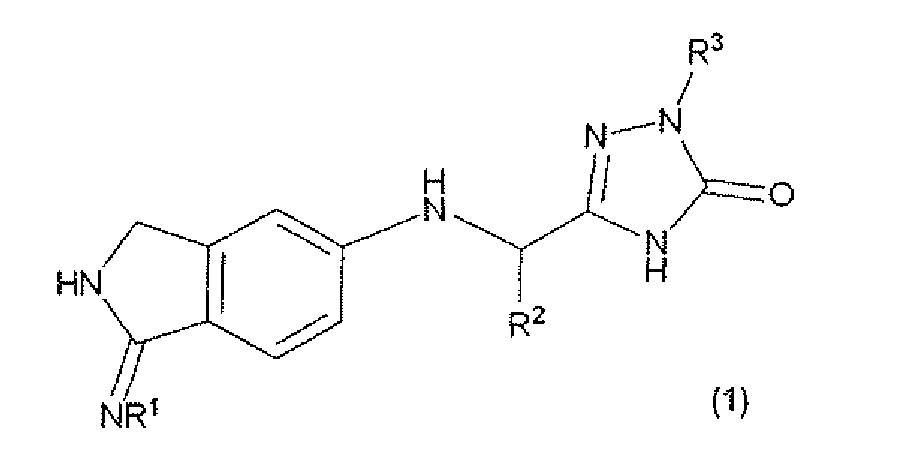
Description
- The present invention relates to novel 2,3-dihydro-iminoisoindole derivatives that are useful as pharmaceuticals, to their pharmacologically acceptable salts, and to therapeutic or prophylactic agents for diseases associated with thrombus formation that contain the foregoing as active ingredients.
- Living organisms with damaged blood vessels avoid hemorrhage death by rapid production of thrombin. However, excess production of thrombin by inflammatory reaction in damaged blood vessels causes thrombosis, which impairs the function of essential organs. Thrombin inhibitors such as heparin and warfarin, which inhibit thrombin production or directly block thrombin activity, have long been used as anticoagulants to treat or prevent thrombosis. Currently, new anticoagulants are being sought that exhibit a more reliable dose-dependent medicament effect, and which are safer and suitable for oral administration.
- The blood clotting mechanism has been classified into two pathways, the "intrinsic clotting pathway" which begins with activation of factor XII (FXII) upon contact with negatively charged substances, and the "extrinsic clotting pathway" which is activated by tissue factor (TF) and factor VII (FVII), and since the pathology of thrombosis onset is associated with specific expression of TF, it has been suggested that extrinsic clotting is of major importance. Compounds that inhibit clotting factor VIIa, which is furthest upstream in the extrinsic clotting pathway of the clotting cascade, are thought to have potential use as therapeutic and/or prophylactic agents for diseases associated with thrombus formation, such as thrombosis, in which the extrinsic clotting mechanism plays a part.
- As compounds that inhibit clotting factor VIIa there are known in the prior art amidinonaphthol derivatives (see Non-patent document 1), amidino derivatives (see Patent document 1), N-sulfonyldipeptide derivatives (see Patent document 2), 6-[[(allyl)oxy]methyl]naphthalene-2-carboxyimidamide derivatives (see Patent document 3) and phenylglycine derivatives (Patent documents 4 and 5).
- However, these known compounds have still been inadequate from the standpoint of inhibiting activity against clotting factor VIIa, blood clotting effects and thrombosis-treating effects.
- Non-patent document 1: Tetrahedron, 55, p.6219, 1999
- Patent document 1:
EP 1078917 - Patent document 2:
WO 00/58346 - Patent document 3:
WO 00/66545 - Patent document 4:
WO 00/35858 - Patent document 5:
WO 00/41531 - It is an object of the present invention, which has been accomplished in light of the aforementioned problems of the prior art, to provide novel 2,3-dihydro-iminoisoindole derivatives having serine protease inhibiting activity, and particularly excellent inhibiting activity against clotting factor VIIa, as well as their pharmacologically acceptable salts, and therapeutic and/or prophylactic agents for diseases associated with thrombus formation, that employ the foregoing.
- As a result of much diligent research in light of the circumstances described above, the present inventors have succeeded in synthesizing novel 2,3-dihydro-iminoisoindole derivatives having a specific chemical structure, and have completed this invention upon discovering that these compounds have excellent inhibiting activity against clotting factor VIIa, and particularly that they are useful as therapeutic and/or prophylactic agents for diseases associated with thrombus formation. In other words, the present invention provides the following [1]-[35].
- [1] A compound represented by general formula (1), or a salt thereof:


R2 represents a C6-10 aryl optionally having 1-5 substituents selected from Group A1 below, a 5- to 10-membered heteroaryl group optionally having 1-5 substituents selected from Group A1 below or a 9- to 12-membered benzene-fused cyclic group optionally having 1-5 substituents selected from Group A1 below; and
R3 represents a 5- or 6-membered non-aromatic heterocyclic group optionally having 1-5 substituents selected from Group A1 below, a C6-10 aryl optionally having 1-5 substituents selected from Group A1 below or a 5- to 10-membered heteroaryl group optionally having 1-5 substituents selected from Group A1 below,
wherein Group A1 consists of hydroxyl, halogen, cyano, nitro, oxo, C1-6 alkyl optionally having 1-3 substituents selected from Group B1 below, C3-8 cycloalkyl optionally having 1-5 substituents selected from Group B1 below, C2-6 alkenyl, C2-6 alkynyl, C1-6 alkoxy optionally having 1-3 substituents selected from Group B1 below, C3-8 cycloalkyloxy optionally having 1-5 substituents selected from Group B1 below, C2-6 alkenyloxy, C2-6 alkynyloxy, C1-6 alkylthio, C1-6 alkylsulfinyl, C1-6 alkylsulfonyl, C1-6 alkylsulfonyloxy, C6-10 aryl optionally having 1-5 substituents selected from Group B1 below, C6-10 aryloxy optionally having 1-5 substituents selected from Group B1 below, 5- to 10-membered heteroaryl group optionally having 1-5 substituents selected from Group B1 below, 5- to 10-membered heteroaryloxy optionally having 1-5 substituents selected from Group B1 below, a 5- or 6-membered non-aromatic heterocyclic group optionally having 1-5 substituents selected from Group B1 below, 5- or 6-membered non-aromatic heterocyclooxy optionally having 1-5 substituents selected from Group B1 below, a group represented by -NR1t-R2t and a group represented by -CO-R3t;
where R1t and R2t each independently represent hydrogen, C1-6 alkyl optionally having 1-3 substituents selected from Group B1 below, C2-6 alkenyl, C2-7 alkylcarbonyl optionally having 1-3 substituents selected from Group B1 below, C2-7 alkoxycarbonyl optionally having 1-3 substituents selected from Group B1 below, C1-6 alkylsulfonyl optionally having 1-3 substituents selected from Group B1 below, carbamoyl, aminosulfonyl, C6-10 aryl optionally having 1-5 substituents selected from Group B1 below or 5- to 10-membered heteroaryl group optionally having 1-5 substituents selected from Group B1 below, and
R3t represents hydroxyl, C1-6 alkyl optionally having 1-3 substituents selected from Group B1 below, C1-6 alkoxy optionally having 1-3 substituents selected from Group B1 below, amino, mono(C1-6 alkyl)amino optionally having 1-3 substituents selected from Group B1 below or di(C1-6 alkyl)amino optionally having 1-3 substituents selected from Group B1 below,
wherein Group B1 consists of hydroxyl, halogen, cyano, oxo, C1-6 alkoxy optionally having halogen, C3-8 cycloalkyl, amino, mono(C1-6 alkyl)amino, di(C1-6 alkyl)amino, carbamoyl, mono(C1-6 alkyl)aminocarbonyl, di(Cl-6 alkyl)aminocarbonyl, C6-10 aryl optionally having 1-5 substituents selected from Group C1 below, and 5- to 10-membered heteroaryl group optionally having 1-5 substituents selected from Group C1 below,
wherein Group C1 consists of halogen, C1-6 alkyl and C1-6 alkoxy. - [2] A compound represented by general formula (1-1), or a salt thereof:

- [3] A compound represented by general formula (1-2), or a salt thereof:

- [4] A compound represented by the following general formula, or a salt thereof:

M1 represents hydrogen or C1-6 alkyl; M2 represents hydrogen or C1-6 alkyl; M3 represents a single bond, -SO2-, -CO- or -CS-;
Q1 represents hydrogen or C1-6 alkyl; Q2 represents morpholino or a group represented by the following formula:
where Q2 optionally has 1-3 substituents selected from Group A1 in [1] above;
K1 represents methylene or carbonyl; K2 represents hydrogen or C1-6 alkyl;
G1 represents a 5- to 10-membered heterocyclic group selected from the following Group G1: Group G1 is the group consisting of furyl, thienyl, pyrolyl, imidazolyl, triazolyl, tetrazolyl, thiazolyl, pyrazolyl, oxazolyl, isooxazolyl, isothiazolyl, furazanyl, thiadiazolyl, oxadiazolyl, pyridyl, pyrazinyl, pyridazinyl, pyrimidinyl, triazinyl, purinyl, pteridinyl, quinolyl, isoquinolyl, naphthylidinyl, quinoxalinyl, cinnolinyl, quinazolinyl, phthaladinyl, imidazopyridyl, imidazothiazolyl, imidazooxazolyl, benzothiazolyl, benzooxazolyl, benzoimidazolyl, indolyl, isoindolyl, indazolyl, pyrrolopyridyl, thienopyridyl, furopyridyl, benzothiadiazolyl, benzooxadiazolyl, pyridopyrimidinyl, benzofuryl, benzothienyl, benzo[1,3]dioxole, thienofuryl, N-oxypyridyl, N-C1-6 alkylpyridinium, 5,6,7,8-tetrahydroquinolyl and 4,5,6,7-tetrahydro-1H-benzo[d]imidazolyl. - [5] A compound or a salt thereof according to any one of [1] to [4] above, wherein R2 is phenyl optionally having 1-4 substituents selected from Group D1 below, pyridyl optionally having 1-3 substituents selected from Group D1 below or a 9- to 12-membered benzene-fused cyclic group optionally having 1-4 substituents selected from Group D1 below,
wherein Group D1 consists of hydroxyl, halogen, C1-6 alkyl optionally having 1-3 substituents selected from Group D2 below, C2-6 alkenyl, C2-6 alkynyl, C1-6 alkoxy optionally having 1-3 substituents selected from Group D2 below, C2-6 alkenyloxy, C1-6 alkylsulfonyloxy, 5- or 6-membered non-aromatic heterocyclooxy optionally having 1-3 substituents selected from Group D2 below and C2-7 alkylcarbonyl,
wherein Group D2 consists of hydroxyl, halogen, cyano, oxo, C1-6 alkoxy optionally having halogen, mono(C1-6 alkyl)amino, di(C1-6 alkyl)amino, mono(C1-6 alkyl)aminocarbonyl and di(C1-6 alkyl)aminocarbonyl. - [6] A compound or a salt thereof according to any one of [1] to [4] above, wherein R2 is phenyl optionally having 1-4 substituents selected from Group D1 below,
wherein Group D1 consists of hydroxyl, halogen, C1-6 alkyl optionally having 1-3 substituents selected from Group D2 below, C2-6 alkenyl, C2-6 alkynyl, C1-6 alkoxy optionally having 1-3 substituents selected from Group D2 below, C2-6 alkenyloxy, C1-6 alkylsulfonyloxy, 5-or 6-membered non-aromatic heterocyclooxy optionally having 1-3 substituents selected from Group D2 below and C2-7 alkylcarbonyl,
wherein Group D2 consists of hydroxyl, halogen, cyano, oxo, C1-6 alkoxy optionally having halogen, mono(C1-6 alkyl)amino, di(C1-6 alkyl)amino, mono(C1-6 alkyl)aminocarbonyl and di(C1-6 alkyl)aminocarbonyl. - [7] A compound or a salt thereof according to any one of [1] to [4] above, wherein R2 is phenyl optionally having 2 or 3 substituents selected from Group D3 below,
wherein Group D3 consists of fluorine, chlorine, methyl optionally having 1 substituent selected from Group D4 below, ethyl optionally having 1 substituent selected from Group D4 below, vinyl, ethynyl, methoxy optionally having 1 or 2 substituents selected from Group D4 below, ethoxy optionally having 1 or 2 substituents selected from Group D4 below, 1-propyloxy optionally having 1 or 2 substituents selected from Group D4 below, 2-propyloxy optionally having 1 or 2 substituents selected from Group D4 below, allyloxy, tetrahydrofuryloxy, tetrahydropyranyloxy and acetyl,
wherein Group D4 consists of hydroxyl, fluorine, cyano, methoxy, methylamino, dimethylamino, methylaminocarbonyl and dimethylaminocarbonyl. - [8] A compound or a salt thereof according to any one of [1] to [4] above, wherein R2 is a group represented by the following formula:

R22 represents hydrogen, hydroxyl, methyl optionally having 1 substituent selected from Group D5 below, ethyl optionally having 1 substituent selected from Group D5 below, methoxy optionally having 1 substituent selected from Group D5 below, ethoxy optionally having 1 or 2 substituents selected from Group D5 below, 1-propyloxy optionally having 1 substituent selected from Group D5 below, 2-propyloxy optionally having 1 substituent selected from Group D5 below, allyloxy, tetrahydrofuryloxy, tetrahydropyranyloxy or acetyl;
R23 represents hydrogen, fluorine, hydroxyl, methoxy optionally having 1 substituent selected from Group D6 below, ethoxy optionally having 1 substituent selected from Group D6 below or 2-propyloxy optionally having 1 substituent selected from Group D6 below; and
R24 represents hydrogen, fluorine, hydroxyl, methyl optionally having 1 substituent selected from Group D7 below, ethyl, vinyl, ethynyl, methoxy optionally having 1 substituent selected from Group D7 below, ethoxy optionally having 1 substituent selected from Group D7 below, 2-propyloxy or allyloxy,
wherein Group D5 consists of hydroxyl, fluorine, cyano, methoxy, dimethylamino, dimethylaminocarbonyl, 2-fluoroethoxy and 2-hydroxyethoxy,
wherein Group D6 consists of fluorine, cyano, methoxy, dimethylamino, methylaminocarbonyl and dimethylaminocarbonyl,
wherein Group D7 consists of hydroxyl, fluorine, cyano and ethoxy having one methoxy group. - [9] A compound or a salt thereof according to [8] above, wherein R21 is hydrogen or fluorine.
- [10] A compound or a salt thereof according to [8] or [9], wherein R22 is hydrogen, hydroxyl, cyanomethyl, methoxymethyl, methoxy, dimethylaminocarbonylmethoxy, ethoxy, 2-fluoroethoxy, 2-hydroxyethoxy, 2-methoxyethoxy, 2-(dimethylamino)ethoxy, tetrahydrofuryloxy, tetrahydropyranyloxy, fluoromethoxy, 3-hydroxypropyloxy, 2-fluoroethoxymethyl or 2-hydroxyethoxymethyl.
- [11] A compound or a salt thereof according to any one of [8] to [10] above, wherein R23 is hydrogen, fluorine, methoxy, cyanomethoxy, ethoxy, 2-propyloxy or 2-methoxyethoxy.
- [12] A compound or a salt thereof according to any one of [8] to [11] above, wherein R24 is hydrogen, hydroxyl, methyl, methoxymethyl, ethyl, vinyl, ethynyl, methoxy, ethoxy or 2-fluoroethoxy.
- [13] A compound or a salt thereof according to any one of [1] to [4] above, wherein R2 is pyridyl optionally having 1-3 substituents selected from Group D1 below,
wherein Group D1 consists of hydroxyl, halogen, C1-6 alkyl optionally having 1-3 substituents selected from Group D2 below, C2-6 alkenyl, C2-6 alkynyl, C1-6 alkoxy optionally having 1-3 substituents selected from Group D2 below, C2-6 alkenyloxy, C1-6 alkylsulfonyloxy, 5- or 6-membered non-aromatic heteracyclooxy optionally having 1-3 substituents selected from Group D2 below and C2-7 alkylcarbonyl,
wherein Group D2 consists of hydroxyl, halogen, cyano, oxo, C1-6 alkoxy optionally having halogen, mono(C1-6 alkyl)amino, di(C1-6 alkyl)amino, mono(C1-6 alkyl)aminocarbonyl and di(C1-6 alkyl)aminocarbonyl. - [14] A compound or a salt thereof according to any one of [1] to [4] above, wherein R2 is pyridyl having two substituents selected from the group consisting of C 1-6 alkyl, and C1-6 alkoxy.
- [15] A compound or a salt thereof according to any one of [1] to [4] above, wherein R2 is pyridyl having two substituents selected from the group consisting of methyl, methoxy and ethoxy.
- [16] A compound or a salt thereof according to any one of [1] to [4] above, wherein R2 is a group represented by the following formula:

- [17] A compound or a salt thereof according to any one of [1] to [4] above, wherein R2 is a 9- to 12-membered benzene-fused cyclic group optionally having 1-4 substituents selected from Group D1 below,
wherein Group D1 consists of hydroxyl, halogen, C1-6 alkyl optionally having 1-3 substituents selected from Group D2 below, C2-6 alkenyl, C2-6 alkynyl, C1-6 alkoxy optionally having 1-3 substituents selected from Group D2 below, C2-6 alkenyloxy, C1-6 alkylsulfonyloxy, 5- or 6-membered non-aromatic heterocyclooxy optionally having 1-3 substituents selected from Group D2 below and C2-7 alkylcarbonyl,
wherein Group D2 consists of hydroxyl, halogen, cyano, oxo, C1-6 alkoxy optionally having halogen, mono(C1-6 alkyl)amino, di(C1-6 alkyl)amino, mono(C1-6 alkyl)aminocarbonyl and di(C1-6 alkyl)aminocarbonyl. - [18] A compound or a salt thereof according to any one of [1] to [4] above, wherein R2 is a group represented by the following formula:


R28 represents hydrogen, hydroxyl, halogen, C1-6 alkyl optionally having 1-3 substituents selected from Group D8 below, C2-6 alkenyl, C2-6 alkynyl, C1-6 alkoxy optionally having 1-3 substituents selected from Group D8 below, or C2-7 alkylcarbonyl;
R29 represents hydrogen, cyano, C1-6 alkyl optionally having 1-3 substituents selected from Group D8 below, C1-6 alkoxy optionally having 1-3 substituents selected from Group D8 below or carbamoyl;
X represents carbon optionally having 1 or 2 substituents selected from Group D8 below, nitrogen optionally having 1 substituent selected from Group D8 below or oxygen;
m represents an integer from 0 to 3 and n represents an integer from 0 to 2, with the proviso that the sum of m and n is 1-4; and
Rings A and B optionally contain one double bond in the ring and optionally have an oxo group on the ring,
wherein Group D8 consists of hydrogen, hydroxyl, halogen, C1-6 alkoxy, mono(C1-6 alkyl)amino, di(C1-6 alkyl)amino, mono(C1-6 alkyl)aminocarbonyl, di(C1-6 alkyl)aminocarbonyl and C1-6 alkyl optionally having halogen. - [19] A compound or a salt thereof according to [18] above, wherein R2 is a group represented by the following formula:


R28 represents hydrogen, hydroxyl, C1-6 alkyl optionally having 1-3 substituents selected from Group D8 below, C2-6 alkenyl, C2-6 alkynyl, C1-6 alkoxy optionally having 1-3 substituents selected from Group D8 below or C2-7 alkylcarbonyl;
R29 represents hydrogen, cyano, C1-6 alkyl optionally having 1-3 substituents selected from Group D8 below, C1-6 alkoxy optionally having 1-3 substituents selected from Group D8 below or aminocarbonyl; and Ring A optionally has an oxo group on the ring,
wherein Group D8 consists of hydrogen, hydroxyl, halogen, C1-6 alkoxy, mono(C1-6 alkyl)amino, di(C1-6 alkyl)amino, mono(C1-6 alkyl)aminocarbonyl, di(C1-6 alkyl)aminocarbonyl and C1-6 alkyl optionally having halogen. - [20] A compound or a salt thereof according to [19] above, wherein R28 is methyl, ethyl, methoxy, ethoxy, vinyl or ethynyl.
- [21] A compound or a salt thereof according to [19] or [20] above, wherein R29 is hydrogen.
- [22] A compound or a salt thereof according to any one of [1] to [21] above, wherein R3 is phenyl optionally having 1-3 substituents selected from Group E1 below, pyridyl optionally having 1-3 substituents selected from Group E1 below, N-oxypyridyl optionally having 1-3 substituents selected from Group E1 below, N-C1-6 alkylpyridinium optionally having 1-3 substituents selected from Group E1 below, pyrazinyl optionally having 1-3 substituents selected from Group E1 below, pyridazinyl optionally having 1-3 substituents selected from Group E1 below, pyrimidinyl optionally having 1-3 substituents selected from Group E1 below, pyrazolyl optionally having 1 or 2 substituents selected from Group E1 below, imidazolyl optionally having 1 or 2 substituents selected from Group E1 below, thiazolyl optionally having 1 or 2 substituents selected from Group E1 below, thienyl optionally having 1-3 substituents selected from Group E1 below, oxazolyl optionally having 1-3 substituents selected from Group E1 below or dihydropyrazinyl having an oxo group, with the proviso that when R3 is N-C1-6 alkylpyridinium, R3 forms an ion pair with an anion in the molecule,
wherein Group E1 consists of hydroxyl, halogen, cyano, C1-6 alkyl, C1-6 alkoxy, a group represented by the formula -NH-R21t and a group represented by the formula -CO-R31t;
where R21t represents hydrogen, C1-6 alkyl, C2-6 alkenyl, C2-7 alkylcarbonyl optionally having 1-3 substituents selected from Group E2 below, C2-7 alkoxycarbonyl optionally having 1-3 substituents selected from Group E2 below, C1-6 alkylsulfonyl, carbamoyl or aminosulfonyl, and
R31t represents hydroxyl, C1-6 alkyl, C1-6 alkoxy, amino, mana(C1-6 alkyl)amino or di(C1-6 alkyl)amino,
wherein Group E2 consists of hydroxyl, C1-6 alkoxy and C3-8 cycloalkyl. - [23] A compound or a salt thereof according to any one of [1] to [21] above, wherein R3 is phenyl optionally having 1 or 2 substituents selected from Group E3 below, pyridyl optionally having 1 or 2 substituents selected from Group E3 below, N-oxypyridyl optionally having 1 or 2 substituents selected from Group E3 below, pyrazinyl optionally having 1 or 2 substituents selected from Group E3 below, pyridazinyl optionally having 1 or 2 substituents selected from Group E3 below, pyrimidinyl optionally having 1 or 2 substituents selected from Group E3 below, pyrazolyl optionally having 1 or 2 substituents selected from Group E3 below, imidazolyl optionally having 1 or 2 substituents selected from Group E3 below, thiazolyl optionally having 1 or 2 substituents selected from Group E3 below, thienyl optionally having 1 or 2 substituents selected from Group E3 below, oxazolyl optionally having 1 or 2 substituents selected from Group E3 below or dihydropyrazinyl having an oxo group,
wherein Group E3 consists of halogen, C1-6 alkyl, C1-6 alkoxy, a group represented by the formula -NH-R22t, nitro and a group represented by the formula -CO-R32t;
where R22t is hydrogen or C2-7 alkoxycarbonyl, and R32t is hydroxyl, C1-6 alkoxy or amino. - [24] A compound or a salt thereof according to any one of [1] to [21] above, wherein R3 is phenyl optionally having one group selected from Group E4 below, pyridyl optionally having one group selected from Group E5 below, N-oxypyridyl, pyrazinyl, pyridazinyl, pyrimidinyl, pyrazolyl optionally having one group selected from Group E4 below, imidazolyl optionally having one group selected from Group E4 below, thiazolyl optionally having one group selected from Group E4 below, thienyl optionally having one group selected from Group E4 below, oxazolyl optionally having one group selected from Group E4 below or dihydropyrazinyl having an oxo group,
wherein Group E4 consists of methoxy, a group represented by the formula -NH-R22t, nitro, carboxyl, carbamoyl, methoxycarbonyl and methoxycarbonylamino,
where R22t is hydrogen or C2-7 alkoxycarbonyl,
wherein Group E5 consists of fluorine, methyl, methoxy and amino. - [25] A medicament comprising a compound or a salt thereof according to any one of [1] to [24].
- [26] A therapeutic and/or prophylactic agent for a disease associated with thrombus formation, which comprises a compound or a salt thereof according to any one of [1] to [24].
- [27] A therapeutic and/or prophylactic agent for a disease selected from Group F1 below, which comprises a compound or a salt thereof according to any one of [1] to [24],
wherein Group F1 consists of thrombosis, deep vein thrombosis, pulmonary embolism, cerebral infarction, myocardial infarction, acute coronary syndrome, vascular restenosis, disseminated intravascular coagulation syndrome and malignant tumor. - [28] A therapeutic and/or prophylactic agent for a disease selected from Group F2 below, which comprises a compound or a salt thereof according to any one of [1] to [24],
wherein Group F2 consists of thrombosis, deep vein thrombosis, pulmonary embolism, cerebral infarction, myocardial infarction, acute coronary syndrome, vascular restenosis and disseminated intravascular coagulation syndrome. - [29] A method for treatment and/or prevention of a disease associated with thrombus formation, which involves administration of a pharmacologically effective dose of a compound or a salt thereof according to any one of [1] to [24].
- [30] A method for treatment and/or prevention of a disease selected from Group F1 below, which involves administration of a pharmacologically effective dose of a compound or a salt thereof according to any one of [1] to [24],
wherein Group F1 consists of thrombosis, deep vein thrombosis, pulmonary embolism, cerebral infarction, myocardial infarction, acute coronary syndrome, vascular restenosis, disseminated intravascular coagulation syndrome and malignant tumor. - [31] A method for treatment and/or prevention of a disease selected from Group F2 below, which involves administration of a pharmacologically effective dose of a compound or a salt thereof according to any one of [1] to [24],
wherein Group F2 consists of thrombosis, deep vein thrombosis, pulmonary embolism, cerebral infarction, myocardial infarction, acute coronary syndrome, vascular restenosis and disseminated intravascular coagulation syndrome. - [32] Use of a compound or a salt thereof according to any one of [1] to [24] for production of a therapeutic and/or prophylactic agent for a disease associated with thrombus formation.
- [33] Use of a compound or a salt thereof according to any one of [1] to [24] for production of a therapeutic and/or prophylactic agent for a disease selected from Group F1 below,
wherein Group F1 consists of thrombosis, deep vein thrombosis, pulmonary embolism, cerebral infarction, myocardial infarction, acute coronary syndrome, vascular restenosis, disseminated intravascular coagulation syndrome and malignant tumor. - [34] Use of a compound or a salt thereof according to any one of [1] to [24] for production of a therapeutic and/or prophylactic agent for a disease selected from Group F2 below,
wherein Group F2 consists of thrombosis, deep vein thrombosis, pulmonary embolism, cerebral infarction, myocardial infarction, acute coronary syndrome, vascular restenosis and disseminated intravascular coagulation syndrome. - [35] A compound represented by the following general formula (1-3), or a salt thereof:

- [36] A compound represented by the following general formula (1-4), or a salt thereof:
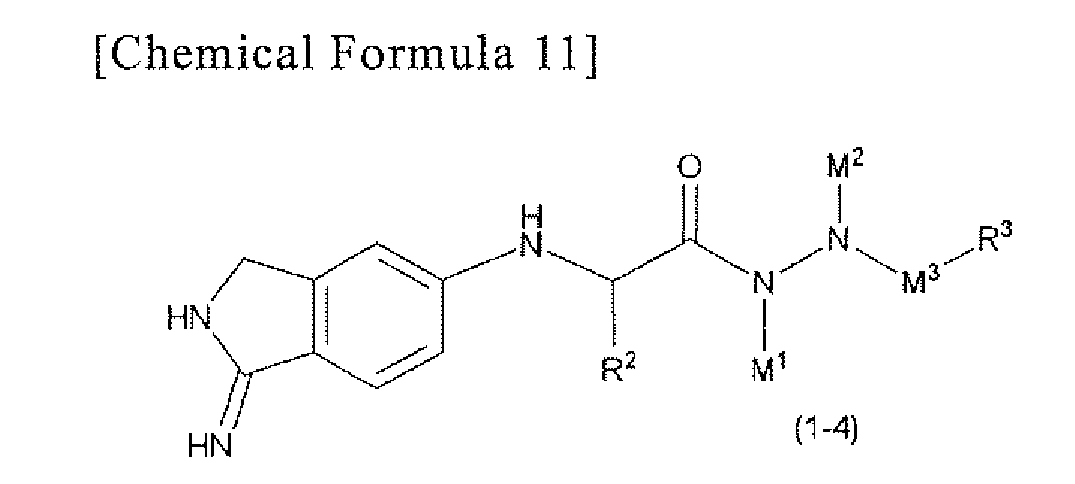
M1 represents hydrogen or C1-6 alkyl;
M2 represents hydrogen or C1-6 alkyl; and
M3 represents a single bond, -SO2-, -CO- or -CS-. - [37] A compound represented by the following general formula (1-5), or a salt thereof:

Q1 represents hydrogen or C1-6 alkyl; and
Q2 represents morpholino or a group represented by the following formula:
where Q2 optionally has 1-3 substituents selected from Group A1 in [1] above. - [38] A compound represented by the following general formula (1-6), or a salt thereof:


- [39] A compound represented by the following general formula (1-8), or a salt thereof:

- The compounds of the invention have excellent inhibiting effects against clotting factor VIIa and excellent anticoagulant effects, and are therefore useful as therapeutic and/or prophylactic agents for diseases associated with thrombus formation (for example, thrombosis, deep vein thrombosis, pulmonary embolism, cerebral infarction, myocardial infarction, acute coronary syndrome, vascular restenosis or disseminated intravascular coagulation syndrome) (Johannes Ruef & Hugo A Katus, New antithrombotic drugs on the horizon, Expert Opin. Investig. Drugs (2003) 12(5):781-797).
- Substances with inhibiting effects against clotting factor VIIa have also been reported to exhibit malignant tumor metastasis suppression and reduction. The compounds of the invention that exhibit excellent inhibition against clotting factor VIIa are therefore useful as therapeutic and/or prophylactic agents for malignant tumors (Mattias Belting et al., Regulation of angiogenesis by tissue factor cytoplasmic domain signaling, Nature Medicine (2004) 10(5):502-509; X Jiang et al., Formation of tissue factor-factor VIIa-factor Xa complex promotes cellular signaling and migration of human breast cancer cells, J Thromb Haemost, (2004) 2:93-101; Hembrough TA. Swartz GM. Papathanassiu A. Vlasuk GP. Rote WE. Green SJ. Pribluda VS., Tissue factor/factor VIIa inhibitors block angiogenesis and tumor growth through a nonhemostatic mechanism. Cancer Research. (2003) 63(11):2997-3000).
- Since the compounds of the invention have excellent suppressing effects against blood clotting, and are safer with suitable physicochemical stability, they are useful as medicaments, and especially as therapeutic and/or prophylactic agents for diseases associated with thrombus formation.
- The present invention will now be explained in detail.
- Throughout the present specification, the structural formulas for the compounds will show only one specific isomer for convenience, but the invention includes all isomers such as geometric isomers, optical isomers, stereoisomers and tautomers implied by the compound structures, as well as their isomer mixtures, and the compounds may therefore be any of the isomers or their mixtures, without being limited to the formulas shown for convenience. Therefore, the compounds of the invention may exist as optically active forms or racemic mixtures, all of which are included without limitations according to the invention. Polymorphic crystals may also exist, and there may be used any crystal form or a mixture thereof without any restrictions, while the compounds of the invention include both anhydrous and hydrated forms.
- Throughout the present specification, the structural formulas for compounds will represent only one isomer for convenience, but the invention includes all isomers including geometric isomers, stereoisomers and tautomers, as well as isomer mixtures, implied by the compound structure, being not limited to the formula shown for convenience, and may relate to any one of the isomers or a mixture thereof. Polymorphic crystals may also exist, and there may be used any crystal form or a mixture thereof without any restrictions, while the compounds of the invention include both anhydrous and hydrated forms.
- As tautomers of the compounds represented by general formula (1) there may be mentioned compounds represented by the following general formulas (1p), (1q), (1r), (1s) and (1t).
-


-


-

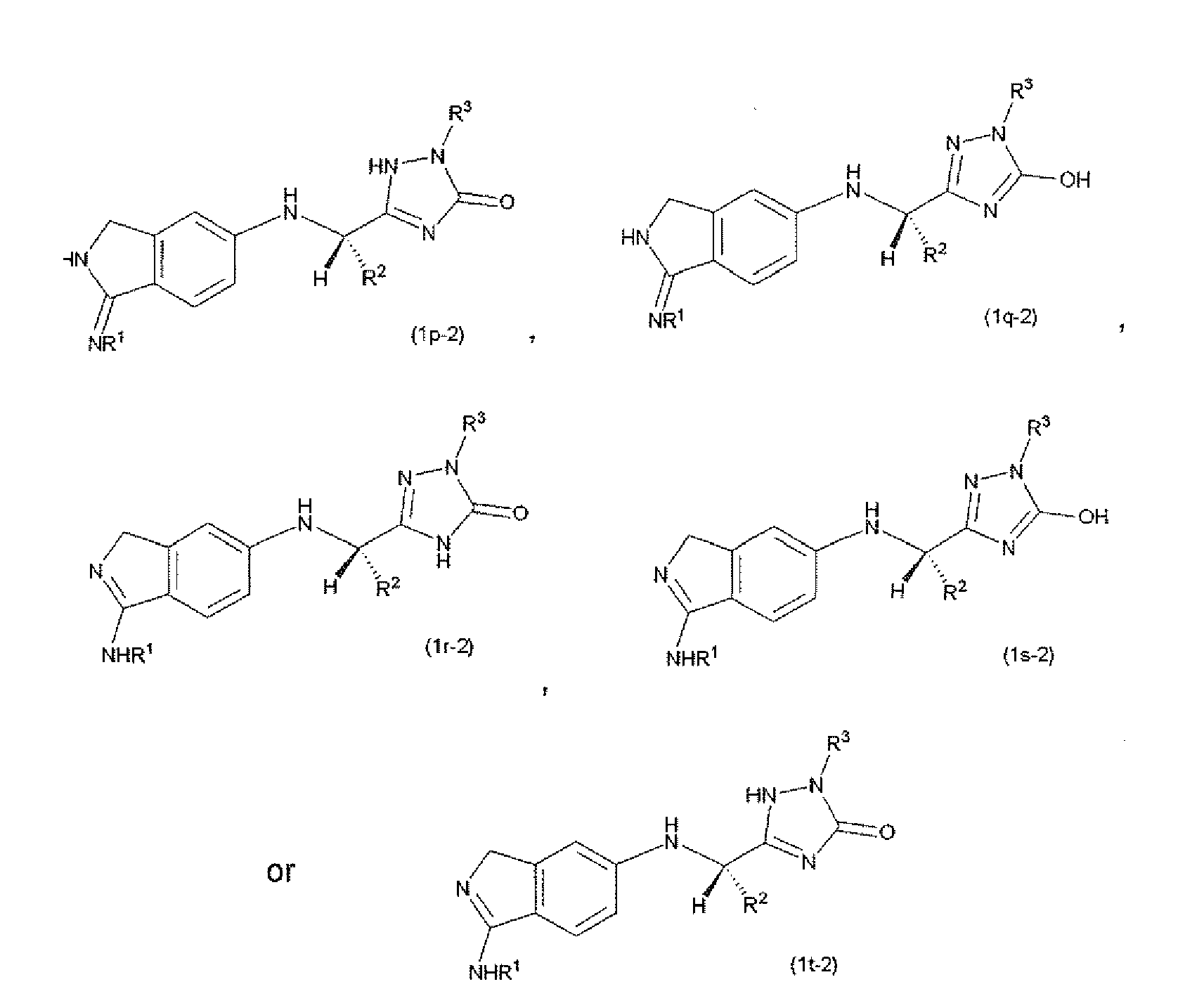
- The definitions of the terms and symbols used throughout the present specification will now be explained, prior to a more detailed description of the invention.
- The term "disease associated with thrombus formation" is not particularly restricted so long as it is a disease with onset directly or indirectly caused by thrombus formation, and as specific examples there may be mentioned thrombosis, deep vein thrombosis, pulmonary embolism, cerebral infarction, myocardial infarction, acute coronary syndrome, vascular restenosis, disseminated intravascular coagulation syndrome and malignant tumor, and preferably thrombosis, deep vein thrombosis, pulmonary embolism, cerebral infarction, myocardial infarction, acute coronary syndrome, vascular restenosis and disseminated intravascular coagulation syndrome.
- The term "halogen" refers to fluorine, chlorine, bromine and iodine. As preferred examples of "halogen" there may be mentioned fluorine and chlorine.
- The term "C1-6 alkyl" refers to C1-6 straight-chain or branched alkyl groups, and as specific examples there may be mentioned methyl, ethyl, 1-propel (n-propyl), 2-propyl (i-propyl), 2-methyl-1-propyl (i-butyl), 2-methyl-2-propyl (t-butyl), 1-butyl (n-butyl), 2-butyl (s-butyl), 1-pentyl, 2-pentyl, 3-pentyl, 2-methyl-1-butyl, 3-methyl-1-butyl, 2-methyl-2-butyl, 3-methyl-2-butyl, 2,2-dimethyl-1-propyl, 1-hexyl, 2-hexyl, 3-hexyl, 2-methyl-1-pentyl, 3-methyl-1-pentyl, 4-methyl-1-pentyl, 2-methyl-2-pentyl, 3-methyl-2-pentyl, 4-methyl-2-pentyl, 2-methyl-3-pentyl, 3-methyl-3-pentyl, 2,3-dimethyl-1-butyl, 3,3-dimethyl-1-butyl, 2,2-dimethyl-1-butyl, 2-ethyl-1-butyl, 3,3-dimethyl-2-butyl and 2,3-dimethyl-2-butyl.
- The term "C2-6 alkenyl" refers to C2-6 straight-chain or branched alkenyl groups with one double bond, and as specific examples there may be mentioned vinyl (ethenyl), allyl (2-propenyl), 1-propenyl, isopropenyl (1-methylvinyl), 1-butenyl, 2-butenyl, 3-butenyl, pentenyl and hexenyl.
- The term "C2-6 alkynyl" refers to a C2-6 straight-chain or branched alkynyl group with one triple bond, and as specific examples there may be mentioned ethynyl, 1-propynyl, 2-propynyl, butynyl, pentynyl and hexynyl.
- The term "C3-8 cycloalkyl" refers to a C3-8 monocyclic saturated aliphatic hydrocarbon, and as specific examples there may be mentioned cyclopropyl, cyclobutyl, cyclopentyl, cyclohexyl, cycloheptyl and cyclooctyl.
- The term "C6-10 aryl" refers to a C6-10 aromatic hydrocarbon ring group, and as specific examples there may be mentioned phenyl and naphthyl.
- The term "5- to 10-membered heteroaryl group" refers to an aromatic ring group having 5-10 atoms composing the ring and containing 1-5 heteroatoms among the atoms composing the ring, and as specific examples there may be mentioned furyl, thienyl, pyrolyl, imidazolyl, triazolyl, tetrazolyl, thiazolyl, pyrazolyl, oxazolyl, isooxazolyl, isothiazolyl, furazanyl, thiadiazolyl, oxadiazolyl, pyridyl, pyrazinyl, pyridazinyl, pyrimidinyl, triazinyl, purinyl, pteridinyl, quinolyl, isoquinolyl, naphthylidinyl, quinoxalinyl, cinnolinyl, quinazolinyl, phthaladinyl, imidazopyridyl, imidazothiazolyl, imidazooxazolyl, benzothiazolyl, benzooxazolyl, benzoimidazolyl, indolyl, isoindolyl, indazolyl, pyrrolopyridyl, thienopyridyl, furopyridyl, benzothiadiazolyl, benzooxadiazolyl, pyridopyrimidinyl, benzofuryl, benzothienyl, benzo[1,3]dioxole, thienofuryl, N-oxypyridyl and N-C1-6 alkylpyridinium.
- The term "5- or 6-membered non-aromatic heterocyclic group" refers to (1) a non-aromatic cyclic group (2) having 5 or 6 atoms composing the ring, (3) containing 1 or 2 heteroatoms among the atoms composing the ring, (4) optionally having 1 or 2 double bonds in the ring and (5) optionally having 1 or 2 oxo groups (carbonyl groups) on the ring, and as specific examples there may be mentioned pyrrolidinyl, piperidinyl, morpholinyl, thiomorpholinyl, tetrahydrofuryl, tetrahydropyranyl, pyridonyl and dihydropyrazinyl.
- The term "5- to 8-membered heterocycle" refers to a ring (1) having 5-8 atoms composing the ring, (2) containing 1-2 heteroatoms among the atoms composing the ring, (3) optionally having 1-2 double bonds in the ring and (4) optionally having 1-2 oxo groups (carbonyl groups) on the ring, and as specific examples there may be mentioned pyrrolidine, piperidine, azepane, azocane, piperazine, diazepane, diazocane, morpholine, thiomorpholine, tetrahydrofuran, tetrahydropyran, oxepane, dioxane, dioxepane, dihydrofuran, tetrahydrothiophene, tetrahydrothiopyran, oxazolidine, thiazolidine, pyridone and dihydropyrazine rings.
- The term "9- to 12-membered benzene-fused cyclic group" refers to a cyclic group having a "5- to 8-membered heterocycle" as defined above fused with a phenyl group, and as specific preferred examples there may be mentioned a group represented by the following formula:


- The term "C1-6 alkoxy" refers to an oxy group bonded to "C1-6 alkyl" as defined above, and as specific examples there may be mentioned methoxy, ethoxy, 1-propyloxy, 2-propyloxy, 2-methyl-1-propyloxy, 2-methyl-2-propyloxy, 1-butyloxy, 2-butyloxy, 1-pentyloxy, 2-pentyloxy, 3-pentyloxy, 2-methyl-1-butyloxy, 3-methyl-1-butyloxy, 2-metbyl-2-butyloxy, 3-methyl-2-butyloxy, 2,2-dimethyl-1-propyloxy, 1-hexyloxy, 2-hexyloxy, 3-hexyloxy, 2-methyl-1-pentyloxy, 3-methyl-1-pentyloxy, 4-methyl-1-pentyloxy, 2-methyl-2-pentyloxy, 3-methyl-2-pentyloxy, 4-methyl-2-pentyloxy, 2-methyl-3-pentyloxy, 3-methyl-3-pentyloxy, 2,3-dimethyl-1-butyloxy, 3,3-dimethyl-1-butyloxy, 2,2-dimethyl-1-butyloxy, 2-ethyl-1-butyloxy, 3,3-dimethyl-2-butyloxy and 2,3-dimethyl-2-butyloxy.
- The term "C3-8 cycloalkyloxy" refers to an oxy group bonded to "C3-8 cycloalkyl" as defined above, and as specific examples there may be mentioned cyclopropyloxy, cyclobutyloxy, cyclopentyloxy, cyclohexyloxy, cycloheptyloxy and cyclooctyloxy.
- The term "C2-6 alkenyloxy" refers to an oxy group bonded to "C2-6 alkenyl" as defined above, and as specific examples there may be mentioned vinyloxy (ethenyloxy), allyloxy (2-propenyloxy), 1-propenyloxy, isopropenyloxy (1-methylvinyloxy), 1-butenyloxy, 2-butenyloxy, 3-butenyloxy, pentenyloxy and hexenyloxy.
- The term "C2-6 alkynyloxy" refers to an oxy group bonded to "C2-6 alkynyl" as defined above, and as specific examples there may be mentioned ethynyloxy, 1-propynyloxy, 2-propynyloxy, butynyloxy, pentynyloxy and hexynyloxy.
- The term "C1-6 alkylthio" refers to a thio group bonded to "C1-6 alkyl" as defined above, and as specific examples there may be mentioned methylthio, ethylthio, 1-propylthio, 2-propylthio, butylthio and pentylthio.
- The term "C1-6 alkylsulfinyl" refers to a sulfinyl group bonded to "C1-6 alkyl" as defined above, and as specific examples there may be mentioned methylsulfinyl, ethylsulfinyl, 1-propylsulfinyl, 2-propylsulfinyl, butylsulfinyl and pentylsulfinyl.
- The term "C1-6 alkylsulfonyl, refers to a sulfonyl group bonded to "C1-6 alkyl" as defined above, and as specific examples there may be mentioned methylsulfonyl, ethylsulfonyl, 1-propylsulfonyl, 2-propylsulfonyl, butylsulfonyl and pentylsulfonyl.
- The term "C2-7 alkylcarbonyl" refers to a carbonyl group bonded to "C1-6 alkyl" as defined above, and as specific examples there may be mentioned acetyl, propionyl, isopropionyl, butyryl, isobutyryl, valeryl, isovaleryl and pivaloyl.
- The term "C2-7 alkoxycarbonyl" refers to a carbonyl group bonded to "C1-6 alkoxy" as defined above, and as specific examples there may be mentioned methoxycarbonyl, ethoxycarbonyl, 1-propyloxycarbonyl and 2-propyloxycarbonyl.
- The term "C6-10 aryloxy" refers to an oxy group bonded to "C6-10 aryl" as defined above, and as specific examples there may be mentioned phenyloxy, 1-naphthyloxy and 2-naphthyloxy.
- The term "5- to 10-membered heteroaryloxy" refers to an oxy group bonded to "5- to 10-membered heteroaryl group" as defined above, and as specific examples there may be mentioned furyloxy, thienyloxy, pyrrolyloxy, imidazolyloxy, pyridyloxy and pyrazinyloxy.
- The term "5- or 6-membered non-aromatic heterocyclooxy" refers to a group consisting of an oxy group bonded to a "5- or 6-membered non-aromatic heterocyclic group" as defined above, and as specific examples there may be mentioned pyrrolidinyloxy, piperidinyloxy, morpholinyloxy, thiomorpholinyloxy, tetrahydrofuryloxy and tetrahydropyranyloxy.
- The term "C1-6 alkylsulfonyloxy" refers to an oxy group bonded to "C1-6 alkylsulfonyl" as defined above, and as specific examples there may be mentioned methylsulfonyloxy, ethylsulfonyloxy, 1-propylsulfonyloxy, 2-propylsulfonyloxy, butylsulfonyloxy and pentylsulfonyloxy.
- The term "C6-10 arylmethyl" refers to a methyl group bonded to "C6-10 aryl" as defined above, and as specific examples there may be mentioned benzyl, 1-naphthylmethyl and 2-naphthylmethyl.
- The term "C6-10 arylamino" refers to an amino group bonded to "C6-10 aryl" as defined above, and as specific examples there may be mentioned phenylamino, 1-naphthylamino and 2-naphthylamino.
- The term "mono(C1-6 alkyl)amino" refers to an amino group bonded to one "C1-6 alkyl" group as defined above, and as specific examples there may be mentioned methylamino and ethylamino.
- The term "di(C1-6 alkyl)amino" refers to an amino group bonded to two "C1-6 alkyl" groups as defined above, and as specific examples there may be mentioned dimethylamino and methylethylamino.
- The term "mono(C1-6 alkyl)aminocarbonyl" refers to a carbonyl group bonded to "mono(C1-6 alkyl)amino" as defined above, and as specific examples there may be mentioned methylaminocarbonyl and ethylaminocarbonyl.
- The term "di(C1-6 alkyl)aminocarbonyl" refers to a carbonyl group bonded to "di(C1-6 alkyl)amino" as defined above, and as specific examples there may be mentioned dimethylaminocarbonyl and methylethylaminocarbonyl.
- The term "pyridyl" refers to a monovalent group derived by removing one hydrogen from any position of a pyridine ring, and specifically there may be mentioned 2-pyridyl, 3-pyridyl and 4-pyridyl.
- The term "N-oxypyridyl" refers to "pyridyl" wherein the nitrogen atom of the ring has been oxidized, and specifically there may be mentioned N-oxy-2-pyridyl, N-oxy-3-pyridyl and N-oxy-4-pyridyl.
- The term "N-C1-6 alkylpyridinium" refers to a cyclic group wherein "C1-6 alkyl" is bonded to the nitrogen atom on a "pyridyl" ring, and specifically there may be mentioned N-methyl-2-pyridinium, N-methyl-3-pyridinium and N-methyl-4-pyridinium. An "N-C1-6 alkylpyridinium" group forms an ion pair with an anion in the molecule, and as examples of such anions there may be mentioned acetate ion and trifluoroacetate ion.
- The term "pyrazinyl" refers to a monovalent group derived by removing one hydrogen from any position of a pyrazine ring.
- The term "pyridazinyl" refers to a monovalent group derived by removing one hydrogen from any position of a pyridazine ring, and specifically there may be mentioned 2-pyridazinyl and 3-pyridazinyl.
- The term "pyrimidinyl" refers to a monovalent group derived by removing one hydrogen from any position of a pyrimidine ring, and specifically there may be mentioned 2-pyrimidinyl, 4-pyrimidinyl and 5-pyrimidinyl.
- The term "pyrazolyl" refers to a monovalent group derived by removing one hydrogen from any position of a pyrazole ring, and specifically there may be mentioned 3-pyrazolyl, 4-pyrazolyl and 5-pyrazolyl.
- The term "imidazolyl" refers to a monovalent group derived by removing one hydrogen from any position of an imidazole ring, and specifically there may be mentioned 2-imidazolyl, 4-imidazolyl and 5-imidazolyl.
- The term "thiazolyl" refers to a monovalent group derived by removing one hydrogen from any position of a thiazole ring, and specifically there may be mentioned 2-thiazolyl, 4-thiazolyl and 5-thiazolyl.
- The term "oxazolyl" refers to a monovalent group derived by removing one hydrogen from any position of an oxazole ring, and specifically there may be mentioned 2-oxazolyl, 4-oxazolyl and 5-oxazolyl.
- The term "thienyl" refers to a monovalent group derived by removing one hydrogen from any position of a thiophene ring, and specifically there may be mentioned 2-thienyl and 3-thienyl.
- The term "pyridonyl" refers to a monovalent group derived by removing one hydrogen from any position of a pyridone ring, and specifically there may be mentioned a group represented by the following formula.

- The term "dihydropyrazinyl having an oxo group" refers to a monovalent group having one oxo group (carbonyl group) on a dihydropyrazine ring and derived by removing one hydrogen from any position of a dihydropyrazine ring, and specifically there may be mentioned a group represented by the following formula.


- The term "tetrahydrofuryloxy" refers to an oxy group bonded to "a monovalent group derived by removing one hydrogen from any position of a tetrahydrofuran ring", and specifically there may be mentioned 2-tetrahydrofuryloxy and 3-tetrahydrofuryloxy.
- The term "tetrahydropyranyloxy" refers to an oxy group bonded to "a monovalent group derived by removing one hydrogen from any position of a tetrahydropyran ring", and specifically there may be mentioned 2-tetrahydropyranyloxy, 3-tetrahydropyranyloxy and 4-tetrahydropyranyloxy.
- The term "optionally having substituents" means that the compound may have one or more substituents in any desired combination at substitutable positions.
- A "salt" as referred to throughout the present specification is not particularly restricted so long as it is formed with the compound of the invention and is pharmacologically acceptable, and as examples there may be mentioned inorganic acid salts, organic acid salts, inorganic base salts, organic base salts and acidic or basic amino acid salts.
- As preferred examples of inorganic acid salts there may be mentioned hydrochloric acid salts, hydrobromic acid salts, sulfuric acid salts, nitric acid salts, phosphoric acid salts and the like, and as preferred examples of organic acid salts there may be mentioned acetic acid salts, succinic acid salts, fumaric acid salts, maleic acid salts, tartaric acid salts, citric acid salts, lactic acid salts, stearic acid salts, benzoic acid salts, methanesulfonic acid salts, ethanesulfonic acid salts, p-toluenesulfonic acid salts, benzenesulfonic acid salts and the like.
- As preferred examples of inorganic base salts there may be mentioned alkali metal salts such as sodium salts and potassium salts, alkaline earth metal salts such as calcium salts and magnesium salts, and aluminum salts, ammonium salts and the like, and as preferred examples of organic base salts there may be mentioned diethylamine salts, diethanolamine salts, meglumine salts, N,N'-dibenzylethylenediamine salts and the like.
- As preferred examples of acidic amino acid salts there may be mentioned aspartic acid salts and glutamic acid salts, and as preferred examples of basic amino acid salts there may be mentioned arginine salts, lysine salts and ornithine salts.
- The substituents for compounds of the invention represented by general formulas (1), (1-1), (1-2), (1-3), (1-4), (1-5), (1-6) and (1-7) above will now be explained.
- R1 represents hydrogen.
- R2 represents C6-10 aryl optionally having 1-5 substituents selected from Group A1 below, a 5- to 10-membered heteroaryl group optionally having 1-5 substituents selected from Group A1 below or a 9- to 12-membered benzene-fused cyclic group optionally having 1-5 substituents selected from Group A1 below.
As preferred examples of R2 there may be mentioned phenyl optionally having 1-4 substituents selected from Group D1 below, pyridyl optionally having 1-3 substituents selected from Group D1 below or a 9- to 12-membered benzene-fused cyclic group optionally having 1-4 substituents selected from Group D1 below. - As preferred examples where R2 is optionally substituted phenyl, there may be mentioned phenyl optionally having 2 or 3 substituents selected from Group D3 below.
As preferred examples where R2 is optionally substituted phenyl there may be mentioned a group represented by the following formula:
R23 represents hydrogen, fluorine, hydroxyl, methoxy optionally having 1 substituent selected from Group D6 below, ethoxy optionally having 1 substituent selected from Group D6 below or 2-propyloxy optionally having 1 substituent selected from Group D6 below; and
R24 represents hydrogen, fluorine, hydroxyl, methyl optionally having 1 substituent selected from Group D7 below, ethyl, vinyl, ethynyl, methoxy optionally having 1 substituent selected from Group D7 below, ethoxy optionally having 1 substituent selected from Group D7 below, 2-propyloxy or allyloxy.
As preferred examples of R21 there may be mentioned hydrogen and fluorine, as preferred examples of R22 there may be mentioned hydrogen, hydroxyl, cyanomethyl, methoxymethyl, methoxy, dimethylaminocarbonylmethoxy, ethoxy, 2-fluoroethoxy, 2-hydroxyethoxy, 2-methoxyethoxy, 2-(dimethylamino)ethoxy, tetrahydrofuryloxy, tetrahydropyranyloxy, fluoromethoxy, 3-hydroxypropyloxy, 2-fluoroethoxymethyl and 2-hydroxyethoxymethyl, as preferred examples of R23 there may be mentioned hydrogen, fluorine, methoxy, cyanomethoxy, ethoxy, 2-propyloxy and 2-methoxyethoxy, and as preferred examples of R24 there may be mentioned hydrogen, hydroxyl, methyl, methoxymethyl, ethyl, vinyl, ethynyl, methoxy, ethoxy and 2-fluoroethoxy.
As preferred examples where R2 is optionally substituted phenyl there may be mentioned a group represented by the following formula.

- As preferred examples where R2 is optionally substituted pyridyl there may be mentioned pyridyl having two substituents selected from the group consisting of C1-6 alkyl and C1-6 alkoxy, more preferably pyridyl having two substituents selected from the group consisting of methyl, methoxy and ethoxy, and even more preferably a group represented by the following formula:

As preferred examples where R2 is optionally substituted pyridyl there may be mentioned a group represented by the following formula.
- As preferred examples where R2 is an optionally substituted 9- to 12-membered benzene-fused cyclic group, there may be mentioned a group represented by the following formula:

R28 represents hydrogen, hydroxyl, halogen, C1-6 alkyl optionally having 1-3 substituents selected from Group D8 below, C2-6 alkenyl, C2-6 alkynyl, C1-6 alkoxy optionally having 1-3 substituents selected from Group D8 below, or C2-7 alkylcarbonyl;
R29 represents hydrogen, cyano, C1-6 alkyl optionally having 1-3 substituents selected from Group D8 below, C1-6 alkoxy optionally having 1-3 substituents selected from Group D8 below or carbamoyl;
X represents carbon optionally having 1 or 2 substituents selected from Group D8 below, nitrogen optionally having 1 substituent selected from Group D8 below or oxygen;
m represents an integer from 0 to 3 and n represents an integer from 0 to 2, with the proviso that the sum of m and n is 1-4; and
Rings A and B optionally contain one double bond in the ring and optionally have an oxo group on the ring,
and as more preferred examples there may be mentioned a group represented by the following formula:
As preferred examples of R28 there may be mentioned methyl, ethyl, methoxy, ethoxy, vinyl and ethynyl, and as a preferred example of R29 there may be mentioned hydrogen.
As preferred examples where R2 is an optionally substituted 9- to 12-membered benzene-fused cyclic group there may be mentioned a group represented by the following formula.
- R3 represents a 5- or 6-membered non-aromatic heterocyclic group optionally having 1-5 substituents selected from Group A1 below, a C6-10 aryl optionally having 1-5 substituents selected from Group A1 below or a 5- to 10-membered heteroaryl group optionally having 1-5 substituents selected from Group A1 below.
As preferred examples of R3 there may be mentioned phenyl optionally having 1-3 substituents selected from Group E1 below, pyridyl optionally having 1-3 substituents selected from Group E1 below, N-oxypyridyl optionally having 1-3 substituents selected from Group E1 below, N-C1-6 alkylpyridinium optionally having 1-3 substituents selected from Group E1 below, pyrazinyl optionally having 1-3 substituents selected from Group E1 below, pyridazinyl optionally having 1-3 substituents selected from Group E1 below, pyrimidinyl optionally having 1-3 substituents selected from Group E1 below, pyrazolyl optionally having 1 or 2 substituents selected from Group E1 below, imidazolyl optionally having 1 or 2 substituents selected from Group E1 below, thiazolyl optionally having 1 or 2 substituents selected from Group E1 below, thienyl optionally having 1-3 substituents selected from Group E1 below, and dihydropyrazinyl having an oxo group, with the proviso that when R3 is N-C1-6 alkylpyridinium, R3 forms an ion pair with an anion in the molecule.
As more preferred examples of R3 there may be mentioned phenyl optionally having 1 or 2 substituents selected from Group E3 below, pyridyl optionally having 1 or 2 substituents selected from Group E3 below, N-oxypyridyl optionally having 1 or 2 substituents selected from Group E3 below, pyrazinyl optionally having 1 or 2 substituents selected from Group E3 below, pyridazinyl optionally having 1 or 2 substituents selected from Group E3 below, pyrimidinyl optionally having 1 or 2 substituents selected from Group E3 below, pyrazolyl optionally having 1 or 2 substituents selected from Group E3 below, imidazolyl optionally having 1 or 2 substituents selected from Group E3 below, thiazolyl optionally having 1 or 2 substituents selected from Group E3 below, thienyl optionally having 1 or 2 substituents selected from Group E3 below, oxazolyl optionally having 1 or 2 substituents selected from Group E3 below and dihydropyrazinyl having an oxo group.
As even more preferred examples of R3 there may be mentioned phenyl optionally having one group selected from Group E4 below, pyridyl optionally having one group selected from Group E5 below, N-oxypyridyl, pyrazinyl, pyridazinyl, pyrimidinyl, pyrazolyl optionally having one group selected from Group E4 below, imidazolyl optionally having one group selected from Group E4 below, thiazolyl optionally having one group selected from Group E4 below, thienyl optionally having one group selected from Group E4 below, oxazolyl optionally having one group selected from Group E4 below or dihydropyrazinyl having an oxo group.
As specific preferred examples of R3 there may be mentioned a group represented by the following formula:

- Group A1: Hydroxyl, halogen, cyano, nitro, oxo, C1-6 alkyl optionally having 1-3 substituents selected from Group B1 below, C3-8 cycloalkyl optionally having 1-5 substituents selected from Group B1 below, C2-6 alkenyl, C2-6 alkynyl, C1-6 alkoxy optionally having 1-3 substituents selected from Group B1 below, C3-8 cycloalkyloxy optionally having 1-5 substituents selected from Group B1 below, C2-6 alkenyloxy, C2-6 alkynyloxy, C1-6 alkylthio, C1-6 alkylsulfinyl, C1-6 alkylsulfonyl, C1-6 alkylsulfonyloxy, C6-10 aryl optionally having 1-5 substituents selected from Group B1 below, C6-10 aryloxy optionally having 1-5 substituents selected from Group B1 below, 5- to 10-membered heteroaryl group optionally having 1-5 substituents selected from Group B1 below, 5-to 10-membered heteroaryloxy optionally having 1-5 substituents selected from Group B1 below, a 5 or 6-membered non-aromatic heterocyclic group optionally having 1-5 substituents selected from Group B1 below, 5- or 6-membered non-aromatic heterocyclooxy optionally having 1-5 substituents selected from Group B1 below, a group represented by -NR1t-R2t and a group represented by -CO-R3t,
where R1t and R2t each independently represent hydrogen, C1-6 alkyl optionally having 1-3 substituents selected from Group B1 below, C2-6 alkenyl, C2-7 alkylcarbonyl optionally having 1-3 substituents selected from Group B1 below, C2-7 alkoxycarbonyl optionally having 1-3 substituents selected from Group B1 below, C1-6 alkylsulfonyl optionally having 1-3 substituents selected from Group B1 below, carbamoyl, aminosulfonyl, C6-10 aryl optionally having 1-5 substituents selected from Group B1 below or 5- to 10-membered heteroaryl group optionally having 1-5 substituents selected from Group B1 below, and
R3t represents hydroxyl, C1-6 alkyl optionally having 1-3 substituents selected from Group B1 below, C1-6 alkoxy optionally having 1-3 substituents selected from Group B1 below, amino, mono(C1-6 alkyl)amino optionally having 1-3 substituents selected from Group B1 below or di(C1-6 alkyl)amino optionally having 1-3 substituents selected from Group B1 below. - Group B1: Hydroxyl, halogen, cyano, oxo, C1-6 alkoxy optionally having halogen, C3-8 cycloalkyl, amino, mono(C1-6 alkyl)amino, di(C1-6 alkyl)amino, carbamoyl, mono(C1-6 alkyl)aminocarbonyl, di(C1-6 alkyl)aminocarbonyl, C6-10 aryl optionally having 1-5 substituents selected from Group C1 below, and 5- to 10-membered heteroaryl group optionally having 1-5 substituents selected from Group C1 below.
- Group C1: Halogen, C1-6 alkyl and C1-6 alkoxy.
- Group D1: Hydroxyl, halogen, C1-6 alkyl optionally having 1-3 substituents selected from Group D2 below, C2-6 alkenyl, C2-6 alkynyl, C1-6 alkoxy optionally having 1-3 substituents selected from Group D2 below, C2-6 alkenyloxy, C1-6 alkylsulfonyloxy, 5- or 6-membered non-aromatic heterocyclooxy optionally having 1-3 substituents selected from Group D2 below and C2-7 alkylcarbonyl.
- Group D2: Hydroxyl, halogen, cyano, oxo, C1-6 alkoxy optionally having halogen, mono(C1-6 alkyl)amino, di(C1-6 alkyl)amino, mono(C1-6 alkyl)aminocarbonyl and di(C1-6 alkyl)aminocarbonyl.
- Group D3: Fluorine, chlorine, methyl optionally having 1 substituent selected from Group D4 below, ethyl optionally having 1 substituent selected from Group D4 below, vinyl, ethynyl, methoxy optionally having 1 or 2 substituents selected from Group D4 below, ethoxy optionally having 1 or 2 substituents selected from Group D4 below, 1-propyloxy optionally having 1 or 2 substituents selected from Group D4 below, 2-propyloxy optionally having 1 or 2 substituents selected from Group D4 below, allyloxy, tetrahydrofuryloxy, tetrahydropyranyloxy and acetyl.
- Group D4: Hydroxyl, fluorine, cyano, methoxy, methylamino, dimethylamino, methylaminocarbonyl and dimethylaminocarbonyl.
- Group D5: Hydroxyl, fluorine, cyano, methoxy, dimethylamino, dimethylaminocarbonyl, 2-fluoroethoxy and 2-hydroxyethoxy.
- Group D6: Fluorine, cyano, methoxy, dimethylamino, methylaminocarbonyl and dimethylaminocarbonyl.
- Group D7: Hydroxyl, fluorine, cyano and ethoxy having one methoxy group.
- Group D8: Hydrogen, hydroxyl, halogen, C1-6 alkoxy, mono(C1-6 alkyl)amino, di(C1-6 alkyl)amino, mono(C1-6 alkyl)aminocarbonyl, di(C1-6 alkyl)aminocarbonyl and C1-6 alkyl optionally having halogen.
- Group E1: Hydroxyl, halogen, cyano, C1-6 alkyl, C1-6 alkoxy, a group represented by the formula -NH-R21t and a group represented by the formula -CO-R31t,
where R21t represents hydrogen, C1-6 alkyl, C2-6 alkenyl, C2-7 alkylcarbonyl optionally having 1-3 substituents selected from Group E2 below, C2-7 alkoxycarbonyl optionally having 1-3 substituents selected from Group E2 below, C1-6 alkylsulfonyl, carbamoyl or aminosulfonyl, and
R31t represents hydroxyl, C1-6 alkyl, C1-6 alkoxy, amino, mono(C1-6 alkyl)amino or di(C1-6 alkyl)amino. - Group E2: Hydroxyl, C1-6 alkoxy and C3-8 cycloalkyl.
- Group E3: Halogen, C1-6 alkyl, C1-6 alkoxy, a group represented by the formula -NH-R22t, nitro and a group represented by the formula -CO-R32t, where R22t is hydrogen or C2-7 alkoxycarbonyl, and R32t is hydroxyl, C1-6 alkoxy or amino.
- Group E4: Methoxy, a group represented by the formula -NH-R22t, nitro, carboxyl, carbamoyl, methoxycarbonyl and methoxycarbonylamino.
where R22t is hydrogen or C2-7 alkoxycarbonyl. - Group E5: Fluorine, methyl, methoxy and amino.
- [General production processes for compounds of the invention]
The compounds of the invention may be produced by the processes described below. However, the processes for production of the compounds of the invention are not restricted to these alone.
These processes will now be explained. - [Production Process A] Production process for invention compound intermediate (14a)
-


- This is a step of reacting compound (1a), compound (2a) and a cyanating agent such as trimethylsilyl cyanide or hydrogen cyanide (3a) in a solvent, in the presence or in the absence of a suitable Lewis acid catalyst and in the presence or in the absence of a suitable dehydrating agent, to produce compound (4a).
This step may be carried out by a commonly employed protocol as described in SYNLETT, 1997, 115-116.
The step may also be carried out under a stream or in an atmosphere of an inert gas such as nitrogen or argon.
As compound (1a) there may be used the compounds described in Examples 1, 3 and 14, publicly known compounds, commercially available compounds, or compounds that can be synthesized from commercially available compounds by methods ordinarily employed by those skilled in the art, or based on the same reaction conditions as in Examples 1, 3 and 14.
As compound (2a) there may be used publicly known compounds, commercially available compounds or compounds that can be produced from commercially available compounds by processes ordinarily carried out by those skilled in the art or by the processes described in the production examples below.
The solvent used for the reaction is not particularly restricted so long as it dissolves the starting materials to some degree and does not interfere with the reaction, and for example, there may be used halogen solvents such as dichloromethane, 1,2-dichloroethane and chloroform, ether solvents such as tetrahydrofuran, 1,2-dimethoxyethane, t-butyl methyl ether, diethyl ether and 1,4-dioxane, ester solvents such as ethyl acetate, nitrile solvents such as acetonitrile, aromatic hydrocarbon solvents such as benzene and toluene, aliphatic hydrocarbon solvents such as heptane and hexane, or mixtures thereof. Of these solvents, dichloromethane or tetrahydrofuran is preferred.
As examples of Lewis acids to be used for the reaction there may be mentioned ytterbium(III) trifluoromethanesulfonate hydrate, scandium(III) trifluoromethanesulfonate, bismuth(III) chloride, ruthenium(III) chloride, nickel(II) chloride, lithium perchlorate and the like, with ytterbium(III) trifluoromethanesulfonate hydrate being preferred.
As examples of dehydrating agents for the reaction there may be used Molecular Sieves 3A, Molecular Sieves 4A, anhydrous magnesium sulfate, anhydrous sodium sulfate and the like, among which Molecular Sieves 3A is preferred.
The reaction temperature will generally differ depending on the starting materials, solvent and other reagents used in the reaction, but it is preferably between -20°C and 50°C, and more preferably 10°C-30°C.
The reaction time will generally differ depending on the starting materials, solvent and other reagents used in the reaction, and on the reaction temperature, but preferably stirring is carried out for 1-96 hours and more preferably 12-48 hours at the aforementioned reaction temperature after addition of the reagents.
Compound (1a) may be used in a 1- to 2-fold molar amount with respect to compound (2a), but preferably it is used in a 1- to 1.2-fold molar amount and more preferably in a 1- to 1.05-fold molar amount.
The cyanating agent (3a) may be used in a 1- to 3-fold molar amount with respect to compound (2a), but preferably it is used in a 1- to 2-fold molar amount and more preferably in a 1.5- to 2-fold molar amount.
The Lewis acid catalyst may be used in a 0.01- to 2-fold molar amount with respect to compound (2a), but preferably it is used in a 0.05-to 0.2-fold molar amount and more preferably in a 0.1-fold molar amount. - This is a step of reacting compound (4a) with a sulfidizing agent (5a) such as aqueous ammonium sulfide in a solvent to produce compound (6a).
The step may also be carried out under a stream or in an atmosphere of an inert gas such as nitrogen or argon.
The solvent used for the reaction is not particularly restricted so long as it dissolves the starting materials to some degree and does not interfere with the reaction, and for example, there may be used alcohol solvents such as methanol, ethanol and 2-propanol or ether solvents such as tetrahydrofuran, 1,2-dimethoxyethane, t-butyl methyl ether, diethyl ether and 1,4-dioxane, or mixtures thereof. Of these solvents, methanol and tetrahydrofuran mixed solvents are preferred.
The reaction temperature will generally differ depending on the starting materials, solvent and other reagents used in the reaction, but it is preferably between 0°C and 80°C, and more preferably 10-50°C.
The reaction time will generally differ depending on the starting materials, solvent and other reagents used in the reaction, and on the reaction temperature, but preferably stirring is carried out for 1-48 hours and more preferably 2-12 hours at the aforementioned reaction temperature after addition of the reagents.
The sulfidizing agent (5a) may be used in a 1- to 10-fold molar amount with respect to compound (4a), but preferably it is used in a 2- to 6-fold molar amount and more preferably in a 3- to 5-fold molar amount. - This is a step of reacting compound (6a) with a methylating agent (7a) such as trimethyloxonium tetrafluoroborate in a solvent to produce compound (8a).
The step may also be carried out under a stream or in an atmosphere of an inert gas such as nitrogen or argon.
The solvent used for the reaction is not particularly restricted so long as it dissolves the starting materials to some degree and does not interfere with the reaction, and for example, there may be used halogen solvents such as dichloromethane, 1,2-dichloroethane and chloroform, aromatic hydrocarbon solvents such as benzene and toluene, aliphatic hydrocarbon solvents such as heptane and hexane, nitrile solvents such as acetonitrile, nitro solvents such as nitromethane, or mixtures thereof. Of these solvents, dichloromethane or acetonitrile is preferred.
The reaction temperature will generally differ depending on the starting materials, solvent and other reagents used in the reaction, but it is preferably between -20°C and 50°C, and more preferably 0-30°C.
The reaction time will generally differ depending on the starting materials, solvent and other reagents used in the reaction, and on the reaction temperature, but preferably stirring is carried out for between 10 minutes and 14 hours and more preferably between 10 minutes and 2 hours at the aforementioned reaction temperature after addition of the reagents.
The methylating agent (7a) may be used in a 1- to 1.5-fold molar amount with respect to compound (6a), but preferably it is used in a 1- to 1.2-fold molar amount and more preferably in a 1.05-fold molar amount. - This is a step of converting compound (8a) to compound (9a) with an appropriate oxidizing agent in a solvent.
The solvent used for the reaction is not particularly restricted so long as it dissolves the starting materials to some degree and does not interfere with the reaction, and for example, there may be used halogen solvents such as dichloromethane, 1,2-dichloroethane and chloroform, ester solvents such as ethyl acetate, ether solvents such as tetrahydrofuran, 1,2-dimethoxyethane, t-butyl methyl ether, diethyl ether and 1,4-dioxane, aromatic hydrocarbon solvents such as benzene and toluene, aliphatic hydrocarbon solvents such as heptane and hexane, ketone solvents such as acetone, or mixtures thereof. Of these solvents, dichloromethane or ethyl acetate is preferred.
As examples of oxidizing agents for the reaction there may be used manganese dioxide, m-chloroperbenzoic acid and 2,3-dichloro-5,6-dicyano-p-benzoquinone, among which manganese dioxide is preferred.
The reaction temperature will generally differ depending on the starting materials, solvent and oxidizing agent used in the reaction, but it is preferably between 0°C and 50°C, and more preferably 10-30°C.
The reaction time will generally differ depending on the starting materials, solvent and other reagents used in the reaction, and on the reaction temperature, but preferably stirring is carried out for between 10 minutes and 12 hours and more preferably between 30 minutes and 4 hours at the aforementioned reaction temperature after addition of the reagents.
The oxidizing agent may be used in a 1- to 20-fold molar amount with respect to compound (8a), but preferably it is used in a 5- to 15-fold molar amount. - This is a step of reacting compound (9a) with a chloroformic acid ester (10a) such as methyl chloroformate or ethyl chloroformate in a solvent, in the presence of a suitable base, to produce compound (11a).
The step may also be carried out under a stream or in an atmosphere of an inert gas such as nitrogen or argon.
The solvent used for the reaction is not particularly restricted so long as it dissolves the starting materials to some degree and does not interfere with the reaction, and for example, there may be used ether solvents such as tetrahydrofuran, 1,2-dimethoxyethane, t-butyl methyl ether, diethyl ether and 1,4-dioxane, halogen solvents such as dichloromethane, 1,2-dichloroethane and chloroform, aromatic hydrocarbon solvents such as benzene, toluene and xylene, aliphatic hydrocarbon solvents such as heptane and hexane, or mixtures thereof. Of these solvents, toluene is preferred.
As specific bases for the reaction there may be used organic bases such as collidine, pyridine and lutidine, among which collidine is preferred.
The reaction temperature will generally differ depending on the starting materials, solvent and other reagents used in the reaction, but it is preferably between 0°C and 120°C, and more preferably 60-100°C.
The reaction time will generally differ depending on the starting materials, solvent and other reagents used in the reaction, and on the reaction temperature, but preferably stirring is carried out for 1-24 hours and more preferably 1-14 hours at the aforementioned reaction temperature after addition of the reagents.
The chloroformic acid ester (10a) may be used in a 1- to 3-fold molar amount with respect to compound (9a), but preferably it is used in a 1- to 2-fold molar amount and more preferably in a 1.2- to 1.6-fold molar amount.
The base may be used in a 1- to 5-fold molar amount with respect to compound (9a), but preferably it is used in a 1- to 3-fold molar amount and more preferably in a 1.5- to 2.5-fold molar amount. - This is a step of reacting compound (11a) with compound (12a) in a solvent, in the presence or in the absence of a suitable base, to produce compound (13a).
As compound (12a) there may be used a publicly known compound, a commercially available compound or a compound that can be produced from a commercially available compound by a process ordinarily carried out by those skilled in the art or by the processes described in the production examples below. Also, compound (12a) may be used in free form or as a salt.
The step may also be carried out under a stream or in an atmosphere of an inert gas such as nitrogen or argon.
The solvent used for the reaction is not particularly restricted so long as it dissolves the starting materials to some degree and does not interfere with the reaction, and for example, there may be used amide solvents such as N,N-dimethylformamide and N,N-dimethylacetamide, sulfoxide solvents such as dimethyl sulfoxide, ether solvents such as tetrahydrofuran, 1,2-dimethoxyethane, t-butyl methyl ether, diethyl ether and 1,4-dioxane, aromatic hydrocarbon solvents such as benzene and toluene, aliphatic hydrocarbon solvents such as heptane and hexane, alcohol solvents such as methanol, ethanol and 2-propanol, halogen solvents such as dichloromethane, 1,2-dichloroethane and chloroform, or mixtures thereof. Of these solvents, N,N-dimethylformamide is preferred.
As specific examples of bases for the reaction there may be used organic bases such as triethylamine, diisopropylethylamine, collidine and pyridine, among which triethylamine is preferred.
The reaction temperature will generally differ depending on the starting materials, solvent and other reagents used in the reaction, but it is preferably between 10°C and 100°C, and more preferably 60-90°C.
The reaction time will generally differ depending on the starting materials, solvent and other reagents used in the reaction, and on the reaction temperature, but preferably stirring is carried out for 1-48 hours and more preferably about 14 hours at the aforementioned reaction temperature after addition of the reagents.
Compound (12a) may be used in a 1- to 3-fold molar amount with respect to compound (11a), but preferably it is used in a 1- to 1.2-fold molar amount and more preferably in a 1- to 1.05-fold molar amount.
The base may be used in a 1- to 3-fold molar amount with respect to compound (12a), but preferably it is used in a 1- to 2-fold molar amount.
When R201 is C6-10 aryl having a protected hydroxyl group, a 5- to 10-membered heteroaryl group having a protected hydroxyl group or a 9- to 12-membered benzene-fused cyclic group having a protected hydroxyl group, this step may be preceded by 1) removal of the hydroxyl-protecting group and 2) alkylation of the hydroxyl group.
Removal of the protecting group may be accomplished by a method that is generally known in the field of synthetic organic chemistry, and for example by a method described in T.W. Greene, (Protective Groups in Organic Synthesis), John Wiley & Sons.
For example, when the hydroxyl-protecting group is a silyl protecting group such as t-butyldimethylsilyl or triisopropylsilyl, the removal may be accomplished by reacting a deprotecting agent such as tetrabutylammonium fluoride with compound (11a) in a solvent such as tetrahydrofuran.
Alkylation of the hydroxyl group may be accomplished by a method that is generally known in the field of synthetic organic chemistry, and for example, by reacting compound (11a) deprotected at the hydroxyl-protecting group (hereinafter referred to as "deprotected compound") with an alkylating agent such as 2-dimethylaminoethyl chloride hydrochloride or (2-iodoethoxy)triisopropylsilane in a solvent such as N,N-dimethylformamide, in the presence or in the absence of a base such as cesium carbonate or potassium carbonate. It may also be accomplished by reacting the deprotected compound with an alcohol such as 3-hydroxytetrahydrofuran, 1-methylpiperidin-4-ol or 2-dimethylaminoethanol in a solvent such as tetrahydrofuran, in the presence of triphenylphosphine and in the presence of an azodicarboxylic acid diester such as diethyl azodicarboxylate or diisopropyl azodicarboxylate. - This is step of reacting compound (13a) with a suitable reducing agent in a solvent in the presence or in the absence of a suitable acid, for conversion to compound (14a).
This step may be carried out by a commonly employed method as described in Jikken Kagaku Koza 20 (4th Edition, The Chemical Society of Japan, Maruzen Publishing, pp.282-284).
The step may also be carried out under a stream or in an atmosphere of an inert gas such as nitrogen or argon.
The solvent used for the reaction is not particularly restricted so long as it dissolves the starting materials to some degree and does not interfere with the reaction, and for example, there may be used alcohol solvents such as methanol, ethanol and 2-propanol, amide solvents such as N,N-dimethylformamide and N,N-dimethylacetamide, sulfoxide solvents such as dimethyl sulfoxide, ether solvents such as tetrahydrofuran, 1,2-dimethoxyethane, t-butyl methyl ether, diethyl ether and 1,4-dioxane, aromatic hydrocarbon solvents such as benzene and toluene, aliphatic hydrocarbon solvents such as heptane and hexane, halogen solvents such as dichloromethane, 1,2-dichloroethane and chloroform, or mixtures thereof. Of these solvents, a mixture of methanol and tetrahydrofuran is preferred.
Examples of reducing agents to be used for the invention include metal hydrogen complexes such as sodium cyanotrihydroborate, diisobutylaluminum hydride, lithium aluminum hydride, sodium bis(2-methoxyethoxy)aluminum hydride, sodium borohydride, sodium triacetoxyborohydride, lithium borohydride, lithium triethylborohydride and lithium tri(s-butyl)borohydride, borane-tetrahydrofuran complex, borane-dimethyl sulfide complex, thexylborane, catecholborane, 9-borabicyclo[3,3,1]nonane and the like, among which sodium cyanotrihydroborate is preferred.
As examples of acids for the reaction there may be used acetic acid, formic acid, hydrochloric acid and the like, among which acetic acid is preferred.
The reaction temperature will generally differ depending on the starting materials, solvent and other reagents used in the reaction, but it is preferably between -20°C and 80°C, and more preferably 10-30°C.
The reaction time will also generally differ depending on the starting materials, solvent and other reagents used in the reaction, and on the reaction temperature, but preferably stirring is carried out for 1-24 hours and more preferably about 3 hours at the aforementioned reaction temperature after addition of the reagents.
The reducing agent may be used in a 1- to 10-fold molar amount with respect to compound (13a), but preferably it is used in a 3- to 6-fold molar amount and more preferably in a 5-fold molar amount.
Alternatively, compound (13a) may be converted to compound (14a) by catalytic hydrogenation in the presence of a suitable metal catalyst.
The metal catalyst used for the reaction may be palladium-carbon, platinum(IV) oxide or the like, with palladium-carbon being preferred.
The solvent used for the reaction is not particularly restricted so long as it dissolves the starting materials to some degree and does not interfere with the reaction, and for example, there may be used alcohol solvents such as methanol, ethanol and 2-propanol, esteric solvents such as ethyl acetate, ether solvents such as tetrahydrofuran, 1,2-dimethoxyethane, t-butyl methyl ether, diethyl ether and 1,4-dioxane, aromatic hydrocarbon solvents such as benzene and toluene, organic acids such as acetic acid and formic acid, water, or mixtures thereof, with ethanol and acetic acid mixed solvents being preferred.
The reaction temperature will generally differ depending on the starting materials, solvent and other reagents used in the reaction, but it is preferably between 10°C and 80°C, and more preferably 10-30°C.
The reaction time will also generally differ depending on the starting materials, solvent and other reagents used in the reaction, as well as on the reaction temperature, but preferably stirring is carried out for 1-24 hours and more preferably about 12 hours at the aforementioned reaction temperature after addition of the reagents.
The metal catalyst may be used in a 0.01- to 2-fold molar amount with respect to compound (13a), but preferably it is used in a 0.05- to 1-fold molar amount.
Alternatively, compound (13a) may be converted to compound (14a) in the presence of a suitable metal reagent.
The step may also be carried out under a stream or in an atmosphere of an inert gas such as nitrogen or argon.
The metal reagent used for the invention may be iron powder, zinc, Raney nickel or the like, with iron powder being preferred.
The solvent used for the reaction is not particularly restricted so long as it dissolves the starting materials to some degree and does not interfere with the reaction, and for example, there may be used alcohol solvents such as methanol, ethanol and 2-propanol, organic acids such as acetic acid and formic acid, water, or mixtures thereof. Of these solvents, methanol, acetic acid and water mixed solvents are preferred.
The reaction temperature will generally differ depending on the starting materials, solvent and other reagents used in the reaction, but it is preferably between 10°C and 80°C, and more preferably 50-70°C.
The reaction time will also generally differ depending on the starting materials, solvent and other reagents used in the reaction, as well as on the reaction temperature, but preferably stirring is carried out for 1-48 hours and more preferably about 24 hours at the aforementioned reaction temperature after addition of the reagents.
The metal reagent may be used in a 1- to 50-fold molar amount with respect to compound (13a), but preferably it is used in a 10- to 30-fold molar amount.
- This is a step of reacting compound (8a) with a chloroformic acid ester (10a) such as methyl chloroformate or ethyl chloroformate in a solvent, in the presence of a suitable base, to produce compound (11a).
The step may also be carried out under a stream or in an atmosphere of an inert gas such as nitrogen or argon.
The solvent used for the reaction is not particularly restricted so long as it dissolves the starting materials to some degree and does not interfere with the reaction, and for example, there may be used ether solvents such as tetrahydrofuran, 1,2-dimethoxyethane, t-butyl methyl ether, diethyl ether and 1,4-dioxane, aromatic hydrocarbon solvents such as benzene and toluene, aliphatic hydrocarbon solvents such as heptane and hexane, halogen solvents such as dichloromethane, 1,2-dichloroethane and chloroform, or mixtures thereof. Of these solvents, toluene is preferred.
As specific bases for the reaction there may be used collidine, pyridine and lutidine, among which collidine is preferred.
The reaction temperature will generally differ depending on the starting materials, solvent and other reagents used in the reaction, but it is preferably between 0°C and 100°C, and more preferably 60-80°C.
The reaction time will also generally differ depending on the starting materials, solvent and other reagents used in the reaction, as well as on the reaction temperature, but preferably stirring is carried out for 1-24 hours and more preferably 1-14 hours at the aforementioned reaction temperature after addition of the reagents.
The chloroformic acid ester (10a) may be used in a 1- to 5-fold molar amount with respect to compound (8a), but preferably it is used in a 1.5- to 3.5-fold molar amount and more preferably in a 2- to 3-fold molar amount.
The base may be used in a 1- to 7-fold molar amount with respect to compound (8a), but preferably it is used in a 2- to 4-fold molar amount. -

- This is a step of deprotection of the amino-protecting group in compound (1b) (compound (14a) above wherein T is a cyano group) in a solvent or without a solvent (elimination of Pro1 and Pro2) followed by intramolecular cyclization reaction, to produce compound (1).
Elimination of the protecting group may be accomplished by a method that is generally known in the field of synthetic organic chemistry, and for example, by the method described in T.W. Greene, (Protective Groups in Organic Synthesis), John Wiley & Sons. - When the amino-protecting group is a t-butoxycarbonyl group, compound (1b) may be reacted in the presence of an acid such as anhydrous hydrogen chloride-ethyl acetate solution, anhydrous hydrogen chloride-methanol solution, anhydrous hydrogen chloride-ethanol solution, anhydrous hydrogen chloride-dioxane solution, trifluoroacetic acid or formic acid, to obtain compound (1).
The step may also be carried out under a stream or in an atmosphere of an inert gas such as nitrogen or argon.
The solvent used for this reaction is not particularly restricted so long as it dissolves the starting materials to some degree and does not interfere with the reaction, and for example, there may be used ether solvents such as tetrahydrofuran, 1,4-dioxane, 1,2-dimethoxyethane, methyl-t-butyl ether, cyclopentyl methyl ether, diethyl ether, diisopropyl ether, dibutyl ether and dicyclopentyl ether, aromatic hydrocarbon solvents such as benzene and toluene, halogen solvents such as dichloromethane, alcohol solvents such as methanol, ethanol and 2-propanol and esteric solvents such as ethyl acetate and propyl acetate, as well as mixtures of these. Of these solvents, dichloromethane is preferred.
The reaction temperature will generally differ depending on the starting materials, solvent and other reagents used in the reaction, but it is preferably between -20°C and 50°C (reactor internal temperature), and more preferably 0-30°C (reactor internal temperature). - When the amino-protecting group is a (2-trimethylsilanyl)ethylcarbonyl group, compound (1b) may be reacted in the presence of a deprotecting agent to obtain compound (1).
The step may also be carried out under a stream or in an atmosphere of an inert gas such as nitrogen or argon.
The solvent used for this reaction is not particularly restricted so long as it dissolves the starting materials to some degree and does not interfere with the reaction, and for example, there may be used ether solvents such as tetrahydrofuran, 1,2-dimethoxyethane, methyl-t-butyl ether, cyclopentyl methyl ether, diethyl ether, diisopropyl ether, dibutyl ether and dicyclopentyl ether, nitrile solvents such as acetonitrile and propionitrile, amide solvents such as N,N-dimethylformamide and sulfoxide solvents such as dimethyl sulfoxide, as well as mixtures of these. Of these solvents, acetonitrile is preferred.
As deprotecting agents for this reaction there may be used tetrabutylammonium fluoride, cesium fluoride, potassium fluoride and the like, with tetrabutylammonium fluoride being preferred.
The reaction temperature will generally differ depending on the starting materials, solvent and other reagents used in the reaction, but it is preferably between 20°C and 100°C (reactor internal temperature), and more preferably 30-70°C (reactor internal temperature). - When the amino-protecting group is an allyl or alkylcarbonyl group, compound (1b) may be reacted in the presence of a hydroxide compound to obtain compound (1).
The step may also be carried out under a stream or in an atmosphere of an inert gas such as nitrogen or argon.
The solvent used for this reaction is not particularly restricted so long as it dissolves the starting materials to some degree and does not interfere with the reaction, and for example, there may be used ether solvents such as tetrahydrofuran, 1,2-dimethoxyethane, methyl-t-butyl ether, cyclopentyl methyl ether, diethyl ether, diisopropyl ether, dibutyl ether and dicyclopentyl ether, alcohol solvents such as methanol and ethanol, amide solvents such as N,N-dimethylformamide and sulfoxide solvents such as dimethyl sulfoxide, as well as mixtures of these. Of these solvents, methanol and tetrahydrofuran mixed solvents are preferred.
As hydroxides for this reaction there may be used sodium hydroxide, potassium hydroxide and the like, among which sodium hydroxide is preferred.
The reaction temperature will generally differ depending on the starting materials, solvent and other reagents used in the reaction, but it is preferably between 20°C and 100°C (reactor internal temperature), and more preferably 40-80°C (reactor internal temperature). -

- This is a step of reaction of compound (1c) (compound (14a) above wherein T is bromine) with a cyanating agent in a solvent, in the presence or in the absence of a suitable catalyst (cyanating coupling reaction) and ligand (cyanating coupling reaction), and then deprotection of the amino-protecting group (elimination of Pro1 and Pro2) followed by intramolecular cyclization reaction to produce compound (1).
The step may also be carried out under a stream or in an atmosphere of an inert gas such as nitrogen or argon.
The solvent used for this reaction is not particularly restricted so long as it dissolves the starting materials to some degree and does not interfere with the reaction, and for example, there may be used ether solvents such as tetrahydrofuran, 1,2-dimethoxyethane, methyl-t-butyl ether, cyclopentyl methyl ether, diethyl ether, diisopropyl ether, dibutyl ether and dicyclopentyl ether, amide solvents such as N,N-dimethylformamide and 1-methyl-2-pyrrolidone and sulfoxide solvents such as dimethyl sulfoxide, as well as mixtures of these. Of these solvents, N,N-dimethylformamide is preferred.
As cyanating agents for this reaction there may be used zinc cyanide, copper cyanide, acetone cyanohydrin and the like, among which zinc cyanide is preferred.
As cyanating reaction catalysts for this reaction there may be used tris(dibenzylideneacetone)dipalladium(0), palladium(II) acetate and the like, with tris(dibenzylideneacetone)dipalladium(0) being preferred.
As ligands for the reaction there may be used 1,1'-bis(diphenylphosphino)ferrocene, tri-t-butylphosphine and the like, with 1,1'-bis(diphenylphosphino)ferrocene being preferred.
The reaction temperature will generally differ depending on the starting materials, solvent and other reagents used in the reaction, but it is preferably between 20°C and 200°C (reactor internal temperature), and more preferably 60-150°C (reactor internal temperature). - Compound (1-3), compound (1-4), compound (1-5), compound (1-6) and compound (1-7) as compounds of the invention can be obtained
- [1] using compound (1a) above as starting material,
- [2] by the same procedures under the same conditions as in the examples, based on production process A, production process B, or the common production processes described in
WO 00/35858 WO 06/41119 WO 00/41531 WO 06/62972 WO 07/76431 - Upon completion of the reaction in each step of the processes described above, the target compound of each step may be recovered from the reaction mixture by a usual method.
- For example, in the case of the entire reaction mixture is a solution, the reaction mixture may be returned to room temperature or cooled on ice, and acid, alkali, oxidizing agent or reducing agent may be appropriately neutralized as desired, prior to addition of water and an organic solvent that is immiscible therewith and does not react with the target compound, such as ethyl acetate, and separation of the layer containing the target compound. Next, a solvent that is immiscible with the obtained layer and does not react with the target compound may be added, and then the layer containing the target compound washed and separated. When this layer is an organic layer, it may be dried using a desiccant such as anhydrous magnesium sulfate or anhydrous sodium sulfate, and the solvent distilled off to recover the target compound. When the layer is an aqueous layer, it may be electrically desalted and then freeze-dried to recover the target compound.
- When the entire reaction mixture is a solution, it may be possible to recover the target compound simply by distilling off the components other than the target compound (for example, solvent, reagents, etc.) at ordinary pressure or under reduced pressure.
- On the other hand, when the reagents or catalyst are the only solids present, or when the entire reaction mixture is a solution and the reagents or catalyst alone precipitate as solid during the recovery process, with the target compound remaining dissolved in solution, the reagents or catalyst may be first filtered by a filtration method, the filtered reagents or catalyst washed with a suitable organic or inorganic solvent, and the obtained wash combined with the mother liquor to obtain a liquid mixture, which may then be treated in the same manner as if the entire reaction mixture were a solution, in order to obtain the target compound.
- The reaction mixture may be used directly for subsequent steps without isolation of the target compound in cases where components other than the target compound in the reaction mixture will not inhibit reaction in the subsequent steps.
- Purity of the target compound recovered by such methods can be increased by appropriately carrying out recrystallization, different chromatography methods or distillation.
- When the recovered target compound is a solid, purity of the target compound can usually be improved by recrystallization. For recrystallization there may be used a simple solvent or a multiple solvent mixture that does not react with the target compound. Specifically, the target compound may first be dissolved at room temperature or with heating in the simple solvent or solvent mixture that does not react with the target compound. The obtained mixture may then be cooled with ice water or the like or allowed to stand at room temperature to cause precipitation of the target compound from the mixture.
- The recovered target compound may subjected to different types of chromatography methods such as normal phase column chromatography or reverse phase column chromatography, to improve the purity of the target compound. In most cases a weakly acidic silica gel such as silica gel 60 (70-230 mesh or 340-400 mesh) by Merck, Ltd. or BW-300 (300 mesh) by Fuji Silysia Chemical, Ltd. may be used. If the target compound is basic and adsorption onto the aforementioned silica gel types is too strong, there may be used propylamine-coated silica gel (200-350 mesh) by Fuji Silysia Chemical, Ltd. If the target compound is dipolar or requires elution with a highly polar solvent such as methanol, there may be used NAM-200H or NAM-300H by Nagara Science Co., Ltd. Purification by chromatography may be accomplished by normal phase silica gel column chromatography using a FLASH+Cartridge (KP-SIL, 60 Å, 32-63 µm) by Biotage or a Hi-Flash™ Column (40 µm 60 Å) by Yamazen Corp., or by reverse phase silica gel column chromatography using YMC*GEL ODS-A by YMC Co., Ltd. Using these silica gels, the target compound may be eluted in a simple solvent or solvent mixture that does not react with the target compound and the solvent distilled off to obtain the target compound with enhanced purity.
- When the recovered target compound is a liquid, purity of the target compound can also be improved by distillation. For distillation, the target compound may be placed under reduced pressure at room temperature or with heating to achieve distillation of the target compound.
- Representative examples of production processes for compounds according to the invention were described above, but the starting compounds and reagents for production of the invention compounds may form salts, hydrates or solvates, and will differ depending on the starting materials and solvents used, without any particular restrictions so long as they do not inhibit the reaction. The solvent used will also differ depending on the starting materials and reagents, and of course is not particularly restricted so long as it can dissolve the starting materials to some degree and does not inhibit the reaction. When a compound of the invention is obtained in free form, it may be converted to an acceptable salt of the compound by an ordinary method.
- Conversely, when a compound of the invention is obtained as a salt or hydrate, it may be converted to the free form of the compound by an ordinary method.
- Various isomers (for example, geometric isomers, optical isomers, rotational isomers, stereoisomers, tautomers and the like) obtained for compounds of the invention may be purified and isolated using ordinary separation means such as, for example, recrystallization, a diastereomer salt method, enzymatic resolution or chromatography methods (for example, thin-layer chromatography, column chromatography, gas chromatography, etc.).
- When a compound of the invention is to be used as a medicament, the compound of the invention will usually be used after mixture and formulation with appropriate additives. However, this does not negate the use of the compounds of the invention in simple forms as medicaments.
- As additives there may be mentioned excipients, binders, lubricants, disintegrators, coloring agents, taste correctives, emulsifiers, surfactants, dissolving aids, suspending agents, isotonizing agents, buffering agents, antiseptic agents, antioxidants, stabilizers, absorption accelerators and the like which are commonly used in medicaments, and these may also be used in appropriate combinations as desired.
As examples of excipients there may be mentioned lactose, saccharose, glucose, corn starch, mannitol, sorbitol, starch, pregelatinized starch, dextrin, crystalline cellulose, light silicic anhydride, aluminum silicate, calcium silicate, magnesium aluminate metasilicate, calcium hydrogenphosphate and the like.
As examples of binders there may be mentioned polyvinyl alcohol, methylcellulose, ethylcellulose, gum arabic, tragacanth, gelatin, shellac, hydroxypropylmethylcellulose, hydroxypropylcellulose, carboxymethylcellulose sodium, polyvinylpyrrolidone, macrogol and the like.
As examples of lubricants there may be mentioned magnesium stearate, calcium stearate, sodium stearyl fumarate, talc, polyethylene glycol, colloidal silica and the like.
As examples of disintegrators there may be mentioned crystalline cellulose, agar, gelatin, calcium carbonate, sodium hydrogencarbonate, calcium citrate, dextrin, pectin, low-substituted hydroxypropylcellulose, carboxymethylcellulose, carboxymethylcellulose calcium, croscarmellose sodium, carboxymethyl starch, carboxymethyl starch sodium and the like.
As coloring agents there may be mentioned those approved for addition to pharmaceuticals, such as iron sesquioxide, yellow iron sesquioxide, calamine, caramel, β-carotene, titanium oxide, talc, riboflavin sodium phosphate, yellow aluminum lake and the like.
As taste correctives there may be mentioned cocoa powder, menthol, aromatic powders, peppermint oil, camphor, cinnamon powder and the like.
As emulsifying agents or surfactants there may be mentioned stearyltriethanolamine, sodium lauryl sulfate, laurylaminopropionic acid, lecithin, glycerin monostearate, sucrose fatty acid esters, glycerin fatty acid esters and the like.
As dissolving aids there may be mentioned polyethylene glycol, propylene glycol, benzyl benzoate, ethanol, cholesterol, triethanolamine, sodium carbonate, sodium citrate, polysorbate 80, nicotinamide and the like.
As suspending agents there may be mentioned the aforementioned surfactants, as well as hydrophilic polymers such as polyvinyl alcohol, polyvinylpyrrolidone, methylcellulose, hydroxymethylcellulose, hydroxyethylcellulose and hydroxypropylcellulose.
As isotonizing agents there may be mentioned glucose, sodium chloride, mannitol, sorbitol and the like.
As buffering agents there may be mentioned buffers of phosphate, acetate, carbonate, citrate and the like.
As antiseptic agents there may be mentioned methylparaben, propylparaben, chlorobutanol, benzyl alcohol, phenethyl alcohol, dehydroacetic acid, sorbic acid and the like.
As antioxidants there may be mentioned sulfurous acid salts, ascorbic acid, α-tocopherol and the like.
As stabilizers there may be mentioned those commonly used in medicaments.
As absorption accelerators there may also be mentioned those commonly used in medicaments. - As formulations there may be mentioned oral forms such as tablets, powders, granules, capsules, syrups, lozenges and inhalants; external preparations such as suppositories, ointments, eye salves, tapes, eye drops, nose drops, ear drops, poultices, lotions, and the like; and injections.
The aforementioned oral forms may be formulated with appropriate combinations of the additives mentioned above. Their surfaces may also be coated if necessary.
The aforementioned external preparations may be formulated with appropriate combinations of the additives mentioned above, and especially excipients, binders, taste correctives, emulsifiers, surfactants, dissolving aids, suspending agents, isotonizing agents, antiseptic agents, antioxidants, stabilizers and absorption accelerators.
Injections may also be formulated with appropriate combinations of the additives mentioned above, and especially emulsifiers, surfactants, dissolving aids, suspending agents, isotonizing agents, buffering agents, antiseptic agents, antioxidants, stabilizers and absorption accelerators. - The dosage of a medicament according to the invention will differ depending on the severity of symptoms, patient age, gender and body weight, type of dosage form/salt, patient medicament sensitivity and specific nature of the disease, but the dosage per day for adults will generally be about 1 mg to about 1000 mg (preferably about 10 mg to about 300 mg) for oral administration, about 1 mg to about 1000 mg (preferably about 10 to about 300 mg) for external application, and in the case of an injection, about 1 µg to about 3000 µg (preferably about 3 µg to about 3000 µg) per kilogram of body weight, either administered at a single time or divided into 2 to 6 times per day.
These values are the actual administered amounts in the case of oral formulations and injections, and are the amounts actually absorbed by the body in the case of external formulations. - The compounds of the invention may be produced by the processes described in the following examples, and the effects of the compounds may be confirmed by the methods described in the following testing examples. However, these specific examples are merely illustrative and not intended to restrict the invention in any way, while various modifications may be implemented such as are within the scope of the invention.
- Compounds mentioned with reference to published documents are produced in the manner described in those documents.
- Unless otherwise specified, the "silica gel" in "silica gel column chromatography" mentioned throughout the examples is either Silica Gel 60 (70-230 mesh or 340-400 mesh) by Merck, Ltd. or FLASH+Cartridge (KP-SIL, 60 Å, 32-63 µm) by Biotage.
- Also, unless otherwise specified, the "silica gel" in "silica gel column chromatography" mentioned throughout the examples also includes Hi-Flash™ Column (40 µm, 60 Å) by Yamazen Corp., in addition to the two silica gels mentioned above.
- Also, unless otherwise specified, the "reverse phase silica gel" in "reverse phase silica gel column chromatography" mentioned throughout the examples is YMC*GEL ODS-A (12 nm, S-50 µm) by YMC Co., Ltd.
- Also unless otherwise specified, the "NH silica gel" in "NH silica gel column chromatography" mentioned throughout the examples is propylamine-coated silica gel (200-350 mesh) by Fuji Silysia Chemical, Ltd.
- The "NAM silica gel" in "NAM silica gel column chromatography" mentioned throughout the examples is either NAM-200H or NAM-300H by Nagara Science Co., Ltd.
- Also, unless specifically stated otherwise, the "purification by reverse-phase high performance liquid chromatography" mentioned throughout the examples was carried out under the following conditions.
- One of the following columns was selected for use.
Manufacturer: SHISEIDO
Name: CAPCELL PAK C 18
Size: 50 mm × 20 mmI.D.
Type: ACR 5 µm - Manufacturer: YMC
Name: YMC CombiPrep ODS-A
Size: 50 mm × 20 mmI.D.
Type: S-5 µm - Manufacturer: WAKO
Name: WAKOpak Combi ODS-A
Size: 50 mm × 20 mmI.D. - A combination of (1) and (2) below or a combination of (3) and (4) below was prepared with a gradient in a 100:0-0:100 proportion range for use as the moving bed for liquid chromatography.
- (1) 99.9% water (0.1% trifluoroacetic acid)
- (2) 99.9% acetonitrile (0.1% trifluoroacetic acid)
- (3) 99.9% water (0.1% acetic acid)
- (4) 99.9% acetonitrile (0.1% acetic acid)
- Unless specifically stated otherwise, "the optical resolution using a SUMICHIRAL OA-2500 column" mentioned throughout the examples was carried out under the following conditions.
- Name: SUMICHIRAL OA-2500, 20 mmϕ × 25 cm
Manufacturer: Sumika Chemical Analysis Service, Ltd. - 0.05 M Ammonium acetate methanol solution, 10 ml/min
- Unless otherwise specified, the term "HPLC retention time" used throughout the examples is the retention time for optical resolution under the following conditions.
- Name: SUMICHIRAL OA-2500, 20 mmϕ × 25 cm
Manufacturer: Sumika Chemical Analysis Service, Ltd. - 0.05 M Ammonium acetate methanol solution, 10 ml/min
- Unless otherwise specified, the term "manganese dioxide" used throughout the examples refers to CMD-1 by Chuo Denki Kogyo Co., Ltd.
- The term "room temperature" in the examples ordinarily refers to a temperature between about 10°C and 35°C. The percentage values are weight percentages, unless otherwise specified. The other symbols used in the examples stand for the following.
1H-NMR: Proton nuclear magnetic resonance
δ: Chemical shift
s: singlet
d: doublet
t: triplet
q: quartet
quint: quintet
m: multiplet
br: broad
sept: septet
J: coupling constant
Hz: Hertz
M: mol/L
n-: normal
s-: secondary
t-: tertiary
N: normality
CDCl3: Deutero chloroform
d6-DMSO: Deutero dimethylsulfoxide
CD3OD: Deutero methanol
CD3CO2D: Deutero acetic acid
CD3CN: Deutero acetonitrile
DMF: N,N-Dimethylformamide
THF: Tetrahydrofuran
DMSO: Dimethyl sulfoxide
DIAD: Diisopropyl azodicarboxylate
DEAD: Diethyl azodicarboxylate
MS3A: Molecular Sieves 3A
Yb (OTf)3: Ytterbium(III) trifluoromethanesulfonate hydrate
Me3O+BF4 -: Trimethyloxonium tetrafluoroborate
TBAF: Tetrabutylammonium fluoride -

1H-NMR (CDCl3) δ 1.85 (sept, J=6.8 Hz, 2H) 2.80 (dt, J=1.6, 6.8 Hz, 2H) 3.59 (t, J=6.0 Hz, 2H) 3.86(s, 3H) 6.54 (t, J=9.2 Hz, 1H) 6.64 (dd, J=4.8, 8.8 Hz, 1H) -

-

1H-NMR (CDCl3) δ 2.03-2.10 (m, 2H) 2.80 (t, J=6.4 Hz, 2H) 3.90(s, 3H) 4.36 (t, J=5.2 Hz, 2H) 7.16 (d, J=6.4 Hz, 1H) 10.24 (s, 1H) -

1H-NMR (CDCl3) δ 3.29(s, 3H) 3.90(s, 3H) 6.00(br.s, 2H) -

1H-NMR (CDCl3) δ 3.85(s, 3H) 5.87(br.s, 2H) 8.54(s, 1H) -

1H-NMR (CDCl3) δ 3.83(s, 3H) 4.14(br.s, 2H) 7.55(br.s, 1H) 8.61(s, 1H) -

-

1H-NMR (CDCl3) δ 3.87(s, 3H) 4.85(s, 2H) 5.28(s, 2H) 6.73(s, 1H) 6.88(s, 1H) -


1H-NMR (CDCl3) δ 3.95(s, 3H) 4.95(s, 2H) 5.37(s, 2H) 7.13(dd, J=0.8,2.0 Hz, 1H) 7.31 (d, J=2.0 Hz, 1H), 9.82 (s, 1H) -

1H-NMR (CDCl3) δ 1.30(t, J=7.7 Hz, 3H) 2.57(q, J=7.7 Hz, 2H) 6.65(ddd, J=8.5,4.7,2.1 Hz, 1H) 6.83(dd, J=8.5,2.1 Hz, 1H) 6.95(dd, J=10.6,8.5 Hz, 1H) -

1H-NMR (CDCl3) δ 0.19(s, 6H) 1.01(s, 9H) 1.38(t, J=7.7 Hz, 3H) 2.55(q, J=7.7 Hz, 2H) 6.67(ddd, J=8.3,4.3,2.2 Hz, 1H) 6.72(dd, J=8.3,2.2 Hz, 1H) 6.94(dd, J=10.8,8.3 Hz, 1H) -

1H-NMR (CDCl3) δ 0.24(s, 6H) 1.01(s, 9H) 1.24(t, J=7.7 Hz, 3H) 2.60(q, J=7.7 Hz, 2H) 6.99 (dd, J=10.0,2.2 Hz, 1H) 7.25(dd, J=4.8,2.2 Hz, 1H) 10.30(s, 1H) - The same procedure was carried out under the same reaction conditions as (135b)-(135c) above to obtain 3-triisopropylsilanyloxy-5-ethyl-2-fluorobenzaldehyde, except that triisopropylchlorosilane was used instead of the t-butyldimethylchlorosilane in (135b)-(135c).
-

This compound was dissolved in 500 ml of DMF, and then 40 g of imidazole and 85 g of chlorotriisopropylsilane were added and the mixture was stirred overnight at room temperature. Water was added to the reaction mixture and extraction was performed with t-butyl methyl ether. The organic layers were combined and washed with 0.5N hydrochloric acid and brine in that order. The organic layer was dried over anhydrous magnesium sulfate. The desiccant was filtered out and the filtrate was concentrated under reduced pressure. The residue was purified by silica gel column chromatography (t-butyl methyl ether-heptane system) to obtain the target compound (113.04 g) as an oil.
1H-NMR (CDCl3) δ 1.11(d, J=7.2 Hz, 18H) 1.23-1.32 (m, 3H) 3.75(s, 3H) 6.39(dt, J=2.8, 8.8 Hz, 1H) 6.50(dd, J=3.2, 7.2 Hz, 1H) 6.93(dd, J=8.0, 10.4 Hz, 1H) -

1H-NMR (CDCl3) δ 1.11(d, J=7.2 Hz, 18H) 1.22-1.35 (m, 3H) 3.80(s, 3H) 6.77(dd, J=2.8, 7.2 Hz, 1H) 6.87(dd, J=3.2, 4.0 Hz, 1H) 10.33 (s, 1H) -

Sodium (1.67 g) was added to ethanol (50 mL) under a nitrogen atmosphere, and when generation of hydrogen ceased, the mixture was cooled to 0°C and the previous reaction residue was added dropwise. The mixture was then stirred overnight at room temperature, and ethyl acetate (400 mL) and half-saturated aqueous ammonium chloride (200 mL) were added. The mixture was sufficiently shaken, and the organic layer was separated off, washed with water (200 mL) and saturated aqueous sodium chloride (200 mL) in that order, and dried over anhydrous magnesium sulfate. The mixture was filtered to obtain a filtrate, and the solvent in the filtrate was distilled off under reduced pressure. The residue was purified by silica gel column chromatography (ethyl acetate-heptane mixture) to obtain 3-allyl-5-amino-3H-imidazole-4-carboxylic acid ethyl ester (7.81 g) as a colorless solid.
A mixture of this compound (5.86 g) and a 35% hydrochloric acid solution (50 mL) was cooled to 0°C, and a mixture of sodium nitrite (2.17 g) and water (6 mL) was added dropwise at 0-5°C. The reaction mixture was stirred at 0°C for 30 minutes, and then a mixture of tin(II) chloride (22.8 g) and a concentrated hydrochloric acid solution (20 ml) was added dropwise at 0-10°C, and the reaction mixture was stirred at 0°C for 2 hours. The precipitate was collected by filtration, washed with a small amount of water and dried under reduced pressure. A mixture of this solid with water (100 mL) and dichloromethane (100 mL) was adjusted to basic with potassium carbonate, and then di-t-butyl dicarbonate (9.82 g) was added and the mixture was stirred overnight at room temperature. The reaction mixture was filtered, and after sufficiently shaking the filtrate, the organic layer was separated off. The filtered product was washed with dichloromethane (100 mL) and this solution was used for extraction of the previous aqueous layer. The organic layers were combined and dried over anhydrous magnesium sulfate. The desiccant was removed and the solvent in the filtrate was distilled off under reduced pressure. The residue was purified by silica gel column chromatography (ethyl acetate-heptane mixture) to obtain 3-allyl-5-(N'-t-butoxycarbonylhydrazino)-3H-imidazole-4-carboxylic acid ethyl ester (6.66 g) as a colorless solid.
Trifluoroacetic acid (20 mL) was added to a mixture of this compound (6.66 g) and dichloromethane (60 mL), and the mixture was stirred at room temperature for 4 hours. Toluene (100 mL) was added, and the solvent in the reaction mixture was distilled off under reduced pressure. Ethanol (100 mL) and concentrated hydrochloric acid (10 mL) were added to the residue, and after heating to reflux for 8 hours, the solvent in the reaction mixture was distilled off under reduced pressure. Ethanol (50 mL) was added to the residue and the solvent was distilled off under reduced pressure. This procedure was repeated twice, and then a mixture of the residue, ethyl acetate (20 mL) and t-butyl methyl ether (50 mL) was tritiated and the solid was collected by filtration. The solvent in the filtrate was distilled off under reduced pressure, ethyl acetate (10 mL) and t-butyl methyl ether (20 mL) were added to the residue, the mixture was tritiated and the solid was collected by filtration. The collected products were combined to obtain the target compound (5.05 g) as a colorless solid.
1H-NMR (CD3OD) δ 1.37(t, J=7.3 Hz, 3H) 4.25(q, J=7.3 Hz, 2H) 4.90(dt, J=5.7,1.6 Hz, 2H) 5.09(dq, J=16.8,1.6 Hz, 1H) 5.22(dq, J=10.9,1.6 Hz, 1H) 6.03(ddt, J=16.8,10.9,5.7 Hz, 1H) 7.72(s, 1H) -

1H-NMR (CD3OD) δ 6.70(td, J=8.3,1.5 Hz, 1H) 7.33(ddd, J=8.3,1.2,0.6 Hz, 1H) 7.46(ddd, J=8.3,7.1,1.2 Hz, 1H) 8.00(ddd, J=7.1,1.5,0.6 Hz, 1H) -
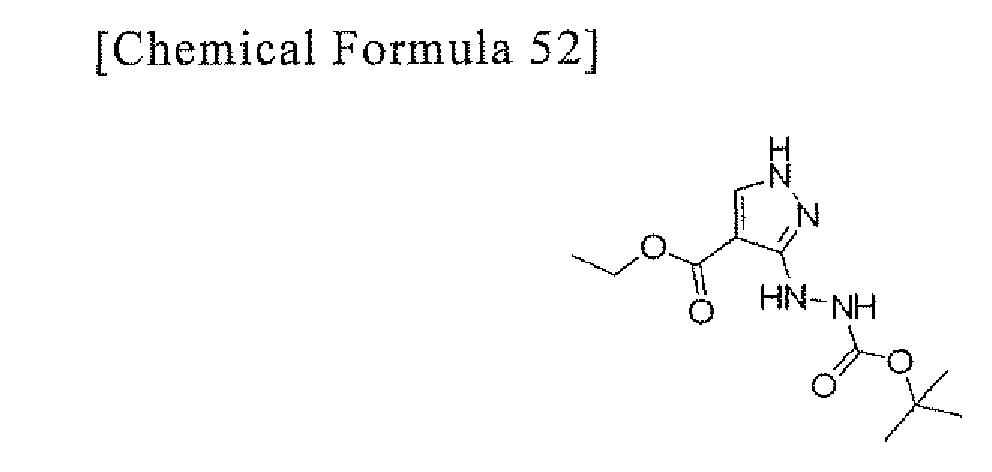
1H-NMR (CDCl3) δ 1.34(t, J=7.3 Hz, 3H) 1.43(s, 9H) 1.67(br.s, 2H) 4.29(q, J=7.3 Hz, 2H) 6.92(br.s, 1H) 7.79(s, 1H) -

1H-NMR (d6-DMSO) δ 1.25(t, J=7.3 Hz, 3H) 4.19(q, J=7.3 Hz, 2H) 8.18(br.s, 1H) 8.23(s, 1H) 9.90(br.s, 4H) 12.55(br.s, 1H) -

1H-NMR (CDCl3)
δ 2.11(t, J=5.2 Hz, 1H) 4.86(d, J=5.2 Hz, 2H) 7.73(d, J=9.2 Hz, 1H) 8.03(dd, J=9.2,3.0 Hz, 1H) 8.44(d, J=3.0 Hz, 1H) -

-

1H-NMR (CDCl3)
δ 4.61(s, 2H) 7.79(d, J=9.4 Hz, 1H) 8.07(dd, J=9.4,3.0 Hz, 1H) 8.31(d, J=3.0 Hz, 1H) -
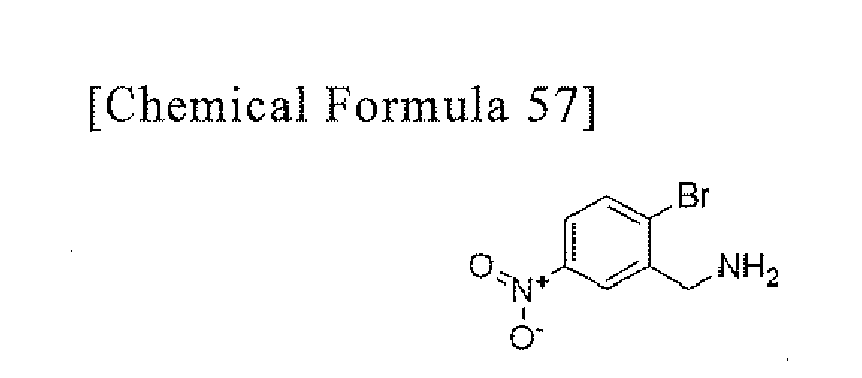
1H-NMR (CDCl3)
δ 4,02(s, 2H) 7.63(d, J=9.0 Hz, 1H) 7.98(dd, J=9.0,2.7 Hz, 1H) 8.37(d, J=2.7 Hz, 1H) -

1H-NMR (CDCl3)
δ 1.49(s, 9H) 4.45(d, J=6.6 Hz, 2H) 5.12(br.s, 1H) 7.74(d, J=9.3 Hz, 1H) 8.00(dd, J=9.3,2.5 Hz, 1H) 8.37(d, J=2.5 Hz, 1H) -

1H-NMR (CDCl3)
δ 1.46(s, 9H) 4.61(d, J=6.2 Hz, 2H) 5.22(br.s, 1H) 7.85(d, J=8.7 Hz, 1H) 8.23(dd, J=8.7,2.0 Hz, 1H) 8.37(d, J=2.0 Hz, 1H) -

1H-NMR (CDCl3)
δ 1.46(s, 9H) 4.17(br.s, 2H) 4.37(d, J=6.7 Hz, 2H) 5.11(br.s, 1H) 6.54(dd, J=8.8,2.5 Hz, 1H) 6.70(d, J=2.5 Hz, 1H) 7.29(d, J=8.8 Hz, 1H) -

1H-NMR (CDCl3)
δ 1.46(s, 9H) 2.04(quint, J=6.8 Hz, 2H) 2.77(t, J=6.8 Hz, 2H) 3.90(s, 3H) 4.29(t, J=6.8 Hz, 2H) 4.42(d, J=6.4 Hz, 2H) 4.51(d, J=7.0 Hz, 1H) 5.15(br.t, J=6.4 Hz, 1H) 5.55(d, J=7.0 Hz, 1H) 6.67(dd, J=8.0,2.4 Hz, 1H) 6.83(d, J=2.4 Hz, 1H) 6.86(d, J=6.9 Hz, 1H) 7.53(d, J=8.0 Hz, 1H) -

1H-NMR (CDCl3)
δ 1.46(s, 9H) 2.04(m, 2H) 2.81(m, 2H) 3.79(s, 3H) 4.27(m, 2H) 4.37(d, J=6.3 Hz, 2H) 5.09(br.t, J=6.3 Hz, 1H) 5.40(d, J=4.8 Hz, 1H) 5.83(d, J=4.8 Hz, 1H) 6.45(d, J=8.6 Hz, 1H) 6.67(d, J=7.0 Hz, 1H) 6.72(s, 1H) 7.40(d, J=8.6 Hz, 1H) 7.51(br.s, 1H) 7.54(br.s, 1H) -

Ethyl acetate (10 mL) and manganese dioxide (1.83 g) were added to the residue in that order, and the mixture was stirred at room temperature for 6 hours. The mixture was filtered through Celite and the Celite was washed with ethyl acetate (100 mL). The organic layers were combined and the solvent in the combined organic layer was distilled off under reduced pressure.
Toluene (30 mL), 2,4,6-collidine (0.407 mL) and methyl chloroformate (0.195 mL) were added to the residue in that order, and the mixture was stirred at 80°C for 8 hours under a nitrogen atmosphere. The mixture was cooled to room temperature, and then ethyl acetate (200 mL) and 1N hydrochloric acid (100 mL) were added. The mixture was sufficiently shaken, and then the organic layer was separated off, washed with saturated aqueous sodium hydrogen carbonate (100 mL) and saturated aqueous sodium chloride (100 mL) in that order, and dried over anhydrous magnesium sulfate. The mixture was filtered to obtain a filtrate, and the solvent in the filtrate was distilled off under reduced pressure. The residue was purified by silica gel column chromatography (ethyl acetate-heptane mixture) to obtain the target compound (0.535 g) as an off-white solid.
1H-NMR (CDCl3) Main isomer
δ 1.44(s, 9H) 2.04(m, 2H) 2.33(s, 3H) 2.81(t, J=6.0 Hz, 2H) 3.64(s, 3H) 3.94(s, 3H) 4.33(t, J=6.0 Hz, 2H) 4.50(d, J=5.9 Hz, 2H) 5.09(br.t, J=5.9 Hz, 1H) 6.96(m, 2H) 7.12(s, 1H) 7.57(d, J=8.4 Hz, 1H) -
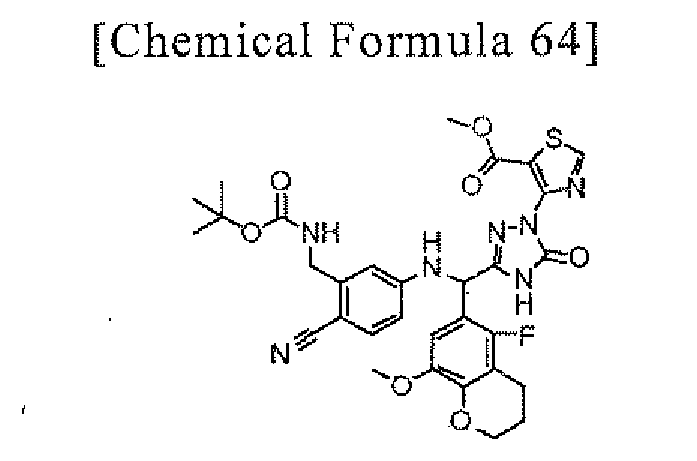
Methanol (1.0 mL), THF (1.0 mL) and acetic acid (52.1 µL) were added to the residue. Sodium cyanotrihydroborate (114 mg) was then added and the mixture was stirred at room temperature for 3 hours. Water and ethyl acetate were added to the mixture, and after sufficiently shaking the mixture, the organic layer was separated off, ethyl acetate was added to the remaining aqueous layer, the mixture was sufficiently shaken and the organic layer was separated off. The combined organic layers were washed with water and saturated aqueous sodium chloride in that order and dried over anhydrous magnesium sulfate. The mixture was filtered to obtain a filtrate, and the solvent in the filtrate was distilled off under reduced pressure. The residue was purified by NAM silica gel column chromatography (ethyl acetate-heptane mixture) to obtain the target compound (74 mg) as an off-white solid.
1H-NMR (CDCl3) δ 1.40(s, 9H) 1.96(m, 2H) 2.69(m, 2H) 3.71(s, 3H) 3.79(s, 3H) 4.22(t, J=5.0 Hz, 2H) 4.33(d, J=6.0 Hz, 2H) 5.30(m, 1H) 5.54(s, 1H) 5.80(d, J=5.6 Hz, 1H) 6.52(dd, J=8.4,2.0 Hz, 1H) 6.72(s, 1H) 6.73(d, J=6.8 Hz, 1H) 7.34(d, J=8.4 Hz, 1H) 8.90(s, 1H) 11.1(s, 1H) -

1H-NMR (d6-DMSO) δ 1.92(m, 2H) 2.70(m, 2H) 3.77(s, 3H) 3.97(m, 2H) 4.16(t, J=5.0 Hz, 2H) 5.51(s, 1H) 6.85(s, 1H) 6.93-7.01(m, 2H) 7.22(m, 1H) 7.54(d, J=8.8 Hz, 1H) 8.94(s, 1H) 9.41(s, 1H) 11.9(br.s, 1H)
Mass spectrum (ESI)m/z: 552 (M+H)+ -
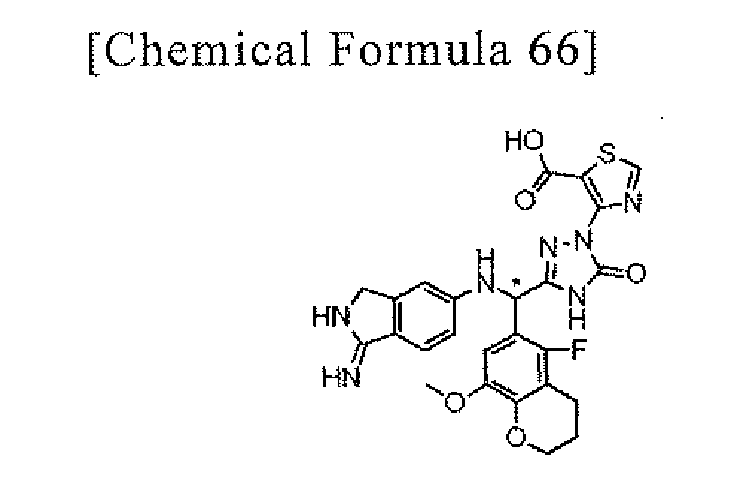
1H-NMR (CD3OD) δ 1.99(m, 2H) 2.76(t, J=6.2 Hz, 2H) 3.73(s, 3H) 4.19(t, J=4.4 Hz, 2H) 4.64-4.91(m, 2H) 5.87(s, 1H) 6.88-6.92(m, 2H) 6.97(d, J=7.2 Hz, 1H) 7.70(d, J=8.4 Hz, 1H) 8.87(s, 1H)
HPLC retention time: 23 min. (Column name: SUMICHIRAL OA-2500, 30 mmϕ × 25 cm, Manufacturer: Sumika Chemical Analysis Service, Ltd., Mobile phase: 0.5 mM ammonium acetate-methanol solution, Elution rate: 30 mL/min) -

1H-NMR (CDCl3)
δ 1.45(s, 9H) 3.93(s, 3H) 4.33(d, J=6.4 Hz, 2H) 4.51(d, J=7.5 Hz, 1H) 4.91(s, 2H) 5.18(br.s, 1H) 5.34(s, 2H) 5.38(d, J=7.5 Hz, 1H) 6.66(dd, J=8.4,2.4 Hz, 1H) 6.83(s, 1H) 6.85(s, 1H) 6.91(d, J=2.4 Hz, 1H) 7.54(d, J=8.4 Hz, 1H) -

1H-NMR (CDCl3)
δ 1.46(s, 9H) 3.89(s, 3H) 4.37(d, J=6.6 Hz, 2H) 4.90(s, 2H) 5.03(s, 1H) 5.31(s, 2H) 5.46(s, 1H) 6.53(d, J=8.3 Hz, 1H) 6.70(s, 1H) 6.75(s, 1H) 6.83(s, 1H) 7.44(d, J=8.3 Hz, 1H) 7.58(br.s, 1H) 7.71(br.s, 1H) -


Ethyl acetate (10 mL) and manganese dioxide (1.83 g) were added to the residue in that order, and the mixture was stirred at room temperature for 6 hours. The mixture was filtered through Celite and the Celite was washed with ethyl acetate (100 mL). The organic layers were combined and the solvent in the combined organic layer was distilled off under reduced pressure. Toluene (20 mL), 2,4,6-collidine (0.407 mL) and methyl chloroformate (0.195 mL) were added to the residue in that order, and the mixture was stirred at 80°C for 8 hours under a nitrogen atmosphere. The mixture was cooled to room temperature, and then ethyl acetate (200 mL) and 1N hydrochloric acid (100 mL) were added. The mixture was sufficiently shaken, and then the organic layer was separated off, washed with saturated aqueous sodium hydrogen carbonate (100 mL) and saturated aqueous sodium chloride (100 mL) in that order, and dried over anhydrous magnesium sulfate. The mixture was filtered to obtain a filtrate, and the solvent in the filtrate was distilled off under reduced pressure. The residue was purified by silica gel column chromatography (ethyl acetate-heptane mixture) to obtain the target compound (0.507 g) as an off-white solid.
1H-NMR (CDCl3) Main isomer
δ 1.45(s, 9H) 2.33(s, 3H) 3.66(s, 3H) 3.85(s, 3H) 4.51(d, J=6.5 Hz, 2H) 4.91(s, 2H) 5.10(br.s, 1H) 5.36(s, 2H) 6.99(s, 1H) 7.04(d, J=8.1 Hz, 1H) 7.20(s, 1H) 7.42(s, 1H) 7.58(d, J=8.1 Hz, 1H) -

Methanol (5 mL) and acetic acid (52.1 µL) were added to the residue. Sodium cyanotrihydroborate (114 mg) was then added and the mixture was stirred overnight at room temperature. Water (25 mL) and ethyl acetate (50 mL) were added to the mixture, and after sufficiently shaking the mixture, the organic layer was separated off. The organic layer was washed twice with water (25 mL) and once with saturated aqueous sodium chloride (25 mL) in that order, and dried over anhydrous magnesium sulfate. The mixture was filtered to obtain a filtrate, and the solvent in the filtrate was distilled off under reduced pressure. The residue was purified by NAM silica gel column chromatography (ethyl acetate-methanol mixture) to obtain the target compound (67 mg) as an off-white solid.
1H-NMR (CD3OD) δ 1.45(s, 9H) 3.85(s, 3H) 4.28(br.d, J=5.7 Hz, 2H) 4.87(s, 2H) 5.23(s, 2H) 5.59(s, 1H) 6.68(dd, J=8.4,2.3 Hz, 1H) 6.77(d, J=1.9 Hz, 1H) 6.80(d, J=2.3 Hz, 1H) 6.99(d, J=1.9 Hz, 1H) 7.08(t, J=5.7 Hz, 1H) 7.41(d, J=8.4 Hz, 1H) 7.64(dd, J=8.0,4.8 Hz, 1H) 8.48(dd, J-8.0,1.3 Hz, 1H) 8.76(dd, J=4.8,1.3 Hz, 1H) -

1H-NMR (CD3OD) δ 1.45(s, 9H) 3.83(s, 3H) 4.29(s, 2H) 4.85(s, 2H) 5.23(s, 2H) 5.57(s, 1H) 6.67(d, J=8.2 Hz, 1H) 6.78(s, 2H) 7.01(s, 1H) 7.13(br.s, 1H) 7.23(dd, J=8.0,4.4 Hz, 1H) 7.32(d, J=8.0 Hz, 1H) 7.41(d, J=8.2 Hz, 1H) 7.81(d, J=4.4 Hz, 1H) -

1H-NMR (CD3OD) δ 1.95(s, 3H) 3.85(s, 3H) 4.63(s, 2H) 4.88(s, 2H) 5.21(s, 2H) 5.65(s, 1H) 6.82(s, 1H) 6.91(s, 1H) 6.96(d, J=8.7 Hz, 1H) 7.05(s, 1H) 7.23(dd, J=8.2,4.6 Hz, 1H) 7.34(dd, J=8.2,1.8 Hz, 1H) 7.78(d, J=8.7 Hz, 1H) 7.82(dd, J=4.6,1.8 Hz, 1H) -

1H-NMR (CD3OD) δ 1.89 (s, 3H) 3.81(s, 3H) 4.59(s, 2H) 4.80-4.91(m, 2H) 5.22(s, 2H) 5.53(s, 1H) 6.82(s, 1H) 6.86(s, 1H) 6.93(dd, J=2.0, 8.8 Hz, 1H) 7.05(d, J=2.0 Hz, 1H) 7.18(dd, J=4.4, 8.0 Hz, 1H) 7.32(dd, J=1.4, 8.0 Hz, 1H) 7.73(d, J=8.8 Hz, 1H) 7.83(d, 1=1.4, 4.4 Hz, 1H)
HPLC retention time: 8 min. (Column name: SUMICHIRAL OA-2500, 30 mmϕ × 25 cm, Manufacturer: Sumika Chemical Analysis Service, Ltd., Mobile phase: 0.5 mM ammonium acetate-methanol solution, Elution rate: 20 mL/min) -

1H-NMR (CDCl3) 1.44(s, 9H) 3.67(br.s, 2H) 4.27(d, J=5.9 Hz, 2H) 4.99(br.s, 1H) 6.46(dd, J=8.3,3.1 Hz, 1H) 6.70(d, J=3.1 Hz, 1H) 7.25(d, J=8.3 Hz, 1H) -

1H-NMR (CDCl3)
δ 0.20(s, 6H) 1.00(s, 9H) 1.23(t, J=7.4 Hz, 3H) 1.45(s, 9H) 2.61(q, J=7.4 Hz, 2H) 4.05(d, J=8.1 Hz, 1H) 4.32(d, J=6.2 Hz, 2H) 5.01(t, J=6.2 Hz, 1H) 5.50(d, J=8.1 Hz, 1H) 6.58(dd, J=8.1,3.1 Hz, 1H) 6.80(d, J=3.1 Hz, 1H) 6.81(dd, J=7.8,2.3 Hz, 1H) 6.98(dd, J=5.7,3.1 Hz, 1H) 7.40(d, J=8.1 Hz, 1H) -

1H-NMR (CDCl3)
δ 0.19(s, 6H) 1.00(s, 9H) 1.17(t, J=7.5 Hz, 3H) 1.45(s, 9H) 2.53(q, J=7.5 Hz, 2H) 4.27(d, J=5.6 Hz, 2H) 4.81(br.s, 1H) 4.98(t, J=5.6 Hz, 1H) 5.35(s, 1H) 6.38(dd, J=8.5,3.1 Hz, 1H) 6.69(d, J=3.1 Hz, 1H) 6.71(dd, J=7.6,2.5 Hz, 1H) 6.98(dd, J=5.7,2.5 Hz, 1H) 7.40(d, J=8.5 Hz, 1H) 7.53(br.s, 1H) 8.06(br.s, 1H) -

Toluene (150 mL), 2,4,6-collidine (1.46 mL) and methyl chloroformate (0.711 mL) were added to the residue in that order, and the mixture was stirred at 85°C for 20 hours under a nitrogen atmosphere. The mixture was cooled to room temperature, and then ethyl acetate (300 mL) and 5% sulfuric acid (200 mL) were added. The mixture was sufficiently shaken, and then the organic layer was separated off, washed with saturated aqueous sodium hydrogen carbonate (200 mL), water (200 mL) and saturated aqueous sodium chloride (200 mL) in that order, and dried over anhydrous magnesium sulfate. The mixture was filtered to obtain a filtrate, and the solvent in the filtrate was distilled off under reduced pressure. The residue was purified by silica gel column chromatography (ethyl acetate-heptane mixture) to obtain the target compound (0.686 g) as an off-white oil.
1H-NMR (CDCl3) Two main isomers
δ 0.20(s, 6H) 1.01(s, 9H) 1.12(t, J=7.4 Hz, 3H) 1.46(s, 9H) 2.45(s, 3H) 2.50(q, J=7.4 Hz, 2H) 3.58(s, 3H) 4.25(d, J=6.3 Hz, 2H) 4.76(t, J=6.3 Hz, 1H) 6.41(dd, J=8.0,2.2 Hz, 1H) 6.55(dd, J=5.6,2.2 Hz, 1H) 6.72(dd, J=7.7,2.2 Hz, 1H) 6.81 (d, J=2.2 Hz, 1H) 7.28(d, J=8.0 Hz, 1H)
δ 0.20(s, 6H) 1.01(s, 9H) 1.23(t, J=7.4 Hz, 3H) 1.45(s, 9H) 2.33(s, 3H) 2.59(q, J=7.4 Hz, 2H) 3.56(s, 3H) 4.38(d, J=6.3 Hz, 2H) 4.99(t, J=6.3 Hz, 1H) 6.86(dd, J=8.0,2.2 Hz, 1H) 6.89(dd, J=7.7,2.2 Hz, 1H) 7.09(d, J=2.2 Hz, 1H) 7.23(dd, J=5.6,2.2 Hz, 1H) 7.46(d, J=8.0 Hz, 1H) -

1H-NMR (CDCl3) Two main isomers
δ 1.11(t, J=7.5 Hz, 3H) 1.47(s, 9H) 2.44(s, 3H) 2.48(q, J=7.5 Hz, 2H) 3.58(s, 3H) 4.25(d, J=6.2 Hz, 2H) 4.93(t, J=6,2 Hz, 1H) 6.02(br.s, 1H) 6.37(dd, J=8.1,2.4 Hz, 1H) 6.55(d, J=5.6 Hz, 1H) 6.72(d, J=7.6 Hz, 1H) 6.83(d, J=2.4 Hz, 1H) 7.27(d, J=8.1 Hz, 1H)
δ 1.23(t, J=7.5 Hz, 3H) 1.44(s, 9H) 2.33(s, 3H) 2.61(q, J=7.5 Hz, 2H) 3.56(s, 3H) 4.37(d, J=6.2 Hz, 2H) 4.99(t, J=6.2 Hz, 1H) 5.28(s, 1H) 6.86(dd, J=8.1,2.4 Hz, 1H) 7.00(dd, J=7.6,2.1 Hz, 1H) 7.09(d, J=2.4 Hz, 1H) 7.17(dd, J=5.6,2.1 Hz, 1H) 7.46(d, J=8.1 Hz, 1H) -

-
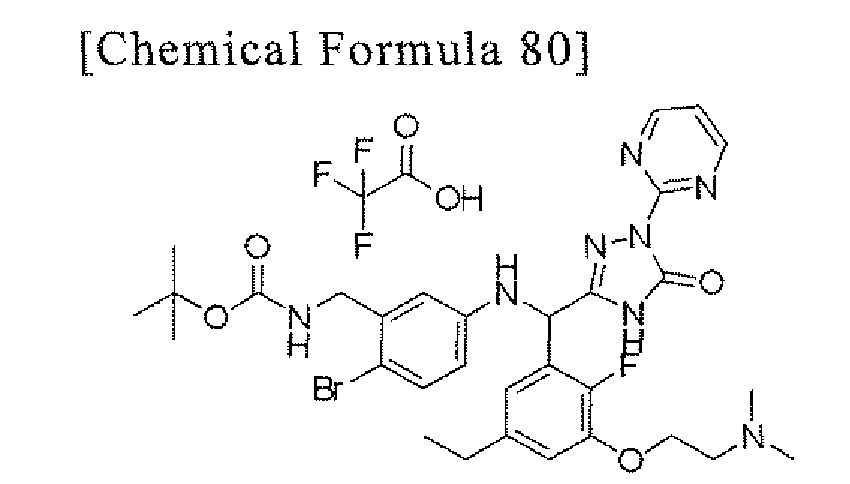
1H-NMR (CD3OD) δ 1.18(t, J=7.4 Hz, 3H) 1.44(s, 9H) 2.60(q, J=7.4 Hz, 2H) 3.00(s, 6H) 3.61(t, J=4.7 Hz, 2H) 4.18(s, 2H) 4.41(t, J=4.7 Hz, 2H) 5.86(s, 1H) 6.53(dd, J=8.4,2.4 Hz, 1H) 6.79(d, J=2.4 Hz, 1H) 6.97(dd, J=7.4,2.0 Hz, 1H) 7.04(dd, J=5.6,2.0 Hz, 1H) 7.25(d, J=8.4 Hz, 1H) 7.36(t, J=4.7 Hz, 1H) 8.76(d, J=4.7 Hz, 2H) -

1H-NMR (CD3OD) δ 1.22(t, J=7.8 Hz, 3H) 2.64(q, J=7.8 Hz, 2H) 3.02(s, 6H) 3.64(t, J=5.5 Hz, 2H) 4.44(t, J=5.5 Hz, 2H) 4.62(d, J=18.9 Hz, 1H) 4.68(d, J=18.9 Hz, 1H) 6.04(s, 1H) 6.94(d, J=2.2 Hz, 1H) 6.97(dd, J=8.6,2.2 Hz, 1H) 7.05(d, J=6.8 Hz, 1H) 7.07(d, J=10.4 Hz, 1H) 7.38{t,
J=5.0 Hz, 1H) 7.81(d, J=8.6 Hz, 1H) 8.78(d, J=5.0 Hz, 2H) -

1H-NMR (CDCl3)
δ 1.10(m, 18H) 1.26(t, J=7.2 Hz, 3H) 1.28(m, 3H) 1.46(s, 9H) 2.62(q, J=7.2 Hz, 2H) 4.43(d, J=6.4 Hz, 2H) 4.51(d, J=8.0 Hz, 1H) 5.13(t, J=6.4 Hz, 1H) 5.59(d, J=8.0 Hz, 1H) 6.88(dd, J=8.5,2.5 Hz, 1H) 6.83(br.s, 1H) 6.87(dd,
J=7.8,2.1 Hz, 1H) 6.97(dd, J=5.8,2.1 Hz, 1H) 7.54(d, J=8.5 Hz, 1H) -

1HTNMR (CDCl3)
δ 1.10(m, 18H) 1.26(t, J=7.2 Hz, 3H) 1.28(m, 3H) 1.46(s, 9H) 2.61(q, J=7.2 Hz, 2H) 4.37(d, J=6.2 Hz, 2H) 4.51(br.s, 1H) 5.13(t, J=6.2 Hz, 1H) 5.42(s, 1H) 6.38(dd, J=8.4,2.3 Hz, 1H) 6.73-6.76(m, 3H) 7.37(d, J=8.4 Hz, 1H) 7.44(br.s, 1H) 7.50(br.s, 1H) -


1H-NMR (CDCl3)
δ 1.10(m, 18H) 1.26(t, J=7.2 Hz, 3H) 1.28(m, 3H) 1.46(s, 9H) 2.28(s, 3H) 2.51(q, J=7.2 Hz, 2H) 4.36(d, J=6.0 Hz, 2H) 5.07(br.s, 1H) 5.35(br.s, 1H) 6.40(d, J=7.8 Hz, 1H) 6.64-6.75(m, 3H) 7.35(d, J=8.4 Hz, 1H)
Ethyl acetate (10 mL) and manganese dioxide (1.06 g) were added to this compound in that order, and the mixture was stirred at room temperature for 9 hours. The mixture was filtered through Celite, the Celite was washed with ethyl acetate (100 mL), and the washed solution was combined with the filtrate. The solvent in the mixture was distilled off under reduced pressure to obtain a crude product of 2-[3-(t-butoxycarbonylaminomethyl)-4-cyanophenylimino]-2-(5-ethyl-2-flu oro-3-triisopropylsilanyloxyphenyl)thioacetimidic acid methyl ester (662 mg).
1H-NMR (CDCl3)
δ 1.00(m, 18H) 1.11(t, J=7.2 Hz, 3H) 1.11(m, 3H) 1.45(s, 9H) 2.43(s, 3H) 2.49(q, J=7.2 Hz, 2H) 4.36(d, J=6.3 Hz, 2H) 4.91(br.s, 1H) 6.41(dd, J=4.7,1.6 Hz, 1H) 6.63(d, J=8.3,1.6 Hz, 1H) 6.74(dd, J=8.3,1.6 Hz, 1H) 6.91(d, J=1.6 Hz, 1H) 7.39(d, J=8.3 Hz, 1H)
Toluene (15 mL), 2,4,6-collidine (0.420 mL) and methyl chloroformate (0.164 mL) were added to this compound in that order, and the mixture was stirred at 85°C for 3 hours under a nitrogen atmosphere. The mixture was cooled to room temperature, and then ethyl acetate (200 mL) and 2% sulfuric acid (200 mL) were added to the mixture. The mixture was sufficiently shaken, and then the organic layer was separated off, washed with water (200 mL) and saturated aqueous sodium chloride (200 mL) in that order, and dried over anhydrous magnesium sulfate. The mixture was filtered to obtain a filtrate, and the solvent in the filtrate was distilled off under reduced pressure. The residue was purified by silica gel column chromatography (ethyl acetate-heptane mixture) to obtain the target compound (0.554 g) as an off-white solid.
1H-NMR (CDCl3) Two main isomers
δ 0.99(m, 18H) 1.1(t, J=7.5 Hz, 3H) 1.12(m, 3H) 1.45(s, 9H) 2.46(s, 3H) 2.50(q, J=7.5 Hz, 2H) 3.61(s, 3H) 4.38(d, J=6.0 Hz, 2H) 4.90(br.s, 1H) 6.55(d, J=5.0 Hz, 1H) 6.61(d, J=8.3 Hz, 1H) 6.75(d, J=7.8 Hz, 1H) 6.90(s, 1H) 7.40(d, J=8.3 Hz, 1H)
δ 1.11(m, 18H) 1.25(m, 3H) 1.26(t, J=7.5 Hz, 3H) 1.44(s, 9H) 2.32(s, 3H) 2.59(q, J=7.5 Hz, 2H) 3.58(s, 3H) 4.50(d, J=6.2 Hz, 2H) 5.09(br.s, 1H) 6.94(d, J=7.8 Hz, 1H) 7.00(d, J=8.3 Hz, 1H) 7.16(s, 1H) 7.20(d, J=5.0 Hz, 1H) 7.57(d, J=8.3 Hz, 1H) -


1H-NMR (CDCl3) Two main isomers
δ 1.11(t, J=7.2 Hz, 3H) 1.47(s, 9H) 2.47(s, 3H) 2.48(q, J=7.2 Hz, 2H) 3.60(s, 3H) 4.40(d, J=6.4 Hz, 2H) 5.09(br.s, 1H) 6.43(d, J=5.0 Hz, 1H) 6.55(d, J=8.0 Hz, 1H) 6.80(d, J=7.4 Hz, 1H) 6.95(s, 1H) 7.40(d, J=8.0 Hz, 1H)
δ 1.27(t, J=7.2 Hz, 3H) 1.47(s, 9H) 2.34(s, 3H) 2.63(q, J=7.2 Hz, 2H) 3.58(s, 3H) 4.51(d, J=6.4 Hz, 2H) 5.09(br.s, 1H) 7.01(d, J=8.0 Hz, 1H) 7.03(d, J=7.4 Hz, 1H) 7.16(s, 1H) 7.19(d, J=5.0 Hz, 1H) 7.59(d, J=8.0 Hz, 1H) -

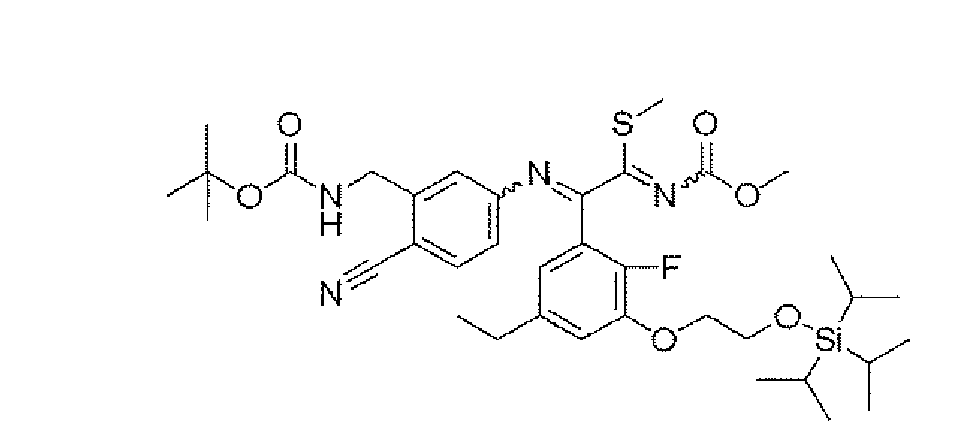
1H-NMR (CDCl3) Two main isomers
δ 1.1(1-1.26(m, 24H) 1.45(s, 9H) 2.45(s, 3H) 2.50(q, J=7.0 Hz, 2H) 3.60(s, 3H) 3.99-4.18(m, 4H) 4.39(d, J=6.2 Hz, 2H) 4.93(br.s, 1H) 6.45(br.s, 1H) 6.60(d, J=8.1 Hz, 1H) 6.83(d, J=7.5 Hz, 1H) 6.88(s, 1H) 7.40(d, J=8.1 Hz, 1H)
δ 1.10-1.26(m, 24H) 1.45(s, 9H) 2.32(s, 3H) 2.63(q, J=7.0 Hz, 2H) 3.60(s, 3H) 3.99-4.18(m, 4H) 4.51(d, J=6.2 Hz, 2H) 5.08(br.s, 1H) 6.97(d, J=8.1 Hz, 1H) 6.98(s, 1H) 7.02(d, J=7.5 Hz, 1H) 7.13(br.s, 1H) 7.57(d, J=8.1 Hz, 1H) -

Methanol (4 mL) and acetic acid (21.4 µL) were added to the residue. Sodium cyanotrihydroborate (58.6 mg) was then added and the mixture was stirred at room temperature for 13 hours. Ethyl acetate (40 mL) and water (20 mL) were added to the mixture. The mixture was sufficiently shaken, and then the organic layer was separated off, washed with water (20 mL) and saturated aqueous sodium chloride (20 mL) in that order, and dried over anhydrous magnesium sulfate. The mixture was filtered to obtain a filtrate, and the solvent in the filtrate was distilled off under reduced pressure. The residue was purified by silica gel column chromatography (methanol-ethyl acetate system) to obtain the target compound (56 mg) as an off-white oil.
1H-NMR (CD3OD)
δ 1.05 (d, J=6.9 Hz, 18H) 1.12(sept, J=6.9 Hz, 3H) 1.16(t, J=7.2 Hz, 3H) 1.42(s, 9H) 2.56(t, J=7.2 Hz, 2H) 4.05(t, J=4.8 Hz, 2H) 4.14(t, J=4.8 Hz, 2H) 4.28(d, J=6.2 Hz, 2H) 5.94(s, 1H) 6.66(dd, J=8.2,2.1 Hz, 1H) 6.80(d, J=2.1 Hz, 1H) 6.87(dd, J=5.1,2.1 Hz, 1H) 6.95(dd, J=7.4,2.1 Hz, 1H) 7.14(t, J=6.2 Hz, 1H) 7.35(t, J=4.4 Hz, 1H) 7.40(d, J=8.2 Hz, 1H) 8.75(d, J=4.4 Hz, 2H) -

1H-NMR (CD3OD)
δ 1.05(t, J=7.2 Hz, 3H) 1.40(s, 9H) 2.38(t, J=7,2 Hz, 2H) 3.95(m, 2H) 4.04(m, 2H) 4.28(s, 2H) 5.94(s, 1H) 6.54-6.63(m, 2H) 6.76-6.82(m, 2H) 7.13(t, J=4.8 Hz, 1H) 7.31(d, J=8.2 Hz, 1H) 8.72(d, J=4.8 Hz, 2H) -


1H-NMR (CD3OD) δ 1.18(t, J=7.3 Hz, 3H) 2.57(q, J=7.3 Hz, 2H) 3.89(m, 2H) 4.12(m, 4H) 5.97(s, 1H) 6.82(dd, J=8.6,2.1 Hz, 1H) 6.94(d, J=6.6 Hz, 1H) 6.95(br.s, 1H) 6.97(dd, J=7.3,2.1 Hz, 1H) 7.34(t, J=4.9 Hz, 1H) 7.49(d, J=8.6 Hz, 1H) 8.76(d, J=4.9 Hz, 2H) -


DMF (2.0 mL) was added to the residue, and the mixture was stirred at 85°C for 16 hours under a nitrogen atmosphere. The solvent in the mixture was distilled off, and methanol (5 mL) and acetic acid (52.1 µL) were added to the residue. Sodium cyanotrihydroborate (114 mg) was then added to the mixture and the mixture was stirred overnight at room temperature. Water (25 mL) and ethyl acetate (50 mL) were added to the mixture, and after sufficiently shaking the mixture, the organic layer was separated off. The organic layer was washed twice with water (25 mL) and once with saturated aqueous sodium chloride (25 mL) in that order, and dried over anhydrous magnesium sulfate. The mixture was filtered to obtain a filtrate, and the solvent in the filtrate was distilled off under reduced pressure. The residue was purified by NAM silica gel column chromatography (methanol-ethyl acetate mixture) to obtain the target compound (83 mg) as an off-white solid.
1H-NMR (CDCl3)
δ 1.34(s, 9H) 3.76(s, 3H) 4.29(d, J=6.2 Hz, 2H) 4.67(d, J=15.7 Hz, 1H) 4.73(d, J=15.7 Hz, 1H) 5.23(s, 2H) 5.74(d, J=7.9 Hz, 1H) 6.20(br.s, 1H) 6.64(dd, J=8.5,2.1 Hz, 1H) 6.73(br.s, 1H) 6.86(br.s, 1H) 6.95(br.s, 1H) 7.20(t, J=4.6 Hz, 1H) 7.38(d, J=8.5 Hz, 1H) 8.75(d, J=4.7 Hz, 2H) -

1H-NMR (CD3OD) δ 3.77(s, 3H) 4.28(s, 2H) 4.78(d, J=15.5 Hz, 1H) 4.85(d, J=15.5 Hz, 1H) 5.22(s, 2H) 5.63(s, 1H) 6.79(d, J=1.8 Hz, 1H) 6.84(dd, J=8.7,1.8 Hz, 1H) 6.97(d, J=1.8 Hz, 1H) 7.01(d, J=1.8 Hz, 1H) 7.35(t, J=4.7 Hz, 1H) 7.50(d, J=8.7 Hz, 1H) 8.78(d, J=4.7 Hz, 2H) [0206] (5c) (R)- and (S)-5-[(1-Imino-2,3-dihydro-1H-isoindol-5-ylamino)-(8-methoxy-4H-benzo [1,3]-dioxin-6-yl)methyl]-2-pyrimidin-2-yl-2,4-dihydro-[1,2,4]triazol-3-one acetate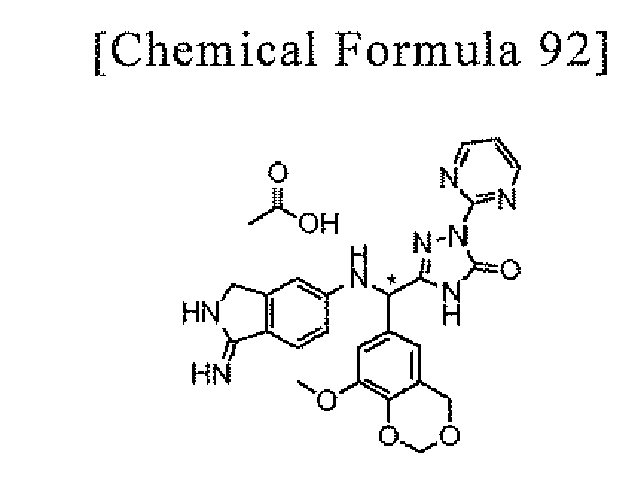
1H-NMR (CD3OD) δ 1.92 (s, 3H) 3.81(s, 3H) 4.61(s, 2H) 4.84-4.90(m, 2H) 5.22(s, 2H) 5.59(s, 1H) 6.82(s, 1H) 6.89(s, 1H) 6.96(d, J=8.8 Hz, 1H) 7.06(s, 1H) 7.31(t, J=4.8 Hz, 1H) 7.75(d, J=8.8 Hz, 1H) 8.77(d, J=4.8 Hz, 2H)
HPLC retention time: 15 min. (Column name: SUMICHIRAL OA-2500, 30 mmϕ × 25 cm, Manufacturer: Sumika Chemical Analysis Service, Ltd., Mobile phase: 50 mM ammonium acetate-methanol solution, Elution rate: 40 mL/min) -

nitrogen atmosphere, and the mixture was stirred at room temperature for 14 hours. Ethyl acetate (300 mL) and water (200 mL) were added to the mixture and filtration was performed with Celite. After sufficiently shaking the filtrate, the organic layer was separated off and washed with saturated aqueous sodium chloride (200 mL), and then dried over anhydrous magnesium sulfate. The mixture was filtered to obtain a filtrate, and the solvent in the filtrate was distilled off under reduced pressure. The residue was purified by silica gel column chromatography (ethyl acetate-heptane mixture) to obtain the target compound (0.98 g) as a colorless solid.
1H-NMR (CDCl3)
δ 1.10(m, 18H) 1.26(m, 3H) 1.45(s, 9H) 3.80(s, 3H) 4.43(d, J=6.2 Hz, 2H) 4.54(d, J=7.9 Hz, 1H) 5.14(br.s, 1H) 5.59(d, J=7.9 Hz, 1H) 6.59(dd, J=8.2,2.4 Hz, 1H) 6.66(br.s, 1H) 6.68(d, J=2.4 Hz, 1H) 6.84(s, 1H) 7.53(d, J=8.2 Hz, 1H) -

1H-NMR (CDCl3)
δ 1.1(m, 18H) 1.28(m, 3H) 1.46(s, 9H) 3.68(s, 3H) 4.38(d, J=6.1 Hz, 2H) 5.08(br.s, 1H) 5.43(d, J=4.9 Hz, 1H) 5.97(br.s, 1H) 6.38(dd, J=8.1,2.0 Hz, 1H) 6.44-6.48(m, 3H) 6.73(s, 1H) 7.37(d, J=8.1 Hz, 1H) 7.45(s, 1H) -

Ethyl acetate (15 mL) and manganese dioxide (1.84 g) were added to the residue in that order, and the mixture was stirred at room temperature for 6 hours. The mixture was filtered through Celite, the Celite was washed with ethyl acetate (100 mL), and the washed solution was combined with the previous filtrate. The solvent in the filtrate was distilled off under reduced pressure.
Toluene (30 mL), 2,4,6-collidine (0.410 mL) and methyl chloroformate (0.196 mL) were added to the residue in that order, and the mixture was stirred at 80°C for 8 hours under a nitrogen atmosphere. After cooling to room temperature, 2,4,6-collidine (0.205 mL) and methyl chloroformate (0.098 mL) were further added in that order and the mixture was stirred at 80°C for 4 hours. The mixture was cooled to room temperature, and then ethyl acetate (200 mL) and 1N hydrochloric acid (100 mL) were added to the mixture. The mixture was sufficiently shaken, and then the organic layer was separated off, washed with saturated aqueous sodium hydrogen carbonate (100 mL) and saturated aqueous sodium chloride (100 mL) in that order, and dried over anhydrous magnesium sulfate. The mixture was filtered to obtain a filtrate, and the solvent in the filtrate was distilled off under reduced pressure. The residue was purified by silica gel column chromatography (ethyl acetate-heptane mixture) to obtain the target compound (0.542 g) as an off-white solid.
1H-NMR (CDCl3) Two main isomers
δ 0.97-1.12(m, 21H) 1.45(s, 9H) 2.46(s, 3H) 3.61(s, 3H) 3.69(s, 3H) 4.38(d, J=6.0 Hz, 2H) 4.94(br.s, 1H) 6.25(br.s, 1H) 6.48(dd, J=7.5,2.4 Hz, 1H) 6.61(d, J=8.1 Hz, 1H) 6.93(s, 1H) 7.41(d, J=8.1 Hz, 1H)
δ 1.08-1.31(m, 21H) 1.45(s, 9H) 2.33(s, 3H) 3.58(s, 3H) 3.79(s, 3H) 4.50(d, J=6.0 Hz, 2H) 5.10(br.s, 1H) 6.59-6.70(m, 2H) 6.99(d, J=8.1 Hz, 1H) 7.14(s, 1H) 7.57(d, J=8.1 Hz, 1H) -

The residue was dissolved in DMF (10 mL), and then cesium carbonate (386 mg) and (2-iodoethoxy)triisopropylsilane (389 mg) were added in that order. The mixture was stirred overnight at room temperature, and then ethyl acetate (100 mL) and water (50 mL) were added. The mixture was sufficiently shaken, and then the organic layer was separated off, washed twice with water (50 mL) and then with saturated aqueous sodium chloride (50 mL) in that order, and dried over anhydrous magnesium sulfate. The mixture was filtered to obtain a filtrate, and the solvent in the filtrate was distilled off under reduced pressure. The residue was purified by silica gel column chromatography (ethyl acetate-heptane mixture) to obtain the target compound (278 mg) as an off-white solid.
1H-NMR (CDCl3) Two main isomers
δ 1.03-1.30(m, 21H) 1.45(s, 9H) 2,45(s, 3H) 3.63(s, 3H) 3.68(s, 3H) 4.01-4.05(m, 4H) 4.41(d, J=5.9 Hz, 2H) 4.95(br.s, 1H) 6.14(br.s, 1H) 6.56(dd, J=7.3,2.4 Hz, 1H) 6.63(d, J=8.3 Hz, 1H) 6.93(s, 1H) 7.43(d, J=8.3 Hz, 1H)
δ 1.03-1.30(m, 21H) 1.45(s, 9H) 2.33(s, 3H) 3.63(s, 3H) 3.81(s, 3H) 4.01-4.05(m, 4H) 4.50(d, J=5.9 Hz, 2H) 5.09(br.s, 1H) 6.75-6.94(m, 2H) 6.97(d, J=8.3 Hz, 1H) 7.12(s, 1H) 7.58(d, J=8.3 Hz, 1H) -

Methanol (3.0 mL), THF (1.0 mL) and acetic acid (22.0 µL) were added to the residue. Sodium cyanotrihydroborate (48.1 mg) was then added to the mixture and the mixture was stirred at room temperature for 20 hours. Water (20 mL) and ethyl acetate (50 mL) were added to the mixture, and after sufficiently shaking the mixture, the organic layer was separated off. The organic layer was washed with water (20 mL) and saturated aqueous sodium chloride (20 mL) in that order, and dried over anhydrous magnesium sulfate. The mixture was filtered to obtain a filtrate, and the solvent in the filtrate was distilled off under reduced pressure. The residue was purified by NAM silica gel column chromatography (ethyl, acetate-heptane mixture) to obtain the target compound (36.4 mg) as a colorless solid.
1H-NMR (CD3OD) δ 1.07(m, 18H) 1.15(m, 3H) 1.44(s, 9H) 3.75(s, 3H) 3.83(s, 3H) 4.06(t, J=4.8 Hz, 2H) 4.14(t, J=4.8 Hz, 2H) 4.31(d, J=6.1 Hz, 2H) 5.95(s, 1H) 6.58(dd, J=5.3,2.2 Hz, 1H) 6.65-6.72(m, 2H) 6.79(d, J=1.9 Hz, 1H) 7.44(d, J=8.3 Hz, 1H) 9.15(s, 1H) -

1H-NMR (CD3OD) δ 1.44(s, 9H) 3.74(s, 3H) 3.83(s, 3H) 3.87(t, J=4.8 Hz, 2H) 4.10(t, J=4.8 Hz, 2H) 4.31(d, J=6.1 Hz, 2H) 5.95(s, 1H) 6.60(dd, J=5.2,2.3 Hz, 1H) 6.65-6.69(m, 2H) 6.79(d, J=1.9 Hz, 1H) 7.43(d, J=8.3 Hz,1H)9.15(s,1H) -

1H-NMR (CD3OD) δ 3.73(s, 3H) 3.88(t, J=5.1 Hz, 2H) 4.11(d, J=5.1 Hz, 2H) 4.55(d, J=18.6 Hz, 1H) 4.70(d, J=18.6 Hz, 1H) 5.94(s, 1H) 6.75-6.78(m, 2H) 6.88-6.95(m, 2H) 7.73(d, J=8.7 Hz, 1H) 8.87(s, 1H) -

1H-NMR (CD3OD) δ 1.45(s, 9H) 3.77(s, 3H) 3.85(s, 3H) 4.31(d, J=5.7 Hz, 2H) 4.87(s, 2H) 5.25(s, 2H) 5.55(s, 1H) 6.69(dd, J=8.4,1.8 Hz, 1H) 6.79(d, J=1.8 Hz, 2H) 7.00(d, J=1.8 Hz, 1H) 7.23(d, J=5.4 Hz, 1H) 7.42(d, J=8.4 Hz, 1H) 7.77(d, J=5.4 Hz, 1H) -

Dichloromethane (4.0 mL) and TFA (1.0 mL) were added to the residue, which was then stirred at room temperature for 2 hours. Toluene (10 mL) was added to the mixture, and the solvent in the mixture was distilled off. The residue was purified by reverse-phase high performance liquid chromatography (acetonitrile/water mixed solvent, 0.1% acetic acid) to obtain the target compound (11.5 mg).
1H-NMR (CD3OD) δ 3.85(s, 3H) 4.55(d, J=19.1 Hz, 1H) 4.68(d, J=19.1 Hz, 1H) 4.88(s, 2H) 5.22(s, 2H) 5.55(s, 1H) 6,81(s,1H) 6.92(s,1H) 6.94(dd, J=8.6,2.2 Hz, 1H) 7.05(d, J=2.2 Hz, 1H) 7.10(d, J=6.2 Hz, 1H) 7.46(d, J=6.2 Hz, 1H) 7.73 (d, J=8.6 Hz, 1H) -

1H-NMR (CD3OD) δ 3.84(s, 3H) 4.51-4.66(m, 4H) 4.88(s, 2H) 5.24(s, 2H) 5.54(s, 1H) 6.82(s, 1H) 6.91-6.94(m, 2H) 7.05(s, 1H) 7.08(d, J=5.0 Hz, 1H) 7.43(d, J=5.0 Hz, 1H) 7.73(d, J=8.4 Hz, 1H)
HPLC retention time: 15 min. (Column name: SUMICHIRAL OA-2500, 30 mmϕ × 25 cm, Manufacturer: Sumika Chemical Analysis Service, Ltd., Mobile phase: 50 mM ammonium acetate-methanol solution, Elution rate: 30 mL/min) -


Methanol (15 mL) and acetic acid (42.4 µL) were added to the residue. Sodium cyanotrihydroborate (124 mg) was then added to the mixture and the mixture was stirred at room temperature for 20 hours. The mixture was filtered to obtain a filtrate, and the solvent in the filtrate was distilled off under reduced pressure. The residue was purified by reverse-phase high performance liquid chromatography (acetonitrile/water mixed solvent, 0.1% trifluoroacetic acid) to obtain the target compound (76 mg).
1H-NMR (CD3OD) δ 1.23(t, J=7.5 Hz, 3H) 1.45(s, 9H) 2.64(q, J=7.5 Hz, 2H) 3.03(s, 6H) 3.64(t, J=5.6 Hz, 2H) 4.18(br.s, 2H) 4.45(t, J=5.6 Hz, 2H) 5.84(s, 1H) 6.54(dd, J=8.5,2.3 Hz, 1H) 6.77(d, J=2.3 Hz, 1H) 7.01-7.05(m, 2H) 7.26(d, J=8.5 Hz, 1H) 7.57(td, J=8.1,1.1 Hz, 1H) 7.69(dd, J=8.1,1.1 Hz, 1H) 7.76(td, J=8.1,1.1 Hz, 1H) 7.97(did, J=8.1,1.1 Hz, 1H) -


1H-NMR (CD3OD) δ 1.22(t, J=7.6 Hz, 3H) 1.45(s, 9H) 2.64(q, J=7.6 Hz, 2H) 3.00(s, 6H) 3.62(m, 2H) 4.18(br.s, 2H) 4.42(t, J=5.6 Hz, 2H) 5.88(s, 1H) 6.55(dd, J=8.4,2.4 Hz, 1H) 6.72(dd, J=8.4,2.9 Hz, 1H) 6.79(d, J=2.4 Hz, 1H) 7.01-7.12(m, 5H) 7.26(d, J=8.4 Hz, 1H) -

1H-NMR (CD3OD) δ 1.21(t, J=7.9 Hz, 3H) 2.64(q, J=7.9 Hz, 2H) 3.01(s, 6H) 3.63(t, J=5.5 Hz, 2H) 4.44(t, J=5.5 Hz, 2H) 4.62(d, J=18.9 Hz, 1H) 4.68(d, J=18.9 Hz, 1H) 6.05(s, 1H) 6.82(td, J=7.3,1.6 Hz, 1H) 6.92-6.98(m, 3H) 7.03(dd, J=6.4,1.6 Hz, 1H) 7.08(dd, J=7.3,1.6 Hz, 1H) 7.17(td, J=7.3,1.6 Hz, 1H) 7.22(dd, J=7.3,1.6 Hz, 1H) 7.81(d, J=8.3 Hz, 1H) -

1H-NMR (CDCl3)
δ 1.45(s, 9H) 3.81(s, 3H) 3.83(s, 3H) 4.43(d, J=5.7 Hz, 2H) 4.52(d, J=7.4 Hz, 1H) 5.16(br.s, 1H) 5.58(d, J=7.4 Hz, 1H) 6.69(dd, J=8.6,2.7 Hz, 1H) 6.73(d, J=11,2 Hz, 1H) 6.84(s, 1H) 7.02(d, J=6.8 Hz, 1H) 7.55(d, J=8.6 Hz, 1H) -

1H-NMR (CDCl3)
δ 1.45(s, 9H) 3.80(s, 3H) 3.87(s, 3H) 4.37(d, J=5.9 Hz, 2H) 5.07(br.s, 1H) 5.41(d, J=6.5 Hz, 1H) 5.92(br.s, 1H) 6.45(d, J=8.5 Hz, 1H) 6.69(d, J=11.6 Hz, 1H) 6.71(s, 1H) 6.82(d, J=7.2 Hz, 1H) 7.40(d, J=8.5 Hz, 1H) 7.46(s, 2H) -

1H-NMR (CDCl3) Main isomer 1.45(s, 9H) 2.33(s, 3H) 3.64(s, 3H) 3.82(s, 3H) 3.83(s, 3H) 4.51(d, J=6.5 Hz, 2H) 5.11(br.s, 1H) 6.62(d, J=11.9 Hz, 1H) 6.97(d, J=8.2 Hz, 1H) 7.13(s, 1H) 7.42(d, J=7.0 Hz, 1H) 7.58(d, J=8.2 Hz, 1H) -

Methanol (6.15 mL) and acetic acid (42.4 µL) were added to the residue. Sodium cyanotrihydroborate (61.8 mg) was then added to the mixture and the mixture was stirred at room temperature for 20 hours. The mixture was purified by reverse-phase high performance liquid chromatography (acetonitrile/water mixed solvent, 0.1% acetic acid) to obtain the target compound (17 mg).
1H-NMR (CD3OD) δ 1.10(t, J=7.0 Hz, 3H) 1.45(s, 9H) 3.77(s, 3H) 3.83(s, 3H) 4.15(q, J=7.0 Hz, 2H) 4.30(m, 2H) 5.00(d, J=6.0 Hz, 2H) 5.14(dd, J=17.3,1.5 Hz, 1H) 5.23(dd, J=10.9,1.5 Hz, 1H) 5.87(s, 1H) 6.01-6.10(m, 1H) 6.68(dd, J=8.2,2.2 Hz, 1H) 6.80(d, J=2.2 Hz, 1H) 6.85(d, J=12.2 Hz, 1H) 7.05(d, J=7.0 Hz, 1H) 7.43(d, J=8.2 Hz, 1H) 7.92(s, 1H) -

1H-NMR (CD3OD) δ 1.45(s, 9H) 3.77(s, 3H) 3.83(s, 3H) 4.28(d, J=16.2 Hz, 1H) 4.35(d, J=16.2 Hz, 1H) 5.04(d, J=6.1 Hz, 2H) 5.16(dd, J=17.5,1.5 Hz, 1H) 5.22(dd, J=10.7,1.5 Hz, 1H) 5.85(s, 1H) 6.02-6.11(m, 1H) 6.66(dd, J=8.2,2.2 Hz, 1H.) 6.77(d, J=2.2 Hz, 1H) 6.83(d, J=11.6 Hz, 1H) 7.01(d, J=7.2 Hz, 1H) 7.41(d, J=8.2 Hz, 1H) 7.81(s, 1H) -

1H-NMR (CD3OD) δ 3.84(s, 3H) 3.85(s, 3H) 4.14(d, J=14.3 Hz, 1H) 4.27(d, J=14.3 Hz, 1H) 5.72(s, 1H) 6.89(d, J=2.0 Hz, 1H) 6.90(d, J=11.5 Hz, 1H) 6.93(dd, J=8.5,2.0 Hz, 1H) 7.06 (d, J=6.5 Hz, 1H) 7.48(d, J=8.5 Hz, 1H) 7.62(s, 1H) -

1H-NMR (CDCl3)
δ 1.45(s, 9H) 3.89(s, 3H) 3.91(s, 3H) 4.33(d, J=6.1 Hz, 2H) 5.11(br.s, 1H) 5.49(s, 1H) 6.58(dd, J=8.7,2.7 Hz, 1H) 6.70(d, J=11.4 Hz, 1H) 6.81(s, 1H) 7.01(d, J=6.9 Hz, 1H) 7.40(d, J=8.7 Hz, 1H) -

1H-NMR (CDCl3)
δ 1.45(s, 9H) 3.82(s, 3H) 3.86(s, 3H) 4.27(d, J=5.9 Hz, 2H) 4.98(br.s, 1H) 5.32(s, 1H) 5.92(br.s, 1H) 6.39(dd, J=8.3,2.6 Hz, 1H) 6.67(d, J=11.3 Hz, 1H) 6.70(d, J=2.6 Hz, 1H) 6.83(d, J=6.9 Hz, 1H) 7.30(d, J=8.3 Hz, 1H) 7.50(s, 1H) 7.93(s, 1H) -


1H-NMR (CDCl3)
δ 1.45(s, 9H) 2.30(s, 3H) 3.80(s, 3H) 3.86(s, 3H) 4.28(d, J=5.9 Hz, 2H) 4.98(br.s, 1H) 5.30(br.s, 1H) 5.92(br.s, 1H) 6.39(d, J=8.0 Hz, 1H) 6.61-6.80(m, 3H) 7.30(br.s, 1H) -

1H-NMR (CDCl3) Main isomer
δ 1.45(s, 9H) 2.46(s, 3H) 3.58(s, 3H) 3.84(s, 3H) 3.95(s, 3H) 4.29(d, J=6.4 Hz, 2H) 4.85(br.s, 1H) 6.60(d, J=11.2 Hz, 1H) 6.81(d, J=8.0 Hz, 1H) 7.06(s, 1H) 7.42(d, J=7.0 Hz, 1H) 7.46(d, J=8.0 Hz, 1H) -

Methanol (20 mL) and acetic acid (94.4 µL) were added to the residue. Sodium cyanotrihydroborate (413 mg) was then added to the mixture and the mixture was stirred at room temperature for 20 hours. The mixture was filtered to obtain a filtrate, and the solvent in the filtrate was distilled off under reduced pressure. Ethyl acetate (100 mL) and water (50 mL) were added to the residue, and after sufficiently shaking the mixture, the organic layer was separated off and washed twice with water (50 mL) and once with saturated aqueous sodium chloride (50 mL) in that order and dried over anhydrous magnesium sulfate. The mixture was filtered to obtain a filtrate, and the solvent in the filtrate was distilled off under reduced pressure. The residue was purified by silica gel column chromatography (ethyl acetate-heptane mixture) to obtain the target compound (232 mg).
1H-NMR (CD3OD) δ 1.44(s, 9H) 3.81(s, 3H) 3.82(s, 3H) 4.20(m, 2H) 5.79(s, 1H) 6.56(dd, J=8.7,2.3 Hz, 1H) 6.76(d, J=2.3 Hz, 1H) 6.82(d, J=11.7 Hz, 1H) 7.03(d, J=6.6 Hz, 1H) 7.26(d, J=8.7 Hz, 1H) 7.55(td, J=7.6,1.4 Hz, 1H) 7.69(dd, J=7.6,1.4 Hz, 1H) 7.74(td, J=7.6,1.4 Hz, 1H) 7.98(dd, J=7.6,1.4Hz, 1H) -

1H-NMR (CDCl3)
δ 1.42(s, 9H) 3.64(s, 3H) 3.79(s, 3H) 4.24(d, J=6.9 Hz, 2H) 4.96(d, J=5.8 Hz, 1H) 5.06(t, J=6.9 Hz, 1H) 5.68(d, J=5.8 Hz, 1H) 6.49(dd, J=8.4,2.2 Hz, 1H) 6.68(d, J=11.3 Hz, 1H) 6.72(br.s, 1H) 6.81(d, J=7.6 Hz, 1H) 6.83(t, J=7.6 Hz, 1H) 6.93(d, J=6.5 Hz, 1H) 7.15(t, J=7.6 Hz, 1H) 7.23(d, J=8.4 Hz, 1H) 7.30(d, J=7.6 Hz, 1H) 9.99(br.s, 1H) 11.84(br.s, 2H) -

1H-NMR (CD3OD) δ 3.78(s, 3H) 3.84(s, 3H) 4.63(d, J=21.0 Hz, 1H) 4.68(d, J=21.0 Hz, 1H) 6.00(s, 1H) 6.88(d, J=11.1 Hz, 1H) 6.91(dd, J=8.4,1.8 Hz, 1H) 6.93(d, J=1.8 Hz, 1H) 6.96(td, J=7.4 Hz, 1.8 Hz, 1H) 7.01(dd, J=7.4,1.8 Hz, 1H) 7.05(d, J=6.6 Hz, 1H) 7.21(td, J=7.4 Hz, 1.8 Hz, 1H) 7.32(dd, J=7.4,1.8 Hz, 1H) 7.80(d, J=8.4 Hz, 1H) -

HPLC retention time: 23 min. (Column name: SUMICHIRAL OA-2500, 20 mmϕ × 25 cm, Manufacturer: Sumika Chemical Analysis Service, Ltd., Mobile phase: 0.05 M ammonium acetate-methanol solution, Elution rate: 5 mL/min) -
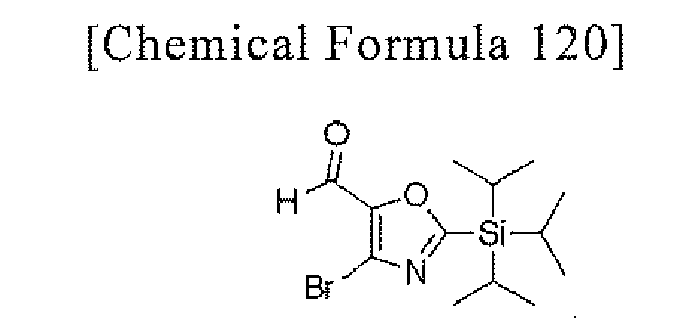
1H-NMR (CDCl3) 1.14(d, J=7.5 Hz, 18H) 1.44(sept, J=7.5 Hz, 3H) 9.84(s, 1H) -

1H-NMR (CDCl3) 3.94(s, 3H) 7.93(s, 1H) -

1H-NMR (CDCl3) 1.49(s, 9H) 1.51(s, 9H) 3.94(s, 3H) 7.86(s, 1H) -

1H-NMR (CDCl3) 3.91(s, 3H) 4.00(br.s, 2H) 4.04(br.s, 1H) 7.71(s, 1H) -

Methanol (3.0 mL), THF (1.0 mL) and acetic acid (22.0 µL) were added to the residue. Sodium cyanotrihydroborate (48.1 mg) was then added to the mixture and the mixture was stirred at room temperature for 20 hours. Water (20 mL) and ethyl acetate (50 mL) were added to the mixture, and after sufficiently shaking the mixture, the organic layer was separated off. The organic layer was washed with water (20 mL) and saturated aqueous sodium chloride (20 mL) in that order, and dried over anhydrous magnesium sulfate. The mixture was filtered to obtain a filtrate, and the solvent in the filtrate was distilled off under reduced pressure. The residue was purified by NAM silica gel column chromatography (ethyl acetate-heptane mixture) to obtain the target compound (41.1 mg) as a colorless solid.
1H-NMR (CD3OD)δ 1.07(m, 18H) 1.25(m, 3H) 1.44(s, 9H) 3.74(s, 3H) 3.85(s, 3H) 4.07(q, J=4.7 Hz, 2H) 4.14(t, J=4.7 Hz, 2H) 4.31(br.s, 2H) 5.94(s, 1H) 6.57(dd, J=5.0,2.3 Hz, 1H) 6.66-6.69(m, 2H) 6.79(d, J=2.0 Hz, 1H) 7.11 (br.t, J=5.7 Hz, 1H) 7.44(d, J=8.6 Hz, 1H) 8.43 (s, 1H) -

1H-NMR (CD3OD) δ 1.44(s, 9H) 3.73(s, 3H) 3.84(s, 3H) 3.87(t, J=5.0 Hz, 2H) 4.10(t, J=5.0 Hz, 2H) 4.31(br.s, 2H) 5.93(s, 1H) 6.58(dd, J=5.0,2.3 Hz, 1H) 6.64-6.68(m, 2H) 6.79(d, J=2.0 Hz, 1H) 7.43(d, J=8.5 Hz, 1H) 8.41(s, 1H) -

1H-NMR (CD3OD) δ 3.73(s, 3H) 3.88(t, J=4.8 Hz, 2H) 4.11(d, J=4.8 Hz, 2H) 4.58(d, J=17.2 Hz, 1H) 4.67(d, J=17.2 Hz, 1H) 5.94(s, 1H) 6.64(dd, J=5.7,2.5 Hz, 1H) 6.66(dd, J=7.8,2.5 Hz, 1H) 6.86-6.95(m, 2H) 7.75(d, J=8.6 Hz, 1H) 8.38(s, 1H) -

1H-NMR (CD3OD) δ 1.42(s, 9H) 3.77(s, 3H) 3.83(s, 3H) 4.27(d, J=16.4 Hz, 1H) 4.36(d, J=16.4 Hz, 1H) 5.86(s, 1H) 6.69(dd, J=8.5,2.1 Hz, 1H) 6.80(d, J=2.1 Hz, 1H) 6.85(d, J=11.4 Hz, 1H) 7.05(d, J=6.6 Hz, 1H) 7.41(d, J=8.5 Hz, 1H) 7.59-7.64(m, 2H) 7.74-7.78(m, 1H) 8.45-8.49(m, 1H) -

1H-NMR (CD3OD) δ 3.83(s, 3H) 3.85(s, 3H) 4.20(d, J=14.6 Hz, 1H) 4.25(d, J=14.6 Hz, 1H) 5.90(s, 1H) 6.90(d, J=12.0 Hz, 1H) 6.91(dd, J=8.8,2.0 Hz, 1H) 6.93(d, J=2.0 Hz, 1H) 7.07(d, J=6.3 Hz, 1H) 7.55(d, J=8.8 Hz, 1H) 7.59-7.64(m, 2H) 7.88(dd, J=7.6,2.8 Hz, 1H) 8.49(dd, J=6.7,1.4 Hz, 1H) -

1H-NMR (CD3OD) δ 1.44(s, 9H) 3.79(s, 3H) 3.83(s, 3H) 4.16(d, J=14.7 Hz, 1H) 4.23(d, J=14.7 Hz, 1H) 5.76(s, 1H) 6.56(dd, J=8.7,3.1 Hz, 1H) 6.75(d, J=3.1 Hz, 1H) 6.82(d, J=11.8 Hz, 1H) 7.07(d, J=6.9 Hz, 1H) 7.26(d, J=8.7 Hz, 1H) 7.49(td, J=7.5,1.6 Hz, 1H) 7.50(dd, J=7.5,1.6 Hz, 1H) 7.62(td, J=7.5,1.6 Hz, 1H) 7.93 (dd, J=7.5,1.6 Hz, 1H) -
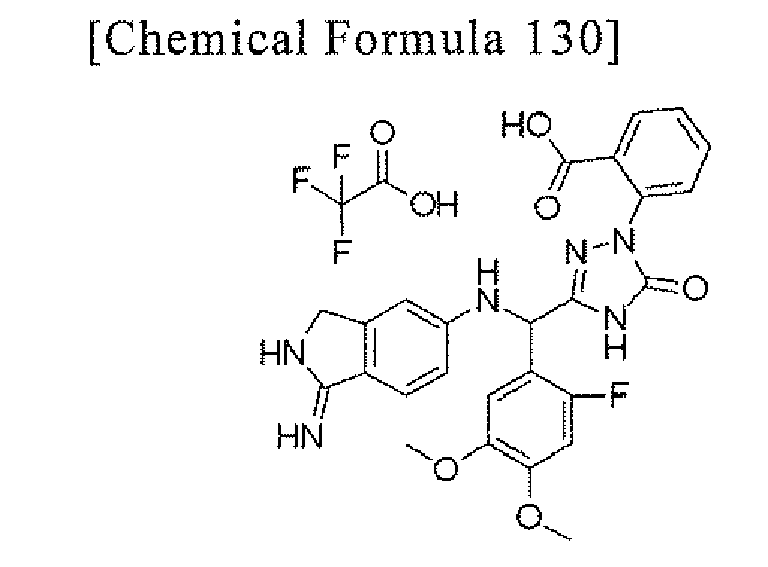
1H-NMR (CD3OD) δ 3.81(s, 3H) 3.83(s, 3H) 4.65(d, J=21.1 Hz, 1H) 4.72(d, J=21.1 Hz, 1H) 5.95(s, 1H) 6.88(d, J=11.6 Hz, 1H) 6.94(s, 1H) 6.96(dd, J=8.7,2.4 Hz, 1H) 7.07(d, J=6.5 Hz, 1H) 7.50(m, 2H) 7.65(td, J=8.7,2.4 Hz, 1H) 7.80(d, J=8.7 Hz, 1H) 7.98(dd, J=8.7,2.4 Hz, 1H) -

1H-NMR (CDCl3) δ] 0.06(s, 9H) 1.01(m, 2H) 4.20(m, 2H) 4.49(d, J=6.4 Hz, 2H) 5.26(br.s, 1H) 7.73(d, J=8.4 Hz, 1H) 8.00(dd, J=8.4, 2.0 Hz, 1H) 8.25(d, J=2.0 Hz, 1H) -

1H-NMR (CDCl3) δ 0.06(s, 9H) 1.01(m, 2H) 4.20(m, 2H) 4.64(d, J=6.4 Hz, 2H) 5.38(br.s, 1H) 7.87(d, J=8.0 Hz, 1H) 8.25(dd, J=8.0,2.0 Hz, 1H) 8.39(d, J=2.0 Hz, 1H) -

1H-NMR (CDCl3) δ 0.06(s, 9H) 0.99(m, 2H) 4.18(m, 2H) 4.43 (d, J=6.4 Hz, 2H) 5.21(br.s, 1H) 6.53(dd, J=8.4,2.5 Hz, 1H) 6.73(br.s, 1H) 7.40(d, J=8.4 Hz, 1H) -

1H-NMR (CDCl3) δ 0.04(s, 9H) 0.99(m, 2H) 3.83(s, 3H) 3.89(s, 3H) 4.17(m, 2H) 4.47(d, J=6.5 Hz, 2H) 4.61(d, J=7.6 Hz, 1H) 5.25(br.t, J=6.5 Hz, 1H) 5.62(d, J=7.6 Hz, 1H) 6.61-6.63(m, 2H) 6.69(dd, J=8.4,2.4 Hz, 1H) 6.85(br.s, 1H) 7.54(d, J=8.4 Hz, 1H) -

1H-NMR (CDCl3) δ 0.05(s, 9H) 1.00(m, 2H) 3.72(s, 3H) 3.89(s, 3H) 4.18(m, 2H) 4.41(d, J=6.4 Hz, 2H) 5.17(br.t, J=6.4 Hz, 1H) 5.46(s, 1H) 6.39-6.43(m, 2H) 6.49(dd, J=7.9,2.6 Hz, 1H) 6.72(br.s, 1H) 7.38(d, J=7.9 Hz, 1H) 7.45(br.s, 2H) -

1H-NMR (CDCl3) Two main isomers
δ 0.03 or 0.05(s, 9H) 0.95-1.02(m, 2H) 2.46(s, 3H) 3.63(s, 3H) 3.69(s, 3H) 3.83 or 3.89(s, 3H) 4.16-4.19(m, 2H) 4.43(d, J=6.0 Hz, 2H) 5.10(br.t, J=6.0 Hz, 1H) 6.14(br.s, 1H) 6.30(dd, J=7.2,2.6 Hz, 1H) 6.66(d, J=7.5 Hz, 1H) 6.89-6.94(m, 1H) 7.45(d, J=7.5 Hz, 1H)
δ 0.03 or 0.05(s, 9H) 0.95-1.02(m, 2H) 2.33(s, 3H) 3.63(s, 3H) 3.79(s, 3H) 3.83 or 3.89(s, 3H) 4.16-4.19(m, 2H) 4.55(d, J=6.0 Hz, 2H) 5.24(br.t, J=6.0 Hz, 1H) 6.69-6.73(m, 1H) 6.91-6.95(m, 1H) 6.97(d, J=7.5 Hz, 1H) 7.14(s, 1H) 7.59(d, J=7.5 Hz, 1H) -

1H-NMR (CD3OD) δ 0.04(s, 9H) 0.94-0.99(m, 2H) 3.75(s, 3H) 3.83(s, 3H) 4.06-4.12(m, 2H) 4.33(s, 2H) 5.91(s, 1H) 6.51(dd, J=5.3,2.8 Hz, 1H) 6.61(dd, J=7.2,2.8 Hz, 1H) 6.67(dd, J=8.5,2.1 Hz, 1H) 6.75(d, J=2.1 Hz, 1H) 7.40(d, J=8.5 Hz, 1H) 7.53-7.77(m, 3H) 7.95(d, J=7.7 Hz, 1H) -


1H-NMR (CD3OD) δ3.79(s, 3H) 3.88(s, 3H) 4.68(s, 2H) 6.00(s, 1H) 6.58(br.s, 1H) 6.70(br.s, 1H) 6.92(s, 1H) 6.99(d, J=8.6 Hz, 1H) 7.60(t, J=7.7 Hz, 1H) 7.70(d, J=7.7 Hz, 1H) 7.75-7.82(m, 2H) 8.01(d, J=7.7 Hz, 1H) -


1H-NMR (CD3OD) δ 1.20(t, J=7.4 Hz, 3H) 1.45(s, 9H) 3.79(s, 3H) 3.84(s, 3H) 4.16(m, 2H) 4.26(d, J=15.4 Hz, 1H) 4.35(d, J=15.4 Hz, 1H) 5.87(s, 1H) 6.68(dd, J=8.3,2.2 Hz, 1H) 6.79(d, J=2.2 Hz, 1H) 6.85(d, J=11.5 Hz, 1H) 7.04(d, J=7.3 Hz, 1H) 7.42(d, J=8.3 Hz, 1H) 8.24(s, 1H) -

The solvent in the mixture was distilled off.
Methanol (1 mL) and a 5N sodium hydroxide aqueous solution (0.031 mL) were added to the residue, and the mixture was stirred overnight at room temperature. The solvent in the mixture was distilled off, and then dichloromethane (2 mL) and trifluoroacetic acid (0.4 mL) were added to the residue and the mixture was stirred at room temperature for 3 hours. Toluene (10 mL) was added, the solvent in the mixture was distilled off, and the residue was purified by reverse-phase high performance liquid chromatography (acetonitrile/water mixed solvent, 0.1% acetic acid) to obtain the target compound (0.5 mg).
1H-NMR (CD3OD) δ 3.79(s, 3H) 3.83(s, 3H) 4.61(d, J=19.2 Hz, 1H) 4.73(d, J=19.2 Hz, 1H) 5.91(s, 1H) 6.85(d, J=11.5 Hz, 1H) 6.91(d, J=2.0 Hz, 1H) 6.93(dd, J=8.4,2.0 Hz, 1H) 7.07 (d, J=6.9 Hz, 1H) 7.76(d, J=8.4 Hz, 1H) 8.04(s, 1H) -

1H-NMR (CD3OD) δ 1.06(m, 18H) 1.10(m, 3H) 1.19(t, J=7.6 Hz, 3H) 1.46(s, 9H) 2.60(q, J=7.6 Hz, 2H) 4.06(t, J=4.8 Hz, 2H) 4.16(t, J=4.8 Hz, 2H) 4.30(m, 2H) 5.95(s, 1H) 6.68(dd, J=8.4,2.2 Hz, 1H) 6.80(d, J=2.2 Hz, 1H) 6.87(dd, J=5.9,2.5 Hz, 1H) 6.97(dd, J=7.7,2.5 Hz, 1H) 7.09(br.s, 1H) 7.41(d, J=8.4 Hz, 1H) 7.64(dd, J=7.9,4.4 Hz, 1H) 8.47(dd, J=7.9,1.5 Hz, 1H) 8.75(dd, J=4.4,1.5 Hz, 1H) -

1H-NMR (CDCl13) δ 1.26(t, J=7.6 Hz, 3H) 1.46(s, 9H) 2.49(q, J=7.6 Hz, 2H) 3.95(m, 2H) 4.10(m, 2H) 4.34(d, J=6.0 Hz, 2H) 5.23(br.s, 1H) 5.75(br.s, 1H) 5.82(br.s, 1H) 6.56(br.s, 1H) 6.71(d, J=7.5 Hz, 1H) 6.76(s, 1H) 6.81(d, J=4.7 Hz, 1H} 7.35(d, J=8.6 Hz, 1H) 7.47(dd, J=8.0,4.2 Hz, 1H) 8.33(dd, J=8.0,1.5 Hz, 1H) 8.74(dd, J=4.2,1.5 Hz, 1H) -

1H-NMR (CD3OD) δ 1.26(t, J=7.6 Hz, 3H) 1.46(s, 9H) 2.49(q, J=7.6 Hz, 2H) 3.79(m, 2H) 4.02(m, 2H) 4.21(s, 2H) 5.86(s, 1H) 6.59(d, J=8.4 Hz, 1H) 6.69(s, 1H) 6.79-6.87(m, 2H) 7.11(dd, J=7.6,3.1 Hz, 1H) 7.21(d, J=7.5 Hz, 1H) 7.32(d, J=8.4 Hz, 1H) 7.70(d, J=4.4 Hz, 1H) -

1H-NMR (CD3OD) δ 1.19(t, J=7.6 Hz, 3H) 1.95(s, 3H) 2.60(q, J=7.6 Hz, 2H) 3.89(t, J=4.8 Hz, 2H) 4.12(t, J=4.8 Hz, 2H) 4.64(s, 2H) 6.02(s, 1H) 6.92-6.99(m, 4H) 7.22(dd, J=7.8,5.0 Hz, 1H) 7.33(d, J=7.8 Hz, 1H) 7.78(d, J=8.5 Hz, 1H) 7.81(d, J=5.0 Hz, 1H) -

1H-NMR (CD3OD) δ 1.18(t, J=7.6 Hz, 3H) 1.91(s, 3H) 2.58(q, J=7.6 Hz, 2H) 3.88(t, J=4.6 Hz, 2H) 4.12(t, J=4.6 Hz, 2H) 4.62(s, 2H) 5.99(s, 1H) 6.91-6.96(m, 4H) 7.20(dd, J=4.4, 8.0 Hz, 1H) 7.32(dd, J=1.6, 8.0 Hz, 1H) 7.77(d, J=8.4 Hz, 1H) 7.81(dd, J=1.6, 4.4 Hz, 1H)
HPLC retention time: 7 min. (Column name: SUMICHIRAL OA-2500, 30 mmϕ × 25 cm, Manufacturer: Sumika Chemical Analysis Service, Ltd., Mobile phase: 50 mM ammonium acetate-methanol solution, Elution rate: 25 mL/min) -

1H-NMR (CD3OD) δ 1.06(m, 18H) 1.10(m, 3H) 1.19(t, J=7.5 Hz, 3H) 1.46(s, 9H) 2.60(q, J=7.5 Hz, 2H) 3.76(s, 3H) 4.06(t, J=4.7 Hz, 2H) 4.16(t, J=4.7 Hz, 2H) 4.31(m, 2H) 5.90(s, 1H) 6.68(dd, J=8.7,2.3 Hz, 1H) 6.78(d, J=2.3 Hz, 1H) 6.89(dd, J=5.9,2.5 Hz, 1H) 6.98(dd, J=7.9,2.5 Hz, 1H) 7.07(br.s, 1H) 7.20(d, J=5.2 Hz, 1H) 7.42(d, J=8.7 Hz, 1H) 7.75(d, J=5.2 Hz, 1H) -


1H-NMR (CD3)OD) δ 1.20(t, J=7.6 Hz, 3H) 1.34(s, 9H) 2.51(q, J=7.6 Hz, 2H) 3.67(s, 3H) 3.78(t, J=5.0 Hz, 2H) 4.16(t, J=5.0 Hz, 2H) 4.24(m, 2H) 5.81(s, 1H) 6.59(dd, J=8.7,2.2 Hz, 1H) 6.69(d, J=2.2 Hz, 1H) 6.81(dd, J=5.5,2.5 Hz, 1H) 6.88(dd, J=8.0,2.5 Hz, 1H) 7.10(d, J=5.1 Hz, 1H) 7.33(d, J=8.7 Hz, 1H) 7.65(d, J=5.1 Hz, 1H) -

-

HPLC retention time: 15 min. (Column name: SUMICHIRAL OA-2500, 30 mmϕ × 25 cm, Manufacturer: Sumika Chemical Analysis Service, Ltd., Mobile phase: 0.5 mM ammonium acetate-methanol solution, Elution rate: 30 mL/min) - A dimethyl sulfoxide (DMSO) solution was prepared with an invention compound concentration of 10 mmol/L (10 mmol/L compound solution). One packet of tris-hydroxymethylaminomethane-preset (hereinafter referred to as "Tris preset") (Product of Sigma Corp., Catalog No. T8293), 8.8 g of sodium chloride (NaCl) and 1 g of bovine serum albumin (hereinafter abbreviated as "BSA") were dissolved in 1 L of water to prepare a Tris-BSA buffer (100 mmol/L Tris, 0.15 mol/L NaCl, 0.1% BSA, pH 7.4).
The Tris-BSA buffering solution (180 µL) was added to the aforementioned 10 mmol/L compound solution (20 µL). The mixture was provided for a 10-fold dilution series using the aforementioned Tris-BSA buffering solution to prepare solutions with compound concentrations of 1.0 mmol/L, 100, 10, 1, 0.1, 0.01 and 0.001 µmol/L (1.0 mmol-0.001 µmol/L compound solutions).
As a control, a solution was prepared by 10-fold dilution of DMSO with the Tris-BSA buffer (hereinafter referred to as "control 10% solution").
After dissolving one pack of Tris-Preset, NaCl (8.8 g) and BSA (1 g) in water (approximately 900 mL), a 1 mol/L calcium chloride (CaCl2) aqueous solution (15 mL) and a 1 mg/mL Cephalin aqueous solution (30 mL) were added, and water was added to a total volume of 1 L. To this solution there was added a human tissue factor (hereinafter, "TF") sample (product of Calbiochem, Catalog No. 612151) (450 µg) to a TF sample concentration of 10 nmol/L, and then a human clotting factor VIIa (hereinafter, "Factor VIIa") purified sample (product of Enzyme Research Laboratories, Catalog No. HFVIIa) (250 µg) was added to a Factor VIIa purified sample concentration of 5 nmol/L, to prepare an enzyme solution (100 mmol/L Tris-HCl, 0.15 mol/L NaCl, 15 mmol/L CaCl2, 30 µg/mL Cephalin, 1 mg/mL BSA, 10 nmol/L TF, 5 nmol/L Factor VIIa).
To 110 µL of this enzyme solution there was added 15 µL of each of the 1.0 mmol-0.001 µmol/L compound solutions, and then 25 µL of a 1.0 mmol/L synthetic chromogenic substrate solution (Spectrozyme FVIIa, product of American Diagnostica, Catalog No. 217L) was added and the mixture was allowed to stand at room temperature for 40 minutes. The amount of 4-nitroanilide released into the solution was quantified by spectrophotometry (405 nm).
A control 10% solution was used in place of the compound solution for measurement in the same manner as a control.
The enzyme reaction inhibition was determined based on this measurement in the presence of the compounds of the invention from 100 µmol/L to 0.1 nmol/L. The IC50 value of each compound as an index of inhibiting activity against clotting factor VIIa was calculated based on nonlinear regression analysis of the enzyme reaction inhibition at each compound concentration. - Table 1 shows the IC50 values (IC50 FVIIa (µM)) for inhibiting activity of each compound against clotting factor VIIa.
-
[Table 1] IC50 of FVIIa (µM) Example 1 0.038 Example 2 0.013 Example 3 0.025 Example 4 0.014 Example 5 0.020 Example 6 0.123 Example 7 0.003 Example 8 0.015 Example 9 0.042 Example 10 0.012 Example 11 0.242 Example 12 0.163 Example 13 0.004 Example 14 0.013 Example 15 0.207 Example 16 0.003 Example 17 0.002 - Since the compounds of the invention have excellent inhibitory action against blood clotting, and are safer with suitable physicochemical stability, they are useful as medicaments, and especially as therapeutic or prophylactic medicaments for diseases associated with thrombus formation.
Claims (33)
- A compound represented by general formula (1), or a salt thereof:

R2 represents a C6-10 aryl optionally having 1-5 substituents selected from Group A1 below, a 5- to 10-membered heteroaryl group optionally having 1-5 substituents selected from Group A1 below or a 9- to 12-membered benzene-fused cyclic group optionally having 1-5 substituents selected from Group A1 below; and
R3 represents a 5- or 6-membered non-aromatic heterocyclic group optionally having 1-5 substituents selected from Group A1 below, a C6-10 aryl optionally having 1-5 substituents selected from Group A1 below or a 5- to 10-membered heteroaryl group optionally having 1-5 substituents selected from Group A1 below,
wherein Group A1 consists of hydroxyl, halogen, cyano, nitro, oxo, C1-6 alkyl optionally having 1-3 substituents selected from Group B1 below, C3-8 cycloalkyl optionally having 1-5 substituents selected from Group B1 below, C2-6 alkenyl, C2-6 alkynyl, C1-6 alkoxy optionally having 1-3 substituents selected from Group B1 below, C3-8 cycloalkyloxy optionally having 1-5 substituents selected from Group B1 below, C2-6 alkenyloxy, C2-6 alkynyloxy, C1-6 alkylthio, C1-6 alkylsulfinyl, C1-6 alkylsulfonyl, C1-6 alkylsulfonyloxy, C6-10 aryl optionally having 1-5 substituents selected from Group B1 below, C6-10 aryloxy optionally having 1-5 substituents selected from Group B1below, 5- to 10-membered heteroaryl group optionally having 1-5 substituents selected from Group B1 below, 5- to 10-membered heteroaryloxy optionally having 1-5 substituents selected from Group B1 below, a 5- or 6-membered non-aromatic heterocyclic group optionally having 1-5 substituents selected from Group B1 below, 5- or 6-membered non-aromatic heterocyclooxy optionally having 1-5 substituents selected from Group B1 below, a group represented by -NR1t-R2t and a group represented by -CO-R3t;
where R1t and R2t each independently represent hydrogen, C1-6 alkyl optionally having 1-3 substituents selected from Group B1 below, C2-6 alkenyl, C2-7 alkylcarbonyl optionally having 1-3 substituents selected from Group B1 below, C2-7 alkoxycarbonyl optionally having 1-3 substituents selected from Group B1 below, C1-6 alkylsulfonyl optionally having 1-3 substituents selected from Group B1 below, carbamoyl, aminosulfonyl, C6-10 aryl optionally having 1-5 substituents selected from Group B1 below or 5- to 10-membered heteroaryl group optionally having 1-5 substituents selected from Group B1 below, and
R3t represents hydroxyl, C1-6 alkyl optionally having 1-3 substituents selected from Group B1 below, C1-6 alkoxy optionally having 1-3 substituents selected from Group B1 below, amino, mono(C1-6 alkyl)amino optionally having 1-3 substituents selected from Group B1 below or di(C1-6 alkyl)amino optionally having 1-3 substituents selected from Group B1 below,
wherein Group B1 consists of hydroxyl, halogen, cyano, oxo, C1-6 alkoxy optionally having halogen, C3-8 cycloalkyl, amino, mono(C1-6 alkyl)amino, di(C1-6 alkyl)amino, carbamoyl, mono(C1-6 alkyl)aminocarbonyl, di(C1-6 alkyl)aminocarbonyl, C6-10 aryl optionally having 1-5 substituents selected from Group C1 below, and 5- to 10-membered heteroaryl group optionally having 1-5 substituents selected from Group C1 below,
wherein Group C1 consists of halogen, C1-6 alkyl and C1-6 alkoxy. - A compound represented by general formula (1-1), or a salt thereof:

- A compound represented by general formula (1-2), or a salt thereof:

- A compound represented by the following general formula, or a salt thereof:


M1 represents hydrogen or C1-6 alkyl; M2 represents hydrogen or C1-6 alkyl; M3 represents a single bond, -SO2-, -CO- or -CS-;
Q1 represents hydrogen or C1-6 alkyl; Q2 represents morpholino or a group represented by the following formula:

where Q2 optionally has 1-3 substituents selected from Group A1 in claim 1;
K1 represents methylene or carbonyl ; K2 represents hydrogen or C1-6 alkyl;
G1 represents a 5- to 10-membered heterocyclic group selected from the following Group G1: Group G1 is the group consisting of furyl, thienyl, pyrolyl, imidazolyl, triazolyl, tetrazolyl, thiazolyl, pyrazolyl, oxazolyl, isooxazolyl, isothiazolyl, furazanyl, thiadiazolyl, oxadiazolyl, pyridyl, pyrazinyl, pyridazinyl, pyrimidinyl, triazinyl, purinyl, pteridinyl, quinolyl, isoquinolyl, naphthylidinyl, quinoxalinyl, cinnolinyl, quinazolinyl, phthaladinyl, imidazopyridyl, imidazothiazolyl, imidazooxazolyl, benzothiazolyl, benzooxazolyl, benzoimidazolyl, indolyl, isoindolyl, indazolyl, pyrrolopyridyl, thienopyridyl, furopyridyl, benzothiadiazolyl, benzooxadiazolyl, pyridopyrimidinyl, benzofuryl, benzothienyl, benzo[1,3]dioxole, thienofuryl, N-oxypyridyl, N-C1-6 alkylpyridinium, 5,6,7,8-tetrahydroquinolyl and 4,5,6,7-tetrahydro-1H-benzo[d]imidazolyl. - A compound or a salt thereof according to any one of claims 1 to 4, wherein R2 is phenyl optionally having 1-4 substituents selected from Group D1 below, pyridyl optionally having 1-3 substituents selected from Group D1 below or a 9- to 12-membered benzene-fused cyclic group optionally having 1-4 substituents selected from Group D1 below,
wherein Group D1 consists of hydroxyl, halogen, C1-6 alkyl optionally having 1-3 substituents selected from Group D2 below, C2-6 alkenyl, C2-6 alkynyl, C1-6 alkoxy optionally having 1-3 substituents selected from Group D2 below, C2-6 alkenyloxy, C1-6 alkylsulfonyloxy, 5- or 6-membered non-aromatic heterocyclooxy optionally having 1-3 substituents selected from Group D2 below and C2-7 alkylcarbonyl,
wherein Group D2 consists of hydroxyl, halogen, cyano, oxo, C1-6 alkoxy optionally having halogen, mono(C1-6 alkyl)amino, di(C1-6 alkyl)amino, mono(C1-6 alkyl)aminocarbonyl and di(C1-6 alkyl)aminocarbonyl. - A compound or a salt thereof according to any one of claims 1 to 4, wherein R2 is phenyl optionally having 1-4 substituents selected from Group D1 below,
wherein Group D1 consists of hydroxyl, halogen, C1-6 alkyl.
optionally having 1-3 substituents selected from Group D2 below, C2-6 alkenyl, C2-6 alkynyl, C1-6 alkoxy optionally having 1-3 substituents selected from Group D2 below, C2-6 alkenyloxy, C1-6 alkylsulfonyloxy, 5- or 6-membered non-aromatic heterocyclooxy optionally having 1-3 substituents selected from Group D2 below and C2-7 alkylcarbonyl,
wherein Group D2 consists of hydroxyl, halogen, cyano, oxo, C1-6 alkoxy optionally having halogen, mono(C1-6 alkyl)amino, di(C1-6 alkyl)amino, mono(C1-6 alkyl)aminocarbonyl and di(C1-6 alkyl)aminocarbonyl. - A compound or a salt thereof according to any one of claims 1 to 4, wherein R2 is phenyl optionally having 2 or 3 substituents selected from Group D3 below,
wherein Group D3 consists of fluorine, chlorine, methyl optionally having 1 substituent selected from Group D4 below, ethyl optionally having 1 substituent selected from Group D4 below, vinyl, ethynyl, methoxy optionally having 1 or 2 substituents selected from Group D4 below, ethoxy optionally having 1 or 2 substituents selected from Group D4 below, 1-propyloxy optionally having 1 or 2 substituents selected from Group D4 below, 2-propyloxy optionally having 1 or 2 substituents selected from Group D4 below, allyloxy, tetrahydrofuryloxy, tetrahydropyranyloxy and acetyl,
wherein Group D4 consists of hydroxyl, fluorine, cyano, methoxy, methylamino, dimethylamino, methylaminocarbonyl and dimethylaminocarbonyl. - A compound or a salt thereof according to any one of claims 1 to 4, wherein R2 is a group represented by the following formula:

R22 represents hydrogen, hydroxyl, methyl optionally having 1 substituent selected from Group D5 below, ethyl optionally having 1 substituent selected from Group D5 below, methoxy optionally having 1 substituent selected from Group D5 below, ethoxy optionally having 1 or 2 substituents selected from Group D5 below, 1-propyloxy optionally having 1 substituent selected from Group D5 below, 2-propyloxy optionally having 1 substituent selected from Group D5 below, allyloxy, tetrahydrofuryloxy, tetrahydropyranyloxy or acetyl;
R23 represents hydrogen, fluorine, hydroxyl, methoxy optionally having 1 substituent selected from Group D6 below, ethoxy optionally having 1 substituent selected from Group D6 below or 2-propyloxy optionally having 1 substituent selected from Group D6 below; and
R24 represents hydrogen, fluorine, hydroxyl, methyl optionally having 1 substituent selected from Group D7 below, ethyl, vinyl, ethynyl, methoxy optionally having 1 substituent selected from Group D7 below, ethoxy optionally having 1 substituent selected from Group D7 below, 2-propyloxy or allyloxy,
wherein Group D5 consists of hydroxyl, fluorine, cyano, methoxy, dimethylamino, dimethylaminocarbonyl, 2-fluoroethoxy and 2-hydroxyethoxy,
wherein Group D6 consists of fluorine, cyano, methoxy, dimethylamino, methylaminocarbonyl and dimethylaminocarbonyl,
wherein Group D7 consists of hydroxyl, fluorine, cyano and ethoxy having one methoxy. - A compound or a salt thereof according to claim 8, wherein R21 is hydrogen or fluorine.
- A compound or a salt thereof according to claim 8 or 9, wherein R22 is hydrogen, hydroxyl, cyanomethyl, methoxymethyl, methoxy, dimethylaminocarbonylmethoxy, ethoxy, 2-fluoroethoxy, 2-hydroxyethoxy, 2-methoxyethoxy, 2-(dimethylamino)ethoxy, tetrahydrofuryloxy, tetrahydropyranyloxy, fluoromethoxy, 3-hydroxypropyloxy, 2-fluoroethoxymethyl or 2-hydroxyethoxymethyl.
- A compound or a salt thereof according to any one of claims 8 to 10, wherein R23 is hydrogen, fluorine, methoxy, cyanomethoxy, ethoxy, 2-propyloxy or 2-methoxyethoxy.
- A compound or a salt thereof according to any one of claims 8 to 11, wherein R24 is hydrogen, hydroxyl, methyl, methoxymethyl, ethyl, vinyl, ethynyl, methoxy, ethoxy or 2-fluoroethoxy.
- A compound or a salt thereof according to any one of claims 1 to 4, wherein R2 is pyridyl optionally having 1-3 substituents selected from Group D1 below,
wherein Group D1 consists of hydroxyl, halogen, C1-6 alkyl optionally having 1-3 substituents selected from Group D2 below, C2-6 alkenyl, C2-6 alkynyl, C1-6 alkoxy optionally having 1-3 substituents selected from Group D2 below, C2-6 alkenyloxy, C1-6 alkylsulfonyloxy, 5- or 6-membered non-aromatic heterocyclooxy optionally having 1-3 substituents selected from Group D2 below and C2-7 alkylcarbonyl,
wherein Group D2 consists of hydroxyl, halogen, cyano, oxo, C1-6 alkoxy optionally having halogen, mono(C1-6 alkyl)amino, di(C1-6 alkyl)amino, mono(C1-6 alkyl)aminocarbonyl and di(C1-6 alkyl)aminocarbonyl. - A compound or a salt thereof according to any one of claims 1 to 4, wherein R2 is pyridyl having two substituents selected from the group consisting of C 1-6 alkyl and C1-6 alkoxy.
- A compound or a salt thereof according to any one of claims 1 to 4, wherein R2 is pyridyl having two substituents selected from the group consisting of methyl, methoxy and ethoxy.
- A compound or a salt thereof according to any one of claims 1 to 4, wherein R2 is a group represented by the following formula:

- A compound or a salt thereof according to any one of claims 1 to 4, wherein R2 is a 9- to 12-membered benzene-fused cyclic group optionally having 1-4 substituents selected from Group D1 below,
wherein Group D1 consists of hydroxyl, halogen, C1-6 alkyl optionally having 1-3 substituents selected from Group D2 below, C2-6 alkenyl, C2-6 alkynyl, C1-6 alkoxy optionally having 1-3 substituents selected from Group D2 below, C2-6 alkenyloxy, C1-6 alkylsulfonyloxy, 5- or 6-membered non-aromatic heterocyclooxy optionally having 1-3 substituents selected from Group D2 below and C2-7 alkylcarbonyl,
wherein Group D2 consists of hydroxyl, halogen, cyano, oxo, C1-6 alkoxy optionally having halogen, mono(C1-6 alkyl)amino, di(C1-6 alkyl)amino, mono(C1-6 alkyl)aminocarbonyl and di(C1-6 alkyl)aminocarbonyl. - A compound or a salt thereof according to any one of claims 1 to 4, wherein R2 is a group represented by the following formula:

R28 represents hydrogen, hydroxyl, halogen, C1-6 alkyl optionally having 1-3 substituents selected from Group D8 below, C2-6 alkenyl, C2-6 alkynyl, C1-6 alkoxy optionally having 1-3 substituents selected from Group D8 below, or C2-7 alkylcarbonyl;
R29 represents hydrogen, cyano, C1-6 alkyl optionally having 1-3 substituents selected from Group D8 below, C1-6 alkoxy optionally having 1-3 substituents selected from Group D8 below or carbamoyl;
X represents carbon optionally having 1 or 2 substituents selected from Group D8 below, nitrogen optionally having 1 substituent selected from Group D8 below or oxygen;
m represents an integer from 0 to 3 and n represents an integer from 0 to 2, with the proviso that the sum of m and n is 1-4; and
Rings A and B optionally contain one double bond in the ring and optionally have an oxo group on the ring,
wherein Group D8 consists of hydrogen, hydroxyl, halogen, C1-6 alkoxy, mono(C1-6 alkyl)amino, di(C1-6 alkyl)amino, mano(C1-6 alkyl)aminocarbonyl, di(C1-6 alkyl)aminocarbonyl and C1-6 alkyl optionally having halogen. - A compound or a salt thereof according to claim 18, wherein R2 is a group represented by the following formula:


R28 represents hydrogen, hydroxyl, C1-6 alkyl optionally having 1-3 substituents selected from Group D8 below, C2-6 alkenyl, C2-6 alkynyl, C1-6 alkoxy optionally having 1-3 substituents selected from Group D8 below or C2-7 alkylcarbonyl;
R29 represents hydrogen, cyano, C1-6 alkyl optionally having 1-3 substituents selected from Group D8 below, C1-6 alkoxy optionally having 1-3 substituents selected from Group D8 below or aminocarbonyl;
and Ring A optionally has an oxo group on the ring,
wherein Group D8 consists of hydrogen, hydroxyl, halogen, C1-6 alkoxy, mono(C1-6 alkyl)amino, di(C1-6 alkyl)amino, monn(C1-6 alkyl)aminocarbonyl, di(C1-6 alkyl)aminocarbonyl and C1-6 alkyl optionally having halogen. - A compound or a salt thereof according to claim 19, wherein R28 is methyl, ethyl, methoxy, ethoxy, vinyl or ethynyl.
- A compound or a salt thereof according to claim 19 or 20, wherein R29 is hydrogen.
- A compound or a salt thereof according to any one of claims 1 to 21, wherein R3 is phenyl optionally having 1-3 substituents selected from Group E1 below, pyridyl optionally having 1-3 substituents selected from Group E1 below, N-oxypyridyl optionally having 1-3 substituents selected from Group E1 below, N-C1-6 alkylpyridinium, optionally having 1-3 substituents selected from Group E1 below, pyrazinyl optionally having 1-3 substituents selected from Group E1 below, pyridazinyl optionally having 1-3 substituents selected from Group E1 below, pyrimidinyl optionally having 1-3 substituents selected from Group E1 below, pyrazolyl optionally having 1 or 2 substituents selected from Group E1 below, imidazolyl optionally having 1 or 2 substituents selected from Group E1 below, thiazolyl optionally having 1 or 2 substituents selected from Group E1 below, thienyl optionally having 1-3 substituents selected from Group E1 below, oxazolyl optionally having 1-3 substituents selected from Group E1 below or dihydropyrazinyl having an oxo group, with the proviso that when R3 is N-C1-6 alkylpyridinium, R3 forms an ion pair with an anion in the molecule,
wherein Group E1 consists of hydroxyl, halogen, cyano, C1-6 alkyl, C1-6 alkoxy, a group represented by the formula -NH-R21t and a group represented by the formula -CO-R31t;
where R21t represents hydrogen, C1-6 alkyl, C2-6 alkenyl, C2-7 alkylcarbonyl optionally having 1-3 substituents selected from Group E2 below, C2-7 alkoxycarbonyl optionally having 1-3 substituents selected from Group E2 below, C1-6 alkylsulfonyl, carbamoyl or aminosulfonyl, and
R31t represents hydroxyl, C1-6 alkyl, C1-6 alkoxy, amino, mono(C1-6 alkyl)amino or di(C1-6 alkyl)amino,
wherein Group E2 consists of hydroxyl, C1-6 alkoxy and C3-8 cycloalkyl. - A compound or a salt thereof according to any one of claims 1 to 21, wherein R3 is phenyl optionally having 1 or 2 substituents selected from Group E3 below, pyridyl optionally having 1 or 2 substituents selected from Group E3 below, N-oxypyridyl optionally having 1 or 2 substituents selected from Group E3 below, pyrazinyl optionally having 1 or 2 substituents selected from Group E3 below, pyridazinyl optionally having 1 or 2 substituents selected from Group E3 below, pyrimidinyl optionally having 1 or 2 substituents selected from Group E3 below, pyrazolyl optionally having 1 or 2 substituents selected from Group E3 below, imidazolyl optionally having 1 or 2 substituents selected from Group E3 below, thiazolyl optionally having 1 or 2 substituents selected from Group E3 below, thienyl optionally having 1 or 2 substituents selected from Group E3 below, oxazolyl optionally having 1 or 2 substituents selected from Group E3 below or dihydropyrazinyl having an oxo group,
wherein Group E3 consists of halogen, C1-6 alkyl, C1-6 alkoxy, a group represented by the formula -NH-R22t, nitro and a group represented by the formula -CO-R32t;
where R22t is hydrogen or C2-7 alkoxycarbonyl, and R32t is hydroxyl, C1-6 alkoxy or amino. - A compound or a salt thereof according to any one of claims 1 to 21, wherein R3 is phenyl optionally having one group selected from Group E4 below, pyridyl optionally having one group selected from Group E5 below, N-oxypyridyl, pyrazinyl, pyridazinyl, pyrimidinyl, pyrazolyl optionally having one group selected from Group E4 below, imidazolyl optionally having one group selected from Group E4 below, thiazolyl optionally having one group selected from Group E4 below, thienyl optionally having one group selected from Group E4 below, oxazolyl optionally having one group selected from Group E4 below or dihydropyrazinyl having an oxo group,
wherein Group E4 consists of methoxy, a group represented by the formula -NH-R22t, nitro, carboxyl, carbamoyl, methoxycarbonyl and methoxycarbonylamino,
where R22t is hydrogen or C2-7 alkoxycarbonyl,
wherein Group E5 consists of fluorine, methyl, methoxy and amino. - A medicament comprising a compound or a salt thereof according to any one of claims 1 to 24.
- A therapeutic and/or prophylactic agent for a disease associated with thrombus formation, which comprises a compound or a salt thereof according to any one of claims 1 to 24.
- A therapeutic and/or prophylactic agent for a disease selected from Group F1 below, which comprises a compound or a salt thereof according to any one of claims 1 to 24,
wherein Group F1 consists of thrombosis, deep vein thrombosis, pulmonary embolism, cerebral infarction, myocardial infarction, acute coronary syndrome, vascular restenosis, disseminated intravascular coagulation syndrome and malignant tumor. - A therapeutic and/or prophylactic agent for a disease selected from Group F2 below, which comprises a compound or a salt thereof according to any one of claims 1 to 24,
wherein Group F2 consists of thrombosis, deep vein thrombosis, pulmonary embolism, cerebral infarction, myocardial infarction, acute coronary syndrome, vascular restenosis and disseminated intravascular coagulation syndrome. - A compound represented by the following general formula (1-3), or a salt thereof:

- A compound represented by the following general formula (1-4), or a salt thereof:

M1 represents hydrogen or C1-6 alkyl;
M2 represents hydrogen or C1-6 alkyl; and
M3 represents a single bond, -SO2-, -CO- or -CS-. - A compound represented by the following general formula (1-5), or a salt thereof:

Q1 represents hydrogen or C1-6 alkyl; and
Q2 represents morpholino or a group represented by the following formula:

where Q2 optionally has 1-3 substituents selected from Group A1 in claim 1. - A compound represented by the following general formula (1-6), or a salt thereof:

- A compound represented by the following general formula (1-8), or a salt thereof:

Applications Claiming Priority (3)
| Application Number | Priority Date | Filing Date | Title |
|---|---|---|---|
| JP2007245988 | 2007-09-21 | ||
| US97505507P | 2007-09-25 | 2007-09-25 | |
| PCT/JP2008/066944 WO2009038157A1 (en) | 2007-09-21 | 2008-09-19 | 2,3-dihydroiminoisoindole derivative |
Publications (2)
| Publication Number | Publication Date |
|---|---|
| EP2202231A1 true EP2202231A1 (en) | 2010-06-30 |
| EP2202231A4 EP2202231A4 (en) | 2011-09-28 |
Family
ID=40467966
Family Applications (1)
| Application Number | Title | Priority Date | Filing Date |
|---|---|---|---|
| EP08832347A Withdrawn EP2202231A4 (en) | 2007-09-21 | 2008-09-19 | 2,3-dihydroiminoisoindole derivative |
Country Status (4)
| Country | Link |
|---|---|
| US (2) | US7807690B2 (en) |
| EP (1) | EP2202231A4 (en) |
| JP (1) | JPWO2009038157A1 (en) |
| WO (1) | WO2009038157A1 (en) |
Families Citing this family (6)
| Publication number | Priority date | Publication date | Assignee | Title |
|---|---|---|---|---|
| WO2006041119A1 (en) * | 2004-10-13 | 2006-04-20 | Eisai R & D Management Co., Ltd. | Hydrazide derivatives |
| ITMI20051085A1 (en) * | 2005-06-10 | 2006-12-11 | Acs Dobfar Spa | METHOD OF PURIFICATION OF CEFOTETAN |
| CA2647423C (en) * | 2006-03-24 | 2015-02-17 | Eisai R&D Management Co., Ltd. | Triazolone derivative |
| WO2009038157A1 (en) | 2007-09-21 | 2009-03-26 | Eisai R & D Management Co., Ltd. | 2,3-dihydroiminoisoindole derivative |
| TW201206905A (en) | 2010-05-20 | 2012-02-16 | Eisai R & Amp D Man Co Ltd | Prodrug of triazolone compound |
| US10919914B2 (en) | 2016-06-08 | 2021-02-16 | Infinity Pharmaceuticals, Inc. | Heterocyclic compounds and uses thereof |
Family Cites Families (20)
| Publication number | Priority date | Publication date | Assignee | Title |
|---|---|---|---|---|
| EP0019586A1 (en) | 1979-05-11 | 1980-11-26 | Ciba-Geigy Ag | Antithrombotic combination formulas |
| SU1512055A1 (en) | 1987-12-04 | 1992-07-23 | Пермский фармацевтический институт | Hydrazide dihydrochloride of n-acetyl-n-allylanthranile acid showing antiaggregate activity to blood plasma thrombocytes |
| EP1020434A4 (en) | 1997-08-27 | 2000-11-15 | Kissei Pharmaceutical | 3-amidinoaniline derivatives, activated blood coagulation factor x inhibitors, and intermediates for producing both |
| US6358960B1 (en) | 1998-02-17 | 2002-03-19 | Ono Pharmaceutical Co., Ltd. | Amidino derivatives and drugs containing the same as the active ingredient |
| AU3110999A (en) | 1998-03-27 | 1999-10-18 | Du Pont Pharmaceuticals Company | Disubstituted pyrazolines and triazolines as factor xa inhibitors |
| HK1043106A1 (en) | 1998-12-14 | 2002-09-06 | F. Hoffmann-La Roche Ag | Phenylglycine derivatives |
| CN100488947C (en) | 1999-01-13 | 2009-05-20 | 杰南技术公司 | Serine protease inhibitors |
| FR2791683A1 (en) | 1999-03-30 | 2000-10-06 | Synthelabo | N-SULFONYL-DIPEPTIDE DERIVATIVES, THEIR PREPARATION AND THEIR THERAPEUTIC APPLICATION |
| FR2793247B1 (en) | 1999-05-04 | 2001-06-22 | Synthelabo | DERIVATIVES OF 6 - [[(ARYL AND HETEROARYL) OXY] METHYL] NAPHTALENE-2- CARBOXIMIDAMIDE, THEIR PREPARATION AND THEIR THERAPEUTIC APPLICATION |
| US6548694B2 (en) | 2000-05-23 | 2003-04-15 | Hoffman-La Roche Inc. | N-(4-carbamimidoyl-phenyl)-glycine derivatives |
| EP1162194A1 (en) | 2000-06-06 | 2001-12-12 | Aventis Pharma Deutschland GmbH | Factor VIIa inhibitory (thio)urea derivatives, their preparation and their use |
| US7476688B2 (en) * | 2001-04-19 | 2009-01-13 | Eisai R&D Management Co., Ltd. | Cyclic amidine derivatives |
| JP4209659B2 (en) | 2001-11-15 | 2009-01-14 | エーザイ・アール・アンド・ディー・マネジメント株式会社 | Amidino derivative and anticoagulant and thrombosis therapeutic agent using the same |
| EP1312602A1 (en) | 2001-11-15 | 2003-05-21 | Eisai Co., Ltd. | Amidino derivatives, and anticoagulants and thrombosis therapeutic agents containing them |
| AU2003284001A1 (en) | 2002-10-07 | 2004-05-04 | Bristol-Myers Squibb Company | Triazolone and triazolethione derivatives |
| EP1479679A1 (en) | 2003-05-19 | 2004-11-24 | Aventis Pharma Deutschland GmbH | Triazole-derivatives as factor Xa inhibitors |
| WO2006041119A1 (en) * | 2004-10-13 | 2006-04-20 | Eisai R & D Management Co., Ltd. | Hydrazide derivatives |
| ATE405553T1 (en) * | 2004-12-08 | 2008-09-15 | Bristol Myers Squibb Co | HETEROCYCLIC COMPOUNDS AS INHIBITORS OF FACTOR VIIA |
| CA2647423C (en) * | 2006-03-24 | 2015-02-17 | Eisai R&D Management Co., Ltd. | Triazolone derivative |
| WO2009038157A1 (en) | 2007-09-21 | 2009-03-26 | Eisai R & D Management Co., Ltd. | 2,3-dihydroiminoisoindole derivative |
-
2008
- 2008-09-19 WO PCT/JP2008/066944 patent/WO2009038157A1/en not_active Ceased
- 2008-09-19 US US12/234,116 patent/US7807690B2/en not_active Expired - Fee Related
- 2008-09-19 JP JP2009533188A patent/JPWO2009038157A1/en not_active Withdrawn
- 2008-09-19 EP EP08832347A patent/EP2202231A4/en not_active Withdrawn
-
2010
- 2010-01-15 US US12/688,756 patent/US20100184981A1/en not_active Abandoned
Non-Patent Citations (2)
| Title |
|---|
| No further relevant documents disclosed * |
| See also references of WO2009038157A1 * |
Also Published As
| Publication number | Publication date |
|---|---|
| JPWO2009038157A1 (en) | 2011-01-06 |
| US7807690B2 (en) | 2010-10-05 |
| WO2009038157A1 (en) | 2009-03-26 |
| EP2202231A4 (en) | 2011-09-28 |
| US20090270433A1 (en) | 2009-10-29 |
| US20100184981A1 (en) | 2010-07-22 |
Similar Documents
| Publication | Publication Date | Title |
|---|---|---|
| EP2000465B1 (en) | Triazolone derivative | |
| US20100240654A1 (en) | Hydrazide derivatives | |
| US20080032992A1 (en) | New Pyridine Analogues V | |
| KR20090020712A (en) | Novel Pyridine Derivatives | |
| US20090312368A1 (en) | Pyridine Analogues IV | |
| US7807690B2 (en) | 2,3-dihydro-iminoisoindole derivatives | |
| ES2355951T3 (en) | DERIVATIVES OF TRIAZOLONA. | |
| EP2571862B1 (en) | Prodrug of triazolone compound | |
| HK1123808B (en) | Triazolone derivative | |
| WO2010005384A1 (en) | Ketone pyridine analogues and their use in the treatment of cardiovascular disorders | |
| HK1197675A (en) | Uracil derivative and use thereof for medical purposes |
Legal Events
| Date | Code | Title | Description |
|---|---|---|---|
| PUAI | Public reference made under article 153(3) epc to a published international application that has entered the european phase |
Free format text: ORIGINAL CODE: 0009012 |
|
| 17P | Request for examination filed |
Effective date: 20100412 |
|
| AK | Designated contracting states |
Kind code of ref document: A1 Designated state(s): AT BE BG CH CY CZ DE DK EE ES FI FR GB GR HR HU IE IS IT LI LT LU LV MC MT NL NO PL PT RO SE SI SK TR |
|
| AX | Request for extension of the european patent |
Extension state: AL BA MK RS |
|
| A4 | Supplementary search report drawn up and despatched |
Effective date: 20110825 |
|
| RIC1 | Information provided on ipc code assigned before grant |
Ipc: C07D 417/14 20060101ALI20110819BHEP Ipc: C07D 413/14 20060101ALI20110819BHEP Ipc: C07D 409/14 20060101ALI20110819BHEP Ipc: C07D 405/14 20060101ALI20110819BHEP Ipc: C07D 401/14 20060101ALI20110819BHEP Ipc: C07D 209/44 20060101ALI20110819BHEP Ipc: A61P 43/00 20060101ALI20110819BHEP Ipc: A61P 35/00 20060101ALI20110819BHEP Ipc: A61P 11/00 20060101ALI20110819BHEP Ipc: A61P 9/14 20060101ALI20110819BHEP Ipc: A61P 9/10 20060101ALI20110819BHEP Ipc: A61P 7/02 20060101ALI20110819BHEP Ipc: A61K 31/506 20060101ALI20110819BHEP Ipc: A61K 31/4439 20060101ALI20110819BHEP Ipc: A61K 31/427 20060101ALI20110819BHEP Ipc: A61K 31/422 20060101ALI20110819BHEP Ipc: A61K 31/4196 20060101ALI20110819BHEP Ipc: C07D 401/12 20060101AFI20110819BHEP |
|
| STAA | Information on the status of an ep patent application or granted ep patent |
Free format text: STATUS: THE APPLICATION HAS BEEN WITHDRAWN |
|
| 18W | Application withdrawn |
Effective date: 20130327 |