EP2202222A2 - Indene derivatives, their preparation and use as medicaments - Google Patents
Indene derivatives, their preparation and use as medicaments Download PDFInfo
- Publication number
- EP2202222A2 EP2202222A2 EP10155635A EP10155635A EP2202222A2 EP 2202222 A2 EP2202222 A2 EP 2202222A2 EP 10155635 A EP10155635 A EP 10155635A EP 10155635 A EP10155635 A EP 10155635A EP 2202222 A2 EP2202222 A2 EP 2202222A2
- Authority
- EP
- European Patent Office
- Prior art keywords
- alkyl
- inden
- methyl
- sulfonamide
- radical
- Prior art date
- Legal status (The legal status is an assumption and is not a legal conclusion. Google has not performed a legal analysis and makes no representation as to the accuracy of the status listed.)
- Withdrawn
Links
- 0 **C1=C(*)*C(C=C2)=C1C=C*2N Chemical compound **C1=C(*)*C(C=C2)=C1C=C*2N 0.000 description 9
Classifications
-
- C—CHEMISTRY; METALLURGY
- C07—ORGANIC CHEMISTRY
- C07C—ACYCLIC OR CARBOCYCLIC COMPOUNDS
- C07C311/00—Amides of sulfonic acids, i.e. compounds having singly-bound oxygen atoms of sulfo groups replaced by nitrogen atoms, not being part of nitro or nitroso groups
- C07C311/15—Sulfonamides having sulfur atoms of sulfonamide groups bound to carbon atoms of six-membered aromatic rings
- C07C311/21—Sulfonamides having sulfur atoms of sulfonamide groups bound to carbon atoms of six-membered aromatic rings having the nitrogen atom of at least one of the sulfonamide groups bound to a carbon atom of a six-membered aromatic ring
-
- A—HUMAN NECESSITIES
- A61—MEDICAL OR VETERINARY SCIENCE; HYGIENE
- A61P—SPECIFIC THERAPEUTIC ACTIVITY OF CHEMICAL COMPOUNDS OR MEDICINAL PREPARATIONS
- A61P1/00—Drugs for disorders of the alimentary tract or the digestive system
- A61P1/04—Drugs for disorders of the alimentary tract or the digestive system for ulcers, gastritis or reflux esophagitis, e.g. antacids, inhibitors of acid secretion, mucosal protectants
-
- A—HUMAN NECESSITIES
- A61—MEDICAL OR VETERINARY SCIENCE; HYGIENE
- A61P—SPECIFIC THERAPEUTIC ACTIVITY OF CHEMICAL COMPOUNDS OR MEDICINAL PREPARATIONS
- A61P25/00—Drugs for disorders of the nervous system
-
- A—HUMAN NECESSITIES
- A61—MEDICAL OR VETERINARY SCIENCE; HYGIENE
- A61P—SPECIFIC THERAPEUTIC ACTIVITY OF CHEMICAL COMPOUNDS OR MEDICINAL PREPARATIONS
- A61P25/00—Drugs for disorders of the nervous system
- A61P25/14—Drugs for disorders of the nervous system for treating abnormal movements, e.g. chorea, dyskinesia
-
- A—HUMAN NECESSITIES
- A61—MEDICAL OR VETERINARY SCIENCE; HYGIENE
- A61P—SPECIFIC THERAPEUTIC ACTIVITY OF CHEMICAL COMPOUNDS OR MEDICINAL PREPARATIONS
- A61P25/00—Drugs for disorders of the nervous system
- A61P25/14—Drugs for disorders of the nervous system for treating abnormal movements, e.g. chorea, dyskinesia
- A61P25/16—Anti-Parkinson drugs
-
- A—HUMAN NECESSITIES
- A61—MEDICAL OR VETERINARY SCIENCE; HYGIENE
- A61P—SPECIFIC THERAPEUTIC ACTIVITY OF CHEMICAL COMPOUNDS OR MEDICINAL PREPARATIONS
- A61P25/00—Drugs for disorders of the nervous system
- A61P25/18—Antipsychotics, i.e. neuroleptics; Drugs for mania or schizophrenia
-
- A—HUMAN NECESSITIES
- A61—MEDICAL OR VETERINARY SCIENCE; HYGIENE
- A61P—SPECIFIC THERAPEUTIC ACTIVITY OF CHEMICAL COMPOUNDS OR MEDICINAL PREPARATIONS
- A61P25/00—Drugs for disorders of the nervous system
- A61P25/22—Anxiolytics
-
- A—HUMAN NECESSITIES
- A61—MEDICAL OR VETERINARY SCIENCE; HYGIENE
- A61P—SPECIFIC THERAPEUTIC ACTIVITY OF CHEMICAL COMPOUNDS OR MEDICINAL PREPARATIONS
- A61P25/00—Drugs for disorders of the nervous system
- A61P25/24—Antidepressants
-
- A—HUMAN NECESSITIES
- A61—MEDICAL OR VETERINARY SCIENCE; HYGIENE
- A61P—SPECIFIC THERAPEUTIC ACTIVITY OF CHEMICAL COMPOUNDS OR MEDICINAL PREPARATIONS
- A61P25/00—Drugs for disorders of the nervous system
- A61P25/28—Drugs for disorders of the nervous system for treating neurodegenerative disorders of the central nervous system, e.g. nootropic agents, cognition enhancers, drugs for treating Alzheimer's disease or other forms of dementia
-
- A—HUMAN NECESSITIES
- A61—MEDICAL OR VETERINARY SCIENCE; HYGIENE
- A61P—SPECIFIC THERAPEUTIC ACTIVITY OF CHEMICAL COMPOUNDS OR MEDICINAL PREPARATIONS
- A61P3/00—Drugs for disorders of the metabolism
- A61P3/04—Anorexiants; Antiobesity agents
-
- A—HUMAN NECESSITIES
- A61—MEDICAL OR VETERINARY SCIENCE; HYGIENE
- A61P—SPECIFIC THERAPEUTIC ACTIVITY OF CHEMICAL COMPOUNDS OR MEDICINAL PREPARATIONS
- A61P3/00—Drugs for disorders of the metabolism
- A61P3/08—Drugs for disorders of the metabolism for glucose homeostasis
- A61P3/10—Drugs for disorders of the metabolism for glucose homeostasis for hyperglycaemia, e.g. antidiabetics
-
- A—HUMAN NECESSITIES
- A61—MEDICAL OR VETERINARY SCIENCE; HYGIENE
- A61P—SPECIFIC THERAPEUTIC ACTIVITY OF CHEMICAL COMPOUNDS OR MEDICINAL PREPARATIONS
- A61P35/00—Antineoplastic agents
-
- A—HUMAN NECESSITIES
- A61—MEDICAL OR VETERINARY SCIENCE; HYGIENE
- A61P—SPECIFIC THERAPEUTIC ACTIVITY OF CHEMICAL COMPOUNDS OR MEDICINAL PREPARATIONS
- A61P43/00—Drugs for specific purposes, not provided for in groups A61P1/00-A61P41/00
-
- A—HUMAN NECESSITIES
- A61—MEDICAL OR VETERINARY SCIENCE; HYGIENE
- A61P—SPECIFIC THERAPEUTIC ACTIVITY OF CHEMICAL COMPOUNDS OR MEDICINAL PREPARATIONS
- A61P7/00—Drugs for disorders of the blood or the extracellular fluid
- A61P7/12—Antidiuretics, e.g. drugs for diabetes insipidus
-
- C—CHEMISTRY; METALLURGY
- C07—ORGANIC CHEMISTRY
- C07C—ACYCLIC OR CARBOCYCLIC COMPOUNDS
- C07C205/00—Compounds containing nitro groups bound to a carbon skeleton
- C07C205/45—Compounds containing nitro groups bound to a carbon skeleton the carbon skeleton being further substituted by at least one doubly—bound oxygen atom, not being part of a —CHO group
-
- C—CHEMISTRY; METALLURGY
- C07—ORGANIC CHEMISTRY
- C07C—ACYCLIC OR CARBOCYCLIC COMPOUNDS
- C07C205/00—Compounds containing nitro groups bound to a carbon skeleton
- C07C205/49—Compounds containing nitro groups bound to a carbon skeleton the carbon skeleton being further substituted by carboxyl groups
- C07C205/56—Compounds containing nitro groups bound to a carbon skeleton the carbon skeleton being further substituted by carboxyl groups having nitro groups bound to carbon atoms of six-membered aromatic rings and carboxyl groups bound to acyclic carbon atoms of the carbon skeleton
-
- C—CHEMISTRY; METALLURGY
- C07—ORGANIC CHEMISTRY
- C07C—ACYCLIC OR CARBOCYCLIC COMPOUNDS
- C07C211/00—Compounds containing amino groups bound to a carbon skeleton
- C07C211/01—Compounds containing amino groups bound to a carbon skeleton having amino groups bound to acyclic carbon atoms
- C07C211/26—Compounds containing amino groups bound to a carbon skeleton having amino groups bound to acyclic carbon atoms of an unsaturated carbon skeleton containing at least one six-membered aromatic ring
- C07C211/30—Compounds containing amino groups bound to a carbon skeleton having amino groups bound to acyclic carbon atoms of an unsaturated carbon skeleton containing at least one six-membered aromatic ring the six-membered aromatic ring being part of a condensed ring system formed by two rings
-
- C—CHEMISTRY; METALLURGY
- C07—ORGANIC CHEMISTRY
- C07C—ACYCLIC OR CARBOCYCLIC COMPOUNDS
- C07C225/00—Compounds containing amino groups and doubly—bound oxygen atoms bound to the same carbon skeleton, at least one of the doubly—bound oxygen atoms not being part of a —CHO group, e.g. amino ketones
- C07C225/22—Compounds containing amino groups and doubly—bound oxygen atoms bound to the same carbon skeleton, at least one of the doubly—bound oxygen atoms not being part of a —CHO group, e.g. amino ketones having amino groups bound to carbon atoms of six-membered aromatic rings of the carbon skeleton
-
- C—CHEMISTRY; METALLURGY
- C07—ORGANIC CHEMISTRY
- C07C—ACYCLIC OR CARBOCYCLIC COMPOUNDS
- C07C233/00—Carboxylic acid amides
- C07C233/01—Carboxylic acid amides having carbon atoms of carboxamide groups bound to hydrogen atoms or to acyclic carbon atoms
- C07C233/02—Carboxylic acid amides having carbon atoms of carboxamide groups bound to hydrogen atoms or to acyclic carbon atoms having nitrogen atoms of carboxamide groups bound to hydrogen atoms or to carbon atoms of unsubstituted hydrocarbon radicals
- C07C233/11—Carboxylic acid amides having carbon atoms of carboxamide groups bound to hydrogen atoms or to acyclic carbon atoms having nitrogen atoms of carboxamide groups bound to hydrogen atoms or to carbon atoms of unsubstituted hydrocarbon radicals with carbon atoms of carboxamide groups bound to carbon atoms of an unsaturated carbon skeleton containing six-membered aromatic rings
-
- C—CHEMISTRY; METALLURGY
- C07—ORGANIC CHEMISTRY
- C07C—ACYCLIC OR CARBOCYCLIC COMPOUNDS
- C07C309/00—Sulfonic acids; Halides, esters, or anhydrides thereof
- C07C309/78—Halides of sulfonic acids
- C07C309/86—Halides of sulfonic acids having halosulfonyl groups bound to carbon atoms of six-membered aromatic rings of a carbon skeleton
-
- C—CHEMISTRY; METALLURGY
- C07—ORGANIC CHEMISTRY
- C07C—ACYCLIC OR CARBOCYCLIC COMPOUNDS
- C07C311/00—Amides of sulfonic acids, i.e. compounds having singly-bound oxygen atoms of sulfo groups replaced by nitrogen atoms, not being part of nitro or nitroso groups
- C07C311/30—Sulfonamides, the carbon skeleton of the acid part being further substituted by singly-bound nitrogen atoms, not being part of nitro or nitroso groups
- C07C311/37—Sulfonamides, the carbon skeleton of the acid part being further substituted by singly-bound nitrogen atoms, not being part of nitro or nitroso groups having the sulfur atom of at least one of the sulfonamide groups bound to a carbon atom of a six-membered aromatic ring
-
- C—CHEMISTRY; METALLURGY
- C07—ORGANIC CHEMISTRY
- C07C—ACYCLIC OR CARBOCYCLIC COMPOUNDS
- C07C311/00—Amides of sulfonic acids, i.e. compounds having singly-bound oxygen atoms of sulfo groups replaced by nitrogen atoms, not being part of nitro or nitroso groups
- C07C311/30—Sulfonamides, the carbon skeleton of the acid part being further substituted by singly-bound nitrogen atoms, not being part of nitro or nitroso groups
- C07C311/37—Sulfonamides, the carbon skeleton of the acid part being further substituted by singly-bound nitrogen atoms, not being part of nitro or nitroso groups having the sulfur atom of at least one of the sulfonamide groups bound to a carbon atom of a six-membered aromatic ring
- C07C311/38—Sulfonamides, the carbon skeleton of the acid part being further substituted by singly-bound nitrogen atoms, not being part of nitro or nitroso groups having the sulfur atom of at least one of the sulfonamide groups bound to a carbon atom of a six-membered aromatic ring having sulfur atoms of sulfonamide groups and amino groups bound to carbon atoms of six-membered rings of the same carbon skeleton
- C07C311/44—Sulfonamides, the carbon skeleton of the acid part being further substituted by singly-bound nitrogen atoms, not being part of nitro or nitroso groups having the sulfur atom of at least one of the sulfonamide groups bound to a carbon atom of a six-membered aromatic ring having sulfur atoms of sulfonamide groups and amino groups bound to carbon atoms of six-membered rings of the same carbon skeleton having the nitrogen atom of at least one of the sulfonamide groups bound to a carbon atom of a six-membered aromatic ring
-
- C—CHEMISTRY; METALLURGY
- C07—ORGANIC CHEMISTRY
- C07C—ACYCLIC OR CARBOCYCLIC COMPOUNDS
- C07C311/00—Amides of sulfonic acids, i.e. compounds having singly-bound oxygen atoms of sulfo groups replaced by nitrogen atoms, not being part of nitro or nitroso groups
- C07C311/30—Sulfonamides, the carbon skeleton of the acid part being further substituted by singly-bound nitrogen atoms, not being part of nitro or nitroso groups
- C07C311/45—Sulfonamides, the carbon skeleton of the acid part being further substituted by singly-bound nitrogen atoms, not being part of nitro or nitroso groups at least one of the singly-bound nitrogen atoms being part of any of the groups, X being a hetero atom, Y being any atom, e.g. N-acylaminosulfonamides
- C07C311/46—Y being a hydrogen or a carbon atom
-
- C—CHEMISTRY; METALLURGY
- C07—ORGANIC CHEMISTRY
- C07D—HETEROCYCLIC COMPOUNDS
- C07D285/00—Heterocyclic compounds containing rings having nitrogen and sulfur atoms as the only ring hetero atoms, not provided for by groups C07D275/00 - C07D283/00
- C07D285/01—Five-membered rings
-
- C—CHEMISTRY; METALLURGY
- C07—ORGANIC CHEMISTRY
- C07D—HETEROCYCLIC COMPOUNDS
- C07D285/00—Heterocyclic compounds containing rings having nitrogen and sulfur atoms as the only ring hetero atoms, not provided for by groups C07D275/00 - C07D283/00
- C07D285/01—Five-membered rings
- C07D285/02—Thiadiazoles; Hydrogenated thiadiazoles
- C07D285/14—Thiadiazoles; Hydrogenated thiadiazoles condensed with carbocyclic rings or ring systems
-
- C—CHEMISTRY; METALLURGY
- C07—ORGANIC CHEMISTRY
- C07D—HETEROCYCLIC COMPOUNDS
- C07D295/00—Heterocyclic compounds containing polymethylene-imine rings with at least five ring members, 3-azabicyclo [3.2.2] nonane, piperazine, morpholine or thiomorpholine rings, having only hydrogen atoms directly attached to the ring carbon atoms
- C07D295/04—Heterocyclic compounds containing polymethylene-imine rings with at least five ring members, 3-azabicyclo [3.2.2] nonane, piperazine, morpholine or thiomorpholine rings, having only hydrogen atoms directly attached to the ring carbon atoms with substituted hydrocarbon radicals attached to ring nitrogen atoms
- C07D295/06—Heterocyclic compounds containing polymethylene-imine rings with at least five ring members, 3-azabicyclo [3.2.2] nonane, piperazine, morpholine or thiomorpholine rings, having only hydrogen atoms directly attached to the ring carbon atoms with substituted hydrocarbon radicals attached to ring nitrogen atoms substituted by halogen atoms or nitro radicals
- C07D295/073—Heterocyclic compounds containing polymethylene-imine rings with at least five ring members, 3-azabicyclo [3.2.2] nonane, piperazine, morpholine or thiomorpholine rings, having only hydrogen atoms directly attached to the ring carbon atoms with substituted hydrocarbon radicals attached to ring nitrogen atoms substituted by halogen atoms or nitro radicals with the ring nitrogen atoms and the substituents separated by carbocyclic rings or by carbon chains interrupted by carbocyclic rings
-
- C—CHEMISTRY; METALLURGY
- C07—ORGANIC CHEMISTRY
- C07D—HETEROCYCLIC COMPOUNDS
- C07D295/00—Heterocyclic compounds containing polymethylene-imine rings with at least five ring members, 3-azabicyclo [3.2.2] nonane, piperazine, morpholine or thiomorpholine rings, having only hydrogen atoms directly attached to the ring carbon atoms
- C07D295/04—Heterocyclic compounds containing polymethylene-imine rings with at least five ring members, 3-azabicyclo [3.2.2] nonane, piperazine, morpholine or thiomorpholine rings, having only hydrogen atoms directly attached to the ring carbon atoms with substituted hydrocarbon radicals attached to ring nitrogen atoms
- C07D295/12—Heterocyclic compounds containing polymethylene-imine rings with at least five ring members, 3-azabicyclo [3.2.2] nonane, piperazine, morpholine or thiomorpholine rings, having only hydrogen atoms directly attached to the ring carbon atoms with substituted hydrocarbon radicals attached to ring nitrogen atoms substituted by singly or doubly bound nitrogen atoms
- C07D295/135—Heterocyclic compounds containing polymethylene-imine rings with at least five ring members, 3-azabicyclo [3.2.2] nonane, piperazine, morpholine or thiomorpholine rings, having only hydrogen atoms directly attached to the ring carbon atoms with substituted hydrocarbon radicals attached to ring nitrogen atoms substituted by singly or doubly bound nitrogen atoms with the ring nitrogen atoms and the substituent nitrogen atoms separated by carbocyclic rings or by carbon chains interrupted by carbocyclic rings
-
- C—CHEMISTRY; METALLURGY
- C07—ORGANIC CHEMISTRY
- C07D—HETEROCYCLIC COMPOUNDS
- C07D295/00—Heterocyclic compounds containing polymethylene-imine rings with at least five ring members, 3-azabicyclo [3.2.2] nonane, piperazine, morpholine or thiomorpholine rings, having only hydrogen atoms directly attached to the ring carbon atoms
- C07D295/16—Heterocyclic compounds containing polymethylene-imine rings with at least five ring members, 3-azabicyclo [3.2.2] nonane, piperazine, morpholine or thiomorpholine rings, having only hydrogen atoms directly attached to the ring carbon atoms acylated on ring nitrogen atoms
- C07D295/18—Heterocyclic compounds containing polymethylene-imine rings with at least five ring members, 3-azabicyclo [3.2.2] nonane, piperazine, morpholine or thiomorpholine rings, having only hydrogen atoms directly attached to the ring carbon atoms acylated on ring nitrogen atoms by radicals derived from carboxylic acids, or sulfur or nitrogen analogues thereof
- C07D295/182—Radicals derived from carboxylic acids
-
- C—CHEMISTRY; METALLURGY
- C07—ORGANIC CHEMISTRY
- C07D—HETEROCYCLIC COMPOUNDS
- C07D295/00—Heterocyclic compounds containing polymethylene-imine rings with at least five ring members, 3-azabicyclo [3.2.2] nonane, piperazine, morpholine or thiomorpholine rings, having only hydrogen atoms directly attached to the ring carbon atoms
- C07D295/16—Heterocyclic compounds containing polymethylene-imine rings with at least five ring members, 3-azabicyclo [3.2.2] nonane, piperazine, morpholine or thiomorpholine rings, having only hydrogen atoms directly attached to the ring carbon atoms acylated on ring nitrogen atoms
- C07D295/18—Heterocyclic compounds containing polymethylene-imine rings with at least five ring members, 3-azabicyclo [3.2.2] nonane, piperazine, morpholine or thiomorpholine rings, having only hydrogen atoms directly attached to the ring carbon atoms acylated on ring nitrogen atoms by radicals derived from carboxylic acids, or sulfur or nitrogen analogues thereof
- C07D295/182—Radicals derived from carboxylic acids
- C07D295/185—Radicals derived from carboxylic acids from aliphatic carboxylic acids
-
- C—CHEMISTRY; METALLURGY
- C07—ORGANIC CHEMISTRY
- C07D—HETEROCYCLIC COMPOUNDS
- C07D333/00—Heterocyclic compounds containing five-membered rings having one sulfur atom as the only ring hetero atom
- C07D333/50—Heterocyclic compounds containing five-membered rings having one sulfur atom as the only ring hetero atom condensed with carbocyclic rings or ring systems
- C07D333/52—Benzo[b]thiophenes; Hydrogenated benzo[b]thiophenes
- C07D333/62—Benzo[b]thiophenes; Hydrogenated benzo[b]thiophenes with hetero atoms or with carbon atoms having three bonds to hetero atoms with at the most one bond to halogen, e.g. ester or nitrile radicals, directly attached to carbon atoms of the hetero ring
-
- C—CHEMISTRY; METALLURGY
- C07—ORGANIC CHEMISTRY
- C07D—HETEROCYCLIC COMPOUNDS
- C07D513/00—Heterocyclic compounds containing in the condensed system at least one hetero ring having nitrogen and sulfur atoms as the only ring hetero atoms, not provided for in groups C07D463/00, C07D477/00 or C07D499/00 - C07D507/00
- C07D513/02—Heterocyclic compounds containing in the condensed system at least one hetero ring having nitrogen and sulfur atoms as the only ring hetero atoms, not provided for in groups C07D463/00, C07D477/00 or C07D499/00 - C07D507/00 in which the condensed system contains two hetero rings
- C07D513/04—Ortho-condensed systems
-
- C—CHEMISTRY; METALLURGY
- C07—ORGANIC CHEMISTRY
- C07C—ACYCLIC OR CARBOCYCLIC COMPOUNDS
- C07C2602/00—Systems containing two condensed rings
- C07C2602/02—Systems containing two condensed rings the rings having only two atoms in common
- C07C2602/04—One of the condensed rings being a six-membered aromatic ring
- C07C2602/08—One of the condensed rings being a six-membered aromatic ring the other ring being five-membered, e.g. indane
Definitions
- the present invention relates to new indene derivatives with a general formula (I), as well as to their preparation procedure, their application as medicaments and to the pharmaceutical compositions comprising them.
- the new compounds of formula I show affinity for 5-HT 6 receptors and are, therefore, effective for treating diseases mediated by these receptors.
- the superfamily of 5-HT serotonin receptors includes 7 classes (5-HT 1 -5-HT 7 ) which encompass 14 subclasses [ D. Hoyer, et al., Neuropharmacology, 1997, 36, 419 ].
- the 5-HT 6 receptor is the latest serotonin receptor identified by molecular cloning both in rats [ F. J. Monsma, et al., Mol. Pharmacol., 1993, 43, 320 ; M. Ruat, et al., Biochem. Biophys. Res. Commun., 1993, 193, 268 ] and humans [ R. Kohen, et al., J. Neurochem., 1996, 66, 47 ].
- Compounds that show affinity for 5-HT 6 receptors are suitable for the treatment of several disorders of the central nervous system and the gastrointestinal tract, such as irritable bowel syndrome. Compounds with affinity for 5-HT 6 receptors are also suitable for treating anxiety, depression and cognitive memory disorders [ M. Yoshioka, et al., Ann. NY Acad. Sci., 1998, 861, 244 ; A. Bourson, et al., Br. J. Pharmacol., 1998, 125, 1562 ; D.C. Rogers, et al., Br. J. Pharmacol. Suppl., 1999, 127, 22P ; A. Bourson, et al., J. Pharmacol. Exp.
- 5-HT 6 receptors also play a role in the intake of nutrients [ Neuropharmacology, 2001, 41, 210-219 ]. Eating disorders, particularly obesity, are a serious and growing threat to public health in all age groups, as they increase the risk of developing other more serious diseases that endanger the life of patients, such as diabetes or coronary diseases.
- Patents US 5092827 , US 6025394 , US 5958982 , US 5965619 , US 6028116 , US 2001/0006965 and US 2001/0020020 describe indene derivatives as being suitable for treating psoriasis, acne, sarcoidosis, pre-cancerous lesions and neoplasias, as well as diabetic retinopathy and macular degeneration.
- the therapeutic effect of these compounds seems to originate in their inhibitive action on a specific phosphodiesterase of cGMP (cGMP PDE), as described in the patent US 6177471 .
- indene derivative compounds with general formula (I) show an affinity for 5-HT 6 receptors ranging from good to excellent. These compounds are therefore particularly suitable as pharmacologically active agents in medicaments for the prophylaxis and/or treatment of disorders or diseases related to 5-HT 6 receptors.
- an object of the present invention is an indene derivative of general formula I :
- Another object of the present invention is the procedures for preparing the indene derivatives of general formula I.
- the present application describes the procedures for obtaining the compounds (Ia), (Ib), (Ic), (Id), (Ie), (If), (Ig), (Ih), (Ik) and (In), specific embodiments of the compounds of general formula I. Specifically, to obtain the compounds (Ia) and (Ib) more than one possible procedure is described.
- An additional object of the present invention is the intermediates of general formula (II): for obtaining the compounds of formula (I)
- indene derivatives of general formula (I) in the manufacture of a medicament for treating disorders or diseases mediated by 5HT 6 receptors is an object of the present invention.
- diseases or disorders mediated by 5HT 6 receptors for which indene derivatives of general formula I are useful are disorders or diseases related to food intake, preferably those related to appetite regulation, maintaining, increasing or reducing body weight, obesity, bulimia, anorexia, cachexia or diabetes type II, or irritable bowel syndrome; disorders of the central nervous system; anxiety; panic attacks; depression; bipolar disorders; cognitive disorders; memory disorders; senile dementia; psychosis; schizophrenia; neurodegenerative disorders, preferably selected among Alzheimer's disease, Parkinson's disease, Huntington's disease and multiple sclerosis; or hyperactivity disorders, preferably attention deficit / hyperactivity disorder or for improving cognitive capacity.
- a final object of the present invention is a pharmaceutical composition comprising an indene derivative of general formula and at least one pharmaceutically acceptable additive.
- the pharmaceutical compositions in accordance with the invention can be adapted in order to be administered by any route of administration, be it orally or parenterally, such as pulmonarily, nasally, rectally and/or intravenously. Therefore, the formulation in accordance with the invention may be adapted for topical or systemic application, particularly for dermal, subcutaneous, intramuscular, intra-articular, intraperitoneal, pulmonary, buccal , sublingual, nasal, percutaneous, vaginal, oral or parenteral application.
- a first aspect makes reference to an indene derivative of general formula I: where
- salt must be understood as any form of an active compound used in accordance with this invention in which the said compound is in ionic form or is charged and coupled to a counter-ion (a cation or anion) or is in solution.
- This definition also includes quaternary ammonium salts and complexes of the active molecule with other molecules and ions, particularly complexes formed via ionic interactions.
- the definition particularly includes physiologically acceptable salts; this term must be understood as equivalent to "pharmacologically acceptable salts”.
- physiologically acceptable salts in the context of this invention means any salt that is tolerated physiologically (normally meaning that it is not toxic, particularly as a result of the counter-ion) when used in an appropriate manner for a treatment, particularly applied or used in humans and/or mammals.
- physiologically acceptable salts may be formed with cations or bases and, in the context of this invention, are understood to be salts formed by at least one compound used in accordance with the invention - normally an acid (deprotonated) - such as an anion and at least one physiologically tolerated cation, preferably inorganic, particularly when used on humans and/or mammals. Salts with alkali and alkali earth metals are particularly preferred, as well as those formed with ammonium cations (NH 4 + ). Preferred salts are those formed with (mono) or (di)sodium, (mono) or (di)potassium, magnesium or calcium.
- physiologically acceptable salts may be formed with anions or acids and, in the context of this invention, are understood as being salts formed by at least one compound used in accordance with the invention - normally protonated, for example in nitrogen - such as a cation and at least one physiologically tolerated anion, particularly when used on humans and/or mammals.
- This definition specifically includes in the context of this invention a salt formed by a physiologically tolerated acid, i.e. salts of a specific active compound with physiologically tolerated organic or inorganic acids - particularly when used on humans and/or mammals.
- salts are those formed with: hydrochloric acid, hydrobromic acid, sulphuric acid, methanesulfonic acid, formic acid, acetic acid, oxalic acid, succinic acid, malic acid, tartaric acid, mandelic acid, fumaric acid, lactic acid or citric acid.
- solvate in accordance with this invention should be understood as meaning any form of the active compound in accordance with the invention in which said compound is bonded by a non-covalent bond to another molecule (normally a polar solvent), especially including hydrates and alcoholates, for example methanolate.
- R 1 represents: where the dotted line represents an optional chemical bond and R' 1 represents a hydrogen atom, a C 1-5 aliphatic radical or a protective group such as benzyl.
- R 1 represents a -NR 8 R 9 radical and R 8 and R 9 represent independently or together a hydrogen atom or a C 1-5 aliphatic radical.
- R 1 represents a -NR 8 R 9 radical; and R 8 and R 9 together with nitrogen form a saturated, unsaturated or aromatic heterocyclic ring with 3 to 9 members that optionally contains 1, 2 or 3 additional heteroatoms independently selected from N, O and S.
- R 1 represents a -CONR 8 R 9 radical
- R 8 and R 9 represent independently or together a hydrogen atom or a C 1-5 aliphatic radical.
- R 1 represents a - CONR 8 R 9 radical
- R 8 and R 9 together with nitrogen form a saturated, unsaturated or aromatic heterocyclic ring with 3 to 9 members that optionally contains 1, 2 or 3 additional heteroatoms independently selected from N, O and S.
- indene derivatives of general formula I in which at least one of among R 2 , R 3 , R 4 or R 5 represents a -SOR 13 radical are also preferred.
- R 2 , R 3 , R 4 or R 5 represents a -N(R 21 )-CO-R 22 radical.
- R 6 and R' 6 represent a hydrogen atom, a C 1-5 aliphatic radical or an aryl or heteroaryl radical with 5 to 14 members optionally substituted with a phenyl that may be bonded by a C 1 -C 6 alkylene or a C 1 -C 6 ylidene.
- R 10 to R 22 represent an aryl or heteroaryl radical with 1, 2 or 3 heteroatoms independently selected among N, O and S and which may be substituted by a Cl.
- a specific embodiment of the invention is that in which the indene derivatives of the invention represent a compound with the general formula (Ia): where R 2 , R 3 , R 4 , R 5 , R 7 , A, and n have the previously described meanings.
- indene derivatives of the invention are represented by the general formula (Ib): where R 2 , R 3 , R 4 , R 5 , R 7 , R 8 , R 9 , A, and n have the previously described meanings.
- Another specific embodiment of the invention are the compounds with the general formula (Id): where the amine group can be at any position in the benzene ring and the other positions which can be substituted as described above for formula I" preferably hydrogen, -OR 11 , -SR 11 , F, Cl, Br, I or a C 1-4 alkyl radical, and where R 1 , R 7 , R 11 , A and n have the previously mentioned meanings.
- Another specific embodiment is that in which the compounds of the invention have the general formula (Ie): where -NHSO 2 R 13 can be at any position in the benzene ring and the other positions can be substituted as described above for formula I" preferably hydrogen, -OR 11 , - SR 11 , F, Cl, Br, I or a C 1-4 alkyl radical, and where R 1 , R 7 , R 11 , R 13 , A and n have the previously mentioned meanings.
- the invention refers to the procedures for obtaining the indene derivatives of general formula I.
- procedures for obtaining the indene derivatives of the invention Several procedures have been developed for obtaining the indene derivatives of the invention. Each of these procedures will be explained below.
- a reaction media that preferably comprises LHMDS and THF.
- a reaction media that preferably comprises LHMDS and THF.
- the indanone of formula II is reacted with an alkyl carboxylate.
- An intermediate alcohol is obtained from this reaction, which is dried and filtered and then subjected to the second step, which comprises treating the alcohol with an acid, preferably H 2 SO 4 , at a suitable temperature and period of time.
- the reaction mixture is extracted with an organic acid and after filtering and drying, a precipitate is obtained that can be identified as an acid with general formula (Ia).
- the indanones of general formula II can be nitrated in positions R 2 to R 5 as described in D. L. Musso, F. R. Cochran, J. L. Kelley, E.W. McLean, J. L. Selph, G. C. Rigdon, G. F. Orr, R. G. Davis, B. R. Cooper, V. L. Styles, J. B. Thompson, and W. R. Hall, J. Med. Chem., 2003, 46, 399-408 .
- the step up to the obtaining of the intermediate alcohol is common to method A.
- the intermediate alcohol obtained is dissolved in a suitable solvent, such as CH 2 Cl 2 , and to this the TFA is added drop by drop at a temperature slightly below 0°C and preferably while stirring.
- This mixture is evaporated and re-suspended in a suitable media, such as dry methanol.
- a suitable media such as dry methanol.
- a sufficient amount of sodium metal dissolved in the same media in which the previous mixture is re-suspended is added.
- the resulting mixture is taken to reflux temperature and made to react for a suitable period of time.
- the product of this reaction mixture is dried and filtered, obtaining a solid that can be identified as an acid with general formula (Ia).
- the indanones of general formula II can be nitrated in positions R 2 to R 5 as described in D. L. Musso, F. R. Cochran, J. L. Kelley, E.W. McLean, J. L. Selph, G. C. Rigdon, G. F. Orr, R. G. Davis, B. R. Cooper, V. L. Styles, J. B. Thompson, and W. R. Hall, J. Med. Chem., 2003, 46, 399-408 .
- the product obtained after purification by silica gel column chromatography is characterised as being a compound of general formula (Ib).
- the preferred reaction media for carrying out the reaction between the compound (Ia) and the CDI comprises THF.
- This reaction in addition to being favoured by stirring, is also favoured when carried out in an argon atmosphere.
- the second step in which the amine with the NR 8 R 9 formula is added to the reaction mixture is also preferably carried out with stirring. Both reactions are preferably performed at room temperature for a suitable period of time.
- This section describes a procedure for obtaining an indene derivative with general formula (Ic).
- the reaction is carried out in a reaction media that preferably comprises THF, at temperatures near 0°C and in an argon atmosphere for a suitable period of time.
- a reaction media that preferably comprises THF, at temperatures near 0°C and in an argon atmosphere for a suitable period of time.
- the residue purified by silica gel column chromatography allows an indenylamine of general formula (Ic) to be identified.
- the reaction is carried out at room temperature for a suitable period of time, preferably under stirring. Washing with a suitable alkaline aqueous solution confirms that the product obtained is an indenylamine of general formula (Id).
- the indenylamine of formula (Id) is made to react dissolved in a suitable media, preferably dry pyridine, with the R 13 SO 2 Cl also dissolved at room temperature and in an argon atmosphere for a suitable period of time. Purification in silica gel column confirms that the product obtained is a compound of general formula (Ie).
- the indenylsulfonamide of formula (Ie) is made to react dissolved in a suitable media, such as acetonitryl, with K 2 CO 3 and a suitable linear or branched alkyl halide with 1 to 5 carbon atoms also dissolved at room temperature in an argon atmosphere for a suitable period of time.
- a suitable media such as acetonitryl
- K 2 CO 3 a suitable linear or branched alkyl halide with 1 to 5 carbon atoms also dissolved at room temperature in an argon atmosphere for a suitable period of time.
- Purification in silica gel column confirms that the product obtained is a compound of general formula (If).
- the reaction is carried out in a reaction media that preferably comprises THF, at temperatures near 0°C and in an argon atmosphere for a suitable period of time.
- a reaction media that preferably comprises THF, at temperatures near 0°C and in an argon atmosphere for a suitable period of time.
- the residue purified by silica gel column chromatography allows an alcohol of general formula (Ig) to be identified.
- the acid with general formula (Ik) is made to react dissolved in a suitable media with NaH and a suitable aldehyde also dissolved at reflux temperature and in an argon atmosphere for a suitable period of time. Acidification and purification in silica gel column of the reaction mixture confirm that the product obtained is an acid of general formula (Ih).
- An additional aspect of the invention relates to the therapeutic use of the compounds of general formula I.
- indene derivatives of general formula I have a strong affinity to 5-HT 6 receptors and can behave as agonists, antagonists, inverse agonists, partial antagonists or partial agonists thereof. For this reason, they are suitable for the treatment and the prophylaxis of disorders and diseases mediated by 5HT 6 receptors.
- indene derivatives of general formula I are particularly useful for disorders or diseases related to food intake, preferably for appetite regulation, maintaining, increasing or reducing body weight, for prophylaxis and/or treatment of obesity, bulimia, anorexia, cachexia or diabetes type II, or for the prophylaxis and/or treatment of irritable bowel syndrome; disorders of the central nervous system; anxiety; panic attacks; depression; bipolar disorders; cognitive disorders; memory disorders; senile dementia; psychosis; schizophrenia; neurodegenerative disorders preferably selected among Alzheimer's disease, Parkinson's disease, Huntington's disease and multiple sclerosis; or hyperactivity disorders, preferably attention deficit / hyperactivity disorder, or for improving cognitive capacity.
- Another essential aspect of the invention is a pharmaceutical composition that comprises a compound of general formula I and at least one additive and/or auxiliary material that is Pharmaceutical acceptable.
- the auxiliary material and/or additive can be selected among carriers, excipients, support materials, lubricants, fillers, solvents, diluents, colorants, flavour conditioners such as sugars, antioxidants and/or agglutinants. In the case of suppositories, this may imply waxes or fatty acid esters or preservatives, emulsifiers and/or carriers for parenteral application.
- suppositories this may imply waxes or fatty acid esters or preservatives, emulsifiers and/or carriers for parenteral application.
- the selection of these auxiliary materials and/or additives and the amounts to be used will depend on the form of application of the pharmaceutical composition.
- the pharmaceutical composition in accordance with the invention can be adapted to any form of administration, be it orally or parenterally, for example pulmonarily, nasally, rectally and/or intravenously. Therefore, the formulation in accordance with the invention may be adapted for topical or systemic application, particularly for dermal, subcutaneous, intramuscular, intra-articular, intraperitoneal, pulmonary, buccal, sublingual, nasal, percutaneous, vaginal, oral or parenteral application.
- Suitable preparations for oral applications are pills, chewing gums, capsules, granules, drops or syrups.
- Suitable preparations for parenteral applications are solutions, suspensions, reconstitutable dry preparations or sprays.
- the compounds of the invention as deposits in dissolved form or in patches, optionally with agents that promote skin penetration, are examples of means of percutaneous application.
- Skin applications include ointments, gels, creams, lotions, suspensions or emulsions.
- compositions in accordance with the invention can have a slow release rate in the aforementioned applications, particularly for oral, rectal and percutaneous applications.
- the amount of active ingredient that must be administered to the patient depends on the patient's weight, the type of application, the condition and severity of the disease. Normally, in human beings 1 to 500 mg of the active compound are administered daily in one or several doses.
- the organic extracts were dried with anhydrous Na 2 SO 4 and filtered, and then evaporated to dryness, giving a residue that was identified by RMN 1 H as the intermediate alcohol.
- the previous alcohol was added to a solution of H 2 SO 4 50% (1:1), cooled to -5°C, and was heated to 60 °C for 2-5 hours. The progress of the reaction was followed by RMN 1 H of reaction mixture aliquots.
- H 2 O was added to the reaction mixture and it was extracted with AcOEt.
- the residue obtained was crushed with dry CH 2 Cl 2 and the precipitate obtained was filtered, obtaining a solid that was identified as the indenylacetic acid.
- Example 2 Synthesis of [2-methyl-6-(naphthalene-2-sulphonylamino)-3 H -inden-1-yl] acetic acid (compound 2) by method B.
- the reaction mixture was acidified with HCl 1N, the temperature was allowed to rise gradually until reaching 20 °C and it was extracted with AcOEt.
- the organic extracts were dried with anhydrous Na 2 SO 4 and filtered, and then evaporated to dryness, giving a residue that was identified by RMN 1 H as the intermediate alcohol.
- EtOH was added to the reaction mixture and it was evaporated to dryness.
- a solution of 5% Na 2 CO 3 was added to the resulting residue and it was washed with AcOEt.
- the aqueous solution was acidified with HCl 5N and extracted with AcOEt.
- the organic extracts after being dried with anhydrous Na 2 SO 4 and filtered, were evaporated to dryness obtaining a solid that was identified as [2-methyl-6-(naphthatene-2-sulphonylamino)-3 H -inden-1-yl] acetic acid.
- the reaction mixture was evaporated to dryness.
- the residue obtained was dissolved in AcOEt and washed with HCl 1 N.
- the organic extract after being dried with anhydrous Na 2 SO 4 and filtered, was evaporated to dryness.
- the residue obtained was purified by silica gel column chromatography (CH 2 Cl 2 :MeOH, increasing polarity mixtures), providing a compound identified as N,N -Dimethyl-2-[2-methyl-6-(naphthalene-2-sulphonylamino) - 3H -inden-1-yl]acetamide.
- the reaction mixture was filtered through Celite ® and the filtered liquids were evaporated to dryness.
- the residue obtained was dissolved in CH 2 Cl 2 and washed with NaHCO 3 10%.
- the organic extract after being dried with anhydrous Na 2 SO 4 and filtered, was evaporated to dryness.
- the residue obtained was purified by silica gel column chromatography (CH 2 Cl 2 /NH 3 gas:MeOH, increasing polarity mixtures), obtaining a brown solid identified as 3-(2-dimethylaminoethyl)-2-methyl-1 H -inden-5-ylamine.
- the reaction mixture was evaporated to dryness.
- the residue obtained was dissolved in CH 2 Cl 2 and washed with a saturated solution of Na 2 CO 3 (3x100 ml).
- the organic extract after being dried with anhydrous Na 2 SO 4 and filtered, was evaporated to dryness.
- the residue obtained was purified by silica gel column chromatography ((CH 2 Cl 2 /NH 3 gas:MeOH, increasing polarity mixtures), providing a solid identified as N-[3-(2-Dimethylaminoethyl)-2-methyl-1 H -inden-5-yl]-6-chloroimidazo[2,1- b ]thiazole-5-sulfonamide.
- Compounds 20, 21 and 22 are obtained by the same method from 5-chloro-3-methylbenzo[b]thiophene-2-sulfonyl chloride, 4-acetylaminobenzenosulfonyl chloride and 2,1,3-benzothiadiazole-4-sulfonyl chloride respectively.
- Example 8 Synthesis of N -ethyl- N- [3-(2-dimethylaminoethyl)-2-methyl-1 H -inden. 5-yl]-5-chloro-3-methylbenzo[ b ]thiophene-2-sulfonamide (compound 23) by method H.
- reaction mixture was filtered and the resulting solution was evaporated to dryness, providing a residue that was purified by silica gel chromatography (CH 2 Cl 2 /NH 3 gas:MeOH, increasing polarity mixtures), obtaining N-ethyl-N-[3-(2-dimethylaminoethyl)-2-methyl-1 H -inden-5-yl]-5-chloro-3-methylbenzo[ b ]thiophene-2-sulfonamide.
- Example 12 Synthesis of 6-chloro- N -[2-methyl-3-(1-methylpyrrolidin-3-yl)-1 H- inden-5-yl]imidazo[2,1-b][1,3]thiazole-5-sulfonamide (compound 45) by methods E, F and G.
- the product was further purified using SiO 2 column chromatography with CH 2 Cl 2 /MeOH/ammonia yielding 6-chloro- N -[2-methyl-3-(1-methylpyrrolidin-3-yl)-1 H -inden-5-yl]imidazo[2,1- b ][1,3]thiazole-5-sulfonamide as a solid.
- Membranes of HEK-293 cells expressing the 5HT 6 human recombinant receptor were supplied by Receptor Biology. In these membranes the receptor concentration is 2.18 pmol/mg protein and the protein concentration is 9.17 mg/ml.
- the experimental protocol follows the method of B. L. Roth et al. [ B. L. Roth, S. C. Craigo, M. S. Choudhary, A. Uluer, F. J. Monsma, Y. Shen, H. Y. Meltzer, D. R. Sibley: Binding of Typical and Atypical Antipsychotic Agents to 5-Hydroxytryptamine-6 and Hydroxytriptamine-7 Receptors.
- the commercial membrane is diluted (dilution 1:40) with the binding buffer: 50 mM Tris-HCl, 10 mM MgCl 2 , 0.5 mM EDTA (pH 7,4).
- the radioligand used is [ 3 H]-LSD at a concentration of 2.7 nM with a final volume of 200 ⁇ l. Incubation is initiated by adding 100 ⁇ l of the membrane suspension ( ⁇ 22.9 ⁇ g membrane protein), and continues for 60 minutes at a temperature of 37°C.
- the inhibition constants (K i , nM) are calculated by non-linear regression analysis using the program EBDA/LIGAND [ Munson and Rodbard, Analytical Biochemistry, 1980, 107, 220 ].
- the following table shows the binding results for some of the compounds object of the present invention.
- compositions are prepared in forms compatible with the way of administration used, such as pills, tablets, capsules, suppositories, solutions or suspensions.
- These compositions are prepared by known methods and comprise between 1 to 60% by weight of the active principle (compound of general formula I) and 40 to 99% by weight of a suitable pharmaceutical vehicle compatible with the active principle and the physical form of the composition used.
- the formula is shown for a pill containing a product of the invention.
- Example 19 5 mg Lactose 60 mg Crystalline cellulose 25 mg Povidone K 90 5 mg Pregelatinised starch 3 mg Colloidal silica dioxide 1 mg Magnesium stereate 1 mg Total weight per pill 100 mg
Landscapes
- Organic Chemistry (AREA)
- Chemical & Material Sciences (AREA)
- Health & Medical Sciences (AREA)
- Bioinformatics & Cheminformatics (AREA)
- Engineering & Computer Science (AREA)
- Chemical Kinetics & Catalysis (AREA)
- Medicinal Chemistry (AREA)
- Nuclear Medicine, Radiotherapy & Molecular Imaging (AREA)
- General Chemical & Material Sciences (AREA)
- Pharmacology & Pharmacy (AREA)
- Life Sciences & Earth Sciences (AREA)
- Animal Behavior & Ethology (AREA)
- General Health & Medical Sciences (AREA)
- Public Health (AREA)
- Veterinary Medicine (AREA)
- Neurosurgery (AREA)
- Biomedical Technology (AREA)
- Neurology (AREA)
- Diabetes (AREA)
- Psychiatry (AREA)
- Hematology (AREA)
- Psychology (AREA)
- Obesity (AREA)
- Endocrinology (AREA)
- Emergency Medicine (AREA)
- Child & Adolescent Psychology (AREA)
- Hospice & Palliative Care (AREA)
- Pain & Pain Management (AREA)
- Pharmaceuticals Containing Other Organic And Inorganic Compounds (AREA)
- Organic Low-Molecular-Weight Compounds And Preparation Thereof (AREA)
- Acyclic And Carbocyclic Compounds In Medicinal Compositions (AREA)
- Nitrogen And Oxygen Or Sulfur-Condensed Heterocyclic Ring Systems (AREA)
Abstract
Description
- The present invention relates to new indene derivatives with a general formula (I), as well as to their preparation procedure, their application as medicaments and to the pharmaceutical compositions comprising them.

- The new compounds of formula I show affinity for 5-HT6 receptors and are, therefore, effective for treating diseases mediated by these receptors.
- The superfamily of 5-HT serotonin receptors includes 7 classes (5-HT1-5-HT7) which encompass 14 subclasses [D. Hoyer, et al., Neuropharmacology, 1997, 36, 419]. The 5-HT6 receptor is the latest serotonin receptor identified by molecular cloning both in rats [F. J. Monsma, et al., Mol. Pharmacol., 1993, 43, 320; M. Ruat, et al., Biochem. Biophys. Res. Commun., 1993, 193, 268] and humans [R. Kohen, et al., J. Neurochem., 1996, 66, 47]. Compounds that show affinity for 5-HT6 receptors are suitable for the treatment of several disorders of the central nervous system and the gastrointestinal tract, such as irritable bowel syndrome. Compounds with affinity for 5-HT6 receptors are also suitable for treating anxiety, depression and cognitive memory disorders [M. Yoshioka, et al., Ann. NY Acad. Sci., 1998, 861, 244; A. Bourson, et al., Br. J. Pharmacol., 1998, 125, 1562; D.C. Rogers, et al., Br. J. Pharmacol. Suppl., 1999, 127, 22P; A. Bourson, et al., J. Pharmacol. Exp. Ther., 1995, 274, 173; A.J. Sleight, et al., Behav. Brain Res., 1996, 73, 245; T. A. Branchek, et al., Annu. Rev. Pharmacol. Toxicol., 2000, 40, 319; C. Routledge, et al., Br. J. Pharmacol., 2000, 130, 1606]. It has been shown that typical and atypical antipsychotic drugs used to treat schizophrenia have a high affinity for 5-HT6 receptors [B. L. Roth, et al., J. Pharmacol. Exp. Ther., 1994, 268, 1403; C. E. Glatt, et al., Mol. Med., 1995, 1, 398; F. J. Mosma, et al., Mol. Pharmacol., 1993, 43, 320; T. Shinkai, et al., Am. J. Med. Genet., 1999, 88, 120]. Compounds with affinity for 5-HT6 receptors are also suitable for treating infantile hyperkinesia (ADHD; Attention Deficit / Hyperactivity Disorder) [W. D. Hirst, et al., Br. J. Pharmacol., 2000, 130, 1597; C. Gérard, et al., Brain Research, 1997, 746, 207; M. R. Pranzatelli, Drugs of Today, 1997, 33, 379]. It has also been shown that 5-HT6 receptors also play a role in the intake of nutrients [Neuropharmacology, 2001, 41, 210-219]. Eating disorders, particularly obesity, are a serious and growing threat to public health in all age groups, as they increase the risk of developing other more serious diseases that endanger the life of patients, such as diabetes or coronary diseases.
- Several patent documents refer to compounds with affinity for receptors of the 5-HT superfamily. Documents
WO 96/23783 WO 96/02537 WO 96/11929 WO 97/08167 - On another hand, there are other patent documents that have described indene derivatives with therapeutic activity. Patents
US 5092827 ,US 6025394 ,US 5958982 ,US 5965619 ,US 6028116 ,US 2001/0006965 andUS 2001/0020020 describe indene derivatives as being suitable for treating psoriasis, acne, sarcoidosis, pre-cancerous lesions and neoplasias, as well as diabetic retinopathy and macular degeneration. The therapeutic effect of these compounds seems to originate in their inhibitive action on a specific phosphodiesterase of cGMP (cGMP PDE), as described in the patentUS 6177471 . - Surprisingly, the authors of the present invention have observed that indene derivative compounds with general formula (I) show an affinity for 5-HT6 receptors ranging from good to excellent. These compounds are therefore particularly suitable as pharmacologically active agents in medicaments for the prophylaxis and/or treatment of disorders or diseases related to 5-HT6 receptors.
- First of all, an object of the present invention is an indene derivative of general formula I:

- Compounds with general formula I have shown a high affinity for 5HT6 receptors and thus provide a good therapeutic alternative for treating disorders mediated by said receptors.
- Another object of the present invention is the procedures for preparing the indene derivatives of general formula I. As will be seen further below, the present application describes the procedures for obtaining the compounds (Ia), (Ib), (Ic), (Id), (Ie), (If), (Ig), (Ih), (Ik) and (In), specific embodiments of the compounds of general formula I. Specifically, to obtain the compounds (Ia) and (Ib) more than one possible procedure is described.
- An additional object of the present invention is the intermediates of general formula (II):


- Likewise, the use of indene derivatives of general formula (I) in the manufacture of a medicament for treating disorders or diseases mediated by 5HT6 receptors is an object of the present invention. Among the diseases or disorders mediated by 5HT6 receptors for which indene derivatives of general formula I are useful are disorders or diseases related to food intake, preferably those related to appetite regulation, maintaining, increasing or reducing body weight, obesity, bulimia, anorexia, cachexia or diabetes type II, or irritable bowel syndrome; disorders of the central nervous system; anxiety; panic attacks; depression; bipolar disorders; cognitive disorders; memory disorders; senile dementia; psychosis; schizophrenia; neurodegenerative disorders, preferably selected among Alzheimer's disease, Parkinson's disease, Huntington's disease and multiple sclerosis; or hyperactivity disorders, preferably attention deficit / hyperactivity disorder or for improving cognitive capacity.
- A final object of the present invention is a pharmaceutical composition comprising an indene derivative of general formula and at least one pharmaceutically acceptable additive. The pharmaceutical compositions in accordance with the invention can be adapted in order to be administered by any route of administration, be it orally or parenterally, such as pulmonarily, nasally, rectally and/or intravenously. Therefore, the formulation in accordance with the invention may be adapted for topical or systemic application, particularly for dermal, subcutaneous, intramuscular, intra-articular, intraperitoneal, pulmonary, buccal , sublingual, nasal, percutaneous, vaginal, oral or parenteral application.
- A first aspect makes reference to an indene derivative of general formula I:

- n is 0, 1, 2, 3 or 4
- R1 represents a saturated or unsaturated cycloaliphatic radical, optionally at least monosubstituted, optionally at least with one heteroatom selected among N, O and S as a member of the ring that may be condensed with a mono or polycyclic annular system optionally at least monosubstituted; a -NR8R9 radical; a -CONR8R9 radical; - COOH; or -OH
- R8 and R9 represent, independently of each other, a hydrogen atom; or a linear or branched, saturated or unsaturated C1-5 aliphatic radical that may be substituted with 1, 2, 3 substituents selected independently among F, Cl, Br, - OH, -NH2, -SH, -O-CH3, -O-C2H5, -NO2, -CN, -NH-CH3 and -S-CH3;
or - R8 and R9 together with nitrogen atom form a saturated, unsaturated or aromatic heterocyclic ring with 3 to 9 members, which may be substituted with 1, 2 or 3 substituents selected independently from C1-5-alkyl, -O-C1-5-alkyl, -S-C1-5 -alkyl, oxo (=O), thioxo (=S), -C(=O)-OH, -C(=O)-O-C1-5-alkyl, -O-C(=O)-C1-5-alkyl, F, Cl, Br, I, -CN, -CF3, -OCF3, -SCF3, -OH, -SH, -NH2, -NH(C1-5-alkyl), - N(C1-5-alkyl)2, -NO2, -CHO, -CF2H, -CFH2, -C(=O)-NH2, -C(=O)-NH(C1-5-alkyl), - C(=O)-N(C1-5-alkyl)2, -S(=O)2-C1-5-alkyl, -S(=O)2-phenyl and which may contain 1, 2 or 3 additional heteroatoms independently selected among N, O and S as members of the ring
- R2, R3, R4 and R5 represent, independently of one another, a hydrogen atom; -NO2; - NH2; -SH; -OH; -CN; -C(=O)-H; -C(=O)-R10; -OR11; -SR12; -SOR13, -S(=O)2-R13, - S(=O)2-N(R14)R15, -N(R16)-S(=O)2-R17; -NH-R18; -NR19R20; -N(R21)-CO-R22; F; Cl, Br; I; a C1-C6 aliphatic radical, linear or branched, saturated o unsaturated, which may be substituted by 1, 2 or 3 substituents independently selected among F, Cl, Br, -OH, - NH2, -SH, -O-CH3, -O-C2H5, -NO2, -CN, -NH-CH3 and -S-CH3; or an aryl or heteroaryl radical of 5 to 14 members, which may be substituted with 1, 2 or 3 substituents independently selected among -CF3, C1-5-alkyl, -O-C1-5-alkyl, -S-C1-5-alkyl, -C(=O)-OH, -C(=O)-O-C1-5-alkyl, -O-C(=O)-C1-5-alkyl, F, Cl, Br, I, -CN, -OCF3, -SCF3, -OH, -SH, - NH2, -NH(C1-5-alkyl), -N(C1-5-alkyl)2, -NH-C(=O)-C1-5-alkyl, -N(C1-5-alkyl)-C(=O)-C1-5-alkyl, -NO2, -CHO, -CF2H, -CFH2, -C(=O)-NH2, -C(=O)-NH(C1-5-alkyl), -C(=O)-N(C1-5-alkyl)2, -S(=O)2-C1-5-alkyl, -S(=O)2-phenyl, cyclopropyl, cyclobutyl, cyclopentyl, cyclohexyl, phenyl, phenoxy, benzyloxy and benzyl and which may be bonded by a linear or branched C1-C6 alkylene group, and where the heteroaryl radical contains 1, 2 or 3 heteroatoms independently selected among N, O and S as members of the ring;
- with the condition that at least one of the substituents R2, R3, R4 and R5 represents a - NO2, -SOR13, -S(=O)2-R13, -S(=O)2-N(R14)R15, -N(R16)-S(=O)2-R17, -N(R21)-CO-R22 radical;
- A represents:


- R6 and R'6, identical or different, represent a hydrogen atom; NO2; -NH2; -SH; -OH; - CN; -C(=O)-R10; -OR11; -SR12; F; Cl, Br; I ; a linear or branched, saturated or unsaturated C1-C10 aliphatic radical, which may be substituted with 1, 2 or 3 substituents independently selected among F, Cl, Br, -OH, -SH, -O-CH3, -O-C2H5, - NO2, -CN and -S-CH3; or an aryl or heteroaryl radical with 5 to 14 members that may be substituted with 1, 2 or 3 substituents independently selected among -CF3, C1-5-alkyl, -O-C1-5-alkyl, -S-C1-6-alkyl, -C(=O)-OH, -C(=O)-O-C1-5-alkyl, -O-C(=O)-C1-5-alkyl, F, Cl, Br, I, -CN, -OGF3, -SCF3, -OH, -SH, -NH2, -NH(C1-5-alkyl), -N(C1-5-alkyl)2, -NH-C(=O)-C1-5-alkyl, -N(C1-5-alkyl)-C(=O)-C1-5-alkyl, -NO2, -CHO, -CF2H, -CFH2, -C(=O)-NH2, -C(=O)-NH(C1-5-alkyl), -C(=O)-N(C1-5-alkyl)2, -S(=O)2-C1-5-alkyl, -S(=O)2-phenyl, cyclopropyl, cyclobutyl, cyclopentyl, cyclohexyl, phenyl, phenoxy, benzyloxy and benzyl and which may be bonded through a C1-C6 alkylene, C2-C6 alkenylene or C1-C6 ilidene linear or branched groups and where the heteroaryl radical contains 1, 2 or 3 heteroatoms independently selected from among N, O and S as members of the ring;
- R7 represents a hydrogen atom, a C1-C6 linear or branched aliphatic radical which may be substituted with 1, 2 or 3 substituents independently selected among F, Cl, Br, -OH, -SH, -O-CH3, -O-C2H5, -NO2, -CN and -S-CH3;
- R10 to R22 represent, independently of each other, a hydrogen atom; a linear or branched, saturated or unsaturated C1-C5 aliphatic radical, which may be substituted with 1, 2 or 3 substituents independently selected from F, Cl, Br, -OH, -NH2, -SH, -O-CH3, -O-C2H5, -NO2, -CN, -NH-CH3 and -S-CH3; a saturated or unsaturated cycloaliphatic radical with 3 to 8 members, which may be substituted with 1, 2 or 3 substituents independently selected from C1-5-alkyl, -O-C1-5-alkyl, -S-C1-5-alkyl, oxo (=O), thioxo (=S), -C(=O)-OH, -C(=O)-O-C1-5-alkyl, -O-C(=O)-C1-5-alkyl, F, Cl, Br, I, -CN, -CF3, -OCF3, -SCF3, -OH, -SH, -NH2, -NH(C1-5-alkyl), -N(C1-5-alkyl)2, -NO2, -CHO, - CF2H, -CFH2, -C(=O)-NH2, -C(=O)-NH(C1-5-alkyl), -C(=O)-N(C1-5-alkyl)2, -S(=O)2-C1-5-alkyl, -S(=O)2-phenyl, cyclopropyl, cyclobutyl, cyclopentyl, cyclohexyl, phenyl, phenoxy benzyloxy and benzyl and which optionally may include 1, 2 or 3 heteroatoms independently selected among N, O and S as members of the ring and which may be bonded through a linear or branched C1-C6 alkylene group; or an aryl or heteroaryl radical with 5 to 14 members that may be substituted with 1, 2 or 3 substituents independently selected from -CF3, C1-5-alkyl, -O-C1-5-alkyl, -S-C1-5-alkyl, -C(=O)-OH, - C(=O)-O-C1-5-alkyl, -O-C(=O)-C1-5-alkyl, F, Cl, Br, I, -CN, -OCF3, -SCF3, -OH, -SH, - NH2, -NH(C1-5-alkyl), -N(C1-5-alkyl)2, -NH-C(=O)-C1-5-alkyl, -N(C1-5-alkyl)-C(=O)-C1-5-alkyl, -NO2, -CHO, -CF2H, -CFH2, -C(=O)-NH2, -C(=O)-NH(C1-5-alkyl), -C(=O)-N(C1-5-alkyl)2, -S(=O)2-C1-5-alkyl, -S(=O)2-phenyl, cyclopropyl, cyclobutyl, cyclopentyl, cyclohexyl, phenyl, phenoxy, benzyloxy and benzyl and which may be bonded through a linear or branched C1-C6 alkylene, C2-C6 alkenylene or C2-C6 alkynylene group and where the heteroaryl radical contains 1, 2 or 3 heteroatoms independently selected from N, O and S as members of the ring;
- preferably with the condition that when R1 is -COOH; R2, R3, R4 or R5 are not -SOR13, - S(=O)2-R13 or -S(=O)2-N(R14)R15 and that A does not represent C=C(R6) R6' resulting in the simultaneous situation in which R6 or R6' are one H and the other a phenyl substituted with -S(=O)2-C1-5-alkyl, -NH2, -O-C1-5-alkyl, F, Cl, Br, CN, -C(=O)-OH or - C(=O)-O-C1-5-alkyl, or the situation in which both R6 and R6' represent -OR11, and/or
- preferably with the condition that when R1 is -OH; R2, R3, R4 or R5 are not -S (=O)2-R13 or -S(=O)2-N(R14)R15, and/or
- preferably with the condition that when R1 is -CONR8R9; R2, R3, R4 or R5 are not - SOR13, -S(=O)2-R13 or -S(=O)2-N(R14)R15 and that A does not represent C=C(R6) R6" resulting in the simultaneous situation in which R6 or R6' are one H and the other a phenyl substituted with -S(=O)2-C1-5-alkyl, -NH2, -O-C1-5-alkyl, F, Cl, Br, I, CN, -C(=O)-OH or -C(=O)-O-C1-5-alkyl, an aryl or a heteroaryl, and/or
- preferably with the condition that when R1 is -NR8R9; R2, R3, R4 or R5 are not -SOR13 or -S(=O)2-R13 and that A does not represent C=C(R6) R6' resulting in the simultaneous situation in which R6 or R6' are one H and the other a phenyl substituted with -S(=O)2-C1-5-alkyl, -NH2, -O-C1-5-alkyl, F, Cl, Br, CN, -C(=O)-OH or -C(=O)-O-C1-5-alkyl
- or a pharmaceutically acceptable salt, isomer, prodrug or solvate thereof,
- optionally in the form of one of their stereoisomers, preferably enantiomers or diastereomers, a racemate or in the form of a mixture of at least two stereoisomers, preferably enantiomers and/or diastereomers, in any mixing ratio or a physiologically acceptable salt thereof or the corresponding solvate thereof.
- The term "salt" must be understood as any form of an active compound used in accordance with this invention in which the said compound is in ionic form or is charged and coupled to a counter-ion (a cation or anion) or is in solution. This definition also includes quaternary ammonium salts and complexes of the active molecule with other molecules and ions, particularly complexes formed via ionic interactions. The definition particularly includes physiologically acceptable salts; this term must be understood as equivalent to "pharmacologically acceptable salts".
- The term "physiologically acceptable salts" in the context of this invention means any salt that is tolerated physiologically (normally meaning that it is not toxic, particularly as a result of the counter-ion) when used in an appropriate manner for a treatment, particularly applied or used in humans and/or mammals.
- These physiologically acceptable salts may be formed with cations or bases and, in the context of this invention, are understood to be salts formed by at least one compound used in accordance with the invention - normally an acid (deprotonated) - such as an anion and at least one physiologically tolerated cation, preferably inorganic, particularly when used on humans and/or mammals. Salts with alkali and alkali earth metals are particularly preferred, as well as those formed with ammonium cations (NH4 +). Preferred salts are those formed with (mono) or (di)sodium, (mono) or (di)potassium, magnesium or calcium.
- These physiologically acceptable salts may be formed with anions or acids and, in the context of this invention, are understood as being salts formed by at least one compound used in accordance with the invention - normally protonated, for example in nitrogen - such as a cation and at least one physiologically tolerated anion, particularly when used on humans and/or mammals. This definition specifically includes in the context of this invention a salt formed by a physiologically tolerated acid, i.e. salts of a specific active compound with physiologically tolerated organic or inorganic acids - particularly when used on humans and/or mammals. Examples of this type of salts are those formed with: hydrochloric acid, hydrobromic acid, sulphuric acid, methanesulfonic acid, formic acid, acetic acid, oxalic acid, succinic acid, malic acid, tartaric acid, mandelic acid, fumaric acid, lactic acid or citric acid.
- The term "solvate" in accordance with this invention should be understood as meaning any form of the active compound in accordance with the invention in which said compound is bonded by a non-covalent bond to another molecule (normally a polar solvent), especially including hydrates and alcoholates, for example methanolate.
- In a specific and preferred embodiment of the invention R1 represents:


- In another preferred embodiment of the invention R1 represents a -NR8R9 radical and R8 and R9 represent independently or together a hydrogen atom or a C1-5 aliphatic radical.
- In another preferred embodiment of the invention R1 represents a -NR8R9 radical; and R8 and R9 together with nitrogen form a saturated, unsaturated or aromatic heterocyclic ring with 3 to 9 members that optionally contains 1, 2 or 3 additional heteroatoms independently selected from N, O and S.
- Another preferred embodiment of the invention defines those compounds of formula I in which R1 represents a -CONR8R9 radical; and R8 and R9 represent independently or together a hydrogen atom or a C1-5 aliphatic radical.
- Another preferred embodiment are compounds of formula I in which R1 represents a - CONR8R9 radical; and R8 and R9 together with nitrogen form a saturated, unsaturated or aromatic heterocyclic ring with 3 to 9 members that optionally contains 1, 2 or 3 additional heteroatoms independently selected from N, O and S.
- In addition, indene derivatives of general formula I in which at least one of among R2 , R3, R4 or R5 represents a -SOR13 radical are also preferred.
- Another preferred embodiment is that in which at least one of R2, R3, R4 or R5 represents a -S(=O)2-R13 radical.
- Another preferred embodiment is that in which at least one of R2, R3, R4 or R5 represents a -S(=O)2-N(R14)R15 radical.
- Also considered a preferred embodiment is that in which at least one of R2, R3, R4 or R5 represents a -N(R16)-S(=O)2-R17 radical.
- Another preferred embodiment is that in which at least one of R2, R3, R4 or R5 represents a -N(R21)-CO-R22 radical.
- With regards to other substituents such as R6 and R'6, an indene derivative of general formula I is preferred wherein R6 and R'6, identical or different, represent a hydrogen atom, a C1-5 aliphatic radical or an aryl or heteroaryl radical with 5 to 14 members optionally substituted with a phenyl that may be bonded by a C1-C6 alkylene or a C1-C6 ylidene.
- Lastly, compounds with general formula I are preferred in which R10 to R22 represent an aryl or heteroaryl radical with 1, 2 or 3 heteroatoms independently selected among N, O and S and which may be substituted by a Cl.
- Among all the compounds described in the general formula I, particularly preferred are any of those selected from:
- [1] (2-methyl-6-nitro-3H-inden-1-yl) acetic acid
- [2] [2-methyl-6-(naphthalene-2-sulphonylamino)-3H-inden-1-yl] acetic acid
- [3] [3(Z)-benzylidene-2-methyl-6-(naphthalene-2-sulphonylamino)-3H-inden-1-yl] acetic acid
- [4] [2-methyl-4-(naphthalene-2-sulphonylamino)-3H-inden-1-yl] acetic acid
- [5] [6-(naphthalene-2-sulphonylamino)-3H-inden-1-yl] acetic acid
- [6] [6-(5-chloro-3-methylbenzo[b]thiophene-2-sulphonylamino)-2-methyl-3H-inden-1-yl] acetic acid
- [7] [2-methyl-6-(naphthalene-1-ylsulfamoyl)-3H-inden-1-yl] acetic acid
- [8] N,N-Dimethyl-2-(2-methyl-6-nitro-3H-inden-1-yl) acetamide
- [9] 2-(2-Methyl-6-nitro-3H-inden-1-yl)-1-pyrrolidin-1-ylethanone
- [10] 2-[3(Z)-Benzylidene-2-methyl-6-(naphthalene-2-sulphonylamino)-3H-inden-1-yl]-N,N-dimethyl acetamide
- [11] N,N-Dimethyl-2-[2-methyl-6-(naphthalene-2-sulphonylamino)-3H-inden-1-yl]acetamide
- [12] N-[2-Methyl-3-(2-oxo-2-pyrrolidin-1-ylethyl)-1H-inden-5-yl]naphthalene-2-sulfonamide
- [13] N-[2-Methyl-1-(2-oxo-2-pyrrolidin-1-ylethyl)-3H-inden-4-yl]naphthalene-2-sulfonamide
- [14] N-[3-(2-Oxo-2-pyrrolidin-1-ylethyl)-1H-inden-5-yl]naphthalene-2-sulfonamide
- [15] N-[2-Methyl-3-(2-oxo-2-pyrrolidin-1-ylethyl)-1H-inden-5-yl]-5-chloro-3-methylbenzo[b] thiophene -2-sulfonamide
- [16] N,N-Dimethyl-2-[2-methyl-6-(naphthalene-1-ylsulfamoyl)-3H-inden-1-yl]acetamide
- [17] Dimethyl-[2-(2-methyl-6-nitro-3H-inden-1-yl)ethyl]amine
- [18] 3-(2-Dimethylaminoethyl)-2-methyl-1H-inden-5-ylamine
- [19] N-[3-(2-Dimethylaminoethyl)-2-methyl-1H-inden-5-yl]-6-chloroimidazo[2,1-b]thiazole-5-sulfonamide
- [20] N-[3-(2-Dimethylaminoethyl)-2-methyl-1H-inden-5-yl]-5-chloro-3-methylbenzo[b]thiophene-2-sulfonamide
- [21] N-{4-[3-(2-Dimethylaminoethyl)-2-methyl-1H-inden-5-ylsulfamoyl]phenyl} acetamide
- [22]N-[3-(2-Dimethylaminoethyl)-2-methyl-1H-inden-5-yl]benzo[1,2,5]thiadiazole-4-sulfonamide.
- [23]N-Ethyl-N-[3-(2-dimethylaminoethyl)-2-methyl-1H-inden-5-yl]-5-chloro-3-methylbenzo[b] thiophene-2-sulfonamide
- [24] 4-Amino-N-[3-(2-dimethylaminoethyl)-2-methyl-1H-inden-5-yl]benzene sulfonamide.
- [25] N-[3-(2-Pyrrolidin-1-ylethyl)-2-methyl-1H-inden-5-yl]-2-(4-benzyloxyphenyl) acetamide
- [26] 2-Methyl-3-(2-pyrrolidin-1-ylethyl)-1H-inden-5-ylamine
- [27] (2-{6-[(5-chloro-3-methylbenzo[b]thiophene-2-sulfonyl)ethylamino]-2-methyl-3H-inden-1-yl}ethyl)ethyldimethylamonnium iodide
- [28] 1-[2-(2-Methyl-6-nitro-3H-inden-1-yl)ethyl]pyrrolidine
- [29] N-[3-(2-Pyrrolidin-1-ylethyl)-2-methyl-1H-inden-5-yl]-6-chloroimidazo[2,1-b]thiazole-5-sulfonamide
- [30] N-{4-[3-(2-Pyrrolidin-1-ylethyl)-2-methyl-1H-inden-5-ylsulfamoyl]phenyl}acetamide
- [31] N-[3-(2-Pyrrolidin-1-ylethyl)-2-methyl-1H-inden-5-yl]-benzo[1,2,5]thiadiazole-4-sulfonamide
- [32] 4-Amino-N-[3-(2-pyrrolidin-1-ylethyl)-2-methyl-1H-inden-5-yl]benzene sulfonamide
- [33] N-[1(Z)-Benzylidene-3-(2-dimethylaminoethyl)-2-methyl-1H-inden-5-yl] naphthalene-2-sulfonamide
- [34] N-[3-(2-Dimethylaminoethyl)-2-methyl-1H-inden-5-yl]naphthalene-2-sulfonamide
- [35] N-[2-Methyl-3-(2-pyrrolidin-1-ylethyl)-1H-inden-5-yl]naphthalene-2-sulfonamide
- [36] N-[2-Methyl-1-(2-pyrrolidin-1-ylethyl)-3H-inden-4-yl]naphthalene-2-sulfonamide
- [37] N-[3-(2-Pyrrolidin-1-ylethyl)-1H-inden-5-yl]naphthalene-2-sulfonamide
- [38] N-[2-Methyl-3-(2-pyrrolidin-1-ylethyl)-1H-inden-5-yl]-5-chloro-3-methylbenzo[b]thiophene-2-sulfonamide
- [39] N-(Naphthalene-1-yl)-3-(2-dimethylaminoethyl)-2-methyl-1H-indene-5-sulfonamide
- [40] N-[3-(2-Hydroxyethyl)-2-methyl-1H-inden-5-yl]naphthalene-2-sulfonamide
- [41] 6-Chloro-N-{3-[2-(dimethylamino)ethyl]-1,1-dimethyl-1H-inden-5-yl}imidazo[2,1-b][1,3]thiazole-5-sulfonamide
- [42] 5-Chloro-N-(3-[2-(dimethylamino)ethyl]-1,1-dimethyl-1H-inden-5-yl)-3-methylbenzo[b]thiophene-2-sulfonamide
- [43] N-(3-[2-(Dimethylamino)ethyl]-2-methyl-1H-inden-5-yl}naphthalene-1-sulfonamide
- [44] N-{3-[2-(Dimethylamino)ethyl]-2-methyl-1H-inden-5-yl}-1-benzothiophene-3-sulfonamide
- [45] 6-Chloro-N-[2-methyl-3-(1-methylpyrrolidin-3-yl)-1H-inden-5-yl]imidazo[2,1-b][1,3]thiazole-5-sulfonamide
- [46] 6-Chloro-N-[2-methyl-3-(1-methylpiperidin-3-yl)-1H-inden-5-yl]imidazo[2,1-b][1,3]thiazole-5-sulfonamide
- [47] 2-(5-Chloro-2-methyl-1H-inden-3-yl)-N,N-dimethylethanamine
- [48] 6-Chloro-N-{3-[2-(dimethylamino)ethyl]-1H-inden-5-yl}imidazo[2,1-b][1,3]thiazole-5-sulfonamide
- [49] 6-Chloro-N-[3-(2-piperidin-1-ylethyl)-1H-inden-5-yl]imidazo[2,1-b][1,3]thiazole-5-sulfonamide
- [50] 6-Chloro-N-[3-(1-methylpyrrolidin-3-yl)-1H-inden-5-yl]imidazo[2,1-b][1,3] thiazole-5-sulfonamide
- A specific embodiment of the invention is that in which the indene derivatives of the invention represent a compound with the general formula (Ia):

- Also a specific embodiment is one in which the indene derivatives of the invention are represented by the general formula (Ib):

- In addition, another specific embodiment is provided by the indene derivatives of general formula (Ic):
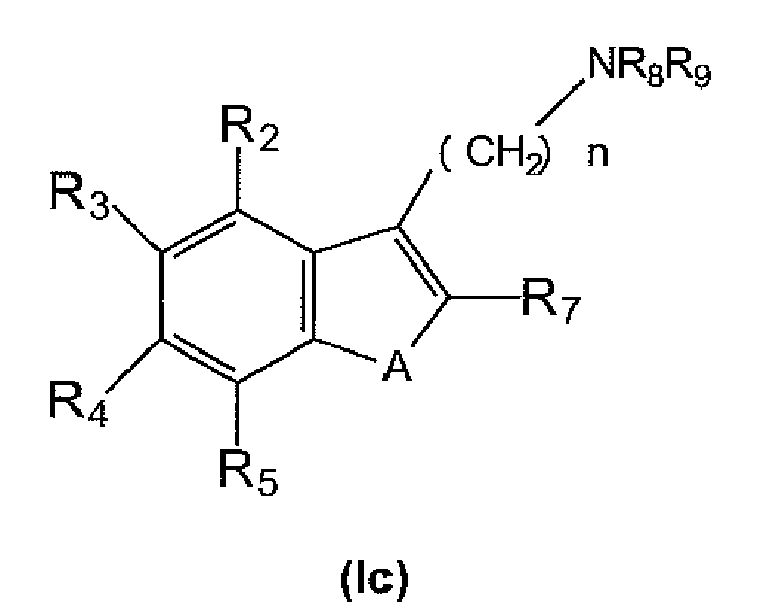
- Another specific embodiment of the invention are the compounds with the general formula (Id):

- Another specific embodiment is that in which the compounds of the invention have the general formula (Ie):

- Another specific embodiment of the invention are the indene derivatives with the general formula (If):

- Another specific embodiment are indene derivatives with the general formula (Ig):

- Another specific embodiment of the invention are the compounds with the general formula (Ih):

- Another specific embodiment of the invention are the compounds with the general formula (In):

- Finally, another specific execution of the invention are the compounds with the general formula (Ik):

- In a different aspect, the invention refers to the procedures for obtaining the indene derivatives of general formula I. Several procedures have been developed for obtaining the indene derivatives of the invention. Each of these procedures will be explained below.
- First of all, a procedure is described for obtaining indene derivatives with general formula (Ia).

- a) bringing together in a suitable reaction media an indanone with general formula II:

- b) Reacting the resulting intermediate alcohol in a solution of an acid , preferably H2SO4.
- In the first stage, very low temperatures approaching -80°C are used in a reaction media that preferably comprises LHMDS and THF. In addition, it is preferable to carry out this step in an argon atmosphere. In these conditions the indanone of formula II is reacted with an alkyl carboxylate. An intermediate alcohol is obtained from this reaction, which is dried and filtered and then subjected to the second step, which comprises treating the alcohol with an acid, preferably H2SO4, at a suitable temperature and period of time. The reaction mixture is extracted with an organic acid and after filtering and drying, a precipitate is obtained that can be identified as an acid with general formula (Ia).
- Before proceeding with step a) of method A, the indanones of general formula II can be nitrated in positions R2 to R5 as described in D. L. Musso, F. R. Cochran, J. L. Kelley, E.W. McLean, J. L. Selph, G. C. Rigdon, G. F. Orr, R. G. Davis, B. R. Cooper, V. L. Styles, J. B. Thompson, and W. R. Hall, J. Med. Chem., 2003, 46, 399-408.
- This procedure also allows indenylalkylcarboxylic acids to be obtained and comprises three main steps, although the first of these is common to method A. Thus, a procedure is described for obtaining indene derivatives with general formula (Ia):

- a) bringing together in a suitable reaction media an indanone with general formula II:

- b) adding TFA drop by drop to the resulting intermediate alcohol in a suitable media
- c) Reacting the resulting mixture with metal sodium dissolved in methanol, bringing the mixture to reflux temperature.
- As mentioned before, the step up to the obtaining of the intermediate alcohol is common to method A. The intermediate alcohol obtained is dissolved in a suitable solvent, such as CH2Cl2, and to this the TFA is added drop by drop at a temperature slightly below 0°C and preferably while stirring. This mixture is evaporated and re-suspended in a suitable media, such as dry methanol. To this solution a sufficient amount of sodium metal dissolved in the same media in which the previous mixture is re-suspended is added. The resulting mixture is taken to reflux temperature and made to react for a suitable period of time. The product of this reaction mixture is dried and filtered, obtaining a solid that can be identified as an acid with general formula (Ia).
- As in method A, the indanones of general formula II can be nitrated in positions R2 to R5 as described in D. L. Musso, F. R. Cochran, J. L. Kelley, E.W. McLean, J. L. Selph, G. C. Rigdon, G. F. Orr, R. G. Davis, B. R. Cooper, V. L. Styles, J. B. Thompson, and W. R. Hall, J. Med. Chem., 2003, 46, 399-408.
- On another hand, the compounds of formula (Ia) where n is different from 1 can be prepared via carboxylic acids, according to the methodology described in:
- H. Ochiai, T. Nishihara, Y. Tamaru, and Z. Yoshida. Titanium(IV)-Mediated Aldol-Type Condensation of Zinc Esters and Zinc Ketones with Carbonyl Electrophiles. J. Org. Chem., 1988, 53, 1343-1344.
- D. A. H. Taylor. 1,2,3,4-Tetrahydro-8-methylfluoren-1-one. Journal of the Chemical Society, Abstracts, 1960, 2805-2806.
- G. R. Clemo, L. H. Groves, L. Munday, and G. A. Swan. Indene series. I. A synthesis of 1,2,3,8-tetrahydro-1-ketocyclopent[a]indene. Journal of the Chemical Society, Abstracts, 1951, 863-867.
- M. Finze, S. E. Reybuck, and R. M. Waymouth. Propylene Polymerization with 1,2'-Bridged Bis(indennyl)zirconium Dichlorides. Macromolecules, 2003, 36, 9325-9334.
- Likewise, the compounds of formula (I) where n is different from 1 may be obtained according to the methodology described in:
- R. Perrone, F. Berardi, N. A. Colabufo, V. Tortorella, F. Fiorentini, V. Olgiati, E. Vanotti, and S. Govoni. Mixed 5-HT1A/D-2 Activity of a New Model of Arylpiperazines: 1-Aryl-4-[3-(1,2-dihydronaphtalen-4-yl)-n-propyl]piperazines. 1. Synthesis and Structure-Activity Relationships. J. Med. Chem., 1994, 37, 99-104.
- K. Fukatsu, O. Uchikawa, M. Kawada, T. Yamano, M. Yamashita, K. Kato, K. Hirai, S. Hinuma, M. Miyamoto, and S. Ohkawa. Synthesis of a Novel Series of Benzocycloalkene Derivatives as Melatonin Receptors Agonists. J. Med. Chem., 2002, 45, 4212-4221.
- In this section a procedure is described for obtaining indene derivatives with general formula (Ib).

which comprises bringing together in a suitable reaction media an acid with general formula (Ia):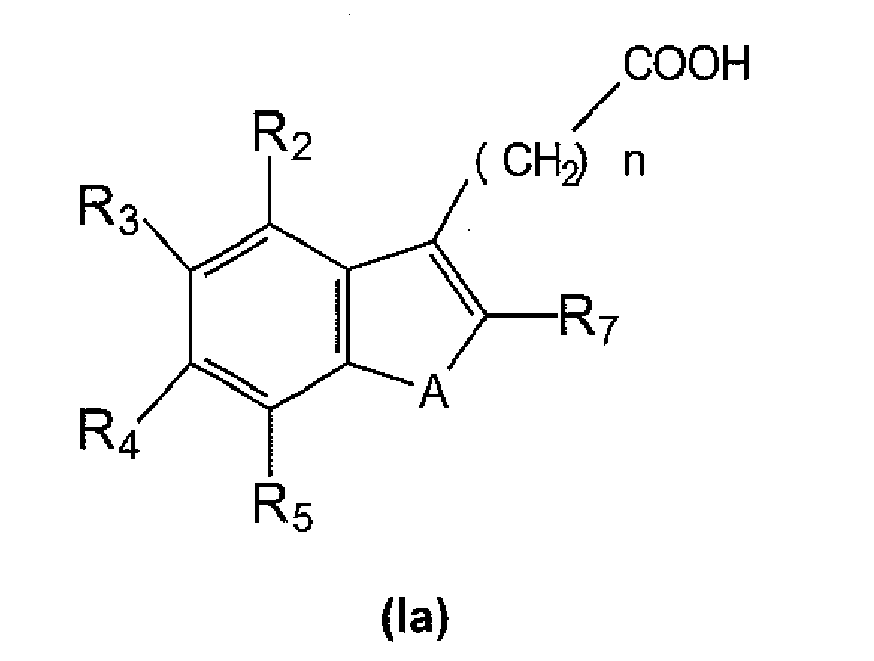
- In a sufficient amount of SOCl2 at reflux temperature and adding an amine with the formula NR8R9 to the residue obtained and re-dissolved.
- The reaction between the compound with general formula (Ia) and SOCl2 must take place in a suitable media, such as CH2Cl2, and at reflux temperature. The residue obtained after eliminating the excess SOCl2 at reduced pressure is once again dissolved in a suitable media (such as CH2Cl2) and mixed with the amine of general formula NR8R9 at a temperature of about 0°C. The mixture is allowed to react for the required time at room temperature and preferably under stirring.
- The product obtained after purification by silica gel column chromatography is characterised as being a compound of general formula (Ib).
- Method D, as method C, provides a procedure for obtaining an indenylamide. Specifically, it is described a procedure for obtaining indene derivatives with general formula (Ib):

which comprises bringing together in a suitable reaction media an acid with general formula (Ia):
- The preferred reaction media for carrying out the reaction between the compound (Ia) and the CDI comprises THF. This reaction, in addition to being favoured by stirring, is also favoured when carried out in an argon atmosphere. On the other hand, the second step in which the amine with the NR8R9 formula is added to the reaction mixture is also preferably carried out with stirring. Both reactions are preferably performed at room temperature for a suitable period of time.
- As in the case of method C, after purification by silica gel column chromatography, compounds are obtained that are identified as the compounds of general formula (Ib).
- This section describes a procedure for obtaining an indene derivative with general formula (Ic).

which comprises bringing together in a suitable reaction media a compound with general formula (Ib):
- The reaction is carried out in a reaction media that preferably comprises THF, at temperatures near 0°C and in an argon atmosphere for a suitable period of time. The residue purified by silica gel column chromatography allows an indenylamine of general formula (Ic) to be identified.
- Method F represents a procedure for preparing an indene derivative of general formula (Id):


- The reaction is carried out at room temperature for a suitable period of time, preferably under stirring. Washing with a suitable alkaline aqueous solution confirms that the product obtained is an indenylamine of general formula (Id).
- Method G represents a procedure for preparing an indene derivative of general formula (Ie):


- The indenylamine of formula (Id) is made to react dissolved in a suitable media, preferably dry pyridine, with the R13SO2Cl also dissolved at room temperature and in an argon atmosphere for a suitable period of time. Purification in silica gel column confirms that the product obtained is a compound of general formula (Ie).
- Method H represents a procedure for preparing an indene derivative of general formula (If):


- The indenylsulfonamide of formula (Ie) is made to react dissolved in a suitable media, such as acetonitryl, with K2CO3 and a suitable linear or branched alkyl halide with 1 to 5 carbon atoms also dissolved at room temperature in an argon atmosphere for a suitable period of time. Purification in silica gel column confirms that the product obtained is a compound of general formula (If).
- Method I represents a procedure for preparing an indene derivative of general formula (Ig):


- The reaction is carried out in a reaction media that preferably comprises THF, at temperatures near 0°C and in an argon atmosphere for a suitable period of time. The residue purified by silica gel column chromatography allows an alcohol of general formula (Ig) to be identified.
- Method J represents a procedure for preparing an indene derivative of general formula (Ih):

which comprises bringing together in a suitable reaction media an indenylic acid with general formula (Ik) :
- The acid with general formula (Ik) is made to react dissolved in a suitable media with NaH and a suitable aldehyde also dissolved at reflux temperature and in an argon atmosphere for a suitable period of time. Acidification and purification in silica gel column of the reaction mixture confirm that the product obtained is an acid of general formula (Ih).
- Another essential aspect of the invention are the intermediates for obtaining the compounds of general formula I, general formula (II):

- The following compounds are specific embodiments of the aforementioned intermediates of formula (II):
- [51] 2-Methyl-6-nitroindan-1-one
- [52] 2-Methyl-4-nitroindan-1-one
- [53] 6-Amino-2-methylindan-1-one
- [54] N-(2-Methyl-3-oxoindan-5-yl)naphthalene-2-sulfonamide
- [55] 4-Amino-2-methylindan-1-one
- [56] N-(2-Methyl-1-oxoindan-4-yl)naphthalene-2-sulfonamide
- [57] 6-Nitroindan-1-one
- [58] 4-Nitroindan-1-one
- [59] 6-Aminoindan-1-one
- [60] N-(3-Oxoindan-5-yl)naphthalene-2-sulfonamide
- [61] N-(2-Methyl-3-oxoindan-5-yl)-5-chloro-3-methylbenzo[b]thiophene-2-sulfonamide
- [62] 2-methyl-3-oxoindan-5-sulfonyl chloride
- [63] N-(Naphthalene-1-yl)-2-methyl-3-oxoindano-5-sulfonamide
- An additional aspect of the invention relates to the therapeutic use of the compounds of general formula I. As mentioned at the beginning, indene derivatives of general formula I have a strong affinity to 5-HT6 receptors and can behave as agonists, antagonists, inverse agonists, partial antagonists or partial agonists thereof. For this reason, they are suitable for the treatment and the prophylaxis of disorders and diseases mediated by 5HT6 receptors. In this sense, indene derivatives of general formula I are particularly useful for disorders or diseases related to food intake, preferably for appetite regulation, maintaining, increasing or reducing body weight, for prophylaxis and/or treatment of obesity, bulimia, anorexia, cachexia or diabetes type II, or for the prophylaxis and/or treatment of irritable bowel syndrome; disorders of the central nervous system; anxiety; panic attacks; depression; bipolar disorders; cognitive disorders; memory disorders; senile dementia; psychosis; schizophrenia; neurodegenerative disorders preferably selected among Alzheimer's disease, Parkinson's disease, Huntington's disease and multiple sclerosis; or hyperactivity disorders, preferably attention deficit / hyperactivity disorder, or for improving cognitive capacity.
- Another essential aspect of the invention is a pharmaceutical composition that comprises a compound of general formula I and at least one additive and/or auxiliary material that is Pharmaceutical acceptable.
- The auxiliary material and/or additive can be selected among carriers, excipients, support materials, lubricants, fillers, solvents, diluents, colorants, flavour conditioners such as sugars, antioxidants and/or agglutinants. In the case of suppositories, this may imply waxes or fatty acid esters or preservatives, emulsifiers and/or carriers for parenteral application. The selection of these auxiliary materials and/or additives and the amounts to be used will depend on the form of application of the pharmaceutical composition.
- The pharmaceutical composition in accordance with the invention can be adapted to any form of administration, be it orally or parenterally, for example pulmonarily, nasally, rectally and/or intravenously. Therefore, the formulation in accordance with the invention may be adapted for topical or systemic application, particularly for dermal, subcutaneous, intramuscular, intra-articular, intraperitoneal, pulmonary, buccal, sublingual, nasal, percutaneous, vaginal, oral or parenteral application.
- Suitable preparations for oral applications are pills, chewing gums, capsules, granules, drops or syrups.
- Suitable preparations for parenteral applications are solutions, suspensions, reconstitutable dry preparations or sprays.
- The compounds of the invention as deposits in dissolved form or in patches, optionally with agents that promote skin penetration, are examples of means of percutaneous application.
- Skin applications include ointments, gels, creams, lotions, suspensions or emulsions.
- The preferred form of rectal application is by means of suppositories.
- Optionally, the compositions in accordance with the invention can have a slow release rate in the aforementioned applications, particularly for oral, rectal and percutaneous applications.
- The amount of active ingredient that must be administered to the patient depends on the patient's weight, the type of application, the condition and severity of the disease. Normally, in human beings 1 to 500 mg of the active compound are administered daily in one or several doses.
- Described below are a number of examples by way of illustration of the invention:
-

- To a sufficient amount of anhydrous THF cooled to -78 °C 1.1-2.1 equivalents of a 1 M LHMDS solution in THF were added, in an argon atmosphere. Then 1.05 equivalents of dry AcOEt were added and the resulting mixture was stirred at -78°C for 30 minutes. Finally, a solution of 1 equivalent of 2-methyl-6-nitroindan-1-one was added in the sufficient amount of anhydrous THF and the resulting mixture was kept at -78 °C for 1-2 hours. The reaction mixture was acidified with HCl 1N, the temperature was allowed to rise gradually until reaching 20 °C and it was extracted with AcOEt. The organic extracts were dried with anhydrous Na2SO4 and filtered, and then evaporated to dryness, giving a residue that was identified by RMN 1H as the intermediate alcohol. The previous alcohol was added to a solution of H2SO4 50% (1:1), cooled to -5°C, and was heated to 60 °C for 2-5 hours. The progress of the reaction was followed by RMN 1H of reaction mixture aliquots. H2O was added to the reaction mixture and it was extracted with AcOEt. The organic extracts, after being dried with anhydrous Na2SO4 and filtered, were evaporated to dryness. The residue obtained was crushed with dry CH2Cl2 and the precipitate obtained was filtered, obtaining a solid that was identified as the indenylacetic acid.
-

- To a sufficient amount of anhydrous THF cooled to -78 °C 1,1-2,1 equivalents of a 1M LHMDS solution in THF were added, in an argon atmosphere. Then 1.05 equivalents of dry AcOEt were added and the resulting mixture was stirred at -78 °C for 30 minutes. Finally, a solution of 1 equivalent of N-(2-methyl-3-oxoindan-5-yl)naphthalene-2-sulfonamide was added in the sufficient amount of anhydrous THF and the resulting mixture was kept at -78 °C for 1-2 hours.
- The reaction mixture was acidified with HCl 1N, the temperature was allowed to rise gradually until reaching 20 °C and it was extracted with AcOEt. The organic extracts were dried with anhydrous Na2SO4 and filtered, and then evaporated to dryness, giving a residue that was identified by RMN 1H as the intermediate alcohol.
- To a solution of the previous alcohol in dry CH2Cl2 cooled to -10°C, in an argon atmosphere, 7 equivalents of TFA were added, drop by drop, and it was stirred at the same temperature for 30 minutes. The resulting mixture was evaporated to dryness. On a sufficient amount of dry methanol, 4 equivalents of sodium metal were added slowly. After all the sodium had dissolved, the solution was transferred to a suspension of the previous residue in dry methanol. The resulting mixture was heated in an argon atmosphere to reflux temperature for 18 hours. The course of the reaction was followed by silica gel thin-layer chromatography (hexane:AcOEt:AcOH 50:45:5).
- EtOH was added to the reaction mixture and it was evaporated to dryness. A solution of 5% Na2CO3 was added to the resulting residue and it was washed with AcOEt. The aqueous solution was acidified with HCl 5N and extracted with AcOEt. The organic extracts, after being dried with anhydrous Na2SO4 and filtered, were evaporated to dryness obtaining a solid that was identified as [2-methyl-6-(naphthatene-2-sulphonylamino)-3H-inden-1-yl] acetic acid.
-

- The sufficient amount of SOCl2 was added to a solution of 1 equivalent of the compound obtained in the previous example in dry CH2Cl2. Then the reaction mixture was heated to reflux temperature for 2 hours. After the reaction mixture had cooled down, the excess SOCl2 was evaporated at reduced pressure.
- The residue obtained was dissolved in dry CH2Cl2, cooled to 0 °C, 2.25 equivalents of the amine N,N-dimethylamine were added and it was stirred at room temperature in an argon atmosphere for 18 hours. The course of the reaction was followed by silica gel thin-layer chromatography (AcOEt).
- H2O was added to the reaction mixture; it was acidified with HCl 5N and extracted with AcOEt. The organic extracts, after being dried with anhydrous Na2SO4 and filtered, were evaporated to dryness. The residue obtained was purified by silica gel column chromatography (CH2Cl2:MeOH, increasing polarity mixtures), providing a compound identified as N,N-Dimethyl-2-[2-methyl-6-(naphthalene-2-sulphonylamino) -3H-inden-1-yl]acetamide.
-

- To a solution of 1 equivalent of the compound obtained in example 2 in anhydrous THF, 2 equivalents of CDI were added, in small portions, and it was stirred at room temperature in an argon atmosphere for 2 hours. Subsequently, 2 equivalents of the amine N,N-dimethylamine were added to the reaction mixture and it was kept in stirring at the same temperature for 18 hours. The course of the reaction was followed by silica gel thin-layer chromatography (CH2Cl2:MeOH 9:1).
- The reaction mixture was evaporated to dryness. The residue obtained was dissolved in AcOEt and washed with HCl 1 N. The organic extract, after being dried with anhydrous Na2SO4 and filtered, was evaporated to dryness. The residue obtained was purified by silica gel column chromatography (CH2Cl2:MeOH, increasing polarity mixtures), providing a compound identified as N,N-Dimethyl-2-[2-methyl-6-(naphthalene-2-sulphonylamino) -3H-inden-1-yl]acetamide.
-
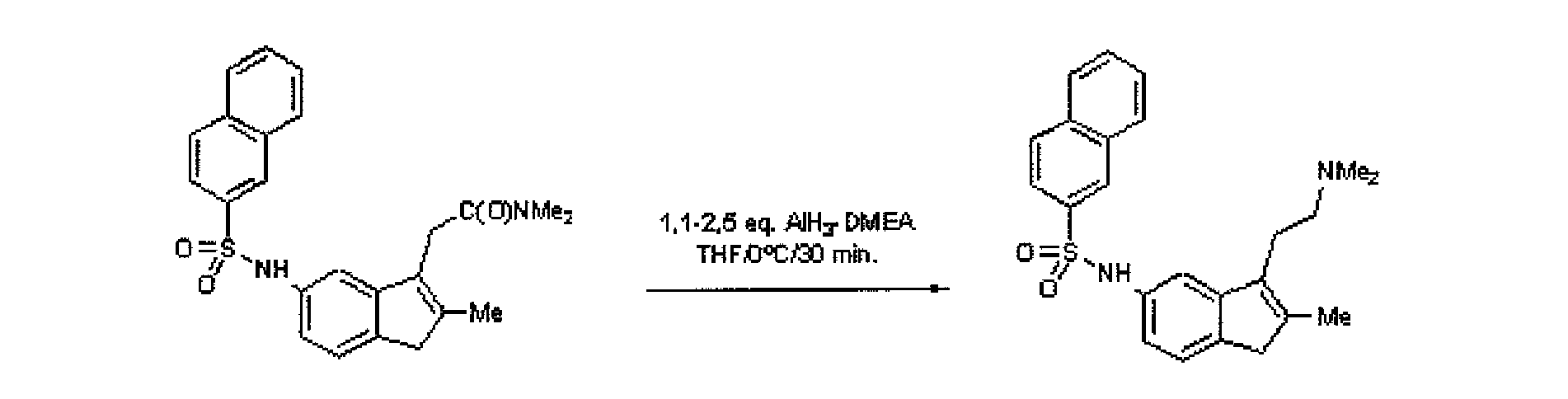
- On a sufficient amount of anhydrous THF cooled to 0 °C 1.1-2.5 equivalents of a solution of AIH3-DMEA 0.5M in toluene were added. Then a solution of 1 equivalent was added of the compound obtained in examples 3 or 4 in anhydrous THF cooled to 0°C. At the end of the addition, the mixture was maintained at the same temperature in an argon atmosphere for 30 minutes. The course of the reaction was followed by SiO2 thin-layer chromatography (CH2Cl2/NH3 gas:MeOH 99:1).
- Water and H2SO4 10% were added slowly to the reaction mixture and the temperature was allowed to rise slowly to 20°C. It was alkalinised with NH3 20% and extracted with AcOEt. The organic extracts, after being dried with anhydrous Na2SO4 and filtered, were evaporated to dryness. The residue obtained was purified by silica gel column chromatography (CH2Cl2/NH3 gas:MeOH, increasing polarity mixtures), providing a compound identified as N-[3-(2-Dimethylaminoethyl)-2-methyl-1H-inden-5-yl]naphthalene-2-sulfonamide.
-

- To a solution of 1 equivalent of N,N-dimethyl-[2-(2-methyl-6-nitro-3H-inden-1-yl)ethyl]amine in glacial AcOH 10 equivalents of Zn were added. The resulting suspension was stirred at room temperature for 3 hours. The course of the reaction was followed by silica gel thin-layer chromatography (CH2Cl2/NH3 gas:MeOH 4:1).
- The reaction mixture was filtered through Celite® and the filtered liquids were evaporated to dryness. The residue obtained was dissolved in CH2Cl2 and washed with NaHCO3 10%. The organic extract, after being dried with anhydrous Na2SO4 and filtered, was evaporated to dryness. The residue obtained was purified by silica gel column chromatography (CH2Cl2/NH3 gas:MeOH, increasing polarity mixtures), obtaining a brown solid identified as 3-(2-dimethylaminoethyl)-2-methyl-1H-inden-5-ylamine.
-

- To a solution of 1 equivalent of 3-(2-dimethylaminoethyl)-2-methyl-1H-inden-5-ylamine in dry pyridine a solution of 1.1-1.5 equivalents of 6-chloroimidazo[2,1-b]thiazole-5-sulfonyl chloride in dry pyridine was added. The resulting mixture was stirred at room temperature in an argon atmosphere for 2-18 hours. The course of the reaction was followed by silica gel thin-layer chromatography (CH2Cl2/NH3 gas:MeOH 4:1).
- The reaction mixture was evaporated to dryness. The residue obtained was dissolved in CH2Cl2 and washed with a saturated solution of Na2CO3 (3x100 ml). The organic extract, after being dried with anhydrous Na2SO4 and filtered, was evaporated to dryness. The residue obtained was purified by silica gel column chromatography ((CH2Cl2/NH3 gas:MeOH, increasing polarity mixtures), providing a solid identified as N-[3-(2-Dimethylaminoethyl)-2-methyl-1H-inden-5-yl]-6-chloroimidazo[2,1-b]thiazole-5-sulfonamide.
- Compounds 20, 21 and 22 are obtained by the same method from 5-chloro-3-methylbenzo[b]thiophene-2-sulfonyl chloride, 4-acetylaminobenzenosulfonyl chloride and 2,1,3-benzothiadiazole-4-sulfonyl chloride respectively.
-
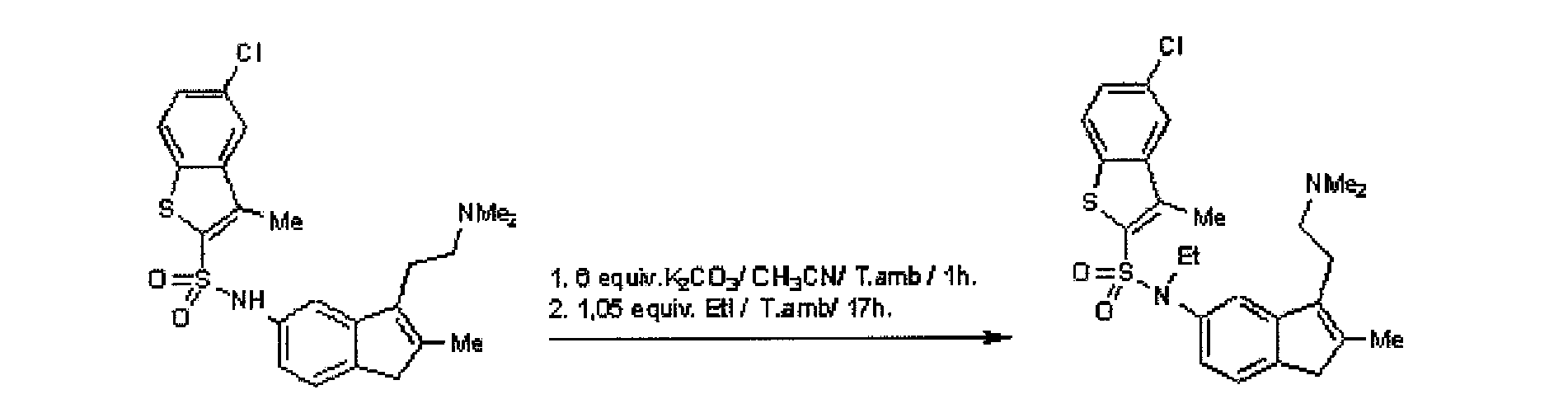
- To a solution of 1 equivalent of N-[3-(2-dimethylaminoethyl)-2-methyl-1H-inden-5-yl]-5-chloro-3-methylbenzo[b]thiophene-2-sulfonamide in dry acetonitrile 6 equivalents of potassium carbonate were added. The resulting mixture was stirred at room temperature in an argon atmosphere for 1 hour. Then 1.05 equivalents were added of ethyl iodide and it was kept with stirring at room temperature for 17 hours. The course of the reaction was followed by silica gel thin-layer chromatography (CH2Cl2/NH3 gas:MeOH 9:1).
- The reaction mixture was filtered and the resulting solution was evaporated to dryness, providing a residue that was purified by silica gel chromatography (CH2Cl2/NH3 gas:MeOH, increasing polarity mixtures), obtaining N-ethyl-N-[3-(2-dimethylaminoethyl)-2-methyl-1H-inden-5-yl]-5-chloro-3-methylbenzo[b]thiophene-2-sulfonamide.
-

- To a suspension of 3.6 equivalents of LiAIH4 in anhydrous THF cooled to 0 °C 1.2 equivalents of AICl3 were added. The temperature was allowed to rise gradually to 20 °C and stirring in an argon atmosphere was maintained for 1 hour. Then the resulting suspension was cooled to 0 °C and a solution of 1 equivalent of [2-methyl-6-(naphthalene-2-sulphonylamine)-3H-inden-1-yl]acetic acid in anhydrous THF was added, drop by drop. At the end of the addition, stirring was maintained at 0 °C for 2 hours. The course of the reaction was followed by silica gel column chromatography (CH2Cl2:AcOH 95:5).
- To the reaction mixture was added HCI 37% and water and extracted with CH2Cl2. Organic extracts were washed with a saturated NaCl solution and, after drying with anhydrous Na2SO4 and filtering, they were evaporated to dryness. A residue was obtained that was purified by silica gel chromatography (CH2Cl2:AcOH 95:5), providing N-[3-(2-hydroxyethyl)-2-methyl-1H-inden-5-yl]naphthalene-2-sulfonamide.
-

- To a solution of 1 equivalent of 6-aminoindan-1-one in CH3CN cooled to -10°C AcOH glacial, HCI 37% and a solution of 1.2 equivalents of NaNO2 in H2O were added. The resulting mixture was added at the same temperature for 30 minutes. SO2 was bubbled through the reaction mixture for about 20 minutes. Then an H2O solution of 1.25 equivalents of CuCl2·2H2O were added maintaining the temperature at -10°C. The temperature of the reaction mixture was allowed to rise gradually until reaching 20 °C and was stirred for 16 hours. H2O was added to the resulting solution, it was alkalinised with Na2CO3 and extracted with CH2Cl2. The organic extract, after being dried with anhydrous Na2SO4 and filtered, was evaporated to dryness, obtaining an oil that was identified as 2-methyl-3-oxoindane-5-sulfonyl chloride.
- To a solution of 1.1 equivalents of 1-naphthylamine in dry CH2Cl2 and dry pyridine a solution of 1 equivalent of the aforementioned sulfonyl chloride in dry CH2Cl2 was added in an argon atmosphere. The reaction mixture was stirred at room temperature for 18 hours. The course of the reaction was followed by silica gel thin-layer chromatography (AcOEt:hexane 1:1). CH2Cl2 was added to the reaction mixture and it was washed with HCI 2.5N. The organic extract, after being dried with anhydrous Na2SO4 and filtered, was evaporated to dryness. The residue obtained was purified by silica gel column chromatography (CH2Cl2:MeOH, increasing polarity mixtures), providing a compound identified by RMN as N-(naphthalene-1-yl)-2-methyl-3-oxoindane-5-sulfonamide.
- To a sufficient amount of anhydrous THF cooled to -78 °C 2.1 equivalents of a 1M LHMDS solution in THF were added, in an argon atmosphere. Then 1.05 equivalents of dry AcOEt were added and the resulting mixture was stirred at the same temperature for 30 minutes. Finally, a 1 equivalent solution of the previous indanone in anhydrous THF was added and it was kept stirring for 1 hour at -78 °C. The reaction mixture was acidified with HCl 1N, the temperature was allowed to rise gradually until reaching 20 °C and it was extracted with AcOEt. The organic extracts, after being dried with anhydrous Na2SO4 and filtered, were evaporated to dryness. To a solution of the resulting residue in dry CH2Cl2 cooled to -10°C, in an argon atmosphere, 7 equivalents of TFA were added and it was stirred at the same temperature for 30 minutes. The resulting mixture was evaporated to dryness. 4 equivalents of sodium metal were added to a sufficient amount of dry methanol. After all the sodium had dissolved the solution was transferred to a suspension of the previous residue in dry methanol. The resulting mixture was heated in an argon atmosphere to reflux temperature for 18 hours. The course of the reaction was followed by silica gel thin-layer chromatography (hexane:AcOEt:AcOH 50:45:5). EtOH was added to the reaction mixture and it was evaporated to dryness. 5% Na2CO3 was added to the resulting residue and it was washed with AcOEt. The aqueous solution was acidified with HCl 5N and extracted with AcOEt. The organic extracts, after being dried with anhydrous Na2SO4 and filtered, were evaporated to dryness obtaining a compound that was identified as [2-methyl-6-(naphthalene-1-ylsulfamoyl)-3H-inden-1-yl]acetic acid.
- A sufficient amount of SOCl2 was added to a solution of 1 equivalent of the previous acid in dry CH2Cl2. Then the reaction mixture was heated to reflux temperature for 2 hours. After the reaction mixture had cooled the excess SOCl2 was evaporated at reduced pressure. To a solution cooled to 0°C of the residue obtained in dry CH2Cl2 2.5 equivalents of HNMe2 were added and it was stirred at room temperature, in an argon atmosphere, for 18 hours. The course of the reaction was followed by silica gel thin-layer chromatography (CH2Cl2:MeOH 9:1). H2O was added to the reaction mixture, it was acidified with HCl 5N and extracted with AcOEt. The organic extracts, after being dried with anhydrous Na2SO4 and filtered, were evaporated to dryness. The residue obtained was purified by silica gel column chromatography (CH2Cl2:MeOH, increasing polarity mixtures), providing a solid identified as the amide N,N-dimethyl-2-[2-methyl-6-(naphthalene-1-ylsulfamoyl)-3H-inden-1-yl]acetamide.
- On a sufficient amount of anhydrous THF cooled to 0 °C 2 equivalents of a solution of AIH3-DMEA 0.5M in toluene were added. Then a solution, previously cooled to 0 °C, of 1 equivalent of the previous amide in anhydrous THF was added. It was kept with stirring in an argon atmosphere at 0 °C for 30 minutes. The course of the reaction was followed by silica gel thin-layer chromatography (CH2Cl2/NH3 gas:MeOH 95:5). Water and H2SO4 10% were added to the reaction mixture and the temperature was allowed to rise slowly to 20°C. It was alkalinised with NH3 20% and extracted with AcOEt. The organic extracts, after being dried with anhydrous Na2SO4 and filtered, were evaporated to dryness. The residue obtained was purified by silica gel column chromatography (CH2Cl2/NH3 gas:MeOH, increasing polarity mixtures), providing N-(naphthalene-1-yl)-3-(2-dimethylaminoethyl)-2-methyl-1H-indene-5-sulfonamide.
-

- To a suspension of 6 equivalents of NaH in anhydrous THF cooled to 0 °C a solution of 1 equivalent of [2-methyl-6-(naphthalene-2-sulphonylamine)-3H-inden-1-yl]acetic acid in anhydrous THF was added, in an argon atmosphere, and it was stirred at room temperature for 1 hour. Then a solution of 5 equivalents of benzaldehyde in anhydrous THF was added. At the end of the addition the resulting mixture was heated to reflux temperature for 5 hours. The course of the reaction was followed by silica gel thin-layer chromatography (hexane:AcOEt:AcOH 50:45:5).
- EtOH was added to the reaction mixture and was evaporated to dryness. A saturated solution of NaCl was added to the resulting residue and was washed with CH2Cl2. The aqueous solution was acidified with HCl 5N and extracted with CH2Cl2. After drying with anhydrous Na2SO4 and filtering, the organic extracts were evaporated to dryness, providing a residue that was purified by silica gel column chromatography (hexane:AcOEt 1:1 and AcOEt). A solid was obtained identified as [3(Z)-benzylidene-2-methyl-6-(naphthalene-2-sulphonylamine)-3H-inden-1-yl]acetic acid.
-

- To a stirred solution of LDA (3.84 mL, 5.76 mmol) in THF (20 mL) was added 1-methyl-2-pyrrolidinone (0.53 mL, 5.5 mmol), and the mixture was stirred at dry ice temperature for 1 h. 2-Methyl-6-nitroindan-1-one (1 g, 5.23 mmol) as a solution in 40 mL of THF was then added to the previous mixture. The reaction mixture was stirred for 2 h at dry ice temperature, and transferred to a 1 N aqueous HCl solution (50 mL). The aqueous layer was extracted with EtOAc and the extracts were combined and concentrated in vacuum to afford the intermediate alcohol as an oil. To a stirred solution of the previous alcohol in CH2Cl2 (40 mL) was added TFA (3 mL, 40.38 mmol) and the mixture was stirred at ice-water temperature for 30 min. The resulting mixture was evaporated to dryness. The resulting crude was purified by column chromatography on silica gel, using as eluent mixtures of EtOAc/MeOH to afford a lactam as an oil.
- To a stirred solution of the previous lactam (322 mg, 1.18 mmol) in 20 mL of THF was added AIH3 (3.8 mL, 1.9 mmol) and the reaction mixture was stirred for 30 min at ice-water temperature. The reaction was quenched by adding a mixture of THF-H2O (1:1, 20 mL) followed by EtOAc (50 mL). The insoluble part was removed by filtration. The combined organic phases were washed with brine and evaporated to afford the intermediate amine as an oil. To a stirred solution of the previous amine in glacial AcOH (5mL) was added Zn dust (464 mg, 7.1 mmol). After 3 h, the reaction mixture was filtered under vacuum through Celite® and the filtrate was evaporated to dryness to give the corresponding 1H-indenamine as a solid.
- To a solution of the previous 1H-indenamine (80 mg, 0.35 mmol) in 3 mL of pyridine, a solution of 6-chloroimidazo[2,1-b][1,3]thiazole-5-sulfonyl chloride in 1 mL of pyridine was added. The reaction mixture was monitored by TLC until completation and then evaporated to dryness. The product was further purified using SiO2 column chromatography with CH2Cl2/MeOH/ammonia yielding 6-chloro-N-[2-methyl-3-(1-methylpyrrolidin-3-yl)-1H-inden-5-yl]imidazo[2,1-b][1,3]thiazole-5-sulfonamide as a solid.
- Melting point and the spectroscopic data obtained from some of the compounds of general formula I prepared in accordance with the examples are shown in the following table:
Ex. COMPOUND M.p. °C IR cm-1 RMN 1H, δ (solvent) 1 
208-10 KBr: 200 MHz (DMSO-d6): 3090, 2.09 (s, 3H), 3.52 (s, 2H), 3.57 1703, (s, 2H), 7.60 (d, J =8.4 Hz, 1H), 1515, 7.98-8.02 (m, 2H) 1332 2 
176-8 KBr: 200 MHz (CDCl3): 3242, 2.07 (s, 3H), 3.20 (s, 2H), 3.48 1705, (s, 2H), 6.85-6.95 (m, 1H), 7.08- 1329, 7.18 (m, 2H), 7.40-7.95 (m, 7H), 1155 8.31 (s, 1H) 3 
110-2 KBr: 200 MHz (CDCl3): 3245, 2.18 (s, 3H), 3.58 (s, 2H), 7.00 1705, (s, 1H), 7.14-7.17 (m, 2H), 7.33- 1330, 7.80 (m, 12H), 8.32 (s, 1H) 1154 4 
90-2 KBr: 200 MHz (CDCl3): 3251, 2.04 (s, 3H), 3.15 (s, 2H), 3.45 1703, (s, 2H), 6.82-7.80 (m, 10H), 8.31 1328, (s, 1H) 1158 5 
134-6 KBr: 200 MHz (CDCl3): 3276, 3.15 (s, 2H), 3.49 (s, 2H), 6.37 1702, (s, 1H), 6.90-7.96 (m, 10H), 8.32 1325, (s, 1H) 1156 6 
196-8 KBr: 200 MHz (CDCl3): 3266, 2.10 (s, 3H), 2.32 (s, 3H), 3.28 1710, (s, 2H), 3.48 (s, 2H), 6.86-6.95 1342, (m, 1H), 7.02-7.06 (m, 2H), 1155 7.19-7.33 (m, 2H), 7.58-7.61 (m, 2H) 7 
118-20 KBr: 300 MHz (CDCl3): 3251, 2.05 (s,3H), 3.21 (s, 2H), 3.49 1710, (s, 2H), 7.15-7.32 (m, 4H), 7.38 1311, (dd, J =1.8, 9.0 Hz, 1H), 7.52- 1151 7.57 (m, 2H), 7.64-7.68 (m, 1H), 7.76 (d, J =1.5 Hz, 1H), 7.85-7.88 (m, 1H) 8 
110-2 KBr: 200 MHz (CDCl3): 1641, 2.13 (s, 3H), 2.99 (s, 3H), 3.16 1515, (s, 3H), 3.44 (s, 2H), 3.59 (s, 1342 2H), 7.43 (d, J=8.8 Hz, 1H), 7.97-8.02 (m, 2H) 9 
128-30 KBr: 200 MHz (CDCl3): 1624, 1.86-2.07 (m, 4H), 2.14 (s, 1513, 3H), 3.44 (s, 2H), 3.47-3.61 1336 (m, 6H), 7.43 (d, J =8.0 Hz, 1H), 7.97-8.06 (m, 2H) 10 
a NaCl: 200 MHz (CDCl3): 3247, 2.14-2.18 (m, 3H), 2.85-2.98 1606, (m, 6H), 3.49- 3.57 (m, 2H), 1334, 6.61-6.73 (m, 1H), 7.04-7.83 1159 (m, 14H), 8.32-8.36 (m, 1H) 11 
114-6 NaCl: 200 MHz (CDCl3): 3250, 2.05 (s, 3H), 2.86 (s, 3H), 2.96 1610, (s, 3H), 3.23 (s, 2H), 3.45 (s, 1333, 2H), 6.78-7.18 (m, 4H), 7.54- 1159 7.94 (m, 5H), 8.38 (s, 1H) 12 
a KBr: 200 MHz (CDCl3): 3063, 1.65-1.84 (m, 4H), 2.02 (s, 1613, 3H), 3.12 (s, 2H), 3.32-3.43 1323, (m, 6H), 6.84-6.89 (m, 1H), 1156 7.01-7.05 (m, 1H), 7.13 (s, 1H), 7.39-7.52 (m, 3H), 7.68-7.79 (m, 4H), 8.33 (s, 1H) 13 
a 14 
125-7 KBr: 200 MHz (CDCl3): 3245, 1.80-2.00 (m, 4H), 3.18 (s, 2H), 3.30-3.50 (m, 4H), 6.30 (s, 1H), 6.95-6.99 (m, 1H), 7.05-7.09 (m, 2H), 7.40-7.58 (m, 2H), 7.64-7.86 (m, 4H), 8.38 (s, 1H) 1615, 1326, 1156 15 
a KBr: 200 MHz (CDCl3): 3079, 1.78-1.98 (m, 4H), 2.07 (s, 3H), 2.36 (s, 3H), 3.22 (s, 2H), 3.36-3.44 (m, 6H), 6.82-6.88 (m, 1H), 7.08-7.14 (m, 2H), 7.32-7.38 (m, 1H), 7.60-7.64 (m, 2H), 7.82 (s, 1H) 1613, 1335, 1157 16 
90-2 KBr: 200 MHz (CDCl3): 3056, 2.02 (s, 3H), 2.91 (s, 3H), 2.99 (s, 3H), 3.20 (s, 2H), 3.45 (s, 2H), 7.17-7.32 (m, 4H), 7.35-7.44 (m, 3H), 7.63-7.67 (m, 1H), 7.74-7.79 (m, 1H), 7.98-8.02 (m, 1H) 1630, 1314, 1151 17 
a NaCl: 200 MHz (CDCl3): 1520, 2.13 (s, 3H), 2.35 (s, 6H), 2.42-2.50 (m, 2H), 2.71-2.79 (m, 2H), 7.45 (d, J =8.0 Hz, 1H), 7.99-8.04 (m,3H) 1338 18 
68-70 NaCl: 200 MHz (CDCl3): 3343, 2.05 (s, 3H), 2.33 (s, 6H), 2.40-2.45 (m, 2H), 2,61-2,69 (m, 2H), 3.18 (s, 2H), 6.46 (dd, J =2.2, 8.0 Hz, 1H), 6,62 (d, J =2.2 Hz, 1H), 7.12 (d, J =8.6 Hz, 1H) 3209, 1614, 853, 804 19 
200-2 KBr: 200 MHz (CDCl3): 3149, 2.03 (s, 3H), 2.26-2.33 (m, 8H), 2.54-2.62 (m, 2H), 3.18 (s, 2H), 6.84 (d, J =1.8 Hz, 1H), 6.95 (d, J =4.4 Hz, 1H), 7.04 (dd, J =1.8, 8.0 Hz, 1H), 7.19 (d, J =7.8 Hz, 1H), 7.82 (d, J =4.8 Hz, 1H) 1343, 1171 20 
158-60 KBr: 200 MHz (CDCl3): 3070, 2.01 (s, 3H), 2.31-2.40 (m, 11H), 2.56-2.64 (m, 2H), 3.18 (s, 2H), 6.92-6.99 (m, 2H), 7.18 (d, J =8.0 Hz, 1H), 7.36 (dd, J =2.0, 8.0 Hz, 1H), 7.62-7.67 (m, 2H), 8.64 (ba, 1H) 1337, 1157 21 
116-8 NaCl: 200MHz (CDCl3): 3263, 2.01 (s, 3H), 2.14 (s, 3H), 2.29-2.40 (m, 8H), 2.54-2.64 (m, 2H), 3.16 (s, 2H), 6.80-6.91 (m, 2H), 7.15 (d, J =8.0 Hz, 1H), 7.52-7.64 (m, 4H), 8.39 (s, 1H) 1680, 1316, 1157 22 
66-8 NaCl: 200MHz (CDCl3): 2937, 1.99 (s, 3H), 2.17-2.24 (m, 2H), 2.28 (s, 6H), 2.48-2.57 (m, 2H), 3,10 (s, 2H), 6.71 (dd, J =2.0, 7.8 Hz, 1H), 6.85 (d, J =1.4 Hz, 1H), 7.06 (d, J =8.0 Hz, 1H), 7.60 (dd, J =7.0, 8.0 Hz, 1H), 8.15 (dd, J =1.2, 4.4 Hz, 1H), 8.18-8.20 (m, 1H) 1335, 1158 23 
a NaCl: 200MHz (CDCl3): 1351, 1.14 (t, J =6.9 Hz, 3H), 2.07 (s, 3H), 2.00 (s, 3H), 2.14 (s, 6H), 2.17-2.23 (m, 2H), 3.27 (s, 2H), 3.79 (c, J =6.9 Hz, 2H), 6.89-6.93 (m, 2H), 7.29 (dd, J =0.9, 9.0 Hz, 1H), 7.42 (dd, J =1.8, 9.0 Hz, 1H), 7.67 (dd, J =0.6, 3.0 Hz, 1H), 7.73-7.76 (m, 1H) 1169 24 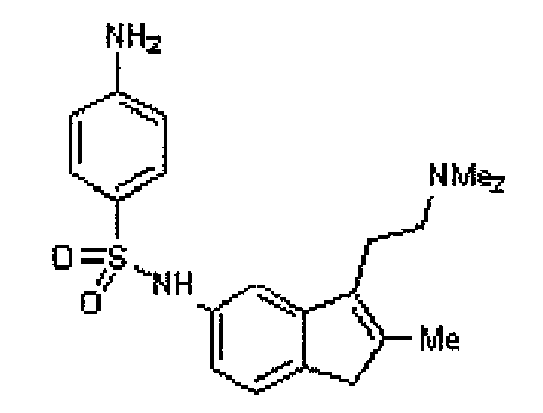
68-70 KBr: 200MHz (CDCl3): 3458, 2.04 (s, 3H), 2.33-2.40 (m, 8H), 2.57-2.66 (m, 2H), 3.19 (s, 2H), 4.08 (ba, 2H), 6.52-6.59 (m, 2H), 6.81 (dd, J =2.2, 8.0 Hz, 1H), 6.90 (d, J =2.0 Hz, 1H), 7.18 (d, J =8.0 Hz, 1H), 7.49-7.55 (m, 2H) 3374, 3236, 1596 1315, 1149, 829, 676 25 
a NaCl: 200MHz (CDCl3): 3293, 1.82 (m, 4H), 2.02 (s, 3H), 2.74 (m, 8H), 3.16 (s, 2H), 3.61 (s, 2H), 4.98 (s, 2H), 6.89 (d, J =8.7 Hz, 2H), 7.19-7.38 (m, 9H), 7.48 (d, J =1.5 Hz, 1H), 8.44 (s, 1H) 1661 26 
74-76 KBr: 200 MHz (CDCl3): 3440, 1.80-1.87 (m, 4H), 2.04 (s, 3H), 2.52-2.78 (m, 8H), 3.17 (s, 2H), 3.68 (ba, 2H), 6.45 (dd, J =2.2, 8.0 Hz, 1H), 6.64 (d, J =2.2 Hz, 1H), 7.11 (d, J =8.0 Hz, 1H) 3306, 1612, 845, 799 27 
108-10 KBr: 200MHz (CDCl3): 1343, 1.12-1.17 (m, 3H), 1.41 (t, J =7.2 Hz, 3H), 2.15 (s, 3H), 2.23 (s, 3H), 2.97-3.02 (m, 2H), 3.32 (s, 2H), 3.42 (s, 6H), 3.52-3.58 (m, 2H), 3.76-3.86 (m, 4H), 6.69 (dd, J =1.6, 6.0 Hz,1H), 7.1 (dd, J =1.9, 6.0 Hz, 1H), 7.24 (d, J =8.0 Hz, 1H), 7.69 (dd, J =1.8, 6.0 Hz, 1H), 7.73-7.81 (m, 1H) 1166 28 
200MHz (CDCl3): 1.81-1.88 (m, 4H), 2.13 (s, 3H), 2.56-2.70 (m, 6H), 2.76-2.84 (m, 2H), 3.37 (s, 2H), 7.44 (dd, J =0.8, 8.0 Hz, 1H), 7.99-8.08 (m, 2H). 29 
98-100 KBr: 200 MHz (CDCl3): 3112, 1.88-1.91 (m, 4H), 2.02 (s, 3H), 2.59-2.72 (m, 8H), 3.18 (s, 2H), 6.84 (d, J = 4.6 Hz, 1H), 6.96 (dd, J =2.0, 8.0 Hz, 1H), 7.10 (d, J =1.8 Hz, 1H), 7.17 (d, J =7.6 Hz, 1H), 7.82 (d, J =4.4 Hz, 1H) 1328, 1141 30 
94-6 KBr: 200MHz (CDCl3); 3256, 1.80-1.81 (m, 4H), 2.04 (s, 3H), 2.17 (s, 3H), 2.45-2.66 (m, 8H), 3.19 (s, 2H), 6.82 (dd, J =2.1, 8.0 Hz, 1H), 6.91 (d, J =1.4 Hz, 1H), 7.18 (d, J =7.6 Hz, 1H), 7.52-7.68 (m, 4H) 1679, 1317, 1155 31 
70-2 KBr: 200MHz (CDCl3): 3257, 1.83-1.89 (m, 1H), 1.98 (s, 3H), 2.32-2.41 (m, 2H), 2.56-2.62 (m, 6H), 3.09 (s, 2H), 6.75 (dd, J =2.0, 8.0 Hz, 1H), 6.86 (d, J =1.8 Hz, 1H), 7.06 (d, J =7.6 Hz, 1H), 7.59 (dd, J =7.0, 8.0 Hz, 1H), 8.12-8.20 (m, 2H) 1336, 1157 32 
80-2 KBr: 200MHz (CDCl3): 3452, 1.80-1.87 (m, 4H), 2.04 (s, 3H), 2.17-2.71 (m, 8H), 3.19 (s, 2H), 4.07 (s, 2H), 6.52-6.59 (m, 2H), 6.81 (dd, J =2.2, 8.0 Hz, 1H), 6.92 (d, J =1.8 Hz, 1H), 7.18 (d, J =7.6 Hz, 1H), 7.48-7.55 (m, 2H) 3376, 3245, 1596, 1315, 1150, 829, 679 33 
a 200 MHz (CDCl3): 2.10 (s, 3H), 2.28 (s, 6H), 2.28-2.40 (m, 2H), 2.60-2.72 (m, 2H), 6.58-6.64 (m, 1H), 6.88-692 (m, 1H), 7.09-7.17 (m, 2H), 7.32-7.86 (m, 13H), 8.38 (s, 1H) 34 
a NaCl: 200 MHz (CDCl3): 3252, 1.99 (s, 3H), 2.23 (s, 6H), 2.23-2.30 (m, 2H), 2.48-2.59 (m, 2H), 3.15 (s, 2H), 6.90-6.93 (m, 2H), 7.14-7.18 (m, 1H), 7.48-7.60 (m, 2H), 7.76-7.86 (m, 4H), 8.35 (s, 1H) 1329, 1158 35 
a NaCl: 200 MHz (CDCl3): 3250, 1.70-1.80 (m, 4H), 1.98 (s, 3H), 2.35-2.64 (m, 8H), 3.13 (s, 2H), 6.92-6.97 (m, 2H), 7.13-7.17 (m, 1H), 7.49-7.59 (m, 2H), 7.78-7.85 (m, 4H), 8.36 (s, 1H) 1330, 1158 36 
a NaCl: 400 MHz (CDCl3): 3261, 1.90 (m, 4H), 1.99 (s, 3H), 2.64-2.76 (m, 8H), 3.08 (s, 2H), 6.97-6.99 (m, 1H), 7.05 -7.16 (m, 2H), 7.55-7.65 (m, 2H), 7.77-7.80 (m, 1H), 7.85-7.90 (m, 3H), 8.35 (d, J =1.6 Hz, 1H) 1335, 1160 37 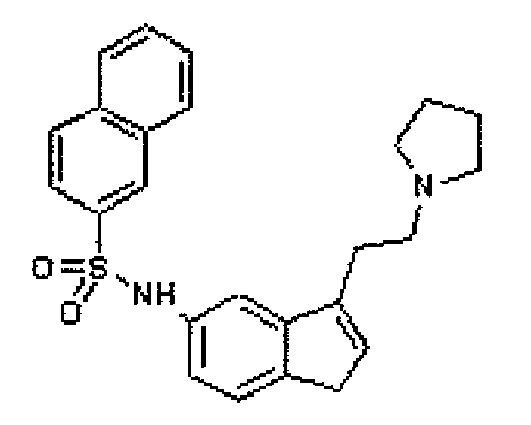
NaCl: 200 MH, (CDCl3): 3056, 1.70-1.80 (m, 4H), 2.46-2.76 (m, 8H), 3.16 (s, 2H), 6.15 (s, 1H), 7.00-7.06 (m,2H), 7.20-7.52 (m, 3H), 7.69-7.78 (m,5H),8.35(s, 1H) 1327, 1157 38 
186-8 NaCl: 200 MHz (CDCl3): 1333, 1.80-1.86 (m, 4H), 2.02 (s, 3H), 2.38 (s, 3H), 2.39-2.62 (m, 6H), 3.18 (s, 2H), 6.86 (s, 1H), 7.02-7.10 (m, 1H), 7.15-7.12 (m, 1H), 7.20-7.38 (m, 2H), 7.63-7.67 (m, 2H) 1157 39 
a NaCl: 200 MHz (CDCl3): 3021, 2.05 (s, 3H), 2.33-2.40 (m, 8H), 2.59-2.67 (m, 2H), 3.26 (s, 2H), 7.29-7.46 (m, 5H), 7.55-7.93 (m, 5H) 1316, 1151 40 
a 200 MHz (CDCl3): 2.01 (s, 3H), 2.62-2.68 (m, 2H), 3.14 (s, 2H), 3.60-3.66 (m, 2H), 6.80-6.88 (m, 1H), 7.05-7.14 (m, 2H), 7,49-7.59 (m, 2H), 7.74-7.80 (m, 4H), 8.36 (s, 1H) 41 
Oil NaCl: 200 MHz (CDCl3): 3008 1.22 (s, 6H), 2.77 s, 6H), 2.80-2.85 (m, 2H), 3.03-3.11(m, 2H), 6.13 (s, 1H), 6.96 (d, J=4.4 Hz, 1H), 7.03-7.08 (m, 2H), 7.15-7.19 (m, 1H), 7.77 (d, J=4.8Hz, 1H) 2935 1335 1156 42 
Oil NaCl: 200 MHz (CDCl3): 3011 1.23 (s, 6H), 2.37 (s, 3H), 2.71 (s, 6H), 2.74-2.82 (m, 2H), 3.03-3.11 (m, 2H), 6.13 (s, 1H), 6.97 (dd, J=2.0, 7.8Hz, 1H), 7.09 (d, J=1.8Hz, 1H), 7.15-7.20 (m, 2H), 7.42 (dd, J=2.0, 8.6Hz, 1H), 7.68-7.74 (m,2H) 2423 1332 1159 43 
200-1 KBr: 300MHz (CDCl3): 2986 1.98 (s, 3H), 2.18-2.23 (m, 2H), 2.26 (s, 6H), 2.45-2.52 (m, 2H), 3.11 (s, 2H), 6.70 (d, J=2.9Hz, 1H), 6.86 (dd, J=2.0, 9.9Hz, 1H), 7.09 (d, J=7.8Hz, 1H), 7.40-7.46 (m, 1H), 7.53-7.58 (m, 1H), 7.63-7.69 (m, 1H), 7.87-7.90 (m, 1 H), 7.98 (d, J=8.1Hz, 1H), 8.21 (dd, J=1.4, 7.2Hz, 1H), 8.75-8.87 (m, 1H) 1320 1158 44 
196-7 KBr: 400MHz (CDCl3): 3117 2.00 (s, 3H), 2.20-2.24 (m, 2H), 2.26 (s, 6H), 2.49-2.53 (m, 2H), 3.16 (s, 2H), 6.73 (d, J=2.0Hz, 1H), 6.97 (dd, J=2.0, 7.4Hz, 1H), 7.16 (d, J=8.0Hz, 1H), 7.38-7.47 (m, 2H), 7.81-7.83 (m, 1H), 8.12(s, 1H); 8.22 (dd, J=0.8, 7.2Hz, 1H) 1325 1151 45 
Oil NaCl: 300 MHz (CDCl3): 3118 2.02 -2.04 (s, 5H), 2.53 (s, 3H), 2.63-3.00 (m, 4H), 3.17 (s, 2H), 3.57 (t, J=8.7Hz, 1H), 6.85 (d, J=4.8Hz, 1H), 7.03 (dd, J=1.9,7.5Hz, 1H), 7.21 (d, J=7.8Hz, 1H), 7.41 (d, J=1.8Hz, 1H), 7.77 (d, J=6.0Hz, 1H) 3009 2938 1334 1142 46 
Oil NaCl: 300 MHz (CDCl3): 3118 1.62-1.78 (m, 4H), 1.99-2.05 (m, 5H), 2.36 (s, 3H), 2.74-2.78 (m, 1H), 2.96-3.00 (m, 2H), 3.17 (s, 2H), 6.88 (d, J=4.2Hz, 1H), 6.91 (dd, J=2.1,7.8Hz, 1H), 7.18-7.21 (m, 2H), 7.72 (d, J=4.5Hz, 1H) 3009 2938 1334 1142 47 
Oil NaCl: 300 MHz (CDCl3): 2961 2.08 (s, 3H), 2.33 (s, 6H), 2.38-2.43 (m, 2H), 2.63-2.68 (m, 2H), 3.24 (s, 2H), 7.06 (dd, J=1.9, 7.9Hz, 1H), 7.20 (d, J=2.1Hz, 1H), 7.25-7.26 (m, 1H) 2421 1467 48 
193-4 KBr: 300 MHz (CDCl3): 3127 2.35 (s, 6H), 2.51-2.56 (m, 2H), 2.57-2.67 (m, 2H), 3.24 (s, 2H), 6.24 (s, 1H), 6.98 (d, J=4.8Hz, 1H), 7.02 (d, J=2.1Hz, 1H), 7.10 (dd, J=2.1, 8.1Hz, 1H), 7.30-7.31 (m, 2H), 7.82 (d, J=4.5Hz, 1H) 1324 1118 49 
222-3 KBr: 300 MHz (CDCl3): 3124 1.50 (m, 2H), 1.65-1.67 (m, 5H), 2.50-2.55 (m, 5H), 2.64 (m, 2H), 3.20-3.23 (m, 2H), 6.23 (s, 1H), 6.95 (d, J=4.8Hz, 1H), 7.04 (d, J=2.1Hz, 1H), 7.11 (m, 1H), 7.27 (m, 1H), 7.81 (d, J=4.5Hz, 1H) 1319 1112 50 
193-4 KBr: 300 MHz (CDCl3): 3128 1.81-1.90 (m, 1H), 2.20-2.32 (m, 1H), 2.54 (s, 3H), 2.57-2.74 (m, 2H), 2.92-3.00 (m, 1H), 3.15 (m, 1H), 3.23 (s, 2H), 3.33-3.38 (m, 1H), 5.33 (bs, 1H), 6.23 (s, 1H), 6.86 (d, J=4.5Hz, 1H), 7.03-7.09 (m, 2H), 7.25-7.28 (m, 1H), 7.73 (d, J=4.5Hz, 1H) 3057 1319 1116 aOil. - Likewise, the following table shows some of the intermediates of general formula (II) used in accordance with the procedures described herein in order to obtain the compounds of general formula (I), as well as their physicochemical data:
Ex. COMPOUND M.p. °C IR cm-1 RMN 1H, δ (solvent) 51 
70-2 NaCl: 400 MHz (CDCl3): 1716 1.37 (d, J =7.2 Hz, 3H); 2.84-2.88 (m, 2H); 3.53 (dd, J =8.8, 16.0 Hz, 1H); 7.64 (d, J =8.0 Hz, 1H); 8.45 (dd, J =2.4, 8.4 Hz, 1H); 8.56 (d, J =2.0 Hz, 1H) 1529 1348 52 
74-6 KBr: 400 MHz (CDCl3): 1720 1.38 (d, J =7.2 Hz, 3H); 2.78-2.86 (m, 1H); 3.21 (dd, J =4.4, 20.0 Hz, 1H); 3.93 (dd, J =8.0, 16.0 Hz, 1H); 7.62 (dd, J =7.2, 8.0 Hz, 1H); 8.09 (d, J =7.2 Hz, 1H); 8.47 (dd, J =0.8, 8.0 Hz, 1H) 1523 1353 53 
144-6 KBr: 200MHz (DMSO-d6): 3461 1.14 (d, J =7.4 Hz, 3H), 2.40-2.60 (m, 2H), 3.10-3.25 (m, 1H), 5.28 (ba, 2H), 6.75 (d, J =1.8 Hz 1H), 6.91 (dd, J =2.6, 10.0 Hz, 1H),7.18 (d, J =8.0 Hz 1H) 3358 1688 54 
174-6 KBr: 200 MHz (CDCl3): 3177, 1.24 (d, J =7.2 Hz, 3 H), 2.50-2.80 (m, 2H), 3.20-3.39 (m, 1H), 7.31 (d, J =10.0 Hz, 1H), 7.43-7,44 (m, 1H), 7.49-7.62 (m, 4H), 7.79-7.90 (m, 4H), 8.39 (s, 1H) 1693, 1341, 1158 55 
a NaCl: 200 MHz (CDCl3): 3367, 1.33 (d, J =7.4 Hz, 3H), 2.42-2.52 (m, 1H), 2.69-2.75 (m, 1H), 3.11-3.23 (m, 1H), 3.78 (ba, 2H), 6.86-6.90 (m, 1H), 7.21 (d, J =3.8 Hz, 2H) 1694 56 
84-6 KBr: 200 MHz, CDCl3-d: 3241, 1.06 (d, J =7.2 Hz, 3H), 2.19-2.29 (m, 1H), 2.42-2.62 (m, 1H), 3.00-3.13 (m, 1H), 6.78 (s, 1H), 7.29 (m, 1H), 7.547.95 (m, 8H), 8.33 (d, J =1.8 Hz, 1H) 1697, 1338, 1159 57 
70-2 KBr: 400 MHz (CDCl3): 1716, 2.84 (m, 2H), 3.29 (m, 2H), 7.67 (d, J =8.4 Hz, 1H), 8.45 (dd, J =2.0, 8.0 Hz, 1H), 8.57 (d, J =2.0 Hz, 1H) 1541, 1351 58 
82-4 KBr: 400 MHz (CDCl3): 1714, 2.81 (m, 2H), 3.66 (m, 2H), 7.63 (dd, J =8.0, 7.6 Hz, 1H), 8.09 (dd, J =8.0, 0.8 Hz, 1H), 8.48 (dd, J =1.2, 8.0 Hz, 1H) 1520, 1352 59 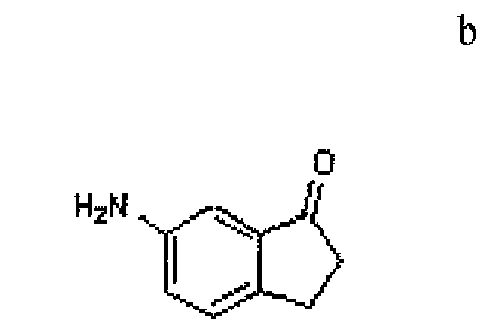
170-2 KBr: 200 MHz (CDCl3): 3446, 2.67 (m, 2H), 3.02 (m, 2H), 3.78 (ba, 2H), 7.00 (m, 2H), 7.26 (m, 1H) 3356, 1677 60 
210-2 KBr: 200 MHz (CDCl3): 3200, 2.60-2.67 (m, 2H), 3.01-3.05 (m, 2H), 6.93 (s, 1H), 7.35-7.39 (m, 2H), 7.45-7.78 (m, 4H), 7.82-7.92 (m, 3H), 8.3 (s, 1H) 1693, 1334, 1154 61 
244-6 KBr: 300 MHz (DMSOd6); 3120, 1.28 (d, J =7.2 Hz, 3H), 2.62-2.90 (m, 2H), 3.36-3.52 (m, 4H), 7.54 (s, 1H), 7.61 (s, 2H), 7.72 (m, 1H), 8.15 (d, J =2.1 Hz, 1H), 8.21 (d, J =8.4 Hz, 1H) 1691, 1342, 1158 62 
a 200 MHz (CDCl3): 1.37 (d, J =7.2 Hz, 3H), 2.78-2.98 (m, 2H), 3.46-3.62 (m, 1H), 7.72 (d, J =8.2 Hz, 1H), 8.23 (dd, J =1.8, 8.0 Hz, 1H), 8.41 (d, J =1.4 Hz, 1H) 63 
132-4 KBr: 200 MHz (CDCl3): 3274, 1.29 (d, J =7.4 Hz, 3H), 2.66-2.77 (m, 2H), 3.34-3.48 (m, 1H), 6.96 (ba, 1H), 7.37-7.47 (m, 5H), 7.71-7.86 (m,4H), 8.20 (d, J =1.0 Hz, 1H) 1703, 1350, 1159 - Membranes of HEK-293 cells expressing the 5HT6 human recombinant receptor were supplied by Receptor Biology. In these membranes the receptor concentration is 2.18 pmol/mg protein and the protein concentration is 9.17 mg/ml. The experimental protocol follows the method of B. L. Roth et al. [B. L. Roth, S. C. Craigo, M. S. Choudhary, A. Uluer, F. J. Monsma, Y. Shen, H. Y. Meltzer, D. R. Sibley: Binding of Typical and Atypical Antipsychotic Agents to 5-Hydroxytryptamine-6 and Hydroxytriptamine-7 Receptors. The Journal of Pharmacology and Experimental Therapeutics, 1994, 268, 1403] with slight modifications. The commercial membrane is diluted (dilution 1:40) with the binding buffer: 50 mM Tris-HCl, 10 mM MgCl2, 0.5 mM EDTA (pH 7,4). The radioligand used is [3H]-LSD at a concentration of 2.7 nM with a final volume of 200 µl. Incubation is initiated by adding 100 µl of the membrane suspension (≈ 22.9 µg membrane protein), and continues for 60 minutes at a temperature of 37°C. Incubation ends by fast filtration in a Harvester Brandel Cell through glass fibre filters manufactured by Schleicher & Schuell GF 3362 pre-treated with a 0.5% polyethylenimine solution. The filters are washed three times with three millilitres of Tris-HCl 50 mM pH 7.4 buffer. The filters are transferred to vials and to each vial 5 ml of liquid scintillation cocktail Ecoscint H is added. The vials are allowed to reach equilibrium for several hours before being counted in a Wallac Winspectral 1414 scintillation counter. Non-specific binding is determined in the presence of 100 µM serotonin. The tests are performed in triplicate. The inhibition constants (Ki, nM) are calculated by non-linear regression analysis using the program EBDA/LIGAND [Munson and Rodbard, Analytical Biochemistry, 1980, 107, 220]. The following table shows the binding results for some of the compounds object of the present invention.
Example % Inhibition 10-6 M % Inhibition 10-7 M % Inhibition 10-8 M Ki (nM) 19 97 -- -- 4.8 20 -- 42 13 -- 29 82 53 32 63 26 33 -- -- 216.5 34 100 71 18 50.6 35 92 -- -- 62.9 36 72 -- -- 157.5 37 92 -- -- 46.3 38 100 -- -- 20.2 39 51 25 -- 40 45 16 8 -- 41 24.5 9.4 42 2.3 -7.5 43 78.4 32.0 44 88.3 53.0 45 5.4 7.4 46 85.8 77.6 47 8.9 16.2 - Daily dosage in human medicine lies between 1 mg and 500 mg of product, which can be administered in one or several administrations. The compositions are prepared in forms compatible with the way of administration used, such as pills, tablets, capsules, suppositories, solutions or suspensions. These compositions are prepared by known methods and comprise between 1 to 60% by weight of the active principle (compound of general formula I) and 40 to 99% by weight of a suitable pharmaceutical vehicle compatible with the active principle and the physical form of the composition used. By way of example, the formula is shown for a pill containing a product of the invention.
-
Example 19 5 mg Lactose 60 mg Crystalline cellulose 25 mg Povidone K 90 5 mg Pregelatinised starch 3 mg Colloidal silica dioxide 1 mg Magnesium stereate 1 mg Total weight per pill 100 mg
Claims (18)
- An indene derivative of general formula I:
 n is 0, 1, 2, 3 or 4R 1 represents a saturated or unsaturated cycloaliphatic radical, optionally at least monosubstituted, optionally at least with one heteroatom selected from N, O and S as a member of the ring that may be condensed with a mono or polycyclic annular system optionally at least monosubstituted; a -NR8R9 radical; a -CONR8R9 radical; -COOH; or - OH
whereR8 and R9 represent, independently of each other, a hydrogen atom; or a linear or branched, saturated or unsaturated C1-5 aliphatic radical that may be substituted by 1, 2, 3 substituents selected independently from F, Cl, Br, -OH, -NH2, -SH, -O-CH3, -O-C2H5, -NO2, -CN, -NH-CH3 and -S-CH3;
orR8 and R9 together with nitrogen form a saturated, unsaturated or aromatic heterocyclic ring with 3 to 9 members, which may be substituted by 1, 2 or 3 substituents selected independently from C1-5-alkyl, -O-C1-5-alkyl, -S-C1-5-alkyl, oxo (=O), thioxo (=S), -C(=O)-OH, -C(=O)-O-C1-5-alkyl, -O-C(=O)-C1-5-alkyl, F, Cl, Br, I, -CN, -CF3, -OCF3, -SCF3, - OH, -SH, -NH2, -NH(C1-5-alkyl), -N(C1-5-alkyl)2, -NO2, -CHO, -CF2H, -CFH2, -C(=O)-NH2, -C(=O)-NH(C1-5-alkyl), -C(=O)-N(C1-5-alkyl)2, -S(=O)2-C1-5-alkyl, -S(=O)2-phenyl and which may contain 1, 2 or 3 additional heteroatoms independently selected from N, O and S as members of the ringR2, R3, R4 and R5 represent, independently of one another, a hydrogen atom; -NO2; - NH2; -SH; -OH; -CN; -C(=O)-H; -C(=O)-R10; -OR11; -SR12; -SOR13, -S(=O)2-R13, - S(=O)2-N(R14)R15, -N(R16)-S(=O)2-R17; -NH-R18; -NR19R20; -N(R21)-CO-R22; F; Cl, Br; I; a linear or branched, saturated o unsaturated C1-C6 aliphatic radical, which may be substituted by 1, 2 or 3 substituents independently selected from F, Cl, Br, -OH, -NH2, - SH, -O-CH3, -O-C2H5, -NO2, -CN, -NH-CH3 and -S-CH3; or an aryl or heteroaryl radical of 5 to 14 members, which may be substituted by 1, 2 or 3 substituents independently selected from -CF3, C1-5-alkyl, -O-C1-5-alkyl, -S-C1-5-alkyl, -C(=O)-OH, -C(=O)-O-C1-5-alkyl, -O-C(=O)-C1-5-alkyl, F, Cl, Br, I, -CN, -OCF3, -SCF3, -OH, -SH, -NH2, -NH(C1-5-alkyl), -N(C1-5-alkyl)2, -NH-C(=O)-C1-5-alkyl, -N(C1-5-alkyl)-C(=O)-C1-5-alkyl, -NO2, -CHO, -CF2H, -CFH2, -C(=O)-NH2, -C(=O)-NH(C1-5-alkyl), -C(=O)-N(C1-5-alkyl)2, -S(=)2-C1-5-alkyl, -S(=O)2-phenyl, cyclopropyl, cyclobutyl, cyclopentyl, cyclohexyl, phenyl, phenoxy, benzyloxy and benzyl and which may be bonded by a linear or branched C1-C6 alkylene group, and where the heteroaryl radical contains 1, 2 or 3 heteroatoms independently selected from N, O and S as members of the ring;with the condition that at least one of the substituents R2, R3, R4 and R5 represents a - N(R16)-S(=O)2-R17 radical;A represents: which respectively means (Ix) and (Iy) type compounds:
 R6 and R' 6, identical or different, represent a hydrogen atom; NO2; -NH2; -SH; -OH; - CN; -C(=O)-R10; -OR11; -SR12; F; Cl, Br; I ; a linear or branched, saturated or unsaturated C1-C10 aliphatic radical, which may be substituted with 1, 2 or 3 substituents independently selected among F, Cl, Br, -OH, -SH, -O-CH3, -O-C2H5, - NO2, -CN and -S-CH3; or an aryl or heteroaryl radical of 5 to 14 members, which may be substituted by 1, 2 or 3 substituents independently selected from -CF3, C1-5-alkyl, - O-C1-5-alkyl, -S-C1-5-alkyl, -C(=O)-OH, -C(=O)-O-C1-5-alkyl, -O-C(=O)-C1-5-alkyl, F, Cl, Br, I, -CN, -OCF3, -SCF3, -OH, -SH, -NH2, -NH(C1-5-alkyl), -N(C1-5-alkyl)2, -NH-C(=O)-C1-5-alkyl, -N(C1-5-alkyl)-C(=O)-C1-5-alkyl, -NO2, -CHO, -CF2H, -CFH2, -C(=O)-NH2, - C(=O)-NH(C1-5-alkyl), -C(=O)-N(C1-5-alkyl)2, -S(=O)2-C1-5-alkyl, -S(=O)2-phenyl, cyclopropyl, cyclobutyl, cyclopentyl, cyclohexyl, phenyl, phenoxy, benzyloxy and benzyl and which may be bonded by a linear or branched C1-C6 alkylene, C2-C6 alkenylene or C1-C6 ylidene group, and where the heteroaryl radical contains 1, 2 or 3 heteroatoms independently selected from N, O and S as members of the ring;R7 represents a hydrogen atom, a linear or branched C1-C6 aliphatic radical which may be substituted with 1, 2 or 3 substituents independently selected from F, Cl, Br, -OH, - SH, -O-CH3, -O-C2H5, -NO2, -CN and -S-CH3;R10 to R22 represent, independently of each other, a hydrogen atom; a linear or branched, saturated or unsaturated C1-C5 aliphatic radical, which may be substituted by 1, 2 or 3 substituents independently selected from F, Cl, Br, -OH, -NH2, -SH, -O-CH3, - O-C2H5, -NO2, -CN, -NH-CH3 and -S-CH3; a saturated or unsaturated cycloaliphatic radical with 3 to 8 members, , which may be substituted by 1, 2 or 3 substituents independently selected from C1-5-alkyl, -O-C1-5-alkyl, -S-C1-5-alkyl, oxo (=O), thioxo (=S), -C(=O)-OH, -C(=O)-O-C1-5-alkyl, -O-C(=O)C1-5-alkyl, F, Cl, Br, I, -CN, -CF3, - OCF3, -SCF3, -OH, -SH, -NH2, -NH(C1-5-alkyl), -N(C1-5-alkyl)2, -NO2, -CHO, -CF2H, - CFH2, -C(=O)-NH2, -C(=O)-NH(C1-5-alkyl), -C(=O)-N(C1-5-alkyl)2, -S(=O)2-C1-5-alkyl, - S(=O)2-phenyl, cyclopropyl, cyclobutyl, cyclopentyl, cyclohexyl, phenyl, phenoxy benzyloxy and benzyl and which optionally may include 1, 2 or 3 heteroatoms independently selected from N, O and S as members of the ring and which may be bonded through a linear or branched C1-C6 alkylene group; or an aryl or heteroaryl radical with 5 to 14 members that may be substituted by 1, 2 or 3 substituents independently selected from -CF3, C1-5-alkyl, -O-C1-5-alkyl, -S-C1-5-alkyl, -C(=O)-OH, - C(=O)-O-C1-5-alkyl, -O-C(=O)-C1-5-alkyl, F, Cl, Br, I, -CN, -OCF3, -SCF3, -OH, -SH, - NH2, -NH(C1-5-alkyl), -N(C1-5-alkyl)2, -NH-C(=O)-C1-5-alkyl, -N(C1-5-alkyl)-C(=O)-C1-5-alkyl, -NO2, -CHO, -CF2H, -CFH2, -C(=O)-NH2, -C(=O)-NH(C1-5-alkyl), -C(=O)-N(C1-5-alkyl)2, -S(=O)2-C1-5-alkyl, -S(=O)2-phenyl, cyclopropyl, cyclobutyl, cyclopentyl, cyclohexyl, phenyl, phenoxy, benzyloxy and benzyl and which may be bonded through a linear or branched C1-C6 alkylene, C2-C6 alkenylene or C2-C6 alkynylene group, and where the heteroaryl radical contains 1, 2 or 3 heteroatoms independently selected from N, O and S as members of the ring;with the condition that when R1 is -COOH; R2, R3, R4 or R5 are not -SOR13, -S(=O)2-R13 or -S(=O)2-N(R14)R15 and A does not represent C=C(R6) R6' resulting in the simultaneous situation in which R6 or R6' are one H and the other a phenyl substituted with -S(=O)2-C1-5-alkyl, -NH2, -O-C1-5-alkyl, F, Cl, Br, CN, -C(=O)-OH or -C(=O)-O-C1-5-alkyl, or the situation in which both R6 and R6' represent -OR11, andwith the condition that when R1 is -OH; R2, R3, R4 or R5 are not -S(=O)2-R13 or -S(=O)2-N(R14)R15, andwith the condition that when R1 is -CONR8R9; R2, R3, R4 o R5 are not -SOR13, -S(=O)2-R13 or -S(=O)2-N(R14)R15 and A does not represent C=C(R6) R6' resulting in the simultaneous situation in which R6 or R6' are one H and the other a phenyl substituted with -S(=O)2-C1-5-alkyl, -NH2, -O-C1-5-alkyl, F, Cl, Br, CN, -C(=O)-OH or -C(=O)-O-C1-5-alkyl, an aryl or a heteroaryl, andwith the condition that when R1 is -NR8R9; R2, R3, R4 or R5 are not -SOR13 or -S(=O)2-R13 and A does not represent C=C(R6) R6' resulting in the simultaneous situation in which R6 or R6' are one H and the other a phenyl substituted with -S(=O)2-C1-5-alkyl, - NH2, -O-C1-5-alkyl, F, Cl, Br, CN, -C(=O)-OH or -C(=O)-O-C1-5-alkylor a pharmaceutically acceptable salt, isomer, prodrug or solvate thereof,optionally in the form of one of their stereoisomers, preferably enantiomers or diastereomers, a racemate or in the form of a mixture of at least two stereoisomers, preferably enantiomers and/or diastereomers, in any mixing ratio or a physiologically acceptable salt thereof or the corresponding solvate thereof.
 - An indene derivative of general formula I according to of claim 1 where R1 represents


or a -NR8R9 radical and R8 and R9 represent independently or together a hydrogen atom or a C1-5 aliphatic radical or R8 and R9 together with nitrogen form a saturated, unsaturated or aromatic heterocyclic ring with 3 to 9 members, which optionally contains 1, 2 or 3 additional heteroatoms independently selected from N, O and S. - An indene derivative of general formula I according to claim 1 where R1 represents a -CONR8R9 radical and R8 and R9 represent independently or together a hydrogen atom or a C1-5 aliphatic radical or R8 and R9 together with nitrogen form a saturated, unsaturated or aromatic, heterocyclic ring with 3 to 9 members, which optionally contains 1, 2 or 3 additional heteroatoms independently selected from N, O and S.
- An indene derivative of general formula I according to claim 1 where R 6 and R'6, identical or different, represent a hydrogen atom or an aryl or heteroaryl radical of 5 to 14 members optionally substituted by a phenyl that can be bonded by a C1-C6 alkylene or a C1-C6 ylidene.
- An indene derivative of general formula I according to claim 1 wherein R10 to R22 represent an aryl or heteroaryl radical containing 1, 2 or 3 heteroatoms independently selected from N, O and S and which can be substituted by one chlorine atom.
- An indene derivative of general formula I according to claim 1 where preferably n=0, 1, 2, 3 or 4; andR1 represents a -COOH, -OH, -NR8R9 o -CONR8R9 radicalwhere R8 and R9 represent independently or together a hydrogen atom or a C1-5 aliphatic radical,or R8 and R9 together with nitrogen form a saturated, unsaturated or aromatic heterocyclic ring with 3 to 9 members that optionally contains 1, 2 or 3 additional heteroatoms independently selected from N, O and S;or R1 represents one of the following groups:

 where the dotted line represents an optional chemical bond and R'1 represents a hydrogen atom, a C1-5 aliphatic radical; andwhere at least one of R2, R3, R4 and R5 represents a radical -N(R16)-S(=O)2-R17; and the others are selected from hydrogen, -OR11, -SR11, F, Cl, Br, I or a C1-4 alkyl radical;and where A represents:
 which respectively means (Ix) and (Iy) type compounds:
 and where R6 and R'6 , being identical or different, represent a hydrogen atom or an aryl or heteroaryl radical with 5 to 14 members, optionally substituted by a phenyl that can be bonded through a C1-C6 alkylene or a C1-C6 ylidene; andwhere R11, R13, R14, R15, R16, R17, R21 and R22 represent, independently of one another, a hydrogen atom, a C1-5 aliphatic radical, an aryl or heteroaryl radical containing 1, 2 or 3 heteroatoms independently selected among N, O and S and which may be substituted by a chlorine atom.
 - An indene derivative of general formula I according to claim 1, selected from:[2] [2-methyl-6-(naphthalene-2-sulphonylamine)-3H-inden-1-yl] acetic acid[3] [3(Z)-benzylidene-2-methyl-6-(naphthalene-2-sulphonylamine)-3H-inden-1-yl] acetic acid[4] [2-methyl-4-(naphthalene-2-sulphonylamine)-3H-inden-1-yl] acetic acid[5] [6-(naphthalene-2-sulphonylamine)-3H-inden-1-yl] acetic acid[6] [6-(5-chloro-3-methylbenzo[b]thiophene-2-sulphonylamine)-2-methyl-3H-inden-1-yl] acetic acid[10] 2-[3(Z)-Benzylidene-2-methyl-6-(naphthalene-2-sulphonylamine)-3H-inden-1-yl]-N,N-dimethylacetamide[11] N,N-Dimethyl-2-[2-methyl-6-(naphthalene-2-sulphonylamine)-3H-inden-1-yl]acetamide[12] N-[2-Methyl-3-(2-oxo-2-pyrrolidin-1-ylethyl)-1H-inden-5-yl]naphthalene-2-sulfonamide[13] N-[2-Methyl-1-(2-oxo-2-pyrrolidin-1-ylethyl)-3H-inden-4-yl]naphthalene-2-sulfonamide[14] N-[3-(2-Oxo-2-pyrrolidin-1-ylethyl)-1H-inden-5-yl]naphthalene-2-sulfonamide[15] N-[2-Methyl-3-(2-oxo-2-pyrrofidin-1-ylethyl)-1H-inden-5-yl]-5-chloro-3-methyl benzo[b]thiophene -2-sulfonamide[19] N-[3-(2-Dimethylaminoethyl)-2-methyl-1H-inden-5-yl]-6-chloroimidazo[2,1-b]thiazole-5-sulfonamide[20] N-[3-(2-Dimethylaminoethyl)-2-methyl-1H-inden-5-yl]-5-chloro-3-methylbenzo [b]thiophene-2-sulfonamide[21] N-{4-[3-(2-Dimethylaminoethyl)-2-methyl-1H-inden-5-ylsulfamoyl]phenyl}acetamide [22]N-[3-(2-Dimethylaminoethyl)-2-methyl-1H-inden-5-yl]benzo[1,2,5]thiadiazole-4-sulfonamide[23]N-Ethyl-N-[3-(2-dimethylaminoethyl)-2-methyl-1H-inden-5-yl]-5-chloro-3-methylbenzo[b]thiophene-2-sulfonamide[24] 4-Amino-N-[3-(2-dimethylaminoethyl)-2-methyl-1H-inden-5-yl]benzene sulfonamide[27] (2-{6-[(5-chloro-3-methylbenzo[b]thiophene-2-sulfonyl)ethylamino]-2-methyl-3H-inden-1-yl}ethyl)ethyldimethylammonium iodide[29] N-[3-(2-Pyrrolidin-1-ylethyl)-2-methyl-1H-inden-5-yl]-6-chloroimidazo[2,1-b]thiazole-5-suffonamide[30] N-{4-[3-(2-Pyrrolidin-1-ylethyl)-2-methyl-1H-inden-5-ylsulfamoyl]phenyl}acetamide[31] N-[3-(2-Pyrrolidin-1-ylethyl)-2-methyl-1H-inden-5-yl]-benzo[1,2,5]thiadiazole-4-sulfonamide[32] 4-Amino-N-[3-(2-pyrrolidin-1-ylethyl)-2-methyl-1H-inden-5-yl]benzenosulfonamide[33]N-[1(Z)-Benzylidene-3-(2-dimethylaminoethyl)-2-methyl-1H-inden-5-yl]naphthalene-2-sulfonamide[34] N-[3-(2-Dimethylaminoethyl)-2-methyl-1H-inden-5-yl]naphthalene-2-sulfonamide[35] N-[2-Methyl-3-(2-pyrrolidin-1-yiethyl)-1H-inden-5-yl]naphthalene-2-sulfonamide[36] N-[2-Methyl-1-(2-pyrrolidin-1-ylethyl)-3H-inden-4-yl]naphthalene-2-sulfonamide[37] N-[3-(2-Pyrrolidin-1-ylethyl)-1H-inden-5-yl]naphthalene-2-sulfonamide[38] N-[2-Methyl-3-(2-pyrrolidin-1-ylethyl)-1H-inden-5-yl]-5-chloro-3-methylbenzo [b]thiophene-2-sulfonamide[40] N-[3-(2-Hydroxyethyl)-2-methyl-1H-inden-5-yl]naphthalene-2-sulfonamide[41] 6-Chloro-N-{3-[2-(dimethylamino)ethyl]-1,1-dimethyl-1H-inden-5-yl}imidazo[2,1-b][1,3]thiazole-5-sulfonamide[42] 5-Chloro-N-{3-[2-(dimethylamino)ethyl]-1,1-dimethyl-1H-inden-5-yl)-3-methylbenzo[b]thiophene-2-sulfonamide[43] N-{3-[2-(Dimethylamino)ethyl]-2-methyl-1H-inden-5-yl}naphthalene-1-sulfonamide[44] N-{3-12-(Dimethylamino)ethyl]-2-methyl-1H-inden-5-yl}-1-benzothiophene-3-sulfonamide[45] 6-Chloro-N-[2-methyl-3-(1-methylpyrrolidin-3-yl)-1H-inden-5-yl]imidazo[2,1-b][1,3]thiazole-5-sulfonamide[46] 6-Chloro-N-[2-methyl-3-(1-methylpiperidin-3-yl)-1H-inden-5-yl]imidazo[2,1-b][1,3]thiazole-5-sulfonamide[48] 6-Chloro-N-{3-[2-(dimethylamino)ethyl]-1H-inden-5-yl}imidazo[2,1-b][1,3]thiazole-5-sulfonamide[49] 6-Chloro-N-[3-(2-piperidin-1-ylethyl)-1H-inden-5-yl]imidazo[2,1-b][1,3]thiazole-5-sulfonamide[50] 6-Chloro-N-[3-(1-methylpyrrolidin-3-yl)-1H-inden-5-yl]imidazo[2,1-b][1,3] thiazole-5-sulfonamide
- Procedure for the preparation of an indene derivative of general formula (If):

which comprises bringing together in a suitable media an indenylsulfonamide of general formula (le):
- A procedure according to claim 8 characterised in that it occurs in a media with acetonitrile.
- A procedure according to claim 8 characterised in that the alkyl halide is ethyl iodide.
- An indanone of general formula (II):

- An indanone of general formula (II) in accordance with claim 50 selected from:[54] N-(2-Methyl-3-oxoindan-5-yl)naphthalene-2-sulfonamide[56] N-(2-Methyl-1-oxoindan-4-yl)naphthalene-2-sulfonamide[60] N-(3-Oxoindan-5-yl)naphthalene-2-sulfonamide[61] N-(2-Methyl-3-oxoindan-5-yl)-5-chloro-3-methylbenzo[b]thiophene-2-sulfonamide
- An indene derivative of general formula I according to any of claims 1 to 7 for its use as a medicament.
- An indene derivative according to claim 13 for its use in the treatment of disorders or diseases mediated by 5HT6 receptors.
- An indene derivative according to claim 14 for its use in the prophylaxis and/or treatment of disorders or diseases related to food intake, preferably for regulating appetite, for maintaining, increasing or reducing body weight, for the prophylaxis and/or treatment of obesity, bulimia, anorexia, cachexia or diabetes type II, or for the prophylaxis and/or treatment of irritable bowel syndrome; disorders of the central nervous system, anxiety; panic attacks; depression; bipolar disorders; cognitive disorders; memory disorders; senile dementia; psychosis; schizophrenia; neurodegenerative disorders preferably selected between Alzheimer's disease, Parkinson's disease, Huntington's disease and multiple sclerosis; or hyperactivity disorders, preferably attention deficit / hyperactivity disorder, or for improving cognitive capacity.
- Use of an indene derivative of general formula I according to any of claims 1 to 7 in the manufacture of a medicament for treating disorders or diseases mediated by 5HT6 receptors.
- Use of an indene derivative according to claim 16 in the manufacture of a medicament for the prophylaxis and/or treatment of disorders or diseases related to food intake, preferably for regulating appetite, for maintaining, increasing or reducing body weight, for the prophylaxis and/or treatment of obesity, bulimia, anorexia, cachexia or diabetes type II, or for the prophylaxis and/or treatment of irritable bowel syndrome; disorders of the central nervous system, anxiety; panic attacks; depression; bipolar disorders; cognitive disorders; memory disorders; senile dementia; psychosis; schizophrenia; neurodegenerative disorders preferably selected between Alzheimer's disease, Parkinson's disease, Huntington's disease and multiple sclerosis; or hyperactivity disorders, preferably attention deficit / hyperactivity disorder, or for improving cognitive capacity.
- Pharmaceutical composition comprising a compound of general formula I according to claims 1 to 7 and at least one pharmaceutically acceptable additive.
Applications Claiming Priority (3)
| Application Number | Priority Date | Filing Date | Title |
|---|---|---|---|
| US73504205P | 2005-11-08 | 2005-11-08 | |
| ES200502720A ES2274725B1 (en) | 2005-11-08 | 2005-11-08 | INDENO DERIVATIVES, ITS PREPARATION AND ITS USE AS MEDICATIONS. |
| EP06818389A EP1960343B1 (en) | 2005-11-08 | 2006-11-07 | Indene derivatives, their preparation and use as medicaments |
Related Parent Applications (1)
| Application Number | Title | Priority Date | Filing Date |
|---|---|---|---|
| EP06818389.6 Division | 2006-11-07 |
Publications (2)
| Publication Number | Publication Date |
|---|---|
| EP2202222A2 true EP2202222A2 (en) | 2010-06-30 |
| EP2202222A3 EP2202222A3 (en) | 2010-09-15 |
Family
ID=37735250
Family Applications (2)
| Application Number | Title | Priority Date | Filing Date |
|---|---|---|---|
| EP10155635A Withdrawn EP2202222A3 (en) | 2005-11-08 | 2006-11-07 | Indene derivatives, their preparation and use as medicaments |
| EP06818389A Not-in-force EP1960343B1 (en) | 2005-11-08 | 2006-11-07 | Indene derivatives, their preparation and use as medicaments |
Family Applications After (1)
| Application Number | Title | Priority Date | Filing Date |
|---|---|---|---|
| EP06818389A Not-in-force EP1960343B1 (en) | 2005-11-08 | 2006-11-07 | Indene derivatives, their preparation and use as medicaments |
Country Status (7)
| Country | Link |
|---|---|
| US (1) | US8217041B2 (en) |
| EP (2) | EP2202222A3 (en) |
| JP (1) | JP2009514915A (en) |
| AR (1) | AR058180A1 (en) |
| CA (1) | CA2628856A1 (en) |
| TW (1) | TW200736189A (en) |
| WO (1) | WO2007054257A2 (en) |
Families Citing this family (17)
| Publication number | Priority date | Publication date | Assignee | Title |
|---|---|---|---|---|
| BRPI0715160A2 (en) | 2006-08-08 | 2013-06-11 | Sanofi Aventis | arylamimoaryl-alkyl-substituted imidazolidine-2,4-diones, process for preparing them, drugs comprising these compounds, and their use |
| ATE495737T1 (en) | 2007-08-01 | 2011-02-15 | Esteve Labor Dr | COMBINATION OF AT LEAST TWO 5-HT6 LIGANDS |
| EP2053052A1 (en) | 2007-10-23 | 2009-04-29 | Laboratorios del Dr. Esteve S.A. | Process for the preparation of 6-substituted imidazo[2,1-b]thiazole-5-sulfonyl halide |
| JP2011507835A (en) | 2007-12-21 | 2011-03-10 | アンドレイ・アレクサンドロビッチ・イワシェンコ | Alpha-adrenergic receptor, dopamine, histamine, imidazoline and serotonin receptor ligands and uses thereof |
| EP2116547A1 (en) * | 2008-05-09 | 2009-11-11 | Laboratorios Del. Dr. Esteve, S.A. | Substituted N-imidazo(2, 1-b) thiazole-5-sulfonamide derivatives as 5-TH6 ligands |
| WO2010003624A2 (en) | 2008-07-09 | 2010-01-14 | Sanofi-Aventis | Heterocyclic compounds, processes for their preparation, medicaments comprising these compounds, and the use thereof |
| WO2010068601A1 (en) | 2008-12-08 | 2010-06-17 | Sanofi-Aventis | A crystalline heteroaromatic fluoroglycoside hydrate, processes for making, methods of use and pharmaceutical compositions thereof |
| DK2470552T3 (en) | 2009-08-26 | 2014-02-17 | Sanofi Sa | NOVEL, CRYSTALLINE, heteroaromatic FLUORGLYCOSIDHYDRATER, MEDICINES COVERING THESE COMPOUNDS AND THEIR USE |
| US8710050B2 (en) | 2011-03-08 | 2014-04-29 | Sanofi | Di and tri- substituted oxathiazine derivatives, method for the production, method for the production thereof, use thereof as medicine and drug containing said derivatives and use thereof |
| WO2012120054A1 (en) | 2011-03-08 | 2012-09-13 | Sanofi | Di- and tri-substituted oxathiazine derivates, method for the production thereof, use thereof as medicine and drug containing said derivatives and use thereof |
| EP2683704B1 (en) | 2011-03-08 | 2014-12-17 | Sanofi | Branched oxathiazine derivatives, method for the production thereof, use thereof as medicine and drug containing said derivatives and use thereof |
| WO2012120056A1 (en) | 2011-03-08 | 2012-09-13 | Sanofi | Tetrasubstituted oxathiazine derivatives, method for producing them, their use as medicine and drug containing said derivatives and the use thereof |
| EP2766349B1 (en) | 2011-03-08 | 2016-06-01 | Sanofi | Oxathiazine derivatives substituted with carbocycles or heterocycles, method for producing same, drugs containing said compounds, and use thereof |
| EP2567959B1 (en) | 2011-09-12 | 2014-04-16 | Sanofi | 6-(4-hydroxy-phenyl)-3-styryl-1h-pyrazolo[3,4-b]pyridine-4-carboxylic acid amide derivatives as kinase inhibitors |
| EP2682391A1 (en) * | 2012-07-03 | 2014-01-08 | Laboratorios Del. Dr. Esteve, S.A. | Indene derivatives, their preparation and use as medicaments |
| US9862698B2 (en) | 2014-12-16 | 2018-01-09 | Adt Pharmaceuticals, Inc. | Indenyl compounds, pharmaceutical compositions, and medical uses thereof |
| CN112020354A (en) | 2018-04-26 | 2020-12-01 | Adt制药有限责任公司 | Anti-cancer indenes, indanes, aza-indenes, aza-indanes, pharmaceutical compositions and uses |
Citations (11)
| Publication number | Priority date | Publication date | Assignee | Title |
|---|---|---|---|---|
| US5092827A (en) | 1989-09-28 | 1992-03-03 | International Paper Box Machine Co., Inc. | Apparatus for folding paper boxes |
| WO1996002537A1 (en) | 1994-07-13 | 1996-02-01 | Smithkline Beecham Plc | Benzocondensed five membered heterocycle carboxamides as 5ht2b/2c receptor antagonists |
| WO1996011929A1 (en) | 1994-10-12 | 1996-04-25 | Smithkline Beecham Plc | Biheteroaryl-carbonyl and carboxamide derivatives with 5ht 2c/2b antagonists activity |
| WO1996023783A1 (en) | 1995-02-02 | 1996-08-08 | Smithkline Beecham Plc | Indole derivatives as 5-ht receptor antagonist |
| WO1997008167A1 (en) | 1995-08-26 | 1997-03-06 | Smithkline Beecham P.L.C. | 5ht2c and 5ht2b antagonists |
| US5958982A (en) | 1998-04-17 | 1999-09-28 | Cell Pathways, Inc. | Method for treating patients with sarcoidosis by administering substituted sulfonyl indenyl acetic acids, esters and alcohols |
| US5965619A (en) | 1996-06-13 | 1999-10-12 | Cell Pathways Inc. | Method for treating patients having precancerous lesions with substituted indene derivatives |
| US6025394A (en) | 1999-01-29 | 2000-02-15 | Cell Pathways, Inc. | Method for treating patients with acne by administering substituted sulfonyl indenyl acetic acids, amides and alcohols |
| US6028116A (en) | 1998-04-03 | 2000-02-22 | Cell Pathways, Inc. | Substituted condensation products of 1H-indenyl-hydroxyalkanes with aldehydes for neoplasia |
| US20010006965A1 (en) | 1998-04-17 | 2001-07-05 | Rifat Pamukcu | Method for treating patients with diabetic retinopathy by administering substituted sulfonyl indenyl acetic acids and alcohols |
| US20010020020A1 (en) | 1998-04-17 | 2001-09-06 | Rifat Pamukcu | Method for treating patients with macular degeneration by administering substituted sulfonyl indenyl acetic acids and alcohols |
Family Cites Families (15)
| Publication number | Priority date | Publication date | Assignee | Title |
|---|---|---|---|---|
| US3325358A (en) * | 1962-06-06 | 1967-06-13 | Merck & Co Inc | Method of treating inflammation |
| US3622623A (en) * | 1968-08-28 | 1971-11-23 | Merck & Co Inc | 1-substituted indenyl-3-aliphatic acids and esters |
| US3692325A (en) * | 1971-03-22 | 1972-09-19 | Joseph Mercadante | Air suspension with saddle members |
| SE7700500L (en) * | 1976-01-20 | 1977-07-21 | Hoechst Ag | THIAZOLIDINE DERIVATIVES AND PROCEDURES FOR THEIR PREPARATION |
| JPS539752A (en) | 1976-07-16 | 1978-01-28 | Sankyo Co Ltd | 4-substituted indanones |
| DE3208079A1 (en) * | 1982-03-04 | 1983-09-08 | Schering AG, 1000 Berlin und 4709 Bergkamen | NEW INDANYL DERIVATIVES, THEIR PRODUCTION AND USE |
| JPS6160610A (en) * | 1984-08-31 | 1986-03-28 | Otsuka Pharmaceut Co Ltd | Pyroxia ameliorant |
| GB8628644D0 (en) | 1986-12-01 | 1987-01-07 | Lunbeck A S H | Intermediates |
| DK691488A (en) * | 1987-12-14 | 1989-06-15 | Beecham Group Plc | UNKNOWN RELATIONSHIPS |
| US5776962A (en) | 1994-08-03 | 1998-07-07 | Cell Pathways, Inc. | Lactone compounds for treating patient with precancerous lesions |
| DE19831878C2 (en) * | 1998-07-17 | 2001-05-17 | Aventis Pharma Gmbh | Polycyclic thiazolidin-2-ylidene amines, process for their preparation and their use as medicaments |
| US20030073850A1 (en) * | 1998-08-07 | 2003-04-17 | Altenbach Robert J. | 4-Imidazole derivatives of benzyl and restricted benzyl sulfonamides, sulfamides, ureas, carbamates, and amides and their use |
| DE60120746T2 (en) * | 2000-11-27 | 2007-05-24 | Merck & Co., Inc. | Estrogen receptor modulators |
| DE60316984T2 (en) | 2002-11-22 | 2008-07-17 | Eli Lilly And Co., Indianapolis | BENZOYLSULFONAMIDE AS ANTITUMOR MEDIUM |
| WO2005040212A2 (en) | 2003-10-24 | 2005-05-06 | Istituto Di Ricerche Di Biologia Molecolare P Angeletti Spa | Orthogonal gene switches |
-
2006
- 2006-11-07 US US12/093,100 patent/US8217041B2/en not_active Expired - Fee Related
- 2006-11-07 EP EP10155635A patent/EP2202222A3/en not_active Withdrawn
- 2006-11-07 EP EP06818389A patent/EP1960343B1/en not_active Not-in-force
- 2006-11-07 JP JP2008539319A patent/JP2009514915A/en active Pending
- 2006-11-07 CA CA002628856A patent/CA2628856A1/en not_active Abandoned
- 2006-11-07 WO PCT/EP2006/010627 patent/WO2007054257A2/en not_active Ceased
- 2006-11-07 AR ARP060104876A patent/AR058180A1/en not_active Application Discontinuation
- 2006-11-08 TW TW095141243A patent/TW200736189A/en unknown
Patent Citations (12)
| Publication number | Priority date | Publication date | Assignee | Title |
|---|---|---|---|---|
| US5092827A (en) | 1989-09-28 | 1992-03-03 | International Paper Box Machine Co., Inc. | Apparatus for folding paper boxes |
| WO1996002537A1 (en) | 1994-07-13 | 1996-02-01 | Smithkline Beecham Plc | Benzocondensed five membered heterocycle carboxamides as 5ht2b/2c receptor antagonists |
| WO1996011929A1 (en) | 1994-10-12 | 1996-04-25 | Smithkline Beecham Plc | Biheteroaryl-carbonyl and carboxamide derivatives with 5ht 2c/2b antagonists activity |
| WO1996023783A1 (en) | 1995-02-02 | 1996-08-08 | Smithkline Beecham Plc | Indole derivatives as 5-ht receptor antagonist |
| WO1997008167A1 (en) | 1995-08-26 | 1997-03-06 | Smithkline Beecham P.L.C. | 5ht2c and 5ht2b antagonists |
| US5965619A (en) | 1996-06-13 | 1999-10-12 | Cell Pathways Inc. | Method for treating patients having precancerous lesions with substituted indene derivatives |
| US6028116A (en) | 1998-04-03 | 2000-02-22 | Cell Pathways, Inc. | Substituted condensation products of 1H-indenyl-hydroxyalkanes with aldehydes for neoplasia |
| US5958982A (en) | 1998-04-17 | 1999-09-28 | Cell Pathways, Inc. | Method for treating patients with sarcoidosis by administering substituted sulfonyl indenyl acetic acids, esters and alcohols |
| US20010006965A1 (en) | 1998-04-17 | 2001-07-05 | Rifat Pamukcu | Method for treating patients with diabetic retinopathy by administering substituted sulfonyl indenyl acetic acids and alcohols |
| US20010020020A1 (en) | 1998-04-17 | 2001-09-06 | Rifat Pamukcu | Method for treating patients with macular degeneration by administering substituted sulfonyl indenyl acetic acids and alcohols |
| US6025394A (en) | 1999-01-29 | 2000-02-15 | Cell Pathways, Inc. | Method for treating patients with acne by administering substituted sulfonyl indenyl acetic acids, amides and alcohols |
| US6177471B1 (en) | 1999-01-29 | 2001-01-23 | Cell Pathways, Inc. | Method for treating patients with acne by administering a CGMP-specific PDE inhibitor |
Non-Patent Citations (28)
| Title |
|---|
| A. BOURSON ET AL., J. PHARMACOL. EXP. THER., vol. 274, 1995, pages 173 |
| A.J. SLEIGHT ET AL., BEHAV. BRAIN RES., vol. 73, 1996, pages 245 |
| B. L. ROTH ET AL., J. PHARMACOL. EXP. THER., vol. 268, 1994, pages 1403 |
| B. L. ROTH; S. C. CRAIGO; M. S. CHOUDHARY; A. ULUER; F. J. MONSMA; Y. SHEN; H. Y. MELTZER; D. R. SIBLEY: "Binding of Typical and Atypical Antipsychotic Agents to 5-Hydroxytryptamine-6 and Hydroxytriptamine-7 Receptors", THE JOURNAL OF PHARMACOLOGY AND EXPERIMENTAL THERAPEUTICS, vol. 268, 1994, pages 1403 |
| BR. J. PHARMACOL., vol. 125, 1998, pages 1562 |
| C. E. GLATT ET AL., MOL. MED., vol. 1, 1995, pages 398 |
| C. GÉRARD ET AL., BRAIN RESEARCH, vol. 746, 1997, pages 207 |
| C. ROUTLEDGE ET AL., BR. J. PHARMACOL., vol. 130, 2000, pages 1606 |
| D. A. H. TAYLOR: "1,2,3,4-Tetrahydro-8-methylfluoren-1-one", JOURNAL OF THE CHEMICAL SOCIETY, ABSTRACTS, 1960, pages 2805 - 2806 |
| D. HOYER ET AL., NEUROPHARMACOLOGY, vol. 36, 1997, pages 419 |
| D. L. MUSSO; F. R. COCHRAN; J. L. KELLEY; E.W. MCLEAN; J. L. SELPH; G. C. RIGDON; G. F. ORR; R. G. DAVIS; B. R. COOPER; V. L. STYL, J. MED. CHEM., vol. 46, 2003, pages 399 - 408 |
| D.C. ROGERS ET AL., BR. J. PHARMACOL. SUPPL., vol. 127, 1999, pages 22P |
| F. J. MONSMA ET AL., MOL. PHARMACOL., vol. 43, 1993, pages 320 |
| F. J. MOSMA ET AL., MOL. PHARMACOL., vol. 43, 1993, pages 320 |
| G. R. CLEMO; L. H. GROVES; L. MUNDAY; G. A. SWAN: "Indene series. I. A synthesis of 1,2,3,8-tetrahydro-1-ketocyclopent[a]indene", JOURNAL OF THE CHEMICAL SOCIETY, 1951, pages 863 - 867 |
| H. OCHIAI; T. NISHIHARA; Y. TAMARU; Z. YOSHIDA: "Titanium(IV)-Mediated Aldol-Type Condensation of Zinc Esters and Zinc Ketones with Carbonyl Electrophiles", J. ORG. CHEM., vol. 53, 1988, pages 1343 - 1344 |
| K. FUKATSU; O. UCHIKAWA; M. KAWADA; T. YAMANO; M. YAMASHITA; K. KATO; K. HIRAI; S. HINUMA; M. MIYAMOTO; S. OHKAWA: "Synthesis of a Novel Series of Benzocycloalkene Derivatives as Melatonin Receptors Agonists", J. MED. CHEM., vol. 45, 2002, pages 4212 - 4221 |
| M. FINZE; S. E. REYBUCK; R. M. WAYMOUTH: "Propylene Polymerization with 1,2'-Bridged Bis(indennyl)zirconium Dichlorides.", MACROMOLECULES, vol. 36, 2003, pages 9325 - 9334 |
| M. R. PRANZATELLI, DRUGS OF TODAY, vol. 33, 1997, pages 379 |
| M. RUAT ET AL., BIOCHEM. BIOPHYS. RES. COMMUN., vol. 193, 1993, pages 268 |
| M. YOSHIOKA ET AL., ANN. NY ACAD. SCI., vol. 861, 1998, pages 244 |
| MUNSON; RODBARD, ANALYTICAL BIOCHEMISTRY, vol. 107, 1980, pages 220 |
| NEUROPHARMACOLOGY, vol. 41, 2001, pages 210 - 219 |
| R. KOHEN ET AL., J. NEUROCHEM., vol. 66, 1996, pages 47 |
| R. PERRONE; F. BERARDI; N. A. COLABUFO; V. TORTORELLA; F. FIORENTINI; V. OLGIATI; E. VANOTTI; S. GOVONI: "Mixed 5-HT1A/D-2 Activity of a New Model of Arylpiperazines: 1-Aryl-4-[3-(1,2-dihydronaphtalen-4-yl)-n-propyl]piperazines. 1. Synthesis and Structure-Activity Relationships", J. MED. CHEM., vol. 37, 1994, pages 99 - 104 |
| T. A. BRANCHEK ET AL., ANNU. REV. PHARMACOL. TOXICOL., vol. 40, 2000, pages 319 |
| T. SHINKAI ET AL., AM. J. MED. GENET., vol. 88, 1999, pages 120 |
| W. D. HIRST ET AL., BR. J. PHARMACOL., vol. 130, 2000, pages 1597 |
Also Published As
| Publication number | Publication date |
|---|---|
| WO2007054257A3 (en) | 2007-10-18 |
| EP1960343B1 (en) | 2012-04-04 |
| WO2007054257A2 (en) | 2007-05-18 |
| CA2628856A1 (en) | 2007-05-18 |
| TW200736189A (en) | 2007-10-01 |
| JP2009514915A (en) | 2009-04-09 |
| US8217041B2 (en) | 2012-07-10 |
| US20090163547A1 (en) | 2009-06-25 |
| AR058180A1 (en) | 2008-01-23 |
| EP1960343A2 (en) | 2008-08-27 |
| EP2202222A3 (en) | 2010-09-15 |
Similar Documents
| Publication | Publication Date | Title |
|---|---|---|
| EP1960343B1 (en) | Indene derivatives, their preparation and use as medicaments | |
| JP2690006B2 (en) | Substituted phenyl sulfonamides as selective β3 agonists for the treatment of diabetes and obesity | |
| HK38695A (en) | Substituted amino methyl tetralines, and their heterocyclic analogous compounds | |
| US20090054453A1 (en) | Novel Tetralins as 5-HT6 Modulators | |
| EP2146990A1 (en) | Triazolopyridine carboxamide derivatives and triazolopyrimidine carboxamide derivatives, preparation thereof and therapeutic use thereof | |
| CA2542494A1 (en) | Tetrahydro-naphthalene and urea derivatives | |
| O'Brien et al. | Inhibitors of acyl-CoA: cholesterol O-acyl transferase (ACAT) as hypocholesterolemic agents. 8. Incorporation of amide or amine functionalities into a series of disubstituted ureas and carbamates. Effects on ACAT inhibition in vitro and efficacy in vivo | |
| US20090030038A1 (en) | Novel 8-Sulfonylamino-3 Aminosubstituted Chroman or Tetrahydronaphtalene Derivatives Modulating the 5Ht6 Receptor | |
| US20050197343A1 (en) | Utilization of heteroarene carboxamide as dopamine-d3 ligands for the treatment of cns diseases | |
| CN101087771A (en) | Substituted N-sulfonylaminobenzyl-2-phenoxyacetamide compounds | |
| CA2465680A1 (en) | Piperazine derivatives having sst1 antagonistic activity | |
| EP1648446B1 (en) | Indol-4 sulfonamide derivatives, their preparation and their use 5-ht-6 as modulators | |
| KR100546534B1 (en) | Arylsulfonamides and their analogs, and their use in the treatment of neurodegenerative diseases | |
| HUP0104942A2 (en) | Polycyclic thiazolidin-2-ylidene amines, method for the production and use thereof as medicaments | |
| US20100069378A1 (en) | Substituted indanyl sulfonamide compounds, their preparation and use as medicaments | |
| ES2384642T3 (en) | Indene derivatives, their preparation and their use as medicines | |
| NZ541242A (en) | Substituted aniline derivatives | |
| CN101356149A (en) | Indene derivatives, processes for their preparation and use as medicaments | |
| EP1648444B1 (en) | Indol-7 sulfonamide derivatives, their preparation and their use 5-ht-6 as modulators | |
| JP4405455B2 (en) | 3-Aryl-3-methyl-quinoline-2,4-dione compound, process for producing the same and pharmaceutical composition containing the same | |
| EP0374054A1 (en) | Indane derivatives, process for their preparation and intermediates obtained, their use as medicines, and pharmaceutical compositions containing them | |
| FR2872159A1 (en) | NOVEL PHENYL CARBOXYLIC ACID DERIVATIVES AND THEIR USE IN THE TREATMENT OF DIABETES | |
| Coombs et al. | Synthesis and Antiinflammatory Activity of tert-aminomethylbenzophenones | |
| JPH0120155B2 (en) | ||
| HUP9902949A2 (en) | Aryl substituted cyclic amines as selective ligands of dopamine d3 receptor |
Legal Events
| Date | Code | Title | Description |
|---|---|---|---|
| PUAI | Public reference made under article 153(3) epc to a published international application that has entered the european phase |
Free format text: ORIGINAL CODE: 0009012 |
|
| AC | Divisional application: reference to earlier application |
Ref document number: 1960343 Country of ref document: EP Kind code of ref document: P |
|
| AK | Designated contracting states |
Kind code of ref document: A2 Designated state(s): AT BE BG CH CY CZ DE DK EE ES FI FR GB GR HU IE IS IT LI LT LU LV MC NL PL PT RO SE SI SK TR |
|
| PUAL | Search report despatched |
Free format text: ORIGINAL CODE: 0009013 |
|
| RIC1 | Information provided on ipc code assigned before grant |
Ipc: A61K 31/40 20060101ALI20100803BHEP Ipc: C07C 311/21 20060101AFI20100521BHEP Ipc: C07C 211/30 20060101ALI20100803BHEP Ipc: C07D 333/62 20060101ALI20100803BHEP Ipc: A61K 31/41 20060101ALI20100803BHEP Ipc: A61K 31/4453 20060101ALI20100803BHEP Ipc: A61K 31/4465 20060101ALI20100803BHEP Ipc: A61K 31/381 20060101ALI20100803BHEP Ipc: A61K 31/63 20060101ALI20100803BHEP Ipc: A61K 31/192 20060101ALI20100803BHEP Ipc: C07D 295/182 20060101ALI20100803BHEP Ipc: C07D 285/00 20060101ALI20100803BHEP Ipc: C07D 513/04 20060101ALI20100803BHEP Ipc: C07D 295/18 20060101ALI20100803BHEP |
|
| AK | Designated contracting states |
Kind code of ref document: A3 Designated state(s): AT BE BG CH CY CZ DE DK EE ES FI FR GB GR HU IE IS IT LI LT LU LV MC NL PL PT RO SE SI SK TR |
|
| 17P | Request for examination filed |
Effective date: 20110217 |
|
| 17Q | First examination report despatched |
Effective date: 20120210 |
|
| STAA | Information on the status of an ep patent application or granted ep patent |
Free format text: STATUS: THE APPLICATION IS DEEMED TO BE WITHDRAWN |
|
| 18D | Application deemed to be withdrawn |
Effective date: 20130601 |