EP2202203A1 - Method of preparing metal carbide and metal carbide prepared using the same - Google Patents
Method of preparing metal carbide and metal carbide prepared using the same Download PDFInfo
- Publication number
- EP2202203A1 EP2202203A1 EP09180275A EP09180275A EP2202203A1 EP 2202203 A1 EP2202203 A1 EP 2202203A1 EP 09180275 A EP09180275 A EP 09180275A EP 09180275 A EP09180275 A EP 09180275A EP 2202203 A1 EP2202203 A1 EP 2202203A1
- Authority
- EP
- European Patent Office
- Prior art keywords
- metal
- particle
- carbonaceous material
- metal oxide
- oxide
- Prior art date
- Legal status (The legal status is an assumption and is not a legal conclusion. Google has not performed a legal analysis and makes no representation as to the accuracy of the status listed.)
- Withdrawn
Links
- 229910052751 metal Inorganic materials 0.000 title claims abstract description 106
- 239000002184 metal Substances 0.000 title claims abstract description 106
- 238000000034 method Methods 0.000 title claims abstract description 36
- 239000002245 particle Substances 0.000 claims abstract description 116
- 229910044991 metal oxide Inorganic materials 0.000 claims abstract description 60
- 150000004706 metal oxides Chemical class 0.000 claims abstract description 60
- 239000003575 carbonaceous material Substances 0.000 claims abstract description 53
- 238000010438 heat treatment Methods 0.000 claims abstract description 19
- 239000000203 mixture Substances 0.000 claims abstract description 5
- OKTJSMMVPCPJKN-UHFFFAOYSA-N Carbon Chemical compound [C] OKTJSMMVPCPJKN-UHFFFAOYSA-N 0.000 claims description 12
- 239000006229 carbon black Substances 0.000 claims description 7
- VYZAMTAEIAYCRO-UHFFFAOYSA-N Chromium Chemical compound [Cr] VYZAMTAEIAYCRO-UHFFFAOYSA-N 0.000 claims description 4
- RTAQQCXQSZGOHL-UHFFFAOYSA-N Titanium Chemical compound [Ti] RTAQQCXQSZGOHL-UHFFFAOYSA-N 0.000 claims description 4
- 229910052804 chromium Inorganic materials 0.000 claims description 4
- 239000011651 chromium Substances 0.000 claims description 4
- 239000010936 titanium Substances 0.000 claims description 4
- 229910052719 titanium Inorganic materials 0.000 claims description 4
- ZOXJGFHDIHLPTG-UHFFFAOYSA-N Boron Chemical compound [B] ZOXJGFHDIHLPTG-UHFFFAOYSA-N 0.000 claims description 3
- 229920000049 Carbon (fiber) Polymers 0.000 claims description 3
- XUIMIQQOPSSXEZ-UHFFFAOYSA-N Silicon Chemical compound [Si] XUIMIQQOPSSXEZ-UHFFFAOYSA-N 0.000 claims description 3
- QCWXUUIWCKQGHC-UHFFFAOYSA-N Zirconium Chemical compound [Zr] QCWXUUIWCKQGHC-UHFFFAOYSA-N 0.000 claims description 3
- 229910052782 aluminium Inorganic materials 0.000 claims description 3
- XAGFODPZIPBFFR-UHFFFAOYSA-N aluminium Chemical compound [Al] XAGFODPZIPBFFR-UHFFFAOYSA-N 0.000 claims description 3
- 229910021383 artificial graphite Inorganic materials 0.000 claims description 3
- 229910052796 boron Inorganic materials 0.000 claims description 3
- 239000004917 carbon fiber Substances 0.000 claims description 3
- 229910021393 carbon nanotube Inorganic materials 0.000 claims description 3
- 239000002041 carbon nanotube Substances 0.000 claims description 3
- 229910002804 graphite Inorganic materials 0.000 claims description 3
- 239000010439 graphite Substances 0.000 claims description 3
- VNWKTOKETHGBQD-UHFFFAOYSA-N methane Chemical compound C VNWKTOKETHGBQD-UHFFFAOYSA-N 0.000 claims description 3
- 229910021382 natural graphite Inorganic materials 0.000 claims description 3
- 229910052758 niobium Inorganic materials 0.000 claims description 3
- 239000010955 niobium Substances 0.000 claims description 3
- GUCVJGMIXFAOAE-UHFFFAOYSA-N niobium atom Chemical compound [Nb] GUCVJGMIXFAOAE-UHFFFAOYSA-N 0.000 claims description 3
- 229910052710 silicon Inorganic materials 0.000 claims description 3
- 239000010703 silicon Substances 0.000 claims description 3
- WFKWXMTUELFFGS-UHFFFAOYSA-N tungsten Chemical compound [W] WFKWXMTUELFFGS-UHFFFAOYSA-N 0.000 claims description 3
- 229910052721 tungsten Inorganic materials 0.000 claims description 3
- 239000010937 tungsten Substances 0.000 claims description 3
- 229910052720 vanadium Inorganic materials 0.000 claims description 3
- LEONUFNNVUYDNQ-UHFFFAOYSA-N vanadium atom Chemical compound [V] LEONUFNNVUYDNQ-UHFFFAOYSA-N 0.000 claims description 3
- 229910052726 zirconium Inorganic materials 0.000 claims description 3
- GWEVSGVZZGPLCZ-UHFFFAOYSA-N Titan oxide Chemical compound O=[Ti]=O GWEVSGVZZGPLCZ-UHFFFAOYSA-N 0.000 description 10
- 239000007789 gas Substances 0.000 description 10
- 235000010215 titanium dioxide Nutrition 0.000 description 7
- 229910052799 carbon Inorganic materials 0.000 description 6
- 230000000052 comparative effect Effects 0.000 description 6
- 238000002441 X-ray diffraction Methods 0.000 description 5
- 150000001345 alkine derivatives Chemical class 0.000 description 5
- 239000000126 substance Substances 0.000 description 5
- MTPVUVINMAGMJL-UHFFFAOYSA-N trimethyl(1,1,2,2,2-pentafluoroethyl)silane Chemical compound C[Si](C)(C)C(F)(F)C(F)(F)F MTPVUVINMAGMJL-UHFFFAOYSA-N 0.000 description 5
- XKRFYHLGVUSROY-UHFFFAOYSA-N Argon Chemical compound [Ar] XKRFYHLGVUSROY-UHFFFAOYSA-N 0.000 description 4
- 238000006243 chemical reaction Methods 0.000 description 4
- 238000004519 manufacturing process Methods 0.000 description 4
- 238000006722 reduction reaction Methods 0.000 description 4
- 230000008859 change Effects 0.000 description 3
- GNTDGMZSJNCJKK-UHFFFAOYSA-N divanadium pentaoxide Chemical compound O=[V](=O)O[V](=O)=O GNTDGMZSJNCJKK-UHFFFAOYSA-N 0.000 description 3
- 230000008569 process Effects 0.000 description 3
- 239000000047 product Substances 0.000 description 3
- 230000009467 reduction Effects 0.000 description 3
- WGLPBDUCMAPZCE-UHFFFAOYSA-N Trioxochromium Chemical compound O=[Cr](=O)=O WGLPBDUCMAPZCE-UHFFFAOYSA-N 0.000 description 2
- 229910052786 argon Inorganic materials 0.000 description 2
- 230000015572 biosynthetic process Effects 0.000 description 2
- 239000011818 carbonaceous material particle Substances 0.000 description 2
- 239000003245 coal Substances 0.000 description 2
- 239000011248 coating agent Substances 0.000 description 2
- 238000000576 coating method Methods 0.000 description 2
- 239000002131 composite material Substances 0.000 description 2
- 238000005260 corrosion Methods 0.000 description 2
- 230000007797 corrosion Effects 0.000 description 2
- QDOXWKRWXJOMAK-UHFFFAOYSA-N dichromium trioxide Chemical compound O=[Cr]O[Cr]=O QDOXWKRWXJOMAK-UHFFFAOYSA-N 0.000 description 2
- 230000001965 increasing effect Effects 0.000 description 2
- 239000000463 material Substances 0.000 description 2
- 238000002156 mixing Methods 0.000 description 2
- 238000012986 modification Methods 0.000 description 2
- 230000004048 modification Effects 0.000 description 2
- HFLAMWCKUFHSAZ-UHFFFAOYSA-N niobium dioxide Chemical compound O=[Nb]=O HFLAMWCKUFHSAZ-UHFFFAOYSA-N 0.000 description 2
- BFRGSJVXBIWTCF-UHFFFAOYSA-N niobium monoxide Chemical compound [Nb]=O BFRGSJVXBIWTCF-UHFFFAOYSA-N 0.000 description 2
- 239000000843 powder Substances 0.000 description 2
- 238000003786 synthesis reaction Methods 0.000 description 2
- OGIDPMRJRNCKJF-UHFFFAOYSA-N titanium(II) oxide Chemical compound [Ti]=O OGIDPMRJRNCKJF-UHFFFAOYSA-N 0.000 description 2
- VXUYXOFXAQZZMF-UHFFFAOYSA-N titanium(IV) isopropoxide Chemical compound CC(C)O[Ti](OC(C)C)(OC(C)C)OC(C)C VXUYXOFXAQZZMF-UHFFFAOYSA-N 0.000 description 2
- DZKDPOPGYFUOGI-UHFFFAOYSA-N tungsten(iv) oxide Chemical compound O=[W]=O DZKDPOPGYFUOGI-UHFFFAOYSA-N 0.000 description 2
- IJGRMHOSHXDMSA-UHFFFAOYSA-N Atomic nitrogen Chemical compound N#N IJGRMHOSHXDMSA-UHFFFAOYSA-N 0.000 description 1
- 229910011255 B2O3 Inorganic materials 0.000 description 1
- GEIAQOFPUVMAGM-UHFFFAOYSA-N Oxozirconium Chemical compound [Zr]=O GEIAQOFPUVMAGM-UHFFFAOYSA-N 0.000 description 1
- VYPSYNLAJGMNEJ-UHFFFAOYSA-N Silicium dioxide Chemical compound O=[Si]=O VYPSYNLAJGMNEJ-UHFFFAOYSA-N 0.000 description 1
- 229910021541 Vanadium(III) oxide Inorganic materials 0.000 description 1
- 229910021542 Vanadium(IV) oxide Inorganic materials 0.000 description 1
- MCMNRKCIXSYSNV-UHFFFAOYSA-N Zirconium dioxide Chemical compound O=[Zr]=O MCMNRKCIXSYSNV-UHFFFAOYSA-N 0.000 description 1
- PRJCXLZLFQTCLE-UHFFFAOYSA-N [W+]=O Chemical compound [W+]=O PRJCXLZLFQTCLE-UHFFFAOYSA-N 0.000 description 1
- QVGXLLKOCUKJST-UHFFFAOYSA-N atomic oxygen Chemical compound [O] QVGXLLKOCUKJST-UHFFFAOYSA-N 0.000 description 1
- 230000008901 benefit Effects 0.000 description 1
- OVHDZBAFUMEXCX-UHFFFAOYSA-N benzyl 4-methylbenzenesulfonate Chemical compound C1=CC(C)=CC=C1S(=O)(=O)OCC1=CC=CC=C1 OVHDZBAFUMEXCX-UHFFFAOYSA-N 0.000 description 1
- 239000007795 chemical reaction product Substances 0.000 description 1
- IAQWMWUKBQPOIY-UHFFFAOYSA-N chromium(4+);oxygen(2-) Chemical compound [O-2].[O-2].[Cr+4] IAQWMWUKBQPOIY-UHFFFAOYSA-N 0.000 description 1
- AYTAKQFHWFYBMA-UHFFFAOYSA-N chromium(IV) oxide Inorganic materials O=[Cr]=O AYTAKQFHWFYBMA-UHFFFAOYSA-N 0.000 description 1
- 239000004020 conductor Substances 0.000 description 1
- 238000007796 conventional method Methods 0.000 description 1
- 239000013078 crystal Substances 0.000 description 1
- JKWMSGQKBLHBQQ-UHFFFAOYSA-N diboron trioxide Chemical compound O=BOB=O JKWMSGQKBLHBQQ-UHFFFAOYSA-N 0.000 description 1
- 229910001873 dinitrogen Inorganic materials 0.000 description 1
- 230000007062 hydrolysis Effects 0.000 description 1
- 238000006460 hydrolysis reaction Methods 0.000 description 1
- 230000001939 inductive effect Effects 0.000 description 1
- 239000011810 insulating material Substances 0.000 description 1
- 239000002923 metal particle Substances 0.000 description 1
- 150000002739 metals Chemical class 0.000 description 1
- QHMGFQBUOCYLDT-RNFRBKRXSA-N n-(diaminomethylidene)-2-[(2r,5r)-2,5-dimethyl-2,5-dihydropyrrol-1-yl]acetamide Chemical compound C[C@@H]1C=C[C@@H](C)N1CC(=O)N=C(N)N QHMGFQBUOCYLDT-RNFRBKRXSA-N 0.000 description 1
- 239000002105 nanoparticle Substances 0.000 description 1
- ZKATWMILCYLAPD-UHFFFAOYSA-N niobium pentoxide Inorganic materials O=[Nb](=O)O[Nb](=O)=O ZKATWMILCYLAPD-UHFFFAOYSA-N 0.000 description 1
- TWNQGVIAIRXVLR-UHFFFAOYSA-N oxo(oxoalumanyloxy)alumane Chemical compound O=[Al]O[Al]=O TWNQGVIAIRXVLR-UHFFFAOYSA-N 0.000 description 1
- KFAFTZQGYMGWLU-UHFFFAOYSA-N oxo(oxovanadiooxy)vanadium Chemical compound O=[V]O[V]=O KFAFTZQGYMGWLU-UHFFFAOYSA-N 0.000 description 1
- 239000001301 oxygen Substances 0.000 description 1
- 229910052760 oxygen Inorganic materials 0.000 description 1
- DUSYNUCUMASASA-UHFFFAOYSA-N oxygen(2-);vanadium(4+) Chemical compound [O-2].[O-2].[V+4] DUSYNUCUMASASA-UHFFFAOYSA-N 0.000 description 1
- 230000000704 physical effect Effects 0.000 description 1
- 238000000197 pyrolysis Methods 0.000 description 1
- 150000003839 salts Chemical class 0.000 description 1
- 229910052814 silicon oxide Inorganic materials 0.000 description 1
- 239000007787 solid Substances 0.000 description 1
- 239000011343 solid material Substances 0.000 description 1
- 230000002194 synthesizing effect Effects 0.000 description 1
- GQUJEMVIKWQAEH-UHFFFAOYSA-N titanium(III) oxide Chemical compound O=[Ti]O[Ti]=O GQUJEMVIKWQAEH-UHFFFAOYSA-N 0.000 description 1
- 229910001931 tungsten(III) oxide Inorganic materials 0.000 description 1
- ZNOKGRXACCSDPY-UHFFFAOYSA-N tungsten(VI) oxide Inorganic materials O=[W](=O)=O ZNOKGRXACCSDPY-UHFFFAOYSA-N 0.000 description 1
- IBYSTTGVDIFUAY-UHFFFAOYSA-N vanadium monoxide Chemical compound [V]=O IBYSTTGVDIFUAY-UHFFFAOYSA-N 0.000 description 1
Images

Classifications
-
- C—CHEMISTRY; METALLURGY
- C01—INORGANIC CHEMISTRY
- C01B—NON-METALLIC ELEMENTS; COMPOUNDS THEREOF; METALLOIDS OR COMPOUNDS THEREOF NOT COVERED BY SUBCLASS C01C
- C01B32/00—Carbon; Compounds thereof
- C01B32/90—Carbides
-
- C—CHEMISTRY; METALLURGY
- C01—INORGANIC CHEMISTRY
- C01B—NON-METALLIC ELEMENTS; COMPOUNDS THEREOF; METALLOIDS OR COMPOUNDS THEREOF NOT COVERED BY SUBCLASS C01C
- C01B32/00—Carbon; Compounds thereof
- C01B32/90—Carbides
- C01B32/914—Carbides of single elements
-
- C—CHEMISTRY; METALLURGY
- C01—INORGANIC CHEMISTRY
- C01B—NON-METALLIC ELEMENTS; COMPOUNDS THEREOF; METALLOIDS OR COMPOUNDS THEREOF NOT COVERED BY SUBCLASS C01C
- C01B32/00—Carbon; Compounds thereof
- C01B32/90—Carbides
- C01B32/914—Carbides of single elements
- C01B32/921—Titanium carbide
-
- C—CHEMISTRY; METALLURGY
- C01—INORGANIC CHEMISTRY
- C01B—NON-METALLIC ELEMENTS; COMPOUNDS THEREOF; METALLOIDS OR COMPOUNDS THEREOF NOT COVERED BY SUBCLASS C01C
- C01B32/00—Carbon; Compounds thereof
- C01B32/90—Carbides
- C01B32/914—Carbides of single elements
- C01B32/949—Tungsten or molybdenum carbides
-
- B—PERFORMING OPERATIONS; TRANSPORTING
- B82—NANOTECHNOLOGY
- B82Y—SPECIFIC USES OR APPLICATIONS OF NANOSTRUCTURES; MEASUREMENT OR ANALYSIS OF NANOSTRUCTURES; MANUFACTURE OR TREATMENT OF NANOSTRUCTURES
- B82Y30/00—Nanotechnology for materials or surface science, e.g. nanocomposites
Definitions
- the present invention relates to a method of preparing metal carbide and metal carbide prepared using the same.
- Metal carbide has excellent hardness, mechanical strength and rigidity, compressive strength and creep characteristics, so it may be used in various fields requiring wear resistance, cutting or heat resistance, and/or chemical resistance, and can be used as a coating material for nuclear reactors since it has a significantly low thermal expansion coefficient, high heat and electric conductive characteristics, and high thermal and chemical stability.
- Metal carbide having these characteristics can be provided by a gas-solid reaction including: providing metal, metal salt, or metal oxide particles in a reactor; providing alkyne gas into the reactor to coat the particles with carbon separated from the alkyne gas through pyrolysis under the alkyne gas atmosphere; inducing a chemical change through carbothermal reduction that is conducted at high temperatures under an inert atmosphere.
- the method determines the physical properties of metal carbide, which can vary depending on carbon concentration of the alkyne gas, flowing strength of the alkyne gas, surface area of the metal particles, oxygen concentration of the inert atmosphere and the like, so the overall process is delicately controlled.
- the obtained metal carbide is formed in a powder shape, so there are limitations with regard to synthesizing metal carbide having a specialized shape such as a needle-shape.
- Another object of the present invention is to provide a metal carbide prepared by the method of the invention for preparing metal carbide.
- Another object of the present invention is to provide a molded product manufactured using the metal carbide of the invention.
- a method of preparing metal carbide that includes applying physical force to a mixture of metal or metal oxide with carbonaceous material to provide a hybrid particle in which the carbonaceous material is filled inside the metal or metal oxide, or the carbonaceous material is coated onto the surface of the metal or metal oxide, or in which the metal or metal oxide is filled inside the carbonaceous material, or the metal or metal oxide is coated onto the surface of the carbonaceous material; and heating the hybrid particle.
- the physical force may be physical compressive force or shear force.
- the metal or metal oxide may be a metal or oxide thereof such as but not limited to titanium, zirconium, tungsten, silicon, aluminum, niobium, boron, chromium, vanadium, and the like and combinations thereof.
- the carbonaceous material may be coal, natural graphite, artificial graphite, expanded graphite, carbon fiber, carbon nanotube, carbon black, or a combination thereof.
- the metal or metal oxide is a mother particle, and the carbonaceous material is a daughter particle; on the other hand, when the metal or metal oxide is filled inside the carbonaceous material, or the metal or metal oxide is coated onto the surface of the carbonaceous material, the carbonaceous material is a mother particle, and the metal or metal oxide is a daughter particle.
- the daughter particle may have a particle diameter of about 1/10 or less, for example, about 1/500 to about 1/10 of the particle diameter of mother particle.
- the heat treatment may be performed under an inert atmosphere and at a temperature ranging from about 1,200°C to about 1,800°C.
- a metal carbide is provided that is prepared by the method of the invention for preparing metal carbide.
- a molded product manufactured using the metal carbide is provided.
- FIG. 1 is a graph showing X-ray diffraction analysis results of metal carbide obtained from Examples 1 and 2 and Comparative Example 1.
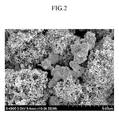
- FIG. 2 is a scanning electron microscope photograph showing the metal carbide obtained from Example 1.
- Metal carbide has excellent mechanical characteristics and is widely used in fields requiring wear resistance, cutting, corrosion resistance, heat insulating material, and/or electric/thermal conductivity. According to one embodiment of the present invention, provided is a method of preparing metal carbide that can be easy and convenient and can provide metal carbide with a specialized shape.
- the method of preparing metal carbide according to one embodiment can enable easy synthesis of various kinds of metal carbide and mass production of the same.
- the method of manufacturing a metal carbide includes applying physical force to a mixture of metal or metal oxide with carbonaceous material to provide a hybrid particle in which the carbonaceous material is filled inside the metal or metal oxide, or the carbonaceous material is coated onto the surface of the metal or metal oxide, or in which the metal or metal oxide is filled inside the carbonaceous material, or the metal or metal oxide is coated onto the surface of the carbonaceous material; and heating the hybrid particle.
- physical force is applied to a mixture of metal or metal oxide with carbonaceous material to provide a hybrid particle.
- Exemplary metals include without limitation titanium, zirconium, tungsten, silicon, aluminum, niobium, boron, chromium, vanadium, and the like, and combinations thereof.
- metal oxide examples include without limitation titanium(II) oxide, titanium(III) oxide, titanium(IV) oxide, titanium(III, IV) oxide, zirconium(II) oxide, zirconium(IV) oxide, tungsten(III) oxide, tungsten(IV) oxide, tungsten(VI) oxide, silicon oxide, aluminum oxide, niobium(II) oxide, niobium(IV) oxide, niobium(V) oxide, boric oxide, chromium(III) oxide, chromium(IV) oxide, chromium(VI) oxide, chromium(II, III) oxide, vanadium(II) oxide, vanadium(III) oxide, vanadium(IV) oxide, vanadium(V) oxide, and the like, and combinations thereof.
- Combinations of the metal and metal oxide may also be used.
- the metal or metal oxide may have a suitable shape such as sheet-shape or needle-shape according to the desired shape for the end product.
- the final composite material shape is determined by the shape of the metal or metal oxide, so it is possible to freely design the final composite material shape.
- Examples of the carbonaceous material may include without limitation coal, natural graphite, artificial graphite, expanded graphite, carbon fiber, carbon nanotube, carbon black, and the like, and combinations thereof.
- Each of the metal oxide and carbonaceous material may have an average particle diameter of about 10 nm to about 100 ⁇ m.
- the metal oxide When the metal oxide is a daughter particle in the hybrid particle, it may have a particle diameter of about 1/500 to about 1/10 of the diameter of the mother particle of the carbonaceous material particle; on the other hand, when the metal oxide is a mother particle in the hybrid particle, it may have a particle diameter of about 10 times to about 500 times the diameter of the daughter particle of the carbonaceous material particle.
- the hybrid particle is provided by applying physical force which can include for example physical collision, and/or friction.
- the physical force may include physical compressive force or shear force.
- the hybrid particle refers to a particle including carbonaceous material and metal or metal oxide, which are mixed, and in which one component is filled inside the other, or one component is coated onto the surface of the other.
- the hybrid particle means that the carbonaceous material is filled inside the metal or metal oxide, or the carbonaceous material is coated onto the surface of the metal or metal oxide, or that the metal or metal oxide is filled inside the carbonaceous material, or the metal or metal oxide is coated onto the surface of the carbonaceous material.
- the particle having a larger size is referred to as a mother particle, and the particle having a smaller size is referred to as a daughter particle.
- the carbonaceous material is a mother particle; and when the carbonaceous material is a daughter particle, the metal or metal oxide is a mother particle.
- the mother particle has a larger size than the daughter particle.
- the daughter particle may have a particle diameter of about 1/10 or less than the diameter of the mother particle, or for example the daughter particle may have a particle diameter of about 1/500 to about 1/10 of the diameter of the mother particle.
- the daughter particles may be uniformly distributed on the surface of the mother particle, which can improve the efficiency of producing a hybrid particle.
- the method of preparing a hybrid particle may include method for preparing a particle hybrid using a flowing gas such as disclosed in U.S. Patent No. 6,892,475 , which is incorporated herein by reference in its entirety, or a method for preparing a particle hybrid using a blade such as disclosed in U.S. Patent No. 4,789,105 , which is also incorporated herein by reference in its entirety.
- the particle hybrid method using a flowing gas or blade all use a physical force, such as physical compressive force or shear force.
- the present invention is not limited to these particle hybrid methods, but it may be performed by any known methods capable of coating or filling daughter particles onto the surface of the mother particle by physical force or any method preparing the hybrid particle.
- the mixing ratio of the metal or metal oxide and the carbonaceous material may be easily calculated by the chemical change formula according to the kind of metal.
- titanium(IV) oxide and carbon may be chemically changed (reacted) according to the following Reaction Scheme 1.
- TiO 2 + 3C ⁇ TiC + 2CO Reaction Scheme 1
- titanium(IV) oxide and carbon are mixed in a weight ratio of about 80 : 36 to provide a hybrid particle.
- the carbon is mixed in an amount of about 5 to about 20 wt% more than the carbon amount calculated in Reaction Scheme 1 since the large amount of carbonaceous material can improve the yield of metal carbide as compared to a smaller amount during the heating treatment (i.e., carbothermal reduction reaction).
- the hybrid particle may be poorly prepared, so that the daughter particle is rarely distributed in the mother particle.
- the obtained hybrid particle is then heated.
- the heating treatment of the hybrid particle is performed under an inert atmosphere, and the heating treatment refers to a carbothermal reduction. According to the heating treatment, the hybrid particle is chemically changed into metal carbide.
- the heating treatment may vary depending upon the kind of metal or metal oxide.
- the hybrid particle may be introduced in a reactor and an inert atmosphere such as argon gas, nitrogen gas or the like can flow into the reactor.
- the heating treatment may be performed at a temperature of about 1,200°C to about 1,800°C, or for example, a temperature of about 1,500°C to about 1,800°C.
- a temperature of about 1,500°C to about 1,800°C When the heat treatment is performed within these temperature ranges, the chemical change can be easily generated, and the production efficiency can be improved which is economical.
- the heating duration is not limited as long as the temperature and atmosphere condition are satisfied.
- the method of preparing metal carbide uses a hybrid particle.
- the hybrid particle is prepared by using all solid materials. This can provide easy control of the process conditions as compared to the conventional method using gas. Also, it is possible to provide metal carbide with a needle-shape or a sheet-shape when using a needle-shaped metal or metal oxide and a sheet-shaped metal or metal oxide, respectively, so the shape of metal carbide may be specialized.
- the method of preparing metal carbide using hybrid particle enables easy synthesis of the various kinds of metal carbide, so that it may be mass produced.
- a metal carbide prepared by the method disclosed herein of preparing metal carbide.
- the metal carbide may be used in various fields, including molded products manufactured using the metal carbide used in fields requiring for wear resistance, cutting, corrosion resistance, heat resistance, electric conductor, and/or thermal conductivity.
- the metal oxide is a nano-sized titanium(IV) oxide.
- the titanium(IV) oxide of titanium tetraisopropoxide is prepared in accordance with the hydrolysis method disclosed in J. Phys. Chem. 98 (1994) 1366 .
- the obtained titanium(IV) oxide has an average particle diameter of 27 nm.
- the carbonaceous material used is carbon black having a surface area of 65m 2 /g measured in accordance with ASTM D3037-89 and an average particle diameter of 5.1 ⁇ m after applied with ultrasonic wave for 5 minutes in an ultrasonic radiator.
- a hybrid particle in which metal oxide is filled inside carbonaceous material, or metal oxide is coated onto the surface of carbonaceous material is prepared in accordance with the particle hybrid method disclosed in U.S. Patent No. 6,892,475 .
- the mixing ratio of carbonaceous material and metal oxide is 1:2 in a weight ratio.
- the particle diameter ratio of mother particle and daughter particle is 189:1.
- the hybrid particle is introduced into a reactor and heated under an argon gas atmosphere at a temperature of 1,000°C (Comparative Example 1), 1,200°C (Example 1), 1,500°C (Example 2) during about 2 hours, respectively to provide a metal carbide.
- Each metal carbide obtained from Examples 1 and 2 and Comparative Example 1 is measured by X-ray diffraction (XRD) using CuK ⁇ line, and the results are shown in FIG. 1 .
- FIG. 1 is a graph showing X-ray diffraction analysis results of each metal carbide obtained from Examples 1 and 2 and Comparative Example 1.
- Comparative Example 1 which is heated at 1000°C did not show the peak of titanium carbide peak, so it is understood that titanium carbide is not provided.
- Examples 1 and 2 which are heated at 1200°C and 1500°C respectively show the peak of titanium carbide, so it is understood that titanium carbide is provided at these temperatures.
- the peak intensity of titanium carbide is increased by increasing the heat treatment temperature from 1200°C to 1500°C.
- metal carbide is successfully synthesized according to Examples 1 and 2.
- FIG. 2 is a scanning electron microscope photograph of metal carbide obtained from Example 1.
Landscapes
- Chemical & Material Sciences (AREA)
- Organic Chemistry (AREA)
- Inorganic Chemistry (AREA)
- Carbon And Carbon Compounds (AREA)
- Other Surface Treatments For Metallic Materials (AREA)
Abstract
Disclosed is a method of preparing metal carbide including: applying physical force to a mixture of metal or metal oxide with carbonaceous material to provide a hybrid particle in which the carbonaceous material is filled inside the metal or metal oxide, or the carbonaceous material is coated onto the surface of the metal or metal oxide or the metal or metal oxide is filled inside the carbonaceous material, or the metal or metal oxide is coated onto the surface of the carbonaceous material and heating the hybrid particle; and a metal carbide prepared therefrom.
Description
- The present invention relates to a method of preparing metal carbide and metal carbide prepared using the same.
- Metal carbide has excellent hardness, mechanical strength and rigidity, compressive strength and creep characteristics, so it may be used in various fields requiring wear resistance, cutting or heat resistance, and/or chemical resistance, and can be used as a coating material for nuclear reactors since it has a significantly low thermal expansion coefficient, high heat and electric conductive characteristics, and high thermal and chemical stability.
- Metal carbide having these characteristics can be provided by a gas-solid reaction including: providing metal, metal salt, or metal oxide particles in a reactor; providing alkyne gas into the reactor to coat the particles with carbon separated from the alkyne gas through pyrolysis under the alkyne gas atmosphere; inducing a chemical change through carbothermal reduction that is conducted at high temperatures under an inert atmosphere.
- The method determines the physical properties of metal carbide, which can vary depending on carbon concentration of the alkyne gas, flowing strength of the alkyne gas, surface area of the metal particles, oxygen concentration of the inert atmosphere and the like, so the overall process is delicately controlled. In addition, the obtained metal carbide is formed in a powder shape, so there are limitations with regard to synthesizing metal carbide having a specialized shape such as a needle-shape.
- It is the object of the present invention to provide a method of preparing a metal carbide which is simple and can provide metal carbide with a desirable shape.
- Another object of the present invention is to provide a metal carbide prepared by the method of the invention for preparing metal carbide.
- Further another object of the present invention is to provide a molded product manufactured using the metal carbide of the invention.
- Above object have been achieved by the provision of a method of preparing metal carbide that includes applying physical force to a mixture of metal or metal oxide with carbonaceous material to provide a hybrid particle in which the carbonaceous material is filled inside the metal or metal oxide, or the carbonaceous material is coated onto the surface of the metal or metal oxide, or in which the metal or metal oxide is filled inside the carbonaceous material, or the metal or metal oxide is coated onto the surface of the carbonaceous material; and heating the hybrid particle.
- The physical force may be physical compressive force or shear force.
- The metal or metal oxide may be a metal or oxide thereof such as but not limited to titanium, zirconium, tungsten, silicon, aluminum, niobium, boron, chromium, vanadium, and the like and combinations thereof.
- The carbonaceous material may be coal, natural graphite, artificial graphite, expanded graphite, carbon fiber, carbon nanotube, carbon black, or a combination thereof.
- When the carbonaceous material is filled inside the metal or metal oxide, or the carbonaceous material is coated onto the surface of the metal or metal oxide, the metal or metal oxide is a mother particle, and the carbonaceous material is a daughter particle; on the other hand, when the metal or metal oxide is filled inside the carbonaceous material, or the metal or metal oxide is coated onto the surface of the carbonaceous material, the carbonaceous material is a mother particle, and the metal or metal oxide is a daughter particle. The daughter particle may have a particle diameter of about 1/10 or less, for example, about 1/500 to about 1/10 of the particle diameter of mother particle.
- The heat treatment may be performed under an inert atmosphere and at a temperature ranging from about 1,200°C to about 1,800°C.
- According to another aspect of the present invention, a metal carbide is provided that is prepared by the method of the invention for preparing metal carbide.
- According to further another aspect of the present invention, provided is a molded product manufactured using the metal carbide.
- Hereinafter, further aspects of the present invention will be described in detail.
-
FIG. 1 is a graph showing X-ray diffraction analysis results of metal carbide obtained from Examples 1 and 2 and Comparative Example 1. -
FIG. 2 is a scanning electron microscope photograph showing the metal carbide obtained from Example 1. - The present invention now will be described more fully hereinafter in the following detailed description of the invention, in which some, but not all embodiments of the invention are described. Indeed, this invention may be embodied in many different forms and should not be construed as limited to the embodiments set forth herein; rather, these embodiments are provided so that this disclosure will satisfy applicable legal requirements.
- Metal carbide has excellent mechanical characteristics and is widely used in fields requiring wear resistance, cutting, corrosion resistance, heat insulating material, and/or electric/thermal conductivity. According to one embodiment of the present invention, provided is a method of preparing metal carbide that can be easy and convenient and can provide metal carbide with a specialized shape.
- That is, the method of preparing metal carbide according to one embodiment can enable easy synthesis of various kinds of metal carbide and mass production of the same. In addition, it is possible to prepare metal carbide with a specialized shape such as a needle-shape as well as powder shape.
- The method of manufacturing a metal carbide includes applying physical force to a mixture of metal or metal oxide with carbonaceous material to provide a hybrid particle in which the carbonaceous material is filled inside the metal or metal oxide, or the carbonaceous material is coated onto the surface of the metal or metal oxide, or in which the metal or metal oxide is filled inside the carbonaceous material, or the metal or metal oxide is coated onto the surface of the carbonaceous material; and heating the hybrid particle.
- Hereinafter, each step is described in more detail.
- According to one embodiment, physical force is applied to a mixture of metal or metal oxide with carbonaceous material to provide a hybrid particle.
- Exemplary metals include without limitation titanium, zirconium, tungsten, silicon, aluminum, niobium, boron, chromium, vanadium, and the like, and combinations thereof.
- Examples of the metal oxide include without limitation titanium(II) oxide, titanium(III) oxide, titanium(IV) oxide, titanium(III, IV) oxide, zirconium(II) oxide, zirconium(IV) oxide, tungsten(III) oxide, tungsten(IV) oxide, tungsten(VI) oxide, silicon oxide, aluminum oxide, niobium(II) oxide, niobium(IV) oxide, niobium(V) oxide, boric oxide, chromium(III) oxide, chromium(IV) oxide, chromium(VI) oxide, chromium(II, III) oxide, vanadium(II) oxide, vanadium(III) oxide, vanadium(IV) oxide, vanadium(V) oxide, and the like, and combinations thereof.
- Combinations of the metal and metal oxide may also be used.
- The metal or metal oxide may have a suitable shape such as sheet-shape or needle-shape according to the desired shape for the end product. The final composite material shape is determined by the shape of the metal or metal oxide, so it is possible to freely design the final composite material shape.
- Examples of the carbonaceous material may include without limitation coal, natural graphite, artificial graphite, expanded graphite, carbon fiber, carbon nanotube, carbon black, and the like, and combinations thereof.
- Each of the metal oxide and carbonaceous material may have an average particle diameter of about 10 nm to about 100 µm. When the metal oxide is a daughter particle in the hybrid particle, it may have a particle diameter of about 1/500 to about 1/10 of the diameter of the mother particle of the carbonaceous material particle; on the other hand, when the metal oxide is a mother particle in the hybrid particle, it may have a particle diameter of about 10 times to about 500 times the diameter of the daughter particle of the carbonaceous material particle.
- The hybrid particle is provided by applying physical force which can include for example physical collision, and/or friction. For example, the physical force may include physical compressive force or shear force.
- According to one embodiment, the hybrid particle refers to a particle including carbonaceous material and metal or metal oxide, which are mixed, and in which one component is filled inside the other, or one component is coated onto the surface of the other. In other words, the hybrid particle means that the carbonaceous material is filled inside the metal or metal oxide, or the carbonaceous material is coated onto the surface of the metal or metal oxide, or that the metal or metal oxide is filled inside the carbonaceous material, or the metal or metal oxide is coated onto the surface of the carbonaceous material.
- In the hybrid particle, the particle having a larger size is referred to as a mother particle, and the particle having a smaller size is referred to as a daughter particle. According to one embodiment, when the metal or metal oxide is a daughter particle, the carbonaceous material is a mother particle; and when the carbonaceous material is a daughter particle, the metal or metal oxide is a mother particle.
- That is, according to one embodiment, it does not matter which particle is a mother particle or a daughter particle to synthesize the metal carbide.
- No matter which particle is a mother particle, since the daughter particle is filled inside mother particle, or the daughter particle is coated onto the surface of mother particle, the mother particle has a larger size than the daughter particle. The daughter particle may have a particle diameter of about 1/10 or less than the diameter of the mother particle, or for example the daughter particle may have a particle diameter of about 1/500 to about 1/10 of the diameter of the mother particle. When the daughter particle and the mother particle have a particle diameter ratio within these ranges, the daughter particles may be uniformly distributed on the surface of the mother particle, which can improve the efficiency of producing a hybrid particle.
- The method of preparing a hybrid particle may include method for preparing a particle hybrid using a flowing gas such as disclosed in
U.S. Patent No. 6,892,475 , which is incorporated herein by reference in its entirety, or a method for preparing a particle hybrid using a blade such as disclosed inU.S. Patent No. 4,789,105 , which is also incorporated herein by reference in its entirety. The particle hybrid method using a flowing gas or blade all use a physical force, such as physical compressive force or shear force. These U.S. Patents disclose the specific process and device for carrying out the particle hybrid method. Accordingly the skilled artisan will understand how to prepare the hybrid particle of the invention in which the daughter particle is filled inside mother particle, or the daughter particle is coated onto the surface of the mother particle without undue experimentation according to these known particle hybrid methods. However, the present invention is not limited to these particle hybrid methods, but it may be performed by any known methods capable of coating or filling daughter particles onto the surface of the mother particle by physical force or any method preparing the hybrid particle. - The mixing ratio of the metal or metal oxide and the carbonaceous material may be easily calculated by the chemical change formula according to the kind of metal.
- For example, titanium(IV) oxide and carbon may be chemically changed (reacted) according to the following Reaction Scheme 1.
TiO2 + 3C → TiC + 2CO [Reaction Scheme 1]
- In this case, titanium(IV) oxide and carbon are mixed in a weight ratio of about 80 : 36 to provide a hybrid particle. In exemplary embodiments, the carbon is mixed in an amount of about 5 to about 20 wt% more than the carbon amount calculated in Reaction Scheme 1 since the large amount of carbonaceous material can improve the yield of metal carbide as compared to a smaller amount during the heating treatment (i.e., carbothermal reduction reaction). However, if too much carbonaceous material is added, the hybrid particle may be poorly prepared, so that the daughter particle is rarely distributed in the mother particle.
- The obtained hybrid particle is then heated.
- The heating treatment of the hybrid particle is performed under an inert atmosphere, and the heating treatment refers to a carbothermal reduction. According to the heating treatment, the hybrid particle is chemically changed into metal carbide.
- The heating treatment may vary depending upon the kind of metal or metal oxide. Generally, the hybrid particle may be introduced in a reactor and an inert atmosphere such as argon gas, nitrogen gas or the like can flow into the reactor.
- The heating treatment may be performed at a temperature of about 1,200°C to about 1,800°C, or for example, a temperature of about 1,500°C to about 1,800°C. When the heat treatment is performed within these temperature ranges, the chemical change can be easily generated, and the production efficiency can be improved which is economical.
- During the heat treatment, the heating duration is not limited as long as the temperature and atmosphere condition are satisfied.
- The method of preparing metal carbide uses a hybrid particle. The hybrid particle is prepared by using all solid materials. This can provide easy control of the process conditions as compared to the conventional method using gas. Also, it is possible to provide metal carbide with a needle-shape or a sheet-shape when using a needle-shaped metal or metal oxide and a sheet-shaped metal or metal oxide, respectively, so the shape of metal carbide may be specialized.
- In addition, as mentioned in above, the method of preparing metal carbide using hybrid particle enables easy synthesis of the various kinds of metal carbide, so that it may be mass produced.
- According to another embodiment, provided is a metal carbide prepared by the method disclosed herein of preparing metal carbide. The metal carbide may be used in various fields, including molded products manufactured using the metal carbide used in fields requiring for wear resistance, cutting, corrosion resistance, heat resistance, electric conductor, and/or thermal conductivity.
- The following examples illustrate the present invention in more detail.
However, they are exemplary embodiments and are not limiting. The contents not disclosed in this specification are easily understood by a person of ordinary skill in the art. - The metal oxide is a nano-sized titanium(IV) oxide. The titanium(IV) oxide of titanium tetraisopropoxide is prepared in accordance with the hydrolysis method disclosed in J. Phys. Chem. 98 (1994) 1366. The obtained titanium(IV) oxide has an average particle diameter of 27 nm.
- The carbonaceous material used is carbon black having a surface area of 65m2/g measured in accordance with ASTM D3037-89 and an average particle diameter of 5.1 µm after applied with ultrasonic wave for 5 minutes in an ultrasonic radiator.
- With a mother particle of carbonaceous material and a daughter particle of metal oxide, a hybrid particle in which metal oxide is filled inside carbonaceous material, or metal oxide is coated onto the surface of carbonaceous material is prepared in accordance with the particle hybrid method disclosed in
U.S. Patent No. 6,892,475 . The mixing ratio of carbonaceous material and metal oxide is 1:2 in a weight ratio. The particle diameter ratio of mother particle and daughter particle is 189:1. - The hybrid particle is introduced into a reactor and heated under an argon gas atmosphere at a temperature of 1,000°C (Comparative Example 1), 1,200°C (Example 1), 1,500°C (Example 2) during about 2 hours, respectively to provide a metal carbide.
- Each metal carbide obtained from Examples 1 and 2 and Comparative Example 1 is measured by X-ray diffraction (XRD) using CuKα line, and the results are shown in
FIG. 1 . -
FIG. 1 is a graph showing X-ray diffraction analysis results of each metal carbide obtained from Examples 1 and 2 and Comparative Example 1. - Since titanium oxide has a crystal face (x y z) of 2θ=36.3° (111), 42.1° (200), 61.1° (220), 73.3° (311), 77.1° (222) in XRD, it may be confirmed that it is chemically changed to metal carbide when the peaks are shown at the sated angles in the XRD results.
- Referring to
FIG. 1 , Comparative Example 1 which is heated at 1000°C did not show the peak of titanium carbide peak, so it is understood that titanium carbide is not provided. On the other hand, Examples 1 and 2 which are heated at 1200°C and 1500°C, respectively show the peak of titanium carbide, so it is understood that titanium carbide is provided at these temperatures. In addition, it is confirmed that the peak intensity of titanium carbide is increased by increasing the heat treatment temperature from 1200°C to 1500°C. As a result, it is confirmed that metal carbide is successfully synthesized according to Examples 1 and 2. -
FIG. 2 is a scanning electron microscope photograph of metal carbide obtained from Example 1. - Referring to
FIG. 2 , metal carbide particles are confirmed. The large lump positioned in the middle of SEM photograph indicates the remaining carbon black which is not reacted since the hybrid particle is prepared with titanium(IV) oxide and carbon black in a weight ratio of 2 : 1, which means that an excessive amount of carbon black is added. - Many modifications and other embodiments of the invention will come to mind to one skilled in the art to which this invention pertains having the benefit of the teachings presented in the foregoing description. Therefore, it is to be understood that the invention is not to be limited to the specific embodiments disclosed and that modifications and other embodiments are intended to be included within the scope of the appended claims. Although specific terms are employed herein, they are used in a generic and descriptive sense only and not for purposes of limitation, the scope of the invention being defined in the claims.
- This application claims priority to Korean Patent Application No.
10-2008-0131353 filed on December 22, 2008
Claims (10)
- A method of preparing metal carbide comprising:applying physical force to a mixture of metal or metal oxide with carbonaceous material to provide a hybrid particle in which the carbonaceous material is filled inside the metal or metal oxide, or the carbonaceous material is coated onto the surface of the metal or metal oxide or in which the metal or metal oxide is filled inside the carbonaceous material, or the metal or metal oxide is coated onto the surface of the carbonaceous material; andheating the hybrid particle.
- The method of claim 1, wherein the physical force is physical compressive force or shear force.
- The method of claim 1 or 2, wherein the metal or metal oxide comprises titanium, zirconium, tungsten, silicon, aluminum, niobium, boron, chromium, vanadium, an oxide thereof, or a combination thereof.
- The method of any of claims 1 to 3, wherein the carbonaceous material comprises natural graphite, artificial graphite, expanded graphite, carbon fiber, carbon nanotube, carbon black, or a combination thereof.
- The method of any of claims 1 to 4, wherein when the carbonaceous material is filled inside the metal or metal oxide, or the carbonaceous material is coated onto the surface of the metal or metal oxide, the metal or metal oxide is a mother particle, and the carbonaceous material is a daughter particle;
and when the metal or metal oxide is filled inside the carbonaceous material, or the metal or metal oxide is coated onto the surface of the carbonaceous material, the carbonaceous material is a mother particle, and the metal or metal oxide is a daughter particle; and
the daughter particle has a particle diameter of about 1/10 or less than the particle diameter of the mother particle. - The method of claim 5, wherein the daughter particle has a particle diameter of about 1/500 to about 1/10 of the particle diameter of the mother particle.
- The method of any of claims 1 to 6, wherein the heat treatment is performed under an inert atmosphere.
- The method of any of claims 1 to 7, wherein the heat treatment is performed at a temperature of about 1,200°C to about 1,800°C.
- A metal carbide obtainable by the method of preparing metal carbide of any of claims 1 to 8.
- A molded product obtainable using the metal carbide of claim 9.
Applications Claiming Priority (1)
| Application Number | Priority Date | Filing Date | Title |
|---|---|---|---|
| KR1020080131353A KR20100072826A (en) | 2008-12-22 | 2008-12-22 | Method of manufacturing metal carbide |
Publications (1)
| Publication Number | Publication Date |
|---|---|
| EP2202203A1 true EP2202203A1 (en) | 2010-06-30 |
Family
ID=42126452
Family Applications (1)
| Application Number | Title | Priority Date | Filing Date |
|---|---|---|---|
| EP09180275A Withdrawn EP2202203A1 (en) | 2008-12-22 | 2009-12-22 | Method of preparing metal carbide and metal carbide prepared using the same |
Country Status (4)
| Country | Link |
|---|---|
| US (1) | US20100158787A1 (en) |
| EP (1) | EP2202203A1 (en) |
| JP (1) | JP2010143820A (en) |
| KR (1) | KR20100072826A (en) |
Cited By (1)
| Publication number | Priority date | Publication date | Assignee | Title |
|---|---|---|---|---|
| CN102642833A (en) * | 2011-02-22 | 2012-08-22 | 成均馆大学校产学协力团 | Method of interface hardening of carbon material using nano silicon carbarde coating |
Families Citing this family (2)
| Publication number | Priority date | Publication date | Assignee | Title |
|---|---|---|---|---|
| KR102393503B1 (en) * | 2020-06-15 | 2022-05-04 | 강원대학교산학협력단 | Method for manufacturing transition metal carbide using lignin, transition metal carbide and catalyst comprising the same |
| CN120024897B (en) * | 2025-03-24 | 2025-12-02 | 赣州有色冶金研究所有限公司 | A nano-tungsten carbide and its preparation method |
Citations (7)
| Publication number | Priority date | Publication date | Assignee | Title |
|---|---|---|---|---|
| DE2417085A1 (en) * | 1973-04-24 | 1974-11-21 | Shinano Electric Refining Co | Silicon carbide mfr. without sawdust furnace packing - partly-reacted reclaimed silica-carbon mixt. avoids blow-ups and bad odours |
| US4789105A (en) | 1986-04-18 | 1988-12-06 | Hosokawa Micron Corporation | Particulate material treating apparatus |
| WO1991019584A1 (en) * | 1990-06-12 | 1991-12-26 | The Australian National University | Metal carbides and derived composites |
| US5567662A (en) * | 1994-02-15 | 1996-10-22 | The Dow Chemical Company | Method of making metallic carbide powders |
| US6892475B2 (en) | 2001-10-29 | 2005-05-17 | Nara Machinery Co., Ltd. | Device for treating powder particles by rotary flow |
| CN101049932A (en) * | 2007-04-05 | 2007-10-10 | 哈尔滨工业大学 | Method for preparing one dimension SiC Nano fiber |
| FR2899574A1 (en) * | 2006-04-10 | 2007-10-12 | Commissariat Energie Atomique | MANUFACTURE OF DENSED MATERIALS OF CARBIDE OF TRANSITION METALS. |
Family Cites Families (10)
| Publication number | Priority date | Publication date | Assignee | Title |
|---|---|---|---|---|
| US4221762A (en) * | 1978-01-30 | 1980-09-09 | Andrjushin Alexandr I | Apparatus for preparing carbides |
| US5202105A (en) * | 1986-08-22 | 1993-04-13 | Stemcor Corporation | Method for making hexagonal silicon carbide platelets with the addition of a growth additive |
| US5746803A (en) * | 1996-06-04 | 1998-05-05 | The Dow Chemical Company | Metallic-carbide group VIII metal powder and preparation methods thereof |
| US6214309B1 (en) * | 1997-09-24 | 2001-04-10 | University Of Connecticut | Sinterable carbides from oxides using high energy milling |
| JP2000072429A (en) * | 1998-09-03 | 2000-03-07 | Tokyo Tungsten Co Ltd | Vanadium carbide powder and method for producing the same |
| KR100346762B1 (en) * | 1999-07-21 | 2002-07-31 | 한국기계연구원 | PRODUCTION METHOD FOR NANOPHASE WC/TiC/Co COMPOSITE POWDER |
| JP4590599B2 (en) * | 2004-04-30 | 2010-12-01 | 独立行政法人物質・材料研究機構 | Boron carbide nanobelt and manufacturing method thereof |
| US20060051281A1 (en) * | 2004-09-09 | 2006-03-09 | Bhabendra Pradhan | Metal carbides and process for producing same |
| KR100833842B1 (en) * | 2005-06-16 | 2008-06-02 | 주식회사 코아로직 | Pixel rasterization processing method and apparatus therefor in 3D graphics engine |
| KR100790423B1 (en) * | 2006-12-20 | 2008-01-03 | 제일모직주식회사 | Hydrophilic Carbon Black Aggregates and Methods for Making the Same, and Bipolar Plates for Hydrophilic Composites and Fuel Cells Comprising the Same |
-
2008
- 2008-12-22 KR KR1020080131353A patent/KR20100072826A/en not_active Ceased
-
2009
- 2009-12-15 US US12/637,888 patent/US20100158787A1/en not_active Abandoned
- 2009-12-17 JP JP2009286382A patent/JP2010143820A/en active Pending
- 2009-12-22 EP EP09180275A patent/EP2202203A1/en not_active Withdrawn
Patent Citations (7)
| Publication number | Priority date | Publication date | Assignee | Title |
|---|---|---|---|---|
| DE2417085A1 (en) * | 1973-04-24 | 1974-11-21 | Shinano Electric Refining Co | Silicon carbide mfr. without sawdust furnace packing - partly-reacted reclaimed silica-carbon mixt. avoids blow-ups and bad odours |
| US4789105A (en) | 1986-04-18 | 1988-12-06 | Hosokawa Micron Corporation | Particulate material treating apparatus |
| WO1991019584A1 (en) * | 1990-06-12 | 1991-12-26 | The Australian National University | Metal carbides and derived composites |
| US5567662A (en) * | 1994-02-15 | 1996-10-22 | The Dow Chemical Company | Method of making metallic carbide powders |
| US6892475B2 (en) | 2001-10-29 | 2005-05-17 | Nara Machinery Co., Ltd. | Device for treating powder particles by rotary flow |
| FR2899574A1 (en) * | 2006-04-10 | 2007-10-12 | Commissariat Energie Atomique | MANUFACTURE OF DENSED MATERIALS OF CARBIDE OF TRANSITION METALS. |
| CN101049932A (en) * | 2007-04-05 | 2007-10-10 | 哈尔滨工业大学 | Method for preparing one dimension SiC Nano fiber |
Non-Patent Citations (3)
| Title |
|---|
| DATABASE WPI Week 200851, Derwent World Patents Index; AN 2008-H93964, XP002582214 * |
| J. PHYS. CHEM., vol. 98, 1994, pages 1366 |
| LIU Z G ET AL: "MECHANICAL MILLING OF FULLERENE WITH CARBIDE FORMING ELEMENTS", JOURNAL OF MATERIALS SCIENCE, SPRINGER NETHERLANDS, NL LNKD- DOI:10.1023/A:1014383909485, vol. 37, no. 6, 15 March 2002 (2002-03-15), pages 1229 - 1235, XP001083033, ISSN: 0022-2461 * |
Cited By (3)
| Publication number | Priority date | Publication date | Assignee | Title |
|---|---|---|---|---|
| CN102642833A (en) * | 2011-02-22 | 2012-08-22 | 成均馆大学校产学协力团 | Method of interface hardening of carbon material using nano silicon carbarde coating |
| EP2492241A1 (en) * | 2011-02-22 | 2012-08-29 | Research & Business Foundation of Sungkyunkwan University | Method of hardening interface of carbon material using nano silicon carbide coating |
| US8673053B2 (en) | 2011-02-22 | 2014-03-18 | Research & Business Foundation Of Sungkyunkwan University | Method of hardening an interface of carbon material using nano silicon carbide coating |
Also Published As
| Publication number | Publication date |
|---|---|
| JP2010143820A (en) | 2010-07-01 |
| KR20100072826A (en) | 2010-07-01 |
| US20100158787A1 (en) | 2010-06-24 |
Similar Documents
| Publication | Publication Date | Title |
|---|---|---|
| Saurabh et al. | Titanium-based materials: synthesis, properties, and applications | |
| Mhadhbi et al. | Titanium carbide: synthesis, properties and applications | |
| Koc et al. | Carbothermal synthesis of titanium carbide using ultrafine titania powders | |
| US5997832A (en) | Preparation of carbide nanorods | |
| Shin et al. | Synthesis of hierarchical titanium carbide from titania‐coated cellulose paper | |
| Ding et al. | The synthesis of titanium nitride whiskers on the surface of graphite by molten salt media | |
| KR100307646B1 (en) | Aluminum nitride, aluminum nitride-containing solids and aluminum nitride composites produced by the combustion synthesis method | |
| US20060051281A1 (en) | Metal carbides and process for producing same | |
| Lin et al. | Using a cobalt activator to synthesize titanium carbide (TiC) nanopowders | |
| Liu et al. | Synthesis of ultra-fine tantalum carbide powders by a combinational method of sol–gel and spark plasma sintering | |
| Xie et al. | Preparation of nano-sized titanium carbide particles via a vacuum carbothermal reduction approach coupled with purification under hydrogen/argon mixed gas | |
| Li et al. | In-situ homogeneous synthesis of carbon nanotubes on aluminum matrix and properties of their composites | |
| Simonenko et al. | Preparation of HfB2/SiC composite powders by sol–gel technology | |
| Patra et al. | Green synthesis of nanosized Tantalum carbide (TaC) via natural polymer/tantalum oxide hybrid composites: a sustainable approach towards enhanced processing and properties | |
| US20100158787A1 (en) | Method of Preparing Metal Carbide and Metal Carbide Prepared Using the Same | |
| CN116986906A (en) | Two-dimensional transition metal compound, preparation method and application thereof based on MXene | |
| Luo et al. | Microstructural evolution and oxidation resistance of multi-walled carbon nanotubes in the presence of silicon powder at high temperatures | |
| Wang et al. | A simple route for the direct conversion of waste plastic to hafnium carbide nanoparticles at low temperature | |
| Mi et al. | New discoveries in the growth of SiC whiskers derived from hydrogen silicone oil | |
| Kumari et al. | Effect of different carbon and silicon source for the preparation of ZrB2-SiC composite powder: a comparative study | |
| CN115367754A (en) | Method for preparing MAX phase material by MXene conversion and application thereof | |
| Yin et al. | Mechanistic evaluation of single-crystalline aluminum nitride nanowire synthesis from plastic waste | |
| Leconte et al. | Elaboration of SiC, TiC, and ZrC nanopowders by laser pyrolysis: from nanoparticles to ceramic nanomaterials | |
| CN103991889B (en) | Method for preparing alumina nanowires and nanorods by liquid phase ball milling | |
| Li et al. | Silicon assistant carbothermal reduction for SiC powders |
Legal Events
| Date | Code | Title | Description |
|---|---|---|---|
| PUAI | Public reference made under article 153(3) epc to a published international application that has entered the european phase |
Free format text: ORIGINAL CODE: 0009012 |
|
| 17P | Request for examination filed |
Effective date: 20091222 |
|
| AK | Designated contracting states |
Kind code of ref document: A1 Designated state(s): AT BE BG CH CY CZ DE DK EE ES FI FR GB GR HR HU IE IS IT LI LT LU LV MC MK MT NL NO PL PT RO SE SI SK SM TR |
|
| 17Q | First examination report despatched |
Effective date: 20110914 |
|
| STAA | Information on the status of an ep patent application or granted ep patent |
Free format text: STATUS: THE APPLICATION IS DEEMED TO BE WITHDRAWN |
|
| 18D | Application deemed to be withdrawn |
Effective date: 20120125 |