EP2201671B1 - Wechselrichter, insbesondere solarwechselrichter, mit lastausgleichsregelung - Google Patents
Wechselrichter, insbesondere solarwechselrichter, mit lastausgleichsregelung Download PDFInfo
- Publication number
- EP2201671B1 EP2201671B1 EP08840452.0A EP08840452A EP2201671B1 EP 2201671 B1 EP2201671 B1 EP 2201671B1 EP 08840452 A EP08840452 A EP 08840452A EP 2201671 B1 EP2201671 B1 EP 2201671B1
- Authority
- EP
- European Patent Office
- Prior art keywords
- voltage
- inverter
- regulator
- current
- actual value
- Prior art date
- Legal status (The legal status is an assumption and is not a legal conclusion. Google has not performed a legal analysis and makes no representation as to the accuracy of the status listed.)
- Not-in-force
Links
Images


Classifications
-
- H—ELECTRICITY
- H02—GENERATION; CONVERSION OR DISTRIBUTION OF ELECTRIC POWER
- H02M—APPARATUS FOR CONVERSION BETWEEN AC AND AC, BETWEEN AC AND DC, OR BETWEEN DC AND DC, AND FOR USE WITH MAINS OR SIMILAR POWER SUPPLY SYSTEMS; CONVERSION OF DC OR AC INPUT POWER INTO SURGE OUTPUT POWER; CONTROL OR REGULATION THEREOF
- H02M7/00—Conversion of AC power input into DC power output; Conversion of DC power input into AC power output
- H02M7/42—Conversion of DC power input into AC power output without possibility of reversal
- H02M7/44—Conversion of DC power input into AC power output without possibility of reversal by static converters
- H02M7/48—Conversion of DC power input into AC power output without possibility of reversal by static converters using discharge tubes with control electrode or semiconductor devices with control electrode
- H02M7/493—Conversion of DC power input into AC power output without possibility of reversal by static converters using discharge tubes with control electrode or semiconductor devices with control electrode the static converters being arranged for operation in parallel
-
- H—ELECTRICITY
- H02—GENERATION; CONVERSION OR DISTRIBUTION OF ELECTRIC POWER
- H02J—ELECTRIC POWER NETWORKS; CIRCUIT ARRANGEMENTS OR SYSTEMS FOR SUPPLYING OR DISTRIBUTING ELECTRIC POWER; SYSTEMS FOR STORING ELECTRIC ENERGY
- H02J3/00—Circuit arrangements for AC mains or AC distribution networks
- H02J3/38—Arrangements for feeding a single network from two or more generators or sources in parallel; Arrangements for feeding already energised networks from additional generators or sources in parallel
- H02J3/381—Dispersed generators
-
- H—ELECTRICITY
- H02—GENERATION; CONVERSION OR DISTRIBUTION OF ELECTRIC POWER
- H02J—ELECTRIC POWER NETWORKS; CIRCUIT ARRANGEMENTS OR SYSTEMS FOR SUPPLYING OR DISTRIBUTING ELECTRIC POWER; SYSTEMS FOR STORING ELECTRIC ENERGY
- H02J2101/00—Supply or distribution of decentralised, dispersed or local electric power generation
- H02J2101/20—Dispersed power generation using renewable energy sources
- H02J2101/22—Solar energy
- H02J2101/24—Photovoltaics
-
- H—ELECTRICITY
- H02—GENERATION; CONVERSION OR DISTRIBUTION OF ELECTRIC POWER
- H02J—ELECTRIC POWER NETWORKS; CIRCUIT ARRANGEMENTS OR SYSTEMS FOR SUPPLYING OR DISTRIBUTING ELECTRIC POWER; SYSTEMS FOR STORING ELECTRIC ENERGY
- H02J2101/00—Supply or distribution of decentralised, dispersed or local electric power generation
- H02J2101/20—Dispersed power generation using renewable energy sources
- H02J2101/28—Wind energy
-
- Y—GENERAL TAGGING OF NEW TECHNOLOGICAL DEVELOPMENTS; GENERAL TAGGING OF CROSS-SECTIONAL TECHNOLOGIES SPANNING OVER SEVERAL SECTIONS OF THE IPC; TECHNICAL SUBJECTS COVERED BY FORMER USPC CROSS-REFERENCE ART COLLECTIONS [XRACs] AND DIGESTS
- Y02—TECHNOLOGIES OR APPLICATIONS FOR MITIGATION OR ADAPTATION AGAINST CLIMATE CHANGE
- Y02E—REDUCTION OF GREENHOUSE GAS [GHG] EMISSIONS, RELATED TO ENERGY GENERATION, TRANSMISSION OR DISTRIBUTION
- Y02E10/00—Energy generation through renewable energy sources
- Y02E10/50—Photovoltaic [PV] energy
- Y02E10/56—Power conversion systems, e.g. maximum power point trackers
Definitions
- the invention relates to an inverter, in particular a solar inverter, which has a plurality of parallel-connected individual inverters, each having a power section for converting an input-side field voltage into an output-side mains voltage.
- One of the individual inverters can be operated as a master.
- the remaining individual inverters can be operated as slaves.
- All individual inverters have a current controller and a superimposed voltage regulator for controlling their respective power unit. All voltage regulators have a predefinable voltage setpoint for voltage regulation.
- the considered inverters convert the z. B. from a solar panel or a solar module provided DC voltage in an AC voltage.
- the inverter can, for example, feed the output side into a 1-phase 50Hz / 230V power supply network or into a 60Hz / 120V power supply network of an energy supply company.
- three-phase inverters are used, which in a corresponding 3-phase power supply network such.
- B. in a 50Hz / 400V power grid, feed.
- One or more inverters may be connected to a common busbar from which is fed into the grid.
- the field voltage can come from wind power generators, from fuel cells or biogas plants.
- Inverters of higher power which are connected on the input side to a solar field, usually have several parallel-connected individual inverters, which are switched on individually as the intensity of the solar radiation increases. When connecting all single inverters, a maximum electrical power to be fed back into the power grid. The gradual connection improves the efficiency of the entire inverter or the entire photovoltaic system with smaller irradiation values.
- the field voltage is typically applied to a voltage intermediate circuit of the respective power section of the individual inverters.
- the field voltage therefore also corresponds to the intermediate circuit voltage.
- the z. B. DC generated by a solar field is dependent on the current solar radiation and in particular of its electrical load.
- the field voltage of the solar field reaches its maximum.
- This voltage is also referred to as no-load voltage.
- the inverter or the individual inverters each have a control unit which controls the electronic semiconductor components in the power section of the respective individual inverter in such a way that the power fed into the electrical grid is maximum.
- the control unit executes a so-called tracking program in order to continuously "seek" the likewise fluctuating maximum power point (MPP for maximum power point).
- the individual inverters preferably have their own regulation of the intermediate circuit voltage.
- the DC link voltage is measured by each individual inverter and serves as the actual value of the respective control. Due to manufacturing tolerances, deviations occur in the voltage measured values between the individual inverters. For example, a first single inverter can measure a field voltage of 601 V and a second individual inverter a field or DC link voltage of 599 V. As a result, uneven loading of the individual inverters can occur. Thus, a part of the individual inverters can carry a high current and a high electric power feed into the grid while another part is almost idle. The reason for this should be clarified by an example below: A higher voltage setpoint of 600 V is specified for which the feed-in power should be maximum.
- the first single inverter measures the voltage of 601 V. However, this voltage is too high. Consequently, the control of the first single inverter will drive the associated power unit such that more power is fed into the grid to lower the field voltage by the now increased load of the solar field. At the same time, the control of the second single inverter, which has detected a voltage value of 599 V, the associated power unit drive such that less power is fed into the grid to raise the field voltage by a now supposedly lower load of the solar field.
- the two opposing effects reinforce each other disadvantageously so that ultimately a part of the individual inverters is operated almost at idle, while the other part feeds power into the grid at full power.
- the slaves each have a load balancing controller.
- the respective load balancing controller on the input side, an actual current value of the master is supplied.
- the respective load balancing controller is connected on the output side to the load balancing control, at least indirectly, to a regulator input of the respective power unit.
- the inverter according to the invention By means of the inverter according to the invention a uniform distribution of the load currents is achieved. Due to the uniform thermal load of the individual inverters increase the reliability and the life of the inverter according to the invention. Furthermore, the time-consuming measurement adjustment for the voltage detection of the field voltage or the intermediate circuit voltage is eliminated. Even larger tolerances in the voltmeter, as z. B. caused by aging or by an exchange, have no adverse effect on the uniform distribution of the load currents.
- the slaves each have a difference former, which forms a current actual value difference from the actual current value supplied by the master and from an actual current value of the respective slave.
- the respective actual current value difference is supplied to the respective load balancing controller on the input side.
- the respective load balancing controller has means for generating a correction voltage as a function of the actual current value difference.
- the respective voltage regulator has a voltage setpoint input for the predefinable voltage setpoint.
- the respective voltage setpoint input of the slaves is also supplied with the respective correction voltage for load balancing control.
- an absolute reduction of the voltage setpoint for the respective slave can be effected for increasing values of the actual current value difference.
- an increase in magnitude of the voltage setpoint for the respective slave can be effected for decreasing values of the actual current value difference.
- the current values have a positive sign.
- the amount of the correction voltage causes a magnitude reduction of the voltage setpoint for the slave. If the current actual value of the slave exceeds the actual current value of the master in absolute terms, the amount of the correction voltage causes an increase in the voltage setpoint for the slave in terms of magnitude.
- the correction voltage is limited and is z. B. maximum 5% to 10% of the maximum voltage setpoint.
- the master and the slaves are largely identically constructed individual inverters.
- largely is meant that the individual inverters are identical in terms of manufacturing technology.
- the individual inverters may differ, for example, with respect to a serial number stored in an electronic non-volatile memory, by means of which an automated determination of the master can be made.
- the single inverter configuration switch such. B. so-called DIP switches have, via which the operating mode of the individual inverters can be determined.
- the individual inverters each have a control unit for controlling and regulating.
- the function of the respective voltage regulator, current regulator and load balancing regulator are simulated in the form of program routines which can be executed on the respective control unit.
- the control unit is preferably a microcontroller or a microprocessor.
- a so-called tracker or search program routine is stored in the control unit, which continuously "tracks" the maximum power point (MPP) in the function of the master.
- MPP maximum power point
- the corresponding voltage setpoint is then output to all individual inverters for setting the intermediate circuit voltage or field voltage.
- the inverter is a solar inverter for input-side connection to a solar module or to a solar field and the output side connection to a power grid.
- FIG. 1 shows a solar inverter 1 with, for example, three parallel-connected individual inverters 11-13.
- the respective individual inverters 11-13 can be individually switched by means of input-side switches 4 to DC voltage lines 21, which in turn are connected to a solar field 2.
- UF a field or intermediate circuit voltage is referred to, which is based on a first reference potential 22.
- the respective individual inverters 11-13 can be individually connected to a power supply network 3 by means of output-side switches 5.
- the supply is three-phase.
- the reference numeral 31 are corresponding network feed lines, designated by the reference numeral 21 DC voltage lines or a busbar.
- UN is a three-phase mains voltage referred to a second reference potential, such. B. ground potential, based.
- the control of the switches 4, 5 can be done by a higher-level control or by a designated as a master 11 single inverter 12, 13.
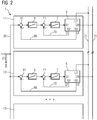
- FIG. 2 shows a schematic diagram of an inverter 1 with a plurality of parallel-connected single inverters 11-13 according to the prior art.
- Inverter 1 is a solar inverter.
- the inverter 1 shown is designed for input-side connection to a variable with respect to the feed power or voltage source, the inverter 1, the current or voltage source can load so that a maximum electric power fed into the output-side grid becomes.
- the current or voltage source may be, for example, a DC voltage generated by a solar field or a DC voltage rectified by a power generator of a wind turbine or a DC voltage generated by a fuel cell.
- the respective individual inverters 11, 13 each have a power section 6 for converting the input-side field voltage UF into the output-side mains voltage UN.
- the upper single inverter 11 is operated as a master, while the other two individual inverters 12, 13 are operated as slaves.
- the master 11 and the slaves 12, 13 are typically identically constructed.
- Each of the individual inverters 11-13 may each have a processor-based control unit for controlling and regulating.
- the control units usually have a start routine for selecting the master 11 during operation of the inverter 1. The selection can be made, for example, on the basis of an individual, stored in an electronic memory of the respective single inverter 11-13 serial number.
- All individual inverters 11-13 have a not shown voltage detection, such. As a voltage converter or a LEM voltage transformer, for detecting the field or intermediate circuit voltage UF and a load current detection, such as. As a current transformer, on. In the example of FIG. 2 the voltage and current measurement takes place in the respective power section 6.
- the detected current actual values and voltage actual values of the master 11 are denoted by the reference symbols SI and UI, those of the slaves 12, 13 by SI 'and UI'.
- All individual inverters 11-13 shown each have a current regulator 7 and a superimposed voltage regulator 8 for controlling the respective power unit 6. For regulation, the actual values SI, UI, SI 'and UI' are fed back via corresponding return paths 70, 80 to the two controllers 8, 9.
- all voltage regulators 8 are supplied with a predefinable voltage setpoint US for voltage regulation. He can z. B. from a not further shown control unit of the master 11 or provided by a higher-level control unit of the inverter 1.
- the individual inverters 11-13 are interconnected via a voltage signal line 20.
- the distribution of the voltage setpoint US via a bus connection, such. B. via a fieldbus.
- the functions of the respective voltage regulator 8 and current regulator 7 are modeled in the form of program routines which can be executed on the respective control unit.
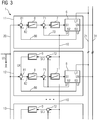
- FIG. 3 shows a schematic diagram of an inverter 1 with several parallel-connected individual inverters 11-13 and with a load balancing control according to the invention.
- the slaves 12, 13 compared to FIG. 2 in each case a load balancing controller 9.
- the actual current value SI of the master 11 is now fed to the respective load balancing controller 9 on the input side.
- the respective load balancing controller 9 is at least indirectly connected to a regulator input 61 of the respective power section 6 for load balancing control.
- the slaves 12, 13 each have a difference former 72 for load distribution, which forms a current actual value difference SID from the actual current value SI supplied by the master 11 and the actual current value SI 'of the respective slave 12, 13.
- the difference former 72 is in the simplest case an adder to which the respective current actual value SI 'of the slaves 12, 13 is supplied negated, while the current actual value SI of the master 11 is unchanged, that is not negated, is supplied. This is symbolized by a minus sign, which is located next to the difference former 72 shown as a node.
- the respective current actual value difference SID is then fed to the respective load balancing controller 9 on the input side.
- the respective load compensation regulator 9 has means (not shown) for generating a correction voltage UK or a correction value as a function of the actual current value difference SID.
- the respective correction voltage UK is then supplied to the respective voltage regulator 8 for load compensation control.
- the adder node 81 is connected on the output side to a corresponding voltage setpoint input 82 of the respective downstream voltage regulator 8, which further processes the added signal supplied to it by control technology.
- an absolute reduction of the voltage setpoint value US for the respective slave 12, 13 can be effected for increasing values of the actual current value difference SID.
- an increase in magnitude of the voltage setpoint US for the respective slave 12, 13 for decreasing values of the actual current value difference SID can be effected.
- the current values for example, positive values were assumed.
- the Stromistwertdifferenz SID can z. B. be mapped into a proportional correction voltage UK.
- a control algorithm is used, which generally has a PI controller, consisting of a proportional element and a parallel integrator.
- the current actual value difference SID can be mapped into the correction voltage UK via a quadratic or another suitable mathematical function.
- the respective correction voltage UK is at most 5% to 10% of the maximum (nominal) voltage setpoint US.
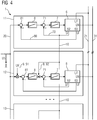
- FIG. 4 shows an alternative example of the inverter 1 which does not fall within the scope.
- the load distribution takes place by means of an underdriven voltage regulation with adjustable current limitation.
- the load balancing controller 9 of the slaves 12, 13 is composed in each case of a lowering element 91 for the voltage and of a limiting element 92 for the load current.
- the respective lowering element 91 is connected upstream of the respective voltage regulator 8 for lowering the supplied voltage nominal value US.
- the current limiting value SI of the master 11 is fed to the respective limiting element 92 as the control signal.
- the respective limiting element 92 is connected on the output side to the setpoint input of the current controller 7 of the respective slave 12, 13 for limiting the output current to the current actual value SI of the master 11. This is symbolized by the control-technical symbol of a limiter.
- the lowering element 91 is an amplifier element which lowers the supplied voltage setpoint US by a factor in the range of 0.95 to 0.9 at most.
- the amplifier element 91 is typically a multiplier that multiplies the applied voltage setpoint US by the (constant) factor.
- the multiplier is indicated by the corresponding "X" symbol.
- the lowering element 91 may be an offset element which supplies the supplied voltage setpoint value US by a predetermined voltage value in the range from a maximum of 5% to 10% of the maximum voltage setpoint US.
- the lowering element 91 is an adder which lowers the voltage command value US by a (constant) amount.
- the voltage controller-side lowering causes the following voltage regulator 8 to "set up” to set a higher load current in order to lower the field voltage UF or the intermediate circuit voltage by this load. According to the invention, however, the output from the respective voltage regulator 8 setpoint for the subsequent current controller 7 is limited to the current actual value SI of the master 11, thereby causing the load balancing.
- FIG. 5 shows a further example of an inverter 1 with a load compensation control without voltage regulation of the slaves 12, 13, which does not fall within the scope.
Landscapes
- Engineering & Computer Science (AREA)
- Power Engineering (AREA)
- Inverter Devices (AREA)
- Supply And Distribution Of Alternating Current (AREA)
Applications Claiming Priority (2)
| Application Number | Priority Date | Filing Date | Title |
|---|---|---|---|
| DE102007049774A DE102007049774B3 (de) | 2007-10-17 | 2007-10-17 | Wechselrichter, insbesondere Solarwechselrichter, mit Lastausgleichsregelung |
| PCT/EP2008/062846 WO2009050015A2 (de) | 2007-10-17 | 2008-09-25 | Wechselrichter, insbesondere solarwechselrichter, mit lastausgleichsregelung |
Publications (2)
| Publication Number | Publication Date |
|---|---|
| EP2201671A2 EP2201671A2 (de) | 2010-06-30 |
| EP2201671B1 true EP2201671B1 (de) | 2019-05-01 |
Family
ID=40436390
Family Applications (1)
| Application Number | Title | Priority Date | Filing Date |
|---|---|---|---|
| EP08840452.0A Not-in-force EP2201671B1 (de) | 2007-10-17 | 2008-09-25 | Wechselrichter, insbesondere solarwechselrichter, mit lastausgleichsregelung |
Country Status (4)
| Country | Link |
|---|---|
| EP (1) | EP2201671B1 (da) |
| DE (1) | DE102007049774B3 (da) |
| DK (1) | DK2201671T3 (da) |
| WO (1) | WO2009050015A2 (da) |
Families Citing this family (3)
| Publication number | Priority date | Publication date | Assignee | Title |
|---|---|---|---|---|
| DE102012214463A1 (de) | 2012-08-14 | 2014-02-20 | Tim Meyer | Vorrichtung und Verfahren zur Stromeinspeisung aus einer oder mehreren Stromerzeugungs-oder Speicheranlagen in zwei oder mehr Einspeisungspunkte |
| DE102014111094A1 (de) * | 2014-08-05 | 2016-02-11 | Solarworld Innovations Gmbh | Verfahren und Vorrichtung zum Betreiben einer an einem Stromnetz angeschlossenen Photovoltaikanlage |
| ES2764981T3 (es) | 2014-10-27 | 2020-06-05 | Vestas Wind Sys As | Control de convertidor de turbina eólica para convertidores de cadena modulares |
Citations (1)
| Publication number | Priority date | Publication date | Assignee | Title |
|---|---|---|---|---|
| GB2012501A (en) * | 1978-01-17 | 1979-07-25 | Northern Telecom Ltd | Master-slave pulse width modulation converter |
Family Cites Families (6)
| Publication number | Priority date | Publication date | Assignee | Title |
|---|---|---|---|---|
| DE3602496A1 (de) * | 1986-01-28 | 1987-07-30 | Klein Kg Elektro Geraete G | Verfahren zum parallelbetrieb von wechselrichtern und wechselrichteranordnung zur durchfuehrung des verfahrens |
| US5036452A (en) * | 1989-12-28 | 1991-07-30 | At&T Bell Laboratories | Current sharing control with limited output voltage range for paralleled power converters |
| JP3112584B2 (ja) * | 1992-11-18 | 2000-11-27 | 東芝エフエーシステムエンジニアリング株式会社 | インバータの高効率運転装置 |
| DE19704662A1 (de) * | 1997-02-07 | 1998-08-13 | Siemens Ag | Verfahren zur Lastsymmetrierung mehrerer autark und unabhängig arbeitenden Stromversorgungsmodulen einer modularen Stromversorgungsanlage |
| US6285572B1 (en) * | 1999-04-20 | 2001-09-04 | Sanyo Electric Co., Ltd. | Method of operating a power supply system having parallel-connected inverters, and power converting system |
| DE19933039A1 (de) * | 1999-07-15 | 2001-01-18 | Bosch Gmbh Robert | Vorrichtung zur Erzeugung eines Regelsignals für einen Gleichspannungswandler |
-
2007
- 2007-10-17 DE DE102007049774A patent/DE102007049774B3/de not_active Expired - Fee Related
-
2008
- 2008-09-25 WO PCT/EP2008/062846 patent/WO2009050015A2/de not_active Ceased
- 2008-09-25 DK DK08840452.0T patent/DK2201671T3/da active
- 2008-09-25 EP EP08840452.0A patent/EP2201671B1/de not_active Not-in-force
Patent Citations (1)
| Publication number | Priority date | Publication date | Assignee | Title |
|---|---|---|---|---|
| GB2012501A (en) * | 1978-01-17 | 1979-07-25 | Northern Telecom Ltd | Master-slave pulse width modulation converter |
Also Published As
| Publication number | Publication date |
|---|---|
| WO2009050015A2 (de) | 2009-04-23 |
| DE102007049774B3 (de) | 2009-07-02 |
| EP2201671A2 (de) | 2010-06-30 |
| DK2201671T3 (da) | 2019-07-15 |
| WO2009050015A3 (de) | 2009-06-04 |
Similar Documents
| Publication | Publication Date | Title |
|---|---|---|
| EP2059999B1 (de) | Verfahren zur regelung von wechselrichtern | |
| DE19961705B4 (de) | Vorrichtung zur dezentralen Einspeisung regenerativer Energie | |
| EP2614573B1 (de) | Verfahren zur stabilisierung eines elektrischen versorgungsnetzes | |
| EP2955808B1 (de) | Verfahren zur Regelung einer Windenergieanlage während eines asymmetrischen Netzfehlers | |
| DE102012002185B4 (de) | Energiegewinnungssystem mit Energiespeicher, Verfahren zum Betreiben eines Energiegewinnungssystems | |
| DE112016006265T5 (de) | Elektroenergie-umwandlungseinrichtung und elektroenergie-umwandlungssystem | |
| EP3358693B1 (de) | Photovoltaikanlage mit blindleistungseinspeisung in abhängigkeit der netzspannung | |
| DE102018105483A1 (de) | Verfahren zum Betrieb einer Energieerzeugungsanlage und Wechselrichter für eine Energieerzeugungsanlage | |
| EP3033816B1 (de) | Verfahren zum einspeisen elektrischer leistung in ein versorgungsnetz | |
| EP2463980A2 (de) | Betrieb eines Energieerzeugers in einem Energieversorgungsnetz | |
| EP2273646A2 (de) | Verfahren zur Blindleistungsregelung sowie Vorrichtung zur Erzeugung elektrischer Energie in einem elektrischen Netz | |
| DE102014016664A1 (de) | Verfahren zum Betreiben einer Windenenergieanlage mit komplexer Umrichtersteuerung und Vorrichtung hierfür | |
| DE69409987T2 (de) | Vorrichtung zum Unterdrücken von Spannungsschwankungen und Oberschwingungen | |
| DE102007049774B3 (de) | Wechselrichter, insbesondere Solarwechselrichter, mit Lastausgleichsregelung | |
| EP2641322A1 (de) | Energieversorgungssystem mit einem multiphasenmatrixumrichter und verfahren zum betrieb desselben | |
| DE19605419B4 (de) | Verfahren zur Beseitigung von Abweichungen der Ist-Spannung in einem Drehstromnetz von einer vorgegebenen Soll-Spannung | |
| EP4268341A1 (de) | Verfahren zum betreiben einer energieversorgungs-anlage, anlagenregler für eine energieversorgungs-anlage sowie energieversorgungs-anlage | |
| DE102011014468B4 (de) | Phasenselektives VAr - Management | |
| EP3939138A1 (de) | Verfahren zur dreiphasigen einspeisung in ein wechselspannungsnetz und dreiphasiger wechselrichter | |
| DE102011084773A1 (de) | Netzgeführter, transformatorfreier Wechselrichter, Verfahren zum Betreiben des Wechselrichters und Photovoltaikanlage | |
| DE102010000838A1 (de) | Verfahren und Vorrichtung zum Aufsynchronisieren eines Generators in einem Netz | |
| DE4308686C2 (de) | Schaltungsanordnung zum Ausgleich von Wirk- und Blindleistung zwischen einem niederfrequenten Wechselspannungsnetz und einem Gleichspannungsnetz | |
| DE102023103824A1 (de) | Verfahren zum Betreiben eines Durchlauferhitzers, Durchlauferhitzer und Computer-programm | |
| EP4636971A1 (de) | Verfahren zum betreiben eines wechselrichters, verfahren zur energieversorgung eines lokalen energieversorgungsnetzes sowie wechselrichter | |
| EP3850740A1 (de) | Verfahren zum zuschalten eines photovoltaik(pv) wechselrichters an ein dreiphasiges netz und pv-wechselrichter |
Legal Events
| Date | Code | Title | Description |
|---|---|---|---|
| PUAI | Public reference made under article 153(3) epc to a published international application that has entered the european phase |
Free format text: ORIGINAL CODE: 0009012 |
|
| 17P | Request for examination filed |
Effective date: 20100416 |
|
| AK | Designated contracting states |
Kind code of ref document: A2 Designated state(s): AT BE BG CH CY CZ DE DK EE ES FI FR GB GR HR HU IE IS IT LI LT LU LV MC MT NL NO PL PT RO SE SI SK TR |
|
| AX | Request for extension of the european patent |
Extension state: AL BA MK RS |
|
| 17Q | First examination report despatched |
Effective date: 20110204 |
|
| DAX | Request for extension of the european patent (deleted) | ||
| RAP1 | Party data changed (applicant data changed or rights of an application transferred) |
Owner name: SIEMENS AKTIENGESELLSCHAFT |
|
| STAA | Information on the status of an ep patent application or granted ep patent |
Free format text: STATUS: EXAMINATION IS IN PROGRESS |
|
| RAP1 | Party data changed (applicant data changed or rights of an application transferred) |
Owner name: SIEMENS AKTIENGESELLSCHAFT |
|
| GRAP | Despatch of communication of intention to grant a patent |
Free format text: ORIGINAL CODE: EPIDOSNIGR1 |
|
| STAA | Information on the status of an ep patent application or granted ep patent |
Free format text: STATUS: GRANT OF PATENT IS INTENDED |
|
| RIC1 | Information provided on ipc code assigned before grant |
Ipc: H02J 3/38 20060101ALN20181114BHEP Ipc: H02M 7/493 20070101AFI20181114BHEP |
|
| INTG | Intention to grant announced |
Effective date: 20181207 |
|
| GRAS | Grant fee paid |
Free format text: ORIGINAL CODE: EPIDOSNIGR3 |
|
| GRAA | (expected) grant |
Free format text: ORIGINAL CODE: 0009210 |
|
| STAA | Information on the status of an ep patent application or granted ep patent |
Free format text: STATUS: THE PATENT HAS BEEN GRANTED |
|
| AK | Designated contracting states |
Kind code of ref document: B1 Designated state(s): AT BE BG CH CY CZ DE DK EE ES FI FR GB GR HR HU IE IS IT LI LT LU LV MC MT NL NO PL PT RO SE SI SK TR |
|
| REG | Reference to a national code |
Ref country code: GB Ref legal event code: FG4D Free format text: NOT ENGLISH |
|
| REG | Reference to a national code |
Ref country code: CH Ref legal event code: EP Ref country code: AT Ref legal event code: REF Ref document number: 1128261 Country of ref document: AT Kind code of ref document: T Effective date: 20190515 |
|
| REG | Reference to a national code |
Ref country code: DE Ref legal event code: R096 Ref document number: 502008016736 Country of ref document: DE |
|
| REG | Reference to a national code |
Ref country code: IE Ref legal event code: FG4D Free format text: LANGUAGE OF EP DOCUMENT: GERMAN |
|
| REG | Reference to a national code |
Ref country code: CH Ref legal event code: NV Representative=s name: SIEMENS SCHWEIZ AG, CH |
|
| REG | Reference to a national code |
Ref country code: DK Ref legal event code: T3 Effective date: 20190708 |
|
| REG | Reference to a national code |
Ref country code: SE Ref legal event code: TRGR |
|
| REG | Reference to a national code |
Ref country code: NL Ref legal event code: MP Effective date: 20190501 |
|
| REG | Reference to a national code |
Ref country code: LT Ref legal event code: MG4D |
|
| PG25 | Lapsed in a contracting state [announced via postgrant information from national office to epo] |
Ref country code: NL Free format text: LAPSE BECAUSE OF FAILURE TO SUBMIT A TRANSLATION OF THE DESCRIPTION OR TO PAY THE FEE WITHIN THE PRESCRIBED TIME-LIMIT Effective date: 20190501 Ref country code: PT Free format text: LAPSE BECAUSE OF FAILURE TO SUBMIT A TRANSLATION OF THE DESCRIPTION OR TO PAY THE FEE WITHIN THE PRESCRIBED TIME-LIMIT Effective date: 20190901 Ref country code: LT Free format text: LAPSE BECAUSE OF FAILURE TO SUBMIT A TRANSLATION OF THE DESCRIPTION OR TO PAY THE FEE WITHIN THE PRESCRIBED TIME-LIMIT Effective date: 20190501 Ref country code: HR Free format text: LAPSE BECAUSE OF FAILURE TO SUBMIT A TRANSLATION OF THE DESCRIPTION OR TO PAY THE FEE WITHIN THE PRESCRIBED TIME-LIMIT Effective date: 20190501 Ref country code: ES Free format text: LAPSE BECAUSE OF FAILURE TO SUBMIT A TRANSLATION OF THE DESCRIPTION OR TO PAY THE FEE WITHIN THE PRESCRIBED TIME-LIMIT Effective date: 20190501 Ref country code: NO Free format text: LAPSE BECAUSE OF FAILURE TO SUBMIT A TRANSLATION OF THE DESCRIPTION OR TO PAY THE FEE WITHIN THE PRESCRIBED TIME-LIMIT Effective date: 20190801 |
|
| PG25 | Lapsed in a contracting state [announced via postgrant information from national office to epo] |
Ref country code: GR Free format text: LAPSE BECAUSE OF FAILURE TO SUBMIT A TRANSLATION OF THE DESCRIPTION OR TO PAY THE FEE WITHIN THE PRESCRIBED TIME-LIMIT Effective date: 20190802 Ref country code: BG Free format text: LAPSE BECAUSE OF FAILURE TO SUBMIT A TRANSLATION OF THE DESCRIPTION OR TO PAY THE FEE WITHIN THE PRESCRIBED TIME-LIMIT Effective date: 20190801 Ref country code: LV Free format text: LAPSE BECAUSE OF FAILURE TO SUBMIT A TRANSLATION OF THE DESCRIPTION OR TO PAY THE FEE WITHIN THE PRESCRIBED TIME-LIMIT Effective date: 20190501 |
|
| PG25 | Lapsed in a contracting state [announced via postgrant information from national office to epo] |
Ref country code: IS Free format text: LAPSE BECAUSE OF FAILURE TO SUBMIT A TRANSLATION OF THE DESCRIPTION OR TO PAY THE FEE WITHIN THE PRESCRIBED TIME-LIMIT Effective date: 20190901 |
|
| PG25 | Lapsed in a contracting state [announced via postgrant information from national office to epo] |
Ref country code: SK Free format text: LAPSE BECAUSE OF FAILURE TO SUBMIT A TRANSLATION OF THE DESCRIPTION OR TO PAY THE FEE WITHIN THE PRESCRIBED TIME-LIMIT Effective date: 20190501 Ref country code: CZ Free format text: LAPSE BECAUSE OF FAILURE TO SUBMIT A TRANSLATION OF THE DESCRIPTION OR TO PAY THE FEE WITHIN THE PRESCRIBED TIME-LIMIT Effective date: 20190501 Ref country code: RO Free format text: LAPSE BECAUSE OF FAILURE TO SUBMIT A TRANSLATION OF THE DESCRIPTION OR TO PAY THE FEE WITHIN THE PRESCRIBED TIME-LIMIT Effective date: 20190501 Ref country code: EE Free format text: LAPSE BECAUSE OF FAILURE TO SUBMIT A TRANSLATION OF THE DESCRIPTION OR TO PAY THE FEE WITHIN THE PRESCRIBED TIME-LIMIT Effective date: 20190501 |
|
| REG | Reference to a national code |
Ref country code: DE Ref legal event code: R097 Ref document number: 502008016736 Country of ref document: DE |
|
| PLBE | No opposition filed within time limit |
Free format text: ORIGINAL CODE: 0009261 |
|
| STAA | Information on the status of an ep patent application or granted ep patent |
Free format text: STATUS: NO OPPOSITION FILED WITHIN TIME LIMIT |
|
| PG25 | Lapsed in a contracting state [announced via postgrant information from national office to epo] |
Ref country code: TR Free format text: LAPSE BECAUSE OF FAILURE TO SUBMIT A TRANSLATION OF THE DESCRIPTION OR TO PAY THE FEE WITHIN THE PRESCRIBED TIME-LIMIT Effective date: 20190501 |
|
| 26N | No opposition filed |
Effective date: 20200204 |
|
| PG25 | Lapsed in a contracting state [announced via postgrant information from national office to epo] |
Ref country code: PL Free format text: LAPSE BECAUSE OF FAILURE TO SUBMIT A TRANSLATION OF THE DESCRIPTION OR TO PAY THE FEE WITHIN THE PRESCRIBED TIME-LIMIT Effective date: 20190501 |
|
| PG25 | Lapsed in a contracting state [announced via postgrant information from national office to epo] |
Ref country code: SI Free format text: LAPSE BECAUSE OF FAILURE TO SUBMIT A TRANSLATION OF THE DESCRIPTION OR TO PAY THE FEE WITHIN THE PRESCRIBED TIME-LIMIT Effective date: 20190501 Ref country code: MC Free format text: LAPSE BECAUSE OF FAILURE TO SUBMIT A TRANSLATION OF THE DESCRIPTION OR TO PAY THE FEE WITHIN THE PRESCRIBED TIME-LIMIT Effective date: 20190501 |
|
| PG25 | Lapsed in a contracting state [announced via postgrant information from national office to epo] |
Ref country code: IE Free format text: LAPSE BECAUSE OF NON-PAYMENT OF DUE FEES Effective date: 20190925 Ref country code: LU Free format text: LAPSE BECAUSE OF NON-PAYMENT OF DUE FEES Effective date: 20190925 |
|
| REG | Reference to a national code |
Ref country code: BE Ref legal event code: MM Effective date: 20190930 |
|
| PG25 | Lapsed in a contracting state [announced via postgrant information from national office to epo] |
Ref country code: BE Free format text: LAPSE BECAUSE OF NON-PAYMENT OF DUE FEES Effective date: 20190930 |
|
| GBPC | Gb: european patent ceased through non-payment of renewal fee |
Effective date: 20190925 |
|
| PG25 | Lapsed in a contracting state [announced via postgrant information from national office to epo] |
Ref country code: GB Free format text: LAPSE BECAUSE OF NON-PAYMENT OF DUE FEES Effective date: 20190925 |
|
| PGFP | Annual fee paid to national office [announced via postgrant information from national office to epo] |
Ref country code: FI Payment date: 20200921 Year of fee payment: 13 Ref country code: DK Payment date: 20200922 Year of fee payment: 13 |
|
| PGFP | Annual fee paid to national office [announced via postgrant information from national office to epo] |
Ref country code: AT Payment date: 20200813 Year of fee payment: 13 Ref country code: SE Payment date: 20200910 Year of fee payment: 13 |
|
| PGFP | Annual fee paid to national office [announced via postgrant information from national office to epo] |
Ref country code: CH Payment date: 20201202 Year of fee payment: 13 |
|
| PG25 | Lapsed in a contracting state [announced via postgrant information from national office to epo] |
Ref country code: CY Free format text: LAPSE BECAUSE OF FAILURE TO SUBMIT A TRANSLATION OF THE DESCRIPTION OR TO PAY THE FEE WITHIN THE PRESCRIBED TIME-LIMIT Effective date: 20190501 |
|
| PG25 | Lapsed in a contracting state [announced via postgrant information from national office to epo] |
Ref country code: MT Free format text: LAPSE BECAUSE OF FAILURE TO SUBMIT A TRANSLATION OF THE DESCRIPTION OR TO PAY THE FEE WITHIN THE PRESCRIBED TIME-LIMIT Effective date: 20190501 Ref country code: HU Free format text: LAPSE BECAUSE OF FAILURE TO SUBMIT A TRANSLATION OF THE DESCRIPTION OR TO PAY THE FEE WITHIN THE PRESCRIBED TIME-LIMIT; INVALID AB INITIO Effective date: 20080925 |
|
| PGFP | Annual fee paid to national office [announced via postgrant information from national office to epo] |
Ref country code: IT Payment date: 20210920 Year of fee payment: 14 Ref country code: FR Payment date: 20210920 Year of fee payment: 14 |
|
| PGFP | Annual fee paid to national office [announced via postgrant information from national office to epo] |
Ref country code: DE Payment date: 20211119 Year of fee payment: 14 |
|
| REG | Reference to a national code |
Ref country code: FI Ref legal event code: MAE |
|
| PG25 | Lapsed in a contracting state [announced via postgrant information from national office to epo] |
Ref country code: FI Free format text: LAPSE BECAUSE OF NON-PAYMENT OF DUE FEES Effective date: 20210925 |
|
| REG | Reference to a national code |
Ref country code: CH Ref legal event code: PL |
|
| REG | Reference to a national code |
Ref country code: DK Ref legal event code: EBP Effective date: 20210930 |
|
| REG | Reference to a national code |
Ref country code: SE Ref legal event code: EUG |
|
| REG | Reference to a national code |
Ref country code: AT Ref legal event code: MM01 Ref document number: 1128261 Country of ref document: AT Kind code of ref document: T Effective date: 20210925 |
|
| PG25 | Lapsed in a contracting state [announced via postgrant information from national office to epo] |
Ref country code: SE Free format text: LAPSE BECAUSE OF NON-PAYMENT OF DUE FEES Effective date: 20210926 |
|
| PG25 | Lapsed in a contracting state [announced via postgrant information from national office to epo] |
Ref country code: LI Free format text: LAPSE BECAUSE OF NON-PAYMENT OF DUE FEES Effective date: 20210930 Ref country code: CH Free format text: LAPSE BECAUSE OF NON-PAYMENT OF DUE FEES Effective date: 20210930 Ref country code: AT Free format text: LAPSE BECAUSE OF NON-PAYMENT OF DUE FEES Effective date: 20210925 |
|
| PG25 | Lapsed in a contracting state [announced via postgrant information from national office to epo] |
Ref country code: DK Free format text: LAPSE BECAUSE OF NON-PAYMENT OF DUE FEES Effective date: 20210930 |
|
| REG | Reference to a national code |
Ref country code: DE Ref legal event code: R119 Ref document number: 502008016736 Country of ref document: DE |
|
| PG25 | Lapsed in a contracting state [announced via postgrant information from national office to epo] |
Ref country code: FR Free format text: LAPSE BECAUSE OF NON-PAYMENT OF DUE FEES Effective date: 20220930 Ref country code: DE Free format text: LAPSE BECAUSE OF NON-PAYMENT OF DUE FEES Effective date: 20230401 |
|
| PG25 | Lapsed in a contracting state [announced via postgrant information from national office to epo] |
Ref country code: IT Free format text: LAPSE BECAUSE OF NON-PAYMENT OF DUE FEES Effective date: 20220925 |