EP2199778A1 - Pellet for spectrometry, process for producing the same, and spectroscopic method - Google Patents
Pellet for spectrometry, process for producing the same, and spectroscopic method Download PDFInfo
- Publication number
- EP2199778A1 EP2199778A1 EP08834336A EP08834336A EP2199778A1 EP 2199778 A1 EP2199778 A1 EP 2199778A1 EP 08834336 A EP08834336 A EP 08834336A EP 08834336 A EP08834336 A EP 08834336A EP 2199778 A1 EP2199778 A1 EP 2199778A1
- Authority
- EP
- European Patent Office
- Prior art keywords
- powder
- pellet
- sample
- spectrometry
- spectrum
- Prior art date
- Legal status (The legal status is an assumption and is not a legal conclusion. Google has not performed a legal analysis and makes no representation as to the accuracy of the status listed.)
- Granted
Links
Images


Classifications
-
- G—PHYSICS
- G01—MEASURING; TESTING
- G01N—INVESTIGATING OR ANALYSING MATERIALS BY DETERMINING THEIR CHEMICAL OR PHYSICAL PROPERTIES
- G01N21/00—Investigating or analysing materials by the use of optical means, i.e. using sub-millimetre waves, infrared, visible or ultraviolet light
- G01N21/17—Systems in which incident light is modified in accordance with the properties of the material investigated
- G01N21/25—Colour; Spectral properties, i.e. comparison of effect of material on the light at two or more different wavelengths or wavelength bands
- G01N21/31—Investigating relative effect of material at wavelengths characteristic of specific elements or molecules, e.g. atomic absorption spectrometry
- G01N21/35—Investigating relative effect of material at wavelengths characteristic of specific elements or molecules, e.g. atomic absorption spectrometry using infrared light
- G01N21/3563—Investigating relative effect of material at wavelengths characteristic of specific elements or molecules, e.g. atomic absorption spectrometry using infrared light for analysing solids; Preparation of samples therefor
-
- B—PERFORMING OPERATIONS; TRANSPORTING
- B29—WORKING OF PLASTICS; WORKING OF SUBSTANCES IN A PLASTIC STATE IN GENERAL
- B29C—SHAPING OR JOINING OF PLASTICS; SHAPING OF MATERIAL IN A PLASTIC STATE, NOT OTHERWISE PROVIDED FOR; AFTER-TREATMENT OF THE SHAPED PRODUCTS, e.g. REPAIRING
- B29C43/00—Compression moulding, i.e. applying external pressure to flow the moulding material; Apparatus therefor
- B29C43/003—Compression moulding, i.e. applying external pressure to flow the moulding material; Apparatus therefor characterised by the choice of material
-
- C—CHEMISTRY; METALLURGY
- C08—ORGANIC MACROMOLECULAR COMPOUNDS; THEIR PREPARATION OR CHEMICAL WORKING-UP; COMPOSITIONS BASED THEREON
- C08J—WORKING-UP; GENERAL PROCESSES OF COMPOUNDING; AFTER-TREATMENT NOT COVERED BY SUBCLASSES C08B, C08C, C08F, C08G or C08H
- C08J3/00—Processes of treating or compounding macromolecular substances
- C08J3/20—Compounding polymers with additives, e.g. colouring
- C08J3/203—Solid polymers with solid and/or liquid additives
-
- G—PHYSICS
- G01—MEASURING; TESTING
- G01N—INVESTIGATING OR ANALYSING MATERIALS BY DETERMINING THEIR CHEMICAL OR PHYSICAL PROPERTIES
- G01N1/00—Sampling; Preparing specimens for investigation
- G01N1/28—Preparing specimens for investigation including physical details of (bio-)chemical methods covered elsewhere, e.g. G01N33/50, C12Q
- G01N1/36—Embedding or analogous mounting of samples
- G01N2001/364—Embedding or analogous mounting of samples using resins, epoxy
-
- G—PHYSICS
- G01—MEASURING; TESTING
- G01N—INVESTIGATING OR ANALYSING MATERIALS BY DETERMINING THEIR CHEMICAL OR PHYSICAL PROPERTIES
- G01N1/00—Sampling; Preparing specimens for investigation
- G01N1/28—Preparing specimens for investigation including physical details of (bio-)chemical methods covered elsewhere, e.g. G01N33/50, C12Q
- G01N1/36—Embedding or analogous mounting of samples
- G01N2001/366—Moulds; Demoulding
-
- G—PHYSICS
- G01—MEASURING; TESTING
- G01N—INVESTIGATING OR ANALYSING MATERIALS BY DETERMINING THEIR CHEMICAL OR PHYSICAL PROPERTIES
- G01N21/00—Investigating or analysing materials by the use of optical means, i.e. using sub-millimetre waves, infrared, visible or ultraviolet light
- G01N21/17—Systems in which incident light is modified in accordance with the properties of the material investigated
- G01N21/25—Colour; Spectral properties, i.e. comparison of effect of material on the light at two or more different wavelengths or wavelength bands
- G01N21/31—Investigating relative effect of material at wavelengths characteristic of specific elements or molecules, e.g. atomic absorption spectrometry
- G01N21/35—Investigating relative effect of material at wavelengths characteristic of specific elements or molecules, e.g. atomic absorption spectrometry using infrared light
- G01N21/3563—Investigating relative effect of material at wavelengths characteristic of specific elements or molecules, e.g. atomic absorption spectrometry using infrared light for analysing solids; Preparation of samples therefor
- G01N2021/3572—Preparation of samples, e.g. salt matrices
-
- G—PHYSICS
- G01—MEASURING; TESTING
- G01N—INVESTIGATING OR ANALYSING MATERIALS BY DETERMINING THEIR CHEMICAL OR PHYSICAL PROPERTIES
- G01N21/00—Investigating or analysing materials by the use of optical means, i.e. using sub-millimetre waves, infrared, visible or ultraviolet light
- G01N21/17—Systems in which incident light is modified in accordance with the properties of the material investigated
- G01N21/25—Colour; Spectral properties, i.e. comparison of effect of material on the light at two or more different wavelengths or wavelength bands
- G01N21/31—Investigating relative effect of material at wavelengths characteristic of specific elements or molecules, e.g. atomic absorption spectrometry
- G01N21/35—Investigating relative effect of material at wavelengths characteristic of specific elements or molecules, e.g. atomic absorption spectrometry using infrared light
- G01N2021/3595—Investigating relative effect of material at wavelengths characteristic of specific elements or molecules, e.g. atomic absorption spectrometry using infrared light using FTIR
-
- G—PHYSICS
- G01—MEASURING; TESTING
- G01N—INVESTIGATING OR ANALYSING MATERIALS BY DETERMINING THEIR CHEMICAL OR PHYSICAL PROPERTIES
- G01N21/00—Investigating or analysing materials by the use of optical means, i.e. using sub-millimetre waves, infrared, visible or ultraviolet light
- G01N21/17—Systems in which incident light is modified in accordance with the properties of the material investigated
- G01N21/25—Colour; Spectral properties, i.e. comparison of effect of material on the light at two or more different wavelengths or wavelength bands
- G01N21/31—Investigating relative effect of material at wavelengths characteristic of specific elements or molecules, e.g. atomic absorption spectrometry
- G01N21/35—Investigating relative effect of material at wavelengths characteristic of specific elements or molecules, e.g. atomic absorption spectrometry using infrared light
- G01N21/3581—Investigating relative effect of material at wavelengths characteristic of specific elements or molecules, e.g. atomic absorption spectrometry using infrared light using far infrared light; using Terahertz radiation
Definitions
- the present invention relates to a pellet for retaining a desired sample in spectrometry of the sample.
- the invention also relates to a method of preparing such a pellet, as well as a method of spectrometry using such a pellet.
- a KBr (potassium bromide) tablet method is frequently used, as disclosed in Patent Documents 1 and 2.
- a desired solid sample in the form of powder or thin film is retained by a pellet prepared by compression-molding potassium bromide powder.
- the pellet retaining the sample is irradiated with light, whereby a transmission spectrum or an absorption spectrum is obtained. Since potassium bromide easily transmits infrared light having a wave number of not less than 500 cm -1 , potassium bromide is suitable for spectrometry in this band.
- cesium iodide is often used as a material for the pellet.
- spectrometry utilizing terahertz waves which are the waves in a lower wave number band than the above-described band including a wave number of 250 cm -1 , is gaining attention and being studied. It is considered that this terahertz spectrometry can detect absorption due to intermolecular interaction, hydrogen bond and Van der Waals forces and hence provide characteristic information which cannot be obtained by spectrometry in other wave number bands.
- the transmittances of potassium bromide and cesium iodide with respect to terahertz waves of such a low wave number band are low.
- pellets prepared by compression-molding polyethylene powder are actually used in the terahertz wave spectrometry. Since polyethylene pellets have higher transmittances with respect to terahertz waves than potassium bromide pellets or cesium iodide pellets, the use of polyethylene pellets is preferable for obtaining proper spectrum data.
- glucose there are two forms of glucose, which are a hydrate, i.e., combined with water molecules, and an anhydride, i.e., not combined with water molecules.
- a glucose hydrate is subjected to spectrometry as a sample, a spectrum influenced by water molecules is obtained which is different from a spectrum of an anhydride. Since terahertz waves are easily influenced by water molecules, the difference between the spectrum of a hydrate and that of an anhydride is noticeable in this wave number band.
- An object of the present invention is to provide a pellet for use in spectrometry which is capable of solving or alleviating the above-described problems, a method of preparing such a pellet and a method of spectrometry.
- the present invention takes the following technical measures.
- a pellet for use in spectrometry for retaining a sample to be subjected to spectrometry.
- the pellet includes a first powder of a light transmitting material in a compression-molded form.
- a second powder which is hydrophilic and water-insoluble is dispersedly mixed in the first powder.
- the sample is a solid in a powdery form and dispersedly mixed in the first and the second powders.
- the sample is a solid in a thin film form, and the first and the second powders surround the sample.
- the pellet when the sample is a solution, the pellet is capable of retaining the solution by at least one of an action of the solution to penetrate into the first and the second powders and an action to receive the solution at a surface portion.
- the first powder comprises at least one of a powder of an olefin resin like polyethylene or polypropylene and a powder of a fluororesin like fluorinated ethylene.
- the second powder comprises at least one of powders of silica, alumina, titanium dioxide, calcium carbonate and talc.
- the second powder is smaller than the first powder in average particle size.
- a method of spectrometry includes the steps of irradiating a pellet for use in spectrometry, which retains a sample, with light, and detecting the light having passed through the pellet to obtain transmission spectrum data or absorption spectrum data on the sample in a predetermined wave number band.
- the pellet includes a first powder of a light transmitting material in a compression-molded form, and a second powder which is hydrophilic and water-insoluble is dispersedly mixed in the first powder.
- the method of spectrometry further includes the step of supplying moisture into the pellet and then obtaining transmission spectrum data or absorption spectrum data on the sample when the sample is determined to be an anhydride.
- a method of preparing a pellet for use in spectrometry includes the steps of mixing a first powder of a light transmitting material with a second powder which is hydrophilic and water-insoluble, and compression-molding the mixture of the first powder and the second powder.
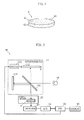
- Fig. 1 illustrates an exemplary pellet for use in spectrometry according to the present invention.
- the pellet 4 of this embodiment has a structure formed by mixing a silica (SiO 2 ) powder 42 and a sample 40 in the form of powder into a polyethylene powder 41 as a main material and compression-molding the mixture into a flat disc shape having a thickness of about 1 to 2 mm.
- the polyethylene powder 41 is an example of the first powder defined by the present invention.
- the polyethylene powder 41 is hydrophobic and serves as a diluent for the sample 40. It is preferable that the polyethylene powder 41 has a minute particle size. This is because, as the particle size becomes smaller, scattering of terahertz waves, which is a cause of an error, decreases, thus leading to more precise measurement of terahertz wave absorptivity.
- the average particle size of the powder polyethylene 41 is not more than 35 ⁇ m, for example.
- the silica powder 42 is an example of the second powder defined by the present invention.
- the silica powder 42 is hydrophilic and water-insoluble.
- the silica powder 42 has a function to dehydrate the sample 40. It is preferable that the silica powder 42 has a small particle size, similarly to the polyethylene powder 41. More preferably, the average particle size of the silica powder 42 is smaller than that of the polyethylene powder 41.
- silica powder having a smaller particle size has a larger total surface area and hence exhibits a higher dehydration effect on the sample 40 than silica powder having a larger particle size. This also means that the amount of the silica powder 42 to be mixed in the pellet 4 can be reduced. When the mixing amount of the silica powder 42 is reduced, the absorption of terahertz waves by the silica powder 42 is also reduced, so that the light transmittance of the entire pellet 4 can be enhanced.
- various kinds of materials can be used as the sample 40.
- the sample 40 is pulverized into powder by using e.g. an agate mortar.
- the pellet 4 can be prepared by mixing the above-described polyethylene powder 41, silica powder 42 and powdered sample 40 together and compressing the mixture by using a tablet molding machine.
- the mixing ratio by weight of the polyethylene powder 41 to the silica powder 42 is in the range of about 80:20 to 60:40, for example.
- the mixing ratio by weight of the total of the powders 41 and 42 to the sample 40 is about 100:3.
- the present invention is not limited to these mixing ratios.
- the spectrometry using the pellet 4 can be performed using a conventionally known spectrometer.
- a spectrometer SP illustrated in Fig. 2 may be used.
- the spectrometer SP is a Fourier transform spectrometer, which is capable of performing spectrometry in a terahertz wave band.
- the spectrometer SP includes a light source 10, an interferometer 11, a sample chamber 12, a detector 13, an A/D converter 14, a computer 15 and a display 16.
- the light source 10 emits light including a wave number band from e.g. 3 cm -1 to 630 cm -1 .
- the interferometer 11 which is e.g. a Michelson interferometer, splits light traveling from the light source 10 into transmitted light and reflected light by means of a beam splitter 110.
- the transmitted light reciprocates between the beam splitter 110 and a fixed mirror 111 and then travels toward the sample chamber 12.
- the reflected light reciprocates between the beam splitter 110 and a movable mirror 112 and then travels toward the sample chamber 12.
- a driver 113 moves the movable mirror 112 along the optical axis of the reflected light.
- the transmitted light and the reflected light have an optical path difference and form coherent light when combined together.
- the above-described pellet 4 is set in the sample chamber 12.
- the detector 13 detects the coherent light having been applied from the interferometer 11 to the sample chamber 12 and passed through the pellet 4.
- the detection signal is A/D-converted by the A/D converter 14 and then input to the computer 15.
- the computer 15 is capable of performing Fourier transformation regarding the input signal to obtain transmission spectrum data and causing the display 16 to display the waveform.
- the computer 15 has stored therein spectrum data on various substances as a library and is capable of carrying out a process for e.g. identifying the sample by checking the spectrum data on the sample 40 (data excluding the spectra of the polyethylene powder 41 and the silica powder 42 as the background) against the data in the library.
- the silica powder 42 is hydrophilic and includes a hydrophilic group at the surface of each particle. Accordingly, in the case where the sample 40 is a hydrate having a water molecule bond structure, the water molecules are released from the water molecule bond structure and bonded to the hydrophilic groups of the silica powder 42. As a result, the sample 40 is dehydrated to become an anhydride. Thus, spectrum data on the sample 40 dehydrated in a relatively short period of time is obtained.
- the sample 40 When the sample 40 remains a hydrate, the spectrum is influenced by water molecules, and the influence is significant particularly in the terahertz wave band. It is often difficult to identify the sample 40 based on the spectrum significantly influenced by water molecules. According to the present embodiment, by contrast, the sample 40 is dehydrated early so that stable spectrum data inherent to the sample 40 as an anhydride is obtained early, which ensures easy and quick identification of the sample 40.
- identification processing or the like can be performed directly from the spectrum of the sample 40 in a conventional manner. Since the silica powder 42 transmits terahertz waves relatively easily, the presence of the silica powder 42 does not make the spectrometry difficult in the terahertz wave band.
- the pellet 4 can be used also for checking the history of the sample 40, as described below.
- moisture is supplied into the pellet 4. Specifically, the supply of moisture is achieved by dropping water onto or feeding water vapor into the pellet 4. After moisture has been supplied, change in the spectrum of the sample 40 with time is observed.
- the spectrum of the sample 40 does not change largely in its basic waveform, although the absorbance changes in a wide wave number band with the lapse of time.
- the sample 40 when the sample 40 is originally a hydrate, the sample 40 changes to a hydrated state with the lapse of time, and the spectrum of the sample 40 shows a waveform characteristic of a hydrate which is not observed in the case of an anhydride.
- it can be determined whether or not the sample 40 is originally a hydrate. Such determination is useful for identifying the sample 40 more precisely.
- Figs. 3 to 11 illustrate experimental examples using pellets for use in spectrometry according to the present invention and pellets for comparison. The details of the experimental examples are described below.
- Fig. 3 illustrates experimental data obtained by using a conventional pellet.
- a pellet used in this experiment was prepared by mixing a polyethylene powder having an average particle size of 7 to 9 ⁇ m with a glucose powder as a sample and then compression-molding the mixture.
- the pellet does not contain silica powder.
- the concentration of glucose is 5 %.
- Spectra S1, S2 and S3 are absorption spectra of a glucose anhydride. (These spectra exclude background absorption spectra. This holds true for other experimental data given below.)
- the spectra S1, S2 and S3 are the data obtained a day after the preparation of the pellet, the data obtained seven days after the preparation of the pellet, and the data obtained fifteen days after the preparation of the pellet, respectively.
- spectra S4, S5 and S6 are absorption spectra of a glucose monohydrate.
- the spectra S4, S5 and S6 are the data obtained a day after the preparation of the pellet, the data obtained seven days after the preparation of the pellet, and the data obtained fifteen days after the preparation of the pellet, respectively.
- the pellet was stored by using a desiccator to minimize the influence of moisture in the air or the like on the pellet.
- the spectra S1 to S3 have an absorption peak characteristic of a glucose anhydride in a band around a wave number of 48 cm -1 , as indicated by reference sign n1. However, substantially no change with time is observed in this part of the spectra.
- the spectrum S4 has two absorption peaks characteristic of a glucose monohydrate in a wave number band from 58 to 65 cm -1 , as indicated by reference signs n2 and n3. Such absorption peaks are observed also in the spectra S2 and S3, which are the spectrum obtained seven days after the preparation of the pellet and the spectrum obtained fifteen days after the preparation of the pellet, respectively. As will be understood from these, the glucose monohydrate is not sufficiently dehydrated in this experiment.
- Fig. 4 illustrates absorption spectra of glucose obtained by using a pellet blended with a silica powder.
- the pellet used in this experiment was prepared by mixing a polyethylene powder having an average particle size of 7 to 9 ⁇ m, a silica powder having an average particle size of 7 nm and a glucose monohydrate powder together and then compression-molding the mixture.
- the mixing ratio by weight of polyethylene to silica is 80:20, and the concentration of glucose in the entirety of the pellet is 5 %.
- Spectrum S10 is the absorption spectrum of the glucose monohydrate obtained a day after the preparation of the pellet. As indicated by reference signs n2' and n3', the spectrum still has absorption peaks characteristic of a glucose monohydrate.
- Spectra S11 and S12 are the absorption spectra of the glucose obtained seven days after the preparation of the pellet and fifteen days after the preparation of the pellet, respectively.
- Figs. 5 and 6 each illustrate data obtained through an experiment in which a pellet mixed with a glucose powder was supplied therein with water and then dried naturally.
- the pellet used in Experimental Example 2 illustrated in Fig. 5 was the same as that used in Experimental Example 1.
- the glucose mixed in the pellet had originally been a hydrate. However, the glucose was already dehydrated or the dehydration of the glucose was promoted before the start of the experiment.
- the water supply to the pellet was achieved by dropping an appropriate amount of water onto the pellet.
- spectrum S20 is the absorption spectrum of the glucose obtained before the water supply to the pellet
- spectrum S21 is the absorption spectrum obtained one and a half hour after the water supply.
- the spectrum S21 has characteristic waveform portions indicated by reference signs n4 and n5, which are not observed when the glucose is an anhydride.
- Experimental Example 3 illustrated in Fig. 6 used a pellet mixed therein with a glucose anhydride which did not have a history of change from a hydrate to an anhydride.
- the pellet contains a silica powder in addition to a polyethylene powder.
- the mixing ratio among polyethylene, silica and glucose anhydride is substantially equal to that in Experimental Example 2.
- spectrum S20' in Fig. 6 is the absorption spectrum of the glucose obtained before the water supply to the pellet.
- Spectrum S22 is the absorption spectrum obtained one and a half hour after the water supply. The spectrum S22 on the whole shows a higher absorbance than that of the spectrum S21, but does not have characteristic waveforms like those indicated by the reference signs n4 and n5 in Fig. 5 .
- Fig. 7 illustrates data on spectrometry using silica powders of different particle sizes.
- a pellet mixed therein with a glucose monohydrate (average particle size of silica: 7 nm), and spectrometry was performed three days later, whereby absorption spectrum S30 of the glucose was obtained.
- a similar pellet was prepared with silica having an average particle size of 124 nm (this pellet was the same as the above-described pellet except the particle size of silica), and spectrometry was performed three days later, whereby absorption spectrum S31 was obtained.
- the spectrum S30 shows a lower absorbance at the portions indicated by reference signs n2" and n3", which are the portions characteristic of a glucose hydrate, and a slightly higher absorbance peak at the portion indicated by reference sign n1", which is characteristic of a glucose anhydride.
- n2 the portions characteristic of a glucose hydrate
- n1 the portion indicated by reference sign n1
- a silica powder having a smaller particle size accelerates dehydration of glucose further.
- the inventors of the present invention further performed an experiment using silica powders of various particle sizes other than those noted above.
- silica powders of various particle sizes were similar in shape to each other, e.g. a spherical shape, a silica powder having a smaller particle size tended to be more suitable for accelerating dehydration of a sample.
- the silica powder does not need to be spherical. This holds true for the first powder.
- a powder comprising non-spherical particles such as those which have irregular surfaces or which are entirely flat, has a larger surface area than a powder comprising spherical particles when the particle sizes of these powders are substantially the same.
- the use of a powder comprising non-spherical particles as the second powder is more suitable for accelerating dehydration of a sample while reducing the amount of the second powder.
- Figs. 8 to 11 each illustrate data obtained by using a water-insoluble hydrophilic material other than silica as the second powder defined by the present invention.
- Figs. 8 , 9 , 10 and 11 illustrate spectral waveforms obtained by using different kinds of pellets containing an alumina powder (average particle size: 12 nm), a titanium dioxide powder (average particle size: 21 nm), a calcium carbonate powder (average particle size: 80 nm) and a talc powder (average particle size: 2.5 ⁇ m), respectively, which were mixed with a polyethylene powder and a glucose monohydrate powder.
- the solid line depicts the absorption spectrum of glucose measured a day after the preparation of the pellet
- the broken line depicts the absorption spectrum of glucose measured seven days after the preparation of the pellet
- the dash-dotted line depicts the absorption spectrum of glucose measured fifteen days after the preparation of the pellet.
- the spectrum of the sample obtained a day after the preparation of the pellet has waveforms characteristic of a glucose monohydrate, as indicated by reference signs n4 and n5.
- waveforms characteristic of a glucose monohydrate as indicated by reference signs n4 and n5.
- the second powder it is preferable to select a material which has a high transmittance with respect to light used in the spectrometry and does not considerably impair the light transmitting property of the pellet.
- alumina, titanium dioxide, calcium carbonate and talc which have relatively high transmittances with respect to terahertz waves, are preferable materials.
- the second powder defined by the present invention is not limited to a single kind of material, but two kinds of powder, e.g. silica powder and alumina powder, may be mixed in a pellet. This holds true for the first powder.
- Fig. 12 illustrates another exemplary pellet for use in spectrometry according to the present invention.
- the pellet 4A illustrated in Fig. 12 includes an upper half portion 44U and a lower half portion 44L which are superposed on each other, and a sample 40 in the form of thin film (in a film form) sandwiched and confined between the upper and the lower half portions.
- the upper half portion 44U and the lower half portion 44L are each prepared by compression-molding a mixture of a polyethylene powder 41 and a silica powder 42, for example.
- the pellet 4A of this embodiment is formed as a so-called window plate for sandwiching and supporting the sample 40. Since the sample 40 is formed into a thin film, transmission of a certain amount of light in the spectrometry process is secured. In the pellet 4A again, the silica powder 42 can be placed adjacent to the sample 40. By so doing, the pellet 4A is expected to have the effect of accelerating dehydration of the sample 40 when the sample is a hydrate.
- Fig. 13 illustrates data on an experiment (Experimental Example 9) in which a solution containing a sample is dropped onto a pellet before spectrometry.
- the pellet used in this experiment had the same structure as that used in Experimental Example 1 except that the pellet used in this experiment did not contain a solid sample.
- a solution (3% concentration) of red pigment No. 105 (sodium salt) legally prescribed in Japan in ethanol was dropped onto the pellet, and spectrometry was performed during a process in which the pellet was allowed to dry naturally.
- the data of Fig. 13 includes a relatively large amount of noise in a wave number band around 0 cm -1 and a wave number band around 350 cm -1 .
- Spectrum S40 in Fig. 13 is the absorption spectrum inherent to the above-described pigment.
- Spectra S41, 42 and 43 are the absorption spectra obtained one and a half hour after the dropping of the ethanol solution, two and a half hours after the dropping of the ethanol solution and seventeen and a half hours after the dropping of the ethanol solution, respectively.
- the spectra S42 and S43 which are the spectra obtained in the stage where natural drying of the pellets has proceeded to a considerable extent, show waveforms corresponding to the absorption peak of the spectrum S40 indicated by reference sign n10 at portions indicated by reference signs n11 and n12.
- the pellet for use in spectrometry according to the present invention can also be used in such a manner that a sample in the form of a solution is dropped onto the surface of the pellet.
- the solute can be retained on the pellet.
- the mode of retainment of the solution by the pellet there are two conceivable modes, i.e., the solution is retained by its penetration into the pellet or the solution is retained as received and remaining on the surface of the pellet without such penetration. The both modes are possible in the present invention.
- the first powder may comprise any other olefin resin such as polypropylene or a fluororesin such as tetrafluoroethylene, because they have preferable transmittances with respect to terahertz waves. Materials other than the foregoing materials may be employed as the first powder.
- the pellet for use in spectrometry according to the present invention may contain, in addition to the first powder and the second powder, a third powder comprising a material which is different from those of the first and the second powders.
- a third powder comprising a material which is different from those of the first and the second powders.
Landscapes
- Chemical & Material Sciences (AREA)
- Physics & Mathematics (AREA)
- Spectroscopy & Molecular Physics (AREA)
- Health & Medical Sciences (AREA)
- General Physics & Mathematics (AREA)
- Engineering & Computer Science (AREA)
- Biochemistry (AREA)
- General Health & Medical Sciences (AREA)
- Life Sciences & Earth Sciences (AREA)
- Immunology (AREA)
- Pathology (AREA)
- Analytical Chemistry (AREA)
- Mechanical Engineering (AREA)
- Chemical Kinetics & Catalysis (AREA)
- Medicinal Chemistry (AREA)
- Polymers & Plastics (AREA)
- Organic Chemistry (AREA)
- Investigating Or Analysing Materials By Optical Means (AREA)
- Sampling And Sample Adjustment (AREA)
Abstract
Description
- The present invention relates to a pellet for retaining a desired sample in spectrometry of the sample. The invention also relates to a method of preparing such a pellet, as well as a method of spectrometry using such a pellet.
- In the field of infrared spectroscopy, a KBr (potassium bromide) tablet method is frequently used, as disclosed in
Patent Documents - In recent years, spectrometry utilizing terahertz waves, which are the waves in a lower wave number band than the above-described band including a wave number of 250 cm-1, is gaining attention and being studied. It is considered that this terahertz spectrometry can detect absorption due to intermolecular interaction, hydrogen bond and Van der Waals forces and hence provide characteristic information which cannot be obtained by spectrometry in other wave number bands. However, the transmittances of potassium bromide and cesium iodide with respect to terahertz waves of such a low wave number band are low.
- Conventionally, therefore, pellets prepared by compression-molding polyethylene powder are actually used in the terahertz wave spectrometry. Since polyethylene pellets have higher transmittances with respect to terahertz waves than potassium bromide pellets or cesium iodide pellets, the use of polyethylene pellets is preferable for obtaining proper spectrum data.
- However, the use of such a polyethylene pellet has the following drawbacks.
- Taking glucose as an example, there are two forms of glucose, which are a hydrate, i.e., combined with water molecules, and an anhydride, i.e., not combined with water molecules. When a glucose hydrate is subjected to spectrometry as a sample, a spectrum influenced by water molecules is obtained which is different from a spectrum of an anhydride. Since terahertz waves are easily influenced by water molecules, the difference between the spectrum of a hydrate and that of an anhydride is noticeable in this wave number band.
- As will be understood from the above-described example of glucose, even from basically the same substance, different spectrum data is obtained depending on whether the substance is a hydrate or an anhydride. Further, even from samples both of which are hydrates, the spectrum data differs due to the difference in water content therebetween. For this reason, the process for identifying a sample based on the spectrum data is complicated and difficult. Therefore, such problems need to be solved.
- Patent Document 1:
JP-A-5-232 018 - Patent Document 2:
JP-A-11-166891 - An object of the present invention is to provide a pellet for use in spectrometry which is capable of solving or alleviating the above-described problems, a method of preparing such a pellet and a method of spectrometry.
- To solve the above-described problems, the present invention takes the following technical measures.
- According to a first aspect of the present invention, there is provided a pellet for use in spectrometry for retaining a sample to be subjected to spectrometry. The pellet includes a first powder of a light transmitting material in a compression-molded form. A second powder which is hydrophilic and water-insoluble is dispersedly mixed in the first powder.
- Preferably, the sample is a solid in a powdery form and dispersedly mixed in the first and the second powders.
- Preferably, the sample is a solid in a thin film form, and the first and the second powders surround the sample.
- Preferably, when the sample is a solution, the pellet is capable of retaining the solution by at least one of an action of the solution to penetrate into the first and the second powders and an action to receive the solution at a surface portion.
- Preferably, the first powder comprises at least one of a powder of an olefin resin like polyethylene or polypropylene and a powder of a fluororesin like fluorinated ethylene.
- Preferably, the second powder comprises at least one of powders of silica, alumina, titanium dioxide, calcium carbonate and talc.
- Preferably, the second powder is smaller than the first powder in average particle size.
- According to a second aspect of the present invention, there is provided a method of spectrometry. The method includes the steps of irradiating a pellet for use in spectrometry, which retains a sample, with light, and detecting the light having passed through the pellet to obtain transmission spectrum data or absorption spectrum data on the sample in a predetermined wave number band. The pellet includes a first powder of a light transmitting material in a compression-molded form, and a second powder which is hydrophilic and water-insoluble is dispersedly mixed in the first powder.
- Preferably, the method of spectrometry further includes the step of supplying moisture into the pellet and then obtaining transmission spectrum data or absorption spectrum data on the sample when the sample is determined to be an anhydride.
- According to a third aspect of the present invention, there is provided a method of preparing a pellet for use in spectrometry. The method includes the steps of mixing a first powder of a light transmitting material with a second powder which is hydrophilic and water-insoluble, and compression-molding the mixture of the first powder and the second powder.
- Other features and advantages of the present invention will become more apparent from the detailed description of embodiments given below with reference to the accompanying drawings.
-
- Fig. 1
- is a perspective view illustrating an exemplary pellet for use in spectrometry according to the present invention.
- Fig. 2
- is a view schematically illustrating an exemplary analysis apparatus used in a method of spectrometry according to the present invention.
- Fig. 3
- is a chart illustrating experimental data on a comparative example for comparison with the present invention.
- Fig. 4
- is a chart illustrating data on Experimental Example 1.
- Fig. 5
- is a chart illustrating data on Experimental Example 2.
- Fig. 6
- is a chart illustrating data on Experimental Example 3.
- Fig. 7
- is a chart illustrating data on Experimental Example 4.
- Fig. 8
- is a chart illustrating data on Experimental Example 5.
- Fig. 9
- is a chart illustrating data on Experimental Example 6.
- Fig. 10
- is a chart illustrating data on Experimental Example 7.
- Fig. 11
- is a chart illustrating data on Experimental Example 8.
- Fig. 12
- is a sectional view illustrating another exemplary pellet for use in spectrometry according to the present invention.
- Fig. 13
- is a chart illustrating data on Experimental Example 9.
- Preferred embodiments of the present invention are described below with reference to the accompanying drawings.
-
Fig. 1 illustrates an exemplary pellet for use in spectrometry according to the present invention. Thepellet 4 of this embodiment has a structure formed by mixing a silica (SiO2)powder 42 and asample 40 in the form of powder into apolyethylene powder 41 as a main material and compression-molding the mixture into a flat disc shape having a thickness of about 1 to 2 mm. - The
polyethylene powder 41 is an example of the first powder defined by the present invention. Thepolyethylene powder 41 is hydrophobic and serves as a diluent for thesample 40. It is preferable that thepolyethylene powder 41 has a minute particle size. This is because, as the particle size becomes smaller, scattering of terahertz waves, which is a cause of an error, decreases, thus leading to more precise measurement of terahertz wave absorptivity. The average particle size of thepowder polyethylene 41 is not more than 35 µm, for example. - The
silica powder 42 is an example of the second powder defined by the present invention. Thesilica powder 42 is hydrophilic and water-insoluble. Thesilica powder 42 has a function to dehydrate thesample 40. It is preferable that thesilica powder 42 has a small particle size, similarly to thepolyethylene powder 41. More preferably, the average particle size of thesilica powder 42 is smaller than that of thepolyethylene powder 41. - When a fixed amount of the
silica powder 42 is mixed in thepolyethylene powder 41, silica powder having a smaller particle size has a larger total surface area and hence exhibits a higher dehydration effect on thesample 40 than silica powder having a larger particle size. This also means that the amount of thesilica powder 42 to be mixed in thepellet 4 can be reduced. When the mixing amount of thesilica powder 42 is reduced, the absorption of terahertz waves by thesilica powder 42 is also reduced, so that the light transmittance of theentire pellet 4 can be enhanced. As thesample 40, various kinds of materials can be used. Thesample 40 is pulverized into powder by using e.g. an agate mortar. - The
pellet 4 can be prepared by mixing the above-describedpolyethylene powder 41,silica powder 42 andpowdered sample 40 together and compressing the mixture by using a tablet molding machine. The mixing ratio by weight of thepolyethylene powder 41 to thesilica powder 42 is in the range of about 80:20 to 60:40, for example. The mixing ratio by weight of the total of thepowders sample 40 is about 100:3. However, the present invention is not limited to these mixing ratios. - The spectrometry using the
pellet 4 can be performed using a conventionally known spectrometer. For instance, a spectrometer SP illustrated inFig. 2 may be used. The spectrometer SP is a Fourier transform spectrometer, which is capable of performing spectrometry in a terahertz wave band. The spectrometer SP includes alight source 10, aninterferometer 11, asample chamber 12, adetector 13, an A/D converter 14, acomputer 15 and adisplay 16. - The
light source 10 emits light including a wave number band from e.g. 3 cm-1 to 630 cm-1. Theinterferometer 11, which is e.g. a Michelson interferometer, splits light traveling from thelight source 10 into transmitted light and reflected light by means of abeam splitter 110. The transmitted light reciprocates between thebeam splitter 110 and a fixedmirror 111 and then travels toward thesample chamber 12. On the other hand, the reflected light reciprocates between thebeam splitter 110 and amovable mirror 112 and then travels toward thesample chamber 12. Adriver 113 moves themovable mirror 112 along the optical axis of the reflected light. - Thus, the transmitted light and the reflected light have an optical path difference and form coherent light when combined together. The above-described
pellet 4 is set in thesample chamber 12. Thedetector 13 detects the coherent light having been applied from theinterferometer 11 to thesample chamber 12 and passed through thepellet 4. The detection signal is A/D-converted by the A/D converter 14 and then input to thecomputer 15. - The
computer 15 is capable of performing Fourier transformation regarding the input signal to obtain transmission spectrum data and causing thedisplay 16 to display the waveform. Thecomputer 15 has stored therein spectrum data on various substances as a library and is capable of carrying out a process for e.g. identifying the sample by checking the spectrum data on the sample 40 (data excluding the spectra of thepolyethylene powder 41 and thesilica powder 42 as the background) against the data in the library. - The advantages of the
pellet 4 are described below. - The
silica powder 42 is hydrophilic and includes a hydrophilic group at the surface of each particle. Accordingly, in the case where thesample 40 is a hydrate having a water molecule bond structure, the water molecules are released from the water molecule bond structure and bonded to the hydrophilic groups of thesilica powder 42. As a result, thesample 40 is dehydrated to become an anhydride. Thus, spectrum data on thesample 40 dehydrated in a relatively short period of time is obtained. - When the
sample 40 remains a hydrate, the spectrum is influenced by water molecules, and the influence is significant particularly in the terahertz wave band. It is often difficult to identify thesample 40 based on the spectrum significantly influenced by water molecules. According to the present embodiment, by contrast, thesample 40 is dehydrated early so that stable spectrum data inherent to thesample 40 as an anhydride is obtained early, which ensures easy and quick identification of thesample 40. - In the case where the
sample 40 is an anhydride from the first, identification processing or the like can be performed directly from the spectrum of thesample 40 in a conventional manner. Since thesilica powder 42 transmits terahertz waves relatively easily, the presence of thesilica powder 42 does not make the spectrometry difficult in the terahertz wave band. - The
pellet 4 can be used also for checking the history of thesample 40, as described below. When the inside of thepellet 4 is dry and thesample 40 is determined to be an anhydride, moisture is supplied into thepellet 4. Specifically, the supply of moisture is achieved by dropping water onto or feeding water vapor into thepellet 4. After moisture has been supplied, change in the spectrum of thesample 40 with time is observed. - When the
sample 40 is an anhydride from the first, the spectrum of thesample 40 does not change largely in its basic waveform, although the absorbance changes in a wide wave number band with the lapse of time. By contrast, when thesample 40 is originally a hydrate, thesample 40 changes to a hydrated state with the lapse of time, and the spectrum of thesample 40 shows a waveform characteristic of a hydrate which is not observed in the case of an anhydride. Thus, based on the difference in waveform between the spectra, it can be determined whether or not thesample 40 is originally a hydrate. Such determination is useful for identifying thesample 40 more precisely. -
Figs. 3 to 11 illustrate experimental examples using pellets for use in spectrometry according to the present invention and pellets for comparison. The details of the experimental examples are described below. -
Fig. 3 illustrates experimental data obtained by using a conventional pellet. Specifically, a pellet used in this experiment was prepared by mixing a polyethylene powder having an average particle size of 7 to 9 µm with a glucose powder as a sample and then compression-molding the mixture. The pellet does not contain silica powder. The concentration of glucose is 5 %. Spectra S1, S2 and S3 are absorption spectra of a glucose anhydride. (These spectra exclude background absorption spectra. This holds true for other experimental data given below.) - Specifically, the spectra S1, S2 and S3 are the data obtained a day after the preparation of the pellet, the data obtained seven days after the preparation of the pellet, and the data obtained fifteen days after the preparation of the pellet, respectively. On the other hand, spectra S4, S5 and S6 are absorption spectra of a glucose monohydrate. Similarly to the above, the spectra S4, S5 and S6 are the data obtained a day after the preparation of the pellet, the data obtained seven days after the preparation of the pellet, and the data obtained fifteen days after the preparation of the pellet, respectively. During these periods of time, the pellet was stored by using a desiccator to minimize the influence of moisture in the air or the like on the pellet.
- The spectra S1 to S3 have an absorption peak characteristic of a glucose anhydride in a band around a wave number of 48 cm-1, as indicated by reference sign n1. However, substantially no change with time is observed in this part of the spectra. By contrast, the spectrum S4 has two absorption peaks characteristic of a glucose monohydrate in a wave number band from 58 to 65 cm-1, as indicated by reference signs n2 and n3. Such absorption peaks are observed also in the spectra S2 and S3, which are the spectrum obtained seven days after the preparation of the pellet and the spectrum obtained fifteen days after the preparation of the pellet, respectively. As will be understood from these, the glucose monohydrate is not sufficiently dehydrated in this experiment.
-
Fig. 4 illustrates absorption spectra of glucose obtained by using a pellet blended with a silica powder. Specifically, the pellet used in this experiment was prepared by mixing a polyethylene powder having an average particle size of 7 to 9 µm, a silica powder having an average particle size of 7 nm and a glucose monohydrate powder together and then compression-molding the mixture. The mixing ratio by weight of polyethylene to silica is 80:20, and the concentration of glucose in the entirety of the pellet is 5 %. - Spectrum S10 is the absorption spectrum of the glucose monohydrate obtained a day after the preparation of the pellet. As indicated by reference signs n2' and n3', the spectrum still has absorption peaks characteristic of a glucose monohydrate. Spectra S11 and S12 are the absorption spectra of the glucose obtained seven days after the preparation of the pellet and fifteen days after the preparation of the pellet, respectively.
- The absorption peaks characteristic of a glucose monohydrate, indicated by the reference sign n2' and n3', are not observed in the spectra S11 and S12. Further, the spectra S11 and S12 each have an absorption peak characteristic of a glucose anhydride, as indicated by reference sign n1', Therefore, this experiment proves that the glucose monohydrate was dehydrated almost sufficiently after the lapse of about seven to fifteen days. The experimental data thus obtained also proves that the pellet according to the present invention can exert the effect of actively dehydrating a hydrate.
-
Figs. 5 and 6 each illustrate data obtained through an experiment in which a pellet mixed with a glucose powder was supplied therein with water and then dried naturally. Specifically, the pellet used in Experimental Example 2 illustrated inFig. 5 was the same as that used in Experimental Example 1. The glucose mixed in the pellet had originally been a hydrate. However, the glucose was already dehydrated or the dehydration of the glucose was promoted before the start of the experiment. The water supply to the pellet was achieved by dropping an appropriate amount of water onto the pellet. - In
Fig. 5 , spectrum S20 is the absorption spectrum of the glucose obtained before the water supply to the pellet, whereas spectrum S21 is the absorption spectrum obtained one and a half hour after the water supply. The spectrum S21 has characteristic waveform portions indicated by reference signs n4 and n5, which are not observed when the glucose is an anhydride. - Unlike Experimental Example 2, Experimental Example 3 illustrated in
Fig. 6 used a pellet mixed therein with a glucose anhydride which did not have a history of change from a hydrate to an anhydride. The pellet contains a silica powder in addition to a polyethylene powder. The mixing ratio among polyethylene, silica and glucose anhydride is substantially equal to that in Experimental Example 2. - Similarly to the
spectrum 20 inFig. 5 , spectrum S20' inFig. 6 is the absorption spectrum of the glucose obtained before the water supply to the pellet. Spectrum S22 is the absorption spectrum obtained one and a half hour after the water supply. The spectrum S22 on the whole shows a higher absorbance than that of the spectrum S21, but does not have characteristic waveforms like those indicated by the reference signs n4 and n5 inFig. 5 . - It will be understood from Experimental Examples 2 and 3 that, when water is supplied to pellets according to the present invention and their spectra are checked thereafter, different spectra are obtained from a sample which was once a hydrate and a sample which has never been a hydrate. Thus, whether the sample is originally a hydrate or not can be determined based on the difference in spectrum, which makes it possible to identify a sample more precisely.
-
Fig. 7 illustrates data on spectrometry using silica powders of different particle sizes. Specifically, similarly to the pellet used in Experimental Example 1, a pellet mixed therein with a glucose monohydrate (average particle size of silica: 7 nm), and spectrometry was performed three days later, whereby absorption spectrum S30 of the glucose was obtained. On the other hand, a similar pellet was prepared with silica having an average particle size of 124 nm (this pellet was the same as the above-described pellet except the particle size of silica), and spectrometry was performed three days later, whereby absorption spectrum S31 was obtained. - As compared with the spectrum S31, the spectrum S30 shows a lower absorbance at the portions indicated by reference signs n2" and n3", which are the portions characteristic of a glucose hydrate, and a slightly higher absorbance peak at the portion indicated by reference sign n1", which is characteristic of a glucose anhydride. As will be understood from this experiment, basically, a silica powder having a smaller particle size accelerates dehydration of glucose further.
- Though not particularly shown as data, the inventors of the present invention further performed an experiment using silica powders of various particle sizes other than those noted above. As a result, it was found that, when silica powders of different particle sizes were similar in shape to each other, e.g. a spherical shape, a silica powder having a smaller particle size tended to be more suitable for accelerating dehydration of a sample. In the present invention, however, the silica powder (the second powder) does not need to be spherical. This holds true for the first powder.
- A powder comprising non-spherical particles, such as those which have irregular surfaces or which are entirely flat, has a larger surface area than a powder comprising spherical particles when the particle sizes of these powders are substantially the same. Thus, the use of a powder comprising non-spherical particles as the second powder is more suitable for accelerating dehydration of a sample while reducing the amount of the second powder.
-
Figs. 8 to 11 each illustrate data obtained by using a water-insoluble hydrophilic material other than silica as the second powder defined by the present invention. Specifically,Figs. 8 ,9 ,10 and11 illustrate spectral waveforms obtained by using different kinds of pellets containing an alumina powder (average particle size: 12 nm), a titanium dioxide powder (average particle size: 21 nm), a calcium carbonate powder (average particle size: 80 nm) and a talc powder (average particle size: 2.5 µm), respectively, which were mixed with a polyethylene powder and a glucose monohydrate powder. - In each of these figures, the solid line depicts the absorption spectrum of glucose measured a day after the preparation of the pellet, the broken line depicts the absorption spectrum of glucose measured seven days after the preparation of the pellet, and the dash-dotted line depicts the absorption spectrum of glucose measured fifteen days after the preparation of the pellet. The pellets used in these experiments had the same structure as that of the pellet used in Experimental Example 1 except the material of the second powder.
- In
Fig. 8 , the spectrum of the sample obtained a day after the preparation of the pellet has waveforms characteristic of a glucose monohydrate, as indicated by reference signs n4 and n5. In the spectra obtained seven days after and fifteen days after the preparation of the pellets, such waveforms are not observed, but instead, a waveform characteristic of a glucose anhydride is observed, as indicated by reference sign n6. - As can be seen from this experiment, dehydration of glucose proceeds even when alumina is used instead of silica. The phenomenon similar to that obtained by the use of alumina is also observed in the data illustrated in
Figs. 9 to 11 . This indicates that the effect of dehydrating glucose is obtained even when titanium dioxide, calcium carbonate or talc is used. - According to the data on the Experiments 5 to 8, it is found that materials other than the above can be used widely as the second powder of the present invention as long as the materials are hydrophilic and water-insoluble. Thus, as the second powder, various materials other than the above can be employed widely. In the present invention, even a material which is not originally hydrophilic can be used as the second powder in the case where the material has been subjected to hydrophilicity-imparting treatment to have a hydrophilic surface.
- However, as the second powder, it is preferable to select a material which has a high transmittance with respect to light used in the spectrometry and does not considerably impair the light transmitting property of the pellet. From this point of view, in addition to silica described above, alumina, titanium dioxide, calcium carbonate and talc, which have relatively high transmittances with respect to terahertz waves, are preferable materials. The second powder defined by the present invention is not limited to a single kind of material, but two kinds of powder, e.g. silica powder and alumina powder, may be mixed in a pellet. This holds true for the first powder.
-
Fig. 12 illustrates another exemplary pellet for use in spectrometry according to the present invention. - The
pellet 4A illustrated inFig. 12 includes anupper half portion 44U and alower half portion 44L which are superposed on each other, and asample 40 in the form of thin film (in a film form) sandwiched and confined between the upper and the lower half portions. Theupper half portion 44U and thelower half portion 44L are each prepared by compression-molding a mixture of apolyethylene powder 41 and asilica powder 42, for example. - The
pellet 4A of this embodiment is formed as a so-called window plate for sandwiching and supporting thesample 40. Since thesample 40 is formed into a thin film, transmission of a certain amount of light in the spectrometry process is secured. In thepellet 4A again, thesilica powder 42 can be placed adjacent to thesample 40. By so doing, thepellet 4A is expected to have the effect of accelerating dehydration of thesample 40 when the sample is a hydrate. -
Fig. 13 illustrates data on an experiment (Experimental Example 9) in which a solution containing a sample is dropped onto a pellet before spectrometry. The pellet used in this experiment had the same structure as that used in Experimental Example 1 except that the pellet used in this experiment did not contain a solid sample. A solution (3% concentration) of red pigment No. 105 (sodium salt) legally prescribed in Japan in ethanol was dropped onto the pellet, and spectrometry was performed during a process in which the pellet was allowed to dry naturally. The data ofFig. 13 includes a relatively large amount of noise in a wave number band around 0 cm-1 and a wave number band around 350 cm-1. - Spectrum S40 in
Fig. 13 is the absorption spectrum inherent to the above-described pigment. Spectra S41, 42 and 43 are the absorption spectra obtained one and a half hour after the dropping of the ethanol solution, two and a half hours after the dropping of the ethanol solution and seventeen and a half hours after the dropping of the ethanol solution, respectively. The spectra S42 and S43, which are the spectra obtained in the stage where natural drying of the pellets has proceeded to a considerable extent, show waveforms corresponding to the absorption peak of the spectrum S40 indicated by reference sign n10 at portions indicated by reference signs n11 and n12. - As will be understood from the data on this experiment, the pellet for use in spectrometry according to the present invention can also be used in such a manner that a sample in the form of a solution is dropped onto the surface of the pellet. By allowing the solvent to evaporate off after the dropping of the solution, the solute can be retained on the pellet. As the mode of retainment of the solution by the pellet, there are two conceivable modes, i.e., the solution is retained by its penetration into the pellet or the solution is retained as received and remaining on the surface of the pellet without such penetration. The both modes are possible in the present invention.
- The present invention is not limited to the foregoing embodiments.
- Although polyethylene, which has a high transmittance with respect to terahertz waves, is preferable as the first powder defined by the present invention, the present invention is not limited to polyethylene. The first powder may comprise any other olefin resin such as polypropylene or a fluororesin such as tetrafluoroethylene, because they have preferable transmittances with respect to terahertz waves. Materials other than the foregoing materials may be employed as the first powder.
- The pellet for use in spectrometry according to the present invention may contain, in addition to the first powder and the second powder, a third powder comprising a material which is different from those of the first and the second powders. There is no limitation on the mixing ratio of the first and the second powders.
Claims (10)
- A pellet for use in spectrometry for retaining a sample to be subjected to spectrometry, comprising:a first powder of a light transmitting material in a compression-molded form,wherein a second powder which is hydrophilic and water-insoluble is dispersedly mixed in the first powder.
- The pellet for use in spectrometry according to claim 1,
wherein the sample is a solid in a powdery form and dispersedly mixed in the first and the second powders. - The pellet for use in spectrometry according to claim 1,
wherein the sample is a solid in a thin film form, and the first and the second powders surround the sample. - The pellet for use in spectrometry according to claim 1,
wherein, when the sample is a solution, the pellet is capable of retaining the solution by at least one of an action of the solution to penetrate into the first and the second powders and an action to receive the solution at a surface portion. - The pellet for use in spectrometry according to any one of claims 1 to 4,
wherein the first powder comprises at least one of a powder of an olefin resin like polyethylene or polypropylene and a powder of a fluororesin like fluorinated ethylene. - The pellet for use in spectrometry according to any one of claims 1 to 5,
wherein the second powder comprises at least one of powders of silica, alumina, titanium dioxide, calcium carbonate and talc. - The pellet for use in spectrometry according to any one of claims 1 to 6,
wherein the second powder is smaller than the first powder in average particle size. - A method of spectrometry comprising the steps of:- irradiating a pellet for use in spectrometry, which retains a sample, with light; and- detecting the light having passed through the pellet to obtain transmission spectrum data or absorption spectrum data on the sample in a predetermined wave number band;- wherein the pellet comprises a first powder of a light transmitting material in a compression-molded form, a second powder which is hydrophilic and water-insoluble being dispersedly mixed in the first powder.
- The method of spectrometry according to claim 8,
further comprising the step of supplying moisture into the pellet and then obtaining transmission spectrum data or absorption spectrum data on the sample when the sample is determined to be an anhydride. - A method of preparing a pellet for use in spectrometry,
the method comprising the steps of:- mixing a first powder of a light transmitting material with a second powder which is hydrophilic and water-insoluble; and- compression-molding the mixture of the first powder and the second powder.
Applications Claiming Priority (2)
| Application Number | Priority Date | Filing Date | Title |
|---|---|---|---|
| JP2007246670 | 2007-09-25 | ||
| PCT/JP2008/067303 WO2009041504A1 (en) | 2007-09-25 | 2008-09-25 | Pellet for spectrometry, process for producing the same, and spectroscopic method |
Publications (3)
| Publication Number | Publication Date |
|---|---|
| EP2199778A1 true EP2199778A1 (en) | 2010-06-23 |
| EP2199778A4 EP2199778A4 (en) | 2012-09-19 |
| EP2199778B1 EP2199778B1 (en) | 2016-02-10 |
Family
ID=40511387
Family Applications (1)
| Application Number | Title | Priority Date | Filing Date |
|---|---|---|---|
| EP08834336.3A Active EP2199778B1 (en) | 2007-09-25 | 2008-09-25 | Pellet for spectrometry, process for producing the same, and method of spectrometry using the same |
Country Status (5)
| Country | Link |
|---|---|
| US (1) | US8030618B2 (en) |
| EP (1) | EP2199778B1 (en) |
| JP (1) | JP5422089B2 (en) |
| CN (1) | CN101802593B (en) |
| WO (1) | WO2009041504A1 (en) |
Cited By (1)
| Publication number | Priority date | Publication date | Assignee | Title |
|---|---|---|---|---|
| CN103492851A (en) * | 2011-04-22 | 2014-01-01 | Fei公司 | Automated sample preparation |
Families Citing this family (9)
| Publication number | Priority date | Publication date | Assignee | Title |
|---|---|---|---|---|
| FR2968763B1 (en) * | 2010-12-08 | 2014-06-06 | Topnir Systems | METHOD AND DEVICE FOR CHARACTERIZING A PRODUCT, METHOD AND DEVICE FOR DETECTING THE TRANSITION OF A PRODUCT, METHOD AND DEVICE FOR DETERMINING THE COMPOSITION OF A PRODUCT |
| US9417181B2 (en) * | 2014-05-08 | 2016-08-16 | Advantest Corporation | Dynamic measurement of density using terahertz radiation with real-time thickness measurement for process control |
| WO2016031267A1 (en) * | 2014-08-29 | 2016-03-03 | 国立大学法人東北大学 | Optical concentration measuring method |
| KR102385738B1 (en) * | 2018-09-11 | 2022-04-13 | 주식회사 엘지화학 | Method of manufacturing specimens of poorly water-soluble materials for maldi mass spectrometry and method for quantitative analysis of water-insoluble materials by using maldi mass spectrometry |
| WO2020055131A1 (en) * | 2018-09-11 | 2020-03-19 | 주식회사 엘지화학 | Method for producing test pieces of water-insoluble material for maldi mass spectrometry and method for quantitative analysis of water-insoluble material using maldi mass spectrometry |
| CN111650163B (en) * | 2020-06-22 | 2021-06-22 | 中国科学院西安光学精密机械研究所 | A kind of high-power laser anti-reflection coating transmittance measurement method and measurement device |
| EP4414689A4 (en) * | 2021-10-27 | 2025-10-15 | Hamamatsu Photonics Kk | METHOD FOR DETERMINING CRYSTALLINE SHAPE |
| US12442809B2 (en) * | 2022-02-14 | 2025-10-14 | Hamamatsu Photonics K.K. | Hygroscopicity evaluation method and water content evaluation method |
| CN115420702A (en) * | 2022-08-31 | 2022-12-02 | 华太极光光电技术有限公司 | A solid testing method for attenuated total reflection terahertz time-domain spectroscopy system |
Family Cites Families (20)
| Publication number | Priority date | Publication date | Assignee | Title |
|---|---|---|---|---|
| JPS5468849A (en) * | 1977-11-11 | 1979-06-02 | Hitachi Chem Co Ltd | Mixing of thermoplastic resin pellets and powdery filler |
| JPS5486548A (en) * | 1977-12-23 | 1979-07-10 | Mitsubishi Rayon Co Ltd | Polyethylene terephthalate type composition |
| JPS63211314A (en) * | 1987-02-20 | 1988-09-02 | Daito Boshoku Kk | Production of ceramic yarn |
| DE3833892A1 (en) * | 1988-10-05 | 1990-04-12 | Bayer Ag | BASIC 4-ARYL-DHP AMIDES, METHOD FOR THE PRODUCTION THEREOF AND THEIR USE IN MEDICINAL PRODUCTS |
| US5470757A (en) * | 1991-06-25 | 1995-11-28 | Minnesota Mining And Manufacturing Company | Spectroscopic sample holder and method for using same |
| JPH05232018A (en) | 1992-02-24 | 1993-09-07 | Nec Corp | Method for measuring infrared absorption spectra of solids |
| JPH06107458A (en) * | 1992-09-24 | 1994-04-19 | Toyota Motor Corp | Method for producing bismuth layered compound sintered body |
| JP3479412B2 (en) * | 1995-07-31 | 2003-12-15 | 株式会社東芝 | Amine collector, amine collector, and method for collecting and analyzing amines |
| CA2228625C (en) * | 1995-08-16 | 2003-11-18 | Osi Specialties, Inc. | Stable silane compositions on silica carrier |
| JPH1036686A (en) | 1996-07-24 | 1998-02-10 | Japan Synthetic Rubber Co Ltd | Resin composition |
| US6048457A (en) | 1997-02-26 | 2000-04-11 | Millipore Corporation | Cast membrane structures for sample preparation |
| JPH11166891A (en) | 1997-12-05 | 1999-06-22 | Ricoh Co Ltd | Infrared transmissive pellet-shaped tablet and pellet-shaped tablet press |
| JP2000214073A (en) * | 1999-01-22 | 2000-08-04 | Mitsubishi Paper Mills Ltd | Infrared moisture meter certification sheet |
| JP2000214973A (en) | 1999-01-25 | 2000-08-04 | Casio Comput Co Ltd | Graph display device and recording medium recording graph display processing program |
| GB2385415B (en) * | 2002-02-15 | 2005-09-14 | Teraview Ltd | An analysis apparatus and method |
| WO2004093875A1 (en) * | 2003-04-22 | 2004-11-04 | Dr. Reddy's Laboratories Limited | Oral pharmaceutical formulations comprising acid-labile active ingredients and a water-soluble sugar derivate, use thereof and the suitable process for manufacturing these |
| CN1255679C (en) * | 2003-04-30 | 2006-05-10 | 中国科学院山西煤炭化学研究所 | Analytical method for chloramphenicol and 1,2-dihydroxypropane in medicine or skin care products |
| GB2405200B (en) * | 2003-08-22 | 2005-09-07 | Teraview Ltd | A method and apparatus for investigating a sample |
| CN1614391A (en) * | 2003-11-03 | 2005-05-11 | 中国科学院上海应用物理研究所 | Rapid non-loss analyzing method for Chinese Medicinal herb quality discrimination |
| ES2621573T3 (en) * | 2006-03-20 | 2017-07-04 | Gusmer Enterprises, Inc. | Sustained release additives for fermentation products |
-
2008
- 2008-09-25 US US12/733,788 patent/US8030618B2/en active Active
- 2008-09-25 JP JP2009534361A patent/JP5422089B2/en active Active
- 2008-09-25 EP EP08834336.3A patent/EP2199778B1/en active Active
- 2008-09-25 CN CN2008801064959A patent/CN101802593B/en active Active
- 2008-09-25 WO PCT/JP2008/067303 patent/WO2009041504A1/en not_active Ceased
Cited By (6)
| Publication number | Priority date | Publication date | Assignee | Title |
|---|---|---|---|---|
| CN103492851A (en) * | 2011-04-22 | 2014-01-01 | Fei公司 | Automated sample preparation |
| EP2699886A4 (en) * | 2011-04-22 | 2014-11-05 | Fei Co | SAMPLE PREPARATION AUTOMATED |
| AU2012245210B2 (en) * | 2011-04-22 | 2015-08-27 | Fei Company | Automated sample preparation |
| CN103492851B (en) * | 2011-04-22 | 2016-09-07 | Fei公司 | Prepared by the automation of sample |
| RU2600058C2 (en) * | 2011-04-22 | 2016-10-20 | Феи Компани | Automated sample preparation |
| US9476810B2 (en) | 2011-04-22 | 2016-10-25 | Fei Company | Automated sample preparation |
Also Published As
| Publication number | Publication date |
|---|---|
| US20100243901A1 (en) | 2010-09-30 |
| JPWO2009041504A1 (en) | 2011-01-27 |
| CN101802593B (en) | 2012-06-06 |
| CN101802593A (en) | 2010-08-11 |
| WO2009041504A1 (en) | 2009-04-02 |
| US8030618B2 (en) | 2011-10-04 |
| EP2199778B1 (en) | 2016-02-10 |
| EP2199778A4 (en) | 2012-09-19 |
| JP5422089B2 (en) | 2014-02-19 |
Similar Documents
| Publication | Publication Date | Title |
|---|---|---|
| EP2199778B1 (en) | Pellet for spectrometry, process for producing the same, and method of spectrometry using the same | |
| Trache et al. | Differentiation of stabilized nitrocellulose during artificial aging: Spectroscopy methods coupled with principal component analysis | |
| Hu et al. | Terahertz, infrared and Raman absorption spectra of tyrosine enantiomers and racemic compound | |
| CN101435771B (en) | Efedrina for identifying different optical rotation performances by THz-TDS | |
| US10837900B2 (en) | Method for detecting notoginseng using terahertz technology | |
| Fu et al. | A PET/paper chip platform for high resolution sulphur dioxide detection in foods | |
| JP4732385B2 (en) | Qualitative and quantitative analysis method for substances with weak interaction | |
| Smith | Infrared spectroscopy of polymers, IX: Pendant ester polymers and polycarbonates | |
| Shaikh et al. | Molecularly imprinted surface plasmon resonance (SPR) based sensing of bisphenol A for its selective detection in aqueous systems | |
| Meier | Vibrational spectroscopy: a ‘vanishing’discipline? | |
| Kiefer et al. | Universal enantioselective discrimination by Raman spectroscopy | |
| Zhang et al. | Examination of primary aromatic amines content in polylactic acid straws and migration into food simulants using SERS with LC-MS | |
| AU2004252392B2 (en) | Reference standard for biological matter and method for calibration | |
| Tarmian et al. | Hydroxyl accessibility in wood by deuterium exchange and ATR-FTIR spectroscopy: methodological uncertainties | |
| Bunaciu et al. | Infrared microspectroscopy applications-review | |
| AU2003214401A1 (en) | Method of analysing a pharmaceutical sample | |
| Mastnak et al. | The use of a novel smartphone testing platform for the development of colorimetric sensor receptors for food spoilage | |
| Pucetaite et al. | Application of infrared spectroscopic imaging in specular reflection mode for determination of distribution of chemical components in urinary stones | |
| WO2014005987A1 (en) | An add-on system for photochemical atr-ir spectroscopy studies | |
| Xie et al. | Quickly determination of resorcinol in composite modified double-base propellants based on near-infrared reflectance spectroscopy | |
| Cersoy et al. | Noninvasive fluid identification: potential of micro-Raman spectroscopy | |
| JP5325097B2 (en) | Spectral measurement pellet and spectroscopic measurement method using the pellet | |
| Edwards et al. | Anomalies in polycyanoacrylate formation studied by Raman spectroscopy: Implications for the forensic enhancement of latent fingerprints for spectral analysis | |
| WO2010132354A1 (en) | Method for reducing loss of electromagnetic radiation in detection applications | |
| Kang et al. | In-situ measurement of vitamin C content in commercial tablet products by terahertz time-domain |
Legal Events
| Date | Code | Title | Description |
|---|---|---|---|
| PUAI | Public reference made under article 153(3) epc to a published international application that has entered the european phase |
Free format text: ORIGINAL CODE: 0009012 |
|
| 17P | Request for examination filed |
Effective date: 20100423 |
|
| AK | Designated contracting states |
Kind code of ref document: A1 Designated state(s): AT BE BG CH CY CZ DE DK EE ES FI FR GB GR HR HU IE IS IT LI LT LU LV MC MT NL NO PL PT RO SE SI SK TR |
|
| AX | Request for extension of the european patent |
Extension state: AL BA MK RS |
|
| DAX | Request for extension of the european patent (deleted) | ||
| A4 | Supplementary search report drawn up and despatched |
Effective date: 20120822 |
|
| RIC1 | Information provided on ipc code assigned before grant |
Ipc: B29C 43/00 20060101ALI20120816BHEP Ipc: C08J 3/20 20060101ALI20120816BHEP Ipc: G01N 1/36 20060101ALI20120816BHEP Ipc: G01N 1/28 20060101ALI20120816BHEP Ipc: G01N 21/35 20060101AFI20120816BHEP Ipc: G01N 21/01 20060101ALI20120816BHEP |
|
| 17Q | First examination report despatched |
Effective date: 20130513 |
|
| GRAP | Despatch of communication of intention to grant a patent |
Free format text: ORIGINAL CODE: EPIDOSNIGR1 |
|
| RIC1 | Information provided on ipc code assigned before grant |
Ipc: C08J 3/20 20060101ALI20150709BHEP Ipc: G01N 21/01 20060101ALI20150709BHEP Ipc: G01N 21/3581 20140101ALI20150709BHEP Ipc: B29C 43/00 20060101ALI20150709BHEP Ipc: G01N 21/35 20140101AFI20150709BHEP Ipc: G01N 1/36 20060101ALI20150709BHEP Ipc: G01N 21/3563 20140101ALI20150709BHEP |
|
| INTG | Intention to grant announced |
Effective date: 20150722 |
|
| GRAS | Grant fee paid |
Free format text: ORIGINAL CODE: EPIDOSNIGR3 |
|
| GRAA | (expected) grant |
Free format text: ORIGINAL CODE: 0009210 |
|
| AK | Designated contracting states |
Kind code of ref document: B1 Designated state(s): AT BE BG CH CY CZ DE DK EE ES FI FR GB GR HR HU IE IS IT LI LT LU LV MC MT NL NO PL PT RO SE SI SK TR |
|
| REG | Reference to a national code |
Ref country code: GB Ref legal event code: FG4D |
|
| REG | Reference to a national code |
Ref country code: AT Ref legal event code: REF Ref document number: 774883 Country of ref document: AT Kind code of ref document: T Effective date: 20160215 Ref country code: CH Ref legal event code: EP |
|
| REG | Reference to a national code |
Ref country code: IE Ref legal event code: FG4D |
|
| REG | Reference to a national code |
Ref country code: DE Ref legal event code: R096 Ref document number: 602008042309 Country of ref document: DE |
|
| REG | Reference to a national code |
Ref country code: LT Ref legal event code: MG4D |
|
| REG | Reference to a national code |
Ref country code: NL Ref legal event code: MP Effective date: 20160210 |
|
| REG | Reference to a national code |
Ref country code: AT Ref legal event code: MK05 Ref document number: 774883 Country of ref document: AT Kind code of ref document: T Effective date: 20160210 |
|
| PG25 | Lapsed in a contracting state [announced via postgrant information from national office to epo] |
Ref country code: FI Free format text: LAPSE BECAUSE OF FAILURE TO SUBMIT A TRANSLATION OF THE DESCRIPTION OR TO PAY THE FEE WITHIN THE PRESCRIBED TIME-LIMIT Effective date: 20160210 Ref country code: NO Free format text: LAPSE BECAUSE OF FAILURE TO SUBMIT A TRANSLATION OF THE DESCRIPTION OR TO PAY THE FEE WITHIN THE PRESCRIBED TIME-LIMIT Effective date: 20160510 Ref country code: ES Free format text: LAPSE BECAUSE OF FAILURE TO SUBMIT A TRANSLATION OF THE DESCRIPTION OR TO PAY THE FEE WITHIN THE PRESCRIBED TIME-LIMIT Effective date: 20160210 Ref country code: HR Free format text: LAPSE BECAUSE OF FAILURE TO SUBMIT A TRANSLATION OF THE DESCRIPTION OR TO PAY THE FEE WITHIN THE PRESCRIBED TIME-LIMIT Effective date: 20160210 Ref country code: GR Free format text: LAPSE BECAUSE OF FAILURE TO SUBMIT A TRANSLATION OF THE DESCRIPTION OR TO PAY THE FEE WITHIN THE PRESCRIBED TIME-LIMIT Effective date: 20160511 |
|
| PG25 | Lapsed in a contracting state [announced via postgrant information from national office to epo] |
Ref country code: PL Free format text: LAPSE BECAUSE OF FAILURE TO SUBMIT A TRANSLATION OF THE DESCRIPTION OR TO PAY THE FEE WITHIN THE PRESCRIBED TIME-LIMIT Effective date: 20160210 Ref country code: NL Free format text: LAPSE BECAUSE OF FAILURE TO SUBMIT A TRANSLATION OF THE DESCRIPTION OR TO PAY THE FEE WITHIN THE PRESCRIBED TIME-LIMIT Effective date: 20160210 Ref country code: PT Free format text: LAPSE BECAUSE OF FAILURE TO SUBMIT A TRANSLATION OF THE DESCRIPTION OR TO PAY THE FEE WITHIN THE PRESCRIBED TIME-LIMIT Effective date: 20160613 Ref country code: LT Free format text: LAPSE BECAUSE OF FAILURE TO SUBMIT A TRANSLATION OF THE DESCRIPTION OR TO PAY THE FEE WITHIN THE PRESCRIBED TIME-LIMIT Effective date: 20160210 Ref country code: IS Free format text: LAPSE BECAUSE OF FAILURE TO SUBMIT A TRANSLATION OF THE DESCRIPTION OR TO PAY THE FEE WITHIN THE PRESCRIBED TIME-LIMIT Effective date: 20160610 Ref country code: AT Free format text: LAPSE BECAUSE OF FAILURE TO SUBMIT A TRANSLATION OF THE DESCRIPTION OR TO PAY THE FEE WITHIN THE PRESCRIBED TIME-LIMIT Effective date: 20160210 Ref country code: SE Free format text: LAPSE BECAUSE OF FAILURE TO SUBMIT A TRANSLATION OF THE DESCRIPTION OR TO PAY THE FEE WITHIN THE PRESCRIBED TIME-LIMIT Effective date: 20160210 Ref country code: LV Free format text: LAPSE BECAUSE OF FAILURE TO SUBMIT A TRANSLATION OF THE DESCRIPTION OR TO PAY THE FEE WITHIN THE PRESCRIBED TIME-LIMIT Effective date: 20160210 |
|
| REG | Reference to a national code |
Ref country code: FR Ref legal event code: PLFP Year of fee payment: 9 |
|
| PG25 | Lapsed in a contracting state [announced via postgrant information from national office to epo] |
Ref country code: DK Free format text: LAPSE BECAUSE OF FAILURE TO SUBMIT A TRANSLATION OF THE DESCRIPTION OR TO PAY THE FEE WITHIN THE PRESCRIBED TIME-LIMIT Effective date: 20160210 Ref country code: EE Free format text: LAPSE BECAUSE OF FAILURE TO SUBMIT A TRANSLATION OF THE DESCRIPTION OR TO PAY THE FEE WITHIN THE PRESCRIBED TIME-LIMIT Effective date: 20160210 |
|
| REG | Reference to a national code |
Ref country code: DE Ref legal event code: R097 Ref document number: 602008042309 Country of ref document: DE |
|
| PG25 | Lapsed in a contracting state [announced via postgrant information from national office to epo] |
Ref country code: SK Free format text: LAPSE BECAUSE OF FAILURE TO SUBMIT A TRANSLATION OF THE DESCRIPTION OR TO PAY THE FEE WITHIN THE PRESCRIBED TIME-LIMIT Effective date: 20160210 Ref country code: RO Free format text: LAPSE BECAUSE OF FAILURE TO SUBMIT A TRANSLATION OF THE DESCRIPTION OR TO PAY THE FEE WITHIN THE PRESCRIBED TIME-LIMIT Effective date: 20160210 Ref country code: CZ Free format text: LAPSE BECAUSE OF FAILURE TO SUBMIT A TRANSLATION OF THE DESCRIPTION OR TO PAY THE FEE WITHIN THE PRESCRIBED TIME-LIMIT Effective date: 20160210 |
|
| PLBE | No opposition filed within time limit |
Free format text: ORIGINAL CODE: 0009261 |
|
| STAA | Information on the status of an ep patent application or granted ep patent |
Free format text: STATUS: NO OPPOSITION FILED WITHIN TIME LIMIT |
|
| PG25 | Lapsed in a contracting state [announced via postgrant information from national office to epo] |
Ref country code: BE Free format text: LAPSE BECAUSE OF FAILURE TO SUBMIT A TRANSLATION OF THE DESCRIPTION OR TO PAY THE FEE WITHIN THE PRESCRIBED TIME-LIMIT Effective date: 20160210 |
|
| 26N | No opposition filed |
Effective date: 20161111 |
|
| PG25 | Lapsed in a contracting state [announced via postgrant information from national office to epo] |
Ref country code: BG Free format text: LAPSE BECAUSE OF FAILURE TO SUBMIT A TRANSLATION OF THE DESCRIPTION OR TO PAY THE FEE WITHIN THE PRESCRIBED TIME-LIMIT Effective date: 20160510 Ref country code: SI Free format text: LAPSE BECAUSE OF FAILURE TO SUBMIT A TRANSLATION OF THE DESCRIPTION OR TO PAY THE FEE WITHIN THE PRESCRIBED TIME-LIMIT Effective date: 20160210 |
|
| PG25 | Lapsed in a contracting state [announced via postgrant information from national office to epo] |
Ref country code: MC Free format text: LAPSE BECAUSE OF FAILURE TO SUBMIT A TRANSLATION OF THE DESCRIPTION OR TO PAY THE FEE WITHIN THE PRESCRIBED TIME-LIMIT Effective date: 20160210 |
|
| REG | Reference to a national code |
Ref country code: CH Ref legal event code: PL |
|
| REG | Reference to a national code |
Ref country code: IE Ref legal event code: MM4A |
|
| PG25 | Lapsed in a contracting state [announced via postgrant information from national office to epo] |
Ref country code: IE Free format text: LAPSE BECAUSE OF NON-PAYMENT OF DUE FEES Effective date: 20160925 Ref country code: CH Free format text: LAPSE BECAUSE OF NON-PAYMENT OF DUE FEES Effective date: 20160930 Ref country code: LI Free format text: LAPSE BECAUSE OF NON-PAYMENT OF DUE FEES Effective date: 20160930 |
|
| PG25 | Lapsed in a contracting state [announced via postgrant information from national office to epo] |
Ref country code: LU Free format text: LAPSE BECAUSE OF NON-PAYMENT OF DUE FEES Effective date: 20160925 |
|
| REG | Reference to a national code |
Ref country code: FR Ref legal event code: PLFP Year of fee payment: 10 |
|
| PG25 | Lapsed in a contracting state [announced via postgrant information from national office to epo] |
Ref country code: CY Free format text: LAPSE BECAUSE OF FAILURE TO SUBMIT A TRANSLATION OF THE DESCRIPTION OR TO PAY THE FEE WITHIN THE PRESCRIBED TIME-LIMIT Effective date: 20160210 Ref country code: HU Free format text: LAPSE BECAUSE OF FAILURE TO SUBMIT A TRANSLATION OF THE DESCRIPTION OR TO PAY THE FEE WITHIN THE PRESCRIBED TIME-LIMIT; INVALID AB INITIO Effective date: 20080925 |
|
| PG25 | Lapsed in a contracting state [announced via postgrant information from national office to epo] |
Ref country code: TR Free format text: LAPSE BECAUSE OF FAILURE TO SUBMIT A TRANSLATION OF THE DESCRIPTION OR TO PAY THE FEE WITHIN THE PRESCRIBED TIME-LIMIT Effective date: 20160210 Ref country code: MT Free format text: LAPSE BECAUSE OF NON-PAYMENT OF DUE FEES Effective date: 20160930 |
|
| REG | Reference to a national code |
Ref country code: FR Ref legal event code: PLFP Year of fee payment: 11 |
|
| REG | Reference to a national code |
Ref country code: DE Ref legal event code: R082 Ref document number: 602008042309 Country of ref document: DE |
|
| PGFP | Annual fee paid to national office [announced via postgrant information from national office to epo] |
Ref country code: DE Payment date: 20250919 Year of fee payment: 18 |
|
| PGFP | Annual fee paid to national office [announced via postgrant information from national office to epo] |
Ref country code: IT Payment date: 20250923 Year of fee payment: 18 |
|
| PGFP | Annual fee paid to national office [announced via postgrant information from national office to epo] |
Ref country code: GB Payment date: 20250918 Year of fee payment: 18 |
|
| PGFP | Annual fee paid to national office [announced via postgrant information from national office to epo] |
Ref country code: FR Payment date: 20250919 Year of fee payment: 18 |