EP2198751B1 - Relaxation apparatus - Google Patents
Relaxation apparatus Download PDFInfo
- Publication number
- EP2198751B1 EP2198751B1 EP09015500.3A EP09015500A EP2198751B1 EP 2198751 B1 EP2198751 B1 EP 2198751B1 EP 09015500 A EP09015500 A EP 09015500A EP 2198751 B1 EP2198751 B1 EP 2198751B1
- Authority
- EP
- European Patent Office
- Prior art keywords
- music information
- unit
- external
- user
- rocking
- Prior art date
- Legal status (The legal status is an assumption and is not a legal conclusion. Google has not performed a legal analysis and makes no representation as to the accuracy of the status listed.)
- Not-in-force
Links
Images


Classifications
-
- A—HUMAN NECESSITIES
- A47—FURNITURE; DOMESTIC ARTICLES OR APPLIANCES; COFFEE MILLS; SPICE MILLS; SUCTION CLEANERS IN GENERAL
- A47C—CHAIRS; SOFAS; BEDS
- A47C3/00—Chairs characterised by structural features; Chairs or stools with rotatable or vertically-adjustable seats
- A47C3/02—Rocking chairs
- A47C3/025—Rocking chairs with seat, or seat and back-rest unit, elastically mounted in a rigid frame
- A47C3/0255—Rocking chairs with seat, or seat and back-rest unit, elastically mounted in a rigid frame pivotally mounted in the base frame, e.g. swings
-
- A—HUMAN NECESSITIES
- A47—FURNITURE; DOMESTIC ARTICLES OR APPLIANCES; COFFEE MILLS; SPICE MILLS; SUCTION CLEANERS IN GENERAL
- A47C—CHAIRS; SOFAS; BEDS
- A47C3/00—Chairs characterised by structural features; Chairs or stools with rotatable or vertically-adjustable seats
- A47C3/02—Rocking chairs
- A47C3/025—Rocking chairs with seat, or seat and back-rest unit, elastically mounted in a rigid frame
- A47C3/0251—Rocking chairs with seat, or seat and back-rest unit, elastically mounted in a rigid frame driven by electric motors
-
- A—HUMAN NECESSITIES
- A47—FURNITURE; DOMESTIC ARTICLES OR APPLIANCES; COFFEE MILLS; SPICE MILLS; SUCTION CLEANERS IN GENERAL
- A47C—CHAIRS; SOFAS; BEDS
- A47C7/00—Parts, details, or accessories of chairs or stools
- A47C7/62—Accessories for chairs
- A47C7/72—Adaptations for incorporating lamps, radio sets, bars, telephones, ventilation, heating or cooling arrangements or the like
- A47C7/727—Adaptations for incorporating lamps, radio sets, bars, telephones, ventilation, heating or cooling arrangements or the like with speakers
Definitions
- the present invention relates to a relaxation apparatus for providing a user with a relaxing effect.
- the above-mentioned relaxation apparatus provides a user with a relaxing effect by rocking the body-supporting unit
- the relaxing effect due to the rocking motion alone has a limited effect and, hence, development of a relaxation apparatus capable of providing a user with a more effective relaxation is in demand.
- JP 2001 149164 A discloses a relaxation apparatus according to the preamble of claim 1.
- the present invention provides a relaxation apparatus capable of giving a user a more effective relaxation by a combination of a rocking motion with a separate function.
- a relaxation apparatus including a body-supporting unit for supporting a user's body, a rocking unit for rocking the body-supporting unit at least in one direction and a control unit for controlling the rocking unit to rock the body-supporting unit.
- the relaxation apparatus further includes: a manipulator by which a user selects any one of a plurality of courses in which amplitude and frequency of the rocking motion of the body-supporting unit are differently set, respectively; a memory unit that stores a plurality of music information data; a selection unit for selecting music information, among the music information data, in accordance with the course selected by the user; and a generating unit for generating at least one of sound and vibration in accordance with the music information selected by the selection unit.
- the selection unit determines music information, among the plurality of music information data stored in advance in the memory unit, in accordance with the course selected by the user and at least one of the sound and the vibration is generated through the generating unit in accordance to the music information selected by the selection unit, so that the user can be provided with a sound suitable to the course. Therefore, for example, in addition to a relaxing effect by the conventional rocking motion, it becomes possible to provide the user with an effective relaxation by sound and/or vibration tuned to the corresponding rocking motion.
- the generating unit may include at least one of a speaker that generates sound and a low-frequency vibrator that generates low-frequency vibrations on at least a portion of the body-supporting unit.
- the user can be provided with at least one of sound and vibration depending on a course. Therefore, in addition to the relaxing effect due to the conventional rocking motion, a more effective relaxation can be provided to the user by the sound and/or the vibration tuned to the rocking motion.
- the relaxation apparatus may further include an external input unit through which external music information is input and the generating unit is configured to generate at least one of the sound and the vibration in accordance with the external music information input through the external input unit.
- the external input unit is provided to generate sound and/or vibration in accordance with the external music information input therethrough so that it becomes possible, in addition to a relaxing effect by the conventional rocking motion, for example, to provide the user with a relaxing effect by listening to the music he/she likes. Further, when a vibration is generated in accordance with the external music information, a low-frequency vibration that the user likes can be provided.
- the relaxation apparatus may further include a switching unit by which the user is able to select the external music information or the music information data stored in the memory unit.
- the switching unit by using the switching unit, the user can select either of the external music information and the music information data (internal music information) stored in advance. Accordingly, the switching can be easily made at the user's disposal when he/she uses the relaxation apparatus.
- control unit may control the generating unit to generate at least one of the sound and the vibration in accordance with the external music information.
- the external music information can be utilized easily without switching between the external music information and the music information data (the internal music information) stored in the memory unit.
- the relaxation apparatus in accordance with the present invention is capable of giving a user a more effective relaxation by a combination of a rocking motion with a separate function.
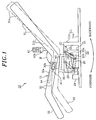
- Fig. 1 shows a schematic diagram of a relaxation apparatus in accordance with an embodiment of the present invention.
- the relaxation apparatus 10 includes a base 11 having a bottom portion 11a placed on the floor (not shown), a rocking machinism 12 as a rocking unit provided to the base 11 and a body-supporting member 13 as a body-supporting unit driven by the rocking mechanism 12.
- the rocking mechanism 12 has a motor 20, a reduction gear 21, a crank mechanism 22 and link members 23.
- the motor 20 is provided on the bottom portion 11a of the base 11 and the operation thereof is controlled by a controller 24, as a contol unit and a selection unit, provided on the bottom portion 11a.
- the reduction gear 21 is also provided on the bottom portion 11a of the base 11.
- the reduction gear 21 is operationally coupled with the motor 20 and serves to reduce the power of the motor 20.
- the motor 20 has a position sensor (not shown) such as an encoder that detects the number of revolutions and revolutionary position.
- the crank mechanism 22 has two connecting rods 22a and 22b, and converts the rotating motion of the reduction gear 21 into a large circular motion.
- the base end of the connecting rod 22a is connected to and rotates with the axis of the reduction gear 21, while its leading end is rotatably connected to the base end of the other connecting rod 22b.
- the leading end of the connecting rod 22b is connected to the lower portion of a rectangular frame 25 to which the body-supporting member 13 is fixed.
- the aforementioned base 11 also has a support frame 11b protruded upward from the bottom portion 11a.
- the base ends of the linkages 23 are rotatably connected to the upper portion of the support frame 11b at an interval, while their leading ends are rotatably connected to the lower portion of the rectangular frame 25.
- the two linkages 23 rotate around their base ends and, therefore, the body-supporting member 13, fixed to the rectangular frame 25, can be rocked back and forth by the power delivered from the crank mechanism 22, like a rocking chair.
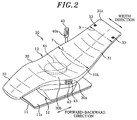
- the body-supporting member 13 of a chair shape includes a seat portion 30 which is fixed to an upper portion of the rectangular frame 25 so that they can move together, a back portion 31 attached to the rear side of the seat portion 30, and an ottoman 32 fixed at the front side of the seat portion 30, which are integrally formed.
- the body-supporting member 13 has a width gradually increased from a head support portion 31a on the rear side thereof, which supports the head of the user M, to a waist support portion 31b that supports the waist portion including the arms of the user M, so that the width Y at the waist support 31b is larger than the width X at the head support 31a.
- the width of the body-supporting member 13 is gradually decreased from the front side of the waist support portion 31b, i.e., the rear side of the seat portion 30 to the front edge of the ottoman 32, forming a curved shape as a whole.
- a manipulator 40 that is detachably held by a manipulator holder (not shown) is provided on a side of the back portion 31 of the body-supporting member 13.
- a main power supply switch 41 for turning on and off the power supply route and an external sound source input terminal 43 as an external input unit to which external music information can be input from an external sound source 42 (see Fig. 4 ).
- a vibrator 44 is installed as a low-frequency vibrator configured to be able to vibrate by a control signal from the controller 24.
- the manipulator 40 is provided with a sound source switch 40a as a switching unit as shown in Fig. 3 .
- a sound source switch 40a By the sound source switch 40a, it is possible to switch between a plurality of music information data (internal music information) stored in advance in a memory 45 as a memory unit (see Fig. 4 ) and the external music information from the external sound source 42 through the external sound source input terminal 43 placed adjacent to the main power supply switch 41.
- a sound information data internal music information
- a memory 45 as a memory unit (see Fig. 4 )
- the external music information from the external sound source 42 through the external sound source input terminal 43 placed adjacent to the main power supply switch 41.
- the state in which the music information data stored in the memory unit 45 is selected is represented by the solid line
- the state in which external music information from the external sound source 42 is selected is represented by the dashed line.
- the manipulator 40 includes various switches 50 to 56 including course selection switches 50, a swing regulator switch 51, a reclining-angle regulator switch 52, a volume regulator switch 53, a vibration regulator switch 54, an air-bag regulator switch 55 and a start-up switch 56, each of which having a sensor unit 57 formed of, e.g., an electrostatic sensor (see Fig. 4 ), and indicators 58 for respectively showing on and off states of the various switches 50 to 56.
- switches 50 to 56 including course selection switches 50, a swing regulator switch 51, a reclining-angle regulator switch 52, a volume regulator switch 53, a vibration regulator switch 54, an air-bag regulator switch 55 and a start-up switch 56, each of which having a sensor unit 57 formed of, e.g., an electrostatic sensor (see Fig. 4 ), and indicators 58 for respectively showing on and off states of the various switches 50 to 56.
- the course selection switches 50 include multiple switches 50a to 50d so that a course can be selected among multiple courses (four courses A to D in the present embodiment) determined by a course table (not shown) in which amplitude and frequency of a rocking motion are set in advance. Further, as shown in Fig. 4 , by the selection of the respective switches 50a to 50d, a prescribed control signal is output to the controller 24 from a course selector 60 in which multiple rocking patterns (courses) are set.
- the swing regulator switch 51 is electrically connected to a speed regulator 61 for regulating the speed (frequency) of a rocking motion of the body-supporting member 13 and an amplitude regulator 62 for regulating the amplitude of the rocking motion as shown in Fig. 4 , so that the speed (frequency) and amplitude of a rocking motion of the body-supporting member 13 can be varied in three steps by an operation of the swing regulator switch 51 by a user.
- a control signal of reclining regulation is outputted through a reclining regulator 63 to the controller 24 and the controller 24 receiving the signal suitably controls a reclining driver 13a to regulate the reclining angle of the body-supporting member 13.
- the volume regulator switch 53 is to regulate the volume of speakers 33 and, in the present embodiment, is configured to regulate the volume in five levels.
- the vibration regulator switch 54 is to regulate the degree of vibration of the vibrator 44 as shown in Figs. 1 and 2 , and, in the present embodiments, is configured to regulate the vibration in five levels.
- the air-bag regulator switch 55 is to vary the amount of expansion of air bags (not shown) and in the present embodiments the expansion amount of the air bags can be regulated in five levels.
- the start-up switch 56 is to turn the relaxation apparatus 10 on and off. When the start-up switch 56 is turned on, the respective parts can be controlled by the controller 24.
- the indicators 58 include light-emitting diodes within a transparent cell of a casing of the manipulator 40 and are installed in the interior of the respective switches 50 to 56, and level displays 51a, 53a, 54a and 55a provided to show the current status of the motion by the respective switches 51, 53, 54 and 55.
- multiple courses having different frequencies of a rocking motion are set up for the course selector switches 50 of the manipulator 40 and, by the operation of the course selector switches 50, various courses are set up such as a single course in which the controller 24 controls the rocking mechanism 12 to carry out a relax-rocking of the body-supporting member 13 and a combination course in which the relax-rocking is carried out while music being outputted from the speakers 33.
- a relax-rocking course having a refresh function.
- a relax-rocking that provides a user with a relaxing effect is carried out at first, and then it is switched to a refresh rocking which is carried out until the end of the course.
- Fig. 5A shows variations in frequencies of the rocking motions in the courses A and B
- Fig. 5B shows variations in tempo of music in the courses A and B
- Fig. 5C shows variations in tone of music in the courses A and B.
- solid and chain-dotted lines are used respectively for the course A and course B.
- the controller 24 controls the motor 20 to perform a relax-rocking by decreasing the cycle (frequency) of rocking motion of the body-supporting member 13 gradually, for example, from its initial value 0.25 Hz to 0.2 Hz and finally 0.1 Hz in a stepwise manner until a specified time T1 as shown in Fig. 5A .
- the controller 24 receiving a signal according to the state of the sound source switch 40a of the manipulator 40, selects either of the music information data stored in the memory 45 and the external music information from the external sound source 42, for example, music information I among the music information data, and then outputs it through the speakers 33 until the specified time T1.
- the controller 24 controls the motor 20 to continuously rock the body-supporting member 13 at the minimum frequency 0.1 Hz of the course A, thereby allowing the user to fall in a state of hypnosis from a state of relaxation. Besides, between the times T1 and T2, the controller 24 outputs through the speakers 33 music information J slower in tempo compared to the music information I.
- the controller 24 controls the motor 20 to perform a refresh rocking by increasing the frequency of the rocking motion gradually, for example, from 0.1 Hz to 0.2 Hz and finally 0.3 Hz in a stepwise manner, so that the user can be lead to a state of being awakened from the state of sleeping (relaxation state).
- the controller 24 outputs through the speakers 33 music information K faster in tempo compared to the music information J and higher in tone compared to the music information I.
- the controller 24 controls the motor 20 to perform a relax-rocking by decreasing the cycle (frequency) of rocking motion of the body-supporting member 13 gradually, for example, from its initial value 0.35 Hz to the final 0.2 Hz by a decrement of 0.05 Hz in a stepwise manner until the specified time T1 as shown in Fig. 5A .
- the controller 24 outputs music information L faster in tempo compared to the music information I through the speakers 33 until the specified time T1.
- the controller 24 controls the motor 20 to continuously rock the body-supporting member 13 at the minimum frequency 0.2 Hz of the course B, thereby allowing the user to fall in a state of hypnosis from a state of relaxation.
- the controller 24 outputs through the speakers 33 music information M slower in tempo compared to the music information L and higher in tone compared to the music information J.
- the controller 24 controls the motor 20 to perform a refresh rocking by increasing the frequency of the rocking motion gradually, for example, from 0.2 Hz to 0.3 Hz, from 0.3 Hz to 0.4 Hz, and from 0.4 Hz to 0.6 Hz in a stepwise manner, so that the user can be lead to a state of being awakened from the state of sleeping (relaxation state).
- the controller 24 receiving a signal according to the state of the sound source switch 40a of the manipulator 40, selects either of the music information data stored in the memory 45 and the external music information from the external sound source 42, for example, music information N faster in tempo and higher in tone compared to the music information M and K among the internal music information, and then outputs it through the speakers 33.
- the relaxation apparatus 10 of the present embodiment is configured such that internal music information in accordance with the respective rocking courses A and B is selected by the controller 24 as a selection unit and music is generated through speakers 33 as a generating unit, the user can be provided with sound (or music) depending on the course. Therefore, for example, in addition to a relaxing effect by the conventional rocking motion, it becomes possible to provide the user with a more effective relaxation by sound (music) tuned to that rocking motion. Besides, for example, because it is configured to be able to use external music information from the external sound source 42 in each course, it becomes possible to perform a relax-rocking while listening to the music that the user likes and provide the user with an effective relaxation suitable individual one.
- music information is varied in accordance with the respective courses A and B and sound is generated (output) through the speakers 33
- another configuration may be employed in which, in addition to the present configuration, music information is varied in accordance with the course A and B and low-frequency vibrations (for example, at 10 Hz to 100 Hz) are generated (output) by the vibrator 44 in accordance with the corresponding music information.
- the configuration may also be altered such that only the vibrations are generated without generating the sound.
- the speakers 33 are provided to the both sides of the top of the head-support portion 31a, they may be placed elsewhere. Besides, though there are two speakers 33 in the present embodiment, the number of speakers is not limited thereto.
- the vibrator 44 is provided to the upper side 30b of the seat portion 30, it may be placed elsewhere. In addition, though there is one vibrator 44 in the present embodiment, the number of the vibrator is not limited thereto.
- the sound source switch 40a that can switch between the external music information from the external sound source 42 and the music information data stored in advance in the memory 45 is provided in the manipulator 40, it is not limited to the above but the sound source switch 40a may be placed elsewhere.
- the external music information from the external sound source 42 and the music information data stored in advance in the memory 45 can be switched, a configuration may be employed in which they are not switchable.
- a detection sensor (not shown) is provided to detect whether the external sound source 42 is connected to the external sound source input terminal 43 and it is determined by the controller 24 through the detection sensor that the external sound source 42 is connected, a configuration may be employed in which the external sound source 42 (the external music information) is used with priority. With this configuration, it becomes possible to use the external sound source 42 (the external music information) easily.
- the sound source input terminal 43 is provided and the external sound source 42 can be used, a configuration may be employed in which the sound source input terminal 43 is omitted and, hence, it is impossible to use the external sound source 42.
- music information is switched depending on the frequency of the rocking motion of the respective courses A and B
- music information is switched depending on the amplitude of the rocking motion.
- music information is switched depending on both the frequency and amplitude of the rocking motion.
- the present invention is not limited to the above.
- it may be configured that the body-supporting member 13 is rocked in the left-right direction.
- air bags may be installed in the respective portions of the body-supporting member 13 so that a relaxing effect such as massaging can be provided to a user by suitably performing expansions and contractions of the air bags.
- the controller 24 controls the motor 20 to perform a refresh rocking in which the frequency of the rocking motion is gradually increased, the refresh rocking may be eliminated.
Landscapes
- Toys (AREA)
Description
- The present invention relates to a relaxation apparatus for providing a user with a relaxing effect.
- There is disclosed in, e.g., Japanese Patent Laid-open Publication No.
2000-42112 a - Although the above-mentioned relaxation apparatus provides a user with a relaxing effect by rocking the body-supporting unit, the relaxing effect due to the rocking motion alone has a limited effect and, hence, development of a relaxation apparatus capable of providing a user with a more effective relaxation is in demand.
-
JP 2001 149164 A claim 1. - In view of the above, the present invention provides a relaxation apparatus capable of giving a user a more effective relaxation by a combination of a rocking motion with a separate function.
- While the invention is defined in the
independent claim 1, further aspects of the invention are set forth in the dependent claims, the drawings and the following description. - In accordance with an aspect of the present invention, there is provided a relaxation apparatus including a body-supporting unit for supporting a user's body, a rocking unit for rocking the body-supporting unit at least in one direction and a control unit for controlling the rocking unit to rock the body-supporting unit. The relaxation apparatus further includes: a manipulator by which a user selects any one of a plurality of courses in which amplitude and frequency of the rocking motion of the body-supporting unit are differently set, respectively; a memory unit that stores a plurality of music information data; a selection unit for selecting music information, among the music information data, in accordance with the course selected by the user; and a generating unit for generating at least one of sound and vibration in accordance with the music information selected by the selection unit.
- With such configuration, the selection unit determines music information, among the plurality of music information data stored in advance in the memory unit, in accordance with the course selected by the user and at least one of the sound and the vibration is generated through the generating unit in accordance to the music information selected by the selection unit, so that the user can be provided with a sound suitable to the course. Therefore, for example, in addition to a relaxing effect by the conventional rocking motion, it becomes possible to provide the user with an effective relaxation by sound and/or vibration tuned to the corresponding rocking motion.
- The generating unit may include at least one of a speaker that generates sound and a low-frequency vibrator that generates low-frequency vibrations on at least a portion of the body-supporting unit.
- With such configuration, the user can be provided with at least one of sound and vibration depending on a course. Therefore, in addition to the relaxing effect due to the conventional rocking motion, a more effective relaxation can be provided to the user by the sound and/or the vibration tuned to the rocking motion.
- The relaxation apparatus may further include an external input unit through which external music information is input and the generating unit is configured to generate at least one of the sound and the vibration in accordance with the external music information input through the external input unit.
- With such configuration, the external input unit is provided to generate sound and/or vibration in accordance with the external music information input therethrough so that it becomes possible, in addition to a relaxing effect by the conventional rocking motion, for example, to provide the user with a relaxing effect by listening to the music he/she likes. Further, when a vibration is generated in accordance with the external music information, a low-frequency vibration that the user likes can be provided.
- The relaxation apparatus may further include a switching unit by which the user is able to select the external music information or the music information data stored in the memory unit.
- With such configuration, by using the switching unit, the user can select either of the external music information and the music information data (internal music information) stored in advance. Accordingly, the switching can be easily made at the user's disposal when he/she uses the relaxation apparatus.
- When the external music information is input through the external input unit, the control unit may control the generating unit to generate at least one of the sound and the vibration in accordance with the external music information.
- With such configuration, the external music information can be utilized easily without switching between the external music information and the music information data (the internal music information) stored in the memory unit.
- The relaxation apparatus in accordance with the present invention is capable of giving a user a more effective relaxation by a combination of a rocking motion with a separate function.
-
-
Fig. 1 shows a schematic diagram of a relaxation apparatus in accordance with an embodiment of the present invention. -
Fig. 2 illustrates a perspective view of the relaxation apparatus. -
Fig. 3 shows a configuration of a manipulator of the relaxation apparatus. -
Fig. 4 shows a block diagram that explains a system configuration of the relaxation apparatus. -
Figs. 5A, 5B and 5C show graphs that explain a relationship between music and a pattern of rocking motions in respective courses. - Hereinafter, embodiments of the present invention will be described in detail with reference to the accompanying drawings.
-
Fig. 1 shows a schematic diagram of a relaxation apparatus in accordance with an embodiment of the present invention. As depicted inFig. 1 , therelaxation apparatus 10 includes abase 11 having abottom portion 11a placed on the floor (not shown), a rockingmachinism 12 as a rocking unit provided to thebase 11 and a body-supportingmember 13 as a body-supporting unit driven by therocking mechanism 12. - The
rocking mechanism 12 has amotor 20, areduction gear 21, acrank mechanism 22 andlink members 23. Themotor 20 is provided on thebottom portion 11a of thebase 11 and the operation thereof is controlled by acontroller 24, as a contol unit and a selection unit, provided on thebottom portion 11a. Thereduction gear 21 is also provided on thebottom portion 11a of thebase 11. Thereduction gear 21 is operationally coupled with themotor 20 and serves to reduce the power of themotor 20. Further, themotor 20 has a position sensor (not shown) such as an encoder that detects the number of revolutions and revolutionary position. - The
crank mechanism 22 has two connectingrods reduction gear 21 into a large circular motion. The base end of the connectingrod 22a is connected to and rotates with the axis of thereduction gear 21, while its leading end is rotatably connected to the base end of the other connectingrod 22b. The leading end of the connectingrod 22b is connected to the lower portion of arectangular frame 25 to which the body-supportingmember 13 is fixed. - The
aforementioned base 11 also has asupport frame 11b protruded upward from thebottom portion 11a. The base ends of thelinkages 23 are rotatably connected to the upper portion of thesupport frame 11b at an interval, while their leading ends are rotatably connected to the lower portion of therectangular frame 25. The twolinkages 23 rotate around their base ends and, therefore, the body-supportingmember 13, fixed to therectangular frame 25, can be rocked back and forth by the power delivered from thecrank mechanism 22, like a rocking chair. - The body-supporting
member 13 of a chair shape includes aseat portion 30 which is fixed to an upper portion of therectangular frame 25 so that they can move together, aback portion 31 attached to the rear side of theseat portion 30, and anottoman 32 fixed at the front side of theseat portion 30, which are integrally formed. As viewed from above, the body-supportingmember 13 has a width gradually increased from ahead support portion 31a on the rear side thereof, which supports the head of the user M, to awaist support portion 31b that supports the waist portion including the arms of the user M, so that the width Y at thewaist support 31b is larger than the width X at thehead support 31a. On the other hand, the width of the body-supportingmember 13 is gradually decreased from the front side of thewaist support portion 31b, i.e., the rear side of theseat portion 30 to the front edge of theottoman 32, forming a curved shape as a whole. - As shown in
Figs. 1 and2 , amanipulator 40 that is detachably held by a manipulator holder (not shown) is provided on a side of theback portion 31 of the body-supportingmember 13. In addition, on aside 30a of theseat portion 30 of the body-supportingmember 13, there are provided a mainpower supply switch 41 for turning on and off the power supply route and an external soundsource input terminal 43 as an external input unit to which external music information can be input from an external sound source 42 (seeFig. 4 ). Further, on anupper side 30b of theseat portion 30, avibrator 44 is installed as a low-frequency vibrator configured to be able to vibrate by a control signal from thecontroller 24. - The
manipulator 40 is provided with asound source switch 40a as a switching unit as shown inFig. 3 . By thesound source switch 40a, it is possible to switch between a plurality of music information data (internal music information) stored in advance in amemory 45 as a memory unit (seeFig. 4 ) and the external music information from theexternal sound source 42 through the external soundsource input terminal 43 placed adjacent to the mainpower supply switch 41. InFig. 3 , the state in which the music information data stored in thememory unit 45 is selected is represented by the solid line, while the state in which external music information from theexternal sound source 42 is selected is represented by the dashed line. - As shown in
Fig. 3 , themanipulator 40 includesvarious switches 50 to 56 includingcourse selection switches 50, aswing regulator switch 51, a reclining-angle regulator switch 52, avolume regulator switch 53, avibration regulator switch 54, an air-bag regulator switch 55 and a start-up switch 56, each of which having asensor unit 57 formed of, e.g., an electrostatic sensor (seeFig. 4 ), andindicators 58 for respectively showing on and off states of thevarious switches 50 to 56. - The
course selection switches 50 includemultiple switches 50a to 50d so that a course can be selected among multiple courses (four courses A to D in the present embodiment) determined by a course table (not shown) in which amplitude and frequency of a rocking motion are set in advance. Further, as shown inFig. 4 , by the selection of therespective switches 50a to 50d, a prescribed control signal is output to thecontroller 24 from acourse selector 60 in which multiple rocking patterns (courses) are set. - The
swing regulator switch 51 is electrically connected to aspeed regulator 61 for regulating the speed (frequency) of a rocking motion of the body-supportingmember 13 and anamplitude regulator 62 for regulating the amplitude of the rocking motion as shown inFig. 4 , so that the speed (frequency) and amplitude of a rocking motion of the body-supportingmember 13 can be varied in three steps by an operation of theswing regulator switch 51 by a user. - When the reclining-
angle regulator switch 52 is operated by a user, as shown inFig. 4 , a control signal of reclining regulation is outputted through a recliningregulator 63 to thecontroller 24 and thecontroller 24 receiving the signal suitably controls a recliningdriver 13a to regulate the reclining angle of the body-supportingmember 13. - The
volume regulator switch 53 is to regulate the volume ofspeakers 33 and, in the present embodiment, is configured to regulate the volume in five levels. Further, thevibration regulator switch 54 is to regulate the degree of vibration of thevibrator 44 as shown inFigs. 1 and2 , and, in the present embodiments, is configured to regulate the vibration in five levels. In addition, the air-bag regulator switch 55 is to vary the amount of expansion of air bags (not shown) and in the present embodiments the expansion amount of the air bags can be regulated in five levels. The start-up switch 56 is to turn therelaxation apparatus 10 on and off. When the start-upswitch 56 is turned on, the respective parts can be controlled by thecontroller 24. - The
indicators 58 include light-emitting diodes within a transparent cell of a casing of themanipulator 40 and are installed in the interior of therespective switches 50 to 56, andlevel displays respective switches - Next, descriptions are given to the movement of the relaxation apparatus configured as in the above with reference to
Figs. 1 to 5C . - In the
relaxation apparatus 10 of the present embodiment, multiple courses (four in the present embodiment) having different frequencies of a rocking motion are set up for the course selector switches 50 of themanipulator 40 and, by the operation of the course selector switches 50, various courses are set up such as a single course in which thecontroller 24 controls therocking mechanism 12 to carry out a relax-rocking of the body-supportingmember 13 and a combination course in which the relax-rocking is carried out while music being outputted from thespeakers 33. Among these, there is a relax-rocking course having a refresh function. In this working course, a relax-rocking that provides a user with a relaxing effect is carried out at first, and then it is switched to a refresh rocking which is carried out until the end of the course. - In the present embodiment, two courses, course A and course B, of the relax-rocking course are explained with reference to
Figs. 5A to 5C. Fig. 5A shows variations in frequencies of the rocking motions in the courses A and B,Fig. 5B shows variations in tempo of music in the courses A and B, andFig. 5C shows variations in tone of music in the courses A and B. InFigs. 5A to 5C , solid and chain-dotted lines are used respectively for the course A and course B. - When receiving a signal showing that the course A is selected from the
manipulator 40, in order to lead a user to be from an awakened state to a relaxed state, thecontroller 24 controls themotor 20 to perform a relax-rocking by decreasing the cycle (frequency) of rocking motion of the body-supportingmember 13 gradually, for example, from its initial value 0.25 Hz to 0.2 Hz and finally 0.1 Hz in a stepwise manner until a specified time T1 as shown inFig. 5A . - At this time, the
controller 24, receiving a signal according to the state of the sound source switch 40a of themanipulator 40, selects either of the music information data stored in thememory 45 and the external music information from theexternal sound source 42, for example, music information I among the music information data, and then outputs it through thespeakers 33 until the specified time T1. - Until a specified time T2 after the lapse of the specified time T1 and , the
controller 24 controls themotor 20 to continuously rock the body-supportingmember 13 at the minimum frequency 0.1 Hz of the course A, thereby allowing the user to fall in a state of hypnosis from a state of relaxation. Besides, between the times T1 and T2, thecontroller 24 outputs through thespeakers 33 music information J slower in tempo compared to the music information I. - After the lapse of the specified time T2, the
controller 24 controls themotor 20 to perform a refresh rocking by increasing the frequency of the rocking motion gradually, for example, from 0.1 Hz to 0.2 Hz and finally 0.3 Hz in a stepwise manner, so that the user can be lead to a state of being awakened from the state of sleeping (relaxation state). At this time, thecontroller 24 outputs through thespeakers 33 music information K faster in tempo compared to the music information J and higher in tone compared to the music information I. - When receiving a signal showing that the course B is selected from the
manipulator 40, in order to lead a user to be from an awakened state to a relaxed state, thecontroller 24 controls themotor 20 to perform a relax-rocking by decreasing the cycle (frequency) of rocking motion of the body-supportingmember 13 gradually, for example, from its initial value 0.35 Hz to the final 0.2 Hz by a decrement of 0.05 Hz in a stepwise manner until the specified time T1 as shown inFig. 5A . - At this time, the
controller 24 outputs music information L faster in tempo compared to the music information I through thespeakers 33 until the specified time T1. - Until the specified time T2 after the lapse of the specified time T1, the
controller 24 controls themotor 20 to continuously rock the body-supportingmember 13 at the minimum frequency 0.2 Hz of the course B, thereby allowing the user to fall in a state of hypnosis from a state of relaxation. Besides, between the times T1 and T2, thecontroller 24 outputs through thespeakers 33 music information M slower in tempo compared to the music information L and higher in tone compared to the music information J. - After the lapse of the specified time T2, the
controller 24 controls themotor 20 to perform a refresh rocking by increasing the frequency of the rocking motion gradually, for example, from 0.2 Hz to 0.3 Hz, from 0.3 Hz to 0.4 Hz, and from 0.4 Hz to 0.6 Hz in a stepwise manner, so that the user can be lead to a state of being awakened from the state of sleeping (relaxation state). - At this time, the
controller 24, receiving a signal according to the state of the sound source switch 40a of themanipulator 40, selects either of the music information data stored in thememory 45 and the external music information from theexternal sound source 42, for example, music information N faster in tempo and higher in tone compared to the music information M and K among the internal music information, and then outputs it through thespeakers 33. - As described above, because the
relaxation apparatus 10 of the present embodiment is configured such that internal music information in accordance with the respective rocking courses A and B is selected by thecontroller 24 as a selection unit and music is generated throughspeakers 33 as a generating unit, the user can be provided with sound (or music) depending on the course. Therefore, for example, in addition to a relaxing effect by the conventional rocking motion, it becomes possible to provide the user with a more effective relaxation by sound (music) tuned to that rocking motion. Besides, for example, because it is configured to be able to use external music information from theexternal sound source 42 in each course, it becomes possible to perform a relax-rocking while listening to the music that the user likes and provide the user with an effective relaxation suitable individual one. - Next, the characteristic effects of the present embodiment will be described.
- (1) The relaxation apparatus of the present embodiment has the
manipulator 45 that can select any one of the multiple courses A to D in which the frequency and amplitude of a rocking motion are set up in advance, thememory 45 where a plurality of music information data is stored, thespeakers 33 that generate sound in accordance with the music information and thecontroller 24 as the selection unit that determines music information in accordance with the course selected by the user. That is, thecontroller 24 as the selection unit determines music information, among a plurality of music information data that is stored in advance in thememory 45, in accordance with the course selected by the user and the sound is generated through thespeakers 33 in accordance to the music information selected by thecontroller 24 as the selection unit, so that the user can be provided with a sound suitable to the course. Therefore, for example, in addition to a relaxing effect by the conventional rocking motion, it becomes possible to provide the user with an effective relaxation by sound tuned to the corresponding rocking motion. - (2) In the present embodiment, the external sound source input terminal 43 as an external input unit is provided to input external music information and the
speakers 33 can generate sound in accordance with the external music information input through the external soundsource input terminal 43. That is to say, the external soundsource input terminal 43 is provided to generate sound in accordance with the external music information input therethrough so that it becomes possible, in addition to a relaxing effect by the conventional rocking motion, for example, to provide the user with a relaxing effect by listening to the music he/she likes. - (3) The
sound source switch 40a is provided to switch between the external music information and the music information data stored in thememory 45 by the operation of the user. In other words, by providing thesound source switch 40a that can switch between the external music information and the music information data stored in thememory 45 by the operation of the user, the user can select either of the external music information and the music information data (internal music information) stored in advance. Accordingly, the switching can be easily made at the user's disposal when he/she uses thepresent apparatus 10. - The embodiment of the present invention may be modified as described below.
- Although, in the embodiment described above, it is configured that music information is varied in accordance with the respective courses A and B and sound is generated (output) through the
speakers 33, another configuration may be employed in which, in addition to the present configuration, music information is varied in accordance with the course A and B and low-frequency vibrations (for example, at 10 Hz to 100 Hz) are generated (output) by thevibrator 44 in accordance with the corresponding music information. Besides, the configuration may also be altered such that only the vibrations are generated without generating the sound. - Although, in the embodiment described above, the
speakers 33 are provided to the both sides of the top of the head-support portion 31a, they may be placed elsewhere. Besides, though there are twospeakers 33 in the present embodiment, the number of speakers is not limited thereto. - Although, in the embodiment described above, the
vibrator 44 is provided to theupper side 30b of theseat portion 30, it may be placed elsewhere. In addition, though there is onevibrator 44 in the present embodiment, the number of the vibrator is not limited thereto. - Even though, in the embodiment described above, the
sound source switch 40a that can switch between the external music information from theexternal sound source 42 and the music information data stored in advance in thememory 45 is provided in themanipulator 40, it is not limited to the above but thesound source switch 40a may be placed elsewhere. - Even though, in the embodiment described in the above, the external music information from the
external sound source 42 and the music information data stored in advance in thememory 45 can be switched, a configuration may be employed in which they are not switchable. In addition, in this case, if a detection sensor (not shown) is provided to detect whether theexternal sound source 42 is connected to the external soundsource input terminal 43 and it is determined by thecontroller 24 through the detection sensor that theexternal sound source 42 is connected, a configuration may be employed in which the external sound source 42 (the external music information) is used with priority. With this configuration, it becomes possible to use the external sound source 42 (the external music information) easily. - Although, in the embodiment described above, the sound
source input terminal 43 is provided and theexternal sound source 42 can be used, a configuration may be employed in which the soundsource input terminal 43 is omitted and, hence, it is impossible to use theexternal sound source 42. - Although, in the embodiment described above, music information is switched depending on the frequency of the rocking motion of the respective courses A and B, it may be configured that music information is switched depending on the amplitude of the rocking motion. Besides, it may be configured that music information is switched depending on both the frequency and amplitude of the rocking motion.
- Although, in the embodiment described above, the body-supporting
member 13 is rocked back and forth, the present invention is not limited to the above. For example, it may be configured that the body-supportingmember 13 is rocked in the left-right direction. - Even though, it is not mentioned explicitly in the embodiment described above, air bags may be installed in the respective portions of the body-supporting
member 13 so that a relaxing effect such as massaging can be provided to a user by suitably performing expansions and contractions of the air bags. - Although, in the embodiment described above, after a relax-rocking, the
controller 24 controls themotor 20 to perform a refresh rocking in which the frequency of the rocking motion is gradually increased, the refresh rocking may be eliminated. - While the invention has been shown and described with respect to the embodiments, it will be understood by those skilled in the art that various changes and modifications may be made without departing from the scope of the invention as defined in the following claims.
Claims (4)
- A relaxation apparatus (10) comprising a body-supporting unit (13) for supporting a user's body; a rocking unit (12) for rocking the body-supporting unit (13) at least in one direction; a control unit (24) for controlling the rocking unit to rock the body-supporting unit (13); a manipulator (40) by which a user selects any one of a plurality of courses in which amplitude and frequency of the rocking motion of the body-supporting unit (13) are differently set, respectively; a memory unit (45) that stores a plurality of music information data; a selection unit (24) for selecting music information, among the music information data, in accordance with the course selected by the user; and a generating unit (33, 44) for generating at least one of sound and vibration in accordance with the music information selected by the selection unit (24),
characterized in that:the apparatus (10) further comprises an external input unit (43) through which external music information is input, andthe generating unit (33, 44) is configured to generate at least one of the sound and the vibration in accordance with the external music information input through the external input unit (43). - The relaxation apparatus (10) of claim 1, wherein the generating unit (33, 44) includes at least one of a speaker (33) that generates sound and a low-frequency vibrator (44) that generates low-frequency vibrations on at least a portion of the body-supporting unit (13).
- The relaxation apparatus (10) of claim 1 or 2, further comprising: a switching unit (40a) by which the user is able to select the external music information or the music information data stored in the memory unit (45).
- The relaxation apparatus (10) of claim 1 or 2, wherein when the external music information is input through the external input unit (43), the control unit (24) controls the generating unit (33, 44) to generate at least one of the sound and the vibration in accordance with the external music information.
Applications Claiming Priority (1)
| Application Number | Priority Date | Filing Date | Title |
|---|---|---|---|
| JP2008324596A JP2010142493A (en) | 2008-12-19 | 2008-12-19 | Relaxation apparatus |
Publications (2)
| Publication Number | Publication Date |
|---|---|
| EP2198751A1 EP2198751A1 (en) | 2010-06-23 |
| EP2198751B1 true EP2198751B1 (en) | 2016-09-07 |
Family
ID=41692856
Family Applications (1)
| Application Number | Title | Priority Date | Filing Date |
|---|---|---|---|
| EP09015500.3A Not-in-force EP2198751B1 (en) | 2008-12-19 | 2009-12-15 | Relaxation apparatus |
Country Status (2)
| Country | Link |
|---|---|
| EP (1) | EP2198751B1 (en) |
| JP (1) | JP2010142493A (en) |
Families Citing this family (8)
| Publication number | Priority date | Publication date | Assignee | Title |
|---|---|---|---|---|
| JP5313753B2 (en) * | 2009-04-20 | 2013-10-09 | パナソニック株式会社 | Relaxation equipment |
| JP7062356B2 (en) * | 2016-11-29 | 2022-05-06 | パイオニア株式会社 | Vibration control device |
| CN107670285A (en) * | 2017-07-31 | 2018-02-09 | 肇庆学院 | A kind of intelligent music rocking horse |
| JP6963688B2 (en) * | 2017-11-06 | 2021-11-10 | ボディーフレンド カンパニー リミテッドBODYFRIEND Co., Ltd. | Anma chair performing a brain massage |
| JP6619063B2 (en) * | 2018-03-19 | 2019-12-11 | 加賀デバイス株式会社 | Game machine, method and program for controlling game machine |
| JP7780148B2 (en) * | 2022-04-28 | 2025-12-04 | トヨタ紡織株式会社 | Oscillating device and control method |
| CN116270110A (en) * | 2023-03-28 | 2023-06-23 | 麒盛科技股份有限公司 | Passive relaxation device and its control method, storage medium and computer equipment |
| CN116473789B (en) * | 2023-03-28 | 2025-03-14 | 麒盛科技股份有限公司 | Passive loosening device, control method thereof, storage medium and computer equipment |
Family Cites Families (7)
| Publication number | Priority date | Publication date | Assignee | Title |
|---|---|---|---|---|
| JP2000042112A (en) | 1998-07-28 | 2000-02-15 | Matsushita Electric Works Ltd | Relax device |
| JP2001149164A (en) * | 1999-11-29 | 2001-06-05 | Matsushita Electric Works Ltd | Relaxation device |
| JP2001178576A (en) * | 1999-12-22 | 2001-07-03 | Matsushita Electric Works Ltd | Relaxing device |
| JP2002253386A (en) * | 2001-02-28 | 2002-09-10 | Shiyouko Ishihara | Baby seat and wheel chair |
| JP2004248974A (en) * | 2003-02-21 | 2004-09-09 | Family Co Ltd | Massage machine |
| JP2008200486A (en) * | 2007-01-25 | 2008-09-04 | Matsushita Electric Works Ltd | Refreshing device and vehicle equipped with refreshing device |
| JP4971238B2 (en) * | 2008-04-17 | 2012-07-11 | パナソニック株式会社 | Relaxation equipment |
-
2008
- 2008-12-19 JP JP2008324596A patent/JP2010142493A/en active Pending
-
2009
- 2009-12-15 EP EP09015500.3A patent/EP2198751B1/en not_active Not-in-force
Also Published As
| Publication number | Publication date |
|---|---|
| JP2010142493A (en) | 2010-07-01 |
| EP2198751A1 (en) | 2010-06-23 |
Similar Documents
| Publication | Publication Date | Title |
|---|---|---|
| EP2198751A1 (en) | Relaxation apparatus | |
| CN102656051B (en) | For the haptic feedback system of vehicle seat | |
| CN102894731A (en) | Children's motion device | |
| US20170304141A1 (en) | Massage machine | |
| EP2196111B1 (en) | Relaxation apparatus | |
| JP2023059996A (en) | Control device for vibration device, control method for vibration device, program and recording medium | |
| JP5313753B2 (en) | Relaxation equipment | |
| JP2001149164A (en) | Relaxation device | |
| EP2189144A1 (en) | Relaxation apparatus | |
| CN119160115A (en) | Method and vehicle device for controlling a comfort function of a vehicle | |
| JP2003135210A (en) | Chair | |
| EP2168458B1 (en) | Relaxation apparatus | |
| EP2210527B1 (en) | Relaxation apparatus | |
| JP2008289756A (en) | Sleep induction device | |
| CN109070784B (en) | Method for controlling a motor of a massage unit provided in a seat, control device and seat arrangement | |
| CN117719444A (en) | Method for controlling comfort function of vehicle and vehicle device | |
| JP2010172377A (en) | Exercise apparatus | |
| JP6123080B1 (en) | Exercise assistance device | |
| JP2003250991A (en) | Gaming machine operation device and gaming machine vibration generator | |
| EP2151224A1 (en) | Relaxation apparatus | |
| JP4752893B2 (en) | Relaxation equipment | |
| JP6178995B1 (en) | Exercise assistance device | |
| JP2002067770A (en) | Seat | |
| EP2189082B1 (en) | Relaxation apparatus | |
| KR100348778B1 (en) | Swinging device |
Legal Events
| Date | Code | Title | Description |
|---|---|---|---|
| PUAI | Public reference made under article 153(3) epc to a published international application that has entered the european phase |
Free format text: ORIGINAL CODE: 0009012 |
|
| AK | Designated contracting states |
Kind code of ref document: A1 Designated state(s): AT BE BG CH CY CZ DE DK EE ES FI FR GB GR HR HU IE IS IT LI LT LU LV MC MK MT NL NO PL PT RO SE SI SK SM TR |
|
| AX | Request for extension of the european patent |
Extension state: AL BA RS |
|
| 17P | Request for examination filed |
Effective date: 20101111 |
|
| RAP1 | Party data changed (applicant data changed or rights of an application transferred) |
Owner name: PANASONIC CORPORATION |
|
| GRAP | Despatch of communication of intention to grant a patent |
Free format text: ORIGINAL CODE: EPIDOSNIGR1 |
|
| RIC1 | Information provided on ipc code assigned before grant |
Ipc: A47C 3/025 20060101ALI20160324BHEP Ipc: A47C 3/02 20060101AFI20160324BHEP Ipc: A47C 7/72 20060101ALI20160324BHEP |
|
| INTG | Intention to grant announced |
Effective date: 20160414 |
|
| GRAS | Grant fee paid |
Free format text: ORIGINAL CODE: EPIDOSNIGR3 |
|
| GRAA | (expected) grant |
Free format text: ORIGINAL CODE: 0009210 |
|
| AK | Designated contracting states |
Kind code of ref document: B1 Designated state(s): AT BE BG CH CY CZ DE DK EE ES FI FR GB GR HR HU IE IS IT LI LT LU LV MC MK MT NL NO PL PT RO SE SI SK SM TR |
|
| REG | Reference to a national code |
Ref country code: GB Ref legal event code: FG4D |
|
| REG | Reference to a national code |
Ref country code: CH Ref legal event code: EP |
|
| REG | Reference to a national code |
Ref country code: IE Ref legal event code: FG4D |
|
| REG | Reference to a national code |
Ref country code: AT Ref legal event code: REF Ref document number: 826040 Country of ref document: AT Kind code of ref document: T Effective date: 20161015 |
|
| REG | Reference to a national code |
Ref country code: DE Ref legal event code: R096 Ref document number: 602009040905 Country of ref document: DE |
|
| REG | Reference to a national code |
Ref country code: LT Ref legal event code: MG4D |
|
| REG | Reference to a national code |
Ref country code: NL Ref legal event code: MP Effective date: 20160907 |
|
| PG25 | Lapsed in a contracting state [announced via postgrant information from national office to epo] |
Ref country code: NO Free format text: LAPSE BECAUSE OF FAILURE TO SUBMIT A TRANSLATION OF THE DESCRIPTION OR TO PAY THE FEE WITHIN THE PRESCRIBED TIME-LIMIT Effective date: 20161207 Ref country code: FI Free format text: LAPSE BECAUSE OF FAILURE TO SUBMIT A TRANSLATION OF THE DESCRIPTION OR TO PAY THE FEE WITHIN THE PRESCRIBED TIME-LIMIT Effective date: 20160907 Ref country code: HR Free format text: LAPSE BECAUSE OF FAILURE TO SUBMIT A TRANSLATION OF THE DESCRIPTION OR TO PAY THE FEE WITHIN THE PRESCRIBED TIME-LIMIT Effective date: 20160907 Ref country code: LT Free format text: LAPSE BECAUSE OF FAILURE TO SUBMIT A TRANSLATION OF THE DESCRIPTION OR TO PAY THE FEE WITHIN THE PRESCRIBED TIME-LIMIT Effective date: 20160907 |
|
| REG | Reference to a national code |
Ref country code: AT Ref legal event code: MK05 Ref document number: 826040 Country of ref document: AT Kind code of ref document: T Effective date: 20160907 |
|
| PG25 | Lapsed in a contracting state [announced via postgrant information from national office to epo] |
Ref country code: LV Free format text: LAPSE BECAUSE OF FAILURE TO SUBMIT A TRANSLATION OF THE DESCRIPTION OR TO PAY THE FEE WITHIN THE PRESCRIBED TIME-LIMIT Effective date: 20160907 Ref country code: ES Free format text: LAPSE BECAUSE OF FAILURE TO SUBMIT A TRANSLATION OF THE DESCRIPTION OR TO PAY THE FEE WITHIN THE PRESCRIBED TIME-LIMIT Effective date: 20160907 Ref country code: GR Free format text: LAPSE BECAUSE OF FAILURE TO SUBMIT A TRANSLATION OF THE DESCRIPTION OR TO PAY THE FEE WITHIN THE PRESCRIBED TIME-LIMIT Effective date: 20161208 Ref country code: SE Free format text: LAPSE BECAUSE OF FAILURE TO SUBMIT A TRANSLATION OF THE DESCRIPTION OR TO PAY THE FEE WITHIN THE PRESCRIBED TIME-LIMIT Effective date: 20160907 Ref country code: NL Free format text: LAPSE BECAUSE OF FAILURE TO SUBMIT A TRANSLATION OF THE DESCRIPTION OR TO PAY THE FEE WITHIN THE PRESCRIBED TIME-LIMIT Effective date: 20160907 |
|
| PG25 | Lapsed in a contracting state [announced via postgrant information from national office to epo] |
Ref country code: EE Free format text: LAPSE BECAUSE OF FAILURE TO SUBMIT A TRANSLATION OF THE DESCRIPTION OR TO PAY THE FEE WITHIN THE PRESCRIBED TIME-LIMIT Effective date: 20160907 Ref country code: RO Free format text: LAPSE BECAUSE OF FAILURE TO SUBMIT A TRANSLATION OF THE DESCRIPTION OR TO PAY THE FEE WITHIN THE PRESCRIBED TIME-LIMIT Effective date: 20160907 |
|
| PG25 | Lapsed in a contracting state [announced via postgrant information from national office to epo] |
Ref country code: CZ Free format text: LAPSE BECAUSE OF FAILURE TO SUBMIT A TRANSLATION OF THE DESCRIPTION OR TO PAY THE FEE WITHIN THE PRESCRIBED TIME-LIMIT Effective date: 20160907 Ref country code: AT Free format text: LAPSE BECAUSE OF FAILURE TO SUBMIT A TRANSLATION OF THE DESCRIPTION OR TO PAY THE FEE WITHIN THE PRESCRIBED TIME-LIMIT Effective date: 20160907 Ref country code: IS Free format text: LAPSE BECAUSE OF FAILURE TO SUBMIT A TRANSLATION OF THE DESCRIPTION OR TO PAY THE FEE WITHIN THE PRESCRIBED TIME-LIMIT Effective date: 20170107 Ref country code: BG Free format text: LAPSE BECAUSE OF FAILURE TO SUBMIT A TRANSLATION OF THE DESCRIPTION OR TO PAY THE FEE WITHIN THE PRESCRIBED TIME-LIMIT Effective date: 20161207 Ref country code: PT Free format text: LAPSE BECAUSE OF FAILURE TO SUBMIT A TRANSLATION OF THE DESCRIPTION OR TO PAY THE FEE WITHIN THE PRESCRIBED TIME-LIMIT Effective date: 20170109 Ref country code: SM Free format text: LAPSE BECAUSE OF FAILURE TO SUBMIT A TRANSLATION OF THE DESCRIPTION OR TO PAY THE FEE WITHIN THE PRESCRIBED TIME-LIMIT Effective date: 20160907 Ref country code: PL Free format text: LAPSE BECAUSE OF FAILURE TO SUBMIT A TRANSLATION OF THE DESCRIPTION OR TO PAY THE FEE WITHIN THE PRESCRIBED TIME-LIMIT Effective date: 20160907 Ref country code: SK Free format text: LAPSE BECAUSE OF FAILURE TO SUBMIT A TRANSLATION OF THE DESCRIPTION OR TO PAY THE FEE WITHIN THE PRESCRIBED TIME-LIMIT Effective date: 20160907 Ref country code: BE Free format text: LAPSE BECAUSE OF FAILURE TO SUBMIT A TRANSLATION OF THE DESCRIPTION OR TO PAY THE FEE WITHIN THE PRESCRIBED TIME-LIMIT Effective date: 20160907 |
|
| REG | Reference to a national code |
Ref country code: DE Ref legal event code: R097 Ref document number: 602009040905 Country of ref document: DE |
|
| PG25 | Lapsed in a contracting state [announced via postgrant information from national office to epo] |
Ref country code: IT Free format text: LAPSE BECAUSE OF FAILURE TO SUBMIT A TRANSLATION OF THE DESCRIPTION OR TO PAY THE FEE WITHIN THE PRESCRIBED TIME-LIMIT Effective date: 20160907 |
|
| PLBE | No opposition filed within time limit |
Free format text: ORIGINAL CODE: 0009261 |
|
| STAA | Information on the status of an ep patent application or granted ep patent |
Free format text: STATUS: NO OPPOSITION FILED WITHIN TIME LIMIT |
|
| PG25 | Lapsed in a contracting state [announced via postgrant information from national office to epo] |
Ref country code: DK Free format text: LAPSE BECAUSE OF FAILURE TO SUBMIT A TRANSLATION OF THE DESCRIPTION OR TO PAY THE FEE WITHIN THE PRESCRIBED TIME-LIMIT Effective date: 20160907 |
|
| REG | Reference to a national code |
Ref country code: CH Ref legal event code: PL |
|
| 26N | No opposition filed |
Effective date: 20170608 |
|
| GBPC | Gb: european patent ceased through non-payment of renewal fee |
Effective date: 20161215 |
|
| PG25 | Lapsed in a contracting state [announced via postgrant information from national office to epo] |
Ref country code: SI Free format text: LAPSE BECAUSE OF FAILURE TO SUBMIT A TRANSLATION OF THE DESCRIPTION OR TO PAY THE FEE WITHIN THE PRESCRIBED TIME-LIMIT Effective date: 20160907 |
|
| PG25 | Lapsed in a contracting state [announced via postgrant information from national office to epo] |
Ref country code: MC Free format text: LAPSE BECAUSE OF FAILURE TO SUBMIT A TRANSLATION OF THE DESCRIPTION OR TO PAY THE FEE WITHIN THE PRESCRIBED TIME-LIMIT Effective date: 20160907 |
|
| REG | Reference to a national code |
Ref country code: FR Ref legal event code: ST Effective date: 20170831 |
|
| REG | Reference to a national code |
Ref country code: IE Ref legal event code: MM4A |
|
| PG25 | Lapsed in a contracting state [announced via postgrant information from national office to epo] |
Ref country code: CH Free format text: LAPSE BECAUSE OF NON-PAYMENT OF DUE FEES Effective date: 20161231 Ref country code: FR Free format text: LAPSE BECAUSE OF NON-PAYMENT OF DUE FEES Effective date: 20170102 Ref country code: LU Free format text: LAPSE BECAUSE OF NON-PAYMENT OF DUE FEES Effective date: 20161215 Ref country code: LI Free format text: LAPSE BECAUSE OF NON-PAYMENT OF DUE FEES Effective date: 20161231 |
|
| PG25 | Lapsed in a contracting state [announced via postgrant information from national office to epo] |
Ref country code: GB Free format text: LAPSE BECAUSE OF NON-PAYMENT OF DUE FEES Effective date: 20161215 Ref country code: IE Free format text: LAPSE BECAUSE OF NON-PAYMENT OF DUE FEES Effective date: 20161215 |
|
| PG25 | Lapsed in a contracting state [announced via postgrant information from national office to epo] |
Ref country code: HU Free format text: LAPSE BECAUSE OF FAILURE TO SUBMIT A TRANSLATION OF THE DESCRIPTION OR TO PAY THE FEE WITHIN THE PRESCRIBED TIME-LIMIT; INVALID AB INITIO Effective date: 20091215 Ref country code: CY Free format text: LAPSE BECAUSE OF FAILURE TO SUBMIT A TRANSLATION OF THE DESCRIPTION OR TO PAY THE FEE WITHIN THE PRESCRIBED TIME-LIMIT Effective date: 20160907 |
|
| PG25 | Lapsed in a contracting state [announced via postgrant information from national office to epo] |
Ref country code: TR Free format text: LAPSE BECAUSE OF FAILURE TO SUBMIT A TRANSLATION OF THE DESCRIPTION OR TO PAY THE FEE WITHIN THE PRESCRIBED TIME-LIMIT Effective date: 20160907 Ref country code: MK Free format text: LAPSE BECAUSE OF FAILURE TO SUBMIT A TRANSLATION OF THE DESCRIPTION OR TO PAY THE FEE WITHIN THE PRESCRIBED TIME-LIMIT Effective date: 20160907 |
|
| PG25 | Lapsed in a contracting state [announced via postgrant information from national office to epo] |
Ref country code: MT Free format text: LAPSE BECAUSE OF NON-PAYMENT OF DUE FEES Effective date: 20161215 |
|
| PGFP | Annual fee paid to national office [announced via postgrant information from national office to epo] |
Ref country code: DE Payment date: 20220609 Year of fee payment: 14 |
|
| REG | Reference to a national code |
Ref country code: DE Ref legal event code: R119 Ref document number: 602009040905 Country of ref document: DE |
|
| PG25 | Lapsed in a contracting state [announced via postgrant information from national office to epo] |
Ref country code: DE Free format text: LAPSE BECAUSE OF NON-PAYMENT OF DUE FEES Effective date: 20240702 |
|
| PG25 | Lapsed in a contracting state [announced via postgrant information from national office to epo] |
Ref country code: DE Free format text: LAPSE BECAUSE OF NON-PAYMENT OF DUE FEES Effective date: 20240702 |