EP2197438B1 - Heterocyclic compounds as crth2 receptor antagonists - Google Patents
Heterocyclic compounds as crth2 receptor antagonists Download PDFInfo
- Publication number
- EP2197438B1 EP2197438B1 EP08838211.4A EP08838211A EP2197438B1 EP 2197438 B1 EP2197438 B1 EP 2197438B1 EP 08838211 A EP08838211 A EP 08838211A EP 2197438 B1 EP2197438 B1 EP 2197438B1
- Authority
- EP
- European Patent Office
- Prior art keywords
- compound
- disorders
- salt
- diseases
- chloro
- Prior art date
- Legal status (The legal status is an assumption and is not a legal conclusion. Google has not performed a legal analysis and makes no representation as to the accuracy of the status listed.)
- Active
Links
- 0 COC(c([n](C*)c1n2)cc1ccc2Cl)=O Chemical compound COC(c([n](C*)c1n2)cc1ccc2Cl)=O 0.000 description 3
- ZMOCLTOUUVQHBG-UHFFFAOYSA-N CN(C1C[n]2c(cc(nc3)Cl)c3c(CC(O)=O)c2CC1)S(c(cc1)ccc1F)(=O)=O Chemical compound CN(C1C[n]2c(cc(nc3)Cl)c3c(CC(O)=O)c2CC1)S(c(cc1)ccc1F)(=O)=O ZMOCLTOUUVQHBG-UHFFFAOYSA-N 0.000 description 2
- XEKVJMPQTXWWOQ-UHFFFAOYSA-N CN(C1C[n]2c(ccnc3)c3c(CC(O)=O)c2CC1)S(c(cc1)ccc1F)(=O)=O Chemical compound CN(C1C[n]2c(ccnc3)c3c(CC(O)=O)c2CC1)S(c(cc1)ccc1F)(=O)=O XEKVJMPQTXWWOQ-UHFFFAOYSA-N 0.000 description 2
- ZJVSMPDCALHZOG-UHFFFAOYSA-N COC(c([nH]c1n2)cc1ccc2Cl)=O Chemical compound COC(c([nH]c1n2)cc1ccc2Cl)=O ZJVSMPDCALHZOG-UHFFFAOYSA-N 0.000 description 1
Classifications
-
- C—CHEMISTRY; METALLURGY
- C07—ORGANIC CHEMISTRY
- C07D—HETEROCYCLIC COMPOUNDS
- C07D471/00—Heterocyclic compounds containing nitrogen atoms as the only ring hetero atoms in the condensed system, at least one ring being a six-membered ring with one nitrogen atom, not provided for by groups C07D451/00 - C07D463/00
- C07D471/12—Heterocyclic compounds containing nitrogen atoms as the only ring hetero atoms in the condensed system, at least one ring being a six-membered ring with one nitrogen atom, not provided for by groups C07D451/00 - C07D463/00 in which the condensed system contains three hetero rings
- C07D471/14—Ortho-condensed systems
-
- A—HUMAN NECESSITIES
- A61—MEDICAL OR VETERINARY SCIENCE; HYGIENE
- A61K—PREPARATIONS FOR MEDICAL, DENTAL OR TOILETRY PURPOSES
- A61K31/00—Medicinal preparations containing organic active ingredients
- A61K31/33—Heterocyclic compounds
- A61K31/395—Heterocyclic compounds having nitrogen as a ring hetero atom, e.g. guanethidine or rifamycins
- A61K31/435—Heterocyclic compounds having nitrogen as a ring hetero atom, e.g. guanethidine or rifamycins having six-membered rings with one nitrogen as the only ring hetero atom
- A61K31/4353—Heterocyclic compounds having nitrogen as a ring hetero atom, e.g. guanethidine or rifamycins having six-membered rings with one nitrogen as the only ring hetero atom ortho- or peri-condensed with heterocyclic ring systems
- A61K31/437—Heterocyclic compounds having nitrogen as a ring hetero atom, e.g. guanethidine or rifamycins having six-membered rings with one nitrogen as the only ring hetero atom ortho- or peri-condensed with heterocyclic ring systems the heterocyclic ring system containing a five-membered ring having nitrogen as a ring hetero atom, e.g. indolizine, beta-carboline
-
- A—HUMAN NECESSITIES
- A61—MEDICAL OR VETERINARY SCIENCE; HYGIENE
- A61P—SPECIFIC THERAPEUTIC ACTIVITY OF CHEMICAL COMPOUNDS OR MEDICINAL PREPARATIONS
- A61P11/00—Drugs for disorders of the respiratory system
-
- A—HUMAN NECESSITIES
- A61—MEDICAL OR VETERINARY SCIENCE; HYGIENE
- A61P—SPECIFIC THERAPEUTIC ACTIVITY OF CHEMICAL COMPOUNDS OR MEDICINAL PREPARATIONS
- A61P11/00—Drugs for disorders of the respiratory system
- A61P11/02—Nasal agents, e.g. decongestants
-
- A—HUMAN NECESSITIES
- A61—MEDICAL OR VETERINARY SCIENCE; HYGIENE
- A61P—SPECIFIC THERAPEUTIC ACTIVITY OF CHEMICAL COMPOUNDS OR MEDICINAL PREPARATIONS
- A61P11/00—Drugs for disorders of the respiratory system
- A61P11/06—Antiasthmatics
-
- A—HUMAN NECESSITIES
- A61—MEDICAL OR VETERINARY SCIENCE; HYGIENE
- A61P—SPECIFIC THERAPEUTIC ACTIVITY OF CHEMICAL COMPOUNDS OR MEDICINAL PREPARATIONS
- A61P15/00—Drugs for genital or sexual disorders; Contraceptives
-
- A—HUMAN NECESSITIES
- A61—MEDICAL OR VETERINARY SCIENCE; HYGIENE
- A61P—SPECIFIC THERAPEUTIC ACTIVITY OF CHEMICAL COMPOUNDS OR MEDICINAL PREPARATIONS
- A61P19/00—Drugs for skeletal disorders
-
- A—HUMAN NECESSITIES
- A61—MEDICAL OR VETERINARY SCIENCE; HYGIENE
- A61P—SPECIFIC THERAPEUTIC ACTIVITY OF CHEMICAL COMPOUNDS OR MEDICINAL PREPARATIONS
- A61P19/00—Drugs for skeletal disorders
- A61P19/08—Drugs for skeletal disorders for bone diseases, e.g. rachitism, Paget's disease
- A61P19/10—Drugs for skeletal disorders for bone diseases, e.g. rachitism, Paget's disease for osteoporosis
-
- A—HUMAN NECESSITIES
- A61—MEDICAL OR VETERINARY SCIENCE; HYGIENE
- A61P—SPECIFIC THERAPEUTIC ACTIVITY OF CHEMICAL COMPOUNDS OR MEDICINAL PREPARATIONS
- A61P21/00—Drugs for disorders of the muscular or neuromuscular system
-
- A—HUMAN NECESSITIES
- A61—MEDICAL OR VETERINARY SCIENCE; HYGIENE
- A61P—SPECIFIC THERAPEUTIC ACTIVITY OF CHEMICAL COMPOUNDS OR MEDICINAL PREPARATIONS
- A61P25/00—Drugs for disorders of the nervous system
-
- A—HUMAN NECESSITIES
- A61—MEDICAL OR VETERINARY SCIENCE; HYGIENE
- A61P—SPECIFIC THERAPEUTIC ACTIVITY OF CHEMICAL COMPOUNDS OR MEDICINAL PREPARATIONS
- A61P25/00—Drugs for disorders of the nervous system
- A61P25/04—Centrally acting analgesics, e.g. opioids
-
- A—HUMAN NECESSITIES
- A61—MEDICAL OR VETERINARY SCIENCE; HYGIENE
- A61P—SPECIFIC THERAPEUTIC ACTIVITY OF CHEMICAL COMPOUNDS OR MEDICINAL PREPARATIONS
- A61P25/00—Drugs for disorders of the nervous system
- A61P25/06—Antimigraine agents
-
- A—HUMAN NECESSITIES
- A61—MEDICAL OR VETERINARY SCIENCE; HYGIENE
- A61P—SPECIFIC THERAPEUTIC ACTIVITY OF CHEMICAL COMPOUNDS OR MEDICINAL PREPARATIONS
- A61P27/00—Drugs for disorders of the senses
- A61P27/02—Ophthalmic agents
- A61P27/06—Antiglaucoma agents or miotics
-
- A—HUMAN NECESSITIES
- A61—MEDICAL OR VETERINARY SCIENCE; HYGIENE
- A61P—SPECIFIC THERAPEUTIC ACTIVITY OF CHEMICAL COMPOUNDS OR MEDICINAL PREPARATIONS
- A61P27/00—Drugs for disorders of the senses
- A61P27/02—Ophthalmic agents
- A61P27/10—Ophthalmic agents for accommodation disorders, e.g. myopia
-
- A—HUMAN NECESSITIES
- A61—MEDICAL OR VETERINARY SCIENCE; HYGIENE
- A61P—SPECIFIC THERAPEUTIC ACTIVITY OF CHEMICAL COMPOUNDS OR MEDICINAL PREPARATIONS
- A61P29/00—Non-central analgesic, antipyretic or antiinflammatory agents, e.g. antirheumatic agents; Non-steroidal antiinflammatory drugs [NSAID]
-
- A—HUMAN NECESSITIES
- A61—MEDICAL OR VETERINARY SCIENCE; HYGIENE
- A61P—SPECIFIC THERAPEUTIC ACTIVITY OF CHEMICAL COMPOUNDS OR MEDICINAL PREPARATIONS
- A61P35/00—Antineoplastic agents
-
- A—HUMAN NECESSITIES
- A61—MEDICAL OR VETERINARY SCIENCE; HYGIENE
- A61P—SPECIFIC THERAPEUTIC ACTIVITY OF CHEMICAL COMPOUNDS OR MEDICINAL PREPARATIONS
- A61P35/00—Antineoplastic agents
- A61P35/04—Antineoplastic agents specific for metastasis
-
- A—HUMAN NECESSITIES
- A61—MEDICAL OR VETERINARY SCIENCE; HYGIENE
- A61P—SPECIFIC THERAPEUTIC ACTIVITY OF CHEMICAL COMPOUNDS OR MEDICINAL PREPARATIONS
- A61P37/00—Drugs for immunological or allergic disorders
- A61P37/02—Immunomodulators
- A61P37/06—Immunosuppressants, e.g. drugs for graft rejection
-
- A—HUMAN NECESSITIES
- A61—MEDICAL OR VETERINARY SCIENCE; HYGIENE
- A61P—SPECIFIC THERAPEUTIC ACTIVITY OF CHEMICAL COMPOUNDS OR MEDICINAL PREPARATIONS
- A61P37/00—Drugs for immunological or allergic disorders
- A61P37/08—Antiallergic agents
-
- A—HUMAN NECESSITIES
- A61—MEDICAL OR VETERINARY SCIENCE; HYGIENE
- A61P—SPECIFIC THERAPEUTIC ACTIVITY OF CHEMICAL COMPOUNDS OR MEDICINAL PREPARATIONS
- A61P43/00—Drugs for specific purposes, not provided for in groups A61P1/00-A61P41/00
-
- A—HUMAN NECESSITIES
- A61—MEDICAL OR VETERINARY SCIENCE; HYGIENE
- A61P—SPECIFIC THERAPEUTIC ACTIVITY OF CHEMICAL COMPOUNDS OR MEDICINAL PREPARATIONS
- A61P5/00—Drugs for disorders of the endocrine system
-
- A—HUMAN NECESSITIES
- A61—MEDICAL OR VETERINARY SCIENCE; HYGIENE
- A61P—SPECIFIC THERAPEUTIC ACTIVITY OF CHEMICAL COMPOUNDS OR MEDICINAL PREPARATIONS
- A61P5/00—Drugs for disorders of the endocrine system
- A61P5/24—Drugs for disorders of the endocrine system of the sex hormones
-
- A—HUMAN NECESSITIES
- A61—MEDICAL OR VETERINARY SCIENCE; HYGIENE
- A61P—SPECIFIC THERAPEUTIC ACTIVITY OF CHEMICAL COMPOUNDS OR MEDICINAL PREPARATIONS
- A61P7/00—Drugs for disorders of the blood or the extracellular fluid
- A61P7/02—Antithrombotic agents; Anticoagulants; Platelet aggregation inhibitors
-
- A—HUMAN NECESSITIES
- A61—MEDICAL OR VETERINARY SCIENCE; HYGIENE
- A61P—SPECIFIC THERAPEUTIC ACTIVITY OF CHEMICAL COMPOUNDS OR MEDICINAL PREPARATIONS
- A61P9/00—Drugs for disorders of the cardiovascular system
-
- A—HUMAN NECESSITIES
- A61—MEDICAL OR VETERINARY SCIENCE; HYGIENE
- A61P—SPECIFIC THERAPEUTIC ACTIVITY OF CHEMICAL COMPOUNDS OR MEDICINAL PREPARATIONS
- A61P9/00—Drugs for disorders of the cardiovascular system
- A61P9/04—Inotropic agents, i.e. stimulants of cardiac contraction; Drugs for heart failure
-
- A—HUMAN NECESSITIES
- A61—MEDICAL OR VETERINARY SCIENCE; HYGIENE
- A61P—SPECIFIC THERAPEUTIC ACTIVITY OF CHEMICAL COMPOUNDS OR MEDICINAL PREPARATIONS
- A61P9/00—Drugs for disorders of the cardiovascular system
- A61P9/08—Vasodilators for multiple indications
-
- A—HUMAN NECESSITIES
- A61—MEDICAL OR VETERINARY SCIENCE; HYGIENE
- A61P—SPECIFIC THERAPEUTIC ACTIVITY OF CHEMICAL COMPOUNDS OR MEDICINAL PREPARATIONS
- A61P9/00—Drugs for disorders of the cardiovascular system
- A61P9/10—Drugs for disorders of the cardiovascular system for treating ischaemic or atherosclerotic diseases, e.g. antianginal drugs, coronary vasodilators, drugs for myocardial infarction, retinopathy, cerebrovascula insufficiency, renal arteriosclerosis
-
- A—HUMAN NECESSITIES
- A61—MEDICAL OR VETERINARY SCIENCE; HYGIENE
- A61P—SPECIFIC THERAPEUTIC ACTIVITY OF CHEMICAL COMPOUNDS OR MEDICINAL PREPARATIONS
- A61P9/00—Drugs for disorders of the cardiovascular system
- A61P9/12—Antihypertensives
Definitions
- Prostaglandin D2 (PGD 2 ) is a cyclooxygenase metabolite of arachidonic acid. It is released from mast and TH2 cells in response to an immunological challenge, and has been implicated in playing a role in different physiological events such as sleep and allergic responses.
- Receptors for PGD 2 include the "DP" receptor, the chemoattractant receptor-homologous molecule expressed on TH2 cells (“CRTH2”), and the "FP" receptor. These receptors are G-protein coupled receptors activated by PGD 2 .
- the CRTH2 receptor and its expression on different cells including human T-helper cells, basophils, and eosinophils are described in Abe, et al., Gene 227:71-77, 1999 , Nagata, et al., FEBS Letters 459:195-199, 1999 , and Nagata, et al., The Journal of Immunology 162:1278-1286, 1999 , describe CRTH2 receptor. Hirai, et al., J. Exp. Med. 193:255-261, 2001 , indicates that CRTH2 is a receptor for PGD 2 .
- Th2-polarisation has been seen in allergic diseases, such as asthma, allergic rhinitis, atopic dermatitis and allergic conjunctivitis ( Romagnani S. Immunology Today, 18, 263-266, 1997 ; Hammad H. et al., Blood, 98, 1135-1141, 2001 ).
- Th2 cells regulate allergic diseases by producing Th2 cytokines, such as IL-4, IL-5 and IL-13 ( Oriss et al., J. Immunol., 162, 1999-2007, 1999 ; Viola et al., Blood, 91, 2223-2230, 1998 ; Webb et al., J. Immunol., 165, 108-113, 2000 ; Dumont F.J., Exp.
- Th2 cytokines directly or indirectly induce migration, activation, priming and prolonged survival of effector cells, such as eosinophils and basophils, in allergic diseases ( Sanz et al., J. Immunol., 160, 5637-5645, 1998 ; Pope et al., J. Allergy Clin. Immunol., 108, 594-601, 2001 ; Teran L. M., Clin. Exp. Allergy, 29, 287-290, 1999 ).
- antagonists which inhibit the binding of CRTH2 and PGD 2 should be useful for the treatment of allergic diseases, such as asthma, allergic rhinitis, atopic dermatitis and allergic conjunctivitis.
- the present invention provides compounds of formula I or a pharmaceutically acceptable salt thereof, wherein: one of A, B, C and D is N and each of the others is independently selected from CH and C(R 1 ); m is 1; n is 2; R 1 is halogen; R 2 and R 3 are hydrogen; R 4 is selected from H, C 1-6 alkyl or halogenated C 1-6 alkyl; Ar is phenyl substituted with 1 or 2 groups independently selected from halogen and C 1-6 alkoxy; X is CH 2 ; and Y is -S(O) 2 - or -C(O)-.
- the compounds of the present invention are CRTH2 receptor antagonists.
- Compounds of the present invention may be useful for the treatment of various prostaglandin-mediated diseases and disorders; accordingly the compounds of the present invention may be used in the treatment of prostaglandin-mediated diseases using the novel compounds described herein, as well as pharmaceutical compositions containing them.
- the present invention relates to compounds of formula I: and pharmaceutically acceptable salts thereof, wherein:
- a subset of compounds of formula I may be represented by formula IIA, for example, wherein n is 2, m is 1; X is CH 2 ; R 2 and R 3 are H; R 4 is Me; Ar is phenyl substituted with 1 or 2 groups independently selected from halogen and C 1-6 alkoxy; A is N; B, C and D are -CH- or C(R 1 )-; and R 1 is hydrogen or halogen.
- Another subset of compounds of formula I may be represented by formula IIB, for example, wherein n is 2, m is 1; X is CH 2 ; R 2 and R 3 are H; R 4 is Me; Ar is phenyl substituted with 1 or 2 groups independently selected from halogen and C 1-6 alkoxy; B is N; A, C and D are -CH- or C(R 1 )-; and R 1 is hydrogen or halogen.
- a further subset of compounds of formula I may be represented by formula IIC, for example, wherein n is 2, m is 1; X is CH 2 ; R 2 and R 3 are H; R 4 is Me; Ar is phenyl substituted with 1 or 2 groups independently selected from halogen and C 1-6 alkoxy; C is N; A, B and D are -CH- or C(R 1 )-; and R 1 is hydrogen or halogen.
- a further subset of compounds of formula I may be represented by formula IID, for example, wherein n is 2, m is 1; X is CH 2 ; R 2 and R 3 are H; R 4 is Me; Ar is phenyl substituted with 1 or 2 groups independently selected from halogen and C 1-6 alkoxy; D is N; A, B and C are -CH- or C(R 1 )-; and R 1 is hydrogen or halogen.
- a compound of formula I may comprise ( ⁇ )- ⁇ 2-chloro-8-[(4-fluoro-benzenesulfonyl)-methyl-amino]-6,7,8,9-tetrahydro-pyrido[3,2-b]indolizin-5-yl ⁇ -acetic acid, or a pure form of either enantiomer.
- the invention also encompasses pharmaceutical compositions containing a compound of formula I, and compounds of formula I for use in the treatment or prevention of prostaglandin CRTH2-mediated diseases.
- halogen or halo includes F, Cl, Br, and I.
- alkyl refers to linear or branched alkyl chains containing the indicated number of carbon atoms.
- alkyl groups include methyl, ethyl, propyl, isopropyl, butyl, s- and t-butyl, pentyl, hexyl, and the like.
- Halogenated-alkyl means an alkyl group as described above wherein one or more hydrogen atoms have been replaced by halogen atoms, with up to complete substitution of all hydrogen atoms with halo groups.
- C 1-6 haloalkyl includes -CF 3 , -CF 2 CF 3 and the like.
- Alkoxy means alkoxy groups of a straight or branched configuration having the indicated number of carbon atoms.
- C 1-6 alkoxy includes methoxy, ethoxy, propoxy, isopropoxy, and the like.
- “Therapeutically effective amount” means that amount of a drug or pharmaceutical agent that will elicit the biological or medical response of a tissue, a system, animal or human that is being sought by a researcher, veterinarian, medical doctor or other clinician.
- treatment includes alleviating, ameliorating, relieving or otherwise reducing the signs and symptoms associated with a disease or disorder.
- prophylaxis means preventing or delaying the onset or the progression of a disease or disorder, or the signs and symptoms associated with such disease or disorder.
- composition as in pharmaceutical composition, is intended to encompass a product comprising the active ingredient(s), and the inert ingredient(s) (pharmaceutically acceptable excipients) that make up the carrier, as well as any product which results, directly or indirectly, from combination, complexation or aggregation of any two or more of the ingredients, or from dissociation of one or more of the ingredients, or from other types of reactions or interactions of one or more of the ingredients.
- pharmaceutical compositions of the present invention encompass any composition made by admixing a compound of Formula I, with one or more pharmaceutically acceptable excipients.
- Compounds of the formula I may be separated into diastereoisomeric pairs of enantiomers by, for example, fractional crystallization from a suitable solvent, for example methanol or ethyl acetate or a mixture thereof.
- a suitable solvent for example methanol or ethyl acetate or a mixture thereof.
- the pair of enantiomers thus obtained may be separated into individual stereoisomers by conventional means, for example by the use of an optically active acid as a resolving agent.
- any enantiomer of a compound of the general formula I may be obtained by stereospecific synthesis using optically pure starting materials or reagents of known configuration.
- salts derived from inorganic bases include aluminum, ammonium, calcium, copper, ferric, ferrous, lithium, magnesium, manganic salts, manganous, potassium, sodium, zinc, and the like. Particularly preferred are the ammonium, calcium, magnesium, potassium, and sodium salts.
- Salts derived from pharmaceutically acceptable organic non-toxic bases include salts of primary, secondary, and tertiary amines, substituted amines including naturally occurring substituted amines, cyclic amines, and basic ion exchange resins, such as arginine, betaine, caffeine, choline, N,N'-dibenzylethylenediamine, diethylamine, 2-diethylaminoethanol, 2-dimethylaminoethanol, ethanolamine, ethylenediamine, N-ethyl-morpholine, N-ethylpiperidine, glucamine, glucosamine, histidine, hydrabamine, isopropylamine, lysine, methylglucamine, morpholine, piperazine, piperidine, polyamine resins, procaine, purines, theobromine, triethylamine, trimethylamine, tripropylamine, tromethamine, and the like.
- basic ion exchange resins such as
- salts may be prepared from pharmaceutically acceptable non-toxic acids, including inorganic and organic acids.
- acids include acetic, benzenesulfonic, benzoic, camphorsulfonic, citric, ethanesulfonic, fumaric, gluconic, glutamic, hydrobromic, hydrochloric, isethionic, lactic, maleic, malic, mandelic, methanesulfonic, mucic, nitric, pamoic, pantothenic, phosphoric, succinic, sulfuric, tartaric, p-toluenesulfonic acid, and the like.
- Particularly preferred are citric, hydrobromic, hydrochloric, maleic, phosphoric, sulfuric, and tartaric acids.
- references to the compound of formula I are meant to also include the pharmaceutically acceptable salts.
- prostaglandin receptors The ability of compounds of formula I to interact with prostaglandin receptors makes them useful for preventing or reversing undesirable symptoms caused by prostaglandins in a mammalian, especially human subject.
- This mimicking or antagonism of the actions of prostaglandins indicates that the compounds of the invention and pharmaceutical compositions thereof are useful to treat, prevent, or ameliorate in mammals and especially in humans: respiratory conditions, allergic conditions, pain, inflammatory conditions, mucus secretion disorders, bone disorders, sleep disorders, fertility disorders, blood coagulation disorders, trouble of the vision as well as immune and autoimmune diseases.
- such a compound may inhibit cellular neoplastic transformations and metastatic tumor growth and hence can be used in the treatment of various forms of cancer.
- Compounds of formula I may also be of use in the treatment and/or prevention prostaglandin-mediated proliferation disorders such as may occur in diabetic retinopathy and tumor angiogenesis.
- Compounds of formula I may also inhibit prostanoid-induced smooth muscle contraction by antagonizing contractile prostanoids or mimicking relaxing prostanoids and hence may be used in the treatment of dysmenorrhea, premature labor and eosinophil related disorders. More particularly compounds of formula I are antagonists of prostaglandin D2 receptor, CRTH2.
- PGD2 receptors including CRTH2 receptor may be antagonised by administering to a mammal in need thereof an effective dose of a compound of formula I.
- a compound of formula I may be used to treat or prevent a prostaglandin mediated disease by administering to a mammalian patient in need of such treatment a compound of formula I in an amount which is effective for treating or preventing said prostaglandin mediated disease.
- prostaglandin mediated diseases including, but not limited to, allergic rhinitis, nasal congestion, rhinorrhea, perennial rhinitis, nasal inflammation, asthma including allergic asthma, chronic obstructive pulmonary diseases and other forms of lung inflammation; sleep disorders and sleep-wake cycle disorders; prostanoid-induced smooth muscle contraction associated with dysmenorrhea and premature labor; eosinophil related disorders; thrombosis; glaucoma and vision disorders; occlusive vascular diseases; congestive heart failure; diseases or conditions requiring a treatment of anti-coagulation such as post-injury or post surgery treatment; inflammation; gangrene; Raynaud's disease; mucus secretion disorders including
- a compound or salt thereof of formula I for use in treating or preventing a prostaglandin mediated disease comprising administering to a mammalian patient in need of such treatment a compound of formula I in an amount which is effective for treating or preventing a prostaglandin mediated disease, wherein the prostaglandin mediated disease is nasal congestion, rhinitis including allergic and perennial rhinitis, and asthma including allergic asthma.
- a compound or salt thereof of formula I for use in treating or preventing a prostaglandin D2-mediated disease comprising administering to a mammalian patient in need of such treatment a compound of formula I in an amount which is effective for treating or preventing a prostaglandin D2 mediated disease wherein said prostaglandin D2 mediated disease is nasal congestion or asthma.
- in another embodiment of the present invention is a method for the treatment of nasal congestion in a patient in need of such treatment which comprises administering to said patient a therapeutically effective amount of a compound of formula I.
- a compound or salt thereof of formula I for use in treatment of asthma, particularly allergic asthma, in a patient in need of such treatment which comprises administering to said patient a therapeutically effective amount of a compound of formula I.
- the compounds disclosed herein can be admixed with pharmaceutically acceptable excipients which per se are well known in the art.
- a drug to be administered systemically it may be confected as a powder, pill, tablet or the like, or as a solution, emulsion, suspension, aerosol, syrup or elixir suitable for oral or parenteral administration or inhalation.
- Parenteral administration is generally characterised by injection, either subcutaneously, intramuscularly or intravenously.
- Injectables can be prepared in conventional forms, either as liquid solutions or suspensions, solid forms suitable for solution or suspension in liquid prior to injection, or as emulsions. Suitable excipients are, for example, water, saline, dextrose, glycerol, ethanol and the like.
- the injectable pharmaceutical compositions to be administered may also contain minor amounts of non-toxic auxiliary substances such as wetting or emulsifying agents, pH buffering agents and the like.
- a compound of formula I may be administered orally or parenterally, e.g . by intravenous infusion (iv), intramuscular injection (im) or subcutaneously (sc).
- iv intravenous infusion
- im intramuscular injection
- sc subcutaneously
- a prophylactic or therapeutic dose of a compound of formula I will, of course, vary according to factors including the nature and the severity of a condition to be treated, the particular compound of formula I and its route of administration, etc.
- Effective dosages of compounds of formula I will also vary according to a variety of other factors including the age, weight, general health, sex, diet, time of administration, rate of excretion, drug combination and response of the individual patient.
- the daily dose may be in the range of from about 0.001 mg to about 100 mg per kg body weight of a mammal, and preferably from about 0.01 mg to about 10 mg per kg. On the other hand, it may be necessary or preferred to use dosages outside these limits in some cases.
- the amount of active ingredient that may be combined with the carrier materials to produce a single dosage form will vary depending upon the host treated and the particular mode of administration.
- a formulation intended for oral administration to a human patient may contain from about 0.05 mg to about 5 g of active agent combined with an appropriate and convenient amount of carrier material wherein the amount of carrier material may vary from about 5 to about 99.95 percent of the total composition.
- Dosage unit forms will generally contain between from about 0.1 mg to about 0.4 g of a compound of formula I as active ingredient, typically 0.5 mg, 1 mg, 2 mg, 5 mg, 10 mg, 25 mg, 50 mg, 100 mg, 200 mg, or 400 mg.
- compositions comprising a compound of formula I with a pharmaceutically acceptable carrier.
- compounds of formula I may be administered orally, by inhalation spray, topically, parenterally or rectally in dosage unit formulations containing conventional non-toxic pharmaceutically acceptable carriers, adjuvants and vehicles.
- parenteral as used herein includes subcutaneous injections, intravenous, intramuscular, intrasternal injection or infusion techniques.
- the compounds of the invention may be effective in the treatment of humans.
- compositions containing the active ingredient may be in a form suitable for oral use, for example, as tablets, troches, lozenges, aqueous or oily suspensions, dispersible powders or granules, emulsions, hard or soft capsules, or syrups or elixirs.
- Compositions intended for oral use may be prepared according to any of the various methods known to the art for the manufacture of pharmaceutical compositions and such compositions may contain one or more agents selected from the group consisting of sweetening agents, flavouring agents, colouring agents and preserving agents in order to provide pharmaceutically elegant and palatable preparations.
- Tablets prepared according to the instant invention will contain an active ingredient of formula I in admixture with non-toxic pharmaceutically acceptable excipients which are suitable for the manufacture of tablets.
- excipients may be for example, inert diluents, such as calcium carbonate, sodium carbonate, lactose, calcium phosphate or sodium phosphate; granulating and disintegrating agents, for example, corn starch, or alginic acid; binding agents, for example starch, gelatin or acacia, and lubricating agents, for example, magnesium stearate, stearic acid or talc.
- the tablets may be uncoated or they may be coated by known techniques to delay disintegration and absorption in the gastrointestinal tract and thereby provide a sustained action over a longer period.
- a time delay material such as glyceryl monostearate or glyceryl distearate may be employed. They may also be coated by the technique described in the U.S. Patent Nos. 4,256,108 ; 4,166,452 ; and 4,265,874 to form osmotic therapeutic tablets for controlled release of the active ingredient.
- Formulations of compounds of formula I for oral use may also be presented as hard gelatin capsules wherein the active ingredient is mixed with an inert solid diluent, for example, calcium carbonate, calcium phosphate or kaolin, or as soft gelatin capsules wherein the active ingredients is mixed with water-miscible solvents such as propylene glycol, PEGs and ethanol, or an oil medium, for example peanut oil, liquid paraffin, or olive oil.
- an inert solid diluent for example, calcium carbonate, calcium phosphate or kaolin
- water-miscible solvents such as propylene glycol, PEGs and ethanol
- an oil medium for example peanut oil, liquid paraffin, or olive oil.
- Aqueous suspensions may contain the active material of formula I in admixture with excipients suitable for the manufacture of aqueous suspensions.
- excipients are suspending agents, for example sodium carboxymethylcellulose, methylcellulose, hydroxypropyl methylcellulose, sodium alginate, polyvinylpyrrolidone, gum tragacanth and gum acacia; dispersing or wetting agents may be a naturally-occurring phosphatide, for example lecithin, or condensation products of an alkylene oxide with fatty acids, for example polyoxyethylene stearate, or condensation products of ethylene oxide with long chain aliphatic alcohols, for example heptadecaethyleneoxycetanol, or condensation products of ethylene oxide with partial esters derived from fatty acids and a hexitol such as polyoxyethylene sorbitol monooleate, or condensation products of ethylene oxide with partial esters derived from fatty acids and hexitol anhydrides, for example polyethylene sorbit
- the aqueous suspensions may also contain one or more preservatives, for example ethyl, or n-propyl, p-hydroxybenzoate, one or more colouring agents, one or more flavouring agents, and one or more sweetening agents, such as sucrose, saccharin or aspartame.
- preservatives for example ethyl, or n-propyl, p-hydroxybenzoate
- colouring agents for example ethyl, or n-propyl, p-hydroxybenzoate
- flavouring agents such as sucrose, saccharin or aspartame.
- sweetening agents such as sucrose, saccharin or aspartame.
- Oily suspensions may be formulated by suspending the active ingredient in a vegetable oil, for example arachis oil, olive oil, sesame oil or coconut oil, or in mineral oil such as liquid paraffin.
- the oily suspensions may contain a thickening agent, for example beeswax, hard paraffin or cetyl alcohol. Sweetening agents such as those set forth above, and flavouring agents may be added to provide a palatable oral preparation. These compositions may be preserved by the addition of an anti-oxidant such as ascorbic acid.
- Dispersible powders and granules suitable for preparation of an aqueous suspension by the addition of water provide the active ingredient in admixture with a dispersing or wetting agent, suspending agent and one or more preservatives.
- a dispersing or wetting agent e.g., kaolin, kaolin, kaolin, kaolin, kaolin, kaolin, kaolin, kaolin, kaolin, kaolin, kaolin, kaolin, kaolin, kaolin, kaolin, kaolin, sorbitol, sorbitol, sorbitol, sorbitol, sorbitol, sorbitol, sorbitol, sorbitol, sorbitol, mannitol, mannitol, mannitol, mannitol, mannitol, mannitol, mannitol, mannitol, mannitol, mannitol,
- the pharmaceutical compositions of the invention may also be in the form of an oil-in-water emulsion.
- the oily phase may be a vegetable oil, for example olive oil or arachis oil, or a mineral oil, for example liquid paraffin or mixtures of these.
- Suitable emulsifying agents may be naturally-occurring phosphatides, for example soy bean, lecithin, and esters or partial esters derived from fatty acids and hexitol anhydrides, for example sorbitan monooleate, and condensation products of the said partial esters with ethylene oxide, for example polyoxyethylene sorbitan monooleate.
- the emulsions may also contain sweetening and flavouring agents.
- Syrups and elixirs containing a compound of the invention may be formulated with sweetening agents, for example glycerol, propylene glycol, sorbitol or sucrose. Such formulations may also contain a demulcent, a preservative and flavouring and colouring agents.
- the pharmaceutical compositions may be in the form of a sterile injectable aqueous or oleagenous suspension. This suspension may be formulated according to the known art using those suitable dispersing or wetting agents and suspending agents which have been mentioned above.
- a pharmaceutical preparation according to the instant invention may also be in the form of a sterile injectable solution or suspension in a non-toxic parenterally-acceptable diluent or solvent, for example as a solution in 1,3-butane diol.
- a non-toxic parenterally-acceptable diluent or solvent for example as a solution in 1,3-butane diol.
- acceptable vehicles and solvents that may be employed are water, Ringer's solution and isotonic sodium chloride solution. Cosolvents such as ethanol, propylene glycol or polyethylene glycols may also be used.
- sterile, fixed oils are conventionally employed as a solvent or suspending medium. For this purpose any bland fixed oil may be employed including synthetic mono- or diglycerides.
- fatty acids such as oleic acid may find use in the preparation of injectables.
- compositions may also be administered in the form of suppositories for rectal administration of the active ingredient or drug.
- These compositions can be prepared by mixing the drug with a suitable non-irritating excipient which is solid at ambient temperatures but liquid at the rectal temperature and will therefore melt in the rectum to release the drug.
- suitable non-irritating excipients include cocoa butter and polyethylene glycols.
- Topical application may generally be comprised of a pharmaceutical carrier, co-solvent, emulsifier, penetration enhancer, preservative system, and emollient.
- topical application may include the use of mouth washes, gargles, and the like.
- compound of formula I may be co-administered with other therapeutic agents.
- pharmaceutical compositions may be used for treating prostaglandin mediated diseases comprising a therapeutically effective amount of a compound of formula I and one or more other therapeutic agents.
- Suitable therapeutic agents for combination therapy with a compound of formula I include: (1) a DP receptor antagonist such as S-5751 or laropiprant; (2) a corticosteroid such as triamcinolone acetonide; (3) a ⁇ -agonist such as salmeterol, formoterol, terbutaline, metaproterenol, albuterol and the like; (4) a leukotriene modifier, including a leukotriene receptor antagonist or a lipoxygenase inhibitor such as montelukast, zafirlukast, pranlukast, or zileuton; (5) an antihistamine such as bromopheniramine, chlorpheniramine, dexchlorpheniramine, triprolidine, clemastine, diphenhydramine, diphenylpyraline, tripelennamine, hydroxyzine, methdilazine, promethazine, trimeprazine, azatadine, cypro
- Ariflo, roflumilast (13) antagonists of the chemokine receptors, especially CCR-1, CCR-2, and CCR-3; (14) cholesterol lowering agents such as HMG-CoA reductase inhibitors (lovastatin, simvastatin and pravastatin, fluvastatin, atorvastatin, and other statins), sequestrants (cholestyramine and colestipol), nicotinic acid, fenofibric acid derivatives (gemfibrozil, clofibrat, fenofibrate and benzafibrate), and probucol; (15) anti-diabetic agents such as insulin, sulfonylureas, biguanides (metformin), ⁇ -glucosidase inhibitors (acarbose) and glitazones (troglitazone, pioglitazone, englitazone, rosiglitazone and the like); (16)
- the compounds of the present invention may be used in treating prostaglandin D 2 mediated diseases comprising: administration to a patient in need of such treatment a non-toxic therapeutically effective amount of a compound of formula I, optionally co-administered with one or more of such ingredients as listed immediately above.
- the compounds of this invention may be made using well known chemical procedures.
- Compounds of Formula I of the present invention may be prepared, for example, according to the synthetic routes outlined in the following general schemes. If not commercially available, a necessary starting material for the preparation of a compound of formula I may be prepared by a procedure which is selected from standard techniques of organic chemistry, including aromatic and heteroaromatic substitution and transformation, from techniques which are analogous to the syntheses of known, structurally similar compounds, and techniques which are analogous to the above described procedures or procedures described in the Examples. It will be clear to one skilled in the art that a variety of sequences is available for the preparation of the starting materials.
- Radioligand binding assay Radioligand binding assays are performed at room temperature in 10 mM HEPES/KOH pH 7.4, 1mM EDTA containing 10mM MnCl 2 and 0.4 nM [ 3 H]PGD 2 (NEN, 172 Ci mmol -1 ), in a final volume of 0.2 ml. Competing ligands are diluted in dimethylsulfoxide (Me 2 SO) kept constant at 1% (v/v) of the final incubation volume. The reaction is initiated by the addition of 23 ⁇ g of membrane protein prepared from a HEK-hCRTH2 cell line. Total and non-specific binding are determined in the absence and the presence of 10 ⁇ M PGD 2 , respectively.
- Me 2 SO dimethylsulfoxide
- Example B2. [cAMP] measurements HEK-hCRTH2 cells are grown to confluency on the day of the assay. The cells are washed with PBS, incubated for 3 min in cell dissociation buffer, harvested by centrifugation at 300g for 6 min at room temperature and resuspended at 10 6 cells ml -1 in Hanks' balanced salt solution containing 25 mM HEPES pH 7.4 (HBSS/HEPES). The assay is performed in 0.2 ml HBSS/HEPES containing 100 000 cells, 5 ⁇ M forskolin (Sigma), 100 ⁇ M RO 20-1724 (Biomol) and the test compound at various concentrations.
- Step 4 (6-chloro-2-hydroxymethyl-pyrrolo[2,3-b]pyridin-1-yl)-acetic acid tert-butyl ester
- Step 8 ( ⁇ )-N-(2-chloro-6,7,8,9-tetrahydro-pyrido[3,2-b]indolizin-8-yl)-4-fluoro-N-methyl-benzenesulfonamide
- Step 9 ( ⁇ )- ⁇ 2-chloro-8-[(4-fluoro-benzenesulfonyl)-methyl-amino]-6,7,8,9-tetrahydropyrido[3,2-b]indolizin-5-yl ⁇ -oxo-acetic acid methyl ester
- Step 11 ( ⁇ )- ⁇ 2-chloro-8-[(4-fluoro-benzenesulfonyl)-methyl-amino]-6,7,8,9-tetrahydropyrido [3,2-b] indolizin-5-yl ⁇ -acetic acid
- Example 2A fast eluting enantiomeric 2-chloro-8-[(4-fluorobenzenesulfonyl)-methyl-amino]-6,7,8,9-tetrahydro-pyrido[3,2-b]indolizin-5-yl ⁇ -acetic acid.
- Example 2B slow eluting enantiomeric 2-chloro-8-[(4-fluorobenzenesulfonyl)-methylamino]-6,7,8,9-tetrahydro-pyrido[3,2-b]indolizin-5-yl ⁇ -acetic acid.
- Step 1 ( ⁇ )- ⁇ 8-[(4-fluoro-benzenesulfonyl)-methyl-amino]-6,7,8,9-tetrahydro-pyrido[3,2-b]indolizin-5-yl ⁇ -acetic acid methyl ester
- Step 2 ( ⁇ )- ⁇ 8-[(4-fluoro-benzenesulfonyl)-methyl-amino]-6,7,8,9-tetrahydro-pyrido[3,2-b]indolizin-5-yl ⁇ -acetic acid
- Example 4A fast eluting enantiomeric 8-[(4-fluoro-benzenesulfonyl)-methyl-amino]-6,7,8,9-tetrahydro-pyrido[3,2-b]indolizin-5-yl ⁇ -acetic acid.
- Example 4B slow eluting enantiomeric 8-[(4-fluoro-benzenesulfonyl)-methyl-amino]-6,7,8,9-tetrahydro-pyrido[3,2-b]indolizin-5-yl ⁇ -acetic acid.
- Step 1 (6-chloro-2-hydroxymethyl-pyrrolo[3,2-c]pyridin-1-yl)-acetic acid tert-butyl ester
- Step 6 ( ⁇ )- ⁇ 3-chloro-6-[(4-fluoro-benzenesulfonyl)-methyl-amino]-5,6,7,8-tetrahydro-2,4b-diaza-fluoren-9-yl ⁇ -oxo-acetic acid methyl ester
- Step 7 ( ⁇ )- ⁇ 3-chloro-6-[(4-fluoro-benzenesulfonyl)-methyl-amino]-5,6,7,8-tetrahydro-2,4b-diaza-fluoren-9-yl ⁇ -acetic acid methyl ester
- Step 8 ( ⁇ )- ⁇ 3-chloro-6-[(4-fluoro-benzenesulfonyl)-methyl-amino]-5,6,7,8-tetrahydro-2,4b-diaza-fluoren-9-yl ⁇ -acetic acid
Landscapes
- Health & Medical Sciences (AREA)
- Chemical & Material Sciences (AREA)
- Organic Chemistry (AREA)
- Life Sciences & Earth Sciences (AREA)
- Medicinal Chemistry (AREA)
- Pharmacology & Pharmacy (AREA)
- Veterinary Medicine (AREA)
- Animal Behavior & Ethology (AREA)
- General Health & Medical Sciences (AREA)
- Public Health (AREA)
- Bioinformatics & Cheminformatics (AREA)
- Chemical Kinetics & Catalysis (AREA)
- General Chemical & Material Sciences (AREA)
- Nuclear Medicine, Radiotherapy & Molecular Imaging (AREA)
- Engineering & Computer Science (AREA)
- Cardiology (AREA)
- Pulmonology (AREA)
- Heart & Thoracic Surgery (AREA)
- Physical Education & Sports Medicine (AREA)
- Neurology (AREA)
- Immunology (AREA)
- Orthopedic Medicine & Surgery (AREA)
- Diabetes (AREA)
- Endocrinology (AREA)
- Rheumatology (AREA)
- Ophthalmology & Optometry (AREA)
- Neurosurgery (AREA)
- Pain & Pain Management (AREA)
- Biomedical Technology (AREA)
- Vascular Medicine (AREA)
- Hematology (AREA)
- Oncology (AREA)
- Transplantation (AREA)
- Otolaryngology (AREA)
- Urology & Nephrology (AREA)
- Reproductive Health (AREA)
- Hospice & Palliative Care (AREA)
- Epidemiology (AREA)
- Pharmaceuticals Containing Other Organic And Inorganic Compounds (AREA)
- Nitrogen Condensed Heterocyclic Rings (AREA)
Description
- Prostaglandin D2 (PGD2) is a cyclooxygenase metabolite of arachidonic acid. It is released from mast and TH2 cells in response to an immunological challenge, and has been implicated in playing a role in different physiological events such as sleep and allergic responses.
- Receptors for PGD2 include the "DP" receptor, the chemoattractant receptor-homologous molecule expressed on TH2 cells ("CRTH2"), and the "FP" receptor. These receptors are G-protein coupled receptors activated by PGD2. The CRTH2 receptor and its expression on different cells including human T-helper cells, basophils, and eosinophils are described in Abe, et al., Gene 227:71-77, 1999,Nagata, et al., FEBS Letters 459:195-199, 1999, and Nagata, et al., The Journal of Immunology 162:1278-1286, 1999, describe CRTH2 receptor. Hirai, et al., J. Exp. Med. 193:255-261, 2001, indicates that CRTH2 is a receptor for PGD2.
- Th2-polarisation has been seen in allergic diseases, such as asthma, allergic rhinitis, atopic dermatitis and allergic conjunctivitis (Romagnani S. Immunology Today, 18, 263-266, 1997; Hammad H. et al., Blood, 98, 1135-1141, 2001). Th2 cells regulate allergic diseases by producing Th2 cytokines, such as IL-4, IL-5 and IL-13 (Oriss et al., J. Immunol., 162, 1999-2007, 1999; Viola et al., Blood, 91, 2223-2230, 1998; Webb et al., J. Immunol., 165, 108-113, 2000; Dumont F.J., Exp. Opin. Ther. Pat., 12, 341-367, 2002). These Th2 cytokines directly or indirectly induce migration, activation, priming and prolonged survival of effector cells, such as eosinophils and basophils, in allergic diseases (Sanz et al., J. Immunol., 160, 5637-5645, 1998; Pope et al., J. Allergy Clin. Immunol., 108, 594-601, 2001; Teran L. M., Clin. Exp. Allergy, 29, 287-290, 1999).
- Therefore, antagonists which inhibit the binding of CRTH2 and PGD2 should be useful for the treatment of allergic diseases, such as asthma, allergic rhinitis, atopic dermatitis and allergic conjunctivitis.
- Ulven and Kostenis, J. Med. Chem., 2005, 48(4):897-900 reports the synthesis of analogs of ramatroban that are selective potent CRTH2 antagonists. CRTH2 antagonists are also reported in patent applications:
WO2003/097598 ,US7220760 ,US7211672 ,US7166607 ,US20070232681 ,US20070208004 ,US20070191416 ,US20070203209 ,US20070197587 ,US20070161698 ,US20070129355 ,US20060241109 ,US20060135591 ,US20060111426 ,US20060106081 ,US20060100425 ,US20060106061 ,US20050256158 ,US20060004030 ,US20050165033 ,US20050119268 ,EP1471057 ,EP1556356 ,EP1784182 ,EP1833791 ,EP1814865 ,EP1828172 ,EP1761529 ,EP1758874 ,EP1756032 ,EP1718649 ,EP1675826 ,EP1633726 ,EP1556356 ,WO2006034419 ,WO2007062678 ,WO2007062677 ,WO2006111560 ,WO2007019675 . - The present invention provides compounds of formula I or a pharmaceutically acceptable salt thereof, wherein:

m is 1;
n is 2;
R1 is halogen;
R2 and R3 are hydrogen;
R4 is selected from H, C1-6 alkyl or halogenated C1-6 alkyl;
Ar is phenyl substituted with 1 or 2 groups independently selected from halogen and C1-6 alkoxy;
X is CH2;
and
Y is -S(O)2- or -C(O)-. - The compounds of the present invention are CRTH2 receptor antagonists. Compounds of the present invention may be useful for the treatment of various prostaglandin-mediated diseases and disorders; accordingly the compounds of the present invention may be used in the treatment of prostaglandin-mediated diseases using the novel compounds described herein, as well as pharmaceutical compositions containing them.
- The present invention relates to compounds of formula I:

- one of A, B, C and D is N and each of the others is independently selected from CH and C(R1);
- m is 1;
- n is 2;
- R1 is halogen;
- R2 and R3 are hydrogen;
- R4 is selected from H, C1-6 alkyl or halogenated C1-6 alkyl;
- Ar is phenyl substituted with 1 or 2 groups independently selected from halogen and C1-6alkoxy; X is CH2;
- Y is -S(O)2- or -C(O)-.
- A subset of compounds of formula I may be represented by formula IIA,

- Another subset of compounds of formula I may be represented by formula IIB,

- A further subset of compounds of formula I may be represented by formula IIC,

- A further subset of compounds of formula I may be represented by formula IID,

- In a currently preferred embodiment of the invention, a compound of formula I may comprise (±)-{2-chloro-8-[(4-fluoro-benzenesulfonyl)-methyl-amino]-6,7,8,9-tetrahydro-pyrido[3,2-b]indolizin-5-yl}-acetic acid, or a pure form of either enantiomer.
- The invention also encompasses pharmaceutical compositions containing a compound of formula I, and compounds of formula I for use in the treatment or prevention of prostaglandin CRTH2-mediated diseases.
- The invention is described using the following definitions unless otherwise indicated.
- The term "halogen" or "halo" includes F, Cl, Br, and I.
- The term "alkyl" refers to linear or branched alkyl chains containing the indicated number of carbon atoms. Non-limiting examples of alkyl groups include methyl, ethyl, propyl, isopropyl, butyl, s- and t-butyl, pentyl, hexyl, and the like.
- "Halogenated-alkyl" means an alkyl group as described above wherein one or more hydrogen atoms have been replaced by halogen atoms, with up to complete substitution of all hydrogen atoms with halo groups. C1-6 haloalkyl includes -CF3, -CF2CF3 and the like.
- "Alkoxy" means alkoxy groups of a straight or branched configuration having the indicated number of carbon atoms. C1-6 alkoxy includes methoxy, ethoxy, propoxy, isopropoxy, and the like.
- "Therapeutically effective amount" means that amount of a drug or pharmaceutical agent that will elicit the biological or medical response of a tissue, a system, animal or human that is being sought by a researcher, veterinarian, medical doctor or other clinician.
- The term "treatment" or "treating" includes alleviating, ameliorating, relieving or otherwise reducing the signs and symptoms associated with a disease or disorder.
- The term "prophylaxis" means preventing or delaying the onset or the progression of a disease or disorder, or the signs and symptoms associated with such disease or disorder.
- The term "composition", as in pharmaceutical composition, is intended to encompass a product comprising the active ingredient(s), and the inert ingredient(s) (pharmaceutically acceptable excipients) that make up the carrier, as well as any product which results, directly or indirectly, from combination, complexation or aggregation of any two or more of the ingredients, or from dissociation of one or more of the ingredients, or from other types of reactions or interactions of one or more of the ingredients. Accordingly, the pharmaceutical compositions of the present invention encompass any composition made by admixing a compound of Formula I, with one or more pharmaceutically acceptable excipients.
- For purposes of this specification, the following abbreviations have the indicated meanings Ac = acetyl; AcO = acetate; BOC = t-butyloxycarbonyl; CBZ = carbobenzoxy; CDI = carbonyldiimidazole; DCC = 1,3-dicyclohexylcarbodiimide; DCE = 1,2-dichloroethane; DIBAL = diisobutyl aluminum hydride; DIEA = N,N-diisoproylethylamine; DMAP = 4-(dimethylamino)pyridine; DMF = dimethylformamide; EDC = 1-(3-dimethylaminopropyl)-3-ethylcarbodiimide HCl; EDTA = ethylenediaminetetraacetic acid, tetrasodium salt hydrate; FAB = fast atom bombardment; FMOC = 9-fluorenylmethoxycarbonyl; HMPA = hexamethylphosphoramide; HATU = O-(7-azabenzotriazol-1-yl)N,N,N',N'-tetramethyluronium hexafluorophosphate; HOBt = 1-hydroxybenzotriazole; HRMS = high resolution mass spectrometry; ICBF = isobutyl chloroformate; KHMDS= potassium hexamethyldisilazane; LDA = lithium diisopropylamide; MCPBA= metachloroperbenzoic acid; MMPP = magnesium monoperoxyphthlate hexahydrate; Ms = methanesulfonyl = mesyl; MsO = methanefulfonate = mesylate; NBS = N-bromosuccinimide; NMM = 4-methylmorpholine; PCC = pyridinium chlorochromate; PDC = pyridinium dichromate; Ph = phenyl; PPTS = pyridinium p-toluene sulfonate; pTSA = p-toluene sulfonic acid; PyH•Br3 = pyridine hydrobromide perbromide; r.t. = room temperature; rac. = racemic; TFA = trifluoroacetic acid; TfO = trifluoromethanesulfonate = triflate; THF = tetrahydrofuran; TLC = thin layer chromatography. Alkyl group abbreviations include: Me = methyl; Et = ethyl; n-Pr = normal propyl; i-Pr = isopropyl; c-Pr = cyclopropyl; n-Bu = normal butyl; i-Bu = isobutyl; c-Bu = cyclobutyl; s-Bu = secondary butyl; t-Bu = tertiary butyl.
- Compounds of formula I contain one or more asymmetric centers and can thus occur as racemates and racemic mixtures, single enantiomers, diastereomeric mixtures and individual diastereomers. The present invention is meant to comprehend all such isomeric forms of the compounds of formula I.
- Compounds of the formula I may be separated into diastereoisomeric pairs of enantiomers by, for example, fractional crystallization from a suitable solvent, for example methanol or ethyl acetate or a mixture thereof. The pair of enantiomers thus obtained may be separated into individual stereoisomers by conventional means, for example by the use of an optically active acid as a resolving agent.
- Alternatively, any enantiomer of a compound of the general formula I may be obtained by stereospecific synthesis using optically pure starting materials or reagents of known configuration.
- The term "pharmaceutically acceptable salts" refers to salts prepared from pharmaceutically acceptable non-toxic bases including inorganic bases and organic bases. Salts derived from inorganic bases include aluminum, ammonium, calcium, copper, ferric, ferrous, lithium, magnesium, manganic salts, manganous, potassium, sodium, zinc, and the like. Particularly preferred are the ammonium, calcium, magnesium, potassium, and sodium salts. Salts derived from pharmaceutically acceptable organic non-toxic bases include salts of primary, secondary, and tertiary amines, substituted amines including naturally occurring substituted amines, cyclic amines, and basic ion exchange resins, such as arginine, betaine, caffeine, choline, N,N'-dibenzylethylenediamine, diethylamine, 2-diethylaminoethanol, 2-dimethylaminoethanol, ethanolamine, ethylenediamine, N-ethyl-morpholine, N-ethylpiperidine, glucamine, glucosamine, histidine, hydrabamine, isopropylamine, lysine, methylglucamine, morpholine, piperazine, piperidine, polyamine resins, procaine, purines, theobromine, triethylamine, trimethylamine, tripropylamine, tromethamine, and the like.
- When the compound of the present invention is basic, salts may be prepared from pharmaceutically acceptable non-toxic acids, including inorganic and organic acids. Such acids include acetic, benzenesulfonic, benzoic, camphorsulfonic, citric, ethanesulfonic, fumaric, gluconic, glutamic, hydrobromic, hydrochloric, isethionic, lactic, maleic, malic, mandelic, methanesulfonic, mucic, nitric, pamoic, pantothenic, phosphoric, succinic, sulfuric, tartaric, p-toluenesulfonic acid, and the like. Particularly preferred are citric, hydrobromic, hydrochloric, maleic, phosphoric, sulfuric, and tartaric acids.
- It will be understood that, unless otherwise specified, references to the compound of formula I are meant to also include the pharmaceutically acceptable salts.
- The ability of compounds of formula I to interact with prostaglandin receptors makes them useful for preventing or reversing undesirable symptoms caused by prostaglandins in a mammalian, especially human subject. This mimicking or antagonism of the actions of prostaglandins indicates that the compounds of the invention and pharmaceutical compositions thereof are useful to treat, prevent, or ameliorate in mammals and especially in humans: respiratory conditions, allergic conditions, pain, inflammatory conditions, mucus secretion disorders, bone disorders, sleep disorders, fertility disorders, blood coagulation disorders, trouble of the vision as well as immune and autoimmune diseases. In addition, such a compound may inhibit cellular neoplastic transformations and metastatic tumor growth and hence can be used in the treatment of various forms of cancer. Compounds of formula I may also be of use in the treatment and/or prevention prostaglandin-mediated proliferation disorders such as may occur in diabetic retinopathy and tumor angiogenesis. Compounds of formula I may also inhibit prostanoid-induced smooth muscle contraction by antagonizing contractile prostanoids or mimicking relaxing prostanoids and hence may be used in the treatment of dysmenorrhea, premature labor and eosinophil related disorders. More particularly compounds of formula I are antagonists of prostaglandin D2 receptor, CRTH2.
- PGD2 receptors including CRTH2 receptor may be antagonised by administering to a mammal in need thereof an effective dose of a compound of formula I.
- A compound of formula I may be used to treat or prevent a prostaglandin mediated disease by administering to a mammalian patient in need of such treatment a compound of formula I in an amount which is effective for treating or preventing said prostaglandin mediated disease. Compounds and compositions of the invention may be used to treat prostaglandin mediated diseases including, but not limited to, allergic rhinitis, nasal congestion, rhinorrhea, perennial rhinitis, nasal inflammation, asthma including allergic asthma, chronic obstructive pulmonary diseases and other forms of lung inflammation; sleep disorders and sleep-wake cycle disorders; prostanoid-induced smooth muscle contraction associated with dysmenorrhea and premature labor; eosinophil related disorders; thrombosis; glaucoma and vision disorders; occlusive vascular diseases; congestive heart failure; diseases or conditions requiring a treatment of anti-coagulation such as post-injury or post surgery treatment; inflammation; gangrene; Raynaud's disease; mucus secretion disorders including cytoprotection; pain and migraine; diseases requiring control of bone formation and resorption such as for example osteoporosis; shock; thermal regulation including fever; and immune disorders or conditions in which immunoregulation is desirable. More particularly the disease to be treated may be one mediated by prostaglandin D2 such as nasal congestion, pulmonary congestion, and asthma including allergic asthma.
- In one embodiment of the invention is provided a compound or salt thereof of formula I for use in treating or preventing a prostaglandin mediated disease comprising administering to a mammalian patient in need of such treatment a compound of formula I in an amount which is effective for treating or preventing a prostaglandin mediated disease, wherein the prostaglandin mediated disease is nasal congestion, rhinitis including allergic and perennial rhinitis, and asthma including allergic asthma.
- In another embodiment of the present invention is provided a compound or salt thereof of formula I for use in treating or preventing a prostaglandin D2-mediated disease comprising administering to a mammalian patient in need of such treatment a compound of formula I in an amount which is effective for treating or preventing a prostaglandin D2 mediated disease wherein said prostaglandin D2 mediated disease is nasal congestion or asthma.
- In another embodiment of the present invention is a method for the treatment of nasal congestion in a patient in need of such treatment which comprises administering to said patient a therapeutically effective amount of a compound of formula I.
- In yet another embodiment of the present invention is provided a compound or salt thereof of formula I for use in treatment of asthma, particularly allergic asthma, in a patient in need of such treatment which comprises administering to said patient a therapeutically effective amount of a compound of formula I.
- Those skilled in the art will readily understand that for administration the compounds disclosed herein can be admixed with pharmaceutically acceptable excipients which per se are well known in the art. Specifically, as a drug to be administered systemically, it may be confected as a powder, pill, tablet or the like, or as a solution, emulsion, suspension, aerosol, syrup or elixir suitable for oral or parenteral administration or inhalation.
- Parenteral administration is generally characterised by injection, either subcutaneously, intramuscularly or intravenously. Injectables can be prepared in conventional forms, either as liquid solutions or suspensions, solid forms suitable for solution or suspension in liquid prior to injection, or as emulsions. Suitable excipients are, for example, water, saline, dextrose, glycerol, ethanol and the like. In addition, if desired, the injectable pharmaceutical compositions to be administered may also contain minor amounts of non-toxic auxiliary substances such as wetting or emulsifying agents, pH buffering agents and the like.
- A compound of formula I may be administered orally or parenterally, e.g. by intravenous infusion (iv), intramuscular injection (im) or subcutaneously (sc).
- The magnitude of a prophylactic or therapeutic dose of a compound of formula I will, of course, vary according to factors including the nature and the severity of a condition to be treated, the particular compound of formula I and its route of administration, etc. Effective dosages of compounds of formula I will also vary according to a variety of other factors including the age, weight, general health, sex, diet, time of administration, rate of excretion, drug combination and response of the individual patient. In general, the daily dose may be in the range of from about 0.001 mg to about 100 mg per kg body weight of a mammal, and preferably from about 0.01 mg to about 10 mg per kg. On the other hand, it may be necessary or preferred to use dosages outside these limits in some cases.
- The amount of active ingredient that may be combined with the carrier materials to produce a single dosage form will vary depending upon the host treated and the particular mode of administration. For example, a formulation intended for oral administration to a human patient may contain from about 0.05 mg to about 5 g of active agent combined with an appropriate and convenient amount of carrier material wherein the amount of carrier material may vary from about 5 to about 99.95 percent of the total composition. Dosage unit forms will generally contain between from about 0.1 mg to about 0.4 g of a compound of formula I as active ingredient, typically 0.5 mg, 1 mg, 2 mg, 5 mg, 10 mg, 25 mg, 50 mg, 100 mg, 200 mg, or 400 mg.
- According to another aspect of the present invention there is provided pharmaceutical compositions comprising a compound of formula I with a pharmaceutically acceptable carrier. For the treatment of any of the prostanoid mediated diseases, e.g. as described herein, compounds of formula I may be administered orally, by inhalation spray, topically, parenterally or rectally in dosage unit formulations containing conventional non-toxic pharmaceutically acceptable carriers, adjuvants and vehicles. The term parenteral as used herein includes subcutaneous injections, intravenous, intramuscular, intrasternal injection or infusion techniques. In addition to the treatment of warm-blooded animals such as mice, rats, horses, cattle, sheep, dogs, cats, etc., the compounds of the invention may be effective in the treatment of humans.
- The pharmaceutical compositions containing the active ingredient may be in a form suitable for oral use, for example, as tablets, troches, lozenges, aqueous or oily suspensions, dispersible powders or granules, emulsions, hard or soft capsules, or syrups or elixirs. Compositions intended for oral use may be prepared according to any of the various methods known to the art for the manufacture of pharmaceutical compositions and such compositions may contain one or more agents selected from the group consisting of sweetening agents, flavouring agents, colouring agents and preserving agents in order to provide pharmaceutically elegant and palatable preparations. Tablets prepared according to the instant invention will contain an active ingredient of formula I in admixture with non-toxic pharmaceutically acceptable excipients which are suitable for the manufacture of tablets. These excipients may be for example, inert diluents, such as calcium carbonate, sodium carbonate, lactose, calcium phosphate or sodium phosphate; granulating and disintegrating agents, for example, corn starch, or alginic acid; binding agents, for example starch, gelatin or acacia, and lubricating agents, for example, magnesium stearate, stearic acid or talc. The tablets may be uncoated or they may be coated by known techniques to delay disintegration and absorption in the gastrointestinal tract and thereby provide a sustained action over a longer period. For example, a time delay material such as glyceryl monostearate or glyceryl distearate may be employed. They may also be coated by the technique described in the
U.S. Patent Nos. 4,256,108 ;4,166,452 ; and4,265,874 to form osmotic therapeutic tablets for controlled release of the active ingredient. - Formulations of compounds of formula I for oral use may also be presented as hard gelatin capsules wherein the active ingredient is mixed with an inert solid diluent, for example, calcium carbonate, calcium phosphate or kaolin, or as soft gelatin capsules wherein the active ingredients is mixed with water-miscible solvents such as propylene glycol, PEGs and ethanol, or an oil medium, for example peanut oil, liquid paraffin, or olive oil.
- Aqueous suspensions may contain the active material of formula I in admixture with excipients suitable for the manufacture of aqueous suspensions. Such excipients are suspending agents, for example sodium carboxymethylcellulose, methylcellulose, hydroxypropyl methylcellulose, sodium alginate, polyvinylpyrrolidone, gum tragacanth and gum acacia; dispersing or wetting agents may be a naturally-occurring phosphatide, for example lecithin, or condensation products of an alkylene oxide with fatty acids, for example polyoxyethylene stearate, or condensation products of ethylene oxide with long chain aliphatic alcohols, for example heptadecaethyleneoxycetanol, or condensation products of ethylene oxide with partial esters derived from fatty acids and a hexitol such as polyoxyethylene sorbitol monooleate, or condensation products of ethylene oxide with partial esters derived from fatty acids and hexitol anhydrides, for example polyethylene sorbitan monooleate. The aqueous suspensions may also contain one or more preservatives, for example ethyl, or n-propyl, p-hydroxybenzoate, one or more colouring agents, one or more flavouring agents, and one or more sweetening agents, such as sucrose, saccharin or aspartame.
- Oily suspensions may be formulated by suspending the active ingredient in a vegetable oil, for example arachis oil, olive oil, sesame oil or coconut oil, or in mineral oil such as liquid paraffin. The oily suspensions may contain a thickening agent, for example beeswax, hard paraffin or cetyl alcohol. Sweetening agents such as those set forth above, and flavouring agents may be added to provide a palatable oral preparation. These compositions may be preserved by the addition of an anti-oxidant such as ascorbic acid.
- Dispersible powders and granules suitable for preparation of an aqueous suspension by the addition of water provide the active ingredient in admixture with a dispersing or wetting agent, suspending agent and one or more preservatives. Suitable dispersing or wetting agents and suspending agents are exemplified by those already mentioned above. Additional excipients, for example sweetening, flavouring and coloring agents, may also be present.
- The pharmaceutical compositions of the invention may also be in the form of an oil-in-water emulsion. The oily phase may be a vegetable oil, for example olive oil or arachis oil, or a mineral oil, for example liquid paraffin or mixtures of these. Suitable emulsifying agents may be naturally-occurring phosphatides, for example soy bean, lecithin, and esters or partial esters derived from fatty acids and hexitol anhydrides, for example sorbitan monooleate, and condensation products of the said partial esters with ethylene oxide, for example polyoxyethylene sorbitan monooleate. The emulsions may also contain sweetening and flavouring agents.
- Syrups and elixirs containing a compound of the invention may be formulated with sweetening agents, for example glycerol, propylene glycol, sorbitol or sucrose. Such formulations may also contain a demulcent, a preservative and flavouring and colouring agents. The pharmaceutical compositions may be in the form of a sterile injectable aqueous or oleagenous suspension. This suspension may be formulated according to the known art using those suitable dispersing or wetting agents and suspending agents which have been mentioned above. A pharmaceutical preparation according to the instant invention may also be in the form of a sterile injectable solution or suspension in a non-toxic parenterally-acceptable diluent or solvent, for example as a solution in 1,3-butane diol. Among the acceptable vehicles and solvents that may be employed are water, Ringer's solution and isotonic sodium chloride solution. Cosolvents such as ethanol, propylene glycol or polyethylene glycols may also be used. In addition, sterile, fixed oils are conventionally employed as a solvent or suspending medium. For this purpose any bland fixed oil may be employed including synthetic mono- or diglycerides. In addition, fatty acids such as oleic acid may find use in the preparation of injectables.
- Compounds of formula I may also be administered in the form of suppositories for rectal administration of the active ingredient or drug. These compositions can be prepared by mixing the drug with a suitable non-irritating excipient which is solid at ambient temperatures but liquid at the rectal temperature and will therefore melt in the rectum to release the drug. Non-limiting examples of such excipients include cocoa butter and polyethylene glycols.
- For topical use, creams, ointments, gels, solutions or suspensions, etc., containing the compound of formula I may be employed. (For purposes of this application, topical application shall include mouth washes and gargles.) Topical formulations may generally be comprised of a pharmaceutical carrier, co-solvent, emulsifier, penetration enhancer, preservative system, and emollient. For the purposes of this patent application, the phrase "topical application" may include the use of mouth washes, gargles, and the like.
- Actual methods of preparing such dosage forms are known, or will be apparent to the skilled in the art; See e.g. Remington's Pharmaceutical Sciences, Mack Publishing Co., Easton, PA, 16th Ed., 1980.
- For the treatment and prevention of prostaglandin mediated diseases, compound of formula I may be co-administered with other therapeutic agents. Thus, pharmaceutical compositions may be used for treating prostaglandin mediated diseases comprising a therapeutically effective amount of a compound of formula I and one or more other therapeutic agents. Suitable therapeutic agents for combination therapy with a compound of formula I include: (1) a DP receptor antagonist such as S-5751 or laropiprant; (2) a corticosteroid such as triamcinolone acetonide; (3) a β-agonist such as salmeterol, formoterol, terbutaline, metaproterenol, albuterol and the like; (4) a leukotriene modifier, including a leukotriene receptor antagonist or a lipoxygenase inhibitor such as montelukast, zafirlukast, pranlukast, or zileuton; (5) an antihistamine such as bromopheniramine, chlorpheniramine, dexchlorpheniramine, triprolidine, clemastine, diphenhydramine, diphenylpyraline, tripelennamine, hydroxyzine, methdilazine, promethazine, trimeprazine, azatadine, cyproheptadine, antazoline, pheniramine pyrilamine, astemizole, terfenadine, loratadine, cetirizine, fexofenadine, descarboethoxy-loratadine, and the like; (6) a decongestant including phenylephrine, phenylpropanolamine, pseudophedrine, oxymetazoline, ephinephrine, naphazoline, xylometazoline, propylhexedrine, or levo-desoxyephedrine; (7) an antiitussive including codeine, hydrocodone, caramiphen, carbetapentane, or dextramethorphan; (8) another prostaglandin ligand including prostaglandin F agonist such as latanoprost; misoprostol, enprostil, rioprostil, ornoprostol or rosaprostol; (9) a diuretic; (10) non-steroidal anti-inflammatory agents (NSAIDs) such as propionic acid derivatives (alminoprofen, benoxaprofen, bucloxic acid, carprofen, fenbufen, fenoprofen, fluprofen, flurbiprofen, ibuprofen, indoprofen, ketoprofen, miroprofen, naproxen, oxaprozin, pirprofen, pranoprofen, suprofen, tiaprofenic acid, and tioxaprofen), acetic acid derivatives (indomethacin, acemetacin, alclofenac, clidanac, diclofenac, fenclofenac, fenclozic acid, fentiazac, furofenac, ibufenac, isoxepac, oxpinac, sulindac, tiopinac, tolmetin, zidometacin, and zomepirac), fenamic acid derivatives (flufenamic acid, meclofenamic acid, mefenamic acid, niflumic acid and tolfenamic acid), biphenylcarboxylic acid derivatives (diflunisal and flufenisal), oxicams (isoxicam, piroxicam, sudoxicam and tenoxican), salicylates (acetyl salicylic acid, sulfasalazine) and the pyrazolones (apazone, bezpiperylon, feprazone, mofebutazone, oxyphenbutazone, phenylbutazone); (11) cyclooxygenase-2 (COX-2) inhibitors such as celecoxib and rofecoxib; (12) inhibitors of phosphodiesterase type IV (PDE-IV) e.g. Ariflo, roflumilast; (13) antagonists of the chemokine receptors, especially CCR-1, CCR-2, and CCR-3; (14) cholesterol lowering agents such as HMG-CoA reductase inhibitors (lovastatin, simvastatin and pravastatin, fluvastatin, atorvastatin, and other statins), sequestrants (cholestyramine and colestipol), nicotinic acid, fenofibric acid derivatives (gemfibrozil, clofibrat, fenofibrate and benzafibrate), and probucol; (15) anti-diabetic agents such as insulin, sulfonylureas, biguanides (metformin), α-glucosidase inhibitors (acarbose) and glitazones (troglitazone, pioglitazone, englitazone, rosiglitazone and the like); (16) preparations of interferon beta (interferon beta-1a, interferon beta-1b); (17) anticholinergic agents such as muscarinic antagonists (ipratropium bromide and tiotropium bromide), as well as selective muscarinic M3 antagonists; (18) steroids such as beclomethasone, methylprednisolone, betamethasone, prednisone, dexamethasone, and hydrocortisone; (19) triptans commonly used for the treatment of migraine such as sumitriptan and rizatriptan; (20) alendronate and other treatments for osteoporosis; (21) other compounds such as 5-aminosalicylic acid and prodrugs thereof, antimetabolites such as azathioprine and 6-mercaptopurine, cytotoxic cancer chemotherapeutic agents, bradykinin (BK2) antagonists such as FK-3657, TP receptor antagonists such as seratrodast, neurokinin antagonists (NK1/NK2), VLA-4 antagonists such as those described in
US 5,510,332 ,WO97/03094 WO97/02289 WO96/40781 WO96/22966 WO96/20216 WO96/01644 WO96/06108 WO95/15973 WO96/31206 - In addition, the compounds of the present invention may be used in treating prostaglandin D2 mediated diseases comprising: administration to a patient in need of such treatment a non-toxic therapeutically effective amount of a compound of formula I, optionally co-administered with one or more of such ingredients as listed immediately above.
- The compounds of this invention may be made using well known chemical procedures. Compounds of Formula I of the present invention may be prepared, for example, according to the synthetic routes outlined in the following general schemes. If not commercially available, a necessary starting material for the preparation of a compound of formula I may be prepared by a procedure which is selected from standard techniques of organic chemistry, including aromatic and heteroaromatic substitution and transformation, from techniques which are analogous to the syntheses of known, structurally similar compounds, and techniques which are analogous to the above described procedures or procedures described in the Examples. It will be clear to one skilled in the art that a variety of sequences is available for the preparation of the starting materials.


- Representative (but non-limiting) compounds of the invention are shown below in Table 1 with reference to formula IA:
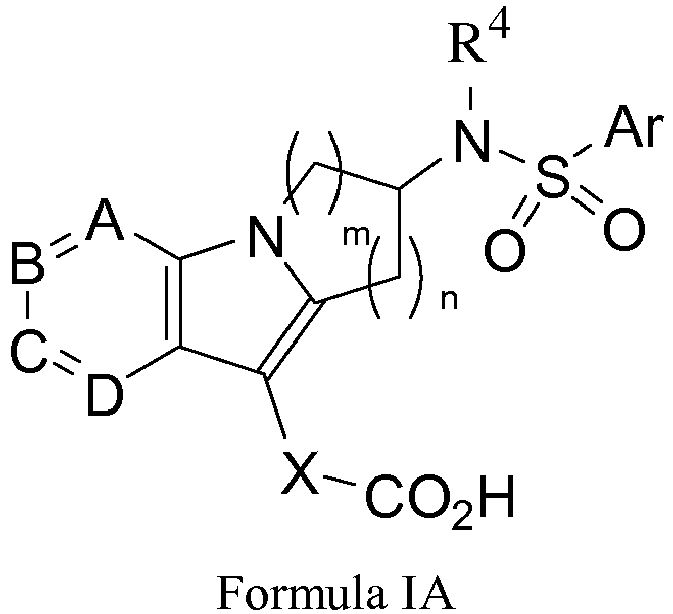
Table 1. Some representative compounds of the invention. Compounds (Cd) marked with an asterisk (*) fall outside of the scope of the claimed invention. Cd A B C D R4 X Ar n m 1 N CH CH CH CH3 CH2 Ph 2 1 2* N CH CH CH CH3 CH2 Ph 1 1 3* N CH CH CH H SCH2 Ph 2 1 4* N CH CH CH CH3 SCH2 Ph 1 1 5 N CH CH CH H CH2 4-FPh 2 1 6* N CH CH CH CH3 CH2 4-CF3Ph 1 1 7* N CH CH CH CH3 SCH2 4-ClPh 2 1 8* N CH CH CH CH3 SCH2 3,4-diFPh 1 1 9* N CCF3 CH CH CH3 CH2 Ph 2 1 10* N CCH3 CH CH CH3 CH2 Ph 2 1 11* N CH CCH3 CH CH3 CH2 4-FPh 2 1 12 CH N CH CH CH3 CH2 Ph 2 1 13* CH N CH N CH3 CH2 Ph 1 1 14* CH N CH CH CH3 SCH2 4-MeSO2Ph 2 1 15* CH N CH CH CH3 SCH2 Ph 1 1 16 CH N CH CH H CH2 4-FPh 2 1 17* CH N CH CH CH3 CH2 4-CF3Ph 1 1 18* CH N CH CH CH3 SCH2 4-ClPh 2 1 19* CH N CH CH CH3 SCH2 3,4-diFPh 1 1 20 CH N CH CH CH3 CH2 Ph 2 1 21* Ci-Pr N CH CH CH3 CH2 Ph 2 1 22* N CH CH N CH3 CH2 Ph 2 1 23 CH N CH CH C2H5 CH2 Ph 2 1 24 CH N CH CH CH3 CH2 Ph 2 1 25* N CH CH CH c-Pr CH2 Ph 2 1 26* CH CH CCH3 N CH3 CH2 Ph 2 1 27* CH CH C-iPr N CH3 CH2 Ph 1 1 28* CH CH C-cPr N CH3 SCH2 Ph 2 1 29* CH N CH N CH3 SCH2 Ph 1 1 30* CH N CCH3 N CH3 CH2 4-FPh 2 1 31* CH CH CSCH3 N CH3 CH2 4-CF3Ph 1 1 32* CH CH CH N CH3 SCH2 4-ClPh 2 1 33* CH CH CH N CH3 SCH2 3,4-diFPh 1 1 34* CH CCF3 CH N H CH2 Ph 2 1 35* CH CCH3 CH N CH3 CH2 Ph 2 1 36 CH CH CH N CH3 CH2 Ph 2 1 37* CH CH CH N CH3 CH2 Ph 1 1 38* CH CH CH N CH3 SCH2 Ph 2 1 39* CH CH CH N CH3 SCH2 Ph 1 1 40 CH CH CH N CH3 CH2 4-FPh 2 1 41* CH CH CH N CH3 CH2 4-CF3Ph 1 1 42 CH CH N CH CH3 CH2 Ph 2 1 43* CH CH N C-iPr H CH2 Ph 1 1 44* CH CH N CH CH3 SCH2 Ph 2 1 45* CH CH N CH CH3 SCH2 Ph 1 1 46 CH CH N CH CH3 CH2 4-FPh 2 1 47* CH CH N CH CH3 CH2 4-CF3Ph 1 1 48* CH CH N CH CH3 SCH2 4-ClPh 2 1 - Example B1. Radioligand binding assay. Radioligand binding assays are performed at room temperature in 10 mM HEPES/KOH pH 7.4, 1mM EDTA containing 10mM MnCl2 and 0.4 nM [3H]PGD2 (NEN, 172 Ci mmol-1), in a final volume of 0.2 ml. Competing ligands are diluted in dimethylsulfoxide (Me2SO) kept constant at 1% (v/v) of the final incubation volume. The reaction is initiated by the addition of 23 µg of membrane protein prepared from a HEK-hCRTH2 cell line. Total and non-specific binding are determined in the absence and the presence of 10 µM PGD2, respectively. Under these conditions, specific binding (total minus non-specific) of the radioligand to the receptor is expected to reach equilibrium within 50 min and is stable up to 180 min. The reaction is routinely conducted for 60 min at room temperature and terminated by rapid filtration through pre-wetted Unifilters GF/C (Packard), using a Tomtec MachIII semi-automated harvester (for HEK-hCRTH2). The filters are then washed with 4ml of the same buffer and residual radioligand bound to the filter is determined by liquid scintillation counting following equilibration in 5ml Ultima Gold™ (GF/C) or 50µl Ultima Gold F™ (Unifilter) (Packard).
- Example B2. [cAMP] measurements. HEK-hCRTH2 cells are grown to confluency on the day of the assay. The cells are washed with PBS, incubated for 3 min in cell dissociation buffer, harvested by centrifugation at 300g for 6 min at room temperature and resuspended at 106 cells ml-1 in Hanks' balanced salt solution containing 25 mM HEPES pH 7.4 (HBSS/HEPES). The assay is performed in 0.2 ml HBSS/HEPES containing 100 000 cells, 5 µM forskolin (Sigma), 100 µM RO 20-1724 (Biomol) and the test compound at various concentrations. Following a 10 min pre-incubation of the cells with a test compound at 37°C, PGD2 is added at a concentration of 3 µM to initiate the reaction. Following a 10 min incubation at 37°C, the reaction is stopped by a 3 min incubation in a boiling water bath. The samples are centrifuged for 10 min at 500g and the cAMP content in the supernatant is determined using a [125I]-cAMP scintillation proximity assay (Amersham). Maximal inhibition of forskolin stimulated cAMP production by activation of CRTH2 is determined in the presence of 1 µM PGD2. All compounds are prepared in Me2SO kept constant at 1% (v/v) of the final incubation volume.
- The CRTH2 binding affinity of compounds of Formula I were assayed by MDS Pharma Service using the following reagents and conditions:
- MDS Prostanoid CRTH2 Binding Assay (Catalog # 268030):
- Source: Human recombinant CHO-K1 cells
- Ligand: 1 nM [3H] Prostaglandin D2 (PGD2)
- Vehicle: 1% DMSO
- Incubation Time/Temp: 2 hours @ 25°C
- Incubation Buffer: 50 mM Tris-HCl, pH 7.4, 40 mM MgCl2., 0.1% BSA, 0.1% NaN3
- Non-Specific Ligand: 1 mM Prostaglandin D2 (PGD2)
- KD: 4.1 nM *
- BMAX: 13 pmole/mg Protein *
- Specific Binding: 88% *
- Quantitation Method: Radioligand Binding
- (* Historical Value)
- The following synthetic examples are provided for illustrative purposes only and are not intended to limit the scope of the invention as defined in the claims.
-

-

- To a solution of 115 g of methyl bromoacetate in 1 L of methanol was added a solution of 71 g of sodium azide in 200 mL of water over 1 h at room temperature. The reaction was slightly exothermic and the reaction mixture was stirred for 3 h and methanol was removed under reduced pressure. The remaining aqueous mixture was extracted with 3 x 1 L of ether and the ether extract was dried over Na2SO4, filtered, and concentrated to give crude title compound which was used for the next step without further purification.
-

- To a solution of NaOMe (35 mL, 4.37M in MeOH) and 70 mL of MeOH cooled at -20 °C was added a solution of 6-chloro-pyridine-3-carbaldehyde (10.9 g, 77 mmol) and azido-acetic acid methyl ester (22 g, 192.5 mmol) in 40 mL of MeOH dropwise over 10 min with a mechanical overhead stirrer. The resulting solution was stirred at 0 °C for 5 h and the cloudy mixture with light yellow solid was poured into 500 g of ice with stirring and the solid was collected by filtration, dried under vacuum to give 13 g of the intermediate. The intermediate was dissolved in 200 mL of xylene and added dropwise over 20 min into 100 mL of boiling xylene. The mixture was refluxed for additional 4 h and concentrated. The residue was swished from 50 mL of 1:1 EtOAc/hexane to give 2.6 g of the desired product. NMR shows ∼30% regioismeric indole (6-chloro-1H-pyrrolo[3,2-c]pyridine-2-carboxylic acid methyl ester) present.
6-Chloro-1H-pyrrolo[2,3-b]pyridine-2-carboxylic acid methyl ester
1H NMR (500 MHz, DMSO-d6): δ 12.80 (1H, bs), 8.18 (1H, d), 7.23 (1H, d), 7.21 (1H, s), 3.88 (3H, s).
6-Chloro-1H-pyrrolo[3,2-c]pyridine-2-carboxylic acid methyl ester
1H NMR (500 MHz, DMSO-d6): δ 12.53 (1H, bs), 8.80 (1H, s), 7.42 (1H, s), 7.35 (1H, s), 3.90 (3H, s). -

- A mixture of 0.63 g of the product of Step 2 (containing ∼30% of a regioisomer), 0.8 g of t-butyl bromoacetate and 1.5 g of Cs2CO2 in 15 mL of DMF was stirred at 60 °C for 2 h. The mixture was diluted with 30 mL of EtOAc, and filtered through a pad of silica gel. The filtrate was concentrated under reduced pressure and the residue was purified by silica gel chromatography eluted with 30% EtOAc/hexane to give 0.55 g of the desired product (fast eluting, white solid) along with 0.2 g of the isomer (slow eluting, white solid): 1-tert-butoxycarbonylmethyl-6-chloro-1H-pyrrolo[3,2-c]pyridine-2-carboxylic acid methyl ester.
1-tert-Butoxycarbonylmethyl-6-chloro-1H-pyrrolo[2,3-b]pyridine-2-carboxylic acid methyl ester
1H NMR (500 MHz, acetone-d6): δ 8.22 (1H, d), 7.38 (1H, s), 7.28 (1H, d), 5.30 (2H, s), 3.91 (3H, s), 1.46 (9H, s).
1-tert-Butoxycarbonylmethyl-6-chloro-1H-pyrrolo[3,2-c]pyridine-2-carboxylic acid methyl ester
1H NMR (500 MHz, acetone-d6): δ 8.82 (1H, s), 7.73 (1H, s), 7.50 (1H, s), 5.34 (2H, s), 3.92 (3H, s), 1.44 (9H, s). -

- To a solution of 0.5 g of (6-chloro-2-hydroxymethyl-pyrrolo[2,3-b]pyridin-1-yl)-acetic acid tert-butyl ester in 10 mL of THF cooled at -50 °C was added dropwise 3.3 mL of 1.5 M diisobutylaluminum hydride solution in toluene. The reaction mixture was stirred between - 50 °C and 0 °C for 2 h, and was then quenched by addition of 10 mL of 25% aqueous solution of K Na tartrate and 25 mL of EtOAc. After stirring for 1 h at room temperature, the organic layer was separated, dried over Na2SO4, concentrated. The residue was purified by silica gel chromatography eluted with 50% EtOAc/hexane to give 0.3 g of desired product as syrup.
1H NMR (500 MHz, acetone-d6): δ 7.95 (1H, d), 7.12 (1H, d), 6.48 (1H, s), 5.08 (2H, s), 4.77 (2H, bs), 4.42 (1H, bs), 1.46 (9H, s). -

- To a solution of 0.75 g of (6-chloro-2-hydroxymethyl-pyrrolo[2,3-b]pyridin-1-yl)-acetic acid tert-butyl ester in 50 mL of CH2Cl2 was added 1 g of Dess-Martin reagent. The mixture was stirred at room temperature for 30 min and diluted with 30 mL of CH2Cl2, filtered through a pad of silica gel. After concentration, the crude aldehyde intermediate was dissolved 40 mL of THF and treated with 1.2 g of Ph3P=CHCO2Et. The reaction mixture was stirred for 2 h at 55 °C and diluted with 30 mL of hexane, filtered through a pad of silica gel. The filtrate was concentrated and the residue was purified by silica gel chromatography eluted with 30% EtOAc/hexane to give 0.9 g of title compound as a light yellow solid.
1H NMR (500 MHz, acetone-d6): δ 8.06 (1H, d), 7.70 (1H, d), 7.22 (1H, s), 7.21 (1H, d), 6.65 (1H, d), 5.23 (2H, s), 4.24 (2H, q), 1.49 (9H, s), 1.31 (3H, t). -

- A mixture of 0.8 g of 3-(1-tert-butoxycarbonylmethyl-6-chloro-1H-pyrrolo[2,3-b]pyridin-2-yl)-acrylic acid ethyl ester and 80 mg of PtO2 in 60 mL of EtOAc was stirred under a balloon pressure of H2 for 1 h. The mixture was filtered through celite and concentrated to give crude product (0.8 g, white solid).
1H NMR (500 MHz, acetone-d6): δ 7.90 (1H, d), 7.10 (1H, d), 6.36 (1H, s), 5.03 (2H, s), 4.13 (2H, q), 3.08 (2H, t), 2.80 (2H, t), 1.50 (9H, s), 1.22 (3H, t). -

- 2.5 ml of 1M KOtBu THF solution was added to 20 mL of THF and the solution was cooled at -10°C. A solution of 3-(1-tert-butoxycarbonylmethyl-6-chloro-1H-pyrrolo[2,3-b]pyridin-2-yl)-propionic acid ethyl ester (0.73 g) in 4 mL of THF was added over 2 min. After stirring for 15 min at -10°C, 3 mL of 1 N HCL was added, followed by 10 mL brine. The mixture was extracted with 40 mL of EtOAc, dried over Na2SO4, filtered, and concentrated. The residue was dissolved in 30 mL of toluene and added 1 g of silica gel, and the resulting mixture was heated to reflux for 3 h. After cooling, the reaction mixture was filtered and concentrated. The residue was purified by silica gel chromatography eluted with 40% EtOAc/hexane to give 0.3 g of the title product as beige solid.
1H NMR (500 MHz, acetone-d6): δ 7.92 (1H, d), 7.10 (1H, d), 6.48 (1H, s), 4.78 (2H, s), 3.34 (2H, q), 2.78 (2H, t). -

- To a solution of 2-chloro-6,7-dihydro-pyrido[3,2-b]indolizin-8-one (0.3 g) in 8 mL of dichloroethane were added 1.5 mL of 2 M methylamine solution in THF, 0.18 mL of AcOH and 0.75 g of NaB(AcO)3H. The mixture was stirred for 2 h at room temperature and was then treated with ∼7 mL of IN aqueous LiOH solution until slightly basic. The resulting mixture was extracted with 3 x 20 mL of CH2Cl2, dried over Na2SO4, filtered and concentrated. The residue was dissolved in 10 mL of CH2Cl2 and treated with 0.5 mL of Et3N, 5 mg of DMAP and 0.3 g of 4-fluorobenzenesulfonyl chloride. The reaction mixture was stirred for 1 h at room temperature and then treated with 0.2 mL of water. After stirring for 10 min, the mixture was filtered through a pad of silica gel and concentrated. The residue was purified by silica gel chromatography eluted with 40% EtOAc/hexane to give 0.4 g of the title product as a white solid.
1H NMR (500 MHz, acetone-d6): δ 8.06 (2H, dd), 7.84 (1H, d), 7.45 (2H, t), 7.08 (1H, d), 6.22 (1H, s), 4.55 (1H, m), 4.32 (1H, dd), 3.92 (1H, t), 3.12 (1H, m), 3.05 (1H, m), 2.98 (3H, s), 2.03 (1H, m), 1.73 (1H, m). -

- To a solution of (±)-N-(2-chloro-6,7,8,9-tetrahydro-pyrido[3,2-b]indolizin-8-yl)-4-fluoro-N-methyl-benzenesulfonamide (0.31 g) in 15 mL of CH2Cl2 cooled at 0 °C was added 0.15 mL of oxalyl chloride. After stirring for 30 min at 0 °C, 6 mL of dry MeOH was added and stirring was continued for 20 min. The resulting solid was collected by filtration to give 0.28 g of the title compound as a white solid (containing trace of MeOH).
1H NMR (500 MHz, DMSO-d6): δ 8.18 (2H, d), 8.01 (1H, dd), 7.50 (2H, t), 7.42 (1H, d), 4.55 (1H, m), 4.20 (1H, dd), 4.08 (1H, t), 3.95 (3H, s), 3.62 (1H, dd), 3.18 (1H, m), 2.83 (3H, s), 2.00 (1H, m), 1.62 (1H, m). -

- To a solution of (±)-{2-chloro-8-[(4-fluoro-benzenesulfonyl)-methyl-amino]-6,7,8,9-tetrahydro-pyrido[3,2-b]indolizin-5-yl}-oxo-acetic acid methyl ester (0.26 g) in 4 mL of CH2Cl2 were added 4 mL of trifluoroacetic acid and 4 mL of Et3SiH. The reaction mixture was stirred overnight at room temperature and all volatile components were removed under vacuum. The residue was purified by silica gel chromatography eluted with 40% EtOAc/hexane to give 180 mg the title product as a white solid.
1H NMR (500 MHz, acetone-d6): δ 8.08 (2H, dd), 7.89 (1H, d), 7.45 (2H, t), 7.10 (1H, d), 4.52 (1H, m), 4.32 (1H, dd), 3.92 (1H, t), 3.72 (1H, d, A of AB), 3.65 (1H, d, B of AB), 3.61 (3H, s), 3.17 (1H, dd), 2.98 (3H, s), 2.92 (1H, m), 2.02 (1H, m), 1.79 (1H, m). -

- To a solution of 20 mg of (±)-{2-chloro-8-[(4-fluoro-benzenesulfonyl)-methyl-amino]-6,7,8,9-tetrahydro-pyrido[3,2-b]indolizin-5-yl}-acetic acid methyl ester in 1.2 mL ofTHF was added 1.5 mL of water, followed by 0.2 mL of 1 N aqueous LiOH solution. The mixture was stirred for 1 h at room temperature and 0.1 mL of AcOH was added, followed by 3 mL of brine. The mixture was extracted with 2 X 10 mL of EtOAc and the combined extracts was dried over Na2SO4 and concentrated to give 18 mg of the desired product as a white solid.
1H NMR (500 MHz, acetone-d6): δ 8.08 (2H, dd), 7.90 (1H, d), 7.45 (2H, t), 7.10 (1H, d), 4.53 (1H, m), 4.32 (1H, dd), 3.92 (1H, t), 3.70 (1H, d, A of AB), 3.62 (1H, d, B of AB), 3.20 (1H, dd), 3.00 (3H, s), 2.92 (1H, m), 2.02 (1H, m), 1.78 (1H, m). - (±)-{2-Chloro-8-[(4-fluorobenzenesulfonyl)-methyl-amino]-6,7,8,9-tetrahydropyrido[3,2-b]indolizin-5-yl}-acetic acid (EXAMPLE 1) was resolved on Chiralcel OJ-RH column (4.6 x 150 mm, Chiral Technologies, Cat. No. 17724, Lot No. OJRHCD-LL028) eluted with 0.05% TFA in Methanol. Two enantiomers were separated with retention time of 2.397 minute and 2.955 minute, respectively.
Example 2A: fast eluting enantiomeric 2-chloro-8-[(4-fluorobenzenesulfonyl)-methyl-amino]-6,7,8,9-tetrahydro-pyrido[3,2-b]indolizin-5-yl}-acetic acid.
Example 2B: slow eluting enantiomeric 2-chloro-8-[(4-fluorobenzenesulfonyl)-methylamino]-6,7,8,9-tetrahydro-pyrido[3,2-b]indolizin-5-yl}-acetic acid. -
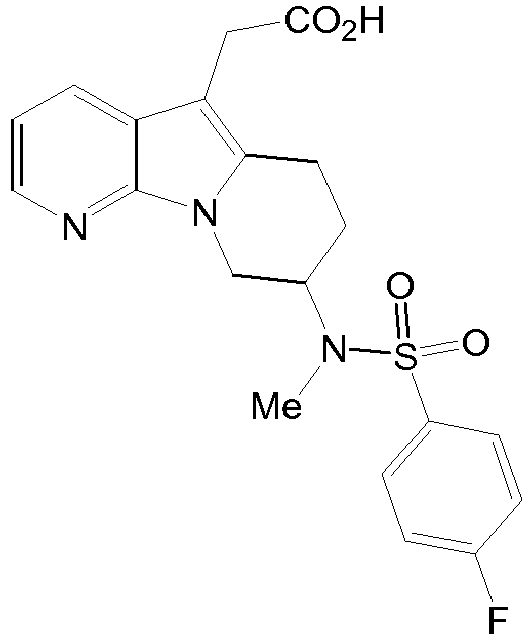
-
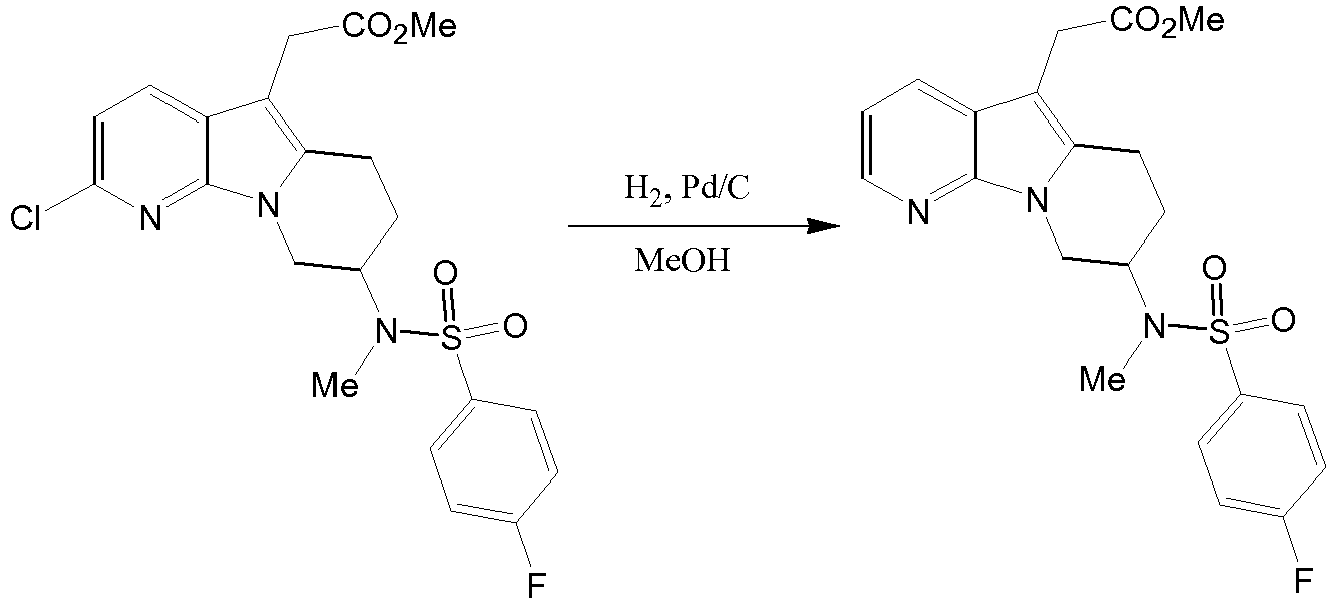
- A solution of the product of (±)-{2-chloro-8-[(4-fluoro-benzenesulfonyl)-methyl-amino]-6,7,8,9-tetrahydro-pyrido[3,2-b]indolizin-5-yl}-acetic acid methyl ester (50 mg) and 40 mg of Pd/C (20%) in 50 mL of MeOH was stirred under H2 (balloon pressure) for 16 h. The suspension was filtered through celite and the filtrate was concentrated. The residue was purified by silica gel chromatography eluted with 40% EtOAc/hexane to give 30 mg of the desired product as a white solid.
1H NMR (500 MHz, acetone-d6): δ 8.17 (1H, d), 8.10 (2H, dd), 7.85 (1H, d), 7.46 (2H, t), 7.05 (1H, dd), 4.53 (1H, m), 4.38 (1H, dd), 3.89 (1H, t), 3.70 (1H, d, A of AB), 3.64 (1H, d, B of AB), 3.62 (3H, s), 3.17 (1H, dd), 2.98 (3H, s), 2.92 (1H, m), 2.02 (1H, m), 1.78 (1H, m). -

- To a solution of (±)-{8-[(4-fluoro-benzenesulfonyl)-methyl-amino]-6,7,8,9-tetrahydro-pyrido[3,2-b]indolizin-5-yl}-acetic acid methyl ester (28 mg) in 4 mL of 1:1 THF/water was added 0.2 mL of IN aqueous LiOH solution. After stirring for 1 h at room temperature, AcOH (0.2 mL) and 4 mL of brine were added and the mixture was extracted with 2X 10 mL of EA, dried over Na2SO4. After filtration and concentration, the residue was purified by silica gel chromatography eluted with 50% EtOAc/hexane containing 5% AcOH to give 20 mg of the desired product as a white solid.
1H NMR (500 MHz, acetone-d6): δ 8.17 (1H, d), 8.10 (2H, dd), 7.88 (1H, d), 7.45 (2H, t), 7.05 (1H, dd), 4.53 (1H, m), 4.40 (1H, dd), 3.88 (1H, t), 3.67 (1H, d, A of AB), 3.60 (1H, d, B of AB), 3.18 (1H, dd), 2.98 (3H, s), 2.92 (1H, m), 2.01 (1H, m), 1.77 (1H, m). - (±)-{8-[(4-Fluoro-benzenesulfonyl)-methyl-amino]-6,7,8,9-tetrahydro-pyrido[3,2-b]indolizin-5-yl}-acetic acid (EXAMPLE 3) was resolved on Chiralcel OJ-RH column (4.6 x 150 mm, Chiral Technologies, Cat. No. 17724, Lot No. OJRHCD-LL028) eluted with 0.05% TFA in Methanol. Two enantiomers were separated with retention time of 2.041 minute and 2.669 minute, respectively.
Example 4A: fast eluting enantiomeric 8-[(4-fluoro-benzenesulfonyl)-methyl-amino]-6,7,8,9-tetrahydro-pyrido[3,2-b]indolizin-5-yl}-acetic acid.
Example 4B: slow eluting enantiomeric 8-[(4-fluoro-benzenesulfonyl)-methyl-amino]-6,7,8,9-tetrahydro-pyrido[3,2-b]indolizin-5-yl}-acetic acid. -

-

- To a solution of 0.51 g of 1-tert-butoxycarbonylmethyl-6-chloro-1H-pyrrolo[3,2-c]pyridine-2-carboxylic acid methyl ester (the slower eluting product of Step 2 of EXAMPLE 1) in 15 mL of THF cooled at -50°C was added dropwise 3.2 mL of 1.5 M DIBAL-H solution in toluene. The reaction mixture was stirred between -50°C and 0°C for 2 h, TLC showed ~ 80 % conversion (60% EtOAc/H, Rf ~0.3) and the reaction was quenched by addition of 30 mL of 25% aqueous solution of K Na tartrate and 60 mL of EtOAc. After stirring for 1 h, the organic layer was separated, and the aqueous phase was extracted with 60 mL of more EtOAc, dried over Na2SO4, filtered, and concentrated. The residue was purified by silica gel chromatography eluted with 70% EtOAc/H to give 0.27 g of desired product as syrup.
-

- 6-chloro-2-hydroxymethyl-pyrrolo[3,2-c]pyridin-1-yl)-acetic acid tert-butyl ester (0.075 g) was dissolved in 5 ml of CH2Cl2 and treated with 0.15 g of Dess-Martin reagent. The mixture was stirred at r.t. for 30 min and diluted with 10 mL of CH2Cl2, filtered through a pad of silica gel. After concentration, the residue was dissolved 10 mL of THF and treated with 0.3 g of Ph3P=CHCO2Et. The reaction mixture was stirred for 2 h at 55°C and diluted with 10 mL of hexane, filtered through a pad of silica gel. The filtrate was concentrated and the residue was purified by silica gel chromatography eluted with 40% EtOAc/hexane to give 0.09 g of the title product as a light yellow solid. MS (ESI): 365.2 (M+1).
-

- A mixture of 0.08 g of 3-(1-tert-butoxycarbonylmethyl-6-chloro-1H-pyrrolo[3,2-c]pyridin-2-yl)-acrylic acid ethyl ester and 0.015 g of PtO2 in 12 mL of EtOAc was stirred under a balloon pressure of H2 for 16 h. The mixture was filtered through celite and concentrated to give crude product (0.08 g, white solid). MS (ESI): 367.2 (M+1)
-

- A solution of 0.25 ml of 1M KOtBu THF solution and 2 mL of THF was cooled at -10 °C. A solution of 3-(1-tert-Butoxycarbonylmethyl-6-chloro-1H-pyrrolo[3,2-c]pyridin-2-yl)-propionic acid ethyl ester (0.07 g) in 0.5 mL of THF was added over 1 min. After stirring for 15 min at -10 °C, 0.3 mL of 1 N HCl and 3 mL brine were added. The mixture was extracted with 10 mL of EtOAc, and extract was dried over Na2SO4, filtered, concentrated. The residue was dissolved in 10 mL of toluene and 0.3 g of silica gel was added, and the mixture was heated to reflux for 3 h. After cooling, the reaction mixture was filtered and concentrated. The residue was used for next step without further purification. MS (ESI): 221.1 (M+1).
-

- To a solution of 3-chloro-7,8-dihydro-2,4b-diaza-fluoren-6-one (∼0.055 g) in 4 mL of dichloroethane were added 0.2 mL of 2 M methylamine solution in THF, 0.02 mL of AcOH and 0.11 g of NaB(AcO)3H. After stirring for 3 h at room temperature, the reaction mixture was treated with ∼1 mL of IN aqueous NaOH solution until slightly basic and was extracted with 3 x 7 mL of CH2Cl2, dried over Na2SO4, filtered and concentrated. The residue was dissolved in 2 mL of CH2Cl2 and treated with 0.1 mL of Et3N, 1 mg of DMAP and 0.1 g of 4-fluorobenzenesulfonyl chloride. After stirring for 1 h at room temperature, 0.1 mL of water was added to the reaction mixture and after stirring for 30 min, the mixture was filtered through a pad of silica gel and concentrated. The residue was purified by silica gel chromatography eluted with 50% EtOAc/hexane to give 0.008 g of the title product as a white solid. MS (ESI): 394.1 (M+1).
-

- (±)-N-(3-Chloro-5,6,7,8-tetrahydro-2,4b-diaza-fluoren-6-yl)-4-fluoro-N-methyl-benzenesulfonamide (0.008 g) was dissolved in 0.4 mL of ClCOCO2Me and the solution was stirred for 3 days at 45°C. The reaction mixture was then concentrated under vacuum to give the 0.009 g of the title compound. MS (ESI): 480.1 (M+1).
-

- To a solution of (±)-{3-chloro-6-[(4-fluoro-benzenesulfonyl)-methyl-amino]-5,6,7,8-tetrahydro-2,4b-diaza-fluoren-9-yl}-oxo-acetic acid methyl ester (0.006 g) in 0.2 mL of CH2Cl2 were added 0.2 mL of TFA and 0.2 mL of Et3SiH. The reaction mixture was stirred overnight at r.t. and concentrated under vacuum. The residue was purified by silica gel chromatography eluted with 50% EtOAc/hexane to give 0.005 g desired product as a white solid. MS (ESI): 466.1 (M+1).
-

- To a solution of 4 mg of (±)-{3-chloro-6-[(4-fluoro-benzenesulfonyl)-methyl-amino]-5,6,7,8-tetrahydro-2,4b-diaza-fluoren-9-yl}-acetic acid methyl ester in 0.2 mL of THF was added 0.1 mL of water, followed by 0.02 mL of 1 N aq. LiOH solution. After stirring for 1 h at room temperature, 0.05 mL of AcOH was added. The reaction mixture was the dried with a jet flow of nitrogen. The residue was suspended in 0.3 mL of EtOAc and filtered through silica gel. The filtrate was concentrated to give 2 mg of the title compound as a white solid. MS (ESI): 452.1 (M+1).
-
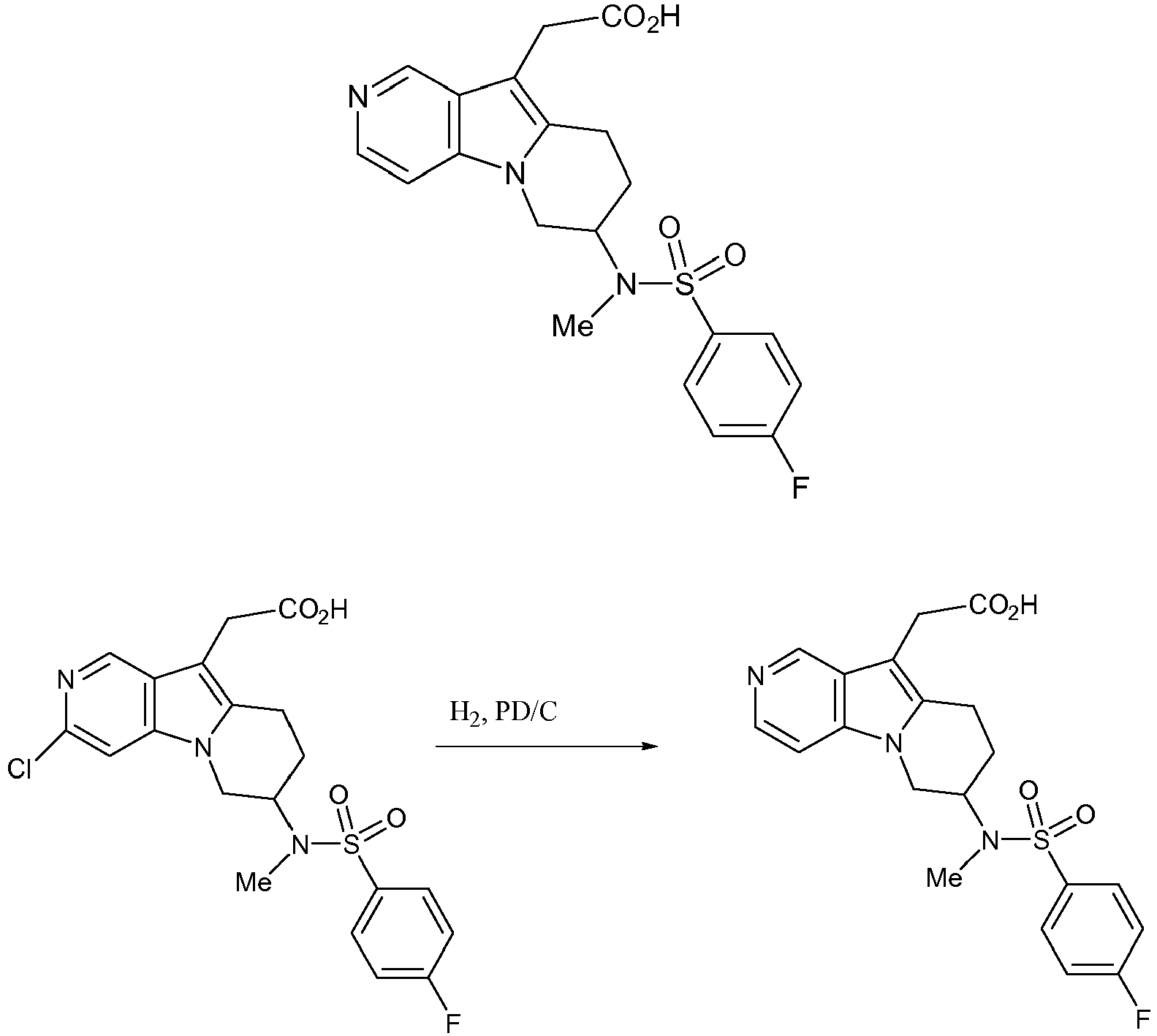
- A solution of (±)-{3-chloro-6-[(4-fluoro-benzenesulfonyl)-methyl-amino]-5,6,7,8-tetrahydro-2,4b-diaza-fluoren-9-yl}-acetic acid (2 mg) and 2 mg of Pd/C (20%) in 0.5 mL of MeOH was stirred under H2 (balloon pressure) for 8 h. The suspension was filtered through celite and the filtrate was concentrated to give the title compound. MS (ESI): 418.0 (M+1).
- It is to be understood that the foregoing relates to exemplary embodiments of the invention, and that the invention may find applications other than those described herein. None of the examples presented herein are to be construed as limiting the present invention in any way; variations and modifications may be made without departing from the scope of the invention as set forth in the following claims.
| Example | Concentration | % inhibition |
| Example 2A | 20 nM | 97 |
| Example 2B | 20 nM | 0 |
| Example 4A | 20 nM | 91 |
| Example 4B | 20 nM | 0 |
Claims (12)
- A compound of formula I:
 one of A, B, C and D is N and each of the others is independently selected from CH and C(R1);m is 1;n is 2;R1 is halogen;R2 and R3 are hydrogen;R4 is selected from H, C1-6 alkyl or halogenated C1-6 alkyl;Ar is phenyl substituted with 1 or 2 groups independently selected from halogen and C1-6 alkoxy;X is CH2;andY is -S(O)2- or -C(O)-.
 - The compound or salt thereof of Claim 1 wherein R4 is methyl.
- A compound of Claim 1 which is (±)-{2-Chloro-8-[(4-fluorobenzenesulfonyl)-methyl-amino]-6,7,8,9-tetrahydro-pyrido[3,2-b]indolizin-5-yl}-acetic acid.
- An enantiomer of the compound of Claim 3 which is the fast eluting compound on a 150 mm long x 4.6 mm internal diameter Chiralcel OJ-RH column (Chiral Technologies, Inc.) eluted with 0.05% TFA in methanol.
- A pharmaceutical composition comprising in association with a pharmaceutically acceptable carrier, diluent, or excipient, the compound or salt thereof as claimed in Claim 1.
- A prodrug of a compound or salt thereof of Claim 1 wherein the prodrug is an ester or amide derivative of said compound of Claim 1.
- Use of a compound or salt thereof of Claim 1 in the manufacture of a medicament for the treatment or prevention of a CRTH2-mediated disease selected from allergic rhinitis, nasal congestion, rhinorrhea, perennial rhinitis, nasal inflammation, asthma including allergic asthma, chronic obstructive pulmonary diseases and other forms of lung inflammation; sleep disorders and sleep-wake cycle disorders; prostanoid-induced smooth muscle contraction associated with dysmenorrhea and premature labor; eosinophil related disorders; thrombosis; glaucoma and vision disorders; occlusive vascular diseases; congestive heart failure; diseases or conditions requiring a treatment of anti-coagulation such as post-injury or post surgery treatment; inflammation; gangrene; Raynaud's disease; mucus secretion disorders including cytoprotection; pain and migraine; diseases requiring control of bone formation and resorption such as for example osteoporosis; shock; thermal regulation including fever; and immune disorders or conditions in which immunoregulation is desirable.
- A compound or salt thereof of Claim 1 in combination with one or more other therapeutic agents selected from corticosteroids and beta-agonists for use in the treatment of a respiratory or an inflammatory disease.
- A composition comprising a compound or salt thereof of Claim 1 with an inhibitor of 5-lipoxygenase and/or 5-lipoxygenase activating protein.
- A composition comprising a compound or salt thereof of Claim 1 with one selected from the group consisting of: an antagonist of leukotriene receptors; a DP antagonist; a muscarinic receptor antagonist selected from the group consisting of tiotropium bromide, ipratropium bromide and glycopyrronium bromide; a Histamine H1 receptor antagonist; a Syk tyrosine kinase inhibitor; a CXCR2 antagonist; a non-steroidal anti-inflammatory agent; and a TP receptor antagonist.
- A composition as in Claim 10 wherein said leukotriene receptor antagonist is montelukast, or said DP antagonist is laropiprant.
- A compound or salt thereof as claimed in Claim 1 for use in treating or preventing a CRTH2 -mediated disease in a mammal, wherein said CRTH2-mediated disease is selected from allergic rhinitis, nasal congestion, rhinorrhea, perennial rhinitis, nasal inflammation, asthma including allergic asthma, chronic obstructive pulmonary diseases and other forms of lung inflammation; sleep disorders and sleep-wake cycle disorders; prostanoid-induced smooth muscle contraction associated with dysmenorrhea and premature labor; eosinophil related disorders; thrombosis; glaucoma and vision disorders; occlusive vascular diseases; congestive heart failure; diseases or conditions requiring a treatment of anti-coagulation such as post-injury or post surgery treatment; inflammation; gangrene; Raynaud's disease; mucus secretion disorders including cytoprotection; pain and migraine; diseases requiring control of bone formation and resorption such as for example osteoporosis; shock; thermal regulation including fever; and immune disorders or conditions in which immunoregulation is desirable.
Applications Claiming Priority (2)
| Application Number | Priority Date | Filing Date | Title |
|---|---|---|---|
| US99829807P | 2007-10-10 | 2007-10-10 | |
| PCT/US2008/079303 WO2009049021A1 (en) | 2007-10-10 | 2008-10-09 | Heterocyclic compounds as crth2 receptor antagonists |
Publications (3)
| Publication Number | Publication Date |
|---|---|
| EP2197438A1 EP2197438A1 (en) | 2010-06-23 |
| EP2197438A4 EP2197438A4 (en) | 2011-10-12 |
| EP2197438B1 true EP2197438B1 (en) | 2015-07-15 |
Family
ID=40549546
Family Applications (1)
| Application Number | Title | Priority Date | Filing Date |
|---|---|---|---|
| EP08838211.4A Active EP2197438B1 (en) | 2007-10-10 | 2008-10-09 | Heterocyclic compounds as crth2 receptor antagonists |
Country Status (12)
| Country | Link |
|---|---|
| US (1) | US8772312B2 (en) |
| EP (1) | EP2197438B1 (en) |
| JP (2) | JP2011500584A (en) |
| KR (2) | KR101442663B1 (en) |
| CN (1) | CN101896178B (en) |
| AU (1) | AU2008310874B2 (en) |
| BR (1) | BRPI0815948A2 (en) |
| CA (1) | CA2700824C (en) |
| ES (1) | ES2548577T3 (en) |
| IL (1) | IL204823A0 (en) |
| RU (1) | RU2451019C2 (en) |
| WO (1) | WO2009049021A1 (en) |
Families Citing this family (20)
| Publication number | Priority date | Publication date | Assignee | Title |
|---|---|---|---|---|
| JP2011526281A (en) | 2008-06-24 | 2011-10-06 | アミラ ファーマシューティカルズ,インク. | Cycloalkane [B] indole antagonist of prostaglandin D2 receptor |
| AU2009295231A1 (en) * | 2008-09-22 | 2010-03-25 | Merck Canada Inc. | Azaindole derivatives as CRTH2 receptor antagonists |
| US8637671B2 (en) | 2008-09-22 | 2014-01-28 | Merck Canada Inc. | Indole derivatives as CRTH2 receptor antagonists |
| GB2465062B (en) | 2008-11-06 | 2011-04-13 | Amira Pharmaceuticals Inc | Cycloalkane(B)azaindole antagonists of prostaglandin D2 receptors |
| SG176628A1 (en) | 2009-06-05 | 2012-01-30 | Link Medicine Corp | Aminopyrrolidinone derivatives and uses thereof |
| CA2790139C (en) | 2010-03-22 | 2018-03-13 | Actelion Pharmaceuticals Ltd | 3-(heteroaryl-amino)-1,2,3,4-tetrahydro-9h-carbazole derivatives and their use as prostaglandin d2 receptor modulators |
| EP2457900A1 (en) | 2010-11-25 | 2012-05-30 | Almirall, S.A. | New pyrazole derivatives having CRTh2 antagonistic behaviour |
| WO2012107364A1 (en) * | 2011-02-07 | 2012-08-16 | Scipharm Sàrl | Novel composition for the treatment of cystic fibrosis |
| JP5964945B2 (en) | 2011-04-14 | 2016-08-03 | アクテリオン ファーマシューティカルズ リミテッドActelion Pharmaceuticals Ltd | 7- (Heteroaryl-amino) -6,7,8,9-tetrahydropyrido [1,2-a] indoleacetic acid derivatives and their use as prostaglandin D2 receptor modulators |
| CA2939892C (en) | 2014-03-17 | 2020-03-31 | Idorsia Pharmaceuticals Ltd | Azaindole acetic acid derivatives and their use as prostaglandin d2 receptor modulators |
| CN106103437A (en) | 2014-03-18 | 2016-11-09 | 埃科特莱茵药品有限公司 | Azaindole acetogenin and the purposes as prostaglandin D 2 receptor regulator thereof |
| WO2016128565A1 (en) * | 2015-02-13 | 2016-08-18 | Institut National De La Sante Et De La Recherche Medicale (Inserm) | Ptgdr-1 and/or ptgdr-2 antagonists for preventing and/or treating systemic lupus erythematosus |
| WO2017005759A1 (en) * | 2015-07-07 | 2017-01-12 | Intervet International B.V. | A process to make azaindole derivatives |
| WO2017005764A1 (en) * | 2015-07-07 | 2017-01-12 | Intervet International B.V. | A process to make tricycloketone intermediates of crth2 antagonists |
| CN108026093B (en) | 2015-09-15 | 2021-11-16 | 爱杜西亚药品有限公司 | Crystalline forms |
| ES2805307T3 (en) * | 2015-09-29 | 2021-02-11 | Novartis Ag | Procedure for preparing 1- (4-methanesulfonyl-2-trifluoromethyl-benzyl) -2-methyl-1H-pyrrolo [2,3-b] pyridin-3-yl-acetic acid |
| JOP20190223A1 (en) * | 2017-04-01 | 2019-09-26 | Novartis Ag | Process for preparing 1-(4-methanesulfonyl-2-trifluoromethyl-benzyl)-2-methyl-1h-pyrrolo [2,3-b]pyridin-3-yl-acetic acid |
| US20220098197A1 (en) * | 2019-01-10 | 2022-03-31 | Cspc Zhongqi Pharmaceutical Technology (Shijiazhuang) Co., Ltd | Salts of heterocyclic compound and use thereof |
| WO2020143781A1 (en) * | 2019-01-10 | 2020-07-16 | 石药集团中奇制药技术(石家庄)有限公司 | Crystal form of heterocyclic compound as crth2 receptor antagonist |
| CN114502164B (en) * | 2019-05-22 | 2024-01-26 | 石药集团中奇制药技术(石家庄)有限公司 | Applications of heterocyclic compounds and their salts |
Family Cites Families (7)
| Publication number | Priority date | Publication date | Assignee | Title |
|---|---|---|---|---|
| ATE340796T1 (en) * | 2001-05-23 | 2006-10-15 | Merck Frosst Canada Inc | DIHYDROPYRROLO(1,2-AÖINDOLE AND TETRAHYDROPYRIDO)1,2-AÖINDOLE DERIVATIVES AS PROSTAGLANDIN RECEPTOR ANTAGONISTS |
| CN1732171A (en) * | 2002-10-30 | 2006-02-08 | 麦克弗罗斯特(加拿大)公司 | Pyridopyrrolizine and pyridoindolizine derivatives |
| BR0315681A (en) * | 2002-10-30 | 2005-09-06 | Merck Frosst Canada Inc | Compound and its pharmaceutically acceptable salts and hydrates, pharmaceutical composition, methods for treating prostaglandin d2-mediated diseases, treating nasal congestion, treating allergic asthma, and treating allergic rhinitis, compound or a salt thereof or pharmaceutically acceptable solvate, salt or hydrate of the compound, and use of a compound or a pharmaceutically acceptable salt or solvate thereof |
| US7714132B2 (en) * | 2004-03-11 | 2010-05-11 | Actelion Pharmaceuticals, Ltd. | Tetrahydropyridoindole derivatives |
| JP4708885B2 (en) * | 2005-07-06 | 2011-06-22 | 日本電気株式会社 | Encoding device, portable terminal device, and pixel color information encoding method used therefor |
| AU2006281937B2 (en) * | 2005-08-12 | 2011-11-17 | Merck Canada Inc. | Indole derivatives as CRTH2 receptor antagonists |
| US20110112134A1 (en) | 2008-05-16 | 2011-05-12 | Amira Pharmaceuticals, Inc. | Tricyclic Antagonists of Prostaglandin D2 Receptors |
-
2008
- 2008-10-09 WO PCT/US2008/079303 patent/WO2009049021A1/en not_active Ceased
- 2008-10-09 CN CN2008801092963A patent/CN101896178B/en active Active
- 2008-10-09 KR KR1020107010092A patent/KR101442663B1/en not_active Expired - Fee Related
- 2008-10-09 EP EP08838211.4A patent/EP2197438B1/en active Active
- 2008-10-09 CA CA2700824A patent/CA2700824C/en active Active
- 2008-10-09 KR KR1020137011440A patent/KR20130069840A/en not_active Ceased
- 2008-10-09 BR BRPI0815948A patent/BRPI0815948A2/en not_active IP Right Cessation
- 2008-10-09 AU AU2008310874A patent/AU2008310874B2/en not_active Ceased
- 2008-10-09 RU RU2010117156/04A patent/RU2451019C2/en active
- 2008-10-09 US US12/681,356 patent/US8772312B2/en active Active
- 2008-10-09 JP JP2010529022A patent/JP2011500584A/en active Pending
- 2008-10-09 ES ES08838211.4T patent/ES2548577T3/en active Active
-
2010
- 2010-03-28 IL IL204823A patent/IL204823A0/en unknown
-
2013
- 2013-06-19 JP JP2013128863A patent/JP5680146B2/en not_active Expired - Fee Related
Also Published As
| Publication number | Publication date |
|---|---|
| HK1147674A1 (en) | 2011-08-19 |
| AU2008310874B2 (en) | 2012-03-15 |
| JP2011500584A (en) | 2011-01-06 |
| CA2700824C (en) | 2013-12-10 |
| CN101896178A (en) | 2010-11-24 |
| IL204823A0 (en) | 2010-11-30 |
| KR20130069840A (en) | 2013-06-26 |
| US8772312B2 (en) | 2014-07-08 |
| KR101442663B1 (en) | 2014-09-22 |
| CA2700824A1 (en) | 2009-04-16 |
| US20100222270A1 (en) | 2010-09-02 |
| EP2197438A4 (en) | 2011-10-12 |
| RU2451019C2 (en) | 2012-05-20 |
| BRPI0815948A2 (en) | 2019-09-24 |
| JP5680146B2 (en) | 2015-03-04 |
| WO2009049021A1 (en) | 2009-04-16 |
| AU2008310874A1 (en) | 2009-04-16 |
| KR20100065398A (en) | 2010-06-16 |
| EP2197438A1 (en) | 2010-06-23 |
| JP2013209425A (en) | 2013-10-10 |
| RU2010117156A (en) | 2011-11-20 |
| ES2548577T3 (en) | 2015-10-19 |
| CN101896178B (en) | 2013-11-20 |
Similar Documents
| Publication | Publication Date | Title |
|---|---|---|
| US8772312B2 (en) | Heterocyclic compounds as CRTH2 receptor antagonists | |
| EP1915372B1 (en) | Indole derivatives as crth2 receptor antagonists | |
| EP2346865B1 (en) | Indole derivatives as crth2 receptor antagonists | |
| EP2344497B1 (en) | Azaindole derivatives as crth2 receptor antagonists | |
| EP1558614B1 (en) | Pyridopyrrolizine and pyridoindolizine derivatives | |
| US8394819B2 (en) | Indole derivatives as CRTH2 receptor antagonists | |
| HK1147674B (en) | Heterocyclic compounds as crth2 receptor antagonists | |
| HK1168592A (en) | Indole derivatives as crth2 receptor antagonists in combination with a second active ingredient |
Legal Events
| Date | Code | Title | Description |
|---|---|---|---|
| PUAI | Public reference made under article 153(3) epc to a published international application that has entered the european phase |
Free format text: ORIGINAL CODE: 0009012 |
|
| 17P | Request for examination filed |
Effective date: 20100504 |
|
| AK | Designated contracting states |
Kind code of ref document: A1 Designated state(s): AT BE BG CH CY CZ DE DK EE ES FI FR GB GR HR HU IE IS IT LI LT LU LV MC MT NL NO PL PT RO SE SI SK TR |
|
| AX | Request for extension of the european patent |
Extension state: AL BA MK RS |
|
| DAX | Request for extension of the european patent (deleted) | ||
| REG | Reference to a national code |
Ref country code: DE Ref legal event code: R079 Ref document number: 602008039061 Country of ref document: DE Free format text: PREVIOUS MAIN CLASS: A61K0031405000 Ipc: C07D0471140000 |
|
| A4 | Supplementary search report drawn up and despatched |
Effective date: 20110914 |
|
| RIC1 | Information provided on ipc code assigned before grant |
Ipc: A61K 31/437 20060101ALI20110908BHEP Ipc: C07D 471/14 20060101AFI20110908BHEP Ipc: A61P 29/00 20060101ALI20110908BHEP |
|
| 17Q | First examination report despatched |
Effective date: 20130212 |
|
| RAP1 | Party data changed (applicant data changed or rights of an application transferred) |
Owner name: CENTAURUS BIOPHARMA CO., LTD. Owner name: CSPC ZHONGQI PHARMACEUTICAL TECHNOLOGY (SHIJIAZHUA |
|
| GRAP | Despatch of communication of intention to grant a patent |
Free format text: ORIGINAL CODE: EPIDOSNIGR1 |
|
| INTG | Intention to grant announced |
Effective date: 20150129 |
|
| GRAS | Grant fee paid |
Free format text: ORIGINAL CODE: EPIDOSNIGR3 |
|
| GRAA | (expected) grant |
Free format text: ORIGINAL CODE: 0009210 |
|
| AK | Designated contracting states |
Kind code of ref document: B1 Designated state(s): AT BE BG CH CY CZ DE DK EE ES FI FR GB GR HR HU IE IS IT LI LT LU LV MC MT NL NO PL PT RO SE SI SK TR |
|
| REG | Reference to a national code |
Ref country code: CH Ref legal event code: EP Ref country code: GB Ref legal event code: FG4D |
|
| REG | Reference to a national code |
Ref country code: IE Ref legal event code: FG4D |
|
| REG | Reference to a national code |
Ref country code: AT Ref legal event code: REF Ref document number: 736714 Country of ref document: AT Kind code of ref document: T Effective date: 20150815 |
|
| REG | Reference to a national code |
Ref country code: DE Ref legal event code: R096 Ref document number: 602008039061 Country of ref document: DE |
|
| REG | Reference to a national code |
Ref country code: SE Ref legal event code: TRGR |
|
| REG | Reference to a national code |
Ref country code: CH Ref legal event code: NV Representative=s name: MICHELI AND CIE SA, CH |
|
| REG | Reference to a national code |
Ref country code: ES Ref legal event code: FG2A Ref document number: 2548577 Country of ref document: ES Kind code of ref document: T3 Effective date: 20151019 |
|
| REG | Reference to a national code |
Ref country code: FR Ref legal event code: PLFP Year of fee payment: 8 |
|
| REG | Reference to a national code |
Ref country code: NL Ref legal event code: FP |
|
| REG | Reference to a national code |
Ref country code: AT Ref legal event code: MK05 Ref document number: 736714 Country of ref document: AT Kind code of ref document: T Effective date: 20150715 |
|
| REG | Reference to a national code |
Ref country code: LT Ref legal event code: MG4D |
|
| PG25 | Lapsed in a contracting state [announced via postgrant information from national office to epo] |
Ref country code: GR Free format text: LAPSE BECAUSE OF FAILURE TO SUBMIT A TRANSLATION OF THE DESCRIPTION OR TO PAY THE FEE WITHIN THE PRESCRIBED TIME-LIMIT Effective date: 20151016 Ref country code: LT Free format text: LAPSE BECAUSE OF FAILURE TO SUBMIT A TRANSLATION OF THE DESCRIPTION OR TO PAY THE FEE WITHIN THE PRESCRIBED TIME-LIMIT Effective date: 20150715 Ref country code: LV Free format text: LAPSE BECAUSE OF FAILURE TO SUBMIT A TRANSLATION OF THE DESCRIPTION OR TO PAY THE FEE WITHIN THE PRESCRIBED TIME-LIMIT Effective date: 20150715 Ref country code: NO Free format text: LAPSE BECAUSE OF FAILURE TO SUBMIT A TRANSLATION OF THE DESCRIPTION OR TO PAY THE FEE WITHIN THE PRESCRIBED TIME-LIMIT Effective date: 20151015 Ref country code: FI Free format text: LAPSE BECAUSE OF FAILURE TO SUBMIT A TRANSLATION OF THE DESCRIPTION OR TO PAY THE FEE WITHIN THE PRESCRIBED TIME-LIMIT Effective date: 20150715 |
|
| PG25 | Lapsed in a contracting state [announced via postgrant information from national office to epo] |
Ref country code: AT Free format text: LAPSE BECAUSE OF FAILURE TO SUBMIT A TRANSLATION OF THE DESCRIPTION OR TO PAY THE FEE WITHIN THE PRESCRIBED TIME-LIMIT Effective date: 20150715 Ref country code: PL Free format text: LAPSE BECAUSE OF FAILURE TO SUBMIT A TRANSLATION OF THE DESCRIPTION OR TO PAY THE FEE WITHIN THE PRESCRIBED TIME-LIMIT Effective date: 20150715 Ref country code: PT Free format text: LAPSE BECAUSE OF FAILURE TO SUBMIT A TRANSLATION OF THE DESCRIPTION OR TO PAY THE FEE WITHIN THE PRESCRIBED TIME-LIMIT Effective date: 20151116 Ref country code: HR Free format text: LAPSE BECAUSE OF FAILURE TO SUBMIT A TRANSLATION OF THE DESCRIPTION OR TO PAY THE FEE WITHIN THE PRESCRIBED TIME-LIMIT Effective date: 20150715 |
|
| REG | Reference to a national code |
Ref country code: DE Ref legal event code: R097 Ref document number: 602008039061 Country of ref document: DE |
|
| PG25 | Lapsed in a contracting state [announced via postgrant information from national office to epo] |
Ref country code: DK Free format text: LAPSE BECAUSE OF FAILURE TO SUBMIT A TRANSLATION OF THE DESCRIPTION OR TO PAY THE FEE WITHIN THE PRESCRIBED TIME-LIMIT Effective date: 20150715 Ref country code: SK Free format text: LAPSE BECAUSE OF FAILURE TO SUBMIT A TRANSLATION OF THE DESCRIPTION OR TO PAY THE FEE WITHIN THE PRESCRIBED TIME-LIMIT Effective date: 20150715 Ref country code: CZ Free format text: LAPSE BECAUSE OF FAILURE TO SUBMIT A TRANSLATION OF THE DESCRIPTION OR TO PAY THE FEE WITHIN THE PRESCRIBED TIME-LIMIT Effective date: 20150715 Ref country code: EE Free format text: LAPSE BECAUSE OF FAILURE TO SUBMIT A TRANSLATION OF THE DESCRIPTION OR TO PAY THE FEE WITHIN THE PRESCRIBED TIME-LIMIT Effective date: 20150715 |
|
| PLBE | No opposition filed within time limit |
Free format text: ORIGINAL CODE: 0009261 |
|
| STAA | Information on the status of an ep patent application or granted ep patent |
Free format text: STATUS: NO OPPOSITION FILED WITHIN TIME LIMIT |
|
| REG | Reference to a national code |
Ref country code: DE Ref legal event code: R082 Ref document number: 602008039061 Country of ref document: DE Representative=s name: HERNANDEZ, YORCK, DIPL.-ING., DE |
|
| PG25 | Lapsed in a contracting state [announced via postgrant information from national office to epo] |
Ref country code: LU Free format text: LAPSE BECAUSE OF FAILURE TO SUBMIT A TRANSLATION OF THE DESCRIPTION OR TO PAY THE FEE WITHIN THE PRESCRIBED TIME-LIMIT Effective date: 20151009 Ref country code: RO Free format text: LAPSE BECAUSE OF FAILURE TO SUBMIT A TRANSLATION OF THE DESCRIPTION OR TO PAY THE FEE WITHIN THE PRESCRIBED TIME-LIMIT Effective date: 20150715 |
|
| 26N | No opposition filed |
Effective date: 20160418 |
|
| PG25 | Lapsed in a contracting state [announced via postgrant information from national office to epo] |
Ref country code: MC Free format text: LAPSE BECAUSE OF FAILURE TO SUBMIT A TRANSLATION OF THE DESCRIPTION OR TO PAY THE FEE WITHIN THE PRESCRIBED TIME-LIMIT Effective date: 20150715 Ref country code: IS Free format text: LAPSE BECAUSE OF FAILURE TO SUBMIT A TRANSLATION OF THE DESCRIPTION OR TO PAY THE FEE WITHIN THE PRESCRIBED TIME-LIMIT Effective date: 20150715 |
|
| PG25 | Lapsed in a contracting state [announced via postgrant information from national office to epo] |
Ref country code: SI Free format text: LAPSE BECAUSE OF FAILURE TO SUBMIT A TRANSLATION OF THE DESCRIPTION OR TO PAY THE FEE WITHIN THE PRESCRIBED TIME-LIMIT Effective date: 20150715 |
|
| REG | Reference to a national code |
Ref country code: FR Ref legal event code: PLFP Year of fee payment: 9 |
|
| PG25 | Lapsed in a contracting state [announced via postgrant information from national office to epo] |
Ref country code: BE Free format text: LAPSE BECAUSE OF FAILURE TO SUBMIT A TRANSLATION OF THE DESCRIPTION OR TO PAY THE FEE WITHIN THE PRESCRIBED TIME-LIMIT Effective date: 20150715 |
|
| PG25 | Lapsed in a contracting state [announced via postgrant information from national office to epo] |
Ref country code: BG Free format text: LAPSE BECAUSE OF FAILURE TO SUBMIT A TRANSLATION OF THE DESCRIPTION OR TO PAY THE FEE WITHIN THE PRESCRIBED TIME-LIMIT Effective date: 20150715 Ref country code: HU Free format text: LAPSE BECAUSE OF FAILURE TO SUBMIT A TRANSLATION OF THE DESCRIPTION OR TO PAY THE FEE WITHIN THE PRESCRIBED TIME-LIMIT; INVALID AB INITIO Effective date: 20081009 |
|
| PG25 | Lapsed in a contracting state [announced via postgrant information from national office to epo] |
Ref country code: CY Free format text: LAPSE BECAUSE OF FAILURE TO SUBMIT A TRANSLATION OF THE DESCRIPTION OR TO PAY THE FEE WITHIN THE PRESCRIBED TIME-LIMIT Effective date: 20150715 |
|
| PG25 | Lapsed in a contracting state [announced via postgrant information from national office to epo] |
Ref country code: TR Free format text: LAPSE BECAUSE OF FAILURE TO SUBMIT A TRANSLATION OF THE DESCRIPTION OR TO PAY THE FEE WITHIN THE PRESCRIBED TIME-LIMIT Effective date: 20150715 Ref country code: MT Free format text: LAPSE BECAUSE OF FAILURE TO SUBMIT A TRANSLATION OF THE DESCRIPTION OR TO PAY THE FEE WITHIN THE PRESCRIBED TIME-LIMIT Effective date: 20150715 |
|
| REG | Reference to a national code |
Ref country code: FR Ref legal event code: PLFP Year of fee payment: 10 |
|
| REG | Reference to a national code |
Ref country code: FR Ref legal event code: PLFP Year of fee payment: 11 |
|
| P01 | Opt-out of the competence of the unified patent court (upc) registered |
Effective date: 20230529 |
|
| PGFP | Annual fee paid to national office [announced via postgrant information from national office to epo] |
Ref country code: IE Payment date: 20230911 Year of fee payment: 16 Ref country code: GB Payment date: 20230911 Year of fee payment: 16 |
|
| PGFP | Annual fee paid to national office [announced via postgrant information from national office to epo] |
Ref country code: SE Payment date: 20230919 Year of fee payment: 16 Ref country code: NL Payment date: 20231023 Year of fee payment: 16 Ref country code: FR Payment date: 20230911 Year of fee payment: 16 |
|
| PGFP | Annual fee paid to national office [announced via postgrant information from national office to epo] |
Ref country code: ES Payment date: 20231117 Year of fee payment: 16 |
|
| PGFP | Annual fee paid to national office [announced via postgrant information from national office to epo] |
Ref country code: IT Payment date: 20231031 Year of fee payment: 16 Ref country code: DE Payment date: 20231018 Year of fee payment: 16 Ref country code: CH Payment date: 20231102 Year of fee payment: 16 |
|
| REG | Reference to a national code |
Ref country code: DE Ref legal event code: R119 Ref document number: 602008039061 Country of ref document: DE |
|
| REG | Reference to a national code |
Ref country code: CH Ref legal event code: PL |
|
| REG | Reference to a national code |
Ref country code: SE Ref legal event code: EUG |
|
| REG | Reference to a national code |
Ref country code: NL Ref legal event code: MM Effective date: 20241101 |
|
| GBPC | Gb: european patent ceased through non-payment of renewal fee |
Effective date: 20241009 |
|
| PG25 | Lapsed in a contracting state [announced via postgrant information from national office to epo] |
Ref country code: DE Free format text: LAPSE BECAUSE OF NON-PAYMENT OF DUE FEES Effective date: 20250501 |
|
| PG25 | Lapsed in a contracting state [announced via postgrant information from national office to epo] |
Ref country code: GB Free format text: LAPSE BECAUSE OF NON-PAYMENT OF DUE FEES Effective date: 20241009 |
|
| PG25 | Lapsed in a contracting state [announced via postgrant information from national office to epo] |
Ref country code: NL Free format text: LAPSE BECAUSE OF NON-PAYMENT OF DUE FEES Effective date: 20241101 |
|
| PG25 | Lapsed in a contracting state [announced via postgrant information from national office to epo] |
Ref country code: FR Free format text: LAPSE BECAUSE OF NON-PAYMENT OF DUE FEES Effective date: 20241031 |
|
| PG25 | Lapsed in a contracting state [announced via postgrant information from national office to epo] |
Ref country code: CH Free format text: LAPSE BECAUSE OF NON-PAYMENT OF DUE FEES Effective date: 20241031 |
|
| PG25 | Lapsed in a contracting state [announced via postgrant information from national office to epo] |
Ref country code: SE Free format text: LAPSE BECAUSE OF NON-PAYMENT OF DUE FEES Effective date: 20241010 Ref country code: IT Free format text: LAPSE BECAUSE OF NON-PAYMENT OF DUE FEES Effective date: 20241009 |
|
| PG25 | Lapsed in a contracting state [announced via postgrant information from national office to epo] |
Ref country code: IE Free format text: LAPSE BECAUSE OF NON-PAYMENT OF DUE FEES Effective date: 20241009 |
|
| REG | Reference to a national code |
Ref country code: ES Ref legal event code: FD2A Effective date: 20251128 |
|
| PG25 | Lapsed in a contracting state [announced via postgrant information from national office to epo] |
Ref country code: ES Free format text: LAPSE BECAUSE OF NON-PAYMENT OF DUE FEES Effective date: 20241010 |