EP2196326A1 - Polymers, rubber compositions, and tires - Google Patents
Polymers, rubber compositions, and tires Download PDFInfo
- Publication number
- EP2196326A1 EP2196326A1 EP09177567A EP09177567A EP2196326A1 EP 2196326 A1 EP2196326 A1 EP 2196326A1 EP 09177567 A EP09177567 A EP 09177567A EP 09177567 A EP09177567 A EP 09177567A EP 2196326 A1 EP2196326 A1 EP 2196326A1
- Authority
- EP
- European Patent Office
- Prior art keywords
- polymer
- integer
- group
- monomer
- amine
- Prior art date
- Legal status (The legal status is an assumption and is not a legal conclusion. Google has not performed a legal analysis and makes no representation as to the accuracy of the status listed.)
- Withdrawn
Links
- 229920000642 polymer Polymers 0.000 title claims abstract description 171
- 239000000203 mixture Substances 0.000 title claims abstract description 54
- 229920001971 elastomer Polymers 0.000 title claims abstract description 52
- 239000005060 rubber Substances 0.000 title claims abstract description 47
- 239000000178 monomer Substances 0.000 claims abstract description 162
- 150000001412 amines Chemical class 0.000 claims abstract description 49
- 150000001993 dienes Chemical class 0.000 claims abstract description 34
- -1 amine styrenes Chemical class 0.000 claims abstract description 32
- NBISUMCCBFKFEY-UHFFFAOYSA-N azane;styrene Chemical compound N.C=CC1=CC=CC=C1 NBISUMCCBFKFEY-UHFFFAOYSA-N 0.000 claims abstract description 8
- VYPSYNLAJGMNEJ-UHFFFAOYSA-N Silicium dioxide Chemical compound O=[Si]=O VYPSYNLAJGMNEJ-UHFFFAOYSA-N 0.000 claims description 55
- 150000001875 compounds Chemical class 0.000 claims description 42
- 229910052799 carbon Inorganic materials 0.000 claims description 35
- 125000000217 alkyl group Chemical group 0.000 claims description 32
- 125000004432 carbon atom Chemical group C* 0.000 claims description 32
- 239000000377 silicon dioxide Substances 0.000 claims description 27
- 238000000034 method Methods 0.000 claims description 22
- 125000004435 hydrogen atom Chemical group [H]* 0.000 claims description 17
- 239000000945 filler Substances 0.000 claims description 14
- 150000001721 carbon Chemical group 0.000 claims description 13
- 125000003118 aryl group Chemical group 0.000 claims description 12
- OKTJSMMVPCPJKN-UHFFFAOYSA-N Carbon Chemical compound [C] OKTJSMMVPCPJKN-UHFFFAOYSA-N 0.000 claims description 9
- 125000000391 vinyl group Chemical group [H]C([*])=C([H])[H] 0.000 claims description 8
- NINIDFKCEFEMDL-UHFFFAOYSA-N Sulfur Chemical group [S] NINIDFKCEFEMDL-UHFFFAOYSA-N 0.000 claims description 6
- 229910052717 sulfur Inorganic materials 0.000 claims description 6
- 239000011593 sulfur Chemical group 0.000 claims description 6
- 125000003903 2-propenyl group Chemical group [H]C([*])([H])C([H])=C([H])[H] 0.000 claims description 5
- ZCYVEMRRCGMTRW-UHFFFAOYSA-N 7553-56-2 Chemical group [I] ZCYVEMRRCGMTRW-UHFFFAOYSA-N 0.000 claims description 4
- WKBOTKDWSSQWDR-UHFFFAOYSA-N Bromine atom Chemical group [Br] WKBOTKDWSSQWDR-UHFFFAOYSA-N 0.000 claims description 4
- 229910052801 chlorine Inorganic materials 0.000 claims description 4
- 125000001309 chloro group Chemical group Cl* 0.000 claims description 4
- 229910052740 iodine Inorganic materials 0.000 claims description 4
- 230000000379 polymerizing effect Effects 0.000 claims description 4
- QVGXLLKOCUKJST-UHFFFAOYSA-N atomic oxygen Chemical group [O] QVGXLLKOCUKJST-UHFFFAOYSA-N 0.000 claims description 3
- 239000001257 hydrogen Substances 0.000 claims description 3
- 229910052739 hydrogen Inorganic materials 0.000 claims description 3
- 229910052760 oxygen Inorganic materials 0.000 claims description 3
- 239000001301 oxygen Substances 0.000 claims description 3
- 125000003545 alkoxy group Chemical group 0.000 claims description 2
- 125000003277 amino group Chemical group 0.000 claims description 2
- 125000001570 methylene group Chemical group [H]C([H])([*:1])[*:2] 0.000 claims description 2
- UFHFLCQGNIYNRP-UHFFFAOYSA-N Hydrogen Chemical compound [H][H] UFHFLCQGNIYNRP-UHFFFAOYSA-N 0.000 claims 1
- 125000000623 heterocyclic group Chemical group 0.000 claims 1
- QJGQUHMNIGDVPM-UHFFFAOYSA-N nitrogen group Chemical group [N] QJGQUHMNIGDVPM-UHFFFAOYSA-N 0.000 claims 1
- 229920003051 synthetic elastomer Polymers 0.000 abstract description 7
- 239000005061 synthetic rubber Substances 0.000 abstract description 6
- 238000007334 copolymerization reaction Methods 0.000 abstract description 3
- 238000006116 polymerization reaction Methods 0.000 description 62
- 238000006243 chemical reaction Methods 0.000 description 35
- 239000007822 coupling agent Substances 0.000 description 28
- VLKZOEOYAKHREP-UHFFFAOYSA-N n-Hexane Chemical compound CCCCCC VLKZOEOYAKHREP-UHFFFAOYSA-N 0.000 description 23
- PPBRXRYQALVLMV-UHFFFAOYSA-N Styrene Chemical group C=CC1=CC=CC=C1 PPBRXRYQALVLMV-UHFFFAOYSA-N 0.000 description 19
- 238000005096 rolling process Methods 0.000 description 18
- RWRDLPDLKQPQOW-UHFFFAOYSA-N Pyrrolidine Chemical compound C1CCNC1 RWRDLPDLKQPQOW-UHFFFAOYSA-N 0.000 description 15
- 239000006229 carbon black Substances 0.000 description 15
- 235000019241 carbon black Nutrition 0.000 description 15
- 239000003795 chemical substances by application Substances 0.000 description 15
- 229910052710 silicon Inorganic materials 0.000 description 15
- 239000010703 silicon Substances 0.000 description 15
- 229920002554 vinyl polymer Polymers 0.000 description 14
- KAKZBPTYRLMSJV-UHFFFAOYSA-N Butadiene Chemical compound C=CC=C KAKZBPTYRLMSJV-UHFFFAOYSA-N 0.000 description 13
- MYRTYDVEIRVNKP-UHFFFAOYSA-N 1,2-Divinylbenzene Chemical compound C=CC1=CC=CC=C1C=C MYRTYDVEIRVNKP-UHFFFAOYSA-N 0.000 description 11
- KFZMGEQAYNKOFK-UHFFFAOYSA-N Isopropanol Chemical compound CC(C)O KFZMGEQAYNKOFK-UHFFFAOYSA-N 0.000 description 11
- 239000005062 Polybutadiene Substances 0.000 description 11
- XUIMIQQOPSSXEZ-UHFFFAOYSA-N Silicon Chemical compound [Si] XUIMIQQOPSSXEZ-UHFFFAOYSA-N 0.000 description 11
- ATJFFYVFTNAWJD-UHFFFAOYSA-N Tin Chemical compound [Sn] ATJFFYVFTNAWJD-UHFFFAOYSA-N 0.000 description 11
- 239000003999 initiator Substances 0.000 description 11
- 229920002857 polybutadiene Polymers 0.000 description 11
- MZRVEZGGRBJDDB-UHFFFAOYSA-N N-Butyllithium Chemical compound [Li]CCCC MZRVEZGGRBJDDB-UHFFFAOYSA-N 0.000 description 10
- 239000002904 solvent Substances 0.000 description 10
- RTZKZFJDLAIYFH-UHFFFAOYSA-N Diethyl ether Chemical compound CCOCC RTZKZFJDLAIYFH-UHFFFAOYSA-N 0.000 description 9
- 239000004215 Carbon black (E152) Substances 0.000 description 8
- LFQSCWFLJHTTHZ-UHFFFAOYSA-N Ethanol Chemical compound CCO LFQSCWFLJHTTHZ-UHFFFAOYSA-N 0.000 description 8
- 239000002585 base Substances 0.000 description 8
- 229930195733 hydrocarbon Natural products 0.000 description 8
- 150000002430 hydrocarbons Chemical class 0.000 description 8
- RRHGJUQNOFWUDK-UHFFFAOYSA-N Isoprene Chemical compound CC(=C)C=C RRHGJUQNOFWUDK-UHFFFAOYSA-N 0.000 description 7
- WHXSMMKQMYFTQS-UHFFFAOYSA-N Lithium Chemical compound [Li] WHXSMMKQMYFTQS-UHFFFAOYSA-N 0.000 description 7
- 239000003607 modifier Substances 0.000 description 7
- 239000003960 organic solvent Substances 0.000 description 7
- 229920003048 styrene butadiene rubber Polymers 0.000 description 7
- UHOVQNZJYSORNB-UHFFFAOYSA-N Benzene Chemical compound C1=CC=CC=C1 UHOVQNZJYSORNB-UHFFFAOYSA-N 0.000 description 6
- YXFVVABEGXRONW-UHFFFAOYSA-N Toluene Chemical compound CC1=CC=CC=C1 YXFVVABEGXRONW-UHFFFAOYSA-N 0.000 description 6
- ZMANZCXQSJIPKH-UHFFFAOYSA-N Triethylamine Chemical compound CCN(CC)CC ZMANZCXQSJIPKH-UHFFFAOYSA-N 0.000 description 6
- 238000010528 free radical solution polymerization reaction Methods 0.000 description 6
- 229910052744 lithium Inorganic materials 0.000 description 6
- 239000011541 reaction mixture Substances 0.000 description 6
- 0 CN(*)c1ccccc1 Chemical compound CN(*)c1ccccc1 0.000 description 5
- 229920001577 copolymer Polymers 0.000 description 5
- 230000008878 coupling Effects 0.000 description 5
- 238000010168 coupling process Methods 0.000 description 5
- 238000005859 coupling reaction Methods 0.000 description 5
- 230000000977 initiatory effect Effects 0.000 description 5
- 238000002360 preparation method Methods 0.000 description 5
- 239000000047 product Substances 0.000 description 5
- XDTMQSROBMDMFD-UHFFFAOYSA-N Cyclohexane Chemical compound C1CCCCC1 XDTMQSROBMDMFD-UHFFFAOYSA-N 0.000 description 4
- YNQLUTRBYVCPMQ-UHFFFAOYSA-N Ethylbenzene Chemical compound CCC1=CC=CC=C1 YNQLUTRBYVCPMQ-UHFFFAOYSA-N 0.000 description 4
- WYURNTSHIVDZCO-UHFFFAOYSA-N Tetrahydrofuran Chemical compound C1CCOC1 WYURNTSHIVDZCO-UHFFFAOYSA-N 0.000 description 4
- XLOMVQKBTHCTTD-UHFFFAOYSA-N Zinc monoxide Chemical compound [Zn]=O XLOMVQKBTHCTTD-UHFFFAOYSA-N 0.000 description 4
- 238000005299 abrasion Methods 0.000 description 4
- 125000000129 anionic group Chemical group 0.000 description 4
- 239000003963 antioxidant agent Substances 0.000 description 4
- 230000015572 biosynthetic process Effects 0.000 description 4
- 238000009835 boiling Methods 0.000 description 4
- MTAZNLWOLGHBHU-UHFFFAOYSA-N butadiene-styrene rubber Chemical compound C=CC=C.C=CC1=CC=CC=C1 MTAZNLWOLGHBHU-UHFFFAOYSA-N 0.000 description 4
- 239000000446 fuel Substances 0.000 description 4
- 238000004817 gas chromatography Methods 0.000 description 4
- 239000012535 impurity Substances 0.000 description 4
- 230000003993 interaction Effects 0.000 description 4
- DLEDOFVPSDKWEF-UHFFFAOYSA-N lithium butane Chemical compound [Li+].CCC[CH2-] DLEDOFVPSDKWEF-UHFFFAOYSA-N 0.000 description 4
- UAEPNZWRGJTJPN-UHFFFAOYSA-N methylcyclohexane Chemical compound CC1CCCCC1 UAEPNZWRGJTJPN-UHFFFAOYSA-N 0.000 description 4
- 238000002156 mixing Methods 0.000 description 4
- 239000003921 oil Substances 0.000 description 4
- 230000009467 reduction Effects 0.000 description 4
- 150000003839 salts Chemical class 0.000 description 4
- 229910000077 silane Inorganic materials 0.000 description 4
- XLYOFNOQVPJJNP-UHFFFAOYSA-N water Substances O XLYOFNOQVPJJNP-UHFFFAOYSA-N 0.000 description 4
- NIUHFBSLQBRLDY-UHFFFAOYSA-N 1-[2-(4-ethylphenyl)ethyl]pyrrolidine Chemical compound C1=CC(CC)=CC=C1CCN1CCCC1 NIUHFBSLQBRLDY-UHFFFAOYSA-N 0.000 description 3
- OKKJLVBELUTLKV-UHFFFAOYSA-N Methanol Chemical compound OC OKKJLVBELUTLKV-UHFFFAOYSA-N 0.000 description 3
- IMNFDUFMRHMDMM-UHFFFAOYSA-N N-Heptane Chemical compound CCCCCCC IMNFDUFMRHMDMM-UHFFFAOYSA-N 0.000 description 3
- SJRJJKPEHAURKC-UHFFFAOYSA-N N-Methylmorpholine Chemical compound CN1CCOCC1 SJRJJKPEHAURKC-UHFFFAOYSA-N 0.000 description 3
- 229920005683 SIBR Polymers 0.000 description 3
- HEMHJVSKTPXQMS-UHFFFAOYSA-M Sodium hydroxide Chemical compound [OH-].[Na+] HEMHJVSKTPXQMS-UHFFFAOYSA-M 0.000 description 3
- 239000002174 Styrene-butadiene Substances 0.000 description 3
- 239000006236 Super Abrasion Furnace Substances 0.000 description 3
- 239000000654 additive Substances 0.000 description 3
- 150000001298 alcohols Chemical class 0.000 description 3
- 238000010923 batch production Methods 0.000 description 3
- 238000012512 characterization method Methods 0.000 description 3
- 125000004122 cyclic group Chemical group 0.000 description 3
- 238000001035 drying Methods 0.000 description 3
- 125000005843 halogen group Chemical group 0.000 description 3
- 239000004615 ingredient Substances 0.000 description 3
- 239000007791 liquid phase Substances 0.000 description 3
- 238000005259 measurement Methods 0.000 description 3
- 229910052751 metal Chemical class 0.000 description 3
- 239000002184 metal Chemical class 0.000 description 3
- 125000002496 methyl group Chemical group [H]C([H])([H])* 0.000 description 3
- 239000003208 petroleum Substances 0.000 description 3
- 229920001195 polyisoprene Polymers 0.000 description 3
- 239000010734 process oil Substances 0.000 description 3
- 239000002002 slurry Substances 0.000 description 3
- 230000006641 stabilisation Effects 0.000 description 3
- 238000011105 stabilization Methods 0.000 description 3
- 239000000126 substance Substances 0.000 description 3
- 238000012360 testing method Methods 0.000 description 3
- 238000004073 vulcanization Methods 0.000 description 3
- KVNYFPKFSJIPBJ-UHFFFAOYSA-N 1,2-diethylbenzene Chemical compound CCC1=CC=CC=C1CC KVNYFPKFSJIPBJ-UHFFFAOYSA-N 0.000 description 2
- YXIWHUQXZSMYRE-UHFFFAOYSA-N 1,3-benzothiazole-2-thiol Chemical compound C1=CC=C2SC(S)=NC2=C1 YXIWHUQXZSMYRE-UHFFFAOYSA-N 0.000 description 2
- RYHBNJHYFVUHQT-UHFFFAOYSA-N 1,4-Dioxane Chemical compound C1COCCO1 RYHBNJHYFVUHQT-UHFFFAOYSA-N 0.000 description 2
- LMAFWBCYAPNOFK-UHFFFAOYSA-N 1-[2-(4-ethenylphenyl)ethyl]pyrrolidine Chemical compound C1=CC(C=C)=CC=C1CCN1CCCC1 LMAFWBCYAPNOFK-UHFFFAOYSA-N 0.000 description 2
- SDJHPPZKZZWAKF-UHFFFAOYSA-N 2,3-dimethylbuta-1,3-diene Chemical compound CC(=C)C(C)=C SDJHPPZKZZWAKF-UHFFFAOYSA-N 0.000 description 2
- AFABGHUZZDYHJO-UHFFFAOYSA-N 2-Methylpentane Chemical compound CCCC(C)C AFABGHUZZDYHJO-UHFFFAOYSA-N 0.000 description 2
- JIGUICYYOYEXFS-UHFFFAOYSA-N 3-tert-butylbenzene-1,2-diol Chemical compound CC(C)(C)C1=CC=CC(O)=C1O JIGUICYYOYEXFS-UHFFFAOYSA-N 0.000 description 2
- PAYRUJLWNCNPSJ-UHFFFAOYSA-N Aniline Chemical compound NC1=CC=CC=C1 PAYRUJLWNCNPSJ-UHFFFAOYSA-N 0.000 description 2
- VTYYLEPIZMXCLO-UHFFFAOYSA-L Calcium carbonate Chemical compound [Ca+2].[O-]C([O-])=O VTYYLEPIZMXCLO-UHFFFAOYSA-L 0.000 description 2
- LZZYPRNAOMGNLH-UHFFFAOYSA-M Cetrimonium bromide Chemical compound [Br-].CCCCCCCCCCCCCCCC[N+](C)(C)C LZZYPRNAOMGNLH-UHFFFAOYSA-M 0.000 description 2
- XTHFKEDIFFGKHM-UHFFFAOYSA-N Dimethoxyethane Chemical compound COCCOC XTHFKEDIFFGKHM-UHFFFAOYSA-N 0.000 description 2
- LYCAIKOWRPUZTN-UHFFFAOYSA-N Ethylene glycol Chemical compound OCCO LYCAIKOWRPUZTN-UHFFFAOYSA-N 0.000 description 2
- ZRALSGWEFCBTJO-UHFFFAOYSA-N Guanidine Chemical compound NC(N)=N ZRALSGWEFCBTJO-UHFFFAOYSA-N 0.000 description 2
- 244000043261 Hevea brasiliensis Species 0.000 description 2
- 239000006238 High Abrasion Furnace Substances 0.000 description 2
- KWYHDKDOAIKMQN-UHFFFAOYSA-N N,N,N',N'-tetramethylethylenediamine Chemical compound CN(C)CCN(C)C KWYHDKDOAIKMQN-UHFFFAOYSA-N 0.000 description 2
- 229920000459 Nitrile rubber Polymers 0.000 description 2
- CTQNGGLPUBDAKN-UHFFFAOYSA-N O-Xylene Chemical compound CC1=CC=CC=C1C CTQNGGLPUBDAKN-UHFFFAOYSA-N 0.000 description 2
- OFBQJSOFQDEBGM-UHFFFAOYSA-N Pentane Chemical compound CCCCC OFBQJSOFQDEBGM-UHFFFAOYSA-N 0.000 description 2
- JUJWROOIHBZHMG-UHFFFAOYSA-N Pyridine Chemical compound C1=CC=NC=C1 JUJWROOIHBZHMG-UHFFFAOYSA-N 0.000 description 2
- 239000006242 Semi-Reinforcing Furnace Substances 0.000 description 2
- CDBYLPFSWZWCQE-UHFFFAOYSA-L Sodium Carbonate Chemical compound [Na+].[Na+].[O-]C([O-])=O CDBYLPFSWZWCQE-UHFFFAOYSA-L 0.000 description 2
- 235000021355 Stearic acid Nutrition 0.000 description 2
- DKGAVHZHDRPRBM-UHFFFAOYSA-N Tert-Butanol Chemical compound CC(C)(C)O DKGAVHZHDRPRBM-UHFFFAOYSA-N 0.000 description 2
- 238000013019 agitation Methods 0.000 description 2
- 125000002947 alkylene group Chemical group 0.000 description 2
- XYLMUPLGERFSHI-UHFFFAOYSA-N alpha-Methylstyrene Chemical compound CC(=C)C1=CC=CC=C1 XYLMUPLGERFSHI-UHFFFAOYSA-N 0.000 description 2
- 230000003078 antioxidant effect Effects 0.000 description 2
- QARVLSVVCXYDNA-UHFFFAOYSA-N bromobenzene Chemical compound BrC1=CC=CC=C1 QARVLSVVCXYDNA-UHFFFAOYSA-N 0.000 description 2
- 229920005549 butyl rubber Polymers 0.000 description 2
- MVPPADPHJFYWMZ-UHFFFAOYSA-N chlorobenzene Chemical compound ClC1=CC=CC=C1 MVPPADPHJFYWMZ-UHFFFAOYSA-N 0.000 description 2
- 238000001816 cooling Methods 0.000 description 2
- RWGFKTVRMDUZSP-UHFFFAOYSA-N cumene Chemical compound CC(C)C1=CC=CC=C1 RWGFKTVRMDUZSP-UHFFFAOYSA-N 0.000 description 2
- 230000003247 decreasing effect Effects 0.000 description 2
- 150000004985 diamines Chemical class 0.000 description 2
- 238000004821 distillation Methods 0.000 description 2
- 238000009826 distribution Methods 0.000 description 2
- HQQADJVZYDDRJT-UHFFFAOYSA-N ethene;prop-1-ene Chemical group C=C.CC=C HQQADJVZYDDRJT-UHFFFAOYSA-N 0.000 description 2
- 239000005038 ethylene vinyl acetate Substances 0.000 description 2
- 230000006872 improvement Effects 0.000 description 2
- 150000007529 inorganic bases Chemical class 0.000 description 2
- 229920003049 isoprene rubber Polymers 0.000 description 2
- 239000007788 liquid Substances 0.000 description 2
- 230000014759 maintenance of location Effects 0.000 description 2
- 239000000463 material Substances 0.000 description 2
- GYNNXHKOJHMOHS-UHFFFAOYSA-N methyl-cycloheptane Natural products CC1CCCCCC1 GYNNXHKOJHMOHS-UHFFFAOYSA-N 0.000 description 2
- 229920003052 natural elastomer Polymers 0.000 description 2
- 229920001194 natural rubber Polymers 0.000 description 2
- QIQXTHQIDYTFRH-UHFFFAOYSA-N octadecanoic acid Chemical compound CCCCCCCCCCCCCCCCCC(O)=O QIQXTHQIDYTFRH-UHFFFAOYSA-N 0.000 description 2
- OQCDKBAXFALNLD-UHFFFAOYSA-N octadecanoic acid Natural products CCCCCCCC(C)CCCCCCCCC(O)=O OQCDKBAXFALNLD-UHFFFAOYSA-N 0.000 description 2
- TVMXDCGIABBOFY-UHFFFAOYSA-N octane Chemical compound CCCCCCCC TVMXDCGIABBOFY-UHFFFAOYSA-N 0.000 description 2
- 150000007530 organic bases Chemical class 0.000 description 2
- 239000012188 paraffin wax Substances 0.000 description 2
- 229920001200 poly(ethylene-vinyl acetate) Polymers 0.000 description 2
- 238000012545 processing Methods 0.000 description 2
- 238000000746 purification Methods 0.000 description 2
- 150000004040 pyrrolidinones Chemical class 0.000 description 2
- 239000000376 reactant Substances 0.000 description 2
- 238000011084 recovery Methods 0.000 description 2
- 230000003014 reinforcing effect Effects 0.000 description 2
- 239000003381 stabilizer Substances 0.000 description 2
- 239000008117 stearic acid Substances 0.000 description 2
- YLQBMQCUIZJEEH-UHFFFAOYSA-N tetrahydrofuran Natural products C=1C=COC=1 YLQBMQCUIZJEEH-UHFFFAOYSA-N 0.000 description 2
- QPBYLOWPSRZOFX-UHFFFAOYSA-J tin(iv) iodide Chemical compound I[Sn](I)(I)I QPBYLOWPSRZOFX-UHFFFAOYSA-J 0.000 description 2
- GETQZCLCWQTVFV-UHFFFAOYSA-N trimethylamine Chemical compound CN(C)C GETQZCLCWQTVFV-UHFFFAOYSA-N 0.000 description 2
- 239000008096 xylene Substances 0.000 description 2
- 239000011787 zinc oxide Substances 0.000 description 2
- PMJHHCWVYXUKFD-SNAWJCMRSA-N (E)-1,3-pentadiene Chemical group C\C=C\C=C PMJHHCWVYXUKFD-SNAWJCMRSA-N 0.000 description 1
- LZDKZFUFMNSQCJ-UHFFFAOYSA-N 1,2-diethoxyethane Chemical compound CCOCCOCC LZDKZFUFMNSQCJ-UHFFFAOYSA-N 0.000 description 1
- CYSGHNMQYZDMIA-UHFFFAOYSA-N 1,3-Dimethyl-2-imidazolidinon Chemical compound CN1CCN(C)C1=O CYSGHNMQYZDMIA-UHFFFAOYSA-N 0.000 description 1
- OWRCNXZUPFZXOS-UHFFFAOYSA-N 1,3-diphenylguanidine Chemical compound C=1C=CC=CC=1NC(=N)NC1=CC=CC=C1 OWRCNXZUPFZXOS-UHFFFAOYSA-N 0.000 description 1
- HKPYHCUQMPLKGI-UHFFFAOYSA-N 1-(4-phenylbut-3-enyl)pyrrolidine Chemical compound C=1C=CC=CC=1C=CCCN1CCCC1 HKPYHCUQMPLKGI-UHFFFAOYSA-N 0.000 description 1
- GIJASVPFYPEQSX-UHFFFAOYSA-N 1-[2-(3-ethenylphenyl)ethyl]pyrrolidine Chemical compound C=CC1=CC=CC(CCN2CCCC2)=C1 GIJASVPFYPEQSX-UHFFFAOYSA-N 0.000 description 1
- UKJYMGLTADZNID-UHFFFAOYSA-N 1-[2-(3-ethylphenyl)ethyl]pyrrolidine Chemical compound CCC1=CC=CC(CCN2CCCC2)=C1 UKJYMGLTADZNID-UHFFFAOYSA-N 0.000 description 1
- DURPTKYDGMDSBL-UHFFFAOYSA-N 1-butoxybutane Chemical compound CCCCOCCCC DURPTKYDGMDSBL-UHFFFAOYSA-N 0.000 description 1
- SLBOQBILGNEPEB-UHFFFAOYSA-N 1-chloroprop-2-enylbenzene Chemical compound C=CC(Cl)C1=CC=CC=C1 SLBOQBILGNEPEB-UHFFFAOYSA-N 0.000 description 1
- JZHGRUMIRATHIU-UHFFFAOYSA-N 1-ethenyl-3-methylbenzene Chemical compound CC1=CC=CC(C=C)=C1 JZHGRUMIRATHIU-UHFFFAOYSA-N 0.000 description 1
- RRQYJINTUHWNHW-UHFFFAOYSA-N 1-ethoxy-2-(2-ethoxyethoxy)ethane Chemical compound CCOCCOCCOCC RRQYJINTUHWNHW-UHFFFAOYSA-N 0.000 description 1
- IGGDKDTUCAWDAN-UHFFFAOYSA-N 1-vinylnaphthalene Chemical compound C1=CC=C2C(C=C)=CC=CC2=C1 IGGDKDTUCAWDAN-UHFFFAOYSA-N 0.000 description 1
- DGPBVJWCIDNDPN-UHFFFAOYSA-N 2-(dimethylamino)benzaldehyde Chemical compound CN(C)C1=CC=CC=C1C=O DGPBVJWCIDNDPN-UHFFFAOYSA-N 0.000 description 1
- VUFKMYLDDDNUJS-UHFFFAOYSA-N 2-(ethoxymethyl)oxolane Chemical compound CCOCC1CCCO1 VUFKMYLDDDNUJS-UHFFFAOYSA-N 0.000 description 1
- YCRFDHHKONBVBR-UHFFFAOYSA-N 2-(hexoxymethyl)oxolane Chemical compound CCCCCCOCC1CCCO1 YCRFDHHKONBVBR-UHFFFAOYSA-N 0.000 description 1
- IEOPZUMPHCZMCS-UHFFFAOYSA-N 2-(methoxymethyl)oxolane Chemical compound COCC1CCCO1 IEOPZUMPHCZMCS-UHFFFAOYSA-N 0.000 description 1
- KOJGQOMKJLGGPI-UHFFFAOYSA-N 2-(propoxymethyl)oxolane Chemical compound CCCOCC1CCCO1 KOJGQOMKJLGGPI-UHFFFAOYSA-N 0.000 description 1
- IKBFHCBHLOZDKH-UHFFFAOYSA-N 2-chloroethyl(triethoxy)silane Chemical compound CCO[Si](CCCl)(OCC)OCC IKBFHCBHLOZDKH-UHFFFAOYSA-N 0.000 description 1
- CASYTJWXPQRCFF-UHFFFAOYSA-N 2-chloroethyl(trimethoxy)silane Chemical compound CO[Si](OC)(OC)CCCl CASYTJWXPQRCFF-UHFFFAOYSA-N 0.000 description 1
- ROGIWVXWXZRRMZ-UHFFFAOYSA-N 2-methylbuta-1,3-diene;styrene Chemical compound CC(=C)C=C.C=CC1=CC=CC=C1 ROGIWVXWXZRRMZ-UHFFFAOYSA-N 0.000 description 1
- DVNPFNZTPMWRAX-UHFFFAOYSA-N 2-triethoxysilylethanethiol Chemical compound CCO[Si](CCS)(OCC)OCC DVNPFNZTPMWRAX-UHFFFAOYSA-N 0.000 description 1
- LOSLJXKHQKRRFN-UHFFFAOYSA-N 2-trimethoxysilylethanethiol Chemical compound CO[Si](OC)(OC)CCS LOSLJXKHQKRRFN-UHFFFAOYSA-N 0.000 description 1
- KXYAVSFOJVUIHT-UHFFFAOYSA-N 2-vinylnaphthalene Chemical compound C1=CC=CC2=CC(C=C)=CC=C21 KXYAVSFOJVUIHT-UHFFFAOYSA-N 0.000 description 1
- XYKNGYCQUIQASK-UHFFFAOYSA-N 3-(1,3-benzothiazol-2-yl)propyl-(dimethoxymethyl)silane Chemical compound C1=CC=C2SC(CCC[SiH2]C(OC)OC)=NC2=C1 XYKNGYCQUIQASK-UHFFFAOYSA-N 0.000 description 1
- KQVVPOMBWBKNRS-UHFFFAOYSA-N 3-(1,3-benzothiazol-2-yl)propyl-triethoxysilane Chemical compound C1=CC=C2SC(CCC[Si](OCC)(OCC)OCC)=NC2=C1 KQVVPOMBWBKNRS-UHFFFAOYSA-N 0.000 description 1
- IABJHLPWGMWHLX-UHFFFAOYSA-N 3-(1,3-benzothiazol-2-yl)propyl-trimethoxysilane Chemical compound C1=CC=C2SC(CCC[Si](OC)(OC)OC)=NC2=C1 IABJHLPWGMWHLX-UHFFFAOYSA-N 0.000 description 1
- LOOUJXUUGIUEBC-UHFFFAOYSA-N 3-(dimethoxymethylsilyl)propane-1-thiol Chemical compound COC(OC)[SiH2]CCCS LOOUJXUUGIUEBC-UHFFFAOYSA-N 0.000 description 1
- KSCAZPYHLGGNPZ-UHFFFAOYSA-N 3-chloropropyl(triethoxy)silane Chemical compound CCO[Si](OCC)(OCC)CCCCl KSCAZPYHLGGNPZ-UHFFFAOYSA-N 0.000 description 1
- OXYZDRAJMHGSMW-UHFFFAOYSA-N 3-chloropropyl(trimethoxy)silane Chemical compound CO[Si](OC)(OC)CCCCl OXYZDRAJMHGSMW-UHFFFAOYSA-N 0.000 description 1
- KNTKCYKJRSMRMZ-UHFFFAOYSA-N 3-chloropropyl-dimethoxy-methylsilane Chemical compound CO[Si](C)(OC)CCCCl KNTKCYKJRSMRMZ-UHFFFAOYSA-N 0.000 description 1
- DCQBZYNUSLHVJC-UHFFFAOYSA-N 3-triethoxysilylpropane-1-thiol Chemical compound CCO[Si](OCC)(OCC)CCCS DCQBZYNUSLHVJC-UHFFFAOYSA-N 0.000 description 1
- UUEWCQRISZBELL-UHFFFAOYSA-N 3-trimethoxysilylpropane-1-thiol Chemical compound CO[Si](OC)(OC)CCCS UUEWCQRISZBELL-UHFFFAOYSA-N 0.000 description 1
- VVBLNCFGVYUYGU-UHFFFAOYSA-N 4,4'-Bis(dimethylamino)benzophenone Chemical compound C1=CC(N(C)C)=CC=C1C(=O)C1=CC=C(N(C)C)C=C1 VVBLNCFGVYUYGU-UHFFFAOYSA-N 0.000 description 1
- VXEGSRKPIUDPQT-UHFFFAOYSA-N 4-[4-(4-methoxyphenyl)piperazin-1-yl]aniline Chemical compound C1=CC(OC)=CC=C1N1CCN(C=2C=CC(N)=CC=2)CC1 VXEGSRKPIUDPQT-UHFFFAOYSA-N 0.000 description 1
- HVCNXQOWACZAFN-UHFFFAOYSA-N 4-ethylmorpholine Chemical compound CCN1CCOCC1 HVCNXQOWACZAFN-UHFFFAOYSA-N 0.000 description 1
- FHQRDEDZJIFJAL-UHFFFAOYSA-N 4-phenylmorpholine Chemical compound C1COCCN1C1=CC=CC=C1 FHQRDEDZJIFJAL-UHFFFAOYSA-N 0.000 description 1
- UGWOAPBVIGCNOV-UHFFFAOYSA-N 5-ethenyldec-5-ene Chemical compound CCCCC=C(C=C)CCCC UGWOAPBVIGCNOV-UHFFFAOYSA-N 0.000 description 1
- NLHHRLWOUZZQLW-UHFFFAOYSA-N Acrylonitrile Chemical compound C=CC#N NLHHRLWOUZZQLW-UHFFFAOYSA-N 0.000 description 1
- KLTQEYRVGGYGKL-UHFFFAOYSA-N C(CCCCCCCCCCC)OCC1CCCO1 Chemical compound C(CCCCCCCCCCC)OCC1CCCO1 KLTQEYRVGGYGKL-UHFFFAOYSA-N 0.000 description 1
- BEYJKDWCYJYAIM-UHFFFAOYSA-N C=CC=C.CC(=C)C=C.C=CC1=CC=CC=C1.CC(=C)C1=CC=CC=C1 Chemical compound C=CC=C.CC(=C)C=C.C=CC1=CC=CC=C1.CC(=C)C1=CC=CC=C1 BEYJKDWCYJYAIM-UHFFFAOYSA-N 0.000 description 1
- QFOROSJYXQFALH-UHFFFAOYSA-N CC(=C)C=C.CC(=C)C1=CC=CC=C1 Chemical compound CC(=C)C=C.CC(=C)C1=CC=CC=C1 QFOROSJYXQFALH-UHFFFAOYSA-N 0.000 description 1
- FSPIGXNLDXWYKZ-UHFFFAOYSA-N CCO[Si](CCC[S+]=C(N(C)C)SSSSC(N(C)C)=[S+]CCC[Si](OCC)(OCC)OCC)(OCC)OCC Chemical compound CCO[Si](CCC[S+]=C(N(C)C)SSSSC(N(C)C)=[S+]CCC[Si](OCC)(OCC)OCC)(OCC)OCC FSPIGXNLDXWYKZ-UHFFFAOYSA-N 0.000 description 1
- ZZOXWBGGPBLVNQ-UHFFFAOYSA-N CN(C)C(SSSSC(N(C)C)=[S+]CCC[SiH2]C(OC)OC)=[S+]CCC[SiH2]C(OC)OC Chemical compound CN(C)C(SSSSC(N(C)C)=[S+]CCC[SiH2]C(OC)OC)=[S+]CCC[SiH2]C(OC)OC ZZOXWBGGPBLVNQ-UHFFFAOYSA-N 0.000 description 1
- SKFGZHGVWONCTD-UHFFFAOYSA-N CN(C)C(SSSSC(N(C)C)=[S+]CCC[Si](OC)(OC)OC)=[S+]CCC[Si](OC)(OC)OC Chemical compound CN(C)C(SSSSC(N(C)C)=[S+]CCC[Si](OC)(OC)OC)=[S+]CCC[Si](OC)(OC)OC SKFGZHGVWONCTD-UHFFFAOYSA-N 0.000 description 1
- FNOKJRGVMILSFT-UHFFFAOYSA-N CN1N=CCC1 Chemical compound CN1N=CCC1 FNOKJRGVMILSFT-UHFFFAOYSA-N 0.000 description 1
- UQFQONCQIQEYPJ-UHFFFAOYSA-N C[n]1nccc1 Chemical compound C[n]1nccc1 UQFQONCQIQEYPJ-UHFFFAOYSA-N 0.000 description 1
- ZAFNJMIOTHYJRJ-UHFFFAOYSA-N Diisopropyl ether Chemical compound CC(C)OC(C)C ZAFNJMIOTHYJRJ-UHFFFAOYSA-N 0.000 description 1
- 229920002943 EPDM rubber Polymers 0.000 description 1
- 241001441571 Hiodontidae Species 0.000 description 1
- NHTMVDHEPJAVLT-UHFFFAOYSA-N Isooctane Chemical compound CC(C)CC(C)(C)C NHTMVDHEPJAVLT-UHFFFAOYSA-N 0.000 description 1
- 241000157049 Microtus richardsoni Species 0.000 description 1
- CHJJGSNFBQVOTG-UHFFFAOYSA-N N-methyl-guanidine Natural products CNC(N)=N CHJJGSNFBQVOTG-UHFFFAOYSA-N 0.000 description 1
- UFWIBTONFRDIAS-UHFFFAOYSA-N Naphthalene Chemical compound C1=CC=CC2=CC=CC=C21 UFWIBTONFRDIAS-UHFFFAOYSA-N 0.000 description 1
- 229920002472 Starch Polymers 0.000 description 1
- 229920006172 Tetrafluoroethylene propylene Polymers 0.000 description 1
- FZWLAAWBMGSTSO-UHFFFAOYSA-N Thiazole Chemical compound C1=CSC=N1 FZWLAAWBMGSTSO-UHFFFAOYSA-N 0.000 description 1
- 229910021623 Tin(IV) bromide Inorganic materials 0.000 description 1
- 229910021627 Tin(IV) chloride Inorganic materials 0.000 description 1
- YKTSYUJCYHOUJP-UHFFFAOYSA-N [O--].[Al+3].[Al+3].[O-][Si]([O-])([O-])[O-] Chemical compound [O--].[Al+3].[Al+3].[O-][Si]([O-])([O-])[O-] YKTSYUJCYHOUJP-UHFFFAOYSA-N 0.000 description 1
- 239000002253 acid Substances 0.000 description 1
- 150000007513 acids Chemical class 0.000 description 1
- 150000001335 aliphatic alkanes Chemical class 0.000 description 1
- 229910052783 alkali metal Inorganic materials 0.000 description 1
- 150000001340 alkali metals Chemical class 0.000 description 1
- HSFWRNGVRCDJHI-UHFFFAOYSA-N alpha-acetylene Natural products C#C HSFWRNGVRCDJHI-UHFFFAOYSA-N 0.000 description 1
- WNROFYMDJYEPJX-UHFFFAOYSA-K aluminium hydroxide Chemical compound [OH-].[OH-].[OH-].[Al+3] WNROFYMDJYEPJX-UHFFFAOYSA-K 0.000 description 1
- PNEYBMLMFCGWSK-UHFFFAOYSA-N aluminium oxide Inorganic materials [O-2].[O-2].[O-2].[Al+3].[Al+3] PNEYBMLMFCGWSK-UHFFFAOYSA-N 0.000 description 1
- 238000004458 analytical method Methods 0.000 description 1
- 238000013459 approach Methods 0.000 description 1
- 150000001491 aromatic compounds Chemical class 0.000 description 1
- 150000004945 aromatic hydrocarbons Chemical class 0.000 description 1
- 239000011324 bead Substances 0.000 description 1
- 239000012965 benzophenone Substances 0.000 description 1
- SXPLGYBFGPYAHS-UHFFFAOYSA-N bis(1-hydroxy-2,2,6,6-tetramethylpiperidin-4-yl) decanedioate Chemical compound C1C(C)(C)N(O)C(C)(C)CC1OC(=O)CCCCCCCCC(=O)OC1CC(C)(C)N(O)C(C)(C)C1 SXPLGYBFGPYAHS-UHFFFAOYSA-N 0.000 description 1
- 238000012662 bulk polymerization Methods 0.000 description 1
- IMJGQTCMUZMLRZ-UHFFFAOYSA-N buta-1,3-dien-2-ylbenzene Chemical compound C=CC(=C)C1=CC=CC=C1 IMJGQTCMUZMLRZ-UHFFFAOYSA-N 0.000 description 1
- ZPLXDNZYWXBGAV-UHFFFAOYSA-N buta-1,3-diene 2-methylbuta-1,3-diene prop-1-en-2-ylbenzene Chemical compound C=CC=C.CC(=C)C=C.CC(=C)C1=CC=CC=C1 ZPLXDNZYWXBGAV-UHFFFAOYSA-N 0.000 description 1
- VLLYOYVKQDKAHN-UHFFFAOYSA-N buta-1,3-diene;2-methylbuta-1,3-diene Chemical compound C=CC=C.CC(=C)C=C VLLYOYVKQDKAHN-UHFFFAOYSA-N 0.000 description 1
- QSYBDNNHWODCCJ-UHFFFAOYSA-N buta-1,3-diene;prop-1-en-2-ylbenzene Chemical compound C=CC=C.CC(=C)C1=CC=CC=C1 QSYBDNNHWODCCJ-UHFFFAOYSA-N 0.000 description 1
- 239000006227 byproduct Substances 0.000 description 1
- 229910000019 calcium carbonate Inorganic materials 0.000 description 1
- AXCZMVOFGPJBDE-UHFFFAOYSA-L calcium dihydroxide Chemical compound [OH-].[OH-].[Ca+2] AXCZMVOFGPJBDE-UHFFFAOYSA-L 0.000 description 1
- 239000000920 calcium hydroxide Substances 0.000 description 1
- 229910001861 calcium hydroxide Inorganic materials 0.000 description 1
- 239000000378 calcium silicate Substances 0.000 description 1
- 229910052918 calcium silicate Inorganic materials 0.000 description 1
- OYACROKNLOSFPA-UHFFFAOYSA-N calcium;dioxido(oxo)silane Chemical compound [Ca+2].[O-][Si]([O-])=O OYACROKNLOSFPA-UHFFFAOYSA-N 0.000 description 1
- 239000003054 catalyst Substances 0.000 description 1
- 239000012986 chain transfer agent Substances 0.000 description 1
- 239000007795 chemical reaction product Substances 0.000 description 1
- 229920006235 chlorinated polyethylene elastomer Polymers 0.000 description 1
- 239000004927 clay Substances 0.000 description 1
- 230000015271 coagulation Effects 0.000 description 1
- 238000005345 coagulation Methods 0.000 description 1
- 238000013329 compounding Methods 0.000 description 1
- 238000010924 continuous production Methods 0.000 description 1
- 150000001924 cycloalkanes Chemical class 0.000 description 1
- 230000001419 dependent effect Effects 0.000 description 1
- 238000013461 design Methods 0.000 description 1
- AFZSMODLJJCVPP-UHFFFAOYSA-N dibenzothiazol-2-yl disulfide Chemical compound C1=CC=C2SC(SSC=3SC4=CC=CC=C4N=3)=NC2=C1 AFZSMODLJJCVPP-UHFFFAOYSA-N 0.000 description 1
- 229920003244 diene elastomer Polymers 0.000 description 1
- 229940019778 diethylene glycol diethyl ether Drugs 0.000 description 1
- SBZXBUIDTXKZTM-UHFFFAOYSA-N diglyme Chemical compound COCCOCCOC SBZXBUIDTXKZTM-UHFFFAOYSA-N 0.000 description 1
- FSAKRVJHJMUPNR-UHFFFAOYSA-N dimethoxymethyl(3-nitropropyl)silane Chemical compound COC(OC)[SiH2]CCC[N+]([O-])=O FSAKRVJHJMUPNR-UHFFFAOYSA-N 0.000 description 1
- JVSWJIKNEAIKJW-UHFFFAOYSA-N dimethyl-hexane Natural products CCCCCC(C)C JVSWJIKNEAIKJW-UHFFFAOYSA-N 0.000 description 1
- SWSQBOPZIKWTGO-UHFFFAOYSA-N dimethylaminoamidine Natural products CN(C)C(N)=N SWSQBOPZIKWTGO-UHFFFAOYSA-N 0.000 description 1
- POLCUAVZOMRGSN-UHFFFAOYSA-N dipropyl ether Chemical compound CCCOCCC POLCUAVZOMRGSN-UHFFFAOYSA-N 0.000 description 1
- 238000002036 drum drying Methods 0.000 description 1
- 239000000806 elastomer Substances 0.000 description 1
- 239000000839 emulsion Substances 0.000 description 1
- 238000005516 engineering process Methods 0.000 description 1
- 229920005558 epichlorohydrin rubber Polymers 0.000 description 1
- 150000002170 ethers Chemical class 0.000 description 1
- 125000005677 ethinylene group Chemical group [*:2]C#C[*:1] 0.000 description 1
- 229920006229 ethylene acrylic elastomer Polymers 0.000 description 1
- 238000001125 extrusion Methods 0.000 description 1
- 229920001973 fluoroelastomer Polymers 0.000 description 1
- 238000009472 formulation Methods 0.000 description 1
- 229910021485 fumed silica Inorganic materials 0.000 description 1
- 125000000524 functional group Chemical group 0.000 description 1
- 238000007306 functionalization reaction Methods 0.000 description 1
- 239000006232 furnace black Substances 0.000 description 1
- 239000000499 gel Substances 0.000 description 1
- 230000009477 glass transition Effects 0.000 description 1
- 238000010438 heat treatment Methods 0.000 description 1
- CNFQJGLKUZBUBD-TXHUMJEOSA-N hexa-1,5-diene;(3e)-hexa-1,3-diene;(4e)-hexa-1,4-diene Chemical class CC\C=C\C=C.C\C=C\CC=C.C=CCCC=C CNFQJGLKUZBUBD-TXHUMJEOSA-N 0.000 description 1
- 125000002887 hydroxy group Chemical group [H]O* 0.000 description 1
- WGCNASOHLSPBMP-UHFFFAOYSA-N hydroxyacetaldehyde Natural products OCC=O WGCNASOHLSPBMP-UHFFFAOYSA-N 0.000 description 1
- 229920002681 hypalon Polymers 0.000 description 1
- 230000000415 inactivating effect Effects 0.000 description 1
- 238000010348 incorporation Methods 0.000 description 1
- 229910052500 inorganic mineral Inorganic materials 0.000 description 1
- 230000002452 interceptive effect Effects 0.000 description 1
- KXUHSQYYJYAXGZ-UHFFFAOYSA-N isobutylbenzene Chemical compound CC(C)CC1=CC=CC=C1 KXUHSQYYJYAXGZ-UHFFFAOYSA-N 0.000 description 1
- 239000003350 kerosene Substances 0.000 description 1
- 238000004898 kneading Methods 0.000 description 1
- 238000004519 manufacturing process Methods 0.000 description 1
- 238000003801 milling Methods 0.000 description 1
- 239000011707 mineral Substances 0.000 description 1
- 239000002808 molecular sieve Substances 0.000 description 1
- DEQZTKGFXNUBJL-UHFFFAOYSA-N n-(1,3-benzothiazol-2-ylsulfanyl)cyclohexanamine Chemical compound C1CCCCC1NSC1=NC2=CC=CC=C2S1 DEQZTKGFXNUBJL-UHFFFAOYSA-N 0.000 description 1
- 230000007935 neutral effect Effects 0.000 description 1
- 239000012299 nitrogen atmosphere Substances 0.000 description 1
- 239000012766 organic filler Substances 0.000 description 1
- 125000001979 organolithium group Chemical group 0.000 description 1
- HDBWAWNLGGMZRQ-UHFFFAOYSA-N p-Vinylbiphenyl Chemical compound C1=CC(C=C)=CC=C1C1=CC=CC=C1 HDBWAWNLGGMZRQ-UHFFFAOYSA-N 0.000 description 1
- 150000002978 peroxides Chemical class 0.000 description 1
- PMJHHCWVYXUKFD-UHFFFAOYSA-N piperylene Natural products CC=CC=C PMJHHCWVYXUKFD-UHFFFAOYSA-N 0.000 description 1
- 239000004014 plasticizer Substances 0.000 description 1
- 229920001084 poly(chloroprene) Polymers 0.000 description 1
- 239000011414 polymer cement Substances 0.000 description 1
- 239000005077 polysulfide Substances 0.000 description 1
- 229920001021 polysulfide Polymers 0.000 description 1
- 150000008117 polysulfides Polymers 0.000 description 1
- 238000001556 precipitation Methods 0.000 description 1
- 238000012673 precipitation polymerization Methods 0.000 description 1
- 230000008569 process Effects 0.000 description 1
- BDERNNFJNOPAEC-UHFFFAOYSA-N propan-1-ol Chemical compound CCCO BDERNNFJNOPAEC-UHFFFAOYSA-N 0.000 description 1
- UMJSCPRVCHMLSP-UHFFFAOYSA-N pyridine Natural products COC1=CC=CN=C1 UMJSCPRVCHMLSP-UHFFFAOYSA-N 0.000 description 1
- 239000002516 radical scavenger Substances 0.000 description 1
- 230000035484 reaction time Effects 0.000 description 1
- 230000009257 reactivity Effects 0.000 description 1
- 239000012763 reinforcing filler Substances 0.000 description 1
- 238000010074 rubber mixing Methods 0.000 description 1
- 229930195734 saturated hydrocarbon Natural products 0.000 description 1
- 150000003335 secondary amines Chemical class 0.000 description 1
- 150000004756 silanes Chemical class 0.000 description 1
- 125000005372 silanol group Chemical group 0.000 description 1
- 229910002027 silica gel Inorganic materials 0.000 description 1
- 239000000741 silica gel Substances 0.000 description 1
- AIFMYMZGQVTROK-UHFFFAOYSA-N silicon tetrabromide Chemical compound Br[Si](Br)(Br)Br AIFMYMZGQVTROK-UHFFFAOYSA-N 0.000 description 1
- 239000005049 silicon tetrachloride Substances 0.000 description 1
- ABTOQLMXBSRXSM-UHFFFAOYSA-N silicon tetrafluoride Chemical compound F[Si](F)(F)F ABTOQLMXBSRXSM-UHFFFAOYSA-N 0.000 description 1
- JHGCXUUFRJCMON-UHFFFAOYSA-J silicon(4+);tetraiodide Chemical compound [Si+4].[I-].[I-].[I-].[I-] JHGCXUUFRJCMON-UHFFFAOYSA-J 0.000 description 1
- 229920002379 silicone rubber Polymers 0.000 description 1
- 239000004945 silicone rubber Substances 0.000 description 1
- 125000004469 siloxy group Chemical group [SiH3]O* 0.000 description 1
- URGAHOPLAPQHLN-UHFFFAOYSA-N sodium aluminosilicate Chemical compound [Na+].[Al+3].[O-][Si]([O-])=O.[O-][Si]([O-])=O URGAHOPLAPQHLN-UHFFFAOYSA-N 0.000 description 1
- 229910000029 sodium carbonate Inorganic materials 0.000 description 1
- 235000015096 spirit Nutrition 0.000 description 1
- 239000008107 starch Substances 0.000 description 1
- 235000019698 starch Nutrition 0.000 description 1
- 239000007858 starting material Substances 0.000 description 1
- 238000003756 stirring Methods 0.000 description 1
- 238000003860 storage Methods 0.000 description 1
- 229940124530 sulfonamide Drugs 0.000 description 1
- 150000003456 sulfonamides Chemical class 0.000 description 1
- 125000004434 sulfur atom Chemical group 0.000 description 1
- 239000004094 surface-active agent Substances 0.000 description 1
- 238000010557 suspension polymerization reaction Methods 0.000 description 1
- 238000003786 synthesis reaction Methods 0.000 description 1
- 230000002194 synthesizing effect Effects 0.000 description 1
- 229910002029 synthetic silica gel Inorganic materials 0.000 description 1
- 239000013077 target material Substances 0.000 description 1
- LTSUHJWLSNQKIP-UHFFFAOYSA-J tin(iv) bromide Chemical compound Br[Sn](Br)(Br)Br LTSUHJWLSNQKIP-UHFFFAOYSA-J 0.000 description 1
- HPGGPRDJHPYFRM-UHFFFAOYSA-J tin(iv) chloride Chemical compound Cl[Sn](Cl)(Cl)Cl HPGGPRDJHPYFRM-UHFFFAOYSA-J 0.000 description 1
- YUOWTJMRMWQJDA-UHFFFAOYSA-J tin(iv) fluoride Chemical compound [F-].[F-].[F-].[F-].[Sn+4] YUOWTJMRMWQJDA-UHFFFAOYSA-J 0.000 description 1
- FPBXRRDHCADTAL-UHFFFAOYSA-N triethoxy(3-nitropropyl)silane Chemical compound CCO[Si](OCC)(OCC)CCC[N+]([O-])=O FPBXRRDHCADTAL-UHFFFAOYSA-N 0.000 description 1
- ASAOXGWSIOQTDI-UHFFFAOYSA-N triethoxy-[2-(2-triethoxysilylethyltetrasulfanyl)ethyl]silane Chemical compound CCO[Si](OCC)(OCC)CCSSSSCC[Si](OCC)(OCC)OCC ASAOXGWSIOQTDI-UHFFFAOYSA-N 0.000 description 1
- FBBATURSCRIBHN-UHFFFAOYSA-N triethoxy-[3-(3-triethoxysilylpropyldisulfanyl)propyl]silane Chemical compound CCO[Si](OCC)(OCC)CCCSSCCC[Si](OCC)(OCC)OCC FBBATURSCRIBHN-UHFFFAOYSA-N 0.000 description 1
- VTHOKNTVYKTUPI-UHFFFAOYSA-N triethoxy-[3-(3-triethoxysilylpropyltetrasulfanyl)propyl]silane Chemical compound CCO[Si](OCC)(OCC)CCCSSSSCCC[Si](OCC)(OCC)OCC VTHOKNTVYKTUPI-UHFFFAOYSA-N 0.000 description 1
- YFNKIDBQEZZDLK-UHFFFAOYSA-N triglyme Chemical compound COCCOCCOCCOC YFNKIDBQEZZDLK-UHFFFAOYSA-N 0.000 description 1
- QPPXVBLDIDEHBA-UHFFFAOYSA-N trimethoxy(3-nitropropyl)silane Chemical compound CO[Si](OC)(OC)CCC[N+]([O-])=O QPPXVBLDIDEHBA-UHFFFAOYSA-N 0.000 description 1
- JSXKIRYGYMKWSK-UHFFFAOYSA-N trimethoxy-[2-(2-trimethoxysilylethyltetrasulfanyl)ethyl]silane Chemical compound CO[Si](OC)(OC)CCSSSSCC[Si](OC)(OC)OC JSXKIRYGYMKWSK-UHFFFAOYSA-N 0.000 description 1
- JTTSZDBCLAKKAY-UHFFFAOYSA-N trimethoxy-[3-(3-trimethoxysilylpropyltetrasulfanyl)propyl]silane Chemical compound CO[Si](OC)(OC)CCCSSSSCCC[Si](OC)(OC)OC JTTSZDBCLAKKAY-UHFFFAOYSA-N 0.000 description 1
- 238000001291 vacuum drying Methods 0.000 description 1
- 239000012808 vapor phase Substances 0.000 description 1
- 239000012855 volatile organic compound Substances 0.000 description 1
- 239000001993 wax Substances 0.000 description 1
Classifications
-
- C—CHEMISTRY; METALLURGY
- C08—ORGANIC MACROMOLECULAR COMPOUNDS; THEIR PREPARATION OR CHEMICAL WORKING-UP; COMPOSITIONS BASED THEREON
- C08C—TREATMENT OR CHEMICAL MODIFICATION OF RUBBERS
- C08C19/00—Chemical modification of rubber
- C08C19/30—Addition of a reagent which reacts with a hetero atom or a group containing hetero atoms of the macromolecule
- C08C19/42—Addition of a reagent which reacts with a hetero atom or a group containing hetero atoms of the macromolecule reacting with metals or metal-containing groups
- C08C19/44—Addition of a reagent which reacts with a hetero atom or a group containing hetero atoms of the macromolecule reacting with metals or metal-containing groups of polymers containing metal atoms exclusively at one or both ends of the skeleton
-
- B—PERFORMING OPERATIONS; TRANSPORTING
- B60—VEHICLES IN GENERAL
- B60C—VEHICLE TYRES; TYRE INFLATION; TYRE CHANGING; CONNECTING VALVES TO INFLATABLE ELASTIC BODIES IN GENERAL; DEVICES OR ARRANGEMENTS RELATED TO TYRES
- B60C1/00—Tyres characterised by the chemical composition or the physical arrangement or mixture of the composition
- B60C1/0016—Compositions of the tread
-
- C—CHEMISTRY; METALLURGY
- C08—ORGANIC MACROMOLECULAR COMPOUNDS; THEIR PREPARATION OR CHEMICAL WORKING-UP; COMPOSITIONS BASED THEREON
- C08L—COMPOSITIONS OF MACROMOLECULAR COMPOUNDS
- C08L15/00—Compositions of rubber derivatives
-
- C—CHEMISTRY; METALLURGY
- C08—ORGANIC MACROMOLECULAR COMPOUNDS; THEIR PREPARATION OR CHEMICAL WORKING-UP; COMPOSITIONS BASED THEREON
- C08L—COMPOSITIONS OF MACROMOLECULAR COMPOUNDS
- C08L19/00—Compositions of rubbers not provided for in groups C08L7/00 - C08L17/00
- C08L19/006—Rubber characterised by functional groups, e.g. telechelic diene polymers
-
- C—CHEMISTRY; METALLURGY
- C08—ORGANIC MACROMOLECULAR COMPOUNDS; THEIR PREPARATION OR CHEMICAL WORKING-UP; COMPOSITIONS BASED THEREON
- C08L—COMPOSITIONS OF MACROMOLECULAR COMPOUNDS
- C08L21/00—Compositions of unspecified rubbers
-
- C—CHEMISTRY; METALLURGY
- C08—ORGANIC MACROMOLECULAR COMPOUNDS; THEIR PREPARATION OR CHEMICAL WORKING-UP; COMPOSITIONS BASED THEREON
- C08L—COMPOSITIONS OF MACROMOLECULAR COMPOUNDS
- C08L9/00—Compositions of homopolymers or copolymers of conjugated diene hydrocarbons
-
- C—CHEMISTRY; METALLURGY
- C08—ORGANIC MACROMOLECULAR COMPOUNDS; THEIR PREPARATION OR CHEMICAL WORKING-UP; COMPOSITIONS BASED THEREON
- C08F—MACROMOLECULAR COMPOUNDS OBTAINED BY REACTIONS ONLY INVOLVING CARBON-TO-CARBON UNSATURATED BONDS
- C08F12/00—Homopolymers and copolymers of compounds having one or more unsaturated aliphatic radicals, each having only one carbon-to-carbon double bond, and at least one being terminated by an aromatic carbocyclic ring
- C08F12/02—Monomers containing only one unsaturated aliphatic radical
- C08F12/04—Monomers containing only one unsaturated aliphatic radical containing one ring
- C08F12/14—Monomers containing only one unsaturated aliphatic radical containing one ring substituted by hetero atoms or groups containing heteroatoms
- C08F12/26—Nitrogen
-
- C—CHEMISTRY; METALLURGY
- C08—ORGANIC MACROMOLECULAR COMPOUNDS; THEIR PREPARATION OR CHEMICAL WORKING-UP; COMPOSITIONS BASED THEREON
- C08F—MACROMOLECULAR COMPOUNDS OBTAINED BY REACTIONS ONLY INVOLVING CARBON-TO-CARBON UNSATURATED BONDS
- C08F12/00—Homopolymers and copolymers of compounds having one or more unsaturated aliphatic radicals, each having only one carbon-to-carbon double bond, and at least one being terminated by an aromatic carbocyclic ring
- C08F12/02—Monomers containing only one unsaturated aliphatic radical
- C08F12/32—Monomers containing only one unsaturated aliphatic radical containing two or more rings
-
- C—CHEMISTRY; METALLURGY
- C08—ORGANIC MACROMOLECULAR COMPOUNDS; THEIR PREPARATION OR CHEMICAL WORKING-UP; COMPOSITIONS BASED THEREON
- C08K—Use of inorganic or non-macromolecular organic substances as compounding ingredients
- C08K3/00—Use of inorganic substances as compounding ingredients
- C08K3/01—Use of inorganic substances as compounding ingredients characterized by their specific function
- C08K3/013—Fillers, pigments or reinforcing additives
-
- C—CHEMISTRY; METALLURGY
- C08—ORGANIC MACROMOLECULAR COMPOUNDS; THEIR PREPARATION OR CHEMICAL WORKING-UP; COMPOSITIONS BASED THEREON
- C08K—Use of inorganic or non-macromolecular organic substances as compounding ingredients
- C08K3/00—Use of inorganic substances as compounding ingredients
- C08K3/34—Silicon-containing compounds
- C08K3/36—Silica
Definitions
- the present invention relates to polymers, rubber compositions, and tires made therefrom.
- US-A- 5,066,721 discloses a rubber composition containing a rubbery polymer modified with a silane compound.
- the rubbery polymer modified with the silane compound is obtained by reacting an active terminal of a living polymer, which is obtained by polymerizing a monomer in the presence of an organic alkali metal catalyst, with a silane compound which is contained in an amount of not less than 10% by weight as a rubber ingredient, and silica is contained in an amount of 5 ⁇ 200 parts by weight based on 100 parts by weight of the rubbery polymer modified with a silane compound.
- US-B- 6,627,721 and US-B- 6,812,307 disclose polymers (and compounds and tires made therefrom) comprising at least one conjugated diolefin monomer and at least one functionalized monomer.
- the invention is directed to a polymer according to claim 1, a method according to claim 9, a rubber composition according to claim 13 and a tire according to claim 15.
- a polymer comprising (a) a terminating compound that provides a terminating group on the polymer, wherein the terminating compound is selected from X n Si(OR) m R' 4-m-n wherein X can be a chlorine atom, a bromine atom or an iodine atom, R is an alkyl group with from 1 carbon to 7 carbons, R' is a alkyl group with from 1 carbon to 20 carbons, an aryl group, a vinyl group or a halogenated alkyl group, m is an integer from 1 to 4, n is an integer from 0 to 2, and a sum of n and m is from 1 to 4; and (b) repeat units comprising (1) a repeat unit provided from a conjugated diolefin monomer, and (2) a repeat unit provided from an amine monomer.
- the amine monomer can be an amine styrene monomer.
- the terminating group can be hydrolyzable.
- aspects of the invention provide for a method for preparing a polymer comprising (1) polymerizing monomers, (2) reacting the polymerized monomers with a terminating compound and (3) recovering the polymer.
- the present invention also includes rubber compositions and tires made from these polymers.
- the present invention relates to polymers and rubber compositions, and tires made therefrom.
- "Repeat units” and “monomers” are terms used to describe the makeup of polymers.
- a repeat unit differs from a monomer in that the repeat unit is part of the polymer whereas the monomer, which is not part of the polymer, can become a repeat unit upon being incorporated into the polymer. In some instances, a double bond of the monomer is consumed by a polymerization reaction to provide the corresponding repeat unit.
- the polymers can comprise repeat units provided from at least one amine monomer.
- a polymer can be made from the copolymerization of at least one amine monomer and at least one monomer that is used to make synthetic rubber, such as a conjugated diolefin monomer.
- These polymers can be terminated with at least one terminating group, including, for example, those having a hydrolyzable group.
- the terminating compounds that can provide the terminating groups on the polymer can include any number of terminating compounds, including, but not limited to, those selected from the terminating compounds of formula I X n Si(OR) m R' 4-m-n (I).
- X can be a halogen atom selected from a chlorine atom, a bromine atom and an iodine atom.
- R can be an alkyl group with from 1 to 7 carbons (e.g., 1, 2, 3, 4, 5, 6, or 7 carbons).
- R' is a alkyl group with from 1 to 20 carbons, an aryl group, a vinyl group or a halogenated alkyl group, m is an integer of 1, 2, 3, or 4, n is an integer of 0, 1, or 2, and the sum of n and m is 1, 2, 3, or 4.
- one or more -OR group(s) are hydrolysable, by for example some steam stripping procedures (such as those disclosed in US-A- 5,066,721 ).
- An example of a terminating compound is TEOS (i.e., Si(OCH 2 CH 3 ) 4 ).
- the terminating compound can be synthesized according to any number of techniques, including, for example, those disclosed in US-A- 5,066,721 , which is herein incorporated by reference in its entirety.
- the amine monomer is an amine styrene monomer.
- the amine styrene monomer is a styrene monomer substituted with at least one amine-comprising moiety and which can also be optionally substituted with one or more non-amine moieties.
- Embodiments of the amine styrene monomer include those described in (a)-(g) below. wherein R can be an alkyl group with from 1 carbon atom to 10 carbon atoms or a hydrogen atom. In some embodiments, R is a hydrogen or a methyl group.
- R 1 and R 2 can be the same or different and can be hydrogen atoms or an amine functional group.
- R 1 and R 2 are not both hydrogen atoms.
- R 1 and R 2 can be a moiety selected from the formula wherein the R 3 groups within a repeat unit and in different repeat units can be the same or different and are hydrogen atoms or alkyl groups with from 1 carbon atom to 4 carbon atoms.
- n can be from 1 to 10 and x can be from 1 to 10.
- R 4 can be the same or different and can be selected from the group consisting of alkyl groups containing from 1 to 10 carbon atoms, aryl groups, allyl groups, and alklyoxy groups having the structural formula -(CH 2 ) y -O-(CH 2 ) z -CH 3 , wherein y is an integer from 1 to 10, wherein z is an integer from 1 to 10.
- R 4 can be alkyl groups with from 1 to 4 carbon atoms, aryl groups with from 6 to 18 carbon atoms, or allyl groups with from 3 to 18 carbon atoms;
- Z can be a nitrogen-containing heterocyclic compound.
- Z can be one of the following moieties:
- R 5 groups can be the same or different and can be selected from the group consisting of alkyl groups with from 1 carbon atom to 10 carbon atoms, aryl groups, allyl groups, and alkoxy groups.
- Y can be oxygen, sulfur, or a methylene group.
- n can be an integer from 1 to 10 and m can be an integer from 1 to 10. In some embodiments, the sum of n and m is at least about 4.
- n can be an integer from 1 to 10
- R and R' can be the same or different and can be alkyl groups with from 1 carbon atom to 10 carbon atoms.
- n can be an integer from 1 to 10 and m can be an integer from 4 to 10.
- x can be an integer from 1 to 10
- n can be an integer from 1 to 10
- m can be an integer from 1 to 10.
- the sum of n and m is at least 4.
- R can be a hydrogen atom or an alkyl group with from 1 carbon atom to 10 carbon atoms.
- n can be an integer from 1 to 10
- m can be an integer from 1 to 10. In some embodiments, the sum of n and m is at least 4.
- n can be an integer from 1 to 10
- m can be an integer from 1 to 10
- x can be an integer from 1 to 10
- y can be an integer from 1 to 10;
- the amine monomers are of the structural formula: where R can be an alkyl group with from 1 carbon atom to 10 carbon atoms or a hydrogen atom. In some embodiments, R is a hydrogen or a methyl group. R 1 and R 2 can be the same or different and can be hydrogen atoms or a functional group. In some embodiments, R 1 and R 2 are not both hydrogen atoms. In some embodiments, R 1 and R 2 can be a moiety selected from the formula: where n can be from 1 to 10 and x can be from 1 to 10.
- the amine monomers have the following structural formulas:
- n is an integer from 4 to 10.
- n can be 4 or 6.
- the amine monomer is selected from
- the amine monomer can be synthesized by reacting a secondary amine with vinyl aromatic halide, such as vinyl benzyl chloride, in the presence of a base to produce the amine styrene monomer.
- vinyl aromatic halide such as vinyl benzyl chloride
- x can be an integer from 1 to 10 and X can be a halogen atom.
- this reaction can be conducted at a temperature that is at least -20° C, at least -10° C, at least 0°C, no more than 25° C, no more than 30° C, or no more than 40° C.
- the base can be an organic base or an inorganic base.
- organic bases include aromatic and aliphatic amines, triethylamine, aniline, and pyridine.
- inorganic bases include the salts of weak mineral acids such as sodium carbonate, calcium carbonate, sodium hydroxide, calcium hydroxide, and aluminum hydroxide.
- volatile compounds can be removed under reduced pressure yielding the product as a viscous residue.
- amine monomers that contain cyclic amines can also be made by the same reaction scheme wherein a cyclic secondary amine is employed in the first step of the reaction.
- This reaction scheme can be depicted as follows:
- x can be an integer from 1 to 10
- n can be an integer from 4 to 10
- X can be a halogen atom.
- the amine monomers can be copolymerized with virtually any monomer used to make synthetic rubber, including but not limited to dienes, such as conjugated diolefin monomers and hexadienes. In some instances the amine monomer can be copolymerized with at least one conjugated diolefin monomer, such as 1,3-butadiene or isoprene. Other monomers that are copolymerizable with conjugated diolefin monomers, such as vinyl aromatic monomers, can also be used.
- inventive polymers can be made by polymerizing a mixture of amine monomers and conjugated diolefin monomers with one or more ethylenically unsaturated monomers, such as vinyl aromatic monomers.
- the conjugated diolefin monomers which can be utilized in the synthesis of inventive polymers that can be coupled in accordance with this invention can contain from at least 4 carbons, no more than 8 carbons, or no more than 12 carbon.
- 1,3-butadiene, isoprene, 2,3-dimethyl-1,3-butadiene, piperylene, 3-butyl-1,3-octadiene, 2-phenyl-1,3-butadiene, or mixtures thereof are utilized as conjugated diolefin monomers.
- the inventive polymer can be copolymerized with one or more diene monomers or with one or more other ethylenically unsaturated monomers and can contain at least 50 weight percent dienes (e.g., conjugated diolefin monomers), no more than 99 weight percent dienes (e.g., conjugated diolefin monomers), at least 1 weight percent of the other ethylenically unsaturated monomers, or no more than 50 weight percent of the other ethylenically unsaturated monomers.
- dienes e.g., conjugated diolefin monomers
- no more than 99 weight percent dienes e.g., conjugated diolefin monomers
- copolymers of the amine monomers with conjugated diolefin monomers and vinylaromatic monomers such as styrene-butadiene rubbers that contain from 50 to 95 weight percent conjugated diolefin monomers and from 5 to 50 weight percent vinylaromatic monomers, can be useful in some embodiments.
- Ethylenically unsaturated monomers including vinyl aromatic monomers can be selected so as to be copolymerizable with the conjugated diolefin monomers being utilized.
- any vinyl aromatic monomer that is known to polymerize with organolithium initiators can be used.
- Such vinyl aromatic monomers can contain at least 8 carbons, no more than 14 carbons or no more than 20 carbon atoms.
- Some examples of vinyl aromatic monomers that can be utilized include styrene, 1-vinylnaphthalene, 2-vinylnaphthalene, ⁇ -methylstyrene, 4-phenylstyrene and 3-methylstyrene.
- At least 0.1 phm (parts by weight by 100 parts by weight of monomers), or no more than 99 phm of the amine monomer can be included in the polymerization.
- the amine monomer can be included in the inventive polymer at the following concentrations: at least 0.1 phm, at least 0.3 phm, at least 50 phm, at least 10 phm, no more than 2 phm, no more than 1 phm, no more than 0.7 phm or ranges from the combinations thereof.
- vinyl aromatic monomers such as styrene or ⁇ -methyl styrene
- styrene or ⁇ -methyl styrene can be copolymerized into the inventive polymer at a concentration of at least 1 phm or no more than 50 phm.
- Vinyl aromatic monomers can be incorporated into the inventive polymer at levels including at least about 10 phm, at least 15 phm, no more than 40 phm, no more than 30 phm, or ranges from the combinations thereof.
- the inventive polymer can comprise repeat units (i.e., monomers incorporated into the polymer) that are (a) from at least 58 weight percent 1,3-butadiene or from no more than 90 weight percent 1,3-butadiene, (b) from at least 8 weight percent styrene or from no more than 40 weight percent styrene, and (c) from at least 0.1 phm of the amine monomer or from no more than 2 phm of the amine monomer.
- repeat units i.e., monomers incorporated into the polymer that are (a) from at least 58 weight percent 1,3-butadiene or from no more than 90 weight percent 1,3-butadiene, (b) from at least 8 weight percent styrene or from no more than 40 weight percent styrene, and (c) from at least 0.1 phm of the amine monomer or from no more than 2 phm of the amine monomer.
- a inventive polymer can comprise repeat units that are (a) from at least 69 weight percent 1,3-butadiene or from no more than 85 weight percent 1,3-butadiene, (b) from at least 14 weight percent styrene or from no more than 30 weight percent styrene, and (c) from at least 0.2 phm of the amine monomer or from no more than 0.7 phm of the amine monomer.
- Polymerization and recovery of polymer can be carried out according to various methods suitable for diene monomer polymerization processes. For example, this includes batchwise, semi-continuous, or continuous operations. In some instances, polymerization or recovery conditions can exclude air and other atmospheric impurities, such as oxygen or moisture.
- the polymerization of the amine monomers can be carried out in a number of different polymerization reactor systems, including bulk polymerization, vapor phase polymerization, solution polymerization, suspension polymerization, and precipitation polymerization systems.
- the polymerization reaction can use an initiation system comprising an initiator such as an anionic initiator.
- the initiation system can depend upon the particular monomers being polymerized and the desired characteristics of the inventive polymer being synthesized.
- embodiments of initiation systems include anionic initiators such as alkyl lithium compounds.
- the reaction temperature can be at least 0° C, at least 20° C, or at least 60° C. In other embodiments, the reaction temperature can be no more than 150°C, no more than 120°C, or no more than 100°C.
- the reaction pressure can be sufficiently high to maintain liquid-phase reaction conditions; it can be autogenic pressure, which can vary depending upon the components of the reaction mixture and the temperature, or it can be higher, e.g., up to 1000 psi.
- the polymerization time of amine monomers can be varied as desired; it can be, for example, at least one minute or no more than several days. Polymerization in batch processes can be terminated when monomer is no longer incorporated, or earlier, if desired. In some embodiments, termination in batch processes can occur when the reaction mixture becomes too viscous.
- the polymerization mixture can be passed through a reactor of any suitable design.
- the residence times can be varied. In some instances, the residence times can depend on the type of reactor system. Some examples of residence time include at least 10 minutes, to at least 15 minutes, to no more than 24, or 24 or at least 24 or more hours.
- the concentration of monomer in the reaction mixture may depend on the conditions employed.
- the concentration of monomer in the reaction mixture can include at least about 5 percent by weight of the reaction mixture, at least 20 percent by weight, or no more than 80 percent by weight.
- the polymerization reactions according to this invention can be carried out in a suitable solvent that can be liquid under the conditions of reaction and can be relatively inert.
- the solvent can have the same number of carbon atoms per molecule as the diene reactant.
- the solvent can be in a different boiling range compared to that of the diene reactant.
- Solvents can include saturated hydrocarbons such as alkanes (e.g., hexane), cycloalkanes (e.g., cyclohexane or methylcyclohexane), and mixtures thereof.
- solvents can include aromatic hydrocarbons (e.g., benzene, toluene, isopropylbenzene, or xylene), halogenated aromatic compounds (e.g.. chlorobenzene, bromobenzene, or orthodichlorobenzen), tetrahydrofuran or dioxane.
- aromatic hydrocarbons e.g., benzene, toluene, isopropylbenzene, or xylene
- halogenated aromatic compounds e.g. chlorobenzene, bromobenzene, or orthodichlorobenzen
- tetrahydrofuran or dioxane etrahydrofuran or dioxane.
- the polymerization can be carried out to maximize amine monomer conversion in order to maximize the incorporation of the polymerizable amine monomer.
- Incremental addition or a chain transfer agent can be used in some embodiments, and can also be used, as one of several methods, to avoid excessive gel formation.
- the polymer can be recovered from a slurry or solution of the polymer through steam stripping. Steam stripping is the reclamation of a polymer from a hydrocarbon solution by means of driving off the hydrocarbon with steam heated water, sometimes under neutral pH conditions.
- the amine monomers can be polymerized with one or more comonomers. Adjustments in the polymerization recipe or reaction conditions can be made to obtain a desired rate of polymer formation, and can depend on several factors including, for example, the amount of amine monomer included and the other monomers involved.
- comonomers that can be used include dienes (e.g., conjugated diolefin monomers) and ethylenically unsaturated monomers and mixture thereof.
- dienes e.g., conjugated diolefin monomers
- ethylenically unsaturated monomers and mixture thereof can be used.
- the monomer charge ratio by weight of amine monomer to total non-amine comonomer can be at least 0.10/99.9, at least 5/95, at least 10/90, no more than 99.9/0.10, no more than 80/20, or no more than 40/60.
- the monomer charge weight ratio of amine monomer to diene monomer to ethylenically unsaturated monomer can range from 5:75:20 to 95:5:0. In some instances, monomer charge weight ratios can depend on the amount of chemical functionality desired to be incorporated and on the reactivity ratios of the monomers in the particular polymerization system used.
- the amine monomers can randomly copolymerize with conjugated diolefin monomers in solution polymerizations that are conducted at temperatures of 20° C or higher.
- the amine monomers are incorporated into a inventive polymer that is capable of being made by solution polymerization with an anionic initiator.
- Polymerization employed in synthesizing the inventive polymers can be carried out in a hydrocarbon solvent including hydrocarbon solvents comprising one or more aromatic, paraffinic, or cycloparaffinic compounds. In some embodiments, these solvents can contain from 4 to 10 carbon atoms per molecule and can be liquid under the conditions of the polymerization.
- Suitable organic solvents include pentane, isooctane, cyclohexane, methylcyclohexane, isohexane, n-heptane; n-octane, n-hexane, benzene, toluene, xylene, ethylbenzene, diethylbenzene, isobutylbenzene, petroleum ether, kerosene, petroleum spirits, petroleum naphtha, and mixtures thereof.
- the polymerization medium can comprise organic solvent and monomers.
- the polymerization medium can contain at least 10 weight percent monomers, at least 15 weight percent monomers, no more than 25 weight percent monomers, or no more than 20 weight percent monomers.
- the polymer may also be formed by random copolymerization of the amine monomer with a conjugated diolefin monomer or by the random terpolymerization of the amine monomer with a conjugated diolefin monomer and a vinyl aromatic monomer.
- polymers that can be functionalized with the amine monomers of this invention include polybutadiene, polyisoprene, styrene-butadiene rubber (SBR), ⁇ -methylstyrene-butadiene rubber, ⁇ -methylstyrene-isoprene rubber, styrene-isoprene-butadiene rubber (SIBR), styrene-isoprene rubber (SIR), isoprene-butadiene rubber (IBR), ⁇ -methylstyrene-isoprene-butadiene rubber and ⁇ -methylstyrene-styrene-isoprene-butadiene rubber.
- the polymer comprises repeat units that are derived from two or more monomers
- the repeat units which are derived from the different monomers, including the amine monomers can be distributed in a random manner.
- a polymer can be made by solution polymerization in a batch process or by using a continuous process by continuously charging at least one conjugated diolefin monomer, at least one amine monomer, and any additional monomers into a polymerization zone.
- the polymerization zone can be a polymerization reactor or a series of polymerization reactors.
- the polymerization zone can provide agitation to keep the monomers, polymer, initiator, and modifier well dispersed throughout the organic solvent the polymerization zone.
- Such continuous polymerizations can be conducted in a multiple reactor system.
- the polymer synthesized can be continuously withdrawn from the polymerization zone.
- the monomer conversion attained in the polymerization zone can be at least 85 percent or at least 90 percent.
- the polymerization can be initiated with an anionic initiator, such as an alkyl lithium compound.
- an anionic initiator such as an alkyl lithium compound.
- the alkyl lithium compounds that can be used can include at least 1 carbon or no more than 8 carbon atoms, such as n-butyl lithium.
- the amount of the lithium initiator utilized can vary with the monomers being polymerized and with the molecular weight that is desired for the polymer being synthesized. In some embodiments, the amount of lithium initiator used can be at least 0.01 phm (parts per 100 parts by weight of monomer), at least 0.025 phm, no more than 0.07 phm, no more than 0.1 phm, or no more than 1 phm.
- the polymerization process of this invention can be conducted in the presence of polar modifiers including alkyltetrahydrofurfuryl ethers (e.g., methyltetrahydrofurfuryl ether, ethyltetrahydrofurfuryl ether, propyltetrahydrofurfuryl ether, butyltetrahydrodfurfuryl ether, hexyltetrahydrofurfuryl ether, octyltetrahydrofurfuryl ether, dodecyltetrahydrofurfuryl ether), diethyl ether, di-n-propyl ether, diisopropyl ether, di-n-butyl ether, tetrahydrofuran, dioxane, ethylene glycol dimethyl ether, ethylene glycol diethyl ether, diethylene glycol dimethyl ether, diethylene glycol diethyl ether, triethylene glycol dimethyl ether
- the polar modifier can be employed at a concentration wherein the molar ratio of the polar modifier to the lithium initiator is at least 0.01:1, at least 0.25:1, at least 0.5:1, no more than 3:2, no more than 3:1, no more than 4:1, or no more than 5:1.
- the polymerization can be conducted utilizing an oligomeric oxolanyl alkane as the modifier.
- oligomeric oxolanyl alkanes can be of a structural formula selected from the group consisting of: and wherein n is an integer from 1 to 5, wherein m is an integer from 3 to 5, wherein R 1 , R 2 , R 3 , R 4 , R 5 , and R 6 can be the same or different, and wherein R 1 , R 2 , R 3 , R 4 , R 5 , and R 6 represent a member selected from the group consisting of a hydrogen atom and alkyl groups containing at least 1 carbon atom, no more than 4 carbon atoms, or no more than 8 carbon atoms.
- the polymerization temperature can be at least 30° C, at least 45° C, at least 60° C, no more than 90°C, no more than 100° C, no more than 125° C, or nor more than 180°C.
- the pressure can be sufficient to maintain a liquid phase or a substantially liquid phase under the conditions of the polymerization reaction. In some instances, the pressure can be maintained such that the reactors operate above the vapor pressure of the reaction mixture.
- the polymerization can be carried out until a certain amount of polymerization of the monomers.
- the polymerization can be conducted for a length of time sufficient to permit substantially complete polymerization of monomers.
- polymerization can be carried out until at least 85% polymerization of monomers is attained, until at least 90% polymerization of the monomers is attained, or until at least 95% polymerization of the monomers is attained.
- the terminating compound (e.g., formula (I)) can terminate the polymer by reacting the terminating compound to an active terminal of the living polymer.
- the amount of the terminating compound used can at least 0.7 molecule per one active terminal of the living polymer, or from 0.7 to 5.0 molecule per one active terminal of the living polymer, or from 0.7to 2.0 molecule per one active terminal of the living polymer.
- a two-stage addition of the terminating compound can be used performed, wherein a small amount of the terminating compound terminating compound, other terminating agents, or a combination thereof is first added to an active terminal of the living polymer to form a polymer having a branched structure; the remaining active terminals can then be modified with a second addition of the terminating compound, other terminating agents, or a combination thereof.
- At least one stage should include a terminating compound or a mixture comprising it.
- One or more terminating compounds can be used in the in one or both stages. Additional stages (e.g., similar to those described) can be used, as desired.
- the reaction (or any of the reaction stages) between an active terminal of the living polymer and the terminating compound can be performed by adding the terminating compound to the solution of polymerization system for the living polymer, or by adding the solution of the living polymer to a solution (e.g., an organic solution) comprising the terminating compound.
- the reaction temperature can be at least 30 oC, no more than +150 oC, or no more than +120 oC.
- the reaction time can be at least 1 minute, at least 5 minutes, no more than 5 hours, or no more than 2 hours.
- the polymerization can be partially terminated by the addition of an agent, such as an alcohol, a terminating agent, or a coupling agent.
- termination of polymerization by any method can occur when a desired amount of polymerization of the monomers has occurred.
- termination occurs at least partially (and sometimes solely) using at least one termination compound of formula (I).
- Coupling agents include tin halides, silicon halides or mixtures thereof.
- the coupling agent can be continuously added in some instances, such as where asymmetrical coupling is desired. Continuous addition coupling agents can be done in a reaction zone separate from the zone where the bulk of the polymerization is occurring. In some embodiments, the coupling agents can be added in a separate reaction vessel after the desired degree of conversion has been attained.
- the coupling agents can be added in a hydrocarbon solution, e.g., in cyclohexane, to the polymerization admixture with suitable mixing for distribution and reaction.
- the coupling can be added only after a high degree of conversion has been attained. For instance, the coupling agent can be added after a monomer conversion of at least 85 percent has occurred or after a monomer conversion of at least 90 percent has occurred.
- the tin halides used as coupling agents can be tin tetrahalides (e.g., tin tetrachloride, tin tetrabromide, tin tetrafluoride, or tin tetraiodide) or tin trihalides.
- tin tetrahalides e.g., tin tetrachloride, tin tetrabromide, tin tetrafluoride, or tin tetraiodide
- Polymers coupled with tin trihalides having a maximum of three arms whereas polymers coupled with tin tetrahalides have a maximum of four arms.
- tin tetrahalides can be used to induce a higher level of branching.
- the silicon coupling agents can be silicon tetrahalides (e.g., silicon tetrachloride, silicon tetrabromide, silicon tetrafluoride, or silicon tetraiodide) or silicon trihalides. Polymers coupled with silicon trihalides having a maximum of three arms, whereas polymers coupled with silicon tetrahalides that have a maximum of four arms. In some embodiments, to induce a higher level of branching, silicon tetrahalides can be used
- a combination of a tin halide and a silicon halide can be used to couple the polymer.
- improved properties for tire rubbers, such as lower hysteresis can be attained.
- a combination of tin and silicon coupling agents is used in tire tread compounds that contain both silica and carbon black.
- the molar ratio of the tin halide to the silicon halide employed in coupling the polymer can be at least 20:80, at least 40:60, at least 60:40, at least 65:35, no more than 80:20, no more than 85:15, no more than 90:10 or no more than 95:5.
- At least 0.01 milliequivalents of the coupling agent (e.g., tin halide, silicon halide, or mixture thereof) per 100 grams of the polymer is employed. In other embodiments, no more than 1.5 milliequivalents of the coupling agent per 100 grams of polymer or no more than 4.5 milliequivalents of the coupling agent per 100 grams of polymer is used. In some embodiments, the amount of coupling agent can be used to obtain the desired Mooney viscosity. In some instances, larger amount of coupling agents can result in production of polymers containing terminally reactive groups or insufficient coupling. In some embodiments, one equivalent of tin coupling agent per equivalent of lithium can provide maximum branching.
- the coupling agent e.g., tin halide, silicon halide, or mixture thereof
- the coupling agent can be added in a hydrocarbon solution, e.g., in cyclohexane, to the polymerization admixture in the reactor with suitable mixing for distribution and reaction.
- a tertiary chelating alkyl 1,2-ethylene diamine or a metal salt of a cyclic alcohol can be added, and in some instances this can stabilize the coupled polymer.
- tertiary chelating amines that can be used include chelating alkyl diamines of the structural formula: wherein n represents an integer from 1 to 6, wherein A represents an alkylene group containing from 1 to 6 carbon atoms and wherein R', R", R'" and R"" can be the same or different and represent alkyl groups containing from 1 to 6 carbon atoms.
- the alkylene group A can be of the formula (CH 2 ) m wherein m is an integer from 1 to 6.
- the amount of chelating alkyl 1,2-ethylene diamine or metal salt of the cyclic alcohol that can be added can be at least 0.01 phr (parts by weight per 100 parts by weight of dry rubber), at least 0.05 phr, at least 0.1 phr, no more than 0.6 phr, no more than 1 phr, or no more than 2 phr. In some embodiments, the amount of chelating alkyl 1,2-ethylene diamine or metal salt of the cyclic alcohol added to the polymer cement can stabilize the polymer.
- Terminating agents include tin monohalides, silicon monohalides, N,N,N',N'-tetradialkyldiamino-benzophenones (e.g., tetramethyldiaminobenzophenone and the like), N,N-dialkylamino-benzaldehydes (e.g., dimethylaminobenzaldehyde and the like), 1,3-dialkyl-2-imidazolidinones (e.g., 1,3-dimethyl-2-imidazolidinone and the like), 1-alkyl substituted pyrrolidinones; 1-aryl substituted pyrrolidinones, dialkyl- dicycloalkyl-carbodiimides containing at least 5 carbon atoms or nor more than 20 carbon atoms, and dicycloalkyl-carbodiimides containing at
- the polymer can be recovered from the organic solvent.
- the coupled polymer can be recovered from the organic solvent and residue by means such as chemical (e.g., alcohol) coagulation, thermal desolventization, steam stripping, or other suitable method.
- the polymer can be precipitated from the organic solvent by the addition to the polymer solution of lower alcohols containing from 1, 2, 3, or 4 carbon atoms.
- lower alcohols that can be used for precipitation of the polymer include but are not limited to methanol, ethanol, isopropyl alcohol, normal-propyl alcohol, and t-butyl alcohol.
- the utilization of lower alcohols to precipitate the polymer can also "terminate" any remaining living polymer by inactivating lithium end groups.
- the coupled polymer is recovered from the solution, steam-stripping can be employed to reduce the level of volatile organic compounds in the coupled polymer. Additionally, the organic solvent can be removed from the polymer by drum drying, extruder drying, vacuum drying, and the like.
- a steam stripping procedure follows. Polymer/hydrocarbon solutions are fed from storage tanks or polymerization reactors to a steam stripper, which in one example can be a nominal 500-gallon steam sparged, agitated vessel. Two axial flow turbines turning at 210 rpm provided agitation in the stripper. Polymer/hydrocarbon solution is pumped through a nozzle entering the bottom of the stripper. Steam is injected through two other nozzles entering the bottom of the stripper. Steam and recycle water rates are variable as they are used to control temperature and stripper level, respectively. Surfactant is used in the stripper to help control polymer crumb size formation. From the stripper, crumb water slurry is dumped on a horizontal shaker screen to remove the bulk of the free water.
- crumb slurries of 1-2% by polymer weight are routinely concentrated to 50-60% polymer.
- This material is fed directly to an Anderson 6D expeller, which is equipped with a variable frequency drive motor. Polymer exiting the expeller is then fed directly into an Anderson 4.5-inch expander for final drying. From the expander, polymer crumb is shaker conveyed to a spiral conveyor to promote additional cooling. From the spiral conveyor, the dry polymer is dropped to collection bins, weighed, and baled. In place of a mechanical expander dryer conventional forced air oven or conveyer driers can be used.
- the polymers of the present invention can be used alone or in combination with other polymers to prepare rubber compositions. These rubber compositions can provide tire treadstock, sidewall stock, or other tire component stock compounds. In some embodiments, at least one such component of a tire can be produced from these rubber compositions.
- the inventive polymer e.g., made by a process described herein
- rubbers include synthetic polyisoprene rubber, styrene/butadiene rubber (SBR), polybutadiene, butyl rubber, Neoprene, ethylene/propylene rubber, ethylene/propylene/diene rubber (EPDM), acrylonitrile/butadiene rubber (NBR), silicone rubber, the fluoroelastomers, ethylene acrylic rubber, ethylene vinyl acetate copolymer (EVA), epichlorohydrin rubbers, chlorinated polyethylene rubbers, chlorosulfonated polyethylene rubbers, hydrogenated nitrile rubber and tetrafluoroethylene/propylene rubber.
- SBR styrene/butadiene rubber
- EPDM ethylene/propylene/diene rubber
- NBR acrylonitrile/butadiene rubber
- silicone rubber silicone rubber
- fluoroelastomers ethylene acrylic rubber, ethylene vinyl acetate copolymer (EVA), epichlorohydrin rubbers, chlorinated
- tires made with the inventive polymers that are synthesized utilizing the technique described herein can exhibit a decreased rolling resistance, an increased tread life, or both. Benefits can be realized in cases where the tire tread compound is made with the inventive polymer synthesized utilizing the technique described herein.
- Rubber compositions can be comprised of polymer and filler.
- the rubber compositions can include vulcanizing agents, process oils, vulcanizing accelerators, and other additives.
- Examples of the conventional rubbery polymer include natural rubber and diene-based synthetic rubbers.
- Examples of the diene-based synthetic rubbers include emulsion styrene/butadiene copolymers, solution styrene/butadiene copolymers, 1,4-cis-polybutadiene, 1,2-vinyl-polybutadiene, 1,4-cis-polyisoprene, 3,4-polyisoprene, styrene/isoprene/butadiene copolymers, isoprene/butadiene copolymers, styrene/isoprene copolymers, butyl rubber, ethylene/propylene copolymers, and blends thereof.
- the rubber composition which includes from 25% to 100% by weight polymer (with from 50% to 75% weight percent being one embodiment) also can include fillers.
- these fillers can be rubber reinforcing fillers.
- the filler can be silica, carbon black, or a combination of a silica and a carbon black. Clay and/or organic fillers such as starch can also be used as fillers.
- the silica can be a synthetic amorphous rubber reinforcing silica.
- examples include wet-process silica (precipitated silica), dry-process silica (fumed silica), calcium silicate, and aluminum silicate.
- the silica is precipitated silica.
- inventive polymers described herein can be coupled with silica, carbon black, or both.
- the inventive polymers described herein can be compounded with carbon black in amounts of at least 5 phr (parts by weight per 100 parts by weight of rubber), at least 40 phr, no more than 70 phr, no more than 80 phr, or no more than 100 phr.
- the carbon blacks may include any of the commonly available, commercially produced carbon blacks.
- carbon blacks can include those having a surface area (EMSA) of at least about 20 m 2 /g, at least about 35 m 2 /g, no more than about 200 m 2 /g, or surface areas higher than 200 m 2 /g.
- Examples of carbon blacks can include furnace black, channel blacks, lamp blacks, super abrasion furnace (SAF) blacks, high abrasion furnace (HAF) blacks, fast extrusion furnace (FEF) blacks, fine furnace (FF) blacks, intermediate super abrasion furnace (ISAF) blacks, semi-reinforcing furnace (SRF) blacks, medium processing channel blacks, hard processing channel blacks, conducting channel blacks, and acetylene blacks. Mixtures of two or more of the above blacks can be used in preparing the carbon black products of the invention.
- Carbon Black ASTM Designation (D-1765-82a) Surface Area (D-3765) N-110 126 m 2 /g N-220 111 m 2 /g N-330 93 m 2 /g N-339 95 m 2 /g N-550 42 m 2 /g N-660 35 m 2 /g
- the carbon blacks utilized in the preparation of rubber compounds can be in pelletized form or an unpelletized flocculent mass. In some instances, unpelletized carbon black can provide more uniformed mixing.
- the reinforced rubber compounds can be cured in a conventional manner with at least 0.5 phr of known vulcanizing agents or no more than 4 phr of known vulcanizing agents. For example, sulfur or peroxide-based curing systems may be employed. For a general disclosure of some vulcanizing agents one can refer to Kirk-Othmer, Encyclopedia of Chemical Technology, 3rd ed., Wiley Interscience, N.Y. 1982, Vol. 20, pp. 365-468 , particularly " Vulcanization Agents and Auxiliary Materials" pp. 390-402 .
- Vulcanizing agents can be used alone or in combination.
- Vulcanizable elastomeric or rubber compositions can be prepared by compounding or mixing the polymers thereof with carbon black and other rubber additives such as fillers, plasticizers, antioxidants, curing agents and the like, using rubber mixing equipment and procedures.
- silica coupling agent can be used to further increase the reinforcing property at the time when the silica is incorporated.
- silica coupling agents have a moiety reactive with hydroxyl groups (e.g. silanol groups), on the silica filler and another different moiety interactive with the conjugated diene derived elastomer. Examples include organoalkoxymercapto silanes and bis(3-trialkoxysilylalkyl) polysulfides having an average of 2 to 4 connecting sulfur atoms in its polysulfidic bridge.
- silica coupling agent comprise, for example, bis(3-triethoxysilylpropyl) tetrasulfide, bis(3-triethoxysilylpropyl) disulfide, bis(2-triethoxysilylethyl) tetrasulfide, bis(3-trimethoxysilylpropyl) tetrasulfide, bis(2-trimeth-oxysilylethyl) tetrasulfide, 3-mercaptopropyltrimethoxysilane, 3-mercaptopropyl-triethoxysilane, 2-mercaptoethyltrimethoxysilane, 2-mercaptoethyltriethoxysilane, 3-nitropropyltrimethoxysilane, 3-nitropropyl-triethoxysilane, 3-chloropropyltrimethoxysilane, 3-chloropropyltriethoxysilane, 2-chloroethoxys
- the amount of silica coupling agent can be, for example, in a range of from 1 to 20 weight percent based on the amount of the silica. In some embodiments, the amount of silica coupling agent can be, for example, in a range of from 5 to 15 weight percent based on the amount of the silica.
- vulcanizing agents include sulfur and sulfur containing compounds.
- the amount of the vulcanizing agent to be used may be for example from 0.1 to 10.0 phr.
- the amount may be from 1.0 to 5.0 phr.
- Examples of the process oil include for example paraffin-based oils, naphthene-based oils, and aromatic-based oils.
- the amount to be used of the process oil may be, for example from 0 to 100 phr.
- the vulcanization accelerators may include for example thiazole-based ones, such as 2-mercaptobenzothiazole, dibenzothiazyl disulfide, and sulphenamides such as for example N-cyclohexyl-2-benzothiazyl sulphenamide, and guanidine-based ones such as for example diphenylguanidine.
- the amount to be used of the vulcanization accelerator may be, for example, from 0.1 to 5.0 phr or from 0.2 to 3.0 phr.
- the rubber composition of the present invention may also typically contain additives that are conventionally used in rubber industries, for example, are antioxidants, zinc oxide, stearic acid, waxes and antidegradients.
- the rubber composition may be obtained by milling the ingredients using a kneading apparatus such as a roll mill, an internal mixer, and the like. After being shaped, the rubber composition can be vulcanized.
- the rubber composition can be used in various tire components, such as tire treads, under treads, carcasses, side walls, and beads, and in other industrial applications such as rubber cushions, belts, and hoses, for example.
- the rubber composition is suitable as a rubber composition for tire treads.
- the desired products are a mixture of 3- and 4- (2-pyrrolidinoethyl) styrene (I) while the minor by-products are a mixture of 3- and 4-(2-pyrrolidinoethyl)-1-ethyl benzene (II) that is formed from the impurity in divinyl benzene (DVB).
- Impurities such as water and t-butylcatechol (tBC) were removed from the starting materials since they can react with n-BuLi.
- Pyrrolidine and hexane are dried over 3A molecular sieves and DVB is dried over alumina.
- Prostab® 5415 is bis(1-oxyl-2,2,6,6- tetramethylpiperidine-4-yl)sebacate.
- Hexane, pyrrolidine, and DVB were transferred into the reactor.
- the contents were cooled down to 5°C or lower.
- nBuLi was added slowly to maintain the temperature within the range of 0°C to 5°C. If the temperature exceeded the range, addition of nBuLi was suspended until the temperature returned to normal.
- the solution had a fairly intense green color during the reaction but turned brownish red at the end.
- the progress of the reaction was monitor by taking GC samples. 80% to 85% conversion indicated an approach to the end of the reaction.
- the active Li was terminated by injecting isopropanol.
- Prostab 5415 was used as a stabilizer to prevent polymerization.
- the Prostab stabilizer prevented rapid polymerization from taking place during distillation, which could yield little or no desired product.
- the mixture was transferred into a round bottom flask along with boiling chips. Pressure was decreased slowly using a vacuum pump to achieve a vacuum of about 1-2 mm Hg. Ambient temperature was maintained to remove hexane and pyrrolidine. When the boiling stopped, the temperature was raised to 60°C - 90°C to remove unreacted DVB. Boiling likely stopped when all of the unreacted DVB was removed because the main product will boil at about 120°C.
- Polymerizations were carried out in a twenty seven gallon batch reactor under moderate stirring and inert nitrogen atmosphere.
- the reactor was equipped with a variable speed agitator with 2 AFTs (axial flow turbine). Heating and cooling to control the reactor temperature was accomplished with a reactor jacket circulating gycol. The glycol was heated with steam when needed.
- the reactor Prior to polymerization, the reactor was filled with dry hexane and quenched with n-BuLi to minimize the scavenger level.
- Premix consisting of a dilute solution of 25/75 wt/wt styrene/butadiene in hexane was dried over a silica gel bed and held in a hold vessel until needed. A weighed amount of this dried monomer premix was transferred into the reactor.
- the reactor was heated to a set point 150°F; the modifier TMEDA (tetramethylelthylenediamine) was pressured into the reactor. After it mixed in, n-BuLi initiator was pressured into the reactor. The reaction was then allowed to run its course and conversion data was determined gravimetrically or by gas chromatography (GC) analysis of residual monomer. Polymerizations were terminated after full conversion was reached by treating with isopropanol. The target polymer Mooney Viscosity was 40 with a glass transition temperature of approximately -25oC. Prior to polymer finishing via steam stripping, 0.5 phr Polystay K antioxidant was added as antioxidant.
- TEOS terminated polymers were prepared as described in Example 2 with the exception that isopropanol termination was replaced with the addition of 1 molar equivalent of TEOS per mole of butyl-lithium used to initiate the polymerization. Base Mooney viscosity prior to the termination was approximately 40 for all polymers and Tg was -25oC.
- TEOS terminated polymers with PES monomers were prepared as described in Example 3 with the exception that 0.25 wt% PES co-monomer was added to the styrene/butadiene premix prior to initiation. Base Mooney viscosity prior to the termination was approximately 40 for all polymers and Tg was -25oC.
- Example 2 control polymer
- Example 3 TEOS polymer
- Example 4 PES-TEOS polymer
- Table 1 shows the characterization of the 3 polymers Table 1: Polymer Characterization Polymer Control (a) TEOS (b) PES-TEOS (c) ML(1+4) 100 C 40 61 69 Tg (midpt) C -28.0 -26.8 -27.2 % Styrene 24.8 25.0 25.0 % Vinyl 40.2 38.3 37.4
- the polymers were tested for performance in a silica compound utilizing 65 phr of Silica, 70 phr of the experimental polymer, and 30 phr of polybutadiene. Compounds were mixed in a 300 cc Brabender mixer in 3 stages, which consisted of two non-productive stages and one productive stage.
- Performance indicators include: Uncured G' @ 100C Lab (an indicator of filler/polymer interaction), room temperature (RT) rebound (ASTM D1054), tan ⁇ measurements at 30oC, 5% strain and 10 Hz to reflect Rolling Resistance (RR) (ASTM D5992), and DIN Abrasion measurements (ASTM D5963) to indicate treadwear. The results are shown in Table 2.
- Table 2 Lab Results for Rolling Resistance and Treadwear Indicators Example Polymer Description Uncured G' (0.83 Hz) RT Rebound RR- Tan ⁇ 5% 30C Treadwear -DIN Abrasion 5a control 127 41.6 0.24 139 5b TEOS 197 48.5 0.16 123 5c PES-TEOS 304 50.6 0.15 111 performance direction higher is better higher is better lower is better lower is better
- the example 5a control polymer shows the base line performance for this class of polymer.
- Example 5b shows that TEOS provides improvement compared to the control polymer but does not provide properties that are as good as PES-TEOS.
- Example 5c the best of the three, shows an increase in polymer/filler interaction, an increase in RT Rebound, and a reduction in tan ⁇ . These are indicative of lower rolling resistance for a tire having a tread of such composition and, therefore, better fuel economy for an associated vehicle.
- Table 2 also shows a significant decrease in DIN Abrasion when using the combination of PES as a co-monomer with TEOS termination. This improvement in abrasion resistance will manifest itself as better resistance to wear rates of a tire tread.
- Tires were prepared with treads of rubber composition corresponding to the three polymer types and compound formulation used in Example 5. Tires were rated for rolling resistance as well as treadwear rates after 12,000 miles. Test information for the respective tires is represented in Table 3 with values normalized to the value of 100 assigned to the respective properties of the Control Tire 6a using the control polymer. Rolling resistance (RR) is represented as a relative rating compared to an assigned value of 100 for the control tire. For the reported results, the higher value equates to lower resistance to rolling and, therefore, is more desirable. Treadwear is measured as an average reduction in tread depth as measured from top of the tread grooves taken across the width of the tread; a higher value indicates less tread was lost and, therefore, represents less wear of the tread, which is better. Table 3: Tire Results for Rolling Resistance and Treadwear Example Polymer Description Normalized RR Normalized Treadwear Rates 6a control 100 100 6b TEOS 103 112 6c PES-TEOS 108 118 performance direction higher is better higher is better is better is better is better is better
- Example 6a control polymer shows the base line performance of a tire results for this class of polymer.
- Example 6b shows that TEOS termination alone only improved RR by 3% and wear rates by 12%.
- Example 6c shows that the combination of PES co-monomer with TEOS termination improved tire tread RR by 8% and also improved wear rates by 18%.
- the addition of a polymer with PES co-monomer and TEOS termination to the tire tread rubber composition significantly improved the treadwear (e.g., reduces the wear of the tread) as well as resistance to rolling which is predictive of better fuel economy.
- Example 7a is control polymer with no functionalization
- Example 7b contains 0.5 wt% PES at 45 Mooney viscosity
- Example 7c contains 0.5 wt% PES at 73 Mooney viscosity.
- Table 4 shows the characterization of the 3 polymers Table 4 Polymer Control (7a) PES (LM) (7b) PES (HM) (7c) ML(1+4) 100 C 73 45 73 Tg (midpt) C -24.0 -24.0 -26.0 % Styrene 26.0 27.0 25.0 % Vinyl 42.0 37.0 38.0
- Performance indicators include: Uncured G' @ 100C Lab indicator filler/polymer interaction, room temperature (RT) rebound (ASTM D1054), and tan ⁇ measurements at 30oC, 5% strain and 10Hz to reflect Rolling Resistance (RR) (ASTM D5992). The results are shown in Table 5 Table 5 Lab Results for Rolling Resistance Example Polymer Description Uncured G' (0.83Hz) RT Rebound RR- Tan ⁇ 5% 30°C 7a control 268 36 0.24 7b PES (LM) 314 46 0.16 7c PES (HM) 360 49 0.15 performance direction high better high better lower better
- the example 7a control polymer shows the base line performance for this class of SBR polymer.
- Examples 7b and 7c show that polymers with PES co-monomer can provide an increase in polymer/filler interaction, reduction in tan ⁇ , and increase in Rebound. This is indicative of lower rolling resistance for a tire having a tread of such composition and, therefore, better fuel economy for an associated vehicle.
- Tires were prepared with treads of rubber composition containing the above polymers according to Example 6. Tire were tested and rated for treadwear rates after 12,000 miles. Test information for the respective tires is represented in Table 6 with values normalized to the value of 100 assigned to the respective properties of the Control Tire 7a using the non-functional control polymer. Calculated Rolling resistance (RR) is represented as a relative rating compared to an assigned value of 100 for the control tire. For the reported results, higher values equate to lower resistance to rolling and, therefore, are more desirable. Treadwear is measured as an average reduction in tread depth as measured from top of the tread grooves taken across the width of the tread. A higher value indicates less tread was lost and, therefore, represents less wear of the tread, which is better. Table 6. Tire Results for Roilling Resistance and Treadwear Example Polymer Description Normalized RR Normalized Treadwear Rates 7a control 100 100 7b PES (LM) 109 101 7c PES (HM) 110 103 performance direction high better high better high better
- the example 7a control polymer shows the base line performance of a tire tread for this class of SBR polymer.
- Examples 7b and 7c show that polymer with PES co-monomer can improve the rolling resistance of the tire and, to a lesser extent, can improve treadwear. Two different Mooney viscosities, high and low, were tested and both show minimal impact on treadwear.
Landscapes
- Chemical & Material Sciences (AREA)
- Health & Medical Sciences (AREA)
- Chemical Kinetics & Catalysis (AREA)
- Medicinal Chemistry (AREA)
- Polymers & Plastics (AREA)
- Organic Chemistry (AREA)
- General Chemical & Material Sciences (AREA)
- Engineering & Computer Science (AREA)
- Mechanical Engineering (AREA)
- Addition Polymer Or Copolymer, Post-Treatments, Or Chemical Modifications (AREA)
Abstract
The present invention relates to polymers, rubber compositions, and tires. The polymers comprise repeat units provided from at least one amine monomer. The amine monomer can be an amine styrene monomer. Examples of amine styrenes monomer are provided. The polymer can be made from the copolymerization of at least one amine monomer and at least one monomer that is used to make synthetic rubber, such as at least one conjugated diolefin monomer. These polymers can be terminated with a terminating group, including, for example, those having a hydrolyzable group. Rubber compositions can be made from the above-described polymers. Tires can be made from the polymers or from the rubber compositions.
Description
- The present invention relates to polymers, rubber compositions, and tires made therefrom.
-
US-A- 5,066,721 discloses a rubber composition containing a rubbery polymer modified with a silane compound. The rubbery polymer modified with the silane compound is obtained by reacting an active terminal of a living polymer, which is obtained by polymerizing a monomer in the presence of an organic alkali metal catalyst, with a silane compound which is contained in an amount of not less than 10% by weight as a rubber ingredient, and silica is contained in an amount of 5∼200 parts by weight based on 100 parts by weight of the rubbery polymer modified with a silane compound. -
US-B- 6,627,721 andUS-B- 6,812,307 disclose polymers (and compounds and tires made therefrom) comprising at least one conjugated diolefin monomer and at least one functionalized monomer. - The invention is directed to a polymer according to claim 1, a method according to claim 9, a rubber composition according to claim 13 and a tire according to claim 15.
- Dependent claims refer to preferred embodiments of the invention.
- In accordance with one embodiment of the present invention is a polymer comprising (a) a terminating compound that provides a terminating group on the polymer, wherein the terminating compound is selected from
XnSi(OR)mR'4-m-n
wherein X can be a chlorine atom, a bromine atom or an iodine atom, R is an alkyl group with from 1 carbon to 7 carbons, R' is a alkyl group with from 1 carbon to 20 carbons, an aryl group, a vinyl group or a halogenated alkyl group, m is an integer from 1 to 4, n is an integer from 0 to 2, and a sum of n and m is from 1 to 4; and (b) repeat units comprising (1) a repeat unit provided from a conjugated diolefin monomer, and (2) a repeat unit provided from an amine monomer. The amine monomer can be an amine styrene monomer. The terminating group can be hydrolyzable. The polymer can be isolated, purified or recovered using steam stripping. - Other aspects of the invention provide for a method for preparing a polymer comprising (1) polymerizing monomers, (2) reacting the polymerized monomers with a terminating compound and (3) recovering the polymer.
- The present invention also includes rubber compositions and tires made from these polymers.
- The present invention relates to polymers and rubber compositions, and tires made therefrom. "Repeat units" and "monomers" are terms used to describe the makeup of polymers. A repeat unit differs from a monomer in that the repeat unit is part of the polymer whereas the monomer, which is not part of the polymer, can become a repeat unit upon being incorporated into the polymer. In some instances, a double bond of the monomer is consumed by a polymerization reaction to provide the corresponding repeat unit.
- The polymers can comprise repeat units provided from at least one amine monomer. In other embodiments, a polymer can be made from the copolymerization of at least one amine monomer and at least one monomer that is used to make synthetic rubber, such as a conjugated diolefin monomer. These polymers can be terminated with at least one terminating group, including, for example, those having a hydrolyzable group.
- The terminating compounds that can provide the terminating groups on the polymer, can include any number of terminating compounds, including, but not limited to, those selected from the terminating compounds of formula I
XnSi(OR)mR'4-m-n (I).
- X can be a halogen atom selected from a chlorine atom, a bromine atom and an iodine atom. R can be an alkyl group with from 1 to 7 carbons (e.g., 1, 2, 3, 4, 5, 6, or 7 carbons). R' is a alkyl group with from 1 to 20 carbons, an aryl group, a vinyl group or a halogenated alkyl group, m is an integer of 1, 2, 3, or 4, n is an integer of 0, 1, or 2, and the sum of n and m is 1, 2, 3, or 4. In some embodiments, one or more -OR group(s) are hydrolysable, by for example some steam stripping procedures (such as those disclosed in
US-A- 5,066,721 ). An example of a terminating compound is TEOS (i.e., Si(OCH2CH3)4). - The terminating compound can be synthesized according to any number of techniques, including, for example, those disclosed in
US-A- 5,066,721 , which is herein incorporated by reference in its entirety. - In some embodiments, the amine monomer is an amine styrene monomer. The amine styrene monomer is a styrene monomer substituted with at least one amine-comprising moiety and which can also be optionally substituted with one or more non-amine moieties. Embodiments of the amine styrene monomer include those described in (a)-(g) below.


- R4can be the same or different and can be selected from the group consisting of alkyl groups containing from 1 to 10 carbon atoms, aryl groups, allyl groups, and alklyoxy groups having the structural formula -(CH2)y-O-(CH2)z-CH3, wherein y is an integer from 1 to 10, wherein z is an integer from 1 to 10. In some embodiment, R4 can be alkyl groups with from 1 to 4 carbon atoms, aryl groups with from 6 to 18 carbon atoms, or allyl groups with from 3 to 18 carbon atoms;
- Z can be a nitrogen-containing heterocyclic compound. In some embodiments, Z can be one of the following moieties:


- R5 groups can be the same or different and can be selected from the group consisting of alkyl groups with from 1 carbon atom to 10 carbon atoms, aryl groups, allyl groups, and alkoxy groups. Y can be oxygen, sulfur, or a methylene group.

- n can be an integer from 1 to 10 and m can be an integer from 1 to 10. In some embodiments, the sum of n and m is at least about 4.

- n can be an integer from 1 to 10, and R and R' can be the same or different and can be alkyl groups with from 1 carbon atom to 10 carbon atoms.

- n can be an integer from 1 to 10 and m can be an integer from 4 to 10.

- x can be an integer from 1 to 10, n can be an integer from 1 to 10 and m can be an integer from 1 to 10. In some embodiments, the sum of n and m is at least 4.

- R can be a hydrogen atom or an alkyl group with from 1 carbon atom to 10 carbon atoms. n can be an integer from 1 to 10, and m can be an integer from 1 to 10. In some embodiments, the sum of n and m is at least 4.

- n can be an integer from 1 to 10, m can be an integer from 1 to 10, x can be an integer from 1 to 10, and y can be an integer from 1 to 10;
- In some embodiments, the amine monomers are of the structural formula:


- In some embodiments, the amine monomers have the following structural formulas:

- n is an integer from 4 to 10. For example, n can be 4 or 6.
- In some embodiments, the amine monomer is selected from

- In some embodiments, the amine monomer can be synthesized by reacting a secondary amine with vinyl aromatic halide, such as vinyl benzyl chloride, in the presence of a base to produce the amine styrene monomer. This procedure can be depicted as follows:

- x can be an integer from 1 to 10 and X can be a halogen atom.
- In some embodiments, this reaction can be conducted at a temperature that is at least -20° C, at least -10° C, at least 0°C, no more than 25° C, no more than 30° C, or no more than 40° C.
The base can be an organic base or an inorganic base. Examples of organic bases include aromatic and aliphatic amines, triethylamine, aniline, and pyridine. Examples of inorganic bases include the salts of weak mineral acids such as sodium carbonate, calcium carbonate, sodium hydroxide, calcium hydroxide, and aluminum hydroxide. In some embodiments, after the reaction has been completed, volatile compounds can be removed under reduced pressure yielding the product as a viscous residue. - In some embodiments, amine monomers that contain cyclic amines can also be made by the same reaction scheme wherein a cyclic secondary amine is employed in the first step of the reaction.
This reaction scheme can be depicted as follows:
- x can be an integer from 1 to 10, n can be an integer from 4 to 10, and X can be a halogen atom.
- The amine monomers can be copolymerized with virtually any monomer used to make synthetic rubber, including but not limited to dienes, such as conjugated diolefin monomers and hexadienes. In some instances the amine monomer can be copolymerized with at least one conjugated diolefin monomer, such as 1,3-butadiene or isoprene. Other monomers that are copolymerizable with conjugated diolefin monomers, such as vinyl aromatic monomers, can also be used.
- In some embodiments, inventive polymers can be made by polymerizing a mixture of amine monomers and conjugated diolefin monomers with one or more ethylenically unsaturated monomers, such as vinyl aromatic monomers. The conjugated diolefin monomers which can be utilized in the synthesis of inventive polymers that can be coupled in accordance with this invention can contain from at least 4 carbons, no more than 8 carbons, or no more than 12 carbon. In some embodiments, 1,3-butadiene, isoprene, 2,3-dimethyl-1,3-butadiene, piperylene, 3-butyl-1,3-octadiene, 2-phenyl-1,3-butadiene, or mixtures thereof are utilized as conjugated diolefin monomers.
- In some embodiments, the inventive polymer can be copolymerized with one or more diene monomers or with one or more other ethylenically unsaturated monomers and can contain at least 50 weight percent dienes (e.g., conjugated diolefin monomers), no more than 99 weight percent dienes (e.g., conjugated diolefin monomers), at least 1 weight percent of the other ethylenically unsaturated monomers, or no more than 50 weight percent of the other ethylenically unsaturated monomers. For example, copolymers of the amine monomers with conjugated diolefin monomers and vinylaromatic monomers, such as styrene-butadiene rubbers that contain from 50 to 95 weight percent conjugated diolefin monomers and from 5 to 50 weight percent vinylaromatic monomers, can be useful in some embodiments.
- Ethylenically unsaturated monomers, including vinyl aromatic monomers can be selected so as to be copolymerizable with the conjugated diolefin monomers being utilized. In some embodiments, any vinyl aromatic monomer that is known to polymerize with organolithium initiators can be used. Such vinyl aromatic monomers can contain at least 8 carbons, no more than 14 carbons or no more than 20 carbon atoms. Some examples of vinyl aromatic monomers that can be utilized include styrene, 1-vinylnaphthalene, 2-vinylnaphthalene, α-methylstyrene, 4-phenylstyrene and 3-methylstyrene.
- In some embodiments, at least 0.1 phm (parts by weight by 100 parts by weight of monomers), or no more than 99 phm of the amine monomer can be included in the polymerization. In some embodiments the amine monomer can be included in the inventive polymer at the following concentrations: at least 0.1 phm, at least 0.3 phm, at least 50 phm, at least 10 phm, no more than 2 phm, no more than 1 phm, no more than 0.7 phm or ranges from the combinations thereof.
- In some embodiments, vinyl aromatic monomers, such as styrene or α-methyl styrene, can be copolymerized into the inventive polymer at a concentration of at least 1 phm or no more than 50 phm. Vinyl aromatic monomers can be incorporated into the inventive polymer at levels including at least about 10 phm, at least 15 phm, no more than 40 phm, no more than 30 phm, or ranges from the combinations thereof. For instance, the inventive polymer can comprise repeat units (i.e., monomers incorporated into the polymer) that are (a) from at least 58 weight percent 1,3-butadiene or from no more than 90 weight percent 1,3-butadiene, (b) from at least 8 weight percent styrene or from no more than 40 weight percent styrene, and (c) from at least 0.1 phm of the amine monomer or from no more than 2 phm of the amine monomer. In some embodiments, a inventive polymer can comprise repeat units that are (a) from at least 69 weight percent 1,3-butadiene or from no more than 85 weight percent 1,3-butadiene, (b) from at least 14 weight percent styrene or from no more than 30 weight percent styrene, and (c) from at least 0.2 phm of the amine monomer or from no more than 0.7 phm of the amine monomer.
- Polymerization and recovery of polymer can be carried out according to various methods suitable for diene monomer polymerization processes. For example, this includes batchwise, semi-continuous, or continuous operations. In some instances, polymerization or recovery conditions can exclude air and other atmospheric impurities, such as oxygen or moisture. The polymerization of the amine monomers can be carried out in a number of different polymerization reactor systems, including bulk polymerization, vapor phase polymerization, solution polymerization, suspension polymerization, and precipitation polymerization systems.
- In some embodiments, the polymerization reaction can use an initiation system comprising an initiator such as an anionic initiator. The initiation system can depend upon the particular monomers being polymerized and the desired characteristics of the inventive polymer being synthesized. In solution polymerizations, embodiments of initiation systems include anionic initiators such as alkyl lithium compounds.
- In some embodiments, the reaction temperature can be at least 0° C, at least 20° C, or at least 60° C. In other embodiments, the reaction temperature can be no more than 150°C, no more than 120°C, or no more than 100°C. The reaction pressure can be sufficiently high to maintain liquid-phase reaction conditions; it can be autogenic pressure, which can vary depending upon the components of the reaction mixture and the temperature, or it can be higher, e.g., up to 1000 psi.
- In batch operations, the polymerization time of amine monomers can be varied as desired; it can be, for example, at least one minute or no more than several days. Polymerization in batch processes can be terminated when monomer is no longer incorporated, or earlier, if desired. In some embodiments, termination in batch processes can occur when the reaction mixture becomes too viscous. In continuous operations, the polymerization mixture can be passed through a reactor of any suitable design. In some embodiments of polymerization reactions in continuous operations, the residence times can be varied. In some instances, the residence times can depend on the type of reactor system. Some examples of residence time include at least 10 minutes, to at least 15 minutes, to no more than 24, or 24 or at least 24 or more hours.
- In some embodiments, the concentration of monomer in the reaction mixture may depend on the conditions employed. The concentration of monomer in the reaction mixture can include at least about 5 percent by weight of the reaction mixture, at least 20 percent by weight, or no more than 80 percent by weight.
- The polymerization reactions according to this invention can be carried out in a suitable solvent that can be liquid under the conditions of reaction and can be relatively inert. The solvent can have the same number of carbon atoms per molecule as the diene reactant. The solvent can be in a different boiling range compared to that of the diene reactant. Solvents can include saturated hydrocarbons such as alkanes (e.g., hexane), cycloalkanes (e.g., cyclohexane or methylcyclohexane), and mixtures thereof. In some embodiments, solvents can include aromatic hydrocarbons (e.g., benzene, toluene, isopropylbenzene, or xylene), halogenated aromatic compounds (e.g.. chlorobenzene, bromobenzene, or orthodichlorobenzen), tetrahydrofuran or dioxane. A mixture of any of the aforementioned solvents can be used.
- The polymerization can be carried out to maximize amine monomer conversion in order to maximize the incorporation of the polymerizable amine monomer. Incremental addition or a chain transfer agent can be used in some embodiments, and can also be used, as one of several methods, to avoid excessive gel formation. After the polymerization is complete, the polymer can be recovered from a slurry or solution of the polymer through steam stripping. Steam stripping is the reclamation of a polymer from a hydrocarbon solution by means of driving off the hydrocarbon with steam heated water, sometimes under neutral pH conditions.
- In some embodiments, the amine monomers can be polymerized with one or more comonomers. Adjustments in the polymerization recipe or reaction conditions can be made to obtain a desired rate of polymer formation, and can depend on several factors including, for example, the amount of amine monomer included and the other monomers involved.
- As discussed above, comonomers that can be used include dienes (e.g., conjugated diolefin monomers) and ethylenically unsaturated monomers and mixture thereof. Mixtures of different amine monomers and mixtures of different comonomers (e.g., conjugated diolyfin monomers or ethylenically unsaturated monomers, together or separately) can be used. The monomer charge ratio by weight of amine monomer to total non-amine comonomer can be at least 0.10/99.9, at least 5/95, at least 10/90, no more than 99.9/0.10, no more than 80/20, or no more than 40/60. In some embodiments, the monomer charge weight ratio of amine monomer to diene monomer to ethylenically unsaturated monomer can range from 5:75:20 to 95:5:0. In some instances, monomer charge weight ratios can depend on the amount of chemical functionality desired to be incorporated and on the reactivity ratios of the monomers in the particular polymerization system used.
- The amine monomers can randomly copolymerize with conjugated diolefin monomers in solution polymerizations that are conducted at temperatures of 20° C or higher. In some embodiments, the amine monomers are incorporated into a inventive polymer that is capable of being made by solution polymerization with an anionic initiator. Polymerization employed in synthesizing the inventive polymers can be carried out in a hydrocarbon solvent including hydrocarbon solvents comprising one or more aromatic, paraffinic, or cycloparaffinic compounds. In some embodiments, these solvents can contain from 4 to 10 carbon atoms per molecule and can be liquid under the conditions of the polymerization. Suitable organic solvents include pentane, isooctane, cyclohexane, methylcyclohexane, isohexane, n-heptane; n-octane, n-hexane, benzene, toluene, xylene, ethylbenzene, diethylbenzene, isobutylbenzene, petroleum ether, kerosene, petroleum spirits, petroleum naphtha, and mixtures thereof.
- In the solution polymerization, there can be at least 5 weight percent monomers in the polymerization medium or no more than 30 weight percent monomers in the polymerization medium. The polymerization media can comprise organic solvent and monomers. In some embodiments, the polymerization medium can contain at least 10 weight percent monomers, at least 15 weight percent monomers, no more than 25 weight percent monomers, or no more than 20 weight percent monomers.
- The polymer may also be formed by random copolymerization of the amine monomer with a conjugated diolefin monomer or by the random terpolymerization of the amine monomer with a conjugated diolefin monomer and a vinyl aromatic monomer.
- Some examples of polymers that can be functionalized with the amine monomers of this invention include polybutadiene, polyisoprene, styrene-butadiene rubber (SBR), α-methylstyrene-butadiene rubber, α-methylstyrene-isoprene rubber, styrene-isoprene-butadiene rubber (SIBR), styrene-isoprene rubber (SIR), isoprene-butadiene rubber (IBR), α-methylstyrene-isoprene-butadiene rubber and α-methylstyrene-styrene-isoprene-butadiene rubber. In cases where the polymer comprises repeat units that are derived from two or more monomers, the repeat units which are derived from the different monomers, including the amine monomers, can be distributed in a random manner.
- In some embodiments, a polymer can be made by solution polymerization in a batch process or by using a continuous process by continuously charging at least one conjugated diolefin monomer, at least one amine monomer, and any additional monomers into a polymerization zone. The polymerization zone can be a polymerization reactor or a series of polymerization reactors. The polymerization zone can provide agitation to keep the monomers, polymer, initiator, and modifier well dispersed throughout the organic solvent the polymerization zone. Such continuous polymerizations can be conducted in a multiple reactor system. The polymer synthesized can be continuously withdrawn from the polymerization zone. The monomer conversion attained in the polymerization zone can be at least 85 percent or at least 90 percent.
- The polymerization can be initiated with an anionic initiator, such as an alkyl lithium compound. The alkyl lithium compounds that can be used can include at least 1 carbon or no more than 8 carbon atoms, such as n-butyl lithium.
- The amount of the lithium initiator utilized can vary with the monomers being polymerized and with the molecular weight that is desired for the polymer being synthesized. In some embodiments, the amount of lithium initiator used can be at least 0.01 phm (parts per 100 parts by weight of monomer), at least 0.025 phm, no more than 0.07 phm, no more than 0.1 phm, or no more than 1 phm.
- The polymerization process of this invention can be conducted in the presence of polar modifiers including alkyltetrahydrofurfuryl ethers (e.g., methyltetrahydrofurfuryl ether, ethyltetrahydrofurfuryl ether, propyltetrahydrofurfuryl ether, butyltetrahydrodfurfuryl ether, hexyltetrahydrofurfuryl ether, octyltetrahydrofurfuryl ether, dodecyltetrahydrofurfuryl ether), diethyl ether, di-n-propyl ether, diisopropyl ether, di-n-butyl ether, tetrahydrofuran, dioxane, ethylene glycol dimethyl ether, ethylene glycol diethyl ether, diethylene glycol dimethyl ether, diethylene glycol diethyl ether, triethylene glycol dimethyl ether, trimethylamine, triethylamine, N,N,N',N'-tetramethylethylenediamine, N-methyl morpholine, N-ethyl morpholine, N-phenyl morpholine, or mixtures thereof.
- The polar modifier can be employed at a concentration wherein the molar ratio of the polar modifier to the lithium initiator is at least 0.01:1, at least 0.25:1, at least 0.5:1, no more than 3:2, no more than 3:1, no more than 4:1, or no more than 5:1.
- In some embodiments, the polymerization can be conducted utilizing an oligomeric oxolanyl alkane as the modifier. Such oligomeric oxolanyl alkanes can be of a structural formula selected from the group consisting of:

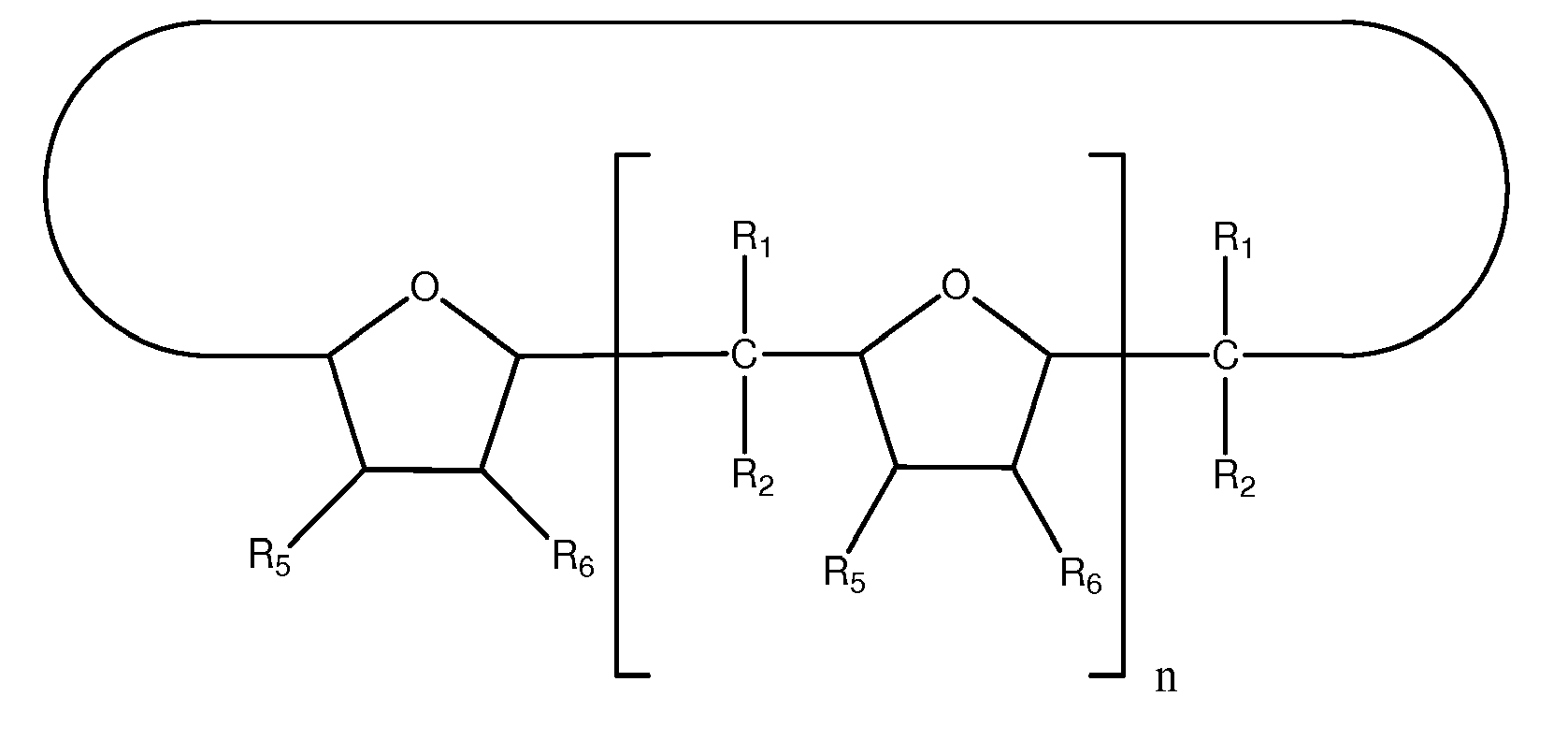
- The polymerization temperature can be at least 30° C, at least 45° C, at least 60° C, no more than 90°C, no more than 100° C, no more than 125° C, or nor more than 180°C. The pressure can be sufficient to maintain a liquid phase or a substantially liquid phase under the conditions of the polymerization reaction. In some instances, the pressure can be maintained such that the reactors operate above the vapor pressure of the reaction mixture.
- The polymerization can be carried out until a certain amount of polymerization of the monomers. For example, the polymerization can be conducted for a length of time sufficient to permit substantially complete polymerization of monomers. In some embodiments, for example, polymerization can be carried out until at least 85% polymerization of monomers is attained, until at least 90% polymerization of the monomers is attained, or until at least 95% polymerization of the monomers is attained.
- The terminating compound (e.g., formula (I)) can terminate the polymer by reacting the terminating compound to an active terminal of the living polymer. In some embodiments, the amount of the terminating compound used can at least 0.7 molecule per one active terminal of the living polymer, or from 0.7 to 5.0 molecule per one active terminal of the living polymer, or from 0.7to 2.0 molecule per one active terminal of the living polymer.
- In some instances, a two-stage addition of the terminating compound can be used performed, wherein a small amount of the terminating compound terminating compound, other terminating agents, or a combination thereof is first added to an active terminal of the living polymer to form a polymer having a branched structure; the remaining active terminals can then be modified with a second addition of the terminating compound, other terminating agents, or a combination thereof. At least one stage should include a terminating compound or a mixture comprising it. One or more terminating compounds can be used in the in one or both stages. Additional stages (e.g., similar to those described) can be used, as desired.
- The reaction (or any of the reaction stages) between an active terminal of the living polymer and the terminating compound can be performed by adding the terminating compound to the solution of polymerization system for the living polymer, or by adding the solution of the living polymer to a solution (e.g., an organic solution) comprising the terminating compound. The reaction temperature can be at least 30 ºC, no more than +150 ºC, or no more than +120 ºC. The reaction time can be at least 1 minute, at least 5 minutes, no more than 5 hours, or no more than 2 hours.
- In combination with using the terminating compounds of formula (I), the polymerization can be partially terminated by the addition of an agent, such as an alcohol, a terminating agent, or a coupling agent. In some embodiments, termination of polymerization by any method can occur when a desired amount of polymerization of the monomers has occurred. In some embodiments, termination occurs at least partially (and sometimes solely) using at least one termination compound of formula (I).
- Coupling agents include tin halides, silicon halides or mixtures thereof. The coupling agent can be continuously added in some instances, such as where asymmetrical coupling is desired. Continuous addition coupling agents can be done in a reaction zone separate from the zone where the bulk of the polymerization is occurring. In some embodiments, the coupling agents can be added in a separate reaction vessel after the desired degree of conversion has been attained. The coupling agents can be added in a hydrocarbon solution, e.g., in cyclohexane, to the polymerization admixture with suitable mixing for distribution and reaction. The coupling can be added only after a high degree of conversion has been attained. For instance, the coupling agent can be added after a monomer conversion of at least 85 percent has occurred or after a monomer conversion of at least 90 percent has occurred.
- The tin halides used as coupling agents can be tin tetrahalides (e.g., tin tetrachloride, tin tetrabromide, tin tetrafluoride, or tin tetraiodide) or tin trihalides. Polymers coupled with tin trihalides having a maximum of three arms, whereas polymers coupled with tin tetrahalides have a maximum of four arms. In some embodiments, to induce a higher level of branching, tin tetrahalides can be used.
- The silicon coupling agents can be silicon tetrahalides (e.g., silicon tetrachloride, silicon tetrabromide, silicon tetrafluoride, or silicon tetraiodide) or silicon trihalides. Polymers coupled with silicon trihalides having a maximum of three arms, whereas polymers coupled with silicon tetrahalides that have a maximum of four arms. In some embodiments, to induce a higher level of branching, silicon tetrahalides can be used
- A combination of a tin halide and a silicon halide can be used to couple the polymer. By using such a combination of tin and silicon coupling agents improved properties for tire rubbers, such as lower hysteresis, can be attained. In some embodiments, a combination of tin and silicon coupling agents is used in tire tread compounds that contain both silica and carbon black. The molar ratio of the tin halide to the silicon halide employed in coupling the polymer can be at least 20:80, at least 40:60, at least 60:40, at least 65:35, no more than 80:20, no more than 85:15, no more than 90:10 or no more than 95:5.
- In some embodiments, at least 0.01 milliequivalents of the coupling agent (e.g., tin halide, silicon halide, or mixture thereof) per 100 grams of the polymer is employed. In other embodiments, no more than 1.5 milliequivalents of the coupling agent per 100 grams of polymer or no more than 4.5 milliequivalents of the coupling agent per 100 grams of polymer is used. In some embodiments, the amount of coupling agent can be used to obtain the desired Mooney viscosity. In some instances, larger amount of coupling agents can result in production of polymers containing terminally reactive groups or insufficient coupling. In some embodiments, one equivalent of tin coupling agent per equivalent of lithium can provide maximum branching. For instance, if a mixture of tin tetrahalide and silicon tetrahalide is used as the coupling agent, one mole of the coupling agent would be utilized per four moles of live lithium ends. In other instances, where a mixture of tin trihalide and silicon trihalide is used as the coupling agent, one mole of the coupling agent will optimally be utilized for every three moles of live lithium ends. The coupling agent can be added in a hydrocarbon solution, e.g., in cyclohexane, to the polymerization admixture in the reactor with suitable mixing for distribution and reaction.
- In some embodiments, after the coupling has been completed, a tertiary chelating alkyl 1,2-ethylene diamine or a metal salt of a cyclic alcohol can be added, and in some instances this can stabilize the coupled polymer. Some examples of tertiary chelating amines that can be used include chelating alkyl diamines of the structural formula:

- In some embodiments, the amount of chelating alkyl 1,2-ethylene diamine or metal salt of the cyclic alcohol that can be added can be at least 0.01 phr (parts by weight per 100 parts by weight of dry rubber), at least 0.05 phr, at least 0.1 phr, no more than 0.6 phr, no more than 1 phr, or no more than 2 phr. In some embodiments, the amount of chelating alkyl 1,2-ethylene diamine or metal salt of the cyclic alcohol added to the polymer cement can stabilize the polymer.
- Together with the terminating compound of formula I, the terminating agents can be used to stop the polymerization and to "terminate" the living polymer. Terminating agents include tin monohalides, silicon monohalides, N,N,N',N'-tetradialkyldiamino-benzophenones (e.g., tetramethyldiaminobenzophenone and the like), N,N-dialkylamino-benzaldehydes (e.g., dimethylaminobenzaldehyde and the like), 1,3-dialkyl-2-imidazolidinones (e.g., 1,3-dimethyl-2-imidazolidinone and the like), 1-alkyl substituted pyrrolidinones; 1-aryl substituted pyrrolidinones, dialkyl- dicycloalkyl-carbodiimides containing at least 5 carbon atoms or nor more than 20 carbon atoms, and dicycloalkyl-carbodiimides containing at least 5 carbon atoms or nor more than 20 carbon atoms.
- After the termination step, and optionally a stabilization step, has been completed, the polymer can be recovered from the organic solvent. The coupled polymer can be recovered from the organic solvent and residue by means such as chemical (e.g., alcohol) coagulation, thermal desolventization, steam stripping, or other suitable method. For instance, the polymer can be precipitated from the organic solvent by the addition to the polymer solution of lower alcohols containing from 1, 2, 3, or 4 carbon atoms. Examples, of lower alcohols that can be used for precipitation of the polymer include but are not limited to methanol, ethanol, isopropyl alcohol, normal-propyl alcohol, and t-butyl alcohol. The utilization of lower alcohols to precipitate the polymer can also "terminate" any remaining living polymer by inactivating lithium end groups.
- After the coupled polymer is recovered from the solution, steam-stripping can be employed to reduce the level of volatile organic compounds in the coupled polymer. Additionally, the organic solvent can be removed from the polymer by drum drying, extruder drying, vacuum drying, and the like.
- One example of a steam stripping procedure follows. Polymer/hydrocarbon solutions are fed from storage tanks or polymerization reactors to a steam stripper, which in one example can be a nominal 500-gallon steam sparged, agitated vessel. Two axial flow turbines turning at 210 rpm provided agitation in the stripper. Polymer/hydrocarbon solution is pumped through a nozzle entering the bottom of the stripper. Steam is injected through two other nozzles entering the bottom of the stripper. Steam and recycle water rates are variable as they are used to control temperature and stripper level, respectively. Surfactant is used in the stripper to help control polymer crumb size formation. From the stripper, crumb water slurry is dumped on a horizontal shaker screen to remove the bulk of the free water. On the shaker screen, crumb slurries of 1-2% by polymer weight are routinely concentrated to 50-60% polymer. This material is fed directly to an Anderson 6D expeller, which is equipped with a variable frequency drive motor. Polymer exiting the expeller is then fed directly into an Anderson 4.5-inch expander for final drying. From the expander, polymer crumb is shaker conveyed to a spiral conveyor to promote additional cooling. From the spiral conveyor, the dry polymer is dropped to collection bins, weighed, and baled. In place of a mechanical expander dryer conventional forced air oven or conveyer driers can be used.
- The polymers of the present invention can be used alone or in combination with other polymers to prepare rubber compositions. These rubber compositions can provide tire treadstock, sidewall stock, or other tire component stock compounds. In some embodiments, at least one such component of a tire can be produced from these rubber compositions. For example, the inventive polymer (e.g., made by a process described herein) can be blended with any conventionally employed treadstock rubber including but not limited to natural rubber, synthetic rubber, and blends thereof. Other examples of such rubbers include synthetic polyisoprene rubber, styrene/butadiene rubber (SBR), polybutadiene, butyl rubber, Neoprene, ethylene/propylene rubber, ethylene/propylene/diene rubber (EPDM), acrylonitrile/butadiene rubber (NBR), silicone rubber, the fluoroelastomers, ethylene acrylic rubber, ethylene vinyl acetate copolymer (EVA), epichlorohydrin rubbers, chlorinated polyethylene rubbers, chlorosulfonated polyethylene rubbers, hydrogenated nitrile rubber and tetrafluoroethylene/propylene rubber.
- When the inventive polymers are blended with conventional rubber polymers, the amounts can be at least 10 percent by weight or no more than 99 percent by weight. In some embodiments, tires made with the inventive polymers that are synthesized utilizing the technique described herein can exhibit a decreased rolling resistance, an increased tread life, or both. Benefits can be realized in cases where the tire tread compound is made with the inventive polymer synthesized utilizing the technique described herein.
- Rubber compositions can be comprised of polymer and filler. In some embodiments, the rubber compositions can include vulcanizing agents, process oils, vulcanizing accelerators, and other additives.
- Examples of the conventional rubbery polymer include natural rubber and diene-based synthetic rubbers. Examples of the diene-based synthetic rubbers include emulsion styrene/butadiene copolymers, solution styrene/butadiene copolymers, 1,4-cis-polybutadiene, 1,2-vinyl-polybutadiene, 1,4-cis-polyisoprene, 3,4-polyisoprene, styrene/isoprene/butadiene copolymers, isoprene/butadiene copolymers, styrene/isoprene copolymers, butyl rubber, ethylene/propylene copolymers, and blends thereof.
- The rubber composition, which includes from 25% to 100% by weight polymer (with from 50% to 75% weight percent being one embodiment) also can include fillers. In some instances, these fillers can be rubber reinforcing fillers. The filler can be silica, carbon black, or a combination of a silica and a carbon black. Clay and/or organic fillers such as starch can also be used as fillers.
- The silica can be a synthetic amorphous rubber reinforcing silica. Examples include wet-process silica (precipitated silica), dry-process silica (fumed silica), calcium silicate, and aluminum silicate. In one example, the silica is precipitated silica.
- The inventive polymers described herein can be coupled with silica, carbon black, or both.
- The inventive polymers described herein can be compounded with carbon black in amounts of at least 5 phr (parts by weight per 100 parts by weight of rubber), at least 40 phr, no more than 70 phr, no more than 80 phr, or no more than 100 phr. The carbon blacks may include any of the commonly available, commercially produced carbon blacks. In some embodiments, carbon blacks can include those having a surface area (EMSA) of at least about 20 m2/g, at least about 35 m2/g, no more than about 200 m2/g, or surface areas higher than 200 m2/g. Surface area values used in this application are determined by ASTM test D-1765 using the cetyltrimethyl-ammonium bromide (CTAB) technique. Examples of carbon blacks can include furnace black, channel blacks, lamp blacks, super abrasion furnace (SAF) blacks, high abrasion furnace (HAF) blacks, fast extrusion furnace (FEF) blacks, fine furnace (FF) blacks, intermediate super abrasion furnace (ISAF) blacks, semi-reinforcing furnace (SRF) blacks, medium processing channel blacks, hard processing channel blacks, conducting channel blacks, and acetylene blacks. Mixtures of two or more of the above blacks can be used in preparing the carbon black products of the invention. Values for surface areas of some carbon blacks are summarized in the following table.
Carbon Black ASTM Designation (D-1765-82a) Surface Area (D-3765) N-110 126 m2 /g N-220 111 m2 /g N-330 93 m2 /g N-339 95 m2 /g N-550 42 m2 /g N-660 35 m2 /g - The carbon blacks utilized in the preparation of rubber compounds can be in pelletized form or an unpelletized flocculent mass. In some instances, unpelletized carbon black can provide more uniformed mixing. The reinforced rubber compounds can be cured in a conventional manner with at least 0.5 phr of known vulcanizing agents or no more than 4 phr of known vulcanizing agents. For example, sulfur or peroxide-based curing systems may be employed. For a general disclosure of some vulcanizing agents one can refer to Kirk-Othmer, Encyclopedia of Chemical Technology, 3rd ed., Wiley Interscience, N.Y. 1982, Vol. 20, pp. 365-468, particularly "Vulcanization Agents and Auxiliary Materials" pp. 390-402. Vulcanizing agents can be used alone or in combination. Vulcanizable elastomeric or rubber compositions can be prepared by compounding or mixing the polymers thereof with carbon black and other rubber additives such as fillers, plasticizers, antioxidants, curing agents and the like, using rubber mixing equipment and procedures.
- When synthetic amorphous silica (e.g. precipitated silica) is used as filler in the rubber composition, a silica coupling agent can be used to further increase the reinforcing property at the time when the silica is incorporated. Such silica coupling agents have a moiety reactive with hydroxyl groups (e.g. silanol groups), on the silica filler and another different moiety interactive with the conjugated diene derived elastomer. Examples include organoalkoxymercapto silanes and bis(3-trialkoxysilylalkyl) polysulfides having an average of 2 to 4 connecting sulfur atoms in its polysulfidic bridge. Examples of the silica coupling agent comprise, for example, bis(3-triethoxysilylpropyl) tetrasulfide, bis(3-triethoxysilylpropyl) disulfide, bis(2-triethoxysilylethyl) tetrasulfide, bis(3-trimethoxysilylpropyl) tetrasulfide, bis(2-trimeth-oxysilylethyl) tetrasulfide, 3-mercaptopropyltrimethoxysilane, 3-mercaptopropyl-triethoxysilane, 2-mercaptoethyltrimethoxysilane, 2-mercaptoethyltriethoxysilane, 3-nitropropyltrimethoxysilane, 3-nitropropyl-triethoxysilane, 3-chloropropyltrimethoxysilane, 3-chloropropyltriethoxysilane, 2-chloroethyltrimethoxy-silane, 2-chloroethyltriethoxysilane, 3-trimethoxysilylpropyl-N,N-dimethylthiocarbamoyl tetrasulfide, 3-triethoxysilylpropyl-N,N-dimethylthiocarbamoyl tetrasulfide, 2-triethoxy-silylethyl-N,N-dimethylthiocarbamoyl tetrasulfide, 3-trimethoxysilylpropylbenzothiazole tetrasulfide, 3-triethoxysilylpropylbenzothiazole tetrasulfide, 3-triethoxysilylpropyl-methacylate monosulfide, 3-trimethoxysilylpropylmethacylate monosulfide, bis(3-diethoxy-methylsilylpropyl) tetrasulfide, 3-mercaptopropyldimethoxymethylsilane, 3-nitropropyl-dimethoxymethylsilane, 3-chloropropyldimethoxymethylsilane, dimethoxymethylsilylpropyl-N,N-dimethyl-thiocarbamoyl tetrasulfide, and dimethoxymethylsilylpropylbenzothiazole tetrasulfide.
- The amount of silica coupling agent can be, for example, in a range of from 1 to 20 weight percent based on the amount of the silica. In some embodiments, the amount of silica coupling agent can be, for example, in a range of from 5 to 15 weight percent based on the amount of the silica.
- Examples of vulcanizing agents include sulfur and sulfur containing compounds. The amount of the vulcanizing agent to be used may be for example from 0.1 to 10.0 phr. For example, the amount may be from 1.0 to 5.0 phr.
- Examples of the process oil include for example paraffin-based oils, naphthene-based oils, and aromatic-based oils. The amount to be used of the process oil may be, for example from 0 to 100 phr.
- The vulcanization accelerators may include for example thiazole-based ones, such as 2-mercaptobenzothiazole, dibenzothiazyl disulfide, and sulphenamides such as for example N-cyclohexyl-2-benzothiazyl sulphenamide, and guanidine-based ones such as for example diphenylguanidine. The amount to be used of the vulcanization accelerator may be, for example, from 0.1 to 5.0 phr or from 0.2 to 3.0 phr.
- The rubber composition of the present invention may also typically contain additives that are conventionally used in rubber industries, for example, are antioxidants, zinc oxide, stearic acid, waxes and antidegradients.
- The rubber composition may be obtained by milling the ingredients using a kneading apparatus such as a roll mill, an internal mixer, and the like. After being shaped, the rubber composition can be vulcanized. The rubber composition can be used in various tire components, such as tire treads, under treads, carcasses, side walls, and beads, and in other industrial applications such as rubber cushions, belts, and hoses, for example. In one example, the rubber composition is suitable as a rubber composition for tire treads.
- This invention is illustrated by the following examples. Unless specifically indicated otherwise, parts and percentages are given by weight.
- The following equation shows the overall reaction for making PES.

- The desired products are a mixture of 3- and 4- (2-pyrrolidinoethyl) styrene (I) while the minor by-products are a mixture of 3- and 4-(2-pyrrolidinoethyl)-1-ethyl benzene (II) that is formed from the impurity in divinyl benzene (DVB).
- Equipment: 11 reactor capable of operating around 0°C, Distillation setup capable of achieving 150°C and 5 mm-Hg or better vacuum, GC for purity determination - HP 5890A or equivalent
Recipe: Reaction Parts Weight Volume Solvent hexane 356.6312 310.79 g 471.60 ml N Pyrrolidine 100.0000 85.00 g 99.77 ml Vinyl 80% DVB 228.8210 194.50 g 0.06 gal Li n-BuLi 1.60M 13.1898 11.21 g 16.60 ml Density 0.751 g/ml Total 694.4522 601.54 g 800.77 ml Termination Isopropanol 2.8168 2.2943 g 3.0501 ml Stabilization Prostab 5415 5000ppm 3.5385 3.0077 g N/A Stabilization Modifier/Li N/vinyl N/Li Actives SS/Li 5000 ppm 0.00 1.00 45.00 40.00% 1.50 - Impurities such as water and t-butylcatechol (tBC) were removed from the starting materials since they can react with n-BuLi. Pyrrolidine and hexane are dried over 3A molecular sieves and DVB is dried over alumina. Prostab® 5415 is bis(1-oxyl-2,2,6,6- tetramethylpiperidine-4-yl)sebacate.
- Hexane, pyrrolidine, and DVB were transferred into the reactor. The contents were cooled down to 5°C or lower. nBuLi was added slowly to maintain the temperature within the range of 0°C to 5°C. If the temperature exceeded the range, addition of nBuLi was suspended until the temperature returned to normal. The solution had a fairly intense green color during the reaction but turned brownish red at the end. The progress of the reaction was monitor by taking GC samples. 80% to 85% conversion indicated an approach to the end of the reaction. At the end of the reaction, the active Li was terminated by injecting isopropanol. Prostab 5415 was used as a stabilizer to prevent polymerization.
- The Prostab stabilizer prevented rapid polymerization from taking place during distillation, which could yield little or no desired product. The mixture was transferred into a round bottom flask along with boiling chips. Pressure was decreased slowly using a vacuum pump to achieve a vacuum of about 1-2 mm Hg. Ambient temperature was maintained to remove hexane and pyrrolidine. When the boiling stopped, the temperature was raised to 60°C - 90°C to remove unreacted DVB. Boiling likely stopped when all of the unreacted DVB was removed because the main product will boil at about 120°C.
- The retention times for the target materials using the above method were
3-(2-pyrrolidinoethyl) styrene = 24.473 minutes
4-(2-pyrrolidinoethyl) styrene = 25.370 minutes - The retention times for the impurities, reaction products of the pyrrolidine with 3 & 4 ethyl benzene were
3-(2-pyrrolidinoethyl)-1-ethyl benzene = 22.922 minutes
4-(2-pyrrolidinoethyl)-1-ethyl benzene = 23.640 minutes - Polymerizations were carried out in a twenty seven gallon batch reactor under moderate stirring and inert nitrogen atmosphere. The reactor was equipped with a variable speed agitator with 2 AFTs (axial flow turbine). Heating and cooling to control the reactor temperature was accomplished with a reactor jacket circulating gycol. The glycol was heated with steam when needed. Prior to polymerization, the reactor was filled with dry hexane and quenched with n-BuLi to minimize the scavenger level. Premix consisting of a dilute solution of 25/75 wt/wt styrene/butadiene in hexane was dried over a silica gel bed and held in a hold vessel until needed. A weighed amount of this dried monomer premix was transferred into the reactor. The reactor was heated to a set point 150°F; the modifier TMEDA (tetramethylelthylenediamine) was pressured into the reactor. After it mixed in, n-BuLi initiator was pressured into the reactor. The reaction was then allowed to run its course and conversion data was determined gravimetrically or by gas chromatography (GC) analysis of residual monomer. Polymerizations were terminated after full conversion was reached by treating with isopropanol. The target polymer Mooney Viscosity was 40 with a glass transition temperature of approximately -25ºC. Prior to polymer finishing via steam stripping, 0.5 phr Polystay K antioxidant was added as antioxidant.
- TEOS terminated polymers were prepared as described in Example 2 with the exception that isopropanol termination was replaced with the addition of 1 molar equivalent of TEOS per mole of butyl-lithium used to initiate the polymerization. Base Mooney viscosity prior to the termination was approximately 40 for all polymers and Tg was -25ºC.
- TEOS terminated polymers with PES monomers were prepared as described in Example 3 with the exception that 0.25 wt% PES co-monomer was added to the styrene/butadiene premix prior to initiation. Base Mooney viscosity prior to the termination was approximately 40 for all polymers and Tg was -25ºC.
- Three polymer types were prepared as described in Example 2 (control polymer), Example 3 (TEOS polymer) and Example 4 (PES-TEOS polymer).
- Table 1 shows the characterization of the 3 polymers
Table 1: Polymer Characterization Polymer Control (a) TEOS (b) PES-TEOS (c) ML(1+4) 100 C 40 61 69 Tg (midpt) C -28.0 -26.8 -27.2 % Styrene 24.8 25.0 25.0 % Vinyl 40.2 38.3 37.4 - The polymers were tested for performance in a silica compound utilizing 65 phr of Silica, 70 phr of the experimental polymer, and 30 phr of polybutadiene. Compounds were mixed in a 300 cc Brabender mixer in 3 stages, which consisted of two non-productive stages and one productive stage.
Stage Ingredient phr NP1 Tested Polymer 70 NP1 Polybutadiene 30 NP1 Silica 65 NP1 Siloxy Coupling Agent* 10.4 NP1 Naphthenic oil 20 NP1 ZnO 3.5 NP1 Stearic Acid 2 NP1 Diamine AO 2.2 NP1 Paraffin Wax 1.5 NP2 re-mill PR Sulfur 1.7 Quanidine/sulfonamide PR Accelerators 3.1 PR Diamine AO 0.75 *50 wt% active absorbed on black - Rotor speed was adjusted to maintain a constant drop temperature for each compound. Performance indicators include: Uncured G' @ 100C Lab (an indicator of filler/polymer interaction), room temperature (RT) rebound (ASTM D1054), tan δ measurements at 30ºC, 5% strain and 10 Hz to reflect Rolling Resistance (RR) (ASTM D5992), and DIN Abrasion measurements (ASTM D5963) to indicate treadwear. The results are shown in Table 2.
Table 2: Lab Results for Rolling Resistance and Treadwear Indicators Example Polymer Description Uncured G' (0.83 Hz) RT Rebound RR- Tanδ 5% 30C Treadwear -DIN Abrasion 5a control 127 41.6 0.24 139 5b TEOS 197 48.5 0.16 123 5c PES-TEOS 304 50.6 0.15 111 performance direction higher is better higher is better lower is better lower is better - The example 5a control polymer shows the base line performance for this class of polymer. Example 5b shows that TEOS provides improvement compared to the control polymer but does not provide properties that are as good as PES-TEOS. Example 5c, the best of the three, shows an increase in polymer/filler interaction, an increase in RT Rebound, and a reduction in tan δ. These are indicative of lower rolling resistance for a tire having a tread of such composition and, therefore, better fuel economy for an associated vehicle. Table 2 also shows a significant decrease in DIN Abrasion when using the combination of PES as a co-monomer with TEOS termination. This improvement in abrasion resistance will manifest itself as better resistance to wear rates of a tire tread.
- Tires were prepared with treads of rubber composition corresponding to the three polymer types and compound formulation used in Example 5. Tires were rated for rolling resistance as well as treadwear rates after 12,000 miles. Test information for the respective tires is represented in Table 3 with values normalized to the value of 100 assigned to the respective properties of the Control Tire 6a using the control polymer. Rolling resistance (RR) is represented as a relative rating compared to an assigned value of 100 for the control tire. For the reported results, the higher value equates to lower resistance to rolling and, therefore, is more desirable. Treadwear is measured as an average reduction in tread depth as measured from top of the tread grooves taken across the width of the tread; a higher value indicates less tread was lost and, therefore, represents less wear of the tread, which is better.
Table 3: Tire Results for Rolling Resistance and Treadwear Example Polymer Description Normalized RR Normalized Treadwear Rates 6a control 100 100 6b TEOS 103 112 6c PES-TEOS 108 118 performance direction higher is better higher is better - The example 6a control polymer shows the base line performance of a tire results for this class of polymer. Example 6b shows that TEOS termination alone only improved RR by 3% and wear rates by 12%. Example 6c shows that the combination of PES co-monomer with TEOS termination improved tire tread RR by 8% and also improved wear rates by 18%.
- Thus, the addition of a polymer with PES co-monomer and TEOS termination to the tire tread rubber composition significantly improved the treadwear (e.g., reduces the wear of the tread) as well as resistance to rolling which is predictive of better fuel economy.
- Three polymers were prepared as described in Example 2 with the exception that a continuous polymerization process was utilized and that 0.5 wt% PES co-monomer was added to the styrene/butadiene premix prior to initiation. Example 7a is control polymer with no functionalization, Example 7b contains 0.5 wt% PES at 45 Mooney viscosity and Example 7c contains 0.5 wt% PES at 73 Mooney viscosity.
Table 4 shows the characterization of the 3 polymersTable 4 Polymer Control (7a) PES (LM) (7b) PES (HM) (7c) ML(1+4) 100 C 73 45 73 Tg (midpt) C -24.0 -24.0 -26.0 % Styrene 26.0 27.0 25.0 % Vinyl 42.0 37.0 38.0 - The polymers were tested for performance in a silica compound as described in Example 5. Performance indicators include: Uncured G' @ 100C Lab indicator filler/polymer interaction, room temperature (RT) rebound (ASTM D1054), and tan δ measurements at 30ºC, 5% strain and 10Hz to reflect Rolling Resistance (RR) (ASTM D5992). The results are shown in Table 5
Table 5 Lab Results for Rolling Resistance Example Polymer Description Uncured G' (0.83Hz) RT Rebound RR- Tan δ 5% 30°C 7a control 268 36 0.24 7b PES (LM) 314 46 0.16 7c PES (HM) 360 49 0.15 performance direction high better high better lower better - The example 7a control polymer shows the base line performance for this class of SBR polymer. Examples 7b and 7c show that polymers with PES co-monomer can provide an increase in polymer/filler interaction, reduction in tan δ, and increase in Rebound. This is indicative of lower rolling resistance for a tire having a tread of such composition and, therefore, better fuel economy for an associated vehicle.
- Tires were prepared with treads of rubber composition containing the above polymers according to Example 6. Tire were tested and rated for treadwear rates after 12,000 miles. Test information for the respective tires is represented in Table 6 with values normalized to the value of 100 assigned to the respective properties of the Control Tire 7a using the non-functional control polymer. Calculated Rolling resistance (RR) is represented as a relative rating compared to an assigned value of 100 for the control tire. For the reported results, higher values equate to lower resistance to rolling and, therefore, are more desirable. Treadwear is measured as an average reduction in tread depth as measured from top of the tread grooves taken across the width of the tread. A higher value indicates less tread was lost and, therefore, represents less wear of the tread, which is better.
Table 6. Tire Results for Roilling Resistance and Treadwear Example Polymer Description Normalized RR Normalized Treadwear Rates 7a control 100 100 7b PES (LM) 109 101 7c PES (HM) 110 103 performance direction high better high better - The example 7a control polymer shows the base line performance of a tire tread for this class of SBR polymer. Examples 7b and 7c show that polymer with PES co-monomer can improve the rolling resistance of the tire and, to a lesser extent, can improve treadwear. Two different Mooney viscosities, high and low, were tested and both show minimal impact on treadwear.
- Comparison of Table 3 and Table 6 shows that adding a polymer with both PES co-monomer and TEOS termination to the tire tread rubber composition can improve both the treadwear (reduce the wear of the tread) and the resistance to rolling, which is predictive of better fuel economy for a tire.
Claims (15)
- A polymer comprising(a) a terminating group provided from a compound
XnSi(OR)mR'4-m-n
wherein X is a chlorine atom, a bromine atom or an iodine atom, R is an alkyl group with from 1 carbon to 7 carbons, R' is a alkyl group with from 1 carbon to 20 carbons, an aryl group, a vinyl group or a halogenated alkyl group, m is an integer from 1 to 4, n is an integer from 0 to 2, and a sum of n and m is from 1 to 4;(b) repeat units comprising:(1) a repeat unit provided from a conjugated diolefin monomer, and(2) a repeat unit provided from an amine monomer. - The polymer of claim 1, wherein the amine monomer is an amine styrene monomer.
- The polymer of claim 2, wherein the amine styrene monomer has a formula selected from the group consisting of


- The polymer of at least one of the previous claims, wherein the amine monomer is

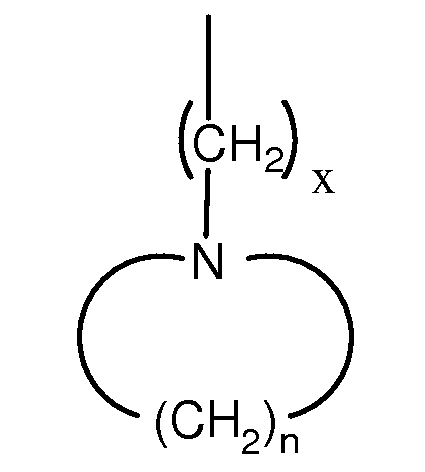

- The polymer of claim 3, wherein the nitrogen-containing heterocyclic group (Z group) mentioned in formula (a) is selected from the group consisting of:


- The polymer of at least one of the previous claims wherein the amine monomer is

- The polymer of claim 1, wherein the at least one compound is hydrolysable and/or wherein the at least one compound is Si(OCH2CH3)4.
- The polymer of at least one of the previous claims, wherein R is an alkyl group having 1 to 3 carbon atoms.
- A method for preparing a polymer, the method comprising(1) polymerizing monomers comprising:(a) at least one conjugated diolefin monomer, and(b) at least one amine monomer; and(2) reacting the polymerized monomers with a terminating compound to provide a terminating group on the polymer, wherein the terminating compound is selected from
XnSi(OR)mR'4-m-n
wherein X is a chlorine atom, a bromine atom or an iodine atom, R is H or an alkyl group with from 1 carbon to 7 carbons, R' is a alkyl group with from 1 carbon to 20 carbons, an aryl group, a vinyl group or a halogenated alkyl group, m is an integer from 1 to 4, n is an integer from 0 to 2, and a sum of n and m is from 1 to 4; and(3) recovering the polymer. - The method of claim 9, wherein the amine monomer is

- The method of claim 9 or 10, wherein the at least one terminating compound is hydrolysable and/or wherein the R of the terminating compound is an alkyl group having from 1 to 3 carbon atoms.
- The method of claim 9, wherein steam stripping is used to isolate, purify or recover the polymer.
- A rubber composition comprising:100 parts by weight of a polymer, wherein from 25% to 100% by weight of the polymer is a polymer of one of the claims 1 to 8; andfrom 10 to 130 phr of a filler.
- The rubber composition of claim 13, wherein the filler comprises silica.
- A tire comprising the polymer of one of the claim 1 to 8 or the rubber composition claim 13 or 14.
Applications Claiming Priority (1)
| Application Number | Priority Date | Filing Date | Title |
|---|---|---|---|
| US12/333,361 US20100152364A1 (en) | 2008-12-12 | 2008-12-12 | Polymers, rubber compositions, and tires |
Publications (1)
| Publication Number | Publication Date |
|---|---|
| EP2196326A1 true EP2196326A1 (en) | 2010-06-16 |
Family
ID=42115352
Family Applications (1)
| Application Number | Title | Priority Date | Filing Date |
|---|---|---|---|
| EP09177567A Withdrawn EP2196326A1 (en) | 2008-12-12 | 2009-12-01 | Polymers, rubber compositions, and tires |
Country Status (3)
| Country | Link |
|---|---|
| US (1) | US20100152364A1 (en) |
| EP (1) | EP2196326A1 (en) |
| BR (1) | BRPI0904989A2 (en) |
Cited By (6)
| Publication number | Priority date | Publication date | Assignee | Title |
|---|---|---|---|---|
| EP2325027A1 (en) * | 2009-11-20 | 2011-05-25 | The Goodyear Tire & Rubber Company | Rubber composition, method of manufacturing a rubber composition and pneumatic tire with such a rubber composition |
| WO2016162482A1 (en) | 2015-04-10 | 2016-10-13 | Synthos S.A. | Initiators for the copolymerisation of diene monomers and vinyl aromatic monomers |
| EP3091040A4 (en) * | 2014-12-01 | 2016-11-30 | Lg Chemical Ltd | ANIONIC POLYMERIZATION INITIATOR COMPRISING ANIONIC TERMINAL END COMPRISING AN AMINO GROUP, PROCESS FOR PRODUCING A COPOLYMER BASED ON A MODIFIED CONJUGATED DIENE USING THE SAME, AND RUBBER COMPOSITION COMPRISING THE DIENE-BASED COPOLYMER MODIFIED CONJUGATE SO PRODUCED |
| US10259830B2 (en) | 2015-04-10 | 2019-04-16 | Synthos S.A. | [Bis(trihydrocarbylsilyl)aminosilyl]-functionalized styrene and a method for its preparation |
| US10723822B2 (en) | 2016-10-06 | 2020-07-28 | Synthos Dwory 7 Spolka Z Ograniczona Odpowiedzialnoscia Spolka Jawna | [Bis(trihydrocarbylsilyl)aminosilyl]-functionalized styrene and a method for its preparation |
| US10752721B2 (en) | 2016-10-06 | 2020-08-25 | Synthos Dwory 7 Spolka Z Organiczona Odpowiedzialnoscia Spolka Jawna | Elastomeric copolymers based on [bis(trihydrocarbylsilyl)aminosilyl]-functionalized styrene and their use in the preparation of rubbers |
Families Citing this family (6)
| Publication number | Priority date | Publication date | Assignee | Title |
|---|---|---|---|---|
| JP2011252137A (en) * | 2010-05-06 | 2011-12-15 | Sumitomo Chemical Co Ltd | Conjugated dienic polymer, conjugated dienic polymer composition, and manufacturing method of conjugated dienic polymer |
| WO2012087460A1 (en) * | 2010-11-19 | 2012-06-28 | World Minerals, Inc. | Reduced alergenicity of natural latex product |
| KR101305441B1 (en) * | 2011-09-23 | 2013-09-09 | 한국기술교육대학교 산학협력단 | Method for manufacturing of Starch/rubber Latex Compound Using Coupling reagent |
| JP6651944B2 (en) * | 2016-03-30 | 2020-02-19 | 東洋インキScホールディングス株式会社 | Pyrrolidine 2-carboxylic acid residue-containing copolymer |
| CN109563196B (en) | 2016-07-22 | 2021-07-27 | 公共型股份公司希布尔控股 | Process for producing modified rubber by anionic solution polymerization, rubber composition comprising said rubber and use thereof |
| EP4596661A1 (en) * | 2024-02-05 | 2025-08-06 | Infineum International Limited | Amine containing polymer compositions and uses thereof |
Citations (10)
| Publication number | Priority date | Publication date | Assignee | Title |
|---|---|---|---|---|
| US5066721A (en) | 1987-01-14 | 1991-11-19 | Bridgestone Corporation | Tires made of silica filled, silane modified rubber |
| EP1152030A2 (en) * | 2000-05-01 | 2001-11-07 | JSR Corporation | Rubber mixtures based on crosslinked rubber particles and non-crosslinked rubbers |
| EP1245585A2 (en) * | 2001-03-26 | 2002-10-02 | JSR Corporation | Hydrogenated modified polymer, process for producing the same and composition containing the same |
| US20030134997A1 (en) * | 2000-12-05 | 2003-07-17 | The Goodyear Tire & Rubber Company | Functionalized elastomers |
| US6627721B1 (en) | 2002-09-19 | 2003-09-30 | The Goodyear Tire & Rubber Company | Functionalized elastomers |
| US20040044202A1 (en) * | 2002-08-16 | 2004-03-04 | Halasa Adel Farhan | Functionalized monomers for synthesis of rubbery polymers |
| US20040063933A1 (en) * | 2002-09-19 | 2004-04-01 | Stephan Rodewald | Functionalized elastomers |
| US20040063884A1 (en) * | 2002-08-16 | 2004-04-01 | Halasa Adel Farhan | Functionalized monomers for synthesis of rubbery polymers |
| US6812307B2 (en) | 2002-08-16 | 2004-11-02 | The Goodyear Tire & Rubber Company | Functionalized monomers for synthesis of rubbery polymers |
| EP1714984A1 (en) * | 2005-04-20 | 2006-10-25 | The Goodyear Tire & Rubber Company | Rubber composition containing an alkoxysilane coupled in-chain functionalized elastomer and tire with component thereof |
Family Cites Families (27)
| Publication number | Priority date | Publication date | Assignee | Title |
|---|---|---|---|---|
| US3244644A (en) * | 1962-02-13 | 1966-04-05 | Du Pont | Method of preparing a catalyst composition consisting of ruthenium on etaalumina and the product thereof |
| US3884971A (en) * | 1971-10-22 | 1975-05-20 | Mobil Oil Corp | Reduction of carbonyl compounds |
| US4430445A (en) * | 1979-07-19 | 1984-02-07 | Asahi Kasei Kogyo Kabushiki Kaisha | Novel basic imidazolylmethylstyrene compound, its polymer, a process for the preparation thereof and a use as ion exchange resin |
| US4699971A (en) * | 1985-11-12 | 1987-10-13 | General Electric Company | Polycarbonate with cycloalkylphenyl end group |
| JPH0734104B2 (en) * | 1986-10-17 | 1995-04-12 | 富士写真フイルム株式会社 | Silver halide photographic light-sensitive material |
| JP2699010B2 (en) * | 1990-05-16 | 1998-01-19 | 富士写真フイルム株式会社 | Diffusion transfer type color photosensitive material |
| EP0706536B1 (en) * | 1993-07-01 | 2000-05-17 | The Procter & Gamble Company | Thermoplastic elastomeric copolymers and hair and skin care, compositions containing the same |
| US5730966A (en) * | 1993-07-01 | 1998-03-24 | The Procter & Gamble Company | Thermoplastic elastomeric copolymers used in hair and skin care compositions |
| SG72661A1 (en) * | 1993-07-01 | 2000-05-23 | Procter & Gamble | Thermoplastic elastomeric copolymers and hair and skin care compositions containing the same |
| FR2722503A1 (en) * | 1994-07-15 | 1996-01-19 | Michelin & Cie | FUNCTIONAL DIENE POLYMERS, PROCESS FOR THEIR PREPARATION AND THEIR USE IN ELASTOMERIC SILICA-FILLED COMPOSITIONS FOR USE IN TIRE ENVELOPES |
| DE69622235T2 (en) * | 1995-10-04 | 2003-01-23 | Compagnie Generale Des Etablissements Michelin-Michelin & Cie., Clermont-Ferrand | Rubber compound based on a diene polymer with groups derived from organosilanes for use in tire treads |
| JPH1138454A (en) * | 1997-07-15 | 1999-02-12 | Nippon Oil Co Ltd | Electrochromic mirror |
| US6285486B1 (en) * | 1997-07-15 | 2001-09-04 | Nippon Oil Co., Ltd. | Electrochromic mirror and electrochromic devices |
| JPH11142891A (en) * | 1997-11-05 | 1999-05-28 | Nippon Oil Co Ltd | Electrochromic mirror |
| EP1113024B1 (en) * | 1999-12-02 | 2003-04-23 | Bridgestone Corporation | Polymer, process for making the polymer, and rubber composition using the polymer |
| JP4352592B2 (en) * | 2000-07-11 | 2009-10-28 | コニカミノルタホールディングス株式会社 | Cellulose ester dope composition, method for producing cellulose ester film, cellulose ester film and polarizing plate using the same |
| CN100347208C (en) * | 2001-09-27 | 2007-11-07 | Jsr株式会社 | Conjugated diene homo-or copolymer rubber, method for producing homo-or copolymer rubber, rubber composition, composite, and tire |
| US6693160B1 (en) * | 2002-08-16 | 2004-02-17 | The Goodyear Tire & Rubber Company | Functionalized monomers for synthesis of rubbery polymers |
| US7211705B2 (en) * | 2002-09-06 | 2007-05-01 | The Texas A&M University System | Phase selective polymer supports for catalysis |
| US6790921B1 (en) * | 2002-09-19 | 2004-09-14 | The Goodyear Tire & Rubber Company | Functionalized elastomers |
| US6664328B1 (en) * | 2002-09-19 | 2003-12-16 | The Goodyear Tire & Rubber Company | Functionalized elastomers |
| EP1731501A4 (en) * | 2004-03-10 | 2008-03-19 | Japan Science & Tech Agency | PROCESS FOR AMIDOCARBONYLATION REACTION |
| JP2006189508A (en) * | 2004-12-28 | 2006-07-20 | Fuji Photo Film Co Ltd | Heat developable photosensitive material and method for manufacturing the same |
| JP2006251243A (en) * | 2005-03-09 | 2006-09-21 | Fuji Photo Film Co Ltd | Lithographic printing original plate |
| US7838687B2 (en) * | 2005-08-29 | 2010-11-23 | Brown University | Redox-active polymers and their applications |
| DE602007009344D1 (en) * | 2006-07-25 | 2010-11-04 | Fujifilm Corp | Lithographic printing plate precursor and method of making a lithographic printing plate |
| US7335706B1 (en) * | 2007-03-05 | 2008-02-26 | The Goodyear Tire & Rubber Company | Method of making alkoxy functionalized rubbery polymers |
-
2008
- 2008-12-12 US US12/333,361 patent/US20100152364A1/en not_active Abandoned
-
2009
- 2009-12-01 EP EP09177567A patent/EP2196326A1/en not_active Withdrawn
- 2009-12-01 BR BRPI0904989-4A patent/BRPI0904989A2/en not_active IP Right Cessation
Patent Citations (10)
| Publication number | Priority date | Publication date | Assignee | Title |
|---|---|---|---|---|
| US5066721A (en) | 1987-01-14 | 1991-11-19 | Bridgestone Corporation | Tires made of silica filled, silane modified rubber |
| EP1152030A2 (en) * | 2000-05-01 | 2001-11-07 | JSR Corporation | Rubber mixtures based on crosslinked rubber particles and non-crosslinked rubbers |
| US20030134997A1 (en) * | 2000-12-05 | 2003-07-17 | The Goodyear Tire & Rubber Company | Functionalized elastomers |
| EP1245585A2 (en) * | 2001-03-26 | 2002-10-02 | JSR Corporation | Hydrogenated modified polymer, process for producing the same and composition containing the same |
| US20040044202A1 (en) * | 2002-08-16 | 2004-03-04 | Halasa Adel Farhan | Functionalized monomers for synthesis of rubbery polymers |
| US20040063884A1 (en) * | 2002-08-16 | 2004-04-01 | Halasa Adel Farhan | Functionalized monomers for synthesis of rubbery polymers |
| US6812307B2 (en) | 2002-08-16 | 2004-11-02 | The Goodyear Tire & Rubber Company | Functionalized monomers for synthesis of rubbery polymers |
| US6627721B1 (en) | 2002-09-19 | 2003-09-30 | The Goodyear Tire & Rubber Company | Functionalized elastomers |
| US20040063933A1 (en) * | 2002-09-19 | 2004-04-01 | Stephan Rodewald | Functionalized elastomers |
| EP1714984A1 (en) * | 2005-04-20 | 2006-10-25 | The Goodyear Tire & Rubber Company | Rubber composition containing an alkoxysilane coupled in-chain functionalized elastomer and tire with component thereof |
Non-Patent Citations (1)
| Title |
|---|
| KIRK-OTHMER: "Encyclopedia of Chemical Technology", vol. 20, 1982, WILEY INTERSCIENCE, pages: 365 - 468 |
Cited By (8)
| Publication number | Priority date | Publication date | Assignee | Title |
|---|---|---|---|---|
| EP2325027A1 (en) * | 2009-11-20 | 2011-05-25 | The Goodyear Tire & Rubber Company | Rubber composition, method of manufacturing a rubber composition and pneumatic tire with such a rubber composition |
| EP3091040A4 (en) * | 2014-12-01 | 2016-11-30 | Lg Chemical Ltd | ANIONIC POLYMERIZATION INITIATOR COMPRISING ANIONIC TERMINAL END COMPRISING AN AMINO GROUP, PROCESS FOR PRODUCING A COPOLYMER BASED ON A MODIFIED CONJUGATED DIENE USING THE SAME, AND RUBBER COMPOSITION COMPRISING THE DIENE-BASED COPOLYMER MODIFIED CONJUGATE SO PRODUCED |
| US9718899B2 (en) | 2014-12-01 | 2017-08-01 | Lg Chem, Ltd. | Anionic polymerization initiator having anionic terminal comprising amine group, production method for modified conjugated diene-based copolymer using same, and rubber composition comprising modified conjugated diene-based copolymer produced in accordance therewith |
| WO2016162482A1 (en) | 2015-04-10 | 2016-10-13 | Synthos S.A. | Initiators for the copolymerisation of diene monomers and vinyl aromatic monomers |
| US10259830B2 (en) | 2015-04-10 | 2019-04-16 | Synthos S.A. | [Bis(trihydrocarbylsilyl)aminosilyl]-functionalized styrene and a method for its preparation |
| US10584187B2 (en) | 2015-04-10 | 2020-03-10 | Synthos S.A. | Initiators for the copolymerisation of diene monomers and vinyl aromatic monomers |
| US10723822B2 (en) | 2016-10-06 | 2020-07-28 | Synthos Dwory 7 Spolka Z Ograniczona Odpowiedzialnoscia Spolka Jawna | [Bis(trihydrocarbylsilyl)aminosilyl]-functionalized styrene and a method for its preparation |
| US10752721B2 (en) | 2016-10-06 | 2020-08-25 | Synthos Dwory 7 Spolka Z Organiczona Odpowiedzialnoscia Spolka Jawna | Elastomeric copolymers based on [bis(trihydrocarbylsilyl)aminosilyl]-functionalized styrene and their use in the preparation of rubbers |
Also Published As
| Publication number | Publication date |
|---|---|
| US20100152364A1 (en) | 2010-06-17 |
| BRPI0904989A2 (en) | 2011-03-15 |
Similar Documents
| Publication | Publication Date | Title |
|---|---|---|
| US20100152364A1 (en) | Polymers, rubber compositions, and tires | |
| EP1963110B1 (en) | Silane-sulfide chain end modified elastomeric polymers | |
| US6433065B1 (en) | Silica-reinforced rubber compounded with mercaptosilanes and alkyl alkoxysilanes | |
| EP2189464B1 (en) | Terminating compounds, polymers, and their uses in rubber compositions and tires | |
| EP2283046B1 (en) | Modified elastomeric polymers | |
| EP2895494B1 (en) | Silane sulfide modified elastomeric polymers | |
| JP4598909B2 (en) | Rubber composition and pneumatic tire using the same | |
| JP4928017B2 (en) | Rubber composition and pneumatic tire using the same | |
| EP2828301B1 (en) | Modified polymer compositions | |
| EP2325027B1 (en) | Rubber composition, method of manufacturing a rubber composition and pneumatic tire with such a rubber composition | |
| US6515087B2 (en) | Synthesis of elastomers having low hysteresis | |
| CN103391947A (en) | Stabilization of polymers that contain a hydrolyzable functionality | |
| US20170233545A1 (en) | Pneumatic tire | |
| WO2002010267A2 (en) | Silica-reinforced rubber compounds containing moisture stabilized polymers | |
| KR102036375B1 (en) | Process for producing conjugated diene rubber and composite of the same rubber | |
| EP3133093A1 (en) | Elastomeric polymer | |
| JP4801827B2 (en) | Polymer, process for producing the same, and rubber composition using the same | |
| JP2003533561A (en) | Chain-coupled polymer alkoxide compounds with controlled viscosity | |
| JP4316074B2 (en) | Modified conjugated diene polymer, rubber composition using the same, and pneumatic tire | |
| EP3045495B1 (en) | Functionalized elastomeric polymer compositions, their preparation methods and crosslinked rubber compositions thereof | |
| JP4326949B2 (en) | Synthesis of chain-linked polymeric sulfide compounds and their use in rubber composition | |
| WO2018150043A1 (en) | Metallated benzylsilanes and their use as polymerization initiators | |
| US20150087768A1 (en) | Elastomeric Polymer Compositions |
Legal Events
| Date | Code | Title | Description |
|---|---|---|---|
| PUAI | Public reference made under article 153(3) epc to a published international application that has entered the european phase |
Free format text: ORIGINAL CODE: 0009012 |
|
| AK | Designated contracting states |
Kind code of ref document: A1 Designated state(s): AT BE BG CH CY CZ DE DK EE ES FI FR GB GR HR HU IE IS IT LI LT LU LV MC MK MT NL NO PL PT RO SE SI SK SM TR |
|
| AX | Request for extension of the european patent |
Extension state: AL BA RS |
|
| STAA | Information on the status of an ep patent application or granted ep patent |
Free format text: STATUS: THE APPLICATION IS DEEMED TO BE WITHDRAWN |
|
| 18D | Application deemed to be withdrawn |
Effective date: 20101217 |