EP2195330B1 - Method and agent for refolding proteins - Google Patents
Method and agent for refolding proteins Download PDFInfo
- Publication number
- EP2195330B1 EP2195330B1 EP08802397A EP08802397A EP2195330B1 EP 2195330 B1 EP2195330 B1 EP 2195330B1 EP 08802397 A EP08802397 A EP 08802397A EP 08802397 A EP08802397 A EP 08802397A EP 2195330 B1 EP2195330 B1 EP 2195330B1
- Authority
- EP
- European Patent Office
- Prior art keywords
- atoms
- refolding
- alkyl
- partially
- cation
- Prior art date
- Legal status (The legal status is an assumption and is not a legal conclusion. Google has not performed a legal analysis and makes no representation as to the accuracy of the status listed.)
- Not-in-force
Links
- 102000004169 proteins and genes Human genes 0.000 title claims description 90
- 108090000623 proteins and genes Proteins 0.000 title claims description 90
- 238000000034 method Methods 0.000 title claims description 24
- 239000002608 ionic liquid Substances 0.000 claims description 59
- 150000001768 cations Chemical class 0.000 claims description 34
- 125000001424 substituent group Chemical group 0.000 claims description 34
- 239000003795 chemical substances by application Substances 0.000 claims description 31
- 125000004432 carbon atom Chemical group C* 0.000 claims description 30
- 125000004429 atom Chemical group 0.000 claims description 24
- 239000007788 liquid Substances 0.000 claims description 20
- 210000003000 inclusion body Anatomy 0.000 claims description 16
- 229910052736 halogen Inorganic materials 0.000 claims description 12
- 238000004220 aggregation Methods 0.000 claims description 10
- 230000002776 aggregation Effects 0.000 claims description 10
- 125000000217 alkyl group Chemical group 0.000 claims description 10
- 125000004122 cyclic group Chemical group 0.000 claims description 9
- 125000004169 (C1-C6) alkyl group Chemical group 0.000 claims description 8
- 229910006080 SO2X Inorganic materials 0.000 claims description 8
- 125000003118 aryl group Chemical group 0.000 claims description 8
- 125000005842 heteroatom Chemical group 0.000 claims description 8
- 125000004051 hexyl group Chemical group [H]C([H])([H])C([H])([H])C([H])([H])C([H])([H])C([H])([H])C([H])([H])* 0.000 claims description 8
- 229920006395 saturated elastomer Polymers 0.000 claims description 8
- 230000003196 chaotropic effect Effects 0.000 claims description 6
- 229910052757 nitrogen Inorganic materials 0.000 claims description 6
- JUJWROOIHBZHMG-UHFFFAOYSA-O pyridinium Chemical compound C1=CC=[NH+]C=C1 JUJWROOIHBZHMG-UHFFFAOYSA-O 0.000 claims description 6
- 150000001450 anions Chemical class 0.000 claims description 5
- 125000001495 ethyl group Chemical group [H]C([H])([H])C([H])([H])* 0.000 claims description 5
- 125000002496 methyl group Chemical group [H]C([H])([H])* 0.000 claims description 5
- XVBOLEXVQPOXEY-UHFFFAOYSA-N 1-ethyl-n,n-dimethylpyridin-1-ium-4-amine Chemical compound CC[N+]1=CC=C(N(C)C)C=C1 XVBOLEXVQPOXEY-UHFFFAOYSA-N 0.000 claims description 4
- 125000003342 alkenyl group Chemical group 0.000 claims description 4
- 125000006615 aromatic heterocyclic group Chemical group 0.000 claims description 4
- 125000000753 cycloalkyl group Chemical group 0.000 claims description 4
- 125000001072 heteroaryl group Chemical group 0.000 claims description 4
- 125000001449 isopropyl group Chemical group [H]C([H])([H])C([H])(*)C([H])([H])[H] 0.000 claims description 4
- 125000004433 nitrogen atom Chemical group N* 0.000 claims description 4
- 125000001147 pentyl group Chemical group C(CCCC)* 0.000 claims description 4
- 125000001997 phenyl group Chemical group [H]C1=C([H])C([H])=C(*)C([H])=C1[H] 0.000 claims description 4
- 125000001436 propyl group Chemical group [H]C([*])([H])C([H])([H])C([H])([H])[H] 0.000 claims description 4
- IJXAEVLSRQXDRZ-UHFFFAOYSA-N 1-butyl-n,n-dimethylpyridin-1-ium-4-amine Chemical compound CCCC[N+]1=CC=C(N(C)C)C=C1 IJXAEVLSRQXDRZ-UHFFFAOYSA-N 0.000 claims description 3
- GJVSYYDNVIVXCK-UHFFFAOYSA-N n,n,1-trimethylpyridin-1-ium-4-amine Chemical compound CN(C)C1=CC=[N+](C)C=C1 GJVSYYDNVIVXCK-UHFFFAOYSA-N 0.000 claims description 3
- 125000002914 sec-butyl group Chemical group [H]C([H])([H])C([H])([H])C([H])(*)C([H])([H])[H] 0.000 claims description 3
- 125000000999 tert-butyl group Chemical group [H]C([H])([H])C(*)(C([H])([H])[H])C([H])([H])[H] 0.000 claims description 3
- 125000000484 butyl group Chemical group [H]C([*])([H])C([H])([H])C([H])([H])C([H])([H])[H] 0.000 claims description 2
- 230000003381 solubilizing effect Effects 0.000 claims description 2
- 125000005843 halogen group Chemical group 0.000 claims 9
- 125000000304 alkynyl group Chemical group 0.000 claims 3
- 235000018102 proteins Nutrition 0.000 description 77
- FAPWRFPIFSIZLT-UHFFFAOYSA-M Sodium chloride Chemical compound [Na+].[Cl-] FAPWRFPIFSIZLT-UHFFFAOYSA-M 0.000 description 52
- 239000000872 buffer Substances 0.000 description 41
- 239000011780 sodium chloride Substances 0.000 description 26
- XSQUKJJJFZCRTK-UHFFFAOYSA-N Urea Chemical compound NC(N)=O XSQUKJJJFZCRTK-UHFFFAOYSA-N 0.000 description 17
- 239000003599 detergent Substances 0.000 description 17
- 102000007056 Recombinant Fusion Proteins Human genes 0.000 description 15
- 108010008281 Recombinant Fusion Proteins Proteins 0.000 description 15
- 239000007983 Tris buffer Substances 0.000 description 15
- 239000000243 solution Substances 0.000 description 15
- 102000001554 Hemoglobins Human genes 0.000 description 14
- 108010054147 Hemoglobins Proteins 0.000 description 14
- 239000000126 substance Substances 0.000 description 14
- PZBFGYYEXUXCOF-UHFFFAOYSA-N TCEP Chemical compound OC(=O)CCP(CCC(O)=O)CCC(O)=O PZBFGYYEXUXCOF-UHFFFAOYSA-N 0.000 description 13
- 239000000654 additive Substances 0.000 description 13
- 102000037865 fusion proteins Human genes 0.000 description 13
- 108020001507 fusion proteins Proteins 0.000 description 13
- PSBDWGZCVUAZQS-UHFFFAOYSA-N (dimethylsulfonio)acetate Chemical compound C[S+](C)CC([O-])=O PSBDWGZCVUAZQS-UHFFFAOYSA-N 0.000 description 12
- PEDCQBHIVMGVHV-UHFFFAOYSA-N Glycerine Chemical compound OCC(O)CO PEDCQBHIVMGVHV-UHFFFAOYSA-N 0.000 description 12
- RWSXRVCMGQZWBV-WDSKDSINSA-N glutathione Chemical compound OC(=O)[C@@H](N)CCC(=O)N[C@@H](CS)C(=O)NCC(O)=O RWSXRVCMGQZWBV-WDSKDSINSA-N 0.000 description 12
- 229940117986 sulfobetaine Drugs 0.000 description 12
- -1 alkyl urea Chemical compound 0.000 description 11
- QCDTUZRKZPWICQ-UHFFFAOYSA-M 1-ethyl-n,n-dimethylpyridin-1-ium-4-amine;bromide Chemical compound [Br-].CC[N+]1=CC=C(N(C)C)C=C1 QCDTUZRKZPWICQ-UHFFFAOYSA-M 0.000 description 10
- 239000004202 carbamide Substances 0.000 description 10
- 239000002609 medium Substances 0.000 description 10
- KCXVZYZYPLLWCC-UHFFFAOYSA-N EDTA Chemical compound OC(=O)CN(CC(O)=O)CCN(CC(O)=O)CC(O)=O KCXVZYZYPLLWCC-UHFFFAOYSA-N 0.000 description 9
- 108010013369 Enteropeptidase Proteins 0.000 description 9
- 102100029727 Enteropeptidase Human genes 0.000 description 9
- ODKSFYDXXFIFQN-BYPYZUCNSA-N L-arginine Chemical compound OC(=O)[C@@H](N)CCCN=C(N)N ODKSFYDXXFIFQN-BYPYZUCNSA-N 0.000 description 9
- 229930064664 L-arginine Natural products 0.000 description 9
- 235000014852 L-arginine Nutrition 0.000 description 9
- PJJJBBJSCAKJQF-UHFFFAOYSA-N guanidinium chloride Chemical compound [Cl-].NC(N)=[NH2+] PJJJBBJSCAKJQF-UHFFFAOYSA-N 0.000 description 9
- 108010024636 Glutathione Proteins 0.000 description 8
- 210000004027 cell Anatomy 0.000 description 8
- DGVVWUTYPXICAM-UHFFFAOYSA-N β‐Mercaptoethanol Chemical compound OCCS DGVVWUTYPXICAM-UHFFFAOYSA-N 0.000 description 8
- 239000002202 Polyethylene glycol Substances 0.000 description 7
- 125000004093 cyano group Chemical group *C#N 0.000 description 7
- 230000002255 enzymatic effect Effects 0.000 description 7
- 229960000789 guanidine hydrochloride Drugs 0.000 description 7
- 229920001223 polyethylene glycol Polymers 0.000 description 7
- HDTRYLNUVZCQOY-UHFFFAOYSA-N α-D-glucopyranosyl-α-D-glucopyranoside Natural products OC1C(O)C(O)C(CO)OC1OC1C(O)C(O)C(O)C(CO)O1 HDTRYLNUVZCQOY-UHFFFAOYSA-N 0.000 description 6
- BMQZYMYBQZGEEY-UHFFFAOYSA-M 1-ethyl-3-methylimidazolium chloride Chemical compound [Cl-].CCN1C=C[N+](C)=C1 BMQZYMYBQZGEEY-UHFFFAOYSA-M 0.000 description 6
- JKMHFZQWWAIEOD-UHFFFAOYSA-N 2-[4-(2-hydroxyethyl)piperazin-1-yl]ethanesulfonic acid Chemical compound OCC[NH+]1CCN(CCS([O-])(=O)=O)CC1 JKMHFZQWWAIEOD-UHFFFAOYSA-N 0.000 description 6
- 108010009595 Inorganic Pyrophosphatase Proteins 0.000 description 6
- 102100027050 Inorganic pyrophosphatase Human genes 0.000 description 6
- HDTRYLNUVZCQOY-WSWWMNSNSA-N Trehalose Natural products O[C@@H]1[C@@H](O)[C@@H](O)[C@@H](CO)O[C@@H]1O[C@@H]1[C@H](O)[C@@H](O)[C@@H](O)[C@@H](CO)O1 HDTRYLNUVZCQOY-WSWWMNSNSA-N 0.000 description 6
- HDTRYLNUVZCQOY-LIZSDCNHSA-N alpha,alpha-trehalose Chemical compound O[C@@H]1[C@@H](O)[C@H](O)[C@@H](CO)O[C@@H]1O[C@@H]1[C@H](O)[C@@H](O)[C@H](O)[C@@H](CO)O1 HDTRYLNUVZCQOY-LIZSDCNHSA-N 0.000 description 6
- 238000007865 diluting Methods 0.000 description 6
- 239000005090 green fluorescent protein Substances 0.000 description 6
- SDEPLAPKWRRKNP-UHFFFAOYSA-M n,n,1-trimethylpyridin-1-ium-4-amine;chloride Chemical compound [Cl-].CN(C)C1=CC=[N+](C)C=C1 SDEPLAPKWRRKNP-UHFFFAOYSA-M 0.000 description 6
- RCVFMABHZHZKCM-UHFFFAOYSA-M n,n,1-trimethylpyridin-1-ium-4-amine;iodide Chemical compound [I-].CN(C)C1=CC=[N+](C)C=C1 RCVFMABHZHZKCM-UHFFFAOYSA-M 0.000 description 6
- 239000000523 sample Substances 0.000 description 6
- 239000001488 sodium phosphate Substances 0.000 description 6
- 229910000162 sodium phosphate Inorganic materials 0.000 description 6
- RYFMWSXOAZQYPI-UHFFFAOYSA-K trisodium phosphate Chemical compound [Na+].[Na+].[Na+].[O-]P([O-])([O-])=O RYFMWSXOAZQYPI-UHFFFAOYSA-K 0.000 description 6
- 101001012262 Bos taurus Enteropeptidase Proteins 0.000 description 5
- OWXMKDGYPWMGEB-UHFFFAOYSA-N HEPPS Chemical compound OCCN1CCN(CCCS(O)(=O)=O)CC1 OWXMKDGYPWMGEB-UHFFFAOYSA-N 0.000 description 5
- 108010006035 Metalloproteases Proteins 0.000 description 5
- 102000005741 Metalloproteases Human genes 0.000 description 5
- 208000034953 Twin anemia-polycythemia sequence Diseases 0.000 description 5
- VHJLVAABSRFDPM-ZXZARUISSA-N dithioerythritol Chemical compound SC[C@H](O)[C@H](O)CS VHJLVAABSRFDPM-ZXZARUISSA-N 0.000 description 5
- 238000000338 in vitro Methods 0.000 description 5
- 239000000203 mixture Substances 0.000 description 5
- 230000030788 protein refolding Effects 0.000 description 5
- 230000009467 reduction Effects 0.000 description 5
- 108060008226 thioredoxin Proteins 0.000 description 5
- FHDQNOXQSTVAIC-UHFFFAOYSA-M 1-butyl-3-methylimidazol-3-ium;chloride Chemical compound [Cl-].CCCCN1C=C[N+](C)=C1 FHDQNOXQSTVAIC-UHFFFAOYSA-M 0.000 description 4
- IEQAICDLOKRSRL-UHFFFAOYSA-N 2-[2-[2-[2-[2-[2-[2-[2-[2-[2-[2-[2-[2-[2-[2-[2-[2-[2-[2-[2-[2-[2-(2-dodecoxyethoxy)ethoxy]ethoxy]ethoxy]ethoxy]ethoxy]ethoxy]ethoxy]ethoxy]ethoxy]ethoxy]ethoxy]ethoxy]ethoxy]ethoxy]ethoxy]ethoxy]ethoxy]ethoxy]ethoxy]ethoxy]ethoxy]ethanol Chemical compound CCCCCCCCCCCCOCCOCCOCCOCCOCCOCCOCCOCCOCCOCCOCCOCCOCCOCCOCCOCCOCCOCCOCCOCCOCCOCCOCCO IEQAICDLOKRSRL-UHFFFAOYSA-N 0.000 description 4
- JVTVKAUYQDCCSZ-UHFFFAOYSA-M 3-(4-methylmorpholin-4-ium-4-yl)propan-1-ol;chloride Chemical compound [Cl-].OCCC[N+]1(C)CCOCC1 JVTVKAUYQDCCSZ-UHFFFAOYSA-M 0.000 description 4
- 241000283690 Bos taurus Species 0.000 description 4
- 0 Cc1c(C)*(*)c(*)c(*)c1*=C Chemical compound Cc1c(C)*(*)c(*)c(*)c1*=C 0.000 description 4
- XUJNEKJLAYXESH-REOHCLBHSA-N L-Cysteine Chemical compound SC[C@H](N)C(O)=O XUJNEKJLAYXESH-REOHCLBHSA-N 0.000 description 4
- 108700019535 Phosphoprotein Phosphatases Proteins 0.000 description 4
- 102000045595 Phosphoprotein Phosphatases Human genes 0.000 description 4
- 102000002933 Thioredoxin Human genes 0.000 description 4
- 230000000996 additive effect Effects 0.000 description 4
- AFYNADDZULBEJA-UHFFFAOYSA-N bicinchoninic acid Chemical compound C1=CC=CC2=NC(C=3C=C(C4=CC=CC=C4N=3)C(=O)O)=CC(C(O)=O)=C21 AFYNADDZULBEJA-UHFFFAOYSA-N 0.000 description 4
- 230000004071 biological effect Effects 0.000 description 4
- OWMVSZAMULFTJU-UHFFFAOYSA-N bis-tris Chemical compound OCCN(CCO)C(CO)(CO)CO OWMVSZAMULFTJU-UHFFFAOYSA-N 0.000 description 4
- XUJNEKJLAYXESH-UHFFFAOYSA-N cysteine Natural products SCC(N)C(O)=O XUJNEKJLAYXESH-UHFFFAOYSA-N 0.000 description 4
- 235000018417 cysteine Nutrition 0.000 description 4
- 229960003180 glutathione Drugs 0.000 description 4
- ZRALSGWEFCBTJO-UHFFFAOYSA-O guanidinium Chemical compound NC(N)=[NH2+] ZRALSGWEFCBTJO-UHFFFAOYSA-O 0.000 description 4
- 239000011159 matrix material Substances 0.000 description 4
- YNAVUWVOSKDBBP-UHFFFAOYSA-O morpholinium Chemical compound [H+].C1COCCN1 YNAVUWVOSKDBBP-UHFFFAOYSA-O 0.000 description 4
- 238000002360 preparation method Methods 0.000 description 4
- 230000008569 process Effects 0.000 description 4
- 238000004153 renaturation Methods 0.000 description 4
- 238000005063 solubilization Methods 0.000 description 4
- 230000007928 solubilization Effects 0.000 description 4
- 239000000758 substrate Substances 0.000 description 4
- WEVYAHXRMPXWCK-UHFFFAOYSA-N Acetonitrile Chemical compound CC#N WEVYAHXRMPXWCK-UHFFFAOYSA-N 0.000 description 3
- LFQSCWFLJHTTHZ-UHFFFAOYSA-N Ethanol Chemical compound CCO LFQSCWFLJHTTHZ-UHFFFAOYSA-N 0.000 description 3
- 108010053070 Glutathione Disulfide Proteins 0.000 description 3
- 239000007995 HEPES buffer Substances 0.000 description 3
- MKWKNSIESPFAQN-UHFFFAOYSA-N N-cyclohexyl-2-aminoethanesulfonic acid Chemical compound OS(=O)(=O)CCNC1CCCCC1 MKWKNSIESPFAQN-UHFFFAOYSA-N 0.000 description 3
- 150000001412 amines Chemical class 0.000 description 3
- 239000007864 aqueous solution Substances 0.000 description 3
- 150000001732 carboxylic acid derivatives Chemical class 0.000 description 3
- 238000006555 catalytic reaction Methods 0.000 description 3
- 239000003638 chemical reducing agent Substances 0.000 description 3
- 239000012539 chromatography resin Substances 0.000 description 3
- 238000004925 denaturation Methods 0.000 description 3
- 230000036425 denaturation Effects 0.000 description 3
- 238000000502 dialysis Methods 0.000 description 3
- 239000012634 fragment Substances 0.000 description 3
- YPZRWBKMTBYPTK-BJDJZHNGSA-N glutathione disulfide Chemical compound OC(=O)[C@@H](N)CCC(=O)N[C@H](C(=O)NCC(O)=O)CSSC[C@@H](C(=O)NCC(O)=O)NC(=O)CC[C@H](N)C(O)=O YPZRWBKMTBYPTK-BJDJZHNGSA-N 0.000 description 3
- 239000003102 growth factor Substances 0.000 description 3
- 150000002367 halogens Chemical group 0.000 description 3
- 229940050929 polyethylene glycol 3350 Drugs 0.000 description 3
- 150000003839 salts Chemical class 0.000 description 3
- 239000002904 solvent Substances 0.000 description 3
- 230000000087 stabilizing effect Effects 0.000 description 3
- 235000000346 sugar Nutrition 0.000 description 3
- 150000008163 sugars Chemical class 0.000 description 3
- 229940094937 thioredoxin Drugs 0.000 description 3
- LENZDBCJOHFCAS-UHFFFAOYSA-N tris Chemical compound OCC(N)(CO)CO LENZDBCJOHFCAS-UHFFFAOYSA-N 0.000 description 3
- XLYOFNOQVPJJNP-UHFFFAOYSA-N water Substances O XLYOFNOQVPJJNP-UHFFFAOYSA-N 0.000 description 3
- IQQRAVYLUAZUGX-UHFFFAOYSA-N 1-butyl-3-methylimidazolium Chemical compound CCCCN1C=C[N+](C)=C1 IQQRAVYLUAZUGX-UHFFFAOYSA-N 0.000 description 2
- BRDZMWNRHPKYLD-UHFFFAOYSA-N 2-(4-methylmorpholin-4-ium-4-yl)acetonitrile Chemical compound N#CC[N+]1(C)CCOCC1 BRDZMWNRHPKYLD-UHFFFAOYSA-N 0.000 description 2
- 102100023995 Beta-nerve growth factor Human genes 0.000 description 2
- 239000008000 CHES buffer Substances 0.000 description 2
- UXVMQQNJUSDDNG-UHFFFAOYSA-L Calcium chloride Chemical compound [Cl-].[Cl-].[Ca+2] UXVMQQNJUSDDNG-UHFFFAOYSA-L 0.000 description 2
- 108050007372 Fibroblast Growth Factor Proteins 0.000 description 2
- 102000018233 Fibroblast Growth Factor Human genes 0.000 description 2
- DHMQDGOQFOQNFH-UHFFFAOYSA-N Glycine Chemical compound NCC(O)=O DHMQDGOQFOQNFH-UHFFFAOYSA-N 0.000 description 2
- 102000004144 Green Fluorescent Proteins Human genes 0.000 description 2
- 108010043121 Green Fluorescent Proteins Proteins 0.000 description 2
- RAXXELZNTBOGNW-UHFFFAOYSA-O Imidazolium Chemical compound C1=C[NH+]=CN1 RAXXELZNTBOGNW-UHFFFAOYSA-O 0.000 description 2
- 102100020873 Interleukin-2 Human genes 0.000 description 2
- 108010002350 Interleukin-2 Proteins 0.000 description 2
- TWRXJAOTZQYOKJ-UHFFFAOYSA-L Magnesium chloride Chemical compound [Mg+2].[Cl-].[Cl-] TWRXJAOTZQYOKJ-UHFFFAOYSA-L 0.000 description 2
- LRHPLDYGYMQRHN-UHFFFAOYSA-N N-Butanol Chemical compound CCCCO LRHPLDYGYMQRHN-UHFFFAOYSA-N 0.000 description 2
- 108010025020 Nerve Growth Factor Proteins 0.000 description 2
- 102000035195 Peptidases Human genes 0.000 description 2
- 108091005804 Peptidases Proteins 0.000 description 2
- 239000004365 Protease Substances 0.000 description 2
- 238000002835 absorbance Methods 0.000 description 2
- 239000000427 antigen Substances 0.000 description 2
- 102000036639 antigens Human genes 0.000 description 2
- 108091007433 antigens Proteins 0.000 description 2
- 239000012062 aqueous buffer Substances 0.000 description 2
- 238000003556 assay Methods 0.000 description 2
- 230000001580 bacterial effect Effects 0.000 description 2
- 239000001110 calcium chloride Substances 0.000 description 2
- 229910001628 calcium chloride Inorganic materials 0.000 description 2
- 230000003197 catalytic effect Effects 0.000 description 2
- 125000002147 dimethylamino group Chemical group [H]C([H])([H])N(*)C([H])([H])[H] 0.000 description 2
- VHJLVAABSRFDPM-QWWZWVQMSA-N dithiothreitol Chemical compound SC[C@@H](O)[C@H](O)CS VHJLVAABSRFDPM-QWWZWVQMSA-N 0.000 description 2
- DNJIEGIFACGWOD-UHFFFAOYSA-N ethyl mercaptane Natural products CCS DNJIEGIFACGWOD-UHFFFAOYSA-N 0.000 description 2
- 229940126864 fibroblast growth factor Drugs 0.000 description 2
- 125000000623 heterocyclic group Chemical group 0.000 description 2
- 125000004108 n-butyl group Chemical group [H]C([H])([H])C([H])([H])C([H])([H])C([H])([H])* 0.000 description 2
- 125000004123 n-propyl group Chemical group [H]C([H])([H])C([H])([H])C([H])([H])* 0.000 description 2
- 229940053128 nerve growth factor Drugs 0.000 description 2
- 239000003960 organic solvent Substances 0.000 description 2
- YPZRWBKMTBYPTK-UHFFFAOYSA-N oxidized gamma-L-glutamyl-L-cysteinylglycine Natural products OC(=O)C(N)CCC(=O)NC(C(=O)NCC(O)=O)CSSCC(C(=O)NCC(O)=O)NC(=O)CCC(N)C(O)=O YPZRWBKMTBYPTK-UHFFFAOYSA-N 0.000 description 2
- 239000002244 precipitate Substances 0.000 description 2
- 238000001556 precipitation Methods 0.000 description 2
- 239000000047 product Substances 0.000 description 2
- 230000002035 prolonged effect Effects 0.000 description 2
- 230000029983 protein stabilization Effects 0.000 description 2
- 230000012743 protein tagging Effects 0.000 description 2
- 239000011347 resin Substances 0.000 description 2
- 229920005989 resin Polymers 0.000 description 2
- 239000003381 stabilizer Substances 0.000 description 2
- 238000003786 synthesis reaction Methods 0.000 description 2
- 150000003573 thiols Chemical class 0.000 description 2
- CMCBDXRRFKYBDG-UHFFFAOYSA-N 1-dodecoxydodecane Chemical compound CCCCCCCCCCCCOCCCCCCCCCCCC CMCBDXRRFKYBDG-UHFFFAOYSA-N 0.000 description 1
- STCBHSHARMAIOM-UHFFFAOYSA-N 1-methyl-1h-imidazol-1-ium;chloride Chemical class Cl.CN1C=CN=C1 STCBHSHARMAIOM-UHFFFAOYSA-N 0.000 description 1
- SXGZJKUKBWWHRA-UHFFFAOYSA-N 2-(N-morpholiniumyl)ethanesulfonate Chemical compound [O-]S(=O)(=O)CC[NH+]1CCOCC1 SXGZJKUKBWWHRA-UHFFFAOYSA-N 0.000 description 1
- BMGMINKVTPDDRZ-UHFFFAOYSA-N 2-acetamido-n-[1-[[5-(diaminomethylideneamino)-1-oxopentan-2-yl]amino]-4-methyl-1-oxopentan-2-yl]-4-methylpentanamide;n-[1-[[5-(diaminomethylideneamino)-1-oxopentan-2-yl]amino]-4-methyl-1-oxopentan-2-yl]-4-methyl-2-(propanoylamino)pentanamide Chemical compound CC(C)CC(NC(C)=O)C(=O)NC(CC(C)C)C(=O)NC(C=O)CCCN=C(N)N.CCC(=O)NC(CC(C)C)C(=O)NC(CC(C)C)C(=O)NC(C=O)CCCN=C(N)N BMGMINKVTPDDRZ-UHFFFAOYSA-N 0.000 description 1
- DVLFYONBTKHTER-UHFFFAOYSA-N 3-(N-morpholino)propanesulfonic acid Chemical compound OS(=O)(=O)CCCN1CCOCC1 DVLFYONBTKHTER-UHFFFAOYSA-N 0.000 description 1
- YICAEXQYKBMDNH-UHFFFAOYSA-N 3-[bis(3-hydroxypropyl)phosphanyl]propan-1-ol Chemical compound OCCCP(CCCO)CCCO YICAEXQYKBMDNH-UHFFFAOYSA-N 0.000 description 1
- 108010091324 3C proteases Proteins 0.000 description 1
- XZKIHKMTEMTJQX-UHFFFAOYSA-N 4-Nitrophenyl Phosphate Chemical group OP(O)(=O)OC1=CC=C([N+]([O-])=O)C=C1 XZKIHKMTEMTJQX-UHFFFAOYSA-N 0.000 description 1
- QTBSBXVTEAMEQO-UHFFFAOYSA-M Acetate Chemical compound CC([O-])=O QTBSBXVTEAMEQO-UHFFFAOYSA-M 0.000 description 1
- 108010087765 Antipain Proteins 0.000 description 1
- 102000004411 Antithrombin III Human genes 0.000 description 1
- 108090000935 Antithrombin III Proteins 0.000 description 1
- 241000894006 Bacteria Species 0.000 description 1
- VGGGPCQERPFHOB-MCIONIFRSA-N Bestatin Chemical compound CC(C)C[C@H](C(O)=O)NC(=O)[C@@H](O)[C@H](N)CC1=CC=CC=C1 VGGGPCQERPFHOB-MCIONIFRSA-N 0.000 description 1
- VGGGPCQERPFHOB-UHFFFAOYSA-N Bestatin Natural products CC(C)CC(C(O)=O)NC(=O)C(O)C(N)CC1=CC=CC=C1 VGGGPCQERPFHOB-UHFFFAOYSA-N 0.000 description 1
- 108091003079 Bovine Serum Albumin Proteins 0.000 description 1
- 108090000565 Capsid Proteins Proteins 0.000 description 1
- 108010076667 Caspases Proteins 0.000 description 1
- 102000011727 Caspases Human genes 0.000 description 1
- 108010084457 Cathepsins Proteins 0.000 description 1
- 102000005600 Cathepsins Human genes 0.000 description 1
- 102100023321 Ceruloplasmin Human genes 0.000 description 1
- 108090000746 Chymosin Proteins 0.000 description 1
- 108090000317 Chymotrypsin Proteins 0.000 description 1
- 108010005843 Cysteine Proteases Proteins 0.000 description 1
- 102000005927 Cysteine Proteases Human genes 0.000 description 1
- 102000052510 DNA-Binding Proteins Human genes 0.000 description 1
- 108700020911 DNA-Binding Proteins Proteins 0.000 description 1
- 238000002965 ELISA Methods 0.000 description 1
- 102000016942 Elastin Human genes 0.000 description 1
- 108010014258 Elastin Proteins 0.000 description 1
- 108090000394 Erythropoietin Proteins 0.000 description 1
- 102000003951 Erythropoietin Human genes 0.000 description 1
- 241000588724 Escherichia coli Species 0.000 description 1
- 108010074860 Factor Xa Proteins 0.000 description 1
- YCKRFDGAMUMZLT-UHFFFAOYSA-N Fluorine atom Chemical compound [F] YCKRFDGAMUMZLT-UHFFFAOYSA-N 0.000 description 1
- 239000004471 Glycine Substances 0.000 description 1
- 241000238631 Hexapoda Species 0.000 description 1
- 241000430519 Human rhinovirus sp. Species 0.000 description 1
- 108060003951 Immunoglobulin Proteins 0.000 description 1
- 108090000723 Insulin-Like Growth Factor I Proteins 0.000 description 1
- 102000048143 Insulin-Like Growth Factor II Human genes 0.000 description 1
- 108090001117 Insulin-Like Growth Factor II Proteins 0.000 description 1
- LEVWYRKDKASIDU-IMJSIDKUSA-N L-cystine Chemical compound [O-]C(=O)[C@@H]([NH3+])CSSC[C@H]([NH3+])C([O-])=O LEVWYRKDKASIDU-IMJSIDKUSA-N 0.000 description 1
- 108010011078 Leupeptins Proteins 0.000 description 1
- 102100024295 Maltase-glucoamylase Human genes 0.000 description 1
- 102000016943 Muramidase Human genes 0.000 description 1
- 108010014251 Muramidase Proteins 0.000 description 1
- 108010062010 N-Acetylmuramoyl-L-alanine Amidase Proteins 0.000 description 1
- BACYUWVYYTXETD-UHFFFAOYSA-N N-Lauroylsarcosine Chemical compound CCCCCCCCCCCC(=O)N(C)CC(O)=O BACYUWVYYTXETD-UHFFFAOYSA-N 0.000 description 1
- YNLCVAQJIKOXER-UHFFFAOYSA-N N-[tris(hydroxymethyl)methyl]-3-aminopropanesulfonic acid Chemical compound OCC(CO)(CO)NCCCS(O)(=O)=O YNLCVAQJIKOXER-UHFFFAOYSA-N 0.000 description 1
- 229910019142 PO4 Inorganic materials 0.000 description 1
- 108090000284 Pepsin A Proteins 0.000 description 1
- 102000057297 Pepsin A Human genes 0.000 description 1
- 108010036222 Pepstatins Proteins 0.000 description 1
- QPFYXYFORQJZEC-FOCLMDBBSA-N Phenazopyridine Chemical compound NC1=NC(N)=CC=C1\N=N\C1=CC=CC=C1 QPFYXYFORQJZEC-FOCLMDBBSA-N 0.000 description 1
- 102000004160 Phosphoric Monoester Hydrolases Human genes 0.000 description 1
- 108090000608 Phosphoric Monoester Hydrolases Proteins 0.000 description 1
- 108010001014 Plasminogen Activators Proteins 0.000 description 1
- 102000001938 Plasminogen Activators Human genes 0.000 description 1
- 229920003171 Poly (ethylene oxide) Polymers 0.000 description 1
- 102000001253 Protein Kinase Human genes 0.000 description 1
- 108010009341 Protein Serine-Threonine Kinases Proteins 0.000 description 1
- 102000009516 Protein Serine-Threonine Kinases Human genes 0.000 description 1
- 108090000412 Protein-Tyrosine Kinases Proteins 0.000 description 1
- 102000004022 Protein-Tyrosine Kinases Human genes 0.000 description 1
- RWRDLPDLKQPQOW-UHFFFAOYSA-O Pyrrolidinium ion Chemical compound C1CC[NH2+]C1 RWRDLPDLKQPQOW-UHFFFAOYSA-O 0.000 description 1
- 240000004808 Saccharomyces cerevisiae Species 0.000 description 1
- 108010022999 Serine Proteases Proteins 0.000 description 1
- 102000012479 Serine Proteases Human genes 0.000 description 1
- 102000013275 Somatomedins Human genes 0.000 description 1
- DHXVGJBLRPWPCS-UHFFFAOYSA-N Tetrahydropyran Chemical compound C1CCOCC1 DHXVGJBLRPWPCS-UHFFFAOYSA-N 0.000 description 1
- 108090001109 Thermolysin Proteins 0.000 description 1
- 102100036407 Thioredoxin Human genes 0.000 description 1
- 108090000190 Thrombin Proteins 0.000 description 1
- 108091023040 Transcription factor Proteins 0.000 description 1
- 102000040945 Transcription factor Human genes 0.000 description 1
- 108090001012 Transforming Growth Factor beta Proteins 0.000 description 1
- 102000004887 Transforming Growth Factor beta Human genes 0.000 description 1
- 108090000631 Trypsin Proteins 0.000 description 1
- 102000004142 Trypsin Human genes 0.000 description 1
- 108010003533 Viral Envelope Proteins Proteins 0.000 description 1
- 108700022715 Viral Proteases Proteins 0.000 description 1
- 108010067390 Viral Proteins Proteins 0.000 description 1
- 241000700605 Viruses Species 0.000 description 1
- 230000002378 acidificating effect Effects 0.000 description 1
- 125000003158 alcohol group Chemical group 0.000 description 1
- 125000006193 alkinyl group Chemical group 0.000 description 1
- 108010028144 alpha-Glucosidases Proteins 0.000 description 1
- 235000001014 amino acid Nutrition 0.000 description 1
- 150000001413 amino acids Chemical class 0.000 description 1
- 125000003277 amino group Chemical group 0.000 description 1
- SDNYTAYICBFYFH-TUFLPTIASA-N antipain Chemical compound NC(N)=NCCC[C@@H](C=O)NC(=O)[C@H](C(C)C)NC(=O)[C@H](CCCN=C(N)N)NC(=O)N[C@H](C(O)=O)CC1=CC=CC=C1 SDNYTAYICBFYFH-TUFLPTIASA-N 0.000 description 1
- 229960005348 antithrombin iii Drugs 0.000 description 1
- 239000012736 aqueous medium Substances 0.000 description 1
- 230000015572 biosynthetic process Effects 0.000 description 1
- 210000001772 blood platelet Anatomy 0.000 description 1
- 229940098773 bovine serum albumin Drugs 0.000 description 1
- 150000003842 bromide salts Chemical class 0.000 description 1
- 230000008859 change Effects 0.000 description 1
- 238000006243 chemical reaction Methods 0.000 description 1
- 150000001805 chlorine compounds Chemical class 0.000 description 1
- 229960002376 chymotrypsin Drugs 0.000 description 1
- 239000000356 contaminant Substances 0.000 description 1
- 239000013068 control sample Substances 0.000 description 1
- 229960003067 cystine Drugs 0.000 description 1
- 210000000805 cytoplasm Anatomy 0.000 description 1
- 230000006735 deficit Effects 0.000 description 1
- 230000001934 delay Effects 0.000 description 1
- 238000011161 development Methods 0.000 description 1
- 230000018109 developmental process Effects 0.000 description 1
- 125000001664 diethylamino group Chemical group [H]C([H])([H])C([H])([H])N(*)C([H])([H])C([H])([H])[H] 0.000 description 1
- 229940042399 direct acting antivirals protease inhibitors Drugs 0.000 description 1
- 238000009826 distribution Methods 0.000 description 1
- 229920002549 elastin Polymers 0.000 description 1
- 238000005421 electrostatic potential Methods 0.000 description 1
- 229940105423 erythropoietin Drugs 0.000 description 1
- 125000001033 ether group Chemical group 0.000 description 1
- 210000003527 eukaryotic cell Anatomy 0.000 description 1
- 230000005284 excitation Effects 0.000 description 1
- 229910052731 fluorine Inorganic materials 0.000 description 1
- 239000011737 fluorine Substances 0.000 description 1
- 125000000524 functional group Chemical group 0.000 description 1
- 230000002538 fungal effect Effects 0.000 description 1
- 150000002334 glycols Chemical class 0.000 description 1
- 125000002768 hydroxyalkyl group Chemical group 0.000 description 1
- 150000004693 imidazolium salts Chemical class 0.000 description 1
- 102000018358 immunoglobulin Human genes 0.000 description 1
- 238000011534 incubation Methods 0.000 description 1
- 239000002198 insoluble material Substances 0.000 description 1
- 230000003993 interaction Effects 0.000 description 1
- 150000004694 iodide salts Chemical class 0.000 description 1
- 150000002632 lipids Chemical class 0.000 description 1
- 239000004325 lysozyme Substances 0.000 description 1
- 229960000274 lysozyme Drugs 0.000 description 1
- 235000010335 lysozyme Nutrition 0.000 description 1
- 229910001629 magnesium chloride Inorganic materials 0.000 description 1
- 210000004962 mammalian cell Anatomy 0.000 description 1
- 238000004519 manufacturing process Methods 0.000 description 1
- 238000005259 measurement Methods 0.000 description 1
- 239000012528 membrane Substances 0.000 description 1
- 108091005763 multidomain proteins Proteins 0.000 description 1
- 230000007935 neutral effect Effects 0.000 description 1
- 102000039446 nucleic acids Human genes 0.000 description 1
- 108020004707 nucleic acids Proteins 0.000 description 1
- 150000007523 nucleic acids Chemical class 0.000 description 1
- 150000002891 organic anions Chemical class 0.000 description 1
- 150000002892 organic cations Chemical class 0.000 description 1
- 125000004430 oxygen atom Chemical group O* 0.000 description 1
- 229940111202 pepsin Drugs 0.000 description 1
- 239000000137 peptide hydrolase inhibitor Substances 0.000 description 1
- 210000001322 periplasm Anatomy 0.000 description 1
- NBIIXXVUZAFLBC-UHFFFAOYSA-K phosphate Chemical compound [O-]P([O-])([O-])=O NBIIXXVUZAFLBC-UHFFFAOYSA-K 0.000 description 1
- 239000010452 phosphate Substances 0.000 description 1
- 229940127126 plasminogen activator Drugs 0.000 description 1
- OXCMYAYHXIHQOA-UHFFFAOYSA-N potassium;[2-butyl-5-chloro-3-[[4-[2-(1,2,4-triaza-3-azanidacyclopenta-1,4-dien-5-yl)phenyl]phenyl]methyl]imidazol-4-yl]methanol Chemical compound [K+].CCCCC1=NC(Cl)=C(CO)N1CC1=CC=C(C=2C(=CC=CC=2)C2=N[N-]N=N2)C=C1 OXCMYAYHXIHQOA-UHFFFAOYSA-N 0.000 description 1
- 230000002265 prevention Effects 0.000 description 1
- 108090000765 processed proteins & peptides Proteins 0.000 description 1
- 210000001236 prokaryotic cell Anatomy 0.000 description 1
- 230000012846 protein folding Effects 0.000 description 1
- 108060006633 protein kinase Proteins 0.000 description 1
- 229940070891 pyridium Drugs 0.000 description 1
- 238000011160 research Methods 0.000 description 1
- 230000000717 retained effect Effects 0.000 description 1
- 238000012552 review Methods 0.000 description 1
- 239000007787 solid Substances 0.000 description 1
- 241000894007 species Species 0.000 description 1
- 230000006641 stabilisation Effects 0.000 description 1
- 238000011105 stabilization Methods 0.000 description 1
- 238000003756 stirring Methods 0.000 description 1
- 238000003860 storage Methods 0.000 description 1
- 239000012085 test solution Substances 0.000 description 1
- ZRKFYGHZFMAOKI-QMGMOQQFSA-N tgfbeta Chemical compound C([C@H](NC(=O)[C@H](C(C)C)NC(=O)CNC(=O)[C@H](CCC(O)=O)NC(=O)[C@H](CCCNC(N)=N)NC(=O)[C@H](CC(N)=O)NC(=O)[C@H](CC(C)C)NC(=O)[C@H]([C@@H](C)O)NC(=O)[C@H](CCC(O)=O)NC(=O)[C@H]([C@@H](C)O)NC(=O)[C@H](CC(C)C)NC(=O)CNC(=O)[C@H](C)NC(=O)[C@H](CO)NC(=O)[C@H](CCC(N)=O)NC(=O)[C@@H](NC(=O)[C@H](C)NC(=O)[C@H](C)NC(=O)[C@@H](NC(=O)[C@H](CC(C)C)NC(=O)[C@@H](N)CCSC)C(C)C)[C@@H](C)CC)C(=O)N[C@@H]([C@@H](C)O)C(=O)N[C@@H](C(C)C)C(=O)N[C@@H](CC=1C=CC=CC=1)C(=O)N[C@@H](C)C(=O)N1[C@@H](CCC1)C(=O)N[C@@H]([C@@H](C)O)C(=O)N[C@@H](CC(N)=O)C(=O)N[C@@H](CCC(O)=O)C(=O)N[C@@H](C)C(=O)N[C@@H](CC=1C=CC=CC=1)C(=O)N[C@@H](CCCNC(N)=N)C(=O)N[C@@H](C)C(=O)N[C@@H](CC(C)C)C(=O)N1[C@@H](CCC1)C(=O)N1[C@@H](CCC1)C(=O)N[C@@H](CCCNC(N)=N)C(=O)N[C@@H](CCC(O)=O)C(=O)N[C@@H](CCCNC(N)=N)C(=O)N[C@@H](CO)C(=O)N[C@@H](CCCNC(N)=N)C(=O)N[C@@H](CC(C)C)C(=O)N[C@@H](CC(C)C)C(O)=O)C1=CC=C(O)C=C1 ZRKFYGHZFMAOKI-QMGMOQQFSA-N 0.000 description 1
- 229960004072 thrombin Drugs 0.000 description 1
- 210000001519 tissue Anatomy 0.000 description 1
- 238000012546 transfer Methods 0.000 description 1
- 229910052723 transition metal Inorganic materials 0.000 description 1
- 150000003624 transition metals Chemical class 0.000 description 1
- 238000013519 translation Methods 0.000 description 1
- 239000012588 trypsin Substances 0.000 description 1
- 229950009811 ubenimex Drugs 0.000 description 1
- VBEQCZHXXJYVRD-GACYYNSASA-N uroanthelone Chemical compound C([C@@H](C(=O)N[C@H](C(=O)N[C@@H](CS)C(=O)N[C@@H](CC(N)=O)C(=O)N[C@@H](CS)C(=O)N[C@H](C(=O)N[C@@H]([C@@H](C)CC)C(=O)NCC(=O)N[C@@H](CC=1C=CC(O)=CC=1)C(=O)N[C@@H](CO)C(=O)NCC(=O)N[C@@H](CC(O)=O)C(=O)N[C@@H](CCCNC(N)=N)C(=O)N[C@@H](CS)C(=O)N[C@@H](CCC(N)=O)C(=O)N[C@@H]([C@@H](C)O)C(=O)N[C@@H](CCCNC(N)=N)C(=O)N[C@@H](CC(O)=O)C(=O)N[C@@H](CC(C)C)C(=O)N[C@@H](CCCNC(N)=N)C(=O)N[C@@H](CC=1C2=CC=CC=C2NC=1)C(=O)N[C@@H](CC=1C2=CC=CC=C2NC=1)C(=O)N[C@@H](CCC(O)=O)C(=O)N[C@@H](CC(C)C)C(=O)N[C@@H](CCCNC(N)=N)C(O)=O)C(C)C)[C@@H](C)O)NC(=O)[C@H](CO)NC(=O)[C@H](CC(O)=O)NC(=O)[C@H](CC(C)C)NC(=O)[C@H](CO)NC(=O)[C@H](CCC(O)=O)NC(=O)[C@@H](NC(=O)[C@H](CC=1NC=NC=1)NC(=O)[C@H](CCSC)NC(=O)[C@H](CS)NC(=O)[C@@H](NC(=O)CNC(=O)CNC(=O)[C@H](CC(N)=O)NC(=O)[C@H](CC(C)C)NC(=O)[C@H](CS)NC(=O)[C@H](CC=1C=CC(O)=CC=1)NC(=O)CNC(=O)[C@H](CC(O)=O)NC(=O)[C@H](CC=1C=CC(O)=CC=1)NC(=O)[C@H](CO)NC(=O)[C@H](CO)NC(=O)[C@H]1N(CCC1)C(=O)[C@H](CS)NC(=O)CNC(=O)[C@H]1N(CCC1)C(=O)[C@H](CC=1C=CC(O)=CC=1)NC(=O)[C@H](CO)NC(=O)[C@@H](N)CC(N)=O)C(C)C)[C@@H](C)CC)C1=CC=C(O)C=C1 VBEQCZHXXJYVRD-GACYYNSASA-N 0.000 description 1
- 230000003612 virological effect Effects 0.000 description 1
- 238000005406 washing Methods 0.000 description 1
- 239000011592 zinc chloride Substances 0.000 description 1
- JIAARYAFYJHUJI-UHFFFAOYSA-L zinc dichloride Chemical compound [Cl-].[Cl-].[Zn+2] JIAARYAFYJHUJI-UHFFFAOYSA-L 0.000 description 1
Images




Classifications
-
- C—CHEMISTRY; METALLURGY
- C07—ORGANIC CHEMISTRY
- C07K—PEPTIDES
- C07K1/00—General methods for the preparation of peptides, i.e. processes for the organic chemical preparation of peptides or proteins of any length
- C07K1/107—General methods for the preparation of peptides, i.e. processes for the organic chemical preparation of peptides or proteins of any length by chemical modification of precursor peptides
- C07K1/113—General methods for the preparation of peptides, i.e. processes for the organic chemical preparation of peptides or proteins of any length by chemical modification of precursor peptides without change of the primary structure
-
- C—CHEMISTRY; METALLURGY
- C07—ORGANIC CHEMISTRY
- C07D—HETEROCYCLIC COMPOUNDS
- C07D213/00—Heterocyclic compounds containing six-membered rings, not condensed with other rings, with one nitrogen atom as the only ring hetero atom and three or more double bonds between ring members or between ring members and non-ring members
- C07D213/02—Heterocyclic compounds containing six-membered rings, not condensed with other rings, with one nitrogen atom as the only ring hetero atom and three or more double bonds between ring members or between ring members and non-ring members having three double bonds between ring members or between ring members and non-ring members
- C07D213/04—Heterocyclic compounds containing six-membered rings, not condensed with other rings, with one nitrogen atom as the only ring hetero atom and three or more double bonds between ring members or between ring members and non-ring members having three double bonds between ring members or between ring members and non-ring members having no bond between the ring nitrogen atom and a non-ring member or having only hydrogen or carbon atoms directly attached to the ring nitrogen atom
- C07D213/60—Heterocyclic compounds containing six-membered rings, not condensed with other rings, with one nitrogen atom as the only ring hetero atom and three or more double bonds between ring members or between ring members and non-ring members having three double bonds between ring members or between ring members and non-ring members having no bond between the ring nitrogen atom and a non-ring member or having only hydrogen or carbon atoms directly attached to the ring nitrogen atom with hetero atoms or with carbon atoms having three bonds to hetero atoms with at the most one bond to halogen, e.g. ester or nitrile radicals, directly attached to ring carbon atoms
- C07D213/72—Nitrogen atoms
- C07D213/74—Amino or imino radicals substituted by hydrocarbon or substituted hydrocarbon radicals
-
- C—CHEMISTRY; METALLURGY
- C07—ORGANIC CHEMISTRY
- C07D—HETEROCYCLIC COMPOUNDS
- C07D265/00—Heterocyclic compounds containing six-membered rings having one nitrogen atom and one oxygen atom as the only ring hetero atoms
- C07D265/28—1,4-Oxazines; Hydrogenated 1,4-oxazines
- C07D265/30—1,4-Oxazines; Hydrogenated 1,4-oxazines not condensed with other rings
-
- C—CHEMISTRY; METALLURGY
- C07—ORGANIC CHEMISTRY
- C07K—PEPTIDES
- C07K1/00—General methods for the preparation of peptides, i.e. processes for the organic chemical preparation of peptides or proteins of any length
- C07K1/107—General methods for the preparation of peptides, i.e. processes for the organic chemical preparation of peptides or proteins of any length by chemical modification of precursor peptides
- C07K1/113—General methods for the preparation of peptides, i.e. processes for the organic chemical preparation of peptides or proteins of any length by chemical modification of precursor peptides without change of the primary structure
- C07K1/1136—General methods for the preparation of peptides, i.e. processes for the organic chemical preparation of peptides or proteins of any length by chemical modification of precursor peptides without change of the primary structure by reversible modification of the secondary, tertiary or quarternary structure, e.g. using denaturating or stabilising agents
Definitions
- This invention relates to the use of ionic liquids comprising a cation with at least one electron donor region and one positively charged electrostatic region which are spatially distinct from each other for protein refolding and/or protein stabilization and methods for refolding and/or stabilizing proteins using said ionic liquids.
- recombinant proteins One important process in biotechnology is the expression of recombinant proteins. Due to the developments achieved in molecular biology it is possible to clone proteins starting with the coding sequences thereof and to produce them in host organisms in a recombinant manner. Upon high-yield production of recombinant proteins in bacteria, the recombinant proteins often precipitate in the form of biologically inactive aggregates or inclusion bodies. The proteins contained in these inclusion bodies must subsequently be transformed into the biologically active form by means of in vitro refolding.
- the inclusion bodies are solubilized typically with denaturing agents or chaotropic agents like urea or guanidinium hydrochloride. That means the recombinant proteins are denatured (completely unfolded) and solubilized (aggregates are dissolved).
- denaturing agents or chaotropic agents like urea or guanidinium hydrochloride.
- chaotropic agents like urea or guanidinium hydrochloride.
- Renaturation or refolding methods are designed to transfer the target protein from a denaturing environment into an environment that favours the correctly folded, active protein. For the vast majority of target proteins, the refolding environment is critical. If it is incorrect, the target protein fails to refold, re-aggregates and precipitates again.
- WO 03/051908 discloses the use of special ionic liquids, i.e. substituted imidazolium salts, as refolding agents.
- ionic liquids with a certain distribution of electron density are especially efficient protein refolding and stabilizing agents.
- the said ionic liquids need to comprise a cation with at least one electron donor region and at least one positively charged electrostatic region which are spatially distinct from each other.
- the present invention therefore relates to the use of ionic liquids comprising a cation with at least one electron donor region and at least one positively charged electrostatic region which are spatially distinct from each other for the refolding, for the increase of the thermal stability and/or for the decrease of aggregation of proteins.
- the ionic liquids comprising a cation with at least one electron donor region and at least one positively charged electrostatic region which are spatially distinct have a cation with one of the following general structures A or B [HetN] + -ED A or [HetNED] + B, with HetN being an aromatic, partially aromatic or non-aromatic heterocyclic ring system with at least one nitrogen atom being part of the ring system.
- ED being an electron donor.
- ED is a substituent which is covalently bound to one atom of the heterocyclic ring system, but ED is not part of the ring system.
- ED is part of the heterocyclic ring system, that means ED is an electron donor group which is directly incorporated in the ring structure.
- the cation with at least one electron donor region and at least one positively charged electrostatic region which are spatially distinct from each other is selected from the group whereby Morpholinium is an example for [HetNED] + because the oxygen atom in the ring can serve as an electron donor, and the other structure given is an example for [HetN] + -ED where the electron donor function is provided by at least one of the substituents R 1' to R 4' , and where the substituents R 1' to R 4' each, independently of one another, denote -H, -CN, -OR', -NR' 2 , -P(O)R' 2 , -P(O)(OR') 2 , -P(O)(NR' 2 ) 2 , -C(O)R', -C(O)OR', -C(O)NR' 2 , -SO 2 NR' 2 , -NO 2 , straight-chain or branched alkyl having 1-20 C atoms, straight
- the cation of the ionic liquid according to the present invention comprises only one electron donor region.
- the substituents R' are particularly preferably methyl, ethyl, isopropyl, propyl, n-butyl, sec-butyl, tert-butyl, pentyl or hexyl.
- one but only one substituent R 1' to R 4' per molecule is -CN, -OR', -NR' 2 , -P(O)R' 2 , -P(O)(OR') 2 , -P(O)(NR' 2 ) 2 , -C(O)R', -C(O)OR', -C(O)NR' 2 , -SO 2 NR' or -NO 2 .
- one but only one substituent R 1' to R 4' per molecule is -CN, -OR', -NR' 2 , -P(O)R' 2 , -P(O)(OR') 2 , -P(O)(NR' 2 ) 2 , -C(O)R', -C(O)OR', -C(O)NR' 2 , -SO 2 NR' 2 or -NO 2 and the other substituents R 1' to R 4' independently of one another, denote -H or straight-chain or branched alkyl having 1-20 C atoms, preferably -H, methyl, ethyl, isopropyl, propyl, n-butyl, sec-butyl, tert-butyl, pentyl or hexyl.
- the most preferred morpholinium cations are 4-(cyanomethyl)-4-methylmorpholinium and 4-(3-hydroxyethyl)-4-methylmorpholinium.
- the cation with at least one electron donor region and at least one positively charged electrostatic region which are spatially distinct from each other is selected from the group with one but only one R 2' being selected from the group dimethylamino or diethylamino, Most preferred is dimethylamino and the other R 2' being independently from another selected from the group -H, methyl, ethyl, iso-propyl, n-propyl, butyl, pentyl, hexyl. Most preferred is -H. and R 1' being selected from the group methyl, ethyl, (iso-)propyl , n-propyl or n- butyl.
- the cation is N-methyl-4-(N',N'-dimethylamino)-pyridinium, N-ethyl-4-(N',N'-dimethylamino)-pyridinium, N-butyl-4-(N',N'-dimethylamino)-pyridinium.
- the anion of the ionic liquid is Cl - , Br - , I - or BF 4 - .
- the present invention is also directed to a method for the refolding, the increase of the thermal stability and/or the decrease of the aggregation of proteins, wherein the proteins to be treated are contacted with a liquid medium comprising at least one ionic liquid which comprises a cation with at least one electron donor region and at least one positively charged electrostatic region which are spatially distinct from each other selected from the group as defined above.
- the preferred embodiments described above for the use according to the present invention are also the preferred embodiments used for the method for the refolding, the increase of the thermal stability and/or the decrease of the aggregation of proteins.
- the present invention is further directed to a method for extracting proteins from inclusion bodies by
- an agent comprising at least one ionic liquid which comprises a cation with at least one electron donor region and at least one positively charged electrostatic region which are spatially distinct from each other in a liquid medium.
- the agent additionally comprises one or more of the following substances:
- the most preferred ionic liquids for use according to the present invention are the chlorides, bromides and/or iodides of N-methyl-4-(N',N'-dimethylamino)-pyridinium, N-ethyl-4-(N',N'-dimethylamino)-pyridinium, N-butyl-4-(N',N'-dimethylamino)-pyridinium, 4-(cyanomethyl)-4-methylmorpholinium and/or 4-(3-hydroxyethyl)-4-methylmorpholinium, for example 4-(3-hydroxyethyl)-4-methylmorpholiniumiodide, 4-(3-hydroxypropyl)-4-methylmorpholinium chloride, N-ethyl-4-(N,N-dimethylamino)pyridinium bromide or N -methyl-4-( N,N- dimethylamino)pyridinium iodide.
- the preferred embodiments described above for the use according to the present invention are also the preferred embodiments used for the method for the refolding, the increase of the thermal stability and/or the decrease of the aggregation of proteins and for the method for extracting proteins form inclusion bodies.
- Ionic liquids or liquid salts are ionic species which consist of an organic cation and an inorganic or (less frequently) an organic anion. They do not comprise neutral molecules. That means the ionic liquids used according to the invention are liquid at room temperature, or if they are not liquid at room temperature, they should at least be present in a liquid form and/or be soluble in the liquid medium under the conditions of treatment.
- N-ethyl-4-(N',N'-dimethylamino)-pyridinium is solid at room temperature but highly soluble (>2.0 M) in biologically relevant buffers (pH 5.0 - 9.0) at temperatures from 4-37°C.
- ionic liquids comprising a cation with at least one electron donor region and at least one positively charged electrostatic region which are spatially distinct from each other preferably means that the ionic liquid comprises a cation with at least one electron donor region which is spatially distinct from the positively charged electrostatic region of the cation.
- a cation with more than one positively charged electrostatic region a divalent cation, or dication
- 1,4-methyllpiperazine can be converted to the divalent 1,1,4,4-tetramethylpiperazinium cation, but in a preferred embodiment, the ionic liquids of the present invention only comprise a cation with one positively charged electrostatic region.
- spatially distinct means that there are typically at least two bonds between the electron donor region and the positively charged electrostatic region. In a preferred embodiment, there are at least two bonds between the centre of the electron donor region and the centre of the positively charged electrostatic region. Centre means the group of atoms or the one atom at which the electrons of the electron donor region are mainly focused or the group of atoms or the atom at which the positive charge is mainly focused.
- an electron donor region is a region containing a an electron releasing group.
- An electron releasing group is a functional group which is able to release electrons into a reaction center. Examples of electron releasing groups are alcohol groups, cyano groups, ether groups and amino groups.
- Examples of cations with electron donor regions are N-alkyl-dimethylamminopyridinium and N,N-dialkylmorpholinium.
- a positively charged electrostatic region is a region with a positive electrostatic potential, due to a deficit of electrons.
- This region can be a point charge, located on a single atom, or delocalized, where the charge is distributed over two or more atoms.
- a non-aromatic cation such as morpholinium or pyrrolidinium
- the positively charged electrostatic region is localised in the region immediately surrounding the ring-nitrogen atom, the ring-nitrogen atom being the centre.
- an aromatic cation such as pyridinium or imidazolium
- the positive charge is delocalised and distributed (but not evenly) amongst the atoms of the ring.
- Refolding means the renaturation of a protein, i.e. the regaining of the native state of the protein in which it shows its biological activity.
- the proteins which have to be refolded are denatured proteins.
- Refolding typically means a change of the 3-dimensional order of the protein.
- the decrease of aggregation is intended to mean a decrease or even a substantial prevention of the aggregation of proteins which usually occurs during prolonged storage periods in liquid media and which is accompanied by a loss or a reduction in biological functionality.
- increase of the thermal stability means that the biological activity or the correct protein folding, respectively, are maintained over a prolonged period of time even at temperatures which can be by far higher than room temperature.
- a refolding agent also called refolding medium or refolding liquid
- refolding medium is the liquid mixture with which the proteins to be refolded are contacted. It typically comprises at least one liquid medium and at least one type of ionic liquid comprising a cation with at least one electron donor region and at least one positively charged electrostatic region which are spatially distinct from each other.
- the refolding agent may comprise further additives like stabilizing agents, reduction agents like TCEP or glutathione, a redox system (e.g.
- the refolding agent according to the invention may also comprise two or more different ionic liquids comprising a cation with at least one electron donor region and at least one positively charged electrostatic region which are spatially distinct from each other.
- Suitable examples of cations for ionic liquids comprising a cation with at least one electron donor region and at least one positively charged electrostatic region which are spatially distinct from each other are given above and in the claims.
- Suitable anions are all anions that can be used to generate ionic liquids with the above mentioned cations with at least one electron donor region and at least one positively charged electrostatic region which are spatially distinct from each other.
- the anion of the ionic liquid is Cl - , Br - , I - or BF 4 - .
- the agents and the method according to the present invention are suitable for the refolding of any protein or any class of proteins.
- the protein might be a protein which has been produced by chemical synthesis or which has been extracted from viruses, cells or tissues, e.g. from prokaryotic or eukaryotic cells.
- the agents and the method according to the present invention are especially suitable for the refolding of recombinant proteins.
- the recombinant proteins have been expressed in host cells like bacterial cells, e.g. E. coli cells.
- inclusion bodies are defined as dense, insoluble, mis-folded aggregates of recombinant protein, located in the cytoplasm and/or the periplasmic space of the host cell.
- inclusion bodies may contain host cell proteins, nucleic acids, lipids, and/or other host cell molecules.
- suitable sources of protein to be refolded include, but are not limited to, recombinant proteins produced in yeast, insect, fungal, mammalian cells, or in vitro translation systems that do fold into the native three dimensional structure.
- Inclusion bodies may be isolated from the host cell using any one of the many well-established protocols.
- proteins which can be refolded according to the method of the present invention are:
- agents and the method according to the present invention are especially suitable for the refolding of:
- Matrix Metalloprotease 12 (MMP12). PDB identification number 2OXU.
- Trx-GFP green fluorescent protein
- Lambda protein phosphatase ( ⁇ PPase). PBD identification number 1G5B.
- disulfide-free and disulfide-bridged proteins can be refolded.
- Multidomain proteins and complex disulfide-bridged proteins can be treated such as e.g. lysozyme, enterokinase, rPA (recombinant plasminogen activator, trade name replase), alpha glucosidase, antibodies and fragments derived therefrom and/or growth factors.
- lysozyme enterokinase
- rPA recombinant plasminogen activator, trade name replase
- alpha glucosidase antibodies and fragments derived therefrom and/or growth factors.
- an aqueous medium i.e. water, an aqueous buffer system or mixtures of water or aqueous buffer systems with water soluble organic solvents like ethanol, butyl alcohol, acetonitrile, etc. (typically not more than 20Vol% organic solvent.)
- Suitable buffers are Tris, Hepes, Mes, Mops, EPPS, TAPS, CHES, bis-TRIS, acetate, glycine and/or phosphate.
- the buffer concentration in the liquid medium is preferably between 10 and 1000 mM, more preferably between 5 and 200 mM, also preferred between 10 and 200 mM and further preferred between 10 and 50 mM.
- the pH of the liquid medium preferably is between 4-11, further preferred between 6.5-9.0. For most proteins good results can be achieved with a pH between 7.0 and 8.5.
- the pH value during renaturation is preferably about 7.0-8.5
- the pH value for the renaturation of the thioredoxin-green fluorescent protein preferably is about 6.5-8.5.
- the buffer composition parameters may be adapted and optimized individually to obtain a maximal yield of refolded protein.
- Contaminating substances may be reduced or removed by washing the protein preparation, typically the inclusion bodies comprising the protein to be refolded, with a buffered aqueous solution containing a wash agent.
- Suitable wash agents include, but are not limited to, mild detergents, detergent-like molecules, chaotropes, and salts.
- contaminating substances may be reduced or removed by first denaturing and reducing the recombinant protein (described below) and applying the resulting preparation to a chromatography resin.
- the recombinant protein is selectively immobilized on the chromatography resin and contaminating substances do not bind to the resin or are washed away with a buffered aqueous solution containing a chaotropic agent.
- the recombinant protein is eluted from the chromatography resin by adjusting the buffer conditions such that the strength of the interaction between the target protein and the resin is reduced significantly. Wash protocols can be adjusted by those skilled in the art with respect to the protein to be refolded and the nature of the contaminating substances.
- solubilization is accomplished by contacting the mis-folded, aggregated, and/or insoluble target protein with a buffered aqueous solution containing a high concentration of a chaotropic agent, such as guanidine hydrochloride, urea, or N-lauryl sarcosine and a reducing agent such as DTT, BME, THP, or TCEP.
- a chaotropic agent such as guanidine hydrochloride, urea, or N-lauryl sarcosine
- a reducing agent such as DTT, BME, THP, or TCEP.
- the contacting of the proteins in a solubilized and denatured state to be refolded or to be treated is preferably performed by diluting, dialyzing and/or diafiltrating the protein to be treated with the refolding liquid.
- a buffer exchange of the denatured protein into the refolding liquid should be assured for the refolding.
- the protein concentration of the protein to be treated preferably is 5-500 ⁇ g/ml, preferably 10-200 ⁇ g/ml, still more preferably about 100-200 ⁇ g/ml. These values can be adjusted by those skilled in the art with respect to the protein to be refolded or to be treated, respectively, considering the solubility properties of the respective protein.
- the method according to the invention is useful for the refolding of disulfide-free and disulfide-bridged proteins.
- disulfide-free proteins these are preferably contacted with a refolding medium that further comprises a reduction agent such as DTT, DTE, glutathione and/or cysteine, preferably in a concentration of 1-10 mM.
- disulfide-bridged proteins these are preferably contacted in the presence of a redox system composed of reduced and oxidized thiol substances such as DTT, DTE, glutathione, cysteine, mercaptoethanol, preferably in a concentration of 1-10 mM.
- concentration ratios of reduced substances to oxidized substances preferably are 1:10 to 20:1, preferably 1:5-10:1, further preferred 1:1 to 5:1.
- the concentration of the ionic liquids comprising a cation with at least one electron donor region and at least one positively charged electrostatic region which are spatially distinct from each other typically is approximately 0.25-5 M, preferably 0.3 to 1.5 M, most preferred 0.5 to 1.0 M.
- the period of refolding preferably is: 0.1-100 h, further preferred 1-50 h, still more preferably about 2-24 h.
- the refolding preferably takes place at low temperatures of 0-37 °C, preferably 5-20°C, since at higher temperatures the aggregation reactions increase.
- the biological activity of the protein and the aggregation behaviour can be measured over the course of the process or afterwards.
- the protein may be added to the refolding agent at several successive times in a pulsed manner or in a continuous manner.
- the refolding procedure is done batch wise, that means, the whole amount of protein is added to a suitable amount of the refolding agent at one time.
- the refolding agent especially the ionic liquid comprised in the refolding agent from the refolded proteins.
- Some of the ionic liquids can interfere with assays for biological or enzymatic activity. In these circumstances, the concentration of the ionic liquid is reduced (essentially to zero) by using dialysis. Proteins are retained within the dialysis membrane and the IL equilibrates with the dialysis buffer.
- Refolding efficiency varies greatly between target proteins and the quality of the inclusion body preparation (amount and type of contaminants).
- Proteins in the form of inclusion bodies are denatured, solubilized, and reduced by stirring inclusion bodies in a solution of 50 mM TRIS, pH 8.0, 7.0 M guanidine hydrochloride, 0.2 M NaCl, 2.0 mM EDTA, and 10 mM TCEP for approximately 2 hours at room temperature.
- the sample is centrifuged at 25,000 x g for 15 minutes at 4°C and then passed through a 0.45 ⁇ m filter to remove any insoluble material.
- the concentration of the protein sample is determined using the bicinchoninic acid (BCA) method (for example, see: Smith, P.K., et al. (1985). Anal. Biochem. 150, 76-85 or product number 71285 from EMD Chemicals or product number 23225 from ThermoFisher) .
- BCA bicinchoninic acid
- MMP12 matrix metalloprotease 12
- TRIS matrix metalloprotease 12
- pH 8.0 pH 8.0
- 7.0 M guanidine hydrochloride 0.2 M NaCl
- 2.0 mM EDTA 10 mM TCEP
- the refolding buffer is 50 mM bis-TRIS, pH 6.5, containing 0.5 M of the ionic liquid N -ethyl-4-( N,N -dimethylamino)pyridinium bromide, 1-butyl-3-methylimidazolium chloride, or 1-ethyl-3-methylimidazolium chloride.
- Refolding samples are incubated at 22 ⁇ 2°C for 20-24 hours with shaking at 300 RPM.
- samples are dialyzed against 50 mM TRIS, pH 7.5, 0.15 M NaCl, 2.0 mM CaCl 2 , 1.0 ⁇ M ZnCl 2 and 0.03% (v/v) Brij-35 at a sample to buffer ratio of 1:40,000, or greater, for 20-24 hours at 10 ⁇ 2°C.
- Refolding is measured using an enzymatic activity assay specific for MMP12.
- the substrate used to measure MMP12 enzymatic activity is BODIPY-FL-labeled DQ elastin conjugate, available from Invitrogen (catalog number E12056).
- Figure 1 shows results from refolding MMP12 when ionic liquids are included in the refolding buffer.
- Refolding of MMP12 is far more efficient in a 0.5 M solution of the pyridium-based ionic liquid N -ethyl-4-( N,N- dimethylamino)pyridinium bromide than is refolding of MMP12 in a 0.5 M solution of the imidazolium-based ionic liquids 1-butyl-3-methylimidazolium chloride (bmim Cl) or 1-ethyl-3-methylimidazolium chloride (emim Cl).
- the refolding of the thioredoxin-green fluorescent protein fusion (trx-GFP), present in 50 mM TRIS, pH 8.0, 7.0 M guanidine hydrochloride, 0.2 M NaCl, 2.0 mM EDTA and 10 mM TCEP, is performed by rapidly diluting the protein into the refolding buffer at a ratio of 1:50.
- the final concentration of the protein is 100 ⁇ g/mL.
- the refolding buffer is 50 mM TAPS, pH 8.5, 7.6 mM reduced glutathione, 2.4 mM oxidized glutathione and 0.5 M of the ionic liquid 4-(3-hydroxypropyl)-4-methylmorpholinium chloride or one of three control refolding additives: 0.5 M L-arginine, 0.25 M NaCl, or 1.0 M non-detergent sulfobetaine 256.
- Refolding samples are incubated at 22 ⁇ 2°C for 20-24 hours with shaking at 300 RPM. After refolding, samples are dialyzed against 50 mM TRIS, pH 8.0 at a sample to buffer ratio of 1:40,000, or greater, for 20-24 hours at 10 ⁇ 2°C.
- the degree of refolding of trx-GFP fusion protein is judged by measuring the relative fluorescence intensity of the refolded samples, using an excitation wavelength of 388 nm and an emission wavelength of 504 nm
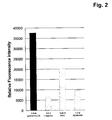
- Figure 2 shows results from refolding trx-GFP when ionic liquids are included in the refolding buffer.
- Refolding of trx-GFP is far more efficient in a 0.5 M solution of the morpholinium-based ionic liquid 4-(3-hydroxypropyl)-4-methylmorpholinium chloride than is refolding trx-GFP in any of the three control protein refolding additives: 0.5 M L-arginine, 0.25 M NaCl, or 1.0 M non-detergent sulfobetaine.
- bovine enterokinase present in 50 mM TRIS, pH 8.0, 7.0 M guanidine hydrochloride, 0.2 M NaCl, 2.0 mM EDTA and 10 mM TCEP, is performed by rapidly diluting the protein into the refolding buffer at a ratio of 1:50.
- the final concentration of the protein is 100 ⁇ g/mL.
- the refolding buffer is 50 mM HEPES, pH 7.5, containing 1.0 M of the ionic liquid N -ethyl-4-( N,N -dimethylamino)pyridinium bromide or one of the three control refolding additives: 0.5 M L-arginine, 0.25 M NaCl, or 1.0 M non-detergent sulfobetaine 256. Refolding samples are incubated at 22 ⁇ 2°C for 20-24 hours with shaking at 300 RPM.
- samples are dialyzed against 20 mM TRIS, pH 7.5, 150 mM NaCl and 2.0 mM CaCl 2 at a sample to buffer ratio of 1:40,000 or greater for 20-24 hours at 10 ⁇ 2°C.
- the substrate used to measure enzymatic activity is a fluorescently-labeled peptide substrate, available from Sigma Aldrich (Gly-Asp-Asp-Asp-Asp-Lys- ⁇ -naphthylamide, catalog number G5261).
- Figure 3 shows results from refolding EK when the ionic liquid N -ethyl-4-( N,N -dimethylamino)pyridinium bromide is included in the refolding buffer.
- Refolding of bovine enterokinase is far more efficient in a 1.0 M solution of the pyridinium-based ionic liquid N -ethyl-4-( N , N -dimethylamino)pyridinium bromide than is refolding of EK in any of the three control refolding additives: 0.5 M L-arginine, 0.25 M NaCl, or 1.0 M non-detergent sulfobetaine 256.
- the final concentration of the protein is 200 ⁇ g/mL.
- the refolding buffer is 50 mM HEPES, pH 7.5, containing 7.6 mM reduced glutathione, 2.4 mM oxidized glutathione and varied concentrations of the ionic liquid N -methyl-4-( N , N -dimethylamino)pyridinium iodide.
- the refolding process is performed at 22 ⁇ 2°C for 20-24 hours with shaking at 300 RPM.
- samples are diluted 1:50 into 50 mM TRIS, pH 7.5, containing 5.0 mM DTT, 2 mM MgCl 2 , 0.1 mM EDTA, 0.1% (w/v) BSA, and 0.01 % (v/v) Brij-35.
- Refolding is measured by using an enzymatic activity specific for ⁇ PPase.
- the substrate used to measure enzymatic activity is 4-nitrophenyl phosphate, available from Sigma Aldrich (catalog number N22002).
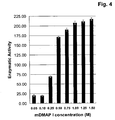
- Figure 4 shows results from refolding ⁇ PPase when the ionic liquid N -methyl-4-( N , N -dimethylamino)pyridinium iodide is included in the refolding buffer at varied concentrations. Refolding efficiency reaches a maximum when N -methyl-4-( N,N -dimethylamino)pyridinium iodide is present at 1.0 M.
- Native bovine hemoglobin (Sigma/Aldrich catalog number H2625) is dissolved in 0.1 M sodium phosphate, pH 7.4, 0.4 M NaCl) at a final concentration of 10.0 mg/mL. Aliquots of this hemoglobin solution are diluted two-fold with 1.5 M N -methyl-4-( N,N -dimethylamino) pyridinium chloride, 100% glycerol, distilled and deionized H 2 O, or 1.5 M NaCl to make the following four test solutions:
- Each hemoglobin solution is incubated at 55°C for 143 hours. During the incubation, samples are removed from each hemoglobin solution and spun at 16,000xg for 15 min at room temperature to remove any precipitated haemoglobin. The amount of hemoglobin remaining in the soluble fraction is quantified by measuring the absorbance of the solution at 540 nm (the absorbance of hemoglobin at 540 nm changes linearly with the protein concentration).
- the data shown in figure 5 represents the average of three independent measurements for each condition at each time point. The standard deviation of each data point is shown. The upper figure shows data from the entire time course. The lower figure shows the same data for the first eight hours only.
- Figure 5 shows that addition of N -methyl-4-( N,N -dimethylamino)pyridinium chloride to a final concentration of 0.75 M ( ⁇ ) significantly delays, or, prevents the precipitation of a 5.0 mg/mL solution of bovine hemoglobin in 50 mM sodium phosphate, pH 7.4, 0.2 M NaCl incubated at 55°C.
- the stabilizing effect of 0.75 M N -methyl-4-( N,N -dimethylamino)pyridinium chloride ( ⁇ ) is far greater than that of a 50% (v/v) solution of glycerol, which is a traditional protein stabilization agent.
- the stabilizing effect of 0.75 M N -methyl-4-( N,N -dimethylamino)pyridinium chloride ( ⁇ ) is not due to an increase in the ionic strength of the solution as the addition of 0.75 M NaCl to the base buffer ( ⁇ , 0.95 M total NaCl) accelerates precipitation of the hemoglobin compared to the control sample (•).
- Refolding of the single-chain antibody thioredoxin fusion protein (scFv-trx), present in 50 mM TRIS, pH 8.0, 7.0 M guanidine hydrochloride, 0.2 M NaCl, 2.0 mM EDTA and 10 mM TCEP, is performed by rapidly diluting the protein into the refolding buffer at a ratio of 1:50 for refolding buffers containing 4-(3-hydroxyethyl)-4-methylmorpholinium iodide (final protein concentration of 200 ⁇ g/mL) or at a ratio of 1:100 for refolding buffers containing non-detergent sulfobetaine 256, trehalose, or polyethylene glycol 3350 (final protein concentration of 100 ⁇ g/mL).
- scFv-trx single-chain antibody thioredoxin fusion protein
- the refolding buffer is 50 mM EPPS, pH 8.0.
- the refolding buffer is 50 mM TAPS, pH 8.5, containing 1.0 mM TCEP.
- 4-(3-hydroxyethyl)-4-methylmorpholinium iodide is added to the refolding buffer to a final concentration of 1.0 M.
- Non-detergent sulfobetaine 256, trehalose, and polyethylene glycol 3350 are added to the refolding buffer to final concentrations of 1.0 M, 0.58 M, and 0.06% (w/v), respectively.
- Refolding samples are incubated at 22 ⁇ 2°C for 20-24 hours with shaking at 300 RPM.
- samples are dialyzed against 25 mM HEPES, pH 7.5, containing 0.2 M NaCl, 0.5 mM DTT, 10% (v/v) glycerol, and 0.03% (v/v) BRIJ 35 at a sample to buffer ratio of 1:40,000 or greater for 20-24 hours at 10 ⁇ 2°C.
- the degree of refolding was measured using an ELISA specific for the correctly folded scFv-trx fusion protein.
- Figure 6A shows results from refolding of the scFv-trx fusion protein when the ionic liquid 4-(3-hydroxyethyl)-4-methylmorpholinium iodide ((eOH)mmo I) is included in the 50 mM EPPS, pH 8.0, refolding buffer in comparison to refolding results in the absence of an additive or when non-detergent sulfobetaine (NDSB-256) is included in the refolding buffer.
- ionic liquid 4-(3-hydroxyethyl)-4-methylmorpholinium iodide (eOH)mmo I)
- Refolding of the scFv-trx fusion protein is far more efficient in a 1.0 M solution of 4-(3-hydroxyethyl)-4-methylmorpholinium iodide than is refolding of the scFv-trx fusion protein in the absence of a refolding additive or in the presence of 1.0 M non-detergent sulfobetaine 256.
- Figure 6B shows results from refolding of the scFv-trx fusion protein when the ionic liquid 4-(3-hydroxyethyl)-4-methylmorpholinium iodide ((eOH)mmo I) is included in the 50 mM TAPS, pH 8.0, 1.0 mM TCEP refolding buffer in comparison to refolding results in the absence of an additive or when 0.58 M trehalose or 0.06% (w/v) polyethylene glycol (PEG3350) is included in the refolding buffer.
- the ionic liquid 4-(3-hydroxyethyl)-4-methylmorpholinium iodide (eOH)mmo I)
- Refolding of the scFv-trx fusion protein is far more efficient in a 1.0 M solution of 4-(3-hydroxyethyl)-4-methylmorpholinium iodide than is refolding of the scFv-trx fusion protein in the absence of a refolding additive or in the presence of 0.58 M trehalose or 0.06% (w/v) polyethylene glycol.
Landscapes
- Chemical & Material Sciences (AREA)
- Organic Chemistry (AREA)
- Chemical Kinetics & Catalysis (AREA)
- General Chemical & Material Sciences (AREA)
- Analytical Chemistry (AREA)
- Health & Medical Sciences (AREA)
- Life Sciences & Earth Sciences (AREA)
- Biochemistry (AREA)
- Biophysics (AREA)
- General Health & Medical Sciences (AREA)
- Genetics & Genomics (AREA)
- Medicinal Chemistry (AREA)
- Molecular Biology (AREA)
- Proteomics, Peptides & Aminoacids (AREA)
- Crystallography & Structural Chemistry (AREA)
- Peptides Or Proteins (AREA)
Description
- This invention relates to the use of ionic liquids comprising a cation with at least one electron donor region and one positively charged electrostatic region which are spatially distinct from each other for protein refolding and/or protein stabilization and methods for refolding and/or stabilizing proteins using said ionic liquids.
- One important process in biotechnology is the expression of recombinant proteins. Due to the developments achieved in molecular biology it is possible to clone proteins starting with the coding sequences thereof and to produce them in host organisms in a recombinant manner. Upon high-yield production of recombinant proteins in bacteria, the recombinant proteins often precipitate in the form of biologically inactive aggregates or inclusion bodies. The proteins contained in these inclusion bodies must subsequently be transformed into the biologically active form by means of in vitro refolding.
- In a first step, the inclusion bodies are solubilized typically with denaturing agents or chaotropic agents like urea or guanidinium hydrochloride. That means the recombinant proteins are denatured (completely unfolded) and solubilized (aggregates are dissolved). In most circumstances, it is necessary to include a reducing agent in the denaturation and solubilization step. The reducing agent acts to break non-native inter- and intra-chain disulfide bonds.
- In a second step, after denaturation and solubilization, the proteins must be refolded into the native and active three dimensional conformation. Renaturation or refolding methods are designed to transfer the target protein from a denaturing environment into an environment that favours the correctly folded, active protein. For the vast majority of target proteins, the refolding environment is critical. If it is incorrect, the target protein fails to refold, re-aggregates and precipitates again.
- Many different molecules that facilitate protein refolding have been identified, e.g. salts, buffers, glycols, amino acids or sugars. It is for example known that the addition of molecules such as urea or guanidinium in a non-denaturing concentration can have a positive impact on the efficiency of refolding. As an alternative to guanidinium or urea other chaotropic substances have been used in in vitro folding processes, for example alkyl urea, or organic co-solvents such as carboxylic acid amides or alkylated amines.
- It has also been observed that the yield of in vitro folding can be enhanced by the addition of L-arginine. Other additives which increase the efficiency of in vitro folding are highly concentrated Tris buffers, polyethylene glycol or detergents.
-
WO 03/051908 - Christian Lange et al., Protein Science, Vol. 14, No. 10, October 2010 (2005-10), pages 2693-2701 disclose the use of hydroxyalkyl substituted methylimidazolium chlorides as additives for refolding recombinant proteins.
- Despite this large collection of refolding additives, there are many recombinant proteins that remain intractable to refolding or are refolded in bad yields.
- Consequently, there exists a clear need for novel, highly efficacious protein refolding additives.
- It has been found that ionic liquids with a certain distribution of electron density are especially efficient protein refolding and stabilizing agents. The said ionic liquids need to comprise a cation with at least one electron donor region and at least one positively charged electrostatic region which are spatially distinct from each other.
- The present invention therefore relates to the use of ionic liquids comprising a cation with at least one electron donor region and at least one positively charged electrostatic region which are spatially distinct from each other for the refolding, for the increase of the thermal stability and/or for the decrease of aggregation of proteins.
The ionic liquids comprising a cation with at least one electron donor region and at least one positively charged electrostatic region which are spatially distinct have a cation with one of the following general structures A or B
[HetN]+-ED A
or
[HetNED]+ B,
with
HetN being an aromatic, partially aromatic or non-aromatic heterocyclic ring system with at least one nitrogen atom being part of the ring system. - ED being an electron donor. According to structure A, ED is a substituent which is covalently bound to one atom of the heterocyclic ring system, but ED is not part of the ring system.
According to structure B, ED is part of the heterocyclic ring system, that means ED is an electron donor group which is directly incorporated in the ring structure. - The cation with at least one electron donor region and at least one positively charged electrostatic region which are spatially distinct from each other is selected from the group

and where the substituents R1'to R4' each, independently of one another, denote
-H, -CN, -OR', -NR'2, -P(O)R'2, -P(O)(OR')2, -P(O)(NR'2)2, -C(O)R', -C(O)OR', -C(O)NR'2, -SO2NR'2, -NO2,
straight-chain or branched alkyl having 1-20 C atoms,
straight-chain or branched alkenyl having 2-20 C atoms and one or more double bonds,
straight-chain or branched alkinyl having 2-20 C atoms and one or more triple bonds,
saturated, partially or fully unsaturated cycloalkyl having 3-7 C atoms, which may be substituted by alkyl groups having 1-6 C atoms, saturated, partially or fully unsaturated heteroaryl, heteroaryl-C1-C6-alkyl or aryl-C1-C6-alkyl,
where the substituents R1', R2' , R3' and/or R4' together may also form a ring system,
where one or more substituents R1' to R4' may be partially or fully substituted by halogens, in particular -F and/or -Cl, or -OH, -OR', -CN, -C(O)OH, -C(O)NR'2, -SO2NR'2, -C(O)X, -SO2OH, -SO2X or -NO2, but where R1' and R4' cannot simultaneously be fully substituted by halogens, and where one or two non-adjacent carbon atoms of the substituents R1' to R4' which are not bonded to the heteroatom may be replaced by atoms and/or atom groups selected from -O-, -S-, -S(O)-, -SO2-, -SO2O -C(O)-, -C(O)O-, -N+R'2-, -P(O)R'O-, -C(O)NR'-, -SO2NR'- -OP(O)R'O-, -P(O)(NR'2)NR'-, -PR'2=N- and -P(O)R'-, where R' = H, non-, partially or perfluorinated C1- to C6-alkyl, C3- to C7-cycloalkyl, or unsubstituted or substituted phenyl, and
X = halogen,
with the proviso that the Pyridinium cation has at least one substituent R1' to R4' per molecule which is -CN, -OR', -NR'2, -P(O)R'2, -P(O)(OR')2, -P(O)(NR'2)2, -C(O)R', -C(O)OR', -C(O)NR'2, -SO2NR' or -NO2
and/or at least one substituent R1' to R4' per molecule which is substituted with -OR', -CN, -C(O)OH, -C(O)NR'2, -SO2NR'2, -C(O)X, -SO2OH -SO2X or -NO2
and/or at least one substituent R1' to R4' per molecule in which one or two non-adjacent carbon atoms which are not bonded to the heteroatom are replaced by atoms and/or atom groups selected from -O-, -S-, -S(O)-, -SO2-, -SO2O-, -C(O)-, -C(O)O-, -N+R'2-, -P(O)R'O-, -C(O)NR'-, -SO2NR'-, -OP(O)R'O-, -P(O)(NR'2)NR'-, -PR'2=N- and -P(O)R'- .
That means that if there is no electron donor function already integrated in the ring structure as in Morpholinium at least one substituent R1' to R4' needs to comprise one of the said electron donor features. - In a preferred embodiment, the cation of the ionic liquid according to the present invention comprises only one electron donor region.
- For the purposes of the present invention, fully unsaturated substituents are also taken to mean aromatic substituents.
- The substituents R' are particularly preferably methyl, ethyl, isopropyl, propyl, n-butyl, sec-butyl, tert-butyl, pentyl or hexyl.
- In a preferred embodiment, one but only one substituent R1' to R4' per molecule is -CN, -OR', -NR'2, -P(O)R'2, -P(O)(OR')2, -P(O)(NR'2)2, -C(O)R', -C(O)OR', -C(O)NR'2, -SO2NR' or -NO2.
- In a preferred embodiment, one but only one substituent R1' to R4' per molecule is -CN, -OR', -NR'2, -P(O)R'2, -P(O)(OR')2, -P(O)(NR'2)2, -C(O)R', -C(O)OR', -C(O)NR'2, -SO2NR'2 or -NO2 and the other substituents R1' to R4' independently of one another, denote -H or straight-chain or branched alkyl having 1-20 C atoms, preferably -H, methyl, ethyl, isopropyl, propyl, n-butyl, sec-butyl, tert-butyl, pentyl or hexyl.
- The most preferred morpholinium cations are 4-(cyanomethyl)-4-methylmorpholinium and 4-(3-hydroxyethyl)-4-methylmorpholinium.
- In a very preferred embodiment, the cation with at least one electron donor region and at least one positively charged electrostatic region which are spatially distinct from each other is selected from the group

one but only one R2' being selected from the group dimethylamino or diethylamino, Most preferred is dimethylamino
and the other R2' being independently from another selected from the group -H, methyl, ethyl, iso-propyl, n-propyl, butyl, pentyl, hexyl. Most preferred is -H.
and R1' being selected from the group methyl, ethyl, (iso-)propyl , n-propyl or n- butyl. - In a very preferred embodiment, the cation is N-methyl-4-(N',N'-dimethylamino)-pyridinium, N-ethyl-4-(N',N'-dimethylamino)-pyridinium, N-butyl-4-(N',N'-dimethylamino)-pyridinium.
- In another preferred embodiment, the anion of the ionic liquid is Cl-, Br-, I- or BF4 -.
- The present invention is also directed to a method for the refolding, the increase of the thermal stability and/or the decrease of the aggregation of proteins, wherein the proteins to be treated are contacted with a liquid medium comprising at least one ionic liquid which comprises a cation with at least one electron donor region and at least one positively charged electrostatic region which are spatially distinct from each other selected from the group

- The preferred embodiments described above for the use according to the present invention are also the preferred embodiments used for the method for the refolding, the increase of the thermal stability and/or the decrease of the aggregation of proteins.
- The present invention is further directed to a method for extracting proteins from inclusion bodies by
- a) solubilizing the proteins from the inclusion bodies with denaturing agents or chaotropic agents like urea or guanidinium hydrochloride. That means the recombinant proteins are denatured (completely unfolded) and solubilized (aggregates are dissolved).
- b) refolding the proteins solubilized in step a) by contacting them with a liquid medium comprising at least one ionic liquid which comprises a cation with at least one electron donor region and at least one positively charged electrostatic region which are spatially distinct from each other selected from the group

- Further disclosed is an agent comprising at least one ionic liquid which comprises a cation with at least one electron donor region and at least one positively charged electrostatic region which are spatially distinct from each other in a liquid medium.
- In a preferred embodiment, the agent additionally comprises one or more of the following substances:
- reduction agents like tris(2-Carboxyethyl)phosphine, reduced glutathione, 1,4-Dithiothreitol, or 2-Mercaptoethanol
- a redox system like a mixture of oxidized and reduced glutathione or a mixture of cysteine and cystine
- other substances that are known to promote refolding of proteins like urea, guanidinium, L-arginine, alkyl urea, carboxylic acid amides, alkylated amines, Tris buffers, polyethylene glycol, detergents, sugars, and/or zwitterionic molecules
- The most preferred ionic liquids for use according to the present invention are the chlorides, bromides and/or iodides of N-methyl-4-(N',N'-dimethylamino)-pyridinium, N-ethyl-4-(N',N'-dimethylamino)-pyridinium, N-butyl-4-(N',N'-dimethylamino)-pyridinium, 4-(cyanomethyl)-4-methylmorpholinium and/or 4-(3-hydroxyethyl)-4-methylmorpholinium, for example 4-(3-hydroxyethyl)-4-methylmorpholiniumiodide, 4-(3-hydroxypropyl)-4-methylmorpholinium chloride, N-ethyl-4-(N,N-dimethylamino)pyridinium bromide or N-methyl-4-(N,N-dimethylamino)pyridinium iodide.
- The preferred embodiments described above for the use according to the present invention are also the preferred embodiments used for the method for the refolding, the increase of the thermal stability and/or the decrease of the aggregation of proteins and for the method for extracting proteins form inclusion bodies.
-
-
Figure 1 shows results from refolding MMP12 when ionic liquids are included in the refolding buffer. Further details can be found in Example 2. -
Figure 2 shows results from refolding trx-GFP when ionic liquids are included in the refolding buffer. Further details can be found in Example 3. -
Figure 3 shows results from refolding EK when the ionic liquid N-ethyl-4-(N,N-dimethylamino)pyridinium bromide is included in the refolding buffer. - Further details can be found in Example 4.
-
Figure 4 shows results from refolding A PPase when the ionic liquid N-methyl-4-(N,N-dimethylamino)pyridinium iodide is included in the refolding buffer at varied concentrations. Further details can be found in Example 5. -
Figure 5 shows the stability of bovine hemoglobin at elevated temperature in the presence of the ionic liquid N-ethyl-4-(N,N-dimethylamino) pyridinium bromide. Further details can be found in Example 6. -
Figure 6 comprisesFigure 6A and Figure &A and shows results from refolding the scFv-trx fusion protein in presence of the ionic liquid 4-(3-hydroxyethyl)-4-methylmorpholinium iodide in comparison to non-detergent sulfobetaine (Figure 6A ) and trehalose and polyethylene glycol (Figure 6B ). - Abbreviations used in figures, tables and elsewhere have the following meanings:
- BCA means Bicinchoninic Acid
- bis-TRIS means 2,2-Bis(hydroxymethyl)-2,2',2"-nitrilotriethanol
- BME means 2-Mercaptoethanol
- bmim Cl means 1-butyl-3-methylimidazolium chloride
- Brij-35 means C12E23 Polyoxyethylene(23) lauryl ether
- BSA means bovine serum albumin
- CHES means 2-(Cyclohexylamino)ethanesulfonic acid
- DTE means erythro-1,4-Dimercapto-2,3-butanediol
- DTT means 1,4-Dithiothreitol
- EDTA means Ethylenediaminetetraacetic acid
- EK means the catalytic subunit of bovine enterokinase
- emim Cl means 1-ethyl-3-methylimidazolium chloride
- EPPS means 4-(2-Hydroxyethyl)-1-piperazinepropanesulfonic acid
- Hepes means 4-(2-Hydroxyethyl)piperazine-1-ethanesulfonic acid
- λ PPase means lambda protein phosphatase
- Mes means 2-(N-Morpholino)ethanesulfonic acid
- MMP12 means the catalytic subunit from human matrix metalloprotease 12
- Mops means 3-(N-Morpholino)propanesulfonic acid
- TAPS means [(2-Hydroxy-1,1-bis(hydroxymethyl)ethyl)amino]-1-propanesulfonic acid
- TCEP means tris(2-carboxyethyl)phosphine
- THP means Tris(hydroxypropyl)phosphine
- Tris means Tris(hydroxymethyl)aminomethane
- trx-GFP means a fusion protein comprised of the bacterial thioredoxin protein and the green fluorescent protein
- Ionic liquids or liquid salts are ionic species which consist of an organic cation and an inorganic or (less frequently) an organic anion. They do not comprise neutral molecules. That means the ionic liquids used according to the invention are liquid at room temperature, or if they are not liquid at room temperature, they should at least be present in a liquid form and/or be soluble in the liquid medium under the conditions of treatment. For example, N-ethyl-4-(N',N'-dimethylamino)-pyridinium is solid at room temperature but highly soluble (>2.0 M) in biologically relevant buffers (pH 5.0 - 9.0) at temperatures from 4-37°C.
- Intensive research is currently being carried out in the area of ionic liquids since the potential applications are multifarious. Review articles on ionic liquids are, for example, R. Sheldon "Catalytic reactions in ionic liquids", Chem. Commun., 2001, 2399-2407; M.J. Earle, K.R. Seddon "Ionic liquids. Green solvent for the future", Pure Appl. Chem., 72 (2000), 1391-1398; P. Wasserscheid, W. Keim "Ionic Flüssigkeiten - neue Lösungen für die Übergangsmetallkatalyse" [Ionic Liquids - Novel Solutions for Transition-Metal Catalysis], Angew. Chem., 112 (2000), 3926-3945; T. Welton "Room temperature ionic liquids. Solvents for synthesis and catalysis", Chem. Rev., 92 (1999), 2071-2083 or R. Hagiwara, Ya. Ito "Room temperature ionic liquids of alkylimidazolium cations and fluoroanions", J. Fluorine Chem., 105 (2000), 221-227.
- According to the present invention, "ionic liquids comprising a cation with at least one electron donor region and at least one positively charged electrostatic region which are spatially distinct from each other" preferably means that the ionic liquid comprises a cation with at least one electron donor region which is spatially distinct from the positively charged electrostatic region of the cation.
- It is possible to have a cation with more than one positively charged electrostatic region (a divalent cation, or dication) which are spatially distinct from each other.
For example, 1,4-methyllpiperazine can be converted to the divalent 1,1,4,4-tetramethylpiperazinium cation, but in a preferred embodiment, the ionic liquids of the present invention only comprise a cation with one positively charged electrostatic region. - "spatially distinct" means that there are typically at least two bonds between the electron donor region and the positively charged electrostatic region. In a preferred embodiment, there are at least two bonds between the centre of the electron donor region and the centre of the positively charged electrostatic region. Centre means the group of atoms or the one atom at which the electrons of the electron donor region are mainly focused or the group of atoms or the atom at which the positive charge is mainly focused.
- According to the invention, an electron donor region is a region containing a an electron releasing group. An electron releasing group is a functional group which is able to release electrons into a reaction center.
Examples of electron releasing groups are alcohol groups, cyano groups, ether groups and amino groups. - Examples of cations with electron donor regions are N-alkyl-dimethylamminopyridinium and N,N-dialkylmorpholinium.
- According to the present invention, a positively charged electrostatic region is a region with a positive electrostatic potential, due to a deficit of electrons.
This region can be a point charge, located on a single atom, or delocalized, where the charge is distributed over two or more atoms.
In a non-aromatic cation (such as morpholinium or pyrrolidinium), the positively charged electrostatic region is localised in the region immediately surrounding the ring-nitrogen atom, the ring-nitrogen atom being the centre. In an aromatic cation (such as pyridinium or imidazolium), the positive charge is delocalised and distributed (but not evenly) amongst the atoms of the ring.
Refolding according to the present invention means the renaturation of a protein, i.e. the regaining of the native state of the protein in which it shows its biological activity. Typically, the proteins which have to be refolded are denatured proteins. Refolding typically means a change of the 3-dimensional order of the protein. - According to the invention, the decrease of aggregation is intended to mean a decrease or even a substantial prevention of the aggregation of proteins which usually occurs during prolonged storage periods in liquid media and which is accompanied by a loss or a reduction in biological functionality.
- According to the invention, increase of the thermal stability means that the biological activity or the correct protein folding, respectively, are maintained over a prolonged period of time even at temperatures which can be by far higher than room temperature.
- According to the present invention a refolding agent, also called refolding medium or refolding liquid, is the liquid mixture with which the proteins to be refolded are contacted. It typically comprises at least one liquid medium and at least one type of ionic liquid comprising a cation with at least one electron donor region and at least one positively charged electrostatic region which are spatially distinct from each other. The refolding agent may comprise further additives like stabilizing agents, reduction agents like TCEP or glutathione, a redox system (e.g. composed of reduced and oxidized thiol substances such as DTT, DTE, glutathione, cysteine, mercaptoethanol) or other substances that are known to promote refolding like for example urea, guanidinium, L-arginine, alkyl urea, carboxylic acid amides, alkylated amines, Tris buffers, polyethylene glycol, detergents, sugars, and/or zwitterionic molecules (non-detergent sulfobetaines). The refolding agent according to the invention may also comprise two or more different ionic liquids comprising a cation with at least one electron donor region and at least one positively charged electrostatic region which are spatially distinct from each other.
- Suitable examples of cations for ionic liquids comprising a cation with at least one electron donor region and at least one positively charged electrostatic region which are spatially distinct from each other are given above and in the claims.
- Suitable anions are all anions that can be used to generate ionic liquids with the above mentioned cations with at least one electron donor region and at least one positively charged electrostatic region which are spatially distinct from each other. In a preferred embodiment, the anion of the ionic liquid is Cl-, Br-, I- or BF4 -.
- The agents and the method according to the present invention are suitable for the refolding of any protein or any class of proteins. The protein might be a protein which has been produced by chemical synthesis or which has been extracted from viruses, cells or tissues, e.g. from prokaryotic or eukaryotic cells. The agents and the method according to the present invention are especially suitable for the refolding of recombinant proteins. Typically, the recombinant proteins have been expressed in host cells like bacterial cells, e.g. E. coli cells. In this context, inclusion bodies are defined as dense, insoluble, mis-folded aggregates of recombinant protein, located in the cytoplasm and/or the periplasmic space of the host cell. In addition to the recombinant protein, inclusion bodies may contain host cell proteins, nucleic acids, lipids, and/or other host cell molecules.
Other suitable sources of protein to be refolded include, but are not limited to, recombinant proteins produced in yeast, insect, fungal, mammalian cells, or in vitro translation systems that do fold into the native three dimensional structure. - Inclusion bodies may be isolated from the host cell using any one of the many well-established protocols.
- Examples of proteins which can be refolded according to the method of the present invention are:
- Proteases, preferably serine proteases, particularly thrombin, factor Xa, caspases, cathepsins, trypsin and chymotrypsin, cysteine proteases, acidic proteases such as pepsin or rennin, metalloproteinases such as thermolysin; protease inhibitors, preferably pepstatins, antipain, chemostatins, elastinal, leupeptins, bestatin, antithrombin III;
- DNA binding proteins, preferably transcription factors, particularly NF kappa B and members of the jun, fos, krox, myc, E2F families, viral T antigens;
- viral proteins, e.g. viral envelope proteins, capsid proteins, viral proteases, polymerases and/or T antigens;
- phosphatases;
- protein kinases, preferably tyrosine kinases and/or serine kinases;
- proteins of the immunoglobulin superfamily, e.g. antibodies and fragments thereof; growth factors, e.g. epidermal growth factor (EGF), erythropoietin, fibroblast growth factor (FGF), insulin-like growth factors I and II (IGF I and IGF II), interleukin-2 (IL-2), nerve growth factor (NGF), transforming growth factor beta. (TGF-.beta.) and/or thrombocyte growth factor (PDGF),
- as well as proteins and fragments derived from these proteins.
- The agents and the method according to the present invention are especially suitable for the refolding of:
- Bovine enterokinase (EK for EnteroKnase). Protein Data Bank (PDB) identification number 1 EKB.
- Matrix Metalloprotease 12 (MMP12). PDB identification number 2OXU.
- Fusion protein of thioredoxin and green fluorescent protein (trx-GFP). Trx PDB identification number 2TRX. GFP PDB identification number 1 B9C.
- Lambda protein phosphatase (λ PPase). PBD identification number 1G5B.
- Human rhino virus protease 3C (HRV 3C). PDB identification number 1 CQQ.
- According to the invention, disulfide-free and disulfide-bridged proteins can be refolded. Multidomain proteins and complex disulfide-bridged proteins can be treated such as e.g. lysozyme, enterokinase, rPA (recombinant plasminogen activator, trade name replase), alpha glucosidase, antibodies and fragments derived therefrom and/or growth factors. These proteins/protein classes merely serve as examples.
- As the liquid medium in the method according to the invention for the refolding of proteins there is preferably used an aqueous medium, i.e. water, an aqueous buffer system or mixtures of water or aqueous buffer systems with water soluble organic solvents like ethanol, butyl alcohol, acetonitrile, etc. (typically not more than 20Vol% organic solvent.) Suitable buffers are Tris, Hepes, Mes, Mops, EPPS, TAPS, CHES, bis-TRIS, acetate, glycine and/or phosphate. The buffer concentration in the liquid medium is preferably between 10 and 1000 mM, more preferably between 5 and 200 mM, also preferred between 10 and 200 mM and further preferred between 10 and 50 mM. The pH of the liquid medium preferably is between 4-11, further preferred between 6.5-9.0. For most proteins good results can be achieved with a pH between 7.0 and 8.5. In the case of recombinant enterokinase, for example, the pH value during renaturation is preferably about 7.0-8.5, and for the renaturation of the thioredoxin-green fluorescent protein, the pH value preferably is about 6.5-8.5. For other proteins to be refolded the buffer composition parameters may be adapted and optimized individually to obtain a maximal yield of refolded protein.
- It is preferable, but not necessary, to reduce the amount of contaminating substances in the preparation of protein to be refolded prior to refolding. Contaminating substances may be reduced or removed by washing the protein preparation, typically the inclusion bodies comprising the protein to be refolded, with a buffered aqueous solution containing a wash agent. Suitable wash agents include, but are not limited to, mild detergents, detergent-like molecules, chaotropes, and salts. Alternatively, contaminating substances may be reduced or removed by first denaturing and reducing the recombinant protein (described below) and applying the resulting preparation to a chromatography resin. Typically, the recombinant protein is selectively immobilized on the chromatography resin and contaminating substances do not bind to the resin or are washed away with a buffered aqueous solution containing a chaotropic agent. The recombinant protein is eluted from the chromatography resin by adjusting the buffer conditions such that the strength of the interaction between the target protein and the resin is reduced significantly. Wash protocols can be adjusted by those skilled in the art with respect to the protein to be refolded and the nature of the contaminating substances.
- Prior to refolding, it is often necessary to fully solubilize and denature the target protein. A fully solubilized protein should be primarily monomeric and lack tertiary structure. Preferably, solubilization is accomplished by contacting the mis-folded, aggregated, and/or insoluble target protein with a buffered aqueous solution containing a high concentration of a chaotropic agent, such as guanidine hydrochloride, urea, or N-lauryl sarcosine and a reducing agent such as DTT, BME, THP, or TCEP.
- In the method according to the invention the contacting of the proteins in a solubilized and denatured state to be refolded or to be treated is preferably performed by diluting, dialyzing and/or diafiltrating the protein to be treated with the refolding liquid. Principally, a buffer exchange of the denatured protein into the refolding liquid should be assured for the refolding.
- During contacting with the refolding agent and particularly during the refolding, the protein concentration of the protein to be treated preferably is 5-500 µg/ml, preferably 10-200 µg/ml, still more preferably about 100-200 µg/ml. These values can be adjusted by those skilled in the art with respect to the protein to be refolded or to be treated, respectively, considering the solubility properties of the respective protein.
- The method according to the invention is useful for the refolding of disulfide-free and disulfide-bridged proteins. Regarding disulfide-free proteins, these are preferably contacted with a refolding medium that further comprises a reduction agent such as DTT, DTE, glutathione and/or cysteine, preferably in a concentration of 1-10 mM.
- Regarding the refolding of disulfide-bridged proteins, these are preferably contacted in the presence of a redox system composed of reduced and oxidized thiol substances such as DTT, DTE, glutathione, cysteine, mercaptoethanol, preferably in a concentration of 1-10 mM. In these cases, the concentration ratios of reduced substances to oxidized substances ("reduced:oxidized") preferably are 1:10 to 20:1, preferably 1:5-10:1, further preferred 1:1 to 5:1.
- During contacting and particularly during the refolding the concentration of the ionic liquids comprising a cation with at least one electron donor region and at least one positively charged electrostatic region which are spatially distinct from each other typically is approximately 0.25-5 M, preferably 0.3 to 1.5 M, most preferred 0.5 to 1.0 M.
- Generally, the period of refolding preferably is: 0.1-100 h, further preferred 1-50 h, still more preferably about 2-24 h.
- The refolding preferably takes place at low temperatures of 0-37 °C, preferably 5-20°C, since at higher temperatures the aggregation reactions increase.
- Typically, as a parameter for the refolding efficiency, the biological activity of the protein and the aggregation behaviour can be measured over the course of the process or afterwards.
- In another embodiment of the method according to the invention the protein may be added to the refolding agent at several successive times in a pulsed manner or in a continuous manner. Preferably, the refolding procedure is done batch wise, that means, the whole amount of protein is added to a suitable amount of the refolding agent at one time.
- Depending on the down-stream application it might be necessary to remove the refolding agent, especially the ionic liquid comprised in the refolding agent from the refolded proteins. Some of the ionic liquids can interfere with assays for biological or enzymatic activity. In these circumstances, the concentration of the ionic liquid is reduced (essentially to zero) by using dialysis. Proteins are retained within the dialysis membrane and the IL equilibrates with the dialysis buffer.
- Refolding efficiency varies greatly between target proteins and the quality of the inclusion body preparation (amount and type of contaminants).
- Without further elaboration, it is believed that one skilled in the art can, using the preceding description, utilise the present invention to its fullest extent.
- The following examples represent practical applications of the invention.
- Denaturation (or solubilization) and reduction of proteins expressed as inclusion bodies.
- Proteins in the form of inclusion bodies are denatured, solubilized, and reduced by stirring inclusion bodies in a solution of 50 mM TRIS, pH 8.0, 7.0 M guanidine hydrochloride, 0.2 M NaCl, 2.0 mM EDTA, and 10 mM TCEP for approximately 2 hours at room temperature. The sample is centrifuged at 25,000 x g for 15 minutes at 4°C and then passed through a 0.45 µm filter to remove any insoluble material. The concentration of the protein sample is determined using the bicinchoninic acid (BCA) method (for example, see: Smith, P.K., et al. (1985). Anal. Biochem. 150, 76-85 or product number 71285 from EMD Chemicals or product number 23225 from ThermoFisher) .
- Refolding of matrix metalloprotease 12 using N-ethyl-4-(N,N-dimethylamino)pyridinium bromide, 1-butyl-3-methylimidazolium chloride, or 1-ethyl-3-methylimidazolium chloride.
- The refolding of matrix metalloprotease 12 (MMP12), present in 50 mM TRIS, pH 8.0, 7.0 M guanidine hydrochloride, 0.2 M NaCl, 2.0 mM EDTA and 10 mM TCEP, is performed by rapidly diluting the protein into the refolding buffer at a ratio of 1:50. The final concentration of the protein is 100 µg/mL. The refolding buffer is 50 mM bis-TRIS, pH 6.5, containing 0.5 M of the ionic liquid N-ethyl-4-(N,N-dimethylamino)pyridinium bromide, 1-butyl-3-methylimidazolium chloride, or 1-ethyl-3-methylimidazolium chloride. Refolding samples are incubated at 22 ± 2°C for 20-24 hours with shaking at 300 RPM. After refolding, samples are dialyzed against 50 mM TRIS, pH 7.5, 0.15 M NaCl, 2.0 mM CaCl2, 1.0 µM ZnCl2 and 0.03% (v/v) Brij-35 at a sample to buffer ratio of 1:40,000, or greater, for 20-24 hours at 10 ± 2°C. Refolding is measured using an enzymatic activity assay specific for MMP12. The substrate used to measure MMP12 enzymatic activity is BODIPY-FL-labeled DQ elastin conjugate, available from Invitrogen (catalog number E12056).
-
Figure 1 shows results from refolding MMP12 when ionic liquids are included in the refolding buffer. Refolding of MMP12 is far more efficient in a 0.5 M solution of the pyridium-based ionic liquid N-ethyl-4-(N,N-dimethylamino)pyridinium bromide than is refolding of MMP12 in a 0.5 M solution of the imidazolium-based ionic liquids 1-butyl-3-methylimidazolium chloride (bmim Cl) or 1-ethyl-3-methylimidazolium chloride (emim Cl). - Refolding of the thioredoxin-green fluorescent protein fusion using 4-(3-hydroxypropyl)-4-methylmorpholinium chloride and comparison to the refolding agents L-arginine, NaCl, and
non-detergent sulfobetaine 256. - The refolding of the thioredoxin-green fluorescent protein fusion (trx-GFP), present in 50 mM TRIS, pH 8.0, 7.0 M guanidine hydrochloride, 0.2 M NaCl, 2.0 mM EDTA and 10 mM TCEP, is performed by rapidly diluting the protein into the refolding buffer at a ratio of 1:50. The final concentration of the protein is 100 µg/mL. The refolding buffer is 50 mM TAPS, pH 8.5, 7.6 mM reduced glutathione, 2.4 mM oxidized glutathione and 0.5 M of the ionic liquid 4-(3-hydroxypropyl)-4-methylmorpholinium chloride or one of three control refolding additives: 0.5 M L-arginine, 0.25 M NaCl, or 1.0 M
non-detergent sulfobetaine 256. Refolding samples are incubated at 22 ± 2°C for 20-24 hours with shaking at 300 RPM. After refolding, samples are dialyzed against 50 mM TRIS, pH 8.0 at a sample to buffer ratio of 1:40,000, or greater, for 20-24 hours at 10 ± 2°C. The degree of refolding of trx-GFP fusion protein is judged by measuring the relative fluorescence intensity of the refolded samples, using an excitation wavelength of 388 nm and an emission wavelength of 504 nm. -
Figure 2 shows results from refolding trx-GFP when ionic liquids are included in the refolding buffer. Refolding of trx-GFP is far more efficient in a 0.5 M solution of the morpholinium-based ionic liquid 4-(3-hydroxypropyl)-4-methylmorpholinium chloride than is refolding trx-GFP in any of the three control protein refolding additives: 0.5 M L-arginine, 0.25 M NaCl, or 1.0 M non-detergent sulfobetaine. - Refolding bovine enterokinase using N-ethyl-4-(N,N-dimethylamino)pyridinium bromide and comparison to the refolding agents L-arginine, sodium chloride, and
non-detergent sulfobetaine 256. - The refolding of bovine enterokinase (EK), present in 50 mM TRIS, pH 8.0, 7.0 M guanidine hydrochloride, 0.2 M NaCl, 2.0 mM EDTA and 10 mM TCEP, is performed by rapidly diluting the protein into the refolding buffer at a ratio of 1:50. The final concentration of the protein is 100 µg/mL. The refolding buffer is 50 mM HEPES, pH 7.5, containing 1.0 M of the ionic liquid N-ethyl-4-(N,N-dimethylamino)pyridinium bromide or one of the three control refolding additives: 0.5 M L-arginine, 0.25 M NaCl, or 1.0 M
non-detergent sulfobetaine 256. Refolding samples are incubated at 22 ± 2°C for 20-24 hours with shaking at 300 RPM. After refolding, samples are dialyzed against 20 mM TRIS, pH 7.5, 150 mM NaCl and 2.0 mM CaCl2 at a sample to buffer ratio of 1:40,000 or greater for 20-24 hours at 10 ± 2°C. - refolding is measured by using an enzymatic activity specific for EK. The substrate used to measure enzymatic activity is a fluorescently-labeled peptide substrate, available from Sigma Aldrich (Gly-Asp-Asp-Asp-Asp-Lys-β-naphthylamide, catalog number G5261).
-
Figure 3 shows results from refolding EK when the ionic liquid N-ethyl-4-(N,N-dimethylamino)pyridinium bromide is included in the refolding buffer. Refolding of bovine enterokinase is far more efficient in a 1.0 M solution of the pyridinium-based ionic liquid N-ethyl-4-(N,N-dimethylamino)pyridinium bromide than is refolding of EK in any of the three control refolding additives: 0.5 M L-arginine, 0.25 M NaCl, or 1.0 Mnon-detergent sulfobetaine 256. - Refolding lambda protein phosphatase using N-methyl-4-(N,N-dimethylamino)pyridinium iodide.
- The refolding of lambda protein phosphatase (λ PPase), present in 50 mM TRIS, pH 8.0, 7.0 M guanidine hydrochloride, 0.2 M NaCl, 2.0 mM EDTA and 10 mM TCEP, is performed by rapidly diluting the protein into the refolding buffer at a ratio of 1:50. The final concentration of the protein is 200 µg/mL. The refolding buffer is 50 mM HEPES, pH 7.5, containing 7.6 mM reduced glutathione, 2.4 mM oxidized glutathione and varied concentrations of the ionic liquid N-methyl-4-(N,N-dimethylamino)pyridinium iodide. The refolding process is performed at 22 ± 2°C for 20-24 hours with shaking at 300 RPM. After refolding, samples are diluted 1:50 into 50 mM TRIS, pH 7.5, containing 5.0 mM DTT, 2 mM MgCl2, 0.1 mM EDTA, 0.1% (w/v) BSA, and 0.01 % (v/v) Brij-35. Refolding is measured by using an enzymatic activity specific for λ PPase. The substrate used to measure enzymatic activity is 4-nitrophenyl phosphate, available from Sigma Aldrich (catalog number N22002).
-
Figure 4 shows results from refolding λ PPase when the ionic liquid N-methyl-4-(N,N-dimethylamino)pyridinium iodide is included in the refolding buffer at varied concentrations. Refolding efficiency reaches a maximum when N-methyl-4-(N,N-dimethylamino)pyridinium iodide is present at 1.0 M. - Stabilization of bovine hemoglobin at elevated temperature by the ionic liquid N-methyl-4-(N,N-dimethylamino)pyridinium chloride.
- Native bovine hemoglobin (Sigma/Aldrich catalog number H2625) is dissolved in 0.1 M sodium phosphate, pH 7.4, 0.4 M NaCl) at a final concentration of 10.0 mg/mL. Aliquots of this hemoglobin solution are diluted two-fold with 1.5 M N-methyl-4-(N,N-dimethylamino) pyridinium chloride, 100% glycerol, distilled and deionized H2O, or 1.5 M NaCl to make the following four test solutions:
- (1) 50 mM sodium phosphate, pH 7.4, containing 0.2 M NaCl, 5.0 mg/mL hemoglobin, and 0.75 M N-methyl-4-(N,N-dimethylamino) pyridinium chloride (▲);
- (2) 50 mM sodium phosphate, pH 7.4, containing 0.2 M NaCl, 5.0 mg/mL hemoglobin, and 50% (v/v) glycerol (■)
- (3) 50 mM sodium phosphate, pH 7.4, containing 0.2 M NaCl, and 5.0 mg/mL hemoglobin (• control);
- (4) 50 mM sodium phosphate, pH 7.4, containing 0.95 M NaCl, and 5.0 mg/mL hemoglobin (▼; 0.2 M NaCl from the base buffer and 0.75 M NaCl as an experimental trial).
- Each hemoglobin solution is incubated at 55°C for 143 hours. During the incubation, samples are removed from each hemoglobin solution and spun at 16,000xg for 15 min at room temperature to remove any precipitated haemoglobin. The amount of hemoglobin remaining in the soluble fraction is quantified by measuring the absorbance of the solution at 540 nm (the absorbance of hemoglobin at 540 nm changes linearly with the protein concentration). The data shown in
figure 5 represents the average of three independent measurements for each condition at each time point. The standard deviation of each data point is shown. The upper figure shows data from the entire time course. The lower figure shows the same data for the first eight hours only. -
Figure 5 shows that addition of N-methyl-4-(N,N-dimethylamino)pyridinium chloride to a final concentration of 0.75 M (▲) significantly delays, or, prevents the precipitation of a 5.0 mg/mL solution of bovine hemoglobin in 50 mM sodium phosphate, pH 7.4, 0.2 M NaCl incubated at 55°C. The stabilizing effect of 0.75 M N-methyl-4-(N,N-dimethylamino)pyridinium chloride (▲) is far greater than that of a 50% (v/v) solution of glycerol, which is a traditional protein stabilization agent. The stabilizing effect of 0.75 M N-methyl-4-(N,N-dimethylamino)pyridinium chloride (▲) is not due to an increase in the ionic strength of the solution as the addition of 0.75 M NaCl to the base buffer (▼, 0.95 M total NaCl) accelerates precipitation of the hemoglobin compared to the control sample (•). - Refolding of a single-chain antibody thioredoxin fusion protein using 4-(3-hydroxyethyl)-4-methylmorpholinium iodide and comparison to the refolding agents
non-detergent sulfobetaine 256, trehalose, and polyethylene glycol 3350. - Refolding of the single-chain antibody thioredoxin fusion protein (scFv-trx), present in 50 mM TRIS, pH 8.0, 7.0 M guanidine hydrochloride, 0.2 M NaCl, 2.0 mM EDTA and 10 mM TCEP, is performed by rapidly diluting the protein into the refolding buffer at a ratio of 1:50 for refolding buffers containing 4-(3-hydroxyethyl)-4-methylmorpholinium iodide (final protein concentration of 200 µg/mL) or at a ratio of 1:100 for refolding buffers containing
non-detergent sulfobetaine 256, trehalose, or polyethylene glycol 3350 (final protein concentration of 100 µg/mL). ForFigure 6A , the refolding buffer is 50 mM EPPS, pH 8.0. Forfigure 6B the refolding buffer is 50 mM TAPS, pH 8.5, containing 1.0 mM TCEP. 4-(3-hydroxyethyl)-4-methylmorpholinium iodide is added to the refolding buffer to a final concentration of 1.0M. Non-detergent sulfobetaine 256, trehalose, and polyethylene glycol 3350 are added to the refolding buffer to final concentrations of 1.0 M, 0.58 M, and 0.06% (w/v), respectively. Refolding samples are incubated at 22±2°C for 20-24 hours with shaking at 300 RPM. After refolding, samples are dialyzed against 25 mM HEPES, pH 7.5, containing 0.2 M NaCl, 0.5 mM DTT, 10% (v/v) glycerol, and 0.03% (v/v) BRIJ 35 at a sample to buffer ratio of 1:40,000 or greater for 20-24 hours at 10±2°C. The degree of refolding was measured using an ELISA specific for the correctly folded scFv-trx fusion protein. -
Figure 6A shows results from refolding of the scFv-trx fusion protein when the ionic liquid 4-(3-hydroxyethyl)-4-methylmorpholinium iodide ((eOH)mmo I) is included in the 50 mM EPPS, pH 8.0, refolding buffer in comparison to refolding results in the absence of an additive or when non-detergent sulfobetaine (NDSB-256) is included in the refolding buffer. Refolding of the scFv-trx fusion protein is far more efficient in a 1.0 M solution of 4-(3-hydroxyethyl)-4-methylmorpholinium iodide than is refolding of the scFv-trx fusion protein in the absence of a refolding additive or in the presence of 1.0 Mnon-detergent sulfobetaine 256. -
Figure 6B shows results from refolding of the scFv-trx fusion protein when the ionic liquid 4-(3-hydroxyethyl)-4-methylmorpholinium iodide ((eOH)mmo I) is included in the 50 mM TAPS, pH 8.0, 1.0 mM TCEP refolding buffer in comparison to refolding results in the absence of an additive or when 0.58 M trehalose or 0.06% (w/v) polyethylene glycol (PEG3350) is included in the refolding buffer. Refolding of the scFv-trx fusion protein is far more efficient in a 1.0 M solution of 4-(3-hydroxyethyl)-4-methylmorpholinium iodide than is refolding of the scFv-trx fusion protein in the absence of a refolding additive or in the presence of 0.58 M trehalose or 0.06% (w/v) polyethylene glycol.
Claims (8)
- Use of ionic liquids comprising a cation with at least one electron donor region and at least one positively charged electrostatic region which are spatially distinct from each other and with one of the following general structures A or B
[HetN]+-ED A
or
[HetNED]+ B,
with
HetN being an aromatic, partially aromatic or non-aromatic heterocyclic ring system with at least one nitrogen atom being part of the ring system and
ED being an electron donor for the refolding, for the increase of the thermal stability and/or for the decrease of aggregation of proteins; characterized in that the cation with at least one electron donor region and at least one positively charged electrostatic region which are spatially distinct from each other is selected from the group
straight-chain or branched alkyl having 1-20 C atoms,
straight-chain or branched alkenyl having 2-20 C atoms and one or more double bonds,
straight-chain or branched alkynyl having 2-20 C atoms and one or more triple bonds,
saturated, partially or fully unsaturated cycloalkyl having 3-7 C atoms, which may be substituted by alkyl groups having 1-6 C atoms, saturated, partially or fully unsaturated heteroaryl, heteroaryl-C1-C6-alkyl or aryl-C1-C6-alkyl,
where the substituents R1', R2' , R3' and/or R4' together may also form a ring system,
where one or more substituents R1' to R4' may be partially or fully substituted by halogens, in particular -F and/or -Cl, or -OH, -OR', -CN, -C(O)OH, -C(O)NR'2, -SO2NR'2 -C(O)X, -SO2OH, -SO2X or -NO2, but where R1' and R4' cannot simultaneously be fully substituted by halogens, and where one or two non-adjacent carbon atoms of the substituents R1' to R4' which are not bonded to the heteroatom may be replaced by atoms and/or atom groups selected from -O-, -S-, -S(O)-, -SO2- -SO2O-,-C(O)-, -C(O)O-, -N+R'2-, -P(O)R'O-, -C(O)NR'-, -SO2NR'- -OP(O)R'O-, -P(O)(NR'2)NR'-, -PR'2=N- and -P(O)R'-, where R' = H, non-, partially or perfluorinated C1- to C6-alkyl, C3- to C7-cycloalkyl, or unsubstituted or substituted phenyl, and X = halogen, with the proviso that the Pyridinium cation has at least one substituent R1' to R4' per molecule which is -CN, -OR', -NR'2, -P(O)R'2, -P(O)(OR')2, -P(O)(NR'2)2, -C(O)R', -C(O)OR', -C(O)NR'2, -SO2NR'2 or -NO2 and/or at least one substituent R1' to R4' per molecule which is substituted with -OR', -CN, -C(O)OH, -C(O)NR'2, -SO2NR'2, -C(O)X, -SO2OH, -SO2X or -NO2 or in which one or two non-adjacent carbon atoms which are not bonded to the heteroatom are replaced by atoms and/or atom groups selected from -O-, -S-, -S(O)-, -SO2-, -SO2O-, -C(O)-, -C(O)O-, -N+R'2-, -P(O)R'O-, -C(O)NR'-, -SO2NR'-, -OP(O)R'O-, -P(O)(NR'2)NR'-, -PR'2=N- and -P(O)R'- . - Use according to claim 1, characterized in that substituents R' independently of one another are methyl, ethyl, isopropyl, propyl, butyl, sec-butyl, tert-butyl, pentyl or hexyl.
- Use according to claims 1 and 2 characterized in that one but only one substituent R1' to R4' per molecule is -CN, -OR', -NR'2, -P(O)R'2, -P(O)(OR')2, -P(O)(NR'2)2, -C(O)R', -C(O)OR', -C(O)NR'2, -SO2NR'2 or - NO2
- Use according to one or more of claims 1 to 3 characterized in that one but only one substituent R1' to R4' per molecule is -CN, -OR', -NR'2, -P(O)R'2, -P(O)(OR')2, -P(O)(NR'2)2, -C(O)R', -C(O)OR', -C(O)NR'2, - SO2NR'2 or -NO2 and the other substituents R1' to R4' independently of one another, denote -H or straight-chain or branched alkyl having 1-20 C atoms.
- Use according to one or more of claims 1 to 4, characterized in that the cation is N-methyl-4-(N',N'-dimethylamino)-pyridinium, N-ethyl-4-(N',N'-dimethylamino)-pyridinium or N-butyl-4-(N',N'-dimethylamino)-pyridinium.
- Use according to one or more of claims 1 to 5 characterized in that the anion of the ionic liquid is Cl-, BR-, I- or BF4 -.
- Method for the refolding, the increase of the thermal stability and/or the decrease of the aggregation of proteins, wherein the proteins to be treated are contacted with a liquid medium comprising at least one ionic liquid which comprises a cation with at least one electron donor region and at least one positively charged electrostatic region which are spatially distinct from each other and with one of the following general structures A or B
[HetN]+-ED A
or
[HetNED]+ B,
with
HetN being an aromatic, partially aromatic or non-aromatic heterocyclic ring system with at least one nitrogen atom being part of the ring system and
ED being an electron donor; characterized in that the cation with at least one electron donor region and at least one positively charged electrostatic region which are spatially distinct from each other is selected from the group
straight-chain or branched alkyl having 1-20 C atoms,
straight-chain or branched alkenyl having 2-20 C atoms and one or more double bonds,
straight-chain or branched alkynyl having 2-20 C atoms and one or more triple bonds,
saturated, partially or fully unsaturated cycloalkyl having 3-7 C atoms, which may be substituted by alkyl groups having 1-6 C atoms,
saturated, partially or fully unsaturated heteroaryl, heteroaryl-C1-C6-alkyl or aryl-C1-C6-alkyl,
where the substituents R1', R2' , R3' and/or R4' together may also form a ring system,
where one or more substituents R1' to R4' may be partially or fully substituted by halogens, in particular -F and/or -Cl, or -OH, -OR', -CN, -C(O)OH, -C(O)NR'2, -SO2NR'2, -C(O)X, -SO2OH, -SO2X or -NO2, but where R1' and R4' cannot simultaneously be fully substituted by halogens, and where one or two non-adjacent carbon atoms of the substituents R1' to R4' which are not bonded to the heteroatom may be replaced by atoms and/or atom groups selected from -O-, -S-, -S(O)-, -SO2-, -SO2O-, -C(O)-, -C(O)O-, -N-R-2-, -P(O)R'O-, -C(O)NR'-, -SO2NR'- -OP(O)R'O-, -P(0)(NR'2)NR'-. -PR'2=N- and -P(O)R'-, where R' = H, non-, partially or perfluorinated C1- to C6-alkyl, C3- to C7-cycloalkyl, or unsubstituted or substituted phenyl, and X = halogen, with the proviso that the Pyridinium cation has at least one substituent R1' to R4' per molecule which is -CN, -OR', -NR'2, -P(O)R'2, -P(O)(OR')2, -P(O)(NR'2)2, -C(O)R', -C(O)OR', -C(O)NR'2, -SO2NR'2 or -NO2 and/or at least one substituent R1' to R4' per molecule which is substituted with -OR', -CN, -C(O)OH, -C(O)NR'2, -SO2NR'2, -C(O)X, -SO2OH, -SO2X or -NO2 or in which one or two non-adjacent carbon atoms which are not bonded to the heteroatom are replaced by atoms and/or atom groups selected from -O-, -S-, -S(O)-, -SO2-, -SO2O-, -C(O)-, -C(O)O-, -N+R'2-, -P(O)R'O-, -C(O)NR'-, -SO2NR'-, -OP(O)R'O-, -P(O)(NR'2)NR'-, -PR'2=N- and -P(O)R'- . - Method for extracting proteins from inclusion bodies bya) solubilizing the proteins from the inclusion bodies with denaturing agents or chaotropic agents,b) refolding the proteins solubilized in step a) by contacting them with a liquid medium comprising at least one ionic liquid comprising a cation with at least one electron donor region and at least one positively charged electrostatic region which are spatially distinct from each other and with one of the following general structures A or B
[HetN]+-ED A
or
[HetNED]+ B,
with
HetN being an aromatic, partially aromatic or non-aromatic heterocyclic ring system with at least one nitrogen atom being part of the ring system and
ED being an electron donor; characterized in that the cation with at least one electron donor region and at least one positively charged electrostatic region which are spatially distinct from each other is selected from the group
straight-chain or branched alkyl having 1-20 C atoms, straight-chain or branched alkenyl having 2-20 C atoms and one or more double bonds,
straight-chain or branched alkynyl having 2-20 C atoms and one or more triple bonds,
saturated, partially or fully unsaturated cycloalkyl having 3-7 C atoms, which may be substituted by alkyl groups having 1-6 C atoms, saturated, partially or fully unsaturated heteroaryl, heteroaryl-C1-C6-alkyl or aryl-C1-C6-alkyl,
where the substituents R1', R2', R3' and/or R4' together may also form a ring system,
where one or more substituents R1' to R4' may be partially or fully substituted by halogens, in particular -F and/or -Cl, or -OH, -OR', -CN, -C(O)OH, -C(O)NR'2, -SO2NR'2, -C(O)X, -SO2OH, -SO2X or -NO2, but where R1' and R4' cannot simultaneously be fully substituted by halogens, and where one or two non-adjacent carbon atoms of the substituents R1' to R4' which are not bonded to the heteroatom may be replaced by atoms and/or atom groups selected from -O-, -S-, -S(O)-, -SO2-, -SO2O-, -C(O)-, -C(O)O-, -N+R'2-, -P(O)R'O-, -C(O)NR'-, -SO2NR'-, -OP(O)R'O-, -P(O)(NR'2)NR'-, -PR'2=N- and -P(O)R'-, where R' = H, non-, partially or perfluorinated C1- to C6-alkyl, C3- to C7-cycloalkyl, or unsubstituted or substituted phenyl, and X = halogen, with the proviso that the Pyridinium cation has at least one substituent R1' to R4' per molecule which is -CN, -OR', -NR'2, -P(O)R'2, -P(O)(OR')2, -P(O)(NR'2)2, -C(O)R', -C(O)OR', -C(O)NR'2, -SO2NR'2 or -NO2 and/or at least one substituent R1' to R4' per molecule which is substituted with -OR', -CN, -C(O)OH, -C(O)NR'2, -SO2NR'2, -C(O)X, -SO2OH, -SO2X or -NO2 or in which one or two non-adjacent carbon atoms which are not bonded to the heteroatom are replaced by atoms and/or atom groups selected from -O-, -S-, -S(O)-, -SO2-, -SO2O-, -C(O)-, -C(O)O-, -N+R'2-, -P(O)R'O-, -C(O)NR'-, -SO2NR'-, -OP(O)R'O-, -P(O)(NR'2)NR'-, -PR'2=N- and -P(O)R'- .
Applications Claiming Priority (2)
| Application Number | Priority Date | Filing Date | Title |
|---|---|---|---|
| US97954207P | 2007-10-12 | 2007-10-12 | |
| PCT/EP2008/007886 WO2009046840A1 (en) | 2007-10-12 | 2008-09-19 | Method and agent for refolding proteins |
Publications (2)
| Publication Number | Publication Date |
|---|---|
| EP2195330A1 EP2195330A1 (en) | 2010-06-16 |
| EP2195330B1 true EP2195330B1 (en) | 2013-03-13 |
Family
ID=39876693
Family Applications (1)
| Application Number | Title | Priority Date | Filing Date |
|---|---|---|---|
| EP08802397A Not-in-force EP2195330B1 (en) | 2007-10-12 | 2008-09-19 | Method and agent for refolding proteins |
Country Status (4)
| Country | Link |
|---|---|
| US (1) | US20100292447A1 (en) |
| EP (1) | EP2195330B1 (en) |
| JP (1) | JP5496898B2 (en) |
| WO (1) | WO2009046840A1 (en) |
Families Citing this family (17)
| Publication number | Priority date | Publication date | Assignee | Title |
|---|---|---|---|---|
| MX2010011463A (en) | 2008-04-16 | 2011-06-03 | Portola Pharm Inc | 2, 6-diamino- pyrimidin- 5-yl-carboxamides as syk or jak kinases inhibitors. |
| US8138339B2 (en) | 2008-04-16 | 2012-03-20 | Portola Pharmaceuticals, Inc. | Inhibitors of protein kinases |
| WO2012018638A2 (en) * | 2010-07-26 | 2012-02-09 | Biomatrica, Inc. | Compositions for stabilizing dna, rna and proteins in blood and other biological samples during shipping and storage at ambient temperatures |
| WO2012018639A2 (en) | 2010-07-26 | 2012-02-09 | Biomatrica, Inc. | Compositions for stabilizing dna, rna and proteins in saliva and other biological samples during shipping and storage at ambient temperatures |
| SG11201402570QA (en) | 2011-11-23 | 2014-06-27 | Portola Pharm Inc | Pyrazine kinase inhibitors |
| TW201341367A (en) | 2012-03-16 | 2013-10-16 | Axikin Pharmaceuticals Inc | 3,5-diaminopyrazole kinase inhibitors |
| JP2015519361A (en) | 2012-05-31 | 2015-07-09 | エイジェンシー・フォー・サイエンス,テクノロジー・アンド・リサーチ | Method for reducing the level of protein-impurity complexes and aggregates in protein formulations by treatment with positively charged organic additives |
| JP6378475B2 (en) * | 2012-12-05 | 2018-08-22 | ミヨシ油脂株式会社 | Hydrophilic room temperature ionic liquid and its application |
| EP3249054A1 (en) | 2012-12-20 | 2017-11-29 | Biomatrica, INC. | Formulations and methods for stabilizing pcr reagents |
| GB201315321D0 (en) * | 2013-08-28 | 2013-10-09 | Koninklijke Nederlandse Akademie Van Wetenschappen | Transduction Buffer |
| NZ631142A (en) | 2013-09-18 | 2016-03-31 | Axikin Pharmaceuticals Inc | Pharmaceutically acceptable salts of 3,5-diaminopyrazole kinase inhibitors |
| WO2015191632A1 (en) | 2014-06-10 | 2015-12-17 | Biomatrica, Inc. | Stabilization of thrombocytes at ambient temperatures |
| HUE049801T2 (en) | 2014-12-23 | 2020-10-28 | Sma Therapeutics Inc | 3,5-diaminopyrazole kinase inhibitors |
| KR102589056B1 (en) | 2015-12-08 | 2023-10-12 | 바이오매트리카 인코포레이티드 | decreased erythrocyte sedimentation rate |
| WO2019175632A1 (en) * | 2018-03-15 | 2019-09-19 | Petiva Private Limited | Methods for refolding isomaltulose synthase |
| CN114544824A (en) * | 2020-11-25 | 2022-05-27 | 中国科学院大连化学物理研究所 | Pretreatment method for hair-stem proteome sample |
| KR20250040894A (en) | 2022-05-25 | 2025-03-25 | 이케나 온콜로지, 인코포레이티드 | MEK inhibitors and uses thereof |
Family Cites Families (3)
| Publication number | Priority date | Publication date | Assignee | Title |
|---|---|---|---|---|
| DE10161577B4 (en) | 2001-12-14 | 2008-01-10 | Scil Proteins Gmbh | Process for the renaturation of proteins |
| DE102004062400B4 (en) * | 2004-12-23 | 2006-10-26 | Loesche Gmbh | Roller mill in modular design |
| DE102005027172A1 (en) * | 2005-06-13 | 2006-12-14 | Merck Patent Gmbh | Extraction of proteins, protein fragments or peptides from biological samples comprises using an ionic liquid as the extractant |
-
2008
- 2008-09-19 EP EP08802397A patent/EP2195330B1/en not_active Not-in-force
- 2008-09-19 US US12/681,438 patent/US20100292447A1/en not_active Abandoned
- 2008-09-19 WO PCT/EP2008/007886 patent/WO2009046840A1/en not_active Ceased
- 2008-09-19 JP JP2010528289A patent/JP5496898B2/en not_active Expired - Fee Related
Also Published As
| Publication number | Publication date |
|---|---|
| US20100292447A1 (en) | 2010-11-18 |
| JP2011500517A (en) | 2011-01-06 |
| EP2195330A1 (en) | 2010-06-16 |
| WO2009046840A1 (en) | 2009-04-16 |
| JP5496898B2 (en) | 2014-05-21 |
Similar Documents
| Publication | Publication Date | Title |
|---|---|---|
| JP5496898B2 (en) | Methods and agents for protein refolding | |
| Yamaguchi et al. | Protein refolding using chemical refolding additives | |
| Yang et al. | Membrane protein stability can be compromised by detergent interactions with the extramembranous soluble domains | |
| AU2010270986B2 (en) | Refolding proteins using a chemically controlled redox state | |
| Bagby et al. | Optimization of protein solubility and stability for protein nuclear magnetic resonance | |
| US20050020814A1 (en) | Method for renaturating proteins | |
| EP2956467B1 (en) | High ph protein refolding methods | |
| Yamamoto et al. | Protein refolding by N-alkylpyridinium and N-alkyl-N-methylpyrrolidinium ionic liquids | |
| JP2018529654A (en) | Improved method for refolding antibody fragments | |
| Kudou et al. | A novel protein refolding system using lauroyl-l-glutamate as a solubilizing detergent and arginine as a folding assisting agent | |
| Yazdanparast et al. | Control of aggregation in protein refolding: Cooperative effects of artificial chaperone and cold temperature | |
| Kee et al. | Efficiency of ionic liquids–based aqueous two-phase electrophoresis for partition of cytochrome C | |
| JPWO2019103106A1 (en) | Aggregating protein regenerating agent and agglutinating protein regeneration method using the same | |
| Wolff et al. | Charge-shielding and the “paradoxical” stimulation of tubulin polymerization by guanidine hydrochloride | |
| MATSUBARA et al. | " Loose folding" and" delayed oxidation" procedures successfully applied for refolding of fully reduced hen egg white lysozyme | |
| Wingfield | Use of protein folding reagents | |
| NO320175B1 (en) | Process for producing properly folded, biologically active recombinant protein or polypeptide. | |
| James et al. | Nuclear Magnetic Resonance of Biological Macromolecules, Part B | |
| JP7606207B2 (en) | Cyclic diselenide compound, protein folding agent, and protein folding method | |
| Liu et al. | Effects of removing a conserved disulfide bond on the biological characteristics of rat lipocalin-type prostaglandin D synthase | |
| Phelps et al. | Protein disaggregation and refolding using high hydrostatic pressure | |
| JP4273205B2 (en) | Functional activation method of inactive protein | |
| Hart et al. | Solubilization and regeneration of Vitreoscilla hemoglobin isolated from protein inclusion bodies | |
| Singh et al. | Efficient protein renaturation using tunable hemifluorinated anionic surfactants as additives | |
| US10457716B2 (en) | Protein folding and methods of using same |
Legal Events
| Date | Code | Title | Description |
|---|---|---|---|
| PUAI | Public reference made under article 153(3) epc to a published international application that has entered the european phase |
Free format text: ORIGINAL CODE: 0009012 |
|
| 17P | Request for examination filed |
Effective date: 20100213 |
|
| AK | Designated contracting states |
Kind code of ref document: A1 Designated state(s): AT BE BG CH CY CZ DE DK EE ES FI FR GB GR HR HU IE IS IT LI LT LU LV MC MT NL NO PL PT RO SE SI SK TR |
|
| AX | Request for extension of the european patent |
Extension state: AL BA MK RS |
|
| DAX | Request for extension of the european patent (deleted) | ||
| 17Q | First examination report despatched |
Effective date: 20110302 |
|
| REG | Reference to a national code |
Ref country code: DE Ref legal event code: R079 Ref document number: 602008022920 Country of ref document: DE Free format text: PREVIOUS MAIN CLASS: C07K0001113000 Ipc: C07D0213740000 |
|
| GRAP | Despatch of communication of intention to grant a patent |
Free format text: ORIGINAL CODE: EPIDOSNIGR1 |
|
| RIC1 | Information provided on ipc code assigned before grant |
Ipc: C07D 213/74 20060101AFI20121018BHEP Ipc: C07D 265/30 20060101ALI20121018BHEP Ipc: C07K 1/113 20060101ALI20121018BHEP |
|
| GRAS | Grant fee paid |
Free format text: ORIGINAL CODE: EPIDOSNIGR3 |
|
| GRAA | (expected) grant |
Free format text: ORIGINAL CODE: 0009210 |
|
| AK | Designated contracting states |
Kind code of ref document: B1 Designated state(s): AT BE BG CH CY CZ DE DK EE ES FI FR GB GR HR HU IE IS IT LI LT LU LV MC MT NL NO PL PT RO SE SI SK TR |
|
| REG | Reference to a national code |
Ref country code: GB Ref legal event code: FG4D |
|
| REG | Reference to a national code |
Ref country code: CH Ref legal event code: EP Ref country code: AT Ref legal event code: REF Ref document number: 600723 Country of ref document: AT Kind code of ref document: T Effective date: 20130315 |
|
| REG | Reference to a national code |
Ref country code: IE Ref legal event code: FG4D |
|
| REG | Reference to a national code |
Ref country code: DE Ref legal event code: R096 Ref document number: 602008022920 Country of ref document: DE Effective date: 20130508 |
|
| PG25 | Lapsed in a contracting state [announced via postgrant information from national office to epo] |
Ref country code: LT Free format text: LAPSE BECAUSE OF FAILURE TO SUBMIT A TRANSLATION OF THE DESCRIPTION OR TO PAY THE FEE WITHIN THE PRESCRIBED TIME-LIMIT Effective date: 20130313 Ref country code: NO Free format text: LAPSE BECAUSE OF FAILURE TO SUBMIT A TRANSLATION OF THE DESCRIPTION OR TO PAY THE FEE WITHIN THE PRESCRIBED TIME-LIMIT Effective date: 20130613 Ref country code: ES Free format text: LAPSE BECAUSE OF FAILURE TO SUBMIT A TRANSLATION OF THE DESCRIPTION OR TO PAY THE FEE WITHIN THE PRESCRIBED TIME-LIMIT Effective date: 20130624 Ref country code: SE Free format text: LAPSE BECAUSE OF FAILURE TO SUBMIT A TRANSLATION OF THE DESCRIPTION OR TO PAY THE FEE WITHIN THE PRESCRIBED TIME-LIMIT Effective date: 20130313 Ref country code: BG Free format text: LAPSE BECAUSE OF FAILURE TO SUBMIT A TRANSLATION OF THE DESCRIPTION OR TO PAY THE FEE WITHIN THE PRESCRIBED TIME-LIMIT Effective date: 20130613 |
|
| REG | Reference to a national code |
Ref country code: AT Ref legal event code: MK05 Ref document number: 600723 Country of ref document: AT Kind code of ref document: T Effective date: 20130313 |
|
| REG | Reference to a national code |
Ref country code: NL Ref legal event code: VDEP Effective date: 20130313 |
|
| REG | Reference to a national code |
Ref country code: LT Ref legal event code: MG4D |
|
| PG25 | Lapsed in a contracting state [announced via postgrant information from national office to epo] |
Ref country code: LV Free format text: LAPSE BECAUSE OF FAILURE TO SUBMIT A TRANSLATION OF THE DESCRIPTION OR TO PAY THE FEE WITHIN THE PRESCRIBED TIME-LIMIT Effective date: 20130313 Ref country code: FI Free format text: LAPSE BECAUSE OF FAILURE TO SUBMIT A TRANSLATION OF THE DESCRIPTION OR TO PAY THE FEE WITHIN THE PRESCRIBED TIME-LIMIT Effective date: 20130313 Ref country code: GR Free format text: LAPSE BECAUSE OF FAILURE TO SUBMIT A TRANSLATION OF THE DESCRIPTION OR TO PAY THE FEE WITHIN THE PRESCRIBED TIME-LIMIT Effective date: 20130614 Ref country code: SI Free format text: LAPSE BECAUSE OF FAILURE TO SUBMIT A TRANSLATION OF THE DESCRIPTION OR TO PAY THE FEE WITHIN THE PRESCRIBED TIME-LIMIT Effective date: 20130313 |
|
| PG25 | Lapsed in a contracting state [announced via postgrant information from national office to epo] |
Ref country code: HR Free format text: LAPSE BECAUSE OF FAILURE TO SUBMIT A TRANSLATION OF THE DESCRIPTION OR TO PAY THE FEE WITHIN THE PRESCRIBED TIME-LIMIT Effective date: 20130313 Ref country code: BE Free format text: LAPSE BECAUSE OF FAILURE TO SUBMIT A TRANSLATION OF THE DESCRIPTION OR TO PAY THE FEE WITHIN THE PRESCRIBED TIME-LIMIT Effective date: 20130313 |
|
| PG25 | Lapsed in a contracting state [announced via postgrant information from national office to epo] |
Ref country code: AT Free format text: LAPSE BECAUSE OF FAILURE TO SUBMIT A TRANSLATION OF THE DESCRIPTION OR TO PAY THE FEE WITHIN THE PRESCRIBED TIME-LIMIT Effective date: 20130313 Ref country code: SK Free format text: LAPSE BECAUSE OF FAILURE TO SUBMIT A TRANSLATION OF THE DESCRIPTION OR TO PAY THE FEE WITHIN THE PRESCRIBED TIME-LIMIT Effective date: 20130313 Ref country code: PT Free format text: LAPSE BECAUSE OF FAILURE TO SUBMIT A TRANSLATION OF THE DESCRIPTION OR TO PAY THE FEE WITHIN THE PRESCRIBED TIME-LIMIT Effective date: 20130715 Ref country code: RO Free format text: LAPSE BECAUSE OF FAILURE TO SUBMIT A TRANSLATION OF THE DESCRIPTION OR TO PAY THE FEE WITHIN THE PRESCRIBED TIME-LIMIT Effective date: 20130313 Ref country code: NL Free format text: LAPSE BECAUSE OF FAILURE TO SUBMIT A TRANSLATION OF THE DESCRIPTION OR TO PAY THE FEE WITHIN THE PRESCRIBED TIME-LIMIT Effective date: 20130313 Ref country code: EE Free format text: LAPSE BECAUSE OF FAILURE TO SUBMIT A TRANSLATION OF THE DESCRIPTION OR TO PAY THE FEE WITHIN THE PRESCRIBED TIME-LIMIT Effective date: 20130313 Ref country code: CZ Free format text: LAPSE BECAUSE OF FAILURE TO SUBMIT A TRANSLATION OF THE DESCRIPTION OR TO PAY THE FEE WITHIN THE PRESCRIBED TIME-LIMIT Effective date: 20130313 Ref country code: IS Free format text: LAPSE BECAUSE OF FAILURE TO SUBMIT A TRANSLATION OF THE DESCRIPTION OR TO PAY THE FEE WITHIN THE PRESCRIBED TIME-LIMIT Effective date: 20130713 |
|
| PG25 | Lapsed in a contracting state [announced via postgrant information from national office to epo] |
Ref country code: CY Free format text: LAPSE BECAUSE OF FAILURE TO SUBMIT A TRANSLATION OF THE DESCRIPTION OR TO PAY THE FEE WITHIN THE PRESCRIBED TIME-LIMIT Effective date: 20130313 Ref country code: PL Free format text: LAPSE BECAUSE OF FAILURE TO SUBMIT A TRANSLATION OF THE DESCRIPTION OR TO PAY THE FEE WITHIN THE PRESCRIBED TIME-LIMIT Effective date: 20130313 |
|
| PLBE | No opposition filed within time limit |
Free format text: ORIGINAL CODE: 0009261 |
|
| STAA | Information on the status of an ep patent application or granted ep patent |
Free format text: STATUS: NO OPPOSITION FILED WITHIN TIME LIMIT |
|
| PG25 | Lapsed in a contracting state [announced via postgrant information from national office to epo] |
Ref country code: DK Free format text: LAPSE BECAUSE OF FAILURE TO SUBMIT A TRANSLATION OF THE DESCRIPTION OR TO PAY THE FEE WITHIN THE PRESCRIBED TIME-LIMIT Effective date: 20130313 |
|
| 26N | No opposition filed |
Effective date: 20131216 |
|
| PG25 | Lapsed in a contracting state [announced via postgrant information from national office to epo] |
Ref country code: IT Free format text: LAPSE BECAUSE OF FAILURE TO SUBMIT A TRANSLATION OF THE DESCRIPTION OR TO PAY THE FEE WITHIN THE PRESCRIBED TIME-LIMIT Effective date: 20130313 |
|
| REG | Reference to a national code |
Ref country code: DE Ref legal event code: R097 Ref document number: 602008022920 Country of ref document: DE Effective date: 20131216 |
|
| PG25 | Lapsed in a contracting state [announced via postgrant information from national office to epo] |
Ref country code: MC Free format text: LAPSE BECAUSE OF FAILURE TO SUBMIT A TRANSLATION OF THE DESCRIPTION OR TO PAY THE FEE WITHIN THE PRESCRIBED TIME-LIMIT Effective date: 20130313 |
|
| REG | Reference to a national code |
Ref country code: CH Ref legal event code: PL |
|
| REG | Reference to a national code |
Ref country code: IE Ref legal event code: MM4A |
|
| PG25 | Lapsed in a contracting state [announced via postgrant information from national office to epo] |
Ref country code: LI Free format text: LAPSE BECAUSE OF NON-PAYMENT OF DUE FEES Effective date: 20130930 Ref country code: IE Free format text: LAPSE BECAUSE OF NON-PAYMENT OF DUE FEES Effective date: 20130919 Ref country code: CH Free format text: LAPSE BECAUSE OF NON-PAYMENT OF DUE FEES Effective date: 20130930 |
|
| PG25 | Lapsed in a contracting state [announced via postgrant information from national office to epo] |
Ref country code: TR Free format text: LAPSE BECAUSE OF FAILURE TO SUBMIT A TRANSLATION OF THE DESCRIPTION OR TO PAY THE FEE WITHIN THE PRESCRIBED TIME-LIMIT Effective date: 20130313 Ref country code: MT Free format text: LAPSE BECAUSE OF FAILURE TO SUBMIT A TRANSLATION OF THE DESCRIPTION OR TO PAY THE FEE WITHIN THE PRESCRIBED TIME-LIMIT Effective date: 20130313 |
|
| PG25 | Lapsed in a contracting state [announced via postgrant information from national office to epo] |
Ref country code: HU Free format text: LAPSE BECAUSE OF FAILURE TO SUBMIT A TRANSLATION OF THE DESCRIPTION OR TO PAY THE FEE WITHIN THE PRESCRIBED TIME-LIMIT; INVALID AB INITIO Effective date: 20080919 Ref country code: LU Free format text: LAPSE BECAUSE OF NON-PAYMENT OF DUE FEES Effective date: 20130919 |
|
| REG | Reference to a national code |
Ref country code: FR Ref legal event code: PLFP Year of fee payment: 9 |
|
| REG | Reference to a national code |
Ref country code: FR Ref legal event code: PLFP Year of fee payment: 10 |
|
| REG | Reference to a national code |
Ref country code: FR Ref legal event code: PLFP Year of fee payment: 11 |
|
| PGFP | Annual fee paid to national office [announced via postgrant information from national office to epo] |
Ref country code: FR Payment date: 20190815 Year of fee payment: 12 Ref country code: DE Payment date: 20190903 Year of fee payment: 12 |
|
| PGFP | Annual fee paid to national office [announced via postgrant information from national office to epo] |
Ref country code: GB Payment date: 20190920 Year of fee payment: 12 |
|
| REG | Reference to a national code |
Ref country code: DE Ref legal event code: R119 Ref document number: 602008022920 Country of ref document: DE |
|
| GBPC | Gb: european patent ceased through non-payment of renewal fee |
Effective date: 20200919 |
|
| PG25 | Lapsed in a contracting state [announced via postgrant information from national office to epo] |
Ref country code: DE Free format text: LAPSE BECAUSE OF NON-PAYMENT OF DUE FEES Effective date: 20210401 Ref country code: FR Free format text: LAPSE BECAUSE OF NON-PAYMENT OF DUE FEES Effective date: 20200930 |
|
| PG25 | Lapsed in a contracting state [announced via postgrant information from national office to epo] |
Ref country code: GB Free format text: LAPSE BECAUSE OF NON-PAYMENT OF DUE FEES Effective date: 20200919 |