EP2194673A2 - Procédé de détection d'une étiquette RFID contrefaite - Google Patents
Procédé de détection d'une étiquette RFID contrefaite Download PDFInfo
- Publication number
- EP2194673A2 EP2194673A2 EP09177476A EP09177476A EP2194673A2 EP 2194673 A2 EP2194673 A2 EP 2194673A2 EP 09177476 A EP09177476 A EP 09177476A EP 09177476 A EP09177476 A EP 09177476A EP 2194673 A2 EP2194673 A2 EP 2194673A2
- Authority
- EP
- European Patent Office
- Prior art keywords
- tag
- party
- locking
- kill password
- unique
- Prior art date
- Legal status (The legal status is an assumption and is not a legal conclusion. Google has not performed a legal analysis and makes no representation as to the accuracy of the status listed.)
- Withdrawn
Links
- 238000000034 method Methods 0.000 title claims abstract description 32
- 238000012358 sourcing Methods 0.000 claims 4
- 230000005540 biological transmission Effects 0.000 description 6
- 238000013500 data storage Methods 0.000 description 3
- 239000011324 bead Substances 0.000 description 2
- 238000001514 detection method Methods 0.000 description 2
- 230000006870 function Effects 0.000 description 2
- 230000004913 activation Effects 0.000 description 1
- 230000009286 beneficial effect Effects 0.000 description 1
- 238000010276 construction Methods 0.000 description 1
- 230000001419 dependent effect Effects 0.000 description 1
- 238000010348 incorporation Methods 0.000 description 1
- 238000004519 manufacturing process Methods 0.000 description 1
- 238000004806 packaging method and process Methods 0.000 description 1
- 238000000275 quality assurance Methods 0.000 description 1
- 239000004065 semiconductor Substances 0.000 description 1
- 238000012795 verification Methods 0.000 description 1
Images

Classifications
-
- H—ELECTRICITY
- H04—ELECTRIC COMMUNICATION TECHNIQUE
- H04L—TRANSMISSION OF DIGITAL INFORMATION, e.g. TELEGRAPHIC COMMUNICATION
- H04L9/00—Cryptographic mechanisms or cryptographic arrangements for secret or secure communications; Network security protocols
- H04L9/32—Cryptographic mechanisms or cryptographic arrangements for secret or secure communications; Network security protocols including means for verifying the identity or authority of a user of the system or for message authentication, e.g. authorization, entity authentication, data integrity or data verification, non-repudiation, key authentication or verification of credentials
- H04L9/3226—Cryptographic mechanisms or cryptographic arrangements for secret or secure communications; Network security protocols including means for verifying the identity or authority of a user of the system or for message authentication, e.g. authorization, entity authentication, data integrity or data verification, non-repudiation, key authentication or verification of credentials using a predetermined code, e.g. password, passphrase or PIN
-
- H—ELECTRICITY
- H04—ELECTRIC COMMUNICATION TECHNIQUE
- H04L—TRANSMISSION OF DIGITAL INFORMATION, e.g. TELEGRAPHIC COMMUNICATION
- H04L2209/00—Additional information or applications relating to cryptographic mechanisms or cryptographic arrangements for secret or secure communication H04L9/00
- H04L2209/80—Wireless
- H04L2209/805—Lightweight hardware, e.g. radio-frequency identification [RFID] or sensor
Definitions
- the present invention relates generally to a method of detecting a counterfeit RFID tag and, more particularly, a method of detection that does not require use of an external database for RFID tag verification or authentication.
- RFID tags are incorporated into sundry products for the purpose of product identification as well as tracking a product from manufacture through ultimate end use.
- An RFID tag is typically manufactured by an electronics manufacturer for subsequent incorporation into an object by the manufacturer of that object.
- a product identification code is typically incorporated into the tag by the manufacturer of a product and the tag is affixed to the product throughout the life of the product.
- the RFID tag thus contains data identifying the product into which it is incorporated that is accessible to an external reader.
- the stored data may include an identification of the tag as well as the product into which it is incorporated.
- an RFID tag may be incorporated into a commercial trailer tire and tracked as the trailer is transported from location to location.
- the tag may contain data identifying the tire to the trailer and load so that the transporter can ensure that the tires originally placed on the trailer remain so placed.
- Other types of information may be stored into the RFID tag memory data base and externally accessed by a reader such as the load being transported and the tractor utilized in conjunction with the trailer.
- a fraudulent replacement of the tires on the trailer may go undetected if the RFID tag is replaced by a counterfeit and the counterfeit is programmed to have the product identification data. It is accordingly a desire of the industry to have the means to detect whether a given RFID tag is counterfeit.
- Such a method should be capable of field application without requiring recourse to information or data from a database.
- the invention relates to a method according to claim 1 or 13.
- the assignment and locking of TID and EPC are conducted by separate first and second parties.
- Assignment and locking of TID may be effected by a party such as the tag source and assignment and locking of the EPC and/or the kill password may be effected by a second party such as the source of an object into which the tag is incorporated.
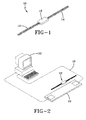
- RFID tag 10 is shown in a dipole antenna configuration in which coiled antenna segments 12, 14 are coupled to an electronics package 16. Other RFID tag configurations may be used with the invention as well.
- RFID tag 10 is of a type in common use within the industry and includes electronic data storage such as RAM or ROM memory and transmission/receiver circuitry by which data may be inputted into the tag memory and accessed by a remote reader (not shown).
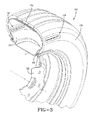
- the RFID tag 10 may be programmed with data including a tag identification number using the station depicted in FIG. 2 .
- the tag 10 receives a data transmission signal from an antenna within pad 18 that connects by means of line 20 to a transmission device 22.
- the transmitted data is stored in tag memory.
- the RFID tag or ASIC (application specific integrated circuit) manufacturer will assign a unique tag identification number (hereinafter referred to as TID) to each tag manufactured and sold.
- TID unique tag identification number
- the identification number is used for quality assurance purposes as well as to uniquely identify a particular tag in field use.
- the tag 10 may be incorporated into a wide variety of manufactured products such as a tire 24. While a tire is used herein as a representative product into which a tag 10 may be incorporated, the invention is not intended to be limited thereto.
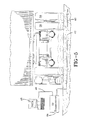
- a drive-over reader system 36 for a vehicle having one or more wheel mounted RFID tags or devices 10 is shown.
- transponder device is used in its broad connotation and includes devices such as RFID tags and other devices for data storage and transmission.
- the reader system 36 is located within a read station through which the vehicle is preferably, although not necessarily, is driven during a tag-reading operation.
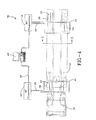
- the vehicle transponder device(s) 10 may be mounted to a wheel unit 38 in a number of locations, such as those identified in FIG. 3 .
- the wheel unit 38 includes a tire 24 of conventional construction having a pair of beads 26, a tire carcass 28 extending between the beads 26, a tire crown region 34, and a tire inner liner 30.
- the tire is mounted to a wheel rim 32 in conventional fashion.
- One or more wheel units 38 of a vehicle may be provided with one or more transponder devices 10.
- the transponder device or RFID tag 10 is of a type common within the industry and commercially available.
- the device combines data storage and transmission capability initiated by receipt of RF signal. Upon activation, the transponder transmits an RF data stream to a remote RF receiver.
- the stored data may include pertinent information that a user would find beneficial to monitor in the operation of a vehicle or a commercial fleet, such as an identification of the vehicle, the tire, the wheel unit, and/or the cargo conveyed by the vehicle and its destination.
- the RF transponder may be read-only or may include read-write capability. Because a proper identification of the tire/trailer/tractor and its cargo may utilize the data stored within the device 10, it is important that the integrity of the device 10 and data stored therein be established and maintained. A fraudulent or inadvertent replacement of an authentic tag 10 with a counterfeit tag may have costly consequences in applications where the tag data is utilized to ensure a proper identification of the object to which the tag attaches.
- Data from the wheel unit transponder(s) 10 are received by antenna device(s) 40 that are located within a read station and relayed by connections 42 to an RF transceiver 44 connected by data transmission lines 46 to a data processing computer 48.
- a display of information from the RFID tag 10 to a user is thereby facilitated.
- the read station 36 may be utilized in a commercial trucking operation to monitor and identify a tractor 50 and a trailer 52 as shown in FIGS. 4 and 5 . While the read station shown represents a fixed means for reading data stored in the RFID tag 10, other known reading devices commercially available may be utilized. Hand held readers may be employed to interface with RFID tags for the purpose of accessing data stored therein. The present invention may be used in RFID tags affixed to objects of various types and configuration or attached to packaging for such products.
- the method disclosed herein is for detecting that a given RFID tag is counterfeit and uses only information on the tag without recourse or need for accessing a database.
- the methodology requires one field (memory area) of the tag to have been uniquely written to and permanently locked into tag memory by the RFID chip manufacturer.
- the encoding of the chip by the RFID manufacturer to include a unique number identifying the chip is referred to at 54 in FIG. 6 .
- This field could be the tag identification (TID) for a NXP G2XM RFID chip (manufactured and sold by NXP Semiconductors having a business address at High Tech Campus 60, 5656 AG Eindhoven, The Netherlands), or the unique identifier in the user data field of a Impinj Monza ID chip (manufactured and sold by Impinj, Inc., having a business address at 701 N. 34th Street, Suite 300, Seattle, WA 98103).
- the permanently locked unique ID (TID) is used as plain text and run through an encryption algorithm, preferably by an object manufacturer of the product to which the tag is to be affixed.
- the encrypted result is stored in one of the other memory fields (access_pwd, kill_pwd or user data).
- the object manufacturer assigns and locks (56 in FIG.6 ) a unique electronic identification number E, commonly referred to as the electronic product code EPC into tag memory.
- E uniquely identifies the product to which the tag is affixed.
- the aforementioned assignment and locking of the TID and E into tag memory is done by two separate entities or parties; typically but not necessarily the chip manufacturer (TID) and the object manufacturer (E).
- the two unique numbers, each assigned and locked into memory by an unrelated separate party are then employed by means of an encryption algorithm to calculate a Kill Password K.
- the resultant generated Kill Password K is not only unique but also incapable of reconstruction from the knowledge of one but not both unique numbers TID and E.
- the read Kill Password K' is derived from unique numbers TID and E assigned and locked by separate entities (typically the chip manufacturer and the object manufacturer, respectively).
- the authenticity of the read Kill Password K' therefore carries a high level of confidence inasmuch as a counterfeit chip would not be able to readily duplicate the numbers TID and E required to replicate the Kill Password.
- the unique TID and E are run through the encryption algorithm, and then compared to the corresponding memory field. In this way, if someone were to copy all the fields (except the manufacturers unique EPC number), the tag would be identified as fraud, as the encryption would result in the wrong encrypted value.
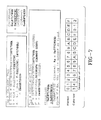
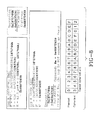
- FIG. 7 illustrates by example operation of the subject methodology.
- TAG A the original tag
- the kill_pwd is a function of the tid assigned by the tag manufacturer.
- TAG B represents a counterfeit tag.
- the data read from the TAG B reveals a copied EPC and a copied kill-pwd number.
- the TID number cannot be copied and the TID for the TAG B accordingly differs from TAG A.
- Other encryption algorithms may be utilized if desired.
- the use of multiple identification numbers assigned by different parties, the generation of a kill password as a function of a number TID that cannot be copied, allows for the detection of a fraudulent tag that generates a kill password that does not equate.
Landscapes
- Engineering & Computer Science (AREA)
- Computer Security & Cryptography (AREA)
- Computer Networks & Wireless Communication (AREA)
- Signal Processing (AREA)
- Storage Device Security (AREA)
Applications Claiming Priority (1)
| Application Number | Priority Date | Filing Date | Title |
|---|---|---|---|
| US12/326,127 US20100134287A1 (en) | 2008-12-02 | 2008-12-02 | Method of detecting a conterfeit rfid tag |
Publications (1)
| Publication Number | Publication Date |
|---|---|
| EP2194673A2 true EP2194673A2 (fr) | 2010-06-09 |
Family
ID=42061095
Family Applications (1)
| Application Number | Title | Priority Date | Filing Date |
|---|---|---|---|
| EP09177476A Withdrawn EP2194673A2 (fr) | 2008-12-02 | 2009-11-30 | Procédé de détection d'une étiquette RFID contrefaite |
Country Status (3)
| Country | Link |
|---|---|
| US (1) | US20100134287A1 (fr) |
| EP (1) | EP2194673A2 (fr) |
| BR (1) | BRPI0904402A2 (fr) |
Families Citing this family (11)
| Publication number | Priority date | Publication date | Assignee | Title |
|---|---|---|---|---|
| US8827163B2 (en) * | 2007-12-04 | 2014-09-09 | Chung Shan Institute Of Science And Technology, Armaments Bureau, M.N.D. | Anti-fake identification system and method capable of automatically connecting to web address |
| US9047499B2 (en) * | 2012-06-01 | 2015-06-02 | Panduit Corp. | Anti-counterfeiting methods |
| CN103544511A (zh) * | 2013-10-29 | 2014-01-29 | 上海华彩科技有限公司 | 一种防伪标识 |
| US20160173465A1 (en) * | 2014-12-12 | 2016-06-16 | Rajesh Poornachandran | Technologies for verifying authorized operation of servers |
| US11213773B2 (en) | 2017-03-06 | 2022-01-04 | Cummins Filtration Ip, Inc. | Genuine filter recognition with filter monitoring system |
| WO2018187368A1 (fr) * | 2017-04-03 | 2018-10-11 | Stewart Brian E | Systèmes, appareil et procédés d'étiquetage, d'emballage et de suivi d'articles chirurgicaux |
| FR3067976B1 (fr) * | 2017-06-22 | 2019-07-26 | Compagnie Generale Des Etablissements Michelin | Pneumatique adapte pour roulage a plat equipe d'un organe electronique |
| CN109472177B (zh) * | 2018-11-06 | 2022-02-22 | 南京杰思微电子技术有限公司 | 一种可以读取电子标签tid号的盘存方法 |
| CN110689102A (zh) * | 2019-09-30 | 2020-01-14 | 上海华苑电子有限公司 | 一种电子标签管理系统 |
| CN114239629B (zh) * | 2022-02-22 | 2022-07-22 | 深圳市成为信息股份有限公司 | 标签的防伪验证方法、uhf手持终端及存储介质 |
| EP4742091A1 (fr) * | 2024-11-06 | 2026-05-13 | EM Microelectronic-Marin SA | Circuit rfid à deux fréquences de communication |
Family Cites Families (4)
| Publication number | Priority date | Publication date | Assignee | Title |
|---|---|---|---|---|
| US7161476B2 (en) * | 2000-07-26 | 2007-01-09 | Bridgestone Firestone North American Tire, Llc | Electronic tire management system |
| US7327216B2 (en) * | 2005-03-28 | 2008-02-05 | Lear Corporation | Secret key programming technique for transponders using encryption |
| US7999659B2 (en) * | 2006-01-16 | 2011-08-16 | Atmel Corporation | Method for access control |
| US8072313B2 (en) * | 2006-02-01 | 2011-12-06 | Vitaly Drucker | RFID interrogator with improved symbol decoding and systems based thereon |
-
2008
- 2008-12-02 US US12/326,127 patent/US20100134287A1/en not_active Abandoned
-
2009
- 2009-11-23 BR BRPI0904402-7A patent/BRPI0904402A2/pt not_active IP Right Cessation
- 2009-11-30 EP EP09177476A patent/EP2194673A2/fr not_active Withdrawn
Also Published As
| Publication number | Publication date |
|---|---|
| BRPI0904402A2 (pt) | 2011-02-01 |
| US20100134287A1 (en) | 2010-06-03 |
Similar Documents
| Publication | Publication Date | Title |
|---|---|---|
| US20100134287A1 (en) | Method of detecting a conterfeit rfid tag | |
| US7761347B2 (en) | Method and system for identifying and managing radio frequency identification (RF-ID) attached objects | |
| US11521156B2 (en) | Trustable product delivery with RFID and smart chip | |
| US20090033464A1 (en) | Transponder with access protection and method for access to the transponder | |
| US7411503B2 (en) | System and method for disabling data on radio frequency identification tags | |
| US7800499B2 (en) | RFID and sensor signing algorithm | |
| US7415613B2 (en) | System and method for detecting alteration of objects | |
| US20030169149A1 (en) | RFID tag, and RFID tag-related determining device and method, and management system and method | |
| US7487177B2 (en) | Set identifiers for objects | |
| US20090267747A1 (en) | Security and Data Collision Systems and Related Techniques for Use With Radio Frequency Identification Systems | |
| CN107231231B (zh) | 一种终端设备安全接入物联网的方法及系统 | |
| CA2556844A1 (fr) | Systeme de controle des stocks a rfid | |
| US9317981B2 (en) | Method and device for protecting products against counterfeiting | |
| US20100148935A1 (en) | Duplication detection for non-cryptographic rfid tags using encrypted traceability information | |
| US20070194879A1 (en) | Method and device for detecting an invalid RFID tag and method for manufacturing an RFID tag | |
| US9594933B2 (en) | Printable, writeable article for tracking counterfeit and diverted products | |
| JP5289594B2 (ja) | 警告システム | |
| US7450009B2 (en) | Wireless tag reader, wireless tag system, computer readable medium and wireless communication method | |
| US10007815B2 (en) | Production method, RFID transponder, authentication method, reader device and computer program product | |
| US20090040023A1 (en) | RF Transponder for Off-Line Authentication of a Source of a Product Carrying the Transponder | |
| EP0982687A1 (fr) | Procédé pour empêcher ou découvrir la fraude dans un système d'identification | |
| US20060259772A1 (en) | Authentication of radio frequency transponders | |
| JP2008233975A (ja) | 情報通信装置、情報集中管理装置、及び情報処理システム | |
| US7690559B2 (en) | Self-referential integrity checking system and method | |
| WO2009005296A2 (fr) | Système et procédé de traitement de certification de contenus numériques et support lisible par ordinateur sur lequel se trouve un programme exécutant une fonction correspondante |
Legal Events
| Date | Code | Title | Description |
|---|---|---|---|
| PUAI | Public reference made under article 153(3) epc to a published international application that has entered the european phase |
Free format text: ORIGINAL CODE: 0009012 |
|
| AK | Designated contracting states |
Kind code of ref document: A2 Designated state(s): AT BE BG CH CY CZ DE DK EE ES FI FR GB GR HR HU IE IS IT LI LT LU LV MC MK MT NL NO PL PT RO SE SI SK SM TR |
|
| STAA | Information on the status of an ep patent application or granted ep patent |
Free format text: STATUS: THE APPLICATION HAS BEEN WITHDRAWN |
|
| 18W | Application withdrawn |
Effective date: 20130703 |