EP2192143A1 - Novel method - Google Patents
Novel method Download PDFInfo
- Publication number
- EP2192143A1 EP2192143A1 EP08170368A EP08170368A EP2192143A1 EP 2192143 A1 EP2192143 A1 EP 2192143A1 EP 08170368 A EP08170368 A EP 08170368A EP 08170368 A EP08170368 A EP 08170368A EP 2192143 A1 EP2192143 A1 EP 2192143A1
- Authority
- EP
- European Patent Office
- Prior art keywords
- benzalmalonate
- formula
- units
- organopolysiloxanes
- functionalized
- Prior art date
- Legal status (The legal status is an assumption and is not a legal conclusion. Google has not performed a legal analysis and makes no representation as to the accuracy of the status listed.)
- Granted
Links
- 0 CC(C)*Oc1ccc(C=C(*)*)cc1 Chemical compound CC(C)*Oc1ccc(C=C(*)*)cc1 0.000 description 2
Classifications
-
- C—CHEMISTRY; METALLURGY
- C08—ORGANIC MACROMOLECULAR COMPOUNDS; THEIR PREPARATION OR CHEMICAL WORKING-UP; COMPOSITIONS BASED THEREON
- C08G—MACROMOLECULAR COMPOUNDS OBTAINED OTHERWISE THAN BY REACTIONS ONLY INVOLVING UNSATURATED CARBON-TO-CARBON BONDS
- C08G77/00—Macromolecular compounds obtained by reactions forming a linkage containing silicon with or without sulfur, nitrogen, oxygen or carbon in the main chain of the macromolecule
- C08G77/04—Polysiloxanes
- C08G77/38—Polysiloxanes modified by chemical after-treatment
Definitions
- the present invention relates to method for improving the color index of an organopolysiloxanes functionalized with a benzalmalonate said method comprising the step of contacting said organopolysiloxanes functionalized with a benzalmalonate with said hydroxy carboxylic acid or a cyclic ester thereof in an organic solvent.
- UV filter agents with a molecular weight of above 1000 Dalton are highly interesting to the cosmetic industry as due to the high molecular weight they exhibit a negligible systemic exposure due to a lack of transdermal penetration.
- Organopolysiloxane functionalized with a benzalmalonate are known as UV-filter agents and are prepared by hydrosilylation, i.e. the addition of Si-H bonds to an unsaturated bond attached to a UV-light absorbing chromophore such as e.g. disclosed in WO92/20690 , EP1142930 or EP358584 .
- hydrosilylation i.e. the addition of Si-H bonds to an unsaturated bond attached to a UV-light absorbing chromophore such as e.g. disclosed in WO92/20690 , EP1142930 or EP358584 .
- the products resulting from the hydrosilylation process exhibit an unwanted yellow to brownish discoloration which is not accepted by the cosmetic industry. Even though it is possible to discolor the products by post-treatment with adsorbents such as active charcoal, these processes are tedious, need high amounts of solvents and result in reduced yields.
- hydroxy carboxylic acids or cyclic esters thereof are suitable for improving the color index of an organopolysiloxanes functionalized with a benzalmalonate.
- the invention relates to a method for improving the color index of an organopolysiloxanes functionalized with a benzalmalonate said method comprising the step of contacting said organopolysiloxanes functionalized with a benzalmalonate with said hydroxy carboxylic acid or a cyclic ester thereof in an organic solvent.
- the degree of coloration of the organopolysiloxanes functionalized with a benzalmalonate before and after the treatment can be determined by methods known to a person skilled in the art such as e.g. by means of color value systems such as the Gardner Index (yellowness index) or the APHA color index.
- the organopolysiloxanes functionalized with a benzalmalonate exhibit in particular a Gardner value of less than 2.9, in particular of less than 2.5, such as in the range of 0.01 to 2 after having been contacted with the hydroxy carboxylic acid or a cyclic ester thereof.
- organic solvent as used according to the present invention relates to carbon-containing chemicals suitable for dissolving the organopolysiloxanes functionalized with a benzalmalonate which have a low boiling point and evaporate easily or can be removed by distillation, leaving the dissolved substance behind.
- the boiling points of the organic solvent are below 300°C, in particular below 200°C, even more particular below 150 such as in particular below 100°C and can thus removed easily at normal or reduced pressure such as at 20 mbar, 1 mbar or even lower pressures.
- linear, branched or cyclic C 1-8 alcohols such as methanol, ethanol, propanol, isopropanol, butanol, isobutyl alcohol, tert-butyl alcohol, hexanol, cyclohexanol, aromatic hydrocarbons such as benzene, toluene or xylene, linear or cyclic acetales such as 1,3-dioxolane or ethylal as well as mixtures thereof.
- isopropanol is used.
- the ratio of organic solvent to the organopolysiloxanes functionalized with a benzalmalonate is not critical.
- the organic solvent is used in amount which allows the solution of the organopolysiloxanes functionalized with a benzalmalonate.
- the ratio of the organic solvent(s) to the organopolysiloxanes functionalized with a benzalmalonate (in wt/wt) is in the range of 10:1 to 1:10, in particular 5:1 to 1:5 such as in the range of 1:1 to 0.5:1.
- hydroxy carboxylic acid or a cyclic ester thereof used according to the invention encompasses hydroxycarboxylic acids such as glycolic acid or lactic acid, hydroxydicarbonic acids such as tartaric acid or hydroxytricarbonic acids such as citric acid as well as cyclic esters thereof such as ascorbic acid without being limited thereto.
- the hydroxy carboxylic acid or a cyclic ester thereof is always selected from glycolic acid, ascorbic acid and/ or citric acid such as in particular citric acid.
- the amount of the hydroxy carboxylic acid or a cyclic ester thereof used in the method according to the invention is not critical.
- an amount of 0.05 - 5wt.-%, preferably, 0.1 - 1 wt.-% based on the weight of the organopolysiloxanes functionalized with a benzalmalonate is used.
- the amount of hydrogen peroxide can also be easily determined by a person skilled in the art and is in particular selected in the range of 0.03 to 3 wt.-% based on a 35 wt.% aqueous hydrogen peroxide solution based on the weight of the organopolysiloxane functionalized with a benzalmalonate.
- the method according to the present invention is preferably carried out at elevated temperatures such as in the range of from 40°C to 150°C, preferably from 40°C to 80°C, e.g., at about 60°C, wherein the reaction temperature should however not exceed the boiling point of the solvent(s) used.
- the solvent can either be evaporated directly or a subsequent washing step may be included before evaporation of the solvent(s).
- washing steps are well known to a person skilled in the art.
- a washing step with a mixture of MeOH/ water is included.
- the ratio of MeOH/ water is not critical and may range from 20:1 to 5:1 such as e.g. 10:1.
- the organopolysiloxanes functionalized with a benzalmalonate according to the invention always comprise at least one unit selected from the formula (Ia), (Ib), (Ic) and/ or (Id) and, optionally, one or several units of formula (II) wherein
- the organopolysiloxane functionalized with a benzalmalonate according to the invention are polymeric materials which may be homopolymers consisting only of units of formula (Ia), (Ib), (Ic) and/ or (Id), or they may be copolymers containing units of formula (Ia), (Ib), (Ic) and/ or (Id) as well as units of formula (II).
- the units of formula (Ia), (Ib), (Ic) and/ or (Id) may be distributed randomly in the organopolysiloxane, they may be the end blocking units of the polymer or they may be located at the end of the polymer and pending in a chain of the polymer at the same time.
- the two substituents R 1 may be identical or different. If b is 2 or 3 the two or three substituents R 2 may be identical or different. If the polymer contains more than one unit of formula (Ia), (Ib), (Ic) and/ or (Id) the substituents R 1 may be identical or different from unit to unit. If the polymer contains more than one unit of formula (II) the substituents R 2 may be identical or different from unit to unit.
- the organopolysiloxanes functionalized with a benzalmalonate according to the invention may be linear, cyclic, branched or crosslinked.
- the organopolysiloxane is a linear polymer at least two end blocking units must be present, thus requiring either the presence of two units in which a has a value of 2 or two units in which b is 3.
- Such organopolysiloxanes generally exhibit a statistical distribution of polymer chain sizes.
- the organopolysiloxanes functionalized with a benzalmalonate are linear organopolysiloxanes consisting of one unit of formula (IIIa) and one unit of formula (IIIb), 4 to 10, preferably 4 to 7 units of formula (Ia) and/ or (Ib) and 40 to 90, preferably 60 to 80 units of formula (IV), wherein R 1 , R 2 , R 4 , R 5 , R 6 , R 7 , R 8 , R 9 , B and B' are methyl, Y is methylene and R 3 is ethyl, and wherein the units of formula (Ia) and/ or (Ib) are randomly distributed in the organopolysiloxanes chain.
- organopolysiloxanes refers to an average statistical distribution of polymer chain sizes which might still contain as minor impurities H-siloxane unit deriving from the preparation process.
- organopolysiloxane functionalized with a benzalmalonate is polysilicone-15 which is sold as PARSOL ® SLX by DSM Nutritional Products Ltd.
- the organopolysiloxanes functionalized with a benzalmalonate by hydrosilylation i.e. the addition of a H-siloxane unit of an organopolysiloxane to an unsaturated carbon-carbon bond of a benzalmalonate
- units of formula (Ia) as well as (Ib), respectively (Ic) as well as (Id) are formed and thus present at the same time in the organopolysiloxanes functionalized with a benzalmalonate.
- the ratio of units of formula (Ia) to units of formula (Ib) in the organopolysiloxanes functionalized with a benzalmalonate is about 4 to 1.
- C 1 -C 10 alkylene used according to the invention includes straight chain or branched saturated hydrocarbon residues such as methylene, 1-ethylene, 2-ethylene, 3-propylene, 2-propylene, 2-methyl-3-propylene, 3-butylene, 4-butylene, 4-pentylene, 5-pentylene, 6-hexylene, and the like.
- C 2 -C 10 alkenylene used according to the invention includes unsaturated hydrocarbon residues containing at least one double bond, such as for example, 2-propen-2-ylene, 2-propen-3-ylene, 3-buten-3-ylene, 3-buten-4-ylene, 4-penten-4-ylene, 4-penten-5-ylene, (3-methyl)-penta-2,4-dien-4 or 5-ylene, 11-dodecen-11-ylene, and the like.
- the divalent alkylene or alkenylene chains may be interrupted by one or several oxygen atoms.
- C 1 -C 30 hydrocarbon group used according to the invention refers to saturated or unsaturated C 1 -C 30 hydrocarbon groups such as C 1 -C 30 alkyl such as methyl, ethyl, propyl and butyl; C 2 -C 30 alkenyl such as vinyl and allyl; and unsubstituted or substituted aryl such as phenyl, alkaryl and alkoxyphenyl.
- the hydrocarbon group is unsubstituted or substituted by, e.g. halogen, e.g. a halogenated C 1 -C 18 hydrocarbon group.
- the alkyl and alkenyl groups may be straight chain or branched such as e.g.
- the solvent was evaporated at 75°C under reduced pressure (250-20 mbar) yielding 600g of polysilicones-15 with a Gardner value of 1.9.
- the solvent was evaporated at 75°C under reduced pressure (250-20 mbar) yielding 600g of polysilicones-15 with a Gardner value of 2.2.
Landscapes
- Chemical & Material Sciences (AREA)
- General Chemical & Material Sciences (AREA)
- Health & Medical Sciences (AREA)
- Chemical Kinetics & Catalysis (AREA)
- Medicinal Chemistry (AREA)
- Polymers & Plastics (AREA)
- Organic Chemistry (AREA)
- Silicon Polymers (AREA)
Abstract
Description
- The present invention relates to method for improving the color index of an organopolysiloxanes functionalized with a benzalmalonate said method comprising the step of contacting said organopolysiloxanes functionalized with a benzalmalonate with said hydroxy carboxylic acid or a cyclic ester thereof in an organic solvent.
- UV filter agents with a molecular weight of above 1000 Dalton are highly interesting to the cosmetic industry as due to the high molecular weight they exhibit a negligible systemic exposure due to a lack of transdermal penetration.
- Organopolysiloxane functionalized with a benzalmalonate are known as UV-filter agents and are prepared by hydrosilylation, i.e. the addition of Si-H bonds to an unsaturated bond attached to a UV-light absorbing chromophore such as e.g. disclosed in
WO92/20690 EP1142930 orEP358584 - Thus, there is an ongoing need for a simple, economically attractive and environmentally benign method which allows the preparation of organopolysiloxanes functionalized with a benzalmalonate with a low color index in good yields by means of a simple industrial process.
- Surprisingly, it has been found that hydroxy carboxylic acids or cyclic esters thereof are suitable for improving the color index of an organopolysiloxanes functionalized with a benzalmalonate.
- Thus, the invention relates to a method for improving the color index of an organopolysiloxanes functionalized with a benzalmalonate said method comprising the step of contacting said organopolysiloxanes functionalized with a benzalmalonate with said hydroxy carboxylic acid or a cyclic ester thereof in an organic solvent.
- The degree of coloration of the organopolysiloxanes functionalized with a benzalmalonate before and after the treatment can be determined by methods known to a person skilled in the art such as e.g. by means of color value systems such as the Gardner Index (yellowness index) or the APHA color index.
- The organopolysiloxanes functionalized with a benzalmalonate exhibit in particular a Gardner value of less than 2.9, in particular of less than 2.5, such as in the range of 0.01 to 2 after having been contacted with the hydroxy carboxylic acid or a cyclic ester thereof.
- The term organic solvent as used according to the present invention relates to carbon-containing chemicals suitable for dissolving the organopolysiloxanes functionalized with a benzalmalonate which have a low boiling point and evaporate easily or can be removed by distillation, leaving the dissolved substance behind. In particular, the boiling points of the organic solvent are below 300°C, in particular below 200°C, even more particular below 150 such as in particular below 100°C and can thus removed easily at normal or reduced pressure such as at 20 mbar, 1 mbar or even lower pressures. In particular suitable are linear, branched or cyclic C1-8 alcohols such as methanol, ethanol, propanol, isopropanol, butanol, isobutyl alcohol, tert-butyl alcohol, hexanol, cyclohexanol, aromatic hydrocarbons such as benzene, toluene or xylene, linear or cyclic acetales such as 1,3-dioxolane or ethylal as well as mixtures thereof. In particular isopropanol is used.
- The ratio of organic solvent to the organopolysiloxanes functionalized with a benzalmalonate is not critical. The organic solvent is used in amount which allows the solution of the organopolysiloxanes functionalized with a benzalmalonate. In particular, the ratio of the organic solvent(s) to the organopolysiloxanes functionalized with a benzalmalonate (in wt/wt) is in the range of 10:1 to 1:10, in particular 5:1 to 1:5 such as in the range of 1:1 to 0.5:1.
- The term hydroxy carboxylic acid or a cyclic ester thereof used according to the invention encompasses hydroxycarboxylic acids such as glycolic acid or lactic acid, hydroxydicarbonic acids such as tartaric acid or hydroxytricarbonic acids such as citric acid as well as cyclic esters thereof such as ascorbic acid without being limited thereto.
- In one subembodiment the hydroxy carboxylic acid or a cyclic ester thereof is always selected from glycolic acid, ascorbic acid and/ or citric acid such as in particular citric acid.
- The amount of the hydroxy carboxylic acid or a cyclic ester thereof used in the method according to the invention is not critical. Preferably, an amount of 0.05 - 5wt.-%, preferably, 0.1 - 1 wt.-% based on the weight of the organopolysiloxanes functionalized with a benzalmalonate is used.
- Particularly good results are obtained if an additional amount of hydrogen peroxide is present as this accelerates the discoloration and thus reduces the cycle times. The amount of hydrogen peroxide can also be easily determined by a person skilled in the art and is in particular selected in the range of 0.03 to 3 wt.-% based on a 35 wt.% aqueous hydrogen peroxide solution based on the weight of the organopolysiloxane functionalized with a benzalmalonate.
- The method according to the present invention is preferably carried out at elevated temperatures such as in the range of from 40°C to 150°C, preferably from 40°C to 80°C, e.g., at about 60°C, wherein the reaction temperature should however not exceed the boiling point of the solvent(s) used.
- After the organopolysiloxane functionalized with a benzalmalonate has been brought into contact with a hydroxy carboxylic acid or a cyclic ester thereof in an organic solvent, optionally in the presence of hydrogen peroxide, the solvent can either be evaporated directly or a subsequent washing step may be included before evaporation of the solvent(s). Such washing steps are well known to a person skilled in the art. In a particular embodiment, a washing step with a mixture of MeOH/ water is included. The ratio of MeOH/ water is not critical and may range from 20:1 to 5:1 such as e.g. 10:1.
- In one subembodiment of the invention, the organopolysiloxanes functionalized with a benzalmalonate according to the invention always comprise at least one unit selected from the formula (Ia), (Ib), (Ic) and/ or (Id)




- a
- is 0, 1 or 2,
- b
- is 0, 1, 2, 3;
- R1
- is a C1-C30hydrocarbon group or a trimethylsilyloxy group, in particular a C1-C10alkyl group such as a methyl group
- R2
- is hydrogen, a C1-C30hydrocarbon group or a trimethylsilyloxy group, in particular a C1-C10alkyl group such as a methyl group
- R3
- is C1-8-alkyl group, in particular a C1-4-alkyl groups such as an ethyl group
- Y
- is a divalent C1-C10 alkylene or C2-C10 alkenylene chain, preferably a C1-C4 alkylene chain, most preferably a methylene group.
- The organopolysiloxane functionalized with a benzalmalonate according to the invention are polymeric materials which may be homopolymers consisting only of units of formula (Ia), (Ib), (Ic) and/ or (Id), or they may be copolymers containing units of formula (Ia), (Ib), (Ic) and/ or (Id) as well as units of formula (II). The units of formula (Ia), (Ib), (Ic) and/ or (Id) may be distributed randomly in the organopolysiloxane, they may be the end blocking units of the polymer or they may be located at the end of the polymer and pending in a chain of the polymer at the same time.
- If a is 2 the two substituents R1 may be identical or different. If b is 2 or 3 the two or three substituents R2 may be identical or different. If the polymer contains more than one unit of formula (Ia), (Ib), (Ic) and/ or (Id) the substituents R1 may be identical or different from unit to unit. If the polymer contains more than one unit of formula (II) the substituents R2 may be identical or different from unit to unit.
- The organopolysiloxanes functionalized with a benzalmalonate according to the invention may be linear, cyclic, branched or crosslinked. In a particular embodiment the organopolysiloxanes are linear or cyclic organopolysiloxane, characterized in that in the majority of units (Ia), (Ib), (Ic), (Id) and (II) a = 1 and b = 2. However, if the organopolysiloxane is a linear polymer at least two end blocking units must be present, thus requiring either the presence of two units in which a has a value of 2 or two units in which b is 3. Such organopolysiloxanes generally exhibit a statistical distribution of polymer chain sizes.
- In another subembodiment of the invention, the organopolysiloxanes functionalized with a benzalmalonate are linear organopolysiloxanes comprising
one end blocking unit of formula (IIIa) and one end blocking unit of formula (IIIb)
[corresponding to units of formula (Ia), (Ib), (Ic) and/ or (Id), wherein a = 2, respectively (II), wherein b = 3]
r units of formula (IV) [corresponding to unit of formula (II), wherein b = 2]
- s
- is an integer from 0 to 50,
- r
- is an integer from 0 to 200; and
- R1, R4, R5, R6, R7
- independently are as defined above for R1;
- R8 and R9
- independently are as defined above for R2
- B and B'
- independently are a group R1 or a benzalmalonate residue selected from
- In a yet other subembodiment, the organopolysiloxanes functionalized with a benzalmalonate are linear organopolysiloxanes consisting of one unit of formula (IIIa) and one unit of formula (IIIb), 4 to 10, preferably 4 to 7 units of formula (Ia) and/ or (Ib) and 40 to 90, preferably 60 to 80 units of formula (IV), wherein R1, R2, R4, R5, R6, R7, R8, R9, B and B' are methyl, Y is methylene and R3 is ethyl, and wherein the units of formula (Ia) and/ or (Ib) are randomly distributed in the organopolysiloxanes chain. It is well understood to a person skilled in the art that the above description of the organopolysiloxanes refers to an average statistical distribution of polymer chain sizes which might still contain as minor impurities H-siloxane unit deriving from the preparation process. Most in particular the organopolysiloxane functionalized with a benzalmalonate is polysilicone-15 which is sold as PARSOL® SLX by DSM Nutritional Products Ltd.
- Due to the preparation of the organopolysiloxanes functionalized with a benzalmalonate by hydrosilylation, i.e. the addition of a H-siloxane unit of an organopolysiloxane to an unsaturated carbon-carbon bond of a benzalmalonate, normally units of formula (Ia) as well as (Ib), respectively (Ic) as well as (Id) are formed and thus present at the same time in the organopolysiloxanes functionalized with a benzalmalonate. In a particular embodiment the ratio of units of formula (Ia) to units of formula (Ib) in the organopolysiloxanes functionalized with a benzalmalonate is about 4 to 1.
- The term C1-C10 alkylene used according to the invention includes straight chain or branched saturated hydrocarbon residues such as methylene, 1-ethylene, 2-ethylene, 3-propylene, 2-propylene, 2-methyl-3-propylene, 3-butylene, 4-butylene, 4-pentylene, 5-pentylene, 6-hexylene, and the like.
- The term C2-C10 alkenylene used according to the invention includes unsaturated hydrocarbon residues containing at least one double bond, such as for example, 2-propen-2-ylene, 2-propen-3-ylene, 3-buten-3-ylene, 3-buten-4-ylene, 4-penten-4-ylene, 4-penten-5-ylene, (3-methyl)-penta-2,4-dien-4 or 5-ylene, 11-dodecen-11-ylene, and the like. The divalent alkylene or alkenylene chains may be interrupted by one or several oxygen atoms.
- The term C1-C30hydrocarbon group used according to the invention refers to saturated or unsaturated C1-C30hydrocarbon groups such as C1-C30alkyl such as methyl, ethyl, propyl and butyl; C2-C30alkenyl such as vinyl and allyl; and unsubstituted or substituted aryl such as phenyl, alkaryl and alkoxyphenyl. The hydrocarbon group is unsubstituted or substituted by, e.g. halogen, e.g. a halogenated C1-C18hydrocarbon group. The alkyl and alkenyl groups may be straight chain or branched such as e.g. methyl, ethyl, 3-propyl, 2-propyl, 2-methyl-3-propyl, 3-butyl, 4-butyl, 4-pentyl, 5-pentyl, 6-hexyl, 2-propen-2-yl, 2-propen-3-yl, 3-buten-3-yl, 3-buten-4-yl, 4-penten-4-yl, 4-penten-5-yl, (3-methyl)-penta-2,4-dien-4 or 5-yl, 11-dodecen-11-yl.
- The invention is illustrated further by the examples without being limited thereto.
- A mixture of 600 g of a sample of polysilicone-15 prepared according to the process disclosed in
EP1142930 , Example 1 having a Gardner value of 3.5, 398.5 g isopropanol, 1 g citric acid monohydrate and 0.5 g of hydrogenperoxide (35% aqueous solution) was stirred for 4 to 8h at 60°C until a Gardner value of about 2 was obtained. The solvent was evaporated at 75°C under reduced pressure (250-20 mbar) yielding 600g of polysilicones-15 with a Gardner value of 1.9. - A mixture of 600 g of a sample of polysilicone-15 prepared according to the process disclosed in
EP1142930 , Example 1 having a Gardner value of 3.5, 398.5 g isopropanol, 1 g ascorbic acid and 0.5 g of hydrogenperoxide (35% aqueous solution) was stirred for 4 to 8h at 60°C until a Gardner value of about 2.2 was obtained. The solvent was evaporated at 75°C under reduced pressure (250-20 mbar) yielding 600g of polysilicones-15 with a Gardner value of 2.2.


Claims (9)
- A method for improving the color index of an organopolysiloxanes functionalized with a benzalmalonate said method comprising the step of contacting said organopolysiloxanes functionalized with a benzalmalonate with said hydroxy carboxylic acid or a cyclic ester thereof in an organic solvent.
- The method according to claim 1, wherein the organopolysiloxanes functionalized with a benzalmalonate exhibits a Gardner value of less than 2.9, in particular of less than 2.5, such as in the range of 0.01 to 2 after having been contacted with the hydroxy carboxylic acid or a cyclic ester thereof.
- The method according to claim 1 or 2, wherein the organic solvent is selected from a C1-8 alkylalcohol, an acetale or an aromatic hydrocarbon or mixtures thereof.
- The method according to any one of claims 1 to 3 wherein the organic solvent is isopropanol.
- The method according to any one of claims 1 to 4 further comprising washing with a mixture of methanol/ water.
- The method according to any one of claims 1 to 5, wherein the organopolysiloxane functionalized with a benzalmalonate comprises at least one unit selected from the formula (Ia), (Ib), (Ic) and/ or (Id)
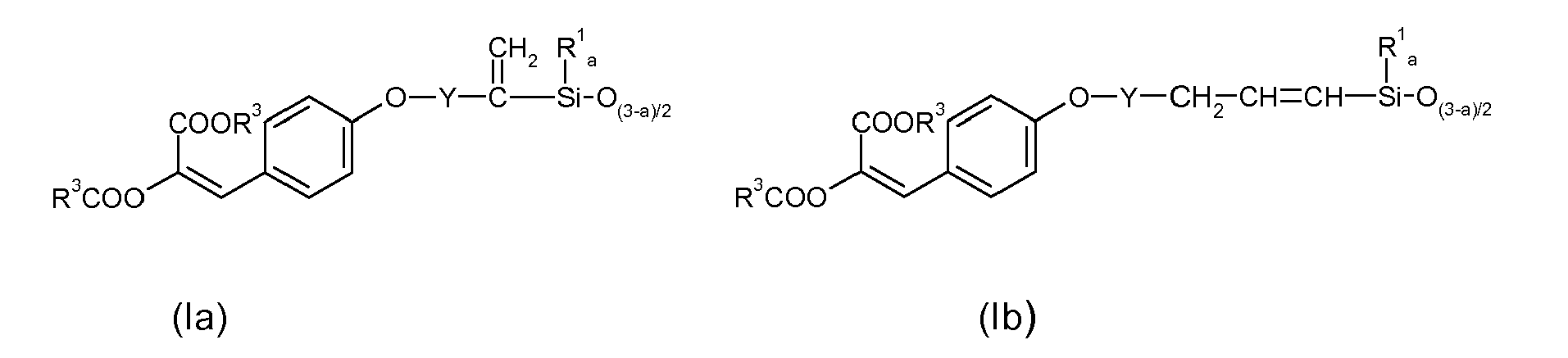

 a is 0, 1 or 2,b is 0, 1, 2, 3;R1 is a C1-C30hydrocarbon group or a trimethylsilyloxy group andR2 is hydrogen, a C1-C30hydrocarbon group or a trimethylsilyloxy group,R3 is C1-8-alkyl, preferably C1-4-alkyl, most preferably ethyl andY is a divalent C1-C10 alkylene or C2-C10 alkenylene chain, preferably a C1-C4 alkylene chain, most preferably a methylene group.
 - The method according to claim 6, wherein the organopolysiloxanes functionalized with a benzalmalonate is a linear organopolysiloxanes comprising
one end blocking unit of formula (IIIa) and one end blocking unit of formula (IIIb)
and,
r units of formula (IV) s is an integer from 0 to 50,r is an integer from 0 to 200; andR1, R4, R5, R6, R7 independently are as defined above for R1;R8 and R9 independently are as defined above for R2B and B' independently are a group R1 or a benzalmalonate residue selected from

- The method according to claim 7, wherein the linear organopolysiloxanes functionalized with a benzalmalonate consists of one unit of formula (IIIa) and one unit of formula (IIIb), 4 to 10, preferably 4 to 6 units of formula (Ia) and/ or (Ib) and 40 to 90, preferably 60 to 80 units of formula (IV), wherein R1, R2, R4, R5, R6, R7, R8, R9, B and B' are methyl, Y is methylene and R3 is ethyl, further characterized in that the units of formula (Ia) and/ or (Ib) are randomly distributed in the organopolysiloxanes chain.
- The method according to claim 8, wherein the linear organopolysiloxanes functionalized with a benzalmalonate is polysilicone-15.
Priority Applications (9)
| Application Number | Priority Date | Filing Date | Title |
|---|---|---|---|
| EP08170368A EP2192143B1 (en) | 2008-12-01 | 2008-12-01 | Novel method |
| AT08170368T ATE523547T1 (en) | 2008-12-01 | 2008-12-01 | NEW PROCEDURE |
| JP2011537988A JP5522580B2 (en) | 2008-12-01 | 2009-11-27 | New method |
| KR1020117012449A KR101735845B1 (en) | 2008-12-01 | 2009-11-27 | Novel method |
| US13/132,136 US8492575B2 (en) | 2008-12-01 | 2009-11-27 | Method for improving the color index of organopolysiloxanes |
| CN2009801483800A CN102232094B (en) | 2008-12-01 | 2009-11-27 | Method for improving colour index of organopolysiloxanes functionalized with benzalmalonate |
| BRPI0923202-8A BRPI0923202B1 (en) | 2008-12-01 | 2009-11-27 | METHOD FOR IMPROVING THE COLOR INDEX OF ORGANOPOLYSILOXANES FUNCTED WITH A BENZAMALONATE |
| PCT/EP2009/065970 WO2010063648A1 (en) | 2008-12-01 | 2009-11-27 | Novel method |
| EP09763934A EP2352780A1 (en) | 2008-12-01 | 2009-11-27 | Novel method |
Applications Claiming Priority (1)
| Application Number | Priority Date | Filing Date | Title |
|---|---|---|---|
| EP08170368A EP2192143B1 (en) | 2008-12-01 | 2008-12-01 | Novel method |
Publications (2)
| Publication Number | Publication Date |
|---|---|
| EP2192143A1 true EP2192143A1 (en) | 2010-06-02 |
| EP2192143B1 EP2192143B1 (en) | 2011-09-07 |
Family
ID=40602267
Family Applications (2)
| Application Number | Title | Priority Date | Filing Date |
|---|---|---|---|
| EP08170368A Active EP2192143B1 (en) | 2008-12-01 | 2008-12-01 | Novel method |
| EP09763934A Withdrawn EP2352780A1 (en) | 2008-12-01 | 2009-11-27 | Novel method |
Family Applications After (1)
| Application Number | Title | Priority Date | Filing Date |
|---|---|---|---|
| EP09763934A Withdrawn EP2352780A1 (en) | 2008-12-01 | 2009-11-27 | Novel method |
Country Status (8)
| Country | Link |
|---|---|
| US (1) | US8492575B2 (en) |
| EP (2) | EP2192143B1 (en) |
| JP (1) | JP5522580B2 (en) |
| KR (1) | KR101735845B1 (en) |
| CN (1) | CN102232094B (en) |
| AT (1) | ATE523547T1 (en) |
| BR (1) | BRPI0923202B1 (en) |
| WO (1) | WO2010063648A1 (en) |
Families Citing this family (1)
| Publication number | Priority date | Publication date | Assignee | Title |
|---|---|---|---|---|
| US8497338B2 (en) * | 2011-10-31 | 2013-07-30 | Momentive Performance Materials Inc. | Process of manufacturing organosilicon products with improved quality using heterogeneous precious metal catalysts |
Citations (4)
| Publication number | Priority date | Publication date | Assignee | Title |
|---|---|---|---|---|
| EP0358584A1 (en) | 1988-09-09 | 1990-03-14 | Rhone-Poulenc Chimie | Diorganopolysiloxanes containing functional benzal malonate groups |
| WO1992020690A1 (en) | 1991-05-10 | 1992-11-26 | Givaudan-Roure (International) S.A. | Organosiloxanes for use as sunscreen agents |
| EP1142930A1 (en) | 1994-10-14 | 2001-10-10 | F. Hoffmann-La Roche Ag | Novel benzylidene malonate siloxane |
| WO2004007592A1 (en) * | 2002-07-16 | 2004-01-22 | Dsm Ip Assets B.V. | Sunscreens |
Family Cites Families (11)
| Publication number | Priority date | Publication date | Assignee | Title |
|---|---|---|---|---|
| DE69525217T2 (en) * | 1994-10-14 | 2002-10-24 | Hoffmann La Roche | Light-stable cosmetic sunscreens |
| FR2756287B1 (en) * | 1996-11-28 | 1998-12-24 | Oreal | NOVEL DERIVATIVES OF SILICON FILTERS ON THEIR AROMATIC PART, PHOTOPROTECTIVE COSMETIC COMPOSITIONS CONTAINING THEM AND USES THEREOF |
| FR2771926B1 (en) * | 1997-12-04 | 2000-03-31 | Oreal | OIL-IN-WATER EMULSIONS CONTAINING A 1,3,5-TRIAZINE DERIVATIVE AND A SILICONE COPOLYOL AND COSMETIC APPLICATIONS |
| FR2772030B1 (en) * | 1997-12-04 | 2000-01-28 | Oreal | NOVEL SILICY DERIVATIVES OF BENZ-X-AZOLES FILTERS, PHOTOPROTECTIVE COSMETIC COMPOSITIONS CONTAINING THEM AND USES THEREOF |
| EP0979645B1 (en) * | 1998-07-16 | 2006-04-12 | DSM IP Assets B.V. | Light screening composition containing a polysiloxane type UV-B screening agent and a benzimidazol type UV-B screening agent |
| CA2288854C (en) * | 1998-11-11 | 2009-09-15 | F. Hoffmann-La Roche Ag | Novel indanylidene compounds |
| ES2259960T3 (en) * | 1999-08-06 | 2006-11-01 | Dsm Ip Assets B.V. | TOPICAL COMPOSITION THAT INCLUDES A TOCOPHEROL COMPOUND. |
| US6489486B2 (en) * | 2000-02-21 | 2002-12-03 | Roche Vitamins Inc. | 2-hydroxyphenyl benzotriazoles as UV-A/B filters |
| DE10012408A1 (en) * | 2000-03-15 | 2001-09-20 | Basf Ag | Use of sunscreen combinations which contain as essential constituent amino-substituted hydroxybenzophenones as photostable UV filters in cosmetic and pharmaceutical preparations |
| US6346595B1 (en) * | 2000-07-07 | 2002-02-12 | Siltech Llc | Aromatic dimethicone copolyol polymers as sunscreen agents |
| WO2006128614A1 (en) * | 2005-05-31 | 2006-12-07 | Dsm Ip Assets B.V. | Novel polysiloxane sunscreens |
-
2008
- 2008-12-01 EP EP08170368A patent/EP2192143B1/en active Active
- 2008-12-01 AT AT08170368T patent/ATE523547T1/en not_active IP Right Cessation
-
2009
- 2009-11-27 CN CN2009801483800A patent/CN102232094B/en active Active
- 2009-11-27 KR KR1020117012449A patent/KR101735845B1/en active Active
- 2009-11-27 WO PCT/EP2009/065970 patent/WO2010063648A1/en not_active Ceased
- 2009-11-27 JP JP2011537988A patent/JP5522580B2/en active Active
- 2009-11-27 EP EP09763934A patent/EP2352780A1/en not_active Withdrawn
- 2009-11-27 US US13/132,136 patent/US8492575B2/en active Active
- 2009-11-27 BR BRPI0923202-8A patent/BRPI0923202B1/en not_active IP Right Cessation
Patent Citations (4)
| Publication number | Priority date | Publication date | Assignee | Title |
|---|---|---|---|---|
| EP0358584A1 (en) | 1988-09-09 | 1990-03-14 | Rhone-Poulenc Chimie | Diorganopolysiloxanes containing functional benzal malonate groups |
| WO1992020690A1 (en) | 1991-05-10 | 1992-11-26 | Givaudan-Roure (International) S.A. | Organosiloxanes for use as sunscreen agents |
| EP1142930A1 (en) | 1994-10-14 | 2001-10-10 | F. Hoffmann-La Roche Ag | Novel benzylidene malonate siloxane |
| WO2004007592A1 (en) * | 2002-07-16 | 2004-01-22 | Dsm Ip Assets B.V. | Sunscreens |
Also Published As
| Publication number | Publication date |
|---|---|
| US8492575B2 (en) | 2013-07-23 |
| JP2012510532A (en) | 2012-05-10 |
| KR101735845B1 (en) | 2017-05-15 |
| EP2192143B1 (en) | 2011-09-07 |
| EP2352780A1 (en) | 2011-08-10 |
| BRPI0923202B1 (en) | 2019-07-30 |
| WO2010063648A1 (en) | 2010-06-10 |
| CN102232094A (en) | 2011-11-02 |
| BRPI0923202A2 (en) | 2016-01-26 |
| ATE523547T1 (en) | 2011-09-15 |
| CN102232094B (en) | 2013-08-14 |
| US20120022280A1 (en) | 2012-01-26 |
| JP5522580B2 (en) | 2014-06-18 |
| KR20110089413A (en) | 2011-08-08 |
Similar Documents
| Publication | Publication Date | Title |
|---|---|---|
| EP3467006B1 (en) | Mixtures of cyclic branched d/t-type siloxanes and their ensuing products | |
| US9076934B2 (en) | Process for preparing resin-linear organosiloxane block copolymers | |
| US5883215A (en) | Polymerisation of cyclosiloxanes | |
| EP3717545A1 (en) | Method for preparing sioc-linked polyether siloxanes branched in the siloxane part | |
| CA3012947A1 (en) | Production of sioc-bonded polyether siloxanes | |
| KR102681424B1 (en) | Siloxanes for treating textiles and for use in cleaning and care formulations | |
| WO2012085364A1 (en) | Hydrosilylation reaction inhibitors and use thereof for preparing stable curable silicone compositions | |
| KR101854906B1 (en) | Compositions of aminosiloxanes, alkoxysilicon compounds and metal carboxylates | |
| EP2192143B1 (en) | Novel method | |
| KR20210091219A (en) | Polymer UV absorber and its manufacturing method and application | |
| KR101495689B1 (en) | Mixtures comprising aminoalkyl-containing polyorganosiloxanes and silicone resins | |
| EP1856191A1 (en) | Method for the preparation of organopolysiloxane by polymerization and rearrangement of cyclic siloxanes | |
| Chang et al. | Nucleophilic cleavage of crosslinked polysiloxanes to cyclic siloxane monomers: Mild catalysis by a designed polar solvent system | |
| KR102490417B1 (en) | Cosmetic composition and method thereof | |
| EP2352778B1 (en) | Process | |
| US8110647B2 (en) | Process for the preparation of an organopolysiloxane functionalized with a benzalmalonate by hydrosilylation in the presence of a hydroxy carboxylic acid or a cyclic ester thereof | |
| US6555662B1 (en) | Process for making siloxane compositions | |
| US8669344B2 (en) | Method of deashing from polymer solutions | |
| EP3415573A1 (en) | Coating composition, coating and article | |
| WO2024252074A1 (en) | Ring-opening polymerisation method | |
| CN119790094A (en) | Elastomers with C-O-Si bonds between the polyester backbone and the crosslinker | |
| Vlad et al. | Synthesis of poly (dimethyldiphenylsiloxane) alpha, omega-diol copolymers by acid-catalyzed polycondensation |
Legal Events
| Date | Code | Title | Description |
|---|---|---|---|
| PUAI | Public reference made under article 153(3) epc to a published international application that has entered the european phase |
Free format text: ORIGINAL CODE: 0009012 |
|
| 17P | Request for examination filed |
Effective date: 20090529 |
|
| AK | Designated contracting states |
Kind code of ref document: A1 Designated state(s): AT BE BG CH CY CZ DE DK EE ES FI FR GB GR HR HU IE IS IT LI LT LU LV MC MT NL NO PL PT RO SE SI SK TR |
|
| AX | Request for extension of the european patent |
Extension state: AL BA MK RS |
|
| AKX | Designation fees paid |
Designated state(s): AT BE BG CH CY CZ DE DK EE ES FI FR GB GR HR HU IE IS IT LI LT LU LV MC MT NL NO PL PT RO SE SI SK TR |
|
| GRAP | Despatch of communication of intention to grant a patent |
Free format text: ORIGINAL CODE: EPIDOSNIGR1 |
|
| GRAS | Grant fee paid |
Free format text: ORIGINAL CODE: EPIDOSNIGR3 |
|
| GRAA | (expected) grant |
Free format text: ORIGINAL CODE: 0009210 |
|
| REG | Reference to a national code |
Ref country code: GB Ref legal event code: FG4D |
|
| REG | Reference to a national code |
Ref country code: CH Ref legal event code: EP |
|
| REG | Reference to a national code |
Ref country code: IE Ref legal event code: FG4D |
|
| REG | Reference to a national code |
Ref country code: DE Ref legal event code: R096 Ref document number: 602008009509 Country of ref document: DE Effective date: 20111103 |
|
| REG | Reference to a national code |
Ref country code: NL Ref legal event code: VDEP Effective date: 20110907 |
|
| PG25 | Lapsed in a contracting state [announced via postgrant information from national office to epo] |
Ref country code: LT Free format text: LAPSE BECAUSE OF FAILURE TO SUBMIT A TRANSLATION OF THE DESCRIPTION OR TO PAY THE FEE WITHIN THE PRESCRIBED TIME-LIMIT Effective date: 20110907 Ref country code: NO Free format text: LAPSE BECAUSE OF FAILURE TO SUBMIT A TRANSLATION OF THE DESCRIPTION OR TO PAY THE FEE WITHIN THE PRESCRIBED TIME-LIMIT Effective date: 20111207 Ref country code: FI Free format text: LAPSE BECAUSE OF FAILURE TO SUBMIT A TRANSLATION OF THE DESCRIPTION OR TO PAY THE FEE WITHIN THE PRESCRIBED TIME-LIMIT Effective date: 20110907 Ref country code: SE Free format text: LAPSE BECAUSE OF FAILURE TO SUBMIT A TRANSLATION OF THE DESCRIPTION OR TO PAY THE FEE WITHIN THE PRESCRIBED TIME-LIMIT Effective date: 20110907 Ref country code: HR Free format text: LAPSE BECAUSE OF FAILURE TO SUBMIT A TRANSLATION OF THE DESCRIPTION OR TO PAY THE FEE WITHIN THE PRESCRIBED TIME-LIMIT Effective date: 20110907 |
|
| LTIE | Lt: invalidation of european patent or patent extension |
Effective date: 20110907 |
|
| PG25 | Lapsed in a contracting state [announced via postgrant information from national office to epo] |
Ref country code: AT Free format text: LAPSE BECAUSE OF FAILURE TO SUBMIT A TRANSLATION OF THE DESCRIPTION OR TO PAY THE FEE WITHIN THE PRESCRIBED TIME-LIMIT Effective date: 20110907 Ref country code: CY Free format text: LAPSE BECAUSE OF FAILURE TO SUBMIT A TRANSLATION OF THE DESCRIPTION OR TO PAY THE FEE WITHIN THE PRESCRIBED TIME-LIMIT Effective date: 20110907 Ref country code: GR Free format text: LAPSE BECAUSE OF FAILURE TO SUBMIT A TRANSLATION OF THE DESCRIPTION OR TO PAY THE FEE WITHIN THE PRESCRIBED TIME-LIMIT Effective date: 20111208 Ref country code: SI Free format text: LAPSE BECAUSE OF FAILURE TO SUBMIT A TRANSLATION OF THE DESCRIPTION OR TO PAY THE FEE WITHIN THE PRESCRIBED TIME-LIMIT Effective date: 20110907 Ref country code: LV Free format text: LAPSE BECAUSE OF FAILURE TO SUBMIT A TRANSLATION OF THE DESCRIPTION OR TO PAY THE FEE WITHIN THE PRESCRIBED TIME-LIMIT Effective date: 20110907 |
|
| REG | Reference to a national code |
Ref country code: AT Ref legal event code: MK05 Ref document number: 523547 Country of ref document: AT Kind code of ref document: T Effective date: 20110907 |
|
| PG25 | Lapsed in a contracting state [announced via postgrant information from national office to epo] |
Ref country code: BE Free format text: LAPSE BECAUSE OF FAILURE TO SUBMIT A TRANSLATION OF THE DESCRIPTION OR TO PAY THE FEE WITHIN THE PRESCRIBED TIME-LIMIT Effective date: 20110907 |
|
| PG25 | Lapsed in a contracting state [announced via postgrant information from national office to epo] |
Ref country code: SK Free format text: LAPSE BECAUSE OF FAILURE TO SUBMIT A TRANSLATION OF THE DESCRIPTION OR TO PAY THE FEE WITHIN THE PRESCRIBED TIME-LIMIT Effective date: 20110907 Ref country code: IS Free format text: LAPSE BECAUSE OF FAILURE TO SUBMIT A TRANSLATION OF THE DESCRIPTION OR TO PAY THE FEE WITHIN THE PRESCRIBED TIME-LIMIT Effective date: 20120107 Ref country code: CZ Free format text: LAPSE BECAUSE OF FAILURE TO SUBMIT A TRANSLATION OF THE DESCRIPTION OR TO PAY THE FEE WITHIN THE PRESCRIBED TIME-LIMIT Effective date: 20110907 |
|
| PG25 | Lapsed in a contracting state [announced via postgrant information from national office to epo] |
Ref country code: RO Free format text: LAPSE BECAUSE OF FAILURE TO SUBMIT A TRANSLATION OF THE DESCRIPTION OR TO PAY THE FEE WITHIN THE PRESCRIBED TIME-LIMIT Effective date: 20110907 Ref country code: PT Free format text: LAPSE BECAUSE OF FAILURE TO SUBMIT A TRANSLATION OF THE DESCRIPTION OR TO PAY THE FEE WITHIN THE PRESCRIBED TIME-LIMIT Effective date: 20120109 Ref country code: NL Free format text: LAPSE BECAUSE OF FAILURE TO SUBMIT A TRANSLATION OF THE DESCRIPTION OR TO PAY THE FEE WITHIN THE PRESCRIBED TIME-LIMIT Effective date: 20110907 Ref country code: EE Free format text: LAPSE BECAUSE OF FAILURE TO SUBMIT A TRANSLATION OF THE DESCRIPTION OR TO PAY THE FEE WITHIN THE PRESCRIBED TIME-LIMIT Effective date: 20110907 Ref country code: IT Free format text: LAPSE BECAUSE OF FAILURE TO SUBMIT A TRANSLATION OF THE DESCRIPTION OR TO PAY THE FEE WITHIN THE PRESCRIBED TIME-LIMIT Effective date: 20110907 Ref country code: PL Free format text: LAPSE BECAUSE OF FAILURE TO SUBMIT A TRANSLATION OF THE DESCRIPTION OR TO PAY THE FEE WITHIN THE PRESCRIBED TIME-LIMIT Effective date: 20110907 |
|
| PLBE | No opposition filed within time limit |
Free format text: ORIGINAL CODE: 0009261 |
|
| STAA | Information on the status of an ep patent application or granted ep patent |
Free format text: STATUS: NO OPPOSITION FILED WITHIN TIME LIMIT |
|
| PG25 | Lapsed in a contracting state [announced via postgrant information from national office to epo] |
Ref country code: DK Free format text: LAPSE BECAUSE OF FAILURE TO SUBMIT A TRANSLATION OF THE DESCRIPTION OR TO PAY THE FEE WITHIN THE PRESCRIBED TIME-LIMIT Effective date: 20110907 Ref country code: MC Free format text: LAPSE BECAUSE OF NON-PAYMENT OF DUE FEES Effective date: 20111231 |
|
| 26N | No opposition filed |
Effective date: 20120611 |
|
| REG | Reference to a national code |
Ref country code: IE Ref legal event code: MM4A |
|
| REG | Reference to a national code |
Ref country code: DE Ref legal event code: R097 Ref document number: 602008009509 Country of ref document: DE Effective date: 20120611 |
|
| PG25 | Lapsed in a contracting state [announced via postgrant information from national office to epo] |
Ref country code: IE Free format text: LAPSE BECAUSE OF NON-PAYMENT OF DUE FEES Effective date: 20111201 |
|
| PG25 | Lapsed in a contracting state [announced via postgrant information from national office to epo] |
Ref country code: MT Free format text: LAPSE BECAUSE OF FAILURE TO SUBMIT A TRANSLATION OF THE DESCRIPTION OR TO PAY THE FEE WITHIN THE PRESCRIBED TIME-LIMIT Effective date: 20110907 |
|
| PG25 | Lapsed in a contracting state [announced via postgrant information from national office to epo] |
Ref country code: ES Free format text: LAPSE BECAUSE OF FAILURE TO SUBMIT A TRANSLATION OF THE DESCRIPTION OR TO PAY THE FEE WITHIN THE PRESCRIBED TIME-LIMIT Effective date: 20111218 |
|
| PG25 | Lapsed in a contracting state [announced via postgrant information from national office to epo] |
Ref country code: LU Free format text: LAPSE BECAUSE OF NON-PAYMENT OF DUE FEES Effective date: 20111201 |
|
| PG25 | Lapsed in a contracting state [announced via postgrant information from national office to epo] |
Ref country code: BG Free format text: LAPSE BECAUSE OF FAILURE TO SUBMIT A TRANSLATION OF THE DESCRIPTION OR TO PAY THE FEE WITHIN THE PRESCRIBED TIME-LIMIT Effective date: 20111207 |
|
| REG | Reference to a national code |
Ref country code: CH Ref legal event code: PL |
|
| PG25 | Lapsed in a contracting state [announced via postgrant information from national office to epo] |
Ref country code: TR Free format text: LAPSE BECAUSE OF FAILURE TO SUBMIT A TRANSLATION OF THE DESCRIPTION OR TO PAY THE FEE WITHIN THE PRESCRIBED TIME-LIMIT Effective date: 20110907 |
|
| PG25 | Lapsed in a contracting state [announced via postgrant information from national office to epo] |
Ref country code: CH Free format text: LAPSE BECAUSE OF NON-PAYMENT OF DUE FEES Effective date: 20121231 Ref country code: LI Free format text: LAPSE BECAUSE OF NON-PAYMENT OF DUE FEES Effective date: 20121231 Ref country code: HU Free format text: LAPSE BECAUSE OF FAILURE TO SUBMIT A TRANSLATION OF THE DESCRIPTION OR TO PAY THE FEE WITHIN THE PRESCRIBED TIME-LIMIT Effective date: 20110907 |
|
| REG | Reference to a national code |
Ref country code: FR Ref legal event code: PLFP Year of fee payment: 8 |
|
| REG | Reference to a national code |
Ref country code: FR Ref legal event code: PLFP Year of fee payment: 9 |
|
| REG | Reference to a national code |
Ref country code: FR Ref legal event code: PLFP Year of fee payment: 10 |
|
| REG | Reference to a national code |
Ref country code: FR Ref legal event code: PLFP Year of fee payment: 11 |
|
| P01 | Opt-out of the competence of the unified patent court (upc) registered |
Effective date: 20230520 |
|
| PGFP | Annual fee paid to national office [announced via postgrant information from national office to epo] |
Ref country code: DE Payment date: 20251111 Year of fee payment: 18 |
|
| PGFP | Annual fee paid to national office [announced via postgrant information from national office to epo] |
Ref country code: GB Payment date: 20251113 Year of fee payment: 18 |
|
| PGFP | Annual fee paid to national office [announced via postgrant information from national office to epo] |
Ref country code: FR Payment date: 20251117 Year of fee payment: 18 |