EP2186013B1 - Gemeinsame nutzung von daten eines datenträgers mittels schattenkopien - Google Patents
Gemeinsame nutzung von daten eines datenträgers mittels schattenkopien Download PDFInfo
- Publication number
- EP2186013B1 EP2186013B1 EP08797218.8A EP08797218A EP2186013B1 EP 2186013 B1 EP2186013 B1 EP 2186013B1 EP 08797218 A EP08797218 A EP 08797218A EP 2186013 B1 EP2186013 B1 EP 2186013B1
- Authority
- EP
- European Patent Office
- Prior art keywords
- volume
- extent
- data
- differential area
- computer
- Prior art date
- Legal status (The legal status is an assumption and is not a legal conclusion. Google has not performed a legal analysis and makes no representation as to the accuracy of the status listed.)
- Active
Links
Images




Classifications
-
- G—PHYSICS
- G06—COMPUTING OR CALCULATING; COUNTING
- G06F—ELECTRIC DIGITAL DATA PROCESSING
- G06F11/00—Error detection; Error correction; Monitoring
- G06F11/07—Responding to the occurrence of a fault, e.g. fault tolerance
- G06F11/16—Error detection or correction of the data by redundancy in hardware
- G06F11/20—Error detection or correction of the data by redundancy in hardware using active fault-masking, e.g. by switching out faulty elements or by switching in spare elements
- G06F11/2053—Error detection or correction of the data by redundancy in hardware using active fault-masking, e.g. by switching out faulty elements or by switching in spare elements where persistent mass storage functionality or persistent mass storage control functionality is redundant
- G06F11/2056—Error detection or correction of the data by redundancy in hardware using active fault-masking, e.g. by switching out faulty elements or by switching in spare elements where persistent mass storage functionality or persistent mass storage control functionality is redundant by mirroring
- G06F11/2071—Error detection or correction of the data by redundancy in hardware using active fault-masking, e.g. by switching out faulty elements or by switching in spare elements where persistent mass storage functionality or persistent mass storage control functionality is redundant by mirroring using a plurality of controllers
- G06F11/2074—Asynchronous techniques
-
- G—PHYSICS
- G06—COMPUTING OR CALCULATING; COUNTING
- G06F—ELECTRIC DIGITAL DATA PROCESSING
- G06F11/00—Error detection; Error correction; Monitoring
- G06F11/07—Responding to the occurrence of a fault, e.g. fault tolerance
- G06F11/16—Error detection or correction of the data by redundancy in hardware
- G06F11/20—Error detection or correction of the data by redundancy in hardware using active fault-masking, e.g. by switching out faulty elements or by switching in spare elements
- G06F11/202—Error detection or correction of the data by redundancy in hardware using active fault-masking, e.g. by switching out faulty elements or by switching in spare elements where processing functionality is redundant
- G06F11/2041—Error detection or correction of the data by redundancy in hardware using active fault-masking, e.g. by switching out faulty elements or by switching in spare elements where processing functionality is redundant with more than one idle spare processing component
-
- G—PHYSICS
- G06—COMPUTING OR CALCULATING; COUNTING
- G06F—ELECTRIC DIGITAL DATA PROCESSING
- G06F11/00—Error detection; Error correction; Monitoring
- G06F11/07—Responding to the occurrence of a fault, e.g. fault tolerance
- G06F11/16—Error detection or correction of the data by redundancy in hardware
- G06F11/20—Error detection or correction of the data by redundancy in hardware using active fault-masking, e.g. by switching out faulty elements or by switching in spare elements
- G06F11/202—Error detection or correction of the data by redundancy in hardware using active fault-masking, e.g. by switching out faulty elements or by switching in spare elements where processing functionality is redundant
- G06F11/2048—Error detection or correction of the data by redundancy in hardware using active fault-masking, e.g. by switching out faulty elements or by switching in spare elements where processing functionality is redundant where the redundant components share neither address space nor persistent storage
-
- G—PHYSICS
- G06—COMPUTING OR CALCULATING; COUNTING
- G06F—ELECTRIC DIGITAL DATA PROCESSING
- G06F16/00—Information retrieval; Database structures therefor; File system structures therefor
- G06F16/10—File systems; File servers
- G06F16/11—File system administration, e.g. details of archiving or snapshots
- G06F16/128—Details of file system snapshots on the file-level, e.g. snapshot creation, administration, deletion
Definitions
- a volume may be mounted by only one server at a time. Normally this is not a problem as the computer that has mounted the volume may be able to effectively utilize the full bandwidth of the storage subsystem hosting the volume. Some storage subsystems, however, have considerable bandwidth with respect to accessing data. In other environments, the server may have to do a lot of computation in conjunction with accessing data on the volume. Furthermore, even a relatively fast server may have concurrent requests from many clients that reduce the responsiveness of the server to a level that is unacceptable. In the systems and environments above, the server may become a bottleneck for accessing data on the storage subsystem.
- US 2006/0064444 A1 relates to a method and system for synthetic backup and restore.
- a method and system for backing up and restoring data is provided.
- a full backup is performed to create a full data set.
- incremental or differential data sets are created by incremental or differential backups, respectively.
- a new full data set is needed, instead of performing a full backup, a previous full data set is combined with subsequent incremental or differential data sets to create the new full data set.
- the new full data set is created on a computer other than the computer which holds the data of the previous set.
- a shadow copy is used.
- a shadow copy is a "snapshot" of one volume.
- a shadow copy is an exact duplicate of a volume at a given point in time, even though the volume may not be entirely copied (e.g. via copy-on-write) in creating the shadow copy.
- a shadow copy may be viewed as a separate volume by the operating system and any executing applications.
- US 2005/0278760 A1 relates to a method and system for controlling streaming in an on-demand server.
- a method and system are provided which permit dynamic manage content in the memory based on-demand server to maximize the streaming to the user interface.
- the flexibility of an open protocol platform for the BMS is used while taking advantage of the dynamic ability of a memory-based on-demand server.
- US 2007/0112723 A1 relates to an approach based on self-evolving models for performance guarantees in a shared storage system.
- a computer-implemented method for allocated shared resources in a computer network-based storage system comprises taking periodic performance samples on a running computer network-based storage system; evaluating an objective function that takes as input the performance samples to quantify how aligned a current state of the network-based storage system is with organizational objectives; building and maintaining modes of behavior and capabilities of the computer network-based storage system by using the performance samples as input; determining how resources of the computer network-based storage system should be allocated among client computers in the computer network-based storage system by selecting one among many possible allocations based on predictions generated by the models in order to maximize a value of the objective function; calculating a confidence statistic value for a chosen resource allocation based on an accuracy of the models; and enforcing the chosen resource allocation on the running computer network-based storage system when the confidence statistic value is at or above a predetermined threshold value.
- an active computer creates a shadow copy of a volume.
- the shadow copy is exposed to one or more passive computers that may read but not write to the volume.
- a passive computer may obtain data from the shadow copy by determining whether the data has been written to a differential area and, if so, reading it from the differential area. If the data has not been written to the differential area, the passive computer may obtain it by first reading it from the volume, then re-determining whether it has been written to the differential area, and if so, reading the data from the differential area. Otherwise, the data read from the volume corresponds to the data needed for the shadow copy.
- FIG. 1 illustrates an example of a suitable computing system environment 100 on which aspects of the subject matter described herein may be implemented.
- the computing system environment 100 is only one example of a suitable computing environment and is not intended to suggest any limitation as to the scope of use or functionality of aspects of the subject matter described herein. Neither should the computing environment 100 be interpreted as having any dependency or requirement relating to any one or combination of components illustrated in the exemplary operating environment 100.
- aspects of the subject matter described herein are operational with numerous other general purpose or special purpose computing system environments or configurations.
- Examples of well known computing systems, environments, and/or configurations that may be suitable for use with aspects of the subject matter described herein include, but are not limited to, personal computers, server computers, hand-held or laptop devices, multiprocessor systems, microcontroller-based systems, set top boxes, programmable consumer electronics, network PCs, minicomputers, mainframe computers, distributed computing environments that include any of the above systems or devices, and the like.
- aspects of the subject matter described herein may be described in the general context of computer-executable instructions, such as program modules, being executed by a computer.
- program modules include routines, programs, objects, components, data structures, and so forth, which perform particular tasks or implement particular abstract data types.
- aspects of the subject matter described herein may also be practiced in distributed computing environments where tasks are performed by remote processing devices that are linked through a communications network.
- program modules may be located in both local and remote computer storage media including memory storage devices.
- an exemplary system for implementing aspects of the subject matter described herein includes a general-purpose computing device in the form of a computer 110.
- Components of the computer 110 may include, but are not limited to, a processing unit 120, a system memory 130, and a system bus 121 that couples various system components including the system memory to the processing unit 120.
- the system bus 121 may be any of several types of bus structures including a memory bus or memory controller, a peripheral bus, and a local bus using any of a variety of bus architectures.
- such architectures include Industry Standard Architecture (ISA) bus, Micro Channel Architecture (MCA) bus, Enhanced ISA (EISA) bus, Video Electronics Standards Association (VESA) local bus, and Peripheral Component Interconnect (PCI) bus also known as Mezzanine bus.
- ISA Industry Standard Architecture
- MCA Micro Channel Architecture
- EISA Enhanced ISA
- VESA Video Electronics Standards Association
- PCI Peripheral Component Interconnect
- Computer 110 typically includes a variety of computer-readable media.
- Computer-readable media can be any available media that can be accessed by the computer 110 and includes both volatile and nonvolatile media, and removable and non-removable media.
- Computer-readable media may comprise computer storage media and communication media.
- Computer storage media includes both volatile and nonvolatile, removable and non-removable media implemented in any method or technology for storage of information such as computer-readable instructions, data structures, program modules, or other data.
- Computer storage media includes, but is not limited to, RAM, ROM, EEPROM, flash memory or other memory technology, CD-ROM, digital versatile discs (DVDs) or other optical disk storage, magnetic cassettes, magnetic tape, magnetic disk storage or other magnetic storage devices, or any other medium which can be used to store the desired information and which can be accessed by the computer 110.
- Communication media typically embodies computer-readable instructions, data structures, program modules, or other data in a modulated data signal such as a carrier wave or other transport mechanism and includes any information delivery media.
- modulated data signal means a signal that has one or more of its characteristics set or changed in such a manner as to encode information in the signal.
- communication media includes wired media such as a wired network or direct-wired connection, and wireless media such as acoustic, RF, infrared and other wireless media. Combinations of any of the above should also be included within the scope of computer-readable media.
- the system memory 130 includes computer storage media in the form of volatile and/or nonvolatile memory such as read only memory (ROM) 131 and random access memory (RAM) 132.
- ROM read only memory
- RAM random access memory
- BIOS basic input/output system
- RAM 132 typically contains data and/or program modules that are immediately accessible to and/or presently being operated on by processing unit 120.
- Figure 1 illustrates operating system 134, application programs 135, other program modules 136, and program data 137.
- the computer 110 may also include other removable/non-removable, volatile/nonvolatile computer storage media.
- Figure 1 illustrates a hard disk drive 141 that reads from or writes to non-removable, nonvolatile magnetic media, a magnetic disk drive 151 that reads from or writes to a removable, nonvolatile magnetic disk 152, and an optical disc drive 155 that reads from or writes to a removable, nonvolatile optical disc 156 such as a CD ROM or other optical media.
- removable/non-removable, volatile/nonvolatile computer storage media that can be used in the exemplary operating environment include, but are not limited to, magnetic tape cassettes, flash memory cards, digital versatile discs, digital video tape, solid state RAM, solid state ROM, and the like.
- the hard disk drive 141 is typically connected to the system bus 121 through a non-removable memory interface such as interface 140, and magnetic disk drive 151 and optical disc drive 155 are typically connected to the system bus 121 by a removable memory interface, such as interface 150.
- hard disk drive 141 is illustrated as storing operating system 144, application programs 145, other program modules 146, and program data 147. Note that these components can either be the same as or different from operating system 134, application programs 135, other program modules 136, and program data 137. Operating system 144, application programs 145, other program modules 146, and program data 147 are given different numbers herein to illustrate that, at a minimum, they are different copies.
- a user may enter commands and information into the computer 20 through input devices such as a keyboard 162 and pointing device 161, commonly referred to as a mouse, trackball or touch pad.
- Other input devices may include a microphone, joystick, game pad, satellite dish, scanner, a touch-sensitive screen of a handheld PC or other writing tablet, or the like.
- These and other input devices are often connected to the processing unit 120 through a user input interface 160 that is coupled to the system bus, but may be connected by other interface and bus structures, such as a parallel port, game port or a universal serial bus (USB).
- a monitor 191 or other type of display device is also connected to the system bus 121 via an interface, such as a video interface 190.
- computers may also include other peripheral output devices such as speakers 197 and printer 196, which may be connected through an output peripheral interface 190.
- the computer 110 may operate in a networked environment using logical connections to one or more remote computers, such as a remote computer 180.
- the remote computer 180 may be a personal computer, a server, a router, a network PC, a peer device or other common network node, and typically includes many or all of the elements described above relative to the computer 110, although only a memory storage device 181 has been illustrated in Figure 1 .
- the logical connections depicted in Figure 1 include a local area network (LAN) 171 and a wide area network (WAN) 173, but may also include other networks.
- LAN local area network
- WAN wide area network
- Such networking environments are commonplace in offices, enterprise-wide computer networks, intranets and the Internet.
- the computer 110 When used in a LAN networking environment, the computer 110 is connected to the LAN 171 through a network interface or adapter 170. When used in a WAN networking environment, the computer 110 typically includes a modem 172 or other means for establishing communications over the WAN 173, such as the Internet.
- the modem 172 which may be internal or external, may be connected to the system bus 121 via the user input interface 160 or other appropriate mechanism.
- program modules depicted relative to the computer 110, or portions thereof may be stored in the remote memory storage device.
- Figure 1 illustrates remote application programs 185 as residing on memory device 181. It will be appreciated that the network connections shown are exemplary and other means of establishing a communications link between the computers may be used.
- FIG. 2 is a block diagram that illustrates an exemplary environment in accordance with aspects of the subject matter described herein.
- the environment includes a storage subsystem 205, servers 211-213, a network 215, and clients 220-223 and may include other entities (not shown).
- the various entities may communicate with each other via various networks including intra-and inter-office networks and the network 215.
- the network 215 may comprise the Internet.
- Each of the servers 211-213 and the clients 220-223 may be implemented on or as one or more computers (e.g., computer 110 as described in conjunction with FIG. 1 ).
- the servers 211-213 include shadow copy components 225-227 and cluster management components 230-232, respectively.
- the cluster management components may communicate with a cluster manager (not shown) that manages the activities of the servers.
- the shadow copy components 225-227 may maintain and/or access shadow copies stored on the storage subsystem 205 as described in more detail below in conjunction with FIGS. 3-6 .
- the storage subsystem 205 may comprise a storage area network (SAN), one or more other storage devices, and the like.
- the storage subsystem 205 may be connected to the servers 205-207 via a high speed communication link such as Fibre Channel, for example.
- one of the servers may be designated as the active server while one or more of the other servers may be designated as passive servers. This designation may be performed by a cluster manager communicating this information to the various cluster management components 230-232.
- the active server may have read/write access to the volume while the passive servers may have read only access to a shadow copy of the volume. If the active server fails or becomes otherwise unable to provide services and/or access the volume, another of the servers may be designated as the active server.
- read requests may be directed to any of the servers 211-213. In another embodiment, read requests may be directed strictly to the passive servers. Write requests may be directed to an active server.
- the read only access granted to the passive servers may be accomplished via the use of a shadow copy of the volume. New shadow copies may be created for the volume periodically. The new shadow copies may be exposed to the passive servers for use in subsequent read requests to the volume. Shadow copies are described in more detail in conjunction with FIG. 3 and will not be described more here.
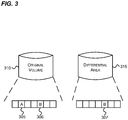
- FIG. 3 is a block diagram that generally represents a shadow copy mechanism in accordance with aspects of the subject matter described herein.
- a shadow copy may be thought of as a "snapshot" of a volume.
- a shadow copy is an exact duplicate of a volume at a given point in time, even though the volume may not be entirely copied (e.g., via copy-on-write) in creating the shadow copy.
- a shadow copy may be viewed as a separate volume by the operating system and any executing applications.
- a shadow copy may have a volume device, a volume name, a drive letter, a mount point, and any other attribute of an actual volume.
- a shadow copy may be exposed through a network remote path such as a network share (sometimes referred to simply as a "share”) associated with it that allows access to a portion or all of the data contained within the shadow copy from a network.
- a network remote path such as a network share (sometimes referred to simply as a "share) associated with it that allows access to
- a shadow copy may be created by various well-known techniques, including copy-on-write, split mirror, specialized hardware that creates a copy of the disk itself, and other methods and systems known to those skilled in the art.
- Shadow copy technology may use a differential area to implement copy-on-write shadow copies.
- the differential area maps blocks on the volume to the contents of those blocks at the point in time that the shadow copy was created.
- the differential mechanism of the shadow copy technology may operate on the physical block level instead of at the object (file or directory) level.
- the differential area 315 may be included on the same storage media upon which the original volume is stored or it may be included on a different storage media.
- a driver may divide a disk into extents.
- An extent refers to a number of contiguous blocks on a storage media and may differ depending on application. For example one application may divide a disk into extents having one size, while another application may divide the disk into extents having a different size.
- the term "extent” is synonymous with a single block. In other embodiments, the term “extent” may mean more than one block.
- the extent containing the block (e.g., extent 306) is copied to a storage location (e.g., extent 307) in a differential area 315.
- an extent is only copied the first time any block within the extent changes.
- a request for information in the shadow copy is received, first, a check is performed to determine if the block has changed in the original volume (e.g., by checking whether an extent containing that block exists in the differential area 315). If the block has not changed, data from the original volume is retrieved and returned. If the block has changed, data from the differential area 315 is retrieved and returned. Note that if a block is overwritten with the same data, that an extent containing the block may not be written to the differential area 315.
- a bitmap may be used to indicate which extents have been written to the differential area 315.
- the bitmap may include a one if a corresponding extent has been written to the differential area 315 and may include a zero if a corresponding extent has not been written to the differential area 315.
- the bitmap may be persisted in a shared storage accessible from all servers.
- other data structures such as a list, array, table, object, or some other data structure may be used to track which extents have been written to the differential area 315.
- the bitmap may be cached on a server to speed access to the bitmap.
- the cached bitmap indicates that an extent has been copied to the differential area, this is sufficient to indicate to the server that the server needs to obtain the original data in the extent from the differential area.
- the server may obtain a list of changes to the bitmap that have occurred since the server last read the bitmap. The server may use this list of changes to update its cached bitmap and to determine whether the extent has been copied to the differential area.
- FIG. 4 is a block diagram of a computer configured to access storage in accordance with aspects of the subject matter described herein.
- the server 405 may include one or more processes 410-411 that request access to data on one or more volumes 425-426.
- the server 405 may also include a throughput measurer 440 and a cluster management component 445.
- the throughput measurer 440 may measure throughput to a volume to determine if the throughput is decreasing or increasing. This may be done via monitoring queue depth or through other mechanisms known to those skilled in the art. Throughput for a volume may decrease if other servers increase their usage of the volume.
- the throughput measurer 440 may have a certain quality of service that it is configured to have for an active server. This quality of service value may be configurable via a persistent management setting like a registry key or otherwise. If the throughput decreases below the quality of service value, the throughput measurer 440 may instruct other servers to decrease (e.g., throttle) their requests, cache more of the shadow copy, or disconnect.
- This quality of service value may be configurable via a persistent management setting like a registry key or otherwise. If the throughput decreases below the quality of service value, the throughput measurer 440 may instruct other servers to decrease (e.g., throttle) their requests, cache more of the shadow copy, or disconnect.
- the throughput measurer 440 may write to a data structure on the disk hosting the volume. Once the other servers read the data structure after it has been changed, they may modify their behavior accordingly. In another embodiment, the throughput measurer 440 may utilize the cluster management component 445 to notify other cluster management components on other servers to modify their behavior accordingly.
- the throughput measurer 440 may be part of the shadow copy component 420 or may be in the file system filter stack 415. In another embodiment, the throughput measurer 440 may be an operating system component that executes outside of the file system filter stack 415. In yet another embodiment, the throughput measurer 440 may be an application or service that executes completely or partially in user mode. Furthermore, although the cluster management component 445 is shown as executing in kernel mode, in other embodiments, it may execute partially or completely in user mode.
- the throughput measurer 440 may reside strictly on an active server. In other embodiments, the throughput measurer 440 may reside on active and/or passive servers. Throughput measurers on different servers may communicate with a cluster manager and/or with the throughput measurer on the active server.
- one or more of the processes 410-411 may execute in user mode. Such processes, for example, may be part of an application, service, or the like. In other embodiments, one or more of the processes 410-411 may execute in kernel mode. For example, an operating system process may request access to a file.
- the file system filter stacks 415-416 may include shadow copy components 420-421, respectively, and may also include one or more other filters that are in the I/O path to the file system. Being in the I/O path means that any I/O request or response that proceeds to or from a storage device may be operated on by filters in a filter stack before reaching or returning from the storage device.
- a filter comprises any object that is capable of examining I/O between an application and a storage device and that is capable of changing, completing, or aborting the I/O or performing other actions based thereon.
- Such filters may execute in user mode or in kernel mode and may be part of other components.
- each volume may be associated with a different file system filter stack.
- the file system filter stack 415 may be associated with volume 425 while the file system filter stack 416 may be associated with the volume 426.
- the filters in the file system filter stack are capable of examining and taking action based on I/O to and from the volume.
- a shadow copy component (e.g., each of shadow copy components 420-421) may comprise or be part of a filter. As such, a shadow copy component may have an opportunity of examining each I/O request to and response from the volume to which the shadow copy component is associated. On an active server, a shadow copy component may perform, if needed, a copy-on-write of an extent of an original volume to the differential area as described previously. On a passive server, the shadow copy components may return an error for an attempt to read or write to an original volume.
- the shadow copy components may not allow higher level filters and/or processes on a passive server to even see the original volume.
- a process of the passive server may attempt to discover volumes on a storage device.
- the shadow copy component may allow the process to see shadow copy volumes but may not allow the process to see original volumes mounted by an active server.
- the shadow copy components of both the active and passive servers may, in some respects, act similarly by determining whether the extent including the block requested has been copied to a differential area. If the extent has been copied to a differential area, a shadow copy component may obtain the block from the differential area. Otherwise, the shadow copy component may obtain the block from the original volume as described below in conjunction with FIG. 6 .
- the differential area bitmap 430 may be used for the volume 425 while the differential area bitmap 431 may be used for the volume 426. Note that although the bitmaps 430 and 431 are shown as residing within their respective volumes, in other embodiments, they may reside on other storage media.
- new shadow copies of an active volume may be created periodically. These may be created, for example, by the shadow copy components of an active server. After a new shadow copy is available, a cluster manager may inform a cluster manager component on each affected server that a new shadow copy is available. In response, each cluster manager component may work with its corresponding shadow copy component to cause any new file access requests to be directed to the new shadow copy while allowing already open file requests to be directed to the old shadow copy. After the last file request completes for an old shadow copy, the old shadow copy may then be removed.
- the frequency with which new shadow copies are created may depend on the number of writes. When writes are very frequent, it may be more expensive for servers to recreate caches for the new shadow copy. Hence, the frequency of creating new shadow copies in this case may be less. When writes are relatively infrequent, it may not be very expensive for servers to recreate caches for the new shadow copy. In this case, the frequency of creating new shadow copies may be increased.
- FIGS. 5-6 are flow diagrams that generally represent exemplary actions that may occur in reading and writing to a volume in accordance with aspects of the subject matter described herein.
- the methodology described in conjunction with FIGS. 5-6 is depicted and described as a series of acts. It is to be understood and appreciated that aspects of the subject matter described herein are not limited by the acts illustrated and/or by the order of acts. In one embodiment, the acts occur in an order as described below. In other embodiments, however, the acts may occur in parallel, in another order, and/or with other acts not presented and described herein. Furthermore, not all illustrated acts may be required to implement the methodology in accordance with aspects of the subject matter described herein. In addition, those skilled in the art will understand and appreciate that the methodology could alternatively be represented as a series of interrelated states via a state diagram or as events.
- FIG. 5 is a flow diagram that generally represents actions that may occur in updating a volume in accordance with aspects of the subject matter described herein. At block 505, the actions begin.
- a request to write to a volume is received at a shadow copy component.
- the process 410 may send a request to update data in one or more blocks of volume 425. This request (or a request derived therefrom) may be received by the shadow copy component 420.
- a request for more than one block may be broken into multiple requests for one block.
- one filter in the filter stack may receive a request to write data to multiple blocks and may in turn send multiple requests down the filter stack to write data to single blocks.
- the actions described herein may be modified to work with requests for more than one block that may span one or more extents.
- the actions associated with blocks 520-545 may be repeated (and/or performed in parallel) for each extent associated with the requested blocks.
- an extent associated with the requested block is read from the original volume.
- the extent 306 may be read.
- the extent is written to the differential area.
- the extent 306 is written to the extent 307 on the differential area 315.
- a data structure that tracks extents copied to the differential area is updated. For example, referring to FIGS. 3 and 4 , the difference area bitmap 430 is updated to indicate that the extent 306 has been updated.
- the data is written to the extent. For example, referring to FIG. 3 , new data may be written in the extent 306.
- FIG. 6 is a flow diagram that generally represents actions that may occur in reading from a shadow copy in accordance with aspects of the subject matter described herein. At block 605, the actions begin.
- a request to read from a shadow copy is received.
- the process 411 may send a read request to obtain data in one or more blocks of a shadow copy of volume 426.
- This request (or a request derived therefrom) may be received by the shadow copy component 421.
- a request for more than one block may be broken into multiple requests, each for one block.
- the actions described below may be modified to work with requests for more than one block that may span one or more extents.
- the actions associated with blocks 625-6555 may be repeated (and/or performed in parallel) for each extent associated with the requested blocks.
- the active server uses normal shadow copy reading to obtain the requested block.
- the active server may determine whether the extent associated with the block has been written to the differential area. If so, the active server may read it from the differential area. Otherwise, the active server may read the block from original volume. Because the active server is the only server authorized to change the block, the active server can be sure that when it reads the block from the original volume that the block has not been changed by another server.
- the extent associated with the requested block is read from the original volume.
- the extent 306 may be read.
- a data structure (e.g., a bitmap) that tracks extents copied to the differential area is read from the disk. It is possible that the active server was updating the requested block while the passive server was reading it. As a result, the passive server may get inconsistent data from the block. However, because of the sequence of steps that an active server takes, if the bitmap on disk indicates that the extent has not been copied to the differential area, then the passive server is assured that the extent it just read from the original volume is consistent.
- the passive server may then obtain the block from the differential area and know that this block will not be overwritten during this action since once a block is copied to the differential area, it does not need to be recopied to the differential area for future updates on the original volume.
- changes to the data structure that have occurred since the passive server last read the data structure are read at block 640. These changes are used to update the cached copy of the data structure that is included on the passive server. The cached copy may then be used to determine whether an extent associated with a block has been written to the differential area.
- the block is read from the differential area. For example, referring to FIG. 3 , the block is read from the extent 307 of the differential area 315.
- a shadow copy deleted. Before a server reads the shadow copy it may read control data associated with the shadow copy to determine if the shadow copy still exists. If the shadow copy has been deleted, the shadow copy component of the server may return an error to the calling process.
- deleting an old shadow copy while any server still has an open handle to the shadow copy is disallowed. In other embodiments, deleting an old shadow copy may be allowed.
- an interface on each of the servers involved with a shadow copy may be called to synchronize a delete of the shadow copy. In response to receiving notification via the interface, a shadow copy component may temporarily deny access to the shadow copy until the shadow copy is deleted. After the shadow copy is deleted, the shadow copy component may fail subsequent requests to the delete shadow copy and/or prepare to read from another shadow copy if desired.
Landscapes
- Engineering & Computer Science (AREA)
- Theoretical Computer Science (AREA)
- Physics & Mathematics (AREA)
- General Engineering & Computer Science (AREA)
- General Physics & Mathematics (AREA)
- Quality & Reliability (AREA)
- Data Mining & Analysis (AREA)
- Databases & Information Systems (AREA)
- Information Retrieval, Db Structures And Fs Structures Therefor (AREA)
- Apparatus For Radiation Diagnosis (AREA)
Claims (14)
- Ein oder zahlreiche computerlesbare Medien mit durch einen Computer ausführbaren Anweisungen, die bei Ausführung durch einen Prozessor eines Servers (211-213; 405), der eine Schattenkopiekomponente (225-227; 420, 421) enthält, bewirken, dass die Schattenkopiekomponente Aktionen ausführt, die umfassen:Empfangen (610) einer Anforderung zum Lesen von Daten aus einer Schattenkopie eines Datenträgers (310; 425; 426), wobei die Anforderung von einem ersten Computer empfangen wird, der über Nur-Leserechte für den Datenträger verfügt, wobei ein zweiter Computer über Lese-/Schreibzugriff auf den Datenträger verfügt und wobei der zweite Computer den Datenträger und die entsprechende Schattenkopie jederzeit ändern kann, ohne den ersten Computer zu benachrichtigen;Bestimmen (625), ob ein den Daten zugeordneter Wertbereich (305; 306, 307) in einen Differenzbereich (315) geschrieben wurde, der der Schattenkopie zugeordnet ist;wenn der den Daten zugeordnete Wertbereich (306, 307) in den Differenzbereich geschrieben wurde, Lesen (655) der Daten aus dem Differenzbereich; undwenn der mit den Daten verknüpfte Wertbereich (305) nicht in den Differenzbereich geschrieben wurde, Ausführen von Aktionen, umfassend das Lesen (635) des Wertbereichs von dem Datenträger und anschließendes erneutes Bestimmen (645), ob der den Daten zugeordnete Wertbereich in den Differenzbereich geschrieben wurde, während der erste Computer die Daten las, und wenn der den Daten zugeordnete Wertbereich in den Differenzbereich geschrieben wurde, Lesen (655) des mit den Daten verbundenen Wertbereichs aus dem Differenzbereich.
- Ein oder zahlreiche computerlesbare Medien nach Anspruch 1, bei denen das Bestimmen, ob ein den Daten zugeordneter Bereich in einen Differenzbereich geschrieben wurde, das Lesen einer Datenstruktur umfasst, die angibt, welche Wertbereiche in den Differenzbereich geschrieben wurden,
wobei die Datenstruktur auf einer Vorrichtung zwischengespeichert wird, die die Daten anfordert, und
das erneute Bestimmen, ob der mit den Daten verknüpfte Bereich in den Differenzbereich geschrieben wurde, umfasst:Beziehen von Änderungen, die in Bezug auf die Wertbereiche vorgenommen wurden, die in den Differenzbereich geschrieben wurden, von einer Platte, auf die ein Computer mit Lese-/Schreibzugriff auf den Datenträger geschrieben hat; undAktualisieren der Datenstruktur, um die Änderungen zu berücksichtigen. - Ein oder zahlreiche computerlesbare Medien nach Anspruch 1, bei denen das Empfangen einer Anforderung zum Lesen von Daten aus einer Schattenkopie eines Datenträgers das Empfangen der Anforderung oder der davon abgeleiteten Daten bei einem Filter umfasst, das die Möglichkeit hat, jede Anforderung auf Daten aus einem Speicher zu untersuchen.
- Ein oder zahlreiche computerlesbare Medien nach Anspruch 1, bei denen der Wertbereich einem Plattenblock der Schattenkopie entspricht oder
mehr als einem Plattenblock der Schattenkopie entspricht. - Ein oder zahlreiche computerlesbare Medien nach Anspruch 1, weiterhin umfassend das Empfangen einer Anweisung zum Drosseln von Lesezugriffen von passiven Anforderern und Verzögern des Lesens von dem Datenträger und dem Differenzbereich als Reaktion darauf.
- Ein oder zahlreiche computerlesbare Medien nach Anspruch 1, weiterhin umfassend das Empfangen einer Anweisung zum Trennen der Verbindung von dem Datenträger und anschließendes Unterbinden jeglicher zukünftiger Lesevorgänge des Datenträgers, bis es anderweitig angewiesen wird.
- Ein oder zahlreiche computerlesbare Medien nach einem der Ansprüche 1 bis 6, weiterhin umfassend:Empfangen (510) einer Anforderung zum Schreiben auf den Datenträger;Bestimmen (520), ob dem Datenträger Schreibzugriff gewährt wird;wenn Schreibzugriff gewährt wird, Bestimmen (520), ob ein der Anforderung zugeordneter Wertbereich bereits in einen Differenzbereich geschrieben wurde, der der Schattenkopie zugeordnet ist; undwenn kein Schreibzugriff gewährt wird, Fehlschlagen (550) der Anforderung.
- Ein oder zahlreiche computerlesbare Medien nach Anspruch 7, bei dem das Bestimmen, ob dem Datenträger Schreibzugriff gewährt wird, das Bestimmen umfasst, ob ein Anforderer, der die Anforderung bereitstellt, in einem Cluster von Computern als aktiv oder passiv gekennzeichnet wird, wobei ein passiver Anforderer Nur-Leserechte in Bezug auf den Datenträger hat und ein aktiver Anforderer Lese-/Schreibrechte in Bezug auf den Datenträger hat.
- Ein oder zahlreiche computerlesbare Medien nach Anspruch 7, bei denen, wenn der der Anforderung zugeordnete Bereich nicht in einen differenziellen Bereich geschrieben wurde, der der Schattenkopie zugeordnet ist, das Ausführen von Aktionen umfasst:Lesen eines mit der Anforderung verknüpften Wertbereichs von dem Datenträger;Schreiben des Wertbereichs in einen Differenzbereich;Aktualisieren einer Datenstruktur um anzuzeigen, dass der Wertbereich in den Differenzbereich geschrieben wurde; undSchreiben in den Wertbereich entsprechend der Anforderung.
- Ein oder zahlreiche computerlesbare Medien nach Anspruch 7, bei denen, wenn der der Anforderung zugeordnete Wertbereich in einen Differenzbereich geschrieben wurde, der der Schattenkopie zugeordnet ist, darauf verzichtet wird, den Wertbereich erneut in den Differenzbereich zu kopieren und anschließend in den Wertbereich entsprechend der Anforderung geschrieben wird.
- In einer Computerumgebung ein Gerät, umfassend:eine Schattenkopiekomponente (225-227; 420, 421), die betriebsfähig ist, um Zugriff auf eine Schattenkopie eines Datenträgers (310; 425; 426) bereitzustellen, wobei die Schattenkopiekomponente einen Nur-Lesezugriff auf den Datenträger erlaubt, wenn das Gerät als passiv gekennzeichnet wird, und Ermöglichen des Lese-/Schreibzugriffs auf den Datenträger, wenn das Gerät als aktiv gekennzeichnet ist, wobei das Gerät Teil einer Gruppe von Geräten ist, die Zugriff auf den Datenträger haben; undeine Cluster-Verwaltungskomponente (445), die betriebsfähig ist, um einen Hinweis zu empfangen, ob das Gerät als aktiv oder passiv gekennzeichnet ist,wobei, wenn das Gerät als passiv gekennzeichnet ist, die Schattenkopiekomponente weiterhin betreibbar ist, um Aktionen auszuführen, die umfassen:Empfangen einer Anforderung zum Lesen von der Schattenkopie;Bestimmen, ob ein mit dem Lesevorgang verknüpfter Wertbereich (305; 306, 307) bereits in einen Differenzbereich geschrieben wurde, der der Schattenkopie zugeordnet ist;wenn der den Daten zugeordnete Wertbereich (306, 307) in den Differenzbereich geschrieben wurde, Lesen (655) der Daten aus dem Differenzbereich; undwenn der dem Lesevorgang zugeordnete Wertbereich (305) nicht bereits in einen Differenzbereich geschrieben wurde, Lesen des Wertbereichs von dem Datenträger, erneutes Bestimmen, ob der Wertbereich in den Differenzbereich geschrieben wurde, während der erste Computer die Daten las, und wenn ja, lesen des Wertbereichs aus dem Differenzbereich, um auf die Anforderung zu antworten.
- Vorrichtung nach Anspruch 11, weiterhin umfassend:eine Drosselkomponente, die betriebsfähig ist, um eine erlaubte Zugriffsrate auf den Datenträger über die Schattenkopiekomponente, abhängig von einem Befehl, der von einer anderen Vorrichtung empfangen wird, zu ändern; odereine Durchsatzmesskomponente, die betriebsfähig ist, um den Durchsatz zu dem Datenträger zu messen und Cluster-Verwaltungskomponenten auf anderen Geräten zu benachrichtigen, ihre zulässigen Zugriffsraten auf den Datenträger zu ändern oder die Verbindung mit dem Datenträger zu trennen oder wiederherzustellen.
- Verfahren für eine Schattenkopiekomponente (225-227; 420, 421), die in einem Server (211-213; 405) enthalten ist, umfassend:Empfangen (610) einer Anforderung zum Lesen von Daten aus einer Schattenkopie eines Datenträgers (310; 425; 426), wobei die Anforderung von einem ersten Computer empfangen wird, der über Nur-Leserechte für den Datenträger verfügt, wobei ein zweiter Computer über Lese-/Schreibzugriff auf den Datenträger verfügt und der zweite Computer den Datenträger und die entsprechende Schattenkopie jederzeit ändern kann, ohne den ersten Computer zu benachrichtigen;Bestimmen (625), ob ein den Daten zugeordneter Wertbereich (305; 306, 307) in einen Differenzbereich (315) geschrieben wurde, der der Schattenkopie zugeordnet ist;wenn der den Daten zugeordnete Wertbereich (306, 307) in den Differenzbereich geschrieben wurde, Lesen (655) der Daten aus dem Differenzbereich; undwenn der mit den Daten verknüpfte Wertbereich (305) nicht in den Differenzbereich geschrieben wurde, Ausführen von Aktionen, umfassend Lesen (635) des Wertbereichs von dem Datenträger und anschließendes erneutes Bestimmen (645), ob der den Daten zugeordnete Wertbereich in den Differenzbereich geschrieben wurde, während der erste Computer die Daten las, und wenn der den Daten zugeordnete Wertbereich in den Differenzbereich geschrieben wurde, Lesen (655) des mit den Daten verbundenen Wertbereichs aus dem Differenzbereich.
- Verfahren nach Anspruch 13, weiterhin umfassend Ausführen von Aktionen, wie sie ausgeführt werden, wenn die computerausführbaren Anweisungen des computerlesbaren Mediums nach einem der Ansprüche 2 bis 6 ausgeführt werden.
Applications Claiming Priority (2)
| Application Number | Priority Date | Filing Date | Title |
|---|---|---|---|
| US11/834,028 US7877553B2 (en) | 2007-08-06 | 2007-08-06 | Sharing volume data via shadow copies using differential areas |
| PCT/US2008/072248 WO2009020978A2 (en) | 2007-08-06 | 2008-08-05 | Sharing volume data via shadow copies |
Publications (3)
| Publication Number | Publication Date |
|---|---|
| EP2186013A2 EP2186013A2 (de) | 2010-05-19 |
| EP2186013A4 EP2186013A4 (de) | 2015-09-16 |
| EP2186013B1 true EP2186013B1 (de) | 2019-06-05 |
Family
ID=40341996
Family Applications (1)
| Application Number | Title | Priority Date | Filing Date |
|---|---|---|---|
| EP08797218.8A Active EP2186013B1 (de) | 2007-08-06 | 2008-08-05 | Gemeinsame nutzung von daten eines datenträgers mittels schattenkopien |
Country Status (3)
| Country | Link |
|---|---|
| US (1) | US7877553B2 (de) |
| EP (1) | EP2186013B1 (de) |
| WO (1) | WO2009020978A2 (de) |
Families Citing this family (7)
| Publication number | Priority date | Publication date | Assignee | Title |
|---|---|---|---|---|
| US20130054533A1 (en) * | 2011-08-24 | 2013-02-28 | Microsoft Corporation | Verifying a data recovery component using a managed interface |
| US9086811B2 (en) | 2013-07-17 | 2015-07-21 | International Business Machines Corporation | Managing data sets of a storage system |
| GB2527828A (en) * | 2014-07-03 | 2016-01-06 | Ibm | Copy-on-read process in disaster recovery |
| US10606766B1 (en) * | 2017-07-14 | 2020-03-31 | STEALTHbits Technologies, Inc. | Systems and methods for shadow copy access prevention |
| US10585756B2 (en) | 2017-08-07 | 2020-03-10 | International Business Machines Corporation | Point-in-time copy on a remote system |
| US10795776B2 (en) | 2017-11-06 | 2020-10-06 | International Business Machines Corporation | Multiple point-in-time copies on a remote system |
| US11100132B2 (en) * | 2018-10-11 | 2021-08-24 | International Business Machines Corporation | Intelligent space release in asynchronous mirror journal volumes |
Family Cites Families (19)
| Publication number | Priority date | Publication date | Assignee | Title |
|---|---|---|---|---|
| US7174352B2 (en) | 1993-06-03 | 2007-02-06 | Network Appliance, Inc. | File system image transfer |
| WO2002001410A1 (en) | 2000-06-26 | 2002-01-03 | International Business Machines Corporation | Data management application programming interface for a parallel file system |
| US6877107B2 (en) | 2001-07-05 | 2005-04-05 | Softwired Ag | Method for ensuring operation during node failures and network partitions in a clustered message passing server |
| US7139809B2 (en) | 2001-11-21 | 2006-11-21 | Clearcube Technology, Inc. | System and method for providing virtual network attached storage using excess distributed storage capacity |
| US20070094466A1 (en) * | 2001-12-26 | 2007-04-26 | Cisco Technology, Inc., A Corporation Of California | Techniques for improving mirroring operations implemented in storage area networks and network based virtualization |
| US7191304B1 (en) * | 2002-09-06 | 2007-03-13 | 3Pardata, Inc. | Efficient and reliable virtual volume mapping |
| US6865597B1 (en) | 2002-12-20 | 2005-03-08 | Veritas Operating Corporation | System and method for providing highly-available volume mount points |
| US7181574B1 (en) | 2003-01-30 | 2007-02-20 | Veritas Operating Corporation | Server cluster using informed prefetching |
| US7080221B1 (en) | 2003-04-23 | 2006-07-18 | Emc Corporation | Method and apparatus for managing migration of data in a clustered computer system environment |
| US7287186B2 (en) | 2003-06-02 | 2007-10-23 | Surgient Inc. | Shared nothing virtual cluster |
| US7730033B2 (en) | 2003-06-13 | 2010-06-01 | Microsoft Corporation | Mechanism for exposing shadow copies in a networked environment |
| US7151574B2 (en) * | 2003-12-01 | 2006-12-19 | Ess Technology, Inc. | Optimized structure for digital separation of composite video signals |
| US20050278760A1 (en) * | 2004-06-01 | 2005-12-15 | Don Dewar | Method and system for controlling streaming in an on-demand server |
| US7366858B2 (en) | 2004-09-09 | 2008-04-29 | Microsoft Corporation | Framework for taking shadow copies and performing backups in a networked environment |
| US7756833B2 (en) * | 2004-09-22 | 2010-07-13 | Microsoft Corporation | Method and system for synthetic backup and restore |
| US8271436B2 (en) * | 2005-02-07 | 2012-09-18 | Mimosa Systems, Inc. | Retro-fitting synthetic full copies of data |
| US8918366B2 (en) * | 2005-02-07 | 2014-12-23 | Mimosa Systems, Inc. | Synthetic full copies of data and dynamic bulk-to-brick transformation |
| US7529816B2 (en) | 2005-06-03 | 2009-05-05 | Hewlett-Packard Development Company, L.P. | System for providing multi-path input/output in a clustered data storage network |
| US7640231B2 (en) | 2005-11-16 | 2009-12-29 | International Business Machines Corporation | Approach based on self-evolving models for performance guarantees in a shared storage system |
-
2007
- 2007-08-06 US US11/834,028 patent/US7877553B2/en active Active
-
2008
- 2008-08-05 WO PCT/US2008/072248 patent/WO2009020978A2/en not_active Ceased
- 2008-08-05 EP EP08797218.8A patent/EP2186013B1/de active Active
Non-Patent Citations (1)
| Title |
|---|
| None * |
Also Published As
| Publication number | Publication date |
|---|---|
| EP2186013A4 (de) | 2015-09-16 |
| US20090043968A1 (en) | 2009-02-12 |
| EP2186013A2 (de) | 2010-05-19 |
| US7877553B2 (en) | 2011-01-25 |
| WO2009020978A3 (en) | 2009-04-16 |
| WO2009020978A2 (en) | 2009-02-12 |
Similar Documents
| Publication | Publication Date | Title |
|---|---|---|
| US11153380B2 (en) | Continuous backup of data in a distributed data store | |
| US11120152B2 (en) | Dynamic quorum membership changes | |
| US10055133B2 (en) | System and method for controlling automated page-based tier management in storage systems | |
| US7574443B2 (en) | Scalable clustered storage system | |
| US7076622B2 (en) | System and method for detecting and sharing common blocks in an object storage system | |
| US7546431B2 (en) | Distributed open writable snapshot copy facility using file migration policies | |
| EP2186013B1 (de) | Gemeinsame nutzung von daten eines datenträgers mittels schattenkopien | |
| US20120079583A1 (en) | Offload reads and writes | |
| US8938425B1 (en) | Managing logical views of storage | |
| US20090319736A1 (en) | Method and apparatus for integrated nas and cas data backup | |
| US8161008B2 (en) | Information processing apparatus and operation method thereof | |
| US9009196B2 (en) | Discovery and client routing to database nodes | |
| JP2007133471A (ja) | ストレージ装置及びスナップショットのリストア方法 | |
| CN103890729A (zh) | 共享资源的协同管理 | |
| US7694095B2 (en) | Managing snapshots using messages | |
| US7536426B2 (en) | Hybrid object placement in a distributed storage system | |
| US10133505B1 (en) | Cooperative host and data storage system services for compression and encryption | |
| CN117369940A (zh) | 基于k8s集群的持久化存储资源动态迁移方法及装置 | |
| US11940885B2 (en) | Parallel restore of a large object | |
| US7987335B1 (en) | Techniques for virtualizing data | |
| US8255675B1 (en) | System and method for storage management of file system configuration data | |
| HK1170583A (en) | Offload reads and writes |
Legal Events
| Date | Code | Title | Description |
|---|---|---|---|
| PUAI | Public reference made under article 153(3) epc to a published international application that has entered the european phase |
Free format text: ORIGINAL CODE: 0009012 |
|
| 17P | Request for examination filed |
Effective date: 20100224 |
|
| AK | Designated contracting states |
Kind code of ref document: A2 Designated state(s): AT BE BG CH CY CZ DE DK EE ES FI FR GB GR HR HU IE IS IT LI LT LU LV MC MT NL NO PL PT RO SE SI SK TR |
|
| AX | Request for extension of the european patent |
Extension state: AL BA MK RS |
|
| DAX | Request for extension of the european patent (deleted) | ||
| RAP1 | Party data changed (applicant data changed or rights of an application transferred) |
Owner name: MICROSOFT TECHNOLOGY LICENSING, LLC |
|
| RIC1 | Information provided on ipc code assigned before grant |
Ipc: G06F 17/30 20060101ALI20150324BHEP Ipc: G06F 11/20 20060101AFI20150324BHEP |
|
| A4 | Supplementary search report drawn up and despatched |
Effective date: 20150818 |
|
| RIC1 | Information provided on ipc code assigned before grant |
Ipc: G06F 11/20 20060101AFI20150812BHEP Ipc: G06F 17/30 20060101ALI20150812BHEP |
|
| STAA | Information on the status of an ep patent application or granted ep patent |
Free format text: STATUS: EXAMINATION IS IN PROGRESS |
|
| 17Q | First examination report despatched |
Effective date: 20180821 |
|
| GRAP | Despatch of communication of intention to grant a patent |
Free format text: ORIGINAL CODE: EPIDOSNIGR1 |
|
| STAA | Information on the status of an ep patent application or granted ep patent |
Free format text: STATUS: GRANT OF PATENT IS INTENDED |
|
| INTG | Intention to grant announced |
Effective date: 20190104 |
|
| GRAS | Grant fee paid |
Free format text: ORIGINAL CODE: EPIDOSNIGR3 |
|
| GRAA | (expected) grant |
Free format text: ORIGINAL CODE: 0009210 |
|
| STAA | Information on the status of an ep patent application or granted ep patent |
Free format text: STATUS: THE PATENT HAS BEEN GRANTED |
|
| AK | Designated contracting states |
Kind code of ref document: B1 Designated state(s): AT BE BG CH CY CZ DE DK EE ES FI FR GB GR HR HU IE IS IT LI LT LU LV MC MT NL NO PL PT RO SE SI SK TR |
|
| REG | Reference to a national code |
Ref country code: GB Ref legal event code: FG4D |
|
| REG | Reference to a national code |
Ref country code: CH Ref legal event code: EP |
|
| REG | Reference to a national code |
Ref country code: AT Ref legal event code: REF Ref document number: 1140698 Country of ref document: AT Kind code of ref document: T Effective date: 20190615 |
|
| REG | Reference to a national code |
Ref country code: IE Ref legal event code: FG4D |
|
| REG | Reference to a national code |
Ref country code: DE Ref legal event code: R096 Ref document number: 602008060288 Country of ref document: DE |
|
| REG | Reference to a national code |
Ref country code: NL Ref legal event code: FP |
|
| REG | Reference to a national code |
Ref country code: LT Ref legal event code: MG4D |
|
| PG25 | Lapsed in a contracting state [announced via postgrant information from national office to epo] |
Ref country code: SE Free format text: LAPSE BECAUSE OF FAILURE TO SUBMIT A TRANSLATION OF THE DESCRIPTION OR TO PAY THE FEE WITHIN THE PRESCRIBED TIME-LIMIT Effective date: 20190605 Ref country code: FI Free format text: LAPSE BECAUSE OF FAILURE TO SUBMIT A TRANSLATION OF THE DESCRIPTION OR TO PAY THE FEE WITHIN THE PRESCRIBED TIME-LIMIT Effective date: 20190605 Ref country code: NO Free format text: LAPSE BECAUSE OF FAILURE TO SUBMIT A TRANSLATION OF THE DESCRIPTION OR TO PAY THE FEE WITHIN THE PRESCRIBED TIME-LIMIT Effective date: 20190905 Ref country code: HR Free format text: LAPSE BECAUSE OF FAILURE TO SUBMIT A TRANSLATION OF THE DESCRIPTION OR TO PAY THE FEE WITHIN THE PRESCRIBED TIME-LIMIT Effective date: 20190605 Ref country code: LT Free format text: LAPSE BECAUSE OF FAILURE TO SUBMIT A TRANSLATION OF THE DESCRIPTION OR TO PAY THE FEE WITHIN THE PRESCRIBED TIME-LIMIT Effective date: 20190605 Ref country code: ES Free format text: LAPSE BECAUSE OF FAILURE TO SUBMIT A TRANSLATION OF THE DESCRIPTION OR TO PAY THE FEE WITHIN THE PRESCRIBED TIME-LIMIT Effective date: 20190605 |
|
| PG25 | Lapsed in a contracting state [announced via postgrant information from national office to epo] |
Ref country code: LV Free format text: LAPSE BECAUSE OF FAILURE TO SUBMIT A TRANSLATION OF THE DESCRIPTION OR TO PAY THE FEE WITHIN THE PRESCRIBED TIME-LIMIT Effective date: 20190605 Ref country code: BG Free format text: LAPSE BECAUSE OF FAILURE TO SUBMIT A TRANSLATION OF THE DESCRIPTION OR TO PAY THE FEE WITHIN THE PRESCRIBED TIME-LIMIT Effective date: 20190905 Ref country code: GR Free format text: LAPSE BECAUSE OF FAILURE TO SUBMIT A TRANSLATION OF THE DESCRIPTION OR TO PAY THE FEE WITHIN THE PRESCRIBED TIME-LIMIT Effective date: 20190906 |
|
| REG | Reference to a national code |
Ref country code: AT Ref legal event code: MK05 Ref document number: 1140698 Country of ref document: AT Kind code of ref document: T Effective date: 20190605 |
|
| PG25 | Lapsed in a contracting state [announced via postgrant information from national office to epo] |
Ref country code: AT Free format text: LAPSE BECAUSE OF FAILURE TO SUBMIT A TRANSLATION OF THE DESCRIPTION OR TO PAY THE FEE WITHIN THE PRESCRIBED TIME-LIMIT Effective date: 20190605 Ref country code: EE Free format text: LAPSE BECAUSE OF FAILURE TO SUBMIT A TRANSLATION OF THE DESCRIPTION OR TO PAY THE FEE WITHIN THE PRESCRIBED TIME-LIMIT Effective date: 20190605 Ref country code: SK Free format text: LAPSE BECAUSE OF FAILURE TO SUBMIT A TRANSLATION OF THE DESCRIPTION OR TO PAY THE FEE WITHIN THE PRESCRIBED TIME-LIMIT Effective date: 20190605 Ref country code: RO Free format text: LAPSE BECAUSE OF FAILURE TO SUBMIT A TRANSLATION OF THE DESCRIPTION OR TO PAY THE FEE WITHIN THE PRESCRIBED TIME-LIMIT Effective date: 20190605 Ref country code: CZ Free format text: LAPSE BECAUSE OF FAILURE TO SUBMIT A TRANSLATION OF THE DESCRIPTION OR TO PAY THE FEE WITHIN THE PRESCRIBED TIME-LIMIT Effective date: 20190605 Ref country code: PT Free format text: LAPSE BECAUSE OF FAILURE TO SUBMIT A TRANSLATION OF THE DESCRIPTION OR TO PAY THE FEE WITHIN THE PRESCRIBED TIME-LIMIT Effective date: 20191007 |
|
| PG25 | Lapsed in a contracting state [announced via postgrant information from national office to epo] |
Ref country code: IT Free format text: LAPSE BECAUSE OF FAILURE TO SUBMIT A TRANSLATION OF THE DESCRIPTION OR TO PAY THE FEE WITHIN THE PRESCRIBED TIME-LIMIT Effective date: 20190605 Ref country code: IS Free format text: LAPSE BECAUSE OF FAILURE TO SUBMIT A TRANSLATION OF THE DESCRIPTION OR TO PAY THE FEE WITHIN THE PRESCRIBED TIME-LIMIT Effective date: 20191005 |
|
| REG | Reference to a national code |
Ref country code: DE Ref legal event code: R097 Ref document number: 602008060288 Country of ref document: DE |
|
| PG25 | Lapsed in a contracting state [announced via postgrant information from national office to epo] |
Ref country code: TR Free format text: LAPSE BECAUSE OF FAILURE TO SUBMIT A TRANSLATION OF THE DESCRIPTION OR TO PAY THE FEE WITHIN THE PRESCRIBED TIME-LIMIT Effective date: 20190605 |
|
| PLBE | No opposition filed within time limit |
Free format text: ORIGINAL CODE: 0009261 |
|
| STAA | Information on the status of an ep patent application or granted ep patent |
Free format text: STATUS: NO OPPOSITION FILED WITHIN TIME LIMIT |
|
| PG25 | Lapsed in a contracting state [announced via postgrant information from national office to epo] |
Ref country code: PL Free format text: LAPSE BECAUSE OF FAILURE TO SUBMIT A TRANSLATION OF THE DESCRIPTION OR TO PAY THE FEE WITHIN THE PRESCRIBED TIME-LIMIT Effective date: 20190605 Ref country code: DK Free format text: LAPSE BECAUSE OF FAILURE TO SUBMIT A TRANSLATION OF THE DESCRIPTION OR TO PAY THE FEE WITHIN THE PRESCRIBED TIME-LIMIT Effective date: 20190605 |
|
| 26N | No opposition filed |
Effective date: 20200306 |
|
| PG25 | Lapsed in a contracting state [announced via postgrant information from national office to epo] |
Ref country code: MC Free format text: LAPSE BECAUSE OF FAILURE TO SUBMIT A TRANSLATION OF THE DESCRIPTION OR TO PAY THE FEE WITHIN THE PRESCRIBED TIME-LIMIT Effective date: 20190605 Ref country code: LU Free format text: LAPSE BECAUSE OF NON-PAYMENT OF DUE FEES Effective date: 20190805 Ref country code: SI Free format text: LAPSE BECAUSE OF FAILURE TO SUBMIT A TRANSLATION OF THE DESCRIPTION OR TO PAY THE FEE WITHIN THE PRESCRIBED TIME-LIMIT Effective date: 20190605 Ref country code: LI Free format text: LAPSE BECAUSE OF NON-PAYMENT OF DUE FEES Effective date: 20190831 Ref country code: CH Free format text: LAPSE BECAUSE OF NON-PAYMENT OF DUE FEES Effective date: 20190831 |
|
| REG | Reference to a national code |
Ref country code: BE Ref legal event code: MM Effective date: 20190831 |
|
| PG25 | Lapsed in a contracting state [announced via postgrant information from national office to epo] |
Ref country code: IE Free format text: LAPSE BECAUSE OF NON-PAYMENT OF DUE FEES Effective date: 20190805 |
|
| PG25 | Lapsed in a contracting state [announced via postgrant information from national office to epo] |
Ref country code: BE Free format text: LAPSE BECAUSE OF NON-PAYMENT OF DUE FEES Effective date: 20190831 |
|
| PG25 | Lapsed in a contracting state [announced via postgrant information from national office to epo] |
Ref country code: CY Free format text: LAPSE BECAUSE OF FAILURE TO SUBMIT A TRANSLATION OF THE DESCRIPTION OR TO PAY THE FEE WITHIN THE PRESCRIBED TIME-LIMIT Effective date: 20190605 |
|
| PG25 | Lapsed in a contracting state [announced via postgrant information from national office to epo] |
Ref country code: HU Free format text: LAPSE BECAUSE OF FAILURE TO SUBMIT A TRANSLATION OF THE DESCRIPTION OR TO PAY THE FEE WITHIN THE PRESCRIBED TIME-LIMIT; INVALID AB INITIO Effective date: 20080805 Ref country code: MT Free format text: LAPSE BECAUSE OF FAILURE TO SUBMIT A TRANSLATION OF THE DESCRIPTION OR TO PAY THE FEE WITHIN THE PRESCRIBED TIME-LIMIT Effective date: 20190605 |
|
| P01 | Opt-out of the competence of the unified patent court (upc) registered |
Effective date: 20230505 |
|
| PGFP | Annual fee paid to national office [announced via postgrant information from national office to epo] |
Ref country code: NL Payment date: 20250723 Year of fee payment: 18 |
|
| PGFP | Annual fee paid to national office [announced via postgrant information from national office to epo] |
Ref country code: DE Payment date: 20250724 Year of fee payment: 18 |
|
| PGFP | Annual fee paid to national office [announced via postgrant information from national office to epo] |
Ref country code: GB Payment date: 20250725 Year of fee payment: 18 |
|
| PGFP | Annual fee paid to national office [announced via postgrant information from national office to epo] |
Ref country code: FR Payment date: 20250725 Year of fee payment: 18 |