EP2185639B1 - Rubber compositions - Google Patents
Rubber compositions Download PDFInfo
- Publication number
- EP2185639B1 EP2185639B1 EP08827425A EP08827425A EP2185639B1 EP 2185639 B1 EP2185639 B1 EP 2185639B1 EP 08827425 A EP08827425 A EP 08827425A EP 08827425 A EP08827425 A EP 08827425A EP 2185639 B1 EP2185639 B1 EP 2185639B1
- Authority
- EP
- European Patent Office
- Prior art keywords
- group
- substituted
- unsubstituted
- saturated
- containing group
- Prior art date
- Legal status (The legal status is an assumption and is not a legal conclusion. Google has not performed a legal analysis and makes no representation as to the accuracy of the status listed.)
- Not-in-force
Links
- 239000000203 mixture Substances 0.000 title claims abstract description 84
- 229920001971 elastomer Polymers 0.000 title claims abstract description 72
- 239000005060 rubber Substances 0.000 title claims abstract description 71
- 229920006395 saturated elastomer Polymers 0.000 claims abstract description 41
- 125000005842 heteroatom Chemical group 0.000 claims abstract description 24
- 150000001875 compounds Chemical class 0.000 claims abstract description 22
- 125000005266 diarylamine group Chemical group 0.000 claims abstract description 21
- 229910052799 carbon Inorganic materials 0.000 claims description 26
- RTZKZFJDLAIYFH-UHFFFAOYSA-N Diethyl ether Chemical compound CCOCC RTZKZFJDLAIYFH-UHFFFAOYSA-N 0.000 claims description 24
- 125000004432 carbon atom Chemical group C* 0.000 claims description 24
- 125000000217 alkyl group Chemical group 0.000 claims description 21
- 125000001424 substituent group Chemical group 0.000 claims description 15
- 229910052739 hydrogen Inorganic materials 0.000 claims description 13
- 239000001257 hydrogen Substances 0.000 claims description 13
- 238000000034 method Methods 0.000 claims description 13
- 125000004435 hydrogen atom Chemical group [H]* 0.000 claims description 11
- 239000004721 Polyphenylene oxide Substances 0.000 claims description 10
- 125000003342 alkenyl group Chemical group 0.000 claims description 10
- 150000001408 amides Chemical class 0.000 claims description 10
- 125000002887 hydroxy group Chemical group [H]O* 0.000 claims description 10
- 229920000570 polyether Polymers 0.000 claims description 10
- 150000001993 dienes Chemical class 0.000 claims description 9
- 150000002148 esters Chemical class 0.000 claims description 9
- 125000003860 C1-C20 alkoxy group Chemical group 0.000 claims description 8
- 229920001577 copolymer Polymers 0.000 claims description 8
- 125000005843 halogen group Chemical group 0.000 claims description 8
- 239000000178 monomer Substances 0.000 claims description 5
- 229920003052 natural elastomer Polymers 0.000 claims description 5
- 229920001194 natural rubber Polymers 0.000 claims description 5
- 125000000923 (C1-C30) alkyl group Chemical group 0.000 claims description 4
- 244000043261 Hevea brasiliensis Species 0.000 claims description 4
- UFHFLCQGNIYNRP-UHFFFAOYSA-N Hydrogen Chemical compound [H][H] UFHFLCQGNIYNRP-UHFFFAOYSA-N 0.000 claims description 3
- 229920001519 homopolymer Polymers 0.000 claims description 3
- 230000000873 masking effect Effects 0.000 claims description 2
- 230000000979 retarding effect Effects 0.000 claims description 2
- 125000003118 aryl group Chemical group 0.000 abstract description 15
- -1 for example Polymers 0.000 description 100
- VYPSYNLAJGMNEJ-UHFFFAOYSA-N Silicium dioxide Chemical compound O=[Si]=O VYPSYNLAJGMNEJ-UHFFFAOYSA-N 0.000 description 49
- 239000003054 catalyst Substances 0.000 description 25
- CXWXQJXEFPUFDZ-UHFFFAOYSA-N tetraline Natural products C1=CC=C2CCCCC2=C1 CXWXQJXEFPUFDZ-UHFFFAOYSA-N 0.000 description 24
- VLKZOEOYAKHREP-UHFFFAOYSA-N n-Hexane Chemical class CCCCCC VLKZOEOYAKHREP-UHFFFAOYSA-N 0.000 description 21
- KDLHZDBZIXYQEI-UHFFFAOYSA-N Palladium Chemical compound [Pd] KDLHZDBZIXYQEI-UHFFFAOYSA-N 0.000 description 19
- 239000000377 silicon dioxide Substances 0.000 description 19
- XKRFYHLGVUSROY-UHFFFAOYSA-N Argon Chemical compound [Ar] XKRFYHLGVUSROY-UHFFFAOYSA-N 0.000 description 18
- 238000006243 chemical reaction Methods 0.000 description 17
- 239000007822 coupling agent Substances 0.000 description 16
- 229910052717 sulfur Inorganic materials 0.000 description 16
- CBENFWSGALASAD-UHFFFAOYSA-N Ozone Chemical compound [O-][O+]=O CBENFWSGALASAD-UHFFFAOYSA-N 0.000 description 15
- 239000006229 carbon black Substances 0.000 description 14
- 235000019241 carbon black Nutrition 0.000 description 14
- 150000001412 amines Chemical class 0.000 description 13
- DMBHHRLKUKUOEG-UHFFFAOYSA-N diphenylamine Chemical compound C=1C=CC=CC=1NC1=CC=CC=C1 DMBHHRLKUKUOEG-UHFFFAOYSA-N 0.000 description 13
- IJGRMHOSHXDMSA-UHFFFAOYSA-N Atomic nitrogen Chemical compound N#N IJGRMHOSHXDMSA-UHFFFAOYSA-N 0.000 description 12
- NINIDFKCEFEMDL-UHFFFAOYSA-N Sulfur Chemical compound [S] NINIDFKCEFEMDL-UHFFFAOYSA-N 0.000 description 12
- 150000001721 carbon Chemical group 0.000 description 12
- BWGNESOTFCXPMA-UHFFFAOYSA-N Dihydrogen disulfide Chemical compound SS BWGNESOTFCXPMA-UHFFFAOYSA-N 0.000 description 11
- 239000011593 sulfur Substances 0.000 description 11
- 239000011521 glass Substances 0.000 description 10
- 238000012360 testing method Methods 0.000 description 10
- 229910052786 argon Inorganic materials 0.000 description 9
- 125000000753 cycloalkyl group Chemical group 0.000 description 9
- 229910052763 palladium Inorganic materials 0.000 description 9
- XLOMVQKBTHCTTD-UHFFFAOYSA-N Zinc monoxide Chemical compound [Zn]=O XLOMVQKBTHCTTD-UHFFFAOYSA-N 0.000 description 8
- 125000004122 cyclic group Chemical group 0.000 description 8
- 239000000945 filler Substances 0.000 description 8
- 229910052757 nitrogen Inorganic materials 0.000 description 8
- 239000000243 solution Substances 0.000 description 8
- PAYRUJLWNCNPSJ-UHFFFAOYSA-N Aniline Chemical compound NC1=CC=CC=C1 PAYRUJLWNCNPSJ-UHFFFAOYSA-N 0.000 description 7
- 239000003795 chemical substances by application Substances 0.000 description 7
- 239000010949 copper Substances 0.000 description 7
- 125000000392 cycloalkenyl group Chemical group 0.000 description 7
- 125000001072 heteroaryl group Chemical group 0.000 description 7
- 239000000463 material Substances 0.000 description 7
- 229910052760 oxygen Inorganic materials 0.000 description 7
- 239000000047 product Substances 0.000 description 7
- 239000002904 solvent Substances 0.000 description 7
- UHOVQNZJYSORNB-UHFFFAOYSA-N Benzene Chemical compound C1=CC=CC=C1 UHOVQNZJYSORNB-UHFFFAOYSA-N 0.000 description 6
- 125000003710 aryl alkyl group Chemical group 0.000 description 6
- 229940035422 diphenylamine Drugs 0.000 description 6
- 238000012545 processing Methods 0.000 description 6
- RIOQSEWOXXDEQQ-UHFFFAOYSA-N triphenylphosphine Chemical compound C1=CC=CC=C1P(C=1C=CC=CC=1)C1=CC=CC=C1 RIOQSEWOXXDEQQ-UHFFFAOYSA-N 0.000 description 6
- OKTJSMMVPCPJKN-UHFFFAOYSA-N Carbon Chemical compound [C] OKTJSMMVPCPJKN-UHFFFAOYSA-N 0.000 description 5
- 230000032683 aging Effects 0.000 description 5
- 125000000592 heterocycloalkyl group Chemical group 0.000 description 5
- 229920001195 polyisoprene Polymers 0.000 description 5
- 230000008569 process Effects 0.000 description 5
- 238000004073 vulcanization Methods 0.000 description 5
- KGRVJHAUYBGFFP-UHFFFAOYSA-N 2,2'-Methylenebis(4-methyl-6-tert-butylphenol) Chemical compound CC(C)(C)C1=CC(C)=CC(CC=2C(=C(C=C(C)C=2)C(C)(C)C)O)=C1O KGRVJHAUYBGFFP-UHFFFAOYSA-N 0.000 description 4
- RYGMFSIKBFXOCR-UHFFFAOYSA-N Copper Chemical compound [Cu] RYGMFSIKBFXOCR-UHFFFAOYSA-N 0.000 description 4
- 239000000654 additive Substances 0.000 description 4
- 229910052782 aluminium Inorganic materials 0.000 description 4
- 230000000052 comparative effect Effects 0.000 description 4
- 229910052802 copper Inorganic materials 0.000 description 4
- 230000008878 coupling Effects 0.000 description 4
- 238000010168 coupling process Methods 0.000 description 4
- 238000005859 coupling reaction Methods 0.000 description 4
- 125000001316 cycloalkyl alkyl group Chemical group 0.000 description 4
- 125000004446 heteroarylalkyl group Chemical group 0.000 description 4
- 125000000623 heterocyclic group Chemical group 0.000 description 4
- 150000002430 hydrocarbons Chemical group 0.000 description 4
- 238000002156 mixing Methods 0.000 description 4
- TWNQGVIAIRXVLR-UHFFFAOYSA-N oxo(oxoalumanyloxy)alumane Chemical compound O=[Al]O[Al]=O TWNQGVIAIRXVLR-UHFFFAOYSA-N 0.000 description 4
- 150000003839 salts Chemical class 0.000 description 4
- 229910002027 silica gel Inorganic materials 0.000 description 4
- 239000000741 silica gel Substances 0.000 description 4
- 229960001866 silicon dioxide Drugs 0.000 description 4
- 239000010936 titanium Substances 0.000 description 4
- 229910052725 zinc Inorganic materials 0.000 description 4
- 239000011701 zinc Substances 0.000 description 4
- 239000011787 zinc oxide Substances 0.000 description 4
- JRZGPXSSNPTNMA-UHFFFAOYSA-N 1,2,3,4-tetrahydronaphthalen-1-amine Chemical class C1=CC=C2C(N)CCCC2=C1 JRZGPXSSNPTNMA-UHFFFAOYSA-N 0.000 description 3
- ZZMVLMVFYMGSMY-UHFFFAOYSA-N 4-n-(4-methylpentan-2-yl)-1-n-phenylbenzene-1,4-diamine Chemical compound C1=CC(NC(C)CC(C)C)=CC=C1NC1=CC=CC=C1 ZZMVLMVFYMGSMY-UHFFFAOYSA-N 0.000 description 3
- WKBOTKDWSSQWDR-UHFFFAOYSA-N Bromine atom Chemical compound [Br] WKBOTKDWSSQWDR-UHFFFAOYSA-N 0.000 description 3
- 239000004215 Carbon black (E152) Substances 0.000 description 3
- BLRPTPMANUNPDV-UHFFFAOYSA-N Silane Chemical compound [SiH4] BLRPTPMANUNPDV-UHFFFAOYSA-N 0.000 description 3
- HEMHJVSKTPXQMS-UHFFFAOYSA-M Sodium hydroxide Chemical compound [OH-].[Na+] HEMHJVSKTPXQMS-UHFFFAOYSA-M 0.000 description 3
- 235000021355 Stearic acid Nutrition 0.000 description 3
- 239000006236 Super Abrasion Furnace Substances 0.000 description 3
- GWEVSGVZZGPLCZ-UHFFFAOYSA-N Titan oxide Chemical compound O=[Ti]=O GWEVSGVZZGPLCZ-UHFFFAOYSA-N 0.000 description 3
- 239000007983 Tris buffer Substances 0.000 description 3
- 125000003545 alkoxy group Chemical group 0.000 description 3
- 125000002947 alkylene group Chemical group 0.000 description 3
- PNEYBMLMFCGWSK-UHFFFAOYSA-N aluminium oxide Inorganic materials [O-2].[O-2].[O-2].[Al+3].[Al+3] PNEYBMLMFCGWSK-UHFFFAOYSA-N 0.000 description 3
- QVGXLLKOCUKJST-UHFFFAOYSA-N atomic oxygen Chemical compound [O] QVGXLLKOCUKJST-UHFFFAOYSA-N 0.000 description 3
- GDTBXPJZTBHREO-UHFFFAOYSA-N bromine Substances BrBr GDTBXPJZTBHREO-UHFFFAOYSA-N 0.000 description 3
- 229910052794 bromium Inorganic materials 0.000 description 3
- 238000005336 cracking Methods 0.000 description 3
- 238000002474 experimental method Methods 0.000 description 3
- 150000004820 halides Chemical group 0.000 description 3
- POFSNPPXJUQANW-UHFFFAOYSA-N hexane-3,4-diol Chemical compound CCC(O)C(O)CC POFSNPPXJUQANW-UHFFFAOYSA-N 0.000 description 3
- 229930195733 hydrocarbon Natural products 0.000 description 3
- QIQXTHQIDYTFRH-UHFFFAOYSA-N octadecanoic acid Chemical compound CCCCCCCCCCCCCCCCCC(O)=O QIQXTHQIDYTFRH-UHFFFAOYSA-N 0.000 description 3
- OQCDKBAXFALNLD-UHFFFAOYSA-N octadecanoic acid Natural products CCCCCCCC(C)CCCCCCCCC(O)=O OQCDKBAXFALNLD-UHFFFAOYSA-N 0.000 description 3
- 239000003921 oil Substances 0.000 description 3
- 230000003647 oxidation Effects 0.000 description 3
- 238000007254 oxidation reaction Methods 0.000 description 3
- 239000001301 oxygen Substances 0.000 description 3
- 239000008188 pellet Substances 0.000 description 3
- 229920000642 polymer Polymers 0.000 description 3
- 238000002360 preparation method Methods 0.000 description 3
- 239000000376 reactant Substances 0.000 description 3
- 239000011347 resin Substances 0.000 description 3
- 229920005989 resin Polymers 0.000 description 3
- 150000004760 silicates Chemical class 0.000 description 3
- 239000008117 stearic acid Substances 0.000 description 3
- 238000003756 stirring Methods 0.000 description 3
- 229910052719 titanium Inorganic materials 0.000 description 3
- WYTZZXDRDKSJID-UHFFFAOYSA-N (3-aminopropyl)triethoxysilane Chemical compound CCO[Si](OCC)(OCC)CCCN WYTZZXDRDKSJID-UHFFFAOYSA-N 0.000 description 2
- KZPYGQFFRCFCPP-UHFFFAOYSA-N 1,1'-bis(diphenylphosphino)ferrocene Chemical compound [Fe+2].C1=CC=C[C-]1P(C=1C=CC=CC=1)C1=CC=CC=C1.C1=CC=C[C-]1P(C=1C=CC=CC=1)C1=CC=CC=C1 KZPYGQFFRCFCPP-UHFFFAOYSA-N 0.000 description 2
- YXIWHUQXZSMYRE-UHFFFAOYSA-N 1,3-benzothiazole-2-thiol Chemical compound C1=CC=C2SC(S)=NC2=C1 YXIWHUQXZSMYRE-UHFFFAOYSA-N 0.000 description 2
- CBCKQZAAMUWICA-UHFFFAOYSA-N 1,4-phenylenediamine Chemical class NC1=CC=C(N)C=C1 CBCKQZAAMUWICA-UHFFFAOYSA-N 0.000 description 2
- DJFWBXZNNOYGAU-UHFFFAOYSA-N 1-bromo-1,2,3,4-tetrahydronaphthalene Chemical compound C1=CC=C2C(Br)CCCC2=C1 DJFWBXZNNOYGAU-UHFFFAOYSA-N 0.000 description 2
- ZJNLYGOUHDJHMG-UHFFFAOYSA-N 1-n,4-n-bis(5-methylhexan-2-yl)benzene-1,4-diamine Chemical compound CC(C)CCC(C)NC1=CC=C(NC(C)CCC(C)C)C=C1 ZJNLYGOUHDJHMG-UHFFFAOYSA-N 0.000 description 2
- ZNRLMGFXSPUZNR-UHFFFAOYSA-N 2,2,4-trimethyl-1h-quinoline Chemical compound C1=CC=C2C(C)=CC(C)(C)NC2=C1 ZNRLMGFXSPUZNR-UHFFFAOYSA-N 0.000 description 2
- SDJHPPZKZZWAKF-UHFFFAOYSA-N 2,3-dimethylbuta-1,3-diene Chemical compound CC(=C)C(C)=C SDJHPPZKZZWAKF-UHFFFAOYSA-N 0.000 description 2
- XOUQAVYLRNOXDO-UHFFFAOYSA-N 2-tert-butyl-5-methylphenol Chemical compound CC1=CC=C(C(C)(C)C)C(O)=C1 XOUQAVYLRNOXDO-UHFFFAOYSA-N 0.000 description 2
- UJAWGGOCYUPCPS-UHFFFAOYSA-N 4-(2-phenylpropan-2-yl)-n-[4-(2-phenylpropan-2-yl)phenyl]aniline Chemical compound C=1C=C(NC=2C=CC(=CC=2)C(C)(C)C=2C=CC=CC=2)C=CC=1C(C)(C)C1=CC=CC=C1 UJAWGGOCYUPCPS-UHFFFAOYSA-N 0.000 description 2
- ZCYVEMRRCGMTRW-UHFFFAOYSA-N 7553-56-2 Chemical compound [I] ZCYVEMRRCGMTRW-UHFFFAOYSA-N 0.000 description 2
- QGZKDVFQNNGYKY-UHFFFAOYSA-N Ammonia Chemical compound N QGZKDVFQNNGYKY-UHFFFAOYSA-N 0.000 description 2
- KAKZBPTYRLMSJV-UHFFFAOYSA-N Butadiene Chemical compound C=CC=C KAKZBPTYRLMSJV-UHFFFAOYSA-N 0.000 description 2
- UUNBFTCKFYBASS-UHFFFAOYSA-N C(CCCCCCC)C=1C(=C(C=CC1)NC1=CC=CC=C1)CCCCCCCC Chemical compound C(CCCCCCC)C=1C(=C(C=CC1)NC1=CC=CC=C1)CCCCCCCC UUNBFTCKFYBASS-UHFFFAOYSA-N 0.000 description 2
- LZZYPRNAOMGNLH-UHFFFAOYSA-M Cetrimonium bromide Chemical compound [Br-].CCCCCCCCCCCCCCCC[N+](C)(C)C LZZYPRNAOMGNLH-UHFFFAOYSA-M 0.000 description 2
- ZAMOUSCENKQFHK-UHFFFAOYSA-N Chlorine atom Chemical compound [Cl] ZAMOUSCENKQFHK-UHFFFAOYSA-N 0.000 description 2
- ZRALSGWEFCBTJO-UHFFFAOYSA-N Guanidine Chemical compound NC(N)=N ZRALSGWEFCBTJO-UHFFFAOYSA-N 0.000 description 2
- 239000006238 High Abrasion Furnace Substances 0.000 description 2
- RRHGJUQNOFWUDK-UHFFFAOYSA-N Isoprene Chemical compound CC(=C)C=C RRHGJUQNOFWUDK-UHFFFAOYSA-N 0.000 description 2
- 239000002841 Lewis acid Substances 0.000 description 2
- 239000004594 Masterbatch (MB) Substances 0.000 description 2
- 241000254043 Melolonthinae Species 0.000 description 2
- BAPJBEWLBFYGME-UHFFFAOYSA-N Methyl acrylate Chemical compound COC(=O)C=C BAPJBEWLBFYGME-UHFFFAOYSA-N 0.000 description 2
- UTGQNNCQYDRXCH-UHFFFAOYSA-N N,N'-diphenyl-1,4-phenylenediamine Chemical compound C=1C=C(NC=2C=CC=CC=2)C=CC=1NC1=CC=CC=C1 UTGQNNCQYDRXCH-UHFFFAOYSA-N 0.000 description 2
- XQVWYOYUZDUNRW-UHFFFAOYSA-N N-Phenyl-1-naphthylamine Chemical compound C=1C=CC2=CC=CC=C2C=1NC1=CC=CC=C1 XQVWYOYUZDUNRW-UHFFFAOYSA-N 0.000 description 2
- 229920004941 NATSYN® 2200 Polymers 0.000 description 2
- 239000006057 Non-nutritive feed additive Substances 0.000 description 2
- CTQNGGLPUBDAKN-UHFFFAOYSA-N O-Xylene Chemical compound CC1=CC=CC=C1C CTQNGGLPUBDAKN-UHFFFAOYSA-N 0.000 description 2
- OAICVXFJPJFONN-UHFFFAOYSA-N Phosphorus Chemical compound [P] OAICVXFJPJFONN-UHFFFAOYSA-N 0.000 description 2
- 239000006242 Semi-Reinforcing Furnace Substances 0.000 description 2
- UIIMBOGNXHQVGW-UHFFFAOYSA-M Sodium bicarbonate Chemical compound [Na+].OC([O-])=O UIIMBOGNXHQVGW-UHFFFAOYSA-M 0.000 description 2
- 229910000831 Steel Inorganic materials 0.000 description 2
- PPBRXRYQALVLMV-UHFFFAOYSA-N Styrene Chemical compound C=CC1=CC=CC=C1 PPBRXRYQALVLMV-UHFFFAOYSA-N 0.000 description 2
- HCHKCACWOHOZIP-UHFFFAOYSA-N Zinc Chemical compound [Zn] HCHKCACWOHOZIP-UHFFFAOYSA-N 0.000 description 2
- 125000000304 alkynyl group Chemical group 0.000 description 2
- HSFWRNGVRCDJHI-UHFFFAOYSA-N alpha-acetylene Natural products C#C HSFWRNGVRCDJHI-UHFFFAOYSA-N 0.000 description 2
- 239000012300 argon atmosphere Substances 0.000 description 2
- 125000000732 arylene group Chemical group 0.000 description 2
- 239000000919 ceramic Substances 0.000 description 2
- 230000008859 change Effects 0.000 description 2
- 239000000460 chlorine Substances 0.000 description 2
- 229910052801 chlorine Inorganic materials 0.000 description 2
- 239000000470 constituent Substances 0.000 description 2
- 125000002993 cycloalkylene group Chemical group 0.000 description 2
- 125000000113 cyclohexyl group Chemical group [H]C1([H])C([H])([H])C([H])([H])C([H])(*)C([H])([H])C1([H])[H] 0.000 description 2
- 229920003244 diene elastomer Polymers 0.000 description 2
- 235000014113 dietary fatty acids Nutrition 0.000 description 2
- 229910001873 dinitrogen Inorganic materials 0.000 description 2
- ZUOUZKKEUPVFJK-UHFFFAOYSA-N diphenyl Chemical compound C1=CC=CC=C1C1=CC=CC=C1 ZUOUZKKEUPVFJK-UHFFFAOYSA-N 0.000 description 2
- 150000002019 disulfides Chemical class 0.000 description 2
- 239000012990 dithiocarbamate Substances 0.000 description 2
- 125000005677 ethinylene group Chemical group [*:2]C#C[*:1] 0.000 description 2
- 239000000194 fatty acid Substances 0.000 description 2
- 229930195729 fatty acid Natural products 0.000 description 2
- 150000004665 fatty acids Chemical class 0.000 description 2
- 239000007789 gas Substances 0.000 description 2
- 238000004817 gas chromatography Methods 0.000 description 2
- 229910052736 halogen Inorganic materials 0.000 description 2
- 150000002367 halogens Chemical class 0.000 description 2
- 238000010438 heat treatment Methods 0.000 description 2
- 230000007062 hydrolysis Effects 0.000 description 2
- 238000006460 hydrolysis reaction Methods 0.000 description 2
- 239000004615 ingredient Substances 0.000 description 2
- 238000002347 injection Methods 0.000 description 2
- 239000007924 injection Substances 0.000 description 2
- PNDPGZBMCMUPRI-UHFFFAOYSA-N iodine Chemical compound II PNDPGZBMCMUPRI-UHFFFAOYSA-N 0.000 description 2
- 239000011630 iodine Substances 0.000 description 2
- 229910052740 iodine Inorganic materials 0.000 description 2
- 125000001449 isopropyl group Chemical group [H]C([H])([H])C([H])(*)C([H])([H])[H] 0.000 description 2
- 239000011968 lewis acid catalyst Substances 0.000 description 2
- 239000007788 liquid Substances 0.000 description 2
- 239000011777 magnesium Substances 0.000 description 2
- 229910052749 magnesium Inorganic materials 0.000 description 2
- 229910044991 metal oxide Inorganic materials 0.000 description 2
- 150000004706 metal oxides Chemical class 0.000 description 2
- 230000005012 migration Effects 0.000 description 2
- 238000013508 migration Methods 0.000 description 2
- 150000005002 naphthylamines Chemical class 0.000 description 2
- LQNUZADURLCDLV-UHFFFAOYSA-N nitrobenzene Chemical compound [O-][N+](=O)C1=CC=CC=C1 LQNUZADURLCDLV-UHFFFAOYSA-N 0.000 description 2
- MVAOEXBRERPGIT-UHFFFAOYSA-N octamine Chemical compound N.N.N.N.N.N.N.N MVAOEXBRERPGIT-UHFFFAOYSA-N 0.000 description 2
- NFHFRUOZVGFOOS-UHFFFAOYSA-N palladium;triphenylphosphane Chemical compound [Pd].C1=CC=CC=C1P(C=1C=CC=CC=1)C1=CC=CC=C1.C1=CC=CC=C1P(C=1C=CC=CC=1)C1=CC=CC=C1.C1=CC=CC=C1P(C=1C=CC=CC=1)C1=CC=CC=C1.C1=CC=CC=C1P(C=1C=CC=CC=1)C1=CC=CC=C1 NFHFRUOZVGFOOS-UHFFFAOYSA-N 0.000 description 2
- 150000002989 phenols Chemical class 0.000 description 2
- 125000001997 phenyl group Chemical group [H]C1=C([H])C([H])=C(*)C([H])=C1[H] 0.000 description 2
- 229910052698 phosphorus Inorganic materials 0.000 description 2
- 239000011574 phosphorus Substances 0.000 description 2
- 230000000704 physical effect Effects 0.000 description 2
- 229920001451 polypropylene glycol Polymers 0.000 description 2
- 239000005077 polysulfide Substances 0.000 description 2
- 229920001021 polysulfide Polymers 0.000 description 2
- 150000008117 polysulfides Polymers 0.000 description 2
- 125000002924 primary amino group Chemical group [H]N([H])* 0.000 description 2
- 125000002943 quinolinyl group Chemical group N1=C(C=CC2=CC=CC=C12)* 0.000 description 2
- 239000011541 reaction mixture Substances 0.000 description 2
- 230000003014 reinforcing effect Effects 0.000 description 2
- 229910000077 silane Inorganic materials 0.000 description 2
- MFRIHAYPQRLWNB-UHFFFAOYSA-N sodium tert-butoxide Chemical compound [Na+].CC(C)(C)[O-] MFRIHAYPQRLWNB-UHFFFAOYSA-N 0.000 description 2
- 239000007787 solid Substances 0.000 description 2
- 230000003068 static effect Effects 0.000 description 2
- 239000010959 steel Substances 0.000 description 2
- 239000000126 substance Substances 0.000 description 2
- 125000004354 sulfur functional group Chemical group 0.000 description 2
- 229920001897 terpolymer Polymers 0.000 description 2
- 125000005329 tetralinyl group Chemical group C1(CCCC2=CC=CC=C12)* 0.000 description 2
- 229960002447 thiram Drugs 0.000 description 2
- 239000001993 wax Substances 0.000 description 2
- 239000008096 xylene Substances 0.000 description 2
- CYPYTURSJDMMMP-WVCUSYJESA-N (1e,4e)-1,5-diphenylpenta-1,4-dien-3-one;palladium Chemical compound [Pd].[Pd].C=1C=CC=CC=1\C=C\C(=O)\C=C\C1=CC=CC=C1.C=1C=CC=CC=1\C=C\C(=O)\C=C\C1=CC=CC=C1.C=1C=CC=CC=1\C=C\C(=O)\C=C\C1=CC=CC=C1 CYPYTURSJDMMMP-WVCUSYJESA-N 0.000 description 1
- WYVXGHYWKHAKJG-UHFFFAOYSA-N (2-bromo-3-phenylprop-1-enyl)benzene Chemical compound C=1C=CC=CC=1C=C(Br)CC1=CC=CC=C1 WYVXGHYWKHAKJG-UHFFFAOYSA-N 0.000 description 1
- PMJHHCWVYXUKFD-SNAWJCMRSA-N (E)-1,3-pentadiene Chemical compound C\C=C\C=C PMJHHCWVYXUKFD-SNAWJCMRSA-N 0.000 description 1
- 0 *C(C=I=CC=C)=C(*)N Chemical compound *C(C=I=CC=C)=C(*)N 0.000 description 1
- GEYOCULIXLDCMW-UHFFFAOYSA-N 1,2-phenylenediamine Chemical compound NC1=CC=CC=C1N GEYOCULIXLDCMW-UHFFFAOYSA-N 0.000 description 1
- 150000005208 1,4-dihydroxybenzenes Chemical class 0.000 description 1
- FKMWAQFLTKJUHD-UHFFFAOYSA-N 1-chloro-2-methylprop-1-ene;2-methylbuta-1,3-diene Chemical compound CC(C)=CCl.CC(=C)C=C FKMWAQFLTKJUHD-UHFFFAOYSA-N 0.000 description 1
- JUHXTONDLXIGGK-UHFFFAOYSA-N 1-n,4-n-bis(5-methylheptan-3-yl)benzene-1,4-diamine Chemical compound CCC(C)CC(CC)NC1=CC=C(NC(CC)CC(C)CC)C=C1 JUHXTONDLXIGGK-UHFFFAOYSA-N 0.000 description 1
- APTGHASZJUAUCP-UHFFFAOYSA-N 1-n,4-n-di(octan-2-yl)benzene-1,4-diamine Chemical compound CCCCCCC(C)NC1=CC=C(NC(C)CCCCCC)C=C1 APTGHASZJUAUCP-UHFFFAOYSA-N 0.000 description 1
- VETPHHXZEJAYOB-UHFFFAOYSA-N 1-n,4-n-dinaphthalen-2-ylbenzene-1,4-diamine Chemical compound C1=CC=CC2=CC(NC=3C=CC(NC=4C=C5C=CC=CC5=CC=4)=CC=3)=CC=C21 VETPHHXZEJAYOB-UHFFFAOYSA-N 0.000 description 1
- OPGZBHOFTGSDNP-UHFFFAOYSA-N 1-phenyl-3-trimethoxysilylpropan-1-amine Chemical compound CO[Si](OC)(OC)CCC(N)C1=CC=CC=C1 OPGZBHOFTGSDNP-UHFFFAOYSA-N 0.000 description 1
- YBYIRNPNPLQARY-UHFFFAOYSA-N 1H-indene Natural products C1=CC=C2CC=CC2=C1 YBYIRNPNPLQARY-UHFFFAOYSA-N 0.000 description 1
- LLMLGZUZTFMXSA-UHFFFAOYSA-N 2,3,4,5,6-pentachlorobenzenethiol Chemical compound SC1=C(Cl)C(Cl)=C(Cl)C(Cl)=C1Cl LLMLGZUZTFMXSA-UHFFFAOYSA-N 0.000 description 1
- VBCFHWSPNHEYGE-UHFFFAOYSA-N 2,3,4-trimethylquinoline Chemical compound C1=CC=C2C(C)=C(C)C(C)=NC2=C1 VBCFHWSPNHEYGE-UHFFFAOYSA-N 0.000 description 1
- QVXGKJYMVLJYCL-UHFFFAOYSA-N 2,3-di(nonyl)-N-phenylaniline Chemical class C(CCCCCCCC)C=1C(=C(C=CC1)NC1=CC=CC=C1)CCCCCCCCC QVXGKJYMVLJYCL-UHFFFAOYSA-N 0.000 description 1
- BYLSIPUARIZAHZ-UHFFFAOYSA-N 2,4,6-tris(1-phenylethyl)phenol Chemical compound C=1C(C(C)C=2C=CC=CC=2)=C(O)C(C(C)C=2C=CC=CC=2)=CC=1C(C)C1=CC=CC=C1 BYLSIPUARIZAHZ-UHFFFAOYSA-N 0.000 description 1
- OVSKIKFHRZPJSS-UHFFFAOYSA-N 2,4-D Chemical compound OC(=O)COC1=CC=C(Cl)C=C1Cl OVSKIKFHRZPJSS-UHFFFAOYSA-N 0.000 description 1
- CZNRFEXEPBITDS-UHFFFAOYSA-N 2,5-bis(2-methylbutan-2-yl)benzene-1,4-diol Chemical compound CCC(C)(C)C1=CC(O)=C(C(C)(C)CC)C=C1O CZNRFEXEPBITDS-UHFFFAOYSA-N 0.000 description 1
- 125000000022 2-aminoethyl group Chemical group [H]C([*])([H])C([H])([H])N([H])[H] 0.000 description 1
- 125000006088 2-oxoazepinyl group Chemical group 0.000 description 1
- 125000004638 2-oxopiperazinyl group Chemical group O=C1N(CCNC1)* 0.000 description 1
- 125000004637 2-oxopiperidinyl group Chemical group O=C1N(CCCC1)* 0.000 description 1
- DOYKFSOCSXVQAN-UHFFFAOYSA-N 3-[diethoxy(methyl)silyl]propyl 2-methylprop-2-enoate Chemical compound CCO[Si](C)(OCC)CCCOC(=O)C(C)=C DOYKFSOCSXVQAN-UHFFFAOYSA-N 0.000 description 1
- LJBNEMPXFPBBFI-UHFFFAOYSA-N 3-amino-3-(3,5-dichloropyridin-4-yl)propanoic acid Chemical compound OC(=O)CC(N)C1=C(Cl)C=NC=C1Cl LJBNEMPXFPBBFI-UHFFFAOYSA-N 0.000 description 1
- OXYZDRAJMHGSMW-UHFFFAOYSA-N 3-chloropropyl(trimethoxy)silane Chemical compound CO[Si](OC)(OC)CCCCl OXYZDRAJMHGSMW-UHFFFAOYSA-N 0.000 description 1
- MIIBUHIQXLFJFP-UHFFFAOYSA-N 3-methyl-1-[[3-[(3-methyl-2,5-dioxopyrrol-1-yl)methyl]phenyl]methyl]pyrrole-2,5-dione Chemical compound O=C1C(C)=CC(=O)N1CC1=CC=CC(CN2C(C(C)=CC2=O)=O)=C1 MIIBUHIQXLFJFP-UHFFFAOYSA-N 0.000 description 1
- URDOJQUSEUXVRP-UHFFFAOYSA-N 3-triethoxysilylpropyl 2-methylprop-2-enoate Chemical compound CCO[Si](OCC)(OCC)CCCOC(=O)C(C)=C URDOJQUSEUXVRP-UHFFFAOYSA-N 0.000 description 1
- SJECZPVISLOESU-UHFFFAOYSA-N 3-trimethoxysilylpropan-1-amine Chemical compound CO[Si](OC)(OC)CCCN SJECZPVISLOESU-UHFFFAOYSA-N 0.000 description 1
- HLBZWYXLQJQBKU-UHFFFAOYSA-N 4-(morpholin-4-yldisulfanyl)morpholine Chemical compound C1COCCN1SSN1CCOCC1 HLBZWYXLQJQBKU-UHFFFAOYSA-N 0.000 description 1
- UDQCDDZBBZNIFA-UHFFFAOYSA-N 4-methyl-1,3-dihydrobenzimidazole-2-thione Chemical compound CC1=CC=CC2=C1NC(=S)N2 UDQCDDZBBZNIFA-UHFFFAOYSA-N 0.000 description 1
- LTVAIOLMQDKZTP-UHFFFAOYSA-N 4-n-(4-methylpentan-2-yl)-1-n-phenylcyclohexa-2,5-diene-1,4-diimine Chemical compound C1=CC(=NC(C)CC(C)C)C=CC1=NC1=CC=CC=C1 LTVAIOLMQDKZTP-UHFFFAOYSA-N 0.000 description 1
- UHJVLUYSDYOULM-UHFFFAOYSA-N 4-n-(5-methylhexan-2-yl)-1-n-phenylbenzene-1,4-diamine Chemical compound C1=CC(NC(C)CCC(C)C)=CC=C1NC1=CC=CC=C1 UHJVLUYSDYOULM-UHFFFAOYSA-N 0.000 description 1
- JQTYAZKTBXWQOM-UHFFFAOYSA-N 4-n-octan-2-yl-1-n-phenylbenzene-1,4-diamine Chemical compound C1=CC(NC(C)CCCCCC)=CC=C1NC1=CC=CC=C1 JQTYAZKTBXWQOM-UHFFFAOYSA-N 0.000 description 1
- 125000005986 4-piperidonyl group Chemical group 0.000 description 1
- UZTQYWLWRFMSSF-UHFFFAOYSA-N 6-bromo-1,2,3,4-tetrahydronaphthalene Chemical compound C1CCCC2=CC(Br)=CC=C21 UZTQYWLWRFMSSF-UHFFFAOYSA-N 0.000 description 1
- NLHHRLWOUZZQLW-UHFFFAOYSA-N Acrylonitrile Chemical compound C=CC#N NLHHRLWOUZZQLW-UHFFFAOYSA-N 0.000 description 1
- 239000005995 Aluminium silicate Substances 0.000 description 1
- ZOXJGFHDIHLPTG-UHFFFAOYSA-N Boron Chemical compound [B] ZOXJGFHDIHLPTG-UHFFFAOYSA-N 0.000 description 1
- GHKOFFNLGXMVNJ-UHFFFAOYSA-N Didodecyl thiobispropanoate Chemical compound CCCCCCCCCCCCOC(=O)CCSCCC(=O)OCCCCCCCCCCCC GHKOFFNLGXMVNJ-UHFFFAOYSA-N 0.000 description 1
- 239000003508 Dilauryl thiodipropionate Substances 0.000 description 1
- 229920002943 EPDM rubber Polymers 0.000 description 1
- 239000004593 Epoxy Chemical group 0.000 description 1
- VGGSQFUCUMXWEO-UHFFFAOYSA-N Ethene Chemical compound C=C VGGSQFUCUMXWEO-UHFFFAOYSA-N 0.000 description 1
- JIGUQPWFLRLWPJ-UHFFFAOYSA-N Ethyl acrylate Chemical compound CCOC(=O)C=C JIGUQPWFLRLWPJ-UHFFFAOYSA-N 0.000 description 1
- 239000005977 Ethylene Substances 0.000 description 1
- IAYPIBMASNFSPL-UHFFFAOYSA-N Ethylene oxide Chemical compound C1CO1 IAYPIBMASNFSPL-UHFFFAOYSA-N 0.000 description 1
- PXGOKWXKJXAPGV-UHFFFAOYSA-N Fluorine Chemical compound FF PXGOKWXKJXAPGV-UHFFFAOYSA-N 0.000 description 1
- CSNNHWWHGAXBCP-UHFFFAOYSA-L Magnesium sulfate Chemical compound [Mg+2].[O-][S+2]([O-])([O-])[O-] CSNNHWWHGAXBCP-UHFFFAOYSA-L 0.000 description 1
- PEEHTFAAVSWFBL-UHFFFAOYSA-N Maleimide Chemical compound O=C1NC(=O)C=C1 PEEHTFAAVSWFBL-UHFFFAOYSA-N 0.000 description 1
- VVQNEPGJFQJSBK-UHFFFAOYSA-N Methyl methacrylate Chemical compound COC(=O)C(C)=C VVQNEPGJFQJSBK-UHFFFAOYSA-N 0.000 description 1
- GYCMBHHDWRMZGG-UHFFFAOYSA-N Methylacrylonitrile Chemical compound CC(=C)C#N GYCMBHHDWRMZGG-UHFFFAOYSA-N 0.000 description 1
- CHJJGSNFBQVOTG-UHFFFAOYSA-N N-methyl-guanidine Natural products CNC(N)=N CHJJGSNFBQVOTG-UHFFFAOYSA-N 0.000 description 1
- XMEKHKCRNHDFOW-UHFFFAOYSA-N O.O.[Na].[Na] Chemical compound O.O.[Na].[Na] XMEKHKCRNHDFOW-UHFFFAOYSA-N 0.000 description 1
- 229910004679 ONO2 Inorganic materials 0.000 description 1
- 229920003171 Poly (ethylene oxide) Polymers 0.000 description 1
- 239000005062 Polybutadiene Substances 0.000 description 1
- GOOHAUXETOMSMM-UHFFFAOYSA-N Propylene oxide Chemical compound CC1CO1 GOOHAUXETOMSMM-UHFFFAOYSA-N 0.000 description 1
- LFMFPKKYRXFHHZ-UHFFFAOYSA-N R24 Chemical compound C1=C(Cl)C(C)=CC=C1NC1=NC(N)=C(C=CC=C2)C2=N1 LFMFPKKYRXFHHZ-UHFFFAOYSA-N 0.000 description 1
- WYURNTSHIVDZCO-UHFFFAOYSA-N Tetrahydrofuran Chemical compound C1CCOC1 WYURNTSHIVDZCO-UHFFFAOYSA-N 0.000 description 1
- XTXRWKRVRITETP-UHFFFAOYSA-N Vinyl acetate Chemical compound CC(=O)OC=C XTXRWKRVRITETP-UHFFFAOYSA-N 0.000 description 1
- 229910021536 Zeolite Inorganic materials 0.000 description 1
- RBYGDVHOECIAFC-UHFFFAOYSA-L acetonitrile;palladium(2+);dichloride Chemical compound [Cl-].[Cl-].[Pd+2].CC#N.CC#N RBYGDVHOECIAFC-UHFFFAOYSA-L 0.000 description 1
- 230000002378 acidificating effect Effects 0.000 description 1
- 125000000641 acridinyl group Chemical group C1(=CC=CC2=NC3=CC=CC=C3C=C12)* 0.000 description 1
- 230000009471 action Effects 0.000 description 1
- 239000012190 activator Substances 0.000 description 1
- 125000005073 adamantyl group Chemical group C12(CC3CC(CC(C1)C3)C2)* 0.000 description 1
- 230000000996 additive effect Effects 0.000 description 1
- 229910052915 alkaline earth metal silicate Inorganic materials 0.000 description 1
- 150000005215 alkyl ethers Chemical class 0.000 description 1
- XYLMUPLGERFSHI-UHFFFAOYSA-N alpha-Methylstyrene Chemical compound CC(=C)C1=CC=CC=C1 XYLMUPLGERFSHI-UHFFFAOYSA-N 0.000 description 1
- 229910000323 aluminium silicate Inorganic materials 0.000 description 1
- 235000012211 aluminium silicate Nutrition 0.000 description 1
- 229910021529 ammonia Inorganic materials 0.000 description 1
- 150000001448 anilines Chemical class 0.000 description 1
- 239000003963 antioxidant agent Substances 0.000 description 1
- 229940111121 antirheumatic drug quinolines Drugs 0.000 description 1
- 150000008378 aryl ethers Chemical class 0.000 description 1
- 239000012298 atmosphere Substances 0.000 description 1
- 125000004429 atom Chemical group 0.000 description 1
- 125000002785 azepinyl group Chemical group 0.000 description 1
- 125000002393 azetidinyl group Chemical group 0.000 description 1
- 229910052788 barium Inorganic materials 0.000 description 1
- 239000011324 bead Substances 0.000 description 1
- 125000003785 benzimidazolyl group Chemical group N1=C(NC2=C1C=CC=C2)* 0.000 description 1
- 125000002047 benzodioxolyl group Chemical group O1OC(C2=C1C=CC=C2)* 0.000 description 1
- 125000005872 benzooxazolyl group Chemical group 0.000 description 1
- 125000004619 benzopyranyl group Chemical group O1C(C=CC2=C1C=CC=C2)* 0.000 description 1
- 125000001164 benzothiazolyl group Chemical group S1C(=NC2=C1C=CC=C2)* 0.000 description 1
- 125000004196 benzothienyl group Chemical group S1C(=CC2=C1C=CC=C2)* 0.000 description 1
- 125000001797 benzyl group Chemical group [H]C1=C([H])C([H])=C(C([H])=C1[H])C([H])([H])* 0.000 description 1
- 125000002619 bicyclic group Chemical group 0.000 description 1
- MUALRAIOVNYAIW-UHFFFAOYSA-N binap Chemical group C1=CC=CC=C1P(C=1C(=C2C=CC=CC2=CC=1)C=1C2=CC=CC=C2C=CC=1P(C=1C=CC=CC=1)C=1C=CC=CC=1)C1=CC=CC=C1 MUALRAIOVNYAIW-UHFFFAOYSA-N 0.000 description 1
- 230000015572 biosynthetic process Effects 0.000 description 1
- 235000010290 biphenyl Nutrition 0.000 description 1
- 239000004305 biphenyl Substances 0.000 description 1
- YNHIGQDRGKUECZ-UHFFFAOYSA-L bis(triphenylphosphine)palladium(ii) dichloride Chemical compound [Cl-].[Cl-].[Pd+2].C1=CC=CC=C1P(C=1C=CC=CC=1)C1=CC=CC=C1.C1=CC=CC=C1P(C=1C=CC=CC=1)C1=CC=CC=C1 YNHIGQDRGKUECZ-UHFFFAOYSA-L 0.000 description 1
- 229910052796 boron Inorganic materials 0.000 description 1
- 125000001246 bromo group Chemical group Br* 0.000 description 1
- 229920005557 bromobutyl Polymers 0.000 description 1
- RTACIUYXLGWTAE-UHFFFAOYSA-N buta-1,3-diene;2-methylbuta-1,3-diene;styrene Chemical compound C=CC=C.CC(=C)C=C.C=CC1=CC=CC=C1 RTACIUYXLGWTAE-UHFFFAOYSA-N 0.000 description 1
- NTXGQCSETZTARF-UHFFFAOYSA-N buta-1,3-diene;prop-2-enenitrile Chemical compound C=CC=C.C=CC#N NTXGQCSETZTARF-UHFFFAOYSA-N 0.000 description 1
- WFYPICNXBKQZGB-UHFFFAOYSA-N butenyne Chemical group C=CC#C WFYPICNXBKQZGB-UHFFFAOYSA-N 0.000 description 1
- 125000000484 butyl group Chemical group [H]C([*])([H])C([H])([H])C([H])([H])C([H])([H])[H] 0.000 description 1
- 229920005549 butyl rubber Polymers 0.000 description 1
- 239000011575 calcium Substances 0.000 description 1
- 229910052791 calcium Inorganic materials 0.000 description 1
- 239000000378 calcium silicate Substances 0.000 description 1
- 229910052918 calcium silicate Inorganic materials 0.000 description 1
- OYACROKNLOSFPA-UHFFFAOYSA-N calcium;dioxido(oxo)silane Chemical compound [Ca+2].[O-][Si]([O-])=O OYACROKNLOSFPA-UHFFFAOYSA-N 0.000 description 1
- DKVNPHBNOWQYFE-UHFFFAOYSA-N carbamodithioic acid Chemical compound NC(S)=S DKVNPHBNOWQYFE-UHFFFAOYSA-N 0.000 description 1
- 125000000609 carbazolyl group Chemical group C1(=CC=CC=2C3=CC=CC=C3NC12)* 0.000 description 1
- 239000011203 carbon fibre reinforced carbon Substances 0.000 description 1
- 125000003178 carboxy group Chemical group [H]OC(*)=O 0.000 description 1
- 150000001732 carboxylic acid derivatives Chemical class 0.000 description 1
- 150000001733 carboxylic acid esters Chemical class 0.000 description 1
- 230000015556 catabolic process Effects 0.000 description 1
- 239000007810 chemical reaction solvent Substances 0.000 description 1
- 125000003016 chromanyl group Chemical group O1C(CCC2=CC=CC=C12)* 0.000 description 1
- 238000004587 chromatography analysis Methods 0.000 description 1
- 125000000259 cinnolinyl group Chemical group N1=NC(=CC2=CC=CC=C12)* 0.000 description 1
- 238000010960 commercial process Methods 0.000 description 1
- 239000012141 concentrate Substances 0.000 description 1
- 230000001143 conditioned effect Effects 0.000 description 1
- 238000007796 conventional method Methods 0.000 description 1
- 229910052593 corundum Inorganic materials 0.000 description 1
- 125000004093 cyano group Chemical group *C#N 0.000 description 1
- 125000001047 cyclobutenyl group Chemical group C1(=CCC1)* 0.000 description 1
- 125000001995 cyclobutyl group Chemical group [H]C1([H])C([H])([H])C([H])(*)C1([H])[H] 0.000 description 1
- UEZWYKZHXASYJN-UHFFFAOYSA-N cyclohexylthiophthalimide Chemical compound O=C1C2=CC=CC=C2C(=O)N1SC1CCCCC1 UEZWYKZHXASYJN-UHFFFAOYSA-N 0.000 description 1
- 125000002433 cyclopentenyl group Chemical group C1(=CCCC1)* 0.000 description 1
- 125000001511 cyclopentyl group Chemical group [H]C1([H])C([H])([H])C([H])([H])C([H])(*)C1([H])[H] 0.000 description 1
- 125000000298 cyclopropenyl group Chemical group [H]C1=C([H])C1([H])* 0.000 description 1
- 125000001559 cyclopropyl group Chemical group [H]C1([H])C([H])([H])C1([H])* 0.000 description 1
- 125000004186 cyclopropylmethyl group Chemical group [H]C([H])(*)C1([H])C([H])([H])C1([H])[H] 0.000 description 1
- 125000005507 decahydroisoquinolyl group Chemical group 0.000 description 1
- 238000006731 degradation reaction Methods 0.000 description 1
- 230000003111 delayed effect Effects 0.000 description 1
- 230000006866 deterioration Effects 0.000 description 1
- WMKGGPCROCCUDY-PHEQNACWSA-N dibenzylideneacetone Chemical compound C=1C=CC=CC=1\C=C\C(=O)\C=C\C1=CC=CC=C1 WMKGGPCROCCUDY-PHEQNACWSA-N 0.000 description 1
- OTARVPUIYXHRRB-UHFFFAOYSA-N diethoxy-methyl-[3-(oxiran-2-ylmethoxy)propyl]silane Chemical compound CCO[Si](C)(OCC)CCCOCC1CO1 OTARVPUIYXHRRB-UHFFFAOYSA-N 0.000 description 1
- 235000019304 dilauryl thiodipropionate Nutrition 0.000 description 1
- 125000000118 dimethyl group Chemical group [H]C([H])([H])* 0.000 description 1
- SWSQBOPZIKWTGO-UHFFFAOYSA-N dimethylaminoamidine Natural products CN(C)C(N)=N SWSQBOPZIKWTGO-UHFFFAOYSA-N 0.000 description 1
- 125000005879 dioxolanyl group Chemical group 0.000 description 1
- HNPSIPDUKPIQMN-UHFFFAOYSA-N dioxosilane;oxo(oxoalumanyloxy)alumane Chemical compound O=[Si]=O.O=[Al]O[Al]=O HNPSIPDUKPIQMN-UHFFFAOYSA-N 0.000 description 1
- 150000004659 dithiocarbamates Chemical class 0.000 description 1
- 239000000806 elastomer Substances 0.000 description 1
- 230000002708 enhancing effect Effects 0.000 description 1
- 230000007613 environmental effect Effects 0.000 description 1
- 125000003700 epoxy group Chemical group 0.000 description 1
- FWDBOZPQNFPOLF-UHFFFAOYSA-N ethenyl(triethoxy)silane Chemical compound CCO[Si](OCC)(OCC)C=C FWDBOZPQNFPOLF-UHFFFAOYSA-N 0.000 description 1
- WOXXJEVNDJOOLV-UHFFFAOYSA-N ethenyl-tris(2-methoxyethoxy)silane Chemical compound COCCO[Si](OCCOC)(OCCOC)C=C WOXXJEVNDJOOLV-UHFFFAOYSA-N 0.000 description 1
- SUPCQIBBMFXVTL-UHFFFAOYSA-N ethyl 2-methylprop-2-enoate Chemical compound CCOC(=O)C(C)=C SUPCQIBBMFXVTL-UHFFFAOYSA-N 0.000 description 1
- 125000001495 ethyl group Chemical group [H]C([H])([H])C([H])([H])* 0.000 description 1
- 238000001125 extrusion Methods 0.000 description 1
- 206010016165 failure to thrive Diseases 0.000 description 1
- 238000001914 filtration Methods 0.000 description 1
- 239000012467 final product Substances 0.000 description 1
- 229910052731 fluorine Inorganic materials 0.000 description 1
- 239000011737 fluorine Substances 0.000 description 1
- 229910021485 fumed silica Inorganic materials 0.000 description 1
- 239000006232 furnace black Substances 0.000 description 1
- 125000002541 furyl group Chemical group 0.000 description 1
- 239000011491 glass wool Substances 0.000 description 1
- 239000008187 granular material Substances 0.000 description 1
- 150000002357 guanidines Chemical class 0.000 description 1
- 125000004366 heterocycloalkenyl group Chemical group 0.000 description 1
- 150000002460 imidazoles Chemical class 0.000 description 1
- 125000002883 imidazolyl group Chemical group 0.000 description 1
- 238000011065 in-situ storage Methods 0.000 description 1
- 125000003392 indanyl group Chemical group C1(CCC2=CC=CC=C12)* 0.000 description 1
- 125000003454 indenyl group Chemical group C1(C=CC2=CC=CC=C12)* 0.000 description 1
- 125000003387 indolinyl group Chemical group N1(CCC2=CC=CC=C12)* 0.000 description 1
- 125000003406 indolizinyl group Chemical group C=1(C=CN2C=CC=CC12)* 0.000 description 1
- 125000001041 indolyl group Chemical group 0.000 description 1
- 239000011261 inert gas Substances 0.000 description 1
- 239000003112 inhibitor Substances 0.000 description 1
- XEEYBQQBJWHFJM-UHFFFAOYSA-N iron Substances [Fe] XEEYBQQBJWHFJM-UHFFFAOYSA-N 0.000 description 1
- 229910052742 iron Inorganic materials 0.000 description 1
- 125000003384 isochromanyl group Chemical group C1(OCCC2=CC=CC=C12)* 0.000 description 1
- 125000004594 isoindolinyl group Chemical group C1(NCC2=CC=CC=C12)* 0.000 description 1
- 125000000904 isoindolyl group Chemical group C=1(NC=C2C=CC=CC12)* 0.000 description 1
- 125000002183 isoquinolinyl group Chemical group C1(=NC=CC2=CC=CC=C12)* 0.000 description 1
- 125000005956 isoquinolyl group Chemical group 0.000 description 1
- 125000004628 isothiazolidinyl group Chemical group S1N(CCC1)* 0.000 description 1
- 125000000842 isoxazolyl group Chemical group 0.000 description 1
- NLYAJNPCOHFWQQ-UHFFFAOYSA-N kaolin Chemical compound O.O.O=[Al]O[Si](=O)O[Si](=O)O[Al]=O NLYAJNPCOHFWQQ-UHFFFAOYSA-N 0.000 description 1
- 150000007517 lewis acids Chemical class 0.000 description 1
- 238000011068 loading method Methods 0.000 description 1
- HCWCAKKEBCNQJP-UHFFFAOYSA-N magnesium orthosilicate Chemical compound [Mg+2].[Mg+2].[O-][Si]([O-])([O-])[O-] HCWCAKKEBCNQJP-UHFFFAOYSA-N 0.000 description 1
- 239000000391 magnesium silicate Substances 0.000 description 1
- 229910052919 magnesium silicate Inorganic materials 0.000 description 1
- 235000019792 magnesium silicate Nutrition 0.000 description 1
- 238000004519 manufacturing process Methods 0.000 description 1
- 239000000155 melt Substances 0.000 description 1
- 125000002496 methyl group Chemical group [H]C([H])([H])* 0.000 description 1
- 125000002950 monocyclic group Chemical group 0.000 description 1
- 125000002757 morpholinyl group Chemical group 0.000 description 1
- IUJLOAKJZQBENM-UHFFFAOYSA-N n-(1,3-benzothiazol-2-ylsulfanyl)-2-methylpropan-2-amine Chemical compound C1=CC=C2SC(SNC(C)(C)C)=NC2=C1 IUJLOAKJZQBENM-UHFFFAOYSA-N 0.000 description 1
- KEZPMZSDLBJCHH-UHFFFAOYSA-N n-(4-anilinophenyl)-4-methylbenzenesulfonamide Chemical compound C1=CC(C)=CC=C1S(=O)(=O)NC(C=C1)=CC=C1NC1=CC=CC=C1 KEZPMZSDLBJCHH-UHFFFAOYSA-N 0.000 description 1
- 125000004108 n-butyl group Chemical group [H]C([H])([H])C([H])([H])C([H])([H])C([H])([H])* 0.000 description 1
- 125000000740 n-pentyl group Chemical group [H]C([H])([H])C([H])([H])C([H])([H])C([H])([H])C([H])([H])* 0.000 description 1
- 125000004123 n-propyl group Chemical group [H]C([H])([H])C([H])([H])C([H])([H])* 0.000 description 1
- 125000001624 naphthyl group Chemical group 0.000 description 1
- 125000004593 naphthyridinyl group Chemical group N1=C(C=CC2=CC=CN=C12)* 0.000 description 1
- 238000006396 nitration reaction Methods 0.000 description 1
- 125000000449 nitro group Chemical group [O-][N+](*)=O 0.000 description 1
- 125000004433 nitrogen atom Chemical group N* 0.000 description 1
- 125000002868 norbornyl group Chemical group C12(CCC(CC1)C2)* 0.000 description 1
- 125000005060 octahydroindolyl group Chemical group N1(CCC2CCCCC12)* 0.000 description 1
- 125000005061 octahydroisoindolyl group Chemical group C1(NCC2CCCCC12)* 0.000 description 1
- JRZJOMJEPLMPRA-UHFFFAOYSA-N olefin Natural products CCCCCCCC=C JRZJOMJEPLMPRA-UHFFFAOYSA-N 0.000 description 1
- 150000003961 organosilicon compounds Chemical class 0.000 description 1
- 125000001715 oxadiazolyl group Chemical group 0.000 description 1
- 125000000160 oxazolidinyl group Chemical group 0.000 description 1
- 125000005968 oxazolinyl group Chemical group 0.000 description 1
- 125000002971 oxazolyl group Chemical group 0.000 description 1
- 125000004043 oxo group Chemical group O=* 0.000 description 1
- 125000005476 oxopyrrolidinyl group Chemical group 0.000 description 1
- PIBWKRNGBLPSSY-UHFFFAOYSA-L palladium(II) chloride Chemical compound Cl[Pd]Cl PIBWKRNGBLPSSY-UHFFFAOYSA-L 0.000 description 1
- JGBZTJWQMWZVNX-UHFFFAOYSA-N palladium;tricyclohexylphosphane Chemical compound [Pd].C1CCCCC1P(C1CCCCC1)C1CCCCC1.C1CCCCC1P(C1CCCCC1)C1CCCCC1 JGBZTJWQMWZVNX-UHFFFAOYSA-N 0.000 description 1
- PNJWIWWMYCMZRO-UHFFFAOYSA-N pent‐4‐en‐2‐one Natural products CC(=O)CC=C PNJWIWWMYCMZRO-UHFFFAOYSA-N 0.000 description 1
- 125000001791 phenazinyl group Chemical group C1(=CC=CC2=NC3=CC=CC=C3N=C12)* 0.000 description 1
- 125000001484 phenothiazinyl group Chemical group C1(=CC=CC=2SC3=CC=CC=C3NC12)* 0.000 description 1
- 125000001644 phenoxazinyl group Chemical group C1(=CC=CC=2OC3=CC=CC=C3NC12)* 0.000 description 1
- 150000004986 phenylenediamines Chemical class 0.000 description 1
- AQSJGOWTSHOLKH-UHFFFAOYSA-N phosphite(3-) Chemical class [O-]P([O-])[O-] AQSJGOWTSHOLKH-UHFFFAOYSA-N 0.000 description 1
- 125000004592 phthalazinyl group Chemical group C1(=NN=CC2=CC=CC=C12)* 0.000 description 1
- 239000000049 pigment Substances 0.000 description 1
- 125000004193 piperazinyl group Chemical group 0.000 description 1
- 125000003386 piperidinyl group Chemical group 0.000 description 1
- PMJHHCWVYXUKFD-UHFFFAOYSA-N piperylene Natural products CC=CC=C PMJHHCWVYXUKFD-UHFFFAOYSA-N 0.000 description 1
- 239000004014 plasticizer Substances 0.000 description 1
- 229920000233 poly(alkylene oxides) Polymers 0.000 description 1
- 229920001084 poly(chloroprene) Polymers 0.000 description 1
- 229920002857 polybutadiene Polymers 0.000 description 1
- 229920001223 polyethylene glycol Polymers 0.000 description 1
- CUQOHAYJWVTKDE-UHFFFAOYSA-N potassium;butan-1-olate Chemical compound [K+].CCCC[O-] CUQOHAYJWVTKDE-UHFFFAOYSA-N 0.000 description 1
- 238000001556 precipitation Methods 0.000 description 1
- 239000011164 primary particle Substances 0.000 description 1
- 230000002035 prolonged effect Effects 0.000 description 1
- QQONPFPTGQHPMA-UHFFFAOYSA-N propylene Natural products CC=C QQONPFPTGQHPMA-UHFFFAOYSA-N 0.000 description 1
- 125000004805 propylene group Chemical group [H]C([H])([H])C([H])([*:1])C([H])([H])[*:2] 0.000 description 1
- 125000001042 pteridinyl group Chemical group N1=C(N=CC2=NC=CN=C12)* 0.000 description 1
- 125000000561 purinyl group Chemical group N1=C(N=C2N=CNC2=C1)* 0.000 description 1
- 125000003373 pyrazinyl group Chemical group 0.000 description 1
- 125000002098 pyridazinyl group Chemical group 0.000 description 1
- 125000004076 pyridyl group Chemical group 0.000 description 1
- 125000000714 pyrimidinyl group Chemical group 0.000 description 1
- 230000001698 pyrogenic effect Effects 0.000 description 1
- 125000000719 pyrrolidinyl group Chemical group 0.000 description 1
- 125000000168 pyrrolyl group Chemical group 0.000 description 1
- 125000002294 quinazolinyl group Chemical group N1=C(N=CC2=CC=CC=C12)* 0.000 description 1
- 125000005493 quinolyl group Chemical group 0.000 description 1
- 125000001567 quinoxalinyl group Chemical group N1=C(C=NC2=CC=CC=C12)* 0.000 description 1
- 125000004621 quinuclidinyl group Chemical group N12C(CC(CC1)CC2)* 0.000 description 1
- 239000012429 reaction media Substances 0.000 description 1
- 230000009467 reduction Effects 0.000 description 1
- 230000002787 reinforcement Effects 0.000 description 1
- 239000012779 reinforcing material Substances 0.000 description 1
- 238000010058 rubber compounding Methods 0.000 description 1
- GPNLWUFFWOYKLP-UHFFFAOYSA-N s-(1,3-benzothiazol-2-yl)thiohydroxylamine Chemical class C1=CC=C2SC(SN)=NC2=C1 GPNLWUFFWOYKLP-UHFFFAOYSA-N 0.000 description 1
- 230000035945 sensitivity Effects 0.000 description 1
- 229910052710 silicon Inorganic materials 0.000 description 1
- 239000010703 silicon Substances 0.000 description 1
- 235000017557 sodium bicarbonate Nutrition 0.000 description 1
- 229910000030 sodium bicarbonate Inorganic materials 0.000 description 1
- 239000011949 solid catalyst Substances 0.000 description 1
- 125000005415 substituted alkoxy group Chemical group 0.000 description 1
- 125000000547 substituted alkyl group Chemical group 0.000 description 1
- 125000003107 substituted aryl group Chemical group 0.000 description 1
- 125000005346 substituted cycloalkyl group Chemical group 0.000 description 1
- 125000000446 sulfanediyl group Chemical group *S* 0.000 description 1
- QAZLUNIWYYOJPC-UHFFFAOYSA-M sulfenamide Chemical group [Cl-].COC1=C(C)C=[N+]2C3=NC4=CC=C(OC)C=C4N3SCC2=C1C QAZLUNIWYYOJPC-UHFFFAOYSA-M 0.000 description 1
- 125000004434 sulfur atom Chemical group 0.000 description 1
- 238000010059 sulfur vulcanization Methods 0.000 description 1
- 230000002195 synergetic effect Effects 0.000 description 1
- 229920003051 synthetic elastomer Polymers 0.000 description 1
- 239000005061 synthetic rubber Substances 0.000 description 1
- 239000000454 talc Substances 0.000 description 1
- 229910052623 talc Inorganic materials 0.000 description 1
- 125000003039 tetrahydroisoquinolinyl group Chemical group C1(NCCC2=CC=CC=C12)* 0.000 description 1
- 125000001712 tetrahydronaphthyl group Chemical group C1(CCCC2=CC=CC=C12)* 0.000 description 1
- 125000001412 tetrahydropyranyl group Chemical group 0.000 description 1
- 125000000147 tetrahydroquinolinyl group Chemical group N1(CCCC2=CC=CC=C12)* 0.000 description 1
- 125000001113 thiadiazolyl group Chemical group 0.000 description 1
- 125000006090 thiamorpholinyl sulfone group Chemical group 0.000 description 1
- 125000006089 thiamorpholinyl sulfoxide group Chemical group 0.000 description 1
- 125000002769 thiazolinyl group Chemical group 0.000 description 1
- 125000000335 thiazolyl group Chemical group 0.000 description 1
- 125000001544 thienyl group Chemical group 0.000 description 1
- 150000007970 thio esters Chemical class 0.000 description 1
- 125000003396 thiol group Chemical group [H]S* 0.000 description 1
- 125000004568 thiomorpholinyl group Chemical group 0.000 description 1
- KUAZQDVKQLNFPE-UHFFFAOYSA-N thiram Chemical compound CN(C)C(=S)SSC(=S)N(C)C KUAZQDVKQLNFPE-UHFFFAOYSA-N 0.000 description 1
- 239000004408 titanium dioxide Substances 0.000 description 1
- 150000003918 triazines Chemical class 0.000 description 1
- 125000001425 triazolyl group Chemical group 0.000 description 1
- GQIUQDDJKHLHTB-UHFFFAOYSA-N trichloro(ethenyl)silane Chemical compound Cl[Si](Cl)(Cl)C=C GQIUQDDJKHLHTB-UHFFFAOYSA-N 0.000 description 1
- JXUKBNICSRJFAP-UHFFFAOYSA-N triethoxy-[3-(oxiran-2-ylmethoxy)propyl]silane Chemical compound CCO[Si](OCC)(OCC)CCCOCC1CO1 JXUKBNICSRJFAP-UHFFFAOYSA-N 0.000 description 1
- XQCNPXMIHJAHGO-UHFFFAOYSA-N trimethoxy-[(trimethoxysilylmethyltetrasulfanyl)methyl]silane Chemical compound CO[Si](OC)(OC)CSSSSC[Si](OC)(OC)OC XQCNPXMIHJAHGO-UHFFFAOYSA-N 0.000 description 1
- WGKLOLBTFWFKOD-UHFFFAOYSA-N tris(2-nonylphenyl) phosphite Chemical compound CCCCCCCCCC1=CC=CC=C1OP(OC=1C(=CC=CC=1)CCCCCCCCC)OC1=CC=CC=C1CCCCCCCCC WGKLOLBTFWFKOD-UHFFFAOYSA-N 0.000 description 1
- 239000005050 vinyl trichlorosilane Substances 0.000 description 1
- XLYOFNOQVPJJNP-UHFFFAOYSA-N water Substances O XLYOFNOQVPJJNP-UHFFFAOYSA-N 0.000 description 1
- 238000005303 weighing Methods 0.000 description 1
- 229910001845 yogo sapphire Inorganic materials 0.000 description 1
- 239000010457 zeolite Substances 0.000 description 1
- 229910052726 zirconium Inorganic materials 0.000 description 1
Classifications
-
- C—CHEMISTRY; METALLURGY
- C08—ORGANIC MACROMOLECULAR COMPOUNDS; THEIR PREPARATION OR CHEMICAL WORKING-UP; COMPOSITIONS BASED THEREON
- C08K—Use of inorganic or non-macromolecular organic substances as compounding ingredients
- C08K5/00—Use of organic ingredients
- C08K5/16—Nitrogen-containing compounds
- C08K5/17—Amines; Quaternary ammonium compounds
- C08K5/18—Amines; Quaternary ammonium compounds with aromatically bound amino groups
Definitions
- the present invention generally relates to rubber compositions.
- the rubber compositions are particularly useful for tire treads, sidewalls and other tire components in a vehicle, e.g., bicycles, motor bikes, passenger automobiles and trucks.
- ozone causes surface cracking of conventional highly unsaturated rubber vulcanizates used in tires when the rubber is placed under strain in an ozone environment. The most severe deterioration occurs when a small number of cracks are formed which grow rapidly into deep, disruptive fissures. These ozone cracks shorten the serviceable life of the tire, especially in the area of the sidewall.
- Rubber tires conventionally also have visually exposed external components of one or more rubber compositions which, when exposed to weathering atmospheric conditions and dynamic use, tend to discolor to various degrees and provide an external tire appearance which is not typically uniform in nature.
- Such tire components having visually exposed surfaces are, for example, tire sidewalls, tire chafers, and tire treads.
- a black colored tire sidewall may become brown in color as a result of migration of antidegradants to the surface of the rubber composition together with exposure to atmospheric ozone, ultraviolet light and weathering general. Such phenomena are well known to those having skill in such art.
- the retreading of tires is a common practice in the tire industry, as it allows the original tire carcass or casing, to be reused once the tread has served its useful life.
- the retreading of tires, and particularly truck tires is carried out not only once, but a plurality of times in some cases. This is desirable in that it is less costly to replace the tread instead of purchasing a new tire. Also, it reduces the environmental impart of tire disposal.
- the structural integrity of the carcass In order to be able to retread a tire multipte times, the structural integrity of the carcass must be maintained for as tong as possible. However, the structural integrity of a tire carcass can degrade over time due to, for example, oxidation and/or flex fatigue, which could limit the number of times the tire is retreaded This is particularly a problem for truck tires.
- rubber compositions having improved ozone resistance white also being able to mask, retard, and/or substantially eliminate for an extended period of time, such dulling and/or discoloring (usually browning) of the exposed surface of a tire component such as a sidewall due to such migration of various antidegradants and the like and/or exposure to atmospheric conditions. It would also be desirabte to provide a tire carcass having improved structural integrity for a prolonged period of time so as to maximize the number of times a tire could be retreaded
- a rubber composition which comprises (a) at least one rubber component selected from the group consisting of a natural rubber, homopolymer of a conjugated diolefin, copolymer of a conjugated diolefin and an ethylenically unsaturared monomer and mixtures thereof; and (b) from 0,5 phr to 8 phr of a diaryl amine-containing compound having the general formula: wherein n is from 0 to 3; m is from 0 to 3; each R and R 3 substituent is independently hydrogen, a straight or branched C 1 -C 32 alkyl group or alkenyl group, substituted or unsubstituted C 3 -C 12 cycloalkyl group, substituted or unsubstituted C -5 -C 12 aryl group, hydroxyl-containing group, halogen group, substituted or unsubstituted C 1 -C 20 alkoxy group, ester-containing group, ether
- a method for masking, retarding and/or substantially eliminating for an extended period of time, dulling and/or discoloring of a visually observable outer surface of a tire comprising providing a tire having a visually observable outer surface, the tire comprising a rubber composition as above defined
- Suitable rubber components for use in the rubber compositions of the present invention are based on highly unsaturated rubbers such as, for example, natural and/or synthetic rubbers and mixtures thereof.
- highly unsaturated rubbers that can be employed in the practice of this invention are diene rubbers.
- Such rubbers will ordinarily possess an iodine number of between about 20 to about 450, although highly unsaturated rubbers having a higher or a lower iodine number, e.g., about 50 to about 100, can also be employed.
- diene rubbers that can be utilized are polymers based on conjugated dienes such as, for example, 1,3-butadiene; 2-methyl-1,3-butadiene; 1,3-pentadiene; 2,3-dimethyl-1,3-butadiene; and the like, as well as copolymers of such conjugated dienes with monomers such as, for example, styrene, alpha-methylstyrene, acetylene, e.g., vinyl acetylene, acrylonitrile, methacrylonitrile, methyl acrylate, ethyl acrylate, methyl methacrylate, ethyl methacrylate, vinyl acetate, and the like.
- conjugated dienes such as, for example, 1,3-butadiene; 2-methyl-1,3-butadiene; 1,3-pentadiene; 2,3-dimethyl-1,3-butadiene; and the like
- monomers such as, for example, s
- Preferred highly unsaturated rubbers include natural rubber, polyisoprenes such as cis-polyisoprene, 1,2-polyisoprene and 3,4-polyisoprene, polybutadiene, poly(styrenebutadiene), styrene-isoprene copolymers, isoprene-butadiene copolymers, styrene-isoprene-butadiene terpolymers, polychloroprene, chloro-isobutene-isoprene, nitrile-chloroprene, styrene-chloroprene, and poly (acrylonitrile-butadiene).
- polyisoprenes such as cis-polyisoprene, 1,2-polyisoprene and 3,4-polyisoprene
- polybutadiene poly(styrenebutadiene), styrene-
- one or more highly unsaturated rubbers combined with elastomers having lesser unsaturation such as terpolymers of ethylene, propylene and a diene (EPDM), copolymers of ethylene and propylene rubbers (EPR), butyl rubbers or halogenated rubbers, e.g., bromo butyl rubbers, rubbers based on benzyl bromo styrene and brominated polymers available from the Exxon Chemical Company under the EXXPRO tradename, are also within the contemplation of the present invention.
- EPDM terpolymers of ethylene, propylene and a diene
- EPR copolymers of ethylene and propylene rubbers
- butyl rubbers or halogenated rubbers e.g., bromo butyl rubbers, rubbers based on benzyl bromo styrene and brominated polymers available from the Exxon Chemical Company under the EXXPRO tradename
- Fillers for use in the rubber compositions of the present invention include, but are not limited to, carbon blacks, metal oxides, such as silica (e.g., pyrogenic and precipitated), titanium dioxide, aluminosilicate and alumina, siliceous materials including clays and talc, and the like-and mixtures thereof
- silica e.g., pyrogenic and precipitated
- titanium dioxide titanium dioxide
- aluminosilicate and alumina siliceous materials including clays and talc
- siliceous materials including clays and talc, and the like-and mixtures thereof
- alumina can be described herein as aluminum oxide, or Al 2 O 3 .
- the fillers may be hydrated or in anhydrous form.
- Useful carbon black fillers include any of the commonly available, commercially-produced carbon blacks known to one skilled in-the art.
- those having a surface area (EMSA) of at least about 5 m 2 /g, preferably at least about 35 m 2 /g and most preferably at least about 200 m 2 /g are preferred.
- SMA surface area
- Surface area values used in this application are those determined by ASTM test D-3765 using the cetyltrimethyl-ammonium bromide (CTAB) technique.
- CTAB cetyltrimethyl-ammonium bromide
- useful carbon blacks are furnace black, channel blacks and lamp blacks.
- examples of the carbon blacks include super abrasion furnace (SAF) blacks, high abrasion furnace (HAF) blacks, fast extrusion furnace (FEF) backs, fine furnace (FF) blacks, intermediate super abrasion furnace (ISAF) blacks, semi-reinforcing furnace (SRF) blacks, medium processing channel blacks, hard processing channel blacks and conducting channel blacks.
- SAF super abrasion furnace
- HAF high abrasion furnace
- FEF fast extrusion furnace
- FF fine furnace
- FF intermediate super abrasion furnace
- SRF semi-reinforcing furnace
- the carbon blacks are ordinarily incorporated into the rubber composition in an amount ranging from about 10 to about 100 phr, preferably from about 30 to about 90 phr and most preferably from about 45 to about 85 phr.
- the term "phr" is used herein in its art-recognized sense, i.e., as referring to parts of a respective material per one hundred (100) parts by weight of rubber.
- the silica filter may be of any type that is known to be useful in connection with the reinforcing of rubber compositions.
- suitable silica fillers include, but are not limited to, silica, precipitated silica, amorphous silica, vitreous silica, fumed silica, fused, silica, synthetic silicates such as aluminum silicates, alkaline earth metal silicates such as magnesium silicate and calcium silicate, natural silicates such as kaolin and other naturally occurring silica and the like.
- highly dispersed silicas having, e.g., BET surfaces of from about 5 to about 1000 m 2 /g and preferably from about 20 to about 400 m 2 /g and primary particle diameters of from about 5 to about 500 nm and preferably from about 10 to about 400 nm.
- These highly dispersed silicas can be prepared by, for example, precipitation of solutions of silicates or by flame hydrolysis of silicon halides.
- the silicas can also be present in the form of mixed oxides with other metal oxides such, as, for example, Al, Mg, Ca, Ba, Zn, Zr, Ti. oxides and the like.
- silica fillers known to one skilled in the art include, e.g., those available from such sources as Cabot Corporation under the Cab-O-Sil ® tradename; PPG industries under the Hi-Sil and Ceptane tradenames; Rhodia under the Zeosil tradename and Degussa, AC under the. Ultrasil ® and Coupsil ® tradenames.
- a silica filler in the rubber composition of the present invention, it is advantageous to also employ a coupling agent.
- Such coupling agents may be premixed, or pre-reacted, with the silica pacticles or added to the rubber mix during the rubber/silica processing, or mixing, stage. If the coupling agent and silica are added separately to the rubber mix during the rubber/silica mixing, or processing stage, it is considered that the coupling agent then combines in situ with the silica.
- Coupling-agents are generally composed of a sitane which has a constituent component, or moiety, (the silane portion) capable of reacting with the silica surface and, also, a constituent component, or moiety, capable of reacting with the rubber, e.g., a sulfur vulcanizable rubber which contains carbon-to-carbon double bonds, or unsaturation.
- the coupling agent acts as a connecting bridge between the silica and the rubber thereby enhancing the rubber reinforcement aspect of the silica.
- the silane component of the coupling agent apparently forms a bond to the silica surface, possibly through hydrolysis, and the rubber reactive component of the coupling agent combines with the rubber itself.
- the rubber reactive component of the coupling agent is temperature sensitive and tends to combine with the rubber during the final and higher- temperature sulfur vulcanization stage, i.e., subsequent to the rubber/silcica/coupling mixing stage and after the silane group of the coupling agent has combined with the silica.
- some degree of combination, or bonding may occur between the rubber- reactive component of the coupling agent and the rubber during an initial rubber/silica/coupling agent mixing stage and prior to a subsequent vulcanization stage.
- Suitable rubber-reactive group components of the coupling agent include, but are not limited to, one or more of groups such as mercapto, amino, vinyl, epoxy, and sulfur groups.
- the rubber-reactive group component of the coupling agent is as sulfur or mercapto moiety with a sulfur group being most preferable.
- Examples of a coupling agent for use herein are vinyltrichlorosilane, vinylrimethoxysilane, vinyltriethoxysilane, vinyltris( ⁇ -methoxyethoxy) silane, ⁇ -(3,4-epoxycyctohexyl)ethyltrimethoxysilarie, ⁇ -glycidoxypropyltrimethoxysilarie, ⁇ -glycidoxypropylmethyldiethoxysilane, ⁇ -glycidoxypropyltriethoxysilane, ⁇ -methacryloxypropyhnethyldimethoxysilane, ⁇ -glycidoxypropyltrriemethoxysilane, ⁇ -methacryloxypropylmethyldiethoxysilane, ⁇ -methacryloxypropyltriethoxysilane, ⁇ - ⁇ (aminoethyl)- ⁇ -aminopropylmethyldimethoxysilane, N- ⁇ -(amino
- the rubber compositions of the present invention contain from 0,5 PHR to 8 PHR of the diaryl amine-containing compound represented by the general formula: wherein n is from 0 to 3; m is from 0 to 3; each R and R 3 substituent is independently hydrogen, a straight or branched C 1 -C 32 alkyl group or alkenyl group, substituted or unsubstituted C 3 -C 12 cycloalkyl group, substituted or unsubstituted C 5 -C 12 aryl group, hydroxyl-containing group, halogen group, substituted or unsubstituted C 1 -C 20 alkoxy group, ester-containing group, ether-containing group, polyether-containing group, amide-containing group, or two R substituents and/or two R 3 substituents together with the carbon atom to which they are bonded are joined together to form a substituted or unsubstituted, saturated, partially saturated or unsaturated C 5 -C 30 ring structure optionally containing
- alkyl groups for use herein include, by way of example, a straight or branched hydrocarbon chain radical containing carbon and hydrogen, atoms of from 1 to about 18 carbon atoms with or without unsaturation, to the rest of the molecule, e.g., methyl, ethyl, n-propyl, 1-methylethyl (isopropyl), n-butyl, n-pentyl, etc., and the like.
- halogens for use herein include, by way of example, chlorine, bromine, iodine, and the like.
- hydroxyl-containing groups for use herein include, by way of example, -OH, a straight or branched hydrocarbon chain radical containing one or morehydroxyl groups bonded to a carbon atom on the hydrocarbon chain, and the like.
- ester-containing groups for use herein include, by way of example, a carboxylic acid ester having one to 20 carbon atoms and the like.
- ether or polyether containing groups for use herein include, by way of example, an alkyl ether, cycloalkyl ether, cycloalkylalkyl ether, cycloalkenyl ether, aryl ether, arylalkyl ether wherein the alkyl, cycloalkyl, cycloalkylalkyl, cycloalkenyl, aryl, and arylalkyl groups are as defined herein, e.g., alkylene oxides, poly(alkylene oxide)s.
- R 20 is a bond, an alkyl, cycloalkyl or aryl ,group as defined herein and R 21 is an alkyl, cycloalkyl or aryl group as defined herein and the like.
- amide-containing groups for use herein include, by way of example, an amide of the general formula-R 23 C(O)NR 24 R 25 wherein R 23 can be a C 1 -C 30 hydrocarbon, e.g., R 23 can be an alkylene group, arylene group, cycloalkylene group, and R 24 and R 23 can be R 24 and R 25 independently hydrogen or a C 1 -C 30 hydrocarbon and the like.
- amine-containing groups for use herein include, by way of example, an amine of the general formula-R 26 NR 27 R 28 wherein R 26 is a C 2 -C 30 alkylene, arylene, or cycloalkylene and R 27 and R 28 are independently hydrogen or a C 1 -C 30 hydrocarbon such as, for example, alkyl groups, aryl groups, or cycloalkyl groups as defined herein, and the like.
- alkoxy groups for use herein include, by way of example, an alkyl group as defined above attached via oxygen linkage to the rest of the molecule, i.e., of the general formula -OR 29 , wherein R 29 is an alkyl, cycloalkyl, cycloalkylalkyl, cycloalkenyl, aryl or an arylalkyl as defined herein, e.g., -OH 3 , -OC 2 H 5 , or -OC 6 H 5 which may be substituted or unsubstituted, and the like.
- cycloalkyl groups for use herein include, by way of example, a substituted or unsubstituted non aromatic mono or multicyclic ring system of about 3 to about 18 carbon atoms such as, for example, cyclopropyl, cyclobutyl, cyclopentyl, cyclohexyl, perhydronanapthtyl, adamantyl and norbornyl groups bridged cyclic group or spirobicyclic groups, e.g., spiro-(4,4)-non-2-yl and the like, optionally containing one or more heteroatoms, e.g., O,S and/or N, and the like.
- a substituted or unsubstituted non aromatic mono or multicyclic ring system of about 3 to about 18 carbon atoms such as, for example, cyclopropyl, cyclobutyl, cyclopentyl, cyclohexyl, perhydronanapthtyl,
- cycloalkylalkyl groups for use herein include, by way of example, a substituted or unsubstituted cyclic ring-containing radical containing from about 3 to about 18 carbon atoms directly attached to the alkyl group which are then attached to the main structure of the monomer at any carbon from the alkyl group that results in the creation of a stable structure such as, for example, cyclopropylmethyl, cyclobutylethyl, cyclopentylethyl and the like, wherein the cyclic ring can optionally contain one or more heteroatoms, e.g., O, S and/or N, and the like.
- a substituted or unsubstituted cyclic ring-containing radical containing from about 3 to about 18 carbon atoms directly attached to the alkyl group which are then attached to the main structure of the monomer at any carbon from the alkyl group that results in the creation of a stable structure such as, for example, cyclopropylmethyl, cyclo
- cycloalkenyl groups for use herein include, by way of example, a substituted or unsubstituted cyclic ring-containing radical containing from about 3 to about 18 carbon atoms with at least one carbon-carbon double bond such as, for example, cyclopropenyl, cyclobutenyl, cyclopentenyl and the like, wherein the cyclic ring can optionally contain one or more heteroatoms, e.g., O, S and/or N, and the like.
- aryl groups for use herein include, by way of example, a substituted or unsubstituted monoaromatic or polyaromatic radical containing from about 5 to about 25 carbon atoms such as, for example, phenyl, naphthyl, tetrahydronapthyl, indenyl, biphenyl and the like, optionally containing one or more heteroatoms, e.g., O, S and/or N, and the like.
- arylalkyl groups for use herein include, by way of example a substituted or unsubstituted as groups defined above directly bonded to an alkyl group as defined herein, e.g., -CH 2 C 6 H 5; -C 2 H 6 C 6 H 5 and the like, wherein the aryl group can optionally contain one or more heteroatoms, e.g., O, S and/or N, and the like.
- heterocyclic ring groups for use herein include, by way of example, a substituted or unsubstituted stable 3 to about 15 membered ring radical, containing carbon atoms and from one to five heteroatoms, e.g., nitrogen, phosphorus, oxygen, sulfur and mixtures thereof.
- Suitable heterocyclic ring radicals 9 for use herein may be a monocyclic, bicyclic or tricyclic ring system, which may include fused, bridged or spiro ring systems, and the nitrogen, phosphorus, carbon, oxygen or sulfur atoms in the heterocyclic ring radical may be optionally oxidized to various oxidation states.
- the nitrogen atom may be optionally quaternized; and the ring radical may be partially or fully saturated (i.e., heteroaromatic or heteroaryl aromatic).
- heterocyclic ring radicals include; but are not limited to, azetidinyl, acridinyl, benzodioxolyl, benzodioxanyl, benzofurnyl, carbazolyl, cinnolinyl,dioxolanyl, indolizinyl, naphthyridinyl, perhydroazepinyl, phenazinyl, phenothiazinyl, phenoxazinyl, phthalazinyl, pyridyl, pteridinyl, purinyl, quinazolinyl, quinoxalinyl, quinolinyl, isoquinolinyl, tetrazoyl, imidazolyl, tetrahydroquinolin
- heteroaryl groups for use herein include, by way of example, a substituted or unsubstituted heterocyclic ring radical as defined herein.
- the heteroaryl ring radical may be attached to the main structure at any heteroatom or carbon atom that results in the creation of a stable structure.
- heteroarylalkyl groups for use herein include, by way of example, a substituted or unsubstituted heteroaryl ring radical as defined above directly bonded to an alkyl group as defined herein.
- the heteroarylalkyl radical may be attached to the main structure at any carbon atom from the alkyl group that results in the creation of a stable structure.
- heterocyclo groups for use herein include, by way of example, a substituted or unsubstituted heterocylic ring radical as defined herein.
- the heterocyclo ring radical may be attached to the main structure at any heteroatom or carbon atom from the heterocyclo ring that results in the creation of a stable structure.
- heterocycloalkyl groups for use herein include, by way of example, a substituted or unsubstituted heterocylic ring radical as defined herein directly bonded to an alkyl group as defined herein.
- the heterocycloalkyl radical may be attached to the main structure at carbon atom in the alkyl group that results in the creation of a stable structure.
- ring structures for R 1 and R 2 and R 4 and R 5 include independently, cycloalkyl, cycloalkenyl, heterocycloalkyl or heterocycloalkenyl as defined above, the ring structures being optionally substituted with one or more substituents.
- each of R 1 and R 2 and R 4 and R 5 together with the carbon atom to which they are bonded are joined to form a cyclohexyl ring structure (to form a tetralin ring structure with the phenyl ring to which it is attached).
- the diaryl amine-containing compound is represented by the general formula: wherein n, m, R and R 3 have the afordmentioned meanings; R 1 and R 2 together with the carbon atoms to which they are bonded are joined together to form a substituted or unsubstituted, saturated or partially unsaturated, 5-0, 6- or 7-membered ring optionally substituted with one or more heteroatoms: and R 4 and R 5 together with the carbon atoms to which they are bonded are joined together to form a substituted or unsubstituted, saturated or partially unsaturated, 5-, 6-, or 7-membered ring optionally substituted with one or more heteroatoms or an isomer or isomeric mixture thereof.
- R 1 and R 2 together with the carbon atoms to which they are bonded are joined together to form a substituted or unsubstituted, saturated 5-, 6- or 7-membered ring optionally substituted with one or more heteroatoms and R 4 and R 5 together with the carbon atoms to which they are bonded are joined together to form a substituted or unsubstituted, saturated 5-, 6-, or 7-membered ring optionally substituted with one or more heteroatoms or an isomer or isomeric mixture thereof.
- n and m are both 0; R 1 and R 2 together with the carbon atoms to which they are bonded are joined together to form a substituted or unsubstituted, saturated 5-, 6- or 7-membered ring optionally substituted with one or more heteroatoms and R 4 and R 5 together with the carbon atoms to which they are bonded are joined together to form a substituted or unsubstituted saturated 5-, 6-, or 7-membered ring optionally substituted with one or more heteroatoms or an isomer or isomeric mixture thereof.
- R 1 and R 2 together with the carbon atoms to which they are bonded are joined together to form a substituted or unsubstituted, saturated 6-membered ring optionally substituted with one or more heteroatoms and R 4 and R 5 together with the carbon atoms to which they are bonded are joined together to form a substituted or unsubstituted, saturated 6-membered ring optionally substituted with one or more heteroatoms or an isomer or isomeric mixture thereof.
- Another embodiment is directed to an isomeric mixture of the diaryl amine-containing compounds for use in the rubber compositions of the present invention.
- the isomeric mixture contains at least a 1,1-isomer, 1,2-isomer and a 2,2-isomer of a diaryl amine-containing compound according to the present invention.
- the isomeric mixture contains at least a 1,1-isomer, 1,2-isomer and a 2,2-isomer of a diaryl amine-containing compound according to the present invention.
- the isomeric mixtures can contain varying amounts, of two or more of isomer of the diaryl amine-containing compound according to the present invention.
- the isomeric mixture can contain at least varying amounts of at least the 1,1-isomer and the 1,2-isomer. In another embodiment, the isomeric mixture can contain varying amounts of at least the 1,1-isomer and the 2,2-isomer. In another embodiment, the isomeric mixture can contain varying amounts of at least the 1,2-isomer and the 1,2-isomer. In another embodiment, the isomeric mixture can contain varying amounts of at least the 1,1-isomer, 1,2-isomere and the 2,2-isomer.
- diaryl amine-containing compounds or an isomer or isomeric mixture thereof can be obtained by reacting an amino-compound of general formula II: wherein n, R, R 1 and R 2 have the aforementioned meanings with a phenyl halide of general formula III wherein m, R 3 , R 4 and R 5 have the aforementioned meanings and X is a halide.
- diaryl amine-containing compounds or an isomer or isomeric mixture thereof can be obtained by reacting a phenyl halide of general formula IV: wherein n, R, R 1 and R 2 have the aforementioned meanings and X is a halide with an amino compound of general formula V: wherein m, R 3 ,R 4 and R 5 have the aforementioned meanings.
- Useful halides include, but are not limited to, bromine, chlorine, iodine, fluorine, etc., with bromine being preferred.
- the diaryl amine-containing compounds or an isomer or isomeric mixture thereof according to the present invention can be obtained by reacting (1) the amino compound of the formula II and the phenyl halide of formula III, or (2) the phenyl halide of formula IV and the amino compound of formula V in the presence of a suitable catalyst.
- a suitable catalyst include, but are not limited to, palladium-containing catalysts, copper-containing catalysts and the like and mixtures thereof.
- Suitable palladium-containing catalysts include, but are not limited to, tetrakis(triphenylphosphine)palladium, (dibenzylideneacetone)palladium, (dibenzylideneacetate)palladium, (tris(dibenzylideneacetale)dipalladium, bis(tricyclohexylphosphine)palladium, (2-(diphenylphosphino)ethyl)palladium, palladium(0) bis-(tri-t-butylphoshine), (1,1'-bis(diphenylphosphino)ferrocene)palladium, bis(triphenylphosphine)dichloropalladium, bis(1,1'-bis(diphenylphosphino) ferrocene)palladium, bis(2-(diphenylphosphino)ethyl)dichloropalladium, PdCl 2 (CH 3 CN) 2 and
- Suitable copper-containing catalysts include, but are not limited to, Cu(PPh 3 ) 3 Br, CuPPh 3 (phenantholine) Br, CuPPh 3 (1,10-dimethyl phenantholine) Br and the like.
- the catalyst is present in an amount sufficient to promote the reaction.
- the copper-containing catalyst is present in the reaction in an amount ordinarily ranging from about 15 to about 25 wt. %, based on the total weight of the reactants (with no solvent).
- the palladium-containing catalyst is present in the reaction in an amount ordinarily ranging from about to about 3 wt. %, based on the total weight of the reactants (with no solvent).
- the reaction is advantageously conducted under an inert gas atmosphere such as argon.
- the temperature for this reaction will ordinarily range from about 80°C to about 150°C and more preferably from about 100°C to about 110°C.
- the molar ratio of the amino compound of the formula II to the phenyl halide of formula III can range from about 0.9:1 to about 1:0.9 and preferably from about 0.95:1 to about :0.95.
- a catalyst e.g., Cu(PPh 3 ) 3 Br
- a base tetralin amine (e.g., of formula II)
- a solvent e.g., diethyl ethylene glycol
- the reaction material can be heated with stirring to a suitable temperature, e.g., about 110°C, for a suitabte time, e.g., about 15 minutes, while maintained under an argon atmosphere.
- the reaction temperature can be lowered, e.g., to about 60°C, and a tetralin halide (e.g., of formula III) is then charged.
- the temperature is then raised, e.g., to about 110°C, and held for a suitable time, e.g., about 72 hours.
- the reaction is then cooled to, for example, about 60°C, and diluted with hexanes to precipitate out the salts which are removed by conventional techniques, e.g., filtration.
- the tittered solution can then be concentrated and placed on a preparative Silica-Gel column using, for example, hexanes, as the column solvent to isolate the ditetralin amine product.
- a diaryl amine-containing compound or an isomer or isomeric mixture thereof can be obtained by treating an amino compound of the formula II with a Lewis acid.
- Suitable Lewis acid catalysts include, but are not limited to iron halide (FeX n ), titanium halide (TiX n ), titanium alkoxide (Ti(OR) 4 ), titanium oxide (TiO 2 ), aluminum halide (AlX 3 ), aluminum alkoxide (Al(OR) 3 ), tin halide (SnX n ), boron trihalide (BX 3 ), magnesium halide (MgX 2 ) and zinc halide (ZnX 2 ).
- aluminum oxide may be used as a catalyst.
- the catalyst is present in the reaction in an amount ordinarily ranging from about 0.1 to about 50% by weight and preferably from about 2 to 20% by weight, based on the weight of the reactants.
- the catalyst can be used in the form of a fixed bed in the reactor or, for example, in the form of a fluidized bed and can have an appropriate shape. Suitable shapes include, for example, granules, pellets, monoliths, spheres or extrudates.
- reaction solvent it may not be necessary to use a reaction solvent.
- the reaction is carried out at a temperature ranging from about 300°C to about 550°C and preferably from about 350°C to About 400°C.
- Diphenyl amine can be made in a process involving the nitration of benzene to nitrobenzene followed by reduction to aniline. This aniline intermediate is then sent through a fixed bed reactor, at elevated temperatures, containing a solid acidic catalyst which converts the aniline to diphenyl amine and ammonia. It is envisioned that ditetralin amine may be made in a similarprocess by substituting tetralin for benzene.
- the diaryl amine-containing compound or an isomer or isomeric mixture thereof will be present in the rubber compositions of the present invention in an amount ranging from about 0.5 phr to about 8.0 phr, preferably about 0.5 phr to about 6.0 phr, and most preferably from about 0.75 phr to about 2.0 phr.
- antidegradants include, but are not limited to, phenols and hindered phenols such as styrenated phenol, 2,2-'-methylene-bis(4-methyl-6-tert-butylphenol), 4;4'-thiobis(6-tert-butyl-m-cresol)and the like and mixtures thereof; alkylated diphenylamines such as dioctyldiphenylamine, 4,4'-di(1-methyl-1 - phenylpropyl)diphenylamine, dinonyldiphenylamines and the like and mixtures thereof; quinolines such as polymerized 1,2-dihydro-2,2,4-trimethylquinoline,6-ethoxy-1,2-dihydro-2,2,4,trimethylquinoline and the like and mixtures thereof; alkylated hydroquinones such as 2,5-di(tert-amyl)hydroquinone and the like and mixtures thereof; N,N'-bis(alkyl)
- the rubber compositions of this invention are formulated in any conventional manner known in the rubber compounding art with various commonly used additive materials, as necessary.
- the diaryl amine-containing compounds can be combined with one or more commonly used additives such as curing aids; activators; antireversion agents; retarders; accelerators; sulfur donors, prevulcanization retarders, processing additives, e.g., oils; tackifying resins; plasticizers; pigments; fatty acids; zinc oxide; waxes; antioxidants; antiozonants; peptizing agents; reinforcing materials and the like and combinations thereof.
- the additives mentioned above are selected and commonly used in conventional amounts.
- accelerators are used to control the time and/or temperature required for vulcanization and to improve the properties of the vulcanizate.
- a single accelerator system is used, i.e., a primary accelerator.
- a primary accelerator(s) is used in an amount ranging from about 0.5 to about 4 phr.
- a primary accelerator(s) is used in an amount ranging from about 0.8 to about 1.5 phr.
- Combinations of a primary and a secondary accelerator can also be used with the secondary accelerator being employed in smaller amounts (e.g., about 0.05 to about 3 phr) in order to activate and to improve the properties of the vulcanizate. Delayed action accelerators may also be used.
- Vulcanization retarders may also be used.
- Suitable types of accelerators are, for example, benzothiazole sulfenamides, 2-mercaptobetizothiazole, disulfides derived from 2-mercaptobenzothiazole, tetraalkyl thiuram mono, di, and polysulfides, dithiocarbamates, and guanidines.
- the primary accelerator is a sulfenamide. If a second accelerator is used, the secondary accelerator, may be a guanidine, dithiocarbamate, or thiuram compound.
- Suitable sulfur donors include, but are not limited to, 4,4' dithiomorpholine and the like
- Suitable antireversion agents include, but are not limited to, 1,3 - bis(citraconimidomethyl)benzene, metaphenylene bis(maleimide), hexamethylene-1,6-bisthiosulfate disodium salt dihydrate and the like and mixtures thereof.
- the tackifier resin is present in an amount ranging from about 0.5 to about 10 phr. In a second embodiment, the amount of tackifier resin will range from about 1 to about 5 phr.
- Suitable processing aids include, but are not limited to, aromatic, naphthenic, and/or paraffinic processing oils.
- the amount of processing aids will range from about 1 to about 50 phr.
- Suitable prevulcanization inhibitors include, but are not limited to, N-(cyclohexylthio)phthalimide and the like.
- the amount of fatty acid e.g., stearic acid
- the amount of zinc oxide will range from about 2 to about 5 phr.
- the amount of wax will range from about 1 to about 5 phr.
- Suitable peptizers include, but are not limited to, pentachlorothiophenol and dibenzamidodiphenyl disulfide. The amount of peptizer will range from about 0.1 to about 1 phr.
- the vulcanization can be conducted in the presence of a sulfur-vulcanizing agent.
- suitable sulfur-vulcanizing agents include elemental sulfur (free sulfur) or sulfur donating vulcanizing agents, for example, an amine disulfide, polymeric polysulfide or sulfur olefin adducts, with elemental sulfur being preferred.
- the sulfur-vulcanizing agents will be present in an amount ranging from about 0.5 to about 4 phr, or even, in some circumstances, up to about 8 phr. However, the typical range is from about 1.5 to about 3.5 phr, and preferably from about 2 to about 2:5 phr.
- the rubber compositions of this invention are particularly useful when used in a tire as a component having a visually exposed surface of any or all portions of the tire.
- Such tire components having visually exposed surfaces are, for example, tire sidewalls, tire chafers, and tire treads, or individual portions thereof intended for, but not exclusive to, a truck tire, passenger tire, off-road vehicle tire, vehicle tire, high speed tire, bicycle tire and motorcycle tire that can contain many different reinforcing layers therein.
- Such rubber or tire compositions in accordance with the present invention may be used for the manufacture of tires or for the re-capping of worn tires.
- the rubber compositions of this invention are also useful when used as a carcass component in a tire, e.g., a truck tire.
- the reaction mixture was heated, under argon with stirring, to 110°C and held.for 15 minutes before being cooled back down to 30°C.
- a second solution of bromotetralin (8.0 g) in 5 ml of diethyl ethylene glycol was now injected into the reaction vessel. The temperature was now raised to 105°C and held for 72 hours with stirring under an argon blanket.
- the bromo and amino tetralins may be the pure 1 or 2-tetralin isomer or isomer mixtures of the two. In this example, a mixture of I and 2-bromotetralin was used.
- the reaction was then cooled to room temperature and diluted in 200 ml of hexanes to precipitate out any insoluble salts. This material was then filtered to remove any unwanted salts and the solution was concentrated down to 50 ml on a roto-evaporator.
- the hexane concentrate was passed through a silica gel column using hexane as the column solvent to isolate the tetralin product. The process of running a silica gel column may be repeated several times to isolate a pure product.
- the product was isolated as 3 to 4 grams of a yellow viscous liquid which may solidify on standing and melts above 40°C.
- the reaction mixture was stirred vigorously under an argon atmosphere raising the temperature to 115°C and holding these conditions for 20 hours.
- the reaction media was then cooled to room temperature and diluted with 100 ml of hexane and allowed to stand for one hour before being filtered.
- the filtered solution was then washed with 1x50ml of 5% aqu. sodium hydroxide, 1x5 ml of 5% aqu. sodium bicarbonate and 1x50ml of water, dried over anhydrous magnesium sulfate and filtered.
- the solution was concentrated to 75 ml and passed through a 50x50 mm chromatography column of silica gel using hexane as the column solvent. The hexane and xylene solvent was then stripped off under vacuum.
- the final product was a yellow-orange viscous liquid weighing 7.5 g.
- Tetralin amine can be converted to di-tetralin amine using a process similar to the commercial process of converting aniline to diphenyl amine (DPA). This process involves converting tetralin amine to ditetralin amine by passing tetralin amine through a fixed bed reactor, in this example a 3/8's inch (0.009525 meter) glass tube, at 300 to 500°C containing aluminum oxide or zeolite lewis acid pellet catalysts.
- DPA diphenyl amine
- a half inch glass wool plug was inserted in the glass tube a little less than half way up the tube.
- the catalyst was then poured down the top of the tube to the desired amount.
- the crushed glass was also added on top of the catalyst to help maintain the tetralin amine in the gas phase before it comes in contact with the catalyst.
- the glass tube containing a one inch loading of catalyst was placed vertically in the middle of the furnace. The top and bottom of the furnace was closed off with the ceramic tile plates by sliding the glass tube through the hole in the ceramic plates. On top of the glass tube was placed the "T" tube with septum to insert a steel syringe needle and nitrogen gas inlet.
- the solid catalysts can be either used in the bead or pellet form or ground down to the 25 to 50 mesh size.
- the catalyst was first pre-conditioned with only the nitrogen gas connected to the top of the glass tube, the nitrogen flow was set at 55ml/ min through the tube.
- the furnace was now turned on and heated to 500 to 550°C. The temperature and nitrogen flow rate were maintained for 18 hours. After 18 hours, the temperature was reset to the temperature desired for the experiment to begin.
- the catalyst used will be 25 to 50 mesh aluminum oxide and the furnace temperature will be set at 360°C:
- the syringe, pre-filled with tetralin amine, was connected to the syringe pump and the steel needle inserted in the top of the "T" tube septum far enough such that the tip of the needle was one inch above the entrance of the furnace.
- the nitrogen flow rate was now reset to 10 to 15 ml/min. for this experiment.
- the syringe pump flow rate was also set to 0.34 ml/hr for the tetralin amine injection rate. The syringe pump was now started.
- Natsyn 2200 1 Ingredients Natsyn 2200 1 , IR 100.0 100.0 100.0 100.0 100.0 100.0 100.0 N-330 2 , carbon black 50.0 50.0 50.0 50.0 50.0 50.0 Stearic Acid 2.5 2.5 2.5 2.5 2.5 2.5 2.5 2.5 2.5 2.5 Kadox 911 3 4.0 4.0 4.0 4.0 4.0 4.0 4.0 4.0 4.0 4.0 Flexzone 7P 4 2.0 Naugard 445 5 2.0 Lowinox 22M46 6 2.0 Ditetralin Amine 7 2.0 Octamine 8 2.0 Durazone 37 9 2.0 Delac NS 10 1.0 1.0 1.0 1.0 1.0 1.0 1.0 1.0 1.0 1.0 Insoluble Sulfur, 80% 3.0 3.0 3.0 3.0 3.0 3.0 3.0 (1) Natsyn 2200 is a cis polyisoprene rubber available from Goodyear.
- N-330 is a carbon black filler available from Cabot Corp.
- Kadox 911 is zinc oxide available from Zinc Corporation of America.
- Flexzone 7P is a N-(1,3-dimethylbutyl)-N'-phenyl-p-phenylenediamine available from Chemtura Corporation.
- Naugard 445 is a 4,4'-di(1-methyl-1-phenylpropyl)diphenylamine available from Chemtura Corporation.
- Lowinox 22M46 is a 2,2'-Methylene-bis(4-methyl-6-tert-butylphenol) available from Chemtura Corporation.
- Ditetralin amine is the product from Example 2.
- Octamine is a dioctyldiphenylamine available from Chemtura Corporation.
- Durazone 37 is a 2,4,6-tris(N-(1,4-dimethylpentyl)-p-phenylenediamino)-1,3,5-triazine available from Chemtura Corporation.
- Delac NS is a vulcanization accelerator, N-tert-butyl-2-benzothiazolylsulfenamide available from Chemtura Corporation.
- Heat ageing was carried out in hot air ovens at the temperatures and time conditions shown in the Table III.
- Ozone resistance was tested using the Dynamic Ozone Belt Test (according to ASTM D3395 Method B) by vulcanizing test specimens on a belt. This belt was continuously flexed at 40°C in an ozone chamber in an ozone concentration of 50 parts per hundred million. At the times indicated in Table III, the specimens were examined and rated according to the number and seventy of the cracks formed, with a rating of 10 corresponding to no cracking and a rating of 1 corresponding to very severe cracking. At the end of the test, the specimens were also examined and the relative amount and color of the surface bloom was assessed. TABLE III Ex./Comp. Ex.
- a balance of ozone protection and desirable surface appearance is achieved when employing a diaryl amine-containing compound in the rubber composition of Example 4 as compared to the use of phenylenediamine in the rubber composition of Comparative Example B.
- the rubber composition of Example 4 had a rating of 7.5 according to the Dynamic Ozone Belt Test, a surface bloom of none while having a color of black and blue after 394 hours whereas the rubber composition of Comparative Example B had a rating of 8 according to the Dynamic Ozone Belt Test, a surface bloom of heavy while having a color of red and brown after 394 hours.
- a coloration of black and blue is indicative of a shiny surface as compared to a red and brown color which is indicative of discoloring bloom.
- the rubber composition of Example 4 achieved a balance of both ozone protection and surface appearance.
- the rubber composition of Example 4 when subjected to heat aging (which correlates to degradation for a carcass) possessed a relatively improved tensile strength and elongation at break after 21 days as compared to the rubber compositions of Comparative Examples A through F.
Landscapes
- Chemical & Material Sciences (AREA)
- Health & Medical Sciences (AREA)
- Chemical Kinetics & Catalysis (AREA)
- Medicinal Chemistry (AREA)
- Polymers & Plastics (AREA)
- Organic Chemistry (AREA)
- Compositions Of Macromolecular Compounds (AREA)
- Tires In General (AREA)
- Tyre Moulding (AREA)
- Organic Low-Molecular-Weight Compounds And Preparation Thereof (AREA)
Abstract
Description
- The present invention generally relates to rubber compositions. The rubber compositions are particularly useful for tire treads, sidewalls and other tire components in a vehicle, e.g., bicycles, motor bikes, passenger automobiles and trucks.
- It is well known that ozone causes surface cracking of conventional highly unsaturated rubber vulcanizates used in tires when the rubber is placed under strain in an ozone environment. The most severe deterioration occurs when a small number of cracks are formed which grow rapidly into deep, disruptive fissures. These ozone cracks shorten the serviceable life of the tire, especially in the area of the sidewall.
- Rubber tires conventionally also have visually exposed external components of one or more rubber compositions which, when exposed to weathering atmospheric conditions and dynamic use, tend to discolor to various degrees and provide an external tire appearance which is not typically uniform in nature. Such tire components having visually exposed surfaces are, for example, tire sidewalls, tire chafers, and tire treads. For example, a black colored tire sidewall may become brown in color as a result of migration of antidegradants to the surface of the rubber composition together with exposure to atmospheric ozone, ultraviolet light and weathering general. Such phenomena are well known to those having skill in such art.
- Conventional chemical antidegradants,have been developed to retard the formation of the ozone cracks occurring under static and dynamic conditions. One-class of antidegradants is phenylenediamine compounds. See, e.g.,
Us Patent. Nos. 5,420,354 ;5,574;187 ;5,840,982 and6,201,049 . Examples of such antidegradants in common use include N-phenyl-N'-(1,3-dimethylbutyl)-p-phenylenediamine; N-phenyt-N'-isopropyl-p-phenylenediamine; N-phenyl-N'-(1,4-dimethylpentyl)-p-phenylenediamine; N-phenyl-N'-(1-methylheptyl)-p-phenylenediamine; N-phenyl=N'-cyclohexyl-p-phenylenediamine; mixed diaryl-p-phenylenediamines;N,N'-diphenyl-p-phenylenediamine; N,N'-di-betanaphthyl-p-phenylenediamine;.N,N'-bis(1,4-dimethylpentyl)-p-phenylenediamine; N,N'-bis(1-ethyl-3-methylpentyl)-p-phenylenediamine; N,N'-bis(1-methylheptyl)-p-phenylenediamine; N-phenyl-N'-p-toluenesulfonyl- p-phenylenediamine, and blends of these materials. - While the use of these well know paraphenylenediamine compounds has improved ozone protection under both static and dynamic conditions, these have a very strong tendency to stain, discolor, and to form a noticeable brownish bloom on the exposed surfaces. In tires, which are the largest application in which ozone protection is required, an objectionable, noticeably brown, dull surface is typically created on the sidewall by the paraphenylenediamine compounds.
- In addition, the retreading of tires is a common practice in the tire industry, as it allows the original tire carcass or casing, to be reused once the tread has served its useful life. Typically, the retreading of tires, and particularly truck tires, is carried out not only once, but a plurality of times in some cases. This is desirable in that it is less costly to replace the tread instead of purchasing a new tire. Also, it reduces the environmental impart of tire disposal. In order to be able to retread a tire multipte times, the structural integrity of the carcass must be maintained for as tong as possible. However, the structural integrity of a tire carcass can degrade over time due to, for example, oxidation and/or flex fatigue, which could limit the number of times the tire is retreaded This is particularly a problem for truck tires.
- Accordingly, it would be desirable to provide rubber compositions having improved ozone: resistance white also being able to mask, retard, and/or substantially eliminate for an extended period of time, such dulling and/or discoloring (usually browning) of the exposed surface of a tire component such as a sidewall due to such migration of various antidegradants and the like and/or exposure to atmospheric conditions. It would also be desirabte to provide a tire carcass having improved structural integrity for a prolonged period of time so as to maximize the number of times a tire could be retreaded
- In accordance with the present invention, a rubber composition is provided which comprises (a) at least one rubber component selected from the group consisting of a natural rubber, homopolymer of a conjugated diolefin, copolymer of a conjugated diolefin and an ethylenically unsaturared monomer and mixtures thereof; and (b) from 0,5 phr to 8 phr of a diaryl amine-containing compound having the general formula:
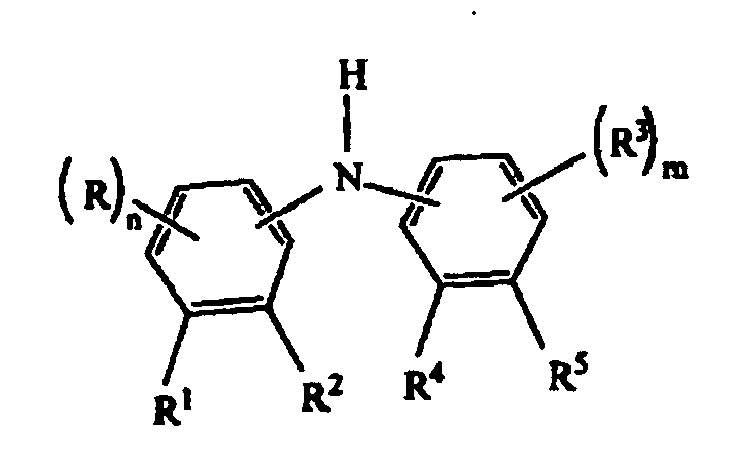
- In accordance with another embodiment of the present invention, a method for masking, retarding and/or substantially eliminating for an extended period of time, dulling and/or discoloring of a visually observable outer surface of a tire is provided, the method comprising providing a tire having a visually observable outer surface, the tire comprising a rubber composition as above defined
- Suitable rubber components for use in the rubber compositions of the present invention are based on highly unsaturated rubbers such as, for example, natural and/or synthetic rubbers and mixtures thereof. Representative of highly unsaturated rubbers that can be employed in the practice of this invention are diene rubbers. Such rubbers will ordinarily possess an iodine number of between about 20 to about 450, although highly unsaturated rubbers having a higher or a lower iodine number, e.g., about 50 to about 100, can also be employed. Illustrative of the diene rubbers that can be utilized are polymers based on conjugated dienes such as, for example, 1,3-butadiene; 2-methyl-1,3-butadiene; 1,3-pentadiene; 2,3-dimethyl-1,3-butadiene; and the like, as well as copolymers of such conjugated dienes with monomers such as, for example, styrene, alpha-methylstyrene, acetylene, e.g., vinyl acetylene, acrylonitrile, methacrylonitrile, methyl acrylate, ethyl acrylate, methyl methacrylate, ethyl methacrylate, vinyl acetate, and the like. Preferred highly unsaturated rubbers include natural rubber, polyisoprenes such as cis-polyisoprene, 1,2-polyisoprene and 3,4-polyisoprene, polybutadiene, poly(styrenebutadiene), styrene-isoprene copolymers, isoprene-butadiene copolymers, styrene-isoprene-butadiene terpolymers, polychloroprene, chloro-isobutene-isoprene, nitrile-chloroprene, styrene-chloroprene, and poly (acrylonitrile-butadiene). Moreover, one or more highly unsaturated rubbers combined with elastomers having lesser unsaturation such as terpolymers of ethylene, propylene and a diene (EPDM), copolymers of ethylene and propylene rubbers (EPR), butyl rubbers or halogenated rubbers, e.g., bromo butyl rubbers, rubbers based on benzyl bromo styrene and brominated polymers available from the Exxon Chemical Company under the EXXPRO tradename, are also within the contemplation of the present invention.
- Fillers for use in the rubber compositions of the present invention include, but are not limited to, carbon blacks, metal oxides, such as silica (e.g., pyrogenic and precipitated), titanium dioxide, aluminosilicate and alumina, siliceous materials including clays and talc, and the like-and mixtures thereof The term "alumina" can be described herein as aluminum oxide, or Al2O3. The fillers may be hydrated or in anhydrous form. Useful carbon black fillers include any of the commonly available, commercially-produced carbon blacks known to one skilled in-the art. Generally; those having a surface area (EMSA) of at least about 5 m2/g, preferably at least about 35 m2/g and most preferably at least about 200 m2/g are preferred. Surface area values used in this application are those determined by ASTM test D-3765 using the cetyltrimethyl-ammonium bromide (CTAB) technique. Among the useful carbon blacks are furnace black, channel blacks and lamp blacks. More specifically, examples of the carbon blacks include super abrasion furnace (SAF) blacks, high abrasion furnace (HAF) blacks, fast extrusion furnace (FEF) backs, fine furnace (FF) blacks, intermediate super abrasion furnace (ISAF) blacks, semi-reinforcing furnace (SRF) blacks, medium processing channel blacks, hard processing channel blacks and conducting channel blacks. Other carbon blacks which may be utilized include acetylene blacks and thermal blacks. Mixtures of two or more of the above blacks can be used in preparing the rubber compositions of the invention. Typical values for surface areas of usable carbon blacks are summarized in the following Table 1.
TABLE I Carbon Blacks: ASTM Designation (D-1765-82a) Surface Area (m2/g) D-3765 N-110 126 N-234 120 N-220 111 N-339 95 N-330 83 N-550 42 N-660 35 - The carbon blacks utilized in the invention may be in pelletized form or an unpelletized=flocculant`rriass: Preferably, for ease-of handling, pelletized carbon black is preferred. The carbon blacks are ordinarily incorporated into the rubber composition in an amount ranging from about 10 to about 100 phr, preferably from about 30 to about 90 phr and most preferably from about 45 to about 85 phr. The term "phr" is used herein in its art-recognized sense, i.e., as referring to parts of a respective material per one hundred (100) parts by weight of rubber.
- The silica filter may be of any type that is known to be useful in connection with the reinforcing of rubber compositions. Representative of suitable silica fillers include, but are not limited to, silica, precipitated silica, amorphous silica, vitreous silica, fumed silica, fused, silica, synthetic silicates such as aluminum silicates, alkaline earth metal silicates such as magnesium silicate and calcium silicate, natural silicates such as kaolin and other naturally occurring silica and the like. Also useful are highly dispersed silicas having, e.g., BET surfaces of from about 5 to about 1000 m2/g and preferably from about 20 to about 400 m2/g and primary particle diameters of from about 5 to about 500 nm and preferably from about 10 to about 400 nm. These highly dispersed silicas can be prepared by, for example, precipitation of solutions of silicates or by flame hydrolysis of silicon halides. The silicas can also be present in the form of mixed oxides with other metal oxides such, as, for example, Al, Mg, Ca, Ba, Zn, Zr, Ti. oxides and the like. Commercially available silica fillers known to one skilled in the art include, e.g., those available from such sources as Cabot Corporation under the Cab-O-Sil® tradename; PPG industries under the Hi-Sil and Ceptane tradenames; Rhodia under the Zeosil tradename and Degussa, AC under the. Ultrasil® and Coupsil® tradenames.
- When employing a silica filler in the rubber composition of the present invention, it is advantageous to also employ a coupling agent. Such coupling agents, for example, may be premixed, or pre-reacted, with the silica pacticles or added to the rubber mix during the rubber/silica processing, or mixing, stage. If the coupling agent and silica are added separately to the rubber mix during the rubber/silica mixing, or processing stage, it is considered that the coupling agent then combines in situ with the silica.
- Coupling-agents are generally composed of a sitane which has a constituent component, or moiety, (the silane portion) capable of reacting with the silica surface and, also, a constituent component, or moiety, capable of reacting with the rubber, e.g., a sulfur vulcanizable rubber which contains carbon-to-carbon double bonds, or unsaturation. In this manner, then, the coupling agent acts as a connecting bridge between the silica and the rubber thereby enhancing the rubber reinforcement aspect of the silica.
- The silane component of the coupling agent apparently forms a bond to the silica surface, possibly through hydrolysis, and the rubber reactive component of the coupling agent combines with the rubber itself. Generally, the rubber reactive component of the coupling agent is temperature sensitive and tends to combine with the rubber during the final and higher- temperature sulfur vulcanization stage, i.e., subsequent to the rubber/silcica/coupling mixing stage and after the silane group of the coupling agent has combined with the silica. However, partly because of typical temperature sensitivity of the coupling agent, some degree of combination, or bonding, may occur between the rubber- reactive component of the coupling agent and the rubber during an initial rubber/silica/coupling agent mixing stage and prior to a subsequent vulcanization stage.
- Suitable rubber-reactive group components of the coupling agent include, but are not limited to, one or more of groups such as mercapto, amino, vinyl, epoxy, and sulfur groups. Preferably, the rubber-reactive group component of the coupling agent is as sulfur or mercapto moiety with a sulfur group being most preferable.
- Examples of a coupling agent for use herein are vinyltrichlorosilane, vinylrimethoxysilane, vinyltriethoxysilane, vinyltris(β-methoxyethoxy) silane, β-(3,4-epoxycyctohexyl)ethyltrimethoxysilarie, γ-glycidoxypropyltrimethoxysilarie,γ-glycidoxypropylmethyldiethoxysilane, γ-glycidoxypropyltriethoxysilane, γ-methacryloxypropyhnethyldimethoxysilane, γ-glycidoxypropyltrriemethoxysilane, γ-methacryloxypropylmethyldiethoxysilane, γ-methacryloxypropyltriethoxysilane,γ-β(aminoethyl)-γ-aminopropylmethyldimethoxysilane, N-β-(aminoethyl) y-aminopropyltrimethoxysilane,N-β(aminoethyl)γ-aminopropyltriethoxysilane, γ-aminopropyltrimethoxysilane, γ-aminopropyltriethoxysilane, γ-phenyl-γ-aminopropyltrimethoxysilane, γ-chloropropyltrimethoxysilane, γ-mercaptopropyltrilmethoxysilane and combinations thereof Examples of sulfur-containing organosilicon compounds which may be used herein include, but are not limited to, 3,3'-bis(trimethoxysilylpropyl) disulfide 3,3'-bis(triethoxysilylpropyl) disulfide, 3,3-bis(triethoxysilylpropyl) tetrasulfide, 3,3'-bis(triethoxysilylpropyl) octasulfide, 3,3'-bis(trimethoxysilylpropyl) tetrasulfide, 2,2'- bis (triethoxysilylethyl) tetrasulfide, 3,3'-bis(trimethoxysilylpropyl) triasulfide, 3,3'-bis(triethoxysilytpropyl) triasulfde, 3,3'-bis(tributoxysilylpropyl) disulfide, 3,3'-bis(trimethoxysilylpropyl) hexasulfide, 3,3'-bis(trimethoxysilylpropyl) octasulfide, 3,3'-bis(trioctoxysilylpropyl) tetrasulfide, 3,3'-bis(trihexoxysilylpropyl) disulfide, 3,3'-bis(tri-2"-ethylhexoxysilylpropyl) trisulfide, 3,3'-bis(triisooctoxysilyipropyl) tetrasulfide, 3,3'-bis(tri-t-butoxysilyl-propyl) disulfide, 2,2'-bis(methoxydiethoxysilylethyl) tetrasulfide, 2,2'-bis(tripropoxyxilylethyl) pentasulfide, 3;3'=bis(tricyclohexoxysilylpropyl) tetrasulfide, 3,3'-bis(tricyclopentoxysilylpropyl) trisulfide, 2,2'-bis(tri-2"-methyl-cyclohexoxysilylethyl) tetrasulfide, bis(trimethoxysilylmethyl) tetrasulfide, 3-methoxy ethoxy propoxysilyl 3'-diethoxybutoxy-silylpropyltetrasulfide, 2,2'-bis(dimethyl methoxysilylethyl) disulfide, 2,2'-bis(dimethyl sec.butoxysilylethyl) trisulfide, 3,3'-bis(methylbutylethoxysilylpropyl) tetrasulfide, 3,3'-bis(di t-butylmethoxysilylpropyl) tetrasulfide, 2,2'-bis(phenylmethylmethoxysilylethyl) trisulfide, 3,3'-bis(diphenylisopropokysilyipropyl)tetrasulfide, 3,3-bis(diphenyl cyclohexoxysilylpropyl) disulfide,-3,3'-bis(dimethylethylmercaptosilylpropyl)-tetrasulfide, 2,2'-bis(methyldimethoxysilylethyl) trisulfide, 2,2'-bis(methyl ethoxypropoxysilylethyl) tetrasulfide, 3,3'-bis(diethylmethoxysilylpropyl) tetrasulfide 3;3'-bis(ethyl di-sec butoxysilylpropyl) disulfide,3,3'-bis(propyldiethoxysilylpropyl) disulfide, 3,3'-bis(butyl dimethoxysilylropyl) trisolfide,3,3'-bis(phenyl dimethoxysilylpropyl)tetrasulfide, 3-phenylethoxy-butoxysilyl 3'-trimethoxysilyipropyl tetrasulfide, 4,4'-bis(trimethoxysilylbutyl) tetrasulfide, 6,6'-bis(triethoxysitythexyl) tetrasulfide, 12,12'-bis(triisopropoxy-silyldodecyl) disulfide, 1,8,18'-bis(trimethoxysilyloctadecyl) tetrasulfide, 18,18'-bis(tripropoxysilyloctadecenyl) tetrasulfide, 4,4'-bis(trimethoxy-silylbutene-2-yl) tetrasulfide,4,4'-bis(trimethoxysilylcyclohexylene)tetrasulfide, 5,5'-bis(dimethoxymethylsilylpentyl) trisulfide, 3,3'-bis(trimethoxy-silyl-2-methylpropyl) tetrasulfide, 3,3'-bis(dimethoxyphenylsilyl-2-methylpropyl) disulfide and the like and mixtures thereof.
- In one embodiment the rubber compositions of the present invention contain from 0,5 PHR to 8 PHR of the diaryl amine-containing compound represented by the general formula:

- Representative examples of alkyl groups for use herein include, by way of example, a straight or branched hydrocarbon chain radical containing carbon and hydrogen, atoms of from 1 to about 18 carbon atoms with or without unsaturation, to the rest of the molecule, e.g., methyl, ethyl, n-propyl, 1-methylethyl (isopropyl), n-butyl, n-pentyl, etc., and the like.
- Representative examples of halogens for use herein include, by way of example, chlorine, bromine, iodine, and the like.
- Representative examples of hydroxyl-containing groups for use herein include, by way of exemple, -OH, a straight or branched hydrocarbon chain radical containing one or morehydroxyl groups bonded to a carbon atom on the hydrocarbon chain, and the like.
- Representative examples of ester-containing groups for use herein include, by way of example, a carboxylic acid ester having one to 20 carbon atoms and the like.
- Representative examples of ether or polyether containing groups for use herein include, by way of example, an alkyl ether, cycloalkyl ether, cycloalkylalkyl ether, cycloalkenyl ether, aryl ether, arylalkyl ether wherein the alkyl, cycloalkyl, cycloalkylalkyl, cycloalkenyl, aryl, and arylalkyl groups are as defined herein, e.g., alkylene oxides, poly(alkylene oxide)s. such as ethylene oxide, propylene oxide, butylene oxide, poly(ethylene oxide)s; poly(ethylene glycol)s, poly(propylene oxide)s, poly(butylene oxide)s and mixtures or copolymers thereof, an ether or polyether group of the general formula -R20OR21, wherein R20 is a bond, an alkyl, cycloalkyl or aryl ,group as defined herein and R21 is an alkyl, cycloalkyl or aryl group as defined herein and the like.
- Representative examples of amide-containing groups for use herein include, by way of example, an amide of the general formula-R23C(O)NR24R25 wherein R23 can be a C1-C30 hydrocarbon, e.g., R23 can be an alkylene group, arylene group, cycloalkylene group, and R24 and R23 can be R24 and R25 independently hydrogen or a C1-C30 hydrocarbon and the like.
- Representative examples of amine-containing groups for use herein include, by way of example, an amine of the general formula-R26NR27R28 wherein R26 is a C2-C30 alkylene, arylene, or cycloalkylene and R27 and R28 are independently hydrogen or a C1-C30 hydrocarbon such as, for example, alkyl groups, aryl groups, or cycloalkyl groups as defined herein, and the like.
- Representative examples of alkoxy groups for use herein include, by way of example, an alkyl group as defined above attached via oxygen linkage to the rest of the molecule, i.e., of the general formula -OR29, wherein R29 is an alkyl, cycloalkyl, cycloalkylalkyl, cycloalkenyl, aryl or an arylalkyl as defined herein, e.g., -OH3, -OC2H5, or -OC6H5 which may be substituted or unsubstituted, and the like.
- Representative examples of cycloalkyl groups for use herein include, by way of example, a substituted or unsubstituted non aromatic mono or multicyclic ring system of about 3 to about 18 carbon atoms such as, for example, cyclopropyl, cyclobutyl, cyclopentyl, cyclohexyl, perhydronanapthtyl, adamantyl and norbornyl groups bridged cyclic group or spirobicyclic groups, e.g., spiro-(4,4)-non-2-yl and the like, optionally containing one or more heteroatoms, e.g., O,S and/or N, and the like.
- Representative examples of cycloalkylalkyl groups for use herein include, by way of example, a substituted or unsubstituted cyclic ring-containing radical containing from about 3 to about 18 carbon atoms directly attached to the alkyl group which are then attached to the main structure of the monomer at any carbon from the alkyl group that results in the creation of a stable structure such as, for example, cyclopropylmethyl, cyclobutylethyl, cyclopentylethyl and the like, wherein the cyclic ring can optionally contain one or more heteroatoms, e.g., O, S and/or N, and the like.
- Representative examples of cycloalkenyl groups for use herein include, by way of example, a substituted or unsubstituted cyclic ring-containing radical containing from about 3 to about 18 carbon atoms with at feast one carbon-carbon double bond such as, for example, cyclopropenyl, cyclobutenyl, cyclopentenyl and the like, wherein the cyclic ring can optionally contain one or more heteroatoms, e.g., O, S and/or N, and the like.
- Representative examples of aryl groups for use herein include, by way of example, a substituted or unsubstituted monoaromatic or polyaromatic radical containing from about 5 to about 25 carbon atoms such as, for example, phenyl, naphthyl, tetrahydronapthyl, indenyl, biphenyl and the like, optionally containing one or more heteroatoms, e.g., O, S and/or N, and the like.
- Representative examples of arylalkyl groups for use herein include, by way of example a substituted or unsubstituted as groups defined above directly bonded to an alkyl group as defined herein, e.g., -CH2C6H5; -C2H6C6H5 and the like, wherein the aryl group can optionally contain one or more heteroatoms, e.g., O, S and/or N, and the like.
- Representative examples of heterocyclic ring groups for use herein include, by way of example, a substituted or unsubstituted stable 3 to about 15 membered ring radical, containing carbon atoms and from one to five heteroatoms, e.g., nitrogen, phosphorus, oxygen, sulfur and mixtures thereof. Suitable heterocyclic ring radicals 9 for use herein may be a monocyclic, bicyclic or tricyclic ring system, which may include fused, bridged or spiro ring systems, and the nitrogen, phosphorus, carbon, oxygen or sulfur atoms in the heterocyclic ring radical may be optionally oxidized to various oxidation states. In addition, the nitrogen atom may be optionally quaternized; and the ring radical may be partially or fully saturated (i.e., heteroaromatic or heteroaryl aromatic). Examples of such heterocyclic ring radicals include; but are not limited to, azetidinyl, acridinyl, benzodioxolyl, benzodioxanyl, benzofurnyl, carbazolyl, cinnolinyl,dioxolanyl, indolizinyl, naphthyridinyl, perhydroazepinyl, phenazinyl, phenothiazinyl, phenoxazinyl, phthalazinyl, pyridyl, pteridinyl, purinyl, quinazolinyl, quinoxalinyl, quinolinyl, isoquinolinyl, tetrazoyl, imidazolyl, tetrahydroquinolinyl, tetrahydroisoquinolinyl, piperidinyl, piperazinyl, 2-oxopiperazinyl, 2-oxopiperidinyl, 2-oxopyrrolidinyl, 2-oxoazepinyl, azepinyl, pyrrolyl, 4-piperidonyl, pyrrolidinyl, pyrazinyl, pyrimidinyl, pyridazinyl, oxazolyl, oxazolinyl, oxazolidinyl, triazolyl, indanyl, isoxazolyl, isooxazolidinyl; morpholinyl, thiazolyl, thiazolinyl, thiazolidinyl isothiazolyl, quinuclidinyl, isothiazolidinyl, indolyl, isoindolyl, indolinyl, isoindolinyl, octahydroindolyl, octahydroisoindolyl, quinolyl, isoquinolyl, decahydroisoquinolyl, benzimidazolyl, thiadiazolyl, benzopyranyl, benzothiazolyl, benzooxazolyl, furyl, tetrahydrofurtyl, tetrahydropyranyl, thienyl, benzothienyl, thiamorpholinyl, thiamorpholinyl sulfoxide, thiamorpholinyl-sulfone, dioxaphospholanyl, oxadiazolyl, chromanyl, isochromanyl and the like and mixtures thereof.
- Representative examples of heteroaryl groups for use herein include, by way of example, a substituted or unsubstituted heterocyclic ring radical as defined herein. The heteroaryl ring radical may be attached to the main structure at any heteroatom or carbon atom that results in the creation of a stable structure.
- Representative examples of heteroarylalkyl groups for use herein include, by way of example, a substituted or unsubstituted heteroaryl ring radical as defined above directly bonded to an alkyl group as defined herein. The heteroarylalkyl radical may be attached to the main structure at any carbon atom from the alkyl group that results in the creation of a stable structure.
- Representative examples of heterocyclo groups for use herein include, by way of example, a substituted or unsubstituted heterocylic ring radical as defined herein. The heterocyclo ring radical may be attached to the main structure at any heteroatom or carbon atom from the heterocyclo ring that results in the creation of a stable structure.
- Representative examples of heterocycloalkyl groups for use herein include, by way of example, a substituted or unsubstituted heterocylic ring radical as defined herein directly bonded to an alkyl group as defined herein. The heterocycloalkyl radical may be attached to the main structure at carbon atom in the alkyl group that results in the creation of a stable structure.
- The substituents in the 'substituted alkyl', 'substituted alkoxy', 'substituted cycloalkyl', 'substituted cycloalkylalkyl', 'substituted cycloalkenyl', 'substituted arylalkyl', 'substituted aryl', 'substituted heterocyclic ring', 'substituted heteroaryl ring,' 'substituted heteroarylalkyl', 'substituted heterocycloalkyl ring', 'substituted cyclic ring' and 'substituted carboxylic acid derivative' may be the same or different and include on or more substituents such as hydrogen, hydroxy, halogen, carboxyl, cyano, nitro, oxo (=O), thio(=S), substituted or unsubstituted alkyl, substituted or unsubstituted alkoxy, substituted or unsubstituted alkenyl, substituted or unsubstituted alkynyl, substituted or unsubstituted aryl, substituted or unsubstituted arylalkyl, substituted or unsubstituted cycloalkyl, substituted or unsubstituted cycloalkenyl, substituted or unsubstituted amino, substituted or unsubstituted aryl, substituted or unsubstituted heteroaryl, substituted heterocycloalkyl ring, substituted or unsubstituted heteroarylalkyl, substituted or unsubstituted heterocyclic ring, -COORx, -C(O)Rx, -C(S)Rx, -C(O)NRxRy, -C(O)ONRxRy, -NRxCONRyRz, N(Rx)SORy, -N(Rx)SO2Ry; -(=N-N(Rx)Ry), - NRxC(O)ORy, -NRxRy, -NRxC(O)Ry-,-NRxC(S)Ry-NRxC(S)NRyRz,-SONRxRy-, -SO2NRxRy-,-ORx, -ORxC(O)NRyRz, - ORxC(O)ORy-, -OC(O)Px,-OC(O)NRxNRy, RxNRyC(O)Rz, -RxORy, -RxC(O)ORy, - RxC(O)NRyRz, -RxC(O)Rx, -RxOC(O)Ry, -SRx, -SORx; -SO2Rx,-ONO2, wherein Rx, Ry and Rz in each of the above groups can be the same or different and can be a hydrogen atom, substituted or unsubstituted alkyl, substituted or unsubstituted alkoxy, substituted, or unsubstituted alkenyl, substituted or unsubstituted alkynyl, substituted or unsubstituted aryl, substituted or unsubstituted arylalkyl, substituted or unsubstituted cycloalkyl, substituted or unsubstituted cycloalkenyl, substituted or unsubstituted amino, substituted or unsubstituted aryl, substituted or unsubstituted heteroaryl, 'substituted heterocycloalkyl ring' substituted or unsubstituted heteroarylalkyl, or a substituted or unsubstituted heterocyclic ring.
- Representative examples of ring structures for R1 and R2 and R4 and R5 include independently, cycloalkyl, cycloalkenyl, heterocycloalkyl or heterocycloalkenyl as defined above, the ring structures being optionally substituted with one or more substituents. In one embodiment, each of R1 and R2 and R4 and R5 together with the carbon atom to which they are bonded are joined to form a cyclohexyl ring structure (to form a tetralin ring structure with the phenyl ring to which it is attached).
- In another embodiment of the present invention, the diaryl amine-containing compound is represented by the general formula:

- Another embodiment is directed to an isomeric mixture of the diaryl amine-containing compounds for use in the rubber compositions of the present invention. In one embodiment, the isomeric mixture contains at least a 1,1-isomer, 1,2-isomer and a 2,2-isomer of a diaryl amine-containing compound according to the present invention. In another embodiment, the isomeric mixture contains at least a 1,1-isomer, 1,2-isomer and a 2,2-isomer of a diaryl amine-containing compound according to the present invention. Generally, the isomeric mixtures can contain varying amounts, of two or more of isomer of the diaryl amine-containing compound according to the present invention. For example, in one embodiment, the isomeric mixture can contain at least varying amounts of at least the 1,1-isomer and the 1,2-isomer. In another embodiment, the isomeric mixture can contain varying amounts of at least the 1,1-isomer and the 2,2-isomer. In another embodiment, the isomeric mixture can contain varying amounts of at least the 1,2-isomer and the 1,2-isomer. In another embodiment, the isomeric mixture can contain varying amounts of at least the 1,1-isomer, 1,2-isomere and the 2,2-isomer.
- The foregoing diaryl amine-containing compounds or an isomer or isomeric mixture thereof can be obtained by reacting an amino-compound of general formula II:


- Alternatively, the foregoing diaryl amine-containing compounds or an isomer or isomeric mixture thereof can be obtained by reacting a phenyl halide of general formula IV:


- In one embodiment, the diaryl amine-containing compounds or an isomer or isomeric mixture thereof according to the present invention can be obtained by reacting (1) the amino compound of the formula II and the phenyl halide of formula III, or (2) the phenyl halide of formula IV and the amino compound of formula V in the presence of a suitable catalyst. Useful catalysts include, but are not limited to, palladium-containing catalysts, copper-containing catalysts and the like and mixtures thereof. Suitable palladium-containing catalysts include, but are not limited to, tetrakis(triphenylphosphine)palladium, (dibenzylideneacetone)palladium, (dibenzylideneacetate)palladium, (tris(dibenzylideneacetale)dipalladium, bis(tricyclohexylphosphine)palladium, (2-(diphenylphosphino)ethyl)palladium, palladium(0) bis-(tri-t-butylphoshine), (1,1'-bis(diphenylphosphino)ferrocene)palladium, bis(triphenylphosphine)dichloropalladium, bis(1,1'-bis(diphenylphosphino) ferrocene)palladium, bis(2-(diphenylphosphino)ethyl)dichloropalladium, PdCl2 (CH3CN)2 and the like. Suitable copper-containing catalysts include, but are not limited to, Cu(PPh3)3Br, CuPPh3 (phenantholine) Br, CuPPh3 (1,10-dimethyl phenantholine) Br and the like. The catalyst is present in an amount sufficient to promote the reaction. For example, in one embodiment, the copper-containing catalyst is present in the reaction in an amount ordinarily ranging from about 15 to about 25 wt. %, based on the total weight of the reactants (with no solvent). In another embodiment, the palladium-containing catalyst is present in the reaction in an amount ordinarily ranging from about to about 3 wt. %, based on the total weight of the reactants (with no solvent).
- The reaction is advantageously conducted under an inert gas atmosphere such as argon. The temperature for this reaction will ordinarily range from about 80°C to about 150°C and more preferably from about 100°C to about 110°C. Generally, the molar ratio of the amino compound of the formula II to the phenyl halide of formula III can range from about 0.9:1 to about 1:0.9 and preferably from about 0.95:1 to about :0.95.
- When forming a preferred ditetralin amine compound or an isomer or isomeric mixture thereof, a catalyst, e.g., Cu(PPh3)3 Br, with a base, tetralin amine (e.g., of formula II) and a solvent, e.g., diethyl ethylene glycol, are charged into an argon flushed reaction vessel. The reaction material can be heated with stirring to a suitable temperature, e.g., about 110°C, for a suitabte time, e.g., about 15 minutes, while maintained under an argon atmosphere. The reaction temperature can be lowered, e.g., to about 60°C, and a tetralin halide (e.g., of formula III) is then charged. The temperature is then raised, e.g., to about 110°C, and held for a suitable time, e.g., about 72 hours. The reaction is then cooled to, for example, about 60°C, and diluted with hexanes to precipitate out the salts which are removed by conventional techniques, e.g., filtration. If desired, the tittered solution can then be concentrated and placed on a preparative Silica-Gel column using, for example, hexanes, as the column solvent to isolate the ditetralin amine product.
- In another embodiment, a diaryl amine-containing compound or an isomer or isomeric mixture thereof can be obtained by treating an amino compound of the formula II with a Lewis acid. Suitable Lewis acid catalysts include, but are not limited to iron halide (FeXn), titanium halide (TiXn), titanium alkoxide (Ti(OR)4), titanium oxide (TiO2), aluminum halide (AlX3), aluminum alkoxide (Al(OR)3), tin halide (SnXn), boron trihalide (BX3), magnesium halide (MgX2) and zinc halide (ZnX2). Alternatively, aluminum oxide may be used as a catalyst. The catalyst is present in the reaction in an amount ordinarily ranging from about 0.1 to about 50% by weight and preferably from about 2 to 20% by weight, based on the weight of the reactants.
- The catalyst can be used in the form of a fixed bed in the reactor or, for example, in the form of a fluidized bed and can have an appropriate shape. Suitable shapes include, for example, granules, pellets, monoliths, spheres or extrudates.
- In this process, it may not be necessary to use a reaction solvent. The reaction is carried out at a temperature ranging from about 300°C to about 550°C and preferably from about 350°C to About 400°C.
- Diphenyl amine can be made in a process involving the nitration of benzene to nitrobenzene followed by reduction to aniline. This aniline intermediate is then sent through a fixed bed reactor, at elevated temperatures, containing a solid acidic catalyst which converts the aniline to diphenyl amine and ammonia. It is envisioned that ditetralin amine may be made in a similarprocess by substituting tetralin for benzene.
- Generally, the diaryl amine-containing compound or an isomer or isomeric mixture thereof will be present in the rubber compositions of the present invention in an amount ranging from about 0.5 phr to about 8.0 phr, preferably about 0.5 phr to about 6.0 phr, and most preferably from about 0.75 phr to about 2.0 phr.
- While not wishing to be bound by any particular theory, it is believed that when one or more of the diaryl amine-containing compounds is used in combination with one or more antidegradant, a synergistic effect may be obtained in further improving properties such as increased resistance to oxidation, ozone, flex-fatigue, crank-growth failures and the like. Representative examples of such antidegradants include, but are not limited to, phenols and hindered phenols such as styrenated phenol, 2,2-'-methylene-bis(4-methyl-6-tert-butylphenol), 4;4'-thiobis(6-tert-butyl-m-cresol)and the like and mixtures thereof; alkylated diphenylamines such as dioctyldiphenylamine, 4,4'-di(1-methyl-1 - phenylpropyl)diphenylamine, dinonyldiphenylamines and the like and mixtures thereof; quinolines such as polymerized 1,2-dihydro-2,2,4-trimethylquinoline,6-ethoxy-1,2-dihydro-2,2,4,trimethylquinoline and the like and mixtures thereof; alkylated hydroquinones such as 2,5-di(tert-amyl)hydroquinone and the like and mixtures thereof; N,N'-bis(alkyl)-para-phenylenediamines such as N,N'-bis(1,4-dimethylpentyl)-paraphenylenediamine and the like and mixtures thereof; N,N'-bis(aryl)-paraphenylenediamines such as N,N'-bis(phenyl)-para-phenylenediamine and the like and mixtures thereof; N-(alkyl)-N'-(aryl)-para-phenylenediamines such as N-(1,3-dimethylbutyl)-N'-phenyl-para-phenylenediamine and the like and mixtures thereof; quinonediimines such as N-(1,3-dimethylbutyl)-N'-phenyl-quinonediimine and the like and mixtures thereof; thioesters such as dilauryl thiodipropionate, pentaerythritoltetrakis(3-(dodecylthio)propionate) and the like and mixtures thereof; phosphites such as tris(nonylphenyl) phosphite and the like and mixtures thereof; imidazoles such as 2-mercaptotoluimidazole and its salts such as zinc and the like and mixtures thereof; naphthylamines and alkylated naphthylamines such as N-phenyl-alphanaphthylamine and the like and mixtures thereof; triazines such as 2,4,6-tris(N-(1,4-dimethylpentyl)-para-phenylenediamino)-1,3,5-triazine and the like and mixtures thereof. Generally, the amount of antidegradant will range from about 1 to about 5 phr.
- The rubber compositions of this invention are formulated in any conventional manner known in the rubber compounding art with various commonly used additive materials, as necessary. For example, the diaryl amine-containing compounds can be combined with one or more commonly used additives such as curing aids; activators; antireversion agents; retarders; accelerators; sulfur donors, prevulcanization retarders, processing additives, e.g., oils; tackifying resins; plasticizers; pigments; fatty acids; zinc oxide; waxes; antioxidants; antiozonants; peptizing agents; reinforcing materials and the like and combinations thereof. Depending on the intended use of the rubber composition, the additives mentioned above are selected and commonly used in conventional amounts.
- Generally, accelerators are used to control the time and/or temperature required for vulcanization and to improve the properties of the vulcanizate. In one embodiment, a single accelerator system is used, i.e., a primary accelerator. In one embodiment, a primary accelerator(s) is used in an amount ranging from about 0.5 to about 4 phr. In another embodiment, a primary accelerator(s) is used in an amount ranging from about 0.8 to about 1.5 phr. Combinations of a primary and a secondary accelerator can also be used with the secondary accelerator being employed in smaller amounts (e.g., about 0.05 to about 3 phr) in order to activate and to improve the properties of the vulcanizate. Delayed action accelerators may also be used. Vulcanization retarders may also be used. Suitable types of accelerators are, for example, benzothiazole sulfenamides, 2-mercaptobetizothiazole, disulfides derived from 2-mercaptobenzothiazole, tetraalkyl thiuram mono, di, and polysulfides, dithiocarbamates, and guanidines. In one embodiment, the primary accelerator is a sulfenamide. If a second accelerator is used, the secondary accelerator, may be a guanidine, dithiocarbamate, or thiuram compound.
- Suitable sulfur donors include, but are not limited to, 4,4' dithiomorpholine and the like Suitable antireversion agents include, but are not limited to, 1,3 - bis(citraconimidomethyl)benzene, metaphenylene bis(maleimide), hexamethylene-1,6-bisthiosulfate disodium salt dihydrate and the like and mixtures thereof.
- Generally, the tackifier resin is present in an amount ranging from about 0.5 to about 10 phr. In a second embodiment, the amount of tackifier resin will range from about 1 to about 5 phr.
- Suitable processing aids include, but are not limited to, aromatic, naphthenic, and/or paraffinic processing oils. The amount of processing aids will range from about 1 to about 50 phr.
- Suitable prevulcanization inhibitors include, but are not limited to, N-(cyclohexylthio)phthalimide and the like.
- The amount of fatty acid, e.g., stearic acid, will range from about 0.5 to about 3 phr. The amount of zinc oxide will range from about 2 to about 5 phr. The amount of wax will range from about 1 to about 5 phr. Suitable peptizers include, but are not limited to, pentachlorothiophenol and dibenzamidodiphenyl disulfide. The amount of peptizer will range from about 0.1 to about 1 phr.
- If desired, the vulcanization can be conducted in the presence of a sulfur-vulcanizing agent. Examples of suitable sulfur-vulcanizing agents include elemental sulfur (free sulfur) or sulfur donating vulcanizing agents, for example, an amine disulfide, polymeric polysulfide or sulfur olefin adducts, with elemental sulfur being preferred. The sulfur-vulcanizing agents will be present in an amount ranging from about 0.5 to about 4 phr, or even, in some circumstances, up to about 8 phr. However, the typical range is from about 1.5 to about 3.5 phr, and preferably from about 2 to about 2:5 phr.
- The rubber compositions of this invention are particularly useful when used in a tire as a component having a visually exposed surface of any or all portions of the tire. Such tire components having visually exposed surfaces are, for example, tire sidewalls, tire chafers, and tire treads, or individual portions thereof intended for, but not exclusive to, a truck tire, passenger tire, off-road vehicle tire, vehicle tire, high speed tire, bicycle tire and motorcycle tire that can contain many different reinforcing layers therein. Such rubber or tire compositions in accordance with the present invention may be used for the manufacture of tires or for the re-capping of worn tires. The rubber compositions of this invention are also useful when used as a carcass component in a tire, e.g., a truck tire.
- The following non-limiting examples are illustrative of the present invention.
- Preparation of Ditetralin Amine Using Copper Coupling Catalyst
- Into a warm dry 50 ml four neck reaction flask equipped with a mechanical stirrer, thermal couple, heating mantle, Argon blanket and septum injection port was charged Cu(PPh3)3 Br (5.0 g) catalyst and potassium butoxide (4.5 g). The vessel was now well flushed with argon gas and maintained under a dry argon blanket. Into the reaction vessel was injected a degassed 30 ml diethyl ethylene glycol solution containing tetralin amine (5.0 g).
- The reaction mixture was heated, under argon with stirring, to 110°C and held.for 15 minutes before being cooled back down to 30°C. A second solution of bromotetralin (8.0 g) in 5 ml of diethyl ethylene glycol was now injected into the reaction vessel. The temperature was now raised to 105°C and held for 72 hours with stirring under an argon blanket. The bromo and amino tetralins may be the pure 1 or 2-tetralin isomer or isomer mixtures of the two. In this example, a mixture of I and 2-bromotetralin was used.
- The reaction was then cooled to room temperature and diluted in 200 ml of hexanes to precipitate out any insoluble salts. This material was then filtered to remove any unwanted salts and the solution was concentrated down to 50 ml on a roto-evaporator. The hexane concentrate was passed through a silica gel column using hexane as the column solvent to isolate the tetralin product. The process of running a silica gel column may be repeated several times to isolate a pure product. The product was isolated as 3 to 4 grams of a yellow viscous liquid which may solidify on standing and melts above 40°C.
- Preparation of Ditetralin Amine Using Palladium Coupling Catalyst
- Into a 50 ml reaction vessel equipped with a mechanical stirrer, thermocouple, heating mantle and an argon blanket was charged powdered sodium t-butoxide (8.7 g, 0.087 mol). To this reaction vessel was now charged a dry argon degassed solution of bromotetralin (9.6 g, 0.045 mol), aminotetralin (7.4 g, 0.050 mol), tris(dibenzylideneacetone)dipalladium (0.18 g, 0.00020 mol) and RAC-2,2'-bis-(diphenylphosphino)-1,1'-bi-naphthyl (0.24 g, 0.00040 mol) in 25 ml of xylene. The reaction mixture was stirred vigorously under an argon atmosphere raising the temperature to 115°C and holding these conditions for 20 hours. The reaction media was then cooled to room temperature and diluted with 100 ml of hexane and allowed to stand for one hour before being filtered. The filtered solution was then washed with 1x50ml of 5% aqu. sodium hydroxide, 1x5 ml of 5% aqu. sodium bicarbonate and 1x50ml of water, dried over anhydrous magnesium sulfate and filtered. The solution was concentrated to 75 ml and passed through a 50x50 mm chromatography column of silica gel using hexane as the column solvent. The hexane and xylene solvent was then stripped off under vacuum. The final product was a yellow-orange viscous liquid weighing 7.5 g.
- Preparation of Ditetralin Amine Using Thermal Hot Tube Coupling over Solid Lewis Acid Catalyst
- Tetralin amine can be converted to di-tetralin amine using a process similar to the commercial process of converting aniline to diphenyl amine (DPA). This process involves converting tetralin amine to ditetralin amine by passing tetralin amine through a fixed bed reactor, in this example a 3/8's inch (0.009525 meter) glass tube, at 300 to 500°C containing aluminum oxide or zeolite lewis acid pellet catalysts.
- To hold the catalyst in a vertical glass tube, a half inch glass wool plug was inserted in the glass tube a little less than half way up the tube. The catalyst was then poured down the top of the tube to the desired amount. Crushed glass, 25 to 50 mesh, was then poured down the top of the tube to the desired amount. The crushed glass was also added on top of the catalyst to help maintain the tetralin amine in the gas phase before it comes in contact with the catalyst.
- The glass tube containing a one inch loading of catalyst was placed vertically in the middle of the furnace. The top and bottom of the furnace was closed off with the ceramic tile plates by sliding the glass tube through the hole in the ceramic plates. On top of the glass tube was placed the "T" tube with septum to insert a steel syringe needle and nitrogen gas inlet.
- The solid catalysts can be either used in the bead or pellet form or ground down to the 25 to 50 mesh size. The catalyst was first pre-conditioned with only the nitrogen gas connected to the top of the glass tube, the nitrogen flow was set at 55ml/ min through the tube. The furnace was now turned on and heated to 500 to 550°C. The temperature and nitrogen flow rate were maintained for 18 hours. After 18 hours, the temperature was reset to the temperature desired for the experiment to begin.
- In this experiment, the catalyst used will be 25 to 50 mesh aluminum oxide and the furnace temperature will be set at 360°C: The syringe, pre-filled with tetralin amine, was connected to the syringe pump and the steel needle inserted in the top of the "T" tube septum far enough such that the tip of the needle was one inch above the entrance of the furnace. The nitrogen flow rate was now reset to 10 to 15 ml/min. for this experiment. The syringe pump flow rate was also set to 0.34 ml/hr for the tetralin amine injection rate. The syringe pump was now started. After-several hours, a sample of the product exiting the bottom of the glass tube was taken and analyzed by gas chromatography (GC) and found to contain 3 to 4% ditetralin amine. The remainder of the product was mostly starting tetralin-amine.
- Employing the ingredients indicated in Table II (which are listed in parts per hundred of rubber by weight), several rubber compositions were compounded in the following manner.
- The rubber polymer, carbon black filler and oil were mixed in a Banbury 1A internal mixer to make a masterbatch. Portions of this masterbatch were taken and zinc oxide, stearic acid, and the antidegradant test materials were mixed in a Brabender lab mixer. The rubber compounds were sheeted on a warm mill and sulfur and an accelerator mixed in a Brabender lab mixer.
TABLE II Ex./Comp.Ex. 4 4 A B C D E F Ingredients Natsyn 22001, IR 100.0 100.0 100.0 100.0 100.0 100.0 100.0 N-3302, carbon black 50.0 50.0 50.0 50.0 50.0 50.0 50.0 Stearic Acid 2.5 2.5 2.5 2.5 2.5 2.5 2.5 Kadox 9113 4.0 4.0 4.0 4.0 4.0 4.0 4.0 Flexzone 7P4 2.0 Naugard 4455 2.0 Lowinox 22M466 2.0 Ditetralin Amine7 2.0 Octamine8 2.0 Durazone 379 2.0 Delac NS10 1.0 1.0 1.0 1.0 1.0 1.0 1.0 Insoluble Sulfur, 80% 3.0 3.0 3.0 3.0 3.0 3.0 3.0 (1) Natsyn 2200 is a cis polyisoprene rubber available from Goodyear.
(2) N-330 is a carbon black filler available from Cabot Corp.
(3) Kadox 911 is zinc oxide available from Zinc Corporation of America.
(4) Flexzone 7P is a N-(1,3-dimethylbutyl)-N'-phenyl-p-phenylenediamine available from Chemtura Corporation.
(5) Naugard 445 is a 4,4'-di(1-methyl-1-phenylpropyl)diphenylamine available from Chemtura Corporation.
(6) Lowinox 22M46 is a 2,2'-Methylene-bis(4-methyl-6-tert-butylphenol) available from Chemtura Corporation.
(7) Ditetralin amine is the product from Example 2.
(8) Octamine is a dioctyldiphenylamine available from Chemtura Corporation.
(9) Durazone 37 is a 2,4,6-tris(N-(1,4-dimethylpentyl)-p-phenylenediamino)-1,3,5-triazine available from Chemtura Corporation.
(10) Delac NS is a vulcanization accelerator, N-tert-butyl-2-benzothiazolylsulfenamide available from Chemtura Corporation. - The compounded stocks prepared above were then sheeted out and cut for cure. The samples were cured for the times and at the temperature indicated in Table III and their physical properties evaluated. The results are summarized in Table III below. Note that in Table III, cure characteristics were determined using a Monsanto rheometer ODR 2000 (1 ° ARC, 100 cpm) according to ASTM D2084-92; MH is the maximum torque and ML is the minimum torque. Scorch safety (ts2) is the time required for the torque to rise 2 units above minimum torque (ML), cure time (t(50)) is the time required to attain 50% of delta torque above minimum and cure time (t(90)) is the time required to attain 90% of delta torque above minimum. Tensile Strength, Elongation and Modulus were measured following procedures in ASTM D412-92. The results of the Hardness tests were measured following procedures in ASTM D2240-91.
- Heat ageing was carried out in hot air ovens at the temperatures and time conditions shown in the Table III.
- Ozone resistance was tested using the Dynamic Ozone Belt Test (according to ASTM D3395 Method B) by vulcanizing test specimens on a belt. This belt was continuously flexed at 40°C in an ozone chamber in an ozone concentration of 50 parts per hundred million. At the times indicated in Table III, the specimens were examined and rated according to the number and seventy of the cracks formed, with a rating of 10 corresponding to no cracking and a rating of 1 corresponding to very severe cracking. At the end of the test, the specimens were also examined and the relative amount and color of the surface bloom was assessed.
TABLE III Ex./Comp. Ex. 4 A B C D E F Rheometer Properties MDR @ 150°C/30 Minutes Torque, ML (in-lb) 2.99 2.84 3.16 2.99 2.33 2.99 2.95 Torque, MH (in-lb) 34.41 37.62 32.93 35.66 32.92 34.9 34.17 Delta Torque 31.42 34.78 29.77 32.67 30.59 31.91 31.22 ts2 (min) (time to a 2 point rise) 2.34 1.99 1.87 2.24 1.55 2.32 2.37 t(50) (min) (time to 50% cure) 6.89 6.6 5.58 7.04 5.64 7.11 6.08 t(90) (min) (time to 90% cure) 13.63 11.84 14.65 12.83 13.12 13.36 11.83 Slope 2.30 2.95 1.92 2.56 2.19 2.39 2.73 Peak Rate (in-lb/sec) 0.11 0.13 0.13 0.11 0.12 0.11 0.14 Stress-Strain Tests Physical Properties Cure time at 150°C (min) 16 14 18 16 16 16 14 A. Original Hardness, Shore A 65 67 64 64 65 67 64 M(100), psi (modulus at 100% elongation) 507 549 532 537 509 500 506 M(300), psi (modulus at 300% elongation) 2303 2521 2410 2440 2365 2360 2250 Tensile Strength (psi) 4084 4082 3915 4042 4089 4082 3874 Elongation, % at Break 481 456 449 458 473 472 471 B. Heat Aging, 7 days at 70°C Hardness 70 69 69 70 72 70 71 M(100), psi 645 638 654 651 649 647 627 M(300), psi 2725 2764 2849 2831 2885 2850 2646 Tensile Strength (psi) 3922 3125 3680 3923 3999 3902 3676 Elongation, % at Break 427 338 379 409 415 404 410 Hardness, pts. 5 2 5 6 7 3 7 M(100), % 27% 16% 23% 21% 28% 29% 24% M(300), % 18% 10% 18% 16% 22% 21% 18% Tensile Strength, % -4% -23% -6% -3% -2% -4% -5% Elongation, % at Break -11% -26% -16% -11% -12% -14% -13% C. Heat Aging, 14 days at 70°C Hardness 71 67 71 70 72 70 70 M(100), psi 681 637 721 715 683 709 699 M(300), psi 2822 - 3012 2987 2968 2973 2854 Tensile Strength (psi) 3827 2630 3624 3775 3509 3650 3600 Elongation, % at Break 406 294 358 378 354 369 377 Hardness, pts. 6 0 7 6 7 3 6 M(100), % 34% 16% 36% 33% 34% 42% 38% M(300), % 23% -- 25% 22% 25% 26% 27% Tensile Strength, % -6% -36% -7% -7% -14% -11% -7% Elongation, % at Break -16%. -36% -20% -17% -25% -22% -20% D. Heat Aging, 21 days at 70°C Hardness 72 68 73 72 69 70 72 M(100), psi 700 605 747 715 739 726 731 M(306), psi 2886 - 3050 2965 2522 3082 2941 Tensile Strength (psi) 3783 1680 3597 3302 3087 3136 3695 Elongation, % at Break 395 214 353 333 306 307 382 Hardness, pts. 7 1 9 8 4 3 8 M(100), % 38% 10% 40% 33% 45% 45% 44% M(300), % 25% - 27% 22% 7% 31% 31% Tensile Strength, % -7% -59% -8% -18% -25%, -23% -5% Elongation, % at Break -18% -53% -21% -17% -35% -35% -19% DeMattia Flex, Crack growth propagation to 0,5-in failure Kcycles, Unaged 132.7 17.04 19.91 127.5 64.05 127.5 18.12 Flex-Fatigue; 100% strain, Kc to failure Unaged 81.27 37.58 97.71 57.08 74.73 57.53 43.93 14days @ 70°C 67.43 15.50 52.35 54.80 47.07 43.23 19.95 change, % -17% -59% -46% -4% -37% -25% -55% Dynamic Ozone Belt Test; 50+ pphm (parts per hundred million) @ 40°C, 300+ hours exposure 26 hours 10.0 10.0 10.0 10.0 10.0 10.0 9.5 50 10.0 10.0 10.0 10.0 10.0 10.0 9.0 75 10.0 9.0 10.0 10.0 10.0 10.0 8.0 100 10.0 8.0 9.5 10.0 10.0 10.0 6.0 123 10.0 7.0 9.0 9:5 10.0 9.0 4.0 147 10.0 6.5 9.0 9.0 10.0 8.0 3.5 171 10.0 6.0 9.0 8:5 10.0 7.0 3.0 195 9.5 4.0 9.0 8.5 9.5 7.0 3.0 218 9.0 3.0 9.0 8.0 9.0 6.5 2.0 242 9.0 2.5 9.0 7.0 9.0 6.0 2.0 267 85 1.5 8.5 6.5 8.0 4.0 1.5 292 8.5 1.0 8.5 5.0 7.0 3.0 1.0 315 8.5 1.0 8.0 4.0 7.0 2.5 1.0 340 8.0 1.0 8.0 4.0 7.0 2.0 1.0 366 8.0 1.0 8.0 3.0 7.0 2.0 1.0 394 7.5 10.0 8.0 3.0 6.5 2.0 10.0 10=no cracks, 1=very severe crack Surface bloom - color black blue none black Heavy red brown none black none black none black none black grey Gloss Index Rating, dynamic ozone belt samples Unaged 58.6 45.5 54.3 60.7 51.1 54.1 45.6 After 394 hours 13.7 14.7 1.8 12.6 23.3 13.1 22.2 Change, % -77% -68% -97% -79% -54% -76% -51% - As can be seen from the data in Table III, a balance of ozone protection and desirable surface appearance is achieved when employing a diaryl amine-containing compound in the rubber composition of Example 4 as compared to the use of phenylenediamine in the rubber composition of Comparative Example B. For example, the rubber composition of Example 4 had a rating of 7.5 according to the Dynamic Ozone Belt Test, a surface bloom of none while having a color of black and blue after 394 hours whereas the rubber composition of Comparative Example B had a rating of 8 according to the Dynamic Ozone Belt Test, a surface bloom of heavy while having a color of red and brown after 394 hours. A coloration of black and blue is indicative of a shiny surface as compared to a red and brown color which is indicative of discoloring bloom. Thus, the rubber composition of Example 4 achieved a balance of both ozone protection and surface appearance. In addition, the rubber composition of Example 4 when subjected to heat aging (which correlates to degradation for a carcass) possessed a relatively improved tensile strength and elongation at break after 21 days as compared to the rubber compositions of Comparative Examples A through F.
Claims (5)
- A tire comprising a rubber composition comprising(a) a rubber component selected from the group consisting of a natural rubber, homopolymer of a conjugated diolefin, copolymer of a conjugated diolefin and an ethylenically unsaturated monomer and mixtures thereof; and(b) from 0.5 phr to 8.0 phr of a diaryl amine-containing compound represented by the general formula:

- The tire of Claim 1, where in the diaryl amine-containing compound, R1 and R2 together with the carbon atom to which they are bonded are joined together to form a substituted or unsubstituted, saturated or partially saturated 5-, 6- or 7-membered ring.
- The tire of claim 1, where in the diaryl amine-containing compound, R, R3, R4 and R5 are hydrogen.
- The tire of claim 1, where in the diaryl amine-containing compound, R1 and R2 together with the carbon atom to which they are bonded are joined together to form a substituted or unsubstituted, saturated or partially saturated 5-, 6-, or 7-membered ring optionally substituted with one or more heteroatoms and R4 and R5 together with the carbon atom to which they are bonded are joined together to form a substituted or unsubstituted, saturated or partially saturated 5-, 6- or 7-membered ring.
- A method for masking, retarding and/or substantially eliminating for an extended period of time, dulling and/or discoloring of a visually observable outer surface of a tire, the method comprising providing a tire having a visually observable outer-surface, the tire comprising a rubber composition comprising:(a) a rubber component selected from the group consisting of a natural rubber, homopolymer of a conjugated diolefin, copolymer of a conjugated diolefin and an ethylenically unsaturated monomer and mixtures thereof; and(b) from 0.5 phr to 8.0 phr of a diaryl amine-containing compound represented by the general formula:

Applications Claiming Priority (2)
| Application Number | Priority Date | Filing Date | Title |
|---|---|---|---|
| US11/894,006 US7879934B2 (en) | 2007-08-16 | 2007-08-16 | Rubber compositions |
| PCT/US2008/071862 WO2009023447A1 (en) | 2007-08-16 | 2008-08-01 | Rubber compositions |
Publications (2)
| Publication Number | Publication Date |
|---|---|
| EP2185639A1 EP2185639A1 (en) | 2010-05-19 |
| EP2185639B1 true EP2185639B1 (en) | 2011-03-16 |
Family
ID=39761069
Family Applications (1)
| Application Number | Title | Priority Date | Filing Date |
|---|---|---|---|
| EP08827425A Not-in-force EP2185639B1 (en) | 2007-08-16 | 2008-08-01 | Rubber compositions |
Country Status (9)
| Country | Link |
|---|---|
| US (1) | US7879934B2 (en) |
| EP (1) | EP2185639B1 (en) |
| JP (1) | JP2010536952A (en) |
| KR (1) | KR20100063009A (en) |
| CN (1) | CN101809078B (en) |
| AT (1) | ATE502075T1 (en) |
| BR (1) | BRPI0815160A2 (en) |
| DE (1) | DE602008005606D1 (en) |
| WO (1) | WO2009023447A1 (en) |
Families Citing this family (9)
| Publication number | Priority date | Publication date | Assignee | Title |
|---|---|---|---|---|
| EP3020757B1 (en) * | 2013-07-11 | 2018-05-30 | NOK Corporation | Nitrile rubber composition |
| JP6377954B2 (en) | 2014-05-22 | 2018-08-22 | 株式会社ブリヂストン | Rubber composition, tire, bisphenyldiamine compound and anti-aging agent |
| JP6377955B2 (en) | 2014-05-22 | 2018-08-22 | 株式会社ブリヂストン | Rubber composition, tire, bisanilino compound and anti-aging agent |
| JP6265832B2 (en) | 2014-05-22 | 2018-01-24 | 株式会社ブリヂストン | Rubber composition, tire, amine compound and anti-aging agent |
| CN106794322A (en) * | 2014-10-02 | 2017-05-31 | 住友橡胶工业株式会社 | Cap of spraying nozzle |
| US11021581B2 (en) | 2016-02-04 | 2021-06-01 | Eastman Chemical Company | Durable elastomeric compositions employing cyclododecasulfur as a vulcanizing agent |
| US10280281B2 (en) * | 2016-02-04 | 2019-05-07 | Eastman Chemical Company | Processes for forming vulcanizable elastomeric formulations and vulcanized elastomeric articles |
| US11059722B2 (en) | 2016-03-02 | 2021-07-13 | Eastman Chemical Company | Method for the manufacture of cyclododecasulfur |
| CN112175248B (en) * | 2019-06-14 | 2022-04-05 | 圣奥化学科技有限公司 | Rubber composition for tire comprising novel low-pollution anti-aging agent |
Family Cites Families (16)
| Publication number | Priority date | Publication date | Assignee | Title |
|---|---|---|---|---|
| US3397145A (en) | 1958-12-29 | 1968-08-13 | Universal Oil Prod Co | Hydrocarbon oils containing alkylthiophosphoric acid salts of polymeric condensation products |
| GB1044810A (en) | 1963-05-14 | 1966-10-05 | Lubrizol Corp | Organic phosphinodithioate-amine reaction products |
| US3293181A (en) | 1965-10-15 | 1966-12-20 | Chevron Res | Dialkyl dithiophosphates and lubricants containing them |
| US3442804A (en) | 1967-01-19 | 1969-05-06 | Lubrizol Corp | Lubricating composition containing a phosphorodithioate inhibitor |
| US3445804A (en) * | 1967-04-20 | 1969-05-20 | Sperry Rand Corp | Electrical connector |
| US3546324A (en) | 1967-05-11 | 1970-12-08 | Exxon Research Engineering Co | Amine salts of dithiophosphoric acids |
| JPS54132907A (en) * | 1978-04-06 | 1979-10-16 | Bridgestone Corp | Pneumatic tire with improved anti-cut property |
| DE2928248C2 (en) | 1979-07-12 | 1982-03-04 | Bridgestone Tire Co. Ltd., Tokyo | Rubber compounds and their use |
| US4559378A (en) * | 1984-08-30 | 1985-12-17 | The Firestone Tire & Rubber Company | Stabilization of elastomers with aliphatic-phenyl diamines and aliphatic phosphite compounds |
| IL107927A0 (en) | 1992-12-17 | 1994-04-12 | Exxon Chemical Patents Inc | Oil soluble ethylene/1-butene copolymers and lubricating oils containing the same |
| EP0867472B1 (en) | 1997-03-26 | 2003-05-28 | Sumitomo Rubber Industries Ltd. | Rubber composition for a tyre sidewall |
| CA2576348A1 (en) | 2004-06-29 | 2006-02-02 | Michelin Recherche Et Technique S.A. | Rubber composition and tire comprising same |
| CN101283031B (en) * | 2005-10-11 | 2012-10-10 | 科聚亚公司 | Diarylamine |
| US8003583B2 (en) | 2005-12-21 | 2011-08-23 | Chevron Oronite Company Llc | Benzo[b]perhydroheterocyclic arylamines and lubricating oil compositions |
| US7501386B2 (en) | 2005-12-21 | 2009-03-10 | Chevron Oronite Company, Llc | Synergistic lubricating oil composition containing a mixture of a benzo[b]perhydroheterocyclic arylamine and a diarylamine |
| US7285518B2 (en) | 2005-12-21 | 2007-10-23 | Chevron Oronite Company Llc | Dibenzo[b]perhydroheterocyclic amines and lubricating oil compositions |
-
2007
- 2007-08-16 US US11/894,006 patent/US7879934B2/en not_active Expired - Fee Related
-
2008
- 2008-08-01 WO PCT/US2008/071862 patent/WO2009023447A1/en not_active Ceased
- 2008-08-01 JP JP2010521079A patent/JP2010536952A/en active Pending
- 2008-08-01 DE DE602008005606T patent/DE602008005606D1/en active Active
- 2008-08-01 BR BRPI0815160 patent/BRPI0815160A2/en not_active IP Right Cessation
- 2008-08-01 AT AT08827425T patent/ATE502075T1/en not_active IP Right Cessation
- 2008-08-01 EP EP08827425A patent/EP2185639B1/en not_active Not-in-force
- 2008-08-01 CN CN200880103003.0A patent/CN101809078B/en not_active Expired - Fee Related
- 2008-08-01 KR KR1020107003368A patent/KR20100063009A/en not_active Ceased
Also Published As
| Publication number | Publication date |
|---|---|
| CN101809078B (en) | 2013-06-12 |
| DE602008005606D1 (en) | 2011-04-28 |
| WO2009023447A8 (en) | 2010-07-22 |
| WO2009023447A1 (en) | 2009-02-19 |
| US7879934B2 (en) | 2011-02-01 |
| CN101809078A (en) | 2010-08-18 |
| KR20100063009A (en) | 2010-06-10 |
| US20090048376A1 (en) | 2009-02-19 |
| BRPI0815160A2 (en) | 2015-03-31 |
| EP2185639A1 (en) | 2010-05-19 |
| JP2010536952A (en) | 2010-12-02 |
| ATE502075T1 (en) | 2011-04-15 |
Similar Documents
| Publication | Publication Date | Title |
|---|---|---|
| US7879934B2 (en) | Rubber compositions | |
| RU2067974C1 (en) | Sulfide-containing polycitracone imides and polytacone imides | |
| KR102859100B1 (en) | Rubber compositions, rubber materials, and their uses, and additives | |
| CN102177200B (en) | Rubber composition | |
| EP2236502B1 (en) | Sulfenamide, vulcanization accelerator containing the sulfenamide for rubber, and process for producing the vulcanization accelerator | |
| KR20170019354A (en) | Alkylidene aminoganidine and salt thereof, modifier composition, modified rubber for tire, rubber composition for tire, and tire | |
| EP4638590A2 (en) | Rubber compositions comprising antidegradants | |
| EP4271741A1 (en) | Rubber composition with longer lasting antiozonation | |
| WO2014071301A1 (en) | Rubber compositions comprising metal carboxylates and processes for making the same | |
| US7358313B2 (en) | Thiouronium salt as anti-reversion agent in a vulcanizable rubber composition and tire based on such a composition | |
| JPS6225137A (en) | Rubber composition | |
| KR20240058842A (en) | Compounds, rubber blends containing the compounds, vehicle tires comprising rubber blends in at least one component, processes for manufacturing the compounds, and uses of the compounds as aging stabilizers and/or ozonolysis inhibitors and/or dyes. | |
| CN118318001A (en) | Compound, rubber blend containing the compound, vehicle tire comprising the rubber blend in at least one component, process for producing the compound and use of the compound as ageing protection agent and/or antiozonant and/or dye | |
| CN121263477A (en) | Compounds as ageing stabilizers in rubber mixtures and vehicle tires | |
| KR20240163108A (en) | Compounds, preparation and use thereof in rubber blends and vehicle tires as anti-aging, anti-oxidant and/or colorant agents | |
| KR20250174669A (en) | Compounds for use as anti-aging agents in rubber compounds and vehicle tires | |
| WO2026034383A1 (en) | Triarylamine compound, antioxidant, rubber composition, and tire | |
| KR20240164923A (en) | Compounds, rubber blends containing the compound, vehicle tires containing the rubber blend as at least one component, processes for making the compounds, and uses of the compounds as anti-aging agents and/or anti-oxidants | |
| JP2025504011A (en) | Compounds, rubber blends containing the compounds, vehicle tires comprising at least one component of the rubber blends, processes for preparing the compounds, and use of the compounds as anti-aging and/or antioxidant agents | |
| JP2026509248A (en) | Compounds, rubber blends containing the compounds, vehicle tires comprising the rubber blend as at least one component, methods for producing the compounds, and use of the compounds as anti-aging means and/or antioxidants and/or dyes. | |
| JP2024529395A (en) | Compounds, rubber blends containing said compounds, vehicle tires containing said rubber blends as at least one component, processes for the manufacture of said compounds, and the use of said compounds as ageing stabilizers and/or antiozonants and/or dyes | |
| JPH11293036A (en) | Vulcanizing agent for rubber and rubber composition |
Legal Events
| Date | Code | Title | Description |
|---|---|---|---|
| PUAI | Public reference made under article 153(3) epc to a published international application that has entered the european phase |
Free format text: ORIGINAL CODE: 0009012 |
|
| 17P | Request for examination filed |
Effective date: 20100120 |
|
| AK | Designated contracting states |
Kind code of ref document: A1 Designated state(s): AT BE BG CH CY CZ DE DK EE ES FI FR GB GR HR HU IE IS IT LI LT LU LV MC MT NL NO PL PT RO SE SI SK TR |
|
| AX | Request for extension of the european patent |
Extension state: AL BA MK RS |
|
| 17Q | First examination report despatched |
Effective date: 20100617 |
|
| GRAP | Despatch of communication of intention to grant a patent |
Free format text: ORIGINAL CODE: EPIDOSNIGR1 |
|
| DAX | Request for extension of the european patent (deleted) | ||
| GRAS | Grant fee paid |
Free format text: ORIGINAL CODE: EPIDOSNIGR3 |
|
| GRAA | (expected) grant |
Free format text: ORIGINAL CODE: 0009210 |
|
| AK | Designated contracting states |
Kind code of ref document: B1 Designated state(s): AT BE BG CH CY CZ DE DK EE ES FI FR GB GR HR HU IE IS IT LI LT LU LV MC MT NL NO PL PT RO SE SI SK TR |
|
| REG | Reference to a national code |
Ref country code: GB Ref legal event code: FG4D |
|
| REG | Reference to a national code |
Ref country code: CH Ref legal event code: EP |
|
| REG | Reference to a national code |
Ref country code: IE Ref legal event code: FG4D |
|
| REF | Corresponds to: |
Ref document number: 602008005606 Country of ref document: DE Date of ref document: 20110428 Kind code of ref document: P |
|
| REG | Reference to a national code |
Ref country code: DE Ref legal event code: R096 Ref document number: 602008005606 Country of ref document: DE Effective date: 20110428 |
|
| REG | Reference to a national code |
Ref country code: NL Ref legal event code: VDEP Effective date: 20110316 |
|
| PG25 | Lapsed in a contracting state [announced via postgrant information from national office to epo] |
Ref country code: ES Free format text: LAPSE BECAUSE OF FAILURE TO SUBMIT A TRANSLATION OF THE DESCRIPTION OR TO PAY THE FEE WITHIN THE PRESCRIBED TIME-LIMIT Effective date: 20110627 Ref country code: SE Free format text: LAPSE BECAUSE OF FAILURE TO SUBMIT A TRANSLATION OF THE DESCRIPTION OR TO PAY THE FEE WITHIN THE PRESCRIBED TIME-LIMIT Effective date: 20110316 Ref country code: NO Free format text: LAPSE BECAUSE OF FAILURE TO SUBMIT A TRANSLATION OF THE DESCRIPTION OR TO PAY THE FEE WITHIN THE PRESCRIBED TIME-LIMIT Effective date: 20110616 Ref country code: GR Free format text: LAPSE BECAUSE OF FAILURE TO SUBMIT A TRANSLATION OF THE DESCRIPTION OR TO PAY THE FEE WITHIN THE PRESCRIBED TIME-LIMIT Effective date: 20110617 Ref country code: HR Free format text: LAPSE BECAUSE OF FAILURE TO SUBMIT A TRANSLATION OF THE DESCRIPTION OR TO PAY THE FEE WITHIN THE PRESCRIBED TIME-LIMIT Effective date: 20110316 Ref country code: LV Free format text: LAPSE BECAUSE OF FAILURE TO SUBMIT A TRANSLATION OF THE DESCRIPTION OR TO PAY THE FEE WITHIN THE PRESCRIBED TIME-LIMIT Effective date: 20110316 Ref country code: LT Free format text: LAPSE BECAUSE OF FAILURE TO SUBMIT A TRANSLATION OF THE DESCRIPTION OR TO PAY THE FEE WITHIN THE PRESCRIBED TIME-LIMIT Effective date: 20110316 |
|
| LTIE | Lt: invalidation of european patent or patent extension |
Effective date: 20110316 |
|
| PG25 | Lapsed in a contracting state [announced via postgrant information from national office to epo] |
Ref country code: CY Free format text: LAPSE BECAUSE OF FAILURE TO SUBMIT A TRANSLATION OF THE DESCRIPTION OR TO PAY THE FEE WITHIN THE PRESCRIBED TIME-LIMIT Effective date: 20110316 Ref country code: FI Free format text: LAPSE BECAUSE OF FAILURE TO SUBMIT A TRANSLATION OF THE DESCRIPTION OR TO PAY THE FEE WITHIN THE PRESCRIBED TIME-LIMIT Effective date: 20110316 Ref country code: BG Free format text: LAPSE BECAUSE OF FAILURE TO SUBMIT A TRANSLATION OF THE DESCRIPTION OR TO PAY THE FEE WITHIN THE PRESCRIBED TIME-LIMIT Effective date: 20110616 Ref country code: AT Free format text: LAPSE BECAUSE OF FAILURE TO SUBMIT A TRANSLATION OF THE DESCRIPTION OR TO PAY THE FEE WITHIN THE PRESCRIBED TIME-LIMIT Effective date: 20110316 Ref country code: SI Free format text: LAPSE BECAUSE OF FAILURE TO SUBMIT A TRANSLATION OF THE DESCRIPTION OR TO PAY THE FEE WITHIN THE PRESCRIBED TIME-LIMIT Effective date: 20110316 |
|
| PG25 | Lapsed in a contracting state [announced via postgrant information from national office to epo] |
Ref country code: BE Free format text: LAPSE BECAUSE OF FAILURE TO SUBMIT A TRANSLATION OF THE DESCRIPTION OR TO PAY THE FEE WITHIN THE PRESCRIBED TIME-LIMIT Effective date: 20110316 |
|
| PG25 | Lapsed in a contracting state [announced via postgrant information from national office to epo] |
Ref country code: EE Free format text: LAPSE BECAUSE OF FAILURE TO SUBMIT A TRANSLATION OF THE DESCRIPTION OR TO PAY THE FEE WITHIN THE PRESCRIBED TIME-LIMIT Effective date: 20110316 Ref country code: PT Free format text: LAPSE BECAUSE OF FAILURE TO SUBMIT A TRANSLATION OF THE DESCRIPTION OR TO PAY THE FEE WITHIN THE PRESCRIBED TIME-LIMIT Effective date: 20110718 |
|
| PG25 | Lapsed in a contracting state [announced via postgrant information from national office to epo] |
Ref country code: RO Free format text: LAPSE BECAUSE OF FAILURE TO SUBMIT A TRANSLATION OF THE DESCRIPTION OR TO PAY THE FEE WITHIN THE PRESCRIBED TIME-LIMIT Effective date: 20110316 Ref country code: IS Free format text: LAPSE BECAUSE OF FAILURE TO SUBMIT A TRANSLATION OF THE DESCRIPTION OR TO PAY THE FEE WITHIN THE PRESCRIBED TIME-LIMIT Effective date: 20110716 Ref country code: CZ Free format text: LAPSE BECAUSE OF FAILURE TO SUBMIT A TRANSLATION OF THE DESCRIPTION OR TO PAY THE FEE WITHIN THE PRESCRIBED TIME-LIMIT Effective date: 20110316 Ref country code: SK Free format text: LAPSE BECAUSE OF FAILURE TO SUBMIT A TRANSLATION OF THE DESCRIPTION OR TO PAY THE FEE WITHIN THE PRESCRIBED TIME-LIMIT Effective date: 20110316 |
|
| PG25 | Lapsed in a contracting state [announced via postgrant information from national office to epo] |
Ref country code: MT Free format text: LAPSE BECAUSE OF FAILURE TO SUBMIT A TRANSLATION OF THE DESCRIPTION OR TO PAY THE FEE WITHIN THE PRESCRIBED TIME-LIMIT Effective date: 20110316 Ref country code: NL Free format text: LAPSE BECAUSE OF FAILURE TO SUBMIT A TRANSLATION OF THE DESCRIPTION OR TO PAY THE FEE WITHIN THE PRESCRIBED TIME-LIMIT Effective date: 20110316 |
|
| PLBE | No opposition filed within time limit |
Free format text: ORIGINAL CODE: 0009261 |
|
| STAA | Information on the status of an ep patent application or granted ep patent |
Free format text: STATUS: NO OPPOSITION FILED WITHIN TIME LIMIT |
|
| 26N | No opposition filed |
Effective date: 20111219 |
|
| PG25 | Lapsed in a contracting state [announced via postgrant information from national office to epo] |
Ref country code: PL Free format text: LAPSE BECAUSE OF FAILURE TO SUBMIT A TRANSLATION OF THE DESCRIPTION OR TO PAY THE FEE WITHIN THE PRESCRIBED TIME-LIMIT Effective date: 20110316 Ref country code: DK Free format text: LAPSE BECAUSE OF FAILURE TO SUBMIT A TRANSLATION OF THE DESCRIPTION OR TO PAY THE FEE WITHIN THE PRESCRIBED TIME-LIMIT Effective date: 20110316 |
|
| PG25 | Lapsed in a contracting state [announced via postgrant information from national office to epo] |
Ref country code: MC Free format text: LAPSE BECAUSE OF NON-PAYMENT OF DUE FEES Effective date: 20110831 |
|
| REG | Reference to a national code |
Ref country code: DE Ref legal event code: R097 Ref document number: 602008005606 Country of ref document: DE Effective date: 20111219 |
|
| REG | Reference to a national code |
Ref country code: FR Ref legal event code: ST Effective date: 20120430 |
|
| REG | Reference to a national code |
Ref country code: IE Ref legal event code: MM4A |
|
| PG25 | Lapsed in a contracting state [announced via postgrant information from national office to epo] |
Ref country code: IT Free format text: LAPSE BECAUSE OF FAILURE TO SUBMIT A TRANSLATION OF THE DESCRIPTION OR TO PAY THE FEE WITHIN THE PRESCRIBED TIME-LIMIT Effective date: 20110316 |
|
| REG | Reference to a national code |
Ref country code: DE Ref legal event code: R119 Ref document number: 602008005606 Country of ref document: DE Effective date: 20120301 |
|
| PG25 | Lapsed in a contracting state [announced via postgrant information from national office to epo] |
Ref country code: IE Free format text: LAPSE BECAUSE OF NON-PAYMENT OF DUE FEES Effective date: 20110801 |
|
| PG25 | Lapsed in a contracting state [announced via postgrant information from national office to epo] |
Ref country code: FR Free format text: LAPSE BECAUSE OF NON-PAYMENT OF DUE FEES Effective date: 20110831 |
|
| PGFP | Annual fee paid to national office [announced via postgrant information from national office to epo] |
Ref country code: GB Payment date: 20120726 Year of fee payment: 5 |
|
| REG | Reference to a national code |
Ref country code: CH Ref legal event code: PL |
|
| PG25 | Lapsed in a contracting state [announced via postgrant information from national office to epo] |
Ref country code: CH Free format text: LAPSE BECAUSE OF NON-PAYMENT OF DUE FEES Effective date: 20120831 Ref country code: LI Free format text: LAPSE BECAUSE OF NON-PAYMENT OF DUE FEES Effective date: 20120831 |
|
| PG25 | Lapsed in a contracting state [announced via postgrant information from national office to epo] |
Ref country code: LU Free format text: LAPSE BECAUSE OF NON-PAYMENT OF DUE FEES Effective date: 20110801 |
|
| PG25 | Lapsed in a contracting state [announced via postgrant information from national office to epo] |
Ref country code: DE Free format text: LAPSE BECAUSE OF NON-PAYMENT OF DUE FEES Effective date: 20120301 |
|
| PG25 | Lapsed in a contracting state [announced via postgrant information from national office to epo] |
Ref country code: TR Free format text: LAPSE BECAUSE OF FAILURE TO SUBMIT A TRANSLATION OF THE DESCRIPTION OR TO PAY THE FEE WITHIN THE PRESCRIBED TIME-LIMIT Effective date: 20110316 |
|
| REG | Reference to a national code |
Ref country code: GB Ref legal event code: 732E Free format text: REGISTERED BETWEEN 20130919 AND 20130925 |
|
| PG25 | Lapsed in a contracting state [announced via postgrant information from national office to epo] |
Ref country code: HU Free format text: LAPSE BECAUSE OF FAILURE TO SUBMIT A TRANSLATION OF THE DESCRIPTION OR TO PAY THE FEE WITHIN THE PRESCRIBED TIME-LIMIT Effective date: 20110316 |
|
| GBPC | Gb: european patent ceased through non-payment of renewal fee |
Effective date: 20130801 |
|
| PG25 | Lapsed in a contracting state [announced via postgrant information from national office to epo] |
Ref country code: GB Free format text: LAPSE BECAUSE OF NON-PAYMENT OF DUE FEES Effective date: 20130801 |