EP2185264B1 - Filtergewebe für ein Brauereimaischefilter - Google Patents
Filtergewebe für ein Brauereimaischefilter Download PDFInfo
- Publication number
- EP2185264B1 EP2185264B1 EP08785450.1A EP08785450A EP2185264B1 EP 2185264 B1 EP2185264 B1 EP 2185264B1 EP 08785450 A EP08785450 A EP 08785450A EP 2185264 B1 EP2185264 B1 EP 2185264B1
- Authority
- EP
- European Patent Office
- Prior art keywords
- filter cloth
- warp
- filter
- cloth according
- weft threads
- Prior art date
- Legal status (The legal status is an assumption and is not a legal conclusion. Google has not performed a legal analysis and makes no representation as to the accuracy of the status listed.)
- Not-in-force
Links
- 239000004744 fabric Substances 0.000 title claims description 44
- 229920003023 plastic Polymers 0.000 claims description 12
- 239000004033 plastic Substances 0.000 claims description 12
- -1 polypropylene Polymers 0.000 claims description 10
- 239000004743 Polypropylene Substances 0.000 claims description 9
- 229920001155 polypropylene Polymers 0.000 claims description 9
- 239000000835 fiber Substances 0.000 claims description 8
- 229920000785 ultra high molecular weight polyethylene Polymers 0.000 claims description 7
- 239000004699 Ultra-high molecular weight polyethylene Substances 0.000 claims description 4
- 239000000463 material Substances 0.000 claims description 4
- 238000003490 calendering Methods 0.000 claims description 3
- 238000010348 incorporation Methods 0.000 claims description 3
- 238000009941 weaving Methods 0.000 claims description 2
- 230000003014 reinforcing effect Effects 0.000 claims 8
- 229920003235 aromatic polyamide Polymers 0.000 claims 1
- 239000012783 reinforcing fiber Substances 0.000 description 16
- 238000001914 filtration Methods 0.000 description 8
- 230000000694 effects Effects 0.000 description 6
- 239000000203 mixture Substances 0.000 description 5
- 230000001105 regulatory effect Effects 0.000 description 2
- 230000000717 retained effect Effects 0.000 description 2
- XLYOFNOQVPJJNP-UHFFFAOYSA-N water Substances O XLYOFNOQVPJJNP-UHFFFAOYSA-N 0.000 description 2
- 229920000271 Kevlar® Polymers 0.000 description 1
- 239000004698 Polyethylene Substances 0.000 description 1
- 239000004760 aramid Substances 0.000 description 1
- 229920006231 aramid fiber Polymers 0.000 description 1
- 235000013405 beer Nutrition 0.000 description 1
- 238000005452 bending Methods 0.000 description 1
- 238000004140 cleaning Methods 0.000 description 1
- 239000012760 heat stabilizer Substances 0.000 description 1
- 238000004519 manufacturing process Methods 0.000 description 1
- 239000002184 metal Substances 0.000 description 1
- 238000000034 method Methods 0.000 description 1
- 239000002245 particle Substances 0.000 description 1
- 229920000573 polyethylene Polymers 0.000 description 1
- 239000002994 raw material Substances 0.000 description 1
- 238000007650 screen-printing Methods 0.000 description 1
- 229920002994 synthetic fiber Polymers 0.000 description 1
- 239000004753 textile Substances 0.000 description 1
Images
Classifications
-
- B—PERFORMING OPERATIONS; TRANSPORTING
- B01—PHYSICAL OR CHEMICAL PROCESSES OR APPARATUS IN GENERAL
- B01D—SEPARATION
- B01D39/00—Filtering material for liquid or gaseous fluids
- B01D39/08—Filter cloth, i.e. woven, knitted or interlaced material
- B01D39/083—Filter cloth, i.e. woven, knitted or interlaced material of organic material
-
- D—TEXTILES; PAPER
- D03—WEAVING
- D03D—WOVEN FABRICS; METHODS OF WEAVING; LOOMS
- D03D15/00—Woven fabrics characterised by the material, structure or properties of the fibres, filaments, yarns, threads or other warp or weft elements used
- D03D15/20—Woven fabrics characterised by the material, structure or properties of the fibres, filaments, yarns, threads or other warp or weft elements used characterised by the material of the fibres or filaments constituting the yarns or threads
- D03D15/283—Woven fabrics characterised by the material, structure or properties of the fibres, filaments, yarns, threads or other warp or weft elements used characterised by the material of the fibres or filaments constituting the yarns or threads synthetic polymer-based, e.g. polyamide or polyester fibres
-
- D—TEXTILES; PAPER
- D03—WEAVING
- D03D—WOVEN FABRICS; METHODS OF WEAVING; LOOMS
- D03D1/00—Woven fabrics designed to make specified articles
-
- D—TEXTILES; PAPER
- D03—WEAVING
- D03D—WOVEN FABRICS; METHODS OF WEAVING; LOOMS
- D03D15/00—Woven fabrics characterised by the material, structure or properties of the fibres, filaments, yarns, threads or other warp or weft elements used
- D03D15/30—Woven fabrics characterised by the material, structure or properties of the fibres, filaments, yarns, threads or other warp or weft elements used characterised by the structure of the fibres or filaments
- D03D15/37—Woven fabrics characterised by the material, structure or properties of the fibres, filaments, yarns, threads or other warp or weft elements used characterised by the structure of the fibres or filaments with specific cross-section or surface shape
-
- D—TEXTILES; PAPER
- D03—WEAVING
- D03D—WOVEN FABRICS; METHODS OF WEAVING; LOOMS
- D03D15/00—Woven fabrics characterised by the material, structure or properties of the fibres, filaments, yarns, threads or other warp or weft elements used
- D03D15/50—Woven fabrics characterised by the material, structure or properties of the fibres, filaments, yarns, threads or other warp or weft elements used characterised by the properties of the yarns or threads
- D03D15/573—Tensile strength
-
- D—TEXTILES; PAPER
- D03—WEAVING
- D03D—WOVEN FABRICS; METHODS OF WEAVING; LOOMS
- D03D9/00—Open-work fabrics
-
- B—PERFORMING OPERATIONS; TRANSPORTING
- B01—PHYSICAL OR CHEMICAL PROCESSES OR APPARATUS IN GENERAL
- B01D—SEPARATION
- B01D2239/00—Aspects relating to filtering material for liquid or gaseous fluids
- B01D2239/02—Types of fibres, filaments or particles, self-supporting or supported materials
- B01D2239/0208—Single-component fibres
-
- B—PERFORMING OPERATIONS; TRANSPORTING
- B01—PHYSICAL OR CHEMICAL PROCESSES OR APPARATUS IN GENERAL
- B01D—SEPARATION
- B01D2239/00—Aspects relating to filtering material for liquid or gaseous fluids
- B01D2239/04—Additives and treatments of the filtering material
- B01D2239/0457—Specific fire retardant or heat resistant properties
-
- B—PERFORMING OPERATIONS; TRANSPORTING
- B01—PHYSICAL OR CHEMICAL PROCESSES OR APPARATUS IN GENERAL
- B01D—SEPARATION
- B01D2239/00—Aspects relating to filtering material for liquid or gaseous fluids
- B01D2239/06—Filter cloth, e.g. knitted, woven non-woven; self-supported material
- B01D2239/0604—Arrangement of the fibres in the filtering material
- B01D2239/0613—Woven
-
- B—PERFORMING OPERATIONS; TRANSPORTING
- B01—PHYSICAL OR CHEMICAL PROCESSES OR APPARATUS IN GENERAL
- B01D—SEPARATION
- B01D2239/00—Aspects relating to filtering material for liquid or gaseous fluids
- B01D2239/06—Filter cloth, e.g. knitted, woven non-woven; self-supported material
- B01D2239/065—More than one layer present in the filtering material
- B01D2239/0668—The layers being joined by heat or melt-bonding
-
- B—PERFORMING OPERATIONS; TRANSPORTING
- B01—PHYSICAL OR CHEMICAL PROCESSES OR APPARATUS IN GENERAL
- B01D—SEPARATION
- B01D2239/00—Aspects relating to filtering material for liquid or gaseous fluids
- B01D2239/12—Special parameters characterising the filtering material
- B01D2239/1233—Fibre diameter
-
- B—PERFORMING OPERATIONS; TRANSPORTING
- B01—PHYSICAL OR CHEMICAL PROCESSES OR APPARATUS IN GENERAL
- B01D—SEPARATION
- B01D2239/00—Aspects relating to filtering material for liquid or gaseous fluids
- B01D2239/12—Special parameters characterising the filtering material
- B01D2239/1291—Other parameters
-
- D—TEXTILES; PAPER
- D10—INDEXING SCHEME ASSOCIATED WITH SUBLASSES OF SECTION D, RELATING TO TEXTILES
- D10B—INDEXING SCHEME ASSOCIATED WITH SUBLASSES OF SECTION D, RELATING TO TEXTILES
- D10B2321/00—Fibres made from polymers obtained by reactions only involving carbon-to-carbon unsaturated bonds
- D10B2321/02—Fibres made from polymers obtained by reactions only involving carbon-to-carbon unsaturated bonds polyolefins
- D10B2321/021—Fibres made from polymers obtained by reactions only involving carbon-to-carbon unsaturated bonds polyolefins polyethylene
- D10B2321/0211—Fibres made from polymers obtained by reactions only involving carbon-to-carbon unsaturated bonds polyolefins polyethylene high-strength or high-molecular-weight polyethylene, e.g. ultra-high molecular weight polyethylene [UHMWPE]
-
- D—TEXTILES; PAPER
- D10—INDEXING SCHEME ASSOCIATED WITH SUBLASSES OF SECTION D, RELATING TO TEXTILES
- D10B—INDEXING SCHEME ASSOCIATED WITH SUBLASSES OF SECTION D, RELATING TO TEXTILES
- D10B2321/00—Fibres made from polymers obtained by reactions only involving carbon-to-carbon unsaturated bonds
- D10B2321/02—Fibres made from polymers obtained by reactions only involving carbon-to-carbon unsaturated bonds polyolefins
- D10B2321/022—Fibres made from polymers obtained by reactions only involving carbon-to-carbon unsaturated bonds polyolefins polypropylene
-
- D—TEXTILES; PAPER
- D10—INDEXING SCHEME ASSOCIATED WITH SUBLASSES OF SECTION D, RELATING TO TEXTILES
- D10B—INDEXING SCHEME ASSOCIATED WITH SUBLASSES OF SECTION D, RELATING TO TEXTILES
- D10B2331/00—Fibres made from polymers obtained otherwise than by reactions only involving carbon-to-carbon unsaturated bonds, e.g. polycondensation products
- D10B2331/02—Fibres made from polymers obtained otherwise than by reactions only involving carbon-to-carbon unsaturated bonds, e.g. polycondensation products polyamides
- D10B2331/021—Fibres made from polymers obtained otherwise than by reactions only involving carbon-to-carbon unsaturated bonds, e.g. polycondensation products polyamides aromatic polyamides, e.g. aramides
-
- D—TEXTILES; PAPER
- D10—INDEXING SCHEME ASSOCIATED WITH SUBLASSES OF SECTION D, RELATING TO TEXTILES
- D10B—INDEXING SCHEME ASSOCIATED WITH SUBLASSES OF SECTION D, RELATING TO TEXTILES
- D10B2505/00—Industrial
-
- D—TEXTILES; PAPER
- D10—INDEXING SCHEME ASSOCIATED WITH SUBLASSES OF SECTION D, RELATING TO TEXTILES
- D10B—INDEXING SCHEME ASSOCIATED WITH SUBLASSES OF SECTION D, RELATING TO TEXTILES
- D10B2505/00—Industrial
- D10B2505/04—Filters
Definitions
- the invention relates to a filter fabric for a brewery blend filter, formed from warp and weft threads based on plastic monofilaments having a diameter of 0.25 to 0.45 mm and in the warp and / or weft direction at defined intervals incorporated further fibers.
- filter mills are used to filter the mash, which have a mash filter, formed from a fabric of warp and weft threads based on plastic monofilaments.
- plastic monofilaments have a diameter of 0.25 to 0.45 mm in order to produce the desired porosity in the fabric for the filtration effect.
- the brewery typically used filters consist of filter fabrics based on polypropylene monofilaments, since polypropylene meets the required food regulatory approvals.
- Such a polypropylene filter cloth is for example from the DE 1 947 119 U1 known.
- a generic blanket for screen printing machines which is formed from a textile fabric with warp and weft threads based on plastic monofilaments. At defined intervals, reinforcing fibers made of a plastic which is reinforced with respect to the warp and weft threads are worked into the fabric parallel to these.
- a filter cloth for Tiefbettfilter which comprises a monofilaments and / or multifilaments formed fabric, in which wires of metal or synthetic material are incorporated.
- Such a filter cloth is unsuitable as a brewery blend filter, since this is subjected during the filtering process and subsequent cleaning a bending alternating load, which breaks the wires in a short time.
- the other fibers as a reinforcing fibers from a compared to the warp and weft threads of the filter fabric forming plastic monofilaments tear-resistant and low-expansion plastic are formed and are incorporated parallel to the warp and weft threads in the filter fabric and have a maximum elongation at break of 6%.
- the reinforcing fibers are incorporated at equal distances from each other in the filter fabric, with distances of 1 to 10 cm, preferably 5 cm from each other are considered suitable.
- the reinforcing fibers can be made of various suitable plastics. Due to the extreme tear strength and low elongation at break and beyond existing food regulatory approval is provided according to a proposal of the invention to produce the reinforcing fibers of an ultra-high molecular weight polyethylene. Fibers of such ultra-high molecular weight polyethylene are available, for example, from DSM under the trade name "Dyneema®".
- these reinforcing fibers have a fiber thickness of 2,500 to 3,000 dtex, preferably 2,800 to 2,900 dtex.
- a Dyneema® 2.840 dtex fiber has a tensile strength of 700 N with only 3 to 4% elongation at break and is thus able to reinforce the filter fabric even at distances of 5 cm from each other in warp and weft direction so that bulges practically no longer occur.
- the extra work involved in incorporating the additional reinforcing fibers is kept within reasonable limits due to the large distance between them.
- aramid fibers such as Kevlar® or PBO fibers.
- the warp and weft threads are preferably made of polypropylene monofilaments, but may for example also be made of polyethylene or other suitable plastics.
- the filter fabric is formed from 20 to 40 warp threads / cm and 5 to 16 weft threads / cm and has a binding which makes the fabric appear the same on both its sides.
- Suitable types of weave are, for example, twill 2/2, twill 3/1, twill 2/1, cross twill, atlas or canvas.
- the filter fabric can be provided on the edge with a piping or a similar circumferential rubber lip and beyond calendered after weaving and incorporation of the reinforcing fibers by means of pressure and heat to a pre-combination of warp and weft threads in the crossing region and a flattening of Monofilqueriteses effect while reducing and setting the final mesh size.
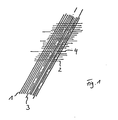
- the single FIGURE shows a roughly schematized fragmentary illustration of a filter fabric for a brewery blend filter formed of warp threads 1 and weft threads 2, each formed of a polypropylene monofilament, preferably with thermally stable equipment and a single diameter of 0.35 mm.
- the warp and weft threads are interwoven with a twill 2/2 weave into a uniform fabric on both sides, with 27 threads / cm in the warp direction and 10 threads / cm in the weft direction.
- reinforcing fibers of an ultrahigh molecular weight polyethylene (Dyneema®) with a fiber thickness of 2,840 dtex and a resulting tensile strength of about 700 N at 3, are here exactly every 5 cm to 4% elongation at break incorporated into the tissue, ie according to the present bond, here twill 2/2, interwoven in the tissue.
- Dyneema® ultrahigh molecular weight polyethylene
- each 135th thread is formed of a reinforcing fiber 3, while in weft every 50th thread is formed of a reinforcing fiber 4, wherein the reinforcing fibers 3 parallel to the warp threads 1 and the reinforcing fibers 4 parallel to the weft threads 2.
- the polypropylene monofilaments forming the warp and weft threads 1, 2 can be thermostable by incorporation of a heat stabilizer.
- the fabric thus formed After the fabric thus formed has been woven, it is fed to a calender, for example a three-roll calender, and calendered under the action of pressure and heat, thereby causing the warp and weft threads to join at the points of intersection, as far as the warp and weft threads are concerned
- a calender for example a three-roll calender
- the polypropylene monofilaments, which are originally of circular cross-section, are given an oval cross-section which reduces the mesh size of the fabric to the desired level.
- the filter fabric thus produced is suitable for a variety of applications, especially as a brewery blend filter and there shows superior stability and filtering effect and lowest elongation.
Landscapes
- Engineering & Computer Science (AREA)
- Textile Engineering (AREA)
- Chemical & Material Sciences (AREA)
- Chemical Kinetics & Catalysis (AREA)
- Woven Fabrics (AREA)
- Filtering Materials (AREA)
Description
- Die Erfindung betrifft ein Filtergewebe für ein Brauereimaischefilter, gebildet aus Kett- und Schussfäden auf Basis von Kunststoffmonofilen mit einem Durchmesser von 0,25 bis 0,45 mm sowie in Kett- und/oder Schussrichtung in definierten Abständen eingearbeiteten weiteren Fasern.
- Bei der Herstellung von Brauereierzeugnissen, wie Bier werden zur Filtration der Maische Filtriereinrichtungen eingesetzt, die ein Maischefilter, gebildet aus einem Gewebe aus Kett- und Schussfäden auf Basis von Kunststoffmonofilen aufweisen. Üblicherweise weisen diese Kunststoffmonofile einen Durchmesser von 0,25 bis 0,45 mm auf, um im Gewebe die für die Filtrationswirkung gewünschte Porosität zu erzeugen.
- Da beim Einsatz derartiger Filtergewebe in einer Brauerei lebensmittelrechtliche Anforderungen zu berücksichtigen sind, bestehen die üblicherweise eingesetzten Brauereimaischefilter aus Filtergeweben auf Basis von Polypropylenmonofilen, da Polypropylen die erforderlichen lebensmittelrechtlichen Zulassungen erfüllt.
- Ein solches Polypropylen-Filtertuch ist beispielsweise aus der
DE 1 947 119 U1 bekannt. - Hierbei tritt jedoch das Problem auf, dass die Brauereimaischefilter lediglich randseitig in einem Halterahmen eingespannt und während des Filtrationsvorganges mit Wasser hohen Drucks und hoher Temperatur beaufschlagt werden.
- Auch nach dem Abschluss des Filtrationsvorganges kommt Wasser mit hohem Druck und hoher Temperatur zum Einsatz, wenn das Maischefilter von den zurückgehaltenen Maischepartikeln gereinigt und für den nächsten Einsatz vorbereitet wird. Bei diesen Bedingungen neigen die eingesetzten Polypropylenmonofilgewebe dazu, sich dauerhaft zu dehnen, so dass das Filtergewebe bereits nach kurzer Nutzungsdauer ausbeult, was außerordentlich unerwünscht ist. Ein ausgebeultes Filtergewebe verändert seine für die Filtrationswirkung gewünschte Maschenweite und lässt sich darüber hinaus nur mit großen Schwierigkeiten wieder von zurückgehaltenem Material abreinigen.
- Aus der
DE 29 36 633 A1 ist ein gattungsfremdes Drucktuch für Siebdruckmaschinen bekannt, welches aus einem Textilgewebe mit Kett- und Schussfäden auf Basis von Kunststoffmonofilen gebildet ist. In definierten Abständen sind Verstärkungsfasern aus einem gegenüber dem Kett- und Schussfäden verstärkten Kunststoff parallel zu diesen in das Gewebe eingearbeitet. - Aus der
IE 2005/0665 - Es ist daher Aufgabe der Erfindung, ein Brauereimaischefilter der eingangs genannten Art vorzuschlagen, welches zuverlässig das Ausbeulen im Betrieb verhindert und somit zu einer verbesserten Filtrationswirkung und verlängerter Lebensdauer bei vertretbaren Kosten führt.
- Zur Lösung der erfindungsgemäßen Aufgabe wird vorgeschlagen, dass die weiteren Fasern als Verstärkungsfasern aus einem gegenüber den die Kett- und Schussfäden des Filtergewebes bildenden Kunststoffmonofilen reißfesteren und dehnungsärmeren Kunststoff gebildet sind und parallel zu den Kett- und Schussfäden in das Filtergewebe eingearbeitet sind und eine Bruchdehnung von maximal 6 % aufweisen.
- Die erfindungsgemäß zusätzlich vorgesehenen weiteren Verstärkungsfasern beeinträchtigen das aus den Kett- und Schussfäden gebildete Filtergewebe hinsichtlich seiner Maschenweite und der daraus resultierenden Filterwirkung nicht, sie verhindern jedoch aufgrund ihrer Reißfestigkeit und geringeren Dehnung zuverlässig das Ausbeulen des ansonsten im Betrieb zu Längendehnungen neigenden Filtergewebes. Auf diese Weise kann die Filterwirkung und Lebensdauer des Filtergewebes auf überraschend einfache Weise beträchtlich erhöht werden.
- Nach einem Vorschlag der Erfindung sind die Verstärkungsfasern in gleichen Abständen voneinander in das Filtergewebe eingearbeitet, wobei Abstände von 1 bis 10 cm, vorzugsweise 5 cm voneinander als geeignet angesehen werden.
- Die Verstärkungsfasern können aus verschiedenen geeigneten Kunststoffen gefertigt werden. Aufgrund der extremen Reißfestigkeit und geringen Bruchdehnung und darüber hinaus vorhandener lebensmittelrechtlicher Zulassung ist nach einem Vorschlag der Erfindung vorgesehen, die Verstärkungsfasern aus einem ultrahochmolekularen Polyethylen herzustellen. Fasern aus derartigem ultrahochmolekularem Polyethylen werden beispielsweise von der Firma DSM unter dem Markennamen "Dyneema®" angeboten.
- Bevorzugt weisen diese Verstärkungsfasern eine Faserstärke von 2.500 bis 3.000 dtex, vorzugsweise 2.800 bis 2.900 dtex auf. Eine Dyneema®-Faser von 2.840 dtex Stärke besitzt eine Zugfestigkeit von 700 N bei nur 3 bis 4% Bruchdehnung und ist somit in der Lage, selbst bei Abständen von 5 cm voneinander in Kett- und Schussrichtung das Filtergewebe so zu verstärken, dass Ausbeulungen praktisch nicht mehr vorkommen. Gleichzeitig wird der Mehraufwand durch das Einarbeiten der zusätzlichen Verstärkungsfasern aufgrund des großen Abstandes derselben voneinander in vertretbaren Grenzen gehalten.
- Selbstverständlich können im Rahmen der Erfindung auch andere Rohstoffe zur Ausbildung der Verstärkungsfasern in Betracht kommen, beispielsweise Aramid-Fasern, wie Kevlar® oder PBO-Fasern.
- Die Kett- und Schussfäden werden bevorzugt aus Polypropylenmonofilen gefertigt, können aber z.B. auch aus Polyethylen oder anderen geeigneten Kunststoffen gefertigt sein.
- Nach weiterem Vorschlag der Erfindung wird das Filtergewebe aus 20 bis 40 Kettfäden/cm und 5 bis 16 Schussfäden/cm gebildet und weist eine Bindung auf, die das Gewebe auf seinen beiden Seiten gleich erscheinen lässt. Geeignete Bindungsarten sind beispielsweise Köper 2/2, Köper 3/1, Köper 2/1, Kreuzköper, Atlas oder Leinwand.
- Zur Befestigung in einem Halterahmen kann das Filtergewebe randseitig mit einem Keder oder einer ähnlichen umlaufenden Gummilippe vorgesehen sein und darüber hinaus nach dem Weben und Einarbeiten der Verstärkungsfasern mittels Druck und Wärme kalandriert werden, um eine Vorverbindung der Kett- und Schussfäden im Kreuzungsbereich sowie eine Abflachung des Monofilquerschnittes unter gleichzeitiger Verringerung und Festlegung der endgültigen Maschenweite zu bewirken.
- Weitere Ausgestaltungen und Einzelheiten der Erfindung werden nachfolgen anhand eines aus der Zeichnung ersichtlichen Ausführungsbeispieles erläutert.
- Die einzige Figur zeigt in grob schematisierter ausschnittsweiser Darstellung ein Filtergewebe für ein Brauereimaischefilter, gebildet aus Kettfäden 1 und Schussfäden 2, die jeweils aus einem Polypropylenmonofil, vorzugsweise mit thermostabiler Ausrüstung und einem Einzeldurchmesser von 0,35 mm gebildet sind.
- Die Kett- und Schussfäden sind mit einer Köper 2/2-Bindung zu einem auf beiden Seiten gleichförmigen Gewebe verwoben, wobei in Kettrichtung 27 Fäden/cm und in Schussrichtung 10 Fäden/cm angeordnet sind.
- Zusätzlich zu den das Grundgewebe bildenden Kett- und Schussfäden 1, 2 sind in definierten Abständen, hier exakt alle 5 cm Verstärkungsfasern aus einem ultrahochmolekularen Polyethylen (Dyneema®) mit einer Faserstärke von 2.840 dtex und einer daraus resultierenden Zugfestigkeit von ca. 700 N bei 3 bis 4% Bruchdehnung mit in das Gewebe eingearbeitet, d.h. entsprechend der vorliegenden Bindung, hier Köper 2/2, im Gewebe verwoben.
- Demzufolge ist in Kettrichtung jeder 135. Faden aus einer Verstärkungsfaser 3 gebildet, während in Schussrichtung jeder 50. Faden aus einer Verstärkungsfaser 4 gebildet ist, wobei die Verstärkungsfasern 3 parallel zu den Kettfäden 1 und die Verstärkungsfasern 4 parallel zu den Schussfäden 2 verlaufen. Durch diese Anordnung ergibt sich die gewünschte Beabstandung der Verstärkungsfasern in Kett- bzw. Schussrichtung voneinander zur den gewünschten jeweils 5 cm.
- Die die Kett- und Schussfäden 1, 2 bildenden Polypropylenmonofile können durch Einarbeitung eines Hitzestabilisators thermostabil ausgerüstet werden.
- Nachdem das solchermaßen gebildete Gewebe gewebt worden ist, wird dieses einem Kalander, beispielsweise einem Dreiwalzenkalander zugeführt und unter Einwirkung von Druck und Wärme kalandriert, wodurch eine Verbindung der Kett- und Schussfäden in den Kreuzungspunkten bewirkt wird, soweit es sich bei den Kett- und Schussfäden um die Polypropylenmonofilamente handelt und darüber hinaus die ursprünglich einen kreisförmigen Querschnitt aufweisenden Polypropylenmonofilamente einen ovalen Querschnitt erhalten, der die Maschenweite des Gewebes auf das gewünschte Maß verringert.
- Das solchermaßen hergestellte Filtergewebe eignet sich für vielfältige Anwendungen, insbesondere als Brauereimaischefilter und zeigt dort überlegene Standfestigkeit und Filterwirkung sowie geringste Dehnung.
Claims (11)
- Filtergewebe für ein Brauereimaischefilter, gebildet aus Kett- und Schussfäden (1, 2) auf Basis von Kunststoffmonofilen mit einem Durchmesser von 0,25 bis 0,45 mm sowie in Kett- und/oder Schussrichtung in definierten Abständen eingearbeiteten weiteren Fasern (3, 4), wobei die weiteren Fasern (3, 4) als Verstärkungsfasern aus einem gegenüber den Kunststoffmonofilen für die Kett- und Schussfäden (1, 2) reißfesteren und dehnungsärmeren Kunststoff parallel zu den Kett- bzw. Schussfäden (1, 2) in das Filtergewebe eingearbeitet sind dadurch gekennzeichnet, dass die Verstärkungsfasern (3, 4) eine Bruchdehnung von maximal 6% aufweisen.
- Filtergewebe nach Anspruch 1, dadurch gekennzeichnet, dass die Verstärkungsfasern (3, 4) in gleichen Abständen voneinander in das Filtergewebe eingearbeitet sind.
- Filtergewebe nach einem der Ansprüche 1 oder 2, dadurch gekennzeichnet, dass die Verstärkungsfasern (3, 4) einen Abstand von 1 bis 10 cm, vorzugsweise 5 cm voneinander aufweisen.
- Filtergewebe nach einem der Ansprüche 1 bis 3, dadurch gekennzeichnet, dass die Verstärkungsfasern (3, 4) aus einem ultrahochmolekularen Polyethylen hergestellt sind.
- Filtergewebe nach Anspruch 4, dadurch gekennzeichnet, dass die Verstärkungsfasern (3, 4) eine Faserstärke von 2.500 bis 3.000 dtex, vorzugsweise 2.800 bis 2.900 dtex aufweisen.
- Filtergewebe nach einem der Ansprüche 1 bis 3, dadurch gekennzeichnet, dass die Verstärkungsfasern (3, 4) aus Aramid-Fasern gebildet sind.
- Filtergewebe nach einem der Ansprüche 1 bis 6, dadurch gekennzeichnet, dass die Kett- und Schussfäden (1, 2) aus Polypropylenmonofilen gebildet sind.
- Filtergewebe nach einem der Ansprüche 1 bis 7, dadurch gekennzeichnet, dass es 20 bis 40 Kettfäden (1) pro cm und 5 bis 16 Schussfäden (2) pro cm aufweist.
- Filtergewebe nach einem der Ansprüche 1 bis 8, dadurch gekennzeichnet, dass es eine Köper 2/2-, Köper 3/1-, Köper 2/1-, Kreuzköper-, Atlas 5/1- oder Leinwandbindung aufweist.
- Filtergewebe nach einem der Ansprüche 1 bis 9, dadurch gekennzeichnet, dass es randseitig mit einem Keder zur Befestigung in einem Halterahmen ausgebildet ist.
- Filtergewebe nach einem der Ansprüche 1 bis 10, dadurch gekennzeichnet, dass es nach dem Weben und Einarbeiten der Verstärkungsfasern (3, 4) mittels Druck und Wärme kalandriert ist.
Applications Claiming Priority (2)
| Application Number | Priority Date | Filing Date | Title |
|---|---|---|---|
| DE102007041412A DE102007041412B3 (de) | 2007-08-31 | 2007-08-31 | Filtergewebe für ein Brauereimaischefilter |
| PCT/EP2008/006547 WO2009030337A1 (de) | 2007-08-31 | 2008-08-08 | Filtergewebe für ein brauereimaischefilter |
Publications (2)
| Publication Number | Publication Date |
|---|---|
| EP2185264A1 EP2185264A1 (de) | 2010-05-19 |
| EP2185264B1 true EP2185264B1 (de) | 2013-10-09 |
Family
ID=39865120
Family Applications (1)
| Application Number | Title | Priority Date | Filing Date |
|---|---|---|---|
| EP08785450.1A Not-in-force EP2185264B1 (de) | 2007-08-31 | 2008-08-08 | Filtergewebe für ein Brauereimaischefilter |
Country Status (4)
| Country | Link |
|---|---|
| EP (1) | EP2185264B1 (de) |
| DE (1) | DE102007041412B3 (de) |
| ES (1) | ES2440915T3 (de) |
| WO (1) | WO2009030337A1 (de) |
Cited By (1)
| Publication number | Priority date | Publication date | Assignee | Title |
|---|---|---|---|---|
| DE102022133357B3 (de) | 2022-12-14 | 2024-01-11 | Markert Filtration GmbH | Filtergewebe |
Families Citing this family (1)
| Publication number | Priority date | Publication date | Assignee | Title |
|---|---|---|---|---|
| DE102014115539A1 (de) * | 2014-10-24 | 2016-04-28 | WasserStiftung | Nebelkollektor |
Family Cites Families (6)
| Publication number | Priority date | Publication date | Assignee | Title |
|---|---|---|---|---|
| DE1947119U (de) * | 1963-02-28 | 1966-10-06 | Ziemann G M B H A | Filtertuch fuer brauereimaischefilter. |
| DE2936633C2 (de) * | 1979-09-11 | 1983-07-28 | Mathias 4815 Schloss Holte Mitter | Drucktuch für Siebdruckmaschinen. |
| JP2001314713A (ja) * | 2000-05-09 | 2001-11-13 | Shikibo Ltd | フィルタープレス用濾過布 |
| ATE249869T1 (de) * | 2001-02-20 | 2003-10-15 | Sefar Ag | Filtertuch |
| FI112514B (fi) * | 2002-11-12 | 2003-12-15 | Tamfelt Oyj Abp | Kuivatusviira |
| EP1837064A1 (de) * | 2006-03-23 | 2007-09-26 | Sefar AG | Gewebe |
-
2007
- 2007-08-31 DE DE102007041412A patent/DE102007041412B3/de not_active Expired - Fee Related
-
2008
- 2008-08-08 WO PCT/EP2008/006547 patent/WO2009030337A1/de not_active Ceased
- 2008-08-08 ES ES08785450.1T patent/ES2440915T3/es active Active
- 2008-08-08 EP EP08785450.1A patent/EP2185264B1/de not_active Not-in-force
Cited By (2)
| Publication number | Priority date | Publication date | Assignee | Title |
|---|---|---|---|---|
| DE102022133357B3 (de) | 2022-12-14 | 2024-01-11 | Markert Filtration GmbH | Filtergewebe |
| EP4385604A1 (de) | 2022-12-14 | 2024-06-19 | Markert Filtration GmbH | Filtergewebe |
Also Published As
| Publication number | Publication date |
|---|---|
| EP2185264A1 (de) | 2010-05-19 |
| DE102007041412B3 (de) | 2009-03-05 |
| WO2009030337A1 (de) | 2009-03-12 |
| ES2440915T3 (es) | 2014-01-31 |
Similar Documents
| Publication | Publication Date | Title |
|---|---|---|
| EP2659039B1 (de) | Sicherheitsgurtband für ein sicherheitsgurtsystem | |
| EP2066572B1 (de) | Fördergurt mit querarmierung | |
| DE2838046C2 (de) | Textilcord zur Verstärkung von Gummierzeugnissen | |
| DE112009001838T5 (de) | Verfahren zur Verbesserung der Anpassungsfähigkeit eines ungekräuselten Geleges und mit derartigen Verfahren hergestellte konturierte Verbundwerkstoffkomponenten | |
| DE202007016848U1 (de) | Scharnierung für einen Airbagdeckel | |
| EP2780264B1 (de) | Transportband oder antriebsband | |
| DE102009058039C5 (de) | Sicherheitsgurtband und Verfahren zur Herstellung desselben | |
| DE102007041412B3 (de) | Filtergewebe für ein Brauereimaischefilter | |
| DE112009001837T5 (de) | Selbstanpassendes ungekräuseltes Gelege und konturierte Verbundwerkstoffkomponenten mit diesem | |
| EP2085060B1 (de) | Material zur Herstellung eines Stützverbandes | |
| DE202011000325U1 (de) | Segeltuch mit Kettfaden und Schussfaden verstärkenden Strängen | |
| EP2217747B1 (de) | Textilgewebe und gewebestück für fahrzeugsitze sowie fahrzeugsitz | |
| EP3196346B1 (de) | Netzartiges gewirktes elastisches material sowie verfahren zu dessen herstellung | |
| EP2952614B1 (de) | Textilgewebe und Sitzbezug sowie Fahrzeugsitz mit einem solchen | |
| DE102010019242B4 (de) | Textiles Trägermaterial für Schleifmittel und Schleifmittelmaterial | |
| DE102016212044A1 (de) | Verfahren zur Herstellung eines Faser-Kunststoff-Verbund-Bauteils und hiermit hergestelltes Faser-Kunststoff-Verbund-Bauteil | |
| DE102013210274B4 (de) | Feinfädiges Sicherheitsgurtband und Verfahren zur Herstellung eines solchen Sicherheitsgurtbands | |
| EP2756781B1 (de) | Kompostierbarer Bezugsstoff | |
| EP2671977A2 (de) | Garniturträger | |
| DE10137040B4 (de) | Nähgewirkter Faserverbundwerkstoff | |
| DE102023200099A1 (de) | Faserverbundwerkstoff mit elastischer Faserbeschichtung | |
| DE102014207017A1 (de) | Verfahren zur Herstellung eines Fahrzeug-Halbzeugs sowie Faser-Halbzeug und Bauteil aus einem Faserverbundwerkstoff | |
| DE202013007156U1 (de) | Textiles Flächenerzeugnis | |
| DE202012103389U1 (de) | Gewebe für Verschattungszwecke | |
| DE2025547B2 (de) | Drucktuch |
Legal Events
| Date | Code | Title | Description |
|---|---|---|---|
| PUAI | Public reference made under article 153(3) epc to a published international application that has entered the european phase |
Free format text: ORIGINAL CODE: 0009012 |
|
| 17P | Request for examination filed |
Effective date: 20100222 |
|
| AK | Designated contracting states |
Kind code of ref document: A1 Designated state(s): AT BE BG CH CY CZ DE DK EE ES FI FR GB GR HR HU IE IS IT LI LT LU LV MC MT NL NO PL PT RO SE SI SK TR |
|
| AX | Request for extension of the european patent |
Extension state: AL BA MK RS |
|
| DAX | Request for extension of the european patent (deleted) | ||
| REG | Reference to a national code |
Ref country code: DE Ref legal event code: R079 Ref document number: 502008010790 Country of ref document: DE Free format text: PREVIOUS MAIN CLASS: B01D0039080000 Ipc: D03D0009000000 |
|
| GRAP | Despatch of communication of intention to grant a patent |
Free format text: ORIGINAL CODE: EPIDOSNIGR1 |
|
| RIC1 | Information provided on ipc code assigned before grant |
Ipc: D03D 9/00 20060101AFI20130304BHEP Ipc: D03D 15/00 20060101ALI20130304BHEP Ipc: D03D 1/00 20060101ALI20130304BHEP Ipc: B01D 39/08 20060101ALI20130304BHEP |
|
| INTG | Intention to grant announced |
Effective date: 20130405 |
|
| GRAS | Grant fee paid |
Free format text: ORIGINAL CODE: EPIDOSNIGR3 |
|
| GRAA | (expected) grant |
Free format text: ORIGINAL CODE: 0009210 |
|
| AK | Designated contracting states |
Kind code of ref document: B1 Designated state(s): AT BE BG CH CY CZ DE DK EE ES FI FR GB GR HR HU IE IS IT LI LT LU LV MC MT NL NO PL PT RO SE SI SK TR |
|
| REG | Reference to a national code |
Ref country code: GB Ref legal event code: FG4D Free format text: NOT ENGLISH |
|
| REG | Reference to a national code |
Ref country code: CH Ref legal event code: EP Ref country code: AT Ref legal event code: REF Ref document number: 635616 Country of ref document: AT Kind code of ref document: T Effective date: 20131015 |
|
| REG | Reference to a national code |
Ref country code: IE Ref legal event code: FG4D Free format text: LANGUAGE OF EP DOCUMENT: GERMAN |
|
| REG | Reference to a national code |
Ref country code: DE Ref legal event code: R096 Ref document number: 502008010790 Country of ref document: DE Effective date: 20131205 |
|
| REG | Reference to a national code |
Ref country code: NL Ref legal event code: T3 |
|
| REG | Reference to a national code |
Ref country code: ES Ref legal event code: FG2A Ref document number: 2440915 Country of ref document: ES Kind code of ref document: T3 Effective date: 20140131 |
|
| PG25 | Lapsed in a contracting state [announced via postgrant information from national office to epo] |
Ref country code: SI Free format text: LAPSE BECAUSE OF FAILURE TO SUBMIT A TRANSLATION OF THE DESCRIPTION OR TO PAY THE FEE WITHIN THE PRESCRIBED TIME-LIMIT Effective date: 20131009 |
|
| REG | Reference to a national code |
Ref country code: LT Ref legal event code: MG4D |
|
| PG25 | Lapsed in a contracting state [announced via postgrant information from national office to epo] |
Ref country code: NO Free format text: LAPSE BECAUSE OF FAILURE TO SUBMIT A TRANSLATION OF THE DESCRIPTION OR TO PAY THE FEE WITHIN THE PRESCRIBED TIME-LIMIT Effective date: 20140109 Ref country code: FI Free format text: LAPSE BECAUSE OF FAILURE TO SUBMIT A TRANSLATION OF THE DESCRIPTION OR TO PAY THE FEE WITHIN THE PRESCRIBED TIME-LIMIT Effective date: 20131009 Ref country code: LT Free format text: LAPSE BECAUSE OF FAILURE TO SUBMIT A TRANSLATION OF THE DESCRIPTION OR TO PAY THE FEE WITHIN THE PRESCRIBED TIME-LIMIT Effective date: 20131009 Ref country code: SE Free format text: LAPSE BECAUSE OF FAILURE TO SUBMIT A TRANSLATION OF THE DESCRIPTION OR TO PAY THE FEE WITHIN THE PRESCRIBED TIME-LIMIT Effective date: 20131009 Ref country code: HR Free format text: LAPSE BECAUSE OF FAILURE TO SUBMIT A TRANSLATION OF THE DESCRIPTION OR TO PAY THE FEE WITHIN THE PRESCRIBED TIME-LIMIT Effective date: 20131009 Ref country code: IS Free format text: LAPSE BECAUSE OF FAILURE TO SUBMIT A TRANSLATION OF THE DESCRIPTION OR TO PAY THE FEE WITHIN THE PRESCRIBED TIME-LIMIT Effective date: 20140209 |
|
| PG25 | Lapsed in a contracting state [announced via postgrant information from national office to epo] |
Ref country code: LV Free format text: LAPSE BECAUSE OF FAILURE TO SUBMIT A TRANSLATION OF THE DESCRIPTION OR TO PAY THE FEE WITHIN THE PRESCRIBED TIME-LIMIT Effective date: 20131009 Ref country code: PL Free format text: LAPSE BECAUSE OF FAILURE TO SUBMIT A TRANSLATION OF THE DESCRIPTION OR TO PAY THE FEE WITHIN THE PRESCRIBED TIME-LIMIT Effective date: 20131009 Ref country code: CY Free format text: LAPSE BECAUSE OF FAILURE TO SUBMIT A TRANSLATION OF THE DESCRIPTION OR TO PAY THE FEE WITHIN THE PRESCRIBED TIME-LIMIT Effective date: 20131009 |
|
| PG25 | Lapsed in a contracting state [announced via postgrant information from national office to epo] |
Ref country code: PT Free format text: LAPSE BECAUSE OF FAILURE TO SUBMIT A TRANSLATION OF THE DESCRIPTION OR TO PAY THE FEE WITHIN THE PRESCRIBED TIME-LIMIT Effective date: 20140210 |
|
| REG | Reference to a national code |
Ref country code: DE Ref legal event code: R097 Ref document number: 502008010790 Country of ref document: DE |
|
| PG25 | Lapsed in a contracting state [announced via postgrant information from national office to epo] |
Ref country code: EE Free format text: LAPSE BECAUSE OF FAILURE TO SUBMIT A TRANSLATION OF THE DESCRIPTION OR TO PAY THE FEE WITHIN THE PRESCRIBED TIME-LIMIT Effective date: 20131009 |
|
| PLBE | No opposition filed within time limit |
Free format text: ORIGINAL CODE: 0009261 |
|
| STAA | Information on the status of an ep patent application or granted ep patent |
Free format text: STATUS: NO OPPOSITION FILED WITHIN TIME LIMIT |
|
| PG25 | Lapsed in a contracting state [announced via postgrant information from national office to epo] |
Ref country code: IT Free format text: LAPSE BECAUSE OF FAILURE TO SUBMIT A TRANSLATION OF THE DESCRIPTION OR TO PAY THE FEE WITHIN THE PRESCRIBED TIME-LIMIT Effective date: 20131009 Ref country code: RO Free format text: LAPSE BECAUSE OF FAILURE TO SUBMIT A TRANSLATION OF THE DESCRIPTION OR TO PAY THE FEE WITHIN THE PRESCRIBED TIME-LIMIT Effective date: 20131009 Ref country code: SK Free format text: LAPSE BECAUSE OF FAILURE TO SUBMIT A TRANSLATION OF THE DESCRIPTION OR TO PAY THE FEE WITHIN THE PRESCRIBED TIME-LIMIT Effective date: 20131009 Ref country code: CZ Free format text: LAPSE BECAUSE OF FAILURE TO SUBMIT A TRANSLATION OF THE DESCRIPTION OR TO PAY THE FEE WITHIN THE PRESCRIBED TIME-LIMIT Effective date: 20131009 |
|
| 26N | No opposition filed |
Effective date: 20140710 |
|
| PG25 | Lapsed in a contracting state [announced via postgrant information from national office to epo] |
Ref country code: DK Free format text: LAPSE BECAUSE OF FAILURE TO SUBMIT A TRANSLATION OF THE DESCRIPTION OR TO PAY THE FEE WITHIN THE PRESCRIBED TIME-LIMIT Effective date: 20131009 |
|
| REG | Reference to a national code |
Ref country code: DE Ref legal event code: R097 Ref document number: 502008010790 Country of ref document: DE Effective date: 20140710 |
|
| PG25 | Lapsed in a contracting state [announced via postgrant information from national office to epo] |
Ref country code: MC Free format text: LAPSE BECAUSE OF FAILURE TO SUBMIT A TRANSLATION OF THE DESCRIPTION OR TO PAY THE FEE WITHIN THE PRESCRIBED TIME-LIMIT Effective date: 20131009 Ref country code: LU Free format text: LAPSE BECAUSE OF FAILURE TO SUBMIT A TRANSLATION OF THE DESCRIPTION OR TO PAY THE FEE WITHIN THE PRESCRIBED TIME-LIMIT Effective date: 20140808 |
|
| REG | Reference to a national code |
Ref country code: CH Ref legal event code: PL |
|
| GBPC | Gb: european patent ceased through non-payment of renewal fee |
Effective date: 20140808 |
|
| PG25 | Lapsed in a contracting state [announced via postgrant information from national office to epo] |
Ref country code: LI Free format text: LAPSE BECAUSE OF NON-PAYMENT OF DUE FEES Effective date: 20140831 Ref country code: CH Free format text: LAPSE BECAUSE OF NON-PAYMENT OF DUE FEES Effective date: 20140831 |
|
| REG | Reference to a national code |
Ref country code: IE Ref legal event code: MM4A |
|
| REG | Reference to a national code |
Ref country code: FR Ref legal event code: ST Effective date: 20150430 |
|
| PG25 | Lapsed in a contracting state [announced via postgrant information from national office to epo] |
Ref country code: GB Free format text: LAPSE BECAUSE OF NON-PAYMENT OF DUE FEES Effective date: 20140808 |
|
| PG25 | Lapsed in a contracting state [announced via postgrant information from national office to epo] |
Ref country code: FR Free format text: LAPSE BECAUSE OF NON-PAYMENT OF DUE FEES Effective date: 20140901 Ref country code: IE Free format text: LAPSE BECAUSE OF NON-PAYMENT OF DUE FEES Effective date: 20140808 |
|
| REG | Reference to a national code |
Ref country code: AT Ref legal event code: MM01 Ref document number: 635616 Country of ref document: AT Kind code of ref document: T Effective date: 20140808 |
|
| PG25 | Lapsed in a contracting state [announced via postgrant information from national office to epo] |
Ref country code: AT Free format text: LAPSE BECAUSE OF NON-PAYMENT OF DUE FEES Effective date: 20140808 |
|
| PG25 | Lapsed in a contracting state [announced via postgrant information from national office to epo] |
Ref country code: BG Free format text: LAPSE BECAUSE OF FAILURE TO SUBMIT A TRANSLATION OF THE DESCRIPTION OR TO PAY THE FEE WITHIN THE PRESCRIBED TIME-LIMIT Effective date: 20131009 |
|
| PG25 | Lapsed in a contracting state [announced via postgrant information from national office to epo] |
Ref country code: MT Free format text: LAPSE BECAUSE OF FAILURE TO SUBMIT A TRANSLATION OF THE DESCRIPTION OR TO PAY THE FEE WITHIN THE PRESCRIBED TIME-LIMIT Effective date: 20131009 Ref country code: GR Free format text: LAPSE BECAUSE OF FAILURE TO SUBMIT A TRANSLATION OF THE DESCRIPTION OR TO PAY THE FEE WITHIN THE PRESCRIBED TIME-LIMIT Effective date: 20140110 |
|
| PG25 | Lapsed in a contracting state [announced via postgrant information from national office to epo] |
Ref country code: HU Free format text: LAPSE BECAUSE OF FAILURE TO SUBMIT A TRANSLATION OF THE DESCRIPTION OR TO PAY THE FEE WITHIN THE PRESCRIBED TIME-LIMIT; INVALID AB INITIO Effective date: 20080808 Ref country code: TR Free format text: LAPSE BECAUSE OF FAILURE TO SUBMIT A TRANSLATION OF THE DESCRIPTION OR TO PAY THE FEE WITHIN THE PRESCRIBED TIME-LIMIT Effective date: 20131009 |
|
| PGFP | Annual fee paid to national office [announced via postgrant information from national office to epo] |
Ref country code: NL Payment date: 20160824 Year of fee payment: 9 |
|
| PGFP | Annual fee paid to national office [announced via postgrant information from national office to epo] |
Ref country code: ES Payment date: 20160829 Year of fee payment: 9 |
|
| PGFP | Annual fee paid to national office [announced via postgrant information from national office to epo] |
Ref country code: BE Payment date: 20170823 Year of fee payment: 10 |
|
| PGFP | Annual fee paid to national office [announced via postgrant information from national office to epo] |
Ref country code: DE Payment date: 20171020 Year of fee payment: 10 |
|
| REG | Reference to a national code |
Ref country code: NL Ref legal event code: MM Effective date: 20170901 |
|
| PG25 | Lapsed in a contracting state [announced via postgrant information from national office to epo] |
Ref country code: NL Free format text: LAPSE BECAUSE OF NON-PAYMENT OF DUE FEES Effective date: 20170901 |
|
| REG | Reference to a national code |
Ref country code: ES Ref legal event code: FD2A Effective date: 20181029 |
|
| PG25 | Lapsed in a contracting state [announced via postgrant information from national office to epo] |
Ref country code: ES Free format text: LAPSE BECAUSE OF NON-PAYMENT OF DUE FEES Effective date: 20170809 |
|
| REG | Reference to a national code |
Ref country code: DE Ref legal event code: R119 Ref document number: 502008010790 Country of ref document: DE |
|
| REG | Reference to a national code |
Ref country code: BE Ref legal event code: MM Effective date: 20180831 |
|
| PG25 | Lapsed in a contracting state [announced via postgrant information from national office to epo] |
Ref country code: DE Free format text: LAPSE BECAUSE OF NON-PAYMENT OF DUE FEES Effective date: 20190301 |
|
| PG25 | Lapsed in a contracting state [announced via postgrant information from national office to epo] |
Ref country code: BE Free format text: LAPSE BECAUSE OF NON-PAYMENT OF DUE FEES Effective date: 20180831 |