EP2181838A1 - A bladder, an apparatus and a method for shaping and curing a tire - Google Patents
A bladder, an apparatus and a method for shaping and curing a tire Download PDFInfo
- Publication number
- EP2181838A1 EP2181838A1 EP09171558A EP09171558A EP2181838A1 EP 2181838 A1 EP2181838 A1 EP 2181838A1 EP 09171558 A EP09171558 A EP 09171558A EP 09171558 A EP09171558 A EP 09171558A EP 2181838 A1 EP2181838 A1 EP 2181838A1
- Authority
- EP
- European Patent Office
- Prior art keywords
- bladder
- tire
- regions
- membrane
- circumferential
- Prior art date
- Legal status (The legal status is an assumption and is not a legal conclusion. Google has not performed a legal analysis and makes no representation as to the accuracy of the status listed.)
- Granted
Links
- 238000000034 method Methods 0.000 title claims abstract description 21
- 238000007493 shaping process Methods 0.000 title claims abstract description 9
- 239000011324 bead Substances 0.000 claims abstract description 12
- 239000012528 membrane Substances 0.000 claims description 51
- 239000013536 elastomeric material Substances 0.000 claims description 13
- 239000000463 material Substances 0.000 claims description 6
- 238000004873 anchoring Methods 0.000 claims description 4
- 230000000750 progressive effect Effects 0.000 abstract description 5
- 238000010438 heat treatment Methods 0.000 description 2
- 238000013459 approach Methods 0.000 description 1
- 150000001875 compounds Chemical class 0.000 description 1
- 230000001419 dependent effect Effects 0.000 description 1
- 238000004519 manufacturing process Methods 0.000 description 1
- 238000000465 moulding Methods 0.000 description 1
- 230000002787 reinforcement Effects 0.000 description 1
- 239000012779 reinforcing material Substances 0.000 description 1
- 239000002759 woven fabric Substances 0.000 description 1
Images


Classifications
-
- B—PERFORMING OPERATIONS; TRANSPORTING
- B29—WORKING OF PLASTICS; WORKING OF SUBSTANCES IN A PLASTIC STATE IN GENERAL
- B29D—PRODUCING PARTICULAR ARTICLES FROM PLASTICS OR FROM SUBSTANCES IN A PLASTIC STATE
- B29D30/00—Producing pneumatic or solid tyres or parts thereof
- B29D30/06—Pneumatic tyres or parts thereof (e.g. produced by casting, moulding, compression moulding, injection moulding, centrifugal casting)
- B29D30/0601—Vulcanising tyres; Vulcanising presses for tyres
- B29D30/0654—Flexible cores therefor, e.g. bladders, bags, membranes, diaphragms
-
- B—PERFORMING OPERATIONS; TRANSPORTING
- B29—WORKING OF PLASTICS; WORKING OF SUBSTANCES IN A PLASTIC STATE IN GENERAL
- B29C—SHAPING OR JOINING OF PLASTICS; SHAPING OF MATERIAL IN A PLASTIC STATE, NOT OTHERWISE PROVIDED FOR; AFTER-TREATMENT OF THE SHAPED PRODUCTS, e.g. REPAIRING
- B29C43/00—Compression moulding, i.e. applying external pressure to flow the moulding material; Apparatus therefor
- B29C43/32—Component parts, details or accessories; Auxiliary operations
- B29C43/36—Moulds for making articles of definite length, i.e. discrete articles
- B29C43/3642—Bags, bleeder sheets or cauls for isostatic pressing
-
- B—PERFORMING OPERATIONS; TRANSPORTING
- B29—WORKING OF PLASTICS; WORKING OF SUBSTANCES IN A PLASTIC STATE IN GENERAL
- B29C—SHAPING OR JOINING OF PLASTICS; SHAPING OF MATERIAL IN A PLASTIC STATE, NOT OTHERWISE PROVIDED FOR; AFTER-TREATMENT OF THE SHAPED PRODUCTS, e.g. REPAIRING
- B29C43/00—Compression moulding, i.e. applying external pressure to flow the moulding material; Apparatus therefor
- B29C43/32—Component parts, details or accessories; Auxiliary operations
- B29C43/36—Moulds for making articles of definite length, i.e. discrete articles
- B29C43/3642—Bags, bleeder sheets or cauls for isostatic pressing
- B29C2043/3649—Inflatable bladders using gas or fluid and related details
-
- B—PERFORMING OPERATIONS; TRANSPORTING
- B29—WORKING OF PLASTICS; WORKING OF SUBSTANCES IN A PLASTIC STATE IN GENERAL
- B29C—SHAPING OR JOINING OF PLASTICS; SHAPING OF MATERIAL IN A PLASTIC STATE, NOT OTHERWISE PROVIDED FOR; AFTER-TREATMENT OF THE SHAPED PRODUCTS, e.g. REPAIRING
- B29C33/00—Moulds or cores; Details thereof or accessories therefor
- B29C33/20—Opening, closing or clamping
-
- B—PERFORMING OPERATIONS; TRANSPORTING
- B29—WORKING OF PLASTICS; WORKING OF SUBSTANCES IN A PLASTIC STATE IN GENERAL
- B29D—PRODUCING PARTICULAR ARTICLES FROM PLASTICS OR FROM SUBSTANCES IN A PLASTIC STATE
- B29D30/00—Producing pneumatic or solid tyres or parts thereof
- B29D30/06—Pneumatic tyres or parts thereof (e.g. produced by casting, moulding, compression moulding, injection moulding, centrifugal casting)
- B29D30/0601—Vulcanising tyres; Vulcanising presses for tyres
- B29D30/0654—Flexible cores therefor, e.g. bladders, bags, membranes, diaphragms
- B29D2030/0655—Constructional or chemical features of the flexible cores
Definitions
- the present invention is directed to a tire bladder, and to an apparatus and a method for curing a tire.
- FIG. 1 shows a mold 3 composed of different movable elements for shaping and forming an uncured tire 1.
- a bladder 2 shaped as an endless ribbon of elastomeric material, the two lateral edges 4 thereof being fastened to two circumferential flanges 5 and 6, respectively.
- the bladder 2 and the tire 1 are positioned such that the circumferential elastomeric ribbon is inside the toroid shape of the tire 1 and is facing the cavity of the tire. Upon inflation, the bladder 2 expands circumferentially into the tire cavity.
- the bladder contacts the whole inner surface of the tire and the internal pressure of the bladder exerts a pressure on the whole inner surface of the tire against the mold 3.
- the external surface of the tire is then pressed against the different elements of the mold for forming the sidewalls inscriptions and the tire tread.
- the tire 1 conforms thereby also to its final general shape.
- the mold and some other elements of the machine are heated up to a predetermined temperature in order to vulcanize the tire so that its rubber reaches a higher stiffness.
- Such a procedure, machine and bladder are known for example from US-A- 2006/0260735 .
- Uncured tire carcasses or green tires present a very low stiffness.
- the process of the bladder expanding in the tire cavity can cause relative movement between the outer contacting surface of the bladder and the inner surface of the uncured tire. This can lead to deformation and undesirable rubber flow of the tire.
- the Figures 2a to 2f show cross sectional views of the bladder expansion and the molding procedure at different successive steps.
- Figures 2a to 2d show the progressive expansion of the bladder before it contacts the central section of the inner surface of the tire.
- the bladder is already expanded a lot but still contacts only the bead regions 8 of the inner surface of the tire. This has for consequence that the high tensions in the bladder membrane resulting from its stretching are transmitted to the bead regions 8 of the sidewalls.
- US-A- 3,963,394 discloses a bladder with a series of convolutions or expansion hollows extending circumferentially along the endless ribbon of the bladder and with reinforcing material in the center and the end sections of the bladder. These convolutions provide controlled amounts of extensibility to the bladder. The shape provided by these convolutions and the reinforcement does however not reduce the deformation and undesired rubber flow in the tire during curing as described here above.
- Axial and “Axially” means the lines or directions that are parallel to the axis of rotation of a tire or a bladder.
- Bead or “Bead Core” generally means that part of a tire comprising an annular tensile member of radially inner beads that are associated with holding the tire to the rim.
- “Circumferential” most often means circular lines or directions extending along the perimeter of the surface of the annular tread of a tire perpendicular to the axial direction; it can also refer to the direction of the sets of adjacent circular curves whose radii define the axial curvature of the tread, as viewed in cross section.
- Equatorial Plane means the plane perpendicular to a tire's axis of rotation and passing through the center of its tread.
- “Gauge” refers to cross-sectional thickness, measured along a line that is normal to at least one surface of what is being measured.
- “Lateral” means a direction parallel to the axial direction.
- Ring and radially mean directions radially toward or away from the axis of rotation of a tire.
- “Shoulder” of a tire means the upper portion of the tire sidewall just below the tread edge.
- Thread Cap refers to the tread and the underlying material into which the tread pattern is molded.
- Thread Contour means the shape of a tire tread as viewed in axial cross section.
- Thread width means the arc length of the tread surface in the plane includes the axis of rotation of the tire.
- the invention relates to a bladder according to claim 1, to an apparatus according to claim 10 and to a method according to claim 11.
- the two structurally weakened circumferential strip-like regions are located such that they come into contact with the shoulder portions of the tire when the bladder is fully inflated in the cavity of the tire.
- the rigidity of the membrane at the remaining regions does not vary more than by 15%, preferably not more than by 10%.
- the gauge of the membrane at the two structurally weakened circumferential strip-like regions is less than at the remaining regions.
- the gauge of the membrane at the two structurally weakened circumferential strip-like regions is less by at least 30%, alternately by at least 40%, than at the remaining regions of the endless ribbon.
- the gauge variation of the membrane when moving from the two structurally weakened circumferential strip-like regions towards a circumferential center region is continuous.
- the gauge variation of the membrane when moving from the two structurally weakened circumferential strip-like regions towards the circumferential edges, respectively, is continuous.
- At least one of the two structurally weakened circumferential strip-like regions comprises a first elastomeric material which is different from the elastomeric material used in the remaining regions and wherein the elasticity modulus of the first material is lower than the elasticity modulus of the elastomeric material used in the remaining regions.
- the gauge of the membrane at the at least one of the two structurally weakened circumferential strip-like regions is less than at the remaining regions.
- the elastomeric material used in the remaining regions is substantially homogenous.
- the bladder initially contacts the inner surface of the tire at inner bead regions of the tire and inner sidewalls regions of the tire.
- the structurally weakened regions of the bladder are then stretched during further inflation in such a way that the bladder progressively come into contact with the inner shoulder regions of the tire and an inner central portion of the tire.
- the structurally weakened regions of the bladder are shaped in such a way that their stretching during inflation reduces or minimizes the deformation by stretching of side sections of the bladder contacting the inner sidewalls regions of said tire.
- the bladder contacts the inner surface of the tire progressively and symmetrically with regard to the equatorial plane EP of the tire.
- a central region of the bladder located between the structurally weakened regions contacts the surface of the inner central region of the tire only when the shoulder regions of the bladder are already in contact with the inner shoulder regions of the tire.
- Figure 3a illustrates a bladder 12 in accordance with the invention in a partially inflated but not yet expanded state.
- the bladder 12 is composed of an endless ribbon or strip of elastomeric material forming an expandable elastomeric membrane 22.
- the ribbon comprises a main circumferential region 24, 25, 26 which comes into contact with the cavity of the tire upon inflation of the bladder and two circumferential edges 20, 21 which are adapted to be fastened to two axially opposite anchoring flanges of a tire mold.
- the gauge or thickness of the membrane 22 is not constant along the cross-sectional section of the bladder 12.
- the membrane 22 is thicker at the two circumferential edges 20, 21. This provides a higher stiffness and resistance at the anchoring regions.
- the thickness of the membrane initially diminishes progressively, i.e. continuously or gradually, from the edges 20, 21 to lateral regions 26 which are adapted for contacting the inner lower sidewalls 23 of the tire.
- the membrane 22 then has a constant or essentially constant thickness in these lateral regions 26 of the bladder which contact the lower sidewalls 23 when the bladder is expanded.
- the membrane gauge then further diminishes progressively, i.e. continuously or gradually, from the lateral regions 26 to the shoulder regions 24, i.e. the regions of the membrane 22 which come into contact with the inner surface of the tire at the shoulders regions of the tier when the bladder 12 is fully inflated.
- these shoulder regions 24 come into contact with the inner surface of the tire at the shoulder regions preferably only when the bladder 12 is totally expanded in the tire cavity.
- the gauge of the membrane 22 at the center region 25 located between the two structurally weakened regions 24 is preferably about the same as the constant or essentially constant gauge of the lateral regions 26.
- the gauge of the membrane in the weakened regions 24 is in the range of 30% to 70%, alternately 35% to 50%, of the constant or essentially constant gauge of the membrane in the lateral regions 26.
- the membrane gauge can also vary continuously or gradually within the weakened regions 24 along the cross section of the membrane.
- the membrane does not vary by more than 15% gauge, preferably less than 10%, in the remaining regions which come into contact with the inner surface of the tire.
- the positions of the weakened regions 24 are preferably symmetrical with regard to the equatorial plane EP of the tire.
- the shoulder regions 24 of the membrane come progressively into contact with the inner surface of the tire following the lateral regions 26.
- the central region 25 of the bladder is now also under tension and slightly stretched, mainly at the connection areas with the structurally weakened regions 24.
- the central region 25 remains essentially parallel to the tread of the tire and approaches the corresponding inner surface portion of the tire progressively.
- the central region 25 of the membrane contacts the tire preferably only at the very end of the expansion process of the tire, i.e. after that the structurally weakened regions 24 have fully contacted the tire.
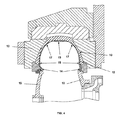
- FIG. 4 An apparatus for forming and curing tires involving a bladder as described in Figures 3a-3g is illustrated in Figure 4 .
- a tire 10 is positioned into a mold 13 and a bladder 12 is inflated in the cavity of the tire to come into contact with the whole inner surface of the tire.
- the two circumferential edges 14 of the membrane of the bladder 12 are fastened to two anchoring flanges 15 and 16, respectively.
- the bead regions of the inner surfaces of the tire are represented by the numeral 18, the shoulder regions by the numeral 17 and the center region by the numeral 19.
- the presence of structurally weakened regions 24 ( Figure 3g ) at the shoulder regions of the membrane as recited here above permits a shaping of the bladder 12 during its inflation.
- This shaping allows a progressive contact of the bladder during inflation with the inner surface of the tire from the tire beads 18 to the inner center region 19 of the tire and reduces, if not avoids, any relative movement between the lateral regions 26 of the bladder 12 and the corresponding sidewalls of the tire.
- the stretching ability of the structurally weakened regions 24 of the membrane 22 reduces the stress in the lateral regions 26 of the membrane at the end of the expansion progress, i.e. when the membrane comes into contact with the shoulder and central regions of the tire. This is particularly true for tires which have normal or high aspect ratios.
- the thickness variation of the bladder along its profile can be designed differently as illustrated here above. For example, the variations can be more progressive or more abrupt as illustrated.
- the exact bladder profile will depend on the characteristics of its material and also of the tire to be shaped and cured.
- the gauge of the membrane can also be designed for influencing the temperature distribution along the tire profile during curing as a thinner gauge of the membrane results in a faster heating up of the corresponding tire portion being in contact with that part of the membrane.
- the central region 25 of the membrane is less stretched than the rest of the membrane when fully inflated in the tire, so that the membrane gauge at this section can be set higher than at the lateral regions 26 in order to slow down the heating up of the center region of the tire.
- the tire bladders of the present invention are formed by conventional expandable and durable materials, preferably rubber.
- the bladders may be reinforced with plies of parallel cord materials or woven fabrics. These features of a tire bladder are well known and conventional in the art of bladder forming.
- the bladder 12 could be weakened at the shoulder portions 24 by using a different elastomeric material compared to the elastomeric material used in the other parts 25, 25 of the membrane.
- the rubber compound composition is changed in the two shoulder regions in such a way that it confers to these regions a lower elasticity modulus and a capacity to be more stretched under a given tension compared to the remaining regions, in particular compared to the lateral regions 26.
- a combination of a variation of the elastomeric material and of the thickness of the membrane is used for providing structurally weakened shoulder regions.
Landscapes
- Engineering & Computer Science (AREA)
- Mechanical Engineering (AREA)
- Moulds For Moulding Plastics Or The Like (AREA)
- Heating, Cooling, Or Curing Plastics Or The Like In General (AREA)
Abstract
Description
- The present invention is directed to a tire bladder, and to an apparatus and a method for curing a tire.
- In the manufacture of tire, the shaping of uncured tire carcasses also called green-tires by means of a machine comprising a mold and a bladder is generally known and an example is illustrated in
Figure 1 . It shows amold 3 composed of different movable elements for shaping and forming anuncured tire 1. To that end there is provided abladder 2 shaped as an endless ribbon of elastomeric material, the two lateral edges 4 thereof being fastened to twocircumferential flanges 5 and 6, respectively. Thebladder 2 and thetire 1 are positioned such that the circumferential elastomeric ribbon is inside the toroid shape of thetire 1 and is facing the cavity of the tire. Upon inflation, thebladder 2 expands circumferentially into the tire cavity. The bladder contacts the whole inner surface of the tire and the internal pressure of the bladder exerts a pressure on the whole inner surface of the tire against themold 3. The external surface of the tire is then pressed against the different elements of the mold for forming the sidewalls inscriptions and the tire tread. Thetire 1 conforms thereby also to its final general shape. The mold and some other elements of the machine are heated up to a predetermined temperature in order to vulcanize the tire so that its rubber reaches a higher stiffness. Such a procedure, machine and bladder are known for example fromUS-A- 2006/0260735 . - Uncured tire carcasses or green tires present a very low stiffness. The process of the bladder expanding in the tire cavity can cause relative movement between the outer contacting surface of the bladder and the inner surface of the uncured tire. This can lead to deformation and undesirable rubber flow of the tire. Indeed, the
Figures 2a to 2f show cross sectional views of the bladder expansion and the molding procedure at different successive steps.Figures 2a to 2d show the progressive expansion of the bladder before it contacts the central section of the inner surface of the tire. InFigure 2d , the bladder is already expanded a lot but still contacts only thebead regions 8 of the inner surface of the tire. This has for consequence that the high tensions in the bladder membrane resulting from its stretching are transmitted to thebead regions 8 of the sidewalls. These tensions can cause rubber flow or deformation of the green tire. InFigure 2f the bladder finally contacts the shoulder regions 7 and thecentral region 9 of the tire. At this stage, the tension in the membrane is further increased resulting in an increased risk of deformations in the sidewalls or bead areas. - Attempts to overcome these problems for low aspect tires have resulted in an increased thickness of the bladder membrane in the shoulder and lateral portions as disclosed in
US-A- 7,144,236 B2 . This solution nevertheless did not prove to be adapted to tires with a higher aspect ratio like radial medium truck tires. -
US-A- 3,963,394 discloses a bladder with a series of convolutions or expansion hollows extending circumferentially along the endless ribbon of the bladder and with reinforcing material in the center and the end sections of the bladder. These convolutions provide controlled amounts of extensibility to the bladder. The shape provided by these convolutions and the reinforcement does however not reduce the deformation and undesired rubber flow in the tire during curing as described here above. - "Axial" and "Axially" means the lines or directions that are parallel to the axis of rotation of a tire or a bladder.
- "Bead" or "Bead Core" generally means that part of a tire comprising an annular tensile member of radially inner beads that are associated with holding the tire to the rim.
- "Circumferential" most often means circular lines or directions extending along the perimeter of the surface of the annular tread of a tire perpendicular to the axial direction; it can also refer to the direction of the sets of adjacent circular curves whose radii define the axial curvature of the tread, as viewed in cross section.
- "Equatorial Plane" means the plane perpendicular to a tire's axis of rotation and passing through the center of its tread.
- "Gauge" refers to cross-sectional thickness, measured along a line that is normal to at least one surface of what is being measured.
- "Lateral" means a direction parallel to the axial direction.
- "Radial" and "radially" mean directions radially toward or away from the axis of rotation of a tire.
- "Shoulder" of a tire means the upper portion of the tire sidewall just below the tread edge.
- "Tread Cap" refers to the tread and the underlying material into which the tread pattern is molded.
- "Tread Contour" means the shape of a tire tread as viewed in axial cross section.
- "Tread width" means the arc length of the tread surface in the plane includes the axis of rotation of the tire.
- The invention relates to a bladder according to
claim 1, to an apparatus according toclaim 10 and to a method according to claim 11. - Dependent claims refer to preferred embodiments of the invention.
- In one aspect of the invention, the two structurally weakened circumferential strip-like regions are located such that they come into contact with the shoulder portions of the tire when the bladder is fully inflated in the cavity of the tire.
- In another aspect of the invention, the rigidity of the membrane at the remaining regions does not vary more than by 15%, preferably not more than by 10%.
- In yet another aspect of the invention, the gauge of the membrane at the two structurally weakened circumferential strip-like regions is less than at the remaining regions.
- In yet another aspect of the invention, the gauge of the membrane at the two structurally weakened circumferential strip-like regions is less by at least 30%, alternately by at least 40%, than at the remaining regions of the endless ribbon.
- In yet another aspect of the invention, the gauge variation of the membrane when moving from the two structurally weakened circumferential strip-like regions towards a circumferential center region is continuous.
- In yet another aspect of the invention, the gauge variation of the membrane when moving from the two structurally weakened circumferential strip-like regions towards the circumferential edges, respectively, is continuous.
- In yet another aspect of the invention, at least one of the two structurally weakened circumferential strip-like regions comprises a first elastomeric material which is different from the elastomeric material used in the remaining regions and wherein the elasticity modulus of the first material is lower than the elasticity modulus of the elastomeric material used in the remaining regions.
- In yet another aspect of the invention, the gauge of the membrane at the at least one of the two structurally weakened circumferential strip-like regions is less than at the remaining regions.
- In yet another aspect of the invention, the elastomeric material used in the remaining regions is substantially homogenous.
- In one aspect of the method according to the invention, during the inflation step the bladder initially contacts the inner surface of the tire at inner bead regions of the tire and inner sidewalls regions of the tire. The structurally weakened regions of the bladder are then stretched during further inflation in such a way that the bladder progressively come into contact with the inner shoulder regions of the tire and an inner central portion of the tire.
- In another aspect of the method according to the invention, the structurally weakened regions of the bladder are shaped in such a way that their stretching during inflation reduces or minimizes the deformation by stretching of side sections of the bladder contacting the inner sidewalls regions of said tire.
- In yet another aspect of the method according to the invention, during the inflation step the bladder contacts the inner surface of the tire progressively and symmetrically with regard to the equatorial plane EP of the tire.
- In yet another aspect of the method according to the invention, a central region of the bladder located between the structurally weakened regions contacts the surface of the inner central region of the tire only when the shoulder regions of the bladder are already in contact with the inner shoulder regions of the tire.
- The invention will be described by way of example and with reference to the accompanying figures in which:
-
FIG. 1 is a sectional view of an apparatus for forming and curing tires as known from the prior art. -
FIG. 2a to FIG. 2f are cross sectional views at successive different steps of the inflation and expansion process of a bladder according to the prior art. -
FIG. 3a to FIG. 3e are cross sectional views at successive different steps of the inflation and expansion process of a bladder according to the invention. -
FIG. 3a shows the beginning of the inflation where the bladder comes into contact first with the lower sections of the inner sidewalls of a tire. -
FIG. 3b, 3c ,3d and 3e show that the bladder comes progressively into contact with the inner sidewalls of the tire with a slight stretching of the corresponding portions of the bladder whereas the weakened regions are stretched to a greater extend. -
FIG. 3f and3g show that the contacting process of the bladder with the tire finishes with the center portion of the tire. -
FIG. 4 is a sectional view of an apparatus for forming and curing tires according to the invention. - An embodiment of the invention is illustrated in
Figures 3a to 3g .Figure 3a illustrates abladder 12 in accordance with the invention in a partially inflated but not yet expanded state. Thebladder 12 is composed of an endless ribbon or strip of elastomeric material forming an expandableelastomeric membrane 22. The ribbon comprises a maincircumferential region circumferential edges membrane 22 is not constant along the cross-sectional section of thebladder 12. Themembrane 22 is thicker at the twocircumferential edges edges lateral regions 26 which are adapted for contacting the innerlower sidewalls 23 of the tire. Themembrane 22 then has a constant or essentially constant thickness in theselateral regions 26 of the bladder which contact thelower sidewalls 23 when the bladder is expanded. The membrane gauge then further diminishes progressively, i.e. continuously or gradually, from thelateral regions 26 to theshoulder regions 24, i.e. the regions of themembrane 22 which come into contact with the inner surface of the tire at the shoulders regions of the tier when thebladder 12 is fully inflated. As shown inFigure 3g , theseshoulder regions 24 come into contact with the inner surface of the tire at the shoulder regions preferably only when thebladder 12 is totally expanded in the tire cavity. The gauge of themembrane 22 at thecenter region 25 located between the two structurally weakenedregions 24 is preferably about the same as the constant or essentially constant gauge of thelateral regions 26. In one embodiment, the gauge of the membrane in the weakenedregions 24 is in the range of 30% to 70%, alternately 35% to 50%, of the constant or essentially constant gauge of the membrane in thelateral regions 26. The membrane gauge can also vary continuously or gradually within the weakenedregions 24 along the cross section of the membrane. The membrane does not vary by more than 15% gauge, preferably less than 10%, in the remaining regions which come into contact with the inner surface of the tire. The positions of the weakenedregions 24 are preferably symmetrical with regard to the equatorial plane EP of the tire. - Upon progressive inflation of the
bladder 12, it can been seen inFigure 3b that the structurally weakenedregions 24 are stretched more than the remaining regions of the membrane and that, as a consequence, thelateral regions 26 of the membrane come progressively and continuously into contact with the inner surface of the tire from the bead regions to the shoulder regions. This is illustrated inFigures 3b, 3c and3d . It is noticeable that the membrane gauge at thelateral regions 26 does substantially not vary or, if any, very little so that the relative movement between the outer contacting surface of the bladder and the inner surface of the uncured tire is very limited. - Still upon further inflation of the bladder, the
shoulder regions 24 of the membrane come progressively into contact with the inner surface of the tire following thelateral regions 26. This is illustrated inFigures 3e and 3f . Thecentral region 25 of the bladder is now also under tension and slightly stretched, mainly at the connection areas with the structurally weakenedregions 24. Thecentral region 25 remains essentially parallel to the tread of the tire and approaches the corresponding inner surface portion of the tire progressively. As illustrated inFigures 3f and3g thecentral region 25 of the membrane contacts the tire preferably only at the very end of the expansion process of the tire, i.e. after that the structurally weakenedregions 24 have fully contacted the tire. - An apparatus for forming and curing tires involving a bladder as described in
Figures 3a-3g is illustrated inFigure 4 . Atire 10 is positioned into amold 13 and abladder 12 is inflated in the cavity of the tire to come into contact with the whole inner surface of the tire. The twocircumferential edges 14 of the membrane of thebladder 12 are fastened to two anchoringflanges Figure 3g ) at the shoulder regions of the membrane as recited here above permits a shaping of thebladder 12 during its inflation. This shaping allows a progressive contact of the bladder during inflation with the inner surface of the tire from thetire beads 18 to theinner center region 19 of the tire and reduces, if not avoids, any relative movement between thelateral regions 26 of thebladder 12 and the corresponding sidewalls of the tire. The stretching ability of the structurally weakenedregions 24 of themembrane 22 reduces the stress in thelateral regions 26 of the membrane at the end of the expansion progress, i.e. when the membrane comes into contact with the shoulder and central regions of the tire. This is particularly true for tires which have normal or high aspect ratios. - The thickness variation of the bladder along its profile can be designed differently as illustrated here above. For example, the variations can be more progressive or more abrupt as illustrated. The exact bladder profile will depend on the characteristics of its material and also of the tire to be shaped and cured.
- In addition, the gauge of the membrane can also be designed for influencing the temperature distribution along the tire profile during curing as a thinner gauge of the membrane results in a faster heating up of the corresponding tire portion being in contact with that part of the membrane. As can be seen in
Figures 3a-3g , more particularly inFigure 3g , thecentral region 25 of the membrane is less stretched than the rest of the membrane when fully inflated in the tire, so that the membrane gauge at this section can be set higher than at thelateral regions 26 in order to slow down the heating up of the center region of the tire. - The tire bladders of the present invention are formed by conventional expandable and durable materials, preferably rubber. The bladders may be reinforced with plies of parallel cord materials or woven fabrics. These features of a tire bladder are well known and conventional in the art of bladder forming.
- In an alternative mode for carrying out the invention, the
bladder 12 could be weakened at theshoulder portions 24 by using a different elastomeric material compared to the elastomeric material used in theother parts lateral regions 26. - In a further alternative mode, a combination of a variation of the elastomeric material and of the thickness of the membrane is used for providing structurally weakened shoulder regions.
Claims (15)
- A bladder for shaping and curing a green tire comprising an endless ribbon of elastomeric membrane (22), the ribbon comprising a main circumferential portion (24, 25, 26) which comes into contact with the cavity of the tire upon full inflation of the bladder (12) and two circumferential edges (21) which are adapted to be fastened to two axially opposite flanges of a tire mold, respectively; wherein the membrane (22) in the main circumferential portion (24, 25, 26) of the ribbon is structurally weakened in two circumferential, preferably strip-like regions (24), and
wherein the rigidity of the membrane (22) in the remaining regions (25, 26) of the main circumferential portion is higher than in the two structurally weakened circumferential regions (24) so that the two structurally weakened circumferential regions (24) are able, upon inflation of the bladder (12), to stretch substantially more than the remaining regions 925, 26). - The bladder according to claim 1, wherein the two structurally weakened circumferential regions (24) are located such that they come into contact with the shoulder portions of the tire only when the bladder (12) is fully inflated or substantially fully inflated in the cavity of the tire.
- The bladder according to claim 1 or 2, wherein the rigidity of the membrane (22) in the remaining regions (25, 26) does not vary more than by 15%.
- The bladder according to at least one of the previous claims, wherein the gauge of the membrane (22) in the two structurally weakened circumferential regions (24) is less than at the remaining regions, preferably at least 30% less than in the remaining regions.
- The bladder according to at least one of the previous claims, wherein the gauge variation of the membrane (22) when moving from the two structurally weakened circumferential regions (24) towards a circumferential center region (25) is continuous and/or wherein the gauge variation of the membrane (22) when moving from the two structurally weakened circumferential regions (24) towards the circumferential edges (21), respectively, is continuous.
- The bladder according to at least one of the previous claims, wherein at least one of the two structurally weakened circumferential regions (24) comprises a first elastomeric material which is different from the elastomeric material used in the remaining regions (25, 26), and wherein the elasticity modulus of the first material is lower than the elasticity modulus of the elastomeric material used in the remaining regions.
- The bladder according to claim 1 or 6, wherein the gauge of the membrane (22) at the at least one of the two structurally weakened circumferential regions (24) is less than at the remaining regions (25, 26).
- The bladder according to claim 1, 6 or 7, wherein the elastomeric material used in the remaining regions (25, 26) is substantially homogenous.
- The bladder according to at least one of the previous claims wherein the two structurally weakened circumferential regions (24) are strip-like regions.
- An apparatus for shaping and curing a green tire, the apparatus comprising a tire mold (2) comprising at least two axially opposite circumferential anchoring flanges (15, 16) and a tire bladder (12) according to one of the previous claims.
- A method for shaping and curing a green tire, the method comprising the steps of:providing a mold (3) comprising a bladder (12), the bladder comprising an elastomeric membrane (22);putting a green tire into the mold (3), the tire comprising an inner surface forming a cavity;inflating the bladder (12) so that the bladder (12) expands in the cavity of the tire; andcuring said tire;wherein the elastomeric membrane (22) of the bladder (12) is structurally weakened in those regions which come into contact with the shoulder portions (17) of the tire cavity when the bladder (12) is fully inflated in the tire cavity, the rigidity of the membrane (22) in the regions coming into contact with the remaining portions of the tire cavity when the bladder (12) is fully inflated being higher than in those regions coming into contact with the shoulder portions (17).
- The method according to claim 11 wherein, during the inflation step, the bladder (12) initially contacts the inner surface of the tire at inner bead regions (18) of the tire and inner sidewalls regions of the tire, and wherein the structurally weakened regions (24) of the bladder (12) are stretched during further inflation in such a way that the bladder (12) then progressively comes into contact with the inner shoulder regions (17) of the tire and an inner central portion (19) of the tire.
- The method according to claim 11 or 12 wherein the structurally weakened regions (24) of the bladder (12) are shaped in such a way that their stretching during inflation reduces or minimizes the deformation by stretching of side sections of the bladder (12) contacting the inner sidewalls regions of the tire.
- The method according to at least one of the claims 11 to 13 wherein, during the inflation step, the bladder (12) contacts the inner surface of the tire progressively and symmetrically with regard to the equatorial plane (EP) of the tire.
- The method according to at least one of the claims 11 to 14 wherein a central region (25) of the bladder (12) located between the structurally weakened regions (24) contacts the surface of the inner central region (19) of the tire only when the shoulder regions (26) of the bladder (12) are already in contact with the inner shoulder regions (17) of the tire.
Applications Claiming Priority (1)
| Application Number | Priority Date | Filing Date | Title |
|---|---|---|---|
| US12/250,006 US20100089520A1 (en) | 2008-10-13 | 2008-10-13 | bladder, an apparatus and a method for shaping and curing a tire |
Publications (2)
| Publication Number | Publication Date |
|---|---|
| EP2181838A1 true EP2181838A1 (en) | 2010-05-05 |
| EP2181838B1 EP2181838B1 (en) | 2012-02-01 |
Family
ID=41571048
Family Applications (1)
| Application Number | Title | Priority Date | Filing Date |
|---|---|---|---|
| EP09171558A Not-in-force EP2181838B1 (en) | 2008-10-13 | 2009-09-29 | A bladder and an apparatus for shaping and curing a tire |
Country Status (3)
| Country | Link |
|---|---|
| US (2) | US20100089520A1 (en) |
| EP (1) | EP2181838B1 (en) |
| AT (1) | ATE543634T1 (en) |
Cited By (1)
| Publication number | Priority date | Publication date | Assignee | Title |
|---|---|---|---|---|
| EP4306310A1 (en) * | 2022-07-12 | 2024-01-17 | Bridgestone Europe NV/SA | Bladder for pneumatic tyre vulcanization |
Families Citing this family (4)
| Publication number | Priority date | Publication date | Assignee | Title |
|---|---|---|---|---|
| EP2318203B1 (en) * | 2008-08-04 | 2013-12-25 | Pirelli Tyre S.P.A. | A process and apparatus for moulding and curing tyres |
| US9046414B2 (en) * | 2012-09-21 | 2015-06-02 | Google Inc. | Selectable lens button for a hazard detector and method therefor |
| US10591607B2 (en) * | 2013-03-28 | 2020-03-17 | Carrier Corporation | Tracking device |
| US10632699B2 (en) | 2015-06-25 | 2020-04-28 | Bridgestone Americas Tire Operations, Llc | Bladder rings for tire vulcanization mold |
Citations (8)
| Publication number | Priority date | Publication date | Assignee | Title |
|---|---|---|---|---|
| GB561068A (en) * | 1942-03-27 | 1944-05-03 | Firestone Tire & Rubber Co | Improvements in or relating to method of manufacturing curing bags |
| US3963394A (en) | 1975-06-25 | 1976-06-15 | Uniroyal Inc. | Bladder for shaping pneumatic tire |
| US4776781A (en) * | 1987-10-06 | 1988-10-11 | Bridgestone Corporation | Open-end bladder for vulcanization of pneumatic tire |
| US5403174A (en) * | 1991-03-05 | 1995-04-04 | Bridgestone Corporation | Pneumatic radial tires |
| EP1629962A1 (en) * | 2004-08-23 | 2006-03-01 | The Goodyear Tire & Rubber Company | Tire curing bladder |
| US20060260735A1 (en) | 2003-03-10 | 2006-11-23 | Gianni Mancini | Method of and apparatus and plant for manufacturing a tyre for a vehicle wheel |
| US7144236B2 (en) | 2004-08-23 | 2006-12-05 | The Goodyear Tire & Rubber Company | Tire curing bladder |
| US20080084007A1 (en) * | 2006-10-05 | 2008-04-10 | Carlisle Intangible Company | Low aspect ratio tire curing bladder |
Family Cites Families (16)
| Publication number | Priority date | Publication date | Assignee | Title |
|---|---|---|---|---|
| US2773511A (en) * | 1952-12-23 | 1956-12-11 | Mercier Jean | Pressure accumulator |
| GB951049A (en) * | 1962-03-31 | 1964-03-04 | Goodyear Tire & Rubber | Tire curing bladder |
| US3890073A (en) * | 1971-10-04 | 1975-06-17 | Mcneil Corp | Center mechanism for a press to shape and cure tires |
| US3847182A (en) * | 1973-06-18 | 1974-11-12 | E Greer | Hydro-pneumatic flexible bladder accumulator |
| FR2278481A1 (en) * | 1973-10-05 | 1976-02-13 | Uniroyal | IMPROVEMENTS TO PNEUMATIC WHEEL BANDAGE WRAPS |
| US4065338A (en) * | 1973-10-05 | 1977-12-27 | Uniroyal | Raw pneumatic tire carcass and method of fabricating same |
| US4070436A (en) * | 1976-10-20 | 1978-01-24 | The Firestone Tire And Rubber Company | Method of manufacturing a pneumatic tire |
| US4338069A (en) * | 1980-04-09 | 1982-07-06 | Nrm Corporation | Tire press |
| US4597929A (en) * | 1984-11-23 | 1986-07-01 | The B. F. Goodrich Company | Method for ventless tire molding and tire resulting therefrom |
| US4768937A (en) * | 1987-02-02 | 1988-09-06 | Nrm Corporation | Tire curing press |
| JP2554499B2 (en) * | 1987-07-06 | 1996-11-13 | 住友ゴム工業 株式会社 | Flat radial tires |
| US5787502A (en) * | 1994-02-17 | 1998-08-04 | Middleton; Nigel John | Thermoinsulative protective garments |
| FR2801896B1 (en) * | 1999-12-03 | 2002-03-01 | Rhodia Chimie Sa | LUBRICATING COMPOSITION BASED ON SILOXANE, WHICH DOESN'T RELEASE HYDROGEN, ITS PREPARATION METHOD AND ITS USE |
| DE20002820U1 (en) * | 2000-02-16 | 2000-05-25 | Igus Spritzgußteile für die Industrie GmbH, 51147 Köln | Energy chain |
| EP1510366B1 (en) * | 2002-06-05 | 2008-05-14 | Sumitomo Rubber Industries, Ltd. | Assembly of pneumatic tire and rim, sound suppressing body used for the assembly, and pneumatic tire storage method |
| JP4567482B2 (en) * | 2005-02-14 | 2010-10-20 | 住友ゴム工業株式会社 | Pneumatic tire |
-
2008
- 2008-10-13 US US12/250,006 patent/US20100089520A1/en not_active Abandoned
-
2009
- 2009-09-29 AT AT09171558T patent/ATE543634T1/en active
- 2009-09-29 EP EP09171558A patent/EP2181838B1/en not_active Not-in-force
-
2010
- 2010-09-14 US US12/881,600 patent/US20110001273A1/en not_active Abandoned
Patent Citations (8)
| Publication number | Priority date | Publication date | Assignee | Title |
|---|---|---|---|---|
| GB561068A (en) * | 1942-03-27 | 1944-05-03 | Firestone Tire & Rubber Co | Improvements in or relating to method of manufacturing curing bags |
| US3963394A (en) | 1975-06-25 | 1976-06-15 | Uniroyal Inc. | Bladder for shaping pneumatic tire |
| US4776781A (en) * | 1987-10-06 | 1988-10-11 | Bridgestone Corporation | Open-end bladder for vulcanization of pneumatic tire |
| US5403174A (en) * | 1991-03-05 | 1995-04-04 | Bridgestone Corporation | Pneumatic radial tires |
| US20060260735A1 (en) | 2003-03-10 | 2006-11-23 | Gianni Mancini | Method of and apparatus and plant for manufacturing a tyre for a vehicle wheel |
| EP1629962A1 (en) * | 2004-08-23 | 2006-03-01 | The Goodyear Tire & Rubber Company | Tire curing bladder |
| US7144236B2 (en) | 2004-08-23 | 2006-12-05 | The Goodyear Tire & Rubber Company | Tire curing bladder |
| US20080084007A1 (en) * | 2006-10-05 | 2008-04-10 | Carlisle Intangible Company | Low aspect ratio tire curing bladder |
Cited By (1)
| Publication number | Priority date | Publication date | Assignee | Title |
|---|---|---|---|---|
| EP4306310A1 (en) * | 2022-07-12 | 2024-01-17 | Bridgestone Europe NV/SA | Bladder for pneumatic tyre vulcanization |
Also Published As
| Publication number | Publication date |
|---|---|
| US20100089520A1 (en) | 2010-04-15 |
| US20110001273A1 (en) | 2011-01-06 |
| ATE543634T1 (en) | 2012-02-15 |
| EP2181838B1 (en) | 2012-02-01 |
Similar Documents
| Publication | Publication Date | Title |
|---|---|---|
| JP4630096B2 (en) | Motorcycle tires | |
| EP2923827B1 (en) | Method for manufacturing a motorcycle tire | |
| EP2181838B1 (en) | A bladder and an apparatus for shaping and curing a tire | |
| KR100454523B1 (en) | Pneumatic tires and method of making | |
| JP2001523607A (en) | Tire air tube and method of manufacturing the same | |
| CN109421304B (en) | method of making tires | |
| EP0919405A1 (en) | A tyre air tube and related manufacturing process | |
| US20080084007A1 (en) | Low aspect ratio tire curing bladder | |
| US7144236B2 (en) | Tire curing bladder | |
| CN112384375A (en) | Heavy duty pneumatic tire and method of manufacturing the same | |
| EP1106392B1 (en) | Pneumatic tyre, tyre mould and process for the manufacture of the same | |
| EP1629962B1 (en) | Tire curing bladder | |
| JP5026900B2 (en) | Vulcanized bladder manufacturing method and vulcanized bladder | |
| CN109421302A (en) | Method of building a tyre | |
| CN109421298A (en) | Methods of building tires | |
| US6964719B1 (en) | Process for manufacturing tires | |
| JP2003191713A (en) | Pneumatic radial tire | |
| US11034112B2 (en) | Method of making a tire | |
| CN102802927A (en) | Method for determining the transverse curve of a generally cylindrical receiving surface | |
| US20150246492A1 (en) | Rigid core mold and method for manufacturing pneumatic tire using the same | |
| JP2005212278A (en) | Tire manufacturing method | |
| US6827115B1 (en) | Bead construction | |
| JP4316401B2 (en) | Tire manufacturing bladder, manufacturing method thereof, and manufacturing method of pneumatic tire using the bladder | |
| CN104053540B (en) | Method and apparatus for controlling the molding of tire in Tyre structure equipment | |
| CN106488838B (en) | Rigid reinforcement ring and tire vulcanization method using the same |
Legal Events
| Date | Code | Title | Description |
|---|---|---|---|
| PUAI | Public reference made under article 153(3) epc to a published international application that has entered the european phase |
Free format text: ORIGINAL CODE: 0009012 |
|
| AK | Designated contracting states |
Kind code of ref document: A1 Designated state(s): AT BE BG CH CY CZ DE DK EE ES FI FR GB GR HR HU IE IS IT LI LT LU LV MC MK MT NL NO PL PT RO SE SI SK SM TR |
|
| AX | Request for extension of the european patent |
Extension state: AL BA RS |
|
| 17P | Request for examination filed |
Effective date: 20101105 |
|
| 17Q | First examination report despatched |
Effective date: 20101206 |
|
| RIC1 | Information provided on ipc code assigned before grant |
Ipc: B29C 43/36 20060101ALI20110608BHEP Ipc: B29D 30/06 20060101AFI20110608BHEP |
|
| RTI1 | Title (correction) |
Free format text: A BLADDER AND AN APPARATUS FOR SHAPING AND CURING A TIRE |
|
| GRAP | Despatch of communication of intention to grant a patent |
Free format text: ORIGINAL CODE: EPIDOSNIGR1 |
|
| GRAS | Grant fee paid |
Free format text: ORIGINAL CODE: EPIDOSNIGR3 |
|
| GRAA | (expected) grant |
Free format text: ORIGINAL CODE: 0009210 |
|
| AK | Designated contracting states |
Kind code of ref document: B1 Designated state(s): AT BE BG CH CY CZ DE DK EE ES FI FR GB GR HR HU IE IS IT LI LT LU LV MC MK MT NL NO PL PT RO SE SI SK SM TR |
|
| REG | Reference to a national code |
Ref country code: GB Ref legal event code: FG4D |
|
| REG | Reference to a national code |
Ref country code: AT Ref legal event code: REF Ref document number: 543634 Country of ref document: AT Kind code of ref document: T Effective date: 20120215 Ref country code: CH Ref legal event code: EP |
|
| REG | Reference to a national code |
Ref country code: DE Ref legal event code: R096 Ref document number: 602009005013 Country of ref document: DE Effective date: 20120329 |
|
| REG | Reference to a national code |
Ref country code: NL Ref legal event code: VDEP Effective date: 20120201 |
|
| LTIE | Lt: invalidation of european patent or patent extension |
Effective date: 20120201 |
|
| PG25 | Lapsed in a contracting state [announced via postgrant information from national office to epo] |
Ref country code: NL Free format text: LAPSE BECAUSE OF FAILURE TO SUBMIT A TRANSLATION OF THE DESCRIPTION OR TO PAY THE FEE WITHIN THE PRESCRIBED TIME-LIMIT Effective date: 20120201 Ref country code: NO Free format text: LAPSE BECAUSE OF FAILURE TO SUBMIT A TRANSLATION OF THE DESCRIPTION OR TO PAY THE FEE WITHIN THE PRESCRIBED TIME-LIMIT Effective date: 20120501 Ref country code: HR Free format text: LAPSE BECAUSE OF FAILURE TO SUBMIT A TRANSLATION OF THE DESCRIPTION OR TO PAY THE FEE WITHIN THE PRESCRIBED TIME-LIMIT Effective date: 20120201 Ref country code: IS Free format text: LAPSE BECAUSE OF FAILURE TO SUBMIT A TRANSLATION OF THE DESCRIPTION OR TO PAY THE FEE WITHIN THE PRESCRIBED TIME-LIMIT Effective date: 20120601 Ref country code: LT Free format text: LAPSE BECAUSE OF FAILURE TO SUBMIT A TRANSLATION OF THE DESCRIPTION OR TO PAY THE FEE WITHIN THE PRESCRIBED TIME-LIMIT Effective date: 20120201 |
|
| PG25 | Lapsed in a contracting state [announced via postgrant information from national office to epo] |
Ref country code: LV Free format text: LAPSE BECAUSE OF FAILURE TO SUBMIT A TRANSLATION OF THE DESCRIPTION OR TO PAY THE FEE WITHIN THE PRESCRIBED TIME-LIMIT Effective date: 20120201 Ref country code: PT Free format text: LAPSE BECAUSE OF FAILURE TO SUBMIT A TRANSLATION OF THE DESCRIPTION OR TO PAY THE FEE WITHIN THE PRESCRIBED TIME-LIMIT Effective date: 20120601 Ref country code: FI Free format text: LAPSE BECAUSE OF FAILURE TO SUBMIT A TRANSLATION OF THE DESCRIPTION OR TO PAY THE FEE WITHIN THE PRESCRIBED TIME-LIMIT Effective date: 20120201 Ref country code: GR Free format text: LAPSE BECAUSE OF FAILURE TO SUBMIT A TRANSLATION OF THE DESCRIPTION OR TO PAY THE FEE WITHIN THE PRESCRIBED TIME-LIMIT Effective date: 20120502 Ref country code: BE Free format text: LAPSE BECAUSE OF FAILURE TO SUBMIT A TRANSLATION OF THE DESCRIPTION OR TO PAY THE FEE WITHIN THE PRESCRIBED TIME-LIMIT Effective date: 20120201 Ref country code: PL Free format text: LAPSE BECAUSE OF FAILURE TO SUBMIT A TRANSLATION OF THE DESCRIPTION OR TO PAY THE FEE WITHIN THE PRESCRIBED TIME-LIMIT Effective date: 20120201 |
|
| REG | Reference to a national code |
Ref country code: AT Ref legal event code: MK05 Ref document number: 543634 Country of ref document: AT Kind code of ref document: T Effective date: 20120201 |
|
| PG25 | Lapsed in a contracting state [announced via postgrant information from national office to epo] |
Ref country code: CY Free format text: LAPSE BECAUSE OF FAILURE TO SUBMIT A TRANSLATION OF THE DESCRIPTION OR TO PAY THE FEE WITHIN THE PRESCRIBED TIME-LIMIT Effective date: 20120201 |
|
| PG25 | Lapsed in a contracting state [announced via postgrant information from national office to epo] |
Ref country code: SI Free format text: LAPSE BECAUSE OF FAILURE TO SUBMIT A TRANSLATION OF THE DESCRIPTION OR TO PAY THE FEE WITHIN THE PRESCRIBED TIME-LIMIT Effective date: 20120201 Ref country code: RO Free format text: LAPSE BECAUSE OF FAILURE TO SUBMIT A TRANSLATION OF THE DESCRIPTION OR TO PAY THE FEE WITHIN THE PRESCRIBED TIME-LIMIT Effective date: 20120201 Ref country code: EE Free format text: LAPSE BECAUSE OF FAILURE TO SUBMIT A TRANSLATION OF THE DESCRIPTION OR TO PAY THE FEE WITHIN THE PRESCRIBED TIME-LIMIT Effective date: 20120201 Ref country code: SE Free format text: LAPSE BECAUSE OF FAILURE TO SUBMIT A TRANSLATION OF THE DESCRIPTION OR TO PAY THE FEE WITHIN THE PRESCRIBED TIME-LIMIT Effective date: 20120201 Ref country code: CZ Free format text: LAPSE BECAUSE OF FAILURE TO SUBMIT A TRANSLATION OF THE DESCRIPTION OR TO PAY THE FEE WITHIN THE PRESCRIBED TIME-LIMIT Effective date: 20120201 Ref country code: DK Free format text: LAPSE BECAUSE OF FAILURE TO SUBMIT A TRANSLATION OF THE DESCRIPTION OR TO PAY THE FEE WITHIN THE PRESCRIBED TIME-LIMIT Effective date: 20120201 |
|
| PG25 | Lapsed in a contracting state [announced via postgrant information from national office to epo] |
Ref country code: SK Free format text: LAPSE BECAUSE OF FAILURE TO SUBMIT A TRANSLATION OF THE DESCRIPTION OR TO PAY THE FEE WITHIN THE PRESCRIBED TIME-LIMIT Effective date: 20120201 |
|
| PLBE | No opposition filed within time limit |
Free format text: ORIGINAL CODE: 0009261 |
|
| STAA | Information on the status of an ep patent application or granted ep patent |
Free format text: STATUS: NO OPPOSITION FILED WITHIN TIME LIMIT |
|
| 26N | No opposition filed |
Effective date: 20121105 |
|
| PG25 | Lapsed in a contracting state [announced via postgrant information from national office to epo] |
Ref country code: AT Free format text: LAPSE BECAUSE OF FAILURE TO SUBMIT A TRANSLATION OF THE DESCRIPTION OR TO PAY THE FEE WITHIN THE PRESCRIBED TIME-LIMIT Effective date: 20120201 |
|
| REG | Reference to a national code |
Ref country code: DE Ref legal event code: R097 Ref document number: 602009005013 Country of ref document: DE Effective date: 20121105 |
|
| PG25 | Lapsed in a contracting state [announced via postgrant information from national office to epo] |
Ref country code: MC Free format text: LAPSE BECAUSE OF NON-PAYMENT OF DUE FEES Effective date: 20120930 Ref country code: ES Free format text: LAPSE BECAUSE OF FAILURE TO SUBMIT A TRANSLATION OF THE DESCRIPTION OR TO PAY THE FEE WITHIN THE PRESCRIBED TIME-LIMIT Effective date: 20120512 |
|
| REG | Reference to a national code |
Ref country code: IE Ref legal event code: MM4A |
|
| PG25 | Lapsed in a contracting state [announced via postgrant information from national office to epo] |
Ref country code: IE Free format text: LAPSE BECAUSE OF NON-PAYMENT OF DUE FEES Effective date: 20120929 Ref country code: BG Free format text: LAPSE BECAUSE OF FAILURE TO SUBMIT A TRANSLATION OF THE DESCRIPTION OR TO PAY THE FEE WITHIN THE PRESCRIBED TIME-LIMIT Effective date: 20120501 |
|
| PG25 | Lapsed in a contracting state [announced via postgrant information from national office to epo] |
Ref country code: MT Free format text: LAPSE BECAUSE OF FAILURE TO SUBMIT A TRANSLATION OF THE DESCRIPTION OR TO PAY THE FEE WITHIN THE PRESCRIBED TIME-LIMIT Effective date: 20120201 |
|
| PG25 | Lapsed in a contracting state [announced via postgrant information from national office to epo] |
Ref country code: TR Free format text: LAPSE BECAUSE OF FAILURE TO SUBMIT A TRANSLATION OF THE DESCRIPTION OR TO PAY THE FEE WITHIN THE PRESCRIBED TIME-LIMIT Effective date: 20120201 |
|
| REG | Reference to a national code |
Ref country code: CH Ref legal event code: PL |
|
| GBPC | Gb: european patent ceased through non-payment of renewal fee |
Effective date: 20130929 |
|
| PG25 | Lapsed in a contracting state [announced via postgrant information from national office to epo] |
Ref country code: SM Free format text: LAPSE BECAUSE OF FAILURE TO SUBMIT A TRANSLATION OF THE DESCRIPTION OR TO PAY THE FEE WITHIN THE PRESCRIBED TIME-LIMIT Effective date: 20120201 Ref country code: LU Free format text: LAPSE BECAUSE OF NON-PAYMENT OF DUE FEES Effective date: 20120929 |
|
| PG25 | Lapsed in a contracting state [announced via postgrant information from national office to epo] |
Ref country code: CH Free format text: LAPSE BECAUSE OF NON-PAYMENT OF DUE FEES Effective date: 20130930 Ref country code: GB Free format text: LAPSE BECAUSE OF NON-PAYMENT OF DUE FEES Effective date: 20130929 Ref country code: HU Free format text: LAPSE BECAUSE OF FAILURE TO SUBMIT A TRANSLATION OF THE DESCRIPTION OR TO PAY THE FEE WITHIN THE PRESCRIBED TIME-LIMIT Effective date: 20090929 Ref country code: LI Free format text: LAPSE BECAUSE OF NON-PAYMENT OF DUE FEES Effective date: 20130930 |
|
| REG | Reference to a national code |
Ref country code: FR Ref legal event code: PLFP Year of fee payment: 7 |
|
| PG25 | Lapsed in a contracting state [announced via postgrant information from national office to epo] |
Ref country code: MK Free format text: LAPSE BECAUSE OF FAILURE TO SUBMIT A TRANSLATION OF THE DESCRIPTION OR TO PAY THE FEE WITHIN THE PRESCRIBED TIME-LIMIT Effective date: 20120201 |
|
| PGFP | Annual fee paid to national office [announced via postgrant information from national office to epo] |
Ref country code: FR Payment date: 20150624 Year of fee payment: 7 |
|
| PGFP | Annual fee paid to national office [announced via postgrant information from national office to epo] |
Ref country code: IT Payment date: 20150914 Year of fee payment: 7 |
|
| PGFP | Annual fee paid to national office [announced via postgrant information from national office to epo] |
Ref country code: DE Payment date: 20150930 Year of fee payment: 7 |
|
| REG | Reference to a national code |
Ref country code: DE Ref legal event code: R119 Ref document number: 602009005013 Country of ref document: DE |
|
| REG | Reference to a national code |
Ref country code: FR Ref legal event code: ST Effective date: 20170531 |
|
| PG25 | Lapsed in a contracting state [announced via postgrant information from national office to epo] |
Ref country code: FR Free format text: LAPSE BECAUSE OF NON-PAYMENT OF DUE FEES Effective date: 20160930 Ref country code: DE Free format text: LAPSE BECAUSE OF NON-PAYMENT OF DUE FEES Effective date: 20170401 |
|
| PG25 | Lapsed in a contracting state [announced via postgrant information from national office to epo] |
Ref country code: IT Free format text: LAPSE BECAUSE OF NON-PAYMENT OF DUE FEES Effective date: 20160929 |