EP2181065B1 - Partial oxidation of hydrocarbons - Google Patents
Partial oxidation of hydrocarbons Download PDFInfo
- Publication number
- EP2181065B1 EP2181065B1 EP08769725.6A EP08769725A EP2181065B1 EP 2181065 B1 EP2181065 B1 EP 2181065B1 EP 08769725 A EP08769725 A EP 08769725A EP 2181065 B1 EP2181065 B1 EP 2181065B1
- Authority
- EP
- European Patent Office
- Prior art keywords
- catalyst
- partial oxidation
- metal
- mixtures
- catalytic partial
- Prior art date
- Legal status (The legal status is an assumption and is not a legal conclusion. Google has not performed a legal analysis and makes no representation as to the accuracy of the status listed.)
- Active
Links
Images
Classifications
-
- C—CHEMISTRY; METALLURGY
- C01—INORGANIC CHEMISTRY
- C01B—NON-METALLIC ELEMENTS; COMPOUNDS THEREOF; METALLOIDS OR COMPOUNDS THEREOF NOT COVERED BY SUBCLASS C01C
- C01B3/00—Hydrogen; Gaseous mixtures containing hydrogen; Separation of hydrogen from mixtures containing it; Purification of hydrogen; Reversible storage of hydrogen
- C01B3/02—Production of hydrogen; Production of gaseous mixtures containing hydrogen
- C01B3/32—Production of hydrogen; Production of gaseous mixtures containing hydrogen by reaction of gaseous or liquid organic compounds with gasifying agents, e.g. water, carbon dioxide or air
- C01B3/34—Production of hydrogen; Production of gaseous mixtures containing hydrogen by reaction of gaseous or liquid organic compounds with gasifying agents, e.g. water, carbon dioxide or air by reaction of hydrocarbons with gasifying agents
- C01B3/38—Production of hydrogen; Production of gaseous mixtures containing hydrogen by reaction of gaseous or liquid organic compounds with gasifying agents, e.g. water, carbon dioxide or air by reaction of hydrocarbons with gasifying agents using catalysts
- C01B3/386—Catalytic partial combustion
-
- C—CHEMISTRY; METALLURGY
- C01—INORGANIC CHEMISTRY
- C01B—NON-METALLIC ELEMENTS; COMPOUNDS THEREOF; METALLOIDS OR COMPOUNDS THEREOF NOT COVERED BY SUBCLASS C01C
- C01B2203/00—Integrated processes for the production of hydrogen or synthesis gas
- C01B2203/02—Processes for making hydrogen or synthesis gas
- C01B2203/025—Processes for making hydrogen or synthesis gas containing a partial oxidation step
- C01B2203/0261—Processes for making hydrogen or synthesis gas containing a partial oxidation step containing a catalytic partial oxidation step [CPO]
-
- C—CHEMISTRY; METALLURGY
- C01—INORGANIC CHEMISTRY
- C01B—NON-METALLIC ELEMENTS; COMPOUNDS THEREOF; METALLOIDS OR COMPOUNDS THEREOF NOT COVERED BY SUBCLASS C01C
- C01B2203/00—Integrated processes for the production of hydrogen or synthesis gas
- C01B2203/10—Catalysts for performing the hydrogen forming reactions
- C01B2203/1005—Arrangement or shape of catalyst
- C01B2203/1023—Catalysts in the form of a monolith or honeycomb
-
- C—CHEMISTRY; METALLURGY
- C01—INORGANIC CHEMISTRY
- C01B—NON-METALLIC ELEMENTS; COMPOUNDS THEREOF; METALLOIDS OR COMPOUNDS THEREOF NOT COVERED BY SUBCLASS C01C
- C01B2203/00—Integrated processes for the production of hydrogen or synthesis gas
- C01B2203/10—Catalysts for performing the hydrogen forming reactions
- C01B2203/1041—Composition of the catalyst
- C01B2203/1047—Group VIII metal catalysts
-
- C—CHEMISTRY; METALLURGY
- C01—INORGANIC CHEMISTRY
- C01B—NON-METALLIC ELEMENTS; COMPOUNDS THEREOF; METALLOIDS OR COMPOUNDS THEREOF NOT COVERED BY SUBCLASS C01C
- C01B2203/00—Integrated processes for the production of hydrogen or synthesis gas
- C01B2203/10—Catalysts for performing the hydrogen forming reactions
- C01B2203/1041—Composition of the catalyst
- C01B2203/1047—Group VIII metal catalysts
- C01B2203/1064—Platinum group metal catalysts
-
- C—CHEMISTRY; METALLURGY
- C01—INORGANIC CHEMISTRY
- C01B—NON-METALLIC ELEMENTS; COMPOUNDS THEREOF; METALLOIDS OR COMPOUNDS THEREOF NOT COVERED BY SUBCLASS C01C
- C01B2203/00—Integrated processes for the production of hydrogen or synthesis gas
- C01B2203/10—Catalysts for performing the hydrogen forming reactions
- C01B2203/1041—Composition of the catalyst
- C01B2203/1094—Promotors or activators
-
- C—CHEMISTRY; METALLURGY
- C01—INORGANIC CHEMISTRY
- C01B—NON-METALLIC ELEMENTS; COMPOUNDS THEREOF; METALLOIDS OR COMPOUNDS THEREOF NOT COVERED BY SUBCLASS C01C
- C01B2203/00—Integrated processes for the production of hydrogen or synthesis gas
- C01B2203/14—Details of the flowsheet
- C01B2203/142—At least two reforming, decomposition or partial oxidation steps in series
-
- Y—GENERAL TAGGING OF NEW TECHNOLOGICAL DEVELOPMENTS; GENERAL TAGGING OF CROSS-SECTIONAL TECHNOLOGIES SPANNING OVER SEVERAL SECTIONS OF THE IPC; TECHNICAL SUBJECTS COVERED BY FORMER USPC CROSS-REFERENCE ART COLLECTIONS [XRACs] AND DIGESTS
- Y02—TECHNOLOGIES OR APPLICATIONS FOR MITIGATION OR ADAPTATION AGAINST CLIMATE CHANGE
- Y02P—CLIMATE CHANGE MITIGATION TECHNOLOGIES IN THE PRODUCTION OR PROCESSING OF GOODS
- Y02P20/00—Technologies relating to chemical industry
- Y02P20/50—Improvements relating to the production of bulk chemicals
- Y02P20/52—Improvements relating to the production of bulk chemicals using catalysts, e.g. selective catalysts
Definitions
- the present invention generally relates to catalytic partial oxidations of hydrocarbons to produce a product mixture comprising hydrogen and carbon monoxide.
- Syngas synthesis gas
- a high temperature hot area/zone is formed at top or front of the catalyst bed. It is commonly observed that the temperature rise in the hot area/zone is much higher than the partial oxidation adiabatic temperature as predicted by calculations or modeling. The high temperature rise may cause damages to the catalyst as the rate of catalyst deactivation increases with temperature. After the top layer catalyst is deactivated, the hot area/zone moves down along the catalyst bed. Consequently, it is typically observed in an experiment that the reaction system outlet temperature increases and the conversion and selectivity decrease with time.
- the reforming reactions are strongly endothermic.
- the temperature along the catalyst bed in a reactor or reaction system decreases rather quickly and requires heat or thermal input to maintain the reaction rate.
- the reforming reactions are very fast.
- the reforming reaction even can be very fast in gas phase without catalyst. But at low temperatures, the reforming slows down substantially.
- 90% to 95% of the oxygen is consumed in a very thin reaction zone in the front, less than three particle diameters from the catalyst bed inlet.
- the particle size in the above patent example is in the range of 192 to 450 microns and the catalyst bed length is 10mm. For a length of only three particles, the depth of the catalyst bed used for oxidation is only a small portion of the entire catalyst bed. Therefore, only reforming reactions take place in the rest of the catalyst bed.
- US 2003/83198 A1 and US 2006/0143980 A1 describe methods and apparatuses for converting a gas feed stream comprising hydrocarbon and oxygen to a product stream such as syngas.
- US 2004/76562 A1 describes a reactor system including microchannels each of which is provided with a graded catalyst wherein the properties of the catalysts vary as function of distance.
- US 2004/01927921 A1 describes a particular catalyst including particles having a core region and an outer region, the catalyst material being provided mostly within the outer region.
- WO 99/35082 A1 relates to a further system for producing syngas, which however needs energy input to maintain the reaction. Also these systems and methods have the problems cited in the foregone paragraph.
- catalytic partial oxidation reaction process which can (a) educe the initial complete oxidation of hydrocarbon feed, such as methane, and/or natural gas and/or other organic compound mixtures to reduce the temperature rise in the front of the reactor or reaction system and at the same time and/or (b) maintain as high as possible a temperature in the rest of the reactor or reaction system in order to maintain a reasonable reaction rate for reforming reactions to convert undesirable complete oxidation products, water and CO 2 , to form additional synthesis gas - - hydrogen and CO.
- hydrocarbon feed such as methane
- natural gas and/or other organic compound mixtures to reduce the temperature rise in the front of the reactor or reaction system and at the same time and/or
- maintain as high as possible a temperature in the rest of the reactor or reaction system in order to maintain a reasonable reaction rate for reforming reactions to convert undesirable complete oxidation products, water and CO 2 , to form additional synthesis gas - - hydrogen and CO.
- the present invention relates to a catalytic partial oxidation process which comprises passing a feed stream through at least a first reaction zone and subsequently a second reaction zone, wherein the first reaction zone containing a first catalyst, the first catalyst comprises a first material in a first shape selected from the group consisting of porous foam, gauze, mesh, honeycomb, monolith, cloth, wire, pellet, trilobe, ring, extrudate, sphere, bead, particulate, granule, and mixtures thereof, and the first material comprises at least one first metal supported on at least one low surface area carrier with a first surface less than about 1.0 square meter per gram (m 2 /g) and a first thermal conductivity; and the second reaction zone containing a second catalyst having a second surface area and a second thermal conductivity, the second catalyst comprises a second metal supported on a high surface area carrier to produce an effluent stream comprising carbon monoxide and hydrogen; wherein the feed stream comprises (a) a hydrocarbon feedstock, and (b)
- the present invention relates to a catalytic partial oxidation process wherein the first metal of the first catalyst is selected from the group consisting of iron, cobalt, nickel, ruthenium, rhodium, palladium, osmium, iridium, platinum, titanium, vanadium, chromium, molybdenum, tungsten, alloys thereof, and mixtures thereof; and wherein the first metal is in a form selected from the group consisting of reduced forms of one or more metals, oxidized forms of one or more metals, one or more alloys, and mixtures thereof; and/or the second metal is selected from the group consisting of iron, cobalt, nickel, ruthenium, rhodium, palladium, osmium, iridium, platinum, lanthanum, cerium, gadolinium, praseodymium, neodymium, dysprosium, holmium, ytterbium, samarium europium, erb
- a further aspect of the present invention relates to a catalytic partial oxidation process wherein a side feed component is added between the first catalyst and the second catalyst wherein the feed component is selected from the group consisting of a recycle gas, steam, hydrogen, carbon dioxide, carbon monoxide, methane, and mixtures thereof.
- the conversion of a hydrocarbon, including but not limited to methane, in a process according to the instant invention is at least 50%, preferably at least about 60%, more preferably at least about 70%, and most preferably at least 75%.
- Another aspect of the present invention involves a catalytic process wherein the space velocity for the two catalysts is in the range of from about 1,000 to about 10,000,000 NL/kg/h, preferably from about 10,000 to about 1,000,000 NL/kg/h.
- a further aspect of the present invention involves a process wherein the high surface area carrier is selected from the group consisting of one or more refractory metal oxides, one or more rare earth modified refractory metal oxides, one or more alkaline earth metal modified refractory metal oxides, and mixtures thereof; and/or the high surface area carrier is selected from the shape of sphere, pellet, trilobe, particulate, bead, ring, granule, and mixtures thereof; and/or the metal of the high surface area carrier is selected from the group consisting of oxides of aluminum, zirconium, magnesium, titanium, silicon, lanthanum, cerium, gadolinium, praseodymium, neodymium, dysprosium, holmium, ytterbium, samarium europium, erbium, terbium, lutetium, thorium, uranium, and mixtures thereof.
- Another embodiment of the present invention involves a catalytic hydrocarbon partial oxidation process, wherein the first metal, preferably a precious metal, of the first catalyst is coated, electroplated, diffusingly coated, or otherwise deposited onto the low surface area carrier which comprises one or more other metallic substances with a high thermal conductivity.
- the first metal preferably a precious metal
- Yet another aspect of the present invention relates to a catalytic partial oxidation process, wherein process comprises passing a feed stream through at least a first reaction zone and subsequently a second reaction zone, wherein the first reaction zone containing a first catalyst, the first catalyst comprises a first material in a first shape selected from the group consisting of porous foam, gauze, mesh, honeycomb, monolith, cloth, wire, pellet, trilobe, ring, extrudate, sphere, particulate, bead, granule, and mixtures thereof, and a first thermal conductivity; and the second reaction zone containing a second catalyst having a second surface area and a second thermal conductivity, the second catalyst comprises a second metal supported on a high surface area carrier to produce an effluent stream comprising carbon monoxide and hydrogen; wherein the feed stream comprises (a) a hydrocarbon feedstock, and (b) oxygen or an oxygen containing mixture; wherein the first surface area of the first catalyst is lower than the second surface area of the second catalyst; and wherein the first
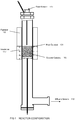
- Fig. 1 is a schematic drawing of a catalytic reactor made of stainless steel suitable for laboratory scale tests of the catalysts of the preferred combination.
- the metal gauze catalyst is used at the catalyst top as the first metal catalyst.
- the first high surface area carrier supported porous catalyst is followed with the metal gauze catalyst to give large reaction surface.
- the first reaction zone contains a first catalyst, which comprises a first material in a certain shape to be discussed in more detail later herein.
- the two reactors and/or catalyst beds can be separated and a recycled gas, such as byproduct stream, can be added between these two reactors or two beds.
- Steam or CO 2 also can be added into the system between two reactors or two beds to adjust the H 2 to CO ratio.
- the two reactors also can be put in the same vessel with or without distance or other materials/substances, inert or otherwise, in between.
- the first catalyst material comprises at least one first metal supported on at least one low surface area carrier with a first surface area less than about 1.0 square meter per gram (m 2 /g) and a first thermal conductivity.
- the catalyst on the top of the catalyst bed could be loaded with a large amount of metal to fill the pore, since the internal surface is not useful at the top and the heat conductivity could be increased with the pore full of metal.
- the metal fill amount in the catalyst could be reduced along the catalyst bed to increase the internal surface for the slower reforming reaction down the catalyst bed.
- the first catalyst used in the first bed for partial/complete hydrocarbon oxidation reaction is preferably a metal, such as one or more precious metals, supported on a low-surface area carrier with a first surface area less than about 1.0 square meter per gram (m 2 /g) and a first thermal conductivity.
- Precious metals such as Re, Rh, Pt can be coated, electroplated, diffusingly coated, or otherwise deposited onto cheaper metals such as Ni, Co, Al, Cu and mixtures thereof in a first shape selected from the group consisting of porous foam, gauze, mesh, honeycomb, monolith, cloth, wire, pellet, trilobe, ring, extrudate, sphere, bead, particulate, granule to reduce the catalyst cost.
- These precious metal(s) can also form metal alloys on the surface of such other cheaper metals.
- the first catalyst on the top or beginning of the catalyst bed could be loaded with a suitable amount of a filler metal to fill the pore to increase the heat and thermal conductivity.
- the metal fill amount in the first catalyst could be reduced along the catalyst bed to increase the internal surface for the slower reforming reaction further down into the catalyst bed.
- the first metal is coated on one or more other metallic substances. It is preferred that such one or more metallic substances also possess high thermal conductivities.
- a suitable metallic substance includes, but is not limited to, nickel, cobalt, aluminum, copper, alloys thereof and mixtures thereof.
- Other metallic substances can also be used provided that they exhibit good thermal conductivity and mechanical strength and that they do not interfere substantially with the desired catalytic partial oxidation reaction of the present invention to produce synthesis gas and/or other desired mixtures comprising carbon monoxide and hydrogen.
- the material or carrier itself is made of one or more such metallic substances.
- a suitable first metal of the first catalyst is selected from the group consisting of iron, cobalt, nickel, ruthenium, rhodium, palladium, osmium, iridium, platinum, titanium, vanadium, chromium, molybdenum, tungsten, alloys thereof, and mixtures thereof.
- a preferred first metal is selected from the group consisting of nickel, ruthenium, rhodium, palladium, iridium, tungsten, alloys thereof, and mixtures thereof.
- the first metal of the first catalyst can be present in various forms - metallic state, reduced forms, oxidized forms, hydrides, sulfides, alloys, complexes, and mixtures thereof.
- a second metal in the second reaction zone suitable for the present invention are selected from, but are not limited to, the group consisting of iron, cobalt, nickel, ruthenium,, rhodium, palladium, osmium, iridium, platinum, lanthanides such as lanthanum, cerium, gadolinium, praseodymium, neodymium, dysprosium, holmium, ytterbium, samarium europium, erbium, terbium, lutetium, actinides such as thorium, uranium, and mixtures thereof.
- Preferred second metal includes, but is not limited to cobalt, nickel, ruthenium,, rhodium, palladium, osmium, iridium, platinum.
- Carriers suitable for the second catalyst of the present invention include, but are not limited to those compounds with high surface areas, particularly high internal surface areas.
- Preferred carriers include, but are not limited to one or more refractory metal oxides, one or more rare earth metal modified refractory metal oxides, one or more alkaline earth metal modified refractory metal oxides, and mixtures thereof.
- metals for these metal oxides are selected from the group consisting of beryllium, magnesium, calcium, strontium, barium, boron, aluminum, zirconium, titanium, silicon, lanthanum, cerium, gadolinium, praseodymium, neodymium, dysprosium, holmium, ytterbium, samarium europium, erbium, terbium, lutetium, thorium, uranium, and mixtures thereof.
- the high surface area carrier of the second catalyst has a substantially stable surface area under reaction conditions.
- substantially stable within this invention means that the loss of surface area under prevailing reaction conditions over time is less than 2% per hour.
- the thermal conductivity of the first catalyst is higher than the thermal conductivity of the second catalyst and subsequent catalysts, if there are any in the reaction system.
- the thermal conductivity of the first catalyst is at least 0.05 cal/cm 2 /cm/second/°C. It is more preferred that the thermal conductivity is at least 0.10 cal/cm 2 /cm/second/°C. It is more preferred that the thermal conductivity is at least 0.15 cal/cm 2 /cm/second/°C.
- the feed stream comprises a mixture of a hydrocarbon feedstock and an oxidizing agent.
- the mixture can be made as a single feed; or alternatively, the hydrocarbon feedstock and the oxidizing agent can be mixed prior to being introduced into the reaction zone.
- the hydrocarbon feedstock can be selected from various compounds such as C 1 to C 10 organic compounds, including, but not limited to methane, ethane, propane, butanes, pentanes, hexanes, heptanes, octanes, nonanes, decanes, and mixtures thereof.
- Unsaturated hydrocarbons can be present, and/or used alone or in conjunction with saturated hydrocarbons too. Examples include, but are not limited to ethylene, acetylene, propylene, propyne, allene, C 4 to C 10 unsaturated compounds such as butene-1, butyne-1, and others, and mixtures thereof.
- Other heteroatom-containing compounds can be present in the hydrocarbon feedstock too.
- Examples include, but are not limited to CO, CO 2 , methanol, methylamine, formaldehyde, formic acid, ethanol, acetaldehyde, acetic acid, other similar oxygen or nitrogen containing compounds, and mixtures thereof. Heavier hydrocarbons can be present in the hydrocarbon feedstock too. But it is preferred that they are present in small quantities to avoid excessive catalyst deactivation.
- hydrocarbons C 1 -C 5 saturated or unsaturated compounds and/or their mixtures are preferred.
- a hydrocarbon feedstock comprising methane, or ethane, or propane, or butanes, and/or mixtures thereof.
- natural gas and liquefied natural gas also are more preferred. They comprise primarily methane, ethane, propane and some other hydrocarbons in small quantities.
- a feed consists essentially of methane is most preferred.
- oxygen-containing compounds such as CO, CO 2 , methanol, formaldehyde, formic acid, and others may also be present.
- the amounts would depend on the proportion of the recycle stream relative to the fresh feed.
- oxygen While many different oxidizing agents can be used, it is preferred to use oxygen, air, other compositions containing oxygen, and mixtures thereof.
- concentration of oxygen in the total feed stream is in the range of from about 0.01 vol% to about 50 vol%, preferably from about 0.1 vol% to about 35 vol%.
- oxygen concentrations outside the so-called flammable region to minimize operational risks.
- Carbon to oxygen ratios are from about 1:1 to about 3.3:1, more preferably, from about 1.3:1 to about 2.5:1, and most preferably from about 1.7:1 to 2.3:1.
- a side feed component is added to the reaction system between the first and the second catalyst.
- a suitable side feed component comprises one or more of the elements selected from, but not limited to, a recycle gas, steam, hydrogen, carbon dioxide, carbon monoxide, methane, ethane, methanol, formaldehyde, formic acid, and mixtures thereof.
- At least two different catalysts are used for the present invention to catalytically and partially oxidize the hydrocarbon feedstock to produce an effluent stream.
- the effluent stream comprises carbon monoxide and hydrogen.
- At least two catalysts are present in a reactor or a reaction system in series.
- One way is to have the catalyst stacked in the reactor, with or without any space or other materials or piping between the catalyst layers.
- the reactor can be placed vertically, horizontally, or in any other suitable angle, arrangements, or combinations thereof known to those skilled in the art.
- two or more catalysts (as a non-exclusive example) mixed to form a gradient - - 100% of the first catalyst in the front, decreasing amounts of the first catalyst and increasing of the second catalyst along the reactor and finally 100% of the second catalyst in the backend of the reactor.
- the feed stream is initially contacted with a first catalyst in the front under selected and appropriate reaction conditions.
- the first catalyst comprises a material, which has a shape of porous foam, gauze, mesh, honeycomb, wheel, monolith, mixtures thereof and other suitable forms.
- the material itself may be made of a first metal. Or, this material is loaded with a first metal for the first catalyst.
- the catalytic partial oxidation reaction can be carried out under a variety of reaction conditions.
- the conditions are selected and adjusted in accordance with the feed stream selected, the hydrocarbon selected, the oxidizing agent selected, the first catalyst selected, the second catalyst selected, other catalyst(s) selected, the manner in which the catalysts are configured, the reactor type, the desired synthesis gas composition (Hydrogen to carbon monoxide ratio), whether any products or byproducts will be recycled, and others.
- a flow rate, measured as space velocity, suitable for the present invention is in the range of from about 1,000 to about 10,000,000 NL/Kg/Hr (normal liters per kilograms of catalyst per hour), preferably from about 10,000 to about 1,000,000 NL/Kg/Hr, and more preferably from about 50,000 to about 500,000 NL/Kg/Hr.
- the flow rate can be adjusted to achieve the desired conversion, selectivity and catalyst life of the catalytic partial oxidation.
- an inlet temperature in the range of from about 15°C to about 750°C is considered suitable.
- the range is preferred to be in the range of from about 150 to about 550°C, more preferably from about 250°C to about 450°C.
- the catalyst degrades faster when the reactor is operated under pressure.
- the reactant density is higher and the heat generation per unit (weight or volume or other suitable measurements) catalyst is also higher.
- the porous catalyst carrier with poor heat (thermal) conductivity and high heat resistance cannot sustain the severe conditions and the active first (or catalytic active) metal is sintered at a faster rate than the rate of sintering for a reaction operated at lower pressures.
- the equilibrium conversion of the catalytic partial oxidation reaction changes with operating pressure.
- Pressure is in the range of from about 101 kPa to about 7,500 kPa; preferably from about 600 kPa to about 3500 kPa; and more preferably from about 1,200 kPa to about 2,500 kPa.
- the pressure can be adjusted as the reaction proceeds to obtain the desired reaction results.
- Another aspect of the current invention relates to recycling of certain by-products or products back to the reaction system at a point between the inlet and the outlet. If two catalysts, a first catalyst and a second catalyst, are used, a preferred point of injecting the recycle stream is somewhere between the two catalyst beds.
- Another aspect of the current invention relates to fuel cell. Steam is introduced in to the reactor between the two catalyst beds to do water gas shifting reaction to convert CO in syngas to H 2 .
- the conversion of a hydrocarbon, such as methane, in a process according to the instant invention is at least 50%, preferably at least about 60%, more preferably at least about 70%, and most preferably at least 75%.
- Selectivity to H 2 is preferred to be at least 65 mol%, more preferably at least about 75 mol%, most preferably at least 85 mol%; and selectivity to CO is preferred to be least 65 mol%, more preferably at least about 75 mol%, most preferably at least 85 mol%.
- a 20 millimeter diameter and 5 millimeter thick Ni gauze with 60 mesh was used as the first catalyst in the first reaction zone.
- a 10 millimeter thick porous carrier supported Ni catalyst with 13% Ni and 12% La was used as the second catalyst in the second reaction zone.
- a feed mixture containing 67 vol% methane and 33 vol% oxygen (The feed is in the flammability range. But with good mixer, there is no problem. The higher inlet temperature can get more reforming and thus higher CH4 conversion and CO and H2 selectivity. The problem for higher inlet temperature is easier to get pre-ignition before the mixed gas contacting the catalyst.) was passed through the reactor containing above catalyst at a space velocity of 46,000 per hour. Methane conversion 86.1%, CO selectivity 84.1%, H 2 selectivity 99.9%, inlet temperature 235 °C, Outlet temperature 920 °C.
- a 20 millimeter diameter and 3 millimeter thick Rh gauze with 80 mesh was used as the first catalyst in the first reaction zone.
- a 10 millimeter thick porous carrier supported Rh catalyst with 4% Rh and 8% La was used as the second catalyst in the second reaction zone.
- a feed mixture containing 67 vol% methane and 33 vol% oxygen was passed through the reactor containing above catalyst at a space velocity of 128,000 per hour. Methane conversion 96.1%, CO selectivity 95.6%, H 2 selectivity 96.4%, inlet temperature 235 °C, Outlet temperature 875 °C.
- the catalytic partial oxidation reaction process of the present invention can (a) eliminate the catalyst sintering to extend the catalyst life, (b) reduce the temperature rise in the front of the reactor system to reduce the initial complete oxidation of hydrocarbon feed, and/or (c) maintain as high as possible a temperature in the rest of the reactor system in order to maintain a reasonable reaction rate for reforming reactions to convert undesirable complete oxidation products, water and CO 2 , to form additional synthesis gas (namely, a mixture of hydrogen and CO), which is expected to increasingly become the starting material of choice for energy production and/or feedstock for industrial chemical processes.
- additional synthesis gas namely, a mixture of hydrogen and CO
Landscapes
- Chemical & Material Sciences (AREA)
- Chemical Kinetics & Catalysis (AREA)
- Engineering & Computer Science (AREA)
- Combustion & Propulsion (AREA)
- Organic Chemistry (AREA)
- Health & Medical Sciences (AREA)
- General Health & Medical Sciences (AREA)
- Inorganic Chemistry (AREA)
- Catalysts (AREA)
- Hydrogen, Water And Hydrids (AREA)
- Organic Low-Molecular-Weight Compounds And Preparation Thereof (AREA)
Priority Applications (1)
| Application Number | Priority Date | Filing Date | Title |
|---|---|---|---|
| PL08769725T PL2181065T3 (pl) | 2007-07-26 | 2008-05-24 | Częściowe utlenianie węglowodorów |
Applications Claiming Priority (2)
| Application Number | Priority Date | Filing Date | Title |
|---|---|---|---|
| US11/881,277 US7981397B2 (en) | 2007-07-26 | 2007-07-26 | Partial oxidation of hydrocarbons |
| PCT/US2008/064806 WO2009014800A1 (en) | 2007-07-26 | 2008-05-24 | Partial oxidation of hydrocarbons |
Publications (3)
| Publication Number | Publication Date |
|---|---|
| EP2181065A1 EP2181065A1 (en) | 2010-05-05 |
| EP2181065A4 EP2181065A4 (en) | 2012-03-21 |
| EP2181065B1 true EP2181065B1 (en) | 2019-03-20 |
Family
ID=40281695
Family Applications (1)
| Application Number | Title | Priority Date | Filing Date |
|---|---|---|---|
| EP08769725.6A Active EP2181065B1 (en) | 2007-07-26 | 2008-05-24 | Partial oxidation of hydrocarbons |
Country Status (14)
| Country | Link |
|---|---|
| US (1) | US7981397B2 (pl) |
| EP (1) | EP2181065B1 (pl) |
| CN (1) | CN101754926B (pl) |
| AU (1) | AU2008279602B2 (pl) |
| BR (1) | BRPI0813842A2 (pl) |
| CA (1) | CA2694585C (pl) |
| DK (1) | DK2181065T3 (pl) |
| EA (1) | EA017647B1 (pl) |
| ES (1) | ES2731433T3 (pl) |
| LT (1) | LT2181065T (pl) |
| MY (1) | MY150494A (pl) |
| PL (1) | PL2181065T3 (pl) |
| TR (1) | TR201908910T4 (pl) |
| WO (1) | WO2009014800A1 (pl) |
Families Citing this family (8)
| Publication number | Priority date | Publication date | Assignee | Title |
|---|---|---|---|---|
| WO2011016030A1 (en) * | 2009-08-03 | 2011-02-10 | Technion Research & Development Foundation Ltd. | Hydrogen production by an autothermal heat exchanger packed-bed membrane gas reformer |
| IT1400492B1 (it) | 2010-06-03 | 2013-06-11 | Eni Spa | Sistema catalitico per processi di ossidazione parziale catalitica a basso tempo di contatto |
| TR201905563T4 (tr) * | 2011-06-23 | 2019-05-21 | Stamicarbon B V Acting Under The Name Of Mt Innovation Center | Hidrojen üretimine yönelik olarak uygun bir sentez gazı aracının üretilmesine yönelik proses. |
| TWI592209B (zh) | 2016-03-31 | 2017-07-21 | 國立清華大學 | 反應器及其溫度的控制方法 |
| US9943818B2 (en) | 2016-06-20 | 2018-04-17 | Air Products And Chemicals, Inc. | Steam-hydrocarbon reforming reactor |
| EP3260194A1 (en) * | 2016-06-20 | 2017-12-27 | Air Products and Chemicals, Inc. | Steam-hydrocarbon reforming reactor |
| US11440797B2 (en) * | 2019-07-11 | 2022-09-13 | Bang-Cheng Xu | Partial oxidation of hydrocarbons |
| WO2022066829A1 (en) * | 2020-09-24 | 2022-03-31 | Miratech Group, Llc | Apparatus, system, and method for oxidizing methane in a lean-burn engine exhaust |
Family Cites Families (7)
| Publication number | Priority date | Publication date | Assignee | Title |
|---|---|---|---|---|
| US5399537A (en) * | 1992-12-21 | 1995-03-21 | Amoco Corporation | Method for preparing synthesis gas using nickel catalysts |
| AR017317A1 (es) * | 1997-10-14 | 2001-09-05 | Shell Int Research | Proceso de oxidacion parcial catalitica, un metodo y disposicion para generar energia electrica por medio de dicho proceso, y medio de transporteprovisto con dicha disposicion |
| US6254807B1 (en) * | 1998-01-12 | 2001-07-03 | Regents Of The University Of Minnesota | Control of H2 and CO produced in partial oxidation process |
| US6887456B2 (en) * | 2001-10-05 | 2005-05-03 | Conocophillips Company | Catalyst system for enhanced flow syngas production |
| US7404936B2 (en) * | 2002-10-22 | 2008-07-29 | Velocys | Catalysts, in microchannel apparatus, and reactions using same |
| US7230035B2 (en) * | 2002-12-30 | 2007-06-12 | Conocophillips Company | Catalysts for the conversion of methane to synthesis gas |
| US7381230B2 (en) * | 2004-12-30 | 2008-06-03 | Conocophillips Company | Reactor and process for making synthesis gas |
-
2007
- 2007-07-26 US US11/881,277 patent/US7981397B2/en not_active Expired - Fee Related
-
2008
- 2008-05-24 EA EA201000253A patent/EA017647B1/ru not_active IP Right Cessation
- 2008-05-24 BR BRPI0813842-7A2A patent/BRPI0813842A2/pt not_active IP Right Cessation
- 2008-05-24 TR TR2019/08910T patent/TR201908910T4/tr unknown
- 2008-05-24 CN CN2008800185833A patent/CN101754926B/zh active Active
- 2008-05-24 AU AU2008279602A patent/AU2008279602B2/en not_active Ceased
- 2008-05-24 ES ES08769725T patent/ES2731433T3/es active Active
- 2008-05-24 DK DK08769725.6T patent/DK2181065T3/da active
- 2008-05-24 CA CA2694585A patent/CA2694585C/en active Active
- 2008-05-24 PL PL08769725T patent/PL2181065T3/pl unknown
- 2008-05-24 LT LTEP08769725.6T patent/LT2181065T/lt unknown
- 2008-05-24 EP EP08769725.6A patent/EP2181065B1/en active Active
- 2008-05-24 WO PCT/US2008/064806 patent/WO2009014800A1/en not_active Ceased
- 2008-05-24 MY MYPI20100260 patent/MY150494A/en unknown
Non-Patent Citations (1)
| Title |
|---|
| None * |
Also Published As
| Publication number | Publication date |
|---|---|
| PL2181065T3 (pl) | 2019-10-31 |
| CN101754926A (zh) | 2010-06-23 |
| ES2731433T3 (es) | 2019-11-15 |
| EA201000253A1 (ru) | 2010-06-30 |
| CA2694585A1 (en) | 2009-01-29 |
| US7981397B2 (en) | 2011-07-19 |
| EP2181065A4 (en) | 2012-03-21 |
| TR201908910T4 (tr) | 2019-07-22 |
| MY150494A (en) | 2014-01-30 |
| BRPI0813842A2 (pt) | 2015-01-06 |
| CN101754926B (zh) | 2012-09-05 |
| LT2181065T (lt) | 2019-09-25 |
| EP2181065A1 (en) | 2010-05-05 |
| WO2009014800A1 (en) | 2009-01-29 |
| AU2008279602B2 (en) | 2013-12-05 |
| EA017647B1 (ru) | 2013-02-28 |
| US20090026420A1 (en) | 2009-01-29 |
| CA2694585C (en) | 2016-01-19 |
| AU2008279602A1 (en) | 2009-01-29 |
| DK2181065T3 (da) | 2019-06-24 |
Similar Documents
| Publication | Publication Date | Title |
|---|---|---|
| EP2181065B1 (en) | Partial oxidation of hydrocarbons | |
| US7226548B2 (en) | Syngas catalysts and their method of use | |
| EP1315670B1 (en) | Process for producing synthesis gas with lanthanide-promoted rhodium catalysts | |
| US7592290B2 (en) | Supported catalyst for stream methane reforming and autothermal reforming reactions | |
| AU2001290617A1 (en) | Lanthanide-promoted rhodium catalysts and process for producing synthesis gas | |
| EP1322549A2 (en) | Catalytic oxidation process | |
| CA2887849A1 (en) | Reactor and catalyst for converting natural gas to organic compounds | |
| WO2001009033A1 (en) | Catalytic partial oxidation processes and catalysts with diffusion barrier coating | |
| WO2011113611A2 (en) | Reforming catalyst | |
| CN103170335A (zh) | 有效的二氧化碳转换催化剂及其制备方法 | |
| US7105107B2 (en) | Use of nonmicroporous support for syngas catalyst | |
| JP5378148B2 (ja) | 改質用触媒、改質装置および水素製造装置 | |
| US7008560B2 (en) | Silicon carbide-supported catalysts for partial oxidation of natural gas to synthesis gas | |
| AU5349000A (en) | Process for pre-reforming of oxygen-containing gas | |
| US20090026419A1 (en) | Partial oxidation of hydrocarbons | |
| US11440797B2 (en) | Partial oxidation of hydrocarbons | |
| WO2004043584A2 (en) | Novel syngas catalysts and their method of use | |
| Haryanto | High temperature water gas shift reaction over nickel catalysts for hydrogen production: effect of supports, GHSV, metal loading, and dopant materials | |
| AU2024289300A1 (en) | Steam reforming | |
| Yang et al. | CH4 reforming by CO2 and O2 using Ni‐M (M= Cu, Fe, Co, Mn, Zn, Cr) Bimetallic Aerogel Catalysts | |
| Bao et al. | Novel catalysts for synthesis gas generation from natural |
Legal Events
| Date | Code | Title | Description |
|---|---|---|---|
| PUAI | Public reference made under article 153(3) epc to a published international application that has entered the european phase |
Free format text: ORIGINAL CODE: 0009012 |
|
| 17P | Request for examination filed |
Effective date: 20100215 |
|
| AK | Designated contracting states |
Kind code of ref document: A1 Designated state(s): AT BE BG CH CY CZ DE DK EE ES FI FR GB GR HR HU IE IS IT LI LT LU LV MC MT NL NO PL PT RO SE SI SK TR |
|
| AX | Request for extension of the european patent |
Extension state: AL BA MK RS |
|
| DAX | Request for extension of the european patent (deleted) | ||
| A4 | Supplementary search report drawn up and despatched |
Effective date: 20120222 |
|
| RIC1 | Information provided on ipc code assigned before grant |
Ipc: C01B 3/38 20060101AFI20120216BHEP |
|
| 17Q | First examination report despatched |
Effective date: 20140620 |
|
| STAA | Information on the status of an ep patent application or granted ep patent |
Free format text: STATUS: EXAMINATION IS IN PROGRESS |
|
| GRAP | Despatch of communication of intention to grant a patent |
Free format text: ORIGINAL CODE: EPIDOSNIGR1 |
|
| STAA | Information on the status of an ep patent application or granted ep patent |
Free format text: STATUS: GRANT OF PATENT IS INTENDED |
|
| INTG | Intention to grant announced |
Effective date: 20180926 |
|
| GRAS | Grant fee paid |
Free format text: ORIGINAL CODE: EPIDOSNIGR3 |
|
| GRAA | (expected) grant |
Free format text: ORIGINAL CODE: 0009210 |
|
| STAA | Information on the status of an ep patent application or granted ep patent |
Free format text: STATUS: THE PATENT HAS BEEN GRANTED |
|
| AK | Designated contracting states |
Kind code of ref document: B1 Designated state(s): AT BE BG CH CY CZ DE DK EE ES FI FR GB GR HR HU IE IS IT LI LT LU LV MC MT NL NO PL PT RO SE SI SK TR |
|
| REG | Reference to a national code |
Ref country code: GB Ref legal event code: FG4D |
|
| REG | Reference to a national code |
Ref country code: CH Ref legal event code: EP |
|
| REG | Reference to a national code |
Ref country code: DE Ref legal event code: R096 Ref document number: 602008059427 Country of ref document: DE |
|
| REG | Reference to a national code |
Ref country code: AT Ref legal event code: REF Ref document number: 1110325 Country of ref document: AT Kind code of ref document: T Effective date: 20190415 |
|
| REG | Reference to a national code |
Ref country code: IE Ref legal event code: FG4D |
|
| REG | Reference to a national code |
Ref country code: RO Ref legal event code: EPE |
|
| REG | Reference to a national code |
Ref country code: DK Ref legal event code: T3 Effective date: 20190619 |
|
| REG | Reference to a national code |
Ref country code: NL Ref legal event code: FP |
|
| REG | Reference to a national code |
Ref country code: SE Ref legal event code: TRGR |
|
| PG25 | Lapsed in a contracting state [announced via postgrant information from national office to epo] |
Ref country code: FI Free format text: LAPSE BECAUSE OF FAILURE TO SUBMIT A TRANSLATION OF THE DESCRIPTION OR TO PAY THE FEE WITHIN THE PRESCRIBED TIME-LIMIT Effective date: 20190320 |
|
| PGFP | Annual fee paid to national office [announced via postgrant information from national office to epo] |
Ref country code: IT Payment date: 20190619 Year of fee payment: 12 Ref country code: DE Payment date: 20190617 Year of fee payment: 12 Ref country code: LU Payment date: 20190619 Year of fee payment: 12 Ref country code: LT Payment date: 20190621 Year of fee payment: 12 |
|
| REG | Reference to a national code |
Ref country code: CH Ref legal event code: NV Representative=s name: LANGPATENT ANWALTSKANZLEI IP LAW FIRM, CH |
|
| PG25 | Lapsed in a contracting state [announced via postgrant information from national office to epo] |
Ref country code: LV Free format text: LAPSE BECAUSE OF FAILURE TO SUBMIT A TRANSLATION OF THE DESCRIPTION OR TO PAY THE FEE WITHIN THE PRESCRIBED TIME-LIMIT Effective date: 20190320 Ref country code: BG Free format text: LAPSE BECAUSE OF FAILURE TO SUBMIT A TRANSLATION OF THE DESCRIPTION OR TO PAY THE FEE WITHIN THE PRESCRIBED TIME-LIMIT Effective date: 20190620 Ref country code: HR Free format text: LAPSE BECAUSE OF FAILURE TO SUBMIT A TRANSLATION OF THE DESCRIPTION OR TO PAY THE FEE WITHIN THE PRESCRIBED TIME-LIMIT Effective date: 20190320 Ref country code: GR Free format text: LAPSE BECAUSE OF FAILURE TO SUBMIT A TRANSLATION OF THE DESCRIPTION OR TO PAY THE FEE WITHIN THE PRESCRIBED TIME-LIMIT Effective date: 20190621 |
|
| PGFP | Annual fee paid to national office [announced via postgrant information from national office to epo] |
Ref country code: SE Payment date: 20190624 Year of fee payment: 12 Ref country code: TR Payment date: 20190616 Year of fee payment: 12 Ref country code: BE Payment date: 20190619 Year of fee payment: 12 Ref country code: RO Payment date: 20190620 Year of fee payment: 12 |
|
| REG | Reference to a national code |
Ref country code: NO Ref legal event code: T2 Effective date: 20190320 |
|
| REG | Reference to a national code |
Ref country code: AT Ref legal event code: MK05 Ref document number: 1110325 Country of ref document: AT Kind code of ref document: T Effective date: 20190320 |
|
| PGFP | Annual fee paid to national office [announced via postgrant information from national office to epo] |
Ref country code: CH Payment date: 20190618 Year of fee payment: 12 |
|
| PG25 | Lapsed in a contracting state [announced via postgrant information from national office to epo] |
Ref country code: EE Free format text: LAPSE BECAUSE OF FAILURE TO SUBMIT A TRANSLATION OF THE DESCRIPTION OR TO PAY THE FEE WITHIN THE PRESCRIBED TIME-LIMIT Effective date: 20190320 Ref country code: PT Free format text: LAPSE BECAUSE OF FAILURE TO SUBMIT A TRANSLATION OF THE DESCRIPTION OR TO PAY THE FEE WITHIN THE PRESCRIBED TIME-LIMIT Effective date: 20190720 Ref country code: SK Free format text: LAPSE BECAUSE OF FAILURE TO SUBMIT A TRANSLATION OF THE DESCRIPTION OR TO PAY THE FEE WITHIN THE PRESCRIBED TIME-LIMIT Effective date: 20190320 Ref country code: CZ Free format text: LAPSE BECAUSE OF FAILURE TO SUBMIT A TRANSLATION OF THE DESCRIPTION OR TO PAY THE FEE WITHIN THE PRESCRIBED TIME-LIMIT Effective date: 20190320 Ref country code: IT Free format text: LAPSE BECAUSE OF FAILURE TO SUBMIT A TRANSLATION OF THE DESCRIPTION OR TO PAY THE FEE WITHIN THE PRESCRIBED TIME-LIMIT Effective date: 20190320 |
|
| PGFP | Annual fee paid to national office [announced via postgrant information from national office to epo] |
Ref country code: PL Payment date: 20190613 Year of fee payment: 12 |
|
| PG25 | Lapsed in a contracting state [announced via postgrant information from national office to epo] |
Ref country code: AT Free format text: LAPSE BECAUSE OF FAILURE TO SUBMIT A TRANSLATION OF THE DESCRIPTION OR TO PAY THE FEE WITHIN THE PRESCRIBED TIME-LIMIT Effective date: 20190320 Ref country code: IS Free format text: LAPSE BECAUSE OF FAILURE TO SUBMIT A TRANSLATION OF THE DESCRIPTION OR TO PAY THE FEE WITHIN THE PRESCRIBED TIME-LIMIT Effective date: 20190720 |
|
| REG | Reference to a national code |
Ref country code: DE Ref legal event code: R097 Ref document number: 602008059427 Country of ref document: DE |
|
| PLBE | No opposition filed within time limit |
Free format text: ORIGINAL CODE: 0009261 |
|
| STAA | Information on the status of an ep patent application or granted ep patent |
Free format text: STATUS: NO OPPOSITION FILED WITHIN TIME LIMIT |
|
| 26N | No opposition filed |
Effective date: 20200102 |
|
| PG25 | Lapsed in a contracting state [announced via postgrant information from national office to epo] |
Ref country code: SI Free format text: LAPSE BECAUSE OF FAILURE TO SUBMIT A TRANSLATION OF THE DESCRIPTION OR TO PAY THE FEE WITHIN THE PRESCRIBED TIME-LIMIT Effective date: 20190320 |
|
| REG | Reference to a national code |
Ref country code: DE Ref legal event code: R119 Ref document number: 602008059427 Country of ref document: DE |
|
| REG | Reference to a national code |
Ref country code: DK Ref legal event code: EBP Effective date: 20200531 |
|
| REG | Reference to a national code |
Ref country code: LT Ref legal event code: MM4D Effective date: 20200524 |
|
| PG25 | Lapsed in a contracting state [announced via postgrant information from national office to epo] |
Ref country code: LT Free format text: LAPSE BECAUSE OF NON-PAYMENT OF DUE FEES Effective date: 20200524 Ref country code: LI Free format text: LAPSE BECAUSE OF NON-PAYMENT OF DUE FEES Effective date: 20200531 Ref country code: CH Free format text: LAPSE BECAUSE OF NON-PAYMENT OF DUE FEES Effective date: 20200531 Ref country code: MC Free format text: LAPSE BECAUSE OF NON-PAYMENT OF DUE FEES Effective date: 20200602 Ref country code: SE Free format text: LAPSE BECAUSE OF NON-PAYMENT OF DUE FEES Effective date: 20200525 Ref country code: RO Free format text: LAPSE BECAUSE OF NON-PAYMENT OF DUE FEES Effective date: 20200524 |
|
| REG | Reference to a national code |
Ref country code: BE Ref legal event code: MM Effective date: 20200531 |
|
| PG25 | Lapsed in a contracting state [announced via postgrant information from national office to epo] |
Ref country code: LU Free format text: LAPSE BECAUSE OF NON-PAYMENT OF DUE FEES Effective date: 20200524 |
|
| PG25 | Lapsed in a contracting state [announced via postgrant information from national office to epo] |
Ref country code: DK Free format text: LAPSE BECAUSE OF NON-PAYMENT OF DUE FEES Effective date: 20200531 |
|
| PG25 | Lapsed in a contracting state [announced via postgrant information from national office to epo] |
Ref country code: CY Free format text: LAPSE BECAUSE OF FAILURE TO SUBMIT A TRANSLATION OF THE DESCRIPTION OR TO PAY THE FEE WITHIN THE PRESCRIBED TIME-LIMIT Effective date: 20190320 Ref country code: BE Free format text: LAPSE BECAUSE OF NON-PAYMENT OF DUE FEES Effective date: 20200531 Ref country code: DE Free format text: LAPSE BECAUSE OF NON-PAYMENT OF DUE FEES Effective date: 20201201 |
|
| PG25 | Lapsed in a contracting state [announced via postgrant information from national office to epo] |
Ref country code: MT Free format text: LAPSE BECAUSE OF FAILURE TO SUBMIT A TRANSLATION OF THE DESCRIPTION OR TO PAY THE FEE WITHIN THE PRESCRIBED TIME-LIMIT Effective date: 20190320 Ref country code: HU Free format text: LAPSE BECAUSE OF FAILURE TO SUBMIT A TRANSLATION OF THE DESCRIPTION OR TO PAY THE FEE WITHIN THE PRESCRIBED TIME-LIMIT; INVALID AB INITIO Effective date: 20080524 |
|
| PG25 | Lapsed in a contracting state [announced via postgrant information from national office to epo] |
Ref country code: TR Free format text: LAPSE BECAUSE OF NON-PAYMENT OF DUE FEES Effective date: 20200524 |
|
| PG25 | Lapsed in a contracting state [announced via postgrant information from national office to epo] |
Ref country code: PL Free format text: LAPSE BECAUSE OF NON-PAYMENT OF DUE FEES Effective date: 20200524 |
|
| PGFP | Annual fee paid to national office [announced via postgrant information from national office to epo] |
Ref country code: NL Payment date: 20241120 Year of fee payment: 17 |
|
| PGFP | Annual fee paid to national office [announced via postgrant information from national office to epo] |
Ref country code: NO Payment date: 20241119 Year of fee payment: 17 |
|
| PGFP | Annual fee paid to national office [announced via postgrant information from national office to epo] |
Ref country code: GB Payment date: 20241031 Year of fee payment: 17 |
|
| PGFP | Annual fee paid to national office [announced via postgrant information from national office to epo] |
Ref country code: FR Payment date: 20241118 Year of fee payment: 17 |
|
| PGFP | Annual fee paid to national office [announced via postgrant information from national office to epo] |
Ref country code: IE Payment date: 20241120 Year of fee payment: 17 |
|
| PGFP | Annual fee paid to national office [announced via postgrant information from national office to epo] |
Ref country code: ES Payment date: 20241118 Year of fee payment: 17 |
|
| REG | Reference to a national code |
Ref country code: NL Ref legal event code: MM Effective date: 20250601 |
|
| PG25 | Lapsed in a contracting state [announced via postgrant information from national office to epo] |
Ref country code: NO Free format text: LAPSE BECAUSE OF NON-PAYMENT OF DUE FEES Effective date: 20250531 |
|
| GBPC | Gb: european patent ceased through non-payment of renewal fee |
Effective date: 20250524 |
|
| PG25 | Lapsed in a contracting state [announced via postgrant information from national office to epo] |
Ref country code: NL Free format text: LAPSE BECAUSE OF NON-PAYMENT OF DUE FEES Effective date: 20250601 |
|
| PG25 | Lapsed in a contracting state [announced via postgrant information from national office to epo] |
Ref country code: GB Free format text: LAPSE BECAUSE OF NON-PAYMENT OF DUE FEES Effective date: 20250524 |
|
| PG25 | Lapsed in a contracting state [announced via postgrant information from national office to epo] |
Ref country code: IE Free format text: LAPSE BECAUSE OF NON-PAYMENT OF DUE FEES Effective date: 20250524 |
|
| PG25 | Lapsed in a contracting state [announced via postgrant information from national office to epo] |
Ref country code: FR Free format text: LAPSE BECAUSE OF NON-PAYMENT OF DUE FEES Effective date: 20250531 |