EP2180429A2 - Empirische Modellierung von Konfusionsmatrizen - Google Patents
Empirische Modellierung von Konfusionsmatrizen Download PDFInfo
- Publication number
- EP2180429A2 EP2180429A2 EP09174022A EP09174022A EP2180429A2 EP 2180429 A2 EP2180429 A2 EP 2180429A2 EP 09174022 A EP09174022 A EP 09174022A EP 09174022 A EP09174022 A EP 09174022A EP 2180429 A2 EP2180429 A2 EP 2180429A2
- Authority
- EP
- European Patent Office
- Prior art keywords
- library
- performance
- classifier
- classifier system
- confusion matrix
- Prior art date
- Legal status (The legal status is an assumption and is not a legal conclusion. Google has not performed a legal analysis and makes no representation as to the accuracy of the status listed.)
- Withdrawn
Links
Images


Classifications
-
- G—PHYSICS
- G06—COMPUTING OR CALCULATING; COUNTING
- G06F—ELECTRIC DIGITAL DATA PROCESSING
- G06F18/00—Pattern recognition
- G06F18/20—Analysing
- G06F18/21—Design or setup of recognition systems or techniques; Extraction of features in feature space; Blind source separation
-
- G—PHYSICS
- G06—COMPUTING OR CALCULATING; COUNTING
- G06F—ELECTRIC DIGITAL DATA PROCESSING
- G06F18/00—Pattern recognition
- G06F18/20—Analysing
- G06F18/24—Classification techniques
- G06F18/241—Classification techniques relating to the classification model, e.g. parametric or non-parametric approaches
- G06F18/2415—Classification techniques relating to the classification model, e.g. parametric or non-parametric approaches based on parametric or probabilistic models, e.g. based on likelihood ratio or false acceptance rate versus a false rejection rate
Definitions
- This application generally relates to artificial intelligence and/or pattern recognition systems, and in particular, estimating the performance of a classifier system.
- Classifier systems may be used in the field of artificial intelligence and/or pattern recognition to identify an object and then to classify it into one or more predetermined categories.
- One exemplary classifier system is an automated target recognition (ATR) system.
- ATR systems are known which are used to identify and categorize military targets.
- Classifier systems may also be used for face recognition, agriculture classification, medical applications (e.g., detecting healthy and unhealthy tissue or cells), and many other applications.
- a confusion matrix is a tool that may be used to characterize the performance of a given classifier system.
- the confusion matrix is generated by evaluating the response of a classifier system to known data.
- a computer-implemented method for estimating the performance of a classifier system comprising: providing an observed confusion matrix quantified by in-library category data which characterizes the classifier system as an input to a computer; generating, using the computer, an empirical model for the performance of the confusion matrix using two density functions that capture correct and incorrect performance of the in-library categories and their respective parameters, and a further density function characterizing an in-library to out-of-library probability parameter; predicting, based upon the empirical model, how well the classifier system will perform when presented with out-of-library data; and outputting, from the computer, the prediction to estimate the performance of the classifier system.
- a system for estimating the performance of a classifier system comprising: a computer processor; a memory containing a structured database having an observed confusion matrix quantified by in-library category data which characterizes the classifier system; an empirical modeler configured to generate an empirical model of the classifier performance using two density functions that capture correct and incorrect performance of the in-library categories and their respective parameters from the confusion matrix, and a further density function characterizing an in-library to out-of-library probability parameter; a predictions unit configured to predict, based upon the empirical model, how well the classifier system will perform when presented with out-of-library data; and a device configured to output the prediction to estimate the performance of the classifier system.
- a methodology of estimating the parameters of an empirical model of classifier performance that can then be used to model the performance of a classifier system based on an observed reported confusion matrix is provided.
- parameters are fit to the observed confusion matrix, such that the expected performance of decision detection versus the probability of not-in-library reports can be estimated based on the forced decision confusion matrix.
- This approach also lends itself to a general methodology for modeling classes of confusers in a statistical manner, and can in principle, also be extended to modeling clutter severity. The expected performance of the system in the case of "not-in-library" target types is also discussed.
- the performance of a pattern classification system may be estimated, without explicit detailed knowledge of the design of the classification system.
- the benefits of such an approach may be applied to many diverse areas that involve pattern recognition problems.
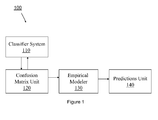
- Figure 1 shows an exemplary system 100 for estimating the performance of a classifier system, according to an embodiment of this disclosure.
- the system 100 may be implemented in software, hardware, or combinations thereof.
- the system 100 may executed using one or more computers or other machines.
- the system 100 generally includes a classifier system 110, confusion matrix unit 120, empirical modeler 130 and a predictions unit 140. It will be appreciated that some elements may be combined, and that additional elements are possible.
- the classifier system 110 may include any classifier system. Exemplary classifier systems are generally used with artificial intelligence and/or pattern recognition systems. In one embodiment, the classifier system 110 may be automated target recognition (ATR) system. For example, ATR systems are known which identify critical military targets using synthetic aperture radar (SAR) imagery. In other implementations, the classifier system 110 may be applied to target recognition, face recognition, agriculture classifications, medical applications (e.g., detecting healthy and unhealthy tissue or cells).
- ATR automated target recognition
- SAR synthetic aperture radar
- the classifier system 110 may be applied to target recognition, face recognition, agriculture classifications, medical applications (e.g., detecting healthy and unhealthy tissue or cells).
- the confusion matrix unit 120 may be used for estimating the performance of a classifier system.
- a confusion matrix shows how well the classifier system confusing two (or more) classes based on known category data.
- the confusion matrix contains information about actual (or "true class type") and predicted classification performance (i.e., correct or incorrect classification) of known category data by a classification system.
- the columns of the matrix may represent instances of the known data in a predicted class.
- the rows of the matrix may represent instances of the known data in an actual class.
- Confusion matrices may be generated by known hardware, software (firmware), or combinations thereof, in conjunction with a classifier system 110.
- the confusion matrix unit 120 may interact and exchange data with the classifier system 110.
- the confusion matrix unit 120 may include a memory containing a structured database having an observed confusion matrix quantified by in-library category data which characterizes the classifier system.
- the known data to the classifier system may be referred to as "in-library” category data.
- “In-library” category data may include, for example, digital files or other data which may be introduced to the classified system.
- the category data may include digital photograph or video signals typical of which a camera or sensor would feed to a microprocessor for identification and classification.
- the "in-library” category data may be stored in a memory associated with the confusion matrix unit 120.
- data which is unknown to the classifier system may be referred to as "out-of-library” category data. In some implementations, this may be actual data measurements which the classifier system 110 may be used to classify.
- the empirical model generator 130 may be configured to model the confusion matrix performance when presented with data from out-of-library categories.
- the empirical model relies upon two density functions that capture correct and incorrect performance of the in-library categories and their respective parameters, and a further density function characterizing an in-library to out-of-library probability parameter.
- the two density functions may be Gaussian-derived functions, for example, a Rayleigh density function and a Ricean density function.
- the further density function may include the non-centrality term of a Rayleigh density function.
- the predictor unit 140 is configured to output how well the classifier system will perform when presented with data from out-of-library categories.
- the display may be a visual display device (for example, a monitor) and/or a print-out.
- the data may be stored, for example, on a computer or machine memory (e.g., flash memory, CD/DVD-ROM, hard-drive, etc.) for later retrieval and analysis.
- the predictions may be displayed as a plot of the probability of detection (P D ) vs. probability that the category data is not-in-library (P leak ).
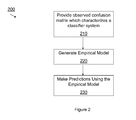
- Figure 2 shows an exemplary method 200 for estimating the performance of a classifier system, according to an embodiment of this disclosure.
- an observed confusion matrix quantified by in-library category data which characterizes the classifier system is provided.
- the empirical model lends itself to the confusion matrix irrespective of the classifier system.
- an empirical model is generated for evaluating the performance of the confusion matrix using two density functions that capture correct and incorrect performance of the in-library categories and their respective parameters, and a further density function characterizing an in-library to out-of-library probability ratio.
- the same empirical model may be used for different classifier systems, but having different parameters.
- the empirical model may be stored in a memory.
- predictions may be made as to how well the classifier system will perform when presented with out-of-library data.
- the predictions may be output to a user for analysis.
- the output data may be stored in a memory, displayed on a monitor, and/or printed.
- an empirical model is implemented for predicting the probability of reporting or detecting a not-in-library object given that one has an observed confusion matrix of the in-library objects.
- Figure 3 shows a flow chart 300 showing empirical modeling of the confusion matrices and confuser rejection predictions, according to an embodiment of this disclosure.
- the modeling begins first an observed confusion matrix 310, which is fitted with model parameters 320, Depending on the predictions desired, forced predictions 330 or unforced predictions 340 may be made.
- the initial empirical model adopts this model with two Gaussian components to develop a model of confusion matrix performance, although it may be possible to subsequently extend this model to a higher number of terms if required.
- the Rayleigh density describes the observed root mean square error for the correct class and the Ricean density the same quantity for the incorrect class or classes.
- a simple empirical model may be applied to the modeling of observed confusion matrices which may in actual practice be derived from any type of underlying signals, allowing the free parameters of the model to fit the observed error probabilities within the rows of the confusion matrix.
- P C ⁇ 0 ⁇ ⁇ x ⁇ 1 2 ⁇ e - x 2 2 ⁇ ⁇ 1 2 ⁇ ⁇ x ⁇ ⁇ ⁇ 0 ⁇ ⁇ A A 0 2 ⁇ e - A 2 2 ⁇ A 0 2 ⁇ y ⁇ 2 2 ⁇ e - y 2 + A 2 2 ⁇ ⁇ 2 2 ⁇ I o yA ⁇ 2 2 ⁇ dAdydx
- the unforced decision detection rates for both in-library and out-of-library target classes is derived.
- the in-library and out-of library forced decision rates are identically 1
- the unforced decision method places an upper threshold U 0 on the observed statistic corresponding to the quality of the match of the measurement to the model.
- the ratio A 0 ⁇ 1 is a natural signal to noise ratio that controls the relative detection and identification levels for any set value of M classes. Note that this ratio can vary for each row of a given confusion matrix.
- the probability of reporting an out-of-library target using an unforced decision method makes an assumption, based on the expectation that a confuser should be, on the average, more difficult to detect than an in-library object, that the value of A 0c ⁇ A 0 of the in-library classes, where A 0c refers to the effective value of the Rayleigh density parameter for the class of confuser objects.
- a 0c refers to the effective value of the Rayleigh density parameter for the class of confuser objects.
- this value has an implicit relationship to both the normalized ⁇ 2 , which is set to 1 in the model, and to the normalized ⁇ 1 whenever a comparison is made to the probabilities of in-library and out-of-library detection.
- the ratio A 0 ⁇ 1 is the ratio A 0 ⁇ c ⁇ 1 which is related to the probability of detection of a true target versus the confuser leakage probability P (Leak).
- a 0 and A 0c parameters may in some cases be possible to characterize the relative values of the A 0 and A 0c parameters, which will depend on the actual classifier and the templates or models of the objects involved, assuming that representative confuser samples are available. In these cases, one can develop estimates of out-of-library confuser values of A 0c to be able to more specifically characterize the likelihood of leakage rates of specific classes of objects.
- the model presented herein provides a formalism for such approaches which may also apply to other applications such as medical lesion classification that have classes of object types and associated confusion matrices and false alarm rates.
- not - in - library as 1 - e U 0 2 ⁇ M 2 ⁇ A 0 2 + 1
- Figure 4 shows plots of the P duf versus P luf for four different values of the parameter A 0c at fixed ⁇ 1 and M.
- Figure 5 shows an example of joint identification and correct detection and conditional identification given correct detection versus P ( Leak ).
- a 0 and ⁇ 1 equation 9 was used to obtain a set of iso-values of A 0 and ⁇ 1 all of which give equivalent values of P C .
- a sequential search based on a Monte Carlo method was then used to find the pair of A 0 and ⁇ 1 values from the initial set of iso A 0 and ⁇ 1 values that best (using a minimum squared error fit criteria) fit to the largest error term P e1 along the row of an M class confusion matrix.
- the search proceeded over the inverse of discrete increments of the cumulative density of P(A ⁇ A 0 ) for each of the M-1 incorrect classes and calculated the error values associated with the 'A' j values for each incorrect column 'j' of the mean confusion matrix.
- results of the model predictions were compared to a reported leakage probability in the literature for a three class problem disclosed in Q. Zhao and J.Q. Principe, Support Vector Machines for SAR Automatic Target Recognition, IEEE Trans. on Aerospace and Electronic Systems, Vol. 37, No. 2, April 2001, 643-654 , Table IV (Template Matching Confusion Matrix).
- Figure 6 shows the resulting averaged P duf , which was obtained by averaging the respective P dufi values from the rows of the reported confusion matrix versus P(Leak) along with the reported leakage rate at the measured P duf .
- the model predicted a P duf value of .93, whereas the measured average P duf at this leakage rate was .918. Given the expected variability in the leakage rates when testing with randomly selected confusers, this may be an acceptable error (less than 2% prediction error) indicating utility of the model.
- An empirical model of classifier performance is provided that is amenable to fitting to the Pc, Pe l and P d performance as represented in M class confusion matrices and its individual rows.
- the unforced probability of detection and conditional classification probability given correct target detection were presented.
- the parameters of the model then allow predictions regarding the expected probability of leakage P(Leak) based on a model of the effective signal to noise ratios of the incorrect targets and confuser targets to the correct targets.
- An example of the use of the method for modeling leakage performance was presented.
- the generality of the model also enables it to be used to fit to observed receiver operating characteristic curves from a variety of classification sources, with the parameters characterizing the target detectibility versus different levels of clutter severity.
- microprocessor may be configured for handling the various mathematical functions and operations.
Landscapes
- Engineering & Computer Science (AREA)
- Theoretical Computer Science (AREA)
- Data Mining & Analysis (AREA)
- Physics & Mathematics (AREA)
- Computer Vision & Pattern Recognition (AREA)
- Artificial Intelligence (AREA)
- Bioinformatics & Cheminformatics (AREA)
- Bioinformatics & Computational Biology (AREA)
- Life Sciences & Earth Sciences (AREA)
- Evolutionary Biology (AREA)
- Evolutionary Computation (AREA)
- General Engineering & Computer Science (AREA)
- General Physics & Mathematics (AREA)
- Probability & Statistics with Applications (AREA)
- Complex Calculations (AREA)
- Testing And Monitoring For Control Systems (AREA)
Applications Claiming Priority (2)
| Application Number | Priority Date | Filing Date | Title |
|---|---|---|---|
| US10871108P | 2008-10-27 | 2008-10-27 | |
| US12/604,539 US8438128B2 (en) | 2008-10-27 | 2009-10-23 | Empirical modeling of confusion matrices |
Publications (2)
| Publication Number | Publication Date |
|---|---|
| EP2180429A2 true EP2180429A2 (de) | 2010-04-28 |
| EP2180429A3 EP2180429A3 (de) | 2015-10-14 |
Family
ID=41663197
Family Applications (1)
| Application Number | Title | Priority Date | Filing Date |
|---|---|---|---|
| EP09174022.5A Withdrawn EP2180429A3 (de) | 2008-10-27 | 2009-10-26 | Empirische Modellierung von Konfusionsmatrizen |
Country Status (2)
| Country | Link |
|---|---|
| US (1) | US8438128B2 (de) |
| EP (1) | EP2180429A3 (de) |
Families Citing this family (6)
| Publication number | Priority date | Publication date | Assignee | Title |
|---|---|---|---|---|
| US8681037B2 (en) | 2011-04-28 | 2014-03-25 | Raytheon Company | Performance model for synthetic aperture radar automatic target recognition and method thereof |
| US10241903B1 (en) | 2017-11-15 | 2019-03-26 | Accenture Global Solutions Limited | Parallel testing and reporting system |
| US10409553B2 (en) | 2017-11-15 | 2019-09-10 | Accenture Global Solutions Limited | Optimized construction of a sample imprint for selecting a sample dataset for comparison testing |
| US10514890B2 (en) | 2017-11-15 | 2019-12-24 | Accenture Global Solutions Limited | Test case and data selection using a sampling methodology |
| CN113222867B (zh) * | 2021-04-16 | 2022-05-20 | 山东师范大学 | 基于多模板图像的图像数据增强方法及系统 |
| CN115409064A (zh) * | 2022-08-31 | 2022-11-29 | 中国电子科技集团公司第十四研究所 | 一种基于集成学习的多维特征虚警剔除方法 |
Family Cites Families (3)
| Publication number | Priority date | Publication date | Assignee | Title |
|---|---|---|---|---|
| US7761238B2 (en) * | 2003-10-03 | 2010-07-20 | Allan Robert Moser | Method and apparatus for discovering patterns in binary or categorical data |
| US7421348B2 (en) * | 2005-03-18 | 2008-09-02 | Swanson Brian G | Predictive emissions monitoring method |
| US8055451B2 (en) * | 2007-01-05 | 2011-11-08 | Integrated Dna Technologies, Inc. | Method for estimating a melting temperature of a nucleic acid in buffers containing magnesium ions |
-
2009
- 2009-10-23 US US12/604,539 patent/US8438128B2/en active Active
- 2009-10-26 EP EP09174022.5A patent/EP2180429A3/de not_active Withdrawn
Non-Patent Citations (5)
| Title |
|---|
| C. HELSTROM, ELEMENTS OF SIGNAL DETECTION AND ESTIMATION, 1995 |
| C. OLIVER; S. QUEGAN: "Understanding Synthetic Aperture Radar Images", 1998, ARTECH HOUSE |
| HUNG-CHIH CHIANG ET AL: "ATR performance prediction using attributed scattering features", OPTICAL SENSING II, vol. 3721, 13 August 1999 (1999-08-13), 1000 20th St. Bellingham WA 98225-6705 USA, pages 785 - 796, XP055318304, ISSN: 0277-786X, ISBN: 978-1-62841-971-9, DOI: 10.1117/12.357693 * |
| Q. ZHAO; J.Q. PRINCIPE: "Support Vector Machines for SAR Automatic Target Recognition", IEEE TRANS. ON AEROSPACE AND ELECTRONIC SYSTEMS, vol. 37, no. 2, April 2001 (2001-04-01), pages 643 - 654 |
| R. N. MCDONOUGH; A. D. WHALEN: "Detection of Signals in Noise", 1995, ACADEMIC PRESS |
Also Published As
| Publication number | Publication date |
|---|---|
| US8438128B2 (en) | 2013-05-07 |
| US20100106676A1 (en) | 2010-04-29 |
| EP2180429A3 (de) | 2015-10-14 |
Similar Documents
| Publication | Publication Date | Title |
|---|---|---|
| US8712929B1 (en) | Dynamic data filtering system and method | |
| US8700550B1 (en) | Adaptive model training system and method | |
| Salmon et al. | Proper comparison among methods using a confusion matrix | |
| US8438128B2 (en) | Empirical modeling of confusion matrices | |
| CN111183437A (zh) | 判别装置以及机器学习方法 | |
| Rowland et al. | Testing the performance of ecosystem indices for biodiversity monitoring | |
| US20050144537A1 (en) | Method to use a receiver operator characteristics curve for model comparison in machine condition monitoring | |
| Murphy‐Barltrop et al. | New estimation methods for extremal bivariate return curves | |
| Paatero et al. | Methods for estimating uncertainty in factor analytic solutions. | |
| Niekum et al. | CHAMP: Changepoint detection using approximate model parameters | |
| Lu et al. | Dependence of Bayesian model selection criteria and Fisher information matrix on sample size | |
| Candy et al. | Receiver operating characteristic (ROC) curves: An analysis tool for detection performance | |
| Chakraborty et al. | Analyzing spatial point patterns subject to measurement error | |
| Gadrich et al. | A Bayesian approach to evaluating uncertainty of inaccurate categorical measurements | |
| Liu et al. | Evaluation and amelioration of computer-aided diagnosis with artificial neural networks utilizing small-sized sample sets | |
| EP4379617A1 (de) | Beurteilung von eingabe-ausgabe-datensätzen unter verwendung von nachbarschaftskriterien in eingaberaum und ausgaberaum | |
| Michael et al. | Goodness of fit test: a chi-squared approach to fitting of a normal distribution to the weights of students of Akwa Ibom State University, Nigeria | |
| Spagnolo et al. | Forensic Metrology: Uncertainty of Measurements in Forensic Analysis | |
| Jamil et al. | Peak-Hour Urban Road Traffic Volume Prediction Model Based on Short-Term Traffic Count in Putrajaya | |
| Bashaykh | Statistical Assessment of Forecast Calibration | |
| US7269538B1 (en) | Method for sparse data two-stage stochastic mensuration | |
| Grundy | On aspects of changepoint analysis motivated by industrial applications | |
| Ray et al. | Evaluation of the Robustness of MLE Method for Selecting the Best Fitting Lifetime Distribution | |
| CN113192557B (zh) | 一种染色体变异检测方法、装置、电子设备及介质 | |
| Subr et al. | Statistical hypothesis testing for assessing Monte Carlo estimators: Applications to image synthesis |
Legal Events
| Date | Code | Title | Description |
|---|---|---|---|
| PUAI | Public reference made under article 153(3) epc to a published international application that has entered the european phase |
Free format text: ORIGINAL CODE: 0009012 |
|
| AK | Designated contracting states |
Kind code of ref document: A2 Designated state(s): AT BE BG CH CY CZ DE DK EE ES FI FR GB GR HR HU IE IS IT LI LT LU LV MC MK MT NL NO PL PT RO SE SI SK SM TR |
|
| AX | Request for extension of the european patent |
Extension state: AL BA RS |
|
| PUAL | Search report despatched |
Free format text: ORIGINAL CODE: 0009013 |
|
| AK | Designated contracting states |
Kind code of ref document: A3 Designated state(s): AT BE BG CH CY CZ DE DK EE ES FI FR GB GR HR HU IE IS IT LI LT LU LV MC MK MT NL NO PL PT RO SE SI SK SM TR |
|
| AX | Request for extension of the european patent |
Extension state: AL BA RS |
|
| RIC1 | Information provided on ipc code assigned before grant |
Ipc: G06K 9/62 20060101AFI20150910BHEP |
|
| 17P | Request for examination filed |
Effective date: 20160308 |
|
| RBV | Designated contracting states (corrected) |
Designated state(s): AT BE BG CH CY CZ DE DK EE ES FI FR GB GR HR HU IE IS IT LI LT LU LV MC MK MT NL NO PL PT RO SE SI SK SM TR |
|
| 17Q | First examination report despatched |
Effective date: 20160405 |
|
| GRAP | Despatch of communication of intention to grant a patent |
Free format text: ORIGINAL CODE: EPIDOSNIGR1 |
|
| INTG | Intention to grant announced |
Effective date: 20170904 |
|
| STAA | Information on the status of an ep patent application or granted ep patent |
Free format text: STATUS: THE APPLICATION IS DEEMED TO BE WITHDRAWN |
|
| 18D | Application deemed to be withdrawn |
Effective date: 20180116 |