EP2179789A1 - Oxidation catalyst and method for producing oxidation catalyst - Google Patents
Oxidation catalyst and method for producing oxidation catalyst Download PDFInfo
- Publication number
- EP2179789A1 EP2179789A1 EP08792300A EP08792300A EP2179789A1 EP 2179789 A1 EP2179789 A1 EP 2179789A1 EP 08792300 A EP08792300 A EP 08792300A EP 08792300 A EP08792300 A EP 08792300A EP 2179789 A1 EP2179789 A1 EP 2179789A1
- Authority
- EP
- European Patent Office
- Prior art keywords
- oxidation catalyst
- nitrate
- composite oxide
- molar ratio
- solution
- Prior art date
- Legal status (The legal status is an assumption and is not a legal conclusion. Google has not performed a legal analysis and makes no representation as to the accuracy of the status listed.)
- Granted
Links
Images


Classifications
-
- B—PERFORMING OPERATIONS; TRANSPORTING
- B01—PHYSICAL OR CHEMICAL PROCESSES OR APPARATUS IN GENERAL
- B01D—SEPARATION
- B01D53/00—Separation of gases or vapours; Recovering vapours of volatile solvents from gases; Chemical or biological purification of waste gases, e.g. engine exhaust gases, smoke, fumes, flue gases, aerosols
- B01D53/34—Chemical or biological purification of waste gases
- B01D53/92—Chemical or biological purification of waste gases of engine exhaust gases
- B01D53/94—Chemical or biological purification of waste gases of engine exhaust gases by catalytic processes
- B01D53/944—Simultaneously removing carbon monoxide, hydrocarbons or carbon making use of oxidation catalysts
-
- B—PERFORMING OPERATIONS; TRANSPORTING
- B01—PHYSICAL OR CHEMICAL PROCESSES OR APPARATUS IN GENERAL
- B01J—CHEMICAL OR PHYSICAL PROCESSES, e.g. CATALYSIS OR COLLOID CHEMISTRY; THEIR RELEVANT APPARATUS
- B01J23/00—Catalysts comprising metals or metal oxides or hydroxides, not provided for in group B01J21/00
- B01J23/002—Mixed oxides other than spinels, e.g. perovskite
-
- B—PERFORMING OPERATIONS; TRANSPORTING
- B01—PHYSICAL OR CHEMICAL PROCESSES OR APPARATUS IN GENERAL
- B01J—CHEMICAL OR PHYSICAL PROCESSES, e.g. CATALYSIS OR COLLOID CHEMISTRY; THEIR RELEVANT APPARATUS
- B01J23/00—Catalysts comprising metals or metal oxides or hydroxides, not provided for in group B01J21/00
- B01J23/10—Catalysts comprising metals or metal oxides or hydroxides, not provided for in group B01J21/00 of rare earths
-
- B—PERFORMING OPERATIONS; TRANSPORTING
- B01—PHYSICAL OR CHEMICAL PROCESSES OR APPARATUS IN GENERAL
- B01J—CHEMICAL OR PHYSICAL PROCESSES, e.g. CATALYSIS OR COLLOID CHEMISTRY; THEIR RELEVANT APPARATUS
- B01J23/00—Catalysts comprising metals or metal oxides or hydroxides, not provided for in group B01J21/00
- B01J23/16—Catalysts comprising metals or metal oxides or hydroxides, not provided for in group B01J21/00 of arsenic, antimony, bismuth, vanadium, niobium, tantalum, polonium, chromium, molybdenum, tungsten, manganese, technetium or rhenium
- B01J23/32—Manganese, technetium or rhenium
- B01J23/34—Manganese
-
- B—PERFORMING OPERATIONS; TRANSPORTING
- B01—PHYSICAL OR CHEMICAL PROCESSES OR APPARATUS IN GENERAL
- B01J—CHEMICAL OR PHYSICAL PROCESSES, e.g. CATALYSIS OR COLLOID CHEMISTRY; THEIR RELEVANT APPARATUS
- B01J23/00—Catalysts comprising metals or metal oxides or hydroxides, not provided for in group B01J21/00
- B01J23/70—Catalysts comprising metals or metal oxides or hydroxides, not provided for in group B01J21/00 of the iron group metals or copper
- B01J23/76—Catalysts comprising metals or metal oxides or hydroxides, not provided for in group B01J21/00 of the iron group metals or copper combined with metals, oxides or hydroxides provided for in groups B01J23/02 - B01J23/36
- B01J23/83—Catalysts comprising metals or metal oxides or hydroxides, not provided for in group B01J21/00 of the iron group metals or copper combined with metals, oxides or hydroxides provided for in groups B01J23/02 - B01J23/36 with rare earths or actinides
-
- B—PERFORMING OPERATIONS; TRANSPORTING
- B01—PHYSICAL OR CHEMICAL PROCESSES OR APPARATUS IN GENERAL
- B01J—CHEMICAL OR PHYSICAL PROCESSES, e.g. CATALYSIS OR COLLOID CHEMISTRY; THEIR RELEVANT APPARATUS
- B01J37/00—Processes, in general, for preparing catalysts; Processes, in general, for activation of catalysts
- B01J37/02—Impregnation, coating or precipitation
- B01J37/03—Precipitation; Co-precipitation
- B01J37/031—Precipitation
-
- B—PERFORMING OPERATIONS; TRANSPORTING
- B01—PHYSICAL OR CHEMICAL PROCESSES OR APPARATUS IN GENERAL
- B01D—SEPARATION
- B01D2255/00—Catalysts
- B01D2255/20—Metals or compounds thereof
- B01D2255/206—Rare earth metals
-
- B—PERFORMING OPERATIONS; TRANSPORTING
- B01—PHYSICAL OR CHEMICAL PROCESSES OR APPARATUS IN GENERAL
- B01D—SEPARATION
- B01D2255/00—Catalysts
- B01D2255/20—Metals or compounds thereof
- B01D2255/207—Transition metals
- B01D2255/2073—Manganese
-
- B—PERFORMING OPERATIONS; TRANSPORTING
- B01—PHYSICAL OR CHEMICAL PROCESSES OR APPARATUS IN GENERAL
- B01D—SEPARATION
- B01D2255/00—Catalysts
- B01D2255/20—Metals or compounds thereof
- B01D2255/207—Transition metals
- B01D2255/20738—Iron
-
- B—PERFORMING OPERATIONS; TRANSPORTING
- B01—PHYSICAL OR CHEMICAL PROCESSES OR APPARATUS IN GENERAL
- B01D—SEPARATION
- B01D2258/00—Sources of waste gases
- B01D2258/01—Engine exhaust gases
- B01D2258/012—Diesel engines and lean burn gasoline engines
-
- B—PERFORMING OPERATIONS; TRANSPORTING
- B01—PHYSICAL OR CHEMICAL PROCESSES OR APPARATUS IN GENERAL
- B01J—CHEMICAL OR PHYSICAL PROCESSES, e.g. CATALYSIS OR COLLOID CHEMISTRY; THEIR RELEVANT APPARATUS
- B01J2523/00—Constitutive chemical elements of heterogeneous catalysts
Definitions
- This invention relates to an oxidation catalyst and a method for producing the oxidation catalyst, and more specifically, relates to an oxidation catalyst that decreases an oxidation or combustion temperature of particulate matter (PM), and to a method for producing the oxidation catalyst.
- PM particulate matter
- An oxidation catalyst for promoting combustion of PM is proposed.
- a diesel particulate filter is proposed, in which a decrease of a PM combustion temperature is attempted.
- This diesel particulate filter is a filter in which a catalyst that supports a platinum group such as Pt and Rh on an oxygen supply oxide including at least one of a zirconium-based multiple oxide and a cerium-based multiple oxide is coated on a ceramic-made honeycomb having alternately sealed channels.
- the present invention has been made in consideration of such a problem inherent in the conventional technology. It is an object of the present invention to provide an oxidation catalyst capable of particularly decreasing a PM oxidation temperature in an effective manner, and to provide a method for producing the oxidation catalyst.
- An oxidation catalyst according to the present invention includes: Ce and Ga; and a Ce-Ga composite oxide containing a solid solution in which a part of Ce is substituted with Ga.
- a method for producing an oxidation catalyst according to the present invention includes the steps of: mixing a Ce-containing solution and a Ga-containing solution together, thereby obtaining a mixed solution; adding an aqueous alkali metal solution or an aqueous ammonia solution to the mixed solution to thereby adjust pH thereof, and coprecipitating Ce and Ga to thereby obtain a precipitate; and drying and baking the precipitate.
- a particulate matter (PM) oxidation catalyst to be used for promoting combustion of PM containing, as a main component, soot emitted from a diesel engine or for decreasing a combustion temperature of the PM.
- the oxidation catalyst according to the embodiment of the present invention contains cerium (Ce) and gallium (Ga), and a Ce-Ga composite oxide containing a solid solution in which a part of Ce is substituted with Ga.
- a usual crystal structure 1 of CeO 2 is shown in FIG. 1A
- a crystal structure 11 of the Ce-Ga composite oxide that composes the oxidation catalyst according to the embodiment of the present invention is shown in FIG. 1B .
- FIG. 1A A usual crystal structure 1 of CeO 2 is shown in FIG. 1A
- a crystal structure 11 of the Ce-Ga composite oxide that composes the oxidation catalyst according to the embodiment of the present invention is shown in FIG. 1B .
- FIG. 1A A usual crystal structure 1 of CeO 2 is shown in FIG. 1A
- a crystal structure 11 of the Ce-Ga composite oxide that composes the oxidation catalyst according to the embodiment of the present invention is shown in FIG. 1B .
- Ce atoms 2 exist at positions of vertices and face centers of a cubic lattice
- oxygen atoms 3 exist at centers of small cubes obtained by dividing the cubic lattice into eight equal parts in such a manner that each side of the cubic lattice is halved.
- the crystal structure 11 of the Ce-Ga composite oxide as shown in FIG. 1B , a structure is formed, in which the Ce atoms existing at the vertices and face centers of the cubic lattice are partially substituted with Ga atoms 14.
- this Ce-Ga composite oxide uses the crystal structure (fluorite structure) of CeO 2 as a basic structure, and the crystal structure 11 of the Ce-Ga composite oxide forms a fluorite crystal structure, in which Ce atoms 12 and the Ga atoms 14 exist at positions of vertices and face centers of a cubic lattice, and oxygen atoms 13 are located at centers of small cubes obtained by dividing the cubic lattice into eight equal parts in such a manner that each side of the cubic lattice is halved.
- the oxidation catalyst according to the embodiment of the present invention contains the Ce-Ga composite oxide, and this Ce-Ga composite oxide forms a solid solution in which the Ce atoms are partially substituted with the Ga atoms.
- An ion radius of Ce 4+ is approximately 0.097 nm, and an ion radius of Ga 3+ is approximately 0.062 nm.
- the Ce atoms are substituted with the Ga atoms by the solid solution of the Ga atoms, and electric charges are reduced in response to an amount of the substitution. Then, in order to balance the electric charges of the entirety of the oxide, oxide ions (O 2- ) at lattice positions come out so as to correspond to a solid solution amount of the Ga atoms, and oxide ion holes are generated.
- the oxidation catalyst according to the embodiment of the present invention contains the Ce-Ga composite oxide that uses the crystal structure of CeO 2 , which has the fluorite structure, as the basic structure, whereby high oxide ion conductivity develops, and the PM oxidation temperature decreases.
- a CeO 2 -Ga 2 O 3 composite oxide is particularly favorable.
- a molar ratio of Ce/Ga be 99.99/0.01 to 70/30. It is more preferable that the molar ratio of Ce/Ga be 97/3 to 85/15, and it is particularly preferable that the molar ratio of Ce/Ga be 97/3 to 95/5. If the molar ratio is lower than 70/30, then a substitution amount by the Ga atoms is increased to develop a Ga 2 O 3 phase besides CeO 2 , and performance of the oxidation catalyst decreases in some case.
- the PM oxidation temperature becomes the lowest temperature in the case where this molar ratio of Ce/Ga is equal to 97/3 to 95/5.
- the Ce-Ga composite oxide contain Mn or Fe.
- the PM oxidation temperature further decreases in such a manner that the Ce-Ga composite oxide contains Mn or Fe.
- the decrease of the PM oxidation temperature is assumed to be caused by any of the following functions. As a first reason, it is assumed that Mn or Fe itself becomes new active sites. As a second reason, it is assumed that the existence of Mn or Fe promotes supply of the active oxygen from the Ce-Ga composite oxide. As a third reason, it is assumed that the existence of Mn or Fe promotes supply of the active oxygen from a Ce-Ga-Mn composite oxide or a Ce-Ga-Fe composite oxide.
- Mn or Fe which the Ce-Ga composite oxide contains, for example, it is preferable that Mn or Fe be contained by 0.01 to 50 moles with respect to 100 moles of Ce and Ga in total, and it is more preferable that Mn or Fe be contained by 0.01 to 30 moles with respect thereto. If the amount of Mn or Fe is 0.01 mole or more, then the amount is sufficient for the PM oxidation in terms of the active sites, and also in terms of the supply of the active oxygen, sufficient emission of the active oxygen for oxidizing the PM is obtained.
- Mn or Fe is 50 moles or less, then such PM oxidation activity can exert an effect appropriate to additive amount of Mn or Fe, and Mn or Fe can be utilized effectively, and does not cause the decrease of the activity owing to sintering. Note that, besides Mn and Fe, transition metal such as Co and Ni also has a similar effect.
- the oxidation catalyst according to the embodiment of the present invention contain alkali metal. If the alkali metal exists on a surface of the Ce-Ga composite oxide, then this alkali metal moves to PM particles proximate thereto, and activates the PM particles themselves. The activated PM particles are broken to a suitable size, and are dispersed. As described above, it is conceived that the coexistence of the alkali metal promotes the oxidation of the PM.
- the alkali metal to be contained be sodium (Na), and though no particular limitations are imposed on an amount of Na to be contained, it is preferable to set the amount of Na to be contained at 0.01 to 10 moles with respect to 1 mole of the Ce-Ga composite oxide. If the amount of Na is less than 0.01 mole, then the effect of decreasing the PM oxidation temperature is small in some case. If the amount of Na exceeds 10 moles, then the effect of decreasing the PM oxidation temperature reaches equilibrium in some case.
- the oxidation catalyst according to the embodiment of the present invention contains the above-described Ce-Ga composite oxide as an essential component.
- the oxidation catalyst according to the embodiment of the present invention is usable by being carried on a monolithically constructed catalyst carrier such as a honeycomb-like monolithic carrier.
- a monolithically constructed catalyst carrier such as a honeycomb-like monolithic carrier.
- the oxidation catalyst according to the embodiment of the present invention can be used for a so-called checkered honeycomb carrier in which one-side ends of cells are alternately sealed.
- This production method is a method for producing the above-mentioned oxidation catalyst, and is a method of forming the Ce-Ga composite oxide in such a manner that a Ce-containing solution and a Ga-containing solution are mixed together to thereby obtain a mixed solution, an aqueous alkali metal solution or an aqueous ammonia solution is added to this mixed solution to thereby adjust pH thereof, Ca and Ga are coprecipitated to thereby obtain a precipitate, and this precipitate is dried and baked.
- the Ce-containing solution and the Ga-containing solution are mixed together to thereby obtain the mixed solution as a precursor of the Ce-Ga composite oxide.
- the Ce-containing solution and the Ga-containing solution are obtained by dissolving nitrate of Ce and nitrate of Ga in a solvent.
- a source of Mn there can be added Mn nitrate, Mn hydroxide, Mn acid hydroxide, Mn carbonate or complexes of these.
- Mn nitrate, Mn hydroxide, Mn acid hydroxide, Fe carbonate or complexes of these there can also be added.
- a raw material of Mn such as the Mn nitrate, or a raw material of the iron, such as the Fe nitrate
- a raw material of the Fe such as the Fe nitrate
- an aqueous sodium hydroxide solution or the aqueous ammonia solution is added to an obtained resultant to thereby adjust pH thereof, and a mixture of Ce hydroxide and Ga hydroxide is coprecipitated.
- the mixture of the Ce hydroxide and the Ga hydroxide, which is generated by the precipitation is dried at 100°C to 150°C for 8 hours to 24 hours, and is further baked at 500°C to 700°C for 5 hours to 8 hours, whereby the desired Ce-Ga composite oxide can be obtained.
- the alkali metal in the case of using the aqueous alkali metal solution in order to adjust pH of the obtained resultant, the alkali metal remains on the surface of the obtained Ce-Ga composite oxide.
- the alkali metal in the form of salt, a hydroxide or an oxide.
- the salt a carbonate is particularly preferable since the carbonate is easy to handle and has high storage stability.
- the alkali metal can be supported on the Ce-Ga composite oxide from the step where the Ce-Ga composite oxide is in the form of the precursor.
- the PM oxidation temperature decreases.
- the obtained oxidation catalyst even if XRD analysis is performed therefor, diffraction peaks derived from the alkali metal or the salt, hydroxide or oxide of the alkali metal are not observed.
- the obtained oxidation catalyst is analyzed by ICP mass analysis, peaks derived from the alkali metal, for example, such as Na are observed. From this fact, it is conceived that the alkali metal exists in the form of the salt, the hydroxide or the oxide on the obtained oxidation catalyst though an amount thereof is very small.
- the oxidation catalyst capable of decreasing the PM oxidation temperature is obtained.
- the PM oxidation catalyst to be used for promoting the combustion of the PM containing, as a main component, the soot emitted from the diesel engine or for decreasing the combustion temperature of the PM has been illustrated as an example of the oxidation catalyst, the present invention is not limited to the PM oxidation catalyst, and is applicable to other engines for which the oxidation catalyst is required.
- Example 1 to Example 42 of the oxidation catalyst according to the embodiment of the present invention were carried out in order to investigate effectiveness of the oxidation catalyst according to the present invention, the respective samples were prepared by treating different raw materials under different conditions, and the present invention is not limited to the illustrated examples.
- Cerium nitrate and gallium nitrate were weighed out so that a molar ratio of Ce/Ga could become 97/3, and were dissolved into ion exchange water. After a resultant aqueous solution was stirred for 1 hour, an aqueous sodium hydroxide solution was dropped thereinto to thereby adjust pH thereof, and a precipitate of a Ce-Ga hydroxide was obtained. The obtained precipitate was dried at 150°C day and night, and was further baked at 500°C, whereby an oxidation catalyst of Example 1 was obtained.
- Example 2 Similar operations to those of Example 1 were repeated except that the molar ratio of Ce/Ga was set at 95/5, whereby an oxidation catalyst of Example 2 was obtained.
- Example 3 Similar operations to those of Example 1 were repeated except that the molar ratio of Ce/Ga was set at 85/15, whereby an oxidation catalyst of Example 3 was obtained.
- Example 4 Similar operations to those of Example 1 were repeated except that the molar ratio of Ce/Ga was set at 68/32, whereby an oxidation catalyst of Example 4 was obtained.
- Example 5 Similar operations to those of Example 1 were repeated except that an aqueous ammonia solution was used in place of the aqueous sodium hydroxide solution, whereby an oxidation catalyst of Example 5 was obtained.
- Example 6 Similar operations to those of Example 2 were repeated except that the aqueous ammonia solution was used in place of the aqueous sodium hydroxide solution, whereby an oxidation catalyst of Example 6 was obtained.
- Example 7 Similar operations to those of Example 3 were repeated except that the aqueous ammonia solution was used in place of the aqueous sodium hydroxide solution, whereby an oxidation catalyst of Example 7 was obtained.
- Example 8 Similar operations to those of Example 4 were repeated except that the aqueous ammonia solution was used in place of the aqueous sodium hydroxide solution, whereby an oxidation catalyst of Example 8 was obtained.
- Example 9 Similar operations to those of Example 1 were repeated except that manganese nitrate was added to the above-mentioned cerium nitrate and gallium nitrate so that a molar ratio of Mn/(Ce+Ga) could become 5/100, whereby an oxidation catalyst of Example 9 was obtained.
- Example 10 Similar operations to those of Example 9 were repeated except that the manganese nitrate was added to the cerium nitrate and the gallium nitrate so that the molar ratio of Mn/(Ce+Ga) could become 10/100, whereby an oxidation catalyst of Example 10 was obtained.
- Example 11 Similar operations to those of Example 9 were repeated except that the manganese nitrate was added to the cerium nitrate and the gallium nitrate so that the molar ratio of Mn/(Ce+Ga) could become 20/100, whereby an oxidation catalyst of Example 11 was obtained.
- Example 12 Similar operations to those of Example 9 were repeated except that the manganese nitrate was added to the cerium nitrate and the gallium nitrate so that the molar ratio of Mn/(Ce+Ga) could become 30/100, whereby an oxidation catalyst of Example 12 was obtained.
- Example 13 Similar operations to those of Example 9 were repeated except that the manganese nitrate was added to the cerium nitrate and the gallium nitrate so that the molar ratio of Mn/(Ce+Ga) could become 50/100, whereby an oxidation catalyst of Example 13 was obtained.
- Example 14 Similar operations to those of Example 2 were repeated except that the manganese nitrate was added to the above-mentioned cerium nitrate and gallium nitrate so that the molar ratio of Mn/(Ce+Ga) could become 5/100, whereby an oxidation catalyst of Example 14 was obtained.
- Example 15 Similar operations to those of Example 14 were repeated except that the manganese nitrate was added to the cerium nitrate and the gallium nitrate so that the molar ratio of Mn/(Ce+Ga) could become 10/100, whereby an oxidation catalyst of Example 15 was obtained.
- Example 16 Similar operations to those of Example 14 were repeated except that the manganese nitrate was added to the cerium nitrate and the gallium nitrate so that the molar ratio of Mn/(Ce+Ga) could become 20/100, whereby an oxidation catalyst of Example 16 was obtained.
- Example 17 Similar operations to those of Example 14 were repeated except that the manganese nitrate was added to the cerium nitrate and the gallium nitrate so that the molar ratio of Mn/(Ce+Ga) could become 30/100, whereby an oxidation catalyst of Example 17 was obtained.
- Example 18 Similar operations to those of Example 14 were repeated except that the manganese nitrate was added to the cerium nitrate and the gallium nitrate so that the molar ratio of Mn/(Ce+Ga) could become 50/100, whereby an oxidation catalyst of Example 18 was obtained.
- Example 19 Similar operations to those of Example 3 were repeated except that the manganese nitrate was added to the above-mentioned cerium nitrate and gallium nitrate so that the molar ratio of Mn/(Ce+Ga) could become 5/100, whereby an oxidation catalyst of Example 19 was obtained.
- Example 20 Similar operations to those of Example 19 were repeated except that the manganese nitrate was added to the cerium nitrate and the gallium nitrate so that the molar ratio of Mn/(Ce+Ga) could become 10/100, whereby an oxidation catalyst of Example 20 was obtained.
- Example 21 Similar operations to those of Example 19 were repeated except that the manganese nitrate was added to the cerium nitrate and the gallium nitrate so that the molar ratio of Mn/(Ce+Ga) could become 20/100, whereby an oxidation catalyst of Example 21 was obtained.
- Example 22 Similar operations to those of Example 19 were repeated except that the manganese nitrate was added to the cerium nitrate and the gallium nitrate so that the molar ratio of Mn/(Ce+Ga) could become 30/100, whereby an oxidation catalyst of Example 22 was obtained.
- Example 23 Similar operations to those of Example 19 were repeated except that the manganese nitrate was added to the cerium nitrate and the gallium nitrate so that the molar ratio of Mn/(Ce+Ga) could become 50/100, whereby an oxidation catalyst of Example 23 was obtained.
- Example 24 Similar operations to those of Example 4 were repeated except that the manganese nitrate was added to the above-mentioned cerium nitrate and gallium nitrate so that the molar ratio of Mn/(Ce+Ga) could become 5/100, whereby an oxidation catalyst of Example 24 was obtained.
- Example 25 Similar operations to those of Example 24 were repeated except that the manganese nitrate was added to the cerium nitrate and the gallium nitrate so that the molar ratio of Mn/(Ce+Ga) could become 10/100, whereby an oxidation catalyst of Example 25 was obtained.
- Example 26 Similar operations to those of Example 24 were repeated except that the manganese nitrate was added to the cerium nitrate and the gallium nitrate so that the molar ratio of Mn/(Ce+Ga) could become 20/100, whereby an oxidation catalyst of Example 26 was obtained.
- Example 27 Similar operations to those of Example 24 were repeated except that the manganese nitrate was added to the cerium nitrate and the gallium nitrate so that the molar ratio of Mn/(Ce+Ga) could become 30/100, whereby an oxidation catalyst of Example 27 was obtained.
- Example 28 Similar operations to those of Example 24 were repeated except that the manganese nitrate was added to the cerium nitrate and the gallium nitrate so that the molar ratio of Mn/(Ce+Ga) could become 50/100, whereby an oxidation catalyst of Example 28 was obtained.
- Example 29 Similar operations to those of Example 1 were repeated except that ferric nitrate was added to the above-mentioned cerium nitrate and gallium nitrate so that a molar ratio of Fe/(Ce+Ga) could become 5/100, whereby an oxidation catalyst of Example 29 was obtained.
- Example 30 Similar operations to those of Example 29 were repeated except that the ferric nitrate was added to the cerium nitrate and the gallium nitrate so that the molar ratio of Fe/(Ce+Ga) could become 10/100, whereby an oxidation catalyst of Example 30 was obtained.
- Example 31 Similar operations to those of Example 29 were repeated except that the ferric nitrate was added to the cerium nitrate and the gallium nitrate so that the molar ratio of Fe/(Ce+Ga) could become 20/100, whereby an oxidation catalyst of Example 31 was obtained.
- Example 32 Similar operations to those of Example 29 were repeated except that the ferric nitrate was added to the cerium nitrate and the gallium nitrate so that the molar ratio of Fe/(Ce+Ga) could become 25/100, whereby an oxidation catalyst of Example 32 was obtained.
- Example 33 Similar operations to those of Example 29 were repeated except that the ferric nitrate was added to the cerium nitrate and the gallium nitrate so that the molar ratio of Fe/(Ce+Ga) could become 30/100, whereby an oxidation catalyst of Example 33 was obtained.
- Example 34 Similar operations to those of Example 29 were repeated except that the ferric nitrate was added to the cerium nitrate and the gallium nitrate so that the molar ratio of Fe/(Ce+Ga) could become 35/100, whereby an oxidation catalyst of Example 34 was obtained.
- Example 35 Similar operations to those of Example 29 were repeated except that the ferric nitrate was added to the cerium nitrate and the gallium nitrate so that the molar ratio of Fe/(Ce+Ga) could become 50/100, whereby an oxidation catalyst of Example 35 was obtained.
- Example 36 Similar operations to those of Example 2 were repeated except that the ferric nitrate was added to the above-mentioned cerium nitrate and gallium nitrate so that the molar ratio of Fe/(Ce+Ga) could become 5/100, whereby an oxidation catalyst of Example 36 was obtained.
- Example 37 Similar operations to those of Example 36 were repeated except that the ferric nitrate was added to the cerium nitrate and the gallium nitrate so that the molar ratio of Fe/(Ce+Ga) could become 10/100, whereby an oxidation catalyst of Example 37 was obtained.
- Example 38 Similar operations to those of Example 36 were repeated except that the ferric nitrate was added to the cerium nitrate and the gallium nitrate so that the molar ratio of Fe/(Ce+Ga) could become 20/100, whereby an oxidation catalyst of Example 38 was obtained.
- Example 39 Similar operations to those of Example 36 were repeated except that the ferric nitrate was added to the cerium nitrate and the gallium nitrate so that the molar ratio of Fe/(Ce+Ga) could become 25/100, whereby an oxidation catalyst of Example 39 was obtained.
- Example 40 Similar operations to those of Example 36 were repeated except that the ferric nitrate was added to the cerium nitrate and the gallium nitrate so that the molar ratio of Fe/(Ce+Ga) could become 30/100, whereby an oxidation catalyst of Example 40 was obtained.
- Example 41 Similar operations to those of Example 36 were repeated except that the ferric nitrate was added to the cerium nitrate and the gallium nitrate so that the molar ratio of Fe/(Ce+Ga) could become 35/100, whereby an oxidation catalyst of Example 41 was obtained.
- Example 42 Similar operations to those of Example 36 were repeated except that the ferric nitrate was added to the cerium nitrate and the gallium nitrate so that the molar ratio of Fe/(Ce+Ga) could become 50/100, whereby an oxidation catalyst of Example 42 was obtained.
- the oxidation catalysts of Example 1 and Example 3 were subjected to X-ray diffraction analysis, and it was determined whether or not the solid solution of Ga occurred therein.
- an analyzer an X-ray diffraction apparatus (XRD: MXP18VAHF) made by MAC Science Co., Ltd. was used. Measurement of the X-ray diffraction was performed under conditions where a radiation source was a CuK ⁇ ray, a voltage was 40 kV, and a current was 300 mA.
- Results thus obtained are shown in FIG. 2 .
- FIG. 2 it was able to be observed that, in the oxidation catalysts of Example 1 and Example 3, the respective diffraction peaks were shifted from peak positions of CeO 2 .
- a value of 2 ⁇ at a peak position 2B1 on a (331) diffraction plane is 77°, which is larger than 76. 77° as a value of 2 ⁇ at a peak position 2B3 on a (331) diffraction plane of Example 1 where Ce was substituted with Ga by 3 moles.
- a value of 2 ⁇ at a peak position on a (331) diffraction plane of CeO 2 that was not substituted with Ga is 76.70°, and it is understood that the value of 2 ⁇ at the peak position on the (331) diffraction plane is shifted more largely as the solid solution amount of Ga becomes larger.
- a value of 2 ⁇ at a peak position 2B2 on a (420) diffraction plane is 79.37°, which is larger than 70.
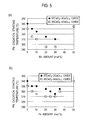
- the oxidation catalyst powder in each of the examples and soot (PM) collected from an automotive engine were mixed together in a mortar, whereby a sample was prepared. Each sample was used as a catalyst bed, and a temperature thereof was changed while introducing a mixed gas flow of 5 vol% of O 2 gas and He gas (in a balance amount) thereinto. Temperatures at which carbon monoxide (CO) and carbon dioxide (CO 2 ) were generated were measured by using a mass spectrometer, and measured values thus obtained were defined as PM oxidation starting temperatures. Obtained results are shown in FIG. 3 to FIG. 5 .
- the oxidation catalyst obtained in each of the examples was analyzed by the inductively coupled plasma atomic emission spectrometry (ICP-AES) by using an inductively coupled plasma atomic emission spectrometer SPS-1700HVR made by SII Nano Technology Inc.
- ICP-AES inductively coupled plasma atomic emission spectrometry
- Example 11 Example 16, Example 21 and Example 26
- the PM oxidation starting temperature was decreased when Ga was solid-solved.
- the obtained oxidation catalyst contains several mass percents of Na, and the PM oxidation starting temperature is decreased.
- the PM oxidation starting temperature is further decreased in the case where the oxidation catalyst contains Mn.
- Example 2 and Example 9 to Example 18 it has been understood that the PM oxidation starting temperature is decreased as a content of Mn in the oxidation catalyst becomes larger.
- the PM oxidation starting temperature was rather decreased in the case where the solid solution amount of Ga was 5 moles, and was decreased most when the additive amount of Mn were 30 mol%. It is conceived that the PM oxidation starting temperature is increased since a Ga 2 O 3 phase develops besides CeO 2 when the additive amount of Mn are increased up to 50 mol%.
- Example 2 and Example 29 to Example 42 it has been understood that the PM oxidation starting temperature is decreased as the oxidation catalyst contains a larger amount of Fe.
- the PM oxidation starting temperature was rather decreased in the case where the solid solution amount of Ga was 5 moles, and was decreased most when the additive amount of Fe were 30 mol%. It is conceived that the PM oxidation starting temperature is increased since the Ga 2 O 3 phase develops besides CeO 2 when the additive amount of Mn are increased up to 50 mol%.
- the Ce-Ga composite oxide containing the solid solution in which a part of Ce is substituted with Ga is formed, and accordingly, the oxidation catalyst capable of effectively decreasing the PM combustion temperature and the method for producing the oxidation catalyst can be provided.
Landscapes
- Chemical & Material Sciences (AREA)
- Engineering & Computer Science (AREA)
- Materials Engineering (AREA)
- Chemical Kinetics & Catalysis (AREA)
- Organic Chemistry (AREA)
- Health & Medical Sciences (AREA)
- Combustion & Propulsion (AREA)
- Biomedical Technology (AREA)
- Environmental & Geological Engineering (AREA)
- Analytical Chemistry (AREA)
- General Chemical & Material Sciences (AREA)
- Oil, Petroleum & Natural Gas (AREA)
- Catalysts (AREA)
- Exhaust Gas Treatment By Means Of Catalyst (AREA)
- Exhaust Gas After Treatment (AREA)
Abstract
Description
- This invention relates to an oxidation catalyst and a method for producing the oxidation catalyst, and more specifically, relates to an oxidation catalyst that decreases an oxidation or combustion temperature of particulate matter (PM), and to a method for producing the oxidation catalyst.
- An oxidation catalyst for promoting combustion of PM is proposed. For example, in Japanese Patent Unexamined Publication No.
2007-54713 - However, in the conventional diesel particulate filter, the decrease of the PM combustion temperature is not sufficient though attempted.
- The present invention has been made in consideration of such a problem inherent in the conventional technology. It is an object of the present invention to provide an oxidation catalyst capable of particularly decreasing a PM oxidation temperature in an effective manner, and to provide a method for producing the oxidation catalyst.
- An oxidation catalyst according to the present invention includes: Ce and Ga; and a Ce-Ga composite oxide containing a solid solution in which a part of Ce is substituted with Ga.
- A method for producing an oxidation catalyst according to the present invention includes the steps of: mixing a Ce-containing solution and a Ga-containing solution together, thereby obtaining a mixed solution; adding an aqueous alkali metal solution or an aqueous ammonia solution to the mixed solution to thereby adjust pH thereof, and coprecipitating Ce and Ga to thereby obtain a precipitate; and drying and baking the precipitate.
-
- [
Fig. 1] FIG. 1(a) is a schematic perspective view showing a crystal structure of CeO2.FIG. 1(b) is a schematic perspective view showing a crystal structure of a Ce-Ga composite oxide that composes an oxidation catalyst according to an embodiment of the present invention. - [
Fig. 2] FIG. 2(a) is an explanatory diagram showing whether or not solid solution occurred.FIG. 2(b) is an explanatory diagram in which aportion 2A ofFIG. 2(a) is enlarged.FIG. 2(c) is a table showing peak positions ofFIG. 2(b) . - [
Fig. 3] FIG. 3 is a table showing data obtained in Examples. - [
Fig. 4] FIG. 4 is a graph showing relationships between Ga solid solution amounts and measured values of PM combustion temperatures. - [
Fig. 5] FIG. 5(a) is a graph showing relationships between Mn amount and measured values of PM oxidation starting temperatures.FIG. 5(b) is a graph showing relationships between Fe amount and measured values of the PM oxidation starting temperatures. - A description will be made below of an oxidation catalyst according to an embodiment of the present invention and a method for producing the oxidation catalyst.
- As the oxidation catalyst according to the embodiment of the present invention, here, mentioned as an example thereof is a particulate matter (PM) oxidation catalyst to be used for promoting combustion of PM containing, as a main component, soot emitted from a diesel engine or for decreasing a combustion temperature of the PM.
- The oxidation catalyst according to the embodiment of the present invention contains cerium (Ce) and gallium (Ga), and a Ce-Ga composite oxide containing a solid solution in which a part of Ce is substituted with Ga. A
usual crystal structure 1 of CeO2 is shown inFIG. 1A , and acrystal structure 11 of the Ce-Ga composite oxide that composes the oxidation catalyst according to the embodiment of the present invention is shown inFIG. 1B . As shown inFIG. 1A , in theusual crystal structure 1 of CeO2,Ce atoms 2 exist at positions of vertices and face centers of a cubic lattice, andoxygen atoms 3 exist at centers of small cubes obtained by dividing the cubic lattice into eight equal parts in such a manner that each side of the cubic lattice is halved. As opposed to this, in thecrystal structure 11 of the Ce-Ga composite oxide, as shown inFIG. 1B , a structure is formed, in which the Ce atoms existing at the vertices and face centers of the cubic lattice are partially substituted withGa atoms 14. Specifically, this Ce-Ga composite oxide uses the crystal structure (fluorite structure) of CeO2 as a basic structure, and thecrystal structure 11 of the Ce-Ga composite oxide forms a fluorite crystal structure, in which Ce atoms 12 and theGa atoms 14 exist at positions of vertices and face centers of a cubic lattice, andoxygen atoms 13 are located at centers of small cubes obtained by dividing the cubic lattice into eight equal parts in such a manner that each side of the cubic lattice is halved. As described above, the oxidation catalyst according to the embodiment of the present invention contains the Ce-Ga composite oxide, and this Ce-Ga composite oxide forms a solid solution in which the Ce atoms are partially substituted with the Ga atoms. - An ion radius of Ce4+ is approximately 0.097 nm, and an ion radius of Ga3+ is approximately 0.062 nm. In the crystal structure of CeO2, the Ce atoms are substituted with the Ga atoms by the solid solution of the Ga atoms, and electric charges are reduced in response to an amount of the substitution. Then, in order to balance the electric charges of the entirety of the oxide, oxide ions (O2-) at lattice positions come out so as to correspond to a solid solution amount of the Ga atoms, and oxide ion holes are generated. In such a way, by the solid solution of the Ga atoms, oxygen holes are generated, and spaces are generated in a specific direction in the Ce cubic lattice, whereby mobility of the oxide ions through the holes is enhanced. It is guessed that, by the fact that the mobility of the oxide ions is enhanced in such a way, that is, a temperature at which active oxygen is generated decreases, the active oxygen can be utilized effectively, and a temperature at which the PM is oxidized or burned decreases. In such a way, the oxidation catalyst according to the embodiment of the present invention contains the Ce-Ga composite oxide that uses the crystal structure of CeO2, which has the fluorite structure, as the basic structure, whereby high oxide ion conductivity develops, and the PM oxidation temperature decreases.
- Among a variety of the Ce-Ga composite oxides, a CeO2-Ga2O3 composite oxide is particularly favorable. Moreover, in the Ce-Ga composite oxide, it is preferable that a molar ratio of Ce/Ga be 99.99/0.01 to 70/30. It is more preferable that the molar ratio of Ce/Ga be 97/3 to 85/15, and it is particularly preferable that the molar ratio of Ce/Ga be 97/3 to 95/5. If the molar ratio is lower than 70/30, then a substitution amount by the Ga atoms is increased to develop a Ga2O3 phase besides CeO2, and performance of the oxidation catalyst decreases in some case. Moreover, it becomes impossible to maintain the fluorite structure of CeO2, and the performance of the oxidation catalyst decreases in some case. Note that the PM oxidation temperature becomes the lowest temperature in the case where this molar ratio of Ce/Ga is equal to 97/3 to 95/5.
- Moreover, in the oxidation catalyst according to the present invention, it is more preferable that the Ce-Ga composite oxide contain Mn or Fe. The PM oxidation temperature further decreases in such a manner that the Ce-Ga composite oxide contains Mn or Fe. The decrease of the PM oxidation temperature is assumed to be caused by any of the following functions. As a first reason, it is assumed that Mn or Fe itself becomes new active sites. As a second reason, it is assumed that the existence of Mn or Fe promotes supply of the active oxygen from the Ce-Ga composite oxide. As a third reason, it is assumed that the existence of Mn or Fe promotes supply of the active oxygen from a Ce-Ga-Mn composite oxide or a Ce-Ga-Fe composite oxide.
- With regard to an amount of Mn or Fe, which the Ce-Ga composite oxide contains, for example, it is preferable that Mn or Fe be contained by 0.01 to 50 moles with respect to 100 moles of Ce and Ga in total, and it is more preferable that Mn or Fe be contained by 0.01 to 30 moles with respect thereto. If the amount of Mn or Fe is 0.01 mole or more, then the amount is sufficient for the PM oxidation in terms of the active sites, and also in terms of the supply of the active oxygen, sufficient emission of the active oxygen for oxidizing the PM is obtained. If the amount of Mn or Fe is 50 moles or less, then such PM oxidation activity can exert an effect appropriate to additive amount of Mn or Fe, and Mn or Fe can be utilized effectively, and does not cause the decrease of the activity owing to sintering. Note that, besides Mn and Fe, transition metal such as Co and Ni also has a similar effect.
- It is preferable that the oxidation catalyst according to the embodiment of the present invention contain alkali metal. If the alkali metal exists on a surface of the Ce-Ga composite oxide, then this alkali metal moves to PM particles proximate thereto, and activates the PM particles themselves. The activated PM particles are broken to a suitable size, and are dispersed. As described above, it is conceived that the coexistence of the alkali metal promotes the oxidation of the PM.
- It is preferable that the alkali metal to be contained be sodium (Na), and though no particular limitations are imposed on an amount of Na to be contained, it is preferable to set the amount of Na to be contained at 0.01 to 10 moles with respect to 1 mole of the Ce-Ga composite oxide. If the amount of Na is less than 0.01 mole, then the effect of decreasing the PM oxidation temperature is small in some case. If the amount of Na exceeds 10 moles, then the effect of decreasing the PM oxidation temperature reaches equilibrium in some case.
- The oxidation catalyst according to the embodiment of the present invention contains the above-described Ce-Ga composite oxide as an essential component. Other components than the above, for example, noble metal such as platinum, a transition metal oxide such as Mn oxide, and another third component can be solid-solved in the composite oxide.
- Moreover, the oxidation catalyst according to the embodiment of the present invention is usable by being carried on a monolithically constructed catalyst carrier such as a honeycomb-like monolithic carrier. In particular, in the case of taking, as a subject, PM of a lean combustion engine such as the diesel engine, the oxidation catalyst according to the embodiment of the present invention can be used for a so-called checkered honeycomb carrier in which one-side ends of cells are alternately sealed.
- Next, a description will be made of a method for producing the oxidation catalyst according to the embodiment of the present invention. This production method is a method for producing the above-mentioned oxidation catalyst, and is a method of forming the Ce-Ga composite oxide in such a manner that a Ce-containing solution and a Ga-containing solution are mixed together to thereby obtain a mixed solution, an aqueous alkali metal solution or an aqueous ammonia solution is added to this mixed solution to thereby adjust pH thereof, Ca and Ga are coprecipitated to thereby obtain a precipitate, and this precipitate is dried and baked.
- First, the Ce-containing solution and the Ga-containing solution are mixed together to thereby obtain the mixed solution as a precursor of the Ce-Ga composite oxide. The Ce-containing solution and the Ga-containing solution are obtained by dissolving nitrate of Ce and nitrate of Ga in a solvent. To this mixed solution, as a source of Mn, there can be added Mn nitrate, Mn hydroxide, Mn acid hydroxide, Mn carbonate or complexes of these. Moreover, in place of the above-described source of Mn, as a source of iron, there can also be added Fe nitrate, Fe hydroxide, Fe acid hydroxide, Fe carbonate or complexes of these.
- Specifically, a raw material of Mn, such as the Mn nitrate, or a raw material of the iron, such as the Fe nitrate, is added to the mixed solution of the Ce nitrate and the Ga nitrate according to needs, and thereafter, an aqueous sodium hydroxide solution or the aqueous ammonia solution is added to an obtained resultant to thereby adjust pH thereof, and a mixture of Ce hydroxide and Ga hydroxide is coprecipitated. Thereafter, the mixture of the Ce hydroxide and the Ga hydroxide, which is generated by the precipitation, is dried at 100°C to 150°C for 8 hours to 24 hours, and is further baked at 500°C to 700°C for 5 hours to 8 hours, whereby the desired Ce-Ga composite oxide can be obtained.
- Moreover, in the method for producing the oxidation catalyst according to the embodiment of the present invention, in the case of using the aqueous alkali metal solution in order to adjust pH of the obtained resultant, the alkali metal remains on the surface of the obtained Ce-Ga composite oxide. In the event of preparing the aqueous alkali metal solution, it is preferable to use the alkali metal in the form of salt, a hydroxide or an oxide. Moreover, as the salt, a carbonate is particularly preferable since the carbonate is easy to handle and has high storage stability. In accordance with this production method, the alkali metal can be supported on the Ce-Ga composite oxide from the step where the Ce-Ga composite oxide is in the form of the precursor. As described above, when the alkali metal remains on the surface of the Ce-Ga composite oxide, the PM oxidation temperature decreases. Note that, with regard to the obtained oxidation catalyst, even if XRD analysis is performed therefor, diffraction peaks derived from the alkali metal or the salt, hydroxide or oxide of the alkali metal are not observed. However, when the obtained oxidation catalyst is analyzed by ICP mass analysis, peaks derived from the alkali metal, for example, such as Na are observed. From this fact, it is conceived that the alkali metal exists in the form of the salt, the hydroxide or the oxide on the obtained oxidation catalyst though an amount thereof is very small.
- As described above, in accordance with the method for producing the oxidation catalyst according to the embodiment of the present invention, the oxidation catalyst capable of decreasing the PM oxidation temperature is obtained.
- Note that, though the PM oxidation catalyst to be used for promoting the combustion of the PM containing, as a main component, the soot emitted from the diesel engine or for decreasing the combustion temperature of the PM has been illustrated as an example of the oxidation catalyst, the present invention is not limited to the PM oxidation catalyst, and is applicable to other engines for which the oxidation catalyst is required.
- A description will be made below of Example 1 to Example 42 of the oxidation catalyst according to the embodiment of the present invention and Comparative example 1 and Comparative example 2 thereof. These examples were carried out in order to investigate effectiveness of the oxidation catalyst according to the present invention, the respective samples were prepared by treating different raw materials under different conditions, and the present invention is not limited to the illustrated examples.
- Cerium nitrate and gallium nitrate were weighed out so that a molar ratio of Ce/Ga could become 97/3, and were dissolved into ion exchange water. After a resultant aqueous solution was stirred for 1 hour, an aqueous sodium hydroxide solution was dropped thereinto to thereby adjust pH thereof, and a precipitate of a Ce-Ga hydroxide was obtained. The obtained precipitate was dried at 150°C day and night, and was further baked at 500°C, whereby an oxidation catalyst of Example 1 was obtained.
- Similar operations to those of Example 1 were repeated except that the molar ratio of Ce/Ga was set at 95/5, whereby an oxidation catalyst of Example 2 was obtained.
- Similar operations to those of Example 1 were repeated except that the molar ratio of Ce/Ga was set at 85/15, whereby an oxidation catalyst of Example 3 was obtained.
- Similar operations to those of Example 1 were repeated except that the molar ratio of Ce/Ga was set at 68/32, whereby an oxidation catalyst of Example 4 was obtained.
- Similar operations to those of Example 1 were repeated except that an aqueous ammonia solution was used in place of the aqueous sodium hydroxide solution, whereby an oxidation catalyst of Example 5 was obtained.
- Similar operations to those of Example 2 were repeated except that the aqueous ammonia solution was used in place of the aqueous sodium hydroxide solution, whereby an oxidation catalyst of Example 6 was obtained.
- Similar operations to those of Example 3 were repeated except that the aqueous ammonia solution was used in place of the aqueous sodium hydroxide solution, whereby an oxidation catalyst of Example 7 was obtained.
- Similar operations to those of Example 4 were repeated except that the aqueous ammonia solution was used in place of the aqueous sodium hydroxide solution, whereby an oxidation catalyst of Example 8 was obtained.
- Similar operations to those of Example 1 were repeated except that manganese nitrate was added to the above-mentioned cerium nitrate and gallium nitrate so that a molar ratio of Mn/(Ce+Ga) could become 5/100, whereby an oxidation catalyst of Example 9 was obtained.
- Similar operations to those of Example 9 were repeated except that the manganese nitrate was added to the cerium nitrate and the gallium nitrate so that the molar ratio of Mn/(Ce+Ga) could become 10/100, whereby an oxidation catalyst of Example 10 was obtained.
- Similar operations to those of Example 9 were repeated except that the manganese nitrate was added to the cerium nitrate and the gallium nitrate so that the molar ratio of Mn/(Ce+Ga) could become 20/100, whereby an oxidation catalyst of Example 11 was obtained.
- Similar operations to those of Example 9 were repeated except that the manganese nitrate was added to the cerium nitrate and the gallium nitrate so that the molar ratio of Mn/(Ce+Ga) could become 30/100, whereby an oxidation catalyst of Example 12 was obtained.
- Similar operations to those of Example 9 were repeated except that the manganese nitrate was added to the cerium nitrate and the gallium nitrate so that the molar ratio of Mn/(Ce+Ga) could become 50/100, whereby an oxidation catalyst of Example 13 was obtained.
- Similar operations to those of Example 2 were repeated except that the manganese nitrate was added to the above-mentioned cerium nitrate and gallium nitrate so that the molar ratio of Mn/(Ce+Ga) could become 5/100, whereby an oxidation catalyst of Example 14 was obtained.
- Similar operations to those of Example 14 were repeated except that the manganese nitrate was added to the cerium nitrate and the gallium nitrate so that the molar ratio of Mn/(Ce+Ga) could become 10/100, whereby an oxidation catalyst of Example 15 was obtained.
- Similar operations to those of Example 14 were repeated except that the manganese nitrate was added to the cerium nitrate and the gallium nitrate so that the molar ratio of Mn/(Ce+Ga) could become 20/100, whereby an oxidation catalyst of Example 16 was obtained.
- Similar operations to those of Example 14 were repeated except that the manganese nitrate was added to the cerium nitrate and the gallium nitrate so that the molar ratio of Mn/(Ce+Ga) could become 30/100, whereby an oxidation catalyst of Example 17 was obtained.
- Similar operations to those of Example 14 were repeated except that the manganese nitrate was added to the cerium nitrate and the gallium nitrate so that the molar ratio of Mn/(Ce+Ga) could become 50/100, whereby an oxidation catalyst of Example 18 was obtained.
- Similar operations to those of Example 3 were repeated except that the manganese nitrate was added to the above-mentioned cerium nitrate and gallium nitrate so that the molar ratio of Mn/(Ce+Ga) could become 5/100, whereby an oxidation catalyst of Example 19 was obtained.
- Similar operations to those of Example 19 were repeated except that the manganese nitrate was added to the cerium nitrate and the gallium nitrate so that the molar ratio of Mn/(Ce+Ga) could become 10/100, whereby an oxidation catalyst of Example 20 was obtained.
- Similar operations to those of Example 19 were repeated except that the manganese nitrate was added to the cerium nitrate and the gallium nitrate so that the molar ratio of Mn/(Ce+Ga) could become 20/100, whereby an oxidation catalyst of Example 21 was obtained.
- Similar operations to those of Example 19 were repeated except that the manganese nitrate was added to the cerium nitrate and the gallium nitrate so that the molar ratio of Mn/(Ce+Ga) could become 30/100, whereby an oxidation catalyst of Example 22 was obtained.
- Similar operations to those of Example 19 were repeated except that the manganese nitrate was added to the cerium nitrate and the gallium nitrate so that the molar ratio of Mn/(Ce+Ga) could become 50/100, whereby an oxidation catalyst of Example 23 was obtained.
- Similar operations to those of Example 4 were repeated except that the manganese nitrate was added to the above-mentioned cerium nitrate and gallium nitrate so that the molar ratio of Mn/(Ce+Ga) could become 5/100, whereby an oxidation catalyst of Example 24 was obtained.
- Similar operations to those of Example 24 were repeated except that the manganese nitrate was added to the cerium nitrate and the gallium nitrate so that the molar ratio of Mn/(Ce+Ga) could become 10/100, whereby an oxidation catalyst of Example 25 was obtained.
- Similar operations to those of Example 24 were repeated except that the manganese nitrate was added to the cerium nitrate and the gallium nitrate so that the molar ratio of Mn/(Ce+Ga) could become 20/100, whereby an oxidation catalyst of Example 26 was obtained.
- Similar operations to those of Example 24 were repeated except that the manganese nitrate was added to the cerium nitrate and the gallium nitrate so that the molar ratio of Mn/(Ce+Ga) could become 30/100, whereby an oxidation catalyst of Example 27 was obtained.
- Similar operations to those of Example 24 were repeated except that the manganese nitrate was added to the cerium nitrate and the gallium nitrate so that the molar ratio of Mn/(Ce+Ga) could become 50/100, whereby an oxidation catalyst of Example 28 was obtained.
- Similar operations to those of Example 1 were repeated except that ferric nitrate was added to the above-mentioned cerium nitrate and gallium nitrate so that a molar ratio of Fe/(Ce+Ga) could become 5/100, whereby an oxidation catalyst of Example 29 was obtained.
- Similar operations to those of Example 29 were repeated except that the ferric nitrate was added to the cerium nitrate and the gallium nitrate so that the molar ratio of Fe/(Ce+Ga) could become 10/100, whereby an oxidation catalyst of Example 30 was obtained.
- Similar operations to those of Example 29 were repeated except that the ferric nitrate was added to the cerium nitrate and the gallium nitrate so that the molar ratio of Fe/(Ce+Ga) could become 20/100, whereby an oxidation catalyst of Example 31 was obtained.
- Similar operations to those of Example 29 were repeated except that the ferric nitrate was added to the cerium nitrate and the gallium nitrate so that the molar ratio of Fe/(Ce+Ga) could become 25/100, whereby an oxidation catalyst of Example 32 was obtained.
- Similar operations to those of Example 29 were repeated except that the ferric nitrate was added to the cerium nitrate and the gallium nitrate so that the molar ratio of Fe/(Ce+Ga) could become 30/100, whereby an oxidation catalyst of Example 33 was obtained.
- Similar operations to those of Example 29 were repeated except that the ferric nitrate was added to the cerium nitrate and the gallium nitrate so that the molar ratio of Fe/(Ce+Ga) could become 35/100, whereby an oxidation catalyst of Example 34 was obtained.
- Similar operations to those of Example 29 were repeated except that the ferric nitrate was added to the cerium nitrate and the gallium nitrate so that the molar ratio of Fe/(Ce+Ga) could become 50/100, whereby an oxidation catalyst of Example 35 was obtained.
- Similar operations to those of Example 2 were repeated except that the ferric nitrate was added to the above-mentioned cerium nitrate and gallium nitrate so that the molar ratio of Fe/(Ce+Ga) could become 5/100, whereby an oxidation catalyst of Example 36 was obtained.
- Similar operations to those of Example 36 were repeated except that the ferric nitrate was added to the cerium nitrate and the gallium nitrate so that the molar ratio of Fe/(Ce+Ga) could become 10/100, whereby an oxidation catalyst of Example 37 was obtained.
- Similar operations to those of Example 36 were repeated except that the ferric nitrate was added to the cerium nitrate and the gallium nitrate so that the molar ratio of Fe/(Ce+Ga) could become 20/100, whereby an oxidation catalyst of Example 38 was obtained.
- Similar operations to those of Example 36 were repeated except that the ferric nitrate was added to the cerium nitrate and the gallium nitrate so that the molar ratio of Fe/(Ce+Ga) could become 25/100, whereby an oxidation catalyst of Example 39 was obtained.
- Similar operations to those of Example 36 were repeated except that the ferric nitrate was added to the cerium nitrate and the gallium nitrate so that the molar ratio of Fe/(Ce+Ga) could become 30/100, whereby an oxidation catalyst of Example 40 was obtained.
- Similar operations to those of Example 36 were repeated except that the ferric nitrate was added to the cerium nitrate and the gallium nitrate so that the molar ratio of Fe/(Ce+Ga) could become 35/100, whereby an oxidation catalyst of Example 41 was obtained.
- Similar operations to those of Example 36 were repeated except that the ferric nitrate was added to the cerium nitrate and the gallium nitrate so that the molar ratio of Fe/(Ce+Ga) could become 50/100, whereby an oxidation catalyst of Example 42 was obtained.
- Similar operations to those of Example 1 were repeated except that only the cerium nitrate was used without using the gallium nitrate, whereby an oxidation catalyst of Comparative example 1 was obtained.
- Similar operations to those of Comparative example 1 were repeated except that the aqueous ammonia solution was used in place of the aqueous sodium hydroxide solution, whereby an oxidation catalyst of Comparative example 2 was obtained.
- The oxidation catalysts of Example 1 and Example 3 were subjected to X-ray diffraction analysis, and it was determined whether or not the solid solution of Ga occurred therein. As an analyzer, an X-ray diffraction apparatus (XRD: MXP18VAHF) made by MAC Science Co., Ltd. was used. Measurement of the X-ray diffraction was performed under conditions where a radiation source was a CuKα ray, a voltage was 40 kV, and a current was 300 mA.
- Results thus obtained are shown in
FIG. 2 . As shown inFIG. 2 , it was able to be observed that, in the oxidation catalysts of Example 1 and Example 3, the respective diffraction peaks were shifted from peak positions of CeO2. For example, in Example 3 where Ce was substituted with Ga by 15 moles, a value of 2θ at a peak position 2B1 on a (331) diffraction plane is 77°, which is larger than 76. 77° as a value of 2θ at a peak position 2B3 on a (331) diffraction plane of Example 1 where Ce was substituted with Ga by 3 moles. A value of 2θ at a peak position on a (331) diffraction plane of CeO2 that was not substituted with Ga is 76.70°, and it is understood that the value of 2θ at the peak position on the (331) diffraction plane is shifted more largely as the solid solution amount of Ga becomes larger. In a similar way, in Example 3 where Ce was substituted with Ga by 15 moles, a value of 2θ at a peak position 2B2 on a (420) diffraction plane is 79.37°, which is larger than 70. 15° as a value of 2θ at a peak position 2B4 on a (420) diffraction plane of Example 1 where Ce was substituted with Ga by 3 moles, and it is understood that the value of 2θ at the peak position on the (420) diffraction plane is shifted more largely as the solid solution amount of Ga becomes larger. As described above, from the results of the X-ray diffraction analysis for Example 1 and Example 3, it has been understood that solid solutions in each of which a considerable amount of Ga is solid-solved are generated.
Moreover, Mn contained in the oxidation catalyst of each of Examples 9 to 28 was not detected as an oxide phase in the X-ray diffraction analysis, and was not able to be observed as particles even by means of a TEM. In a similar way, Fe contained in the oxidation catalyst of each of Examples 29 to 42 was not detected as an oxide phase in the X-ray diffraction analysis, and was not able to be observed as particles even by means of the TEM. Hence, it is conceived that these Mn and Fe are highly dispersed, or are solid-solved into the composite oxide. - The oxidation catalyst powder in each of the examples and soot (PM) collected from an automotive engine were mixed together in a mortar, whereby a sample was prepared. Each sample was used as a catalyst bed, and a temperature thereof was changed while introducing a mixed gas flow of 5 vol% of O2 gas and He gas (in a balance amount) thereinto. Temperatures at which carbon monoxide (CO) and carbon dioxide (CO2) were generated were measured by using a mass spectrometer, and measured values thus obtained were defined as PM oxidation starting temperatures. Obtained results are shown in
FIG. 3 to FIG. 5 . - The oxidation catalyst obtained in each of the examples was analyzed by the inductively coupled plasma atomic emission spectrometry (ICP-AES) by using an inductively coupled plasma atomic emission spectrometer SPS-1700HVR made by SII Nano Technology Inc.
- In accordance with each result obtained in Example 1 to Example 8, Example 11, Example 16, Example 21 and Example 26, the PM oxidation starting temperature was decreased when Ga was solid-solved. Moreover, it has been understood that, when NaOH is used as an alkaline solution, the obtained oxidation catalyst contains several mass percents of Na, and the PM oxidation starting temperature is decreased. Furthermore, it has been understood that the PM oxidation starting temperature is further decreased in the case where the oxidation catalyst contains Mn.
- Moreover, in accordance with results in Example 1, Example 2 and Example 9 to Example 18, it has been understood that the PM oxidation starting temperature is decreased as a content of Mn in the oxidation catalyst becomes larger. The PM oxidation starting temperature was rather decreased in the case where the solid solution amount of Ga was 5 moles, and was decreased most when the additive amount of Mn were 30 mol%. It is conceived that the PM oxidation starting temperature is increased since a Ga2O3 phase develops besides CeO2 when the additive amount of Mn are increased up to 50 mol%.
- In a similar way, in accordance with results of Example 1, Example 2 and Example 29 to Example 42, it has been understood that the PM oxidation starting temperature is decreased as the oxidation catalyst contains a larger amount of Fe. The PM oxidation starting temperature was rather decreased in the case where the solid solution amount of Ga was 5 moles, and was decreased most when the additive amount of Fe were 30 mol%. It is conceived that the PM oxidation starting temperature is increased since the Ga2O3 phase develops besides CeO2 when the additive amount of Mn are increased up to 50 mol%.
- As described above, it has been understood that, in each of the samples obtained in Example 1 to Example 42, the Ce-Ga composite oxide containing the solid solution in which a part of Ce was substituted with Ga was formed, and accordingly, the oxidation catalyst capable of effectively decreasing the PM combustion temperature was obtained.
- The description has been made above of the embodiment of the present invention; however, it should not be understood that the description and the drawings, which form a part of the disclosure of the above-mentioned embodiment, limit this invention. From this disclosure, a variety of alternative embodiments, examples and operation technologies will be apparent for those skilled in the art.
- The entire contents of Japanese Patent Application No.
2007-210798 (filed on: August 13, 2007 2008-036949 (filed on: February 19, 2008 2008-168404 (filed on: June 27, 2008 - In accordance with the present invention, the Ce-Ga composite oxide containing the solid solution in which a part of Ce is substituted with Ga is formed, and accordingly, the oxidation catalyst capable of effectively decreasing the PM combustion temperature and the method for producing the oxidation catalyst can be provided.
Claims (10)
- An oxidation catalyst comprising:Ce and Ga; anda Ce-Ga composite oxide containing a solid solution in which a part of Ce is substituted with Ga.
- The oxidation catalyst according to claim 1, wherein the Ce-Ga composite oxide has a fluorite crystal structure.
- The oxidation catalyst according to claim 1, wherein a molar ratio of Ce/Ga in the Ce-Ga composite oxide is 99.99/0.01 to 70/30.
- The oxidation catalyst according to claim 1, wherein a molar ratio of Ce/Ga in the Ce-Ga composite oxide is 97/3 to 85/15.
- The oxidation catalyst according to any one of claims 1 to 4, wherein the Ce-Ga composite oxide further contains Mn, and a molar ratio of Mn/(Ce+Ga) in the Ce-Ga composite oxide is 0.01/100 to 50/100.
- The oxidation catalyst according to any one of claims 1 to 4, wherein the Ce-Ga composite oxide further contains Mn, and a molar ratio of Mn/(Ce+Ga) in the Ce-Ga composite oxide is 0.01/100 to 30/100.
- The oxidation catalyst according to any one of claims 1 to 4, wherein the Ce-Ga composite oxide further contains Fe, and a molar ratio of Fe/(Ce+Ga) in the Ce-Ga composite oxide is 0.01/100 to 50/100.
- The oxidation catalyst according to any one of claims 1 to 4, wherein the Ce-Ga composite oxide further contains Fe, and a molar ratio of Fe/(Ce+Ga) in the Ce-Ga composite oxide is 0.01/100 to 30/100.
- The oxidation catalyst according to any one of claims 1 to 8, further comprising: alkali metal.
- A method for producing an oxidation catalyst, comprising:mixing a Ce-containing solution and a Ga-containing solution together, thereby obtaining a mixed solution;adding an aqueous alkali metal solution or an aqueous ammonia solution to the mixed solution to thereby adjust pH thereof, and coprecipitating Ce and Ga to thereby obtain a precipitate; anddrying and baking the precipitate.
Applications Claiming Priority (4)
| Application Number | Priority Date | Filing Date | Title |
|---|---|---|---|
| JP2007210798 | 2007-08-13 | ||
| JP2008036949 | 2008-02-19 | ||
| JP2008168404A JP5585805B2 (en) | 2007-08-13 | 2008-06-27 | PM oxidation catalyst and production method thereof |
| PCT/JP2008/064193 WO2009022620A1 (en) | 2007-08-13 | 2008-08-07 | Oxidation catalyst and method for producing oxidation catalyst |
Publications (3)
| Publication Number | Publication Date |
|---|---|
| EP2179789A1 true EP2179789A1 (en) | 2010-04-28 |
| EP2179789A4 EP2179789A4 (en) | 2011-08-03 |
| EP2179789B1 EP2179789B1 (en) | 2019-10-09 |
Family
ID=40350673
Family Applications (1)
| Application Number | Title | Priority Date | Filing Date |
|---|---|---|---|
| EP08792300.9A Active EP2179789B1 (en) | 2007-08-13 | 2008-08-07 | Use of an oxidation catalyst to decrease a pm combustion temperature |
Country Status (4)
| Country | Link |
|---|---|
| US (1) | US9457317B2 (en) |
| EP (1) | EP2179789B1 (en) |
| JP (1) | JP5585805B2 (en) |
| WO (1) | WO2009022620A1 (en) |
Cited By (1)
| Publication number | Priority date | Publication date | Assignee | Title |
|---|---|---|---|---|
| CN112755990A (en) * | 2020-12-16 | 2021-05-07 | 中南大学 | CeZrK/rGO nano solid solution |
Families Citing this family (1)
| Publication number | Priority date | Publication date | Assignee | Title |
|---|---|---|---|---|
| CN104324722A (en) * | 2014-11-05 | 2015-02-04 | 上海纳米技术及应用国家工程研究中心有限公司 | Composite catalyst for catalyzing ozonation as well as preparation method and application of composite catalyst |
Family Cites Families (32)
| Publication number | Priority date | Publication date | Assignee | Title |
|---|---|---|---|---|
| DE3151095A1 (en) | 1980-12-24 | 1982-07-22 | Monsanto Co., 63166 St. Louis, Mo. | "CATALYSTS FOR AMMONOXYDATION" |
| JPS57130549A (en) * | 1980-12-24 | 1982-08-13 | Monsanto Co | Ammonia oxidizing catalyst |
| FR2501065B1 (en) * | 1981-03-09 | 1986-02-07 | Pro Catalyse | IMPROVED CATALYST AND METHOD FOR THE TREATMENT OF EXHAUST GASES FROM INTERNAL COMBUSTION ENGINES |
| US4705908A (en) | 1984-12-31 | 1987-11-10 | Gondouin Oliver M | Natural gas conversion process |
| FR2677347B1 (en) * | 1991-06-05 | 1993-08-20 | Rhone Poulenc Chimie | COMPOSITION BASED ON CERIC OXIDE, ITS PREPARATION AND USES THEREOF. |
| US5550095A (en) | 1992-05-08 | 1996-08-27 | Mitsubishi Rayon Co., Ltd. | Process for producing catalyst used for synthesis of methacrylic acid |
| JP3200149B2 (en) * | 1992-05-08 | 2001-08-20 | 三菱レイヨン株式会社 | Method for producing catalyst for methacrylic acid synthesis |
| JPH07299369A (en) * | 1994-05-11 | 1995-11-14 | Mitsubishi Rayon Co Ltd | Method for preparing catalyst for producing unsaturated carboxylic acid and method for producing unsaturated carboxylic acid using catalyst obtained by the method |
| JP3497558B2 (en) * | 1994-05-12 | 2004-02-16 | 旭化成ケミカルズ株式会社 | Ammoxidation catalyst composition and method for producing acrylonitrile or methacrylonitrile using the same |
| JPH09313941A (en) * | 1996-05-28 | 1997-12-09 | Kyocera Corp | Oxide catalyst material for removing nitrogen oxide and method for removing nitrogen oxide |
| JP3943648B2 (en) * | 1997-04-11 | 2007-07-11 | 関西電力株式会社 | Methanol synthesis method |
| JP2000084412A (en) * | 1998-09-17 | 2000-03-28 | Mitsubishi Rayon Co Ltd | Catalyst for producing methacrylic acid, method for producing the same, and method for producing methacrylic acid |
| KR100731944B1 (en) | 1999-10-18 | 2007-06-25 | 미쯔비시 레이온 가부시끼가이샤 | Method for producing acrylonitrile, catalyst used herein, and method for producing the catalyst |
| JP3875011B2 (en) * | 1999-10-18 | 2007-01-31 | ダイヤニトリックス株式会社 | Acrylonitrile manufacturing process |
| US7482077B2 (en) * | 1999-11-16 | 2009-01-27 | Northwestern University | Direct hydrocarbon fuel cells |
| JP3872268B2 (en) * | 2000-09-21 | 2007-01-24 | 三菱レイヨン株式会社 | Production process of hydrogen cyanide |
| JP3837487B2 (en) * | 2001-11-14 | 2006-10-25 | 独立行政法人産業技術総合研究所 | Methanol reforming catalyst |
| US7236083B2 (en) * | 2002-06-27 | 2007-06-26 | National Institute Of Advanced Industrial Science And Technology | Resistance type oxygen sensor and oxygen sensor device using it and air/fuel ratio control system |
| JP2004160435A (en) * | 2002-09-18 | 2004-06-10 | Nissan Motor Co Ltd | CO removal catalyst |
| EP1594594B1 (en) * | 2003-02-12 | 2012-05-23 | Delphi Technologies, Inc. | SYSTEM FOR NOx ABATEMENT |
| US7202194B2 (en) * | 2003-03-17 | 2007-04-10 | Umicore Ag & Co. Kg | Oxygen storage material, process for its preparation and its application in a catalyst |
| JP4119980B2 (en) * | 2003-08-04 | 2008-07-16 | 独立行政法人産業技術総合研究所 | Catalyst for propane dehydrogenation reaction |
| JP2005116225A (en) * | 2003-10-03 | 2005-04-28 | Nissan Motor Co Ltd | Electrode for solid oxide fuel cell and method for producing the same |
| JP2005158436A (en) * | 2003-11-25 | 2005-06-16 | Nissan Motor Co Ltd | Fuel electrode for solid oxide fuel cell and solid oxide fuel cell using the same |
| JP4175282B2 (en) * | 2004-03-31 | 2008-11-05 | いすゞ自動車株式会社 | Exhaust gas purification system control method and exhaust gas purification system |
| US9236615B2 (en) * | 2005-08-09 | 2016-01-12 | The University Of Houston System | Methods for using novel cathode and electrolyte materials for solid oxide fuel cells and ion transport membranes |
| JP4618046B2 (en) | 2005-08-23 | 2011-01-26 | マツダ株式会社 | Diesel particulate filter |
| JP2007210798A (en) | 2006-01-11 | 2007-08-23 | Konica Minolta Business Technologies Inc | Paper post-processing device and image forming system |
| JP2008036949A (en) | 2006-08-04 | 2008-02-21 | Toppan Printing Co Ltd | Gas barrier laminated film |
| EP1920831B1 (en) * | 2006-11-08 | 2020-06-03 | Nissan Motor Co., Ltd. | Compound oxide-based particulate matter oxidizing catalyst |
| JP2008168404A (en) | 2007-01-12 | 2008-07-24 | Seiko Precision Inc | Drilling device |
| JP5408518B2 (en) * | 2007-04-18 | 2014-02-05 | 日産自動車株式会社 | PM oxidation catalyst and production method thereof |
-
2008
- 2008-06-27 JP JP2008168404A patent/JP5585805B2/en not_active Expired - Fee Related
- 2008-08-07 WO PCT/JP2008/064193 patent/WO2009022620A1/en not_active Ceased
- 2008-08-07 EP EP08792300.9A patent/EP2179789B1/en active Active
- 2008-08-07 US US12/673,343 patent/US9457317B2/en not_active Expired - Fee Related
Cited By (2)
| Publication number | Priority date | Publication date | Assignee | Title |
|---|---|---|---|---|
| CN112755990A (en) * | 2020-12-16 | 2021-05-07 | 中南大学 | CeZrK/rGO nano solid solution |
| CN112755990B (en) * | 2020-12-16 | 2021-12-17 | 中南大学 | A CeZrK/rGO Nano-Solid Solution |
Also Published As
| Publication number | Publication date |
|---|---|
| WO2009022620A1 (en) | 2009-02-19 |
| US9457317B2 (en) | 2016-10-04 |
| JP2009220095A (en) | 2009-10-01 |
| JP5585805B2 (en) | 2014-09-10 |
| US20120122673A1 (en) | 2012-05-17 |
| EP2179789B1 (en) | 2019-10-09 |
| EP2179789A4 (en) | 2011-08-03 |
Similar Documents
| Publication | Publication Date | Title |
|---|---|---|
| US6585944B1 (en) | Enhancement of the OSC properties of Ce-Zr based solid solutions | |
| US6468941B1 (en) | Niobium containing zirconium-cerium based soild solutions | |
| EP1921044B1 (en) | Zirconia-ceria-yttria-based mixed oxide and process for producing the same | |
| Liu et al. | Modulated CO oxidation activity of M-doped ceria (M= Cu, Ti, Zr, and Tb): role of the pauling electronegativity of M | |
| US20020090512A1 (en) | Composite oxide powder, a method for producing the same and a catalyst using the same | |
| CN102395428B (en) | Exhaust gas purifying catalyst and method for producing same | |
| EP0205102B1 (en) | Perovskite-type oxidation catalysts and method for preparing the catalysts | |
| US20140221198A1 (en) | Catalyst carrier for exhaust gas purification and catalyst for exhaust gas purification | |
| Masui et al. | Reduction Behavior of CeO2− ZrO2 Solid Solution Prepared from Cerium Zirconyl Oxalate | |
| WO2009118190A4 (en) | Application of basic exchange os materials for lower temperature catalytic oxidation of particulates | |
| JPH0986928A (en) | A-site deficient perovskite composite oxide and catalyst using the same | |
| Reddy et al. | Physicochemical Characteristics and Catalytic Activity of Alumina-Supported Nanosized Ceria− Terbia Solid Solutions | |
| WO2009104386A1 (en) | Process for production of catalyst supports and catalyst supports | |
| Fernández-García et al. | Ca doping of nanosize Ce− Zr and Ce− Tb solid solutions: Structural and electronic effects | |
| US8389436B2 (en) | Composite oxide | |
| CN102527386B (en) | Co oxidation catalyst and waste gas purification method employing the same | |
| Bin et al. | La1–x K x CoO3 and LaCo1–y Fe y O3 Perovskite Oxides: Preparation, Characterization, and Catalytic Performance in the Simultaneous Removal of NO x and Diesel Soot | |
| JP6087784B2 (en) | Oxygen storage / release material and exhaust gas purification catalyst containing the same | |
| EP2179789B1 (en) | Use of an oxidation catalyst to decrease a pm combustion temperature | |
| JP5574222B2 (en) | CO oxidation catalyst and exhaust gas purification method using the same | |
| JP2006346603A (en) | Catalyst composition | |
| Choi et al. | Synthesis, characteristics, and redox properties of Zr/Sn-doped CeO2 nanoparticles in H2 gas at high temperatures | |
| Dai et al. | Engineering surface Mn-enriched species and regulating active oxygen species over LaMnO 3 catalysts by synergistic modification of acid etching and potassium support for soot removal | |
| JPWO2009001902A1 (en) | Catalyst carrier and exhaust gas purification catalyst | |
| JP2009142789A (en) | Exhaust gas purification catalyst carrier and manufacturing method thereof, exhaust gas purification catalyst, and exhaust gas purification honeycomb catalyst structure |
Legal Events
| Date | Code | Title | Description |
|---|---|---|---|
| PUAI | Public reference made under article 153(3) epc to a published international application that has entered the european phase |
Free format text: ORIGINAL CODE: 0009012 |
|
| 17P | Request for examination filed |
Effective date: 20100210 |
|
| AK | Designated contracting states |
Kind code of ref document: A1 Designated state(s): AT BE BG CH CY CZ DE DK EE ES FI FR GB GR HR HU IE IS IT LI LT LU LV MC MT NL NO PL PT RO SE SI SK TR |
|
| AX | Request for extension of the european patent |
Extension state: AL BA MK RS |
|
| DAX | Request for extension of the european patent (deleted) | ||
| A4 | Supplementary search report drawn up and despatched |
Effective date: 20110701 |
|
| 17Q | First examination report despatched |
Effective date: 20131107 |
|
| STAA | Information on the status of an ep patent application or granted ep patent |
Free format text: STATUS: EXAMINATION IS IN PROGRESS |
|
| GRAP | Despatch of communication of intention to grant a patent |
Free format text: ORIGINAL CODE: EPIDOSNIGR1 |
|
| STAA | Information on the status of an ep patent application or granted ep patent |
Free format text: STATUS: GRANT OF PATENT IS INTENDED |
|
| RIC1 | Information provided on ipc code assigned before grant |
Ipc: B01J 23/10 20060101AFI20190415BHEP Ipc: F01N 3/10 20060101ALI20190415BHEP Ipc: B01J 23/00 20060101ALI20190415BHEP Ipc: B01J 37/03 20060101ALI20190415BHEP Ipc: B01J 23/825 20060101ALI20190415BHEP Ipc: B01J 23/835 20060101ALI20190415BHEP Ipc: B01D 53/94 20060101ALI20190415BHEP Ipc: B01J 23/34 20060101ALI20190415BHEP Ipc: B01J 23/83 20060101ALI20190415BHEP |
|
| INTG | Intention to grant announced |
Effective date: 20190502 |
|
| GRAS | Grant fee paid |
Free format text: ORIGINAL CODE: EPIDOSNIGR3 |
|
| GRAA | (expected) grant |
Free format text: ORIGINAL CODE: 0009210 |
|
| STAA | Information on the status of an ep patent application or granted ep patent |
Free format text: STATUS: THE PATENT HAS BEEN GRANTED |
|
| AK | Designated contracting states |
Kind code of ref document: B1 Designated state(s): AT BE BG CH CY CZ DE DK EE ES FI FR GB GR HR HU IE IS IT LI LT LU LV MC MT NL NO PL PT RO SE SI SK TR |
|
| REG | Reference to a national code |
Ref country code: GB Ref legal event code: FG4D |
|
| REG | Reference to a national code |
Ref country code: CH Ref legal event code: EP |
|
| REG | Reference to a national code |
Ref country code: IE Ref legal event code: FG4D |
|
| REG | Reference to a national code |
Ref country code: DE Ref legal event code: R096 Ref document number: 602008061379 Country of ref document: DE |
|
| REG | Reference to a national code |
Ref country code: AT Ref legal event code: REF Ref document number: 1188140 Country of ref document: AT Kind code of ref document: T Effective date: 20191115 |
|
| REG | Reference to a national code |
Ref country code: NL Ref legal event code: MP Effective date: 20191009 |
|
| REG | Reference to a national code |
Ref country code: LT Ref legal event code: MG4D |
|
| REG | Reference to a national code |
Ref country code: AT Ref legal event code: MK05 Ref document number: 1188140 Country of ref document: AT Kind code of ref document: T Effective date: 20191009 |
|
| PG25 | Lapsed in a contracting state [announced via postgrant information from national office to epo] |
Ref country code: BG Free format text: LAPSE BECAUSE OF FAILURE TO SUBMIT A TRANSLATION OF THE DESCRIPTION OR TO PAY THE FEE WITHIN THE PRESCRIBED TIME-LIMIT Effective date: 20200109 Ref country code: FI Free format text: LAPSE BECAUSE OF FAILURE TO SUBMIT A TRANSLATION OF THE DESCRIPTION OR TO PAY THE FEE WITHIN THE PRESCRIBED TIME-LIMIT Effective date: 20191009 Ref country code: NO Free format text: LAPSE BECAUSE OF FAILURE TO SUBMIT A TRANSLATION OF THE DESCRIPTION OR TO PAY THE FEE WITHIN THE PRESCRIBED TIME-LIMIT Effective date: 20200109 Ref country code: LT Free format text: LAPSE BECAUSE OF FAILURE TO SUBMIT A TRANSLATION OF THE DESCRIPTION OR TO PAY THE FEE WITHIN THE PRESCRIBED TIME-LIMIT Effective date: 20191009 Ref country code: AT Free format text: LAPSE BECAUSE OF FAILURE TO SUBMIT A TRANSLATION OF THE DESCRIPTION OR TO PAY THE FEE WITHIN THE PRESCRIBED TIME-LIMIT Effective date: 20191009 Ref country code: NL Free format text: LAPSE BECAUSE OF FAILURE TO SUBMIT A TRANSLATION OF THE DESCRIPTION OR TO PAY THE FEE WITHIN THE PRESCRIBED TIME-LIMIT Effective date: 20191009 Ref country code: PT Free format text: LAPSE BECAUSE OF FAILURE TO SUBMIT A TRANSLATION OF THE DESCRIPTION OR TO PAY THE FEE WITHIN THE PRESCRIBED TIME-LIMIT Effective date: 20200210 Ref country code: GR Free format text: LAPSE BECAUSE OF FAILURE TO SUBMIT A TRANSLATION OF THE DESCRIPTION OR TO PAY THE FEE WITHIN THE PRESCRIBED TIME-LIMIT Effective date: 20200110 Ref country code: ES Free format text: LAPSE BECAUSE OF FAILURE TO SUBMIT A TRANSLATION OF THE DESCRIPTION OR TO PAY THE FEE WITHIN THE PRESCRIBED TIME-LIMIT Effective date: 20191009 Ref country code: SE Free format text: LAPSE BECAUSE OF FAILURE TO SUBMIT A TRANSLATION OF THE DESCRIPTION OR TO PAY THE FEE WITHIN THE PRESCRIBED TIME-LIMIT Effective date: 20191009 Ref country code: PL Free format text: LAPSE BECAUSE OF FAILURE TO SUBMIT A TRANSLATION OF THE DESCRIPTION OR TO PAY THE FEE WITHIN THE PRESCRIBED TIME-LIMIT Effective date: 20191009 Ref country code: LV Free format text: LAPSE BECAUSE OF FAILURE TO SUBMIT A TRANSLATION OF THE DESCRIPTION OR TO PAY THE FEE WITHIN THE PRESCRIBED TIME-LIMIT Effective date: 20191009 |
|
| PG25 | Lapsed in a contracting state [announced via postgrant information from national office to epo] |
Ref country code: IS Free format text: LAPSE BECAUSE OF FAILURE TO SUBMIT A TRANSLATION OF THE DESCRIPTION OR TO PAY THE FEE WITHIN THE PRESCRIBED TIME-LIMIT Effective date: 20200224 Ref country code: HR Free format text: LAPSE BECAUSE OF FAILURE TO SUBMIT A TRANSLATION OF THE DESCRIPTION OR TO PAY THE FEE WITHIN THE PRESCRIBED TIME-LIMIT Effective date: 20191009 |
|
| REG | Reference to a national code |
Ref country code: DE Ref legal event code: R097 Ref document number: 602008061379 Country of ref document: DE |
|
| PG2D | Information on lapse in contracting state deleted |
Ref country code: IS |
|
| PG25 | Lapsed in a contracting state [announced via postgrant information from national office to epo] |
Ref country code: RO Free format text: LAPSE BECAUSE OF FAILURE TO SUBMIT A TRANSLATION OF THE DESCRIPTION OR TO PAY THE FEE WITHIN THE PRESCRIBED TIME-LIMIT Effective date: 20191009 Ref country code: CZ Free format text: LAPSE BECAUSE OF FAILURE TO SUBMIT A TRANSLATION OF THE DESCRIPTION OR TO PAY THE FEE WITHIN THE PRESCRIBED TIME-LIMIT Effective date: 20191009 Ref country code: DK Free format text: LAPSE BECAUSE OF FAILURE TO SUBMIT A TRANSLATION OF THE DESCRIPTION OR TO PAY THE FEE WITHIN THE PRESCRIBED TIME-LIMIT Effective date: 20191009 Ref country code: EE Free format text: LAPSE BECAUSE OF FAILURE TO SUBMIT A TRANSLATION OF THE DESCRIPTION OR TO PAY THE FEE WITHIN THE PRESCRIBED TIME-LIMIT Effective date: 20191009 Ref country code: IS Free format text: LAPSE BECAUSE OF FAILURE TO SUBMIT A TRANSLATION OF THE DESCRIPTION OR TO PAY THE FEE WITHIN THE PRESCRIBED TIME-LIMIT Effective date: 20200209 |
|
| PLBE | No opposition filed within time limit |
Free format text: ORIGINAL CODE: 0009261 |
|
| STAA | Information on the status of an ep patent application or granted ep patent |
Free format text: STATUS: NO OPPOSITION FILED WITHIN TIME LIMIT |
|
| PG25 | Lapsed in a contracting state [announced via postgrant information from national office to epo] |
Ref country code: SK Free format text: LAPSE BECAUSE OF FAILURE TO SUBMIT A TRANSLATION OF THE DESCRIPTION OR TO PAY THE FEE WITHIN THE PRESCRIBED TIME-LIMIT Effective date: 20191009 Ref country code: IT Free format text: LAPSE BECAUSE OF FAILURE TO SUBMIT A TRANSLATION OF THE DESCRIPTION OR TO PAY THE FEE WITHIN THE PRESCRIBED TIME-LIMIT Effective date: 20191009 |
|
| 26N | No opposition filed |
Effective date: 20200710 |
|
| PG25 | Lapsed in a contracting state [announced via postgrant information from national office to epo] |
Ref country code: SI Free format text: LAPSE BECAUSE OF FAILURE TO SUBMIT A TRANSLATION OF THE DESCRIPTION OR TO PAY THE FEE WITHIN THE PRESCRIBED TIME-LIMIT Effective date: 20191009 |
|
| PG25 | Lapsed in a contracting state [announced via postgrant information from national office to epo] |
Ref country code: MC Free format text: LAPSE BECAUSE OF FAILURE TO SUBMIT A TRANSLATION OF THE DESCRIPTION OR TO PAY THE FEE WITHIN THE PRESCRIBED TIME-LIMIT Effective date: 20191009 |
|
| REG | Reference to a national code |
Ref country code: CH Ref legal event code: PL |
|
| PG25 | Lapsed in a contracting state [announced via postgrant information from national office to epo] |
Ref country code: CH Free format text: LAPSE BECAUSE OF NON-PAYMENT OF DUE FEES Effective date: 20200831 Ref country code: LI Free format text: LAPSE BECAUSE OF NON-PAYMENT OF DUE FEES Effective date: 20200831 Ref country code: LU Free format text: LAPSE BECAUSE OF NON-PAYMENT OF DUE FEES Effective date: 20200807 |
|
| REG | Reference to a national code |
Ref country code: BE Ref legal event code: MM Effective date: 20200831 |
|
| PG25 | Lapsed in a contracting state [announced via postgrant information from national office to epo] |
Ref country code: IE Free format text: LAPSE BECAUSE OF NON-PAYMENT OF DUE FEES Effective date: 20200807 Ref country code: BE Free format text: LAPSE BECAUSE OF NON-PAYMENT OF DUE FEES Effective date: 20200831 |
|
| PG25 | Lapsed in a contracting state [announced via postgrant information from national office to epo] |
Ref country code: TR Free format text: LAPSE BECAUSE OF FAILURE TO SUBMIT A TRANSLATION OF THE DESCRIPTION OR TO PAY THE FEE WITHIN THE PRESCRIBED TIME-LIMIT Effective date: 20191009 Ref country code: MT Free format text: LAPSE BECAUSE OF FAILURE TO SUBMIT A TRANSLATION OF THE DESCRIPTION OR TO PAY THE FEE WITHIN THE PRESCRIBED TIME-LIMIT Effective date: 20191009 Ref country code: CY Free format text: LAPSE BECAUSE OF FAILURE TO SUBMIT A TRANSLATION OF THE DESCRIPTION OR TO PAY THE FEE WITHIN THE PRESCRIBED TIME-LIMIT Effective date: 20191009 |
|
| PGFP | Annual fee paid to national office [announced via postgrant information from national office to epo] |
Ref country code: FR Payment date: 20220609 Year of fee payment: 15 |
|
| PGFP | Annual fee paid to national office [announced via postgrant information from national office to epo] |
Ref country code: GB Payment date: 20220706 Year of fee payment: 15 Ref country code: DE Payment date: 20220608 Year of fee payment: 15 |
|
| REG | Reference to a national code |
Ref country code: DE Ref legal event code: R119 Ref document number: 602008061379 Country of ref document: DE |
|
| GBPC | Gb: european patent ceased through non-payment of renewal fee |
Effective date: 20230807 |
|
| PG25 | Lapsed in a contracting state [announced via postgrant information from national office to epo] |
Ref country code: GB Free format text: LAPSE BECAUSE OF NON-PAYMENT OF DUE FEES Effective date: 20230807 |
|
| PG25 | Lapsed in a contracting state [announced via postgrant information from national office to epo] |
Ref country code: GB Free format text: LAPSE BECAUSE OF NON-PAYMENT OF DUE FEES Effective date: 20230807 Ref country code: FR Free format text: LAPSE BECAUSE OF NON-PAYMENT OF DUE FEES Effective date: 20230831 Ref country code: DE Free format text: LAPSE BECAUSE OF NON-PAYMENT OF DUE FEES Effective date: 20240301 |