EP2178491B1 - Mixtures comprising benzotriazoles and merocyanines - Google Patents
Mixtures comprising benzotriazoles and merocyanines Download PDFInfo
- Publication number
- EP2178491B1 EP2178491B1 EP08803084.6A EP08803084A EP2178491B1 EP 2178491 B1 EP2178491 B1 EP 2178491B1 EP 08803084 A EP08803084 A EP 08803084A EP 2178491 B1 EP2178491 B1 EP 2178491B1
- Authority
- EP
- European Patent Office
- Prior art keywords
- preparations
- acid
- hair
- use according
- formula
- Prior art date
- Legal status (The legal status is an assumption and is not a legal conclusion. Google has not performed a legal analysis and makes no representation as to the accuracy of the status listed.)
- Active
Links
- 0 CC(*(*)C(C)(N)NI)(N)N Chemical compound CC(*(*)C(C)(N)NI)(N)N 0.000 description 5
- WAXYGVIVDZVOJC-HTXNQAPBSA-N CCCCC(CC)CNC(CC(C)(C)C1)=C/C1=C(\C(OCC)=O)/C#N Chemical compound CCCCC(CC)CNC(CC(C)(C)C1)=C/C1=C(\C(OCC)=O)/C#N WAXYGVIVDZVOJC-HTXNQAPBSA-N 0.000 description 1
Classifications
-
- C—CHEMISTRY; METALLURGY
- C09—DYES; PAINTS; POLISHES; NATURAL RESINS; ADHESIVES; COMPOSITIONS NOT OTHERWISE PROVIDED FOR; APPLICATIONS OF MATERIALS NOT OTHERWISE PROVIDED FOR
- C09K—MATERIALS FOR MISCELLANEOUS APPLICATIONS, NOT PROVIDED FOR ELSEWHERE
- C09K15/00—Anti-oxidant compositions; Compositions inhibiting chemical change
- C09K15/04—Anti-oxidant compositions; Compositions inhibiting chemical change containing organic compounds
- C09K15/30—Anti-oxidant compositions; Compositions inhibiting chemical change containing organic compounds containing heterocyclic ring with at least one nitrogen atom as ring member
-
- A—HUMAN NECESSITIES
- A61—MEDICAL OR VETERINARY SCIENCE; HYGIENE
- A61K—PREPARATIONS FOR MEDICAL, DENTAL OR TOILETRY PURPOSES
- A61K8/00—Cosmetics or similar toiletry preparations
- A61K8/18—Cosmetics or similar toiletry preparations characterised by the composition
- A61K8/30—Cosmetics or similar toiletry preparations characterised by the composition containing organic compounds
- A61K8/40—Cosmetics or similar toiletry preparations characterised by the composition containing organic compounds containing nitrogen
- A61K8/41—Amines
-
- A—HUMAN NECESSITIES
- A61—MEDICAL OR VETERINARY SCIENCE; HYGIENE
- A61K—PREPARATIONS FOR MEDICAL, DENTAL OR TOILETRY PURPOSES
- A61K8/00—Cosmetics or similar toiletry preparations
- A61K8/18—Cosmetics or similar toiletry preparations characterised by the composition
- A61K8/30—Cosmetics or similar toiletry preparations characterised by the composition containing organic compounds
- A61K8/46—Cosmetics or similar toiletry preparations characterised by the composition containing organic compounds containing sulfur
-
- A—HUMAN NECESSITIES
- A61—MEDICAL OR VETERINARY SCIENCE; HYGIENE
- A61K—PREPARATIONS FOR MEDICAL, DENTAL OR TOILETRY PURPOSES
- A61K8/00—Cosmetics or similar toiletry preparations
- A61K8/18—Cosmetics or similar toiletry preparations characterised by the composition
- A61K8/30—Cosmetics or similar toiletry preparations characterised by the composition containing organic compounds
- A61K8/49—Cosmetics or similar toiletry preparations characterised by the composition containing organic compounds containing heterocyclic compounds
- A61K8/494—Cosmetics or similar toiletry preparations characterised by the composition containing organic compounds containing heterocyclic compounds with more than one nitrogen as the only hetero atom
- A61K8/496—Triazoles or their condensed derivatives, e.g. benzotriazoles
-
- A—HUMAN NECESSITIES
- A61—MEDICAL OR VETERINARY SCIENCE; HYGIENE
- A61Q—SPECIFIC USE OF COSMETICS OR SIMILAR TOILETRY PREPARATIONS
- A61Q17/00—Barrier preparations; Preparations brought into direct contact with the skin for affording protection against external influences, e.g. sunlight, X-rays or other harmful rays, corrosive materials, bacteria or insect stings
- A61Q17/04—Topical preparations for affording protection against sunlight or other radiation; Topical sun tanning preparations
-
- C—CHEMISTRY; METALLURGY
- C11—ANIMAL OR VEGETABLE OILS, FATS, FATTY SUBSTANCES OR WAXES; FATTY ACIDS THEREFROM; DETERGENTS; CANDLES
- C11D—DETERGENT COMPOSITIONS; USE OF SINGLE SUBSTANCES AS DETERGENTS; SOAP OR SOAP-MAKING; RESIN SOAPS; RECOVERY OF GLYCEROL
- C11D3/00—Other compounding ingredients of detergent compositions covered in group C11D1/00
- C11D3/16—Organic compounds
- C11D3/20—Organic compounds containing oxygen
- C11D3/2072—Aldehydes-ketones
-
- C—CHEMISTRY; METALLURGY
- C11—ANIMAL OR VEGETABLE OILS, FATS, FATTY SUBSTANCES OR WAXES; FATTY ACIDS THEREFROM; DETERGENTS; CANDLES
- C11D—DETERGENT COMPOSITIONS; USE OF SINGLE SUBSTANCES AS DETERGENTS; SOAP OR SOAP-MAKING; RESIN SOAPS; RECOVERY OF GLYCEROL
- C11D3/00—Other compounding ingredients of detergent compositions covered in group C11D1/00
- C11D3/16—Organic compounds
- C11D3/20—Organic compounds containing oxygen
- C11D3/2075—Carboxylic acids-salts thereof
- C11D3/2086—Hydroxy carboxylic acids-salts thereof
-
- C—CHEMISTRY; METALLURGY
- C11—ANIMAL OR VEGETABLE OILS, FATS, FATTY SUBSTANCES OR WAXES; FATTY ACIDS THEREFROM; DETERGENTS; CANDLES
- C11D—DETERGENT COMPOSITIONS; USE OF SINGLE SUBSTANCES AS DETERGENTS; SOAP OR SOAP-MAKING; RESIN SOAPS; RECOVERY OF GLYCEROL
- C11D3/00—Other compounding ingredients of detergent compositions covered in group C11D1/00
- C11D3/16—Organic compounds
- C11D3/26—Organic compounds containing nitrogen
- C11D3/30—Amines; Substituted amines ; Quaternized amines
-
- C—CHEMISTRY; METALLURGY
- C11—ANIMAL OR VEGETABLE OILS, FATS, FATTY SUBSTANCES OR WAXES; FATTY ACIDS THEREFROM; DETERGENTS; CANDLES
- C11D—DETERGENT COMPOSITIONS; USE OF SINGLE SUBSTANCES AS DETERGENTS; SOAP OR SOAP-MAKING; RESIN SOAPS; RECOVERY OF GLYCEROL
- C11D3/00—Other compounding ingredients of detergent compositions covered in group C11D1/00
- C11D3/16—Organic compounds
- C11D3/26—Organic compounds containing nitrogen
- C11D3/32—Amides; Substituted amides
-
- C—CHEMISTRY; METALLURGY
- C11—ANIMAL OR VEGETABLE OILS, FATS, FATTY SUBSTANCES OR WAXES; FATTY ACIDS THEREFROM; DETERGENTS; CANDLES
- C11D—DETERGENT COMPOSITIONS; USE OF SINGLE SUBSTANCES AS DETERGENTS; SOAP OR SOAP-MAKING; RESIN SOAPS; RECOVERY OF GLYCEROL
- C11D3/00—Other compounding ingredients of detergent compositions covered in group C11D1/00
- C11D3/16—Organic compounds
- C11D3/34—Organic compounds containing sulfur
- C11D3/349—Organic compounds containing sulfur additionally containing nitrogen atoms, e.g. nitro, nitroso, amino, imino, nitrilo, nitrile groups containing compounds or their derivatives or thio urea
-
- C—CHEMISTRY; METALLURGY
- C11—ANIMAL OR VEGETABLE OILS, FATS, FATTY SUBSTANCES OR WAXES; FATTY ACIDS THEREFROM; DETERGENTS; CANDLES
- C11D—DETERGENT COMPOSITIONS; USE OF SINGLE SUBSTANCES AS DETERGENTS; SOAP OR SOAP-MAKING; RESIN SOAPS; RECOVERY OF GLYCEROL
- C11D3/00—Other compounding ingredients of detergent compositions covered in group C11D1/00
- C11D3/40—Dyes ; Pigments
- C11D3/42—Brightening agents ; Blueing agents
Definitions
- the present invention relates to the use of merocyanine compounds having an absorption maximum of 350 to 400 nm and 2-hydroxyphenyl benzotriazole UV filters for the protection of body care and household products against the deleterious effects of light, heat and oxygen.
- the present invention also relates to a mixture of at least one merocyanine having an absorption maximum of 350 to 400 nm and of at least one 2-hydroxyphenyl benzotriazole UV filter and optionally at least one excited state quencher.
- the most effective stabilizers known as of today to prevent or delay light induced fading of transparent packaged products are e.g. benzotriazoles like known under the trade names Ciba TINOGARD HS or Ciba TINOGARD TL. These proved to be very effective, due to their broadband absorption properties and strong extinction in the UV-A range.
- WO 2004/006878 discloses merocyanine UV-A absorbers and their use for protecting human and animal hair and skin from UV radiation as well as their application in cosmetic and dermatological formulations.
- WO 2007/014848 discloses various merocyanine structures which have superior properties in stabilizing cosmetic and dermatological formulations and household products.
- the present invention relates to the use of stabilizing composition
- stabilizing composition comprising
- merocyanine compounds which correspond to component (a) are disclosed in WO 2004/006878 , WO 2005/058269 , WO 2006/016806 , WO 2006/009451 , WO 2006/125676 , WO 2006/032741 and WO 2007/081209 .
- C 1 -C 4 alkyl is for example methyl, ethyl, n-propyl, isopropyl, n-butyl, sec.-butyl, isobutyl or tert.-butyl.
- ESQTM Excited State Quencher
- excited state quenchers selected from the group of hindered amine stabilizers are disclosed in the patent applications WO 01/07550 , WO 2005/042828 A2 and US 6,254,724 .
- Table 3 Preferred excited state stabilizers ESS-01 citrate ESS-02 ESS-03 ESS-04 ESS-05 ESS-06 CAS 6197-30-4 ESS-07 CAS 5232-99-5 ESS-08 CAS 127474-91-3 ESS-09 Polycrylene CAS 866102-82-1 ESS-10 CAS # 30538-92-2
- dialkyl naphthalates structures such as disclosed US 2002/197285 , US 2006/228311 and WO 2002/087528 .
- excited state quenchers are those based on the ⁇ , ⁇ -diphenylacrylate structure which are for example described in US 2004/047818 , US 2006/257338 , US 2006/228311 , US 2004/062726 and US 2004/057916 .
- the stabilizing composition comprising
- Table 4 Preferred Combinations Component (a) Component (b) Component (c) (M3) MC-03 CAS-No.: 125304-04-3 BT-01 (M4) MC-03 CAS-No.: 125304-04-3 BT-01 ESS-01 (M5) MC-03 CAS-No.: 125304-04-3 BT-01 ESS-06 (M6) MC-03 CAS-No.: 125304-04-3 BT-01 CAS 6197-30-4 ESS-02 (M7) MC-03 CAS-No.: 125304-04-3 BT-01 CAS 127474-91-3 ESS-04
- the stabilizing composition is also mixed with a salicylate.
- Preferred salicylates are salicylic acid (CAS-No. 69-72-7 ), homosalate ( CAS-No. 118-56-9, 3,3,5- trimethylcyclohexyl salicylate), 2-ethylhexyl salicylate ( CAS-No. 118-60-5 ), benzyl salicylate ( CAS-No. 118-58-1 ), ethyl salicylate ( CAS-No. 118-61-6 ), methyl salicylate ( CAS-No. 119-36-8 ), isoamyl salicylate ( CAS-No. 87-20-7 ), acetylsalicylic acid ( CAS-No. 50-78-2 ) and isobutyl salicylate ( CAS-No. 87-19-4 ). Even more preferred is to mix the stabilizing composition of the present invention with homosalate and/or 2-ethylhexyl salicylate.
- the stabilizing composition of the present invention is particularly suitable for protecting body-care and household products against photolytic degradation.
- the stabilizing composition of the present invention may be used as single component or in mixture with other stabilizers in particular for skin-care products, bath and shower additives, preparations containing fragrances and odoriferous substances, hair-care products, dentifrices, deodorizing and antiperspirant preparations, decorative preparations, light protection formulations and preparations containing active ingredients.
- Skin-care products are, in particular, body oils, body lotions, body gels, treatment creams, skin protection ointments, shaving preparations, such as shaving foams or gels, skin powders, such as baby powder, moisturizing gels, moisturizing sprays, revitalizing body sprays, cellulite gels and peeling preparations.
- Suitable bath and shower additives are shower gels, bath-salts, bubble baths and soaps.
- fragrances and odoriferous substances are in particular scents, perfumes, toilet waters and shaving lotions (aftershave preparations).
- Suitable hair-care products are, for example, shampoos for humans and animals, in particular dogs, hair conditioners, products for styling and treating hair, perming agents, hair sprays and lacquers, hair gels, hair fixatives and hair dyeing or bleaching agents.
- Suitable dentifrices are in particular tooth creams, toothpastes, mouth-washes, mouth rinses, anti-plaque preparations and cleaning agents for dentures.
- Suitable decorative preparations are in particular lipsticks, nail varnishes, eye shadows, mascaras, dry and moist make-up, rouge, powders, depilatory agents and suntan lotions.
- Suitable cosmetic formulations containing active ingredients are in particular hormone preparations, vitamin preparations, vegetable extract preparations and antibacterial preparations.
- the mentioned body-care products may be in the form of creams, ointments, pastes, foams, gels, lotions, powders, make-ups, sprays, sticks or aerosols.
- They preferably contain the stabilizing mixture according to the present invention and, optionally, further UV absorbers, sterically hindered amines, complexing agents and phenolic or non-phenolic antioxidants.
- the present invention therefore also relates to a body-care product comprising a stabilizing mixture according to the present invention.
- the weight ratio of component (a) to component (b) is from 20:1 to 1:20 and the weight ratio of component (a) to component (c) is from 1:1 to 1000:1, more preferably from 10:1 to 100:1.
- the weight ratio of component (a) to the salicylate is from 20:1 to 1:20, more preferably from 10:1 to 1:10.
- the stabilizing mixture according to the present invention is present in the body care and household products in a concentration of about 5 to about 50000 ppm, based on the total formulation, preferably from about 10 to about 10000 ppm, and most preferably from about 100 to about 1000 ppm.
- the body-care products according to the present invention may also contain one or one more additional compounds as described below.
- ester oils are isopropylmyristate, isopropylpalmitate, isopropylstearate, isopropyl isostearate, isopropyloleate, n-butylstearate, n-hexyllaurate, n-decyloleate, isooctylstearate, isononylstearate, isononyl isononanoate, 2-ethylhexylpalmitate, 2-hexyllaurate, 2-hexyldecylstearate, 2-octyldodecylpalmitate, oleyloleate, oleylerucate, erucyloleate, erucylerucate, cetearyl octanoate, cetyl palmitate, cetyl stearate, cetyl oleate, cetyl behenate, cetyl acetate, myristyl myri
- Natural or synthetic triglycerides including glyceryl esters and derivatives
- Di- or tri-glycerides based on C 6 -C 18 fatty acids, modified by reaction with other alcohols (caprylic/capric triglyceride, wheat germ glycerides, etc.).
- Fatty acid esters of polyglycerin polyglyceryl-n such as polyglyceryl-4 caprate, polyglyceryl-2 isostearate, etc.
- castor oil hydrogenated vegetable oil, sweet almond oil, wheat germ oil, sesame oil, hydrogenated cottonseed oil, coconut oil, avocado oil, corn oil, hydrogenated castor oil, shea butter, cocoa butter, soybean oil, mink oil, sunflower oil, safflower oil, macadamia nut oil, olive oil, hydrogenated tallow, apricot kernel oil, hazelnut oil, borago oil, etc.
- esters of long-chain acids and alcohols as well as compounds having wax-like properties, e.g., carnauba wax, beeswax (white or yellow), lanolin wax, candellila wax, ozokerite, japan wax, paraffin wax, microcrystalline wax, ceresin, cetearyl esters wax, synthetic beeswax etc.
- hydrophilic waxes as Cetearyl Alcohol or partial glycerides.
- Alkylene glycol esters especially ethylene glycol distearate; fatty acid alkanolamides, especially coco fatty acid diethanolamide; partial glycerides, especially stearic acid monoglyceride; esters of polyvalent, unsubstituted or hydroxy-substituted carboxylic acids with fatty alcohols having from 6 to 22 carbon atoms, especially long-chained esters of tartaric acid; fatty substances, for example fatty alcohols, fatty ketones, fatty aldehydes, fatty ethers and fatty carbonates, which in total have at least 24 carbon atoms, especially laurone and distearyl ether; fatty acids, such as stearic acid, hydroxystearic acid or behenic acid, ring-opening products of olefin epoxides having from 12 to 22 carbon atoms with fatty alcohols having from 12 to 22 carbon atoms and/or polyols having from 2 to 15 carbon atoms and from 2 to 10
- Mineral oil (light or heavy), petrolatum (yellow or white), microcrystalline wax, paraffinic and isoparaffinic compounds, hydrogenated isoparaffinic molecules as polydecenes and polybutene, hydrogenated polyisobutene, squalane, isohexadecane, isododecane and others from plant and animal kingdom.
- simethicones which are mixtures of dimethicones having an average chain length of from 200 to 300 dimethylsiloxane units with hydrogenated silicates.
- a detailed survey by Todd et al. of suitable volatile silicones may in addition be found in Cosm. Toil. 91, 27 (1976 ).
- Perfluorohexane dimethylcyclohexane, ethylcyclopentane, polyperfluoromethylisopropyl ether.
- Emulsifier systems may comprise for example: carbocyclic acids and their salts: alkaline soap of sodium, potassium and ammonium, metallic soap of calcium or magnesium, organic basis soap such as Lauric, palmitic, stearic and oleic acid etc., alkyl phosphates or phosphoric acid esters, acid phosphate, diethanolamine phosphate, potassium cetyl phosphate, ethoxylated carboxylic acids or polyethyleneglycol esters, PEG-n acrylates, linear fatty alcohols having from 8 to 22 carbon atoms, branched from 2 to 30 mol of ethylene oxide and/or from 0 to 5 mol propylene oxide with fatty acids having from 12 to 22 carbon atoms and with alkylphenols having from 8 to 15 carbon atoms in the alkyl group, fatty alcohol polyglycolether such as laureth-n, ceteareth-n, steareth-n, o
- Monoglycerides and polyol esters C 12 -C 22 fatty acid mono- and di-esters of addition products of from 1 to 30 mol of ethylene oxide with polyols.
- Fatty acid and polyglycerol ester such as monostearate glycerol, diisostearoyl polyglyceryl-3-diisostearates, polyglyceryl-3-diisostearates, triglyceryl diisostearates, polyglyceryl-2-sesquiisostearates or polyglyceryl dimerates (mixtures of compounds from a plurality of those substance classes are also suitable); fatty acid polyglycolesters such as monostearate diethylene glycol, fatty acid and polyethylene glycol esters, fatty acid and saccharose esters such as sucro esters, glycerol and saccharose esters such as sucro glycerides, sorbitol and sorbitan, sorbitan mono- and di-esters of saturated and unsatur
- Non ionic emulsifiers such as PEG-6 beeswax (and) PEG-6 stearate (and) polyglyceryl-2-isostearate [Apifac], glyceryl stearate (and) PEG-100 stearate.
- Anionic emulsifiers such as PEG-2 stearate SE, glyceryl stearate SE [Monelgine, Cutina KD], propylene glycol stearate [Tegin P], cetearyl Alcohol and Sodium cetearyl sulfate [Lanette N, Cutina LE, Crodacol GP], cetearyl alcohol and sodium lauryl sulfate [Lanette W], trilaneth-4 phopshate and glycol stearate and PEG-2 stearate [Sedefos 75], glyceryl stearate and sodium lauryl Sulfate [Teginacid Special].
- Cationic acid bases such as cetearyl alcohol and cetrimonium bromide.
- the emulsifiers may be used in an amount of, for example, from 1 to 30 % by weight, especially from 4 to 20 % by weight and preferably from 5 to 10 % by weight, based on the total weight of the composition.
- the preferably amount of such emulsifier system could represent 5% to 20% of the oil phase.
- Substances suitable for use as super-fatting agents are, for example, lanolin and lecithin and also polyethoxylated or acrylated lanolin and lecithin derivatives, polyol fatty acid esters, monoglycerides and fatty acid alkanolamides, the latter simultaneously acting as foam stabilizers.
- Suitable mild surfactants include fatty alcohol polyglycol ether sulfates, monoglyceride sulfates, mono- and/or di-alkyl sulfosuccinates, fatty acid isethionates, fatty acid sarcosinates, fatty acid taurides, fatty acid glutamates, ⁇ -olefin sulfonates, ether carboxylic acids, alkyl oligoglucosides, fatty acid glucamides, alkylamidobetaines and/or protein fatty acid condensation products, the latter preferably being based on wheat proteins.
- silicon dioxide magnesium silicates, aluminum silicates, polysaccharides or derivatives thereof for example hyaluronic acid, xanthan gum, guar-guar, agar-agar, alginates, carraghenan, gellan, pectines, or modified cellulose such as hydroxycellulose, hydroxypropyl-methylcellulose.
- polyacrylates or homopolymer of reticulated acrylic acids and polyacrylamides carbomer (carbopol types 980, 981, 1382, ETD 2001, ETD2020, Ultrez 10) or Salcare range such as Salcare SC80(steareth-10 allyl ether/acrylates copolymer), Salcare SC81(acrylates copolymer), Salcare SC91 and Salcare AST(sodium acrylates copolymer/PPG-1 trideceth-6), sepigel 305(polyacrylamide/laureth-7), Simulgel NS and Simulgel EG (hydroxyethyl acrylate / sodium acryloyldimethyl taurate copolymer), Stabilen 30 (acrylates / vinyl isodecanoate crosspolymer), Pemulen TR-1 (acrylates / C10-30 alkyl acrylate crosspolymer), Luvigel EM (sodium acrylates copolymer), Aculyn 28 (acrylates/beheneth-25
- Suitable cationic polymers are, for example, cationic cellulose derivatives, for example a quaternized hydroxymehtyl cellulose obtainable under the name Polymer JR 400 from Amerchol, cationic starches, copolymers of diallylammonium salts and acrylamides, quaternized vinylpyrrolidone/vinyl imidazole polymers, for example Luviquatâ (BASF), condensation products of polyglycols and amines, quaternized collagen polypeptides, for example lauryl diammonium hydroxypropyl hydrolyzed collagen (LamequatâL/Grünau), quaternised wheat polypeptides, polyethyleneimine, cationic silicone polymers, for example amidomethicones, copolymers of adipic acid and dimethylaminohydroxypropyldiethylene-triamine (Cartaretin/Sandoz), copolymers of acrylic acid with dimethyldiallylammonium chloride (Merqua
- anionic, zwitterionic, amphoteric and non-ionic polymers there come into consideration, for example, vinyl acetate / crotonic acid copolymers, vinylpyrrolidone / vinyl acrylate copolymers, vinyl acetate / butyl maleate / isobornyl acrylate copolymers, methyl vinyl ether / maleic anhydride copolymers and esters thereof, uncrosslinked polyacrylic acids and polyacrylic acids crosslinked with polyols, acrylamidopropyl-trimethyl-ammonium chloride /acrylate copolymers, octyl acrylamide/methyl methacrylatetert.
- butylaminoethyl methacrylate/2-hydroxypropyl methacrylate copolymers polyvinylpyrrolidone, vinylpyrrolidone/vinyl acetate copolymers, vinylpyrrolidone/dimethylaminoethyl methacrylate/vinyl caprolactam terpolymers and also optionally derivatised cellulose ethers and silicones. Furthermore the polymers as described in EP 1093796 (pages 3-8, paragraphs 17-68) may be used.
- cetyl trimethyl ammonium bromide (CTAB), dimethicone copolyols, amidomethicones, acrylamidopropyltrimonium chloride/Acrylamide copolymer, guar hydroxypropyl trimonium chloride, hydroxyacetyl hydroxyethyl dimonium chloride quaternium compounds as listed in International Cosmetic Ingredient Dictionary and Handbook, 7th Edition 1997 , for example Quaternium-80, polyquaternium compounds, as listed in International Cosmetic Ingredient Dictionary and Handbook, 7th Edition 1997 , for example polyquaternium- 5, polyquaternium-6, polyquaternium-7, polyquaternium-10, polyquaternium-11, polyquaternium-17, polyquaternium-18, polyquaternium-24 or polyquaternium-27, polyquaternium-28, polyquaternium-32, polyquaternium-37.
- CTAB cetyl trimethyl ammonium bromide
- dimethicone copolyols amidomethicones
- Biogenic active ingredients are to be understood as meaning, for example, tocopherol, tocopherol acetate, tocopherol palmitate, ascorbic acid, deoxyribonucleic acid, retinol, bisabolol, allantoin, phytantriol, panthenol, AHA acids, amino acids, ceramides, pseudoceramides, essential oils, plant extracts and vitamin complexes.
- deodorizing active ingredients are for example, antiperspirants, for example aluminium chlorohydrates (see J. Soc. Cosm. Chem. 24, 281 (1973 )). Under the trade mark Locronâ of Hoechst AG, Frankfurt (FRG), there is available commercially, for example, an aluminium chlorohydrate corresponding to formula Al2(OH)5Cl x 2.5 H2O, the use of which is especially preferred (see J. Pharm. Pharmacol. 26, 531 (1975 )). Besides the chlorohydrates, it is also possible to use aluminium hydroxyacetates and acidic aluminium/zirconium salts. Esterase inhibitors may be added as further deodorizing active ingredients.
- Such inhibitors are preferably trialkyl citrates, such as trimethyl citrate, tripropyl citrate, triisopropyl citrate, tributyl citrate and especially triethyl citrate (Hydagen CAT, Henkel), which inhibit enzyme activity and hence reduce odor formation.
- trialkyl citrates such as trimethyl citrate, tripropyl citrate, triisopropyl citrate, tributyl citrate and especially triethyl citrate (Hydagen CAT, Henkel), which inhibit enzyme activity and hence reduce odor formation.
- esterase inhibitors are sterol sulfates or phosphates, for example lanosterol, cholesterol, campesterol, stigmasterol and sitosterol sulfate or phosphate, dicarboxylic acids and esters thereof, for example glutaric acid, glutaric acid monoethyl ester, glutaric acid diethyl ester, adipic acid, adipic acid monoethyl ester, adipic acid diethyl ester, malonic acid and malonic acid diethyl ester and hydroxycarboxylic acids and esters thereof, for example citric acid, malic acid, tartaric acid or tartaric acid diethyl ester.
- dicarboxylic acids and esters thereof for example glutaric acid, glutaric acid monoethyl ester, glutaric acid diethyl ester, adipic acid, adipic acid monoethyl ester, adipic acid diethyl ester, malonic acid and malonic
- Antibacterial active ingredients that influence the germ flora and kill or inhibit the growth of sweat-decomposing bacteria can likewise be present in the preparations (especially in stick preparations).
- Examples include chitosan, phenoxyethanol and chlorhexidine gluconate.
- 5-chloro-2-(2,4-dichlorophenoxy)-phenol Triclosan, Irgasan, Ciba Specialty Chemicals Inc. has also proved especially effective.
- Customary film formers include, for example, chitosan, microcrystalline chitosan, quaternized chitosan, polyvinylpyrrolidone, vinylpyrrolidone/vinyl acetate copolymers, polymers of quaternary cellulose derivatives containing a high proportion of acrylic acid, collagen, hyaluronic acid and salts thereof and similar compounds.
- hydrotropic agents for example ethoxylated or non ethoxylated mono-alcohols, diols or polyols with a low number of carbon atoms or their ethers (e.g.
- ethanol isopropanol, 1,2-dipropanediol, propyleneglycol, glycerin, ethylene glycol, ethylene glycol monoethylether, ethylene glycol monobutylether, propylene glycol monomethylether, propylene glycol monoethylether, propylene glycol monobutylether, diethylene glycol monomethylether; diethylene glycol monoethylether, diethylene glycol monobutylether and similar products).
- the polyols for that purpose comprise preferably 2 to 15 carbon atoms and at least two hydroxy groups.
- the polyols may also contain further functional groups, especially amino groups, and/or may be modified with nitrogen.
- Typical examples are as follows: glycerol, alkylene glycols, for example ethylene glycol, diethylene glycol, propylene glycol, butylene glycol, hexylene glycol and also polyethylene glycols having an average molecular weight of from 100 to 1000 Dalton; technical oligo-glycerol mixtures having an intrinsic degree of condensation of from 1.5 to 10, for example technical diglycerol mixtures having a diglycerol content of from 40 to 50 % by weight; methylol compounds, such as, especially, trimethylolethane, trimethylolpropane, trimethylolbutane, pentaerythritol and dipentaerythritol; lower alkyl-glucosides, especially those having from 1 to 8 carbon atoms in the alkyl radical, for example methyl and butyl glucoside; sugar alcohols having from 5 to 12 carbon atoms, for example sorbitol or mannitol; sugars having from 5 to 12 carbon atom
- Suitable preservatives include, for example methyl-, ethyl-, propyl-, butyl- parabens, benzalkonium chloride, 2-bromo-2-nitro-propane-1,3-diol, dihydroacetic acid, diazolidinyl urea, 2-dichloro-benzyl alcohol, DMDM hydantoin, formaldehyde solution, methyldibromoglutanitrile, phenoxyethanol, sodium hydroxymethylglycinate, imidazolidinyl urea, Triclosan and further substance classes listed in the following reference: K.F.Depolo - A Short Textbook Of Cosmetology, Chapter 7, Table 7-2, 7-3, 7-4 And 7-5, P210-219 .
- bacteria-inhibiting agents are preservatives that have a specific action against gram-positive bacteria, such as 2,4,4'-trichloro-2'-hydroxydiphenyl ether, chlorhexidine (1,6-di(4-chlorophenyl-biguanido)hexane) or TCC (3,4,4'-trichlorocarbanilide).
- gram-positive bacteria such as 2,4,4'-trichloro-2'-hydroxydiphenyl ether, chlorhexidine (1,6-di(4-chlorophenyl-biguanido)hexane) or TCC (3,4,4'-trichlorocarbanilide).
- TCC 3,4,4'-trichlorocarbanilide
- a large number of aromatic substances and ethereal oils also have antimicrobial properties.
- Typical examples are the active ingredients eugenol, menthol and thymol in clove oil, mint oil and thyme oil.
- a natural deodorizing agent of interest is the terpene alcohol farnesol (3,7,11-trimethyl-2,6,10-dodecatrien-1-ol), which is present in lime blossom oil.
- Glycerol monolaurate has also proved to be a bacteriostatic agent.
- the amount of the additional bacteria-inhibiting agents present is usually from 0.1 to 2 % by weight, based on the solids content of the preparations.
- Natural aromatic substances are, for example, extracts from blossom (lilies, lavender, roses, jasmine, neroli, ylang-ylang), from stems and leaves (geranium, patchouli, petitgrain), from fruit (aniseed, coriander, carraway, juniper), from fruit peel (bergamot, lemons, oranges), from roots (mace, angelica, celery, cardamom, costus, iris, calmus), from wood (pinewood, sandalwood, guaiacum wood, cedarwood, rosewood), from herbs and grasses (tarragon, lemon grass, sage, thyme), from needles and twigs (spruce, pine, Scots pine, mountain pine), from resins and balsams (galbanum, elemi, benzoin, myrrh, olibanum, opoponax).
- Typical synthetic aromatic substances are, for example, products of the ester, ether, aldehyde, ketone, alcohol or hydrocarbon type.
- Aromatic substance compounds of the ester type are, for example, benzyl acetate, phenoxyethyl isobutyrate, p-tert-butylcyclohexyl acetate, linalyl acetate, dimethylbenzylcarbinyl acetate, phenylethyl acetate, linalyl benzoate, benzyl formate, ethylmethylphenyl glycinate, allylcyclohexyl propionate, styrallyl propionate and benzyl salicylate.
- the ethers include, for example, benzyl ethyl ether;
- the aldehydes include, for example, the linear alkanals having from 8 to 18 hydrocarbon atoms, citral, citronellal, citronellyl oxyacetaldehyde, cyclamen aldehyde, hydroxycitronellal, lilial and bourgeonal;
- the ketones include, for example, the ionones, isomethylionone and methyl cedryl ketone;
- the alcohols include, for example, anethol, citronellol, eugenol, isoeugenol, geraniol, linalool, phenyl ethyl alcohol and terpinol; and
- the hydrocarbons include mainly the terpenes and balsams.
- Ethereal oils of relatively low volatility which are chiefly used as aroma components, are also suitable as perfume oils, e.g. sage oil, camomile oil, clove oil, melissa oil, oil of cinnamon leaves, lime blossom oil, juniper berry oil, vetiver oil, olibanum oil, galbanum oil, labolanum oil and lavandin oil.
- the cosmetic preparations may contain, as adjuvants, anti-foams, such as silicones, structurants, such as maleic acid, solubilizers, such as ethylene glycol, propylene glycol, glycerol or diethylene glycol, opacifiers, such as latex, styrene/PVP or styrene/acrylamide copolymers, propellants, such as propane/butane mixtures, N2O, dimethyl ether, CO2, N2 or air, so-called coupler and developer components as oxidation dye precursors, reducing agents, such as thioglycolic acid and derivatives thereof, thiolactic acid, cysteamine, thiomalic acid or mercaptoethanesulfonic acid, or oxidizing agents, such as hydrogen peroxide, potassium bromate or sodium bromate.
- anti-foams such as silicones
- structurants such as maleic acid
- solubilizers such as ethylene glycol,
- Suitable insect repellents are, for example, N,N-diethyl-m-toluamide, 1,2-pentanediol or insect repellent 3535; suitable self-tanning agents are, for example, dihydroxyacetone and/or erythrulose or dihydroxy acetone and/or dihydroxy acetone precursors as described in WO 01/85124 and/or erythrulose.
- compositions are particularly suitable for stabilizing body care products, in particular:
- Suitable cosmetic formulations containing active ingredients are in particular hormone preparations, vitamin preparations, vegetable extract preparations and antibacterial preparations.
- cosmetic preparations for the skin are light-protective preparations, such as sun milks, lotions, creams, oils, sun blocks or tropicals, pretanning preparations or after-sun preparations, also skin-tanning preparations, for example self-tanning creams.
- sun protection creams, sun protection lotions, sun protection milk and sun protection preparations in the form of a spray are especially interested.
- hair-washing preparations in the form of shampoos, hair conditioners, hair-care preparations, e.g. pretreatment preparations, hair tonics, styling creams, styling gels, pomades, hair rinses, treatment packs, intensive hair treatments, hair-straightening preparations, liquid hair-setting preparations, hair foams and hairsprays.
- hair-washing preparations in the form of shampoos.
- a shampoo has, for example, the following composition:
- hair-cosmetic formulations may be used:
- Body care product Ingredients Sun screen Oils, emulsifiers, water, UV absorbers, thickeners, antioxidants, stabilizer according to invention moisturizing cream vegetable oil, emulsifier, thickener, perfume, water, antioxidant, stabilizer according to invention Hair or body shampoo surfactant, emulsifier, colorant, preservatives, perfume, antioxidant, stabilizer according to invention Hair conditioner surfactant, cationic polymers, emulsifier, colorant, preservatives, perfume, antioxidant, stabilizer according to invention Toothpaste cleaning agent, abrasives, water, thickener, sweetener, flavor, colorant, antioxidant, stabilizer according to invention lip-care stick vegetable oil, wax, TiO 2 , pigments, antioxidant, stabilizer according to invention
- the stabilized compositions of the present invention are also used in household cleaning and treatment agents, for example in laundry products and fabric softeners, liquid cleansing and scouring agents, glass detergents, neutral cleaners (all-purpose cleaners), acid household cleaners (bath), bathroom cleaners, WC cleaners, for instance in washing, rinsing and dishwashing agents, kitchen and oven cleaners, clear rinsing agents, dishwasher detergents, shoe polishes, polishing waxes, floor detergents and polishes, metal, glass and ceramic cleaners, textile-care products, rug cleaners and carpet shampoos, agents for removing rust, color and stains (stain remover salt), furniture and multipurpose polishes and leather and vinyl dressing agents (leather and vinyl sprays) and air fresheners.
- household cleaning and treatment agents for example in laundry products and fabric softeners, liquid cleansing and scouring agents, glass detergents, neutral cleaners (all-purpose cleaners), acid household cleaners (bath), bathroom cleaners, WC cleaners, for instance in washing, rin
- Household cleaning agents are aqueous or alcoholic (ethanol or isopropyl alcohol) solutions of one or more of the following components:
- Colored cleaning agents and decorative cosmetic products can comprise the following dyes:
- the present invention also relates to home care and fabric care products such as drain cleaners, disinfectant solutions, upholstery cleaners, automotive care products (e.g., to clean and/or polish and protect paint, tires, chrome, vinyl, leather, fabric, rubber, plastic and fabric), degreasers, polishes (glass, wood, leather, plastic, marble, granite, and tile, etc.), and metal polishes and cleaners.
- home care products such as candles, gel candles, air fresheners and fragrance oils (for the home).
- Household cleaners/household treating agents Ingredients detergent concentrate surfactant mixture, builders, water, ethanol, pH adjuster, antioxidant, antioxidants, stabilizer according to invention Cleaner Surfactant mixture, water, pH adjuster, colorant, stabilizer according to invention Bleaches Hypochlorite or peroxide bleach, water, pH adjuster, EDTA, stabilizer according to invention shoe polish wax wax emulsifier, antioxidant, water, preservative, antioxidants, stabilizer according to invention wax-containing floor cleaning agent emulsifier, wax, sodium chloride, water, preservative, antioxidant, stabilizer according to invention
- Colored cleaning agents, personal care and decorative cosmetic products can comprise the following dyes and pigments:
- the stabilized compositions of the present invention are for example incorporated by dissolution in an oil phase or alcoholic or water phase, where required at elevated temperature.
- present body care products and household products have high stability towards color changes and chemical degradation of the ingredients present in these products.
- present compositions that comprise a dye are found to have excellent color stability.
- the following colored basic shampoo formulation was prepared: Sodium Laureth Ether Sulfate 10 (w/w) % Cocamidopropylbetaine 3 (w/w) % Citric Acid to pH 5 FD&C Blue No. 1 0.001 (w/w) % Aqua ad. 100 (w/w) % Stabilizer q.a.
- the formulations are filled into 30ml glass bottles and irradiated in an ATLAS Sun test XLS+ Xenon Lamp (light intensity 500W/m2, spectrum of light adjusted to indoor conditions, sample chamber temperature: 32°C). Results: Sample Irradiation Time until samples were significantly faded (1) 2 hours (colorless) (2) 8 hours (colorless) (3) 6 hours (faded, but still colored), 8 hours (colorless) (4) 18 hours (colorless) (5) 24 hours (colorless)
- Sample (2) stabilized with 0.03 % of the compound (BT-01), is totally faded after 8 hours.
- the following colored basic shampoo formulation is prepared: Texapon NSO 30 (w/w) % Dehyton K 10 (w/w) % Aqua 60 (w/w) % Citric Acid to pH 5 PURICOLOR Blue ABL9 0.001 (w/w) % Aqua ad. 100 (w/w) % Stabilizer q.a.
- the formulations are filled into 30ml glass bottles and irradiated in an ATLAS Sun test XLS+ Xenon Lamp (light intensity 500W/m2, spectrum of light adjusted to indoor conditions, sample chamber temperature: 32°C).
- Results Sample Irradiation Time until samples were significantly faded (6) 9 hours (nearly colorless) (7) 9 hours (faded), 24 hours (colorless) (8) 39 hours (strongly faded, but still colored) (9) 31 hours (faded, but still colored) (10) 31 hours (faded, but still colored) (11) 63 hours (still no fading observed) (12) 63 hours (still no fading observed)
- Samples 9 and 10 stabilized by the synergistic combination of the compound (BT-01) with (MC-03), exhibited significantly better light stability compared to the samples when the compound (BT-01) (Sample (7)) is used alone.
- a colored basic shampoo formulation is prepared as described for example B2-A.
- the formulations are filled into 30ml glass bottles and irradiated in an ATLAS Sun test XLS+ Xenon Lamp (light intensity 500W/m2, spectrum of light adjusted to indoor conditions, sample chamber temperature: 32°C). Results Sample Irradiation Time until samples were significantly faded (13) 6 hours (nearly colorless) (14) 10 hours (slightly faded), 25 hours (colorless) (15) 25 hours (slightly faded), 34 hours (strongly faded, but still colored) (16) 25 hours (slightly faded), 34 hours (strongly faded, but still a bit more colored than sample 15) (17) 25 hours (slightly faded), 34 hours (strongly faded, but still a bit more colored than sample 15)
- Example B4 - B17 Preparation of body-care and household formulations
- Example B4 Preparation of a baby shampoo Ingredients (w/w) % cocoamidopropylbetaine 35.00 water, demin. ad.100 citric acid q.s. (pH) polyquaternium-15 0.15 perfume oil 0.30 chlorophyll 0.20 Merocyanine (MC-03) 0.02 Compound (BT-01) (INCI Benzotriazolyl Dodecyl p-Cresol) 0.02 colorant (D&C Yellow No.5) 0.02 sodium chloride 0.30
- Example B5 Preparation of a perfumed toilet water Ingredients (w/w) % ethanol, 96% 60 d-limonene 5 cedrene 1.5 citronellol 0.5 savin 0.5 Merocyanine (MC-03) 0.05 Compound (BT-01) (INCI Benzotriazolyl Dodecyl p-Cresol) 0.05 Compound (ESS-01) (INCI: Tris (tetramethylhydroxypiperidinol) citrate) 0.03 Tinogard TS ( CAS number: 2082-79-3 ) 0.02 S,S-EDDS 0.01 colorant (D&C Yellow No.5) 0.1 water ad. 100
- Example B8 Preparation of a lipstick, non-greasy Ingredients (w/w) % Carnauba wax 2.5 Beeswax, white 20.0 Ozekerite 10.0 Lanoline, anhydrous 5.0 Cetyl alcohol 2.0 Liquid paraffin 3.0 Isopropyl Myristate 3.0 Propylene glycol recinoleate 4.0 Cl Pigment Red 4 9.0 Cl Pigment Blue 15 1.0 Merocyanine (MC-03) 0.025 Compound (BT-01) (INCI Benzotriazolyl Dodecyl p-Cresol) 0.075 Castor Oil ad 100
- Example B9 Preparation of a lipstick, transfer resistant Ingredients (w/w) % Cyclomethicone 41.50 Isodecane 10.00 D&C Red No.
- Ethylhexyl triazone (Octyl triazone; Uvinul T 150) 2,0 1,5 2,0 CAS-Regno.6197-30-4 , Octocrylene 3,0 4,0 5,0 CAS-Regno. 180898-37-7 , Disodium phenyldibenzimidazoletetrasulfonate Neo Heliopan AP or Neo-Heliopan APC 3,0 4,0 5,0 3,0 CAS-Regno. 302776-68-7 , Uvinul A Plus 4,0 5,0 CAS-Regno.
Landscapes
- Life Sciences & Earth Sciences (AREA)
- Chemical & Material Sciences (AREA)
- Health & Medical Sciences (AREA)
- Organic Chemistry (AREA)
- Engineering & Computer Science (AREA)
- Wood Science & Technology (AREA)
- Oil, Petroleum & Natural Gas (AREA)
- Chemical Kinetics & Catalysis (AREA)
- Animal Behavior & Ethology (AREA)
- Veterinary Medicine (AREA)
- Public Health (AREA)
- General Health & Medical Sciences (AREA)
- Epidemiology (AREA)
- Birds (AREA)
- Emergency Medicine (AREA)
- Dermatology (AREA)
- Materials Engineering (AREA)
- Cosmetics (AREA)
Description
- The present invention relates to the use of merocyanine compounds having an absorption maximum of 350 to 400 nm and 2-hydroxyphenyl benzotriazole UV filters for the protection of body care and household products against the deleterious effects of light, heat and oxygen.
- The present invention also relates to a mixture of at least one merocyanine having an absorption maximum of 350 to 400 nm and of at least one 2-hydroxyphenyl benzotriazole UV filter and optionally at least one excited state quencher.
- Since consumers can choose from a large variety of Home & Personal Care products, producers need to communicate clearly how their brands are unique. Sophisticated products containing new fragrances and actives in many colourful formulations, displayed in transparent and translucent packaging are very common.
- It is mandatory for commercial success that the pleasant appearance, product efficacy and the fresh smell of a consumer product will last during its whole product life cycle even when exposed heavily to UV-light. This exposure can result in decomposition processes and strong color fading destroying the product appearance, active ingredients and fragrances.
- Various stabilization techniques of clear packaged products by absorption of UV light are commonly used and well known. For example broad-band UV light stabilizers of the benzotriazole class enhance product's stability and shelf live due to their very good UV-A and UV-B absorption properties.
- The most effective stabilizers known as of today to prevent or delay light induced fading of transparent packaged products are e.g. benzotriazoles like known under the trade names Ciba TINOGARD HS or Ciba TINOGARD TL. These proved to be very effective, due to their broadband absorption properties and strong extinction in the UV-A range.
-
WO 2004/006878 ,WO 2005/058269 ,WO 2006/016806 A1 ,WO 2006/009451 ,
WO 2006/125676 A1 andWO 2006/032741 A1 disclose merocyanine UV-A absorbers and their use for protecting human and animal hair and skin from UV radiation as well as their application in cosmetic and dermatological formulations. -
WO 2007/014848 discloses various merocyanine structures which have superior properties in stabilizing cosmetic and dermatological formulations and household products. - These references also describe that the merocyanine UV absorbers can be mixed with any other UV filter substance.
- It was now surprisingly found that the combination of specific merocyanine derivatives which have an absorption maximum in the range of 350 to 400 nm with benzotriazole UV-B filters and optionally with at least one excited state quencher have outstanding stabilizing properties.
- Therefore, the present invention relates to the use of stabilizing composition comprising
- (a) an effective stabilizing amount of at least one merocyanine derivative having an absorption maximum of 350 to 400nm of formula

- (b) at least one UV filter selected from benzotriazole derivatives of formula

- (c) at least one excited state quencher; and optionally
- (d) a salicylate;
- Examples of merocyanine compounds which correspond to component (a) are disclosed in
WO 2004/006878 ,WO 2005/058269 ,WO 2006/016806 ,WO 2006/009451 ,
WO 2006/125676 ,WO 2006/032741 andWO 2007/081209 . - C1-C4alkyl is for example methyl, ethyl, n-propyl, isopropyl, n-butyl, sec.-butyl, isobutyl or tert.-butyl.
- The stabilized composition of the present invention may additionally comprise an Excited State Quencher (ESQ™) (= component (c)). It interacts with high-energy states of molecules, e.g. caused by UV-radiation or visible light, and significantly reduces the probability of degradation reactions and scavengers radical intermediates. This mechanism works complimentarily to that of UV light stabilizers.
- Examples of excited state quenchers selected from the group of hindered amine stabilizers are disclosed in the patent applications
WO 01/07550 WO 2005/042828 A2 andUS 6,254,724 . - Particularly preferred hindered amine stabilizers are
- (c1) hindered nitroxyl compounds of formula (6a)

- (c2) hindered hydroxylamine compounds of formula (6b)

- (c3) hindered hydroxylamine salt compounds of formula (6c)

- G1 and G2
- independently from each other are C1-C4alkyl alkyl; or are together pentamethylene,
- Z1 and Z2
- are each methyl; or Z1 and Z2 together form a linking moiety which may additionally be substituted by an ester, ether, hydroxy, oxo, cyanohydrine, amide, amino, carboxy or urethane group,
- X
- is an inorganic or organic anion selected from phosphate, phosphonate, carbonate, bicarbonate, nitrate, chloride, bromide, bisulfite, sulfite, bisulfate, sulfate, borate, formate, acetate, benzoate, citrate, oxalate, tartrate, acrylate, polyacrylate, fumarate, maleate, itaconate, glycolate, gluconate, malate, mandelate, tiglate, ascorbate, polymethacrylate, a carboxylate of nitrilotriacetic acid, hydroxyethylethylenediaminetriacetic acid, ethylene-diaminetetraacetic acid or of diethylenetriaminepentaacetic acid, a diethylenetriamin-epentamethylenephosphonate, an alkylsulfonate or an arylsulfonate; and
- Examples of particularly preferred excited state stabilizers are listed in Table 3 below:
Table 3: Preferred excited state stabilizers ESS-01 
citrate ESS-02 
ESS-03 
ESS-04 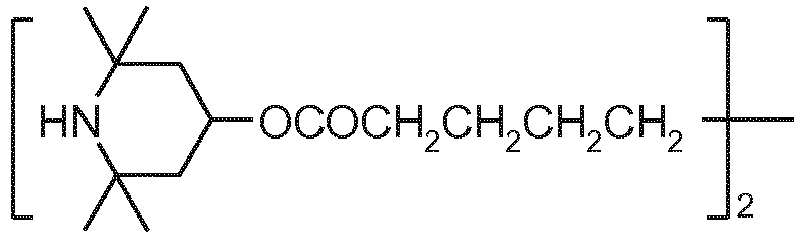
ESS-05 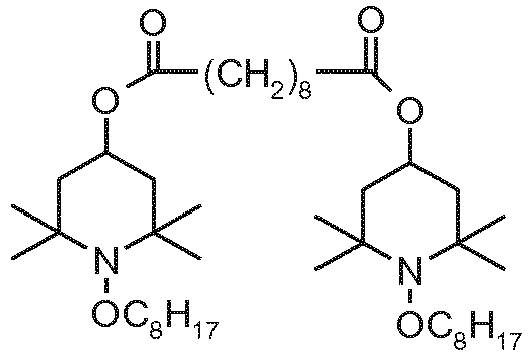
ESS-06 
CAS 6197-30-4 ESS-07 
CAS 5232-99-5 ESS-08 
CAS 127474-91-3 ESS-09 Polycrylene CAS 866102-82-1 ESS-10 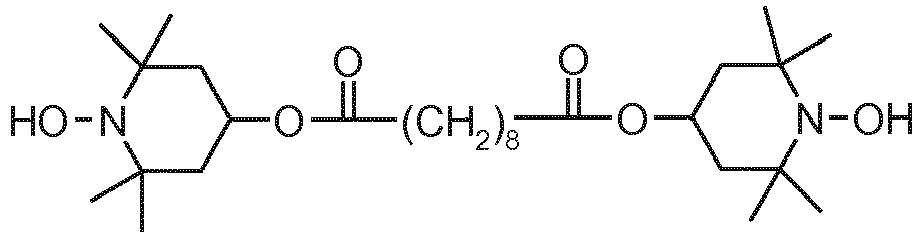
CAS # 30538-92-2 - Combinations of excited state stabilizers like the compound (ESS-01) with UV absorbers like other Tinogard UV light stabilizers show a synergistic stabilizing effect.
- This "boosting" effect allows for high demanding shelf life enhancements as well as cost effective ingredient protection.
- In the literature also excited state quenchers based on the naphthalene structure are known.
- Particularly preferred are dialkyl naphthalates structures such as disclosed
US 2002/197285 ,US 2006/228311 andWO 2002/087528 . - Another group of particularly preferred excited state quenchers are those based on the β,β-diphenylacrylate structure which are for example described in
US 2004/047818 ,
US 2006/257338 ,US 2006/228311 ,US 2004/062726 andUS 2004/057916 . - The stabilizing composition comprising
- (a) an effective stabilizing amount of at least one merocyanine derivative of formula

- (b) at least one UV filter of formula (BT-01)

- (c) at least one excited state quencher as defined in claim 1; and optionally
- (d) at least one salicylate;
- Particularly preferred mixtures are listed in Table 4 below:
Table 4: Preferred Combinations Component (a) Component (b) Component (c) (M3) 

MC-03 CAS-No.: 125304-04-3 BT-01 (M4) 


MC-03 CAS-No.: 125304-04-3 BT-01 ESS-01 (M5) 


MC-03 CAS-No.: 125304-04-3 BT-01 ESS-06 (M6) 


MC-03 CAS-No.: 125304-04-3 BT-01 CAS 6197-30-4 ESS-02 (M7) 
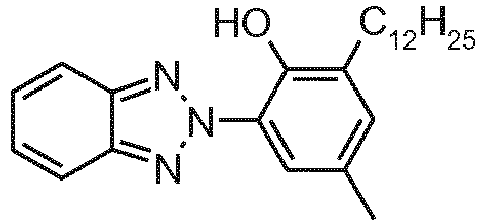

MC-03 CAS-No.: 125304-04-3 BT-01 CAS 127474-91-3 ESS-04 - Advantageously the stabilizing composition is also mixed with a salicylate. Preferred salicylates are salicylic acid (CAS-No. 69-72-7), homosalate (CAS-No. 118-56-9, 3,3,5-trimethylcyclohexyl salicylate), 2-ethylhexyl salicylate (CAS-No. 118-60-5), benzyl salicylate (CAS-No. 118-58-1), ethyl salicylate (CAS-No. 118-61-6), methyl salicylate (CAS-No. 119-36-8), isoamyl salicylate (CAS-No. 87-20-7), acetylsalicylic acid (CAS-No. 50-78-2) and isobutyl salicylate (CAS-No. 87-19-4). Even more preferred is to mix the stabilizing composition of the present invention with homosalate and/or 2-ethylhexyl salicylate.
- Particularly preferred mixtures with salicylates are listed in Table 5 below:
Table 5: Preferred Combinations with salicylates Component (a) Component (b) Component (c) salicylate M24 MC-03 BT-01 2-ethylhexylsalicylate M25 MC-03 BT-01 homosalate M26 MC-01 BT-01 2-ethylhexylsalicylate M27 MC-03 BT-01 ESS-01 2-ethylhexylsalicylate M28 MC-03 BT-01 ESS-06 2-ethylhexylsalicylate - The stabilizing composition of the present invention is particularly suitable for protecting body-care and household products against photolytic degradation.
- The stabilizing composition of the present invention may be used as single component or in mixture with other stabilizers in particular for skin-care products, bath and shower additives, preparations containing fragrances and odoriferous substances, hair-care products, dentifrices, deodorizing and antiperspirant preparations, decorative preparations, light protection formulations and preparations containing active ingredients.
- Skin-care products are, in particular, body oils, body lotions, body gels, treatment creams, skin protection ointments, shaving preparations, such as shaving foams or gels, skin powders, such as baby powder, moisturizing gels, moisturizing sprays, revitalizing body sprays, cellulite gels and peeling preparations.
- Suitable bath and shower additives are shower gels, bath-salts, bubble baths and soaps.
- Preparations containing fragrances and odoriferous substances are in particular scents, perfumes, toilet waters and shaving lotions (aftershave preparations).
- Suitable hair-care products are, for example, shampoos for humans and animals, in particular dogs, hair conditioners, products for styling and treating hair, perming agents, hair sprays and lacquers, hair gels, hair fixatives and hair dyeing or bleaching agents.
- Suitable dentifrices are in particular tooth creams, toothpastes, mouth-washes, mouth rinses, anti-plaque preparations and cleaning agents for dentures.
- Suitable decorative preparations are in particular lipsticks, nail varnishes, eye shadows, mascaras, dry and moist make-up, rouge, powders, depilatory agents and suntan lotions.
- Suitable cosmetic formulations containing active ingredients are in particular hormone preparations, vitamin preparations, vegetable extract preparations and antibacterial preparations.
- The mentioned body-care products may be in the form of creams, ointments, pastes, foams, gels, lotions, powders, make-ups, sprays, sticks or aerosols.
- They preferably contain the stabilizing mixture according to the present invention and, optionally, further UV absorbers, sterically hindered amines, complexing agents and phenolic or non-phenolic antioxidants.
- The present invention therefore also relates to a body-care product comprising a stabilizing mixture according to the present invention.
- In the stabilizing composition the weight ratio of component (a) to component (b) is from 20:1 to 1:20 and the weight ratio of component (a) to component (c) is from 1:1 to 1000:1, more preferably from 10:1 to 100:1. When the synergistic combination is combined with a salicylate the weight ratio of component (a) to the salicylate is from 20:1 to 1:20, more preferably from 10:1 to 1:10.
- The stabilizing mixture according to the present invention is present in the body care and household products in a concentration of about 5 to about 50000 ppm, based on the total formulation, preferably from about 10 to about 10000 ppm, and most preferably from about 100 to about 1000 ppm.
- The body-care products according to the present invention may also contain one or one more additional compounds as described below.
- Guerbet alcohols based on fatty alcohols having from 6 to 18, preferably from 8 to 10 carbon atoms including cetyl alcohol, stearyl alcohol, cetearyl alcohol, oleyl alcohol, octyldodecanol, benzoate of C12-C15 alcohols, acetylated lanolin alcohol, etc..
- Esters of linear C6-C24 fatty acids with linear C3-C24 alcohols, esters of branched C6-C13carboxylic acids with linear C6-C24 fatty alcohols, esters of linear C6-C24fatty acids with branched alcohols, especially 2-ethylhexanol, esters of hydroxycarboxylic acids with linear or branched C6-C22 fatty alcohols, especially dioctyl malates, esters of linear and/or branched fatty acids with polyhydric alcohols (for example propylene glycol, dimer diol or trimer triol) and/or Guerbet alcohols, for example caproic acid, caprylic acid, 2-ethylhexanoic acid, capric acid, lauric acid, isotridecanoic acid, myristic acid, palmitic acid, palmitoleic acid, stearic acid, isostearic acid, oleic acid, elaidic acid, petroselinic acid, linoleic acid, linolenic acid, elaeostearic acid, arachidic acid, gadoleic acid, behenic acid and erucic acid and technical-grade mixtures thereof (obtained, for example, in the pressure removal of natural fats and oils, in the reduction of aldehydes from Roelen's ox synthesis or in the dimerisation of unsaturated fatty acids) with alcohols, for example, isopropyl alcohol, caproic alcohol, capryl alcohol, 2-ethylhexyl alcohol, capric alcohol, lauryl alcohol, isotridecyl alcohol, myristyl alcohol, cetyl alcohol, palmoleyl alcohol, stearyl alcohol, isostearyl alcohol, oleyl alcohol, elaidyl alcohol, petroselinyl alcohol, linoyl alcohol, linolenyl alcohol, elaeostearyl alcohol, arachidyl alcohol, gadoleyl alcohol, behenyl alcohol, erucyl alcohol and brassidyl alcohol and technical-grade mixtures thereof (obtained, for example, in the high-pressure hydrogenation of technical-grade methyl esters based on fats and oils or aldehydes from Roelen's oxo synthesis and as monomer fractions in the dimerisation of unsaturated fatty alcohols).
- Examples of such ester oils are isopropylmyristate, isopropylpalmitate, isopropylstearate, isopropyl isostearate, isopropyloleate, n-butylstearate, n-hexyllaurate, n-decyloleate, isooctylstearate, isononylstearate, isononyl isononanoate, 2-ethylhexylpalmitate, 2-hexyllaurate, 2-hexyldecylstearate, 2-octyldodecylpalmitate, oleyloleate, oleylerucate, erucyloleate, erucylerucate, cetearyl octanoate, cetyl palmitate, cetyl stearate, cetyl oleate, cetyl behenate, cetyl acetate, myristyl myristate, myristyl behenate, myristyl oleate, myristyl stearate, myristyl palmitate, myristyl lactate, propylene glycol dicaprylate/caprate, stearyl heptanoate, diisostearyl malate, octyl hydroxystearate, etc..
- Di- or tri-glycerides, based on C6-C18 fatty acids, modified by reaction with other alcohols (caprylic/capric triglyceride, wheat germ glycerides, etc.). Fatty acid esters of polyglycerin (polyglyceryl-n such as polyglyceryl-4 caprate, polyglyceryl-2 isostearate, etc. or castor oil, hydrogenated vegetable oil, sweet almond oil, wheat germ oil, sesame oil, hydrogenated cottonseed oil, coconut oil, avocado oil, corn oil, hydrogenated castor oil, shea butter, cocoa butter, soybean oil, mink oil, sunflower oil, safflower oil, macadamia nut oil, olive oil, hydrogenated tallow, apricot kernel oil, hazelnut oil, borago oil, etc.
- including esters of long-chain acids and alcohols as well as compounds having wax-like properties, e.g., carnauba wax, beeswax (white or yellow), lanolin wax, candellila wax, ozokerite, japan wax, paraffin wax, microcrystalline wax, ceresin, cetearyl esters wax, synthetic beeswax etc. Also, hydrophilic waxes as Cetearyl Alcohol or partial glycerides.
- Alkylene glycol esters, especially ethylene glycol distearate; fatty acid alkanolamides, especially coco fatty acid diethanolamide; partial glycerides, especially stearic acid monoglyceride; esters of polyvalent, unsubstituted or hydroxy-substituted carboxylic acids with fatty alcohols having from 6 to 22 carbon atoms, especially long-chained esters of tartaric acid; fatty substances, for example fatty alcohols, fatty ketones, fatty aldehydes, fatty ethers and fatty carbonates, which in total have at least 24 carbon atoms, especially laurone and distearyl ether; fatty acids, such as stearic acid, hydroxystearic acid or behenic acid, ring-opening products of olefin epoxides having from 12 to 22 carbon atoms with fatty alcohols having from 12 to 22 carbon atoms and/or polyols having from 2 to 15 carbon atoms and from 2 to 10 hydroxy groups, and mixtures thereof.
- Mineral oil (light or heavy), petrolatum (yellow or white), microcrystalline wax, paraffinic and isoparaffinic compounds, hydrogenated isoparaffinic molecules as polydecenes and polybutene, hydrogenated polyisobutene, squalane, isohexadecane, isododecane and others from plant and animal kingdom.
- Dimethylpolysiloxanes, methylphenylpolysiloxanes, cyclic silicones, and also amino-, fatty acid-, alcohol-, polyether-, epoxy-, fluorine-, glycoside- and/or alkyl-modified silicone compounds, which at room temperature may be in either liquid or resinous form, linear polysiloxanes, dimethicone (Dow Corning 200 fluid, Rhodia Mirasil DM), dimethiconol, cyclic silicone fluids, cyclopentasiloxanes volatiles (Dow Corning 345 fluid), phenyltrimethicone (Dow Corning 556 fluid). Also suitable are simethicones, which are mixtures of dimethicones having an average chain length of from 200 to 300 dimethylsiloxane units with hydrogenated silicates.
A detailed survey by Todd et al. of suitable volatile silicones may in addition be found in Cosm. Toil. 91, 27 (1976). - Perfluorohexane, dimethylcyclohexane, ethylcyclopentane, polyperfluoromethylisopropyl ether.
- Any conventionally usable emulsifier can be used for the compositions. Emulsifier systems may comprise for example: carbocyclic acids and their salts: alkaline soap of sodium, potassium and ammonium, metallic soap of calcium or magnesium, organic basis soap such as Lauric, palmitic, stearic and oleic acid etc., alkyl phosphates or phosphoric acid esters, acid phosphate, diethanolamine phosphate, potassium cetyl phosphate, ethoxylated carboxylic acids or polyethyleneglycol esters, PEG-n acrylates, linear fatty alcohols having from 8 to 22 carbon atoms, branched from 2 to 30 mol of ethylene oxide and/or from 0 to 5 mol propylene oxide with fatty acids having from 12 to 22 carbon atoms and with alkylphenols having from 8 to 15 carbon atoms in the alkyl group, fatty alcohol polyglycolether such as laureth-n, ceteareth-n, steareth-n, oleth-n, fatty acid polyglycolether such as PEG-n stearate, PEG-n oleate, PEG-n cocoate. Monoglycerides and polyol esters. C12-C22 fatty acid mono- and di-esters of addition products of from 1 to 30 mol of ethylene oxide with polyols. Fatty acid and polyglycerol ester such as monostearate glycerol, diisostearoyl polyglyceryl-3-diisostearates, polyglyceryl-3-diisostearates, triglyceryl diisostearates, polyglyceryl-2-sesquiisostearates or polyglyceryl dimerates (mixtures of compounds from a plurality of those substance classes are also suitable); fatty acid polyglycolesters such as monostearate diethylene glycol, fatty acid and polyethylene glycol esters, fatty acid and saccharose esters such as sucro esters, glycerol and saccharose esters such as sucro glycerides, sorbitol and sorbitan, sorbitan mono- and di-esters of saturated and unsaturated fatty acids having from 6 to 22 carbon atoms and ethylene oxide addition products, polysorbate-n series, sorbitan esters such as sesquiisostearate, sorbitan, PEG-(6)-isostearate sorbitan, PEG-(10)-sorbitan laurate, PEG-17-dioleate sorbitan, glucose derivatives, C8-C22 alkyl-mono and oligo-glycosides and ethoxylated analogues with glucose being preferred as the sugar component, O/W emulsifiers such as methyl gluceth-20 sesquistearate, sorbitan stearate/sucrose cocoate, methyl glucose sesquistearate, cetearyl alcohol/cetearyl glucoside, W/O emulsifiers such as methyl glucose dioleate/ methyl glucose isostearate, sulfates and sulfonated derivatives, dialkylsulfosuccinates, dioctyl succinate, alkyl lauryl sulfonate, linear sulfonated paraffins, sulfonated tetrapropylene sulfonate, sodium lauryl sulfates, ammonium and ethanolamine lauryl sulfates, lauryl ether sulfates, sodium laureth sulfates, sulfosuccinates, acetyl isothionates, alkanolamide sulfates, taurines, methyl taurines, imidazole sulfates, amine derivatives, amine salts, ethoxylated amines, oxide amine with chains containing an heterocycle such as alkyl imidazolines, pyridine derivatives, isoquinoteines, cetyl pyridinium chloride, cetyl pyridinium bromide, quaternary ammonium such as cetyltrimethylbroide ammonium bromide (CTBA), stearylalkonium, amide derivatives, alkanolamides such as acylamide DEA, ethoxylated amides such as PEG-n acylamide, oxydeamide, polysiloxane/polyalkyl/polyether copolymers and derivatives, dimethicone, copolyols, silicone polyethylene oxide copolymer, silicone glycol copolymer, propoxylated or POE-n ethers (Meroxapols), polaxamers or poly-(oxyethylene)m-block-poly(oxypropylene)n-block(oxyethylene), zwitterionic surfactants that carry at least one quaternary ammonium group and at least one carboxylate and/or sulfonate group in the molecule, zwitterionic surfactants that are especially suitable are betaines, such as N-alkyl-N,N_dimethylammonium glycinates, cocoalkyldimethylammonium glycinate, N-acylaminopropyl-N,N-dimethylammonium glycinates, cocoacylaminopropyldimethylammonium glycinate and 2_alkyl-3-carboxymethyl-3-hydroxyethylimidazolines each having from 8 to 18 carbon atoms in the alkyl or acyl group and also cocoacylaminoethylhydroxyethylcarboxymethylglycinate, N-alkylbetaine, N-alkylaminobetaines, alkylimidazolines, alkylopeptides, lipoaminoacids, self emulsifying bases and the compounds as described in K.F.DePolo, A short textbook of cosmetology, Chapter 8, Table 8-7, p250-251.
- Non ionic emulsifiers such as PEG-6 beeswax (and) PEG-6 stearate (and) polyglyceryl-2-isostearate [Apifac], glyceryl stearate (and) PEG-100 stearate. [Arlacel 165], PEG-5 glyceryl stearate [arlatone 983 S], sorbitan oleate (and) polyglyceryl-3 ricinoleate.[Arlacel 1689], sorbitan stearate and sucrose cocoate [arlatone 2121], glyceryl stearate and laureth-23 [Cerasynth 945], cetearyl alcohol and ceteth-20 [Cetomacrogol Wax], cetearyl alcohol and colysorbate 60 and PEG-150 and stearate-20[Polawax GP 200, Polawax NF], cetearyl alcohol and cetearyl polyglucoside [Emulgade PL 1618], cetearyl alcohol and ceteareth-20 [Emulgade 1000NI, Cosmowax], cetearyl alcohol and PEG-40 castor oil [Emulgade F Special], cetearyl alcohol and PEG-40 castor oil and sodium cetearyl sulfate [Emulgade F], stearyl alcohol and steareth-7 and steareth-10 [Emulgator E 2155], cetearyl alcohol and steareth-7 and steareth-10 [Emulsifying wax U.S.N.F], glyceryl stearate and PEG-75 stearate [Gelot 64], propylene glycol ceteth-3 acetate .[Hetester PCS], propylene glycol isoceth-3 acetate [Hetester PHA], cetearyl alcohol and ceteth-12 and oleth-12 [Lanbritol Wax N 21], PEG -6 stearate and PEG-32 stearate [Tefose 1500], PEG-6 stearate and ceteth-20 and steareth-20 [Tefose 2000], PEG-6 stearate and ceteth-20 and glyceryl stearate and steareth-20 [Tefose 2561], glyceryl stearate and ceteareth-20 [Teginacid H, C, X].
- Anionic emulsifiers such as PEG-2 stearate SE, glyceryl stearate SE [Monelgine, Cutina KD], propylene glycol stearate [Tegin P], cetearyl Alcohol and Sodium cetearyl sulfate [Lanette N, Cutina LE, Crodacol GP], cetearyl alcohol and sodium lauryl sulfate [Lanette W], trilaneth-4 phopshate and glycol stearate and PEG-2 stearate [Sedefos 75], glyceryl stearate and sodium lauryl Sulfate [Teginacid Special]. Cationic acid bases such as cetearyl alcohol and cetrimonium bromide.
- The emulsifiers may be used in an amount of, for example, from 1 to 30 % by weight, especially from 4 to 20 % by weight and preferably from 5 to 10 % by weight, based on the total weight of the composition.
- When formulated in O/W emulsions, the preferably amount of such emulsifier system could represent 5% to 20% of the oil phase.
- Substances suitable for use as super-fatting agents are, for example, lanolin and lecithin and also polyethoxylated or acrylated lanolin and lecithin derivatives, polyol fatty acid esters, monoglycerides and fatty acid alkanolamides, the latter simultaneously acting as foam stabilizers.
- Examples of suitable mild surfactants, that is to say surfactants especially well tolerated by the skin, include fatty alcohol polyglycol ether sulfates, monoglyceride sulfates, mono- and/or di-alkyl sulfosuccinates, fatty acid isethionates, fatty acid sarcosinates, fatty acid taurides, fatty acid glutamates, α-olefin sulfonates, ether carboxylic acids, alkyl oligoglucosides, fatty acid glucamides, alkylamidobetaines and/or protein fatty acid condensation products, the latter preferably being based on wheat proteins.
- silicon dioxide, magnesium silicates, aluminum silicates, polysaccharides or derivatives thereof for example hyaluronic acid, xanthan gum, guar-guar, agar-agar, alginates, carraghenan, gellan, pectines, or modified cellulose such as hydroxycellulose, hydroxypropyl-methylcellulose. In addition polyacrylates or homopolymer of reticulated acrylic acids and polyacrylamides, carbomer (carbopol types 980, 981, 1382, ETD 2001, ETD2020, Ultrez 10) or Salcare range such as Salcare SC80(steareth-10 allyl ether/acrylates copolymer), Salcare SC81(acrylates copolymer), Salcare SC91 and Salcare AST(sodium acrylates copolymer/PPG-1 trideceth-6), sepigel 305(polyacrylamide/laureth-7), Simulgel NS and Simulgel EG (hydroxyethyl acrylate / sodium acryloyldimethyl taurate copolymer), Stabilen 30 (acrylates / vinyl isodecanoate crosspolymer), Pemulen TR-1 (acrylates / C10-30 alkyl acrylate crosspolymer), Luvigel EM (sodium acrylates copolymer), Aculyn 28 (acrylates/beheneth-25 methacrylate copolymer), etc.
- Suitable cationic polymers are, for example, cationic cellulose derivatives, for example a quaternized hydroxymehtyl cellulose obtainable under the name Polymer JR 400 from Amerchol, cationic starches, copolymers of diallylammonium salts and acrylamides, quaternized vinylpyrrolidone/vinyl imidazole polymers, for example Luviquatâ (BASF), condensation products of polyglycols and amines, quaternized collagen polypeptides, for example lauryl diammonium hydroxypropyl hydrolyzed collagen (LamequatâL/Grünau), quaternised wheat polypeptides, polyethyleneimine, cationic silicone polymers, for example amidomethicones, copolymers of adipic acid and dimethylaminohydroxypropyldiethylene-triamine (Cartaretin/Sandoz), copolymers of acrylic acid with dimethyldiallylammonium chloride (Merquat 550 / Chemviron), polyaminopolyamides, as described, for example, in
FR-A-2 252 840 EP 1093796 (pages 3-8, paragraphs 17-68) may be used. - cetyl trimethyl ammonium bromide (CTAB), dimethicone copolyols, amidomethicones, acrylamidopropyltrimonium chloride/Acrylamide copolymer, guar hydroxypropyl trimonium chloride, hydroxyacetyl hydroxyethyl dimonium chloride quaternium compounds as listed in International Cosmetic Ingredient Dictionary and Handbook, 7th Edition 1997, for example Quaternium-80, polyquaternium compounds, as listed in International Cosmetic Ingredient Dictionary and Handbook, 7th Edition 1997, for example polyquaternium- 5, polyquaternium-6, polyquaternium-7, polyquaternium-10, polyquaternium-11, polyquaternium-17, polyquaternium-18, polyquaternium-24 or polyquaternium-27, polyquaternium-28, polyquaternium-32, polyquaternium-37.
- Biogenic active ingredients are to be understood as meaning, for example, tocopherol, tocopherol acetate, tocopherol palmitate, ascorbic acid, deoxyribonucleic acid, retinol, bisabolol, allantoin, phytantriol, panthenol, AHA acids, amino acids, ceramides, pseudoceramides, essential oils, plant extracts and vitamin complexes.
- As deodorizing active ingredients are for example, antiperspirants, for example aluminium chlorohydrates (see J. Soc. Cosm. Chem. 24, 281 (1973)). Under the trade mark Locronâ of Hoechst AG, Frankfurt (FRG), there is available commercially, for example, an aluminium chlorohydrate corresponding to formula Al2(OH)5Cl x 2.5 H2O, the use of which is especially preferred (see J. Pharm. Pharmacol. 26, 531 (1975)). Besides the chlorohydrates, it is also possible to use aluminium hydroxyacetates and acidic aluminium/zirconium salts. Esterase inhibitors may be added as further deodorizing active ingredients. Such inhibitors are preferably trialkyl citrates, such as trimethyl citrate, tripropyl citrate, triisopropyl citrate, tributyl citrate and especially triethyl citrate (Hydagen CAT, Henkel), which inhibit enzyme activity and hence reduce odor formation. Further substances that come into consideration as esterase inhibitors are sterol sulfates or phosphates, for example lanosterol, cholesterol, campesterol, stigmasterol and sitosterol sulfate or phosphate, dicarboxylic acids and esters thereof, for example glutaric acid, glutaric acid monoethyl ester, glutaric acid diethyl ester, adipic acid, adipic acid monoethyl ester, adipic acid diethyl ester, malonic acid and malonic acid diethyl ester and hydroxycarboxylic acids and esters thereof, for example citric acid, malic acid, tartaric acid or tartaric acid diethyl ester. Antibacterial active ingredients that influence the germ flora and kill or inhibit the growth of sweat-decomposing bacteria can likewise be present in the preparations (especially in stick preparations). Examples include chitosan, phenoxyethanol and chlorhexidine gluconate. 5-chloro-2-(2,4-dichlorophenoxy)-phenol (Triclosan, Irgasan, Ciba Specialty Chemicals Inc.) has also proved especially effective.
- As anti-dandruff agents there may be used, for example, climbazole, octopirox and zinc pyrithione. Customary film formers include, for example, chitosan, microcrystalline chitosan, quaternized chitosan, polyvinylpyrrolidone, vinylpyrrolidone/vinyl acetate copolymers, polymers of quaternary cellulose derivatives containing a high proportion of acrylic acid, collagen, hyaluronic acid and salts thereof and similar compounds.
- For improvement of the flow behavior it is also possible to employ hydrotropic agents, for example ethoxylated or non ethoxylated mono-alcohols, diols or polyols with a low number of carbon atoms or their ethers (e.g. ethanol, isopropanol, 1,2-dipropanediol, propyleneglycol, glycerin, ethylene glycol, ethylene glycol monoethylether, ethylene glycol monobutylether, propylene glycol monomethylether, propylene glycol monoethylether, propylene glycol monobutylether, diethylene glycol monomethylether; diethylene glycol monoethylether, diethylene glycol monobutylether and similar products). The polyols for that purpose comprise preferably 2 to 15 carbon atoms and at least two hydroxy groups. The polyols may also contain further functional groups, especially amino groups, and/or may be modified with nitrogen. Typical examples are as follows: glycerol, alkylene glycols, for example ethylene glycol, diethylene glycol, propylene glycol, butylene glycol, hexylene glycol and also polyethylene glycols having an average molecular weight of from 100 to 1000 Dalton; technical oligo-glycerol mixtures having an intrinsic degree of condensation of from 1.5 to 10, for example technical diglycerol mixtures having a diglycerol content of from 40 to 50 % by weight; methylol compounds, such as, especially, trimethylolethane, trimethylolpropane, trimethylolbutane, pentaerythritol and dipentaerythritol; lower alkyl-glucosides, especially those having from 1 to 8 carbon atoms in the alkyl radical, for example methyl and butyl glucoside; sugar alcohols having from 5 to 12 carbon atoms, for example sorbitol or mannitol; sugars having from 5 to 12 carbon atoms, for example glucose or saccharose; amino sugars, for example glutamine; dialcohol amines, such as diethanolamine or 2-amino-1,3-propanediol.
- Suitable preservatives include, for example methyl-, ethyl-, propyl-, butyl- parabens, benzalkonium chloride, 2-bromo-2-nitro-propane-1,3-diol, dihydroacetic acid, diazolidinyl urea, 2-dichloro-benzyl alcohol, DMDM hydantoin, formaldehyde solution, methyldibromoglutanitrile, phenoxyethanol, sodium hydroxymethylglycinate, imidazolidinyl urea, Triclosan and further substance classes listed in the following reference: K.F.Depolo - A Short Textbook Of Cosmetology, Chapter 7, Table 7-2, 7-3, 7-4 And 7-5, P210-219.
- Typical examples of bacteria-inhibiting agents are preservatives that have a specific action against gram-positive bacteria, such as 2,4,4'-trichloro-2'-hydroxydiphenyl ether, chlorhexidine (1,6-di(4-chlorophenyl-biguanido)hexane) or TCC (3,4,4'-trichlorocarbanilide). A large number of aromatic substances and ethereal oils also have antimicrobial properties. Typical examples are the active ingredients eugenol, menthol and thymol in clove oil, mint oil and thyme oil. A natural deodorizing agent of interest is the terpene alcohol farnesol (3,7,11-trimethyl-2,6,10-dodecatrien-1-ol), which is present in lime blossom oil. Glycerol monolaurate has also proved to be a bacteriostatic agent. The amount of the additional bacteria-inhibiting agents present is usually from 0.1 to 2 % by weight, based on the solids content of the preparations.
- Mixtures of natural and/or synthetic aromatic substances. Natural aromatic substances are, for example, extracts from blossom (lilies, lavender, roses, jasmine, neroli, ylang-ylang), from stems and leaves (geranium, patchouli, petitgrain), from fruit (aniseed, coriander, carraway, juniper), from fruit peel (bergamot, lemons, oranges), from roots (mace, angelica, celery, cardamom, costus, iris, calmus), from wood (pinewood, sandalwood, guaiacum wood, cedarwood, rosewood), from herbs and grasses (tarragon, lemon grass, sage, thyme), from needles and twigs (spruce, pine, Scots pine, mountain pine), from resins and balsams (galbanum, elemi, benzoin, myrrh, olibanum, opoponax). Animal raw materials also come into consideration, for example civet and castoreum. Typical synthetic aromatic substances are, for example, products of the ester, ether, aldehyde, ketone, alcohol or hydrocarbon type. Aromatic substance compounds of the ester type are, for example, benzyl acetate, phenoxyethyl isobutyrate, p-tert-butylcyclohexyl acetate, linalyl acetate, dimethylbenzylcarbinyl acetate, phenylethyl acetate, linalyl benzoate, benzyl formate, ethylmethylphenyl glycinate, allylcyclohexyl propionate, styrallyl propionate and benzyl salicylate. The ethers include, for example, benzyl ethyl ether; the aldehydes include, for example, the linear alkanals having from 8 to 18 hydrocarbon atoms, citral, citronellal, citronellyl oxyacetaldehyde, cyclamen aldehyde, hydroxycitronellal, lilial and bourgeonal; the ketones include, for example, the ionones, isomethylionone and methyl cedryl ketone; the alcohols include, for example, anethol, citronellol, eugenol, isoeugenol, geraniol, linalool, phenyl ethyl alcohol and terpinol; and the hydrocarbons include mainly the terpenes and balsams. It is preferable, however, to use mixtures of various aromatic substances that together produce an attractive scent. Ethereal oils of relatively low volatility, which are chiefly used as aroma components, are also suitable as perfume oils, e.g. sage oil, camomile oil, clove oil, melissa oil, oil of cinnamon leaves, lime blossom oil, juniper berry oil, vetiver oil, olibanum oil, galbanum oil, labolanum oil and lavandin oil. Preference is given to the use of bergamot oil, dihydromyrcenol, lilial, lyral, citronellol, phenyl ethyl alcohol, hexyl cinnamaldehyde, geraniol, benzyl acetone, cyclamen aldehyde, linalool, boisambrene forte, ambroxan, indole, hedione, sandelice, lemon oil, tangerine oil, orange oil, allyl amyl glycolate, cyclovertal, lavandin oil, muscatel sage oil, damascone, bourbon geranium oil, cyclohexyl salicylate, vertofix coeur, iso-E-Super, Fixolide NP, evernyl, iraldein gamma, phenyl acetic acid, geranyl acetate, benzyl acetate, rose oxide, romillat, irotyl and floramat alone or in admixture with one another.
- It is furthermore possible for the cosmetic preparations to contain, as adjuvants, anti-foams, such as silicones, structurants, such as maleic acid, solubilizers, such as ethylene glycol, propylene glycol, glycerol or diethylene glycol, opacifiers, such as latex, styrene/PVP or styrene/acrylamide copolymers, propellants, such as propane/butane mixtures, N2O, dimethyl ether, CO2, N2 or air, so-called coupler and developer components as oxidation dye precursors, reducing agents, such as thioglycolic acid and derivatives thereof, thiolactic acid, cysteamine, thiomalic acid or mercaptoethanesulfonic acid, or oxidizing agents, such as hydrogen peroxide, potassium bromate or sodium bromate.
- Suitable insect repellents are, for example, N,N-diethyl-m-toluamide, 1,2-pentanediol or insect repellent 3535; suitable self-tanning agents are, for example, dihydroxyacetone and/or erythrulose or dihydroxy acetone and/or dihydroxy acetone precursors as described in
WO 01/85124 - The present stabilized compositions are particularly suitable for stabilizing body care products, in particular:
- skin-care preparations, e.g. skin-washing and cleansing preparations in the form of tablet-form or liquid soaps, soapless detergents or washing pastes,
- bath preparations, e.g. liquid (foam baths, milks, shower preparations) or solid bath preparations, e.g. bath cubes and bath salts;
- skin-care preparations, e.g. skin emulsions, multi-emulsions or skin oils; body oils, body lotions, body gels; skin protection ointments;
- cosmetic personal care preparations, e.g. facial make-up in the form of day creams or powder creams, face powder (loose or pressed), rouge or cream make-up, eye-care preparations, e.g. eye shadow preparations, mascara, eyeliner, eye creams or eye-fix creams; lip-care preparations, e.g. lipsticks, lip gloss, lip contour pencils, nail-care preparations, such as nail varnish, nail varnish removers, nail hardeners or cuticle removers;
- foot-care preparations, e.g. foot baths, foot powders, foot creams or foot balsams, special deodorants and antiperspirants or callus-removing preparations;
- light-protective preparations, such as sun milks, lotions, creams or oils, sun blocks or tropicals, pre-tanning preparations or after-sun preparations;
- skin-tanning preparations, e.g. self-tanning creams;
- depigmenting preparations, e.g. preparations for bleaching the skin or skin-lightening preparations;
- insect-repellents, e.g. insect-repellent oils, lotions, sprays or sticks;
- deodorants, such as deodorant sprays, pump-action sprays, deodorant gels, sticks or roll-ons;
- antiperspirants, e.g. antiperspirant sticks, creams or roll-ons;
- preparations for cleansing and caring for blemished skin, e.g. synthetic detergents (solid or liquid), peeling or scrub preparations or peeling masks;
- hair-removal preparations in chemical form (depilation), e.g. hair-removing powders, liquid hair-removing preparations, cream- or paste-form hair-removing preparations, hair-removing preparations in gel form or aerosol foams;
- shaving preparations, e.g. shaving soap, foaming shaving creams, non-foaming shaving creams, foams and gels, preshave preparations for dry shaving, aftershaves or aftershave lotions;
- fragrance preparations, e.g. fragrances and odoriferous substances containing preparations (scents, eau de Cologne, eau de toilette, eau de perfume, perfume de toilette, perfume), perfume oils or perfume creams;
- cosmetic hair-treatment preparations, e.g. hair-washing preparations in the form of shampoos and conditioners, hair-care preparations, e.g. pretreatment preparations, hair tonics, styling creams, styling gels, pomades, hair rinses, treatment packs, intensive hair treatments, hair-structuring preparations, e.g. hair-waving preparations for permanent waves (hot wave, mild wave, cold wave), hair-straightening preparations, liquid hair-setting preparations, hair foams, hairsprays, bleaching preparations, e.g. hydrogen peroxide solutions, lightening shampoos, bleaching creams, bleaching powders, bleaching pastes or oils, temporary, semi-permanent or permanent hair colorants, preparations containing self-oxidizing dyes, or natural hair colorants, such as henna or camomile;
- dentifrices, in particular tooth creams, toothpastes, mouth-washes, mouth rinses, anti-plaque preparations and cleaning agents for dentures;
- decorative preparations, in particular lipsticks, nail varnishes, eye shadows, mascaras, dry and moist make-up, rouge, powders, depilatory agents and suntan lotions
- cosmetic formulations containing active ingredients, in particular hormone preparations, vitamin preparations, vegetable extract preparations and antibacterial preparations.
- Suitable cosmetic formulations containing active ingredients are in particular hormone preparations, vitamin preparations, vegetable extract preparations and antibacterial preparations.
- The final formulations listed may exist in a wide variety of presentation forms, for example:
- in the form of liquid preparations as a W/O, O/W, O/W/O, W/O/W or PIT emulsion and all kinds of microemulsions,
- in the form of a gel,
- in the form of an oil, a cream, milk or lotion,
- in the form of a stick,
- in the form of a spray (spray with propellant gas or pump-action spray) or an aerosol,
- in the form of a foam, or
- in the form of a paste.
- Of special importance as cosmetic preparations for the skin are light-protective preparations, such as sun milks, lotions, creams, oils, sun blocks or tropicals, pretanning preparations or after-sun preparations, also skin-tanning preparations, for example self-tanning creams. Of particular interest are sun protection creams, sun protection lotions, sun protection milk and sun protection preparations in the form of a spray.
- Of special importance as cosmetic preparations for the hair are the above-mentioned preparations for hair treatment, especially hair-washing preparations in the form of shampoos, hair conditioners, hair-care preparations, e.g. pretreatment preparations, hair tonics, styling creams, styling gels, pomades, hair rinses, treatment packs, intensive hair treatments, hair-straightening preparations, liquid hair-setting preparations, hair foams and hairsprays. Of special interest are hair-washing preparations in the form of shampoos.
- A shampoo has, for example, the following composition:
- 0.01 to 5 % by weight of the stabilized composition of the present invention,
- 12.0 % by weight of sodium laureth-2-sulfate,
- 4.0 % by weight of cocamidopropyl betaine,
- 3.0 % by weight of sodium chloride,
- and water ad 100%.
- For example, especially the following hair-cosmetic formulations may be used:
- a1) spontaneously emulsifying stock formulation, comprising stabilized composition of the present invention, optionally another stabilizer, PEG-6-C10oxoalcohol and sorbitan sesquioleate, to which water and any desired quaternary ammonium compound, for example 4 % minkamidopropyl dimethyl-2-hydroxyethylammonium chloride or Quaternium 80 is added;
- a2) spontaneously emulsifying stock formulation comprising the stabilized composition of the present invention, optionally another stabilizer, tributyl citrate and PEG-20-sorbitan monooleate, to which water and any desired quaternary ammonium compound, for example 4 % minkamidopropyl dimethyl-2-hydroxyethylammonium chloride or Quaternium 80 is added;
- b) quat-doped solutions comprising the stabilized composition of the present invention in butyl triglycol and tributyl citrate; and optionally another stabilizer;
- c) mixtures or solutions comprising the compound stabilized composition of the present invention with alkylpyrrolidone; and optionally another stabilizer.
- Examples of body care products of the present invention are listed in the Table below:
Body care product Ingredients Sun screen Oils, emulsifiers, water, UV absorbers, thickeners, antioxidants, stabilizer according to invention moisturizing cream vegetable oil, emulsifier, thickener, perfume, water, antioxidant, stabilizer according to invention Hair or body shampoo surfactant, emulsifier, colorant, preservatives, perfume, antioxidant, stabilizer according to invention Hair conditioner surfactant, cationic polymers, emulsifier, colorant, preservatives, perfume, antioxidant, stabilizer according to invention Toothpaste cleaning agent, abrasives, water, thickener, sweetener, flavor, colorant, antioxidant, stabilizer according to invention lip-care stick vegetable oil, wax, TiO2, pigments, antioxidant, stabilizer according to invention - The stabilized compositions of the present invention are also used in household cleaning and treatment agents, for example in laundry products and fabric softeners, liquid cleansing and scouring agents, glass detergents, neutral cleaners (all-purpose cleaners), acid household cleaners (bath), bathroom cleaners, WC cleaners, for instance in washing, rinsing and dishwashing agents, kitchen and oven cleaners, clear rinsing agents, dishwasher detergents, shoe polishes, polishing waxes, floor detergents and polishes, metal, glass and ceramic cleaners, textile-care products, rug cleaners and carpet shampoos, agents for removing rust, color and stains (stain remover salt), furniture and multipurpose polishes and leather and vinyl dressing agents (leather and vinyl sprays) and air fresheners.
- Household cleaning agents are aqueous or alcoholic (ethanol or isopropyl alcohol) solutions of one or more of the following components:
- anionic, nonionic, amphoteric and/or cationic surfactants
- soaps, prepared by saponification of animal and vegetable greases
- organic acids, like hydrochloric acid, phosphoric acid, or sulfuric acid,
- for basic products inorganic (NaOH or KOH) or organic bases;
- abrasives for improved cleaning of surfaces,
- waxes and/or silicones for maintenance and protection of surfaces,
- polyphosphates,
- substances which eliminate hypochlorite or halogens;
- peroxides comprising bleaching activators like TAED, for example sodium perborate or H2O2;
- enzymes;
- in washing detergents discoloration inhibitors, soil-release compounds, grey scale inhibitors, foam inhibitors, fluorescent whitening agents;
- cleaning agents based on wax may comprise solvents selected from benzene, turpentine and/or paraffins and emulsifiers based on wax;
- filling agents like silicates, polyphosphates, Zeolithes for powdery cleaning agents;
- pigments, lakes or soluble dyes;
- perfumes; and
- light stabilizers, antioxidants and chelating agents.
- Colored cleaning agents and decorative cosmetic products can comprise the following dyes:
- inorganic pigments, for example iron oxide (Iron Oxide Red, Iron Oxide Yellow, Iron Oxide Black, etc.), Ultramarines, Chromium Oxide Green or Carbon Black;
- natural or synthetic organic pigments;
- disperse dyes which may be solubilized in solvents like direct hair dyes of the HC type, for example HC Red No. 3, HC Blue No. 2 and all other hair dyes listed in International Cosmetic Ingredient Dictionary and Handbook, 7th edition 19997) or the dispersion dyes listed in Color Index International or Society of Dyers and Colourists;
- color varnishes (insoluble salts of soluble dyes, like many Ca-, Ba- or Al-salts of anionic dyes);
- soluble anionic or cationic dyes, like acid dyes (anionic), basic dyes (cationic), direct dyes, reactive dyes or solvent dyes.
- Generally, for the coloration of household- and body care products all substances are suitable which have an absorption in the visible light of electromagnetic radiation (wave length of ca. 4000 to 700 nm). The absorption is often caused by the following chromophores:
- Azo- (mono-, di, tris-, or poly-)stilbene-, carotenoide-, diarylmethan-, triarylmethan-, xanthen-, acridin-, quinoline, methin- (also polymethin-), thiazol-, indamin-, indophenol-, azin-, oxazin, thiazin-, anthraquinone-, indigoid-, phtalocyanine- and further synthetic, natural and/or inorganic chromophores.
- The present invention also relates to home care and fabric care products such as drain cleaners, disinfectant solutions, upholstery cleaners, automotive care products (e.g., to clean and/or polish and protect paint, tires, chrome, vinyl, leather, fabric, rubber, plastic and fabric), degreasers, polishes (glass, wood, leather, plastic, marble, granite, and tile, etc.), and metal polishes and cleaners. The present invention also relates to home care products such as candles, gel candles, air fresheners and fragrance oils (for the home).
- Typical examples of household cleaning and treating agents are listed in the table below:
Household cleaners/household treating agents Ingredients detergent concentrate surfactant mixture, builders, water, ethanol, pH adjuster, antioxidant, antioxidants, stabilizer according to invention Cleaner Surfactant mixture, water, pH adjuster, colorant, stabilizer according to invention Bleaches Hypochlorite or peroxide bleach, water, pH adjuster, EDTA, stabilizer according to invention shoe polish wax wax emulsifier, antioxidant, water, preservative, antioxidants, stabilizer according to invention wax-containing floor cleaning agent emulsifier, wax, sodium chloride, water, preservative, antioxidant, stabilizer according to invention - Colored cleaning agents, personal care and decorative cosmetic products can comprise the following dyes and pigments:
- inorganic pigments, for example iron oxide (Iron Oxide Red, Iron Oxide Yellow, Iron Oxide Black, etc.), Ultramarines, Chromium Oxide Green or Carbon Black;
- natural or synthetic organic pigments;
- dispersed dyes which may be solubilized in solvents like direct hair dyes of the HC type, for example HC Red No. 3, HC Blue No. 2
- all other hair dyes listed in International Cosmetic Ingredient Dictionary and Handbook, 7th edition 19997) or listed in Color Index International or Society of Dyers and Colourists;
- color lakes (insoluble salts of soluble dyes, like many Ca-, Ba- or Al-salts of anionic dyes);
- soluble anionic or cationic dyes, like acid dyes (anionic), basic dyes (cationic), direct dyes, reactive dyes or solvent dyes.
- Generally, for the coloration of household- and body care products all substances are suitable which have an absorption in the visible light of electromagnetic radiation (wave length of ca. 4000 to 700 nm). The absorption is often caused by the following chromophores:
- Azo- (mono-, di, tris-, or poly-)stilbene-, carotenoide-, diarylmethane-, triarylmethan-, xanthen-, acridin-, quinoline, methin- (also polymethin-), thiazol-, indamin-, indophenol-, azin-, oxazin, thiazin-, anthraquinone-, indigoid-, phtalocyanine- and further synthetic, natural and/or inorganic chromophores.
- The stabilized compositions of the present invention are for example incorporated by dissolution in an oil phase or alcoholic or water phase, where required at elevated temperature.
- The present body care products and household products have high stability towards color changes and chemical degradation of the ingredients present in these products. For example, present compositions that comprise a dye are found to have excellent color stability.
- The following Examples illustrate the invention.
- The following colored basic shampoo formulation was prepared:
Sodium Laureth Ether Sulfate 10 (w/w) % Cocamidopropylbetaine 3 (w/w) % Citric Acid to pH 5 FD&C Blue No. 1 0.001 (w/w) % Aqua ad. 100 (w/w) % Stabilizer q.a. - The following stabilized und unstabilized samples of this formulation are prepared for light stability testing:
- (1) unstabilized basic shampoo formulation
- (2) basic shampoo formulation plus 0.03% of the compound (BT-01)
- (3) basic shampoo formulation plus 0.003% of compound (MC-03)
- (4) basic shampoo formulation plus 0.003% of compound (MC-03) and 0.027 % of the compound (BT-01)
- (5) basic shampoo formulation plus 0.0075% of compound (MC-03) and 0.0225 % of the compound (BT-01) (corresponds to 0.03% of a 1:3 (w%)-mixture of compound (MC-03) and of the compound (BT-01)).
- The formulations are filled into 30ml glass bottles and irradiated in an ATLAS Sun test XLS+ Xenon Lamp (light intensity 500W/m2, spectrum of light adjusted to indoor conditions, sample chamber temperature: 32°C).
Results: Sample Irradiation Time until samples were significantly faded (1) 2 hours (colorless) (2) 8 hours (colorless) (3) 6 hours (faded, but still colored), 8 hours (colorless) (4) 18 hours (colorless) (5) 24 hours (colorless) - Samples (4) and (5), stabilized by the synergistic combination of the compound (BT-01) with (MC-03), exhibit significantly better light stability compared to the samples when the compound (BT-01) (Sample (2)) or the merocyanine UV filter (MC-03) (Sample (3)) are used alone.
- Sample (2), stabilized with 0.03 % of the compound (BT-01), is totally faded after 8 hours.
- In Sample (5), where 25 % of the compound (BT-01) are replaced by the merocyanine (MC-03), the fading time is tripled to 24 hours.
- The following colored basic shampoo formulation is prepared:
Texapon NSO 30 (w/w) % Dehyton K 10 (w/w) % Aqua 60 (w/w) % Citric Acid to pH 5 PURICOLOR Blue ABL9 0.001 (w/w) % Aqua ad. 100 (w/w) % Stabilizer q.a. - The following stabilized und unstabilized samples of this formulation were prepared for light stability testing:
- (6) unstabilized basic shampoo formulation
- (7) basic shampoo formulation plus 0.03% of the compound (BT-01);
- (8) basic shampoo formulation plus 0.02 % of the compound (BT-01) and 0.01 % of the compound (ESS-01);
- (9) basic shampoo formulation plus 0.03% of a 1:3 (w%)-mixture of compound (MC-03) and of the compound (BT-01);
- (10) basic shampoo formulation plus 0.03% of a 1:4 (w%)-mixture of compound (MC-03) and of the compound (BT-01);
- (11) basic shampoo formulation plus 0.02% of a 1:3 (w%)-mixture of compound (MC-03) and of the compound (BT-01) plus additional 0.01 % of the compound (ESS-01);
- (12) basic shampoo formulation plus 0.02% of a 1:4 (w%)-mixture of compound (MC-03) and of the compound (BT-01) plus additional 0.01 % of the compound (ESS-01).
- The formulations are filled into 30ml glass bottles and irradiated in an ATLAS Sun test XLS+ Xenon Lamp (light intensity 500W/m2, spectrum of light adjusted to indoor conditions, sample chamber temperature: 32°C).
Results Sample Irradiation Time until samples were significantly faded (6) 9 hours (nearly colorless) (7) 9 hours (faded), 24 hours (colorless) (8) 39 hours (strongly faded, but still colored) (9) 31 hours (faded, but still colored) (10) 31 hours (faded, but still colored) (11) 63 hours (still no fading observed) (12) 63 hours (still no fading observed) - Samples 9 and 10, stabilized by the synergistic combination of the compound (BT-01) with (MC-03), exhibited significantly better light stability compared to the samples when the compound (BT-01) (Sample (7)) is used alone.
- Best performance is shown by a combination of the compound (BT-01) and (MC-03) with the compound (ESS-01). Even after 63 hours of irradiation no fading is observed in the samples (11) and (12).
- The following stabilized und unstabilized samples of this formulation are prepared for light stability testing:
- (13) unstabilized basic shampoo formulation;
- (14) basic shampoo formulation plus 0.03% of the compound (BT-01);
- (15) basic shampoo formulation plus 0.03% of a 1:3 (w%)-mixture of compound (MC-03) and of the compound (BT-01);
- (16) basic shampoo formulation plus 0.03% of a 2,5:7,5:1 (w%)-mixture of compound (MC-03) and of the compound (BT-01) and of homosalate (CAS-No. 118-56-9);
- (17) basic shampoo formulation plus 0.03% of a 2,5:7,5:1 (w%)-mixture of compound (MC-03) and of the compound (BT-01) and of 2-ethylhexyl salicylate;
- The formulations are filled into 30ml glass bottles and irradiated in an ATLAS Sun test XLS+ Xenon Lamp (light intensity 500W/m2, spectrum of light adjusted to indoor conditions, sample chamber temperature: 32°C).
Results Sample Irradiation Time until samples were significantly faded (13) 6 hours (nearly colorless) (14) 10 hours (slightly faded), 25 hours (colorless) (15) 25 hours (slightly faded), 34 hours (strongly faded, but still colored) (16) 25 hours (slightly faded), 34 hours (strongly faded, but still a bit more colored than sample 15) (17) 25 hours (slightly faded), 34 hours (strongly faded, but still a bit more colored than sample 15) - When compounds (BT-01) is used alone the shampoo formulation (sample 14) is completely faded after 25 hours. Where else at this time the sample 15 containing the synergistic combination of the compound (BT-01) with (MC-03) starts fading and is still colored after 34 hours. The samples (16) and (17) containing the synergistic composition of the compound (BT-01) with (MC-03) in combination with a salicylate exhibit marginal better light stability compared to the sample (15) when the synergistic combination is used alone.
- The transparency of the gel can be increased by adding small amounts of triethanolamine (pH=5.6-5.75).
Example B4: Preparation of a baby shampoo Ingredients (w/w) % cocoamidopropylbetaine 35.00 water, demin. ad.100 citric acid q.s. (pH) polyquaternium-15 0.15 perfume oil 0.30 chlorophyll 0.20 Merocyanine (MC-03) 0.02 Compound (BT-01) (INCI Benzotriazolyl Dodecyl p-Cresol) 0.02 colorant (D&C Yellow No.5) 0.02 sodium chloride 0.30 - Preparation: Surfactant and water are blended until a homogeneous solution is obtained. The pH is adjusted to 6.0-6.5 with citric acid and the other components are added in the indicated sequence. The mixture is stirred until it is completely dissolved.
Example B5: Preparation of a perfumed toilet water Ingredients (w/w) % ethanol, 96% 60 d-limonene 5 cedrene 1.5 citronellol 0.5 savin 0.5 Merocyanine (MC-03) 0.05 Compound (BT-01) (INCI Benzotriazolyl Dodecyl p-Cresol) 0.05 Compound (ESS-01) (INCI: Tris (tetramethylhydroxypiperidinol) citrate) 0.03 Tinogard TS (CAS number: 2082-79-3) 0.02 S,S-EDDS 0.01 colorant (D&C Yellow No.5) 0.1 water ad. 100 - Preparation: The components are thoroughly mixed in the indicated sequence at 50°C. A clear homogeneous solution is obtained.
Preparation of formulations of household products Example B7: Preparation of a floor wax Ingredients (w/w) % wax mixture 12 white spirit ad 100 d-limonene 4.00 Merocyanine (MC-03) 0.025 Compound (BT-01) (INCI Benzotriazolyl Dodecyl p-Cresol) 0.075 - Preparation: The components are stirred in the indicated sequence until a homogeneous mixture is obtained.
Example B8: Preparation of a lipstick, non-greasy Ingredients (w/w) % Carnauba wax 2.5 Beeswax, white 20.0 Ozekerite 10.0 Lanoline, anhydrous 5.0 Cetyl alcohol 2.0 Liquid paraffin 3.0 Isopropyl Myristate 3.0 Propylene glycol recinoleate 4.0 Cl Pigment Red 4 9.0 Cl Pigment Blue 15 1.0 Merocyanine (MC-03) 0.025 Compound (BT-01) (INCI Benzotriazolyl Dodecyl p-Cresol) 0.075 Castor Oil ad 100 Example B9: Preparation of a lipstick, transfer resistant Ingredients (w/w) % Cyclomethicone 41.50 Isodecane 10.00 D&C Red No. 7 8.00 Synthetic wax 6.00 Isostearyltrimethylpropane siloxysilicate 5.00 Cetylstearate/acetylated lanolin, 90:10 5.00 Ceresin 4.00 Paraffin 3.00 Titanium dioxide 2.00 Methylparaben 0.30 Propylparaben 0.10 Tinogard AS (INCI Bumetrizole) 0.10 Merocyanine (MC-03) 0.02 Compound (BT-01) (INCI Benzotriazolyl Dodecyl p-Cresol) 0.08 Example B10: Preparation of a Rouge (powder) Ingredients (w/w) % Talcum 56 Zinc Stearate 15 Rice starch 15 Iron Oxide Red 12 Perfume q.s. Merocyanine (MC-03) 0.02 Compound (BT-01) (INCI Benzotriazolyl Dodecyl p-Cresol) 0.08 Example B11: Preparation of a Foundation cream Ingredients (w/w) % Titanium dioxide 12.79 Oleyl alcohol 4.57 Glyceryl stearate 3.65 Propylene glycol 3.65 Stearic acid 1.83 Magnesium aluminium silicate 0.91 Triethanolamine 99% 0.91 Iron Oxide Yellow 0.64 Iron Oxide Red 0.32 Cl Pigment Brown 6 0.37 Carboxymethyl cellulose 0.10 Merocyanine (MC-03) 0.025 Compound (BT-01) (INCI Benzotriazolyl Dodecyl p-Cresol) 0.075 Water ad 100 Example B12: Preparation of an Eyeliner Ingredients (w/w) % Polysaccharide resin (Kama KM 13, Kama) 8 Iron Oxide Black 6.50 Carnauba wax 1.00 Triethanolamine, 99% 1.00 Hydrogenated polyisobutane 1.00 Hydrogenated polydecene 1.00 Sorbitan sesquioleate 1.00 Xanthan gum 0.50 Carboxymethyl cellulose 0.40 Magnesium aluminium silicate 0.40 Methyl paraben 0.35 Stearic acid 2.50 Lecithin 0.20 Imidazolidinyl urea 0.10 Merocyanine (MC-03) 0.02 Compound (BT-01) (INCI Benzotriazolyl Dodecyl p-Cresol) 0.08 Tinogard TT (INCI Pentaerythritol Tetra-di-t-butyl hydroxycinnamate) 0.05 Water to 100 Example B13: Preparation of an Eyelash Makeup Ingredients (w/w) % Paraffin Wax 10.00 Starch 5.00 Polyethylene 5.00 Iron Oxide Black 7.00 Carbomer (Carbopol, BFGoodrich) 0.50 Hydroxyethylcellulose 0.50 Panthenol 2.00 Merocyanine (MC-03) 0.01 Compound (BT-01) (INCI Benzotriazolyl Dodecyl p-Cresol) 0.04 Water ad 100 Example B14: Preparation of a Nail Varnish Ingredients (w/w) % Poly(1-trimethylsilylpropylene) 0.30 Nitrocellulose 12.00 Alkyd resin 10.00 Dibutyl phthalate 4.00 Camphor 2.00 Butyl acetate 49.50 Toluene 20.00 Pigment Red 57.1 1.00 Quaternary bentonite 1.00 Merocyanine (MC-03) 0.06 compound (BT-01) (INCI Benzotriazolyl Dodecyl p-Cresol) 0.14 Tinogard NOA (INCI Tetrabutyl Ethylidinebisphenol) 0.10 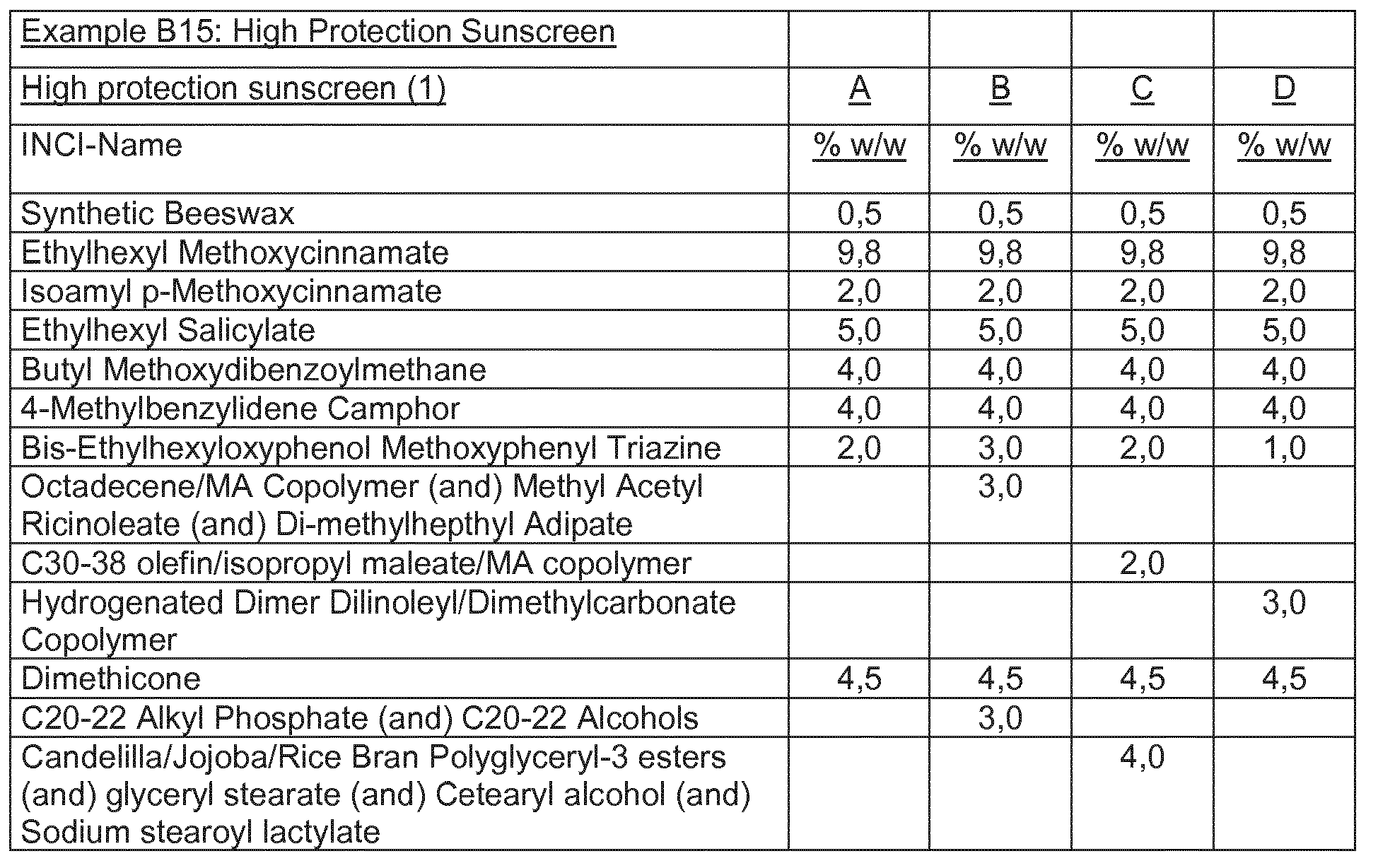


Example B16: High Protection Sunscreen High protection sunscreen (2) E F G H I INCI-Name % w/w % w/w % w/w % w/w % w/w Dodecyl p-Cresol) Merocyanine (MC-03) 0,5 0,8 1,0 0,3 0,33 Tinogard AS (INCI Bumetrizole) 1,0 1,0 Tris(tetramethylhydroxypiperidinol) citrate Compound (ESS-01) 0,5 0,5 220410-74-2 4-Piperidinol, 1-hydroxy-2,2,6,6-tetramethyl-, 2-hydroxy-1,2,3-propanetricarboxylate (3:1) (salt) 1,0 CAS-Regno. 1750-49-8, N-(2-Hydroxypropyl)urea 10,0 CAS-Regno. 2078-71-9, N-(2-Hydroxyethyl)urea 10,0 mixture of n-butylphthalimide and isopropylphthalimide 3,0 Example B17: High Protection Sunscreen High protection sunscreen (3) A B C D INCI-Name % w/w % w/w % w/w % w/w Synthetic Beeswax 0,5 0,5 0,5 0,5 Ethylhexyl Methoxycinnamate 9,8 9,8 9,8 9,8 Isoamyl p-Methoxycinnamate 2,0 2,0 2,0 2,0 Ethylhexyl Salicylate 5,0 5,0 5,0 5,0 Butyl Methoxydibenzoylmethane 4,0 4,0 4,0 4,0 4-Methylbenzylidene Camphor 4,0 4,0 4,0 4,0 Bis-Ethylhexyloxyphenol Methoxyphenyl Triazine 2,0 3,0 2,0 1,0 Octadecene/MA Copolymer (and) Methyl Acetyl Ricinoleate (and) Di-methylhepthyl Adipate 3,0 C30-38 olefin/isopropyl maleate/MA copolymer 2,0 Hydrogenated Dimer Dilinoleyl/Dimethylcarbonate Copolymer 3,0 Dimethicone 4,5 4,5 4,5 4,5 C20-22 Alkyl Phosphate (and) C20-22 Alcohols 3,0 Candelilla/Jojoba/Rice Bran Polyglyceryl-3 esters (and) glyceryl stearate (and) Cetearyl alcohol (and) Sodium stearoyl lactylate 4,0 Glyceryl oleate citrate (and) Caprylic/Capric Triglycerides 6,0 Cetearyl Alcohol (and) Dicetyl Phosphate (and) Ceteth-10 Phosphate 4,5 Cetyl Ricinoleate 3,0 3,0 3,0 3,0 Pentaerythrityl Distearate 1,5 Glyceryl Dibehenate (and) Tribehenin (and) Glyceryl Behenate 2,0 Hydroxypropyl Dimethicone Behenate 2,2 1,0 2,2 Decyl Cocoate 1,0 1,0 1,0 1,0 Aqua Qs to 100 Qs to 100 Qs to 100 Qs to 100 Propylene Glycol 3,0 3,0 3,0 3,0 Methylene Bis-Benzotriazolyl Tetramethylbutyl-phenol (and) Aqua (and) Decyl Glucoside (and) Propylene Glycol (and) Xanthan Gum 5,0 4,0 6,0 8,0 Decyl Glucoside 0,5 0,5 0,5 0,5 Acrylates/Vinyl Neodecanoate Crosspolymer Ammonium Acryloyldimethyltaurate/VP Copolymer 0,3 0,3 0,3 0,3 Phenylbenzimidazole Sulfonic Acid 2,0 2,0 2,0 2,0 Disteareth-75 IPDI 0,3 3,0 Disteareth-100 IPDI 0,3 Acrylates/C10-30 Alkyl Acrylate Crosspolymer 0,2 Disodium EDTA 0,2 0,2 0,2 0,2 Tromethamine 0,8 0,8 0,8 0,8 Cyclohexasiloxane (and) Cyclopentasiloxane 0,8 0,8 0,8 0,8 Phenoxyethanol (and) Methylparaben (and) Ethylparaben (and) Butylparaben (and) Propylparaben (and) Isobutylparaben 0,8 0,8 0,8 0,8 Tocopheryl Acetate 0,4 0,4 0,4 0,4 CAS-Regno. 88122-99-0, Ethylhexyl triazone (Octyl triazone; Uvinul T 150) 2,0 1,5 2,0 CAS-Regno.6197-30-4, Octocrylene 3,0 4,0 5,0 CAS-Regno. 180898-37-7, Disodium phenyldibenzimidazoletetrasulfonate Neo Heliopan AP or Neo-Heliopan APC 3,0 4,0 5,0 3,0 CAS-Regno. 302776-68-7, Uvinul A Plus 4,0 5,0 CAS-Regno. 444811-29-4, Propanedioic acid, [(4-hydroxy-3,5-dimethoxyphenyl)methylene]-, bis(2-ethylhexyl) ester (Oxynex ST) 3,0 1,0 CAS-Regno. 477844-93-2, Octofluorene 3,0 1,0 2-phenylethylbenzoate 1,0 1,0 CAS-Regno. 68890-66-4, Octopirox 2,0 3,0 Tinogard TT (INCI Tetradibutyl Pentaerythrityl Hydroxy- hydrocinnamate) 1,0 1,0 1,0 Tinogard HS (INCI Sodium Benzotriazolyl Butylphenol Sulfonate) 2,0 3,0 compound (BT-01) (INCI Benzotriazolyl Dodecyl p-Cresol) 2,0 0,9 1,0 1,0 Merocyanine (MC-03) 1,0 0,9 0,3 0,3 Cibafast H Liquid (INCI Sodium Benzotriazolyl Butylphenol Sulfonate, Buteth-3, Tributyl Citrate) 1,0 Tinogard AS (INCI Bumetrizole) 2,0 1,0 CAS-Regn. 30538-92-2 (Compound ESS-06) 0,05 0,01 220410-74-2 4-Piperidinol, 1-hydroxy-2,2,6,6-tetramethyl-, 2-hydroxy-1,2,3-propanetricarboxylate (3:1) (salt) 1,0 CAS-Regno. 1750-49-8, N-(2-Hydroxypropyl)urea 5,0 CAS-Regno. 2078-71-9, N-(2-Hydroxyethyl)urea 10,0 mixture of n-butylphthalimide and isopropylphthalimide 0,5 5,0
Claims (14)
- Use of a stabilizing a composition for the protection of body care and household products against the deleterious effects of light, heat and oxygen comprising(a) an effective stabilizing amount of at least one merocyanine derivative having an absorption maximum of 350 to 400nm of formula
 (b) at least one UV filter of formula (BT-01)
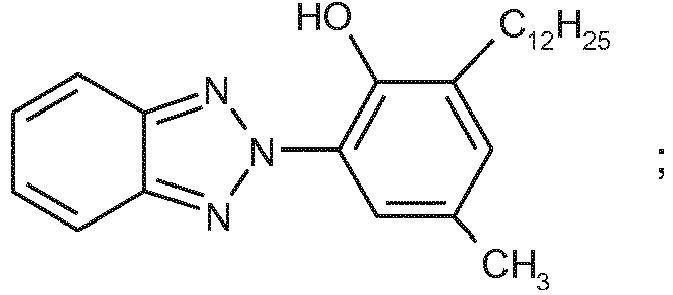 (c) at least one excited state quencher; and optionally(d) a salicylate.
- Use according to claim 1, wherein component (c) is selected from(c1) hindered nitroxyl compounds of formula (6a)
 (c2) hindered hydroxylamine compounds of formula (6b)
 (c3) hindered hydroxylamine salt compounds of formula (6c)
 G1 and G2 independently from each other are C1-C4alkyl alkyl; or are together pentamethylene,Z1 and Z2 are each methyl; or Z1 and Z2 together form a linking moiety which may additionally be substituted by an ester, ether, hydroxy, oxo, cyanohydrine, amide, amino, carboxy or urethane group;X is an inorganic or organic anion selected from phosphate, phosphonate, carbonate, bicarbonate, nitrate, chloride, bromide, bisulfite, sulfite, bisulfate, sulfate, borate, formate, acetate, benzoate, citrate, oxalate, tartrate, acrylate, polyacrylate, fumarate, maleate, itaconate, glycolate, gluconate, malate, mandelate, tiglate, ascorbate, polymethacrylate, a carboxylate of nitrilotriacetic acid, hydroxyethylethylenediaminetriacetic acid, ethylene-diaminetetraacetic acid or of diethylenetriaminepentaacetic acid, a diethylenetriamin-epentamethylenephosphonate, an alkylsulfonate or an arylsulfonate;, andwhere the total charge of cations h is equal to the total charge of anions j.
- Use according to claim 1 or 2, wherein component (c) corresponds to the compound of formula
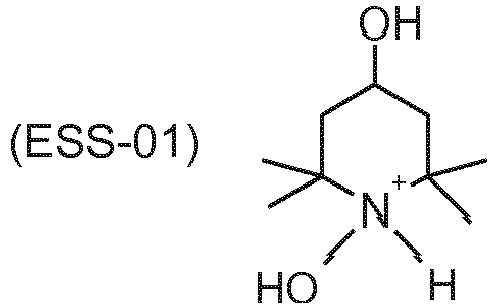
- Use according to claim 1, wherein component (d) is selected from salicylic acid, homosalate, 2-ethylhexyl salicylate, benzyl salicylate, ethyl salicylate, methyl salicylate, isoamyl salicylate, acetylsalicylic acid and isobutyl salicylate.
- Use according to claim 1, wherein the component (a) corresponds to the formula


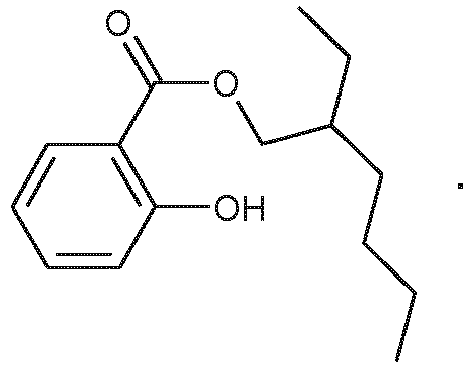
- Use according to claim 1, wherein the stabilizing composition is present in the body-care and household products in a concentration of about 5 to about 50000 ppm.
- Use according to claim 1, wherein the weight ratio of component (a) to component (b) is from 20:1 to 1:20.
- Use according to claim 1, wherein the weight ratio of component (a) to component (c) is from 1:1 to 1000:1.
- Use according to claim 1, wherein the body-care products are selected from skin-care products, bath and shower additives, preparations containing fragrances and odoriferous substances, hair-care products, dentifrices, deodorizing and antiperspirant preparations, decorative preparations, light protection formulations and preparations containing active ingredients.
- Use according to claim 1, wherein the body-care products are selected from body oils, body lotions, body gels, treatment creams, skin protection ointments, shaving preparations and skin powders.
- Use according to claim 9, wherein the body-care products are hair-care products and are selected from shampoos, hair conditioners, products for styling and treating hair, perming agents, hair sprays and lacquers, hair gels, hair fixatives and hair dyeing or bleaching agents.
- Use according to claim 9, wherein the body-care products are decorative preparations and are selected from lipsticks, nail varnishes, eye shadows, mascaras, dry and moist make-up, rouge, powders, depilatory agents and suntan lotions.
- Use according to claim 1,wherein the household product is selected from washing, rinsing and dishwashing agents, shoe polishes, polishing waxes, floor detergents and polishes, all purpose cleaners, bath and toilet cleaners, kitchen cleaners, car shampoos and waxes, neutral, acidic and alkaline cleaners, metal, glass and ceramic cleaners, textile care agents, agents for removing rust, color and stains (stain remover salt), bleaches, furniture and multipurpose polishes, surface protecting formulations, film forming formulations, air care formulations and candles.
- Stabilizing composition comprising(a) an effective stabilizing amount of at least one merocyanine derivative-of formula
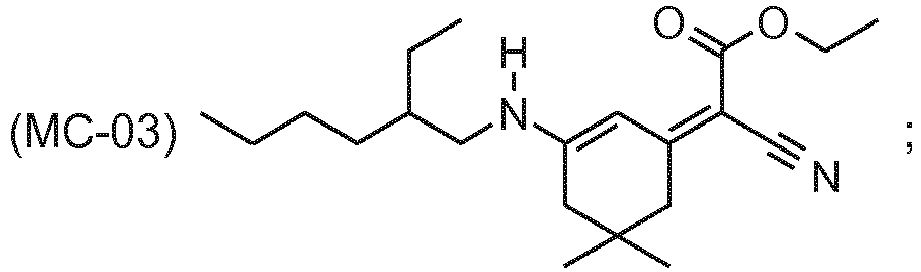 (b) at least one UV filter of formula (BT-01)
 (c) at least one excited state quencher as defined in claim 1; and optionally(d) at least one salicylate as defined in claim 1.
Priority Applications (1)
| Application Number | Priority Date | Filing Date | Title |
|---|---|---|---|
| EP08803084.6A EP2178491B1 (en) | 2007-08-24 | 2008-08-18 | Mixtures comprising benzotriazoles and merocyanines |
Applications Claiming Priority (3)
| Application Number | Priority Date | Filing Date | Title |
|---|---|---|---|
| EP07114913 | 2007-08-24 | ||
| PCT/EP2008/060797 WO2009027258A2 (en) | 2007-08-24 | 2008-08-18 | Mixtures comprising benzotriazoles and merocyanines |
| EP08803084.6A EP2178491B1 (en) | 2007-08-24 | 2008-08-18 | Mixtures comprising benzotriazoles and merocyanines |
Publications (2)
| Publication Number | Publication Date |
|---|---|
| EP2178491A2 EP2178491A2 (en) | 2010-04-28 |
| EP2178491B1 true EP2178491B1 (en) | 2017-03-22 |
Family
ID=39494188
Family Applications (1)
| Application Number | Title | Priority Date | Filing Date |
|---|---|---|---|
| EP08803084.6A Active EP2178491B1 (en) | 2007-08-24 | 2008-08-18 | Mixtures comprising benzotriazoles and merocyanines |
Country Status (10)
| Country | Link |
|---|---|
| US (2) | US8454940B2 (en) |
| EP (1) | EP2178491B1 (en) |
| JP (3) | JP2010536822A (en) |
| KR (2) | KR101721787B1 (en) |
| CN (1) | CN101808615B (en) |
| BR (1) | BRPI0816128B1 (en) |
| ES (1) | ES2629093T3 (en) |
| PL (1) | PL2178491T3 (en) |
| TW (1) | TWI488649B (en) |
| WO (1) | WO2009027258A2 (en) |
Families Citing this family (64)
| Publication number | Priority date | Publication date | Assignee | Title |
|---|---|---|---|---|
| AR078677A1 (en) * | 2009-10-20 | 2011-11-23 | Colgate Palmolive Co | ANTITRANSPIRING COMPOSITION THAT REDUCES OR ELIMINATES YELLOW DECOLORATION IN CLOTHING |
| WO2012042000A1 (en) * | 2010-10-01 | 2012-04-05 | Rhodia Operations | Cleaning composition for hard surface |
| KR101928014B1 (en) | 2011-01-28 | 2018-12-11 | 모멘티브 퍼포먼스 머티리얼즈 게엠베하 | Uv-photo-protecting cosmetic composition |
| FR2975590B1 (en) * | 2011-05-24 | 2013-06-21 | Dermatologiques Uriage Lab | NEW DERMATOLOGICAL AND / OR COSMETIC COMPOSITIONS PROVIDING SOLAR PROTECTION |
| US20140227205A1 (en) * | 2011-06-08 | 2014-08-14 | Dsm Ip Assets B.V. | Topical composition |
| BR112013031217A2 (en) * | 2011-06-08 | 2016-09-06 | Dsm Ip Assets Bv | sunscreens |
| WO2012168275A2 (en) * | 2011-06-08 | 2012-12-13 | Dsm Ip Assets B.V. | Sunscreens |
| WO2013010590A1 (en) * | 2011-07-21 | 2013-01-24 | L'oreal | Cosmetic and/or dermatological composition containing a merocyanine derivative comprising specific polar groups consisting of hydroxyl- and ether-functionalities |
| JP2014527039A (en) * | 2011-07-21 | 2014-10-09 | ビーエーエスエフ ソシエタス・ヨーロピア | Merocyanine derivatives |
| EP2734499B1 (en) * | 2011-07-21 | 2020-06-24 | Basf Se | Merocyanine derivatives |
| KR20140101788A (en) | 2011-11-15 | 2014-08-20 | 바스프 에스이 | Organic semiconductor device and process for its production |
| FR3001137B1 (en) | 2013-01-21 | 2015-02-27 | Oreal | COSMETIC OR DERMATOLOGICAL WATER-IN-OIL EMULSION COMPRISING A MEROCYANINE AND AT LEAST ONE EMULSIFYING POLYMER OF THE ESTER TYPE OF FATTY ACID AND GLYCOL POLYOXYALKYLENE |
| FR3001138B1 (en) | 2013-01-21 | 2015-06-19 | Oreal | COSMETIC OR DERMATOLOGICAL ANHYDROUS COMPOSITION COMPRISING A MEROCYANINE AND AN OILY PHASE |
| FR3001134B1 (en) * | 2013-01-21 | 2015-06-19 | Oreal | COSMETIC OR DERMATOLOGICAL COMPOSITION COMPRISING A MEROCYANINE AND A BIS-RESORCINYL TRIAZINE COMPOUND |
| FR3001128B1 (en) | 2013-01-21 | 2015-06-19 | Oreal | COSMETIC OR DERMATOLOGICAL EMULSION COMPRISING A MEROCYANINE AND AN EMULSIFYING SYSTEM CONTAINING AN ALKALINE METAL SALT OF ESTER OF PHOSPHORIC ACID AND FATTY ALCOHOL |
| JP6509743B2 (en) * | 2013-01-21 | 2019-05-08 | ロレアル | Cosmetic or dermatological composition comprising a merocyanine, an organic UVB screening agent and an additional organic UVA screening agent |
| FR3001216B1 (en) * | 2013-01-21 | 2015-02-27 | Oreal | COSMETIC OR DERMATOLOGICAL COMPOSITION COMPRISING A MEROCYANINE, AN OILY PHASE AND A C4 MONO-ALKANOL |
| ES2691870T3 (en) | 2013-01-21 | 2018-11-29 | L'oréal | Cosmetic or dermatological composition comprising a merocyanine and a lipophilic benzotriazole UV filtering agent and / or a bis-resorcinyl-triazine compound |
| FR3001133B1 (en) | 2013-01-21 | 2015-03-20 | Oreal | COSMETIC OR DERMATOLOGICAL COMPOSITION COMPRISING A MEROCYANINE AND AN OILY PHASE COMPRISING AT LEAST ONE PARTICULATE AMIDE COMPOUND |
| FR3001136B1 (en) * | 2013-01-21 | 2015-06-19 | Oreal | COSMETIC OR DERMATOLOGICAL EMULSION COMPRISING A MEROCYANINE AND AN EMULSIFIER SYSTEM CONTAINING AN AMPHIPHILIC POLYMER COMPRISING AT LEAST ONE ACRYLAMIDO 2-METHYLPROPANE SULFONIC ACIDIC PATTERN |
| FR3001131B1 (en) | 2013-01-21 | 2015-06-19 | Oreal | COSMETIC OR DERMATOLOGICAL EMULSION COMPRISING A MEROCYANINE AND AN EMULSIFYING SYSTEM COMPRISING A GEMINE SURFACTANT. |
| WO2014111566A2 (en) | 2013-01-21 | 2014-07-24 | L'oreal | Cosmetic or dermatological composition comprising a merocyanine and an insoluble organic uv-screening agent and/or an insoluble inorganic uv- screening agent |
| FR3001129B1 (en) * | 2013-01-21 | 2015-06-19 | Oreal | COSMETIC OR DERMATOLOGICAL COMPOSITION COMPRISING A MEROCYANINE AND A LIPOPHILIC UV BENZOTRIAZOLE FILTER |
| FR3001130B1 (en) * | 2013-01-21 | 2015-06-19 | Oreal | COSMETIC OR DERMATOLOGICAL COMPOSITION COMPRISING A MEROCYANINE AND AN INSOLUBLE ORGANIC UV FILTER |
| BR112015017297B1 (en) | 2013-01-21 | 2020-03-10 | L'oreal | COSMETIC OR DERMATOLOGICAL COMPOSITION AND NON-THERAPEUTIC COSMETIC PROCESSES |
| FR3001135B1 (en) * | 2013-01-21 | 2015-06-19 | Oreal | COSMETIC OR DERMATOLOGICAL COMPOSITION COMPRISING A MEROCYANINE AND AN INSOLUBLE INORGANIC UV FILTER |
| EP3185843B2 (en) | 2014-08-28 | 2025-07-02 | L'oreal | Gel composition and gel comprising a uv filter |
| CN107205894A (en) | 2014-11-24 | 2017-09-26 | 欧莱雅 | Cosmetic compositions comprising synthetic phyllosilicates and polyols and/or UV filters |
| FR3037243B1 (en) | 2015-06-11 | 2018-11-16 | L'oreal | COMPOSITION COMPRISING UV FILTER, ANIONIC CROSSLINKABLE HYDROPHILIC POLYMER, SURFACTANT HAVING HLB LESS THAN OR EQUAL TO 5 AND SILICONE COPOLYMER |
| WO2016204947A1 (en) | 2015-06-19 | 2016-12-22 | L'oreal | Sunscreen composition containing high levels of liposoluble uv filters |
| DE102015219009A1 (en) * | 2015-10-01 | 2017-04-06 | Beiersdorf Ag | Sunscreen with reduced textile staining by Diethylamino Hydroxybenzoyl Hexyl Benzoate |
| US10485745B2 (en) | 2016-04-29 | 2019-11-26 | L'oreal | UV-A/UV-B sunscreen composition |
| JP6705699B2 (en) * | 2016-05-25 | 2020-06-03 | 住友化学株式会社 | Light absorbing composition |
| GB2552806A (en) * | 2016-08-10 | 2018-02-14 | Sumitomo Chemical Co | Light filter and sensor |
| FR3060355B1 (en) | 2016-12-21 | 2020-01-24 | L'oreal | WATER-IN-OIL EMULSION CONTAINING BAICALIN, XANTHIC BASE, VITAMIN B3 AND MULTIVALENT METAL CATION SALT |
| FR3060361B1 (en) | 2016-12-21 | 2018-12-07 | L'oreal | WATER-IN-OIL EMULSION COMPRISING A PARTICULAR EMULSIFYING SYSTEM, A LIPOPHILIC CLAY, AN ELASTOMERIC ORGANOPOLYSILOXANE POWDER COATED WITH A SILICONE RESIN |
| FR3060997B1 (en) | 2016-12-23 | 2019-05-31 | L'oreal | COMPOSITION COMPRISING BAICALIN |
| FR3073402B1 (en) | 2017-11-15 | 2020-05-15 | L'oreal | COMPOSITION COMPRISING BAICALIN AND / OR A DERIVATIVE THEREOF AND A PARTICULAR ACRYLIC POLYMER |
| FR3073400B1 (en) | 2017-11-15 | 2024-08-09 | Oreal | COSMETIC EMULSION CONTAINING A GEMINE SURFACTANT AND A LIPOPHILIC POLYMER |
| US10813875B2 (en) | 2018-04-23 | 2020-10-27 | L'oreal | Memory shape sunscreen composition |
| CN112074736B (en) * | 2018-04-27 | 2024-10-01 | 巴斯夫欧洲公司 | UV filter composition, preparation method and use thereof |
| EP3820838A1 (en) * | 2018-07-12 | 2021-05-19 | Basf Se | Merocyanine crystallization process |
| FR3090329B1 (en) | 2018-12-21 | 2020-12-04 | Oreal | Composition comprising a UV filter, an anionic crosslinked hydrophilic polymer, a surfactant having an HLB less than or equal to 5 and a non-volatile alkane |
| CN113573689B (en) * | 2019-03-15 | 2025-04-15 | 巴斯夫欧洲公司 | Sunscreen composition comprising butyl methoxydibenzoylmethane, a triazine derivative and a light stabilizer |
| BR112021017072A2 (en) * | 2019-03-15 | 2021-11-09 | Basf Se | Composition of sunscreen or daily care, and, use of hexyl 2-[4-(diethylamino)-2-hydroxybenzoyl]benzoate (inci diethylamino hydroxybenzoyl hexyl benzoate) and a particulate organic UV filter |
| AU2019453263B2 (en) * | 2019-07-02 | 2025-11-20 | Symrise Ag | Blend of beeswax and a lactylate ester |
| FR3103704B1 (en) | 2019-11-29 | 2022-07-08 | Oreal | Composition comprising a UV filter, an ethylenic polymer with a phosphonic acid group and a hydrocarbon oil |
| FR3103705B1 (en) | 2019-11-29 | 2021-12-17 | Oreal | A composition comprising a UV filter, a block polymer containing a phosphonic acid group and a hydrocarbon oil |
| FR3104976B1 (en) | 2019-12-20 | 2021-12-24 | Oreal | Composition based on retinol |
| FR3104975B1 (en) | 2019-12-20 | 2021-12-17 | Oreal | Retinol-based composition |
| JP2023508194A (en) * | 2019-12-25 | 2023-03-01 | ロレアル | Composition for conditioning keratin fibers |
| FR3111074B1 (en) | 2020-06-08 | 2022-07-01 | Oreal | Composition based on retinol |
| FR3111075B1 (en) | 2020-06-08 | 2022-12-16 | Oreal | Composition based on retinol |
| JP2023529979A (en) * | 2020-06-17 | 2023-07-12 | ビーエーエスエフ ソシエタス・ヨーロピア | Biodegradable UV absorber |
| FR3115991B1 (en) | 2020-11-06 | 2023-11-03 | Oreal | Solid anhydrous composition comprising a lipophilic organic UV filter, a hydrocarbon oil, and at least 10% of a high melting point wax |
| US20250235392A1 (en) * | 2021-12-17 | 2025-07-24 | L'oreal | Cosmetic or dermatological composition comprising a merocyanine and a gamma-butyrolactone and/or a gamma-butyrolactam |
| FR3141059A1 (en) * | 2022-10-20 | 2024-04-26 | L'oreal | Cosmetic or dermatological composition comprising a merocyanine and a gamma-butyrolactone and/or a gamma-butyrolactam |
| FR3130598B1 (en) * | 2021-12-17 | 2025-04-25 | Oreal | Cosmetic or dermatological composition comprising a merocyanine and pentaerythrityl di-t-butyl tetrahydroxycinnamate |
| FR3130599B1 (en) * | 2021-12-17 | 2025-02-14 | Oreal | Cosmetic or dermatological composition comprising a merocyanine and a gamma-butyrolactone and/or a gamma-butyrolactam |
| CN115137657B (en) * | 2022-07-29 | 2024-02-23 | 上海百雀羚生物科技有限公司 | Composition for stabilizing color of cosmetic gardenia pigment and application thereof |
| FR3142344B1 (en) | 2022-11-30 | 2026-02-27 | Oreal | Retinol-based composition |
| FR3156324B3 (en) | 2023-12-11 | 2026-06-12 | Oreal | NAIL POLISH COMPOSITION CONTAINING A PIPERIDINOL COMPOUND |
| WO2025071660A1 (en) | 2023-09-29 | 2025-04-03 | L'oreal | Nail polish composition containing piperidinol compound |
| WO2026027355A1 (en) | 2024-07-29 | 2026-02-05 | Basf Se | Process for decolorization of light stabilizers |
Family Cites Families (9)
| Publication number | Priority date | Publication date | Assignee | Title |
|---|---|---|---|---|
| JP2818296B2 (en) * | 1991-01-10 | 1998-10-30 | アミリン・ファーマシューティカルズ・インコーポレイテッド | Amylin activity assay |
| AU1041700A (en) * | 1998-11-02 | 2000-05-22 | Ciba Specialty Chemicals Holding Inc. | Stabilization of body-care and household products |
| BR0312500B1 (en) | 2002-07-10 | 2013-12-03 | Cosmetic use of merocyanine derivatives and cosmetic preparation | |
| US7799317B2 (en) * | 2002-11-22 | 2010-09-21 | Hallstar Innovations Corp. | Photostabilizers, UV absorbers, and methods of photostabilizing compositions |
| EP1701695B1 (en) * | 2003-12-17 | 2016-04-20 | Basf Se | Merocyanine derivatives for cosmetic use |
| CN101023089B (en) | 2004-09-20 | 2013-11-06 | 莱雅公司 | Silane merocyanine sulphone derivatives, photoprotecting compositions containing same, use thereof as UV filter |
| FR2876580B1 (en) * | 2004-10-19 | 2007-03-02 | Oreal | ANTISOLAR COMPOSITION BASED ON A DIBENZOYLMETHA NE DERIVATIVE AND A PARTICULAR PHOTOSTABILIZING AGENT; PHO TESTABILIZATION PROCESS |
| FR2886144B1 (en) * | 2005-05-27 | 2007-06-29 | Oreal | METHOD FOR PHOTOSTABILIZING A DIBENZOYLMETHANE DERIVATIVE WITH A MEROCYANINE SULFONE DERIVATIVE; PHOTOPROTECTIVE COSMETIC COMPOSITIONS CONTAINING THE SAME. |
| ES2765632T3 (en) * | 2005-07-29 | 2020-06-10 | Bayer Cropscience Lp | Stabilization of body and home care products against degradation by UV radiation using merocyanine derivatives |
-
2008
- 2008-08-18 EP EP08803084.6A patent/EP2178491B1/en active Active
- 2008-08-18 JP JP2010521406A patent/JP2010536822A/en active Pending
- 2008-08-18 ES ES08803084.6T patent/ES2629093T3/en active Active
- 2008-08-18 PL PL08803084T patent/PL2178491T3/en unknown
- 2008-08-18 CN CN2008801041444A patent/CN101808615B/en active Active
- 2008-08-18 BR BRPI0816128A patent/BRPI0816128B1/en active IP Right Grant
- 2008-08-18 KR KR1020157025635A patent/KR101721787B1/en active Active
- 2008-08-18 US US12/674,172 patent/US8454940B2/en active Active
- 2008-08-18 WO PCT/EP2008/060797 patent/WO2009027258A2/en not_active Ceased
- 2008-08-18 KR KR1020107006297A patent/KR20100063084A/en not_active Ceased
- 2008-08-22 TW TW097132014A patent/TWI488649B/en active
-
2013
- 2013-05-07 US US13/888,447 patent/US20130251650A1/en not_active Abandoned
-
2014
- 2014-11-21 JP JP2014236055A patent/JP6324882B2/en active Active
-
2017
- 2017-12-25 JP JP2017247472A patent/JP2018104421A/en active Pending
Non-Patent Citations (1)
| Title |
|---|
| None * |
Also Published As
| Publication number | Publication date |
|---|---|
| JP2015091810A (en) | 2015-05-14 |
| PL2178491T3 (en) | 2017-09-29 |
| JP6324882B2 (en) | 2018-05-16 |
| JP2018104421A (en) | 2018-07-05 |
| KR20150110830A (en) | 2015-10-02 |
| CN101808615A (en) | 2010-08-18 |
| CN101808615B (en) | 2013-05-15 |
| KR101721787B1 (en) | 2017-03-30 |
| WO2009027258A3 (en) | 2009-04-23 |
| US20130251650A1 (en) | 2013-09-26 |
| US8454940B2 (en) | 2013-06-04 |
| BRPI0816128B1 (en) | 2016-10-11 |
| BRPI0816128A2 (en) | 2014-10-07 |
| TW200909000A (en) | 2009-03-01 |
| KR20100063084A (en) | 2010-06-10 |
| WO2009027258A2 (en) | 2009-03-05 |
| EP2178491A2 (en) | 2010-04-28 |
| TWI488649B (en) | 2015-06-21 |
| ES2629093T3 (en) | 2017-08-07 |
| JP2010536822A (en) | 2010-12-02 |
| US20110200540A1 (en) | 2011-08-18 |
Similar Documents
| Publication | Publication Date | Title |
|---|---|---|
| US8454940B2 (en) | Mixtures comprising benzotriazoles and merocyanines | |
| US7678381B2 (en) | Stabilized body care products, household products, textiles and fabrics | |
| US8623946B2 (en) | Stabilization of body-care and household products | |
| EP2709977B1 (en) | Use of benzotropolone derivatives as photostabilizer and antioxidant for stabilization of body-care and household products. | |
| JP2018154836A (en) | Stabilization of body-care and household products against degradation due to uv radiation by using merocyanine derivatives | |
| CN101277674B (en) | Stabilization of body-care and household products against degradation by UV radiation using merocyanine derivatives |
Legal Events
| Date | Code | Title | Description |
|---|---|---|---|
| PUAI | Public reference made under article 153(3) epc to a published international application that has entered the european phase |
Free format text: ORIGINAL CODE: 0009012 |
|
| 17P | Request for examination filed |
Effective date: 20100125 |
|
| AK | Designated contracting states |
Kind code of ref document: A2 Designated state(s): AT BE BG CH CY CZ DE DK EE ES FI FR GB GR HR HU IE IS IT LI LT LU LV MC MT NL NO PL PT RO SE SI SK TR |
|
| AX | Request for extension of the european patent |
Extension state: AL BA MK RS |
|
| 17Q | First examination report despatched |
Effective date: 20120531 |
|
| DAX | Request for extension of the european patent (deleted) | ||
| GRAP | Despatch of communication of intention to grant a patent |
Free format text: ORIGINAL CODE: EPIDOSNIGR1 |
|
| RIN1 | Information on inventor provided before grant (corrected) |
Inventor name: REICH, OLIVER Inventor name: SCHORK, MICHAEL Inventor name: MANTLER, ALEXANDER Inventor name: WAGNER, BARBARA |
|
| INTG | Intention to grant announced |
Effective date: 20161102 |
|
| GRAS | Grant fee paid |
Free format text: ORIGINAL CODE: EPIDOSNIGR3 |
|
| GRAA | (expected) grant |
Free format text: ORIGINAL CODE: 0009210 |
|
| AK | Designated contracting states |
Kind code of ref document: B1 Designated state(s): AT BE BG CH CY CZ DE DK EE ES FI FR GB GR HR HU IE IS IT LI LT LU LV MC MT NL NO PL PT RO SE SI SK TR |
|
| REG | Reference to a national code |
Ref country code: GB Ref legal event code: FG4D |
|
| REG | Reference to a national code |
Ref country code: CH Ref legal event code: EP |
|
| REG | Reference to a national code |
Ref country code: AT Ref legal event code: REF Ref document number: 877004 Country of ref document: AT Kind code of ref document: T Effective date: 20170415 |
|
| REG | Reference to a national code |
Ref country code: IE Ref legal event code: FG4D |
|
| REG | Reference to a national code |
Ref country code: DE Ref legal event code: R096 Ref document number: 602008049377 Country of ref document: DE |
|
| REG | Reference to a national code |
Ref country code: NL Ref legal event code: FP |
|
| PG25 | Lapsed in a contracting state [announced via postgrant information from national office to epo] |
Ref country code: GR Free format text: LAPSE BECAUSE OF FAILURE TO SUBMIT A TRANSLATION OF THE DESCRIPTION OR TO PAY THE FEE WITHIN THE PRESCRIBED TIME-LIMIT Effective date: 20170623 Ref country code: FI Free format text: LAPSE BECAUSE OF FAILURE TO SUBMIT A TRANSLATION OF THE DESCRIPTION OR TO PAY THE FEE WITHIN THE PRESCRIBED TIME-LIMIT Effective date: 20170322 Ref country code: HR Free format text: LAPSE BECAUSE OF FAILURE TO SUBMIT A TRANSLATION OF THE DESCRIPTION OR TO PAY THE FEE WITHIN THE PRESCRIBED TIME-LIMIT Effective date: 20170322 Ref country code: LT Free format text: LAPSE BECAUSE OF FAILURE TO SUBMIT A TRANSLATION OF THE DESCRIPTION OR TO PAY THE FEE WITHIN THE PRESCRIBED TIME-LIMIT Effective date: 20170322 Ref country code: NO Free format text: LAPSE BECAUSE OF FAILURE TO SUBMIT A TRANSLATION OF THE DESCRIPTION OR TO PAY THE FEE WITHIN THE PRESCRIBED TIME-LIMIT Effective date: 20170622 |
|
| REG | Reference to a national code |
Ref country code: ES Ref legal event code: FG2A Ref document number: 2629093 Country of ref document: ES Kind code of ref document: T3 Effective date: 20170807 |
|
| REG | Reference to a national code |
Ref country code: LT Ref legal event code: MG4D |
|
| REG | Reference to a national code |
Ref country code: AT Ref legal event code: MK05 Ref document number: 877004 Country of ref document: AT Kind code of ref document: T Effective date: 20170322 |
|
| REG | Reference to a national code |
Ref country code: FR Ref legal event code: PLFP Year of fee payment: 10 |
|
| PG25 | Lapsed in a contracting state [announced via postgrant information from national office to epo] |
Ref country code: SE Free format text: LAPSE BECAUSE OF FAILURE TO SUBMIT A TRANSLATION OF THE DESCRIPTION OR TO PAY THE FEE WITHIN THE PRESCRIBED TIME-LIMIT Effective date: 20170322 Ref country code: LV Free format text: LAPSE BECAUSE OF FAILURE TO SUBMIT A TRANSLATION OF THE DESCRIPTION OR TO PAY THE FEE WITHIN THE PRESCRIBED TIME-LIMIT Effective date: 20170322 Ref country code: BG Free format text: LAPSE BECAUSE OF FAILURE TO SUBMIT A TRANSLATION OF THE DESCRIPTION OR TO PAY THE FEE WITHIN THE PRESCRIBED TIME-LIMIT Effective date: 20170622 |
|
| PG25 | Lapsed in a contracting state [announced via postgrant information from national office to epo] |
Ref country code: AT Free format text: LAPSE BECAUSE OF FAILURE TO SUBMIT A TRANSLATION OF THE DESCRIPTION OR TO PAY THE FEE WITHIN THE PRESCRIBED TIME-LIMIT Effective date: 20170322 Ref country code: CZ Free format text: LAPSE BECAUSE OF FAILURE TO SUBMIT A TRANSLATION OF THE DESCRIPTION OR TO PAY THE FEE WITHIN THE PRESCRIBED TIME-LIMIT Effective date: 20170322 Ref country code: RO Free format text: LAPSE BECAUSE OF FAILURE TO SUBMIT A TRANSLATION OF THE DESCRIPTION OR TO PAY THE FEE WITHIN THE PRESCRIBED TIME-LIMIT Effective date: 20170322 Ref country code: EE Free format text: LAPSE BECAUSE OF FAILURE TO SUBMIT A TRANSLATION OF THE DESCRIPTION OR TO PAY THE FEE WITHIN THE PRESCRIBED TIME-LIMIT Effective date: 20170322 Ref country code: SK Free format text: LAPSE BECAUSE OF FAILURE TO SUBMIT A TRANSLATION OF THE DESCRIPTION OR TO PAY THE FEE WITHIN THE PRESCRIBED TIME-LIMIT Effective date: 20170322 |
|
| PG25 | Lapsed in a contracting state [announced via postgrant information from national office to epo] |
Ref country code: IS Free format text: LAPSE BECAUSE OF FAILURE TO SUBMIT A TRANSLATION OF THE DESCRIPTION OR TO PAY THE FEE WITHIN THE PRESCRIBED TIME-LIMIT Effective date: 20170722 Ref country code: PT Free format text: LAPSE BECAUSE OF FAILURE TO SUBMIT A TRANSLATION OF THE DESCRIPTION OR TO PAY THE FEE WITHIN THE PRESCRIBED TIME-LIMIT Effective date: 20170724 |
|
| REG | Reference to a national code |
Ref country code: DE Ref legal event code: R097 Ref document number: 602008049377 Country of ref document: DE |
|
| PLBE | No opposition filed within time limit |
Free format text: ORIGINAL CODE: 0009261 |
|
| STAA | Information on the status of an ep patent application or granted ep patent |
Free format text: STATUS: NO OPPOSITION FILED WITHIN TIME LIMIT |
|
| PG25 | Lapsed in a contracting state [announced via postgrant information from national office to epo] |
Ref country code: DK Free format text: LAPSE BECAUSE OF FAILURE TO SUBMIT A TRANSLATION OF THE DESCRIPTION OR TO PAY THE FEE WITHIN THE PRESCRIBED TIME-LIMIT Effective date: 20170322 |
|
| 26N | No opposition filed |
Effective date: 20180102 |
|
| PG25 | Lapsed in a contracting state [announced via postgrant information from national office to epo] |
Ref country code: SI Free format text: LAPSE BECAUSE OF FAILURE TO SUBMIT A TRANSLATION OF THE DESCRIPTION OR TO PAY THE FEE WITHIN THE PRESCRIBED TIME-LIMIT Effective date: 20170322 |
|
| PG25 | Lapsed in a contracting state [announced via postgrant information from national office to epo] |
Ref country code: MC Free format text: LAPSE BECAUSE OF FAILURE TO SUBMIT A TRANSLATION OF THE DESCRIPTION OR TO PAY THE FEE WITHIN THE PRESCRIBED TIME-LIMIT Effective date: 20170322 |
|
| REG | Reference to a national code |
Ref country code: IE Ref legal event code: MM4A |
|
| PG25 | Lapsed in a contracting state [announced via postgrant information from national office to epo] |
Ref country code: LU Free format text: LAPSE BECAUSE OF NON-PAYMENT OF DUE FEES Effective date: 20170818 |
|
| PG25 | Lapsed in a contracting state [announced via postgrant information from national office to epo] |
Ref country code: IE Free format text: LAPSE BECAUSE OF NON-PAYMENT OF DUE FEES Effective date: 20170818 |
|
| REG | Reference to a national code |
Ref country code: FR Ref legal event code: PLFP Year of fee payment: 11 |
|
| PG25 | Lapsed in a contracting state [announced via postgrant information from national office to epo] |
Ref country code: MT Free format text: LAPSE BECAUSE OF NON-PAYMENT OF DUE FEES Effective date: 20170818 |
|
| PG25 | Lapsed in a contracting state [announced via postgrant information from national office to epo] |
Ref country code: HU Free format text: LAPSE BECAUSE OF FAILURE TO SUBMIT A TRANSLATION OF THE DESCRIPTION OR TO PAY THE FEE WITHIN THE PRESCRIBED TIME-LIMIT; INVALID AB INITIO Effective date: 20080818 |
|
| PG25 | Lapsed in a contracting state [announced via postgrant information from national office to epo] |
Ref country code: CY Free format text: LAPSE BECAUSE OF NON-PAYMENT OF DUE FEES Effective date: 20170322 |
|
| PGFP | Annual fee paid to national office [announced via postgrant information from national office to epo] |
Ref country code: NL Payment date: 20250825 Year of fee payment: 18 |
|
| PGFP | Annual fee paid to national office [announced via postgrant information from national office to epo] |
Ref country code: ES Payment date: 20250916 Year of fee payment: 18 |
|
| PGFP | Annual fee paid to national office [announced via postgrant information from national office to epo] |
Ref country code: DE Payment date: 20250827 Year of fee payment: 18 |
|
| PGFP | Annual fee paid to national office [announced via postgrant information from national office to epo] |
Ref country code: TR Payment date: 20250730 Year of fee payment: 18 Ref country code: PL Payment date: 20250730 Year of fee payment: 18 Ref country code: IT Payment date: 20250825 Year of fee payment: 18 |
|
| PGFP | Annual fee paid to national office [announced via postgrant information from national office to epo] |
Ref country code: BE Payment date: 20250825 Year of fee payment: 18 Ref country code: GB Payment date: 20250826 Year of fee payment: 18 |
|
| PGFP | Annual fee paid to national office [announced via postgrant information from national office to epo] |
Ref country code: FR Payment date: 20250825 Year of fee payment: 18 |
|
| PGFP | Annual fee paid to national office [announced via postgrant information from national office to epo] |
Ref country code: CH Payment date: 20250901 Year of fee payment: 18 |