EP2178217A2 - Encoding apparatus and method for low density parity check (LDPC) codes - Google Patents
Encoding apparatus and method for low density parity check (LDPC) codes Download PDFInfo
- Publication number
- EP2178217A2 EP2178217A2 EP09173424A EP09173424A EP2178217A2 EP 2178217 A2 EP2178217 A2 EP 2178217A2 EP 09173424 A EP09173424 A EP 09173424A EP 09173424 A EP09173424 A EP 09173424A EP 2178217 A2 EP2178217 A2 EP 2178217A2
- Authority
- EP
- European Patent Office
- Prior art keywords
- matrix
- sub
- parity check
- symbols
- columns
- Prior art date
- Legal status (The legal status is an assumption and is not a legal conclusion. Google has not performed a legal analysis and makes no representation as to the accuracy of the status listed.)
- Granted
Links
Images



Classifications
-
- H—ELECTRICITY
- H03—ELECTRONIC CIRCUITRY
- H03M—CODING; DECODING; CODE CONVERSION IN GENERAL
- H03M13/00—Coding, decoding or code conversion, for error detection or error correction; Coding theory basic assumptions; Coding bounds; Error probability evaluation methods; Channel models; Simulation or testing of codes
- H03M13/03—Error detection or forward error correction by redundancy in data representation, i.e. code words containing more digits than the source words
- H03M13/05—Error detection or forward error correction by redundancy in data representation, i.e. code words containing more digits than the source words using block codes, i.e. a predetermined number of check bits joined to a predetermined number of information bits
- H03M13/11—Error detection or forward error correction by redundancy in data representation, i.e. code words containing more digits than the source words using block codes, i.e. a predetermined number of check bits joined to a predetermined number of information bits using multiple parity bits
- H03M13/1102—Codes on graphs and decoding on graphs, e.g. low-density parity check [LDPC] codes
- H03M13/1148—Structural properties of the code parity-check or generator matrix
- H03M13/116—Quasi-cyclic LDPC [QC-LDPC] codes, i.e. the parity-check matrix being composed of permutation or circulant sub-matrices
-
- H—ELECTRICITY
- H03—ELECTRONIC CIRCUITRY
- H03M—CODING; DECODING; CODE CONVERSION IN GENERAL
- H03M13/00—Coding, decoding or code conversion, for error detection or error correction; Coding theory basic assumptions; Coding bounds; Error probability evaluation methods; Channel models; Simulation or testing of codes
- H03M13/03—Error detection or forward error correction by redundancy in data representation, i.e. code words containing more digits than the source words
- H03M13/05—Error detection or forward error correction by redundancy in data representation, i.e. code words containing more digits than the source words using block codes, i.e. a predetermined number of check bits joined to a predetermined number of information bits
- H03M13/11—Error detection or forward error correction by redundancy in data representation, i.e. code words containing more digits than the source words using block codes, i.e. a predetermined number of check bits joined to a predetermined number of information bits using multiple parity bits
- H03M13/1102—Codes on graphs and decoding on graphs, e.g. low-density parity check [LDPC] codes
- H03M13/1148—Structural properties of the code parity-check or generator matrix
- H03M13/118—Parity check matrix structured for simplifying encoding, e.g. by having a triangular or an approximate triangular structure
- H03M13/1182—Parity check matrix structured for simplifying encoding, e.g. by having a triangular or an approximate triangular structure wherein the structure of the parity-check matrix is obtained by reordering of a random parity-check matrix
-
- H—ELECTRICITY
- H03—ELECTRONIC CIRCUITRY
- H03M—CODING; DECODING; CODE CONVERSION IN GENERAL
- H03M13/00—Coding, decoding or code conversion, for error detection or error correction; Coding theory basic assumptions; Coding bounds; Error probability evaluation methods; Channel models; Simulation or testing of codes
- H03M13/61—Aspects and characteristics of methods and arrangements for error correction or error detection, not provided for otherwise
- H03M13/611—Specific encoding aspects, e.g. encoding by means of decoding
-
- H—ELECTRICITY
- H03—ELECTRONIC CIRCUITRY
- H03M—CODING; DECODING; CODE CONVERSION IN GENERAL
- H03M13/00—Coding, decoding or code conversion, for error detection or error correction; Coding theory basic assumptions; Coding bounds; Error probability evaluation methods; Channel models; Simulation or testing of codes
- H03M13/03—Error detection or forward error correction by redundancy in data representation, i.e. code words containing more digits than the source words
- H03M13/05—Error detection or forward error correction by redundancy in data representation, i.e. code words containing more digits than the source words using block codes, i.e. a predetermined number of check bits joined to a predetermined number of information bits
- H03M13/11—Error detection or forward error correction by redundancy in data representation, i.e. code words containing more digits than the source words using block codes, i.e. a predetermined number of check bits joined to a predetermined number of information bits using multiple parity bits
- H03M13/1102—Codes on graphs and decoding on graphs, e.g. low-density parity check [LDPC] codes
- H03M13/1148—Structural properties of the code parity-check or generator matrix
- H03M13/1171—Parity-check or generator matrices with non-binary elements, e.g. for non-binary LDPC codes
Definitions
- the link performance is affected by various noises in channels, a fading phenomenon, and Inter-Symbol Interference (ISI). Therefore, in order to realise high-speed digital communication systems requiring high data throughput and reliability, such as in the 60GHz personal area network (PAN), next-generation mobile communication, digital broadcasting, and portable internet, it is advantageous to develop a technology for operating in the presence of noise, fading and ISI. Recently, an intensive study of an error-correcting code has been conducted as a method for increasing communication reliability by efficiently recovering distorted information.
- PAN personal area network
- ISI Inter-Symbol Interference
- Low density parity check (LDPC) codes are used for error correcting in noisy channels and appear in various wireless and wired standards.
- LDPC codes are linear block codes, and as such, can be represented by a parity check matrix.
- LDPC codes are low density parity check codes, which means that their parity check matrix is sparse. A sparse matrix has very few non-zero entries.
- Systematic LDPC codes are codes such that the information symbols are an explicit part of the codeword.
- Quasi-cyclic (QC) LDPC matrices are common as they can be concisely described.
- the code rate represents the ratio of information to parity bits.
- half of the bits of a codeword are information bits and the other half are parity check bits.
- a "-1" entry in the matrix represents a Z ⁇ Z matrix having all zeros.
- Each other entry in this matrix represents a permutation matrix of size Z ⁇ Z.
- a permutation matrix is a matrix that has a single "1" in each row and a single “1" in each column.
- the matrix as shown in Figure 2 is a 8 ⁇ 8 permutation matrix.
- the exemplified permutation matrix is a cyclic permutation matrix.
- the QC LDPC is made of cyclic permutation matrices. An entry that is not "-1" is the amount of cyclic permutation of the submatrix.
- Embodiments of the invention relate generally to the field of error correction in a communication system, and in particular, to a method and apparatus for encoding using low density parity check (LDPC) codes.
- LDPC low density parity check
- Embodiments of the present invention hold for LDPC codes defined over any Galois field, but for brevity and better insight, the discussion and examples herein are confined to Galois field of size 2, meaning the binary field.
- the main properties remain the same, which are the following: the matrix structure after reordering and the invertibility of matrix D, described below.
- a method comprising encoding a codeword using a low density parity check matrix using an encoder, the low density parity check matrix comprising a first sub-matrix associated with information symbols, a second sub-matrix having a block triangular structure associated with a first subset of parity check symbols and a third sub-matrix that is invertible and associated with a second subset of parity check symbols, the encoding being or having been performed over the second sub-matrix before the third sub-matrix.
- an apparatus comprising an encoder configured to encode a codeword using a low density parity check matrix, the low density parity check matrix comprising a first sub-matrix associated with information symbols, a second sub-matrix having a block triangular structure associated with a first subset of parity check symbols and a third sub-matrix that is invertible and associated with a second subset of parity check symbols, the encoder being configured to perform the encoding over the second sub-matrix before the third sub-matrix.
- a computer program comprising, or computer program product comprising computer readable storage storing, computer readable program code embodied therein, said computer readable program code being adapted to be executed to implement a method comprising encoding a codeword using a low density parity check matrix, the low density parity check matrix comprising a first sub-matrix associated with information symbols, a second sub-matrix having a block triangular structure associated with a first subset of parity check symbols and a third sub-matrix that is invertible and associated with a second subset of parity check symbols, the encoding being performed over the second sub-matrix before the third sub-matrix.
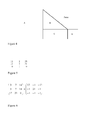
- an encoding technique is described using systematic LDPC codes that can be brought to a structure by row and column permutations as shown in Figure 4 , as exemplified also in Figure 3 .
- a parity check matrix with reordered rows corresponds to the same code as without reordering and that reordering of columns corresponds to reordering of the symbols in the codeword, such that this reordering can be inverted at the end of the encoding process if one desires. Operations such as reordering of rows and columns do not change the sparseness of the matrix.
- Any systematic code may be brought to the structure depicted in Figure 4 using reordering of rows and columns.
- the columns associated with sub-matrix A correspond to information symbols.
- the columns associated with sub-matrices B and C correspond to a first part of the parity symbols.
- the columns associated with sub-matrix D correspond to a second part of the parity symbols.
- the codes may be constructed using the structure as depicted in Figure 4 ; however, other structures may be used such that the matrix can be brought to this structure using steps such as row reordering, etc. Matrices that are brought into the form of Figure 4 should still be considered of the form of Figure 4 .
- each entry in matrix H represents a permutation matrix or a zero matrix of size Z ⁇ Z.
- the matrix shown in figure 4 is an example of matrix H.
- a plurality of the permutation matrices can be formed by permuting at least one base permutation matrix according to a predetermined regularity. For instance, if a base permutation matrix is set to a Z ⁇ Z identity matrix, a plurality of permutation matrices can be generated from shifting all rows of the base permutation matrix in a specific direction by a predetermined interval, exchanging a specific row (or column) of the base permutation matrix for another random row (or column) of the base permutation matrix, rotating the base permutation matrix by a predetermined angle or the like.
- sub-matrix D may have a sparse inverse.
- the 3*28 ⁇ 3*28 inverse matrix is shown in Figure 7 , where the white dots represent "1" and black dots represent "0."
- the sub-matrix D may have an inverse, but the inverse may not be sparse, or it may not have to be the sum of two quasi-cyclic (QC) matrices.
- the codeword includes information symbols corresponding to columns of the first sub-matrix, parity symbols corresponding to columns of the second sub-matrix and parity symbols corresponding to columns of the third sub-matrix.
- a vector of symbols is a codeword if and only if the multiplication of the parity check matrix by this vector is 0, where the additions/summations are over the relevant Galois field (binary in this example, but embodiments are not limited in this respect).
- a transpose operation T on a row vector results in a column vector.
- the mathematics described throughout the various embodiments is algebra over a Galois field.
- Au -Er.
- the encoding procedure described below is demonstrated over the binary field, in which case symbols are bits. Those skilled with the art will be able to apply the procedure also to LDPC codes over other Galois fields.
- the encoding begins by calculating a product of the first sub-matrix, A , and a vector representing the information bits corresponding to columns of the first sub-matrix, u .
- the product can be represented as a vector, z, having a first part corresponding to rows of the second sub-matrix and a second part corresponding to rows of the third sub-matrix.
- the product, z is then equal to the vector [ x y ], where x corresponds to the rows of B and y corresponds to the rows of C or D .
- the encoding continues by calculating parity bits corresponding to columns of the second sub-matrix by backward or forward substitution using the second sub-matrix and the first part of the vector corresponding to rows of the second sub-matrix.
- the second ( B ) sub-matrix may be a lower-block-triangular matrix and, thus, the bits associated with columns of matrices B and C can be solved for using forward substitution block by block.
- the second ( B ) sub-matrix may be a upper-block-triangular matrix, and thus, the bits associated with columns of matrices B and C can be solved for using backward substitution block by block.
- Other substitution methods may be used when the sub-matrix is not in a strict triangular form, such as when a lower triangular matrix has its first two rows shifted to the end.
- blockiness of the triangular matrix is an inherent property, of course.
- the submatrices may be of size 1 ⁇ 1, where the block-triangular is actually strictly triangular.
- the encoding continues by calculating a sum, as represented by zz , of the second part of the vector corresponding to rows of the third sub-matrix, y , and a product of a fourth sub-matrix of the parity check matrix, C , and parity bits associated with the second sub-matrix, p .
- zz -( y + Cp ).
- the encoding concludes by calculating parity bits associated with the third sub-matrix, q, by using the calculated sum, zz , and the inverse of the third sub-matrix, D .
- Each submatrix of the parity check matrix represents either an invertible matrix or an all-zero matrix of size Z ⁇ Z .
- the invertible matrix may be a permutation matrix.
- Z is equal to 28 or 42. Alternatively, other values of Z may be used.
- the third matrix has an inverse matrix that is sparse.
- the encoding may be performed by a specific-purpose computer operating with encoding instructions stored in a memory of the computer.
- the stored instructions may cause one or more processors or controllers within the computer to perform a series of operations on the codeword and parity bits of the LDPC matrix to encode the codeword.
- the computer may be arranged to transmit the encoded codeword across a network, such as a wireless network, to another computer or a receiver.
- FIG. 9 shows a block diagram of a communication system in accordance with various aspects of embodiments of the present invention.
- Transmitter 10 and receiver 30 communicate with each other using a radio channel 20 as a medium.
- a k-bit source data u output from a data source 12 is converted to an n-bit codeword cw by systematic LDPC encoding conducted by an LDPC encoding module 14.
- the codeword cw is radio-modulated by a modulation module 16 to be transmitted by an antenna 18 via the radio channel 20 and is then received by another antenna 32 of the receiver 30.
- the receiver 30 goes through a reverse process to that of the transmitter 10. Namely, data m received by receiver 30, which is a noisy estimate of the transmitted cw , is demodulated by a demodulation module 34 to be decoded by an LDPC decoding module 36, whereby an estimate v of the source data u can be finally obtained.
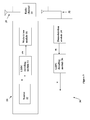
- FIG. 10 shows block diagram of an encoding procedure in an orthogonal frequency divisional multiplexing (OFDM) transmitter in accordance with various aspects of embodiments of the present invention.
- OFDM orthogonal frequency divisional multiplexing
- LDPC encoder 50 includes encoder input memory 52. Data is read from memory 52 and is supplied to mode dependent multiplexers and encoder output memory 54.
- encoder input memory 52 and encoder output memory 54 are configured to store 672 bits of data. If the encoding is preformed in a single step, the output memory 54 may contain an entire codeword and has a length equal to the codeword length.
- the input memory 52 is essentially of a shorter length and equal to the length of the information vector.
- the data supplied to mode dependent multiplexers and encoder output memory 54 includes systematic data, such as information bits, as well as parity bits. Parity bits are calculated by a parity calculation logic 56.
- the encoded data from LDPC encoder 50 is mapped onto the subcarrier using a mapper module 58 and conveyed to an input buffer 60 of a Fast Fourier Transform (FFT) module that is responsible for transforming its input from a frequency domain into a time domain.
- FFT Fast Fourier Transform
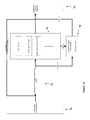
- Figure 11 shows an exemplary LDPC encoder in hardware in accordance with various aspects of embodiments of the present invention.
- Input buffer 70 is configured to store vector u , which are the information bits corresponding to the columns of sub-matrix A . All or a portion of vector u is read from buffer 70 and is supplied to module 72.
- Module 72 is configured to include XOR gates and OR gates that are configured to calculate the product of sub-matrix, A , and the vector u .
- the calculated product is then supplied to module 74 that is configured to calculate the vector p by utilizing XOR and OR gates.
- the vector p can be represented by [ p 1 P 2 P 3 ,..., P n-1 P n ], where p n is the last element of vector p .
- elements of the vector p represent vectors of size Z .
- the vector p can be calculated by either forward or backward substitution depending on the triangular structure of the B sub-matrix, as discussed above.
- p1 is calculated by Inv( B 1 , 1 ) z 1 , where the subscript 1,1, represents the element of sub-matrix B occupying row 1 and column 1.
- the submatrix B 1 , 1 may be a permutation sub-matrix as is typical for quasi-cyclic LDPC codes.
- p 2 is calculate by Inv( B 2,2 )( B 2,1 p1 + z 2 ) and p 3 is calculated by Inv ( B 3,3 )( B 3,1 p 1 + B 3,2 p 2 + z 3 ). All of the elements of the vector p are calculated in a suitable or similar manner.
- the calculated vector p is then output to an output buffer 76, which is configured to store the codeword cw , and to module 78 which is configured to calculate the vector q .
- the module 78 is configured to receive y as determined from z by module 72 and may include XOR and OR gates that are configured to calculate q by the expression Inv( D )( y + C*p ). The output of module 78 is configured to feed back to module 72.
- embodiments of the present invention can be realised in the form of hardware, software or a combination of hardware and software. Any such software may be stored in the form of volatile or non-volatile storage such as, for example, a storage device like a ROM, whether erasable or rewritable or not, or in the form of memory such as, for example, RAM, memory chips, device or integrated circuits or on an optically or magnetically readable medium such as, for example, a CD, DVD, magnetic disk or magnetic tape or the like. It will be appreciated that the storage devices and storage media are embodiments of machine-readable storage that are suitable for storing a program or programs comprising instructions that, when executed, implement embodiments of the present invention.
- embodiments provide a program comprising code for implementing a system, device, apparatus or method as described herein or as claimed herein and machine readable storage storing such a program. Still further, such programs may be conveyed electronically via any medium such as a communication signal carried over a wired or wireless connection and embodiments suitably encompass the same.
Landscapes
- Physics & Mathematics (AREA)
- Mathematical Physics (AREA)
- Probability & Statistics with Applications (AREA)
- Engineering & Computer Science (AREA)
- Theoretical Computer Science (AREA)
- Error Detection And Correction (AREA)
Abstract
Description
- In communication systems, the link performance is affected by various noises in channels, a fading phenomenon, and Inter-Symbol Interference (ISI). Therefore, in order to realise high-speed digital communication systems requiring high data throughput and reliability, such as in the 60GHz personal area network (PAN), next-generation mobile communication, digital broadcasting, and portable internet, it is advantageous to develop a technology for operating in the presence of noise, fading and ISI. Recently, an intensive study of an error-correcting code has been conducted as a method for increasing communication reliability by efficiently recovering distorted information.
- Low density parity check (LDPC) codes are used for error correcting in noisy channels and appear in various wireless and wired standards. LDPC codes are linear block codes, and as such, can be represented by a parity check matrix. LDPC codes are low density parity check codes, which means that their parity check matrix is sparse. A sparse matrix has very few non-zero entries. Systematic LDPC codes are codes such that the information symbols are an explicit part of the codeword.
- Quasi-cyclic (QC) LDPC matrices are common as they can be concisely described. An example for QC LDPC matrix (binary rate ½ LDPC code, with Z = 28) is shown in
Figure 1 . The code rate represents the ratio of information to parity bits. For the ½ rate example above, half of the bits of a codeword are information bits and the other half are parity check bits. A "-1" entry in the matrix represents a Z × Z matrix having all zeros. Each other entry in this matrix represents a permutation matrix of size Z × Z. Thus, if the exemplified matrix has 24 columns and if Z = 28, then this matrix is associated with a 28*24 = 672 bit code. A permutation matrix is a matrix that has a single "1" in each row and a single "1" in each column. For example, the matrix as shown inFigure 2 is a 8 × 8 permutation matrix. Moreover, the exemplified permutation matrix is a cyclic permutation matrix. The QC LDPC is made of cyclic permutation matrices. An entry that is not "-1" is the amount of cyclic permutation of the submatrix. -
-
Figure 1 shows an example for a rate ½ LDPC code, with Z = 28. -
Figure 2 shows an example of a 8 × 8 cyclic permutation matrix. -
Figure 3 shows a matrix like that shown inFigure 1 , with row permutations only in accordance with various aspects of the embodiments of the present invention. -
Figure 4 shows a matrix structure for encoding in accordance with various aspects of embodiments of the present invention. -
Figure 5 shows an exemplary sub-matrix D in accordance with various aspects of embodiments of the present invention. -
Figure 6 shows the inverse of the exemplary sub-matrix D ofFigure 5 in accordance with various aspects of embodiments of the present invention. -
Figure 7 shows a representation of the inverse matrix ofFigure 6 in accordance with various aspects of embodiments of the present invention. -
Figure 8 shows a block-lower triangular matrix that is quasi-cyclic, corresponding to Z = 3 in accordance with various aspects of embodiments of the present invention. -
Figure 9 shows a block diagram of a communication system in accordance with various aspects of embodiments of the present invention. -
Figure 10 shows block diagram of an encoding procedure in an orthogonal frequency divisional multiplexing (OFDM) transmitter in accordance with various aspects of embodiments of the present invention. -
Figure 11 shows an exemplary LDPC encoder in hardware in accordance with various aspects of embodiments of the present invention. - In the description that follows, like components have been given the same reference numerals, regardless of whether they are shown in different embodiments. To illustrate an embodiment(s) of the present disclosure in a clear and concise manner, the drawings may not necessarily be to scale and certain features may be shown in somewhat schematic form. Features that are described and/or illustrated with respect to one embodiment may be used in the same way or in a similar way in one or more other embodiments and/or in combination with or instead of the features of the other embodiments.
- Embodiments of the invention relate generally to the field of error correction in a communication system, and in particular, to a method and apparatus for encoding using low density parity check (LDPC) codes.
- Embodiments of the present invention hold for LDPC codes defined over any Galois field, but for brevity and better insight, the discussion and examples herein are confined to Galois field of
size 2, meaning the binary field. When LDPC codes over other fields are considered, the main properties remain the same, which are the following: the matrix structure after reordering and the invertibility of matrix D, described below. - In accordance with various embodiments there is provided a method comprising encoding a codeword using a low density parity check matrix using an encoder, the low density parity check matrix comprising a first sub-matrix associated with information symbols, a second sub-matrix having a block triangular structure associated with a first subset of parity check symbols and a third sub-matrix that is invertible and associated with a second subset of parity check symbols, the encoding being or having been performed over the second sub-matrix before the third sub-matrix.
- In accordance with various embodiments there is provided an apparatus comprising an encoder configured to encode a codeword using a low density parity check matrix, the low density parity check matrix comprising a first sub-matrix associated with information symbols, a second sub-matrix having a block triangular structure associated with a first subset of parity check symbols and a third sub-matrix that is invertible and associated with a second subset of parity check symbols, the encoder being configured to perform the encoding over the second sub-matrix before the third sub-matrix.
- In accordance with various embodiments there is provided, a computer program comprising, or computer program product comprising computer readable storage storing, computer readable program code embodied therein, said computer readable program code being adapted to be executed to implement a method comprising encoding a codeword using a low density parity check matrix, the low density parity check matrix comprising a first sub-matrix associated with information symbols, a second sub-matrix having a block triangular structure associated with a first subset of parity check symbols and a third sub-matrix that is invertible and associated with a second subset of parity check symbols, the encoding being performed over the second sub-matrix before the third sub-matrix.
- These and other features and characteristics, as well as the methods of operation and functions of the related elements of structure and the combination of parts and economies of manufacture, will become more apparent upon considering the following description and the appended claims with reference to the accompanying drawings, all of which form a part of this specification, wherein like reference numerals designate corresponding parts in the various Figures. It is to be expressly understood, however, that the drawings are for the purpose of illustration and description only and are not intended as a definition of the limits of claims. As used in the specification and in the claims, the singular form of "a", "an", and "the" include plural referents unless the context clearly dictates otherwise.
- Turning now to the various aspects of embodiments of the invention, an encoding technique is described using systematic LDPC codes that can be brought to a structure by row and column permutations as shown in
Figure 4 , as exemplified also inFigure 3 . A parity check matrix with reordered rows corresponds to the same code as without reordering and that reordering of columns corresponds to reordering of the symbols in the codeword, such that this reordering can be inverted at the end of the encoding process if one desires. Operations such as reordering of rows and columns do not change the sparseness of the matrix. Any systematic code may be brought to the structure depicted inFigure 4 using reordering of rows and columns. In the embodiment illustrated inFigure 4 , the columns associated with sub-matrix A correspond to information symbols. The columns associated with sub-matrices B and C correspond to a first part of the parity symbols. The columns associated with sub-matrix D correspond to a second part of the parity symbols. According to an embodiment, the codes may be constructed using the structure as depicted inFigure 4 ; however, other structures may be used such that the matrix can be brought to this structure using steps such as row reordering, etc. Matrices that are brought into the form ofFigure 4 should still be considered of the form ofFigure 4 . - As discussed above, each entry in matrix H represents a permutation matrix or a zero matrix of size Z × Z. The matrix shown in
figure 4 is an example of matrix H. A plurality of the permutation matrices can be formed by permuting at least one base permutation matrix according to a predetermined regularity. For instance, if a base permutation matrix is set to a Z × Z identity matrix, a plurality of permutation matrices can be generated from shifting all rows of the base permutation matrix in a specific direction by a predetermined interval, exchanging a specific row (or column) of the base permutation matrix for another random row (or column) of the base permutation matrix, rotating the base permutation matrix by a predetermined angle or the like. - In some aspects of the embodiments of the preset invention, sub-matrix D may have a sparse inverse. For example, consider sub-matrix D as given by the matrix as shown in
Figure 5 , with Z = 28, which is a representation of a 3 *28 × 3*28 binary matrix, whose inverse has the representation of the sum of two quasi-cyclic matrices and this representation is shown inFigure 6 , and thus this inverse is also sparse. Each entry in the inverse matrix represents a cyclic permutation matrix, with Z = 28 in this example. The 3*28 × 3*28 inverse matrix is shown inFigure 7 , where the white dots represent "1" and black dots represent "0." In some aspects, the sub-matrix D may have an inverse, but the inverse may not be sparse, or it may not have to be the sum of two quasi-cyclic (QC) matrices. - The codeword includes information symbols corresponding to columns of the first sub-matrix, parity symbols corresponding to columns of the second sub-matrix and parity symbols corresponding to columns of the third sub-matrix. For example, the codeword (cw) can be represented as the concatenation of the information symbols and of the parity symbols that may be stated as two vectors, p and q, which together form the codeword, cw = [u p q], wherein u are the information symbols corresponding to the columns of A, p are some of the parity symbols corresponding to the columns of B and C, and q are the rest of the parity symbols corresponding to the columns of D. The length of the codeword is determined by the product of Z and the number of columns in the LDPC matrix. For example, if Z = 28 and the number of columns is 24, then the codeword is 672 symbols in length. Alternatively, other size codewords may be used.
- The condition H times cw = 0 is a property of parity check matrices and their codewords. A vector of symbols is a codeword if and only if the multiplication of the parity check matrix by this vector is 0, where the additions/summations are over the relevant Galois field (binary in this example, but embodiments are not limited in this respect). Denote the portion of the parity check matrix excluding sub-matrix A by submatrix E and denote the vector of parity symbols by r = [p q] then the condition H times cw = 0 is equivalent to the expression [A E] × [u r] T = Au + Er = 0, wherein superscript T is the transpose of the vector [u r]. A transpose operation T on a row vector results in a column vector. The mathematics described throughout the various embodiments is algebra over a Galois field. Thus, above expression can be separated into Au = -Er. This gives rise to a method of solving for the vector r given vector u as described next. The encoding procedure described below is demonstrated over the binary field, in which case symbols are bits. Those skilled with the art will be able to apply the procedure also to LDPC codes over other Galois fields.
- The encoding begins by calculating a product of the first sub-matrix, A, and a vector representing the information bits corresponding to columns of the first sub-matrix, u. The product can be represented as a vector, z, having a first part corresponding to rows of the second sub-matrix and a second part corresponding to rows of the third sub-matrix. The product, z, is then equal to the vector [x y], where x corresponds to the rows of B and y corresponds to the rows of C or D.
- The encoding continues by calculating parity bits corresponding to columns of the second sub-matrix by backward or forward substitution using the second sub-matrix and the first part of the vector corresponding to rows of the second sub-matrix. In some aspects, the second (B) sub-matrix may be a lower-block-triangular matrix and, thus, the bits associated with columns of matrices B and C can be solved for using forward substitution block by block.
Figure 8 shows a block-lower triangular matrix that is quasi-cyclic, corresponding to Z = 3. Likewise, in some aspects, the second (B) sub-matrix may be a upper-block-triangular matrix, and thus, the bits associated with columns of matrices B and C can be solved for using backward substitution block by block. Other substitution methods may be used when the sub-matrix is not in a strict triangular form, such as when a lower triangular matrix has its first two rows shifted to the end. For QC matrices, blockiness of the triangular matrix is an inherent property, of course. In general, the submatrices may be ofsize 1 × 1, where the block-triangular is actually strictly triangular. - The encoding continues by calculating a sum, as represented by zz, of the second part of the vector corresponding to rows of the third sub-matrix, y, and a product of a fourth sub-matrix of the parity check matrix, C, and parity bits associated with the second sub-matrix, p. In other words, zz = -(y + Cp).
- The encoding concludes by calculating parity bits associated with the third sub-matrix, q, by using the calculated sum, zz, and the inverse of the third sub-matrix, D.
- Each submatrix of the parity check matrix represents either an invertible matrix or an all-zero matrix of size Z × Z. The invertible matrix may be a permutation matrix. In accordance with some aspects of the various disclosed embodiments, Z is equal to 28 or 42. Alternatively, other values of Z may be used. In some aspects, the third matrix has an inverse matrix that is sparse.
- In some aspects, the encoding may be performed by a specific-purpose computer operating with encoding instructions stored in a memory of the computer. The stored instructions may cause one or more processors or controllers within the computer to perform a series of operations on the codeword and parity bits of the LDPC matrix to encode the codeword. The computer may be arranged to transmit the encoded codeword across a network, such as a wireless network, to another computer or a receiver.
-
Figure 9 shows a block diagram of a communication system in accordance with various aspects of embodiments of the present invention.Transmitter 10 andreceiver 30 communicate with each other using a radio channel 20 as a medium. In thetransmitter 10, a k-bit source data u output from adata source 12 is converted to an n-bit codeword cw by systematic LDPC encoding conducted by anLDPC encoding module 14. The codeword cw can be represented as cw = [u p q], wherein u are the information bits corresponding to the columns of A, p are some of the parity bits corresponding to the columns of B and C, and q are the rest of the parity bits corresponding to the columns of D, as discussed above. The codeword cw is radio-modulated by amodulation module 16 to be transmitted by anantenna 18 via the radio channel 20 and is then received by anotherantenna 32 of thereceiver 30. Thereceiver 30 goes through a reverse process to that of thetransmitter 10. Namely, data m received byreceiver 30, which is a noisy estimate of the transmitted cw, is demodulated by ademodulation module 34 to be decoded by anLDPC decoding module 36, whereby an estimate v of the source data u can be finally obtained. -
Figure 10 shows block diagram of an encoding procedure in an orthogonal frequency divisional multiplexing (OFDM) transmitter in accordance with various aspects of embodiments of the present invention. Transmission using OFDM is such that the available spectrum is divided into N orthogonal subcarriers.LDPC encoder 50 includesencoder input memory 52. Data is read frommemory 52 and is supplied to mode dependent multiplexers and encoder output memory 54. For example,encoder input memory 52 and encoder output memory 54 are configured to store 672 bits of data. If the encoding is preformed in a single step, the output memory 54 may contain an entire codeword and has a length equal to the codeword length. Theinput memory 52 is essentially of a shorter length and equal to the length of the information vector. The data supplied to mode dependent multiplexers and encoder output memory 54 includes systematic data, such as information bits, as well as parity bits. Parity bits are calculated by aparity calculation logic 56. The encoded data fromLDPC encoder 50 is mapped onto the subcarrier using amapper module 58 and conveyed to an input buffer 60 of a Fast Fourier Transform (FFT) module that is responsible for transforming its input from a frequency domain into a time domain. -
Figure 11 shows an exemplary LDPC encoder in hardware in accordance with various aspects of embodiments of the present invention. Input buffer 70 is configured to store vector u, which are the information bits corresponding to the columns of sub-matrix A. All or a portion of vector u is read from buffer 70 and is supplied tomodule 72.Module 72 is configured to include XOR gates and OR gates that are configured to calculate the product of sub-matrix, A, and the vector u. The calculated product is then supplied tomodule 74 that is configured to calculate the vector p by utilizing XOR and OR gates. The vector p can be represented by [p 1 P2 P3,..., Pn-1 Pn ], where pn is the last element of vector p. For quasi-cyclic LDPC codes, elements of the vector p represent vectors of size Z. The vector p can be calculated by either forward or backward substitution depending on the triangular structure of the B sub-matrix, as discussed above. For example, p1 is calculated by Inv(B1,1 )z 1, where thesubscript B occupying row 1 andcolumn 1. The submatrix B1,1 may be a permutation sub-matrix as is typical for quasi-cyclic LDPC codes. p2 is calculate by Inv(B2,2 )(B 2,1p1 +z2 ) and p3 is calculated by Inv(B3,3 )(B3,1p1 +B3,2p2 +z3 ). All of the elements of the vector p are calculated in a suitable or similar manner. The calculated vector p is then output to anoutput buffer 76, which is configured to store the codeword cw, and tomodule 78 which is configured to calculate the vector q. Themodule 78 is configured to receive y as determined from z bymodule 72 and may include XOR and OR gates that are configured to calculate q by the expression Inv(D)(y + C*p). The output ofmodule 78 is configured to feed back tomodule 72. - Although the above discusses what is currently considered to be a variety of useful embodiments, it is to be understood that such detail is solely for that purpose, and that the appended claims are not limited to the disclosed embodiments, but, on the contrary, is intended to cover modifications and equivalent arrangements that are within the scope of the appended claims.
- It will be appreciated that embodiments of the present invention can be realised in the form of hardware, software or a combination of hardware and software. Any such software may be stored in the form of volatile or non-volatile storage such as, for example, a storage device like a ROM, whether erasable or rewritable or not, or in the form of memory such as, for example, RAM, memory chips, device or integrated circuits or on an optically or magnetically readable medium such as, for example, a CD, DVD, magnetic disk or magnetic tape or the like. It will be appreciated that the storage devices and storage media are embodiments of machine-readable storage that are suitable for storing a program or programs comprising instructions that, when executed, implement embodiments of the present invention. Accordingly, embodiments provide a program comprising code for implementing a system, device, apparatus or method as described herein or as claimed herein and machine readable storage storing such a program. Still further, such programs may be conveyed electronically via any medium such as a communication signal carried over a wired or wireless connection and embodiments suitably encompass the same.
Claims (15)
- A method comprising:encoding a codeword using a low density parity check matrix using an encoder, the low density parity check matrix comprising a first sub-matrix associated with information symbols, a second sub-matrix having a block triangular structure associated with a first subset of parity check symbols and a third sub-matrix that is invertible and associated with a second subset of parity check symbols, the encoding being performed over the second sub-matrix before the third sub-matrix.
- The method according to claim 1, wherein the codeword includes information symbols corresponding to columns of the first sub-matrix, parity symbols corresponding to columns of the second sub-matrix and parity symbols corresponding to columns of the third sub-matrix.
- The method according to either of claims 1 and 2, wherein the encoding includes calculating a product the first sub-matrix and a vector representing the information symbols corresponding to columns of the first sub-matrix.
- The method according to claim 3, wherein the product is represented as a vector having a first part corresponding to rows of the second sub-matrix and a second part corresponding to rows of the third sub-matrix.
- The method according to any preceding claim, wherein the encoding includes calculating parity symbols corresponding to columns of the second sub-matrix by backward or forward substitution using the second sub-matrix and the first part of the vector corresponding to rows of the second sub-matrix.
- The method according to any preceding claim, wherein the encoding includes calculating a sum of the second part of the vector corresponding to rows of the third sub-matrix and a product of a fourth sub-matrix of the parity check matrix and parity symbols associated with the second sub-matrix.
- The method according to claim 6, wherein the encoding includes calculating parity symbols associated with the third sub-matrix by using the calculated sum and the inverse of the third sub-matrix.
- The method according to any preceding claim, wherein each entry of the parity check matrix represents either a invertible matrix or an all-zero matrix of size Z × Z.
- The method according to any preceding claim, wherein the third matrix has an inverse matrix which is sparse.
- The method according to claim 9, wherein the inverse matrix is expressed as a sum of two quasi cyclic matrices.
- The method according to claim 8, wherein Z = 1, Z = 28 or Z = 42.
- The method according to any preceding claim, wherein the codeword is 672 bits in length.
- The method according to any preceding claim, wherein the low density parity check matrix is over the binary field.
- An apparatus comprising:an encoder configured to implement a method as claimed in any preceding claim.
- A computer program, or computer program product, comprising:computer readable programs code adapted, when executed, to implement a method or to realise an apparatus as claimed in any preceding claim.
Applications Claiming Priority (2)
| Application Number | Priority Date | Filing Date | Title |
|---|---|---|---|
| US10631608P | 2008-10-17 | 2008-10-17 | |
| US12/498,167 US8612823B2 (en) | 2008-10-17 | 2009-07-06 | Encoding of LDPC codes using sub-matrices of a low density parity check matrix |
Publications (3)
| Publication Number | Publication Date |
|---|---|
| EP2178217A2 true EP2178217A2 (en) | 2010-04-21 |
| EP2178217A3 EP2178217A3 (en) | 2010-05-05 |
| EP2178217B1 EP2178217B1 (en) | 2014-02-12 |
Family
ID=41334498
Family Applications (1)
| Application Number | Title | Priority Date | Filing Date |
|---|---|---|---|
| EP09173424.4A Active EP2178217B1 (en) | 2008-10-17 | 2009-10-19 | Encoding apparatus and method for low density parity check (LDPC) codes |
Country Status (4)
| Country | Link |
|---|---|
| US (1) | US8612823B2 (en) |
| EP (1) | EP2178217B1 (en) |
| JP (1) | JP5161857B2 (en) |
| CN (1) | CN101944916B (en) |
Cited By (3)
| Publication number | Priority date | Publication date | Assignee | Title |
|---|---|---|---|---|
| US20100241923A1 (en) * | 2009-03-17 | 2010-09-23 | Broadcom Corporation | Communication device employing LDPC (Low Density Parity Check) coding with Reed-Solomon (RS) and/or binary product coding |
| EP2858249A1 (en) * | 2013-10-07 | 2015-04-08 | Electronics and Telecommunications Research Institute | Low density parity check encoder |
| WO2019226064A1 (en) * | 2018-05-22 | 2019-11-28 | Huawei Technologies Co., Ltd. | Type-i qc-ldpc codes with efficient encoding and good error floor characteristic |
Families Citing this family (14)
| Publication number | Priority date | Publication date | Assignee | Title |
|---|---|---|---|---|
| US8508391B1 (en) * | 2011-01-19 | 2013-08-13 | Marvell International Ltd | Code word formatter of shortened non-binary linear error correction code |
| US8788922B2 (en) * | 2011-02-28 | 2014-07-22 | Apple Inc | Error correction codes for incremental redundancy |
| US8839069B2 (en) | 2011-04-08 | 2014-09-16 | Micron Technology, Inc. | Encoding and decoding techniques using low-density parity check codes |
| CN103053116B (en) * | 2011-06-28 | 2016-10-05 | 华为技术有限公司 | The coded method of low density parity check code and device |
| CN104508982B (en) * | 2012-10-31 | 2017-05-31 | 慧与发展有限责任合伙企业 | The block symbol error-correcting of combination |
| US9553608B2 (en) * | 2013-12-20 | 2017-01-24 | Sandisk Technologies Llc | Data storage device decoder and method of operation |
| US9734129B2 (en) * | 2014-04-22 | 2017-08-15 | Sandisk Technologies Llc | Low complexity partial parallel architectures for Fourier transform and inverse Fourier transform over subfields of a finite field |
| US9432055B2 (en) * | 2014-06-26 | 2016-08-30 | Sandisk Technologies Llc | Encoder for quasi-cyclic low-density parity-check codes over subfields using fourier transform |
| US9444493B2 (en) | 2014-06-26 | 2016-09-13 | Sandisk Technologies Llc | Encoder with transform architecture for LDPC codes over subfields using message mapping |
| CN104410427B (en) * | 2014-12-30 | 2018-05-29 | 成都凯腾四方数字广播电视设备有限公司 | A kind of LDPC encoder and its check bit generation unit |
| MX2019009819A (en) * | 2017-06-25 | 2019-12-02 | Lg Electronics Inc | Method for performing encoding on basis of parity check matrix of ldpc code in wireless communication system and terminal using same. |
| CN109120275B (en) * | 2017-06-26 | 2021-02-05 | 电信科学技术研究院 | Encoding method and device and computer storage medium |
| CN112655152B (en) * | 2018-08-03 | 2024-07-19 | 科得鲁西达股份有限公司 | Method and device for encoding quasi-cyclic low-density parity-check codes |
| CN112398488B (en) * | 2020-12-29 | 2021-04-30 | 支付宝(杭州)信息技术有限公司 | Method and device for vector compression |
Citations (2)
| Publication number | Priority date | Publication date | Assignee | Title |
|---|---|---|---|---|
| WO2004019268A1 (en) | 2002-08-20 | 2004-03-04 | Flarion Technologies, Inc. | Methods and apparatus for encoding ldpc codes |
| EP1443656A2 (en) | 2003-01-29 | 2004-08-04 | Samsung Electronics Co., Ltd. | Method of generating parity data based on a low-density parity check (LDPC) matrix and apparatus therefor |
Family Cites Families (12)
| Publication number | Priority date | Publication date | Assignee | Title |
|---|---|---|---|---|
| US6895547B2 (en) | 2001-07-11 | 2005-05-17 | International Business Machines Corporation | Method and apparatus for low density parity check encoding of data |
| US6961888B2 (en) * | 2002-08-20 | 2005-11-01 | Flarion Technologies, Inc. | Methods and apparatus for encoding LDPC codes |
| EP1597828B1 (en) | 2003-02-26 | 2020-10-07 | QUALCOMM Incorporated | Method and apparatus for performing low-density parity-check (ldpc) code operations using a multi-level permutation |
| KR100809619B1 (en) * | 2003-08-26 | 2008-03-05 | 삼성전자주식회사 | Block Low Density Parity Check Coding / Decoding Apparatus and Method in Mobile Communication System |
| DE202005021953U1 (en) * | 2004-01-20 | 2012-06-28 | Nec Corporation | Device for generating a parity check matrix, data transmission system, coding device, decoding device |
| US7506238B2 (en) * | 2004-08-13 | 2009-03-17 | Texas Instruments Incorporated | Simplified LDPC encoding for digital communications |
| WO2006039801A1 (en) * | 2004-10-12 | 2006-04-20 | Nortel Networks Limited | System and method for low density parity check encoding of data |
| KR100669152B1 (en) * | 2004-11-25 | 2007-01-15 | 한국전자통신연구원 | Apparatus and method for encoding low density parity check code |
| KR100975558B1 (en) * | 2006-05-03 | 2010-08-13 | 삼성전자주식회사 | Signal transceiving device and method in communication system |
| CN101601187B (en) * | 2007-01-24 | 2014-08-20 | 高通股份有限公司 | LDPC encoding and decoding of variable size packets |
| JP4487213B2 (en) * | 2007-10-19 | 2010-06-23 | ソニー株式会社 | Decoding apparatus and method, and program |
| US8392814B2 (en) * | 2008-10-07 | 2013-03-05 | Qualcomm Incorporated | Method and apparatus for high speed structured multi rate low density parity check codes |
-
2009
- 2009-07-06 US US12/498,167 patent/US8612823B2/en active Active
- 2009-10-16 JP JP2009238835A patent/JP5161857B2/en not_active Expired - Fee Related
- 2009-10-19 CN CN200911000017.2A patent/CN101944916B/en not_active Expired - Fee Related
- 2009-10-19 EP EP09173424.4A patent/EP2178217B1/en active Active
Patent Citations (2)
| Publication number | Priority date | Publication date | Assignee | Title |
|---|---|---|---|---|
| WO2004019268A1 (en) | 2002-08-20 | 2004-03-04 | Flarion Technologies, Inc. | Methods and apparatus for encoding ldpc codes |
| EP1443656A2 (en) | 2003-01-29 | 2004-08-04 | Samsung Electronics Co., Ltd. | Method of generating parity data based on a low-density parity check (LDPC) matrix and apparatus therefor |
Non-Patent Citations (1)
| Title |
|---|
| DAVID JC MACKAY ET AL.: "IEEE Transactions on communications", vol. 147, 1 October 1999, IEEE SERVICE CENTRE, article "comparison of constructions of irregular Gallager codes" |
Cited By (12)
| Publication number | Priority date | Publication date | Assignee | Title |
|---|---|---|---|---|
| US20100241923A1 (en) * | 2009-03-17 | 2010-09-23 | Broadcom Corporation | Communication device employing LDPC (Low Density Parity Check) coding with Reed-Solomon (RS) and/or binary product coding |
| EP2858249A1 (en) * | 2013-10-07 | 2015-04-08 | Electronics and Telecommunications Research Institute | Low density parity check encoder |
| US9450611B2 (en) | 2013-10-07 | 2016-09-20 | Electronics And Telecommunications Research Institute | Low density parity check encoder having length of 64800 and code rate of 7/15, and low density parity check encoding method using the same |
| US9729172B2 (en) | 2013-10-07 | 2017-08-08 | Electronics And Telecommunications Research Institute | Low density parity check encoder having length of 64800 and code rate of 7/15, and low density parity check encoding method using the same |
| US10432220B2 (en) | 2013-10-07 | 2019-10-01 | Electronics And Telecommunications Research Institute | Low density parity check encoder having length of 64800 and code rate of 7/15, and low density parity check encoding method using the same |
| US10979073B2 (en) | 2013-10-07 | 2021-04-13 | Electronics And Telecommunications Research Institute | Low density parity check encoder having length of 64800 and code rate of 7/15, and low density parity check encoding method using the same |
| US11424763B2 (en) | 2013-10-07 | 2022-08-23 | Electronics And Telecommunications Research Institute | Low density parity check encoder having length of 64800 and code rate of 7/15, and low density parity check encoding method using the same |
| US11916572B2 (en) | 2013-10-07 | 2024-02-27 | Electronics And Telecommunications Research Institute | Low density parity check encoder having length of 64800 and code rate of 7/15, and low density parity check encoding method using the same |
| US12438558B2 (en) | 2013-10-07 | 2025-10-07 | Electronics And Telecommunications Research Institute | Low density parity check encoder having length of 64800 and code rate of 7/15, and low density parity check encoding method using the same |
| WO2019226064A1 (en) * | 2018-05-22 | 2019-11-28 | Huawei Technologies Co., Ltd. | Type-i qc-ldpc codes with efficient encoding and good error floor characteristic |
| CN112204888A (en) * | 2018-05-22 | 2021-01-08 | 华为技术有限公司 | QC-LDPC code with high-efficiency coding and good error code flat layer characteristic |
| CN112204888B (en) * | 2018-05-22 | 2024-08-09 | 华为技术有限公司 | QC-LDPC code with high-efficiency coding and good error code layer characteristics |
Also Published As
| Publication number | Publication date |
|---|---|
| EP2178217B1 (en) | 2014-02-12 |
| CN101944916A (en) | 2011-01-12 |
| EP2178217A3 (en) | 2010-05-05 |
| US20100100790A1 (en) | 2010-04-22 |
| US8612823B2 (en) | 2013-12-17 |
| JP5161857B2 (en) | 2013-03-13 |
| JP2010279013A (en) | 2010-12-09 |
| CN101944916B (en) | 2015-02-04 |
Similar Documents
| Publication | Publication Date | Title |
|---|---|---|
| EP2178217B1 (en) | Encoding apparatus and method for low density parity check (LDPC) codes | |
| KR102596423B1 (en) | Method and apparatus for encoding and decoding of low density parity check codes | |
| US9009560B1 (en) | Apparatus for encoding and decoding using sparse matrices | |
| US20110138258A1 (en) | Encoding device and decoding device | |
| US9362952B2 (en) | Apparatuses and methods for encoding and decoding of parity check codes | |
| EP2164178A1 (en) | Encoding method and encoding device | |
| KR102482110B1 (en) | Apparatus and method for channel encoding/decoding in communication or broadcasting system | |
| KR102567916B1 (en) | Transmitter and signal processing method thereof | |
| US20070067696A1 (en) | System, transmitter, receiver, method, and computer program product for structured interleaved Zigzag coding | |
| US7665008B2 (en) | Method and apparatus for implementing a low density parity check code in a wireless system | |
| KR102146803B1 (en) | Method and apparatus for encoding and decoding of parity-check codes | |
| US11190210B2 (en) | Method for encoding based on parity check matrix of LDPC code in wireless communication system and terminal using this | |
| KR102159242B1 (en) | Transmitter and signal processing method thereof | |
| US20140068387A1 (en) | Transmitting apparatus, receiving apparatus, transmitting method and receiving method for communicating data coded with low density parity check (ldpc) codes | |
| HK1106882A (en) | Method and apparatus for generating low density parity check codes |
Legal Events
| Date | Code | Title | Description |
|---|---|---|---|
| PUAI | Public reference made under article 153(3) epc to a published international application that has entered the european phase |
Free format text: ORIGINAL CODE: 0009012 |
|
| PUAL | Search report despatched |
Free format text: ORIGINAL CODE: 0009013 |
|
| 17P | Request for examination filed |
Effective date: 20091022 |
|
| AK | Designated contracting states |
Kind code of ref document: A2 Designated state(s): AT BE BG CH CY CZ DE DK EE ES FI FR GB GR HR HU IE IS IT LI LT LU LV MC MK MT NL NO PL PT RO SE SI SK SM TR |
|
| AX | Request for extension of the european patent |
Extension state: AL BA RS |
|
| AK | Designated contracting states |
Kind code of ref document: A3 Designated state(s): AT BE BG CH CY CZ DE DK EE ES FI FR GB GR HR HU IE IS IT LI LT LU LV MC MK MT NL NO PL PT RO SE SI SK SM TR |
|
| AX | Request for extension of the european patent |
Extension state: AL BA RS |
|
| 17Q | First examination report despatched |
Effective date: 20101207 |
|
| REG | Reference to a national code |
Ref country code: DE Ref legal event code: R079 Ref document number: 602009021772 Country of ref document: DE Free format text: PREVIOUS MAIN CLASS: H03M0013110000 Ipc: H03M0013000000 |
|
| RIC1 | Information provided on ipc code assigned before grant |
Ipc: H03M 13/00 20060101AFI20130625BHEP Ipc: H03M 13/11 20060101ALI20130625BHEP |
|
| GRAP | Despatch of communication of intention to grant a patent |
Free format text: ORIGINAL CODE: EPIDOSNIGR1 |
|
| INTG | Intention to grant announced |
Effective date: 20130820 |
|
| GRAS | Grant fee paid |
Free format text: ORIGINAL CODE: EPIDOSNIGR3 |
|
| GRAA | (expected) grant |
Free format text: ORIGINAL CODE: 0009210 |
|
| AK | Designated contracting states |
Kind code of ref document: B1 Designated state(s): AT BE BG CH CY CZ DE DK EE ES FI FR GB GR HR HU IE IS IT LI LT LU LV MC MK MT NL NO PL PT RO SE SI SK SM TR |
|
| REG | Reference to a national code |
Ref country code: GB Ref legal event code: FG4D |
|
| REG | Reference to a national code |
Ref country code: CH Ref legal event code: EP |
|
| REG | Reference to a national code |
Ref country code: AT Ref legal event code: REF Ref document number: 652513 Country of ref document: AT Kind code of ref document: T Effective date: 20140215 |
|
| REG | Reference to a national code |
Ref country code: IE Ref legal event code: FG4D Ref country code: NL Ref legal event code: T3 |
|
| REG | Reference to a national code |
Ref country code: DE Ref legal event code: R096 Ref document number: 602009021772 Country of ref document: DE Effective date: 20140327 |
|
| REG | Reference to a national code |
Ref country code: AT Ref legal event code: MK05 Ref document number: 652513 Country of ref document: AT Kind code of ref document: T Effective date: 20140212 |
|
| REG | Reference to a national code |
Ref country code: LT Ref legal event code: MG4D |
|
| PG25 | Lapsed in a contracting state [announced via postgrant information from national office to epo] |
Ref country code: NO Free format text: LAPSE BECAUSE OF FAILURE TO SUBMIT A TRANSLATION OF THE DESCRIPTION OR TO PAY THE FEE WITHIN THE PRESCRIBED TIME-LIMIT Effective date: 20140512 Ref country code: IS Free format text: LAPSE BECAUSE OF FAILURE TO SUBMIT A TRANSLATION OF THE DESCRIPTION OR TO PAY THE FEE WITHIN THE PRESCRIBED TIME-LIMIT Effective date: 20140612 Ref country code: LT Free format text: LAPSE BECAUSE OF FAILURE TO SUBMIT A TRANSLATION OF THE DESCRIPTION OR TO PAY THE FEE WITHIN THE PRESCRIBED TIME-LIMIT Effective date: 20140212 |
|
| PG25 | Lapsed in a contracting state [announced via postgrant information from national office to epo] |
Ref country code: SE Free format text: LAPSE BECAUSE OF FAILURE TO SUBMIT A TRANSLATION OF THE DESCRIPTION OR TO PAY THE FEE WITHIN THE PRESCRIBED TIME-LIMIT Effective date: 20140212 Ref country code: AT Free format text: LAPSE BECAUSE OF FAILURE TO SUBMIT A TRANSLATION OF THE DESCRIPTION OR TO PAY THE FEE WITHIN THE PRESCRIBED TIME-LIMIT Effective date: 20140212 Ref country code: ES Free format text: LAPSE BECAUSE OF FAILURE TO SUBMIT A TRANSLATION OF THE DESCRIPTION OR TO PAY THE FEE WITHIN THE PRESCRIBED TIME-LIMIT Effective date: 20140212 Ref country code: FI Free format text: LAPSE BECAUSE OF FAILURE TO SUBMIT A TRANSLATION OF THE DESCRIPTION OR TO PAY THE FEE WITHIN THE PRESCRIBED TIME-LIMIT Effective date: 20140212 Ref country code: CY Free format text: LAPSE BECAUSE OF FAILURE TO SUBMIT A TRANSLATION OF THE DESCRIPTION OR TO PAY THE FEE WITHIN THE PRESCRIBED TIME-LIMIT Effective date: 20140212 Ref country code: PT Free format text: LAPSE BECAUSE OF FAILURE TO SUBMIT A TRANSLATION OF THE DESCRIPTION OR TO PAY THE FEE WITHIN THE PRESCRIBED TIME-LIMIT Effective date: 20140612 |
|
| PG25 | Lapsed in a contracting state [announced via postgrant information from national office to epo] |
Ref country code: LV Free format text: LAPSE BECAUSE OF FAILURE TO SUBMIT A TRANSLATION OF THE DESCRIPTION OR TO PAY THE FEE WITHIN THE PRESCRIBED TIME-LIMIT Effective date: 20140212 Ref country code: BE Free format text: LAPSE BECAUSE OF FAILURE TO SUBMIT A TRANSLATION OF THE DESCRIPTION OR TO PAY THE FEE WITHIN THE PRESCRIBED TIME-LIMIT Effective date: 20140212 Ref country code: HR Free format text: LAPSE BECAUSE OF FAILURE TO SUBMIT A TRANSLATION OF THE DESCRIPTION OR TO PAY THE FEE WITHIN THE PRESCRIBED TIME-LIMIT Effective date: 20140212 |
|
| PG25 | Lapsed in a contracting state [announced via postgrant information from national office to epo] |
Ref country code: RO Free format text: LAPSE BECAUSE OF FAILURE TO SUBMIT A TRANSLATION OF THE DESCRIPTION OR TO PAY THE FEE WITHIN THE PRESCRIBED TIME-LIMIT Effective date: 20140212 Ref country code: EE Free format text: LAPSE BECAUSE OF FAILURE TO SUBMIT A TRANSLATION OF THE DESCRIPTION OR TO PAY THE FEE WITHIN THE PRESCRIBED TIME-LIMIT Effective date: 20140212 Ref country code: DK Free format text: LAPSE BECAUSE OF FAILURE TO SUBMIT A TRANSLATION OF THE DESCRIPTION OR TO PAY THE FEE WITHIN THE PRESCRIBED TIME-LIMIT Effective date: 20140212 Ref country code: CZ Free format text: LAPSE BECAUSE OF FAILURE TO SUBMIT A TRANSLATION OF THE DESCRIPTION OR TO PAY THE FEE WITHIN THE PRESCRIBED TIME-LIMIT Effective date: 20140212 |
|
| REG | Reference to a national code |
Ref country code: DE Ref legal event code: R097 Ref document number: 602009021772 Country of ref document: DE |
|
| PG25 | Lapsed in a contracting state [announced via postgrant information from national office to epo] |
Ref country code: PL Free format text: LAPSE BECAUSE OF FAILURE TO SUBMIT A TRANSLATION OF THE DESCRIPTION OR TO PAY THE FEE WITHIN THE PRESCRIBED TIME-LIMIT Effective date: 20140212 Ref country code: SK Free format text: LAPSE BECAUSE OF FAILURE TO SUBMIT A TRANSLATION OF THE DESCRIPTION OR TO PAY THE FEE WITHIN THE PRESCRIBED TIME-LIMIT Effective date: 20140212 |
|
| PLBE | No opposition filed within time limit |
Free format text: ORIGINAL CODE: 0009261 |
|
| STAA | Information on the status of an ep patent application or granted ep patent |
Free format text: STATUS: NO OPPOSITION FILED WITHIN TIME LIMIT |
|
| 26N | No opposition filed |
Effective date: 20141113 |
|
| REG | Reference to a national code |
Ref country code: DE Ref legal event code: R097 Ref document number: 602009021772 Country of ref document: DE Effective date: 20141113 |
|
| PG25 | Lapsed in a contracting state [announced via postgrant information from national office to epo] |
Ref country code: IT Free format text: LAPSE BECAUSE OF FAILURE TO SUBMIT A TRANSLATION OF THE DESCRIPTION OR TO PAY THE FEE WITHIN THE PRESCRIBED TIME-LIMIT Effective date: 20140212 |
|
| PG25 | Lapsed in a contracting state [announced via postgrant information from national office to epo] |
Ref country code: MC Free format text: LAPSE BECAUSE OF FAILURE TO SUBMIT A TRANSLATION OF THE DESCRIPTION OR TO PAY THE FEE WITHIN THE PRESCRIBED TIME-LIMIT Effective date: 20140212 Ref country code: LU Free format text: LAPSE BECAUSE OF FAILURE TO SUBMIT A TRANSLATION OF THE DESCRIPTION OR TO PAY THE FEE WITHIN THE PRESCRIBED TIME-LIMIT Effective date: 20141019 Ref country code: SI Free format text: LAPSE BECAUSE OF FAILURE TO SUBMIT A TRANSLATION OF THE DESCRIPTION OR TO PAY THE FEE WITHIN THE PRESCRIBED TIME-LIMIT Effective date: 20140212 |
|
| REG | Reference to a national code |
Ref country code: CH Ref legal event code: PL |
|
| REG | Reference to a national code |
Ref country code: IE Ref legal event code: MM4A |
|
| PG25 | Lapsed in a contracting state [announced via postgrant information from national office to epo] |
Ref country code: CH Free format text: LAPSE BECAUSE OF NON-PAYMENT OF DUE FEES Effective date: 20141031 Ref country code: LI Free format text: LAPSE BECAUSE OF NON-PAYMENT OF DUE FEES Effective date: 20141031 |
|
| REG | Reference to a national code |
Ref country code: FR Ref legal event code: ST Effective date: 20150630 |
|
| PG25 | Lapsed in a contracting state [announced via postgrant information from national office to epo] |
Ref country code: FR Free format text: LAPSE BECAUSE OF NON-PAYMENT OF DUE FEES Effective date: 20141031 |
|
| PG25 | Lapsed in a contracting state [announced via postgrant information from national office to epo] |
Ref country code: IE Free format text: LAPSE BECAUSE OF NON-PAYMENT OF DUE FEES Effective date: 20141019 |
|
| PG25 | Lapsed in a contracting state [announced via postgrant information from national office to epo] |
Ref country code: SM Free format text: LAPSE BECAUSE OF FAILURE TO SUBMIT A TRANSLATION OF THE DESCRIPTION OR TO PAY THE FEE WITHIN THE PRESCRIBED TIME-LIMIT Effective date: 20140212 |
|
| PG25 | Lapsed in a contracting state [announced via postgrant information from national office to epo] |
Ref country code: BG Free format text: LAPSE BECAUSE OF FAILURE TO SUBMIT A TRANSLATION OF THE DESCRIPTION OR TO PAY THE FEE WITHIN THE PRESCRIBED TIME-LIMIT Effective date: 20140212 Ref country code: GR Free format text: LAPSE BECAUSE OF FAILURE TO SUBMIT A TRANSLATION OF THE DESCRIPTION OR TO PAY THE FEE WITHIN THE PRESCRIBED TIME-LIMIT Effective date: 20140513 |
|
| PG25 | Lapsed in a contracting state [announced via postgrant information from national office to epo] |
Ref country code: HU Free format text: LAPSE BECAUSE OF FAILURE TO SUBMIT A TRANSLATION OF THE DESCRIPTION OR TO PAY THE FEE WITHIN THE PRESCRIBED TIME-LIMIT; INVALID AB INITIO Effective date: 20091019 Ref country code: MT Free format text: LAPSE BECAUSE OF FAILURE TO SUBMIT A TRANSLATION OF THE DESCRIPTION OR TO PAY THE FEE WITHIN THE PRESCRIBED TIME-LIMIT Effective date: 20140212 Ref country code: TR Free format text: LAPSE BECAUSE OF FAILURE TO SUBMIT A TRANSLATION OF THE DESCRIPTION OR TO PAY THE FEE WITHIN THE PRESCRIBED TIME-LIMIT Effective date: 20140212 |
|
| PG25 | Lapsed in a contracting state [announced via postgrant information from national office to epo] |
Ref country code: MK Free format text: LAPSE BECAUSE OF FAILURE TO SUBMIT A TRANSLATION OF THE DESCRIPTION OR TO PAY THE FEE WITHIN THE PRESCRIBED TIME-LIMIT Effective date: 20140212 |
|
| PGFP | Annual fee paid to national office [announced via postgrant information from national office to epo] |
Ref country code: NL Payment date: 20181017 Year of fee payment: 10 |
|
| PGFP | Annual fee paid to national office [announced via postgrant information from national office to epo] |
Ref country code: GB Payment date: 20181017 Year of fee payment: 10 |
|
| REG | Reference to a national code |
Ref country code: NL Ref legal event code: MM Effective date: 20191101 |
|
| PG25 | Lapsed in a contracting state [announced via postgrant information from national office to epo] |
Ref country code: NL Free format text: LAPSE BECAUSE OF NON-PAYMENT OF DUE FEES Effective date: 20191101 |
|
| GBPC | Gb: european patent ceased through non-payment of renewal fee |
Effective date: 20191019 |
|
| PG25 | Lapsed in a contracting state [announced via postgrant information from national office to epo] |
Ref country code: GB Free format text: LAPSE BECAUSE OF NON-PAYMENT OF DUE FEES Effective date: 20191019 |
|
| P01 | Opt-out of the competence of the unified patent court (upc) registered |
Effective date: 20230518 |
|
| PGFP | Annual fee paid to national office [announced via postgrant information from national office to epo] |
Ref country code: DE Payment date: 20250916 Year of fee payment: 17 |