EP2177977B1 - Multidirektionale Navigation zwischen Fokuspunkten auf einer Anzeige - Google Patents
Multidirektionale Navigation zwischen Fokuspunkten auf einer Anzeige Download PDFInfo
- Publication number
- EP2177977B1 EP2177977B1 EP09153478A EP09153478A EP2177977B1 EP 2177977 B1 EP2177977 B1 EP 2177977B1 EP 09153478 A EP09153478 A EP 09153478A EP 09153478 A EP09153478 A EP 09153478A EP 2177977 B1 EP2177977 B1 EP 2177977B1
- Authority
- EP
- European Patent Office
- Prior art keywords
- focus
- points
- navigation
- point
- adjacent
- Prior art date
- Legal status (The legal status is an assumption and is not a legal conclusion. Google has not performed a legal analysis and makes no representation as to the accuracy of the status listed.)
- Active
Links
Images



Classifications
-
- G—PHYSICS
- G06—COMPUTING OR CALCULATING; COUNTING
- G06F—ELECTRIC DIGITAL DATA PROCESSING
- G06F3/00—Input arrangements for transferring data to be processed into a form capable of being handled by the computer; Output arrangements for transferring data from processing unit to output unit, e.g. interface arrangements
- G06F3/01—Input arrangements or combined input and output arrangements for interaction between user and computer
- G06F3/03—Arrangements for converting the position or the displacement of a member into a coded form
- G06F3/033—Pointing devices displaced or positioned by the user, e.g. mice, trackballs, pens or joysticks; Accessories therefor
- G06F3/0338—Pointing devices displaced or positioned by the user, e.g. mice, trackballs, pens or joysticks; Accessories therefor with detection of limited linear or angular displacement of an operating part of the device from a neutral position, e.g. isotonic or isometric joysticks
-
- G—PHYSICS
- G06—COMPUTING OR CALCULATING; COUNTING
- G06F—ELECTRIC DIGITAL DATA PROCESSING
- G06F3/00—Input arrangements for transferring data to be processed into a form capable of being handled by the computer; Output arrangements for transferring data from processing unit to output unit, e.g. interface arrangements
- G06F3/01—Input arrangements or combined input and output arrangements for interaction between user and computer
- G06F3/03—Arrangements for converting the position or the displacement of a member into a coded form
- G06F3/033—Pointing devices displaced or positioned by the user, e.g. mice, trackballs, pens or joysticks; Accessories therefor
- G06F3/0354—Pointing devices displaced or positioned by the user, e.g. mice, trackballs, pens or joysticks; Accessories therefor with detection of two-dimensional [2D] relative movements between the device, or an operating part thereof, and a plane or surface, e.g. 2D mice, trackballs, pens or pucks
- G06F3/03549—Trackballs
-
- G—PHYSICS
- G06—COMPUTING OR CALCULATING; COUNTING
- G06F—ELECTRIC DIGITAL DATA PROCESSING
- G06F3/00—Input arrangements for transferring data to be processed into a form capable of being handled by the computer; Output arrangements for transferring data from processing unit to output unit, e.g. interface arrangements
- G06F3/01—Input arrangements or combined input and output arrangements for interaction between user and computer
- G06F3/048—Interaction techniques based on graphical user interfaces [GUI]
- G06F3/0481—Interaction techniques based on graphical user interfaces [GUI] based on specific properties of the displayed interaction object or a metaphor-based environment, e.g. interaction with desktop elements like windows or icons, or assisted by a cursor's changing behaviour or appearance
- G06F3/04817—Interaction techniques based on graphical user interfaces [GUI] based on specific properties of the displayed interaction object or a metaphor-based environment, e.g. interaction with desktop elements like windows or icons, or assisted by a cursor's changing behaviour or appearance using icons
-
- G—PHYSICS
- G06—COMPUTING OR CALCULATING; COUNTING
- G06F—ELECTRIC DIGITAL DATA PROCESSING
- G06F3/00—Input arrangements for transferring data to be processed into a form capable of being handled by the computer; Output arrangements for transferring data from processing unit to output unit, e.g. interface arrangements
- G06F3/01—Input arrangements or combined input and output arrangements for interaction between user and computer
- G06F3/048—Interaction techniques based on graphical user interfaces [GUI]
- G06F3/0481—Interaction techniques based on graphical user interfaces [GUI] based on specific properties of the displayed interaction object or a metaphor-based environment, e.g. interaction with desktop elements like windows or icons, or assisted by a cursor's changing behaviour or appearance
- G06F3/0482—Interaction with lists of selectable items, e.g. menus
Definitions
- the present specification relates generally to electronic devices, and in particular to a method and apparatus for navigating between different focus points displayed on an electronic device.
- Multidirectional pointing devices are known in the art for providing navigation between different focus points displayed on an electronic device, such as a smart phone, Personal Digital Assistant (PDA), portable electronic game, etc.
- Examples of such pointing devices include trackballs and +-shaped navigation buttons that are commonly found on electronic game controllers for providing on-screen navigation in four directions: up, down, left and right.
- PDA Personal Digital Assistant
- Examples of such pointing devices include trackballs and +-shaped navigation buttons that are commonly found on electronic game controllers for providing on-screen navigation in four directions: up, down, left and right.
- such electronic devices may also provide customizable home screens wherein the applications/buttons/lists, etc. may be placed anywhere on the home screen of the electronic device.
- the implementation of such customizable home screens gives rise to a problem of how movement of the pointing device will move the focus between the different points. This problem can be particularly challenging when a one-to-many mapping is defined between focus points.
- a navigation model that is appropriate for one home screen may not work for other home screens.
- US2004/041837A1 describes a GUI part focus destination setting apparatus comprising searching means for searching a destination GUI part of a focus.
- a method and apparatus are provided for navigating between different focus points displayed on an electronic device.
- a method and electronic device are specified in the independent claims.
- Preferred embodiments are outlined in the dependent claims.
- an electronic device comprising a display being configured for displaying different focus points; a multi-directional input device being configured for generating navigation events in multiple directions; a memory being configured for maintaining (i) a list for each of said different focus points of any adjacent ones of said focus points to which focus can move in each direction responsive to a navigation event in said direction and (ii) a memory setting for each said list having more than one adjacent focus point for resolving focus moves as between adjacent focus points; and a processor being configured accessing said memory responsive to a navigation event in one of said multiple directions and in the event said list has only one adjacent focus point then moving focus to said one adjacent focus point and in the event said list has more than one adjacent focus point then moving focus in accordance with said memory setting, wherein said memory setting is adapted to cause focus to move to one of said adjacent focus points in said list associated with the direction of said navigation event and from which focus was last received.
- a method of navigating between different focus points displayed on an electronic device having a processor comprising generating navigation events in multiple directions by a multi-directional input device, for each of said different focus points maintaining a list of any adjacent ones of said focus points to which focus can move in each direction responsive to a navigation event in said direction, for each said list having more than one adjacent focus point maintaining a memory setting for resolving focus moves as between said adjacent focus points; and responsive to a navigation event for each said list having only one adjacent focus point moving focus to said one adjacent focus point and for each said list having more than one adjacent focus point, the processor accessing said memory setting and moving focus in accordance with said memory setting, wherein said memory setting causes focus to move to one of said adjacent focus points in said list associated with the direction of said navigation event and from which focus was last received.
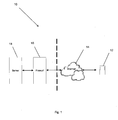
- Figure 1 is a simplified block diagram of a wireless communication system
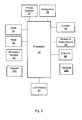
- Figure 2 is a block diagram of components of a portable electronic device
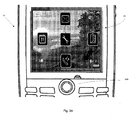
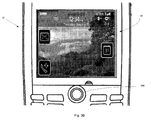
- Figures 3A - 3D are screen shot representations of a graphical user interface of the portable electronic device in Figure 2 showing exemplary home screen configurations having icons representing different focus points;
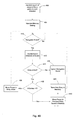
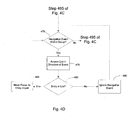
- Figures 4A - 4D are flowcharts showing exemplary methods of navigating between different focus points displayed on the electronic device of Figure 2 for the exemplary home screen configurations of screen shot representations of Figures 3A-3D , according to four respective memory settings.
- FIG. 1 is a simplified block diagram of an exemplary communication system 10 for a portable electronic device 12.
- the portable electronic device 12 is operable to effect communications over a radio communications channel and communicates with a base station (not shown) while located within a coverage area that is defined by the base station.
- the portable electronic device 12 is not limited to a device capable of effecting communications.
- the exemplary method of navigating between different focus points set forth in greater detail below may advantageously be implemented within a multitude of devices, some of which are capable of communications and others of which are not (e.g. PDAs, mobile phones, smart telephones, laptop computers, electronic games, GPS receivers, etc.).
- the base station is part of a wireless network that is in communication with the Internet 14. Data is delivered to the portable electronic device 12 via wireless transmission from the base station. Similarly, data is sent from the portable electronic device 12 via wireless transmission to the base station.
- wireless networks include GSM/GPRS, CDPD, TDMA, iDEN, Mobitex, DataTAC networks, EDGE, EVDO or UMTS and broadband networks such as Bluetooth and variants of 802.11.
- a server 18 handles wireless client requests from the portable electronic device 12.
- a firewall16 is provided between the server 18 and the Internet 14.
- the server 18 further operates as a Mail Server, which communicates with an email client of the portable electronic device 12 to allow a user to send and receive email messages.
- FIG. 2 is a block diagram showing certain components within an exemplary embodiment of the portable electronic device 12.
- the portable electronic device 12 includes a processor 20 connected to a read-only-memory (ROM) 21 that contains a plurality of applications executable by the processor 20 for enabling each portable electronic device 12 to perform certain functions including, for example, Personal Identification Number (PIN) message functions, Short Message Service (SMS) message functions, address book and calendaring functions, camera functions, and cellular telephone functions. More particularly, processor 20 may execute applications within ROM 21 for notifying the user of events such as incoming calls and/or emails, appointments, tasks, etc.
- the processor 20 is also connected to a random access memory unit (RAM) 22 and a persistent storage device 23 to facilitate various non-volatile storage functions of the portable electronic device 12.
- RAM random access memory unit
- the processor 20 receives input from one or more input devices, including a keypad 24A and a multi-directional device such as a trackball 24B. Other multi-directional devices are contemplated, such as touch pads, +-shaped game buttons, etc.
- the processor 20 outputs to one or more output devices, including a Liquid Crystal Display (LCD) display 25.
- LCD Liquid Crystal Display
- a microphone 26 and phone speaker 27 are connected to the processor 20 for cellular telephone functions.
- the processor 20 is also connected to a modem and radio device 28.
- the modem and radio device 28 is used to connect to wireless networks and transmit and receive voice and data communications through an antenna 29.
- a camera 30 provides functionality for taking pictures that can be viewed on display 25, sent to other users via wireless email, saved to persistent storage 23 for later viewing, etc.
- “user interface” comprises an input device (such as keypad 24A, trackball 24B, etc.) and at least one graphical window displayed via an output device (such as display 25).
- the user interface of portable electronic device 12 may be configured according to a plurality of customizable home screens wherein buttons, application icons, lists, etc. may be placed anywhere on the display 25.
- buttons, application icons, lists, etc. may be placed anywhere on the display 25.
- a method is provided for defining how movements of the trackball 24B result in moving the focus between different focusable points (i.e. buttons, application icons, etc).
- Figures 3A- 3D depict several examples of home screens according to different customizable themes that provide for navigation between different focus points displayed on electronic device 12, according to exemplary embodiments.
- FIG 3A an exemplary home screen is shown with five application icons: a central 'Options' application icon surrounded by Messages, Address Book, Phone and Calendar application icons, wherein navigation paths between the applications are illustrated using double-sided arrows. These navigation arrows are illustrated for the purpose of explaining the exemplary method but would not, normally, be shown on the display 25 during ordinary usage.
- the Options application center
- trackball 24B pushing trackball 24B in any direction (up, down, left or right) will result in focus moving to the application icon positioned in that direction (i.e. Messages, Phone, Calendar or Address Book, respectively).
- a solution to the configuration of Figure 3A wherein it is desirable for focus to always return to a predetermined application, may be provided by implementing a memory configuration wherein the device 12 does not need to 'remember' any previous point. Rather, device 12 may be programmed to return focus to the same application each time trackball 24B is moved in the direction of that application.
- This implementation of memory is referred to herein as "None" since the device 12 does not need remember any previous focus points.
- a home screen theme has been constructed such that two navigation paths exist to the left of the Calendar application. That is, pushing trackball 24B to the right when either of the Messages or Phone application icons is in focus will result in focus moving to the Calendar application icon.
- trackball 24B is pushed to the left when the Calendar application icon is in focus since it is unclear which of the Messages or Phone application icons should gain focus.
- it may be desirable that focus should return to the previous application icon i.e. pushing the trackball 24B right from Phone to Calendar means that pushing the trackball 24B to the left from the Calendar icon will return focus to the Phone icon).
- focus should always return to a predetermined application regardless of which application icon focus came from (i.e. pushing the trackball 24B left from the Calendar icon always returns focus to Messages, even if focus previously shifted right to Calendar from Phone).
- device 12 may be programmed to save the last icon from which focus has been received.
- the Calendar application icon obtains focus from the Phone application, then when trackball 24B is next pushed to the left it must return focus to the Phone application icon.
- This implementation of memory is referred to herein as "one-step memory" since device 12 is required to store only one previous shift in focus.
- two columns of application icons are provided with one application icon (Options) serving as the center point.
- Navigation between icons in a single column is effected by pushing trackball 24B up or down (e.g. navigating between Messages and Calendar) and navigation to the other column is effected by navigating through the center icon (Options). Therefore, in order to navigate between application icons on the home screen theme of Figure 3C , more than one type of memory functionality is required. For example, if focus moves from Messages to Calendar, then to Options, Address Book, Phone and finally back to Options, if trackball 24B is next pushed left from Options, a memory configuration must be provided to select which of Messages or Calendar is put in focus.
- device 12 remembers that the Options icon obtained focus from Phone. However, Phone is not an application that can be reached by pushing trackball 24B to the left. Thus, under the 'one-step' model, it is not possible to "remember" that the shift in focus to Options from the left column originally came from the Calendar application.
- a "full" or “directional" memory configuration is provided so that instead of remembering only which application focus has been obtained from, device 12 remembers each last application in each direction from which focus has been obtained.
- the device 12 therefore remembers that the Options application icon has received focus from the Calendar application icon in the left column such that when trackball 24B is next pushed left, focus returns to the Calendar application. If trackball 24B is next pushed up to Messages and right to Options, Messages then replaces Calendar as the application icon that gains focus when trackball 24B is next pushed left from Options.
- Figure 3D is similar to the example of Figure 3C with the exception that the Options application in the center is replaced with a group application (SMS and MMS) and its corresponding sub-entries (individual unread "Welcome” messages). Therefore, as described in greater detail below, a "group” memory configuration is provided so that items may be grouped together and handled as a single atomic unit. For group navigation according to the "group” memory configuration, focus moves are only recorded when focus leaves the group. Thus, pushing trackball 24B left and right records focus, whereas vertical navigation within the sub-entries are not recorded. When using the "group” memory configuration focus points must be placed inside a logical group construct used to record and remember the focus points from which the focus is obtained.
- group application SMS and MMS
- sub-entries individual unread "Welcome” messages
- a method for navigating between different focus points displayed on electronic device 12.
- a list is maintained in memory 22, for each focus point, of any adjacent focus points to which focus can move in each direction, responsive to a navigation event in that direction. Therefore, each list may contain zero (empty list) or more focus points to which focus can move in a given direction. If the list is empty (Nil) for a particular direction, then navigation movements in that direction are ignored. If the list contains only one entry, then the application associated with the icon identified by that entry always receives focus when a navigation event in that direction is received. If the list contains more than one entry, then the focus point that receives focus is determined by a memory setting.
- a memory setting is maintained (step 405) such that for each list having more than one adjacent focus point for movement of focus is resolved between the multiple adjacent focus points.
- four memory settings are provided, as follows: None ( Figure 4A ), One-step ( Figure 4B ), Full ( Figure 4C ) and Group ( Figure 4D ).
- step 410 responsive to a navigation event, the foregoing lists are accessed in memory 22 (step 415) according to the direction of the navigation event. If there is an entry in the list for that direction (i.e. a "Yes” at step 420), then focus is moved to the icon entry in the list (step 425). Otherwise, the navigation event is ignored (step 430). Thus, for each list having only one adjacent focus point focus moves to that one adjacent focus point (i.e. the "None" memory setting provides consistent prediction of which application will receive focus).
- memory 22 stores the identifier of the focus point from which focus was last received.
- the following information is maintained in memory 22: List Up Down Left Right Calendar Nil Nil Messages/Phone (One-step memory) Nil Phone Messages Nil Nil Calendar Messages Nil Phone Nil Calendar
- focus moves to the previous entry from which focus last moved (step 440).
- the memory 22 is then updated to reflect the new "previous" adjacent focus point (step 445).
- the one-step identifier is stored in a generic variable that is not associated with navigation direction.
- the exemplary method accesses 22 memory to identify the previous focus point in the direction list and if present, gives focus to that point.
- one of either Message or Phone is saved in the one-step memory 22 such that when moving focus to the left from the Calendar, the previous one of Message or Phone is selected. If no value has been stored in the one-step memory 22, then by default the first application in the list is selected (i.e. Messages in the example of Figure 3B ).
- the Full memory setting saves the identifier of the point from which focus was received and stores it in one of four variables, each one associated with a direction.
- the navigation method of Figure 4C is similar to that of Figure 4B except that when focus leaves a current point, the appropriate directional memory variable is checked in memory 22. More particularly, if more than one direction of navigation is possible then if the identifier can be found in the list of focus points for that direction, focus is moved to that focus point (step 455) and the memory 22 is updated with the new directional variable (step 460). If the variable is unassigned, focus is given to the first point in the list.
- the Left entry in the Options list is "Messages/Calendar" and the Right entry is "Address Book/Phone", indicating that the memory variable for the Left entry is one of either Messages or Calendar based on which one of Messages or Calendar the Options icon received focus from to its left, and the memory variable for the Right entry is one of either Address Book or Phone based on which one of Address Book or Phone the Options icon received focus from to its right.
- the Group memory setting is used to logically group a set of points into an atomic unit.
- a group object i.e. a "Yes" at step 465
- additional focus moves between items within the group are effected in accordance with the direction of the navigation events but without remembering movement between focus points in the group.
- the points that use the Group memory setting must be children of a group object and store the identifiers in the parent object.
Landscapes
- Engineering & Computer Science (AREA)
- General Engineering & Computer Science (AREA)
- Theoretical Computer Science (AREA)
- Human Computer Interaction (AREA)
- Physics & Mathematics (AREA)
- General Physics & Mathematics (AREA)
- Navigation (AREA)
- Telephone Function (AREA)
- Traffic Control Systems (AREA)
- Position Fixing By Use Of Radio Waves (AREA)
- Radar Systems Or Details Thereof (AREA)
Claims (9)
- Elektronische Vorrichtung (12), die aufweist:eine Anzeige (25), die konfiguriert ist zum Anzeigen von verschiedenen Fokus-Punkten;eine multidirektionale Eingabevorrichtung(24B), die konfiguriert ist zum Erzeugern von Navigationsereignissen in mehrere Richtungen;einen Speicher (22), der konfiguriert ist zum Führen (i) einer Liste (400) für jeden der verschiedenen Fokus-Punkte von angrenzenden der Fokus-Punkte, zu denen sich ein Fokus in jede Richtung bewegen kann in Reaktion auf ein Navigationsereignis in diese Richtung, und (ii) einer Speicher-Einstellung für jede Liste, die mehr als einen angrenzenden Fokus-Punkt hat, zum Auflösen von Fokus-Bewegungen wie zwischen angrenzenden Fokus-Punkten;undeinen Prozessor (20), der konfiguriert ist zum Zugreifen auf den Speicher in Reaktion auf ein Navigationsereignis in eine der mehreren Richtungen, und in dem Fall, dass die Liste nur einen angrenzenden Fokus-Punkt hat, dann Bewegen des Fokus zu dem einen angrenzenden Fokus-Punkt, und in dem Fall, dass die Liste mehr als einen angrenzenden Fokus-Punkt hat, dann Bewegen des Fokus in Übereinstimmung mit der Speicher-Einstellung, dadurch gekennzeichnet, dass die Speicher-Einstellung ausgebildet ist, zu veranlassen, dass sich der Fokus zu einem der angrenzenden Fokus-Punkte in der Liste bewegt, der zu der Richtung des Navigationsereignisses gehört, und von dem der Fokus als letztes empfangen wurde.
- Elektronische Vorrichtung gemäß Anspruch 1, wobei die multidirektionale Eingabevorrichtung (24B) einen Trackball aufweist.
- Verfahren zum Navigieren zwischen verschiedenen Fokus-Punkten, die auf einer Anzeige(25) einer elekfronischen Vorrichtung(12) mit eirtem Prozessor(20)angezeigt werden, das aufweist:Erzeugen von Navigationsereignissen in mehrere Richtungen durch eine multidirektionale Eingabevorrichtung(248);für jeden der verschiedenen Fokus-Punkte, Führen einer Liste (400) von angrenzenden der Fokus-Punkte, zu denen sich ein Fokus in jede Richtung bewegen kann in Reaktion auf ein Navigationsereignis in diese Richtung;für Jede Liste, die mehr als einen angrenzenden Fokus-Punkt hat, Fuhren einerSpeicher-Einstellung(405)zum Auflösen von Fokus-Bewegungen wie zwischen angrenzenden Fokus-Punkten; undin Reaktion auf ein Navigationsereignis (410), für jede liste, die nur einen angrenzend Fokus-Punkt hat, Bewegen des Fokus. zu dem einen angenzenden Fokus-Punkt(425), und für jede Liste, die mehr als einen angrencher-Eihstellung und Bewegen des Fokus(440) in Übereinstimmung mit der Speicher Einstellung, dadurch gekennzeichnet, dass die Speicher-Einstellung veranlasst, dass sich der Fokus zu einem der angrenzenden Fokus-Punkte in der Liste bewegt, der zu der Richtung des Navigationsereignisses gehört, und von dem der Fokus als letztes empfangen wurde.
- Verfahren gemäß Anspruch3, wobei die mehreren Richtungen nach oben, nach unten, nach links und nach rechts relativ zu der Anzeige sind..
- Verfahren gemäß einem der Anspruche 3 oder 4, wobei der eine der angrenzenden Fokus-Punkte eine logische Gruppe von Elementen (465) ist und die Fokusbewegungen zwisehen den Elementen (485) in der Gruppe nicht aufgezeichnet werden.
- Verfahren gemäß einem der Ansprüche 3 bis 5, das weiter aufweist Anzeigen der Fokus-Punkte gemäß einer vorgegebenen Themenanordnung.
- Verfahren gemäß Anspruch 6, wobei die vorgegebene Themenanordnung eines aufweist aus:eine Vielzahl von Fokus-Punkten, die einen weiteren zentralen Fokus-Punkt umgeben, wobei eine Navigation in jede Richtung von dem zentralen Fokus-Punkt dazu führt, dass sich der Fokus zu einem der Vielzahl von Fokus-Punkten bewegt, der in der Richtung positioniert ist, und eine Navigation von einem der Vielzahl von Fokus-Punkten in eine entgegengesetzte Richtung den Fokus zu dem zentralen Fokus-Punkt zurückbringt;eine Vielzahl von Foklls-Punkten, die an einer Seite eines weiteren Fokus-Punkts angeordnet sind, wobei eine Navigation in eine Richtung von einem der Vielzahl von Fokus-Punkten hin zu dem weiteren Fokus-Punkt dazu führt, dass sich der Fokus zu dem weiteren Fokus-Punkt bewegt, und eine Navigation von dem weiteren Fokus-Punkt hin zu einem der Vielzahl von Fokus-Punkten den Fokus zu einem vorgegebenen der Vielzahl von Fokus-Punkten zurückbringt;eine Vielzahl von Fokus-Punkten, die an einer Seite eines weiteren Fokus-Punkts angeordnet sind, wobei eine Navigation in eine Richtung von einem der Vielzahl von Fokus-Punkten hin zu dem weiteren Fokus-Punkt dazu führt, dass sich der Fokus zu dem weiteren Fokus-Punkt bewegt, und eine Navigation von dem weiteren Fokus-Punkt hin zu einem der Vielzahl von Fokus-Punkten den Fokus zu dem einem der Vielzahl von Fokus-Punkten zurückbringt; odereine erste Vielzahl von Fokus-Punkten, die an einer Seite eines weiteren Fokus-Punkts angeordnet sind, und eine zweite Vielzahl von Fokus-Punkten, die an einer anderen Seite des weiteren Fokus-Punkts angeordnet sind, wobei eine Navigation in eine Richtung von einem der ersten Vielzahl von Fokus-Punkten hin zu dem weiteren Fokus-Punkt dazu führt, dass sich der Fokus zu dem weiteren Fokus-Punkt bewegt, und eine weitere Navigation von dem weiteren Fokus-Punkt in die Richtung zu einem der zweiten Vielzahl von Fokus-Punkten den Fokus zu dem einem der zweiten Vielzahl von Fokus-Punkten bewegt, und eine Navigation in eine entgegengesetzten Richtung von dem einen der zweiten Vielzahl von Fokus-Punkten zu dem weiteren Fokus-Punkt dazu fuhrt, dass sich der Fokus zu dem welteien Fokus-Punkt bewegt, und eine weitere Navigation in die entgegengesetzte Richtung hin zu einem der ersten Vieizahl von Fokus-Punkten den Fokus zu dem einen der ersten Vieizahl von Fokus-Punten zurückbringt
- Verfahren gemäß einem der Ansprüche 6 bis 7, wobei die Fokus-Punkte Anzeigesymbole aufweisen zum Starten von Option-, Nachrichten-, Ad ressbuch-, Telefon-und Kalender-Anwendungen auf der elektronischen Vorrichtung.
- Computerlesbares Medium, das Medium computerausführbare Anweisungen speichert, die durch einen Prozessor einer Computervorrichtung ausführbar sind, um die Compufervorrichtung zu veranlassen, die Schritte des Verfahrens gemäß einem der Anspruche 3 bis 8 zu imptementieren.
Priority Applications (1)
| Application Number | Priority Date | Filing Date | Title |
|---|---|---|---|
| CA2683247A CA2683247C (en) | 2008-10-17 | 2009-10-19 | Multi-directional navigation between focus points on a display |
Applications Claiming Priority (1)
| Application Number | Priority Date | Filing Date | Title |
|---|---|---|---|
| US10622808P | 2008-10-17 | 2008-10-17 |
Publications (2)
| Publication Number | Publication Date |
|---|---|
| EP2177977A1 EP2177977A1 (de) | 2010-04-21 |
| EP2177977B1 true EP2177977B1 (de) | 2011-03-30 |
Family
ID=40677456
Family Applications (1)
| Application Number | Title | Priority Date | Filing Date |
|---|---|---|---|
| EP09153478A Active EP2177977B1 (de) | 2008-10-17 | 2009-02-23 | Multidirektionale Navigation zwischen Fokuspunkten auf einer Anzeige |
Country Status (5)
| Country | Link |
|---|---|
| US (2) | US8174498B2 (de) |
| EP (1) | EP2177977B1 (de) |
| AT (1) | ATE504036T1 (de) |
| CA (1) | CA2683247C (de) |
| DE (1) | DE602009000982D1 (de) |
Families Citing this family (4)
| Publication number | Priority date | Publication date | Assignee | Title |
|---|---|---|---|---|
| KR102173110B1 (ko) * | 2014-05-07 | 2020-11-02 | 삼성전자주식회사 | 웨어러블 디바이스 및 그 제어 방법 |
| US10209851B2 (en) * | 2015-09-18 | 2019-02-19 | Google Llc | Management of inactive windows |
| US10891106B2 (en) | 2015-10-13 | 2021-01-12 | Google Llc | Automatic batch voice commands |
| US20180095938A1 (en) * | 2016-09-30 | 2018-04-05 | Sap Se | Synchronized calendar and timeline adaptive user interface |
Family Cites Families (4)
| Publication number | Priority date | Publication date | Assignee | Title |
|---|---|---|---|---|
| WO2003007140A2 (en) * | 2001-07-13 | 2003-01-23 | Wind River Systems, Inc. | Directional focus manager |
| JPWO2003025729A1 (ja) | 2001-09-13 | 2004-12-24 | 松下電器産業株式会社 | Gui部品のフォーカス移動先設定装置及びフォーカス移動装置 |
| US7365735B2 (en) * | 2004-03-23 | 2008-04-29 | Fujitsu Limited | Translation controlled cursor |
| US7532198B2 (en) * | 2005-01-14 | 2009-05-12 | Research In Motion Limited | Handheld electronic device with roller ball input |
-
2009
- 2009-02-23 US US12/390,984 patent/US8174498B2/en active Active
- 2009-02-23 AT AT09153478T patent/ATE504036T1/de not_active IP Right Cessation
- 2009-02-23 EP EP09153478A patent/EP2177977B1/de active Active
- 2009-02-23 DE DE602009000982T patent/DE602009000982D1/de active Active
- 2009-10-19 CA CA2683247A patent/CA2683247C/en active Active
-
2012
- 2012-04-04 US US13/439,014 patent/US8581843B2/en active Active
Also Published As
| Publication number | Publication date |
|---|---|
| US20100097319A1 (en) | 2010-04-22 |
| US8174498B2 (en) | 2012-05-08 |
| CA2683247C (en) | 2013-07-23 |
| CA2683247A1 (en) | 2010-04-17 |
| ATE504036T1 (de) | 2011-04-15 |
| US8581843B2 (en) | 2013-11-12 |
| US20120188165A1 (en) | 2012-07-26 |
| DE602009000982D1 (de) | 2011-05-12 |
| EP2177977A1 (de) | 2010-04-21 |
Similar Documents
| Publication | Publication Date | Title |
|---|---|---|
| JP4538000B2 (ja) | 階層メニュー内のメニューアイテムにアクセスするためのイベントリストメニュー | |
| KR101486345B1 (ko) | 이동 단말기 및 이동 단말기의 화면 표시 방법 | |
| KR101123660B1 (ko) | 선호 콘택트 그룹 중심형 인터페이스 | |
| US7778671B2 (en) | Mobile communications terminal having an improved user interface and method therefor | |
| US8208964B2 (en) | Flexible home page layout for mobile devices | |
| US7375730B2 (en) | Graphic entries for interactive directory | |
| US7984381B2 (en) | User interface | |
| KR101709130B1 (ko) | 휴대 단말기의 메시지 리스트 표시 방법 및 장치 | |
| EP1536616B1 (de) | Interaktives Telefonbuch | |
| EP2456178B1 (de) | Verfahren und tragbare Vorrichtung zum Suchen von Elementen verschiedener Typen | |
| CA2586985C (en) | System and method for accessing an icon of a handheld electronic device | |
| CN105094602A (zh) | 移动终端实现按键模式的方法和装置 | |
| US20110320939A1 (en) | Electronic Device for Providing a Visual Representation of a Resizable Widget Associated with a Contacts Database | |
| US20090110177A1 (en) | Dynamic Secondary Phone Book | |
| US20160165048A1 (en) | Methods and systems for automated business dialing | |
| EP2177977B1 (de) | Multidirektionale Navigation zwischen Fokuspunkten auf einer Anzeige | |
| CN105611071A (zh) | 一种日程信息显示方法及终端 | |
| US20110099473A1 (en) | Input signal processing device for portable device and method of the same | |
| US20110320980A1 (en) | Electronic Device for Providing a Visual Representation of a Widget Associated with a Contacts Database | |
| US20060262097A1 (en) | Continuous click apparatus of mobile communication terminal and method for executing the same | |
| EP2757469B1 (de) | Verfahren und Vorrichtung zur Ausführung eines Anwendungsprogramms in einer elektronischen Vorrichtung | |
| CN105262901A (zh) | 一种短信处理方法和装置 | |
| CN106547424A (zh) | 一种图标排序方法和一种终端 | |
| US20100169831A1 (en) | Information Product and Method for Interacting with User | |
| KR100592179B1 (ko) | 이동통신단말기에서 문자메시지 관리 방법 |
Legal Events
| Date | Code | Title | Description |
|---|---|---|---|
| PUAI | Public reference made under article 153(3) epc to a published international application that has entered the european phase |
Free format text: ORIGINAL CODE: 0009012 |
|
| 17P | Request for examination filed |
Effective date: 20090223 |
|
| AK | Designated contracting states |
Kind code of ref document: A1 Designated state(s): AT BE BG CH CY CZ DE DK EE ES FI FR GB GR HR HU IE IS IT LI LT LU LV MC MK MT NL NO PL PT RO SE SI SK TR |
|
| AX | Request for extension of the european patent |
Extension state: AL BA RS |
|
| GRAP | Despatch of communication of intention to grant a patent |
Free format text: ORIGINAL CODE: EPIDOSNIGR1 |
|
| AKX | Designation fees paid |
Designated state(s): AT BE BG CH CY CZ DE DK EE ES FI FR GB GR HR HU IE IS IT LI LT LU LV MC MK MT NL NO PL PT RO SE SI SK TR |
|
| GRAS | Grant fee paid |
Free format text: ORIGINAL CODE: EPIDOSNIGR3 |
|
| GRAA | (expected) grant |
Free format text: ORIGINAL CODE: 0009210 |
|
| AK | Designated contracting states |
Kind code of ref document: B1 Designated state(s): AT BE BG CH CY CZ DE DK EE ES FI FR GB GR HR HU IE IS IT LI LT LU LV MC MK MT NL NO PL PT RO SE SI SK TR |
|
| REG | Reference to a national code |
Ref country code: GB Ref legal event code: FG4D |
|
| REG | Reference to a national code |
Ref country code: CH Ref legal event code: EP |
|
| REG | Reference to a national code |
Ref country code: IE Ref legal event code: FG4D |
|
| REF | Corresponds to: |
Ref document number: 602009000982 Country of ref document: DE Date of ref document: 20110512 Kind code of ref document: P |
|
| REG | Reference to a national code |
Ref country code: DE Ref legal event code: R096 Ref document number: 602009000982 Country of ref document: DE Effective date: 20110512 |
|
| REG | Reference to a national code |
Ref country code: NL Ref legal event code: VDEP Effective date: 20110330 |
|
| PG25 | Lapsed in a contracting state [announced via postgrant information from national office to epo] |
Ref country code: LV Free format text: LAPSE BECAUSE OF FAILURE TO SUBMIT A TRANSLATION OF THE DESCRIPTION OR TO PAY THE FEE WITHIN THE PRESCRIBED TIME-LIMIT Effective date: 20110330 Ref country code: SE Free format text: LAPSE BECAUSE OF FAILURE TO SUBMIT A TRANSLATION OF THE DESCRIPTION OR TO PAY THE FEE WITHIN THE PRESCRIBED TIME-LIMIT Effective date: 20110330 Ref country code: HR Free format text: LAPSE BECAUSE OF FAILURE TO SUBMIT A TRANSLATION OF THE DESCRIPTION OR TO PAY THE FEE WITHIN THE PRESCRIBED TIME-LIMIT Effective date: 20110330 Ref country code: GR Free format text: LAPSE BECAUSE OF FAILURE TO SUBMIT A TRANSLATION OF THE DESCRIPTION OR TO PAY THE FEE WITHIN THE PRESCRIBED TIME-LIMIT Effective date: 20110701 Ref country code: LT Free format text: LAPSE BECAUSE OF FAILURE TO SUBMIT A TRANSLATION OF THE DESCRIPTION OR TO PAY THE FEE WITHIN THE PRESCRIBED TIME-LIMIT Effective date: 20110330 |
|
| LTIE | Lt: invalidation of european patent or patent extension |
Effective date: 20110330 |
|
| PG25 | Lapsed in a contracting state [announced via postgrant information from national office to epo] |
Ref country code: SI Free format text: LAPSE BECAUSE OF FAILURE TO SUBMIT A TRANSLATION OF THE DESCRIPTION OR TO PAY THE FEE WITHIN THE PRESCRIBED TIME-LIMIT Effective date: 20110330 Ref country code: NO Free format text: LAPSE BECAUSE OF FAILURE TO SUBMIT A TRANSLATION OF THE DESCRIPTION OR TO PAY THE FEE WITHIN THE PRESCRIBED TIME-LIMIT Effective date: 20110630 Ref country code: CY Free format text: LAPSE BECAUSE OF FAILURE TO SUBMIT A TRANSLATION OF THE DESCRIPTION OR TO PAY THE FEE WITHIN THE PRESCRIBED TIME-LIMIT Effective date: 20110330 Ref country code: AT Free format text: LAPSE BECAUSE OF FAILURE TO SUBMIT A TRANSLATION OF THE DESCRIPTION OR TO PAY THE FEE WITHIN THE PRESCRIBED TIME-LIMIT Effective date: 20110330 Ref country code: FI Free format text: LAPSE BECAUSE OF FAILURE TO SUBMIT A TRANSLATION OF THE DESCRIPTION OR TO PAY THE FEE WITHIN THE PRESCRIBED TIME-LIMIT Effective date: 20110330 |
|
| PG25 | Lapsed in a contracting state [announced via postgrant information from national office to epo] |
Ref country code: BE Free format text: LAPSE BECAUSE OF FAILURE TO SUBMIT A TRANSLATION OF THE DESCRIPTION OR TO PAY THE FEE WITHIN THE PRESCRIBED TIME-LIMIT Effective date: 20110330 |
|
| PG25 | Lapsed in a contracting state [announced via postgrant information from national office to epo] |
Ref country code: EE Free format text: LAPSE BECAUSE OF FAILURE TO SUBMIT A TRANSLATION OF THE DESCRIPTION OR TO PAY THE FEE WITHIN THE PRESCRIBED TIME-LIMIT Effective date: 20110330 Ref country code: PT Free format text: LAPSE BECAUSE OF FAILURE TO SUBMIT A TRANSLATION OF THE DESCRIPTION OR TO PAY THE FEE WITHIN THE PRESCRIBED TIME-LIMIT Effective date: 20110801 |
|
| PG25 | Lapsed in a contracting state [announced via postgrant information from national office to epo] |
Ref country code: RO Free format text: LAPSE BECAUSE OF FAILURE TO SUBMIT A TRANSLATION OF THE DESCRIPTION OR TO PAY THE FEE WITHIN THE PRESCRIBED TIME-LIMIT Effective date: 20110330 Ref country code: CZ Free format text: LAPSE BECAUSE OF FAILURE TO SUBMIT A TRANSLATION OF THE DESCRIPTION OR TO PAY THE FEE WITHIN THE PRESCRIBED TIME-LIMIT Effective date: 20110330 Ref country code: SK Free format text: LAPSE BECAUSE OF FAILURE TO SUBMIT A TRANSLATION OF THE DESCRIPTION OR TO PAY THE FEE WITHIN THE PRESCRIBED TIME-LIMIT Effective date: 20110330 Ref country code: IS Free format text: LAPSE BECAUSE OF FAILURE TO SUBMIT A TRANSLATION OF THE DESCRIPTION OR TO PAY THE FEE WITHIN THE PRESCRIBED TIME-LIMIT Effective date: 20110730 Ref country code: ES Free format text: LAPSE BECAUSE OF FAILURE TO SUBMIT A TRANSLATION OF THE DESCRIPTION OR TO PAY THE FEE WITHIN THE PRESCRIBED TIME-LIMIT Effective date: 20110711 |
|
| PG25 | Lapsed in a contracting state [announced via postgrant information from national office to epo] |
Ref country code: NL Free format text: LAPSE BECAUSE OF FAILURE TO SUBMIT A TRANSLATION OF THE DESCRIPTION OR TO PAY THE FEE WITHIN THE PRESCRIBED TIME-LIMIT Effective date: 20110330 |
|
| PLBE | No opposition filed within time limit |
Free format text: ORIGINAL CODE: 0009261 |
|
| STAA | Information on the status of an ep patent application or granted ep patent |
Free format text: STATUS: NO OPPOSITION FILED WITHIN TIME LIMIT |
|
| PG25 | Lapsed in a contracting state [announced via postgrant information from national office to epo] |
Ref country code: PL Free format text: LAPSE BECAUSE OF FAILURE TO SUBMIT A TRANSLATION OF THE DESCRIPTION OR TO PAY THE FEE WITHIN THE PRESCRIBED TIME-LIMIT Effective date: 20110330 |
|
| 26N | No opposition filed |
Effective date: 20120102 |
|
| REG | Reference to a national code |
Ref country code: DE Ref legal event code: R097 Ref document number: 602009000982 Country of ref document: DE Effective date: 20120102 |
|
| PG25 | Lapsed in a contracting state [announced via postgrant information from national office to epo] |
Ref country code: IT Free format text: LAPSE BECAUSE OF FAILURE TO SUBMIT A TRANSLATION OF THE DESCRIPTION OR TO PAY THE FEE WITHIN THE PRESCRIBED TIME-LIMIT Effective date: 20110330 |
|
| PG25 | Lapsed in a contracting state [announced via postgrant information from national office to epo] |
Ref country code: MC Free format text: LAPSE BECAUSE OF NON-PAYMENT OF DUE FEES Effective date: 20120229 |
|
| REG | Reference to a national code |
Ref country code: IE Ref legal event code: MM4A |
|
| PG25 | Lapsed in a contracting state [announced via postgrant information from national office to epo] |
Ref country code: IE Free format text: LAPSE BECAUSE OF NON-PAYMENT OF DUE FEES Effective date: 20120223 |
|
| PG25 | Lapsed in a contracting state [announced via postgrant information from national office to epo] |
Ref country code: MK Free format text: LAPSE BECAUSE OF FAILURE TO SUBMIT A TRANSLATION OF THE DESCRIPTION OR TO PAY THE FEE WITHIN THE PRESCRIBED TIME-LIMIT Effective date: 20110330 |
|
| PG25 | Lapsed in a contracting state [announced via postgrant information from national office to epo] |
Ref country code: BG Free format text: LAPSE BECAUSE OF FAILURE TO SUBMIT A TRANSLATION OF THE DESCRIPTION OR TO PAY THE FEE WITHIN THE PRESCRIBED TIME-LIMIT Effective date: 20110630 |
|
| PG25 | Lapsed in a contracting state [announced via postgrant information from national office to epo] |
Ref country code: MT Free format text: LAPSE BECAUSE OF FAILURE TO SUBMIT A TRANSLATION OF THE DESCRIPTION OR TO PAY THE FEE WITHIN THE PRESCRIBED TIME-LIMIT Effective date: 20110330 |
|
| REG | Reference to a national code |
Ref country code: CH Ref legal event code: PL |
|
| PG25 | Lapsed in a contracting state [announced via postgrant information from national office to epo] |
Ref country code: CH Free format text: LAPSE BECAUSE OF NON-PAYMENT OF DUE FEES Effective date: 20130228 Ref country code: LI Free format text: LAPSE BECAUSE OF NON-PAYMENT OF DUE FEES Effective date: 20130228 |
|
| PG25 | Lapsed in a contracting state [announced via postgrant information from national office to epo] |
Ref country code: TR Free format text: LAPSE BECAUSE OF FAILURE TO SUBMIT A TRANSLATION OF THE DESCRIPTION OR TO PAY THE FEE WITHIN THE PRESCRIBED TIME-LIMIT Effective date: 20110330 |
|
| PG25 | Lapsed in a contracting state [announced via postgrant information from national office to epo] |
Ref country code: LU Free format text: LAPSE BECAUSE OF NON-PAYMENT OF DUE FEES Effective date: 20120223 |
|
| PG25 | Lapsed in a contracting state [announced via postgrant information from national office to epo] |
Ref country code: HU Free format text: LAPSE BECAUSE OF FAILURE TO SUBMIT A TRANSLATION OF THE DESCRIPTION OR TO PAY THE FEE WITHIN THE PRESCRIBED TIME-LIMIT Effective date: 20090223 |
|
| REG | Reference to a national code |
Ref country code: DE Ref legal event code: R082 Ref document number: 602009000982 Country of ref document: DE Representative=s name: MATIAS ERNY REICHL HOFFMANN PATENTANWAELTE, DE |
|
| REG | Reference to a national code |
Ref country code: DE Ref legal event code: R082 Ref document number: 602009000982 Country of ref document: DE Representative=s name: MATIAS ERNY REICHL HOFFMANN PATENTANWAELTE, DE Effective date: 20140925 Ref country code: DE Ref legal event code: R081 Ref document number: 602009000982 Country of ref document: DE Owner name: BLACKBERRY LIMITED, WATERLOO, CA Free format text: FORMER OWNER: RESEARCH IN MOTION LTD., WATERLOO, ONTARIO, CA Effective date: 20140925 |
|
| REG | Reference to a national code |
Ref country code: FR Ref legal event code: PLFP Year of fee payment: 8 |
|
| REG | Reference to a national code |
Ref country code: FR Ref legal event code: PLFP Year of fee payment: 9 |
|
| REG | Reference to a national code |
Ref country code: FR Ref legal event code: PLFP Year of fee payment: 10 |
|
| REG | Reference to a national code |
Ref country code: DE Ref legal event code: R082 Ref document number: 602009000982 Country of ref document: DE Ref country code: DE Ref legal event code: R081 Ref document number: 602009000982 Country of ref document: DE Owner name: MALIKIE INNOVATIONS LTD., IE Free format text: FORMER OWNER: BLACKBERRY LIMITED, WATERLOO, ONTARIO, CA |
|
| PGFP | Annual fee paid to national office [announced via postgrant information from national office to epo] |
Ref country code: DE Payment date: 20250226 Year of fee payment: 17 |
|
| PGFP | Annual fee paid to national office [announced via postgrant information from national office to epo] |
Ref country code: FR Payment date: 20250224 Year of fee payment: 17 |
|
| PGFP | Annual fee paid to national office [announced via postgrant information from national office to epo] |
Ref country code: GB Payment date: 20250218 Year of fee payment: 17 |