EP2177550A1 - Fluorine-containing fiber processing agent having alcohol repellency and soil release properties - Google Patents
Fluorine-containing fiber processing agent having alcohol repellency and soil release properties Download PDFInfo
- Publication number
- EP2177550A1 EP2177550A1 EP08791220A EP08791220A EP2177550A1 EP 2177550 A1 EP2177550 A1 EP 2177550A1 EP 08791220 A EP08791220 A EP 08791220A EP 08791220 A EP08791220 A EP 08791220A EP 2177550 A1 EP2177550 A1 EP 2177550A1
- Authority
- EP
- European Patent Office
- Prior art keywords
- group
- monomer
- fluorine
- containing copolymer
- carbon atoms
- Prior art date
- Legal status (The legal status is an assumption and is not a legal conclusion. Google has not performed a legal analysis and makes no representation as to the accuracy of the status listed.)
- Granted
Links
Classifications
-
- C—CHEMISTRY; METALLURGY
- C08—ORGANIC MACROMOLECULAR COMPOUNDS; THEIR PREPARATION OR CHEMICAL WORKING-UP; COMPOSITIONS BASED THEREON
- C08F—MACROMOLECULAR COMPOUNDS OBTAINED BY REACTIONS ONLY INVOLVING CARBON-TO-CARBON UNSATURATED BONDS
- C08F214/00—Copolymers of compounds having one or more unsaturated aliphatic radicals, each having only one carbon-to-carbon double bond, and at least one being terminated by a halogen
- C08F214/18—Monomers containing fluorine
- C08F214/186—Monomers containing fluorine with non-fluorinated comonomers
-
- C—CHEMISTRY; METALLURGY
- C08—ORGANIC MACROMOLECULAR COMPOUNDS; THEIR PREPARATION OR CHEMICAL WORKING-UP; COMPOSITIONS BASED THEREON
- C08F—MACROMOLECULAR COMPOUNDS OBTAINED BY REACTIONS ONLY INVOLVING CARBON-TO-CARBON UNSATURATED BONDS
- C08F214/00—Copolymers of compounds having one or more unsaturated aliphatic radicals, each having only one carbon-to-carbon double bond, and at least one being terminated by a halogen
- C08F214/18—Monomers containing fluorine
-
- C—CHEMISTRY; METALLURGY
- C08—ORGANIC MACROMOLECULAR COMPOUNDS; THEIR PREPARATION OR CHEMICAL WORKING-UP; COMPOSITIONS BASED THEREON
- C08F—MACROMOLECULAR COMPOUNDS OBTAINED BY REACTIONS ONLY INVOLVING CARBON-TO-CARBON UNSATURATED BONDS
- C08F220/00—Copolymers of compounds having one or more unsaturated aliphatic radicals, each having only one carbon-to-carbon double bond, and only one being terminated by only one carboxyl radical or a salt, anhydride ester, amide, imide or nitrile thereof
- C08F220/02—Monocarboxylic acids having less than ten carbon atoms; Derivatives thereof
- C08F220/10—Esters
- C08F220/22—Esters containing halogen
- C08F220/24—Esters containing halogen containing perhaloalkyl radicals
-
- D—TEXTILES; PAPER
- D06—TREATMENT OF TEXTILES OR THE LIKE; LAUNDERING; FLEXIBLE MATERIALS NOT OTHERWISE PROVIDED FOR
- D06M—TREATMENT, NOT PROVIDED FOR ELSEWHERE IN CLASS D06, OF FIBRES, THREADS, YARNS, FABRICS, FEATHERS OR FIBROUS GOODS MADE FROM SUCH MATERIALS
- D06M15/00—Treating fibres, threads, yarns, fabrics, or fibrous goods made from such materials, with macromolecular compounds; Such treatment combined with mechanical treatment
- D06M15/19—Treating fibres, threads, yarns, fabrics, or fibrous goods made from such materials, with macromolecular compounds; Such treatment combined with mechanical treatment with synthetic macromolecular compounds
- D06M15/21—Macromolecular compounds obtained by reactions only involving carbon-to-carbon unsaturated bonds
- D06M15/263—Macromolecular compounds obtained by reactions only involving carbon-to-carbon unsaturated bonds of unsaturated carboxylic acids; Salts or esters thereof
-
- D—TEXTILES; PAPER
- D06—TREATMENT OF TEXTILES OR THE LIKE; LAUNDERING; FLEXIBLE MATERIALS NOT OTHERWISE PROVIDED FOR
- D06M—TREATMENT, NOT PROVIDED FOR ELSEWHERE IN CLASS D06, OF FIBRES, THREADS, YARNS, FABRICS, FEATHERS OR FIBROUS GOODS MADE FROM SUCH MATERIALS
- D06M15/00—Treating fibres, threads, yarns, fabrics, or fibrous goods made from such materials, with macromolecular compounds; Such treatment combined with mechanical treatment
- D06M15/19—Treating fibres, threads, yarns, fabrics, or fibrous goods made from such materials, with macromolecular compounds; Such treatment combined with mechanical treatment with synthetic macromolecular compounds
- D06M15/21—Macromolecular compounds obtained by reactions only involving carbon-to-carbon unsaturated bonds
- D06M15/263—Macromolecular compounds obtained by reactions only involving carbon-to-carbon unsaturated bonds of unsaturated carboxylic acids; Salts or esters thereof
- D06M15/27—Macromolecular compounds obtained by reactions only involving carbon-to-carbon unsaturated bonds of unsaturated carboxylic acids; Salts or esters thereof of alkylpolyalkylene glycol esters of unsaturated carboxylic acids
-
- D—TEXTILES; PAPER
- D06—TREATMENT OF TEXTILES OR THE LIKE; LAUNDERING; FLEXIBLE MATERIALS NOT OTHERWISE PROVIDED FOR
- D06M—TREATMENT, NOT PROVIDED FOR ELSEWHERE IN CLASS D06, OF FIBRES, THREADS, YARNS, FABRICS, FEATHERS OR FIBROUS GOODS MADE FROM SUCH MATERIALS
- D06M15/00—Treating fibres, threads, yarns, fabrics, or fibrous goods made from such materials, with macromolecular compounds; Such treatment combined with mechanical treatment
- D06M15/19—Treating fibres, threads, yarns, fabrics, or fibrous goods made from such materials, with macromolecular compounds; Such treatment combined with mechanical treatment with synthetic macromolecular compounds
- D06M15/21—Macromolecular compounds obtained by reactions only involving carbon-to-carbon unsaturated bonds
- D06M15/263—Macromolecular compounds obtained by reactions only involving carbon-to-carbon unsaturated bonds of unsaturated carboxylic acids; Salts or esters thereof
- D06M15/277—Macromolecular compounds obtained by reactions only involving carbon-to-carbon unsaturated bonds of unsaturated carboxylic acids; Salts or esters thereof containing fluorine
-
- D—TEXTILES; PAPER
- D06—TREATMENT OF TEXTILES OR THE LIKE; LAUNDERING; FLEXIBLE MATERIALS NOT OTHERWISE PROVIDED FOR
- D06M—TREATMENT, NOT PROVIDED FOR ELSEWHERE IN CLASS D06, OF FIBRES, THREADS, YARNS, FABRICS, FEATHERS OR FIBROUS GOODS MADE FROM SUCH MATERIALS
- D06M15/00—Treating fibres, threads, yarns, fabrics, or fibrous goods made from such materials, with macromolecular compounds; Such treatment combined with mechanical treatment
- D06M15/19—Treating fibres, threads, yarns, fabrics, or fibrous goods made from such materials, with macromolecular compounds; Such treatment combined with mechanical treatment with synthetic macromolecular compounds
- D06M15/21—Macromolecular compounds obtained by reactions only involving carbon-to-carbon unsaturated bonds
- D06M15/285—Macromolecular compounds obtained by reactions only involving carbon-to-carbon unsaturated bonds of unsaturated carboxylic acid amides or imides
-
- D—TEXTILES; PAPER
- D06—TREATMENT OF TEXTILES OR THE LIKE; LAUNDERING; FLEXIBLE MATERIALS NOT OTHERWISE PROVIDED FOR
- D06M—TREATMENT, NOT PROVIDED FOR ELSEWHERE IN CLASS D06, OF FIBRES, THREADS, YARNS, FABRICS, FEATHERS OR FIBROUS GOODS MADE FROM SUCH MATERIALS
- D06M15/00—Treating fibres, threads, yarns, fabrics, or fibrous goods made from such materials, with macromolecular compounds; Such treatment combined with mechanical treatment
- D06M15/19—Treating fibres, threads, yarns, fabrics, or fibrous goods made from such materials, with macromolecular compounds; Such treatment combined with mechanical treatment with synthetic macromolecular compounds
- D06M15/21—Macromolecular compounds obtained by reactions only involving carbon-to-carbon unsaturated bonds
- D06M15/285—Macromolecular compounds obtained by reactions only involving carbon-to-carbon unsaturated bonds of unsaturated carboxylic acid amides or imides
- D06M15/29—Macromolecular compounds obtained by reactions only involving carbon-to-carbon unsaturated bonds of unsaturated carboxylic acid amides or imides containing a N-methylol group or an etherified N-methylol group; containing a N-aminomethylene group; containing a N-sulfidomethylene group
-
- D—TEXTILES; PAPER
- D06—TREATMENT OF TEXTILES OR THE LIKE; LAUNDERING; FLEXIBLE MATERIALS NOT OTHERWISE PROVIDED FOR
- D06M—TREATMENT, NOT PROVIDED FOR ELSEWHERE IN CLASS D06, OF FIBRES, THREADS, YARNS, FABRICS, FEATHERS OR FIBROUS GOODS MADE FROM SUCH MATERIALS
- D06M15/00—Treating fibres, threads, yarns, fabrics, or fibrous goods made from such materials, with macromolecular compounds; Such treatment combined with mechanical treatment
- D06M15/19—Treating fibres, threads, yarns, fabrics, or fibrous goods made from such materials, with macromolecular compounds; Such treatment combined with mechanical treatment with synthetic macromolecular compounds
- D06M15/21—Macromolecular compounds obtained by reactions only involving carbon-to-carbon unsaturated bonds
- D06M15/285—Macromolecular compounds obtained by reactions only involving carbon-to-carbon unsaturated bonds of unsaturated carboxylic acid amides or imides
- D06M15/295—Macromolecular compounds obtained by reactions only involving carbon-to-carbon unsaturated bonds of unsaturated carboxylic acid amides or imides containing fluorine
-
- D—TEXTILES; PAPER
- D06—TREATMENT OF TEXTILES OR THE LIKE; LAUNDERING; FLEXIBLE MATERIALS NOT OTHERWISE PROVIDED FOR
- D06M—TREATMENT, NOT PROVIDED FOR ELSEWHERE IN CLASS D06, OF FIBRES, THREADS, YARNS, FABRICS, FEATHERS OR FIBROUS GOODS MADE FROM SUCH MATERIALS
- D06M15/00—Treating fibres, threads, yarns, fabrics, or fibrous goods made from such materials, with macromolecular compounds; Such treatment combined with mechanical treatment
- D06M15/19—Treating fibres, threads, yarns, fabrics, or fibrous goods made from such materials, with macromolecular compounds; Such treatment combined with mechanical treatment with synthetic macromolecular compounds
- D06M15/37—Macromolecular compounds obtained otherwise than by reactions only involving carbon-to-carbon unsaturated bonds
- D06M15/53—Polyethers
-
- C—CHEMISTRY; METALLURGY
- C08—ORGANIC MACROMOLECULAR COMPOUNDS; THEIR PREPARATION OR CHEMICAL WORKING-UP; COMPOSITIONS BASED THEREON
- C08F—MACROMOLECULAR COMPOUNDS OBTAINED BY REACTIONS ONLY INVOLVING CARBON-TO-CARBON UNSATURATED BONDS
- C08F220/00—Copolymers of compounds having one or more unsaturated aliphatic radicals, each having only one carbon-to-carbon double bond, and only one being terminated by only one carboxyl radical or a salt, anhydride ester, amide, imide or nitrile thereof
- C08F220/02—Monocarboxylic acids having less than ten carbon atoms; Derivatives thereof
- C08F220/10—Esters
- C08F220/26—Esters containing oxygen in addition to the carboxy oxygen
- C08F220/28—Esters containing oxygen in addition to the carboxy oxygen containing no aromatic rings in the alcohol moiety
- C08F220/282—Esters containing oxygen in addition to the carboxy oxygen containing no aromatic rings in the alcohol moiety and containing two or more oxygen atoms
-
- C—CHEMISTRY; METALLURGY
- C08—ORGANIC MACROMOLECULAR COMPOUNDS; THEIR PREPARATION OR CHEMICAL WORKING-UP; COMPOSITIONS BASED THEREON
- C08F—MACROMOLECULAR COMPOUNDS OBTAINED BY REACTIONS ONLY INVOLVING CARBON-TO-CARBON UNSATURATED BONDS
- C08F220/00—Copolymers of compounds having one or more unsaturated aliphatic radicals, each having only one carbon-to-carbon double bond, and only one being terminated by only one carboxyl radical or a salt, anhydride ester, amide, imide or nitrile thereof
- C08F220/02—Monocarboxylic acids having less than ten carbon atoms; Derivatives thereof
- C08F220/10—Esters
- C08F220/26—Esters containing oxygen in addition to the carboxy oxygen
- C08F220/28—Esters containing oxygen in addition to the carboxy oxygen containing no aromatic rings in the alcohol moiety
- C08F220/283—Esters containing oxygen in addition to the carboxy oxygen containing no aromatic rings in the alcohol moiety and containing one or more carboxylic moiety in the chain, e.g. acetoacetoxyethyl(meth)acrylate
-
- C—CHEMISTRY; METALLURGY
- C08—ORGANIC MACROMOLECULAR COMPOUNDS; THEIR PREPARATION OR CHEMICAL WORKING-UP; COMPOSITIONS BASED THEREON
- C08F—MACROMOLECULAR COMPOUNDS OBTAINED BY REACTIONS ONLY INVOLVING CARBON-TO-CARBON UNSATURATED BONDS
- C08F220/00—Copolymers of compounds having one or more unsaturated aliphatic radicals, each having only one carbon-to-carbon double bond, and only one being terminated by only one carboxyl radical or a salt, anhydride ester, amide, imide or nitrile thereof
- C08F220/02—Monocarboxylic acids having less than ten carbon atoms; Derivatives thereof
- C08F220/10—Esters
- C08F220/26—Esters containing oxygen in addition to the carboxy oxygen
- C08F220/28—Esters containing oxygen in addition to the carboxy oxygen containing no aromatic rings in the alcohol moiety
- C08F220/285—Esters containing oxygen in addition to the carboxy oxygen containing no aromatic rings in the alcohol moiety and containing a polyether chain in the alcohol moiety
- C08F220/286—Esters containing oxygen in addition to the carboxy oxygen containing no aromatic rings in the alcohol moiety and containing a polyether chain in the alcohol moiety and containing polyethylene oxide in the alcohol moiety, e.g. methoxy polyethylene glycol (meth)acrylate
-
- D—TEXTILES; PAPER
- D06—TREATMENT OF TEXTILES OR THE LIKE; LAUNDERING; FLEXIBLE MATERIALS NOT OTHERWISE PROVIDED FOR
- D06M—TREATMENT, NOT PROVIDED FOR ELSEWHERE IN CLASS D06, OF FIBRES, THREADS, YARNS, FABRICS, FEATHERS OR FIBROUS GOODS MADE FROM SUCH MATERIALS
- D06M2200/00—Functionality of the treatment composition and/or properties imparted to the textile material
- D06M2200/01—Stain or soil resistance
-
- D—TEXTILES; PAPER
- D06—TREATMENT OF TEXTILES OR THE LIKE; LAUNDERING; FLEXIBLE MATERIALS NOT OTHERWISE PROVIDED FOR
- D06M—TREATMENT, NOT PROVIDED FOR ELSEWHERE IN CLASS D06, OF FIBRES, THREADS, YARNS, FABRICS, FEATHERS OR FIBROUS GOODS MADE FROM SUCH MATERIALS
- D06M2200/00—Functionality of the treatment composition and/or properties imparted to the textile material
- D06M2200/10—Repellency against liquids
-
- D—TEXTILES; PAPER
- D06—TREATMENT OF TEXTILES OR THE LIKE; LAUNDERING; FLEXIBLE MATERIALS NOT OTHERWISE PROVIDED FOR
- D06M—TREATMENT, NOT PROVIDED FOR ELSEWHERE IN CLASS D06, OF FIBRES, THREADS, YARNS, FABRICS, FEATHERS OR FIBROUS GOODS MADE FROM SUCH MATERIALS
- D06M2200/00—Functionality of the treatment composition and/or properties imparted to the textile material
- D06M2200/10—Repellency against liquids
- D06M2200/11—Oleophobic properties
-
- D—TEXTILES; PAPER
- D06—TREATMENT OF TEXTILES OR THE LIKE; LAUNDERING; FLEXIBLE MATERIALS NOT OTHERWISE PROVIDED FOR
- D06M—TREATMENT, NOT PROVIDED FOR ELSEWHERE IN CLASS D06, OF FIBRES, THREADS, YARNS, FABRICS, FEATHERS OR FIBROUS GOODS MADE FROM SUCH MATERIALS
- D06M2200/00—Functionality of the treatment composition and/or properties imparted to the textile material
- D06M2200/10—Repellency against liquids
- D06M2200/12—Hydrophobic properties
-
- Y—GENERAL TAGGING OF NEW TECHNOLOGICAL DEVELOPMENTS; GENERAL TAGGING OF CROSS-SECTIONAL TECHNOLOGIES SPANNING OVER SEVERAL SECTIONS OF THE IPC; TECHNICAL SUBJECTS COVERED BY FORMER USPC CROSS-REFERENCE ART COLLECTIONS [XRACs] AND DIGESTS
- Y10—TECHNICAL SUBJECTS COVERED BY FORMER USPC
- Y10T—TECHNICAL SUBJECTS COVERED BY FORMER US CLASSIFICATION
- Y10T442/00—Fabric [woven, knitted, or nonwoven textile or cloth, etc.]
- Y10T442/20—Coated or impregnated woven, knit, or nonwoven fabric which is not [a] associated with another preformed layer or fiber layer or, [b] with respect to woven and knit, characterized, respectively, by a particular or differential weave or knit, wherein the coating or impregnation is neither a foamed material nor a free metal or alloy layer
- Y10T442/2279—Coating or impregnation improves soil repellency, soil release, or anti- soil redeposition qualities of fabric
Definitions
- the present invention relates to a fluorine-containing copolymer and a fluorine-containing textile processing agent, which imparts excellent alcohol repellency, oil repellency, stain-proofing properties and soil releasability to a treated article such as a textile, and is also excellent in washing durability of alcohol repellency, oil repellency, stain-proofing properties and soil releasability.
- a copolymer of a (meth)acrylate ester having a fluoroalkyl group hereinafter also referred to as a fluorine-containing compound
- a hydrophilic group-containing compound hereinafter also referred to as a fluorine-containing compound
- JP-A-49-75472 JP-A-53-134786 , JP-A-53-134787 , JP-A-59-204980 , JP-A-06-116340 and JP-A-11-49825 ).
- fiber woven fabrics and the like treated with these fluorine-containing copolymers do not always have satisfactory washing durability and also have a tendency of failing to have sufficient and satisfactory soil releasability from heavy soils (for example, a waste oil such as a used engine oil).
- heavy soils for example, a waste oil such as a used engine oil.
- oil repellency and flip-flop properties are important so as to obtain sufficient soil releasability and, in air, perfluoroalkyl groups (hereinafter abbreviated to Rf groups) are oriented on the surface so that high oil repellency is exhibited.
- Rf groups retract and hydrophilic groups are oriented on the surface, and thus soils are easily removed.
- the flip-flop properties are properties that a surface molecular structure varies depending on the environment in air and water, and the flip-flop properties are proposed by Sherman et al. [ P. Sherman, S. Smith, B. Johannessen, Textile Research Journal, 39, 499 (1969 )].
- the oil repellency tends to deteriorate as crystallinity of Rf decreases and an article to be treated is easily contaminated with oil soils. Therefore, a stain-proofing agent having the Rf group substantially containing at least 8 carbon atoms has been used (cf. JP-A-53-134785 ).
- the alcohol repellency also tends to deteriorate when the Rf group has carbon atoms less than 8, as similar to the above-mentioned oil repellency.
- An object of the present invention is to provide a fluorine-containing textile processing agent which, while maintaining washing durability, imparts excellent alcohol repellency, oil repellency, stain-proofing properties and soil releasability to a substrate such as a fiber and a woven fabric, in particular to a natural fiber such as a cotton fiber or a mixture fiber and also to provide a fluorine-containing textile processing agent having soil releasability excellent similar to the prior art even if the number of carbon atoms of an Rf group is decreased to less than 8, which is less than that in the prior art.
- the present invention provides a fluorine-containing copolymer comprising repeating units derived from
- the present invention can impart excellent alcohol repellency, oil repellency, stain-proofing properties and soil releasability to textiles and the like and also can give the processing excellent in washing durability of alcohol repellency, oil repellency, stain-proofing properties and soil releasability.
- the above advantageous effects are remarkable in a natural fiber such as cotton fiber or a mixture fiber thereof.
- the above-mentioned excellent fluorine-containing textile processing agent is obtained, even if the number of carbon atoms of a perfluoroalkyl group in the fluorine-containing copolymer is less than 8.
- the perfluoroalkyl group having less than 8 carbon atoms gives poor alcohol repellency, the oil repellency and soil releasability.
- the present invention even if a polymerizable monomer containing a perfluoroalkyl group having less than 8 carbon atoms, excellent soil releasability is obtained due to its high flip-flop properties, while maintaining excellent alcohol repellency and oil repellency in air.
- the fluorine-containing copolymer of the present invention is a fluorine-containing copolymer which comprises repeating units derived from
- the carbon number of the fluoroalkyl group is preferably 1 to 21, for example 1 to 8, particularly 1 to 6, especially 4 to 6 and the carbon number of the fluoroalkenyl group is preferably 3 to 21, for example 3 to 8, particularly 3 to 6, especially 4 to 6.
- the monomer (a) may be, for example, an acrylate ester compound, an acryl amide compound or a vinyl ether compound.
- a 1 and D 1 each is preferably a hydrogen atom.
- T is as follows: -(CH 2 ) m -
- the Rf group is preferably a perfluoroalkyl group having 1 to 21, for example 1 to 8, particularly 4 to 6 carbon atoms or a perfluoroalkenyl group having 3 to 21, for example 3 to 8, particularly 3 to 6 carbon atoms.
- examples of the Rf group include -CF 3 , -CF 2 CF 3 , -CF 2 CF 2 CF 3 , -CF(CF 3 ) 2 , -CF 2 CF 2 CF 2 CF 3 , -CF 2 CF(CF 3 ) 2 , -C(CF 3 ) 3 , -(CF 2 ) 4 CF 3 , -(CF 2 ) 2 CF(CF 3 ) 2 , -CF 2 C(CF 3 ) 3 , -CF(CF 3 )CF 2 CF 2 CF 3 , -(CF 2 ) 5 CF 3 , -(CF 2 ) 3 CF(CF 3 ) 2 , -(CF 2 ) 2 H, -CF 2 CFHCF 3 , -(CF 2 ) 4 H and - (CF 2 ) 6 H.
- -CF C(CF 3 )(CF(CF 3 ) 2 )
- -C(CF 3 ) CF(CF(CF 3 ) 2 )
- -C(CF 2 CF 3 ) C(CF 3 ) 2
- Rf is a linear or branched fluoroalkyl group having 1 to 21, for example 1 to 8, particularly 4 to 6 carbon atoms or a fluoroalkenyl group having 3 to 21, for example 3 to 8, particularly 3 to 6 carbon atoms.
- the monomer (b) preferably has a linear or branched alkylene group having 2 to 6 carbon atoms in the alkylene oxide group.
- Examples of the monomer (c) include compounds having both an acetoacetyl group (CH 3 -CO-CH 2 -CO-) and a carbon-carbon double bond.
- the acetoacetyl group provides excellent adhesion to the substrate to be treated and shows good reactivity with a crosslinking agent (for example, an isocyanate compound) due to the presence of an active methylene group in the molecule, thereby improves washing durability.
- the monomer (c) is preferably represented by the general formula (3): CH 3 -CO-CH 2 -CO-O-Q 3 -B 3 (3) wherein
- the monomer (c) examples include acetoacetoxyethyl acrylate, acetoacetoxyethyl methacrylate, acetoacetoxypropyl acrylate, acetoacetoxypropyl methacrylate, N-(2-acetoacetoxyethyl)acrylamide, N-(2-acetoacetoxyethyl)methacrylamide, vinyl acetoacetate and allyl acetoacetate.
- Acetoacetoxyethyl (meth)acrylate and acetoacetoxypropyl (meth)acrylate are preferable.
- the monomer (c) may be a mixture of two or more compounds.
- Examples of the monomer (d) include compounds having a -CH(OH)-CH 2 -Cl group and a carbon-carbon double bond.
- the monomer (d) is preferably a monoester of an ethylenically unsaturated monocarboxylic and 3-monochloropropane-1,2-diol.
- Examples of the ethylenically unsaturated monocarboxylic include (meta)acrylic acid, crotonic acid and cinnamic acid.
- Specific examples of the monomer (d) include 3-chloro-2-hydroxypropyl methacrylate and 3-chloro-2-hydroxypropyl acrylate.
- the monomer (d) may be a mixture of two or more compounds.
- Example of the monomer (e) include compounds having a -CH(OH)-CH 2 -OH group and a carbon-carbon double bond.
- the monomer (e) is preferably a monoester of an ethylenically unsaturated monocarboxylic and glycerol.
- Examples of the ethylenically unsaturated monocarboxylic include (meta)acrylic acid, crotonic acid and cinnamic acid.
- Specific examples of the monomer (e) include glycerol monomethacrylate and glycerol monoacrylate.
- the monomer (e) may be a mixture of two or more compounds.
- the copolymer of the present invention contains the monomer (a), the monomer (b), the monomer (c), the monomer (d) and the monomer (e) in amounts of 30 to 80 parts by weight, 1 to 30 parts by weight, 0.5 to 20 parts by weight, 0.5 to 20 parts by weight and 0.5 to 20 parts by weight, respectively, and preferably in amounts of 50 to 80 parts by weight, 1 to 20 parts by weight, 1 to 15 parts by weight, 1 to 15 parts by weight and 1 to 15 parts by weight, respectively.
- the total amount of the monomer (a), the monomer (b), the monomer (c), the monomer (d) and the monomer (e) is 100 parts by weight.
- another monomer (f) may be incorporated into the copolymer of the present invention.
- the monomer (f) include, for example, but are not limited to, diacetoneacrylamide, (meth)acrylamide, N-methylolacrylamide, N,N-dimethylaminoethyl (meth) acrylate, N,N-diethylaminoethyl (meth)acrylate, butadiene, chloroprene, glycidyl (meth)acrylate, a maleic acid derivative, a vinyl halide such as vinyl chloride, ethylene, a vinylidene halide such as vinylidene chloride, a vinyl alkyl ether, styrene, an alkyl (meth)acrylate, vinylpyrrolidone, an isocyanate group-containing (meth)acrylate such as 2-
- a monomer having an amino group e.g., N,N-dimethylaminoethyl (meth)acrylate and N,N-diethylaminoethyl (methacrylate) is preferable.
- the amount of the other monomer (f) may be preferably from 0 to 40 % by weight, more preferably from 0.1 to 20 % by weight, for example, from 1 to 10 % by weight, based on the copolymer, and the other monomer (f) may be a mixture of two or more compounds.
- the weight-average molecular weight of the copolymer of the present invention may be from 1,000 to 1,000,000, and preferably from 5,000 to 500,000.
- the weight-average molecular weight is measured by a gel permeation chromatography in terms of polystyrene.
- the copolymer of the present invention may be a random copolymer, a block copolymer or a graft copolymer.
- a polymerization method of producing the copolymer of the present invention is not limited.
- Various polymerization methods such as a bulk polymerization, a solution polymerization, an emulsion polymerization and a radiation polymerization can be selected.
- a solution polymerization using an organic solvent and an emulsion polymerization using water or both of an organic solvent and water are generally selected.
- a treatment liquid is produced by diluting a reaction mixture with water or adding an emulsifying agent to make the emulsification in water, after the polymerization.
- organic solvent examples include ketones such as acetone and methyl ethyl ketone; esters such as ethyl acetate and methyl acetate; glycols such as propylene glycol, dipropylene glycol monomethyl ether, dipropylene glycol, tripropylene glycol and low molecular weight polyethylene glycol; alcohols such as ethyl alcohol and isopropanol; and 1-methyl-2-pyrrolidone.
- ketones such as acetone and methyl ethyl ketone
- esters such as ethyl acetate and methyl acetate
- glycols such as propylene glycol, dipropylene glycol monomethyl ether, dipropylene glycol, tripropylene glycol and low molecular weight polyethylene glycol
- alcohols such as ethyl alcohol and isopropanol
- 1-methyl-2-pyrrolidone examples of the organic solvent.
- emulsifying agent for the emulsion polymerization and for emulsification in water by adding the emulsifying agent after polymerization various conventional emulsifying agents such as an anionic emulsifying agent, a cationic emulsifying agent and a nonionic emulsifying agent can be used.
- a polymerization initiator for example, peroxide, an azo compound, a persulfuric acid-based compound can be used.
- the polymerization initiator is generally water-soluble and/or oil-soluble.
- oil-soluble polymerization initiator examples are preferably 2,2'-azobis(2-methylpropionitrile), 2,2'-azobis(2-methylbutyronitrile), 2,2'-azobis(2,4-dimethylvaleronitrile), 2,2'-azobis(2,4-dimethyl-4-methoxyvaleronitrile), 1,1'-azobis(cyclohexane-1-carbonitrile), dimethyl 2,2'-azobis(2-methylpropionate), 2,2'-azobis(2-isobutyronitrile), benzoyl peroxide, di-tertiary-butyl peroxide, lauryl peroxide, cumene hydroperoxide, t-butyl peroxypivalate, diisopropyl peroxydicarbonate, and t-butyl perpivalate.
- water-soluble polymerization initiator examples are preferably 2,2'-azobisisobutylamidine dihydrochloride, 2,2'-azobis(2--methylpropionamidine) hydrochloride, 2,2'"azobis[2-(2-imidazolin-2-yl)propane] hydrochloride, 2,2'-azobis[2-(2-imidazolin-2-yl) propane] sulfate hydrate, 2,2'-azobis[2-(5-methyl-2-imidazolin-2-yl)propane]hydrochloride, potassium persulfate, barium persulfate, ammonium persulfate, and hydrogen peroxide.
- the polymerization initiator is used in an amount within a range from 0.01 to 5 parts by weight based on 100 parts by weight of the monomer.
- a known mercapto group-containing compound may be used. Specific examples thereof include 2-mercaptoethanol, thiopropionic acid, and alkyl mercaptan.
- the mercapto group-containing compound may used within a range from 0.01 to 5 parts by weight based on 100 parts by weight of the monomer.
- a copolymer can be produced in the following manner.
- a solution polymerization it is possible to employ a method of dissolving a monomer in an organic solvent in the presence of a polymerization initiator, replacing the atmosphere by nitrogen and stirring the solution with heating at a temperature within a range from 50 to 120°C for 1 to 10 hours.
- the polymerization initiator generally may be an oil-soluble polymerization initiator.
- organic solvent examples include ketones such as acetone and methyl ethyl ketone; esters such as ethyl acetate and methyl acetate; glycols such as propylene glycol, dipropylene glycol monomethyl ether, dipropylene glycol, tripropylene glycol and low molecular weight polyethylene glycol; alcohols such as ethyl alcohol and isopropanol; and 1-methyl-2-pyrrolidone.
- the organic solvent may be used in an amount within a range from 50 to 1,000 parts by weight based on 100 parts by weight of the total of the monomer.
- an emulsion polymerization there can be used a method of emulsifying monomers in water in the presence of a polymerization initiator and an emulsifying agent, replacing the atmosphere by nitrogen, and polymerizing with stirring, for example, at the temperature within the range from 50°C to 80°C for 1 hour to 10 hours.
- the polymerization initiator may be the water-soluble polymerization initiator and/or the oil-soluble polymerization initiator.
- the monomers are emulsified in water by using an emulsifying device capable of applying a strong shearing energy (e.g., a high-pressure homogenizer and an ultrasonic homogenizer) and then polymerized with using the water-soluble polymerization initiator.
- an emulsifying device capable of applying a strong shearing energy (e.g., a high-pressure homogenizer and an ultrasonic homogenizer) and then polymerized with using the water-soluble polymerization initiator.
- Various conventional emulsifying agents such as an anionic emulsifying agent, a cationic emulsifying agent and a nonionic emulsifying agent can be used as the emulsifying agent.
- the amount of the emulsifying agent is within the range from 0.5 to 10 parts by weight based on 100 parts by weight of the monomers.
- a compatibilizing agent for example, a water-soluble organic solvent or a low-molecular weight monomer, which is capable of sufficiently compatibilizing them, is added to these monomers.
- a compatibilizing agent for example, a water-soluble organic solvent or a low-molecular weight monomer, which is capable of sufficiently compatibilizing them.
- water-soluble organic solvent examples include acetone, methyl ethyl ketone, ethyl acetate, propylene glycol, dipropylene glycol monomethyl ether, dipropylene glycol, tripropylene glycol and ethanol.
- the water-soluble organic solvent may be used in an amount within the range from 1 to 80 parts by weight, e.g., from 5 to 50 parts by weight, based on 100 parts by weight of water.
- the copolymer thus obtained can be formed into any form such as an emulsion, an organic solvent solution or an aerosol after optionally diluting with or dispersing in water or an organic solvent, and thus a soil release agent can be obtained.
- the copolymer functions as an active ingredient of the soil release agent.
- the soil release agent comprises a fluorine-containing copolymer and a medium, particularly, a liquid medium (for example, an organic solvent and/or water).
- aqueous medium means a medium comprising only water, and a medium containing, in addition to water, an organic solvent (in the aqueous medium, the amount of the organic solvent is 80 parts by weight or less, for example, 0.1 to 50 parts by weight, in particular 5 to 30 parts by weight based on 100 parts by weight of water).
- concentration of the fluorine-containing copolymer may be, for example, from 0.01 to 50% by weight.
- the soil release agent of the present invention preferably comprises the fluorine-containing copolymer and the liquid medium.
- the copolymer of the present invention can be applied to a substrate to be treated as a soil release agent by using an optional method, according to the type of the treated substrate and the preparation form (an emulsion, an organic solvent solution, or an aerosol).
- an aqueous emulsion or an organic solvent solution a method of coating on the surface of the treated substrate by using a known method, for example, a coating method such as a dip coating or spray coating method, followed by drying can be employed. In this case, a heat treatment such as curing may be performed, if necessary. If necessary, another blender can be used in combination.
- blenders examples include water- and oil-repellents, anti-wrinkle agents, anti-shrinkage agents, flame retardants, crosslinking agents, antistatic agents, softening agents, water-soluble polymers such as polyethylene glycol and polyvinyl alcohol, wax emulsions, antibacterial agents, pigments, and coating materials. These blenders may be added to a treating bath upon treatment of the substrate. If possible, the blenders may be preliminarily mixed with the copolymer of the present invention.
- the treated article include, in addition to a textile, masonry, a filter (for example, an electrostatic filter), a dust protective mask, glass, paper, wood, leather, fur, asbestos, brick, cement, metal and oxide, ceramics, plastics, a coated surface and a plaster, to which the treated article is not limited. It is particularly useful for the textile.
- the textile has various examples. Examples of the textile include animal- or vegetable-origin natural fibers such as cotton, hemp, wool and silk; synthetic fibers such as polyamide, polyester, polyvinyl alcohol, polyacrylonitrile, polyvinyl chloride and polypropylene; semi-synthetic fibers such as rayon and acetate; inorganic fibers such as glass fiber, carbon fiber and asbestos fiber; and a mixture of these fibers.
- the textile may be in any form such as a fiber, a yarn and a fabric.
- a substrate is treated with a soil release agent.
- the "treatment” means that a treatment agent is applied to a substrate by immersion, spraying, coating or the like.
- the treatment gives the result that a fluorine-containing polymer which is an active component of the treatment agent is penetrated into the internal parts of the substrate and/or adhered to surfaces of the substrate.
- a soil releasability test was performed in accordance with AATCC Soil Release Management Performance Test Method of the USA.
- corn oil mineral oil is used.
- a test cloth having a size of 20 cm x 20 cm was spread out on a horizontally spread absorbent blotting paper, and five drops of the corn oil or mineral oil (about 0.2 cc) as the soil were dropped.
- a glassine paper was laid thereon and a weight of 2,268 g was placed, followed by standing for 60 seconds. After 60 seconds, the weight and the glassine paper were removed, followed by standing at room temperature for 15 minutes.
- the test cloth and a ballast cloth were washed under the conditions of a bath volume of 64 liters and a bath temperature of 38°C for 12 minutes using 100 g of a detergent (an AATCC standard WOB detergent) and an AATCC standard washing machine (manufactured by Kenmore, USA).
- the clothes were rinsed and then dried by using an AATCC standard tumbler drying machine (manufactured by Kenmore, USA).
- the state of the remaining soil on the dried test cloth was compared with that of a standard photographic plate for criterion and expressed by the corresponding criteria class (cf. Table 1).
- a standard photographic plate for criterion a photographic plate of AATCC-TM130-2000 (American Association of Textile Chemists and Colorists Test Method 130-2000) was used.
- An alcohol repellency test was performed in accordance with AATCC-TM130-2000 using a textile. A test cloth was horizontally spread out and one drop of a test solution shown in Table 2 was dropped. The alcohol repellency was evaluated by a penetration state of the test solution after 10 seconds.
- Table 2 Criteria class of alcohol repellency Determined grade Test solution Surface tension (dyne/cm, 25°C) 8 40:60/Water:IPR(vol/vol) 24.0 7 50:50/Water:IPA(vo1/vol) 24.5 6 60:40/Water:IPA(vol/vol) 25.4 5 70:30/Water:IPA(vol/vol) 27.5 4 80:20/Water:IPR(vol/vol) 33.0 3 90:10/Water:IPA(vol/vol) 42.0 2 95:5/Water:IPA(vol/vol) 50.0 1 98:2/Water:IPA(vol/vol) 59.0 0 None(fails 98vol% water) - IPA: Isopropanol
- An oil repellency test was performed in accordance with AATCC-TM118-2000 using a textile. A test cloth was horizontally spread out and one drop of a test solution shown in Table 3 was dropped. The oil repellency was evaluated by a penetration state of the test solution after 30 seconds. In the case of low oil repellency, an oily soil penetrates into an article to be treated in air, thus resulting the difficulty of removing the oily soil. Therefore, the oil repellency is an important evaluation indicator, similar to the soil releasability.
- Example 1 The procedure of Example 1 was repeated except that the types and weight ratios of the charged monomers were changed as shown in Table 4, to finally give a 20 % liquid of each fluorine-containing copolymer.
- the types and weight ratios of the charged monomers are shown in Table 4. Explanation of abbreviation in Table 4 is shown in Table 5.
- the composition of the fluorine-containing copolymer was almost the same as the formulations of charged monomers.
- Example 2 20% Aqueous dispersion of the fluorine-containing copolymer obtained in Example 1: 8.0 parts NICCA ASSIST V2 (MDI-based blocked isocyanate, Nicca Chemical Co., Ltd.): 0.25 parts NICCA SUNMARINA S-750 (aqueous dispersion of polyethylene wax, Nicca Chemical Co., Ltd.): 1.70 parts BECKAMINE NS-19 (glyoxal resin, DIC Corporation): 8.0 parts BECKAMINE X-80 (catalyst for glyoxal resin, DIC Corporation) : 2.4 parts Tap water: 79.65 parts
- the treated cloth was washed at a normal condition (a bath temperature of 40°C for 12 minutes (excluding a time for rinse and the like) at one wash) and then tumbler-dried. This procedure was taken as one cycle. Soil releasability, alcohol repellency and oil repellency of the treated cloth were measured also for the treated cloth repeatedly subjected to the above cycle. The results are shown in Table 6.
- a treatment liquid was prepared, a cloth was treated and then soil releasability, alcohol repellency and oil repellency were measured in the same procedure as in Test Example 1, except that a 20% aqueous dispersion of the fluorine-containing copolymer was replaced with each of polymer liquids obtained in Examples 2 to 8 and Comparative Examples 1 to 8. The results are shown in Table 6.
- Table 5 (Explanation of abbreviations in Table 4) abbre viation Trade name Chemical name Manufacturer 13FA 2-(Perfluorohexyl)ethyl acrylate AE-400 BLEMMER AE-400 Polyethylene glycol monoacrylate (EO 10 mol) NOF Corporation DMAEM Dimethylaminoethyl methacrylate AAEM AAEM Acetoacetoxyethyl methacrylate Eastman Chemical Japan Co. Ltd. T-M TOPOLENE M 3-Chloro-2-hydroxyprapyl methacrylate Shin-Nakamura Chemical Co., Ltd.
- a number A-B means an intermediate performance between A and B.
- Each of HL5 and HL10 is after a washing time of 5 and after a washing time of 10.
Landscapes
- Chemical & Material Sciences (AREA)
- Chemical Kinetics & Catalysis (AREA)
- Engineering & Computer Science (AREA)
- Textile Engineering (AREA)
- Health & Medical Sciences (AREA)
- Medicinal Chemistry (AREA)
- Polymers & Plastics (AREA)
- Organic Chemistry (AREA)
- Addition Polymer Or Copolymer, Post-Treatments, Or Chemical Modifications (AREA)
- Treatments For Attaching Organic Compounds To Fibrous Goods (AREA)
- Macromonomer-Based Addition Polymer (AREA)
Abstract
Description
- The present invention relates to a fluorine-containing copolymer and a fluorine-containing textile processing agent, which imparts excellent alcohol repellency, oil repellency, stain-proofing properties and soil releasability to a treated article such as a textile, and is also excellent in washing durability of alcohol repellency, oil repellency, stain-proofing properties and soil releasability.
- As a stain-proofing agent which imparts water- and oil-repellency to fiber woven fabrics and the like, and also enables easy removal of stains adhered on fibers through washing, a copolymer of a (meth)acrylate ester having a fluoroalkyl group (hereinafter also referred to as a fluorine-containing compound) and a hydrophilic group-containing compound is known (cf.
JP-A-49-75472 JP-A-53-134786 JP-A-53-134787 JP-A-59-204980 JP-A-06-116340 JP-A-11-49825 - However, fiber woven fabrics and the like treated with these fluorine-containing copolymers do not always have satisfactory washing durability and also have a tendency of failing to have sufficient and satisfactory soil releasability from heavy soils (for example, a waste oil such as a used engine oil).
It is considered that oil repellency and flip-flop properties are important so as to obtain sufficient soil releasability and, in air, perfluoroalkyl groups (hereinafter abbreviated to Rf groups) are oriented on the surface so that high oil repellency is exhibited. In contrast, in water, Rf groups retract and hydrophilic groups are oriented on the surface, and thus soils are easily removed. The flip-flop properties are properties that a surface molecular structure varies depending on the environment in air and water, and the flip-flop properties are proposed by Sherman et al. [P. Sherman, S. Smith, B. Johannessen, Textile Research Journal, 39, 499 (1969)].
When the Rf group has a short chain length, the oil repellency tends to deteriorate as crystallinity of Rf decreases and an article to be treated is easily contaminated with oil soils. Therefore, a stain-proofing agent having the Rf group substantially containing at least 8 carbon atoms has been used (cf.JP-A-53-134785 - Recently, as to compounds containing Rf group having 8 carbon atoms which are prepared by telomerization, the Federal Register (FR Vol. 68, No. 73/April 16, 2003 [FRL-2303-8]) (http://www.epa.gov/opptintr/pfoa/pfoafr.pdf), EPA Environmental News for release Monday April, 2003, "EPA INTENSIFIES SCIENTIFIC INVESTIGATION OF A CHEMICAL PROCESSING AID" (http://www.epa.gov/opptintr/pfoa/pfoaprs.pdf), and EPA OPPT FACT SHEET April 14, 2003 (http://www.epa.gov/opptintr/pfoa/pfoafacts.pdf) announced that a "telomer" may possibly metabolize or decompose to perfluorooctanoic acid (hereinafter abbreviated to PFOA).
EPA (Environmental Protection Agency of USA) announced that the EPA intensifies the scientific investigation on PFOA (cf. EPA Report "PRELIMINARY RISK ASSESSMENT OF THE DEVELOPMENTAL TOXICITY ASSOCIATED WITH EXPOSURE TO PERFLUOROOCTANOIC ACID AND ITS SALS" (http://www.epa.gov/opptintr/pfoa/pfoara.pdf)). -
- [Patent Document 1]
JP-A-49-75472 - [Patent Document 2]
JP-A-53-134786 - [Patent Document 3]
JP-A-53-134787 - [Patent Document 4]
JP-A-59-204980 - [Patent Document 5]
JP-A-53-134786 - [Patent Document 6]
JP-A-06-116340 - [Patent Document 7]
JP-A-11-49825 - An object of the present invention is to provide a fluorine-containing textile processing agent which, while maintaining washing durability, imparts excellent alcohol repellency, oil repellency, stain-proofing properties and soil releasability to a substrate such as a fiber and a woven fabric, in particular to a natural fiber such as a cotton fiber or a mixture fiber and also to provide a fluorine-containing textile processing agent having soil releasability excellent similar to the prior art even if the number of carbon atoms of an Rf group is decreased to less than 8, which is less than that in the prior art.
- The present invention provides a fluorine-containing copolymer comprising repeating units derived from
- (a) a monomer having a fluoroalkyl group or a fluoroalkenyl group,
- (b) a monomer having an alkylene oxide group,
- (c) a monomer having an acetoacetyl group,
- (d) a monomer having -CH(OH)-CH2-Cl group, and
- (e) a monomer having -CH(OH)-CH2-OH group,
- The present invention can impart excellent alcohol repellency, oil repellency, stain-proofing properties and soil releasability to textiles and the like and also can give the processing excellent in washing durability of alcohol repellency, oil repellency, stain-proofing properties and soil releasability. In particular, the above advantageous effects are remarkable in a natural fiber such as cotton fiber or a mixture fiber thereof.
Also, the above-mentioned excellent fluorine-containing textile processing agent is obtained, even if the number of carbon atoms of a perfluoroalkyl group in the fluorine-containing copolymer is less than 8.
In the prior art, the perfluoroalkyl group having less than 8 carbon atoms gives poor alcohol repellency, the oil repellency and soil releasability. According to the present invention, even if a polymerizable monomer containing a perfluoroalkyl group having less than 8 carbon atoms, excellent soil releasability is obtained due to its high flip-flop properties, while maintaining excellent alcohol repellency and oil repellency in air. - The fluorine-containing copolymer of the present invention is a fluorine-containing copolymer which comprises repeating units derived from
- (a) a monomer having a fluoroalkyl group or a fluoroalkenyl group,
- (b) a monomer having an alkylene oxide group,
- (c) a monomer having an acetoacetyl group,
- (d) a monomer having -CH(OH)-CH2-Cl group, and
- (e) a monomer having -CH(OH)-CH2-OH group
- In the monomer (a) having a fluoroalkyl group or a fluoroalkenyl group, the carbon number of the fluoroalkyl group is preferably 1 to 21, for example 1 to 8, particularly 1 to 6, especially 4 to 6 and the carbon number of the fluoroalkenyl group is preferably 3 to 21, for example 3 to 8, particularly 3 to 6, especially 4 to 6.
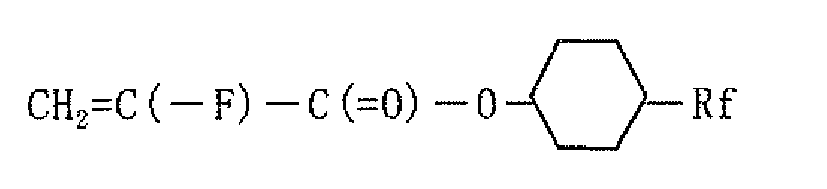
- The monomer (a) is preferably a fluorine-containing monomer represented by the general formula (1):
C(-A1)(-D1)=C(-X1)-Y1-[Q-Z-]p-T-Rf (1)
wherein - A1, D1 and X1 each is a hydrogen atom, a methyl group, an alkyl group having a linear or branched chain having 2 to 20 carbon atoms, a fluorine atom, a chlorine atom, a bromine atom, an iodine atom, a CFL1L2 group (in which L1 and L2 each is a hydrogen atom, a fluorine atom or a chlorine atom), a cyano group, a linear or branched fluoroalkyl group having 4 to 6 carbon atoms, a substituted or unsubstituted benzyl group, or a substituted or unsubstituted phenyl group,
- Y1 is -C(=O)-O-, -C(=O)-NH-, -O- or -O-(CF2CF(-CF3)O-)9-(in which g is 1 to 21);
- Q is -(CH2)n- or -(CH2)n-N(-Q1)- (in which n is 1 to 10, and Q1 is a hydrogen atom or CqH2q+1 where q is 1 to 30) ;
- Z is -S-, -SO-, -SO2- or -C(-Z1)(-Z2)- (in which Z1 and Z2 each is a hydrogen atom, -OH or -OCO-CwH2w+1 (in which w is 1 to 30));
- T is a direct bond, an aliphatic group having 1 to 10 carbon atoms, an aromatic, cycloaliphatic or araliphatic group having 6 to 20 carbon atoms;
- Rf is a linear or branched fluoroalkyl group having 1 to 21 carbon atoms or a fluoroalkenyl group having 3 to 21 carbon atoms; and
- p is 0 or 1.
- The monomer (a) may be, for example, an acrylate ester compound, an acryl amide compound or a vinyl ether compound.
A1 and D1 each is preferably a hydrogen atom. - Specific examples of T are as follows:
-(CH2)m-
- wherein m is 0 to 10, for example, 1 to 5.
- In the general formula (1), the Rf group is preferably a perfluoroalkyl group having 1 to 21, for example 1 to 8, particularly 4 to 6 carbon atoms or a perfluoroalkenyl group having 3 to 21, for example 3 to 8, particularly 3 to 6 carbon atoms.
When the Rf group is a fluoroalkyl group, examples of the Rf group include -CF3, -CF2CF3, -CF2CF2CF3, -CF(CF3)2, -CF2CF2CF2CF3, -CF2CF(CF3)2, -C(CF3)3, -(CF2)4CF3, -(CF2)2CF(CF3)2, -CF2C(CF3)3, -CF(CF3)CF2CF2CF3, -(CF2)5CF3, -(CF2)3CF(CF3)2, -(CF2)2H, -CF2CFHCF3, -(CF2)4H and - (CF2)6H. When the Rf group is a fluoroalkenyl group, examples of the Rf group include -CF=CFCF3, -CF=C(CF3)2, -CF=C(CF3)(CF2CF2CF3). -CF=C(CF3)(CF(CF3)2), -C(CF3)=CF(CF(CF3)2) and -C(CF2CF3)=C(CF3)2 - The specific examples of the general formula (1) include, but are not limited to, the followings:
Examples of the acrylate ester compound or the acrylamide compound include:
CH2=C(-H)-C(=O)-O-(CH2)10-Rf
CH2=C(-CH3)-C(=O)-O-(CH2)10-Pf
CH2=C(-H)-C(=O)-O-CH2-Rf
CH2=C(-CH3)-C(=O)-O-CH2-Rf
CH2=C(-H)-C(=O)-O-(CH2)2-Rt
CH2=C(-CH3)-C(=O)-O-(CH2)2-Rf
CH2=C(-Cl)-C(=O)-O-(CH2)2-Rf
CH2=C(-F)-C(=O)-O-(CH2)2-Rf
CH2=C(-Br)-C(=O)-O-(CH2)2-Rf
CH2=C(-I)-C(=O)-O-(CH2)2-Rf
CH2=C(-CF3)-C(=O)-O-(CH2)2-Rf
CH2=C(-CN)-C(=O)-O-(CH2)2-Rf
CH2=C(-Rf)-C(=O)-O-(CH2)2-Rf
CH2=C(-CH2-C6H5)-C(=O)-O-(CH2)2-Rf
CH2=C(-C6H5)-C(=O)-O-(CH2)2-Rf
-
CH2=C(-H)-C(=O)-O-(CH2)2-N(-CH3)-SO2-Rf
CH2=C(-F)-C(=O)-O-(CH2)2-N(-CH3)-SO2-Rf
CH2=C(-Cl)-C(=O)-O-(CH2)2-N(-CH3)-SO2-Rf
CH2=C(-CF3)-C(=O)-O-(CH2)2-N(-CH3)-SO2-Rf
CH2=C(-H)-C(=O)-O-(CH2)2-N(-C2H5)-SO2-Rf
CH2=C(-F)-C(=O)-O-(CH2)2-N(-C2H5)-SO2-Rf
CH2=C(-Cl)-C(=O)-O-(CH2)2-N(-C4H9)-SO2-Rf
CH2=C(-CH3)-C(=O)-O-CH2-CH(-OCO-CH3)-CH2-Rf
CH2=C(-F)-C(=O)-O-CH2-CH(-OCO-CH3)-CH2-Rf
CH2=C(-Cl)-C(=O)-O-CH2-CH(-OCO-CH3)-CH2-Rf
CH2=C(-H)-C(=O)-O-CH2-CH(-OH)-CH2-Rf
CH2=C(-F)-C(=O)-O-CH2-CH(-OH)-CH2-Rf
CH2=C(-Cl)-C(=O)-O-CH2-CH(-OH)-CH2-Rf
-


-
CH2=C(-H)-C(=O)-O-(CH2)2-S-Rf
CH2=C(-H-C(=O)-O-CH2)2-S-(CH2)2-Rf
CH2=C(-H)-C(=O)-O-(CH2)3-SO2-Rf
CH2=C(-H)-CE=O)-O-(CH2)2-SO2-(CH2)2-Rf
CH2=C(-H)-C(=O)-NH-(CH2)2-Rf
CH2=C(-CH3)-C(=O)-O-(CH2)2-S-Rf
CH2=C(-CH3)-C(=O)-O-(CH2)2-S-(CH2)2-Rf
CH2=C(-CH3)-C(=O)-O-(CH2)3-SO2-Rf
CH2-C(-CH3)-C(=O)-O-(CH2)2-SO2-(CH2)2-Rf
CH2=C(-CH3)-C(=O)-NH-(CH2)2-Rf
-
CH2=C(-F)-C(=O)-O-(CH2)2-S-Rf
CH2=C(-F)-C(=O)-O-(CH2)2-S-(CH2)2-Rf
CH2=C(-F)-C(=O)-O-(CH2)2-SO2-Rf
CH2=C(-F)-C(=O)-O-(CH2)2-SO2-(CH2)2-Rf
CH2=C(-F)-C(=O)-NH-(CH2)2-Rf
CH2-C(-Cl)-C(=O)-O-(CH2)2-S-Rf
CH2=C(-Cl)-C(=O)-O-(CH2)2-S-(CH2)2-Rf
CH2=C(-Cl)-C(=O)-O-(CH2)2-SO2-Rf
CH2=C(-Cl)-C(=O)-O-(CH2)2-SO2-(CH2)2-Rf
CH2=C(-Cl)-C(=O)-NH-(CH2)2-Rf
-
CH2=C(-CF3)-C(=O)-O-(CH2)2-S-Rf
CH2=C(-CF3)-C(=O)-O-(CH2)2-S-(CH2)2-Rf
CH2=C(-CF3)-C(=O)-O-(CH2)2-SO2-Rf
CH2=C(-CF3)-C(=O)-O-(CH2)2-SO2-(CH2)2-Rf
CH2=C(-CF3)-C(=O)-NH-(CH2)2-Rf
CH2=C(-CF2H)-C(=O)-O-(CH2)2-S-Rf
CH2=C(-CF2H)-C(=O)-O-(CH2)2-S-(CH2)2-Rf
CH2=C(-CF2H)-C(=O)-O-(CH2)2-SO2-Rf
CH2=C(-CF2H)-C(=O)-O-(CH2)2-SO2-(CH2)2-Rf
CH2=C(-CF2H)-C(=O)-NH-(CH2)2-Rf
-
CH2=C(-CN)-C(-O)-O-(CH2)2-S-Rf
CH2=C(-CN)-C(=O)-O-(CH2)2-S-(CH2)2-Rf
CH2=C(-CN)-C(=O)-O-(CH2)2-SO2-Rf
CH2=C(-CN)-C(=O)-O-(CH2)2-SO2-(CH2)2-Rf
CH2=C(-CN)-C(=O)-NH-(CH2)2-Rf
CH2=C(-CF2CF3)-C(=O)-O-(CH2)2-S-Rf
CH2=C(-CF2CF3)-C(=O)-O-(CH2)2-S-(CH2)2-Rf
CH2=C(-CF2CF3)-C(=O)-O-(CH2)2-SO2-Rf
CH2=C(-CF2CF3)-C(=O)-O-(CH2)2-SO2-(CH2)2-Rf
CH2=C(-CF2CF3)-C(=O)-NH-(CH2)2-Rf
-
CH2=C(-F)-C(=O)-O-(CH2)3-S-Rf
CH2=C(-F)-C(=O)-O-(CH2)3-S-(CH2)2-Rf
CH2=C(-F)-C(=O)-O-(CH2)3-SO2-Rf
CH2=C(-F)-C(=O)-O-(CH2)3-SO2-(CH2)2-Rf
CH2=C(-F)-C(=O)-NH-(CH2)3-Rf
CH2=C(-Cl)-C(=O)-O-(CH2)3-S-Rf
CH2=C(-Cl)-C(=O)-O-(CH2)3-S-(CH2)2-Rf
CH2=C(-Cl)-C(=O)-O-(CH2)2-SO2-Rf
CH2=C(-Cl)-C(=O)-O-(CH2)3-SO2-(CH2)2-Rf
-
CH2=C(-CF3)-C(=O)-O-(CH2)3-S-Rf
CH2=C(-CF3)-C(=O)-O-(CH2)3-S-(CH2)2-Rf
CH2=C(-CF3)-C(=O)-O-(CH2)3-SC2-Rf
CH2=C(-CF3)-C(=O)-O-(CH2)3-SO2-(CH2)2-Rf
CH2=C(-CF2H)-C(=O)-O-(CH2)3-S-Rf
CH2=C(-CF2H)-C(=O)-O-(CH2)3-S-(CH2)2-Rf
CH2=C(-CF2H)-C(=O)-O-(CH2)3-SO2-Rf
CH2=C(-CF2H)-C(=O)-O-(CH2)3-SO2-(CH2)2-Rf
CH2=C(-CN)-C(=O)-O-(CH2)3-S-Rf
CH2=C(-CN)-C(=O)-O-(CH2)3-S-(CH2)2-Rf
CH2=C(-CN)-C(=O)-O-(CH2)3-SO2-Rf
CH2=C(-CN)-C(=O)-O-(CH2)3-SO2-(CH2)2-Rf
-
CH2=C(-CF2CF3)-C(=O)-O-(CH2)3-S-Rf
CH2=C(-CF2CF3)-C(=O)-O-(CH2)3-S-(CH2)2-Rf
CH2=C(-CF2CF3)-C(=O)-O-(CH2)3-SO2-Rf
CH2=C(-CF2CF3)-C(=O)-O-(CH2)3-SO2-(CH2)2-Rf
wherein Rf is a linear or branched fluoroalkyl group having 1 to 21, for example 1 to 8, particularly 4 to 6 carbon atoms or a fluoroalkenyl group having 3 to 21, for example 3 to 8, particularly 3 to 6 carbon atoms. - Examples of the vinyl ether compound include:
CF2=C(-F)-O-Rf
CF2=C(-F)-O-CH2-Rf
CF2=C(-F)-O-CH2-CH2-Rf
CH2=C(-H)-O-CH2-CH2-Rf
CF2=C(-F)-O-CH2-CH(-OH)-CH2-Rf
CH2=C(-H)-O-CH2-CH(-OH)-CH2-Rf
CH2=C(-H)-O-(CF2-CF(-CF3)-O)2-Rf
CH2=C(-Cl)-O-(CF2-CF(-CF3)-O)2-Rf
wherein Rf is a linear or branched fluoroalkyl group having 1 to 21, for example 1 to 8, particularly 4 to 6 carbon atoms or a fluoroalkenyl group having 3 to 21, for example 3 to 8, particularly 3 to 6 carbon atoms.
The monomer (a) may be a mixture of two or more compounds. - The monomer (b) preferably has a linear or branched alkylene group having 2 to 6 carbon atoms in the alkylene oxide group.
The monomer (b) is preferably represented by the general formula (2):
C(-A2)(-D2)=C(-X2)Y2-[E-O-]r-G (2)
wherein - A2, D2 and X2 each is a hydrogen atom, a methyl group, an alkyl group having a linear or branched chain having 2 to 20 carbon atoms, a chlorine atom, a bromine atom, an iodine atom, a cyano group, a substituted or unsubstituted benzyl group, or a substituted or unsubstituted phenyl group;
- Y2 is -C(=O)-O-, -C(=O)-NH- or -0-;
- E is a linear or branched alkylene group having 2 to 6 carbon atoms;
- r is 1 to 50; and
- G is a hydrogen atom, a methyl group, an alkyl group having a linear or branched chain having 2 to 20 carbon atoms, a substituted or unsubstituted benzyl group, or a substituted or unsubstituted phenyl group.
- A2 and D2 each is preferably a hydrogen atom. X2 is preferably a hydrogen atom or a methyl group.
- The specific examples of the general formula (2) include, but are not limited to, the following:
H2C=CHCOO-CH2CH2O-H
H2C=C(CH3)COO-CH2CH2O-H
H2C=CHCOO-(CH2CH2O)9-H
H2C=C(CH3)COO-(CH2CH2O)9-H
H2C=C(CH3)COO-(CH2CH2O)9-CH3
H2C=C(CH3)COO-(CH2C2O)5-CH3
H2C=C(CH3)COO-(CH2CH(CH3)O)9-H
H2C=CHCOO-(CH2CH(CH3)O)9-H
H2C=C(CH3)COO-(CH2CH(CH3)O)9-CH3
H2C=C(CH3)COO-(CH2CH(CH3)O)12-CHs
H2C=C(CH3)COO-(CH2CH(CH3)O)4O-CH3
H2C=C(CH3)COO-(CH2CH2O)5-(CH2CH(CH3)O)3-CH3
H2C=C(CH3)CONH-CH2CH2O-H
H2C=CHCONH-(CH2CH2O)9-H
H2C=C(CH3)CONH-(CH2CH2O)5-(CH2CH(CH3)O)3-CH3
H2C=CH-O-CH2CH2O-H
H2C=C(CH3)-O-(CH2CH2O)5-CH3
H2C=C(CH3)-O-(CH2CH(CH3) O)12-CH3
The monomer (b) may be a mixture of two or more compounds. - The monomer (b) may be a mixture of a monomer wherein r=1 [for example, hydroxyethyl (meth)acrylate] with a monomer wherein r is 2 to 50, where a preferable molar ratio of the monomer (wherein r=1) to the monomer (wherein r is 2 to 50) may be in a range from 1:20 to 10:1.
- Examples of the monomer (c) include compounds having both an acetoacetyl group (CH3-CO-CH2-CO-) and a carbon-carbon double bond. The acetoacetyl group provides excellent adhesion to the substrate to be treated and shows good reactivity with a crosslinking agent (for example, an isocyanate compound) due to the presence of an active methylene group in the molecule, thereby improves washing durability.
- The monomer (c) is preferably represented by the general formula (3):
CH3-CO-CH2-CO-O-Q3-B3 (3)
wherein - Q3 is a direct bond or an alkylene group having 1 to 10 carbon atoms; and
- B3 is an acryloyl group (CH2=CH-CO-O-) , a methacryloyl group (CH2=C(CH3)-CO-O-), an acrylamide group (CH2=CH-CO-NH-), a methacrylamide group (CH2=C(CH3)-CO-NH-) or an allyl group (CH2=CH-CH2-). Q3 is preferably -(CH2)m- (wherein m is a number in a range from 0 to 10, particularly from 1 to 5).
- Specific examples of the monomer (c) include acetoacetoxyethyl acrylate, acetoacetoxyethyl methacrylate, acetoacetoxypropyl acrylate, acetoacetoxypropyl methacrylate, N-(2-acetoacetoxyethyl)acrylamide, N-(2-acetoacetoxyethyl)methacrylamide, vinyl acetoacetate and allyl acetoacetate. Acetoacetoxyethyl (meth)acrylate and acetoacetoxypropyl (meth)acrylate are preferable.
The monomer (c) may be a mixture of two or more compounds. - Examples of the monomer (d) include compounds having a -CH(OH)-CH2-Cl group and a carbon-carbon double bond.
The monomer (d) is preferably a monoester of an ethylenically unsaturated monocarboxylic and 3-monochloropropane-1,2-diol. Examples of the ethylenically unsaturated monocarboxylic include (meta)acrylic acid, crotonic acid and cinnamic acid.
Specific examples of the monomer (d) include 3-chloro-2-hydroxypropyl methacrylate and 3-chloro-2-hydroxypropyl acrylate.
The monomer (d) may be a mixture of two or more compounds. - Example of the monomer (e) include compounds having a -CH(OH)-CH2-OH group and a carbon-carbon double bond.
The monomer (e) is preferably a monoester of an ethylenically unsaturated monocarboxylic and glycerol. Examples of the ethylenically unsaturated monocarboxylic include (meta)acrylic acid, crotonic acid and cinnamic acid.
Specific examples of the monomer (e) include glycerol monomethacrylate and glycerol monoacrylate.
The monomer (e) may be a mixture of two or more compounds. - The copolymer of the present invention contains the monomer (a), the monomer (b), the monomer (c), the monomer (d) and the monomer (e) in amounts of 30 to 80 parts by weight, 1 to 30 parts by weight, 0.5 to 20 parts by weight, 0.5 to 20 parts by weight and 0.5 to 20 parts by weight, respectively, and preferably in amounts of 50 to 80 parts by weight, 1 to 20 parts by weight, 1 to 15 parts by weight, 1 to 15 parts by weight and 1 to 15 parts by weight, respectively. Preferably, the total amount of the monomer (a), the monomer (b), the monomer (c), the monomer (d) and the monomer (e) is 100 parts by weight.
- For the purpose of an improvement in durable soil releasability, solubility in an organic solvent, flexibility and adhesion to a treated substrate, another monomer (f) may be incorporated into the copolymer of the present invention. Specific examples of the monomer (f) include, for example, but are not limited to, diacetoneacrylamide, (meth)acrylamide, N-methylolacrylamide, N,N-dimethylaminoethyl (meth) acrylate, N,N-diethylaminoethyl (meth)acrylate, butadiene, chloroprene, glycidyl (meth)acrylate, a maleic acid derivative, a vinyl halide such as vinyl chloride, ethylene, a vinylidene halide such as vinylidene chloride, a vinyl alkyl ether, styrene, an alkyl (meth)acrylate, vinylpyrrolidone, an isocyanate group-containing (meth)acrylate such as 2-isocyanatoethyl methacrylate or said (meth)acrylate in which an isocyanate group is blocked with a blocking agent such as methyl ethyl ketoxime. A monomer having an amino group (e.g., N,N-dimethylaminoethyl (meth)acrylate and N,N-diethylaminoethyl (methacrylate) is preferable. The amount of the other monomer (f) may be preferably from 0 to 40 % by weight, more preferably from 0.1 to 20 % by weight, for example, from 1 to 10 % by weight, based on the copolymer, and the other monomer (f) may be a mixture of two or more compounds.
- The weight-average molecular weight of the copolymer of the present invention may be from 1,000 to 1,000,000, and preferably from 5,000 to 500,000. When the weight-average molecular weight is from 1,000 to 1,000,000, high soil releasability is obtained and a polymer liquid has low viscosity so that the handling of the polymer is easy. The weight-average molecular weight is measured by a gel permeation chromatography in terms of polystyrene.
- The copolymer of the present invention may be a random copolymer, a block copolymer or a graft copolymer.
- A polymerization method of producing the copolymer of the present invention is not limited. Various polymerization methods such as a bulk polymerization, a solution polymerization, an emulsion polymerization and a radiation polymerization can be selected. For example, a solution polymerization using an organic solvent and an emulsion polymerization using water or both of an organic solvent and water are generally selected. A treatment liquid is produced by diluting a reaction mixture with water or adding an emulsifying agent to make the emulsification in water, after the polymerization.
Examples of the organic solvent include ketones such as acetone and methyl ethyl ketone; esters such as ethyl acetate and methyl acetate; glycols such as propylene glycol, dipropylene glycol monomethyl ether, dipropylene glycol, tripropylene glycol and low molecular weight polyethylene glycol; alcohols such as ethyl alcohol and isopropanol; and 1-methyl-2-pyrrolidone. - As the emulsifying agent for the emulsion polymerization and for emulsification in water by adding the emulsifying agent after polymerization, various conventional emulsifying agents such as an anionic emulsifying agent, a cationic emulsifying agent and a nonionic emulsifying agent can be used.
As a polymerization initiator, for example, peroxide, an azo compound, a persulfuric acid-based compound can be used. The polymerization initiator is generally water-soluble and/or oil-soluble.
Specific examples of the oil-soluble polymerization initiator are preferably 2,2'-azobis(2-methylpropionitrile), 2,2'-azobis(2-methylbutyronitrile), 2,2'-azobis(2,4-dimethylvaleronitrile), 2,2'-azobis(2,4-dimethyl-4-methoxyvaleronitrile), 1,1'-azobis(cyclohexane-1-carbonitrile), dimethyl 2,2'-azobis(2-methylpropionate), 2,2'-azobis(2-isobutyronitrile), benzoyl peroxide, di-tertiary-butyl peroxide, lauryl peroxide, cumene hydroperoxide, t-butyl peroxypivalate, diisopropyl peroxydicarbonate, and t-butyl perpivalate. - Specific examples of the water-soluble polymerization initiator are preferably 2,2'-azobisisobutylamidine dihydrochloride, 2,2'-azobis(2--methylpropionamidine) hydrochloride, 2,2'"azobis[2-(2-imidazolin-2-yl)propane] hydrochloride, 2,2'-azobis[2-(2-imidazolin-2-yl) propane] sulfate hydrate, 2,2'-azobis[2-(5-methyl-2-imidazolin-2-yl)propane]hydrochloride, potassium persulfate, barium persulfate, ammonium persulfate, and hydrogen peroxide.
The polymerization initiator is used in an amount within a range from 0.01 to 5 parts by weight based on 100 parts by weight of the monomer. For the purpose of adjusting the molecular weight of the fluorine-containing copolymer, a known mercapto group-containing compound may be used. Specific examples thereof include 2-mercaptoethanol, thiopropionic acid, and alkyl mercaptan. The mercapto group-containing compound may used within a range from 0.01 to 5 parts by weight based on 100 parts by weight of the monomer.
Specifically, a copolymer can be produced in the following manner.
In a solution polymerization, it is possible to employ a method of dissolving a monomer in an organic solvent in the presence of a polymerization initiator, replacing the atmosphere by nitrogen and stirring the solution with heating at a temperature within a range from 50 to 120°C for 1 to 10 hours. The polymerization initiator generally may be an oil-soluble polymerization initiator. Examples of the organic solvent include ketones such as acetone and methyl ethyl ketone; esters such as ethyl acetate and methyl acetate; glycols such as propylene glycol, dipropylene glycol monomethyl ether, dipropylene glycol, tripropylene glycol and low molecular weight polyethylene glycol; alcohols such as ethyl alcohol and isopropanol; and 1-methyl-2-pyrrolidone.
The organic solvent may be used in an amount within a range from 50 to 1,000 parts by weight based on 100 parts by weight of the total of the monomer. - In an emulsion polymerization, there can be used a method of emulsifying monomers in water in the presence of a polymerization initiator and an emulsifying agent, replacing the atmosphere by nitrogen, and polymerizing with stirring, for example, at the temperature within the range from 50°C to 80°C for 1 hour to 10 hours. The polymerization initiator may be the water-soluble polymerization initiator and/or the oil-soluble polymerization initiator.
In order to obtain an aqueous dispersion of a copolymer, which is superior in storage stability, it is desirable that the monomers are emulsified in water by using an emulsifying device capable of applying a strong shearing energy (e.g., a high-pressure homogenizer and an ultrasonic homogenizer) and then polymerized with using the water-soluble polymerization initiator. Various conventional emulsifying agents such as an anionic emulsifying agent, a cationic emulsifying agent and a nonionic emulsifying agent can be used as the emulsifying agent. The amount of the emulsifying agent is within the range from 0.5 to 10 parts by weight based on 100 parts by weight of the monomers. When the monomers are not completely compatibilized, it is preferable that a compatibilizing agent, for example, a water-soluble organic solvent or a low-molecular weight monomer, which is capable of sufficiently compatibilizing them, is added to these monomers. By the addition of the compatibilizing agent, the emulsifiability and polymerizability can be improved. - Examples of the water-soluble organic solvent include acetone, methyl ethyl ketone, ethyl acetate, propylene glycol, dipropylene glycol monomethyl ether, dipropylene glycol, tripropylene glycol and ethanol. The water-soluble organic solvent may be used in an amount within the range from 1 to 80 parts by weight, e.g., from 5 to 50 parts by weight, based on 100 parts by weight of water.
- The copolymer thus obtained can be formed into any form such as an emulsion, an organic solvent solution or an aerosol after optionally diluting with or dispersing in water or an organic solvent, and thus a soil release agent can be obtained. The copolymer functions as an active ingredient of the soil release agent. The soil release agent comprises a fluorine-containing copolymer and a medium, particularly, a liquid medium (for example, an organic solvent and/or water). As used herein, the term "aqueous medium" means a medium comprising only water, and a medium containing, in addition to water, an organic solvent (in the aqueous medium, the amount of the organic solvent is 80 parts by weight or less, for example, 0.1 to 50 parts by weight, in particular 5 to 30 parts by weight based on 100 parts by weight of water). In the soil release agent, the concentration of the fluorine-containing copolymer may be, for example, from 0.01 to 50% by weight.
The soil release agent of the present invention preferably comprises the fluorine-containing copolymer and the liquid medium. - The copolymer of the present invention can be applied to a substrate to be treated as a soil release agent by using an optional method, according to the type of the treated substrate and the preparation form (an emulsion, an organic solvent solution, or an aerosol). In the case of an aqueous emulsion or an organic solvent solution, a method of coating on the surface of the treated substrate by using a known method, for example, a coating method such as a dip coating or spray coating method, followed by drying can be employed. In this case, a heat treatment such as curing may be performed, if necessary.
If necessary, another blender can be used in combination. Examples of the blender include water- and oil-repellents, anti-wrinkle agents, anti-shrinkage agents, flame retardants, crosslinking agents, antistatic agents, softening agents, water-soluble polymers such as polyethylene glycol and polyvinyl alcohol, wax emulsions, antibacterial agents, pigments, and coating materials. These blenders may be added to a treating bath upon treatment of the substrate. If possible, the blenders may be preliminarily mixed with the copolymer of the present invention. - The treated article include, in addition to a textile, masonry, a filter (for example, an electrostatic filter), a dust protective mask, glass, paper, wood, leather, fur, asbestos, brick, cement, metal and oxide, ceramics, plastics, a coated surface and a plaster, to which the treated article is not limited. It is particularly useful for the textile. The textile has various examples. Examples of the textile include animal- or vegetable-origin natural fibers such as cotton, hemp, wool and silk; synthetic fibers such as polyamide, polyester, polyvinyl alcohol, polyacrylonitrile, polyvinyl chloride and polypropylene; semi-synthetic fibers such as rayon and acetate; inorganic fibers such as glass fiber, carbon fiber and asbestos fiber; and a mixture of these fibers. The textile may be in any form such as a fiber, a yarn and a fabric.
- In the present invention, a substrate is treated with a soil release agent. The "treatment" means that a treatment agent is applied to a substrate by immersion, spraying, coating or the like. The treatment gives the result that a fluorine-containing polymer which is an active component of the treatment agent is penetrated into the internal parts of the substrate and/or adhered to surfaces of the substrate.
- The present invention is now described in detail by way of Examples, Comparative Examples and Test Examples. However, the present invention is not limited to these.
In the following Examples, Comparative Examples and Test Examples, parts and percentages are by weight unless otherwise specified. - A soil releasability test was performed in accordance with AATCC Soil Release Management Performance Test Method of the USA. As soils for the test, corn oil, mineral oil is used.
A test cloth having a size of 20 cm x 20 cm was spread out on a horizontally spread absorbent blotting paper, and five drops of the corn oil or mineral oil (about 0.2 cc) as the soil were dropped. A glassine paper was laid thereon and a weight of 2,268 g was placed, followed by standing for 60 seconds. After 60 seconds, the weight and the glassine paper were removed, followed by standing at room temperature for 15 minutes. After the lapse of 15 minutes, the test cloth and a ballast cloth (total weight: 1.8 kg) were washed under the conditions of a bath volume of 64 liters and a bath temperature of 38°C for 12 minutes using 100 g of a detergent (an AATCC standard WOB detergent) and an AATCC standard washing machine (manufactured by Kenmore, USA). The clothes were rinsed and then dried by using an AATCC standard tumbler drying machine (manufactured by Kenmore, USA). The state of the remaining soil on the dried test cloth was compared with that of a standard photographic plate for criterion and expressed by the corresponding criteria class (cf. Table 1). As the standard photographic plate for criterion, a photographic plate of AATCC-TM130-2000 (American Association of Textile Chemists and Colorists Test Method 130-2000) was used. -
Table 1: Criteria class of soil releasability Determined grade Class Criterion 1.0 Remarkable soil remained 2.0 Considerable soil remained 3.0 Slight soil remained 4.0 Little soil remained 5.0 No soil remained - An alcohol repellency test was performed in accordance with AATCC-TM130-2000 using a textile. A test cloth was horizontally spread out and one drop of a test solution shown in Table 2 was dropped. The alcohol repellency was evaluated by a penetration state of the test solution after 10 seconds.
- [Table 2]
Table 2: Criteria class of alcohol repellency Determined grade Test solution Surface tension (dyne/cm, 25°C) 8 40:60/Water:IPR(vol/vol) 24.0 7 50:50/Water:IPA(vo1/vol) 24.5 6 60:40/Water:IPA(vol/vol) 25.4 5 70:30/Water:IPA(vol/vol) 27.5 4 80:20/Water:IPR(vol/vol) 33.0 3 90:10/Water:IPA(vol/vol) 42.0 2 95:5/Water:IPA(vol/vol) 50.0 1 98:2/Water:IPA(vol/vol) 59.0 0 None(fails 98vol% water) - IPA: Isopropanol - An oil repellency test was performed in accordance with AATCC-TM118-2000 using a textile. A test cloth was horizontally spread out and one drop of a test solution shown in Table 3 was dropped. The oil repellency was evaluated by a penetration state of the test solution after 30 seconds. In the case of low oil repellency, an oily soil penetrates into an article to be treated in air, thus resulting the difficulty of removing the oily soil. Therefore, the oil repellency is an important evaluation indicator, similar to the soil releasability.
- [Table 3]
Table 3 Criteria class of oil repellency Determined grade Test solution Surface tension (dyne/cm, 25°C) 8 n-heptane 20.0 7 n-octane 21.8 6 n-decane 23.5 5 n-dodecane 25.0 4 n-tetradecane 26.7 3 n-hexadecane 27.3 2 Mixed liquid of hexadecane/Nujor (35/65) 29.6 1 Nujor 31.2 0 Inferior to 1 - - In a 100 ml four-necked flask, 2-(perfluorohexyl)ethyl acrylate (13A) (14g), polyethylene glycol monoacrylate (EO 10mol) (AE-400) (1.2g), dimethylaminoethyl methacrylate (DMAEM) (0.4g), acetoacetoxyethyl methacrylate (AAEM) (0.6g), 3-chloro-2-hydroxypropyl methacrylate (T-M) (1.2g), glycerol monomethacrylate (GLM) (2.6g) and methyl ethyl ketone (30g) were charged and nitrogen flow was performed for 60 minutes. After the inner temperature was raised to 75-80°C, azobisisobutyronitrile (0.12 g) was added and the reaction was performed for 8 hours, thereby a fluorine-containing copolymer was obtained. Finally, the resulted polymerization liquid was neutralized by addition of acetic acid and diluted with water to give a 20 % liquid of the fluorine-containing copolymer. The types and weight ratios of the charged monomers are shown in Table 4. Explanation of abbreviations in Table 4 is shown in Table 5. The composition of the fluorine-containing copolymer was almost the same as the formulations of the charged monomers.
- The procedure of Example 1 was repeated except that the types and weight ratios of the charged monomers were changed as shown in Table 4, to finally give a 20 % liquid of each fluorine-containing copolymer. The types and weight ratios of the charged monomers are shown in Table 4. Explanation of abbreviation in Table 4 is shown in Table 5. The composition of the fluorine-containing copolymer was almost the same as the formulations of charged monomers.
-
20% Aqueous dispersion of the fluorine-containing copolymer obtained in Example 1: 8.0 parts NICCA ASSIST V2 (MDI-based blocked isocyanate, Nicca Chemical Co., Ltd.): 0.25 parts NICCA SUNMARINA S-750 (aqueous dispersion of polyethylene wax, Nicca Chemical Co., Ltd.): 1.70 parts BECKAMINE NS-19 (glyoxal resin, DIC Corporation): 8.0 parts BECKAMINE X-80 (catalyst for glyoxal resin, DIC Corporation) : 2.4 parts Tap water: 79.65 parts - In the ratio as shown above, the fluorine-containing copolymer liquid and the chemicals such blocked isocyanate and the others were diluted with water to give a treatment liquid. A cotton twill cloth (100%) was immersed in the thus obtained treatment liquid, and then squeezed with a roll to adjust a wet pickup to 60 mass%. The cloth was dried and heat-treated at 160°C for 3 minutes to complete the treatment with the soil release agent. Soil releasability, alcohol repellency and oil repellency of the cloth were measured. The test results are shown in Table 6.
For the purpose of evaluating washing durability, the treated cloth was washed at a normal condition (a bath temperature of 40°C for 12 minutes (excluding a time for rinse and the like) at one wash) and then tumbler-dried. This procedure was taken as one cycle. Soil releasability, alcohol repellency and oil repellency of the treated cloth were measured also for the treated cloth repeatedly subjected to the above cycle. The results are shown in Table 6. - A treatment liquid was prepared, a cloth was treated and then soil releasability, alcohol repellency and oil repellency were measured in the same procedure as in Test Example 1, except that a 20% aqueous dispersion of the fluorine-containing copolymer was replaced with each of polymer liquids obtained in Examples 2 to 8 and Comparative Examples 1 to 8. The results are shown in Table 6.
- [Table 4]
Table 4 Monomer ingredients Monomer weight ratio (%) Example 1 13FA/AE-400/DMAEM/AAEM/T-M/GLM 70/6/2/3/6/13 Example 2 13FA/AE-400/DMAEM/AAEM/T-M/GLM 70/10/2/3/5/10 Example 3 13FA/AE-400/DMAEM/AAEM/T-M/GLM 70/8/2/1/6/13 Example 4 13FA/AE-400/DMAEM/AAEM/T-M/GLM 70/13/2/7/3/5 Example 5 13FA/AE-400/DMAEM/AAEM/T-M/GLM 70/9/2/10/4/5 Example 6 13FA/AE-400/AE-200/DMAEM/AAEM/T-M/GLM 70/3/3/2/3/6/13 Example 7 13FA/AE-400/PE-350/DMAEM/AAEM/T-M/GLM 70/6/3/2/3/3/13 Example 8 13FA/AE-200/DMAEM/AAEM/T-M/GLM 70/6/2/3/6/13 Com. Ex. 1 13FA/AE-400/DMAEM/AAEM 70/18/2/10 Com. Ex. 2 13FA/AE-400/DMAEM/AAEM/T-M 70/10/2/3/15 Com. Ex. 3 13FA/AE-400/DMAEM/T-M/GLM 70/9/2/6/13 Com. Ex. 4 13FA/DMAEM/AAEM/GLM 70/12/3/15 Com. Ex. 5 13FA/DMAEM/AAEM/T-M/GLM 70/2/3/19/6 Com. Ex. 6 13FA/DMAEM/AAEM/T-M/GLM 70/2/3/6/19 Com. Ex. 7 13FA/DMAEM/GLM 70/2/28 Com. Ex. 8 13FA/AE-400/DMAEM/AAEM/GLM 70/10/2/3/15 - [Table 5]
Table 5 (Explanation of abbreviations in Table 4) abbre viation Trade name Chemical name Manufacturer 13FA 2-(Perfluorohexyl)ethyl acrylate AE-400 BLEMMER AE-400 Polyethylene glycol monoacrylate (EO 10 mol) NOF Corporation DMAEM Dimethylaminoethyl methacrylate AAEM AAEM Acetoacetoxyethyl methacrylate Eastman Chemical Japan Co. Ltd. T-M TOPOLENE M 3-Chloro-2-hydroxyprapyl methacrylate Shin-Nakamura Chemical Co., Ltd. GLM BLEMMER GLM Glycerol monomethacrylate NOF Corporation AE-200 BLEMMER AE-200 Polyethyleneglycol monoacrylate (EO 4.5 mol) NOF Corporation PE-350 BLEMMER PE-350 polyethyleneglycol monomethacrylate (EO 8 mol) NOF Corporation - [Table 6]
Table 6 Oil repellency Alcohol repellency Soil releasability Corn oil Mineral oil Initial HL5 HL10 Initial HL5 HL10 Initial HL5 HL10 Initial HL5 HL10 Example 1 5 5 2 5 4 2 4-5 4-5 4 4 4 4 Example 2 5 4 2 5 4 1 4 4 4 4 4 3-4 Example 3 5 3 2 5 4 2 4-5 4-5 4 4 4 3-4 Example 4 5 3 1 4 3 1 4 4 4 4 4 3-4 Example 5 6 3 1 4 3 1 4-5 4-5 4 4 4 3-4 Example 6 5 3 2 5 4 2 4 4 4 4 4 3-4 Example 7 5 2 1 4 3 1 4-5 4-5 4 4 4 3-4 Example 8 6 3 2 5 3 1 4-5 4-5 4-5 4 4 3-4 Com. 1 Ex. 5 4 1 3 2 0 4-5 4-5 4 4 4 3-4 Com. 2 Ex. 5 2 0 3 0 0 4 4 4 3-4 3-4 3 Com. 3 Ex. 5 4 0 5 2 0 4 4 4 3-4 3-4 3 Com. 4 Ex. 5 3 0 4 0 0 3-4 3-4 3-4 3 3 3 Com. 5 Ex. 6 1 0 5 2 0 3 3 3 3 3 3 Com. Ex. 6 5 2 0 5 2 0 4 4 3-4 3-4 3-4 3-4 Com. 7 Ex. 5 2 0 3 2 0 4 4 4 3 3 3 Com. 8 Ex. 5 3 0 4 1 0 4-5 4-5 4 4 4 3-4 Untreated cloth 0 0 0 0 0 0 1 1 1 1 1 1 Note) In the table, a number A-B means an intermediate performance between A and B.
Each of HL5 and HL10 is after a washing time of 5 and after a washing time of 10.
The fluorine-containing copolymer of the present invention functions as an active component of the fluorine-containing fiber processing agent having soil releasability.
If necessary, the fluorine-containing copolymer of the present invention may further comprise a repeating unit derived from (f) a monomer which is other than the monomers (a), (b), (c), (d) and (e) and which has unsaturated double bond copolymerizable with any of the monomers (a), (b), (c), (d) and (e).
Generally, each of the monomers (b), (c), (d), (e) and (f) is free from a fluorine atom.


Claims (19)
- A fluorine-containing copolymer comprising repeating units derived from(a) a monomer having a fluoroalkyl group or a fluoroalkenyl group,(b) a monomer having an alkylene oxide group,(c) a monomer having an acetoacetyl group,(d) a monomer having -CH(OH)-CH2-Cl group, and(e) a monomer having -CH(OH)-CH2-OH group,wherein the amounts of the monomer (a), the monomer (b), the monomer (c), the monomer (d) and the monomer (e) are 30 to 80 parts, 1 to 30 parts, 0.5 to 20 parts, 0.5 to 20 parts and 0.5 to 20 parts, respectively.
- The fluorine-containing copolymer according to claim 1, wherein the monomer (a) is a fluorine-containing monomer represented by the general formula (1):
C(-A1)(-D1)=C(-X1)-Y1-[Q-Z-]p-T-Rf (1)
whereinA1, D1 and X1 each is a hydrogen atom, a methyl group, an alkyl group having a linear or branched chain having 2 to 20 carbon atoms, a fluorine atom, a chlorine atom, a bromine atom, an iodine atom, a CFL1L2 group,in which L1 and L2 each is a hydrogen atom, a fluorine atom or a chlorine atom,
a cyano group, a linear or branched fluoroalkyl group having 4 to 6 carbon atoms, a substituted or unsubstituted benzyl group, or a substituted or unsubstituted phenyl group,Y1 is -C(=O)-O-, -C(=O)-NH-, -O- or -O-(CF2CF(-CF3)O-)g-in which g is 1 to 21;Q is -(CH2)n- or -(CH2)n-N(-Q1)-
in which n is 1 to 10, and Q1 is a hydrogen atom or CqH2q+1 where q is 1 to 30;Z is -S-, -SO-, -SO2- or -C(-Z1)(-Z2)-
in which Z1 and Z2 each is a hydrogen atom, -OH or -OCO-CwH2w+1, where w is 1 to 30;T is a direct bond, an aliphatic group having 1 to 10 carbon atoms, an aromatic, cycloaliphatic or araliphatic group having 6 to 20 carbon atoms;Rf is a linear or branched fluoroalkyl group having 1 to 21 carbon atoms or a fluoroalkenyl group having 3 to 21 carbon atoms; andp is 0 or 1. - The fluorine-containing copolymer according to claim 2, wherein, in the monomer (a), the carbon number of the fluoroalkyl group is from 4 to 6 and the carbon number of the fluoroalkenyl group is from 3 to 6.
- The fluorine-containing copolymer according to claim 2, wherein, in the monomer (a), the fluoroalkyl group is a perfluoroalkyl group and the fluoroalkenyl group is a perfluoroalkenyl group.
- The fluorine-containing copolymer according to claim 1, wherein the monomer (b) is represented by the general formula (2):
C(-A2)(-D2)=C(-X2)-Y2-[E-O-]r-G (2)
whereinA2, D2 and X2 each is a hydrogen atom, a methyl group, an alkyl group having a linear or branched chain having 2 to 20 carbon atoms, a chlorine atom, a bromine atom, an iodine atom, a cyano group, a substituted or unsubstituted benzyl group, or a substituted or unsubstituted phenyl group;Y2 is -C(=O)-O-, -C(=O)-NH- or -O-;E is a linear or branched alkylene group having 2 to 6 carbon atoms;r is 1 to 50; andG is a hydrogen atom, a methyl group, an alkyl group having a linear or branched chain having 2 to 20 carbon atoms, a substituted or unsubstituted benzyl group, or a substituted or unsubstituted phenyl group. - The fluorine-containing copolymer according to claim 1, wherein the monomer (c) is a compound having an acetyl group and a carbon-carbon double bond.
- The fluorine-containing copolymer according to claim 1, wherein the monomer (c) is represented by the general formula (3) :
CH3-CO-CH2-CO-O-Q3-B3 (3)
whereinQ3 is a direct bond or an alkylene group having 1 to 10 carbon atoms; andB3 is an acryloyl group (CH2=CH-CO-O-), a methacryloyl group (CH2=C(CH3)-CO-O-), an acrylamide group (CH2=CH-CO-NH-), a methacrylamide group (CH2=C(CH3)-CO-NH-) or an allyl group (CH2=CH-CH2-). - The fluorine-containing copolymer according to claim 1, wherein the monomer (c) is selected from the group consisting of acetoacetoxyethyl acrylate, acetoacetoxyethyl methacrylate, acetoacetoxypropyl acrylate, acetoacetoxypropyl methacrylate, N-(2-acetoacetoxyethyl)acrylamide, N-(2-acetoacetoxyethyl)-methacrylamide, vinyl acetoacetate and allyl acetoacetate.
- The fluorine-containing copolymer according to claim 1, wherein the monomer (d) is a compound having -CH(OH)-CH2-Cl group and a carbon-carbon double bond.
- The fluorine-containing copolymer according to claim 1, wherein the monomer (d) is a monoester of an ethylenically unsaturated monocarboxylic and 3-monochloropropane-1,2-diol.
- The fluorine-containing copolymer according to claim 1, wherein the monomer (d) is 3-chloro-2-hydroxypropyl methacrylate or 3-chloro-2-hydroxypropyl acrylate.
- The fluorine-containing copolymer according to claim 1, wherein the monomer (e) is a compound having the -CH(OH)-CH2-OH group and a carbon-carbon double bond.
- The fluorine-containing copolymer according to claim 1, wherein the monomer (e) is a monoester of an ethylenically unsaturated monocarboxylic acid and glycerol.
- The fluorine-containing copolymer according to claim 1, wherein the monomer (e) is glycerol monomethacrylate or glycerol monoacrylate.
- A textile processing agent comprising the fluorine-containing copolymer according to claim 1, as an active ingredient.
- The textile processing agent according to claim 15, which comprises a fluorine-containing copolymer and a liquid medium.
- A method of treating a textile substrate, comprising treating the textile substrate with the textile processing agent according to claim 16.
- The method according to claim 17, wherein the weight of the fluorine-containing copolymer is from 0.05 to 10% by weight based on the textile substrate which has been coated with the fluorine-containing copolymer after the textile processing agent is applied to the textile substrate and dried.
- A textile substrate coated by the method according to claim 17 or 18.
Applications Claiming Priority (2)
| Application Number | Priority Date | Filing Date | Title |
|---|---|---|---|
| JP2007189437 | 2007-07-20 | ||
| PCT/JP2008/062825 WO2009014039A1 (en) | 2007-07-20 | 2008-07-16 | Fluorine-containing fiber processing agent having alcohol repellency and soil release properties |
Publications (3)
| Publication Number | Publication Date |
|---|---|
| EP2177550A1 true EP2177550A1 (en) | 2010-04-21 |
| EP2177550A4 EP2177550A4 (en) | 2011-02-16 |
| EP2177550B1 EP2177550B1 (en) | 2014-11-05 |
Family
ID=40281295
Family Applications (1)
| Application Number | Title | Priority Date | Filing Date |
|---|---|---|---|
| EP20080791220 Active EP2177550B1 (en) | 2007-07-20 | 2008-07-16 | Fluorine-containing fiber processing agent having alcohol repellency and soil release properties |
Country Status (7)
| Country | Link |
|---|---|
| US (1) | US20100216363A1 (en) |
| EP (1) | EP2177550B1 (en) |
| JP (1) | JP5392081B2 (en) |
| KR (1) | KR101185652B1 (en) |
| ES (1) | ES2524063T3 (en) |
| TW (1) | TWI450909B (en) |
| WO (1) | WO2009014039A1 (en) |
Families Citing this family (6)
| Publication number | Priority date | Publication date | Assignee | Title |
|---|---|---|---|---|
| WO2010110339A1 (en) * | 2009-03-25 | 2010-09-30 | ダイキン工業株式会社 | Surfactant comprising fluorine-containing polymer |
| CN102153902B (en) * | 2011-03-11 | 2013-05-29 | 安徽嘉智信诺化工有限公司 | Fluorocarbon anti-shrinkage flatting agent for coating ink |
| US9702081B2 (en) * | 2014-09-26 | 2017-07-11 | The Chemours Company Fc, Llc | Polyurethanes derived from non-fluorinated or partially fluorinated polymers |
| MX2018000740A (en) * | 2015-07-20 | 2018-05-15 | Dow Global Technologies Llc | A coating additive. |
| JP6953548B2 (en) * | 2017-10-27 | 2021-10-27 | 富士フイルム株式会社 | Polymer compounds, liquid crystal compositions, retardation layers, optical films, polarizing plates and image display devices |
| KR102508178B1 (en) * | 2022-07-08 | 2023-03-10 | 이정현 | Manufacturing method of pants having anti-fouling coating and functional pants manufacturing thereof |
Family Cites Families (15)
| Publication number | Priority date | Publication date | Assignee | Title |
|---|---|---|---|---|
| US4013627A (en) * | 1972-09-20 | 1977-03-22 | E. I. Du Pont De Nemours And Company | Oil and water repellent polymer containing onium groups |
| JPS5235033B2 (en) * | 1972-11-24 | 1977-09-07 | ||
| DE3435618A1 (en) * | 1984-09-28 | 1986-04-10 | Chemische Fabrik Pfersee Gmbh, 8900 Augsburg | METHOD FOR OBTAINING WASHING AND CLEANING-RESISTANT TEXTILE EQUIPMENT WITH REACTIVE (CO) POLYMERS OR PRE-CONDENSATE |
| US4564561A (en) * | 1985-03-27 | 1986-01-14 | E. I. Du Pont De Nemours And Company | Fluorine-containing polymer compositions and their preparation |
| US4791166A (en) * | 1988-03-23 | 1988-12-13 | Hoechst Celanese Corporation | Fluorocarbon polymer compositions and methods |
| US5674961A (en) * | 1996-04-12 | 1997-10-07 | E. I. Du Pont De Nemours And Company | Oil water and solvent resistant paper by treatment with fluorochemical copolymers |
| JP3820694B2 (en) * | 1997-08-06 | 2006-09-13 | ダイキン工業株式会社 | New copolymer and antifouling agent |
| US6326447B1 (en) * | 1998-06-19 | 2001-12-04 | E. I. Du Pont De Nemours And Company | Polymeric compositions for soil release on fabrics |
| US6479605B1 (en) * | 2001-05-15 | 2002-11-12 | E. I. Du Pont De Nemours And Company | High-durability, low-yellowing repellent for textiles |
| US20050052457A1 (en) * | 2003-02-27 | 2005-03-10 | Neil Muncy | Apparatus for generating and displaying images for determining the quality of audio reproduction |
| CN1938391B (en) * | 2004-03-26 | 2012-06-06 | 大金工业株式会社 | Surface treatment agents, fluoromonomers and fluoropolymers |
| CA2561890A1 (en) * | 2004-04-05 | 2005-10-20 | Daikin Industries, Ltd. | Stain remover containing fluoropolymer |
| JP4761760B2 (en) * | 2004-11-29 | 2011-08-31 | 日華化学株式会社 | Manufacturing method of durable antifouling fiber products |
| CN101218269A (en) * | 2005-07-14 | 2008-07-09 | 大金工业株式会社 | Fluoropolymers and Stain Removers |
| CN101595142B (en) * | 2007-02-02 | 2014-06-25 | 大金工业株式会社 | Fluorine-containing copolymer having excellent washing resistance and soil release agent |
-
2008
- 2008-07-16 JP JP2009524457A patent/JP5392081B2/en active Active
- 2008-07-16 WO PCT/JP2008/062825 patent/WO2009014039A1/en not_active Ceased
- 2008-07-16 US US12/669,731 patent/US20100216363A1/en not_active Abandoned
- 2008-07-16 KR KR1020107003646A patent/KR101185652B1/en not_active Expired - Fee Related
- 2008-07-16 ES ES08791220.0T patent/ES2524063T3/en active Active
- 2008-07-16 EP EP20080791220 patent/EP2177550B1/en active Active
- 2008-07-17 TW TW97127089A patent/TWI450909B/en not_active IP Right Cessation
Also Published As
| Publication number | Publication date |
|---|---|
| TW200911850A (en) | 2009-03-16 |
| EP2177550A4 (en) | 2011-02-16 |
| WO2009014039A1 (en) | 2009-01-29 |
| US20100216363A1 (en) | 2010-08-26 |
| KR101185652B1 (en) | 2012-09-24 |
| EP2177550B1 (en) | 2014-11-05 |
| KR20100044221A (en) | 2010-04-29 |
| JP5392081B2 (en) | 2014-01-22 |
| TWI450909B (en) | 2014-09-01 |
| ES2524063T3 (en) | 2014-12-03 |
| JPWO2009014039A1 (en) | 2010-09-30 |
Similar Documents
| Publication | Publication Date | Title |
|---|---|---|
| EP2110391B1 (en) | Fluorine-containing copolymer having excellent washing resistance and soil release agent | |
| CA2523029C (en) | Surface-treating agent comprising fluoropolymer | |
| JP4816455B2 (en) | Water and oil repellent composition | |
| JP5459219B2 (en) | Fluoropolymer and water / oil repellent | |
| US7651993B2 (en) | Fluorine-containing polymer and soil release agent | |
| WO2010030044A2 (en) | Water- and oil-repellent composition | |
| WO2009104728A1 (en) | Aqueous polymer dispersion composition and water-repellent oil-repellent agent | |
| EP2762504A1 (en) | Water-repellent and oil-repellent composition | |
| EP2177550B1 (en) | Fluorine-containing fiber processing agent having alcohol repellency and soil release properties | |
| JP5556179B2 (en) | Fluoropolymer and antifouling agent | |
| JP2010222382A (en) | Fluorine-containing fiber finishing agent with dirt release properties | |
| EP1736486B1 (en) | Fluorine-containing monomer, fluorine-containing polymer and surface treating agent | |
| JP5125625B2 (en) | Fluoropolymer and antifouling agent | |
| JP5397520B2 (en) | Fluorine-containing composition and surface treatment agent | |
| US7754836B2 (en) | Water and oil repellent composition and treatment method | |
| US20090256102A1 (en) | Fluoropolymer and soil remover | |
| WO2013058335A1 (en) | Fluorine-containing composition and application thereof | |
| JP5040583B2 (en) | Fluorine-containing graft polymer and antifouling agent |
Legal Events
| Date | Code | Title | Description |
|---|---|---|---|
| PUAI | Public reference made under article 153(3) epc to a published international application that has entered the european phase |
Free format text: ORIGINAL CODE: 0009012 |
|
| 17P | Request for examination filed |
Effective date: 20100219 |
|
| AK | Designated contracting states |
Kind code of ref document: A1 Designated state(s): AT BE BG CH CY CZ DE DK EE ES FI FR GB GR HR HU IE IS IT LI LT LU LV MC MT NL NO PL PT RO SE SI SK TR |
|
| AX | Request for extension of the european patent |
Extension state: AL BA MK RS |
|
| DAX | Request for extension of the european patent (deleted) | ||
| A4 | Supplementary search report drawn up and despatched |
Effective date: 20110117 |
|
| GRAP | Despatch of communication of intention to grant a patent |
Free format text: ORIGINAL CODE: EPIDOSNIGR1 |
|
| INTG | Intention to grant announced |
Effective date: 20140602 |
|
| GRAS | Grant fee paid |
Free format text: ORIGINAL CODE: EPIDOSNIGR3 |
|
| GRAA | (expected) grant |
Free format text: ORIGINAL CODE: 0009210 |
|
| AK | Designated contracting states |
Kind code of ref document: B1 Designated state(s): AT BE BG CH CY CZ DE DK EE ES FI FR GB GR HR HU IE IS IT LI LT LU LV MC MT NL NO PL PT RO SE SI SK TR |
|
| REG | Reference to a national code |
Ref country code: GB Ref legal event code: FG4D |
|
| REG | Reference to a national code |
Ref country code: CH Ref legal event code: EP |
|
| REG | Reference to a national code |
Ref country code: AT Ref legal event code: REF Ref document number: 694599 Country of ref document: AT Kind code of ref document: T Effective date: 20141115 |
|
| REG | Reference to a national code |
Ref country code: ES Ref legal event code: FG2A Ref document number: 2524063 Country of ref document: ES Kind code of ref document: T3 Effective date: 20141203 Ref country code: IE Ref legal event code: FG4D |
|
| REG | Reference to a national code |
Ref country code: DE Ref legal event code: R096 Ref document number: 602008035219 Country of ref document: DE Effective date: 20141218 |
|
| REG | Reference to a national code |
Ref country code: AT Ref legal event code: MK05 Ref document number: 694599 Country of ref document: AT Kind code of ref document: T Effective date: 20141105 |
|
| REG | Reference to a national code |
Ref country code: NL Ref legal event code: VDEP Effective date: 20141105 |
|
| REG | Reference to a national code |
Ref country code: LT Ref legal event code: MG4D |
|
| PG25 | Lapsed in a contracting state [announced via postgrant information from national office to epo] |
Ref country code: NL Free format text: LAPSE BECAUSE OF FAILURE TO SUBMIT A TRANSLATION OF THE DESCRIPTION OR TO PAY THE FEE WITHIN THE PRESCRIBED TIME-LIMIT Effective date: 20141105 Ref country code: NO Free format text: LAPSE BECAUSE OF FAILURE TO SUBMIT A TRANSLATION OF THE DESCRIPTION OR TO PAY THE FEE WITHIN THE PRESCRIBED TIME-LIMIT Effective date: 20150205 Ref country code: FI Free format text: LAPSE BECAUSE OF FAILURE TO SUBMIT A TRANSLATION OF THE DESCRIPTION OR TO PAY THE FEE WITHIN THE PRESCRIBED TIME-LIMIT Effective date: 20141105 Ref country code: IS Free format text: LAPSE BECAUSE OF FAILURE TO SUBMIT A TRANSLATION OF THE DESCRIPTION OR TO PAY THE FEE WITHIN THE PRESCRIBED TIME-LIMIT Effective date: 20150305 Ref country code: PT Free format text: LAPSE BECAUSE OF FAILURE TO SUBMIT A TRANSLATION OF THE DESCRIPTION OR TO PAY THE FEE WITHIN THE PRESCRIBED TIME-LIMIT Effective date: 20150305 Ref country code: LT Free format text: LAPSE BECAUSE OF FAILURE TO SUBMIT A TRANSLATION OF THE DESCRIPTION OR TO PAY THE FEE WITHIN THE PRESCRIBED TIME-LIMIT Effective date: 20141105 |
|
| PG25 | Lapsed in a contracting state [announced via postgrant information from national office to epo] |
Ref country code: LV Free format text: LAPSE BECAUSE OF FAILURE TO SUBMIT A TRANSLATION OF THE DESCRIPTION OR TO PAY THE FEE WITHIN THE PRESCRIBED TIME-LIMIT Effective date: 20141105 Ref country code: AT Free format text: LAPSE BECAUSE OF FAILURE TO SUBMIT A TRANSLATION OF THE DESCRIPTION OR TO PAY THE FEE WITHIN THE PRESCRIBED TIME-LIMIT Effective date: 20141105 Ref country code: HR Free format text: LAPSE BECAUSE OF FAILURE TO SUBMIT A TRANSLATION OF THE DESCRIPTION OR TO PAY THE FEE WITHIN THE PRESCRIBED TIME-LIMIT Effective date: 20141105 Ref country code: CY Free format text: LAPSE BECAUSE OF FAILURE TO SUBMIT A TRANSLATION OF THE DESCRIPTION OR TO PAY THE FEE WITHIN THE PRESCRIBED TIME-LIMIT Effective date: 20141105 Ref country code: PL Free format text: LAPSE BECAUSE OF FAILURE TO SUBMIT A TRANSLATION OF THE DESCRIPTION OR TO PAY THE FEE WITHIN THE PRESCRIBED TIME-LIMIT Effective date: 20141105 Ref country code: SE Free format text: LAPSE BECAUSE OF FAILURE TO SUBMIT A TRANSLATION OF THE DESCRIPTION OR TO PAY THE FEE WITHIN THE PRESCRIBED TIME-LIMIT Effective date: 20141105 Ref country code: GR Free format text: LAPSE BECAUSE OF FAILURE TO SUBMIT A TRANSLATION OF THE DESCRIPTION OR TO PAY THE FEE WITHIN THE PRESCRIBED TIME-LIMIT Effective date: 20150206 |
|
| PG25 | Lapsed in a contracting state [announced via postgrant information from national office to epo] |
Ref country code: SK Free format text: LAPSE BECAUSE OF FAILURE TO SUBMIT A TRANSLATION OF THE DESCRIPTION OR TO PAY THE FEE WITHIN THE PRESCRIBED TIME-LIMIT Effective date: 20141105 Ref country code: RO Free format text: LAPSE BECAUSE OF FAILURE TO SUBMIT A TRANSLATION OF THE DESCRIPTION OR TO PAY THE FEE WITHIN THE PRESCRIBED TIME-LIMIT Effective date: 20141105 Ref country code: EE Free format text: LAPSE BECAUSE OF FAILURE TO SUBMIT A TRANSLATION OF THE DESCRIPTION OR TO PAY THE FEE WITHIN THE PRESCRIBED TIME-LIMIT Effective date: 20141105 Ref country code: CZ Free format text: LAPSE BECAUSE OF FAILURE TO SUBMIT A TRANSLATION OF THE DESCRIPTION OR TO PAY THE FEE WITHIN THE PRESCRIBED TIME-LIMIT Effective date: 20141105 Ref country code: DK Free format text: LAPSE BECAUSE OF FAILURE TO SUBMIT A TRANSLATION OF THE DESCRIPTION OR TO PAY THE FEE WITHIN THE PRESCRIBED TIME-LIMIT Effective date: 20141105 |
|
| REG | Reference to a national code |
Ref country code: DE Ref legal event code: R097 Ref document number: 602008035219 Country of ref document: DE |
|
| PLBE | No opposition filed within time limit |
Free format text: ORIGINAL CODE: 0009261 |
|
| STAA | Information on the status of an ep patent application or granted ep patent |
Free format text: STATUS: NO OPPOSITION FILED WITHIN TIME LIMIT |
|
| 26N | No opposition filed |
Effective date: 20150806 |
|
| PG25 | Lapsed in a contracting state [announced via postgrant information from national office to epo] |
Ref country code: SI Free format text: LAPSE BECAUSE OF FAILURE TO SUBMIT A TRANSLATION OF THE DESCRIPTION OR TO PAY THE FEE WITHIN THE PRESCRIBED TIME-LIMIT Effective date: 20141105 Ref country code: MC Free format text: LAPSE BECAUSE OF FAILURE TO SUBMIT A TRANSLATION OF THE DESCRIPTION OR TO PAY THE FEE WITHIN THE PRESCRIBED TIME-LIMIT Effective date: 20141105 |
|
| REG | Reference to a national code |
Ref country code: CH Ref legal event code: PL |
|
| GBPC | Gb: european patent ceased through non-payment of renewal fee |
Effective date: 20150716 |
|
| PG25 | Lapsed in a contracting state [announced via postgrant information from national office to epo] |
Ref country code: LU Free format text: LAPSE BECAUSE OF FAILURE TO SUBMIT A TRANSLATION OF THE DESCRIPTION OR TO PAY THE FEE WITHIN THE PRESCRIBED TIME-LIMIT Effective date: 20150716 |
|
| REG | Reference to a national code |
Ref country code: IE Ref legal event code: MM4A |
|
| PG25 | Lapsed in a contracting state [announced via postgrant information from national office to epo] |
Ref country code: GB Free format text: LAPSE BECAUSE OF NON-PAYMENT OF DUE FEES Effective date: 20150716 Ref country code: CH Free format text: LAPSE BECAUSE OF NON-PAYMENT OF DUE FEES Effective date: 20150731 Ref country code: LI Free format text: LAPSE BECAUSE OF NON-PAYMENT OF DUE FEES Effective date: 20150731 |
|
| REG | Reference to a national code |
Ref country code: FR Ref legal event code: PLFP Year of fee payment: 9 |
|
| PG25 | Lapsed in a contracting state [announced via postgrant information from national office to epo] |
Ref country code: IE Free format text: LAPSE BECAUSE OF NON-PAYMENT OF DUE FEES Effective date: 20150716 |
|
| PG25 | Lapsed in a contracting state [announced via postgrant information from national office to epo] |
Ref country code: MT Free format text: LAPSE BECAUSE OF FAILURE TO SUBMIT A TRANSLATION OF THE DESCRIPTION OR TO PAY THE FEE WITHIN THE PRESCRIBED TIME-LIMIT Effective date: 20141105 |
|
| PG25 | Lapsed in a contracting state [announced via postgrant information from national office to epo] |
Ref country code: HU Free format text: LAPSE BECAUSE OF FAILURE TO SUBMIT A TRANSLATION OF THE DESCRIPTION OR TO PAY THE FEE WITHIN THE PRESCRIBED TIME-LIMIT; INVALID AB INITIO Effective date: 20080716 Ref country code: BG Free format text: LAPSE BECAUSE OF FAILURE TO SUBMIT A TRANSLATION OF THE DESCRIPTION OR TO PAY THE FEE WITHIN THE PRESCRIBED TIME-LIMIT Effective date: 20141105 |
|
| REG | Reference to a national code |
Ref country code: FR Ref legal event code: PLFP Year of fee payment: 10 |
|
| PG25 | Lapsed in a contracting state [announced via postgrant information from national office to epo] |
Ref country code: TR Free format text: LAPSE BECAUSE OF FAILURE TO SUBMIT A TRANSLATION OF THE DESCRIPTION OR TO PAY THE FEE WITHIN THE PRESCRIBED TIME-LIMIT Effective date: 20141105 |
|
| PG25 | Lapsed in a contracting state [announced via postgrant information from national office to epo] |
Ref country code: BE Free format text: LAPSE BECAUSE OF FAILURE TO SUBMIT A TRANSLATION OF THE DESCRIPTION OR TO PAY THE FEE WITHIN THE PRESCRIBED TIME-LIMIT Effective date: 20141105 |
|
| REG | Reference to a national code |
Ref country code: FR Ref legal event code: PLFP Year of fee payment: 11 |
|
| P01 | Opt-out of the competence of the unified patent court (upc) registered |
Effective date: 20230525 |
|
| PGFP | Annual fee paid to national office [announced via postgrant information from national office to epo] |
Ref country code: ES Payment date: 20230801 Year of fee payment: 16 |
|
| PGFP | Annual fee paid to national office [announced via postgrant information from national office to epo] |
Ref country code: FR Payment date: 20240611 Year of fee payment: 17 |
|
| PGFP | Annual fee paid to national office [announced via postgrant information from national office to epo] |
Ref country code: IT Payment date: 20240612 Year of fee payment: 17 |
|
| PGFP | Annual fee paid to national office [announced via postgrant information from national office to epo] |
Ref country code: DE Payment date: 20240529 Year of fee payment: 17 |
|
| REG | Reference to a national code |
Ref country code: ES Ref legal event code: FD2A Effective date: 20250829 |
|
| PG25 | Lapsed in a contracting state [announced via postgrant information from national office to epo] |
Ref country code: ES Free format text: LAPSE BECAUSE OF NON-PAYMENT OF DUE FEES Effective date: 20240717 |
|
| REG | Reference to a national code |
Ref country code: DE Ref legal event code: R119 Ref document number: 602008035219 Country of ref document: DE |
|
| PG25 | Lapsed in a contracting state [announced via postgrant information from national office to epo] |
Ref country code: DE Free format text: LAPSE BECAUSE OF NON-PAYMENT OF DUE FEES Effective date: 20260203 |
|
| PG25 | Lapsed in a contracting state [announced via postgrant information from national office to epo] |
Ref country code: FR Free format text: LAPSE BECAUSE OF NON-PAYMENT OF DUE FEES Effective date: 20250731 |