EP2177215A1 - Co-crystals of tramadol and NSAIDs - Google Patents
Co-crystals of tramadol and NSAIDs Download PDFInfo
- Publication number
- EP2177215A1 EP2177215A1 EP20080384012 EP08384012A EP2177215A1 EP 2177215 A1 EP2177215 A1 EP 2177215A1 EP 20080384012 EP20080384012 EP 20080384012 EP 08384012 A EP08384012 A EP 08384012A EP 2177215 A1 EP2177215 A1 EP 2177215A1
- Authority
- EP
- European Patent Office
- Prior art keywords
- tramadol
- crystal
- naproxen
- crystals
- physiologically acceptable
- Prior art date
- Legal status (The legal status is an assumption and is not a legal conclusion. Google has not performed a legal analysis and makes no representation as to the accuracy of the status listed.)
- Withdrawn
Links
Images


Classifications
-
- A—HUMAN NECESSITIES
- A61—MEDICAL OR VETERINARY SCIENCE; HYGIENE
- A61K—PREPARATIONS FOR MEDICAL, DENTAL OR TOILETRY PURPOSES
- A61K31/00—Medicinal preparations containing organic active ingredients
- A61K31/63—Compounds containing para-N-benzenesulfonyl-N-groups, e.g. sulfanilamide, p-nitrobenzenesulfonyl hydrazide
- A61K31/635—Compounds containing para-N-benzenesulfonyl-N-groups, e.g. sulfanilamide, p-nitrobenzenesulfonyl hydrazide having a heterocyclic ring, e.g. sulfadiazine
-
- A—HUMAN NECESSITIES
- A61—MEDICAL OR VETERINARY SCIENCE; HYGIENE
- A61K—PREPARATIONS FOR MEDICAL, DENTAL OR TOILETRY PURPOSES
- A61K31/00—Medicinal preparations containing organic active ingredients
- A61K31/13—Amines
- A61K31/135—Amines having aromatic rings, e.g. ketamine, nortriptyline
-
- A—HUMAN NECESSITIES
- A61—MEDICAL OR VETERINARY SCIENCE; HYGIENE
- A61K—PREPARATIONS FOR MEDICAL, DENTAL OR TOILETRY PURPOSES
- A61K31/00—Medicinal preparations containing organic active ingredients
- A61K31/13—Amines
- A61K31/135—Amines having aromatic rings, e.g. ketamine, nortriptyline
- A61K31/137—Arylalkylamines, e.g. amphetamine, epinephrine, salbutamol, ephedrine or methadone
-
- A—HUMAN NECESSITIES
- A61—MEDICAL OR VETERINARY SCIENCE; HYGIENE
- A61K—PREPARATIONS FOR MEDICAL, DENTAL OR TOILETRY PURPOSES
- A61K31/00—Medicinal preparations containing organic active ingredients
- A61K31/185—Acids; Anhydrides, halides or salts thereof, e.g. sulfur acids, imidic, hydrazonic or hydroximic acids
- A61K31/19—Carboxylic acids, e.g. valproic acid
- A61K31/192—Carboxylic acids, e.g. valproic acid having aromatic groups, e.g. sulindac, 2-aryl-propionic acids, ethacrynic acid
-
- A—HUMAN NECESSITIES
- A61—MEDICAL OR VETERINARY SCIENCE; HYGIENE
- A61K—PREPARATIONS FOR MEDICAL, DENTAL OR TOILETRY PURPOSES
- A61K31/00—Medicinal preparations containing organic active ingredients
- A61K31/33—Heterocyclic compounds
- A61K31/395—Heterocyclic compounds having nitrogen as a ring hetero atom, e.g. guanethidine or rifamycins
- A61K31/41—Heterocyclic compounds having nitrogen as a ring hetero atom, e.g. guanethidine or rifamycins having five-membered rings with two or more ring hetero atoms, at least one of which being nitrogen, e.g. tetrazole
- A61K31/415—1,2-Diazoles
-
- A—HUMAN NECESSITIES
- A61—MEDICAL OR VETERINARY SCIENCE; HYGIENE
- A61K—PREPARATIONS FOR MEDICAL, DENTAL OR TOILETRY PURPOSES
- A61K45/00—Medicinal preparations containing active ingredients not provided for in groups A61K31/00 - A61K41/00
- A61K45/06—Mixtures of active ingredients without chemical characterisation, e.g. antiphlogistics and cardiaca
-
- A—HUMAN NECESSITIES
- A61—MEDICAL OR VETERINARY SCIENCE; HYGIENE
- A61K—PREPARATIONS FOR MEDICAL, DENTAL OR TOILETRY PURPOSES
- A61K9/00—Medicinal preparations characterised by special physical form
- A61K9/14—Particulate form, e.g. powders, Processes for size reducing of pure drugs or the resulting products, Pure drug nanoparticles
- A61K9/16—Agglomerates; Granulates; Microbeadlets ; Microspheres; Pellets; Solid products obtained by spray drying, spray freeze drying, spray congealing,(multiple) emulsion solvent evaporation or extraction
-
- A—HUMAN NECESSITIES
- A61—MEDICAL OR VETERINARY SCIENCE; HYGIENE
- A61P—SPECIFIC THERAPEUTIC ACTIVITY OF CHEMICAL COMPOUNDS OR MEDICINAL PREPARATIONS
- A61P19/00—Drugs for skeletal disorders
-
- A—HUMAN NECESSITIES
- A61—MEDICAL OR VETERINARY SCIENCE; HYGIENE
- A61P—SPECIFIC THERAPEUTIC ACTIVITY OF CHEMICAL COMPOUNDS OR MEDICINAL PREPARATIONS
- A61P19/00—Drugs for skeletal disorders
- A61P19/02—Drugs for skeletal disorders for joint disorders, e.g. arthritis, arthrosis
-
- A—HUMAN NECESSITIES
- A61—MEDICAL OR VETERINARY SCIENCE; HYGIENE
- A61P—SPECIFIC THERAPEUTIC ACTIVITY OF CHEMICAL COMPOUNDS OR MEDICINAL PREPARATIONS
- A61P21/00—Drugs for disorders of the muscular or neuromuscular system
-
- A—HUMAN NECESSITIES
- A61—MEDICAL OR VETERINARY SCIENCE; HYGIENE
- A61P—SPECIFIC THERAPEUTIC ACTIVITY OF CHEMICAL COMPOUNDS OR MEDICINAL PREPARATIONS
- A61P25/00—Drugs for disorders of the nervous system
-
- A—HUMAN NECESSITIES
- A61—MEDICAL OR VETERINARY SCIENCE; HYGIENE
- A61P—SPECIFIC THERAPEUTIC ACTIVITY OF CHEMICAL COMPOUNDS OR MEDICINAL PREPARATIONS
- A61P25/00—Drugs for disorders of the nervous system
- A61P25/02—Drugs for disorders of the nervous system for peripheral neuropathies
-
- A—HUMAN NECESSITIES
- A61—MEDICAL OR VETERINARY SCIENCE; HYGIENE
- A61P—SPECIFIC THERAPEUTIC ACTIVITY OF CHEMICAL COMPOUNDS OR MEDICINAL PREPARATIONS
- A61P25/00—Drugs for disorders of the nervous system
- A61P25/04—Centrally acting analgesics, e.g. opioids
-
- A—HUMAN NECESSITIES
- A61—MEDICAL OR VETERINARY SCIENCE; HYGIENE
- A61P—SPECIFIC THERAPEUTIC ACTIVITY OF CHEMICAL COMPOUNDS OR MEDICINAL PREPARATIONS
- A61P29/00—Non-central analgesic, antipyretic or antiinflammatory agents, e.g. antirheumatic agents; Non-steroidal antiinflammatory drugs [NSAID]
-
- A—HUMAN NECESSITIES
- A61—MEDICAL OR VETERINARY SCIENCE; HYGIENE
- A61P—SPECIFIC THERAPEUTIC ACTIVITY OF CHEMICAL COMPOUNDS OR MEDICINAL PREPARATIONS
- A61P3/00—Drugs for disorders of the metabolism
- A61P3/08—Drugs for disorders of the metabolism for glucose homeostasis
- A61P3/10—Drugs for disorders of the metabolism for glucose homeostasis for hyperglycaemia, e.g. antidiabetics
-
- A—HUMAN NECESSITIES
- A61—MEDICAL OR VETERINARY SCIENCE; HYGIENE
- A61P—SPECIFIC THERAPEUTIC ACTIVITY OF CHEMICAL COMPOUNDS OR MEDICINAL PREPARATIONS
- A61P43/00—Drugs for specific purposes, not provided for in groups A61P1/00-A61P41/00
-
- C—CHEMISTRY; METALLURGY
- C07—ORGANIC CHEMISTRY
- C07C—ACYCLIC OR CARBOCYCLIC COMPOUNDS
- C07C217/00—Compounds containing amino and etherified hydroxy groups bound to the same carbon skeleton
- C07C217/54—Compounds containing amino and etherified hydroxy groups bound to the same carbon skeleton having etherified hydroxy groups bound to carbon atoms of at least one six-membered aromatic ring and amino groups bound to acyclic carbon atoms or to carbon atoms of rings other than six-membered aromatic rings of the same carbon skeleton
- C07C217/74—Compounds containing amino and etherified hydroxy groups bound to the same carbon skeleton having etherified hydroxy groups bound to carbon atoms of at least one six-membered aromatic ring and amino groups bound to acyclic carbon atoms or to carbon atoms of rings other than six-membered aromatic rings of the same carbon skeleton with rings other than six-membered aromatic rings being part of the carbon skeleton
-
- C—CHEMISTRY; METALLURGY
- C07—ORGANIC CHEMISTRY
- C07C—ACYCLIC OR CARBOCYCLIC COMPOUNDS
- C07C59/00—Compounds having carboxyl groups bound to acyclic carbon atoms and containing any of the groups OH, O—metal, —CHO, keto, ether, groups, groups, or groups
- C07C59/40—Unsaturated compounds
- C07C59/58—Unsaturated compounds containing ether groups, groups, groups, or groups
- C07C59/64—Unsaturated compounds containing ether groups, groups, groups, or groups containing six-membered aromatic rings
-
- C—CHEMISTRY; METALLURGY
- C07—ORGANIC CHEMISTRY
- C07D—HETEROCYCLIC COMPOUNDS
- C07D231/00—Heterocyclic compounds containing 1,2-diazole or hydrogenated 1,2-diazole rings
- C07D231/02—Heterocyclic compounds containing 1,2-diazole or hydrogenated 1,2-diazole rings not condensed with other rings
- C07D231/10—Heterocyclic compounds containing 1,2-diazole or hydrogenated 1,2-diazole rings not condensed with other rings having two or three double bonds between ring members or between ring members and non-ring members
- C07D231/12—Heterocyclic compounds containing 1,2-diazole or hydrogenated 1,2-diazole rings not condensed with other rings having two or three double bonds between ring members or between ring members and non-ring members with only hydrogen atoms, hydrocarbon or substituted hydrocarbon radicals, directly attached to ring carbon atoms
-
- C—CHEMISTRY; METALLURGY
- C07—ORGANIC CHEMISTRY
- C07B—GENERAL METHODS OF ORGANIC CHEMISTRY; APPARATUS THEREFOR
- C07B2200/00—Indexing scheme relating to specific properties of organic compounds
- C07B2200/13—Crystalline forms, e.g. polymorphs
-
- C—CHEMISTRY; METALLURGY
- C07—ORGANIC CHEMISTRY
- C07C—ACYCLIC OR CARBOCYCLIC COMPOUNDS
- C07C2601/00—Systems containing only non-condensed rings
- C07C2601/12—Systems containing only non-condensed rings with a six-membered ring
- C07C2601/14—The ring being saturated
-
- C—CHEMISTRY; METALLURGY
- C07—ORGANIC CHEMISTRY
- C07C—ACYCLIC OR CARBOCYCLIC COMPOUNDS
- C07C2602/00—Systems containing two condensed rings
- C07C2602/02—Systems containing two condensed rings the rings having only two atoms in common
- C07C2602/04—One of the condensed rings being a six-membered aromatic ring
- C07C2602/10—One of the condensed rings being a six-membered aromatic ring the other ring being six-membered, e.g. tetraline
Definitions
- the present invention relates to co-crystals of tramadol and NSAIDs (Non steroidal anti-inflammatory drugs), processes for preparation of the same and their uses as medicaments or in pharmaceutical formulations, more particularly for the treatment of pain.
- NSAIDs Non steroidal anti-inflammatory drugs
- Pain is a complex response that has been functionally categorized into sensory, autonomic, motor, and affective components.
- the sensory aspect includes information about stimulus location and intensity while the adaptive component may be considered to be the activation of endogenous pain modulation and motor planning for escape responses.
- the affective component appears to include evaluation of pain unpleasantness and stimulus threat as well as negative emotions triggered by memory and context of the painful stimulus.
- Chronic pain includes neuropathic pain and chronic inflammatory pain, for example arthritis, or pain of unknown origin, as fibromyalgia.
- Acute pain usually follows non-neural tissue injury, for example tissue damage from surgery or inflammation, or migraine.
- Opioids are frequently used as analgesics in pain.
- Derivatives of morphine are indicated for the treatment of moderate to acute pain in human.
- the analgesic effect is obtained through their action on morphinic receptors, preferably the ⁇ -receptors.
- morphinic receptors preferably the ⁇ -receptors.
- these derivatives of morphine may be mentioned morphine, codeine, pethidine, dextropropoxyphenemethadone, lenefopan and others.
- Tramadol also available as a physiologically acceptable salt, particularly as a chlorhydrate.
- Tramadol whose chemical name is 2-(dimethylaminomethyl)-1-(3-methoxyphenyl)cyclohexanol, has the following formula :
- This structure shows two different chiral centers and thus may exist in different diastereoisomers among which the tramadol is the cis-diastereisomer : (1R, 2R), or (1S, 2S), both also known as (+)-tramadol and (-)-tramadol and both of which contribute in different ways to its activity.
- tramadol is an opioid agonist, whereas clinical experience indicates that it lacks many of the typical side effects of opioids agonist, for example respiratory depression, constipation or tolerance.
- opioids cannot always be given repeatedly or at higher doses as analgesics to treat pain.
- the side effects of opioids are known in the art including e.g. J. Jaffe in "Goodman and Gilman's, The Pharmacological Basis of Therapeutics", 8th edition; Gilman et al.; Pergamon Press, New York, 1990, Chapter 22, pages 522-573 .
- the new drugable forms should combine more than one, most of these advantages.
- APIs Active Pharamceutical Ingredients
- Co-crystals are a specific type of crystalline form which provide a new avenue to modulate the API form and thus to modulate API properties.
- Co-crystals contain an API and at least one other component which crystallize together. Selection of the other component helps determine whether a co-crystal will form and what properties the co-crystal will have.
- a polymorph, solvate, hydrate or amorphous form of an API can modulate stability, solubility, and hygroscopicity
- a co-crystal can modulate those same properties.
- the main object of the present invention is a co-crystal comprising tramadol either as a free base or as its physiologically acceptable salt and at least one NSAID.
- “Drugable form (of tramadol)” as used herein is defined as any form (salt, amorphous crystal, solution, dispersion, mixture etc,) that tramadol might take which still can be formulated into a pharmaceutical formulation usable as a medicament to treat a disease or a symptom, especially pain.
- Co-Crystal as used herein is defined as a crystalline material comprising two or more compounds at ambient temperature (20 to 25°C, preferably 20°C), of which at least two are held together by weak interaction, wherein at least one of the compounds is a co-crystal former.
- Weak interaction is being defined as an interaction which is neither ionic nor covalent and includes for example: hydrogen bonds, van der Waals forces, and ⁇ - ⁇ interactions.
- Solvates of tramadol that do not further comprise a co-crystal former are not co- crystals according to the present invention.
- the co-crystals may however, include one or more solvate molecules in the crystalline lattice.
- a co-crystal is a multiple component crystal in which all components are solid under ambient conditions when in their pure form. These components consist of a target molecule or ion and a molecular co-crystal former(s); when in a co-crystal, they coexist at a molecular level within a single crystal " .
- Co-crystal former as use herein is defined as a molecule being an active agent selected from NSAIDs, and with which tramadol is able to form co-crystals.
- Active agents are APIs which show a pharmaceutical effect and thus can be identified as being pharmaceutically active. In a more narrow sense this definition is encompassing all APIs being marketed or under clinical trial for the treatment of diseases.
- Active agents with analgesic activity are APIs (Active Pharamceutical Ingredients) which show efficacy in well-known animal models of pain and thus can be identified as being analgesics. In a more narrow sense this definition is encompassing all APIs being marketed or under clinical trial for a labelling including an indication falling under the definition of pain, including also migraine.
- indications might include acute pain, chronic pain, neuropathic pain, hyperalgesia, allodynia or cancer pain, including diabetic neuropathy or diabetic peripheral neuropathy, osteoarthritis or fibromyalgia and all their subforms.
- active agents with analgesic activity include NSAIDs like naproxen or ibuprofen, pregabalin or tramadol and its N-desmethyl-metabolite.
- Pain is defined by the International Association for the Study of Pain (IASP) as "an unpleasant sensory and emotional experience associated with actual or potential tissue damage, or described in terms of such damage ( IASP, Classification of chronic pain, 2nd Edition, IASP Press (2002), 210 ). Even though pain is always subjective its causes or syndromes can be classified.
- IASP International Association for the Study of Pain
- allodynia is defined as "a pain due to a stimulus which does not normally provoke pain” ( IASP, Classification of chronic pain, 2nd Edition, IASP Press (2002), 210 ). Even though the symptoms of allodynia are most likely associated as symptoms of neuropathic pain this is not necessarily the case so that there are symptoms of allodynia not connected to neuropathic pain though rendering allodynia in some areas broader then neuropathic pain.
- the IASP further draws the following difference between "allodynia”, “hyperalgesia” and “hyperpathia” ( IASP, Classification of chronic pain, 2nd Edition, IASP Press (2002), 212 ): Allodynia Lowered threshold Stimulus and response mode differ Hyperalgesia Increased response Stimulus and response rate are the same Hyperpathia Raised threshold; Increased response Stimulus and response rate may be the same or different
- Neurode is defined as "a primary lesion or dysfunction in the nervous system” ( IASP, Classification of chronic pain, 2nd Edition, IASP Press (2002), 211 ). Neuropathic pain may have central or peripheral origin.
- the NSAID has at least one functional group from the group consisting of ether, thioether, alcohol, thiol, aldehyde, ketone, thioketone, nitrate ester, phosphate ester, thiophosphate ester, ester, thioester, sulfate ester, carboxylic acid, phosphonic acid, phosphinic acid, sulfonic acid, amide, primary amine, secondary amine, ammonia, tertiary amine, thiocyanate, cyanamide, oxime, nitrile, diazo, organohalide, nitro, s-heterocyclic ring, thiophene, n-heterocyclic ring, pyrrole, o-heterocyclic ring, furan, epoxide, peroxide, hydroxamic acid, imidazole, and pyridine; preferably
- the NSAID has at least one functional group from the group consisting of alcohol, ester, or carboxylic acid.
- the NSAID/s is/are chosen in such a way that if compared to either tramadol alone, or to a mixture of tramadol and the corresponding active agent/s:
- Matture of tramadol and the corresponding active agent/s is defined as a mixture of the active agent or agents in question (the NSAID/s) with tramadol which is only a physical mixture without any coupling forces between the compounds and thus neither includes salts nor another co-crystal.
- the molar ratio between tramadol and the NSAID is different from 1. This might have the advantage of allowing the development of a non-equimolar ratio between tramadol and the active agent/s in a fixed dose with all the advantages of the co-crystal.
- NSAIDs have analgesic activity in a number of pain symptoms, with acetyl salicylic acid known under its trademark aspirin - despite being more than 100 years old - being an outstandingly used pharmaceutical.
- Aspirin other NSAIDs (and COX-INHIBITORS) whose use generally is also centered on anti-inflammatory action like lbuprofen, naproxen or diclofenac are among the worldwide most frequently applied pharmaceutical compounds.
- COX cyclooxygenase
- Preferred NSAIDs are those with a carboxylic acid function. Preferred examples include salicylates, anthranilates, arylacetic acids/arylalkanoic acids, and arylpropionic acids.
- the NSAID is selected from:
- NSAIDs which have at least one stereogenic center are to be understood as being included herein in their racemic form or as diastereoisomers or enantiomers or mixtures thereof.
- salt is to be understood as meaning any form of tramadol or the NSAID according to the invention in which this assumes an ionic form or is charged and is coupled with a counter-ion (a cation or anion) or is in solution.
- a counter-ion a cation or anion
- complexes of tramadol or the NSAID with other molecules and ions in particular complexes which are complexed via ionic interactions. This also includes physiologically acceptable salt.
- solvate is to be understood as meaning any form of the tramadol or NSAID in which the compound has attached to it via non-covalent binding another molecule (most likely a polar solvent) especially including hydrates and alcoholates, e.g. methanolate.
- a highly interesting NSAID to be the co-crystal former with tramadol is the marketed drug naproxen.
- the chemical name of its (S)-enantiomer, the marketed (S)-naproxen, is (S)-(6-methoxy-2-naphtyl)propionic acid, and which is also described as a physiologically acceptable salt. It has an empirical formula of C 14 H 14 O 3 , an Mp of 153°C and a pKa of 4.2.
- NSAID is naproxen, its enantiomers or salts thereof.
- NSAID is (S)-naproxen or (R)-naproxen.
- Another embodiment of the invention relates to a co-crystal according to the invention, wherein the tramadol is (-)-tramadol or (+)-tramadol.
- tramadol and especially its enantiomers (+)-tramadol and (-)-tramadol form co-crystals with naproxen, especially with (S)-naproxen and (R)-naproxen.
- co-crystals obtained have a specific stoichiometry which depends upon the structure of each co-crystal forming NSAID.
- the molecular ratio between tramadol and naproxen is 1 to 2.
- co-crystal according to the invention is selected from
- the molecular ratio between the tramadol and naproxen is 1 : 2.
- a co-crystal with a molecular ratio between the tramadol and naproxen of 1 : 2 comprising (-)-tramadol either as a free base or as its physiologically acceptable salt and (S)-naproxen or comprising (+)-tramadol either as a free base or as its physiologically acceptable salt and (R)-naproxen, or enantiomeric mixtures of these co-crystals
- the co-crystal shows a Fourier Transform Infra Red pattern with absorption bands at 3247, 2942, 1699, 1633, 1605, 1583, 1485, 1380, 1271, 1223, 1160, 1029, 851, 789 and 704 cm -1 .
- a co-crystal with a molecular ratio between the tramadol and naproxen of 1 : 2 comprising (-)-tramadol either as a free base or as its physiologically acceptable salt and (S)-naproxen or comprising (+)-tramadol either as a free base or as its physiologically acceptable salt and (R)-naproxen, or enantiomeric mixtures of these co-crystals
- the co-crystal has an orthorombic unit cell with the following dimensions:
- a co-crystal with a molecular ratio between the tramadol and naproxen of 1 : 2 comprising (-)-tramadol either as a free base or as its physiologically acceptable salt and (S)-naproxen or comprising (+)-tramadol either as a free base or as its physiologically acceptable salt and (R)-naproxen, or enantiomeric mixtures of these co-crystals
- the endothermic sharp peak of the co-crystal corresponding to the melting point has an onset at 82°C.
- the co-crystal has an orthorombic unit cell.
- the co-crystal shows a Fourier Transform Infra Red pattern with absorption bands at 3523, 3151, 2928, 2861, 2465, 1706, 1632, 1603, 1567, 1485, 1461, 1445, 1417, 1388 and 1362 cm -1 .
- tramadol forms co-crystals with (S)-naproxen.
- co-crystals obtained have a specific stoichiometry which depends upon the structure of each co-crystal former.
- the molecular ratio between Tramadol and (S)-naproxen is 1 to 2.
- Ambient temperature is defined here as a temperature between 20 and 25°C, preferably being 20°C.
- the solvents usable in this process include water or organic solvents, preferably solvents selected from acetone, isobutyl acetate, acetonitrile, ethyl acetate, 2-butanol, dimethylcarbonate, chlorobenzene, butylether, diisopropylether, dimethylformamide, ethanol, water, hexane, isopropanol, methyl ethyl ketone, methanol, methyl t-butyl ether, 3-pentanone, toluene and 1,1,1-trichloroethane, most prefrably including alcohols, like ethanol. It is preferable - but not necessary - that the solvents in steps (a) and (c) are identical.
- the molecular ratio between tramadol and the NSAID lies between 4 : 1 to 1 : 4, preferably from 3 : 1 to 1 : 3 and more preferably from 1 : 1 to 1 : 2.
- the tramadol-solution in step (b) has a concentration of between 3 and 0.01 mM.
- the parts of the co-crystal according to the invention are well-known drugs with analgesic properties sometimes used for a long time worldwide. Due to this a further object of the present invention is a medicament comprising a co-crystal according to the invention.
- the invention also concerns a medicament comprising at least one co-crystal according to the invention as described above and optionally one or more pharmaceutically acceptable excipients.
- the invention also relates to a pharmaceutical composition that comprises a therapeutically effective amount of the co-crystal according to the invention in a physiologically acceptable medium.
- PKPD Pharmacokinetic/Pharmacodynamic
- co-crystals of tramadol are used (e.g. for the treatment of pain etc.)
- these co-crystals would be formulated into a convenient pharmaceutical formulation or a medicament.
- a desirable advantage of a co-crystal of tramadol would show improved pharmaceutical properties and features, especially when compared to the free base or tramadol hydrochloride.
- the co-crystal of tramadol according to the invention should desirably show at least one, preferably more, of the following features:
- the medicament or pharmaceutical compositions according to the present invention may be in any form suitable for the application to humans and/or animals, preferably humans including infants, children and adults and can be produced by standard procedures known to those skilled in the art.
- the medicament of the present invention may for example be administered parenterally, including intramuscular, intraperitoneal, or intravenous injection, transmucosal or subklingual application; or orally, including administration as tablets, pellets, granules, capsules, lozenges, aqueous or oily solutions, suspensions, emulsions, sprays or as reconstituted dry powdered form with a liquid medium.
- the medicaments according to the present invention may contain 1-60 % by weight of one or more of the co-crystals as defined herein and 40-99 % by weight of one or more auxiliary substances (additives/excipients).
- compositions of the present invention may also be administered topically or via a suppository.
- the daily dosage for humans and animals may vary depending on factors that have their basis in the respective species or other factors, such as age, sex, weight or degree of illness and so forth.
- the daily dosage for humans preferably is in the range of 5 to 500 milligrams of tramadol to be administered during one or several intakes per day.
- a further aspect of the invention relates to the use of co-crystal according to the invention as described above for the treatment of pain, preferably acute pain, chronic pain, neuropathic pain, hyperalgesia, allodynia or cancer pain, including diabetic neuropathy or osteoarthritis or fibromyalgia.
- pain preferably acute pain, chronic pain, neuropathic pain, hyperalgesia, allodynia or cancer pain, including diabetic neuropathy or osteoarthritis or fibromyalgia.
- this use is provided for in form of a medicament or a pharmaceutical composition according to the invention as described above.
- Another object of the current invention is a method of treatment of pain, preferably acute pain, chronic pain, neuropathic pain, hyperalgesia, allodynia or cancer pain, including diabetic neuropathy or osteoarthritis or fibromyalgia, by providing to a patient in need thereof a sufficient amount of a co-crystal according to the invention as described above.
- the co-crystal according to the invention is provided in physiologically suitable form like e.g. in form of a medicament or a pharmaceutical composition according to the invention as described above.
- Example 1 (-)-tramadol-(S)-naproxen (1:2) co-crystal.
- Powder diffraction patterns were acquired on a D8 Advance Series 2Theta/Theta powder diffraction system using Cu K ⁇ -radiation in transmission geometry.
- the system is equipped with a VANTEC-1 single photon counting PSD, a Germanium monochromator, a ninety positions auto changer sample stage, fixed divergence slits and radial soller.
- Programs used Data collection with DIFFRAC plus XRD Commander V.2.4.1 and evaluation with EVA V.12.0 (see figure 1 ).
- the peaks expressed in d-value are described in detail in table 1: Table 1: List of selected peaks obtained by powder X-Ray diffraction of a co-crystal of (-)-tramadol and (S)-naproxen (1:2).
- Proton nuclear magnetic resonance analyses were recorded in deuterated methanol (MeOH-d4) in a Bruker Avance 400 Ultrashield NMR spectrometer, equipped with a z-gradient 5 mm BBO (Broadband Observe) probe. Spectra were acquired solving 2 - 10 mg of sample in 0.6 mL of deuterated solvent.
- the FTIR spectra (ATR) of the co-crystal of (-)-tramadol-(S)-naproxen were recorded using a Bruker Tensor 27, equipped with a MKII golden gate single reflection ATR system, a mid-infrared source as the excitation source and a DTGS detector.
- the spectra were acquired in 32 scans at a resolution of 4 cm -1 .
- the sample (KBr pellets) of (-)-tramadol-(S)-ibuprofen co-crystal (1:2) shows a Fourier Transform Infra Red spectrum (ATR) with absorption bands ⁇ max at 3247, 2942, 1699, 1633, 1605, 1583, 1485, 1380, 1271, 1223, 1160, 1029, 851, 789 and 704 cm -1 .
- ATR Fourier Transform Infra Red spectrum
- Thermogravimetric analyses were recorded in a Mettler Toledo SDTA851e. Samples of 3 - 4 mg were weighted into 40 ⁇ L aluminium crucibles with a pinhole lid, and heated at 10°C/min from 30 to 500°C, under nitrogen (80 mL/min).
- the TG analysis of the (-)-tramadol-(S)-ibuprofen co-crystal (1:2) according to the invention does not show weight loss at temperatures below the melting point (see figure 3 ).
- the crystal structure was determined from single crystal X-ray diffraction data.
- the measured crystal obtained from the preparation according to example 3 was selected using a Zeiss stereomicroscope using polarized light and prepared under inert conditions immersed in perfluoropolyether as protecting oil for manipulation.
- (+)-tramadol-(R)-naproxen (1:2) co-crystal obtained according to example 2 was fully characterised by 1 H-NMR, FTIR, X-Ray diffraction, DSC and TG.
- (+)-tramadol-(R)-naproxen (1:2) methanol solvate co-crystal obtained according to example 3 was fully characterised by 1 H-NMR, FTIR, X-Ray diffraction, DSC and TG (see figures 5 to 8 ).
- Powder X-ray diffraction (PXRD) pattern of a (+)-tramadol-(R)-naproxen methanol solvate (1:2) co-crystal see Fig. 5:
- Powder diffraction patterns were acquired on a D8 Advance Series 2Theta/Theta powder diffraction system using Cu K ⁇ -radiation in transmission geometry.
- the system is equipped with a VANTEC-1 single photon counting PSD, a Germanium monochromator, a ninety positions auto changer sample stage, fixed divergence slits and radial soller.
- Table 3 List of selected peaks obtained by powder X-Ray diffraction of (+)-tramadol-(R)-naproxen methanol solvate (1:2) co-crystal.
- Proton nuclear magnetic resonance analyses were recorded in deuterated methanol (MeOH-d4) in a Bruker Avance 400 Ultrashield NMR spectrometer, equipped with a z-gradient 5 mm BBO (Broadband Observe) probe. Spectra were acquired solving 2 - 10 mg of sample in 0.6 mL of deuterated solvent.
- the FTIR spectra (ATR) of the (+)-tramadol-(R)-naproxen methanol solvate (1:2) co-crystal were recorded using a Bruker Tensor 27, equipped with a MKII golden gate single reflection ATR system, a mid-infrared source as the excitation source and a DTGS detector.
- the spectra were acquired in 32 scans at a resolution of 4 cm -1 .
- the sample (KBr pellets) of (+)-tramadol-(R)-naproxen methanol solvate (1:2) co-crystal shows a Fourier Transform Infra Red spectrum (ATR) with absorption bands ⁇ max at 3523, 3151, 2928, 2861, 2465, 1706, 1632, 1603, 1567, 1485, 1461, 1445, 1417, 1388 and 1362 cm -1 .
- ATR Fourier Transform Infra Red spectrum
- Thermogravimetric analyses were recorded in a Mettler Toledo SDTA851e. Samples of 3 - 4 mg were weighted into 40 ⁇ L aluminium crucibles with a pinhole lid, and heated at 10°C/min from 30 to 500°C, under nitrogen (80 mL/min).
- the TG analysis of the (+)-tramadol-(R)-naproxen methanol solvate (1:2) co-crystal according to the invention does show weight loss of 7.2% between 40 and 140°C followed by decomposition starting at 160°C (see figure 7 ).
- the crystal structure is determined from single crystal X-ray diffraction data.
- a crystal obtained from the preparation according to example 3 is selected using a Zeiss stereomicroscope using polarized light and prepared under inert conditions immersed in perfluoropolyether as protecting oil for manipulation.
Landscapes
- Health & Medical Sciences (AREA)
- Chemical & Material Sciences (AREA)
- Organic Chemistry (AREA)
- Animal Behavior & Ethology (AREA)
- General Health & Medical Sciences (AREA)
- Veterinary Medicine (AREA)
- Public Health (AREA)
- Life Sciences & Earth Sciences (AREA)
- Medicinal Chemistry (AREA)
- Pharmacology & Pharmacy (AREA)
- Epidemiology (AREA)
- Bioinformatics & Cheminformatics (AREA)
- Engineering & Computer Science (AREA)
- General Chemical & Material Sciences (AREA)
- Nuclear Medicine, Radiotherapy & Molecular Imaging (AREA)
- Chemical Kinetics & Catalysis (AREA)
- Neurology (AREA)
- Physical Education & Sports Medicine (AREA)
- Rheumatology (AREA)
- Orthopedic Medicine & Surgery (AREA)
- Pain & Pain Management (AREA)
- Biomedical Technology (AREA)
- Neurosurgery (AREA)
- Emergency Medicine (AREA)
- Diabetes (AREA)
- Immunology (AREA)
- Obesity (AREA)
- Hematology (AREA)
- Endocrinology (AREA)
- Acyclic And Carbocyclic Compounds In Medicinal Compositions (AREA)
- Pharmaceuticals Containing Other Organic And Inorganic Compounds (AREA)
- Medicines That Contain Protein Lipid Enzymes And Other Medicines (AREA)
- Organic Low-Molecular-Weight Compounds And Preparation Thereof (AREA)
Abstract
In a preferred embodiment, co-crystals of (-)tramadol-(S)-naproxen (1:2) and (+)tramadol-(R)-naproxen (1:2) are prepared.
Description
- The present invention relates to co-crystals of tramadol and NSAIDs (Non steroidal anti-inflammatory drugs), processes for preparation of the same and their uses as medicaments or in pharmaceutical formulations, more particularly for the treatment of pain.
- Pain is a complex response that has been functionally categorized into sensory, autonomic, motor, and affective components. The sensory aspect includes information about stimulus location and intensity while the adaptive component may be considered to be the activation of endogenous pain modulation and motor planning for escape responses. The affective component appears to include evaluation of pain unpleasantness and stimulus threat as well as negative emotions triggered by memory and context of the painful stimulus.
- In general, pain conditions can be divided into chronic and acute. Chronic pain includes neuropathic pain and chronic inflammatory pain, for example arthritis, or pain of unknown origin, as fibromyalgia. Acute pain usually follows non-neural tissue injury, for example tissue damage from surgery or inflammation, or migraine.
- There are many drugs that are known to be useful in the treatment or management of pain. Opioids are frequently used as analgesics in pain. Derivatives of morphine are indicated for the treatment of moderate to acute pain in human. The analgesic effect is obtained through their action on morphinic receptors, preferably the µ-receptors. Among these derivatives of morphine, may be mentioned morphine, codeine, pethidine, dextropropoxyphenemethadone, lenefopan and others.
- One of the morphinic derivatives that has shown very good results when orally administrated, and which is extensively marketed, is Tramadol, also available as a physiologically acceptable salt, particularly as a chlorhydrate. Tramadol, whose chemical name is 2-(dimethylaminomethyl)-1-(3-methoxyphenyl)cyclohexanol, has the following formula :
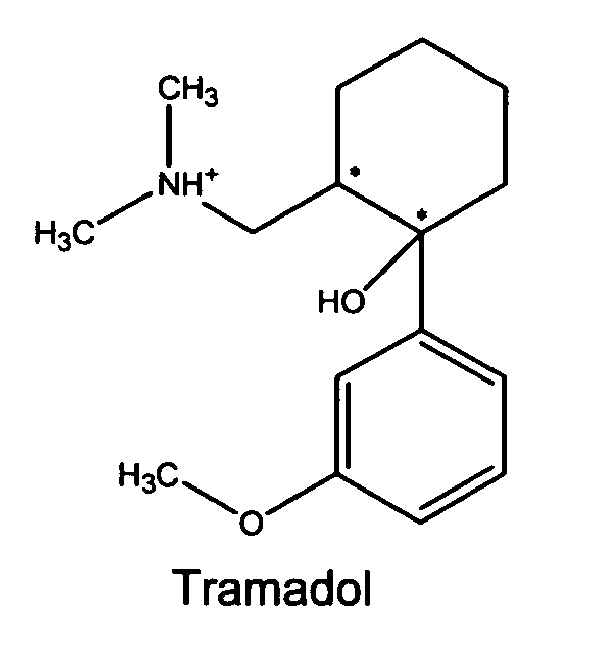
- This structure shows two different chiral centers and thus may exist in different diastereoisomers among which the tramadol is the cis-diastereisomer : (1R, 2R), or (1S, 2S), both also known as (+)-tramadol and (-)-tramadol and both of which contribute in different ways to its activity.
- From the art it appears that this compound is neither fully opioid-like, nor non-opioid-like. Some studies have demonstrate that tramadol is an opioid agonist, whereas clinical experience indicates that it lacks many of the typical side effects of opioids agonist, for example respiratory depression, constipation or tolerance.
- Due to their drawbacks, opioids cannot always be given repeatedly or at higher doses as analgesics to treat pain. The side effects of opioids are known in the art including e.g. J. Jaffe in "Goodman and Gilman's, The Pharmacological Basis of Therapeutics", 8th edition; Gilman et al.; Pergamon Press, New York, 1990, .
- Consequently it has been proposed to combine opioids with other drugs that are not opioid analgesic agents, in order to lower the amount of opioids needed to produce an equivalent degree of analgesia. Among these combinations, the association of tramadol with nonsteroidal anti-inflammatory drugs (NSAIDs) has been reported to be of particular interest (
EP-0 546 676 ). - Thus it was the objective of the current invention to provide new means of improving the properties of tramadol, especially in regard to the treatment of pain, by providing new drugable forms of tramadol.
- Especially desirable improvements/advantages of the new drugable form would include:
- improvement of physicochemical properties in order to facilitate the formulation, the manufacture, or to enhance the absorption and/or the bioavailability:
thus - being more active when compared to tramadol base or hydrochloride salt; or
- providing a form tramadol with a further active agent having a beneficial pharmacological effect in itself, thus allowing for a highly efficient dose/weight relation of the final active principle or even
- allowing the use of a lower therapeutic dose of either tramadol and the further active agent, an NSAID, or of both;
- having a synergistic effect through the combination of tramadol and the further actice agent, an NSAID, in the same new drugable form; or
further - having the bitter taste of tramadol removed or ameliorated;
- being easily obtainable, easy to manufacture or
- allowing more flexibility in formulating, or facilitating its formulation,
- being highly soluble, thus allowing better dissolution rates, especially if dissolving in an aqueous physiological surrounding, or
- improving stability of the co-crystal in comparison to the physical mixture of Tramadol/Active Agent (an NSAID) at the same ratio;
- allowing new routes of administration;
also - allowing - if necessary - to combine tramadol with a chemically usually non-compatible active agent in the same formulation or even in immediate contact, without having to isolate tramadol;
or finally - minimizing/reducing the side effects, especially the severe side effects, assigned to tramadol.
- Most desirably the new drugable forms should combine more than one, most of these advantages.
- This objective was achieved by providing new co-crystals of tramadol. It was found that Tramadol was able to form Co-crystals with NSAIDs. These co-crystals show improved properties if compared to tramadol alone, and also good analgesic activity. The co-crystals thus obtained have a specific stoichiometry which depends upon the structure of each NSAID. Under the proper circumstance this is also another advantage of these new solid drugable forms possibly achieving some modulation of the pharmacological effects. While APIs (Active Pharamceutical Ingredients) like tramadol in general have been recognized to form crystalline polymorphs, solvates, hydrates and amorphous forms for a number of years, there is little knowledge about which APIs will form co-crystals. Co-crystals are a specific type of crystalline form which provide a new avenue to modulate the API form and thus to modulate API properties. Co-crystals contain an API and at least one other component which crystallize together. Selection of the other component helps determine whether a co-crystal will form and what properties the co-crystal will have. Just as a polymorph, solvate, hydrate or amorphous form of an API can modulate stability, solubility, and hygroscopicity, a co-crystal can modulate those same properties.
- Thus the main object of the present invention is a co-crystal comprising tramadol either as a free base or as its physiologically acceptable salt and at least one NSAID.
- "Drugable form (of tramadol)" as used herein is defined as any form (salt, amorphous crystal, solution, dispersion, mixture etc,) that tramadol might take which still can be formulated into a pharmaceutical formulation usable as a medicament to treat a disease or a symptom, especially pain.
- "Co-Crystal" as used herein is defined as a crystalline material comprising two or more compounds at ambient temperature (20 to 25°C, preferably 20°C), of which at least two are held together by weak interaction, wherein at least one of the compounds is a co-crystal former. Weak interaction is being defined as an interaction which is neither ionic nor covalent and includes for example: hydrogen bonds, van der Waals forces, and π-π interactions. Solvates of tramadol that do not further comprise a co-crystal former are not co- crystals according to the present invention. The co-crystals may however, include one or more solvate molecules in the crystalline lattice. Just for the sake of clarity the destinction between crystalline salt and a co-crystal has to be stressed here. An API bound to another compound forming a salt by means of ionic interaction can be considered as one "compound" according to the invention, but it cannot be considered as two compounds by itself.
- In scientific literature there currently is some discussion on the proper use of the word co-crystal (see for example Desiraju, CrystEngComm, 2003, 5(82), 466-467 and Dunitz, CrystEngComm, 2003, 5(91), 506). A recent article by Zawarotko (Zwarotko, Crystal Growth & design, Vol. 7, No. 1, 2007, 4-9) gives a definition of co-crystal which is in line with the definition given above and thus also is a definition of "co-crystal" according to this invention. According to this article "a co-crystal is a multiple component crystal in which all components are solid under ambient conditions when in their pure form. These components consist of a target molecule or ion and a molecular co-crystal former(s); when in a co-crystal, they coexist at a molecular level within a single crystal".
- "Co-crystal former" as use herein is defined as a molecule being an active agent selected from NSAIDs, and with which tramadol is able to form co-crystals.
- "Active agents" are APIs which show a pharmaceutical effect and thus can be identified as being pharmaceutically active. In a more narrow sense this definition is encompassing all APIs being marketed or under clinical trial for the treatment of diseases.."Active agents with analgesic activity" are APIs (Active Pharamceutical Ingredients) which show efficacy in well-known animal models of pain and thus can be identified as being analgesics. In a more narrow sense this definition is encompassing all APIs being marketed or under clinical trial for a labelling including an indication falling under the definition of pain, including also migraine. These indications might include acute pain, chronic pain, neuropathic pain, hyperalgesia, allodynia or cancer pain, including diabetic neuropathy or diabetic peripheral neuropathy, osteoarthritis or fibromyalgia and all their subforms. Examples of "active agents with analgesic activity" include NSAIDs like naproxen or ibuprofen, pregabalin or tramadol and its N-desmethyl-metabolite.
- "Pain" is defined by the International Association for the Study of Pain (IASP) as "an unpleasant sensory and emotional experience associated with actual or potential tissue damage, or described in terms of such damage (IASP, Classification of chronic pain, 2nd Edition, IASP Press (2002), 210). Even though pain is always subjective its causes or syndromes can be classified.
- According to the IASP "allodynia" is defined as "a pain due to a stimulus which does not normally provoke pain" (IASP, Classification of chronic pain, 2nd Edition, IASP Press (2002), 210). Even though the symptoms of allodynia are most likely associated as symptoms of neuropathic pain this is not necessarily the case so that there are symptoms of allodynia not connected to neuropathic pain though rendering allodynia in some areas broader then neuropathic pain.
- The IASP further draws the following difference between "allodynia", "hyperalgesia" and "hyperpathia" (IASP, Classification of chronic pain, 2nd Edition, IASP Press (2002), 212):
Allodynia Lowered threshold Stimulus and response mode differ Hyperalgesia Increased response Stimulus and response rate are the same Hyperpathia Raised threshold; Increased response Stimulus and response rate may be the same or different - According to the IASP "neuropathy" is defined as "a primary lesion or dysfunction in the nervous system" (IASP, Classification of chronic pain, 2nd Edition, IASP Press (2002), 211). Neuropathic pain may have central or peripheral origin.
- In one prefered embodiment of the co-crystal according to the invention, the NSAID has at least one functional group from the group consisting of ether, thioether, alcohol, thiol, aldehyde, ketone, thioketone, nitrate ester, phosphate ester, thiophosphate ester, ester, thioester, sulfate ester, carboxylic acid, phosphonic acid, phosphinic acid, sulfonic acid, amide, primary amine, secondary amine, ammonia, tertiary amine, thiocyanate, cyanamide, oxime, nitrile, diazo, organohalide, nitro, s-heterocyclic ring, thiophene, n-heterocyclic ring, pyrrole, o-heterocyclic ring, furan, epoxide, peroxide, hydroxamic acid, imidazole, and pyridine;
preferably wherein the NSAID has at least one functional group from the group consisting of alcohol, thiol, ester, carboxylic acid, primary amine, secondary amine, tertiary amine. - In another embodiment the NSAID has at least one functional group from the group consisting of alcohol, ester, or carboxylic acid.
- In a further embodiment of the co-crystal according to the invention, the NSAID/s is/are chosen in such a way that if compared to either tramadol alone, or to a mixture of tramadol and the corresponding active agent/s:
- the solubility of the co-crystal is increased; and/or
- the dose response of the co-crystal is increased; and/or
- the efficacy of the co-crystal is increased; and/or
- the dissolution of the co-crystal is increased; and/or
- the bioavailability of the co-crystal is increased; and/or
- the stability of the co-crystal is increased; and/or
- the hygroscopicity of the co-crystal is decreased; and/or
- the form diversity of the co-crystal is decreased; and/or
- the morphology of the co-crystal is modulated.
- "Mixture of tramadol and the corresponding active agent/s" is defined as a mixture of the active agent or agents in question (the NSAID/s) with tramadol which is only a physical mixture without any coupling forces between the compounds and thus neither includes salts nor another co-crystal.
- In a further embodiment of the co-crystal according to the invention, the molar ratio between tramadol and the NSAID is different from 1. This might have the advantage of allowing the development of a non-equimolar ratio between tramadol and the active agent/s in a fixed dose with all the advantages of the co-crystal.
- NSAIDs have analgesic activity in a number of pain symptoms, with acetyl salicylic acid known under its trademark aspirin - despite being more than 100 years old - being an outstandingly used pharmaceutical. Besides Aspirin other NSAIDs (and COX-INHIBITORS) whose use generally is also centered on anti-inflammatory action like lbuprofen, naproxen or diclofenac are among the worldwide most frequently applied pharmaceutical compounds. The basis of their activity is inhibition of cyclooxygenase (COX), one of the two activities of prostaglandine endoperoxide synthase (PGHS). It is a key enzyme in the prostaglandin pathway. Preferred NSAIDs, are those with a carboxylic acid function. Preferred examples include salicylates, anthranilates, arylacetic acids/arylalkanoic acids, and arylpropionic acids.
- In a further embodiment of the co-crystal according to the invention, the NSAID is selected from:
- Acetylsalicylic Acid;
- Triflusal;
- HTB (2-hydroxy-4-trifluoromethyl benzoic acid);
- Diflunisal;
- Meclofenamic acid;
- Mefenamic acid;
- Niflumic acid;
- Flufenamic acid.
- Diclofenac;
- Lonazolac;
- Acemetacin;
- Indomethacin;
- Tolmetin;
- Sulindac
- Etodolac;
- Keterolac;
- Flurbiprofen;
- (RS)-Flurbiprofen;
- Esflurbiprofen;
- Ibuprofen;
- (RS)-Ibuprofen;
- S-(+)-Ibuprofen;
- Ketoprofen;
- (rac)-Ketoprofen
- R-(-)-Ketoprofen
- Bermoprofen;
- Pelubiprofen;
- Tenosal;
- Aceneuramic acid;
- Pirazolac;
- Xinoprofen;
- Flobufen;
- Anirolac;
- Zoliprofen;
- Bromfenac;
- Pemedolac;
- Dexpemedolac;
- Bindarit;
- Romazarit;
- Naproxen;
- (S)-Naproxen;
- (R)-Naproxen;
- Tiaprofenic acid;
- Ketorolac;
- Fenbufen;
- Fenoprofen;
- Flobufen; or
- Oxaprozin.
- In general all of these NSAIDs which have at least one stereogenic center are to be understood as being included herein in their racemic form or as diastereoisomers or enantiomers or mixtures thereof.
- The term "salt" is to be understood as meaning any form of tramadol or the NSAID according to the invention in which this assumes an ionic form or is charged and is coupled with a counter-ion (a cation or anion) or is in solution. By this are also to be understood complexes of tramadol or the NSAID with other molecules and ions, in particular complexes which are complexed via ionic interactions. This also includes physiologically acceptable salt.
- The term "solvate" according to this invention is to be understood as meaning any form of the tramadol or NSAID in which the compound has attached to it via non-covalent binding another molecule (most likely a polar solvent) especially including hydrates and alcoholates, e.g. methanolate.
- A highly interesting NSAID to be the co-crystal former with tramadol is the marketed drug naproxen. The chemical name of its (S)-enantiomer, the marketed (S)-naproxen, is (S)-(6-methoxy-2-naphtyl)propionic acid, and which is also described as a physiologically acceptable salt. It has an empirical formula of C14H14O3, an Mp of 153°C and a pKa of 4.2.

- The (R)-enantiomer, the R-naproxen, whose chemical name is (R)-(6-methoxy-2-naphtyl)propionic acid, having the same formula of C14H14O3, Mp of 153°C and pKa of 4.2, shows the following formula.

- Thus, another very preferred aspect of the invention relates to a co-crystal according to the invention, wherein the NSAID is naproxen, its enantiomers or salts thereof. Especially it refers to a co-crystal according to the invention, wherein the NSAID is (S)-naproxen or (R)-naproxen.
- Another embodiment of the invention relates to a co-crystal according to the invention, wherein the tramadol is (-)-tramadol or (+)-tramadol.
- As illustrated in more detail below tramadol and especially its enantiomers (+)-tramadol and (-)-tramadol form co-crystals with naproxen, especially with (S)-naproxen and (R)-naproxen. Generally co-crystals obtained have a specific stoichiometry which depends upon the structure of each co-crystal forming NSAID. In this specific case of the co-crystal between tramadol and naproxen being the co-crystal former the molecular ratio between tramadol and naproxen is 1 to 2.
- In a further preferred embodiment of the invention, co-crystal according to the invention, is selected from
- a co-crystal comprising (-)-tramadol either as a free base or as its physiologically acceptable salt and (S)-naproxen;
- a co-crystal comprising (+)-tramadol either as a free base or as its physiologically acceptable salt and (R)-naproxen;
- an enantiomeric mixture of co-crystals comprising (-)-tramadol either as a free base or as its physiologically acceptable salt and (S)-naproxen and co-crystals comprising (+)-tramadol either as a free base or as its physiologically acceptable salt and (R)-naproxen;
- any of the co-crystals above being solvate co-crystals, preferably being alcoholate co-crystals, most preferably being methanol solvate co-crystals.
- In a highly preferred embodiment of these selected co-crystals, the molecular ratio between the tramadol and naproxen is 1 : 2.
- In a preferred embodiment of a co-crystal with a molecular ratio between the tramadol and naproxen of 1 : 2 according to the invention comprising (-)-tramadol either as a free base or as its physiologically acceptable salt and (S)-naproxen or comprising (+)-tramadol either as a free base or as its physiologically acceptable salt and (R)-naproxen, or enantiomeric mixtures of these co-crystals, the co-crystal shows a Fourier Transform Infra Red pattern with absorption bands at 3247, 2942, 1699, 1633, 1605, 1583, 1485, 1380, 1271, 1223, 1160, 1029, 851, 789 and 704 cm-1.
- In a preferred embodiment of a co-crystal with a molecular ratio between the tramadol and naproxen of 1 : 2 according to the invention comprising (-)-tramadol either as a free base or as its physiologically acceptable salt and (S)-naproxen or comprising (+)-tramadol either as a free base or as its physiologically acceptable salt and (R)-naproxen, or enantiomeric mixtures of these co-crystals, the co-crystal has an orthorombic unit cell with the following dimensions:
- a = 9.512(2) A
- b = 40.5736(11) A
- c = 10.323(4) A
- α =90°
- β = 96.3°
- γ = 90°.
- In a preferred embodiment of a co-crystal with a molecular ratio between the tramadol and naproxen of 1 : 2 according to the invention comprising (-)-tramadol either as a free base or as its physiologically acceptable salt and (S)-naproxen or comprising (+)-tramadol either as a free base or as its physiologically acceptable salt and (R)-naproxen, or enantiomeric mixtures of these co-crystals, the endothermic sharp peak of the co-crystal corresponding to the melting point has an onset at 82°C.
- In another preferred embodiment of a co-crystal with a molecular ratio between the tramadol and naproxen of 1 : 2 according to the invention in the form of a methanol solvate comprising (+)-tramadol either as a free base or as its physiologically acceptable salt and (R)-naproxen, the co-crystal has an orthorombic unit cell.
- In another preferred embodiment of a co-crystal with a molecular ratio between the tramadol and naproxen of 1 : 2 according to the invention in the form of a methanol solvate comprising (+)-tramadol either as a free base or as its physiologically acceptable salt and (R)-naproxen, the co-crystal shows a Fourier Transform Infra Red pattern with absorption bands at 3523, 3151, 2928, 2861, 2465, 1706, 1632, 1603, 1567, 1485, 1461, 1445, 1417, 1388 and 1362 cm-1.
- As illustrated in more detail below tramadol forms co-crystals with (S)-naproxen. Generally co-crystals obtained have a specific stoichiometry which depends upon the structure of each co-crystal former. In this specific case of the co-crystal with (S)-naproxen being the NSAID the molecular ratio between Tramadol and (S)-naproxen is 1 to 2.
- Another embodiment of the present invention relates to a process for the production of a co-crystal according to the invention as described above comprising the steps of:
- (a) dissolving or suspending an NSAID in a solvent; optionally heating the solution or dispersion to a temperature above ambient temperature and below the boiling point of the solution or dispersion;
- (b) dissolving together with, or after, or before step (a) tramadol either as a free base or as a salt in a solvent,
- (c) adding the solution of (b) to the solution of (a) and mixing them;
- (d) cooling the mixed solution/dispersion of step (c) to ambient temperature;
- (e) optionally evaporating part or all of the solvent; and
- (f) filtering-off the resulting co-crystals.
- "Ambient temperature" is defined here as a temperature between 20 and 25°C, preferably being 20°C.
- The solvents usable in this process include water or organic solvents, preferably solvents selected from acetone, isobutyl acetate, acetonitrile, ethyl acetate, 2-butanol, dimethylcarbonate, chlorobenzene, butylether, diisopropylether, dimethylformamide, ethanol, water, hexane, isopropanol, methyl ethyl ketone, methanol, methyl t-butyl ether, 3-pentanone, toluene and 1,1,1-trichloroethane, most prefrably including alcohols, like ethanol. It is preferable - but not necessary - that the solvents in steps (a) and (c) are identical.
- The molecular ratio between tramadol and the NSAID lies between 4 : 1 to 1 : 4, preferably from 3 : 1 to 1 : 3 and more preferably from 1 : 1 to 1 : 2.
- Preferably the tramadol-solution in step (b) has a concentration of between 3 and 0.01 mM.
- The parts of the co-crystal according to the invention are well-known drugs with analgesic properties sometimes used for a long time worldwide. Due to this a further object of the present invention is a medicament comprising a co-crystal according to the invention.
- Thus the invention also concerns a medicament comprising at least one co-crystal according to the invention as described above and optionally one or more pharmaceutically acceptable excipients.
- The invention also relates to a pharmaceutical composition that comprises a therapeutically effective amount of the co-crystal according to the invention in a physiologically acceptable medium.
- The association of two active principles in the same crystal exhibits several advantages. Being linked, they often behave as a single chemical entity, thus facilitating the treatments, formulation, dosage etc. In addition to that, with both tramadol and the NSAIDs being active analgesics these co-crystals are highly useful in the treatment of pain, especially also not losing any activity/weight by the addition of pharmacologically useless counterions as in salts with no API. In addition the two active principles are complementing each other in the treatment especially of pain, but possibly also of various other diseases or symptoms. Thus, the co-crystals according to the invention do combine a high number of advantages over the state of the art.
- Another advantage is that the association of two active principles into one unique species seems to allow for a better Pharmacokinetic/Pharmacodynamic (PKPD) including also a better penetration of the blood-brain barrier, which helps in the treatment of pain.
- In general, in most embodiments in which the co-crystals of tramadol are used (e.g. for the treatment of pain etc.), these co-crystals would be formulated into a convenient pharmaceutical formulation or a medicament. Accordingly, a desirable advantage of a co-crystal of tramadol, would show improved pharmaceutical properties and features, especially when compared to the free base or tramadol hydrochloride. Thus, the co-crystal of tramadol according to the invention, should desirably show at least one, preferably more, of the following features:
- to have a very small particle size, e.g. from 300 µm or lower; or
- to be and/or remain essentially free of agglomerates; or
- to be less or not very hygroscopic; or
- to help in formulating controlled release or immediate release formulations; or
- to have a high chemical stability; or
if given to a patient - to decrease the inter- and intra-subject variability in blood levels; or
- to show a good absorption rate (e.g. increases in plasma levels or AUC); or
- to show a high maximum plasma concentration (e.g. Cmax); or
- to show decreased time to peak drug concentrations in plasma (tmax); or
- to show changes in half life of the compound (t1/2), in whichever direction this change is preferably directed.
- The medicament or pharmaceutical compositions according to the present invention may be in any form suitable for the application to humans and/or animals, preferably humans including infants, children and adults and can be produced by standard procedures known to those skilled in the art. The medicament of the present invention may for example be administered parenterally, including intramuscular, intraperitoneal, or intravenous injection, transmucosal or subklingual application; or orally, including administration as tablets, pellets, granules, capsules, lozenges, aqueous or oily solutions, suspensions, emulsions, sprays or as reconstituted dry powdered form with a liquid medium.
- Typically, the medicaments according to the present invention may contain 1-60 % by weight of one or more of the co-crystals as defined herein and 40-99 % by weight of one or more auxiliary substances (additives/excipients).
- The compositions of the present invention may also be administered topically or via a suppository.
- The daily dosage for humans and animals may vary depending on factors that have their basis in the respective species or other factors, such as age, sex, weight or degree of illness and so forth. The daily dosage for humans preferably is in the range of 5 to 500 milligrams of tramadol to be administered during one or several intakes per day.
- A further aspect of the invention relates to the use of co-crystal according to the invention as described above for the treatment of pain, preferably acute pain, chronic pain, neuropathic pain, hyperalgesia, allodynia or cancer pain, including diabetic neuropathy or osteoarthritis or fibromyalgia. Preferably this use is provided for in form of a medicament or a pharmaceutical composition according to the invention as described above.
- Another object of the current invention is a method of treatment of pain, preferably acute pain, chronic pain, neuropathic pain, hyperalgesia, allodynia or cancer pain, including diabetic neuropathy or osteoarthritis or fibromyalgia, by providing to a patient in need thereof a sufficient amount of a co-crystal according to the invention as described above. Preferably the co-crystal according to the invention is provided in physiologically suitable form like e.g. in form of a medicament or a pharmaceutical composition according to the invention as described above.
- The present invention is illustrated below with the help of the following figures and examples. These illustrations are given solely by way of example and do not limit the invention.
-
-
Figure 1 :- Powder X-Ray diffraction pattern of (-)-tramadol-(S)-naproxen 1:2 co-crystal.
-
Figure 2 :- DSC analysis of (-)-tramadol-(S)-naproxen 1:2 co-crystal.
-
Figure 3 :- TG analysis of (-)-tramadol-(S)-naproxen 1:2 co-crystal.
-
Figure 4 :- Structure of the unit cell of the (-)-tramadol-(S)-naproxen 1:2 co-crystal obtained by SCXRD analysis showing four molecules of (S)-naproxen and two molecules of (-)-tramadol.
-
Figure 5 :- Powder X-Ray diffraction pattern of the (+)-tramadol-(R)-naproxen 1:2 methanol solvate co-crystal.
-
Figure 6 :- DSC analysis of (+)-tramadol-(R)-naproxen 1:2 methanol solvate co-crystal.
-
Figure 7 :- TG analysis of the (+)-tramadol-(R)-naproxen 1:2 methanol solvate co-crystal.
- A solution of (-)-tramadol (0.58 g, 2.20 mmol) in 2 mL of isopropanol was added to a stirred suspension of (S)-naproxen (1.02 g, 4.43 mmol, 2 eq) in 2 mL of isopropanol at 60°C. The resulting solution was cooled to room temperature and a third of the solvent was evaporated. The solution was seeded with 5 - 10 mg of crystalline (-)-tramadol-(S)-naproxen (1:2) co-crystal and was left standing at room temperature for 48 hours without stirring. The resulting suspension was filtered off, the filtrate was washed with ca. 1 mL of isopropanol and dried under vacuum (10 mm Hg) at 60°C for 24 hours to give the co-crystal (-)-tramadol-(S)-naproxen in a 1:2 ratio as a white solid (1.31 g, 81%).
- (-)-tramadol-(S)-naproxen (1:2) co-crystal obtained according to example 1 was fully characterised by 1H-NMR, FTIR, X-Ray diffraction, DSC and TG (see
figures 1 to 4 ). - The optical rotation value is [α]23 D=+ 6° (c=1.00, MeOH)
- Powder diffraction patterns were acquired on a D8 Advance Series 2Theta/Theta powder diffraction system using CuKα-radiation in transmission geometry. The system is equipped with a VANTEC-1 single photon counting PSD, a Germanium monochromator, a ninety positions auto changer sample stage, fixed divergence slits and radial soller. Programs used: Data collection with DIFFRAC plus XRD Commander V.2.4.1 and evaluation with EVA V.12.0 (see
figure 1 ). The peaks expressed in d-value are described in detail in table 1:Table 1: List of selected peaks obtained by powder X-Ray diffraction of a co-crystal of (-)-tramadol and (S)-naproxen (1:2). Angle 2θ1 d-Value (Å) Relative Intensity % Angle 2θ1 d-Value (Å) Relative Intensity % 4.296 20.55171 8.9 16.176 5.47506 4.0 8.659 10.20397 20.0 17.033 5.20140 9.1 9.458 9.34300 36.6 17.449 5.07826 4.2 10.209 8.65740 10.4 17.882 4.95625 3.1 10.634 8.31301 12.5 18.131 4.88881 7.3 11.302 7.82251 16.4 18.700 4.74132 100.0 12.118 7.29783 9.3 19.060 4.65259 29.6 12.693 6.96824 28.2 19.407 4.57012 15.7 13.241 6.68136 9.4 19.705 4.50167 32.7 13.754 6.43322 21.3 20.115 4.41077 41.6 14.278 6.19841 2.4 20.525 4.32376 11.6 14.626 6.05175 6.3 20.795 4.26805 12.1 14.790 5.98498 7.3 21.097 4.20773 16.5 15.551 5.69362 4.3 21.409 4.14714 13.2 15.711 5.63613 4.3 21.579 4.11476 13.8 16.015 5.52985 9.6 21.855 4.06355 8.4 1The 2θ values were obtained using cupper radiation (CuKα 1.54060Å) - Proton nuclear magnetic resonance analyses were recorded in deuterated methanol (MeOH-d4) in a Bruker Avance 400 Ultrashield NMR spectrometer, equipped with a z-gradient 5 mm BBO (Broadband Observe) probe. Spectra were acquired solving 2 - 10 mg of sample in 0.6 mL of deuterated solvent.
1H NMR spectrum (in D4-methanol at 400 MHz) δ shows peaks at 1.47-1.96 (m, 8H), 1.51 (d, J = 7 Hz, 6H), 2.17 (m, 1H), 2.55 (dd, J = 2 Hz, J = 13 Hz, 1H), 2.57 (s, 6H), 2.88 (dd, J = 9 Hz, J = 13 Hz, 1H), 3.78 (q, J = 7 Hz, 2H), 3.80 (s, 3H), 3.89 (s, 6H), 6.82 (dd, J = 2 Hz, J = 8 Hz, 1H), 7.07 (m, 4H), 7.19 (d, J = 2 Hz, 2H), 7.29 (t, J = 8 Hz, 1H), 7.45 (dd, J = 2 Hz, J = 8 Hz, 2H), 7.70 (m, 6H). - The FTIR spectra (ATR) of the co-crystal of (-)-tramadol-(S)-naproxen were recorded using a Bruker Tensor 27, equipped with a MKII golden gate single reflection ATR system, a mid-infrared source as the excitation source and a DTGS detector. The spectra were acquired in 32 scans at a resolution of 4 cm-1.
- The sample (KBr pellets) of (-)-tramadol-(S)-ibuprofen co-crystal (1:2) shows a Fourier Transform Infra Red spectrum (ATR) with absorption bands υmax at 3247, 2942, 1699, 1633, 1605, 1583, 1485, 1380, 1271, 1223, 1160, 1029, 851, 789 and 704 cm-1.
- DSC analyses were recorded in a Mettler Toledo DSC822e. Samples of 1-2 mg were weighted into 40 µL aluminium crucibles with a pinhole lid, and were heated, under nitrogen (50 mL/min), at 10°C/min from 30 to 300°C.
- The endothermic peak of the (+)-tramadol-(S)-ibuprofen co-crystal (1:2) measured was corresponding to the melting point with an onset at 82°C, see
figure 2 . - Thermogravimetric analyses were recorded in a Mettler Toledo SDTA851e. Samples of 3 - 4 mg were weighted into 40µL aluminium crucibles with a pinhole lid, and heated at 10°C/min from 30 to 500°C, under nitrogen (80 mL/min).
- The TG analysis of the (-)-tramadol-(S)-ibuprofen co-crystal (1:2) according to the invention does not show weight loss at temperatures below the melting point (see
figure 3 ). - The crystal structure was determined from single crystal X-ray diffraction data. The measured crystal obtained from the preparation according to example 3 was selected using a Zeiss stereomicroscope using polarized light and prepared under inert conditions immersed in perfluoropolyether as protecting oil for manipulation. Crystal structure determination was carried out using a Bruker-Nonius diffractometer equipped with a
APPEX 2 4K CCD area detector, aFR591 Figure 4 the structure formed by 2 molecules of (S)-naproxen and 1 molecule of (-)-tramadol is shown. Crystal data and structure refinement for (-)-tramadol-(S)-naproxen (1:2) co-crystal is given in the following tables 2a and 2b:Table 2a: Most relevant structural data of the SCXRD analysis of a co-crystal of (-)-tramadol-(S)-naproxen (1:2). Crystal system Orthorhombic Space group: P 2 12121A (Å) 9.512(2) B (Å) 40.5736(11) C (Å) 10.323(4) α (°) 90 β (°) 96.29 γ (°) 90 Z 2 Volume (Å3) 3959.9(16) Table 2b. Complete Crystal data and structure refinement for (-)-tramadol-(S)-naproxen (1:2) co-crystal. Identification code p12napbul2-05 Empirical formula C88 H106 N2 016 Formula weight 1447.75 Temperature 100(2) K Wavelength 0.71073 Å Crystal system Orthorhombic Space group P2 12121 Unit cell dimensions a = 9.512(2) A α = 90° b = 40.5736(11) A β = 96.29° c = 10.323(4) A γ = 90° Volume 3959.9(16) Å3 Z 2 Density (calculated) 1.214 Mg/m3 Absorption coefficient 0.083 mm-1 F(000) 1552 Crystal size 0.10 x 0.10 x 0.02 mm3 Theta range for data collection 2.76 to 29.22°. Index ranges -12 ≤h ≤12, -55 ≤k ≤55, 0 ≤1 ≤ 14 Reflections collected 10979 Independent reflections 10979 [R(int) = 0.0000] Completeness to theta = 39.67° 73.5 % Absorption correction 0.9983 and 0.9918 Max. and min. transmission Full-matrix least-squares on F2 Refinement method 10979 / 1 / 975 Data / restraints / parameters 0.937 Goodness-of-fit on F2 R1 = 0.0754, wR2 = 0.1577 Final R indices [I>2sigma(I)] R1 = 0.1205, wR2 = 0.1751 R indices (all data) -0.3(13) Absolute structure parameter 0.561 and -0.345 e.Å-3 Largest diff. peak and hole 0.083 mm-1 - A solution of (R)-naproxen (751 mg, 3.26 mmol) in 4 mL of methanol is added to a solution of (+)-tramadol (430 mg, 1.63 mmol) in 1 mL of methanol. The mixture is stirred for 30 minutes and the solvent is evaporated under vacuum rendering an oil, which solidified by cooling to - 197°C. The resulting solid was suspended in 10 mL of diisopropyl ether and stirred for 7 days at room temperature. The resulting suspension was filtered off. The filtrate was washed with 5 mL of diisopropyl ether and dried under vacuum at 40°C (10 mm Hg) for 16 hours to give a co-crystal of (+)-tramadol-(R)-naproxen in a 1:2 ratio as a crystalline white solid (620 mg, 53%).
- (+)-tramadol-(R)-naproxen (1:2) co-crystal obtained according to example 2 was fully characterised by 1H-NMR, FTIR, X-Ray diffraction, DSC and TG.
- All the data obtained were identical to the data obtained for its enantiomer (-)-tramadol-(S)-naproxen (1:2) co-crystal of Example 1, the only difference being the optical rotation value of [α]23 D= - 7° (c=1.00, MeOH).
- A solution of (R)-naproxen (925 mg, 4.02 mmol) in 3 mL of methanol was added to a solution of (+)-tramadol (530 mg, 2.01 mmol) in 1 mL of methanol. The mixture was stirred for 10 minutes and about half of the solvent was evaporated. The resulting solution was left standing at room temperature and after 24 hours a solid had formed. The solid was filtered off, the filtrate was washed with 2 mL of methanol and dried under vacuum (10 mm Hg) for 4 hours to give the methanol solvate of the 1:2 co-crystal of (+)-tramadol-(R)-naproxen as crystalline white needles (610 mg, 42%).
- (+)-tramadol-(R)-naproxen (1:2) methanol solvate co-crystal obtained according to example 3 was fully characterised by 1H-NMR, FTIR, X-Ray diffraction, DSC and TG (see
figures 5 to 8 ). - The optical rotation value is [α]23 D= -5° (c=1.00, MeOH).
- Powder diffraction patterns were acquired on a D8 Advance Series 2Theta/Theta powder diffraction system using CuKα-radiation in transmission geometry. The system is equipped with a VANTEC-1 single photon counting PSD, a Germanium monochromator, a ninety positions auto changer sample stage, fixed divergence slits and radial soller. Programs used: Data collection with DIFFRAC plus XRD Commander V.2.4.1 and evaluation with EVA V.12.0 (see
figure 5 ). The peaks expressed in d-value are described in detail in table 3:Table 3: List of selected peaks obtained by powder X-Ray diffraction of (+)-tramadol-(R)-naproxen methanol solvate (1:2) co-crystal. Angle 2θ1 d-Value (Å) Relative Intensity % Angle 2θ1 d-Value (Å) Relative Intensity % 4.118 21.44081 12.1 17.204 5.15004 19.0 6.606 13.37037 1.4 17.610 5.03216 10.4 9.002 9.81544 3.7 18.124 4.89075 100.0 9.190 9.61534 3.2 18.499 4.79232 30.4 10.447 8.46109 49.5 19.080 4.64786 55.8 11.043 8.00578 39.3 19.352 4.58308 12.5 11.547 7.65723 2.5 19.643 4.51573 9.8 12.266 7.21033 7.8 19.898 4.45840 12.6 12.498 7.07682 8.9 20.074 4.41971 9.0 12.671 6.98047 4.1 20.424 4.34491 8.3 13.041 6.78342 4.6 20.881 4.25078 45.4 13.191 6.70672 5.3 21.035 4.22003 28.5 13.778 6.42196 6.0 21.552 4.11988 36.9 14.907 5.93807 19.4 22.023 4.03290 13.3 15.384 5.75499 6.6 22.263 3.98986 33.4 16.195 5.46846 6.3 22.580 3.93462 7.6 1The 2θ values were obtained using cupper radiation (CuKα 1.54060Å) - Proton nuclear magnetic resonance analyses were recorded in deuterated methanol (MeOH-d4) in a Bruker Avance 400 Ultrashield NMR spectrometer, equipped with a z-gradient 5 mm BBO (Broadband Observe) probe. Spectra were acquired solving 2 - 10 mg of sample in 0.6 mL of deuterated solvent. 1H NMR spectrum (in D4-methanol at 400 MHz) δ shows peaks at 1.41 - 1.93 (m, 8H), 1.51 (d, J = 7 Hz, 6H), 2.13 (m, 1H), 2.52 (m, 7H), 2.87 (dd, J = 9 Hz, J = 13 Hz, 1H), 3.35 (2 x MeOH), 3.77 (q, J = 7 Hz, 2H), 3.79 (s, 3H), 3.88 (s, 6H), 6.81 (dd, J = 2 Hz, J = 8 Hz, 1H), 7.02 (d, J = 7 Hz, 1H), 7.09 (m, 3H), 7.18 (d, J = 2 Hz, 2H), 7.27 (t, J = 8 Hz, 1H), 7.45 (dd, J = 1 Hz, J = 8 Hz, 2H), 7.66 - 7.74 (m, 6H).
- The FTIR spectra (ATR) of the (+)-tramadol-(R)-naproxen methanol solvate (1:2) co-crystal were recorded using a Bruker Tensor 27, equipped with a MKII golden gate single reflection ATR system, a mid-infrared source as the excitation source and a DTGS detector. The spectra were acquired in 32 scans at a resolution of 4 cm-1. The sample (KBr pellets) of (+)-tramadol-(R)-naproxen methanol solvate (1:2) co-crystal shows a Fourier Transform Infra Red spectrum (ATR) with absorption bands υmax at 3523, 3151, 2928, 2861, 2465, 1706, 1632, 1603, 1567, 1485, 1461, 1445, 1417, 1388 and 1362 cm-1.
- DSC analyses were recorded in a Mettler Toledo DSC822e. Samples of 1-2 mg were weighted into 40 µL aluminium crucibles with a pinhole lid, and were heated, under nitrogen (50 mL/min), at 10°C/min from 30 to 300°C. The endothermic peaks of the (+)-tramado)-(S)-ibuprofen co-crystal (1:2) measured had onsets at 44°C and 60°C, see
figure 6 . - Thermogravimetric analyses were recorded in a Mettler Toledo SDTA851e. Samples of 3 - 4 mg were weighted into 40 µL aluminium crucibles with a pinhole lid, and heated at 10°C/min from 30 to 500°C, under nitrogen (80 mL/min). The TG analysis of the (+)-tramadol-(R)-naproxen methanol solvate (1:2) co-crystal according to the invention does show weight loss of 7.2% between 40 and 140°C followed by decomposition starting at 160°C (see
figure 7 ). - The crystal structure is determined from single crystal X-ray diffraction data. A crystal obtained from the preparation according to example 3 is selected using a Zeiss stereomicroscope using polarized light and prepared under inert conditions immersed in perfluoropolyether as protecting oil for manipulation. Crystal structure determination is carried out using a Bruker-Nonius diffractometer equipped with a
APPEX 2 4K CCD area detector, a FR591 rotating anode with MoKα radiation, Montel mirrors as monochromator and a Kryoflex low temperature device (T = 100 K). Fullsphere data collection omega and phi scans. Programs used: Data collection Apex2 V. 1.0-22 (Bruker-Nonius 2004), data reduction Saint + Version 6.22 (Bruker-Nonius 2001) and absorption correction SADABS V. 2.10 (2003). Crystal structure solution is achieved using direct methods as implemented in SHELXTL Version 6.10 (Sheldrick, Universtität Göttingen (Germany), 2000) and visualized using XP program. Missing atoms are subsequently located from difference Fourier synthesis and added to the atom list. Least-squares refinement on F0 2 using all measured intensities is carried out using the program SHELXTL Version 6.10 (Sheldrick, Universtität Göttingen (Germany), 2000). All non hydrogen atoms are refined including anisotropic displacement parameters.
Claims (16)
- A co-crystal comprising tramadol either as a free base or as its physiologically acceptable salt and at least one NSAID.
- A co-crystal according to claim 1 comprising tramadol either as a free base or as its physiologically acceptable salt and at least one NSAID, wherein the NSAID or at least one of the NSAIDs has at least one functional group from the group consisting of ether, thioether, alcohol, thiol, aldehyde, ketone, thioketone, nitrate ester, phosphate ester, thiophosphate ester, ester, thioester, sulfate ester, carboxylic acid, phosphonic acid, phosphinic acid, sulfonic acid, amide, primary amine, secondary amine, ammonia, tertiary amine, thiocyanate, cyanamide, oxime, nitrile, diazo, organohalide, nitro, s-heterocyclic ring, thiophene, n-heterocyclic ring, pyrrole, o-heterocyclic ring, furan, epoxide, peroxide, hydroxamic acid, imidazole, and pyridine; preferably wherein the NSAID has at least one functional group from the group consisting of alcohol, thiol, ester, carboxylic acid, primary amine, secondary amine, tertiary amine.
- A co-crystal according to any of claims 1 to 2, wherein the NSAID is chosen in such a way that if compared to either tramadol alone, or to a mixture of tramadol and the corresponding NSAID, as active agent/s:• the solubility of the co-crystal is increased; and/or• the dose response of the co-crystal is increased; and/or• the efficacy of the co-crystal is increased; and/or• the dissolution of the co-crystal is increased; and/or• the bioavailability of the co-crystal is increased; and/or• the stability of the co-crystal is increased; and/or• the hygroscopicity of the co-crystal is decreased; and/or• the form diversity of the co-crystal is decreased; and/or• the morphology of the co-crystal is modulated.
- The co-crystal according to any of claims 1 to 4, wherein the NSAID is selected from:- Acetylsalicylic Acid;- Triflusal;- HTB (2-hydroxy-4-trifluoromethyl benzoic acid);- Diflunisal;- Meclofenamic acid;- Mefenamic acid;- Niflumic acid;- Flufenamic acid.- Diclofenac;- Lonazolac;- Acemetacin;- Indomethacin;- Tolmetin;- Sulindac- Etodolac;- Keterolac- Flurbiprofen;- (RS)-Flurbiprofen;- Esflurbiprofen;- Ibuprofen;- (RS)-Ibuprofen;- S-(+)-Ibuprofen;- Ketoprofen;- (rac)-Ketoprofen- R-(-)-Ketoprofen- Bermoprofen;- Pelubiprofen;- Tenosal;- Aceneuramic acid;- Pirazolac;- Xinoprofen;- Flobufen;- Anirolac;- Zoliprofen;- Bromfenac;- Pemedolac;- Dexpemedolac;- Bindarit;- Romazarit;- Naproxen;- (S)-Naproxen;- (R)-Naproxen;- Tiaprofenic acid;- Ketorolac;- Fenbufen;- Fenoprofen;- Flobufen; or- Oxaproxin.
- The co-crystal according to any of claims 1 to 5, wherein the NSAID is naproxen, its enantiomers or salts thereof.
- The co-crystal according to any of claims 1 to 6, wherein the NSAID is (S)-naproxen or (R)-naproxen.
- The co-crystal according to any of claims 1 to 7, wherein the tramadol is (-)-tramadol or (+)-tramadol.
- A co-crystal according to any of claims 1 to 9, selected from:• a co-crystal comprising (-)-tramadol either as a free base or as its physiologically acceptable salt and (S)-naproxen;• a co-crystal comprising (+)-tramadol either as a free base or as its physiologically acceptable salt and (R)-naproxen;• an enantiomeric mixture of co-crystals comprising (-)-tramadol either as a free base or as its physiologically acceptable salt and (S)-naproxen and co-crystals comprising (+)-tramadol either as a free base or as its physiologically acceptable salt and (R)-naproxen;• any of the co-crystals above being solvate co-crystals, preferably being alcoholate co-crystals, most preferably being methanol solvate co-crystals.
- A co-crystal according to claim 6, wherein the molecular ratio between the tramadol and naproxen is 1 : 2.
- A co-crystal according to claim 9 comprising (-)-tramadol either as a free base or as its physiologically acceptable salt and (S)-naproxen or comprising (+) tramadol either as a free base or as its physiologically acceptable salt and (R)-naproxen, or enantiomeric mixtures of these co-crystals, characterized in that it shows a Fourier Transform Infra Red pattern with absorption bands at 3247, 2942, 1699, 1633, 1605, 1583, 1485, 1380, 1271, 1223, 1160, 1029, 851, 789 and 704 cm-1.
- A co-crystal according to claim 9 comprising (-)-tramadol either as a free base or as its physiologically acceptable salt and (S)-naproxen or comprising (+)-tramadol either as a free base or as its physiologically acceptable salt and (R)-naproxen, or enantiomeric mixtures of these co-crystals, characterized in that it has an orthorombic unit cell with the following dimensions:a = 9.512(2) Ab = 40.5736(11) Ac = 10.323(4) Aα = 90°β = 96.3°γ = 90°.
- A co-crystal according to claim 9 comprising (-)-tramadol either as a free base or as its physiologically acceptable salt and (S)-naproxen or comprising (+)-tramadol either as a free base or as its physiologically acceptable salt and (R)-naproxen, or enantiomeric mixtures of these co-crystals, characterized in that the endothermic sharp peak corresponding to the melting point has an onset at 82°C.
- A co-crystal according to claim 9 in the form of a methanol solvate comprising (+)-tramadol either as a free base or as its physiologically acceptable salt and (R)-naproxen, characterized in that it it shows a Fourier Transform Infra Red pattern with absorption bands at 3523, 3151, 2928, 2861, 2465, 1706, 1632, 1603, 1567, 1485, 1461, 1445, 1417, 1388 and 1362 cm-1.
- Process for the production of a co-crystal according to claim 1 comprising the steps of:(a) dissolving or suspending an NSAID in a solvent; optionally heating the solution or dispersion to a temperature above ambient temperature and below the boiling point of the solution or dispersion;(b) dissolving together with, or after, or before step (a) tramadol either as a free base or as a salt in a solvent,(c) adding the solution of (b) to the solution of (a) and mixing them;(d) cooling the mixed solution/dispersion of step (c) to ambient temperature;(e) optionally evaporating part or all of the solvent; and(f) filtering-off the resulting co-crystals.
- Pharmaceutical composition characterized in that it comprises a therapeutically effective amount of the co-crystal according to any of claims 1 to 13 in a physiologically acceptable medium.
- Use of a co-crystal according to any one of claims 1 to 13 for the treatment of pain, preferably acute pain, chronic pain, neuropathic pain, hyperalgesia, allodynia or cancer pain, including diabetic neuropathy or diabetic peripheral neuropathy and osteoarthritis or fibromyalgia.
Priority Applications (37)
| Application Number | Priority Date | Filing Date | Title |
|---|---|---|---|
| EP20080384012 EP2177215A1 (en) | 2008-10-17 | 2008-10-17 | Co-crystals of tramadol and NSAIDs |
| ES09736862.5T ES2603962T3 (en) | 2008-10-17 | 2009-10-16 | Co-crystals of tramadol and NSAIDs |
| HRP20161526TT HRP20161526T1 (en) | 2008-10-17 | 2009-10-16 | Co-crystals of tramadol and nsaids |
| AU2009304235A AU2009304235B2 (en) | 2008-10-17 | 2009-10-16 | Co-crystals of tramadol and NSAIDs |
| LTEP09736862.5T LT2349238T (en) | 2008-10-17 | 2009-10-16 | TRAMADOL AND NSAID COMPOUNDS KO-CRYSTALS |
| RU2011119608/04A RU2599717C2 (en) | 2008-10-17 | 2009-10-16 | Co-crystalline forms of tramadol and nsaid |
| NZ591873A NZ591873A (en) | 2008-10-17 | 2009-10-16 | Co-crystals of tramadol and nsaids |
| HUE09736862A HUE030976T2 (en) | 2008-10-17 | 2009-10-16 | Co-crystals of tramadol and nsaids |
| EP09736862.5A EP2349238B1 (en) | 2008-10-17 | 2009-10-16 | Co-crystals of tramadol and nsaids |
| US13/124,027 US20110257134A1 (en) | 2008-10-17 | 2009-10-16 | CO-CRYSTALS OF TRAMADOL AND NSAIDs |
| MX2011003612A MX336318B (en) | 2008-10-17 | 2009-10-16 | CO-CRYSTALS OF TRAMADOL AND NSAIDS. |
| PL09736862T PL2349238T3 (en) | 2008-10-17 | 2009-10-16 | Co-crystals of tramadol and nsaids |
| KR1020117010637A KR101679400B1 (en) | 2008-10-17 | 2009-10-16 | Co-crystals of Tramadol and NSAIDs |
| BRPI0920358-3A BRPI0920358A2 (en) | 2008-10-17 | 2009-10-16 | Tramadol cocrystals and insaids |
| DK09736862.5T DK2349238T3 (en) | 2008-10-17 | 2009-10-16 | CO-CRYSTALS of tramadol and NSAIDs |
| CN200980141056.6A CN102186465B (en) | 2008-10-17 | 2009-10-16 | The eutectic of tramadol and NSAID |
| JP2011531401A JP5645830B2 (en) | 2008-10-17 | 2009-10-16 | Co-crystal of tramadol and NSAID |
| PCT/EP2009/007451 WO2010043412A1 (en) | 2008-10-17 | 2009-10-16 | Co-crystals of tramadol and nsaids |
| SI200931565A SI2349238T1 (en) | 2008-10-17 | 2009-10-16 | Co-crystals of tramadol and nsaids |
| PT97368625T PT2349238T (en) | 2008-10-17 | 2009-10-16 | TRAMADOL AND NSAID CO-CRYSTALS |
| CA2737754A CA2737754C (en) | 2008-10-17 | 2009-10-16 | Co-crystals of tramadol and nsaids |
| US13/395,021 US8598152B2 (en) | 2008-10-17 | 2010-04-19 | Co-crystals of tramadol and coxibs |
| UAA201205792A UA109534C2 (en) | 2008-10-17 | 2010-04-19 | Co-crystals of tramadol and coxibs |
| MYPI2012000675A MY156285A (en) | 2008-10-17 | 2010-04-19 | Co-crystals of tramadol and coxibs |
| IN1435DEN2012 IN2012DN01435A (en) | 2008-10-17 | 2010-04-19 | |
| IL211785A IL211785A (en) | 2008-10-17 | 2011-03-17 | Tramadol and Neproxane crystals |
| ZA2011/02762A ZA201102762B (en) | 2008-10-17 | 2011-04-13 | CO-CRYSTALS OF TRAMADOL AND NSAIDs |
| US14/066,127 US9012440B2 (en) | 2008-10-17 | 2013-10-29 | Co-crystals of tramadol and coxibs |
| US14/324,448 US9393220B2 (en) | 2008-10-17 | 2014-07-07 | Co-crystals of tramadol and NSAIDs |
| US14/665,055 US20150196503A1 (en) | 2008-10-17 | 2015-03-23 | Co-crystals of tramadol and coxibs |
| US14/665,060 US20150196504A1 (en) | 2008-10-17 | 2015-03-23 | Co-crystals of tramadol and coxibs |
| US15/207,694 US10238668B2 (en) | 2008-10-17 | 2016-07-12 | Co-crystals of tramadol and coxibis |
| US15/231,915 US10245276B2 (en) | 2008-10-17 | 2016-08-09 | Co-crystals of tramadol and coxibs |
| CY20161101201T CY1118374T1 (en) | 2008-10-17 | 2016-11-22 | TRAMADOL CO-CRYSTALS AND NSAIDs |
| SM201600439T SMT201600439B (en) | 2008-10-17 | 2016-11-30 | CO-CRYSTALS OF TRAMADOLUS AND NSAID |
| US16/275,437 US10548909B2 (en) | 2008-10-17 | 2019-02-14 | Co-crystals of tramadol and coxibs |
| US16/720,574 US11478488B2 (en) | 2008-10-17 | 2019-12-19 | Co-crystals of tramadol and coxibs |
Applications Claiming Priority (1)
| Application Number | Priority Date | Filing Date | Title |
|---|---|---|---|
| EP20080384012 EP2177215A1 (en) | 2008-10-17 | 2008-10-17 | Co-crystals of tramadol and NSAIDs |
Publications (1)
| Publication Number | Publication Date |
|---|---|
| EP2177215A1 true EP2177215A1 (en) | 2010-04-21 |
Family
ID=40673614
Family Applications (2)
| Application Number | Title | Priority Date | Filing Date |
|---|---|---|---|
| EP20080384012 Withdrawn EP2177215A1 (en) | 2008-10-17 | 2008-10-17 | Co-crystals of tramadol and NSAIDs |
| EP09736862.5A Active EP2349238B1 (en) | 2008-10-17 | 2009-10-16 | Co-crystals of tramadol and nsaids |
Family Applications After (1)
| Application Number | Title | Priority Date | Filing Date |
|---|---|---|---|
| EP09736862.5A Active EP2349238B1 (en) | 2008-10-17 | 2009-10-16 | Co-crystals of tramadol and nsaids |
Country Status (27)
| Country | Link |
|---|---|
| US (10) | US20110257134A1 (en) |
| EP (2) | EP2177215A1 (en) |
| JP (1) | JP5645830B2 (en) |
| KR (1) | KR101679400B1 (en) |
| CN (1) | CN102186465B (en) |
| AU (1) | AU2009304235B2 (en) |
| BR (1) | BRPI0920358A2 (en) |
| CA (1) | CA2737754C (en) |
| CY (1) | CY1118374T1 (en) |
| DK (1) | DK2349238T3 (en) |
| ES (1) | ES2603962T3 (en) |
| HR (1) | HRP20161526T1 (en) |
| HU (1) | HUE030976T2 (en) |
| IL (1) | IL211785A (en) |
| IN (1) | IN2012DN01435A (en) |
| LT (1) | LT2349238T (en) |
| MX (1) | MX336318B (en) |
| MY (1) | MY156285A (en) |
| NZ (1) | NZ591873A (en) |
| PL (1) | PL2349238T3 (en) |
| PT (1) | PT2349238T (en) |
| RU (1) | RU2599717C2 (en) |
| SI (1) | SI2349238T1 (en) |
| SM (1) | SMT201600439B (en) |
| UA (1) | UA109534C2 (en) |
| WO (1) | WO2010043412A1 (en) |
| ZA (1) | ZA201102762B (en) |
Cited By (3)
| Publication number | Priority date | Publication date | Assignee | Title |
|---|---|---|---|---|
| WO2012009262A3 (en) * | 2010-07-12 | 2012-04-19 | Yung Shin Pharm. Ind. Co., Ltd. | Diclofenac salt of tramadol |
| WO2014091226A1 (en) * | 2012-12-11 | 2014-06-19 | Centre For Process Innovation Limited | Methods for making active crystalline materials |
| EP4169903A1 (en) * | 2021-10-25 | 2023-04-26 | Dompe' Farmaceutici S.P.A. | Co-crystals of nonsteroidal anti-inflammatory drugs, lysine and gabapentin, pharmaceutical compositions and their medical use |
Families Citing this family (22)
| Publication number | Priority date | Publication date | Assignee | Title |
|---|---|---|---|---|
| EP2177215A1 (en) | 2008-10-17 | 2010-04-21 | Laboratorios Del. Dr. Esteve, S.A. | Co-crystals of tramadol and NSAIDs |
| EP2392319A1 (en) * | 2010-06-04 | 2011-12-07 | Laboratorios Del. Dr. Esteve, S.A. | Pharmaceutical compositions of co-crystals of tramadol and coxibs |
| DE102010063609A1 (en) * | 2010-12-20 | 2012-06-21 | Awd.Pharma Gmbh & Co. Kg | New multicomponent crystals of ([2-amino-6- (4-fluoro-benzylamino) -pyridin-3yl) -carbamic acid ethyl ester and an arylpropionic acid |
| KR101888852B1 (en) | 2011-12-02 | 2018-09-21 | 삼성전자주식회사 | Apparatus and method for providing diversity service antenna in portable terminal |
| ITMI20130210A1 (en) * | 2013-02-14 | 2014-08-15 | Menarini Lab | PHARMACEUTICAL COMPOSITIONS CONTAINING DEXKETOPROPHENES AND TRAMADOL |
| RU2542100C1 (en) * | 2013-12-24 | 2015-02-20 | Федеральное государственное бюджетное учреждение науки Институт химии растворов им. Г.А. Крестова Российской Академии Наук (ИХС РАН) | Co-crystalline form of theophylline with diflunisal or diclofenac |
| WO2016116942A1 (en) | 2015-01-20 | 2016-07-28 | Anlon Chemical Research Organization | Novel pharmaceutical compounds comprising ticagrelor with salts of aspirin |
| CN104592009B (en) * | 2015-02-09 | 2017-02-22 | 黑龙江大学 | Naproxen pharmaceutical co-crystal and preparation method thereof |
| US9693949B1 (en) * | 2015-12-22 | 2017-07-04 | Revogenex Ireland Ltd | Intravenous administration of tramadol |
| MX2016006464A (en) * | 2016-05-18 | 2017-11-17 | Laboratorios Liomont S A De C V | Pharmaceutical composition of a combination of tramadol-etoricoxib hydrochloride for the treatment of pain. |
| WO2018165269A2 (en) * | 2017-03-08 | 2018-09-13 | Intercept Pharmaceuticals, Inc | Crystalline forms of obeticholic acid |
| MX2018003456A (en) | 2017-12-21 | 2019-09-06 | Gruenenthal Gmbh | Pharmaceutical combination in a bilayer tablet form comprising ketorolac tromethamine and tramadol hydrochloride, and its use in pain treatment. |
| WO2019130049A1 (en) | 2017-12-29 | 2019-07-04 | Grünenthal GmbH | Pharmaceutical combination comprising extended-release tramadol hydrochloride and immediate-release etoricoxib, and its use for the treatment of pain |
| EP3814353A4 (en) * | 2018-05-31 | 2021-11-24 | The Royal Institution for the Advancement of Learning / McGill University | PHARMACEUTICAL SALTS / CO-CRYSTALS OF PENTOXIFYLLINE, CLONIDINE AND LINSIDOMINE WITH CAFEIC ACID, PROTOCATECHUIC ACID OR ALPHA-LIPOIC ACID AND ASSOCIATED USE IN THE TREATMENT OF PAIN |
| CA3110155A1 (en) * | 2018-08-20 | 2020-02-27 | Mylan Laboratories Limited | Tramadol hbr-celecoxib co-crystal |
| WO2020121326A1 (en) | 2018-12-13 | 2020-06-18 | Mylan Laboratories Limited | Amorphous (rac)-tramadol.hcl-celecoxib (1:1) |
| KR20220008301A (en) * | 2019-05-14 | 2022-01-20 | 에스테베 파마슈티칼스 에스에이 | Use of a co-crystal of tramadol and celecoxib to treat pain while reducing the abuse tendency of tramadol |
| EP3842408A1 (en) | 2019-12-23 | 2021-06-30 | Dompé farmaceutici S.p.A. | Co-crystal of ketoprofen and its preparation, pharmaceutical compositions comprising the same and uses thereof |
| EP3907214A1 (en) | 2020-05-04 | 2021-11-10 | Dompe' Farmaceutici S.P.A. | Co-crystal of ketoprofen, lysine and gabapentin, pharmaceutical compositions and their medical use |
| KR20240027436A (en) * | 2022-08-23 | 2024-03-04 | 대원제약주식회사 | Ionic bonding compound of pelubiprofen and tramadol, composition comprising same, and preparing method thereof |
| CN116492349B (en) * | 2023-04-11 | 2025-09-09 | 东南大学 | Olsappan and isoniazid eutectic, pharmaceutical composition and preparation method thereof |
| KR20240158668A (en) * | 2023-04-27 | 2024-11-05 | 대원제약주식회사 | Pharmaceutical composition for pain relief comprising pelubiprofen and tramadol |
Citations (4)
| Publication number | Priority date | Publication date | Assignee | Title |
|---|---|---|---|---|
| EP0546676A1 (en) | 1991-10-30 | 1993-06-16 | Mcneilab, Inc. | Composition comprising a tramadol material and a non-steroidal anti-inflammatory drug |
| US20080031950A1 (en) * | 2007-04-27 | 2008-02-07 | Nectid Inc. | Novel anelgesic combination |
| WO2008064854A1 (en) * | 2006-11-28 | 2008-06-05 | Grünenthal GmbH | Drug preparation of tramadol and acetaminophen |
| EP2022778A1 (en) * | 2007-08-07 | 2009-02-11 | Laboratorios del Dr. Esteve S.A. | A crystalline form of (R,R)-tramadol-(S)-naproxene salt |
Family Cites Families (37)
| Publication number | Priority date | Publication date | Assignee | Title |
|---|---|---|---|---|
| US3652589A (en) | 1967-07-27 | 1972-03-28 | Gruenenthal Chemie | 1-(m-substituted phenyl)-2-aminomethyl cyclohexanols |
| HU219332B (en) | 1991-09-06 | 2001-03-28 | Mcneilab Inc | Synergetic medicaments containing trans-(+)-2-[(dimethylamino)-methyl]-1-(3-methoxiphenyl)-cyclohexanol and acetaminophen |
| US5516803A (en) | 1991-10-30 | 1996-05-14 | Mcneilab, Inc. | Composition comprising a tramadol material and a non-steroidal anti-inflammatory drug |
| US5474995A (en) | 1993-06-24 | 1995-12-12 | Merck Frosst Canada, Inc. | Phenyl heterocycles as cox-2 inhibitors |
| US5466823A (en) | 1993-11-30 | 1995-11-14 | G.D. Searle & Co. | Substituted pyrazolyl benzenesulfonamides |
| RO118291B1 (en) | 1993-11-30 | 2003-04-30 | Searle & Co | PIRAZOL DERIVATIVES 1,3,4,5 - TETRASUBSTITUITIS AND PHARMACEUTICAL COMPOSITION CONTAINING CONTAINERS |
| US5633272A (en) | 1995-02-13 | 1997-05-27 | Talley; John J. | Substituted isoxazoles for the treatment of inflammation |
| UA57002C2 (en) | 1995-10-13 | 2003-06-16 | Мерк Фросст Кенада Енд Ко./Мерк Фросст Кенада Енд Сі. | (methylsulfonyl)phenyl-2-(5n)-furanon derivative, a pharmaceutical composition and a method for treatment |
| WO1997038986A1 (en) | 1996-04-12 | 1997-10-23 | G.D. Searle & Co. | Substituted benzenesulfonamide derivatives as prodrugs of cox-2 inhibitors |
| CA2412968C (en) | 1996-07-18 | 2010-05-11 | Merck Frosst Canada & Co. | Substituted pyridines as selective cyclooxygenase-2 inhibitors |
| US5861419A (en) | 1996-07-18 | 1999-01-19 | Merck Frosst Canad, Inc. | Substituted pyridines as selective cyclooxygenase-2 inhibitors |
| CO4960662A1 (en) | 1997-08-28 | 2000-09-25 | Novartis Ag | CERTAIN 5-ALKYL-2-ARYLAMINOPHENYLACETIC ACIDS AND THEIR DERIVATIVES |
| RS49982B (en) | 1997-09-17 | 2008-09-29 | Euro-Celtique S.A., | SYNERGISTIC ANALGETIC COMBINATION OF ANALGETIC OPIATE AND CYCLOOOXYGENASE-2 INHIBITOR |
| AU3384200A (en) * | 1999-03-01 | 2000-09-21 | Ortho-Mcneil Pharmaceutical, Inc. | Composition comprising a tramadol material and a selective cox-2 inhibitor drug |
| DE19927688A1 (en) | 1999-06-17 | 2000-12-21 | Gruenenthal Gmbh | Multi-layered tablet containing tramadole and diclofenac, useful for treating pain, has separating layer between active ingredient layers |
| DE10108122A1 (en) | 2001-02-21 | 2002-10-02 | Gruenenthal Gmbh | Medicines based on tramadol |
| MXPA03000985A (en) * | 2001-07-27 | 2004-04-02 | Yamanouchi Pharma Co Ltd | Compositions containing sustained-release fine grains for tablets quickly disintegrable in the oral cavity and process for producing the same. |
| US7927613B2 (en) * | 2002-02-15 | 2011-04-19 | University Of South Florida | Pharmaceutical co-crystal compositions |
| US7790905B2 (en) | 2002-02-15 | 2010-09-07 | Mcneil-Ppc, Inc. | Pharmaceutical propylene glycol solvate compositions |
| CN100418533C (en) | 2002-02-19 | 2008-09-17 | 阿德科克因格拉姆有限公司 | Pharmaceutical combination of a cyclooxygenase-2 inhibitor and an opiate |
| DE60315670T2 (en) | 2002-07-17 | 2008-06-05 | S.O.I.Tec Silicon On Insulator Technologies | METHOD FOR THE PRODUCTION OF SUBSTRATES, ESPECIALLY FOR OPTICS, ELECTRONICS AND OPTOELECTRONICS |
| CN1245968C (en) | 2002-10-09 | 2006-03-22 | 新疆特丰药业股份有限公司 | Method for preparing naproxen sodium release tablet |
| JP4469846B2 (en) | 2003-01-31 | 2010-06-02 | エラン ファーマ インターナショナル,リミティド | Nanoparticulate topiramate formulation |
| CA2514733A1 (en) * | 2003-02-28 | 2004-09-16 | Transform Pharmaceuticals, Inc. | Pharmaceutical co-crystal compositions of drugs such as carbamazepine, celecoxib, olanzapine, itraconazole, topiramate, modafinil, 5-fluorouracil, hydrochlorothiazide, acetaminophen, aspirin, flurbiprofen, phenytoin and ibuprofen |
| US20060172006A1 (en) * | 2003-10-10 | 2006-08-03 | Vincent Lenaerts | Sustained-release tramadol formulations with 24-hour clinical efficacy |
| EP1727520A2 (en) | 2003-12-09 | 2006-12-06 | Medcrystalforms, Llc | Method of preparation of mixed phase co-crystals with active agents |
| US8216610B2 (en) * | 2004-05-28 | 2012-07-10 | Imaginot Pty Ltd. | Oral paracetamol formulations |
| WO2008085674A1 (en) | 2007-01-04 | 2008-07-17 | Transform Pharmaceuticals, Inc. | Pharmaceutical compositions comprising celecoxib co-crystals |
| JP5757864B2 (en) | 2008-05-20 | 2015-08-05 | ニューロジェシックス, インコーポレイテッド | Water-soluble acetaminophen analogue |
| CN102216281B (en) | 2008-09-06 | 2014-11-05 | 碧奥尼维亚制药股份有限公司 | Novel choline cocrystal of epalrestat |
| EP2177215A1 (en) * | 2008-10-17 | 2010-04-21 | Laboratorios Del. Dr. Esteve, S.A. | Co-crystals of tramadol and NSAIDs |
| EP2488169B1 (en) * | 2009-10-16 | 2013-01-23 | Laboratorios Del Dr. Esteve, S.A. | Co-crystals of tramadol and coxibs |
| AU2010306168B2 (en) | 2009-10-16 | 2014-10-30 | Esteve Pharmaceuticals, S.A. | Co-crystals of tramadol and coxibs |
| EP2311446A1 (en) | 2009-10-16 | 2011-04-20 | Laboratorios Del. Dr. Esteve, S.A. | Compositions comprising Tramadol and Celecoxib in the treatment of pain |
| RU2012151952A (en) * | 2010-05-07 | 2014-06-20 | Кеафьюжин 2200, Инк. | METHOD FOR CREATING PLEUROSIS |
| EP2392319A1 (en) * | 2010-06-04 | 2011-12-07 | Laboratorios Del. Dr. Esteve, S.A. | Pharmaceutical compositions of co-crystals of tramadol and coxibs |
| KR20220008301A (en) * | 2019-05-14 | 2022-01-20 | 에스테베 파마슈티칼스 에스에이 | Use of a co-crystal of tramadol and celecoxib to treat pain while reducing the abuse tendency of tramadol |
-
2008
- 2008-10-17 EP EP20080384012 patent/EP2177215A1/en not_active Withdrawn
-
2009
- 2009-10-16 DK DK09736862.5T patent/DK2349238T3/en active
- 2009-10-16 KR KR1020117010637A patent/KR101679400B1/en not_active Expired - Fee Related
- 2009-10-16 RU RU2011119608/04A patent/RU2599717C2/en active
- 2009-10-16 HR HRP20161526TT patent/HRP20161526T1/en unknown
- 2009-10-16 PT PT97368625T patent/PT2349238T/en unknown
- 2009-10-16 SI SI200931565A patent/SI2349238T1/en unknown
- 2009-10-16 AU AU2009304235A patent/AU2009304235B2/en not_active Ceased
- 2009-10-16 NZ NZ591873A patent/NZ591873A/en not_active IP Right Cessation
- 2009-10-16 JP JP2011531401A patent/JP5645830B2/en not_active Expired - Fee Related
- 2009-10-16 CN CN200980141056.6A patent/CN102186465B/en not_active Expired - Fee Related
- 2009-10-16 ES ES09736862.5T patent/ES2603962T3/en active Active
- 2009-10-16 PL PL09736862T patent/PL2349238T3/en unknown
- 2009-10-16 MX MX2011003612A patent/MX336318B/en unknown
- 2009-10-16 EP EP09736862.5A patent/EP2349238B1/en active Active
- 2009-10-16 US US13/124,027 patent/US20110257134A1/en not_active Abandoned
- 2009-10-16 WO PCT/EP2009/007451 patent/WO2010043412A1/en not_active Ceased
- 2009-10-16 LT LTEP09736862.5T patent/LT2349238T/en unknown
- 2009-10-16 BR BRPI0920358-3A patent/BRPI0920358A2/en not_active Application Discontinuation
- 2009-10-16 CA CA2737754A patent/CA2737754C/en not_active Expired - Fee Related
- 2009-10-16 HU HUE09736862A patent/HUE030976T2/en unknown
-
2010
- 2010-04-19 UA UAA201205792A patent/UA109534C2/en unknown
- 2010-04-19 US US13/395,021 patent/US8598152B2/en active Active
- 2010-04-19 IN IN1435DEN2012 patent/IN2012DN01435A/en unknown
- 2010-04-19 MY MYPI2012000675A patent/MY156285A/en unknown
-
2011
- 2011-03-17 IL IL211785A patent/IL211785A/en active IP Right Grant
- 2011-04-13 ZA ZA2011/02762A patent/ZA201102762B/en unknown
-
2013
- 2013-10-29 US US14/066,127 patent/US9012440B2/en active Active
-
2014
- 2014-07-07 US US14/324,448 patent/US9393220B2/en active Active
-
2015
- 2015-03-23 US US14/665,060 patent/US20150196504A1/en not_active Abandoned
- 2015-03-23 US US14/665,055 patent/US20150196503A1/en not_active Abandoned
-
2016
- 2016-07-12 US US15/207,694 patent/US10238668B2/en active Active
- 2016-08-09 US US15/231,915 patent/US10245276B2/en active Active
- 2016-11-22 CY CY20161101201T patent/CY1118374T1/en unknown
- 2016-11-30 SM SM201600439T patent/SMT201600439B/en unknown
-
2019
- 2019-02-14 US US16/275,437 patent/US10548909B2/en active Active
- 2019-12-19 US US16/720,574 patent/US11478488B2/en active Active
Patent Citations (4)
| Publication number | Priority date | Publication date | Assignee | Title |
|---|---|---|---|---|
| EP0546676A1 (en) | 1991-10-30 | 1993-06-16 | Mcneilab, Inc. | Composition comprising a tramadol material and a non-steroidal anti-inflammatory drug |
| WO2008064854A1 (en) * | 2006-11-28 | 2008-06-05 | Grünenthal GmbH | Drug preparation of tramadol and acetaminophen |
| US20080031950A1 (en) * | 2007-04-27 | 2008-02-07 | Nectid Inc. | Novel anelgesic combination |
| EP2022778A1 (en) * | 2007-08-07 | 2009-02-11 | Laboratorios del Dr. Esteve S.A. | A crystalline form of (R,R)-tramadol-(S)-naproxene salt |
Non-Patent Citations (10)
| Title |
|---|
| "IASP, Classification of chronic pain", 2002, IASP PRESS |
| "IASP, Classification of chronic pain", 2002, IASP PRESS, pages: 210 |
| "IASP, Classification of chronic pain", 2002, IASP PRESS, pages: 211 |
| "IASP, Classification of chronic pain", 2002, IASP PRESS, pages: 212 |
| DESIRAJU, CRYSTENGCOMM, vol. 5, no. 82, 2003, pages 466 - 467 |
| DUNITZ, CRYSTENGCOMM, vol. 5, no. 91, 2003, pages 506 |
| J. JAFFE ET AL.: "Goodman and Gilman's, The Pharmacological Basis of Therapeutics", vol. 22, PERGAMON PRESS, pages: 522 - 573 |
| SHAN N ET AL: "The role of cocrystals in pharmaceutical science", DRUG DISCOVERY TODAY, ELSEVIER, RAHWAY, NJ, US, vol. 13, no. 9-10, 1 May 2008 (2008-05-01), pages 440 - 446, XP008098804, ISSN: 1359-6446 * |
| TRASK A V: "An overview of pharmaceutical cocrystals as intellectual property", MOLECULAR PHARMACEUTICS, AMERICAN CHEMICAL SOCIETY, US, vol. 4, no. 3, 1 January 2007 (2007-01-01), pages 301 - 309, XP008098803, ISSN: 1543-8384, [retrieved on 20070504] * |
| ZWAROTKO, CRYSTAL GROWTH & DESIGN, vol. 7, no. 1, 2007, pages 4 - 9 |
Cited By (10)
| Publication number | Priority date | Publication date | Assignee | Title |
|---|---|---|---|---|
| WO2012009262A3 (en) * | 2010-07-12 | 2012-04-19 | Yung Shin Pharm. Ind. Co., Ltd. | Diclofenac salt of tramadol |
| CN102970989A (en) * | 2010-07-12 | 2013-03-13 | 永信药品工业股份有限公司 | Diclofenac salt of tramadol |
| US20130065957A1 (en) * | 2010-07-12 | 2013-03-14 | Carlsbad Technology, Inc. | Diclofenac salt of tramadol |
| EP2593096A4 (en) * | 2010-07-12 | 2014-02-26 | Yung Shin Pharm Ind Co Ltd | SALT OF DICLOFENAC-TRAMADOL |
| WO2014091226A1 (en) * | 2012-12-11 | 2014-06-19 | Centre For Process Innovation Limited | Methods for making active crystalline materials |
| US9439914B2 (en) | 2012-12-11 | 2016-09-13 | Cpi Innovation Services Limited | Methods for making active crystalline materials |
| AU2013357015B2 (en) * | 2012-12-11 | 2017-07-20 | Cpi Innovation Services Limited | Methods for making active crystalline materials |
| US10280124B2 (en) | 2012-12-11 | 2019-05-07 | Cpi Innovation Services Limited | Methods for making active crystalline materials |
| EP4169903A1 (en) * | 2021-10-25 | 2023-04-26 | Dompe' Farmaceutici S.P.A. | Co-crystals of nonsteroidal anti-inflammatory drugs, lysine and gabapentin, pharmaceutical compositions and their medical use |
| WO2023072908A1 (en) * | 2021-10-25 | 2023-05-04 | Dompe' Farmaceutici Spa | Co-crystals of non-steroidal anti-inflammatory drugs, lysine and gabapentin, pharmaceutical compositions and their medical use |
Also Published As
Similar Documents
| Publication | Publication Date | Title |
|---|---|---|
| JP5645830B2 (en) | Co-crystal of tramadol and NSAID | |
| US8501802B2 (en) | Co-crystals of duloxetine and COX-INHIBITORs for the treatment of pain | |
| US8168679B2 (en) | Salts of Tramadol and Naproxen and their crystal forms in the treatment of pain | |
| EP2098500A1 (en) | Salts of menantine and cox-inhibitors and their crystal form in the treatment of pain | |
| EP2281558A1 (en) | Pharmaceutical compounds of O-Desmethyl-Tramadol and COX-inhibitors | |
| WO2010069561A1 (en) | Cocrystals of tramadol and paracetamol | |
| HK1160035B (en) | Co-crystals of tramadol and nsaids | |
| US20110178174A1 (en) | Salts of tramadol and ibuprofen and their crystal form in the treatment of pain |
Legal Events
| Date | Code | Title | Description |
|---|---|---|---|
| PUAI | Public reference made under article 153(3) epc to a published international application that has entered the european phase |
Free format text: ORIGINAL CODE: 0009012 |
|
| AK | Designated contracting states |
Kind code of ref document: A1 Designated state(s): AT BE BG CH CY CZ DE DK EE ES FI FR GB GR HR HU IE IS IT LI LT LU LV MC MT NL NO PL PT RO SE SI SK TR |
|
| AX | Request for extension of the european patent |
Extension state: AL BA MK RS |
|
| AKY | No designation fees paid | ||
| STAA | Information on the status of an ep patent application or granted ep patent |
Free format text: STATUS: THE APPLICATION IS DEEMED TO BE WITHDRAWN |
|
| 18D | Application deemed to be withdrawn |
Effective date: 20101022 |
|
| REG | Reference to a national code |
Ref country code: DE Ref legal event code: R108 Effective date: 20110322 Ref country code: DE Ref legal event code: 8566 |