EP2176403B1 - NiFe-Hydrogenasen mit erhöhter Resistenz gegen Disauerstoff, Verfahren zu ihrer Gewinnung und Anwendungen davon - Google Patents
NiFe-Hydrogenasen mit erhöhter Resistenz gegen Disauerstoff, Verfahren zu ihrer Gewinnung und Anwendungen davon Download PDFInfo
- Publication number
- EP2176403B1 EP2176403B1 EP08827040.0A EP08827040A EP2176403B1 EP 2176403 B1 EP2176403 B1 EP 2176403B1 EP 08827040 A EP08827040 A EP 08827040A EP 2176403 B1 EP2176403 B1 EP 2176403B1
- Authority
- EP
- European Patent Office
- Prior art keywords
- nife
- hydrogenase
- motif
- residue
- methionine
- Prior art date
- Legal status (The legal status is an assumption and is not a legal conclusion. Google has not performed a legal analysis and makes no representation as to the accuracy of the status listed.)
- Not-in-force
Links
- MYMOFIZGZYHOMD-UHFFFAOYSA-N Dioxygen Chemical compound O=O MYMOFIZGZYHOMD-UHFFFAOYSA-N 0.000 title claims description 26
- 229910001882 dioxygen Inorganic materials 0.000 title claims description 26
- 238000000034 method Methods 0.000 title claims description 16
- 230000008569 process Effects 0.000 title claims description 13
- 108010092755 nickel-iron hydrogenase Proteins 0.000 title description 3
- 229910001030 Iron–nickel alloy Inorganic materials 0.000 claims description 60
- 108010020056 Hydrogenase Proteins 0.000 claims description 48
- 108091033319 polynucleotide Proteins 0.000 claims description 25
- 102000040430 polynucleotide Human genes 0.000 claims description 25
- 239000002157 polynucleotide Substances 0.000 claims description 25
- 241000605734 Desulfovibrio fructosivorans Species 0.000 claims description 23
- FFEARJCKVFRZRR-BYPYZUCNSA-N L-methionine Chemical compound CSCC[C@H](N)C(O)=O FFEARJCKVFRZRR-BYPYZUCNSA-N 0.000 claims description 22
- 229930182817 methionine Natural products 0.000 claims description 22
- 241000192584 Synechocystis Species 0.000 claims description 16
- 241000192700 Cyanobacteria Species 0.000 claims description 15
- 125000000539 amino acid group Chemical group 0.000 claims description 13
- 229910052739 hydrogen Inorganic materials 0.000 claims description 11
- 229910052717 sulfur Inorganic materials 0.000 claims description 9
- 229910052720 vanadium Inorganic materials 0.000 claims description 9
- 229910052757 nitrogen Inorganic materials 0.000 claims description 7
- 239000013598 vector Substances 0.000 claims description 7
- 229910052805 deuterium Inorganic materials 0.000 claims description 6
- 108090000765 processed proteins & peptides Proteins 0.000 claims description 4
- 108090000790 Enzymes Proteins 0.000 description 39
- 102000004190 Enzymes Human genes 0.000 description 39
- 230000000694 effects Effects 0.000 description 37
- 210000004027 cell Anatomy 0.000 description 21
- QVGXLLKOCUKJST-UHFFFAOYSA-N atomic oxygen Chemical compound [O] QVGXLLKOCUKJST-UHFFFAOYSA-N 0.000 description 20
- 239000001301 oxygen Substances 0.000 description 20
- 229910052760 oxygen Inorganic materials 0.000 description 20
- 235000006109 methionine Nutrition 0.000 description 17
- 239000013612 plasmid Substances 0.000 description 14
- 230000035772 mutation Effects 0.000 description 13
- 230000002779 inactivation Effects 0.000 description 12
- 241000894007 species Species 0.000 description 10
- UFHFLCQGNIYNRP-UHFFFAOYSA-N Hydrogen Chemical compound [H][H] UFHFLCQGNIYNRP-UHFFFAOYSA-N 0.000 description 9
- 239000007789 gas Substances 0.000 description 9
- 238000006243 chemical reaction Methods 0.000 description 8
- 101150049407 hoxH gene Proteins 0.000 description 8
- 238000002741 site-directed mutagenesis Methods 0.000 description 8
- KZSNJWFQEVHDMF-UHFFFAOYSA-N Valine Natural products CC(C)C(N)C(O)=O KZSNJWFQEVHDMF-UHFFFAOYSA-N 0.000 description 7
- 230000003197 catalytic effect Effects 0.000 description 7
- 230000002829 reductive effect Effects 0.000 description 7
- 239000004474 valine Substances 0.000 description 7
- 108020004705 Codon Proteins 0.000 description 6
- 230000007423 decrease Effects 0.000 description 6
- UYTPUPDQBNUYGX-UHFFFAOYSA-N guanine Chemical compound O=C1NC(N)=NC2=C1N=CN2 UYTPUPDQBNUYGX-UHFFFAOYSA-N 0.000 description 6
- FIKAKWIAUPDISJ-UHFFFAOYSA-L paraquat dichloride Chemical compound [Cl-].[Cl-].C1=C[N+](C)=CC=C1C1=CC=[N+](C)C=C1 FIKAKWIAUPDISJ-UHFFFAOYSA-L 0.000 description 6
- 108090000623 proteins and genes Proteins 0.000 description 6
- 102200102666 rs3179969 Human genes 0.000 description 6
- 238000004435 EPR spectroscopy Methods 0.000 description 5
- ROHFNLRQFUQHCH-UHFFFAOYSA-N Leucine Natural products CC(C)CC(N)C(O)=O ROHFNLRQFUQHCH-UHFFFAOYSA-N 0.000 description 5
- PXHVJJICTQNCMI-UHFFFAOYSA-N Nickel Chemical compound [Ni] PXHVJJICTQNCMI-UHFFFAOYSA-N 0.000 description 5
- 235000001014 amino acid Nutrition 0.000 description 5
- 229940024606 amino acid Drugs 0.000 description 5
- 238000002474 experimental method Methods 0.000 description 5
- 239000000284 extract Substances 0.000 description 5
- 239000001257 hydrogen Substances 0.000 description 5
- 238000002347 injection Methods 0.000 description 5
- 239000007924 injection Substances 0.000 description 5
- 239000003446 ligand Substances 0.000 description 5
- 238000004519 manufacturing process Methods 0.000 description 5
- 230000001404 mediated effect Effects 0.000 description 5
- 238000006467 substitution reaction Methods 0.000 description 5
- XLYOFNOQVPJJNP-UHFFFAOYSA-N water Substances O XLYOFNOQVPJJNP-UHFFFAOYSA-N 0.000 description 5
- 241000894006 Bacteria Species 0.000 description 4
- 229910002548 FeFe Inorganic materials 0.000 description 4
- ROHFNLRQFUQHCH-YFKPBYRVSA-N L-leucine Chemical compound CC(C)C[C@H](N)C(O)=O ROHFNLRQFUQHCH-YFKPBYRVSA-N 0.000 description 4
- COLNVLDHVKWLRT-QMMMGPOBSA-N L-phenylalanine Chemical compound OC(=O)[C@@H](N)CC1=CC=CC=C1 COLNVLDHVKWLRT-QMMMGPOBSA-N 0.000 description 4
- KZSNJWFQEVHDMF-BYPYZUCNSA-N L-valine Chemical compound CC(C)[C@H](N)C(O)=O KZSNJWFQEVHDMF-BYPYZUCNSA-N 0.000 description 4
- 150000001413 amino acids Chemical class 0.000 description 4
- 239000013078 crystal Substances 0.000 description 4
- OPTASPLRGRRNAP-UHFFFAOYSA-N cytosine Chemical compound NC=1C=CNC(=O)N=1 OPTASPLRGRRNAP-UHFFFAOYSA-N 0.000 description 4
- 229960000310 isoleucine Drugs 0.000 description 4
- AGPKZVBTJJNPAG-UHFFFAOYSA-N isoleucine Natural products CCC(C)C(N)C(O)=O AGPKZVBTJJNPAG-UHFFFAOYSA-N 0.000 description 4
- 150000002742 methionines Chemical class 0.000 description 4
- 238000002703 mutagenesis Methods 0.000 description 4
- 231100000350 mutagenesis Toxicity 0.000 description 4
- COLNVLDHVKWLRT-UHFFFAOYSA-N phenylalanine Natural products OC(=O)C(N)CC1=CC=CC=C1 COLNVLDHVKWLRT-UHFFFAOYSA-N 0.000 description 4
- BASFCYQUMIYNBI-UHFFFAOYSA-N platinum Chemical compound [Pt] BASFCYQUMIYNBI-UHFFFAOYSA-N 0.000 description 4
- 235000018102 proteins Nutrition 0.000 description 4
- 102000004169 proteins and genes Human genes 0.000 description 4
- 230000007420 reactivation Effects 0.000 description 4
- 239000000243 solution Substances 0.000 description 4
- 125000000134 2-(methylsulfanyl)ethyl group Chemical group [H]C([H])([H])SC([H])([H])C([H])([H])[*] 0.000 description 3
- 229930024421 Adenine Natural products 0.000 description 3
- GFFGJBXGBJISGV-UHFFFAOYSA-N Adenine Chemical compound NC1=NC=NC2=C1N=CN2 GFFGJBXGBJISGV-UHFFFAOYSA-N 0.000 description 3
- YZCKVEUIGOORGS-OUBTZVSYSA-N Deuterium Chemical group [2H] YZCKVEUIGOORGS-OUBTZVSYSA-N 0.000 description 3
- 241000588724 Escherichia coli Species 0.000 description 3
- CEAZRRDELHUEMR-URQXQFDESA-N Gentamicin Chemical compound O1[C@H](C(C)NC)CC[C@@H](N)[C@H]1O[C@H]1[C@H](O)[C@@H](O[C@@H]2[C@@H]([C@@H](NC)[C@@](C)(O)CO2)O)[C@H](N)C[C@@H]1N CEAZRRDELHUEMR-URQXQFDESA-N 0.000 description 3
- 229930182566 Gentamicin Natural products 0.000 description 3
- AGPKZVBTJJNPAG-WHFBIAKZSA-N L-isoleucine Chemical compound CC[C@H](C)[C@H](N)C(O)=O AGPKZVBTJJNPAG-WHFBIAKZSA-N 0.000 description 3
- 229910003271 Ni-Fe Inorganic materials 0.000 description 3
- 229960000643 adenine Drugs 0.000 description 3
- 239000002551 biofuel Substances 0.000 description 3
- 239000000872 buffer Substances 0.000 description 3
- 239000003054 catalyst Substances 0.000 description 3
- 229960005091 chloramphenicol Drugs 0.000 description 3
- WIIZWVCIJKGZOK-RKDXNWHRSA-N chloramphenicol Chemical compound ClC(Cl)C(=O)N[C@H](CO)[C@H](O)C1=CC=C([N+]([O-])=O)C=C1 WIIZWVCIJKGZOK-RKDXNWHRSA-N 0.000 description 3
- 238000012217 deletion Methods 0.000 description 3
- 230000037430 deletion Effects 0.000 description 3
- 239000000446 fuel Substances 0.000 description 3
- 238000012544 monitoring process Methods 0.000 description 3
- 230000002035 prolonged effect Effects 0.000 description 3
- 238000000746 purification Methods 0.000 description 3
- 230000027756 respiratory electron transport chain Effects 0.000 description 3
- 229960000268 spectinomycin Drugs 0.000 description 3
- UNFWWIHTNXNPBV-WXKVUWSESA-N spectinomycin Chemical compound O([C@@H]1[C@@H](NC)[C@@H](O)[C@H]([C@@H]([C@H]1O1)O)NC)[C@]2(O)[C@H]1O[C@H](C)CC2=O UNFWWIHTNXNPBV-WXKVUWSESA-N 0.000 description 3
- 150000003680 valines Chemical class 0.000 description 3
- KJZHLKZXRSCVKH-UHFFFAOYSA-N 1-methyl-4-(1-methyl-4h-pyridin-4-yl)-4h-pyridine Chemical compound C1=CN(C)C=CC1C1C=CN(C)C=C1 KJZHLKZXRSCVKH-UHFFFAOYSA-N 0.000 description 2
- 206010002660 Anoxia Diseases 0.000 description 2
- 241000976983 Anoxia Species 0.000 description 2
- 241000203069 Archaea Species 0.000 description 2
- IJGRMHOSHXDMSA-UHFFFAOYSA-N Atomic nitrogen Chemical compound N#N IJGRMHOSHXDMSA-UHFFFAOYSA-N 0.000 description 2
- 241000252867 Cupriavidus metallidurans Species 0.000 description 2
- 241000605716 Desulfovibrio Species 0.000 description 2
- 206010021143 Hypoxia Diseases 0.000 description 2
- 241000192581 Synechocystis sp. Species 0.000 description 2
- 241000192593 Synechocystis sp. PCC 6803 Species 0.000 description 2
- 230000004913 activation Effects 0.000 description 2
- 229960000723 ampicillin Drugs 0.000 description 2
- AVKUERGKIZMTKX-NJBDSQKTSA-N ampicillin Chemical compound C1([C@@H](N)C(=O)N[C@H]2[C@H]3SC([C@@H](N3C2=O)C(O)=O)(C)C)=CC=CC=C1 AVKUERGKIZMTKX-NJBDSQKTSA-N 0.000 description 2
- 230000007953 anoxia Effects 0.000 description 2
- 238000010367 cloning Methods 0.000 description 2
- 238000012937 correction Methods 0.000 description 2
- 229940104302 cytosine Drugs 0.000 description 2
- 230000003247 decreasing effect Effects 0.000 description 2
- 238000013461 design Methods 0.000 description 2
- 238000011161 development Methods 0.000 description 2
- 238000001362 electron spin resonance spectrum Methods 0.000 description 2
- 239000012634 fragment Substances 0.000 description 2
- 230000002068 genetic effect Effects 0.000 description 2
- 230000002209 hydrophobic effect Effects 0.000 description 2
- 125000001165 hydrophobic group Chemical group 0.000 description 2
- XLYOFNOQVPJJNP-UHFFFAOYSA-M hydroxide Chemical compound [OH-] XLYOFNOQVPJJNP-UHFFFAOYSA-M 0.000 description 2
- 238000011534 incubation Methods 0.000 description 2
- 239000007788 liquid Substances 0.000 description 2
- 239000012528 membrane Substances 0.000 description 2
- 239000000203 mixture Substances 0.000 description 2
- 238000012986 modification Methods 0.000 description 2
- 230000004048 modification Effects 0.000 description 2
- 238000002887 multiple sequence alignment Methods 0.000 description 2
- 229910052759 nickel Inorganic materials 0.000 description 2
- 102000039446 nucleic acids Human genes 0.000 description 2
- 108020004707 nucleic acids Proteins 0.000 description 2
- 150000007523 nucleic acids Chemical class 0.000 description 2
- 230000005298 paramagnetic effect Effects 0.000 description 2
- 150000002978 peroxides Chemical class 0.000 description 2
- 230000000243 photosynthetic effect Effects 0.000 description 2
- 229910052697 platinum Inorganic materials 0.000 description 2
- 230000009257 reactivity Effects 0.000 description 2
- 230000009467 reduction Effects 0.000 description 2
- 238000006722 reduction reaction Methods 0.000 description 2
- 238000012552 review Methods 0.000 description 2
- 230000035945 sensitivity Effects 0.000 description 2
- 239000013605 shuttle vector Substances 0.000 description 2
- 238000011144 upstream manufacturing Methods 0.000 description 2
- 238000004832 voltammetry Methods 0.000 description 2
- KZMAWJRXKGLWGS-UHFFFAOYSA-N 2-chloro-n-[4-(4-methoxyphenyl)-1,3-thiazol-2-yl]-n-(3-methoxypropyl)acetamide Chemical compound S1C(N(C(=O)CCl)CCCOC)=NC(C=2C=CC(OC)=CC=2)=C1 KZMAWJRXKGLWGS-UHFFFAOYSA-N 0.000 description 1
- HBAQYPYDRFILMT-UHFFFAOYSA-N 8-[3-(1-cyclopropylpyrazol-4-yl)-1H-pyrazolo[4,3-d]pyrimidin-5-yl]-3-methyl-3,8-diazabicyclo[3.2.1]octan-2-one Chemical class C1(CC1)N1N=CC(=C1)C1=NNC2=C1N=C(N=C2)N1C2C(N(CC1CC2)C)=O HBAQYPYDRFILMT-UHFFFAOYSA-N 0.000 description 1
- 101150011812 AADAC gene Proteins 0.000 description 1
- 241000726121 Acidianus Species 0.000 description 1
- 229920001817 Agar Polymers 0.000 description 1
- 108010011170 Ala-Trp-Arg-His-Pro-Gln-Phe-Gly-Gly Proteins 0.000 description 1
- 101100096227 Bacteroides fragilis (strain 638R) argF' gene Proteins 0.000 description 1
- 241000589173 Bradyrhizobium Species 0.000 description 1
- 241000589174 Bradyrhizobium japonicum Species 0.000 description 1
- OKTJSMMVPCPJKN-UHFFFAOYSA-N Carbon Chemical compound [C] OKTJSMMVPCPJKN-UHFFFAOYSA-N 0.000 description 1
- 241000195628 Chlorophyta Species 0.000 description 1
- 108091035707 Consensus sequence Proteins 0.000 description 1
- 241001464430 Cyanobacterium Species 0.000 description 1
- 102100025698 Cytosolic carboxypeptidase 4 Human genes 0.000 description 1
- 108020004414 DNA Proteins 0.000 description 1
- 241000196324 Embryophyta Species 0.000 description 1
- MBMLMWLHJBBADN-UHFFFAOYSA-N Ferrous sulfide Chemical class [Fe]=S MBMLMWLHJBBADN-UHFFFAOYSA-N 0.000 description 1
- 101000932590 Homo sapiens Cytosolic carboxypeptidase 4 Proteins 0.000 description 1
- QIVBCDIJIAJPQS-VIFPVBQESA-N L-tryptophane Chemical compound C1=CC=C2C(C[C@H](N)C(O)=O)=CNC2=C1 QIVBCDIJIAJPQS-VIFPVBQESA-N 0.000 description 1
- 241000203353 Methanococcus Species 0.000 description 1
- 241000205276 Methanosarcina Species 0.000 description 1
- 101001033003 Mus musculus Granzyme F Proteins 0.000 description 1
- 101100354186 Mycoplasma capricolum subsp. capricolum (strain California kid / ATCC 27343 / NCTC 10154) ptcA gene Proteins 0.000 description 1
- 101100301239 Myxococcus xanthus recA1 gene Proteins 0.000 description 1
- 229910018106 Ni—C Inorganic materials 0.000 description 1
- 108090000854 Oxidoreductases Proteins 0.000 description 1
- 102000004316 Oxidoreductases Human genes 0.000 description 1
- 241000205226 Pyrobaculum Species 0.000 description 1
- 241000232299 Ralstonia Species 0.000 description 1
- 241000589180 Rhizobium Species 0.000 description 1
- 241000191025 Rhodobacter Species 0.000 description 1
- 241000191023 Rhodobacter capsulatus Species 0.000 description 1
- FAPWRFPIFSIZLT-UHFFFAOYSA-M Sodium chloride Chemical compound [Na+].[Cl-] FAPWRFPIFSIZLT-UHFFFAOYSA-M 0.000 description 1
- 239000012505 Superdex™ Substances 0.000 description 1
- 239000007983 Tris buffer Substances 0.000 description 1
- QIVBCDIJIAJPQS-UHFFFAOYSA-N Tryptophan Natural products C1=CC=C2C(CC(N)C(O)=O)=CNC2=C1 QIVBCDIJIAJPQS-UHFFFAOYSA-N 0.000 description 1
- 101150067314 aadA gene Proteins 0.000 description 1
- 239000008272 agar Substances 0.000 description 1
- 235000004279 alanine Nutrition 0.000 description 1
- 150000001295 alanines Chemical class 0.000 description 1
- 239000008346 aqueous phase Substances 0.000 description 1
- 101150056313 argF gene Proteins 0.000 description 1
- 238000003556 assay Methods 0.000 description 1
- 125000004429 atom Chemical group 0.000 description 1
- 230000001580 bacterial effect Effects 0.000 description 1
- 230000008901 benefit Effects 0.000 description 1
- 125000001797 benzyl group Chemical group [H]C1=C([H])C([H])=C(C([H])=C1[H])C([H])([H])* 0.000 description 1
- 230000005587 bubbling Effects 0.000 description 1
- 210000004899 c-terminal region Anatomy 0.000 description 1
- 238000004364 calculation method Methods 0.000 description 1
- 238000010531 catalytic reduction reaction Methods 0.000 description 1
- 210000000349 chromosome Anatomy 0.000 description 1
- 238000010276 construction Methods 0.000 description 1
- 238000002447 crystallographic data Methods 0.000 description 1
- 125000000151 cysteine group Chemical group N[C@@H](CS)C(=O)* 0.000 description 1
- 238000002050 diffraction method Methods 0.000 description 1
- 238000009792 diffusion process Methods 0.000 description 1
- 208000037265 diseases, disorders, signs and symptoms Diseases 0.000 description 1
- 238000002848 electrochemical method Methods 0.000 description 1
- 238000004520 electroporation Methods 0.000 description 1
- 238000010828 elution Methods 0.000 description 1
- 238000004134 energy conservation Methods 0.000 description 1
- 239000013604 expression vector Substances 0.000 description 1
- 230000004907 flux Effects 0.000 description 1
- 238000012252 genetic analysis Methods 0.000 description 1
- 239000010439 graphite Substances 0.000 description 1
- 229910002804 graphite Inorganic materials 0.000 description 1
- 239000001307 helium Substances 0.000 description 1
- 229910052734 helium Inorganic materials 0.000 description 1
- SWQJXJOGLNCZEY-UHFFFAOYSA-N helium atom Chemical compound [He] SWQJXJOGLNCZEY-UHFFFAOYSA-N 0.000 description 1
- 125000002887 hydroxy group Chemical group [H]O* 0.000 description 1
- 238000005286 illumination Methods 0.000 description 1
- 230000005764 inhibitory process Effects 0.000 description 1
- 230000000977 initiatory effect Effects 0.000 description 1
- 238000011835 investigation Methods 0.000 description 1
- 150000002500 ions Chemical class 0.000 description 1
- 229910052742 iron Inorganic materials 0.000 description 1
- 125000000741 isoleucyl group Chemical group [H]N([H])C(C(C([H])([H])[H])C([H])([H])C([H])([H])[H])C(=O)O* 0.000 description 1
- 230000000155 isotopic effect Effects 0.000 description 1
- SBUJHOSQTJFQJX-NOAMYHISSA-N kanamycin Chemical compound O[C@@H]1[C@@H](O)[C@H](O)[C@@H](CN)O[C@@H]1O[C@H]1[C@H](O)[C@@H](O[C@@H]2[C@@H]([C@@H](N)[C@H](O)[C@@H](CO)O2)O)[C@H](N)C[C@@H]1N SBUJHOSQTJFQJX-NOAMYHISSA-N 0.000 description 1
- 238000009533 lab test Methods 0.000 description 1
- 150000002614 leucines Chemical class 0.000 description 1
- 230000033001 locomotion Effects 0.000 description 1
- 230000007774 longterm Effects 0.000 description 1
- 238000004949 mass spectrometry Methods 0.000 description 1
- 238000005259 measurement Methods 0.000 description 1
- 229910052751 metal Inorganic materials 0.000 description 1
- 239000002184 metal Substances 0.000 description 1
- 125000001360 methionine group Chemical group N[C@@H](CCSC)C(=O)* 0.000 description 1
- 230000003647 oxidation Effects 0.000 description 1
- 238000007254 oxidation reaction Methods 0.000 description 1
- 230000001590 oxidative effect Effects 0.000 description 1
- 125000004430 oxygen atom Chemical group O* 0.000 description 1
- 239000008363 phosphate buffer Substances 0.000 description 1
- 238000006303 photolysis reaction Methods 0.000 description 1
- 230000015843 photosynthesis, light reaction Effects 0.000 description 1
- 238000002360 preparation method Methods 0.000 description 1
- 230000002633 protecting effect Effects 0.000 description 1
- 238000001742 protein purification Methods 0.000 description 1
- 230000005855 radiation Effects 0.000 description 1
- 238000011084 recovery Methods 0.000 description 1
- 230000022532 regulation of transcription, DNA-dependent Effects 0.000 description 1
- 229920006395 saturated elastomer Polymers 0.000 description 1
- 239000012047 saturated solution Substances 0.000 description 1
- 238000005204 segregation Methods 0.000 description 1
- 238000000926 separation method Methods 0.000 description 1
- 239000002904 solvent Substances 0.000 description 1
- 230000005469 synchrotron radiation Effects 0.000 description 1
- 238000012360 testing method Methods 0.000 description 1
- 230000009466 transformation Effects 0.000 description 1
- 230000001131 transforming effect Effects 0.000 description 1
- 230000001052 transient effect Effects 0.000 description 1
- LENZDBCJOHFCAS-UHFFFAOYSA-N tris Chemical compound OCC(N)(CO)CO LENZDBCJOHFCAS-UHFFFAOYSA-N 0.000 description 1
- 230000007306 turnover Effects 0.000 description 1
- 108700026220 vif Genes Proteins 0.000 description 1
Images



Classifications
-
- C—CHEMISTRY; METALLURGY
- C12—BIOCHEMISTRY; BEER; SPIRITS; WINE; VINEGAR; MICROBIOLOGY; ENZYMOLOGY; MUTATION OR GENETIC ENGINEERING
- C12N—MICROORGANISMS OR ENZYMES; COMPOSITIONS THEREOF; PROPAGATING, PRESERVING, OR MAINTAINING MICROORGANISMS; MUTATION OR GENETIC ENGINEERING; CULTURE MEDIA
- C12N15/00—Mutation or genetic engineering; DNA or RNA concerning genetic engineering, vectors, e.g. plasmids, or their isolation, preparation or purification; Use of hosts therefor
- C12N15/09—Recombinant DNA-technology
- C12N15/11—DNA or RNA fragments; Modified forms thereof; Non-coding nucleic acids having a biological activity
- C12N15/52—Genes encoding for enzymes or proenzymes
-
- C—CHEMISTRY; METALLURGY
- C12—BIOCHEMISTRY; BEER; SPIRITS; WINE; VINEGAR; MICROBIOLOGY; ENZYMOLOGY; MUTATION OR GENETIC ENGINEERING
- C12N—MICROORGANISMS OR ENZYMES; COMPOSITIONS THEREOF; PROPAGATING, PRESERVING, OR MAINTAINING MICROORGANISMS; MUTATION OR GENETIC ENGINEERING; CULTURE MEDIA
- C12N9/00—Enzymes; Proenzymes; Compositions thereof; Processes for preparing, activating, inhibiting, separating or purifying enzymes
- C12N9/0004—Oxidoreductases (1.)
- C12N9/0095—Oxidoreductases (1.) acting on iron-sulfur proteins as donor (1.18)
Definitions
- the invention relates to [NiFe]-hydrogenases having an improved resistance to dioxygen (O 2 ).
- Some photosynthetic organisms belonging to the group of the green algae or cyanobacteria, possess hydrogenases, catalyzing the conversion between H + and H 2 .
- the presence of hydrogenases confers to these organisms the ability to produce dihydrogen, starting from solar energy and using water as electron and proton donors.
- This type of biological conversion of light energy into hydrogen is one of the most efficient in terms of energy conservation, as 10% of the incident light energy can theoretically be recovered in hydrogen ( PRINCE & KHESHGI, Crit. Rev. Microbiol., 31, 19-31, 2005 ).
- hydrogenases are also envisioned as potential catalysts to replace platinum in fuel cells, through the design of so-called bio-fuel cells. Such a design might considerably alleviate the price of fuel cells in which both platinum and H+ selective membranes represent the major costs. It has also been proposed to use hydrogenases in designing biosensors, for safety applications ( QIAN et al., Biosens Bioelectron, 17, 789-96, 2002 ; BIANCO, J Biotechnol, 82, 393-409, 2002 ). Thus, potential applications of hydrogenases include dihydrogen photoproduction, bio-fuel cells and biosensors.
- Hydrogenases constitute a family of oxidoreductase enzymes which have been classified according to the metal content of their active sites ( VIGNAIS et al., FEMS Microbiol Rev, 25, 455-501, 2001 ).
- the main classes are [NiFe]-hydrogenases and [FeFe]-hydrogenases, which arc phylogenetically distinct families of proteins.
- [NiFe]-hydrogenases have been isolated from diverse bacteria including for instance Desulfovibrio, Azobacter, Rhodobacter, Ralstonia, Rhizobium, Bradyrhizobium, and Synechocystis. These enzymes are also found in several archaea such as Methanococcus, Methanosarcina, Acidianus. Pyrobaculum. They typically comprise a large subunit, containing the Ni-Fe active site, and a small subunit containing [Fe-S] clusters involved in the electron transfer; they may also contain additional subunits. The large subunits of all [NiFe]-hydrogenases appear to be evolutionary related.
- L1 conserved motifs
- L2 conserved motifs
- L3 conserved motifs
- a fifth conserved motif, designated as L0 is also found near the N-terminal end of most of [NiFe]-hydrogenases ( KLEIHUES et al., J. Bacteriol., 182, 2716-24, 2000 ; BURGDORF et al., J. Bacteriol., 184, 6280-88, 2002 ).
- amino acids are alternatives at a given position; any amino acid residue refers to a natural or synthetic amino acid including enantiomers and stereoisomers of any of the 20 usual amino acids; X n corresponds to all the other positions not specifically mentioned.
- Each of motifs L2 and L4 contains two cysteine residues which are involved in the binding of nickel in the active site.
- L3 is rather variable, it is easily identified in a multiple sequence alignment by Clustal W [ Chenna R, Sugawara H, Koike T, Lopez R, Gibson TJ, Higgins DG, Thompson JD (2003). Multiple sequence alignment with the Clustal series of programs. Nucleic Acids Res, 31:3497-3500 ].
- the sequence of L3 is DHLVHFYHLHALD in D. fructosovorans [NiFe]-hydrogenase and SHALSFFHLSSPD in the Synechocystis PCC6803 enzyme.
- a sub-group of highly oxygen-tolerant but even less active [NiFe]-hydrogenases are the H 2 -sensors such as RH from Ralstonia eutropha ( BERNHARD et al., J Biol Chem, 276, 15592-7, 2001 ) and the HupUV proteins from Rhodobacter capsulatus ( ELSEN et al., J Bacteriol, 178, 5174-81, 1996 ) and Bradyrhizobium japonicum ( BLACK et al., J Bacteriol, 176, 7102-6, 1994 ), as well as [NiFeSe]- hydrogenases.
- Figure 1 represents the crystallographic structure of the prototypic [NiFe] hydrogenase from D. fructosovorans: the gas channels are shown in grey.
- the inventors have explored the effect on dioxygen tolerance of mutations at the positions occupied by Val74 and Leu122 (corresponding respectively to residue X 2 of the conserved motif L2, and residue X 9 of the conserved motif L3), in the [NiFe]-hydrogenase from Desulfovibrio fructosovorans.
- the present invention provides means for improving dioxygen tolerance of [NiFe]-hydrogenases.
- the invention also provides modified [NiFe]-hydrogenases having a better oxygen tolerance than their native counterparts, while keeping a comparable catalytic activity.
- An object of the present invention is a process for obtaining a mutant polynucleotide encoding a modified large subunit of a [NiFe]-hydrogenase for improving dioxygen tolerance of said [NiFe]-hydrogenase, wherein said process comprises:
- said process comprises further modifying said initial polynucleotide in order to substitute the residue X 4 of motif L3 and/or the residue X 9 of motif L3 of said large subunit by a methionine.
- said process comprises modifying said initial polynucleotide in order to substitute at least one of the residues X 2 of motif L2 and X 9 of motif L3 of said large subunit by a methionine.
- said initial polynucleotide is an operon further comprising the sequence(s) encoding the other subunit(s) of said [NiFe]-hydrogenase.
- mutant polynucleotides obtainable by the above-described process wherein said [NiFe]-hydrogenase is from Desulfovibrio fructosovorans or cyanobacteria such as Synechocystis are also part of the invention, as well as nucleic acid vectors containing said polynucleotides, and host cells genetically transformed by said vectors.
- Said mutant polynucleotide encoding a modified large subunit of a [NiFe]-hydrogenase comprising the peptide motifs L1, L2, L3, L4 and optionally L0 as defined above from Desulfovibrio fructosovorans or cyanobacteria such as Synechocystis, encodes at least a methionine at residue X2 of said motif L2. It can further encode a methionine at residue X 4 of said motif L3 and/or a methionine at residue X 9 of said motif L3. It can further be an operon further comprising the sequence(s) encoding the other subunit(s) of said [NiFe]-hydrogenase.
- said vectors are expression vectors wherein the polynucleotide to be expressed is placed under transcriptional control of an appropriate promoter.
- suitable vectors and promoters depends on the host cell in which the polynucleotide will be transformed.
- the invention also encompasses the modified large subunits of [NiFe]-hydrogenases from Desulfovibrio fructosovorans or cyanobacteria such as Synechocystis, encoded by the mutant polynucleotides of the invention, as well as the [NiFe]-hydrogenases from Desulfovibrio fructosovorans or cyanobacteria such as Synechocystis containing said modified large subunits.
- said [NiFe]-hydrogenases are encoded by the mutant operons of the invention.
- Said modified [NiFe]-hydrogenases have an equivalent catalytic activity and an improved dioxygen tolerance when compared with the wild-type [NiFe]-hydrogenase from which they are derived.
- the modified [NiFe]-hydrogenases of the invention can be used in H 2 production. They are also useful in the development of bio-fuel cells, which can benefit from the availability of oxygen-tolerant catalysts, in order to yield more robust active surfaces, and eventually to get rid of membrane separation between hydrogen-oxidizing and dioxygen reducing electrodes ( VINCENT et al., J Am Chem Soc, 127, 18179-89, 2005 ). Oxygen-tolerant [NiFe]-hydrogenases of the invention can also be employed in designing biosensors, to detect H 2 presence in air.
- mutant polyucleotides of the invention can be obtained by mutagenesis techniques, including in particular directed mutagenesis, which are well known in themselves.
- the modified large subunits, and the [NiFe]-hydrogenases of the invention can be obtained by expressing the polynucleotides of the invention in suitable host cells.
- suitable host cells for hydrogen photoproduction include in particular cyanobacteria such as the cyanobacterium Synechocystis PCC6803 and by extension any cyanobacterium possessing a NiFe hydrogenase, the subunits of which are susceptible to be modified in the way described by the invention, by site-directed mutagenesis.
- Suitable host cells for producing hydrogenases which can be used as catalyst for fuel cells, electrolyzers or sensors are any bacterium in which a NiFe hydrogenase is present, is accessible to site directed mutagenesis and can be extracted and purified, in particular Desulfovibrio fructosovorans (see example 1).
- EXAMPLE 1 CONSTRUCTION AND EXPRESSION OF MUTANT [Nife] HYDROGENASES.
- D. fructosovorans was used as a model because a genetic system allowing production of large amounts of recombinant hydrogenase has been developed in this organism ( ROUSSET ct al., Proc. Natl. Acad. Sci. U S A, 95, 11625-30, 1998 ; DEMENTIN et al., J Biol Chem, 279, 10508-13,2004 ).
- Escherichia coli strain DH5 ⁇ , F - , end A1, hsd R17 (r K - m K + ), sup E44, thi -1 , ⁇ - , rec A1, gyr A96, rel A1, ⁇ ( arg F - lac ZYA) U169, ⁇ 80d lac Z ⁇ M15 was used as a host in the cloning of recombinant plasmids.
- the bacterium was routinely grown at 37 °C in LB medium. Ampicillin at 100 ⁇ g/ml or gentamycin at 20 ⁇ g/ml was added when cells harbored pUC18 or pBGF4 derivatives, respectively.
- the pBGF4 plasmid which is a shuttle vector of the pBM family, reporting the gentamycin resistance gene ( ROUSSET et al., Plasmid, 39, 114-22, 1998 ), was used to carry the [NiFe] hydrogenase operon from D. fructosovorans as described previously ( ROUSSET et al., Proc. Natl. Acad. Sci. U S A, 95, 11625-30, 1998 ).
- D. fructosovorans strain MR400 [ hyn::npt ⁇ hynABC] carrying a deletion in the [NiFe] hydrogenase operon ( ROUSSET et al., Mol. Microbiol., 5, 1735-40, 1991 ) was grown anaerobically at 37 °C in SOS medium ( ROUSSET et al., Plasmid, 39, 114-22, 1998 ). Large culture volumes were performed as described previously ( ROUSSET et al., Proc. Natl. Acad. Sci. U S A, 95, 11625-30, 1998 ). Kanamycine at 50 ⁇ g/ml was present routinely, and 50 ⁇ g gentamycin/ml were added only when cells harbored the plasmid pBGF4.
- the Aat II -Pst I fragment from pBGF4 was subcloned in pUC18 to generate the template that was used in mutagenesis experiments.
- the QuikChange TM XL site-directed mutagenesis kit (Stratagene, Amsterdam, The Netherlands) was used to generate point mutations in the large subunit hynB.
- valine 74 in methionine was performed by replacing guanine 1533 (According to the GenBank M35333 sequence numbering) from the GTG codon encoding valine by adenine to give the ATG codon encoding methionine.
- the substitution of valine 117 in methionine was performed by replacing guanine 1662 and cytosine 1664 (According to the M35333 sequence numbering) from the GTC codon encoding valine by adenine and guanine, respectively to give the ATG codon encoding methionine.
- the substitution of leucine 122 in methionine was performed by replacing cytosine 1677 (According to the M35333 sequence numbering) from the CTG codon encoding leucine by adenine to give the ATG codon encoding methionine.
- the Aat II -Pst I fragment was fully sequenced and inserted in the Aat II- Pst I digested pBGF4.
- the recombinant plasmid was introduced into D. fructosovorans strain MR400 by electroporation ( ROUSSET et al., Plasmid, 39, 114-22, 1998 ).
- the Strep tag II sequence (IBA Gmbh, Göttingen, Germany) was introduced in the hydrogenase gene: The tag S W S H P Q F E K plus a five amino acids linker G A S G A A was introduced on the N-terminal extremity of the large subunit.
- the enzyme was purified by affinity on a Strep-Tactin® column (IBA Gmbh) in a 100 mM Tris/HCl pH8, 0.5M Nacl Buffer. The elution was carried out as described by the manufacturer.
- EXAMPLE 2 CATALYTIC ACTIVITY OF THE WT, OF THE L122F-V74I, AND OF THE L122M-V74M [NiFe]-HYDROGENASES.
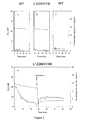
- Hydrogenase activity was assessed in the presence of O 2 by monitoring the H + /D 2 exchange activity, an intrinsic property of hydrogenase's active sites that does not involve electron transfer so that no catalytic reduction of dioxygen may occur.
- H + /deuterium exchange in aqueous phase was monitored continuously by a membrane-inlet mass-spectrometric method ( JOUANNEAU et al., J Bacteriol, 143, 628-36, 1980 ) at 30°C in a 1.5 ml vessel containing 50 mM phosphate buffer, pH 7. Prior to measurements, hydrogenase was activated by incubation under an H 2 atmosphere in the presence of 100 ⁇ M MV. Anoxia of samples during activation was easily monitored by the blue color of reduced MV.
- the assay was then performed in the following way: D 2 was bubbled into the medium in the vessel until O 2 was chased and decreased to the desired concentration, the vessel was then closed and an aliquot of activated hydrogenase (20 ⁇ l of activated sample, representing 1 to 2.5 ⁇ g of enzyme) was injected (at initial time in the graphs composing figure 2 ). Hydrogenase activity was then calculated from velocity of isotopic exchange as exposed previously ( COURNAC et al., J Bacteriol, 186, 1737-46, 2004 ).
- the native enzyme inactivation was almost instantaneous at dioxygen concentrations around 10 ⁇ M and above ( Fig 2A ). Some activity was detected soon after injection at lower O 2 concentrations (around 4 ⁇ M in Fig 2B ) which vanished within a few minutes. In addition, the native enzyme required prolonged incubation under reducing conditions to be reactivated. More surprisingly, the L122F-V74I mutant was inactivated in the same manner as the native enzyme ( Fig 2C ).
- the specific hydrogen-uptake activity of the L122M-V74M mutant was 320 U, which is comparable to that of the native hydrogenase (500 U).
- the inactivation of the L122M-V74M-mutant in the presence of about 20 ⁇ M dioxygen ( Fig 2D ) was much slower than that of the native enzyme.
- H + /D 2 exchange recovered to a large extent when O 2 concentration was set below 10 ⁇ M.
- About 50 % of the initial activity was maintained under 6 ⁇ M O 2 , a concentration at which the native enzyme is fully inhibited.
- EXAMPLE 3 EPR SPECTROSCOPY OF THE WT AND OF THE L122M-V74M [NiFe]-HYDROGENASES.
- the bridging ligand is thought to be a hydroxide ion that is easily removable under reducing conditions ( VOLBEDA et al., J Biol Inorg Chem, 10, 239-49, 2005 ; FERNANDEZ et al., Coordin. Chem. Rev., 249, 1596-608, 2005 ).
- the Ni-A state is obtained only under aerobic oxidizing conditions whereas the Ni-B species can be formed upon anaerobic oxidation.
- the significant amount of Ni-B signal observed in the oxidized L122M-V74M-mutant is therefore fully consistent with its fast reactivation and suggests that the mutant's methionine side chains protect the enzyme by restricting dioxygen accessibility to the active site.
- the L122M-V74M-mutation has no effect on the reduced Ni-C active state of the enzyme or on the reduced iron-sulfur clusters, as measured by EPR spectroscopy, indicating that the mutated enzyme is fully matured and functional and that H 2 can reach the active site.
- EXAMPLE 4 AEROBIC INACTIVATION OF THE WT AND OF THE L122M-V74M [NiFe]-HYDROGENASES.
- Protein film voltammetry was used to determine how the rate of aerobic inactivation is affected by the mutation.
- the enzyme is adsorbed onto an electrode so that direct electron transfer occurs, the activity is measured as a current and no soluble mediators need be used ( LEGER et al., Biochemistry, 42, 8653-62, 2003 ).
- Electrochemical measurements were performed as described previously ( LEGER et al., J Am Chem Soc, 126, 12162-72, 2004 ).
- the pyrolytic graphite edge electrode onto which the enzymes adsorb was poised at +200mV vs SHE, immerged in a solution at pH7, 40°C, continuously flushed with H 2 , and the activity was measured as a current ( Fig 4A ).
- the dioxygen concentration profile in Fig 4B was reconstructed from the amounts of aerated solution injected in the electrochemical cell, assuming an initial concentration of 250 ⁇ M O 2 in the air-saturated buffer. After each injection the O 2 concentration decreases exponentially with time and the time constant of the decay was determined by fitting the rate of the first inactivation as described in ( LEGER ct al., J Am Chem Soc, 126, 12162-72, 2004 ).
- Figure 4A compares the results of two inactivation experiments performed under exactly the same conditions. After exposure to sufficient amounts of O 2 , both enzymes loose all activity. However, all things being equal, the MM-mutant inactivates significantly more slowly than the native enzyme. We determined that the mutation decreases the bimolecular rate constant for the reaction with dioxygen from 32 s -1 mM -1 of O 2 ( LEGER et al., J Am Chem Soc, 126, 12162-72, 2004 ) to 20 s -1 mM -1 , indicating that 1) the access of O 2 to the active site limits the rate of inactivation, and 2) that this process is slower in the mutant. Therefore the electrochemical experiments are also fully consistent with the notion that the mutant's methionine side chains block the active site cavity entrance to oxygen.
- EXAMPLE 5 STRUCTURE OF THE L122M-V74M [NiFe] HYDROGENASE.
- the crystal structure of the L122M-V74M-mutant in the oxidised state was solved to determine the impact of the mutations on the shape of the gas tunnel, the reactivity of the methionines towards dioxygen and the possible modifications induced by the mutations in the active site cavity.
- Crystals of the double methionine mutant of D.fructosovorans [NiFe]-hydrogenase were obtained and stored in liquid nitrogen as described for the S499A mutant ( VOLBEDA et al., J Biol Inorg Chem, 10, 239-49, 2005 ).
- Diffraction data were collected at 100K on a square ADSC Q315R detector, using an X-ray wavelength of 1.0 ⁇ at the ED23-1 beam line of the European Synchrotron Radiation Facility in Grenoble, France.
- three sets of images were collected from different parts of a cryo-cooled crystal. For each image a ⁇ of 0.5 c and an exposure time of 0.6 seconds were used.
- the crystal structure was refined with REFMAC ( MURSHUDOV et al., Acta Crystallogr D Biol Crystallogr, 53, 240-55, 1997 ) with approximately the same strategy as described for the S499A mutant ( VOLBEDA et al., J Biol Inorg Chem, 10, 239-49, 2005 ).
- the residues at the two mutation sites, Val74 and Leu122, were first changed into alanines and all water molecules were deleted from the starting model. After rigid body refinement of each subunit, methionines were modeled at positions 74 and 122 of the large subunits.
- TLS bodies were used in order to model the overall anisotropic motions of each subunit ( WINN et al., Acta Crystallogr D Biol Crystallogr, 57, 122-33, 2001 ) and typically, 10 cycles of TLS refinement and 10-15 cycles of refinement of atomic positions and isotropic temperate factors were alternated with manual model corrections using TURBO-FRODO (ROUSSEL & CAMBILLAU, 81, 1991), including water molecules where the electron density map indicated significant peaks at geometrically suitable positions. During refinement it became clear that the mutated residues were partially disordered.
- EXAMPLE 6 SITE DIRECTED MUTAGENESIS OF HOXH SUBUNIT IN SYNECHOCYSTIS PCC6803 AND CATALYTIC ACTIVITY OF THE WT, OF THE HOXH AADA, OF THE I64M-L112M, AND OF THE I64M-L107M ENZYMES.
- Escherichia coli strains XL1 Blue, HB101 and DH10 ⁇ were used as a host in the cloning of the recombinant plasmids.
- the bacterium was routinely grown at 37°C in LB medium. Ampicillin at 100 ⁇ g/ml or chloramphenicol at 50 ⁇ g/ml were added when cells harboured pUC18 or pUC19 derivatives.
- Wild-type Synechocystis strain PCC 6803 and mutant strains were grown autotrophically in liquid modified Allen's medium ( Allen, J. Phycol., 4, 1-4, 1968 ) at 30°C under continuous illumination, using one fluorescence tubular lamp, which provided an average light intensity of 30 ⁇ mol of photons m -2 s -1 .
- Transformants were selected on Allen agar plates containing 25 ⁇ g chloramphenicol ml -1 for the deletion mutant ⁇ hoxH or 25 ⁇ g spectinomycin ml -1 for the mutants of the hoxH gene. Correct segregation of the transformants was checked by PCR.
- the pUC19 plasmid in which a sequence comprising the ORF of hoxH and 300bp upstream and downstream (position 1673795 to 1671771 of the complete Synechocystis sequence ( Kaneko et al. DNA Res., 3, 109-136, 1996 ) has been inserted, was subcloned in Escherichia coli cells and mutagenized.
- the QuickChange TM XL site-directed mutagenesis kit (Stratagene, Amsterdam, The Netherlands) was used to generate point mutations in the hoxH gene.
- the plasmid also contains a spectinomycin ( aadA ) resistance cassette inserted 50bp after the ORF of hoxH.
- the final plasmid was completely sequenced.
- the residues 164, L107 and L112 in Synechocystis correspond to residues V74, L117 and L122 in D . fructosovorans respectively.
- a ⁇ hoxH strain of Syrrechocystis sp. PCC 6803 was first constructed by transforming the wild-type strain with pUC18 harbouring the following construct: the ORF of hoxH and 300 bp upstream and downstream (position 1673795 to 1671771 of the complete sequence Kaneko et al. 1996) in which a chloramphenicol resistance cassette was inserted into Cla I restriction sites at position 19 and 1376 of hoxH . Indeed, starting from a deletion mutant is necessary due to the high number of chromosome copies in Synechocystis.
- the resulting strain ⁇ hoxH was transformed with the modified pUC19 plasmid containing the mutants of hoxH .
- Strains harbouring the modified gene were then selected on spectinomycin as described above. I64M-L112M and I64M-L107M HoxH mutants were thus obtained.
- Hydrogenase activity was assessed in the presence of O 2 by monitoring the H + /D 2 exchange activity as described in Example 2. Results are shown on Figures 6-9 .
- Figures 6 and 7 are the controls: Figure 6 represents the activity measured in the case of the ⁇ hoxH strain of Synechocystis sp. complemented with a wild-type (WT) copy of the hydrogenase gene ( hoxH ), and Figure 7 represents the activity measured in the case of the WT enzyme.
- WT wild-type
- Figure 8 presents the activity measured in the I64M-L112M extract. When O 2 was injected, the activity first dropped and then increased to remain stable while O 2 was still present. The addition of reduced methyl viologen (MV) did not increase the activity.
- MV reduced methyl viologen
- EXAMPLE 7 CATALYTIC ACTIVITY OF THE WT, OF THE L122F-V74M, AND OF THE V74M [NiFe]-HYDROGENASES
- Hydrogenase activity of the wild-type (denoted WT), of the L122F-V74M (denoted MM), and of the V74M (denoted M) [NiFe]-hydrogenases was assessed in the presence of O 2 by monitoring the H + /D 2 exchange activity.
- the medium was bubbled with D 2 and left open, so that the O 2 concentration is closed to that in air. Results are shown on Figure 10 .
- the M-mutant (V74M) was immediately active. It consumed D 2 and produced reduced methyl viologen (MV) that was oxidized by O 2 . This reaction was followed by the consumption of D 2 (dashed line in graph A) and by the decrease of O 2 (top line in graph A) reduced by the methyl viologen (MV).
- MV methyl viologen
- the electron flux was driven towards oxygen reduction, which prevented the exchange reaction to occur.
- oxygen was eliminated then the medium became fully reduced and the exchange reaction could start. This experiment demonstrates that the M-mutant is active in the presence of high oxygen concentration.
- the enzyme was also active in the presence of 150 ⁇ M of O 2 , but the kinetic was much slower. The enzyme became therefore inhibited by its longer exposure time to O 2 .
- the WT enzyme was readily inhibited by O 2 .
Landscapes
- Health & Medical Sciences (AREA)
- Life Sciences & Earth Sciences (AREA)
- Genetics & Genomics (AREA)
- Engineering & Computer Science (AREA)
- Chemical & Material Sciences (AREA)
- Organic Chemistry (AREA)
- Bioinformatics & Cheminformatics (AREA)
- Biomedical Technology (AREA)
- Wood Science & Technology (AREA)
- Zoology (AREA)
- Biotechnology (AREA)
- Molecular Biology (AREA)
- General Engineering & Computer Science (AREA)
- Microbiology (AREA)
- Biochemistry (AREA)
- General Health & Medical Sciences (AREA)
- Medicinal Chemistry (AREA)
- Physics & Mathematics (AREA)
- Biophysics (AREA)
- Plant Pathology (AREA)
- Enzymes And Modification Thereof (AREA)
- Micro-Organisms Or Cultivation Processes Thereof (AREA)
Claims (15)
- Verfahren zur Gewinnung eines mutierten Polynucleotids, welches eine veränderte große Untereinheit einer [NiFe]-Hydrogenase zur Verbesserung der Disauerstoff-Toleranz der besagten [NiFe]-Hydrogenase codiert, wobei das besagte Verfahren umfasst:- Bereitstellung eines anfänglichen Polynucleotids, welches eine Sequenz umfasst, welche eine große Untereinheit einer [NiFe]-Hydrogenase codiert, wobei die besagte große Untereinheit die folgenden Peptidmotive umfasst:• L1: RGXE, worin X = L, I, F, V oder M ist• L2: [R/K]X1C[G/R]X2C, worin X1 ein beliebiger Aminosäurerest ist, X2 = L, V oder I ist, L1 und L2 durch 16 beliebige Aminosäurereste getrennt sind;• L3: X1X2X3X4X5X6X7X8X9X10X11X12[D/S/E], worin X1 = D, S, N oder E, X2 = H, D, S, N oder L, X5 = H, S, A, Q oder W, X6 = F, T, Y oder G, X9 = L, F, M oder Y, das andere Xn ein beliebiger Aminosäurerest ist;• L4: D[P/I/S]CX1X2CX3X4[H/R], worin X2 = A, S, V, G oder T, X1, X3 und X4 ein beliebiger Aminosäurerest sind• und gegebenenfalls ein Motiv L0: R[I/V/A]EG[H/D/A] umfasst.- Verändern des besagten Polynucleotids, um mindestens den Rest X2 des Motivs L2 der besagten großen Untereinheit durch ein Methionin zu substituieren.
- Verfahren von Anspruch 1, wobei das besagte anfängliche Polynucleotid weiterhin verändert wird, um den Rest X4 des Motivs L3 der besagten großen Untereinheit durch ein Methionin zu substituieren.
- Verfahren von Anspruch 1 oder 2, wobei das besagte anfängliche Polynucleotid weiterhin verändert wird, um den Rest X9 des Motivs L3 der besagten großen Untereinheit durch ein Methionin zu substituieren.
- Verfahren von einem der Ansprüche 1 bis 3, wobei die besagte Sequenz, welche eine große Untereinheit einer [NiFe]-Hydrogenase codiert, aus Desulfovibrio fructosovorans oder Cyanobakterien, wie zum Beispiel Synechocystis, stammt.
- Verfahren von einem der Ansprüche 1 bis 4, wobei das besagte anfängliche Polynucleotid ein Operon ist, welches weiterhin die Sequenz(en) umfasst, welche die andere(n) Untereinheit(en) der besagten [NiFe]-Hydrogenase codiert/codieren.
- Mutiertes Polynucleotid, welches eine veränderte große Untereinheit einer [NiFe]-Hydrogenase codiert, welche die Peptidmotive L1, L2, L3, L4, wie in Anspruch 1 definiert, und gegebenenfalls L0, wie in Anspruch 1 definiert, aus Desulfovibrio fructosovorans oder Cyanobakterien, wie zum Beispiel Synechocystis, umfasst, dadurch gekennzeichnet, dass das besagte mutierte Polynucleotid mindestens ein Methionin am Rest X2 des besagten Motivs L2 codiert.
- Mutiertes Polynucleotid von Anspruch 6, wobei es weiterhin ein Methionin am Rest X4 des besagten Motivs L3 codiert.
- Mutiertes Polynucleotid von Anspruch 6 oder Anspruch 7, wobei es weiterhin ein Methionin am Rest X9 des besagten Motivs L3 codiert.
- Mutiertes Polynucleotid von einem der Ansprüche 6 bis 8, wobei es ein Operon ist, welches weiterhin die Sequenz(en) umfasst, welche die andere(n) Untereinheit(en) der besagten [NiFe]-Hydrogenase codiert/codieren.
- Vektor, umfassend ein mutiertes Polynucleotid von einem der Ansprüche 6 bis 9.
- Wirtszelle, transformiert durch einen Vektor von Anspruch 10.
- Veränderte große Untereinheit der [NiFe]-Hydrogenase aus Desulfovibrio fructosovorans oder Cyanobakterien, wie zum Beispiel Synechocystis, wobei der Rest X2 des Motivs L2, wie in Anspruch 1 definiert, durch ein Methionin substituiert ist.
- Veränderte große Untereinheit der [NiFe]-Hydrogenase gemäß Anspruch 12, wobei der Rest X4 des Motivs L3, wie in Anspruch 1 definiert, ferner durch ein Methionin substituiert ist.
- Veränderte große Untereinheit einer [NiFe]-Hydrogenase gemäß Anspruch 12 oder Anspruch 13, wobei der Rest X9 des Motivs L3, wie in Anspruch 1 definiert, ferner durch ein Methionin substituiert ist.
- [NiFe]-Hydrogenase aus Desulfovibrio fructosovorans oder Cyanobakterien, wie zum Beispiel Synechocystis, welche eine veränderte große Untereinheit von einem der Ansprüche 12 bis 14 enthält.
Priority Applications (1)
| Application Number | Priority Date | Filing Date | Title |
|---|---|---|---|
| EP08827040.0A EP2176403B1 (de) | 2007-08-03 | 2008-08-01 | NiFe-Hydrogenasen mit erhöhter Resistenz gegen Disauerstoff, Verfahren zu ihrer Gewinnung und Anwendungen davon |
Applications Claiming Priority (3)
| Application Number | Priority Date | Filing Date | Title |
|---|---|---|---|
| EP07290973A EP2020437A1 (de) | 2007-08-03 | 2007-08-03 | (NiFe)-Hydrogenasen mit verbesserter Sauerstoffresistenz, Verfahren zu ihrer Gewinnung und Anwendung |
| EP08827040.0A EP2176403B1 (de) | 2007-08-03 | 2008-08-01 | NiFe-Hydrogenasen mit erhöhter Resistenz gegen Disauerstoff, Verfahren zu ihrer Gewinnung und Anwendungen davon |
| PCT/IB2008/002998 WO2009019613A2 (en) | 2007-08-03 | 2008-08-01 | [nife]-hydrogenases having an improved resistance to dioxygen, process for obtaining them and their applications |
Publications (2)
| Publication Number | Publication Date |
|---|---|
| EP2176403A2 EP2176403A2 (de) | 2010-04-21 |
| EP2176403B1 true EP2176403B1 (de) | 2014-04-30 |
Family
ID=38926393
Family Applications (2)
| Application Number | Title | Priority Date | Filing Date |
|---|---|---|---|
| EP07290973A Ceased EP2020437A1 (de) | 2007-08-03 | 2007-08-03 | (NiFe)-Hydrogenasen mit verbesserter Sauerstoffresistenz, Verfahren zu ihrer Gewinnung und Anwendung |
| EP08827040.0A Not-in-force EP2176403B1 (de) | 2007-08-03 | 2008-08-01 | NiFe-Hydrogenasen mit erhöhter Resistenz gegen Disauerstoff, Verfahren zu ihrer Gewinnung und Anwendungen davon |
Family Applications Before (1)
| Application Number | Title | Priority Date | Filing Date |
|---|---|---|---|
| EP07290973A Ceased EP2020437A1 (de) | 2007-08-03 | 2007-08-03 | (NiFe)-Hydrogenasen mit verbesserter Sauerstoffresistenz, Verfahren zu ihrer Gewinnung und Anwendung |
Country Status (6)
| Country | Link |
|---|---|
| US (1) | US8377671B2 (de) |
| EP (2) | EP2020437A1 (de) |
| JP (1) | JP2010535471A (de) |
| CA (1) | CA2695491A1 (de) |
| ES (1) | ES2483342T3 (de) |
| WO (1) | WO2009019613A2 (de) |
Families Citing this family (16)
| Publication number | Priority date | Publication date | Assignee | Title |
|---|---|---|---|---|
| EP3587573A1 (de) | 2011-06-16 | 2020-01-01 | The Regents of The University of California | Synthetische gencluster |
| WO2014071182A1 (en) | 2012-11-01 | 2014-05-08 | Massachusetts Institute Of Technology | Directed evolution of synthetic gene cluster |
| KR102804055B1 (ko) | 2015-07-13 | 2025-05-08 | 피벗 바이오, 인크. | 식물 형질 개선을 위한 방법 및 조성물 |
| CA3001001A1 (en) | 2015-10-05 | 2017-04-13 | Massachusetts Institute Of Technology | Nitrogen fixation using refactored nif clusters |
| CN116904333A (zh) | 2017-01-12 | 2023-10-20 | 皮沃特生物公司 | 用于改良植物性状的方法及组合物 |
| CN111527057A (zh) | 2017-10-25 | 2020-08-11 | 皮沃特生物股份有限公司 | 靶向改良植物性状的固氮的基因靶标 |
| MX2020004343A (es) | 2017-10-25 | 2021-01-08 | Pivot Bio Inc | Métodos y composiciones para mejorar microbios modificados que fijan nitrógeno. |
| WO2020006064A2 (en) | 2018-06-27 | 2020-01-02 | Pivot Bio, Inc. | Agricultural compositions comprising remodeled nitrogen fixing microbes |
| EP3813511A4 (de) | 2018-06-27 | 2022-08-03 | Pivot Bio, Inc. | Geführte mikrobielle remodellierung, plattform zur rationellen verbesserung mikrobieller spezies für die landwirtschaft |
| KR20210060434A (ko) | 2018-07-11 | 2021-05-26 | 피벗 바이오, 인크. | 리모델링된 미생물에 의한 시간적 및 공간적 표적화 동적 질소 전달 |
| AU2020206751A1 (en) | 2019-01-07 | 2021-07-01 | Pivot Bio, Inc. | Plant colonization assays using natural microbial barcodes |
| WO2020190363A1 (en) | 2019-03-19 | 2020-09-24 | Massachusetts Institute Of Technology | Control of nitrogen fixation in rhizobia that associate with cereals |
| CA3129539A1 (en) | 2019-04-25 | 2020-10-29 | Min-Hyung RYU | High-throughput methods for isolating and characterizing ammonium-excreting mutant libraries generated by chemical mutagenesis |
| WO2021094465A1 (fr) * | 2019-11-13 | 2021-05-20 | H2Win S.A. | Polypeptide monomérique présentant une activité hydrogénase, en particulier polypeptide monomérique recombinant présentant une activité hydrogénase |
| CA3172321A1 (en) | 2020-05-01 | 2021-11-04 | Farzaneh REZAEI | Stable liquid formulations for nitrogen-fixing microorganisms |
| AU2020445067A1 (en) | 2020-05-01 | 2022-12-01 | Pivot Bio, Inc. | Measurement of nitrogen fixation and incorporation |
Family Cites Families (1)
| Publication number | Priority date | Publication date | Assignee | Title |
|---|---|---|---|---|
| WO2004093524A2 (en) * | 2003-04-18 | 2004-11-04 | Midwest Research Institute | Oxygen-resistant hydrogenases and methods for designing and making same |
-
2007
- 2007-08-03 EP EP07290973A patent/EP2020437A1/de not_active Ceased
-
2008
- 2008-08-01 US US12/671,555 patent/US8377671B2/en not_active Expired - Fee Related
- 2008-08-01 ES ES08827040.0T patent/ES2483342T3/es active Active
- 2008-08-01 CA CA2695491A patent/CA2695491A1/en active Pending
- 2008-08-01 WO PCT/IB2008/002998 patent/WO2009019613A2/en not_active Ceased
- 2008-08-01 EP EP08827040.0A patent/EP2176403B1/de not_active Not-in-force
- 2008-08-01 JP JP2010518780A patent/JP2010535471A/ja not_active Withdrawn
Also Published As
| Publication number | Publication date |
|---|---|
| ES2483342T3 (es) | 2014-08-06 |
| WO2009019613A2 (en) | 2009-02-12 |
| US8377671B2 (en) | 2013-02-19 |
| WO2009019613A3 (en) | 2009-06-11 |
| CA2695491A1 (en) | 2009-02-12 |
| EP2176403A2 (de) | 2010-04-21 |
| US20110212502A1 (en) | 2011-09-01 |
| JP2010535471A (ja) | 2010-11-25 |
| EP2020437A1 (de) | 2009-02-04 |
Similar Documents
| Publication | Publication Date | Title |
|---|---|---|
| EP2176403B1 (de) | NiFe-Hydrogenasen mit erhöhter Resistenz gegen Disauerstoff, Verfahren zu ihrer Gewinnung und Anwendungen davon | |
| Buhrke et al. | Oxygen tolerance of the H2-sensing [NiFe] hydrogenase from Ralstonia eutropha H16 is based on limited access of oxygen to the active site | |
| Duché et al. | Enlarging the gas access channel to the active site renders the regulatory hydrogenase HupUV of Rhodobacter capsulatus O2 sensitive without affecting its transductory activity | |
| Ferry | Enzymology of one-carbon metabolism in methanogenic pathways | |
| Posewitz et al. | Discovery of two novel radical S-adenosylmethionine proteins required for the assembly of an active [Fe] hydrogenase | |
| Garcin et al. | The crystal structure of a reduced [NiFeSe] hydrogenase provides an image of the activated catalytic center | |
| Ren et al. | A protein disulfide oxidoreductase from the archaeon Pyrococcus furiosus contains two thioredoxin fold units | |
| Knörzer et al. | Importance of the protein framework for catalytic activity of [FeFe]-hydrogenases | |
| Pilak et al. | The crystal structure of the apoenzyme of the iron–sulphur cluster-free hydrogenase | |
| Brugna-Guiral et al. | [NiFe] hydrogenases from the hyperthermophilic bacterium Aquifex aeolicus: properties, function, and phylogenetics | |
| Auld et al. | Medium-and short-chain dehydrogenase/reductase gene and protein families: The role of zinc for alcohol dehydrogenase structure and function | |
| Aufhammer et al. | Crystal structure of methylenetetrahydromethanopterin reductase (Mer) in complex with coenzyme F420: Architecture of the F420/FMN binding site of enzymes within the nonprolyl cis‐peptide containing bacterial luciferase family | |
| Bowman et al. | How the structure of the large subunit controls function in an oxygen-tolerant [NiFe]-hydrogenase | |
| Birrell et al. | Importance of hydrogen bonding in fine tuning the [2Fe-2S] cluster redox potential of HydC from Thermotoga maritima | |
| Moore et al. | Structural insights into the mechanism of four-coordinate Cob (II) alamin formation in the active site of the Salmonella enterica ATP: Co (I) rrinoid adenosyltransferase enzyme: critical role of residues Phe91 and Trp93 | |
| Fritsch et al. | [NiFe] and [FeS] cofactors in the membrane-bound hydrogenase of Ralstonia eutropha investigated by X-ray absorption spectroscopy: insights into O2-tolerant H2 cleavage | |
| US9249440B2 (en) | Hydrogenase polypeptide and methods of use | |
| Rousset et al. | Engineering hydrogenases for H2 production: bolts and goals | |
| King et al. | Structural and functional investigations of biological catalysts for optimization of solar-driven H2 production systems | |
| Plegaria et al. | Structural and functional characterization of a short-chain flavodoxin associated with a noncanonical 1, 2-propanediol utilization bacterial microcompartment | |
| Leroux et al. | Is engineering O2-tolerant hydrogenases just a matter of reproducing the active sites of the naturally occurring O2-resistant enzymes? | |
| Evans et al. | A novel overproduction system for the structural determination of a proton-pumping hydrogen-producing [NiFe]-hydrogenase | |
| Kanai et al. | Hydrogen production by the hyperthermophilic archaeon Thermococcus kodakarensis | |
| CN114901814B (zh) | 具有氢化酶活性的单体多肽,特别是具有氢化酶活性的重组单体多肽 | |
| Greening et al. | Unique minimal and hybrid hydrogenases are active in anaerobic archaea |
Legal Events
| Date | Code | Title | Description |
|---|---|---|---|
| PUAI | Public reference made under article 153(3) epc to a published international application that has entered the european phase |
Free format text: ORIGINAL CODE: 0009012 |
|
| 17P | Request for examination filed |
Effective date: 20100205 |
|
| AK | Designated contracting states |
Kind code of ref document: A2 Designated state(s): AT BE BG CH CY CZ DE DK EE ES FI FR GB GR HR HU IE IS IT LI LT LU LV MC MT NL NO PL PT RO SE SI SK TR |
|
| AX | Request for extension of the european patent |
Extension state: AL BA MK RS |
|
| RAP1 | Party data changed (applicant data changed or rights of an application transferred) |
Owner name: COMMISSARIAT A L'ENERGIE ATOMIQUE ET AUX ENERGIES Owner name: CENTRE NATIONAL DE LA RECHERCHE SCIENTIFIQUE |
|
| 17Q | First examination report despatched |
Effective date: 20100607 |
|
| DAX | Request for extension of the european patent (deleted) | ||
| GRAP | Despatch of communication of intention to grant a patent |
Free format text: ORIGINAL CODE: EPIDOSNIGR1 |
|
| RIC1 | Information provided on ipc code assigned before grant |
Ipc: C12N 15/52 20060101ALI20131107BHEP Ipc: C12N 1/15 20060101ALI20131107BHEP Ipc: C12N 5/10 20060101ALI20131107BHEP Ipc: C12N 1/21 20060101ALI20131107BHEP Ipc: C12N 15/53 20060101ALI20131107BHEP Ipc: C12N 9/02 20060101AFI20131107BHEP |
|
| INTG | Intention to grant announced |
Effective date: 20131126 |
|
| GRAS | Grant fee paid |
Free format text: ORIGINAL CODE: EPIDOSNIGR3 |
|
| GRAA | (expected) grant |
Free format text: ORIGINAL CODE: 0009210 |
|
| AK | Designated contracting states |
Kind code of ref document: B1 Designated state(s): AT BE BG CH CY CZ DE DK EE ES FI FR GB GR HR HU IE IS IT LI LT LU LV MC MT NL NO PL PT RO SE SI SK TR |
|
| REG | Reference to a national code |
Ref country code: GB Ref legal event code: FG4D Ref country code: CH Ref legal event code: EP |
|
| REG | Reference to a national code |
Ref country code: AT Ref legal event code: REF Ref document number: 665192 Country of ref document: AT Kind code of ref document: T Effective date: 20140515 |
|
| REG | Reference to a national code |
Ref country code: IE Ref legal event code: FG4D |
|
| REG | Reference to a national code |
Ref country code: DE Ref legal event code: R096 Ref document number: 602008031909 Country of ref document: DE Effective date: 20140612 |
|
| REG | Reference to a national code |
Ref country code: ES Ref legal event code: FG2A Ref document number: 2483342 Country of ref document: ES Kind code of ref document: T3 Effective date: 20140806 |
|
| REG | Reference to a national code |
Ref country code: NL Ref legal event code: T3 |
|
| REG | Reference to a national code |
Ref country code: AT Ref legal event code: MK05 Ref document number: 665192 Country of ref document: AT Kind code of ref document: T Effective date: 20140430 |
|
| REG | Reference to a national code |
Ref country code: LT Ref legal event code: MG4D |
|
| PG25 | Lapsed in a contracting state [announced via postgrant information from national office to epo] |
Ref country code: IS Free format text: LAPSE BECAUSE OF FAILURE TO SUBMIT A TRANSLATION OF THE DESCRIPTION OR TO PAY THE FEE WITHIN THE PRESCRIBED TIME-LIMIT Effective date: 20140830 Ref country code: GR Free format text: LAPSE BECAUSE OF FAILURE TO SUBMIT A TRANSLATION OF THE DESCRIPTION OR TO PAY THE FEE WITHIN THE PRESCRIBED TIME-LIMIT Effective date: 20140731 Ref country code: NO Free format text: LAPSE BECAUSE OF FAILURE TO SUBMIT A TRANSLATION OF THE DESCRIPTION OR TO PAY THE FEE WITHIN THE PRESCRIBED TIME-LIMIT Effective date: 20140730 Ref country code: LT Free format text: LAPSE BECAUSE OF FAILURE TO SUBMIT A TRANSLATION OF THE DESCRIPTION OR TO PAY THE FEE WITHIN THE PRESCRIBED TIME-LIMIT Effective date: 20140430 Ref country code: FI Free format text: LAPSE BECAUSE OF FAILURE TO SUBMIT A TRANSLATION OF THE DESCRIPTION OR TO PAY THE FEE WITHIN THE PRESCRIBED TIME-LIMIT Effective date: 20140430 Ref country code: CY Free format text: LAPSE BECAUSE OF FAILURE TO SUBMIT A TRANSLATION OF THE DESCRIPTION OR TO PAY THE FEE WITHIN THE PRESCRIBED TIME-LIMIT Effective date: 20140430 Ref country code: BG Free format text: LAPSE BECAUSE OF FAILURE TO SUBMIT A TRANSLATION OF THE DESCRIPTION OR TO PAY THE FEE WITHIN THE PRESCRIBED TIME-LIMIT Effective date: 20140730 |
|
| PG25 | Lapsed in a contracting state [announced via postgrant information from national office to epo] |
Ref country code: HR Free format text: LAPSE BECAUSE OF FAILURE TO SUBMIT A TRANSLATION OF THE DESCRIPTION OR TO PAY THE FEE WITHIN THE PRESCRIBED TIME-LIMIT Effective date: 20140430 Ref country code: SE Free format text: LAPSE BECAUSE OF FAILURE TO SUBMIT A TRANSLATION OF THE DESCRIPTION OR TO PAY THE FEE WITHIN THE PRESCRIBED TIME-LIMIT Effective date: 20140430 Ref country code: LV Free format text: LAPSE BECAUSE OF FAILURE TO SUBMIT A TRANSLATION OF THE DESCRIPTION OR TO PAY THE FEE WITHIN THE PRESCRIBED TIME-LIMIT Effective date: 20140430 Ref country code: AT Free format text: LAPSE BECAUSE OF FAILURE TO SUBMIT A TRANSLATION OF THE DESCRIPTION OR TO PAY THE FEE WITHIN THE PRESCRIBED TIME-LIMIT Effective date: 20140430 Ref country code: PL Free format text: LAPSE BECAUSE OF FAILURE TO SUBMIT A TRANSLATION OF THE DESCRIPTION OR TO PAY THE FEE WITHIN THE PRESCRIBED TIME-LIMIT Effective date: 20140430 |
|
| PG25 | Lapsed in a contracting state [announced via postgrant information from national office to epo] |
Ref country code: PT Free format text: LAPSE BECAUSE OF FAILURE TO SUBMIT A TRANSLATION OF THE DESCRIPTION OR TO PAY THE FEE WITHIN THE PRESCRIBED TIME-LIMIT Effective date: 20140901 |
|
| PG25 | Lapsed in a contracting state [announced via postgrant information from national office to epo] |
Ref country code: DK Free format text: LAPSE BECAUSE OF FAILURE TO SUBMIT A TRANSLATION OF THE DESCRIPTION OR TO PAY THE FEE WITHIN THE PRESCRIBED TIME-LIMIT Effective date: 20140430 Ref country code: RO Free format text: LAPSE BECAUSE OF FAILURE TO SUBMIT A TRANSLATION OF THE DESCRIPTION OR TO PAY THE FEE WITHIN THE PRESCRIBED TIME-LIMIT Effective date: 20140430 Ref country code: BE Free format text: LAPSE BECAUSE OF FAILURE TO SUBMIT A TRANSLATION OF THE DESCRIPTION OR TO PAY THE FEE WITHIN THE PRESCRIBED TIME-LIMIT Effective date: 20140430 Ref country code: EE Free format text: LAPSE BECAUSE OF FAILURE TO SUBMIT A TRANSLATION OF THE DESCRIPTION OR TO PAY THE FEE WITHIN THE PRESCRIBED TIME-LIMIT Effective date: 20140430 Ref country code: SK Free format text: LAPSE BECAUSE OF FAILURE TO SUBMIT A TRANSLATION OF THE DESCRIPTION OR TO PAY THE FEE WITHIN THE PRESCRIBED TIME-LIMIT Effective date: 20140430 Ref country code: CZ Free format text: LAPSE BECAUSE OF FAILURE TO SUBMIT A TRANSLATION OF THE DESCRIPTION OR TO PAY THE FEE WITHIN THE PRESCRIBED TIME-LIMIT Effective date: 20140430 |
|
| REG | Reference to a national code |
Ref country code: DE Ref legal event code: R097 Ref document number: 602008031909 Country of ref document: DE |
|
| PLBE | No opposition filed within time limit |
Free format text: ORIGINAL CODE: 0009261 |
|
| STAA | Information on the status of an ep patent application or granted ep patent |
Free format text: STATUS: NO OPPOSITION FILED WITHIN TIME LIMIT |
|
| PG25 | Lapsed in a contracting state [announced via postgrant information from national office to epo] |
Ref country code: LU Free format text: LAPSE BECAUSE OF FAILURE TO SUBMIT A TRANSLATION OF THE DESCRIPTION OR TO PAY THE FEE WITHIN THE PRESCRIBED TIME-LIMIT Effective date: 20140801 Ref country code: MC Free format text: LAPSE BECAUSE OF FAILURE TO SUBMIT A TRANSLATION OF THE DESCRIPTION OR TO PAY THE FEE WITHIN THE PRESCRIBED TIME-LIMIT Effective date: 20140430 |
|
| REG | Reference to a national code |
Ref country code: CH Ref legal event code: PL |
|
| 26N | No opposition filed |
Effective date: 20150202 |
|
| GBPC | Gb: european patent ceased through non-payment of renewal fee |
Effective date: 20140801 |
|
| PG25 | Lapsed in a contracting state [announced via postgrant information from national office to epo] |
Ref country code: LI Free format text: LAPSE BECAUSE OF NON-PAYMENT OF DUE FEES Effective date: 20140831 Ref country code: CH Free format text: LAPSE BECAUSE OF NON-PAYMENT OF DUE FEES Effective date: 20140831 |
|
| REG | Reference to a national code |
Ref country code: DE Ref legal event code: R097 Ref document number: 602008031909 Country of ref document: DE Effective date: 20150202 |
|
| REG | Reference to a national code |
Ref country code: IE Ref legal event code: MM4A |
|
| PG25 | Lapsed in a contracting state [announced via postgrant information from national office to epo] |
Ref country code: GB Free format text: LAPSE BECAUSE OF NON-PAYMENT OF DUE FEES Effective date: 20140801 Ref country code: SI Free format text: LAPSE BECAUSE OF FAILURE TO SUBMIT A TRANSLATION OF THE DESCRIPTION OR TO PAY THE FEE WITHIN THE PRESCRIBED TIME-LIMIT Effective date: 20140430 |
|
| PG25 | Lapsed in a contracting state [announced via postgrant information from national office to epo] |
Ref country code: IE Free format text: LAPSE BECAUSE OF NON-PAYMENT OF DUE FEES Effective date: 20140801 |
|
| REG | Reference to a national code |
Ref country code: FR Ref legal event code: PLFP Year of fee payment: 8 |
|
| PG25 | Lapsed in a contracting state [announced via postgrant information from national office to epo] |
Ref country code: MT Free format text: LAPSE BECAUSE OF FAILURE TO SUBMIT A TRANSLATION OF THE DESCRIPTION OR TO PAY THE FEE WITHIN THE PRESCRIBED TIME-LIMIT Effective date: 20140430 |
|
| PG25 | Lapsed in a contracting state [announced via postgrant information from national office to epo] |
Ref country code: TR Free format text: LAPSE BECAUSE OF FAILURE TO SUBMIT A TRANSLATION OF THE DESCRIPTION OR TO PAY THE FEE WITHIN THE PRESCRIBED TIME-LIMIT Effective date: 20140430 Ref country code: HU Free format text: LAPSE BECAUSE OF FAILURE TO SUBMIT A TRANSLATION OF THE DESCRIPTION OR TO PAY THE FEE WITHIN THE PRESCRIBED TIME-LIMIT; INVALID AB INITIO Effective date: 20080801 |
|
| REG | Reference to a national code |
Ref country code: FR Ref legal event code: PLFP Year of fee payment: 9 |
|
| PGFP | Annual fee paid to national office [announced via postgrant information from national office to epo] |
Ref country code: NL Payment date: 20160711 Year of fee payment: 9 |
|
| PGFP | Annual fee paid to national office [announced via postgrant information from national office to epo] |
Ref country code: DE Payment date: 20160817 Year of fee payment: 9 Ref country code: IT Payment date: 20160822 Year of fee payment: 9 |
|
| PGFP | Annual fee paid to national office [announced via postgrant information from national office to epo] |
Ref country code: FR Payment date: 20160831 Year of fee payment: 9 |
|
| PGFP | Annual fee paid to national office [announced via postgrant information from national office to epo] |
Ref country code: ES Payment date: 20160830 Year of fee payment: 9 |
|
| REG | Reference to a national code |
Ref country code: DE Ref legal event code: R119 Ref document number: 602008031909 Country of ref document: DE |
|
| REG | Reference to a national code |
Ref country code: NL Ref legal event code: MM Effective date: 20170901 |
|
| REG | Reference to a national code |
Ref country code: FR Ref legal event code: ST Effective date: 20180430 |
|
| PG25 | Lapsed in a contracting state [announced via postgrant information from national office to epo] |
Ref country code: NL Free format text: LAPSE BECAUSE OF NON-PAYMENT OF DUE FEES Effective date: 20170901 |
|
| PG25 | Lapsed in a contracting state [announced via postgrant information from national office to epo] |
Ref country code: DE Free format text: LAPSE BECAUSE OF NON-PAYMENT OF DUE FEES Effective date: 20180301 |
|
| PG25 | Lapsed in a contracting state [announced via postgrant information from national office to epo] |
Ref country code: IT Free format text: LAPSE BECAUSE OF NON-PAYMENT OF DUE FEES Effective date: 20170801 Ref country code: FR Free format text: LAPSE BECAUSE OF NON-PAYMENT OF DUE FEES Effective date: 20170831 |
|
| REG | Reference to a national code |
Ref country code: ES Ref legal event code: FD2A Effective date: 20181030 |
|
| PG25 | Lapsed in a contracting state [announced via postgrant information from national office to epo] |
Ref country code: ES Free format text: LAPSE BECAUSE OF NON-PAYMENT OF DUE FEES Effective date: 20170802 |