EP2174941A1 - Isosorbide-derivatives - Google Patents
Isosorbide-derivatives Download PDFInfo
- Publication number
- EP2174941A1 EP2174941A1 EP08017704A EP08017704A EP2174941A1 EP 2174941 A1 EP2174941 A1 EP 2174941A1 EP 08017704 A EP08017704 A EP 08017704A EP 08017704 A EP08017704 A EP 08017704A EP 2174941 A1 EP2174941 A1 EP 2174941A1
- Authority
- EP
- European Patent Office
- Prior art keywords
- isosorbide
- atoms
- formula
- linear
- saturated
- Prior art date
- Legal status (The legal status is an assumption and is not a legal conclusion. Google has not performed a legal analysis and makes no representation as to the accuracy of the status listed.)
- Granted
Links
- KLDXJTOLSGUMSJ-JGWLITMVSA-N Isosorbide Chemical class O[C@@H]1CO[C@@H]2[C@@H](O)CO[C@@H]21 KLDXJTOLSGUMSJ-JGWLITMVSA-N 0.000 claims abstract description 46
- 125000004432 carbon atom Chemical group C* 0.000 claims abstract description 18
- 125000004435 hydrogen atom Chemical group [H]* 0.000 claims abstract description 15
- 229920006395 saturated elastomer Polymers 0.000 claims abstract description 15
- 125000003342 alkenyl group Chemical group 0.000 claims abstract description 12
- 125000000217 alkyl group Chemical group 0.000 claims abstract description 12
- IAYPIBMASNFSPL-UHFFFAOYSA-N Ethylene oxide Chemical group C1CO1 IAYPIBMASNFSPL-UHFFFAOYSA-N 0.000 claims abstract description 8
- GOOHAUXETOMSMM-UHFFFAOYSA-N Propylene oxide Chemical compound CC1CO1 GOOHAUXETOMSMM-UHFFFAOYSA-N 0.000 claims abstract description 7
- 229920000642 polymer Polymers 0.000 claims abstract description 3
- 229960002479 isosorbide Drugs 0.000 claims description 18
- 150000001875 compounds Chemical class 0.000 claims description 14
- 238000002360 preparation method Methods 0.000 claims description 11
- 238000000034 method Methods 0.000 claims description 8
- 239000000203 mixture Substances 0.000 claims description 7
- 239000003599 detergent Substances 0.000 claims description 6
- 239000003054 catalyst Substances 0.000 claims description 5
- -1 epoxide compound Chemical class 0.000 claims description 5
- 239000002537 cosmetic Substances 0.000 claims description 4
- 239000003905 agrochemical Substances 0.000 claims description 2
- 239000000178 monomer Substances 0.000 abstract description 6
- 150000002924 oxiranes Chemical class 0.000 abstract description 6
- 238000006116 polymerization reaction Methods 0.000 abstract description 4
- 229920001400 block copolymer Polymers 0.000 abstract description 3
- 229920001577 copolymer Polymers 0.000 abstract description 2
- 229920001519 homopolymer Polymers 0.000 abstract description 2
- KWYUFKZDYYNOTN-UHFFFAOYSA-M Potassium hydroxide Chemical compound [OH-].[K+] KWYUFKZDYYNOTN-UHFFFAOYSA-M 0.000 description 9
- 238000006243 chemical reaction Methods 0.000 description 9
- 238000004140 cleaning Methods 0.000 description 9
- 150000004703 alkoxides Chemical group 0.000 description 8
- 238000012360 testing method Methods 0.000 description 7
- JSPLKZUTYZBBKA-UHFFFAOYSA-N trioxidane Chemical class OOO JSPLKZUTYZBBKA-UHFFFAOYSA-N 0.000 description 6
- 238000004851 dishwashing Methods 0.000 description 4
- 150000002170 ethers Chemical class 0.000 description 4
- 238000005187 foaming Methods 0.000 description 4
- JVTAAEKCZFNVCJ-UHFFFAOYSA-N lactic acid Chemical compound CC(O)C(O)=O JVTAAEKCZFNVCJ-UHFFFAOYSA-N 0.000 description 4
- 239000004033 plastic Substances 0.000 description 4
- 239000002689 soil Substances 0.000 description 4
- 239000004094 surface-active agent Substances 0.000 description 4
- HEMHJVSKTPXQMS-UHFFFAOYSA-M Sodium hydroxide Chemical compound [OH-].[Na+] HEMHJVSKTPXQMS-UHFFFAOYSA-M 0.000 description 3
- XLYOFNOQVPJJNP-UHFFFAOYSA-N water Substances O XLYOFNOQVPJJNP-UHFFFAOYSA-N 0.000 description 3
- KLDXJTOLSGUMSJ-UNTFVMJOSA-N (3s,3ar,6s,6ar)-2,3,3a,5,6,6a-hexahydrofuro[3,2-b]furan-3,6-diol Chemical compound O[C@H]1CO[C@@H]2[C@@H](O)CO[C@@H]21 KLDXJTOLSGUMSJ-UNTFVMJOSA-N 0.000 description 2
- FBPFZTCFMRRESA-FSIIMWSLSA-N D-Glucitol Natural products OC[C@H](O)[C@H](O)[C@@H](O)[C@H](O)CO FBPFZTCFMRRESA-FSIIMWSLSA-N 0.000 description 2
- VEXZGXHMUGYJMC-UHFFFAOYSA-N Hydrochloric acid Chemical compound Cl VEXZGXHMUGYJMC-UHFFFAOYSA-N 0.000 description 2
- 230000003197 catalytic effect Effects 0.000 description 2
- 230000000694 effects Effects 0.000 description 2
- 239000003995 emulsifying agent Substances 0.000 description 2
- 238000009472 formulation Methods 0.000 description 2
- 239000004310 lactic acid Substances 0.000 description 2
- 235000014655 lactic acid Nutrition 0.000 description 2
- 239000007788 liquid Substances 0.000 description 2
- 239000006254 rheological additive Substances 0.000 description 2
- 239000002904 solvent Substances 0.000 description 2
- 239000000600 sorbitol Substances 0.000 description 2
- 239000007921 spray Substances 0.000 description 2
- 238000004448 titration Methods 0.000 description 2
- 125000004417 unsaturated alkyl group Chemical group 0.000 description 2
- MPGABYXKKCLIRW-UHFFFAOYSA-N 2-decyloxirane Chemical compound CCCCCCCCCCC1CO1 MPGABYXKKCLIRW-UHFFFAOYSA-N 0.000 description 1
- AAMHBRRZYSORSH-UHFFFAOYSA-N 2-octyloxirane Chemical compound CCCCCCCCC1CO1 AAMHBRRZYSORSH-UHFFFAOYSA-N 0.000 description 1
- VGGSQFUCUMXWEO-UHFFFAOYSA-N Ethene Chemical compound C=C VGGSQFUCUMXWEO-UHFFFAOYSA-N 0.000 description 1
- 239000005977 Ethylene Substances 0.000 description 1
- DGAQECJNVWCQMB-PUAWFVPOSA-M Ilexoside XXIX Chemical compound C[C@@H]1CC[C@@]2(CC[C@@]3(C(=CC[C@H]4[C@]3(CC[C@@H]5[C@@]4(CC[C@@H](C5(C)C)OS(=O)(=O)[O-])C)C)[C@@H]2[C@]1(C)O)C)C(=O)O[C@H]6[C@@H]([C@H]([C@@H]([C@H](O6)CO)O)O)O.[Na+] DGAQECJNVWCQMB-PUAWFVPOSA-M 0.000 description 1
- RVGRUAULSDPKGF-UHFFFAOYSA-N Poloxamer Chemical group C1CO1.CC1CO1 RVGRUAULSDPKGF-UHFFFAOYSA-N 0.000 description 1
- ZLMJMSJWJFRBEC-UHFFFAOYSA-N Potassium Chemical compound [K] ZLMJMSJWJFRBEC-UHFFFAOYSA-N 0.000 description 1
- 229920002472 Starch Polymers 0.000 description 1
- 230000002378 acidificating effect Effects 0.000 description 1
- 239000002280 amphoteric surfactant Substances 0.000 description 1
- 150000008064 anhydrides Chemical class 0.000 description 1
- 125000000129 anionic group Chemical group 0.000 description 1
- 239000003945 anionic surfactant Substances 0.000 description 1
- 125000004429 atom Chemical group 0.000 description 1
- 230000015572 biosynthetic process Effects 0.000 description 1
- 239000003093 cationic surfactant Substances 0.000 description 1
- 230000018044 dehydration Effects 0.000 description 1
- 238000006297 dehydration reaction Methods 0.000 description 1
- 230000001419 dependent effect Effects 0.000 description 1
- 150000001983 dialkylethers Chemical class 0.000 description 1
- 150000005690 diesters Chemical class 0.000 description 1
- 150000005218 dimethyl ethers Chemical class 0.000 description 1
- 239000002270 dispersing agent Substances 0.000 description 1
- 239000003623 enhancer Substances 0.000 description 1
- 238000007046 ethoxylation reaction Methods 0.000 description 1
- 239000006260 foam Substances 0.000 description 1
- 238000010438 heat treatment Methods 0.000 description 1
- NUHSROFQTUXZQQ-UHFFFAOYSA-N isopentenyl diphosphate Chemical compound CC(=C)CCO[P@](O)(=O)OP(O)(O)=O NUHSROFQTUXZQQ-UHFFFAOYSA-N 0.000 description 1
- 230000003137 locomotive effect Effects 0.000 description 1
- 239000012299 nitrogen atmosphere Substances 0.000 description 1
- 239000002736 nonionic surfactant Substances 0.000 description 1
- 238000011056 performance test Methods 0.000 description 1
- 239000011591 potassium Substances 0.000 description 1
- 229910052700 potassium Inorganic materials 0.000 description 1
- 238000007142 ring opening reaction Methods 0.000 description 1
- 229910052708 sodium Inorganic materials 0.000 description 1
- 239000011734 sodium Substances 0.000 description 1
- 235000011121 sodium hydroxide Nutrition 0.000 description 1
- 229940083608 sodium hydroxide Drugs 0.000 description 1
- 239000007787 solid Substances 0.000 description 1
- 239000013042 solid detergent Substances 0.000 description 1
- 239000003381 stabilizer Substances 0.000 description 1
- 235000019698 starch Nutrition 0.000 description 1
- 239000008107 starch Substances 0.000 description 1
- QAOWNCQODCNURD-UHFFFAOYSA-N sulfuric acid Substances OS(O)(=O)=O QAOWNCQODCNURD-UHFFFAOYSA-N 0.000 description 1
- 238000005406 washing Methods 0.000 description 1
Classifications
-
- C—CHEMISTRY; METALLURGY
- C07—ORGANIC CHEMISTRY
- C07D—HETEROCYCLIC COMPOUNDS
- C07D493/00—Heterocyclic compounds containing oxygen atoms as the only ring hetero atoms in the condensed system
- C07D493/02—Heterocyclic compounds containing oxygen atoms as the only ring hetero atoms in the condensed system in which the condensed system contains two hetero rings
- C07D493/04—Ortho-condensed systems
Definitions
- the present application pertains to derivatives of isosorbide, in particular isosorbidethers, and particularly hydroxyl ether derivatives thereof, as well as of methods for the preparation of these derivatives.
- Isosorbide (or 1,4: 3,6-dianhydrosorbitol, see formula below) is the anhydride of sorbitol:
- isosorbide Upon heating sorbitol for example with concentrated sulfuric or hydrochloric acid, two molecules of water are eliminated with the formation of isosorbide. So far, these compounds are also known generally as dianhydrohexitols (including besides isosorbide also the isomers isomannide and isoidide). Besides isosorbide, certain derivatives of isosorbide are well known, inter alia mono- and diesters, and ethers, in particular mono- and dimethylethers of isosorbide. Those ethers are known to have good solvent properties for pharmaceutical and cosmetic compositions.
- EP 186 276 A2 discloses C1-C4-Alkyldiethers of isosorbide useful in oral hygiene preparations.
- isosorbide is derived from natural sources, applicable by double dehydration of starch, it is an interesting basis to obtain new compounds based on renewable resources. In this field, there is a constant search for new derivatives with new properties to suit the needs in some applications areas.
- the present application pertains in a first embodiment to an isosorbide derivative, according to general formula (I) wherein R' and R" independently from each other represent a hydrogen atom or a polymeric moiety (CH 2 -CHR 1 -O) x -H.
- This polymeric moiety is composed of epoxide-based monomers, described as H 2 COCH-R 1 , where R 1 represents in the broadest manner either a hydrogen atom, or an alkyl or alkenyl moiety with 1 to 33 C-atoms, which is saturated or unsaturated, branched or linear.
- R 1 is an linear or branched, saturated or unsaturated alkyl or alkenyl moiety containing 1 to 33 C-Atoms.
- This polymer moiety can be a homopolymer or a copolymer, x being the total degree of polymerization (DP).
- DP the total degree of polymerization
- x in formula (I) is zero, or a number from 1 to 50.
- the proviso is that R' and R" are not both hydrogen atoms.
- R', R" (CH2-CHR1-O)x-H.
- R 1 H or -CH 3 an alkoxide isosorbide derivative is present.
- R 1 is a hydrogen atom, and then this compound is an ethoxylated isosorbide.
- ethoxylated isosorbides also propoxylated isosorbides are encompassed, as well as mixed alkoxylates, containing both, ethylenoxide- and propylenoxide moieties, either as blocks or in random manner.
- the group R 1 represents H, and an alky moiety containing 1 to 22 C-Atoms.
- the isosorbide derivatives then contain at least one alkoxide group, like ethylenoxide- and/or propylenoxide groups: CH 2 -CH 2 -O or CH 2 -CHCH 3 -O, together with end-capped groups of the general structure CH 2 -CHR 1 -OH, wherein R 1 is an alkyl moiety containing 1 to 22 atoms, and preferably 6 to 18 C-atoms.
- both OH-functions of the isosorbide contain the said hydroxyl ether groups, or only one of it (then a mono-ether derivative of isosorbide is present). Also mixed derivatives, containing one alkoxide group and one hydroxyl ether group together are encompassed. Most preferred are isosorbide derivatives according to formula (I), in which R' and R" stand for a block copolymer moiety.
- the index x represent the degree of polymerization within the moieties (CH 2 -CHR 1 -O) x -H, and is independently in the range of 1 to 50, whereby, due to the kind of certain alkoxylation process used, the number may be odd or even.
- the sum of x for the whole molecule therefore ranges from 1 to 100 at maximum.
- the amount of x ranges preferably from 2 to 45, more preferably from 4 to 25, and most preferably from 4 to 10 for alkoxylated groups. If both groups R' and R" are alkoxylated the figure for x in each group R' and R" may be the same or different, whereby those compounds are preferred with having symmetric R' and R" groups, which means the same amount of alkoxides groups each. Preferred are the ethoxylated isosorbides, i.e. in the formula (I) then R stands for a hydrogen atom only. If mixed alkoxylates are concerned the compounds may contain the different alkoxides block-wise or randomized, whereby each group R' and R" may be the same, or different from each other.
- the total number of all alkoxylated groups (ethylene oxide, propylene oxide or both) in the inventive isosorbide derivatives ranges from 0 to 100 at maximum.
- the group R 1 can also represent a branched or linear, saturated or unsaturated alkyl or alkenyl moiety with 1 to 22 C-atoms. Preferred are chains from 6 to 18, and 8 to 12 C-atoms. Also preferred are the saturated over the unsaturated chains.
- the preparation of the compounds according to formula (I) can be carried out by known alkoxylation processes.
- known methods are applicable.
- the isosorbide may be reacted with a gaseous alkoxide (ethylene or propylene oxide or blends thereof) in the presence of basic or acidic catalysts under elevated pressure (100 - 500 kPa) and preferably elevated temperatures, for example of 120 to 220 °C.
- a gaseous alkoxide ethylene or propylene oxide or blends thereof
- elevated temperatures for example of 120 to 220 °C.
- hydroxyl ether derivatives it is most preferred to react isosorbide with an epoxide compound, selected from ethylene oxide, propylene oxide, or 1,2-alkyloxides according to the general formula H 2 COCH-R 1 , where R 1 has the same meaning as in formula (I) above, in the presence of basic catalysts at temperatures from 100 to 200 °C, and a pressure in the range from 1 to 10 bar.
- the reaction leads to a ring opening of the 1,2-alkyloxide to form a hydroxyl-ether derivative first.
- reaction sequence twice, that means first an ethoxylation step takes place and subsequently a reaction with a long chain alkoxide, preferably 1,2-dodecyl- or 1,2- decenoxide is used.
- a reaction is a polymerization reaction
- the mole ratio isosorbide/1,2-alkoxyde must not be 1/1, but can differ according to the above definition of x.
- Useful catalysts are for example sodium- or potassium hydroxide, or sodium or potassium methylates, which are applied at temperatures from 100 - 220°C, especially between 160 - 200°C.
- Specifically preferred compounds are the following ones:
- a second preferred derivative is:
- R 1 means a moiety with 6 to 18, but preferably 6 to 16 C-atoms.
- the sum of indices z and t is between 2 and 50, and preferably chosen from the numbers 4, 10, 25 or 40.
- the numbers for the indices z and t may be even or odd numbers. Symmetrical compounds may be of advantage.
- Compounds according to formula (I) show cloud points at temperatures between ⁇ 0 °C up to 60°C (1% in water), according to the amount of alkoxides groups in the molecule (the more alkoxides the higher the cloud point).
- the isosorbide derivatives according to the invention also show low foaming behavior.
- a further embodiment of the invention pertains to the use of compounds according to formula (I) for the preparation of detergents, cleansers and cosmetic compositions (solid, liquid or gel-like ones).
- the isosorbide derivatives may be present in amounts from 0.1 up to 80 % by weight, dependent on the particular formulation.
- the isosorbide derivatives are particular useful in home care applications, like all kind of cleansers (kitchen, bathroom, hard surface, automotive or car cleansers), as well as in dishwashing compositions (hand and automatic dish washing).
- the isosorbide derivative may be formulated with other surfactants, like anionic, nonionic, amphoteric and/or cationic surfactants.
- the isosorbide derivatives according to the present invention are particularly suitable to be included into detergents and cleaners, including liquid and solid detergents, and preferably for hard surface cleaners, like kitchen or bathroom cleansers, all purpose cleaners, car wash, or dish washing detergents (for hand washing as well as for automatic dish detergents) and for industrial and institutional cleaning.
- the use of isosorbide derivatives according to the present invention is particularly preferred in applications where the good low- or de-foaming properties of these compounds are of advantage. Examples, which are not limiting the application range, are automatic dishwashing detergents, spray cleaners, bottle cleaning, automotive and locomotive cleaning, high pressure cleaning, tank cleaner and others.
- the isosorbide derivatives are also suitable in cosmetic preparations, where they can act as emulsifiers, solubilizers, cleaners, rheology modifiers, stabilizers, for rinse-off as well as for leave-on applications.
- the isosorbide derivatives are also suitable for agrochemical preparations, especially for spray applications, where they can act as surfactants, emulsifiers, dispersants, foam regulator, rheology modifier or in general as formulation aid or performance enhancer.
- the cleaning preparation was applied to an artificially soiled plastic surface.
- the 26x28 cm test surface was uniformly coated with 2 g of the artificial soil using a surface spreader and was then cut up into seven equally large pieces measuring 26x4 cm.
- a plastic sponge was impregnated with 6 ml of the undiluted cleaning solution to be tested and moved by machine over the test surface. After 10 wiping movements, the cleaned test surface was held under running water and the loose soil removed.
- the cleaning effect i.e. the whiteness of the plastic surface thus cleaned, was measured using a Dr. B. Lange LF 90 photoelectric colorimeter. The clean white plastic surface was used as the whiteness standard.
- the reflectance values are 66 and 71 % (for the 4 and the 10 moles product), which is comparable or better to known low foaming surfactants.
- low foaming surfactants are DEHYPON ® LS 45, DEHYPON ® LT 104 and DEHYPON ® LS 24 (all products of Cognis GmbH), which give a reflectance of 58%, 57,5% and 49% according to this test.
Landscapes
- Chemical & Material Sciences (AREA)
- Organic Chemistry (AREA)
- Heterocyclic Carbon Compounds Containing A Hetero Ring Having Oxygen Or Sulfur (AREA)
- Detergent Compositions (AREA)
- Polyesters Or Polycarbonates (AREA)
Abstract

Description
- The present application pertains to derivatives of isosorbide, in particular isosorbidethers, and particularly hydroxyl ether derivatives thereof, as well as of methods for the preparation of these derivatives.
- Isosorbide (or 1,4: 3,6-dianhydrosorbitol, see formula below) is the anhydride of sorbitol:

- Upon heating sorbitol for example with concentrated sulfuric or hydrochloric acid, two molecules of water are eliminated with the formation of isosorbide. So far, these compounds are also known generally as dianhydrohexitols (including besides isosorbide also the isomers isomannide and isoidide). Besides isosorbide, certain derivatives of isosorbide are well known, inter alia mono- and diesters, and ethers, in particular mono- and dimethylethers of isosorbide. Those ethers are known to have good solvent properties for pharmaceutical and cosmetic compositions.
EP 186 276 A2 EP 315 334 A2 EP 1 216 685A2 . - As isosorbide is derived from natural sources, applicable by double dehydration of starch, it is an interesting basis to obtain new compounds based on renewable resources. In this field, there is a constant search for new derivatives with new properties to suit the needs in some applications areas.
- The present application pertains in a first embodiment to an isosorbide derivative, according to general formula (I)

- Preferably R1 is an linear or branched, saturated or unsaturated alkyl or alkenyl moiety containing 1 to 33 C-Atoms. This polymer moiety can be a homopolymer or a copolymer, x being the total degree of polymerization (DP). In the case of a block copolymer composed of monomer A (DP = a), preferably ethylene oxide or propylene oxide and monomer B (DP = b), preferably an alkyl or alkenyl moiety with 1 to 33 C-atoms, which is saturated or unsaturated, branched or linear, x = a + b. x in formula (I) is zero, or a number from 1 to 50. For formula (I) the proviso is that R' and R" are not both hydrogen atoms. In a preferred embodiment R', R" = (CH2-CHR1-O)x-H.
- In the case that the moieties R' and/or R" represent a group (CH2-CHR1-O)x-H, with R1= H or -CH3 an alkoxide isosorbide derivative is present. Preferably R1 is a hydrogen atom, and then this compound is an ethoxylated isosorbide. Besides the ethoxylated isosorbides also propoxylated isosorbides are encompassed, as well as mixed alkoxylates, containing both, ethylenoxide- and propylenoxide moieties, either as blocks or in random manner.
- Preferred compounds according to formula (I) contain at least one group (CH2-CHR1-O)x-H, with R1 = alkyl or alkenyl moiety with 1 to 22 C-atoms, which is saturated or unsaturated, branched or linear, and may be understood therefore as hydroxyl ether derivatives of isosorbide, or R1 stands for a hydrogen atom. It is possible that more than one R1-moiety is present in the molecules, according to formula (I).
- Preferably, if more than one group R1 is present, the group R1 represents H, and an alky moiety containing 1 to 22 C-Atoms. In particular the isosorbide derivatives then contain at least one alkoxide group, like ethylenoxide- and/or propylenoxide groups: CH2-CH2-O or CH2-CHCH3-O, together with end-capped groups of the general structure CH2-CHR1-OH, wherein R1 is an alkyl moiety containing 1 to 22 atoms, and preferably 6 to 18 C-atoms.
- It is possible that both OH-functions of the isosorbide contain the said hydroxyl ether groups, or only one of it (then a mono-ether derivative of isosorbide is present). Also mixed derivatives, containing one alkoxide group and one hydroxyl ether group together are encompassed. Most preferred are isosorbide derivatives according to formula (I), in which R' and R" stand for a block copolymer moiety.
- The index x represent the degree of polymerization within the moieties (CH2-CHR1-O)x-H, and is independently in the range of 1 to 50, whereby, due to the kind of certain alkoxylation process used, the number may be odd or even. The sum of x for the whole molecule therefore ranges from 1 to 100 at maximum.
- The amount of x ranges preferably from 2 to 45, more preferably from 4 to 25, and most preferably from 4 to 10 for alkoxylated groups. If both groups R' and R" are alkoxylated the figure for x in each group R' and R" may be the same or different, whereby those compounds are preferred with having symmetric R' and R" groups, which means the same amount of alkoxides groups each. Preferred are the ethoxylated isosorbides, i.e. in the formula (I) then R stands for a hydrogen atom only. If mixed alkoxylates are concerned the compounds may contain the different alkoxides block-wise or randomized, whereby each group R' and R" may be the same, or different from each other.
- The total number of all alkoxylated groups (ethylene oxide, propylene oxide or both) in the inventive isosorbide derivatives ranges from 0 to 100 at maximum.
- The group R1 can also represent a branched or linear, saturated or unsaturated alkyl or alkenyl moiety with 1 to 22 C-atoms. Preferred are chains from 6 to 18, and 8 to 12 C-atoms. Also preferred are the saturated over the unsaturated chains.
- The preparation of the compounds according to formula (I) can be carried out by known alkoxylation processes. Thus, to obtain the alkoxylated isosorbides known methods are applicable. For example, the isosorbide may be reacted with a gaseous alkoxide (ethylene or propylene oxide or blends thereof) in the presence of basic or acidic catalysts under elevated pressure (100 - 500 kPa) and preferably elevated temperatures, for example of 120 to 220 °C. Certain alkoxylated isosorbide derivatives, other than the claimed ones are described by S. Ropuszyński and J. Perka, in Wiadomości Chemiczne (1969), Zeszyt 5 (263), pages 297 - 318 .
- To obtain the hydroxyl ether derivatives it is most preferred to react isosorbide with an epoxide compound, selected from ethylene oxide, propylene oxide, or 1,2-alkyloxides according to the general formula H2COCH-R1, where R1 has the same meaning as in formula (I) above, in the presence of basic catalysts at temperatures from 100 to 200 °C, and a pressure in the range from 1 to 10 bar. The reaction leads to a ring opening of the 1,2-alkyloxide to form a hydroxyl-ether derivative first. It is possible to carry out the reaction sequence twice, that means first an ethoxylation step takes place and subsequently a reaction with a long chain alkoxide, preferably 1,2-dodecyl- or 1,2- decenoxide is used. As the reaction is a polymerization reaction, the mole ratio isosorbide/1,2-alkoxyde must not be 1/1, but can differ according to the above definition of x. Useful catalysts are for example sodium- or potassium hydroxide, or sodium or potassium methylates, which are applied at temperatures from 100 - 220°C, especially between 160 - 200°C.
- Specifically preferred compounds are the following ones:
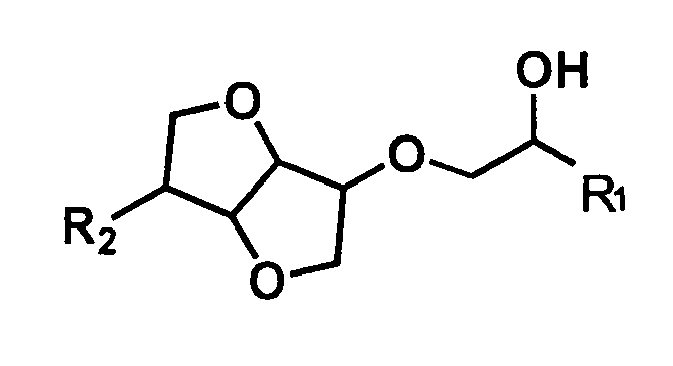

- R1 here represents a moiety with 6 to 16 C-atoms, whereby the chain may be saturated or unsaturated, but is preferably saturated and most preferred also linear. Most preferred is the compound according to the above formula, wherein R2 = O-CH2-CHR1-OH.
- A second preferred derivative is:

- Again, R1 means a moiety with 6 to 18, but preferably 6 to 16 C-atoms. The sum of indices z and t is between 2 and 50, and preferably chosen from the numbers 4, 10, 25 or 40. The numbers for the indices z and t may be even or odd numbers. Symmetrical compounds may be of advantage.
- Compounds according to formula (I) show cloud points at temperatures between < 0 °C up to 60°C (1% in water), according to the amount of alkoxides groups in the molecule (the more alkoxides the higher the cloud point). The isosorbide derivatives according to the invention also show low foaming behavior.
- A further embodiment of the invention pertains to the use of compounds according to formula (I) for the preparation of detergents, cleansers and cosmetic compositions (solid, liquid or gel-like ones). The isosorbide derivatives may be present in amounts from 0.1 up to 80 % by weight, dependent on the particular formulation. The isosorbide derivatives are particular useful in home care applications, like all kind of cleansers (kitchen, bathroom, hard surface, automotive or car cleansers), as well as in dishwashing compositions (hand and automatic dish washing).
- The isosorbide derivative may be formulated with other surfactants, like anionic, nonionic, amphoteric and/or cationic surfactants.
- The isosorbide derivatives according to the present invention are particularly suitable to be included into detergents and cleaners, including liquid and solid detergents, and preferably for hard surface cleaners, like kitchen or bathroom cleansers, all purpose cleaners, car wash, or dish washing detergents (for hand washing as well as for automatic dish detergents) and for industrial and institutional cleaning. The use of isosorbide derivatives according to the present invention is particularly preferred in applications where the good low- or de-foaming properties of these compounds are of advantage. Examples, which are not limiting the application range, are automatic dishwashing detergents, spray cleaners, bottle cleaning, automotive and locomotive cleaning, high pressure cleaning, tank cleaner and others.
- The isosorbide derivatives are also suitable in cosmetic preparations, where they can act as emulsifiers, solubilizers, cleaners, rheology modifiers, stabilizers, for rinse-off as well as for leave-on applications.
- The isosorbide derivatives are also suitable for agrochemical preparations, especially for spray applications, where they can act as surfactants, emulsifiers, dispersants, foam regulator, rheology modifier or in general as formulation aid or performance enhancer.
-
- I. 1 mole isosorbide (146 g) is reacted with 1 or 3 moles (156 or 312 g) of 1,2-deceneoxide with catalytic amounts of KOH (0.025 moles, 1.4 g) at temperatures of 160 - 180 °C under a nitrogen atmosphere. After completion of the reaction, which can be detected by epoxide titration according to Jay (see for details of the method: Jay et al., Anal. Chem. Volume 36, 1964. Pages: 667,), the product is cooled and neutralized by adding adequate amounts of lactic acid. The epoxide value should be reduced to at least 1/10 or 1/20 of the starting value in order to obtain a yield of the reaction which ist at least 90% or 95%.
- II. 1 mole isosorbide (146 g) is reacted with 4, 10, 25 or 40 moles of ethylene oxide (176, 440, 1100 or 1760 g) with catalytic amounts of KOH (0.025 moles, 1.4 g) at temperatures of 160 - 180 °C in a pressure reactor at a maximum pressure of 5 bar. After completion of the reaction 2 moles of 1,2-dodeceneoxide (386 g) are added and the reaction is completed at 180 - 200 °C, which can be detected by epoxide titration according to Jay. The product is cooled and neutralized by adding adequate amounts of lactic acid. The epoxide value should be reduced to at least 1/10 or 1/20 of the starting value in order to obtain a yield of the reaction which is at least 90% or 95%.
- The cleaning performance of two selected candidates according to example II (with 4 and 10 moles ethylene oxide respectively) was tested at 25 °C in a modified Gardner test on PVC with a standard soil (IPP Soil for diluted applications; 1 % active matter).
- Testing of the cleaning effect (Gardner Test): The cleaning preparation was applied to an artificially soiled plastic surface. The 26x28 cm test surface was uniformly coated with 2 g of the artificial soil using a surface spreader and was then cut up into seven equally large pieces measuring 26x4 cm. A plastic sponge was impregnated with 6 ml of the undiluted cleaning solution to be tested and moved by machine over the test surface. After 10 wiping movements, the cleaned test surface was held under running water and the loose soil removed. The cleaning effect, i.e. the whiteness of the plastic surface thus cleaned, was measured using a Dr. B. Lange LF 90 photoelectric colorimeter. The clean white plastic surface was used as the whiteness standard. The reflectance values are 66 and 71 % (for the 4 and the 10 moles product), which is comparable or better to known low foaming surfactants. Examples of low foaming surfactants are DEHYPON® LS 45, DEHYPON® LT 104 and DEHYPON® LS 24 (all products of Cognis GmbH), which give a reflectance of 58%, 57,5% and 49% according to this test.
Claims (10)
- Isosorbide derivatives, according to general formula (I)

- Isosorbide derivative according to claim 1, characterized in that R' is a hydrogen atom and R" stands for a polymer moiety (CH2-CHR1-O)x-H, and R1 is a hydrogen atom or an alkyl or alkenyl moiety with 1 to 33 C-Atoms, and is saturated or unsaturated, branched or linear.
- Isosorbide derivative according to claim 1 and/or claim 2, characterized in that R' and R" both stand for a group (CH2-CHR1-O)x-H, and R is a hydrogen atom or an alkyl or alkenyl moiety with 1 to 33 C-Atoms, and is saturated or unsaturated, branched or linear.
- Isosorbide derivative according to at least one of the claims 1 to 3, characterized in that in formula (I) the groups R' and R" are identical.
- Isosorbide derivative according to at least one of the claims 1 to 4, characterized in that in formula (I) R1 is selected from linear alkyl moieties with 6 to 18, preferably 8 to 12 C-Atoms.
- Isosorbide derivative according to at least one of the claims 1 to 5, characterized in that in formula (I) x is a number from 1 to 45, preferably from 2 to 40 and especially preferred from 4 to 25, and most preferred from 4 to 10.
- A derivative of Isosorbide according to formula


- A derivative of isosorbide according to formula

- Process for the preparation of isosorbide derivatives according to formula (I) in claim 1, or the compounds according to claims 7 or 9, whereby isosorbide is reacted with an epoxide compound, selected from ethylene oxide, propylene oxide, or 1,2-alkyloxides according to the general formula H2COCH-R1, where R1 has the same meaning as in formula (1) of claim 1, in the presence of basic catalysts at temperatures from 100 to 200 °C, and a pressure in the range from 1 to 10 bar.
- Use of isosorbide derivatives according to claim 1 to prepare detergents, cleansers, cosmetic compositions or agrochemical preparations.
Priority Applications (9)
| Application Number | Priority Date | Filing Date | Title |
|---|---|---|---|
| PL10192759T PL2308881T3 (en) | 2008-10-09 | 2008-10-09 | Isosorbide-derivatives |
| EP08017704A EP2174941B1 (en) | 2008-10-09 | 2008-10-09 | Isosorbide-derivatives |
| PL08017704T PL2174941T3 (en) | 2008-10-09 | 2008-10-09 | Isosorbide-derivatives |
| ES10192759T ES2392148T3 (en) | 2008-10-09 | 2008-10-09 | Isosorbide derivatives |
| ES08017704T ES2368551T3 (en) | 2008-10-09 | 2008-10-09 | ISOSORBID DERIVATIVES. |
| AT08017704T ATE514701T1 (en) | 2008-10-09 | 2008-10-09 | ISOSORBIDE DERIVATIVES |
| EP10192759A EP2308881B1 (en) | 2008-10-09 | 2008-10-09 | Isosorbide-derivatives |
| US13/123,666 US8575372B2 (en) | 2008-10-09 | 2009-09-30 | Isosorbide derivatives |
| PCT/EP2009/007015 WO2010040464A1 (en) | 2008-10-09 | 2009-09-30 | Isosorbide-derivatives |
Applications Claiming Priority (1)
| Application Number | Priority Date | Filing Date | Title |
|---|---|---|---|
| EP08017704A EP2174941B1 (en) | 2008-10-09 | 2008-10-09 | Isosorbide-derivatives |
Related Child Applications (2)
| Application Number | Title | Priority Date | Filing Date |
|---|---|---|---|
| EP10192759A Division EP2308881B1 (en) | 2008-10-09 | 2008-10-09 | Isosorbide-derivatives |
| EP10192759.8 Division-Into | 2010-11-26 |
Publications (2)
| Publication Number | Publication Date |
|---|---|
| EP2174941A1 true EP2174941A1 (en) | 2010-04-14 |
| EP2174941B1 EP2174941B1 (en) | 2011-06-29 |
Family
ID=40344795
Family Applications (2)
| Application Number | Title | Priority Date | Filing Date |
|---|---|---|---|
| EP10192759A Not-in-force EP2308881B1 (en) | 2008-10-09 | 2008-10-09 | Isosorbide-derivatives |
| EP08017704A Not-in-force EP2174941B1 (en) | 2008-10-09 | 2008-10-09 | Isosorbide-derivatives |
Family Applications Before (1)
| Application Number | Title | Priority Date | Filing Date |
|---|---|---|---|
| EP10192759A Not-in-force EP2308881B1 (en) | 2008-10-09 | 2008-10-09 | Isosorbide-derivatives |
Country Status (6)
| Country | Link |
|---|---|
| US (1) | US8575372B2 (en) |
| EP (2) | EP2308881B1 (en) |
| AT (1) | ATE514701T1 (en) |
| ES (2) | ES2392148T3 (en) |
| PL (2) | PL2174941T3 (en) |
| WO (1) | WO2010040464A1 (en) |
Cited By (2)
| Publication number | Priority date | Publication date | Assignee | Title |
|---|---|---|---|---|
| WO2016156505A1 (en) | 2015-04-01 | 2016-10-06 | Basf Se | Isosorbide ether derivatives with preservation activity |
| US9562054B2 (en) | 2015-02-26 | 2017-02-07 | Basf Se | Process for preparing isosorbide ethoxylate di(meth)acrylate |
Families Citing this family (13)
| Publication number | Priority date | Publication date | Assignee | Title |
|---|---|---|---|---|
| ES2423939T3 (en) * | 2009-09-10 | 2013-09-25 | Cognis Ip Management Gmbh | Isosorbide glyceryl ether derivatives and their use in domestic applications |
| FR2975991B1 (en) | 2011-05-31 | 2013-05-24 | Seppic Sa | PROCESS FOR THE PREPARATION OF BISPHENOL ALCOXY DERIVATIVES |
| WO2013041388A1 (en) * | 2011-09-19 | 2013-03-28 | Basf Se | Use of isosorbide derivatives for producing cosmetic preparations |
| AU2014251315A1 (en) * | 2013-04-09 | 2015-08-13 | Archer Daniels Midland Company | Mono-ethers of isohexides and process for making the same |
| US9441164B2 (en) | 2013-07-31 | 2016-09-13 | Semiconductor Energy Laboratory Co., Ltd. | Isosorbide derivative, liquid crystal composition, liquid crystal element, and liquid crystal display device |
| JP6191514B2 (en) * | 2014-03-12 | 2017-09-06 | 富士ゼロックス株式会社 | Resin composition and resin molded body |
| FR3046927B1 (en) * | 2016-01-26 | 2018-03-02 | L'oreal | COSMETIC OR DERMATOLOGICAL COMPOSITION COMPRISING A MEROCYANINE AND AN OILY PHASE COMPRISING AT LEAST ONE ISOSORBIDE ETHER |
| KR20180067396A (en) * | 2016-12-09 | 2018-06-20 | 주식회사 삼양사 | Thermoplastic polyether ester elastomer comprising anhydrosugar alcohol derivative and method for preparing the same |
| EP3489205A1 (en) | 2017-11-28 | 2019-05-29 | HILTI Aktiengesellschaft | Isosorbide derivatives as reactive additives in reactive resins and chemical dowels |
| KR102682901B1 (en) * | 2020-12-08 | 2024-07-09 | 삼양이노켐 주식회사 | Anhydrosugar alcohol-alkylene glycol composition having enhanced storage stability and method for preparing the same |
| KR102661972B1 (en) * | 2020-12-08 | 2024-04-30 | 주식회사 삼양사 | Method for preparing anhydrosugar alcohol-alkylene glycol having enhanced storage stability |
| KR102799323B1 (en) * | 2021-12-23 | 2025-04-23 | 주식회사 삼양사 | Method for purifying anhydrosugar alcohol-alkylene glycol composition |
| US20260062510A1 (en) * | 2022-08-22 | 2026-03-05 | Pucore Co., Ltd. | Polyol composition and preparation method therefor, composition for polyurethane preparation comprising polyol composition, and battery module |
Citations (4)
| Publication number | Priority date | Publication date | Assignee | Title |
|---|---|---|---|---|
| EP0186276A2 (en) | 1984-12-21 | 1986-07-02 | Ici Americas Inc. | Oral hygiene composition |
| EP0315334A2 (en) | 1987-11-06 | 1989-05-10 | Ici Americas Inc. | Process for the preparation of dianhydrosorbitol ethers |
| EP1106616A2 (en) * | 1999-12-08 | 2001-06-13 | Institut Francais Du Petrole | Isosorbide derivatives useful in detergent compositions for gasoline-type fuels |
| EP1216685A2 (en) | 2000-12-21 | 2002-06-26 | Johnson & Johnson Consumer Companies, Inc. | Personal care compositions |
-
2008
- 2008-10-09 ES ES10192759T patent/ES2392148T3/en active Active
- 2008-10-09 EP EP10192759A patent/EP2308881B1/en not_active Not-in-force
- 2008-10-09 AT AT08017704T patent/ATE514701T1/en not_active IP Right Cessation
- 2008-10-09 PL PL08017704T patent/PL2174941T3/en unknown
- 2008-10-09 ES ES08017704T patent/ES2368551T3/en active Active
- 2008-10-09 PL PL10192759T patent/PL2308881T3/en unknown
- 2008-10-09 EP EP08017704A patent/EP2174941B1/en not_active Not-in-force
-
2009
- 2009-09-30 WO PCT/EP2009/007015 patent/WO2010040464A1/en not_active Ceased
- 2009-09-30 US US13/123,666 patent/US8575372B2/en not_active Expired - Fee Related
Patent Citations (4)
| Publication number | Priority date | Publication date | Assignee | Title |
|---|---|---|---|---|
| EP0186276A2 (en) | 1984-12-21 | 1986-07-02 | Ici Americas Inc. | Oral hygiene composition |
| EP0315334A2 (en) | 1987-11-06 | 1989-05-10 | Ici Americas Inc. | Process for the preparation of dianhydrosorbitol ethers |
| EP1106616A2 (en) * | 1999-12-08 | 2001-06-13 | Institut Francais Du Petrole | Isosorbide derivatives useful in detergent compositions for gasoline-type fuels |
| EP1216685A2 (en) | 2000-12-21 | 2002-06-26 | Johnson & Johnson Consumer Companies, Inc. | Personal care compositions |
Non-Patent Citations (3)
| Title |
|---|
| ASHTON PETER R ET AL: "Molecular mechano. Part 51. Diastereoselective self-assembly of [2]catenanes", EUROPEAN JOURNAL OF ORGANIC CHEMISTRY, no. 5, 1999, pages 995 - 1004, XP009112514, ISSN: 1434-193X, [retrieved on 19990415] * |
| CHATTI ET AL., RECENT RES. DEVEL. ORGANIC CHEM., vol. 7, 2003, pages 13 - 20 |
| VU DANG H ET AL: "Composition analysis of two batches of polysorbate 60 using MS and NMR techniques", JOURNAL OF PHARMACEUTICAL AND BIOMEDICAL ANALYSIS, NEW YORK, NY, US, vol. 40, no. 5, 18 March 2006 (2006-03-18), pages 1155 - 1165, XP025145695, ISSN: 0731-7085, [retrieved on 20060318] * |
Cited By (2)
| Publication number | Priority date | Publication date | Assignee | Title |
|---|---|---|---|---|
| US9562054B2 (en) | 2015-02-26 | 2017-02-07 | Basf Se | Process for preparing isosorbide ethoxylate di(meth)acrylate |
| WO2016156505A1 (en) | 2015-04-01 | 2016-10-06 | Basf Se | Isosorbide ether derivatives with preservation activity |
Also Published As
| Publication number | Publication date |
|---|---|
| PL2308881T3 (en) | 2013-03-29 |
| US20110237809A1 (en) | 2011-09-29 |
| PL2174941T3 (en) | 2012-02-29 |
| EP2308881A1 (en) | 2011-04-13 |
| WO2010040464A1 (en) | 2010-04-15 |
| ATE514701T1 (en) | 2011-07-15 |
| US8575372B2 (en) | 2013-11-05 |
| ES2368551T3 (en) | 2011-11-18 |
| EP2174941B1 (en) | 2011-06-29 |
| ES2392148T3 (en) | 2012-12-05 |
| EP2308881B1 (en) | 2012-08-22 |
Similar Documents
| Publication | Publication Date | Title |
|---|---|---|
| EP2308881B1 (en) | Isosorbide-derivatives | |
| JP5567496B2 (en) | Alkylene oxide capped secondary alcohol alkoxylates useful as surfactants | |
| US9115335B2 (en) | Phosphoric acid esters, their preparation and use | |
| US10736832B2 (en) | Aqueous surfactant compositions | |
| US6680412B2 (en) | Alcohol alkoxylates used as low-foam, or foam inhibiting surfactants | |
| BR102017001098B1 (en) | POLYGLYCEROL ALCOXYLATE ESTERS AND THE PREPARATION AND USE THEREOF | |
| EP3174919B1 (en) | Amphiphilic star-like polyether | |
| WO2012005897A1 (en) | Branched secondary alcohol alkoxylate surfactants and process to make them | |
| US20240110128A1 (en) | Alkoxylates having improved hydrotropic power | |
| ES2529649T3 (en) | Polymers based on glycerol carbonate and an alcohol | |
| US8546446B2 (en) | Anionic isosorbide derivatives and their use | |
| US20120172282A1 (en) | Isosorbide Glyceryl Ether Derivatives And Their Use In Household Applications | |
| EP2295030A1 (en) | Use of isosorbide ethers in detergents and cleaners | |
| US20120215030A1 (en) | Polymers based on glycerol carbonate | |
| KR101884163B1 (en) | Polymers based on glyceryl carbonate | |
| US20210371588A1 (en) | Alkoxylated Polycarboxylic Acid Amides | |
| CN104144744B (en) | The derivant of three (2-hydroxy phenyl) methane, its preparation and the purposes in prepared by oil thereof | |
| US20130284068A1 (en) | Liquid Thickener For Surfactant Systems | |
| US20240124801A1 (en) | Low foaming surfactants | |
| CN111068578B (en) | A kind of surfactant and its preparation method and use | |
| JP2026060874A (en) | Liquid detergent composition for hand washing dishes |
Legal Events
| Date | Code | Title | Description |
|---|---|---|---|
| PUAI | Public reference made under article 153(3) epc to a published international application that has entered the european phase |
Free format text: ORIGINAL CODE: 0009012 |
|
| AK | Designated contracting states |
Kind code of ref document: A1 Designated state(s): AT BE BG CH CY CZ DE DK EE ES FI FR GB GR HR HU IE IS IT LI LT LU LV MC MT NL NO PL PT RO SE SI SK TR |
|
| AX | Request for extension of the european patent |
Extension state: AL BA MK RS |
|
| 17P | Request for examination filed |
Effective date: 20100608 |
|
| 17Q | First examination report despatched |
Effective date: 20100802 |
|
| AKX | Designation fees paid |
Designated state(s): AT BE BG CH CY CZ DE DK EE ES FI FR GB GR HR HU IE IS IT LI LT LU LV MC MT NL NO PL PT RO SE SI SK TR |
|
| GRAP | Despatch of communication of intention to grant a patent |
Free format text: ORIGINAL CODE: EPIDOSNIGR1 |
|
| GRAS | Grant fee paid |
Free format text: ORIGINAL CODE: EPIDOSNIGR3 |
|
| GRAA | (expected) grant |
Free format text: ORIGINAL CODE: 0009210 |
|
| AK | Designated contracting states |
Kind code of ref document: B1 Designated state(s): AT BE BG CH CY CZ DE DK EE ES FI FR GB GR HR HU IE IS IT LI LT LU LV MC MT NL NO PL PT RO SE SI SK TR |
|
| REG | Reference to a national code |
Ref country code: GB Ref legal event code: FG4D |
|
| REG | Reference to a national code |
Ref country code: CH Ref legal event code: EP |
|
| REG | Reference to a national code |
Ref country code: IE Ref legal event code: FG4D |
|
| REG | Reference to a national code |
Ref country code: DE Ref legal event code: R096 Ref document number: 602008007887 Country of ref document: DE Effective date: 20110818 |
|
| REG | Reference to a national code |
Ref country code: NL Ref legal event code: VDEP Effective date: 20110629 |
|
| PG25 | Lapsed in a contracting state [announced via postgrant information from national office to epo] |
Ref country code: LT Free format text: LAPSE BECAUSE OF FAILURE TO SUBMIT A TRANSLATION OF THE DESCRIPTION OR TO PAY THE FEE WITHIN THE PRESCRIBED TIME-LIMIT Effective date: 20110629 Ref country code: HR Free format text: LAPSE BECAUSE OF FAILURE TO SUBMIT A TRANSLATION OF THE DESCRIPTION OR TO PAY THE FEE WITHIN THE PRESCRIBED TIME-LIMIT Effective date: 20110629 Ref country code: SE Free format text: LAPSE BECAUSE OF FAILURE TO SUBMIT A TRANSLATION OF THE DESCRIPTION OR TO PAY THE FEE WITHIN THE PRESCRIBED TIME-LIMIT Effective date: 20110629 Ref country code: NO Free format text: LAPSE BECAUSE OF FAILURE TO SUBMIT A TRANSLATION OF THE DESCRIPTION OR TO PAY THE FEE WITHIN THE PRESCRIBED TIME-LIMIT Effective date: 20110929 |
|
| REG | Reference to a national code |
Ref country code: ES Ref legal event code: FG2A Ref document number: 2368551 Country of ref document: ES Kind code of ref document: T3 Effective date: 20111118 |
|
| PG25 | Lapsed in a contracting state [announced via postgrant information from national office to epo] |
Ref country code: GR Free format text: LAPSE BECAUSE OF FAILURE TO SUBMIT A TRANSLATION OF THE DESCRIPTION OR TO PAY THE FEE WITHIN THE PRESCRIBED TIME-LIMIT Effective date: 20110930 Ref country code: FI Free format text: LAPSE BECAUSE OF FAILURE TO SUBMIT A TRANSLATION OF THE DESCRIPTION OR TO PAY THE FEE WITHIN THE PRESCRIBED TIME-LIMIT Effective date: 20110629 Ref country code: AT Free format text: LAPSE BECAUSE OF FAILURE TO SUBMIT A TRANSLATION OF THE DESCRIPTION OR TO PAY THE FEE WITHIN THE PRESCRIBED TIME-LIMIT Effective date: 20110629 Ref country code: SI Free format text: LAPSE BECAUSE OF FAILURE TO SUBMIT A TRANSLATION OF THE DESCRIPTION OR TO PAY THE FEE WITHIN THE PRESCRIBED TIME-LIMIT Effective date: 20110629 Ref country code: LV Free format text: LAPSE BECAUSE OF FAILURE TO SUBMIT A TRANSLATION OF THE DESCRIPTION OR TO PAY THE FEE WITHIN THE PRESCRIBED TIME-LIMIT Effective date: 20110629 |
|
| PG25 | Lapsed in a contracting state [announced via postgrant information from national office to epo] |
Ref country code: BE Free format text: LAPSE BECAUSE OF FAILURE TO SUBMIT A TRANSLATION OF THE DESCRIPTION OR TO PAY THE FEE WITHIN THE PRESCRIBED TIME-LIMIT Effective date: 20110629 |
|
| PG25 | Lapsed in a contracting state [announced via postgrant information from national office to epo] |
Ref country code: CZ Free format text: LAPSE BECAUSE OF FAILURE TO SUBMIT A TRANSLATION OF THE DESCRIPTION OR TO PAY THE FEE WITHIN THE PRESCRIBED TIME-LIMIT Effective date: 20110629 Ref country code: PT Free format text: LAPSE BECAUSE OF FAILURE TO SUBMIT A TRANSLATION OF THE DESCRIPTION OR TO PAY THE FEE WITHIN THE PRESCRIBED TIME-LIMIT Effective date: 20111031 Ref country code: IS Free format text: LAPSE BECAUSE OF FAILURE TO SUBMIT A TRANSLATION OF THE DESCRIPTION OR TO PAY THE FEE WITHIN THE PRESCRIBED TIME-LIMIT Effective date: 20111029 Ref country code: EE Free format text: LAPSE BECAUSE OF FAILURE TO SUBMIT A TRANSLATION OF THE DESCRIPTION OR TO PAY THE FEE WITHIN THE PRESCRIBED TIME-LIMIT Effective date: 20110629 Ref country code: NL Free format text: LAPSE BECAUSE OF FAILURE TO SUBMIT A TRANSLATION OF THE DESCRIPTION OR TO PAY THE FEE WITHIN THE PRESCRIBED TIME-LIMIT Effective date: 20110629 |
|
| PG25 | Lapsed in a contracting state [announced via postgrant information from national office to epo] |
Ref country code: RO Free format text: LAPSE BECAUSE OF FAILURE TO SUBMIT A TRANSLATION OF THE DESCRIPTION OR TO PAY THE FEE WITHIN THE PRESCRIBED TIME-LIMIT Effective date: 20110629 Ref country code: CY Free format text: LAPSE BECAUSE OF FAILURE TO SUBMIT A TRANSLATION OF THE DESCRIPTION OR TO PAY THE FEE WITHIN THE PRESCRIBED TIME-LIMIT Effective date: 20110629 Ref country code: SK Free format text: LAPSE BECAUSE OF FAILURE TO SUBMIT A TRANSLATION OF THE DESCRIPTION OR TO PAY THE FEE WITHIN THE PRESCRIBED TIME-LIMIT Effective date: 20110629 |
|
| REG | Reference to a national code |
Ref country code: PL Ref legal event code: T3 |
|
| PLBE | No opposition filed within time limit |
Free format text: ORIGINAL CODE: 0009261 |
|
| STAA | Information on the status of an ep patent application or granted ep patent |
Free format text: STATUS: NO OPPOSITION FILED WITHIN TIME LIMIT |
|
| PG25 | Lapsed in a contracting state [announced via postgrant information from national office to epo] |
Ref country code: MC Free format text: LAPSE BECAUSE OF NON-PAYMENT OF DUE FEES Effective date: 20111031 |
|
| 26N | No opposition filed |
Effective date: 20120330 |
|
| PG25 | Lapsed in a contracting state [announced via postgrant information from national office to epo] |
Ref country code: DK Free format text: LAPSE BECAUSE OF FAILURE TO SUBMIT A TRANSLATION OF THE DESCRIPTION OR TO PAY THE FEE WITHIN THE PRESCRIBED TIME-LIMIT Effective date: 20110629 |
|
| REG | Reference to a national code |
Ref country code: IE Ref legal event code: MM4A |
|
| REG | Reference to a national code |
Ref country code: DE Ref legal event code: R097 Ref document number: 602008007887 Country of ref document: DE Effective date: 20120330 |
|
| PG25 | Lapsed in a contracting state [announced via postgrant information from national office to epo] |
Ref country code: IE Free format text: LAPSE BECAUSE OF NON-PAYMENT OF DUE FEES Effective date: 20111009 |
|
| PG25 | Lapsed in a contracting state [announced via postgrant information from national office to epo] |
Ref country code: MT Free format text: LAPSE BECAUSE OF FAILURE TO SUBMIT A TRANSLATION OF THE DESCRIPTION OR TO PAY THE FEE WITHIN THE PRESCRIBED TIME-LIMIT Effective date: 20110629 |
|
| PG25 | Lapsed in a contracting state [announced via postgrant information from national office to epo] |
Ref country code: LU Free format text: LAPSE BECAUSE OF NON-PAYMENT OF DUE FEES Effective date: 20111009 |
|
| REG | Reference to a national code |
Ref country code: CH Ref legal event code: PL |
|
| PG25 | Lapsed in a contracting state [announced via postgrant information from national office to epo] |
Ref country code: BG Free format text: LAPSE BECAUSE OF FAILURE TO SUBMIT A TRANSLATION OF THE DESCRIPTION OR TO PAY THE FEE WITHIN THE PRESCRIBED TIME-LIMIT Effective date: 20110929 |
|
| PG25 | Lapsed in a contracting state [announced via postgrant information from national office to epo] |
Ref country code: LI Free format text: LAPSE BECAUSE OF NON-PAYMENT OF DUE FEES Effective date: 20121031 Ref country code: CH Free format text: LAPSE BECAUSE OF NON-PAYMENT OF DUE FEES Effective date: 20121031 |
|
| PG25 | Lapsed in a contracting state [announced via postgrant information from national office to epo] |
Ref country code: TR Free format text: LAPSE BECAUSE OF FAILURE TO SUBMIT A TRANSLATION OF THE DESCRIPTION OR TO PAY THE FEE WITHIN THE PRESCRIBED TIME-LIMIT Effective date: 20110629 |
|
| PG25 | Lapsed in a contracting state [announced via postgrant information from national office to epo] |
Ref country code: HU Free format text: LAPSE BECAUSE OF FAILURE TO SUBMIT A TRANSLATION OF THE DESCRIPTION OR TO PAY THE FEE WITHIN THE PRESCRIBED TIME-LIMIT Effective date: 20110629 |
|
| REG | Reference to a national code |
Ref country code: FR Ref legal event code: PLFP Year of fee payment: 8 |
|
| PGFP | Annual fee paid to national office [announced via postgrant information from national office to epo] |
Ref country code: PL Payment date: 20150929 Year of fee payment: 8 |
|
| REG | Reference to a national code |
Ref country code: FR Ref legal event code: PLFP Year of fee payment: 9 |
|
| REG | Reference to a national code |
Ref country code: FR Ref legal event code: PLFP Year of fee payment: 10 |
|
| PG25 | Lapsed in a contracting state [announced via postgrant information from national office to epo] |
Ref country code: PL Free format text: LAPSE BECAUSE OF NON-PAYMENT OF DUE FEES Effective date: 20161009 |
|
| REG | Reference to a national code |
Ref country code: FR Ref legal event code: PLFP Year of fee payment: 11 |
|
| PGFP | Annual fee paid to national office [announced via postgrant information from national office to epo] |
Ref country code: FR Payment date: 20181025 Year of fee payment: 11 Ref country code: ES Payment date: 20181127 Year of fee payment: 11 Ref country code: IT Payment date: 20181024 Year of fee payment: 11 Ref country code: GB Payment date: 20181031 Year of fee payment: 11 |
|
| PGFP | Annual fee paid to national office [announced via postgrant information from national office to epo] |
Ref country code: DE Payment date: 20181228 Year of fee payment: 11 |
|
| REG | Reference to a national code |
Ref country code: DE Ref legal event code: R119 Ref document number: 602008007887 Country of ref document: DE |
|
| PG25 | Lapsed in a contracting state [announced via postgrant information from national office to epo] |
Ref country code: DE Free format text: LAPSE BECAUSE OF NON-PAYMENT OF DUE FEES Effective date: 20200501 |
|
| GBPC | Gb: european patent ceased through non-payment of renewal fee |
Effective date: 20191009 |
|
| PG25 | Lapsed in a contracting state [announced via postgrant information from national office to epo] |
Ref country code: GB Free format text: LAPSE BECAUSE OF NON-PAYMENT OF DUE FEES Effective date: 20191009 Ref country code: IT Free format text: LAPSE BECAUSE OF NON-PAYMENT OF DUE FEES Effective date: 20191009 Ref country code: FR Free format text: LAPSE BECAUSE OF NON-PAYMENT OF DUE FEES Effective date: 20191031 |
|
| REG | Reference to a national code |
Ref country code: ES Ref legal event code: FD2A Effective date: 20210303 |
|
| PG25 | Lapsed in a contracting state [announced via postgrant information from national office to epo] |
Ref country code: ES Free format text: LAPSE BECAUSE OF NON-PAYMENT OF DUE FEES Effective date: 20191010 |