EP2170900B1 - Crystalline form ii of 7-(dimethoxy-methyl) camptothecin, its use as intermediate and products obtained therefrom - Google Patents
Crystalline form ii of 7-(dimethoxy-methyl) camptothecin, its use as intermediate and products obtained therefrom Download PDFInfo
- Publication number
- EP2170900B1 EP2170900B1 EP08786333A EP08786333A EP2170900B1 EP 2170900 B1 EP2170900 B1 EP 2170900B1 EP 08786333 A EP08786333 A EP 08786333A EP 08786333 A EP08786333 A EP 08786333A EP 2170900 B1 EP2170900 B1 EP 2170900B1
- Authority
- EP
- European Patent Office
- Prior art keywords
- camptothecin
- acid
- polymorph form
- methanol
- process according
- Prior art date
- Legal status (The legal status is an assumption and is not a legal conclusion. Google has not performed a legal analysis and makes no representation as to the accuracy of the status listed.)
- Active
Links
Images


Classifications
-
- C—CHEMISTRY; METALLURGY
- C07—ORGANIC CHEMISTRY
- C07D—HETEROCYCLIC COMPOUNDS
- C07D491/00—Heterocyclic compounds containing in the condensed ring system both one or more rings having oxygen atoms as the only ring hetero atoms and one or more rings having nitrogen atoms as the only ring hetero atoms, not provided for by groups C07D451/00 - C07D459/00, C07D463/00, C07D477/00 or C07D489/00
- C07D491/22—Heterocyclic compounds containing in the condensed ring system both one or more rings having oxygen atoms as the only ring hetero atoms and one or more rings having nitrogen atoms as the only ring hetero atoms, not provided for by groups C07D451/00 - C07D459/00, C07D463/00, C07D477/00 or C07D489/00 in which the condensed system contains four or more hetero rings
Definitions
- the present invention relates to the field of organic chemistry, in particular to compounds useful as intermediates in processes for the preparation of active ingredients in medicine.
- This invention relates to a process for preparing a crystalline form of (4S)-11-(dimethoxymethyl)-4-ethyl-4-hydroxy-1H-pyrano[3',4':6,7]indolizino[ 1,2-b]qui-noline-3,14(4H,12H)-dione (CAS n 84017-99-2), also named 7-(dimethoxy-methyl)camptothecin.
- Camptothecin is an alkaloid, which demonstrated a wide spectrum of antitumor activity, in particular against colon tumors, other solid tumors and leukemias, and the first clinical trials were performed in the early 70's.
- Camptothecin has low water solubility and is rather toxic, a number of derivatives were proposed in the art in order to make available better drugs, in particular with lower toxicity and higher water solubility.
- camptothecin derivatives were prepared and made available in the art through several synthetic routes.
- the quality of the final product such as its purity level or the easiness of isolation may depend also on the synthetic route and the kind of intermediate products.
- camptothecin derivatives bearing an alkyloxime O-substituted at position 7 and endowed with antitumor activity higher than the compound of reference topotecan are described. Moreover these camptothecin derivatives bearing an imino group on position 7, also show an improved therapeutic index.
- One of the preferred molecules is 7-t-butoxyiminomethylcamptothecin (CPT 184) and known under the INN name Gimatecan.
- This compound is used in different patents as intermediate in the synthesis of campthothecin derivatives.
- 7-(dimethoxy-methyl)-camptothecin can be prepared by ordinary acetalization of camptothecin 7-aldehyde, for example by heating camptothecin 7-aldehyde in hot methanol in the presence of an acid.
- this compound can be prepared in a single step by treating 7-hydroxymethylcamptothecin with an acid in the presence of methanol, see the above mentioned EP 0 056 692 .
- Acetalization is an equilibrium reaction and the starting aldehyde can be present in a certain amount. Moreover, acetals can be converted in the starting aldehyde in the presence of acids.
- aldehydes are not endowed with high stability and they tend to polymerize giving side products which are difficult to eliminate from reaction mixtures and affect the purity of the final product.
- WO2006/067092 discloses a stereoselective process for the preparation of crystalline forms of Gimatecan. This process allows the stereoselective preparation of Gimatecan. With the addition of further dissolution and precipitation steps carried out in appropriate different solvent mixtures, four new crystalline forms of Gimatecan are also obtainable by using the same stereoselective process.
- WO03/101995 discloses camptothecins with a modified lactone ring and 7-(dimethoxymethyl)camptothecin is used as intermediate in the synthesis of the final products.
- 7-(dimethoxy-methyl)camptothecin preparation is provided as purified from column chromatography and as a yellow solid with m.p. 201°C (dec.). Product yield is 55%.
- GMP Good Manufacturing Practice
- a sensitive topic is represented by standardization of intermediate compounds and impurity levels.
- a high purity intermediate means a higher purity final product, with more severe specifications, therefore lesser quality variability. This latter aspect is requested and appreciated by Regulatory authorities.
- crystallization of an intermediate product represents an optimal purification step, allowing a better control of final quality, thus meeting GMP requirements easier and facilitating the whole production process.
- WO/03101995 does not teach any crystallization.
- Stability is a desirable and necessary property for the intermediate compounds, since they are able to withstand chemical reaction conditions, in particular temperatures, without undergoing degradation or decomposition. More in particular, a high melting point, especially for those compounds which melt with decomposition, is recommended, as to avoid the presence in the reaction mixture of degradation side products, which make purification of the final product (the drug) much more difficult, even impossible.
- the present invention provides a polymorph of 7-(dimethoxy-methyl)camptothecin which is endowed with higher purity, in particular with respect to side products of aldehyde type and derivatives thereof.
- Another object of the present invention is a process for the preparation of the above crystalline form.
- a further object of the present invention is the use of the crystalline form of 7-(dimethoxymethyl)camptothecin as intermediate in a process for the preparation of camptothecin derivatives.
- the polymorph Form II of 7-(dimethoxy-methyl)-camptothecin of the present invention is characterized by the physico-chemical parameters provided in this description.
- a particular advantage of the polymorph Form II according to the present invention is to be substantially free from aldehyde impurities and derivatives thereof.
- the compound of the present invention contains no aldehyde impurities and derivatives thereof or at least no detectable amounts, or at least amounts below the admitted limits stated by National or European Pharmacopoeias.
- aldehyde impurities and derivatives thereof it is intended a 7-formyl-camptothecin, said camptothecin being optionally substituted and/or having a modified lactone, an aldehyde polymer product, or any derivative of aldehyde.
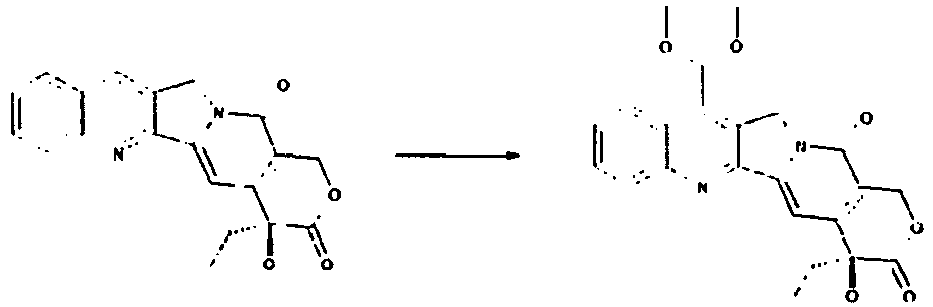
- the polymorph Form II of 7-(dimethoxy-methyl)camptothecin is prepared by transformation of camptothecin, through its 7 formyl derivative:
- the process according to the present invention comprises the following steps:
- the oxidizing step of step a) can be performed according to well known methods, see for example US 6,194,579 .
- oxidizing step is performed with a first oxidizing system and a second oxidizing system.
- said first oxidizing system is 30% H 2 O 2 / Fe(II) salt and said second oxidizing system is selected from the group consisting of acetic acid, CrO 3 , and MnO 2 .
- said first oxidizing system is 30% H 2 O 2 /iron sulphate and said second oxidizing system is manganese dioxide (see WO03/101995 ).
- Step b) is also a well-known procedure for obtaining acetals of aldehyde compounds.
- said first, acid methanol reaction mixture is selected from the group consisting of distilled methanol and a low water methanol mixture, for example 30% water/70% methanol solution.
- the acid used in step b) can be any organic or inorganic acid which does not interfere with the progress of reaction or with the stability of the starting material or of the final product.
- said acid is selected from the group consisting of H 2 SO 4 , CH 3 COOH, H 3 PO 4 , HCl SOcl 2 , COCl 2 , CH 3 SO 2O H, CH 3 PhSO 2 OH, CF 3 COOH, CF 3 SO 3 H.
- the preferred acid is 98%H 2 SO 4 in a concentration of 10 % v/v.
- Steps c), d) and e) are also carried out according to common practice and the person of ordinary skill in the art will have no difficulty in selecting the proper conditions, equipments and any other element for performing these steps.
- Step f) which is essential for achieving the final product, is also a common step of crystallization that can be carried out by the normal chemistry practitioner, either on lab scale or in industrial scale, just selecting the proper conditions, such as volumes, temperatures, time.
- the final product is dried in order to eliminate solvent traces.
- a further object of the present invention are solvates of the above polymorph Form II of 7-(dimethoxy-methyl)-camptothecin.
- Camptothecin is a commercial product or can be prepared according to literature methods, see for example US patents 5,053,512 , 4,894,456 , 5,405,963 and 6,982,333 ,
- Starting camptothecin is suspended into methanol (0.5 to 10%; preferably 1.5 % solution w/v).
- the solution or suspension is kept at a temperature ranging from -10 to 80°C (preferably 0 to 50°C) and added with a mineral or organic acid, preferably H 2 SO 4 90 to 98% (preferably 96%) (1% to 30%, preferably 10% v/v), and at the presence of a suitable first oxidizing system (for example 30% H 2 O 2 / Fe(II) salts), then a second oxidizing agent (for example acetic acid, CrO 3 , MnO 2 ) to obtain the desired product.
- a preferred first oxidizing system is iron sulphate/hydrogen peroxide.
- a preferred second oxidizing system is manganese dioxide.
- the dried solid is then suspended in freshly distilled or with low water content methanol (30% solution) and a mineral or organic acid ranging between catalytic to stoichiometric amounts are added.
- the acid can be selected from the preferred group consisting of H 2 SO 4 , CH 3 COOH, H 3 PO 4 , HCl SOCl 2 , COCl 2 , CH 3 SO 2 OH (MsOH), CH 3 PhSO 2 OH (TsOH), CF 3 COOH, CF 3 SO 3 H.
- Other acids can be used with similar results.
- Preferred acid and its concentration are 10 % v/v of H 2 SO 4 98%
- the solution is neutralized until about pH 6 with a suitable base, such as aqueous NaOH, KOH or Na 2 CO 3 .
- a suitable base such as aqueous NaOH, KOH or Na 2 CO 3 .
- the obtained solid is finally dried, for example under vacuum at 40°C overnight.
- the polymorph Form II is suitable as intermediate for the preparation of camptothecin derivatives, such as the ones disclosed in EP 0 056 692 , in particular, and preferably the ones disclosed in WO03/101995 and any other camptothecin derivative for use as in the treatment of diseases responding to inhibition of Topoisomerase I, such as for example tumors, HIV infections and parasitic infections.
- camptothecin derivatives such as the ones disclosed in EP 0 056 692 , in particular, and preferably the ones disclosed in WO03/101995 and any other camptothecin derivative for use as in the treatment of diseases responding to inhibition of Topoisomerase I, such as for example tumors, HIV infections and parasitic infections.
- the polymorph Form II of 7-(dimethoxymethyl)-camptothecin was used as intermediate product for the preparation of the compounds disclosed in WO03/101995 .
- reaction mixture was concentrated under reduced pressure and the solid obtained was suspended in freshly distilled or low water content methanol and H 2 SO 4 (98%) (4.4 equivalent).
- the suspension was stirred for 6 h and then was neutralized until about pH 6 with 1N NaOH solution.
- the X-ray powder diffractogram on about 15 mg of ground powder was obtained using a computer controlled XRD powder diffraction apparatus and examined under inert atmosphere.
- the tube conditions were 40 KV x 40 mA CuK ⁇ , the windows used were aperture 0.3°, and closing 0.15°.
- the time for each step scan was 7 s, the 2- ⁇ range was 5° - 35°.
- Figure 1 shows X-ray powder diffractogram of 7-(dimethoxy-methyl)camptothecin (form II).
- the diffuse reflectance FT-IR spectrum of 7-(dimethoxy-methyl)camptothecin form II was collected on a 2% sample in KBr with a Thermo Nicolet spectrometer model Avatar 370 DTGS.
- Figure 2 shows IR Spectrum (in KBr) of 7-(dimethoxy-methyl)camptothecin (form II)
- This Example was conducted in order to ascertain the differences between the crystal form of the 7-(dimethoxy-methyl)camptothecin obtained by chloroform/n-hexane crystallization, as described by the above mentioned Sawada et al., 1994, and named herein Form 1) and the 7-(dimethoxy-methyl)camptothecin obtained according to the present invention, named Form II.
- the aim of this example is to verify that the form described in the cited article, crystallized by chloroform and n-hexane (named Form I), is different from Form II of the present invention.
- n-hexane MERCK (Batch K37503267 725) (Boiling Point 69°C).
- Chloroform Sigma Aldrich (Batch 01635EC-344) (Boiling Point 61°C).
- the obtained crop was separated by filtration and dried with vacuum pump.
- the solid obtained was identified by NMR spectroscopy, using a NMR 500 spectrometer (solid solubilized in DMSO) and characterized by FT-IR ( Figures 6 , 7 , 8 and 9 ), XRPD ( Figure 10 ) and TGA ( Figure 12 ).
- the NMR is in compliance with the structure of 7-(dimethoxy-methyl)camptothecin.
Landscapes
- Chemical & Material Sciences (AREA)
- Organic Chemistry (AREA)
- Nitrogen Condensed Heterocyclic Rings (AREA)
- Pharmaceuticals Containing Other Organic And Inorganic Compounds (AREA)
Description
- The present invention relates to the field of organic chemistry, in particular to compounds useful as intermediates in processes for the preparation of active ingredients in medicine.
- This invention relates to a process for preparing a crystalline form of (4S)-11-(dimethoxymethyl)-4-ethyl-4-hydroxy-1H-pyrano[3',4':6,7]indolizino[ 1,2-b]qui-noline-3,14(4H,12H)-dione (CAS n 84017-99-2), also named 7-(dimethoxy-methyl)camptothecin. With the provision of a particular crystallization step, in appropriate way, a new crystalline form of the above compound is obtained.
- Camptothecin is an alkaloid, which demonstrated a wide spectrum of antitumor activity, in particular against colon tumors, other solid tumors and leukemias, and the first clinical trials were performed in the early 70's.
- Since Camptothecin (CPT) has low water solubility and is rather toxic, a number of derivatives were proposed in the art in order to make available better drugs, in particular with lower toxicity and higher water solubility.
- Many camptothecin derivatives were prepared and made available in the art through several synthetic routes.
- The quality of the final product, such as its purity level or the easiness of isolation may depend also on the synthetic route and the kind of intermediate products.
- In
patent EP 1 044 977 and in Dallavalle S. et al., J. Med. Chem. 2001, 44, 3264-3274, camptothecin derivatives bearing an alkyloxime O-substituted atposition 7 and endowed with antitumor activity higher than the compound of reference topotecan are described. Moreover these camptothecin derivatives bearing an imino group onposition 7, also show an improved therapeutic index. One of the preferred molecules is 7-t-butoxyiminomethylcamptothecin (CPT 184) and known under the INN name Gimatecan. - 7-(dimethoxy-methyl)camptothecin is disclosed in
EP 0 056 692 - This compound is used in different patents as intermediate in the synthesis of campthothecin derivatives.
- 7-(dimethoxy-methyl)-camptothecin can be prepared by ordinary acetalization of camptothecin 7-aldehyde, for example by heating camptothecin 7-aldehyde in hot methanol in the presence of an acid. Alternatively, this compound can be prepared in a single step by treating 7-hydroxymethylcamptothecin with an acid in the presence of methanol, see the above mentioned
EP 0 056 692 - Acetalization is an equilibrium reaction and the starting aldehyde can be present in a certain amount. Moreover, acetals can be converted in the starting aldehyde in the presence of acids.
- It is well-known that aldehydes are not endowed with high stability and they tend to polymerize giving side products which are difficult to eliminate from reaction mixtures and affect the purity of the final product.
- The absence of the aldehyde allows crystallization and elimination of other unwished impurities, which can be present both in the starting material and derive from the reaction. For example, 9, 10 and 11 hydroxy- and methoxy- camptothecins (see below general formula 1), mappicine (see below general formula 2), and their derivatives are side derivatives produced in the reaction of formation of 7-(dimethoxy-methyl)camptothecin.

-
WO2006/067092 discloses a stereoselective process for the preparation of crystalline forms of Gimatecan. This process allows the stereoselective preparation of Gimatecan. With the addition of further dissolution and precipitation steps carried out in appropriate different solvent mixtures, four new crystalline forms of Gimatecan are also obtainable by using the same stereoselective process. - 7-(dimethoxy-methyl)camptothecin is only mentioned as starting material, with no characterization.
-
WO03/101995 - In the above mentioned Chemical & Pharmaceutical Bulletin (1991), 39(10), 2574-80 and in
EP 0 056 692 - Pharmaceutical legislations are stricter and stricter on safety issues concerning drug manufacturing. One aspect is Good Manufacturing Practice (GMP, see for Example EMEA and FDA Guidelines) and a sensitive topic is represented by standardization of intermediate compounds and impurity levels.
- There is still the need of a form of 7-(dimethoxy-methyl)camptothecin of higher purity and that can be used for subsequent preparation of camptothecin derivatives to be used as drugs, meeting the severe regulatory requirements easier.
- From a regulatory point of view, a high purity intermediate means a higher purity final product, with more severe specifications, therefore lesser quality variability. This latter aspect is requested and appreciated by Regulatory Authorities. Moreover, crystallization of an intermediate product represents an optimal purification step, allowing a better control of final quality, thus meeting GMP requirements easier and facilitating the whole production process. In this context,
WO/03101995 - Another, additional need in synthesis of drugs is the stability of intermediate compounds. Stability is a desirable and necessary property for the intermediate compounds, since they are able to withstand chemical reaction conditions, in particular temperatures, without undergoing degradation or decomposition. More in particular, a high melting point, especially for those compounds which melt with decomposition, is recommended, as to avoid the presence in the reaction mixture of degradation side products, which make purification of the final product (the drug) much more difficult, even impossible.
- We have now surprisingly found a new form of (4S)-11-(dimethoxymethyl)-4-ethyl-4-hydroxy-1H-pyrano[3',4':6,7]indolizino[1,2-b]quinoline-3,14(4H,12H)-dione, or otherwise named in this description and claims 7-(dimethoxy-methyl)camptothecin (also named Form II or with our code ST2337) which provides an improvement in the state of the art of camptothecin derivative preparation.
- In particular, the present invention provides a polymorph of 7-(dimethoxy-methyl)camptothecin which is endowed with higher purity, in particular with respect to side products of aldehyde type and derivatives thereof.
- Therefore, it is an object of the present invention the crystalline form of 7-(dimethoxymethyl)camptothecin Form II.
- Another object of the present invention is a process for the preparation of the above crystalline form.
- A further object of the present invention is the use of the crystalline form of 7-(dimethoxymethyl)camptothecin as intermediate in a process for the preparation of camptothecin derivatives.
- These and other objects will be illustrated in detail in the foregoing description, also by means of Figures and Examples.
- In the attached drawings:
-
Figure 1 represents the X-ray powder diffractogram of the polymorph Form II of the present invention, using a computer controlled XRD powder diffraction apparatus and examined under inert atmosphere. Diffractometry conditions were 40 KV x 40 mA CuKα. -
Figure 2 represents the diffuse reflectance FT-IR spectrum of the compound of the present invention, the polymorph Form II, in KBr with a Thermo Nicolet spectrometer model Avatar 370 DTGS. -
Figure 3 represents thermal behaviour of the compound of the invention measured by a melting range apparatus. -
Figure 4 represents differential scanning calorimetry (DSC) analysis of the polymorph Form II. -
Figure 5 represents differential scanning calorimetry (DSC) analysis of the polymorph Form II with a different scanning speed. -
Figure 6 shows FT-IR spectrum of 7-(dimethoxymethyl)camptothecin polymorph of the prior art (Form I). -
Figures 7-9 show compared FT-IR spectra of 7-(dimethoxymethyl)camptothecin polymorph according to the present invention (Form II) and of the prior art (Form I). -
Figure 10 shows X-ray powder diffractogram of the polymorph Form I of the prior art. -
Figure 11 shows the comparison between XRPD spectra of Form II, the 7-(dimethoxymethyl)camptothecin polymorph according to the present invention, and polymorph Form I of the state of the art. -
Figure 12 shows thermal behaviour of 7-(dimethoxy-methyl)camptothecin form I. - The polymorph Form II of 7-(dimethoxy-methyl)-camptothecin of the present invention is characterized by the physico-chemical parameters provided in this description.
- A particular advantage of the polymorph Form II according to the present invention is to be substantially free from aldehyde impurities and derivatives thereof.
- By the term "substantially free" it is intended that the compound of the present invention contains no aldehyde impurities and derivatives thereof or at least no detectable amounts, or at least amounts below the admitted limits stated by National or European Pharmacopoeias.
- By the term "aldehyde impurities and derivatives thereof' it is intended a 7-formyl-camptothecin, said camptothecin being optionally substituted and/or having a modified lactone, an aldehyde polymer product, or any derivative of aldehyde.
- The polymorph Form II of 7-(dimethoxy-methyl)camptothecin is prepared by transformation of camptothecin, through its 7 formyl derivative:
- The process according to the present invention comprises the following steps:
- a. oxidizing
position 7 of camptothecin or a derivative thereof to obtain the corresponding 7-formyl camptothecin or 7-formyl camptothecin derivative; - b. treating 7-formyl camptothecin or 7-formyl camptothecin derivative obtained in step a) with methanol, in the presence of an acid to obtain a first, acid methanol reaction mixture;
- c. neutralizing said first, acid methanol reaction mixture from step b) to give a second, substantially neutral methanol reaction mixture;
- d. adding water to said second, substantially neutral methanol reaction mixture, to obtain a precipitate;
- e. separating said precipitate of step d) to obtain an isolated precipitate;
- f. crystallizing said isolated precipitate of step e) from methanol to give said polymorph.
- The oxidizing step of step a) can be performed according to well known methods, see for example
US 6,194,579 . - In a preferred embodiment of the present invention, oxidizing step is performed with a first oxidizing system and a second oxidizing system. In a further preferred embodiment, said first oxidizing system is 30% H2O2/ Fe(II) salt and said second oxidizing system is selected from the group consisting of acetic acid, CrO3, and MnO2. In the most preferred embodiment, said first oxidizing system is 30% H2O2/iron sulphate and said second oxidizing system is manganese dioxide (see
WO03/101995 - Step b) is also a well-known procedure for obtaining acetals of aldehyde compounds. In a preferred embodiment, said first, acid methanol reaction mixture is selected from the group consisting of distilled methanol and a low water methanol mixture, for example 30% water/70% methanol solution.
- The acid used in step b) can be any organic or inorganic acid which does not interfere with the progress of reaction or with the stability of the starting material or of the final product. Typically, said acid is selected from the group consisting of H2SO4, CH3COOH, H3PO4, HCl SOcl2, COCl2, CH3SO2OH, CH3PhSO2OH, CF3COOH, CF3SO3H. The preferred acid is 98%H2SO4 in a concentration of 10 % v/v.
- Steps c), d) and e) are also carried out according to common practice and the person of ordinary skill in the art will have no difficulty in selecting the proper conditions, equipments and any other element for performing these steps.
- Step f), which is essential for achieving the final product, is also a common step of crystallization that can be carried out by the normal chemistry practitioner, either on lab scale or in industrial scale, just selecting the proper conditions, such as volumes, temperatures, time.
- Isolation of the polymorph Form II of 7-(dimethoxy-methyl)-camptothecin is carried out according to normal practice and this step need no further explanation.
- Preferably, the final product is dried in order to eliminate solvent traces.
- A further object of the present invention are solvates of the above polymorph Form II of 7-(dimethoxy-methyl)-camptothecin.
- Camptothecin is a commercial product or can be prepared according to literature methods, see for example
US patents 5,053,512 ,4,894,456 ,5,405,963 and6,982,333 , - Starting camptothecin is suspended into methanol (0.5 to 10%; preferably 1.5 % solution w/v). The solution or suspension is kept at a temperature ranging from -10 to 80°C (preferably 0 to 50°C) and added with a mineral or organic acid, preferably H2SO4 90 to 98% (preferably 96%) (1% to 30%, preferably 10% v/v), and at the presence of a suitable first oxidizing system (for example 30% H2O2/ Fe(II) salts), then a second oxidizing agent (for example acetic acid, CrO3, MnO2) to obtain the desired product. A preferred first oxidizing system is iron sulphate/hydrogen peroxide. A preferred second oxidizing system is manganese dioxide.
- The dried solid is then suspended in freshly distilled or with low water content methanol (30% solution) and a mineral or organic acid ranging between catalytic to stoichiometric amounts are added. The acid can be selected from the preferred group consisting of H2SO4, CH3COOH, H3PO4, HCl SOCl2, COCl2, CH3SO2OH (MsOH), CH3PhSO2OH (TsOH), CF3COOH, CF3SO3H. Other acids can be used with similar results. Preferred acid and its concentration are 10 % v/v of H2SO4 98%
- After a suitable time, such as 2-6h, the solution is neutralized until about
pH 6 with a suitable base, such as aqueous NaOH, KOH or Na2CO3. - Then water is added to obtain a yellow precipitate which is isolated, preferably by filtration and crystallized again from MeOH.
- The obtained solid is finally dried, for example under vacuum at 40°C overnight.
- The polymorph Form II is suitable as intermediate for the preparation of camptothecin derivatives, such as the ones disclosed in
EP 0 056 692WO03/101995 - In an exemplary embodiment of the invention, the polymorph Form II of 7-(dimethoxymethyl)-camptothecin was used as intermediate product for the preparation of the compounds disclosed in
WO03/101995 - The following examples further illustrate the invention.
- To a suspension of 1.53 g (4.4 mmol) of camptothecin in 92 ml of methanol, cooled with an ice bath under stirring, were added slowly 9.2 ml of H2SO4 96%, keeping the temperature of the mixture below 50 °C. The suspension thus obtained was heated to reflux temperature; on reaching 50 °C, 46 mg of FeSO4 7 H2O were added and then 3 ml of H2O2 30% dropwise, keeping the reaction at reflux temperature. The reaction was stirred for 2 hours, checking for disappearance of the starting product by TLC. On completion of the reaction, the suspension was cooled to 25 °C and 2.8 g of MnO2 were added; the mixture was stirred for 2 hours, checking for disappearance of the intermediate product by TLC. The suspension was then filtered through a layer of Celite placed on a Gooch filter.
- The reaction mixture was concentrated under reduced pressure and the solid obtained was suspended in freshly distilled or low water content methanol and H2SO4 (98%) (4.4 equivalent).
- The suspension was stirred for 6 h and then was neutralized until about
pH 6 with 1N NaOH solution. - Then water was added to obtain a yellow precipitate which was isolated by filtration. The solid was crystallized from MeOH and dried under vacuum at 40°C overnight.
- The X-ray powder diffractogram on about 15 mg of ground powder was obtained using a computer controlled XRD powder diffraction apparatus and examined under inert atmosphere.
- The tube conditions were 40 KV x 40 mA CuKα, the windows used were aperture 0.3°, and closing 0.15°. The time for each step scan was 7 s, the 2-θ range was 5° - 35°.
- After the acquisition, an accurate analysis of the spectrum was performed adopting a procedure for the peak evaluation taking into account both the minimum peak width and an estimated amount of disordered part. It is concluded that the sample is crystalline.
- The characteristic main diffraction peaks are given in the following table 1.
Table 1 Degrees 2-Theta ± 0.2 Relative intensity (%) 6.3 20 8.7 21 10.6 100 12.9 8 13.6 23 16.3 18 16.7 20 18.6 6 19.5 13 21.2 21 23.9 6 25.3 22 26.2 9 27.3 17 28.5 4 28.9 4 29.5 4 30.5 4 31.4 9 32.7 2 -
Figure 1 shows X-ray powder diffractogram of 7-(dimethoxy-methyl)camptothecin (form II). - The most representative peaks are given in Table 2 below.
Table 2 Degrees 2-Theta Relative intensity (%) 6.3 20 8.7 21 10.6 100 13.6 23 16.3 18 16.7 20 19.5 13 21.2 21 25.3 22 27.4 17 - The diffuse reflectance FT-IR spectrum of 7-(dimethoxy-methyl)camptothecin form II was collected on a 2% sample in KBr with a Thermo Nicolet spectrometer model Avatar 370 DTGS.
- In the following table 3 main signals (cm-1) characteristic of this crystalline form are reported.
Table 3 Frequency (cm-1) Intensity (%T) 3518 53 2989 65 2936 65 1744 21 1660 21 1463 50 1155 31 1060 23 769 37 -
Figure 2 shows IR Spectrum (in KBr) of 7-(dimethoxy-methyl)camptothecin (form II) - 7-(dimethoxy-methyl)camptothecin undergoes degradation starting from the temperature of about 160°C, measured by a suitable melting range apparatus (
Mettler TG 50, temperature ramp from 25°C to 600°C at 10°C/min., seeFigure 3 ) and confirmed by the differential scanning calorimetry analysis (DSC mod.Mettler DSC 30, temperature ramp from 25°C to 160°C at 10°C/min., seeFigure 4 ) which indicates that no melting phenomena occurred before 160°C. The same experiment was repeated at different heat rump (20°C/min) giving a value of decomposition temperature at 173.56°C (seeFigure 5 ). - An HPLC-MS analysis was performed in order to study the impurity profile of 7-(dimethoxy-methyl)camptothecin. In the following described experimental conditions no peak with a molecular weight compatible with aldehyde has been found.
-
- Equipment:
- - Surveyor LC, micro pump, Autosampler - Thermo;
- LCQ DecaXP Plus ion trap mass spectrometer with ESI (+) interface, Thermo; - Column:
- - Inertsil ODS-3 (5µm, 150×4.6mm ID) - GL Sciences Inc.;
- Mobile phase:
- - A: H2O + HCOOH 0.1 %;
- B: H2O/CH3CN 10/90 v/v + HCOOH 0.1 %; - Gradient elution:
- - A/
B 70/30 to 100%B in 20 minutes; - Flow rate:
- - 1.0mL/min;
- Detection:
- - ESI (+) interface: capillary temp. 300°C;
- Shield gas flow (N2): 70;
- Auxiliary gas flow (N2): 10;
- Capillary voltage: 3 V; - Source voltage:
- - 5 kV;
- Source current:
- - 80 µA;
- Tube lens offset:
- - 20 V;
- Acquisition range:
- - 200-600 amu.
- This Example was conducted in order to ascertain the differences between the crystal form of the 7-(dimethoxy-methyl)camptothecin obtained by chloroform/n-hexane crystallization, as described by the above mentioned Sawada et al., 1994, and named herein Form 1) and the 7-(dimethoxy-methyl)camptothecin obtained according to the present invention, named Form II.
- The results (FT-IR, powder x-ray and TGA) showed the existence of differences between the two forms and that the form II is more stable (it decomposes at higher temperature) in comparison with the other form I.
- The aim of this example is to verify that the form described in the cited article, crystallized by chloroform and n-hexane (named Form I), is different from Form II of the present invention.
-
- FT-IR Spectrophotometer THERMO (Nicolet 5700) connected to a PC via the OMNIC analysis software;
- Drying oven;
- Stirring Plate;
- TGA thermobalance PerkinElmer (Analytical dept. Lab. MASC);
- NMR Varian (Analytical dept. Lab. MASC);
- Powder X-Ray (ISMAC).
- 7-(dimethoxy-methyl)camptothecin: According to Example above.
- n-hexane: MERCK (Batch K37503267 725) (Boiling Point 69°C).
- Chloroform: Sigma Aldrich (Batch 01635EC-344) (Boiling Point 61°C).
- The compound 7-(dimethoxy-methyl)camptothecin was prepared according to steps a)-e) described above and in Example 1.
- About 130 mg of 7-(dimethoxy-methyl)camptothecin were solubilised in about 15 ml of chloroform, in a brown round bottom flask, under magnetic stirring. After complete solubilisation of the solid, the solution was filtered on Nalgene 0.2 µm filter, and then added with about 10 ml of n-hexane until to obtain complete precipitation.
- The obtained crop was separated by filtration and dried with vacuum pump.
- The solid obtained was identified by NMR spectroscopy, using a
NMR 500 spectrometer (solid solubilized in DMSO) and characterized by FT-IR (Figures 6 ,7 ,8 and9 ), XRPD (Figure 10 ) and TGA (Figure 12 ). - The NMR is in compliance with the structure of 7-(dimethoxy-methyl)camptothecin.
- The comparison between infrared spectra of Form II and Form I showed a significant difference between the region 3600-2700 cm-1, around 1700 cm-1 and between 1600-800 cm-1 (show
Figures 7, 8 and9 ). - The FT-IR Match between these two forms is 35.05 %.
Table 4 2θ values of X-ray powder diffractogram for 7-(dimethoxy-methyl)camptothecin Form I Degrees 2-Theta Relative intensity (%) 5.75 33.65 7.25 20.19 8.75 100 13.4 36.53 14.25 43.26 14.9 20.19 15.2 25 15.65 35.57 15.85 36.53 17 95.19 17.3 66.34 17.75 43.26 18.2 62.5 20.4 36.53 22.05 52.88 22.7 35.57 23.55 50 26.45 29.80 28.95 26.92 - The comparison between XRPD spectra of Form II and Form I showed a significant difference (see
Figure 11 ). In fact, the most characteristic diffraction peaks of Form II are at 6.3, 10.6, 19.5 and 25.3 degree (while those relatives of Form I are at 5.75, 18.2, and 23.55 degree). - 7-(dimethoxy-methyl)camptothecin form I undergoes degradation starting from the temperature of 123.38 °C (the step around 100 °C is due to variation of heating ramp), measured by a suitable melting range apparatus (
Mettler TG 50, temperature ramp from 25°C to 600°C at 20°C/min., seeFigure 12 ) and confirmed by the differential scanning calorimetry analysis (DSC mod.Mettler DSC 30, temperature ramp from 25°C to 160°C at 20°C/min.) which indicates that no melting phenomena occurred. - The study of crystal form of the 7-(dimethoxy-methyl)camptothecin obtained by chloroform/n-hexane (Form I) and Form II, showed significant differences between them.
- The DSC-TGA analysis showed that this Form I is less stable in comparison with Form II, in fact the decomposition temperature of Form II is 173.56 °C while for the form I is 123.38°C.
- Both solid forms of 7-(dimethoxy-methyl)camptothecin have almost the same thermal behaviour when the melting points were performed by a very similar instrument used by Sawada in 1991. In fact using a BUCHI 535 melting point we are not able to appreciate the decomposition and the melting phenomena can be confused with decomposition. With Buchi system we registered a melting point closed to 222-224°C for form I and 224-226°C for form II.
Claims (15)
- Polymorph Form II of 7-(dimethoxy-methyl)camptothecin which has a degradation temperature of 173.56°C when measured with a temperature ramp of 20°C/min.
- The polymorph Form II according to claim 1, which shows an X-ray powder diffraction pattern having the following characteristic peaks expressed in degrees 2θ ± 0.2
Degrees 2-Theta Relative intensity (%) 6.3 20 8.7 21 10.6 100 13.6 23 16.3 18 16.7 20 19.5 13 21.2 21 25.3 22 27.4 17 - The polymorph Form II according to any one of claims 1-2, which shows an IR spectrum (KBr) with the following main peaks:
Frequency (cm-1) Intensity (%T) 3518 53 2989 65 2936 65 1744 21 1660 21 1463 50 1155 31 1060 23 769 37 - The polymorph Form II according to any one of claims 1-3, which is substantially free from aldehyde impurity.
- A solvate of the polymorph Form II of any one of claims 1-4.
- A process for the preparation of the polymorph Form II of claims 1-4, comprising the following steps:a. oxidizing position 7 of camptothecin or a derivative thereof to obtain the corresponding 7-formyl-camptothecin or 7-formyl-camptothecin derivative;b. treating 7-formyl-camptothecin or 7-formyl-camptothecin derivative obtained in step a) with methanol, in the presence of an acid to obtain a first, acid methanol reaction mixture;c. neutralizing said first, acid methanol reaction mixture from step b) to give a second, substantially neutral methanol reaction mixture;d. adding water to said second, substantially neutral methanol reaction mixture, to obtain a precipitate;e. separating said precipitate of step d) to obtain an isolated precipitate;f. crystallizing said isolated precipitate of step e) from methanol to give said polymorph.
- Process according to claim 6, wherein the oxidizing step of step a) is performed with a first oxidizing system and a second oxidizing system.
- Process according to claim 7, wherein said first oxidizing system is 30% H2O2/ Fe(II) salt and said second oxidizing system is selected from the group consisting of acetic acid, CrO3, and MnO2.
- Process according to claim 8, wherein said first oxidizing system is 30% H2O2/iron sulphate and said second oxidizing system is manganese dioxide.
- Process according to any one of claims 6-9, wherein said first, acid methanol reaction mixture of step b) is selected from the group consisting of distilled methanol and 30% water/70% methanol solution.
- Process according to any one of claims 6-10, wherein said acid of step b) is selected from the group consisting of H2SO4, CH3COOH, H3PO4, HCl SOCl2, COCl2, CH3SO2OH, CH3PhSO2OH, CF3COOH, CF3SO3H.
- Process according to claim 11, wherein said acid of step b) is 98% H2SO4.
- Process according to claim 11 or 12, wherein said acid is in a concentration of 10 % v/v.
- Process according to any one of claims 6-13, wherein, after step f) said crystallized polymorph Form II is dried under vacuum at 40°C overnight.
- A process for the preparation of a camptothecin derivative in which the polymorph Form II of claims 1-4 is used.
Priority Applications (4)
| Application Number | Priority Date | Filing Date | Title |
|---|---|---|---|
| SI200830871T SI2170900T1 (en) | 2007-08-01 | 2008-07-22 | Crystalline form ii of 7-(dimethoxy-methyl) camptothecin, its use as intermediate and products obtained therefrom |
| PL08786333T PL2170900T3 (en) | 2007-08-01 | 2008-07-22 | Crystalline form ii of 7-(dimethoxy-methyl) camptothecin, its use as intermediate and products obtained therefrom |
| EP08786333A EP2170900B1 (en) | 2007-08-01 | 2008-07-22 | Crystalline form ii of 7-(dimethoxy-methyl) camptothecin, its use as intermediate and products obtained therefrom |
| CY20131100036T CY1113808T1 (en) | 2007-08-01 | 2013-01-11 | CRYSTAL FORM II OF 7- (DIMETHOXY-METHYLO) KAMPTOTHEKIN, USE OF THIS INTERMEDIATE SUBSTANCE AND PRODUCTS THAT ITS TAKEN |
Applications Claiming Priority (3)
| Application Number | Priority Date | Filing Date | Title |
|---|---|---|---|
| EP07113597 | 2007-08-01 | ||
| PCT/EP2008/059597 WO2009016068A1 (en) | 2007-08-01 | 2008-07-22 | Crystalline form ii of 7-(dimethoxy-methyl) camptothecin, its use as intermediate and products obtained therefrom |
| EP08786333A EP2170900B1 (en) | 2007-08-01 | 2008-07-22 | Crystalline form ii of 7-(dimethoxy-methyl) camptothecin, its use as intermediate and products obtained therefrom |
Publications (2)
| Publication Number | Publication Date |
|---|---|
| EP2170900A1 EP2170900A1 (en) | 2010-04-07 |
| EP2170900B1 true EP2170900B1 (en) | 2012-12-12 |
Family
ID=38865681
Family Applications (1)
| Application Number | Title | Priority Date | Filing Date |
|---|---|---|---|
| EP08786333A Active EP2170900B1 (en) | 2007-08-01 | 2008-07-22 | Crystalline form ii of 7-(dimethoxy-methyl) camptothecin, its use as intermediate and products obtained therefrom |
Country Status (11)
| Country | Link |
|---|---|
| US (1) | US8269007B2 (en) |
| EP (1) | EP2170900B1 (en) |
| CY (1) | CY1113808T1 (en) |
| DK (1) | DK2170900T3 (en) |
| ES (1) | ES2400607T3 (en) |
| HR (1) | HRP20121053T1 (en) |
| PL (1) | PL2170900T3 (en) |
| PT (1) | PT2170900E (en) |
| RS (1) | RS52630B (en) |
| SI (1) | SI2170900T1 (en) |
| WO (1) | WO2009016068A1 (en) |
Families Citing this family (1)
| Publication number | Priority date | Publication date | Assignee | Title |
|---|---|---|---|---|
| WO2014131847A1 (en) | 2013-02-28 | 2014-09-04 | Janssen R&D Ireland | Sulfamoyl-arylamides and the use thereof as medicaments for the treatment of hepatitis b |
Family Cites Families (2)
| Publication number | Priority date | Publication date | Assignee | Title |
|---|---|---|---|---|
| US4399276A (en) * | 1981-01-09 | 1983-08-16 | Kabushiki Kaisha Yakult Honsha | 7-Substituted camptothecin derivatives |
| ITRM20020305A1 (en) | 2002-05-31 | 2003-12-01 | Sigma Tau Ind Farmaceuti | CAMPTOTECINE WITH MODIFIED LATTON RING. |
-
2008
- 2008-07-22 DK DK08786333.8T patent/DK2170900T3/en active
- 2008-07-22 PL PL08786333T patent/PL2170900T3/en unknown
- 2008-07-22 WO PCT/EP2008/059597 patent/WO2009016068A1/en not_active Ceased
- 2008-07-22 PT PT87863338T patent/PT2170900E/en unknown
- 2008-07-22 SI SI200830871T patent/SI2170900T1/en unknown
- 2008-07-22 ES ES08786333T patent/ES2400607T3/en active Active
- 2008-07-22 HR HRP20121053AT patent/HRP20121053T1/en unknown
- 2008-07-22 EP EP08786333A patent/EP2170900B1/en active Active
- 2008-07-22 RS RS20130022A patent/RS52630B/en unknown
- 2008-07-22 US US12/670,905 patent/US8269007B2/en not_active Expired - Fee Related
-
2013
- 2013-01-11 CY CY20131100036T patent/CY1113808T1/en unknown
Also Published As
| Publication number | Publication date |
|---|---|
| ES2400607T3 (en) | 2013-04-11 |
| PL2170900T3 (en) | 2013-04-30 |
| PT2170900E (en) | 2013-01-24 |
| WO2009016068A1 (en) | 2009-02-05 |
| RS52630B (en) | 2013-06-28 |
| US8269007B2 (en) | 2012-09-18 |
| CY1113808T1 (en) | 2016-07-27 |
| US20100249414A1 (en) | 2010-09-30 |
| HRP20121053T1 (en) | 2013-01-31 |
| SI2170900T1 (en) | 2013-02-28 |
| DK2170900T3 (en) | 2013-03-11 |
| EP2170900A1 (en) | 2010-04-07 |
Similar Documents
| Publication | Publication Date | Title |
|---|---|---|
| EP0971922B1 (en) | Tetrahydropyrido compounds | |
| US20040167157A1 (en) | Process for preparation of amidine derivatives | |
| AU6192099A (en) | Tetrahydropyridoethers | |
| DE69823493T2 (en) | TETRAHYDROPYRIDOVERBINDUNGEN | |
| EP2341046B1 (en) | Process for the preparation of 7-ethyl-10-[4-(1-piperidino)-1-piperidino] carbonyloxy-camptothecin hydrochloride trihydrate | |
| EP1951235B1 (en) | Novel crystal forms of irinotecan hydrochloride | |
| US8269007B2 (en) | Crystalline form II of 7-(dimethoxy-methyl) camptothecin, its use as intermediate and products obtained therefrom | |
| EP1501799A1 (en) | Compounds useful in preparing camptothecin derivatives | |
| US7547785B2 (en) | Process for preparing topotecan | |
| EP2189461B1 (en) | Crystalline irinotecan hydrochloride and methods for the preparation thereof | |
| AU2004266752A1 (en) | Method of manufacturing of 7-ethyl-10-(4-(1-piperidino)--1- piperidino)- carbonyloxycamptothecin | |
| KR100498868B1 (en) | NEW BENZO[b]PYRANO[3,2-h]ACRIDIN-7-ONE COMPOUNDS, A PROCESS FOR THEIR PREPARATION AND PHARMACEUTICAL COMPOSITIONS CONTAINING THEM | |
| CA2591074C (en) | Preparation method | |
| EP1846371B1 (en) | Process for producing [1,4']bipiperidinyl-1'-carbonyl chloride or hydrochloride thereof | |
| KR101355121B1 (en) | Stereoselective process and crystalline forms of a camptothecin | |
| FUJIwARA et al. | Synthesis of new heterocyclic compounds by the Skraup reaction of amino-9H-thioxanthen-9-ones | |
| FUJIWARA et al. | Synthesis of Pyrido [3', 2': 5, 6] pyrano [4, 3, 2-de] quinoline | |
| 藤原英俊 et al. | Synthesis of Pyrido (3', 2': 5, 6) pyrano (4, 3, 2-de) quinoline. | |
| Yamaguchi et al. | The synthesis of benzofuroquinolines. VII. Some benzo [h] benzofuro [2, 3‐b]‐and [3, 2‐c] quinoline derivatives | |
| US20050197355A1 (en) | Compounds useful in preparing camptothecin derivatives |
Legal Events
| Date | Code | Title | Description |
|---|---|---|---|
| PUAI | Public reference made under article 153(3) epc to a published international application that has entered the european phase |
Free format text: ORIGINAL CODE: 0009012 |
|
| 17P | Request for examination filed |
Effective date: 20100126 |
|
| AK | Designated contracting states |
Kind code of ref document: A1 Designated state(s): AT BE BG CH CY CZ DE DK EE ES FI FR GB GR HR HU IE IS IT LI LT LU LV MC MT NL NO PL PT RO SE SI SK TR |
|
| AX | Request for extension of the european patent |
Extension state: AL BA MK RS |
|
| 17Q | First examination report despatched |
Effective date: 20100608 |
|
| RIN1 | Information on inventor provided before grant (corrected) |
Inventor name: MARAZZI, GIUSEPPE Inventor name: ARMAROLI, SILVIA Inventor name: CABRI, WALTER Inventor name: MARZI, MAURO Inventor name: GIORGI, FABRIZIO Inventor name: BADALONI, ELENA |
|
| GRAP | Despatch of communication of intention to grant a patent |
Free format text: ORIGINAL CODE: EPIDOSNIGR1 |
|
| GRAS | Grant fee paid |
Free format text: ORIGINAL CODE: EPIDOSNIGR3 |
|
| GRAA | (expected) grant |
Free format text: ORIGINAL CODE: 0009210 |
|
| AK | Designated contracting states |
Kind code of ref document: B1 Designated state(s): AT BE BG CH CY CZ DE DK EE ES FI FR GB GR HR HU IE IS IT LI LT LU LV MC MT NL NO PL PT RO SE SI SK TR |
|
| AX | Request for extension of the european patent |
Extension state: AL BA MK RS |
|
| REG | Reference to a national code |
Ref country code: GB Ref legal event code: FG4D |
|
| REG | Reference to a national code |
Ref country code: CH Ref legal event code: EP |
|
| REG | Reference to a national code |
Ref country code: AT Ref legal event code: REF Ref document number: 588286 Country of ref document: AT Kind code of ref document: T Effective date: 20121215 |
|
| REG | Reference to a national code |
Ref country code: HR Ref legal event code: TUEP Ref document number: P20121053 Country of ref document: HR |
|
| REG | Reference to a national code |
Ref country code: CH Ref legal event code: NV Representative=s name: RENTSCH PARTNER AG, CH |
|
| REG | Reference to a national code |
Ref country code: IE Ref legal event code: FG4D |
|
| REG | Reference to a national code |
Ref country code: PT Ref legal event code: SC4A Free format text: AVAILABILITY OF NATIONAL TRANSLATION Effective date: 20130109 |
|
| REG | Reference to a national code |
Ref country code: RO Ref legal event code: EPE |
|
| REG | Reference to a national code |
Ref country code: HR Ref legal event code: T1PR Ref document number: P20121053 Country of ref document: HR |
|
| REG | Reference to a national code |
Ref country code: DE Ref legal event code: R096 Ref document number: 602008020808 Country of ref document: DE Effective date: 20130207 |
|
| REG | Reference to a national code |
Ref country code: NL Ref legal event code: T3 |
|
| REG | Reference to a national code |
Ref country code: SE Ref legal event code: TRGR |
|
| REG | Reference to a national code |
Ref country code: DK Ref legal event code: T3 |
|
| REG | Reference to a national code |
Ref country code: SK Ref legal event code: T3 Ref document number: E 13357 Country of ref document: SK |
|
| REG | Reference to a national code |
Ref country code: ES Ref legal event code: FG2A Ref document number: 2400607 Country of ref document: ES Kind code of ref document: T3 Effective date: 20130411 |
|
| REG | Reference to a national code |
Ref country code: EE Ref legal event code: FG4A Ref document number: E007648 Country of ref document: EE Effective date: 20130212 |
|
| REG | Reference to a national code |
Ref country code: NO Ref legal event code: T2 Effective date: 20121212 |
|
| REG | Reference to a national code |
Ref country code: PL Ref legal event code: T3 |
|
| REG | Reference to a national code |
Ref country code: GR Ref legal event code: EP Ref document number: 20130400305 Country of ref document: GR Effective date: 20130327 |
|
| PLBE | No opposition filed within time limit |
Free format text: ORIGINAL CODE: 0009261 |
|
| STAA | Information on the status of an ep patent application or granted ep patent |
Free format text: STATUS: NO OPPOSITION FILED WITHIN TIME LIMIT |
|
| REG | Reference to a national code |
Ref country code: HU Ref legal event code: AG4A Ref document number: E017062 Country of ref document: HU |
|
| 26N | No opposition filed |
Effective date: 20130913 |
|
| REG | Reference to a national code |
Ref country code: DE Ref legal event code: R097 Ref document number: 602008020808 Country of ref document: DE Effective date: 20130913 |
|
| REG | Reference to a national code |
Ref country code: HR Ref legal event code: ODRP Ref document number: P20121053 Country of ref document: HR Payment date: 20150708 Year of fee payment: 8 |
|
| PGFP | Annual fee paid to national office [announced via postgrant information from national office to epo] |
Ref country code: LU Payment date: 20150731 Year of fee payment: 8 |
|
| PGFP | Annual fee paid to national office [announced via postgrant information from national office to epo] |
Ref country code: SK Payment date: 20150702 Year of fee payment: 8 Ref country code: CZ Payment date: 20150715 Year of fee payment: 8 Ref country code: MC Payment date: 20150703 Year of fee payment: 8 Ref country code: LT Payment date: 20150701 Year of fee payment: 8 Ref country code: HR Payment date: 20150708 Year of fee payment: 8 Ref country code: EE Payment date: 20150703 Year of fee payment: 8 Ref country code: CY Payment date: 20150703 Year of fee payment: 8 |
|
| PGFP | Annual fee paid to national office [announced via postgrant information from national office to epo] |
Ref country code: LV Payment date: 20150707 Year of fee payment: 8 Ref country code: SI Payment date: 20150702 Year of fee payment: 8 |
|
| REG | Reference to a national code |
Ref country code: FR Ref legal event code: PLFP Year of fee payment: 9 |
|
| PGFP | Annual fee paid to national office [announced via postgrant information from national office to epo] |
Ref country code: RO Payment date: 20160706 Year of fee payment: 9 |
|
| PGFP | Annual fee paid to national office [announced via postgrant information from national office to epo] |
Ref country code: TR Payment date: 20160713 Year of fee payment: 9 |
|
| REG | Reference to a national code |
Ref country code: HR Ref legal event code: PBON Ref document number: P20121053 Country of ref document: HR Effective date: 20160722 |
|
| REG | Reference to a national code |
Ref country code: EE Ref legal event code: MM4A Ref document number: E007648 Country of ref document: EE Effective date: 20160731 |
|
| REG | Reference to a national code |
Ref country code: LT Ref legal event code: MM4D Effective date: 20160722 |
|
| PG25 | Lapsed in a contracting state [announced via postgrant information from national office to epo] |
Ref country code: MC Free format text: LAPSE BECAUSE OF NON-PAYMENT OF DUE FEES Effective date: 20160801 |
|
| PGFP | Annual fee paid to national office [announced via postgrant information from national office to epo] |
Ref country code: MT Payment date: 20150708 Year of fee payment: 8 |
|
| REG | Reference to a national code |
Ref country code: SK Ref legal event code: MM4A Ref document number: E 13357 Country of ref document: SK Effective date: 20160722 |
|
| PG25 | Lapsed in a contracting state [announced via postgrant information from national office to epo] |
Ref country code: LV Free format text: LAPSE BECAUSE OF NON-PAYMENT OF DUE FEES Effective date: 20160722 Ref country code: EE Free format text: LAPSE BECAUSE OF NON-PAYMENT OF DUE FEES Effective date: 20160731 Ref country code: LT Free format text: LAPSE BECAUSE OF NON-PAYMENT OF DUE FEES Effective date: 20160722 |
|
| PG25 | Lapsed in a contracting state [announced via postgrant information from national office to epo] |
Ref country code: SK Free format text: LAPSE BECAUSE OF NON-PAYMENT OF DUE FEES Effective date: 20160722 Ref country code: CY Free format text: LAPSE BECAUSE OF NON-PAYMENT OF DUE FEES Effective date: 20160722 Ref country code: SI Free format text: LAPSE BECAUSE OF NON-PAYMENT OF DUE FEES Effective date: 20160723 Ref country code: HR Free format text: LAPSE BECAUSE OF NON-PAYMENT OF DUE FEES Effective date: 20160722 Ref country code: CZ Free format text: LAPSE BECAUSE OF NON-PAYMENT OF DUE FEES Effective date: 20160722 |
|
| REG | Reference to a national code |
Ref country code: SI Ref legal event code: KO00 Effective date: 20170405 |
|
| REG | Reference to a national code |
Ref country code: FR Ref legal event code: PLFP Year of fee payment: 10 |
|
| PG25 | Lapsed in a contracting state [announced via postgrant information from national office to epo] |
Ref country code: LU Free format text: LAPSE BECAUSE OF NON-PAYMENT OF DUE FEES Effective date: 20160722 |
|
| REG | Reference to a national code |
Ref country code: CH Ref legal event code: PCAR Free format text: NEW ADDRESS: BELLERIVESTRASSE 203 POSTFACH, 8034 ZUERICH (CH) |
|
| PG25 | Lapsed in a contracting state [announced via postgrant information from national office to epo] |
Ref country code: RO Free format text: LAPSE BECAUSE OF NON-PAYMENT OF DUE FEES Effective date: 20170722 |
|
| REG | Reference to a national code |
Ref country code: FR Ref legal event code: PLFP Year of fee payment: 11 |
|
| PG25 | Lapsed in a contracting state [announced via postgrant information from national office to epo] |
Ref country code: MT Free format text: LAPSE BECAUSE OF NON-PAYMENT OF DUE FEES Effective date: 20160722 |
|
| PGFP | Annual fee paid to national office [announced via postgrant information from national office to epo] |
Ref country code: NL Payment date: 20190726 Year of fee payment: 12 |
|
| PGFP | Annual fee paid to national office [announced via postgrant information from national office to epo] |
Ref country code: DE Payment date: 20190729 Year of fee payment: 12 Ref country code: FR Payment date: 20190726 Year of fee payment: 12 Ref country code: FI Payment date: 20190729 Year of fee payment: 12 Ref country code: ES Payment date: 20190801 Year of fee payment: 12 Ref country code: SE Payment date: 20190729 Year of fee payment: 12 Ref country code: NO Payment date: 20190729 Year of fee payment: 12 Ref country code: IT Payment date: 20190726 Year of fee payment: 12 Ref country code: PT Payment date: 20190708 Year of fee payment: 12 Ref country code: IE Payment date: 20190729 Year of fee payment: 12 Ref country code: DK Payment date: 20190729 Year of fee payment: 12 |
|
| PGFP | Annual fee paid to national office [announced via postgrant information from national office to epo] |
Ref country code: HU Payment date: 20190710 Year of fee payment: 12 Ref country code: BE Payment date: 20190729 Year of fee payment: 12 Ref country code: BG Payment date: 20190723 Year of fee payment: 12 Ref country code: GR Payment date: 20190730 Year of fee payment: 12 Ref country code: PL Payment date: 20190702 Year of fee payment: 12 |
|
| PGFP | Annual fee paid to national office [announced via postgrant information from national office to epo] |
Ref country code: GB Payment date: 20190729 Year of fee payment: 12 Ref country code: IS Payment date: 20190702 Year of fee payment: 12 Ref country code: AT Payment date: 20190703 Year of fee payment: 12 |
|
| PGFP | Annual fee paid to national office [announced via postgrant information from national office to epo] |
Ref country code: CH Payment date: 20190801 Year of fee payment: 12 |
|
| REG | Reference to a national code |
Ref country code: DE Ref legal event code: R119 Ref document number: 602008020808 Country of ref document: DE |
|
| REG | Reference to a national code |
Ref country code: FI Ref legal event code: MAE |
|
| REG | Reference to a national code |
Ref country code: CH Ref legal event code: PL |
|
| REG | Reference to a national code |
Ref country code: DK Ref legal event code: EBP Effective date: 20200731 Ref country code: NO Ref legal event code: MMEP |
|
| REG | Reference to a national code |
Ref country code: SE Ref legal event code: EUG |
|
| REG | Reference to a national code |
Ref country code: NL Ref legal event code: MM Effective date: 20200801 |
|
| REG | Reference to a national code |
Ref country code: AT Ref legal event code: MM01 Ref document number: 588286 Country of ref document: AT Kind code of ref document: T Effective date: 20200722 |
|
| GBPC | Gb: european patent ceased through non-payment of renewal fee |
Effective date: 20200722 |
|
| REG | Reference to a national code |
Ref country code: BE Ref legal event code: MM Effective date: 20200731 |
|
| PG25 | Lapsed in a contracting state [announced via postgrant information from national office to epo] |
Ref country code: GB Free format text: LAPSE BECAUSE OF NON-PAYMENT OF DUE FEES Effective date: 20200722 Ref country code: FR Free format text: LAPSE BECAUSE OF NON-PAYMENT OF DUE FEES Effective date: 20200731 Ref country code: FI Free format text: LAPSE BECAUSE OF NON-PAYMENT OF DUE FEES Effective date: 20200722 Ref country code: PT Free format text: LAPSE BECAUSE OF NON-PAYMENT OF DUE FEES Effective date: 20210224 Ref country code: NO Free format text: LAPSE BECAUSE OF NON-PAYMENT OF DUE FEES Effective date: 20200731 Ref country code: NL Free format text: LAPSE BECAUSE OF NON-PAYMENT OF DUE FEES Effective date: 20200801 Ref country code: CH Free format text: LAPSE BECAUSE OF NON-PAYMENT OF DUE FEES Effective date: 20200731 Ref country code: HU Free format text: LAPSE BECAUSE OF NON-PAYMENT OF DUE FEES Effective date: 20200723 Ref country code: LI Free format text: LAPSE BECAUSE OF NON-PAYMENT OF DUE FEES Effective date: 20200731 Ref country code: GR Free format text: LAPSE BECAUSE OF NON-PAYMENT OF DUE FEES Effective date: 20210210 |
|
| PG25 | Lapsed in a contracting state [announced via postgrant information from national office to epo] |
Ref country code: DE Free format text: LAPSE BECAUSE OF NON-PAYMENT OF DUE FEES Effective date: 20210202 Ref country code: AT Free format text: LAPSE BECAUSE OF NON-PAYMENT OF DUE FEES Effective date: 20200722 Ref country code: BE Free format text: LAPSE BECAUSE OF NON-PAYMENT OF DUE FEES Effective date: 20200731 Ref country code: BG Free format text: LAPSE BECAUSE OF NON-PAYMENT OF DUE FEES Effective date: 20210131 Ref country code: SE Free format text: LAPSE BECAUSE OF NON-PAYMENT OF DUE FEES Effective date: 20200723 |
|
| PG25 | Lapsed in a contracting state [announced via postgrant information from national office to epo] |
Ref country code: DK Free format text: LAPSE BECAUSE OF NON-PAYMENT OF DUE FEES Effective date: 20200731 Ref country code: IE Free format text: LAPSE BECAUSE OF NON-PAYMENT OF DUE FEES Effective date: 20200722 |
|
| PG25 | Lapsed in a contracting state [announced via postgrant information from national office to epo] |
Ref country code: IT Free format text: LAPSE BECAUSE OF NON-PAYMENT OF DUE FEES Effective date: 20200722 |
|
| REG | Reference to a national code |
Ref country code: ES Ref legal event code: FD2A Effective date: 20220103 |
|
| PG25 | Lapsed in a contracting state [announced via postgrant information from national office to epo] |
Ref country code: ES Free format text: LAPSE BECAUSE OF NON-PAYMENT OF DUE FEES Effective date: 20200723 |
|
| PG25 | Lapsed in a contracting state [announced via postgrant information from national office to epo] |
Ref country code: TR Free format text: LAPSE BECAUSE OF NON-PAYMENT OF DUE FEES Effective date: 20170722 |
|
| PG25 | Lapsed in a contracting state [announced via postgrant information from national office to epo] |
Ref country code: PL Free format text: LAPSE BECAUSE OF NON-PAYMENT OF DUE FEES Effective date: 20200722 |
|
| PG25 | Lapsed in a contracting state [announced via postgrant information from national office to epo] |
Ref country code: IS Free format text: LAPSE BECAUSE OF NON-PAYMENT OF DUE FEES Effective date: 20210205 |