EP2169178A2 - Matrix-Turbinenhülse und Herstellungsverfahren dafür - Google Patents
Matrix-Turbinenhülse und Herstellungsverfahren dafür Download PDFInfo
- Publication number
- EP2169178A2 EP2169178A2 EP09252153A EP09252153A EP2169178A2 EP 2169178 A2 EP2169178 A2 EP 2169178A2 EP 09252153 A EP09252153 A EP 09252153A EP 09252153 A EP09252153 A EP 09252153A EP 2169178 A2 EP2169178 A2 EP 2169178A2
- Authority
- EP
- European Patent Office
- Prior art keywords
- cylindrical structure
- inner cylindrical
- blades
- outer layer
- threads
- Prior art date
- Legal status (The legal status is an assumption and is not a legal conclusion. Google has not performed a legal analysis and makes no representation as to the accuracy of the status listed.)
- Withdrawn
Links
- 239000011159 matrix material Substances 0.000 title claims abstract description 48
- 238000000034 method Methods 0.000 title claims description 24
- 239000000463 material Substances 0.000 claims abstract description 41
- 239000010432 diamond Substances 0.000 claims abstract description 16
- 229910003460 diamond Inorganic materials 0.000 claims abstract description 11
- 229910000831 Steel Inorganic materials 0.000 claims description 12
- 239000010959 steel Substances 0.000 claims description 12
- UONOETXJSWQNOL-UHFFFAOYSA-N tungsten carbide Chemical compound [W+]#[C-] UONOETXJSWQNOL-UHFFFAOYSA-N 0.000 claims description 9
- 239000000843 powder Substances 0.000 description 16
- 239000004576 sand Substances 0.000 description 10
- 238000005553 drilling Methods 0.000 description 9
- 230000008901 benefit Effects 0.000 description 6
- 239000011230 binding agent Substances 0.000 description 4
- 239000012530 fluid Substances 0.000 description 4
- 238000005520 cutting process Methods 0.000 description 3
- 238000001816 cooling Methods 0.000 description 2
- 230000007704 transition Effects 0.000 description 2
- XLYOFNOQVPJJNP-UHFFFAOYSA-N water Substances O XLYOFNOQVPJJNP-UHFFFAOYSA-N 0.000 description 2
- OKTJSMMVPCPJKN-UHFFFAOYSA-N Carbon Chemical compound [C] OKTJSMMVPCPJKN-UHFFFAOYSA-N 0.000 description 1
- RYGMFSIKBFXOCR-UHFFFAOYSA-N Copper Chemical compound [Cu] RYGMFSIKBFXOCR-UHFFFAOYSA-N 0.000 description 1
- 239000008186 active pharmaceutical agent Substances 0.000 description 1
- 229910045601 alloy Inorganic materials 0.000 description 1
- 239000000956 alloy Substances 0.000 description 1
- 238000004140 cleaning Methods 0.000 description 1
- 239000000470 constituent Substances 0.000 description 1
- 229910052802 copper Inorganic materials 0.000 description 1
- 239000010949 copper Substances 0.000 description 1
- 238000005260 corrosion Methods 0.000 description 1
- 230000007797 corrosion Effects 0.000 description 1
- 230000003247 decreasing effect Effects 0.000 description 1
- 229910002804 graphite Inorganic materials 0.000 description 1
- 239000010439 graphite Substances 0.000 description 1
- 239000007770 graphite material Substances 0.000 description 1
- 239000004519 grease Substances 0.000 description 1
- 238000010438 heat treatment Methods 0.000 description 1
- 230000006872 improvement Effects 0.000 description 1
- 238000010348 incorporation Methods 0.000 description 1
- 229910001338 liquidmetal Inorganic materials 0.000 description 1
- 238000004519 manufacturing process Methods 0.000 description 1
- 239000000203 mixture Substances 0.000 description 1
- 230000008569 process Effects 0.000 description 1
- 238000010791 quenching Methods 0.000 description 1
- 230000024042 response to gravity Effects 0.000 description 1
- 238000000926 separation method Methods 0.000 description 1
- 239000007779 soft material Substances 0.000 description 1
Images



Classifications
-
- E—FIXED CONSTRUCTIONS
- E21—EARTH OR ROCK DRILLING; MINING
- E21B—EARTH OR ROCK DRILLING; OBTAINING OIL, GAS, WATER, SOLUBLE OR MELTABLE MATERIALS OR A SLURRY OF MINERALS FROM WELLS
- E21B17/00—Drilling rods or pipes; Flexible drill strings; Kellies; Drill collars; Sucker rods; Cables; Casings; Tubings
- E21B17/10—Wear protectors; Centralising devices, e.g. stabilisers
- E21B17/1092—Gauge section of drill bits
-
- E—FIXED CONSTRUCTIONS
- E21—EARTH OR ROCK DRILLING; MINING
- E21B—EARTH OR ROCK DRILLING; OBTAINING OIL, GAS, WATER, SOLUBLE OR MELTABLE MATERIALS OR A SLURRY OF MINERALS FROM WELLS
- E21B17/00—Drilling rods or pipes; Flexible drill strings; Kellies; Drill collars; Sucker rods; Cables; Casings; Tubings
- E21B17/10—Wear protectors; Centralising devices, e.g. stabilisers
- E21B17/1078—Stabilisers or centralisers for casing, tubing or drill pipes
-
- E—FIXED CONSTRUCTIONS
- E21—EARTH OR ROCK DRILLING; MINING
- E21B—EARTH OR ROCK DRILLING; OBTAINING OIL, GAS, WATER, SOLUBLE OR MELTABLE MATERIALS OR A SLURRY OF MINERALS FROM WELLS
- E21B17/00—Drilling rods or pipes; Flexible drill strings; Kellies; Drill collars; Sucker rods; Cables; Casings; Tubings
- E21B17/10—Wear protectors; Centralising devices, e.g. stabilisers
- E21B17/1085—Wear protectors; Blast joints; Hard facing
-
- Y—GENERAL TAGGING OF NEW TECHNOLOGICAL DEVELOPMENTS; GENERAL TAGGING OF CROSS-SECTIONAL TECHNOLOGIES SPANNING OVER SEVERAL SECTIONS OF THE IPC; TECHNICAL SUBJECTS COVERED BY FORMER USPC CROSS-REFERENCE ART COLLECTIONS [XRACs] AND DIGESTS
- Y10—TECHNICAL SUBJECTS COVERED BY FORMER USPC
- Y10T—TECHNICAL SUBJECTS COVERED BY FORMER US CLASSIFICATION
- Y10T29/00—Metal working
- Y10T29/49—Method of mechanical manufacture
- Y10T29/49826—Assembling or joining
Definitions
- This invention relates to downhole drilling and more particularly to downhole turbine sleeves and methods for making downhole turbine sleeves.
- Downhole drilling environments present some of the harshest conditions on the planet. Materials able to withstand these conditions are thus critical to the performance of downhole tools.
- a turbine sleeve may be placed adjacent to a downhole drill bit.
- a turbine sleeve is typically a substantially cylindrical structure with a series of blades running along its outside diameter and contacting the borehole. A series of channels running between the blades allow drilling fluids to pass by the sleeve.
- the turbine sleeve extends the gauge portion of the drill bit and is helpful to reduce lateral movement of the drill bit and prevent the hole from going undergauge.
- the sleeve may also reduce vibration and hole-spiraling in order to provide a consistently smooth, concentric borehole.
- the smoothness of the borehole may be critical to placing casing and obtaining accurate logging data.
- the sleeve may improve rate-of-penetration (ROP) and bit life, thereby extending drilling time and decreasing tripping frequency.
- ROP rate-of-penetration
- Typical turbine sleeves may be may be made of various materials or combinations of materials.
- turbine sleeves may include an internal steel structure that is coated with a matrix material, such as a tungsten carbide matrix.
- matrix material such as a tungsten carbide matrix.
- conventional matrix-coated sleeves are known to be susceptible to blade fractures at the matrix/steel interface due to residual, mechanical, and thermal loading, thereby significantly limiting their service life.
- the present invention provides a novel turbine matrix sleeve and method for making same.
- a turbine matrix sleeve in accordance with the invention includes an inner cylindrical structure made up of a first material.
- the inner cylindrical structure may include multiple blades and multiple channels running between the blades along an outside diameter thereof.
- the inner cylindrical structure further includes threads, such as right-hand or left-hand threads, on an outer surface thereof.
- An outer layer, made up of a second material different from the first material, is integrally bonded to the threads. This outer layer may be optionally embedded with hardened inserts or buttons, such as PDC inserts, diamond inserts, TSP inserts, or the like.
- the threaded surface on the inner cylindrical structure significantly improves the bond between the outer layer and inner cylindrical structure and creates a mechanical lock between the outer layer and inner cylindrical structure.
- the blades are substantially parallel to or helical with respect to an axis of the inner cylindrical structure.
- the inner cylindrical structure is made of steel and the outer layer is made of a matrix material.
- the matrix material may be a tungsten carbide matrix material.
- the outer layer is made of a material that is harder or more durable than the material of the inner cylindrical structure. In certain embodiments, the outer layer makes up about 5 to 95 percent of the blade height. In other embodiments, the outer layer makes up about 30 percent of the blade height.
- a method in accordance with the invention may include providing an inner cylindrical structure made up of a first material. The method may then include forming multiple blades and multiple channels running between the blades along an outside diameter of the inner cylindrical structure. The method may also include forming threads on an outer surface of the plurality of blades. The method may include forming the threads prior to or after forming the blades and channels on the inner cylindrical structure. Once the threads are formed, the method may include integrally bonding, to the threads, an outer layer made up of a second material different from the first material. Optionally, the method may include embedding buttons or inserts, such as PDC inserts, diamond inserts, TSP inserts, or the like into the outer layer.
- an apparatus in accordance with the invention may include an inner cylindrical structure made up of a first material.
- the inner cylindrical structure may have threads on an outer diameter thereof.
- An outer layer, made up of a second material different from the first material, may be integrally bonded to the threads.
- Multiple blades and channels running between the blades may be formed on an outer surface of the outer layer. The channels may extend exclusively into the outer layer or, alternatively, through the outer layer and into the inner cylindrical structure.
- FIG. 1 shows a turbine sleeve 100 attached to a drill bit 102 and Figure 2 shows the turbine sleeve 100 by itself.
- the turbine sleeve 100 may be a substantially cylindrical structure with a series of blades 104 running along an outside diameter thereof. The blades 104 may contact the borehole and extend the gauge portion ( i.e. , the outer diameter) of the drill bit 102. In the illustrated embodiment, the blades 104 are substantially parallel with respect to an axis 108 of the turbine sleeve 100.
- the blades 104 may be slanted or helical with respect to the axis 108.
- a series of channels 106 may run between the blades 104 to allow drilling fluids, cuttings, or other materials to flow past the turbine sleeve 100 along the borehole.
- the turbine sleeve 100 may provide various benefits in downhole drilling applications. For example, the turbine sleeve 100 may reduce lateral movement of the drill bit 102 by providing stiffness support thereto. The turbine sleeve 100 may also reduce vibration and hole spiraling in order to provide a consistently smooth, concentric borehole. The turbine sleeve 100 may improve rate-of-penetration (ROP) and bit life. These benefits may extend drilling time and decrease tripping frequency.
- ROP rate-of-penetration
- the blades 104 and channels 106 of the turbine sleeve 100 may align with corresponding blades or channels of the drill bit 102 to provide a path for fluids and cuttings to pass by the turbine sleeve 100.
- one or more blades 104 may be omitted to provide wider channels 107 along the turbine sleeve 100, thereby provided additional space for drilling fluids or cuttings to pass by the turbine sleeve 100.
- a breaker slot 110 may enable a tool or fixture to grab and apply torque to the turbine sleeve 100 when making up the drill bit 102.
- one or more weld holes 112 may be provided in the turbine sleeve 100.
- weld holes 112 may be filled with a weld material to connect the sleeve 100 to an extension member 114 connecting the sleeve 100 to the drill bit 102.
- the extension member 114 may include internal threads (e.g ., standard API connection threads) to connect the drill bit 102 and turbine sleeve 100 to other drill tools ( e.g ., a motor or turbine).
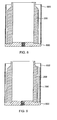
- a turbine sleeve 100 in accordance with the invention may include an inner cylindrical structure 300 made of a material such as steel.
- a more durable outer layer 302 may be adhered or attached to the outside diameter of the inner cylindrical structure 300.
- a matrix material such as a layer 302 of tungsten carbide matrix may be attached to the outside diameter of the inner cylindrical structure 300 to provide added hardness or durability to the turbine sleeve 100.
- the matrix material may include an impreg matrix containing 10 to 40 percent diamond grit by volume.
- a matrix layer containing a transition constituent may be used.
- the outer layer 302 may be embedded with inserts or buttons, such as tungsten carbide buttons, polycrystalline diamond compact (PDC) buttons, diamond inserts, PDC inserts, thermally stable polycrystalline diamond inserts (TSPs), natural diamonds, or the like, to improve the hardness or durability of the outer layer 302.
- the outer layer 302 may also receive durability enhancements such as impreg mix, brazed in PDC cutters on the blades 104, and/or PDC cutters on the back angle 402 to act as upreamers.
- the outer layer 302 may be localized to the blades 104, meaning that the outer layer 302 may not extend to the root 304 of each blade 104. This design may minimize residual stresses by not having the outer layer 302 fully cover the inner cylindrical structure 300.
- the thickness 306 of the outer layer 302 may be about ten to eighty percent of the overall blade height 308. In other embodiments, the thickness 306 of the outer layer 302 may be about thirty percent of the overall blade height 308. In general, the thickness of the outer layer 302 may be chosen to avoid undercutting of the softer steel beneath the outer layer 302. Nevertheless, in other embodiments, the outer layer 302 is not localized to the blades 104, but rather extends to the root 304 of each blade 104 and completely covers the inner cylindrical structure 300.
- threads 500 may be formed on the outside diameter of the inner cylindrical structure 300 prior to applying the outer layer 302 thereon.
- a series of blades 104 and channels 106 are formed on the inner cylindrical structure 300 either before or after the threads 500 are formed thereon.
- the threads 500 may increase the surface area of the interface 400 and create a more gradual, as opposed to abrupt, transition from matrix material to steel.
- the threads 500 may also spread interfacial stress (due to compatibility strains, differences in coefficients of thermal expansion, etc.) over a wider area, thereby reducing the peak stresses experienced at the interface. This may significantly reduce the outer layer's tendency to separate or fracture from the underlying inner cylindrical structure 300. This improvement has been verified in high-speed turbine applications.
- threads 500 may create a mechanical lock between the outer layer 302 and the inner cylindrical structure 300, thereby preventing separation due to tangential or thermal loading.
- the direction of the threads 500 may be selected based on the rotational direction of the drill bit 102.
- One additional advantage of using threads 500 as opposed to other textured surfaces is the ease of forming the threads 500 on the inner cylindrical structure 300 using a lathe or other appropriate machine tool.
- a mold sleeve 600 such as a graphite mold sleeve 600, may be provided.
- the inside diameter of the mold sleeve 600 may be designed such that it is substantially equal to a desired outside diameter of the turbine sleeve 100.
- buttons 602 e.g ., PDC buttons, diamond inserts, PDC inserts, TSPs, natural diamonds, or the like
- these buttons 602 or inserts 602 may be glued or adhered to the inside diameter of the mold sleeve 600 at locations that will align with the blades 104 of the inner cylindrical structure 300.
- the mold sleeve 600 may provide a temporary form for the matrix material (i.e. , the outer layer 302) that is deposited on the inner cylindrical structure 300.
- the inner cylindrical structure 300 may be placed within the mold sleeve 600 such that the buttons/inserts 602 are positioned immediately over the blades 104 of the inner cylindrical structure 300.
- a series of channel formers 700 e.g ., sand formers 700
- the remaining voids 702 may then be infiltrated with a matrix material (e.g ., tungsten carbide matrix) to form the blades 104 of the turbine sleeve 100.
- a matrix material e.g ., tungsten carbide matrix
- the mold sleeve 600 may be broken up and removed from the outer circumference of the turbine sleeve 100, leaving the buttons/inserts 602 embedded within the blades 104.
- a method for fabricating a turbine sleeve 100 in accordance with the invention may include initially cleaning the inner cylindrical structure 300 to ensure that corrosion, grease, and/or dirt are removed from the outside diameter thereof.
- the inner cylindrical structure 300 and mold sleeve 600 may then be placed on a base fixture 800.
- the base fixture 800 may help keep the inner cylindrical structure 300 and the mold sleeve 600 axially centered with respect to one another.
- the mold sleeve 600 may be oriented such that the buttons 602 or inserts 602 that are adhered to the sleeve 600 are positioned immediately over the blades 104 of the inner cylindrical structure 300.
- the buttons 602 or inserts 602 are positioned some distance ( e.g ., 0.2 inches) away from the edge of the blades 104.
- the channel formers 700 may then be inserted into the channels 106 of the inner cylindrical structure 300. These channel formers 700 may create voids in the turbine sleeve 100 that will produce the waterways 106 or channels 106 along the turbine sleeve 100.
- the assembly illustrated in Figure 9 may then be placed into a mold pot 1000.
- the mold pot 1000, as well as a funnel member 1014 and lid 1020 may be fabricated from a heavy-grade graphite material and may be re-used when producing the turbine sleeve 100.
- a matrix powder such as a tungsten carbide powder, may then be loaded into the voids 702 illustrated in Figure 7 .
- the matrix powder may be loaded to a depth ( e.g ., 1/8 inch) below a top surface of the channel formers 700. If needed, the entire structure may be vibrated to compact the matrix powder.
- upreamer ring 1004 may be added to the structure immediately above the channel formers 700 and the powder 1002. The upreamer ring 1004 may provide a temporary form to ensure that the matrix material assumes the sloping back angle 1006.
- additional matrix powder may be loaded into the voids 702, such as at or near the corner 1008.
- a sand stalk 1010 may then be installed into the base fixture 800 and centered with respect to the inside diameter of the inner cylindrical structure 300.
- the sand stalk 1010 may keep the inside diameter of the inner cylindrical structure 300 free of powder and binder.
- a soft powder may be loaded into the space 1012 between the sand stalk 1010 and the inner cylindrical structure 300. This soft powder may create a soft material that may be machined away or broken up after the turbine sleeve 100 is fabricated.
- a funnel member 1014 may be attached to the top of the mold pot 1000.
- the funnel member 1014 may thread onto the mold pot 1000.
- the funnel member 1014 may provide a chamber 1016 where a binder material (e.g ., a copper-based alloy) may be added.
- a lid 1020 may cover the top of the funnel member 1014.
- the lid 1020 may also thread onto the funnel member 1014.
- a thermocouple protection tube 1018 may extend through the lid 1020, through a smaller sand stalk 1026, and through the larger sand stalk 1010.
- a thermocouple (not shown) may extend through the thermocouple protection tube into the assembly 1024 to measure the assembly's internal temperature when heated.
- a thermocouple cap 1022 may fit over the thermocouple tube 1018 and rest on the lid 1020.
- the entire assembly may be placed in a furnace and heated.
- the assembly may be heated to temperature of about 1200°C for about 3 hours.
- the heat will cause the binder in the chamber 1016 to melt and flow (in response to gravity and surface tension) into the matrix powder 1002 in the assembly 1024.
- the assembly 1024 may be removed from the furnace and cooled. This may be accomplished by placing the assembly on a cooling table and directing a stream of water into a quench cavity 1028 on the bottom of the mold pot 1000. By controlling the flow rate of the water stream, the cooling rate of the assembly 1024 may be controlled. As the assembly 1024 cools, the binder that has infiltrated the matrix powder 1002 will begin to solidify from the bottom up, thereby creating the solidified matrix material on the blades 104. Solidifying the matrix material in an upward direction may ensure that liquid metal is available to fill any porosity in the matrix powder as the matrix shrinks and solidifies.
- the turbine sleeve 100 (which may include the inner cylindrical structure 300 and the solidified matrix material 1002) may be removed from the assembly 1024.
- the sand stalk 1010, mold sleeve 600, and upreamer ring 1004 may be mechanically broken up and removed from the turbine sleeve 100.
- the resulting turbine sleeve 100 may then be machined as needed to assume its final contour and shape.
Landscapes
- Engineering & Computer Science (AREA)
- Life Sciences & Earth Sciences (AREA)
- Geology (AREA)
- Mining & Mineral Resources (AREA)
- Mechanical Engineering (AREA)
- Physics & Mathematics (AREA)
- Environmental & Geological Engineering (AREA)
- Fluid Mechanics (AREA)
- General Life Sciences & Earth Sciences (AREA)
- Geochemistry & Mineralogy (AREA)
- Earth Drilling (AREA)
Applications Claiming Priority (1)
| Application Number | Priority Date | Filing Date | Title |
|---|---|---|---|
| US12/239,915 US8083011B2 (en) | 2008-09-29 | 2008-09-29 | Matrix turbine sleeve and method for making same |
Publications (2)
| Publication Number | Publication Date |
|---|---|
| EP2169178A2 true EP2169178A2 (de) | 2010-03-31 |
| EP2169178A3 EP2169178A3 (de) | 2011-06-22 |
Family
ID=41314537
Family Applications (1)
| Application Number | Title | Priority Date | Filing Date |
|---|---|---|---|
| EP09252153A Withdrawn EP2169178A3 (de) | 2008-09-29 | 2009-09-10 | Matrix-Turbinenhülse und Herstellungsverfahren dafür |
Country Status (2)
| Country | Link |
|---|---|
| US (1) | US8083011B2 (de) |
| EP (1) | EP2169178A3 (de) |
Cited By (2)
| Publication number | Priority date | Publication date | Assignee | Title |
|---|---|---|---|---|
| GB2476596A (en) * | 2009-03-20 | 2011-06-29 | Turbopower Drilling Sal | A drill bit comprising a gauge region |
| EP3183211A4 (de) * | 2014-08-19 | 2018-04-04 | US Synthetic Corporation | Positiventlastungsformung von polykristallinen diamantstrukturen und daraus resultierende schneidwerkzeuge |
Families Citing this family (1)
| Publication number | Priority date | Publication date | Assignee | Title |
|---|---|---|---|---|
| US9217301B1 (en) * | 2012-03-06 | 2015-12-22 | B.O.N.D. Enterprises, Llc | Attachable collar for down hole apparatus |
Citations (11)
| Publication number | Priority date | Publication date | Assignee | Title |
|---|---|---|---|---|
| US2331909A (en) * | 1940-12-04 | 1943-10-19 | Mallory & Co Inc P R | Gear and the like |
| US2653061A (en) * | 1948-07-15 | 1953-09-22 | Hughes Tool Co | Wear resistant tool joint |
| US3940268A (en) * | 1973-04-12 | 1976-02-24 | Crucible Inc. | Method for producing rotor discs |
| US4063939A (en) * | 1975-06-27 | 1977-12-20 | Special Metals Corporation | Composite turbine wheel and process for making same |
| US4101318A (en) * | 1976-12-10 | 1978-07-18 | Erwin Rudy | Cemented carbide-steel composites for earthmoving and mining applications |
| US4171339A (en) * | 1977-10-21 | 1979-10-16 | General Electric Company | Process for preparing a polycrystalline diamond body/silicon carbide substrate composite |
| US4749594A (en) * | 1986-10-17 | 1988-06-07 | Degussa Aktiengesellschaft | Method for coating surfaces with hard substances |
| GB2275054A (en) * | 1993-02-10 | 1994-08-17 | Rank Brimar Ltd | Tungsten articles and method for making them |
| US5801110A (en) * | 1997-04-07 | 1998-09-01 | Miltex Instrument Company | Ceramic composition for coating surgical and dental instruments |
| WO2002049801A1 (en) * | 2000-12-21 | 2002-06-27 | Element Six (Pty) Ltd | Method of making a cutting tool |
| EP1667177A1 (de) * | 2003-09-17 | 2006-06-07 | Hitachi Powdered Metals Co., Ltd. | Gesinterter beweglicher eisenkern und verfahren zu seiner herstellung |
Family Cites Families (18)
| Publication number | Priority date | Publication date | Assignee | Title |
|---|---|---|---|---|
| US3419094A (en) * | 1966-06-17 | 1968-12-31 | Reed Roller Bit Co | Drill string stabilizer |
| US3645587A (en) * | 1969-11-18 | 1972-02-29 | Bill G Parker | Drill string member and method for manufacture |
| US3978933A (en) * | 1975-01-27 | 1976-09-07 | Smith International, Inc. | Bit-adjacent stabilizer and steel |
| US4000549A (en) * | 1975-07-14 | 1977-01-04 | Eastman-Whipstock, Inc. | Stabilizer |
| GB2147033A (en) * | 1983-08-20 | 1985-05-01 | Richard Groom | Improved drilling tools |
| US4982802A (en) * | 1989-11-22 | 1991-01-08 | Amoco Corporation | Method for stabilizing a rotary drill string and drill bit |
| CA2105190A1 (en) | 1992-09-11 | 1994-03-12 | Ronald L. Frazee | Segmented diamond compact |
| AU6346196A (en) * | 1995-07-14 | 1997-02-18 | U.S. Synthetic Corporation | Polycrystalline diamond cutter with integral carbide/diamond transition layer |
| DE19634314A1 (de) | 1996-07-27 | 1998-01-29 | Widia Gmbh | Verbundkörper und Verfahren zu seiner Herstellung |
| US5829541A (en) * | 1996-12-27 | 1998-11-03 | General Electric Company | Polycrystalline diamond cutting element with diamond ridge pattern |
| US6241036B1 (en) * | 1998-09-16 | 2001-06-05 | Baker Hughes Incorporated | Reinforced abrasive-impregnated cutting elements, drill bits including same |
| US6213229B1 (en) * | 1998-10-13 | 2001-04-10 | Smith International Canada Limited | Drilling motor drill bit reaming stabilizer |
| DE60018154T2 (de) | 2000-01-13 | 2005-12-29 | Camco International (Uk) Ltd., Stonehouse | Schneideinsatz |
| EP1190791B1 (de) | 2000-09-20 | 2010-06-23 | Camco International (UK) Limited | Polykristalline Diamant-Schneidelemente mit Arbeitsfläche und diese mit veränderlicher Verschleissfesstigkeit bei gleicher Schlagfestigkeit |
| US7681669B2 (en) * | 2005-01-17 | 2010-03-23 | Us Synthetic Corporation | Polycrystalline diamond insert, drill bit including same, and method of operation |
| US7435478B2 (en) * | 2005-01-27 | 2008-10-14 | Smith International, Inc. | Cutting structures |
| GB2454122B (en) * | 2005-02-08 | 2009-07-08 | Smith International | Thermally stable polycrystalline diamond cutting elements and bits incorporating the same |
| US7694757B2 (en) * | 2005-02-23 | 2010-04-13 | Smith International, Inc. | Thermally stable polycrystalline diamond materials, cutting elements incorporating the same and bits incorporating such cutting elements |
-
2008
- 2008-09-29 US US12/239,915 patent/US8083011B2/en active Active
-
2009
- 2009-09-10 EP EP09252153A patent/EP2169178A3/de not_active Withdrawn
Patent Citations (11)
| Publication number | Priority date | Publication date | Assignee | Title |
|---|---|---|---|---|
| US2331909A (en) * | 1940-12-04 | 1943-10-19 | Mallory & Co Inc P R | Gear and the like |
| US2653061A (en) * | 1948-07-15 | 1953-09-22 | Hughes Tool Co | Wear resistant tool joint |
| US3940268A (en) * | 1973-04-12 | 1976-02-24 | Crucible Inc. | Method for producing rotor discs |
| US4063939A (en) * | 1975-06-27 | 1977-12-20 | Special Metals Corporation | Composite turbine wheel and process for making same |
| US4101318A (en) * | 1976-12-10 | 1978-07-18 | Erwin Rudy | Cemented carbide-steel composites for earthmoving and mining applications |
| US4171339A (en) * | 1977-10-21 | 1979-10-16 | General Electric Company | Process for preparing a polycrystalline diamond body/silicon carbide substrate composite |
| US4749594A (en) * | 1986-10-17 | 1988-06-07 | Degussa Aktiengesellschaft | Method for coating surfaces with hard substances |
| GB2275054A (en) * | 1993-02-10 | 1994-08-17 | Rank Brimar Ltd | Tungsten articles and method for making them |
| US5801110A (en) * | 1997-04-07 | 1998-09-01 | Miltex Instrument Company | Ceramic composition for coating surgical and dental instruments |
| WO2002049801A1 (en) * | 2000-12-21 | 2002-06-27 | Element Six (Pty) Ltd | Method of making a cutting tool |
| EP1667177A1 (de) * | 2003-09-17 | 2006-06-07 | Hitachi Powdered Metals Co., Ltd. | Gesinterter beweglicher eisenkern und verfahren zu seiner herstellung |
Cited By (8)
| Publication number | Priority date | Publication date | Assignee | Title |
|---|---|---|---|---|
| GB2476596A (en) * | 2009-03-20 | 2011-06-29 | Turbopower Drilling Sal | A drill bit comprising a gauge region |
| GB2476596B (en) * | 2009-03-20 | 2012-05-23 | Halliburton Energy Serv Inc | Downhole drilling assembly |
| US9249630B2 (en) | 2009-03-20 | 2016-02-02 | Halliburton Energy Services, Inc. | Downhole drilling assembly |
| US9714543B2 (en) | 2009-03-20 | 2017-07-25 | Halliburton Energy Services, Inc. | Downhole drilling assembly |
| US10119336B2 (en) | 2009-03-20 | 2018-11-06 | Halliburton Energy Services, Inc. | Downhole drilling assembly |
| EP3183211A4 (de) * | 2014-08-19 | 2018-04-04 | US Synthetic Corporation | Positiventlastungsformung von polykristallinen diamantstrukturen und daraus resultierende schneidwerkzeuge |
| US10293467B2 (en) | 2014-08-19 | 2019-05-21 | Us Synthetic Corporation | Positive relief forming of polycrystalline diamond structures and resulting cutting tools |
| US11667011B2 (en) | 2014-08-19 | 2023-06-06 | Us Synthetic Corporation | Methods of making a polycrystalline diamond structure |
Also Published As
| Publication number | Publication date |
|---|---|
| US8083011B2 (en) | 2011-12-27 |
| US20100078222A1 (en) | 2010-04-01 |
| EP2169178A3 (de) | 2011-06-22 |
Similar Documents
| Publication | Publication Date | Title |
|---|---|---|
| US8973683B2 (en) | Heavy duty matrix bit | |
| US7426969B2 (en) | Bits and cutting structures | |
| US8973466B2 (en) | Methods of forming earth-boring tools and components thereof including attaching a shank to a body of an earth-boring tool | |
| US8268452B2 (en) | Bonding agents for improved sintering of earth-boring tools, methods of forming earth-boring tools and resulting structures | |
| US9759015B2 (en) | Liquid-metal-embrittlement resistant superabrasive compacts | |
| CN101583773A (zh) | 连接地钻钻具的柄和钻头体的方法及由该方法形成的钻具 | |
| WO2008157371A1 (en) | Interchangeable bearing blocks for drill bits, and drill bits including same | |
| WO2008144036A2 (en) | Method of repairing diamond rock bit | |
| CN102667049A (zh) | 具有大磨切介质的孕镶切削元件及其制造和使用方法 | |
| US9528551B2 (en) | Method for making a bearing component, a bearing component, a down hole device and a down hole bearing assembly | |
| US8083011B2 (en) | Matrix turbine sleeve and method for making same | |
| US9359824B2 (en) | Method for reducing intermetallic compounds in matrix bit bondline | |
| US9993869B2 (en) | Directional solidification of polycrystalline diamond compact (PDC) drill bits | |
| CN105593454B (zh) | 用于改善附接性的增强pcd切割器凹口表面几何结构 | |
| WO2025015043A1 (en) | Fixed cutter drill bits and methods of making same | |
| US11512537B2 (en) | Displacement members comprising machineable material portions, bit bodies comprising machineable material portions from such displacement members, earth-boring rotary drill bits comprising such bit bodies, and related methods | |
| EP2899360B1 (de) | Verfahren zur Reduzierung intermetallischer Verbindungen in einer Matrixbit-Klebeschicht | |
| JPS60199189A (ja) | ロ−タリ掘削ビツトの製造方法 |
Legal Events
| Date | Code | Title | Description |
|---|---|---|---|
| PUAI | Public reference made under article 153(3) epc to a published international application that has entered the european phase |
Free format text: ORIGINAL CODE: 0009012 |
|
| AK | Designated contracting states |
Kind code of ref document: A2 Designated state(s): AT BE BG CH CY CZ DE DK EE ES FI FR GB GR HR HU IE IS IT LI LT LU LV MC MK MT NL NO PL PT RO SE SI SK SM TR |
|
| AX | Request for extension of the european patent |
Extension state: AL BA RS |
|
| PUAL | Search report despatched |
Free format text: ORIGINAL CODE: 0009013 |
|
| AK | Designated contracting states |
Kind code of ref document: A3 Designated state(s): AT BE BG CH CY CZ DE DK EE ES FI FR GB GR HR HU IE IS IT LI LT LU LV MC MK MT NL NO PL PT RO SE SI SK SM TR |
|
| AX | Request for extension of the european patent |
Extension state: AL BA RS |
|
| 17P | Request for examination filed |
Effective date: 20111214 |
|
| 17Q | First examination report despatched |
Effective date: 20140221 |
|
| STAA | Information on the status of an ep patent application or granted ep patent |
Free format text: STATUS: THE APPLICATION IS DEEMED TO BE WITHDRAWN |
|
| 18D | Application deemed to be withdrawn |
Effective date: 20170411 |