EP2168958A1 - Isoindole-Imide Compounds, Compositions And Uses Thereof - Google Patents
Isoindole-Imide Compounds, Compositions And Uses Thereof Download PDFInfo
- Publication number
- EP2168958A1 EP2168958A1 EP10151016A EP10151016A EP2168958A1 EP 2168958 A1 EP2168958 A1 EP 2168958A1 EP 10151016 A EP10151016 A EP 10151016A EP 10151016 A EP10151016 A EP 10151016A EP 2168958 A1 EP2168958 A1 EP 2168958A1
- Authority
- EP
- European Patent Office
- Prior art keywords
- alkyl
- dioxo
- piperidyl
- methyl
- piperidin
- Prior art date
- Legal status (The legal status is an assumption and is not a legal conclusion. Google has not performed a legal analysis and makes no representation as to the accuracy of the status listed.)
- Withdrawn
Links
- 239000000203 mixture Substances 0.000 title claims abstract description 284
- -1 clathrates Chemical class 0.000 claims abstract description 146
- 238000000034 method Methods 0.000 claims abstract description 61
- 241000124008 Mammalia Species 0.000 claims abstract description 59
- 206010028980 Neoplasm Diseases 0.000 claims abstract description 55
- 108060008682 Tumor Necrosis Factor Proteins 0.000 claims abstract description 41
- 102000000852 Tumor Necrosis Factor-alpha Human genes 0.000 claims abstract description 41
- MZOFCQQQCNRIBI-VMXHOPILSA-N (3s)-4-[[(2s)-1-[[(2s)-1-[[(1s)-1-carboxy-2-hydroxyethyl]amino]-4-methyl-1-oxopentan-2-yl]amino]-5-(diaminomethylideneamino)-1-oxopentan-2-yl]amino]-3-[[2-[[(2s)-2,6-diaminohexanoyl]amino]acetyl]amino]-4-oxobutanoic acid Chemical compound OC[C@@H](C(O)=O)NC(=O)[C@H](CC(C)C)NC(=O)[C@H](CCCN=C(N)N)NC(=O)[C@H](CC(O)=O)NC(=O)CNC(=O)[C@@H](N)CCCCN MZOFCQQQCNRIBI-VMXHOPILSA-N 0.000 claims abstract description 40
- 238000004519 manufacturing process Methods 0.000 claims abstract description 32
- 150000003839 salts Chemical class 0.000 claims abstract description 29
- 208000027866 inflammatory disease Diseases 0.000 claims abstract description 27
- 239000012453 solvate Substances 0.000 claims abstract description 18
- 230000002757 inflammatory effect Effects 0.000 claims abstract description 11
- 208000019622 heart disease Diseases 0.000 claims abstract description 9
- 239000008194 pharmaceutical composition Substances 0.000 claims abstract description 9
- 150000001875 compounds Chemical class 0.000 claims description 290
- 125000003118 aryl group Chemical group 0.000 claims description 174
- 125000004209 (C1-C8) alkyl group Chemical group 0.000 claims description 156
- 125000001072 heteroaryl group Chemical group 0.000 claims description 140
- 125000001797 benzyl group Chemical group [H]C1=C([H])C([H])=C(C([H])=C1[H])C([H])([H])* 0.000 claims description 139
- 125000004649 C2-C8 alkynyl group Chemical group 0.000 claims description 128
- 125000004648 C2-C8 alkenyl group Chemical group 0.000 claims description 127
- 125000000592 heterocycloalkyl group Chemical group 0.000 claims description 110
- 125000006272 (C3-C7) cycloalkyl group Chemical group 0.000 claims description 67
- 125000002496 methyl group Chemical group [H]C([H])([H])* 0.000 claims description 55
- TUMJPYMYNBEMDD-UHFFFAOYSA-N 4-(aminomethyl)-2-(2,6-dioxopiperidin-3-yl)isoindole-1,3-dione Chemical compound O=C1C=2C(CN)=CC=CC=2C(=O)N1C1CCC(=O)NC1=O TUMJPYMYNBEMDD-UHFFFAOYSA-N 0.000 claims description 29
- 229910052799 carbon Inorganic materials 0.000 claims description 21
- 229910052760 oxygen Inorganic materials 0.000 claims description 21
- 229910052717 sulfur Inorganic materials 0.000 claims description 21
- 229910052736 halogen Inorganic materials 0.000 claims description 20
- 201000011510 cancer Diseases 0.000 claims description 19
- 239000003814 drug Substances 0.000 claims description 19
- 150000002367 halogens Chemical class 0.000 claims description 19
- 229910052739 hydrogen Inorganic materials 0.000 claims description 18
- 102000003814 Interleukin-10 Human genes 0.000 claims description 16
- 108090000174 Interleukin-10 Proteins 0.000 claims description 16
- 210000001519 tissue Anatomy 0.000 claims description 15
- 210000001744 T-lymphocyte Anatomy 0.000 claims description 14
- 125000004178 (C1-C4) alkyl group Chemical group 0.000 claims description 12
- 125000004200 2-methoxyethyl group Chemical group [H]C([H])([H])OC([H])([H])C([H])([H])* 0.000 claims description 12
- 230000006378 damage Effects 0.000 claims description 12
- 210000004962 mammalian cell Anatomy 0.000 claims description 11
- MWQKBNITZCDKHB-UHFFFAOYSA-N 2-(2,6-dioxopiperidin-3-yl)-4-(2-methoxyethylamino)isoindole-1,3-dione Chemical compound O=C1C=2C(NCCOC)=CC=CC=2C(=O)N1C1CCC(=O)NC1=O MWQKBNITZCDKHB-UHFFFAOYSA-N 0.000 claims description 10
- 210000004369 blood Anatomy 0.000 claims description 10
- 239000008280 blood Substances 0.000 claims description 10
- 230000001684 chronic effect Effects 0.000 claims description 10
- 125000003342 alkenyl group Chemical group 0.000 claims description 9
- 208000022559 Inflammatory bowel disease Diseases 0.000 claims description 8
- 201000004681 Psoriasis Diseases 0.000 claims description 8
- 208000027418 Wounds and injury Diseases 0.000 claims description 8
- 206010039073 rheumatoid arthritis Diseases 0.000 claims description 8
- 238000012360 testing method Methods 0.000 claims description 8
- 206010002556 Ankylosing Spondylitis Diseases 0.000 claims description 7
- 208000014674 injury Diseases 0.000 claims description 7
- 230000000302 ischemic effect Effects 0.000 claims description 7
- 201000008482 osteoarthritis Diseases 0.000 claims description 7
- 125000002541 furyl group Chemical group 0.000 claims description 6
- 210000001035 gastrointestinal tract Anatomy 0.000 claims description 6
- 210000004185 liver Anatomy 0.000 claims description 6
- UWNBNIUPNHDFRA-UHFFFAOYSA-N n-[2-(2,6-dioxopiperidin-3-yl)-1,3-dioxoisoindol-4-yl]-2-methoxybenzamide Chemical compound COC1=CC=CC=C1C(=O)NC1=CC=CC2=C1C(=O)N(C1C(NC(=O)CC1)=O)C2=O UWNBNIUPNHDFRA-UHFFFAOYSA-N 0.000 claims description 6
- 125000004076 pyridyl group Chemical group 0.000 claims description 6
- 125000001544 thienyl group Chemical group 0.000 claims description 6
- BYAVQDFAOPXIIQ-UHFFFAOYSA-N 1-cyclopropyl-3-[[2-(2,6-dioxopiperidin-3-yl)-1,3-dioxoisoindol-4-yl]methyl]urea Chemical compound C1CC1NC(=O)NCC(C=1C2=O)=CC=CC=1C(=O)N2C1CCC(=O)NC1=O BYAVQDFAOPXIIQ-UHFFFAOYSA-N 0.000 claims description 5
- VXHZYVVGSMAQMJ-UHFFFAOYSA-N 2-azido-n-[[2-(2,6-dioxopiperidin-3-yl)-1,3-dioxoisoindol-4-yl]methyl]acetamide Chemical compound O=C1C=2C(CNC(=O)CN=[N+]=[N-])=CC=CC=2C(=O)N1C1CCC(=O)NC1=O VXHZYVVGSMAQMJ-UHFFFAOYSA-N 0.000 claims description 5
- 208000034578 Multiple myelomas Diseases 0.000 claims description 5
- 206010035226 Plasma cell myeloma Diseases 0.000 claims description 5
- HADVZQNRDFIJQJ-UHFFFAOYSA-N benzyl n-[6-[[2-(2,6-dioxopiperidin-3-yl)-1,3-dioxoisoindol-4-yl]amino]-6-oxohexyl]carbamate Chemical compound C=1C=CC=2C(=O)N(C3C(NC(=O)CC3)=O)C(=O)C=2C=1NC(=O)CCCCCNC(=O)OCC1=CC=CC=C1 HADVZQNRDFIJQJ-UHFFFAOYSA-N 0.000 claims description 5
- 210000000988 bone and bone Anatomy 0.000 claims description 5
- 210000004556 brain Anatomy 0.000 claims description 5
- 210000000481 breast Anatomy 0.000 claims description 5
- 210000003679 cervix uteri Anatomy 0.000 claims description 5
- 210000001072 colon Anatomy 0.000 claims description 5
- 229910052731 fluorine Inorganic materials 0.000 claims description 5
- 210000003734 kidney Anatomy 0.000 claims description 5
- 210000000867 larynx Anatomy 0.000 claims description 5
- 210000004072 lung Anatomy 0.000 claims description 5
- 210000001165 lymph node Anatomy 0.000 claims description 5
- 201000001441 melanoma Diseases 0.000 claims description 5
- 210000000214 mouth Anatomy 0.000 claims description 5
- 210000001672 ovary Anatomy 0.000 claims description 5
- 210000000496 pancreas Anatomy 0.000 claims description 5
- 210000003800 pharynx Anatomy 0.000 claims description 5
- 210000002307 prostate Anatomy 0.000 claims description 5
- 210000000952 spleen Anatomy 0.000 claims description 5
- 210000001550 testis Anatomy 0.000 claims description 5
- 210000004291 uterus Anatomy 0.000 claims description 5
- BRXUPRUKIALMFT-UHFFFAOYSA-N 1-[[2-(2,6-dioxopiperidin-3-yl)-1,3-dioxoisoindol-4-yl]methyl]-3-ethylurea Chemical compound O=C1C=2C(CNC(=O)NCC)=CC=CC=2C(=O)N1C1CCC(=O)NC1=O BRXUPRUKIALMFT-UHFFFAOYSA-N 0.000 claims description 4
- CLGYDNGWRRGLFE-UHFFFAOYSA-N 1-[[2-(2,6-dioxopiperidin-3-yl)-1,3-dioxoisoindol-4-yl]methyl]-3-octylurea Chemical compound O=C1C=2C(CNC(=O)NCCCCCCCC)=CC=CC=2C(=O)N1C1CCC(=O)NC1=O CLGYDNGWRRGLFE-UHFFFAOYSA-N 0.000 claims description 4
- OKKBUZAPZRRSSO-UHFFFAOYSA-N 1-benzyl-3-[[2-(2,6-dioxopiperidin-3-yl)-1,3-dioxoisoindol-4-yl]methyl]urea Chemical compound C=1C=CC=2C(=O)N(C3C(NC(=O)CC3)=O)C(=O)C=2C=1CNC(=O)NCC1=CC=CC=C1 OKKBUZAPZRRSSO-UHFFFAOYSA-N 0.000 claims description 4
- SVSMQAPPCVNXQW-UHFFFAOYSA-N 2-chloro-n-[2-(2,6-dioxopiperidin-3-yl)-1,3-dioxoisoindol-4-yl]acetamide Chemical compound O=C1C=2C(NC(=O)CCl)=CC=CC=2C(=O)N1C1CCC(=O)NC1=O SVSMQAPPCVNXQW-UHFFFAOYSA-N 0.000 claims description 4
- BOQZENHFBTUPTC-UHFFFAOYSA-N 3-chloro-n-[2-(2,6-dioxopiperidin-3-yl)-1,3-dioxoisoindol-4-yl]benzamide Chemical compound ClC1=CC=CC(C(=O)NC=2C=3C(=O)N(C4C(NC(=O)CC4)=O)C(=O)C=3C=CC=2)=C1 BOQZENHFBTUPTC-UHFFFAOYSA-N 0.000 claims description 4
- JBYQCGLMICPOSQ-UHFFFAOYSA-N 4-(benzylamino)-2-(2,6-dioxopiperidin-3-yl)isoindole-1,3-dione Chemical compound O=C1C(C(=CC=C2)NCC=3C=CC=CC=3)=C2C(=O)N1C1CCC(=O)NC1=O JBYQCGLMICPOSQ-UHFFFAOYSA-N 0.000 claims description 4
- AOJJSUZBOXZQNB-TZSSRYMLSA-N Doxorubicin Chemical compound O([C@H]1C[C@@](O)(CC=2C(O)=C3C(=O)C=4C=CC=C(C=4C(=O)C3=C(O)C=21)OC)C(=O)CO)[C@H]1C[C@H](N)[C@H](O)[C@H](C)O1 AOJJSUZBOXZQNB-TZSSRYMLSA-N 0.000 claims description 4
- NKANXQFJJICGDU-QPLCGJKRSA-N Tamoxifen Chemical compound C=1C=CC=CC=1C(/CC)=C(C=1C=CC(OCCN(C)C)=CC=1)/C1=CC=CC=C1 NKANXQFJJICGDU-QPLCGJKRSA-N 0.000 claims description 4
- OMDPFAQFGCNOQD-UHFFFAOYSA-N ethyl 2-[[2-(2,6-dioxopiperidin-3-yl)-1,3-dioxoisoindol-4-yl]methylcarbamoylamino]acetate Chemical compound O=C1C=2C(CNC(=O)NCC(=O)OCC)=CC=CC=2C(=O)N1C1CCC(=O)NC1=O OMDPFAQFGCNOQD-UHFFFAOYSA-N 0.000 claims description 4
- BAGHZDZFZMSHKT-UHFFFAOYSA-N ethyl 7-[[2-(2,6-dioxopiperidin-3-yl)-1,3-dioxoisoindol-4-yl]methylamino]-7-oxoheptanoate Chemical compound O=C1C=2C(CNC(=O)CCCCCC(=O)OCC)=CC=CC=2C(=O)N1C1CCC(=O)NC1=O BAGHZDZFZMSHKT-UHFFFAOYSA-N 0.000 claims description 4
- MNWFXJYAOYHMED-UHFFFAOYSA-N heptanoic acid Chemical compound CCCCCCC(O)=O MNWFXJYAOYHMED-UHFFFAOYSA-N 0.000 claims description 4
- 239000007943 implant Substances 0.000 claims description 4
- LCANJHCPRSJZJQ-UHFFFAOYSA-N n-[2-(2,6-dioxopiperidin-3-yl)-1,3-dioxoisoindol-4-yl]-2-ethoxyacetamide Chemical compound O=C1C=2C(NC(=O)COCC)=CC=CC=2C(=O)N1C1CCC(=O)NC1=O LCANJHCPRSJZJQ-UHFFFAOYSA-N 0.000 claims description 4
- GNQIBHPPXHWHFQ-UHFFFAOYSA-N n-[2-(2,6-dioxopiperidin-3-yl)-1,3-dioxoisoindol-4-yl]-4-nitrobenzamide Chemical compound C1=CC([N+](=O)[O-])=CC=C1C(=O)NC1=CC=CC2=C1C(=O)N(C1C(NC(=O)CC1)=O)C2=O GNQIBHPPXHWHFQ-UHFFFAOYSA-N 0.000 claims description 4
- JRKZXUJIOPCGGI-UHFFFAOYSA-N n-[[2-(2,6-dioxopiperidin-3-yl)-1,3-dioxoisoindol-4-yl]methyl]-2-methoxyacetamide Chemical compound O=C1C=2C(CNC(=O)COC)=CC=CC=2C(=O)N1C1CCC(=O)NC1=O JRKZXUJIOPCGGI-UHFFFAOYSA-N 0.000 claims description 4
- UOWIGNWCDRKWMJ-UHFFFAOYSA-N n-[[2-(2,6-dioxopiperidin-3-yl)-1,3-dioxoisoindol-4-yl]methyl]benzamide Chemical compound C=1C=CC=CC=1C(=O)NCC(C=1C2=O)=CC=CC=1C(=O)N2C1CCC(=O)NC1=O UOWIGNWCDRKWMJ-UHFFFAOYSA-N 0.000 claims description 4
- MLLZEXSWYDOQDE-UHFFFAOYSA-N n-[[2-(2,6-dioxopiperidin-3-yl)-1,3-dioxoisoindol-4-yl]methyl]butanamide Chemical compound O=C1C=2C(CNC(=O)CCC)=CC=CC=2C(=O)N1C1CCC(=O)NC1=O MLLZEXSWYDOQDE-UHFFFAOYSA-N 0.000 claims description 4
- XKFHXTMSMUHONX-UHFFFAOYSA-N n-[[2-(2,6-dioxopiperidin-3-yl)-1,3-dioxoisoindol-4-yl]methyl]cyclohexanecarboxamide Chemical compound C1CCCCC1C(=O)NCC(C=1C2=O)=CC=CC=1C(=O)N2C1CCC(=O)NC1=O XKFHXTMSMUHONX-UHFFFAOYSA-N 0.000 claims description 4
- TVOVTRQGKCWEAG-UHFFFAOYSA-N n-[[2-(2,6-dioxopiperidin-3-yl)-1,3-dioxoisoindol-4-yl]methyl]furan-2-carboxamide Chemical compound C=1C=COC=1C(=O)NCC(C=1C2=O)=CC=CC=1C(=O)N2C1CCC(=O)NC1=O TVOVTRQGKCWEAG-UHFFFAOYSA-N 0.000 claims description 4
- UDODWYJNTGKWBS-UHFFFAOYSA-N n-[[2-(2,6-dioxopiperidin-3-yl)-1,3-dioxoisoindol-4-yl]methyl]heptanamide Chemical compound O=C1C=2C(CNC(=O)CCCCCC)=CC=CC=2C(=O)N1C1CCC(=O)NC1=O UDODWYJNTGKWBS-UHFFFAOYSA-N 0.000 claims description 4
- FWELFDXVJGXJIY-UHFFFAOYSA-N n-[[2-(2,6-dioxopiperidin-3-yl)-1,3-dioxoisoindol-4-yl]methyl]propanamide Chemical compound O=C1C=2C(CNC(=O)CC)=CC=CC=2C(=O)N1C1CCC(=O)NC1=O FWELFDXVJGXJIY-UHFFFAOYSA-N 0.000 claims description 4
- BIUYITAPSPGGPW-UHFFFAOYSA-N n-[[2-(2,6-dioxopiperidin-3-yl)-1,3-dioxoisoindol-4-yl]methyl]pyridine-2-carboxamide Chemical compound C=1C=CC=NC=1C(=O)NCC(C=1C2=O)=CC=CC=1C(=O)N2C1CCC(=O)NC1=O BIUYITAPSPGGPW-UHFFFAOYSA-N 0.000 claims description 4
- HDLDXSASWILUMA-UHFFFAOYSA-N n-[[2-(2,6-dioxopiperidin-3-yl)-1-oxo-3h-isoindol-4-yl]methyl]cyclopropanecarboxamide Chemical compound C1CC1C(=O)NCC(C=1C2)=CC=CC=1C(=O)N2C1CCC(=O)NC1=O HDLDXSASWILUMA-UHFFFAOYSA-N 0.000 claims description 4
- YPKGJVAMXZZNGJ-UHFFFAOYSA-N 2-(2,6-dioxopiperidin-3-yl)-4-(furan-2-ylmethylamino)isoindole-1,3-dione Chemical compound O=C1C(C(=CC=C2)NCC=3OC=CC=3)=C2C(=O)N1C1CCC(=O)NC1=O YPKGJVAMXZZNGJ-UHFFFAOYSA-N 0.000 claims description 3
- FTZARLOKGLDDOC-UHFFFAOYSA-N 2-(2,6-dioxopiperidin-3-yl)-4-(heptylamino)isoindole-1,3-dione Chemical compound O=C1C=2C(NCCCCCCC)=CC=CC=2C(=O)N1C1CCC(=O)NC1=O FTZARLOKGLDDOC-UHFFFAOYSA-N 0.000 claims description 3
- JWBGWRMTYZIZRL-UHFFFAOYSA-N 2-amino-n-[2-(2,6-dioxopiperidin-3-yl)-1-oxo-3h-isoindol-4-yl]acetamide Chemical compound C1C=2C(NC(=O)CN)=CC=CC=2C(=O)N1C1CCC(=O)NC1=O JWBGWRMTYZIZRL-UHFFFAOYSA-N 0.000 claims description 3
- IQACOJIVZRDPIM-UHFFFAOYSA-N 2-azido-n-[2-(2,6-dioxopiperidin-3-yl)-1-oxo-3h-isoindol-4-yl]acetamide Chemical compound C1C=2C(NC(=O)CN=[N+]=[N-])=CC=CC=2C(=O)N1C1CCC(=O)NC1=O IQACOJIVZRDPIM-UHFFFAOYSA-N 0.000 claims description 3
- RAECDRLOAIXBNG-UHFFFAOYSA-N 2-chloro-n-[2-(2,6-dioxopiperidin-3-yl)-1-oxo-3h-isoindol-4-yl]acetamide Chemical compound C1C=2C(NC(=O)CCl)=CC=CC=2C(=O)N1C1CCC(=O)NC1=O RAECDRLOAIXBNG-UHFFFAOYSA-N 0.000 claims description 3
- XRAYWKDMFVKUTJ-UHFFFAOYSA-N 2-chloro-n-[[2-(2,6-dioxopiperidin-3-yl)-1,3-dioxoisoindol-4-yl]methyl]acetamide Chemical compound O=C1C=2C(CNC(=O)CCl)=CC=CC=2C(=O)N1C1CCC(=O)NC1=O XRAYWKDMFVKUTJ-UHFFFAOYSA-N 0.000 claims description 3
- VWZVRHSJOPXCKC-UHFFFAOYSA-N 3-[7-(benzylamino)-3-oxo-1h-isoindol-2-yl]piperidine-2,6-dione Chemical compound O=C1N(C2C(NC(=O)CC2)=O)CC2=C1C=CC=C2NCC1=CC=CC=C1 VWZVRHSJOPXCKC-UHFFFAOYSA-N 0.000 claims description 3
- IRCVSMVEFUBRKE-UHFFFAOYSA-N 4-chloro-n-[2-(2,6-dioxopiperidin-3-yl)-1,3-dioxoisoindol-4-yl]benzamide Chemical compound C1=CC(Cl)=CC=C1C(=O)NC1=CC=CC2=C1C(=O)N(C1C(NC(=O)CC1)=O)C2=O IRCVSMVEFUBRKE-UHFFFAOYSA-N 0.000 claims description 3
- JQEQCBULHMUUKQ-UHFFFAOYSA-N 5-[[[2-(2,6-dioxopiperidin-3-yl)-1,3-dioxoisoindol-4-yl]amino]methyl]furan-2-carboxylic acid Chemical compound O1C(C(=O)O)=CC=C1CNC1=CC=CC2=C1C(=O)N(C1C(NC(=O)CC1)=O)C2=O JQEQCBULHMUUKQ-UHFFFAOYSA-N 0.000 claims description 3
- 208000019693 Lung disease Diseases 0.000 claims description 3
- TZBINUQFZFSFKQ-UHFFFAOYSA-N [2-[[2-(2,6-dioxopiperidin-3-yl)-1,3-dioxoisoindol-4-yl]amino]-2-oxoethyl] acetate Chemical compound O=C1C=2C(NC(=O)COC(=O)C)=CC=CC=2C(=O)N1C1CCC(=O)NC1=O TZBINUQFZFSFKQ-UHFFFAOYSA-N 0.000 claims description 3
- OBBCQKHWPYKEMI-UHFFFAOYSA-N [2-[[2-(2,6-dioxopiperidin-3-yl)-1,3-dioxoisoindol-4-yl]methylamino]-2-oxoethyl] acetate Chemical compound O=C1C=2C(CNC(=O)COC(=O)C)=CC=CC=2C(=O)N1C1CCC(=O)NC1=O OBBCQKHWPYKEMI-UHFFFAOYSA-N 0.000 claims description 3
- 239000002246 antineoplastic agent Substances 0.000 claims description 3
- 239000004202 carbamide Substances 0.000 claims description 3
- 125000003917 carbamoyl group Chemical group [H]N([H])C(*)=O 0.000 claims description 3
- 229960004768 irinotecan Drugs 0.000 claims description 3
- AHLRKYLJJOLOSA-UHFFFAOYSA-N n-[2-(2,6-dioxopiperidin-3-yl)-1,3-dioxoisoindol-4-yl]-2-fluorobenzamide Chemical compound FC1=CC=CC=C1C(=O)NC1=CC=CC2=C1C(=O)N(C1C(NC(=O)CC1)=O)C2=O AHLRKYLJJOLOSA-UHFFFAOYSA-N 0.000 claims description 3
- KEYLHGOTFIBDRT-UHFFFAOYSA-N n-[2-(2,6-dioxopiperidin-3-yl)-1,3-dioxoisoindol-4-yl]-2-methoxyacetamide Chemical compound O=C1C=2C(NC(=O)COC)=CC=CC=2C(=O)N1C1CCC(=O)NC1=O KEYLHGOTFIBDRT-UHFFFAOYSA-N 0.000 claims description 3
- ZKHWQACTXQQZPZ-UHFFFAOYSA-N n-[2-(2,6-dioxopiperidin-3-yl)-1,3-dioxoisoindol-4-yl]-4-(trifluoromethyl)benzamide Chemical compound C1=CC(C(F)(F)F)=CC=C1C(=O)NC1=CC=CC2=C1C(=O)N(C1C(NC(=O)CC1)=O)C2=O ZKHWQACTXQQZPZ-UHFFFAOYSA-N 0.000 claims description 3
- GCYCCBRTJYRRNK-UHFFFAOYSA-N n-[2-(2,6-dioxopiperidin-3-yl)-1,3-dioxoisoindol-4-yl]benzamide Chemical compound C=1C=CC=CC=1C(=O)NC(C=1C2=O)=CC=CC=1C(=O)N2C1CCC(=O)NC1=O GCYCCBRTJYRRNK-UHFFFAOYSA-N 0.000 claims description 3
- ZNSIEKYJZZEJNA-UHFFFAOYSA-N n-[2-(2,6-dioxopiperidin-3-yl)-1,3-dioxoisoindol-4-yl]cyclopropanecarboxamide Chemical compound C1CC1C(=O)NC(C=1C2=O)=CC=CC=1C(=O)N2C1CCC(=O)NC1=O ZNSIEKYJZZEJNA-UHFFFAOYSA-N 0.000 claims description 3
- FKXMMTWDYMLWRR-UHFFFAOYSA-N n-[2-(2,6-dioxopiperidin-3-yl)-1,3-dioxoisoindol-4-yl]furan-2-carboxamide Chemical compound C=1C=COC=1C(=O)NC(C=1C2=O)=CC=CC=1C(=O)N2C1CCC(=O)NC1=O FKXMMTWDYMLWRR-UHFFFAOYSA-N 0.000 claims description 3
- SLRVRHNIGFIYIC-UHFFFAOYSA-N n-[2-(2,6-dioxopiperidin-3-yl)-1,3-dioxoisoindol-4-yl]heptanamide Chemical compound O=C1C=2C(NC(=O)CCCCCC)=CC=CC=2C(=O)N1C1CCC(=O)NC1=O SLRVRHNIGFIYIC-UHFFFAOYSA-N 0.000 claims description 3
- AOFBWOWGDIJWCR-UHFFFAOYSA-N n-[2-(2,6-dioxopiperidin-3-yl)-1,3-dioxoisoindol-4-yl]pentanamide Chemical compound O=C1C=2C(NC(=O)CCCC)=CC=CC=2C(=O)N1C1CCC(=O)NC1=O AOFBWOWGDIJWCR-UHFFFAOYSA-N 0.000 claims description 3
- FPYSCUBOQCTDPU-UHFFFAOYSA-N n-[2-(2,6-dioxopiperidin-3-yl)-1,3-dioxoisoindol-4-yl]propanamide Chemical compound O=C1C=2C(NC(=O)CC)=CC=CC=2C(=O)N1C1CCC(=O)NC1=O FPYSCUBOQCTDPU-UHFFFAOYSA-N 0.000 claims description 3
- ZGYJSLXLVBIKGT-UHFFFAOYSA-N n-[2-(2,6-dioxopiperidin-3-yl)-1,3-dioxoisoindol-4-yl]thiophene-2-carboxamide Chemical compound C=1C=CSC=1C(=O)NC(C=1C2=O)=CC=CC=1C(=O)N2C1CCC(=O)NC1=O ZGYJSLXLVBIKGT-UHFFFAOYSA-N 0.000 claims description 3
- IGUDNJLDVFQEGM-UHFFFAOYSA-N n-[[2-(2,6-dioxopiperidin-3-yl)-1,3-dioxoisoindol-4-yl]methyl]thiophene-2-carboxamide Chemical compound C=1C=CSC=1C(=O)NCC(C=1C2=O)=CC=CC=1C(=O)N2C1CCC(=O)NC1=O IGUDNJLDVFQEGM-UHFFFAOYSA-N 0.000 claims description 3
- RFIOZSIHFNEKFF-UHFFFAOYSA-M piperazine-1-carboxylate Chemical compound [O-]C(=O)N1CCNCC1 RFIOZSIHFNEKFF-UHFFFAOYSA-M 0.000 claims description 3
- 210000000664 rectum Anatomy 0.000 claims description 3
- APPPMWLAQJXQJZ-UHFFFAOYSA-N tert-butyl n-[3-[[2-(2,6-dioxopiperidin-3-yl)-1,3-dioxoisoindol-4-yl]methylamino]-3-oxopropyl]carbamate Chemical compound O=C1C=2C(CNC(=O)CCNC(=O)OC(C)(C)C)=CC=CC=2C(=O)N1C1CCC(=O)NC1=O APPPMWLAQJXQJZ-UHFFFAOYSA-N 0.000 claims description 3
- UMLXMDSGUCNRJE-UHFFFAOYSA-N tert-butyl n-[[2-(2,6-dioxopiperidin-3-yl)-1,3-dioxoisoindol-4-yl]methyl]carbamate Chemical compound O=C1C=2C(CNC(=O)OC(C)(C)C)=CC=CC=2C(=O)N1C1CCC(=O)NC1=O UMLXMDSGUCNRJE-UHFFFAOYSA-N 0.000 claims description 3
- LKJPYSCBVHEWIU-KRWDZBQOSA-N (R)-bicalutamide Chemical compound C([C@@](O)(C)C(=O)NC=1C=C(C(C#N)=CC=1)C(F)(F)F)S(=O)(=O)C1=CC=C(F)C=C1 LKJPYSCBVHEWIU-KRWDZBQOSA-N 0.000 claims description 2
- RBOPGPIIBBSRQO-UHFFFAOYSA-N 1-[[2-(2,6-dioxopiperidin-3-yl)-1,3-dioxoisoindol-4-yl]methyl]-3-ethylthiourea Chemical compound O=C1C=2C(CNC(=S)NCC)=CC=CC=2C(=O)N1C1CCC(=O)NC1=O RBOPGPIIBBSRQO-UHFFFAOYSA-N 0.000 claims description 2
- FKOFRYWZKLLJHJ-UHFFFAOYSA-N 1-[[2-(2,6-dioxopiperidin-3-yl)-1,3-dioxoisoindol-4-yl]methyl]-3-phenylurea Chemical compound C=1C=CC=CC=1NC(=O)NCC(C=1C2=O)=CC=CC=1C(=O)N2C1CCC(=O)NC1=O FKOFRYWZKLLJHJ-UHFFFAOYSA-N 0.000 claims description 2
- CKOFUTLCCXSNOZ-UHFFFAOYSA-N 1-[[2-(2,6-dioxopiperidin-3-yl)-1,3-dioxoisoindol-4-yl]methyl]-3-pyridin-3-ylurea;hydrochloride Chemical compound Cl.C=1C=CN=CC=1NC(=O)NCC(C=1C2=O)=CC=CC=1C(=O)N2C1CCC(=O)NC1=O CKOFUTLCCXSNOZ-UHFFFAOYSA-N 0.000 claims description 2
- IYSIDZMLLKLYIO-UHFFFAOYSA-N 1-[[2-(2,6-dioxopiperidin-3-yl)-1-oxo-3h-isoindol-4-yl]methyl]-3-ethylurea Chemical compound C1C=2C(CNC(=O)NCC)=CC=CC=2C(=O)N1C1CCC(=O)NC1=O IYSIDZMLLKLYIO-UHFFFAOYSA-N 0.000 claims description 2
- OWJDKMFZNZKFEZ-UHFFFAOYSA-N 1-butyl-3-[[2-(2,6-dioxopiperidin-3-yl)-1,3-dioxoisoindol-4-yl]methyl]urea Chemical compound O=C1C=2C(CNC(=O)NCCCC)=CC=CC=2C(=O)N1C1CCC(=O)NC1=O OWJDKMFZNZKFEZ-UHFFFAOYSA-N 0.000 claims description 2
- GYBAWNXMPZVXFQ-UHFFFAOYSA-N 1-cyclohexyl-3-[[2-(2,6-dioxopiperidin-3-yl)-1,3-dioxoisoindol-4-yl]methyl]urea Chemical compound C1CCCCC1NC(=O)NCC(C=1C2=O)=CC=CC=1C(=O)N2C1CCC(=O)NC1=O GYBAWNXMPZVXFQ-UHFFFAOYSA-N 0.000 claims description 2
- KIYGXFJOOIEPNO-UHFFFAOYSA-N 1-cyclopentyl-3-[[2-(2,6-dioxopiperidin-3-yl)-1,3-dioxoisoindol-4-yl]methyl]urea Chemical compound C1CCCC1NC(=O)NCC(C=1C2=O)=CC=CC=1C(=O)N2C1CCC(=O)NC1=O KIYGXFJOOIEPNO-UHFFFAOYSA-N 0.000 claims description 2
- GPEDWDVUPFIAIV-UHFFFAOYSA-N 2-(2,6-dioxopiperidin-3-yl)-4-(2-phenylmethoxyethylamino)isoindole-1,3-dione Chemical compound O=C1C(C(=CC=C2)NCCOCC=3C=CC=CC=3)=C2C(=O)N1C1CCC(=O)NC1=O GPEDWDVUPFIAIV-UHFFFAOYSA-N 0.000 claims description 2
- VUFGKXWZCASHSG-UHFFFAOYSA-N 2-(2,6-dioxopiperidin-3-yl)-4-(pentylamino)isoindole-1,3-dione Chemical compound O=C1C=2C(NCCCCC)=CC=CC=2C(=O)N1C1CCC(=O)NC1=O VUFGKXWZCASHSG-UHFFFAOYSA-N 0.000 claims description 2
- RITVZGDFSKPJIU-UHFFFAOYSA-N 2-(2,6-dioxopiperidin-3-yl)-4-[(5-methylfuran-2-yl)methylamino]isoindole-1,3-dione Chemical compound O1C(C)=CC=C1CNC1=CC=CC2=C1C(=O)N(C1C(NC(=O)CC1)=O)C2=O RITVZGDFSKPJIU-UHFFFAOYSA-N 0.000 claims description 2
- LPYWGSRQCRYNHG-UHFFFAOYSA-N 2-(2,6-dioxopiperidin-3-yl)-4-[[5-(hydroxymethyl)furan-2-yl]methylamino]isoindole-1,3-dione Chemical compound O1C(CO)=CC=C1CNC1=CC=CC2=C1C(=O)N(C1C(NC(=O)CC1)=O)C2=O LPYWGSRQCRYNHG-UHFFFAOYSA-N 0.000 claims description 2
- PPXOICYYCHOOJU-UHFFFAOYSA-N 2-azido-n-[2-(2,6-dioxopiperidin-3-yl)-1,3-dioxoisoindol-4-yl]acetamide Chemical compound O=C1C=2C(NC(=O)CN=[N+]=[N-])=CC=CC=2C(=O)N1C1CCC(=O)NC1=O PPXOICYYCHOOJU-UHFFFAOYSA-N 0.000 claims description 2
- WMVJXNMOIPSFSY-UHFFFAOYSA-N 2-methoxy-n-[2-(3-methyl-2,6-dioxopiperidin-3-yl)-1,3-dioxoisoindol-4-yl]acetamide Chemical compound O=C1C=2C(NC(=O)COC)=CC=CC=2C(=O)N1C1(C)CCC(=O)NC1=O WMVJXNMOIPSFSY-UHFFFAOYSA-N 0.000 claims description 2
- PMGYFRQTUOFKFJ-UHFFFAOYSA-N 3-[3-oxo-7-(pentylamino)-1h-isoindol-2-yl]piperidine-2,6-dione Chemical compound C1C=2C(NCCCCC)=CC=CC=2C(=O)N1C1CCC(=O)NC1=O PMGYFRQTUOFKFJ-UHFFFAOYSA-N 0.000 claims description 2
- BQWTYLNHSNXBIE-UHFFFAOYSA-N 3-[7-[(3-chlorophenyl)methylamino]-3-oxo-1h-isoindol-2-yl]piperidine-2,6-dione Chemical compound ClC1=CC=CC(CNC=2C=3CN(C(=O)C=3C=CC=2)C2C(NC(=O)CC2)=O)=C1 BQWTYLNHSNXBIE-UHFFFAOYSA-N 0.000 claims description 2
- UHOIAXOEZXLNQU-UHFFFAOYSA-N 3-[[2-(2,6-dioxopiperidin-3-yl)-1,3-dioxoisoindol-4-yl]methyl]-1,1-diethylurea Chemical compound O=C1C=2C(CNC(=O)N(CC)CC)=CC=CC=2C(=O)N1C1CCC(=O)NC1=O UHOIAXOEZXLNQU-UHFFFAOYSA-N 0.000 claims description 2
- JQVADXNBQLKKGL-UHFFFAOYSA-N 3-[[2-(2,6-dioxopiperidin-3-yl)-1,3-dioxoisoindol-4-yl]methyl]-1-ethyl-1-methylurea Chemical compound O=C1C=2C(CNC(=O)N(C)CC)=CC=CC=2C(=O)N1C1CCC(=O)NC1=O JQVADXNBQLKKGL-UHFFFAOYSA-N 0.000 claims description 2
- AOJJSUZBOXZQNB-VTZDEGQISA-N 4'-epidoxorubicin Chemical compound O([C@H]1C[C@@](O)(CC=2C(O)=C3C(=O)C=4C=CC=C(C=4C(=O)C3=C(O)C=21)OC)C(=O)CO)[C@H]1C[C@H](N)[C@@H](O)[C@H](C)O1 AOJJSUZBOXZQNB-VTZDEGQISA-N 0.000 claims description 2
- WUTOYMPPCGEPEL-UHFFFAOYSA-N 4-[(3-chlorophenyl)methylamino]-2-(2,6-dioxopiperidin-3-yl)isoindole-1,3-dione Chemical compound ClC1=CC=CC(CNC=2C=3C(=O)N(C4C(NC(=O)CC4)=O)C(=O)C=3C=CC=2)=C1 WUTOYMPPCGEPEL-UHFFFAOYSA-N 0.000 claims description 2
- VKLSNATTZKWRDC-UHFFFAOYSA-N 4-[(3-chlorophenyl)methylamino]-2-(3-methyl-2,6-dioxopiperidin-3-yl)isoindole-1,3-dione Chemical compound O=C1C2=CC=CC(NCC=3C=C(Cl)C=CC=3)=C2C(=O)N1C1(C)CCC(=O)NC1=O VKLSNATTZKWRDC-UHFFFAOYSA-N 0.000 claims description 2
- NKROBHZPWIGLHK-UHFFFAOYSA-N 4-[(4,5-dimethylfuran-2-yl)methylamino]-2-(2,6-dioxopiperidin-3-yl)isoindole-1,3-dione Chemical compound O1C(C)=C(C)C=C1CNC1=CC=CC2=C1C(=O)N(C1C(NC(=O)CC1)=O)C2=O NKROBHZPWIGLHK-UHFFFAOYSA-N 0.000 claims description 2
- HTIJFSOGRVMCQR-UHFFFAOYSA-N Epirubicin Natural products COc1cccc2C(=O)c3c(O)c4CC(O)(CC(OC5CC(N)C(=O)C(C)O5)c4c(O)c3C(=O)c12)C(=O)CO HTIJFSOGRVMCQR-UHFFFAOYSA-N 0.000 claims description 2
- BLCLNMBMMGCOAS-URPVMXJPSA-N Goserelin Chemical compound C([C@@H](C(=O)N[C@H](COC(C)(C)C)C(=O)N[C@@H](CC(C)C)C(=O)N[C@@H](CCCN=C(N)N)C(=O)N1[C@@H](CCC1)C(=O)NNC(N)=O)NC(=O)[C@H](CO)NC(=O)[C@H](CC=1C2=CC=CC=C2NC=1)NC(=O)[C@H](CC=1NC=NC=1)NC(=O)[C@H]1NC(=O)CC1)C1=CC=C(O)C=C1 BLCLNMBMMGCOAS-URPVMXJPSA-N 0.000 claims description 2
- 108010069236 Goserelin Proteins 0.000 claims description 2
- 102100039620 Granulocyte-macrophage colony-stimulating factor Human genes 0.000 claims description 2
- 108010000817 Leuprolide Proteins 0.000 claims description 2
- ZDZOTLJHXYCWBA-VCVYQWHSSA-N N-debenzoyl-N-(tert-butoxycarbonyl)-10-deacetyltaxol Chemical compound O([C@H]1[C@H]2[C@@](C([C@H](O)C3=C(C)[C@@H](OC(=O)[C@H](O)[C@@H](NC(=O)OC(C)(C)C)C=4C=CC=CC=4)C[C@]1(O)C3(C)C)=O)(C)[C@@H](O)C[C@H]1OC[C@]12OC(=O)C)C(=O)C1=CC=CC=C1 ZDZOTLJHXYCWBA-VCVYQWHSSA-N 0.000 claims description 2
- 229930012538 Paclitaxel Natural products 0.000 claims description 2
- 206010003246 arthritis Diseases 0.000 claims description 2
- 229960000997 bicalutamide Drugs 0.000 claims description 2
- 229940022399 cancer vaccine Drugs 0.000 claims description 2
- DQLATGHUWYMOKM-UHFFFAOYSA-L cisplatin Chemical compound N[Pt](N)(Cl)Cl DQLATGHUWYMOKM-UHFFFAOYSA-L 0.000 claims description 2
- 229960004316 cisplatin Drugs 0.000 claims description 2
- 229960003668 docetaxel Drugs 0.000 claims description 2
- 229960004679 doxorubicin Drugs 0.000 claims description 2
- 229960001904 epirubicin Drugs 0.000 claims description 2
- GXHOYFXAQMUCLT-UHFFFAOYSA-N ethyl n-[[2-(2,6-dioxopiperidin-3-yl)-1,3-dioxoisoindol-4-yl]methyl]carbamate Chemical compound O=C1C=2C(CNC(=O)OCC)=CC=CC=2C(=O)N1C1CCC(=O)NC1=O GXHOYFXAQMUCLT-UHFFFAOYSA-N 0.000 claims description 2
- SDUQYLNIPVEERB-QPPQHZFASA-N gemcitabine Chemical compound O=C1N=C(N)C=CN1[C@H]1C(F)(F)[C@H](O)[C@@H](CO)O1 SDUQYLNIPVEERB-QPPQHZFASA-N 0.000 claims description 2
- 229960005277 gemcitabine Drugs 0.000 claims description 2
- 229960002913 goserelin Drugs 0.000 claims description 2
- 208000032839 leukemia Diseases 0.000 claims description 2
- GFIJNRVAKGFPGQ-LIJARHBVSA-N leuprolide Chemical compound CCNC(=O)[C@@H]1CCCN1C(=O)[C@H](CCCNC(N)=N)NC(=O)[C@H](CC(C)C)NC(=O)[C@@H](CC(C)C)NC(=O)[C@@H](NC(=O)[C@H](CO)NC(=O)[C@H](CC=1C2=CC=CC=C2NC=1)NC(=O)[C@H](CC=1N=CNC=1)NC(=O)[C@H]1NC(=O)CC1)CC1=CC=C(O)C=C1 GFIJNRVAKGFPGQ-LIJARHBVSA-N 0.000 claims description 2
- 229960004338 leuprorelin Drugs 0.000 claims description 2
- QXPYMSUOOHGLGJ-UHFFFAOYSA-N methyl 4-[[2-(2,6-dioxopiperidin-3-yl)-1,3-dioxoisoindol-4-yl]amino]-4-oxobutanoate Chemical compound O=C1C=2C(NC(=O)CCC(=O)OC)=CC=CC=2C(=O)N1C1CCC(=O)NC1=O QXPYMSUOOHGLGJ-UHFFFAOYSA-N 0.000 claims description 2
- GMTPRXAUCNEANT-UHFFFAOYSA-N n-[2-(2,6-dioxopiperidin-3-yl)-1,3-dioxoisoindol-4-yl]-2-methylbenzamide Chemical compound CC1=CC=CC=C1C(=O)NC1=CC=CC2=C1C(=O)N(C1C(NC(=O)CC1)=O)C2=O GMTPRXAUCNEANT-UHFFFAOYSA-N 0.000 claims description 2
- NUUWIVPLHOBHAH-UHFFFAOYSA-N n-[2-(2,6-dioxopiperidin-3-yl)-1,3-dioxoisoindol-4-yl]-2-phenoxyacetamide Chemical compound C=1C=CC=2C(=O)N(C3C(NC(=O)CC3)=O)C(=O)C=2C=1NC(=O)COC1=CC=CC=C1 NUUWIVPLHOBHAH-UHFFFAOYSA-N 0.000 claims description 2
- KKTLQRZWRNYBRJ-UHFFFAOYSA-N n-[2-(2,6-dioxopiperidin-3-yl)-1,3-dioxoisoindol-4-yl]-2-phenylacetamide Chemical compound C=1C=CC=2C(=O)N(C3C(NC(=O)CC3)=O)C(=O)C=2C=1NC(=O)CC1=CC=CC=C1 KKTLQRZWRNYBRJ-UHFFFAOYSA-N 0.000 claims description 2
- RZQHCMWISNAJBN-UHFFFAOYSA-N n-[2-(2,6-dioxopiperidin-3-yl)-1,3-dioxoisoindol-4-yl]-2-phenylmethoxyacetamide Chemical compound C=1C=CC=2C(=O)N(C3C(NC(=O)CC3)=O)C(=O)C=2C=1NC(=O)COCC1=CC=CC=C1 RZQHCMWISNAJBN-UHFFFAOYSA-N 0.000 claims description 2
- WICAQTHBEIZQPX-UHFFFAOYSA-N n-[2-(2,6-dioxopiperidin-3-yl)-1,3-dioxoisoindol-4-yl]-3-(trifluoromethyl)benzamide Chemical compound FC(F)(F)C1=CC=CC(C(=O)NC=2C=3C(=O)N(C4C(NC(=O)CC4)=O)C(=O)C=3C=CC=2)=C1 WICAQTHBEIZQPX-UHFFFAOYSA-N 0.000 claims description 2
- XINHPRLSYHOFAX-UHFFFAOYSA-N n-[2-(2,6-dioxopiperidin-3-yl)-1,3-dioxoisoindol-4-yl]-3-fluorobenzamide Chemical compound FC1=CC=CC(C(=O)NC=2C=3C(=O)N(C4C(NC(=O)CC4)=O)C(=O)C=3C=CC=2)=C1 XINHPRLSYHOFAX-UHFFFAOYSA-N 0.000 claims description 2
- KQFNDICMWIUZEQ-UHFFFAOYSA-N n-[2-(2,6-dioxopiperidin-3-yl)-1,3-dioxoisoindol-4-yl]-3-nitrobenzamide Chemical compound [O-][N+](=O)C1=CC=CC(C(=O)NC=2C=3C(=O)N(C4C(NC(=O)CC4)=O)C(=O)C=3C=CC=2)=C1 KQFNDICMWIUZEQ-UHFFFAOYSA-N 0.000 claims description 2
- HWKZFWLDUJZNLU-UHFFFAOYSA-N n-[2-(2,6-dioxopiperidin-3-yl)-1,3-dioxoisoindol-4-yl]-4-methylbenzamide Chemical compound C1=CC(C)=CC=C1C(=O)NC1=CC=CC2=C1C(=O)N(C1C(NC(=O)CC1)=O)C2=O HWKZFWLDUJZNLU-UHFFFAOYSA-N 0.000 claims description 2
- FBDHIJAJOCBJEJ-UHFFFAOYSA-N n-[2-(2,6-dioxopiperidin-3-yl)-1,3-dioxoisoindol-4-yl]butanamide Chemical compound O=C1C=2C(NC(=O)CCC)=CC=CC=2C(=O)N1C1CCC(=O)NC1=O FBDHIJAJOCBJEJ-UHFFFAOYSA-N 0.000 claims description 2
- UZKKKDIDZKECMB-UHFFFAOYSA-N n-[2-(2,6-dioxopiperidin-3-yl)-1,3-dioxoisoindol-4-yl]pyridine-3-carboxamide Chemical compound C=1C=CN=CC=1C(=O)NC(C=1C2=O)=CC=CC=1C(=O)N2C1CCC(=O)NC1=O UZKKKDIDZKECMB-UHFFFAOYSA-N 0.000 claims description 2
- UJZAGPRTRGMLOF-UHFFFAOYSA-N n-[2-(3-methyl-2,6-dioxopiperidin-3-yl)-1,3-dioxoisoindol-4-yl]heptanamide Chemical compound O=C1C=2C(NC(=O)CCCCCC)=CC=CC=2C(=O)N1C1(C)CCC(=O)NC1=O UJZAGPRTRGMLOF-UHFFFAOYSA-N 0.000 claims description 2
- OFLFKQDMZWPJFP-UHFFFAOYSA-N n-[2-(3-methyl-2,6-dioxopiperidin-3-yl)-1,3-dioxoisoindol-4-yl]pentanamide Chemical compound O=C1C=2C(NC(=O)CCCC)=CC=CC=2C(=O)N1C1(C)CCC(=O)NC1=O OFLFKQDMZWPJFP-UHFFFAOYSA-N 0.000 claims description 2
- WXWUKERVCKYVDN-UHFFFAOYSA-N n-[2-(3-methyl-2,6-dioxopiperidin-3-yl)-1,3-dioxoisoindol-4-yl]propanamide Chemical compound O=C1C=2C(NC(=O)CC)=CC=CC=2C(=O)N1C1(C)CCC(=O)NC1=O WXWUKERVCKYVDN-UHFFFAOYSA-N 0.000 claims description 2
- WXAXMYJQPUXINA-UHFFFAOYSA-N n-[2-(3-methyl-2,6-dioxopiperidin-3-yl)-1,3-dioxoisoindol-4-yl]thiophene-2-carboxamide Chemical compound O=C1C2=CC=CC(NC(=O)C=3SC=CC=3)=C2C(=O)N1C1(C)CCC(=O)NC1=O WXAXMYJQPUXINA-UHFFFAOYSA-N 0.000 claims description 2
- MYPNODVDQDTIGX-UHFFFAOYSA-N n-[[2-(2,6-dioxopiperidin-3-yl)-1,3-dioxoisoindol-4-yl]methyl]-2-methylpropanamide Chemical compound O=C1C=2C(CNC(=O)C(C)C)=CC=CC=2C(=O)N1C1CCC(=O)NC1=O MYPNODVDQDTIGX-UHFFFAOYSA-N 0.000 claims description 2
- XVSQSLMQJTVTKM-UHFFFAOYSA-N n-[[2-(2,6-dioxopiperidin-3-yl)-1,3-dioxoisoindol-4-yl]methyl]-2-phenylacetamide Chemical compound C=1C=CC=2C(=O)N(C3C(NC(=O)CC3)=O)C(=O)C=2C=1CNC(=O)CC1=CC=CC=C1 XVSQSLMQJTVTKM-UHFFFAOYSA-N 0.000 claims description 2
- RJIQBXMVWAVGFJ-UHFFFAOYSA-N n-[[2-(2,6-dioxopiperidin-3-yl)-1,3-dioxoisoindol-4-yl]methyl]cyclopentanecarboxamide Chemical compound C1CCCC1C(=O)NCC(C=1C2=O)=CC=CC=1C(=O)N2C1CCC(=O)NC1=O RJIQBXMVWAVGFJ-UHFFFAOYSA-N 0.000 claims description 2
- MZYNRRLQEFJMBV-UHFFFAOYSA-N n-[[2-(2,6-dioxopiperidin-3-yl)-1,3-dioxoisoindol-4-yl]methyl]piperazine-1-carboxamide Chemical compound C1CNCCN1C(=O)NCC(C=1C2=O)=CC=CC=1C(=O)N2C1CCC(=O)NC1=O MZYNRRLQEFJMBV-UHFFFAOYSA-N 0.000 claims description 2
- SBPTVFJEEQCSOA-UHFFFAOYSA-N n-[[2-(3-methyl-2,6-dioxopiperidin-3-yl)-1,3-dioxoisoindol-4-yl]methyl]cyclopropanecarboxamide Chemical compound O=C1C2=CC=CC(CNC(=O)C3CC3)=C2C(=O)N1C1(C)CCC(=O)NC1=O SBPTVFJEEQCSOA-UHFFFAOYSA-N 0.000 claims description 2
- 229960001592 paclitaxel Drugs 0.000 claims description 2
- 230000010412 perfusion Effects 0.000 claims description 2
- 108010038379 sargramostim Proteins 0.000 claims description 2
- 229960002530 sargramostim Drugs 0.000 claims description 2
- 229960001603 tamoxifen Drugs 0.000 claims description 2
- RCINICONZNJXQF-MZXODVADSA-N taxol Chemical compound O([C@@H]1[C@@]2(C[C@@H](C(C)=C(C2(C)C)[C@H](C([C@]2(C)[C@@H](O)C[C@H]3OC[C@]3([C@H]21)OC(C)=O)=O)OC(=O)C)OC(=O)[C@H](O)[C@@H](NC(=O)C=1C=CC=CC=1)C=1C=CC=CC=1)O)C(=O)C1=CC=CC=C1 RCINICONZNJXQF-MZXODVADSA-N 0.000 claims description 2
- VSUOJOLGNZWUBY-UHFFFAOYSA-N 1-[[2-(2,6-dioxopiperidin-3-yl)-1,3-dioxoisoindol-4-yl]methyl]-3-propylthiourea Chemical compound O=C1C=2C(CNC(=S)NCCC)=CC=CC=2C(=O)N1C1CCC(=O)NC1=O VSUOJOLGNZWUBY-UHFFFAOYSA-N 0.000 claims 1
- HNPGYBNMOZYMJO-UHFFFAOYSA-N 1-[[2-(2,6-dioxopiperidin-3-yl)-1,3-dioxoisoindol-4-yl]methyl]-3-propylurea Chemical compound O=C1C=2C(CNC(=O)NCCC)=CC=CC=2C(=O)N1C1CCC(=O)NC1=O HNPGYBNMOZYMJO-UHFFFAOYSA-N 0.000 claims 1
- MKANWMQFWTVBCF-UHFFFAOYSA-N 1-cyclohexyl-3-[[2-(2,6-dioxopiperidin-3-yl)-1,3-dioxoisoindol-4-yl]methyl]thiourea Chemical compound O=C1C(C(=CC=C2)CNC(=S)NC3CCCCC3)=C2C(=O)N1C1CCC(=O)NC1=O MKANWMQFWTVBCF-UHFFFAOYSA-N 0.000 claims 1
- TYFWVUHGEDGFCZ-UHFFFAOYSA-N 2-(2,6-dioxopiperidin-3-yl)-4-(pyridin-3-ylmethylamino)isoindole-1,3-dione Chemical compound O=C1C(C(=CC=C2)NCC=3C=NC=CC=3)=C2C(=O)N1C1CCC(=O)NC1=O TYFWVUHGEDGFCZ-UHFFFAOYSA-N 0.000 claims 1
- HNRFCDXBRNQTEI-UHFFFAOYSA-N 2-(2,6-dioxopiperidin-3-yl)-4-(thiophen-2-ylmethylamino)isoindole-1,3-dione Chemical compound O=C1C(C(=CC=C2)NCC=3SC=CC=3)=C2C(=O)N1C1CCC(=O)NC1=O HNRFCDXBRNQTEI-UHFFFAOYSA-N 0.000 claims 1
- ZUQYQYUYQNQFRM-UHFFFAOYSA-N 2-(2,6-dioxopiperidin-3-yl)-4-[(furan-2-ylmethylamino)methyl]isoindole-1,3-dione Chemical compound O=C1C(C(=CC=C2)CNCC=3OC=CC=3)=C2C(=O)N1C1CCC(=O)NC1=O ZUQYQYUYQNQFRM-UHFFFAOYSA-N 0.000 claims 1
- JYOYXHQDMCEFAF-UHFFFAOYSA-N 2-(dimethylamino)-n-[2-(2,6-dioxopiperidin-3-yl)-1,3-dioxoisoindol-4-yl]acetamide Chemical compound O=C1C=2C(NC(=O)CN(C)C)=CC=CC=2C(=O)N1C1CCC(=O)NC1=O JYOYXHQDMCEFAF-UHFFFAOYSA-N 0.000 claims 1
- YFQWZWTYGJLUOC-UHFFFAOYSA-N 2-(dimethylamino)-n-[[2-(2,6-dioxopiperidin-3-yl)-1,3-dioxoisoindol-4-yl]methyl]acetamide Chemical compound O=C1C=2C(CNC(=O)CN(C)C)=CC=CC=2C(=O)N1C1CCC(=O)NC1=O YFQWZWTYGJLUOC-UHFFFAOYSA-N 0.000 claims 1
- LPMWLZKQEVOOMZ-UHFFFAOYSA-N 2-amino-n-[2-(2,6-dioxopiperidin-3-yl)-1,3-dioxoisoindol-4-yl]acetamide Chemical compound O=C1C=2C(NC(=O)CN)=CC=CC=2C(=O)N1C1CCC(=O)NC1=O LPMWLZKQEVOOMZ-UHFFFAOYSA-N 0.000 claims 1
- UBILPEJHCFOWDT-UHFFFAOYSA-N 2-chloro-n-[2-(2,6-dioxopiperidin-3-yl)-1,3-dioxoisoindol-4-yl]benzamide Chemical compound ClC1=CC=CC=C1C(=O)NC1=CC=CC2=C1C(=O)N(C1C(NC(=O)CC1)=O)C2=O UBILPEJHCFOWDT-UHFFFAOYSA-N 0.000 claims 1
- BULGVKDOYNCFDI-UHFFFAOYSA-N 3-[4-(furan-2-ylmethylamino)isoindol-2-yl]-1-methylpiperidine-2,6-dione Chemical compound O=C1N(C)C(=O)CCC1N1C=C2C(NCC=3OC=CC=3)=CC=CC2=C1 BULGVKDOYNCFDI-UHFFFAOYSA-N 0.000 claims 1
- DKYSBCDKDPAQIA-UHFFFAOYSA-N 3-[7-(furan-2-ylmethylamino)-3-oxo-1h-isoindol-2-yl]piperidine-2,6-dione Chemical compound O=C1N(C2C(NC(=O)CC2)=O)CC2=C1C=CC=C2NCC1=CC=CO1 DKYSBCDKDPAQIA-UHFFFAOYSA-N 0.000 claims 1
- OKBRLIPXDCBJQB-UHFFFAOYSA-N 3-amino-n-[[2-(2,6-dioxopiperidin-3-yl)-1,3-dioxoisoindol-4-yl]methyl]propanamide Chemical compound O=C1C=2C(CNC(=O)CCN)=CC=CC=2C(=O)N1C1CCC(=O)NC1=O OKBRLIPXDCBJQB-UHFFFAOYSA-N 0.000 claims 1
- IUMWTNFRHJMXKN-UHFFFAOYSA-N 3-chloro-n-[2-(3-methyl-2,6-dioxopiperidin-3-yl)-1,3-dioxoisoindol-4-yl]benzamide Chemical compound O=C1C2=CC=CC(NC(=O)C=3C=C(Cl)C=CC=3)=C2C(=O)N1C1(C)CCC(=O)NC1=O IUMWTNFRHJMXKN-UHFFFAOYSA-N 0.000 claims 1
- ZFGVBDDQFVKALX-UHFFFAOYSA-N 4-[(2-chlorophenyl)methylamino]-2-(2,6-dioxopiperidin-3-yl)isoindole-1,3-dione Chemical compound ClC1=CC=CC=C1CNC1=CC=CC2=C1C(=O)N(C1C(NC(=O)CC1)=O)C2=O ZFGVBDDQFVKALX-UHFFFAOYSA-N 0.000 claims 1
- VOWNQRHKGOINRF-UHFFFAOYSA-N 7-amino-n-[[2-(2,6-dioxopiperidin-3-yl)-1,3-dioxoisoindol-4-yl]methyl]heptanamide Chemical compound O=C1C=2C(CNC(=O)CCCCCCN)=CC=CC=2C(=O)N1C1CCC(=O)NC1=O VOWNQRHKGOINRF-UHFFFAOYSA-N 0.000 claims 1
- 208000000453 Skin Neoplasms Diseases 0.000 claims 1
- MKSVRWZPBAJWIM-UHFFFAOYSA-N benzyl n-[2-(2,6-dioxopiperidin-3-yl)-1,3-dioxoisoindol-4-yl]carbamate Chemical compound C=1C=CC=CC=1COC(=O)NC(C=1C2=O)=CC=CC=1C(=O)N2C1CCC(=O)NC1=O MKSVRWZPBAJWIM-UHFFFAOYSA-N 0.000 claims 1
- 229940127089 cytotoxic agent Drugs 0.000 claims 1
- 210000003128 head Anatomy 0.000 claims 1
- UWKQSNNFCGGAFS-XIFFEERXSA-N irinotecan Chemical compound C1=C2C(CC)=C3CN(C(C4=C([C@@](C(=O)OC4)(O)CC)C=4)=O)C=4C3=NC2=CC=C1OC(=O)N(CC1)CCC1N1CCCCC1 UWKQSNNFCGGAFS-XIFFEERXSA-N 0.000 claims 1
- JJLIMEYSXKMLSL-UHFFFAOYSA-N methyl 2-[[2-(2,6-dioxopiperidin-3-yl)-1,3-dioxoisoindol-4-yl]amino]-2-oxoacetate Chemical compound O=C1C=2C(NC(=O)C(=O)OC)=CC=CC=2C(=O)N1C1CCC(=O)NC1=O JJLIMEYSXKMLSL-UHFFFAOYSA-N 0.000 claims 1
- BKAYKBRHWXCRAB-UHFFFAOYSA-N methyl 3-[[2-(2,6-dioxopiperidin-3-yl)-1,3-dioxoisoindol-4-yl]amino]-3-oxopropanoate Chemical compound O=C1C=2C(NC(=O)CC(=O)OC)=CC=CC=2C(=O)N1C1CCC(=O)NC1=O BKAYKBRHWXCRAB-UHFFFAOYSA-N 0.000 claims 1
- LGHYRPFLTJXGQQ-UHFFFAOYSA-N n-[2-(2,6-dioxopiperidin-3-yl)-1,3-dioxoisoindol-4-yl]-2-(methylamino)acetamide Chemical compound O=C1C=2C(NC(=O)CNC)=CC=CC=2C(=O)N1C1CCC(=O)NC1=O LGHYRPFLTJXGQQ-UHFFFAOYSA-N 0.000 claims 1
- PPXBSHPVKAZMLB-UHFFFAOYSA-N n-[2-(2,6-dioxopiperidin-3-yl)-1,3-dioxoisoindol-4-yl]-2-(trifluoromethyl)benzamide Chemical compound FC(F)(F)C1=CC=CC=C1C(=O)NC1=CC=CC2=C1C(=O)N(C1C(NC(=O)CC1)=O)C2=O PPXBSHPVKAZMLB-UHFFFAOYSA-N 0.000 claims 1
- CQVPKFPKMYOEND-UHFFFAOYSA-N n-[2-(2,6-dioxopiperidin-3-yl)-1,3-dioxoisoindol-4-yl]-2-methylpropanamide Chemical compound O=C1C=2C(NC(=O)C(C)C)=CC=CC=2C(=O)N1C1CCC(=O)NC1=O CQVPKFPKMYOEND-UHFFFAOYSA-N 0.000 claims 1
- GUHQKUNJZYMVJB-UHFFFAOYSA-N n-[2-(2,6-dioxopiperidin-3-yl)-1,3-dioxoisoindol-4-yl]-2-methylsulfanylacetamide Chemical compound O=C1C=2C(NC(=O)CSC)=CC=CC=2C(=O)N1C1CCC(=O)NC1=O GUHQKUNJZYMVJB-UHFFFAOYSA-N 0.000 claims 1
- OSDPODBDVBPYHW-UHFFFAOYSA-N n-[2-(2,6-dioxopiperidin-3-yl)-1,3-dioxoisoindol-4-yl]-3,3-dimethylbutanamide Chemical compound O=C1C=2C(NC(=O)CC(C)(C)C)=CC=CC=2C(=O)N1C1CCC(=O)NC1=O OSDPODBDVBPYHW-UHFFFAOYSA-N 0.000 claims 1
- DBFWANUUPKGPFE-UHFFFAOYSA-N n-[2-(2,6-dioxopiperidin-3-yl)-1,3-dioxoisoindol-4-yl]-3-methoxybenzamide Chemical compound COC1=CC=CC(C(=O)NC=2C=3C(=O)N(C4C(NC(=O)CC4)=O)C(=O)C=3C=CC=2)=C1 DBFWANUUPKGPFE-UHFFFAOYSA-N 0.000 claims 1
- MATBTGGNRFPFBW-UHFFFAOYSA-N n-[2-(2,6-dioxopiperidin-3-yl)-1,3-dioxoisoindol-4-yl]-3-methoxypropanamide Chemical compound O=C1C=2C(NC(=O)CCOC)=CC=CC=2C(=O)N1C1CCC(=O)NC1=O MATBTGGNRFPFBW-UHFFFAOYSA-N 0.000 claims 1
- DHXDQHFQUPSHMN-UHFFFAOYSA-N n-[2-(2,6-dioxopiperidin-3-yl)-1,3-dioxoisoindol-4-yl]-3-methylbenzamide Chemical compound CC1=CC=CC(C(=O)NC=2C=3C(=O)N(C4C(NC(=O)CC4)=O)C(=O)C=3C=CC=2)=C1 DHXDQHFQUPSHMN-UHFFFAOYSA-N 0.000 claims 1
- OIJCZJFOCANRSB-UHFFFAOYSA-N n-[2-(2,6-dioxopiperidin-3-yl)-1,3-dioxoisoindol-4-yl]-3-phenylpropanamide Chemical compound C=1C=CC=2C(=O)N(C3C(NC(=O)CC3)=O)C(=O)C=2C=1NC(=O)CCC1=CC=CC=C1 OIJCZJFOCANRSB-UHFFFAOYSA-N 0.000 claims 1
- RVFKAPPWQGGDFX-UHFFFAOYSA-N n-[2-(2,6-dioxopiperidin-3-yl)-1,3-dioxoisoindol-4-yl]-4-fluorobenzamide Chemical compound C1=CC(F)=CC=C1C(=O)NC1=CC=CC2=C1C(=O)N(C1C(NC(=O)CC1)=O)C2=O RVFKAPPWQGGDFX-UHFFFAOYSA-N 0.000 claims 1
- LDJVLVVLYJHFSG-UHFFFAOYSA-N n-[2-(2,6-dioxopiperidin-3-yl)-1,3-dioxoisoindol-4-yl]-4-methoxybenzamide Chemical compound C1=CC(OC)=CC=C1C(=O)NC1=CC=CC2=C1C(=O)N(C1C(NC(=O)CC1)=O)C2=O LDJVLVVLYJHFSG-UHFFFAOYSA-N 0.000 claims 1
- ZWXLEWVWKZSKRA-UHFFFAOYSA-N n-[2-(2,6-dioxopiperidin-3-yl)-1,3-dioxoisoindol-4-yl]acetamide Chemical compound O=C1C=2C(NC(=O)C)=CC=CC=2C(=O)N1C1CCC(=O)NC1=O ZWXLEWVWKZSKRA-UHFFFAOYSA-N 0.000 claims 1
- BMHXFCVCRIYCKE-UHFFFAOYSA-N n-[2-(2,6-dioxopiperidin-3-yl)-1,3-dioxoisoindol-4-yl]pyridine-2-carboxamide Chemical compound C=1C=CC=NC=1C(=O)NC(C=1C2=O)=CC=CC=1C(=O)N2C1CCC(=O)NC1=O BMHXFCVCRIYCKE-UHFFFAOYSA-N 0.000 claims 1
- SCLUDSBCYAKYRU-UHFFFAOYSA-N n-[2-(2,6-dioxopiperidin-3-yl)-1-oxo-3h-isoindol-4-yl]pentanamide Chemical compound C1C=2C(NC(=O)CCCC)=CC=CC=2C(=O)N1C1CCC(=O)NC1=O SCLUDSBCYAKYRU-UHFFFAOYSA-N 0.000 claims 1
- UCEVPLHOHMSXKA-UHFFFAOYSA-N n-[2-(2,6-dioxopiperidin-3-yl)-1-oxo-3h-isoindol-4-yl]propanamide Chemical compound C1C=2C(NC(=O)CC)=CC=CC=2C(=O)N1C1CCC(=O)NC1=O UCEVPLHOHMSXKA-UHFFFAOYSA-N 0.000 claims 1
- AMTYDSFWNPIRCX-UHFFFAOYSA-N n-[2-(2,6-dioxopiperidin-3-yl)-1-oxo-3h-isoindol-4-yl]pyridine-3-carboxamide Chemical compound C=1C=CN=CC=1C(=O)NC(C=1C2)=CC=CC=1C(=O)N2C1CCC(=O)NC1=O AMTYDSFWNPIRCX-UHFFFAOYSA-N 0.000 claims 1
- OVMABLPNZZHAIZ-UHFFFAOYSA-N n-[[2-(2,6-dioxopiperidin-3-yl)-1,3-dioxoisoindol-4-yl]methyl]-3,3-dimethylbutanamide Chemical compound O=C1C=2C(CNC(=O)CC(C)(C)C)=CC=CC=2C(=O)N1C1CCC(=O)NC1=O OVMABLPNZZHAIZ-UHFFFAOYSA-N 0.000 claims 1
- XYXZUBMCEWJOLA-UHFFFAOYSA-N n-[[2-(2,6-dioxopiperidin-3-yl)-1,3-dioxoisoindol-4-yl]methyl]acetamide Chemical compound O=C1C=2C(CNC(=O)C)=CC=CC=2C(=O)N1C1CCC(=O)NC1=O XYXZUBMCEWJOLA-UHFFFAOYSA-N 0.000 claims 1
- YKIDMDUQIHNRNC-UHFFFAOYSA-N n-[[2-(2,6-dioxopiperidin-3-yl)-1,3-dioxoisoindol-4-yl]methyl]pyridine-4-carboxamide Chemical compound C=1C=NC=CC=1C(=O)NCC(C=1C2=O)=CC=CC=1C(=O)N2C1CCC(=O)NC1=O YKIDMDUQIHNRNC-UHFFFAOYSA-N 0.000 claims 1
- 210000003739 neck Anatomy 0.000 claims 1
- 210000003932 urinary bladder Anatomy 0.000 claims 1
- 208000037265 diseases, disorders, signs and symptoms Diseases 0.000 abstract description 32
- 201000010099 disease Diseases 0.000 abstract description 22
- 208000023275 Autoimmune disease Diseases 0.000 abstract description 15
- 102000004127 Cytokines Human genes 0.000 abstract description 14
- 108090000695 Cytokines Proteins 0.000 abstract description 14
- 208000035475 disorder Diseases 0.000 abstract description 10
- 206010019280 Heart failures Diseases 0.000 abstract description 9
- 230000002068 genetic effect Effects 0.000 abstract description 9
- 206010007559 Cardiac failure congestive Diseases 0.000 abstract description 8
- 208000026350 Inborn Genetic disease Diseases 0.000 abstract description 8
- 208000026935 allergic disease Diseases 0.000 abstract description 8
- 230000000172 allergic effect Effects 0.000 abstract description 8
- 208000016361 genetic disease Diseases 0.000 abstract description 8
- 208000001132 Osteoporosis Diseases 0.000 abstract description 7
- HBAQYPYDRFILMT-UHFFFAOYSA-N 8-[3-(1-cyclopropylpyrazol-4-yl)-1H-pyrazolo[4,3-d]pyrimidin-5-yl]-3-methyl-3,8-diazabicyclo[3.2.1]octan-2-one Chemical class C1(CC1)N1N=CC(=C1)C1=NNC2=C1N=C(N=C2)N1C2C(N(CC1CC2)C)=O HBAQYPYDRFILMT-UHFFFAOYSA-N 0.000 abstract description 6
- 150000004677 hydrates Chemical class 0.000 abstract description 4
- 239000003112 inhibitor Substances 0.000 abstract description 4
- 239000002243 precursor Substances 0.000 abstract description 2
- 230000003389 potentiating effect Effects 0.000 abstract 1
- IAZDPXIOMUYVGZ-WFGJKAKNSA-N Dimethyl sulfoxide Chemical compound [2H]C([2H])([2H])S(=O)C([2H])([2H])[2H] IAZDPXIOMUYVGZ-WFGJKAKNSA-N 0.000 description 432
- YMWUJEATGCHHMB-UHFFFAOYSA-N Dichloromethane Chemical compound ClCCl YMWUJEATGCHHMB-UHFFFAOYSA-N 0.000 description 317
- 239000007787 solid Substances 0.000 description 213
- XEKOWRVHYACXOJ-UHFFFAOYSA-N Ethyl acetate Chemical compound CCOC(C)=O XEKOWRVHYACXOJ-UHFFFAOYSA-N 0.000 description 198
- OKKJLVBELUTLKV-UHFFFAOYSA-N Methanol Chemical compound OC OKKJLVBELUTLKV-UHFFFAOYSA-N 0.000 description 176
- 239000002904 solvent Substances 0.000 description 150
- RTZKZFJDLAIYFH-UHFFFAOYSA-N Diethyl ether Chemical compound CCOCC RTZKZFJDLAIYFH-UHFFFAOYSA-N 0.000 description 143
- 238000005160 1H NMR spectroscopy Methods 0.000 description 140
- XLYOFNOQVPJJNP-UHFFFAOYSA-N water Substances O XLYOFNOQVPJJNP-UHFFFAOYSA-N 0.000 description 133
- 229910001868 water Inorganic materials 0.000 description 128
- 239000000725 suspension Substances 0.000 description 116
- 238000001644 13C nuclear magnetic resonance spectroscopy Methods 0.000 description 113
- WEVYAHXRMPXWCK-UHFFFAOYSA-N Acetonitrile Chemical compound CC#N WEVYAHXRMPXWCK-UHFFFAOYSA-N 0.000 description 112
- CSNNHWWHGAXBCP-UHFFFAOYSA-L Magnesium sulfate Chemical compound [Mg+2].[O-][S+2]([O-])([O-])[O-] CSNNHWWHGAXBCP-UHFFFAOYSA-L 0.000 description 102
- WYURNTSHIVDZCO-UHFFFAOYSA-N Tetrahydrofuran Chemical compound C1CCOC1 WYURNTSHIVDZCO-UHFFFAOYSA-N 0.000 description 94
- 239000000047 product Substances 0.000 description 91
- 239000000243 solution Substances 0.000 description 79
- 235000019439 ethyl acetate Nutrition 0.000 description 73
- VYPSYNLAJGMNEJ-UHFFFAOYSA-N Silicium dioxide Chemical compound O=[Si]=O VYPSYNLAJGMNEJ-UHFFFAOYSA-N 0.000 description 65
- 239000012267 brine Substances 0.000 description 65
- HPALAKNZSZLMCH-UHFFFAOYSA-M sodium;chloride;hydrate Chemical compound O.[Na+].[Cl-] HPALAKNZSZLMCH-UHFFFAOYSA-M 0.000 description 65
- 238000010992 reflux Methods 0.000 description 64
- QTBSBXVTEAMEQO-UHFFFAOYSA-N Acetic acid Chemical compound CC(O)=O QTBSBXVTEAMEQO-UHFFFAOYSA-N 0.000 description 53
- HEDRZPFGACZZDS-MICDWDOJSA-N Trichloro(2H)methane Chemical compound [2H]C(Cl)(Cl)Cl HEDRZPFGACZZDS-MICDWDOJSA-N 0.000 description 52
- 229910052943 magnesium sulfate Inorganic materials 0.000 description 51
- VEXZGXHMUGYJMC-UHFFFAOYSA-N Hydrochloric acid Chemical compound Cl VEXZGXHMUGYJMC-UHFFFAOYSA-N 0.000 description 46
- 238000003756 stirring Methods 0.000 description 46
- 238000004587 chromatography analysis Methods 0.000 description 44
- 238000006243 chemical reaction Methods 0.000 description 40
- GQHTUMJGOHRCHB-UHFFFAOYSA-N 2,3,4,6,7,8,9,10-octahydropyrimido[1,2-a]azepine Chemical compound C1CCCCN2CCCN=C21 GQHTUMJGOHRCHB-UHFFFAOYSA-N 0.000 description 39
- UVSMNLNDYGZFPF-UHFFFAOYSA-N pomalidomide Chemical compound O=C1C=2C(N)=CC=CC=2C(=O)N1C1CCC(=O)NC1=O UVSMNLNDYGZFPF-UHFFFAOYSA-N 0.000 description 37
- 238000003786 synthesis reaction Methods 0.000 description 37
- COAGYRHYZRMZHS-UHFFFAOYSA-N 4-(aminomethyl)-2-(2,6-dioxopiperidin-3-yl)isoindole-1,3-dione;hydrochloride Chemical compound Cl.O=C1C=2C(CN)=CC=CC=2C(=O)N1C1CCC(=O)NC1=O COAGYRHYZRMZHS-UHFFFAOYSA-N 0.000 description 36
- 230000015572 biosynthetic process Effects 0.000 description 36
- VLKZOEOYAKHREP-UHFFFAOYSA-N n-Hexane Chemical compound CCCCCC VLKZOEOYAKHREP-UHFFFAOYSA-N 0.000 description 33
- 239000011541 reaction mixture Substances 0.000 description 32
- 239000003921 oil Substances 0.000 description 30
- 235000019198 oils Nutrition 0.000 description 30
- 229910052681 coesite Inorganic materials 0.000 description 29
- 229910052906 cristobalite Inorganic materials 0.000 description 29
- 239000000377 silicon dioxide Substances 0.000 description 29
- 229910052682 stishovite Inorganic materials 0.000 description 29
- 229910052905 tridymite Inorganic materials 0.000 description 29
- ZMANZCXQSJIPKH-UHFFFAOYSA-N Triethylamine Chemical compound CCN(CC)CC ZMANZCXQSJIPKH-UHFFFAOYSA-N 0.000 description 27
- 235000002639 sodium chloride Nutrition 0.000 description 25
- UIIMBOGNXHQVGW-UHFFFAOYSA-M Sodium bicarbonate Chemical compound [Na+].OC([O-])=O UIIMBOGNXHQVGW-UHFFFAOYSA-M 0.000 description 24
- LFQSCWFLJHTTHZ-UHFFFAOYSA-N Ethanol Chemical compound CCO LFQSCWFLJHTTHZ-UHFFFAOYSA-N 0.000 description 22
- 239000000460 chlorine Substances 0.000 description 22
- JGFZNNIVVJXRND-UHFFFAOYSA-N N,N-Diisopropylethylamine (DIPEA) Chemical compound CCN(C(C)C)C(C)C JGFZNNIVVJXRND-UHFFFAOYSA-N 0.000 description 18
- 206010040070 Septic Shock Diseases 0.000 description 17
- 229960000583 acetic acid Drugs 0.000 description 16
- 238000000746 purification Methods 0.000 description 16
- 210000004027 cell Anatomy 0.000 description 14
- 125000001424 substituent group Chemical group 0.000 description 14
- 229940076144 interleukin-10 Drugs 0.000 description 12
- CZJUXXAJQWKTMT-UHFFFAOYSA-N 3-(2-methoxyethylamino)phthalic acid Chemical compound COCCNC1=CC=CC(C(O)=O)=C1C(O)=O CZJUXXAJQWKTMT-UHFFFAOYSA-N 0.000 description 11
- IJGRMHOSHXDMSA-UHFFFAOYSA-N Atomic nitrogen Chemical compound N#N IJGRMHOSHXDMSA-UHFFFAOYSA-N 0.000 description 11
- KDLHZDBZIXYQEI-UHFFFAOYSA-N Palladium Chemical compound [Pd] KDLHZDBZIXYQEI-UHFFFAOYSA-N 0.000 description 11
- 230000001154 acute effect Effects 0.000 description 11
- AAXYWHUXZJBDEP-UHFFFAOYSA-N dimethyl 3-(pentylamino)benzene-1,2-dicarboxylate Chemical compound CCCCCNC1=CC=CC(C(=O)OC)=C1C(=O)OC AAXYWHUXZJBDEP-UHFFFAOYSA-N 0.000 description 11
- 230000000694 effects Effects 0.000 description 11
- 125000002950 monocyclic group Chemical group 0.000 description 11
- 230000036303 septic shock Effects 0.000 description 11
- 229910000030 sodium bicarbonate Inorganic materials 0.000 description 11
- IAZDPXIOMUYVGZ-UHFFFAOYSA-N Dimethylsulphoxide Chemical compound CS(C)=O IAZDPXIOMUYVGZ-UHFFFAOYSA-N 0.000 description 10
- CSCPPACGZOOCGX-UHFFFAOYSA-N Acetone Chemical compound CC(C)=O CSCPPACGZOOCGX-UHFFFAOYSA-N 0.000 description 9
- KRKNYBCHXYNGOX-UHFFFAOYSA-N citric acid Chemical compound OC(=O)CC(O)(C(O)=O)CC(O)=O KRKNYBCHXYNGOX-UHFFFAOYSA-N 0.000 description 9
- 239000001257 hydrogen Substances 0.000 description 9
- FVAUCKIRQBBSSJ-UHFFFAOYSA-M sodium iodide Chemical compound [Na+].[I-] FVAUCKIRQBBSSJ-UHFFFAOYSA-M 0.000 description 9
- 230000009885 systemic effect Effects 0.000 description 9
- 239000003981 vehicle Substances 0.000 description 9
- UEJJHQNACJXSKW-UHFFFAOYSA-N 2-(2,6-dioxopiperidin-3-yl)-1H-isoindole-1,3(2H)-dione Chemical compound O=C1C2=CC=CC=C2C(=O)N1C1CCC(=O)NC1=O UEJJHQNACJXSKW-UHFFFAOYSA-N 0.000 description 8
- YCPULGHBTPQLRH-UHFFFAOYSA-N 3-aminopiperidine-2,6-dione;hydron;chloride Chemical class Cl.NC1CCC(=O)NC1=O YCPULGHBTPQLRH-UHFFFAOYSA-N 0.000 description 8
- JUJWROOIHBZHMG-UHFFFAOYSA-N Pyridine Chemical compound C1=CC=NC=C1 JUJWROOIHBZHMG-UHFFFAOYSA-N 0.000 description 8
- PXIPVTKHYLBLMZ-UHFFFAOYSA-N Sodium azide Chemical compound [Na+].[N-]=[N+]=[N-] PXIPVTKHYLBLMZ-UHFFFAOYSA-N 0.000 description 8
- 125000004432 carbon atom Chemical group C* 0.000 description 8
- 239000002158 endotoxin Substances 0.000 description 8
- 238000003818 flash chromatography Methods 0.000 description 8
- 238000001990 intravenous administration Methods 0.000 description 8
- 208000003747 lymphoid leukemia Diseases 0.000 description 8
- 230000007246 mechanism Effects 0.000 description 8
- 208000025113 myeloid leukemia Diseases 0.000 description 8
- 229920006395 saturated elastomer Polymers 0.000 description 8
- 239000002002 slurry Substances 0.000 description 8
- 239000000126 substance Substances 0.000 description 8
- 229960003433 thalidomide Drugs 0.000 description 8
- 229940124597 therapeutic agent Drugs 0.000 description 8
- 238000002560 therapeutic procedure Methods 0.000 description 8
- 230000003612 virological effect Effects 0.000 description 8
- 208000030507 AIDS Diseases 0.000 description 7
- UFHFLCQGNIYNRP-UHFFFAOYSA-N Hydrogen Chemical compound [H][H] UFHFLCQGNIYNRP-UHFFFAOYSA-N 0.000 description 7
- 206010040047 Sepsis Diseases 0.000 description 7
- 238000003556 assay Methods 0.000 description 7
- 125000000753 cycloalkyl group Chemical group 0.000 description 7
- 229910052757 nitrogen Inorganic materials 0.000 description 7
- 238000002953 preparative HPLC Methods 0.000 description 7
- 230000035939 shock Effects 0.000 description 7
- 235000017557 sodium bicarbonate Nutrition 0.000 description 7
- VZTDWPXKIYLLAT-UHFFFAOYSA-N 4-amino-2-(3-methyl-2,6-dioxopiperidin-3-yl)isoindole-1,3-dione Chemical compound O=C1C2=CC=CC(N)=C2C(=O)N1C1(C)CCC(=O)NC1=O VZTDWPXKIYLLAT-UHFFFAOYSA-N 0.000 description 6
- 206010001052 Acute respiratory distress syndrome Diseases 0.000 description 6
- 208000035143 Bacterial infection Diseases 0.000 description 6
- 206010006895 Cachexia Diseases 0.000 description 6
- 208000011231 Crohn disease Diseases 0.000 description 6
- 201000003883 Cystic fibrosis Diseases 0.000 description 6
- 206010014824 Endotoxic shock Diseases 0.000 description 6
- 241000282412 Homo Species 0.000 description 6
- 208000013616 Respiratory Distress Syndrome Diseases 0.000 description 6
- 239000002253 acid Substances 0.000 description 6
- 208000011341 adult acute respiratory distress syndrome Diseases 0.000 description 6
- 201000000028 adult respiratory distress syndrome Diseases 0.000 description 6
- 125000000217 alkyl group Chemical group 0.000 description 6
- 230000002917 arthritic effect Effects 0.000 description 6
- 208000022362 bacterial infectious disease Diseases 0.000 description 6
- HUMNYLRZRPPJDN-UHFFFAOYSA-N benzaldehyde Chemical compound O=CC1=CC=CC=C1 HUMNYLRZRPPJDN-UHFFFAOYSA-N 0.000 description 6
- 125000002619 bicyclic group Chemical group 0.000 description 6
- 208000019664 bone resorption disease Diseases 0.000 description 6
- 239000002775 capsule Substances 0.000 description 6
- 230000000747 cardiac effect Effects 0.000 description 6
- 239000003795 chemical substances by application Substances 0.000 description 6
- 125000004122 cyclic group Chemical group 0.000 description 6
- ZOOSILUVXHVRJE-UHFFFAOYSA-N cyclopropanecarbonyl chloride Chemical compound ClC(=O)C1CC1 ZOOSILUVXHVRJE-UHFFFAOYSA-N 0.000 description 6
- 239000000706 filtrate Substances 0.000 description 6
- 125000005842 heteroatom Chemical group 0.000 description 6
- 230000001965 increasing effect Effects 0.000 description 6
- 235000019341 magnesium sulphate Nutrition 0.000 description 6
- 201000006417 multiple sclerosis Diseases 0.000 description 6
- CTSLXHKWHWQRSH-UHFFFAOYSA-N oxalyl chloride Chemical compound ClC(=O)C(Cl)=O CTSLXHKWHWQRSH-UHFFFAOYSA-N 0.000 description 6
- 230000002265 prevention Effects 0.000 description 6
- 230000002685 pulmonary effect Effects 0.000 description 6
- 239000012279 sodium borohydride Substances 0.000 description 6
- 229910000033 sodium borohydride Inorganic materials 0.000 description 6
- 238000000935 solvent evaporation Methods 0.000 description 6
- 230000000638 stimulation Effects 0.000 description 6
- 239000012258 stirred mixture Substances 0.000 description 6
- KXDHJXZQYSOELW-UHFFFAOYSA-M Carbamate Chemical compound NC([O-])=O KXDHJXZQYSOELW-UHFFFAOYSA-M 0.000 description 5
- VGCXGMAHQTYDJK-UHFFFAOYSA-N Chloroacetyl chloride Chemical compound ClCC(Cl)=O VGCXGMAHQTYDJK-UHFFFAOYSA-N 0.000 description 5
- 206010009900 Colitis ulcerative Diseases 0.000 description 5
- 201000004624 Dermatitis Diseases 0.000 description 5
- 206010024229 Leprosy Diseases 0.000 description 5
- 201000009906 Meningitis Diseases 0.000 description 5
- 208000001388 Opportunistic Infections Diseases 0.000 description 5
- 206010063837 Reperfusion injury Diseases 0.000 description 5
- 206010053879 Sepsis syndrome Diseases 0.000 description 5
- CDBYLPFSWZWCQE-UHFFFAOYSA-L Sodium Carbonate Chemical compound [Na+].[Na+].[O-]C([O-])=O CDBYLPFSWZWCQE-UHFFFAOYSA-L 0.000 description 5
- FAPWRFPIFSIZLT-UHFFFAOYSA-M Sodium chloride Chemical compound [Na+].[Cl-] FAPWRFPIFSIZLT-UHFFFAOYSA-M 0.000 description 5
- 206010051379 Systemic Inflammatory Response Syndrome Diseases 0.000 description 5
- 206010052779 Transplant rejections Diseases 0.000 description 5
- 201000006704 Ulcerative Colitis Diseases 0.000 description 5
- 150000001299 aldehydes Chemical class 0.000 description 5
- 125000003545 alkoxy group Chemical group 0.000 description 5
- 125000000304 alkynyl group Chemical group 0.000 description 5
- 208000006673 asthma Diseases 0.000 description 5
- 150000003857 carboxamides Chemical class 0.000 description 5
- 238000013270 controlled release Methods 0.000 description 5
- XFUSUQGFXMAJFV-UHFFFAOYSA-N dimethyl 3-(aminomethyl)benzene-1,2-dicarboxylate;hydrochloride Chemical compound Cl.COC(=O)C1=CC=CC(CN)=C1C(=O)OC XFUSUQGFXMAJFV-UHFFFAOYSA-N 0.000 description 5
- VEJKSNHPNFHCLF-UHFFFAOYSA-N dimethyl 3-aminobenzene-1,2-dicarboxylate Chemical compound COC(=O)C1=CC=CC(N)=C1C(=O)OC VEJKSNHPNFHCLF-UHFFFAOYSA-N 0.000 description 5
- 239000002024 ethyl acetate extract Substances 0.000 description 5
- 230000003176 fibrotic effect Effects 0.000 description 5
- 238000009472 formulation Methods 0.000 description 5
- 230000000004 hemodynamic effect Effects 0.000 description 5
- 208000006454 hepatitis Diseases 0.000 description 5
- 231100000283 hepatitis Toxicity 0.000 description 5
- 230000000222 hyperoxic effect Effects 0.000 description 5
- 238000000338 in vitro Methods 0.000 description 5
- 238000002347 injection Methods 0.000 description 5
- 239000007924 injection Substances 0.000 description 5
- 150000002540 isothiocyanates Chemical class 0.000 description 5
- GOTYRUGSSMKFNF-UHFFFAOYSA-N lenalidomide Chemical compound C1C=2C(N)=CC=CC=2C(=O)N1C1CCC(=O)NC1=O GOTYRUGSSMKFNF-UHFFFAOYSA-N 0.000 description 5
- 206010025135 lupus erythematosus Diseases 0.000 description 5
- 230000001404 mediated effect Effects 0.000 description 5
- 208000010125 myocardial infarction Diseases 0.000 description 5
- 230000005855 radiation Effects 0.000 description 5
- 125000000999 tert-butyl group Chemical group [H]C([H])([H])C(*)(C([H])([H])[H])C([H])([H])[H] 0.000 description 5
- 231100000419 toxicity Toxicity 0.000 description 5
- 230000001988 toxicity Effects 0.000 description 5
- 206010047470 viral myocarditis Diseases 0.000 description 5
- RYHBNJHYFVUHQT-UHFFFAOYSA-N 1,4-Dioxane Chemical compound C1COCCO1 RYHBNJHYFVUHQT-UHFFFAOYSA-N 0.000 description 4
- VBICKXHEKHSIBG-UHFFFAOYSA-N 1-monostearoylglycerol Chemical compound CCCCCCCCCCCCCCCCCC(=O)OCC(O)CO VBICKXHEKHSIBG-UHFFFAOYSA-N 0.000 description 4
- VOUMCDUUDATPTJ-UHFFFAOYSA-N 3-[7-(aminomethyl)-3-oxo-1h-isoindol-2-yl]piperidine-2,6-dione;hydrochloride Chemical compound Cl.C1C=2C(CN)=CC=CC=2C(=O)N1C1CCC(=O)NC1=O VOUMCDUUDATPTJ-UHFFFAOYSA-N 0.000 description 4
- 206010000830 Acute leukaemia Diseases 0.000 description 4
- 208000031229 Cardiomyopathies Diseases 0.000 description 4
- VEXZGXHMUGYJMC-UHFFFAOYSA-M Chloride anion Chemical compound [Cl-] VEXZGXHMUGYJMC-UHFFFAOYSA-M 0.000 description 4
- 206010062207 Mycobacterial infection Diseases 0.000 description 4
- PCLIMKBDDGJMGD-UHFFFAOYSA-N N-bromosuccinimide Chemical compound BrN1C(=O)CCC1=O PCLIMKBDDGJMGD-UHFFFAOYSA-N 0.000 description 4
- 208000006664 Precursor Cell Lymphoblastic Leukemia-Lymphoma Diseases 0.000 description 4
- 206010037423 Pulmonary oedema Diseases 0.000 description 4
- 150000004982 aromatic amines Chemical class 0.000 description 4
- 125000004104 aryloxy group Chemical group 0.000 description 4
- 239000002585 base Substances 0.000 description 4
- 210000001185 bone marrow Anatomy 0.000 description 4
- 208000024207 chronic leukemia Diseases 0.000 description 4
- 239000003085 diluting agent Substances 0.000 description 4
- 150000002430 hydrocarbons Chemical group 0.000 description 4
- 238000001727 in vivo Methods 0.000 description 4
- 239000000543 intermediate Substances 0.000 description 4
- 230000000527 lymphocytic effect Effects 0.000 description 4
- HQKMJHAJHXVSDF-UHFFFAOYSA-L magnesium stearate Chemical compound [Mg+2].CCCCCCCCCCCCCCCCCC([O-])=O.CCCCCCCCCCCCCCCCCC([O-])=O HQKMJHAJHXVSDF-UHFFFAOYSA-L 0.000 description 4
- 201000004792 malaria Diseases 0.000 description 4
- 239000000463 material Substances 0.000 description 4
- 239000012528 membrane Substances 0.000 description 4
- 208000027531 mycobacterial infectious disease Diseases 0.000 description 4
- QJGQUHMNIGDVPM-UHFFFAOYSA-N nitrogen group Chemical group [N] QJGQUHMNIGDVPM-UHFFFAOYSA-N 0.000 description 4
- 239000000546 pharmaceutical excipient Substances 0.000 description 4
- 125000001997 phenyl group Chemical group [H]C1=C([H])C([H])=C(*)C([H])=C1[H] 0.000 description 4
- 239000006187 pill Substances 0.000 description 4
- 125000002924 primary amino group Chemical group [H]N([H])* 0.000 description 4
- 125000006239 protecting group Chemical group 0.000 description 4
- 208000005333 pulmonary edema Diseases 0.000 description 4
- UMJSCPRVCHMLSP-UHFFFAOYSA-N pyridine Natural products COC1=CC=CN=C1 UMJSCPRVCHMLSP-UHFFFAOYSA-N 0.000 description 4
- 230000009467 reduction Effects 0.000 description 4
- 238000006722 reduction reaction Methods 0.000 description 4
- 239000011780 sodium chloride Substances 0.000 description 4
- 239000012321 sodium triacetoxyborohydride Substances 0.000 description 4
- 239000000829 suppository Substances 0.000 description 4
- 208000024891 symptom Diseases 0.000 description 4
- 239000003826 tablet Substances 0.000 description 4
- 230000001225 therapeutic effect Effects 0.000 description 4
- QIQITDHWZYEEPA-UHFFFAOYSA-N thiophene-2-carbonyl chloride Chemical compound ClC(=O)C1=CC=CS1 QIQITDHWZYEEPA-UHFFFAOYSA-N 0.000 description 4
- 230000006433 tumor necrosis factor production Effects 0.000 description 4
- VOXZDWNPVJITMN-ZBRFXRBCSA-N 17β-estradiol Chemical compound OC1=CC=C2[C@H]3CC[C@](C)([C@H](CC4)O)[C@@H]4[C@@H]3CCC2=C1 VOXZDWNPVJITMN-ZBRFXRBCSA-N 0.000 description 3
- LWMOTIQKAURFAC-UHFFFAOYSA-N 2-(2,6-dioxopiperidin-3-yl)-1-oxo-3h-isoindole-4-carbonitrile Chemical compound C1C(C(=CC=C2)C#N)=C2C(=O)N1C1CCC(=O)NC1=O LWMOTIQKAURFAC-UHFFFAOYSA-N 0.000 description 3
- OFTKFKYVSBNYEC-UHFFFAOYSA-N 2-furoyl chloride Chemical compound ClC(=O)C1=CC=CO1 OFTKFKYVSBNYEC-UHFFFAOYSA-N 0.000 description 3
- JJKWHOSQTYYFAE-UHFFFAOYSA-N 2-methoxyacetyl chloride Chemical compound COCC(Cl)=O JJKWHOSQTYYFAE-UHFFFAOYSA-N 0.000 description 3
- AXZONJHBMFYWII-UHFFFAOYSA-N 3-[(3-chlorophenyl)methylamino]phthalic acid Chemical compound OC(=O)C1=CC=CC(NCC=2C=C(Cl)C=CC=2)=C1C(O)=O AXZONJHBMFYWII-UHFFFAOYSA-N 0.000 description 3
- ZBRSIGNVJXEJAF-UHFFFAOYSA-N 5-amino-2-(7-cyano-3-oxo-1h-isoindol-2-yl)-5-oxopentanoic acid Chemical compound O=C1N(C(CCC(=O)N)C(O)=O)CC2=C1C=CC=C2C#N ZBRSIGNVJXEJAF-UHFFFAOYSA-N 0.000 description 3
- CPELXLSAUQHCOX-UHFFFAOYSA-M Bromide Chemical compound [Br-] CPELXLSAUQHCOX-UHFFFAOYSA-M 0.000 description 3
- OKTJSMMVPCPJKN-UHFFFAOYSA-N Carbon Chemical compound [C] OKTJSMMVPCPJKN-UHFFFAOYSA-N 0.000 description 3
- 206010009944 Colon cancer Diseases 0.000 description 3
- 238000002965 ELISA Methods 0.000 description 3
- WQZGKKKJIJFFOK-GASJEMHNSA-N Glucose Natural products OC[C@H]1OC(O)[C@H](O)[C@@H](O)[C@@H]1O WQZGKKKJIJFFOK-GASJEMHNSA-N 0.000 description 3
- PEDCQBHIVMGVHV-UHFFFAOYSA-N Glycerine Chemical compound OCC(O)CO PEDCQBHIVMGVHV-UHFFFAOYSA-N 0.000 description 3
- 239000004793 Polystyrene Substances 0.000 description 3
- KWYUFKZDYYNOTN-UHFFFAOYSA-M Potassium hydroxide Chemical compound [OH-].[K+] KWYUFKZDYYNOTN-UHFFFAOYSA-M 0.000 description 3
- NINIDFKCEFEMDL-UHFFFAOYSA-N Sulfur Chemical compound [S] NINIDFKCEFEMDL-UHFFFAOYSA-N 0.000 description 3
- YXFVVABEGXRONW-UHFFFAOYSA-N Toluene Chemical compound CC1=CC=CC=C1 YXFVVABEGXRONW-UHFFFAOYSA-N 0.000 description 3
- DTQVDTLACAAQTR-UHFFFAOYSA-N Trifluoroacetic acid Chemical compound OC(=O)C(F)(F)F DTQVDTLACAAQTR-UHFFFAOYSA-N 0.000 description 3
- 230000002378 acidificating effect Effects 0.000 description 3
- 239000013543 active substance Substances 0.000 description 3
- 125000004453 alkoxycarbonyl group Chemical group 0.000 description 3
- 239000012736 aqueous medium Substances 0.000 description 3
- PASDCCFISLVPSO-UHFFFAOYSA-N benzoyl chloride Chemical compound ClC(=O)C1=CC=CC=C1 PASDCCFISLVPSO-UHFFFAOYSA-N 0.000 description 3
- 125000002915 carbonyl group Chemical group [*:2]C([*:1])=O 0.000 description 3
- 239000003054 catalyst Substances 0.000 description 3
- 239000003153 chemical reaction reagent Substances 0.000 description 3
- 238000004440 column chromatography Methods 0.000 description 3
- 235000008504 concentrate Nutrition 0.000 description 3
- 239000012141 concentrate Substances 0.000 description 3
- 238000013461 design Methods 0.000 description 3
- 238000010790 dilution Methods 0.000 description 3
- 239000012895 dilution Substances 0.000 description 3
- 229940079593 drug Drugs 0.000 description 3
- 239000003937 drug carrier Substances 0.000 description 3
- 125000001495 ethyl group Chemical group [H]C([H])([H])C([H])([H])* 0.000 description 3
- 125000000031 ethylamino group Chemical group [H]C([H])([H])C([H])([H])N([H])[*] 0.000 description 3
- 239000012458 free base Substances 0.000 description 3
- 150000004820 halides Chemical class 0.000 description 3
- 125000005843 halogen group Chemical group 0.000 description 3
- UCVODTZQZHMTPN-UHFFFAOYSA-N heptanoyl chloride Chemical compound CCCCCCC(Cl)=O UCVODTZQZHMTPN-UHFFFAOYSA-N 0.000 description 3
- 125000000623 heterocyclic group Chemical group 0.000 description 3
- 238000000099 in vitro assay Methods 0.000 description 3
- 208000015181 infectious disease Diseases 0.000 description 3
- 230000004054 inflammatory process Effects 0.000 description 3
- 230000028709 inflammatory response Effects 0.000 description 3
- 238000001802 infusion Methods 0.000 description 3
- 239000002502 liposome Substances 0.000 description 3
- WMILMIDBWBQPAB-UHFFFAOYSA-N methyl 3-bromo-2-(bromomethyl)benzoate Chemical compound COC(=O)C1=CC=CC(Br)=C1CBr WMILMIDBWBQPAB-UHFFFAOYSA-N 0.000 description 3
- MKQQTCSBXHAYQL-UHFFFAOYSA-N methyl 3-bromo-2-methylbenzoate Chemical compound COC(=O)C1=CC=CC(Br)=C1C MKQQTCSBXHAYQL-UHFFFAOYSA-N 0.000 description 3
- MCZGCFYKEVRECX-UHFFFAOYSA-N n-[[2-(2,6-dioxopiperidin-3-yl)-1,3-dioxoisoindol-4-yl]methyl]pyridine-3-carboxamide Chemical compound C=1C=CN=CC=1C(=O)NCC(C=1C2=O)=CC=CC=1C(=O)N2C1CCC(=O)NC1=O MCZGCFYKEVRECX-UHFFFAOYSA-N 0.000 description 3
- 239000012299 nitrogen atmosphere Substances 0.000 description 3
- QNGNSVIICDLXHT-UHFFFAOYSA-N para-ethylbenzaldehyde Natural products CCC1=CC=C(C=O)C=C1 QNGNSVIICDLXHT-UHFFFAOYSA-N 0.000 description 3
- HGBOYTHUEUWSSQ-UHFFFAOYSA-N pentanal Chemical compound CCCCC=O HGBOYTHUEUWSSQ-UHFFFAOYSA-N 0.000 description 3
- 210000003819 peripheral blood mononuclear cell Anatomy 0.000 description 3
- 125000003367 polycyclic group Chemical group 0.000 description 3
- 229920002223 polystyrene Polymers 0.000 description 3
- 239000000843 powder Substances 0.000 description 3
- 239000000651 prodrug Substances 0.000 description 3
- 229940002612 prodrug Drugs 0.000 description 3
- RZWZRACFZGVKFM-UHFFFAOYSA-N propanoyl chloride Chemical compound CCC(Cl)=O RZWZRACFZGVKFM-UHFFFAOYSA-N 0.000 description 3
- 230000004044 response Effects 0.000 description 3
- 238000012552 review Methods 0.000 description 3
- 235000009518 sodium iodide Nutrition 0.000 description 3
- 239000007858 starting material Substances 0.000 description 3
- 238000001356 surgical procedure Methods 0.000 description 3
- 238000010189 synthetic method Methods 0.000 description 3
- DYHSDKLCOJIUFX-UHFFFAOYSA-N tert-butoxycarbonyl anhydride Chemical compound CC(C)(C)OC(=O)OC(=O)OC(C)(C)C DYHSDKLCOJIUFX-UHFFFAOYSA-N 0.000 description 3
- CHBWRRKAALVQII-UHFFFAOYSA-N tert-butyl 5-amino-2-(7-bromo-3-oxo-1h-isoindol-2-yl)-5-oxopentanoate Chemical compound O=C1N(C(CCC(N)=O)C(=O)OC(C)(C)C)CC2=C1C=CC=C2Br CHBWRRKAALVQII-UHFFFAOYSA-N 0.000 description 3
- QJJDMBBRFMMBCH-UHFFFAOYSA-N tert-butyl 5-amino-2-(7-cyano-3-oxo-1h-isoindol-2-yl)-5-oxopentanoate Chemical compound O=C1N(C(CCC(N)=O)C(=O)OC(C)(C)C)CC2=C1C=CC=C2C#N QJJDMBBRFMMBCH-UHFFFAOYSA-N 0.000 description 3
- DLFVBJFMPXGRIB-UHFFFAOYSA-N thioacetamide Natural products CC(N)=O DLFVBJFMPXGRIB-UHFFFAOYSA-N 0.000 description 3
- 230000000699 topical effect Effects 0.000 description 3
- UCPYLLCMEDAXFR-UHFFFAOYSA-N triphosgene Chemical compound ClC(Cl)(Cl)OC(=O)OC(Cl)(Cl)Cl UCPYLLCMEDAXFR-UHFFFAOYSA-N 0.000 description 3
- HZDNNJABYXNPPV-UHFFFAOYSA-N (2-chloro-2-oxoethyl) acetate Chemical compound CC(=O)OCC(Cl)=O HZDNNJABYXNPPV-UHFFFAOYSA-N 0.000 description 2
- ASOKPJOREAFHNY-UHFFFAOYSA-N 1-Hydroxybenzotriazole Chemical compound C1=CC=C2N(O)N=NC2=C1 ASOKPJOREAFHNY-UHFFFAOYSA-N 0.000 description 2
- UNILWMWFPHPYOR-KXEYIPSPSA-M 1-[6-[2-[3-[3-[3-[2-[2-[3-[[2-[2-[[(2r)-1-[[2-[[(2r)-1-[3-[2-[2-[3-[[2-(2-amino-2-oxoethoxy)acetyl]amino]propoxy]ethoxy]ethoxy]propylamino]-3-hydroxy-1-oxopropan-2-yl]amino]-2-oxoethyl]amino]-3-[(2r)-2,3-di(hexadecanoyloxy)propyl]sulfanyl-1-oxopropan-2-yl Chemical compound O=C1C(SCCC(=O)NCCCOCCOCCOCCCNC(=O)COCC(=O)N[C@@H](CSC[C@@H](COC(=O)CCCCCCCCCCCCCCC)OC(=O)CCCCCCCCCCCCCCC)C(=O)NCC(=O)N[C@H](CO)C(=O)NCCCOCCOCCOCCCNC(=O)COCC(N)=O)CC(=O)N1CCNC(=O)CCCCCN\1C2=CC=C(S([O-])(=O)=O)C=C2CC/1=C/C=C/C=C/C1=[N+](CC)C2=CC=C(S([O-])(=O)=O)C=C2C1 UNILWMWFPHPYOR-KXEYIPSPSA-M 0.000 description 2
- ZJYLMAUNLWUZQE-UHFFFAOYSA-N 1-[[2-(2,6-dioxopiperidin-3-yl)-1,3-dioxoisoindol-4-yl]methyl]-3-pyridin-3-ylurea Chemical compound C=1C=CN=CC=1NC(=O)NCC(C=1C2=O)=CC=CC=1C(=O)N2C1CCC(=O)NC1=O ZJYLMAUNLWUZQE-UHFFFAOYSA-N 0.000 description 2
- NMPZJXNAEWWOHT-UHFFFAOYSA-N 2-amino-n-[[2-(2,6-dioxopiperidin-3-yl)-1,3-dioxoisoindol-4-yl]methyl]acetamide Chemical compound O=C1C=2C(CNC(=O)CN)=CC=CC=2C(=O)N1C1CCC(=O)NC1=O NMPZJXNAEWWOHT-UHFFFAOYSA-N 0.000 description 2
- VMZCDNSFRSVYKQ-UHFFFAOYSA-N 2-phenylacetyl chloride Chemical compound ClC(=O)CC1=CC=CC=C1 VMZCDNSFRSVYKQ-UHFFFAOYSA-N 0.000 description 2
- BUTKIHRNYUEGKB-UHFFFAOYSA-N 3,3-dimethylbutanoyl chloride Chemical compound CC(C)(C)CC(Cl)=O BUTKIHRNYUEGKB-UHFFFAOYSA-N 0.000 description 2
- UPYSZNRLGIZEDR-UHFFFAOYSA-N 3-(1-benzofuran-2-ylmethylamino)phthalic acid Chemical compound OC(=O)C1=CC=CC(NCC=2OC3=CC=CC=C3C=2)=C1C(O)=O UPYSZNRLGIZEDR-UHFFFAOYSA-N 0.000 description 2
- AKRSPVWONKMEHP-UHFFFAOYSA-N 3-(2-phenylmethoxyethylamino)phthalic acid Chemical compound OC(=O)C1=CC=CC(NCCOCC=2C=CC=CC=2)=C1C(O)=O AKRSPVWONKMEHP-UHFFFAOYSA-N 0.000 description 2
- FPQQSJJWHUJYPU-UHFFFAOYSA-N 3-(dimethylamino)propyliminomethylidene-ethylazanium;chloride Chemical compound Cl.CCN=C=NCCCN(C)C FPQQSJJWHUJYPU-UHFFFAOYSA-N 0.000 description 2
- MVVPXMYSBURWMY-UHFFFAOYSA-N 3-(pentylamino)phthalic acid Chemical compound CCCCCNC1=CC=CC(C(O)=O)=C1C(O)=O MVVPXMYSBURWMY-UHFFFAOYSA-N 0.000 description 2
- UQMYDMTUSSQGPC-UHFFFAOYSA-N 3-(pyridin-3-ylmethylamino)phthalic acid Chemical compound OC(=O)C1=CC=CC(NCC=2C=NC=CC=2)=C1C(O)=O UQMYDMTUSSQGPC-UHFFFAOYSA-N 0.000 description 2
- IRQNCTAASVHVKL-UHFFFAOYSA-N 3-(thiophen-2-ylmethylamino)phthalic acid Chemical compound OC(=O)C1=CC=CC(NCC=2SC=CC=2)=C1C(O)=O IRQNCTAASVHVKL-UHFFFAOYSA-N 0.000 description 2
- XWNJIKMYOJMELU-UHFFFAOYSA-N 3-[(4,5-dimethylfuran-2-yl)methylamino]phthalic acid Chemical compound O1C(C)=C(C)C=C1CNC1=CC=CC(C(O)=O)=C1C(O)=O XWNJIKMYOJMELU-UHFFFAOYSA-N 0.000 description 2
- WHIHIKVIWVIIER-UHFFFAOYSA-N 3-chlorobenzoyl chloride Chemical compound ClC(=O)C1=CC=CC(Cl)=C1 WHIHIKVIWVIIER-UHFFFAOYSA-N 0.000 description 2
- QCQCHGYLTSGIGX-GHXANHINSA-N 4-[[(3ar,5ar,5br,7ar,9s,11ar,11br,13as)-5a,5b,8,8,11a-pentamethyl-3a-[(5-methylpyridine-3-carbonyl)amino]-2-oxo-1-propan-2-yl-4,5,6,7,7a,9,10,11,11b,12,13,13a-dodecahydro-3h-cyclopenta[a]chrysen-9-yl]oxy]-2,2-dimethyl-4-oxobutanoic acid Chemical compound N([C@@]12CC[C@@]3(C)[C@]4(C)CC[C@H]5C(C)(C)[C@@H](OC(=O)CC(C)(C)C(O)=O)CC[C@]5(C)[C@H]4CC[C@@H]3C1=C(C(C2)=O)C(C)C)C(=O)C1=CN=CC(C)=C1 QCQCHGYLTSGIGX-GHXANHINSA-N 0.000 description 2
- KJYVZEOQNBMQIR-UHFFFAOYSA-N 5-[[2,3-bis(methoxycarbonyl)anilino]methyl]furan-2-carboxylic acid Chemical compound COC(=O)C1=CC=CC(NCC=2OC(=CC=2)C(O)=O)=C1C(=O)OC KJYVZEOQNBMQIR-UHFFFAOYSA-N 0.000 description 2
- NOEGNKMFWQHSLB-UHFFFAOYSA-N 5-hydroxymethylfurfural Chemical compound OCC1=CC=C(C=O)O1 NOEGNKMFWQHSLB-UHFFFAOYSA-N 0.000 description 2
- MMVIDXVHQANYAE-UHFFFAOYSA-N 5-nitro-2-benzofuran-1,3-dione Chemical compound [O-][N+](=O)C1=CC=C2C(=O)OC(=O)C2=C1 MMVIDXVHQANYAE-UHFFFAOYSA-N 0.000 description 2
- RHGXYGFXUVNOSM-UHFFFAOYSA-N 7-amino-n-[[2-(2,6-dioxopiperidin-3-yl)-1,3-dioxoisoindol-4-yl]methyl]heptanamide;hydrochloride Chemical compound Cl.O=C1C=2C(CNC(=O)CCCCCCN)=CC=CC=2C(=O)N1C1CCC(=O)NC1=O RHGXYGFXUVNOSM-UHFFFAOYSA-N 0.000 description 2
- 244000215068 Acacia senegal Species 0.000 description 2
- 235000006491 Acacia senegal Nutrition 0.000 description 2
- RZVAJINKPMORJF-UHFFFAOYSA-N Acetaminophen Chemical compound CC(=O)NC1=CC=C(O)C=C1 RZVAJINKPMORJF-UHFFFAOYSA-N 0.000 description 2
- QTBSBXVTEAMEQO-UHFFFAOYSA-M Acetate Chemical compound CC([O-])=O QTBSBXVTEAMEQO-UHFFFAOYSA-M 0.000 description 2
- 125000004650 C1-C8 alkynyl group Chemical group 0.000 description 2
- 108010029697 CD40 Ligand Proteins 0.000 description 2
- 102100032937 CD40 ligand Human genes 0.000 description 2
- OYPRJOBELJOOCE-UHFFFAOYSA-N Calcium Chemical compound [Ca] OYPRJOBELJOOCE-UHFFFAOYSA-N 0.000 description 2
- ROSDSFDQCJNGOL-UHFFFAOYSA-N Dimethylamine Chemical compound CNC ROSDSFDQCJNGOL-UHFFFAOYSA-N 0.000 description 2
- VXCUURYYWGCLIH-UHFFFAOYSA-N Dodecanenitrile Chemical compound CCCCCCCCCCCC#N VXCUURYYWGCLIH-UHFFFAOYSA-N 0.000 description 2
- YZGQDNOIGFBYKF-UHFFFAOYSA-N Ethoxyacetic acid Chemical compound CCOCC(O)=O YZGQDNOIGFBYKF-UHFFFAOYSA-N 0.000 description 2
- 229920000084 Gum arabic Polymers 0.000 description 2
- 108010001336 Horseradish Peroxidase Proteins 0.000 description 2
- MHAJPDPJQMAIIY-UHFFFAOYSA-N Hydrogen peroxide Chemical compound OO MHAJPDPJQMAIIY-UHFFFAOYSA-N 0.000 description 2
- DGAQECJNVWCQMB-PUAWFVPOSA-M Ilexoside XXIX Chemical compound C[C@@H]1CC[C@@]2(CC[C@@]3(C(=CC[C@H]4[C@]3(CC[C@@H]5[C@@]4(CC[C@@H](C5(C)C)OS(=O)(=O)[O-])C)C)[C@@H]2[C@]1(C)O)C)C(=O)O[C@H]6[C@@H]([C@H]([C@@H]([C@H](O6)CO)O)O)O.[Na+] DGAQECJNVWCQMB-PUAWFVPOSA-M 0.000 description 2
- 206010061218 Inflammation Diseases 0.000 description 2
- 241001465754 Metazoa Species 0.000 description 2
- BAVYZALUXZFZLV-UHFFFAOYSA-N Methylamine Chemical compound NC BAVYZALUXZFZLV-UHFFFAOYSA-N 0.000 description 2
- 241000699666 Mus <mouse, genus> Species 0.000 description 2
- MZRVEZGGRBJDDB-UHFFFAOYSA-N N-Butyllithium Chemical compound [Li]CCCC MZRVEZGGRBJDDB-UHFFFAOYSA-N 0.000 description 2
- 238000005481 NMR spectroscopy Methods 0.000 description 2
- BLXXJMDCKKHMKV-UHFFFAOYSA-N Nabumetone Chemical compound C1=C(CCC(C)=O)C=CC2=CC(OC)=CC=C21 BLXXJMDCKKHMKV-UHFFFAOYSA-N 0.000 description 2
- 241000283973 Oryctolagus cuniculus Species 0.000 description 2
- NQRYJNQNLNOLGT-UHFFFAOYSA-N Piperidine Chemical compound C1CCNCC1 NQRYJNQNLNOLGT-UHFFFAOYSA-N 0.000 description 2
- 241001222774 Salmonella enterica subsp. enterica serovar Minnesota Species 0.000 description 2
- 229920002472 Starch Polymers 0.000 description 2
- XSQUKJJJFZCRTK-UHFFFAOYSA-N Urea Chemical compound NC(N)=O XSQUKJJJFZCRTK-UHFFFAOYSA-N 0.000 description 2
- HCHKCACWOHOZIP-UHFFFAOYSA-N Zinc Chemical compound [Zn] HCHKCACWOHOZIP-UHFFFAOYSA-N 0.000 description 2
- 235000010489 acacia gum Nutrition 0.000 description 2
- WETWJCDKMRHUPV-UHFFFAOYSA-N acetyl chloride Chemical compound CC(Cl)=O WETWJCDKMRHUPV-UHFFFAOYSA-N 0.000 description 2
- 239000012346 acetyl chloride Substances 0.000 description 2
- 150000007513 acids Chemical class 0.000 description 2
- 239000000853 adhesive Substances 0.000 description 2
- 230000001070 adhesive effect Effects 0.000 description 2
- 230000002411 adverse Effects 0.000 description 2
- 239000003708 ampul Substances 0.000 description 2
- 238000010171 animal model Methods 0.000 description 2
- 239000003242 anti bacterial agent Substances 0.000 description 2
- 230000003110 anti-inflammatory effect Effects 0.000 description 2
- 229940088710 antibiotic agent Drugs 0.000 description 2
- QVGXLLKOCUKJST-UHFFFAOYSA-N atomic oxygen Chemical compound [O] QVGXLLKOCUKJST-UHFFFAOYSA-N 0.000 description 2
- 230000009286 beneficial effect Effects 0.000 description 2
- 230000008901 benefit Effects 0.000 description 2
- WPYMKLBDIGXBTP-UHFFFAOYSA-N benzoic acid Chemical compound OC(=O)C1=CC=CC=C1 WPYMKLBDIGXBTP-UHFFFAOYSA-N 0.000 description 2
- HSDAJNMJOMSNEV-UHFFFAOYSA-N benzyl chloroformate Chemical compound ClC(=O)OCC1=CC=CC=C1 HSDAJNMJOMSNEV-UHFFFAOYSA-N 0.000 description 2
- SPHAWGSPLGYKBW-UHFFFAOYSA-N benzyl n-(6-chloro-6-oxohexyl)carbamate Chemical compound ClC(=O)CCCCCNC(=O)OCC1=CC=CC=C1 SPHAWGSPLGYKBW-UHFFFAOYSA-N 0.000 description 2
- WQZGKKKJIJFFOK-VFUOTHLCSA-N beta-D-glucose Chemical compound OC[C@H]1O[C@@H](O)[C@H](O)[C@@H](O)[C@@H]1O WQZGKKKJIJFFOK-VFUOTHLCSA-N 0.000 description 2
- DVECBJCOGJRVPX-UHFFFAOYSA-N butyryl chloride Chemical compound CCCC(Cl)=O DVECBJCOGJRVPX-UHFFFAOYSA-N 0.000 description 2
- 239000011575 calcium Substances 0.000 description 2
- 229910052791 calcium Inorganic materials 0.000 description 2
- 239000011203 carbon fibre reinforced carbon Substances 0.000 description 2
- 238000004113 cell culture Methods 0.000 description 2
- 150000001805 chlorine compounds Chemical class 0.000 description 2
- 125000001309 chloro group Chemical group Cl* 0.000 description 2
- MYSWGUAQZAJSOK-UHFFFAOYSA-N ciprofloxacin Chemical compound C12=CC(N3CCNCC3)=C(F)C=C2C(=O)C(C(=O)O)=CN1C1CC1 MYSWGUAQZAJSOK-UHFFFAOYSA-N 0.000 description 2
- 239000003086 colorant Substances 0.000 description 2
- 238000002648 combination therapy Methods 0.000 description 2
- 239000013078 crystal Substances 0.000 description 2
- 239000008121 dextrose Substances 0.000 description 2
- 239000012954 diazonium Substances 0.000 description 2
- BHFDSLIABGYBRL-UHFFFAOYSA-N dimethyl 3-(2-methoxyethylamino)benzene-1,2-dicarboxylate Chemical compound COCCNC1=CC=CC(C(=O)OC)=C1C(=O)OC BHFDSLIABGYBRL-UHFFFAOYSA-N 0.000 description 2
- PUJYZSZSPZDISB-UHFFFAOYSA-N dimethyl 3-(2-phenylmethoxyethylamino)benzene-1,2-dicarboxylate Chemical compound COC(=O)C1=CC=CC(NCCOCC=2C=CC=CC=2)=C1C(=O)OC PUJYZSZSPZDISB-UHFFFAOYSA-N 0.000 description 2
- BPKVFNDBTJICAY-UHFFFAOYSA-N dimethyl 3-(acetamidomethyl)benzene-1,2-dicarboxylate Chemical compound COC(=O)C1=CC=CC(CNC(C)=O)=C1C(=O)OC BPKVFNDBTJICAY-UHFFFAOYSA-N 0.000 description 2
- QAHAREKUXOFRSY-UHFFFAOYSA-N dimethyl 3-(phenylmethoxycarbonylaminomethyl)benzene-1,2-dicarboxylate Chemical compound COC(=O)C1=CC=CC(CNC(=O)OCC=2C=CC=CC=2)=C1C(=O)OC QAHAREKUXOFRSY-UHFFFAOYSA-N 0.000 description 2
- TXXGGNMDKWZMHM-UHFFFAOYSA-N dimethyl 3-(pyridin-3-ylmethylamino)benzene-1,2-dicarboxylate Chemical compound COC(=O)C1=CC=CC(NCC=2C=NC=CC=2)=C1C(=O)OC TXXGGNMDKWZMHM-UHFFFAOYSA-N 0.000 description 2
- SCKHHFCGUUBILP-UHFFFAOYSA-N dimethyl 3-(thiophen-2-ylmethylamino)benzene-1,2-dicarboxylate Chemical compound COC(=O)C1=CC=CC(NCC=2SC=CC=2)=C1C(=O)OC SCKHHFCGUUBILP-UHFFFAOYSA-N 0.000 description 2
- ZGWPOYWITLOLSD-UHFFFAOYSA-N dimethyl 3-[(3-chlorophenyl)methylamino]benzene-1,2-dicarboxylate Chemical compound COC(=O)C1=CC=CC(NCC=2C=C(Cl)C=CC=2)=C1C(=O)OC ZGWPOYWITLOLSD-UHFFFAOYSA-N 0.000 description 2
- PZYMEQZEXLOTOC-UHFFFAOYSA-N dimethyl 3-[(4,5-dimethylfuran-2-yl)methylamino]benzene-1,2-dicarboxylate Chemical compound COC(=O)C1=CC=CC(NCC=2OC(C)=C(C)C=2)=C1C(=O)OC PZYMEQZEXLOTOC-UHFFFAOYSA-N 0.000 description 2
- MXCNHFLOUDDSCQ-UHFFFAOYSA-N dimethyl 3-[(5-methylfuran-2-yl)methylamino]benzene-1,2-dicarboxylate Chemical compound COC(=O)C1=CC=CC(NCC=2OC(C)=CC=2)=C1C(=O)OC MXCNHFLOUDDSCQ-UHFFFAOYSA-N 0.000 description 2
- ACPMALDUDWMCDY-UHFFFAOYSA-N dimethyl 3-[(ethoxycarbonylamino)methyl]benzene-1,2-dicarboxylate Chemical compound CCOC(=O)NCC1=CC=CC(C(=O)OC)=C1C(=O)OC ACPMALDUDWMCDY-UHFFFAOYSA-N 0.000 description 2
- UPFVWOHVUXLBHG-UHFFFAOYSA-N dimethyl 3-[[5-(hydroxymethyl)furan-2-yl]methylamino]benzene-1,2-dicarboxylate Chemical compound COC(=O)C1=CC=CC(NCC=2OC(CO)=CC=2)=C1C(=O)OC UPFVWOHVUXLBHG-UHFFFAOYSA-N 0.000 description 2
- MLQMIKSBTAZNBK-UHFFFAOYSA-N dimethyl 3-nitrobenzene-1,2-dicarboxylate Chemical compound COC(=O)C1=CC=CC([N+]([O-])=O)=C1C(=O)OC MLQMIKSBTAZNBK-UHFFFAOYSA-N 0.000 description 2
- 230000003292 diminished effect Effects 0.000 description 2
- 238000006073 displacement reaction Methods 0.000 description 2
- 239000003534 dna topoisomerase inhibitor Substances 0.000 description 2
- 230000002526 effect on cardiovascular system Effects 0.000 description 2
- 210000002889 endothelial cell Anatomy 0.000 description 2
- 210000003038 endothelium Anatomy 0.000 description 2
- 229960005309 estradiol Drugs 0.000 description 2
- RIFGWPKJUGCATF-UHFFFAOYSA-N ethyl chloroformate Chemical compound CCOC(Cl)=O RIFGWPKJUGCATF-UHFFFAOYSA-N 0.000 description 2
- WUDNUHPRLBTKOJ-UHFFFAOYSA-N ethyl isocyanate Chemical compound CCN=C=O WUDNUHPRLBTKOJ-UHFFFAOYSA-N 0.000 description 2
- 239000000284 extract Substances 0.000 description 2
- 238000001914 filtration Methods 0.000 description 2
- 125000004005 formimidoyl group Chemical group [H]\N=C(/[H])* 0.000 description 2
- HYBBIBNJHNGZAN-UHFFFAOYSA-N furfural Chemical compound O=CC1=CC=CO1 HYBBIBNJHNGZAN-UHFFFAOYSA-N 0.000 description 2
- 239000000499 gel Substances 0.000 description 2
- FXHGMKSSBGDXIY-UHFFFAOYSA-N heptanal Chemical compound CCCCCCC=O FXHGMKSSBGDXIY-UHFFFAOYSA-N 0.000 description 2
- JYGXADMDTFJGBT-VWUMJDOOSA-N hydrocortisone Chemical compound O=C1CC[C@]2(C)[C@H]3[C@@H](O)C[C@](C)([C@@](CC4)(O)C(=O)CO)[C@@H]4[C@@H]3CCC2=C1 JYGXADMDTFJGBT-VWUMJDOOSA-N 0.000 description 2
- 150000002431 hydrogen Chemical class 0.000 description 2
- 125000004435 hydrogen atom Chemical group [H]* 0.000 description 2
- XMBWDFGMSWQBCA-UHFFFAOYSA-N hydrogen iodide Chemical compound I XMBWDFGMSWQBCA-UHFFFAOYSA-N 0.000 description 2
- 238000005984 hydrogenation reaction Methods 0.000 description 2
- VIPHVHVAGBKHGR-UHFFFAOYSA-N hydron;pyridine-2-carbonyl chloride;chloride Chemical compound Cl.ClC(=O)C1=CC=CC=N1 VIPHVHVAGBKHGR-UHFFFAOYSA-N 0.000 description 2
- 230000028993 immune response Effects 0.000 description 2
- 238000011534 incubation Methods 0.000 description 2
- 230000006698 induction Effects 0.000 description 2
- 230000005764 inhibitory process Effects 0.000 description 2
- 238000001361 intraarterial administration Methods 0.000 description 2
- 238000007918 intramuscular administration Methods 0.000 description 2
- 238000007913 intrathecal administration Methods 0.000 description 2
- 229910052740 iodine Inorganic materials 0.000 description 2
- GURKHSYORGJETM-WAQYZQTGSA-N irinotecan hydrochloride (anhydrous) Chemical compound Cl.C1=C2C(CC)=C3CN(C(C4=C([C@@](C(=O)OC4)(O)CC)C=4)=O)C=4C3=NC2=CC=C1OC(=O)N(CC1)CCC1N1CCCCC1 GURKHSYORGJETM-WAQYZQTGSA-N 0.000 description 2
- 125000000959 isobutyl group Chemical group [H]C([H])([H])C([H])(C([H])([H])[H])C([H])([H])* 0.000 description 2
- 125000001972 isopentyl group Chemical group [H]C([H])([H])C([H])(C([H])([H])[H])C([H])([H])C([H])([H])* 0.000 description 2
- 125000001449 isopropyl group Chemical group [H]C([H])([H])C([H])(*)C([H])([H])[H] 0.000 description 2
- 125000000842 isoxazolyl group Chemical group 0.000 description 2
- JTEGQNOMFQHVDC-NKWVEPMBSA-N lamivudine Chemical compound O=C1N=C(N)C=CN1[C@H]1O[C@@H](CO)SC1 JTEGQNOMFQHVDC-NKWVEPMBSA-N 0.000 description 2
- 229960001627 lamivudine Drugs 0.000 description 2
- 239000010410 layer Substances 0.000 description 2
- 210000000265 leukocyte Anatomy 0.000 description 2
- 230000000670 limiting effect Effects 0.000 description 2
- ZCSHNCUQKCANBX-UHFFFAOYSA-N lithium diisopropylamide Chemical compound [Li+].CC(C)[N-]C(C)C ZCSHNCUQKCANBX-UHFFFAOYSA-N 0.000 description 2
- 239000000314 lubricant Substances 0.000 description 2
- 235000019359 magnesium stearate Nutrition 0.000 description 2
- 239000002609 medium Substances 0.000 description 2
- PSGAAPLEWMOORI-PEINSRQWSA-N medroxyprogesterone acetate Chemical compound C([C@@]12C)CC(=O)C=C1[C@@H](C)C[C@@H]1[C@@H]2CC[C@]2(C)[C@@](OC(C)=O)(C(C)=O)CC[C@H]21 PSGAAPLEWMOORI-PEINSRQWSA-N 0.000 description 2
- ZGEGCLOFRBLKSE-UHFFFAOYSA-N methylene hexane Natural products CCCCCC=C ZGEGCLOFRBLKSE-UHFFFAOYSA-N 0.000 description 2
- 239000002480 mineral oil Substances 0.000 description 2
- 235000010446 mineral oil Nutrition 0.000 description 2
- 229960004270 nabumetone Drugs 0.000 description 2
- 231100000252 nontoxic Toxicity 0.000 description 2
- 230000003000 nontoxic effect Effects 0.000 description 2
- 239000012044 organic layer Substances 0.000 description 2
- 239000001301 oxygen Substances 0.000 description 2
- XGISHOFUAFNYQF-UHFFFAOYSA-N pentanoyl chloride Chemical compound CCCCC(Cl)=O XGISHOFUAFNYQF-UHFFFAOYSA-N 0.000 description 2
- 230000035755 proliferation Effects 0.000 description 2
- 230000000069 prophylactic effect Effects 0.000 description 2
- 125000000714 pyrimidinyl group Chemical group 0.000 description 2
- 238000001953 recrystallisation Methods 0.000 description 2
- 230000001105 regulatory effect Effects 0.000 description 2
- 238000011160 research Methods 0.000 description 2
- CVHZOJJKTDOEJC-UHFFFAOYSA-N saccharin Chemical compound C1=CC=C2C(=O)NS(=O)(=O)C2=C1 CVHZOJJKTDOEJC-UHFFFAOYSA-N 0.000 description 2
- 239000011734 sodium Substances 0.000 description 2
- 229910052708 sodium Inorganic materials 0.000 description 2
- 229910000029 sodium carbonate Inorganic materials 0.000 description 2
- VWDWKYIASSYTQR-UHFFFAOYSA-N sodium nitrate Chemical compound [Na+].[O-][N+]([O-])=O VWDWKYIASSYTQR-UHFFFAOYSA-N 0.000 description 2
- LPXPTNMVRIOKMN-UHFFFAOYSA-M sodium nitrite Chemical compound [Na+].[O-]N=O LPXPTNMVRIOKMN-UHFFFAOYSA-M 0.000 description 2
- 230000006641 stabilisation Effects 0.000 description 2
- 238000011105 stabilization Methods 0.000 description 2
- 238000010561 standard procedure Methods 0.000 description 2
- 239000008107 starch Substances 0.000 description 2
- 235000019698 starch Nutrition 0.000 description 2
- UCSJYZPVAKXKNQ-HZYVHMACSA-N streptomycin Chemical compound CN[C@H]1[C@H](O)[C@@H](O)[C@H](CO)O[C@H]1O[C@@H]1[C@](C=O)(O)[C@H](C)O[C@H]1O[C@@H]1[C@@H](NC(N)=N)[C@H](O)[C@@H](NC(N)=N)[C@H](O)[C@H]1O UCSJYZPVAKXKNQ-HZYVHMACSA-N 0.000 description 2
- 239000011593 sulfur Substances 0.000 description 2
- 239000006228 supernatant Substances 0.000 description 2
- 239000006188 syrup Substances 0.000 description 2
- 235000020357 syrup Nutrition 0.000 description 2
- 239000000454 talc Substances 0.000 description 2
- 229910052623 talc Inorganic materials 0.000 description 2
- 235000007586 terpenes Nutrition 0.000 description 2
- LRHOWBFXLVFBTC-UHFFFAOYSA-N tert-butyl n-[7-[[2-(2,6-dioxopiperidin-3-yl)-1,3-dioxoisoindol-4-yl]methylamino]-7-oxoheptyl]carbamate Chemical compound O=C1C=2C(CNC(=O)CCCCCCNC(=O)OC(C)(C)C)=CC=CC=2C(=O)N1C1CCC(=O)NC1=O LRHOWBFXLVFBTC-UHFFFAOYSA-N 0.000 description 2
- YLQBMQCUIZJEEH-UHFFFAOYSA-N tetrahydrofuran Natural products C=1C=COC=1 YLQBMQCUIZJEEH-UHFFFAOYSA-N 0.000 description 2
- FYSNRJHAOHDILO-UHFFFAOYSA-N thionyl chloride Chemical compound ClS(Cl)=O FYSNRJHAOHDILO-UHFFFAOYSA-N 0.000 description 2
- 229940044693 topoisomerase inhibitor Drugs 0.000 description 2
- VZCYOOQTPOCHFL-UHFFFAOYSA-N trans-butenedioic acid Natural products OC(=O)C=CC(O)=O VZCYOOQTPOCHFL-UHFFFAOYSA-N 0.000 description 2
- 210000004881 tumor cell Anatomy 0.000 description 2
- 229910052725 zinc Inorganic materials 0.000 description 2
- 239000011701 zinc Substances 0.000 description 2
- DNXHEGUUPJUMQT-UHFFFAOYSA-N (+)-estrone Natural products OC1=CC=C2C3CCC(C)(C(CC4)=O)C4C3CCC2=C1 DNXHEGUUPJUMQT-UHFFFAOYSA-N 0.000 description 1
- HMJIYCCIJYRONP-UHFFFAOYSA-N (+-)-Isradipine Chemical compound COC(=O)C1=C(C)NC(C)=C(C(=O)OC(C)C)C1C1=CC=CC2=NON=C12 HMJIYCCIJYRONP-UHFFFAOYSA-N 0.000 description 1
- AOSZTAHDEDLTLQ-AZKQZHLXSA-N (1S,2S,4R,8S,9S,11S,12R,13S,19S)-6-[(3-chlorophenyl)methyl]-12,19-difluoro-11-hydroxy-8-(2-hydroxyacetyl)-9,13-dimethyl-6-azapentacyclo[10.8.0.02,9.04,8.013,18]icosa-14,17-dien-16-one Chemical compound C([C@@H]1C[C@H]2[C@H]3[C@]([C@]4(C=CC(=O)C=C4[C@@H](F)C3)C)(F)[C@@H](O)C[C@@]2([C@@]1(C1)C(=O)CO)C)N1CC1=CC=CC(Cl)=C1 AOSZTAHDEDLTLQ-AZKQZHLXSA-N 0.000 description 1
- CYPYTURSJDMMMP-WVCUSYJESA-N (1e,4e)-1,5-diphenylpenta-1,4-dien-3-one;palladium Chemical compound [Pd].[Pd].C=1C=CC=CC=1\C=C\C(=O)\C=C\C1=CC=CC=C1.C=1C=CC=CC=1\C=C\C(=O)\C=C\C1=CC=CC=C1.C=1C=CC=CC=1\C=C\C(=O)\C=C\C1=CC=CC=C1 CYPYTURSJDMMMP-WVCUSYJESA-N 0.000 description 1
- DQVUDXZMEAQWGR-UHFFFAOYSA-N (2,5-dioxopyrrolidin-1-yl) n-pyridin-3-ylcarbamate Chemical compound O=C1CCC(=O)N1OC(=O)NC1=CC=CN=C1 DQVUDXZMEAQWGR-UHFFFAOYSA-N 0.000 description 1
- YLOCGHYTXIINAI-XKUOMLDTSA-N (2s)-2-amino-3-(4-hydroxyphenyl)propanoic acid;(2s)-2-aminopentanedioic acid;(2s)-2-aminopropanoic acid;(2s)-2,6-diaminohexanoic acid Chemical compound C[C@H](N)C(O)=O.NCCCC[C@H](N)C(O)=O.OC(=O)[C@@H](N)CCC(O)=O.OC(=O)[C@@H](N)CC1=CC=C(O)C=C1 YLOCGHYTXIINAI-XKUOMLDTSA-N 0.000 description 1
- LOGFVTREOLYCPF-KXNHARMFSA-N (2s,3r)-2-[[(2r)-1-[(2s)-2,6-diaminohexanoyl]pyrrolidine-2-carbonyl]amino]-3-hydroxybutanoic acid Chemical compound C[C@@H](O)[C@@H](C(O)=O)NC(=O)[C@H]1CCCN1C(=O)[C@@H](N)CCCCN LOGFVTREOLYCPF-KXNHARMFSA-N 0.000 description 1
- KRBZIKIABVIMJX-UHFFFAOYSA-N (4-nitrophenyl) n-cyclopropylcarbamate Chemical compound C1=CC([N+](=O)[O-])=CC=C1OC(=O)NC1CC1 KRBZIKIABVIMJX-UHFFFAOYSA-N 0.000 description 1
- 125000006553 (C3-C8) cycloalkenyl group Chemical group 0.000 description 1
- 125000006552 (C3-C8) cycloalkyl group Chemical group 0.000 description 1
- SYTBZMRGLBWNTM-SNVBAGLBSA-N (R)-flurbiprofen Chemical compound FC1=CC([C@H](C(O)=O)C)=CC=C1C1=CC=CC=C1 SYTBZMRGLBWNTM-SNVBAGLBSA-N 0.000 description 1
- TVYLLZQTGLZFBW-ZBFHGGJFSA-N (R,R)-tramadol Chemical compound COC1=CC=CC([C@]2(O)[C@H](CCCC2)CN(C)C)=C1 TVYLLZQTGLZFBW-ZBFHGGJFSA-N 0.000 description 1
- KZPYGQFFRCFCPP-UHFFFAOYSA-N 1,1'-bis(diphenylphosphino)ferrocene Chemical compound [Fe+2].C1=CC=C[C-]1P(C=1C=CC=CC=1)C1=CC=CC=C1.C1=CC=C[C-]1P(C=1C=CC=CC=1)C1=CC=CC=C1 KZPYGQFFRCFCPP-UHFFFAOYSA-N 0.000 description 1
- DETWFIUAXSWCIK-UHFFFAOYSA-N 1,2,3,4-tetrahydronaphthalen-1-ylazanium;chloride Chemical compound [Cl-].C1=CC=C2C([NH3+])CCCC2=C1 DETWFIUAXSWCIK-UHFFFAOYSA-N 0.000 description 1
- GEYOCULIXLDCMW-UHFFFAOYSA-N 1,2-phenylenediamine Chemical compound NC1=CC=CC=C1N GEYOCULIXLDCMW-UHFFFAOYSA-N 0.000 description 1
- NUBQKPWHXMGDLP-UHFFFAOYSA-N 1-[4-benzyl-2-hydroxy-5-[(2-hydroxy-2,3-dihydro-1h-inden-1-yl)amino]-5-oxopentyl]-n-tert-butyl-4-(pyridin-3-ylmethyl)piperazine-2-carboxamide;sulfuric acid Chemical compound OS(O)(=O)=O.C1CN(CC(O)CC(CC=2C=CC=CC=2)C(=O)NC2C3=CC=CC=C3CC2O)C(C(=O)NC(C)(C)C)CN1CC1=CC=CN=C1 NUBQKPWHXMGDLP-UHFFFAOYSA-N 0.000 description 1
- DYQFCTCUULUMTQ-UHFFFAOYSA-N 1-isocyanatooctane Chemical compound CCCCCCCCN=C=O DYQFCTCUULUMTQ-UHFFFAOYSA-N 0.000 description 1
- OQURWGJAWSLGQG-UHFFFAOYSA-N 1-isocyanatopropane Chemical compound CCCN=C=O OQURWGJAWSLGQG-UHFFFAOYSA-N 0.000 description 1
- FUFLCEKSBBHCMO-UHFFFAOYSA-N 11-dehydrocorticosterone Natural products O=C1CCC2(C)C3C(=O)CC(C)(C(CC4)C(=O)CO)C4C3CCC2=C1 FUFLCEKSBBHCMO-UHFFFAOYSA-N 0.000 description 1
- YBYIRNPNPLQARY-UHFFFAOYSA-N 1H-indene Natural products C1=CC=C2CC=CC2=C1 YBYIRNPNPLQARY-UHFFFAOYSA-N 0.000 description 1
- ADDZHRRCUWNSCS-UHFFFAOYSA-N 2-Benzofurancarboxaldehyde Chemical compound C1=CC=C2OC(C=O)=CC2=C1 ADDZHRRCUWNSCS-UHFFFAOYSA-N 0.000 description 1
- XNWFRZJHXBZDAG-UHFFFAOYSA-N 2-METHOXYETHANOL Chemical compound COCCO XNWFRZJHXBZDAG-UHFFFAOYSA-N 0.000 description 1
- VVNJGYJCWAMOTC-UHFFFAOYSA-N 2-amino-n-[[2-(2,6-dioxopiperidin-3-yl)-1,3-dioxoisoindol-4-yl]methyl]acetamide;hydrochloride Chemical compound Cl.O=C1C=2C(CNC(=O)CN)=CC=CC=2C(=O)N1C1CCC(=O)NC1=O VVNJGYJCWAMOTC-UHFFFAOYSA-N 0.000 description 1
- RAAGZOYMEQDCTD-UHFFFAOYSA-N 2-fluorobenzoyl chloride Chemical compound FC1=CC=CC=C1C(Cl)=O RAAGZOYMEQDCTD-UHFFFAOYSA-N 0.000 description 1
- AUVALWUPUHHNQV-UHFFFAOYSA-N 2-hydroxy-3-propylbenzoic acid Chemical class CCCC1=CC=CC(C(O)=O)=C1O AUVALWUPUHHNQV-UHFFFAOYSA-N 0.000 description 1
- MGOLNIXAPIAKFM-UHFFFAOYSA-N 2-isocyanato-2-methylpropane Chemical compound CC(C)(C)N=C=O MGOLNIXAPIAKFM-UHFFFAOYSA-N 0.000 description 1
- GSLTVFIVJMCNBH-UHFFFAOYSA-N 2-isocyanatopropane Chemical compound CC(C)N=C=O GSLTVFIVJMCNBH-UHFFFAOYSA-N 0.000 description 1
- RZNHSEZOLFEFGB-UHFFFAOYSA-N 2-methoxybenzoyl chloride Chemical compound COC1=CC=CC=C1C(Cl)=O RZNHSEZOLFEFGB-UHFFFAOYSA-N 0.000 description 1
- 125000004918 2-methyl-2-pentyl group Chemical group CC(C)(CCC)* 0.000 description 1
- 125000004493 2-methylbut-1-yl group Chemical group CC(C*)CC 0.000 description 1
- DGMOBVGABMBZSB-UHFFFAOYSA-N 2-methylpropanoyl chloride Chemical compound CC(C)C(Cl)=O DGMOBVGABMBZSB-UHFFFAOYSA-N 0.000 description 1
- PKUPAJQAJXVUEK-UHFFFAOYSA-N 2-phenoxyacetyl chloride Chemical compound ClC(=O)COC1=CC=CC=C1 PKUPAJQAJXVUEK-UHFFFAOYSA-N 0.000 description 1
- NFNOAHXEQXMCGT-UHFFFAOYSA-N 2-phenylmethoxyacetaldehyde Chemical compound O=CCOCC1=CC=CC=C1 NFNOAHXEQXMCGT-UHFFFAOYSA-N 0.000 description 1
- QISAUDWTBBNJIR-UHFFFAOYSA-N 2-phenylmethoxyacetyl chloride Chemical compound ClC(=O)COCC1=CC=CC=C1 QISAUDWTBBNJIR-UHFFFAOYSA-N 0.000 description 1
- 125000003903 2-propenyl group Chemical group [H]C([*])([H])C([H])=C([H])[H] 0.000 description 1
- 208000010543 22q11.2 deletion syndrome Diseases 0.000 description 1
- RUJYJCANMOTJMO-UHFFFAOYSA-N 3-(trifluoromethyl)benzoyl chloride Chemical compound FC(F)(F)C1=CC=CC(C(Cl)=O)=C1 RUJYJCANMOTJMO-UHFFFAOYSA-N 0.000 description 1
- WCFJUSRQHZPVKY-UHFFFAOYSA-N 3-[(2-methylpropan-2-yl)oxycarbonylamino]propanoic acid Chemical compound CC(C)(C)OC(=O)NCCC(O)=O WCFJUSRQHZPVKY-UHFFFAOYSA-N 0.000 description 1
- CNDMSQNWZDQUCQ-UHFFFAOYSA-N 3-[(5-carboxyfuran-2-yl)methylamino]phthalic acid Chemical compound O1C(C(=O)O)=CC=C1CNC1=CC=CC(C(O)=O)=C1C(O)=O CNDMSQNWZDQUCQ-UHFFFAOYSA-N 0.000 description 1
- UDEZWTMCBWATIF-UHFFFAOYSA-N 3-[(5-methylfuran-2-yl)methylamino]phthalic acid Chemical compound O1C(C)=CC=C1CNC1=CC=CC(C(O)=O)=C1C(O)=O UDEZWTMCBWATIF-UHFFFAOYSA-N 0.000 description 1
- WPVSCVSYTQOSSN-UHFFFAOYSA-N 3-[[5-(hydroxymethyl)furan-2-yl]methylamino]phthalic acid Chemical compound O1C(CO)=CC=C1CNC1=CC=CC(C(O)=O)=C1C(O)=O WPVSCVSYTQOSSN-UHFFFAOYSA-N 0.000 description 1
- XABIMORGEXTPEY-UHFFFAOYSA-N 3-amino-3-methylpiperidine-2,6-dione;hydrochloride Chemical compound Cl.CC1(N)CCC(=O)NC1=O XABIMORGEXTPEY-UHFFFAOYSA-N 0.000 description 1
- RXRYIBBNQKZZIY-UHFFFAOYSA-N 3-amino-n-[[2-(2,6-dioxopiperidin-3-yl)-1,3-dioxoisoindol-4-yl]methyl]propanamide;hydrochloride Chemical compound Cl.O=C1C=2C(CNC(=O)CCN)=CC=CC=2C(=O)N1C1CCC(=O)NC1=O RXRYIBBNQKZZIY-UHFFFAOYSA-N 0.000 description 1
- BJGKVCKGUBYULR-UHFFFAOYSA-N 3-bromo-2-methylbenzoic acid Chemical compound CC1=C(Br)C=CC=C1C(O)=O BJGKVCKGUBYULR-UHFFFAOYSA-N 0.000 description 1
- FEWJPZIEWOKRBE-UHFFFAOYSA-M 3-carboxy-2,3-dihydroxypropanoate Chemical compound OC(=O)C(O)C(O)C([O-])=O FEWJPZIEWOKRBE-UHFFFAOYSA-M 0.000 description 1
- ALKYHXVLJMQRLQ-UHFFFAOYSA-M 3-carboxynaphthalen-2-olate Chemical compound C1=CC=C2C=C(C([O-])=O)C(O)=CC2=C1 ALKYHXVLJMQRLQ-UHFFFAOYSA-M 0.000 description 1
- SRWILAKSARHZPR-UHFFFAOYSA-N 3-chlorobenzaldehyde Chemical compound ClC1=CC=CC(C=O)=C1 SRWILAKSARHZPR-UHFFFAOYSA-N 0.000 description 1
- SYVNVEGIRVXRQH-UHFFFAOYSA-N 3-fluorobenzoyl chloride Chemical compound FC1=CC=CC(C(Cl)=O)=C1 SYVNVEGIRVXRQH-UHFFFAOYSA-N 0.000 description 1
- RUQIUASLAXJZIE-UHFFFAOYSA-N 3-methoxybenzoyl chloride Chemical compound COC1=CC=CC(C(Cl)=O)=C1 RUQIUASLAXJZIE-UHFFFAOYSA-N 0.000 description 1
- 125000004919 3-methyl-2-pentyl group Chemical group CC(C(C)*)CC 0.000 description 1
- YHOYYHYBFSYOSQ-UHFFFAOYSA-N 3-methylbenzoyl chloride Chemical compound CC1=CC=CC(C(Cl)=O)=C1 YHOYYHYBFSYOSQ-UHFFFAOYSA-N 0.000 description 1
- NXTNASSYJUXJDV-UHFFFAOYSA-N 3-nitrobenzoyl chloride Chemical compound [O-][N+](=O)C1=CC=CC(C(Cl)=O)=C1 NXTNASSYJUXJDV-UHFFFAOYSA-N 0.000 description 1
- JPTPEPVCVXGNJM-UHFFFAOYSA-N 4,5-dimethylfuran-2-carbaldehyde Chemical compound CC=1C=C(C=O)OC=1C JPTPEPVCVXGNJM-UHFFFAOYSA-N 0.000 description 1
- GRICLJZNEMDVMA-UHFFFAOYSA-N 4-(1-benzofuran-2-ylmethylamino)-2-(2,6-dioxopiperidin-3-yl)isoindole-1,3-dione Chemical compound O=C1C(C(=CC=C2)NCC=3OC4=CC=CC=C4C=3)=C2C(=O)N1C1CCC(=O)NC1=O GRICLJZNEMDVMA-UHFFFAOYSA-N 0.000 description 1
- FUCDBRMXYBMKHT-UHFFFAOYSA-N 4-(aminomethyl)-2-(3-methyl-2,6-dioxopiperidin-3-yl)isoindole-1,3-dione;hydrochloride Chemical compound Cl.O=C1C2=CC=CC(CN)=C2C(=O)N1C1(C)CCC(=O)NC1=O FUCDBRMXYBMKHT-UHFFFAOYSA-N 0.000 description 1
- OXZYBOLWRXENKT-UHFFFAOYSA-N 4-(trifluoromethyl)benzoyl chloride Chemical compound FC(F)(F)C1=CC=C(C(Cl)=O)C=C1 OXZYBOLWRXENKT-UHFFFAOYSA-N 0.000 description 1
- RKIDDEGICSMIJA-UHFFFAOYSA-N 4-chlorobenzoyl chloride Chemical compound ClC(=O)C1=CC=C(Cl)C=C1 RKIDDEGICSMIJA-UHFFFAOYSA-N 0.000 description 1
- CZKLEJHVLCMVQR-UHFFFAOYSA-N 4-fluorobenzoyl chloride Chemical compound FC1=CC=C(C(Cl)=O)C=C1 CZKLEJHVLCMVQR-UHFFFAOYSA-N 0.000 description 1
- 125000004920 4-methyl-2-pentyl group Chemical group CC(CC(C)*)C 0.000 description 1
- NQUVCRCCRXRJCK-UHFFFAOYSA-N 4-methylbenzoyl chloride Chemical compound CC1=CC=C(C(Cl)=O)C=C1 NQUVCRCCRXRJCK-UHFFFAOYSA-N 0.000 description 1
- SKDHHIUENRGTHK-UHFFFAOYSA-N 4-nitrobenzoyl chloride Chemical compound [O-][N+](=O)C1=CC=C(C(Cl)=O)C=C1 SKDHHIUENRGTHK-UHFFFAOYSA-N 0.000 description 1
- SHNRXUWGUKDPMA-UHFFFAOYSA-N 5-formyl-2-furoic acid Chemical compound OC(=O)C1=CC=C(C=O)O1 SHNRXUWGUKDPMA-UHFFFAOYSA-N 0.000 description 1
- RXQDBVWDABAAHL-UHFFFAOYSA-N 6-(phenylmethoxycarbonylamino)hexanoic acid Chemical compound OC(=O)CCCCCNC(=O)OCC1=CC=CC=C1 RXQDBVWDABAAHL-UHFFFAOYSA-N 0.000 description 1
- ZCYVEMRRCGMTRW-UHFFFAOYSA-N 7553-56-2 Chemical compound [I] ZCYVEMRRCGMTRW-UHFFFAOYSA-N 0.000 description 1
- 206010048998 Acute phase reaction Diseases 0.000 description 1
- GUBGYTABKSRVRQ-XLOQQCSPSA-N Alpha-Lactose Chemical compound O[C@@H]1[C@@H](O)[C@@H](O)[C@@H](CO)O[C@H]1O[C@@H]1[C@@H](CO)O[C@H](O)[C@H](O)[C@H]1O GUBGYTABKSRVRQ-XLOQQCSPSA-N 0.000 description 1
- 208000024827 Alzheimer disease Diseases 0.000 description 1
- LSBDFXRDZJMBSC-UHFFFAOYSA-N Amide-Phenylacetic acid Natural products NC(=O)CC1=CC=CC=C1 LSBDFXRDZJMBSC-UHFFFAOYSA-N 0.000 description 1
- VHUUQVKOLVNVRT-UHFFFAOYSA-N Ammonium hydroxide Chemical compound [NH4+].[OH-] VHUUQVKOLVNVRT-UHFFFAOYSA-N 0.000 description 1
- 108010011485 Aspartame Proteins 0.000 description 1
- BSYNRYMUTXBXSQ-UHFFFAOYSA-N Aspirin Chemical compound CC(=O)OC1=CC=CC=C1C(O)=O BSYNRYMUTXBXSQ-UHFFFAOYSA-N 0.000 description 1
- BVKZGUZCCUSVTD-UHFFFAOYSA-M Bicarbonate Chemical compound OC([O-])=O BVKZGUZCCUSVTD-UHFFFAOYSA-M 0.000 description 1
- 241000283690 Bos taurus Species 0.000 description 1
- 241000167854 Bourreria succulenta Species 0.000 description 1
- WKBOTKDWSSQWDR-UHFFFAOYSA-N Bromine atom Chemical compound [Br] WKBOTKDWSSQWDR-UHFFFAOYSA-N 0.000 description 1
- PVFISZDUWHDMGF-UHFFFAOYSA-N CCC(=O)NCc1cccc2C(=O)N(C3CCC(=O)NC3=O)C(=O)c12.O=C1N(C2CCC(=O)NC2=O)C(=O)c2c1cccc2NCc1ccccc1 Chemical compound CCC(=O)NCc1cccc2C(=O)N(C3CCC(=O)NC3=O)C(=O)c12.O=C1N(C2CCC(=O)NC2=O)C(=O)c2c1cccc2NCc1ccccc1 PVFISZDUWHDMGF-UHFFFAOYSA-N 0.000 description 1
- 241000282472 Canis lupus familiaris Species 0.000 description 1
- BVKZGUZCCUSVTD-UHFFFAOYSA-L Carbonate Chemical compound [O-]C([O-])=O BVKZGUZCCUSVTD-UHFFFAOYSA-L 0.000 description 1
- 241000700198 Cavia Species 0.000 description 1
- 108010067225 Cell Adhesion Molecules Proteins 0.000 description 1
- 102000016289 Cell Adhesion Molecules Human genes 0.000 description 1
- 108010001857 Cell Surface Receptors Proteins 0.000 description 1
- 241000282693 Cercopithecidae Species 0.000 description 1
- ZAMOUSCENKQFHK-UHFFFAOYSA-N Chlorine atom Chemical compound [Cl] ZAMOUSCENKQFHK-UHFFFAOYSA-N 0.000 description 1
- 208000017667 Chronic Disease Diseases 0.000 description 1
- KRKNYBCHXYNGOX-UHFFFAOYSA-K Citrate Chemical compound [O-]C(=O)CC(O)(CC([O-])=O)C([O-])=O KRKNYBCHXYNGOX-UHFFFAOYSA-K 0.000 description 1
- 208000035473 Communicable disease Diseases 0.000 description 1
- 229940126657 Compound 17 Drugs 0.000 description 1
- MFYSYFVPBJMHGN-ZPOLXVRWSA-N Cortisone Chemical compound O=C1CC[C@]2(C)[C@H]3C(=O)C[C@](C)([C@@](CC4)(O)C(=O)CO)[C@@H]4[C@@H]3CCC2=C1 MFYSYFVPBJMHGN-ZPOLXVRWSA-N 0.000 description 1
- MFYSYFVPBJMHGN-UHFFFAOYSA-N Cortisone Natural products O=C1CCC2(C)C3C(=O)CC(C)(C(CC4)(O)C(=O)CO)C4C3CCC2=C1 MFYSYFVPBJMHGN-UHFFFAOYSA-N 0.000 description 1
- XFXPMWWXUTWYJX-UHFFFAOYSA-N Cyanide Chemical compound N#[C-] XFXPMWWXUTWYJX-UHFFFAOYSA-N 0.000 description 1
- PMATZTZNYRCHOR-CGLBZJNRSA-N Cyclosporin A Chemical compound CC[C@@H]1NC(=O)[C@H]([C@H](O)[C@H](C)C\C=C\C)N(C)C(=O)[C@H](C(C)C)N(C)C(=O)[C@H](CC(C)C)N(C)C(=O)[C@H](CC(C)C)N(C)C(=O)[C@@H](C)NC(=O)[C@H](C)NC(=O)[C@H](CC(C)C)N(C)C(=O)[C@H](C(C)C)NC(=O)[C@H](CC(C)C)N(C)C(=O)CN(C)C1=O PMATZTZNYRCHOR-CGLBZJNRSA-N 0.000 description 1
- 108010036949 Cyclosporine Proteins 0.000 description 1
- FBPFZTCFMRRESA-FSIIMWSLSA-N D-Glucitol Natural products OC[C@H](O)[C@H](O)[C@@H](O)[C@H](O)CO FBPFZTCFMRRESA-FSIIMWSLSA-N 0.000 description 1
- FBPFZTCFMRRESA-KVTDHHQDSA-N D-Mannitol Chemical compound OC[C@@H](O)[C@@H](O)[C@H](O)[C@H](O)CO FBPFZTCFMRRESA-KVTDHHQDSA-N 0.000 description 1
- FBPFZTCFMRRESA-JGWLITMVSA-N D-glucitol Chemical compound OC[C@H](O)[C@@H](O)[C@H](O)[C@H](O)CO FBPFZTCFMRRESA-JGWLITMVSA-N 0.000 description 1
- RGHNJXZEOKUKBD-SQOUGZDYSA-M D-gluconate Chemical compound OC[C@@H](O)[C@@H](O)[C@H](O)[C@@H](O)C([O-])=O RGHNJXZEOKUKBD-SQOUGZDYSA-M 0.000 description 1
- 208000000398 DiGeorge Syndrome Diseases 0.000 description 1
- KCXVZYZYPLLWCC-UHFFFAOYSA-N EDTA Chemical compound OC(=O)CN(CC(O)=O)CCN(CC(O)=O)CC(O)=O KCXVZYZYPLLWCC-UHFFFAOYSA-N 0.000 description 1
- 241000283086 Equidae Species 0.000 description 1
- 108010008165 Etanercept Proteins 0.000 description 1
- 206010015866 Extravasation Diseases 0.000 description 1
- 241000282324 Felis Species 0.000 description 1
- 241000282326 Felis catus Species 0.000 description 1
- PXGOKWXKJXAPGV-UHFFFAOYSA-N Fluorine Chemical compound FF PXGOKWXKJXAPGV-UHFFFAOYSA-N 0.000 description 1
- 229930091371 Fructose Natural products 0.000 description 1
- 239000005715 Fructose Substances 0.000 description 1
- RFSUNEUAIZKAJO-ARQDHWQXSA-N Fructose Chemical compound OC[C@H]1O[C@](O)(CO)[C@@H](O)[C@@H]1O RFSUNEUAIZKAJO-ARQDHWQXSA-N 0.000 description 1
- 206010059024 Gastrointestinal toxicity Diseases 0.000 description 1
- 108010010803 Gelatin Proteins 0.000 description 1
- 208000034826 Genetic Predisposition to Disease Diseases 0.000 description 1
- 108010072051 Glatiramer Acetate Proteins 0.000 description 1
- 208000009329 Graft vs Host Disease Diseases 0.000 description 1
- 208000031886 HIV Infections Diseases 0.000 description 1
- 208000032843 Hemorrhage Diseases 0.000 description 1
- HEFNNWSXXWATRW-UHFFFAOYSA-N Ibuprofen Chemical compound CC(C)CC1=CC=C(C(C)C(O)=O)C=C1 HEFNNWSXXWATRW-UHFFFAOYSA-N 0.000 description 1
- 108010005716 Interferon beta-1a Proteins 0.000 description 1
- 108010005714 Interferon beta-1b Proteins 0.000 description 1
- 102000003777 Interleukin-1 beta Human genes 0.000 description 1
- 108090000193 Interleukin-1 beta Proteins 0.000 description 1
- 108010002350 Interleukin-2 Proteins 0.000 description 1
- 102000015696 Interleukins Human genes 0.000 description 1
- 108010063738 Interleukins Proteins 0.000 description 1
- SHGAZHPCJJPHSC-NUEINMDLSA-N Isotretinoin Chemical compound OC(=O)C=C(C)/C=C/C=C(C)C=CC1=C(C)CCCC1(C)C SHGAZHPCJJPHSC-NUEINMDLSA-N 0.000 description 1
- 108010076876 Keratins Proteins 0.000 description 1
- 102000011782 Keratins Human genes 0.000 description 1
- 108010092694 L-Selectin Proteins 0.000 description 1
- WHUUTDBJXJRKMK-VKHMYHEASA-N L-glutamic acid Chemical compound OC(=O)[C@@H](N)CCC(O)=O WHUUTDBJXJRKMK-VKHMYHEASA-N 0.000 description 1
- ZDXPYRJPNDTMRX-VKHMYHEASA-N L-glutamine Chemical compound OC(=O)[C@@H](N)CCC(N)=O ZDXPYRJPNDTMRX-VKHMYHEASA-N 0.000 description 1
- 229930182816 L-glutamine Natural products 0.000 description 1
- 102000016551 L-selectin Human genes 0.000 description 1
- FEWJPZIEWOKRBE-JCYAYHJZSA-L L-tartrate(2-) Chemical compound [O-]C(=O)[C@H](O)[C@@H](O)C([O-])=O FEWJPZIEWOKRBE-JCYAYHJZSA-L 0.000 description 1
- XUIIKFGFIJCVMT-LBPRGKRZSA-N L-thyroxine Chemical compound IC1=CC(C[C@H]([NH3+])C([O-])=O)=CC(I)=C1OC1=CC(I)=C(O)C(I)=C1 XUIIKFGFIJCVMT-LBPRGKRZSA-N 0.000 description 1
- JVTAAEKCZFNVCJ-UHFFFAOYSA-M Lactate Chemical compound CC(O)C([O-])=O JVTAAEKCZFNVCJ-UHFFFAOYSA-M 0.000 description 1
- GUBGYTABKSRVRQ-QKKXKWKRSA-N Lactose Natural products OC[C@H]1O[C@@H](O[C@H]2[C@H](O)[C@@H](O)C(O)O[C@@H]2CO)[C@H](O)[C@@H](O)[C@H]1O GUBGYTABKSRVRQ-QKKXKWKRSA-N 0.000 description 1
- NNJVILVZKWQKPM-UHFFFAOYSA-N Lidocaine Chemical compound CCN(CC)CC(=O)NC1=C(C)C=CC=C1C NNJVILVZKWQKPM-UHFFFAOYSA-N 0.000 description 1
- WHXSMMKQMYFTQS-UHFFFAOYSA-N Lithium Chemical compound [Li] WHXSMMKQMYFTQS-UHFFFAOYSA-N 0.000 description 1
- FYYHWMGAXLPEAU-UHFFFAOYSA-N Magnesium Chemical compound [Mg] FYYHWMGAXLPEAU-UHFFFAOYSA-N 0.000 description 1
- 229930195725 Mannitol Natural products 0.000 description 1
- 244000246386 Mentha pulegium Species 0.000 description 1
- 235000016257 Mentha pulegium Nutrition 0.000 description 1
- 235000004357 Mentha x piperita Nutrition 0.000 description 1
- AFVFQIVMOAPDHO-UHFFFAOYSA-N Methanesulfonic acid Chemical compound CS(O)(=O)=O AFVFQIVMOAPDHO-UHFFFAOYSA-N 0.000 description 1
- FQISKWAFAHGMGT-SGJOWKDISA-M Methylprednisolone sodium succinate Chemical compound [Na+].C([C@@]12C)=CC(=O)C=C1[C@@H](C)C[C@@H]1[C@@H]2[C@@H](O)C[C@]2(C)[C@@](O)(C(=O)COC(=O)CCC([O-])=O)CC[C@H]21 FQISKWAFAHGMGT-SGJOWKDISA-M 0.000 description 1
- 229920000168 Microcrystalline cellulose Polymers 0.000 description 1
- 241000699670 Mus sp. Species 0.000 description 1
- 229910002651 NO3 Inorganic materials 0.000 description 1
- CMWTZPSULFXXJA-UHFFFAOYSA-N Naproxen Natural products C1=C(C(C)C(O)=O)C=CC2=CC(OC)=CC=C21 CMWTZPSULFXXJA-UHFFFAOYSA-N 0.000 description 1
- NHNBFGGVMKEFGY-UHFFFAOYSA-N Nitrate Chemical compound [O-][N+]([O-])=O NHNBFGGVMKEFGY-UHFFFAOYSA-N 0.000 description 1
- 108010035766 P-Selectin Proteins 0.000 description 1
- 102000008212 P-Selectin Human genes 0.000 description 1
- 229910019142 PO4 Inorganic materials 0.000 description 1
- 241000282320 Panthera leo Species 0.000 description 1
- 235000019483 Peanut oil Nutrition 0.000 description 1
- 241001494479 Pecora Species 0.000 description 1
- 229930182555 Penicillin Natural products 0.000 description 1
- JGSARLDLIJGVTE-MBNYWOFBSA-N Penicillin G Chemical compound N([C@H]1[C@H]2SC([C@@H](N2C1=O)C(O)=O)(C)C)C(=O)CC1=CC=CC=C1 JGSARLDLIJGVTE-MBNYWOFBSA-N 0.000 description 1
- 229920001213 Polysorbate 20 Polymers 0.000 description 1
- ZLMJMSJWJFRBEC-UHFFFAOYSA-N Potassium Chemical compound [K] ZLMJMSJWJFRBEC-UHFFFAOYSA-N 0.000 description 1
- XBDQKXXYIPTUBI-UHFFFAOYSA-M Propionate Chemical compound CCC([O-])=O XBDQKXXYIPTUBI-UHFFFAOYSA-M 0.000 description 1
- 206010037660 Pyrexia Diseases 0.000 description 1
- 241000700159 Rattus Species 0.000 description 1
- 241000219061 Rheum Species 0.000 description 1
- 239000006146 Roswell Park Memorial Institute medium Substances 0.000 description 1
- KEAYESYHFKHZAL-UHFFFAOYSA-N Sodium Chemical compound [Na] KEAYESYHFKHZAL-UHFFFAOYSA-N 0.000 description 1
- VMHLLURERBWHNL-UHFFFAOYSA-M Sodium acetate Chemical compound [Na+].CC([O-])=O VMHLLURERBWHNL-UHFFFAOYSA-M 0.000 description 1
- XNKLLVCARDGLGL-JGVFFNPUSA-N Stavudine Chemical compound O=C1NC(=O)C(C)=CN1[C@H]1C=C[C@@H](CO)O1 XNKLLVCARDGLGL-JGVFFNPUSA-N 0.000 description 1
- 229930006000 Sucrose Natural products 0.000 description 1
- CZMRCDWAGMRECN-UGDNZRGBSA-N Sucrose Chemical compound O[C@H]1[C@H](O)[C@@H](CO)O[C@@]1(CO)O[C@@H]1[C@H](O)[C@@H](O)[C@H](O)[C@@H](CO)O1 CZMRCDWAGMRECN-UGDNZRGBSA-N 0.000 description 1
- 241000282887 Suidae Species 0.000 description 1
- QAOWNCQODCNURD-UHFFFAOYSA-L Sulfate Chemical compound [O-]S([O-])(=O)=O QAOWNCQODCNURD-UHFFFAOYSA-L 0.000 description 1
- 206010042971 T-cell lymphoma Diseases 0.000 description 1
- 208000027585 T-cell non-Hodgkin lymphoma Diseases 0.000 description 1
- QJJXYPPXXYFBGM-LFZNUXCKSA-N Tacrolimus Chemical compound C1C[C@@H](O)[C@H](OC)C[C@@H]1\C=C(/C)[C@@H]1[C@H](C)[C@@H](O)CC(=O)[C@H](CC=C)/C=C(C)/C[C@H](C)C[C@H](OC)[C@H]([C@H](C[C@H]2C)OC)O[C@@]2(O)C(=O)C(=O)N2CCCC[C@H]2C(=O)O1 QJJXYPPXXYFBGM-LFZNUXCKSA-N 0.000 description 1
- 229920002253 Tannate Polymers 0.000 description 1
- BPEGJWRSRHCHSN-UHFFFAOYSA-N Temozolomide Chemical compound O=C1N(C)N=NC2=C(C(N)=O)N=CN21 BPEGJWRSRHCHSN-UHFFFAOYSA-N 0.000 description 1
- 208000033781 Thyroid carcinoma Diseases 0.000 description 1
- 208000024770 Thyroid neoplasm Diseases 0.000 description 1
- OKJPEAGHQZHRQV-UHFFFAOYSA-N Triiodomethane Natural products IC(I)I OKJPEAGHQZHRQV-UHFFFAOYSA-N 0.000 description 1
- 102100040247 Tumor necrosis factor Human genes 0.000 description 1
- 208000036142 Viral infection Diseases 0.000 description 1
- UFUVLHLTWXBHGZ-MGZQPHGTSA-N [(2r,3r,4s,5r,6r)-6-[(1s,2s)-2-chloro-1-[[(2s,4r)-1-methyl-4-propylpyrrolidine-2-carbonyl]amino]propyl]-4,5-dihydroxy-2-methylsulfanyloxan-3-yl] dihydrogen phosphate Chemical compound CN1C[C@H](CCC)C[C@H]1C(=O)N[C@H]([C@H](C)Cl)[C@@H]1[C@H](O)[C@H](O)[C@@H](OP(O)(O)=O)[C@@H](SC)O1 UFUVLHLTWXBHGZ-MGZQPHGTSA-N 0.000 description 1
- OZPWNCNLFBVVEN-RFYLDXRNSA-N [(6s,8r,9s,10r,13s,14s,17r)-17-acetyl-6,10,13-trimethyl-3-oxo-2,6,7,8,9,11,12,14,15,16-decahydro-1h-cyclopenta[a]phenanthren-17-yl] acetate;[(9s,13s,14s)-13-methyl-17-oxo-9,11,12,14,15,16-hexahydro-6h-cyclopenta[a]phenanthren-3-yl] hydrogen sulfate;[(8r,9 Chemical compound OS(=O)(=O)OC1=CC=C2[C@H]3CC[C@](C)(C(CC4)=O)[C@@H]4[C@@H]3CCC2=C1.OS(=O)(=O)OC1=CC=C2[C@H]3CC[C@](C)(C(CC4)=O)[C@@H]4C3=CCC2=C1.OS(=O)(=O)OC1=CC=C2C(CC[C@]3([C@H]4CCC3=O)C)=C4C=CC2=C1.C([C@@]12C)CC(=O)C=C1[C@@H](C)C[C@@H]1[C@@H]2CC[C@]2(C)[C@@](OC(C)=O)(C(C)=O)CC[C@H]21 OZPWNCNLFBVVEN-RFYLDXRNSA-N 0.000 description 1
- 238000002835 absorbance Methods 0.000 description 1
- 238000010521 absorption reaction Methods 0.000 description 1
- KXKVLQRXCPHEJC-UHFFFAOYSA-N acetic acid trimethyl ester Natural products COC(C)=O KXKVLQRXCPHEJC-UHFFFAOYSA-N 0.000 description 1
- 229960001138 acetylsalicylic acid Drugs 0.000 description 1
- 230000004658 acute-phase response Effects 0.000 description 1
- 102000019997 adhesion receptor Human genes 0.000 description 1
- 108010013985 adhesion receptor Proteins 0.000 description 1
- 239000002671 adjuvant Substances 0.000 description 1
- 229910052783 alkali metal Inorganic materials 0.000 description 1
- 150000001340 alkali metals Chemical class 0.000 description 1
- 229910052784 alkaline earth metal Inorganic materials 0.000 description 1
- 125000005278 alkyl sulfonyloxy group Chemical group 0.000 description 1
- 239000002168 alkylating agent Substances 0.000 description 1
- 229940100198 alkylating agent Drugs 0.000 description 1
- HSFWRNGVRCDJHI-UHFFFAOYSA-N alpha-acetylene Natural products C#C HSFWRNGVRCDJHI-UHFFFAOYSA-N 0.000 description 1
- VREFGVBLTWBCJP-UHFFFAOYSA-N alprazolam Chemical compound C12=CC(Cl)=CC=C2N2C(C)=NN=C2CN=C1C1=CC=CC=C1 VREFGVBLTWBCJP-UHFFFAOYSA-N 0.000 description 1
- 150000001412 amines Chemical class 0.000 description 1
- 150000001413 amino acids Chemical class 0.000 description 1
- LSQZJLSUYDQPKJ-NJBDSQKTSA-N amoxicillin Chemical compound C1([C@@H](N)C(=O)N[C@H]2[C@H]3SC([C@@H](N3C2=O)C(O)=O)(C)C)=CC=C(O)C=C1 LSQZJLSUYDQPKJ-NJBDSQKTSA-N 0.000 description 1
- 229960003022 amoxicillin Drugs 0.000 description 1
- KLOHDWPABZXLGI-YWUHCJSESA-M ampicillin sodium Chemical compound [Na+].C1([C@@H](N)C(=O)N[C@H]2[C@H]3SC([C@@H](N3C2=O)C([O-])=O)(C)C)=CC=CC=C1 KLOHDWPABZXLGI-YWUHCJSESA-M 0.000 description 1
- 229960001931 ampicillin sodium Drugs 0.000 description 1
- 239000004037 angiogenesis inhibitor Substances 0.000 description 1
- WFKAJVHLWXSISD-UHFFFAOYSA-N anhydrous dimethyl-acetamide Natural products CC(C)C(N)=O WFKAJVHLWXSISD-UHFFFAOYSA-N 0.000 description 1
- 150000001450 anions Chemical class 0.000 description 1
- 239000005557 antagonist Substances 0.000 description 1
- 230000002456 anti-arthritic effect Effects 0.000 description 1
- 230000001093 anti-cancer Effects 0.000 description 1
- 229940121363 anti-inflammatory agent Drugs 0.000 description 1
- 239000002260 anti-inflammatory agent Substances 0.000 description 1
- 239000007864 aqueous solution Substances 0.000 description 1
- 239000008135 aqueous vehicle Substances 0.000 description 1
- 125000005279 aryl sulfonyloxy group Chemical group 0.000 description 1
- 239000000605 aspartame Substances 0.000 description 1
- IAOZJIPTCAWIRG-QWRGUYRKSA-N aspartame Chemical compound OC(=O)C[C@H](N)C(=O)N[C@H](C(=O)OC)CC1=CC=CC=C1 IAOZJIPTCAWIRG-QWRGUYRKSA-N 0.000 description 1
- 235000010357 aspartame Nutrition 0.000 description 1
- 229960003438 aspartame Drugs 0.000 description 1
- 238000003149 assay kit Methods 0.000 description 1
- 239000012298 atmosphere Substances 0.000 description 1
- 230000001363 autoimmune Effects 0.000 description 1
- 239000012752 auxiliary agent Substances 0.000 description 1
- 125000000852 azido group Chemical group *N=[N+]=[N-] 0.000 description 1
- 125000004069 aziridinyl group Chemical group 0.000 description 1
- 125000003828 azulenyl group Chemical group 0.000 description 1
- 230000004888 barrier function Effects 0.000 description 1
- 150000007514 bases Chemical class 0.000 description 1
- 229940077388 benzenesulfonate Drugs 0.000 description 1
- SRSXLGNVWSONIS-UHFFFAOYSA-M benzenesulfonate Chemical compound [O-]S(=O)(=O)C1=CC=CC=C1 SRSXLGNVWSONIS-UHFFFAOYSA-M 0.000 description 1
- JXHYCCGOZUGBFD-UHFFFAOYSA-N benzoic acid;hydrochloride Chemical compound Cl.OC(=O)C1=CC=CC=C1 JXHYCCGOZUGBFD-UHFFFAOYSA-N 0.000 description 1
- PUJDIJCNWFYVJX-UHFFFAOYSA-N benzyl carbamate Chemical compound NC(=O)OCC1=CC=CC=C1 PUJDIJCNWFYVJX-UHFFFAOYSA-N 0.000 description 1
- 125000001743 benzylic group Chemical group 0.000 description 1
- 102000023732 binding proteins Human genes 0.000 description 1
- 108091008324 binding proteins Proteins 0.000 description 1
- 230000004071 biological effect Effects 0.000 description 1
- 230000008512 biological response Effects 0.000 description 1
- 230000036983 biotransformation Effects 0.000 description 1
- 239000012455 biphasic mixture Substances 0.000 description 1
- 210000003969 blast cell Anatomy 0.000 description 1
- 210000004204 blood vessel Anatomy 0.000 description 1
- 230000037396 body weight Effects 0.000 description 1
- GDTBXPJZTBHREO-UHFFFAOYSA-N bromine Substances BrBr GDTBXPJZTBHREO-UHFFFAOYSA-N 0.000 description 1
- 229910052794 bromium Inorganic materials 0.000 description 1
- 125000001246 bromo group Chemical group Br* 0.000 description 1
- 239000000872 buffer Substances 0.000 description 1
- 125000004369 butenyl group Chemical group C(=CCC)* 0.000 description 1
- 125000006309 butyl amino group Chemical group 0.000 description 1
- 125000000484 butyl group Chemical group [H]C([*])([H])C([H])([H])C([H])([H])C([H])([H])[H] 0.000 description 1
- 125000000480 butynyl group Chemical group [*]C#CC([H])([H])C([H])([H])[H] 0.000 description 1
- BBBFJLBPOGFECG-VJVYQDLKSA-N calcitonin Chemical compound N([C@H](C(=O)N[C@@H](CC(C)C)C(=O)NCC(=O)N[C@@H](CCCCN)C(=O)N[C@@H](CC(C)C)C(=O)N[C@@H](CO)C(=O)N[C@@H](CCC(N)=O)C(=O)N[C@@H](CCC(O)=O)C(=O)N[C@@H](CC(C)C)C(=O)N[C@@H](CC=1NC=NC=1)C(=O)N[C@@H](CCCCN)C(=O)N[C@@H](CC(C)C)C(=O)N[C@@H](CCC(N)=O)C(=O)N[C@@H]([C@@H](C)O)C(=O)N[C@@H](CC=1C=CC(O)=CC=1)C(=O)N1[C@@H](CCC1)C(=O)N[C@@H](CCCNC(N)=N)C(=O)N[C@@H]([C@@H](C)O)C(=O)N[C@@H](CC(N)=O)C(=O)N[C@@H]([C@@H](C)O)C(=O)NCC(=O)N[C@@H](CO)C(=O)NCC(=O)N[C@@H]([C@@H](C)O)C(=O)N1[C@@H](CCC1)C(N)=O)C(C)C)C(=O)[C@@H]1CSSC[C@H](N)C(=O)N[C@@H](CO)C(=O)N[C@@H](CC(N)=O)C(=O)N[C@@H](CC(C)C)C(=O)N[C@@H](CO)C(=O)N[C@@H]([C@@H](C)O)C(=O)N1 BBBFJLBPOGFECG-VJVYQDLKSA-N 0.000 description 1
- 229960003773 calcitonin (salmon synthetic) Drugs 0.000 description 1
- 239000000378 calcium silicate Substances 0.000 description 1
- 229910052918 calcium silicate Inorganic materials 0.000 description 1
- 235000012241 calcium silicate Nutrition 0.000 description 1
- OYACROKNLOSFPA-UHFFFAOYSA-N calcium;dioxido(oxo)silane Chemical compound [Ca+2].[O-][Si]([O-])=O OYACROKNLOSFPA-UHFFFAOYSA-N 0.000 description 1
- MIOPJNTWMNEORI-UHFFFAOYSA-N camphorsulfonic acid Chemical compound C1CC2(CS(O)(=O)=O)C(=O)CC1C2(C)C MIOPJNTWMNEORI-UHFFFAOYSA-N 0.000 description 1
- 125000002837 carbocyclic group Chemical group 0.000 description 1
- 125000006297 carbonyl amino group Chemical group [H]N([*:2])C([*:1])=O 0.000 description 1
- PFKFTWBEEFSNDU-UHFFFAOYSA-N carbonyldiimidazole Chemical compound C1=CN=CN1C(=O)N1C=CN=C1 PFKFTWBEEFSNDU-UHFFFAOYSA-N 0.000 description 1
- 125000003178 carboxy group Chemical group [H]OC(*)=O 0.000 description 1
- 210000004413 cardiac myocyte Anatomy 0.000 description 1
- 150000001768 cations Chemical class 0.000 description 1
- QYIYFLOTGYLRGG-GPCCPHFNSA-N cefaclor Chemical compound C1([C@H](C(=O)N[C@@H]2C(N3C(=C(Cl)CS[C@@H]32)C(O)=O)=O)N)=CC=CC=C1 QYIYFLOTGYLRGG-GPCCPHFNSA-N 0.000 description 1
- 229960005361 cefaclor Drugs 0.000 description 1
- 230000020411 cell activation Effects 0.000 description 1
- 230000021164 cell adhesion Effects 0.000 description 1
- 230000024245 cell differentiation Effects 0.000 description 1
- 230000004663 cell proliferation Effects 0.000 description 1
- 230000033077 cellular process Effects 0.000 description 1
- 239000001913 cellulose Substances 0.000 description 1
- 235000010980 cellulose Nutrition 0.000 description 1
- 229920002678 cellulose Polymers 0.000 description 1
- 238000005119 centrifugation Methods 0.000 description 1
- 230000000973 chemotherapeutic effect Effects 0.000 description 1
- 235000019693 cherries Nutrition 0.000 description 1
- 238000004296 chiral HPLC Methods 0.000 description 1
- 238000000633 chiral stationary phase gas chromatography Methods 0.000 description 1
- 229910052801 chlorine Inorganic materials 0.000 description 1
- AOGYCOYQMAVAFD-UHFFFAOYSA-N chlorocarbonic acid Chemical class OC(Cl)=O AOGYCOYQMAVAFD-UHFFFAOYSA-N 0.000 description 1
- WBLIXGSTEMXDSM-UHFFFAOYSA-N chloromethane Chemical compound Cl[CH2] WBLIXGSTEMXDSM-UHFFFAOYSA-N 0.000 description 1
- 229960001265 ciclosporin Drugs 0.000 description 1
- 229960003405 ciprofloxacin Drugs 0.000 description 1
- 229960002291 clindamycin phosphate Drugs 0.000 description 1
- 230000015271 coagulation Effects 0.000 description 1
- 238000005345 coagulation Methods 0.000 description 1
- 229940110456 cocoa butter Drugs 0.000 description 1
- 235000019868 cocoa butter Nutrition 0.000 description 1
- 239000008119 colloidal silica Substances 0.000 description 1
- 208000029742 colonic neoplasm Diseases 0.000 description 1
- 229940125773 compound 10 Drugs 0.000 description 1
- 229940035811 conjugated estrogen Drugs 0.000 description 1
- 239000000599 controlled substance Substances 0.000 description 1
- 239000012050 conventional carrier Substances 0.000 description 1
- DOBRDRYODQBAMW-UHFFFAOYSA-N copper(i) cyanide Chemical compound [Cu+].N#[C-] DOBRDRYODQBAMW-UHFFFAOYSA-N 0.000 description 1
- 229960004544 cortisone Drugs 0.000 description 1
- 239000006071 cream Substances 0.000 description 1
- 238000004132 cross linking Methods 0.000 description 1
- 239000012043 crude product Substances 0.000 description 1
- 239000012228 culture supernatant Substances 0.000 description 1
- 125000001047 cyclobutenyl group Chemical group C1(=CCC1)* 0.000 description 1
- 125000001995 cyclobutyl group Chemical group [H]C1([H])C([H])([H])C([H])(*)C1([H])[H] 0.000 description 1
- 125000001162 cycloheptenyl group Chemical group C1(=CCCCCC1)* 0.000 description 1
- 125000000582 cycloheptyl group Chemical group [H]C1([H])C([H])([H])C([H])([H])C([H])([H])C([H])(*)C([H])([H])C1([H])[H] 0.000 description 1
- RVOJTCZRIKWHDX-UHFFFAOYSA-N cyclohexanecarbonyl chloride Chemical compound ClC(=O)C1CCCCC1 RVOJTCZRIKWHDX-UHFFFAOYSA-N 0.000 description 1
- 125000000596 cyclohexenyl group Chemical group C1(=CCCCC1)* 0.000 description 1
- 125000000113 cyclohexyl group Chemical group [H]C1([H])C([H])([H])C([H])([H])C([H])(*)C([H])([H])C1([H])[H] 0.000 description 1
- KQWGXHWJMSMDJJ-UHFFFAOYSA-N cyclohexyl isocyanate Chemical compound O=C=NC1CCCCC1 KQWGXHWJMSMDJJ-UHFFFAOYSA-N 0.000 description 1
- WEPUZBYKXNKSDH-UHFFFAOYSA-N cyclopentanecarbonyl chloride Chemical compound ClC(=O)C1CCCC1 WEPUZBYKXNKSDH-UHFFFAOYSA-N 0.000 description 1
- 125000002433 cyclopentenyl group Chemical group C1(=CCCC1)* 0.000 description 1
- 125000006312 cyclopentyl amino group Chemical group [H]N(*)C1([H])C([H])([H])C([H])([H])C([H])([H])C1([H])[H] 0.000 description 1
- 125000001511 cyclopentyl group Chemical group [H]C1([H])C([H])([H])C([H])([H])C([H])(*)C1([H])[H] 0.000 description 1
- RUEXLJBOCWQHJM-UHFFFAOYSA-N cyclopentyl-(4-nitrophenyl)carbamic acid Chemical compound C=1C=C([N+]([O-])=O)C=CC=1N(C(=O)O)C1CCCC1 RUEXLJBOCWQHJM-UHFFFAOYSA-N 0.000 description 1
- 125000000298 cyclopropenyl group Chemical group [H]C1=C([H])C1([H])* 0.000 description 1
- 125000001559 cyclopropyl group Chemical group [H]C1([H])C([H])([H])C1([H])* 0.000 description 1
- 229930182912 cyclosporin Natural products 0.000 description 1
- 230000034994 death Effects 0.000 description 1
- 230000007812 deficiency Effects 0.000 description 1
- 230000002939 deleterious effect Effects 0.000 description 1
- 230000001419 dependent effect Effects 0.000 description 1
- 238000010511 deprotection reaction Methods 0.000 description 1
- 229960003957 dexamethasone Drugs 0.000 description 1
- UREBDLICKHMUKA-CXSFZGCWSA-N dexamethasone Chemical compound C1CC2=CC(=O)C=C[C@]2(C)[C@]2(F)[C@@H]1[C@@H]1C[C@@H](C)[C@@](C(=O)CO)(O)[C@@]1(C)C[C@@H]2O UREBDLICKHMUKA-CXSFZGCWSA-N 0.000 description 1
- 150000001989 diazonium salts Chemical class 0.000 description 1
- IJGRMHOSHXDMSA-UHFFFAOYSA-O diazynium Chemical compound [NH+]#N IJGRMHOSHXDMSA-UHFFFAOYSA-O 0.000 description 1
- ACYGYJFTZSAZKR-UHFFFAOYSA-J dicalcium;2-[2-[bis(carboxylatomethyl)amino]ethyl-(carboxylatomethyl)amino]acetate Chemical compound [Ca+2].[Ca+2].[O-]C(=O)CN(CC([O-])=O)CCN(CC([O-])=O)CC([O-])=O ACYGYJFTZSAZKR-UHFFFAOYSA-J 0.000 description 1
- 239000002027 dichloromethane extract Substances 0.000 description 1
- 229960001193 diclofenac sodium Drugs 0.000 description 1
- HPNMFZURTQLUMO-UHFFFAOYSA-N diethylamine Chemical compound CCNCC HPNMFZURTQLUMO-UHFFFAOYSA-N 0.000 description 1
- 125000001664 diethylamino group Chemical group [H]C([H])([H])C([H])([H])N(*)C([H])([H])C([H])([H])[H] 0.000 description 1
- 230000004069 differentiation Effects 0.000 description 1
- UZHMTTFFYUTVQQ-UHFFFAOYSA-N dimethyl 3-(1-benzofuran-2-ylmethylamino)benzene-1,2-dicarboxylate Chemical compound COC(=O)C1=CC=CC(NCC=2OC3=CC=CC=C3C=2)=C1C(=O)OC UZHMTTFFYUTVQQ-UHFFFAOYSA-N 0.000 description 1
- JWDRTGPAGFWEIF-UHFFFAOYSA-N dimethyl 3-(aminomethyl)benzene-1,2-dicarboxylate Chemical compound COC(=O)C1=CC=CC(CN)=C1C(=O)OC JWDRTGPAGFWEIF-UHFFFAOYSA-N 0.000 description 1
- CIKRMXBTYKOLMU-UHFFFAOYSA-N dimethyl 3-[(cyclopropanecarbonylamino)methyl]benzene-1,2-dicarboxylate Chemical compound COC(=O)C1=CC=CC(CNC(=O)C2CC2)=C1C(=O)OC CIKRMXBTYKOLMU-UHFFFAOYSA-N 0.000 description 1
- UBCVIRYRLWSKBK-UHFFFAOYSA-N dimethyl 3-[[(2-methylpropan-2-yl)oxycarbonylamino]methyl]benzene-1,2-dicarboxylate Chemical compound COC(=O)C1=CC=CC(CNC(=O)OC(C)(C)C)=C1C(=O)OC UBCVIRYRLWSKBK-UHFFFAOYSA-N 0.000 description 1
- IILWSDRORQNXFD-UHFFFAOYSA-N dimethyl 3-cyanobenzene-1,2-dicarboxylate Chemical compound COC(=O)C1=CC=CC(C#N)=C1C(=O)OC IILWSDRORQNXFD-UHFFFAOYSA-N 0.000 description 1
- 239000001177 diphosphate Substances 0.000 description 1
- XPPKVPWEQAFLFU-UHFFFAOYSA-J diphosphate(4-) Chemical compound [O-]P([O-])(=O)OP([O-])([O-])=O XPPKVPWEQAFLFU-UHFFFAOYSA-J 0.000 description 1
- 235000011180 diphosphates Nutrition 0.000 description 1
- 229940120889 dipyrone Drugs 0.000 description 1
- 230000006806 disease prevention Effects 0.000 description 1
- ODCCJTMPMUFERV-UHFFFAOYSA-N ditert-butyl carbonate Chemical compound CC(C)(C)OC(=O)OC(C)(C)C ODCCJTMPMUFERV-UHFFFAOYSA-N 0.000 description 1
- 229960003218 dolasetron mesylate Drugs 0.000 description 1
- 229960003135 donepezil hydrochloride Drugs 0.000 description 1
- XWAIAVWHZJNZQQ-UHFFFAOYSA-N donepezil hydrochloride Chemical compound [H+].[Cl-].O=C1C=2C=C(OC)C(OC)=CC=2CC1CC(CC1)CCN1CC1=CC=CC=C1 XWAIAVWHZJNZQQ-UHFFFAOYSA-N 0.000 description 1
- 108010067396 dornase alfa Proteins 0.000 description 1
- 239000002552 dosage form Substances 0.000 description 1
- 230000002222 downregulating effect Effects 0.000 description 1
- 238000012377 drug delivery Methods 0.000 description 1
- 229940126534 drug product Drugs 0.000 description 1
- 229940009662 edetate Drugs 0.000 description 1
- 239000003995 emulsifying agent Substances 0.000 description 1
- 230000001804 emulsifying effect Effects 0.000 description 1
- 239000000839 emulsion Substances 0.000 description 1
- 238000005538 encapsulation Methods 0.000 description 1
- 230000003511 endothelial effect Effects 0.000 description 1
- 230000002708 enhancing effect Effects 0.000 description 1
- 229950000206 estolate Drugs 0.000 description 1
- 229930182833 estradiol Natural products 0.000 description 1
- JKKFKPJIXZFSSB-CBZIJGRNSA-N estrone 3-sulfate Chemical compound OS(=O)(=O)OC1=CC=C2[C@H]3CC[C@](C)(C(CC4)=O)[C@@H]4[C@@H]3CCC2=C1 JKKFKPJIXZFSSB-CBZIJGRNSA-N 0.000 description 1
- 229960000403 etanercept Drugs 0.000 description 1
- CCIVGXIOQKPBKL-UHFFFAOYSA-M ethanesulfonate Chemical compound CCS([O-])(=O)=O CCIVGXIOQKPBKL-UHFFFAOYSA-M 0.000 description 1
- 239000012259 ether extract Substances 0.000 description 1
- NYZNYLOIPHDFKS-UHFFFAOYSA-N ethyl 7-chloro-7-oxoheptanoate Chemical compound CCOC(=O)CCCCCC(Cl)=O NYZNYLOIPHDFKS-UHFFFAOYSA-N 0.000 description 1
- 125000002534 ethynyl group Chemical group [H]C#C* 0.000 description 1
- 238000011156 evaluation Methods 0.000 description 1
- 230000036251 extravasation Effects 0.000 description 1
- 229960002428 fentanyl Drugs 0.000 description 1
- PJMPHNIQZUBGLI-UHFFFAOYSA-N fentanyl Chemical compound C=1C=CC=CC=1N(C(=O)CC)C(CC1)CCN1CCC1=CC=CC=C1 PJMPHNIQZUBGLI-UHFFFAOYSA-N 0.000 description 1
- 239000000835 fiber Substances 0.000 description 1
- 239000012847 fine chemical Substances 0.000 description 1
- 239000000796 flavoring agent Substances 0.000 description 1
- 238000000684 flow cytometry Methods 0.000 description 1
- 239000012530 fluid Substances 0.000 description 1
- 229960000676 flunisolide Drugs 0.000 description 1
- 125000003983 fluorenyl group Chemical group C1(=CC=CC=2C3=CC=CC=C3CC12)* 0.000 description 1
- 238000003682 fluorination reaction Methods 0.000 description 1
- 239000011737 fluorine Substances 0.000 description 1
- 125000001153 fluoro group Chemical group F* 0.000 description 1
- 235000013355 food flavoring agent Nutrition 0.000 description 1
- 235000003599 food sweetener Nutrition 0.000 description 1
- 125000002485 formyl group Chemical group [H]C(*)=O 0.000 description 1
- CNUDBTRUORMMPA-UHFFFAOYSA-N formylthiophene Chemical compound O=CC1=CC=CS1 CNUDBTRUORMMPA-UHFFFAOYSA-N 0.000 description 1
- 229960002737 fructose Drugs 0.000 description 1
- 229940050411 fumarate Drugs 0.000 description 1
- VZCYOOQTPOCHFL-OWOJBTEDSA-L fumarate(2-) Chemical compound [O-]C(=O)\C=C\C([O-])=O VZCYOOQTPOCHFL-OWOJBTEDSA-L 0.000 description 1
- 230000006870 function Effects 0.000 description 1
- 206010017758 gastric cancer Diseases 0.000 description 1
- 208000010749 gastric carcinoma Diseases 0.000 description 1
- 230000002496 gastric effect Effects 0.000 description 1
- 231100000414 gastrointestinal toxicity Toxicity 0.000 description 1
- 239000008273 gelatin Substances 0.000 description 1
- 229920000159 gelatin Polymers 0.000 description 1
- 239000007903 gelatin capsule Substances 0.000 description 1
- 235000019322 gelatine Nutrition 0.000 description 1
- 235000011852 gelatine desserts Nutrition 0.000 description 1
- 239000012362 glacial acetic acid Substances 0.000 description 1
- 229940042385 glatiramer Drugs 0.000 description 1
- 229960001731 gluceptate Drugs 0.000 description 1
- KWMLJOLKUYYJFJ-VFUOTHLCSA-N glucoheptonic acid Chemical compound OC[C@@H](O)[C@@H](O)[C@H](O)[C@@H](O)[C@@H](O)C(O)=O KWMLJOLKUYYJFJ-VFUOTHLCSA-N 0.000 description 1
- 229940050410 gluconate Drugs 0.000 description 1
- 229930195712 glutamate Natural products 0.000 description 1
- 229940049906 glutamate Drugs 0.000 description 1
- YQEMORVAKMFKLG-UHFFFAOYSA-N glycerine monostearate Natural products CCCCCCCCCCCCCCCCCC(=O)OC(CO)CO YQEMORVAKMFKLG-UHFFFAOYSA-N 0.000 description 1
- SVUQHVRAGMNPLW-UHFFFAOYSA-N glycerol monostearate Natural products CCCCCCCCCCCCCCCCC(=O)OCC(O)CO SVUQHVRAGMNPLW-UHFFFAOYSA-N 0.000 description 1
- 208000024908 graft versus host disease Diseases 0.000 description 1
- 239000008187 granular material Substances 0.000 description 1
- 239000003102 growth factor Substances 0.000 description 1
- 239000001963 growth medium Substances 0.000 description 1
- 229940093915 gynecological organic acid Drugs 0.000 description 1
- 235000015220 hamburgers Nutrition 0.000 description 1
- 125000003187 heptyl group Chemical group [H]C([*])([H])C([H])([H])C([H])([H])C([H])([H])C([H])([H])C([H])([H])C([H])([H])[H] 0.000 description 1
- 125000006038 hexenyl group Chemical group 0.000 description 1
- 125000004051 hexyl group Chemical group [H]C([H])([H])C([H])([H])C([H])([H])C([H])([H])C([H])([H])C([H])([H])* 0.000 description 1
- 125000005980 hexynyl group Chemical group 0.000 description 1
- 238000004128 high performance liquid chromatography Methods 0.000 description 1
- 230000003054 hormonal effect Effects 0.000 description 1
- 235000001050 hortel pimenta Nutrition 0.000 description 1
- XGIHQYAWBCFNPY-AZOCGYLKSA-N hydrabamine Chemical compound C([C@@H]12)CC3=CC(C(C)C)=CC=C3[C@@]2(C)CCC[C@@]1(C)CNCCNC[C@@]1(C)[C@@H]2CCC3=CC(C(C)C)=CC=C3[C@@]2(C)CCC1 XGIHQYAWBCFNPY-AZOCGYLKSA-N 0.000 description 1
- 229960000890 hydrocortisone Drugs 0.000 description 1
- 230000007062 hydrolysis Effects 0.000 description 1
- 238000006460 hydrolysis reaction Methods 0.000 description 1
- MSYBLBLAMDYKKZ-UHFFFAOYSA-N hydron;pyridine-3-carbonyl chloride;chloride Chemical compound Cl.ClC(=O)C1=CC=CN=C1 MSYBLBLAMDYKKZ-UHFFFAOYSA-N 0.000 description 1
- 229960001680 ibuprofen Drugs 0.000 description 1
- 239000005457 ice water Substances 0.000 description 1
- 125000002883 imidazolyl group Chemical group 0.000 description 1
- 239000012729 immediate-release (IR) formulation Substances 0.000 description 1
- 239000002955 immunomodulating agent Substances 0.000 description 1
- 238000002650 immunosuppressive therapy Methods 0.000 description 1
- 238000005462 in vivo assay Methods 0.000 description 1
- 125000003454 indenyl group Chemical group C1(C=CC2=CC=CC=C12)* 0.000 description 1
- 229960004243 indinavir sulfate Drugs 0.000 description 1
- 230000001524 infective effect Effects 0.000 description 1
- 229960000598 infliximab Drugs 0.000 description 1
- 230000002401 inhibitory effect Effects 0.000 description 1
- 239000003999 initiator Substances 0.000 description 1
- 230000000297 inotrophic effect Effects 0.000 description 1
- 230000003993 interaction Effects 0.000 description 1
- 229960004461 interferon beta-1a Drugs 0.000 description 1
- 229960003161 interferon beta-1b Drugs 0.000 description 1
- 229940047122 interleukins Drugs 0.000 description 1
- 238000007912 intraperitoneal administration Methods 0.000 description 1
- 238000007914 intraventricular administration Methods 0.000 description 1
- 239000011630 iodine Substances 0.000 description 1
- 125000002346 iodo group Chemical group I* 0.000 description 1
- INQOMBQAUSQDDS-UHFFFAOYSA-N iodomethane Chemical compound IC INQOMBQAUSQDDS-UHFFFAOYSA-N 0.000 description 1
- 159000000014 iron salts Chemical class 0.000 description 1
- SUMDYPCJJOFFON-UHFFFAOYSA-N isethionic acid Chemical compound OCCS(O)(=O)=O SUMDYPCJJOFFON-UHFFFAOYSA-N 0.000 description 1
- 239000012948 isocyanate Substances 0.000 description 1
- 150000002513 isocyanates Chemical class 0.000 description 1
- YDNLNVZZTACNJX-UHFFFAOYSA-N isocyanatomethylbenzene Chemical compound O=C=NCC1=CC=CC=C1 YDNLNVZZTACNJX-UHFFFAOYSA-N 0.000 description 1
- 238000002955 isolation Methods 0.000 description 1
- 229960005280 isotretinoin Drugs 0.000 description 1
- ZLVXBBHTMQJRSX-VMGNSXQWSA-N jdtic Chemical compound C1([C@]2(C)CCN(C[C@@H]2C)C[C@H](C(C)C)NC(=O)[C@@H]2NCC3=CC(O)=CC=C3C2)=CC=CC(O)=C1 ZLVXBBHTMQJRSX-VMGNSXQWSA-N 0.000 description 1
- DKYWVDODHFEZIM-UHFFFAOYSA-N ketoprofen Chemical compound OC(=O)C(C)C1=CC=CC(C(=O)C=2C=CC=CC=2)=C1 DKYWVDODHFEZIM-UHFFFAOYSA-N 0.000 description 1
- 229960000991 ketoprofen Drugs 0.000 description 1
- OZWKMVRBQXNZKK-UHFFFAOYSA-N ketorolac Chemical compound OC(=O)C1CCN2C1=CC=C2C(=O)C1=CC=CC=C1 OZWKMVRBQXNZKK-UHFFFAOYSA-N 0.000 description 1
- 229940001447 lactate Drugs 0.000 description 1
- 229940099584 lactobionate Drugs 0.000 description 1
- JYTUSYBCFIZPBE-AMTLMPIISA-M lactobionate Chemical compound [O-]C(=O)[C@H](O)[C@@H](O)[C@@H]([C@H](O)CO)O[C@@H]1O[C@H](CO)[C@H](O)[C@H](O)[C@H]1O JYTUSYBCFIZPBE-AMTLMPIISA-M 0.000 description 1
- 239000008101 lactose Substances 0.000 description 1
- 229950008325 levothyroxine Drugs 0.000 description 1
- 229960004194 lidocaine Drugs 0.000 description 1
- 239000007788 liquid Substances 0.000 description 1
- 229910052744 lithium Inorganic materials 0.000 description 1
- 239000003589 local anesthetic agent Substances 0.000 description 1
- 239000006210 lotion Substances 0.000 description 1
- 229960002373 loxoprofen Drugs 0.000 description 1
- BAZQYVYVKYOAGO-UHFFFAOYSA-M loxoprofen sodium hydrate Chemical compound O.O.[Na+].C1=CC(C(C([O-])=O)C)=CC=C1CC1C(=O)CCC1 BAZQYVYVKYOAGO-UHFFFAOYSA-M 0.000 description 1
- 239000007937 lozenge Substances 0.000 description 1
- 230000001050 lubricating effect Effects 0.000 description 1
- 239000008176 lyophilized powder Substances 0.000 description 1
- 239000011777 magnesium Substances 0.000 description 1
- 229910052749 magnesium Inorganic materials 0.000 description 1
- ZLNQQNXFFQJAID-UHFFFAOYSA-L magnesium carbonate Chemical compound [Mg+2].[O-]C([O-])=O ZLNQQNXFFQJAID-UHFFFAOYSA-L 0.000 description 1
- 239000001095 magnesium carbonate Substances 0.000 description 1
- 229910000021 magnesium carbonate Inorganic materials 0.000 description 1
- 229940049920 malate Drugs 0.000 description 1
- BJEPYKJPYRNKOW-UHFFFAOYSA-L malate(2-) Chemical compound [O-]C(=O)C(O)CC([O-])=O BJEPYKJPYRNKOW-UHFFFAOYSA-L 0.000 description 1
- VZCYOOQTPOCHFL-UPHRSURJSA-N maleic acid Chemical compound OC(=O)\C=C/C(O)=O VZCYOOQTPOCHFL-UPHRSURJSA-N 0.000 description 1
- 230000003211 malignant effect Effects 0.000 description 1
- IWYDHOAUDWTVEP-UHFFFAOYSA-M mandelate Chemical compound [O-]C(=O)C(O)C1=CC=CC=C1 IWYDHOAUDWTVEP-UHFFFAOYSA-M 0.000 description 1
- 239000000594 mannitol Substances 0.000 description 1
- 235000010355 mannitol Nutrition 0.000 description 1
- 229960004616 medroxyprogesterone Drugs 0.000 description 1
- 230000008018 melting Effects 0.000 description 1
- 238000002844 melting Methods 0.000 description 1
- 102000006240 membrane receptors Human genes 0.000 description 1
- DKHGMERMDICWDU-GHDNBGIDSA-N menaquinone-4 Chemical compound C1=CC=C2C(=O)C(C/C=C(C)/CC/C=C(C)/CC/C=C(C)/CCC=C(C)C)=C(C)C(=O)C2=C1 DKHGMERMDICWDU-GHDNBGIDSA-N 0.000 description 1
- 125000005905 mesyloxy group Chemical group 0.000 description 1
- LVWZTYCIRDMTEY-UHFFFAOYSA-N metamizole Chemical compound O=C1C(N(CS(O)(=O)=O)C)=C(C)N(C)N1C1=CC=CC=C1 LVWZTYCIRDMTEY-UHFFFAOYSA-N 0.000 description 1
- 206010061289 metastatic neoplasm Diseases 0.000 description 1
- ZXUQEPZWVQIOJE-UHFFFAOYSA-N methyl 2-chloro-2-oxoacetate Chemical compound COC(=O)C(Cl)=O ZXUQEPZWVQIOJE-UHFFFAOYSA-N 0.000 description 1
- CRZGFIMLHZTLGT-UHFFFAOYSA-N methyl 2-methyl-3-nitrobenzoate Chemical compound COC(=O)C1=CC=CC([N+]([O-])=O)=C1C CRZGFIMLHZTLGT-UHFFFAOYSA-N 0.000 description 1
- RZAOFIGXPAQGQC-UHFFFAOYSA-N methyl 3-cyano-2-(3-methoxy-3,7,7-trimethyl-2-oxo-1-bicyclo[4.1.0]heptanyl)benzoate Chemical compound COC(C1=C(C(=CC=C1)C#N)C12C(C(CCC1C2(C)C)(C)OC)=O)=O RZAOFIGXPAQGQC-UHFFFAOYSA-N 0.000 description 1
- SRXOJMOGPYFZKC-UHFFFAOYSA-N methyl 4-chloro-4-oxobutanoate Chemical compound COC(=O)CCC(Cl)=O SRXOJMOGPYFZKC-UHFFFAOYSA-N 0.000 description 1
- OJLOPKGSLYJEMD-URPKTTJQSA-N methyl 7-[(1r,2r,3r)-3-hydroxy-2-[(1e)-4-hydroxy-4-methyloct-1-en-1-yl]-5-oxocyclopentyl]heptanoate Chemical compound CCCCC(C)(O)C\C=C\[C@H]1[C@H](O)CC(=O)[C@@H]1CCCCCCC(=O)OC OJLOPKGSLYJEMD-URPKTTJQSA-N 0.000 description 1
- 229920000609 methyl cellulose Polymers 0.000 description 1
- OSWPMRLSEDHDFF-UHFFFAOYSA-N methyl salicylate Chemical compound COC(=O)C1=CC=CC=C1O OSWPMRLSEDHDFF-UHFFFAOYSA-N 0.000 description 1
- JZMJDSHXVKJFKW-UHFFFAOYSA-M methyl sulfate(1-) Chemical compound COS([O-])(=O)=O JZMJDSHXVKJFKW-UHFFFAOYSA-M 0.000 description 1
- 239000001923 methylcellulose Substances 0.000 description 1
- 235000010981 methylcellulose Nutrition 0.000 description 1
- 229960004584 methylprednisolone Drugs 0.000 description 1
- 239000003094 microcapsule Substances 0.000 description 1
- 239000008108 microcrystalline cellulose Substances 0.000 description 1
- 235000019813 microcrystalline cellulose Nutrition 0.000 description 1
- 229940016286 microcrystalline cellulose Drugs 0.000 description 1
- 239000011859 microparticle Substances 0.000 description 1
- 150000007522 mineralic acids Chemical class 0.000 description 1
- 229960005249 misoprostol Drugs 0.000 description 1
- 238000012986 modification Methods 0.000 description 1
- 230000004048 modification Effects 0.000 description 1
- 210000002864 mononuclear phagocyte Anatomy 0.000 description 1
- 229960004866 mycophenolate mofetil Drugs 0.000 description 1
- RTGDFNSFWBGLEC-SYZQJQIISA-N mycophenolate mofetil Chemical compound COC1=C(C)C=2COC(=O)C=2C(O)=C1C\C=C(/C)CCC(=O)OCCN1CCOCC1 RTGDFNSFWBGLEC-SYZQJQIISA-N 0.000 description 1
- 230000002107 myocardial effect Effects 0.000 description 1
- 230000010016 myocardial function Effects 0.000 description 1
- 210000004165 myocardium Anatomy 0.000 description 1
- RLKHFSNWQCZBDC-UHFFFAOYSA-N n-(benzenesulfonyl)-n-fluorobenzenesulfonamide Chemical compound C=1C=CC=CC=1S(=O)(=O)N(F)S(=O)(=O)C1=CC=CC=C1 RLKHFSNWQCZBDC-UHFFFAOYSA-N 0.000 description 1
- CHNYUALHRXJJRB-UHFFFAOYSA-N n-[[2-(2,6-dioxopiperidin-3-yl)-1,3-dioxoisoindol-4-yl]methyl]piperidine-1-carboxamide Chemical compound C1CCCCN1C(=O)NCC(C=1C2=O)=CC=CC=1C(=O)N2C1CCC(=O)NC1=O CHNYUALHRXJJRB-UHFFFAOYSA-N 0.000 description 1
- FAAONDDOPKLQME-UHFFFAOYSA-N n-[[2-(2,6-dioxopiperidin-3-yl)-1,3-dioxoisoindol-4-yl]methyl]undecanamide Chemical compound O=C1C=2C(CNC(=O)CCCCCCCCCC)=CC=CC=2C(=O)N1C1CCC(=O)NC1=O FAAONDDOPKLQME-UHFFFAOYSA-N 0.000 description 1
- HNHVTXYLRVGMHD-UHFFFAOYSA-N n-butyl isocyanate Chemical compound CCCCN=C=O HNHVTXYLRVGMHD-UHFFFAOYSA-N 0.000 description 1
- 125000001624 naphthyl group Chemical group 0.000 description 1
- 229960002009 naproxen Drugs 0.000 description 1
- CMWTZPSULFXXJA-VIFPVBQESA-M naproxen(1-) Chemical compound C1=C([C@H](C)C([O-])=O)C=CC2=CC(OC)=CC=C21 CMWTZPSULFXXJA-VIFPVBQESA-M 0.000 description 1
- 239000013642 negative control Substances 0.000 description 1
- 125000001971 neopentyl group Chemical group [H]C([*])([H])C(C([H])([H])[H])(C([H])([H])[H])C([H])([H])[H] 0.000 description 1
- 229960005419 nitrogen Drugs 0.000 description 1
- 239000000041 non-steroidal anti-inflammatory agent Substances 0.000 description 1
- 229940021182 non-steroidal anti-inflammatory drug Drugs 0.000 description 1
- 230000000269 nucleophilic effect Effects 0.000 description 1
- QIQXTHQIDYTFRH-UHFFFAOYSA-N octadecanoic acid Chemical compound CCCCCCCCCCCCCCCCCC(O)=O QIQXTHQIDYTFRH-UHFFFAOYSA-N 0.000 description 1
- 125000002347 octyl group Chemical group [H]C([*])([H])C([H])([H])C([H])([H])C([H])([H])C([H])([H])C([H])([H])C([H])([H])C([H])([H])[H] 0.000 description 1
- 239000002674 ointment Substances 0.000 description 1
- 239000006186 oral dosage form Substances 0.000 description 1
- 150000007524 organic acids Chemical class 0.000 description 1
- 235000005985 organic acids Nutrition 0.000 description 1
- 229940029358 orthoclone okt3 Drugs 0.000 description 1
- 125000002971 oxazolyl group Chemical group 0.000 description 1
- 125000005740 oxycarbonyl group Chemical group [*:1]OC([*:2])=O 0.000 description 1
- LSQZJLSUYDQPKJ-UHFFFAOYSA-N p-Hydroxyampicillin Natural products O=C1N2C(C(O)=O)C(C)(C)SC2C1NC(=O)C(N)C1=CC=C(O)C=C1 LSQZJLSUYDQPKJ-UHFFFAOYSA-N 0.000 description 1
- WLJNZVDCPSBLRP-UHFFFAOYSA-N pamoic acid Chemical compound C1=CC=C2C(CC=3C4=CC=CC=C4C=C(C=3O)C(=O)O)=C(O)C(C(O)=O)=CC2=C1 WLJNZVDCPSBLRP-UHFFFAOYSA-N 0.000 description 1
- 229960005489 paracetamol Drugs 0.000 description 1
- 238000007911 parenteral administration Methods 0.000 description 1
- 230000001717 pathogenic effect Effects 0.000 description 1
- 230000004963 pathophysiological condition Effects 0.000 description 1
- 239000000312 peanut oil Substances 0.000 description 1
- 239000008188 pellet Substances 0.000 description 1
- 229940049954 penicillin Drugs 0.000 description 1
- 125000002255 pentenyl group Chemical group C(=CCCC)* 0.000 description 1
- 125000001147 pentyl group Chemical group C(CCCC)* 0.000 description 1
- 125000005981 pentynyl group Chemical group 0.000 description 1
- XHFXMNZYIKFCPN-UHFFFAOYSA-N perchloryl fluoride Chemical compound FCl(=O)(=O)=O XHFXMNZYIKFCPN-UHFFFAOYSA-N 0.000 description 1
- 239000003208 petroleum Substances 0.000 description 1
- 239000000825 pharmaceutical preparation Substances 0.000 description 1
- 230000000144 pharmacologic effect Effects 0.000 description 1
- 125000000951 phenoxy group Chemical group [H]C1=C([H])C([H])=C(O*)C([H])=C1[H] 0.000 description 1
- DGTNSSLYPYDJGL-UHFFFAOYSA-N phenyl isocyanate Chemical compound O=C=NC1=CC=CC=C1 DGTNSSLYPYDJGL-UHFFFAOYSA-N 0.000 description 1
- NBIIXXVUZAFLBC-UHFFFAOYSA-K phosphate Chemical compound [O-]P([O-])([O-])=O NBIIXXVUZAFLBC-UHFFFAOYSA-K 0.000 description 1
- 239000010452 phosphate Substances 0.000 description 1
- 239000007981 phosphate-citrate buffer Substances 0.000 description 1
- 239000000256 polyoxyethylene sorbitan monolaurate Substances 0.000 description 1
- 235000010486 polyoxyethylene sorbitan monolaurate Nutrition 0.000 description 1
- 229920000136 polysorbate Polymers 0.000 description 1
- 239000011591 potassium Substances 0.000 description 1
- 229910052700 potassium Inorganic materials 0.000 description 1
- CHKVPAROMQMJNQ-UHFFFAOYSA-M potassium bisulfate Chemical compound [K+].OS([O-])(=O)=O CHKVPAROMQMJNQ-UHFFFAOYSA-M 0.000 description 1
- 229910000343 potassium bisulfate Inorganic materials 0.000 description 1
- 229960004618 prednisone Drugs 0.000 description 1
- XOFYZVNMUHMLCC-ZPOLXVRWSA-N prednisone Chemical compound O=C1C=C[C@]2(C)[C@H]3C(=O)C[C@](C)([C@@](CC4)(O)C(=O)CO)[C@@H]4[C@@H]3CCC2=C1 XOFYZVNMUHMLCC-ZPOLXVRWSA-N 0.000 description 1
- 229940063238 premarin Drugs 0.000 description 1
- 238000002360 preparation method Methods 0.000 description 1
- 239000003755 preservative agent Substances 0.000 description 1
- 150000003141 primary amines Chemical class 0.000 description 1
- 230000008569 process Effects 0.000 description 1
- 230000000750 progressive effect Effects 0.000 description 1
- 230000000770 proinflammatory effect Effects 0.000 description 1
- 229940080818 propionamide Drugs 0.000 description 1
- 125000006308 propyl amino group Chemical group 0.000 description 1
- 125000001436 propyl group Chemical group [H]C([*])([H])C([H])([H])C([H])([H])[H] 0.000 description 1
- 125000002568 propynyl group Chemical group [*]C#CC([H])([H])[H] 0.000 description 1
- 230000001681 protective effect Effects 0.000 description 1
- 230000017854 proteolysis Effects 0.000 description 1
- 125000004309 pyranyl group Chemical group O1C(C=CC=C1)* 0.000 description 1
- 125000003373 pyrazinyl group Chemical group 0.000 description 1
- 125000003226 pyrazolyl group Chemical group 0.000 description 1
- 125000005412 pyrazyl group Chemical group 0.000 description 1
- 125000002098 pyridazinyl group Chemical group 0.000 description 1
- QJZUKDFHGGYHMC-UHFFFAOYSA-N pyridine-3-carbaldehyde Chemical compound O=CC1=CC=CN=C1 QJZUKDFHGGYHMC-UHFFFAOYSA-N 0.000 description 1
- ATBIAJXSKNPHEI-UHFFFAOYSA-N pyridine-3-carbonyl chloride Chemical compound ClC(=O)C1=CC=CN=C1 ATBIAJXSKNPHEI-UHFFFAOYSA-N 0.000 description 1
- 125000000719 pyrrolidinyl group Chemical group 0.000 description 1
- 125000000168 pyrrolyl group Chemical group 0.000 description 1
- MIXMJCQRHVAJIO-TZHJZOAOSA-N qk4dys664x Chemical compound O.C1([C@@H](F)C2)=CC(=O)C=C[C@]1(C)[C@@H]1[C@@H]2[C@@H]2C[C@H]3OC(C)(C)O[C@@]3(C(=O)CO)[C@@]2(C)C[C@@H]1O.C1([C@@H](F)C2)=CC(=O)C=C[C@]1(C)[C@@H]1[C@@H]2[C@@H]2C[C@H]3OC(C)(C)O[C@@]3(C(=O)CO)[C@@]2(C)C[C@@H]1O MIXMJCQRHVAJIO-TZHJZOAOSA-N 0.000 description 1
- 150000003254 radicals Chemical class 0.000 description 1
- 239000012429 reaction media Substances 0.000 description 1
- 108020003175 receptors Proteins 0.000 description 1
- 102000005962 receptors Human genes 0.000 description 1
- 230000007115 recruitment Effects 0.000 description 1
- 238000006268 reductive amination reaction Methods 0.000 description 1
- 230000002829 reductive effect Effects 0.000 description 1
- 238000007363 ring formation reaction Methods 0.000 description 1
- 229960004641 rituximab Drugs 0.000 description 1
- RZJQGNCSTQAWON-UHFFFAOYSA-N rofecoxib Chemical compound C1=CC(S(=O)(=O)C)=CC=C1C1=C(C=2C=CC=CC=2)C(=O)OC1 RZJQGNCSTQAWON-UHFFFAOYSA-N 0.000 description 1
- 229960000371 rofecoxib Drugs 0.000 description 1
- 235000019204 saccharin Nutrition 0.000 description 1
- 229940081974 saccharin Drugs 0.000 description 1
- 239000000901 saccharin and its Na,K and Ca salt Substances 0.000 description 1
- YGSDEFSMJLZEOE-UHFFFAOYSA-M salicylate Chemical compound OC1=CC=CC=C1C([O-])=O YGSDEFSMJLZEOE-UHFFFAOYSA-M 0.000 description 1
- 229960001860 salicylate Drugs 0.000 description 1
- 108010068072 salmon calcitonin Proteins 0.000 description 1
- 239000011833 salt mixture Substances 0.000 description 1
- 210000002966 serum Anatomy 0.000 description 1
- 239000008159 sesame oil Substances 0.000 description 1
- 235000011803 sesame oil Nutrition 0.000 description 1
- 150000003384 small molecules Chemical class 0.000 description 1
- 239000001632 sodium acetate Substances 0.000 description 1
- 235000017281 sodium acetate Nutrition 0.000 description 1
- WRIKHQLVHPKCJU-UHFFFAOYSA-N sodium bis(trimethylsilyl)amide Chemical compound C[Si](C)(C)N([Na])[Si](C)(C)C WRIKHQLVHPKCJU-UHFFFAOYSA-N 0.000 description 1
- 239000012312 sodium hydride Substances 0.000 description 1
- 229910000104 sodium hydride Inorganic materials 0.000 description 1
- 239000004317 sodium nitrate Substances 0.000 description 1
- 235000010344 sodium nitrate Nutrition 0.000 description 1
- 239000001488 sodium phosphate Substances 0.000 description 1
- 229910000162 sodium phosphate Inorganic materials 0.000 description 1
- JGMJQSFLQWGYMQ-UHFFFAOYSA-M sodium;2,6-dichloro-n-phenylaniline;acetate Chemical compound [Na+].CC([O-])=O.ClC1=CC=CC(Cl)=C1NC1=CC=CC=C1 JGMJQSFLQWGYMQ-UHFFFAOYSA-M 0.000 description 1
- 239000000600 sorbitol Substances 0.000 description 1
- 235000010356 sorbitol Nutrition 0.000 description 1
- 239000003549 soybean oil Substances 0.000 description 1
- 235000012424 soybean oil Nutrition 0.000 description 1
- 238000001228 spectrum Methods 0.000 description 1
- 230000007480 spreading Effects 0.000 description 1
- 238000003892 spreading Methods 0.000 description 1
- 239000003381 stabilizer Substances 0.000 description 1
- 230000000087 stabilizing effect Effects 0.000 description 1
- 229960001203 stavudine Drugs 0.000 description 1
- 239000008223 sterile water Substances 0.000 description 1
- 239000002294 steroidal antiinflammatory agent Substances 0.000 description 1
- 201000000498 stomach carcinoma Diseases 0.000 description 1
- 229960005322 streptomycin Drugs 0.000 description 1
- 238000007920 subcutaneous administration Methods 0.000 description 1
- 239000000758 substrate Substances 0.000 description 1
- KDYFGRWQOYBRFD-UHFFFAOYSA-L succinate(2-) Chemical compound [O-]C(=O)CCC([O-])=O KDYFGRWQOYBRFD-UHFFFAOYSA-L 0.000 description 1
- 239000005720 sucrose Substances 0.000 description 1
- 230000001629 suppression Effects 0.000 description 1
- 239000000375 suspending agent Substances 0.000 description 1
- 230000002459 sustained effect Effects 0.000 description 1
- 238000013268 sustained release Methods 0.000 description 1
- 239000012730 sustained-release form Substances 0.000 description 1
- 239000003765 sweetening agent Substances 0.000 description 1
- 208000011580 syndromic disease Diseases 0.000 description 1
- 230000002195 synergetic effect Effects 0.000 description 1
- 230000002194 synthesizing effect Effects 0.000 description 1
- QJJXYPPXXYFBGM-SHYZHZOCSA-N tacrolimus Natural products CO[C@H]1C[C@H](CC[C@@H]1O)C=C(C)[C@H]2OC(=O)[C@H]3CCCCN3C(=O)C(=O)[C@@]4(O)O[C@@H]([C@H](C[C@H]4C)OC)[C@@H](C[C@H](C)CC(=C[C@@H](CC=C)C(=O)C[C@H](O)[C@H]2C)C)OC QJJXYPPXXYFBGM-SHYZHZOCSA-N 0.000 description 1
- 235000012222 talc Nutrition 0.000 description 1
- 229940095064 tartrate Drugs 0.000 description 1
- 229960004964 temozolomide Drugs 0.000 description 1
- 229950002757 teoclate Drugs 0.000 description 1
- 230000003390 teratogenic effect Effects 0.000 description 1
- 125000004213 tert-butoxy group Chemical group [H]C([H])([H])C(O*)(C([H])([H])[H])C([H])([H])[H] 0.000 description 1
- ZEPNUNKDKQACNC-RGMNGODLSA-N tert-butyl (2s)-2,5-diamino-5-oxopentanoate;hydrochloride Chemical compound Cl.CC(C)(C)OC(=O)[C@@H](N)CCC(N)=O ZEPNUNKDKQACNC-RGMNGODLSA-N 0.000 description 1
- 125000005931 tert-butyloxycarbonyl group Chemical group [H]C([H])([H])C(OC(*)=O)(C([H])([H])[H])C([H])([H])[H] 0.000 description 1
- 125000003718 tetrahydrofuranyl group Chemical group 0.000 description 1
- 125000001412 tetrahydropyranyl group Chemical group 0.000 description 1
- 125000003831 tetrazolyl group Chemical group 0.000 description 1
- 125000000335 thiazolyl group Chemical group 0.000 description 1
- 230000008719 thickening Effects 0.000 description 1
- 239000002562 thickening agent Substances 0.000 description 1
- 125000005505 thiomorpholino group Chemical group 0.000 description 1
- 201000002510 thyroid cancer Diseases 0.000 description 1
- 208000013077 thyroid gland carcinoma Diseases 0.000 description 1
- XUIIKFGFIJCVMT-UHFFFAOYSA-N thyroxine-binding globulin Natural products IC1=CC(CC([NH3+])C([O-])=O)=CC(I)=C1OC1=CC(I)=C(O)C(I)=C1 XUIIKFGFIJCVMT-UHFFFAOYSA-N 0.000 description 1
- 230000000451 tissue damage Effects 0.000 description 1
- 231100000827 tissue damage Toxicity 0.000 description 1
- 229960000707 tobramycin Drugs 0.000 description 1
- NLVFBUXFDBBNBW-PBSUHMDJSA-N tobramycin Chemical compound N[C@@H]1C[C@H](O)[C@@H](CN)O[C@@H]1O[C@H]1[C@H](O)[C@@H](O[C@@H]2[C@@H]([C@@H](N)[C@H](O)[C@@H](CO)O2)O)[C@H](N)C[C@@H]1N NLVFBUXFDBBNBW-PBSUHMDJSA-N 0.000 description 1
- 125000003944 tolyl group Chemical group 0.000 description 1
- 238000011200 topical administration Methods 0.000 description 1
- 239000006208 topical dosage form Substances 0.000 description 1
- 125000005424 tosyloxy group Chemical group S(=O)(=O)(C1=CC=C(C)C=C1)O* 0.000 description 1
- 229960004380 tramadol Drugs 0.000 description 1
- TVYLLZQTGLZFBW-GOEBONIOSA-N tramadol Natural products COC1=CC=CC([C@@]2(O)[C@@H](CCCC2)CN(C)C)=C1 TVYLLZQTGLZFBW-GOEBONIOSA-N 0.000 description 1
- 230000037317 transdermal delivery Effects 0.000 description 1
- 125000004306 triazinyl group Chemical group 0.000 description 1
- LENZDBCJOHFCAS-UHFFFAOYSA-N tris Chemical compound OCC(N)(CO)CO LENZDBCJOHFCAS-UHFFFAOYSA-N 0.000 description 1
- RYFMWSXOAZQYPI-UHFFFAOYSA-K trisodium phosphate Chemical compound [Na+].[Na+].[Na+].[O-]P([O-])([O-])=O RYFMWSXOAZQYPI-UHFFFAOYSA-K 0.000 description 1
- 229960000281 trometamol Drugs 0.000 description 1
- 229940046728 tumor necrosis factor alpha inhibitor Drugs 0.000 description 1
- 239000002452 tumor necrosis factor alpha inhibitor Substances 0.000 description 1
- QTFFGPOXNNGTGZ-RCSCTSIBSA-N u3c8e5bwkr Chemical compound O.CS(O)(=O)=O.C1=CC=C2C(C(OC3C[C@@H]4CC5C[C@@H](N4CC5=O)C3)=O)=CNC2=C1 QTFFGPOXNNGTGZ-RCSCTSIBSA-N 0.000 description 1
- JUKPJGZUFHCZQI-UHFFFAOYSA-N undecanoyl chloride Chemical compound CCCCCCCCCCC(Cl)=O JUKPJGZUFHCZQI-UHFFFAOYSA-N 0.000 description 1
- 241001430294 unidentified retrovirus Species 0.000 description 1
- 230000003827 upregulation Effects 0.000 description 1
- 235000015112 vegetable and seed oil Nutrition 0.000 description 1
- 239000008158 vegetable oil Substances 0.000 description 1
- 235000013311 vegetables Nutrition 0.000 description 1
- 125000000391 vinyl group Chemical group [H]C([*])=C([H])[H] 0.000 description 1
- 229920002554 vinyl polymer Polymers 0.000 description 1
- 239000011728 vitamin K2 Substances 0.000 description 1
- 238000005406 washing Methods 0.000 description 1
- 239000000080 wetting agent Substances 0.000 description 1
- 239000009637 wintergreen oil Substances 0.000 description 1
- 238000010626 work up procedure Methods 0.000 description 1
- HBOMLICNUCNMMY-XLPZGREQSA-N zidovudine Chemical compound O=C1NC(=O)C(C)=CN1[C@@H]1O[C@H](CO)[C@@H](N=[N+]=[N-])C1 HBOMLICNUCNMMY-XLPZGREQSA-N 0.000 description 1
- 229960002555 zidovudine Drugs 0.000 description 1
Classifications
-
- C—CHEMISTRY; METALLURGY
- C07—ORGANIC CHEMISTRY
- C07D—HETEROCYCLIC COMPOUNDS
- C07D401/00—Heterocyclic compounds containing two or more hetero rings, having nitrogen atoms as the only ring hetero atoms, at least one ring being a six-membered ring with only one nitrogen atom
- C07D401/02—Heterocyclic compounds containing two or more hetero rings, having nitrogen atoms as the only ring hetero atoms, at least one ring being a six-membered ring with only one nitrogen atom containing two hetero rings
- C07D401/04—Heterocyclic compounds containing two or more hetero rings, having nitrogen atoms as the only ring hetero atoms, at least one ring being a six-membered ring with only one nitrogen atom containing two hetero rings directly linked by a ring-member-to-ring-member bond
-
- A—HUMAN NECESSITIES
- A61—MEDICAL OR VETERINARY SCIENCE; HYGIENE
- A61K—PREPARATIONS FOR MEDICAL, DENTAL OR TOILETRY PURPOSES
- A61K31/00—Medicinal preparations containing organic active ingredients
- A61K31/33—Heterocyclic compounds
- A61K31/395—Heterocyclic compounds having nitrogen as a ring hetero atom, e.g. guanethidine or rifamycins
- A61K31/435—Heterocyclic compounds having nitrogen as a ring hetero atom, e.g. guanethidine or rifamycins having six-membered rings with one nitrogen as the only ring hetero atom
- A61K31/44—Non condensed pyridines; Hydrogenated derivatives thereof
-
- A—HUMAN NECESSITIES
- A61—MEDICAL OR VETERINARY SCIENCE; HYGIENE
- A61P—SPECIFIC THERAPEUTIC ACTIVITY OF CHEMICAL COMPOUNDS OR MEDICINAL PREPARATIONS
- A61P1/00—Drugs for disorders of the alimentary tract or the digestive system
-
- A—HUMAN NECESSITIES
- A61—MEDICAL OR VETERINARY SCIENCE; HYGIENE
- A61P—SPECIFIC THERAPEUTIC ACTIVITY OF CHEMICAL COMPOUNDS OR MEDICINAL PREPARATIONS
- A61P1/00—Drugs for disorders of the alimentary tract or the digestive system
- A61P1/04—Drugs for disorders of the alimentary tract or the digestive system for ulcers, gastritis or reflux esophagitis, e.g. antacids, inhibitors of acid secretion, mucosal protectants
-
- A—HUMAN NECESSITIES
- A61—MEDICAL OR VETERINARY SCIENCE; HYGIENE
- A61P—SPECIFIC THERAPEUTIC ACTIVITY OF CHEMICAL COMPOUNDS OR MEDICINAL PREPARATIONS
- A61P1/00—Drugs for disorders of the alimentary tract or the digestive system
- A61P1/16—Drugs for disorders of the alimentary tract or the digestive system for liver or gallbladder disorders, e.g. hepatoprotective agents, cholagogues, litholytics
-
- A—HUMAN NECESSITIES
- A61—MEDICAL OR VETERINARY SCIENCE; HYGIENE
- A61P—SPECIFIC THERAPEUTIC ACTIVITY OF CHEMICAL COMPOUNDS OR MEDICINAL PREPARATIONS
- A61P11/00—Drugs for disorders of the respiratory system
-
- A—HUMAN NECESSITIES
- A61—MEDICAL OR VETERINARY SCIENCE; HYGIENE
- A61P—SPECIFIC THERAPEUTIC ACTIVITY OF CHEMICAL COMPOUNDS OR MEDICINAL PREPARATIONS
- A61P11/00—Drugs for disorders of the respiratory system
- A61P11/06—Antiasthmatics
-
- A—HUMAN NECESSITIES
- A61—MEDICAL OR VETERINARY SCIENCE; HYGIENE
- A61P—SPECIFIC THERAPEUTIC ACTIVITY OF CHEMICAL COMPOUNDS OR MEDICINAL PREPARATIONS
- A61P11/00—Drugs for disorders of the respiratory system
- A61P11/16—Central respiratory analeptics
-
- A—HUMAN NECESSITIES
- A61—MEDICAL OR VETERINARY SCIENCE; HYGIENE
- A61P—SPECIFIC THERAPEUTIC ACTIVITY OF CHEMICAL COMPOUNDS OR MEDICINAL PREPARATIONS
- A61P17/00—Drugs for dermatological disorders
-
- A—HUMAN NECESSITIES
- A61—MEDICAL OR VETERINARY SCIENCE; HYGIENE
- A61P—SPECIFIC THERAPEUTIC ACTIVITY OF CHEMICAL COMPOUNDS OR MEDICINAL PREPARATIONS
- A61P17/00—Drugs for dermatological disorders
- A61P17/02—Drugs for dermatological disorders for treating wounds, ulcers, burns, scars, keloids, or the like
-
- A—HUMAN NECESSITIES
- A61—MEDICAL OR VETERINARY SCIENCE; HYGIENE
- A61P—SPECIFIC THERAPEUTIC ACTIVITY OF CHEMICAL COMPOUNDS OR MEDICINAL PREPARATIONS
- A61P17/00—Drugs for dermatological disorders
- A61P17/06—Antipsoriatics
-
- A—HUMAN NECESSITIES
- A61—MEDICAL OR VETERINARY SCIENCE; HYGIENE
- A61P—SPECIFIC THERAPEUTIC ACTIVITY OF CHEMICAL COMPOUNDS OR MEDICINAL PREPARATIONS
- A61P19/00—Drugs for skeletal disorders
- A61P19/02—Drugs for skeletal disorders for joint disorders, e.g. arthritis, arthrosis
-
- A—HUMAN NECESSITIES
- A61—MEDICAL OR VETERINARY SCIENCE; HYGIENE
- A61P—SPECIFIC THERAPEUTIC ACTIVITY OF CHEMICAL COMPOUNDS OR MEDICINAL PREPARATIONS
- A61P19/00—Drugs for skeletal disorders
- A61P19/08—Drugs for skeletal disorders for bone diseases, e.g. rachitism, Paget's disease
-
- A—HUMAN NECESSITIES
- A61—MEDICAL OR VETERINARY SCIENCE; HYGIENE
- A61P—SPECIFIC THERAPEUTIC ACTIVITY OF CHEMICAL COMPOUNDS OR MEDICINAL PREPARATIONS
- A61P19/00—Drugs for skeletal disorders
- A61P19/08—Drugs for skeletal disorders for bone diseases, e.g. rachitism, Paget's disease
- A61P19/10—Drugs for skeletal disorders for bone diseases, e.g. rachitism, Paget's disease for osteoporosis
-
- A—HUMAN NECESSITIES
- A61—MEDICAL OR VETERINARY SCIENCE; HYGIENE
- A61P—SPECIFIC THERAPEUTIC ACTIVITY OF CHEMICAL COMPOUNDS OR MEDICINAL PREPARATIONS
- A61P25/00—Drugs for disorders of the nervous system
-
- A—HUMAN NECESSITIES
- A61—MEDICAL OR VETERINARY SCIENCE; HYGIENE
- A61P—SPECIFIC THERAPEUTIC ACTIVITY OF CHEMICAL COMPOUNDS OR MEDICINAL PREPARATIONS
- A61P29/00—Non-central analgesic, antipyretic or antiinflammatory agents, e.g. antirheumatic agents; Non-steroidal antiinflammatory drugs [NSAID]
-
- A—HUMAN NECESSITIES
- A61—MEDICAL OR VETERINARY SCIENCE; HYGIENE
- A61P—SPECIFIC THERAPEUTIC ACTIVITY OF CHEMICAL COMPOUNDS OR MEDICINAL PREPARATIONS
- A61P31/00—Antiinfectives, i.e. antibiotics, antiseptics, chemotherapeutics
- A61P31/04—Antibacterial agents
-
- A—HUMAN NECESSITIES
- A61—MEDICAL OR VETERINARY SCIENCE; HYGIENE
- A61P—SPECIFIC THERAPEUTIC ACTIVITY OF CHEMICAL COMPOUNDS OR MEDICINAL PREPARATIONS
- A61P31/00—Antiinfectives, i.e. antibiotics, antiseptics, chemotherapeutics
- A61P31/04—Antibacterial agents
- A61P31/08—Antibacterial agents for leprosy
-
- A—HUMAN NECESSITIES
- A61—MEDICAL OR VETERINARY SCIENCE; HYGIENE
- A61P—SPECIFIC THERAPEUTIC ACTIVITY OF CHEMICAL COMPOUNDS OR MEDICINAL PREPARATIONS
- A61P31/00—Antiinfectives, i.e. antibiotics, antiseptics, chemotherapeutics
- A61P31/12—Antivirals
-
- A—HUMAN NECESSITIES
- A61—MEDICAL OR VETERINARY SCIENCE; HYGIENE
- A61P—SPECIFIC THERAPEUTIC ACTIVITY OF CHEMICAL COMPOUNDS OR MEDICINAL PREPARATIONS
- A61P31/00—Antiinfectives, i.e. antibiotics, antiseptics, chemotherapeutics
- A61P31/12—Antivirals
- A61P31/14—Antivirals for RNA viruses
- A61P31/18—Antivirals for RNA viruses for HIV
-
- A—HUMAN NECESSITIES
- A61—MEDICAL OR VETERINARY SCIENCE; HYGIENE
- A61P—SPECIFIC THERAPEUTIC ACTIVITY OF CHEMICAL COMPOUNDS OR MEDICINAL PREPARATIONS
- A61P33/00—Antiparasitic agents
-
- A—HUMAN NECESSITIES
- A61—MEDICAL OR VETERINARY SCIENCE; HYGIENE
- A61P—SPECIFIC THERAPEUTIC ACTIVITY OF CHEMICAL COMPOUNDS OR MEDICINAL PREPARATIONS
- A61P33/00—Antiparasitic agents
- A61P33/02—Antiprotozoals, e.g. for leishmaniasis, trichomoniasis, toxoplasmosis
- A61P33/06—Antimalarials
-
- A—HUMAN NECESSITIES
- A61—MEDICAL OR VETERINARY SCIENCE; HYGIENE
- A61P—SPECIFIC THERAPEUTIC ACTIVITY OF CHEMICAL COMPOUNDS OR MEDICINAL PREPARATIONS
- A61P35/00—Antineoplastic agents
-
- A—HUMAN NECESSITIES
- A61—MEDICAL OR VETERINARY SCIENCE; HYGIENE
- A61P—SPECIFIC THERAPEUTIC ACTIVITY OF CHEMICAL COMPOUNDS OR MEDICINAL PREPARATIONS
- A61P35/00—Antineoplastic agents
- A61P35/02—Antineoplastic agents specific for leukemia
-
- A—HUMAN NECESSITIES
- A61—MEDICAL OR VETERINARY SCIENCE; HYGIENE
- A61P—SPECIFIC THERAPEUTIC ACTIVITY OF CHEMICAL COMPOUNDS OR MEDICINAL PREPARATIONS
- A61P37/00—Drugs for immunological or allergic disorders
-
- A—HUMAN NECESSITIES
- A61—MEDICAL OR VETERINARY SCIENCE; HYGIENE
- A61P—SPECIFIC THERAPEUTIC ACTIVITY OF CHEMICAL COMPOUNDS OR MEDICINAL PREPARATIONS
- A61P37/00—Drugs for immunological or allergic disorders
- A61P37/02—Immunomodulators
-
- A—HUMAN NECESSITIES
- A61—MEDICAL OR VETERINARY SCIENCE; HYGIENE
- A61P—SPECIFIC THERAPEUTIC ACTIVITY OF CHEMICAL COMPOUNDS OR MEDICINAL PREPARATIONS
- A61P37/00—Drugs for immunological or allergic disorders
- A61P37/02—Immunomodulators
- A61P37/04—Immunostimulants
-
- A—HUMAN NECESSITIES
- A61—MEDICAL OR VETERINARY SCIENCE; HYGIENE
- A61P—SPECIFIC THERAPEUTIC ACTIVITY OF CHEMICAL COMPOUNDS OR MEDICINAL PREPARATIONS
- A61P37/00—Drugs for immunological or allergic disorders
- A61P37/02—Immunomodulators
- A61P37/06—Immunosuppressants, e.g. drugs for graft rejection
-
- A—HUMAN NECESSITIES
- A61—MEDICAL OR VETERINARY SCIENCE; HYGIENE
- A61P—SPECIFIC THERAPEUTIC ACTIVITY OF CHEMICAL COMPOUNDS OR MEDICINAL PREPARATIONS
- A61P37/00—Drugs for immunological or allergic disorders
- A61P37/08—Antiallergic agents
-
- A—HUMAN NECESSITIES
- A61—MEDICAL OR VETERINARY SCIENCE; HYGIENE
- A61P—SPECIFIC THERAPEUTIC ACTIVITY OF CHEMICAL COMPOUNDS OR MEDICINAL PREPARATIONS
- A61P39/00—General protective or antinoxious agents
-
- A—HUMAN NECESSITIES
- A61—MEDICAL OR VETERINARY SCIENCE; HYGIENE
- A61P—SPECIFIC THERAPEUTIC ACTIVITY OF CHEMICAL COMPOUNDS OR MEDICINAL PREPARATIONS
- A61P43/00—Drugs for specific purposes, not provided for in groups A61P1/00-A61P41/00
-
- A—HUMAN NECESSITIES
- A61—MEDICAL OR VETERINARY SCIENCE; HYGIENE
- A61P—SPECIFIC THERAPEUTIC ACTIVITY OF CHEMICAL COMPOUNDS OR MEDICINAL PREPARATIONS
- A61P7/00—Drugs for disorders of the blood or the extracellular fluid
-
- A—HUMAN NECESSITIES
- A61—MEDICAL OR VETERINARY SCIENCE; HYGIENE
- A61P—SPECIFIC THERAPEUTIC ACTIVITY OF CHEMICAL COMPOUNDS OR MEDICINAL PREPARATIONS
- A61P7/00—Drugs for disorders of the blood or the extracellular fluid
- A61P7/10—Antioedematous agents; Diuretics
-
- A—HUMAN NECESSITIES
- A61—MEDICAL OR VETERINARY SCIENCE; HYGIENE
- A61P—SPECIFIC THERAPEUTIC ACTIVITY OF CHEMICAL COMPOUNDS OR MEDICINAL PREPARATIONS
- A61P9/00—Drugs for disorders of the cardiovascular system
-
- A—HUMAN NECESSITIES
- A61—MEDICAL OR VETERINARY SCIENCE; HYGIENE
- A61P—SPECIFIC THERAPEUTIC ACTIVITY OF CHEMICAL COMPOUNDS OR MEDICINAL PREPARATIONS
- A61P9/00—Drugs for disorders of the cardiovascular system
- A61P9/04—Inotropic agents, i.e. stimulants of cardiac contraction; Drugs for heart failure
-
- A—HUMAN NECESSITIES
- A61—MEDICAL OR VETERINARY SCIENCE; HYGIENE
- A61P—SPECIFIC THERAPEUTIC ACTIVITY OF CHEMICAL COMPOUNDS OR MEDICINAL PREPARATIONS
- A61P9/00—Drugs for disorders of the cardiovascular system
- A61P9/08—Vasodilators for multiple indications
-
- A—HUMAN NECESSITIES
- A61—MEDICAL OR VETERINARY SCIENCE; HYGIENE
- A61P—SPECIFIC THERAPEUTIC ACTIVITY OF CHEMICAL COMPOUNDS OR MEDICINAL PREPARATIONS
- A61P9/00—Drugs for disorders of the cardiovascular system
- A61P9/10—Drugs for disorders of the cardiovascular system for treating ischaemic or atherosclerotic diseases, e.g. antianginal drugs, coronary vasodilators, drugs for myocardial infarction, retinopathy, cerebrovascula insufficiency, renal arteriosclerosis
-
- Y—GENERAL TAGGING OF NEW TECHNOLOGICAL DEVELOPMENTS; GENERAL TAGGING OF CROSS-SECTIONAL TECHNOLOGIES SPANNING OVER SEVERAL SECTIONS OF THE IPC; TECHNICAL SUBJECTS COVERED BY FORMER USPC CROSS-REFERENCE ART COLLECTIONS [XRACs] AND DIGESTS
- Y02—TECHNOLOGIES OR APPLICATIONS FOR MITIGATION OR ADAPTATION AGAINST CLIMATE CHANGE
- Y02A—TECHNOLOGIES FOR ADAPTATION TO CLIMATE CHANGE
- Y02A50/00—TECHNOLOGIES FOR ADAPTATION TO CLIMATE CHANGE in human health protection, e.g. against extreme weather
- Y02A50/30—Against vector-borne diseases, e.g. mosquito-borne, fly-borne, tick-borne or waterborne diseases whose impact is exacerbated by climate change
Definitions
- the invention encompasses novel compounds including compounds having an isoindole-imide moiety, pharmaceutically acceptable salts, hydrates, solvates, clathrates, enantiomers, diastereomers, racemates, or mixtures of stereoisomers thereof, pharmaceutical compositions of these compounds, and methods of using these compounds and compositions in mammals for treatment or prevention of diseases.
- the present invention relates to isoindole-imide compounds and pharmaceutically acceptable salts, hydrates, solvate, clathrate, enantiomer, diastereomer, racemate, or mixture of stereoisomers thereof; pharmaceutical compositions comprising these isoindole-imide compounds; and methods for reducing the level of cytokines and their precursors in mammals.
- the invention includes isoindole-imide compounds that have one or more of the following activities: modulation of the production of TNF- ⁇ ; modulation of the production of IL-1 ⁇ ; stimulation of the production of IL-10; or stimulation of the production T-cells.
- the isoindole-imides described herein are useful for treating or preventing diseases or disorders in mammals, for example, cancers, such as solid tumors and blood-born tumors.
- cancers treatable or preventable by compounds of the invention include, but are not limited to, cancers of the skin, such as melanoma; lymph node; breast; cervix; uterus; gastrointestinal tract; lung; ovary; prostate; colon; rectum; mouth; brain; head and neck; throat; testes; kidney; pancreas; bone; spleen; liver; bladder, larynx; nasal passages; and AIDS-related cancers.
- the compounds are particularly useful for treating cancers of the blood and bone marrow, such as multiple myeloma and acute and chronic leukemias, for example, lymphoblastic, myelogenous, lymphocytic, and myelocytic leukemias.
- the compounds of the invention are also useful to treat or prevent heart disease, such as congestive heart failure, cardiomyopathy, pulmonary edema, endotoxin-mediated septic shock, acute viral myocarditis, cardiac allograft rejection, and myocardial infarction.
- heart disease such as congestive heart failure, cardiomyopathy, pulmonary edema, endotoxin-mediated septic shock, acute viral myocarditis, cardiac allograft rejection, and myocardial infarction.
- the compounds of the invention can also be used to treat or prevent viral, genetic, inflammatory, allergic, and autoimmune diseases.
- the compounds are useful to treat or prevent diseases including, but not limited to, HIV; hepatitis; adult respiratory distress syndrome; bone-resorption diseases; chronic pulmonary inflammatory diseases; dermatitis; cystic fibrosis; septic shock; sepsis; endotoxic shock; hemodynamic shock; sepsis syndrome; post ischemic reperfusion injury; meningitis; psoriasis; fibrotic disease; cachexia; graft rejection including graft versus host disease; auto-immune disease; rheumatoid spondylitis; arthritic conditions, such as rheumatoid arthritis and osteoarthritis; osteoporosis; Crohn's disease; ulcerative colitis; inflammatory-bowel disease; multiple sclerosis; systemic lupus erythrematosus; ENL in leprosy; radiation damage; asthma; and hyperoxi
- the compounds of the invention are also useful for treating or preventing bacterial infections or the symptoms of bacterial infections including, but not limited to, malaria, mycobacterial infection, and opportunistic infections resulting from HIV.
- Tumor necrosis factor alpha (TNF- ⁇ ) is a cytokine that is released primarily by mono-nuclear phagocytes in response to immunostimulators. TNF- ⁇ is capable of enhancing most cellular processes, such as differentiation, recruitment, proliferation, and proteolytic degradation. At low levels, TNF- ⁇ confers protection against infective agents, tumors, and tissue damage. But TNF- ⁇ also has role in many disease processes. When administered to mammals or humans, TNF- ⁇ causes or aggravates inflammation, fever, cardiovascular effects, hemorrhage, coagulation, and acute phase responses similar to those seen during acute infections and shock states.
- Enhanced or unregulated TNF- ⁇ production has been implicated in a number of diseases and medical conditions, for example, cancers, such as solid tumors and blood-born tumors; heart disease, such as congestive heart failure; and viral, genetic, inflammatory, allergic, and autoimmune diseases.
- the interleukins are a subclass of the cytokine family and possess a wide spectrum of biological activities including involvement in cell activation, cell differentiation, cell proliferation, and cell-to-cell interactions.
- Interleukin 1 beta (IL-1 ⁇ ) and interleukin 10 (IL-10) in combination with other cytokines, play a central role in mediating inflammatory processes and IL-1 ⁇ has been implicated as both a growth factor and growth suppressor in certain tumor cells.
- T-cells are a class of white blood cells that play an important role in the immune response, and help protect the body from viral and bacterial infections. Diminished T-cell levels strongly contribute to the inability of HIV patients to combat infections, and abnormally low T-cell levels are prominent in a number of other immune deficiency syndromes, including DiGeorge Syndrome, and in certain forms of cancer, such as T-cell lymphoma.
- Cancer is a particularly devastating disease, and increase in blood TNF- ⁇ levels are implicated in the risk of and the spreading of cancer.
- cancer cells Normally, in healthy subjects, cancer cells fail to survive in the circulatory system, one of the reasons being that the lining of blood vessels acts as a barrier to tumor-cell extravasation.
- increased levels of cytokines have been shown to substantially increase the adhesion of cancer cells to endothelium in vitro.
- cytokines such as TNF- ⁇ stimulate the biosynthesis and expression of a cell surface receptors called ELAM-1 (endothelial leukocyte adhesion molecule).
- ELAM-1 is a member of a family of calcium-dependent cell adhesion receptors, known as LEC-CAMs, which includes LECAM-1 and GMP-140. During an inflammatory response, ELAM-1 on endothelial cells functions as a "homing receptor" for leukocytes. Recently, ELAM-1 on endothelial cells was shown to mediate the increased adhesion of colon cancer cells to endothelium treated with cytokines ( Rice et al., 1989, Science 246:1303-1306 ).
- Inflammatory diseases such as arthritis, related arthritic conditions (e . g . osteoarthritis and rheumatoid arthritis), inflammatory bowel disease, sepsis, psoriasis, and chronic inflammatory pulmonary diseases are also prevalent and problematic ailments.
- Both TNF- ⁇ and IL-1 ⁇ play central roles in the inflammatory response and the administration of their antagonists block chronic and acute responses in animal models of inflammatory disease.
- IL-10 is an anti-inflammatory cytokine and is responsible for down-regulating inflammatory responses and as such possesses anti-inflammatory ability, including the suppression of production of proinflammatory cytokines such as TNF- ⁇ and IL-1 ⁇
- TNF- ⁇ has been implicated in a broad variety of cardiac pathophysiological conditions, such as septic shock, acute viral myocarditis, cardiac allograft rejection, myocardial infarction, and congestive heart failure (see e . g ., Steadman et al., 1988, IEEE Trans. Biomed Eng. 35:264-272 ; Tracey et al., 1986, Science Wash. DC 234:470-474 ; for a review see Ferrari, 1998, Cardiovascular Research 37:554-559 ). In one study, it was found that protective TNF- ⁇ binding proteins are downregulated in the hearts of patients with advanced congestive heart failure.
- TNF- ⁇ may be the primary instigator of myocardial-function depression during systemic sepsis ( Kapadia et al., 1995, J. Clin. Invest. 96:1042-1052 ).
- inhibitors of TNF- ⁇ activity may prevent its deleterious effects on the heart.
- soluble TNF-binding proteins modulate the negative inotropic effects of TNF- ⁇ in vitro in isolated contracting cardiac myocytes ( Kapadia et al., 1995, Am. J. Physiol. 268:H517-H525 ).
- Enhanced or unregulated TNF- ⁇ production has been implicated in viral, genetic, inflammatory, allergic, and autoimmune diseases, for example, HIV; hepatitis; adult respiratory distress syndrome; bone-resorption diseases; chronic pulmonary inflammatory diseases; dermatitis; cystic fibrosis; septic shock; sepsis; endotoxic shock; hemodynamic shock; sepsis syndrome; post ischemic reperfusion injury; meningitis; psoriasis; fibrotic disease; cachexia; graft rejection; auto-immune disease; rheumatoid spondylitis; arthritic conditions, such as rheumatoid arthritis and osteoarthritis; osteoporosis, Crohn's disease; ulcerative colitis; inflammatory-bowel disease; multiple sclerosis; systemic lupus erythrematosus; ENL in leprosy; radiation damage; asthma; and hyperoxic alveolar injury.
- compositions that can block the activity or inhibit the production of certain cytokines may be beneficial therapeutics.
- Many small-molecule inhibitors have demonstrated an ability to treat or prevent inflammatory diseases implicated by TNF- ⁇ (for a review see Lowe, 1998 Exp. Opin. Ther. Patents 8:1309-1332 ).
- pharmaceutical compounds that can stimulate the activity or increase the production of certain cytokines, including IL-10, and immune response factors such as T-cells may be beneficial therapeutics.
- Thalidomide is an emerging immunotherapeutic agent and, in addition to utility in treating a variety of inflammatory disorders, it is projected to be useful in treating cancers ( see e . g ., Marriott et al., 1999, Immunology Today 20:537-540 ). Thalidomide has been shown to inhibit production of both TNF- ⁇ and IL-1 ⁇ while simultaneously increasing the production of IL-10 and T-cells, and has been tested against a variety of autoimmune and inflammatory diseases, see e.g ., Gutierrez-Rodriguez, 1984, Arth. and Rheum 27:1118 ; The Physician's Desk Reference, 54th edition, 911-916, Medical Economics Company (2000 ).
- Thalidomide's teratogenic properties have limited its use and driven efforts to discover analogs or derivatives with reduced toxicity and improved therapeutic activity.
- the design of thalidomide analogs and derivatives attempts to maintain/enhance activity while subverting toxicity (for a discussion of some recent advances in TNF- ⁇ inhibitors structurally related to thalidomide see Marriott, 1997, Exp. Opin. Invest. Drugs 6 :1105-1108).
- the following references have disclosed alternatives to thalidomide as inhibitors of TNF- ⁇ production: U.S. Patent Nos. 5,385,901 ; 5,635,517 ; and 5,798,368 and PCT International Application WO 98/54170 .
- the invention encompasses novel isoindole-imide compounds and compositions thereof that are useful to treat or prevent diseases in mammals, including humans.
- the invention further encompasses the use of these compounds for treating or preventing diseases or disorders including, but not limited to, cancer; viral, genetic, inflammatory, allergic, and autoimmune diseases; and bacterial infections.
- the compounds of the invention are particularly useful to treat or prevent diseases caused or aggravated by excessive or unregulated levels of TNF- ⁇ , or IL-1 ⁇ ; or diminished or unregulated levels of IL-10 or T-cells.
- the invention relates to compounds encompassed by Formula I : wherein:
- the compounds of the invention include compounds of formula I, wherein when n is 0 then R 1 is (C 3 -C 7 )cycloalkyl, (C 2 -C 8 )alkenyl, (C 2 -C 8 )alkynyl, benzyl, aryl, (C 0 -C 4 )alkyl-(C 1 -C 6 )heterocycloalkyl, (C 0 -C 4 )alkyl-(C 2 -C 5 )heteroaryl, C(O)R 3 , C(O)OR 4 , (C 1 -C 8 )alkyl-N(R 6 ) 2 , (C 1 -C 8 )alkyl-OR 5 , (C 1 -C 8 )alkyl-C(O)OR 5 , C(S)NHR 3 , or (C 1 -C 8 )alkyl-O(CO)R 5 ; R 2 is H or
- R 2 is H or (C 1 -C 4 )alkyl.
- R 1 is (C 1 -C 8 )alkyl or benzyl.
- R 1 is H, (C 1 -C 8 )alkyl, benzyl, CH 2 OCH 3 , CH 2 CH 2 OCH 3 , or
- R 1 is wherein Q is O or S, and each occurrence of R 7 is independently H,(C 1 -C 8 )alkyl, (C 3 -C 7 )cycloalkyl, (C 2 -C 8 )alkenyl, (C 2 -C 8 )alkynyl, benzyl, aryl, halogen, (C 0 -C 4 )alkyl-(C 1 -C 6 )heterocycloalkyl, (C 0 -C 4 )alkyl-(C 2 -C 5 )heteroaryl, (C 0 -C 5 )alkyl-N(R 6 ) 2 , (C 1 -C 8 )alkyl-OR 5 , (C 1 -C 8 )alkyl-C(O)OR 5 , (C 1 -C 8 )alkyl-O(CO)R 5 , or C(O)OR 5 , or
- R 1 is C(O)R 3 or C(O)OR 4 .
- R 3 is (C 0 -C 4 )alkyl-(C 2 -C 5 )heteroaryl, (C 1 -C 8 )alkyl, aryl, or (C 0 -C 4 )alkyl-OR 5 .
- heteroaryl is pyridyl, furyl, or thienyl.
- the H of C(O)NHC(O) can be replaced with (C 1 -C 4 )alkyl, aryl, or benzyl.
- the invention encompasess compounds of Formula II: wherein:
- R 1 is H, (C 1 -C 4 )alkyl, CH 2 OCH 3 , CH 2 CH 2 OCH 3 , or
- R 1 is wherein Q is O or S, and each occurrence of R 7 is independently H,(C 1 -C 8 )alkyl, (C 3 -C 7 )cycloalkyl, (C 2 -C 8 )alkenyl, (C 2 -C 8 )alkynyl, benzyl, aryl, halogen, (C 0 -C 4 )alkyl-(C 1 -C 6 )heterocycloalkyl, (C 0 -C 4 )alkyl-(C 2 -C 5 )heteroaryl, (C 0 -C 8 )alkyl-N(R 6 ) 2 , (C 1 -C 8 )alkyl-OR 5 , (C 1 -C 8 )alkyl-C(O)OR 5 , (C 1 -C 8 )alkyl-O(CO)R 5 , or C(O)OR 5 ,
- R 1 is C(O)R 3 or C(O)OR 4 .
- the invention encompasses compounds of Formula III: wherein:
- R 1 is H, (C 1 -C 4 )alkyl, CH 2 OCH 3 , CH 2 CH 2 OCH 3 , or
- R 1 is wherein Q is O or S, and each occurrence of R 7 is independently H,(C 1 -C 8 )alkyl, (C 3 -C 7 )cycloalkyl, (C 2 -C 8 )alkenyl, (C 2 -C 8 )alkynyl, benzyl, aryl, halogen, (C 0 -C 4 )alkyl-(C 1 -C 6 )beterocycloalkyl, (C 0 -C 4 )alkyl-(C 2 -C 5 )heteroaryl, (C 0 -C 8 )alkyl-N(R 6 ) 2 , (C 1 -C 8 )alkyl-OR 5 , (C 1 -C 8 )alkyl-C(O)OR 5 , (C 1 -C 8 )alkyl-O(CO)R 5 , or C(O)OR 5 , or
- R 1 is C(O)R 3 or C(O)OR 4 .
- R 1 is H, (C 1 -C 4 )alkyl, CH 2 OCH 3 , CH 2 CH 2 OCH 3 , or
- R 1 is wherein Q is O or S, and each occurrence of R 7 is independently H,(C 1 -C 8 )alkyl, (C 3 -C 7 )cycloalkyl, (C 2 -C 8 )alkenyl, (C 2 -C 8 )alkynyl, benzyl, aryl, halogen, (C 0 -C 4 )alkyl-(C 1 -C 6 )heterocycloalkyl, (C 0 -C 4 )alkyl-(C 2 -C 5 )heteroaryl.
- R 1 is C(O)R 3 or C(O)OR 4 .
- the invention encompasses compounds of Formula V: wherein:
- R 1 is (C 3 -C 7 )cycloalkyl, (C 2 -C 8 )alkenyl, (C 2 -C 8 )alkynyl, benzyl, aryl, (C 0 -C 4 )alkyl-(C 1 -C 6 )heterocycloalkyl, (C 0 -C 4 )alkyl-(C 2 -C 5 )heteroaryl, C(O)R 3 , C(O)OR 4 , (C 1 -C 8 )alkyl-N(R 6 ) 2 , (C 1 -C 8 )alkyl-OR 5 , (C 1 -C 8 )alkyl-C(O)OR 5 , or (C 1 -C 8 )alkyl-O(CO)R 5 ; and R 3 is (C 1 -C 8 )alkyl, (C 3 -C 7 )cycloalkyl, (C 3 -C 7
- R 1 is (C 1 -C 8 )alkyl or benzyl, CH 2 OCH 3 , CH 2 CH 2 OCH 3 , or
- R 1 is wherein Q is O or S, and each occurrence of R 7 is independently H,(C 1 -C 8 )alkyl, (C 3 -C 7 )cycloalkyl, (C 2 -C 8 )alkenyl, (C 2 -C 8 )alkynyl, benzyl, aryl, halogen, (C 0 -C 4 )alkyl-(C 1 -C 6 )heterocycloalkyl, (C 0 -C 4 )alkyl-(C 2 -C 5 )heteroaryl, (C 0 -C 8 )alkyl-N(R 6 ) 2 , (C 1 -C 8 )alkyl-OR 5 , (C 1 -C 8 )alkyl-C(O)OR 5 , (C 1 -C 8 )alkyl-O(CO)R 5 , or C(O)OR 5 , or
- R 1 is C(O)R 3 or C(O)OR 4 .
- R 3 is (C 0 -C 4 )alkyl-(C 2 -C 5 )heteroaryl, (C 1 -C 8 )alkyl, aryl, or (C 0 -C 4 )alkyl-OR 5 .
- heteroaryl is pyridyl, furyl, or thienyl.
- the invention further provides compounds of Formula VI: wherein:
- R 1 is (C 3 -C 7 )cycloalkyl, (C 2 -C 8 )alkenyl, (C 2 -C 8 )alkynyl, benzyl, aryl, (C 0 -C 4 )alkyl-(C 1 -C 6 )heterocycloalkyl, (C 0 -C 4 )alkyl-(C 2 -C 5 )heteroaryl, C(O)R 3 , C(O)OR 4 , (C 1 -C 8 )alkyl-N(R 6 ) 2 , (C 1 -C 8 )alkyl-OR 5 , (C 1 -C 8 )alkyl-C(O)OR 5 ,C(S)NHR 3 , or (C 1 -C 8 )alkyl-O(CO)R 5 ; and R 3 is (C 1 -C 8 )alkyl, (C 3
- R 1 is (C 1 -C 8 )alkyl, benzyl, CH 2 OCH 3 , CH 2 CH 2 OCH 3 , or
- R 1 is wherein Q is O or S, and each occurrence of R 7 is independently H,(C 1 -C 8 )alkyl, (C 3 -C 7 )cycloalkyl, (C 2 -C 8 )alkenyl, (C 2 -C 8 )alkynyl, benzyl, aryl, halogen, (C 0 -C 4 )alkyl-(C 1 -C 6 )heterocycloalkyl, (C 0 -C 4 )alkyl-(C 2 -C 5 )heteroaryl, (C 0 -C 8 )alkyl-N(R 6 ) 2 , (C 1 -C 8 )alkyl-OR 5 , (C 1 -C 8 )alkyl-C(O)OR 5 , (C 1 -C 8 )alkyl-O(CO)R 5 , or C(O)OR 5 , or
- R 1 is C(O)R 3 or C(O)OR 4 .
- R 3 is (C 0 -C 4 )alkyl-(C 2 -C 5 )heteroaryl, (C 1 -C 8 )alkyl, aryl, or (C 0 -C 4 )alkyl-OR 5 .
- heteroaryl is pyridyl, furyl, or thienyl.
- the H of C(O)NHC(O) can be replaced with (C 1 -C 4 )alkyl, aryl, or benzyl.
- the invention encompasses compounds of Formula VII: wherein:
- R 1 is (C 3 -C 7 )cycloalkyl, (C 2 -C 8 )alkenyl, (C 2 -C 8 )alkynyl, benzyl, aryl, (C 0 -C 4 )alkyl-(C 1 -C 6 )heterocycloalkyl, (C 0 -C 4 )alkyl-(C 2 -C 5 )heteroaryl, C(O)R 3 , C(O)OR 4 , (C 1 -C 8 )alkyl-N(R 6 ) 2 , (C 1 -C 8 )alkyl-OR 5 , (C 1 -C 8 )alkyl-C(O)OR 5 , C(S)NHR 3 , or (C 1 -C 8 )alkyl-O(CO)R 5 ; and R 3 is (C 1 -C 8 )alkyl, (C 1 -C 8 )alkyl,
- R 1 is (C 1 -C 8 )alkyl, benzyl, CH 2 OCH 3 , CH 2 CH 2 OCH 3 , or
- R 1 is wherein Q is O or S, and each occurrence of R 7 is independently H,(C 1 -C 8 )alkyl, (C 3 -C 7 )cycloalkyl, (C 2 -C 8 )alkenyl, (C 2 -C 8 )alkynyl, benzyl, aryl, halogen, (C 0 -C 4 )alkyl-(C 1 -C 6 )heterocycloalkyl, (C 0 -C 4 )alkyl-(C 2 -C 5 )heteroaryl, (C 0 -C 8 )alkyl-N(R 6 ) 2 , (C 1 -C 8 )alkyl-OR 5 , (C 1 -C 8 )alkyl-C(O)OR 5 , (C 1 -C 8 )alkyl-O(CO)R 5 , or C(O)OR 5 , or
- R 1 is C(O)R 3 or C(O)OR 4 .
- R 3 is (C 0 -C 4 )alkyl-(C 2 -C 5 )heteroaryl, (C 1 -C 8 )alkyl, aryl, or (C 0 -C 4 )alkyl-OR 5 .
- heteroaryl is pyridyl, furyl, or thienyl.
- the phrase "compounds of the invention” means, collectively, compounds falling within Formulas I, II, III, IV, V, VI, and VII and include pharmaceutically acceptable salts, hydrates, solvates, and clathrates thereof.
- the compounds of the invention generally exist in solid form and can be recrystallized according to well-known methods affording high-purity crystals, preferably, in greater than 95% purity, more preferably, in greater than 98% purity.
- Narrow melting-point range is an indication of purity, thus, compounds of the invention generally have a melting point within a range of 3 °C to 4 °C, more preferably, within a range of 2 °C.
- the compounds of the invention can contain one or more chiral centers and/or double bonds and, therefore, exist as stereoisomers, such as double-bond isomers (i.e., geometric isomers), enantiomers, or diastereomers.
- stereoisomers such as double-bond isomers (i.e., geometric isomers), enantiomers, or diastereomers.
- the chemical structures depicted herein, and therefore the compounds of the invention encompass all of the corresponding enantiomers and stereoisomers, that is, both the stereomerically pure form ( e . g ., geometrically pure, enantiomerically pure, or diastereomerically pure) and enantiomeric and stereoisomeric mixtures, e . g ., racemates.
- a compound of the invention is considered optically active or enantiomerically pure (i.e., substantially the R-form or substantially the S-form) with respect to a chiral center when the compound is about 90% ee (enantiomeric excess) or greater, preferably, equal to or greater than 95% ee with respect to a particular chiral center.
- a compound of the invention is considered to be in enantiomerically enriched form when the compound has an enantiomeric excess of greater than about 1% ee, preferably greater than about 5% ee, more preferably, greater than about 10% ee with respect to a particular chiral center.
- a racemic mixture means about 50% of one enantiomer and about 50% of is corresponding enantiomer relative to all chiral centers in the molecule.
- the invention encompasses all enantiomerically pure, enantiomerically enriched, and racemic mixtures of compounds of Formulas I through VII .
- Enantiomeric and stereoisomeric mixtures of compounds of the invention can be resolved into their component enantiomers or stereoisomers by well-known methods, such as chiral-phase gas chromatography, chiral-phase high performance liquid chromatography, crystallizing the compound as a chiral salt complex, or crystallizing the compound in a chiral solvent.
- Enantiomers and stereoisomers can also be obtained from stereomerically or enantiomerically pure intermediates, reagents, and catalysts by well-known asymmetric synthetic methods.
- the invention further encompasses prodrugs of compounds falling within Formulas I, II, III, IV, V, VI, and VII.
- prodrug refers to a compound that, following administration in a mammal, converts, via a biotransformation, into a compound falling within Formulas I, II, III, IV, V, VI, and VII in vivo.
- Prodrugs of compounds falling within Formulas I, II, III, IV, V, VI, and VII can be synthesized using well-known methods, such as those described by Burger's Medicinal Chemistry and Drug Chemistry, Fifth Ed., Vol. 1, pp. 172-178, 949-982 (1995 ).
- the compounds of the invention are defined herein by their chemical structures and/or chemical names. Where a compound is referred to by both a chemical structure and a chemical name, and the chemical structure and chemical name conflict, the chemical structure is determinative of the compound's identity.
- the present invention further provides pharmaceutical compositions comprising a therapeutically effective or a prophylactically effective amount of one or more compounds of the invention and a pharmaceutically acceptable vehicle or carrier.
- a pharmaceutically acceptable vehicle or carrier can comprise an excipient, diluent, or a mixture thereof.
- therapeutically effective amount means the amount of a compound of the invention that will elicit the biological or medical response in a mammal that is being that is being treated by the veterinarian or clinician.
- prophylactically effective means the amount of a compound of the invention that will prevent or inhibit affliction or mitigate affliction of a mammal with a medical condition that a veterinarian or clinician is trying to prevent, inhibit, or mitigate.
- the invention concerns a method of modulating the production or lowering the levels of TNF- ⁇ in a mammal comprising administering to said mammal an effective amount of a compound of the invention.
- the invention concerns a method of modulating the production or lowering the levels of IL-1 ⁇ in a mammal comprising administering to said mammal an effective amount of a compound of the invention.
- the invention concerns a method of modulating the production or increasing the levels of IL-10 in a mammal comprising administering to said mammal an effective amount of a compound of the invention.
- the invention concerns a method of modulating the production or increasing the levels of T-cells in a mammal comprising administering to said mammal an effective amount of a compound of the invention.
- the invention concerns a method of treating or preventing cancer in a mammal, comprising administering to said mammal a therapeutically effective amount of a compound of the invention.
- the compounds of the invention can be used to treat or prevent any cancer, for example, solid tumors and blood-born tumors.
- cancers treatable or preventable by compounds of the invention include, but are not limited to, cancers of the skin, such as melanoma; lymph node; breast; cervix; uterus; gastrointestinal tract; lung; ovary; prostate; colon; rectum; mouth; brain; head and neck; throat; testes; kidney; pancreas; bone; spleen; liver, bladder; larynx; nasal passages; and AIDS-related cancers.
- the compounds are particularly useful for treating cancers of the blood and bone marrow, such as multiple myeloma and acute and chronic leukemias, for example, lymphoblastic, myelogenous, lymphocytic, and myelocytic leukemias.
- the compounds of the invention can be used for treating or preventing either primary or metastatic tumors.
- the invention provides methods of treating or preventing cancer in a mammal, comprising administering to a mammal in need thereof, a therapeutically effective amount of a compound of the invention and another cancer chemotherapeutic agent.
- the invention concerns a method of treating or preventing inflammatory disorders in a mammal, comprising administering to said mammal a therapeutically effective amount of a compound of the invention.
- the compounds of the invention are especially effective to treat or prevent inflammatory diseases related to the up-regulation of TNF- ⁇ including, but not limited to, arthritic conditions, such as, rheumatoid arthritis, and osteoarthritis; rheumatoid spondylitis; psoriasis; post ischemic perfusion injury; inflammatory bowel disease; and chronic inflammatory pulmonary disease.
- the invention provides methods of treating or preventing inflammatory disorders in a mammal, comprising administering to a mammal in need thereof, a therapeutically effective amount of a compound of the invention and another anti-inflammatory agent.
- the invention concerns a method of treating or preventing heart disease in a mammal comprising administering to said mammal a therapeutically effective amount of a compound of the invention.
- the compounds of the invention can be used to treat or prevent congestive heart failure, cardiomyopathy, pulmonary edema, endotoxin-mediated septic shock, acute viral myocarditis, cardiac allograft rejection, and myocardial infarction.
- the invention concerns a method of treating or preventing osteoporosis in a mammal comprising administering to said mammal a therapeutically effective amount of a compound of the invention.
- the invention relates to a method of treating or preventing viral, genetic, inflammatory, allergic, and autoimmune diseases.
- the compounds are useful to treat or prevent diseases including, but not limited to, HIV, hepatitis, adult respiratory distress syndrome, bone resorption diseases, chronic pulmonary inflammatory diseases, dermatitis, cystic fibrosis, septic shock, sepsis, endotoxic shock, hemodynamic shock, sepsis syndrome, post ischemic reperfusion injury, meningitis, psoriasis, fibrotic disease, cachexia, graft rejection, auto-immune disease, rheumatoid spondylitis, Crohn's disease, ulcerative colitis, inflammatory-bowel disease, multiple sclerosis, systemic lupus erythrematosus, ENL in leprosy, radiation damage, asthma, or hyperoxic alveolar injury in a mammal comprising administering to said mammal a therapeutically effective amount of a compound of
- the invention concerns a method of treating or preventing malaria, mycobacterial infection, or an opportunistic infection resulting from HIV in a mammal, comprising administering to said mammal a therapeutically effective amount of a compound of the invention.
- the invention relates to treating or preventing mammals having more than one of the conditions treatable by a compound of the invention.
- the mammal be in need of the treatment or prevention, that is, the mammal is actually suffering from a medical condition or at risk of a medical condition for which a compound of the invention can provide treatment or prevention.
- the compounds of the invention can also be administered to test animals that do not necessarily require such treatment or prevention.
- the invention encompasses a method of modulating the production or lowering the levels of TNF- ⁇ in a mammalian cell or tissue comprising contacting an effective amount of a compound of the invention with said mammalian cell or tissue.
- the invention encompasses a method of modulating the production or lowering the levels of IL-1 ⁇ in a mammalian cell or tissue comprising contacting an effective amount of a compound of the invention with said mammalian cell or tissue.
- the invention encompasses a method of modulating the production or lowering the levels of IL-10 in a mammalian cell or tissue comprising contacting an effective amount of a compound of the invention with said mammalian cell or tissue.
- the invention encompasses a method of modulating the production or lowering the levels of T-cells in a mammalian cell or tissue comprising contacting an effective amount of a compound of the invention with said mammalian cell or tissue.
- the term "effective amount” means the amount of the compound that will induce the biological response sought by the researcher, veterinarian, physician, or clinician. It should be understood that the cell can be in a cell culture or a tissue culture ( in vitro ) or in an organism ( in vivo ) including a human.
- phrases "pharmaceutically acceptable salt(s),” as used herein includes, but is not limited to, salts of acidic or basic groups that may be present in the compounds of the invention.
- Compounds of the invention that are basic in nature are capable of forming a wide variety of salts with various inorganic and organic acids.
- acids that may be used to prepare pharmaceutically acceptable salts of such basic compounds are those that form salts comprising pharmacologically acceptable anions including, but not limited to, acetate, benzenesulfonate, benzoate, bicarbonate, bitartrate, bromide, calcium edetate, camsylate, carbonate, chloride, bromide, iodide, citrate, dihydrochloride, edetate, edisylate, estolate, esylate, fumarate, gluceptate, gluconate, glutamate, glycollylarsanilate, hexylresorcinate, hydrabamine, hydroxynaphthoate, isethionate, lactate, lactobionate, malate, maleate, mandelate, mesylate, methylsulfate, muscate, napsylate, nitrate, panthothenate, phosphate/diphosphate, polygalacturonate, sal
- Compounds of the invention that include an amino moiety also can form pharmaceutically acceptable salts with various amino acids, in addition to the acids mentioned above.
- Compounds of the invention that are acidic in nature are capable of forming base salts with various pharmacologically acceptable cations. Examples of such salts include alkali metal or alkaline earth metal salts and, particularly, calcium, magnesium, sodium, lithium, zinc, potassium, and iron salts.
- solvate means a compound of the invention or a salt thereof, that further includes a stoichiometric or non-stoichiometric amount of a solvent bound by non-covalent intermolecular forces.
- Preferred solvents are volatile, non-toxic, and/or acceptable for administration to humans in trace amounts.
- hydrate means a compound of the invention or a salt thereof, that further includes a stoichiometric or non-stoichiometric amount of water bound by non-covalent intermolecular forces.
- clathrate means a compound of the invention or a salt thereof in the form of a crystal lattice that contains spaces ( e . g ., channels) that have a guest molecule (e.g., a solvent or water) trapped within.
- alkyl group means a saturated, monovalent, unbranched or branched hydrocarbon chain.
- alkyl groups include, but are not limited to, (C 1 -C 8 )alkyl groups, such as methyl, ethyl, propyl, isopropyl, 2-methyl-1-propyl, 2-methyl-2-propyl, 2-methyl-1-butyl, 3-methyl-1-butyl, 2-methyl-3-butyl, 2,2-dimethyl-1-propyl, 2-methyl-1-pentyl, 3-methyl-1-pentyl, 4-methyl-1-pentyl, 2-methyl-2-pentyl, 3-methyl-2-pentyl, 4-methyl-2-pentyl, 2,2-dimethyl-1-butyl, 3,3-dimethyl-1-butyl, 2-ethyl-1-butyl, butyl, isobutyl, t -butyl, pentyl, isopentyl, neopentyl, neopenty
- alkenyl group means a monovalent, unbranched or branched hydrocarbon chain having one or more double bonds therein.
- the double bond of an alkenyl group can be unconjugated or conjugated to another unsaturated group.
- Suitable alkenyl groups include, but are not limited to (C 2 -C 8 )alkenyl groups, such as vinyl, allyl, butenyl, pentenyl, hexenyl, butadienyl, pentadienyl, hexadienyl, 2-ethylhexenyl, 2-propyl-2-butenyl, 4-(2-methyl-3-butene)-pentenyl.
- An alkenyl group can be unsubstituted or substituted with one or two suitable substituents.
- alkynyl group means monovalent, unbranched or branched hydrocarbon chain having one or more triple bonds therein.
- the triple bond of an alkynyl group can be unconjugated or conjugated to another unsaturated group.
- Suitable alkynyl groups include, but are not limited to, (C 2 -C 8 )alkynyl groups, such as ethynyl, propynyl, butynyl, pentynyl, hexynyl, methylpropynyl, 4-methyl-1-butynyl, 4-propyl-2-pentynyl, and 4-butyl-2-hexynyl.
- An alkynyl group can be unsubstituted or substituted with one or two suitable substituents.
- aryl group means a monocyclic or polycyclic-aromatic group comprising carbon and hydrogen atoms.
- suitable aryl groups include, but are not limited to, phenyl, tolyl, anthacenyl, fluorenyl, indenyl, azulenyl, and naphthyl, as well as benzo-fused carbocyclic moieties such as 5,6,7,8-tetrahydronaphthyl.
- An aryl group can be unsubstituted or substituted with one or more suitable substituents.
- the aryl group is a monocyclic ring, wherein the ring comprises 6 carbon atoms, referred to herein as "(C 6 )aryl".
- heteroaryl group means a monocyclic or polycyclic aromatic ring comprising carbon atoms and one or more heteroatoms, preferably, 1 to 3 heteroatoms, independently selected from nitrogen, oxygen, and sulfur.
- Preferred heteroaryl-ring systems include 5 to 6 membered monocyclic, 8 to 11 membered bicyclic, and 11 to 15 membered tricyclic ring systems.
- heteroaryl rings have less aromatic character than their all-carbon counter parts. Thus, for the purposes of the invention, a heteroaryl group need only have some degree of aromatic character.
- heteroaryl groups include, but are not limited to, pyridinyl, pyridazinyl, pyrimidyl, pyrazyl, triazinyl, pyrrolyl, pyrazolyl, imidazolyl, (1,2,3,)- and (1,2,4)-triazolyl, pyrazinyl, pyrimidinyl, tetrazolyl, furyl, thienyl, isoxazolyl, thiazolyl, phienyl, isoxazolyl, and oxazolyl.
- a heteroaryl group can be unsubstituted or substituted with one or two suitable substituents.
- a heteroaryl group is a 5 or 6 membered monocyclic ring, wherein the ring comprises 2 to 5 carbon atoms and 1 to 3 heteroatoms, referred to herein as "(C 2 -C 5 )heteroaryl", which optionally can be fused to one or more other aryl, cycloalkyl, heteroaryl, or heterocyclic ring systems to form 7 to 10 membered bicyclic or 10 to 15 membered tricyclic ring systems.
- a "cycloalkyl group” means a non-aromatic, monocyclic or polycyclic ring comprising carbon and hydrogen atoms.
- a cycloalkyl group can have one or more carbon-carbon double bonds in the ring so long as the ring is not rendered aromatic by their presence.
- cycloalkyl groups include, but are not limited to, (C 3 -C 8 )cycloalkyl groups, such as cyclopropyl, cyclobutyl, cyclopentyl, cyclohexyl, and cycloheptyl, and saturated cyclic and bicyclic terpenes and (C 3 -C 8 )cycloalkenyl groups, such as cyclopropenyl, cyclobutenyl, cyclopentenyl, cyclohexenyl, and cycloheptenyl, and unsaturated cyclic and bicyclic terpenes.
- a cycloalkyl group can be unsubstituted or substituted by one or two suitable substituents.
- the cycloalkyl group is a monocyclic ring or bicyclic ring.
- heterocycloalkyl group means a non-aromatic monocyclic or polycyclic ring comprising carbon atoms and at least one heteroatom, preferably, 1 to 4 heteroatoms independently selected from nitrogen, oxygen, and sulfur.
- Preferred heterocyclic-ring systems include 3 to 8 membered monocyclic, 8 to 11 membered bicyclic, and 11 to 15 membered tricyclic ring systems.
- a heterocycloalkyl group can have one or more carbon-carbon double bonds or carbon-heteroatom double bonds in the ring as long as the ring is not rendered aromatic by their presence.
- heterocycloalkyl groups include aziridinyl, pyrrolidinyl, pyrrolidino, piperidinyl, piperidino, piperazinyl, piperazino, morpholinyl, morpholino, thiomorpholinyl, thiomorpholino, tetrahydrofuranyl, tetrahydrothiofuranyl, tetrahydropyranyl, and pyranyl.
- a heterocycloalkyl group can be unsubstituted or substituted with one or more suitable substituents.
- the heterocycloalkyl group is a monocyclic or bicyclic ring, more preferably, a 3-7 membered monocyclic ring, wherein the ring comprises from 1 to 6 carbon atoms and from 1 to 3 heteroatoms, referred to herein as "(C 1 -C 6 )heterocycloalkyl", which optionally can be fused to one or more other aryl, cycloalkyl, heteroaryl, or heterocyclic ring systems to form 7 to 10 membered bicyclic or 10 to 15 membered tricyclic ring systems.
- alkoxy group means an -O-alkyl group, wherein alkyl is as defined above.
- An alkoxy group can be unsubstituted or substituted with one or two suitable substituents.
- the alkyl chain of an alkyloxy group is from 1 to 8 carbon atoms in length, referred to herein as "(C 1 -C 8 )alkoxy”.
- aryloxy group means an O-aryl group, wherein aryl is as defined above.
- An aryloxy group can be unsubstituted or substituted with one or two suitable substituents.
- the aryl ring of an aryloxy group is a monocyclic ring, wherein the ring comprises 6 carbon atoms, referred to herein as "(C 6 )aryloxy”.
- benzyl means CH 2 -phenyl.
- a benzyl group can be unsubstituted or substituted with one or more suitable substituents.
- phenyl means C 6 H 5 .
- a phenyl group can be unsubstituted or substituted with one or more suitable substituents.
- a "carbonyl” group is a divalent group of the formula -C(O)-.
- alkoxycarbonyl means a monovalent group of the formula C(O)-alkoxy.
- the hydrocarbon chain of an alkoxycarbonyl group is from 1 to 8 carbon atoms in length, referred to herein as a "lower alkoxycarbonyl” group.
- halogen means fluorine, chlorine, bromine, or iodine.
- halo encompass fluoro, chloro, bromo, and iodo.
- a "suitable substituent” means a group that does not nullify the synthetic or pharmaceutical utility of the compounds of the invention or the intermediates useful for preparing them.
- suitable substituents include, but are not limited to: (C 1 -C 8 )alkyl; (C 1 -C 8 )alkenyl; (C 1 -C 8 )alkynyl; aryl; (C 2 -C 5 )heteroaryl; (C 1 -C 6 )heterocycloalkyl; (C 3 -C 7 )cycloalkyl; O-(C 1 -C 8 )alkyl; O-(C 1 -C 8 )alkenyl; O-(C 1 -C 8 )alkynyl; O-aryl; CN; OH; oxo; halo, C(O)OH; COhalo; O(CO)halo; CF 3 , N 3 ; NO 2 , NH 2 ;
- R 1 is (C 3 -C 7 )cycloalkyl, (C 2 -C 8 )alkenyl, (C 2 -C 8 )alkynyl, benzyl, aryl, (C 0 -C 4 )alkyl-(C 1 -C 6 )heterocycloalkyl, (C 0 -C 4 )alkyl-(C 2 -C 5 )heteroaryl, C(O)R 3 , C(O)OR 4 , (C 1 -C 8 )alkyl-N(R 6 ) 2 , (C 1 -C 8 )alkyl-OR 5 , (C 1 -C 8 )alkyl-C(O)OR 5 , or (C 1 -C 8 )alkyl-O(CO)R 5 ;
- R 2 is H or (C 1 -C 8 )alkyl; and R 3 is
- the compounds of the invention can be obtained via standard, synthetic methodology. Some convenient methods are illustrated in Schemes 1-8.
- Starting materials useful for preparing the compounds of the invention and intermediates therefor are commercially available or can be prepared from commercially available materials using known synthetic methods and reagents. Such starting materials include, but are not limited to, methyl-2-(methoxycarbonyl)-3-nitrobenzoate; methyl-3-aminomethyl-2-(methoxycarbonyl)benzoate; substituted and unsubstituted aminoglutarimide hydrochloride; di- t -butyl dicarbonate; and cyclopropylcarbonyl chloride.
- Scheme 1 outlines one method to synthesize 4-(aminomethyl)-2-(2,6-dioxo(3-piperidyl))-isoindoline-1,3-dione ( I, wherein R 1 is H and n is 1) from compound 10.
- reduction of 10 commercially available
- palladium on charcoal and 50 psi of hydrogen followed by standard isolation and purification gives arylamine 11.
- Arylamine 11 converts to nitrile 12 by diazonium salt formation effected by treatment with sodium nitrate then displacement of nitrogen with cyanide according to the classic Sandmeyer procedure.
- Scheme 2 outlines a convenient method to synthesize 4-amino-2-(2,6-dioxo -piperidin-3-yl)-isoindole-1,3-dione ( I, wherein R 1 is H and n is 0) from 4-nitrophthalic anhydride (18).
- a mixture of 18 and 16 in an acidic medium e . g ., sodium acetate in glacial acetic acid
- an acidic medium e . g ., sodium acetate in glacial acetic acid
- 19 is isolated and characterized according to standard methods ( see e . g ., United States Patent No.
- Scheme 3 outlines a convenient synthesis of compounds of Formula I, wherein R 1 is C(O)R 3 or C(O)OR 4 .
- compound 13 as prepared as in Scheme 1 above, reacts with a compounds 20 or 21, depending on whether R 1 of C(O)R 3 or C(O)OR 4 is desired, to give compounds 22.
- E is a suitable leaving group, for example, but not limited to halides, such as chloride, bromide, and iodide; azido (N 3 ); arylsulfonyloxy or alkylsulfonyloxy ( e . g ., tosyloxy or mesyloxy); phenoxy; alkoxy; and oxycarbonyl groups.
- E is a halide, more preferably, chloride.
- compounds 20 are acid chlorides, such as acetyl chloride and cyclopropylcarbonyl chloride and compounds 21 are chloroformates, such as ethylchloroformate or benzylchloroformate.
- the reaction is carried out according to standard, well-known procedures, e.g. see March, J. Advanced Organic Chemistry; Reactions Mechanisms, and Structure, 4th ed., 1992, pp.417-419 , incorporated herein by reference.
- Treatment of 22 with 16 using the same procedure as outlined in Scheme 1 gives compounds of Formula I, wherein R 1 is C(O)R 3 or C(O)OR 4 .
- Scheme 4 outlines an alternative synthesis of compounds of Formula I, wherein R 1 is C(O)R 3 or C(O)OR 4 and a convenient synthesis of compounds of Formula I, wherein R 1 is CH 2 R 3 .
- E is a suitable leaving group.
- E is a halide, more preferably, chloride.
- compounds 20 are acid chlorides, such as chloroacetyl chloride and t -butylacetyl chloride.
- Aldehydes 23 are readily available commercially or synthesized by well-known methods The reaction of 20 or 21 with I, where R 1 is H is carried out according to standard, well-known procedures for nucleophilic displacement, e.g. see March, J. Advanced Organic Chemistry; Reactions Mechanisms, and Structure, 4th ed., 1992, pp.417-419 .
- reaction of 23 with I, where R 1 is H is accomplished according to the well-known reductive-amination procedure between an aldehyde and a primary amine, e.g. see March, J. Advanced Organic Chemistry; Reactions Mechanisms, and Structure, 4th ed., 1992, pp.898-902 , incorporated herein by reference.
- Scheme 5 outlines one method for the synthesis of compounds of Formula I, wherein R 1 is C(O)CH 2 N(R 6 ) 2 .
- E is chloro and R 5 is (C 1 -C 8 )alkyl, such as methyl.
- the reaction is performed according to standard, well-known procedures, e.g. see March, J. Advanced Organic Chemistry; Reactions Mechanisms, and Structure, 4th ed., 1992, pp. 411-413 , incorporated herein by reference.
- Scheme 6 shows one method to synthesize compounds of Formula I, wherein R 1 is C(O)NHR 5 .
- a compound of Formula I, where R 1 is H reacts with isocyanates 25 under routine conditions to give a compounds I, where R 1 is C(O)NHR 5 .
- the reaction is performed according to standard, well-known procedures, e.g. see March, J. Advanced Organic Chemistry; Reactions Mechanisms, and Structure, 4th ed., 1992, p. 903 , incorporated herein by reference.
- Scheme 7 shows one method to synthesize compounds of Formula I, wherein R 2 is F.
- R 1 and R 2 are H are first protected with suitable nitrogen-protecting groups (PG 1 , PG 2 , and PG 3 ) at the methyleneamino and glutarimide nitrogens, respectively, to give compounds 26.
- suitable nitrogen-protecting groups PG 1 , PG 2 , and PG 3
- PG 1 , PG 2 , and PG 3 suitable nitrogen-protecting groups
- PG 3 nitrogen-protecting groups
- a "nitrogen protecting group” means a group that is reversibly attached to the nitrogen that renders the nitrogen moiety unreactive during a subsequent reaction(s) and that can be selectively cleaved to regenerate the original nitrogen moiety once its protecting purpose has been served.
- the nitrogen-protecting group is stable in a basic reaction medium but can be cleaved by acid.
- all of PG 1 , PG 2 , and PG 3 protecting groups are tert -butyloxycarbonyl, attached by treatment of compounds of Formula I, where R 1 and R 2 are H with in excess of 3 equivalents of di-tert-butyl carbonate as described in United States Patent No. 5,874,448 .
- the fluorination-reaction procedure, to give compounds 27, is described in detail in United States Patent No. 5,874,448 and can be effected by treating deprotonated 26 with a variety of reagents, such as N -fluorobenzenesulfonimide, perchloryl fluoride, or N -fluorobenzenedisulfonimide.
- Deprotonated 26 can be prepared by treatment of 26 with strong base, such as n-butyl lithium, sodium bis (trimethylsilyl)amide, sodium hydride, or lithium diisopropylamide.
- compounds IA and IB can be prepared starting from compounds 28 or 29 respectively, for example, using the methodology described in WO 98/54170 , incorporated herein by reference.
- Compounds 28 and compounds 29 are available commercially or readily available through well-known synthetic methodology.
- methyl-2-methyl-3-nitrobenzoate (29, where alkyl is methyl) is commercially available from Aldrich Chemical Co., Milwaukee, WI.
- Compounds 28 and 29 are first brominated at the activated benzylic position with a brominating agent such as N -bromosuccinimide under the influence of light or other radical initiator to yield methylbromo-compounds 30 .
- a brominating agent such as N -bromosuccinimide under the influence of light or other radical initiator
- Exemplary brominating procedures are reviewed in March, J. Advanced Organic Chemistry; Reactions Mechanisms, and Structure, 4th ed., 1992, pp. 694-697 , incorporated herein by reference.
- Compounds 30 are then converted into compounds 31 or 32 and thereafter to IA or IB by adapting the synthetic methods presented in Schemes 1 to 5 above, including standard cyclization with compounds 16 .
- Scheme 9 shows one method to synthesize compounds of Formula I, wherein R 1 is C(S)NHR 3 .
- a compound of Formula I, where R 1 is H reacts with isothiocyanates 28 under routine conditions to give a compounds I, where R 1 is C(O)NHR 5 .
- the reaction is performed according to standard, well-known procedures, e.g. see March, J. Advanced Organic Chemistry; Reactions Mechanisms, and Structure, 4th ed., 1992, p. 903 , incorporated herein by reference.
- a compound or composition of the invention is administered to a mammal, preferably, a human, with or at risk of a disease or medical condition, for example, cancer, such as solid tumors and blood-born tumors.
- cancers treatable or preventable by administering compounds of the invention include, but are not limited to, cancers of the skin, such as melanoma; lymph node; breast; cervix; uterus; gastrointestinal tract; lung; ovary; prostate; colon; rectal; mouth; brain; head and neck; throat; testes; kidney, pancreas; bone; spleen; liver; bladder; larynx; nasal passages; and AIDS-related cancers.
- the compounds are particularly useful for treating cancers of the blood and bone marrow, such as multiple myeloma and acute and chronic leukemias, for example, lymphoblastic, myelogenous, lymphocytic, and myelocytic leukemias.
- the compounds of the invention are also useful to treat or prevent heart disease, such as congestive heart failure, cardiomyopathy, pulmonary edema, endotoxin-mediated septic shock, acute viral myocarditis, cardiac allograft rejection, and myocardial infarction.
- heart disease such as congestive heart failure, cardiomyopathy, pulmonary edema, endotoxin-mediated septic shock, acute viral myocarditis, cardiac allograft rejection, and myocardial infarction.
- the compounds of the invention can also be used to treat or prevent viral, genetic, inflammatory, allergic, and autoimmune diseases.
- the compounds are useful to treat or prevent diseases including, but not limited to, HIV; hepatitis; adult respiratory distress syndrome; bone-resorption diseases; chronic pulmonary inflammatory diseases; dermatitis; cystic fibrosis; septic shock; sepsis; endotoxic shock; hemodynamic shock; sepsis syndrome; post ischemic reperfusion injury; meningitis; psoriasis; fibrotic disease; cachexia; graft rejection; auto-immune disease; rheumatoid spondylitis; arthritic conditions, such as rheumatoid arthritis and osteoarthritis; osteoporosis, Crohn's disease; ulcerative colitis; inflammatory-bowel disease; multiple sclerosis; systemic lupus erythrematosus; ENL in leprosy; radiation damage; asthma; and hyperoxic alveolar injury.
- the compounds of the invention are also useful for treating or preventing bacterial infections including, but not limited to, malaria, mycobacterial infection, and opportunistic infections resulting from HTV.
- treatment refers to an amelioration of a disease or disorder, or at least one discernible symptom thereof.
- treatment refers to an amelioration of at least one measurable physical parameter, not necessarily discernible by the mammal.
- treatment or “treating” refers to inhibiting the progression of a disease or disorder, either physically, e.g. , stabilization of a discernible symptom, physiologically, e.g ., stabilization of a physical parameter, or both.
- treatment or “treating” refers to delaying the onset of a disease or disorder.
- the compounds of the invention or the compositions of the invention are administered to a mammal, preferably, a human, as a prophylactic.
- prevention or “preventing” refers to a reduction of the risk of acquiring a given disease or disorder.
- the compounds and compositions of the present invention are administered as a preventative measure to a mammal, preferably, a human, having a genetic or non-genetic predisposition to a medical condition, for example, cancers, such as solid tumors and blood-born tumors.
- cancers preventable by compounds of the invention include, but are not limited to, cancers of the skin, such as melanoma; lymph node; breast; cervix; uterus; gastrointestinal tract; lung; ovary; prostate; colon; rectal; mouth; brain; head and neck; throat; testes; kidney; pancreas; bone; spleen; liver; bladder; larynx; nasal passages; and AIDS-related cancers.
- the compounds are particularly useful for treating cancers of the blood and bone marrow, such as multiple myeloma and acute and chronic leukemias, for example, lymphoblastic, myelogenous, lymphocytic, and myelocytic leukemias.
- the compounds of the invention are also useful for preventing heart disease, such as congestive heart failure, cardiomyopathy, pulmonary edema, endotoxin-mediated septic shock, acute viral myocarditis, cardiac allograft rejection, and myocardial infarction.
- heart disease such as congestive heart failure, cardiomyopathy, pulmonary edema, endotoxin-mediated septic shock, acute viral myocarditis, cardiac allograft rejection, and myocardial infarction.
- the compounds of the invention can also be used to prevent viral, genetic, inflammatory, allergic, and autoimmune diseases.
- the compounds are useful to prevent diseases including, but not limited to, HIV; hepatitis; adult respiratory distress syndrome; bone-resorption diseases; chronic pulmonary inflammatory diseases; dermatitis; cystic fibrosis; septic shock; sepsis; endotoxic shock; hemodynamic shock; sepsis syndrome; post ischemic reperfusion injury; meningitis; psoriasis; fibrotic disease; cachexia; graft rejection; auto-immune disease; rheumatoid spondylitis; arthritic conditions, such as rheumatoid arthritis and osteoarthritis; osteoporosis, Crohn's disease; ulcerative colitis; inflammatory-bowel disease; multiple sclerosis; systemic lupus erythrematosus; ENL in leprosy; radiation damage; asthma; and hyperoxic alveolar injury.
- the compounds of the invention are also useful for preventing bacterial infections or symptoms including, but not limited to, malaria, mycobacterial infection, and opportunistic infections resulting from HIV.
- the invention provides methods of treatment and prevention by administration of a therapeutically effective amount of a compound or a composition of the invention to a mammal, preferably, a human.
- a mammal encompasses any mammal.
- a mammal is in need of such treatment or prevention.
- mammals include, but are not limited to, cows, horses, sheep, pigs, cats, dogs, mice, rats, rabbits, guinea pigs, monkeys, etc., more preferably, a human.
- Administration of compounds of the invention can be systemic or local. In most instances, administration to a mammal will result in systemic release of the compounds of the invention ( i . e ., into the bloodstream).
- Methods of administration include enteral routes, such as oral, buccal, sublingual, and rectal; topical administration, such as transdermal and intradermal; and parenteral administration.
- Suitable parenteral routes include injection via a hypodermic needle or catheter, for example, intravenous, intramuscular, subcutaneous, intradermal, intraperitoneal, intraarterial, intraventricular, intrathecal, and intracameral injection and non-injection routes, such as intravaginal rectal, or nasal administration.
- the compounds and compositions of the invention are administered orally.
- This may be achieved, for example, by local infusion during surgery, topical application, e.g ., in conjunction with a wound dressing after surgery, by injection, by means of a catheter, by means of a suppository, or by means of an implant, said implant being of a porous, non-porous, or gelatinous material, including membranes, such as sialastic membranes, or fibers.
- the compounds of the invention can be administered via typical as well as non-standard delivery systems, e.g ., encapsulation in liposomes, microparticles, microcapsules, capsules, etc .
- the compounds and compositions of the invention can be delivered in a vesicle, in particular a liposome (see Langer, 1990, Science 249:1527-1533 ; Treat et al., in Liposomes in Therapy of Infectious Disease and Cancer, Lopez-Berestein and Fidler (eds.), Liss, New York, pp. 353-365 (1989 ); Lopez-Berestein, ibid, pp. 317-327 ; see generally ibid .).
- the compounds and compositions of the invention can be delivered in a controlled release system.
- a pump may be used (see Langer, supra; Sefton, 1987, CRC Crit. Ref. Biomed. Eng. 14:201 ; Buchwald et al., 1980, Surgery 88:507 Saudek et al., 1989, N. Engl. J. Med 321:574 ).
- polymeric materials can be used (see Medical Applications of Controlled Release, Langer and Wise (eds.), CRC Press., Boca Raton, Florida (1974 ); Controlled Drug Bioavailability, Drug Product Design and Performance, Smolen and Ball (eds.), Wiley, New York (1984 ); Ranger and Peppas,1983, J. Macromol. Sci. Rev. Macromol. Chem. 23:61 ; see also Levy et al.,1985, Science 228:190 ; During et al., 1989, Ann. Neurol. 25:351 ; Howard et al., 1989, J. Neurosurg. 71:105 ).
- a controlled-release system can be placed in proximity of the target area to be treated, e.g ., the liver, thus requiring only a fraction of the systemic dose (see, e.g., Goodson, in Medical Applications of Controlled Release, supra, vol. 2, pp. 115-138 (1984 )).
- Other controlled-release systems discussed in the review by Langer, 1990, Science 249:1527-1533 ) can be used.
- a compound of the invention When administered as a composition, a compound of the invention will be formulated with a suitable amount of a pharmaceutically acceptable vehicle or carrier so as to provide the form for proper administration to the mammal.
- a pharmaceutically acceptable vehicle or carrier means approved by a regulatory agency of the Federal or a state government or listed in the U.S. Pharmacopeia or other generally recognized pharmacopeia for use in mammals, and more particularly in humans.
- vehicle refers to a diluent, adjuvant, excipient, or carrier with which a compound of the invention is formulated for administration to a mammal.
- Such pharmaceutical vehicles can be liquids, such as water and oils, including those of petroleum, animal, vegetable or synthetic origin, such as peanut oil, soybean oil, mineral oil, sesame oil and the like.
- the pharmaceutical vehicles can be saline, gum acacia, gelatin, starch paste, talc, keratin, colloidal silica, urea, and the like.
- auxiliary, stabilizing, thickening, lubricating and coloring agents may be used.
- the compounds and compositions of the invention and pharmaceutically acceptable vehicles, excipients, or diluents are sterile.
- An aqueous medium is a preferred vehicle when the compound of the invention is administered intravenously, such as water, saline solutions, and aqueous dextrose and glycerol solutions.
- the present compounds and compositions can take the form of capsules, tablets, pills, pellets, lozenges, powders, granules, syrups, elixirs, solutions, suspensions, emulsions, suppositories, or sustained-release formulations thereof, or any other form suitable for administration to a mammal.
- the compounds and compositions of the invention are formulated for administration in accordance with routine procedures as a pharmaceutical composition adapted for oral or intravenous administration to humans.
- the pharmaceutically acceptable vehicle is a hard gelatin capsule. Examples of suitable pharmaceutical vehicles and methods for formulation thereof are described in Remington: The Science and Practice of Pharmacy, Alfonso R. Gennaro ed., Mack Publishing Co. Easton, PA, 19th ed., 1995, Chapters 86, 87, 88, 91, and 92 , incorporated herein by reference.
- Compounds and compositions of the invention formulated for oral delivery are preferably in the form of capsules, tablets, pills, or any compressed pharmaceutical form. Moreover, where in tablet or pill form, the compounds and compositions may be coated to delay disintegration and absorption in the gastrointestinal tract thereby providing a sustained action over an extended period of time.
- Selectively permeable membranes surrounding an osmotically active driving compound are also suitable for orally administered compounds and compositions of the invention. In these later platforms, fluid from the environment surrounding the capsule is imbibed by the driving compound that swells to displace the agent or agent composition through an aperture.
- These delivery platforms can provide an essentially zero order delivery profile as opposed to the spiked profiles of immediate release formulations.
- a time delay material such as glycerol monostearate or glycerol stearate may also be used.
- Oral compositions can include standard vehicles, excipients, and diluents, such as magnesium stearate, sodium saccharine, cellulose, magnesium carbonate, lactose, dextrose, sucrose, sorbitol, mannitol, starch, gum acacia, calcium silicate, microcrystalline cellulose, polyvinylpyrrolidinone, water, syrup, and methyl cellulose, the formulations can additionally include lubricating agents, such as talc, magnesium stearate, mineral oil, wetting agents, emulsifying and suspending agents, preserving agents such as methyl- and propylhydroxybenzoates.
- lubricating agents such as talc, magnesium stearate, mineral oil, wetting agents, emulsifying and suspending agents, preserving agents such as methyl- and propylhydroxybenzoates.
- Orally administered compounds and compositions of the invention can optionally include one or more sweetening agents, such as fructose, aspartame or saccharin; one or more flavoring agents such as peppermint, oil of wintergreen, or cherry; or one or more coloring agents to provide a pharmaceutically palatable preparation.
- sweetening agents such as fructose, aspartame or saccharin
- flavoring agents such as peppermint, oil of wintergreen, or cherry
- coloring agents to provide a pharmaceutically palatable preparation.
- a therapeutically effective dosage regimen for the treatment of a particular disorder or condition will depend on its nature and severity, and can be determined by standard clinical techniques according to the judgment of a medical practitioner. In addition, in vitro or in vivo assays can be used to help identify optimal dosages.
- the amount of a compound of the invention that constitutes a therapeutically effective dose also depends on the administration route.
- suitable dosage ranges for oral administration are about 0.001 milligrams to about 20 milligrams of a compound of the invention per kilogram body weight per day, preferably, about 0.7 milligrams to about 6 milligrams, more preferably, about 1.5 milligrams to about 4.5 milligrams.
- a mammal preferably, a human is orally administered about 0.01 mg to about 1000 mg of a compound of the invention per day, more preferably, about 0.1 mg to about 300 mg per day, or about 1 mg to about 250 mg in single or divided doses.
- the dosage amounts described herein refer to total amounts administered; that is, if more than one compound of the invention is administered, the preferred dosages correspond to the total amount of the compounds of the invention administered.
- Oral compositions preferably contain 10% to 95% of a compound of the invention by weight.
- Preferred unit oral-dosage forms include pills, tablets, and capsules, more preferably capsules.
- unit-dosage forms will contain about 0.01 mg, 0.1 mg,1 mg, 5 mg, 10 mg, 15 mg, 20 mg, 50 mg,100 mg, 250 mg, or 500 mg of a compound of the invention, preferably, from about 5 mg to about 200 mg of compound per unit dosage.
- the compounds and compositions of the invention can be administered parenterally (e . g ., by intramuscular, intrathecal, intravenous, and intraarterial routes), preferably, intravenously.
- parenterally e . g ., by intramuscular, intrathecal, intravenous, and intraarterial routes
- compounds and compositions of the invention for intravenous administration are solutions in sterile isotonic aqueous vehicles, such as water, saline, Ringer's solution, or dextrose solution.
- the compositions may also include a solubilizing agent.
- Compositions for intravenous administration may optionally include a local anesthetic such as lignocaine to ease pain at the site of the injection.
- the compounds and compositions of the invention can be supplied as a sterile, dry lyophilized powder or water-free concentrate in a hermetically sealed container, such as an ampule or sachette, the container indicating the quantity of active agent.
- a powder or concentrate is then diluted with an appropriate aqueous medium prior to intravenous administration.
- An ampule of sterile water, saline solution, or other appropriate aqueous medium can be provided with the powder or concentrate for dilution prior to administration.
- the compositions can be supplied in premixed form, ready for administration.
- a compound or composition of the invention is to be administered by intravenous infusion, it can be dispensed, for example, with an infusion bottle containing sterile pharmaceutical-grade water, saline, or other suitable medium.
- Rectal administration can be effected through the use of suppositories formulated from conventional carriers such as cocoa butter, modified vegetable oils, and other fatty bases.
- Suppositories can be formulated by well-known methods using well-known formulations, for example see Remington: The Science and Practice of Pharmacy, Alfonso R. Gennaro ed., Mack Publishing Co. Easton, PA, 19th ed., 1995, pp. 1591-1597 , incorporated herein by reference
- a reservoir type patch design can comprise a backing film coated with an adhesive, and a reservoir compartment comprising a compound or composition of the invention, that is separated from the skin by a semipermeable membrane (e.g ., U.S. Patent 4,615,699 , incorporated herein by reference).
- the adhesive coated backing layer extends around the reservoir's boundaries to provide a concentric seal with the skin and hold the reservoir adjacent to the skin.
- the invention also provides pharmaceutical packs or kits comprising one or more containers filled with one or more compounds of the invention.
- Optionally associated with such container(s) can be a notice in the form prescribed by a governmental agency regulating the manufacture, use or sale of pharmaceuticals or biological products, which notice reflects approval by the agency of manufacture, use or sale for human administration.
- the kit contains more than one compound of the invention.
- the kit comprises a compound of the invention and another biologically active agent.
- the compounds of the invention are preferably assayed in vitro and in vivo, for the desired therapeutic or prophylactic activity, prior to use in humans.
- in vitro assays can be used to determine whether administration of a specific compound of the invention or a combination of compounds of the invention is preferred.
- the compounds and compositions of the invention may also be demonstrated to be effective and safe using animal model systems. Other methods will be known to the skilled artisan and are within the scope of the invention.
- a compound of the invention is administered to a mammal, preferably, a human concurrently with one or more other biologically active agents, or with one or more other compounds of the invention, or with both.
- a compound of the invention and the other agent are administered to a mammal in a sequence and within a time interval such that the compound of the invention can act together with the other agent to provide an increased or synergistic benefit than if they were administered otherwise.
- each component may be administered at the same time or sequentially in any order at different points in time; however, if not administered at the same time, they should be administered sufficiently closely in time so as to provide the desired treatment effect.
- all components are administered at the same time, and if not administered at the same time, preferably, they are all administered from about 6 hours to about 12 hours apart from one another.
- the compounds of the invention and the therapeutic agent can act additively or, more preferably, synergistically.
- a compound or a composition of the invention is administered concurrently with another therapeutic agent in the same pharmaceutical composition.
- a compound or a composition of the invention is administered concurrently with another therapeutic agent in separate pharmaceutical compositions.
- a compound or a composition of the invention is administered prior or subsequent to administration of another therapeutic agent.
- combination therapy involves alternating between administering a compound or a composition of the invention and a pharmaceutical composition comprising another therapeutic agent, e.g ., to minimize the toxicity associated with a particular drug.
- the therapeutic agent when a composition of the invention is administered concurrently with another therapeutic agent that potentially produces adverse side effects including, but not limited to toxicity, can advantageously be administered at a dose that falls below the threshold that the adverse side effect is elicited.
- the present compounds and compositions can be administered together with hormonal and steroidal anti-inflammatory agents, such as, estradiol, conjugated estrogens (e.g. , PREMARIN, PREMPRO, AND PREMPHASE), 17 beta estradiol, calcitonin-salmon, levothyroxine, dexamethasone, medroxyprogesterone, prednisone, cortisone, flunisolide, and hydrocortisone; non-steroidal anti-inflammatory agents, such as tramadol, fentanyl, metamizole, ketoprofen, naproxen, nabumetone, ketoralac, tromethamine, loxoprofen, ibuprofen, aspirin, and acetaminophen; anti-TNF- ⁇ antibodies, such as infliximab (REM1CADE TM ) and etanercept (ENBREL TM ); AIDS and AIDS-related therapies, such as lami
- the compounds of the invention can be used, not only to directly treat the disorder, but also to reduce the dose or toxicity of another chemotherapeutic.
- the compounds of the invention can be administered to reduce gastrointestinal toxicity associated with a topoisomerase inhibitor, such as irinotecan.
- the compounds of the invention can be assayed for their ability to modulate the production of TNF- ⁇ by well-known methods in the art, see e.g., Corral et al., 1999, J. Immun. 163:380-386 and Muller et al., 1996, J. Med. Chem. 39:3238 (assay for the inhibition of production of TNF- ⁇ ) and Muller et al., 1998, Bioorg. Med. Chem. Lett. 8:2669 , all three of which citations are incorporated herein by reference.
- PBMC cells -normal human donors- were obtained by Ficoll-Hypaque density centrifugation (Pharmacia Fine Chemicals, Piscataway, NJ).
- the cells (about 2 ⁇ 10 5 to 10 6 cells/ml) are cultured with RPMI (commercially available, e.g ., from Gibco Laboratories, Grand Island, NY) supplemented with 10AB+ serum (commercially available, e.g ., from Biocell, Collinso Dominguez, CA), about 2 mM L-glutamine, about 100 U/ml penicillin, and about 100 ⁇ g/ml streptomycin (Gibco).
- the test compounds are dissolved in DMSO at 20 mg/ml, further dilution can be done with culture medium.
- the final DMSO concentration in all samples including the controls should be about 0.25% by weight.
- Test compounds were added to cells 1 hour prior to the addition ofLPS.
- the PBMC cells in triplicate, are stimulated by 1 ⁇ g/ml LPS from Salmonella Minnesota R595 (List Biological Labs, Campbell, CA) and incubated for about 18 to about 20 hours at 37°C (5% CO 2 ) in 96-well flat-bottom polystyrene Costar tissue culture plates (Corning, Coming, NY) for the induction of TNF- ⁇ . Cells are incubated with or without compounds of the invention (negative controls). The supernatants are collected for the determination of cytokine levels by ELISA (Endogen, Cambridge, MA).
- Percent inhibition can be determined as 100 ⁇ [1 - (TNF- ⁇ EXPFRIMENTAL/ TNF- ⁇ CONTROL)].
- Assays are performed, in accordance with the assay kit's manufacturer, in 96-well plates (Nunc Immunoplates, Roskilde, Denmark) coated with the affinity purified rabbit anti-TNF- ⁇ antibody (0.5 ⁇ g/ml; 12-16 hours; 4 °C) and blocked for 2 hours at room temperature with PBS/0.05% Tween 20 (Sigma Chemical Co., St. Louis, Mo.) containing 5 mg/ml BSA. After washing, 100 ⁇ l of TNF- ⁇ standards, samples and controls are applied to the wells, and the plates are incubated for 12-24 hours at 4 °C.
- HRP horseradish peroxidase
- the color reaction is developed with the OPD substrate (0.4 mg/ml o -phenylenediamine [Sigma Chemical Co.] in 24 mM citric acid, 51 mM sodium phosphate, pH 5.0 [phosphate-citrate buffer: Sigma Chemical Co.] containing 0.012% hydrogen peroxide [Fisher Scientific Co., Pittsburgh, PA.]) and absorbance read at 492 nm in an automated ELISA reader (Dynatech Laboratories, Inc., Alexandria, Va.).
- OPD substrate 0.4 mg/ml o -phenylenediamine [Sigma Chemical Co.] in 24 mM citric acid, 51 mM sodium phosphate, pH 5.0 [phosphate-citrate buffer: Sigma Chemical Co.] containing 0.012% hydrogen peroxide [Fisher Scientific Co., Pittsburgh, PA.]
- PBMC peripheral blood monoclonal mouse anti-human CD3
- Orthoclone OKT3 monoclonal mouse anti-human CD3
- the anti-CD3 Ab is diluted to 10 ⁇ g/ml in 100 ⁇ l PBS and coated onto 48-well flat-bottom polystyrene Falcon tissue culture plates (Becton Dickinson, Franklyn Lakes, NJ) by overnight incubation at 4°C. Appropriate dilutions of compounds of the invention are added at the start of the cell culture.
- Supernatants are collected at 24, 43, and 72 hours and assayed for TNF- ⁇ levels.
- Cells are collected at 48 hours for evaluation of CD40 ligand (CD40L) 3 and CD3 surface expression by two-color flow cytometry (anti-CD40L, PharMingen, San Diego, CA; anti-CD3, Becton Dickinson, San Jose, CA).
- This assay can be performed according to the procedure outlined in Muller et. al., 1999, J. Immunol. 176, 380 , hereby expressly incorporated herein by reference.
- PMBC (2 X 10 5 cells) incubated in 96-well flat-bottom polystyrene Costar tissue culture plates (Corning, Coming, NY) were stimulated by 1 mg/ml LPS from Salmonella minnesota R595 (List Biological Labs, Campbell, CA) for the induction of IL-1 ⁇ , and IL-10.
- Cells were incubated with or without thalidomide or analogues for 20 h, and culture supernatants were collected and frozen immediately at - 70 °C until assayed in triplicate or duplicate.
- IL-1 ⁇ and IL-10 levels were measured by ELISA (Endogen, Cambridge, MA) as described by the manufacturer.
- the cold neutralized diazonium solution was then added in small portions at a time with vigorous stirring.
- the mixture was stirred at 60 °C for 1 hour and then cooled to room temperature.
- the mixture was extracted with dichloromethane (4 ⁇ 150 ml) and the combined dichloromethane extracts were washed with water (2 ⁇ 100 ml), brine (100 ml) and dried.
- Triethylamine (3.89 g, 38 mmol) was added dropwise to a stirred suspension of methyl-3-aminomethyl-2-(methoxycarbonyl)benzoate hydrochloride (4.0 g, 15 mmol) in dichloromethane (100 ml). The mixture was cooled in an ice bath to 8°C. A solution of dit-butyl dicarbonate (3.7 g, 16 mmol) in dichloromethane (20 ml) was added dropwise at 8 °C. After the addition was complete, the cooled mixture was stirred for an additional 30 minutes, and then warmed to room temperature for 1 hour. The mixture was washed with water (2 ⁇ 40 ml), brine (40 ml) and dried.
- Diisopropylethylamine (3.20 g, 25 mmol) was added to a stirred suspension of methyl-3-[( t -butoxycarbonylamino)methyl]-2-(methoxycarbonyl)benzoate (8.00 g, 25 mmol) and aminoglutarimide hydrochloride (4.07 g, 25 mmol) in DMF (60 ml). The mixture was heated to 120 °C for 24 hours and then cooled to room temperature. The mixture was poured into cold water (300 ml) and extracted with ethyl acetate (4x100 ml each).
- Triethylamine (1.87 g, 18 mmol) was added slowly to a stirred suspension of methyl-3-(aminomethyl)-2-(methoxycarbonyl)benzoate hydrochloride (2.0 g, 8 mmol) in dichloromethane (30 ml). The resulting mixture was cooled in an ice bath to 4 °C. Acetyl chloride (0.73 g, 9 mmol) was added dropwise at a rate such that the temperature stayed between 4-7 °C. After addition was complete, the mixture was stirred in the ice bath for an additional 30 minutes and then allowed to warm to room temperature and maintained for 2 hours. The reaction mixture was washed with water (2 ⁇ 30 ml), brine (30 ml) and dried.
- 1,8-Diazabicyclo[5,4,0]undec-7-ene (0.93 g, 6 mmol) was added dropwise to a stirred suspension of 3-(acetylamino-methyl)-phthalic acid dimethyl ester (1.61 g, 6.0 mmol) and aminoglutarimide hydrochloride (1.0 g, 6.0 mmol) in DMF (15 ml). The mixture was then heated to 120 °C for 24 hours. The cooled mixture was concentrated in vacuo and the residue was stirred with water (25 ml) and dichloromethane (20 ml). The resulting slurry was filtered to give 0.45 g (22%) of the product as a gray solid.
- Triethylamine (1.87 g, 18 mmol) was added dropwise to a stirred suspension of methyl-3-(aminomethyl)-2-(methoxycarbonyl)benzoate hydrochloride (2.0 g, 7 mmol) in dichloromethane (40 ml). The mixture was cooled in an ice bath to 4°C. Cyclopropylcarbonyl chloride (0.99 g, 9 mmol) was added slowly at 4-8 °C. After addition, the mixture was stirred in ice bath for 30 min and then warmed to room temperature for 2 hours. The mixture was washed with water (2 ⁇ 30 ml), brine (30 ml) and dried.
- Triethylamine (1.57 g, 18.5 mmol) was added to a stirred suspension of methyl-3-(aminomethyl)-2-(methoxycarbonyl)benzoate hydrochloride (2.0 g, 8 mmol) in dichloromethane (30 ml). The mixture was cooled in an ice bath to 4 °C. Ethyl chloroformate (1.0 g, 9 mmol) was added slowly keeping the mixture at 4-6 °C. After addition was complete, the mixture was stirred in an ice bath for 30 minutes and then warmed to room temperature for 2 hours. The mixture was washed with water (2 x 30 ml), brine (30 ml) and dried.
- 1,8-Diazabicyclo[5,4,0]undec-7-ene (0.8 g, 5 mmol). was added to a stirred suspension of methyl-3-[(ethoxycarbonylamino)methyl]-2-(methoxycarbonyl)benzoate (1.54 g, 5 mmol) and aminoglutarimide hydrochloride (0.86 g, 5 mmol) in DMF (15 ml). The mixture was heated to 120 °C for 24 hours. The mixture was cooled to room temperature and poured into water (150 ml).
- Triethylamine (1.87 g, 18.5 mmol) was added to a stirred suspension of methyl-3-(aminomethyl)-2-(methoxycarbonyl)benzoate hydrochloride (2.0 g, 8 mmol) in dichloromethane (30 ml). The mixture was cooled in an ice bath to 4 °C. Benzyl chloroformate (1.66 g,10 mmol) was added slowly keeping the temperature between 4-7 °C. After the addition was complete, the cooled mixture was stirred an additional 30 minutes and then warmed to room temperature for 4 hours. The mixture was washed with water (2 ⁇ 30 ml), brine (30 ml) and dried.
- 1,8-diazabicyclo[5,4,0]undec-7-ene (0.88 g, 6 mmol) was added to a stirred suspension of methyl-3-[(benzyloxycarbonylamino)methyl]-2-(methoxycarbonyl)benzoate (2.07 g, 6 mmol) and aminoglutarimide hydrochloride (0.95 g, 6 mmol) in DMF (15 ml). The mixture was heated to 120°C for 24 hours. The mixture was cooled to room temperature and poured into water (150 ml).
- Triethylamine (0.6 g, 6 mmol) was added to a stirred suspension of 4-(aminomethyl)-2-(2,6-dioxo(3-piperidyl))isoindoline-1,3-dione hydrochloride (0.8 g, 2.5 mmol) in THF (70 ml). After stirring for 5 min, chloroacetyl chloride (0.34 g, 3 mmol) was added and the resulting mixture was heated at reflux for 3 hours.
- 1,8-Diazabicyclo[5,4,0]undec-7-ene (0.28 g, 1.9 mmol) was added to stirred suspension of 4-(aminomethyl)-2-(2,6-dioxo(3-piperidyl))isoindoline-1,3-dione hydrochloride (0.6 g, 1.9 mmol) in acetonitrile (50 ml). After stirring for 1 hour, t- butylisocyanate (0.21 g, 2 mmol) was added. The mixture was stirred at room temperature for 17 hours.
- 1,8-Diazabicyclo[5,4,0]undec-7-ene (0.62 g, 4 mmol) was added to a stirred suspension of 4-(aminomethyl)-2-(2,6-dioxo(3-piperidyl))isoindoline-1,3-dione hydrochloride (0.6 g, 1.9 mmol) in acetonitrile (50 ml). After stirring for 20 min, t- butylacetyl chloride (0.25 g, 1.9 mmol) was added. The mixture was stirred at room temperature for 17 hours.
- 1,8-Diazabicyclo[5,4,0]undec-7-ene (0.65 g, 4.25 mmol) was added to a stirred suspension of 4-(aminomethyl)-2-(2,6-dioxo(3-piperidyl))isoindoline-1,3-dione hydrochloride (0.6 g, 1.85 mmol) in CH 3 CN (50 ml). After stirring for 20 min, propionyl chloride (0.2 g, 2.13 mmol) was added. The mixture was stirred at room temperature for 17 hours.
- 1,8-Diazabicyclo[5,4,0]undec-7-ene (0.98 g, 6.48 mmol) was added to stirred suspension of 4-(aminomethyl)-2-(2,6-dioxo(3-piperidyl))isoindotine-1,3-dione hydrochloride (0.6 g, 1.85 mmol) in CH 3 CN (50 ml). After stirring for 20 min, nicotinoyl chloride (0.41 g, 2.22 mmol) was added. The mixture was stirred at room temperature for 17 hours. The solvent was removed in vacuo and the residue was dissolved in CH 2 Cl 2 (70 ml).
- 1,8-Diazabicyclo[5,4,0]undec-7-ene (0.65 g, 2.22 mmol) was added to a stirred suspension of 4-(aminomethyl)-2-(2,6-dioxo(3-piperidyl))isoindoline-1,3-dione hydrochloride (0.6 g, 1.85 mmol) in CH 3 CN (50 ml). After stirring for 20 min, heptanoyl chloride (0.33 g, 2.22 mmol) was added. The mixture was stirred at room temperature for 17 hours. The solvent was removed in vacuo and the residue was dissolved in CH 2 Cl 2 (70 ml).
- 1,8-Diazabicyclo[5,4,0]undec-7-ene (0.650 g, 2.22 mmol) was added to a stirred suspension of 4-(aminomethyl)-2-(2,6-dioxo(3-piperidyl))isoindoline-1,3-dione hydrochloride (0.600 g, 1.85 mmol) in CH 3 CN (50 ml). After stirring for 20 min, 2-furoyl chloride (0.290 g, 2.22 mmol) was added and the mixture was stirred at room temperature for 17 hours. The solvent was removed in vacuo and the residue was dissolved in CH 2 Cl 2 (70 ml).
- 1,8-Diazabicyclo[5,4,0]undec-7-ene (0.65 g, 4.26 mmol) was added to a stirred suspension of 4-(aminomethyl)-2-(2,6-dioxo(3-piperidyl))isoindoline-1,3-dione hydrochloride (0.6 g, 1.85 mmol) in CH 3 CN (50 ml). After stirring for 20 min, 6-(chloroformyl)hexanoic acid ethyl ester (0.46 g, 2.22 mmol) was added. The mixture was stirred at room temperature for 17 hours. The solvent was removed in vacuo and the residue was dissolved in CH 2 Cl 2 (70 ml).
- 1,8-Diazabicyclo[5,4,0]undec-7-ene (0.7 g, 4.62 mmol) was added to a stirred suspension of 4-(aminomethyl)-2-(2,6-dioxo(3-piperidyl))isoindoline-1,3-dione hydrochloride (0.6 g,1.85 mmol) in CH 3 CN (50 ml).
- 1,8-Diazabicyclo[5,4,0]undec-7-ene (0.620 g; 4.07 mmol) was added to a stirred suspension of 4-(aminomethyl)-2-(2,6-dioxo(3-piperidyl))-isoindoline-1,3-dione hydrochloride (0.600 g, 1.85 mmol) in CH 3 CN (50 ml). After stirring for 20 min, 2-thiophene-carbonyl chloride (0.3 g, 2.03 mmol) was added. The mixture was stirred at room temperature for 17 hours. The solvent was removed in vacuo and the residue was dissolved in CH 2 Cl 2 (70 ml).
- 1,8-Diazabicyclo[5,4,0]undec-7-ene (0.62 g, 4.07 mmol) was added to a stirred suspension of 4-(aminomethyl)-2-(2,6-dioxo(3-piperidyl))isoindoline-1,3-dione hydrochloride (0.600 g, 1.85 mmol) in CH 3 CN (50 ml). After stirring for 20 min, methoxyacetyl chloride (0.22 g, 2.03 mmol) was added. The mixture was stirred at room temperature for 17 hours. The solvent was removed in vacuo and the residue was dissolved in CH 2 C1 2 (70 ml).
- 1,8-Diazabicyclo[5,4,0]undec-7-ene (0.62 g, 4.08 mmol) was added to a stirred suspension of 4-(aminomethyl)-2-(2,6-dioxo(3-piperidyl))isoindoline-1,3-dione hydrochloride (0.600 g, 1.85 mmol) in CH 3 CN (50 ml). After stirring for 20 min, acetoxyacetyl chloride (0.28 g, 2.03 mmol) was added. The mixture was stirred at room temperature for 17 hours. The solvent was removed in vacuo and the residue was dissolved in CH 2 Cl 2 (70 ml).
- 1,8-Diazabicyclo[5,4,0]undec-7-ene (0.29 g, 1.9 mmol) was added to a stirred suspension of 4-(aminomethyl)-2-(2,6-dioxo(3-piperidyl))isoindoline-1,3-dione hydrochloride (0.6 g, 1.85 mmol) in CH 3 CN (50 ml): After stirring for 20 min, ethyl isocyanatacetate (0.29 g, 2.22 mmol) was added. The mixture was stirred at room temperature for 17 hours. The solvent was removed in vacuo and the residue was dissolved in CH 2 Cl 2 (70 ml).
- 1,8-Diazabicyclo[5,4,0]undec-7-ene (0.29 g, 1.90 mmol) was added to a stirred suspension of 4-(aminomethyl)-2-(2,6-dioxo(3-piperidyl))isoindoline-1,3-dione hydrochloride (0.60 g, 1.85 mmol) in CH 3 CN (50 ml). After stirring for 20 min, ethyl isocyanate (0.16 g, 2.22 mmol) was added. The mixture was stirred at room temperature for 17 hours. The solvent was removed in vacuo and the residue was dissolved in CH 2 Cl 2 (70 ml).
- the reaction mixture was diluted with methylene chloride (20 ml). To this stirred mixture was added 3-amino-phthalic acid dimethyl ester (2.09 g, 10 mmol) and acetic acid (4.60 ml, 80 mmol). The mixture was stirred at room temperature under a nitrogen atmosphere for 5 minutes followed by the addition of sodium triacetoxyborohydride (4.24 g, 20 mmol). The mixture was stirred for 3 h. The reaction mixture was diluted with methylene chloride (50 ml) and washed with water (3x100 ml), saturated aqueous sodium bicarbonate (2x100 ml), brine (100 ml), and dried (MgSO 4 ).
- 3-Pentylamino-phthalic acid dimethyl ester (4.19,15 mmol) was treated in the same manner as described above for the synthesis of 3-(2-methoxy-ethylamino)-phthalic acid.
- the product of the reaction which contained a mixture of diacid and monomethyl esters, was used without further purification.
- the pH of the aqueous portion was adjusted to 11-12 by dropwise addition of saturated aqueous sodium carbonate.
- the aqueous mixture was washed with ethyl acetate (3 x 100 ml).
- the combined ethyl acetate extracts were washed with brine (100 ml), and dried (MgSO 4 ).
- the solvent was evaporated in vacuo leaving a white solid.
- the solid was dissolved in acetonitrile (15 ml) and 2M HCl in ether (2 ml) was added to the solution. The mixture was stirred for 1 h and the solvent was evaporated in vacuo leaving a white solid.
- Step 1 1,8-Diazabicyclo[5,4,0]undec-7-ene (0.7g, 4.62 mmol) was added to a stirred suspension of 4-(aminomethyl)-2-(2,6-dioxo(3-piperidyl))isoindoline-1,3-dione hydrochloride (0.6g, 1.85 mmol) in CH 3 CN (50 mL).
- Step 2 A 4N HCl solution in dioxane (1.5 mL) was added to a stirred solution of 7-[(tert-butoxy)carbonylamino]-N- ⁇ [2-(2,6-dioxo(3-piperidyl))-1,3-dioxoisoindolin-4-yl]methyl ⁇ heptanamide (0.72g, 1.40 mmol) in CH 2 Cl 2 (25 mL) and stirred for 17 hours.
- 1,8-Diazabicyclo[5,4,0]undec-7-ene (0.62g, 4.08 mmol) was added to a stirred suspension of 4-(aminomethyl)-2-(2,6-dioxo(3-piperidyl))isoindoline-1,3-dione hydrochloride (0.6g, 1.85 mmol) in CH 3 CN (50 mL). After stirring for 20 min, butyryl chloride (0.24g, 2.22 mmol) was added. The mixture was stirred at room temperature for 17 hours. The solvent was removed in vacuo and the residue was dissolved in CH 2 Cl 2 (70 mL).
- 1,8-Diazabicyclo[5,4,0]undec-7-ene (0.62g, 4.08 mmol) was added to a stirred suspension of 4-(aminomethyl)-2-(2,6-dioxo(3-piperidyl))isoindoline-1,3-dione hydrochloride (0.6g, 1.85 mmol) in CH 3 CN (50 mL). After stirring for 20 min, benzoyl chloride (0.31 g, 2.22 mmol) was added. The mixture was stirred at room temperature for 17 hours. The solvent was removed in vacuo and the residue was dissolved in CH 2 Cl 2 (70 mL).
- 1,8-Diazabicyclo[5,4,0]undec-7-ene (0.65g, 4.26mmol) was added to a stirred suspension of 4-(aminomethyl)-2-(2,6-dioxo(3-piperidyl))isoindoline-1,3-dione hydrochloride (0.60g, 1.85 mmol) in CH 3 CN (50 mL). After stirring for 20 min, phenylacetyl chloride (0.35g, 2.22mmol) was added. The mixture was stirred at room temperature for 17 hours. The solvent was removed in vacuo and the residue was dissolved in CH 2 Cl 2 (70 mL).
- 1,8-Diazabicyclo[5,4,0]undec-7-ene (0.98g, 6.48mmol) was added to a stirred suspension of 4-(aminomethyl)-2-(2,6-dioxo(3-piperidyl))isoindoline-1,3-dione hydrochloride (0.60g, 1.85 mmol) in CH 3 CN (50 mL). After stirring for 20 min, picolinoyl chloride hydrochloride (0.41g, 2.22 mmol) was added. The mixture was stirred at room temperature for 17 hours. The solvent was removed in vacuo and the residue was dissolved in CH 2 Cl 2 (70 mL).
- 1,8-Diazabicyclo[5,4,0]undec-7-ene (0.62g, 4.08 mmol) was added to a stirred suspension of 4-(aminomethyl)-2-(2,6-dioxo(3-piperidyl))isoindoline-1,3-dione hydrochloride (0.60 g, 1.85 mmol) in CH 3 CN (50 mL). After stirring for 20 min, undecanoyl chloride (0.45g, 2.22 mmol) was added. The mixture was stirred at room temperature for 17 hours. The solvent was removed and the residue was dissolved in CH 2 Cl 2 (70 mL).
- 1,8-Diazabicyclo[5,4,0]undec-7-ene (0.62g, 4.08 mmol) was added to a stirred suspension of 4-(aminomethyl)-2-(2,6-dioxo(3-piperidyl))isoindoline-1,3-dione hydrochloride (0.60g, 1.85 mmol) in CH 3 CN (50 mL). After stirring for 20 min, isobutyryl chloride (0.24g, 2.22 mmol) was added. The mixture was stirred at room temperature for 17 hours. The solvent was removed in vacuo and the residue was dissolved in CH 2 Cl 2 (70 mL).
- 1,8-Diazabicyclo[5,4,0]undec-7-ene (0.62g, 4.08 mmol) was added to a stirred suspension of 4-(aminomethyl)-2-(2,6-dioxo(3-piperidyl))isoindoline-1,3-dione hydrochloride (0.60g, 1.85 mmol) in CH 3 CN (50 mL). After stirring for 20 min, cyclopentanecarbonyl chloride (0.29g, 2.22 mmol) was added. The mixture was stirred at room temperature for 17 hours. The solvent was removed in vacuo and the residue was dissolved in CH 2 Cl 2 (70 mL).
- 1,8-Diazabicyclo[5,4,0]undec-7-ene (0.62g, 4.08 mmol) was added to a stirred suspension of 4-(aminomethyl)-2-(2,6-dioxo(3-piperidyl))isoindoline-1,3-dione hydrochloride (0.60g, 1.85 mmol) in CH 3 CN (50 mL). After stirring for 20 min, cyclohexanecarbonyl chloride (0.33g, 2.22 mmol) was added. The mixture was stirred at room temperature for 17 hours. The solvent was removed in vacuo and the residue was dissolved in CH 2 Cl 2 (70 mL).
- 1,8-Diazabicyclo[5,4,0]undec-7-ene (0.29g. 1.90 mmol) was added to a stirred suspension of 4-(aminomethyl)-2-(2,6-dioxo(3-piperidyl))isoindoline-1,3-dione hydrochloride (0.6g, 1.85 mmol) in CH 3 CN (50 mL). After stirring for 20 min, phenyl isocyanate (0.33g, 2.77 mmol) was added. The mixture was stirred at room temperature for 17 hours. The solvent was removed in vacuo and the residue was dissolved in CH 2 Cl 2 (70 mL).
- 1,8-Diazabicyclo[5,4,0]undec-7-ene (0.29g, 1.90 mmol) was added to a stirred suspension of 4-(aminomethyl)-2-(2,6-dioxo(3-piperidyl))isoindoline-1,3-dione hydrochloride (0.6g, 1.85 mmol) in CH 3 CN (50 mL). After stirring for 20 min, n-butyl isocyanate (0.27g, 2.77 mmol) was added. The mixture was stirred at room temperature for 17 hours. The solvent was removed in vacuo and the residue was dissolved in CH 2 Cl 2 (70 mL).
- 1,8-Diazabicyclo[5,4,0]undec-7-ene (0.29g, 1.90 mmol) was added to a stirred suspension of 4-(aminomethyl)-2-(2,6-dioxo(3-piperidyl))isoindoline-1,3-dione hydrochloride (0.6 g, 1.85 mmol) in CH 3 CN (50 mL). After stirring for 20 min, propyl isocyanate (0.24 g, 2.77 mmol) was added. The mixture was stirred at room temperature for 17 hours. The solvent was removed and the residue was dissolved in CH 2 Cl 2 (70 mL).
- 1,8-Diazabicyclo[5,4,0]undec-7-ene (0.29g, 1.90 mmol) was added to a stirred suspension of 4-(aminomethyl)-2-(2,6-dioxo(3-piperidyl))isoindoline-1,3-dione hydrochloride (0.6g, 1.85 mmol) in CH 3 CN (50 mL). After stirring for 20 min, cyclohexyl isocyanate (0.35g, 2.77 mmol) was added. The mixture was stirred at room temperature for 17 hours. The solvent was removed in vacuo and the residue was dissolved in CH 2 Cl 2 (70 mL).
- 1,8-Diazabicyclo[5,4,0]undec-7-ene (0.29g, 1.90 mmol) was added to a stirred suspension of 4-(aminomethyl)-2-(2,6-dioxo(3-piperidyl))isoindoline-1,3-dione hydrochloride (0.6g, 1.85 mmol) in CH 3 CN (50 mL). After stirring for 20 min, isopropyl isocyanate (0.24g, 2.77 mmol) was added. The mixture was stirred at room temperature for 17 hours. The solvent was removed in vacuo and the residue was dissolved in CH 2 Cl 2 (70 mL).
- 1,8-Diazabicyclo[5,4,0]undec-7-ene (0.29g, 1.90 mmol) was added to a stirred suspension of 4-(aminomethyl)-2-(2,6-dioxo(3-piperidyl))isoindoline-1,3-dione hydrochloride (0.6g, 1.85 mmol) in CH 3 CN (50 mL). After stirring for 20 min, octyl isocyanate (0.44g, 2.77 mmol) was added. The mixture was stirred at room temperature for 17 hours.
- 1,8-Diazabicyclo[5,4,0]undec-7-ene (0.29g, 1.90 mmol) was added to a stirred suspension of 4-(aminomethyl)-2-(2,6-dioxo(3-piperidyl))isoindoline-1,3-dione hydrochloride (0.6g, 1.85 mmol) in CH 3 CN (50 mL). After stirring for 20 min, benzyl isocyanate (0.32g, 2.41 mmol) was added. The mixture was stirred at room temperature for 17 hours. The solvent was removed in vacuo and the residue was dissolved in CH 2 Cl 2 (70 mL).
- 1,8-Diazabicyclo[5,4,0]undec-7-ene (0.58g, 3.81mmol) was added to a stirred suspension of 4-(aminomethyl)-2-(2,6-dioxo(3-piperidyl))isoindoline-1,3-dione hydrochloride (0.6g, 1.85 mmol) in CH 3 CN (50 mL). After stirring for 20 min, 4-nitrophenyl-N-cyclopropylcarbamate (0.41g, 1.85 mmol) was added. The mixture was stirred at room temperature for 17 hours.
- 1,8-Diazabicyclo[5,4,0]undec-7-ene (0.29g, 1.90 mmol) was added to a stirred suspension of 4-(aminomethyl)-2-(2,6-dioxo(3-piperidyl))isoindoline-1,3-dione hydrochloride (0.6g, 1.85 mmol) in CH 3 CN (50 mL). After stirring for 20 min, ethyl idothiocyanate (0.2g, 2.22 mmol) was added. The mixture was stirred at room temperature for 17 hours. The solvent was removed in vacuo and the residue was dissolved in CH 2 Cl 2 (70 mL).
- Pentanoic acid [2-(3-methyl-2,6-dioxo-piperidin-3-yl)-1,3-dioxo-2,3-dihydro-1H-isoindol-4-yl]-amide I-119
- 3-Amino-phthalic acid dimethyl ester (1.05 g, 5 mmol) was treated in the same manner as described above for the synthesis of 3-pentylamino-phthalic acid dimethyl ester. The product of the reaction was used without further purification.
- the solid yellow residue was purified by chromatography (SiO 2 , 60% ethyl acetate/hexanes) to give 0.40 g of solid which was dissolved in methylene chloride (70 ml) and washed with saturated NaHCO 3 (2 x 100 ml), brine (1 x 100 ml), dried (magnesium sulfate), and filtered.
- 3-Pyridinecarboxaldehyde (0.94 ml, 10 mmol) was treated in the same manner as described above for the synthesis of 3-pentylamino-phthalic acid dimethyl ester. After removal of pyridine the residue was dissolved in methylene chloride (100 ml) and washed with water (2 x 100 ml), saturated NaHCO 3 (2 x 100ml), brine (1 x 100 ml), dried (magnesium sulfate), and filtered. The solvent was evaporated in vacuo to give an oil. The oil was dissolved in diethyl ether (100 ml) and extracted with 0.1 N HCl (2 x 100 ml).
- the combined aqueous HCl extracts were washed with diethyl ether (2 x 100 ml) and the pH adjusted to 10 by dropwise addition of saturated Na 2 CO 3 .
- the product was extracted with diethyl ether (3 x 100 ml).
- the combined ether extracts were washed with brine (1 x 100 ml), dried (magnesium sulfate), and filtered.
- reaction mixture was stirred at room temperature under a nitrogen atomosphere for 2 h, diluted with methylene chloride (100 ml), washed with water (2 x 100 ml), saturated aqueous sodium bicarbonate (2 x 100 ml), brine (100 ml), dried (magnesium sulfate), and filtered. The solvent was evaporated in vacuo to give a white solid.
- 1,8-Diazabicyclo[5,4,0]undec-7-ene (0.29 g, 1.9 mmol) was added to a stirred suspension of 4-(aminomethyl)-2-(2,6-dioxo(3-piperidyl))isoindoline-1,3-dione hydrochloride (0.6 g, 1.85 mmol) in acetonitrile (50 mL). After stirring for 20 min, 4-nitrophenyl-N-cyclopentylcarbamate (0.44 g, 1.85 mmol) was added. The mixture was stirred at room temperature for 17 hours.
- 1,8-Diazabicyclo[5,4,0]undec-7-ene (0.29 g, 1.9 mmol) was added to a stirred suspension of 4-(aminomethyl)-2-(2,6-dioxo(3-piperidyl))isoindoline-1,3-dione hydrochloride (0.6 g, 1.85 mmol) in acetonitrile (50 mL). After stirring for 20 min, (2,5-dioxopyrrolidinyloxy)-N-(3-pyridyl)carboxamide (0.44 g, 1.85 mmol) was added. The mixture was stirred at room temperature for 17 hours.
- Diisopropylethylamine (0.88 g, 6.79 mmol) was added to a stirred suspension of 4-(aminomethyl)-2-(2,6-dioxo(3-piperidyl))isoindoline-1,3-dione hydrochloride (1.0 g, 3.09 mmol) in acetonitrile (50 mL). After stirring for 20 min, the mixture was slowly added to a stirred solution of triphosgene (0.34 g, 1.14 mmol) in acetonitrile (15 mL) over 30 min.
- Diisopropylethylamine (0.88 g, 6.80 mmol) was added to a stirred suspension of 4-(aminomethyl)-2-(2,6-dioxo(3-piperidyl))isoindoline-1,3-dione hydrochloride (1.0 g, 3.09 mmol) in acetonitrile (50 mL). After stirring for 20 min, the mixture was slowly added to a stirred solution of triphosgene (0.34 g, 1.14 mmol) in acetonitrile (20 mL) over 20 min.
- 1,8-Diazabicyclo[5,4,0]undec-7-ene (0.68 g, 4.44 mmol) was added to a stirred suspension of 4-(aminomethyl)-2-(3-methyl-2,6-dioxo(3-piperidyl))isoindoline-1,3-dione hydrochloride (0.6 g,1.78 mmol) in acetonitrile (50 mL). After stirring for 20 min, cyclopropanecarbonyl chloride (0.22 g, 2.14 mmol) was added. The mixture was stirred at room temperature for 17 hours.
- Triethylamine (4.66 g, 46.09 mmol) was added to a stirred suspension of methyl 3-bromo-2-bromomethylbenzoate (6.45 g, 20.95 mmol) and L-glutamine t-butyl ester hydrochloride (5.0 g, 20.95 mmol) in THF (100 mL). The mixture was heated to reflux for 18 hours. The mixture was cooled to room temperature and solvent was removed. The residue was dissolved in methylene chloride (100 mL) and washed with water (2x80 mL), brine (80 mL) and dried (MgSO 4 ).
- 1,8-Diazabicyclo[5,4,0]undec-7-ene (0.7 g, 4.62 mmol) was added to a stirred suspension of 3-[4-(aminomethyl)-1-oxoisoindolin-2-yl]piperidine-2,6-dione hydrochloride (0.65 g, 2.10 mmol) in acetonitrile (50 mL). After stirring for 30 min, cyclopropanecarbonyl chloride (0.24 g, 2.31 mmol) was added. The mixture was stirred at room temperature for 17 hours.
- 1,8-Diazabicyclo[5,4,0]undec-7-ene (0.44 g, 2.91 mmol) was added to a stirred suspension of 3-[4-(aminomethyl)-1-oxoisoindolin-2-yl]piperidine-2,6-dione hydrochloride (0.6 g,1.94 mmol) in acetonitrile (50 mL). After stirring for 30 min, ethyl isocyanate (0.21 g, 2.91 mmol) was added. The mixture was stirred at room temperature for 17 hours.
Landscapes
- Health & Medical Sciences (AREA)
- Chemical & Material Sciences (AREA)
- Organic Chemistry (AREA)
- Life Sciences & Earth Sciences (AREA)
- Veterinary Medicine (AREA)
- Medicinal Chemistry (AREA)
- Pharmacology & Pharmacy (AREA)
- Animal Behavior & Ethology (AREA)
- General Health & Medical Sciences (AREA)
- Public Health (AREA)
- Chemical Kinetics & Catalysis (AREA)
- General Chemical & Material Sciences (AREA)
- Nuclear Medicine, Radiotherapy & Molecular Imaging (AREA)
- Bioinformatics & Cheminformatics (AREA)
- Engineering & Computer Science (AREA)
- Immunology (AREA)
- Physical Education & Sports Medicine (AREA)
- Rheumatology (AREA)
- Cardiology (AREA)
- Pulmonology (AREA)
- Oncology (AREA)
- Heart & Thoracic Surgery (AREA)
- Tropical Medicine & Parasitology (AREA)
- Orthopedic Medicine & Surgery (AREA)
- Communicable Diseases (AREA)
- Hematology (AREA)
- Dermatology (AREA)
- Virology (AREA)
- Diabetes (AREA)
- Epidemiology (AREA)
- Neurosurgery (AREA)
- Hospice & Palliative Care (AREA)
- Pain & Pain Management (AREA)
- Molecular Biology (AREA)
- Biomedical Technology (AREA)
- Neurology (AREA)
- Urology & Nephrology (AREA)
- Vascular Medicine (AREA)
- Toxicology (AREA)
- AIDS & HIV (AREA)
Abstract
Description
- This application is a continuation-in-part of United States Application No.
09/972,487 filed October 5, 2001 U.S. Provisional Application No. 60/258,372, filed December 27, 2000 - The invention encompasses novel compounds including compounds having an isoindole-imide moiety, pharmaceutically acceptable salts, hydrates, solvates, clathrates, enantiomers, diastereomers, racemates, or mixtures of stereoisomers thereof, pharmaceutical compositions of these compounds, and methods of using these compounds and compositions in mammals for treatment or prevention of diseases.
- The present invention relates to isoindole-imide compounds and pharmaceutically acceptable salts, hydrates, solvate, clathrate, enantiomer, diastereomer, racemate, or mixture of stereoisomers thereof; pharmaceutical compositions comprising these isoindole-imide compounds; and methods for reducing the level of cytokines and their precursors in mammals. In particular, the invention includes isoindole-imide compounds that have one or more of the following activities: modulation of the production of TNF-α; modulation of the production of IL-1β; stimulation of the production of IL-10; or stimulation of the production T-cells.
- The isoindole-imides described herein are useful for treating or preventing diseases or disorders in mammals, for example, cancers, such as solid tumors and blood-born tumors. Specific examples of cancers treatable or preventable by compounds of the invention include, but are not limited to, cancers of the skin, such as melanoma; lymph node; breast; cervix; uterus; gastrointestinal tract; lung; ovary; prostate; colon; rectum; mouth; brain; head and neck; throat; testes; kidney; pancreas; bone; spleen; liver; bladder, larynx; nasal passages; and AIDS-related cancers. The compounds are particularly useful for treating cancers of the blood and bone marrow, such as multiple myeloma and acute and chronic leukemias, for example, lymphoblastic, myelogenous, lymphocytic, and myelocytic leukemias.
- The compounds of the invention are also useful to treat or prevent heart disease, such as congestive heart failure, cardiomyopathy, pulmonary edema, endotoxin-mediated septic shock, acute viral myocarditis, cardiac allograft rejection, and myocardial infarction.
- The compounds of the invention can also be used to treat or prevent viral, genetic, inflammatory, allergic, and autoimmune diseases. For example, the compounds are useful to treat or prevent diseases including, but not limited to, HIV; hepatitis; adult respiratory distress syndrome; bone-resorption diseases; chronic pulmonary inflammatory diseases; dermatitis; cystic fibrosis; septic shock; sepsis; endotoxic shock; hemodynamic shock; sepsis syndrome; post ischemic reperfusion injury; meningitis; psoriasis; fibrotic disease; cachexia; graft rejection including graft versus host disease; auto-immune disease; rheumatoid spondylitis; arthritic conditions, such as rheumatoid arthritis and osteoarthritis; osteoporosis; Crohn's disease; ulcerative colitis; inflammatory-bowel disease; multiple sclerosis; systemic lupus erythrematosus; ENL in leprosy; radiation damage; asthma; and hyperoxic alveolar injury.
- The compounds of the invention are also useful for treating or preventing bacterial infections or the symptoms of bacterial infections including, but not limited to, malaria, mycobacterial infection, and opportunistic infections resulting from HIV.
- Tumor necrosis factor alpha, (TNF-α) is a cytokine that is released primarily by mono-nuclear phagocytes in response to immunostimulators. TNF-α is capable of enhancing most cellular processes, such as differentiation, recruitment, proliferation, and proteolytic degradation. At low levels, TNF-α confers protection against infective agents, tumors, and tissue damage. But TNF-α also has role in many disease processes. When administered to mammals or humans, TNF-α causes or aggravates inflammation, fever, cardiovascular effects, hemorrhage, coagulation, and acute phase responses similar to those seen during acute infections and shock states. Enhanced or unregulated TNF-α production has been implicated in a number of diseases and medical conditions, for example, cancers, such as solid tumors and blood-born tumors; heart disease, such as congestive heart failure; and viral, genetic, inflammatory, allergic, and autoimmune diseases.
- The interleukins are a subclass of the cytokine family and possess a wide spectrum of biological activities including involvement in cell activation, cell differentiation, cell proliferation, and cell-to-cell interactions. Interleukin 1 beta (IL-1β) and interleukin 10 (IL-10), in combination with other cytokines, play a central role in mediating inflammatory processes and IL-1β has been implicated as both a growth factor and growth suppressor in certain tumor cells.
- T-cells are a class of white blood cells that play an important role in the immune response, and help protect the body from viral and bacterial infections. Diminished T-cell levels strongly contribute to the inability of HIV patients to combat infections, and abnormally low T-cell levels are prominent in a number of other immune deficiency syndromes, including DiGeorge Syndrome, and in certain forms of cancer, such as T-cell lymphoma.
- Cancer is a particularly devastating disease, and increase in blood TNF-α levels are implicated in the risk of and the spreading of cancer. Normally, in healthy subjects, cancer cells fail to survive in the circulatory system, one of the reasons being that the lining of blood vessels acts as a barrier to tumor-cell extravasation. But increased levels of cytokines, have been shown to substantially increase the adhesion of cancer cells to endothelium in vitro. One explanation is that cytokines, such as TNF-α stimulate the biosynthesis and expression of a cell surface receptors called ELAM-1 (endothelial leukocyte adhesion molecule). ELAM-1 is a member of a family of calcium-dependent cell adhesion receptors, known as LEC-CAMs, which includes LECAM-1 and GMP-140. During an inflammatory response, ELAM-1 on endothelial cells functions as a "homing receptor" for leukocytes. Recently, ELAM-1 on endothelial cells was shown to mediate the increased adhesion of colon cancer cells to endothelium treated with cytokines (Rice et al., 1989, Science 246:1303-1306). It has been suggested that an uncontrolled synthesis of IL-1β in leukemia blast cells is thought to result in the production of factors which promote proliferation of these malignant cells (Hestdal et al., 1992, Blood 80: 2486-94). In addition to this, IL-1β, in combination with other cytokines, appears to stimulate the growth of human gastric and thyroid carcinoma cells (Ito et. al., 1993, Cancer Research 53: 4102-6).
- Inflammatory diseases such as arthritis, related arthritic conditions (e.g. osteoarthritis and rheumatoid arthritis), inflammatory bowel disease, sepsis, psoriasis, and chronic inflammatory pulmonary diseases are also prevalent and problematic ailments. Both TNF-α and IL-1β play central roles in the inflammatory response and the administration of their antagonists block chronic and acute responses in animal models of inflammatory disease. Conversely, IL-10 is an anti-inflammatory cytokine and is responsible for down-regulating inflammatory responses and as such possesses anti-inflammatory ability, including the suppression of production of proinflammatory cytokines such as TNF-α and IL-1β
- Heart disease has caused wide-spread death and debilitation. TNF-α has been implicated in a broad variety of cardiac pathophysiological conditions, such as septic shock, acute viral myocarditis, cardiac allograft rejection, myocardial infarction, and congestive heart failure (see e.g., Steadman et al., 1988, IEEE Trans. Biomed Eng. 35:264-272; Tracey et al., 1986, Science Wash. DC 234:470-474; for a review see Ferrari, 1998, Cardiovascular Research 37:554-559). In one study, it was found that protective TNF-α binding proteins are downregulated in the hearts of patients with advanced congestive heart failure. During the study it was found that a large percentage of the diseased hearts analyzed had elevated TNF-α levels. The authors noted that the results support the proposition that the heart itself is a target of TNF-α and that myocardial TNF-α production may be a maladaptive mechanism that contributes to progressive heart failure (Torre-Amione et al., 1996, Circulation 93:704-711). In other studies, it has been demonstrated in-vitro and in-vivo (feline) that TNF-α is produced in the myocardium portion of the heart upon endotoxin stimulation. These studies provide compelling evidence indicating that a pathogenic level of biologically active TNF-α may be produced in the heart during endotoxin-mediated septic shock. And that such local concentrations of TNF-α may be the primary instigator of myocardial-function depression during systemic sepsis (Kapadia et al., 1995, J. Clin. Invest. 96:1042-1052). Thus, inhibitors of TNF-α activity may prevent its deleterious effects on the heart. For example, it has been demonstrated that soluble TNF-binding proteins modulate the negative inotropic effects of TNF-α in vitro in isolated contracting cardiac myocytes (Kapadia et al., 1995, Am. J. Physiol. 268:H517-H525).
- Enhanced or unregulated TNF-α production has been implicated in viral, genetic, inflammatory, allergic, and autoimmune diseases, for example, HIV; hepatitis; adult respiratory distress syndrome; bone-resorption diseases; chronic pulmonary inflammatory diseases; dermatitis; cystic fibrosis; septic shock; sepsis; endotoxic shock; hemodynamic shock; sepsis syndrome; post ischemic reperfusion injury; meningitis; psoriasis; fibrotic disease; cachexia; graft rejection; auto-immune disease; rheumatoid spondylitis; arthritic conditions, such as rheumatoid arthritis and osteoarthritis; osteoporosis, Crohn's disease; ulcerative colitis; inflammatory-bowel disease; multiple sclerosis; systemic lupus erythrematosus; ENL in leprosy; radiation damage; asthma; and hyperoxic alveolar injury. For discussions see Tracey et al., 1987, Nature 330:662-664 and Hinshaw et al., 1990, Circ. Shock 30:279-292 (endotoxic shock); Dezube et al., 1990, Lancet, 335:662 (cachexia); Millar et al., 1989, Lancet 2:712-714 and Ferrai-Baliviera et al., 1989, Arch. Surg. 124:1400-1405 (adult respiratory distress syndrome); Bertolini et al., 1986, Nature 319:516-518, Johnson et al.,1989, Endocrinology 124:1424-1427, Holler et al., 1990, Blood 75:1011-1016, and Grau et al., 1989, N. Engl. J. Med. 320:1586-1591 (bone resorption diseases); Pignet et al., 1990, Nature, 344:245-247, Bissonnette et al., 1989, Inflammation 13:329-339 and Baughman et al., 1990, J. Lab. Clin. Med. 115:36-42 (chronic pulmonary inflammatory diseases); Elliot et al., 1995, Int. J. Pharmac. 17:141-145 (rheumatoid arthritis); von Dullemen et al., 1995, Gastroenterology, 109:129-135 (Crohn's disease); Duh et al., 1989, Proc. Nat. Acad Sci. 86:5974-5978, Poll et al., 1990, Proc. Nat. Acad. Sci. 87:782-785, Monto et al., 1990, Blood 79:2670, Clouse et al., 1989, J. Immunol. 142, 431-438, Poll et al., 1992, AIDS Res. Hum. Retrovirus, 191-197, Poli et al. 1990, Proc. Natl. Acad. Sci. 87:782-784, Folks et al., 1989, PNAS 86:2365-2368 (HIV and opportunistic infections resulting from HIV).
- Pharmaceutical compounds that can block the activity or inhibit the production of certain cytokines, including TNF-α and IL-1β, may be beneficial therapeutics. Many small-molecule inhibitors have demonstrated an ability to treat or prevent inflammatory diseases implicated by TNF-α (for a review see Lowe, 1998 Exp. Opin. Ther. Patents 8:1309-1332). In addition, pharmaceutical compounds that can stimulate the activity or increase the production of certain cytokines, including IL-10, and immune response factors such as T-cells, may be beneficial therapeutics.
- Thalidomide is an emerging immunotherapeutic agent and, in addition to utility in treating a variety of inflammatory disorders, it is projected to be useful in treating cancers (see e.g., Marriott et al., 1999, Immunology Today 20:537-540). Thalidomide has been shown to inhibit production of both TNF-α and IL-1β while simultaneously increasing the production of IL-10 and T-cells, and has been tested against a variety of autoimmune and inflammatory diseases, see e.g., Gutierrez-Rodriguez, 1984, Arth. and Rheum 27:1118; The Physician's Desk Reference, 54th edition, 911-916, Medical Economics Company (2000). Thalidomide's teratogenic properties, however, have limited its use and driven efforts to discover analogs or derivatives with reduced toxicity and improved therapeutic activity. The design of thalidomide analogs and derivatives attempts to maintain/enhance activity while subverting toxicity (for a discussion of some recent advances in TNF-α inhibitors structurally related to thalidomide see Marriott, 1997, Exp. Opin. Invest. Drugs 6:1105-1108). For example, the following references have disclosed alternatives to thalidomide as inhibitors of TNF-α production:
U.S. Patent Nos. 5,385,901 ;5,635,517 ; and5,798,368 andPCT International Application WO 98/54170 - Citation or identification of any reference in Section 3 of this application is not an admission that such reference is available as prior art to the present invention.
- The invention encompasses novel isoindole-imide compounds and compositions thereof that are useful to treat or prevent diseases in mammals, including humans. The invention further encompasses the use of these compounds for treating or preventing diseases or disorders including, but not limited to, cancer; viral, genetic, inflammatory, allergic, and autoimmune diseases; and bacterial infections. The compounds of the invention are particularly useful to treat or prevent diseases caused or aggravated by excessive or unregulated levels of TNF-α, or IL-1β; or diminished or unregulated levels of IL-10 or T-cells.
- In one embodiment, the invention relates to compounds encompassed by Formula I :

- one of X and Y is C=O and the other is CH2 or C=O;
- R1 is H, (C1-C8)alkyl, (C3-C7)cycloalkyl, (C2-C8)alkenyl, (C2-C8)alkynyl, benzyl, aryl, (C0-C4)alkyl-(C1-C6)heterocycloalkyl, (C0-C4)alkyl-(C2-C5)heteroaryl, C(O)R3, C(S)R3, C(O)OR4, (C1-C8)alkyl-N(R6)2, (C1-C8)alkyl-OR5, (C1-C8)alkyl-C(O)OR5, C(O)NHR3, C(S)NHR3, C(O)NR3R3', C(S)NR3R3' or (C1-C8)alkyl-O(CO)R5;
- R2 is H, F, benzyl, (C1-C8)alkyl, (C2-C8)alkenyl, or (C2-C8)alkynyl;
- R3 and R3' are independently (C1-C8)alkyl, (C3-C7)cycloalkyl, (C2-C8)alkenyl, (C2-C8)alkynyl, benzyl, aryl, (C0-C4)alkyl-(C1-C6)heterocycloalkyl, (C0-C4)alkyl-(C2-C5)heteroaryl, (C0-C8)alkyl-N(R6)2, (C1-C8)alkyl-OR5, (C1-C8)alkyl-C(O)OR5, (C1-C8)alkyl-O(CO)R5, or C(O)OR5;
- R4 is (C1-C8)alkyl, (C2-C8)alkenyl, (C2-C8)alkynyl, (C1-C4)alkyl-OR5, benzyl, aryl, (C0-C4)alkyl-(C1-C6)heterocycloalkyl, or (C0-C4)alkyl-(C2-C5)heteroaryl;
- R5 is (C1-C8)alkyl, (C2-C8)alkenyl, (C2-C8)alkynyl, benzyl, aryl, or (C2-C5)heteroaryl;
- each occurrence of R6 is independently H, (C1-C8)alkyl, (C2-C8)alkenyl, (C2-C8)alkynyl, benzyl, aryl, (C2-C5)heteroaryl, or (C0-C8)alkyl-C(O)O-R5 or the R6 groups can join to form a heterocycloalkyl group;
- n is 0 or 1; and
* represents, in formula I and in the following formulas of the invention, a chiral-carbon center; with the proviso that when n is 0 then R1 is not H. - In a separate embodiment, the compounds of the invention include compounds of formula I, wherein when n is 0 then R1 is (C3-C7)cycloalkyl, (C2-C8)alkenyl, (C2-C8)alkynyl, benzyl, aryl, (C0-C4)alkyl-(C1-C6)heterocycloalkyl, (C0-C4)alkyl-(C2-C5)heteroaryl, C(O)R3, C(O)OR4, (C1-C8)alkyl-N(R6)2, (C1-C8)alkyl-OR5, (C1-C8)alkyl-C(O)OR5, C(S)NHR3, or (C1-C8)alkyl-O(CO)R5;
R2 is H or (C1-C8)alkyl; and
R3 is (C1-C8)alkyl, (C3-C7)cycloalkyl, (C2-C8)alkenyl, (C2-C8)alkynyl, benzyl, aryl, (C0-C4)alkyl-(C1-C6)heterocycloalkyl, (C0-C4)alkyl-(C2-C5)heteroaryl, (C5-C8)alkyl-N(R6)2; (C0-C8)alkyl-NH-C(O)O-R5; (C1-C8)alkyl-OR5, (C1-C8)alkyl-C(O)OR5, (C1-C8)alkyl-O(CO)R5, or C(O)OR5; and the other variables are as described above. - In another embodiment of the compounds of formula I, R2 is H or (C1-C4)alkyl.
- In still another embodiment of the compounds of formula I, R1 is (C1-C8)alkyl or benzyl.
- In yet another embodiment of the compounds of formula I, R1 is H, (C1-C8)alkyl, benzyl, CH2OCH3, CH2CH2OCH3, or

- In another embodiment of the compounds of formula I, R1 is

- In still another embodiment of the compounds of formula I, R1 is C(O)R3 or C(O)OR4.
- In another embodiment of the compounds of formula I, R3 is (C0-C4)alkyl-(C2-C5)heteroaryl, (C1-C8)alkyl, aryl, or (C0-C4)alkyl-OR5.
- In yet another embodiment of the compounds of formula I, heteroaryl is pyridyl, furyl, or thienyl.
- In another embodiment of the compounds of formula I, the H of C(O)NHC(O) can be replaced with (C1-C4)alkyl, aryl, or benzyl.
- In another embodiment, the invention encompasess compounds of Formula II:

- R1 is H, (C1-C8)alkyl, (C3-C7)cycloalkyl, (C2-C8)alkenyl, (C2-C8)alkynyl, benzyl, aryl, (C0-C4)alkyl-(C1-C6)heterocycloalkyl, (C0-C4)alkyl-(C2-C5)heteroaryl, C(O)R3, C(S)R3, C(O)OR4, (C1-C8)alkyl-N(R6)2, (C1-C8)alkyl-OR5, (C1-C8)alkyl-C(O)OR5, C(O)NHR3, C(S)NHR3, C(O)NR3R3', C(S)NR3R3' or (C1-C8)alkyl-O(CO)R5;
- R2 is H or (C1-C8)alkyl;
- R3 and R3' are independently (C1-C8)alkyl, (C3-C7)cycloalkyl, (C2-C8)alkenyl, (C2-C8)alkynyl, benzyl, aryl, (C0-C4)alkyl-(C1-C6)heterocycloalkyl, (C0-C4)alkyl-(C2-C5)heteroaryl, (C0-C8)alkyl-N(R6)2, (C1-C8)alkyl-OR5, (C1-C8)alkyl-C(O)OR5, (C1-C8)alkyl-O(CO)R5, or C(O)OR5;
- R4 is (C1-C8)alkyl, (C2-C8)alkenyl, (C2-C8)alkynyl, (C1-C4)alkyl-QR5, benzyl, aryl, (C0-C4)alkyl-(C1-C6)heterocycloalkyl, or (C0-C4)alkyl-(C2-C5)heteroaryl;
- R5 is (C1-C8)alkyl, (C2-C8)alkenyl, (C2-C8)alkynyl, benzyl, aryl, or (C2-C5)heteroaryl;
each occurrence of R6 is independently H, (C1-C8)alkyl, (C2-C8)alkenyl, (C2-C8alkynyl, benzyl, aryl, (C2-C5)heteroaryl, or (C0-C8)alkyl-C(O)O-R5 or the R6 groups can join to form a heterocycloalkyl group; and
the * represents a chiral-carbon center. - In another embodiment of the compounds of formula II, R1 is H, (C1-C4)alkyl, CH2OCH3, CH2CH2OCH3, or

- In yet another embodiment of the compounds of formula II, R1 is

- In still another embodiment of the compounds of formula II, R1 is C(O)R3 or C(O)OR4.
- In a further embodiment, the invention encompasses compounds of Formula III:

- R1 is H, (C1-C8)alkyl, (C3-C7)cycloalkyl, (C2-C8)alkenyl, (C2-C8)alkynyl, benzyl, aryl, (C0-C4)alkyl-(C1-C6)heterocycloalkyl, (C0-C4)alkyl-(C2-C5)heteroaryl, C(O)R3, C(S)R3, C(O)OR4, (C1-C5)alkyl-N(R6)2, (C1-C8)alkyl-OR5, (C1-C8)alkyl-C(O)OR5, C(O)NHR3, C(S)NHR3, C(O)NR3R3', C(S)NR3R3' or (C1-C8)alkyl-O(CO)R5;
- R2 is H or (C1-C8)alkyl;
- R3 and R3' are independently is (C1-C8)alkyl, (C3-C7)cycloalkyl, (C2-C8)alkenyl, (C2-C8)alkynyl, benzyl, aryl, (C0-C4)alkyl-(C1-C6)heterocycloalkyl, (C0-C4)alkyl-(C2-C5)heteroaryl, (C0-C5)alkyl-N(R6)2, (C1-C8)alkyl-OR5, (C1-C8)alkyl-C(O)OR5, (C1-C8)alkyl-O(CO)R5, or C(O)OR5;
- R4 is (C1-C8)alkyl, (C2-C8)alkenyl, (C2-C8)alkynyl, (C1-C4)alkyl-OR5, benzyl, aryl, (C0-C4)alkyl-(C1-C6)heterocycloalkyl, or (C0-C4)alkyl-(C2-C5)heteroaryl;
- R5 is (C1-C8)alkyl, (C2-C8)alkenyl, (C2-C8)alkynyl, benzyl, aryl, or (C2-C5)heteroaryl;
each occurrence of R6 is independently H, (C1-C8)alkyl, (C2-C8)alkenyl, (C2-C8)alkynyl, benzyl, aryl, (C2-C5)heteroaryl, or (C0-C8)alkyl-C(O)O-R5 or the R6 groups can join to form a heterocycloalkyl group; and
the * represents a chiral-carbon center. - In yet another embodiment of the compounds of formula III, R1 is H, (C1-C4)alkyl, CH2OCH3, CH2CH2OCH3, or

- In another embodiment of the compounds of formula III, R1 is

- In still another embodiment of the compounds of formula III, R1 is C(O)R3 or C(O)OR4.
- In a further embodiment still, the invention encompasses compounds of Formula IV:

- R1 is H, (C1-C8)alkyl, (C3-C7)cycloalkyl, (C2-C8)alkenyl, (C2-C8)alkynyl, benzyl, aryl, (C0-C4)alkyl-(C1-C6)heterocycloalkyl, (C0-C4)alkyl-(C2-C5)heteroaryl, C(O)R3, C(S)R3, C(O)OR4, (C1-C8)alkyl-N(R6)2, (C1-C8)alkyl-OR5, (C1-C8)alkyl-C(O)OR5, C(O)NHR3, C(S)NHR3, C(O)NR3R3', C(S)NR3R3' or (C1-C8)alkyl-O(CO)R5;
- R2 is H or (C1-C8)alkyl;
- R3 and R3' are independently (C1-C8)alkyl, (C3-C7)cycloalkyl, (C2-C8)alkenyl, (C2-C8)alkynyl, benzyl, aryl, (C0-C4)alkyl-(C1-C6)heterocycloalkyl. (C0-C4)alkyl-(C2-C5)heteroaryl, (C0-C8)alkyl-N(R6)2, (C1-C8)alkyl-DR5, (C1-C8)alkyl-C(O)OR5, (C1-C8)alkyl-O(CO)R5, or C(O)OR5;
- R4 is (C1-C8)alkyl, (C2-C8)alkenyl, (C2-C8)alkynyl, (C1-C4)alkyl-OR5, benzyl, aryl, (C0-C4)alkyl-(C1-C6)heterocycloalkyl, or (C0-C4)alkyl-(C2-C5)heteroaryl;
- R5 is (C1-C8)alkyl, (C2-C8)alkenyl, (C2-C8)alkynyl, benzyl, aryl, or (C2-C5)heteroaryl;
each occurrence of R6 is independently H, (C1-C8)alkyl, (C2-C8)alkenyl, (C2-C8)alkynyl, benzyl, aryl, (C2-C5)heteroaryl, or (C0-C8)alkyl-C(O)O-R5 or the R6 groups can join to form a heterocycloalkyl group; and
the * represents a chiral-carbon center. - In another embodiment of the compounds of formula IV, R1 is H, (C1-C4)alkyl, CH2OCH3, CH2CH2OCH3, or

- In yet another embodiment of the compounds of formula IV, R1 is

- In still another embodiment of the compounds of formula IV, R1 is C(O)R3 or C(O)OR4.
- In yet another embodiment, the invention encompasses compounds of Formula V:

- R1 is H, (C1-C8)alkyl, (C3-C7)cycloalkyl, (C2-C8)alkenyl, (C-2-C8)alkynyl, benzyl, aryl, (C0-C4)alkyl-(C1-C6)heterocycloalkyl, (C0-C4)alkyl-(C2-C5)heteroaryl, C(O)R3, C(S)R3, C(O)OR4, (C1-C8)alkyl-N(R6)2. (C1-C8)alkyl-OR5, (C1-C8)alkyl-C(O)OR5, C(O)NHR3, C(S)NHR3, C(O)NR3R3', C(S)NR3R3' or (C1-C8)alkyl-O(CO)R5;
- R3 and R3' are independently (C1-C8)alkyl, (C3-C7)cycloalkyl, (C2-C8)alkenyl, (C2-C8)alkynyl, benzyl, aryl, (C0-C4)alkyl-(C1-C6)heterocycloalkyl, (C0-C4)alkyl-(C2-C5)heteroaryl, (C0-C8)alkyl-N(R6)2, (C1-C8)alkyl-OR5, (C1-C8)alkyl-C(O)OR5, (C1-C8)alkyl-O(CO)R5, or C(O)OR5;
- R4 is (C1-C8)alkyl, (C2-C8)alkenyl, (C2-C8)alkynyl, (C1-C4)alkyl-OR5, benzyl, aryl, (C0-C4)alkyl-(C1-C6)heterocycloalkyl, or (C0-C4)alkyl-(C2-C5)hetemaryl;
- R5 is (C1-C8)alkyl, (C2-C8)alkenyl, (C2-C8)alkynyl, benzyl, aryl, or (C2-C5)heteroaryl;
each occurrence of R6 is independently H, (C1-C8)alkyl, (C2-C8)alkenyl, (C2-C8)alkynyl, benzyl, aryl, (C2-C5)heteroaryl, or (C0-C8)alkyl-C(O)O-R5 or the R6 groups can join to form a heterocycloalkyl group; and
the * represents a chiral-carbon center. - In a separate embodiment of compounds of formula V, R1 is (C3-C7)cycloalkyl, (C2-C8)alkenyl, (C2-C8)alkynyl, benzyl, aryl, (C0-C4)alkyl-(C1-C6)heterocycloalkyl, (C0-C4)alkyl-(C2-C5)heteroaryl, C(O)R3, C(O)OR4, (C1-C8)alkyl-N(R6)2, (C1-C8)alkyl-OR5, (C1-C8)alkyl-C(O)OR5, or (C1-C8)alkyl-O(CO)R5; and
R3 is (C1-C8)alkyl, (C3-C7)cycloalkyl, (C2-C8)alkenyl, (C2-C1)alkynyl, benzyl, aryl, (C0-C4)alkyl-(C1-C6)heterocycloalkyl, (C0-C4)alkyl-(C2-C5)heteroaryl, (C5-C8)alkyl-N(R6)2; (C0-C8)alkyl-NH-C(O)O-R5; (C1-C8)alkyl-OR5, (C1-C8)alkyl-C(O)OR5, (C1-C8)alkyl-O(CO)R5, or C(O)OR5; and the other variables have the definitions above. - In another embodiment of the compounds of formula V, R1 is (C1-C8)alkyl or benzyl, CH2OCH3, CH2CH2OCH3, or

- In another embodiment of the compounds of formula V, R1 is

- In still another embodiment of the compounds of formula V, R1 is C(O)R3or C(O)OR4.
- In another embodiment of the compounds of formula V, R3 is (C0-C4)alkyl-(C2-C5)heteroaryl, (C1-C8)alkyl, aryl, or (C0-C4)alkyl-OR5.
- In yet another embodiment of the compounds of formula V, heteroaryl is pyridyl, furyl, or thienyl.
- In another embodiment, the invention further provides compounds of Formula VI:
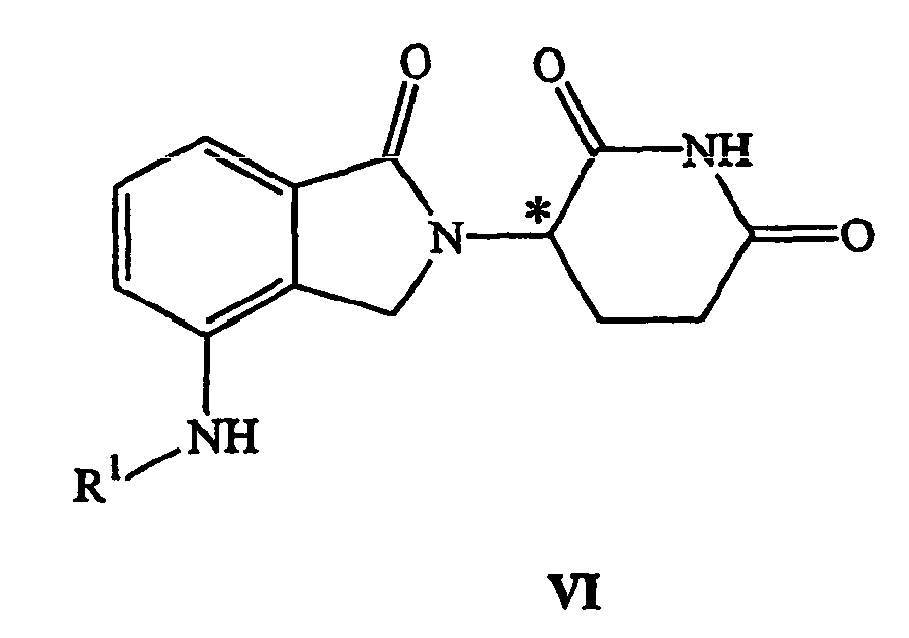
- R1 is (C1-C8)alkyl, (C3-C7)cycloalkyl, (C2-C8)alkenyl, (C2-C8)alkynyl, benzyl, aryl, (C0-C4)alkyl-(C1-C6)heterocycloalkyl, (C0-C4)alkyl-(C2-C5)heteroaryl, C(O)R3, C(O)OR4, (C1-C8)alkyl-N(R6)2, (C1-C8)alkyl-OR5, (C1-C8)alkyl-C(O)OR5, C(S)NHR3, or (C1-C8)alkyl-O(CO)R5;
- R3 is (C1-C8)alkyl, (C3-C7)cycloalkyl, (C2-C8)alkenyl, (C2-C8)alkynyl, benzyl, aryl, (C0-C4)alkyl-(C1-C6)heterocycloalkyl, (C0-C4)alkyl-(C2-C5)heteroaryl, (C0-C8)alkyl-N(R6)2, (C1-C8)alkyl-OR5, (C1-C8)alkyl-C(O)OR5, (C1-C8)alkyl-O(CO)R5, or C(O)OR5;
- R4 is (C1-C8)alkyl, (C2-C8)alkenyl, (C2-C8)alkynyl, (C1-C4)alkyl-OR5, benzyl, aryl, (C0-C4)alkyl-(C1-C6)heterocycloalkyl, or (C0-C4)alkyl-(C2-C5)heteroaryl;
- R5 is (C1-C8)alkyl, (C2-C8)alkenyl, (C2-C8)alkynyl, benzyl, aryl, or (C2-C5)heteroaryl;
each occurrence of R6 is independently H, (C1-C8)alkyl, (C2-C8)alkenyl, (C2-C8)alkynyl, benzyl, aryl, (C2-C5)heteroaryl, or (C0-C8)alkyl-C(O)O-R5 or the R6 groups can join to form a heterocycloalkyl group; and
the * represents a chiral-carbon center. - In a separate embodiment of compounds of formula VI, R1 is (C3-C7)cycloalkyl, (C2-C8)alkenyl, (C2-C8)alkynyl, benzyl, aryl, (C0-C4)alkyl-(C1-C6)heterocycloalkyl, (C0-C4)alkyl-(C2-C5)heteroaryl, C(O)R3, C(O)OR4, (C1-C8)alkyl-N(R6)2, (C1-C8)alkyl-OR5, (C1-C8)alkyl-C(O)OR5,C(S)NHR3, or (C1-C8)alkyl-O(CO)R5; and
R3 is (C1-C8)alkyl, (C3-C7)cycloalkyl, (C2-C8)alkenyl, (C2-C8)alkynyl, benzyl, aryl, (C0-C4)alkyl-(C1-C6)heterocycloalkyl, (C0-C4)alkyl-(C2-C5)heteroaryl, (C5-C8)alkyl-N(R6)2; (C0-C8)alkyl-NH-C(O)O-R5; (C1-C8)alkyl-OR5, (C1-C8)alkyl-C(O)OR5, (C1-C8)alkyl-O(CO)R5, or C(O)OR5; and the other variables are defined as above. - In another embodiment of the compounds of formula VI, R1 is (C1-C8)alkyl, benzyl, CH2OCH3, CH2CH2OCH3, or

- In another embodiment of the compounds of formula VI, R1 is

- In still another embodiment of the compounds of formula VI, R1 is C(O)R3 or C(O)OR4.
- In another embodiment of the compounds of formula VI, R3 is (C0-C4)alkyl-(C2-C5)heteroaryl, (C1-C8)alkyl, aryl, or (C0-C4)alkyl-OR5.
- In yet another embodiment of the compounds of formula VI, heteroaryl is pyridyl, furyl, or thienyl. In another embodiment of the compounds of formula VI, the H of C(O)NHC(O) can be replaced with (C1-C4)alkyl, aryl, or benzyl.
- In still another embodiment, the invention encompasses compounds of Formula VII:
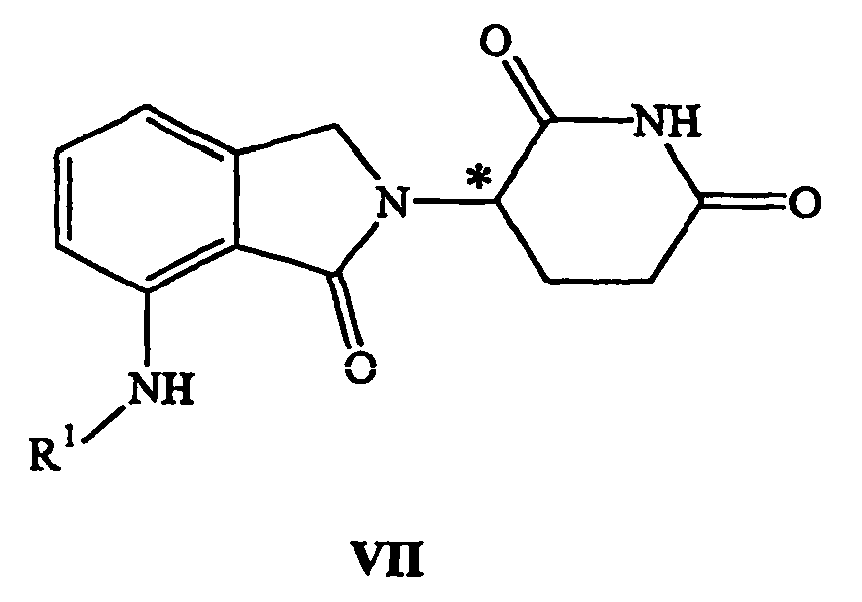
- R1 is (C1-C8)alkyl, (C3-C7)cycloalkyl, (C2-C8)alkenyl, (C2-C8)alkynyl, benzyl, aryl, (C0-C4)alkyl-(C1-C6)heterocycloalkyl, (C0-C4)alkyl-(C2-C5)heteroaryl, C(O)R3, C(O)OR4, (C1-C8)alkyl-N(R6)2, (C1-C8)alkyl-OR5, (C1-C8)alkyl-C(O)OR5, C(S)NHR3, or (C1-C8)alkyl-O(CO)R5;
- R3 is (C1-C8)alkyl, (C3-C7)cycloalkyl, (C2-C8)alkenyl, (C2-C8)alkynyl, benzyl, aryl, (C0-C4)alkyl-(C1-C6)heterocycloalkyl, (C0-C4)alkyl-(C2-C5)heteroaryl, (C0-C8)alkyl-N(R6)2, (C1-C8)alkyl-OR5, (C1-C8)alkyl-C(O)OR5 (C1-C8)alkyl-O(CO)R5. or C(O)OR5;
- R4 is (C1-C8)alkyl, (C2-C8)alkenyl, (C2-C8)alkynyl, (C1-C4)alkyl-OR5, benzyl, aryl, (C0-C4)alkyl-(C1-C6)heterocycloalkyl, or (C0-C4)alkyl-(C2-C5)heteroaryl;
- R5 is (C1-C8)alkyl, (C2-C8)alkenyl, (C2-C8)alkynyl, benzyl, aryl, or (C2-C5)heteroaryl;
each occurrence of R6 is independently H, (C1-C8)alkyl, (C2-C8)alkenyl, (C2-C8)alkynyl, benzyl, aryl, (C2-C5)heteroaryl, or (C0-C8)alkyl-C(O)O-R5 or the R6 groups can join to form a heterocycloalkyl group; and
the * represents a chiral-carbon center. - In a separate embodiment of compounds of formula VII, R1 is (C3-C7)cycloalkyl, (C2-C8)alkenyl, (C2-C8)alkynyl, benzyl, aryl, (C0-C4)alkyl-(C1-C6)heterocycloalkyl, (C0-C4)alkyl-(C2-C5)heteroaryl, C(O)R3, C(O)OR4, (C1-C8)alkyl-N(R6)2, (C1-C8)alkyl-OR5, (C1-C8)alkyl-C(O)OR5, C(S)NHR3, or (C1-C8)alkyl-O(CO)R5; and
R3 is (C1-C8)alkyl, (C3-C7)cycloalkyl, (C2-C8)alkenyl, (C1-C8)alkynyl, benzyl, aryl, (C0-C4)alkyl-(C1-C6)heterocycloalkyl, (C0-C4)alkyl-(C2-C5)heteroaryl, (C5-C8)alkyl-N(R6)2; (C0-C8)alkyl-NH-C(O)O-R5; (C1-C8)alkyl-OR5, (C1-C8)alkyl-C(O)OR5, (C1-C8)alkyl-O(CO)R5, or C(O)OR5; and the other variables are as defined above. - In another embodiment of the compounds of formula VII R1 is (C1-C8)alkyl, benzyl, CH2OCH3, CH2CH2OCH3, or
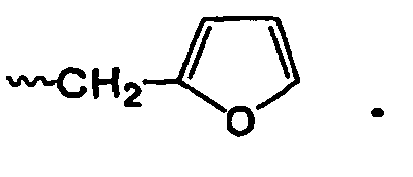
- In another embodiment of the compounds of formula VII, R1 is

- In still another embodiment of the compounds of formula VII, R1 is C(O)R3 or C(O)OR4 .
- In another embodiment of the compounds of formula VII, R3 is (C0-C4)alkyl-(C2-C5)heteroaryl, (C1-C8)alkyl, aryl, or (C0-C4)alkyl-OR5. In yet another embodiment of the compounds of formula VII, heteroaryl is pyridyl, furyl, or thienyl.
- As used herein, the phrase "compounds of the invention" means, collectively, compounds falling within Formulas I, II, III, IV, V, VI, and VII and include pharmaceutically acceptable salts, hydrates, solvates, and clathrates thereof.
- The compounds of the invention generally exist in solid form and can be recrystallized according to well-known methods affording high-purity crystals, preferably, in greater than 95% purity, more preferably, in greater than 98% purity. Narrow melting-point range is an indication of purity, thus, compounds of the invention generally have a melting point within a range of 3 °C to 4 °C, more preferably, within a range of 2 °C.
- The compounds of the invention can contain one or more chiral centers and/or double bonds and, therefore, exist as stereoisomers, such as double-bond isomers (i.e., geometric isomers), enantiomers, or diastereomers. According to the invention, the chemical structures depicted herein, and therefore the compounds of the invention, encompass all of the corresponding enantiomers and stereoisomers, that is, both the stereomerically pure form (e.g., geometrically pure, enantiomerically pure, or diastereomerically pure) and enantiomeric and stereoisomeric mixtures, e.g., racemates.
- A compound of the invention is considered optically active or enantiomerically pure (i.e., substantially the R-form or substantially the S-form) with respect to a chiral center when the compound is about 90% ee (enantiomeric excess) or greater, preferably, equal to or greater than 95% ee with respect to a particular chiral center. A compound of the invention is considered to be in enantiomerically enriched form when the compound has an enantiomeric excess of greater than about 1% ee, preferably greater than about 5% ee, more preferably, greater than about 10% ee with respect to a particular chiral center. As used herein, a racemic mixture means about 50% of one enantiomer and about 50% of is corresponding enantiomer relative to all chiral centers in the molecule. Thus, the invention encompasses all enantiomerically pure, enantiomerically enriched, and racemic mixtures of compounds of Formulas I through VII.
- Enantiomeric and stereoisomeric mixtures of compounds of the invention can be resolved into their component enantiomers or stereoisomers by well-known methods, such as chiral-phase gas chromatography, chiral-phase high performance liquid chromatography, crystallizing the compound as a chiral salt complex, or crystallizing the compound in a chiral solvent. Enantiomers and stereoisomers can also be obtained from stereomerically or enantiomerically pure intermediates, reagents, and catalysts by well-known asymmetric synthetic methods.
- The invention further encompasses prodrugs of compounds falling within Formulas I, II, III, IV, V, VI, and VII. The term "prodrug" refers to a compound that, following administration in a mammal, converts, via a biotransformation, into a compound falling within Formulas I, II, III, IV, V, VI, and VII in vivo. Prodrugs of compounds falling within Formulas I, II, III, IV, V, VI, and VII can be synthesized using well-known methods, such as those described by Burger's Medicinal Chemistry and Drug Chemistry, Fifth Ed., Vol. 1, pp. 172-178, 949-982 (1995).
- The compounds of the invention are defined herein by their chemical structures and/or chemical names. Where a compound is referred to by both a chemical structure and a chemical name, and the chemical structure and chemical name conflict, the chemical structure is determinative of the compound's identity.
- In another embodiment, the present invention further provides pharmaceutical compositions comprising a therapeutically effective or a prophylactically effective amount of one or more compounds of the invention and a pharmaceutically acceptable vehicle or carrier. A pharmaceutically acceptable vehicle or carrier can comprise an excipient, diluent, or a mixture thereof. The term "therapeutically effective amount" means the amount of a compound of the invention that will elicit the biological or medical response in a mammal that is being that is being treated by the veterinarian or clinician. The term "prophylactically effective " means the amount of a compound of the invention that will prevent or inhibit affliction or mitigate affliction of a mammal with a medical condition that a veterinarian or clinician is trying to prevent, inhibit, or mitigate.
- In another embodiment, the invention concerns a method of modulating the production or lowering the levels of TNF-α in a mammal comprising administering to said mammal an effective amount of a compound of the invention.
- In yet another embodiment, the invention concerns a method of modulating the production or lowering the levels of IL-1β in a mammal comprising administering to said mammal an effective amount of a compound of the invention.
- In a further embodiment, the invention concerns a method of modulating the production or increasing the levels of IL-10 in a mammal comprising administering to said mammal an effective amount of a compound of the invention.
- In still another embodiment, the invention concerns a method of modulating the production or increasing the levels of T-cells in a mammal comprising administering to said mammal an effective amount of a compound of the invention.
- In still another embodiment, the invention concerns a method of treating or preventing cancer in a mammal, comprising administering to said mammal a therapeutically effective amount of a compound of the invention. The compounds of the invention can be used to treat or prevent any cancer, for example, solid tumors and blood-born tumors. Specific examples of cancers treatable or preventable by compounds of the invention include, but are not limited to, cancers of the skin, such as melanoma; lymph node; breast; cervix; uterus; gastrointestinal tract; lung; ovary; prostate; colon; rectum; mouth; brain; head and neck; throat; testes; kidney; pancreas; bone; spleen; liver, bladder; larynx; nasal passages; and AIDS-related cancers. The compounds are particularly useful for treating cancers of the blood and bone marrow, such as multiple myeloma and acute and chronic leukemias, for example, lymphoblastic, myelogenous, lymphocytic, and myelocytic leukemias. The compounds of the invention can be used for treating or preventing either primary or metastatic tumors.
- In yet one more embodiment, the invention provides methods of treating or preventing cancer in a mammal, comprising administering to a mammal in need thereof, a therapeutically effective amount of a compound of the invention and another cancer chemotherapeutic agent.
- In yet another embodiment, the invention concerns a method of treating or preventing inflammatory disorders in a mammal, comprising administering to said mammal a therapeutically effective amount of a compound of the invention. The compounds of the invention are especially effective to treat or prevent inflammatory diseases related to the up-regulation of TNF-α including, but not limited to, arthritic conditions, such as, rheumatoid arthritis, and osteoarthritis; rheumatoid spondylitis; psoriasis; post ischemic perfusion injury; inflammatory bowel disease; and chronic inflammatory pulmonary disease.
- In one more embodiment still, the invention provides methods of treating or preventing inflammatory disorders in a mammal, comprising administering to a mammal in need thereof, a therapeutically effective amount of a compound of the invention and another anti-inflammatory agent.
- In a further embodiment, the invention concerns a method of treating or preventing heart disease in a mammal comprising administering to said mammal a therapeutically effective amount of a compound of the invention. For example, the compounds of the invention can be used to treat or prevent congestive heart failure, cardiomyopathy, pulmonary edema, endotoxin-mediated septic shock, acute viral myocarditis, cardiac allograft rejection, and myocardial infarction.
- In an additional embodiment, the invention concerns a method of treating or preventing osteoporosis in a mammal comprising administering to said mammal a therapeutically effective amount of a compound of the invention.
- In a further embodiment, the invention relates to a method of treating or preventing viral, genetic, inflammatory, allergic, and autoimmune diseases. For example, the compounds are useful to treat or prevent diseases including, but not limited to, HIV, hepatitis, adult respiratory distress syndrome, bone resorption diseases, chronic pulmonary inflammatory diseases, dermatitis, cystic fibrosis, septic shock, sepsis, endotoxic shock, hemodynamic shock, sepsis syndrome, post ischemic reperfusion injury, meningitis, psoriasis, fibrotic disease, cachexia, graft rejection, auto-immune disease, rheumatoid spondylitis, Crohn's disease, ulcerative colitis, inflammatory-bowel disease, multiple sclerosis, systemic lupus erythrematosus, ENL in leprosy, radiation damage, asthma, or hyperoxic alveolar injury in a mammal comprising administering to said mammal a therapeutically effective amount of a compound of the invention.
- In still another embodiment, the invention concerns a method of treating or preventing malaria, mycobacterial infection, or an opportunistic infection resulting from HIV in a mammal, comprising administering to said mammal a therapeutically effective amount of a compound of the invention.
- In still one more embodiment, the invention relates to treating or preventing mammals having more than one of the conditions treatable by a compound of the invention.
- In the above embodiments, it is preferable that the mammal be in need of the treatment or prevention, that is, the mammal is actually suffering from a medical condition or at risk of a medical condition for which a compound of the invention can provide treatment or prevention. However, the compounds of the invention can also be administered to test animals that do not necessarily require such treatment or prevention.
- In a further embodiment, the invention encompasses a method of modulating the production or lowering the levels of TNF-α in a mammalian cell or tissue comprising contacting an effective amount of a compound of the invention with said mammalian cell or tissue.
- In yet another embodiment, the invention encompasses a method of modulating the production or lowering the levels of IL-1β in a mammalian cell or tissue comprising contacting an effective amount of a compound of the invention with said mammalian cell or tissue.
- In still another embodiment, the invention encompasses a method of modulating the production or lowering the levels of IL-10 in a mammalian cell or tissue comprising contacting an effective amount of a compound of the invention with said mammalian cell or tissue.
- In still another embodiment, the invention encompasses a method of modulating the production or lowering the levels of T-cells in a mammalian cell or tissue comprising contacting an effective amount of a compound of the invention with said mammalian cell or tissue.
- In these embodiments, the term "effective amount" means the amount of the compound that will induce the biological response sought by the researcher, veterinarian, physician, or clinician. It should be understood that the cell can be in a cell culture or a tissue culture (in vitro) or in an organism (in vivo) including a human.
- The present invention may be understood by reference to the detailed description and examples that are intended to exemplify non-limiting embodiments of the invention.
- The phrase "pharmaceutically acceptable salt(s)," as used herein includes, but is not limited to, salts of acidic or basic groups that may be present in the compounds of the invention. Compounds of the invention that are basic in nature are capable of forming a wide variety of salts with various inorganic and organic acids. The acids that may be used to prepare pharmaceutically acceptable salts of such basic compounds are those that form salts comprising pharmacologically acceptable anions including, but not limited to, acetate, benzenesulfonate, benzoate, bicarbonate, bitartrate, bromide, calcium edetate, camsylate, carbonate, chloride, bromide, iodide, citrate, dihydrochloride, edetate, edisylate, estolate, esylate, fumarate, gluceptate, gluconate, glutamate, glycollylarsanilate, hexylresorcinate, hydrabamine, hydroxynaphthoate, isethionate, lactate, lactobionate, malate, maleate, mandelate, mesylate, methylsulfate, muscate, napsylate, nitrate, panthothenate, phosphate/diphosphate, polygalacturonate, salicylate, stearate, succinate, sulfate, tannate, tartrate, teoclate, triethiodide, and pamoate (i.e., 1,1'-methylene-bis-(2-hydroxy-3-naphthoate)). Compounds of the invention that include an amino moiety also can form pharmaceutically acceptable salts with various amino acids, in addition to the acids mentioned above. Compounds of the invention that are acidic in nature are capable of forming base salts with various pharmacologically acceptable cations. Examples of such salts include alkali metal or alkaline earth metal salts and, particularly, calcium, magnesium, sodium, lithium, zinc, potassium, and iron salts.
- As used herein, the term "solvate" means a compound of the invention or a salt thereof, that further includes a stoichiometric or non-stoichiometric amount of a solvent bound by non-covalent intermolecular forces. Preferred solvents are volatile, non-toxic, and/or acceptable for administration to humans in trace amounts.
- As used herein, the term "hydrate" means a compound of the invention or a salt thereof, that further includes a stoichiometric or non-stoichiometric amount of water bound by non-covalent intermolecular forces.
- The term "clathrate" means a compound of the invention or a salt thereof in the form of a crystal lattice that contains spaces (e.g., channels) that have a guest molecule (e.g., a solvent or water) trapped within.
- As used herein, the term "alkyl group" means a saturated, monovalent, unbranched or branched hydrocarbon chain. Examples of alkyl groups include, but are not limited to, (C1-C8)alkyl groups, such as methyl, ethyl, propyl, isopropyl, 2-methyl-1-propyl, 2-methyl-2-propyl, 2-methyl-1-butyl, 3-methyl-1-butyl, 2-methyl-3-butyl, 2,2-dimethyl-1-propyl, 2-methyl-1-pentyl, 3-methyl-1-pentyl, 4-methyl-1-pentyl, 2-methyl-2-pentyl, 3-methyl-2-pentyl, 4-methyl-2-pentyl, 2,2-dimethyl-1-butyl, 3,3-dimethyl-1-butyl, 2-ethyl-1-butyl, butyl, isobutyl, t-butyl, pentyl, isopentyl, neopentyl, and hexyl, heptyl, and octyl. An alkyl group can be unsubstituted or substituted with one or two suitable substituents.
- An "alkenyl group" means a monovalent, unbranched or branched hydrocarbon chain having one or more double bonds therein. The double bond of an alkenyl group can be unconjugated or conjugated to another unsaturated group. Suitable alkenyl groups include, but are not limited to (C2-C8)alkenyl groups, such as vinyl, allyl, butenyl, pentenyl, hexenyl, butadienyl, pentadienyl, hexadienyl, 2-ethylhexenyl, 2-propyl-2-butenyl, 4-(2-methyl-3-butene)-pentenyl. An alkenyl group can be unsubstituted or substituted with one or two suitable substituents.
- An "alkynyl group" means monovalent, unbranched or branched hydrocarbon chain having one or more triple bonds therein. The triple bond of an alkynyl group can be unconjugated or conjugated to another unsaturated group. Suitable alkynyl groups include, but are not limited to, (C2-C8)alkynyl groups, such as ethynyl, propynyl, butynyl, pentynyl, hexynyl, methylpropynyl, 4-methyl-1-butynyl, 4-propyl-2-pentynyl, and 4-butyl-2-hexynyl. An alkynyl group can be unsubstituted or substituted with one or two suitable substituents.
- An "aryl group" means a monocyclic or polycyclic-aromatic group comprising carbon and hydrogen atoms. Examples of suitable aryl groups include, but are not limited to, phenyl, tolyl, anthacenyl, fluorenyl, indenyl, azulenyl, and naphthyl, as well as benzo-fused carbocyclic moieties such as 5,6,7,8-tetrahydronaphthyl. An aryl group can be unsubstituted or substituted with one or more suitable substituents. Preferably, the aryl group is a monocyclic ring, wherein the ring comprises 6 carbon atoms, referred to herein as "(C6)aryl".
- A "heteroaryl group" means a monocyclic or polycyclic aromatic ring comprising carbon atoms and one or more heteroatoms, preferably, 1 to 3 heteroatoms, independently selected from nitrogen, oxygen, and sulfur. Preferred heteroaryl-ring systems include 5 to 6 membered monocyclic, 8 to 11 membered bicyclic, and 11 to 15 membered tricyclic ring systems. As well known to those skilled in the art, heteroaryl rings have less aromatic character than their all-carbon counter parts. Thus, for the purposes of the invention, a heteroaryl group need only have some degree of aromatic character. Illustrative examples of heteroaryl groups include, but are not limited to, pyridinyl, pyridazinyl, pyrimidyl, pyrazyl, triazinyl, pyrrolyl, pyrazolyl, imidazolyl, (1,2,3,)- and (1,2,4)-triazolyl, pyrazinyl, pyrimidinyl, tetrazolyl, furyl, thienyl, isoxazolyl, thiazolyl, phienyl, isoxazolyl, and oxazolyl. A heteroaryl group can be unsubstituted or substituted with one or two suitable substituents. Preferably, a heteroaryl group is a 5 or 6 membered monocyclic ring, wherein the ring comprises 2 to 5 carbon atoms and 1 to 3 heteroatoms, referred to herein as "(C2-C5)heteroaryl", which optionally can be fused to one or more other aryl, cycloalkyl, heteroaryl, or heterocyclic ring systems to form 7 to 10 membered bicyclic or 10 to 15 membered tricyclic ring systems.
- A "cycloalkyl group" means a non-aromatic, monocyclic or polycyclic ring comprising carbon and hydrogen atoms. A cycloalkyl group can have one or more carbon-carbon double bonds in the ring so long as the ring is not rendered aromatic by their presence. Examples of cycloalkyl groups include, but are not limited to, (C3-C8)cycloalkyl groups, such as cyclopropyl, cyclobutyl, cyclopentyl, cyclohexyl, and cycloheptyl, and saturated cyclic and bicyclic terpenes and (C3-C8)cycloalkenyl groups, such as cyclopropenyl, cyclobutenyl, cyclopentenyl, cyclohexenyl, and cycloheptenyl, and unsaturated cyclic and bicyclic terpenes. A cycloalkyl group can be unsubstituted or substituted by one or two suitable substituents. Preferably, the cycloalkyl group is a monocyclic ring or bicyclic ring.
- A "heterocycloalkyl group" means a non-aromatic monocyclic or polycyclic ring comprising carbon atoms and at least one heteroatom, preferably, 1 to 4 heteroatoms independently selected from nitrogen, oxygen, and sulfur. Preferred heterocyclic-ring systems include 3 to 8 membered monocyclic, 8 to 11 membered bicyclic, and 11 to 15 membered tricyclic ring systems. A heterocycloalkyl group can have one or more carbon-carbon double bonds or carbon-heteroatom double bonds in the ring as long as the ring is not rendered aromatic by their presence. Examples of heterocycloalkyl groups include aziridinyl, pyrrolidinyl, pyrrolidino, piperidinyl, piperidino, piperazinyl, piperazino, morpholinyl, morpholino, thiomorpholinyl, thiomorpholino, tetrahydrofuranyl, tetrahydrothiofuranyl, tetrahydropyranyl, and pyranyl. A heterocycloalkyl group can be unsubstituted or substituted with one or more suitable substituents. Preferably, the heterocycloalkyl group is a monocyclic or bicyclic ring, more preferably, a 3-7 membered monocyclic ring, wherein the ring comprises from 1 to 6 carbon atoms and from 1 to 3 heteroatoms, referred to herein as "(C1-C6)heterocycloalkyl", which optionally can be fused to one or more other aryl, cycloalkyl, heteroaryl, or heterocyclic ring systems to form 7 to 10 membered bicyclic or 10 to 15 membered tricyclic ring systems.
- The term "alkoxy group"means an -O-alkyl group, wherein alkyl is as defined above. An alkoxy group can be unsubstituted or substituted with one or two suitable substituents. Preferably, the alkyl chain of an alkyloxy group is from 1 to 8 carbon atoms in length, referred to herein as "(C1-C8)alkoxy".
- The term "aryloxy group" means an O-aryl group, wherein aryl is as defined above. An aryloxy group can be unsubstituted or substituted with one or two suitable substituents. Preferably, the aryl ring of an aryloxy group is a monocyclic ring, wherein the ring comprises 6 carbon atoms, referred to herein as "(C6)aryloxy".
- The term "benzyl" means CH2-phenyl. A benzyl group can be unsubstituted or substituted with one or more suitable substituents.
- The term "phenyl" means C6H5. A phenyl group can be unsubstituted or substituted with one or more suitable substituents.
- A "carbonyl" group is a divalent group of the formula -C(O)-.
- An "alkoxycarbonyl" group means a monovalent group of the formula C(O)-alkoxy. Preferably, the hydrocarbon chain of an alkoxycarbonyl group is from 1 to 8 carbon atoms in length, referred to herein as a "lower alkoxycarbonyl" group.
- As used herein, "halogen" means fluorine, chlorine, bromine, or iodine. Correspondingly, the meaning of the term "halo" encompass fluoro, chloro, bromo, and iodo.
- As used herein, a "suitable substituent" means a group that does not nullify the synthetic or pharmaceutical utility of the compounds of the invention or the intermediates useful for preparing them. Examples of suitable substituents include, but are not limited to: (C1-C8)alkyl; (C1-C8)alkenyl; (C1-C8)alkynyl; aryl; (C2-C5)heteroaryl; (C1-C6)heterocycloalkyl; (C3-C7)cycloalkyl; O-(C1-C8)alkyl; O-(C1-C8)alkenyl; O-(C1-C8)alkynyl; O-aryl; CN; OH; oxo; halo, C(O)OH; COhalo; O(CO)halo; CF3, N3; NO2, NH2; NH((C1-C8)alkyl); N((C1-C8)alkyl)2; NH(aryl); N(aryl)2; (CO)NH2; (CO)NH((C1-C8)alkyl); (CO)N((C1-C8)alkyl)2; (CO)NH(aryl); (CO)N(aryl)2;O(CO)NH2; NHOH; NOH((C1-C8)alkyl); NOH(aryl);O(CO)NH((C1-C8)alkyl); O(CO)N((C1-C8)alkyl)2; O(CO)NH(aryl); O(CO)N(aryl)2; CHO; CO((C1-C8)alkyl); CO(aryl); C(O)O((C1-C8)alkyl); C(O)O(aryl); O(CO)((C1-C8)alkyl); O(CO)(aryl); O(CO)O((C1-C8)alkyl); O(CO)O(aryl); S-(C1-C8)alkyl; S-(C1-C8)alkenyl; S-(C1-C8)alkynyl; and S-aryl. One of skill in art can readily choose a suitable substituent based on the stability and pharmacological and synthetic activity of the compound of the invention.
- In one embodiment, the invention encompasses compounds of the formula:

one of X and Y is C=O and the other is CH2 or C=O;
R1 is H, (C1-C8)alkyl, (C3-C7)cycloalkyl, (C2-C8)alkenyl, (C2-C8)alkynyl, benzyl, aryl, (C0-C4)alkyl-(C1-C6)heterocycloalkyl, (C0-C4)alkyl-(C2-C5)heteroaryl, C(O)R3, C(S)R3, C(O)OR4, (C1-C8)alkyl-N(R6)2, (C1-C8)alkyl-OR5, (C1-C8)alkyl-C(O)OR5, C(O)NHR3, C(S)NHR3, C(O)NR3R3', C(S)NR3R3' or (C1-C8)alkyl-O(CO)R5;
R2 is H, F, benzyl, (C1-C8)alkyl, (C2-C8)alkenyl, or (C2-C8)alkynyl;
R3 and R3' are independently (C1-C8)alkyl, (C3-C7)cycloalkyl, (C2-C8)alkenyl, (C2-C8)alkynyl, benzyl, aryl, (C0-C4)alkyl-(C1-C6)heterocycloalkyl, (C0-C4)alkyl-(C2-C5)heteroaryl, (C0-C8)alkyl-N(R6)2, (C1-C8)alkyl-OR5, (C1-C8)alkyl-C(O)OR5, (C1-C8)alkyl-O(CO)R5, or C(O)OR5;
R4 is (C1-C8)alkyl, (C2-C8)alkenyl, (C2-C8)alkynyl, (C1-C4)alkyl-OR5, benzyl, aryl, (C0-C4)alkyl-(C1-C6)heterocycloalkyl, or (C0-C4)alkyl-(C2-C5)heteroaryl;
R5 is (C1-C8)alkyl, (C2-C8)alkenyl, (C2-C8)alkynyl, benzyl, aryl, or (C2-C5)heteroaryl;
each occurrence of R6 is independently H, (C1-C8)alkyl, (C2-C8)alkenyl, (C2-C8)alkynyl, benzyl, aryl, (C2-C5)heteroaryl, or (C0-C8)alkyl-C(O)O-R5 or the R6 groups can join to form a heterocycloalkyl group;
n is 0 or 1; and
the * represents a chiral-carbon center;
with the proviso that when n is 0 then R1 is not H. - In a separate embodiment of compounds of formula I, when n is 0 then R1 is (C3-C7)cycloalkyl, (C2-C8)alkenyl, (C2-C8)alkynyl, benzyl, aryl, (C0-C4)alkyl-(C1-C6)heterocycloalkyl, (C0-C4)alkyl-(C2-C5)heteroaryl, C(O)R3, C(O)OR4, (C1-C8)alkyl-N(R6)2, (C1-C8)alkyl-OR5, (C1-C8)alkyl-C(O)OR5, or (C1-C8)alkyl-O(CO)R5;
R2 is H or (C1-C8)alkyl; and
R3 is (C1-C8)alkyl, (C3-C7)cycloalkyl, (C2-C8)alkenyl, (C2-C8)alkynyl, benzyl, aryl, (C0-C4)alkyl-(C1-C6)heterocycloalkyl, (C0-C4)alkyl-(C2-C5)heteroaryl, (C5-C8)alkyl-N(R6)2; (C0-C8)alkyl-NH-C(O)O-R5; (C1-C8)alkyl-OR5, (C1-C8)alkyl-C(O)OR5, (C1-C8)alkyl-O(CO)R5, or C(O)OR5; and the other variables have the same definitions. Further, the compounds encompassed by Formulas II, III, IV, V, VI, and VII as described above are also included within the invention. - A few examples of compounds of the invention which are illustrative and non-limiting are depicted in Table 1 below.
TABLE 1: Examples of Compounds of the Invention Structure Name 
[2-(2,6-Dioxo-piperidin-3-yl)-1,3-dioxo-2,3-dihydro-1H-is oindol-4-yl-methyl]-carbamic acid tert-butyl ester 
4-(Aminomethyl)-2-(2,6-dioxo(3-piperidyl))-isoindoline-1,3-dione 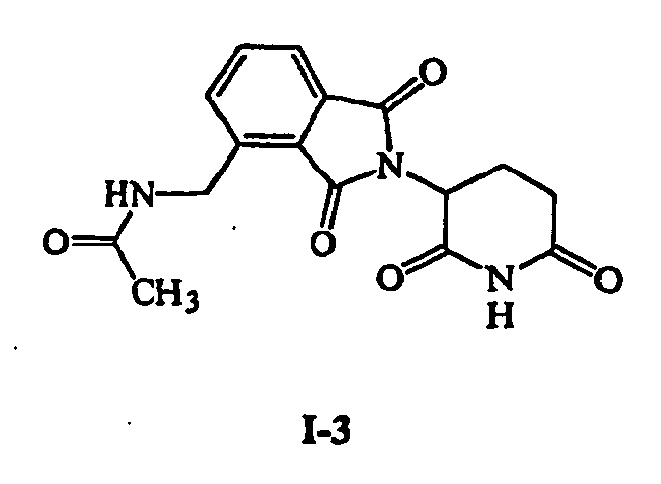
N-[2-(2,6-Dioxo-piperidin-3-yl)-1,3-dioxo-2,3-dihydro-1H-isoindol-4-yl-methyl]-acetamide 
N-{[2-(2,6-Dioxo(3-piperidyl)-1,3-dioxoisoindolin-4-yl]methyl}cyclopropyl-carboxamide 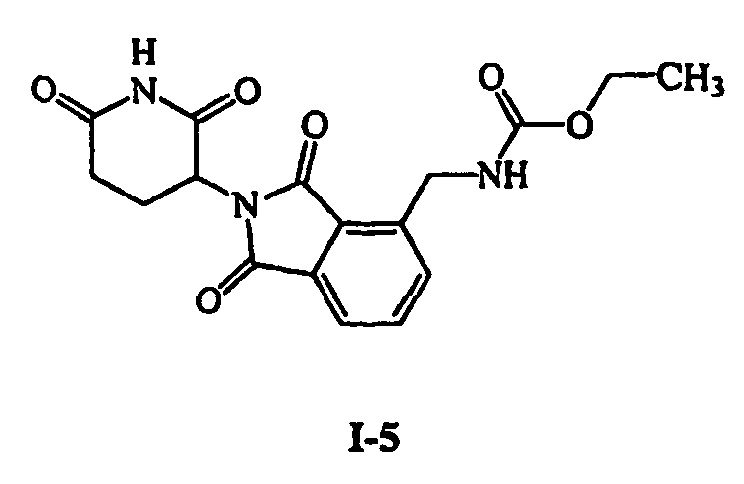
[2-(2,6-Dioxo-piperidin-3-yl)-1,3-dioxo-2,3-dihydro-1H-is oindol-4-ylmethyl]-carbamic acid ethyl ester 
2-(2,6-Dioxo-piperidin-3-yl)-1,3-dioxo-2,3-dihydro-1H-iso indol-4-ylmethyl]-carbamic acid benzyl ester 
2-Chloro-N-{[2-(2,6-dioxo(3-piperidyl))-1,3-dioxoisoindolin-4-yl]methyl}acetamide 
2-(Dimethylamino)-N-{[2-(2,6-dioxo(3-piperidyl))-1,3-dioxoisoindolin-4-yl]methyl}-acetamide 
1-tert-Butyl-3-[2-(2,6-dioxo-piperidin-3-yl)-1,3-dioxo-2,3-dihydro-1H-isoindol-4-ylmethyl]-urea 
N-{[2-(2,6-Dioxo(3-piperidyl))-1,3-dioxoisoindolin-4-yl]methyl}-3,3-dimethylbutanamide 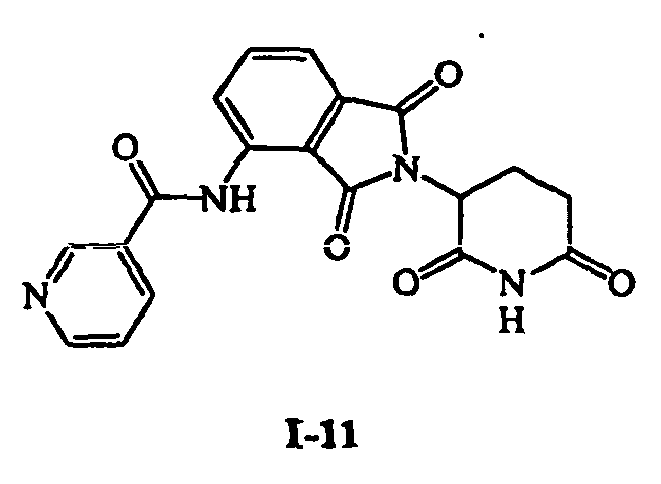
N-[2-(2,6-Dioxo(3-piperidyl))-1,3-dioxoisoindolin-4-yl]-3-pyridylcarboxamide 
3-{1-Oxo-4-[benzylamino]isoindolin-2-yl}piperidine-2,6-dione 
2-(2,6-Dioxo(3-piperidyl))-4-[benzylamino]isoindoline-1,3-dione 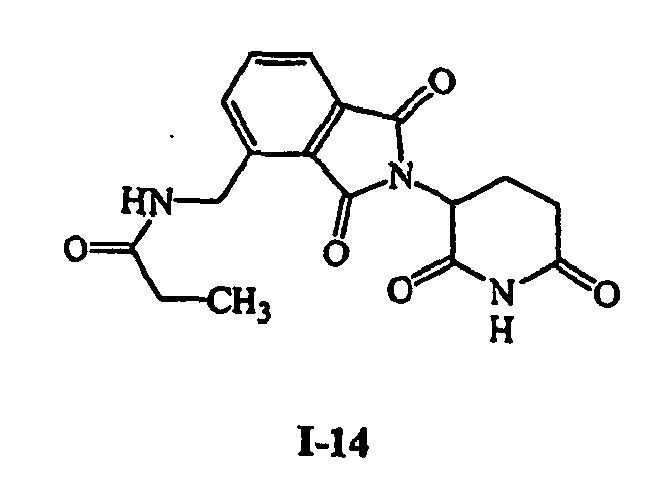
N-{[2-(2,6-Dioxo(3-piperidyl))-1,3-dioxoisoindolin-4-yl]methyl}propanamide 
N-{[2-(2,6-Dioxo(3-piperidyl))-1,3-dioxoisoindolin-4-yl]methyl}-3-pyridylcarboxamide 
N-{[2-(2,6-Dioxo(3-piperidyl))-1,3-dioxoisoindolin-4. yl]methyl}heptanamide 
N-{[2-(2,6-Dioxo(3-piperidyl))-1,3-dioxoisoindolin-4-yl]methyl}-2-furylcarboxamide 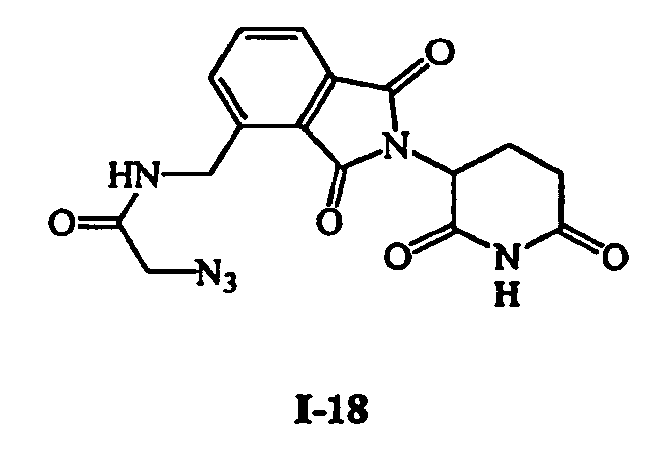
2-Azido-N-[2-(2,6-dioxo-piperidin-3-yl)-1,3-dioxo-2,3-dihydro-1H-isoindol-4-ylmethyl]-acetamide 
2-Amino-N-{[2-(2,6-dioxo(3-piperidyl))-1,3-dioxoisoindolin-4-yl]methyl} acetamide 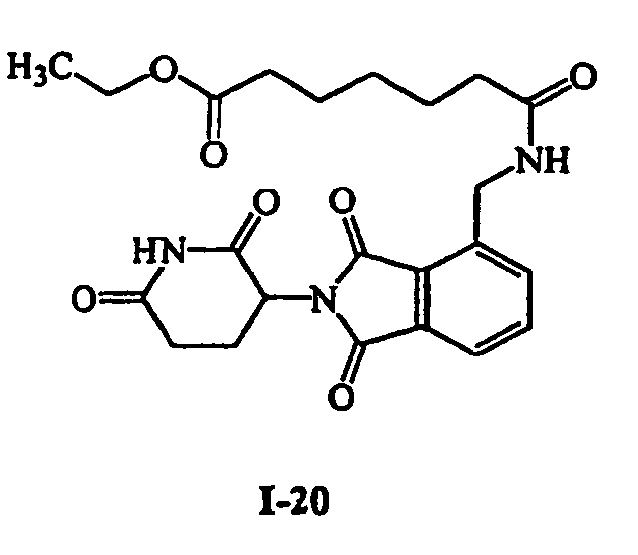
Ethyl 6-(N-{[2-(2,6-dioxo(3-piperidyl))-1,3-dioxoisoindolin-4-yl]methyl} carbamoyl)hexanoate 
3-[(tert-Butoxy)carbonylamino]-N-{[2-(2,6-dioxo(3- piperidyl))-1,3-dioxoisoindolin-4-yl]methyl}propanamide 
3-Amino-N-{[2-(2,6-dioxo(3-piperidyl))-1,3-dioxoisoindolin-4-yl]methyl}propanamide 
N-{[2-(2,6-Dioxo(3-piperidyl))-1,3-dioxoisoindolin-4-yl]methyl}-2-thienylcarboxamide 
N-{[2-(2,6-Dioxo(3-piperidyl))-1,3-dioxoisoindolin-4-yl]methyl}-2-methoxyacetamide 
(N-{[2-(2,6-Dioxo(3-piperidyl))-1,3-dioxoisoindolin-4-yl]methyl}carbamoyl)methyl acetate 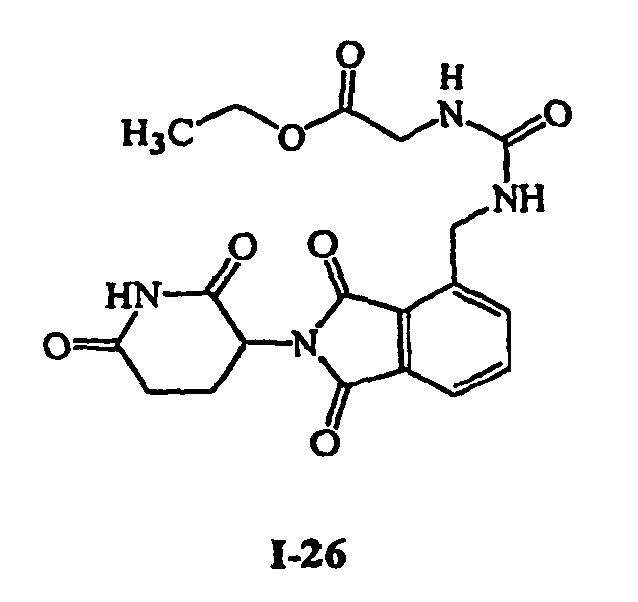
Ethyl 2-[(N-{[2-(2,6-dioxo(3-piperidyl))-1,3-dioxoisoindolin-4-yl]methyl} carbamoyl) amino]acetate 
N-{[2-(2,6-Dioxo(3-piperidyl))-1,3-dioxoisoindolin-4-yl]methyl}(ethylamino)carboxamide 
2-(2,6-Dioxo(3-piperidyl))-4-[(2-furylmethyl)amino]isoindoline-1,3-dione 
N-[2-(2,6-dioxo(3-piperidyl))-1,3-dioxoisoindolin-4-yl]-2-methoxyacetamide 
N-[2-(2,6-dioxo(3-piperidyl))-1,3-dioxoisoindolin-4-yl]heptanamide 
{N-[2-(2,6-dioxo(3-piperidyl))-1,3-dioxoisoindolin-4-yl]carbamoyl}methyl acetate 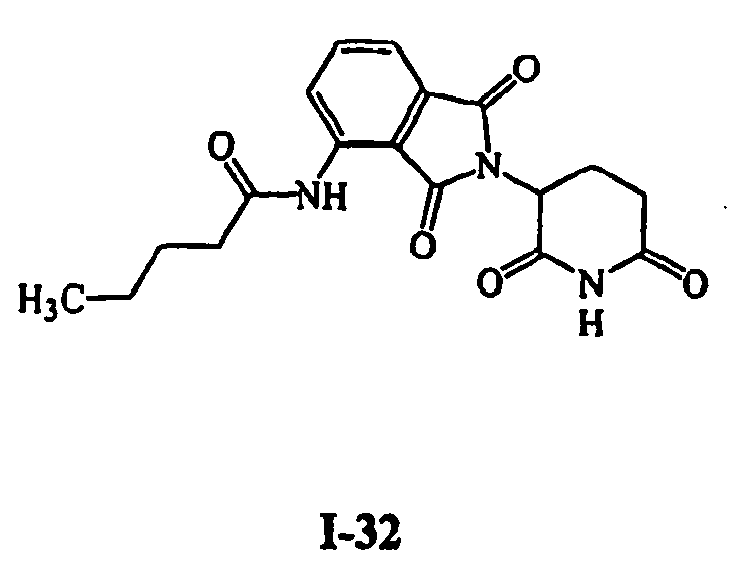
N-[2-(2,6-dioxo(3-piperidyl))-1,3-dioxoisoindolin-4-yl]pentanamide 
N-[2-(2,6-dioxo(3-piperidyl))-1,3-dioxoisoindolin-4-yl]-2-thienylcarboxamide 
Methyl {N-[2-(2,6-dioxo(3-piperidyl))-1,3-dioxoisoindolin-4-yl]carbamoyl}formate 
N-[2-(2,6-dioxo(3-piperidyl))-1,3-dioxoisoindolin-4-yl]-2-furylcarboxamide 
N-[2-(2,6-dioxo(3-piperidyl))-1,3-dioxoisoindolin-4-yl]benzamide 
N-[2-(2,6-dioxo(3-piperidyl))-1,3-dioxoisoindolin-4-yl]propanamide 
Methyl 3-{N-[2-(2,6-dioxo(3-piperidyl))-1,3-dioxoisoindolin-4-yl]carbamoyl}propanoate 
N-[2-(2,6-dioxo(3-piperidyl))-1,3-dioxoisoindolin-4-yl]-2-phenylacetamide 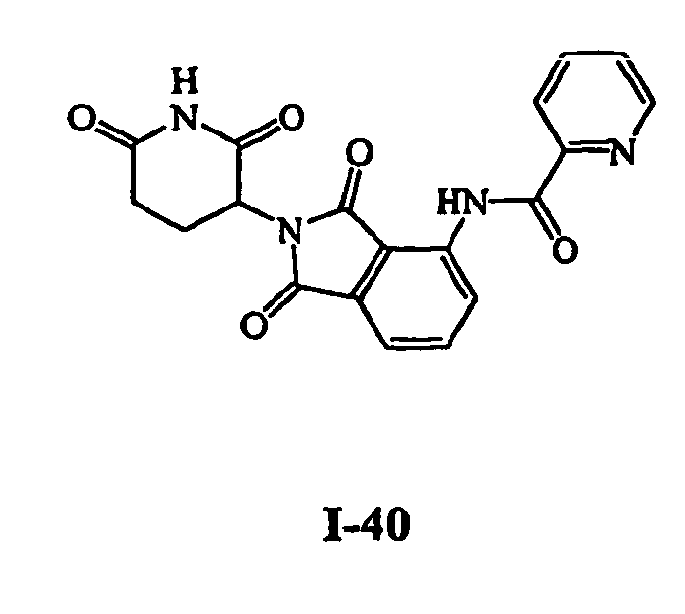
N-[2-(2,6-dioxo(3-piperidyl))-1,3-dioxoisoindolin-4-yl]-2-pyridylcarboxamide 
N-[2-(2,6-dioxo(3-piperidyl))-1,3-dioxoisoindolin-4-yl]-2-chloroacetamide 
2-azido-N-[2-(2,6-dioxo(3-piperidyl))-1,3-dioxoisoindolin-4-yl]acetamide 
2-Amino-N-[2-(2,6-dioxo(3-piperidyl))-1,3-dioxoisoindolin-4-yl]acetamide 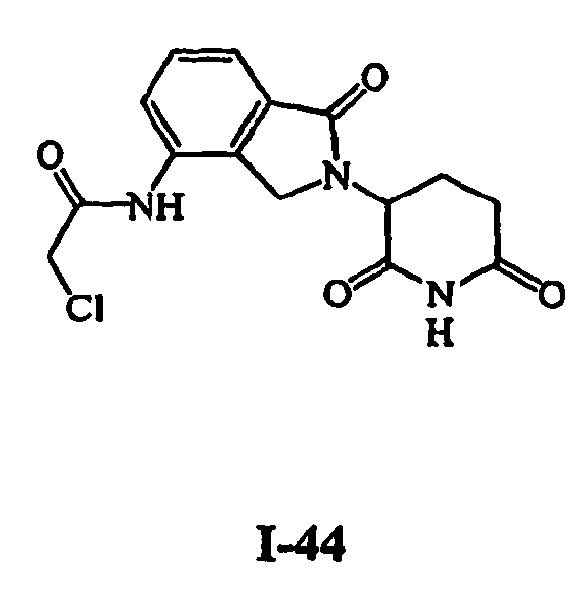
N-[2-(2,6-dioxo(3-piperidyl))-1-oxoisoindolin-4-yl]-2-chloroacetamide 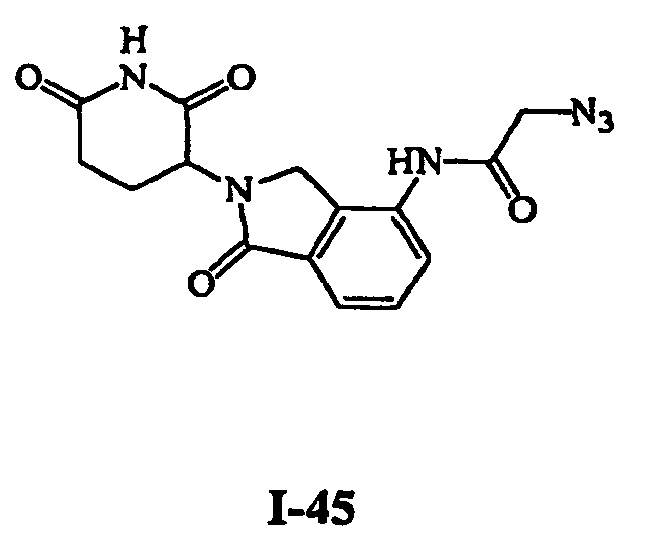
2-azido-N-[2-(2,6-dioxo(3-piperidyl))-1-oxoisoindolin-4-yl]acetamide 
2-Amino-N-[2-(2,6-dioxo(3-piperidyl))-1-oxoisoindolin-4-yl]acetamide 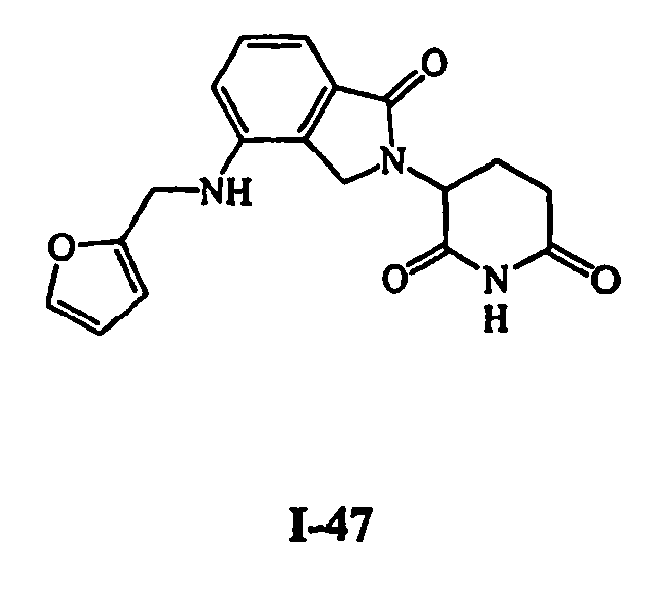
3-{4-[(2-Furylmethyl)amino]-1-oxoisoindolin-2-yl}piperidine-2,6-dione 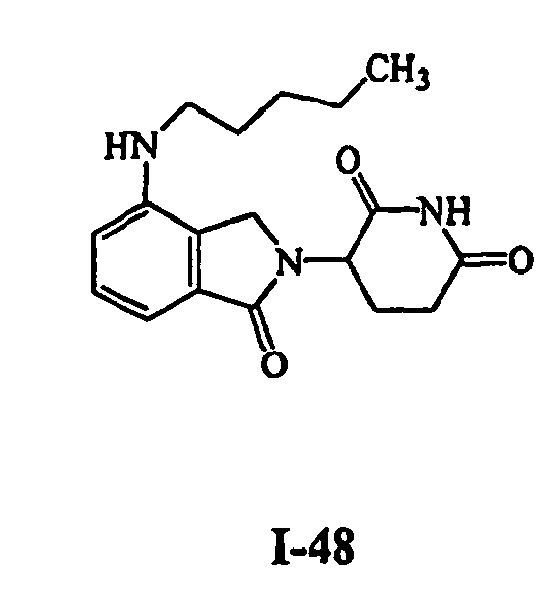
3-[1-Oxo-4-(pentylamino)isoindolin-2-yl]piperidine-2,6-dione 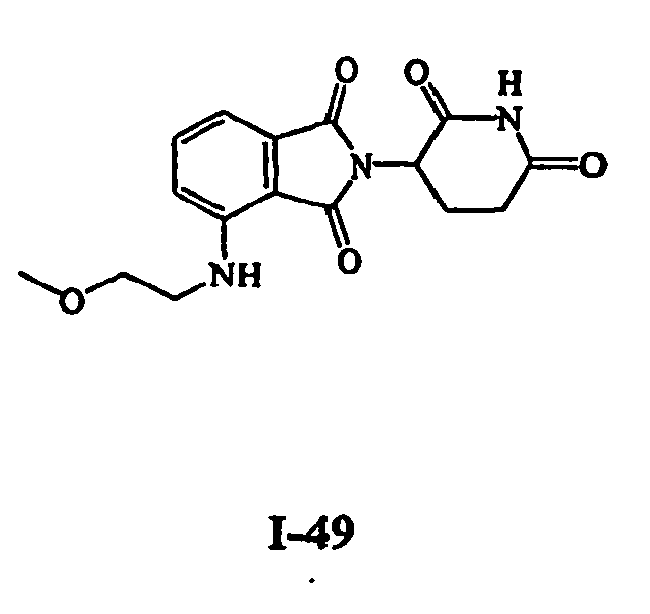
2-(2,6-Dioxo-piperidin-3-yl)-4-(2-methoxy ethylamino)-isoindole-1,3-dione 
2-Benzyloxy-N-[2-(2,6-dioxo-piperidin-3-yl)-1,3-dioxo-2,3-dihydro-1H-isoindol-4-yl]-acetamide 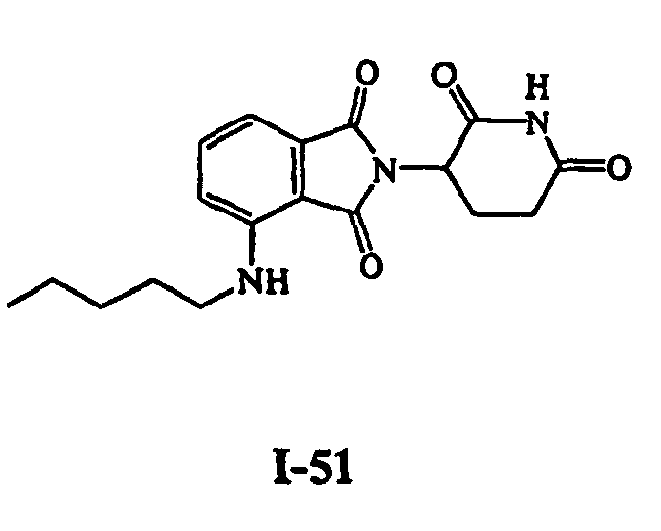
2-(2,6-Dioxo-piperidin-3-yl)-4-pentylamino-isoindole-1,3-dione 
3-Chloro-N-[2-(2,6-dioxo-piperidin-3-yl)-1,3-dioxo-2,3-dihydro-1H-isoindol-4-yl]-benzamide 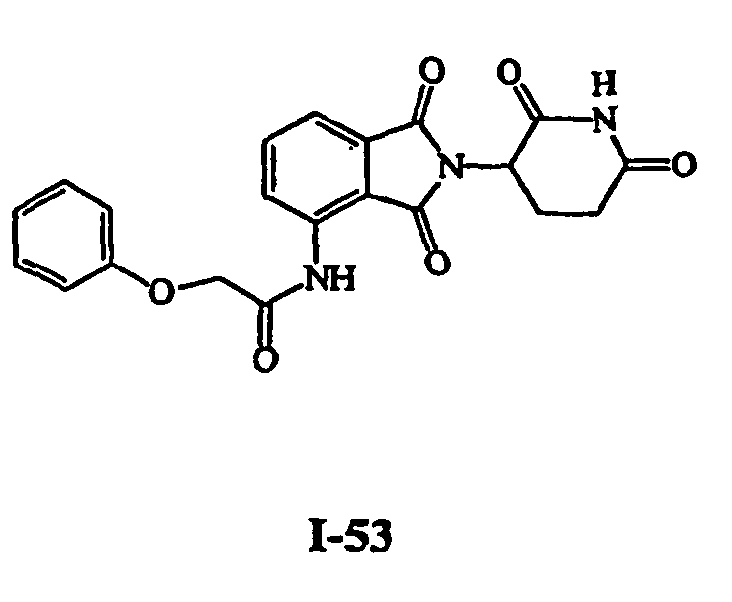
N-[2-(2,6-Dioxo-piperidin-3-yl)-1,3-dioxo-2,3-dihydro-1H-isoindol-4-yl]-2-phenoxy acetamide 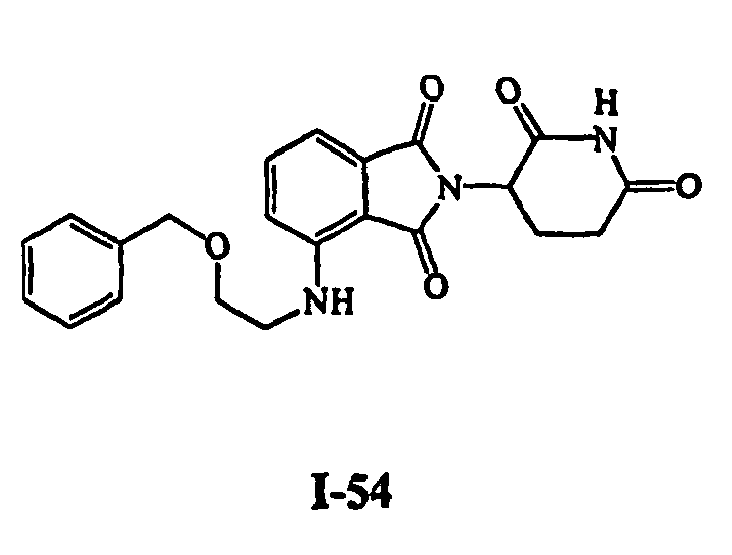
4-(2-Benzyloxy-ethylamino)-2-(2,6-dioxo-piperidin-3-yl)-isoindole-1,3-dione 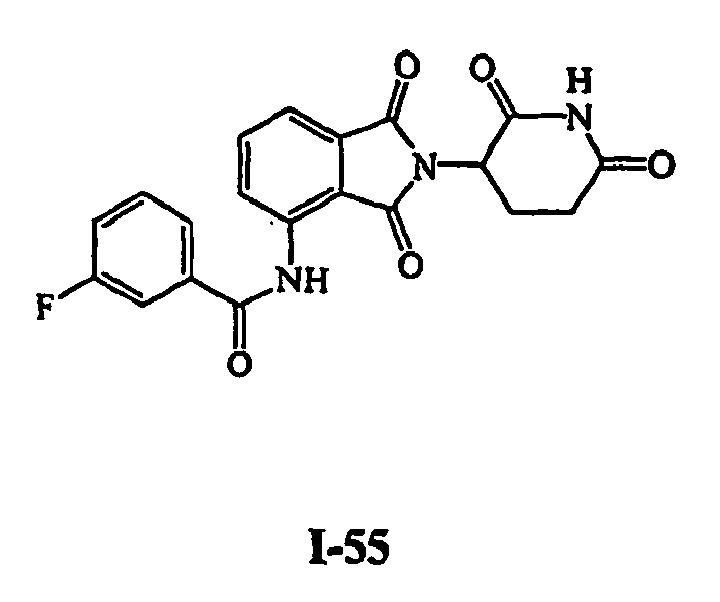
N-[2-(2,6-Dioxo-piperidin-3-yl)-1,3-dioxo-2,3-dihydro-1H-isoindol-4-yl]-3-fluoro-benzamide 
N-[2-(2,6-Dioxo-piperidin-3-yl)-1,3-dioxo-2,3-dihydro-1H-isoindol-4-yl]-3-methyl-benzamide 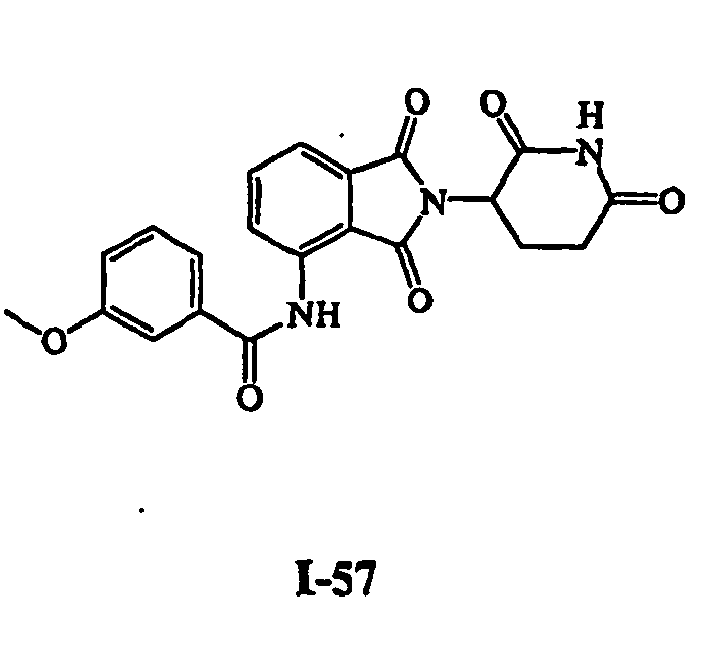
N-[2-(2,6-Dioxo-piperidin-3-yl)-1,3-dioxo-2,3-dihydro-1H-isoindol-4-yl]-3-methoxy-benzamide 
N-[2-(2,6-Dioxo-piperidin-3-yl)-1,3-dioxo-2,3-dihydro-1H-isoindol-4-yl]-3-trifluoromethyl-benzamide 
N-[2-(2,6-Dioxo-piperidin-3-yl)-1,3-dioxo-2,3-dihydro-1H-isoindol-4-yl]-3-nitro-benzamide 
N-[2-(2,6-Dioxo-piperidin-3-yl)-1,3-dioxo-2,3-dihydro-1H-ioindol-4-yl]-butyramide 
N-[2-(2,6-Dioxo-piperidin-3-yl)-1,3-dioxo-2,3-dihydro-1H-isoindol-yl]-2-methylamino-acetamide 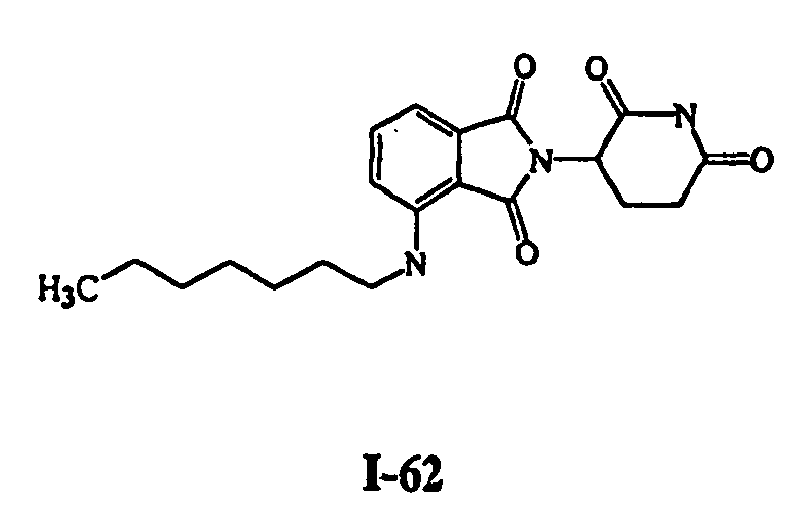
2-(2,6-Dioxo-piperidin-3-yl)-4-heptylamino-isoindole-1,3-dione 
4-Chloro-N-[2-(2,6-dioxo-piperidin-3-yl)-1,3-dioxo-2,3-dihydro-1H-isoindol-4-yl]-benzamide 
Cyclopropanecarboxylic acid [2-(2,6-dioxo-piperidin-3-yl)-1,3-dioxo-2,3-dihydro-1H- isoindol-4-yl]-amide 
N-[2-(2,6-Dioxo-piperidin-3-yl)-1,3-dioxo-2,3-dihydro-1H-isoindol-4-yl]-4-fluoro-benzamide 
N-[2-(2,6-Dioxo-piperidin-3-yl)-1,3-dioxo-2,3-dihydro-1H-isoindol-4-yl]-4-trifluoromethyl-benzamide 
N-[2-(2,6-Dioxo-piperidin-3-yl)-1,3-dioxo-2,3-dihydro-1H-isoindol-4-yl]-4-methyl-benzamide 
N-[2-(2,6-Dioxo-piperidin-3-yl)-1,3-dioxo-2,3-dihydro-1H-isoindol-4-yl]4-nitro-benzamide 
N-[2-(2,6-Dioxo-piperidin-3-yl)-1,3-dioxo-2,3-dihydro-1H-isoindol-4-yl]-2-ethoxy-acetamide 
N-[2-(2,6-Dioxo-piperidin-3-yl)-1,3-dioxo-2,3-dihydro-1H-isoindol-4-yl]-2-methylsulfanyl-acetamide 
N-[2-(2,6-Dioxo-piperidin-3-yl)-1,3-dioxo-2,3-dihydro-1H-isoindol-4-yl]-2-methoxy-benzamide 
N-[2-(2,6-Dioxo-piperidin-3-yl)-1,3-dioxo-2,3-dihydro-1H-isoindol-4-yl]-2-fluoro-benzamide 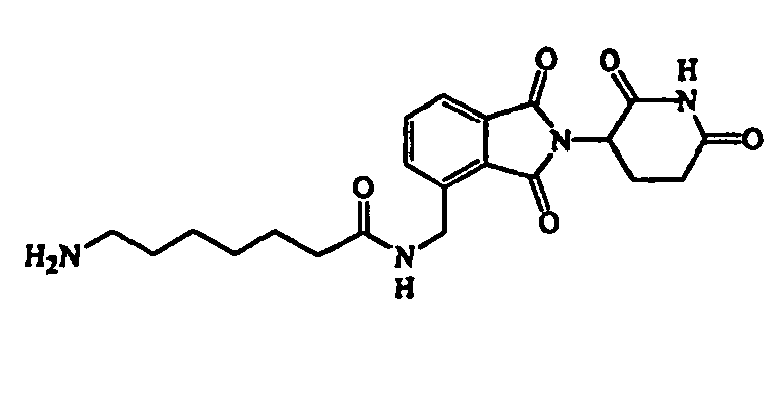
7-Amino-N-{[2-(2,6-dioxo(3-pipeidyl))-1,3-dioxoisoindolin-4-yl]methyl}heptanamide 
N-{[2-(2,6-Dioxo(3-piperidyl))-1,3-dioxoisoindolin-4-yl]methyl}butanamide 
N-{[2-(2,6-Dioxo(3-piperidyl))-1,3-dioxoisoindolin-4-yl]methyl}benzamide 
N-{[2-(2,6-Dioxo(3-piperidyl))-1,3-dioxoisoindolin-4-yl]methyl}phenylacetamide 
N-{[2-(2,6-Dioxo(3-piperidyl))-1,3-dioxoisoindolin-4-yl]methyl}-2-pyridylcarboxamide 
N-{[2-(2,6-Dioxo(3-piperidyl))-1,3-dioxoisoindolin-4-yl]methyl}undecamide 
N-{[2-(2,6-Dioxo(3-piperidyl))-1,3-dioxoisoindolin-4-yl]methyl}-2-methylpropanamide 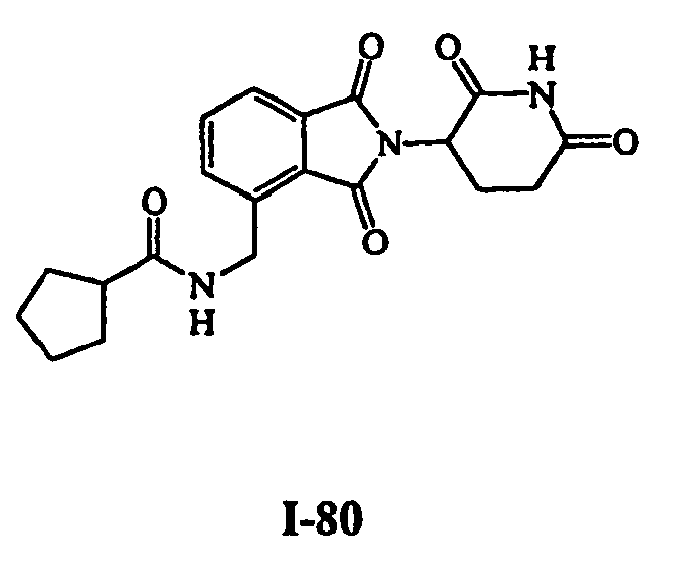
N-{[2-(2,6-Dioxo(3-piperidyl))-1,3-dioxoisoindolin-4-yl]methyl}cyclopentylcarboxamide 
N-{[2-(2,6-Dioxo(3-piperidyl))-1,3-dioxoisoindolin-4-yl]methyl}cyclohexylcarboxamide 
N-{[2-(2,6-Dioxo(3-piperidyl))-1,3-dioxoisoindolin-4-yl]methyl}(phenylamino)carboxamide 
N-{[2-(2,6-Dioxo(3-piperidyl))-1,3-dioxoisoindolin-4-yl]methyl}(butylamino)carboxamide 
N-{[2-(2,6-Dioxo(3-piperidyl))-1,3-dioxoisoindolin-4-yl]methyl}(propylamino)carboxamide 
N-{[2-(2,6-Dioxo(3-piperidyl))-1,3-dioxoisoindolin-4-yl]methyl}(cyclohexylamino)carboxamide 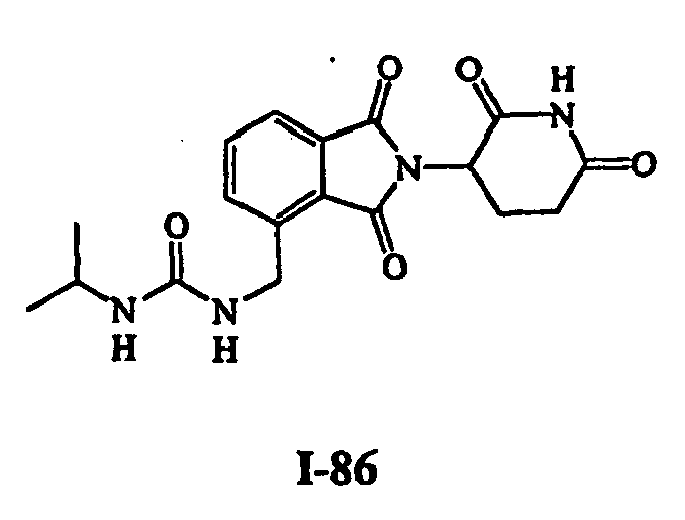
N-{[2-(2,6-Dioxo(3-piperidyl))-1,3-dioxoisoindolin-4-yl]methyl}[(methylethylamino)]carboxamide 
N-{[2-(2,6-Dioxo(3-piperidyl))-1,3-dioxoisoindolin-4-yl]methyl}(octylamino)carboxamide 
N-{[2-(2,6-Dioxo(3-piperidyl))-1,3-dioxoisoindolin-4-yl]methyl}(benzylamino)carboxamide 
N-{[2-(2,6-Dioxo(3-piperidyl))-1,3-dioxoisoindolin-4-yl]methyl}(cyclopropylamino)carboxamide 
2-Chloro-N-[2-(2,6-dioxo-piperidin-3-yl)-1,3-dio xo-2,3-dihydro-1H-isoindol-4-yl]-benzamide 
[2-(2,6-Dioxo-piperidin-3-yl)-1,3-dioxo-2,3-dihy dro-1H-isoindol-4-yl]-carbamic acid benzyl ester 
N-[2-(2,6-Dioxo-piperidin-3-yl)-1,3-dioxo-2,3-di hydro-1H-isoindol-4-yl]-acetamide 
Pentanoic acid [2-(2,6-dioxo-piperidin-3-yl)-1-oxo-2,3-dihydro-1H-isoindol-4-yl]-amide 
N-[2-(2,6-Dioxo-piperidin-3-yl)-1-oxo-2,3-dihyd ro-1H-isomdol-4-yl]-propionamide 
N-[2-(2,6-Dioxo-piperidin-3-yl)-1-oxo-2,3-dihydro-1H-isoindol-4-yl]-nicotinamide 
2-(2,6-Dioxo-piperidin-3-yl)-4-{[(furan-2-ylmethyl)-amino]-methyl}-isoindole-1,3-dione 
N-[2-(2,6-Dioxo-piperidin-3-yl)-1-oxo-2,3-dihydro-1H-isoindol-4-yl]-benzamide 
2-Dimethylamino-N-[2-(2,6-dioxo-piperidin-3-yl)-1,3-dioxo-2,3-dihydro-1H-isoindol-4-yl]-acetamide 
N-[2-(2,6-Dioxo-piperidin-3-yl)-1,3-dioxo-2,3-dihydro-1H-isoindol-4-yl]-2-methyl-benzamide 
Heptanoic acid[2-(2,6-dioxo-piperidin-3-yl)-1-oxo-2,3-dihydro-1H-isoindol-4-yl]-amide 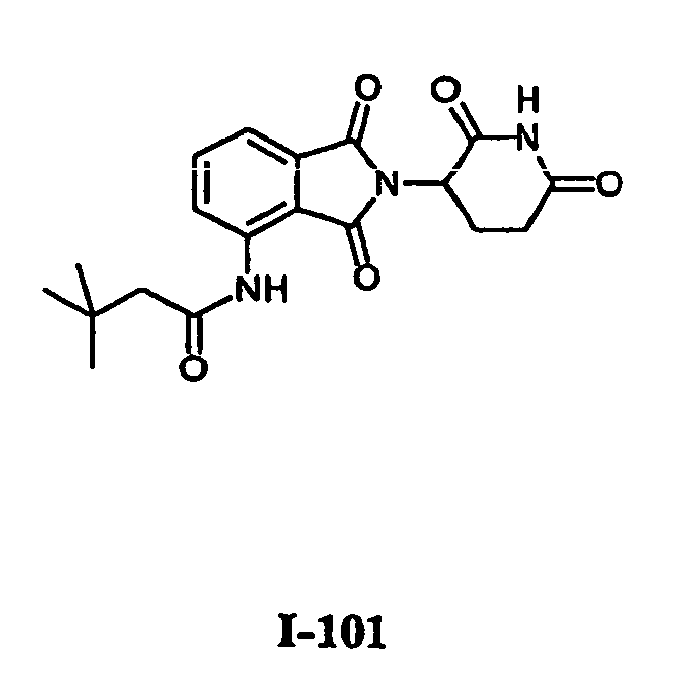
N-[2-(2,6-Dioxo-piperidin-3-yl)-1,3-dioxo-2,3-dihydro-1H-isoindol-4-yl]-3,3-dimethyl-butyramide 
N-[2-(2,6-Dioxo-piperidin-3-yl)-1,3-dioxo-2,3-dihydro-1H-isoindol-4-yl]-isobutyramide 
N-[2-(2,6-Dioxo-piperidin-3-yl)-1,3-dioxo-2,3-dihydro-1H-isoindol-4-yl]-3-phenyl-propionamide 
N-[2-(2,6-Dioxo-piperidin-3-yl)-1,3-dioxo-2,3-dihydro-1H-isoindol-4-yl]-4-methoxy-benzamide 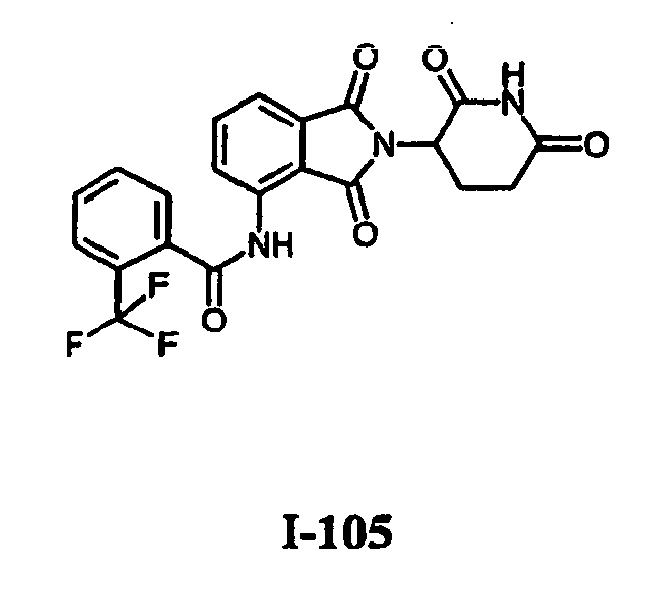
N-[2-(2,6-Dioxo-piperidin-3-yl)-1,3-dioxo-2,3-dihydro-1H-isoindol-4-yl]-2-trifluoromethyl-benzamide 
N-[2-(2,6-Dioxo-piperidin-3-yl)-1,3-dioxo-2,3-dihydro-1H-isoindol-4-yl]-malonamic acid methyl ester 
N-[2-(2,6-Dioxo-piperidin-3-yl)-1,3-dioxo-2,3-dihydro-1H-isoindol-4-yl]-3-methoxy-propionamide 
N-[2-(2,6-Dioxo-piperidin-3-yl)-1,3-dioxo-2,3-dihydro-1H-isoindol-4-yl]-2-hydroxy-acetamide 
4-[(Furan-2-ylmethyl)-amino]-2-(1-methyl-2,6-dioxo-piperidin-3-yl)-isoindole-1,3-dione 
N-[2-(2,6-Dioxo-piperidin-3-yl)-1,3-dioxo-2,3-dihydro-1H-isoindol-4-ylmethyl]-isonicotinamide 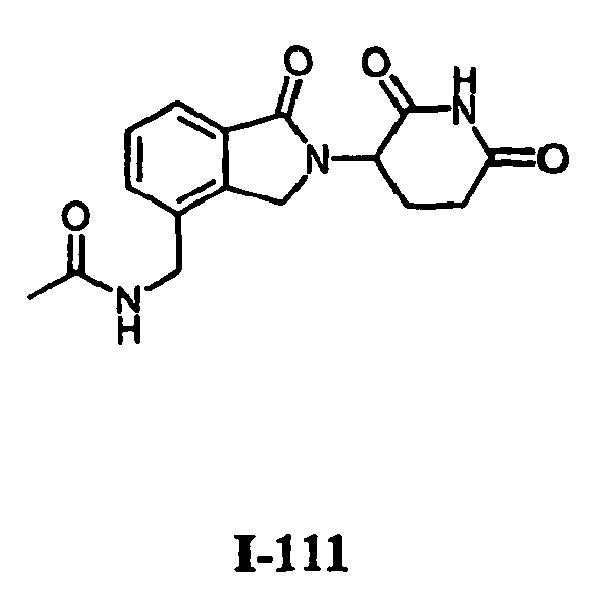
N-[2-(2,6-Dioxo-piperidin-3-yl)-1,3-dioxo-2,3-dihydro- 1H-isoindol-4-ylmethyl]-acetamide 
{5-[2-(2,6-Dioxo-piperidin-3-yl)-1,3-dioxo-2,3-dihydro-1H-isoindol-4-ylcarbamoyl]-pentyl}-carb amic acid benzyl ester 
2-(2,6-Dioxo(3-piperidyl))-4-({[(cyclohexylamino)thioxomethyl]amino}methyl)isoindole-1,3-dione 
2-(2,6-Dioxo(3-piperidyl))-4-({[(ethylamino)thioxomethyl]amino}methyl)isoindole-1,3-dione 
2-(2,6-Dioxo(3-piperidyl))-4-({[(propylamino)thioxomethyl]amino}methyl)isoindole-1,3-dione 
N-[2-(2,6-dioxo(3-piperidyl))-1,3-dioxoisoindolin-4-yl]-2-chloro-benzylamine 
{5-[2-(2,6-Dioxo-piperidin-3-yl)-1,3-dioxo-2,3-dihydro-1H-isoindol-4-ylcarbamoyl]-pentyl}-carbamic acid benzyl ester 
2-Methoxy-N-[2-(3-methyl-2,6-dioxo-piperidin-3-yl)-1,3-dioxo-2,3-dihydro-1H-isoindol-4-yl]-acetamide 
Pentanoic acid [2-(3-methyl-2,6-dioxo-piperidin-3-yl)-1,3-dioxo-2,3-dihydro-1H-isoindol-4-yl]-amide 
Heptanoic acid [2-(3-methyl-2,6-dioxo-piperidin-3-yl)-1,3-dioxo-2,3-dihydro-1H-isoindol-4-yl]-amide 
3-Chloro-N-[2-(3-methyl-2,6-dioxo-pipendin-3-yl)-1,3-dioxo-2,3-dihydro-1H-isoindol-4-yl]-benzamide 
N-[2-(3-Methyl-2,6-dioxo-piperidin-3-yl)-1,3-dioxo-2,3-dihydro-1H-isoindol-4-yl]-propionamide 
Thiophene-2-carboxylic acid [2-(3-methyl-2,6-dioxo-piperidin-3-yl)-1,3-dioxo-2,3-dihydro-1H-isoindol-4-yl]-amide 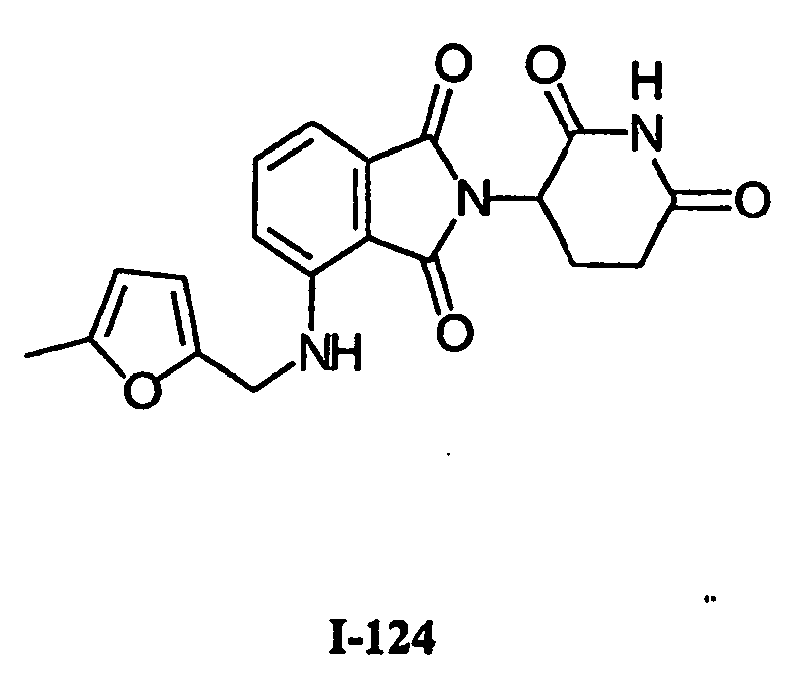
2-(2,6-Dioxo-piperidin-3-yl)-4-[(5-methyl-furan-2-ylmethyl)-amino]-isoindole-1,3-dione 
2-(2,6-Dioxo-piperidin-3-yl)-4-[(5-hydroxymethyl-furan-2-ylmethyl)-amino]-isoindole-1,3-dione 
2-(2,6-Dioxo-piperidin-3-yl)-4-[(thiophen-2-ylmethyl)-amino]-isoindole-1,3-dione 
4-(3-Chloro-benzylamino)-2-(2,6-dioxo-piperidin-3-yl)-isoindole-1,3-dione 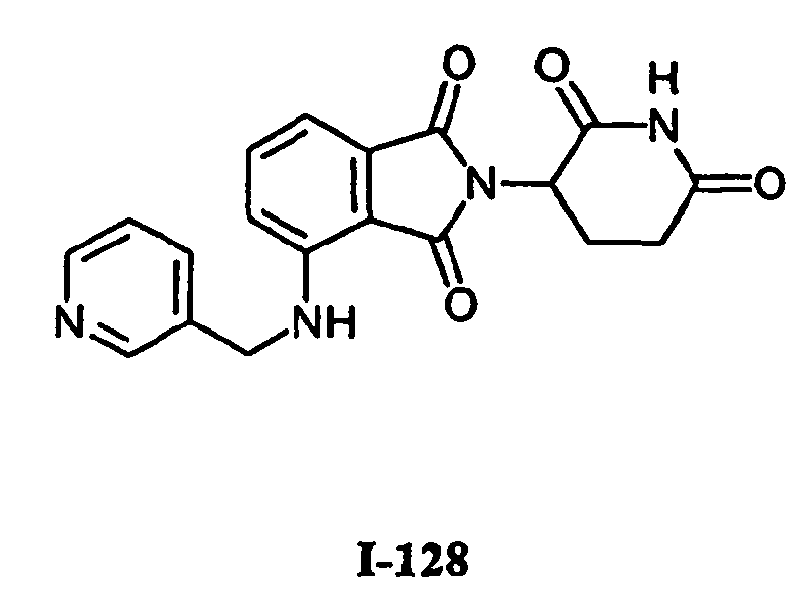
2-(2,6-Dioxo-piperidin-3-yl)-4-[(pyridin-3-ylmethyl)-amino]-isoindole-1,3-dione 
5-{[2-(2,6-Dioxo-piperidin-3-yl)-1,3-dioxo-2,3-dihydro-1H-isoindol-4-ylamino]-methyl}-furan-2-carboxylic acid 
4-[(4,5-Dimethyl-furan-2-ylmethyl)-amino]-2-(2,6-dioxo-piperidin-3-yl)-isoindole-1,3-dione 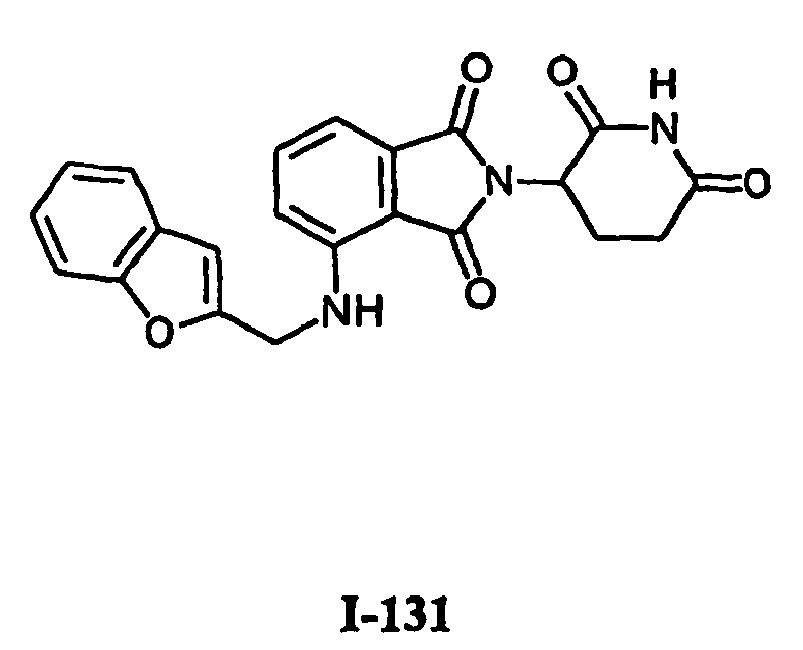
4-[(Benzofuran-2-ylmethyl)-amino]-2-(2,6-dioxo-piperidin-3-yl)-isoindole-1,3-dione 
4-(3-Chloro-benzylamino)-2-(3-methyl-2,6-dioxo-piperidin-3-yl)-isoindole-1,3-dione 
3-[4-(3-Chloro-benzylamino)-1-oxo-1,3-dihydro-isoindol-2-yl]-piperidine-2,6-dione 
N-{[2-(2,6-Dioxo(3-piperidyl))-1,3-dioxoisoindolin-4-yl]methyl}(cyclopentylamino)carboxamide 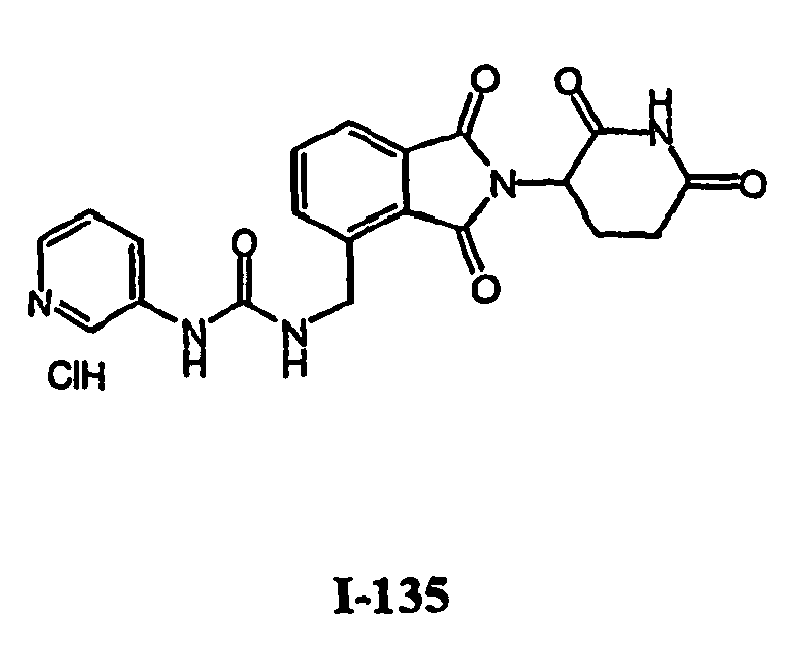
N-{[2-(2,6-Dioxo(3-piperidyl))-1,3-dioxoisoindolin-4-yl]methyl}(3-pyridylamino)carboxamide Hydrochloride 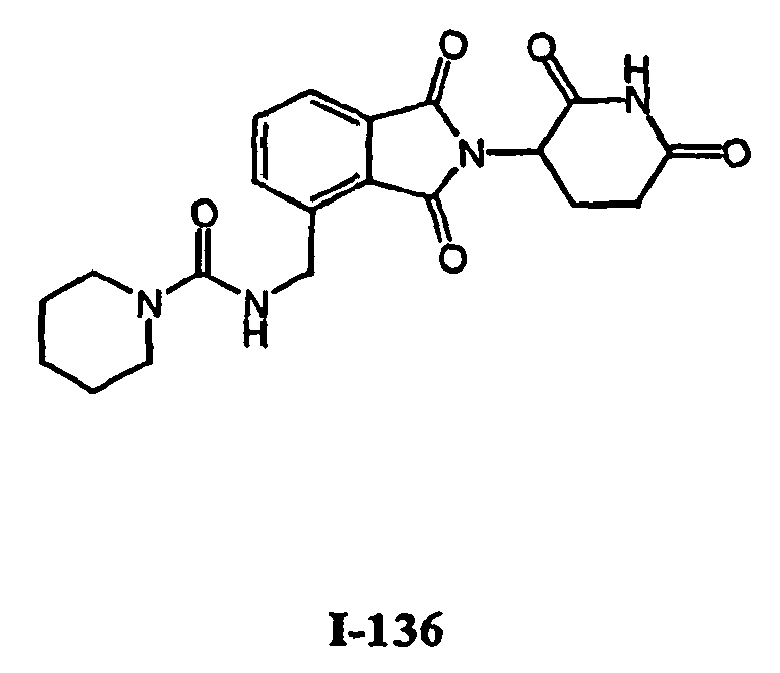
N- {[2,(2,6-dioxo(3-piperidyl))-1,3-dioxoisoindolin-4-yl]methyl}piperidylcarboxamide 
Tert-Butyl 4-(N-{[2-(2,6-dioxo(3-piperidyl))-1,3-dioxoisoindolin-4-yl]methyl} (carbamoyl)piperazinecarboxylat e 
N-{[2-(2,6-Dioxo(3-piperidyl))-1,3-dioxoisoindolin-4-yl]methyl} (diethylamino)carboxamide 
Cyclopropyl-N-{[2-(3-methyl-2,6-dioxo(3-piperidyl))-1,3-dioxoisoindolin-4-yl]methyl}carboxamide 
N-{[2-(2,6-Dioxo(3-piperidyl))-1-oxoisoindolin-4-yl]methyl}cyclopropylcarboxamide 
N-{[2-(2,6-Dioxo(3-piperidyl))-1-oxoisoindolin-4-yl]methyl}(ethylamino)caboxamide 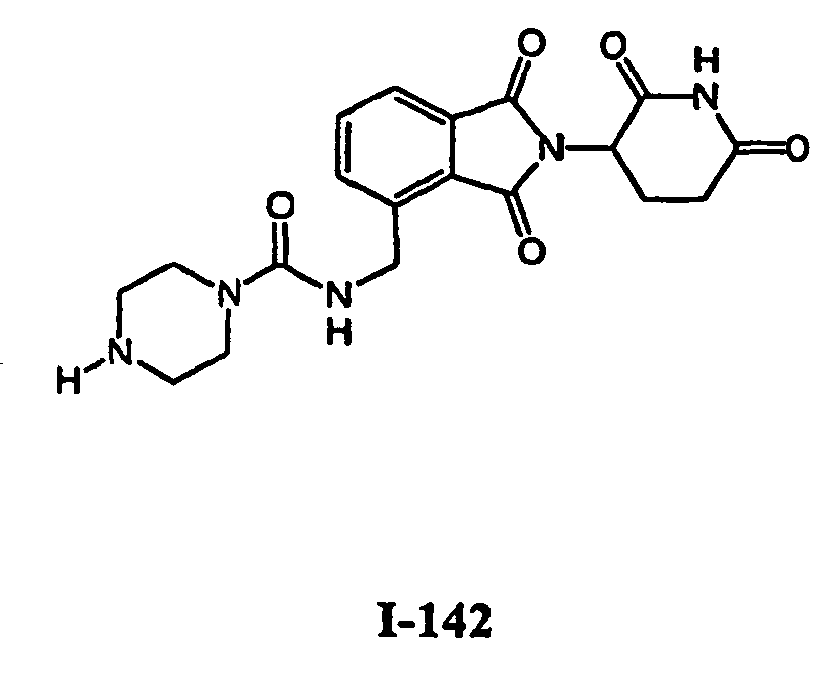
Piperazine-1-carboxylic acid [2-(2,6-dioxo-piperidin-3-yl)-1,3-dioxo-2,3-dihydro-1H-isoindol-4-ylmethyl]-amide - Selected compounds of Table 1 were tested using the in vitro assays described below and found to be active for modulating the production of TNF-α. Examples of optically or enantiomerically pure stereoisomers of the invention are depicted in Table 2 below.
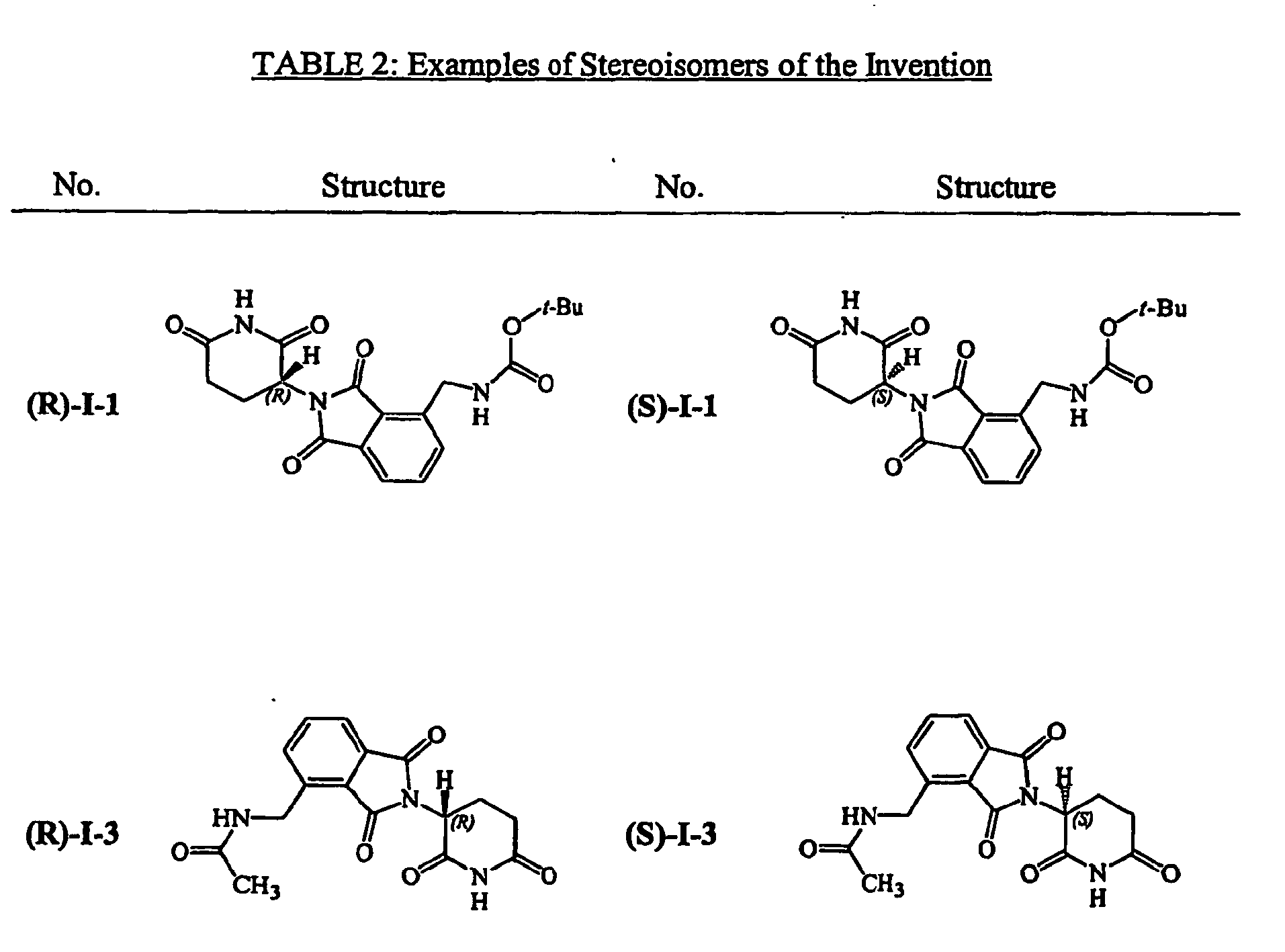


- The compounds of the invention can be obtained via standard, synthetic methodology. Some convenient methods are illustrated in Schemes 1-8. Starting materials useful for preparing the compounds of the invention and intermediates therefor, are commercially available or can be prepared from commercially available materials using known synthetic methods and reagents. Such starting materials include, but are not limited to, methyl-2-(methoxycarbonyl)-3-nitrobenzoate; methyl-3-aminomethyl-2-(methoxycarbonyl)benzoate; substituted and unsubstituted aminoglutarimide hydrochloride; di-t-butyl dicarbonate; and cyclopropylcarbonyl chloride.

- Scheme 1 outlines one method to synthesize 4-(aminomethyl)-2-(2,6-dioxo(3-piperidyl))-isoindoline-1,3-dione (I, wherein R1 is H and n is 1) from compound 10. In the first step, reduction of 10 (commercially available), for example, with palladium on charcoal and 50 psi of hydrogen, followed by standard isolation and purification gives arylamine 11. Arylamine 11 converts to nitrile 12 by diazonium salt formation effected by treatment with sodium nitrate then displacement of nitrogen with cyanide according to the classic Sandmeyer procedure. Reduction of nitrile 12, for example, with palladium on carbon in methanol/aqueous hydrochloric acid under an atmosphere of hydrogen, gives the hydrochloride salt of compound 13. Treatment of 13 with triethylamine liberates the free base, which in turn reacts with di-t-butyl dicarbonate (14) (commercially available, for example, from Aldrich Chemical Co. Milwaukee, WI) giving carbamate 15. Treatment of carbamate 15 with 16, where R2 is as defined above, and a base, such as diisopropylethyl amine gives compound 17 that converts to I, wherein R1 is H and n is 1 upon standard hydrolysis, for example, with aqueous hydrochloric acid/dioxane. Compounds 16 can be obtained by cyclizing the appropriately substituted, amino-protected glutamine by well-known methods (e.g., see
WO 98/54170 
- Scheme 2 outlines a convenient method to synthesize 4-amino-2-(2,6-dioxo -piperidin-3-yl)-isoindole-1,3-dione (I, wherein R1 is H and n is 0) from 4-nitrophthalic anhydride (18). In the first step, a mixture of 18 and 16 in an acidic medium (e.g., sodium acetate in glacial acetic acid) is heated at about 60 °C to about 150 °C for a time of about 1 hour to about 24 hours, until the reaction is substantially complete. After an aqueous workup, 19 is isolated and characterized according to standard methods (see e.g., United States Patent No.
5,635,517 , incorporated herein by reference).Altemately, the reaction may be carried out in other solvents, including pyridine. Conversion of 19 to I, wherein R1 is H and n is 0, is accomplished by standard hydrogen reduction, for example, with palladium on carbon under about 50 psi to 200 psi of hydrogen at about room temperature to about 100 °C (see e.g., the procedure recited in United States Patent5,635,517 ).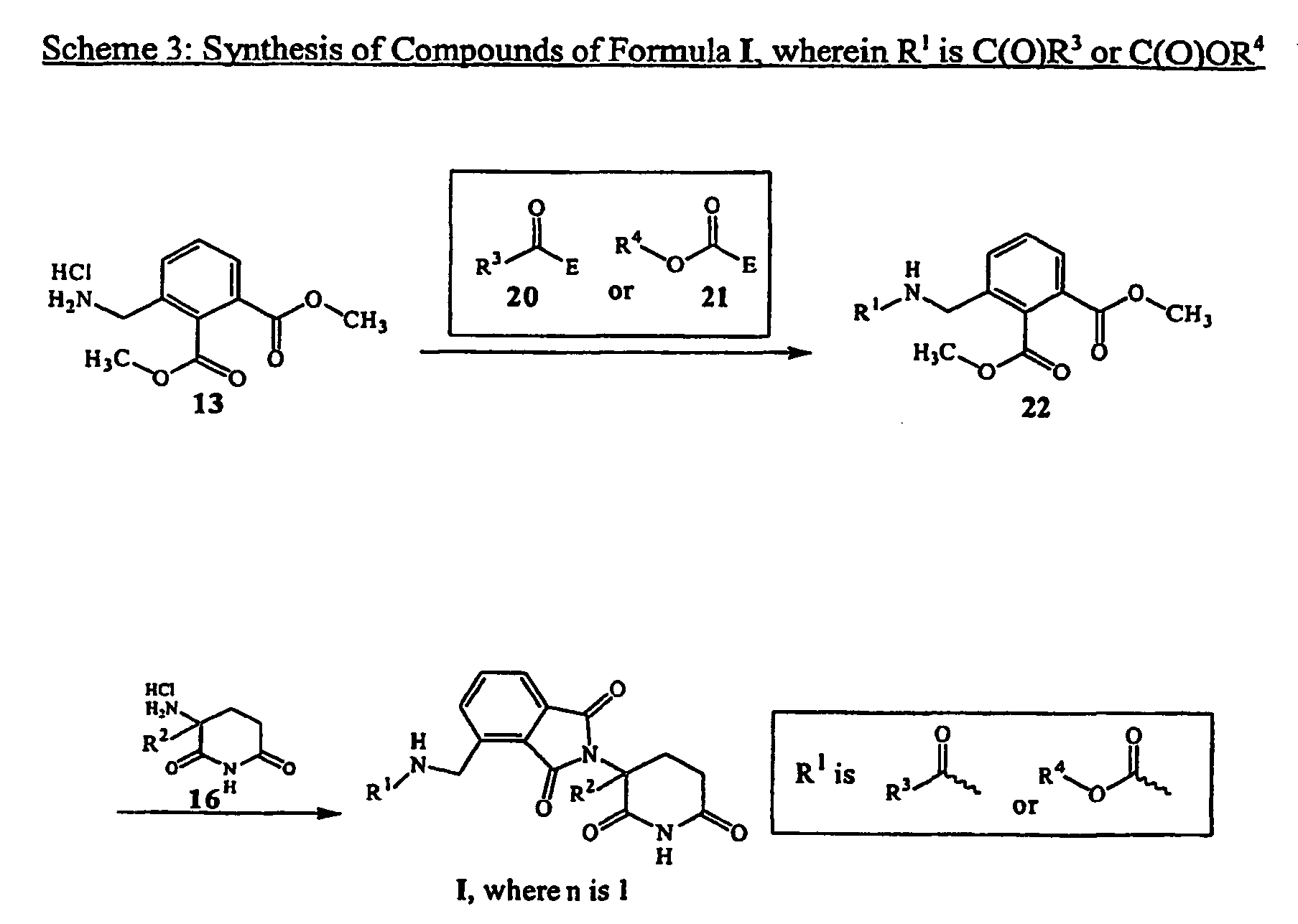
- Scheme 3 outlines a convenient synthesis of compounds of Formula I, wherein R1 is C(O)R3 or C(O)OR4. In the first step, compound 13, as prepared as in Scheme 1 above, reacts with a compounds 20 or 21, depending on whether R1 of C(O)R3 or C(O)OR4 is desired, to give compounds 22. According to scheme 3, E is a suitable leaving group, for example, but not limited to halides, such as chloride, bromide, and iodide; azido (N3); arylsulfonyloxy or alkylsulfonyloxy (e.g., tosyloxy or mesyloxy); phenoxy; alkoxy; and oxycarbonyl groups. Preferably, E is a halide, more preferably, chloride. Preferably, compounds 20 are acid chlorides, such as acetyl chloride and cyclopropylcarbonyl chloride and compounds 21 are chloroformates, such as ethylchloroformate or benzylchloroformate. The reaction is carried out according to standard, well-known procedures, e.g. see March, J. Advanced Organic Chemistry; Reactions Mechanisms, and Structure, 4th ed., 1992, pp.417-419, incorporated herein by reference. Treatment of 22 with 16 using the same procedure as outlined in Scheme 1 gives compounds of Formula I, wherein R1 is C(O)R3 or C(O)OR4.

- Scheme 4 outlines an alternative synthesis of compounds of Formula I, wherein R1 is C(O)R3 or C(O)OR4 and a convenient synthesis of compounds of Formula I, wherein R1 is CH2R3. In the first step, compounds I, wherein R1 is H, as prepared as in Scheme 1 (n = 1) or Scheme 2 (n = 0) above, reacts with a compounds 20, 21, or 23 depending on whether R1 of C(O)R3, C(O)OR4, or CH2R3 is desired, to give compounds I where R1 is C(O)R3, C(O)OR4, or CH2R3. As defined above for Scheme 3, E is a suitable leaving group. Preferably, E is a halide, more preferably, chloride. Preferably, compounds 20 are acid chlorides, such as chloroacetyl chloride and t-butylacetyl chloride. Aldehydes 23 are readily available commercially or synthesized by well-known methods The reaction of 20 or 21 with I, where R1 is H is carried out according to standard, well-known procedures for nucleophilic displacement, e.g. see March, J. Advanced Organic Chemistry; Reactions Mechanisms, and Structure, 4th ed., 1992, pp.417-419. The reaction of 23 with I, where R1 is H is accomplished according to the well-known reductive-amination procedure between an aldehyde and a primary amine, e.g. see March, J. Advanced Organic Chemistry; Reactions Mechanisms, and Structure, 4th ed., 1992, pp.898-902, incorporated herein by reference.

- Scheme 5 outlines one method for the synthesis of compounds of Formula I, wherein R1 is C(O)CH2N(R6)2. A compound of Formula I, wherein R1 is C(O)R3 and R3 is (CH2)E, where E is a suitable leaving group as defined for Scheme 3, reacts with amines 24 to give the desired Formula I compound, where R1 is C(O)CH2N(R6)2. Preferably, E is chloro and R5 is (C1-C8)alkyl, such as methyl. The reaction is performed according to standard, well-known procedures, e.g. see March, J. Advanced Organic Chemistry; Reactions Mechanisms, and Structure, 4th ed., 1992, pp. 411-413, incorporated herein by reference.

- Scheme 6 shows one method to synthesize compounds of Formula I, wherein R1 is C(O)NHR5. A compound of Formula I, where R1 is H reacts with isocyanates 25 under routine conditions to give a compounds I, where R1 is C(O)NHR5. The reaction is performed according to standard, well-known procedures, e.g. see March, J. Advanced Organic Chemistry; Reactions Mechanisms, and Structure, 4th ed., 1992, p. 903, incorporated herein by reference.

- Scheme 7 shows one method to synthesize compounds of Formula I, wherein R2 is F. A similar method is described in
U.S. Patent No. 5,874,448 , incorporated herein by reference. In the first step, compounds of Formula I, where R1 and R2 are H are first protected with suitable nitrogen-protecting groups (PG1, PG2, and PG3) at the methyleneamino and glutarimide nitrogens, respectively, to give compounds 26. As used herein, a "nitrogen protecting group" means a group that is reversibly attached to the nitrogen that renders the nitrogen moiety unreactive during a subsequent reaction(s) and that can be selectively cleaved to regenerate the original nitrogen moiety once its protecting purpose has been served. Examples of suitable protecting groups are found in Greene, T.W., Protective Groups in Organic Synthesis, 3rd edition 494-654 (1999), incorporated herein by reference, and United States Patent No.5,874,448 . Preferably, the nitrogen-protecting group is stable in a basic reaction medium but can be cleaved by acid. Preferably, all of PG1, PG2, and PG3 protecting groups are tert-butyloxycarbonyl, attached by treatment of compounds of Formula I, where R1 and R2 are H with in excess of 3 equivalents of di-tert-butyl carbonate as described in United States Patent No.5,874,448 . The fluorination-reaction procedure, to give compounds 27, is described in detail in United States Patent No.5,874,448 and can be effected by treating deprotonated 26 with a variety of reagents, such as N-fluorobenzenesulfonimide, perchloryl fluoride, or N-fluorobenzenedisulfonimide. Deprotonated 26 can be prepared by treatment of 26 with strong base, such as n-butyl lithium, sodium bis(trimethylsilyl)amide, sodium hydride, or lithium diisopropylamide. Deprotection of compounds 27 to give compounds I, where R1 is H and R2 is F is effected by standard procedures such as those described in Greene, T.W., Protective Groups in Organic Synthesis, 3rd edition 494-654 (1999) and United States Patent No.5,874,448 .
- Scheme 8 depicts convenient general synthetic methodology to prepare compounds of Formula I, wherein one of X and Y is C=O and the other is CH2 (i.e., compounds IA and IB). In compounds IA, the isoindolin-ring carbonyl is cis with respect to the methyleneamino (n =1) or the amino (n = 0) group, conversely, in compounds IB, the isoindolin-ring carbonyl is trans. In one convenient methods, compounds IA and IB can be prepared starting from compounds 28 or 29 respectively, for example, using the methodology described in
WO 98/54170 
- Scheme 9 shows one method to synthesize compounds of Formula I, wherein R1 is C(S)NHR3. A compound of Formula I, where R1 is H reacts with isothiocyanates 28 under routine conditions to give a compounds I, where R1 is C(O)NHR5. The reaction is performed according to standard, well-known procedures, e.g. see March, J. Advanced Organic Chemistry; Reactions Mechanisms, and Structure, 4th ed., 1992, p. 903, incorporated herein by reference.
- In accordance with the invention, a compound or composition of the invention is administered to a mammal, preferably, a human, with or at risk of a disease or medical condition, for example, cancer, such as solid tumors and blood-born tumors. Specific examples of cancers treatable or preventable by administering compounds of the invention include, but are not limited to, cancers of the skin, such as melanoma; lymph node; breast; cervix; uterus; gastrointestinal tract; lung; ovary; prostate; colon; rectal; mouth; brain; head and neck; throat; testes; kidney, pancreas; bone; spleen; liver; bladder; larynx; nasal passages; and AIDS-related cancers. The compounds are particularly useful for treating cancers of the blood and bone marrow, such as multiple myeloma and acute and chronic leukemias, for example, lymphoblastic, myelogenous, lymphocytic, and myelocytic leukemias.
- The compounds of the invention are also useful to treat or prevent heart disease, such as congestive heart failure, cardiomyopathy, pulmonary edema, endotoxin-mediated septic shock, acute viral myocarditis, cardiac allograft rejection, and myocardial infarction.
- The compounds of the invention can also be used to treat or prevent viral, genetic, inflammatory, allergic, and autoimmune diseases. For example, the compounds are useful to treat or prevent diseases including, but not limited to, HIV; hepatitis; adult respiratory distress syndrome; bone-resorption diseases; chronic pulmonary inflammatory diseases; dermatitis; cystic fibrosis; septic shock; sepsis; endotoxic shock; hemodynamic shock; sepsis syndrome; post ischemic reperfusion injury; meningitis; psoriasis; fibrotic disease; cachexia; graft rejection; auto-immune disease; rheumatoid spondylitis; arthritic conditions, such as rheumatoid arthritis and osteoarthritis; osteoporosis, Crohn's disease; ulcerative colitis; inflammatory-bowel disease; multiple sclerosis; systemic lupus erythrematosus; ENL in leprosy; radiation damage; asthma; and hyperoxic alveolar injury.
- The compounds of the invention are also useful for treating or preventing bacterial infections including, but not limited to, malaria, mycobacterial infection, and opportunistic infections resulting from HTV.
- In one embodiment, "treatment" or "treating" refers to an amelioration of a disease or disorder, or at least one discernible symptom thereof. In another embodiment, "treatment" or "treating" refers to an amelioration of at least one measurable physical parameter, not necessarily discernible by the mammal. In yet another embodiment, "treatment" or "treating" refers to inhibiting the progression of a disease or disorder, either physically, e.g., stabilization of a discernible symptom, physiologically, e.g., stabilization of a physical parameter, or both. In yet another embodiment, "treatment" or "treating" refers to delaying the onset of a disease or disorder.
- In certain embodiments, the compounds of the invention or the compositions of the invention are administered to a mammal, preferably, a human, as a prophylactic. As used herein, "prevention" or "preventing" refers to a reduction of the risk of acquiring a given disease or disorder. In a preferred mode of the embodiment, the compounds and compositions of the present invention are administered as a preventative measure to a mammal, preferably, a human, having a genetic or non-genetic predisposition to a medical condition, for example, cancers, such as solid tumors and blood-born tumors. Specific examples of cancers preventable by compounds of the invention include, but are not limited to, cancers of the skin, such as melanoma; lymph node; breast; cervix; uterus; gastrointestinal tract; lung; ovary; prostate; colon; rectal; mouth; brain; head and neck; throat; testes; kidney; pancreas; bone; spleen; liver; bladder; larynx; nasal passages; and AIDS-related cancers. The compounds are particularly useful for treating cancers of the blood and bone marrow, such as multiple myeloma and acute and chronic leukemias, for example, lymphoblastic, myelogenous, lymphocytic, and myelocytic leukemias.
- The compounds of the invention are also useful for preventing heart disease, such as congestive heart failure, cardiomyopathy, pulmonary edema, endotoxin-mediated septic shock, acute viral myocarditis, cardiac allograft rejection, and myocardial infarction.
- The compounds of the invention can also be used to prevent viral, genetic, inflammatory, allergic, and autoimmune diseases. For example, the compounds are useful to prevent diseases including, but not limited to, HIV; hepatitis; adult respiratory distress syndrome; bone-resorption diseases; chronic pulmonary inflammatory diseases; dermatitis; cystic fibrosis; septic shock; sepsis; endotoxic shock; hemodynamic shock; sepsis syndrome; post ischemic reperfusion injury; meningitis; psoriasis; fibrotic disease; cachexia; graft rejection; auto-immune disease; rheumatoid spondylitis; arthritic conditions, such as rheumatoid arthritis and osteoarthritis; osteoporosis, Crohn's disease; ulcerative colitis; inflammatory-bowel disease; multiple sclerosis; systemic lupus erythrematosus; ENL in leprosy; radiation damage; asthma; and hyperoxic alveolar injury.
- The compounds of the invention are also useful for preventing bacterial infections or symptoms including, but not limited to, malaria, mycobacterial infection, and opportunistic infections resulting from HIV.
- Due to the activity of the compounds and compositions of the invention, they are useful in veterinary and human medicine. The invention provides methods of treatment and prevention by administration of a therapeutically effective amount of a compound or a composition of the invention to a mammal, preferably, a human. The term "mammal" as used herein, encompasses any mammal. Preferably a mammal is in need of such treatment or prevention. Examples of mammals include, but are not limited to, cows, horses, sheep, pigs, cats, dogs, mice, rats, rabbits, guinea pigs, monkeys, etc., more preferably, a human.
- Administration of compounds of the invention can be systemic or local. In most instances, administration to a mammal will result in systemic release of the compounds of the invention (i.e., into the bloodstream). Methods of administration include enteral routes, such as oral, buccal, sublingual, and rectal; topical administration, such as transdermal and intradermal; and parenteral administration. Suitable parenteral routes include injection via a hypodermic needle or catheter, for example, intravenous, intramuscular, subcutaneous, intradermal, intraperitoneal, intraarterial, intraventricular, intrathecal, and intracameral injection and non-injection routes, such as intravaginal rectal, or nasal administration. Preferably, the compounds and compositions of the invention are administered orally. In specific embodiments, it may be desirable to administer one or more compounds of the invention locally to the area in need of treatment. This may be achieved, for example, by local infusion during surgery, topical application, e.g., in conjunction with a wound dressing after surgery, by injection, by means of a catheter, by means of a suppository, or by means of an implant, said implant being of a porous, non-porous, or gelatinous material, including membranes, such as sialastic membranes, or fibers.
- The compounds of the invention can be administered via typical as well as non-standard delivery systems, e.g., encapsulation in liposomes, microparticles, microcapsules, capsules, etc. For example, the compounds and compositions of the invention can be delivered in a vesicle, in particular a liposome (see Langer, 1990, Science 249:1527-1533; Treat et al., in Liposomes in Therapy of Infectious Disease and Cancer, Lopez-Berestein and Fidler (eds.), Liss, New York, pp. 353-365 (1989); Lopez-Berestein, ibid, pp. 317-327; see generally ibid.). In another example, the compounds and compositions of the invention can be delivered in a controlled release system. In one embodiment, a pump may be used (see Langer, supra; Sefton, 1987, CRC Crit. Ref. Biomed. Eng. 14:201; Buchwald et al., 1980, Surgery 88:507 Saudek et al., 1989, N. Engl. J. Med 321:574). In another example, polymeric materials can be used (see Medical Applications of Controlled Release, Langer and Wise (eds.), CRC Press., Boca Raton, Florida (1974); Controlled Drug Bioavailability, Drug Product Design and Performance, Smolen and Ball (eds.), Wiley, New York (1984); Ranger and Peppas,1983, J. Macromol. Sci. Rev. Macromol. Chem. 23:61 ; see also Levy et al.,1985, Science 228:190 ; During et al., 1989, Ann. Neurol. 25:351 ; Howard et al., 1989, J. Neurosurg. 71:105). In still another example, a controlled-release system can be placed in proximity of the target area to be treated, e.g., the liver, thus requiring only a fraction of the systemic dose (see, e.g., Goodson, in Medical Applications of Controlled Release, supra, vol. 2, pp. 115-138 (1984)). Other controlled-release systems discussed in the review by Langer, 1990, Science 249:1527-1533) can be used.
- When administered as a composition, a compound of the invention will be formulated with a suitable amount of a pharmaceutically acceptable vehicle or carrier so as to provide the form for proper administration to the mammal. The term "pharmaceutically acceptable" means approved by a regulatory agency of the Federal or a state government or listed in the U.S. Pharmacopeia or other generally recognized pharmacopeia for use in mammals, and more particularly in humans. The term "vehicle" refers to a diluent, adjuvant, excipient, or carrier with which a compound of the invention is formulated for administration to a mammal. Such pharmaceutical vehicles can be liquids, such as water and oils, including those of petroleum, animal, vegetable or synthetic origin, such as peanut oil, soybean oil, mineral oil, sesame oil and the like. The pharmaceutical vehicles can be saline, gum acacia, gelatin, starch paste, talc, keratin, colloidal silica, urea, and the like. In addition, auxiliary, stabilizing, thickening, lubricating and coloring agents may be used. Preferably, when administered to a mammal, the compounds and compositions of the invention and pharmaceutically acceptable vehicles, excipients, or diluents are sterile. An aqueous medium is a preferred vehicle when the compound of the invention is administered intravenously, such as water, saline solutions, and aqueous dextrose and glycerol solutions.
- The present compounds and compositions can take the form of capsules, tablets, pills, pellets, lozenges, powders, granules, syrups, elixirs, solutions, suspensions, emulsions, suppositories, or sustained-release formulations thereof, or any other form suitable for administration to a mammal. In a preferred embodiment, the compounds and compositions of the invention are formulated for administration in accordance with routine procedures as a pharmaceutical composition adapted for oral or intravenous administration to humans. In one embodiment, the pharmaceutically acceptable vehicle is a hard gelatin capsule. Examples of suitable pharmaceutical vehicles and methods for formulation thereof are described in Remington: The Science and Practice of Pharmacy, Alfonso R. Gennaro ed., Mack Publishing Co. Easton, PA, 19th ed., 1995, Chapters 86, 87, 88, 91, and 92, incorporated herein by reference.
- Compounds and compositions of the invention formulated for oral delivery, are preferably in the form of capsules, tablets, pills, or any compressed pharmaceutical form. Moreover, where in tablet or pill form, the compounds and compositions may be coated to delay disintegration and absorption in the gastrointestinal tract thereby providing a sustained action over an extended period of time. Selectively permeable membranes surrounding an osmotically active driving compound are also suitable for orally administered compounds and compositions of the invention. In these later platforms, fluid from the environment surrounding the capsule is imbibed by the driving compound that swells to displace the agent or agent composition through an aperture. These delivery platforms can provide an essentially zero order delivery profile as opposed to the spiked profiles of immediate release formulations. A time delay material such as glycerol monostearate or glycerol stearate may also be used. Oral compositions can include standard vehicles, excipients, and diluents, such as magnesium stearate, sodium saccharine, cellulose, magnesium carbonate, lactose, dextrose, sucrose, sorbitol, mannitol, starch, gum acacia, calcium silicate, microcrystalline cellulose, polyvinylpyrrolidinone, water, syrup, and methyl cellulose, the formulations can additionally include lubricating agents, such as talc, magnesium stearate, mineral oil, wetting agents, emulsifying and suspending agents, preserving agents such as methyl- and propylhydroxybenzoates. Such vehicles are preferably of pharmaceutical grade. Orally administered compounds and compositions of the invention can optionally include one or more sweetening agents, such as fructose, aspartame or saccharin; one or more flavoring agents such as peppermint, oil of wintergreen, or cherry; or one or more coloring agents to provide a pharmaceutically palatable preparation.
- A therapeutically effective dosage regimen for the treatment of a particular disorder or condition will depend on its nature and severity, and can be determined by standard clinical techniques according to the judgment of a medical practitioner. In addition, in vitro or in vivo assays can be used to help identify optimal dosages. Of course, the amount of a compound of the invention that constitutes a therapeutically effective dose also depends on the administration route. In general, suitable dosage ranges for oral administration are about 0.001 milligrams to about 20 milligrams of a compound of the invention per kilogram body weight per day, preferably, about 0.7 milligrams to about 6 milligrams, more preferably, about 1.5 milligrams to about 4.5 milligrams. In a preferred embodiment, a mammal, preferably, a human is orally administered about 0.01 mg to about 1000 mg of a compound of the invention per day, more preferably, about 0.1 mg to about 300 mg per day, or about 1 mg to about 250 mg in single or divided doses. The dosage amounts described herein refer to total amounts administered; that is, if more than one compound of the invention is administered, the preferred dosages correspond to the total amount of the compounds of the invention administered. Oral compositions preferably contain 10% to 95% of a compound of the invention by weight. Preferred unit oral-dosage forms include pills, tablets, and capsules, more preferably capsules. Typically such unit-dosage forms will contain about 0.01 mg, 0.1 mg,1 mg, 5 mg, 10 mg, 15 mg, 20 mg, 50 mg,100 mg, 250 mg, or 500 mg of a compound of the invention, preferably, from about 5 mg to about 200 mg of compound per unit dosage.
- In another embodiment, the compounds and compositions of the invention can be administered parenterally (e.g., by intramuscular, intrathecal, intravenous, and intraarterial routes), preferably, intravenously. Typically, compounds and compositions of the invention for intravenous administration are solutions in sterile isotonic aqueous vehicles, such as water, saline, Ringer's solution, or dextrose solution. Where necessary, the compositions may also include a solubilizing agent. Compositions for intravenous administration may optionally include a local anesthetic such as lignocaine to ease pain at the site of the injection. For intravenous administration, the compounds and compositions of the invention can be supplied as a sterile, dry lyophilized powder or water-free concentrate in a hermetically sealed container, such as an ampule or sachette, the container indicating the quantity of active agent. Such a powder or concentrate is then diluted with an appropriate aqueous medium prior to intravenous administration. An ampule of sterile water, saline solution, or other appropriate aqueous medium can be provided with the powder or concentrate for dilution prior to administration. Or the compositions can be supplied in premixed form, ready for administration. Where a compound or composition of the invention is to be administered by intravenous infusion, it can be dispensed, for example, with an infusion bottle containing sterile pharmaceutical-grade water, saline, or other suitable medium.
- Rectal administration can be effected through the use of suppositories formulated from conventional carriers such as cocoa butter, modified vegetable oils, and other fatty bases. Suppositories can be formulated by well-known methods using well-known formulations, for example see Remington: The Science and Practice of Pharmacy, Alfonso R. Gennaro ed., Mack Publishing Co. Easton, PA, 19th ed., 1995, pp. 1591-1597, incorporated herein by reference
- To formulate and administer topical dosage forms, well-known transdermal and intradermal delivery mediums such as lotions, creams, and ointments and transdermal delivery devices such as patches can be used (Ghosh, T.K.; Pfister, W.R.; Yum, S.I. Transdermal and Topical Drug Delivery Systems, Interpharm Press, Inc. p. 249-297, incorporated herein by reference). For example, a reservoir type patch design can comprise a backing film coated with an adhesive, and a reservoir compartment comprising a compound or composition of the invention, that is separated from the skin by a semipermeable membrane (e.g.,
U.S. Patent 4,615,699 , incorporated herein by reference). The adhesive coated backing layer extends around the reservoir's boundaries to provide a concentric seal with the skin and hold the reservoir adjacent to the skin. - The invention also provides pharmaceutical packs or kits comprising one or more containers filled with one or more compounds of the invention. Optionally associated with such container(s) can be a notice in the form prescribed by a governmental agency regulating the manufacture, use or sale of pharmaceuticals or biological products, which notice reflects approval by the agency of manufacture, use or sale for human administration. In one embodiment, the kit contains more than one compound of the invention. In another embodiment, the kit comprises a compound of the invention and another biologically active agent.
- The compounds of the invention are preferably assayed in vitro and in vivo, for the desired therapeutic or prophylactic activity, prior to use in humans. For example, in vitro assays can be used to determine whether administration of a specific compound of the invention or a combination of compounds of the invention is preferred. The compounds and compositions of the invention may also be demonstrated to be effective and safe using animal model systems. Other methods will be known to the skilled artisan and are within the scope of the invention.
- In certain embodiments, a compound of the invention is administered to a mammal, preferably, a human concurrently with one or more other biologically active agents, or with one or more other compounds of the invention, or with both. By "concurrently" it is meant that a compound of the invention and the other agent are administered to a mammal in a sequence and within a time interval such that the compound of the invention can act together with the other agent to provide an increased or synergistic benefit than if they were administered otherwise. For example, each component may be administered at the same time or sequentially in any order at different points in time; however, if not administered at the same time, they should be administered sufficiently closely in time so as to provide the desired treatment effect. Preferably, all components are administered at the same time, and if not administered at the same time, preferably, they are all administered from about 6 hours to about 12 hours apart from one another.
- When used in combination with other therapeutic agents, the compounds of the invention and the therapeutic agent can act additively or, more preferably, synergistically. In one embodiment, a compound or a composition of the invention is administered concurrently with another therapeutic agent in the same pharmaceutical composition. In another embodiment, a compound or a composition of the invention is administered concurrently with another therapeutic agent in separate pharmaceutical compositions. In still another embodiment, a compound or a composition of the invention is administered prior or subsequent to administration of another therapeutic agent. As many of the disorders for which the compounds and compositions of the invention are useful in treating are chronic disorders, in one embodiment combination therapy involves alternating between administering a compound or a composition of the invention and a pharmaceutical composition comprising another therapeutic agent, e.g., to minimize the toxicity associated with a particular drug. In certain embodiments, when a composition of the invention is administered concurrently with another therapeutic agent that potentially produces adverse side effects including, but not limited to toxicity, the therapeutic agent can advantageously be administered at a dose that falls below the threshold that the adverse side effect is elicited.
- The present compounds and compositions can be administered together with hormonal and steroidal anti-inflammatory agents, such as, estradiol, conjugated estrogens (e.g., PREMARIN, PREMPRO, AND PREMPHASE), 17 beta estradiol, calcitonin-salmon, levothyroxine, dexamethasone, medroxyprogesterone, prednisone, cortisone, flunisolide, and hydrocortisone; non-steroidal anti-inflammatory agents, such as tramadol, fentanyl, metamizole, ketoprofen, naproxen, nabumetone, ketoralac, tromethamine, loxoprofen, ibuprofen, aspirin, and acetaminophen; anti-TNF-α antibodies, such as infliximab (REM1CADE™) and etanercept (ENBREL™); AIDS and AIDS-related therapies, such as lamivudine, zidovudine, indinavir sulfate, stavudine, and lamivudine; chemotherapeutics and cancer-related therapies, such as anti-angiogenesis agents, topoisomerase inhibitors, alkylating agents, nitrogen mustards, antibiotics such as doxorubicin, and paclitaxel, cisplatin, tamoxifen, docetaxel, irinotecan, temozolomide, thalidomide, amino-thalidomide, amino-EM-12, epirubicin, leuprolide, bicalutamide, goserelin implant, gemcitabine, sargramostim anti-cancer antibodies, such as Rituxan, and anti-cancer vaccines, such as Theratope and HSPPC-96; antibiotics, such as amoxicillin, ampicillin sodium, cefaclor, and ciprofloxacin; dermatological therapeutics, such as isotretinoin, clindamycin phosphate topical; antiarthritic therapies, such as diclofenac sodium, nabumetone, misoprostol, and rofecoxib; immunosuppressive therapies, such as cyclosporine, FK506, mycophenolate mofetil, and methylprednisolone; multiple sclerosis therapies, such as interferon beta-1a, interferon beta-1b, and glatiramer; osteoporosis therapies, such as vitamin K2; cystic fibrosis therapies, such as dornase alpha and tobramycin; and Alzheimer's disease therapies, such as dolasetron mesylate, and donepezil hydrochloride.
- In one embodiment of the invention, the compounds of the invention can be used, not only to directly treat the disorder, but also to reduce the dose or toxicity of another chemotherapeutic. For example, the compounds of the invention can be administered to reduce gastrointestinal toxicity associated with a topoisomerase inhibitor, such as irinotecan.
- The compounds of the invention can be assayed for their ability to modulate the production of TNF-α by well-known methods in the art, see e.g., Corral et al., 1999, J. Immun. 163:380-386 and Muller et al., 1996, J. Med. Chem. 39:3238 (assay for the inhibition of production of TNF-α) and Muller et al., 1998, Bioorg. Med. Chem. Lett. 8:2669, all three of which citations are incorporated herein by reference.
- PBMC cells -normal human donors- were obtained by Ficoll-Hypaque density centrifugation (Pharmacia Fine Chemicals, Piscataway, NJ). The cells (about 2 × 10⁵ to 106 cells/ml) are cultured with RPMI (commercially available, e.g., from Gibco Laboratories, Grand Island, NY) supplemented with 10AB+ serum (commercially available, e.g., from Biocell, Rancho Dominguez, CA), about 2 mM L-glutamine, about 100 U/ml penicillin, and about 100 µg/ml streptomycin (Gibco). The test compounds are dissolved in DMSO at 20 mg/ml, further dilution can be done with culture medium. The final DMSO concentration in all samples including the controls should be about 0.25% by weight. Test compounds were added to cells 1 hour prior to the addition ofLPS. The PBMC cells, in triplicate, are stimulated by 1 µg/ml LPS from Salmonella Minnesota R595 (List Biological Labs, Campbell, CA) and incubated for about 18 to about 20 hours at 37°C (5% CO2) in 96-well flat-bottom polystyrene Costar tissue culture plates (Corning, Coming, NY) for the induction of TNF-α. Cells are incubated with or without compounds of the invention (negative controls). The supernatants are collected for the determination of cytokine levels by ELISA (Endogen, Cambridge, MA). Percent inhibition can be determined as 100 × [1 - (TNF-α EXPFRIMENTAL/ TNF-α CONTROL)]. Assays are performed, in accordance with the assay kit's manufacturer, in 96-well plates (Nunc Immunoplates, Roskilde, Denmark) coated with the affinity purified rabbit anti-TNF-α antibody (0.5 µg/ml; 12-16 hours; 4 °C) and blocked for 2 hours at room temperature with PBS/0.05% Tween 20 (Sigma Chemical Co., St. Louis, Mo.) containing 5 mg/ml BSA. After washing, 100 µl of TNF-α standards, samples and controls are applied to the wells, and the plates are incubated for 12-24 hours at 4 °C. After the incubation, plates are washed and a second antibody, horseradish peroxidase (HRP)-conjugated mouse monoclonal anti-TNF-α, diluted 1:2,000 in PBSBSA/Tween, is applied to the wells, after which they incubated for 2 hours at room temperature. The color reaction is developed with the OPD substrate (0.4 mg/ml o-phenylenediamine [Sigma Chemical Co.] in 24 mM citric acid, 51 mM sodium phosphate, pH 5.0 [phosphate-citrate buffer: Sigma Chemical Co.] containing 0.012% hydrogen peroxide [Fisher Scientific Co., Pittsburgh, PA.]) and absorbance read at 492 nm in an automated ELISA reader (Dynatech Laboratories, Inc., Alexandria, Va.).
- PBMC (1 × 10⁶ cells) are stimulated by cross-linking of the TCR by immobilized monoclonal mouse anti-human CD3 (Orthoclone OKT3) as described in Haslett et al., 1998, J. Exp. Med. 187:1885 , incorporated herein by reference. The anti-CD3 Ab is diluted to 10 µg/ml in 100 µl PBS and coated onto 48-well flat-bottom polystyrene Falcon tissue culture plates (Becton Dickinson, Franklyn Lakes, NJ) by overnight incubation at 4°C. Appropriate dilutions of compounds of the invention are added at the start of the cell culture. Supernatants are collected at 24, 43, and 72 hours and assayed for TNF-α levels. Cells are collected at 48 hours for evaluation of CD40 ligand (CD40L)3 and CD3 surface expression by two-color flow cytometry (anti-CD40L, PharMingen, San Diego, CA; anti-CD3, Becton Dickinson, San Jose, CA).
- This assay can be performed according to the procedure outlined in Muller et. al., 1999, J. Immunol. 176, 380, hereby expressly incorporated herein by reference. PMBC (2 X 10⁵ cells) incubated in 96-well flat-bottom polystyrene Costar tissue culture plates (Corning, Coming, NY) were stimulated by 1 mg/ml LPS from Salmonella minnesota R595 (List Biological Labs, Campbell, CA) for the induction of IL-1β, and IL-10. Cells were incubated with or without thalidomide or analogues for 20 h, and culture supernatants were collected and frozen immediately at - 70 °C until assayed in triplicate or duplicate. IL-1β and IL-10 levels were measured by ELISA (Endogen, Cambridge, MA) as described by the manufacturer.
- The following Examples further illustrate methods for synthesizing compounds and intermediates of the invention. It is to be understood that the invention is not limited to the specific details of the Examples set forth below.
-

- To a solution of methyl-2-(methoxycarbonyl)-3-nitrobenzoate (23.8 g, 99.51 mmol) in ethyl acetate (200 ml) was added 10% Pd/C (1.8 g). The mixture was hydrogenated under 50 psi of hydrogen for 3 hours in a Parr Type Shaker. The mixture was filtered through Celite and the filtrate was concentrated in vacuo to yield an oil. The crude product was purified by flash chromatography (dichloromethane/ethyl acetate 95 to 5) to afford 18.1 g (87%) of the product as a brown oil: 1H NMR (CDCl3) δ 7.22 (t, J=7.6 Hz, 1H), 6.90 (d, J=7.2 Hz, 1H), 6.79 (d, J=8.7 Hz), 5.07 (b, 2H), 3.85 (s, 3H), 3.83 (s, 3H).
-

- To a stirred suspension of methyl-3-amino-2-(methoxycarbonyl)benzoate (17.0 g, 81 mmol) in a mixture of concentrated HC1 (44 ml) and water (440 ml) at 4 °C was added a solution of NaNO2 (6.73 g, 97 mmol) in water (25 ml) dropwise at 4-5 °C. Stirring was continued for 30 min at 4 °C. The mixture was then carefully neutralized with sat. sodium carbonate to pH 6. A stirred solution of CuCN (9.46 g, 105 mmol) and KCN (6.38 g, 105 mmol) in water (150 ml) was warmed to 60 °C. The cold neutralized diazonium solution was then added in small portions at a time with vigorous stirring. The mixture was stirred at 60 °C for 1 hour and then cooled to room temperature. The mixture was extracted with dichloromethane (4 × 150 ml) and the combined dichloromethane extracts were washed with water (2 × 100 ml), brine (100 ml) and dried. The solvent was removed in vacuo and the product was purified by chromatography (dichloromethane) to afford 12.36 g (65%) of the product as a light yellow solid: 1 H NMR (CDCl3) δ 8.19 (d, J=7.9 Hz, 1H), 7.89 (d, J=7.4 Hz, 1H), 7.64 (t, J=8.0 Hz, 1H), 4.03 (s, 3H), 3.94 (s, 3H).
-

- To a solution of methyl-3-cyano-2-(methoxycarbonyl)benzoate (12.3 g, 57 mmol) in methanol (250 ml) and 4N HCl (40 ml) was added 10% Pd/C (1.2 g). The mixture was hydrogenated under 50 psi of hydrogen in a Parr Type Shaker for 17 hours. The mixture was filtered through Celite and the filtrate was concentrated in vacuo. The residue was further evaporated with ethanol (2 × 25 ml) and toluene (25 ml) and dried under vacuum. The resulting solid was slurried in ether (50 ml) for 1 hour. The slurry was then filtered and dried to give 13.46 g (90%) of the product as a white solid: 1H NMR (DMSO-d6 ) δ 8.79 (b, 2H), 7.94 (d, J=7.8 Hz, 1H), 7.88 (d, J=7.7 Hz, 1H), 7.72 (t, J=7.7 Hz, 1H), 4.03 (s, 2H), 3.86 (s, 3H), 3.85 (s, 3H); 13C NMR (DMSO-d6 ) δ 167.58, 166.12, 133.41, 133.18, 132.28, 130.62, 129.49, 52.99, 52.92, 39.25.
-

- Triethylamine (3.89 g, 38 mmol) was added dropwise to a stirred suspension of methyl-3-aminomethyl-2-(methoxycarbonyl)benzoate hydrochloride (4.0 g, 15 mmol) in dichloromethane (100 ml). The mixture was cooled in an ice bath to 8°C. A solution of dit-butyl dicarbonate (3.7 g, 16 mmol) in dichloromethane (20 ml) was added dropwise at 8 °C. After the addition was complete, the cooled mixture was stirred for an additional 30 minutes, and then warmed to room temperature for 1 hour. The mixture was washed with water (2 × 40 ml), brine (40 ml) and dried. Solvent was removed in vacuo and the product was purified by chromatography (hexane/ethyl acetate 7 to 3) to afford 4.66 g (93%) of the product as an oil: 1H NMR (CDCl3) δ 7.87 (d, J=7.4 Hz, 1H), 7.62 (d, J=7.4 Hz, 1H), 7.46 (t, J=7.8 Hz, 1H), 5.16 (b, 1H), 4.30 (d, J=6.1 Hz, 2H), 3.93 (s, 3H), 3.89 (s, 3H), 1.42 (s, 9H); 13C NMR (CDCl3) δ 169.41,166.18, 155.57,137.09, 134.04, 133.32, 129.76, 128.95, 128.64, 79.52, 52.72, 52.50, 42.23.
-

- Diisopropylethylamine (3.20 g, 25 mmol) was added to a stirred suspension of methyl-3-[(t-butoxycarbonylamino)methyl]-2-(methoxycarbonyl)benzoate (8.00 g, 25 mmol) and aminoglutarimide hydrochloride (4.07 g, 25 mmol) in DMF (60 ml). The mixture was heated to 120 °C for 24 hours and then cooled to room temperature. The mixture was poured into cold water (300 ml) and extracted with ethyl acetate (4x100 ml each). The combined ethyl acetate extracts were washed with water (2 × 50 ml), brine (50 ml) and dried. Solvent was removed in vacuo and the product purified by flash chromatography (dichloromethane/ethyl acetate 8 to 2) to yield 4.66 g of recovered starting material and 3.31 g (82%) of the product as a white solid: mp 180-182 °C; 1H NMR (CDCl3) δ 8.51 (s, 1H), 7.81-7.67 (m, 3H), 5.54 (b, 1H), 5.03-4.96 (dd, J=5.2 and 11.2 Hz, 1H), 4.66 (d, J=6.3 Hz, 2H), 2.95-2.74 (m, 3H), 2.18-2.14 (m, 1H), 1.43 (s, 9H); 13C NMR (CDCl3) δ 170.99, 168.08, 167.95, 167.07, 155.86, 139.17, 135.00, 134.61, 132.15, 128.22, 122.82, 79.81, 49.21, 40.53, 31.33, 28.32, 22.58; Anal. Calcd for C19H21N3O6: C, 58.91; H, 5.46; N, 10.85. Found: C, 59.08; H, 5.51; N, 10.69.
-

- A solution of 4 N HCl in dioxane (10 ml) was added to a stirred solution of (t-butoxy)-N-{[2-(2,6-dioxo(3-piperidyl))-1,3-dioxoisoindolin-4-yl]methyl}carboxamide (3.3 g, 8.5 mmol) in dichloromethane (50 ml). The mixture was stirred at room temperature overnight. The resulting slurry was filtered and dried to afford 2.4 g (87%) of the product as a white solid: mp 291-293 °C; 1H NMR (DMSO-d6 ) δ 11.18 (s, 1H), 8.77 (b, 2H), 8.06-7.93 (m, 3H), 5.22-5.15 (dd, J=5.1 and 12.6 Hz, 1H), 4.49 (s, 2H), 2.97-2.85 (m, 1H), 2.65-2.51 (m, 2H), 2.08-2.04 (m, 1H); 13CNMR (DMSO-d6 ) δ 172.86,169.76,167.35,166.71, 135.62, 134.98, 132.80, 131.46, 128.62, 123.57, 49.00, 37.00, 30.95, 22.07; Anal. Calcd for C14H14N3O4Cl + 0.22water: C, 51.31; H, 4.44; N, 12.82; Cl, 10.82. Found: C, 51.08; H, 4.36; N, 12.47; Cl, 10.61.
-

- Triethylamine (1.87 g, 18 mmol) was added slowly to a stirred suspension of methyl-3-(aminomethyl)-2-(methoxycarbonyl)benzoate hydrochloride (2.0 g, 8 mmol) in dichloromethane (30 ml). The resulting mixture was cooled in an ice bath to 4 °C. Acetyl chloride (0.73 g, 9 mmol) was added dropwise at a rate such that the temperature stayed between 4-7 °C. After addition was complete, the mixture was stirred in the ice bath for an additional 30 minutes and then allowed to warm to room temperature and maintained for 2 hours. The reaction mixture was washed with water (2 × 30 ml), brine (30 ml) and dried. Solvent was removed in vacuo and the product was purified by chromatography (dichloromethanelethyl acetate 6 to 4) to afford 1.65 g (80%) of the product as an oil: 1H NMR (CDCl3) δ 7.86 (d, J=7.7 Hz, 1H), 7.62 (d, J=7.6 Hz); 7.46 (t, J=7.7 Hz); 6.29 (b, 1H), 4.39 (d, J=6.1 Hz, 2H), 3.93 (s, 3H), 3.90 (s, 3H), 1.96 (s, 3H).
-

- 1,8-Diazabicyclo[5,4,0]undec-7-ene (0.93 g, 6 mmol) was added dropwise to a stirred suspension of 3-(acetylamino-methyl)-phthalic acid dimethyl ester (1.61 g, 6.0 mmol) and aminoglutarimide hydrochloride (1.0 g, 6.0 mmol) in DMF (15 ml). The mixture was then heated to 120 °C for 24 hours. The cooled mixture was concentrated in vacuo and the residue was stirred with water (25 ml) and dichloromethane (20 ml). The resulting slurry was filtered to give 0.45 g (22%) of the product as a gray solid. Recrystallization from methanol gave a white solid: mp 177-179 °C; 1H NMR (DMSO-d6 ) δ ( 11.02 (s, 1H), 8.36 (t, J=5.8 Hz, 1H), 7.74-7.55 (m, 3H), 5.05-4.98 (dd, J=5.3 and 12.5 Hz, 1H), 4.57 9D,j=5.9 Hz, 2H), 2.84-2.70 (m, 1H), 2.51-2.34 (m, 2H), 1.95-1.91 (m, 1H), 1.79 (s, 3H); 13C NMR (DMSO-d6 ) δ (172.85, 169.89, 169.81, 167.56, 167.05,139.37, 134.83, 133.35,131.58, 127.14, 121.94, 48.91, 37.84, 30.98, 22.54, 22.05; Anal. Calcd. For C16H15N3O5 + 0.96 water: C, 55.45; H, 4.92; N,12.12. Found: C, 55.27; H, 4.82; N, 12.00.
-
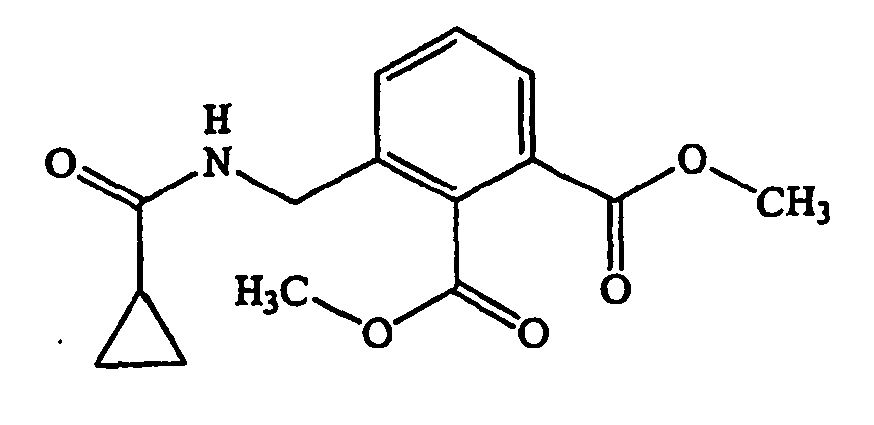
- Triethylamine (1.87 g, 18 mmol) was added dropwise to a stirred suspension of methyl-3-(aminomethyl)-2-(methoxycarbonyl)benzoate hydrochloride (2.0 g, 7 mmol) in dichloromethane (40 ml). The mixture was cooled in an ice bath to 4°C. Cyclopropylcarbonyl chloride (0.99 g, 9 mmol) was added slowly at 4-8 °C. After addition, the mixture was stirred in ice bath for 30 min and then warmed to room temperature for 2 hours. The mixture was washed with water (2 × 30 ml), brine (30 ml) and dried. Solvent was removed in vacuo and the product was purified by flash chromatography (dichloromethane/ethyl acetate 9 to 1) to give 2.1 g (93%) of the product as a white solid : 1H NMR ( CDCl3) ( 7.87 (d, J=7.8 Hz, 1H), 7.63 (d, J=7.7 Hz, 1H), 7.46 (t, J=7.77 Hz, 1H), 6.31 (m, 1H), 4.43 (d, J=6.0 Hz, 2H), 3.95 (s, 3H), 3.90 (s, 3H), 1.36-1.29 (m, 1H), 0.99-0.93 (m, 2H), 0.76-0.69 (m, 2H).
-

- Diisopropylethylamine (0.92 g, 7 mmol) was added to a stirred suspension of methyl-3-[(cyclopropylcarbonylamino)methyl]-2-(methoxycarbonyl)benzoate (2.08 g, 7 mmol) and aminoglutarimide hydrochloride (1.17 g, 7 mmol) in DMF (15 ml). The mixture was heated to 120 °C for 24 hours. The mixture was concentrated in vacuo and the residue was stirred with water (40 ml) and ethyl acetate (15 ml). The resulting slurry was filtered to give 0.7 g (27%) of the product as a gray solid. Recrystallization for methanol gave a white solid: mp 240-242 °C; 1H NMR (DMSO-d6 ) δ 1106 (s, 1H), 8.62 (t, J=5.8 Hz, 1H), 7.79-7.70 (m, 2H), 7.60 (d, J=7.2 Hz, 1H), 5.09-5.02 (dd, J=5.3 and 12.5 Hz, 1H), 4.65 (d, J=5.8 Hz, 2H), 2.83-2.73 (m, 1H), 2.54-2.41 (m, 2H), 1.99-1.94 (m,1H), 1.57 (m, 1H), 0.62-0.60 (m, 4H); 13C NMR (DMSO-d6 ) δ 173.21. 172.85, 169.90, 167.52, 167.01, 139.44, 134.85, 133.37,131.57,127.13, 121.94, 48.89, 37.82, 30.97, 22.03,13.58, 6.52; Anal. Calcd. For C18H17N3O5: C, 60.84; H, 4.82; N, 11.82. Found: C, 60.46; H, 4.84; N, 11.65.
-

- Triethylamine (1.57 g, 18.5 mmol) was added to a stirred suspension of methyl-3-(aminomethyl)-2-(methoxycarbonyl)benzoate hydrochloride (2.0 g, 8 mmol) in dichloromethane (30 ml). The mixture was cooled in an ice bath to 4 °C. Ethyl chloroformate (1.0 g, 9 mmol) was added slowly keeping the mixture at 4-6 °C. After addition was complete, the mixture was stirred in an ice bath for 30 minutes and then warmed to room temperature for 2 hours. The mixture was washed with water (2 x 30 ml), brine (30 ml) and dried. Solvent was removed in vacuo and the residue was purified by flash chromatography (dichloromethane/ethyl acetate 95 to 5) to give 1.59 g (70%) of the product as an oil: 1H NMR (CDCl3) δ 7.87 (d, J=7.8 Hz, 1H), 7.36 (d, J=7.6 Hz, 1H), 7.46 (t, J=7.7 Hz, 1H), 5.30 (b, 1H), 4.32 (d, J=6.3 Hz, 2H), 4.12 (q, J=7.0 Hz, 2H), 3.93 (s, 3H), 3.89 (s, 3H), 1.22 (t, J=7.2 Hz, 3H).
-

- 1,8-Diazabicyclo[5,4,0]undec-7-ene (0.8 g, 5 mmol). was added to a stirred suspension of methyl-3-[(ethoxycarbonylamino)methyl]-2-(methoxycarbonyl)benzoate (1.54 g, 5 mmol) and aminoglutarimide hydrochloride (0.86 g, 5 mmol) in DMF (15 ml). The mixture was heated to 120 °C for 24 hours. The mixture was cooled to room temperature and poured into water (150 ml). The mixture was extracted with ethyl acetate (3 × 30 ml) and the ethyl acetate solution was washed with water (30 ml), brine (30 ml) and dried. Solvent was removed and the residue was purified by flash chromatography (dichloromethane/ethyl acetate 7 to 3) to give 0.84 g (45%) of the product as a white solid: mp 187-189 °C; 1H NMR (DMSO-d6 ) δ 11.03 (s, 1H), 7.76-7.58 (m, 4H), 5.06-4.99 (dd, J=5.4 and 12.6 Hz, 1H), 4.52 (d, J=5.9 Hz, 2H), 3.91 (q, J=7.0 Hz, 2H), 2.79-2.70 (m, 1H), 2.51-2.38 (m, 2H), 1.96-1.86 (m, 1H), 1.06 (t, J=7.0 Hz, 3H); 13C NMR (DMSO-d6 ) δ 172.89, 169.93, 167.55, 167.05, 156.72, 139.69, 134.91, 132.90, 131.58, 127.04, 121.97, 60.15, 48.90, 39.34, 30.98, 22.04, 14.69; Anal. Calcd. For C17H17N3O6: C, 56.82; H, 4.77; N, 11.69. Found: C, 56.94; H, 4.81; N, 11.37.
-

- Triethylamine (1.87 g, 18.5 mmol) was added to a stirred suspension of methyl-3-(aminomethyl)-2-(methoxycarbonyl)benzoate hydrochloride (2.0 g, 8 mmol) in dichloromethane (30 ml). The mixture was cooled in an ice bath to 4 °C. Benzyl chloroformate (1.66 g,10 mmol) was added slowly keeping the temperature between 4-7 °C. After the addition was complete, the cooled mixture was stirred an additional 30 minutes and then warmed to room temperature for 4 hours. The mixture was washed with water (2 × 30 ml), brine (30 ml) and dried. Solvent was removed and the residue was purified by chromatography (dichloromethane/ethyl acetate 95 to 5) to give 2.1 g (76%) of the product as a solid; 1H NMR (CDCl3) δ 7.87 (d, J=7.8 Hz, 1H), 7.63 (d, J=7.6 Hz, 1H), 7.46 (t, J=7.7 Hz, 1H), 7.36-7.26 (m, 5H), 5.41 (b, 1H), 5.09 (s, 2H), 4.36 (d, J=6.3 Hz, 2H), 3.91 (s, 3H), 3.88 (s, 3H).
-

- 1,8-diazabicyclo[5,4,0]undec-7-ene (0.88 g, 6 mmol) was added to a stirred suspension of methyl-3-[(benzyloxycarbonylamino)methyl]-2-(methoxycarbonyl)benzoate (2.07 g, 6 mmol) and aminoglutarimide hydrochloride (0.95 g, 6 mmol) in DMF (15 ml). The mixture was heated to 120°C for 24 hours. The mixture was cooled to room temperature and poured into water (150 ml). The mixture was extracted with ethyl acetate (3 x 30 ml) and the combined ethyl acetate extracts were washed with water (2 × 30 ml), brine (30 ml) and dried. Solvent was removed in vacuo and the residue was purified by chromatography (dichloromethane/ethyl acetate 8 to 2) to give 0.58 g (24%) of the product as a white solid: mp 166-168 °C; 1H NMR (DMSO-d6 ) δ 11.15 (s, 1H), 7.99-7.71 (m, 4H), 7.37 (m, 5H), 5.19-5.12 (dd, J=5.1 and 17:4 Hz, 1H), 5.07 ( s, 2H), 4.70 (d, J=5.7 Hz, 2H), 2.97-2.83 (m, 1H), 2.64-2.51 (m, 2H), 2.08-2.04 (m, 1H); 13C NMR(DMSO-d6 ) δ 172.85, 169.89, 167.51, 167.01, 156.55, 139.46, 137.02, 134.87, 132.89, 131.57, 128.44, 127.92, 127.83,127.06, 121.99, 65.69, 48.89, 30.97, 22.02; Anal. Calcd. For C22H19N3O6: C, 62.70; H, 4.54; N, 9.97. Found: C, 62.53; H, 4.57; N, 9.89.
-
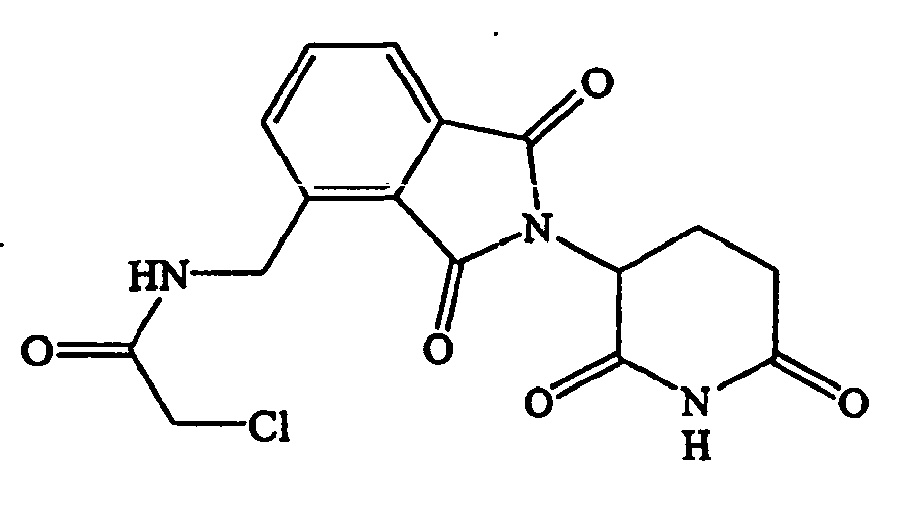
- Triethylamine (0.6 g, 6 mmol) was added to a stirred suspension of 4-(aminomethyl)-2-(2,6-dioxo(3-piperidyl))isoindoline-1,3-dione hydrochloride (0.8 g, 2.5 mmol) in THF (70 ml). After stirring for 5 min, chloroacetyl chloride (0.34 g, 3 mmol) was added and the resulting mixture was heated at reflux for 3 hours. The solvent was removed in vacuo and the residue was dissolved in dichloromethane (70 ml), washed with water (20 ml), 2N HCl (30 ml), water (2 × 30 ml), brine (30 ml) and dried. Solvent was removed in vacuo and the resulting solid was slurried in dichloromethane (10 ml) and ether (10 ml) and filtered to give 0.76 g (84%) of the product: 1H NMR (DMSO-d6 ) δ 11.15 (s, 1H), 8.87 (t, J=5.9 Hz, 1H), 7.88-7.68 (m, 3H), 5.19-5.12 (dd, J=5.3 and 12.6 Hz, 1H), 4.77 (d, J=5.9 Hz, 2H), 4.19 (s, 2H), 2.96-2.83 (m, 1H), 2.65-2.51 (m, 2H), 2.11-2.04 (m, 1H); 13C NMR (DMSO-d6 ) δ 172.88, 169.90, 167.53, 167.01, 166.67, 138.46, 134.90, 133.22,131.63, 127.26, 122.14, 48.94, 42.61, 38.27, 30.99, 22.05.
-

- Dimethylamine (2M in THF, 5 ml, 10 mmol) was added to a stirred suspension of 2-chloro-N-{[2-(2,6-dioxo(3-piperidyl))-1,3-dioxoisoindolin-4-yl]methyl)acetamide (1.2 g, 3.3 mmol) in acetonitrile (120 ml). The mixture was stirred at room temperature overnight. Solvent was removed in vacuo and the residue was dissolved in dichloromethane (75 ml), washed with water (30 ml), brine (30 ml) and dried. Solvent was removed in vacuo and the residue was purified by flash chromatography (dichlromethane/methanol 95 to 5) to give 0.96 g (78%) of the free base. The free base was dissolved in ethyl acetate (20 ml) and treated with 1N HCl (5 ml) to afford 0.9 g (86%) of the hydrochloride salt: mp 185-187 °C; 1H NMR (DMSO-d6 ) δ 11.15 (s, 1H), 10.05 (b. 1H), 9.40 (s, 1H), 7.84 (m, 3H), 5.14 (m, 1H), 4.81 (s, 2H), 4.07 (s, 2H), 2.84 (s, 6H), 2.65-2.52 (m, 3H), 2.09 (m, 1H); 13C NMR (DMSO-d6 ) δ 172.81, 169.82, 167.40, 166.89, 164.77, 137.91, 134.88, 133.53, 131.55, 127.25, 122.23, 57.21, 48.88, 43.20, 37.91, 30.93, 21.89; Anal. Calcd. For C18H21N4O5Cl + 0.65 water: C, 51.41; H, 5.34; N, 13.32; Cl, 8.43. Found: C, 51.12; H, 5.20; N, 12.67; Cl, 8.45.
-

- 1,8-Diazabicyclo[5,4,0]undec-7-ene (0.28 g, 1.9 mmol) was added to stirred suspension of 4-(aminomethyl)-2-(2,6-dioxo(3-piperidyl))isoindoline-1,3-dione hydrochloride (0.6 g, 1.9 mmol) in acetonitrile (50 ml). After stirring for 1 hour, t-butylisocyanate (0.21 g, 2 mmol) was added. The mixture was stirred at room temperature for 17 hours. The solvent was removed in vacuo and the residue was dissolved in dichloromethane (70 ml) and washed with 0.1 N HCl (20 ml), water (20 ml), brine (20 ml) and dried. The solvent was removed in vacuo and the resulting solid was recrystallized from ethanol/isopropyl ether to give 0.36 g (51%) of the product: mp 186-188 °C; 1H NMR (DMSO-d6 ) δ 11.04 (s, 1H), 7.77-7.59 (m, 3H), 6.17 (t, J=6.2 Hz, 1H), 5.86 (s, 1H), 5.08-5.01 (dd, J=5.4 and 12.4 Hz, 1H), 4.49 (d, J=6.0 Hz, 2H), 2.82-2.73 (m, 1H), 2.54 -2.40 (m, 2H), 1.98-1.94 (m, 1H), 1.12 (s, 9H); 13C NMR(DMSO-d6 ) δ 172.33, 169.39, 167.11, 166.59, 156.85, 140.72, 134.20, 132.99, 131.06, 126.54, 121.20, 48.69, 48.37, 37.89, 30.46, 28.88, 21.53; Anal. Calcd. For C19H22N4O5 + 0.2 water: C, 58.51; H, 5.79; N, 14.37. Found: C, 58.86; H, 6.15; N, 14.24.
-

- 1,8-Diazabicyclo[5,4,0]undec-7-ene (0.62 g, 4 mmol) was added to a stirred suspension of 4-(aminomethyl)-2-(2,6-dioxo(3-piperidyl))isoindoline-1,3-dione hydrochloride (0.6 g, 1.9 mmol) in acetonitrile (50 ml). After stirring for 20 min, t-butylacetyl chloride (0.25 g, 1.9 mmol) was added. The mixture was stirred at room temperature for 17 hours. Solvent was removed in vacuo and the residue was dissolved in dichloromethane (90 ml) and washed with 0.1N HC1 (30 ml), water (30 ml), brine (30 ml) and then dried. Solvent was removed in vacuo and the solid residue was slurried in ethanol (10 ml) to give after filtration 0.55 g (77%) of the product: mp 145-147 °C; 1H NMR (DMSO-d6 ) δ 11.14 (s, 1H), 8.39 (t, J=5.7 Hz, 1H), 7.87-7.69 (m, 3H), 5.19-5.12 (dd, J=5.3 and 12.4 Hz, 1H), 4.72 (d, J=5.8 Hz, 2H), 2.92-2.83 (m, 1H), 2.63-2.51 (m, 2H), 2.08 (s, 2H), 2.08-2.04 (m, 1H), 0.97 (s, 9H); 13C NMR (DMSO-d6 ) δ 172.69, 171.35, 169.74, 167.51, 166.96, 139.61, 134.69, 133.41, 131.52, 127.11, 121.87, 48.86, 48.62, 37.53, 30.93, 30.52, 29.71, 22.00; Anal. Calcd. For C20H23N3O5 + 0.28 water : C, 61.52; H, 6.08; N, 10.76. Found: C, 61.23; H, 6.18; N, 10.57.
-

- A stirred mixture of 4-amino-2-(2,6-dioxo(3-piperidyl))isoindoline-1,3-dione (1.09 g, 4.0 mmol) and nicotinoyl chloride hydrochloride (1.42 g, 8.0 mmol) in tetrahydrofuran (60 ml) was heated to reflux for 22 h. The suspension was filtered and washed with tetrahydrofuran (20 ml) and ether (10 ml) to yield a white solid. The solid was slurried in pH 7 buffer (40 ml) and ether (30 ml) for 1h. The suspension was filtered and washed with water (20 ml) and ether (20 ml) to N-[2-(2,6-dioxo(3-piperidyl))-1,3-dioxoisoindolin-4-yl]-3-pyridylcarboxamide as a white solid (1.2 g, 79% yield): mp, 176-178 °C; 1H NMR (DMSO-d6 ) δ 2.06-2.10 (m, 1H, CHH), 2.49-2.65 (m, 2H, CH 2), 2.83-2.97 (m, 1H, CHH), 5.18 (dd, J= 5.3, 12.5 Hz, 1H, NCH), 7.64 (dd, J = 4.9, 7.9 Hz, 1H, Ar), 7.71 (d, J= 7.3 Hz, 1H, Ar), 7.92 (t, J= 7.8 Hz, 1H, Ar), 8.29-8.34 (m, 1H, Ar), 8.45 (d, J= 8.2 Hz, 1H, Ar), 8.83 (dd, J=1.2, 4.8 Hz, 1H, Ar), 9.15 (d, J= 1.7 Hz, 1H, Ar), 10.55 (s, 1H, NH), 11.17 (s, 1H, NH); 13C NMR (DMSO-d6 ) δ 21.99, 30.93, 49.00, 119.06,119.34, 123.91, 127.36, 129.17, 131.55, 135.24, 135.94, 136.20, 148.47, 152.95, 163.85,166.59, 167.54, 169.69, 172.72; Anal Calcd for C19H14N4O5+ 0.13 H2O: C, 59.95; H, 3.78; N, 14.72; H2O, 0.62. Found: C, 59.83; H, 3.66; N, 14.68; H2O, 0.64.
-

- A stirred mixture of 3-(4-amino-1-oxoisoindolin-2-yl)piperidine-2,6-dione (518 mg, 2.0 mmol) and benzaldehyde (0.21 ml, 2.0 mmol) in methanol (20 ml) was heated to reflux for 5 h. The solvent was removed in vacuo to give a solid. The solid was re-dissolved in acetic acid (20 ml). The stirred solution was heated to reflux for 1h, and was then allowed to cool to room temperature. To the stirred solution was added sodium borohydride (90 mg, 2.3 mmol) and stirring continued at room temperature for 18h. The resulting suspension was filtered and washed with acetic acid (10 ml) and ether (20 ml) to give 3-{1-oxo-4-[benzylamino]isoindolin-2-yl}piperidine-2,6-dione as an off-white solid (420 mg, 60% yield): mp, 257-259 °C; 1H NMR (DMSO-d6 ) δ 2.01-2.07 (m, 1H, CHH), 2.23-2.30 (m, 1H, CHH), 2.49-2.65 (m, 1H, CHH), 2.85-3.00 (m, 1H, CHH), 4.19 (d, J = 17 Hz, 1H, CHH), 4.31 (d, J = 17 Hz, 1H, CHH), 4.39 (d, J = 5.7 Hz, 2H, CH 2), 5.12 (dd, J = 5.1, 13 Hz, 1H, NCH), 6.37 (t, J= 5.9 Hz, 1H, NH), 6.62 (d, J = 8.0 Hz, 1H, Ar), 6.91 (d, J = 7.3 Hz, 1H, Ar), 7.19-7.40 (m, 6H, Ar), 11.02 (s, 1H, NH); 13C NMR (DMSO-d6 ) δ 22.79, 31.25, 45.79, 46.09, 51.56, 110.32, 112.34,126.72, 127.05, 128.32, 129.07,132.08; 139.72, 143.33,168.82, 171.22, 172.90; Anal Calcd for C20H19N3O3: C, 68.75; H, 5.48; N, 12.03. Found C, 68.73; H, 5.41; N, 12.04.
-

- A mixture of 4-amino-2-(2,6-dioxo(3-piperidyl))isoindoline-1,3-dione (1.0 g, 3.7 mmol) and benzaldehyde (0.4 ml, 3.9 mmol) in acetic acid (20 ml) was stirred at room temperature for 17h, then was heated to reflux for 3h. The mixture was cooled to room temperature. To the stirred mixture was added sodium borohydride (140 mg, 3.7 mmol) and kept at room temperature for 18h. The mixture was then heated to reflux for 2h. To the mixture was added additional benzaldehyde (0.4 ml, 3.9 mmol) during reflux. After 30 min of reflux the reaction was allowed to cool to room temperature. To the mixture was added sodium borohydride (180 mg, 4.8 mmol) and the mixture stirred at room temperature for 3 days. The solvent was removed in vacuo to yield an oil. The oil was diluted with ethyl acetate (90 ml) and aqueous sodium hydrogen carbonate (sat, 100 ml). The organic layer was separated and was washed with aqueous sodium hydrogen carbonate (sat, 2 × 100 ml), brine (100 ml) and dried over MgSO4. The solvent was removed in vacuo to give a solid. The solid was purified by column chromatography (Silca Gel, 50% EtOAc:CH2Cl2) to give a yellow solid. The solid was further purified by column chromatography (KP-C18-HS, 35:65 CH3CN:0.1% CF3COOH in water) to give 2-(2,6-dioxo(3-piperidyl))-4-[benzylamino]isoindoline-1,3-dione as a yellow solid (210 mg, 16% yield): mp, 209-211 °C; 1H NMR (DMSO-d6 ) δ 2.02-2.08 (m, 1H, CHH), 2.46-2.63 (m, 2H, CH 2) 2.82-2.97 (m, 1H, CHH), 4.56 (d, J = 6.2 Hz, 2H, CH 2), 5.07 (dd, J = 5.3, 12.4 Hz, 1H, NCH), 6.96 (d, J = 8.6 Hz, 1H, Ar), 7.02 (d, J = 7.0 Hz, 1H, Ar), 7.19-7.40 (m, 6H, Ar, NH), 7.51 (dd, J = 7.5, 8.4 Hz, 1H, Ar), 11.11 (s,1H, NH); 13C NMR (DMSO-d6 ) δ 22.15, 30.99, 45.44, 48.59, 109.58, 110.74. 117.63, 126.95, 126.99, 128.53, 132.21, 136.09, 138.95, 146.09, 167.27, 168.78, 170.07, 172.79; Anal Calcd for C20H17N3O4: C, 66.11; H, 4.72; N, 11.56. Found: C, 65.96; H, 4.60; N, 11.49.
-
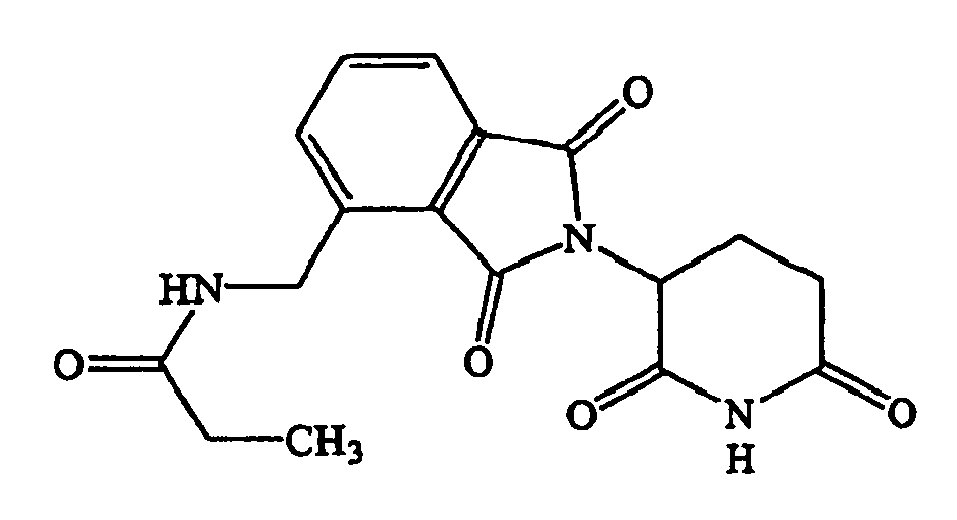
- 1,8-Diazabicyclo[5,4,0]undec-7-ene.(0.65 g, 4.25 mmol) was added to a stirred suspension of 4-(aminomethyl)-2-(2,6-dioxo(3-piperidyl))isoindoline-1,3-dione hydrochloride (0.6 g, 1.85 mmol) in CH3CN (50 ml). After stirring for 20 min, propionyl chloride (0.2 g, 2.13 mmol) was added. The mixture was stirred at room temperature for 17 hours. Solvent was removed in vacuo and the residue was dissolved in CH2Cl2 (60 ml) and washed with 1N HCl (30 ml), H2O (30 ml), brine (30 ml) and dried (MgSO4). The solvent was removed and the resulting solid was slurried in hot C2H5OH (10 ml) to give after filtration N-{[2-(2,6-dioxo(3-piperidyl))-1,3-dioxoisoindolin-4-yl]methyl}propanamide (0.41 g, 64%) as a white solid: mp 219-221°C; 1H NMR (DMSO-d6 ) δ d 11.15 (s, 1H), 8.42 (t, J=5.8 Hz, 1H), 7.87-7.67 (m, 3H), 5.19-5.12 (dd, J=5.3 and 12.5 Hz, 1H), 4.72 (d, J=5.8 Hz, 2H), 2.98-2.84 (m, 1H), 2.65-2.48 (m, 2H), 2.26-2.17 (m, 2H), 2.09-2.04 (m, 1H), 1.05 (t, J=7.8 Hz, 3H); 13C NMR (DMSO-d6 ) δ d 173.52, 172.81, 169.79, 167.53, 167.01, 139.52, 134.79, 133..20, 131.55, 127.10, 121.86, 48.89, 37.69, 30.95, 28.43, 22.03, 9.90; Anal. Calcd. For C17H17N3O5 + 0.19 H2O: C, 58.88; H, 5.05; N,12.12. Found: C, 58.77; H, 4.97; N,12.12.
-

- 1,8-Diazabicyclo[5,4,0]undec-7-ene (0.98 g, 6.48 mmol) was added to stirred suspension of 4-(aminomethyl)-2-(2,6-dioxo(3-piperidyl))isoindotine-1,3-dione hydrochloride (0.6 g, 1.85 mmol) in CH3CN (50 ml). After stirring for 20 min, nicotinoyl chloride (0.41 g, 2.22 mmol) was added. The mixture was stirred at room temperature for 17 hours. The solvent was removed in vacuo and the residue was dissolved in CH2Cl2 (70 ml). The CH2Cl2 solution was washed with H2O (30 ml), brine (30 ml) and dried (MgSO4). The solvent was removed in vacuo and the residue was purified by flash chromatography (SiO2, CH2Cl2: CH3OH 97.5:2.5) to give N-{[2-(2,6-dioxo(3-piperidyl))-1,3-dioxoisoindolin-4-yl]methyl}-3-pyridylcarboxamide (0.47 g, 64%) as a white solid: mp 148-151°C; 1H NMR (DMSO-d 6) δ d 11.16 (s, 1H), 9.36 (t, J=5.6 Hz, 1H), 9.09 (d, J=1.25 Hz, 1H), 8.75-8.73 (m, 1H), 8.25 (d, J=8.0 Hz, 1H), 7.84-7.76 (m, 3H), 7.57-7.52 (m, 1H), 5.22-5.15 (dd, J=5.4 and 12.7 Hz, 1H), 4.96 (d, J=5.6 Hz, 2H), 2.92-2.85 (m, 1H), 2.65-2.50 (m, 2H), 2.11-2.06 (m, 1H); 13C NMR (DMSO-d6 ) δ d 172.72,169.80,167.51, 166.94, 165.23, 152.02, 148.44, 138.86, 135.10, 134.83, 133.20, 131.55, 129.48, 127.20, 123.49, 121.95, 48.89, 38.33, 30.93, 21.98; Anal. Calcd. For C20H16N4O5 + 0.28 H2O: C, 60.45; H, 4.20;N, 14.10. Found: C, 60.29; H, 4.28; N, 13.82.
-
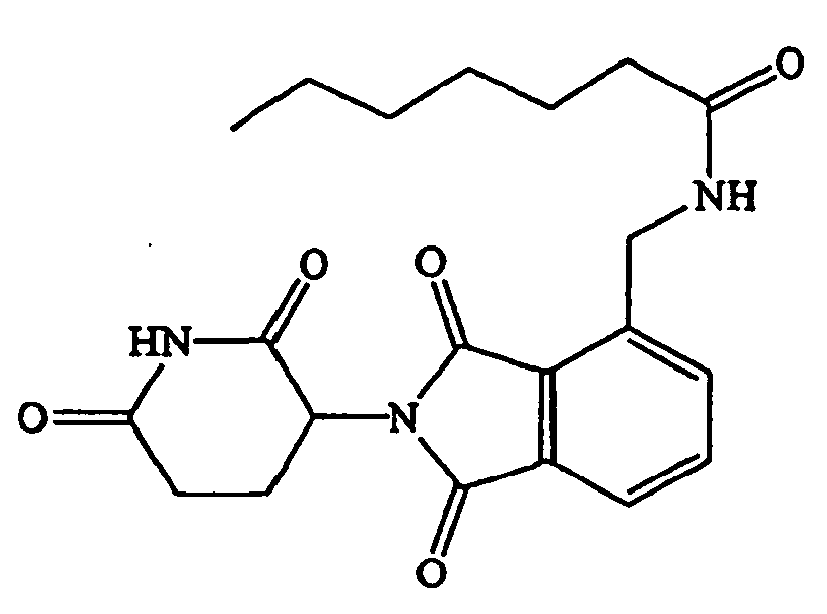
- 1,8-Diazabicyclo[5,4,0]undec-7-ene (0.65 g, 2.22 mmol) was added to a stirred suspension of 4-(aminomethyl)-2-(2,6-dioxo(3-piperidyl))isoindoline-1,3-dione hydrochloride (0.6 g, 1.85 mmol) in CH3CN (50 ml). After stirring for 20 min, heptanoyl chloride (0.33 g, 2.22 mmol) was added. The mixture was stirred at room temperature for 17 hours. The solvent was removed in vacuo and the residue was dissolved in CH2Cl2 (70 ml). The CH2CI2 solution was washed with 1N HCI (30 ml), H2O (30 ml), brine (30 ml) and dried (MgSO4). The solvent was removed in vacuo and the residue was purified by chromatography (SiO2, CH2Cl2: EtOAc 7: 3) to give N-{[2-(2,6-dioxo(3-piperidyl))-1,3-dioxoisoindolin-4-yl]methyl}heptanamide (0.49 g, 66%) as a white solid: mp 130-132°C; 1H NMR (DMSO-d 6) δ d 11.14 (s, 1H), 8.44 (t, J=5.7 Hz, 1H), 7.86-7.78 (m, 2H), 7.71-7.65 (m, 1H), 5.19-5.12 (dd, J=5.2 and 12.4 Hz, 1H), 4.69 (d, J=5.7 Hz, 2H), 2.98-2.83 (m, 1H), 2.64-2.50 (m, 2H), 2.18 (t, J=7.3 Hz, 2H), 2.08-2.04 (m, 1H), 1.53 (t, J=6.0 Hz, 2H), 1.25 (s, 6H), 0.85 (t, J=5.9 Hz, 3H); 13C NMR (DMSO-d6 ) δ d 172.73,172.66,169.79, 167.47, 166.93, 139.54, 134.66, 133.13, 131.50, 127.06, 121.80, 54.86, 48.85, 37.57, 35.23, 30.96, 28.31, 25.16, 21.97, 13.87; Anal. Calcd. For C21H25N3O5 + 0.3 H2O: C, 62.30; H, 6.37; N, 10.38. Found: C, 62.07; H, 6.29; N, 10.23.
-

- 1,8-Diazabicyclo[5,4,0]undec-7-ene (0.650 g, 2.22 mmol) was added to a stirred suspension of 4-(aminomethyl)-2-(2,6-dioxo(3-piperidyl))isoindoline-1,3-dione hydrochloride (0.600 g, 1.85 mmol) in CH3CN (50 ml). After stirring for 20 min, 2-furoyl chloride (0.290 g, 2.22 mmol) was added and the mixture was stirred at room temperature for 17 hours. The solvent was removed in vacuo and the residue was dissolved in CH2Cl2 (70 ml). The CH2Cl2 solution was washed 1N HCl (30 ml), H2O (30 ml), brine (30 ml) and dried (MgSO4). The solvent was removed in vacuo and the residue was purified by chromatography (SiO2, CH2Cl2: EtOAc 1:1) to give N-{[2-(2,6-dioxo(3-piperidyl))-1,3-dioxoisoindolin-4-yl]methyl}-2-furylcarboxamide (0.51 g, 73%) as a white solid: mp 121-123°C; 1H NMR (DMSO-d 6) δ d 11.13 (s, 1H), 9.01 (t, J=5.7 Hz, 1H), 7.88-7.68 (m, 4H), 7.18 (d, J=3.3 Hz, 1H), 6.66 (m, 1H), 5.20-5.13 (dd, J=5.4 and 12.5 Hz, 1H), 4.90 (d, J=5.6 Hz, 2H), 2.97-2.84 (m,1H), 2.65-2.49 (m, 2H), 2.10-1.98 (m, 1H); 13C NMR (DMSO-d6 ) δ d 172.73, 169.80, 167.52, 166.94, 158.09, 147.49, 145.27, 139.06, 134.80, 132.98, 131.52, 127.09, 121.88, 113.86, 111.91, 48.86, 37.64, 30.92, 21.97; Anal. Calcd. For C19H15N3O6 + 0.18 H2O: C, 59.34; H, 4.03; N, 10.93. Found: C, 59.47; H, 4.16; N, 10.49.
-
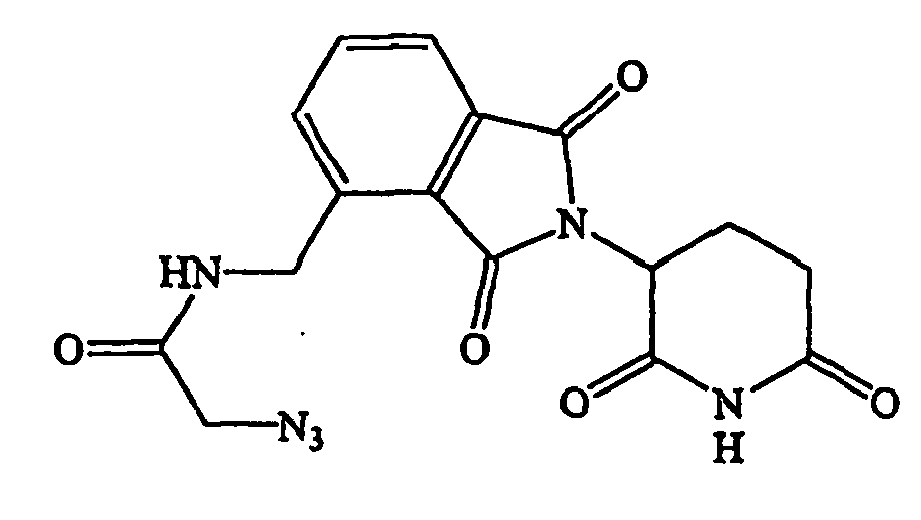
- A mixture of 2-chloro-N-{[2-(2,6-dioxo(3-piperidyl))-1,3-dioxoisoindolin-4-yl]methyl}acetamide (1.3 g, 3.57 mmol), sodium azide (0.3 g, 4.65 mmol) and sodium iodide (0.54 g, 3.57 mmol) in acetone (50 ml) was refluxed for 17 hours. The solvent was removed in vacuo and the residue was dissolved in EtOAc (60 ml). The EtOAc solution was washed with H2O (30 ml), brine (30 ml), and dried (MgSO4). The solvent was removed in vacuo to give 2-azido-N-{[2-(2,6-dioxo(3-piperidyl))-1,3-dioxoisoindolin-4-yl]methyl} acetamide (1.2 g, 90%) as a white solid: 1H NMR (CDCl3) δ d 8.48 (s, 1H), 7.84-7.68 (m, 3H), 7.51 (t, J=6.3 Hz, 1H), 5.04-4.97 (dd, J=4.7 and 11.8 Hz, 1H), 4.80 (d, J=6.5 Hz, 2H), 3.97 (s, 2H), 2.95-2.74 (m, 3H), 2.20-2.15 (m, 1H).
-
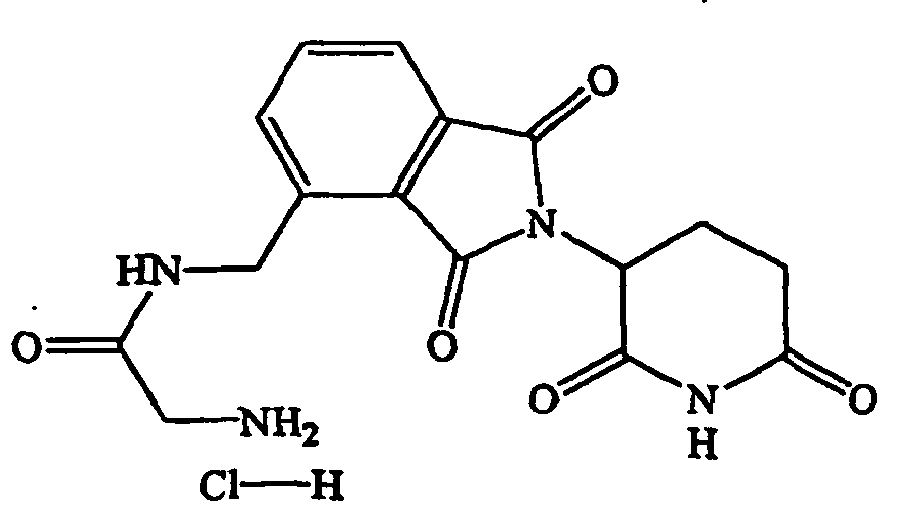
- A mixture of 2-azido-N-{[2-(2,6-dioxo(3-piperidyl))-1,3-dioxoisoindolin-4-yl]methyl}acetamide (1.2 g, 3.24 mmol), and 10% Pd/C (0.15 g) in 4N HCI (20 ml) and CH3OH (50 ml) was hydrogenated in Parr shake apparatus under 50 psi of hydrogen for 3 hours. The mixture was then filtered through celite and the filtrate was concentrated to a solid residue. The solid was slurried in ethanol (20 ml) and the suspension filtered to give 2-amino-N-{[2-(2,6-dioxo(3-piperidyl))1,3-dioxoisoindolin-4-yl]methyl}acetamide hydrochloride (0.86 g, 84%) as a white solid: mp 270-272°C; 1H NMR (DMSO-d6 ) δ d 11.16 (s, 1H), 9.28 (t, J=5.7 Hz, 1H), 8.33 (s, 3H), 7.83 (s, 3H), 5.20-5.13 (dd, J=5.3 and 12.5 Hz,1H), 4.81 (d, J=5.7 Hz, 2H), 3.69 (s, 2H), 2.92-2.87 (m, 1H), 2.65-2.51 (m, 2H), 2.09-2.05 (m, 1H); 13C NMR (DMSO-d6 ) δ d 172.76, 169.80, 167.44, 166.91, 166.52, 138.24,134.74, 133.53, 131.51, 127.17, 122.08, 48.89, 37.89, 30.94, 21.99; Anal. Calcd. For C16H17N4O5Cl: C, 50.47; H, 4.50; N, 14.71; Cl, 9.31. Found: C, 50.39; H, 4.61; N, 14.42; Cl, 9.25.
-

- 1,8-Diazabicyclo[5,4,0]undec-7-ene (0.65 g, 4.26 mmol) was added to a stirred suspension of 4-(aminomethyl)-2-(2,6-dioxo(3-piperidyl))isoindoline-1,3-dione hydrochloride (0.6 g, 1.85 mmol) in CH3CN (50 ml). After stirring for 20 min, 6-(chloroformyl)hexanoic acid ethyl ester (0.46 g, 2.22 mmol) was added. The mixture was stirred at room temperature for 17 hours. The solvent was removed in vacuo and the residue was dissolved in CH2Cl2 (70 ml). The CH2Cl2 solution was washed with 1N HCI (30 ml), H2O (30 ml), brine (30 ml) and dried (MgSO4). The solvent was removed in vacuo and the residue was purified by chromatography (SiO2, CH2Cl2: EtOAc 1:1) to give ethyl 6-(N-{[2-(2,6-dioxo(3-piperidyl))-1,3-dioxoisoindolin-4-yl]methyl}carbamoyl)hexanoate (0.43 g, 50%) as a white solid: mp 82-84°C; 1H NMR (DMSO-d6 ) δ d 11.11 (s, 1H), 8.41 (t, J=5.6 Hz, 1H), 7.86-7.65 (m, 3H), 5.18-5.11 (dd, J=5.4 and 12.4 Hz, 1H), 4.72 (d, J=5.7 Hz, 2H), 4.05 (q, J=7.1 Ha, 2H), 2.97-2.83 (m, 1H), 2.64-2.48 (m, 2H), 2.30-2.15 (m, 4H), 2.08-2.04 (m, 1H), 1.56-1.47 (m, 4H), 1.32-1.23 (m, 2H), 1.17 (t, J=7.1 Hz, 3H); 13C NMR (DMSO-d6 ) δ d 172.80, 172.71, 172.52, 169.77, 167.45, 166.92, 139.49, 134.67, 133.13, 131.49, 127.04, 121.78, 59.60, 48.84, 37.57, 35.02, 33.38, 30.91, 28.08, 24.83, 24.16, 21.96, 14.09; Anal. Calcd. For C23H27N3O7: C, 60.39; H, 5.95; N, 9.18. Found: C, 60.10; H, 5.82; N, 8.82.
-

- 1,8-Diazabicyclo[5,4,0]undec-7-ene (0.7 g, 4.62 mmol) was added to a stirred suspension of 4-(aminomethyl)-2-(2,6-dioxo(3-piperidyl))isoindoline-1,3-dione hydrochloride (0.6 g,1.85 mmol) in CH3CN (50 ml). After stirring for 20 min, 1-hydroxybenzotriazole (0.3 g, 2.22 mmol), N-BOC-b-alanine (0.42 g, 2.22 mol) and 1-[3-(dimethylamino)propyl]-3-ethylcarbodimide hydrochloride 0.53 g, 2.78 mmol) were added. The mixture was stirred at room temperature for 17 hours. The solvent was removed in vacuo and the residue was dissolved in CH2Cl2 (70 ml). The CH2Cl2 solution was washed with 1N citric acid (30 ml), H2O (2 × 30 ml), brine (30 ml) and dried (MgSO4). The solvent was removed in vacuo and the residue was purified by chromatography (SiO2, CH2Cl2: CH3OH 100:2) to give 3-[(tert-butoxy)carbonylamino]-N-{[2-(2,6-dioxo(3-piperidyl))-1,3-dioxoisoindolin-4-yl]methyl}propanamide (0.57 g, 67%) as a white solid: mp 96-98°C; 1H NMR(DMSO-d6 ) δ d 11.14 (s, 1H), 8.50 (t, J=5.8 Hz, 1H), 7.82-7.67 (m, 3H), 6.81 (t, J=5.1 Hz, 1H), 5.19-5.11 (dd, J=5.4 and 12.4 Hz, 1H), 4.72 (d, J=5.7 Hz, 2H), 3.21-3.13 (dd, J=6.8 and 13.1 Hz, 2H), 2.92-2.85 (m, 1H), 2.64-2.33 (m, 4H), 2.08-2.04 (m, 1H), 1.37 (s, 9H); 13C NNM (DMSO-d6 ) δ d 172.71, 170.87, 169.77, 167.46, 166.93, 155.45, 139.27, 134.67, 133.17, 131.47, 127.03, 121.80, 77.57, 48.84, 37.63, 36.69, 35.62, 30.91, 28.21, 21.96; Anal. Calcd. For C22H26N4O7 + 0.28 H2O: C, 57.01; H, 5.78; N, 12.09. Found: C, 56.99; H, 5.89; N, 11.79.
-

- A 4N HCI solution in dioxane (1 ml) was added to a stirred solution of 3-[(tert-butoxy)carbonylamino]-N-{[2-(2,6-dioxo(3-piperidyl))-1,3-dioxoisoindolin-4-yl]methyl}propanamide (0.5 g, 1.09 mmol) in CH2Cl2 (15 ml) and stirred for 17 hours. The resulting suspension was filtered to give 3-amino-N-{[2-(2,6-dioxo(3-piperidyl))-1,3-dioxoisoindolin-4-yl]methyl}propanamide hydrochloride (0.34 g, 79%) as a white solid: mp 161-163°C; 1H NMR (DMSO-d6 ) δ d 11.15 (s, 1H), 8.88 (t, J=5.8 Hz, 1H), 8.06 (b, 3H), 7.87-7.79 (m, 3H), 5.19-5.12 (dd, J=5.3 and 12.6 Hz, 1H), 4.76 (d, J=5.8 Hz, 2H), 3.03-2.84 (m, 3H), 2.67-2.47 (m, 4H), 2.08-2.04 (m, 1H); 13C NMR (DMSO-d6 ) δ d 172.74, 169.88, 169.80, 167.45, 166.92, 138.92, 134.74, 133.46, 13.1.48, 127.09, 121.92, 48.86, 37.69, 35.11, 32.03, 30.92, 21.97; Anal. Calcd. For C17H19N4O5Cl +0.13 CH2Cl2+ 0.57 H2O: C, 49.44; H, 4.94; N, 13.46; Cl, 10.73. Found: C, 49.22; H, 4.88; N, 13.08; Cl, 10.95.
-

- 1,8-Diazabicyclo[5,4,0]undec-7-ene (0.620 g; 4.07 mmol) was added to a stirred suspension of 4-(aminomethyl)-2-(2,6-dioxo(3-piperidyl))-isoindoline-1,3-dione hydrochloride (0.600 g, 1.85 mmol) in CH3CN (50 ml). After stirring for 20 min, 2-thiophene-carbonyl chloride (0.3 g, 2.03 mmol) was added. The mixture was stirred at room temperature for 17 hours. The solvent was removed in vacuo and the residue was dissolved in CH2Cl2 (70 ml). The CH2Cl2 solution was washed with 1N HCl (30 ml), H2O (30 ml), brine (30 ml) and dried (MgSO4). The solvent was removed in vacuo and the residue was purified by chromatography (SiO2, CH2Cl2: EtOAc 6:4) to give N-{[2-(2,6-dioxo(3-piperidyl))-1,3-dioxoisoindolin-4-yl]methyl}-2-thienylcarboxamide (0.35 g, 47%) as a white solid: mp 192-194°C; 1H NMR (DMSO-d6 ) δ d 11.16 (s, 1H), 9.18 (t, J=5.8 Hz, 1H), 7.88-7.72 (m 5H), 7.20-7.17 (dd, J=3.9 and 4.7 Hz, 1H), 5.22-5.15 (dd, J=5.5 and 12.7 Hz, 1H), 4.94 (d, J=5.8 Hz, 2H), 2.98-2.85 (m, 1H), 2.66-2.50 (m, 2H), 2.11-2.06 (m, 1H); 13C NMR (DMSO-d6 ) δ d 172.72, 169.80, 167.51, 166.93, .16.1.52, 139.26, 139.14, 134.83, 133.14, 131.53, 131.11, 128.51,127.96, 127.12, 121.93, 48.89, 38.09, 30.93, 21.99; Anal. Calcd. For C19H15N3O5S: C, 57.42; H, 3.80; N; 10.57; S, 8.07. Found: C, 57.80; H, 3.93; N, 10.22; S, 7.99.
-
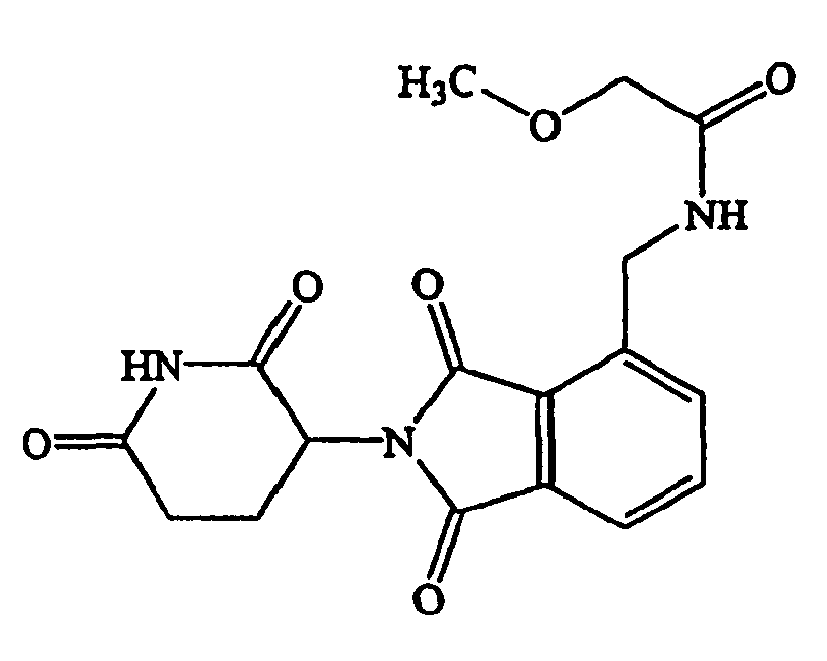
- 1,8-Diazabicyclo[5,4,0]undec-7-ene (0.62 g, 4.07 mmol) was added to a stirred suspension of 4-(aminomethyl)-2-(2,6-dioxo(3-piperidyl))isoindoline-1,3-dione hydrochloride (0.600 g, 1.85 mmol) in CH3CN (50 ml). After stirring for 20 min, methoxyacetyl chloride (0.22 g, 2.03 mmol) was added. The mixture was stirred at room temperature for 17 hours. The solvent was removed in vacuo and the residue was dissolved in CH2C12 (70 ml). The CH2Cl2 solution was washed with 1N HCI (30 ml), H2O (30 ml), brine (30 ml) and dried (MgSO4). The solvent was removed in vacuo and the residue was purified by chromatography (SiO2, CH2Cl2: CH3OH 100:2.5) to give N-{[2-(2,6-dioxo(3-piperidyl))-1,3-dioxoisoindolin-4-yl]methyl}-2-methoxyacetamide (0.44 g, 66%) as a white solid: mp 196-198°C; 1H NMR (DMSO-d6 ) δ d 11.14 (s, 1H), 8.49 (t, J=6.1 Hz, 1H), 7.86-7.79 (m, 2H), 7.68-7.65 (m, 1H), 5.19-5.12 (dd, J=5.3 and 12.5 Hz, 1H), 4:77 (d, J=6.1 Hz, 2H), 3.92 (s, 2H), 3.36 (s, 3H), 2.96-2.83 (m, 1H), 2.64-2.49 (m, 2H), 2.09-2.04 (m, 1H); 13C NMR (DMSO-d6 ) δ d 172.71, 169.78, 169.58, 167.52, 166.94, 139.09, 134.70, 133.00, 131.51, 127.08, 121.82, 71.46, 58.70, 48.86, 37.47, 30.91, 21.95; Anal. Calcd. For C17H17N3O6: C, 56.82; H, 4.77; N, 11.69. Found: C, 57.02; H, 4.87; N, 11.36.
-

- 1,8-Diazabicyclo[5,4,0]undec-7-ene (0.62 g, 4.08 mmol) was added to a stirred suspension of 4-(aminomethyl)-2-(2,6-dioxo(3-piperidyl))isoindoline-1,3-dione hydrochloride (0.600 g, 1.85 mmol) in CH3CN (50 ml). After stirring for 20 min, acetoxyacetyl chloride (0.28 g, 2.03 mmol) was added. The mixture was stirred at room temperature for 17 hours. The solvent was removed in vacuo and the residue was dissolved in CH2Cl2 (70 ml). The CH2Cl2 solution was washed with 1N HCl (30 ml), H2O (30 ml), brine (30 ml) and dried (MgSO4). The solvent was removed in vacuo and the residue was purified by chromatography (SiO2, CH2Cl2: CH3OH 100:2.5) to give (N-{[2-(2,6-dioxo(3-piperidyl))-1,3-dioxoisoindolin-4-yl]metlxyl}carbamoyl)methyl acetate (0.54 g, 75%) as a white solid: mp 108-110°C; 1H NMR (DMSO-d6 ) δ d 11.14 (s, 1H), 8.68 (t, J=6.0 Hz, 1H), 7.87-7.79 (m, 2H), 7.71-7.65 (m, 1H), 5.19-5.12 (dd, J=5.3 and 12.4 Hz, 1H), 4.77 (d, J=5.9 Hz, 2H), 4.56 (s, 2H), 2.96-2.83 (m, 1H), 2.63-2.47 (m, 2H), 2.11 (s, 3H), 2.08-1.98 (m, 1H); 13C NMR (DMSO-d6 ) δ d 172.66, 169.96, 169.72, 167.46, 167.37, 166.36, 138.80, 134.68, 133.01, 132.47, 127.04, 121.87, 62.36, 48.84, 37.46, 30.38, 21.93, 20.49; Anal. Calcd. For C18H17N3O7 + 0.15H2O: C, 55.43; H, 4.47; N,10.77. Found: C, 55.43; H, 4.54; N, 10.44.
-
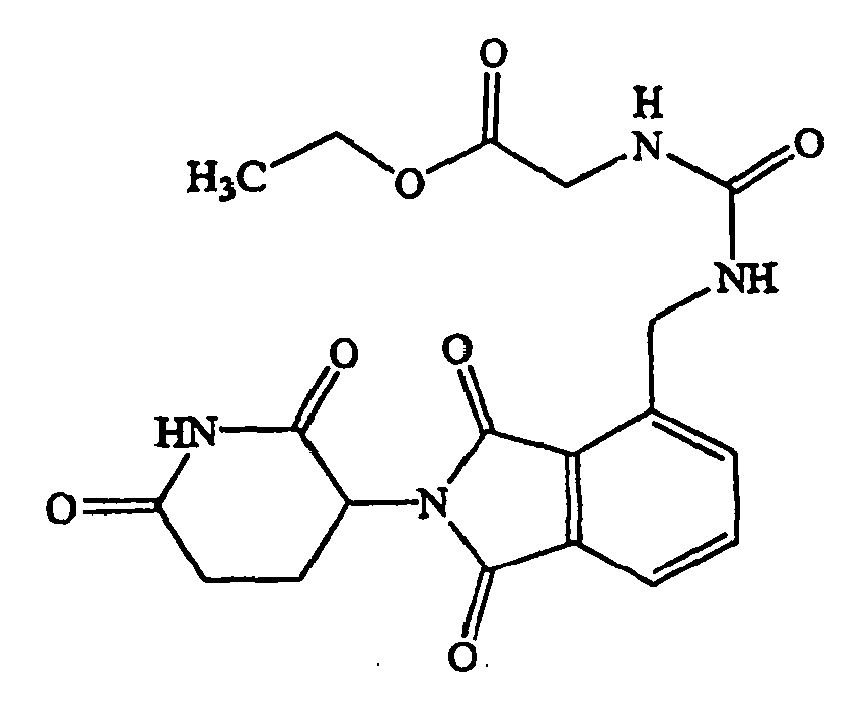
- 1,8-Diazabicyclo[5,4,0]undec-7-ene (0.29 g, 1.9 mmol) was added to a stirred suspension of 4-(aminomethyl)-2-(2,6-dioxo(3-piperidyl))isoindoline-1,3-dione hydrochloride (0.6 g, 1.85 mmol) in CH3CN (50 ml): After stirring for 20 min, ethyl isocyanatacetate (0.29 g, 2.22 mmol) was added. The mixture was stirred at room temperature for 17 hours. The solvent was removed in vacuo and the residue was dissolved in CH2Cl2 (70 ml). The CH2Cl2 solution was washed with 1N HCl (30 ml), H2O (30 ml), brine (30 ml) and dried (MgSO4). The solvent was removed in vacuo and the residue was purified by chromatography (SiO2, CH2Cl2: EtOAc 1:1) to give ethyl 2-[(N-{[2-(2,6-dioxo(3-piperidyl))-1,3-dioxoisoindolin-4-yl]methyl}carbamoyl)amino]acetate (0.30 g, 39%) as a white solid: mp 187-189°C; 1H NMR (DMSO-d6 ) δ d 11.14 (s, 1H), 7.86-7.70 (m, 3H), 6.83 (t, J=6.1 Hz, 1H), 6.53 (t, J=6.0 Hz, 1H), 5.18-5.11 (dd, J=5.4 and 12.5 Hz, 1H), 4.65 (d, J=6.0 Hz, 2H), 4.09 (q, J=7.2 Hz, 2H), 3.79 (d, J=6.0 Hz, 2H), 2.98-2.83 (m, 1H), 2.64-2.48 (m, 2H), 2.08-2.04 (m, 1H), 1.18 (t, J=7.2 Hz, 3H); 13C NMR (DMSO-d6 ) δ d 172.72; 171.01, 169.78, 167.54, 167.00,158.00, 140.78, 134.57, 133.25, 131.48, 126.95, 121.66, 60.17, 48.83, 41.58, 38.72, 30.91, 21.97, 14.06; Anal. Calcd. For C19H20N4O7: C, 54.81; H, 4.84; N, 13.46. Found: C, 54.73; H, 4.77; N, 13.35.
-
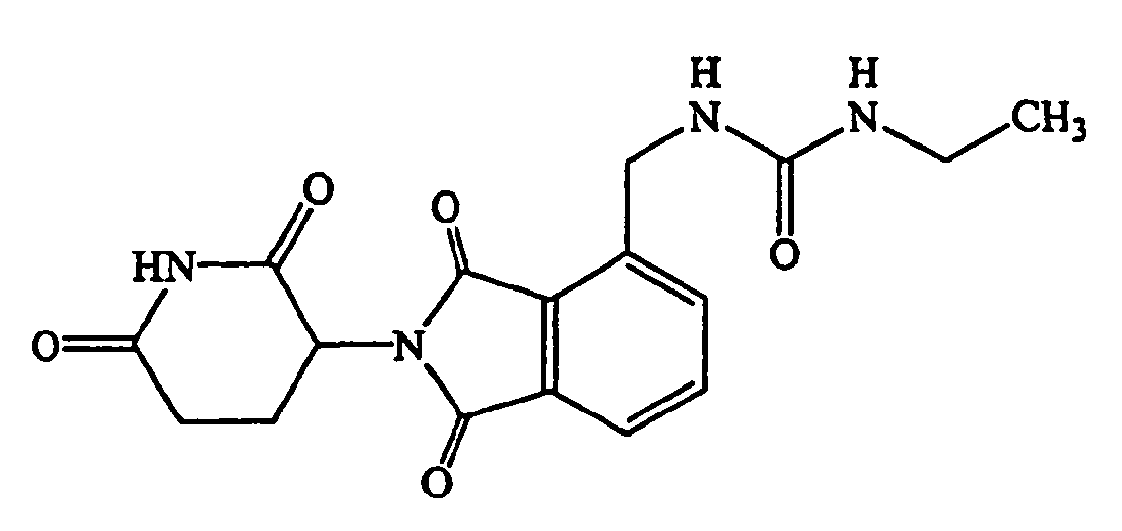
- 1,8-Diazabicyclo[5,4,0]undec-7-ene (0.29 g, 1.90 mmol) was added to a stirred suspension of 4-(aminomethyl)-2-(2,6-dioxo(3-piperidyl))isoindoline-1,3-dione hydrochloride (0.60 g, 1.85 mmol) in CH3CN (50 ml). After stirring for 20 min, ethyl isocyanate (0.16 g, 2.22 mmol) was added. The mixture was stirred at room temperature for 17 hours. The solvent was removed in vacuo and the residue was dissolved in CH2Cl2 (70 ml). The CH2Cl2 solution was washed with 1N HCL (30 ml), H2O (30 ml), brine (30 ml) and dried (MgSO4). The solvent was removed in vacuo and the residue was purified by chromatography (SiO2, CH2Cl2: CH3CN 6:4) to give N-{[2-(2,6-dioxo(3-piperidyl))-1,3-dioxoisoindolin-4-yl]methyl}(ethylamino)carboxamide (0.2 g, 30%) as a white solid: mp 173-175 °C; 1H NMR (DMSO-d6 ) δ d 11.13 (s, 1H), 7.86-7.69 (m, 3H), 6.44 (t, J=6.1 Hz, 1H), 6.11 (t, J=5.55 Hz, 1H), 5.18-5.11 (dd, J=5.4 and 12.6 Hz, 1H), 4.63 (d, J=6.1 Hz, 2H), 3.07-2.83 (m, 3H), 2.64-2.49 (m, 2H), 2.08-2.04 (m, 1H), 0.99 (t, J=7.1 Hz, 3H); 13C NMR (DMSO-d6 ) δ d 172.73, 169.80, 167.58, 167.03, 157.93, 141.15, 134.61, 133.37, 131.49, 126.96, 121.61, 48.83, 38.71, 34.17, 30.92, 21.98, 15.58; Anal. Calcd. For C17H18N4O5 + 0.14 H2O: C, 56.58; H, 5.11; N, 15.53. Found: C, 56.56; H, 5.05; N, 15.28.
-

- To a suspension of 4-amino-2-(2,6-dioxo(3-piperidyl))isoindoline-1,3-dione (0.55 g, 2 mmol) in acetic acid (20 ml) was added furan-2-carbaldehyde (0.20 g, 2.05 mmol). The mixture was heated to reflux for 5 hours and allowed to cool at room temperature. Sodium borohydride (80 mg, 2 mmol) was added to the reaction mixture. The reaction mixture was stirred for 24 hours. The solvent was evaporated in vacuo and the residue was dissolved in ethyl acetate (100 ml), washed with H2O (3 × 100 ml), saturated aqueous NaHCO3 (2 × 100 ml), brine (1 × 100 ml), and dried. The solvent was evaporated and the residue was purified by chromatography (ethyl acetate/hexane, 1:1) to give 0.25 g (35%) of product as a yellow solid: mp 171-173°C; 1H NMR (DMSO-d6 ) δ 11.10 (s, 1H), 7.58 (t, J=7.1 Hz, 2H), 7.18 (d, J=8.6 Hz, 1H), 7.08-6.97 (m, 2H), 6.39-6.36 (m, 2H), 5.06 (dd, J=5.2 and 12.4 Hz, 1H), 4.57 (d, J=6.0 Hz, 2H), 2.96-2.82 (m, 1H), 2.63-2.46 (m, 2H), 2.06-2.02 (m, 1H; 13C NMR (DMSO-d6 ) δ 172.76, 170.01, 168.75, 167.21, 151.97, 145.81, 142.42, 136.45, 132.09, 117.60, 111.04, 110.42, 109.73, 107.38, 48.57, 30.95, 22.10; Anal. Calcd. For C18H15N3O5 : C, 61.19; H, 4.28; N, 11.89. Found: C, 61.02; H, 4.24; N, 11.81.
-

- To a suspension of 4-amino-2-(2,6-dioxo(3-piperidyl))isoindoline-1,3-dione (0.55 g, 2.0 mmol) in THF (30 ml) was added 2-methoxyacetyl chloride (0.43 g, 4.0 mmol). The stirred mixture was heated to reflux for 18 hours. The solvent was evaporated in vacuo and the resulting solid was slurried in diethyl ether (20 ml) and filtered to give 0.69 g (100 %) of product as an off-white solid: mp 246-248 °C; 1H NMR (DMSO-d6 ) δ 11.15 (s, 1H), 10.30 (s, 1H), 8.70 (d, J=8.4 Hz, 1H), 7.86 (t, J=7.8 Hz, 1H), 7.63 (d, J=7.3 Hz, 1H), 5.17 (dd, J=5.2 and 12.7 Hz, 1H), 4.11 (s, 2H), 3.49 (s, 3H), 2.98-2.84 (m, 1H), 2.66-2.47 (m, 2H), 2.12-2.07 (m, 1H); 13C NMR (DMSO-d6 ) δ 172.67,169.66,169.02,168.25,166.61, 136.48, 135.91, 131.24, 124.35, 11831, 116.04, 71.40, 59.10, 48.96, 30.91, 21.94; Anal. Calcd. For C16H15N3O6: C, 55.65; H, 4.38; N, 12.17. Found: C, 55.58; H, 4.40; N, 12.08.
-
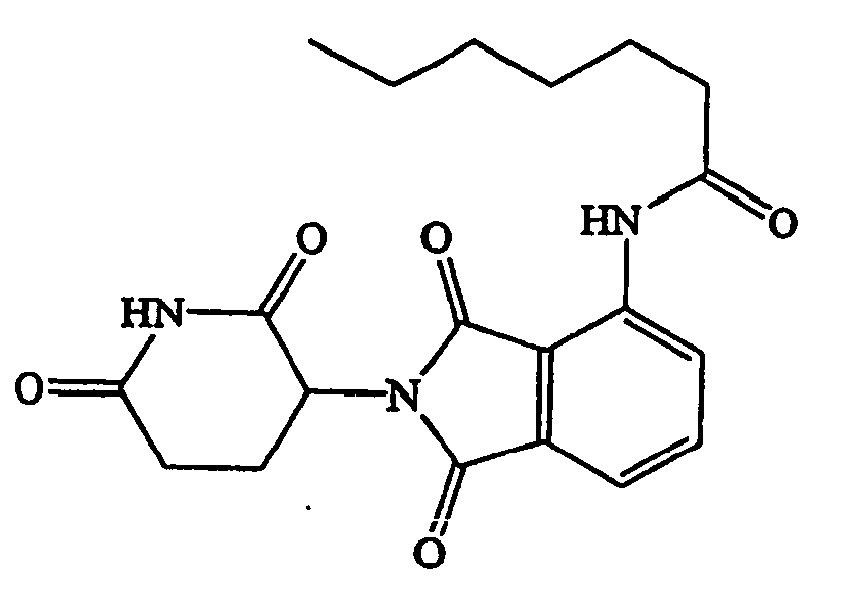
- To a stirred suspension of 4-amino-2-(2,6-dioxo(3-piperidyl))isoindoline-1,3-dione (0.55 g, 2.0 mmol) in THF (30 ml) was added heptanoyl chloride (0.59 g, 4.0 mmol). The mixture was heated to reflux for 18 hours. The solvent was evaporated in vacuo and the resulting solid was slurried in diethyl ether (20 ml) and filtered to give 0.61 g (79 %) of product as an off-white solid: map 200-202 °C; 1H NMR (DMSO-d6 ) δ 11.16 (s, 1H), 9.65 (s, 1H), 8.48 (d, J=8.3 Hz, 1H), 7.81 (t, J=7.7 Hz, 1H), 7.58 (d, J=7.2 Hz, 1H), 5.15 (dd, J=4.8 and 12.2Hz, 1H), 2.97-2.87 (m, 1H), 2.65-2.43 (m, 4H), 2.10-2.06 (m, 1H), 1.61-1.58 (m, 2H), 1.28 (bs, 6H), 0.85 (bs, 3H); 13C NMR (DMSO-d6 ) δ 172.67, 171.96, 169.69, 167.78, 166.61, 136.62, 136.04, 131.36, 125.97, 118.13, 116.67, 48.93, 36.56, 30.95, 28.16, 24.69,21.94,13.84; Anal. Calcd. For C20H23N3O5 : C, 62.33; H, 6.02; N, 10.90. Found: C, 62.14; H, 6.05; N, 10.72.
-

- To a stirred suspension of 4-amino-2-(2,6-dioxo(3-piperidyl))isoindoline-1,3-dione (0.55 g, 2.0 mmol) in THF (30 ml) was added (chlorocarbonyl)methyl acetate (0.55 g, 4.0 mmol). The mixture was heated to reflux for 18 hours. The solvent was evaporated in vacuo and the resulting solid was slurried in diethyl ether (20 ml) and filtered to give 0.56 g (75 %) of product as an off white solid: mp 234-236 °C; 1H NMR (DMSO-d6 ) δ 11.15 (s, 1H), 10.06 (s, 1H), 8.55 (d, J=8.3 Hz, 1H), 7.87 (t, J=8.0 Hz, 1H), 7.65 (d, J=7.2 Hz, 1H), 5.17 (dd, J=5.0 and 12.4 Hz, 1H), 4.78 (s, 2H), 2.99-2.85 (m, 1H), 2.65-2.52 (m, 2H), 2.22 (s, 2H), 2.11-2.07 (m, 1H); 13C NMR (DMSO-d6 ) δ 172.70, 169.69, 169.50, 167.99, 166.57, 136.40, 135.59, 131.35, 125.34, 118.72,116.96, 62.60, 48.98, 30.90, 21.91, 20.41; Anal. Calcd. For C17H15N3O7: C, 54.69; H, 4.05; N, 11.26. Found: C, 54.43; H, 4.05; N, 10.97.
-

- To a stirred suspension of 4-amino-2-(2,6-dioxo(3-piperidyl))isoindoline-1,3-dione (0.55 g, 2.0 mmol) in THF (30 ml) was added pentanoyl chloride (0.48 g, 4.0 mmol). The stirred mixture was heated to reflux for 18 hours. The solvent was evaporated in vacuo and the resulting solid was slurried in diethyl ether (20 ml) and filtered to give 0.61 g (85 %) of product as an off-white solid: mp 178-179 °C; 1H NMR (DMSO-d6 ) δ 11.17 (s, 1H), 9.65 (s, 1H), 8.50 (d, J=8.3 Hz, 1H), 7.82 (t, J=7.5 Hz, 1H), 7.59 (d, J=7.2 Hz, 1H), 5.18 (dd, J=5.0 and 12.4 Hz, 1H), 2.99-2.89 (m, 1H), 2.68-2.45 (m, 4H), 2.13-2.09 (m, 1H), 1.69-1.57 (m, 2H), 1.44-1.30 (m, 2H), 0.92 (t, J=7.2 Hz, 3H); 13C NMR (DMSO-d6 ) δ 172.72, 171.99, 169.73, 167.83, 166.64, 136.64, 136.07, 131.36, 125.96, 118.15, 116.68, 48.97, 36.32, 30.97, 26.88, 22.03, 21.70, 13.64; Anal. Calcd. For C18H19N3O5 : C, 60.50; H, 5.36; N, 11.76. Found: C, 60.10; H, 5.37; N, 11.58.
-

- To a stirred suspension of 4-amino-2-(2,6-dioxo(3-piperidyl))isoindoline-1,3-dione (0.55g, 2.0 mmol) in THF (30 ml) was added thiophene-2-carbonyl chloride (0.59 g, 4.0 mmol). The mixture was heated to reflux for 18 hours. To the reaction mixture was added additional thiophene-2-carbonyl chloride (0.30 g, 2 mmol). The mixture was heated to reflux for an additional 8 hours. The solvent was evaporated in vacuo and the resulting solid was slurried in diethyl ether (20 ml) and filtered to give an of off-white solid which was recrystallized from acetic acid to give 0.50 g (65 %) of product: mp 284-286 °C; 1H NMR (DMSO-d6 ) δ 11.19 (s, 1H), 10.34 (s, 1H), 8.47(d, J=8.3 Hz, 1H), 7.98-7.86 (m, 3H), 7.68 (d, J=7.3 Hz, 1H), 7.29 (dd, J=4.0 and 4.8 Hz, 1H), 5.19 (dd, J=5.4 and 12.6 Hz, 1H), 2.99-2.85 (m,1H), 2.67-2.49(m, 2H), 2.12-2.08 (m, 1H); 13C NMR (DMSO-d6 ) δ 172.72, 169.69, 167.96, 166.60, 159.67, 138.02, 136.26, 136.19, 133.26, 131.42, 129.91, 128.58, 126.42, 118.82, 117.94, 49.00, 30.93, 22.00; Anal. Calcd. For C18H13N3O5S : C, 55.77; H, 3.54; N, 10.60. Found: C, 55.67; H, 3.36; N, 10.42 + 0.2 AcOH + 0.05 H2O.
-

- To a stirred suspension of 4-amino-2-(2,6-dioxo(3-piperidyl))isoindoline-1,3-dione (0.55g, 2.0 mmol) in THF (30 ml) was added methyl (chlorocarbonyl)formate (0.49 g, 4.0 mmol). The mixture was heated to reflux for 18 hours. The solvent was evaporated in vacuo and the resulting solid was slurried in diethyl ether (20 ml) and filtered to give 0.55 g (76 %) of product as an off-white solid: mp 247-249 °C; 1H NMR (DMSO-d6 ) δ 11.17 (s, 1H), 10.81 (s, 1H), 8.59 (d, J=8.3 Hz, 1H), 7.92 (t, J=7.7 Hz, 1H), 7.70 (d, J=7.3 Hz, 1H), 5.19 (dd, J=5.0 and 12.5 Hz, 1H), 3.91 (s, 3H), 2.98-2.85 (m, 1H), 2.68-2.50 (m, 2H), 2.14-2.09 (m, 1H); 13C NMR (DMSO-d6 ) δ 172.70, 169.63, 168.03, 166.45, 159.81, 154.57, 136.65, 134.93, 131.36, 124.67, 119.34, 117.17, 53.80, 49.06, 30.92, 21.94; Anal. Calcd. For C16H13N3O7 : C, 53.49; H, 3.65; N, 11.70. Found: C, 53.53; H, 3.66; N, 11.52.
-
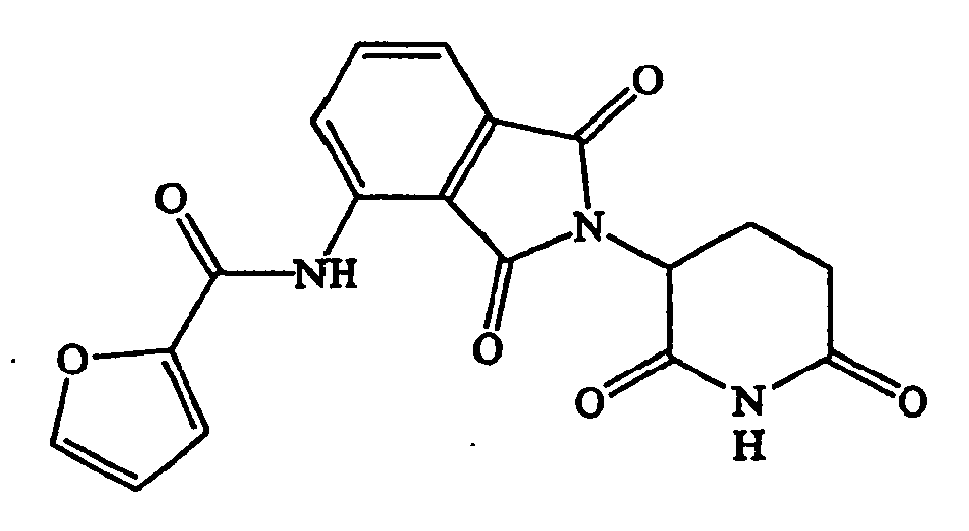
- To a stirred suspension of 4-amino-2-(2,6-dioxo(3-piperidyl))isoindoline-1,3-dione (0.55 g, 2.0 mmol) in THF (30 ml) was added furan-2-carbonyl chloride (0.52 g, 4.0 mmol). The mixture was heated to reflux for 18 hours. To the reaction mixture was added additional furan-2-carbonyl chloride (0.26 g, 2 mmol). The mixture was heated to reflux for an additional 8 hours. The solvent was evaporated in vacuo and the resulting solid was slurried in diethyl ether (20 ml) and filtered to give 0.65 g (88 %) of product as an off-white solid: mp 299-301 °C; 1H NMR (DMSO-d6 ) δ 11.19 (s, 1H), 10.37 (s,1H), 8.68 (dd, J=1.4 and 8.4 Hz, 1H), 8.06 (s, 1H), 7.90 (t, J=8.1 Hz, 1H), 7.65 (d, J=7.3 Hz, 1H), 7.39 (d, J=3.5 Hz, 1H). 6.79 (dd, J=1.5 and 3.2 Hz, 1H), 5.19 (dd, J=5.1 and 12.5 Hz, 1H), 2.98-2.84 (m, 1H), 2.67-2.49(m, 2H), 2.13-2.08 (m, 1H); 13C NMR (DMSO-d 6) δ 172.66,169.62,168.44, 166.59, 155.71, 146.80, 146.34,136.55,136.23, 136.12, 131.30, 124.86, 118.54,116.64, 113.06,48.98,30.90,22.01; Anal. Calcd. For C18H13N3O6: C, 58.86; H, 3.57; N, 11.44. Found: C, 58.69; H, 3.54; N,11.41.
-

- To a stirred suspension of 4-amino-2-(2,6-dioxo(3-piperidyl))isoindoline-1,3-dione (0.55 g, 2.0 mmol) in THF (30 ml) was added benzoyl chloride (0.56 g, 4.0 mmol). The mixture was heated to reflux for 18 hours. To the reaction mixture was added additional benzoyl chloride (0.28 g, 2.0 mmol). The mixture was heated at reflux for an additional 8 hours. The solvent was evaporated in vacuo and the resulting solid was slurried in diethyl ether (20 ml) and filtered to give an of off-white solid which was recrystallized from acetic acid to give 0.49 g (65 %) of product: mp 268-270 °C; 1H NMR (DMSO-d 6 δ 11.18 (s, 1H), 10.43 (s, 1H), 8.64-8.59 (m, 1H), 8.00-7.89 (m, 3H), 7.72-7.60 (m, 4H), 5.19 (dd, J=5.2 and 12.5 Hz, 1H), 2.98-2.84 (m, 1H), 2.66-2.50(m, 2H), 2.12-2.07 (m, 1H); 13C NMR (DMSO-d6 ) δ 172.62, 169.59, 168.16, 166.64, 164.91, 136.50, 136.36, 133.23, 132.67, 131.36, 129.06, 127.24, 126.00, 118.74, 117.74, 48.98, 30.89, 21.98; Anal. Calcd. For C20H15N3O5 : C, 63.02; H, 4.08; N, 10.90. Found: C, 63.05; H, 4.06; N, 10.69 + 0.11 AcOH + 0.08 H2O.
-
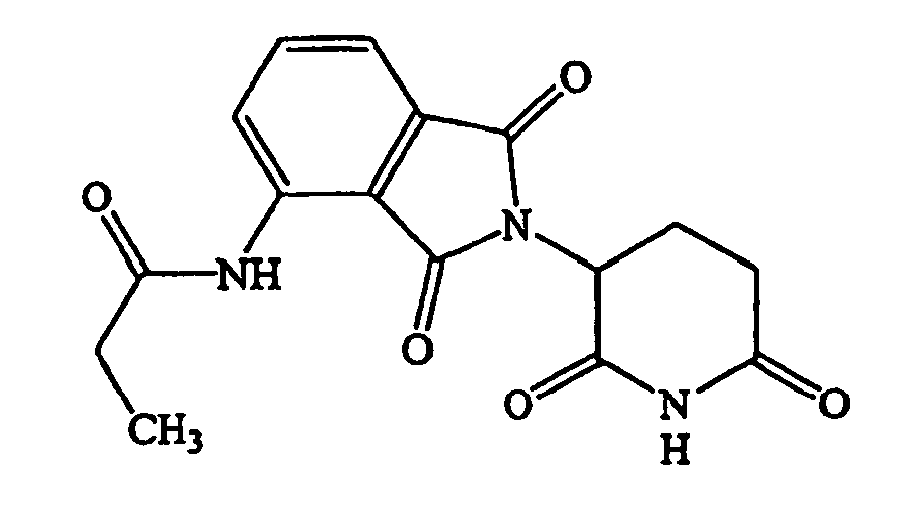
- To a stirred suspension of 4-amino-2-(2,6-dioxo(3-piperidyl))isoindoline-1,3-dione (0.55 g, 2.0 mmol) in THF (30 ml) was added propanoyl chloride (0.37 g, 4.0 mmol). The mixture was heated to reflux for 18 hours. The solvent was evaporated in vacuo and the resulting solid was slurried in diethyl ether (20 ml) and filtered to give 0.58 g (88 %) of product as an off-white solid: mp 221-223 °C; 1H NMR (DMSO-d 6) δ 11.15 (s, 1H), 9.65 (s, 1H), 8.50 (d, J=8.3 Hz, 1H), 7.83 (t, J=7.6 Hz, 1H), 7.60 (d, J=7.2 Hz, 1H), 5.16 (dd, J=5.2 and 12.6 Hz, 1H), 2.99-2.85 (m, 1H), 2.66-2.45 (m, 4H), 2.11-2.07(m, 1H), 1.14 (t, J=7.5 Hz, 3H); 13C NMR (DMSO-d6 ) δ 172.69, 172.65, 169.71, 167.79, 166.62, 136.65, 136.09, 131.35, 125.93, 118.12, 116.66, 48.91, 30.91, 29.73, 21.97, 9.13; Anal. Calcd. For C16H15N3O5 : C, 58.36; H, 4.59; N,12.76. Found: C, 58.01; H, 4.45; N, 12.61.
-

- To a stirred suspension of 4-amino-2-(2,6-dioxo(3-piperidyl))isoindoline-1,3-dione (0.55 g, 2.0 mmol) in THF (30 ml) was added methyl 3-(chlorocarbonyl)propanoate (0.63 g, 4.0 mmol). The mixture was heated to reflux for 18 hours. The solvent was evaporated in vacuo and the resulting solid was slurried in diethyl ether (20 ml) and filtered to give 0.75 g (97 %) of product as an off-white solid: mp 224-226 °C; 1H NMR (DMSO-d 6) δ 11.18 (s, 1H), 9.79 (s, 1H), 8.43 (d, J=8.4 Hz, 1H), 7.83 (t, J=7.8 Hz, 1H), 7.62 (d, J=7.3 Hz, 1H), 5.16 (dd, J=5.2 and 12.6 Hz, 1H), 3.61 (s, 3H), 2.99-2.48 (m, 7H), 2.11-2.06 (m, 1H); 13C NMR (DMSO-d6 ) δ 172.84, 172.66, 170.94, 169.75, 167.61, 166.70, 136.39, 136.15, 131.52, 126.39, 118.43, 117.04, 51.51, 48.95, 31.22, 30.96, 28.39, 22.03; Anal. Calcd. For C18H17N3O7 : C, 55.82; H, 4.42; N, 10.85. Found: C, 55.68; H, 4.41; N, 10.61.
-

-

-

- To a stirred suspension of 4-amino-2-(2,6-dioxo(3-piperidyl))isoindoline-1,3-dione (1.37 g, 5.00 mmol) in THF (30 ml) was added chloroacetyl chloride (0.62 g, 5.5 mmol). The mixture was heated to reflux for 30 minutes. The solvent was evaporated in vacuo and the resulting solid was slurried in diethyl ether (20 ml) and filtered to give 1.67 g (96 %) of product as an off-white solid: 1H NMR (DMSO-d 6) δ 11.18 (s, 1H), 10.31 (s, 1H), 8.54 (d, J=8.4 Hz, 1H), 7.88 (t, J=7.7 Hz, 1H), 7.68 (d, J=7.3 Hz, 1H), 5.17(dd, J=5.2 and 12.7 Hz, 1H), 4.54 (s, 2H), 2.90-2.85 (m, 1H), 2.65-2.51 (m, 2H), 2.10-2.06(m, 1H).
-

-

-

- To a stirred suspension of 3-(4-amino-1-oxoisoindolin-2-yl)piperidine-2,6-dione (3.89 g, 15.0 mmol) in THF (50 ml) was added chloroacetyl chloride (1.86 g, 16.5 mmol). The mixture was heated to reflux for 45 minutes. To the reaction mixture was added additional chloroacetyl chloride (0.15 g, 0.13 mmol). The reaction mixture was heated at reflux for an additional 30 minutes. The solvent was evaporated in vacuo and the resulting solid was slurried in diethyl ether (20 ml) and filtered to give 4.64 g (92 %) of product as an off-white solid: 1H NMR (DMSO-d6 ) δ 11.04 (s, 1H), 10.22 (s, 1H), 7.82 (dd, J=1.6 and 7.2 Hz, 1H), 7.59-7.50 (m, 2H), 5.16 (dd, J=5.1 and 13.2 Hz, 1H), 4.46-4.30 (m, 4H), 3.00-2.85 (m, 1H), 2.65-2.58 (m, 1H), 2.44-2.28 (m, 1H), 2.06-2.01 (m, 1H).
-

- To a stirred suspension of N-[2-(2,6-dioxo(3-piperidyl))-1-oxoisoindolin-4-yl]-2-chloroacetamide (4.64 g, 13.8 mmol) in acetone (60 ml) was added sodium azide (1.35 g, 20.7 mmol). The mixture was heated to.reflux for 18 hours. After 18 hours, to the reaction mixture was added NaI (2.05 g, 13.8 mmol) and additional sodium azide (0.90 g, 13.8 mmol). The mixture was heated at reflux for an additional 18 hours. The solvent was evaporated in vacuo to give an off-white solid which was slurried in a mixture of dichloromethane (50 ml) and H2O (50 ml). This slurry was filtered to give 4.39 g (93 %) of product: 1H NMR (DMSO-d 6) δ 11.50-9.52 (bs, 2H), 7.87-7.84 (m, 1H), 7.59-7.50 (m, 2H), 5.17 (dd, J=5.0 and 13.1 Hz, 1H), 4.44 (d, J=17.6 Hz, 1H), 4.34 (d, J=17.6 Hz, 1H), 4.13 (s, 2H), 3.00-2.86 (m, 1H), 2.65-2.59 (m, 1H), 2.44-2.29 (m, 1H), 2.07-2.02 (m, 1H).
-

- To a stirred suspension of 2-azido-N-[2-(2,6-dioxo(3-piperidyl))-1-oxoisoindolin-4-yl]acetamide (1.49 g, 4.20 mmol) in a mixture of methanol (50 ml) and 3N HCI (6 ml) was added 10% Pd-C (0.1 g). Hydrogenation at 50 psi of hydrogen in a Parr Type shaker for 24 hours gave a slurry. The mixture was filtered leaving a gray solid that was stirred in H2O (100 ml). The aqueous mixture was filtered through celite to remove catalyst. The aqueous and methanolic filtrates were combined and evaporated in vacuo to give a white solid. The solid was slurried in ethyl acetate (20 ml), filtered, re-slurried in methanol (20 ml), and filtered to give 2.35 g (48 %) of product: mp 293-295 °C; 1H NMR (DMSO-d6 ) δ 11.06 (s, 1H), 10.86 (s, 1H), 8.45 (bs, 2H), 7.90 (d, J=6.3 Hz, 1H), 7.59-7.51 (m, 2H), 5.17 (dd, J=4.9 and 13.0 Hz, 1H), 4.54 (d, J=17.8 Hz, 1H), 4.39 (d, J=17.8 Hz, 1H), 3.91 (s, 2H), 3.02-2.88 (m, 1H), 2.68-2.61 (m, 1H), 2.37-2.23 (m, 1H), 2.09-2.05 (m, 1H); 13C NMR (DMSO-d6 ) δ 172.94, 171.07, 167.74, 165.24, 133.73, 132.86, 128.95, 125.01, 119.65, 51.59, 46.74, 40.90, 31.22, 22.82; Anal. Calcd. For C15H17ClN4O4: C, 50.43; H, 4.94; N, 15.68. Found: C, 50.08; H, 4.92; N, 15.53 + 0.25 H2O.
-

- To a stirred suspension of 3-(4-amino-1-oxoisoindolin-2-yl)piperidine-2,6-dione (0.52 g, 2.0 mmol) in methanol (50 ml) was added furan-2-carbaldehyde (0.200 g, 2.05 mmol). The mixture was heated to reflux for 4 hours. The solvent was evaporated in vacuo and the residue was dissolved in acetic acid (20 ml). Sodium triacetoxyborohydride (0.450 g, 2.05 mmol) was added to the reaction mixture. The reaction mixture was stirred for 24 hours. The solvent was evaporated in vacuo and the residue was dissolved in ethyl acetate (100 ml), washed with H2O (3 × 100 ml), saturated aqueous NaHCO3 (2 × 100 ml), brine (1 × 100 ml), and dried over MgSO4. The solvent was evaporated in vacuo and the residue was partially purified by chromatography (100 % ethyl acetate) to give an off-white solid which was recrystallized from ethanol to give 0.20 g of product as a white solid: mp 248-250 °C; 1H NMR (DMSO-d6 ) δ 11.02 (s, 1H), 7.57 (s, 1H), 7.27 (t, J=7.6 Hz, 1H), 6.96 (d, J=7.3 Hz, 1H), 6.85 (d, J=8.0 Hz, 1H), 6.36 (d, J=11.2 Hz, 2H), 6.22 (t, J=5.4 Hz, 1H), 5.12 (dd, J=4.9 and 13.1 Hz, 1H), 4.37 (d, J=5.5 Hz, 2H), 4.27 (d, J=17.2 Hz, 1H), 4.14 (d, J=17.2 Hz, 1H) 3.00-2.86 (m, 1H), 2.65-2.59 (m, 1H), 2.37-2.23 (m, 1H), 2.08-1.99 (m, 1H); 13C NMR (DMSO-d6 ) δ 172.83, 171.16,168.70, 152.82, 143.06, 142.00, 132.09, 129.02, 126.76, 112.35, 110.63, 110.33, 107.08, 51.50, 45.73, 31.20, 22.75; Anal. Calcd. For C18H17N3O4 : C, 63.71; H, 5.05; N, 12.38. Found: C, 63.41; H, 5.03; N,11.98.
-
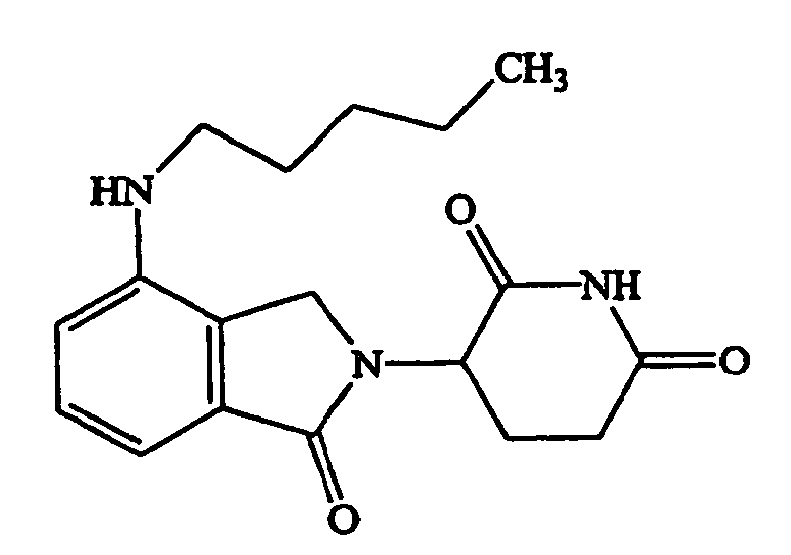
- To a stirred solution of 3-(4-amino-1-oxoisoindolin-2-yl)piperidine-2,6-dione (0.52 g, 2.0 mmol) in DMF (10 ml) was added pentanal (0.26 g, 3.0 mmol), acetic acid (0.24 g, 4.0 mmol), and sodium triactoxyborohydride (0.85 g, 4.0 mmol). The reaction mixture was stirred at room temperature for 6 hours. The solvent was evaporated in vacuo and the residue was dissolved in ethyl acetate (100 ml), washed with H2O (3 × 100 ml), brine (1 × 100 ml), and dried over MgSO4. The solvent was evaporated and the residue was partially purified by chromatography (ethyl acetate/hexane, 75:25) to give an off-white solid which was slurried in ethyl acetate and filtered to give 0.14 g (21 %) of product as a white solid: mp 244-246 °C; 1H NMR (DMSO-d6 ) δ 11.00 (s, 1H), 7.28 (t, J=7.7 Hz, 1H), 6.92 (d, J=7.3 Hz, 1H), 6.73 (d, J=8.0 Hz, 1H), 5.54 (t, J=5.3 Hz, 1H), 5.12 (dd, J=5.1 and 13.2 Hz, 1H), 4.24 (d, J=17.2 Hz, 1H), 4.13 (d, J=17.2 Hz, 1H) 3.15-3.07 (m, 2H), 3.00-2.86 (m, 1H), 2.65-2.59 (m, 1H), 2.39-2.23 (m, 1H), 2.08-1.99 (m, 1H), 1.61-1.57 (m, 2H), 1.41-1.32 (m, 4H), 0.89 (t, J=6.8 Hz, 3H); 13C NMR (DMSO-d6 ) δ 172.83,171.19, 168.86, 143.74, 132.00,129.15, 126.42, 111.66, 109.86, 1.46, 45.69, 42.68, 1.20, 28.80, 28.21, 22.79, 21.96,13.89; Anal. Calcd. For C18H23N3O3 : C, 65.63; H, 7.04; N, 12.76. Found: C, 65.69; H, 7.22; N, 12.55.
-

-
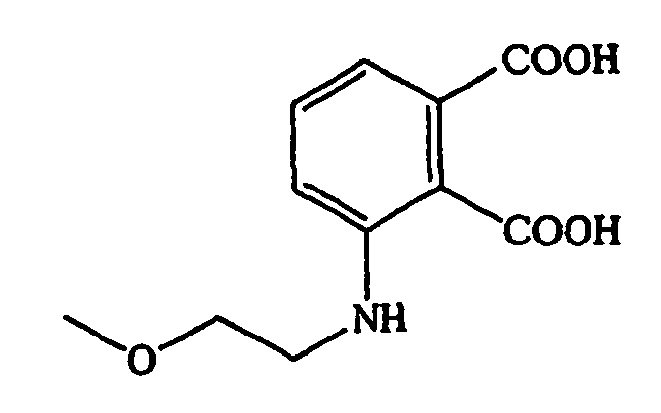
- To a stirred solution of 3-(2-methoxy-ethylamino)-phthalic acid dimethyl ester (2.24 g, 8.38 mmol) in methanol (50 ml) was added 5N potassium hydroxide (10 ml). The mixture was stirred at room temperature overnight. The solvent was evaporated in vacuo and the residue dissolved in water (50 ml). The water was washed with diethyl ether (2 x 75 ml). The aqueous portion was cooled in an ice bath and the pH was adjusted to 2-3 by dropwise addition of concentrated hydrochloric acid. The aqueous solution was then extracted with ethyl acetate (3 x 75 ml). The combined ethyl acetate extracts were washed with brine (100 ml) and dried (MgSO4). The solvent was evaporated in vacuo and the residue, which contained a mixture of diacid and monomethyl esters, was used without further purification.
-
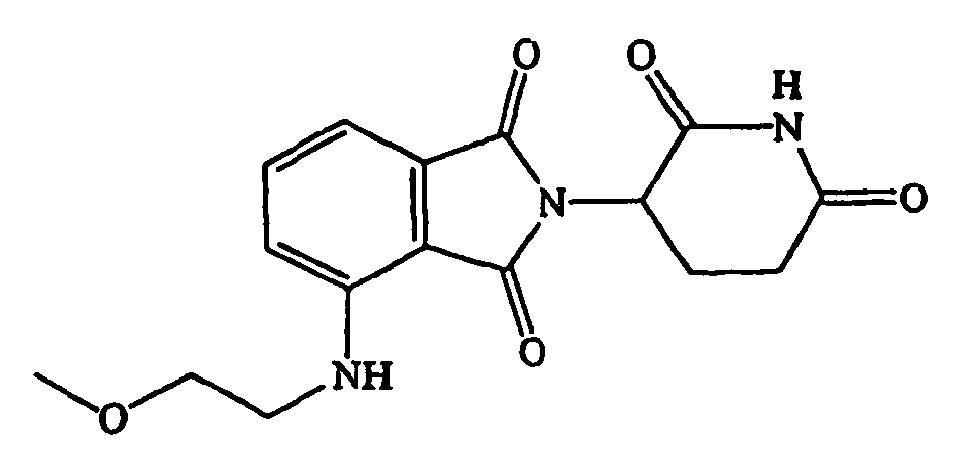
- To a stirred solution of 3-(2-methoxy ethylamino)-phthalic acid (8.38 mmol) in pyridine (40 ml) was added 3-amino-piperidine-2,6-dione hydrochloride (1.39 g, 8.42 mmol). The reaction mixture was heated to reflux for 5 hours. The solvent was evaporated in vacuo and the residue dissolved in methylene chloride (125 ml). The methylene chloride mixture was treated with Norit (2 g), washed with water (2 x 100 ml), 0.1N HCl (1 x 100 ml), brine (1 x 100 ml), and dried (MgSO4). The solvent was evaporated in vacuo and the residue (oil) crystallized from a minimal amount of ethanol to give a yellow solid that was purified by preparative HPLC to give 1.71 g (64%) of product as a yellow solid: mp 182-184°C; 1H NMR (DMSO-d6 ) d 11.12 (s, 1H),7.58 (t, J=7.7 Hz,1H), 7.12 (d, J=8.5 Hz, 1H), 7.04 (d, J=6.9 Hz, 1H), 6.59 (bs, 1H), 5.07 (dd, J= 4.7 and 12.1 Hz, 1H), 3.54-3.30 (m, 7H), 2.95-2.85 (m, 1 H), 2.64-2.52 (m, 2H), 2.07-2.02 (m, 1H); 13C NMR (DMSO-d6 ) d 172.79, 170.06,168.98, 167.27, 146.38, 136.21, 132.07, 117.33, 110.67, 109.24, 70.39, 58.12, 48.58, 41.50, 30.99, 22.15; Anal. Calcd. For C16H17N3O5 : C, 58.00; H, 5.17; N,12.68. Found: C, 58.06; H, 5.12; N, 12.76.
-

-

- To a stirred solution of 3-amino-phthalic acid dimethyl ester (3.14 g, 15 mmol) in methylene chloride (50 ml) under a nitrogen atmosphere were added valeraldehyde (2.0 ml, 18.75 mmol) and acetic acid (5.18 ml, 90 mmol). The mixture was stirred for 5 minutes followed by addition of sodium triacetoxyborohydride (6.36g, 30 mmol). The reaction was stirred for 30 minutes, diluted with methylene chloride (50 ml), washed with water (2 x 100 ml), saturated aqueous sodium bicarbonate (2 x 100 ml), brine (100 ml), and dried (MgSO4). The solvent was evaporated in vacuo to give 4.19 g of product (100%) that used without further purification. 1H NMR (DMSO-d6 ) d 7.31 (t, J=7.9 Hz, 1H), 6.81-6.75 (m, 2H), 3.85 (s, 3H), 3.82 (s, 3H), 3.15 (bs, 2H), 1.68-1.60 (m, 2H), 1.45-1.32 (m, 4H), 0.89 (t, J=6.9 Hz, 3H).
-

-

-

-
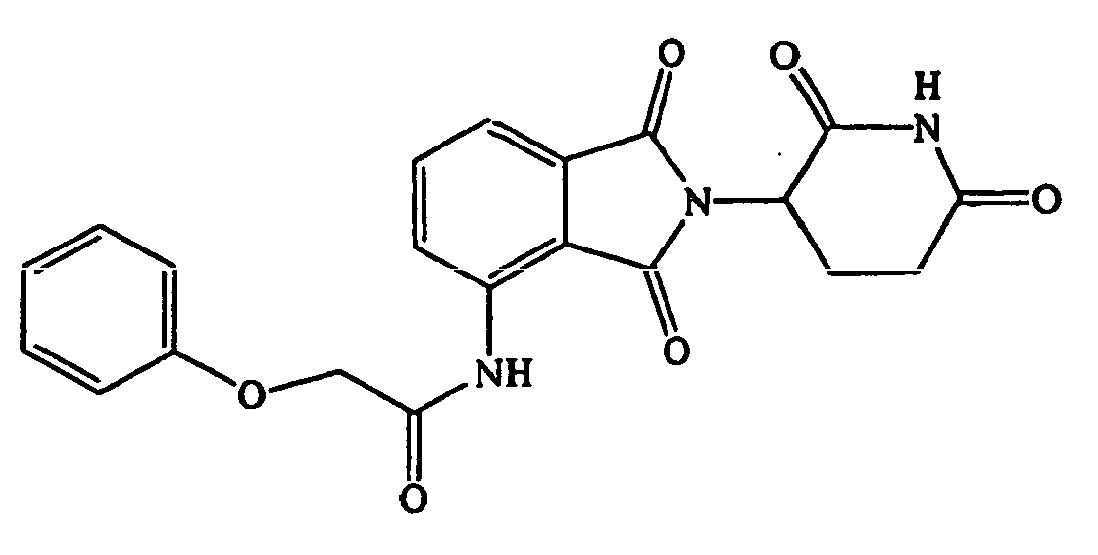
-

-
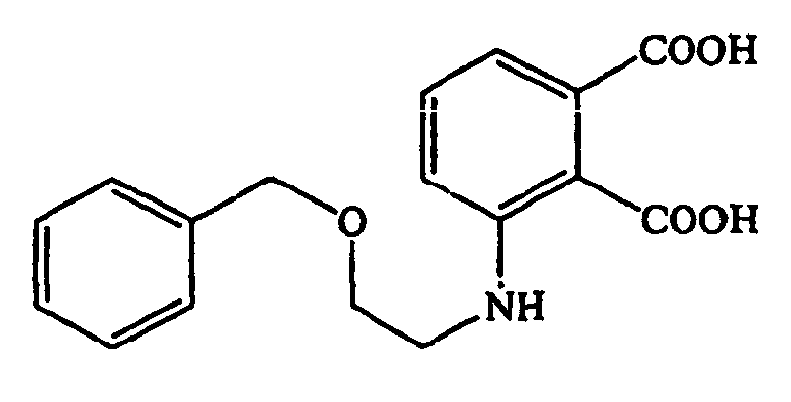
-

-

-

-

-
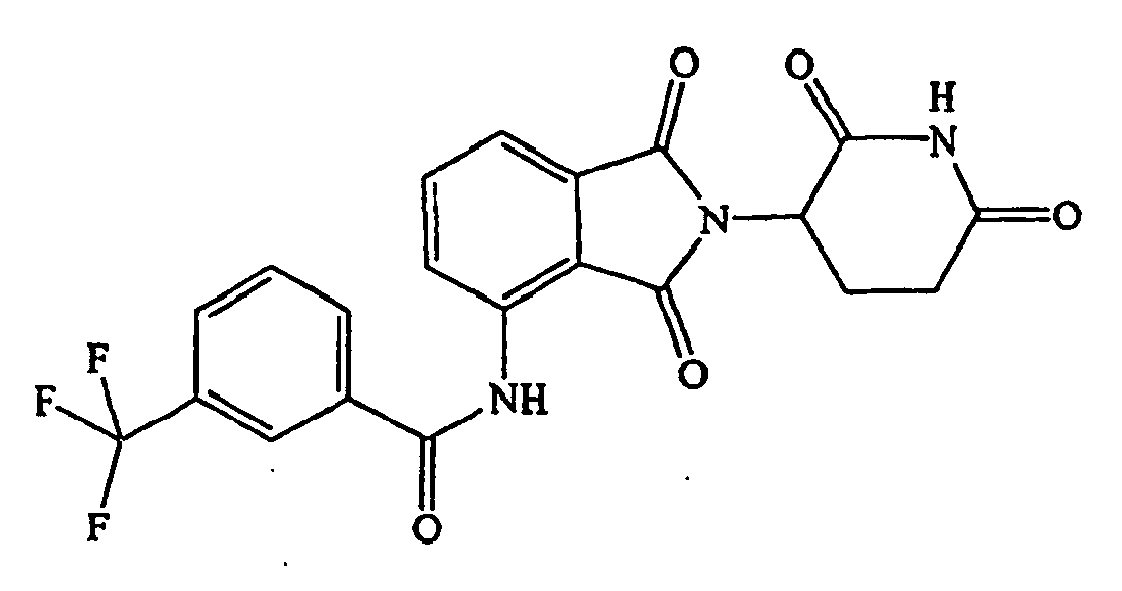
-

-

-

-

- A mixture of 4-amino-2-(2,6-dioxo(3-piperidyl))isoindoline-1,3-dione (1.1 g, 4.0 mmol) and heptanal (3.4 mL, 24 mmol) and acetic acid (2 mL) in DMF (20 mL) was heated until all solid was dissolved. To the mixture was added sodium borohydride (605 mg, 16 mmol) and kept at room temperature for 18h. To the mixture was added sodium borohydride (150 mg, 3.9 mmol) and kept at room temperature for 1 d. The mixture was extracted with ethyl acetate (200 mL) and water (100 mL). The organic layer was washed with water (100 mL). The solvent was removed in vacuo to give an oil. The oil was purified by column chromatography (Silca Gel, 33% EtOAc:CH2Cl2) to give 2-(2,6-Dioxo-piperidin-3-yl)-4-heptylamino-isoindole-1,3-dione as a yellow solid (610 mg, 41% yield): mp, 107-109 °C; 1H NMR (DMSO-d6) δ 0.82-0.87 (m, 3H, CH3 ), 1.24-1.29 (m, 8H, 4 CH2 ), 2.00-2.04 (m, 1H, CHH), 2.43-2.62 (m, 2H, CH 2), 2.82-2.96 (m, 1H, CHH), 3.23-3.31 (m, 2H, CH 2), 5.06 (dd, J = 5.3, 12.4 Hz, 1H, NCH), 6.51 (t, J = 5.9 Hz, 1H, NH), 7.01 (d, J = 7.0 Hz, 1H, Ar), 7.07 (d, J = 8.6 Hz,1H, Ar), 7.57 (dd, J = 7.4,8.4 Hz, 1H, Ar), 11.10 (s, 1H, NH); 13C NMR (DMSO-d6) δ 13.91, 22.03, 22.17, 26.28, 28.42, 28.69, 30.98, 31.22, 34.84, 48.55, 109.03, 110.36, 117.13, 132.18, 136.24, 146.43, 167.29, 168.96, 170.05, 172.77; Anal Calcd for C20H25N3O4: C, 64.67; H, 6.78; N, 11.31. Found: C, 64.62; H, 6.76; N, 11.13.
-

- A mixture of 4-amino-2-(2,6-dioxo(3-piperidyl))isoindoline-1,3-dione (1.2 g, 4.5 mmol) and 4-chlorobenzoyl chloride (1.1 mL, 8.8 mmol) in THF (40 mL) was heated to reflux for 15 h. To the mixture was added methanol (5 mL) to give a suspension. The suspension was filtered and washed with ether (2 x 10 mL) then methanol (5 mL) to give 4-chloro-N-[2-(2,6-dioxo-piperidin-3-yl)-1,3-dioxo-2,3-dihydro-1H-isoindol-4-yl]-benzamide as a white solid (1.5 g, 81 % yield): mp, 261-263 °C; 1H NMR (DMSO-d6 ) δ 2.05-2.09 (m, 1H, CHH), 2.49-2.65 (m, 2H, CH 2), 2.83-2.98 (m, 1H, CHH), 5.18 (dd, J = 5.5, 12.8 Hz, 1H, NCH), 7.68-7.72 (m, 3H, Ar), 7.89-8.01 (m, 3H, Ar), 8.52 (d, J = 8.2, Hz, 1H, Ar), 10.47 (s, 1H, NH), 11.16 (s, 1H, NH); 13C NMR (DMSO-d6) δ 21.99, 30.92, 48.98, 118.48, 119.06, 126.76, 129.10, 129.29, 131.46, 132.13, 136.28, 137.47, 164.08, 166.60, 167.86, 169.67, 172.72; Anal Calcd for C20H14N3O5Cl + 0.2 H2O: C, 57.83; H, 3.49; N, 10.12; Cl, 8.53; H2O, 0.87. Found: C, 57.88; H, 3.33; N, 9.93; Cl, 8.53; H2O, 0.73.
-

- A mixture of 4-amino-2-(2,6-dioxo(3-piperidyl))isoindoline-1,3-dione (0.60 g, 2.2 mmol) and cyclopropanecarbonyl chloride (0.4 mL, 4.4 mmol) in THF (20 mL) was heated to reflux for 15 h. To the mixture was added methanol (5 mL). The solvent was removed in vacuo to give a solid. The solid was slurried in ether (30 mL0 for 1h. The suspension was filtered and washed with ether (30 mL) to give cyclopropanecarboxylic acid [2-(2,6-dioxo-piperidin-3-yl)-1,3-dioxo-2,3-dihydro-1H-isoindol-4-yl]-amide as a solid (630 mg, 84 % yield): mp, 237-239 °C; 1H NMR (DMSO-d6) δ 0.87-0.90 (m, 4H, 2CH 2), 1.93-2.09 (m, 2H, CH, CHH), 2.49-2.65 (m, 2H, CH 2), 2.64-2.96 (m, 1H, CHH), 5.15 (dd, J = 5.2, 12.6 Hz, 1H, NCH), 7.61 (d, J = 7.2 Hz, 1H, Ar), 7.82 (t, J = 7.7 Hz, 1H, Ar), 8.41 (d, J = 8.3 Hz, 1H, Ar), 9.99 (s, 1H, NH), 11.16 (s, 1H, NH); 13C NMR (DMSO-d6) δ 8.10,14.93, 22.00, 30.93, 48.92, 117.07, 118.30, 126:69, 131.49, 135.97, 136.43 166.67, 167.57, 169.77,172.55,172.74; Anal Calcd for C17H15N3O5: C, 59.82; H, 4.43; N, 12.31. Found: C, 59.50; H, 4.39; N, 12.04.
-

- A mixture of 4-amino-2-(2,6-dioxo(3-piperidyl))isoindoline-1,3-dione (1.1 g, 4.0 mmol) and 4-fluorobenzoyl chloride (0.95 mL, 8.0 mmol) in THF (40 mL) was heated to reflux for 15 h. To the mixture was added methanol (5 mL) to give a suspension. The suspension was filtered and washed with ether (2 x 10 mL) then methanol (5 mL) to give N-[2-(2,6-dioxo-piperidin-3-yl)-1,3-dioxo-2,3-dihydro-1H-isomdol-4-yl]-4-fluoro-beazamide as a yellow solid (1.2 g, 77 % yield): mp, 283-285 °C; 1H NMR (DMSO-d6) δ 2.06-2.10 (m,1H, CHH), 2.48-2.65 (m, 2H, CH 2), 2.83-2.97 (m, 1H, CHH), 5.18 (dd, J = 5.4, 12.6 Hz, 1H, NCH), 7.42-7.49 (m, 2H, Ar), 7.69 (d, J = 7.2, Hz, 1H, Ar), 7.91 (t, J = 8.2 Hz, 1H, Ar), 8.03-8.08 (m, 2H, Ar), 8.54 (d, J = 8.3 Hz, 1H, Ar),10.41 (s, 1H, NH), 11.15 (s, 1H, NH); 13C NMR (DMSO-d6) δ 22.10,30.98,49.29,115.96 (d, J C-F = 22 Hz); 118.03, 118.67, 128.09 (d, J C-F = 235 Hz), 130.12, 131.49, 136.18, 136.75, 162.70, 164.08, 166.56, 168.22, 169.29, 172.27; Anal Calcd for C20H14N3O5F + 0.2 H2O: C, 60.21; H, 3.64; N, 10.53; F, 4.76; H2O, 0.90. Found: C, 60.17; H, 3.55; N,10.47; F, 4.90; H2O, 0.95.
-

-

- A mixture of 4-amino-2-(2,6-dioxo(3-piperidyl))isoindoline-1,3-dione (1.1 g, 4.0 mmol) and 4-methylbenzoyl chloride (1.1 g, 8.0 mmol) in THF (40 mL) was heated to reflux for 36 h. To the mixture was added methanol (5 mL) to give a suspension. The suspension was filtered and washed with methanol (15 mL) to give N-[2-(2,6-dioxo-piperidin-3-yl)-1,3-dioxo-2,3-dihydro-1H-isoindol-4-yl]-4-methyl-benzamide as a yellow solid (1.3 g, 83 % yield): mp, 322-324 °C; 1H NMR (DMSO-d6) δ 2.06-2.10 (m,1H, CHH), 2.41 (s, 3H, CH3 ), 2.50-2.65 (m, 2H, CH 2), 2.83-2.97 (m, 1H, CHH), 5.19 (dd, J = 5.3, 12.6 Hz, 1H, NCH), 7.42 (d, J = 8.1 Hz, 2H, Ar), 7.67 (d, J = 7.2 Hz, 1H, Ar), 7.86-7.93 (m, 3H, Ar), 8.62 (d, J = 8.4 Hz, 1H. Ar), 10.37 (s, 1H, NH). 11.18 (s, 1H, NH); 13C NMR (DMSO-d6) δ 21.07, 21.99, 30.93, 48.99, 117.57, 118.58, 125.94, 127.28, 129.58, 130.44, 131.33, 136.34, 136.77, 142.96, 164.80, 166.65, 168.29, 169.69, 172.72; Anal Calcd for C21H17N3O5: C, 64.45; H, 4.38; N, 10.74. Found: C, 64.65; H, 4.17; N, 10.70.
-
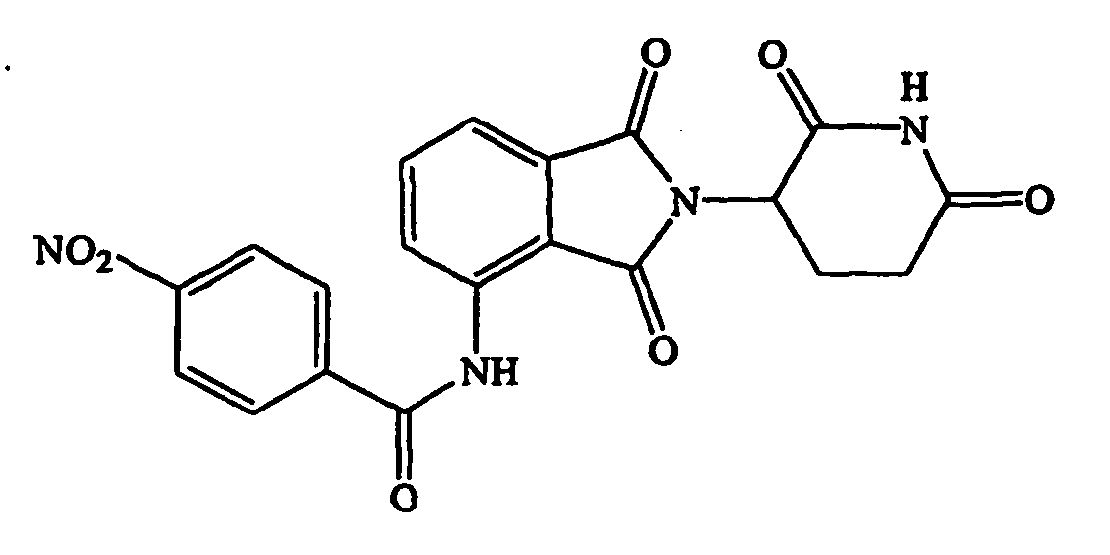
- A mixture of 4-amino-2-(2,6-dioxo(3-piperidyl))isoindoline-1,3-dione (2.2 g, 8.0 mmol) and 4-nitrobenzoyl chloride (3.0 g, 16.0 mmol) in THF (80 mL) was heated to reflux for 15 h. To the mixture was added methanol (20 mL) to give a suspension. The suspension was filtered and washed with methanol (20 mL) to give N-[2-(2,6-Dioxo-piperidin-3-yl)-1,3-dioxo-2,3-dihydro-1H-isoindol-4-yl]-4-nitro-benzamide as a white solid (2.5 g, 73 % yield): mp, 298-300 °C; 1H NMR (DMSO-d6) δ 2.06-2.10 (m, 1H, CHH), 2.49-2.65 (m, 2H, CH 2), 2.83-2.98 (m, 1H, CHH), 5.18 (dd, J = 5.2, 12.6 Hz, 1H, NCH), 7.73 (d, J = 7.2 Hz, 1H, Ar), 7.93 (t, J = 8.0 Hz, 1H, Ar), 8.19-8.22 (m, 2H, Ar), 8.42-8.47 (m, 3H, Ar), 10.65 (s, 1H, NH), 11.18 (s, 1H, NH); 13C NMR (DMSO-d6) δ 21.99,30.92, 48.99, 119.30, 119.56, 124.06, 127.49, 129.01,131.58, 135.77, 136.23, 138.96, 149.69, 163.65, 166.57, 167.48,169.68, 172.72; Anal Calcd for C20H14N4O7: C, 56.88; H, 3.34; N, 13.27. Found: C, 57.15; H, 3.02; N, 13.22.
-

- To a solution of ethoxyacetic acid (0.8 mL, 8.5 mmol) and oxalyl chloride (0.7 mL, 8.0 mmol) in ether (5 mL) was added DMF (0.03 mL) at room temperature. After 3h, 4-amino-2-(2,6-dioxo(3-piperidyl))isoindoline-1,3-dione (1.1 g, 4.0 mmol) and THF (40 mL) was added to the mixture. Then the mixture was heated to reflux for 15 h. To the mixture was added methanol, (10 mL) to give a suspension. The suspension was filtered and washed with methanol (10 mL) to give N-[2-(2,6-dioxo-piperidin-3-yl)-1,3-dioxo-2,3-dihydro-1H-isoindol-4-yl]-2-ethoxy-acetamide as a white solid (1.3 g, 87 % yield): mp, 253-255 °C; 1H NMR (DMSO-d6) δ 1.27 (t, J= 7.0 Hz, 3H, CH3 ), 2.06-2.10 (m, 1H, CHH), 2.46-2.64 (m, 2H, CH 2), 2.84-2.98 (m, 1H, CHH), 3.66 (q, J= 7.0 Hz, 2H, CH 2), 4.14 (s, 2H, CH 2), 5.17 (dd, J = 5.2, 12.7 Hz, 1H, NCH), 7.62 (d, J= 7.2 Hz, 1H, Ar), 7.87 (t, J= 8.2 Hz, 1H, Ar), 8.75 (d, J= 8.4 Hz, 1H, Ar), 10.39 (s, 1H, NH), 11.16 (s, 1H, NH); 13C NMR (DMSO-d6) δ 14.88, 21.93, 30.92, 48.98, 66.89, 69.49, 116.00, 118.28, 124.25, 131.31, 135.99, 136.53, 166.69, 168.31, 169.49, 169.73, 174.71; Anal Calcd for C17H17N3O6: C, 56.82; H, 4.77; N, 11.69. Found: C, 56.82; H, 4.71; N, 11.60.
-

- To a solution of (methylthio)acetic acid (0.77 mL, 8.9 mmol) and oxalyl chloride (0.7 mL, 8.0 mmol) in ether (5 mL) was added DMF (0.02 mL) at room temperature. After 3h, 4-amino-2-(2,6-dioxo(3-pipendyl))isomdoline-1,3-dione (1.1 g, 4.0 mmol) and THF (40 mL) was added to the mixture. Then the mixture was heated to reflux for 15 h. To the mixture was added methanol (10 mL) to give a suspension. The suspension was filtered and washed with methanol (10 mL) to give N-[2-(2,6-dioxo-piperidin-3-yl)-1,3-dioxo-2,3-dihydro-1H-isoindol-4-yl]-2-methylsulfanyl-acetamie as a white solid (1.0 g, 69 % yield): mp, 228-230 °C; 1H NMR (DMSO-d6) δ 2.05-2.10 (m,1H, CHH), 2.18 (s, 3H, CH 3), 2.46-2.65 (m, 2H, CH 2), 2.82-2.95 (m, 1H, CHH), 3.53 (s, 2H, CH 2), 5.17 (dd, J = 5.2,12.6 Hz, 1H, NCH), 7.63 (d, J = 7.2 Hz, 1H, Ar), 7.86 (t, J = 7.5 Hz, 1H, Ar), 8.61 (d, J = 8.4 Hz, 1H, Ar),10.39 (s, 1H, NH), 11.16 (s, 1H, NH); 13C NMR (DMSO-d6) δ 15.62, 21.96, 30.93, 37.99, 48.94, 116.69, 118.46, 125.28, 131.44, 136.31, 166.67, 167.88, 168.63, 169.78, 172.75; Anal Calcd for C16H15N3O5S: C, 53.18; H, 4.18; N, 11.63. Found: C, 53.26; H, 4.17; N, 11.52.
-

- A mixture of 4-amino-2-(2,6-dioxo(3-piperidyl))isoindoline-1,3-dione (660 mg, 2.4 mmol) and 2-methoxybenzoyl chloride (0.7 mL, 4.7 mmol) in THF (20 mL) was heated to reflux for 15 h. To the mixture was added methanol (5 mL) to give a suspension. The suspension was filtered and washed with methanol (20 mL) to give N-[2-(2,6-dioxo-piperidin-3-yl)-1,3-dioxo-2,3-dihydro-1H-isoindol-4-yl]-2-methoxy-benzamide as a white solid (760 mg, 78 % yield): mp, 286-287 °C; 1H NMR (DMSO-d6) (at 340K) δ 2.09-2.14 (m, 1H, CHH), 2.55-2.66 (m, 2H, CH 2), 2.85-2.98 (m, 1H, CHH), 4.14 (s, 3H, OCH 3), 5.19 (dd, J = 5.5, 12.9 Hz, 1H, NCH), 7.17 (t, J = 7.2 Hz, 1H, Ar), 7.30 (d, J = 8.3 Hz, 1H, Ar), 7.61-7.68 (m, 2H, Ar), 7.89 (t, J = 7.7 Hz, 1H, Ar), 8.12 (dd, J = 1.8, 7.9 Hz, 1H Ar), 9.03 (d, J = 8.5 Hz, 1H, Ar), 11.17 (s, 1H, NH), 11.64 (s, 1H, NH); 13C NMR (DMSO-d6) (at 340K) δ 22.09, 31.02, 49.29, 56.19, 112.65, 116.31, 117.93, 120.66, 121.14, 125.52, 131.59, 131.75, 134.34, 136.22,137.00, 157.64, 163.82, 166.69, 168.15, 169.43, 172.32; Anal Calcd for C21H17N3O6: C, 61.92; H, 4.21; N, 10.31. Found: C, 62.05; H, 4.10; N, 10.38.
-
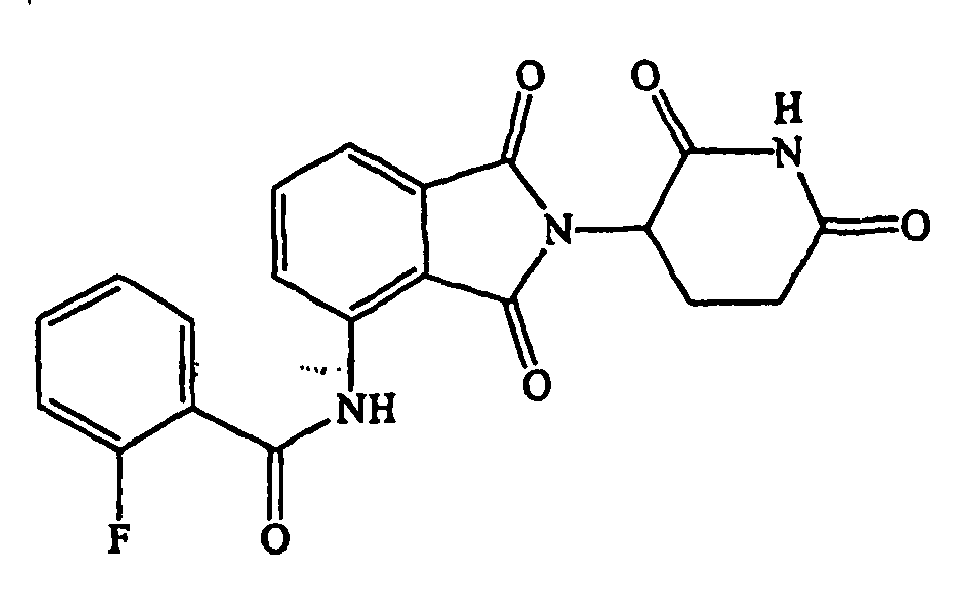
- A mixture of 4-amino-2-(2,6-dioxo(3-piperidyl))isoindoline-1,3-dione (1.1 g, 4.0 mmol) and 2-fluorobenzoyl chloride (1.0 mL, 8.4 mmol) in THF (40 mL) was heated to reflux for 15 h. To the mixture was added methanol (10 mL) to give a suspension. The suspension was filtered and washed with methanol (20 mL) to give N-[2-(2,6-dioxo-piperidin-3-yl)-1,3-dioxo-2,3-dihydro-1H-isoindol-4-yl]-2-fluoro-benzamide as a white solid (1.5 g, 93 % yield): mp, 300-302 °C; 1H NMR (DMSO-d6) δ 2.05-2.12 (m, 1H, CHH), 2.45-2.65 (m, 2H, CH 2), 2.83-2.97 (m, 1H, CHH), 5.18 (dd, J = 5.5,12.9 Hz, 1H, NCH), 7.40-7.49 (m, 2H, Ar), 7.67-7.76 (m, 2H, Ar), 7.88-7.98 (m, 1H, Ar), 8.01-8.05 (m, 1H, Ar), 8.76 (d, J = 8.4 Hz, 1H Ar), 10.56 (d, J N-F = 10 Hz, 1H, NH), 11.17 (s, 1H, NH); 13C NMR (DMSO-d6) δ 21.96, 30.92, 48.97, 116.48, 116.97 (d, J C-F =14 Hz), 118.82, 120.87 (d, J C-F = 12 Hz), 125.32 (d, J C-F = 1.5 Hz), 125.74, 131.32, 131.39, 134.88 (d, J C-F = 9 Hz), 136.22, 136.48, 159.75 (d, J C-F = 252 Hz), 161.76 (d, J C-F = 7 Hz), 166.58, 168.04, 169.70, 172,71; Anal Calcd for C20H14N3O5F: C, 60.76; H, 3.57; N, 10.63; F, 4.81. Found: C, 60.70; H, 3.64; N, 10.64; F, 4.91.
-
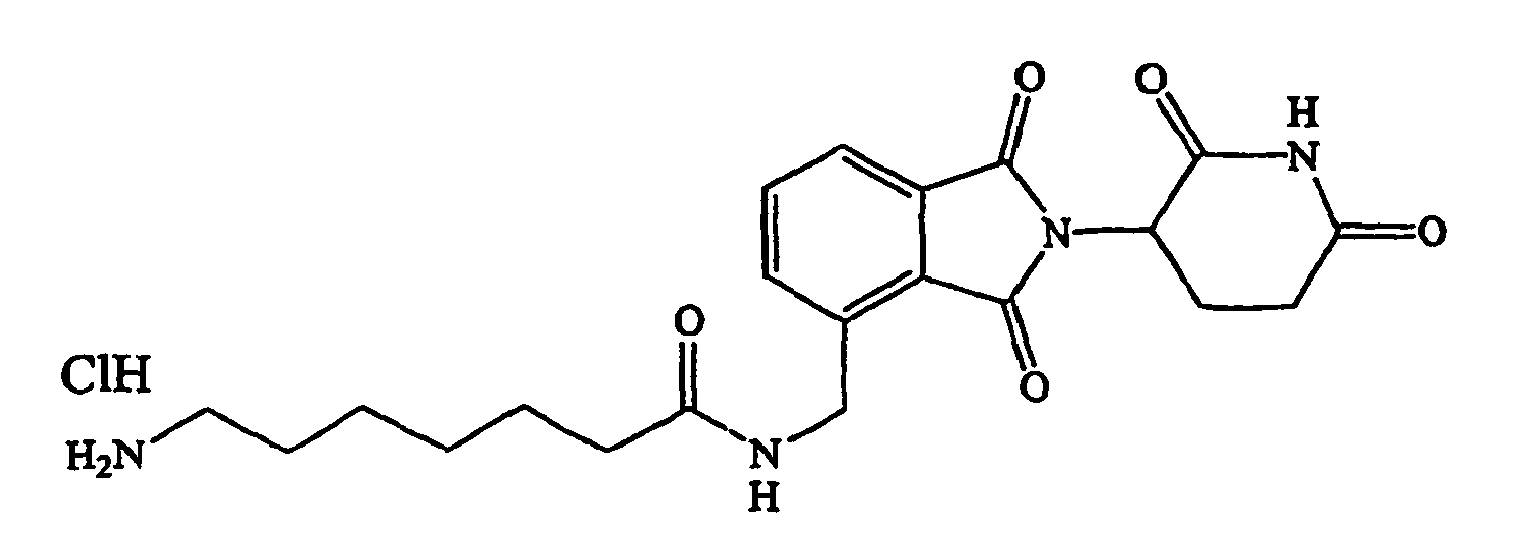
Step 2: A 4N HCl solution in dioxane (1.5 mL) was added to a stirred solution of 7-[(tert-butoxy)carbonylamino]-N-{[2-(2,6-dioxo(3-piperidyl))-1,3-dioxoisoindolin-4-yl]methyl}heptanamide (0.72g, 1.40 mmol) in CH2Cl2 (25 mL) and stirred for 17 hours. The resulting suspension was filtered to give 7-amino-N-{[2-(2,6-dioxo(3-piperidyl))-1,3-dioxoisoindolin-4-yl]methyl}heptanamide hydrochloride (0.26g, 41%) as a white solid: mp 187-189°C; 1H NMR (DMSO-d6) δ 11.12 (s, 1H), 8.52 (t, J=5.7 Hz, 1H), 7.93 (b, 3H), 7.88-7.67 (m, 3H), 5.18-5.11 (dd, J=5.3 and 12.4 Hz, 1H), 4.72 (d, J=5.7 Hz, 2H), 2.91-2.50 (m, 5H), 2.21 (t, J=7.2 Hz, 2H), 2.08-2.04 (m, 1H), 1.57-1.52 (m, 4H), 1.31-1.29 (m, 4H); 13C NMR (CDCl3) δ 172.70, 172.55, 169.77, 167.44, 166.90, 139.54, 134.68, 133.08, 131.47, 127.01, 121.77, 48.82, 38.64, 37.53, 35.00, 30.90, 28.05, 26.73, 25.50, 24.89, 21.95; Anal. Calcd. For C21H27N4O5Cl + 0.64 H2O: C, 54.95; H, 6.13; N, 12.21; Cl, 7.72. Found: C, 54.56; H, 6.10; N, 11.96; Cl, 8.04. -

- 1,8-Diazabicyclo[5,4,0]undec-7-ene (0.62g, 4.08 mmol) was added to a stirred suspension of 4-(aminomethyl)-2-(2,6-dioxo(3-piperidyl))isoindoline-1,3-dione hydrochloride (0.6g, 1.85 mmol) in CH3CN (50 mL). After stirring for 20 min, butyryl chloride (0.24g, 2.22 mmol) was added. The mixture was stirred at room temperature for 17 hours. The solvent was removed in vacuo and the residue was dissolved in CH2Cl2 (70 mL). The CH2Cl2 solution was washed with H2O (30 mL), brine (30 mL) and dried (MgSO4). The solvent was removed in vacuo and residue was purified by chromatography (SiO2, CH2Cl2:EtOAc 1:1) to give N-{[2-(2,6-dioxo(3-piperidyl))-1,3-dioxoisoindolin-4-yl]methyl}butanamide (0.41g, 62%) as a white solid: mp 121-123°C; 1H NMR (DMSO-d6) δ 11.14 (s, 1H), 8.44 (1, J=5.55 Hz, 1H), 7.87-7.66 (m, 3H), 5.19-5.12 (dd, J=5.1 and 12.4 Hz, 1H), 4.72 (d, J=5.6 Hz, 2H), 2.96-2.85 (m, 1H), 2.63-2.51 (m, 2H), 2.17 (t, J=7.2 Hz, 2H), 2.08-2.04 (m, 1H), 1.63-1.51 (m, 2H), 0.87 (t, J=7.3 Hz, 3H); 13C NMR (DMSO-d6) δ 172.71, 172.47, 169.77, 167.46, 166.92, 139.53, 134.68, 133.11, 131.49, 127.04, 121.77, 48.84, 37.55, 37.16, 30.91, 21.96, 18.60, 13.63; Anal. Calcd. For C18H19N3O5: C, 60.50; H, 5.36; N, 11.76. Found: C, 60.46; H, 5.36; N, 11.59.
-

- 1,8-Diazabicyclo[5,4,0]undec-7-ene (0.62g, 4.08 mmol) was added to a stirred suspension of 4-(aminomethyl)-2-(2,6-dioxo(3-piperidyl))isoindoline-1,3-dione hydrochloride (0.6g, 1.85 mmol) in CH3CN (50 mL). After stirring for 20 min, benzoyl chloride (0.31 g, 2.22 mmol) was added. The mixture was stirred at room temperature for 17 hours. The solvent was removed in vacuo and the residue was dissolved in CH2Cl2 (70 mL). The CH2Cl2 solution was washed with H2O (30 mL), brine (30 mL) and dried (MgSO4). The solvent was removed and the residue was purified by chromatography (SiO2, CH2Cl2: EtOAC 6:4) to give N-{[2-(2,6-dioxo(3-piperidyl))-1,3-dioxoisoindolin-4-yl]methyl}benzamide (0.55g, 76%) as a white solid: mp 227-229 °C; 1H NMR (DMSO-d6) δ 11.16 (s, 1H), 9.16 (t, J=5.7 Hz, 1H), 7.95-7.72 (m, 5H), 7.60-7.46 (m, 3H), 5.22-5.12 (dd, J=5.4 and 12.8 Hz, 1H), 4.96 (d, J=5.7 Hz, 2H), 2.98-2.85 (m, 1H), 2.65-2.50 (m, 2H), 2.11-2.06 (m, 1H); 13C NMR (DMSO-d6) δ 172.72, 169.80, 167.54, 166.96, 166.60, 139.34, 134.77, 133.92, 133.02, 131.52, 131.42, 128.34, 127.28, 127.12, 121.83, 48.88, 38.32, 30.93, 21.98; Anal. Calcd. For C21H17N3O5: C, 64.45; H, 4.38; N, 10.74. Found: C, 64.47; H, 4.50; N, 10.34.
-

- 1,8-Diazabicyclo[5,4,0]undec-7-ene (0.65g, 4.26mmol) was added to a stirred suspension of 4-(aminomethyl)-2-(2,6-dioxo(3-piperidyl))isoindoline-1,3-dione hydrochloride (0.60g, 1.85 mmol) in CH3CN (50 mL). After stirring for 20 min, phenylacetyl chloride (0.35g, 2.22mmol) was added. The mixture was stirred at room temperature for 17 hours. The solvent was removed in vacuo and the residue was dissolved in CH2Cl2 (70 mL). The CH2Cl2 solution was washed with 1N HCl (30 mL), H2O (30 mL), brine (30 mL) and dried (MgSO4). The solvent was removed in vacuo and the residue was purified by chromatography (SiO2, CH2Cl2: EtOAc 6:4) to give N-{[2-(2,6-dioxo(3-piperidyl))-1,3-dioxoisoindolin-4-yl]methyl}-2-phenylacetamide (0.41g, 55%) as a white solid: mp 128-130°C; 1H NMR (DMSO-d6) δ 11.14 (s, 1H), 8.67 (t, J=5.5 Hz, 1H), 7.80-7.61 (m, 3H), 7.29 (s, 5H), 5.19-5.12 (dd, J=5.1 and 12.4 Hz, 1H), 4.71 (d, J=5.5 Hz, 2H), 3.53 (s, 2H), 2.96-2.83 (m, 1H), 2.63-2.50 (m, 2H), 2.08-2.03 (m, 1H); 13HNMR (DMSO-d6)δ 172.77, 170.65, 169.82, 167.45, 166.93, 139.19, 136.15, 134.68, 133.18, 131.53, 129.05, 128.25, 127.13, 126.43, 121.90, 48.85, 42.24, 37.85, 30.93, 21.98; Anal. Calcd. For C22H19N3O5: C, 65.18; H, 4.72; N, 10.36. Found: C, 65.16; H, 4.75; N, 10.11.
-
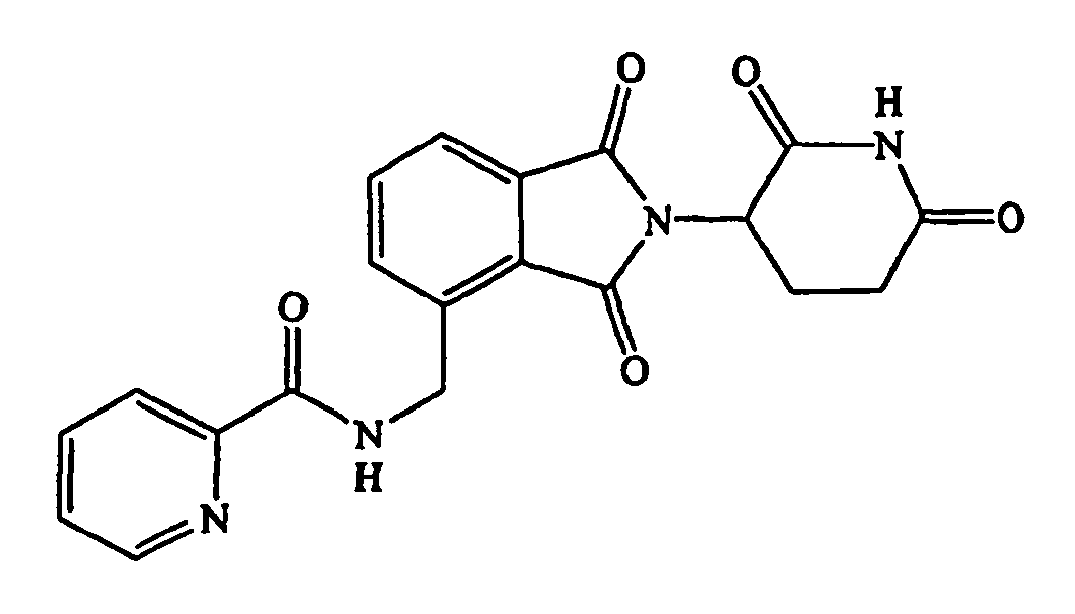
- 1,8-Diazabicyclo[5,4,0]undec-7-ene (0.98g, 6.48mmol) was added to a stirred suspension of 4-(aminomethyl)-2-(2,6-dioxo(3-piperidyl))isoindoline-1,3-dione hydrochloride (0.60g, 1.85 mmol) in CH3CN (50 mL). After stirring for 20 min, picolinoyl chloride hydrochloride (0.41g, 2.22 mmol) was added. The mixture was stirred at room temperature for 17 hours. The solvent was removed in vacuo and the residue was dissolved in CH2Cl2 (70 mL). The CH2Cl2 solution was washed with 1N HCL (30 mL), H2O (30 mL), brine (30 mL) and dried (MgSO4). The solvent was removed in vacuo and the residue was purified by chromatography (SiO2, CH2Cl2: CH3OH 97.5:2.5) to give N-{[2-(2,6-dioxo(3-piperidyl))-1,3-dioxoisoindolin4-yl]methyl}-2-pyridylcarboxamide (0.40g, 55%) as a white solid: mp 155-157°C; 1H NMR (DMSO-d6) δ 11.15 (s, 1H), 9.50 (t, J=6.2 Hz, 1H), 8.70 (d, J=4.6 Hz, 1H), 8.08-7.98 (m, 2H), 7.82-7.62 (m, 4H), 5.21-5.14 (dd, J=5.4 and 12.6 Hz, 1H), 4.97 (d, J=6.3 Hz, 2H), 2.99-2.84 (m, 1H), 2.65-2.50 (m, 2H), 2.10-2.06 (m, 1H); 13C NMR (DMSO-d6) δ 172.77, 169.85, 167.59, 166.99, 164.38, 149.59, 148.56, 139.02, 137.87, 134.79,132.95, 131.57,127.16, 126.76, 122.05,121.87, 48.87, 38.37, 30.94, 21.97; Anal. Calcd. For C20H16N4O5+0.08H2O: C, 61.08; H, 4.13; N, 14.25. Found: C, 61.48; H, 4.22; N, 13.87.
-

- 1,8-Diazabicyclo[5,4,0]undec-7-ene (0.62g, 4.08 mmol) was added to a stirred suspension of 4-(aminomethyl)-2-(2,6-dioxo(3-piperidyl))isoindoline-1,3-dione hydrochloride (0.60 g, 1.85 mmol) in CH3CN (50 mL). After stirring for 20 min, undecanoyl chloride (0.45g, 2.22 mmol) was added. The mixture was stirred at room temperature for 17 hours. The solvent was removed and the residue was dissolved in CH2Cl2 (70 mL). The CH2Cl2 solution was washed with 1N HCl (30 mL), H2O (30 mL), brine (30 mL) and dried (MgSO4). The solvent was removed in vacuo and the residue was purified by chromatography (SiO2, CH2Cl2: EtOAc 6:4) to give N-{[2-(2,6-dioxo(3-piperidyl))-1,3-dioxoisoindolin-4-yl]methyl}undecanamide (0.53g, 63%) as a white solid: mp 138-139°C; 1H NMR (DMSO-d6) δ 11.12 (s, 1H), 8.42 (t, J=5.9 Hz, 1H), 7.85-7.78 (m, 2H), 7.71-7.65 (m, 1H), 5.18-5.11 (dd, J=5.4 and 12.5 Hz, 1H), 4.72 (d, J=5.9 Hz, 2H), 2.96-2.83 (m, 1H), 2.64-2.47 (m, 2H), 2.18 (t, J=7.3 Hz, 2H), 2.08-2.04 (m, 1H), 1.55-1.50 (m, 2H), 1.24 (s, 14H), 0.85 (t, J=6.1 Hz, 3H); 13C NMR (DMSO-d6) δ 172.74, 172.63, 169.80, 167.47, 166.93, 139.55, 134.65, 133.10, 131.50, 127.04,121.79, 48.83, 37.55, 35.21, 31.28, 30.92, 28.94, 28.74, 28.67, 25.20, 22.08, 21.97, 13.94; Anal. Calcd. For C25H33N3O5: C, 65.91; H, 7.30; N, 9.23. Found: C, 66.08; H, 7.13; N, 9.23.
-

- 1,8-Diazabicyclo[5,4,0]undec-7-ene (0.62g, 4.08 mmol) was added to a stirred suspension of 4-(aminomethyl)-2-(2,6-dioxo(3-piperidyl))isoindoline-1,3-dione hydrochloride (0.60g, 1.85 mmol) in CH3CN (50 mL). After stirring for 20 min, isobutyryl chloride (0.24g, 2.22 mmol) was added. The mixture was stirred at room temperature for 17 hours. The solvent was removed in vacuo and the residue was dissolved in CH2Cl2 (70 mL). The CH2Cl2 solution was washed with 1N HCl (30 mL), H2O (30 mL), brine (30 mL) and dried (MgSO4). The solvent was removed in vacuo and the solid was purified from ether (10 mL) and hexane (10 mL) to give N-{[2-(2,6-dioxo(3-piperidyl))-1,3-dioxoisoindolin-4-yl]methyl}-2-methylpropanamide (0.48g, 73%) as a white solid: mp 218-220°C; 1H NMR (DMSO4) δ 11.13 (s, 1H), 8.39 (t, J=5.8 Hz, 1H), 7.87-7.78 (m, 2H), 7.66-7.63 (m, 1H), 5.19-5.12 (dd, J=6.9 and 12.5 Hz, 1H), 4.71 (d, J=5.8 Hz, 2H), 2.97-2.83 (m, 1H), 2.63-2.43 (m, 3H), 2.08-2.04 (m, 1H), 1.07 (d, J=6.9 Hz, 6H); 13C NMR (DMSO-d6) δ 176.52,172.75, 169.82, 167.49, 166.95, 139.54, 134.77, 132.85, 131.50, 127.02, 121.77, 48.83, 37.48, 33.98, 30.92, 21.96, 19.53; Anal. Calcd. For C18H19N3O5: C, 60.50; H, 5.36; N, 11.76. Found: C, 60.48; H, 5.33; N, 11.64.
-

- 1,8-Diazabicyclo[5,4,0]undec-7-ene (0.62g, 4.08 mmol) was added to a stirred suspension of 4-(aminomethyl)-2-(2,6-dioxo(3-piperidyl))isoindoline-1,3-dione hydrochloride (0.60g, 1.85 mmol) in CH3CN (50 mL). After stirring for 20 min, cyclopentanecarbonyl chloride (0.29g, 2.22 mmol) was added. The mixture was stirred at room temperature for 17 hours. The solvent was removed in vacuo and the residue was dissolved in CH2Cl2 (70 mL). The CH2Cl2 solution was washed with 1N HCl (30 mL), H2O (30 mL), brine (30 mL) and dried (MgSO4). The solvent was removed in vacuo and the solid was stirred with ether (20 mL) to give N-{[2-(2,6-dioxo(3-piperidyl))-1,3-dioxoisoindolin-4-yl]methyl}cyclopentylcarboxamide (0.59g, 83%) as a white solid: mp 175-177°C; 1H NMR (DMSO-d6) δ 11.13 (s, 1H), 8.41 (t, J=5.7 Hz, 1H), 7.87-7.78 (m, 2H), 7.66-7.63 (m, 1H), 5.19-5.12 (dd, J=5.3 and 12.5 Hz, 1H), 4.72 (d, J=5.8 Hz, 2H), 2.98-2.83 (m, 1H), 2.73-2.51 (m, 3H), 2.08-2.04 (m, 1H), 1.81-1.51 (m, 8H); 13C NMR (DMSO-d6) δ 175.71, 172.75, 169.82, 167.49, 166.95, 139.68, 134.76, 132.91, 131.50, 127.01, 121.77, 48.84, 44.20, 37.60, 30.93, 29.96, 25.60, 21.97; Anal. Calcd. For C20H21N3O5: C, 62.65; H, 5.52; N, 10.96. Found: C, 62.52; H, 5.55; N, 10.81.
-

- 1,8-Diazabicyclo[5,4,0]undec-7-ene (0.62g, 4.08 mmol) was added to a stirred suspension of 4-(aminomethyl)-2-(2,6-dioxo(3-piperidyl))isoindoline-1,3-dione hydrochloride (0.60g, 1.85 mmol) in CH3CN (50 mL). After stirring for 20 min, cyclohexanecarbonyl chloride (0.33g, 2.22 mmol) was added. The mixture was stirred at room temperature for 17 hours. The solvent was removed in vacuo and the residue was dissolved in CH2Cl2 (70 mL). The CH2Cl2 solution was washed with 1N HCL (30 mL), H2O (30 mL), brine (30 mL) and dried (MgSO4). The solvent was removed and the residue was purified by chromatography (SiO2, CH2Cl2: EtOAc 6:4) to give N- {[2-(2,6-dioxo(3-piperidyl))-1,3-dioxoisoindolin-4-yl]methyl}cyclohexylcarboxamide (0.53g, 72%) as a white solid: mp 142-144°C; 1H NMR (DMSO-d6) 8 11.13 (s, 1H), 8.36 (t, J=5.8 Hz, 1H), 7.86-7.77 (m, 2H), 7.64-7.61 (m, 1H), 5.18-5.11 (dd, J=5.3 and 12.5 Hz, 1H), 4.70 (d, J=5.8 Hz, 2H), 2.97-2.83 (m, 1H), 2.63-2.47 (m, 2H), 2.26-2.17 (m, 1H), 2.08-2.03 (m, 1H), 1.79-1.61 (m, 5H), 1.43-1.12 (m, 5H); 13C NMR (DMSO-d6) δ 175.58,172.75,169.82,167.49, 166.96, 139.68, 134.75, 132.76, 131.49, 126.99, 121.73, 48.83, 43.90, 37.43, 30.92, 29.20, 25.43, 25.24, 21.96; Anal. Calcd. For C21H23N3O5: C, 63.47; H, 5.83; N, 10.57. Found: C, 63.12; H, 5.68; N, 10.41.
-

- 1,8-Diazabicyclo[5,4,0]undec-7-ene (0.29g. 1.90 mmol) was added to a stirred suspension of 4-(aminomethyl)-2-(2,6-dioxo(3-piperidyl))isoindoline-1,3-dione hydrochloride (0.6g, 1.85 mmol) in CH3CN (50 mL). After stirring for 20 min, phenyl isocyanate (0.33g, 2.77 mmol) was added. The mixture was stirred at room temperature for 17 hours. The solvent was removed in vacuo and the residue was dissolved in CH2Cl2 (70 mL). The CH2Cl2 solution was washed with 1N HCl (30 mL), H2O (30 mL), brine (30 mL) and dried (MgSO4). The solvent was removed in vacuo and the residue was purified by chromatography (SiO2, CH2Cl2 : EtOAc 7:3) to give N-{[2-(2,6-dioxo(3-piperidyl))-1,3-dioxoisoindolin-4-yl]methyl}(phenylamino)carboxamide (0.23g, 31%) as a white solid: mp 212-214°C; 1H NMR (DMSO-d6) δ 11.15 (s, 1H), 8.78 (s, 1H), 7.88-7.76 (m, 3H), 7.37 (d, J=7.7 Hz, 2H), 7.21 (t, J=7.7 Hz, 2H), 6.89 (t, J=7.3 Hz, 1H), 6.76 (t, J=5.9 Hz, 1H), 5.20-5.13 (dd, J=5.3 and 12.5 Hz, 1H), 4.72 (d, J=5.9 Hz, 2H), 2.97-2.84 (m, 1H), 2.65-2.49 (m, 2H), 2.09-2.05 (m, 1H); 13C NMR (DMSO-d6) δ 172.72, 169.79, 167.58, 166.99, 155.22, 140.25, 134.69, 133.63, 131.59,128.60,127.18, 121.83, 121.18, 117.70, 48.86, 38.71, 30.92, 21.97; Anal. Calcd. For C21H18N4O5: C, 62.07; H, 4.46; N, 13.79. Found: C, 62.14; H, 4.49; N, 13.49.
-

- 1,8-Diazabicyclo[5,4,0]undec-7-ene (0.29g, 1.90 mmol) was added to a stirred suspension of 4-(aminomethyl)-2-(2,6-dioxo(3-piperidyl))isoindoline-1,3-dione hydrochloride (0.6g, 1.85 mmol) in CH3CN (50 mL). After stirring for 20 min, n-butyl isocyanate (0.27g, 2.77 mmol) was added. The mixture was stirred at room temperature for 17 hours. The solvent was removed in vacuo and the residue was dissolved in CH2Cl2 (70 mL). The CH2Cl2 solution was washed with 1N HCl (30 mL), H2O (30 mL), brine (30 mL) and dried (MgSO4). The solvent was removed in vacuo and the residue was purified by chromatography (SiO2, CH2Ch: EtOAc 1:1) to give N-{[2-(2,6-dioxo(3-piperidyl))1,3-dioxoisoindolin-4-yl]methyl}(butylamino)carboxamide (0.44g, 61%) as a white solid: mp 172-174°C; 1H NMR (DMSO-d6) δ 11.13 (s, 1H), 7.86-7.68 (m, 3H), 6.42 (t, J=5.9 Hz, 1H), 6.12 (t, J=5.4 Hz, 1H), 5.18-5.11 (dd, J=5.2 and 12.4 Hz, 1H), 4.63 (d, J=5.9 Hz, 1H), 3.03-2.83 (m, 3H), 2.64-2.51 (m, 2H), 2.08-2.04 (m, 1H), 1.37-1.22 (m, 4H), 0.86 (t, J=7.0 Hz, 3H); 13C NMR (DMSO-d6) δ 172.70,169.77,167.54,167.00,157.98,141.14, 134.56, 133.33, 131.47, 126.94, 121.58, 48.80, 38.98, 38.70, 32.01, 30.90, 21.95, 19.46, 13.64; Anal. Calcd. For C19H22N4O5: C, 59.06; H, 5.74; N, 14.50. Found: C, 59.24; H, 5.53; N, 14.37.
-

- 1,8-Diazabicyclo[5,4,0]undec-7-ene (0.29g, 1.90 mmol) was added to a stirred suspension of 4-(aminomethyl)-2-(2,6-dioxo(3-piperidyl))isoindoline-1,3-dione hydrochloride (0.6 g, 1.85 mmol) in CH3CN (50 mL). After stirring for 20 min, propyl isocyanate (0.24 g, 2.77 mmol) was added. The mixture was stirred at room temperature for 17 hours. The solvent was removed and the residue was dissolved in CH2Cl2 (70 mL). The CH2Cl, solution was washed with 1N HCl (30 mL), H2O (30 mL), brine (30 mL) and dried (MgSO4). The solvent was removed in vacuo, and the residue was purified by chromatography (SiO2, CH2Cl2: CH3OH 100: 3) to give N-{[2-(2,6-dioxo(3-piperidyl))-1,3-dioxoisoindolin-4-yl]methyl}(pmpylamino)carboxamide (0.13g, 20%) as a white solid: mp160-162°C; 1H NMR (DMSO-d6) δ 11.14 (s, 1H), 7.86-7.69 (m, 3H), 6.44 (t, J=5.9 Hz, 1H), 6.16 (t, J=1H), 5.18-5.11 (dd, J=5.3 and 12.4 Hz, 1H), 4.63 (d, J=5.9 Hz, 2H), 2.99-2.83 (m, 3H), 2.64-2.50 (m, 2H), 2.08-2.04 (m, 1H), 1.42-1.32 (m, 2H), 0.83 (t, J=7.3 Hz, 3H); 13 C NMR (DMSO-d6) δ 172.78, 169.84, 167.59, 167.05, 158.03, 141.16, 134.62, 133.34,131.51, 126.96, 121.63, 48.82, 41.18, 30.94, 23.15, 21.99, 11.33; Anal. Calcd. For C18H20N4O5: C, 58.06; H, 5.41; N, 15.05. Found: C, 57.94; H, 5.31; N, 14.90.
-

- 1,8-Diazabicyclo[5,4,0]undec-7-ene (0.29g, 1.90 mmol) was added to a stirred suspension of 4-(aminomethyl)-2-(2,6-dioxo(3-piperidyl))isoindoline-1,3-dione hydrochloride (0.6g, 1.85 mmol) in CH3CN (50 mL). After stirring for 20 min, cyclohexyl isocyanate (0.35g, 2.77 mmol) was added. The mixture was stirred at room temperature for 17 hours. The solvent was removed in vacuo and the residue was dissolved in CH2Cl2 (70 mL). The CH2Cl2 solution was washed with 1N HCl (30 mL), H2O (30 mL), brine (30 mL) and dried (MgSO4). The solvent was removed in vacuo and the residue was purified by chromatography (SiO2, CH2Cl2: EtOAc 1:1) to give N-{[2-(2,6-dioxo(3-piperidyl))-1,3-dioxoisoindolin-4-yl]methyl}(cyclohexylamino)carboxamide (0.37g, 49%) as a white solid: mp 208-210°C; 1H NMR (DMSO-d6) δ 11.13 (s, 1H), 7.86-7.68 (m, 3H), 6.34 (t, J=5.8Hz, 1H), 6.04 (d, J=7.9 Hz, 1H), 5.18-5.11 (dd, J=5.3 and 12.4 Hz, 1H), 4.62 (d, J=5.8 Hz, 2H), 3.37 (m, 1H), 2.96-2.83 (m, 1H), 2.63-2.50 (m, 2H), 2.08-2.04 (m, 1H), 1.76-1.02 (m, 10H); 13C NMR (DMSO-d6) δ 172.78, 169.84, 167.59, 0167.04, 157.28, 141.13, 134.64, 133.42, 131.51, 126.98, 121.64, 48.82, 47.91, 38.66, 33.23, 30.94, 25.27, 24.47, 21.99; Anal. Calcd. For C21H24N4O5: C, 61.16; H, 5.87; N, 13.58. Found: C, 61.21; H, 5.79; N,13.63.
-

- 1,8-Diazabicyclo[5,4,0]undec-7-ene (0.29g, 1.90 mmol) was added to a stirred suspension of 4-(aminomethyl)-2-(2,6-dioxo(3-piperidyl))isoindoline-1,3-dione hydrochloride (0.6g, 1.85 mmol) in CH3CN (50 mL). After stirring for 20 min, isopropyl isocyanate (0.24g, 2.77 mmol) was added. The mixture was stirred at room temperature for 17 hours. The solvent was removed in vacuo and the residue was dissolved in CH2Cl2 (70 mL). The CH2Cl2 solution was washed with 1N HCl (30 mL), H2O (30 mL), brine (30 mL) and dried (MgSO4). The solvent was removed in vacuo and the residue was purified by chromatography (SiO2, CH2Cl2: CH3OH 97.5:2.5) to give N-{[2-(2,6-dioxo(3-piperidyl))-1,3-dioxoisoindolin-4-yl]methyl}[(methylethylamino)]carboxamide (0.25g, 36%) as a white solid: mp 180-182°C; 1H NMR (DMSO-d6) δ 11.19 (s, 1H), 7.87-7.68 (m, 3H), 6.33 (t, J=5.9 Hz, 1H), 6.02 (d, J=7.5 Hz, 1H), 5.18-5.11 (dd, J=5.2 and 12.4 Hz, 1H), 4.62 (d, J=5.9 Hz, 2H), 3.73-3.35 (m, 1H), 2.98-2.83 (m, 1H), 2.63-2.50 (m, 2H), 2.08-2.04 (m, 1H), 1.04 (d, J=6.5 Hz, 6H); 13C NMR (DMSO-d6) δ 172.78,169.85,167.59,167.05,157.36, 141.16, 134.65, 133.39, 131.52, 126.98, 121.64, 48.82, 41.03, 38.64, 30.94, 23.18, 21.99; Anal. Calcd. For C18H20N4O5: C, 58.06; H, 5.41; N, 15.05. Found: C, 58.20; H, 5.44; N, 14.95.
-

- 1,8-Diazabicyclo[5,4,0]undec-7-ene (0.29g, 1.90 mmol) was added to a stirred suspension of 4-(aminomethyl)-2-(2,6-dioxo(3-piperidyl))isoindoline-1,3-dione hydrochloride (0.6g, 1.85 mmol) in CH3CN (50 mL). After stirring for 20 min, octyl isocyanate (0.44g, 2.77 mmol) was added. The mixture was stirred at room temperature for 17 hours. The slurry mixture was filtered and the solid was recrystallized from methanol to give N-{[2-(2,6-dioxo(3-piperidyl))-1,3-dioxoisoindolin-4-yl]methyl}(octylamino)carboxamide (0.46g, 56%) as a white solid: mp 160-162°C; 1H NMR (DMSO-d6) δ 11.14 (s, 1H), 7.85-7.68 (m, 3H), 6.43 (t, J=6.0 Hz, 1H), 6.13 (t, J=5.6 Hz, 1H), 5.18-5.11 (dd, J=5.3 and 12.5 Hz, 1H), 4.62 (d, J=6.0 Hz, 2H), 3.02-2.83 (m, 3H), 2.64-2.50 (m, 2H), 2.08-2.04 (m, 1H), 1.36-1.24 (m 12H), 0.85 (t, J=6.2 Hz, 3H); 13C NMR (DMSO-d6) δ 172.75, 169.82, 167.57, 167.03, 157.99, 141.19, 134.57, 133.33, 131.50, 126.95, 121.61, 48.82, 39.32, 38.83, 31.21, 30.93, 29.92, 28.73, 28.69, 26.37, 22.07, 21.98, 13.93; Anal. Calcd. For C23H30N4O5: C, 62.43; H, 6.83; N, 12.66. Found: C, 62.27; H, 6.94; N, 12.54.
-

- 1,8-Diazabicyclo[5,4,0]undec-7-ene (0.29g, 1.90 mmol) was added to a stirred suspension of 4-(aminomethyl)-2-(2,6-dioxo(3-piperidyl))isoindoline-1,3-dione hydrochloride (0.6g, 1.85 mmol) in CH3CN (50 mL). After stirring for 20 min, benzyl isocyanate (0.32g, 2.41 mmol) was added. The mixture was stirred at room temperature for 17 hours. The solvent was removed in vacuo and the residue was dissolved in CH2Cl2 (70 mL). The CH2Cl2 solution was washed with 1N HCl (30 mL), H2O (30 mL), brine (30 mL) and dried (MgSO4). The solvent was removed in vacuo and the residue was purified by chromatography (SiO2, CH2Cl2: CH3OH 96:4) to give N-{[2-(2,6-dioxo(3-piperidyl))-1,3-dioxoisoindolin-4-yl]methyl}(benzylamino)carboxamide (0.42g, 54%) as a white solid: mp 192-194°C; 1H NMR (DMSO-d6) δ 11.13 (s, 1H), 7.86-7.69 (m, 3H), 7.34-7.19 (m, 5H), 6.67 (t, J=5.8 Hz, 1H), 6.60 (t, J=5.9 Hz, 1H) 5.18-5.11 (dd, J= 5.3 and 12.5 Hz, 1H), 4.67 (d, J=5.9 Hz, 2H), 4.23 (d, J=5.8 Hz, 2H), 2.97-2.83 (m, 1H), 2.63-2.50 (m, 2H), 2.07-2.03 (m, 1H); 13C NMR (DMSO-d6) δ 175.63, 172.75, 167.56, 167.03, 158.05, 141.01, 140.70, 134.61, 133.31, 131.52, 128.19, 126.98, 126.55, 121.66, 48.83, 42.99, 30.93, 21.98; Anal. Calcd. For C22H20N4O5: C, 62.85; H, 4.79; N, 13.33. Found: C, 62.78; H, 4.53; N, 13.18.
-
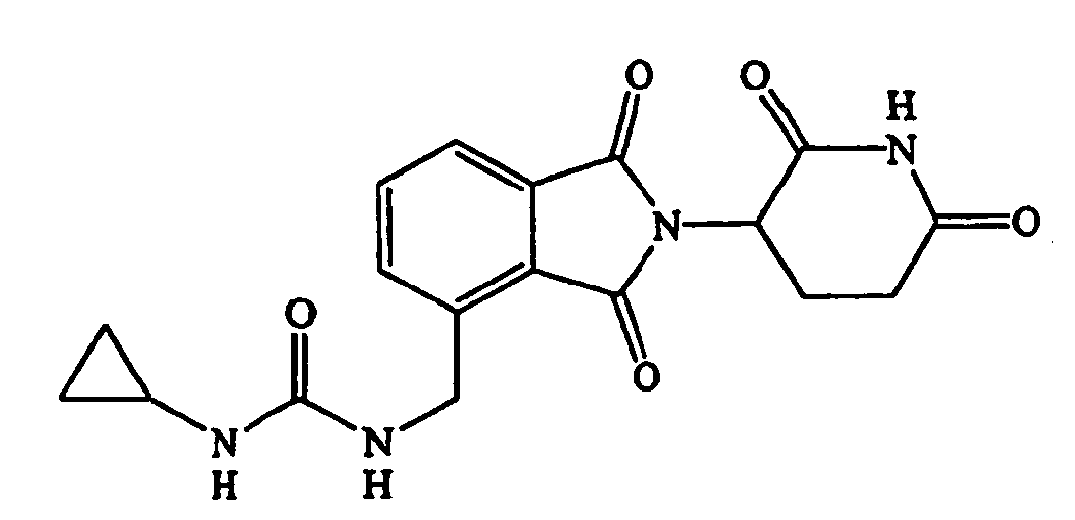
- 1,8-Diazabicyclo[5,4,0]undec-7-ene (0.58g, 3.81mmol) was added to a stirred suspension of 4-(aminomethyl)-2-(2,6-dioxo(3-piperidyl))isoindoline-1,3-dione hydrochloride (0.6g, 1.85 mmol) in CH3CN (50 mL). After stirring for 20 min, 4-nitrophenyl-N-cyclopropylcarbamate (0.41g, 1.85 mmol) was added. The mixture was stirred at room temperature for 17 hours. The mixture was filtered and the solid was recrystallized from methanol to give N-{[2-(2,6-dioxo(3-piperidyl))-1,3-dioxoisoindolin-4-yl]methyl}(cyclopropylamino)carboxamide (0.53g, 77%) as a white solid: mp 245-247°C; 1H NMR (DMSO-d6) δ 11.14 (s, 1H), 7.87-7.69 (m, 3H), 6.58 (t, J=5.7 Hz, 1H), 6.45 (d, J=2.2 Hz, 1H)5.19-5.11 (dd, J=5.4 and 12.5 Hz, 1H), 4.65 (d, J=6.1 Hz, 2H), 2.96-2.83 (m, 1H), 2.64-2.40 (m, 3H), 2.08-2.04 (m, 1H), 0.62-0.55 (m, 2H), 0.40-0.34 (m, 2H); 13C NMR (DMSO-d6) δ 172.75, 169.82, 167.63, 167.04, 158.69, 141.11, 134.61, 133.26, 131.49, 126.94, 121.60, 48.83, 30.93, 22.37, 21.97, 6.59; Anal. Calcd. For C18H18N4O5: C, 58.37; H, 4.90; N, 15.13. Found: C, 58.26; H, 4.82; N, 14.85.
-
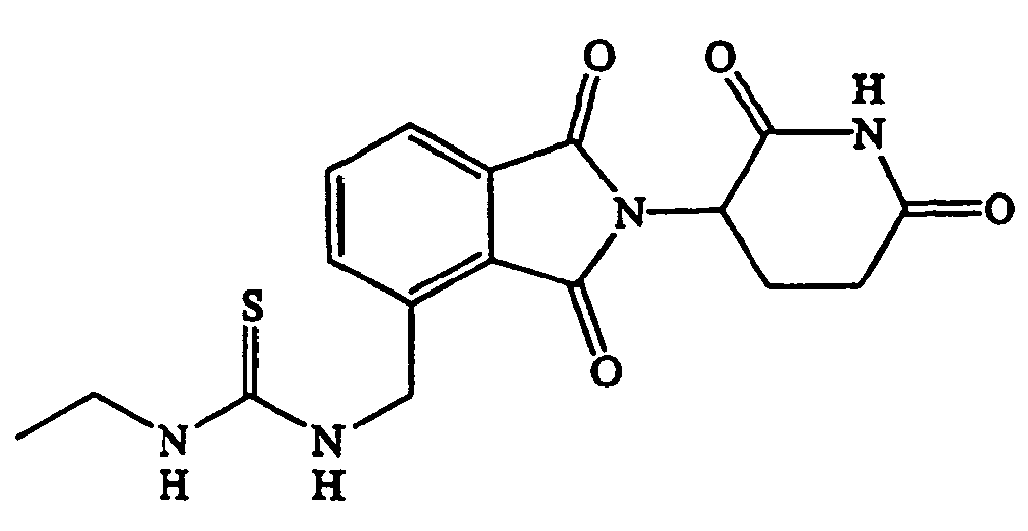
- 1,8-Diazabicyclo[5,4,0]undec-7-ene (0.29g, 1.90 mmol) was added to a stirred suspension of 4-(aminomethyl)-2-(2,6-dioxo(3-piperidyl))isoindoline-1,3-dione hydrochloride (0.6g, 1.85 mmol) in CH3CN (50 mL). After stirring for 20 min, ethyl idothiocyanate (0.2g, 2.22 mmol) was added. The mixture was stirred at room temperature for 17 hours. The solvent was removed in vacuo and the residue was dissolved in CH2Cl2 (70 mL). The CH2Cl2 solution was washed with 2N HCl (30 mL), H2O (30 mL), brine (30 mL) and dried (MgSO4). The solvent was removed and the residue was purified by chromatography (SiO2, CH2Cl2:EtOAc 6:4) to give 2-(2,6-dioxo(3-piperidyl))-4-({[(ethylamino)thioxomethyl]amino}methyl)isoindoline-1,3-dione (0.33g, 48%) as a white solid: mp 154-156°C; 1H NMR (DMSO-d6) d 11.14 (s, 1H), 7.86-7.66 (m, 5H), 5.19-5.09 (m, 3H), 3.38 (m, 2H), 2.98-2.83 (m, 1H), 2.64-2.50 (m, 2H), 2.08-2.04 (m, 1H), 1.09 (t, J=7.1 Hz, 3H); 13C NMR (DMSO-d6) d 172.78, 169.85, 167.56, 167.02, 139.64, 134.53, 133.22, 131.54, 127.06, 121.76, 48.85, 42.74, 30.84, 22.80, 21.99, 14.32; Anal. Calcd. For C17H18N4O4S: C, 54.53; H, 4.85; N, 14.96; S, 8.56. Found: C, 54.89; H, 4.82; N, 14.72; S, 8.51.
-

-

-

-

-

-

-

-

-
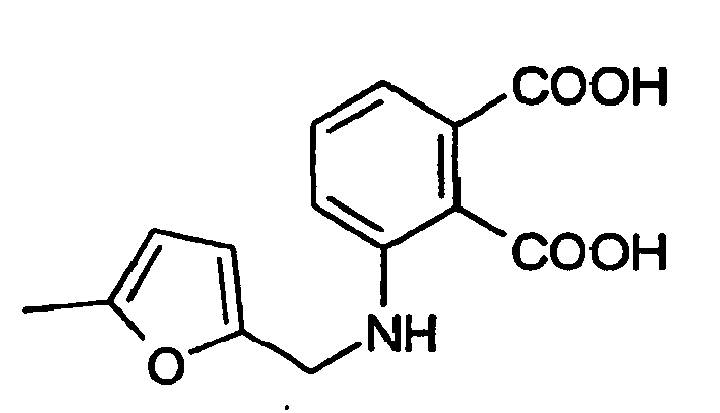
-

-

-

-

-

-

-

-

-

-

-

-

-
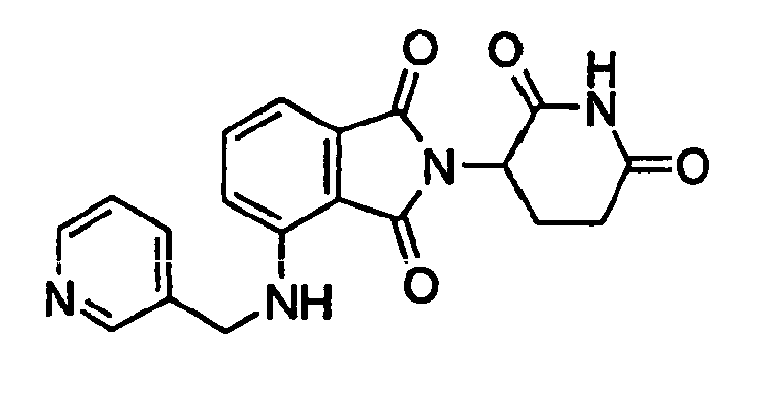
-
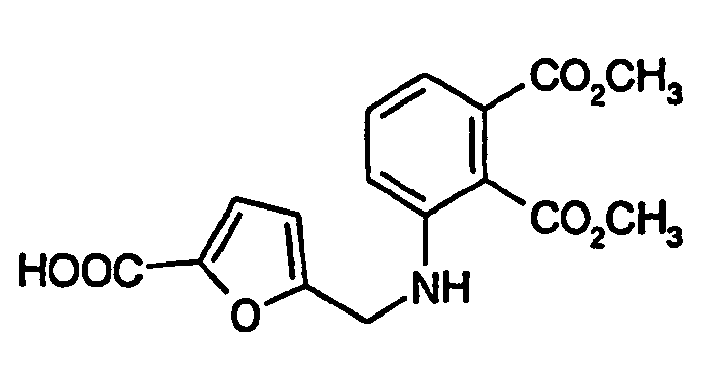
-

-

-

-

-

-

-
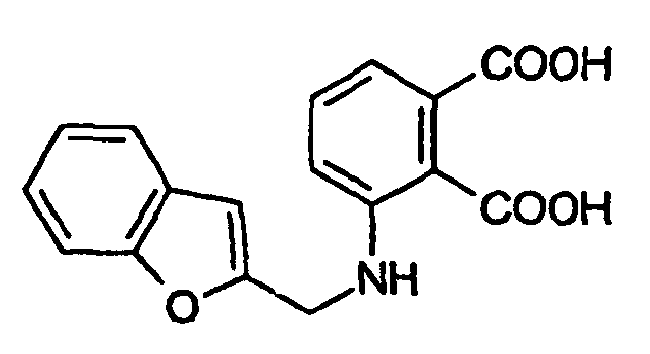
-
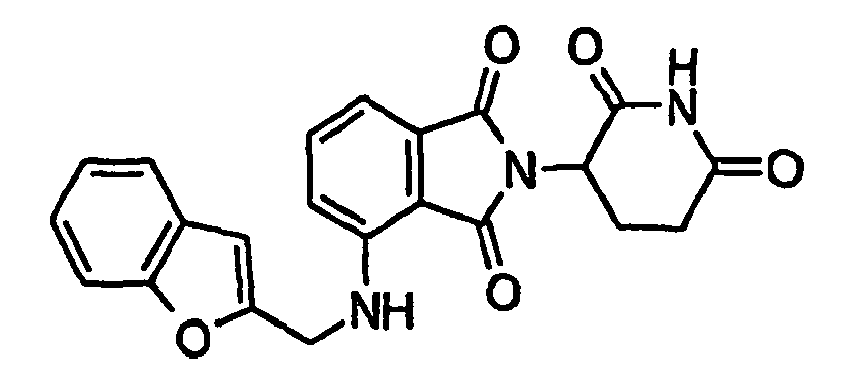
-

-
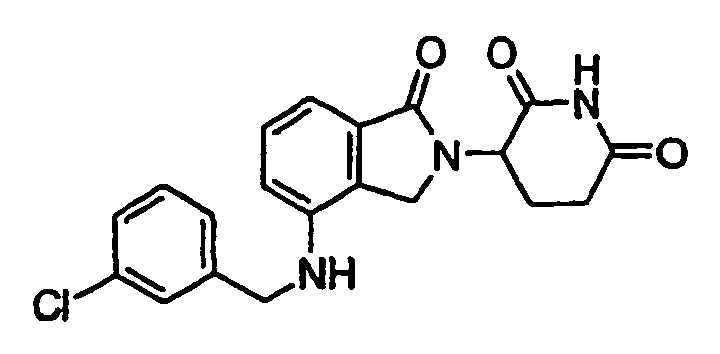
-

-

-

-

-

-
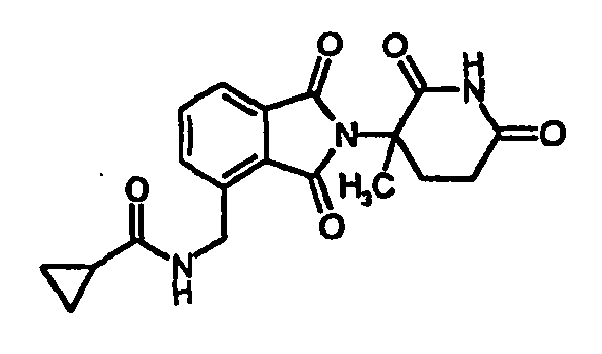
- A mixture of 3-bromo-2-methylbenzoic acid (16 g, 74.4 mmol), sodium bicarbonate (12.5 g, 148.8 mmol) and iodomethane (21.2 g, 148.8 mmol) in DMF (160 mL) was heated at 60°C for 2 hours. The mixture was cooled to room temperature and poured into ice water (400 mL). The mixture was extracted with ethyl acetate (4x100 mL). The EtOAc solution was washed with water (3x100 mL), brine (100 mL) and dried (MgSO4). Solvent was removed to give methyl 3-bromo-2-methylbenzoate (17.6 g, 100%) as an oil: 1H NMR (CDCl3) δ 7.70 (t, J=7.6Hz, 2H), 7.08 (t, J=7.9 Hz, 1H), 3.90 (s, 3H), 2.67 (s, 3H).
- A mixture of methyl 3-bromo-2-methylbenzoate (17.0 g, 74.22 mmol) and N-bromosuccinimide ( 15.85 g, 89.06 mmol) in acetonitrile (200 mL) was heated under gently refluxing for 17 hours while a 200W bulb situated 2 cm away was shining on the reaction flask. The mixture was cooled to room temperature and solvent was removed. The residue was dissolved in ethyl acetate (200 mL) and washed with water (3x80 mL), brine (80 mL) and dried (MgSO4). Solvent was removed to give methyl 3-bromo-2-bromomethylbenzoate (24.5 g, 97% by HPLC): 1H NMR (CDCl3) δ 7.90-7.86 (dd, J=1.0 and 7.9 Hz, 1H), 7.78-7.74 (dd, J=1.2 and 8.2 Hz, 1H), 7.22 (t, J=7.9 Hz, 1H), 5.12 (s, 2H), 3.95 (s, 3H).
- Triethylamine (4.66 g, 46.09 mmol) was added to a stirred suspension of methyl 3-bromo-2-bromomethylbenzoate (6.45 g, 20.95 mmol) and L-glutamine t-butyl ester hydrochloride (5.0 g, 20.95 mmol) in THF (100 mL). The mixture was heated to reflux for 18 hours. The mixture was cooled to room temperature and solvent was removed. The residue was dissolved in methylene chloride (100 mL) and washed with water (2x80 mL), brine (80 mL) and dried (MgSO4). Solvent was removed and the residue was purified by chromatography (CH2Cl2: CH3OH 97.5:2.5) to afford tert-butyl 2-(4-bromo-1-oxoisoindolin-2-yl)-4-carbamoylbutanoate (3.97 g, 48%): 1H NMR (CDCl3) δ 7.74 (d, J=7.1 Hz, 1H), 7.65 (d, J=7.9 Hz, 1H), 7.35 (t, J=7.8 Hz, 1H), 6.15 (s, 1H), 5.77 (s, 1H), 5.02-4.96 (m, 1H), 4.58 (d, J-17.4 Hz, 1H), 4.34 (d, J=17.4 Hz, 1H), 2.45-2.10 (m, 4H), 1.46 (s, 9H); 13C NMR (CDCl3) δ 173.83, 169.42, 168.74, 142.28, 134.70, 133.65, 129.80, 122.70, 117.75, 82.66, 54.29, 47.80, 32.27, 27.95, 25.54.
- A mixture of tert-butyl 2-(4-bromo-1-oxoisoindolin-2-yl)-4-carbamoylbutanoate (1.2 g, 3.02 mmol), zinc cyamide (0.21 g, 1.81 mmol), tris(dibenzylideneacetone)dipalladium (0.06g, 0.06 mmol), 1,1'-bis(diphenylphosphino)ferrocene (0.067 g, 0.12 mmol) in deoxygenated DMF (15 mL) was heated to 120°C under N2 for 6 hours. The mixture was cooled to room temperature and poured into EtOAc (100 mL) and sat. NaHCO3 (40 mL). The EtOAc solution was washed with water (2x40 mL), brine (40 mL), and dried (MgSO4). Solvent was removed and the residue was purified by chromatography (CH2Cl2: CH3OH 97.5:2.5) to afford tert-butyl 2-(4-cyano-1-oxoisoindolin-2-yl)-4-carbamoylbutanoate (0.77 g, 74%): 1H NMR (CDCl3) δ 8.07-8.03 (dd, J=0.7 and 7.4 Hz, 1H), 7.86-7.83 (dd, J=1.0 and 7.9 Hz, 1H), 7.61 (t, J=7.6 Hz, 1H), 5.91 (s, 1H), 5.68 (s, 1H), 5.03-4.98 (m, 1H), 4.85 (d, J=17.9 Hz, 1H), 4.62 (d, J=17.9 Hz, 1H), 2.48-2.41(m, 4H), 1.46 (s, 9H); 13C NMR (CDCl3) δ 173.56, 169.21, 167.70, 145.23, 134.94, 133.11, 128.93, 128.21, 115.65, 107.86, 82.98, 63.68, 54.47, 46.55, 32.34, 27.95, 25.46.
- A mixture of tert-butyl 2-(4-cyano-1-oxoisoindolin-2-yl)-4-carbamoylbutanoate (1.0 g, 2.91 mmol) and trifluoroacetic acid (5 mL) was stirred for 2 hours. The mixture was concentrated and the residue was crystallized from ether (15 mL) to give 2-(4-cyano-1-oxoisoindolin-2-yl)-4-carbamoylbutanoic acid (0.74 g, 89%) as a white solid: 1H NMR (DMSO-d6) δ 13.12 (b, 1H), 8.12 (d, J=7.6 Hz, 1H), 8.03 (d, J=7.6 Hz, 1H), 7.73 (t, J=7.6 Hz, 1H), 7.23 (s, 1H), 6.76 (s, 1H), 4.80-4.62 (m, 3H), 2.32-2.09 (m, 4H).
-

- A mixture of 2-(2,6-dioxo(3-piperidyl))1-oxoisoindoline-4-carbonitrile (1.0 g, 3.71 mmol) and 10% Pd/C (0.2 g) in 4N HCl (20 mL) and methanol (600 mL) was hydrogenated at 50 psi for 17 hours. The mixture was filtered through celite and the filtrate was concentrated. The residue was stirred with ether (30 mL) to give 3-[4-(aminomethyl)-1-oxoisoindolin-2-yl]piperidine-2,6-dione hydrochloride (1.1 g, 99%) as a white solid: 1H NMR (DMSO-d6) δ 11.06 (s, 1H), 8.64 (s, 3H), 7.79 (d, J=7.5 Hz, 1H), 7.74 (d, J=7.4 Hz, 1H), 7.59 (t, J=7.5 Hz, 1H), 5.21-5.14 (dd, J=5.0 and 13.2 Hz, 1H), 4.69 (d, J=17.4 Hz, 1H), 4.51 (d, J=17.4 Hz, 1H), 4.09 (d, J=4.9 Hz, 2H), 3.00-2.87 (m, 1H), 2.66-2.35 (m, 2H), 2.03-1.98 (m, 1H); 13C NMR (DMSO-d6) δ 172.87, 170.92,167.77, 141.58, 132.50, 131.88, 129.39, 128.48, 123.25, 51.52, 46.19, 38.39, 31.17, 22.69.
-

-

- The present invention is not to be limited in scope by the specific embodiments disclosed in the examples that are intended as illustrations of a few aspects of the invention and any embodiments that are functionally equivalent are within the scope of this invention. Indeed, various modifications of the invention in addition to those shown and described herein will become apparent to those skilled in the art and are intended to fall within the appended claims.
- Preferred features:
- 1. A compound of the formula:

one of X and Y is C=O and the other is CH2 or C=O;
R1 is H, (C1-C8)alkyl, (C3-C7)cycloalkyl, (C2-C8)alkenyl, (C2-C8)alkynyl, benzyl, aryl, (C0-C4)alkyl-(C1-C6)heterocycloalkyl, (C0-C4)alkyl-(C2-C5)heteroaryl, C(O)R3, C(S)R3, C(O)OR4, (C1-C8)alkyl-N(R6)2, (C1-C8)alkyl-OR5, (C1-C8)alkyl-C(O)OR5, C(O)NHR3, C(S)NHR3, C(O)NR3R3', C(S)NR3R3' or (C1-C8)alkyl-O(CO)R5;
R2 is H, F, benzyl, (C1-C8)alkyl, (C2-C8)alkenyl, or (C2-C8)alkynyl;
R3 and R3' are independently (C1-C8)alkyl, (C3-C7)cycloalkyl, (C2-C8)alkenyl, (C2-C8)alkynyl, benzyl, aryl, (C0-C4)alkyl-(C1-C6)heterocycloalkyl, (C0-C4)alkyl-(C2-C5)heteroaryl, (C0-C8)alkyl-N(R6)2, (C1-C8)alkyl-OR5, (C1-C8)alkyl-C(O)OR5, (C1-C8)alkyl-O(CO)R5, or C(O)OR5;
R4 is (C1-C8)alkyl, (C2-C8)alkenyl, (C2-C8)alkynyl, (C1-C4)alkyl-OR5, benzyl, aryl, (C0-C4)alkyl-(C1-C6)heterocycloalkyl, or (C0-C4)alkyl-(C2-C5)heteroaryl;
R5 is (C1-C8)alkyl, (C2-C8)alkenyl, (C2-C8)alkynyl, benzyl, aryl, or (C2-C5)heteroaryl;
each occurrence of R6 is independently H, (C1-C8)alkyl, (C1-C8)alkenyl, (C2-C8)alkynyl, benzyl, aryl, (C2-C5)heteroaryl, or (C0-C8)alkyl-C(O)O-R5 or the R6 groups can join to form a heterocycloakyl group;
n is 0 or 1; and the * represents a chiral-carbon center; with the proviso that when n is 0 then R1 is not H. - 2. The compound of feature 1, wherein the compound is the R-enantiomer or substantially R.
- 3. The compound of feature 1, wherein the compound is the S-enantiomer or substantially S.
- 4. The compound of feature 1, wherein the compound is a racemic mixture.
- 5. The compound of feature 1, wherein the enantiomeric excess is about 90% ee or more.
- 6. A compound of feature 1, wherein R2 is H or (C1-C4)alkyl.
- 7. A compound of feature 1, wherein R1 is H, (C1-C4)alkyl, CH2OCH3, CH2CH2OCH3, or

- 8. A compound of feature 1, wherein R1 is C(O)R3.
- 9. A compound of feature 1, wherein R1 is C(O)OR4.
- 10. The compound of feature 1 having the formula:

- R1 is H, (C1-C8)alkyl, (C3-C7)cycloalkyl, (C2-C8)alkenyl, (C2-C8)alkynyl, benzyl, aryl, (C0-C4)alkyl-(C1-C6)heterocycloalkyl, (C0-C4)alkyl-(C2-C5)heteroaryl, C(O)R3, C(S)R3, C(O)OR4, (C1-C8)alkyl-N(R6)2, (C1-C8)alkyl-OR5, (C1-C8)alkyl-C(O)OR5, C(O)NHR3, C(S)NHR3, C(O)NR3R3', C(S)NR3R3' or (C1-C8)alkyl-O(CO)R5;
- R2 is H or (C1-C8)alkyl;
- R3 and R3' are independently (C1-C8)alkyl, (C3-C7)cycloalkyl, (C2-C8)alkenyl, (C2-C8)alkynyl, benzyl, aryl, (C0-C4)alkyl-(C1-C6)heterocycloalkyl, (C0-C4)alkyl-(C2-C5)heteroaryl, (C0-C8)alkyl-N(R6)2, (C1-C8)alkyl-OR5, (C1-C8)alkyl-C(O)OR5, (C1-C8)alkyl-O(CO)R5, or C(O)OR5;
- R4 is (C1-C8)alkyl, (C2-C8)alkenyl, (C2-C8)alkynyl, (C1-C4)alkyl-OR5, benzyl, aryl, (C0-C4)alkyl-(C1-C6)heterocycloalkyl, or (C0-C4)alkyl-(C2-C5)heteroaryl;
- R5 is (C1-C8)alkyl, (C2-C8)alkenyl, (C2-C8)alkynyl, benzyl, aryl, or (C2-C5)heteroaryl;
the * represents a chiral-carbon center. - 11. A compound of feature 10, wherein R1 is H, (C1-C4)alkyl, CH2OCH3, CH2CH2OCH3, or

- 12. A compound of feature 10, wherein R1 is C(O)R3.
- 13. A compound of feature 10, wherein R1 is C(O)OR4.
- 14. The compound of feature 1 having the formula:

- R1 is H, (C1-C8)alkyl, (C3-C7)cycloalkyl, (C2-C8)alkenyl, (C2-C8)alkynyl, benzyl, aryl, (C0-C4)alkyl-(C1-C6)heterocycloalkyl, (C0-C4)alkyl-(C2-C5)heteroaryl, C(O)R3, C(S)R3, C(O)OR4, (C1-C8)alkyl-N(R6)2, (C1-C8)alkyl-OR5, (C1-C8)alkyl-C(O)OR5, C(O)NHR3, C(S)NHR3, C(O)NR3R3', C(S)NR3R3' or (C1-C8)alkyl-O(CO)R5;
- R2 is H or (C1-C8)alkyl;
- R3 and R3' are independently (C1-C8)alkyl, (C3-C7)cycloalkyl, (C2-C8)alkenyl, (C2-C8)alkynyl, benzyl, aryl, (C0-C4)alkyl-(C1-C6)heterocycloalkyl, (C0-C4)alkyl-(C2-C5)heteroaryl, (C0-C8)alkyl-N(R6)2, (C1-C8)alkyl-OR5, (C1-C8)alkyl-C(O)OR5, (C1-C8)alkyl-O(CO)R5, or C(O)OR5;
- R4 is (C1-C8)alkyl, (C2-C8)alkenyl, (C2-C8)alkynyl, (C1-C4)alkyl-OR5, benzyl, aryl, (C0-C4)alkyl-(C1-C6)heterocycloalkyl, or (C0-C4)alkyl-(C2-C5)heteroaryl;
- R5 is (C1-C8)alkyl, (C2-C8)alkenyl, (C2-C8)alkynyl, benzyl, aryl, or (C2-C5)heteroaryl;
each occurrence of R6 is independently H, (C1-C8)alkyl, (C2-C8)alkenyl, (C2-C8)alkynyl, benzyl, aryl, (C2-C5)heteroaryl, or (C0-C8)alkyl-C(O)O-R5 or the R6 groups can join to form a heterocycloalkyl group; and
the * represents a chiral-carbon center.
- 15. A compound of feature 14, wherein RI is H, (C1-C4)alkyl, CH2OCH3, CH2CH2OCH3, or

- 16. A compound of feature 14, wherein R1 is C(O)R3.
- 17. A compound of feature 14, wherein R1 is C(O)OR4.
- 18. A compound of feature 1 having the formula:

- R1 is H, (C1-C8)alkyl, (C3-C7)cycloalkyl, (C2-C8)alkenyl, (C2-C8)alkynyl, benzyl, aryl, (C0-C4)alkyl-(C1-C6)heterocycloalkyl, (C0-C4)alkyl-(C2-C5)heteroaryl, C(O)R3, C(S)R3, C(O)OR4, (C1-C8)alkyl-N(R6)2, (C1-C8)alkyl-OR5, (C1-C8)alkyl-C(O)OR5, C(O)NHR3, C(S)NHR3, C(O)NR3R3', C(S)NR3R3' or (C1-C8)alkyl-O(CO)R5;
- R2 is H or (C1-C8)alkyl;
- R3 and R3' are independently (C1-C8)alkyl, (C3-C7)cycloalkyl, (C2-C8)alkenyl, (C2-C8)alkynyl, benzyl, aryl, (C0-C4)alkyl-(C1-C6)heterocycloalkyl, (C2-C8)alkynyl, benzyl, aryl, (C0-C4)alkyl-(C1-C6)heterocycloalkyl, (C0-C4)alkyl-(C2-C5)heteroaryl, (C0-C8)alkyl-N(R6)2, (C1-C8)alkyl-OR5, (C1-C8)alkyl-C(O)OR5, (C1-C8)alkyl-O(CO)R5, or C(O)OR5;
- R4 is (C1-C8)alkyl, (C2-C8)alkenyl, (C2-C8)alkynyl, (C1-C4)alkyl-OR5, benzyl, aryl, (C0-C4)alkyl-(C1-C6)heterocycloalkyl, or (C0-C4)alkyl-(C2-C5)heteroaryl;
- R5 is (C1-C8)alkyl, (C2-C8)alkenyl, (C2-C8)alkynyl, benzyl, aryl, or (C2-C5)heteroaryl;
each occurrence of R6 is independently H, (C1-C8)alkyl, (C2-C8)alkenyl, (C2-C8)alkynyl, benzyl, aryl, (C2-C5)heteroaryl, or (C0-C8)alkyl-C(O)O-R5 or the R6 groups can join to form a heterocycloalkyl group; and
the * represents a chiral-carbon center.
- 19. A compound of feature 18, wherein R1 is H, (C1-C4)alkyl, CH2OCH3, CH2CH2OCH3 or

- 20. A compound of feature 18, wherein R1 is C(O)R3.
- 21. A compound of feature 18, wherein R1 is C(O)OR4.
- 22. A compound of feature 1 having the formula:
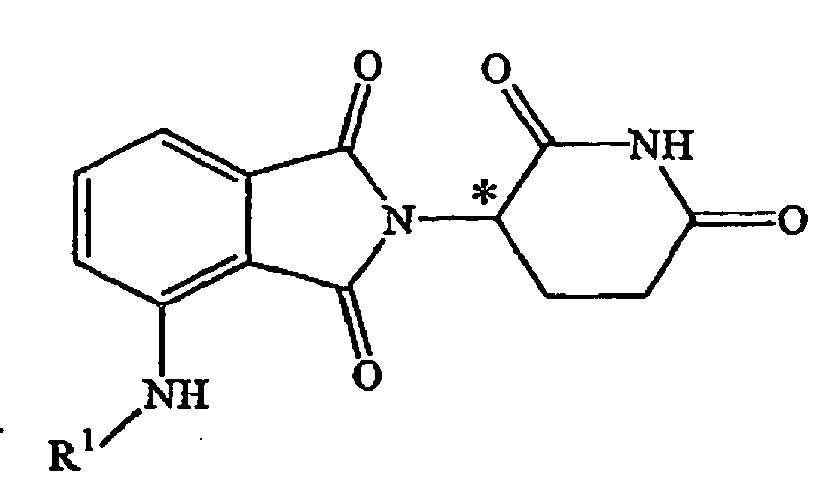
- R1 is H, (C1-C8)alkyl, (C3-C7)cycloalkyl, (C2-C8)alkenyl, (C2-C8)alkynyl, benzyl, aryl, (C0-C4)alkyl-(C1-C6)heterocycloalkyl, (C0-C4)alkyl-(C2-C5)heteroaryl, C(O)R3, C(S)R3, C(O)OR4, (C1-C8)alkyl-N(R6)2, (C1-C8)alkyl-OR5, (C1-C8)alkyl-C(O)OR5, C(O)NHR3, C(S)NHR3, C(O)NR3R3', C(S)NR3R3' or (C1-C8)alkyl-(CO)R5;
- R3 and R3' are independently (C1-C8)alkyl, (C3-C7)cycloalkyl, (C2-C8)alkenyl, (C2-C8)alkynyl, benzyl, aryl, (C0-C4)alkyl-(C1-C6)heterocycloalkyl, (C0-C4)alkyl-(C2-C5)heteroaryl, (C0-C8)alkyl-N(R6)2, (C1-C8)alkyl-OR5, (C1-C8)alkyl-C(O)OR5, (C1-C8)alkyl-O(CO)R5, or C(O)OR5;
- R4 is (C1-C8)alkyl, (C2-C8)alkenyl, (C2-C8)alkynyl, (C1-C4)alkyl-OR5, benzyl, aryl, (C0-C4)alkyl-(C1-C6)heterocycloalkyl, or (C0-C4)alkyl-(C2-C5)heteroaryl;
- R5 is (C1-C8)alkyl, (C2-C8)alkenyl, (C2-C8)alkynyl, benzyl, aryl, or (C2-C5)heteroaryl;
each occurrence of R6 is independently H, (C1-C6)alkyl, (C2-C8)alkenyl, (C2-C8)alkynyl, benzyl, aryl, (C2-C5)heteroaryl, or (C0-C8)alkyl-C(O)O-R5 or the R6 groups can join to form a heterocycloalkyl group; and
the * represents a chiral-carbon center.
- 23. A compound of feature 22, wherein R1 is (C1-C8)alkyl, benzyl, CH2OCH3, CH2CH2OCH3, or

- 24. A compound of feature 22, wherein R1 is C(O)R3.
- 25. A compound of feature 24, wherein R3 is (C0-C4)alkyl-(C2-C5)heteroaryl, (C1-C8)alkyl, aryl, or (C0-C4)alkyl-OR5.
- 26. A compound of feature 25, wherein heteroaryl is pyridyl, furyl, or thienyl.
- 27. A compound of feature 22, wherein R1 is C(O)OR4.
- 28. A compound of feature 1 having the formula:
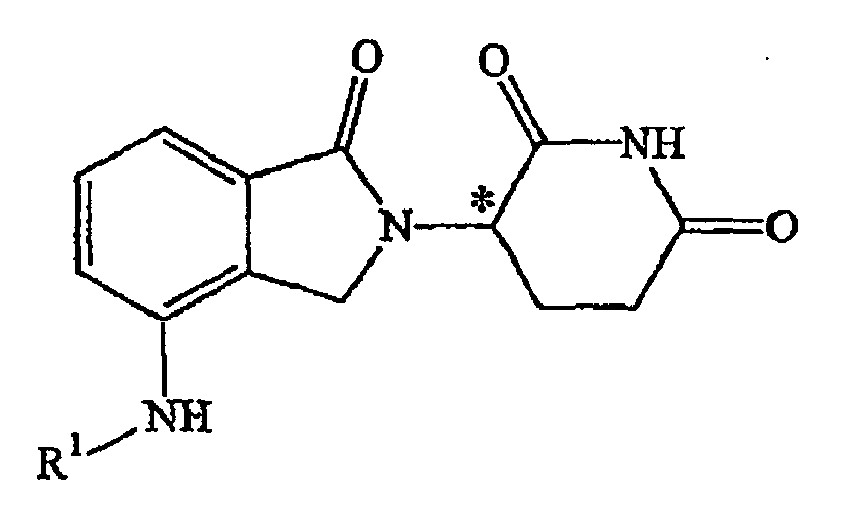
- R1 is H, (C1-C8)alkyl, (C3-C7)cycloalkyl, (C2-C8)alkenyl, (C2-C8)alkynyl, benzyl, aryl, (C0-C4)alkyl-(C1-C6)heterocycloalkyl, (C0-C4)alkyl-(C2-C5)heteroaryl, C(O)R3, C(S)R3, C(O)OR4, (C1-C8)alkyl-N(R6)2, (C1-C8)alkyl-OR5, (C1-C8)alkyl-C(O)OR5, C(O)NHR3, C(S)NHR3, C(O)NR3R3', C(S)NR3R3' or (C1-C8)alkyl-O(CO)R5;
- R3 and R3'are independently (C1-C8)alkyl, (C3-C7)cycloalkyl, (C2-C8)alkenyl, (C2-C8)alkynyl, benzyl, aryl, (C0-C4)alkyl-(C1-C6)heterocycloalkyl, (C0-C4)alkyl-(C2-C5)heteroaryl, (C0-C8)alkyl-N(R6)2, (C1-C8)alkyl-OR5, (C1-C8)alkyl-C(O)OR5, (C1-C8)alkyl-O(CO)R5, or C(O)OR5;
- R4 is (C1-C8)alkyl, (C2-C8)alkenyl, (C2-C8)alkynyl, (C1-C4)alkyl-OR5, benzyl, aryl, (C0-C4)alkyl-(C1-C6)heterocycloalkyl, or (C0-C4)alkyl-(C2-C5)heteroaryl;
- R5 is (C1-C8)alkyl, (C2-C8)alkenyl, (C2-C8)alkynyl, benzyl, aryl, or (C2-C5)heteroaryl;
each occurrence of R6 is independently H, (C1-C8)alkyl, (C2-C8)alkenyl, (C2-C8)alkynyl, benzyl, aryl, (C2-C5)heteroaryl, or (C0-C8)alkyl-C(O)O-R5 or the R6 groups can join to form a heterocycloalkyl group; and
the * represents a chiral-carbon center.
- 29. A compound of feature 28, wherein R1 is (C1-C8)alkyl, benzyl, CH2OCH3, CH2CH2OCH3, or

- 30. A compound of feature 28, wherein R1 is C(O)R3.
- 31. A compound of feature 30, wherein R3 is (C0-C4)alkyl-(C2-C5)heteroaryl, (C1-C8)alkyl, aryl, or (C0-C4)alkyl-OR5.
- 32. A compound of feature 31, wherein heteroaryl is pyridyl, furyl, or thienyl.
- 33. A compound of feature 28, wherein R1 is C(O)OR4.
- 34. A compound of feature 1 having the formula:

- R1 is H, (C1-C8)alkyl, (C3-C7)cycloalkyl, (C2-C8)alkenyl, (C2-C8)alkynyl, benzyl, aryl, (C0-C4)alkyl-(C1-C6)heterocycloalkyl, (C0-C4)alkyl-(C2-C5)heteroaryl, C(O)R3, C(S)R3, C(O)OR4, (C1-C8)alkyl-N(R6)2, (C1-C8)alkyl-OR5, (C1-C8)alkyl-C(O)OR5, C(O)NHR3, C(S)NHR3, C(O)NR3R3', C(S)NR3R3' or (C1-C8)alkyl-O(CO)R5;
- R3 and R3' are independently (C1-C8)alkyl, (C3-C7)cylcloalkyl, (C2-C9)alkenyl, (C2-C8)alkynyl, benzyl, aryl, (C0-C4)alkyl-(C1-C6)heterocycloalkyl, (C0-C4)alkyl-(C2-C5)heteroaryl, (C0-C8)alkyl-N(R6)2, (C1-C8)alkyl-OR5, (C1-C8)alkyl-C(O)OR5, (C1-C8)alkyl-O(CO)R5, or C(O)OR5;
- R4 is (C1-C8)alkyl, (C2-C8)alkenyl, (C2-C8)alkynyl, (C1-C4)alkyl-OR5, benzyl, aryl, (C0-C4)alkyl-(C1-C6)heterocycloalkyl, or (C0-C4)alkyl-(C2-C5)heteroaryl;
- R5 is (C1-C8)alkyl, (C2-C8)alkenyl, (C2-C8)alkynyl, benzyl, aryl, or (C2-C5)heteroaryl;
each occurrence of R6 is independently H, (C1-C8)alkyl, (C2-C8)alkenyl, (C2-C8)alkynyl, benzyl, aryl, (C2-C5)heteroaryl, or (C0-C8)alkyl-C(O)O-R5 or the R6 groups can join to
form a heterocycloalkyl group; and
the * represents a chiral-carbon center.
- 35. A compound of feature 34, wherein R1 is (C1-C8)alkyl, benzyl, CH2OCH3, CH2CH2OCH3, or

- 36. A compound of feature 34, wherein R1 is C(O)R3.
- 37. A compound of feature 36, wherein R3 is (C0-C4)alkyl-(C2-C4)heteroaryl, (C1-C8)alkyl, aryl, or (C0-C4)alkyl-OR5.
- 38. A compound of feature 37, wherein heteroaryl is pyridyl, furyl, or thienyl.
- 39. A compound of feature 34, wherein R1 is C(O)OR4.
- 40. A compound of feature 1 having the formula:
- I-1 (2-(2,6-dioxo-piperidin-3-yl)-1,3-dioxo-2,3-dihydro-1H-isoindol-4-ylmethyl) -carbamic acid tert-butyl ester;
- 1-2 4-(aminomethyl)-2-(2,6-dioxo(3-piperidyl))-isoindoline-1,3-dione;
- 1-3 N-(2-(2,6-dioxo-piperidin-3-yl)-1,3-dioxo-2,3-dihydro-1H-isoiudol-4-ylmeth yl)-acetamide;
- I-4 N-{(2-(2,6-dioxo(3-piperidyl)-1,3-dioxoisoindolin-4-yl)methyl)cyclopropyl-carboxamide;
- I-5 (2-(2,6-dioxo-piperdin-3-yl)-1,3-dioxo-2,3-dihydro-1H-isouldol-4-ylmethyl)
- -carbamic acid ethyl ester;
- I-6 2-(2,6-dioxo-piperidin-3-yl)-1,3-dioxo-2,3-dihydro-1H-isoindol-4-ylmethyl)-carbamic acid benzyl ester;
- I-7 2-chloro-N-{(2-(2,6-dioxo(3-piperidyl))-1,3-dioxoisoindolin-4-yl)methyl}acetamide;
- I-8 2-(dimethylamino)-N-{(2-(2,6-dioxo(3-piperidyl))-1,3-dioxoisomdolin-4-yl)methyl}-acetamide;
- I-9 1-tert-butyl-3-(2-(2,6-dioxo-piperidin-3-yl)-1,3-dioxo-2,3-dihydro-1H-isoind ol-4-ylmethyl)-urea;
- I-10 N-{(2-(2,6-dioxo(3-piperidyl))-1,3-dioxoisoindolin-4-yl)methyl}-3,3-dimethylbutanamide;
- I-11 N-(2-(2,6-dioxo(3-piperidyl))-1,3-dioxoisoindolin-4-yl)-3-pyridylcarboxamide;
- I-12 3-{1-oxo-4-(benzylamino)isoindolin-2-yl}piperidine-2,6-dione;
- I-13 2-(2,6-dioxo(3-piperidyl))-4-(benzylamino)isoindoline-1,3-dione;
- I-14 N-{(2-(2,6-dioxo(3-piperidyl))-1,3-dioxoisoindolin-4-yl)methyl}propanamide;
- I-15 N-{(2-(2,6-dioxo(3-piperidyl))-1,3-dioxoisoindolin-4-yl)methyl}-3-pyridylcarboxamide;
- I-16 N-{(2-(2,6-dioxo(3-piperidyl))-1,3-dioxoisoindolin-4-yl)methyl}heptanamide;
- I-17 N-{(2-(2,6-dioxo(3-piperidyl))-1,3-dioxoisoindolin-4-yl)methyl}-2-furylcarboxamide;
- I-18 2-azido-N-(2-(2,6-dioxo-piperldin-3-yl)-1,3-dioxo-2,3-dihydro-1H-isoindol-4-yl-methyl)-acetamide;
- I-19 2-amino-N-{(2-(2,6-dioxo(3-piperidyl))-1,3-dioxoisoindolin-4-yl)methyl}acetamide;
- I-20 ethyl 6-(N-{(2-(2,6-dioxo(3-piperidyl))-1,3-dioxoisoindolin-4-yl)methyl}carbamoyl)hexanoate,
- I-21 3-((tert-butoxy)carbonylamino)-N-{(2-(2,6-dioxo(3-piperidyl))-1,3-dioxoisoindolin-4-yl)methyl}propanamide;
- I-22 3-amino-N-{(2-(2,6-dioxo(3-piperidyl))-1,3-dioxoisoindolin-4-yl)methyl}propanamide;
- I-23 N-{(2-(2,6-dioxo(3-piperidyl)-1,3-dioxoisoindolin-4-yl)methyl}-2-thienylcarboxamide;
- I-24 N-{(2-(2,6-dioxo(3-piperidyl))-1,3-dioxoisoindolin-yl)methyl}-2-methoxyacetamide;
- I-25 (N-{(2-(2,6-dioxo(3-piperidyl))-1,3-dioxoisoindolin-4-yl)methyl}carbamoyl)methyl acetate;
- I-26 ethyl 2-((N-{(2-(2,6-dioxo(3-piperidyl))-1,3-dioxoisoindolin-4-yl)methyl}carbamoyl) amino)acetate;
- I-27 N-{(2-(2,6-dioxo(3-piperidyl))-1,3-dioxoisoindolin-4-yl)methyl}(ethylamino)carboxamide;
- I-28 2-(2,6-Dioxo(3-piperidyl))-4-[(2-furylmethyl)amino]isoindoline-1,3-dione
- I-29 N-(2-(2,6-dioxo(3-piperidyl))-1,3-dioxoisoindolin-4-yl)-2-methoxyacetamide;
- 1-30 N-(2-(2,6-dioxo(3-piperidyl))-1,3-dioxoisoindolin-4-yl)heptanamide;
- I-31 {N-(2-(2,6-dioxo(3-piperidyl))-1,3-dioxoisoindolin-4-yl)carbamoyl}methyl acetate;
- I-32 N-(2-(2,6-dioxo(3-piperidyl))-1,3-dioxoisoindolin-4-yl)pentanamide;
- I-33 N-(2-(2,6-dioxo(3-piperidyl))-1,3-dioxoisoindolin-4-yl)-2-thienylcarboxamide;
- I-34 methyl {N-(2-(2,6-dioxo(3-piperidyl))-1,3-dioxoisoindolin-4-yl)carbamoyl}formate;
- I-35 N-(2-(2,6-dioxo(3-piperidyl))-1,3-dioxoisoindolin-4-yl)-2-furylcarboxamide;
- I-36 N-(2-(2,6-dioxo(3-piperidyl))-1,3-dioxoisomdolin-4-yl)benzamide;
- I-37 N-(2-(2,6-dioxo(3-piperidyl))-1,3-dioxoisoindolin-4-yl)Propanamide;
- I-38 methyl 3-{N-(2-(2,6-dioxo(3-piperidyl))-1,3-dioxoisoindolin-4-yl)carbamoyl}propanoate;
- I-39 N-(2-(2,6-dioxo(3-piperidyl))-1,3-dioxoisoindolin-4-yl)-2-phenylacetamide;
- I-40 N-(2-(2,6-dioxo(3-piperidyl))-1,3-dioxoisoindolin-4-yl)-2-pyridylcarboxamide;
- I-41 N-(2-(2,6-dioxo(3-piperidyl))-1,3-dioxoisoindolin-4-yl)-2-chloroacetamide;
- I-42 2-azido-N-(2-(2,6-dioxo(3-piperidyl))-1,3-dioxoisoindolin-4-yl)acetamide;
- I-43 2-amino-N-(2-(2,6-dioxo(3-piperidyl))-1,3-dioxoisoindolin-4-yl)acetamide;
- I-44 N-(2-(2,6-dioxo(3-piperidyl))-1-oxoisoindolin-4-yl)-2-chloroacetamide;
- I-45 2-azido-N-(2-(2,6-dioxo(3-piperidyl))-1-oxoisoindolin-4-yl)acetamide;
- I-46 2-amino-N-(2-(2,6-dioxo(3-piperidyl))-1-oxoisoindolin-4-yl)acetamide;
- I-47 3-{4-((2-furylmethyl)amino)-1-oxoisomdolin-2-yl}piperidine-2,6-dione; or
- I-48 3-(1-oxo-4-(pentylamino)isoindolin-2-yl)pipendine-2,6-dione;
- I-49 2-(2,6-dioxo-piperidin-3-yl)-4-(2-methoxy-ethylamino)-isoindole-1,3-dione;
- I-50 2-benzyloxy-N-[2-(2,6-dioxo-piperidin-3-yl)-1,3-dioxo-2,3-dihydro-1H-isoindol-4-yl]-acetamide;
- I-51 2-(2,6-dioxo-piperidin-3-yl)-4-pentylamino-isoindole-1,3-dione;
- I-52 3-chloro-N-[2-(2,6-dioxo-piperidin-3-yl)-2,3-dioxo-2,3-dihydro-1H-isoindol-4-yl]-benzamide;
- I-53 N-[2-(2,6-dioxo-piperidin-3-yl)-1,3-dioxo-2,3-dihydro-1H-isoindol-4-yl]-2-phenoxy-acetamide;
- I-54 4-(2-benzyloxy-ethyylamino)-2-(2,6-dioxo-piperidin-3-yl)-isoindole-1,3-dione;
- I-55 N-[2-(2,6-dioxo-piperidin-3-yl)-1,3-dioxo-2,3-dihydro-1H-isoindol-4-yl]-3-fluoro-benzamide;
- I-56 N-[2-(2,6-dioxo-piperidin-3-yl)-1,3-dioxo-2,3-dihydro-1H-isoindol-4-yl]-3-methyl-benzamide;
- I-57 N-[2-(2,6-dioxo-pipendm-3-yl)-1,3-dioxo-2,3-dihydro-1H-isoindol-4-yl]-3-methoxy-benzamide;
- I-58 N-[2-(2,6-dioxo-piperidin-3-yl)-1,3-dioxo-2,3-dihydro-1H-isoindol-4-yl]-3-trifluoromethyl-benzamide;
- I-59 N-[2-(2,6-dioxo-piperidin-3-yl)-1,3-dioxo-2,3-dihydro-1H-isoindol-4-yl]-3-nitro-benzamide;
- I-60 N-[2-(2,6-dioxo-piperidin-3-y1)-1,3-dioxo-2,3-dihydro-1H-isoindol-4-yl]-butyramide;
- I-61 N-[2-(2,6-dioxo-piperidin-3-yl)-1,3-dioxo-2,3-dihydro-1H-isoindol-4-yl]-2-methylamino-acetamide;
- I-62 2-(2,6-dioxo-piperidin-3-yl)-4-heptylmnino-isoindole-1,3-dione;
- I-63 4-chloro-N-[2-(2,6-dioxo-piperidin-3-yl)-1,3-dioxo-2,3-dihydro-1H-isoindol-4-yl]-benzamide;
- I-64 cyclopropanecarboxylic acid [2-(2,6-dioxo-piperidin-3-yl)-1,3-dioxo-2,3-dihydro-1H-isomdol-4-yl]-amide;
- I-65 N-[2-(2,6-dioxo-piperidin-3-yl)-1,3-dioxo-2,3-dihydro-1H-isoindol-4-yl]-4-fluoro-benzamide;
- I-66 N-[2-(2,6-dioxo-piperidin-3-yl)-1,3-dioxo-2,3-dihydro-1H-isoindol-4-yl]-4-trifluoromethyl-benzamide;
- I-67 N-[2-(2,6-dioxo-piperidin-3-yl)-1,3-dioxo-2,3-dihydro-1H-isoindol-4-yl]-4-methyl-benzamide;
- I-68 N-[2-(2,6-dioxo-piperidin-3-yl)-1,3-dioxo-2,3-dihydro-1H-isoindol-4-yl]-4-nitro-benzamide;
- I-69 N-[2-(2,6-dioxo-piperidin-3-yl)-1,3-dioxo-2,3-dihydro-1H-isoindol-4-yl]-2-ethoxy-acetamide;
- I-70 N-[2-(2,6-dioxo-piperidin-3-yl)-1,3-dioxo-2,3-dihydro-1H-isoindol-4-yl]-2-methylsulfanyl-acetamide;
- I-71 N-[2-(2,6-dioxo-piperidin-3-yl)-1,3-dioxo-2,3-dihydro-1H-isoindol-4-yl]-2-methoxy-benzamide;
- I-72 N-[2-(2,6-dioxo-piperidin-3-yl)-1,3-dioxo-2,3-dihydro-1H-isoindol-4-yl]-2-fluoro-benzamide;
- I-73 7-amino-N-{[2-(2,6-dioxo(3-piperidyl))-1,3-dioxoisoindolin-4-yl]methyl}heptanamide;
- I-74 N-{[2-(2,6-dioxo(3-piperidyl))-1,3-dioxoisoindolin-4-yl]methyl}butanamide;
- I-75 N-{[2-(2,6-dioxo(3-piperidyl))-1,3-dioxoisoindolin-4-yl]methyl}benzamide;
- I-76 N-{[2-(2,6-dioxo(3-piperidyl))-1,3-dioxoisoindolin-4-yl] methyl}phenylacetamide;
- I-77 N-{[2-(2,6-dioxo(3-piperidyl))-1,3-dioxoisoindolin-4-yl]methyl}-2-pyridylcarboxamide;
- I-78 N-{[2-(2,6-dioxo(3-piperidyl))-1,3-dioxoisoindolin-4-yl] methyl}undecamide;
- I79 N-{[2-(2,6-dioxo(3-piperidyl))-1,3-dioxoisoindolin-4-yl]methyl}-2-methylpropanamide;
- I-80 N-{[2-(2,6-dioxo(3-pipendyl))-1,3-dioxoisomdolin-4-yl] methyl} cyclopentylcarboxamide;
- I-81 N-{[2-(2,6-dioxo(3-piperidyl))-1,3-dioxoisoindolin-4-yl] methyl}cyclohexylcarboxamide;
- I-82 N-{[2-(2,6-dioxo(3-piperidyl))-1,3-dioxoisoindolin-4-yl] methyl}(phenylamino)carboxamide;
- I-83 N-{[2-(2,6-dioxo(3-piperidyl))-1,3-dioxoisoindolin-4-yl] methyl}(butylamino)carboxamide;
- I-84 N-{[2-(2,6-dioxo(3-piperidyl))-1,3-dioxoisoindolin-4-yl] methyl}(propylamino)carboxamide;
- I-85 N-{[2-(2,6-dioxo(3-piperidyl))-1,3-dioxoisoindolin-4-yl] methyl}(cyclohexylamino)carboxamide ;
- I-86 N-{[2-(2,6-dioxo(3-piperidyl))-1,3-dioxoisoindolin-4-yl] methyl}[(methylethylamino)]carboxamide;
- I-87 N-{[2-(2,6-dioxo(3-piperidyl))-1,3-dioxoisoindolin-4-yl] methyl}(octylamino)carboxamide;
- I-88 N-{[2-(2,6-dioxo(3-piperidyl))-1,3-dioxoisoindolin-4-yl] methyl}(benzylamino)carboxamide;
- I-89 N-{[2-(2,6-dioxo(3-piperidyl))-1,3-dioxoisoindolin-4-yl] methyl}(cyclopropylamino)carboxamide;
- I-90 2-chloro-N-[2-(2,6-dioxo-piperidin-3-yl)-1,3-dioxo-2,3-dihydro-1H-isomdol-4-yl]-benzamide;
- I-91 [2-(2,6-dioxo-piperidin-3-yl)-1,3-dioxo-2,3-dihydro-1H-isoindol-4-yl]-carbamic acid benzyl ester,
- I-92 N-[2-(2,6-dioxo-piperidin-3-yl)-1,3-dioxo-2,3-dihydro-1H-isoindol-4-yl]-acetamide;
- I-93 Pentanoic acid [2-(2,6-dioxo-piperidin-3-yl)-1-oxo-2,3-dihydro-1H-isoindol-4-yl]-amide;
- I-94 N-[2-(2,6-dioxo-piperidin-3-yl)-1-oxo-2,3-dihydro-1H-isoindol-4-yl]-propionamide;
- I-95 N-[2-(2,6-dioxo-piperidin-3-yl)-1-oxo-2,3-dihydro-1H-isoindol-4-yl]-nicotinamide;
- I-96 2-(2,6-dioxo-piperidin-3-yl)-4-{[(furan-2-ylmethyl)-amino]-methyl}-isoindole-1,3-dione;
- I-97 N-[2-(2,6-dioxo-piperidin-3-yl)-1-oxo-2,3-dihydro-1H-isoindol-4-yl]-benza mide;
- 1-98 2-dimethylamino-N-[2-(2,6-dioxo-piperidin-3-yl)-1,3-dioxo-2,3-dihydro-1H-isoindol-4-yl]-acetamide;
- I-99 N-[2-(2,6-dioxo-piperidin-3-yl)-1,3-dioxo-2,3-dihydro-1H-isoindol-4-yl]-2-methyl-benzamide;
- I-100 Heptanoic acid[2-(2,6-dioxo-piperidin-3-yl)-1-oxo-2,3-dihydro-1H-isoindol-4-yl]-dihydro-1H-isoindol-4-yl]-amide;
- I-101 N-[2-(2,6-dioxo-piperidin-3-yl)-1,3-dioxo-2,3-dihydro-1H-isoindol-4-yl]-3,3-dimethyl-butyramide;
- I-102 N-[2-(2,6-dioxo-piperidin-3-yl)-1,3-dioxo-2,3-dihydro-1H-isoindol-4-yl]-isobutyramide;
- I-103 N-[2-(2,6-dioxo-piperidin-3-yl)-1,3-dioxo-2,3-dihydro-1H-isoindol-4-yl]-3-phenyl-propionamide;
- I-104 N-[2-(2,6-dioxo-piperidin-3-yl)-1,3-dioxo-2,3-dihydro-1H-isoindol-4-yl]-4-methoxy-benzamide
- I-105 N-[2-(2,6-dioxo-piperidin-3-yl)-1,3-dioxo-2,3-dihydro-1H-isoindol-4-yl]-2-trifluoromethyl-benzamide;
- I-106 N-[2-(2,6-dioxo-piperidin-3-yl)-1,3-dioxo-2,3-dihydro-1H-isoindol-4-yl]-malonamic acid methyl ester,
- I-107 N-[2-(2,6-dioxo-piperidin-3-yl)-1,3-dioxo-2,3-dihydro-1H-isoindol-4-yl]-3-methoxy-propionamide;
- I-108 N-[2-(2,6-dioxo-pipendin-3-yl)-1,3-dioxo-2,3-dihydro-1H-isomdol-4-yl]-2-h ydroxy-acetamide
- I-109 4-[(furan-2-ylmethyl)-amino]-2-(1-methyl-2,6-dioxo-piperidin-3-yl)-isoindoi e-1,3-dione;
- I-110 N-[2-(2,6-dioxo-piperidin-3-yl)-1,3-dioxo-2,3-dihydro-1H-isoindol-4-ylmethyl]-isonicotinamide;
- I-111 N-[2-(2,6-dioxo-piperidin-3-yl)-1,3-dioxo-2,3-dihydro-1H-isoindol-4-ylmethyl]-acetamide;
- I-112 {5-[2-(2,6-dioxo-piperidin-3-yl)-1,3-dioxo-2,3-dihydro-1H-isoindol-4-ylcarbamoyl]-pentyl}-embamic acid benzyl ester;
- I-113 2-(2,6-Dioxo(3-piperidyl))-4-({[(cyclohexylamino)thioxomethyl]amino} methyl)isoindole -1,3-dione;
- I-114 2-(2,6-Dioxo(3-piperidyl))-4-({[(ethylamino)thioxomethyl]amino} methyl)isoindole -1,3-dione,
- I-115 2-(2,6-Dioxo(3-piperidyl))-4-({[(propylamino)thioxomethyl]amino} methyl)isoindole -1,3-dione;
- I-116 N-[2-(2,6-dioxo(3-piperidyl))-1,3-dioxoisoindolin-4-yl]-2-chlorobenzylamine;
- I-II7 {5-[2-(2,6-Dioxo-piperidin-3-yl)-1,3-dioxo-2,3-dihydro-1H-isoindol-4-ylcarbamoyl]-pentyl}-carbamic acid benzyl ester;
- I-118 2-Methoxy-N-[2-(3-methyl-2,6-dioxo-piperidin-3-yl)-1,3-dioxo-2,3-dihydro-1H-isoindol-4-yl]-acetamide;
- I-119 Pentanoic acid [2-(3-methyl-2,6-dioxo-piperidin-3-yl)-1,3-dioxo-2,3-dihydro-1H-isoindol-4-yl]-amide;
- I-120 Heptanoic acid [2-(3-methyl-2,6-dioxo-piperidin-3-yl)-1,3-dioxo-2,3-dihydro-1H-isoindol-4-yl]-amide;
- I-121 3-Chloro-N-[2-(3-methyl-2,6-dioxo-piperidm-3-yl)-1,3-dioxo-2,3-dihydro-1H-isoindol-4-yl]-benzamide;
- 1-122 N-[2-(3-Methyl-2,6-dioxo-piperidin-3-yl)-1,3-dioxo-2,3-dihydro-1H-isoindol-4-yl]-propionamide;
- I-123 Thiophene-2-carboxylic acid [2-(3-methyl-2,6-dioxo-piperidin-3-yl)-1,3-dioxo-2,3-dihydro-1H-isoindol-4-yl]-amide;
- I-124 2-(2,6-Dioxo-piperidin-3-yl)-4-[(5-methyl-furan-2-ylmethyl)-amino]-isoindole-1,3-dione;
- I-125 2-(2,6-Dioxo-piperidin-3-yl)-4-[(5-hydroxymethyl-furan-2-ylmethyl)-amino]-isoindole-1,3-dione;
- I-126 2-(2,6-Dioxo-piperidin-3-yl)-4-[(thiophen-2-ylmethyl)-amino]-isoindole-1,3-dione;
- I-127 4-(3-chloro-benzylamino)-2-(2,6-dioxo-piperidin-3-yl)-isoindole-1,3-dione;
- I-I28 2-(2,6-Dioxo-pipendin-3-yl)-4-[(pyridin-3-ylmethyl)-ammo]-isoindole-1,3-dione;
- I-129 5-{[2-(2,6-Dioxo-piperidin-3-yl)-1,3-dioxo-2,3-dihydro-1H-isoindol-4-ylamino]-methyl}-furan-2-carboxylic acid;
- I-130 4-[(4,5-Dimethyl-furan-2-ylmethyl)-amino]-2-(2,6-dioxo-piperidin-3-yl)-isoindole-1,3-dione ;
- I-131 4-[(Benzofuran-2-ylmethyl)-animo]-2-(2,6-dioxo-piperidin-3-yl)-isoindole-1,3-dione;
- I-132 4-(3-Chloro-benzylamino)-2-(3-methyl-2,6-dioxo-piperidin-3-li)-isoindole-1,3-dione;
- I-133 3-[4-(3-Chloro-benzylamino)-1-oxo-1,3-dihydro-isoindol-2-yl]-piperidine-2,6-dione;
- I-134 N-{[2-(2,6-Dioxo(3-piperidyl))-1,3-dioxoisoindolin-4-yl]methyl}(cyclopentylamino)carboxamide;
- I-135 N-{[2-(2,6-Dioxo(3-piperidyl))-1,3-dioxoisoindolin-4-yl]methyl}(3-pyridylamino)carboxamide Hydrochloride;
- I-136 N-{[2,(2,6-dioxo(3-piperidyl))-1,3-dioxoisoindolin-4-yl]methyl}piperidylcarboxamide;
- I-137 Tert-Butyl 4-(N-{[2-(2,6-dioxo(3-piperidyl))-1,3-dioxoisoindolin-4-yl]methyl}(carbamoyl)piperazinecarboxylate;
- I-138 N-{[2-(2,6-Dioxo(3-piperidyl))-1,3-dioxoisoindolin-4-yl]methyl}(diethylamino)carboxamide;
- I-139 Cyclopropyl-N-{[2-(3-methyl-2,6-dioxo(3-piperidyl))-1,3-dioxoisoindolin-4-yl]methyl}carboxamide;
- I-140 N-{[2-(2,6-Dioxo(3-piperidyl))-1-oxoisoindolin-4-yl]methyl}cycopropylcarboxamide;
- I-141 N-{[2-(2,6-Dioxo(3-piperidyl))-1-oxoisoindolin-4-yl]methyl}(ethylamino)carboxamide; or
- I-142 Piperazine-1-carboxylic acid [2-(2,6-dioxo-piperidin-3-yl)-1,3-dioxo-2,3-dihydro-1H-isoindol-4-ylmethyl] -amide
- 41. A pharmaceutical composition comprising a therapeutically effective amount of a compound of feature 1 and a pharmaceutically acceptable vehicle or carrier.
- 42. A pharmaceutical composition comprising a therapeutically effective amount of a compound of feature 10 and a pharmaceutically acceptable vehicle or carrier.
- 43. A pharmaceutical composition comprising a therapeutically effective amount of a compound of feature 14 and a pharmaceutically acceptable vehicle or carrier.
- 44. A pharmaceutical composition comprising a therapeutically effective amount of a compound of feature 18 and a pharmaceutically acceptable vehicle or carrier.
- 45. A pharmaceutical composition comprising a therapeutically effective amount of a compound of feature 22 and a pharmaceutically acceptable vehicle or carrier.
- 46. A pharmaceutical composition comprising a therapeutically effective amount of a compound of feature 28 and a pharmaceutically acceptable vehicle or carrier.
- 47. A pharmaceutical composition comprising a therapeutically effective amount of a compound of feature 34 and a pharmaceutically acceptable vehicle or carrier.
- 48. A pharmaceutical composition comprising a therapeutically effective amount of a compound of feature 40 and a pharmaceutically acceptable vehicle or carrier.
- 49. A method of modulating the production of TNF-α in a mammal comprising administering to said mammal an effective amount of a compound of feature 1.
- 50. A method of modulating the production of IL-1β in a mammal comprising administering to said mammal an effective amount of a compound of feature 1.
- 51. A method of modulating the production of IL-10 in a mammal comprising administering to said mammal an effective amount of a compound of feature 1.
- 52. A method of modulating the production of T-cells in a mammal comprising administering to said mammal an effective amount ofa compound of feature 1.
- 53. A method of treating cancer in a mammal, comprising administering to a mammal in need thereof a therapeutically effective amount of a compound of feature 1, 10, 14, 18, 22, 28, 34, or 40.
- 54. The method of feature 53, wherein the cancer is a solid tumor or a blood born tumor.
- 55. The method of feature 53, wherein the cancer is cancer of the skin, blood, lymph node, breast, cervix, uterus, gastrointestinal tract, lung, ovary, prostate, mouth, brain, head, neck, throat, colon, rectum, testes, kidney, pancreas, bone, spleen, liver, bladder, larynx, or nasal passages.
- 56. The method of feature 53, wherein the cancer is melanoma, multiple myeloma, or a leukemia.
- 57. A method of treating cancer in a mammal, comprising administering to a mammal in need thereof a therapeutically effective amount of a compound of feature 1 and another chemotherapeutic agent.
- 58. The method of feature 57, wherein the other cancer chemotherapeutic agent is paclitaxel, cisplatin, tamoxifen, docetaxel, epirubicin, doxorubicin, irinotecan, leuprolide, bicalutamide, goserelin implant, gemcitabine, or sargramostim.
- 59. The method of feature 57, wherein the other cancer chemotherapeutic agent is an anti-cancer vaccine.
- 60. A method of treating an inflammatory disorder in a mammal, comprising administering to a mammal in need thereof a therapeutically effective amount of a compound of feature 1.
- 61. The method of feature 60, wherein the, inflammatory disorder is arthritis, rheumatoid spondylitis, psoriasis, inflammatory bowel disease, post ischemic perfusion injury, or chronic inflammatory pulmonary disease.
- 62. The method of feature 61, wherein the arthritis is rheumatoid arthritis or osteoarthritis.
- 63. A method of treating heart disease in a mammal comprising administering to a mammal in need thereof a therapeutically effective amount of a compound of feature 1.
- 64. A method of modulating the production of TNF-α in a mammalian cell or tissue comprising contacting an effective amount of a compound of feature 1.
- 65. A method of modulating the production, of IL-1β in a mammalian cell or tissue comprising contacting an effective amount of a compound of feature 1.
- 66. A method of modulating the production of IL-10 in a mammalian cell or tissue comprising contacting an effective amount of a compound of feature 1.
- 67. A method of modulating the production of T-cells in a mammalian cell or tissue comprising contacting an effective amount of a compound of feature 1.
Claims (19)
- A compound of the formula:

one of X and Y is C=O and the other is CH2 or C=O;
R1 is H, (C1-C8)alkyl, (C3-C7)cycloalkyl, (C2-C8)alkenyl, (C2-C8)alkynyl, benzyl, aryl, (C0-C4)alkyl-(C1-C6)heterocycloalkyl, (C0-C4)alkyl-(C2-C5)heteroaryl, C(O)R3, C(S)R3, C(O)OR4, (C1-C8)alkyl-N(R6)2, (C1-C8)alkyl-OR5, (C1-C8)alkyl-C(O)OR5, C(O)NHR3, C(S)NHR3, C(O)NR3R3', C(S)NR3R3', (C1-C8)alkyl-O(CO)R5, or
R2 is H, F, benzyl, (C1-C8)alkyl, (C2-C8)alkenyl, or (C2-C8)alkynyl;
R3 and R3' are independently (C1-C8)alkyl, (C3-C7)cycloalkyl, (C2-C8)alkenyl, (C2-C8)alkynyl, benzyl, aryl, (C0-C4)alkyl-(C1-C6)heterocycloalkyl, (C0-C4)alkyl-(C2-C5)heteroaryl, (C0-C8)alkyl-N(R6)2, (C1-C8)alkyl-OR5 (C1-C8)alkyl-C(O)OR5, (C1-C8)alkyl-O(CO)R5, or C(O)OR5;
R4 is (C1-C8)alkyl, (C2-C8)alkenyl, (C2-C8)alkynyl, (C1-C4)alkyl-OR5, benzyl, aryl, (C0-C4)alkyl-(C1-C6)heterocycloalkyl, or (C0-C4)alkyl-(C2-C5)heteroaryl;
R5 is (C1-C8)alkyl, (C2-C8)alkenyl, (C2-C8)alkynyl, benzyl, aryl, or (C2-C5)heteroaryl; each occurrence of R6 is independently H, (C1-C8)alkyl, (C2-C8)alkenyl, (C2-C8)alkynyl, benzyl, aryl, (C2-C5)heteroaryl, or (C0-C8)alkyl-C(O)O-R5 or the R6 groups can join to form a heterocycloalkyl group;
n is 0 or 1; and the * represents a chiral-carbon center; with the proviso that when n is 0 then R1 is not H. - The compound of claim 1, wherein:(a) the compound is the R-enantiomer or substantially R; or(b) the compound is the S-enantiomer or substantially S; or(c) the compound is a racemic mixture; or(d) the enantiomeric excess is about 90% ee or more; or(e) R2 is H or (C1-C4)alkyl.
- The compound of claim 1 having the formula:
 R1 is H, (C1-C8)alkyl, (C3-C7)cycloalkyl, (C2-C8)alkenyl, (C2-C8)alkynyl, benzyl, aryl, (C0-C4)alkyl-(C1-C6)heterocycloalkyl, (C0-C4)alkyl-(C2-C5)heteroaryl, C(O)R3, C(S)R3, C(O)OR4, (C1-C8)alkyl-N(R6)2, (C1-C8)alkyl-OR5, (C1-C8)alkyl-C(O)OR5, C(O)NHR3, C(S)NHR3, C(O)NR3R3', C(S)NR3R3', (C1-C8)alkyl-O(CO)R5, or
 R2 is H or (C1-C8)alkyl;R3 and R3' are independently (C1-C8)alkyl, (C3-C7)cycloalkyl, (C2-C8)alkenyl, (C2-C8)alkynyl, benzyl, aryl, (C0-C4)alkyl-(C1-C6)heterocycloalkyl, (C0-C4)alkyl-(C2-C5)heteroaryl, (C0-C8)alkyl-N(R6)2, (C1-C8)alkyl-OR5, (C1-C8)alkyl-C(O)OR5, (C1-C8)alkyl-O(CO)R5, or C(O)OR5;R4 is (C1-C8)alkyl, (C2-C8)alkenyl, (C2-C8)alkynyl, (C1-C4)alkyl-OR5, benzyl, aryl, (C0-C4)alkyl-(C1-C6)heterocycloalkyl, or (C0-C4)alkyl-(C2-C5)heteroaryl;R5 is (C1-C8)alkyl, (C2-C8)alkenyl, (C2-C8)alkynyl, benzyl, aryl, or (C2-C5)heteroaryl; each occurrence of R6 is independently H, (C1-C8)alkyl, (C2-C8)alkenyl, (C2-C8)alkynyl, benzyl, aryl, (C2-C5)heteroazyl, or (C0-C8)alkyl-C(O)O-R5 or the R6 groups can join to form a heterocycloalkyl group; and
the * represents a chiral-carbon center. - The compound of claim 1 having the formula:
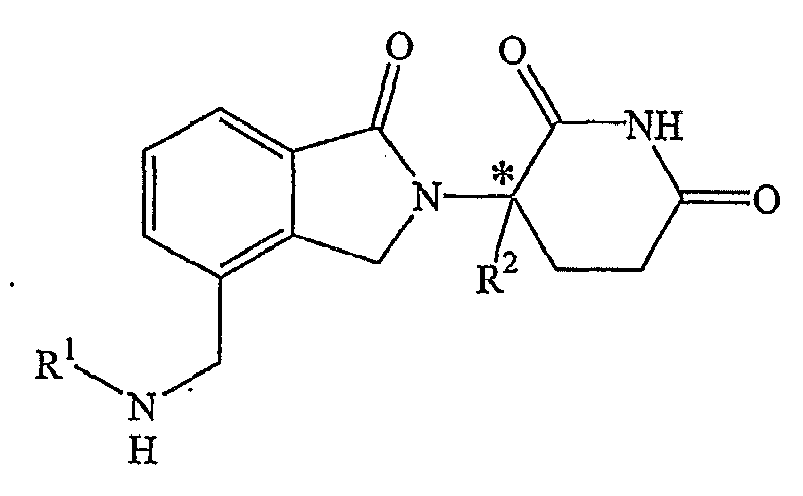 R1 is H, (C1-C8)alkyl, (C3-C7)cycloalkyl, (C2-C8)alkenyl, (C2-C8)alkynyl, benzyl, aryl, (C0-C4)alkyl-(C1-C6)heterocycloalkyl, (C0-C4)alkyl-(C2-C5)heteroaryl, C(O)R3, C(S)R3, C(O)OR4, (C1-C8)alkyl-N(R6)2, (C1-C8)alkyl-OR5, (C1-C8)alkyl-C(O)OR5, C(O)NHR3, C(S)NHR3, C(O)NR3R3', C(S)NR3R3', (C1-C8)alkyl-O(CO)R5, or
 R2 is H or (C1-C8)alkyl;R3 and R3' are independently (C1-C8)alkyl, (C3-C7)cycloalkyl, (C2-C8)alkenyl, (C2-C8)alkynyl, benzyl, aryl, (C0-C4)alkyl-(C1-C6)heterocycloalkyl, (C0-C4)alkyl-(C2-C5)heteroaryl, (C0-C8)alkyl-N(R6)2, (C1-C8)alkyl-OR5, (C1-C8)alkyl-C(O)OR5, (C1-C8)alkyl-O(CO)R5, or C(O)OR5;R4 is (C1-C8)alkyl, (C2-C8)alkenyl, (C2-C8)alkynyl, (C1-C4)alkyl-OR5, benzyl, aryl, (C0-C4)alkyl-(C1-C6)heterocycloalkyl, or (C0-C4)alkyl-(C2-C5)heteroaryl;R5 is (C1-C8)alkyl, (C2-C8)alkenyl, (C2-C8)alkynyl, benzyl, aryl, or (C2-C5)heteroaryl; each occurrence of R6 is independently H, (C1-C8)alkyl, (C27-C8)alkenyl, (C2-C8)alkynyl, benzyl, aryl, (C2-C5)heteroaryl, or (C0-C8)alkyl-C(O)O-R5 or the R6 groups can join to form a heterocycloalkyl group; and
the * represents a chiral-carbon center. - A compound of claim 1 having the formula:
 R1 is H, (C1-C8)alkyl, (C3-C7)cycloalkyl, (C2-C8)alkenyl, (C2-C8)alkynyl, benzyl, aryl, (C0-C4)alkyl-(C1-C6)heterocycloalkyl, (C0-C4)alkyl-(C2-C5)heteroaryl, C(O)R3, C(S)R3, C(O)OR4, (C1-C8)alkyl-N(R6)2, (C1-C8)alkyl-OR5, (C1-C8)alkyl-C(O)OR5, C(O)N-HW, C(S)NHR3, C(O)NR3W3', C(S)NR3R3', (C1-C8)alkyl-O(CO)R5, or

R2 is H or (C1-C8)alkyl;R3 and R3' are independently (C1-C8)alkyl, (C3-C7)cycloalkyl, (C2-C8)alkenyl, (C2-C8)alkynyl, benzyl, aryl, (C0-C4)alkyl-(C1-C6)heterocycloalkyl, (C0-C4)alkyl-(C2-C5)heteroaryl, (C0-C8)alkyl-N(R6)2, (C1-C8)alkyl-OR5, (C1-C8)alkyl-C(O)OR5, (C1-C8)alkyl-O(CO)R5, or C(O)OR5;R4 is (C1-C8)alkyl, (C2-C8)alkenyl, (C2-C8)alkynyl, (C1-C4)alkyl-OR5, benzyl, aryl, (C0-C4)alkyl-(C1-C6)heterocycloalkyl, or (C0-C4)alkyl-(C2-C5)heteroaryl;R5 is (C1-C8)alkyl, (C2-C8)alkenyl, (C2-C8)alkynyl, benzyl, aryl, or (C2-C5)heteroaryl; each occurrence of R6 is independently H, (C1-C8)alkyl, (C2-C8)alkenyl, (C2-C8)alkynyl, benzyl, aryl, (C2-C5)heteroaryl, or (C0-C8)alkyl-C(O)O-R5 or the R6 groups can join to form a heterocycloalkyl group; and
the * represents a chiral-carbon center. - A compound of any one of claims 1-5, wherein: (a) R1 is H, (C1-C4)alkyl, CH2OCH3, CH2CH2OCH3 or
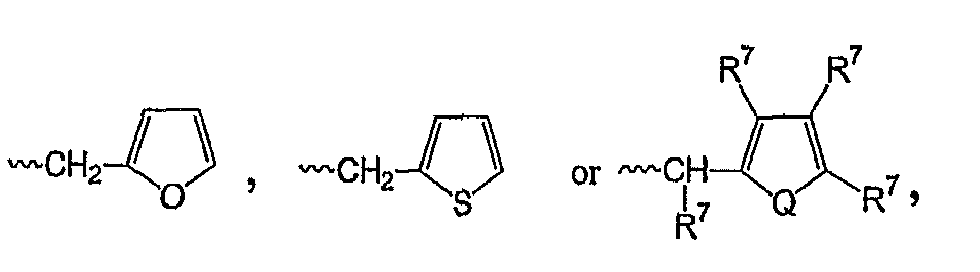
- A compound of claim 1 having the formula:
 R1 is (C1-C8)alkyl (C3-C7)cycloalkyl, (C2-C8)alkenyl, (C2-C8)alkynyl, benzyl, aryl, (C0-C4)alkyl-(C1-C6)heterocycloalkyl, (C0-C4)alkyl-(C2-C5)heteroatyl, C(O)R3, C(S)R3, C(O)OR4, (C1-C8)alkyl-N(R6)2, (C1-C8)alkyl-OR5, (C1-C8)alkyl-C(O)OR5, C(O)NHR3, C(S)NHR3, C(O)NR3R3', C(S)NR3R3', (C1-C8)alkyl-O(CQ)R5, or
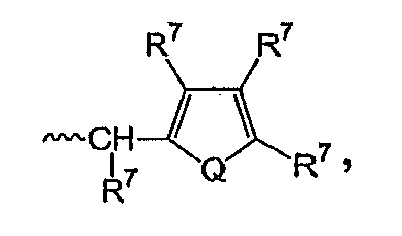 R3 and R3' are independently (C1-C8)alkyl, (C3-C7)cycloalkyl, (C2-C8)alkenyl, (C2-C8)alkynyl, benzyl, aryl, (C0-C4)alkyl-(C1-C6)heterocycloalkyl, (C0-C4)alkyl-(C2-C5)heteroaryl, (C0-C8)alkyl-N(R6)2, (C1-C8)alkyl-OR5, (C1-C8)alkyl-C(O)OR5, (C1-C8)alkyl-O(CO)R5, or C(O)OR5;R4 is (C1-C8)alkyl, (C2-C8)alkenyl, (C2-C8)alkynyl, (C1-C4)alkyl-OR5, benzyl, aryl, (C0-C4)alkyl-(C1-C6)heterocycloalkyl, or (C0-C4)alkyl-(C2-C5)heteroaryl;R5 is (C1-C8)alkyl, (C2-C8)alkenyl, (C2-C8)alkynyl, benzyl, aryl, or (C2-C5)heteroaryl; each occurrence of R6 is independently H, (C1-C8)alkyl, (C2-C8)alkenyl, (C2-C8)alkynyl, benzyl, aryl, (C2-C5)heteroaryl, or (C0-C8)alkyl-C(O)O-R5 or the R6 groups can join to form a heterocycloalkyl group; and
the * represents a chiral-carbon center. - A compound of claim 1 having the formula:
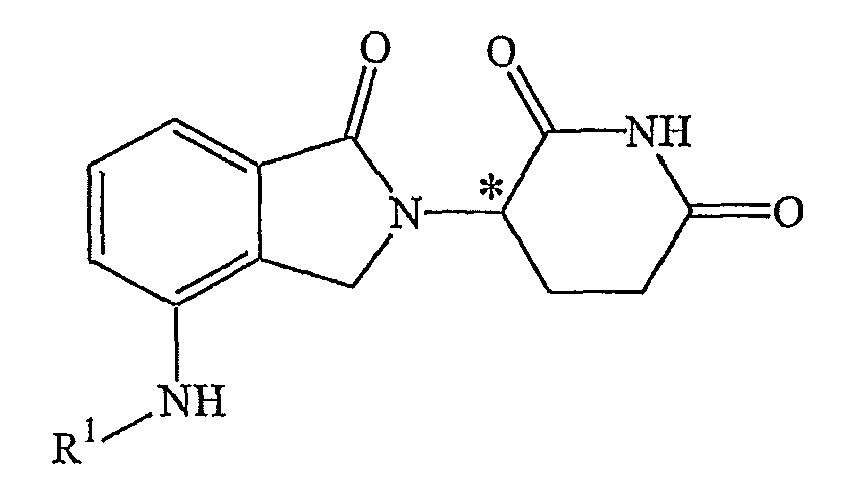 R1 is (C1-C8)alkyl, (C3-C7)cycloalkyl, (C2-C8)alkenyl, (C2-C8)alkynyl, benzyl, aryl, (C0-C4)alkyl-(C1-C6)heterocycloalkyl, (C0-C4)alkyl-(C2-C5)heteroaryl, C(O)R3, C(S)R3, C(O)OR4, (C1-C8)alkyl-N(R6)2, (C1-C8)alkyl-OR5, (C1-C8)alkyl-C(O)OR5, C(O)NHR3, C(S)NHR3, C(O)NR3R3', C(S)NR3R3' (C1-C8)alkyl-O(CO)R5, or
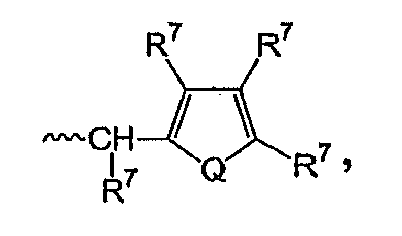 R3 and R3'are independently (C1-C8)alkyl, (C3-C7)cycloalkyl, (C2-C8)alkenyl, (C2-C8)alkynyl, benzyl, aryl, (C0-C4)alkyl-(C1-C6)heterocycloalkyl, (C0-C4)alkyl-(C2-C5)heteroaryl, (C0-C8)alkyl-N(R6)2, (C1-C8)alkyl-OR5, (C1-C8)alkyl-C(O)OR5, (C1-C8)alkyl-O(CO)R5, or C(O)OR5;R4 is (C1-C8)alkyl, (C2-C8)alkenyl, (C2-C8)alkynyl, (C1-C4)alkyl-OR5, benzyl, aryl, (C0-C4)alkyl-(C1-C6)heterocycloalkyl, or (C0-C4)alkyl-(C2-C5)heteroaryl;R5 is (C1-C8)alkyl, (C2-C8)alkenyl, (C2-C8)alkynyl, benzyl, aryl, or (C2-C5)heteroaryl;
each occurrence of R6 is independently H, (C1-C8)alkyl, (C2-C8)alkenyl, (C2-C8)alkynyl, benzyl, aryl, (C2-C5)heteroaryl, or (C0-C8)alkyl-C(O)O-R5 or the R6 groups can join to form a heterocycloalkyl group; and
the * represents a chiral-carbon center. - A compound of claim 1 having the formula:
 R1 is (C1-C8)alkyl, (C3-C7)cycloalkyl, (C2-C8)alkenyl, (C2-C8)alkynyl, benzyl, aryl, (C0-C4)alkyl-(C1-C6)heterocycloalkyl, (C6-C4)alkyl-(C2-C5)heteroaryl, C(O)R3, C(S)R3, C(O)OR4, (C1-C8)alkyl-N(R6)2, (C1-C8)alkyl-OR5, (C1-C8)alkyl-C(O)OR5, C(O)NHR3, C(S)NHR3, C(O)NR3R3', C(S)NR3R3' (C1-C8)alkyl-O(CO)R5, or
 R3 and R3' are independently (C1-C8)alkyl, (C3-C7)cycloalkyl, (C2-C8)alkenyl, (C2-C8)alkynyl, benzyl, aryl, (C0-C4)alkyl-(C1-C6)heterocycloalkyl, (C0-C4)alkyl-(C2-C5)heteroaryl, (C0-C8)alkyl-N(R6)2, (C1-C8)alkyl-OR5, (C1-C8)alkyl-C(O)OR5, (C1-C8)alkyl-O(CO)R5, or C(O)OR5;R4 is (C1-C8)alkyl, (C2-C8)alkenyl, (C2-C8)alkynyl, (C1-C4)alkyl-OR5, benzyl, aryl, (C0-C4)alkyl-(C1-C6)heterocycloalkyl, or (C0-C4)alkyl-(C2-C5)heteroaryl;R5 is (C1-C8)alkyl, (C2-C8)alkenyl, (C2-C8)alkynyl, benzyl, aryl, or (C2-C5)heteroaryl;
each occurrence of R6 is independently H, (C1-C8)alkyl, (C2-C8)alkenyl, (C2-C8)alkynyl, benzyl, aryl, (C2-C5)heteroaryl, or (C0-C8)alkyl-C(O)O-R5 or the R6 groups can join to form a heterocycloalkyl group; and
the * represents a chiral-carbon center. - A compound of any one of claims 7-9, wherein :(a) R1 is (C1-C8)alkyl, benzyl, CH2OCH3, CH2CH2OCH3, or
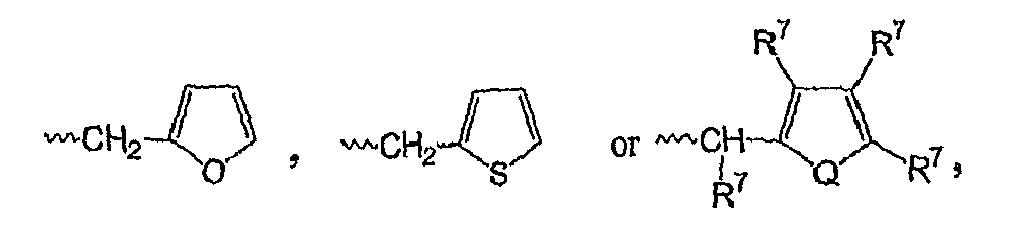 (b) R1 is (O)R3; or(c) R1 is C(O)R3; and R3 is (C0-C4)alkyl-(C2-C5)heteroaryl, (C1-C8)alkyl, aryl, or (C1-C4)alkyl-OR5; or(d) R1 is C(O)R3; R3 is (C0-C4)alkyl-(C2-C5)heteroaryl, (C1-C8)alkyl, aryl, or (C1-C4)alkyl-OR5; and heteroaryl is pyridyl, furyl, or thienyl; or (e) R1 is C(O)OR4.
- A compound of claim 1 having the formula:I-1 (2-(2,6-dioxo-piperidin-3-yl)-1,3-dioxo-2,3-dihydro-1H-isoindol-4-ylmethyl) -carbamic acid tert-butyl ester;I-2 4-(aminomethyl)-2-(2,6-dioxo(3-piperidyl))-isoindoline-1,3-dione;1-3 N-(2-(2,6-dioxo-piperidin-3-yl)-1,3-dioxo-2,3-dihydro-1H-isoindol-4-ylmeth yl)-acetamide;I-4 N-{(2-(2,6-dioxo(3-piperidyl)-1,3-dioxoisoindolin-4-yl)methyl}cyclopropyl-carboxamide;I-5 (2-(2,6-dioxo-piperidin-3-yl)-1,3-dioxo-2,3-dihydro-1H-isoindol-4-ylmethyl)-carbamic acid ethyl ester;I-6 2-(2,6-dioxo-piperidin-3-yl)-1,3-dioxo-2,3-dihydro-1H-isoindol-4-ylmethyl)-carbamic acid benzyl ester;I-7 2-chloro-N-{(2-(2,6-dioxo(3-piperidyl))-1,3-dioxoisoindolin-4-yl)methyl}acetamide;1-8 2-(dimethylamino)-N-{(2-(2,6-dioxo(3-piperidyl))-1,3-dioxoisoindolin-4-yl)methyl}-acetamide;I-9 1-tert-butyl-3-(2-(2,6-dioxo-piperidin-3-yl)-1,3-dioxo-2,3-dihydro-1H-isoind ol-4-ylmethyl)-urea;I-10 N-{(2-(2,6-dioxo(3-piperidyl))-1,3-dioxoisoindolin-4-yl)methyl}-3,3-dimethylbutanamide;I-11 N-(2-(2,6-dioxo(3-piperidyl))-1,3-dioxoisoindolin-4-yl)-3-pyridylcarboxamide;I-12 3-{1-oxo-4-(benzylamino)isoindolin-2-yl}piperidine-2,6-dione;I-13 2-(2,6-dioxo(3-piperidyl))-4-(benzylamino)isoindoline-1,3-dione;I-14 N-{(2-(2,6-dioxo(3-piperidyl))-1,3-dioxoisoindolin-4-yl)methyl}propanamide;I-15 N-{(2-(2,6-dioxo(3-pipcridyl))-1,3-dioxoisoindolin-4-yl)methyl}-3-pyridylcarboxamide;I-16 N-{(2-(2,6-dioxo(3-piperidyl))-1,3-dioxoisoindolin-4-yl)methyl} heptanamide;I-17 N-{(2-(2,6-dioxo(3-piperidyl))-1,3-dioxoisoindolin-4-yl)methyl}-2-furylcarboxamide;I-18 2-azido-N-(2-(2,6-dioxo-piperidin-3-yl)-1,3-dioxo-2,3-dihydro-1H-isoindol-4-yl-methyl)-acetamide;I-19 2-amino-N-{(2-(2,6-dioxo(3-piperidyl))-1,3-dioxoisoindolin-4-yl)methyl} acetamide;I-20 ethyl 6-(N-{(2-(2,6-dioxo(3-piperidyl))-1,3-dioxoisoindolin-4-yl)methyl}carbamoyl)hexanoate;I-21 3-((tert-butoxy)carbonylamino)-N-{(2-(2,6-dioxo(3-piperidyl))-1,3-dioxoisoindolin-4-yl)methyl}propanamide;I-22 3-amino-N-{(2-(2,6-dioxo(3-piperidyl))-1,3-dioxoisoindolin-4-yl)methyl}propanamide;I-23 N-{(2-(2,6-dioxo(3-piperidyl))-1,3-dioxoisoindolin-4-yl)methyl}-2-thienylcarboxamide;I-24 N-{(2-(2,6-dioxo(3-piperidyl))-1,3-dioxoisoindolin-4-yl)methyl}-2-methoxyacetamide;1-25 (N-{(2-(2,6-dioxo(3-piperidyl))-1,3-dioxoisoindolin-4-yl)methyl} carbamoyl)methyl acetate;I-26 ethyl 2-((N-{(2-(2,6-dioxo(3-piperidyl))-1,3-dioxoisoindolin-4-yl)methyl} carbamoyl) amino)acetate;I-27 N-{(2-(2,6-dioxo(3-piperidyl))-1,3-dioxoisoindolin-4-yl)methyl}(ethylamino)carboxamide;I-28 2-(2,6-Dioxo(3-piperidyl))-4-[(2-furylmethyl)amino]isoindoline-1,3-dioneI-29 N-(2-(2,6-dioxo(3-piperidyl))-1,3-dioxoisoindolin-4-yl)-2-methoxyacetamide;I-30 N-(2-(2,6-dioxo(3-piperidyl))-1,3-dioxoisoindolin-4-yl)heptanamide;I-31 {N-(2-(2,6-dioxo(3-piperidyl))-1,3-dioxoisoindolin-4-yl)carbamoyl}methyl acetate;I-32 N-(2-(2,6-dioxo(3-piperidyl))-1,3-dioxoisoindolin-4-yl)pentanamide;I-33 N-(2-(2,6-dioxo(3-piperidyl))-1,3-dioxoisoindolin-4-yl)-2-thienylcarboxamide;I-34 methyl {N-(2-(2,6-dioxo(3-piperidyl))-1,3-dioxoisoindolin-4-yl)carbamoyl} formate;1-35 N-(2-(2,6-dioxo(3-piperidyl))-1,3-dioxoisoindolin-4-yl)-2-furylcarboxamide;I-36 N-(2-(2,6-dioxo(3-piperidyl))-1,3-dioxoisoindolin-4-yl)benzamide;I-37 N-(2-(2,6-dioxo(3-piperidyl))-1,3-dioxoisoindolin-4-yl)propanamide;I-38 methyl 3-{N-(2-(2,6-dioxo(3-piperidyl))-1,3-dioxoisoindolin-4-yl)carbamoyl}propanoate;I-39 N-(2-(2,6-dioxo(3-piperidyl))-1,3-dioxoisoindolin-4-yl)-2-phenylacetamide;I-40 N-(2-(2,6-dioxo(3-piperidyl))-1,3-dioxoisoindolin-4-yl)-2-pyridylcarboxamide;I-41 N-(2-(2,6-dioxo(3-piperidyl))-1,3-dioxoisoindolin-4-yl)-2-chloroacetamide;I-42 2-azido-N-(2-(2,6-dioxo(3-piperidyl))-1,3-dioxoisoindolin-4-yl)acetamide;I-43 2-amino-N-(2-(2,6-dioxo(3-piperidyl))-1,3-dioxoisoindolin-4-yl)acetamide;I-44 N-(2-(2,6-dioxo(3-piperidyl))-1-oxoisoindolin-4-yl)-2-chloroacetamide;I-45 2-azido-N-(2-(2,6-dioxo(3-piperidyl))-1-oxoisoindolin-4-yl)acetamide;I-46 2-amino-N-(2-(2,6-dioxo(3-piperidyl))-1-oxoisoindolin-4-yl)acetamide;I-47 3-{4-((2-furylmethyl)amino)-1-oxoisoindolin-2-yl}piperidine-2,6-dione; orI-48 3-(1-oxo-4-(pentylamino)isoindolin-2-yl)piperidine-2,6-dione;I-49 2-(2,6-dioxo-piperidin-3-yl)-4-(2-methoxy-ethylamino)-isoindole-1,3-dione;I-50 2-benzyloxy-N-[2-(2,6-dioxo-piperidin-3-yl)-1,3-dioxo-2,3-dihydro-1H-isoindol-4-yl]-acetamide;I-51 2-(2,6-dioxo-piperidin-3-yl)-4-pentylamino-isoindole-1,3-dione;I-52 3-chloro-N-[2-(2,6-dioxo-piperidin-3-yl)-1,3-dioxo-2,3-dihydro-1H-isoindol-4-yl]-benzamide;I-53 N-[2-(2,6-dioxo-piperidin-3-yl)-1,3-dioxo-2,3-dihydro-1H-isoindol-4-yl]-2-phenoxy-acetamide;I-54 4-(2-benzyloxy-ethylamino)-2-(2,6-dioxo-piperidin-3-yl)-isoindole-1,3-dione;I-55 N-[2-(2,6-dioxo-piperidin-3-yl)-1,3-dioxo-2,3-dihydro-1H-isoindol-4-yl]-3-fluoro-benzamide;I-56 N-[2-(2,6-dioxo-piperidin-3-yl)-1,3-dioxo-2,3-dihydro-1H-isoindol-4-yl]-3-methyl-benzamide;I-57 N-[2-(2,6-dioxo-piperidin-3-yl)-1,3-dioxo-2,3-dihydro-1H-isoindol-4-yl]-3-methoxy-benzamide;I-58 N-[2-(2,6-dioxo-piperidin-3-yl)-1,3-dioxo-2,3-dihydro-1H-isoindol-4-yl]-3-trifluoromethyl-benzamide;I-59 N-[2-(2,6-dioxo-piperidin-3-yl)-1,3-dioxo-2,3-dihydro-1H-isoindol-4-yl]-3-nitro-benzamide;I-60 N-[2-(2,6-dioxo-piperidin-3-yl)-1,3-dioxo-2,3-dihydro-1H-isoindol-4-yl]-butyramide;I-61 N-[2-(2,6-dioxo-piperidin-3-yl)-1,3-dioxo-2,3-dihydro-1H-isoindol-4-yl]-2-methylamino-acetamide;I-62 2-(2,6-dioxo-piperidin-3-yl)-4-heptylamino-isoindole-1,3-dione;I-63 4-chloro-N-[2-(2,6-dioxo-piperidin-3-yl)-1,3-dioxo-2,3-dihydro-1H-isoindol-4-yl]-benzamide;I-64 cyclopropanecarboxylic acid [2-(2,6-dioxo-piperidin-3-yl)-1,3-dioxo-2,3-dihydro-1H-isoindol-4-yl]-amide;I-65 N-[2-(2,6-dioxo-piperidin-3-yl)-1,3-dioxo-2,3-dihydro-1H-isoindol-4-yl]-4-fluoro-benzamide;I-66 N-[2-(2,6-dioxo-piperidin-3-yl)-1,3-dioxo-2,3-dihydro-1H-isoindol-4-yl]-4-trifluoromethyl-benzamide;I-67 N-[2-(2,6-dioxo-piperidin-3-yl)-1,3-dioxo-2,3-dihydro-1H-isoindol-4-yl]-4-methyl-benzamide;I-68 N-[2-(2,6-dioxo-piperidin-3-yl)-1,3-dioxo-2,3-dihydro-1H-isoindol-4-yl]-4-nitro-benzamide;I-69 N-[2-(2,6-dioxo-piperidin-3-yl)-1,3-dioxo-2,3-dihydro-1H-isoindol-4-yl]-2-ethoxy-acetamide;I-70 N-[2-(2,6-dioxo-piperidin-3-yl)-1,3-dioxo-2,3-dihydro-1H-isoindol-4-yl]-2-methylsulfanyl-acetamide;1-71 N-[2-(2,6-dioxo-piperidin-3-yl)-1,3-dioxo-2,3-dihydro-1H-isoindol-4-yl]-2-methoxy-benzamide;I-72 N-[2-(2,6-dioxo-piperidin-3-yl)-1,3-dioxo-2,3-dihydro-1H-isoindol-4-yl]-2-fluoro-benzamide;I-73 7-amino-N-{[2-(2,6-dioxo(3-piperidyl))-1,3-dioxoisoindolin-4-yl]methyl}heptanamide;I-74 N-{[2-(2,6-dioxo(3-piperidyl))-1,3-dioxoisoindolin-4-yl]methyl}butanamide;I-75 N-{[2-(2,6-dioxo(3-piperidyl))-1,3-dioxoisoindolin-4-yl]methyl}benzamide;I-76 N-{[2-(2,6-dioxo(3-piperidyl))-1,3-dioxoisoindolin-4-yl] methyl}phenylacetamide;I-77 N-{[2-(2,6-dioxo(3-piperidyl))-1,3-dioxoisoindolin-4-yl]methyl}-2-pyridylcarboxamide;I-78 N-{[2-(2,6-dioxo(3-piperidyl))-1,3-dioxoisoindolin-4-yl] methyl}undecamide;I-79 N-{[2-(2,6-dioxo(3-piperidyl))-1,3-dioxoisoindolin-4-yl]methyl}-2-methylpropanamide;I-80 N-{[2-(2,6-dioxo(3-piperidyl))-1,3-dioxoisoindolin-4-yl] methyl} cyclopentylcarboxamide;I-81 N-{[2-(2,6-dioxo(3-piperidyl))-1,3-dioxoisoindolin-4-yl] methyl} cyclohexylcarboxamide;I-82 N-{[2-(2,6-dioxo(3-piperidyl))-1,3-dioxoisoindolin-4-yl] methyl}(phenylamino)carboxamide;I-83 N-{[2-(2,6-dioxo(3-piperidyl))-1,3-dioxoisoindolin-4-yl] methyl} (butylamino)carboxamide;I-84 N-{[2-(2,6-dioxo(3-piperidyl))-1,3-dioxoisoindolin-4-yl] methyl} (propylamino)carboxamide;I-85 N-{[2-(2,6-dioxo(3-piperidyl))-1,3-dioxoisoindolin-4-yl] methyl}(cyclohexylamino)carboxamide ;I-86 N-{[2-(2,6-dioxo(3-piperidyl))-1,3-dioxoisoindolin-4-yl] methyl}[(methylethylamino)]carboxamide;I-87 N-{[2-(2,6-dioxo(3-piperidyl))-1,3-dioxoisoindolin-4-yl] methyl}(octylamino)carboxamide;I-88 N-{[2-(2,6-dioxo(3-piperidyl))-1,3-dioxoisoindolin-4-yl] methyl} (benzylamino)carboxamide;I-89 N-{[2-(2,6-dioxo(3-piperidyl))-1,3-dioxoisoindolin-4-yl] methyl}(cyclopropylamino)carboxamide;I-90 2-chloro-N-[2-(2,6-dioxo-piperidin-3-yl)-1,3-dioxo-2,3-dihydro-1H-isoindol-4-yl]-benzamide;I-91 [2-(2,6-dioxo-piperidin-3-yl)-1,3-dioxo-2,3-dihydro-1H-isoindol-4-yl]-carbamic acid benzyl ester;I-92 N-[2-(2,6-dioxo-piperidin-3-yl)-1,3-dioxo-2,3-dihydro-1H-isoindol-4-yl]-acetamide;I-93 Pentanoic acid [2-(2,6-dioxo-piperidin-3-yl)-1-oxo-2,3-dihydro-1H-isoindol-4-yl]-amide;I-94 N-[2-(2,6-dioxo-piperidin-3-yl)-1-oxo-2,3-dihydro-1H-isoindol-4-yl]-propionamide;I-95 N-[2-(2,6-dioxo-piperidin-3-yl)-1-oxo-2,3-dihydro-1H-isoindol-4-yl]-nicotinamide;I-96 2-(2,6-dioxo-piperidin-3-yl)-4-{[(furan-2-ylmethyl)-amino]-methyl}-isoindole-1,3-dione;I-97 N-[2-(2,6-dioxo-piperidin-3-yl)-1-oxo-2,3-dihydro-1H-isomdol-4-yl]-benza mide;I-98 2-dimethylamino-N-[2-(2,6-dioxo-piperidin-3-yl)-1,3-dioxo-2,3-dihydro-1H-isoindol-4-yl]-acetamide;I-99 N-[2-(2,6-dioxo-piperidin-3-yl)-1,3-dioxo-2,3-dihydro-1H-isoindol-4-yl]-2-methyl-benzamide;I-100 Heptanoic acid[2-(2,6-dioxo-piperidin-3-yl)-1-oxo-2,3-dihydro-1H-isoindol-4-yl]-dihydro-1H-isoindol-4-yl]-amide;I-101 N-[2-(2,6-dioxo-piperidin-3-yl)-1,3-dioxo-2,3-dihydro-1H-isoindol-4-yl]-3,3-dimethyl-butyramide;I-102 N-[2-(2,6-dioxo-piperidin-3-yl)-1,3-dioxo-2,3-dihydro-1H-isoindol-4-yl]-isobutyramide;I-103 N-[2-(2,6-dioxo-piperidin-3-yl)-1,3-dioxo-2,3-dihydro-1H-isoindol-4-yl]-3-phenyl-propionamide;I-104 N-[2-(2,6-dioxo-piperidin-3-yl)-1,3-dioxo-2,3-dihydro-1H-isoindol-4-yl]-4-methoxy-benzamideI-105 N-[2-(2,6-dioxo-piperidin-3-yl)-1,3-dioxo-2,3-dihydro-1H-isoindol-4-yl]-2-trifluoromethyl-benzamide;I-106 N-[2-(2,6-dioxo-piperidin-3-yl)-1,3-dioxo-2,3-dihydro-1H-isoindol-4-yl]-malonamic acid methyl ester;I-107 N-[2-(2,6-dioxo-piperidin-3-yl)-1,3-dioxo-2,3-dihydro-1H-isoindol-4-yl]-3-methoxy-propionamide;I-108 N-[2-(2,6-dioxo-piperidin-3-yl)-1,3-dioxo-2,3-dihydro-1H-isoindol-4-yl]-2-h ydroxy-acetamideI-109 4-[(furan-2-ylmethyl)-amino]-2-(1-methyl-2,6-dioxo-piperidin-3-yl)-isoindol e-1,3-dione;I-110 N-[2-(2,6-dioxo-piperidin-3-yl)-1,3-dioxo-2,3-dihydro-1H-isoindol-4-ylmethyl]-isonicotinamide;I-111 N-[2-(2,6-dioxo-piperidin-3-yl)-1,3-dioxo-2,3-dihydro-1H-isoindol-4-ylmethyl]-acetamide;I-112 {5-[2-(2,6-dioxo-piperidin-3-yl)-1,3-dioxo-2,3-dihydro-1H-isoindol-4-ylcarbamoyl]-pentyl}-carbamic acid benzyl ester;I-113 2-(2,6-Dioxo(3-piperidyl))-4-({[(cyclohexylamino)thioxomethyl]amino} methyl)isoindole -1,3-dione;I-114 2-(2,6-Dioxo(3-piperidyl))-4-({[(ethylamino)thioxomethyl]amino} methyl)isoindole -1,3-dione;I-115 2-(2,6-Dioxo(3-piperidyl))-4-({[(propylamino)thioxomethyl]amino} methyl)isoindole -1,3-dione;I-116 N-[2-(2,6-dioxo(3-piperidyl))-1,3-dioxoisoindolin-4-yl]-2-chlorobenzylamine;I-117 {5-[2-(2,6-Dioxo-piperidin-3-yl)-1,3-dioxo-2,3-dihydro-1H-isoindol-4-ylcarbamoyl]-pentyl}-carbamic acid benzyl ester;I-118 2-Methoxy-N-[2-(3-methyl-2,6-dioxo-piperidin-3-yl)-1,3-dioxo-2,3-dihydro-1H-isoindol-4-yl]-acetamide;I-119 Pentanoic acid [2-(3-methyl-2,6-dioxo-piperidin-3-yl)-1,3-dioxo-2,3-dihydro-1H-isoindol-4-yl]-amide;I-120 Heptanoic acid [2-(3-methyl-2,6-dioxo-piperidin-3-yl)-1,3-dioxo-2,3-dihydro-1H-isoindol-4-yl]-amide;I-121 3-Chloro-N-[2-(3-methyl-2,6-dioxo-piperidin-3-yl)-1,3-dioxo-2,3-dihydro-1H-isoindol-4-yl]-benzamide;I-122 N-[2-(3-Methyl-2,6-dioxo-piperidin-3-yl)-1,3-dioxo-2,3-dihydro-1H-isoindol-4-yl]-propionamide;I-123 Thiophene-2-carboxylic acid [2-(3-methyl-2,6-dioxo-piperidin-3-yl)-1,3-dioxo-2,3-dihydro-1H-isoindol-4-yl]-amide;I-124 2-(2,6-Dioxo-piperidin-3-yl)-4-[(5-methyl-furan-2-ylmethyl)-amino]-isoindole-1,3-dione;I-125 2-(2,6-Dioxo-piperidin-3-yl)-4-[(5-hydroxymethyl-furan-2-ylmethyl)-amino]-isoindole-1,3-dione;I-126 2-(2,6-Dioxo-piperidin-3-yl)-4-[(thiophen-2-ylmethyl)-amino]-isoindole-1,3-dione;I-127 4-(3-Chloro-benzylamino)-2-(2,6-dioxo-piperidin-3-yl)-isoindole-1,3-dione;I-128 2-(2,6-Dioxo-piperidin-3-yl)-4-[(pyridin-3-ylmethyl)-amino]-isoindole-1,3-dione;I-129 5-{[2-(2,6-Dioxo-piperidin-3-yl)-1,3-dioxo-2,3-dihydro-1H-isoindol-4-ylamino]-methyl}-furan-2-carboxylic acid;I-130 4-[(4,5-Dimethyl-furan-2-ylmethyl)-amino]-2-(2,6-dioxo-piperidin-3-yl)-isoindole-1,3-dione;I-131 4-[(Benzofuran-2-ylmthyl)-amino]-2-(2,6-dioxo-piperidin-3-yl)-isoindole-1,3-dione ;I-132 4-(3-Chloro-benzylamino)-2-(3-methyl-2,6-dioxo-piperidin-3-yl)-isoindole-1,3-dione;I-133 3-[4-(3-Chloro-benzylamino)-1-oxo-1,3-dihydro-isoindol-2-yl]-piperidine-2,6-dione;I-134 N-{[2-(2,6-Dioxo(3-piperidyl))-1,3-dioxoisoindolin-4-yl]methyl}(cyclopentylamino)carboxamide;I-135 N-{[2-(2,6-Dioxo(3-piperidyl))-1,3-dioxoisoindolin-4-yl]methyl}(3-pyridylamino)carboxamide Hydrochloride;I-136 N-{[2,(2,6-dioxo(3-piperidyl))-1,3-dioxoisoindolin-4-yl]methyl)piperidylcarboxamide;I-137 Tert-Butyl4-(N-{[2-(2,6-dioxo(3-piperidyl))-1,3-dioxoisoindolin-4-yl]methyl}(carbamoyl)piperazinecarboxylate;I-138 N-{[2-(2,6-Dioxo(3-piperidyl))-1,3-dioxoisoindolin-4-yl]methyl}(diethylamino)carboxamide;I-139 Cyclopropyl-N-{[2-(3-methyl-2,6-dioxo(3-piperidyl))-1,3-dioxoisoindolin-4-yl]methyl}carboxamide;1-140 N-{[2-(2,6-Dioxo(3-piperidyl))-1-oxoisoindolin-4-yl]methyl}cyclopropylcarboxamide;I-141 N-{[2-(2,6-Dioxo(3-piperidyl))-1-oxoisoindolin-4-yl]methyl}(ethylamino)carboxamide; orI-142 Piperazine-1-carboxylic acid [2-(2,6-dioxo-piperidin-3-yl)-1,3-dioxo-2,3-dihydro-1H-isoindol-4-ylmethyl] -amideor a pharmaceutically acceptable salt, hydrate, solvate, clathrate, enantiomer, diastereomer, racemate, or mixture of stereoisomers thereof.
- A compound of any one of claims 1-11, for:(a) use in medicine; and/or(b) treating cancer, an inflammatory disorder or heart disease; and/or(c) modulating the production of TNF-α, IL-1β, IL-10 or T-cells in a mammal; and/or(d) modulating the production of TNF-α, IL-1β, IL-10 or T-cells in a mammalian cell or tissue.
- A pharmaceutical composition comprising a compound of any one of claims 1-12 and a pharmaceutically acceptable vehicle or carrier.
- Use of a compound of any one of claims 1-12 in the manufacture of a medicament for treating cancer, an inflammatory disorder or heart disease.
- The use of claim 14, wherein:(a) the cancer is a solid tumor or a blood born tumor; or(b) the cancer is cancer of the skin, blood, lymph node, breast, cervix, uterus, gastrointestinal tract, lung, ovary, prostate, mouth, brain, head, neck, throat, colon, rectum, testes, kidney, pancreas, bone, spleen, liver, bladder, larynx, or nasal passages; or(c) the cancer is melanoma, multiple myeloma, or a leukemia; or(d) the inflammatory disorder is arthritis, rheumatoid spondylitis, psoriasis, inflammatory bowel disease, post ischemic perfusion injury, or chronic inflammatory pulmonary disease; or(e) the inflammatory disorder is rheumatoid arthritis or osteoarthritis.
- Use of a compound of any one of claims 1-12 and another chemotherapeutic agent in the manufacture of a medicament for treating cancer.
- The use of claim 16, wherein the other cancer chemotherapeutic agent is:(a) paclitaxel, cisplatin, tamoxifen, docetaxel, epirubicin, doxorubicin, irinotecan, leuprolide, bicalutamide, goserelin implant, gemcitabine, or sargramostim; or(b) an anti-cancer vaccine.
- A method of modulating the production of TNF-α, IL-1β, IL-10 or T-cells in a mammal comprising administering to said mammal an effective amount of a compound of any one of claims 1-12.
- A method of modulating the production of TNF-α, IL-1β, IL-10 or T-cells in a mammalian cell or tissue comprising contacting the mammalian cell or tissue with an effective amount of a compound of any one of claims 1-12.
Applications Claiming Priority (4)
| Application Number | Priority Date | Filing Date | Title |
|---|---|---|---|
| US25837200P | 2000-12-27 | 2000-12-27 | |
| US09/972,487 US20030045552A1 (en) | 2000-12-27 | 2001-10-05 | Isoindole-imide compounds, compositions, and uses thereof |
| EP06017608A EP1767533A1 (en) | 2000-12-27 | 2001-12-21 | N-{(2-(2,6-dioxo(3-piperidyl)-1,3-dioxo-2,3-dihydro-1H-isoindolin-4-yl)methyl}cyclopropylcarboxamide as TNF inhibitor |
| EP01997133A EP1363900B1 (en) | 2000-12-27 | 2001-12-21 | Isoindole-imide compounds, compositions and uses thereof |
Related Parent Applications (2)
| Application Number | Title | Priority Date | Filing Date |
|---|---|---|---|
| EP01997133.2 Division | 2001-12-21 | ||
| EP06017608.8 Division | 2006-08-24 |
Publications (1)
| Publication Number | Publication Date |
|---|---|
| EP2168958A1 true EP2168958A1 (en) | 2010-03-31 |
Family
ID=26946597
Family Applications (3)
| Application Number | Title | Priority Date | Filing Date |
|---|---|---|---|
| EP10151016A Withdrawn EP2168958A1 (en) | 2000-12-27 | 2001-12-21 | Isoindole-Imide Compounds, Compositions And Uses Thereof |
| EP06017608A Withdrawn EP1767533A1 (en) | 2000-12-27 | 2001-12-21 | N-{(2-(2,6-dioxo(3-piperidyl)-1,3-dioxo-2,3-dihydro-1H-isoindolin-4-yl)methyl}cyclopropylcarboxamide as TNF inhibitor |
| EP01997133A Expired - Lifetime EP1363900B1 (en) | 2000-12-27 | 2001-12-21 | Isoindole-imide compounds, compositions and uses thereof |
Family Applications After (2)
| Application Number | Title | Priority Date | Filing Date |
|---|---|---|---|
| EP06017608A Withdrawn EP1767533A1 (en) | 2000-12-27 | 2001-12-21 | N-{(2-(2,6-dioxo(3-piperidyl)-1,3-dioxo-2,3-dihydro-1H-isoindolin-4-yl)methyl}cyclopropylcarboxamide as TNF inhibitor |
| EP01997133A Expired - Lifetime EP1363900B1 (en) | 2000-12-27 | 2001-12-21 | Isoindole-imide compounds, compositions and uses thereof |
Country Status (19)
| Country | Link |
|---|---|
| US (1) | US20030045552A1 (en) |
| EP (3) | EP2168958A1 (en) |
| JP (3) | JP4284071B2 (en) |
| KR (4) | KR100889116B1 (en) |
| AT (1) | ATE352548T1 (en) |
| AU (3) | AU2002248252B2 (en) |
| CA (1) | CA2433021C (en) |
| CY (1) | CY1106423T1 (en) |
| CZ (1) | CZ20032041A3 (en) |
| DE (1) | DE60126344T2 (en) |
| DK (1) | DK1363900T3 (en) |
| ES (1) | ES2275758T3 (en) |
| HU (1) | HU229003B1 (en) |
| IL (1) | IL156646A (en) |
| MX (1) | MXPA03005786A (en) |
| NZ (1) | NZ526893A (en) |
| PT (1) | PT1363900E (en) |
| WO (1) | WO2002059106A1 (en) |
| ZA (1) | ZA200305759B (en) |
Families Citing this family (256)
| Publication number | Priority date | Publication date | Assignee | Title |
|---|---|---|---|---|
| US6228879B1 (en) * | 1997-10-16 | 2001-05-08 | The Children's Medical Center | Methods and compositions for inhibition of angiogenesis |
| US6429221B1 (en) | 1994-12-30 | 2002-08-06 | Celgene Corporation | Substituted imides |
| US5635517B1 (en) * | 1996-07-24 | 1999-06-29 | Celgene Corp | Method of reducing TNFalpha levels with amino substituted 2-(2,6-dioxopiperidin-3-YL)-1-oxo-and 1,3-dioxoisoindolines |
| HU228769B1 (en) * | 1996-07-24 | 2013-05-28 | Celgene Corp | Substituted 2(2,6-dioxopiperidin-3-yl)phthalimides and -1-oxoisoindolines and their use for production of pharmaceutical compositions for mammals to reduce the level of tnf-alpha |
| US7629360B2 (en) * | 1999-05-07 | 2009-12-08 | Celgene Corporation | Methods for the treatment of cachexia and graft v. host disease |
| US6458810B1 (en) | 2000-11-14 | 2002-10-01 | George Muller | Pharmaceutically active isoindoline derivatives |
| PT1353672E (en) * | 2000-11-30 | 2008-01-11 | Childrens Medical Center | Synthesis of 4-amino-thalidomide enantiomers |
| US20030045552A1 (en) * | 2000-12-27 | 2003-03-06 | Robarge Michael J. | Isoindole-imide compounds, compositions, and uses thereof |
| DE10137163A1 (en) * | 2001-07-30 | 2003-02-13 | Bayer Ag | New thiophenecarboxamido-substituted isoindole derivatives, useful as Factor XIa inhibitors for treatment or prophylaxis of, e.g. thromboembolic diseases, atherosclerosis, arthritis, Alzheimer's disease or cancer |
| EP1423115B9 (en) * | 2001-08-06 | 2009-09-02 | The Children's Medical Center Corporation | Antiangiogenic activity of nitrogen substituted thalidomide analogs |
| JP4453363B2 (en) * | 2002-02-14 | 2010-04-21 | 味の素株式会社 | Analytical method and analytical reagent for amino-functional compounds |
| NZ536050A (en) * | 2002-04-12 | 2007-11-30 | Celgene Corp | Methods of identifying modulators of angiogenesis using stem cells with the proviso the stems cells are not totipotent |
| US7498171B2 (en) | 2002-04-12 | 2009-03-03 | Anthrogenesis Corporation | Modulation of stem and progenitor cell differentiation, assays, and uses thereof |
| US7393862B2 (en) | 2002-05-17 | 2008-07-01 | Celgene Corporation | Method using 3-(4-amino-1-oxo-1,3-dihydro-isoindol-2-yl)-piperidine-2,6-dione for treatment of certain leukemias |
| USRE48890E1 (en) | 2002-05-17 | 2022-01-11 | Celgene Corporation | Methods for treating multiple myeloma with 3-(4-amino-1-oxo-1,3-dihydroisoindol-2-yl)-piperidine-2,6-dione after stem cell transplantation |
| SI1505973T1 (en) | 2002-05-17 | 2010-06-30 | Celgene Corp | Combinations for treating multiple myeloma |
| AU2006202316B2 (en) * | 2002-05-17 | 2008-04-10 | Celgene Corporation | Methods and compositions using immunomodulatory compounds for treatment and management of cancers and other diseases |
| US7968569B2 (en) * | 2002-05-17 | 2011-06-28 | Celgene Corporation | Methods for treatment of multiple myeloma using 3-(4-amino-1-oxo-1,3-dihydro-isoindol-2-yl)-piperidine-2,6-dione |
| US7323479B2 (en) * | 2002-05-17 | 2008-01-29 | Celgene Corporation | Methods for treatment and management of brain cancer using 1-oxo-2-(2,6-dioxopiperidin-3-yl)-4-methylisoindoline |
| EP1900369A1 (en) | 2002-10-15 | 2008-03-19 | Celgene Corporation | Methods of using and compositions comprising immunomodulatory compounds for the treatment and management of myelodysplastic syndromes |
| US8404717B2 (en) * | 2002-10-15 | 2013-03-26 | Celgene Corporation | Methods of treating myelodysplastic syndromes using lenalidomide |
| US7189740B2 (en) * | 2002-10-15 | 2007-03-13 | Celgene Corporation | Methods of using 3-(4-amino-oxo-1,3-dihydro-isoindol-2-yl)-piperidine-2,6-dione for the treatment and management of myelodysplastic syndromes |
| US11116782B2 (en) | 2002-10-15 | 2021-09-14 | Celgene Corporation | Methods of treating myelodysplastic syndromes with a combination therapy using lenalidomide and azacitidine |
| US8404716B2 (en) | 2002-10-15 | 2013-03-26 | Celgene Corporation | Methods of treating myelodysplastic syndromes with a combination therapy using lenalidomide and azacitidine |
| US20050203142A1 (en) * | 2002-10-24 | 2005-09-15 | Zeldis Jerome B. | Methods of using and compositions comprising immunomodulatory compounds for treatment, modification and management of pain |
| ZA200503240B (en) * | 2002-10-24 | 2007-11-28 | Gelgene Corp | Methods of using and compositions comprising immunodulatory compounds for treatment, modification and management of pain |
| US8034831B2 (en) | 2002-11-06 | 2011-10-11 | Celgene Corporation | Methods for the treatment and management of myeloproliferative diseases using 4-(amino)-2-(2,6-Dioxo(3-piperidyl)-isoindoline-1,3-dione in combination with other therapies |
| US7563810B2 (en) * | 2002-11-06 | 2009-07-21 | Celgene Corporation | Methods of using 3-(4-amino-1-oxo-1,3-dihydroisoindol-2-yl)-piperidine-2,6-dione for the treatment and management of myeloproliferative diseases |
| JP2006509770A (en) * | 2002-11-26 | 2006-03-23 | アンソロジェネシス コーポレーション | Cell therapy, cell therapy units, and therapies using them |
| NZ540878A (en) * | 2003-01-14 | 2008-06-30 | Cytokinetics Inc | Compounds, compositions and methods |
| CN1770976A (en) * | 2003-02-13 | 2006-05-10 | 人类起源公司 | Use of umbilical cord blood to treat individuals having a disease, disorder or condition |
| US7320992B2 (en) * | 2003-08-25 | 2008-01-22 | Amgen Inc. | Substituted 2,3-dihydro-1h-isoindol-1-one derivatives and methods of use |
| UA83504C2 (en) | 2003-09-04 | 2008-07-25 | Селджин Корпорейшн | Polymorphic forms of 3-(4-amino-1-oxo-1,3 dihydro-isoindol-2-yl)-piperidine-2,6-dione |
| US8952895B2 (en) | 2011-06-03 | 2015-02-10 | Apple Inc. | Motion-based device operations |
| BRPI0414497A (en) | 2003-09-17 | 2006-11-14 | Us Gov Health & Human Serv | thalidomide analogs |
| US7612096B2 (en) * | 2003-10-23 | 2009-11-03 | Celgene Corporation | Methods for treatment, modification and management of radiculopathy using 1-oxo-2-(2,6-dioxopiperidin-3yl)-4-aminoisoindoline |
| US20050100529A1 (en) * | 2003-11-06 | 2005-05-12 | Zeldis Jerome B. | Methods of using and compositions comprising immunomodulatory compounds for the treatment and management of asbestos-related diseases and disorders |
| WO2005046593A2 (en) * | 2003-11-06 | 2005-05-26 | Celgene Corporation | Methods and compositions using thalidomide for the treatment and management of cancers and other diseases. |
| KR20110116225A (en) * | 2003-12-02 | 2011-10-25 | 셀진 코포레이션 | Methods and compositions for the treatment and management of hemochromatosis and anemia |
| US20050143344A1 (en) * | 2003-12-30 | 2005-06-30 | Zeldis Jerome B. | Methods and compositions using immunomodulatory compounds for the treatment and management of central nervous system disorders or diseases |
| CN1956718A (en) * | 2004-03-22 | 2007-05-02 | 细胞基因公司 | Compositions and methods of use containing immunomodulatory compounds for the treatment and management of skin diseases and conditions |
| US20050222209A1 (en) * | 2004-04-01 | 2005-10-06 | Zeldis Jerome B | Methods and compositions for the treatment, prevention or management of dysfunctional sleep and dysfunctional sleep associated with disease |
| EA014429B1 (en) * | 2004-04-14 | 2010-12-30 | Селджин Корпорейшн | Methods of using and compositions comprising immunomodulatory compounds for the treatment and management of myelodysplastic syndromes |
| WO2005105088A2 (en) * | 2004-04-23 | 2005-11-10 | Celgene Corporation | Methods of using and compositions comprising immunomodulatory compounds for the treatment and management of pulmonary hypertension |
| JP2005336157A (en) * | 2004-04-30 | 2005-12-08 | Arigen Inc | Process for producing optically active thalidomide and its derivatives |
| CN1984657B (en) * | 2004-05-05 | 2010-12-15 | 细胞基因公司 | Compositions comprising immunomodulatory compounds and methods of use for the treatment and management of myeloproliferative diseases |
| MY144470A (en) | 2004-06-17 | 2011-09-30 | Cytokinetics Inc | Compounds, compositions and methods |
| US7176222B2 (en) | 2004-07-27 | 2007-02-13 | Cytokinetics, Inc. | Syntheses of ureas |
| JP2008512379A (en) * | 2004-09-03 | 2008-04-24 | セルジーン・コーポレーション | Process for the preparation of substituted 2- (2,6-dioxopiperidin-3-yl) -1-oxoisoindolines |
| KR20070085454A (en) * | 2004-10-28 | 2007-08-27 | 셀진 코포레이션 | Methods and compositions for using PD4 modulators for the treatment and management of central nervous system damage |
| CA2586950A1 (en) * | 2004-11-12 | 2006-05-18 | Celgene Corporation | Methods and compositions using immunomodulatory compounds for treatment and management of parasitic diseases |
| BRPI0518282A2 (en) * | 2004-11-23 | 2008-11-11 | Celgene Corp | use of a therapeutically or prophylactically effective amount of an immunomodulatory compound |
| US20060270707A1 (en) * | 2005-05-24 | 2006-11-30 | Zeldis Jerome B | Methods and compositions using 4-[(cyclopropanecarbonylamino)methyl]-2-(2,6-dioxopiperidin-3-yl)isoindole-1,3-dione for the treatment or prevention of cutaneous lupus |
| EP2380887B1 (en) * | 2005-06-30 | 2013-08-07 | Celgene Corporation | Processes for the preparation of 4-amino-2-(2,6-dioxopiperidin-3-yl)isoindoline-1,3-dione compounds |
| AU2006265601A1 (en) * | 2005-06-30 | 2007-01-11 | Anthrogenesis Corporation | Repair of tympanic membrane using placenta derived collagen biofabric |
| EP1919500A2 (en) * | 2005-07-13 | 2008-05-14 | Anthrogenesis Corporation | Treatment of leg ulcers using placenta derived collagen biofabric |
| EP1919365A2 (en) * | 2005-07-13 | 2008-05-14 | Anthrogenesis Corporation | Ocular plug formed from placenta derived collagen biofabric |
| US7538223B2 (en) | 2005-08-04 | 2009-05-26 | Cytokinetics, Inc. | Compounds, compositions and methods |
| RU2008112221A (en) * | 2005-08-31 | 2009-10-10 | Селджин Корпорейшн (Us) | COMPOUNDS OF A NUMBER OF ISOINDOLIMIDES, THEIR COMPOSITIONS AND METHODS OF APPLICATION |
| EP2301535B1 (en) | 2005-09-01 | 2014-05-28 | Celgene Corporation | Immunological uses of immunomodulatory compounds for vaccine and anti-infectious disease therapy |
| US20070066512A1 (en) * | 2005-09-12 | 2007-03-22 | Dominique Verhelle | Methods and compositions using immunomodulatory compounds for the treatment of disorders associated with low plasma leptin levels |
| CN1939922B (en) * | 2005-09-27 | 2010-10-13 | 天津和美生物技术有限公司 | 5H-thiophene[3,4-c]pyrrole-4,6-dione derivatives that can inhibit the release of tumor necrosis factor from cells |
| HRP20140243T1 (en) | 2005-10-13 | 2014-04-25 | Anthrogenesis Corporation | Immunomodulation using placental stem cells |
| WO2007075377A2 (en) * | 2005-12-15 | 2007-07-05 | Cytokinetics, Inc. | Certain chemical entities, compositions and methods |
| US20070208000A1 (en) * | 2005-12-15 | 2007-09-06 | Morgan Bradley P | Certain chemical entities, compositions and methods |
| TW200808321A (en) * | 2005-12-15 | 2008-02-16 | Cytokinetics Inc | Certain chemical entities, compositions and methods |
| US7825120B2 (en) * | 2005-12-15 | 2010-11-02 | Cytokinetics, Inc. | Certain substituted ((piperazin-1-ylmethyl)benzyl)ureas |
| WO2007078815A2 (en) | 2005-12-16 | 2007-07-12 | Cytokinetics, Inc. | Certain chemical entities, compositions, and methods |
| WO2007078839A2 (en) * | 2005-12-19 | 2007-07-12 | Cytokinetics, Inc. | Compounds, compositions and methods |
| JP2009521931A (en) * | 2005-12-29 | 2009-06-11 | アントフロゲネシス コーポレーション | Improved composition for collecting and storing placental stem cells and methods of using the composition |
| US20070155791A1 (en) * | 2005-12-29 | 2007-07-05 | Zeldis Jerome B | Methods for treating cutaneous lupus using aminoisoindoline compounds |
| PL2471904T3 (en) | 2005-12-29 | 2019-08-30 | Celularity, Inc. | Placental stem cell populations |
| WO2007092569A1 (en) * | 2006-02-07 | 2007-08-16 | Battelle Memorial Institute | Esters of 5 -hydroxymethylfurfural and methods for their preparation |
| WO2007136640A2 (en) * | 2006-05-16 | 2007-11-29 | Celgene Corporation | Processes for the preparation of substituted 2-(2,6-dioxopiperidin-3-yl)isoindole-1,3-dione |
| TW200806625A (en) * | 2006-05-26 | 2008-02-01 | Astrazeneca Ab | Therapeutic compounds |
| EP2049119A2 (en) * | 2006-06-29 | 2009-04-22 | Astex Therapeutics Limited | Pharmaceutical combinations of 1-cyclopropyl-3-[3-(5-morphoolin-4-ylmethyl-1h-benzoimidazol-2-yl)-1h-1-pyrazol-4-yl]-urea |
| CL2007002218A1 (en) * | 2006-08-03 | 2008-03-14 | Celgene Corp Soc Organizada Ba | USE OF 3- (4-AMINO-1-OXO-1,3-DIHIDRO-ISOINDOL-2-IL) -PIPERIDINE 2,6-DIONA FOR THE PREPARATION OF A USEFUL MEDICINAL PRODUCT FOR THE TREATMENT OF LAYER CELL LYMPHOMA. |
| US7993918B2 (en) | 2006-08-04 | 2011-08-09 | Anthrogenesis Corporation | Tumor suppression using placental stem cells |
| WO2008021391A1 (en) * | 2006-08-15 | 2008-02-21 | Anthrogenesis Corporation | Umbilical cord biomaterial for medical use |
| US8877780B2 (en) * | 2006-08-30 | 2014-11-04 | Celgene Corporation | 5-substituted isoindoline compounds |
| JP5523831B2 (en) * | 2006-08-30 | 2014-06-18 | セルジーン コーポレイション | 5-substituted isoindoline compounds |
| RU2448101C2 (en) * | 2006-08-30 | 2012-04-20 | Селджин Корпорейшн | 5-substituted isoindoline compounds |
| KR20090050107A (en) * | 2006-09-15 | 2009-05-19 | 셀진 코포레이션 | N-methylaminomethyl isoindole compound, method for using same, and composition containing same |
| WO2008042441A1 (en) * | 2006-10-03 | 2008-04-10 | Anthrogenesis Corporation | Use of umbilical cord biomaterial for ocular surgery |
| WO2008060377A2 (en) | 2006-10-04 | 2008-05-22 | Anthrogenesis Corporation | Placental or umbilical cord tissue compositions |
| KR20160093739A (en) | 2006-10-06 | 2016-08-08 | 안트로제네시스 코포레이션 | Native(telopeptide) Placental Collagen Compositions |
| AU2008216748A1 (en) * | 2007-02-12 | 2008-08-21 | Anthrogenesis Corporation | Hepatocytes and chondrocytes from adherent placental stem cells; and CD34+, CD45- placental stem cell-enriched cell populations |
| NZ578819A (en) * | 2007-02-12 | 2012-02-24 | Anthrogenesis Corp | Treatment of inflammatory diseases using placental stem cells |
| BRPI0809011A8 (en) * | 2007-03-20 | 2019-01-15 | Celgene Corp | compound, pharmaceutical composition, method of treating, controlling or preventing a disease or disorder, and, single unit dosage form |
| US20100172830A1 (en) * | 2007-03-29 | 2010-07-08 | Cellx Inc. | Extraembryonic Tissue cells and method of use thereof |
| US7893045B2 (en) | 2007-08-07 | 2011-02-22 | Celgene Corporation | Methods for treating lymphomas in certain patient populations and screening patients for said therapy |
| KR101644659B1 (en) * | 2007-09-26 | 2016-08-01 | 안트로제네시스 코포레이션 | Angiogenic cells from human placental perfusate |
| MY157495A (en) | 2007-09-26 | 2016-06-15 | Celgene Corp | 6-,7-, or 8-substituted quinazolinone derivatives and compositions comprising and methods of using the same |
| NZ617412A (en) | 2007-09-28 | 2015-06-26 | Anthrogenesis Corp | Tumor suppression using human placental perfusate and human placenta-derived intermediate natural killer cells |
| DK2217329T3 (en) * | 2007-11-07 | 2018-04-23 | Anthrogenesis Corp | APPLICATION OF NAVLINE BLOOD IN THE TREATMENT OF COMPLIANCES IN CONNECTION WITH PREGNANCY BIRTH |
| CN101909609A (en) * | 2007-11-08 | 2010-12-08 | 细胞基因公司 | Use of immunomodulatory compounds in the treatment of disorders associated with endothelial dysfunction |
| WO2009073146A2 (en) * | 2007-11-29 | 2009-06-11 | Celgene Corporation | Use of immunomodulatory compounds for the treatment of transverse myelitis, multiple sclerosis, and other disorders |
| CA2710196A1 (en) | 2007-12-20 | 2009-07-09 | Celgene Corporation | Use of micro-rna as a biomarker of immunomodulatory drug activity |
| MX2010008220A (en) * | 2008-01-29 | 2010-08-23 | Celgene Corp | Methods using immunomodulatory compounds for modulating level of cd59. |
| WO2009105256A2 (en) * | 2008-02-20 | 2009-08-27 | Celgene Corporation | Method of treating cancer by administering an immunomodulatory compound in combination with a cd40 antibody or cd40 ligand |
| CN105766891A (en) * | 2008-08-20 | 2016-07-20 | 人类起源公司 | Improved cell composition and methods of making the same |
| JP5950577B2 (en) * | 2008-08-20 | 2016-07-13 | アンスロジェネシス コーポレーション | Treatment of stroke using isolated placental cells |
| PE20110358A1 (en) * | 2008-08-22 | 2011-06-13 | Anthrogenesis Corp | METHODS AND COMPOSITIONS FOR THE TREATMENT OF BONE DEFECTS WITH PLACENTARY CELL POPULATIONS |
| HRP20151366T1 (en) | 2008-10-29 | 2016-01-15 | Celgene Corporation | Isoindoline compounds for use in the treatment of cancer |
| CN102282252B (en) | 2008-11-19 | 2017-07-04 | 人类起源公司 | amnion derived adherent cells |
| RU2732240C2 (en) * | 2008-11-21 | 2020-09-14 | Антродженезис Корпорейшн | Treating diseases, disorders or pathological conditions of the lungs using placental cells |
| KR20110098789A (en) * | 2008-12-08 | 2011-09-01 | 서트리스 파마슈티컬즈, 인코포레이티드 | Isoindolinone and related analogs as sirtuin modulators |
| WO2010111631A1 (en) | 2009-03-25 | 2010-09-30 | Anthrogenesis Corporation | Tumor suppression using human placenta-derived intermediate natural killer cells and immunomodulatory compounds |
| WO2010137547A1 (en) | 2009-05-25 | 2010-12-02 | 国立大学法人東京工業大学 | Pharmaceutical composition containing nuclear factor involved in proliferation and differentiation of central neuronal cells |
| CN101580501B (en) | 2009-06-01 | 2011-03-09 | 南京卡文迪许生物工程技术有限公司 | Synthesis method and intermediate of 3-(substituted dihydroisoindolinone-2-yl)-2,6-piperidinedione |
| EP2851070A1 (en) | 2010-01-05 | 2015-03-25 | Celgene Corporation | A combination of lenalidomide and artesunate/artemisone for treating cancer |
| EP3284818B1 (en) * | 2010-01-26 | 2022-03-09 | Celularity Inc. | Treatment of bone-related cancers using placental stem cells |
| PH12012501607A1 (en) | 2010-02-11 | 2012-10-22 | Celgene Corp | Arylmethoxy isoindoline derivatives and compositions comprising and methods of using the same |
| KR20210029310A (en) | 2010-04-07 | 2021-03-15 | 안트로제네시스 코포레이션 | Angiogenesis using placental stem cells |
| JP5937060B2 (en) | 2010-04-07 | 2016-06-22 | セルジーン コーポレイション | Method for treating respiratory viral infections |
| KR20130092394A (en) | 2010-04-08 | 2013-08-20 | 안트로제네시스 코포레이션 | Treatment of sarcoidosis using placental stem cells |
| NZ703888A (en) | 2010-07-13 | 2016-12-23 | Anthrogenesis Corp | Methods of generating natural killer cells |
| WO2012078492A1 (en) | 2010-12-06 | 2012-06-14 | Celgene Corporation | A combination therapy with lenalidomide and a cdk inhibitor for treating multiple myeloma |
| WO2012092485A1 (en) | 2010-12-31 | 2012-07-05 | Anthrogenesis Corporation | Enhancement of placental stem cell potency using modulatory rna molecules |
| EP2683708B1 (en) | 2011-03-11 | 2017-11-01 | Celgene Corporation | Solid forms of 3-(5-amino-2-methyl-4-oxo-4h-quinazolin-3-yl)-piperidine-2,6-dione, and their pharmaceutical compositions and uses |
| US9090585B2 (en) | 2011-03-28 | 2015-07-28 | Deuterx, Llc | 2,6-dioxo-3-deutero-piperdin-3-yl-isoindoline compounds |
| MX2013012083A (en) | 2011-04-18 | 2014-04-16 | Celgene Corp | Biomarkers for the treatment of multiple myeloma. |
| MX353482B (en) | 2011-04-29 | 2018-01-16 | Celgene Corp | METHODS FOR THE TREATMENT OF CANCER and INFLAMMATORY DISEASES USING CEREBLON AS A PREDICTOR. |
| US9040035B2 (en) | 2011-06-01 | 2015-05-26 | Anthrogenesis Corporation | Treatment of pain using placental stem cells |
| US8927725B2 (en) | 2011-12-02 | 2015-01-06 | The United States Of America, As Represented By The Secretary, Department Of Health And Human Services | Thio compounds |
| US10335482B2 (en) | 2012-06-06 | 2019-07-02 | Bionor Immuno As | Method of inducing an anti-HIV-1 immune response comprising administering a C5/TM-GP41 peptide dimer |
| EP3904875B1 (en) | 2012-06-29 | 2024-11-20 | Celgene Corporation | Methods for determining drug efficacy using ikzf3 (aiolos) |
| US9587281B2 (en) | 2012-08-14 | 2017-03-07 | Celgene Corporation | Cereblon isoforms and their use as biomarkers for therapeutic treatment |
| AU2013204922B2 (en) | 2012-12-20 | 2015-05-14 | Celgene Corporation | Chimeric antigen receptors |
| JP6359563B2 (en) | 2013-01-14 | 2018-07-18 | デュートルクス・リミテッド・ライアビリティ・カンパニーDeuteRx, LLC | 3- (5-substituted-4-oxoquinazolin-3 (4H) -yl) -3-deuteropiperidine-2,6-dione derivatives |
| CN105142651A (en) | 2013-02-05 | 2015-12-09 | 人类起源公司 | Natural killer cells from placenta |
| CA2941560A1 (en) | 2013-03-14 | 2014-09-25 | Deuterx, Llc | 3-(substituted-4-oxo-quinazolin-3(4h)-yl)-3-deutero-piperidine-2,6-dione derivatives |
| WO2014152177A1 (en) | 2013-03-15 | 2014-09-25 | Anthrogenesis Corporation | Modified t lymphocytes |
| WO2015007337A1 (en) | 2013-07-19 | 2015-01-22 | Bionor Immuno As | Method for the vaccination against hiv |
| CN103396397A (en) * | 2013-08-14 | 2013-11-20 | 中国人民解放军军事医学科学院毒物药物研究所 | Lenalidomide derivatives and their use as medicines |
| CN103421061A (en) * | 2013-08-14 | 2013-12-04 | 中国药科大学 | Lenalidomide derivative and preparation method and pharmaceutical application thereof |
| AU2014372638A1 (en) * | 2013-12-23 | 2016-06-16 | Norgine B.V. | Compounds useful as CCR9 modulators |
| EP4649963A3 (en) * | 2014-04-14 | 2026-05-13 | Arvinas Operations, Inc. | Imide-based modulators of proteolysis and associated methods of use |
| US20180228907A1 (en) | 2014-04-14 | 2018-08-16 | Arvinas, Inc. | Cereblon ligands and bifunctional compounds comprising the same |
| JP6640126B2 (en) | 2014-06-27 | 2020-02-05 | セルジーン コーポレイション | Compositions and methods for inducing conformational changes of cerebrons and other E3 ubiquitin ligases |
| WO2016005508A1 (en) | 2014-07-11 | 2016-01-14 | Bionor Immuno As | Method for reducing and/or delaying pathological effects of human immunodeficiency virus i (hiv) or for reducing the risk of developing acquired immunodeficiency syndrome (aids) |
| MX388383B (en) | 2014-08-22 | 2025-03-19 | Celgene Corp | Immunomodulatory compounds in combination with antibodies for use in methods of treating multiple myeloma. |
| PL3643709T3 (en) * | 2014-10-30 | 2022-02-21 | Kangpu Biopharmaceuticals, Ltd. | Isoindoline derivative, intermediate, preparation method, pharmaceutical composition and use thereof |
| JP6815318B2 (en) * | 2014-12-23 | 2021-01-20 | ダナ−ファーバー キャンサー インスティテュート,インコーポレイテッド | How to Induce Targeted Proteolysis by Bifunctional Molecules |
| US9694084B2 (en) | 2014-12-23 | 2017-07-04 | Dana-Farber Cancer Institute, Inc. | Methods to induce targeted protein degradation through bifunctional molecules |
| KR20220029783A (en) | 2015-01-20 | 2022-03-08 | 아비나스 오퍼레이션스, 인코포레이티드 | Compounds and Methods for the Targeted Degradation of the Androgen Receptor |
| US12312316B2 (en) | 2015-01-20 | 2025-05-27 | Arvinas Operations, Inc. | Compounds and methods for the targeted degradation of androgen receptor |
| CA2984991A1 (en) | 2015-05-04 | 2016-11-10 | Bionor Immuno As | Dosage regimen for hiv vaccine |
| EP3302482A4 (en) | 2015-06-05 | 2018-12-19 | Arvinas, Inc. | Tank-binding kinase-1 protacs and associated methods of use |
| HUE065109T2 (en) | 2015-06-26 | 2024-05-28 | Celgene Corp | Methods for the treatment of kaposi's sarcoma or kshv-induced lymphoma using immunomodulatory compounds, and uses of biomarkers |
| US9809603B1 (en) | 2015-08-18 | 2017-11-07 | Deuterx, Llc | Deuterium-enriched isoindolinonyl-piperidinonyl conjugates and oxoquinazolin-3(4H)-yl-piperidinonyl conjugates and methods of treating medical disorders using same |
| WO2017030814A1 (en) | 2015-08-19 | 2017-02-23 | Arvinas, Inc. | Compounds and methods for the targeted degradation of bromodomain-containing proteins |
| EP3357513B1 (en) * | 2015-09-29 | 2023-10-25 | Kangpu Biopharmaceuticals, Ltd. | Pharmaceutical composition and application thereof |
| US10830762B2 (en) | 2015-12-28 | 2020-11-10 | Celgene Corporation | Compositions and methods for inducing conformational changes in cereblon and other E3 ubiquitin ligases |
| US20170281784A1 (en) | 2016-04-05 | 2017-10-05 | Arvinas, Inc. | Protein-protein interaction inducing technology |
| CA3020281A1 (en) | 2016-04-06 | 2017-10-12 | The Regents Of The University Of Michigan | Monofunctional intermediates for ligand-dependent target protein degradation |
| CN113788818A (en) * | 2016-04-06 | 2021-12-14 | 密执安大学评议会 | MDM2 protein degrading agent |
| KR20180132861A (en) * | 2016-04-12 | 2018-12-12 | 더 리젠츠 오브 더 유니버시티 오브 미시간 | BET protein cleavage |
| CN109641874A (en) | 2016-05-10 | 2019-04-16 | C4医药公司 | C for target protein degradation3The glutarimide degron body of carbon connection |
| EP3454856B1 (en) | 2016-05-10 | 2024-09-11 | C4 Therapeutics, Inc. | Heterocyclic degronimers for target protein degradation |
| EP4483875A3 (en) | 2016-05-10 | 2025-04-02 | C4 Therapeutics, Inc. | Spirocyclic degronimers for target protein degradation |
| CN121913987A (en) | 2016-05-10 | 2026-04-24 | C4医药公司 | Amine linked C for target protein degradation3Glutarimide degradation determinants |
| IL283761B2 (en) | 2016-10-11 | 2023-03-01 | Arvinas Operations Inc | Compounds and methods for the targeted degradation of androgen receptor |
| JP7286539B2 (en) | 2016-11-01 | 2023-06-05 | アルビナス・オペレーションズ・インコーポレイテッド | TAU PROTEIN TARGETING PROTAC AND RELATED METHODS OF USE |
| SMT202300483T1 (en) | 2016-12-01 | 2024-01-10 | Arvinas Operations Inc | Tetrahydronaphthalene and tetrahydroisoquinoline derivatives as estrogen receptor degraders |
| AU2017368332A1 (en) | 2016-12-03 | 2019-06-13 | Juno Therapeutics, Inc. | Methods for modulation of CAR-T cells |
| JP7227131B2 (en) | 2016-12-03 | 2023-02-21 | ジュノー セラピューティクス インコーポレイテッド | Methods for Determining Dosing of CAR-T Cells |
| CN110049765B (en) * | 2016-12-16 | 2022-02-01 | 康朴生物医药技术(上海)有限公司 | Combination, application and treatment method thereof |
| EP3559006A4 (en) | 2016-12-23 | 2021-03-03 | Arvinas Operations, Inc. | COMPOUNDS AND METHODS FOR TARGETED DEGRADATION OF FETAL LIVER KINASE POLYPEPTIDES |
| CN110753693A (en) | 2016-12-23 | 2020-02-04 | 阿尔维纳斯运营股份有限公司 | EGFR Proteolytic Targeting Chimeric Molecules and Related Methods of Use |
| KR20250117470A (en) | 2016-12-23 | 2025-08-04 | 아비나스 오퍼레이션스, 인코포레이티드 | Compounds and methods for the targeted degradation of rapidly accelerated fibrosarcoma polypeptides |
| US11191741B2 (en) | 2016-12-24 | 2021-12-07 | Arvinas Operations, Inc. | Compounds and methods for the targeted degradation of enhancer of zeste homolog 2 polypeptide |
| BR112019015312A2 (en) | 2017-01-26 | 2020-03-10 | Arvinas Operations, Inc. | MODULATORS OF PROTEOLYSIS BY THE ESTROGEN RECEPTOR AND ASSOCIATED METHODS OF USE |
| CN110612294B (en) | 2017-01-31 | 2024-01-16 | 阿尔维纳斯运营股份有限公司 | Human cerebellin ligands and bifunctional compounds containing the same |
| AU2017202864B2 (en) * | 2017-02-13 | 2020-04-23 | Kangpu Biopharmaceuticals, Ltd. | Combination treating prostate cancer, pharmaceutical composition and treatment method |
| EP4327878A3 (en) | 2017-05-01 | 2024-05-01 | Juno Therapeutics, Inc. | Combination of a cell therapy and an immunomodulatory compound |
| US10093647B1 (en) | 2017-05-26 | 2018-10-09 | Celgene Corporation | Crystalline 4-amino-2-(2,6-dioxopiperidine-3-yl)isoindoline-1,3-dione dihydrate, compositions and methods of use thereof |
| CN111225675B (en) | 2017-06-02 | 2024-05-03 | 朱诺治疗学股份有限公司 | Articles and methods of treatment using adoptive cell therapy |
| CN110769822A (en) | 2017-06-20 | 2020-02-07 | C4医药公司 | N/O-linked degron and degron bodies for protein degradation |
| EP3644721A1 (en) | 2017-06-29 | 2020-05-06 | Juno Therapeutics, Inc. | Mouse model for assessing toxicities associated with immunotherapies |
| CN109422751B (en) * | 2017-09-03 | 2022-04-22 | 上海美志医药科技有限公司 | Compound with activity of degrading tyrosine protein kinase JAK3 |
| WO2019043208A1 (en) | 2017-09-04 | 2019-03-07 | F. Hoffmann-La Roche Ag | Dihydroquinolinones |
| EP3679027A1 (en) | 2017-09-04 | 2020-07-15 | C4 Therapeutics, Inc. | Dihydrobenzimidazolones |
| WO2019043214A1 (en) | 2017-09-04 | 2019-03-07 | F. Hoffmann-La Roche Ag | Glutarimide |
| US10093649B1 (en) | 2017-09-22 | 2018-10-09 | Celgene Corporation | Crystalline 4-amino-2-(2,6-dioxopiperidine-3-yl)isoindoline-1,3-dione monohydrate, compositions and methods of use thereof |
| US10093648B1 (en) | 2017-09-22 | 2018-10-09 | Celgene Corporation | Crystalline 4-amino-2-(2,6-dioxopiperidine-3-yl)isoindoline-1,3-dione hemihydrate, compositions and methods of use thereof |
| US20200246393A1 (en) | 2017-09-28 | 2020-08-06 | Celularity, Inc. | Tumor suppression using human placenta-derived intermediate natural killer (pink) cells in combination with an antibody |
| WO2019089858A2 (en) | 2017-11-01 | 2019-05-09 | Juno Therapeutics, Inc. | Methods of assessing or monitoring a response to a cell therapy |
| MX2020004243A (en) | 2017-11-01 | 2020-09-25 | Juno Therapeutics Inc | Antibodies and chimeric antigen receptors specific for b-cell maturation antigen. |
| WO2019099868A2 (en) | 2017-11-16 | 2019-05-23 | C4 Therapeutics, Inc. | Degraders and degrons for targeted protein degradation |
| EP3710443A1 (en) | 2017-11-17 | 2020-09-23 | Arvinas Operations, Inc. | Compounds and methods for the targeted degradation of interleukin-1 receptor-associated kinase 4 polypeptides |
| JP2021508317A (en) | 2017-12-01 | 2021-03-04 | ジュノー セラピューティクス インコーポレイテッド | Methods for administration and regulation of genetically engineered cells |
| CN112204048A (en) | 2017-12-15 | 2021-01-08 | 朱诺治疗学股份有限公司 | Anti-CCT5 binding molecules and methods of use |
| IL315310A (en) | 2017-12-26 | 2024-10-01 | Kymera Therapeutics Inc | IRAK joints and used in them |
| CA3089553A1 (en) * | 2018-01-25 | 2019-08-01 | Fujimoto Co., Ltd. | Thiophene derivative and use thereof |
| WO2019148055A1 (en) | 2018-01-26 | 2019-08-01 | Yale University | Imide-based modulators of proteolysis and methods of use |
| US11401336B2 (en) | 2018-02-21 | 2022-08-02 | Celgene Corporation | BCMA-binding antibodies and uses thereof |
| JP2021519337A (en) | 2018-03-26 | 2021-08-10 | シー4 セラピューティクス, インコーポレイテッド | Cereblon binder for the degradation of Ikaras |
| CA3095494C (en) | 2018-04-04 | 2023-11-07 | Arvinas Operations, Inc. | Modulators of proteolysis and associated methods of use |
| WO2019204354A1 (en) | 2018-04-16 | 2019-10-24 | C4 Therapeutics, Inc. | Spirocyclic compounds |
| US11358952B2 (en) * | 2018-04-23 | 2022-06-14 | Celgene Corporation | Substituted 4-aminoisoindoline-1,3-dione compounds, compositions thereof, and methods of treatment therewith |
| US10969381B2 (en) * | 2018-05-23 | 2021-04-06 | Celgene Corporation | Methods for treating multiple myeloma and the use of companion biomarkers for 4-(4-(4-(((2-(2,6-dioxopiperidin-3-yl)-1-oxoisoindolin-4-yl)oxy)methyl)benzyl)piperazin-1-yl)-3-fluorobenzonitrile |
| EP3578561A1 (en) | 2018-06-04 | 2019-12-11 | F. Hoffmann-La Roche AG | Spiro compounds |
| CN112638380B (en) * | 2018-06-29 | 2024-05-24 | 达纳-法伯癌症研究所有限公司 | CRBN ligand |
| WO2020051235A1 (en) * | 2018-09-04 | 2020-03-12 | C4 Therapeutics, Inc. | Compounds for the degradation of brd9 or mth1 |
| JP2022512971A (en) | 2018-11-08 | 2022-02-07 | ジュノー セラピューティクス インコーポレイテッド | Methods and combinations for treatment and T cell regulation |
| US10844039B2 (en) * | 2018-11-13 | 2020-11-24 | Biotheryx, Inc. | Substituted isoindolinones |
| IL283218B2 (en) | 2018-11-16 | 2025-11-01 | Juno Therapeutics Inc | Methods of dosing engineered t cells for the treatment of b cell malignancies |
| CN109293631B (en) * | 2018-11-30 | 2020-05-08 | 常州制药厂有限公司 | Preparation method of 3-amino-N- (2, 6-dioxo-3-piperidyl) -phthalimide compound |
| KR102891608B1 (en) | 2018-11-30 | 2025-11-28 | 카이메라 쎄라퓨틱스 인코포레이티드 | IRAK disintegrant and its uses |
| JP7695882B2 (en) | 2018-11-30 | 2025-06-19 | ジュノー セラピューティクス インコーポレイテッド | Methods for treatment with adoptive cell therapy |
| US20220026439A1 (en) | 2018-12-20 | 2022-01-27 | Orionis Biosciences, Inc. | Particle based small molecule-protein complex trap |
| EP3897631A4 (en) | 2018-12-20 | 2022-11-23 | C4 Therapeutics, Inc. | TARGETED PROTEIN DEGRADATION |
| CA3123303A1 (en) | 2019-01-29 | 2020-08-06 | Juno Therapeutics, Inc. | Antibodies and chimeric antigen receptors specific for receptor tyrosine kinase like orphan receptor 1 (ror1) |
| ES2995214T3 (en) | 2019-03-06 | 2025-02-07 | C4 Therapeutics Inc | Heterocyclic compounds for medical treatment |
| WO2020227183A1 (en) * | 2019-05-03 | 2020-11-12 | Dynamic Biologics Inc. | Lenalidomide prodrugs, polymeric conjugates, and formulations thereof, and their uses for the treatment of multiple myeloma |
| EP3976623A1 (en) | 2019-05-24 | 2022-04-06 | Biotheryx, Inc. | Compounds targeting proteins and pharmaceutical compositions thereof, and their therapeutic applications |
| TWI851729B (en) * | 2019-05-31 | 2024-08-11 | 美商西建公司 | Substituted 1-oxo-isoindoline-5-carboxamide compounds, compositions thereof, and methods of treatment therewith |
| JP7687970B2 (en) | 2019-06-28 | 2025-06-03 | カイメラ セラピューティクス, インコーポレイテッド | IRAK degrading agents and uses thereof |
| WO2021011868A1 (en) | 2019-07-17 | 2021-01-21 | Kymera Therapeutics, Inc. | Irak degraders and uses thereof |
| CA3310119A1 (en) | 2019-08-26 | 2026-06-21 | Arvinas Operations, Inc. | Methods of treating breast cancer with tetrahydronaphthalene derivatives as estrogen receptor degraders |
| JP7724394B2 (en) * | 2019-10-09 | 2025-08-18 | モンテ ローザ セラピューティクス アーゲー | isoindolinone compounds |
| BR112022007580A2 (en) * | 2019-10-21 | 2022-07-05 | Celgene Corp | SOLID FORMS COMPRISING (S)-2-(2,6-DIOXOPIPERIDIN-3-IL)-4-((2-FLUORO-4-((3-MORPOLINOAZETIDIN-1-YL)METHYL)BENZYL)AMINO)ISOINDOLINE- 1,3-DIONE AND ITS SALTS AND COMPOSITIONS INCLUDING THEM AND THEIR USES |
| MX430587B (en) | 2019-11-19 | 2026-01-21 | Bristol Myers Squibb Co | COMPOUNDS USEFUL AS INHIBITORS OF THE HELIOS PROTEIN. |
| EP4072591A4 (en) | 2019-12-10 | 2024-06-05 | Kymera Therapeutics, Inc. | IRAQ DEGRADATION AGENTS AND THEIR USES |
| KR20220145325A (en) | 2019-12-17 | 2022-10-28 | 카이메라 쎄라퓨틱스 인코포레이티드 | IRAK disintegrants and uses thereof |
| CN115175901B (en) | 2019-12-19 | 2024-03-22 | 阿尔维纳斯运营股份有限公司 | Compounds and methods for targeted degradation of androgen receptor |
| EP4114830A1 (en) * | 2020-03-04 | 2023-01-11 | Genentech, Inc. | Heterobifunctional molecules as tead inhibitors |
| TW202140441A (en) | 2020-03-23 | 2021-11-01 | 美商必治妥美雅史谷比公司 | Substituted oxoisoindoline compounds |
| EP4126067A4 (en) * | 2020-03-31 | 2024-12-04 | Orum Therapeutics Inc. | NEODEGRADER TYPE CONJUGATES |
| JP2023524599A (en) | 2020-05-09 | 2023-06-12 | アルビナス・オペレーションズ・インコーポレイテッド | Methods of making bifunctional compounds, ultrapure forms of bifunctional compounds, and dosage forms containing them |
| JP7834721B2 (en) | 2020-08-28 | 2026-03-24 | アルビナス・オペレーションズ・インコーポレイテッド | Rapidly Progressive Fibrosarcoma Proteolytic Compounds and Related Methods of Use |
| AR123492A1 (en) | 2020-09-14 | 2022-12-07 | Arvinas Operations Inc | CRYSTALLINE AND AMORPHOUS FORMS OF A COMPOUND FOR TARGETED DEGRADATION OF THE ESTROGEN RECEPTOR |
| CA3196278A1 (en) | 2020-09-23 | 2022-03-31 | St. Jude Children's Research Hospital, Inc. | Substituted n-(2-(2,6-dioxopiperidin-3-yl)-1,3-dioxoisoindolin-5-yl)arylsulfonamide analogs as modulators of cereblon protein |
| JP7873243B2 (en) | 2020-12-30 | 2026-06-11 | カイメラ セラピューティクス, インコーポレイテッド | IRAK decomposing agents and their use |
| AU2022207648A1 (en) | 2021-01-13 | 2023-07-27 | Monte Rosa Therapeutics Ag | Isoindolinone compounds |
| CN112876414B (en) * | 2021-01-29 | 2022-09-09 | 河南大学 | A kind of naphthalimide conjugate based on polyamine modification, its preparation method and application |
| US11773103B2 (en) | 2021-02-15 | 2023-10-03 | Kymera Therapeutics, Inc. | IRAK4 degraders and uses thereof |
| EP4313047A1 (en) * | 2021-03-22 | 2024-02-07 | Monte Rosa Therapeutics, Inc. | Pharmaceutical compositions for use in the prevention and treatment of a disease or disorder caused by or associated with one or more premature termination codons |
| PE20231941A1 (en) | 2021-04-06 | 2023-12-05 | Bristol Myers Squibb Co | PYRIDINYL SUBSTITUTED OXOISOINDOLINE COMPOUNDS |
| US20240383887A1 (en) * | 2021-05-07 | 2024-11-21 | Kymera Therapeutics, Inc. | Deuterated irak degraders and uses thereof |
| CN115504963A (en) * | 2021-06-22 | 2022-12-23 | 苏州开拓药业股份有限公司 | A c-Myc protein degradation agent |
| US20250122166A1 (en) * | 2021-11-03 | 2025-04-17 | St. Jude Children's Research Hospital, Inc. | Substituted n-((2-(2,6-dioxopiperidin-3-yl)-1-oxoisoindolin-4-yl)methyl)benzamide analogs as modulators of cereblon protein |
| EP4426687A4 (en) * | 2021-11-04 | 2025-12-10 | Brigham & Womens Hospital Inc | Targeted Degron molecules and applications thereof |
| JP2025504059A (en) | 2022-01-31 | 2025-02-06 | カイメラ セラピューティクス, インコーポレイテッド | IRAK Degrader and its Use |
| CN114656374A (en) * | 2022-02-22 | 2022-06-24 | 营口兴福化工有限公司 | Synthesis method of 2, 4-dichloro-3-cyano-5-fluorobenzoic acid |
| AU2023283735A1 (en) | 2022-06-06 | 2024-10-31 | C4 Therapeutics, Inc. | Bicyclic-substituted glutarimide cereblon binders |
| KR20250029137A (en) | 2022-06-22 | 2025-03-04 | 주노 쎄러퓨티크스 인코퍼레이티드 | Treatment methods for second-line therapy with CD19-targeted CAR T cells |
| KR20240001072A (en) * | 2022-06-24 | 2024-01-03 | 주식회사 아이비스바이오 | Novel pomalidomide derivative and manufacturing method thereof |
| CN117285524A (en) * | 2022-06-24 | 2023-12-26 | 中国科学院上海药物研究所 | A class of substituted 4-aminoisoindoline compounds, their preparation methods, pharmaceutical compositions and applications |
| US11957759B1 (en) | 2022-09-07 | 2024-04-16 | Arvinas Operations, Inc. | Rapidly accelerated fibrosarcoma (RAF) degrading compounds and associated methods of use |
| WO2024097905A1 (en) | 2022-11-02 | 2024-05-10 | Celgene Corporation | Methods of treatment with t cell therapy and immunomodulatory agent maintenance therapy |
| KR20240066904A (en) * | 2022-11-08 | 2024-05-16 | 주식회사 온코드바이오 | Isoindolinone compounds with arylcycloalkyl amide and use thereof |
| WO2024159164A2 (en) | 2023-01-26 | 2024-08-02 | Arvinas Operations, Inc. | Cereblon-based kras degrading protacs ans uses related thereto |
| AU2024392985A1 (en) | 2023-12-08 | 2026-06-04 | Arvinas Operations, Inc. | Use of androgen receptor degrader for the treatment of spinal and bulbar muscular atrophy |
| WO2026060296A2 (en) * | 2024-09-13 | 2026-03-19 | Uab Research Foundation | Compounds for the treatment of cystic fibrosis |
Citations (7)
| Publication number | Priority date | Publication date | Assignee | Title |
|---|---|---|---|---|
| US5385901A (en) | 1991-02-14 | 1995-01-31 | The Rockefeller University | Method of treating abnormal concentrations of TNF α |
| US5635517A (en) | 1996-07-24 | 1997-06-03 | Celgene Corporation | Method of reducing TNFα levels with amino substituted 2-(2,6-dioxopiperidin-3-yl)-1-oxo-and 1,3-dioxoisoindolines |
| WO1998003502A1 (en) | 1996-07-24 | 1998-01-29 | Celgene Corporation | Substituted 2(2,6-dioxopiperidin-3-yl)phthalimides and -1-oxoisoindolines and method of reducing tnf-alpha levels |
| US5798368A (en) | 1996-08-22 | 1998-08-25 | Celgene Corporation | Tetrasubstituted 2-(2,6-dioxopiperidin-3-yl)-1-oxoisoindolines and method of reducing TNFα levels |
| WO1998054170A1 (en) | 1997-05-30 | 1998-12-03 | Celgene Corporation | SUBSTITUTED 2-(2,6-DIOXOPIPERIDIN-3-YL)-PHTHALIMIDES AND 1-OXOISOINDOLINES AND METHOD OF REDUCING TNFα LEVELS |
| US5874448A (en) * | 1997-11-18 | 1999-02-23 | Celgene Corporation | Substituted 2-(2,6 dioxo-3-fluoropiperidin-3-yl)-isoindolines and method of reducing TNFα levels |
| WO1999046258A1 (en) | 1998-03-13 | 1999-09-16 | Celgene Corporation | SUBSTITUTED 2-(2,6-DIOXO-3-FLUOROPIPERIDIN-3-YL)-ISOINDOLINES AND THEIR USE TO REDUCE TNFα LEVELS |
Family Cites Families (1)
| Publication number | Priority date | Publication date | Assignee | Title |
|---|---|---|---|---|
| US20030045552A1 (en) * | 2000-12-27 | 2003-03-06 | Robarge Michael J. | Isoindole-imide compounds, compositions, and uses thereof |
-
2001
- 2001-10-05 US US09/972,487 patent/US20030045552A1/en not_active Abandoned
- 2001-12-21 MX MXPA03005786A patent/MXPA03005786A/en active IP Right Grant
- 2001-12-21 HU HU0302578A patent/HU229003B1/en not_active IP Right Cessation
- 2001-12-21 WO PCT/US2001/050401 patent/WO2002059106A1/en not_active Ceased
- 2001-12-21 JP JP2002559408A patent/JP4284071B2/en not_active Expired - Fee Related
- 2001-12-21 CA CA2433021A patent/CA2433021C/en not_active Expired - Fee Related
- 2001-12-21 DK DK01997133T patent/DK1363900T3/en active
- 2001-12-21 KR KR1020077018941A patent/KR100889116B1/en not_active Expired - Fee Related
- 2001-12-21 EP EP10151016A patent/EP2168958A1/en not_active Withdrawn
- 2001-12-21 KR KR1020067001053A patent/KR100802713B1/en not_active Expired - Fee Related
- 2001-12-21 PT PT01997133T patent/PT1363900E/en unknown
- 2001-12-21 AU AU2002248252A patent/AU2002248252B2/en not_active Ceased
- 2001-12-21 IL IL156646A patent/IL156646A/en not_active IP Right Cessation
- 2001-12-21 NZ NZ526893A patent/NZ526893A/en not_active IP Right Cessation
- 2001-12-21 EP EP06017608A patent/EP1767533A1/en not_active Withdrawn
- 2001-12-21 EP EP01997133A patent/EP1363900B1/en not_active Expired - Lifetime
- 2001-12-21 AT AT01997133T patent/ATE352548T1/en active
- 2001-12-21 KR KR1020077003140A patent/KR20070026879A/en not_active Ceased
- 2001-12-21 CZ CZ20032041A patent/CZ20032041A3/en unknown
- 2001-12-21 KR KR1020037008812A patent/KR100747436B1/en not_active Expired - Fee Related
- 2001-12-21 ES ES01997133T patent/ES2275758T3/en not_active Expired - Lifetime
- 2001-12-21 DE DE60126344T patent/DE60126344T2/en not_active Expired - Lifetime
-
2003
- 2003-07-25 ZA ZA2003/05759A patent/ZA200305759B/en unknown
-
2005
- 2005-11-04 JP JP2005321049A patent/JP4648822B2/en not_active Expired - Fee Related
-
2006
- 2006-02-21 AU AU2006200717A patent/AU2006200717B8/en not_active Ceased
-
2007
- 2007-03-29 CY CY20071100444T patent/CY1106423T1/en unknown
-
2009
- 2009-06-23 AU AU2009202509A patent/AU2009202509B2/en not_active Ceased
-
2010
- 2010-05-12 JP JP2010110388A patent/JP2010195824A/en active Pending
Patent Citations (8)
| Publication number | Priority date | Publication date | Assignee | Title |
|---|---|---|---|---|
| US5385901A (en) | 1991-02-14 | 1995-01-31 | The Rockefeller University | Method of treating abnormal concentrations of TNF α |
| US5635517A (en) | 1996-07-24 | 1997-06-03 | Celgene Corporation | Method of reducing TNFα levels with amino substituted 2-(2,6-dioxopiperidin-3-yl)-1-oxo-and 1,3-dioxoisoindolines |
| WO1998003502A1 (en) | 1996-07-24 | 1998-01-29 | Celgene Corporation | Substituted 2(2,6-dioxopiperidin-3-yl)phthalimides and -1-oxoisoindolines and method of reducing tnf-alpha levels |
| US5635517B1 (en) | 1996-07-24 | 1999-06-29 | Celgene Corp | Method of reducing TNFalpha levels with amino substituted 2-(2,6-dioxopiperidin-3-YL)-1-oxo-and 1,3-dioxoisoindolines |
| US5798368A (en) | 1996-08-22 | 1998-08-25 | Celgene Corporation | Tetrasubstituted 2-(2,6-dioxopiperidin-3-yl)-1-oxoisoindolines and method of reducing TNFα levels |
| WO1998054170A1 (en) | 1997-05-30 | 1998-12-03 | Celgene Corporation | SUBSTITUTED 2-(2,6-DIOXOPIPERIDIN-3-YL)-PHTHALIMIDES AND 1-OXOISOINDOLINES AND METHOD OF REDUCING TNFα LEVELS |
| US5874448A (en) * | 1997-11-18 | 1999-02-23 | Celgene Corporation | Substituted 2-(2,6 dioxo-3-fluoropiperidin-3-yl)-isoindolines and method of reducing TNFα levels |
| WO1999046258A1 (en) | 1998-03-13 | 1999-09-16 | Celgene Corporation | SUBSTITUTED 2-(2,6-DIOXO-3-FLUOROPIPERIDIN-3-YL)-ISOINDOLINES AND THEIR USE TO REDUCE TNFα LEVELS |
Non-Patent Citations (9)
| Title |
|---|
| "The Physician's Desk Refenence, 54th edition", 2000, MEDICAL ECONOMICS COMPANY, pages: 911 - 916 |
| GUTIERREZ-RODRIGUEZ, ARTH, AND RHEUM, vol. 27, 1984, pages 1118 |
| LOWE, EXP. OPIN. THER. PATENTS, vol. 8, 1998, pages 1309 - 1332 |
| MARRIOTT ET AL., IMMUNOLOGY TODAY, vol. 20, 1999, pages 537 - 540 |
| MARRIOTT, EXP. OPIN..INVEST. DRUGS, vol. 6, 1997, pages 1105 - 1108 |
| MIYACHI ET AL.: "Chern. Pharm. Bull.", vol. 46, 1998, PHARM. SOC. JAPAN, pages: 1165 |
| MIYACHI H ET AL: "Tumor necrosis factor-alpha production enhancing activity of substituted 3'-methylthalidomide: Influence of substituents at the phthaloyl moiety on the activity and stereoselectivity", CHEMICAL AND PHARMACEUTICAL BULLETIN, PHARMACEUTICAL SOCIETY OF JAPAN. TOKYO, JP, vol. 46, no. 7, July 1998 (1998-07-01), pages 1165 - 1168, XP002107774, ISSN: 0009-2363 * |
| MULLER G W ET AL: "Amino-substituted thalidomide analogs: potent inhibitors of TNF-alpha production", BIOORGANIC & MEDICINAL CHEMISTRY LETTERS, OXFORD, GB, vol. 9, no. 11, 7 June 1999 (1999-06-07), pages 1625 - 1630, XP004169632, ISSN: 0960-894X * |
| MULLET ET AL., BIOORG. MED. CHEM. LETT., vol. 9, 1999, pages 1625 |
Also Published As
Similar Documents
| Publication | Publication Date | Title |
|---|---|---|
| US7576104B2 (en) | Isoindole-imide compounds, compositions, and uses thereof | |
| EP1363900B1 (en) | Isoindole-imide compounds, compositions and uses thereof | |
| AU2002248252A1 (en) | Isoindole-imide compounds, compositions, and uses thereof | |
| EP3807261B1 (en) | Pyridinyl pyrazoles as modulators of roryt | |
| CN102112463A (en) | 5-substituted isoindoline compounds | |
| BG62093B1 (en) | INHIBITORS OF HIV PROTEZA | |
| TW200922558A (en) | Indazole acrylic and amide compound | |
| HK1102331A (en) | N-{(2-(2,6-dioxo(3-piperidyl)-1,3-dioxo-2,3-dihydro-1h-isoindolin-4-yl)methyl}cyclopropylcarboxamide as tnf inhibitor | |
| HK1061396B (en) | Isoindole-imide compounds, compositions and uses thereof |
Legal Events
| Date | Code | Title | Description |
|---|---|---|---|
| PUAI | Public reference made under article 153(3) epc to a published international application that has entered the european phase |
Free format text: ORIGINAL CODE: 0009012 |
|
| 17P | Request for examination filed |
Effective date: 20100118 |
|
| AC | Divisional application: reference to earlier application |
Ref document number: 1363900 Country of ref document: EP Kind code of ref document: P Ref document number: 1767533 Country of ref document: EP Kind code of ref document: P |
|
| AK | Designated contracting states |
Kind code of ref document: A1 Designated state(s): AT BE CH CY DE DK ES FI FR GB GR IE IT LI LU MC NL PT SE TR |
|
| AX | Request for extension of the european patent |
Extension state: AL LT LV MK RO SI |
|
| RTI1 | Title (correction) |
Free format text: ISOINDOLE DERIVATIVES AS TNF-INHIBITORS |
|
| 17Q | First examination report despatched |
Effective date: 20101215 |
|
| RIN1 | Information on inventor provided before grant (corrected) |
Inventor name: MAN, HON-WAH Inventor name: MULLER, GEORGE W. Inventor name: CHEN, ROGER SHEN-CHU Inventor name: ROBARGE, MICHAEL J. |
|
| STAA | Information on the status of an ep patent application or granted ep patent |
Free format text: STATUS: THE APPLICATION IS DEEMED TO BE WITHDRAWN |
|
| 18D | Application deemed to be withdrawn |
Effective date: 20130305 |