EP2165791B1 - Method for producing gold nanorods - Google Patents
Method for producing gold nanorods Download PDFInfo
- Publication number
- EP2165791B1 EP2165791B1 EP08162067.6A EP08162067A EP2165791B1 EP 2165791 B1 EP2165791 B1 EP 2165791B1 EP 08162067 A EP08162067 A EP 08162067A EP 2165791 B1 EP2165791 B1 EP 2165791B1
- Authority
- EP
- European Patent Office
- Prior art keywords
- rods
- gold nano
- solution
- gold
- absorption
- Prior art date
- Legal status (The legal status is an assumption and is not a legal conclusion. Google has not performed a legal analysis and makes no representation as to the accuracy of the status listed.)
- Expired - Lifetime
Links
- PCHJSUWPFVWCPO-UHFFFAOYSA-N gold Chemical compound [Au] PCHJSUWPFVWCPO-UHFFFAOYSA-N 0.000 title claims description 128
- 238000004519 manufacturing process Methods 0.000 title claims description 28
- 239000000243 solution Substances 0.000 claims description 87
- 239000007864 aqueous solution Substances 0.000 claims description 37
- 238000006722 reduction reaction Methods 0.000 claims description 36
- 229910052737 gold Inorganic materials 0.000 claims description 28
- 239000010931 gold Substances 0.000 claims description 28
- LZZYPRNAOMGNLH-UHFFFAOYSA-M Cetrimonium bromide Chemical group [Br-].CCCCCCCCCCCCCCCC[N+](C)(C)C LZZYPRNAOMGNLH-UHFFFAOYSA-M 0.000 claims description 18
- -1 gold ions Chemical class 0.000 claims description 14
- 239000004094 surface-active agent Substances 0.000 claims description 14
- 230000003247 decreasing effect Effects 0.000 claims description 4
- 238000000034 method Methods 0.000 description 63
- 238000010521 absorption reaction Methods 0.000 description 47
- 239000010419 fine particle Substances 0.000 description 42
- 239000003638 chemical reducing agent Substances 0.000 description 35
- 229910052751 metal Inorganic materials 0.000 description 35
- 239000002184 metal Substances 0.000 description 35
- 238000006243 chemical reaction Methods 0.000 description 28
- 239000000203 mixture Substances 0.000 description 28
- 239000000463 material Substances 0.000 description 27
- YXFVVABEGXRONW-UHFFFAOYSA-N Toluene Chemical compound CC1=CC=CC=C1 YXFVVABEGXRONW-UHFFFAOYSA-N 0.000 description 21
- 239000011248 coating agent Substances 0.000 description 21
- 238000000576 coating method Methods 0.000 description 21
- CSCPPACGZOOCGX-UHFFFAOYSA-N Acetone Chemical compound CC(C)=O CSCPPACGZOOCGX-UHFFFAOYSA-N 0.000 description 16
- 238000007540 photo-reduction reaction Methods 0.000 description 15
- 239000000758 substrate Substances 0.000 description 15
- 239000002253 acid Substances 0.000 description 13
- 239000002270 dispersing agent Substances 0.000 description 13
- HEMHJVSKTPXQMS-UHFFFAOYSA-M sodium hydroxide Inorganic materials [OH-].[Na+] HEMHJVSKTPXQMS-UHFFFAOYSA-M 0.000 description 13
- 238000000862 absorption spectrum Methods 0.000 description 12
- JHIVVAPYMSGYDF-UHFFFAOYSA-N cyclohexanone Chemical compound O=C1CCCCC1 JHIVVAPYMSGYDF-UHFFFAOYSA-N 0.000 description 12
- 229920005989 resin Polymers 0.000 description 12
- 239000011347 resin Substances 0.000 description 12
- 239000007788 liquid Substances 0.000 description 11
- 230000003287 optical effect Effects 0.000 description 11
- 239000002904 solvent Substances 0.000 description 11
- 239000011230 binding agent Substances 0.000 description 10
- TYQCGQRIZGCHNB-JLAZNSOCSA-N l-ascorbic acid Chemical compound OC[C@H](O)[C@H]1OC(O)=C(O)C1=O TYQCGQRIZGCHNB-JLAZNSOCSA-N 0.000 description 10
- 239000000049 pigment Substances 0.000 description 10
- CIWBSHSKHKDKBQ-JLAZNSOCSA-N Ascorbic acid Natural products OC[C@H](O)[C@H]1OC(=O)C(O)=C1O CIWBSHSKHKDKBQ-JLAZNSOCSA-N 0.000 description 9
- 229960005070 ascorbic acid Drugs 0.000 description 9
- 239000010408 film Substances 0.000 description 9
- 239000002073 nanorod Substances 0.000 description 9
- XLYOFNOQVPJJNP-UHFFFAOYSA-N water Substances O XLYOFNOQVPJJNP-UHFFFAOYSA-N 0.000 description 9
- 238000002835 absorbance Methods 0.000 description 8
- 230000031700 light absorption Effects 0.000 description 8
- 239000002245 particle Substances 0.000 description 8
- 230000003595 spectral effect Effects 0.000 description 8
- LFQSCWFLJHTTHZ-UHFFFAOYSA-N Ethanol Chemical compound CCO LFQSCWFLJHTTHZ-UHFFFAOYSA-N 0.000 description 7
- 239000003792 electrolyte Substances 0.000 description 7
- 238000001556 precipitation Methods 0.000 description 7
- 235000010323 ascorbic acid Nutrition 0.000 description 6
- 239000011668 ascorbic acid Substances 0.000 description 6
- 238000005259 measurement Methods 0.000 description 6
- QSHDDOUJBYECFT-UHFFFAOYSA-N mercury Chemical compound [Hg] QSHDDOUJBYECFT-UHFFFAOYSA-N 0.000 description 6
- 229910052753 mercury Inorganic materials 0.000 description 6
- 230000009467 reduction Effects 0.000 description 6
- SQGYOTSLMSWVJD-UHFFFAOYSA-N silver(1+) nitrate Chemical compound [Ag+].[O-]N(=O)=O SQGYOTSLMSWVJD-UHFFFAOYSA-N 0.000 description 6
- XDTMQSROBMDMFD-UHFFFAOYSA-N Cyclohexane Chemical compound C1CCCCC1 XDTMQSROBMDMFD-UHFFFAOYSA-N 0.000 description 5
- GRYLNZFGIOXLOG-UHFFFAOYSA-N Nitric acid Chemical compound O[N+]([O-])=O GRYLNZFGIOXLOG-UHFFFAOYSA-N 0.000 description 5
- BQCADISMDOOEFD-UHFFFAOYSA-N Silver Chemical compound [Ag] BQCADISMDOOEFD-UHFFFAOYSA-N 0.000 description 5
- 230000015572 biosynthetic process Effects 0.000 description 5
- 239000002537 cosmetic Substances 0.000 description 5
- 239000011521 glass Substances 0.000 description 5
- 229910017604 nitric acid Inorganic materials 0.000 description 5
- 229910001961 silver nitrate Inorganic materials 0.000 description 5
- 239000000126 substance Substances 0.000 description 5
- 238000003786 synthesis reaction Methods 0.000 description 5
- 229940079593 drug Drugs 0.000 description 4
- 239000003814 drug Substances 0.000 description 4
- 230000001678 irradiating effect Effects 0.000 description 4
- 239000007787 solid Substances 0.000 description 4
- ZWEHNKRNPOVVGH-UHFFFAOYSA-N 2-Butanone Chemical compound CCC(C)=O ZWEHNKRNPOVVGH-UHFFFAOYSA-N 0.000 description 3
- XEKOWRVHYACXOJ-UHFFFAOYSA-N Ethyl acetate Chemical compound CCOC(C)=O XEKOWRVHYACXOJ-UHFFFAOYSA-N 0.000 description 3
- LYCAIKOWRPUZTN-UHFFFAOYSA-N Ethylene glycol Chemical compound OCCO LYCAIKOWRPUZTN-UHFFFAOYSA-N 0.000 description 3
- 239000002211 L-ascorbic acid Substances 0.000 description 3
- 235000000069 L-ascorbic acid Nutrition 0.000 description 3
- OKKJLVBELUTLKV-UHFFFAOYSA-N Methanol Chemical compound OC OKKJLVBELUTLKV-UHFFFAOYSA-N 0.000 description 3
- 239000002202 Polyethylene glycol Substances 0.000 description 3
- 239000011358 absorbing material Substances 0.000 description 3
- 239000000090 biomarker Substances 0.000 description 3
- 230000008859 change Effects 0.000 description 3
- KRKNYBCHXYNGOX-UHFFFAOYSA-N citric acid Chemical compound OC(=O)CC(O)(C(O)=O)CC(O)=O KRKNYBCHXYNGOX-UHFFFAOYSA-N 0.000 description 3
- 239000007772 electrode material Substances 0.000 description 3
- 150000002576 ketones Chemical class 0.000 description 3
- 229910021645 metal ion Inorganic materials 0.000 description 3
- 239000002105 nanoparticle Substances 0.000 description 3
- 210000000056 organ Anatomy 0.000 description 3
- 229920001223 polyethylene glycol Polymers 0.000 description 3
- 150000003839 salts Chemical class 0.000 description 3
- 238000004381 surface treatment Methods 0.000 description 3
- IJGRMHOSHXDMSA-UHFFFAOYSA-N Atomic nitrogen Chemical compound N#N IJGRMHOSHXDMSA-UHFFFAOYSA-N 0.000 description 2
- 238000000018 DNA microarray Methods 0.000 description 2
- 229910001111 Fine metal Inorganic materials 0.000 description 2
- WTDHULULXKLSOZ-UHFFFAOYSA-N Hydroxylamine hydrochloride Chemical compound Cl.ON WTDHULULXKLSOZ-UHFFFAOYSA-N 0.000 description 2
- XLOMVQKBTHCTTD-UHFFFAOYSA-N Zinc monoxide Chemical compound [Zn]=O XLOMVQKBTHCTTD-UHFFFAOYSA-N 0.000 description 2
- 239000003054 catalyst Substances 0.000 description 2
- 239000003795 chemical substances by application Substances 0.000 description 2
- 239000004020 conductor Substances 0.000 description 2
- 230000007423 decrease Effects 0.000 description 2
- 239000002612 dispersion medium Substances 0.000 description 2
- 238000012377 drug delivery Methods 0.000 description 2
- 230000005284 excitation Effects 0.000 description 2
- ZSIAUFGUXNUGDI-UHFFFAOYSA-N hexan-1-ol Chemical compound CCCCCCO ZSIAUFGUXNUGDI-UHFFFAOYSA-N 0.000 description 2
- 229910052757 nitrogen Inorganic materials 0.000 description 2
- 150000003904 phospholipids Chemical class 0.000 description 2
- 239000004033 plastic Substances 0.000 description 2
- 229920003023 plastic Polymers 0.000 description 2
- 230000010287 polarization Effects 0.000 description 2
- 239000000843 powder Substances 0.000 description 2
- 239000007870 radical polymerization initiator Substances 0.000 description 2
- 150000003254 radicals Chemical class 0.000 description 2
- 230000003014 reinforcing effect Effects 0.000 description 2
- 239000011342 resin composition Substances 0.000 description 2
- SDKPSXWGRWWLKR-UHFFFAOYSA-M sodium;9,10-dioxoanthracene-1-sulfonate Chemical compound [Na+].O=C1C2=CC=CC=C2C(=O)C2=C1C=CC=C2S(=O)(=O)[O-] SDKPSXWGRWWLKR-UHFFFAOYSA-M 0.000 description 2
- 238000004611 spectroscopical analysis Methods 0.000 description 2
- 238000012360 testing method Methods 0.000 description 2
- POAOYUHQDCAZBD-UHFFFAOYSA-N 2-butoxyethanol Chemical compound CCCCOCCO POAOYUHQDCAZBD-UHFFFAOYSA-N 0.000 description 1
- HCZBMENVWKFZDJ-UHFFFAOYSA-N 3-trimethylsilylpropane-1-thiol Chemical compound C[Si](C)(C)CCCS HCZBMENVWKFZDJ-UHFFFAOYSA-N 0.000 description 1
- 229920000178 Acrylic resin Polymers 0.000 description 1
- 239000004925 Acrylic resin Substances 0.000 description 1
- DKPFZGUDAPQIHT-UHFFFAOYSA-N Butyl acetate Natural products CCCCOC(C)=O DKPFZGUDAPQIHT-UHFFFAOYSA-N 0.000 description 1
- 229910004613 CdTe Inorganic materials 0.000 description 1
- JOYRKODLDBILNP-UHFFFAOYSA-N Ethyl urethane Chemical compound CCOC(N)=O JOYRKODLDBILNP-UHFFFAOYSA-N 0.000 description 1
- 238000004566 IR spectroscopy Methods 0.000 description 1
- CTQNGGLPUBDAKN-UHFFFAOYSA-N O-Xylene Chemical compound CC1=CC=CC=C1C CTQNGGLPUBDAKN-UHFFFAOYSA-N 0.000 description 1
- 239000004372 Polyvinyl alcohol Substances 0.000 description 1
- BLRPTPMANUNPDV-UHFFFAOYSA-N Silane Chemical compound [SiH4] BLRPTPMANUNPDV-UHFFFAOYSA-N 0.000 description 1
- 229910021607 Silver chloride Inorganic materials 0.000 description 1
- KDYFGRWQOYBRFD-UHFFFAOYSA-N Succinic acid Natural products OC(=O)CCC(O)=O KDYFGRWQOYBRFD-UHFFFAOYSA-N 0.000 description 1
- 230000009471 action Effects 0.000 description 1
- 150000001298 alcohols Chemical class 0.000 description 1
- 150000001338 aliphatic hydrocarbons Chemical class 0.000 description 1
- 239000003513 alkali Substances 0.000 description 1
- 229920000180 alkyd Polymers 0.000 description 1
- 150000001412 amines Chemical class 0.000 description 1
- 239000011260 aqueous acid Substances 0.000 description 1
- 150000004945 aromatic hydrocarbons Chemical class 0.000 description 1
- 125000004429 atom Chemical group 0.000 description 1
- 239000002585 base Substances 0.000 description 1
- KDYFGRWQOYBRFD-NUQCWPJISA-N butanedioic acid Chemical compound O[14C](=O)CC[14C](O)=O KDYFGRWQOYBRFD-NUQCWPJISA-N 0.000 description 1
- 239000008199 coating composition Substances 0.000 description 1
- 239000011247 coating layer Substances 0.000 description 1
- 239000003086 colorant Substances 0.000 description 1
- 238000004040 coloring Methods 0.000 description 1
- 150000001875 compounds Chemical class 0.000 description 1
- 238000007796 conventional method Methods 0.000 description 1
- 150000004696 coordination complex Chemical class 0.000 description 1
- 238000012937 correction Methods 0.000 description 1
- 238000000354 decomposition reaction Methods 0.000 description 1
- 238000001514 detection method Methods 0.000 description 1
- 238000003618 dip coating Methods 0.000 description 1
- 230000000694 effects Effects 0.000 description 1
- 238000005868 electrolysis reaction Methods 0.000 description 1
- 238000010828 elution Methods 0.000 description 1
- 239000003822 epoxy resin Substances 0.000 description 1
- 150000002148 esters Chemical class 0.000 description 1
- 150000002170 ethers Chemical class 0.000 description 1
- 238000001506 fluorescence spectroscopy Methods 0.000 description 1
- FUZZWVXGSFPDMH-UHFFFAOYSA-N hexanoic acid Chemical compound CCCCCC(O)=O FUZZWVXGSFPDMH-UHFFFAOYSA-N 0.000 description 1
- OAKJQQAXSVQMHS-UHFFFAOYSA-N hydrazine Substances NN OAKJQQAXSVQMHS-UHFFFAOYSA-N 0.000 description 1
- 238000001746 injection moulding Methods 0.000 description 1
- 230000003993 interaction Effects 0.000 description 1
- 238000004898 kneading Methods 0.000 description 1
- 239000003550 marker Substances 0.000 description 1
- 239000002082 metal nanoparticle Substances 0.000 description 1
- 239000002923 metal particle Substances 0.000 description 1
- 150000002739 metals Chemical class 0.000 description 1
- 230000005012 migration Effects 0.000 description 1
- 238000013508 migration Methods 0.000 description 1
- 238000002156 mixing Methods 0.000 description 1
- 239000000178 monomer Substances 0.000 description 1
- 238000000465 moulding Methods 0.000 description 1
- 125000004433 nitrogen atom Chemical group N* 0.000 description 1
- 229910000510 noble metal Inorganic materials 0.000 description 1
- 239000011356 non-aqueous organic solvent Substances 0.000 description 1
- 239000013307 optical fiber Substances 0.000 description 1
- 239000012788 optical film Substances 0.000 description 1
- 239000005416 organic matter Substances 0.000 description 1
- 239000003960 organic solvent Substances 0.000 description 1
- 238000010422 painting Methods 0.000 description 1
- 230000035699 permeability Effects 0.000 description 1
- 229920005668 polycarbonate resin Polymers 0.000 description 1
- 239000004431 polycarbonate resin Substances 0.000 description 1
- 229920000647 polyepoxide Polymers 0.000 description 1
- 229920001225 polyester resin Polymers 0.000 description 1
- 239000004645 polyester resin Substances 0.000 description 1
- 229920006254 polymer film Polymers 0.000 description 1
- 229920002451 polyvinyl alcohol Polymers 0.000 description 1
- 239000004800 polyvinyl chloride Substances 0.000 description 1
- 229920000915 polyvinyl chloride Polymers 0.000 description 1
- BDERNNFJNOPAEC-UHFFFAOYSA-N propan-1-ol Chemical compound CCCO BDERNNFJNOPAEC-UHFFFAOYSA-N 0.000 description 1
- 239000010453 quartz Substances 0.000 description 1
- 230000035484 reaction time Effects 0.000 description 1
- PYWVYCXTNDRMGF-UHFFFAOYSA-N rhodamine B Chemical compound [Cl-].C=12C=CC(=[N+](CC)CC)C=C2OC2=CC(N(CC)CC)=CC=C2C=1C1=CC=CC=C1C(O)=O PYWVYCXTNDRMGF-UHFFFAOYSA-N 0.000 description 1
- 239000012266 salt solution Substances 0.000 description 1
- 239000000523 sample Substances 0.000 description 1
- 239000012488 sample solution Substances 0.000 description 1
- 238000004574 scanning tunneling microscopy Methods 0.000 description 1
- 239000004065 semiconductor Substances 0.000 description 1
- 229910000077 silane Inorganic materials 0.000 description 1
- VYPSYNLAJGMNEJ-UHFFFAOYSA-N silicon dioxide Inorganic materials O=[Si]=O VYPSYNLAJGMNEJ-UHFFFAOYSA-N 0.000 description 1
- 229920002050 silicone resin Polymers 0.000 description 1
- 150000003378 silver Chemical class 0.000 description 1
- 229910052709 silver Inorganic materials 0.000 description 1
- 239000004332 silver Substances 0.000 description 1
- ADZWSOLPGZMUMY-UHFFFAOYSA-M silver bromide Chemical compound [Ag]Br ADZWSOLPGZMUMY-UHFFFAOYSA-M 0.000 description 1
- HKZLPVFGJNLROG-UHFFFAOYSA-M silver monochloride Chemical compound [Cl-].[Ag+] HKZLPVFGJNLROG-UHFFFAOYSA-M 0.000 description 1
- 238000001228 spectrum Methods 0.000 description 1
- 238000005507 spraying Methods 0.000 description 1
- 238000010186 staining Methods 0.000 description 1
- 229910001220 stainless steel Inorganic materials 0.000 description 1
- 239000010935 stainless steel Substances 0.000 description 1
- 238000003860 storage Methods 0.000 description 1
- 229910052717 sulfur Inorganic materials 0.000 description 1
- 125000004434 sulfur atom Chemical group 0.000 description 1
- 239000000725 suspension Substances 0.000 description 1
- 229920002803 thermoplastic polyurethane Polymers 0.000 description 1
- 238000009281 ultraviolet germicidal irradiation Methods 0.000 description 1
- 239000008096 xylene Substances 0.000 description 1
- 239000011787 zinc oxide Substances 0.000 description 1
Images



Classifications
-
- B—PERFORMING OPERATIONS; TRANSPORTING
- B22—CASTING; POWDER METALLURGY
- B22F—WORKING METALLIC POWDER; MANUFACTURE OF ARTICLES FROM METALLIC POWDER; MAKING METALLIC POWDER; APPARATUS OR DEVICES SPECIALLY ADAPTED FOR METALLIC POWDER
- B22F9/00—Making metallic powder or suspensions thereof
- B22F9/16—Making metallic powder or suspensions thereof using chemical processes
- B22F9/18—Making metallic powder or suspensions thereof using chemical processes with reduction of metal compounds
- B22F9/24—Making metallic powder or suspensions thereof using chemical processes with reduction of metal compounds starting from liquid metal compounds, e.g. solutions
-
- B—PERFORMING OPERATIONS; TRANSPORTING
- B22—CASTING; POWDER METALLURGY
- B22F—WORKING METALLIC POWDER; MANUFACTURE OF ARTICLES FROM METALLIC POWDER; MAKING METALLIC POWDER; APPARATUS OR DEVICES SPECIALLY ADAPTED FOR METALLIC POWDER
- B22F1/00—Metallic powder; Treatment of metallic powder, e.g. to facilitate working or to improve properties
-
- B—PERFORMING OPERATIONS; TRANSPORTING
- B82—NANOTECHNOLOGY
- B82Y—SPECIFIC USES OR APPLICATIONS OF NANOSTRUCTURES; MEASUREMENT OR ANALYSIS OF NANOSTRUCTURES; MANUFACTURE OR TREATMENT OF NANOSTRUCTURES
- B82Y20/00—Nanooptics, e.g. quantum optics or photonic crystals
-
- B—PERFORMING OPERATIONS; TRANSPORTING
- B82—NANOTECHNOLOGY
- B82Y—SPECIFIC USES OR APPLICATIONS OF NANOSTRUCTURES; MEASUREMENT OR ANALYSIS OF NANOSTRUCTURES; MANUFACTURE OR TREATMENT OF NANOSTRUCTURES
- B82Y30/00—Nanotechnology for materials or surface science, e.g. nanocomposites
-
- B—PERFORMING OPERATIONS; TRANSPORTING
- B22—CASTING; POWDER METALLURGY
- B22F—WORKING METALLIC POWDER; MANUFACTURE OF ARTICLES FROM METALLIC POWDER; MAKING METALLIC POWDER; APPARATUS OR DEVICES SPECIALLY ADAPTED FOR METALLIC POWDER
- B22F2998/00—Supplementary information concerning processes or compositions relating to powder metallurgy
-
- B—PERFORMING OPERATIONS; TRANSPORTING
- B82—NANOTECHNOLOGY
- B82Y—SPECIFIC USES OR APPLICATIONS OF NANOSTRUCTURES; MEASUREMENT OR ANALYSIS OF NANOSTRUCTURES; MANUFACTURE OR TREATMENT OF NANOSTRUCTURES
- B82Y40/00—Manufacture or treatment of nanostructures
Definitions
- the present invention relates to a production method for producing gold nano-rods, wherein the aspect ratio of the gold nano-rods can be easily controlled.
- an absorption wavelength differs depending on the kind and shape of metal.
- a gold colloid in which spherical gold fine particles are dispersed in water, has an absorption region around 530 nm.
- gold fine particles in a rod shape having a length in a short axis of about 10 nm they have an absorption at a long wavelength side, which is attributed to a long axis of the rods, in addition to the absorption at 530 nm, which is attributed to the short axis of the rods ( S-S. Chang et al. Langmuir, 1999, 15th issue, pages 701 to 709 ).
- a resin composition containing noble metal fine particles as a coating or pigment can be used for optical materials such as an optical filter (Japanese Patent Application, First Publication No. H11-80647 ).
- an optical filter As materials used for an optical filter, a color filter containing a dye having a specific chemical structure (Japanese Patent Application, First Publication No. 2001-108815 ), and an optical filter comprising a coating containing both a dye having a specific chemical structure and a metal complex (Japanese Patent Application, First Publication No. 2002-22935 ) are known.
- the former color filter comprises a striped pattern of three colors of red, green and blue on a transparent substrate.
- the latter optical filter has a light transmissivity of 0.01 to 30% in a wavelength range from 750 to 1,100 nm.
- a production method for producing metal fine patterns using plasmon excitation of metal fine particles is also known (Japanese Patent Application, First Publication No. 2001-64794 ).
- This production method is a method using a phenomenon whereby when metal fine particles are supported on the flat surface of a semiconductor or solid metal, metal fine particles linearly elongate due to plasmon excitation.
- noble fine particles can be used for a coating or pigment for resin compositions; however, the noble fine particles used are spherical.
- plasmon color which spherical gold fine particles generate, is limited to visible light such as blue, bluish-purple, and reddish-purple. Therefore, a composition which uses plasmon absorption of spherical gold fine particles, or a substrate which is obtained by coating or kneading the composition, only has tones such as blue, bluish-purple, and reddish-purple.
- the metal nano-rods are expected to be used for a variety of applications such as optical filter materials, near infrared light absorbing materials, pigments, and cosmetics, which use light absorption properties of the metal nano-rods, and conductive materials, wiring materials, electromagnetic interference shielding materials which use conductivity of the metal nano-rods.
- an electrochemical reduction method As a production method for producing metal nano-rods, an electrochemical reduction method, a chemical reduction method, a photoreduction method, an ultrasonic wave irradiation method, and the like are known.
- the electrochemical reduction method is a method in which gold fine particles are obtained by putting a gold-plated anode and a platinum-plated cathode in an electrolyte containing a surfactant, and passing a constant current between the anode and cathode. Gold ions generated at the anode are reduced at the cathode, and become gold fine particles. Then, the gold fine particles grow into a rod shape due to the functions of the surfactant, and become gold nano-rods in nano-size.
- a silver plate is immersed in an electrolyte.
- the chemical reduction method is a method in which gold nano-rods are obtained by adding a reducing agent to an aqueous solution of chloroauric acid, reducing chloroauric acid, growing gold nano-particles to obtain "seed particles", transferring the seed particles to an aqueous solution of chloroauric acid, and growing the seed particles in the aqueous solution to obtain gold nano-rods ( J. Phys. Chem. B, 2001, 105th issue, pages 4065 to 4067 ).
- this method it is possible to control the length of the obtained rods by changing the amount of seed particles which are transferred to a growth reaction vessel.
- a reaction vessel for obtaining the seed particles and a reaction vessel for growing the seed particles are necessary, and production processes are complicated and troublesome.
- the photoreduction method is a method in which gold fine particles are obtained by irradiating ultraviolet light to an aqueous solution of chloroauric acid, and reducing chloroauric acid in the solution ( J. Am. Chem. Soc. 2002, 124th issue, pages 14,316 to 14,318 ).
- This method does not need two vessels, which are required in the chemical reduction method, and the length of the rods can be controlled by adjusting the irradiation time.
- this method has a problem in that the reaction time is long.
- JP 04-323310 A a method for the production of a fine metal powder is described by forming with a base the complex of the metal dissolved in an aqueous acid-containing solvent, adjusting the solution to a specified pH and adding a reducing agent at a specified temperature. In this manner a fine metal powder having a particular grain shape is obtained.
- the present invention solves these problems of conventional production methods for producing metal fine particles.
- the present invention provides a production method which can easily control the aspect ratio of metal fine particles, and compositions containing the metal fine particles produced by the production method.
- the present invention provides the following production method for gold nano-rods.
- the production method of the present invention is a method in which gold ions are reduced in an aqueous solution containing a surfactant, wherein the aspect ratio of the gold nano-rods is controlled by performing the reduction reaction while adjusting a solution temperature.
- a chemical reduction method, electrochemical reduction method, photoreduction method, or combination of a chemical reduction method and a photoreduction method can be used.
- the aspect ratio of the gold nano-rods is controlled by conducting the electrolytic reaction while the temperature of the electrolyte is maintained in a certain range.
- the aspect ratio of the gold nano-rods is controlled by conducting the reaction while the temperature of the reaction solution is maintained in a certain range.
- the aspect ratio of the gold nano-rods is controlled by irradiating ultraviolet light while the temperature of the reaction solution, which is obtained by adding the reducing agent to the metal salt aqueous solution containing the surfactant, is maintained in a certain range.
- the aspect ratio is made small by raising the liquid temperature, or this is made large by lowering the liquid temperature. Specifically, the higher the liquid temperature is raised above the precipitation temperature of the surfactant, the smaller the aspect ratio is, and the production amount of the spherical fine particles increases. When the liquid temperature is near the precipitation temperature, the aspect ratio is large. When the liquid temperature is lower than the precipitation temperature of the surfactant, the production amount of the gold nano-rods decreases.
- the precipitation temperature of CTAB is about 25°C.
- the upper limit of the liquid temperature is preferably in a range from 40 to 60°C, and the lower limit is preferably in a range from 26 to 30°C. Among these temperature ranges, the liquid temperature is further adjusted based on the fact that the higher liquid temperature is raised above the precipitation temperature, the smaller aspect ratio is, and that the aspect ratio is large when the liquid temperature is around the precipitation temperature.
- the chemical reduction method is a method in which metal ions are reduced using a reducing agent.
- the electrochemical reduction method is a method in which metal ions eluted from an anode are reduced at a cathode by flowing a current thorough an electrolyte.
- the photoreduction method is a method in which metal particles are reduced by irradiating ultraviolet light, for example.
- the combination of a chemical reduction method and a photoreduction method is a combination of the chemical reduction method and the photoreduction method.
- the electrochemical reduction method is a method in which metal ions eluted from an anode are reduced at a cathode.
- gold nano-rods are produced efficiently by using an aqueous solution the surfactant hexadecyltrimethylammonium bromide (CTAB: CH 3 (CH 2 ) 15 N + (CH 3 ) 3 Br - ).
- the production of the gold nano-rods is stabilized by using a ketone simultaneously.
- a method in which a solution containing a reducing agent in a gold salt solution containing a surfactant is used as a reaction solution, and the reaction solution is irradiated with ultraviolet light to produce gold nano-rods.
- the reducing agent used in the combination of the chemical reduction method and the photoreduction method it is preferable to use a reducing agent having relatively weak reducing power.
- the preferable reducing agent include ascorbic acid, citric acid and salts thereof; hydroxylamine hydrochloride, a hydrazine compound, succinic acid, and salts thereof; and amines.
- a solution containing CTAB, in which a gold salt is added is used as a reaction solution, and a chemical reduction is conducted by adding a reducing agent such as ascorbic acid.
- a reducing agent such as ascorbic acid
- the production reaction of the gold nano-rods is stabilized.
- the growth of the gold nano-rods in the long axis is promoted by adding silver salts such as silver nitrate, silver chloride, and silver bromide.
- Gold nano-rods are produced by the combination of the chemical reduction method and the photoreduction method. Specifically, in the method in which chloroauric acid in a solution is chemically reduced, and then this is photoreduced, chemical reduction conditions and photoreduction conditions, that is, light irradiation conditions are adjusted to obtain preferable gold nano-rods. For example, hexadecyltrimethylammonium bromide (CTAB) is added in a chloroauric acid aqueous solution used as a synthesis solution so that the concentration is 0.24 to 0.8 mol/L, and then acetone and cyclohexane are added thereto, and the chloroauric acid is reduced by adding the reducing agent such as ascorbic acid.
- CTAB hexadecyltrimethylammonium bromide
- Gold nano-rods have selective wavelength absorbing characteristics depending on the length in a long axis thereof. Specifically, the absorbance due to the long axis of the gold nano-rods is larger than the absorbance at 530 nm due to the short axis, and a maximum absorption occurs in a range from 550 nm to 1,200 nm.
- the aspect ratio is less than 1.1, the shape is subsequently spherical. Therefore, it is difficult to yield wavelength absorption characteristics in a long wavelength region of 550 nm or greater. In contrast, if the aspect ratio is greater than 8.0, a half band width of an absorption spectrum at the maximum absorption wavelength is easily larger than 200 nm, and it is difficult to obtain a sharp absorption property.
- an absorbance A can be calculated by the following Lambert Beer formula [1], wherein ⁇ means an absorption coefficient of a material through which light is transmitted, L means an optical path length of the material placed in a quartz cell for measurement, and C means a concentration of the material.
- the absorption coefficient ⁇ is a specific value of the material through which light is transmitted, and the more the absorption coefficient ⁇ increases, the more the absorbance increases, and an absorption spectrum having a high peak is obtained.
- A ⁇ LC
- the concentration of the gold fine particles in the measurement sample solution is 1.6 x 10 -4 mol/L (solvent: water), and the optical path length of the measurement cell is 1 cm
- the absorption coefficient in a wavelength range from 550 nm to 1,200 nm is in a range from 6,000 to 20, 000 L/mol ⁇ cm. Therefore, the absorbance of the peak position at the maximum absorption wavelength is approximately in a range from 0.96 to 3.2.
- a half band width of an absorption spectrum at the maximum absorption wavelength is 200 nm or less.
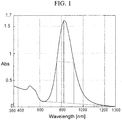
- Figure 1 is an absorption spectral figure when gold nano-rods are dispersed in water. As shown in Figure 1 , a peak position of the maximum absorption wavelength of the gold nano-rods of the present invention is 822 nm, and the absorbance at the peak position is about 1.53.
- half band positions of the maximum absorption wavelength are about 760 nm at a short wavelength side and about 910 nm at a long wavelength side, and a half band width is about 150 nm.
- the gold nano-rods produced according to the present invention yield a composition by adding a dispersant, a dispersion medium, and a binder (resin).
- the gold nano-rod composition is obtained by dispersing the gold nano-rods in a dispersion medium in a presence of a dispersant, and the obtained dispersed solution is mixed with a binder.
- the dispersant examples include a basic high molecular type dispersant which has a principal chain comprising absorption portions such as a nitrogen atom and sulfur atom which have high absorption capacity against the gold nano-rods, and a plurality of side chains having an affinity to non-aqueous organic solvents such as water and alcohol.
- Examples of a preferable commercially available dispersant include Solsperse 13940, Solsperse 24000SC, Solsperse 28000, and Solsperse 32000 (marketed by Avecia Ltd.), Flowlen DOPA-15B, and Flowlen DOPA-17 (marketed by KYOEISHA CHEMICAL Co., LTD.), and Ajisper PB815 and Ajisper PB711 (marketed by Ajinomoto Fine-Techno Co., Inc.).
- CTAB hexadecyltrimethylammonium bromide
- any resin can be used as the binder (resin), as long as it has transparency to light from visible light to near infrared light which is generally used for coating or molding.
- the resin used as the binder include organic resins such as acrylic resin, polyester resin, alkyd resin, urethane resin, silicone resin, fluororesin, epoxy resin, polycarbonate resin, polyvinyl chloride resin, polyvinyl alcohol resin, and radical polymerizable oligomer and monomer (possibly together with a curing agent and/or a radical polymerization initiator).
- the gold nano-rod composition of the present application may contain a solvent, if necessary.
- a solvent any solvent which stably dissolves or disperses the binder is used.
- the solvent used in the present application include alcohols such as methanol, ethanol, propanol, hexanol, and ethylene glycol; aromatic hydrocarbons such as xylene, and toluene; aliphatic hydrocarbons such as cyclohexane; ketones such as acetone and methyl ethyl ketone; esters such as ethyl acetate, and butyl acetate; ethers such as ethylene glycol monobutyl ether; and a mixture thereof, in addition to water.
- the solvents used in the present application are not limited to these solvents. That is, the gold nano-rod composition of the present application may be an aqueous dispersed solution in which gold nano-rods are dispersed in water. The method for using the gold nano-rod composition is not limited.
- the gold nano-rod composition of the present application may contain a dye or pigment for color correction and the like. Furthermore, the gold nano-rod composition may contain one or more kinds of gold nano-rods having the same or different wavelength absorption range.
- the gold nano-rod composition of the present application may be used as a variety of embodiments such as a coating, film, and plate containing the same, in addition to a coating composition, and a painting composition.
- the gold nano-rod composition of the present application is used together with a substrate such as transparent glass and plastic.
- a substrate such as transparent glass and plastic.
- this is coated on the substrate by various coating manners such as brush coating, spray coating, roll coating, spine coating, and dip coating.
- the gold nano-rod composition of the present application is used in not only a coating method but also in a method in which the metal fine particle composition is injected into a mold, i.e., injection molding method, and a method in which the gold nano-rod composition is kneaded with a binder (resin) and molded.
- the usage of the gold nano-rod compositions of the present application is not limited to these methods.
- the content of the gold nano-rods is preferably in a range from 0.01 part by weight to 90 parts by weight, relative to 100 parts by weight of the binder (resin). If the content is less than 0.01 part by weight, it is difficult to yield sufficiently desired effects. In contrast, if the content exceeds 90 parts by weight, it is disadvantage for cost.
- a transparent polymer film in which the gold nano-rods are kneaded in a resin, or a transparent substrate comprising a coating layer in which the gold nano-rods are dispersed in the surface thereof is used as an optical filter which absorbs a specific wavelength in a near infrared light region in a range from 800 nm to 1,200 nm.
- the optical film can be produced by the following method.
- (a) The composition of the present application is directly coated or printed on the transparent substrate, and hardened to produce a visible light ⁇ near infrared light absorption filter.
- (b) The composition of the present application is made into a film or plate to produce a visible light ⁇ near infrared light absorption filter, and the obtained absorption filter is laminated on a transparent substrate, or a transparent substrate is covered with the obtained absorption filter.
- the hardened coating or film containing the composition of the present application is laminated on a transparent substrate made of glass or plastic, and the obtained laminate is further laminated on another substrate or another substrate is covered with the obtained laminate, as a visible light ⁇ near infrared light absorption filter.
- the thickness of the coating film or filter is preferably in a range from approximately 0.01 ⁇ m to 1 mm, and when cost and light transparency are concerned, it is more preferably in a range from 0.05 ⁇ m to 300 ⁇ m.
- the obtained gold nano-rods and the gold nano-rod composition are used as a wiring material, electrode material, catalyst, pigment, cosmetic, near infrared light absorbing material, anticounterfeit ink, electromagnetic interference shielding materials, surface reinforcing fluorescence sensor, biomarker, nano-waveguide, recording material, recording element, polarization material, drug supporter for drug delivery system (DDS), biosensor, DNA chip, and test drug, in addition to the optical filter material.
- DDS drug delivery system
- a solution in which the gold nano-rods produced according to the present invention are dispersed is used as an anticounterfeit ink.
- the specific wavelength absorption property, scattered light, or fluorescence of the gold nano-rods is used in a detecting method.
- a detection wavelength is set in this range.
- the specific absorption wavelength is set in a range from 760 nm to 1,500 nm
- an invisible ink which is transparent in a visible light region, is obtained. Since the invisible ink can be discerned in a near infrared light region, this is used as an anticounterfeit ink.
- a film coated with the anticounterfeit ink comprises the gold nano-rods produced according to the present invention, the film is excellent in weather resistance, heat resistance, and chemical resistance.
- Any dispersant is used for surface treatment of the gold nano-rods, as long as it is compatible with a solvent used.
- a solvent for the anticounterfeit ink is selectable.
- the gold nano-rods produced according to the present invention are also used as a pigment.
- the gold nano-rods produced according to the present invention are dispersed in an oily material, it is difficult to observe the gold nano-rods as particles by the naked eye, and when this is coated, a coating film having high transparency is obtained. Therefore, when the gold nano-rods produced according to the present invention are used as a pigment for a cosmetic, although the content is small, a cosmetic having strong tinctorial power and high chroma is obtained.
- the gold nano-rods produced according to the present invention are also used as a conductive material.
- a conductive paste containing the gold nano-rods produced according to the present invention is used as a wiring material or electrode material.
- a wiring or electrode, which is obtained by coating or printing the conductive paste on an insulating substrate, and dried (burned), is excellent in conductivity, and migration resistance.
- a conductive paste is obtained by using the gold nano-rods produced according to the present invention, it is preferable that 1 to 20 parts by weight of a binder is added relative to 100 parts by weight of the metal nano-rods.
- SEIRS Surface Enhanced IR Spectroscopy
- SEFS Surface Enhanced Fluorescence Spectroscopy
- a glass substrate having the surface on which gold nano-rods treated with a silane treatment agent having a thiol-terminal (3-mercaptopropyltrimethylsilane, and the like) are fixed with high density is suitable for SEFS spectrometry using a fluorescent material emitting fluorescent light in this wavelength (for example, rhodamine type fluorescent pigment) as a marker.
- the gold nano-rods produced according to the present invention are used as a biomarker which responds to near infrared light.
- near infrared light in a range from 750 nm to 1,100 nm is not absorbed in organic matter, but gold nano-rods have distinctive absorption properties in a wavelength region from 750 nm to 1,100 nm, depending on the aspect ratio thereof.
- near infrared light is absorbed in the portion by irradiating near infrared light, so the portion can be determined. Therefore, it is possible to observe any portion dyed with the gold nano-rods in an organism having a large thickness, in which a measurement is impossible due to suspension or coloring by conventional methods.
- an organism is dyed with the gold nano-rods produced according to the present invention by covering with a compound having high biocompatibility such as polyethylene glycol, phospholipids, sugar chain, and antibody.
- Gold nano-rods which are covered with polyethylene glycol or phospholipids are preferably used for dying uniformly without local presence in a specific organ or tissue.
- polyethylene glycol is preferable as a coating agent for vital staining, because it is hardly affected by vital decomposition action and has high permeability in a cell.
- sugar chain and antibody are preferably used for dying a specific organ or tissue, because they are accumulated in the specific organ or tissue. It is possible to observe biomedical materials which have not previously been observed, using the gold nano-rods covered with these materials.
- a nano-waveguide is produced by the following method. First, the gold nano-rods are arranged in one dimension using an atom force microscope (AFM) or scanning tunneling microscopy (STM) as a manipulator.
- AFM atom force microscope
- STM scanning tunneling microscopy
- luminous nano-particles (zinc oxide, CdTe, or the like) are fixed at the one end of the nano-rods arranged in one dimension, and an optical fiber sensor of a near-filed microscope is positioned at the other end of the arrangement to form a nano-waveguide.
- the gold nano-rods produced according to the present invention are preferably used as such a nano-waveguide.
- the examples relate mainly to gold nano-rods, and show light absorption properties in a wavelength range from 800 to 900 nm. However, the same light absorption properties are obtained in a wavelength range from 550 to 1,200 nm by changing the aspect ratio of the gold nano-rods. Spectral characteristics were measured using V-570 manufactured by JASCO Corporation. In addition, in the case of other metals, the same results were obtained.
- the color of the reaction solution changed from orange to transparent and colorless.
- the transparent and colorless solution was put into a 100 ml-beaker, and ultraviolet light generated in a UV irradiation device (high-pressure mercury lamp) was irradiated directly onto the synthesis solution from the upper part of the beaker for five minutes. After irradiation, the synthesis solution was left to rest for one hour, and transferred to a storage vessel. Then the solution was ten-times diluted by adding water (in volume ratio, gold fine particle concentration: 1.6 x 10 -4 mol/L) to obtain a sample for measurement of absorption spectrum. The absorption spectrum is shown in Figure 1 .
- the peak position of the maximum absorption wavelength of the gold fine particles was 822 nm
- the positions of the half band width of the absorption spectrum were respectively about 760 nm at the short wavelength side and about 910 nm at the long wavelength side, and therefore, the half band width of the absorption spectrum was about 150 nm.
- the absorption coefficient which was calculated from the Lambert Beer formula [1] was about 9,563 L/mol ⁇ cm.
- 0.1 g of the dispersing agent (Solsperse 24000SC; marketed by Avecia Ltd.) was dissolved in 10 g of toluene.
- 50 g of the aqueous dispersing solution of the gold nano-rods (the average length in the short axis: 10 nm; the average length in the long axis: 42 nm, and the aspect ratio: 4.2) synthesized in Example 1, was added, and they were aggregated for ten minutes using an aggregator (revolution speed: 300 rpm).
- 30 g of ethanol was added, and this was left to rest for twenty-four hours.
- CTAB solubility of CTAB increased by adding ethanol, and CTAB absorbed in the surface of the gold nano-rods was desorbed. Then, nitrogen portions of the dispersing agent were absorbed in gold nano-rods and they were replaced with CTAB, and the surface treatment was performed.
- the mixture which was left to rest, was separated into a transparent and colorless water phase and a vivid red toluene phase. After that, only the organic solvent phase was eluted, and excess toluene was removed using an evaporator to produce the gold nano-rods concentrated solution of toluene (gold fine particle content: 10% by weight; solid content: 40% by weight).
- gold nano-rods concentrated solution of toluene gold fine particle content: 10% by weight; solid content: 40% by weight.
- the concentrated solution was diluted by adding toluene to 10,000 times (in volume), the gold nano-rods were not coagulated, and dispersed stably.
- the absorption spectrum of the concentrated and dispersed solution is shown in Figure 2 .
- the absorption spectrum changed by the surface treatment of the dispersing agent, and the peak position of the maximum absorption wavelength transferred from 822 nm to 864 nm. This was caused by a change of the refractive index of the material on the surface of the gold nano-rods.
- the coating was obtained by mixing 5 g of the gold nano-rods concentrated solution obtained in Example 2 in 20 g of a mixture containing a radical polymerizable urethane oligomer and a radical polymerization initiator.
- the obtained coating did not change color or generate precipitations, and was stable even though it was left under conditions in which light was blocked and at room temperature for three months or longer.
- the coating was coated on the glass plate (gold fine particle content: 1% by weight, and dried film thickness: 10 ⁇ m), and the transmitted spectrum was measured.
- the results are shown in Figure 3 .
- the transmissivity around the wavelength (870 nm) which corresponds to the peak position of the maximum absorption wavelength shown in Figure 2 was the lowest. Thereby, it was confirmed that the specific wavelength was absorbed by the gold nano-rods.
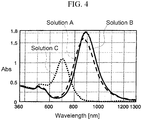
- the reaction solution was produced in the same manner as the solution A, and then chemical reduction was conducted.
- 150 ⁇ L of commercial strength nitric acid (concentration: about 60%) was added, and then ultraviolet light generated by a high-pressure mercury lamp of 10 mW/cm 2 or less was irradiated directly onto the solution from the upper part thereof for five minutes.
- the reaction solution was produced in the same manner as the solution A, and then chemical reduction was conducted.
- To the obtained reaction solution 2.5 ml of 1 mol/L-sodium hydroxide aqueous solution was added, and then ultraviolet light generated by a high-pressure mercury lamp of 10 mW/cm 2 or less was irradiated directly onto the solution from the upper part thereof for five minutes.
- the reaction solution was produced in the same manner as the solution A, and then chemical reduction was conducted.
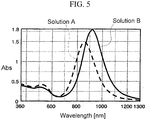
- the temperature of the obtained reaction solution was maintained at 26°C, and then ultraviolet light generated by a high-pressure mercury lamp of 10 mW/cm 2 or less was irradiated directly onto the solution from the upper part thereof for five minutes.
- the surfactant To 1 L of water, the surfactant, acetone, cyclohexane, cyclohexanone, and commercial strength nitric acid (concentration: about 60%) or 1 mol/L-sodium hydroxide aqueous solution were added to produce the electrolytes A, B, and C, that is, the solutions A, B, and C having the compositions shown in Table 1.
- the production method of the present invention it is possible to control easily the aspect ratio of the metal nano-rods, and produce efficiently the metal nano-rods having a desired aspect ratio.
- the gold nano-rods which are produced by the production method of the present invention are used as a filter material, wiring material, electrode material, catalyst, pigment, cosmetic, near infrared light absorbing material, anticounterfeit ink, electromagnetic interference shielding materials, surface reinforcing fluorescence sensor, biomarker, nano-waveguide, recording material, recording element, polarization material, drug supporter for drug delivery system (DDS), biosensor, DNA chip, or test drug, which contains the metal fine particles.
- DDS drug delivery system
Landscapes
- Chemical & Material Sciences (AREA)
- Engineering & Computer Science (AREA)
- Nanotechnology (AREA)
- Chemical Kinetics & Catalysis (AREA)
- General Chemical & Material Sciences (AREA)
- Physics & Mathematics (AREA)
- Crystallography & Structural Chemistry (AREA)
- Optics & Photonics (AREA)
- Biophysics (AREA)
- Life Sciences & Earth Sciences (AREA)
- Composite Materials (AREA)
- Condensed Matter Physics & Semiconductors (AREA)
- General Physics & Mathematics (AREA)
- Materials Engineering (AREA)
- Manufacture Of Metal Powder And Suspensions Thereof (AREA)
Description
- The present invention relates to a production method for producing gold nano-rods, wherein the aspect ratio of the gold nano-rods can be easily controlled.
- When metal fine particles are irradiated with light, a resonance absorption phenomenon, which is so-called plasmon absorption, occurs. In the resonance absorption phenomenon, an absorption wavelength differs depending on the kind and shape of metal. For example, a gold colloid, in which spherical gold fine particles are dispersed in water, has an absorption region around 530 nm. In contrast, it is well known that in the case of gold fine particles in a rod shape having a length in a short axis of about 10 nm, they have an absorption at a long wavelength side, which is attributed to a long axis of the rods, in addition to the absorption at 530 nm, which is attributed to the short axis of the rods (S-S. Chang et al. Langmuir, 1999, 15th issue, pages 701 to 709).
- It has been suggested that a resin composition containing noble metal fine particles as a coating or pigment can be used for optical materials such as an optical filter (Japanese Patent Application, First Publication No.
H11-80647 2001-108815 2002-22935 - A production method for producing metal fine patterns using plasmon excitation of metal fine particles is also known (Japanese Patent Application, First Publication No.
2001-64794 - As explained above, it is known that noble fine particles can be used for a coating or pigment for resin compositions; however, the noble fine particles used are spherical. For example, plasmon color, which spherical gold fine particles generate, is limited to visible light such as blue, bluish-purple, and reddish-purple. Therefore, a composition which uses plasmon absorption of spherical gold fine particles, or a substrate which is obtained by coating or kneading the composition, only has tones such as blue, bluish-purple, and reddish-purple.
- Many color filters containing a dye having a specific chemical structure discolor or decrease their absorption capacity when a long time has passed, because the dye has inferior heat resistance, light resistance, and chemical resistance compared with pigments and metal fine particles, and they have problems in reliability. In a method in which metal fine particles are made to grow on the surface of a solid, the metal fine particles are supported and grown on the surface of the solid. Therefore, it is impossible to disperse the metal fine particles in many solvents, binders, and production of a coating is difficult. In addition, in Patent Publications, plasmon absorption of metal fine particles is used only to grow the metal fine particles during synthesis steps, and selective light absorption characteristics at a specific wavelength due to a long direction of the metal fine particles is not used.
- The metal nano-rods are expected to be used for a variety of applications such as optical filter materials, near infrared light absorbing materials, pigments, and cosmetics, which use light absorption properties of the metal nano-rods, and conductive materials, wiring materials, electromagnetic interference shielding materials which use conductivity of the metal nano-rods.
- As a production method for producing metal nano-rods, an electrochemical reduction method, a chemical reduction method, a photoreduction method, an ultrasonic wave irradiation method, and the like are known.
- The electrochemical reduction method is a method in which gold fine particles are obtained by putting a gold-plated anode and a platinum-plated cathode in an electrolyte containing a surfactant, and passing a constant current between the anode and cathode. Gold ions generated at the anode are reduced at the cathode, and become gold fine particles. Then, the gold fine particles grow into a rod shape due to the functions of the surfactant, and become gold nano-rods in nano-size. In the electrolytic method, a silver plate is immersed in an electrolyte. It is reported that the area of the immersed silver plate in the electrolyte affects the length of the rods (Langmuir, 1999, 15th issue, pages 701 to 709). However, the amount of eluted silver and elution rate change depending on surface conditions of the silver plate. Therefore, it is difficult to adjust the area of the immersed silver plate, and control sufficiently the aspect ratio of the metal nano-rods.
- The chemical reduction method is a method in which gold nano-rods are obtained by adding a reducing agent to an aqueous solution of chloroauric acid, reducing chloroauric acid, growing gold nano-particles to obtain "seed particles", transferring the seed particles to an aqueous solution of chloroauric acid, and growing the seed particles in the aqueous solution to obtain gold nano-rods (J. Phys. Chem. B, 2001, 105th issue, pages 4065 to 4067). In this method, it is possible to control the length of the obtained rods by changing the amount of seed particles which are transferred to a growth reaction vessel. However, a reaction vessel for obtaining the seed particles and a reaction vessel for growing the seed particles are necessary, and production processes are complicated and troublesome.
- The photoreduction method is a method in which gold fine particles are obtained by irradiating ultraviolet light to an aqueous solution of chloroauric acid, and reducing chloroauric acid in the solution (J. Am. Chem. Soc. 2002, 124th issue, pages 14,316 to 14,318). This method does not need two vessels, which are required in the chemical reduction method, and the length of the rods can be controlled by adjusting the irradiation time. However, this method has a problem in that the reaction time is long.
- In
JP 04-323310 A - The present invention solves these problems of conventional production methods for producing metal fine particles. The present invention provides a production method which can easily control the aspect ratio of metal fine particles, and compositions containing the metal fine particles produced by the production method.
- Specifically, the present invention provides the following production method for gold nano-rods.
- (1) A production method for producing metal fine particles by reducing gold ions in an aqueous solution containing a surfactant, wherein
the aspect ratio of the gold nano-rods is controlled by performing the reduction reaction while adjusting the solution temperature,
the surfactant is hexadecyltrimethylammonium bromide, and
the aspect ratio of the gold nano-rods is controlled by adjusting the temperature of the aqueous solution in a range having an upper limit of 40 °C to 60 °C, and a lower limit of 26 °C to 30 °C. - (2) The production method for producing gold nano-rods according to (1), wherein in the range having an upper limit of 40 °C to 60 °C, and a lower limit of 26 °C to 30 °C, the aspect ratio of the gold nano-rods is made small by increasing the solution temperature of the aqueous solution containing gold ions, or the aspect ratio of the gold nano-rods is made large by decreasing the solution temperature of the aqueous solution containing gold ions.
-
-
Figure 1 is an absorption spectral figure of a gold nano-rods dispersed aqueous solution of reference Example 1. -
Figure 2 is an absorption spectral figure of a gold nano-rods concentrated solution of reference Example 2. -
Figure 3 is a transmitted spectral figure of a coating made of a gold nano-rods containing coating of reference Example 3. -
Figure 4 is an absorption spectral figure showing results of reference Example 4. -
Figure 5 is an absorption spectral figure showing results of Example 5. -
Figure 6 is an absorption spectral figure showing results of reference Example 6. - Below, the present invention is explained in detail.
- The production method for the metal fine particles is explained below.
- The production method of the present invention is a method in which gold ions are reduced in an aqueous solution containing a surfactant, wherein the aspect ratio of the gold nano-rods is controlled by performing the reduction reaction while adjusting a solution temperature.
- As a method for reducing gold ions in an aqueous solution containing a surfactant in the production method of the present invention, a chemical reduction method, electrochemical reduction method, photoreduction method, or combination of a chemical reduction method and a photoreduction method can be used.
- In the production method of the present invention in which the liquid temperature is adjusted to perform the reduction reaction, for example, when the electrochemical reduction method is adopted, the aspect ratio of the gold nano-rods is controlled by conducting the electrolytic reaction while the temperature of the electrolyte is maintained in a certain range. In addition, when the chemical reduction method, photoreduction method, or the combination of the chemical reduction method and the photoreduction method is adopted, the aspect ratio of the gold nano-rods is controlled by conducting the reaction while the temperature of the reaction solution is maintained in a certain range.
- Specifically, when the combination of the chemical reduction method and the photoreduction method is adopted, the aspect ratio of the gold nano-rods is controlled by irradiating ultraviolet light while the temperature of the reaction solution, which is obtained by adding the reducing agent to the metal salt aqueous solution containing the surfactant, is maintained in a certain range.
- In the production method in which the liquid temperature is adjusted, the aspect ratio is made small by raising the liquid temperature, or this is made large by lowering the liquid temperature. Specifically, the higher the liquid temperature is raised above the precipitation temperature of the surfactant, the smaller the aspect ratio is, and the production amount of the spherical fine particles increases. When the liquid temperature is near the precipitation temperature, the aspect ratio is large. When the liquid temperature is lower than the precipitation temperature of the surfactant, the production amount of the gold nano-rods decreases. The precipitation temperature of CTAB is about 25°C. When productivity is concerned, the upper limit of the liquid temperature is preferably in a range from 40 to 60°C, and the lower limit is preferably in a range from 26 to 30°C. Among these temperature ranges, the liquid temperature is further adjusted based on the fact that the higher liquid temperature is raised above the precipitation temperature, the smaller aspect ratio is, and that the aspect ratio is large when the liquid temperature is around the precipitation temperature.
- As explained above, the chemical reduction method is a method in which metal ions are reduced using a reducing agent. The electrochemical reduction method is a method in which metal ions eluted from an anode are reduced at a cathode by flowing a current thorough an electrolyte. The photoreduction method is a method in which metal particles are reduced by irradiating ultraviolet light, for example. The combination of a chemical reduction method and a photoreduction method is a combination of the chemical reduction method and the photoreduction method.
- As explained above, the electrochemical reduction method is a method in which metal ions eluted from an anode are reduced at a cathode. For example, gold nano-rods are produced efficiently by using an aqueous solution the surfactant hexadecyltrimethylammonium bromide (CTAB: CH3(CH2)15N+(CH3)3Br-).
- The production of the gold nano-rods is stabilized by using a ketone simultaneously.
- As the combination of the chemical reduction method and the photoreduction method, a method is known, in which a solution containing a reducing agent in a gold salt solution containing a surfactant is used as a reaction solution, and the reaction solution is irradiated with ultraviolet light to produce gold nano-rods.
- As the reducing agent used in the combination of the chemical reduction method and the photoreduction method, it is preferable to use a reducing agent having relatively weak reducing power. Examples of the preferable reducing agent include ascorbic acid, citric acid and salts thereof; hydroxylamine hydrochloride, a hydrazine compound, succinic acid, and salts thereof; and amines.
- In the combination of the chemical reduction method and the photoreduction method, specifically, the method in which gold nano-rods are produced by performing chemical reduction and ultraviolet light irradiation, a solution containing CTAB, in which a gold salt is added, is used as a reaction solution, and a chemical reduction is conducted by adding a reducing agent such as ascorbic acid. When ascorbic acid is added, the reaction solution is transparent and colorless due to a reduction reaction.
- When a ketone such as acetone is added to the reaction solution, the production reaction of the gold nano-rods is stabilized. The growth of the gold nano-rods in the long axis is promoted by adding silver salts such as silver nitrate, silver chloride, and silver bromide.
- Gold nano-rods are produced by the combination of the chemical reduction method and the photoreduction method. Specifically, in the method in which chloroauric acid in a solution is chemically reduced, and then this is photoreduced, chemical reduction conditions and photoreduction conditions, that is, light irradiation conditions are adjusted to obtain preferable gold nano-rods. For example, hexadecyltrimethylammonium bromide (CTAB) is added in a chloroauric acid aqueous solution used as a synthesis solution so that the concentration is 0.24 to 0.8 mol/L, and then acetone and cyclohexane are added thereto, and the chloroauric acid is reduced by adding the reducing agent such as ascorbic acid. After the chemical reduction, light irradiation is performed to grow the gold nano-rods. In this case, a peak position in the maximum absorption wavelength is transferred to the long wavelength side by adding 0.01 to 1.0% by weight of cyclohexanone together with CTAB.
- Gold nano-rods have selective wavelength absorbing characteristics depending on the length in a long axis thereof. Specifically, the absorbance due to the long axis of the gold nano-rods is larger than the absorbance at 530 nm due to the short axis, and a maximum absorption occurs in a range from 550 nm to 1,200 nm.
- When the aspect ratio is less than 1.1, the shape is subsequently spherical. Therefore, it is difficult to yield wavelength absorption characteristics in a long wavelength region of 550 nm or greater. In contrast, if the aspect ratio is greater than 8.0, a half band width of an absorption spectrum at the maximum absorption wavelength is easily larger than 200 nm, and it is difficult to obtain a sharp absorption property.
- In general, an absorbance A can be calculated by the following Lambert Beer formula [1], wherein ε means an absorption coefficient of a material through which light is transmitted, L means an optical path length of the material placed in a quartz cell for measurement, and C means a concentration of the material. The absorption coefficient ε is a specific value of the material through which light is transmitted, and the more the absorption coefficient ε increases, the more the absorbance increases, and an absorption spectrum having a high peak is obtained.

- In the gold nano-rods produced according to the present invention, when the concentration of the gold fine particles in the measurement sample solution is 1.6 x 10⁻⁴ mol/L (solvent: water), and the optical path length of the measurement cell is 1 cm, the absorption coefficient in a wavelength range from 550 nm to 1,200 nm is in a range from 6,000 to 20, 000 L/mol·cm. Therefore, the absorbance of the peak position at the maximum absorption wavelength is approximately in a range from 0.96 to 3.2.
- In the gold nano-rods produced according to the present invention, a half band width of an absorption spectrum at the maximum absorption wavelength is 200 nm or less.
Figure 1 is an absorption spectral figure when gold nano-rods are dispersed in water. As shown inFigure 1 , a peak position of the maximum absorption wavelength of the gold nano-rods of the present invention is 822 nm, and the absorbance at the peak position is about 1.53. In addition, half band positions of the maximum absorption wavelength are about 760 nm at a short wavelength side and about 910 nm at a long wavelength side, and a half band width is about 150 nm. - The gold nano-rods produced according to the present invention yield a composition by adding a dispersant, a dispersion medium, and a binder (resin). For example, the gold nano-rod composition is obtained by dispersing the gold nano-rods in a dispersion medium in a presence of a dispersant, and the obtained dispersed solution is mixed with a binder.
- Examples of the dispersant include a basic high molecular type dispersant which has a principal chain comprising absorption portions such as a nitrogen atom and sulfur atom which have high absorption capacity against the gold nano-rods, and a plurality of side chains having an affinity to non-aqueous organic solvents such as water and alcohol. Examples of a preferable commercially available dispersant include Solsperse 13940, Solsperse 24000SC, Solsperse 28000, and Solsperse 32000 (marketed by Avecia Ltd.), Flowlen DOPA-15B, and Flowlen DOPA-17 (marketed by KYOEISHA CHEMICAL Co., LTD.), and Ajisper PB815 and Ajisper PB711 (marketed by Ajinomoto Fine-Techno Co., Inc.).
- When a synthesis solution containing chloroauric acid and hexadecyltrimethylammonium bromide (CTAB) is used, CTAB sometimes adheres to the surface of the obtained metal fine particles. In this case, when the above listed dispersant is used, CTAB adhered to the surface of the metal fine particles is replaced with the dispersant, and thereby dispersibility to resins and the like is improved.
- Any resin can be used as the binder (resin), as long as it has transparency to light from visible light to near infrared light which is generally used for coating or molding. Examples of the resin used as the binder include organic resins such as acrylic resin, polyester resin, alkyd resin, urethane resin, silicone resin, fluororesin, epoxy resin, polycarbonate resin, polyvinyl chloride resin, polyvinyl alcohol resin, and radical polymerizable oligomer and monomer (possibly together with a curing agent and/or a radical polymerization initiator).
- The gold nano-rod composition of the present application may contain a solvent, if necessary. As the solvent used in the present application, any solvent which stably dissolves or disperses the binder is used. Examples of the solvent used in the present application include alcohols such as methanol, ethanol, propanol, hexanol, and ethylene glycol; aromatic hydrocarbons such as xylene, and toluene; aliphatic hydrocarbons such as cyclohexane; ketones such as acetone and methyl ethyl ketone; esters such as ethyl acetate, and butyl acetate; ethers such as ethylene glycol monobutyl ether; and a mixture thereof, in addition to water. However, the solvents used in the present application are not limited to these solvents. That is, the gold nano-rod composition of the present application may be an aqueous dispersed solution in which gold nano-rods are dispersed in water. The method for using the gold nano-rod composition is not limited.
- The gold nano-rod composition of the present application may contain a dye or pigment for color correction and the like. Furthermore, the gold nano-rod composition may contain one or more kinds of gold nano-rods having the same or different wavelength absorption range.
- The gold nano-rod composition of the present application may be used as a variety of embodiments such as a coating, film, and plate containing the same, in addition to a coating composition, and a painting composition.
- In addition, the gold nano-rod composition of the present application is used together with a substrate such as transparent glass and plastic. When the gold nano-rod composition is used together with such a substrate, this is coated on the substrate by various coating manners such as brush coating, spray coating, roll coating, spine coating, and dip coating.
- The gold nano-rod composition of the present application is used in not only a coating method but also in a method in which the metal fine particle composition is injected into a mold, i.e., injection molding method, and a method in which the gold nano-rod composition is kneaded with a binder (resin) and molded. The usage of the gold nano-rod compositions of the present application is not limited to these methods.
- When the gold nano-rod composition in which the gold nano-rods are mixed in the binder (resin) is used as a material for an optical filter, the content of the gold nano-rods is preferably in a range from 0.01 part by weight to 90 parts by weight, relative to 100 parts by weight of the binder (resin). If the content is less than 0.01 part by weight, it is difficult to yield sufficiently desired effects. In contrast, if the content exceeds 90 parts by weight, it is disadvantage for cost.
- A transparent polymer film in which the gold nano-rods are kneaded in a resin, or a transparent substrate comprising a coating layer in which the gold nano-rods are dispersed in the surface thereof is used as an optical filter which absorbs a specific wavelength in a near infrared light region in a range from 800 nm to 1,200 nm.
- For example, the optical film can be produced by the following method. (a) The composition of the present application is directly coated or printed on the transparent substrate, and hardened to produce a visible light · near infrared light absorption filter. (b) The composition of the present application is made into a film or plate to produce a visible light · near infrared light absorption filter, and the obtained absorption filter is laminated on a transparent substrate, or a transparent substrate is covered with the obtained absorption filter. (c) The hardened coating or film containing the composition of the present application is laminated on a transparent substrate made of glass or plastic, and the obtained laminate is further laminated on another substrate or another substrate is covered with the obtained laminate, as a visible light · near infrared light absorption filter.
- The thickness of the coating film or filter is preferably in a range from approximately 0.01 µm to 1 mm, and when cost and light transparency are concerned, it is more preferably in a range from 0.05 µm to 300 µm.
- The obtained gold nano-rods and the gold nano-rod composition are used as a wiring material, electrode material, catalyst, pigment, cosmetic, near infrared light absorbing material, anticounterfeit ink, electromagnetic interference shielding materials, surface reinforcing fluorescence sensor, biomarker, nano-waveguide, recording material, recording element, polarization material, drug supporter for drug delivery system (DDS), biosensor, DNA chip, and test drug, in addition to the optical filter material.
- A solution in which the gold nano-rods produced according to the present invention are dispersed is used as an anticounterfeit ink. In the anticounterfeit ink, the specific wavelength absorption property, scattered light, or fluorescence of the gold nano-rods is used in a detecting method. Specifically, since the gold nano-rods absorb a specific wavelength in a range from 600 nm to 1,500 nm, a detection wavelength is set in this range. When the specific absorption wavelength is set in a range from 760 nm to 1,500 nm, an invisible ink, which is transparent in a visible light region, is obtained. Since the invisible ink can be discerned in a near infrared light region, this is used as an anticounterfeit ink. Since a film coated with the anticounterfeit ink comprises the gold nano-rods produced according to the present invention, the film is excellent in weather resistance, heat resistance, and chemical resistance.
- Any dispersant is used for surface treatment of the gold nano-rods, as long as it is compatible with a solvent used. A solvent for the anticounterfeit ink is selectable.
- The gold nano-rods produced according to the present invention are also used as a pigment. When the gold nano-rods produced according to the present invention are dispersed in an oily material, it is difficult to observe the gold nano-rods as particles by the naked eye, and when this is coated, a coating film having high transparency is obtained. Therefore, when the gold nano-rods produced according to the present invention are used as a pigment for a cosmetic, although the content is small, a cosmetic having strong tinctorial power and high chroma is obtained.
- The gold nano-rods produced according to the present invention are also used as a conductive material. A conductive paste containing the gold nano-rods produced according to the present invention is used as a wiring material or electrode material. A wiring or electrode, which is obtained by coating or printing the conductive paste on an insulating substrate, and dried (burned), is excellent in conductivity, and migration resistance. When a conductive paste is obtained by using the gold nano-rods produced according to the present invention, it is preferable that 1 to 20 parts by weight of a binder is added relative to 100 parts by weight of the metal nano-rods.
- It is well-known that infrared light absorption or fluorescence emission is amplified by fixing metal fine particles, that is, metal nano-particles, on the surface of a glass substrate with high density. Spectroscopy utilizing this is called as "Surface Enhanced IR Spectroscopy (SEIRS)" or "Surface Enhanced Fluorescence Spectroscopy (SEFS)". In particular, SEFS is known as being a simple technique. The gold nano-rods produced according to the present invention are suitable as a sensor material used for SEIRS or SEFS. For example, because gold nano-rods have a wavelength region having a small absorbance in a wavelength range from 550 nm to 800 nm, a glass substrate having the surface on which gold nano-rods treated with a silane treatment agent having a thiol-terminal (3-mercaptopropyltrimethylsilane, and the like) are fixed with high density is suitable for SEFS spectrometry using a fluorescent material emitting fluorescent light in this wavelength (for example, rhodamine type fluorescent pigment) as a marker.
- The gold nano-rods produced according to the present invention are used as a biomarker which responds to near infrared light. For example, most near infrared light in a range from 750 nm to 1,100 nm is not absorbed in organic matter, but gold nano-rods have distinctive absorption properties in a wavelength region from 750 nm to 1,100 nm, depending on the aspect ratio thereof. When a specific portion of the organism is dyed by the gold nano-rods, near infrared light is absorbed in the portion by irradiating near infrared light, so the portion can be determined. Therefore, it is possible to observe any portion dyed with the gold nano-rods in an organism having a large thickness, in which a measurement is impossible due to suspension or coloring by conventional methods.
- Specifically, an organism is dyed with the gold nano-rods produced according to the present invention by covering with a compound having high biocompatibility such as polyethylene glycol, phospholipids, sugar chain, and antibody. Gold nano-rods which are covered with polyethylene glycol or phospholipids are preferably used for dying uniformly without local presence in a specific organ or tissue. In particular, polyethylene glycol is preferable as a coating agent for vital staining, because it is hardly affected by vital decomposition action and has high permeability in a cell. In contrast, sugar chain and antibody are preferably used for dying a specific organ or tissue, because they are accumulated in the specific organ or tissue. It is possible to observe biomedical materials which have not previously been observed, using the gold nano-rods covered with these materials.
- When the gold nano-rods produced according to the present invention are arranged regularly in one dimension with high density, light propagates among the particles due to an interaction of near-field light which is generated near the nano-particles. Due to this, it is possible to produce a nano-waveguide suitable for a one-diementional waveguide. For example, a nano-waveguide is produced by the following method. First, the gold nano-rods are arranged in one dimension using an atom force microscope (AFM) or scanning tunneling microscopy (STM) as a manipulator. Then, luminous nano-particles (zinc oxide, CdTe, or the like) are fixed at the one end of the nano-rods arranged in one dimension, and an optical fiber sensor of a near-filed microscope is positioned at the other end of the arrangement to form a nano-waveguide. The gold nano-rods produced according to the present invention are preferably used as such a nano-waveguide.
- Below, the present invention will be explained with reference to examples. The examples relate mainly to gold nano-rods, and show light absorption properties in a wavelength range from 800 to 900 nm. However, the same light absorption properties are obtained in a wavelength range from 550 to 1,200 nm by changing the aspect ratio of the gold nano-rods. Spectral characteristics were measured using V-570 manufactured by JASCO Corporation. In addition, in the case of other metals, the same results were obtained.
- To 50 ml of 0.50 mol/L-CTAB (hexadecyltrimethylammonium bromide) aqueous solution, 5 ml of 24 mmol/L-chloroauric acid aqueous solution, 1 ml of acetone, 1 ml of cyclohexane, 1 ml of cyclohexanone, and 5 ml of 10 mmol/L-silver nitrate aqueous solution were added to produce the reaction solution. To the reaction solution, 5 ml of 40 mmol/L-ascorbic acid (AS) aqueous solution was added to initiate chemical reduction. Just after the AS aqueous solution was added, the color of the reaction solution changed from orange to transparent and colorless. The transparent and colorless solution was put into a 100 ml-beaker, and ultraviolet light generated in a UV irradiation device (high-pressure mercury lamp) was irradiated directly onto the synthesis solution from the upper part of the beaker for five minutes. After irradiation, the synthesis solution was left to rest for one hour, and transferred to a storage vessel. Then the solution was ten-times diluted by adding water (in volume ratio, gold fine particle concentration: 1.6 x 10⁻⁴ mol/L) to obtain a sample for measurement of absorption spectrum. The absorption spectrum is shown in
Figure 1 . - As shown in
Figure 1 , the peak position of the maximum absorption wavelength of the gold fine particles (gold nano-rods) was 822 nm, the positions of the half band width of the absorption spectrum were respectively about 760 nm at the short wavelength side and about 910 nm at the long wavelength side, and therefore, the half band width of the absorption spectrum was about 150 nm. In addition, in the case where the gold fine particle concentration was 1.6 x 10⁻⁴ mol/L, and the length of the measurement cell was 1 cm, the absorbance at the maximum absorption wavelength was 1.53. Therefore, the absorption coefficient, which was calculated from the Lambert Beer formula [1], was about 9,563 L/mol·cm. - 0.1 g of the dispersing agent (Solsperse 24000SC; marketed by Avecia Ltd.) was dissolved in 10 g of toluene. To the toluene solution containing the dispersing agent, 50 g of the aqueous dispersing solution of the gold nano-rods (the average length in the short axis: 10 nm; the average length in the long axis: 42 nm, and the aspect ratio: 4.2) synthesized in Example 1, was added, and they were aggregated for ten minutes using an aggregator (revolution speed: 300 rpm). To the obtained solution, 30 g of ethanol was added, and this was left to rest for twenty-four hours. The solubility of CTAB increased by adding ethanol, and CTAB absorbed in the surface of the gold nano-rods was desorbed. Then, nitrogen portions of the dispersing agent were absorbed in gold nano-rods and they were replaced with CTAB, and the surface treatment was performed.
- The mixture, which was left to rest, was separated into a transparent and colorless water phase and a vivid red toluene phase. After that, only the organic solvent phase was eluted, and excess toluene was removed using an evaporator to produce the gold nano-rods concentrated solution of toluene (gold fine particle content: 10% by weight; solid content: 40% by weight). When the concentrated solution was diluted by adding toluene to 10,000 times (in volume), the gold nano-rods were not coagulated, and dispersed stably. The absorption spectrum of the concentrated and dispersed solution is shown in
Figure 2 . - As shown in
Figure 2 , the absorption spectrum changed by the surface treatment of the dispersing agent, and the peak position of the maximum absorption wavelength transferred from 822 nm to 864 nm. This was caused by a change of the refractive index of the material on the surface of the gold nano-rods. - The coating was obtained by mixing 5 g of the gold nano-rods concentrated solution obtained in Example 2 in 20 g of a mixture containing a radical polymerizable urethane oligomer and a radical polymerization initiator. The obtained coating did not change color or generate precipitations, and was stable even though it was left under conditions in which light was blocked and at room temperature for three months or longer.
- The coating was coated on the glass plate (gold fine particle content: 1% by weight, and dried film thickness: 10 µm), and the transmitted spectrum was measured. The results are shown in
Figure 3 . As shown inFigure 3 , the transmissivity around the wavelength (870 nm) which corresponds to the peak position of the maximum absorption wavelength shown inFigure 2 was the lowest. Thereby, it was confirmed that the specific wavelength was absorbed by the gold nano-rods. - To 405 ml of 480 mmol/L-CTAB aqueous solution, 34 ml of 24 mmol/L-chloroauric acid aqueous solution, 6 ml of acetone, 0.7 ml of cyclohexanone, and 25 ml of 10 mmol/L-silver nitrate aqueous solution were added to produce the reaction solution. To the reaction solution, 33 ml of 40 mmol/L-ascorbic acid aqueous solution was added to initiate chemical reduction. Just after the ascorbic acid aqueous solution was added, the color of the reaction solution changed from orange to transparent and colorless. Ultraviolet light generated by a high-pressure mercury lamp of 10 mW/cm2 or less was irradiated directly onto the transparent and colorless solution from the upper part thereof for five minutes.
- The reaction solution was produced in the same manner as the solution A, and then chemical reduction was conducted. To the obtained reaction solution, 150 µL of commercial strength nitric acid (concentration: about 60%) was added, and then ultraviolet light generated by a high-pressure mercury lamp of 10 mW/cm2 or less was irradiated directly onto the solution from the upper part thereof for five minutes.
- The reaction solution was produced in the same manner as the solution A, and then chemical reduction was conducted. To the obtained reaction solution, 2.5 ml of 1 mol/L-sodium hydroxide aqueous solution was added, and then ultraviolet light generated by a high-pressure mercury lamp of 10 mW/cm2 or less was irradiated directly onto the solution from the upper part thereof for five minutes.
- The absorption spectrums of the solutions A, B, and C are shown in
Figure 4 .
As shown inFigure 4 , the absorption peak of the solution B, in which nitric acid was added, is shifted to the long wavelength side, compared with the solution A. This showed that 4.7 (the length in the long axis: 42.3 nm), which was the aspect ratio of the gold nano-rods in the solution A, increased to 5.0 (the length in the long axis: 45.0 nm) which was the aspect ratio of the gold nano-rods in the solution B. The absorption peak of the solution C, in which sodium hydroxide was added, was shifted to the short wavelength side, and this showed that the aspect ratio of the gold nano-rods decreased to 3.0 (the length in the long axis: 27.0 nm). - To 405 ml of 480 mmol/L-CTAB aqueous solution, 34 ml of 24 mmol/L-chloroauric acid aqueous solution, 6 ml of acetone, 0.7 ml of cyclohexanone, and 25 ml of 10 mmol/L-silver nitrate aqueous solution were added to produce the reaction solution. To the reaction solution, 33 ml of 40 mmol/L-ascorbic acid aqueous solution was added to initiate chemical reduction. Just after the ascorbic acid aqueous solution was added, the color of the reaction solution changed from orange to transparent and colorless. The temperature of the transparent and colorless solution was maintained at 40°C, and ultraviolet light generated by a high-pressure mercury lamp of 10 mW/cm2 or less was irradiated directly onto the solution from the upper part thereof for five minutes.
- The reaction solution was produced in the same manner as the solution A, and then chemical reduction was conducted. The temperature of the obtained reaction solution was maintained at 26°C, and then ultraviolet light generated by a high-pressure mercury lamp of 10 mW/cm2 or less was irradiated directly onto the solution from the upper part thereof for five minutes.
- The absorption spectrums of the solutions A and B are shown in
Figure 5 . As shown inFigure 5 , the absorption peak of the solution B, of which the solution temperature is lower than that of the solution A, is shifted to the long wavelength side. This showed that 4.6 (the length in the long axis: 41.4 nm), which was the aspect ratio of the solution A, increased to 5.3 (the length in the long axis: 47.7 nm) which was the aspect ratio of the solution B. - To 1 L of water, the surfactant, acetone, cyclohexane, cyclohexanone, and commercial strength nitric acid (concentration: about 60%) or 1 mol/L-sodium hydroxide aqueous solution were added to produce the electrolytes A, B, and C, that is, the solutions A, B, and C having the compositions shown in Table 1.
Table 1 Solution A Solution B Solution C CTAB 240 mmol/L 240 mmol/L 240 mmol/L [CH3(CH2)3]4N+Br- 7.3 mmol/L 7.3 mmol/L 7.3 mmol/L [CH3(CH2)5]4N+Br- 17.0 mmol/L 17.0 mmol/L 17.0 mmol/L Acetone 13 mL 13 mL 13 mL Cyclohexane 13.5 mL 13.5 mL 13.5 mL Cyclohexanone 2.6 mL 2.6 mL 2.6 mL Acid or alkali no addition (pH 4.1) nitric acid to pH 3 NaOH to pH 7.1 - While 3.0 mol/L-silver nitrate aqueous solution was added at a rate of 80 µL/min, the electrolytes A, B, and C were electrolyzed by flowing a constant current of 5.0 mA for four hours and using a gold plate as the anode and a stainless steel plate (SUS 304 plate) as the cathode. The absorption spectrums of the solutions A, B, and C after electrolysis are shown in
Figure 6 . As shown inFigure 6 , the absorption peak of the solution B, in which nitric acid was added, is shifted to the short wavelength side, compared with that of the solution A. This showed that 5.5 (the length in the long axis: 49.5 nm), which was the aspect ratio of the gold nano-rods of the solution A, decreased to 4.8 (the length in the long axis: 43.2 nm), which was the aspect ratio of the gold nano-rods of the solution B. In addition, the absorption peak of the solution C, in which sodium hydroxide aqueous solution was added, was shifted to the long wavelength side, and this showed that the aspect ratio of the gold nano-rods increased to 5.8 (the length in the long axis: 52.2 nm). - According to the production method of the present invention, it is possible to control easily the aspect ratio of the metal nano-rods, and produce efficiently the metal nano-rods having a desired aspect ratio.
- In addition, the gold nano-rods which are produced by the production method of the present invention are used as a filter material, wiring material, electrode material, catalyst, pigment, cosmetic, near infrared light absorbing material, anticounterfeit ink, electromagnetic interference shielding materials, surface reinforcing fluorescence sensor, biomarker, nano-waveguide, recording material, recording element, polarization material, drug supporter for drug delivery system (DDS), biosensor, DNA chip, or test drug, which contains the metal fine particles.
Claims (2)
- A production method for producing gold nano-rods by reducing gold ions in an aqueous solution containing a surfactant, wherein
the aspect ratio of the gold nano-rods is controlled by performing the reduction reaction while adjusting the solution temperature,
the surfactant is hexadecyltrimethylammonium bromide, and
the aspect ratio of the gold nano-rods is controlled by adjusting the temperature of the aqueous solution in a range having an upper limit of 40 °C to 60 °C, and a lower limit of 26 °C to 30 °C. - The production method for producing gold nano-rods according to claim 1, wherein in the range having an upper limit of 40 °C to 60 °C, and a lower limit of 26 °C to 30 °C, the aspect ratio of the gold nano-rods is made small by increasing the solution temperature of the aqueous solution containing gold ions, or the aspect ratio of the gold nano-rods is made large by decreasing the solution temperature of the aqueous solution containing gold ions.
Applications Claiming Priority (4)
| Application Number | Priority Date | Filing Date | Title |
|---|---|---|---|
| JP2003314208 | 2003-09-05 | ||
| JP2004116253 | 2004-04-09 | ||
| JP2004116254A JP2005298891A (en) | 2004-04-09 | 2004-04-09 | Method for producing metal fine particles and composition containing the same |
| EP04772901A EP1661648A4 (en) | 2003-09-05 | 2004-09-02 | METAL MICROPARTICLE, COMPOSITION CONTAINING THESE MICROPARTICLES AND PROCESS FOR PRODUCING METAL MICROPARTICLES |
Related Parent Applications (5)
| Application Number | Title | Priority Date | Filing Date |
|---|---|---|---|
| EP04772901A Division EP1661648A4 (en) | 2003-09-05 | 2004-09-02 | METAL MICROPARTICLE, COMPOSITION CONTAINING THESE MICROPARTICLES AND PROCESS FOR PRODUCING METAL MICROPARTICLES |
| WOPCT/JP20/04013087 Previously-Filed-Application | 2004-09-02 | ||
| WOPCT/JP2004/001087 Previously-Filed-Application | 2004-09-02 | ||
| PCT/JP2004/013087 Previously-Filed-Application WO2005023466A1 (en) | 2003-09-05 | 2004-09-02 | Metal microparticle, composition containing the same and process for producing metal microparticle |
| EP04772901.7 Division | 2004-09-02 |
Publications (4)
| Publication Number | Publication Date |
|---|---|
| EP2165791A2 EP2165791A2 (en) | 2010-03-24 |
| EP2165791A3 EP2165791A3 (en) | 2010-04-14 |
| EP2165791A8 EP2165791A8 (en) | 2010-07-07 |
| EP2165791B1 true EP2165791B1 (en) | 2018-03-14 |
Family
ID=34279565
Family Applications (3)
| Application Number | Title | Priority Date | Filing Date |
|---|---|---|---|
| EP08162067.6A Expired - Lifetime EP2165791B1 (en) | 2003-09-05 | 2004-09-02 | Method for producing gold nanorods |
| EP04772901A Withdrawn EP1661648A4 (en) | 2003-09-05 | 2004-09-02 | METAL MICROPARTICLE, COMPOSITION CONTAINING THESE MICROPARTICLES AND PROCESS FOR PRODUCING METAL MICROPARTICLES |
| EP08162064A Withdrawn EP2189232A1 (en) | 2003-09-05 | 2004-09-02 | Metal microparticle, composition containing the same and process for producing metal microparticle |
Family Applications After (2)
| Application Number | Title | Priority Date | Filing Date |
|---|---|---|---|
| EP04772901A Withdrawn EP1661648A4 (en) | 2003-09-05 | 2004-09-02 | METAL MICROPARTICLE, COMPOSITION CONTAINING THESE MICROPARTICLES AND PROCESS FOR PRODUCING METAL MICROPARTICLES |
| EP08162064A Withdrawn EP2189232A1 (en) | 2003-09-05 | 2004-09-02 | Metal microparticle, composition containing the same and process for producing metal microparticle |
Country Status (5)
| Country | Link |
|---|---|
| EP (3) | EP2165791B1 (en) |
| KR (2) | KR20070104954A (en) |
| CN (1) | CN102019434A (en) |
| TW (1) | TWI347925B (en) |
| WO (1) | WO2005023466A1 (en) |
Families Citing this family (21)
| Publication number | Priority date | Publication date | Assignee | Title |
|---|---|---|---|---|
| KR101125491B1 (en) | 2004-07-08 | 2012-03-21 | 다이닛뽄도료가부시키가이샤 | Method for producing metal fine particle, metal fine particle produced thereby, composition containing same, light absorbing material, and application thereof |
| US7592001B2 (en) * | 2004-08-02 | 2009-09-22 | University Of Florida Research Foundation, Inc. | High aspect ratio metal particles and methods for forming same |
| SG150516A1 (en) | 2005-08-12 | 2009-03-30 | Cambrios Technologies Corp | Nanowires-based transparent conductors |
| JP2007165284A (en) * | 2005-11-18 | 2007-06-28 | Seiko Instruments Inc | Electroluminescence element and display device using the same |
| GB2438196B (en) | 2006-05-13 | 2008-05-28 | Inovink Ltd | Improvements in or relating to printing |
| WO2008056815A1 (en) * | 2006-11-08 | 2008-05-15 | Ricoh Company, Ltd. | Multiphoton absorption functional material, composite layer having multiphoton absorption function and mixture, and optical recording medium, photoelectric conversion element, optical control element, and optical modeling system using the same |
| KR100873176B1 (en) * | 2007-01-22 | 2008-12-10 | 한국생명공학연구원 | Synthesis of various crystalline gold nanoparticles using halogen ions |
| TWI556456B (en) | 2007-04-20 | 2016-11-01 | 坎畢歐科技公司 | Composite transparent conductor and method of forming same |
| US20100285994A1 (en) * | 2007-12-28 | 2010-11-11 | Shiga University Of Medical Science | Gold nanoparticle composition, dna chip, near infrared absorbent, drug carrier for drug delivery system (dds), coloring agent, biosensor, cosmetic, composition for in vivo diagnosis and composition for therapeutic use |
| KR101466787B1 (en) * | 2008-05-19 | 2014-11-28 | 엘지디스플레이 주식회사 | Method for forming wiring and electrode pattern using nanoparticles and method for manufacturing array substrate for liquid crystal display |
| EP2531566B1 (en) | 2010-02-05 | 2018-09-12 | CAM Holding Corporation | Photosensitive ink compositions and transparent conductors and method of using the same |
| CN102382815B (en) * | 2011-09-15 | 2013-03-13 | 王利兵 | Binary plasma nanoparticle site singularity self-assembly method |
| SG11201407203VA (en) * | 2012-05-08 | 2014-12-30 | Univ California | Fine spatiotemporal control of thermolysis and lipolysis using nir light |
| EP2781562B1 (en) * | 2013-03-20 | 2016-01-20 | Agfa-Gevaert | A method to prepare a metallic nanoparticle dispersion |
| CN106574182A (en) | 2014-07-15 | 2017-04-19 | 耶路撒冷希伯来大学伊森姆研究发展有限公司 | Patterns of fluorescent seeded nanorods |
| CN112620646A (en) * | 2020-12-17 | 2021-04-09 | 上海纳米技术及应用国家工程研究中心有限公司 | Preparation method of large length-diameter ratio gold nanorod with platinum particles growing at two ends and product thereof |
| TWI790849B (en) | 2021-12-09 | 2023-01-21 | 財團法人工業技術研究院 | Adhesive composition and liquid crystal display and method of disassembling the same |
| US12509583B2 (en) | 2022-04-28 | 2025-12-30 | Johnson & Johnson Vision Care, Inc. | Particle surface modification to increase compatibility and stability in hydrogels |
| US20230348718A1 (en) * | 2022-04-28 | 2023-11-02 | Johnson & Johnson Vision Care, Inc. | Light-filtering materials for biomaterial integration and methods thereof |
| US11971518B2 (en) | 2022-04-28 | 2024-04-30 | Johnson & Johnson Vision Care, Inc. | Shape engineering of particles to create a narrow spectral filter against a specific portion of the light spectrum |
| US12498590B2 (en) | 2022-04-28 | 2025-12-16 | Johnson & Johnson Vision Care, Inc. | Using particles for light filtering |
Family Cites Families (9)
| Publication number | Priority date | Publication date | Assignee | Title |
|---|---|---|---|---|
| JPS5035498B2 (en) * | 1971-11-08 | 1975-11-17 | ||
| JPH04323309A (en) * | 1991-04-12 | 1992-11-12 | Daido Steel Co Ltd | Production of fine metal powder |
| JPH04323310A (en) | 1991-04-12 | 1992-11-12 | Daido Steel Co Ltd | Manufacturing method of metal fine powder |
| JP3594803B2 (en) | 1997-07-17 | 2004-12-02 | 日本ペイント株式会社 | Noble metal or copper colloid solution, method for producing the same, coating composition and resin molded product |
| JP4682354B2 (en) | 1999-08-25 | 2011-05-11 | 独立行政法人科学技術振興機構 | INORGANIC FINE ROD AND MANUFACTURING METHOD OF THE ROD DEVELOPED TO BE A DIAMETER UNDER 100 NAMOMETER AND ASPECT RATIO OVER 1 |
| JP2001108815A (en) | 1999-10-07 | 2001-04-20 | Toppan Printing Co Ltd | Color filter and manufacturing method thereof |
| JP2002022935A (en) | 2000-07-06 | 2002-01-23 | Fuji Photo Film Co Ltd | Optical filter |
| JP2003225899A (en) * | 2002-01-31 | 2003-08-12 | Sangaku Renkei Kiko Kyushu:Kk | Functional element using spectral characteristic of metal nano-rod |
| JP4636454B2 (en) * | 2003-05-13 | 2011-02-23 | 三菱マテリアル株式会社 | Manufacturing method and use of metal nanorods |
-
2004
- 2004-09-02 CN CN2010105902456A patent/CN102019434A/en active Pending
- 2004-09-02 KR KR1020077023867A patent/KR20070104954A/en not_active Ceased
- 2004-09-02 EP EP08162067.6A patent/EP2165791B1/en not_active Expired - Lifetime
- 2004-09-02 EP EP04772901A patent/EP1661648A4/en not_active Withdrawn
- 2004-09-02 WO PCT/JP2004/013087 patent/WO2005023466A1/en not_active Ceased
- 2004-09-02 EP EP08162064A patent/EP2189232A1/en not_active Withdrawn
- 2004-09-02 KR KR1020067004310A patent/KR100861899B1/en not_active Expired - Lifetime
- 2004-09-03 TW TW093126733A patent/TWI347925B/en not_active IP Right Cessation
Non-Patent Citations (1)
| Title |
|---|
| None * |
Also Published As
| Publication number | Publication date |
|---|---|
| EP2165791A3 (en) | 2010-04-14 |
| TWI347925B (en) | 2011-09-01 |
| KR20070104954A (en) | 2007-10-29 |
| EP2189232A1 (en) | 2010-05-26 |
| EP1661648A1 (en) | 2006-05-31 |
| CN102019434A (en) | 2011-04-20 |
| TW200514751A (en) | 2005-05-01 |
| EP2165791A2 (en) | 2010-03-24 |
| WO2005023466A1 (en) | 2005-03-17 |
| KR20060083971A (en) | 2006-07-21 |
| EP2165791A8 (en) | 2010-07-07 |
| EP1661648A4 (en) | 2008-06-11 |
| KR100861899B1 (en) | 2008-10-09 |
Similar Documents
| Publication | Publication Date | Title |
|---|---|---|
| US8182574B2 (en) | Metal fine particles, composition containing the same, and production method for producing metal fine particles | |
| EP1661648A1 (en) | Metal microparticle, composition containing the same and process for producing metal microparticle | |
| CN1795141B (en) | Manufacturing method and use of metal nanorods | |
| KR101125491B1 (en) | Method for producing metal fine particle, metal fine particle produced thereby, composition containing same, light absorbing material, and application thereof | |
| JP4665499B2 (en) | Metal fine particles, production method thereof, composition containing the same, and use thereof | |
| JP4517230B2 (en) | Composition containing fine metal particles and use thereof | |
| Hormozi-Nezhad et al. | A simple shape-controlled synthesis of gold nanoparticles using nonionic surfactants | |
| CN101284313B (en) | Method for producing metal fine particles and composition containing the same | |
| JP4512876B2 (en) | Metal fine particles, method for producing metal fine particles, composition containing metal fine particles, etc. | |
| EP4299524A1 (en) | Semiconductor nano-particles comprising agaus-based compound | |
| Sofiane et al. | Surface enhanced Raman scattering (SERS) investigation and sensitive detection of zinc oxide nanorods (ZnO Nrds) deposited on silver nanoparticles (Ag NPs) substrate | |
| CN112620646A (en) | Preparation method of large length-diameter ratio gold nanorod with platinum particles growing at two ends and product thereof | |
| JP2007154292A (en) | Method for producing silver particle, silver particle-containing composition containing the obtained silver particle, and use thereof | |
| JP2006118036A (en) | Metal fine particles, production method thereof, composition containing the same, and use thereof | |
| JP6140634B2 (en) | Alloy fine particle dispersion and method for producing the same | |
| Altamimi et al. | Lasing emission from hybrid silver nanowires and zinc oxide | |
| CN108414486A (en) | A kind of preparation method and application of water soluble fluorescence palladium nanocluster | |
| Bizar et al. | Synthesis and characterization of gold/nickel oxide nanoalloy via green laser irradiation | |
| González-Carrero et al. | Colloidal photoemissive nanoparticles | |
| Friedersdorf et al. | Plasmonic Enhanced Photoluminescence of Lanthanide-Doped Upconversion Nanoparticles |
Legal Events
| Date | Code | Title | Description |
|---|---|---|---|
| PUAI | Public reference made under article 153(3) epc to a published international application that has entered the european phase |
Free format text: ORIGINAL CODE: 0009012 |
|
| PUAL | Search report despatched |
Free format text: ORIGINAL CODE: 0009013 |
|
| AC | Divisional application: reference to earlier application |
Ref document number: 1661648 Country of ref document: EP Kind code of ref document: P |
|
| AK | Designated contracting states |
Kind code of ref document: A2 Designated state(s): DE FR GB |
|
| AK | Designated contracting states |
Kind code of ref document: A3 Designated state(s): DE FR GB |
|
| 17P | Request for examination filed |
Effective date: 20100618 |
|
| 17Q | First examination report despatched |
Effective date: 20100927 |
|
| AKX | Designation fees paid |
Designated state(s): DE FR GB |
|
| RIC1 | Information provided on ipc code assigned before grant |
Ipc: B22F 1/00 20060101ALI20170914BHEP Ipc: B82Y 20/00 20110101ALI20170914BHEP Ipc: B82Y 30/00 20110101ALI20170914BHEP Ipc: B22F 9/24 20060101AFI20170914BHEP |
|
| GRAP | Despatch of communication of intention to grant a patent |
Free format text: ORIGINAL CODE: EPIDOSNIGR1 |
|
| INTG | Intention to grant announced |
Effective date: 20171024 |
|
| RIN1 | Information on inventor provided before grant (corrected) |
Inventor name: MIZOGUCHI, DAIGOU Inventor name: NIIDOME, YASURO Inventor name: TAKATA, YOSHIAKI Inventor name: NISHIOKA, KOJI Inventor name: ISHIHARA, MASAOKI Inventor name: YAMADA, SUNAO Inventor name: KAWASAKI, HIDEYA Inventor name: HIRATA, HIROKI Inventor name: MUROUCHI, MASATO Inventor name: SATOH, JUN-ETSU Inventor name: NAGAI, MASANORI |
|
| RIN1 | Information on inventor provided before grant (corrected) |
Inventor name: ISHIHARA, MASAOKI Inventor name: KAWASAKI, HIDEYA Inventor name: YAMADA, SUNAO Inventor name: MIZOGUCHI, DAIGOU Inventor name: NAGAI, MASANORI Inventor name: HIRATA, HIROKI Inventor name: NISHIOKA, KOJI Inventor name: NIIDOME, YASURO Inventor name: MUROUCHI, MASATO Inventor name: SATOH, JUN-ETSU Inventor name: TAKATA, YOSHIAKI |
|
| GRAS | Grant fee paid |
Free format text: ORIGINAL CODE: EPIDOSNIGR3 |
|
| GRAA | (expected) grant |
Free format text: ORIGINAL CODE: 0009210 |
|
| AC | Divisional application: reference to earlier application |
Ref document number: 1661648 Country of ref document: EP Kind code of ref document: P |
|
| AK | Designated contracting states |
Kind code of ref document: B1 Designated state(s): DE FR GB |
|
| REG | Reference to a national code |
Ref country code: GB Ref legal event code: FG4D |
|
| RIN1 | Information on inventor provided before grant (corrected) |
Inventor name: TAKATA, YOSHIAKI Inventor name: MUROUCHI, MASATO Inventor name: KAWASAKI, HIDEYA Inventor name: SATOH, JUN-ETSU Inventor name: HIRATA, HIROKI Inventor name: YAMADA, SUNAO Inventor name: MIZOGUCHI, DAIGOU Inventor name: NIDOME, YASURO Inventor name: NAGAI, MASANORI Inventor name: ISHIHARA, MASAOKI Inventor name: NISHIOKA, KOJI |
|
| REG | Reference to a national code |
Ref country code: DE Ref legal event code: R096 Ref document number: 602004052473 Country of ref document: DE |
|
| REG | Reference to a national code |
Ref country code: FR Ref legal event code: PLFP Year of fee payment: 15 |
|
| PGFP | Annual fee paid to national office [announced via postgrant information from national office to epo] |
Ref country code: FR Payment date: 20180911 Year of fee payment: 15 |
|
| PGFP | Annual fee paid to national office [announced via postgrant information from national office to epo] |
Ref country code: GB Payment date: 20180911 Year of fee payment: 15 |
|
| REG | Reference to a national code |
Ref country code: DE Ref legal event code: R097 Ref document number: 602004052473 Country of ref document: DE |
|
| RIC2 | Information provided on ipc code assigned after grant |
Ipc: B22F 9/24 20060101AFI20170914BHEP Ipc: B22F 1/00 20060101ALI20170914BHEP Ipc: B82Y 20/00 20110101ALI20170914BHEP Ipc: B82Y 30/00 20110101ALI20170914BHEP |
|
| PLBE | No opposition filed within time limit |
Free format text: ORIGINAL CODE: 0009261 |
|
| STAA | Information on the status of an ep patent application or granted ep patent |
Free format text: STATUS: NO OPPOSITION FILED WITHIN TIME LIMIT |
|
| PGFP | Annual fee paid to national office [announced via postgrant information from national office to epo] |
Ref country code: DE Payment date: 20181016 Year of fee payment: 15 |
|
| RIC2 | Information provided on ipc code assigned after grant |
Ipc: B22F 9/24 20060101AFI20170914BHEP Ipc: B82Y 20/00 20110101ALI20170914BHEP Ipc: B82Y 30/00 20110101ALI20170914BHEP Ipc: B22F 1/00 20060101ALI20170914BHEP |
|
| 26N | No opposition filed |
Effective date: 20181217 |
|
| REG | Reference to a national code |
Ref country code: DE Ref legal event code: R119 Ref document number: 602004052473 Country of ref document: DE |
|
| PG25 | Lapsed in a contracting state [announced via postgrant information from national office to epo] |
Ref country code: DE Free format text: LAPSE BECAUSE OF NON-PAYMENT OF DUE FEES Effective date: 20200401 |
|
| GBPC | Gb: european patent ceased through non-payment of renewal fee |
Effective date: 20190902 |
|
| PG25 | Lapsed in a contracting state [announced via postgrant information from national office to epo] |
Ref country code: GB Free format text: LAPSE BECAUSE OF NON-PAYMENT OF DUE FEES Effective date: 20190902 Ref country code: FR Free format text: LAPSE BECAUSE OF NON-PAYMENT OF DUE FEES Effective date: 20190930 |