EP2163639A1 - New tomato ethylene response factors and uses thereof - Google Patents
New tomato ethylene response factors and uses thereof Download PDFInfo
- Publication number
- EP2163639A1 EP2163639A1 EP08163692A EP08163692A EP2163639A1 EP 2163639 A1 EP2163639 A1 EP 2163639A1 EP 08163692 A EP08163692 A EP 08163692A EP 08163692 A EP08163692 A EP 08163692A EP 2163639 A1 EP2163639 A1 EP 2163639A1
- Authority
- EP
- European Patent Office
- Prior art keywords
- erf
- plant
- tomato
- expression
- sequence
- Prior art date
- Legal status (The legal status is an assumption and is not a legal conclusion. Google has not performed a legal analysis and makes no representation as to the accuracy of the status listed.)
- Withdrawn
Links
- 235000007688 Lycopersicon esculentum Nutrition 0.000 title claims abstract description 33
- VGGSQFUCUMXWEO-UHFFFAOYSA-N Ethene Chemical compound C=C VGGSQFUCUMXWEO-UHFFFAOYSA-N 0.000 title claims abstract description 26
- 239000005977 Ethylene Substances 0.000 title claims abstract description 26
- 240000003768 Solanum lycopersicum Species 0.000 title abstract description 46
- 230000004044 response Effects 0.000 title description 5
- 108090000623 proteins and genes Proteins 0.000 claims abstract description 111
- 102000004169 proteins and genes Human genes 0.000 claims abstract description 44
- 239000012634 fragment Substances 0.000 claims abstract description 9
- 108091023040 Transcription factor Proteins 0.000 claims abstract description 7
- 102000040945 Transcription factor Human genes 0.000 claims abstract description 7
- 125000003275 alpha amino acid group Chemical group 0.000 claims abstract 4
- 241000196324 Embryophyta Species 0.000 claims description 77
- 230000014509 gene expression Effects 0.000 claims description 38
- 210000004027 cell Anatomy 0.000 claims description 24
- 235000013399 edible fruits Nutrition 0.000 claims description 24
- 230000004077 genetic alteration Effects 0.000 claims description 20
- 231100000118 genetic alteration Toxicity 0.000 claims description 20
- 238000000034 method Methods 0.000 claims description 17
- 230000001105 regulatory effect Effects 0.000 claims description 13
- 230000004048 modification Effects 0.000 claims description 12
- 238000012986 modification Methods 0.000 claims description 12
- 108091026890 Coding region Proteins 0.000 claims description 10
- 108020004414 DNA Proteins 0.000 claims description 7
- 230000001580 bacterial effect Effects 0.000 claims description 7
- 210000000056 organ Anatomy 0.000 claims description 7
- 230000002068 genetic effect Effects 0.000 claims description 6
- 238000013518 transcription Methods 0.000 claims description 6
- 230000035897 transcription Effects 0.000 claims description 6
- 230000036579 abiotic stress Effects 0.000 claims description 5
- 206010017533 Fungal infection Diseases 0.000 claims description 4
- 241000238631 Hexapoda Species 0.000 claims description 4
- 208000031888 Mycoses Diseases 0.000 claims description 4
- 241000244206 Nematoda Species 0.000 claims description 4
- 210000005221 acidic domain Anatomy 0.000 claims description 4
- 208000035143 Bacterial infection Diseases 0.000 claims description 3
- 102000043136 MAP kinase family Human genes 0.000 claims description 3
- 108091054455 MAP kinase family Proteins 0.000 claims description 3
- 108010077850 Nuclear Localization Signals Proteins 0.000 claims description 3
- 230000009418 agronomic effect Effects 0.000 claims description 3
- 208000022362 bacterial infectious disease Diseases 0.000 claims description 3
- 239000003550 marker Substances 0.000 claims description 3
- 230000026731 phosphorylation Effects 0.000 claims description 3
- 238000006366 phosphorylation reaction Methods 0.000 claims description 3
- 230000001172 regenerating effect Effects 0.000 claims description 3
- 208000036142 Viral infection Diseases 0.000 claims description 2
- ZDXPYRJPNDTMRX-UHFFFAOYSA-N glutamine Natural products OC(=O)C(N)CCC(N)=O ZDXPYRJPNDTMRX-UHFFFAOYSA-N 0.000 claims description 2
- 230000003612 virological effect Effects 0.000 claims description 2
- 241000227653 Lycopersicon Species 0.000 claims 3
- 108091028043 Nucleic acid sequence Proteins 0.000 claims 1
- 235000018102 proteins Nutrition 0.000 description 39
- 101000938776 Homo sapiens ETS domain-containing transcription factor ERF Proteins 0.000 description 30
- 230000000694 effects Effects 0.000 description 19
- 150000001413 amino acids Chemical class 0.000 description 16
- 241000700605 Viruses Species 0.000 description 11
- 240000001980 Cucurbita pepo Species 0.000 description 9
- 235000001014 amino acid Nutrition 0.000 description 9
- 235000009852 Cucurbita pepo Nutrition 0.000 description 7
- 229920003266 Leaf® Polymers 0.000 description 7
- 230000008569 process Effects 0.000 description 7
- 230000005070 ripening Effects 0.000 description 7
- 235000013311 vegetables Nutrition 0.000 description 7
- 108091061403 ERF family Proteins 0.000 description 6
- 210000001519 tissue Anatomy 0.000 description 6
- 240000004160 Capsicum annuum Species 0.000 description 5
- 241000514831 Stemphylium botryosum Species 0.000 description 5
- 230000009261 transgenic effect Effects 0.000 description 5
- 235000008534 Capsicum annuum var annuum Nutrition 0.000 description 4
- 240000008067 Cucumis sativus Species 0.000 description 4
- 235000009854 Cucurbita moschata Nutrition 0.000 description 4
- 230000004568 DNA-binding Effects 0.000 description 4
- 101150094177 Erf gene Proteins 0.000 description 4
- 230000004913 activation Effects 0.000 description 4
- 238000001994 activation Methods 0.000 description 4
- 230000033228 biological regulation Effects 0.000 description 4
- 230000003247 decreasing effect Effects 0.000 description 4
- 238000012217 deletion Methods 0.000 description 4
- 230000037430 deletion Effects 0.000 description 4
- 230000004345 fruit ripening Effects 0.000 description 4
- 230000035772 mutation Effects 0.000 description 4
- 229920001184 polypeptide Polymers 0.000 description 4
- 108090000765 processed proteins & peptides Proteins 0.000 description 4
- 102000004196 processed proteins & peptides Human genes 0.000 description 4
- 238000006467 substitution reaction Methods 0.000 description 4
- 230000002103 transcriptional effect Effects 0.000 description 4
- 241000219195 Arabidopsis thaliana Species 0.000 description 3
- 235000002567 Capsicum annuum Nutrition 0.000 description 3
- 235000002568 Capsicum frutescens Nutrition 0.000 description 3
- 235000010799 Cucumis sativus var sativus Nutrition 0.000 description 3
- 244000019459 Cynara cardunculus Species 0.000 description 3
- 235000019106 Cynara scolymus Nutrition 0.000 description 3
- 244000061176 Nicotiana tabacum Species 0.000 description 3
- 235000002637 Nicotiana tabacum Nutrition 0.000 description 3
- 240000007594 Oryza sativa Species 0.000 description 3
- 235000007164 Oryza sativa Nutrition 0.000 description 3
- 244000025272 Persea americana Species 0.000 description 3
- 235000008673 Persea americana Nutrition 0.000 description 3
- 241000233629 Phytophthora parasitica Species 0.000 description 3
- 108700008625 Reporter Genes Proteins 0.000 description 3
- 235000002560 Solanum lycopersicum Nutrition 0.000 description 3
- 235000002597 Solanum melongena Nutrition 0.000 description 3
- 244000061458 Solanum melongena Species 0.000 description 3
- 241000016010 Tomato spotted wilt orthotospovirus Species 0.000 description 3
- 230000027455 binding Effects 0.000 description 3
- 239000001511 capsicum annuum Substances 0.000 description 3
- 239000002299 complementary DNA Substances 0.000 description 3
- 230000006870 function Effects 0.000 description 3
- 230000002018 overexpression Effects 0.000 description 3
- 230000000754 repressing effect Effects 0.000 description 3
- 238000012216 screening Methods 0.000 description 3
- 230000010474 transient expression Effects 0.000 description 3
- 239000013598 vector Substances 0.000 description 3
- UHPMCKVQTMMPCG-UHFFFAOYSA-N 5,8-dihydroxy-2-methoxy-6-methyl-7-(2-oxopropyl)naphthalene-1,4-dione Chemical compound CC1=C(CC(C)=O)C(O)=C2C(=O)C(OC)=CC(=O)C2=C1O UHPMCKVQTMMPCG-UHFFFAOYSA-N 0.000 description 2
- 241000223602 Alternaria alternata Species 0.000 description 2
- 241000584609 Alternaria consortialis Species 0.000 description 2
- 241001530056 Athelia rolfsii Species 0.000 description 2
- 235000000832 Ayote Nutrition 0.000 description 2
- 244000036905 Benincasa cerifera Species 0.000 description 2
- 235000011274 Benincasa cerifera Nutrition 0.000 description 2
- 241000123650 Botrytis cinerea Species 0.000 description 2
- 235000011299 Brassica oleracea var botrytis Nutrition 0.000 description 2
- 240000003259 Brassica oleracea var. botrytis Species 0.000 description 2
- 235000004977 Brassica sinapistrum Nutrition 0.000 description 2
- 240000008574 Capsicum frutescens Species 0.000 description 2
- 240000006740 Cichorium endivia Species 0.000 description 2
- 235000015866 Citrullus vulgaris var fistulosus Nutrition 0.000 description 2
- 244000016285 Citrullus vulgaris var. fistulosus Species 0.000 description 2
- 241001672694 Citrus reticulata Species 0.000 description 2
- 241001529387 Colletotrichum gloeosporioides Species 0.000 description 2
- 240000001251 Cucumis anguria Species 0.000 description 2
- 244000241257 Cucumis melo Species 0.000 description 2
- 235000015001 Cucumis melo var inodorus Nutrition 0.000 description 2
- 244000259764 Cucurbita melanosperma Species 0.000 description 2
- 235000000861 Cucurbita melanosperma Nutrition 0.000 description 2
- 235000009804 Cucurbita pepo subsp pepo Nutrition 0.000 description 2
- 241000219130 Cucurbita pepo subsp. pepo Species 0.000 description 2
- 235000003954 Cucurbita pepo var melopepo Nutrition 0.000 description 2
- 102000053602 DNA Human genes 0.000 description 2
- 241000223218 Fusarium Species 0.000 description 2
- 241000453701 Galactomyces candidum Species 0.000 description 2
- 235000017388 Geotrichum candidum Nutrition 0.000 description 2
- WHUUTDBJXJRKMK-UHFFFAOYSA-N Glutamic acid Natural products OC(=O)C(N)CCC(O)=O WHUUTDBJXJRKMK-UHFFFAOYSA-N 0.000 description 2
- 102100027377 HBS1-like protein Human genes 0.000 description 2
- 101001009070 Homo sapiens HBS1-like protein Proteins 0.000 description 2
- CKLJMWTZIZZHCS-REOHCLBHSA-N L-aspartic acid Chemical compound OC(=O)[C@@H](N)CC(O)=O CKLJMWTZIZZHCS-REOHCLBHSA-N 0.000 description 2
- 241000896221 Leveillula taurica Species 0.000 description 2
- KDXKERNSBIXSRK-UHFFFAOYSA-N Lysine Natural products NCCCCC(N)C(O)=O KDXKERNSBIXSRK-UHFFFAOYSA-N 0.000 description 2
- 244000302512 Momordica charantia Species 0.000 description 2
- 235000009811 Momordica charantia Nutrition 0.000 description 2
- 240000005561 Musa balbisiana Species 0.000 description 2
- 244000064622 Physalis edulis Species 0.000 description 2
- 235000001982 Physalis edulis Nutrition 0.000 description 2
- 240000009134 Physalis philadelphica Species 0.000 description 2
- 235000002489 Physalis philadelphica Nutrition 0.000 description 2
- 241000233639 Pythium Species 0.000 description 2
- 239000013614 RNA sample Substances 0.000 description 2
- 241000813090 Rhizoctonia solani Species 0.000 description 2
- 235000019095 Sechium edule Nutrition 0.000 description 2
- 240000007660 Sechium edule Species 0.000 description 2
- 241001076352 Stemphylium lycopersici Species 0.000 description 2
- 241000561282 Thielaviopsis basicola Species 0.000 description 2
- 241000723613 Tomato mosaic virus Species 0.000 description 2
- 241000702308 Tomato yellow leaf curl virus Species 0.000 description 2
- 244000078912 Trichosanthes cucumerina Species 0.000 description 2
- 235000000934 Trichosanthes dioica Nutrition 0.000 description 2
- 241001604554 Trichosanthes dioica Species 0.000 description 2
- 244000078534 Vaccinium myrtillus Species 0.000 description 2
- 240000008042 Zea mays Species 0.000 description 2
- 235000002017 Zea mays subsp mays Nutrition 0.000 description 2
- 125000001931 aliphatic group Chemical group 0.000 description 2
- 230000004790 biotic stress Effects 0.000 description 2
- 238000004364 calculation method Methods 0.000 description 2
- 235000003733 chicria Nutrition 0.000 description 2
- 150000001875 compounds Chemical class 0.000 description 2
- 230000004907 flux Effects 0.000 description 2
- 238000010353 genetic engineering Methods 0.000 description 2
- 238000001727 in vivo Methods 0.000 description 2
- 238000002955 isolation Methods 0.000 description 2
- 238000013507 mapping Methods 0.000 description 2
- 230000007246 mechanism Effects 0.000 description 2
- 230000017074 necrotic cell death Effects 0.000 description 2
- 230000001766 physiological effect Effects 0.000 description 2
- 230000035790 physiological processes and functions Effects 0.000 description 2
- 239000003375 plant hormone Substances 0.000 description 2
- 230000029279 positive regulation of transcription, DNA-dependent Effects 0.000 description 2
- 235000015136 pumpkin Nutrition 0.000 description 2
- 238000003757 reverse transcription PCR Methods 0.000 description 2
- 235000009566 rice Nutrition 0.000 description 2
- 230000007226 seed germination Effects 0.000 description 2
- 239000002689 soil Substances 0.000 description 2
- 235000020354 squash Nutrition 0.000 description 2
- 230000006641 stabilisation Effects 0.000 description 2
- 238000011105 stabilization Methods 0.000 description 2
- 230000009466 transformation Effects 0.000 description 2
- 108091032973 (ribonucleotides)n+m Proteins 0.000 description 1
- 240000004507 Abelmoschus esculentus Species 0.000 description 1
- 235000009436 Actinidia deliciosa Nutrition 0.000 description 1
- 244000298697 Actinidia deliciosa Species 0.000 description 1
- 241000157282 Aesculus Species 0.000 description 1
- 235000001674 Agaricus brunnescens Nutrition 0.000 description 1
- 241000589158 Agrobacterium Species 0.000 description 1
- 235000005254 Allium ampeloprasum Nutrition 0.000 description 1
- 240000006108 Allium ampeloprasum Species 0.000 description 1
- 244000291564 Allium cepa Species 0.000 description 1
- 235000002732 Allium cepa var. cepa Nutrition 0.000 description 1
- 241000223600 Alternaria Species 0.000 description 1
- 241001441180 Alternaria alternata f. sp. lycopersici Species 0.000 description 1
- 241000213004 Alternaria solani Species 0.000 description 1
- 244000144730 Amygdalus persica Species 0.000 description 1
- 244000099147 Ananas comosus Species 0.000 description 1
- 235000007119 Ananas comosus Nutrition 0.000 description 1
- 241001124076 Aphididae Species 0.000 description 1
- 240000007087 Apium graveolens Species 0.000 description 1
- 235000015849 Apium graveolens Dulce Group Nutrition 0.000 description 1
- 235000010591 Appio Nutrition 0.000 description 1
- 241000219194 Arabidopsis Species 0.000 description 1
- 235000017060 Arachis glabrata Nutrition 0.000 description 1
- 244000105624 Arachis hypogaea Species 0.000 description 1
- 235000010777 Arachis hypogaea Nutrition 0.000 description 1
- 235000018262 Arachis monticola Nutrition 0.000 description 1
- 239000004475 Arginine Substances 0.000 description 1
- 244000003416 Asparagus officinalis Species 0.000 description 1
- 235000005340 Asparagus officinalis Nutrition 0.000 description 1
- 241000132092 Aster Species 0.000 description 1
- 235000007319 Avena orientalis Nutrition 0.000 description 1
- 241000209763 Avena sativa Species 0.000 description 1
- 235000007558 Avena sp Nutrition 0.000 description 1
- 239000010754 BS 2869 Class F Substances 0.000 description 1
- 241000894006 Bacteria Species 0.000 description 1
- 241000580218 Belonolaimus longicaudatus Species 0.000 description 1
- 235000016068 Berberis vulgaris Nutrition 0.000 description 1
- 241000335053 Beta vulgaris Species 0.000 description 1
- 241000219310 Beta vulgaris subsp. vulgaris Species 0.000 description 1
- 241001273385 Boeremia lycopersici Species 0.000 description 1
- 241000167854 Bourreria succulenta Species 0.000 description 1
- 235000014698 Brassica juncea var multisecta Nutrition 0.000 description 1
- 240000002791 Brassica napus Species 0.000 description 1
- 235000006008 Brassica napus var napus Nutrition 0.000 description 1
- 240000007124 Brassica oleracea Species 0.000 description 1
- 235000003899 Brassica oleracea var acephala Nutrition 0.000 description 1
- 235000011301 Brassica oleracea var capitata Nutrition 0.000 description 1
- 235000004221 Brassica oleracea var gemmifera Nutrition 0.000 description 1
- 235000017647 Brassica oleracea var italica Nutrition 0.000 description 1
- 235000001169 Brassica oleracea var oleracea Nutrition 0.000 description 1
- 244000308368 Brassica oleracea var. gemmifera Species 0.000 description 1
- 235000006618 Brassica rapa subsp oleifera Nutrition 0.000 description 1
- 244000188595 Brassica sinapistrum Species 0.000 description 1
- 235000004936 Bromus mango Nutrition 0.000 description 1
- 235000002566 Capsicum Nutrition 0.000 description 1
- 235000002283 Capsicum annuum var aviculare Nutrition 0.000 description 1
- 235000013303 Capsicum annuum var. frutescens Nutrition 0.000 description 1
- 235000002284 Capsicum baccatum var baccatum Nutrition 0.000 description 1
- 235000009467 Carica papaya Nutrition 0.000 description 1
- 240000006432 Carica papaya Species 0.000 description 1
- 102000014914 Carrier Proteins Human genes 0.000 description 1
- 241001157813 Cercospora Species 0.000 description 1
- 241000437818 Cercospora vignicola Species 0.000 description 1
- 244000298479 Cichorium intybus Species 0.000 description 1
- 244000241235 Citrullus lanatus Species 0.000 description 1
- 235000012828 Citrullus lanatus var citroides Nutrition 0.000 description 1
- 241000207199 Citrus Species 0.000 description 1
- 235000008733 Citrus aurantifolia Nutrition 0.000 description 1
- 235000005979 Citrus limon Nutrition 0.000 description 1
- 244000131522 Citrus pyriformis Species 0.000 description 1
- 240000000560 Citrus x paradisi Species 0.000 description 1
- 241001464977 Clavibacter michiganensis subsp. michiganensis Species 0.000 description 1
- 235000006165 Coccinia grandis Nutrition 0.000 description 1
- 240000006560 Coccinia grandis Species 0.000 description 1
- 240000007154 Coffea arabica Species 0.000 description 1
- 241001123534 Colletotrichum coccodes Species 0.000 description 1
- 241001480648 Colletotrichum dematium Species 0.000 description 1
- 244000018436 Coriandrum sativum Species 0.000 description 1
- 229920000742 Cotton Polymers 0.000 description 1
- 241000724252 Cucumber mosaic virus Species 0.000 description 1
- 235000009075 Cucumis anguria Nutrition 0.000 description 1
- 235000011808 Cucumis anguria var anguria Nutrition 0.000 description 1
- 235000000830 Cucumis anguria var longaculeatus Nutrition 0.000 description 1
- 235000015510 Cucumis melo subsp melo Nutrition 0.000 description 1
- 235000009847 Cucumis melo var cantalupensis Nutrition 0.000 description 1
- 241000291129 Cucumis melo var. flexuosus Species 0.000 description 1
- 240000002495 Cucumis melo var. inodorus Species 0.000 description 1
- 235000009849 Cucumis sativus Nutrition 0.000 description 1
- 235000009364 Cucurbita pepo var ovifera Nutrition 0.000 description 1
- 244000008210 Cucurbita pepo var. ovifera Species 0.000 description 1
- 240000000456 Cyclanthera pedata Species 0.000 description 1
- 235000000784 Cyclanthera pedata Nutrition 0.000 description 1
- 235000017788 Cydonia oblonga Nutrition 0.000 description 1
- 235000002767 Daucus carota Nutrition 0.000 description 1
- 244000000626 Daucus carota Species 0.000 description 1
- 241000555695 Didymella Species 0.000 description 1
- 235000011511 Diospyros Nutrition 0.000 description 1
- 244000236655 Diospyros kaki Species 0.000 description 1
- 235000014466 Douglas bleu Nutrition 0.000 description 1
- 241001517923 Douglasiidae Species 0.000 description 1
- 101100117236 Drosophila melanogaster speck gene Proteins 0.000 description 1
- 244000024675 Eruca sativa Species 0.000 description 1
- 235000014755 Eruca sativa Nutrition 0.000 description 1
- 241000221785 Erysiphales Species 0.000 description 1
- 244000004281 Eucalyptus maculata Species 0.000 description 1
- 108091029865 Exogenous DNA Proteins 0.000 description 1
- 240000006927 Foeniculum vulgare Species 0.000 description 1
- 235000004204 Foeniculum vulgare Nutrition 0.000 description 1
- 235000016623 Fragaria vesca Nutrition 0.000 description 1
- 240000009088 Fragaria x ananassa Species 0.000 description 1
- 235000011363 Fragaria x ananassa Nutrition 0.000 description 1
- 241000233866 Fungi Species 0.000 description 1
- 241000611205 Fusarium oxysporum f. sp. lycopersici Species 0.000 description 1
- 241000879804 Fusarium oxysporum f. sp. radicis-lycopersici Species 0.000 description 1
- 108700039691 Genetic Promoter Regions Proteins 0.000 description 1
- 241000178293 Geotrichum klebahnii Species 0.000 description 1
- 235000010469 Glycine max Nutrition 0.000 description 1
- 244000068988 Glycine max Species 0.000 description 1
- 241000219146 Gossypium Species 0.000 description 1
- 244000020551 Helianthus annuus Species 0.000 description 1
- 235000003222 Helianthus annuus Nutrition 0.000 description 1
- 235000003230 Helianthus tuberosus Nutrition 0.000 description 1
- 241000258937 Hemiptera Species 0.000 description 1
- 235000007340 Hordeum vulgare Nutrition 0.000 description 1
- 240000005979 Hordeum vulgare Species 0.000 description 1
- 235000002678 Ipomoea batatas Nutrition 0.000 description 1
- 244000017020 Ipomoea batatas Species 0.000 description 1
- 235000003228 Lactuca sativa Nutrition 0.000 description 1
- 240000008415 Lactuca sativa Species 0.000 description 1
- 240000007472 Leucaena leucocephala Species 0.000 description 1
- 235000010643 Leucaena leucocephala Nutrition 0.000 description 1
- 241000208682 Liquidambar Species 0.000 description 1
- 235000006552 Liquidambar styraciflua Nutrition 0.000 description 1
- 241000219138 Luffa Species 0.000 description 1
- 235000003956 Luffa Nutrition 0.000 description 1
- 235000018780 Luffa acutangula Nutrition 0.000 description 1
- 244000280244 Luffa acutangula Species 0.000 description 1
- 235000009814 Luffa aegyptiaca Nutrition 0.000 description 1
- 244000302544 Luffa aegyptiaca Species 0.000 description 1
- 239000004472 Lysine Substances 0.000 description 1
- 241001495426 Macrophomina phaseolina Species 0.000 description 1
- 241000220225 Malus Species 0.000 description 1
- 235000011430 Malus pumila Nutrition 0.000 description 1
- 235000015103 Malus silvestris Nutrition 0.000 description 1
- 235000014826 Mangifera indica Nutrition 0.000 description 1
- 240000007228 Mangifera indica Species 0.000 description 1
- 240000004658 Medicago sativa Species 0.000 description 1
- 235000017587 Medicago sativa ssp. sativa Nutrition 0.000 description 1
- 241001143352 Meloidogyne Species 0.000 description 1
- 235000003805 Musa ABB Group Nutrition 0.000 description 1
- 235000018290 Musa x paradisiaca Nutrition 0.000 description 1
- 235000001591 Pachyrhizus erosus Nutrition 0.000 description 1
- 244000215747 Pachyrhizus erosus Species 0.000 description 1
- 235000018669 Pachyrhizus tuberosus Nutrition 0.000 description 1
- 241001479588 Packera glabella Species 0.000 description 1
- 241001220391 Paratrichodorus Species 0.000 description 1
- 241000222291 Passalora fulva Species 0.000 description 1
- 241000588702 Pectobacterium carotovorum subsp. carotovorum Species 0.000 description 1
- 235000002245 Penicillium camembertii Nutrition 0.000 description 1
- 239000006002 Pepper Substances 0.000 description 1
- 244000062780 Petroselinum sativum Species 0.000 description 1
- 235000010627 Phaseolus vulgaris Nutrition 0.000 description 1
- 244000046052 Phaseolus vulgaris Species 0.000 description 1
- 241001503951 Phoma Species 0.000 description 1
- 241000233616 Phytophthora capsici Species 0.000 description 1
- 241000233633 Phytophthora drechsleri Species 0.000 description 1
- 241000233622 Phytophthora infestans Species 0.000 description 1
- 235000008331 Pinus X rigitaeda Nutrition 0.000 description 1
- 241000018646 Pinus brutia Species 0.000 description 1
- 235000011613 Pinus brutia Nutrition 0.000 description 1
- 241001236219 Pinus echinata Species 0.000 description 1
- 235000005018 Pinus echinata Nutrition 0.000 description 1
- 235000017339 Pinus palustris Nutrition 0.000 description 1
- 235000008577 Pinus radiata Nutrition 0.000 description 1
- 241000218621 Pinus radiata Species 0.000 description 1
- 241000218679 Pinus taeda Species 0.000 description 1
- 235000008566 Pinus taeda Nutrition 0.000 description 1
- 235000016761 Piper aduncum Nutrition 0.000 description 1
- 240000003889 Piper guineense Species 0.000 description 1
- 235000017804 Piper guineense Nutrition 0.000 description 1
- 235000008184 Piper nigrum Nutrition 0.000 description 1
- 240000004713 Pisum sativum Species 0.000 description 1
- 235000010582 Pisum sativum Nutrition 0.000 description 1
- 235000015266 Plantago major Nutrition 0.000 description 1
- 241000219000 Populus Species 0.000 description 1
- 241000723762 Potato virus Y Species 0.000 description 1
- 244000018633 Prunus armeniaca Species 0.000 description 1
- 235000009827 Prunus armeniaca Nutrition 0.000 description 1
- 235000006040 Prunus persica var persica Nutrition 0.000 description 1
- 241001322464 Pseudocercospora fuligena Species 0.000 description 1
- 241000218936 Pseudomonas corrugata Species 0.000 description 1
- 241000589623 Pseudomonas syringae pv. syringae Species 0.000 description 1
- 241000589626 Pseudomonas syringae pv. tomato Species 0.000 description 1
- 241000812329 Pseudopyrenochaeta lycopersici Species 0.000 description 1
- 240000001416 Pseudotsuga menziesii Species 0.000 description 1
- 235000005386 Pseudotsuga menziesii var menziesii Nutrition 0.000 description 1
- 244000294611 Punica granatum Species 0.000 description 1
- 235000014360 Punica granatum Nutrition 0.000 description 1
- 235000014443 Pyrus communis Nutrition 0.000 description 1
- 240000001987 Pyrus communis Species 0.000 description 1
- 244000184734 Pyrus japonica Species 0.000 description 1
- 241000918585 Pythium aphanidermatum Species 0.000 description 1
- 241001622914 Pythium arrhenomanes Species 0.000 description 1
- 241000599030 Pythium debaryanum Species 0.000 description 1
- 241000918584 Pythium ultimum Species 0.000 description 1
- 235000005832 Queen Annes pocket melon Nutrition 0.000 description 1
- 241000589771 Ralstonia solanacearum Species 0.000 description 1
- 244000088415 Raphanus sativus Species 0.000 description 1
- 235000006140 Raphanus sativus var sativus Nutrition 0.000 description 1
- 241000930989 Remotididymella destructiva Species 0.000 description 1
- 241001361634 Rhizoctonia Species 0.000 description 1
- 241000235527 Rhizopus Species 0.000 description 1
- 241000235546 Rhizopus stolonifer Species 0.000 description 1
- 235000017848 Rubus fruticosus Nutrition 0.000 description 1
- 240000007651 Rubus glaucus Species 0.000 description 1
- 235000011034 Rubus glaucus Nutrition 0.000 description 1
- 235000009122 Rubus idaeus Nutrition 0.000 description 1
- 240000000111 Saccharum officinarum Species 0.000 description 1
- 235000007201 Saccharum officinarum Nutrition 0.000 description 1
- 241001518705 Sclerotinia minor Species 0.000 description 1
- 241000221696 Sclerotinia sclerotiorum Species 0.000 description 1
- 241001247145 Sebastes goodei Species 0.000 description 1
- 241000209056 Secale Species 0.000 description 1
- 235000007238 Secale cereale Nutrition 0.000 description 1
- 241001533598 Septoria Species 0.000 description 1
- 241001533580 Septoria lycopersici Species 0.000 description 1
- 244000061456 Solanum tuberosum Species 0.000 description 1
- 235000002595 Solanum tuberosum Nutrition 0.000 description 1
- 240000003829 Sorghum propinquum Species 0.000 description 1
- 235000011684 Sorghum saccharatum Nutrition 0.000 description 1
- 235000009337 Spinacia oleracea Nutrition 0.000 description 1
- 244000300264 Spinacia oleracea Species 0.000 description 1
- 235000009184 Spondias indica Nutrition 0.000 description 1
- 244000309518 Stemphylium botryosum f.sp. lycopersici Species 0.000 description 1
- 241000143503 Stemphylium solani Species 0.000 description 1
- 235000021536 Sugar beet Nutrition 0.000 description 1
- 244000269722 Thea sinensis Species 0.000 description 1
- 235000011941 Tilia x europaea Nutrition 0.000 description 1
- 240000006909 Tilia x europaea Species 0.000 description 1
- 241000723792 Tobacco etch virus Species 0.000 description 1
- 241000710145 Tomato bushy stunt virus Species 0.000 description 1
- 241000702305 Tomato mottle virus Species 0.000 description 1
- 241000723681 Tomato ringspot virus Species 0.000 description 1
- 241000961581 Torradovirus Species 0.000 description 1
- 241001220308 Trichodorus Species 0.000 description 1
- 235000008326 Trichosanthes anguina Nutrition 0.000 description 1
- 235000008322 Trichosanthes cucumerina Nutrition 0.000 description 1
- 235000021307 Triticum Nutrition 0.000 description 1
- 244000098338 Triticum aestivum Species 0.000 description 1
- 235000003095 Vaccinium corymbosum Nutrition 0.000 description 1
- 235000017537 Vaccinium myrtillus Nutrition 0.000 description 1
- 241000082085 Verticillium <Phyllachorales> Species 0.000 description 1
- 241001123669 Verticillium albo-atrum Species 0.000 description 1
- 241001123668 Verticillium dahliae Species 0.000 description 1
- 235000009754 Vitis X bourquina Nutrition 0.000 description 1
- 235000012333 Vitis X labruscana Nutrition 0.000 description 1
- 240000006365 Vitis vinifera Species 0.000 description 1
- 235000014787 Vitis vinifera Nutrition 0.000 description 1
- 241000815873 Xanthomonas euvesicatoria Species 0.000 description 1
- 235000007244 Zea mays Nutrition 0.000 description 1
- 235000005824 Zea mays ssp. parviglumis Nutrition 0.000 description 1
- 241000482268 Zea mays subsp. mays Species 0.000 description 1
- FJJCIZWZNKZHII-UHFFFAOYSA-N [4,6-bis(cyanoamino)-1,3,5-triazin-2-yl]cyanamide Chemical compound N#CNC1=NC(NC#N)=NC(NC#N)=N1 FJJCIZWZNKZHII-UHFFFAOYSA-N 0.000 description 1
- 230000002159 abnormal effect Effects 0.000 description 1
- 239000002253 acid Substances 0.000 description 1
- 230000009471 action Effects 0.000 description 1
- 208000005652 acute fatty liver of pregnancy Diseases 0.000 description 1
- 150000001408 amides Chemical class 0.000 description 1
- 230000003321 amplification Effects 0.000 description 1
- 238000013459 approach Methods 0.000 description 1
- ODKSFYDXXFIFQN-UHFFFAOYSA-N arginine Natural products OC(=O)C(N)CCCNC(N)=N ODKSFYDXXFIFQN-UHFFFAOYSA-N 0.000 description 1
- 235000016520 artichoke thistle Nutrition 0.000 description 1
- 235000000183 arugula Nutrition 0.000 description 1
- 125000003118 aryl group Chemical group 0.000 description 1
- 235000003704 aspartic acid Nutrition 0.000 description 1
- OQFSQFPPLPISGP-UHFFFAOYSA-N beta-carboxyaspartic acid Natural products OC(=O)C(N)C(C(O)=O)C(O)=O OQFSQFPPLPISGP-UHFFFAOYSA-N 0.000 description 1
- 108091008324 binding proteins Proteins 0.000 description 1
- 235000021029 blackberry Nutrition 0.000 description 1
- 235000021014 blueberries Nutrition 0.000 description 1
- 210000004899 c-terminal region Anatomy 0.000 description 1
- 239000001728 capsicum frutescens Substances 0.000 description 1
- 230000015556 catabolic process Effects 0.000 description 1
- 210000003855 cell nucleus Anatomy 0.000 description 1
- 238000012512 characterization method Methods 0.000 description 1
- 239000003610 charcoal Substances 0.000 description 1
- 235000019693 cherries Nutrition 0.000 description 1
- 210000000349 chromosome Anatomy 0.000 description 1
- 235000020971 citrus fruits Nutrition 0.000 description 1
- 230000008045 co-localization Effects 0.000 description 1
- 235000005822 corn Nutrition 0.000 description 1
- 230000007123 defense Effects 0.000 description 1
- 238000006731 degradation reaction Methods 0.000 description 1
- 230000018044 dehydration Effects 0.000 description 1
- 238000006297 dehydration reaction Methods 0.000 description 1
- 230000001687 destabilization Effects 0.000 description 1
- 230000000368 destabilizing effect Effects 0.000 description 1
- 230000018109 developmental process Effects 0.000 description 1
- 235000004879 dioscorea Nutrition 0.000 description 1
- 230000002222 downregulating effect Effects 0.000 description 1
- 230000007613 environmental effect Effects 0.000 description 1
- 230000002255 enzymatic effect Effects 0.000 description 1
- 238000002474 experimental method Methods 0.000 description 1
- 239000013604 expression vector Substances 0.000 description 1
- 239000000284 extract Substances 0.000 description 1
- 230000035558 fertility Effects 0.000 description 1
- 239000000796 flavoring agent Substances 0.000 description 1
- 235000019634 flavors Nutrition 0.000 description 1
- 230000008014 freezing Effects 0.000 description 1
- 238000007710 freezing Methods 0.000 description 1
- 230000005078 fruit development Effects 0.000 description 1
- 230000005094 fruit set Effects 0.000 description 1
- 230000035784 germination Effects 0.000 description 1
- 235000013922 glutamic acid Nutrition 0.000 description 1
- 239000004220 glutamic acid Substances 0.000 description 1
- 230000012010 growth Effects 0.000 description 1
- 230000036541 health Effects 0.000 description 1
- 229910001385 heavy metal Inorganic materials 0.000 description 1
- 230000006801 homologous recombination Effects 0.000 description 1
- 238000002744 homologous recombination Methods 0.000 description 1
- 239000005556 hormone Substances 0.000 description 1
- 229940088597 hormone Drugs 0.000 description 1
- 235000010181 horse chestnut Nutrition 0.000 description 1
- 230000006872 improvement Effects 0.000 description 1
- 238000012405 in silico analysis Methods 0.000 description 1
- 238000010348 incorporation Methods 0.000 description 1
- 239000000411 inducer Substances 0.000 description 1
- 230000001939 inductive effect Effects 0.000 description 1
- 208000015181 infectious disease Diseases 0.000 description 1
- 230000005764 inhibitory process Effects 0.000 description 1
- 229910052500 inorganic mineral Inorganic materials 0.000 description 1
- 238000003780 insertion Methods 0.000 description 1
- 230000037431 insertion Effects 0.000 description 1
- 230000003993 interaction Effects 0.000 description 1
- 235000015110 jellies Nutrition 0.000 description 1
- 239000008274 jelly Substances 0.000 description 1
- 239000004571 lime Substances 0.000 description 1
- 230000035800 maturation Effects 0.000 description 1
- 108020004999 messenger RNA Proteins 0.000 description 1
- 230000004066 metabolic change Effects 0.000 description 1
- 230000002503 metabolic effect Effects 0.000 description 1
- 230000037353 metabolic pathway Effects 0.000 description 1
- 239000011707 mineral Substances 0.000 description 1
- 239000000203 mixture Substances 0.000 description 1
- 239000000178 monomer Substances 0.000 description 1
- 238000003199 nucleic acid amplification method Methods 0.000 description 1
- 108020004707 nucleic acids Proteins 0.000 description 1
- 102000039446 nucleic acids Human genes 0.000 description 1
- 150000007523 nucleic acids Chemical class 0.000 description 1
- 235000014571 nuts Nutrition 0.000 description 1
- 230000008723 osmotic stress Effects 0.000 description 1
- 239000002245 particle Substances 0.000 description 1
- 235000020232 peanut Nutrition 0.000 description 1
- 235000011197 perejil Nutrition 0.000 description 1
- 238000013081 phylogenetic analysis Methods 0.000 description 1
- 229930195732 phytohormone Natural products 0.000 description 1
- 238000003976 plant breeding Methods 0.000 description 1
- 230000008638 plant developmental process Effects 0.000 description 1
- 239000013612 plasmid Substances 0.000 description 1
- 108091033319 polynucleotide Proteins 0.000 description 1
- 102000040430 polynucleotide Human genes 0.000 description 1
- 239000002157 polynucleotide Substances 0.000 description 1
- 230000002028 premature Effects 0.000 description 1
- 230000001737 promoting effect Effects 0.000 description 1
- 238000011069 regeneration method Methods 0.000 description 1
- 230000035945 sensitivity Effects 0.000 description 1
- 230000001953 sensory effect Effects 0.000 description 1
- 244000029478 serpent melon Species 0.000 description 1
- 235000008933 serpent melon Nutrition 0.000 description 1
- 230000019491 signal transduction Effects 0.000 description 1
- 239000000758 substrate Substances 0.000 description 1
- 235000013616 tea Nutrition 0.000 description 1
- 108091006106 transcriptional activators Proteins 0.000 description 1
- 108091008023 transcriptional regulators Proteins 0.000 description 1
- 230000037426 transcriptional repression Effects 0.000 description 1
- 108091006107 transcriptional repressors Proteins 0.000 description 1
- 238000013519 translation Methods 0.000 description 1
- 230000017260 vegetative to reproductive phase transition of meristem Effects 0.000 description 1
- 230000009385 viral infection Effects 0.000 description 1
- 239000011782 vitamin Substances 0.000 description 1
- 235000013343 vitamin Nutrition 0.000 description 1
- 229940088594 vitamin Drugs 0.000 description 1
- 229930003231 vitamin Natural products 0.000 description 1
- 150000003722 vitamin derivatives Chemical class 0.000 description 1
Images


Classifications
-
- C—CHEMISTRY; METALLURGY
- C07—ORGANIC CHEMISTRY
- C07K—PEPTIDES
- C07K14/00—Peptides having more than 20 amino acids; Gastrins; Somatostatins; Melanotropins; Derivatives thereof
- C07K14/415—Peptides having more than 20 amino acids; Gastrins; Somatostatins; Melanotropins; Derivatives thereof from plants
-
- C—CHEMISTRY; METALLURGY
- C12—BIOCHEMISTRY; BEER; SPIRITS; WINE; VINEGAR; MICROBIOLOGY; ENZYMOLOGY; MUTATION OR GENETIC ENGINEERING
- C12N—MICROORGANISMS OR ENZYMES; COMPOSITIONS THEREOF; PROPAGATING, PRESERVING, OR MAINTAINING MICROORGANISMS; MUTATION OR GENETIC ENGINEERING; CULTURE MEDIA
- C12N15/00—Mutation or genetic engineering; DNA or RNA concerning genetic engineering, vectors, e.g. plasmids, or their isolation, preparation or purification; Use of hosts therefor
- C12N15/09—Recombinant DNA-technology
- C12N15/63—Introduction of foreign genetic material using vectors; Vectors; Use of hosts therefor; Regulation of expression
- C12N15/79—Vectors or expression systems specially adapted for eukaryotic hosts
- C12N15/82—Vectors or expression systems specially adapted for eukaryotic hosts for plant cells, e.g. plant artificial chromosomes (PACs)
- C12N15/8241—Phenotypically and genetically modified plants via recombinant DNA technology
- C12N15/8242—Phenotypically and genetically modified plants via recombinant DNA technology with non-agronomic quality (output) traits, e.g. for industrial processing; Value added, non-agronomic traits
- C12N15/8243—Phenotypically and genetically modified plants via recombinant DNA technology with non-agronomic quality (output) traits, e.g. for industrial processing; Value added, non-agronomic traits involving biosynthetic or metabolic pathways, i.e. metabolic engineering, e.g. nicotine, caffeine
- C12N15/8249—Phenotypically and genetically modified plants via recombinant DNA technology with non-agronomic quality (output) traits, e.g. for industrial processing; Value added, non-agronomic traits involving biosynthetic or metabolic pathways, i.e. metabolic engineering, e.g. nicotine, caffeine involving ethylene biosynthesis, senescence or fruit development, e.g. modified tomato ripening, cut flower shelf-life
Definitions
- ERFs Ethylene Response Factors
- the making of a fruit is a developmental process unique to plants, involving a complex network of interacting genes and signalling pathways. In the case of fleshy fruit, this process involves three main stages : (a) fruit set, (b) fruit development, and (c) fruit ripening. This latter stage is crucial for fruit quality and most of the sensory and health promoting compounds accumulate during the ripening step.
- Ripening is a genetically programmed process orchestrated by complex interplay between endogenous hormones and environmental cues.
- the regulated changes at the level of gene expression are the first steps leading to the metabolic changes associated with fruit ripening.
- the phytohormone ethylene is a key regulator of this process.
- Transcription factors from the ERF type are thought to be, at least partly, responsible of the complex network of metabolic activations associated with the ripening process, nevertheless, the mechanism by which they select ripening-specific genes remains largely unknown.
- Ethylene Responsive Factors were isolated as GCC box binding proteins from tobacco (Ohme-Takagi and Shinshi, 1995). Later, ERFs have been identified in numerous plants including Arabidopsis Thaliana and Solanum lycopersicum (tomato).
- a highly conserved DNA binding domain known as the "AP2/ERF domain", consisting of 58 to 59 amino acids, is the unique structural feature of common to all factors belonging to this protein family. This ERF domain binds to DNA as a monomer, with high affinity.
- ERFs can act as either transcriptional activators or repressors for GCC box-dependant gene expression ( Fujimoto et al., Plant Cell, 2000 ).
- ERFs have been shown to be involved in normal and abnormal plant processes such as plant defense, osmotic stress tolerance, and seed germination.
- the present invention is related to new ERF proteins, identified in tomato, classified according to their structural characteristics, expression pattern and physiological functions.
- the invention is also related to the modulation of the expression of genes encoding said ERFs, these activation or repression being used to obtain new interesting phenotypes of tomato plants.
- mapping of genes encoding ERF proteins, and identification of genetic markers QTL linked to these genes are claimed here.
- ERF proteins can act either as positive or negative regulators of GCC-containing promoters.
- some ERFs can also modulate the transcriptional activity of native ethylene-responsive promoters lacking the canonical GCC box ( Figure 5 ).
- the present invention is related to new transcription factors from tomato, belonging to the Ethylene Responsive Factor family (ERF), showing an amino acid sequence chosen among SEQ ID NO 1 to NO 28, a variant thereof, a functional fragment thereof and a functional homologous sequence thereof.
- EEF Ethylene Responsive Factor family
- transcription factor » designates a protein that binds to promoters of genes, using DNA binding domains, and controls the transcription of the gene, i.e. the level of expression of the gene.
- Ethylene Responsive Factor designates a transcription factor having as DNA binding domain, a domain called “AP2/ERF” consisting of 58 to 59 amino acids, highly conserved among all the factors of the family.
- the term "functional fragment” means according to the invention that the sequence of the polypeptide may include less amino-acid than shown in SEQ ID N°1 to N°28 but still enough amino acids to confer the Ethylene Responsive Factor activity. It is well known in the art that a polypeptide can be modified by substitution, insertion, deletion and/or addition of one or more amino acids while retaining its DNA binding activity. For example, substitutions of one amino-acid at a given position by a chemically equivalent amino-acid that do not affect the functional properties of a protein are common. For the purposes of the present invention, substitutions are defined as exchanges within one of the following groups:
- the positions where the amino acids are modified and the number of amino acids subject to modification in the amino acid sequence are not particularly limited. The man skilled in the art is able to recognize the modifications that can be introduced without affecting the activity of the protein. For example, modifications in the N- or C-terminal portion of a protein would not be expected to alter the activity of a protein.
- polypeptide of the present invention have at least 70% identity with the sequences shown as SEQ ID N°1 to SEQ ID N°28, preferentially at least 80% identity and more preferentially at least 90% identity.
- Methods for determination of the percentage of identity between two protein sequences are known from the man skilled in the art. For example, it can be made after alignment of the sequences by using the software CLUSTALW available on the website http://www.ebi.ac.uk/clustalw/ with the default parameters indicated on the website. From the alignment, calculation of the percentage of identity can be made easily by recording the number of identical residues at the same position compared to the total number of residues. Alternatively, automatic calculation can be made by using for example the BLAST programs available on the website http://www.ncb ⁇ .nlm.nih.gov/BLAST/ with the default parameters indicated on the website.
- ERFS are selected among the proteins having an amino acid sequence as shown in SEQ ID NO 1 to 20, and more preferentially in SEQ ID NO 1 to 16.
- ERFS are selected among DNA fragments having a nucleotidic sequence as shown in one of SEQ ID N0 29 to NO 56 or a functional homologous sequence thereof.
- the tomato ERFs present specific features, and in particular at least one of the following structural features:
- ERFs according to the invention present a combination of two or more of the features presented above.
- the spatio-temporal pattern of expression of twenty-four members of the tomato ERF gene family was established, which indicated that some ERFs are preferentially expressed in the fruit, others in flower organ or in both flower and fruit, a few are expressed mainly in vegetative tissues, while the remaining ERFs display a constitutive pattern of expression.
- Each of the tomato ERFs according to the invention can act positively or negatively on the transcription of responsive genes.
- the ERF proteins are known to modulate transcription of ethylene-responsive genes via binding to the so-called GCC box, a cis- elements found in the promoter region of ethylene-regulated genes.
- a "responsive gene” is defined as a gene having a promoter on which the ERF can bind, and the expression level of said gene is modulated positively or negatively by the binding of the ERF.
- Each ERF has the functional ability to regulate in vivo the activity of ethylene-responsive promoters. This ability was assayed by using a dedicated transient expression system.
- ERF proteins can act either as positive or negative regulators of GCC-containing promoters.
- ERFs can also modulate the transcriptional activity of native ethylene-responsive promoters lacking the canonical GCC box ( Figure 5 and table 2).
- tomato ERFs according to the invention are proteins encoded by a gene localized on the genome close to at least one genetic marker such as a QTL (Quantitative Trait Locus).
- a quantitative trait locus is a region of DNA that is associated with a particular phenotypic trait, since they are closely linked to the genes that underlie the trait in question.
- QTLs can be molecularly identified (for example, with PCR or AFLP) to help map regions of the genome that contain genes involved in specifying a quantitative trait.
- the invention is also related to a plant cell and to plants having a different expression of at least one of the ERF according to the invention. This difference may be an increased or a decreased expression level of the gene, an increased or a decreased expression level of the protein, or an increased or a decreased activity of the protein.
- Such modulation of expression of genes or proteins are well known by the man skilled in the art, and can be obtained by various means including but not limited to genetic manipulation, deletion of a gene, replacement of a native promoter with a stronger one, stabilization or destabilization of the encoded RNA messenger, stabilization, degradation or exportation of the encoded protein.
- modulation of the activity of a protein can also be achieved by various means known by the man skilled in the art, including but not limited to introduction of point mutations into the gene leading to the translation of a protein with a different level of activity than the native protein.
- This difference of expression may be observed in all cells of the plant, or only in part of them.
- This different level of expression may be constitutive or induced at a specific time, by addition of inducers.
- the plant cell according to the invention may have in particular a genetic alteration in the regulatory or in the coding sequence of at least one ERF according to the invention.
- the genetic alteration may result of a selection process of naturally occuring mutations, or of a genetic manipulation of the plant.
- the genetic alteration may be a mutation, a deletion or an overexpression of the gene encoding the ERF according to the invention.
- Genetic alterations according to the invention may result in different phenotypes, depending on the ERF that is mutated, deleted or overexpressed.
- At least one ERF encoding gene has its expression enhanced.
- At least one ERF encoding gene has its expression inhibited.
- Genetic transformation of plants are now well known in the art, comprising introducing a new gene fragment in a plant cell and then regenerating a plant form the cell.
- the new gene fragment is preferably introduced with known techniques of particle bombardment and/or infection with a transformed Agrobacterium. Regeneration procedure are also well known in the art and documented for numerous plant today.
- the new gene fragment is preferably integrated into the plant cell genome. New techniques of homologous recombination and gene replacement are also known today to be effective in plant cells.
- transformation » refers to the incorporation of exogenous nucleic acid by a cell, this acquisition of new genes being transitory (if the vector carrying genes is cured) or permanent (in the case the exogenous DNA is integrated chromosomally).
- vector » refers to an extra-chromosomal element carrying genes or cassettes, that is usually in the form of a circular double-stranded DNA molecules, but may be a single strand DNA molecule, too. Both terms “vector” and “plasmid” are used indifferently.
- the invention is also related to a plant containing at least one plant cell such as described above.
- plant means any plant, monocotyledonous (small leafs) or dicotyledonous (broad leafs) and particularly crops having a commercial interest in the agricultural industry, more particularly crops selected among the group consisting of acacia, alfalfa, aneth, apple, apricot, artichoke, arugula, asparagus, avocado, banana, barley, beans, beet, blackberry, blueberry, broccoli, brussels sprouts, cabbage, canola, cantaloupe, carrot, cassaya, cauliflower, celery, cherry, cilantro, citrus, clementine, coffee, corn, cotton, cucumber, Douglas fir, eggplant, endive, escarole, eucalyptus, fennel, figs, forest trees, gourd, grape, grapefruit, honey dew, jicama, kiwifruit, lettuce, leeks, lemon, lime, loblolly pine, mango, melon, mushroom, nut, oat, o
- said plants are selected among fruiting and flowering vegetables, including Armenian cucumber (Cucumis melo Flexuosus group) , Eggplant (Solanum melongena), Avocado (Persea americana), Bell pepper (Capsicum annuum), Bitter melon (Momordica charantia), Caigua (Cyclanthera pedata), Cape Gooseberry (Physalis peruviana), Cayenne pepper (Capsicum frutescens), Chayote (Sechium edule), chili pepper (Capsicum annuum Longum group), Cucumber (Cucumis sativus), Globe Artichoke (Cynara scolymus), Luffa (Luffa acutangula, Luffa aegyptiaca), Malabar gourd (Cucurbita ficifolia), Parwal (Trichosanthes dioica), Perennial cucumber (Coccinia grandis), Pumpkin
- a plant having a genetic alteration in one of the gene encoding for an ERF according to the invention shows an increased tolerance to viral, bacterial and/or a fungal infections.
- An increased plant tolerance to viral infections may be in particular an increased tolerance to one of the following virus: Tomato mosaic virus (ToMV), Tomato spotted wilt virus (TSWV), Tobacco and tomato ringspot virus, Curly top virus (Curly top virus), Potato virus Y virus, Tomato bushy stunt virus, Tomato etch virus, Tomato fern leaf virus (TYLCV), Tomato mottle virus, Tomato necrosis virus, Tomato spotted wilt virus, Tomato yellow leaf curl virus, Tomato yellow top virus, Tomato bunchy top virus, Tomato planto macho virus, Aster yellows virus, Tomato big bud virus, Torrado virus, Marchito Virus.
- ToMV Tomato mosaic virus
- TSWV Tomato spotted wilt virus
- Tobacco and tomato ringspot virus Curly top virus
- Curly top virus Curly top virus
- Potato virus Y virus Tomato bushy stunt virus
- Tomato etch virus Tomato fern leaf virus
- Tomato mottle virus Tomato necrosis virus
- An increased plant tolerance to bacterial infections may be in particular an increased tolerance to one of the following bacterial infections: Bacterial canker ( Clavibacter michiganensis subsp. Michiganensis), Bacterial speck ( Pseudomonas syringae pv. Tomato), Bacterial spot ( Xanthomonas campestris pv. Vesicatoria), Bacterial stem rot and fruit rot ( Erwinia carotovora subsp.
- An increased plant tolerance to fungal infections may be in particular an increased tolerance to one of the following fungal infections : Alternaria stem canker ( Alternaria alternata f.sp. lycopersici ), Anthracnose ( Colletotrichum coccodes , Colletotrichum dematium, Colletotrichum gloeosporioides, Glomerella cingulata ), Black mold rot (Alternaria alternata, Stemphylium botryosum, Pleospora tarda, Stemphylium herbarum, Pleospora herbarum, Pleospora lycopersici, Ulocladium consortiale, Stemphylium consortiale ), Black root rot ( Thielaviopsis basicola, Chalara elegans ), Black shoulder ( Alternaria alternata ), Buckeye fruit and root rot ( Phytophthora capsici, Phytophthora drechsleri, Phytophthora parasitica ), Cerco
- a plant particularly a vegetable plant, more particularly a tomato plant having a genetic alteration in at least one of the gene encoding for an ERF according to the invention, shows an increased tolerance to insects attacks and/or increased tolerance to nematodes.
- the genetic alteration in the regulatory or coding sequence of a member of the ERF family leads to increased plant tolerance to insects attacks such as: acarians, aphids, white flies, trips, caterpillar, leaf miner.
- the genetic alteration in the regulatory or coding sequence of a member of the ERF family leads to increased plant tolerance to Nematodes such as: Root-knot ( Meloidogyne spp.), Sting ( Belonolaimus longicaudatus ), Stubby-root ( Paratrichodorus spp., Trichodorus spp.).
- Root-knot Meloidogyne spp.
- Sting Belonolaimus longicaudatus
- Stubby-root Paratrichodorus spp., Trichodorus spp.
- a plant particularly vegetable plant, more particularly a tomato plant having a genetic alteration in at least one of the gene encoding for an ERF according to the invention, shows an increased tolerance to abiotic stresses.
- Abiotic stresses are for example: chilling, freezing, drought, salinity of the growth substrate, presence of heavy metals, wind, dehydration, high CO2 content, acid soils, basic soils.
- a plant particularly a vegetable plant, more particularly a tomato plant having a genetic alteration in at least one of the gene encoding for an ERF according to the invention, shows modifications and in particular improvement of fruit properties.
- a genetic alteration in the regulatory or coding sequence of a member of the ERF family leading to modifications of fruit properties such as : colour, shape, weight, shelf-life, maturation, flesh texture, sugar content, vitamin content, anti-oxydant content, firmness, freshness, mineral content, absence of seeds (Seedless), absence of Jelly (all-flesh), aroma content, flavour, volatile compounds composition, organoleptic properties.
- a plant particularly a vegetable plant, more particularly a tomato plant having a genetic alteration in at least one of the gene encoding for an ERF according to the invention, shows modifications of plant agronomic properties.
- a genetic alteration in the regulatory or coding sequence of a member of the ERF family can lead to modifications of plant agronomic properties such as such as: plant vigour, precocity, inter-node distance, number of flowers, fertility of flowers, plant architecture, absence of axillary shoots, parthenocarpy, apomixes.
- a plant particularly a vegetable plant, more particularly a tomato plant having a genetic alteration in at least one of the gene encoding for an ERF according to the invention, shows modifications of seed properties.
- a genetic alteration in the regulatory or coding sequence of a member of the ERF family can lead to modifications of seed properties such as such as: germination, yield, weight, size, conservation.
- the present invention also concerns a seed of a plant according to the invention, or comprising at least one plant cell according to the invention.
- the present invention also concerns a method for obtaining a plant having new phenotypic characteristics, comprising introducing into a plant cell a genetic alteration in the regulatory or in the coding sequence of at least one gene encoding an ERF protein as define above and below and regenerating at least one fertile plant comprising said cell.
- This genetic alteration leads in particular to a modification of the level of expression of at least one of the ERF encoding genes.
- the plant being regenerated is further crossed with another plant and seeds are harvested, said crossing step being eventually repeated at least one time.
- the invention also concerns seeds and progenies of plants of the invention, wherein said seeds and progenies have a genetic alteration in the regulatory or in the coding sequence of a gene encoding an ERF protein as defined above and below.
- ERFs modulate positively or negatively the activity of promoters
- three ERFs (B3, D2, F5) can also modulate the transcriptional activity of native ethylene-responsive promoters lacking the canonical GCC box (see lane C, E4 promoter,).
- ERF. C3 shows also this capacity (result not shown).
Landscapes
- Health & Medical Sciences (AREA)
- Life Sciences & Earth Sciences (AREA)
- Genetics & Genomics (AREA)
- Chemical & Material Sciences (AREA)
- Engineering & Computer Science (AREA)
- Organic Chemistry (AREA)
- Biotechnology (AREA)
- Molecular Biology (AREA)
- Biochemistry (AREA)
- Zoology (AREA)
- Biophysics (AREA)
- General Engineering & Computer Science (AREA)
- General Health & Medical Sciences (AREA)
- Bioinformatics & Cheminformatics (AREA)
- Biomedical Technology (AREA)
- Wood Science & Technology (AREA)
- Physics & Mathematics (AREA)
- Microbiology (AREA)
- Cell Biology (AREA)
- Plant Pathology (AREA)
- Nutrition Science (AREA)
- Botany (AREA)
- Gastroenterology & Hepatology (AREA)
- Medicinal Chemistry (AREA)
- Proteomics, Peptides & Aminoacids (AREA)
- Breeding Of Plants And Reproduction By Means Of Culturing (AREA)
- Peptides Or Proteins (AREA)
Abstract
The present invention concerns a tomato transcription factor of the Ethylene Responsive Factor family (ERF), having an amino acid sequence selected among the group consisting in :
- a protein having an amino acid sequence as shown in one of SEQ ID NO 1 to NO 28,
- a variant thereof,
- a functional fragment thereof and
- a functional homologous sequence thereof.
- a protein having an amino acid sequence as shown in one of SEQ ID NO 1 to NO 28,
- a variant thereof,
- a functional fragment thereof and
- a functional homologous sequence thereof.
Description
- The plant hormone ethylene is involved in the control of myriad plant developmental processes and is also known to play an active role in plant responses to biotic and abiotic stresses. It is well established that this plant hormone exerts its effects by modulating the expression of a large number of genes through the activation of specific members of the Ethylene Response Factor (ERF) gene family. ERFs are plant specific transcriptional regulators encoded by one of the largest gene family known in plant kingdom. Because ERFs are down-stream mediators of ethylene action, they are the main actors for the amplification and diversification of plant responses to ethylene.
- The making of a fruit is a developmental process unique to plants, involving a complex network of interacting genes and signalling pathways. In the case of fleshy fruit, this process involves three main stages : (a) fruit set, (b) fruit development, and (c) fruit ripening. This latter stage is crucial for fruit quality and most of the sensory and health promoting compounds accumulate during the ripening step.
- Ripening is a genetically programmed process orchestrated by complex interplay between endogenous hormones and environmental cues. The regulated changes at the level of gene expression are the first steps leading to the metabolic changes associated with fruit ripening. In climacteric fruit type like tomato, the phytohormone ethylene is a key regulator of this process.
- However, while molecular and genetic evidences are becoming available showing that ethylene triggers and co-ordinates fruit ripening, the developmental cues required to signal a readiness to ripen remain unknown and the mechanism by which the fruit developmental program switches into a ripening process is yet to be elucidated.
- Transcription factors from the ERF type are thought to be, at least partly, responsible of the complex network of metabolic activations associated with the ripening process, nevertheless, the mechanism by which they select ripening-specific genes remains largely unknown.
- At first, Ethylene Responsive Factors were isolated as GCC box binding proteins from tobacco (Ohme-Takagi and Shinshi, 1995). Later, ERFs have been identified in numerous plants including Arabidopsis Thaliana and Solanum lycopersicum (tomato).
- A highly conserved DNA binding domain, known as the "AP2/ERF domain", consisting of 58 to 59 amino acids, is the unique structural feature of common to all factors belonging to this protein family. This ERF domain binds to DNA as a monomer, with high affinity.
- ERFs can act as either transcriptional activators or repressors for GCC box-dependant gene expression (Fujimoto et al., Plant Cell, 2000).
- ERFs have been shown to be involved in normal and abnormal plant processes such as plant defense, osmotic stress tolerance, and seed germination.
- In tomato, new members of the ERF family were identified in 2003 and their respective role and expression pattern were studied (Tournier et al., FEBS Letters, 2003). Four distinct classes of ERF were described, based on functionalities and structures of each subtype.
- Later, the physiological function of one of the identified ERF was extensively studied. In particular, overexpression of said ERF gene in transgenic tomato line results in premature seed germination and increased ethylene sensitivity. Interestingly, the mannanase2 encoding gene is upregulated in seeds (Pirrello et al., 2006).
- This preliminary data indicate that each ERF controls a specific subset of ethylene-regulated genes. Therefore, identifying a set of ripening-associated genes that are under the regulation of a given ERF will open new prospects towards the targeted control of genes involved in specific metabolic pathways, and more particularly in ripening control.
- The present invention is related to new ERF proteins, identified in tomato, classified according to their structural characteristics, expression pattern and physiological functions.
- The invention is also related to the modulation of the expression of genes encoding said ERFs, these activation or repression being used to obtain new interesting phenotypes of tomato plants.
- Moreover, mapping of genes encoding ERF proteins, and identification of genetic markers QTL linked to these genes, are claimed here.
- Screening of various cDNA libraries from different plant tissues and organs allowed the isolation of complete cDNA clones for 28 tomato ERFs. Complete amino acid sequences of the ERF proteins are provided in
Figure 1 and in the Sequence Listing; corresponding polynucleotide sequences of the cDNA are provided in the sequence listing. - In silico analysis allowed to classify the encoded proteins based on their structural features and by comparison with the corresponding Arabidopsis (Arabidopsis thaliana) and rice (Oryza sativa L. subsp. japonica) orthologs. Phylogenetic analyses defined eight ERF sub-classes in the tomato; each of them display distinct specific features (
Figures 2 and3 ). - The spatio-temporal pattern of expression of some members of the tomato ERF gene family was established which indicated that some ERFs are preferentially expressed in the fruit, other ERFs in flower organ and a few in vegetative tissues, while the remaining ERFs displays a constitutive pattern of expression (
Figure 4 ). - The ability of each ERF to regulate in vivo the activity of ethylene-responsive promoters, containing or not a GCC box, was assayed. Depending on the sub-class to which they belong, ERF proteins can act either as positive or negative regulators of GCC-containing promoters. Moreover, some ERFs can also modulate the transcriptional activity of native ethylene-responsive promoters lacking the canonical GCC box (
Figure 5 ). - All together, the structural diversity, the preferential binding to target promoters as well as the differential patterns of expression, provide new insights on how ERF proteins mediate ethylene responses in highly selective and specific manner.
- Among the numerous applications that arise from the isolation and functional characterization of tomato ERFs, the following are of first importance:
- Obtaining ERF-drived markers for plant breeding via marker-assisted classical genetics approaches;
- Selection of naturally occurring or chemically induced mutants having commercially relevant phenotypes including fruit traits, tolerance to biotic and abiotic stresses;
- Up-regulating and down-regulating the expression of ERFs via transgenesis in homologous or heterologous hosts to generate novel and advantageous plant properties.
- The present invention is related to new transcription factors from tomato, belonging to the Ethylene Responsive Factor family (ERF), showing an amino acid sequence chosen among
SEQ ID NO 1 toNO 28, a variant thereof, a functional fragment thereof and a functional homologous sequence thereof. - The term of « transcription factor » designates a protein that binds to promoters of genes, using DNA binding domains, and controls the transcription of the gene, i.e. the level of expression of the gene.
- The term of "Ethylene Responsive Factor" or "ERF" designates a transcription factor having as DNA binding domain, a domain called "AP2/ERF" consisting of 58 to 59 amino acids, highly conserved among all the factors of the family.
- The term "functional fragment" means according to the invention that the sequence of the polypeptide may include less amino-acid than shown in SEQ ID N°1 to N°28 but still enough amino acids to confer the Ethylene Responsive Factor activity. It is well known in the art that a polypeptide can be modified by substitution, insertion, deletion and/or addition of one or more amino acids while retaining its DNA binding activity. For example, substitutions of one amino-acid at a given position by a chemically equivalent amino-acid that do not affect the functional properties of a protein are common. For the purposes of the present invention, substitutions are defined as exchanges within one of the following groups:
- ■ Small aliphatic, non-polar or slightly polar residues : Ala, Ser, Thr, Pro, Gly
- ■ Polar, negatively charged residues and their amides : Asp, Asn, Glu, Gln
- ■ Polar, positively charged residues : His, Arg, Lys
- ■ Large aliphatic, non-polar residues : Met, Leu, Ile, Val, Cys
- ■ Large aromatic residues : Phe, Tyr, Trp.
- Thus, changes which result in substitution of one negatively charged residue for another (such as glutamic acid for aspartic acid) or one positively charged residue for another (such as lysine for arginine) can be expected to produce a functionally equivalent product.
- The positions where the amino acids are modified and the number of amino acids subject to modification in the amino acid sequence are not particularly limited. The man skilled in the art is able to recognize the modifications that can be introduced without affecting the activity of the protein. For example, modifications in the N- or C-terminal portion of a protein would not be expected to alter the activity of a protein.
- The term "functional homologous" and "variant" refers to polypeptides submitted to modifications such as defined above while still retaining the original enzymatic activity.
- In a specific embodiment of the invention, the polypeptide of the present invention have at least 70% identity with the sequences shown as SEQ ID N°1 to SEQ ID N°28, preferentially at least 80% identity and more preferentially at least 90% identity.
- Methods for determination of the percentage of identity between two protein sequences are known from the man skilled in the art. For example, it can be made after alignment of the sequences by using the software CLUSTALW available on the website http://www.ebi.ac.uk/clustalw/ with the default parameters indicated on the website. From the alignment, calculation of the percentage of identity can be made easily by recording the number of identical residues at the same position compared to the total number of residues. Alternatively, automatic calculation can be made by using for example the BLAST programs available on the website http://www.ncbí.nlm.nih.gov/BLAST/ with the default parameters indicated on the website.
- In a particular embodiment of the invention, ERFS are selected among the proteins having an amino acid sequence as shown in
SEQ ID NO 1 to 20, and more preferentially inSEQ ID NO 1 to 16. - In another embodiment of the invention, ERFS are selected among DNA fragments having a nucleotidic sequence as shown in one of SEQ ID N0 29 to NO 56 or a functional homologous sequence thereof.
- According to the invention, the tomato ERFs present specific features, and in particular at least one of the following structural features:
- a nuclear localization signal; almost all ERFs according to the invention show this signal, except ERF.D1 and H1. Presence of a nuclear localization signal strongly supports that the encoded ERF proteins are targeted to the cell nucleus, and therefore act, positively or negatively, on transcription regulation;
- an acidic domain; almost all ERF according to the invention show an acidic domain, except ERF.A1, D1, D2, D3 and F4. Presence of an acidic domain suggests that the corresponding ERF proteins display transcriptional activation properties;
- an EAR domain; presence of a putative EAR motif strongly supports that the corresponding ERF proteins display some transcriptional repression properties. This characteristic is specific to ERF belonging to the class F : F1 to F5;
- a putative MAP kinase phosphorylation site ; presence of a MAP kinase phosphorylation site suggests that the corresponding ERF proteins bind efficiently on the GCC box present in DNA;
- a sequence "MCGGAII/L"; this structural characteristic is found in all factors of class E. Its function is still unknown;
- a sequence CMX-1; this structural characteristic is found in all factors of class D but D4. Its function is still unknown;
- a glutamine rich region; this structural characteristic is found in factors ERF.D3 and D4. Its putative function is an activation of the transcription.
- Some ERFs according to the invention present a combination of two or more of the features presented above.
- The spatio-temporal pattern of expression of twenty-four members of the tomato ERF gene family was established, which indicated that some ERFs are preferentially expressed in the fruit, others in flower organ or in both flower and fruit, a few are expressed mainly in vegetative tissues, while the remaining ERFs display a constitutive pattern of expression.
- The knowledge of the expression pattern of these ERFs is of primary importance to anticipate the physiological effects of a modulation of expression of these factors.
- Each of the tomato ERFs according to the invention can act positively or negatively on the transcription of responsive genes. Indeed, the ERF proteins are known to modulate transcription of ethylene-responsive genes via binding to the so-called GCC box, a cis-elements found in the promoter region of ethylene-regulated genes.
- A "responsive gene" is defined as a gene having a promoter on which the ERF can bind, and the expression level of said gene is modulated positively or negatively by the binding of the ERF.
- Each ERF has the functional ability to regulate in vivo the activity of ethylene-responsive promoters. This ability was assayed by using a dedicated transient expression system.
- The data presented in example 2 (below) indicate that depending on the sub-class to which they belong, ERF proteins can act either as positive or negative regulators of GCC-containing promoters.
- Surprisingly, inventors show also that some ERFs can also modulate the transcriptional activity of native ethylene-responsive promoters lacking the canonical GCC box (
Figure 5 and table 2). - In a specific embodiment of the invention, tomato ERFs according to the invention are proteins encoded by a gene localized on the genome close to at least one genetic marker such as a QTL (Quantitative Trait Locus). A quantitative trait locus is a region of DNA that is associated with a particular phenotypic trait, since they are closely linked to the genes that underlie the trait in question. QTLs can be molecularly identified (for example, with PCR or AFLP) to help map regions of the genome that contain genes involved in specifying a quantitative trait.
- The man skilled in the art knows how to realize the genetic mapping of the ERFs and associated QTLs on the tomato genome. This will allow the implementation of association genetics strategy in order to uncover putative co-localization of a particular ERF with fruit quality QTLs and therefore to identify candidate ERF genes that are key regulator of specific aspects of fruit ripening and quality.
- The invention is also related to a plant cell and to plants having a different expression of at least one of the ERF according to the invention. This difference may be an increased or a decreased expression level of the gene, an increased or a decreased expression level of the protein, or an increased or a decreased activity of the protein.
- Such modulation of expression of genes or proteins are well known by the man skilled in the art, and can be obtained by various means including but not limited to genetic manipulation, deletion of a gene, replacement of a native promoter with a stronger one, stabilization or destabilization of the encoded RNA messenger, stabilization, degradation or exportation of the encoded protein.
- The modulation of the activity of a protein can also be achieved by various means known by the man skilled in the art, including but not limited to introduction of point mutations into the gene leading to the translation of a protein with a different level of activity than the native protein.
- This difference of expression may be observed in all cells of the plant, or only in part of them. This different level of expression may be constitutive or induced at a specific time, by addition of inducers.
- The plant cell according to the invention may have in particular a genetic alteration in the regulatory or in the coding sequence of at least one ERF according to the invention.
- The genetic alteration may result of a selection process of naturally occuring mutations, or of a genetic manipulation of the plant.
- The genetic alteration may be a mutation, a deletion or an overexpression of the gene encoding the ERF according to the invention.
- Genetic alterations according to the invention may result in different phenotypes, depending on the ERF that is mutated, deleted or overexpressed.
- In an embodiment of the invention, at least one ERF encoding gene has its expression enhanced. To obtain an increase of the expression of a gene encoding a specific ERF, the man skilled in the art knows different methods, and for example:
- Replacement of the endogenous promoter of said gene encoding an ERF with a stronger promoter;
- Introduction into the cell of an expression vector carrying said gene encoding a specific ERF;
- Introducing additional copies of said gene encoding a specific ERF into the chromosome.
- In another embodiment of the invention, at least one ERF encoding gene has its expression inhibited. To obtain the attenuation of the expression of a gene, different methods exist, and for example:
- Introduction of a mutation into the gene, decreasing the expression level of this gene, or the level of activity of the encoded protein;
- Replacement of the natural promoter of the gene by a low strength promoter, resulting in a lower expression;
- Use of elements destabilizing the corresponding messenger RNA or the protein;
- Deletion of the gene if no expression is needed.
- Genetic transformation of plants are now well known in the art, comprising introducing a new gene fragment in a plant cell and then regenerating a plant form the cell. The new gene fragment is preferably introduced with known techniques of particle bombardment and/or infection with a transformed Agrobacterium. Regeneration procedure are also well known in the art and documented for numerous plant today. The new gene fragment is preferably integrated into the plant cell genome. New techniques of homologous recombination and gene replacement are also known today to be effective in plant cells.
- The term « transformation » refers to the incorporation of exogenous nucleic acid by a cell, this acquisition of new genes being transitory (if the vector carrying genes is cured) or permanent (in the case the exogenous DNA is integrated chromosomally).
- The term « vector » refers to an extra-chromosomal element carrying genes or cassettes, that is usually in the form of a circular double-stranded DNA molecules, but may be a single strand DNA molecule, too. Both terms "vector" and "plasmid" are used indifferently.
- The invention is also related to a plant containing at least one plant cell such as described above.
- The term "plant" according to the invention means any plant, monocotyledonous (small leafs) or dicotyledonous (broad leafs) and particularly crops having a commercial interest in the agricultural industry, more particularly crops selected among the group consisting of acacia, alfalfa, aneth, apple, apricot, artichoke, arugula, asparagus, avocado, banana, barley, beans, beet, blackberry, blueberry, broccoli, brussels sprouts, cabbage, canola, cantaloupe, carrot, cassaya, cauliflower, celery, cherry, cilantro, citrus, clementine, coffee, corn, cotton, cucumber, Douglas fir, eggplant, endive, escarole, eucalyptus, fennel, figs, forest trees, gourd, grape, grapefruit, honey dew, jicama, kiwifruit, lettuce, leeks, lemon, lime, loblolly pine, mango, melon, mushroom, nut, oat, okra, onion, orange, an ornamental plant, papaya, parsley, pea, peach, peanut, pear, pepper, persimmon, pine, pineapple, plantain, plum, pomegranate, poplar, potato, pumpkin, quince, radiata pine, radicchio, radish, rapeseed, raspberry, rice, rye, sorghum, Southern pine, soybean, spinach, squash, strawberry, sugarbeet, sugarcane, sunflower, sweet potato, sweetgum, tangerine, tea, tobacco, tomato, turf, a vine, watermelon, wheat, yams, and zucchini.
- In a preferred embodiment, said plants are selected among fruiting and flowering vegetables, including Armenian cucumber (Cucumis melo Flexuosus group) , Eggplant (Solanum melongena), Avocado (Persea americana), Bell pepper (Capsicum annuum), Bitter melon (Momordica charantia), Caigua (Cyclanthera pedata), Cape Gooseberry (Physalis peruviana), Cayenne pepper (Capsicum frutescens), Chayote (Sechium edule), Chili pepper (Capsicum annuum Longum group), Cucumber (Cucumis sativus), Globe Artichoke (Cynara scolymus), Luffa (Luffa acutangula, Luffa aegyptiaca), Malabar gourd (Cucurbita ficifolia), Parwal (Trichosanthes dioica), Perennial cucumber (Coccinia grandis), Pumpkin (Cucurbita maxima, Cucurbita pepo), Pattypan squash Snake gourd (Trichosanthes cucumerina), Squash (Cucurbita pepo), Sweetcorn (Zea mays), Sweet pepper (Capsicum annuum Grossum group), Tinda (Praecitrullus fistulosus), Tomato (Solanum lycopersicum), Tomatillo (Physalis philadelphica), Winter melon (Benincasa hispida), West Indian gherkin (Cucumis anguria), Zucchini (Cucurbita pepo), and more preferably tomato plants.
- Preferred phenotypes of plants and particularly of vegetable plants, more particularly of tomato plants according to the invention, are presented below.
- In a specific embodiment of the invention, a plant having a genetic alteration in one of the gene encoding for an ERF according to the invention shows an increased tolerance to viral, bacterial and/or a fungal infections.
- An increased plant tolerance to viral infections may be in particular an increased tolerance to one of the following virus: Tomato mosaic virus (ToMV), Tomato spotted wilt virus (TSWV), Tobacco and tomato ringspot virus, Curly top virus (Curly top virus), Potato virus Y virus, Tomato bushy stunt virus, Tomato etch virus, Tomato fern leaf virus (TYLCV), Tomato mottle virus, Tomato necrosis virus, Tomato spotted wilt virus, Tomato yellow leaf curl virus, Tomato yellow top virus, Tomato bunchy top virus, Tomato planto macho virus, Aster yellows virus, Tomato big bud virus, Torrado virus, Marchito Virus.
- The man skilled in the art knows how to determine if a plant is resistant or not to a specific virus, bacteria or fungus using screening method well known to the one skilled in the art of agronomy, agrochemistry and agriculture.
- An increased plant tolerance to bacterial infections may be in particular an increased tolerance to one of the following bacterial infections: Bacterial canker (Clavibacter michiganensis subsp. Michiganensis), Bacterial speck (Pseudomonas syringae pv. Tomato), Bacterial spot (Xanthomonas campestris pv. Vesicatoria), Bacterial stem rot and fruit rot (Erwinia carotovora subsp. Carotovora), Bacterial wilt (Ralstonia solanacearum), Pith necrosis (Pseudomonas corrugata), Syringae leaf spot (Pseudomonas syringae pv. Syringae).
- An increased plant tolerance to fungal infections may be in particular an increased tolerance to one of the following fungal infections : Alternaria stem canker (Alternaria alternata f.sp. lycopersici), Anthracnose (Colletotrichum coccodes , Colletotrichum dematium, Colletotrichum gloeosporioides, Glomerella cingulata), Black mold rot (Alternaria alternata, Stemphylium botryosum, Pleospora tarda, Stemphylium herbarum, Pleospora herbarum, Pleospora lycopersici, Ulocladium consortiale, Stemphylium consortiale), Black root rot (Thielaviopsis basicola, Chalara elegans), Black shoulder (Alternaria alternata), Buckeye fruit and root rot (Phytophthora capsici, Phytophthora drechsleri, Phytophthora parasitica), Cercospora leaf mold (Cercospora fuligena), Charcoal rot (Macrophomina phaseolina), Corky root rot (Pyrenochaeta lycopersici), Didymella stem rot (Didymella lycopersici), Early blight (Alternaria solani), Fusarium crown and root rot (Fusarium oxysporum f.sp. radicis-lycopersici), Fusarium wilt (Fusarium oxysporum f.sp. lycopersici), Gray leaf spot (Stemphylium botryosum f.sp. lycopersici, Stemphylium lycopersici, Stemphylium floridanum, Stemphylium solani), Gray Mold (Botrytis cinerea, Botryotinia fuckeliana), Late blight (Phytophthora infestans), Leaf mold (Fulvia fulva), Phoma rot (Phoma destructiva), Powdery mildew (Oidiopsis sicula, Leveillula taurica), Pythium damping-off and fruit rot (Pythium aphanidermatum, Pythium arrhenomanes, Pythium debaryanum, Pythium myriowlum, Pythium ultimum), Rhizoctonia damping-off and fruit rot (Rhizoctonia solani, Thanatephorus cucumeris), Rhizopus rot (Rhizopus stolonifer), Septoria leaf spot (Septoria lycopersici), Sour rot (Geotrichum candidum, Galactomyces geotrichum, Geotrichum klebahnii), Southern blight (Sclerotium rolfsii, Athelia rolfsii), Target spot (Corynespora cassiicola), Verticillium wilt (Verticillium albo-atrum, Verticillium dahliae), White mold (Sclerotinia sclerotiorum, Sclerotinia minor).
- In another embodiment of the invention, a plant, particularly a vegetable plant, more particularly a tomato plant having a genetic alteration in at least one of the gene encoding for an ERF according to the invention, shows an increased tolerance to insects attacks and/or increased tolerance to nematodes.
- The man skilled in the art knows how to determine the resistance of a plant to a specific insect or nematode using screening method well known to the one skilled in the art of agronomy, agrochemistry and agriculture.
- Preferentially, the genetic alteration in the regulatory or coding sequence of a member of the ERF family leads to increased plant tolerance to insects attacks such as: acarians, aphids, white flies, trips, caterpillar, leaf miner.
- Preferentially, the genetic alteration in the regulatory or coding sequence of a member of the ERF family leads to increased plant tolerance to Nematodes such as: Root-knot (Meloidogyne spp.), Sting (Belonolaimus longicaudatus), Stubby-root (Paratrichodorus spp., Trichodorus spp.).
- In another embodiment of the invention, a plant, particularly vegetable plant, more particularly a tomato plant having a genetic alteration in at least one of the gene encoding for an ERF according to the invention, shows an increased tolerance to abiotic stresses.
- Abiotic stresses are for example: chilling, freezing, drought, salinity of the growth substrate, presence of heavy metals, wind, dehydration, high CO2 content, acid soils, basic soils.
- In another embodiment of the invention, a plant, particularly a vegetable plant, more particularly a tomato plant having a genetic alteration in at least one of the gene encoding for an ERF according to the invention, shows modifications and in particular improvement of fruit properties.
- A genetic alteration in the regulatory or coding sequence of a member of the ERF family leading to modifications of fruit properties such as : colour, shape, weight, shelf-life, maturation, flesh texture, sugar content, vitamin content, anti-oxydant content, firmness, freshness, mineral content, absence of seeds (Seedless), absence of Jelly (all-flesh), aroma content, flavour, volatile compounds composition, organoleptic properties.
- In another embodiment of the invention, a plant, particularly a vegetable plant, more particularly a tomato plant having a genetic alteration in at least one of the gene encoding for an ERF according to the invention, shows modifications of plant agronomic properties.
- A genetic alteration in the regulatory or coding sequence of a member of the ERF family can lead to modifications of plant agronomic properties such as such as: plant vigour, precocity, inter-node distance, number of flowers, fertility of flowers, plant architecture, absence of axillary shoots, parthenocarpy, apomixes.
- In another embodiment of the invention, a plant, particularly a vegetable plant, more particularly a tomato plant having a genetic alteration in at least one of the gene encoding for an ERF according to the invention, shows modifications of seed properties.
- A genetic alteration in the regulatory or coding sequence of a member of the ERF family can lead to modifications of seed properties such as such as: germination, yield, weight, size, conservation.
- The present invention also concerns a seed of a plant according to the invention, or comprising at least one plant cell according to the invention.
- The present invention also concerns a method for obtaining a plant having new phenotypic characteristics, comprising introducing into a plant cell a genetic alteration in the regulatory or in the coding sequence of at least one gene encoding an ERF protein as define above and below and regenerating at least one fertile plant comprising said cell.
- This genetic alteration leads in particular to a modification of the level of expression of at least one of the ERF encoding genes.
- Preferably, the plant being regenerated is further crossed with another plant and seeds are harvested, said crossing step being eventually repeated at least one time.
- The invention also concerns seeds and progenies of plants of the invention, wherein said seeds and progenies have a genetic alteration in the regulatory or in the coding sequence of a gene encoding an ERF protein as defined above and below.
-
-
Figure 1 : Complete amino acid sequences of the twenty-eight claimed tomato ERF proteins. -
Figures 2 : Structural features of different subclasses of tomato ERF. -
Figure 3 : Phylogenetic tree of Arabidopsis Thaliana and Solanum lycopersicum ERF proteins.- A- Homology of the amino acid sequence of the whole protein.
- B- Homology of the amino acid sequence of the AP2/ERF domain only.
-
Figure 4 : Expression pattern of the ERF in different plant tissue and organs. Quantitative RT-PCR of ERF transcript in total RNA samples extracted from Stem (St), Roots (R), Leaves (L), Flower (Fl), Early Immature Green Fruit (EIMG), Mature Green Fruit (MG), Breaker Fruit (B), Breaker + 2 days (B+2), Breaker + 7 days (B+7). -
Figure 5 : ERF activity on synthetic or native complex promoter assessed by transient expression in a single cell system. The fluorescence of a reporter gene was assessed by flux cytometrie. Regulation by ERFs of the following pomoters were assayed :- (A) a synthetic promoter gene containing 4XGCC box,
- (B) an ethylene-inducible native promoter containing GCC box,
- (C) an ethylene-inducible native promoter lacking the GCC box.
2 refers to the activity of the promoters in the presence of ERF proteins fused to the SRDX repressor domain. -
Figure 6 :- A- Tomato transgenic lines over-expressing the gene encoding ERF. E2
- B- Tomato transgenic lines expressing a "repression version" of ERF. B3 compared to a wild type tomato.
- The spatio-temporal pattern of expression of twenty-four members of the tomato ERF gene family was established. Quantitative RT-PCR of ERF transcript in total RNA samples were realized on extracts from Stem (St), Roots (R), Leaves (L), Flower (Fl), Early Immature Green Fruit (EIMG), Mature Green Fruit (MG), Breaker Fruit (B), Breaker + 2 days (B+2), and Breaker + 7 days (B+7). Results are presented in
figure 4 and summarized in table 1 below.Mainly expressed in the fruit A1, B2, C1, C3, C6, D2, D3, E4, F2, F5 Mainly expressed in the flower organ A2, A3, E3, F1, F3, G1 Mainly expressed in vegetative tissues C5, G2 Constitutive expression B1, B3, C2, E1, E2, F4. - These results indicate that ten ERFs are preferentially expressed in the fruit, six ERFs in flower organ and two in vegetative tissues, while the remaining ERFs display a constitutive pattern of expression.
- ERF activity on synthetic or native promoter, positionned before a reporter gene, was assessed by transient expression in a single cell system. The fluorescence of the reporter gene was assessed by flux cytometrie. Regulation by thirteen ERFs of the following promoters was assayed:
- (A) a synthetic promoter gene containing 4XGCC box,
- (B) an ethylene-inducible native promoter containing GCC box, Osmotine promoter,
- (C) an ethylene inducible native promoter lacking the GCC box, E4 promoter.
1 refers to the activity of the promoters in the presence of native ERF proteins,
2 refers to the activity of the promoters in the presence of ERF proteins fused to the SRDX domain, a dominant repressing domain. - Results are presented in
figure 5 and in table 2 below :Transcriptional activation of ERF responsive genes A3, B3, C3, C4, E1 Transcriptional inhibition of ERF responsive genes F1, F2, F3, F4, F5 ERF able to modulate the activity of ethylene responsive promoters lacking the GCC box B3, C3, D2, F5 - Inventors here show that some ERFs modulate positively or negatively the activity of promoters, and that surprisingly, three ERFs (B3, D2, F5) can also modulate the transcriptional activity of native ethylene-responsive promoters lacking the canonical GCC box (see lane C, E4 promoter,). ERF. C3 shows also this capacity (result not shown).
- The physiological effects of the overexpression in tomato plants of the gene encoding ERF. E2 and a "repressing version" of ERF. B3, comprising a SRDX domain such as described above, were investigated.
Figure 6 show that transgenic tomato expressing ERF.E2 have fruits with unusual color(A); and transgenic tomato plant expressing the "repressing version" of ERF.B3 is smaller than the corresponding wild-type tomato plant shown on the left (B).
This experiment demonstrates the impact of ERF expression on different properties of tomato plants.


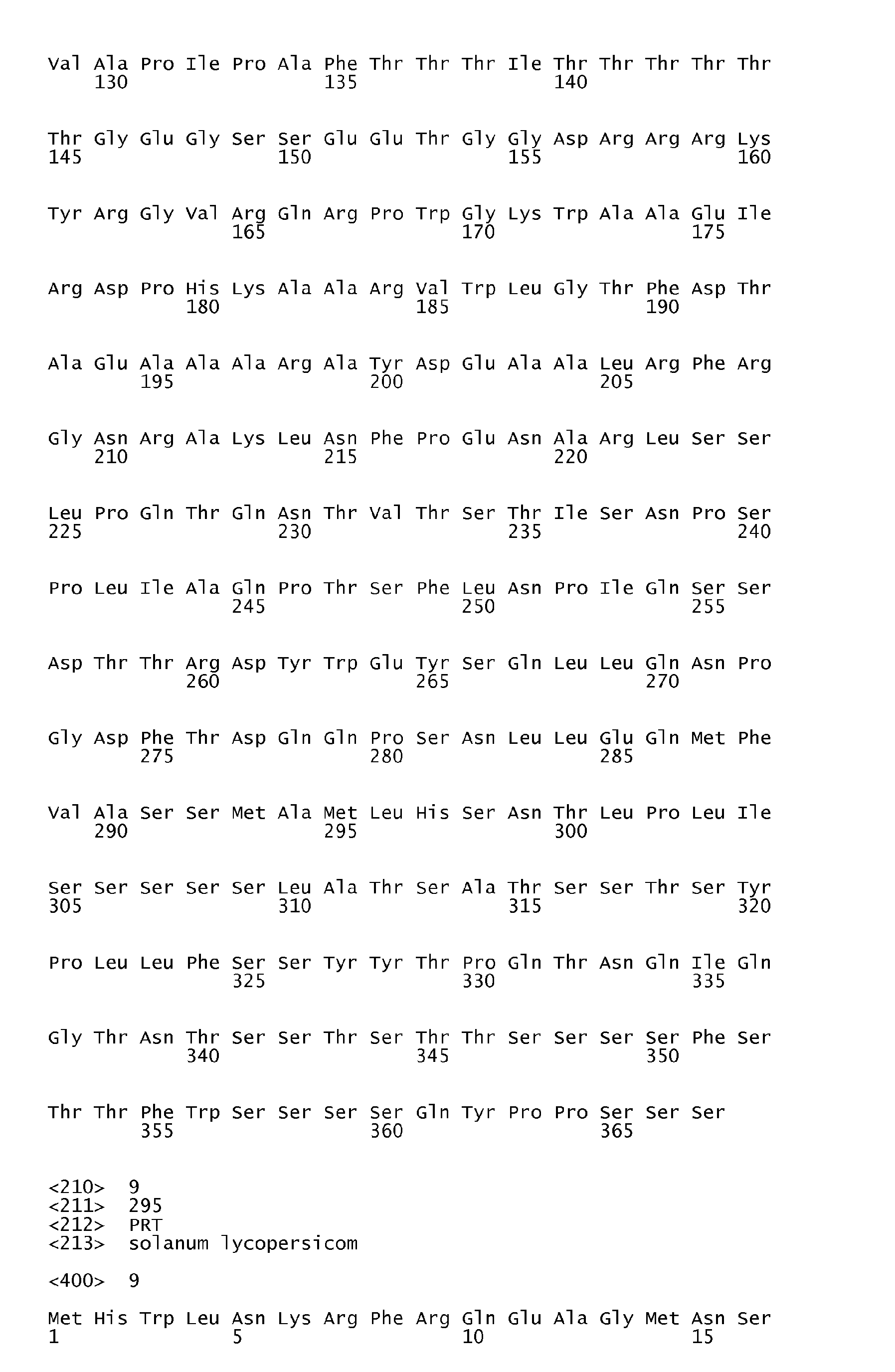


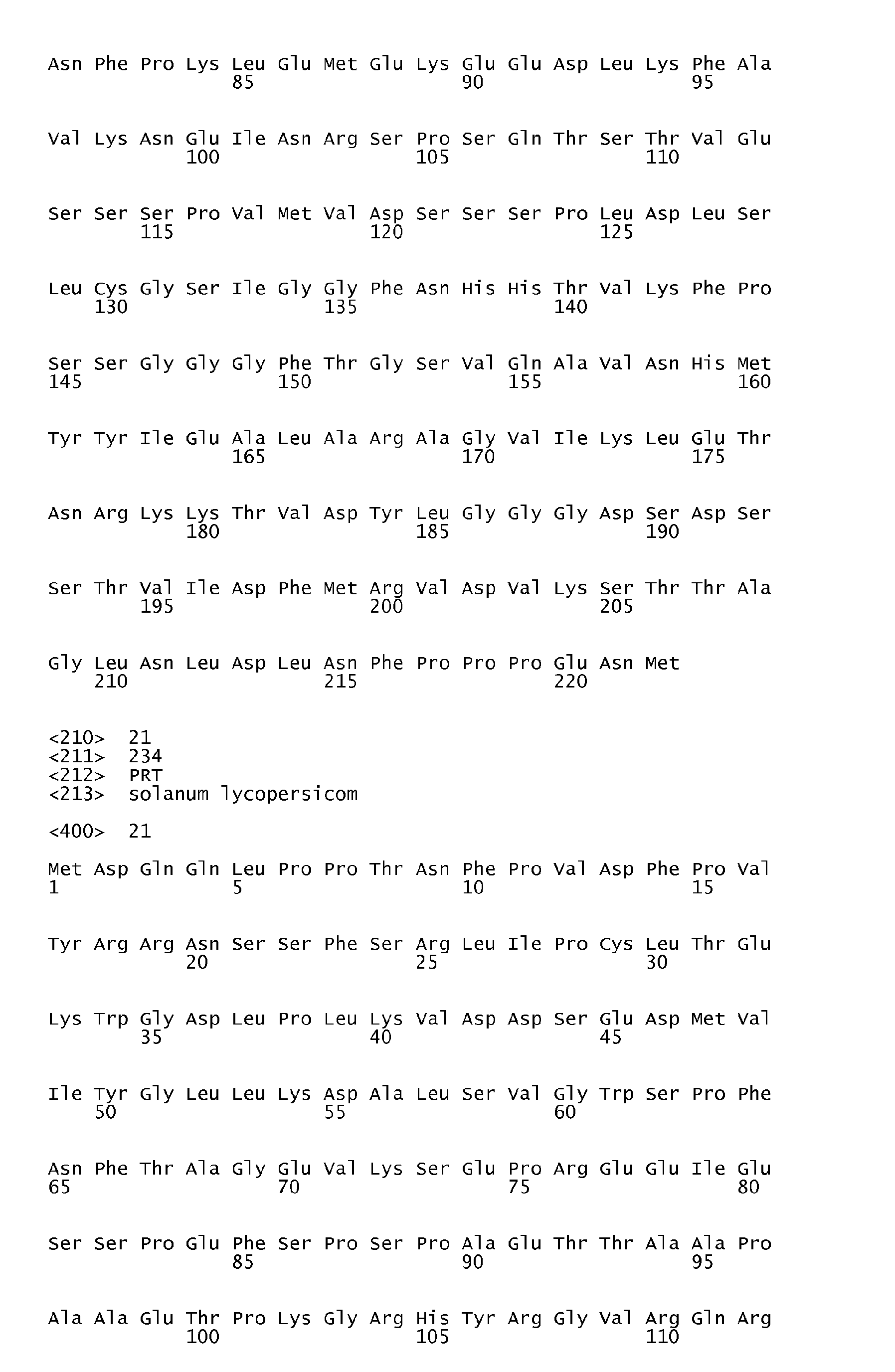


Claims (16)
- A tomato transcription factor of the Ethylene Responsive Factor family (ERF), having an amino acid sequence selected among the group consisting in- a protein having an amino acid sequence as shown in one of SEQ ID NO 1 to NO 28,- a variant thereof,- a functional fragment thereof and- a functional homologous sequence thereof.
- A tomato transcription factor of the Ethylene Responsive Factor family (ERF), encoded by a DNA sequence selected among the group consisting in :- a DNA fragment having a nucleotidic sequence as shown in one of SEQ ID N0 29 to NO 56- a functional homologous sequence thereof.
- The ERF of claim 1 or 2 wherein said factor presents at least one of the following structural features :a. a nuclear localization signalb. an acidic domainc. an EAR domaind. a MAP kinase phosphorylation sitee. a sequence "MCGGAII/L"f. a sequence CMX-1g. a glutamine rich region;and combinations thereof.
- The ERF of anyone of claims 1 to 3 wherein said factor is preferentially expressed :a. in the fruitb. in the flower organc. both in flowers and fruitd. in vegetative tissues.
- The ERF of one of claims 1 to 4, wherein said factor has a constitutive pattern of expression.
- The ERF of one of claims 1 to 5, wherein said factor acts positively or negatively on the transcription of responsive genes.
- The ERF of one of claims 1 to 6, wherein said protein is encoded by a gene localized on the genome close to at least one specific genetic marker (QTL).
- A plant cell having a genetic alteration in the regulatory or in the coding sequence of a gene encoding an ERF protein as claimed in anyone of claims 1 to 7.
- The plant cell of claim 8, wherein expression of at least one ERF as claimed in anyone of claims 1 to 6 is enhanced.
- The plant cell according to claim 8, wherein expression of at least one ERF as claimed in anyone of claims 1 to 6 is partially or totally inhibited.
- A plant containing at least one cell as claimed in any one of claims 8 to 10.
- The plant of claim 11, wherein said plant has an increased tolerance to viral, bacterial and/or fungal infections and/or an increased tolerance to insects attacks and/or an increased tolerance to nematodes and/or an increased tolerance to abiotic stresses and/or modifications of fruit properties, and/or of plant agronomic properties, and/or of seed properties.
- The plant cell as claimed in one of claims 8 to 10 or a plant as claimed in one of claims 11 to 12, wherein the plant is a tomato plant.
- A seed of a plant as claimed in one of claims 11 or 12, wherein it comprises cells as claimed in one of claims 8 to 10.
- A method for obtaining a plant having new phenotypic characteristics, comprising introducing into a plant cell a genetic alteration in the regulatory or in the coding sequence of at least one gene encoding an ERF protein as claimed in anyone of claims 1 to 7 and regenerating at least one fertile plant comprising said cell.
- The method of claim 15, wherein the plant being regenerated is further crossed with another plant and seeds are harvested, said crossing step being eventually repeated at least one time.
Priority Applications (4)
| Application Number | Priority Date | Filing Date | Title |
|---|---|---|---|
| EP08163692A EP2163639A1 (en) | 2008-09-04 | 2008-09-04 | New tomato ethylene response factors and uses thereof |
| US13/062,122 US20110165678A1 (en) | 2008-09-04 | 2009-09-04 | New Tomato Ethylene Response Factors and Uses Thereof |
| PCT/EP2009/061470 WO2010026219A2 (en) | 2008-09-04 | 2009-09-04 | New tomato ethylene response factors and uses thereof |
| EP09782621A EP2337854A2 (en) | 2008-09-04 | 2009-09-04 | New tomato ethylene response factors and uses thereof |
Applications Claiming Priority (1)
| Application Number | Priority Date | Filing Date | Title |
|---|---|---|---|
| EP08163692A EP2163639A1 (en) | 2008-09-04 | 2008-09-04 | New tomato ethylene response factors and uses thereof |
Publications (1)
| Publication Number | Publication Date |
|---|---|
| EP2163639A1 true EP2163639A1 (en) | 2010-03-17 |
Family
ID=40202937
Family Applications (2)
| Application Number | Title | Priority Date | Filing Date |
|---|---|---|---|
| EP08163692A Withdrawn EP2163639A1 (en) | 2008-09-04 | 2008-09-04 | New tomato ethylene response factors and uses thereof |
| EP09782621A Withdrawn EP2337854A2 (en) | 2008-09-04 | 2009-09-04 | New tomato ethylene response factors and uses thereof |
Family Applications After (1)
| Application Number | Title | Priority Date | Filing Date |
|---|---|---|---|
| EP09782621A Withdrawn EP2337854A2 (en) | 2008-09-04 | 2009-09-04 | New tomato ethylene response factors and uses thereof |
Country Status (3)
| Country | Link |
|---|---|
| US (1) | US20110165678A1 (en) |
| EP (2) | EP2163639A1 (en) |
| WO (1) | WO2010026219A2 (en) |
Cited By (2)
| Publication number | Priority date | Publication date | Assignee | Title |
|---|---|---|---|---|
| CN103952416A (en) * | 2014-04-28 | 2014-07-30 | 浙江大学 | Two transcription factors for deastringency of harvested persimmons and application thereof |
| CN107254478A (en) * | 2017-06-23 | 2017-10-17 | 山西大学 | Tomato SLLCD genes and its application |
Families Citing this family (7)
| Publication number | Priority date | Publication date | Assignee | Title |
|---|---|---|---|---|
| WO2011107537A1 (en) * | 2010-03-05 | 2011-09-09 | Institut National Polytechnique De Toulouse | New plants with modified expression or activity of ethylene response factors |
| CN110387430B (en) * | 2018-04-20 | 2020-12-22 | 中国农业大学 | A method for predicting apple fruit firmness based on the type of amino acid residue at position 225 of apple transcription factor ERF4 |
| CN113563439B (en) * | 2021-07-15 | 2024-06-18 | 浙江省农业科学院 | A fruit shape development-related protein and its encoding gene and application |
| CN114686494B (en) * | 2021-09-06 | 2024-01-26 | 吉林大学 | Application of SlERF.H2 gene and its encoded protein in regulating tomato salt tolerance |
| CN116375833A (en) * | 2023-03-03 | 2023-07-04 | 合肥工业大学 | A Pear Transcription Factor PuERF106 that Regulates Pear Aroma Synthesis in Response to Hydrogen Sulfide Signal and Its Recombinant Expression Vector and Application |
| CN117164687A (en) * | 2023-05-11 | 2023-12-05 | 合肥工业大学 | Gene and method for promoting tomato fruit ripening |
| CN116675754B (en) * | 2023-07-07 | 2025-09-19 | 上海交通大学 | Application of EMB1444-like in regulation and control of tomato mature development and breeding |
Citations (2)
| Publication number | Priority date | Publication date | Assignee | Title |
|---|---|---|---|---|
| US20060162018A1 (en) * | 2003-06-06 | 2006-07-20 | Gutterson Neil I | Plant transcriptional regulators of disease resistance |
| WO2006130156A2 (en) * | 2004-07-14 | 2006-12-07 | Mendel Biotechnology, Inc | Plant polynucleotides for improved yield and quality |
Family Cites Families (5)
| Publication number | Priority date | Publication date | Assignee | Title |
|---|---|---|---|---|
| EP1566444A3 (en) * | 1999-11-17 | 2005-08-31 | Mendel Biotechnology, Inc. | Yield-related genes |
| US20050108791A1 (en) * | 2001-12-04 | 2005-05-19 | Edgerton Michael D. | Transgenic plants with improved phenotypes |
| US7396979B2 (en) * | 2004-06-30 | 2008-07-08 | Ceres, Inc. | Nucleotide sequences and polypeptides encoded thereby useful for modifying plant characteristics and phenotypes |
| US20060168696A1 (en) * | 2004-12-22 | 2006-07-27 | Ceres, Inc. | Nucleotide sequences and corresponding polypeptides conferring modulated plant size and biomass and other characteristics |
| US20060041961A1 (en) * | 2004-03-25 | 2006-02-23 | Abad Mark S | Genes and uses for pant improvement |
-
2008
- 2008-09-04 EP EP08163692A patent/EP2163639A1/en not_active Withdrawn
-
2009
- 2009-09-04 US US13/062,122 patent/US20110165678A1/en not_active Abandoned
- 2009-09-04 WO PCT/EP2009/061470 patent/WO2010026219A2/en not_active Ceased
- 2009-09-04 EP EP09782621A patent/EP2337854A2/en not_active Withdrawn
Patent Citations (2)
| Publication number | Priority date | Publication date | Assignee | Title |
|---|---|---|---|---|
| US20060162018A1 (en) * | 2003-06-06 | 2006-07-20 | Gutterson Neil I | Plant transcriptional regulators of disease resistance |
| WO2006130156A2 (en) * | 2004-07-14 | 2006-12-07 | Mendel Biotechnology, Inc | Plant polynucleotides for improved yield and quality |
Non-Patent Citations (9)
| Title |
|---|
| FUJIMOTO ET AL., PLANT CELL, 2000 |
| FUJIMOTO S Y ET AL: "Arabidopsis ethylene-responsive element binding factors act as transcriptional activators or repressors of GCC box-mediated gene expression", PLANT CELL, AMERICAN SOCIETY OF PLANT PHYSIOLOGISTS, ROCKVILLE, MD, US, vol. 12, no. 3, 1 March 2000 (2000-03-01), pages 393 - 404, XP002314273, ISSN: 1040-4651 * |
| GU YONG-QIANG ET AL: "Pti4 is induced by ethylene and salicylic acid, and its product is phosphorylated by the Pto kinase", PLANT CELL, vol. 12, no. 5, May 2000 (2000-05-01), pages 771 - 785, XP002510014, ISSN: 1040-4651 * |
| JIA YULIN ET AL: "Rapid transcript accumulation of pathogenesis-related genes during an incompatible interaction in bacterial speck disease-resistant tomato plants", PLANT MOLECULAR BIOLOGY, SPRINGER, DORDRECHT, NL, vol. 40, no. 3, 1 June 1999 (1999-06-01), pages 455 - 465, XP002159399, ISSN: 0167-4412 * |
| PIRRELLO JULIEN ET AL: "Sl-ERF2, a tomato ethylene response factor involved in ethylene response and seed germination", PLANT AND CELL PHYSIOLOGY, vol. 47, no. 9, September 2006 (2006-09-01), pages 1195 - 1205, XP002510012, ISSN: 0032-0781 * |
| THARA VENKATAPPA K ET AL: "Pseudomonas syringae pv tomato induces the expression of tomato EREBP-like genes Pti4 and Pti5 independent of ethylene, salicylate and jasmonate", PLANT JOURNAL, vol. 20, no. 4, November 1999 (1999-11-01), pages 475 - 483, XP002510015, ISSN: 0960-7412 * |
| TOURNIER BARTHELEMY ET AL: "New members of the tomato ERF family show specific expression pattern and diverse DNA-binding capacity to the GCC box element.", FEBS LETTERS, vol. 550, no. 1-3, 28 August 2003 (2003-08-28), pages 149 - 154, XP002510013, ISSN: 0014-5793 * |
| TOURNIER ET AL., FEBS LETTERS, 2003 |
| ZHOU JIANMIN ET AL: "The Pto kinase conferring resistance to tomato bacterial speck disease interacts with proteins that bind a cis-element of pathogenesis-related genes", EMBO JOURNAL, OXFORD UNIVERSITY PRESS, SURREY, GB, vol. 16, no. 11, 1 January 1997 (1997-01-01), pages 3207 - 3218, XP002150166, ISSN: 0261-4189 * |
Cited By (4)
| Publication number | Priority date | Publication date | Assignee | Title |
|---|---|---|---|---|
| CN103952416A (en) * | 2014-04-28 | 2014-07-30 | 浙江大学 | Two transcription factors for deastringency of harvested persimmons and application thereof |
| CN103952416B (en) * | 2014-04-28 | 2016-06-15 | 浙江大学 | Participate in adopting two transcription factor and the application that rear persimmon takes away the puckery taste |
| CN107254478A (en) * | 2017-06-23 | 2017-10-17 | 山西大学 | Tomato SLLCD genes and its application |
| CN107254478B (en) * | 2017-06-23 | 2020-07-10 | 山西大学 | Tomato SLLCD gene and its application |
Also Published As
| Publication number | Publication date |
|---|---|
| WO2010026219A3 (en) | 2010-05-06 |
| WO2010026219A2 (en) | 2010-03-11 |
| US20110165678A1 (en) | 2011-07-07 |
| EP2337854A2 (en) | 2011-06-29 |
Similar Documents
| Publication | Publication Date | Title |
|---|---|---|
| Luo et al. | The Arabidopsis defensin gene AtPDF2. 5 mediates cadmium tolerance and accumulation | |
| US20110165678A1 (en) | New Tomato Ethylene Response Factors and Uses Thereof | |
| Patil et al. | Improvement for bacterial wilt resistance in potato by conventional and biotechnological approaches | |
| Wang et al. | TaNAC1 acts as a negative regulator of stripe rust resistance in wheat, enhances susceptibility to Pseudomonas syringae, and promotes lateral root development in transgenic Arabidopsis thaliana | |
| Chen et al. | Identification of specific fragments of HpaGXooc, a harpin from Xanthomonas oryzae pv. oryzicola, that induce disease resistance and enhance growth in plants | |
| Wang et al. | The abiotic stress-responsive NAC transcription factor SlNAC11 is involved in drought and salt response in tomato (Solanum lycopersicum L.) | |
| US20190292559A1 (en) | Nucleotide sequence for improving resistance against plant pathogens | |
| Serrazina et al. | Expression of Castanea crenata allene oxide synthase in Arabidopsis improves the defense to Phytophthora cinnamomi | |
| JP6712285B2 (en) | FT Family Nucleic Acids and Peptides/Proteins Providing Tobacco Flowering Inhibitory Properties and Transgenic Plants Transformed Therewith | |
| US20160068860A1 (en) | Transgenic plants | |
| Cheng et al. | The MADS-box gene CsSHP participates in fruit maturation and floral organ development in cucumber | |
| Liang et al. | An asparagine-rich protein nbnrp1 modulate verticillium dahliae protein pevd1-induced cell death and disease resistance in nicotiana benthamian a | |
| Deng-wei et al. | Cloning and characterization of a Solanum torvum NPR1 gene involved in regulating plant resistance to Verticillium dahliae | |
| WO2001007635A1 (en) | Bs2 resistance gene | |
| Zhai et al. | Characterization and expression analysis of key abscisic acid signal transduction genes during kiwifruit development | |
| Xiao et al. | Overexpression of PsoRPM3, an NBS-LRR gene isolated from myrobalan plum, confers resistance to Meloidogyne incognita in tobacco | |
| US20170029839A1 (en) | Method for improving crop productivity | |
| JP6215196B2 (en) | Pest resistant plant | |
| US20160102316A1 (en) | Stress tolerant plants | |
| Ribone et al. | What do we know about homeodomain–leucine zipper I transcription factors? Functional and biotechnological considerations | |
| US20160272995A1 (en) | Manipulation of plasmodesmal connectivity to improve plant yield and fitness | |
| CN114457096A (en) | Improved plants containing combinations of apyrase genes and methods for making the same | |
| da Silva et al. | Employing in vitro directed molecular evolution for the selection of α-amylase variant inhibitors with activity toward cotton boll weevil enzyme | |
| CN116286858A (en) | Gene for regulating ethylene response sensitivity of plant and application thereof | |
| Liu et al. | Solanum lycopersicum, a Model Plant for the Studies in Developmental Biology, Stress Biology and Food Science. Foods 2022, 11, 2402 |
Legal Events
| Date | Code | Title | Description |
|---|---|---|---|
| PUAI | Public reference made under article 153(3) epc to a published international application that has entered the european phase |
Free format text: ORIGINAL CODE: 0009012 |
|
| AK | Designated contracting states |
Kind code of ref document: A1 Designated state(s): AT BE BG CH CY CZ DE DK EE ES FI FR GB GR HR HU IE IS IT LI LT LU LV MC MT NL NO PL PT RO SE SI SK TR |
|
| AX | Request for extension of the european patent |
Extension state: AL BA MK RS |
|
| STAA | Information on the status of an ep patent application or granted ep patent |
Free format text: STATUS: THE APPLICATION HAS BEEN WITHDRAWN |
|
| 18W | Application withdrawn |
Effective date: 20100806 |