EP2161432A1 - Throttle body - Google Patents
Throttle body Download PDFInfo
- Publication number
- EP2161432A1 EP2161432A1 EP08001843A EP08001843A EP2161432A1 EP 2161432 A1 EP2161432 A1 EP 2161432A1 EP 08001843 A EP08001843 A EP 08001843A EP 08001843 A EP08001843 A EP 08001843A EP 2161432 A1 EP2161432 A1 EP 2161432A1
- Authority
- EP
- European Patent Office
- Prior art keywords
- bore
- throttle
- throttle valve
- resin
- linear expansion
- Prior art date
- Legal status (The legal status is an assumption and is not a legal conclusion. Google has not performed a legal analysis and makes no representation as to the accuracy of the status listed.)
- Withdrawn
Links
Images











Classifications
-
- F—MECHANICAL ENGINEERING; LIGHTING; HEATING; WEAPONS; BLASTING
- F02—COMBUSTION ENGINES; HOT-GAS OR COMBUSTION-PRODUCT ENGINE PLANTS
- F02D—CONTROLLING COMBUSTION ENGINES
- F02D9/00—Controlling engines by throttling air or fuel-and-air induction conduits or exhaust conduits
- F02D9/08—Throttle valves specially adapted therefor; Arrangements of such valves in conduits
- F02D9/10—Throttle valves specially adapted therefor; Arrangements of such valves in conduits having pivotally-mounted flaps
- F02D9/1075—Materials, e.g. composites
- F02D9/108—Plastics
-
- F—MECHANICAL ENGINEERING; LIGHTING; HEATING; WEAPONS; BLASTING
- F02—COMBUSTION ENGINES; HOT-GAS OR COMBUSTION-PRODUCT ENGINE PLANTS
- F02D—CONTROLLING COMBUSTION ENGINES
- F02D9/00—Controlling engines by throttling air or fuel-and-air induction conduits or exhaust conduits
- F02D9/08—Throttle valves specially adapted therefor; Arrangements of such valves in conduits
- F02D9/10—Throttle valves specially adapted therefor; Arrangements of such valves in conduits having pivotally-mounted flaps
- F02D9/1005—Details of the flap
- F02D9/101—Special flap shapes, ribs, bores or the like
-
- F—MECHANICAL ENGINEERING; LIGHTING; HEATING; WEAPONS; BLASTING
- F02—COMBUSTION ENGINES; HOT-GAS OR COMBUSTION-PRODUCT ENGINE PLANTS
- F02D—CONTROLLING COMBUSTION ENGINES
- F02D9/00—Controlling engines by throttling air or fuel-and-air induction conduits or exhaust conduits
- F02D9/08—Throttle valves specially adapted therefor; Arrangements of such valves in conduits
- F02D9/10—Throttle valves specially adapted therefor; Arrangements of such valves in conduits having pivotally-mounted flaps
- F02D9/1035—Details of the valve housing
-
- F—MECHANICAL ENGINEERING; LIGHTING; HEATING; WEAPONS; BLASTING
- F02—COMBUSTION ENGINES; HOT-GAS OR COMBUSTION-PRODUCT ENGINE PLANTS
- F02D—CONTROLLING COMBUSTION ENGINES
- F02D9/00—Controlling engines by throttling air or fuel-and-air induction conduits or exhaust conduits
- F02D9/08—Throttle valves specially adapted therefor; Arrangements of such valves in conduits
- F02D9/10—Throttle valves specially adapted therefor; Arrangements of such valves in conduits having pivotally-mounted flaps
- F02D9/107—Manufacturing or mounting details
-
- F—MECHANICAL ENGINEERING; LIGHTING; HEATING; WEAPONS; BLASTING
- F16—ENGINEERING ELEMENTS AND UNITS; GENERAL MEASURES FOR PRODUCING AND MAINTAINING EFFECTIVE FUNCTIONING OF MACHINES OR INSTALLATIONS; THERMAL INSULATION IN GENERAL
- F16K—VALVES; TAPS; COCKS; ACTUATING-FLOATS; DEVICES FOR VENTING OR AERATING
- F16K1/00—Lift valves or globe valves, i.e. cut-off apparatus with closure members having at least a component of their opening and closing motion perpendicular to the closing faces
- F16K1/16—Lift valves or globe valves, i.e. cut-off apparatus with closure members having at least a component of their opening and closing motion perpendicular to the closing faces with pivoted closure-members
- F16K1/18—Lift valves or globe valves, i.e. cut-off apparatus with closure members having at least a component of their opening and closing motion perpendicular to the closing faces with pivoted closure-members with pivoted discs or flaps
- F16K1/22—Lift valves or globe valves, i.e. cut-off apparatus with closure members having at least a component of their opening and closing motion perpendicular to the closing faces with pivoted closure-members with pivoted discs or flaps with axis of rotation crossing the valve member, e.g. butterfly valves
- F16K1/222—Shaping of the valve member
-
- B—PERFORMING OPERATIONS; TRANSPORTING
- B29—WORKING OF PLASTICS; WORKING OF SUBSTANCES IN A PLASTIC STATE IN GENERAL
- B29C—SHAPING OR JOINING OF PLASTICS; SHAPING OF MATERIAL IN A PLASTIC STATE, NOT OTHERWISE PROVIDED FOR; AFTER-TREATMENT OF THE SHAPED PRODUCTS, e.g. REPAIRING
- B29C45/00—Injection moulding, i.e. forcing the required volume of moulding material through a nozzle into a closed mould; Apparatus therefor
- B29C45/0005—Injection moulding, i.e. forcing the required volume of moulding material through a nozzle into a closed mould; Apparatus therefor using fibre reinforcements
-
- B—PERFORMING OPERATIONS; TRANSPORTING
- B29—WORKING OF PLASTICS; WORKING OF SUBSTANCES IN A PLASTIC STATE IN GENERAL
- B29L—INDEXING SCHEME ASSOCIATED WITH SUBCLASS B29C, RELATING TO PARTICULAR ARTICLES
- B29L2031/00—Other particular articles
- B29L2031/748—Machines or parts thereof not otherwise provided for
- B29L2031/7506—Valves
Definitions
- the present invention relates to a throttle valve made of resin used in a throttle body made of resin.
- a conventional throttle body one of the components of an intake system, is manufactured by aluminum die casting. Efforts have been made in recent years to provide lightweight, low-cost throttle bodies by forming throttle bodies of resins.
- the bore of a throttle body must be formed so that the gap between the bore wall defining the bore of the throttle body and a throttle valve placed in the bore of the throttle body is in the range of 80 to 100 ⁇ m.
- the bore of a conventional throttle body formed by die casting is finished by machining to form the bore in a desired accuracy. If a resin throttle body can be formed such that its bore is formed in an accuracy that insures the gap in the aforesaid range, machining is unnecessary.
- the roundness of the bore after molding shrinkage, the roundness of the throttle valve (hereinafter, roundness is used to represent variations in diameter), and errors in the inside diameter of the bore must be equal to those of an aluminum throttle valve formed by die casting. It is necessary to prevent the interference between the bore wall and the throttle valve, and an excessive increase in the gap between the throttle body and the throttle valve due to thermal deformation caused by the variation of temperature between a very low temperature and a high temperature exceeding 100°C.
- a method of preventing irregular deformation proposed in JP-A No. 169473/1998 places filler in an orientation in a bore part of a throttle body defining a bore. It is considered that the gap can be reduced when a metal throttle valve formed by machining is placed in such a bore part.
- the throttle valve must be formed of resin to omit a machining process.
- the throttle body and the throttle valve can be formed of resins respectively having similar coefficients of linear expansion, respectively, and hence the initial gap between the bore wall and the throttle valve can be substantially maintained.
- the throttle valve is formed of a resin having a thermal conductivity lower than those of metals, it is possible to prevent freezing that occurs in metal throttle valves during operation.
- both the throttle body and the throttle valve are formed of the same resin containing the same amount of filler, the throttle body and the throttle valve have different coefficients of linear expansion, respectively, and deform by different quantities of deformation, respectively due to the difference between the throttle body and the throttle valve in the orientation of the filler. Consequently, there is the possibility that the throttle valve interferes with the bore wall, and the gap between the bore wall and the throttle valve increases excessively.
- Recent internal combustion engines have a tendency to reduce idle throttle valve opening to reduce idle speed.
- idle throttle valve opening is reduced, the possibility that contaminants, such as carbon contained in the recirculated exhaust gas, and oils contained in the blowby gas, adhere to the periphery of the throttle valve increases. If those contaminants deposited on the throttle valve are solidified by the heat of the internal combustion engine, the throttle valve is locked to the bore wall and, in the worst case, the throttle valve will not move even if the accelerator pedal is operated.
- a second object of the present invention is to reduce the roundness of a bore after molding shrinkage and to reduce the gap between a throttle valve and the bore.
- a third object of the present invention is to prevent the fixation of a throttle valve by solid deposits including carbon and oils.
- a filler contained in a resin is oriented in a circumferential direction to make the linear expansion coefficient of a throttle valve in a radial direction approach that of a bore by making the thermal deformation of the throttle valve approach that of the bore to prevent the aforesaid interference and the enlargement of the gap.
- a throttle body comprises: a throttle shaft extended substantially diametrically across an intake cylinder (bore); and a throttle valve fixed to the throttle shaft and contained in the bore; wherein the bore and the throttle valve are made of a resin containing filler, and the difference between circumferential deformation of the bore and radial deformation of the throttle valve is in the range of 0 to 40 ⁇ m at temperatures in the range of -40°C to 120°C.
- a throttle body comprises: an intake cylinder (bore); and a throttle valve; wherein the throttle valve and the bore are formed of resins containing filler, the difference between the linear expansion coefficient of the throttle valve and that of the bore is in the range of 0 to 4 ⁇ 10 -6 /°C.
- the fillers in the bore and the throttle valve are oriented in substantially the same direction.
- the fillers are randomly oriented in the bore and the throttle valve.
- the throttle valve is provided with circumferential grooves or ribs, and the filler is substantially circumferentially oriented.
- the throttle valve is formed by sandwiching an aggregate formed by circumferentially arranging the filler between resin layers.
- the throttle valve is made of a resin different in filler content from that forming the bore to make the radial linear expansion coefficient of the throttle valve nearly equal to the circumferential linear expansion coefficient of the bore.
- At least a peripheral part of the throttle valve facing the bore wall of the bore is made of a resin containing a fluorocarbon resin or is coated with a fluorocarbon resin.
- a throttle body comprises: a throttle shaft extended substantially diametrically across an intake cylinder (bore); and a throttle valve fixed to the throttle shaft and contained in the bore; wherein the bore is made of a resin, and an annular rib of a fixed or continuously changing width, or parts of such an annular rib are formed in a part, corresponding to the throttle shaft, of the bore to counterbalance the effect of sinks due to bosses.
- minimum thickness is 2/3 of maximum thickness or below.
- ribs are formed in parts of the bore, around the throttle shaft such that the product of maximum height and thickness is in the range of 15 to 40% of the height and the mean thickness of the bosses, and the product of minimum height and thickness is in the range of 20 to 80% of the product of maximum height and thickness.
- the bore is provided in a part thereof with a rib capable of limiting the roundness (diameter) of a part of the bore in the range of ⁇ 5 mm along the center axis of the bore from a position corresponding to the throttle shaft to 80 ⁇ m or below.
- the ribs are formed in the parts of the intake cylinder defining the bore around the throttle shaft to reduce the roundness of the bore after mold shrinkage.
- the present invention adds an additive to the resin to suppress the adhesion of carbon and oils to the throttle valve.
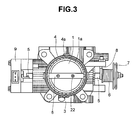
- a throttle body 3 has a throttle valve 1 contained in a space surrounded by a bore wall 4a of a bore 4, and a throttle shaft 5.
- the throttle valve 1 is fastened to the throttle shaft 5 with screws 22.
- the throttle shaft 5 is extended substantially diametrically across the bore 4.
- a throttle lever 7 is connected to one end of the throttle shaft 5.
- a return spring 6 is extended between the throttle lever 7 and a stopper 8.
- a throttle-valve position sensor 9 is attached to the other end of the throttle shaft 5.
- the throttle lever 7 When the driver depresses an accelerator pedal, not shown, the throttle lever 7 is moved and the throttle shaft 5 is moved accordingly to open the throttle valve 1.
- the throttle valve 1 When the force applied to the accelerator pedal is removed, the throttle valve 1 is closed by the resilience of the return spring 6.
- the gap between the circumference 1a of the throttle valve 1 and the bore wall 4a is, for example, in the range of 80 to 100 ⁇ m to reduce idle speed, fuel consumption and noise during idling. This gap enables the smooth movement of the throttle valve 1.
- Fig. 3 the gap is exaggerated to facilitate understanding.
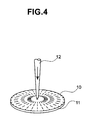
- Fig. 4 is a schematic view of assistance in explaining a method of molding a common disk, in which a filler is indicated at 10, a disk is indicated at 11 and a runner a is indicated at 12. A resin flows through the runner 12 to a position corresponding to the center of the disk-shaped part 11. As shown in Fig. 4 , the filler 10 is oriented radially from the center when the thickness of the disk-shaped part 11 is small. The filler 10 is enlarged in Fig. 4 to facilitate recognizing the direction of orientation.
- Fig. 5 is a schematic view of assistance in explaining a method of molding a cylindrical part. Gates symmetrical with respect to a circumferential direction are formed to improve roundness. Shown in Fig. 5 are a cylindrical part 13, a gate 14 and a runner b 15. In this case, the filler 10 extends in a flowing direction and is generally axially oriented. It is expected that circumferential and radial coefficients of thermal deformation are large, an axial thermal deformation is small.
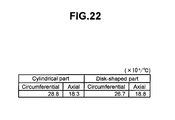
- Fig. 22 show measured coefficients of linear expansion of a cylindrical part and a disk-shaped part made of a resin containing the filler 10.
- the circumferential linear expansion coefficient of the cylindrical part is 1.6 times the axial linear expansion coefficient of the same, and the circumferential linear expansion coefficient of the disk-shaped part is 1.4 times the radial linear expansion coefficient of the same, which substantiates the aforesaid expectation.
- the cylindrical part is a bore
- the disk-shaped part is a throttle valve.
- the circumferential linear expansion coefficient of the cylindrical part, and the radial linear expansion coefficient of the disk-shaped part are related with the gap.
- the circumferential linear expansion coefficient of the cylindrical part 28.8 ⁇ 10 -6 /°C
- the radial linear expansion coefficient of the disk-shaped part 18.8 ⁇ 10 -6 /°C.
- the difference between the respective deformations of the bore and the throttle vale must be smaller than 80 ⁇ m.
- the deformation difference of 80 ⁇ m corresponds to a difference of about 8 ⁇ 10 -6 /°C in linear expansion coefficient when the inside diameter is 60 mm and the working temperature range is -40 to 120°C.
- the difference between the respective coefficients of linear expansion of the both must not be greater than about 8 ⁇ 10 -6 /°C. More preferably, in view of changes in roundness, it is desirable that the deformation difference is 40 ⁇ m or below.
- Fig. 1 is a typical view of a throttle valve 1 in a first embodiment according to the present invention. Shown in Fig. 1 are a throttle valve 16, some of grooves 17 arranged on concentric circles, and holes 24 for attaching the throttle valve 16 to a shaft 5.
- Fig. 6 is a sectional view taken on line A-A in Fig. 1 .
- Filler 2 can be oriented mostly in a circumferential direction by arranging the grooves 17 on concentric circles.
- the grooves 17 are arranged zigzag in this embodiment to make a resin flow through thin parts of each groove without fail.
- the radial flow of the resin is disturbed to make the extension of the filler in radial directions difficult, and the probability of the filler extending in a circumferential direction increases.
- the filler can be more randomly oriented by changing the depth, size and pitches of the grooves 17.
- the linear expansion coefficient of the throttle valve 1 is close to that of the bore 4.
- the difference in linear expansion coefficient between the throttle valve 1 and the bore 4 can be made smaller than that when the filler is radially oriented in the throttle valve (valve) by randomly orienting the filler, which is within the scope of the present invention.
- the radial linear expansion coefficient of the throttle valve can be made to approach that of the bore 4 to suppress the variation of the gap between the throttle valve 16 and the bore 4 according to temperature variation.
- the throttle valve 16 in this embodiment can be easily made by injecting a thermoplastic resin into a cavity of a mold provided with protrusions corresponding to the grooves.
- Minimum thicknesses t of the disk-shaped parts, which are associated with these depths of the grooves, are 2.0 mm, 1.5 mm and 1.0 mm, respectively.
- the thickness ratio t/t 0 is measured on the horizontal axis, and the linear expansion coefficient ratio ⁇ / ⁇ 0 , i.e., the ratio of the linear expansion coefficient ⁇ of the throttle valve to the linear expansion coefficient ⁇ 0 of the bore is measured on vertical axis.
- the effect of the groves is significant and the linear expansion coefficient ratio ⁇ / ⁇ 0 approaches 1 when the thickness ratio t/t 0 is smaller than 2/3; that is, the respective linear expansion coefficients of the disk-shaped part and the bore approaches each other.
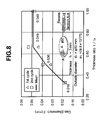
- Fig. 8 shows calculated gaps between the disk-shaped part and the bore in the temperature range of -40 to 120°C.
- the gap is 49 ⁇ m when the disk-shaped part is not provided with any grooves.
- the gap is as small as 18 ⁇ m when the disk-shaped part is provided with grooves of 1 mm in depth.
- the gap can be limited to 40 ⁇ m or below (0 to 40 ⁇ m) when the temperature of the disk-shaped part is in the temperature range of -40 to 120°C by forming grooves in the disk-shaped part such that the minimum thickness is 1/2 of the original thickness or below. This corresponds to the linear expansion coefficient difference of about 4 ⁇ 10 -6 /°C (0 to 4 ⁇ 10 -6 /°C) when the inside diameter is 60 mm.
- the linear expansion coefficient ⁇ of 23.7 ⁇ 10 -6 /°C of the disk-shaped part in this embodiment is greater than the linear expansion coefficient of 18.1 ⁇ 10 -6 /24°C of a disk-shaped part shown in Fig. 22 and is near the linear expansion coefficient of 28.8 ⁇ 10 -6 /°C of the bore. It is inferred that such a fact is the result of increase of part not subject to the influence of shearing with a wall surface resulting from increase of the thickness in the range of 1.5 to 3.0 mm and increase of the ratio of circumferentially oriented fibers.
- the practical throttle valve 16 is in contact with the bore 4 in a position inclined at several degrees to the axis of the bore and not perpendicular to the axis of the bore. Therefore, the practical throttle valve 16 is not a perfectly circular disk, is an elliptic plate and is tapered.
- the mold is made so as to conform the shape of the throttle valve 16.
- the grooves 17 are formed in the opposite surfaces, the grooves 17 may be formed only in one of the opposite surfaces for the same effect. However, when the grooves 17 is formed only in one of the opposite surfaces, measures to prevent the warp of the throttle valve, such as heating different parts of the mold at different temperatures, respectively, must be taken. Although the grooves 17 are arranged zigzag in this embodiment, the grooves may be radially arranged. The throttle valve may be provided with concentric circular grooves. The grooves 17 may be formed only in a peripheral part for the same effect.
- the throttle valve 1 is bent around the throttle shaft by a negative pressure during idling.
- the throttle valve 11 since the throttle valve 11 is not perpendicular to the axis of the bore and is inclined at an angle to the axis of the bore, a half part of the throttle valve closer to the engine is bent so as to recede from the bore wall. The other half part of the throttle valve farther from the engine is bent so as to come into the bore wall. Consequently, the throttle valve and the bore gall and, there is the possibility, in the worst case, that the throttle valve becomes uncontrollable.
- ribs are formed on the half part of the throttle valve farther from the engine (righthand half part in Fig. 9 ) instead of the grooves so that the filler are circumferentially oriented.
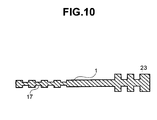
- Shown in Fig. 10 are grooves 17 and ribs 23.
- Fig. 10 is a sectional view taken on line A-A in Fig. 9 .
- Most part of the filler 10 is circumferentially oriented in the half part provided with ribs 23 of the throttle valve shown in Fig. 10 . Therefore, the linear expansion coefficient of the throttle valve 1 can be made near or substantially equal to that of the bore.
- the strength of the throttle valve 1 can be increased and, at the same time, the difference in linear expansion coefficient between the throttle valve and the bore can be reduced to a value not greater than the predetermined value, which can solve the problem with galling of the throttle valve 1 and bore 4.
- ribs may be formed either on both or one of the opposite surfaces. If the ribs are formed only on one of the surfaces, flow resistance can be reduced by forming protrusions on the side of the engine.
- Fig. 21 shows another section of a throttle valve corresponding to the section taken on line A-A in Fig. 9 . Shown in Fig. 21 are grooves 17 and ribs 23. The ribs are formed in a right half part of the throttle valve such that the height of the rib nearer to the circumference is greater than that of the rib farther from the circumference to enhance the bending rigidity of the rib. The adhesion of carbon and oils to a peripheral part 30 can be avoided without forming any rib in the peripheral part 30.
- Possible materials as the filler to be contained in the resin used in this embodiment are, for example, glass fibers, carbon fibers, boron fibers, aramid fibers, carbon silicate fibers, alumina fibers and potassium titanate (K n O ⁇ nTiO 2 ) whiskers.
- Fig. 11 is a typical view of assistance in explaining a method of manufacturing a throttle valve 1 in a second embodiment according to the present invention
- Fig. 12 is a sectional view of a mold to be used in manufacturing the throttle valve 1.
- an aggregate 18 formed by circumferentially arranging filler 2, a lower mold 19, and an upper mold 20.
- the aggregate of the filler 2 is placed in a recess formed in the lower mold 19, a thermosetting resin is poured in the recess to impregnate the filler 2 with the thermosetting resin, the lower mold 19 and the upper mold 20 are joined together, and the mold is heated to set the thermosetting resin.
- the filler 2 is arranged circumferentially.
- the linear expansion coefficient of the second embodiment similarly to that of the first embodiment, can be made to approach the linear expansion coefficient of the bore 4, so that it is possible to prevent the variation of the gap between the throttle valve 1 and the bore 4 according to the variation of temperature.
- a filling member formed by arranging strings of the filler 2 in concentric circles or in a spiral may be used. Even a filling member like a fabric formed by weaving threads of the filler 2 is somewhat effective.
- a throttle valve 1 having the same properties can be manufactured by using a cold-setting resin, a photocurable resin or a thermoplastic resin instead of the thermosetting resin. If a photocurable resin is used, the upper mold 20 must be a glass mold.
- the radial linear expansion coefficient of a throttle valve 1 can be made to approach the circumferential linear expansion coefficient of a bore 4 by another method that forms the throttle valve 1 of a resin having a filler content different from that of a resin forming the bore 4.
- the linear expansion coefficient of a resin having a small filler content is large.
- the linear expansion coefficient of the throttle valve 1 in this embodiment can be made to approach the circumferential linear expansion coefficient of the bore 4 by forming the throttle valve 1 of a resin having a small filler content. Consequently, the variation of the gap between the throttle valve 1 and the bore 4 according to the variation of temperature can be suppressed.
- the radial linear expansion coefficient of the throttle valve can be made to approach the circumferential linear expansion coefficient of the bore by forming the throttle valve and the bore of different resins, respectively.
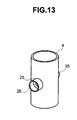
- Fig. 13 shows a model of assistance in explaining the postmolding shrinkage that occurs after injection molding of a throttle body in a fourth embodiment according to the present invention.
- a bore 4 bearing housings 25 for housing bearings supporting a throttle shaft, and a through holes 26 through which the throttle shaft is extended.
- the bore is 50 mm in diameter and 100 mm in height
- the housing is 20 mm in diameter and 10 mm in height
- the through holes are 10 mm in diameter
- the bore has a wall thickness of 2 mm.
- PEI polyetherimide
- mica ULTEM 3452 made by GE Plastics
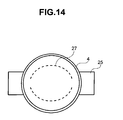
- Fig. 14 shows the results of the analysis.
- Broken lines 27 indicate, in an enlarged view, the position of the bore corresponding to the position of the center of the throttle shaft after shrinkage.
- the shrinkage of a part corresponding to the bearing housings is large and the bore has a laterally elongate elliptic shape.
- annular rib 28 of 2 mm in thickness and 10 mm in width was formed around a part corresponding to the center of the throttle shaft.
- Fig. 16 shows the results of analysis performed using the model shown in Fig. 15 .
- Broken lines 29 indicate, in an enlarged view, the position of the bore corresponding to the position of the center of the throttle shaft after shrinkage.
- the shrinkage of the bore is different from that of the bore shown in Fig. 14 , and a part corresponding to the bearing housings and the bore has a longitudinally elongate elliptic shape. It was inferred that such shrinkage occurred because the shrinkage of the annular rib is greater than a part corresponding to the bearing housings.
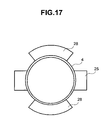
- Fig. 17 shows a bore provided with partial ribs.
- the partial ribs narrow ranges of shrinking effect of the ribs.
- Fig. 18 shows a rib having a narrow width.
- Fig. 19 shows ribs having a continuously changing width. The roundness of the bore can be greatly improved by these ribs.
- Fig. 20 is a diagram of assistance in explaining the dependence of deformation due to postmolding shrinkage on the shape of the rib, in which the ratio h/h 0 , i.e., the ratio of the maximum width h of the rib to the height h 0 of the boss, is measured on the horizontal axis, and the ratio hb/h, i.e., the ratio of minimum width hb of the rib to the maximum width h of the rib, is measured on the vertical axis.
- the ratio h/h 0 i.e., the ratio of the maximum width h of the rib to the height h 0 of the boss
- the ratio hb/h i.e., the ratio of minimum width hb of the rib to the maximum width h of the rib
- the bore is deformed in a laterally elongate elliptic shape, in a longitudinally elongate elliptic shape, and in a nearly square shape when any ribs are not formed, when a large rib is formed, and when a rib having a comparatively narrow, uniform width is formed, respectively.
- the roundness after molding shrinkage is the smallest in the vicinity of the boundaries of those three deformation modes.
- the roundness is 80 ⁇ m or below in a range where the maximum width is in the range of 15 to 40% of the height of the boss, and the minimum width is in the range of 20 to 80% of the maximum width.
- the respective mean wall thicknesses of the rib and the bore are substantially equal.
- sinks are dependent not only on the width of the rib and the height of the boss, but also on the volume.
- a deformation mode will be similar to a case where the width of the rib and the height of the boss are multiplied by the wall thickness.
- the same effect as that available when the rib and the boss have the same wall thickness is expected when the rib is formed such that the product of the maximum width and wall thickness of the rib is in the range of 15 to 40% of the product of the height and the mean wall thickness of the boss, and the product of the minimum width and wall thickness of the rib is in the range of 20 to 80% of the product of the maximum width and wall thickness of the rib.
- the roundness Since the throttle valve is inclined at an angle in the range of 5° to 7° when closed, the roundness must be 80 ⁇ m or below in a range of ⁇ 5 mm along the center axis of the bore from a position corresponding to the throttle shaft.
- the results of the analysis showed that the roundness is substantially 80 ⁇ m or below in the aforesaid ranges.
- ribs may be formed in two or more layers at positions around the center of the throttle shaft. Since the rib enhances the rigidity of the bore, the wall thickness of the bore may be reduced.
- the adhesion of oils or carbon can be prevented by forming the throttle valve 1 of a resin capable of preventing the adhesion of oils, carbon or an adhesive substance containing oils and carbon. More concretely, water repellency can be increased and the adhesion of oils or carbon to the throttle valve can be prevented by adding a fluorocarbon resin, such as PTFE (polytetrafluoroethylene resin) to the resin. Formation of a peripheral part of the throttle valve 1 of a resin containing a fluorocarbon resin by two-color molding provides a similar effect. Alternatively, coating the surface of the throttle valve 1 with a fluorocarbon resin provides a similar effect.
- PTFE polytetrafluoroethylene resin
- the bore 4 and the throttle valve 1 are substantially the same in linear expansion coefficient, the gap between the bore wall 4a and the circumference 1a of the throttle valve 1 can be kept uniform, and the interference between the bore 4 and the throttle valve 1 can be avoided.
- the roundness of a part of the bore around the throttle shaft after molding shrinkage can be reduced.
- the gap between the bore wall 4a and the circumference 1a of the throttle valve during idling can be limited to a very small value, so that a high-performance resin throttle body that permits only a small air leakage can be obtained.
- the adhesion of carbon and oils to the throttle valve 1 can be suppressed by adding an additive to the resin and, consequently, the faulty operation of the throttle valve 1 can be obviated.
- the present invention is applicable to the throttle body included in the intake system of an automobile, and is particularly of service when the bore and the throttle valve of the throttle body are made of resins.
Landscapes
- Engineering & Computer Science (AREA)
- General Engineering & Computer Science (AREA)
- Mechanical Engineering (AREA)
- Chemical & Material Sciences (AREA)
- Combustion & Propulsion (AREA)
- Manufacturing & Machinery (AREA)
- Control Of Throttle Valves Provided In The Intake System Or In The Exhaust System (AREA)
- Lift Valve (AREA)
Abstract
Description
- The present invention relates to a throttle valve made of resin used in a throttle body made of resin.
- Research and development activities have been made to reduce the weight of automobiles for the reduction of fuel consumption. A conventional throttle body, one of the components of an intake system, is manufactured by aluminum die casting. Efforts have been made in recent years to provide lightweight, low-cost throttle bodies by forming throttle bodies of resins.
- The bore of a throttle body must be formed so that the gap between the bore wall defining the bore of the throttle body and a throttle valve placed in the bore of the throttle body is in the range of 80 to 100 µm. The bore of a conventional throttle body formed by die casting is finished by machining to form the bore in a desired accuracy. If a resin throttle body can be formed such that its bore is formed in an accuracy that insures the gap in the aforesaid range, machining is unnecessary. The roundness of the bore after molding shrinkage, the roundness of the throttle valve (hereinafter, roundness is used to represent variations in diameter), and errors in the inside diameter of the bore must be equal to those of an aluminum throttle valve formed by die casting. It is necessary to prevent the interference between the bore wall and the throttle valve, and an excessive increase in the gap between the throttle body and the throttle valve due to thermal deformation caused by the variation of temperature between a very low temperature and a high temperature exceeding 100°C.
- A method of preventing irregular deformation proposed in
JP-A No. 169473/1998 - However, in view of cost reduction, the throttle valve must be formed of resin to omit a machining process. When both a throttle body having a bore and a throttle valve to be placed in the bore are formed of resins, the throttle body and the throttle valve can be formed of resins respectively having similar coefficients of linear expansion, respectively, and hence the initial gap between the bore wall and the throttle valve can be substantially maintained. When the throttle valve is formed of a resin having a thermal conductivity lower than those of metals, it is possible to prevent freezing that occurs in metal throttle valves during operation. Even if both the throttle body and the throttle valve are formed of the same resin containing the same amount of filler, the throttle body and the throttle valve have different coefficients of linear expansion, respectively, and deform by different quantities of deformation, respectively due to the difference between the throttle body and the throttle valve in the orientation of the filler. Consequently, there is the possibility that the throttle valve interferes with the bore wall, and the gap between the bore wall and the throttle valve increases excessively.
- Recent internal combustion engines have a tendency to reduce idle throttle valve opening to reduce idle speed. When idle throttle valve opening is reduced, the possibility that contaminants, such as carbon contained in the recirculated exhaust gas, and oils contained in the blowby gas, adhere to the periphery of the throttle valve increases. If those contaminants deposited on the throttle valve are solidified by the heat of the internal combustion engine, the throttle valve is locked to the bore wall and, in the worst case, the throttle valve will not move even if the accelerator pedal is operated.
- It is a first object of the present invention to form a throttle body such that the thermal deformation of the bore wall of the throttle body is substantially equal to that of a throttle valve at temperatures in the range of a very low temperature to a temperature exceeding 100°C, the gap between the bore wall and the throttle valve is at the same level as the gap between the bore wall of a conventional throttle body and a conventional throttle valve, and to provide a low-cost, high-performance throttle body.
- A second object of the present invention is to reduce the roundness of a bore after molding shrinkage and to reduce the gap between a throttle valve and the bore.
- A third object of the present invention is to prevent the fixation of a throttle valve by solid deposits including carbon and oils.
- To solve the foregoing problems, according to the present invention, a filler contained in a resin is oriented in a circumferential direction to make the linear expansion coefficient of a throttle valve in a radial direction approach that of a bore by making the thermal deformation of the throttle valve approach that of the bore to prevent the aforesaid interference and the enlargement of the gap.
- To solve the foregoing problems, a throttle body according to the present invention comprises: a throttle shaft extended substantially diametrically across an intake cylinder (bore); and a throttle valve fixed to the throttle shaft and contained in the bore; wherein the bore and the throttle valve are made of a resin containing filler, and the difference between circumferential deformation of the bore and radial deformation of the throttle valve is in the range of 0 to 40 µm at temperatures in the range of -40°C to 120°C.
- To solve the foregoing problems, a throttle body according to the present invention comprises: an intake cylinder (bore); and a throttle valve; wherein the throttle valve and the bore are formed of resins containing filler, the difference between the linear expansion coefficient of the throttle valve and that of the bore is in the range of 0 to 4×10⁻⁶/°C.
- To solve the foregoing problems, in the throttle body according to the present invention, the fillers in the bore and the throttle valve are oriented in substantially the same direction.
- To solve the foregoing problems, in the throttle body according to the present invention, the fillers are randomly oriented in the bore and the throttle valve.
- To solve the foregoing problems, in the throttle body according to the present invention, the throttle valve is provided with circumferential grooves or ribs, and the filler is substantially circumferentially oriented.
- To solve the foregoing problems, in the throttle body according to the present invention, the throttle valve is formed by sandwiching an aggregate formed by circumferentially arranging the filler between resin layers.
- To solve the foregoing problems, in the throttle valve according to the present invention, the throttle valve is made of a resin different in filler content from that forming the bore to make the radial linear expansion coefficient of the throttle valve nearly equal to the circumferential linear expansion coefficient of the bore.
- To solve the foregoing problems, in the throttle body according to the present invention, at least a peripheral part of the throttle valve facing the bore wall of the bore is made of a resin containing a fluorocarbon resin or is coated with a fluorocarbon resin.
- To solve the foregoing problems, a throttle body according to the present invention comprises: a throttle shaft extended substantially diametrically across an intake cylinder (bore); and a throttle valve fixed to the throttle shaft and contained in the bore; wherein the bore is made of a resin, and an annular rib of a fixed or continuously changing width, or parts of such an annular rib are formed in a part, corresponding to the throttle shaft, of the bore to counterbalance the effect of sinks due to bosses.
- To solve the foregoing problems, in the throttle body according to the present invention, minimum thickness is 2/3 of maximum thickness or below.
- To solve the foregoing problems, in the throttle body according to the present invention, ribs are formed in parts of the bore, around the throttle shaft such that the product of maximum height and thickness is in the range of 15 to 40% of the height and the mean thickness of the bosses, and the product of minimum height and thickness is in the range of 20 to 80% of the product of maximum height and thickness.
- To solve the foregoing problems, in the throttle body according to the present invention, the bore is provided in a part thereof with a rib capable of limiting the roundness (diameter) of a part of the bore in the range of ±5 mm along the center axis of the bore from a position corresponding to the throttle shaft to 80 µm or below.
- According to the present invention, the ribs are formed in the parts of the intake cylinder defining the bore around the throttle shaft to reduce the roundness of the bore after mold shrinkage.
- The present invention adds an additive to the resin to suppress the adhesion of carbon and oils to the throttle valve.
-
-
Fig. 1 is a perspective view of a throttle valve in a first embodiment according to the present invention; -
Fig. 2 is a side elevation of a throttle body which is a subject of the present invention; -
Fig. 3 is a plan view of the throttle body which is the subject of the present invention; -
Fig. 4 is a schematic view of assistance in explaining a method of molding a disk-shaped part; -
Fig. 5 is a schematic view of assistance in explaining a method of molding a cylindrical part -
Fig. 6 is a sectional view taken on line A-A inFig. 1 ; -
Fig. 7 is a graph showing the relation between the depth of grooves and linear expansion coefficient in the throttle valve according to the first embodiment; -
Fig. 8 is a graph showing the relation between the depth of a groove and gap in the throttle valve in the first embodiment; -
Fig. 9 is a schematic diagram showing a throttle valve in a modification of the first embodiment; -
Fig. 10 is a sectional view of another throttle valve according to the first embodiment, taken on line A-A inFig. 9 ; -
Fig. 11 is a typical view of a throttle valve in a second embodiment according to the present invention; -
Fig. 12 is a sectional view of a mold for molding the throttle valve in the second embodiment; -
Fig. 13 is a perspective view of an analytic model of a throttle body; -
Fig. 14 is a top view of the analytic model shown inFig. 13 ; -
Fig. 15 is a fragmentary perspective view of a throttle body in a fourth embodiment according to the present invention; -
Fig. 16 is a top view of the throttle body shown inFig. 15 ; . -
Fig. 17 is a fragmentary top view of the throttle body in the fourth embodiment; -
Fig. 18 is a fragmentary top view of the throttle body in the fourth embodiment; -
Fig. 19 is a fragmentary top view of the throttle body in the fourth embodiment; -
Fig. 20 is a view of assistance in explaining a deformation mode of the throttle body in the fourth embodiment; -
Fig. 21 is another example of a section on line A-A inFig. 9 ; and -
Fig. 22 is a table showing measured coefficients of linear expansion. - Preferred embodiments of the present invention will be described hereinafter with reference to the accompanying drawings.
- Referring to
Figs. 2 and3 , athrottle body 3 has athrottle valve 1 contained in a space surrounded by abore wall 4a of abore 4, and athrottle shaft 5. Thethrottle valve 1 is fastened to thethrottle shaft 5 withscrews 22. - The
throttle shaft 5 is extended substantially diametrically across thebore 4. Athrottle lever 7 is connected to one end of thethrottle shaft 5. Areturn spring 6 is extended between thethrottle lever 7 and astopper 8. A throttle-valve position sensor 9 is attached to the other end of thethrottle shaft 5. - When the driver depresses an accelerator pedal, not shown, the
throttle lever 7 is moved and thethrottle shaft 5 is moved accordingly to open thethrottle valve 1. When the force applied to the accelerator pedal is removed, thethrottle valve 1 is closed by the resilience of thereturn spring 6. In a state where thethrottle valve 1 is closed, the gap between thecircumference 1a of thethrottle valve 1 and thebore wall 4a is, for example, in the range of 80 to 100 µm to reduce idle speed, fuel consumption and noise during idling. This gap enables the smooth movement of thethrottle valve 1. InFig. 3 , the gap is exaggerated to facilitate understanding. - When the
throttle body 3 is heated by the heat generated by the engine, part of the gap between thecircumference 1a of the throttle valve and thebore wall 4a decreases, and thethrottle valve 1 bites into the bore wall. This phenomenon is liable to occur mostly during idling. - The linear expansion coefficient of a resin containing a fibrous filler in a direction parallel to the extending direction of the filler is small, and that of the same in a direction perpendicular to the extending direction of the filler is large.
Fig. 4 is a schematic view of assistance in explaining a method of molding a common disk, in which a filler is indicated at 10, a disk is indicated at 11 and a runner a is indicated at 12. A resin flows through therunner 12 to a position corresponding to the center of the disk-shapedpart 11. As shown inFig. 4 , thefiller 10 is oriented radially from the center when the thickness of the disk-shapedpart 11 is small. Thefiller 10 is enlarged inFig. 4 to facilitate recognizing the direction of orientation. Therefore, it is expected that radial thermal deformation is smaller than circumferential thermal deformation.Fig. 5 is a schematic view of assistance in explaining a method of molding a cylindrical part. Gates symmetrical with respect to a circumferential direction are formed to improve roundness. Shown inFig. 5 are acylindrical part 13, agate 14 and arunner b 15. In this case, thefiller 10 extends in a flowing direction and is generally axially oriented. It is expected that circumferential and radial coefficients of thermal deformation are large, an axial thermal deformation is small.Fig. 22 show measured coefficients of linear expansion of a cylindrical part and a disk-shaped part made of a resin containing thefiller 10. - The circumferential linear expansion coefficient of the cylindrical part is 1.6 times the axial linear expansion coefficient of the same, and the circumferential linear expansion coefficient of the disk-shaped part is 1.4 times the radial linear expansion coefficient of the same, which substantiates the aforesaid expectation. Suppose that the cylindrical part is a bore, and the disk-shaped part is a throttle valve. Then, the circumferential linear expansion coefficient of the cylindrical part, and the radial linear expansion coefficient of the disk-shaped part are related with the gap. There is a large difference between the circumferential linear expansion coefficient of the cylindrical part of 28.8×10⁻⁶/°C and the radial linear expansion coefficient of the disk-shaped part of 18.8×10⁻⁶/°C. When the inside diameter is 60 mm, a difference between sizes in the working temperature range of -40 to 120°C is 96 µm. Thus, it is most important to make equal the coefficients of linear expansion of the both. In this case, the difference between the respective deformations of the bore and the throttle vale must be smaller than 80 µm. The deformation difference of 80 µm corresponds to a difference of about 8×10⁻⁶/°C in linear expansion coefficient when the inside diameter is 60 mm and the working temperature range is -40 to 120°C. Thus, to prevent galling of the bore and throttle valve, the difference between the respective coefficients of linear expansion of the both must not be greater than about 8×10⁻⁶/°C. More preferably, in view of changes in roundness, it is desirable that the deformation difference is 40 µm or below.
- In this embodiment, a method of increasing the radial linear expansion coefficient of the
throttle valve 1, which is easier to deal with than thethrottle body 3, has been devised. Preferred embodiments of the present invention will be described with reference to the accompanying drawings. -
Fig. 1 is a typical view of athrottle valve 1 in a first embodiment according to the present invention. Shown inFig. 1 are athrottle valve 16, some ofgrooves 17 arranged on concentric circles, and holes 24 for attaching thethrottle valve 16 to ashaft 5.Fig. 6 is a sectional view taken on line A-A inFig. 1 . - Filler 2 can be oriented mostly in a circumferential direction by arranging the
grooves 17 on concentric circles. Thegrooves 17 are arranged zigzag in this embodiment to make a resin flow through thin parts of each groove without fail. Thus, the radial flow of the resin is disturbed to make the extension of the filler in radial directions difficult, and the probability of the filler extending in a circumferential direction increases. - The filler can be more randomly oriented by changing the depth, size and pitches of the
grooves 17. When the filler is oriented mostly in a circumferential direction, it is desirable that the linear expansion coefficient of thethrottle valve 1 is close to that of thebore 4. The difference in linear expansion coefficient between thethrottle valve 1 and thebore 4 can be made smaller than that when the filler is radially oriented in the throttle valve (valve) by randomly orienting the filler, which is within the scope of the present invention. - Consequently, as mentioned above, the radial linear expansion coefficient of the throttle valve can be made to approach that of the
bore 4 to suppress the variation of the gap between thethrottle valve 16 and thebore 4 according to temperature variation. - The
throttle valve 16 in this embodiment can be easily made by injecting a thermoplastic resin into a cavity of a mold provided with protrusions corresponding to the grooves. -
Fig. 7 shows the coefficients α of linear expansion of four types of disk-shaped parts of a thickness of to = 3 mm and an outside diameter of 60 mm, respectively provided with grooves of depths of 0.5 mm, 0.75 mm and 1.0 mm. Minimum thicknesses t of the disk-shaped parts, which are associated with these depths of the grooves, are 2.0 mm, 1.5 mm and 1.0 mm, respectively. The thickness ratio t/t0 is measured on the horizontal axis, and the linear expansion coefficient ratio α/α0, i.e., the ratio of the linear expansion coefficient α of the throttle valve to the linear expansion coefficient α0 of the bore is measured on vertical axis. The effect of the groves is significant and the linear expansion coefficient ratio α/α0 approaches 1 when the thickness ratio t/t0 is smaller than 2/3; that is, the respective linear expansion coefficients of the disk-shaped part and the bore approaches each other. -
Fig. 8 shows calculated gaps between the disk-shaped part and the bore in the temperature range of -40 to 120°C. The gap is 49 µm when the disk-shaped part is not provided with any grooves. The gap is as small as 18 µm when the disk-shaped part is provided with grooves of 1 mm in depth. In this embodiment, the gap can be limited to 40 µm or below (0 to 40 µm) when the temperature of the disk-shaped part is in the temperature range of -40 to 120°C by forming grooves in the disk-shaped part such that the minimum thickness is 1/2 of the original thickness or below. This corresponds to the linear expansion coefficient difference of about 4×10⁻⁶/°C (0 to 4×10⁻⁶/°C) when the inside diameter is 60 mm. - The linear expansion coefficient α of 23.7×10⁻⁶/°C of the disk-shaped part in this embodiment is greater than the linear expansion coefficient of 18.1×10⁻⁶/24°C of a disk-shaped part shown in
Fig. 22 and is near the linear expansion coefficient of 28.8×10⁻⁶/°C of the bore. It is inferred that such a fact is the result of increase of part not subject to the influence of shearing with a wall surface resulting from increase of the thickness in the range of 1.5 to 3.0 mm and increase of the ratio of circumferentially oriented fibers. - To prevent galling of the throttle valve and bore 4, the
practical throttle valve 16 is in contact with thebore 4 in a position inclined at several degrees to the axis of the bore and not perpendicular to the axis of the bore. Therefore, thepractical throttle valve 16 is not a perfectly circular disk, is an elliptic plate and is tapered. The mold is made so as to conform the shape of thethrottle valve 16. - Although the
grooves 17 are formed in the opposite surfaces, thegrooves 17 may be formed only in one of the opposite surfaces for the same effect. However, when thegrooves 17 is formed only in one of the opposite surfaces, measures to prevent the warp of the throttle valve, such as heating different parts of the mold at different temperatures, respectively, must be taken. Although thegrooves 17 are arranged zigzag in this embodiment, the grooves may be radially arranged. The throttle valve may be provided with concentric circular grooves. Thegrooves 17 may be formed only in a peripheral part for the same effect. - The
throttle valve 1 is bent around the throttle shaft by a negative pressure during idling. As mentioned above, since thethrottle valve 11 is not perpendicular to the axis of the bore and is inclined at an angle to the axis of the bore, a half part of the throttle valve closer to the engine is bent so as to recede from the bore wall. The other half part of the throttle valve farther from the engine is bent so as to come into the bore wall. Consequently, the throttle valve and the bore gall and, there is the possibility, in the worst case, that the throttle valve becomes uncontrollable. - As shown in
Fig. 9 , ribs are formed on the half part of the throttle valve farther from the engine (righthand half part inFig. 9 ) instead of the grooves so that the filler are circumferentially oriented. Shown inFig. 10 aregrooves 17 andribs 23. Thus, the reduction of the thickness due to the formation of the grooves is avoided and the rigidity of the half part is increased.Fig. 10 is a sectional view taken on line A-A inFig. 9 . Most part of thefiller 10 is circumferentially oriented in the half part provided withribs 23 of the throttle valve shown inFig. 10 . Therefore, the linear expansion coefficient of thethrottle valve 1 can be made near or substantially equal to that of the bore. Consequently, the strength of thethrottle valve 1 can be increased and, at the same time, the difference in linear expansion coefficient between the throttle valve and the bore can be reduced to a value not greater than the predetermined value, which can solve the problem with galling of thethrottle valve 1 and bore 4. - The ribs may be formed either on both or one of the opposite surfaces. If the ribs are formed only on one of the surfaces, flow resistance can be reduced by forming protrusions on the side of the engine.
Fig. 21 shows another section of a throttle valve corresponding to the section taken on line A-A inFig. 9 . Shown inFig. 21 aregrooves 17 andribs 23. The ribs are formed in a right half part of the throttle valve such that the height of the rib nearer to the circumference is greater than that of the rib farther from the circumference to enhance the bending rigidity of the rib. The adhesion of carbon and oils to aperipheral part 30 can be avoided without forming any rib in theperipheral part 30. - Possible materials as the filler to be contained in the resin used in this embodiment are, for example, glass fibers, carbon fibers, boron fibers, aramid fibers, carbon silicate fibers, alumina fibers and potassium titanate (KnO·nTiO2) whiskers.
-
Fig. 11 is a typical view of assistance in explaining a method of manufacturing athrottle valve 1 in a second embodiment according to the present invention, andFig. 12 is a sectional view of a mold to be used in manufacturing thethrottle valve 1. There are shown an aggregate 18 formed by circumferentially arranging filler 2, alower mold 19, and anupper mold 20. The aggregate of the filler 2 is placed in a recess formed in thelower mold 19, a thermosetting resin is poured in the recess to impregnate the filler 2 with the thermosetting resin, thelower mold 19 and theupper mold 20 are joined together, and the mold is heated to set the thermosetting resin. In thethrottle valve 1 in the second embodiment, the filler 2 is arranged circumferentially. The linear expansion coefficient of the second embodiment, similarly to that of the first embodiment, can be made to approach the linear expansion coefficient of thebore 4, so that it is possible to prevent the variation of the gap between thethrottle valve 1 and thebore 4 according to the variation of temperature. - Although the aggregate of the filler 2 is used in the second embodiment, a filling member formed by arranging strings of the filler 2 in concentric circles or in a spiral may be used. Even a filling member like a fabric formed by weaving threads of the filler 2 is somewhat effective.
- A
throttle valve 1 having the same properties can be manufactured by using a cold-setting resin, a photocurable resin or a thermoplastic resin instead of the thermosetting resin. If a photocurable resin is used, theupper mold 20 must be a glass mold. - The radial linear expansion coefficient of a
throttle valve 1 can be made to approach the circumferential linear expansion coefficient of abore 4 by another method that forms thethrottle valve 1 of a resin having a filler content different from that of a resin forming thebore 4. Generally, the linear expansion coefficient of a resin having a small filler content is large. The linear expansion coefficient of thethrottle valve 1 in this embodiment can be made to approach the circumferential linear expansion coefficient of thebore 4 by forming thethrottle valve 1 of a resin having a small filler content. Consequently, the variation of the gap between thethrottle valve 1 and thebore 4 according to the variation of temperature can be suppressed. - The radial linear expansion coefficient of the throttle valve can be made to approach the circumferential linear expansion coefficient of the bore by forming the throttle valve and the bore of different resins, respectively.
-
Fig. 13 shows a model of assistance in explaining the postmolding shrinkage that occurs after injection molding of a throttle body in a fourth embodiment according to the present invention. There are shown abore 4, bearinghousings 25 for housing bearings supporting a throttle shaft, and a throughholes 26 through which the throttle shaft is extended. The bore is 50 mm in diameter and 100 mm in height, the housing is 20 mm in diameter and 10 mm in height, the through holes are 10 mm in diameter, and the bore has a wall thickness of 2 mm. - Flow, holding and warp during injection molding were analyzed using this model and general-purpose resin flow analyzing software (MOLDFLOW). A PEI (polyetherimide) containing, as filler, 25% glass fibers and 20% mica (ULTEM 3452 made by GE Plastics) was used.
-
Fig. 14 shows the results of the analysis.Broken lines 27 indicate, in an enlarged view, the position of the bore corresponding to the position of the center of the throttle shaft after shrinkage. As obvious fromFig. 14 , the shrinkage of a part corresponding to the bearing housings is large and the bore has a laterally elongate elliptic shape. - To form this part in a shape having a satisfactory roundness, an
annular rib 28 of 2 mm in thickness and 10 mm in width was formed around a part corresponding to the center of the throttle shaft.Fig. 16 shows the results of analysis performed using the model shown inFig. 15 .Broken lines 29 indicate, in an enlarged view, the position of the bore corresponding to the position of the center of the throttle shaft after shrinkage. As obvious fromFig. 16 , the shrinkage of the bore is different from that of the bore shown inFig. 14 , and a part corresponding to the bearing housings and the bore has a longitudinally elongate elliptic shape. It was inferred that such shrinkage occurred because the shrinkage of the annular rib is greater than a part corresponding to the bearing housings. - It is known from the foregoing results that the roundness of the bore after shrinkage can be improved by properly determining the shape of the annular rib.
Fig. 17 shows a bore provided with partial ribs. The partial ribs narrow ranges of shrinking effect of the ribs.Fig. 18 shows a rib having a narrow width.Fig. 19 shows ribs having a continuously changing width. The roundness of the bore can be greatly improved by these ribs. -
Fig. 20 is a diagram of assistance in explaining the dependence of deformation due to postmolding shrinkage on the shape of the rib, in which the ratio h/h0, i.e., the ratio of the maximum width h of the rib to the height h0 of the boss, is measured on the horizontal axis, and the ratio hb/h, i.e., the ratio of minimum width hb of the rib to the maximum width h of the rib, is measured on the vertical axis. The bore is deformed in a laterally elongate elliptic shape, in a longitudinally elongate elliptic shape, and in a nearly square shape when any ribs are not formed, when a large rib is formed, and when a rib having a comparatively narrow, uniform width is formed, respectively. The roundness after molding shrinkage is the smallest in the vicinity of the boundaries of those three deformation modes. The roundness is 80 µm or below in a range where the maximum width is in the range of 15 to 40% of the height of the boss, and the minimum width is in the range of 20 to 80% of the maximum width. InFig. 20 , the respective mean wall thicknesses of the rib and the bore are substantially equal. It is considered that sinks are dependent not only on the width of the rib and the height of the boss, but also on the volume. When the rib and the boss differ from each other in wall thickness, a deformation mode will be similar to a case where the width of the rib and the height of the boss are multiplied by the wall thickness. The same effect as that available when the rib and the boss have the same wall thickness is expected when the rib is formed such that the product of the maximum width and wall thickness of the rib is in the range of 15 to 40% of the product of the height and the mean wall thickness of the boss, and the product of the minimum width and wall thickness of the rib is in the range of 20 to 80% of the product of the maximum width and wall thickness of the rib. - Since the throttle valve is inclined at an angle in the range of 5° to 7° when closed, the roundness must be 80 µm or below in a range of ±5 mm along the center axis of the bore from a position corresponding to the throttle shaft. The results of the analysis showed that the roundness is substantially 80 µm or below in the aforesaid ranges.
- Although the rib is formed in one layer at a position corresponding to the center of the throttle shaft in this embodiment, ribs may be formed in two or more layers at positions around the center of the throttle shaft. Since the rib enhances the rigidity of the bore, the wall thickness of the bore may be reduced.
- The results of the analysis showed that the roundness of a part corresponding to the throttle shaft is improved scarcely when the rib is formed in axial range other than an axial range corresponding to the boss. Therefore, the rib must be formed in the axial range corresponding to the boss.
- The conception of the shape of the rib in this embodiment applies also to a case where a resin and fiber content different from those in this embodiment are used.
- When an internal combustion engine, not shown, operates, an exhaust gas and a blowby gas flow sometimes from the internal combustion engine toward a
throttle valve 1. These gases contain carbon and oils. If the gap between athrottle valve 1 and abore wall 4a is narrow, the carbon and the oils adhere to and solidify on a peripheral part of thethrottle valve 1 facing thebore wall 4a. Consequently, thethrottle valve 1 becomes unmovable. - The adhesion of oils or carbon can be prevented by forming the
throttle valve 1 of a resin capable of preventing the adhesion of oils, carbon or an adhesive substance containing oils and carbon. More concretely, water repellency can be increased and the adhesion of oils or carbon to the throttle valve can be prevented by adding a fluorocarbon resin, such as PTFE (polytetrafluoroethylene resin) to the resin. Formation of a peripheral part of thethrottle valve 1 of a resin containing a fluorocarbon resin by two-color molding provides a similar effect. Alternatively, coating the surface of thethrottle valve 1 with a fluorocarbon resin provides a similar effect. - According to the present invention, the
bore 4 and thethrottle valve 1 are substantially the same in linear expansion coefficient, the gap between thebore wall 4a and thecircumference 1a of thethrottle valve 1 can be kept uniform, and the interference between thebore 4 and thethrottle valve 1 can be avoided. - According to the present invention, the roundness of a part of the bore around the throttle shaft after molding shrinkage can be reduced.
- Thus, the gap between the
bore wall 4a and thecircumference 1a of the throttle valve during idling can be limited to a very small value, so that a high-performance resin throttle body that permits only a small air leakage can be obtained. - According to the present invention, the adhesion of carbon and oils to the
throttle valve 1 can be suppressed by adding an additive to the resin and, consequently, the faulty operation of thethrottle valve 1 can be obviated. - The present invention is applicable to the throttle body included in the intake system of an automobile, and is particularly of service when the bore and the throttle valve of the throttle body are made of resins.
Claims (4)
- A throttle body comprising:a throttle shaft extended substantially diametrically across an intake cylinder (bore); andthrottle valve fixed to the throttle shaft and contained in the bore;wherein the bore is made of a resin, and an annular rib of a fixed or continuously changing width, or parts of such an annular rib are formed in a part, corresponding to the throttle shaft, of the bore to counterbalance the effect of sinks due to bosses.
- The throttle body according to claim 1,
wherein ribs are formed in parts of the bore provided with bosses, around the throttle shaft such that the product of maximum height and thickness is in the range of 15 to 40% of the height and the mean thickness of the bosses, and the product of minimum height and thickness is in the range of 20 to 80% of the product of maximum height and thickness. - The throttle body according to claim 1,
wherein a rib having a maximum width in the range of 15 to 40% of the height of the bosses and a minimum width in the range of 20 to 80% of the maximum width is formed in a part of the bore provided with the bosses, corresponding to the throttle shaft. - The throttle body according to any one of claims 1 to 3,
wherein the bore is provided in a part thereof with a rib capable of limiting the roundness (diameter) of a part of the bore in the range of ±5 mm along the center axis of the bore from a position corresponding to the throttle shaft to 80 µm or below.
Applications Claiming Priority (3)
| Application Number | Priority Date | Filing Date | Title |
|---|---|---|---|
| JP2000159540 | 2000-05-25 | ||
| JP2001105372A JP3971898B2 (en) | 2000-05-25 | 2001-04-04 | Throttle body |
| EP01934352A EP1284347A4 (en) | 2000-05-25 | 2001-05-25 | BUTTERFLY BODY |
Related Parent Applications (2)
| Application Number | Title | Priority Date | Filing Date |
|---|---|---|---|
| WOPCT/JP01/04404 Previously-Filed-Application | 2001-05-25 | ||
| EP01934352.4 Division | 2001-05-25 |
Publications (1)
| Publication Number | Publication Date |
|---|---|
| EP2161432A1 true EP2161432A1 (en) | 2010-03-10 |
Family
ID=26592861
Family Applications (2)
| Application Number | Title | Priority Date | Filing Date |
|---|---|---|---|
| EP08001843A Withdrawn EP2161432A1 (en) | 2000-05-25 | 2001-05-25 | Throttle body |
| EP01934352A Withdrawn EP1284347A4 (en) | 2000-05-25 | 2001-05-25 | BUTTERFLY BODY |
Family Applications After (1)
| Application Number | Title | Priority Date | Filing Date |
|---|---|---|---|
| EP01934352A Withdrawn EP1284347A4 (en) | 2000-05-25 | 2001-05-25 | BUTTERFLY BODY |
Country Status (5)
| Country | Link |
|---|---|
| US (2) | US6986502B2 (en) |
| EP (2) | EP2161432A1 (en) |
| JP (1) | JP3971898B2 (en) |
| CN (1) | CN1444693A (en) |
| WO (1) | WO2001090550A1 (en) |
Families Citing this family (14)
| Publication number | Priority date | Publication date | Assignee | Title |
|---|---|---|---|---|
| DE10255339A1 (en) * | 2002-11-27 | 2004-06-09 | Siemens Ag | Process for the production of a throttle valve |
| WO2005116423A1 (en) * | 2004-05-31 | 2005-12-08 | Aisan Kogyo Kabushiki Kaisha | Molding method for throttle body and throttle body |
| JP4606829B2 (en) * | 2004-09-24 | 2011-01-05 | 本田技研工業株式会社 | Throttle valve device |
| DE102006039827A1 (en) | 2006-08-25 | 2008-02-28 | Mahle International Gmbh | Switching device for controlling a gas flow |
| JP2008063959A (en) * | 2006-09-05 | 2008-03-21 | Aisan Ind Co Ltd | Throttle device |
| JP5239179B2 (en) * | 2007-03-13 | 2013-07-17 | 独立行政法人産業技術総合研究所 | Back pressure valve |
| US20090000119A1 (en) * | 2007-06-26 | 2009-01-01 | Honeywell International, Inc. | Valve assemblies having valve flowbodies and methods of manufacturing |
| US8453621B2 (en) * | 2010-10-22 | 2013-06-04 | Magneti Marelli Powertrain Usa, Llc | Integrated throttle body for electronic fuel injection system and method of manufacture |
| USD681059S1 (en) * | 2012-08-22 | 2013-04-30 | Group-A Autosports, Inc. | Throttle body |
| JP5999252B2 (en) * | 2013-03-11 | 2016-09-28 | 株式会社島津製作所 | Flow path switching valve |
| US9938893B2 (en) * | 2014-12-22 | 2018-04-10 | MAGNETI MARELLI S.p.A. | Electromechanical actuator for an internal combustion engine provided with a conditioning circuit |
| KR101877132B1 (en) * | 2016-11-23 | 2018-07-10 | 주식회사 현대케피코 | Intake apparatus for engine |
| US20170159840A1 (en) * | 2017-02-22 | 2017-06-08 | Borgwarner Inc. | Coupling Device for a Valve Arrangement |
| KR20220123801A (en) * | 2021-03-02 | 2022-09-13 | 현대자동차주식회사 | Apparatus and method for controlling throttle valve heating in EGR system for preventing freezing |
Citations (5)
| Publication number | Priority date | Publication date | Assignee | Title |
|---|---|---|---|---|
| US5575256A (en) * | 1993-07-14 | 1996-11-19 | Robert Bosch Gmbh | Throttle valve housing formed of molded plastic |
| US5615861A (en) * | 1993-10-07 | 1997-04-01 | Robert Bosch Gmbh | Throttle device for an internal combustion engine |
| JPH11182366A (en) * | 1997-12-22 | 1999-07-06 | Mitsubishi Eng Plast Corp | Shell of intake air control device for internal combustion engine |
| US5988131A (en) * | 1997-12-23 | 1999-11-23 | Ford Global Technologies, Inc. | Air intake system with composite throttle body |
| US6065483A (en) * | 1996-12-09 | 2000-05-23 | Denso Corporation | Throttle body and method of manufacturing the same |
Family Cites Families (11)
| Publication number | Priority date | Publication date | Assignee | Title |
|---|---|---|---|---|
| FR2687601A1 (en) * | 1992-02-26 | 1993-08-27 | Plastic Omnium Cie | Method of manufacturing a butterfly valve, device for implementing it and butterfly valve obtained by this method |
| DE4329527A1 (en) * | 1993-09-02 | 1995-03-09 | Mann & Hummel Filter | Throttle device |
| JP2824447B2 (en) * | 1993-12-10 | 1998-11-11 | 株式会社ミクニ | Multiple-integrated butterfly valve for intake control device of multi-cylinder internal combustion engine and apparatus for manufacturing the same |
| JPH0814069A (en) * | 1994-06-29 | 1996-01-16 | Nippondenso Co Ltd | Intake device for internal combustion engine |
| JP3787861B2 (en) * | 1995-07-14 | 2006-06-21 | 株式会社デンソー | Throttle valve device for internal combustion engine |
| JPH10205359A (en) * | 1997-01-21 | 1998-08-04 | Nissan Motor Co Ltd | Air flow control device |
| JP3404254B2 (en) * | 1997-05-07 | 2003-05-06 | 株式会社日立製作所 | Engine throttle device |
| JP4178642B2 (en) * | 1998-02-04 | 2008-11-12 | 日産自動車株式会社 | Air flow control device and manufacturing method thereof |
| JPH11236830A (en) * | 1998-02-20 | 1999-08-31 | Nissan Motor Co Ltd | Resin throttle chamber |
| US6451238B1 (en) * | 1998-04-07 | 2002-09-17 | Honda Giken Kogyo Kabushiki Kaisha | Process for producing intake member of resin, and intake member of resin |
| US6354267B1 (en) * | 2000-03-28 | 2002-03-12 | Borgwarner Inc. | Injection molded throttle body |
-
2001
- 2001-04-04 JP JP2001105372A patent/JP3971898B2/en not_active Expired - Lifetime
- 2001-05-25 US US10/296,654 patent/US6986502B2/en not_active Expired - Fee Related
- 2001-05-25 CN CN01813268A patent/CN1444693A/en active Pending
- 2001-05-25 EP EP08001843A patent/EP2161432A1/en not_active Withdrawn
- 2001-05-25 WO PCT/JP2001/004404 patent/WO2001090550A1/en not_active Ceased
- 2001-05-25 EP EP01934352A patent/EP1284347A4/en not_active Withdrawn
-
2005
- 2005-11-14 US US11/273,905 patent/US7316385B2/en not_active Expired - Fee Related
Patent Citations (5)
| Publication number | Priority date | Publication date | Assignee | Title |
|---|---|---|---|---|
| US5575256A (en) * | 1993-07-14 | 1996-11-19 | Robert Bosch Gmbh | Throttle valve housing formed of molded plastic |
| US5615861A (en) * | 1993-10-07 | 1997-04-01 | Robert Bosch Gmbh | Throttle device for an internal combustion engine |
| US6065483A (en) * | 1996-12-09 | 2000-05-23 | Denso Corporation | Throttle body and method of manufacturing the same |
| JPH11182366A (en) * | 1997-12-22 | 1999-07-06 | Mitsubishi Eng Plast Corp | Shell of intake air control device for internal combustion engine |
| US5988131A (en) * | 1997-12-23 | 1999-11-23 | Ford Global Technologies, Inc. | Air intake system with composite throttle body |
Also Published As
| Publication number | Publication date |
|---|---|
| US20030106526A1 (en) | 2003-06-12 |
| US7316385B2 (en) | 2008-01-08 |
| EP1284347A4 (en) | 2007-07-25 |
| EP1284347A1 (en) | 2003-02-19 |
| CN1444693A (en) | 2003-09-24 |
| JP3971898B2 (en) | 2007-09-05 |
| WO2001090550A1 (en) | 2001-11-29 |
| US6986502B2 (en) | 2006-01-17 |
| US20060060808A1 (en) | 2006-03-23 |
| JP2002047950A (en) | 2002-02-15 |
Similar Documents
| Publication | Publication Date | Title |
|---|---|---|
| US7316385B2 (en) | Throttle body | |
| JP4163230B2 (en) | Throttle body manufacturing method and throttle body | |
| US5615861A (en) | Throttle device for an internal combustion engine | |
| US5188078A (en) | Throttle valve assembly | |
| JP4457115B2 (en) | Butterfly type valve device | |
| US7047936B2 (en) | Throttle bodies and methods of manufacturing such throttle bodies | |
| US20070240690A1 (en) | Fluid control valve | |
| CN1054117A (en) | The manufacture method of engine throttle gate segment assembly and throttle blade thereof | |
| CN1533467A (en) | The transmission device of the automobile valve valve train, especially the transmission device of the camshaft adjuster | |
| JP4103721B2 (en) | Method of forming throttle device for internal combustion engine | |
| JPH08177616A (en) | Dry liner for internal combustion engine | |
| JP2005140061A (en) | Injection molding method for throttle device for internal combustion engine | |
| US20080110430A1 (en) | Intake system of internal combustion engine | |
| KR20020097272A (en) | Valve assembly for an internal combustion engine and method of manufacturing | |
| JP3713694B2 (en) | Throttle body and manufacturing method thereof | |
| JP2007146855A (en) | Throttle body | |
| JPH0751902B2 (en) | Throttle valve body | |
| JP4424179B2 (en) | Method of manufacturing throttle device for internal combustion engine | |
| JP2005180423A (en) | Throttle body and method of manufacturing the same | |
| JP2006009683A (en) | Inlet throttle device for internal combustion engine | |
| JPH1162637A (en) | Intake device for internal combustion engine | |
| JPH11294201A (en) | Intake air control device for internal combustion engine | |
| Buckley et al. | Design process for resin transfer molded, fiber reinforced poppet valves for internal combustion engines | |
| JPH0749784B2 (en) | Throttle assembly | |
| JP2005163546A (en) | Throttle body and its manufacturing method |
Legal Events
| Date | Code | Title | Description |
|---|---|---|---|
| PUAI | Public reference made under article 153(3) epc to a published international application that has entered the european phase |
Free format text: ORIGINAL CODE: 0009012 |
|
| AC | Divisional application: reference to earlier application |
Ref document number: 1284347 Country of ref document: EP Kind code of ref document: P |
|
| AK | Designated contracting states |
Kind code of ref document: A1 Designated state(s): DE FR GB |
|
| 17P | Request for examination filed |
Effective date: 20100331 |
|
| 17Q | First examination report despatched |
Effective date: 20100507 |
|
| AKX | Designation fees paid |
Designated state(s): DE FR GB |
|
| STAA | Information on the status of an ep patent application or granted ep patent |
Free format text: STATUS: THE APPLICATION IS DEEMED TO BE WITHDRAWN |
|
| 18D | Application deemed to be withdrawn |
Effective date: 20100918 |