EP2161118A2 - Extrusion die, extruder and process for forming cereal flakes ; Cereal flakes formed by the process - Google Patents
Extrusion die, extruder and process for forming cereal flakes ; Cereal flakes formed by the process Download PDFInfo
- Publication number
- EP2161118A2 EP2161118A2 EP09010977A EP09010977A EP2161118A2 EP 2161118 A2 EP2161118 A2 EP 2161118A2 EP 09010977 A EP09010977 A EP 09010977A EP 09010977 A EP09010977 A EP 09010977A EP 2161118 A2 EP2161118 A2 EP 2161118A2
- Authority
- EP
- European Patent Office
- Prior art keywords
- extrusion die
- approximately
- land
- flakes
- depth
- Prior art date
- Legal status (The legal status is an assumption and is not a legal conclusion. Google has not performed a legal analysis and makes no representation as to the accuracy of the status listed.)
- Granted
Links
Images



Classifications
-
- A—HUMAN NECESSITIES
- A23—FOODS OR FOODSTUFFS; TREATMENT THEREOF, NOT COVERED BY OTHER CLASSES
- A23P—SHAPING OR WORKING OF FOODSTUFFS, NOT FULLY COVERED BY A SINGLE OTHER SUBCLASS
- A23P30/00—Shaping or working of foodstuffs characterised by the process or apparatus
- A23P30/20—Extruding
-
- A—HUMAN NECESSITIES
- A23—FOODS OR FOODSTUFFS; TREATMENT THEREOF, NOT COVERED BY OTHER CLASSES
- A23L—FOODS, FOODSTUFFS OR NON-ALCOHOLIC BEVERAGES, NOT OTHERWISE PROVIDED FOR; PREPARATION OR TREATMENT THEREOF
- A23L7/00—Cereal-derived products; Malt products; Preparation or treatment thereof
- A23L7/10—Cereal-derived products
- A23L7/117—Flakes or other shapes of ready-to-eat type; Semi-finished or partly-finished products therefor
- A23L7/122—Coated, filled, multilayered or hollow ready-to-eat cereals
-
- A—HUMAN NECESSITIES
- A23—FOODS OR FOODSTUFFS; TREATMENT THEREOF, NOT COVERED BY OTHER CLASSES
- A23L—FOODS, FOODSTUFFS OR NON-ALCOHOLIC BEVERAGES, NOT OTHERWISE PROVIDED FOR; PREPARATION OR TREATMENT THEREOF
- A23L7/00—Cereal-derived products; Malt products; Preparation or treatment thereof
- A23L7/10—Cereal-derived products
- A23L7/161—Puffed cereals, e.g. popcorn or puffed rice
- A23L7/165—Preparation of puffed cereals involving preparation of meal or dough as an intermediate step
- A23L7/17—Preparation of puffed cereals involving preparation of meal or dough as an intermediate step by extrusion
-
- B—PERFORMING OPERATIONS; TRANSPORTING
- B29—WORKING OF PLASTICS; WORKING OF SUBSTANCES IN A PLASTIC STATE IN GENERAL
- B29C—SHAPING OR JOINING OF PLASTICS; SHAPING OF MATERIAL IN A PLASTIC STATE, NOT OTHERWISE PROVIDED FOR; AFTER-TREATMENT OF THE SHAPED PRODUCTS, e.g. REPAIRING
- B29C48/00—Extrusion moulding, i.e. expressing the moulding material through a die or nozzle which imparts the desired form; Apparatus therefor
- B29C48/03—Extrusion moulding, i.e. expressing the moulding material through a die or nozzle which imparts the desired form; Apparatus therefor characterised by the shape of the extruded material at extrusion
- B29C48/05—Filamentary, e.g. strands
-
- B—PERFORMING OPERATIONS; TRANSPORTING
- B29—WORKING OF PLASTICS; WORKING OF SUBSTANCES IN A PLASTIC STATE IN GENERAL
- B29C—SHAPING OR JOINING OF PLASTICS; SHAPING OF MATERIAL IN A PLASTIC STATE, NOT OTHERWISE PROVIDED FOR; AFTER-TREATMENT OF THE SHAPED PRODUCTS, e.g. REPAIRING
- B29C48/00—Extrusion moulding, i.e. expressing the moulding material through a die or nozzle which imparts the desired form; Apparatus therefor
- B29C48/25—Component parts, details or accessories; Auxiliary operations
- B29C48/30—Extrusion nozzles or dies
- B29C48/345—Extrusion nozzles comprising two or more adjacently arranged ports, for simultaneously extruding multiple strands, e.g. for pelletising
-
- B—PERFORMING OPERATIONS; TRANSPORTING
- B29—WORKING OF PLASTICS; WORKING OF SUBSTANCES IN A PLASTIC STATE IN GENERAL
- B29C—SHAPING OR JOINING OF PLASTICS; SHAPING OF MATERIAL IN A PLASTIC STATE, NOT OTHERWISE PROVIDED FOR; AFTER-TREATMENT OF THE SHAPED PRODUCTS, e.g. REPAIRING
- B29C48/00—Extrusion moulding, i.e. expressing the moulding material through a die or nozzle which imparts the desired form; Apparatus therefor
- B29C48/25—Component parts, details or accessories; Auxiliary operations
- B29C48/36—Means for plasticising or homogenising the moulding material or forcing it through the nozzle or die
- B29C48/50—Details of extruders
- B29C48/505—Screws
- B29C48/53—Screws having a varying channel depth, e.g. varying the diameter of the longitudinal screw trunk
-
- B—PERFORMING OPERATIONS; TRANSPORTING
- B29—WORKING OF PLASTICS; WORKING OF SUBSTANCES IN A PLASTIC STATE IN GENERAL
- B29C—SHAPING OR JOINING OF PLASTICS; SHAPING OF MATERIAL IN A PLASTIC STATE, NOT OTHERWISE PROVIDED FOR; AFTER-TREATMENT OF THE SHAPED PRODUCTS, e.g. REPAIRING
- B29C48/00—Extrusion moulding, i.e. expressing the moulding material through a die or nozzle which imparts the desired form; Apparatus therefor
- B29C48/001—Combinations of extrusion moulding with other shaping operations
- B29C48/0022—Combinations of extrusion moulding with other shaping operations combined with cutting
-
- B—PERFORMING OPERATIONS; TRANSPORTING
- B29—WORKING OF PLASTICS; WORKING OF SUBSTANCES IN A PLASTIC STATE IN GENERAL
- B29C—SHAPING OR JOINING OF PLASTICS; SHAPING OF MATERIAL IN A PLASTIC STATE, NOT OTHERWISE PROVIDED FOR; AFTER-TREATMENT OF THE SHAPED PRODUCTS, e.g. REPAIRING
- B29C48/00—Extrusion moulding, i.e. expressing the moulding material through a die or nozzle which imparts the desired form; Apparatus therefor
- B29C48/03—Extrusion moulding, i.e. expressing the moulding material through a die or nozzle which imparts the desired form; Apparatus therefor characterised by the shape of the extruded material at extrusion
- B29C48/04—Particle-shaped
-
- B—PERFORMING OPERATIONS; TRANSPORTING
- B29—WORKING OF PLASTICS; WORKING OF SUBSTANCES IN A PLASTIC STATE IN GENERAL
- B29C—SHAPING OR JOINING OF PLASTICS; SHAPING OF MATERIAL IN A PLASTIC STATE, NOT OTHERWISE PROVIDED FOR; AFTER-TREATMENT OF THE SHAPED PRODUCTS, e.g. REPAIRING
- B29C48/00—Extrusion moulding, i.e. expressing the moulding material through a die or nozzle which imparts the desired form; Apparatus therefor
- B29C48/25—Component parts, details or accessories; Auxiliary operations
- B29C48/36—Means for plasticising or homogenising the moulding material or forcing it through the nozzle or die
- B29C48/395—Means for plasticising or homogenising the moulding material or forcing it through the nozzle or die using screws surrounded by a cooperating barrel, e.g. single screw extruders
- B29C48/40—Means for plasticising or homogenising the moulding material or forcing it through the nozzle or die using screws surrounded by a cooperating barrel, e.g. single screw extruders using two or more parallel screws or at least two parallel non-intermeshing screws, e.g. twin screw extruders
-
- B—PERFORMING OPERATIONS; TRANSPORTING
- B29—WORKING OF PLASTICS; WORKING OF SUBSTANCES IN A PLASTIC STATE IN GENERAL
- B29C—SHAPING OR JOINING OF PLASTICS; SHAPING OF MATERIAL IN A PLASTIC STATE, NOT OTHERWISE PROVIDED FOR; AFTER-TREATMENT OF THE SHAPED PRODUCTS, e.g. REPAIRING
- B29C48/00—Extrusion moulding, i.e. expressing the moulding material through a die or nozzle which imparts the desired form; Apparatus therefor
- B29C48/25—Component parts, details or accessories; Auxiliary operations
- B29C48/36—Means for plasticising or homogenising the moulding material or forcing it through the nozzle or die
- B29C48/50—Details of extruders
- B29C48/69—Filters or screens for the moulding material
-
- B—PERFORMING OPERATIONS; TRANSPORTING
- B29—WORKING OF PLASTICS; WORKING OF SUBSTANCES IN A PLASTIC STATE IN GENERAL
- B29K—INDEXING SCHEME ASSOCIATED WITH SUBCLASSES B29B, B29C OR B29D, RELATING TO MOULDING MATERIALS OR TO MATERIALS FOR MOULDS, REINFORCEMENTS, FILLERS OR PREFORMED PARTS, e.g. INSERTS
- B29K2105/00—Condition, form or state of moulded material or of the material to be shaped
- B29K2105/25—Solid
- B29K2105/251—Particles, powder or granules
Definitions
- the present invention relates generally to an extrusion die and process for forming cereal flakes. More specifically, the present invention relates to an extrusion die and process for forming curled cereal flakes.
- Breakfast cereals in ready-to-eat (“RTE”) flake form have been produced for years. These cereal flakes typically contain cereal grains such as wheat, rice, oats, corn, etc. and ancillary ingredients such as sugars, salts, oils, etc. Flavoring, coloring and preservative agents and vitamins and mineral fortifiers are also typically included.
- RTE ready-to-eat
- RTE cereal flakes have been prepared by toasting wet cereal flakes.
- the toasting process causes a slight expansion of the flakes and, in some instances, a curling of the flakes.
- Curled flakes are aesthetically pleasing to the consumer-flat flakes appearing too processed and unnatural.
- Bulk density is a function of the absolute density of the cereal and its packing factor.
- the packing factor is influenced by the size and shape of the cereal pieces--the lower the packing factor the more air space is present between the cereal pieces. Curled flakes, relative to flat flakes, decrease the packing factor and desirably decrease the bulk density of the cereal product.
- RTE cereal flakes it so introduce the cereal ingredients, in the form of whole grains or grits (large grain pieces), into a batch cooker, cook the mix, dry and temper, and then roll the cooked grain pieces into flakes with flaking rolls After rolling, the flakes are immediately dried to prevent clumping.
- RTE cereals flakes by a process which utilizes an extrusion step to form pellets
- the cereal ingredients may be batch mixed and fed into an extruder.
- the ingredients are formed into a cooked dough and then extruded into strands or ropes. These strands are cut into pellets, which are subsequently dried, flaked (for example, with a flaking roller) and toasted according to traditional methods.
- the post-extrusion processes including pelletizing, intermediate drying, flaking and toasting, may provide the flakes with a generally curled configuration.
- each of these known post-extrusion processes requires additional equipment and equipment operators, additional floor space and additional energy.
- RTE cereal flakes having a curl without the use of a flaking roll and/or without the use of an intermediate drying step.
- the present invention relates to an extrusion die for extruding cooked dough.
- the extrusion die includes at least one slot having an inlet edge, an outlet edge, and a land.
- the land has a length and a depth, with the depth extending between the inlet edge and the outlet edge and the length extending between a first side and a second side of the land.
- the depth of the land varies along at least a portion of the length.
- an extruder including an extrusion die having a variable depth land is disclosed.
- a process for forming cereal flakes includes the steps of extruding a cooked dough through the extrusion die and cutting the extruded dough.
- cereal flakes are formed using a process that includes extruding a cooked dough through the extrusion die and cutting the extruded dough.
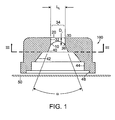
- Fig. 1 shows a cross-section view of an extrusion die according to an aspect of the present invention
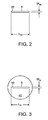
- Fig. 2 shows an outlet-side view of the extrusion die slot according to Fig. 1 ;
- Fig. 3 shows an inlet-side view of the extrusion die slot across section III-III as shown in Fig. 1 ;
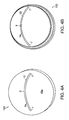
- Fig. 4A shows an inlet-side view of an extrusion die according to another aspect of the invention
- Fig. 4B shows an outlet-side view of the extrusion die according to Fig. 4A ;
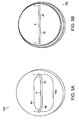
- Fig. 5A shows an inlet-side view of an extrusion die according to another aspect of the invention
- Fig. 5B shows an outlet-side view of the extrusion die according to Fig. 5A ;
- Fig. 6A shows an inlet-side view of an extrusion die according to another aspect of the invention.
- Fig. 6B shows an outlet-side view of the extrusion die according to Fig. 6A ;
- Fig. 7 shows a cross-section view of an extrusion die according to an aspect of the present invention
- Fig. 8 shows a cross-section view of an extrusion die according to another aspect of the present invention.
- Fig. 9A shows an inlet-side view of an extrusion die according to another aspect of the invention.
- Fig. 9B shows a slot-side view of a first extrusion die element according to Fig. 9A ;
- Fig. 9C shows a slot-side view of a second extrusion die element according to Fig. 9A ;
- Fig. 10A shows a slot-side view of a first extrusion die element according to another aspect of the invention.
- Fig. 10B shows a slot-side view of a second extrusion die element according to Fig. 10A .
- Fig. 11A shows an inlet-side view of a multiple bore extrusion die according to an aspect of the invention
- Fig. 11B shows a cross-section view of an extrusion die according to Fig. 11 A;
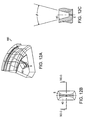
- Fig. 12A shows a perspective view of a single bore of the multiple bore extrusion die according to Fig. 11A ;
- Fig. 12B shows an inlet-side view of the single bore according to Fig. 12A ;
- Fig. 12C shows a cross-section view of the single bore taken at section XII.C - XII.C of Fig 12B ;
- Fig. 13 shows an extruder according to an aspect of the invention.
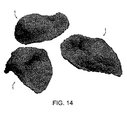
- Fig. 14 illustrates cereal flakes produced according to an aspect of the invention.
- aspects of the invention are directed to an extrusion die suitable for forming cereal flakes having curled edges, an extruder containing the extruder die, and a process of forming cereal flakes utilizing the extrusion die.
- a cereal mix for use with an extruder can be prepared by blending various dry cereal ingredients together with water.
- the water may be added during a pre-conditioning step in the form of liquid water and/or steam.
- pre-conditioning if any, the cereal mix is introduced into an extruder.
- the cereal mix is cooked and mechanically worked to form a cooked dough.
- the cooked dough is extruded through an extrusion die at the downstream end of the extruder.
- Rotating knife blades at the extrusion die face cut the dough as it is extruded.
- the extruded pieces may be dried. Prior to being dried, the extrudate may be coated. A person of ordinary skill in the art would be familiar with each of these process steps.
- the dry cereal ingredients may be any combination of dry cereal components suitable for cooking and extrusion, such as whole and processed flours.
- Such ingredients include, but are not limited to, flours prepared from oat, corn, wheat, rice, and combinations thereof such as, for example, a combination of a majority of whole oat flour and a minority component of whole wheat flour. Selection of suitable dry cereal components for use with the present invention is within the skill of the art given the benefit of the present disclosure.
- RTE cereal flakes 1 may be formed by extruding a cooked dough through a relatively narrow slot of an extrusion die. Flakes 1 are defined as having relative large length and width dimensions compared to their thickness dimension. As flakes 1 may be curled (or otherwise warped out-of-plane), the length, width, and thickness dimensions referred to above are determined as if the flakes were flat.
- Extrusion die 100 includes a slot 5 having a length (L S ) and a width (W S ). Slot 5 extends between an inlet 10 and an outlet 20. The length and width dimensions of slot 5 may be different at the inlet side 10 (L Si , W Si ) from the dimensions at the outlet side 20 (L So , W So ). Slot 5 further includes a land 30. Land 30 has a length (L L ) and a depth (D L ). The depth extends between the inlet 10 and the outlet 20. The length extends between a first side 32 through a middle portion 34 to a second side 36 of land 30. The depth D L of land 30, i.e. the distance between the inlet edge 10 and the outlet edge 20, varies along at least a portion of the length L L of the land.
- Extrusion die 100 may be formed of any suitable die material(s) as would be known to persons of ordinary skill in the art, including, by way of non-limiting example, stainless steel and brass. Further, any suitable method of manufacturing extrusion die 100 may be used.
- the varying length of the land causes the dough to travel through the passageway at different speeds.
- the land has a greater length (for example, at the sides) the dough moves slower than where the land has a lesser length (for example, in the middle).
- this relative speed of passage of the dough through the die causes the dough to cup or curl as it flows through and exits the die.
- the result is that cereal flakes 1 having a degree of curl are produced by the extrusion process.
- the length of the curling piece is allowed to grow (i.e., the cutting rate is slowed), the curl direction unexpectedly reverses and curls in the other direction. Referring to Fig. 14 , this results in cereal flakes 1 with a sinusoidal wave-like shape.
- the depth of land 30 is greater at the first side 32 than at a middle portion 34. Indeed, in this aspect, the depth of land 30 is greater at both first side 32 and second side 36 than it is in middle portion 34. Further, the depth of land 30 may vary smoothly along the length of the land from the first side to the second side.
- the variation in the depth of land 30 may be accomplished by providing a stepped or curved edge at the inlet 10.
- at least a portion of an inlet edge of the land may be curved (in the plane of land 30).
- the entire inlet edge 10 of land 30 may be curved.
- the inlet edge may be composed of stepwise straight portions, by stepwise curved portions or a combination thereof.
- the inlet edge 10 of land 30 is comprised of two linear segments; in Fig. 8 , the inlet edge 10 of land 30 is comprised of 4 linear segments.
- outlet edge 20 of land 30 may extend in a straight line from the first side to the second side, as shown in the aspect of Fig. 3 .
- outlet edge 20 may also be stepped and/or curved (in the plane of land 30).
- both inlet edge 10 and outlet edge 20 may be stepped and/or curved.
- the inlet edge of the land may extend along an arc having a radius ranging from approximately 6.5 mm to approximately 10 mm.
- the arc may have a radius of approximately 8 mm.
- the depth of the land at a first side may range from approximately 5 mm to approximately 7.5 mm long.
- the depth of the land at the first side (and optionally the second side) may be approximately 6.3-6.4 mm long.
- the depth of the land at the middle portion may range from approximately 2.5 mm to approximately 4 mm.
- the depth of the land in the middle portion may be approximately 3.2 mm long.
- inlet edges 10 and outlet edges 20 of slot 5 have width dimensions (W Si and W So , respectively) and length dimensions (L Si and L So , respectively).
- the width and length dimensions of slot 5 at the inlet and the outlet may be the same or different.
- the inlet and/or the outlet of slot 5 may have a length dimension ranging from approximately 10 mm to approximately 15 mm.
- the outlet may have a length dimension of approximately 13 mm.
- the inlet and/or the outlet may have a width dimension ranging from approximately 0.4 mm to approximately 1.0 mm.
- the inlet and/or outlet may have a width dimension ranging from approximately 0.51 mm to approximately 0.74 mm.
- the ratio of the length dimension-to-width dimension of slot 5 at the inlet and/or the outlet may range from approximately 10 to approximately 40. As a specific, non-limiting example, this ratio may be approximately 17.
- the ends of the inlet and/or outlet slots may be radiused. In the aspect of Figs. 2 and 3 , the ends are provided with a full semicircular curve.
- the extrusion die may include multiple bores 40, 42, 44, 46 upstream of inlet 20. Bores 44 and 46 may be configured to accommodate the method of attaching the extrusion die to the extruder, and as such, may accommodate o-rings and/or distribution plates. As best shown in FIG. 1 , bores 44 and 46 may be cylindrical, i.e., having a constant diameter, while bores 40 and 42 may be frusto-conical.
- the included angle ( ⁇ ) of frusto-conical bore 40 may be any suitable angle such as approximately 20 to approximately 60 degrees. In one non-limiting example, the angle may be approximately 40 degrees. The desired angle may depend on, for example, properties of the cooked dough. As would be appreciated by a person of ordinary skill in the art, given the benefit of the present disclosure, there could be any number of bores and the cross-sectional shape of the bores need not be circular.
- frusto-conical bore 40 may be used to shape inlet 10 of the extrusion die.
- bore 40 is provided with a hemispherical end.
- Figs. 4A and 4B show an extrusion die having a non-linear slot 5a.
- slot 5a is curved and is no longer centered within bore 40a of extrusion die 100.
- Curved slot 5a defines a midpoint 6 and endpoints 7.
- Bore 40a is hemispherical. Because the thickness of the die (in the flow direction) is a minimum at the center of the hemispherical bore, the curved slot 5a has a land depth at its midpoint 6 that is greater than the midpoint land depth of a slot that extends through the center of bore 40a.
- the midpoint-to-endpoint land depth ratio of the slot can be varied.
- the curved slot may allow the overall dimensions of the extrusion die to be minimized, as the curved slot can be provided with the same length as a straight slot within a smaller diameter.
- Other non-linear shaped slots such as a V-shaped slot or S-shaped slot, may be provided
- Figs. 5A and 5B show an extrusion die having a straight slot 5b with an elongated bore 40b.
- Bore 40b may be formed by a hemispherical ball cutter traversing along the length of slot 5b.
- Elongated bore 40b may be centered on slot 5b or off-center, as shown in Fig. 5A .
- Elongated bore 40b provides a land having a constant depth in the center portion of slot 5b and a varying depth (formed by the radius of the ball cutter) at the end portions of the slot.
- Figs. 6A and 6B show an extrusion die according to another aspect of the invention.
- Bore 40c is formed by combining an elongated bore portion (centered over slot 5c) with an off-centered spherical bore portion.
- the spherical bore portion is deeper than the elongate bore portion.
- Figs. 9A, 9B and 9C show an extrusion die 100 formed in two parts.
- Fig. 9A shows the two parts 100a, 100b joined to form the extrusion die.
- Fig. 9B shows a first extrusion die part 100a;
- Fig. 9C shows a second extrusion die part 100b.
- Each part includes a portion of bore 40d, 40e and a portion of land 30a, 30b.
- Slot 5d is formed when parts 100a and 100b are joined together.
- Parts 100a, 100b may be joined together in any suitable manner, including, welding, brazing, adhesive, mechanical fasteners, and/or clamping.
- Extrusion die part 100a has a first surface finish and extrusion die part 100b has a second surface finish that is different from the first surface finish.
- part 100a has a rough surface finish relative to the smooth surface finish of part 100b.
- the rougher surface finish of part 100a has a higher coefficient of friction than the smooth surface finish of part 100b.
- the difference in surface finishes promotes a higher flow rate on the smoother side (than that experienced by the rougher side), thus imparting a greater curling torque to the extruded dough.
- the surface finishes may be provided on the surface of the bore, the surface of the land, or on both.
- the extrusion die may be formed in two parts (as shown in Figs. 9B and 9C ) to facilitate the manufacture of the die with two different surface finishes.
- Figs. 10A and 10B illustrate two parts of an extrusion die 100 as a variation of the extrusion die of Figs. 9A-9C .
- Fig. 10A shows a first extrusion die part 100c having a relatively rough surface finish.
- Fig. 10B shows a second extrusion die part 100d having a relatively smooth surface finish.
- Each die part 100c, 100d has a variable land length created by forming substantially V-shaped bore portions 40f, 40g on the inlet side of the die. Parts 100c, 100d may be joined together in any suitable manner to form slot 5 and extrusion die 100.
- extrusion die 100 could include multiple bores 40 and multiple slots 5.
- bores 40 and slots 5 are equally spaced on approximately a 3 inch diameter.
- bores 40 and slots 5 may be arranged in any suitable manner.
- Figs. 12A, 12B and 12C show details of a single bore as may be used in an extrusion die having multiple bores. Some non-limiting examples of dimensions associated with a typical bore 40 and a typical slot 5 are presented herein.
- Slot 5 may have a length of approximately 0.5 inches and a width of approximately .03 inches.
- the length dimension of slot 5 may be aligned in a radial direction of the extrusion die.
- the minimum land depth (i.e., the land depth at the midpoint) of slot 5 may be approximately 0.12 inches and the maximum land depth (i.e., the land depth at the sides) of slot 5 may be approximately 0.25 inches.
- Inlet edge 10 of slot 5 may be radiused in the length direction (refer to Fig.
- inlet edge 10 of slot 5 may be straight across (refer to Fig. 12C ).
- the length of bore 40 at its upper opening may be approximately 0.68 inches; the width of bore 40 at its upper opening may be approximately 0.33 inches, the depth of bore 40 at the midpoint of slot 5 may be approximately 0.38 inches.
- the included angle, ⁇ , of the widthwise sides of bore 40 may be approximately 30 degrees; the included angle of the lengthwise sides of bore 40 may be approximately 40 degrees.
- the extrusion die may be formed of a stainless steel or any other suitable material.
- Fig. 13 schematically illustrates an extruder 200 that may be used for extruding dough through extrusion die 100.
- Extruder 200 includes a barrel 210 and a screw 220 positioned within the barrel.
- Extrusion die 100 is located at a downstream end of barrel 210.
- the extruder may be any suitable extruder that can accommodate an extrusion die such as a twin screw extruder.
- a twin screw extruder having a length-to-diameter ratio of 16 to 24 and having a maximum screw speed of 500 RPM may be used to facilitate the process described herein.
- a blade (not shown) for cutting the extruded dough as it exits the extruder may be located adjacent the outlet of the extrusion die.
- a process for forming cereal flakes 1 is described herein.
- the process includes extruding a cooked dough through the extrusion die described above and cutting the extruded dough adjacent the outlet face of the extrusion die to form flakes.
- the geometry of the extrusion die encourages cupping or curling of the cooked dough as the dough is extruded.
- flakes 1 formed from this process will have the appearance of rolled flakes, without actually undergoing any flaking roll and/or intermediate drying processes.
- the process may further include drying the flakes.
- the flakes are dried by toasting. Toasting is performed at temperatures high enough to generate browning of the flakes. In some instances, toasting is performed at temperatures high enough to nearly bum the flakes. Alternatively, the flakes could be dried without toasting. Even further, if desired, the process may include coating the flakes after the step of cutting, but before the step of drying.
- the cooked dough may undesirably include particulate matter that is too large to pass through the extrusion die's slot.
- the process may further include placing a screen 50 upstream of the extrusion die to filter out these particles that could block the extrusion die.
- cereal flakes 1 formed by the process described above are described herein.
- the cereal flakes may have a bulk density ranging from approximately 50 grams/liter to approximately 220 grams/liter.
- the cereal flakes 1 may have a bulk density ranging from approximately 100 grams/liter to approximately 170 grams/liter.
- the cereal flakes 1 may have a bulk density ranging from approximately 140 grams/liter to approximately 160 grams/liter.
- the cereal flakes 1 may have an average thickness ranging from approximately 0.4 mm to approximately 2.2 mm.
- the cereal flakes 1 may have an average thickness ranging from approximately .8 mm to approximately 2 mm.
- the cereal flakes 1 may have an average width ranging from approximately 4 mm to approximately 15 mm. As a specific, non-limiting example, the cereal flakes 1 may have an average width ranging from approximately 6 mm to approximately 12 mm.
- the length of the cereal flakes is typically determined by the flow rate of the extrudate and the cutting rate of the rotating knife blades at the extrusion die face. As a specific, non-limiting example, the cereal flakes may have an average length-to-average width ratio ranging from approximately 1.0 to approximately 2.0.
- the slot height, the slot land length, the dough's viscosity, and the flow rate of the dough through the slot of the extrusion die influence the ultimate thickness and texture of the flakes.
- the composition, temperature and moisture content of the dough also can be manipulated to influence the amount of expansion of the dough upon exiting the extrusion die and thus, to also influence the ultimate characteristics of the flakes.
- Extruded doughs may be subject to a phenomenon called die swell.
- Fully gelatinized starch doughs are typically viscoelastic, which means they resist deformation (viscous) and are elastic at the same time. Elastic doughs have memory, which means they will try to bounce back to the shape they had before being forced through a die.
- swell increases with viscosity; decreases with increased land; and increases with the shear rate in the slot.
- shear increases as the flow rate through the slot increases and as the slot gets narrower. This means that a relatively low flow rate through the slot may be used to form a relatively thin flake, while a higher flow rate may result in a relatively thick flake.
- a flow rate in the range of approximately 15 to 40 kilogram of dry ingredients /hour/slot may provide a typical operating range.
- a preferred rate may be approximately 14 to 22 kilogram of dry ingredients /hour/slot for a twelve-slot die.
- a rate of approximately 24 to 36 kilogram of dry ingredients /hour/slot was used.
- the present invention provides an extrusion die which efficiently produces aesthetically pleasing, curled, RTE cereal flakes 1 without the need for extensive post-extrusion processing, thereby streamlining the flake forming process and saving time, energy, and capital.
- the individual flakes 1 curl in a single direction.
- the cut rate is slowed, thereby allowing longer flakes to be formed, the individual flakes 1 curl out-of-the plane in a first direction and out-of-the-plane in a second direction substantially opposite to the first direction.
- These doubly-curled flakes 1 assume a substantially sinusoidal wave-like shape.
Landscapes
- Engineering & Computer Science (AREA)
- Food Science & Technology (AREA)
- Mechanical Engineering (AREA)
- Polymers & Plastics (AREA)
- Life Sciences & Earth Sciences (AREA)
- Chemical & Material Sciences (AREA)
- Nutrition Science (AREA)
- Health & Medical Sciences (AREA)
- Manufacturing & Machinery (AREA)
- Fodder In General (AREA)
- Manufacturing And Processing Devices For Dough (AREA)
- Formation And Processing Of Food Products (AREA)
- Grain Derivatives (AREA)
Abstract
Description
- This application claims priority to
U.S. Utility Application Serial No. 12/203,303 filed September 3, 2008 - The present invention relates generally to an extrusion die and process for forming cereal flakes. More specifically, the present invention relates to an extrusion die and process for forming curled cereal flakes.
- Breakfast cereals in ready-to-eat ("RTE") flake form have been produced for years. These cereal flakes typically contain cereal grains such as wheat, rice, oats, corn, etc. and ancillary ingredients such as sugars, salts, oils, etc. Flavoring, coloring and preservative agents and vitamins and mineral fortifiers are also typically included.
- Conventionally, RTE cereal flakes have been prepared by toasting wet cereal flakes. The toasting process causes a slight expansion of the flakes and, in some instances, a curling of the flakes. Curled flakes are aesthetically pleasing to the consumer-flat flakes appearing too processed and unnatural. Thus, from a consumer preference standpoint, it is desirable to produce curled flakes and/or also to increase the amount of curling of each individual flake.
- Another concern with flat flakes is that they have a relatively high bulk density. Bulk density is a function of the absolute density of the cereal and its packing factor. The packing factor is influenced by the size and shape of the cereal pieces--the lower the packing factor the more air space is present between the cereal pieces. Curled flakes, relative to flat flakes, decrease the packing factor and desirably decrease the bulk density of the cereal product.
- One way to form RTE cereal flakes it so introduce the cereal ingredients, in the form of whole grains or grits (large grain pieces), into a batch cooker, cook the mix, dry and temper, and then roll the cooked grain pieces into flakes with flaking rolls After rolling, the flakes are immediately dried to prevent clumping.
- It is also known to form RTE cereals flakes by a process which utilizes an extrusion step to form pellets (
U.S. Published Patent Application No. 2001/0051198 andU.S. Patent No. 6,183,788 ). The cereal ingredients may be batch mixed and fed into an extruder. In the extruder, the ingredients are formed into a cooked dough and then extruded into strands or ropes. These strands are cut into pellets, which are subsequently dried, flaked (for example, with a flaking roller) and toasted according to traditional methods. The post-extrusion processes, including pelletizing, intermediate drying, flaking and toasting, may provide the flakes with a generally curled configuration. However, each of these known post-extrusion processes requires additional equipment and equipment operators, additional floor space and additional energy. - It would be desirable to form RTE cereal flakes having a curl without the use of a flaking roll and/or without the use of an intermediate drying step. A need exists to reduce the number of processing steps, yet still produce a ready-to-eat cereal flake that is aesthetically appealing and that has a pleasing texture.
- The present invention relates to an extrusion die for extruding cooked dough. The extrusion die includes at least one slot having an inlet edge, an outlet edge, and a land. The land has a length and a depth, with the depth extending between the inlet edge and the outlet edge and the length extending between a first side and a second side of the land. The depth of the land varies along at least a portion of the length.
- In another aspect, an extruder including an extrusion die having a variable depth land is disclosed.
- In yet another aspect of the invention, a process for forming cereal flakes is disclosed. The process includes the steps of extruding a cooked dough through the extrusion die and cutting the extruded dough.
- In another aspect, cereal flakes are formed using a process that includes extruding a cooked dough through the extrusion die and cutting the extruded dough.
- These and other aspects, along with advantages and features of the present invention herein disclosed, will become apparent through reference to the following description and the accompanying drawings. Furthermore, it is to be understood that the features of the various aspects described herein are not mutually exclusive and can exist in various combinations and permutations.
- In the drawings, like reference characters generally refer to the same parts throughout the different views. Also, the drawings are not necessarily to scale, emphasis instead generally being placed upon illustrating the principles of the invention. In the following description, various aspects of the present invention are described with reference to the following drawings, in which:
-
Fig. 1 shows a cross-section view of an extrusion die according to an aspect of the present invention; -
Fig. 2 shows an outlet-side view of the extrusion die slot according toFig. 1 ; a -
Fig. 3 shows an inlet-side view of the extrusion die slot across section III-III as shown inFig. 1 ; -
Fig. 4A shows an inlet-side view of an extrusion die according to another aspect of the invention; -
Fig. 4B shows an outlet-side view of the extrusion die according toFig. 4A ; -
Fig. 5A shows an inlet-side view of an extrusion die according to another aspect of the invention; -
Fig. 5B shows an outlet-side view of the extrusion die according toFig. 5A ; -
Fig. 6A shows an inlet-side view of an extrusion die according to another aspect of the invention; -
Fig. 6B shows an outlet-side view of the extrusion die according toFig. 6A ; -
Fig. 7 shows a cross-section view of an extrusion die according to an aspect of the present invention; -
Fig. 8 shows a cross-section view of an extrusion die according to another aspect of the present invention; -
Fig. 9A shows an inlet-side view of an extrusion die according to another aspect of the invention; -
Fig. 9B shows a slot-side view of a first extrusion die element according toFig. 9A ; -
Fig. 9C shows a slot-side view of a second extrusion die element according toFig. 9A ; -
Fig. 10A shows a slot-side view of a first extrusion die element according to another aspect of the invention; -
Fig. 10B shows a slot-side view of a second extrusion die element according toFig. 10A . -
Fig. 11A shows an inlet-side view of a multiple bore extrusion die according to an aspect of the invention; -
Fig. 11B shows a cross-section view of an extrusion die according toFig. 11 A; -
Fig. 12A shows a perspective view of a single bore of the multiple bore extrusion die according toFig. 11A ; -
Fig. 12B shows an inlet-side view of the single bore according toFig. 12A ; -
Fig. 12C shows a cross-section view of the single bore taken at section XII.C - XII.C ofFig 12B ; -
Fig. 13 shows an extruder according to an aspect of the invention; and -
Fig. 14 illustrates cereal flakes produced according to an aspect of the invention. - Aspects of the invention are directed to an extrusion die suitable for forming cereal flakes having curled edges, an extruder containing the extruder die, and a process of forming cereal flakes utilizing the extrusion die.
- As is well known to those of ordinary skill in the art, a cereal mix for use with an extruder can be prepared by blending various dry cereal ingredients together with water. The water may be added during a pre-conditioning step in the form of liquid water and/or steam. After pre-conditioning (if any), the cereal mix is introduced into an extruder. Within the extruder, the cereal mix is cooked and mechanically worked to form a cooked dough. Upon the application of pressure, the cooked dough is extruded through an extrusion die at the downstream end of the extruder. Rotating knife blades at the extrusion die face cut the dough as it is extruded. In a post-extrusion process, the extruded pieces may be dried. Prior to being dried, the extrudate may be coated. A person of ordinary skill in the art would be familiar with each of these process steps.
- The dry cereal ingredients may be any combination of dry cereal components suitable for cooking and extrusion, such as whole and processed flours. Such ingredients include, but are not limited to, flours prepared from oat, corn, wheat, rice, and combinations thereof such as, for example, a combination of a majority of whole oat flour and a minority component of whole wheat flour. Selection of suitable dry cereal components for use with the present invention is within the skill of the art given the benefit of the present disclosure.
- In accordance with the present invention,
RTE cereal flakes 1 may be formed by extruding a cooked dough through a relatively narrow slot of an extrusion die.Flakes 1 are defined as having relative large length and width dimensions compared to their thickness dimension. Asflakes 1 may be curled (or otherwise warped out-of-plane), the length, width, and thickness dimensions referred to above are determined as if the flakes were flat. -
Figs. 1-3 show an illustrative aspect of an extrusion die for extruding cooked dough. Extrusion die 100 includes aslot 5 having a length (LS) and a width (WS).Slot 5 extends between aninlet 10 and anoutlet 20. The length and width dimensions ofslot 5 may be different at the inlet side 10 (LSi, WSi) from the dimensions at the outlet side 20 (LSo, WSo).Slot 5 further includes aland 30.Land 30 has a length (LL) and a depth (DL). The depth extends between theinlet 10 and theoutlet 20. The length extends between afirst side 32 through amiddle portion 34 to asecond side 36 ofland 30. The depth DL ofland 30, i.e. the distance between theinlet edge 10 and theoutlet edge 20, varies along at least a portion of the length LL of the land. - Extrusion die 100 may be formed of any suitable die material(s) as would be known to persons of ordinary skill in the art, including, by way of non-limiting example, stainless steel and brass. Further, any suitable method of manufacturing extrusion die 100 may be used.
- By way of non-limiting explanation, the varying length of the land (in conjunction with the slot-like aspects of the die's passageway) causes the dough to travel through the passageway at different speeds. Thus, where the land has a greater length (for example, at the sides) the dough moves slower than where the land has a lesser length (for example, in the middle). It has been shown or discovered that this relative speed of passage of the dough through the die causes the dough to cup or curl as it flows through and exits the die. The result is that
cereal flakes 1 having a degree of curl are produced by the extrusion process. It has also been discovered, that if the length of the curling piece is allowed to grow (i.e., the cutting rate is slowed), the curl direction unexpectedly reverses and curls in the other direction. Referring toFig. 14 , this results incereal flakes 1 with a sinusoidal wave-like shape. - In the aspect shown in
Figs. 1-3 and as best shown inFig. 1 , the depth ofland 30 is greater at thefirst side 32 than at amiddle portion 34. Indeed, in this aspect, the depth ofland 30 is greater at bothfirst side 32 andsecond side 36 than it is inmiddle portion 34. Further, the depth ofland 30 may vary smoothly along the length of the land from the first side to the second side. - The variation in the depth of
land 30 may be accomplished by providing a stepped or curved edge at theinlet 10. For example, at least a portion of an inlet edge of the land may be curved (in the plane of land 30). As best shown inFig. 1 , in this particular aspect, theentire inlet edge 10 ofland 30 may be curved. Optionally, as best shown inFigs. 7 and 8 , the inlet edge may be composed of stepwise straight portions, by stepwise curved portions or a combination thereof. InFig. 7 , theinlet edge 10 ofland 30 is comprised of two linear segments; inFig. 8 , theinlet edge 10 ofland 30 is comprised of 4 linear segments. Theoutlet edge 20 ofland 30 may extend in a straight line from the first side to the second side, as shown in the aspect ofFig. 3 . Optionally (not shown),outlet edge 20 may also be stepped and/or curved (in the plane of land 30). Further, optionally, bothinlet edge 10 andoutlet edge 20 may be stepped and/or curved. - By way of specific, non-limiting example and referring back to
Fig. 1 , the inlet edge of the land may extend along an arc having a radius ranging from approximately 6.5 mm to approximately 10 mm. In one aspect, the arc may have a radius of approximately 8 mm. Further, the depth of the land at a first side may range from approximately 5 mm to approximately 7.5 mm long. In one aspect, the depth of the land at the first side (and optionally the second side) may be approximately 6.3-6.4 mm long. Even further, the depth of the land at the middle portion may range from approximately 2.5 mm to approximately 4 mm. In one aspect, the depth of the land in the middle portion may be approximately 3.2 mm long. - As best shown in
Figs. 2 and 3 , inlet edges 10 and outlet edges 20 ofslot 5 have width dimensions (WSi and WSo, respectively) and length dimensions (LSi and LSo, respectively). The width and length dimensions ofslot 5 at the inlet and the outlet may be the same or different. In one aspect, the inlet and/or the outlet ofslot 5 may have a length dimension ranging from approximately 10 mm to approximately 15 mm. As a specific, non-limiting example, the outlet may have a length dimension of approximately 13 mm. In another aspect, the inlet and/or the outlet may have a width dimension ranging from approximately 0.4 mm to approximately 1.0 mm. As a specific, non-limiting example, the inlet and/or outlet may have a width dimension ranging from approximately 0.51 mm to approximately 0.74 mm. Further, the ratio of the length dimension-to-width dimension ofslot 5 at the inlet and/or the outlet may range from approximately 10 to approximately 40. As a specific, non-limiting example, this ratio may be approximately 17. As shown inFigs. 2 and 3 , the ends of the inlet and/or outlet slots may be radiused. In the aspect ofFigs. 2 and 3 , the ends are provided with a full semicircular curve. - The extrusion die may include
multiple bores inlet 20.Bores FIG. 1 , bores 44 and 46 may be cylindrical, i.e., having a constant diameter, whilebores conical bore 40 may be any suitable angle such as approximately 20 to approximately 60 degrees. In one non-limiting example, the angle may be approximately 40 degrees. The desired angle may depend on, for example, properties of the cooked dough. As would be appreciated by a person of ordinary skill in the art, given the benefit of the present disclosure, there could be any number of bores and the cross-sectional shape of the bores need not be circular. - As best shown by
Figs. 1 and3 in concert, the downstream end of frusto-conical bore 40 may be used to shapeinlet 10 of the extrusion die. In the aspect shown, bore 40 is provided with a hemispherical end. - In another aspect of the present invention,
Figs. 4A and 4B show an extrusion die having anon-linear slot 5a. In this aspect,slot 5a is curved and is no longer centered withinbore 40a of extrusion die 100.Curved slot 5a defines amidpoint 6 andendpoints 7.Bore 40a is hemispherical. Because the thickness of the die (in the flow direction) is a minimum at the center of the hemispherical bore, thecurved slot 5a has a land depth at itsmidpoint 6 that is greater than the midpoint land depth of a slot that extends through the center ofbore 40a. Thus, by varying the amount of curvature ofslot 5a, the midpoint-to-endpoint land depth ratio of the slot can be varied. Further, the curved slot may allow the overall dimensions of the extrusion die to be minimized, as the curved slot can be provided with the same length as a straight slot within a smaller diameter. Other non-linear shaped slots, such as a V-shaped slot or S-shaped slot, may be provided - According to another aspect of the invention,
Figs. 5A and 5B show an extrusion die having astraight slot 5b with anelongated bore 40b.Bore 40b may be formed by a hemispherical ball cutter traversing along the length ofslot 5b.Elongated bore 40b may be centered onslot 5b or off-center, as shown inFig. 5A .Elongated bore 40b provides a land having a constant depth in the center portion ofslot 5b and a varying depth (formed by the radius of the ball cutter) at the end portions of the slot. -
Figs. 6A and 6B show an extrusion die according to another aspect of the invention.Bore 40c is formed by combining an elongated bore portion (centered overslot 5c) with an off-centered spherical bore portion. The spherical bore portion is deeper than the elongate bore portion. A person of ordinary skill in the art would recognize, given the benefit of this disclosure, that any of a variety of bores could be provided such that the depth of the land varies along at least a portion of the length. -
Figs. 9A, 9B and 9C show an extrusion die 100 formed in two parts.Fig. 9A shows the twoparts Fig. 9B shows a first extrusion diepart 100a;Fig. 9C shows a second extrusion diepart 100b. Each part includes a portion ofbore land Slot 5d is formed whenparts Parts part 100a has a first surface finish and extrusion diepart 100b has a second surface finish that is different from the first surface finish. In the example shown inFigs. 9A-9C ,part 100a has a rough surface finish relative to the smooth surface finish ofpart 100b. The rougher surface finish ofpart 100a has a higher coefficient of friction than the smooth surface finish ofpart 100b. The difference in surface finishes promotes a higher flow rate on the smoother side (than that experienced by the rougher side), thus imparting a greater curling torque to the extruded dough. The surface finishes may be provided on the surface of the bore, the surface of the land, or on both. The extrusion die may be formed in two parts (as shown inFigs. 9B and 9C ) to facilitate the manufacture of the die with two different surface finishes. -
Figs. 10A and 10B illustrate two parts of an extrusion die 100 as a variation of the extrusion die ofFigs. 9A-9C .Fig. 10A shows a first extrusion diepart 100c having a relatively rough surface finish.Fig. 10B shows a second extrusion diepart 100d having a relatively smooth surface finish. Each diepart bore portions 40f, 40g on the inlet side of the die.Parts slot 5 and extrusion die 100. - According to another aspect, as shown in
Figs. 11A and 11B , extrusion die 100 could includemultiple bores 40 andmultiple slots 5. In the example ofFig. 11A , 22 bores are equally spaced on approximately a 3 inch diameter. In general, bores 40 andslots 5 may be arranged in any suitable manner. -
Figs. 12A, 12B and 12C show details of a single bore as may be used in an extrusion die having multiple bores. Some non-limiting examples of dimensions associated with atypical bore 40 and atypical slot 5 are presented herein.Slot 5 may have a length of approximately 0.5 inches and a width of approximately .03 inches. The length dimension ofslot 5 may be aligned in a radial direction of the extrusion die. The minimum land depth (i.e., the land depth at the midpoint) ofslot 5 may be approximately 0.12 inches and the maximum land depth (i.e., the land depth at the sides) ofslot 5 may be approximately 0.25 inches.Inlet edge 10 ofslot 5 may be radiused in the length direction (refer toFig. 11 B) , thus forming a smoothly varying length land. In the width direction,inlet edge 10 ofslot 5 may be straight across (refer toFig. 12C ). The length ofbore 40 at its upper opening may be approximately 0.68 inches; the width ofbore 40 at its upper opening may be approximately 0.33 inches, the depth ofbore 40 at the midpoint ofslot 5 may be approximately 0.38 inches. The included angle, β, of the widthwise sides ofbore 40 may be approximately 30 degrees; the included angle of the lengthwise sides ofbore 40 may be approximately 40 degrees. The extrusion die may be formed of a stainless steel or any other suitable material. -
Fig. 13 schematically illustrates anextruder 200 that may be used for extruding dough through extrusion die 100.Extruder 200 includes abarrel 210 and ascrew 220 positioned within the barrel. Extrusion die 100 is located at a downstream end ofbarrel 210. The extruder may be any suitable extruder that can accommodate an extrusion die such as a twin screw extruder. By way of non-limiting example, a conventional twin screw extruder having a length-to-diameter ratio of 16 to 24 and having a maximum screw speed of 500 RPM may be used to facilitate the process described herein. A blade (not shown) for cutting the extruded dough as it exits the extruder may be located adjacent the outlet of the extrusion die. - In one aspect of the present invention, a process for forming
cereal flakes 1 is described herein. The process includes extruding a cooked dough through the extrusion die described above and cutting the extruded dough adjacent the outlet face of the extrusion die to form flakes. The geometry of the extrusion die encourages cupping or curling of the cooked dough as the dough is extruded. Thus,flakes 1 formed from this process will have the appearance of rolled flakes, without actually undergoing any flaking roll and/or intermediate drying processes. - The process may further include drying the flakes. In one aspect, the flakes are dried by toasting. Toasting is performed at temperatures high enough to generate browning of the flakes. In some instances, toasting is performed at temperatures high enough to nearly bum the flakes. Alternatively, the flakes could be dried without toasting. Even further, if desired, the process may include coating the flakes after the step of cutting, but before the step of drying.
- In some aspects, the cooked dough may undesirably include particulate matter that is too large to pass through the extrusion die's slot. In such case, the process may further include placing a
screen 50 upstream of the extrusion die to filter out these particles that could block the extrusion die. - In even another aspect,
cereal flakes 1 formed by the process described above are described herein. The cereal flakes may have a bulk density ranging from approximately 50 grams/liter to approximately 220 grams/liter. As a specific, non-limiting example, thecereal flakes 1 may have a bulk density ranging from approximately 100 grams/liter to approximately 170 grams/liter. In another example, thecereal flakes 1 may have a bulk density ranging from approximately 140 grams/liter to approximately 160 grams/liter. Further, thecereal flakes 1 may have an average thickness ranging from approximately 0.4 mm to approximately 2.2 mm. As a specific, non-limiting example, thecereal flakes 1 may have an average thickness ranging from approximately .8 mm to approximately 2 mm. Even further, thecereal flakes 1 may have an average width ranging from approximately 4 mm to approximately 15 mm. As a specific, non-limiting example, thecereal flakes 1 may have an average width ranging from approximately 6 mm to approximately 12 mm. The length of the cereal flakes is typically determined by the flow rate of the extrudate and the cutting rate of the rotating knife blades at the extrusion die face. As a specific, non-limiting example, the cereal flakes may have an average length-to-average width ratio ranging from approximately 1.0 to approximately 2.0. - As would be appreciated by persons of ordinary skill in the art, given the benefit of this disclosure, the slot height, the slot land length, the dough's viscosity, and the flow rate of the dough through the slot of the extrusion die influence the ultimate thickness and texture of the flakes. Further, the composition, temperature and moisture content of the dough also can be manipulated to influence the amount of expansion of the dough upon exiting the extrusion die and thus, to also influence the ultimate characteristics of the flakes.
- Extruded doughs may be subject to a phenomenon called die swell. Fully gelatinized starch doughs are typically viscoelastic, which means they resist deformation (viscous) and are elastic at the same time. Elastic doughs have memory, which means they will try to bounce back to the shape they had before being forced through a die. Typically, swell increases with viscosity; decreases with increased land; and increases with the shear rate in the slot. Generally, shear increases as the flow rate through the slot increases and as the slot gets narrower. This means that a relatively low flow rate through the slot may be used to form a relatively thin flake, while a higher flow rate may result in a relatively thick flake. By way of non-limiting example, a flow rate in the range of approximately 15 to 40 kilogram of dry ingredients /hour/slot may provide a typical operating range. A preferred rate may be approximately 14 to 22 kilogram of dry ingredients /hour/slot for a twelve-slot die. To get uniform flow through a sixteen-slot die at production scale, a rate of approximately 24 to 36 kilogram of dry ingredients /hour/slot was used.
- As described, the present invention provides an extrusion die which efficiently produces aesthetically pleasing, curled,
RTE cereal flakes 1 without the need for extensive post-extrusion processing, thereby streamlining the flake forming process and saving time, energy, and capital. In one aspect, theindividual flakes 1 curl in a single direction. In another aspect, referring toFig. 14 , when the cut rate is slowed, thereby allowing longer flakes to be formed, theindividual flakes 1 curl out-of-the plane in a first direction and out-of-the-plane in a second direction substantially opposite to the first direction. These doubly-curledflakes 1 assume a substantially sinusoidal wave-like shape. - The invention may be embodied in other specific forms without departing from the spirit or essential characteristics thereof. The foregoing aspects, therefore, are to be considered in all respects illustrative rather than limiting the invention described herein. Scope of the invention is thus indicated by the appended claims, rather than by the foregoing description, and all changes that come within the meaning and range of equivalency of the claims are intended to be embraced therein.
Claims (20)
- An extrusion die for extruding cooked dough, the die comprising:at least one slot, the slot including:wherein the depth of the land varies along at least a portion of the length.an inlet edge;an outlet edge;a land having a length and a depth, the depth extending between the inlet edge and the outlet edge and the length extending between a first side and a second side of the land,
- The extrusion die of claim 1 wherein the depth of the land is greater at the first side than at a middle portion of the land.
- The extrusion die of claim 1 wherein the depth of the land is greater at both the first side and the second side than at a middle portion of the land.
- The extrusion die of claim 1 wherein the depth of the land varies smoothly along the length from the first side to the second side.
- The extrusion die of claim 1 wherein the outlet edge of the slot extends in a straight line from the first side to the second side of the land.
- The extrusion die of claim 1 wherein at least a portion of the inlet edge of the slot is curved in the plane of the land.
- The extrusion die of claim 1 wherein the inlet edge of the land extends along an arc in the plane of the land having a radius ranging from approximately 6.5 mm to approximately 10 mm.
- The extrusion die of claim 1 wherein at least one of the outlet edge and the inlet edge has a length dimension and a width dimension, wherein the ratio of the length dimension-to-width dimension ranges from approximately 10 to approximately 40.
- The extrusion die of claim 1,
wherein the depth of the land at a first side ranges from approximately 5 mm to approximately 7.5 mm,
wherein the depth of the land at a middle portion ranges from approximately 2.5 mm to approximately 4 mm,
wherein the outlet has a length dimension ranging from approximately 10 mm to approximately 15 mm, and
wherein the outlet has a width dimension ranging from approximately 0.4 mm to approximately 1.0 mm. - The extrusion die of claim 1, further comprising a frusto-conically-shaped bore immediately upstream of the inlet edge.
- The extrusion die of claim 1, wherein the slot is non-linear.
- The extrusion die of claim 1, wherein the at least one slot is a plurality of slots.
- An extruder for extruding dough, the extruder comprising:a barrel;at least one screw positioned within the barrel; andan extrusion die at a downstream end of the barrel, the extrusion die having at least one slot having an inlet edge, an outlet edge, and a land having a length and a depth, the depth extending between the inlet edge and the outlet edge and the length extending between a first side and a second side of the land, wherein the depth of the land varies along at least a portion of the length.
- A process for forming cereal flakes comprising:extruding a cooked dough through the extrusion die of claim 1; andcutting the extrudate adjacent an outlet face of the extrusion die to form flakes.
- The process of claim 14, further comprising:drying the flakes; andcoating the flakes after the step of cutting and before the step of drying.
- The process of claim 14, further comprising:placing a screen upstream of the extrusion die to filter out particles that could block the extrusion die.
- Cereal flakes formed by a process comprising:extruding a cooked dough through the extrusion die of claim 1; andcutting the extrudate adjacent the outlet face of the extrusion die.
- The cereal flakes of claim 17, wherein the flakes have a bulk density ranging from approximately 50 grams/liter to approximately 220 grams/liter.
- The cereal flakes of claim 17, wherein the flakes have an average thickness ranging from approximately 0.4 mm to approximately 2.2 mm, and an average width ranging from approximately 4 mm to approximately 15 mm.
- The cereal flakes of claim 17, wherein the individual flakes curl out-of-the plane in a first direction and out-of-the-plane in a second direction substantially opposite to the first direction, thereby forming a sinusoidal wave-like shape.
Applications Claiming Priority (1)
| Application Number | Priority Date | Filing Date | Title |
|---|---|---|---|
| US12/203,303 US8366433B2 (en) | 2008-09-03 | 2008-09-03 | Extrusion die and process for forming cereal flakes |
Publications (3)
| Publication Number | Publication Date |
|---|---|
| EP2161118A2 true EP2161118A2 (en) | 2010-03-10 |
| EP2161118A3 EP2161118A3 (en) | 2011-09-21 |
| EP2161118B1 EP2161118B1 (en) | 2016-07-13 |
Family
ID=41463098
Family Applications (1)
| Application Number | Title | Priority Date | Filing Date |
|---|---|---|---|
| EP09010977.8A Not-in-force EP2161118B1 (en) | 2008-09-03 | 2009-08-27 | Extrusion die, extruder and process for forming cereal flakes ; |
Country Status (4)
| Country | Link |
|---|---|
| US (1) | US8366433B2 (en) |
| EP (1) | EP2161118B1 (en) |
| CA (1) | CA2675567C (en) |
| MX (1) | MX2009009023A (en) |
Cited By (1)
| Publication number | Priority date | Publication date | Assignee | Title |
|---|---|---|---|---|
| US8968816B2 (en) | 2012-02-14 | 2015-03-03 | General Mills, Inc. | Method and apparatus for making cereal flakes |
Families Citing this family (7)
| Publication number | Priority date | Publication date | Assignee | Title |
|---|---|---|---|---|
| RU2015144015A (en) * | 2013-03-15 | 2017-05-03 | Маккормик Энд Компани, Инкорпорейтед | Encapsulation of compositions containing spices, herbs, fruit and vegetable powders |
| DK3073841T3 (en) | 2013-11-07 | 2018-08-27 | Nestec Sa | EXTENDED FLAGS AND PREPARATION PROCEDURE |
| WO2016151064A1 (en) * | 2015-03-26 | 2016-09-29 | Nestec S.A. | A forming die for a wet extrusion process |
| LT3155903T (en) | 2015-10-16 | 2018-03-12 | Gold&Green Foods Oy | A method of manufacturing a textured food product and a texturized food product |
| BR112018013547B1 (en) | 2016-01-18 | 2022-11-01 | Kellogg Company | APPARATUS AND METHOD FOR PRODUCING CEREAL IN THE FORM OF FLAKES WITHOUT THE USE OF A FLAKE FORMING MILL |
| US10863750B2 (en) | 2017-05-31 | 2020-12-15 | MHI Restaurant Group | Pizza dough press apparatus and method |
| US10687537B2 (en) * | 2017-05-31 | 2020-06-23 | Mhi Restaurant Group Llc | Pizza dough press apparatus and method |
Citations (2)
| Publication number | Priority date | Publication date | Assignee | Title |
|---|---|---|---|---|
| US6183788B1 (en) | 1997-07-25 | 2001-02-06 | General Mills, Inc. | Flaked R-T-E cereal |
| US20010051198A1 (en) | 1998-02-19 | 2001-12-13 | General Mills, Inc. | R-T-E cereal and method of preparation |
Family Cites Families (70)
| Publication number | Priority date | Publication date | Assignee | Title |
|---|---|---|---|---|
| US1333047A (en) * | 1919-08-20 | 1920-03-09 | Ernest D Valentine | Die for making pneumatic-tire trfads |
| US2071434A (en) * | 1932-10-03 | 1937-02-23 | Sarnmark Axel Uno | Method and machine for producing flakes and the like from plastic masses |
| US1959006A (en) * | 1933-08-04 | 1934-05-15 | Penza Frederick | Macaroni and die for producing the same |
| US1946238A (en) * | 1933-09-26 | 1934-02-06 | Ronzoni Macaroni Company Inc | Die for forming spiral macaroni |
| US2120138A (en) * | 1933-12-06 | 1938-06-07 | Flakall Corp | Method for producing food products |
| US2339419A (en) * | 1941-07-02 | 1944-01-18 | Nat Biscuit Co | Method of making puffed cereal flakes |
| US2514211A (en) * | 1947-03-12 | 1950-07-04 | Firestone Tire & Rubber Co | Adjustable extrusion machine |
| US2613620A (en) * | 1947-08-09 | 1952-10-14 | Model Crafters Inc | Method of preparing dough for baking |
| US3062657A (en) * | 1958-12-03 | 1962-11-06 | Gen Foods Corp | Process for making breakfast cereal flakes |
| US3236928A (en) * | 1961-07-10 | 1966-02-22 | Leyman Corp | Method of producing curved radially aligned matrix bonded fine particle permanent magnets |
| US3462277A (en) | 1966-09-26 | 1969-08-19 | Quaker Oats Co | Method of shaping a cereal product |
| US3664779A (en) * | 1969-04-01 | 1972-05-23 | Beatrice Foods Co | Apparatus for producing shapes with controlled three dimensions |
| US3808962A (en) * | 1971-10-01 | 1974-05-07 | Procter & Gamble | Method of and apparatus for making substantially uniformly shaped flakes |
| US3852491A (en) * | 1972-03-22 | 1974-12-03 | Ralston Purina Co | High protein ready-to-eat breakfast cereal |
| US4182606A (en) * | 1975-11-20 | 1980-01-08 | Fiber Industries, Inc. | Slit extrusion die |
| US4105728A (en) * | 1976-09-22 | 1978-08-08 | Celanese Corporation | Spinning method and apparatus |
| JPS5418865A (en) * | 1977-07-14 | 1979-02-13 | Kobe Steel Ltd | Extrusion molding of synthetic resin and die therefor |
| US4118166A (en) * | 1977-07-22 | 1978-10-03 | The Bf Goodrich Company | Extrusion apparatus |
| US4497840A (en) * | 1981-06-29 | 1985-02-05 | The Quaker Oats Company | Cereal foods made from oats and method of making |
| US4435430A (en) * | 1983-01-20 | 1984-03-06 | General Foods Corporation | Enzyme-saccharified all natural, ready-to-eat cereal from whole cereal grain |
| US4710386A (en) * | 1985-01-29 | 1987-12-01 | General Foods Corporation | All natural, ready-to-eat enzyme-saccharified cereal derived from whole cereal grain |
| US4756921A (en) | 1985-05-24 | 1988-07-12 | Nabisco Brands, Inc. | Bran extrusion process |
| US4790996A (en) * | 1987-06-10 | 1988-12-13 | General Foods Corporation | Process for preparing cereal products |
| US4954061A (en) * | 1987-08-28 | 1990-09-04 | The Quaker Oats Company | Multi-orifice coextrusion apparatus |
| IE60531B1 (en) * | 1987-09-09 | 1994-07-27 | Food & Cereal Research | A process for manufacturing a reconstitutable oat cereal |
| US5129315A (en) * | 1987-10-02 | 1992-07-14 | Nestec S.A. | Apparatus for forming an array of extruded filaments |
| US4965081A (en) * | 1988-11-01 | 1990-10-23 | Haarmann & Reimer Corporation | Dry mix suitable for the preparation of a puffable food product, processes for the use thereof, and the puffable and/or puffed foods products so produced |
| USRE36067E (en) * | 1989-03-29 | 1999-01-26 | Kellogg Company | R-T-E cereal with psyllium |
| AU624230B2 (en) * | 1989-04-05 | 1992-06-04 | Byron Food Science Pty Limited | Low amylose food product |
| US5464644A (en) * | 1989-09-27 | 1995-11-07 | Kellogg Company | Ready-to-eat-cereal containing psyllium and use thereof for lowering cholesterol levels |
| US5143740A (en) * | 1989-12-02 | 1992-09-01 | Nestec S.A. | Process for preparing cereal flakes |
| US5176936A (en) * | 1990-12-17 | 1993-01-05 | General Mills, Inc. | Puffed high fiber R-T-E cereal and method of preparation |
| US5167980A (en) * | 1991-04-24 | 1992-12-01 | Recot, Inc. | Horizontal extrusion of edge rippled snack product |
| US6287621B1 (en) * | 1991-05-03 | 2001-09-11 | National Starch And Chemical Investment Holding Corporation | Sweetened extruded cereals containing pregelatinized high amylose starches |
| US5198255A (en) * | 1991-07-08 | 1993-03-30 | General Mills, Inc. | Stability improvements of oat R-T-E cereals by high intensity microwave heating |
| US5372826A (en) | 1991-08-16 | 1994-12-13 | The Quaker Oats Company | Ready-to-eat cereal flakes and process for making same |
| US5510130A (en) * | 1991-08-16 | 1996-04-23 | The Quaker Oats Company | Ready-to-eat cereal flakes and process for making same |
| US5132133A (en) * | 1991-09-11 | 1992-07-21 | Wenger Manufacturing, Inc. | Reduced calorie, palatable snack product and method of producing same |
| US5747091A (en) * | 1992-03-30 | 1998-05-05 | Tate & Lyle Public Limited Company | Sweetened extruded food products |
| US5238385A (en) * | 1992-05-22 | 1993-08-24 | Nestec S.A. | Extrusion die assembly |
| CA2147117C (en) * | 1992-12-24 | 2002-08-20 | Kenneth J. Mcnaught | Food compositions including resistant starch |
| AU664327C (en) * | 1993-03-24 | 2003-01-30 | Brunob Ii B.V. | Method for increasing expansion and improving texture of fiber fortified extruded food products |
| US5384142A (en) | 1993-06-21 | 1995-01-24 | Recot, Inc. | Process for preparing textured dough products |
| US5443854B1 (en) * | 1994-08-29 | 2000-02-29 | Cummins Eagle Inc | Dough treating and dispensing method and apparatus |
| US5997934A (en) * | 1995-04-28 | 1999-12-07 | Nestec S.A. | Manufacture of cooked cereals |
| US5695805A (en) * | 1995-05-30 | 1997-12-09 | General Mills, Inc. | Multistrand twist cereal pieces |
| ATE208254T1 (en) * | 1995-11-29 | 2001-11-15 | Nestle Sa | CUTTING DEVICE |
| DK0867117T3 (en) * | 1997-03-25 | 2002-12-30 | Nestle Sa | Filled boat-shaped tartlets on cereal basis |
| US6054149A (en) * | 1997-05-16 | 2000-04-25 | Bran Tec, Inc. | Use of rice bran extract as a processing aid |
| US5932264A (en) * | 1997-10-07 | 1999-08-03 | General Mills, Inc. | Method for preparing cooked cereal dough using twin screw preconditioning extruder |
| US6010732A (en) * | 1997-11-04 | 2000-01-04 | General Mills, Inc. | Grain based extruded product and process of making |
| DK0937411T3 (en) * | 1998-02-10 | 2005-01-17 | Nestle Sa | Preoxidized oat product and treated cereals containing this |
| US6432460B1 (en) * | 1998-06-12 | 2002-08-13 | General Mills, Inc. | Food product and method of preparation |
| US6242033B1 (en) * | 1999-02-16 | 2001-06-05 | Eugene H. Sander | High protein cereal |
| US6174553B1 (en) * | 1999-03-19 | 2001-01-16 | General Mills, Inc. | R-T-E cereals with calcium containing pre-sweetener coating and method of preparation |
| PT1168933E (en) | 1999-03-24 | 2005-03-31 | Nestle Sa | METHOD OF MANUFACTURING A SNACK PRODUCT EXPANDED WITH A HIGH CONTENT OF SOLID DAIRY PRODUCTS |
| DE60001595T2 (en) * | 1999-04-30 | 2004-04-08 | Société des Produits Nestlé S.A. | Extrusion die, extruded cereal product and method of making the extruded cereal product |
| US6440473B2 (en) * | 1999-09-22 | 2002-08-27 | Nestec S.A. | Impregnated composite extrusion product |
| EP1244361B1 (en) * | 1999-12-30 | 2007-07-25 | Kellogg Company | Waxy wheat products and processes for producing same |
| EP1133931A3 (en) | 2000-03-16 | 2003-08-20 | Bestfoods | Nozzle for making snack foods having two or more filled axial cavities |
| GB0022719D0 (en) * | 2000-09-15 | 2000-11-01 | Mars Uk Ltd | Food product |
| US6733263B2 (en) | 2001-04-13 | 2004-05-11 | Hills Pet Nutrition Inc. | Composition, process and apparatus |
| DE10355347A1 (en) | 2003-03-12 | 2004-09-23 | Bühler AG | Nozzle assembly forming strands of viscoelastic polymer or dough, has partitions with upstream cutting edge between each pair of nozzle channels |
| US7153528B2 (en) * | 2003-03-28 | 2006-12-26 | Council Of Scientific & Industrial Research | Process for preparation of hypoglycemic foods and formulations thereof |
| US7318720B2 (en) * | 2003-08-07 | 2008-01-15 | Arunas Antanas Pabedinskas | Die assembly and production process for profile extrusion |
| US7235276B2 (en) | 2003-09-24 | 2007-06-26 | General Mills Ip Holdings Ii, Llc | High protein puffed food product and method of preparation |
| US8367142B2 (en) * | 2005-04-29 | 2013-02-05 | Kraft Foods Global Brands Llc | Production of shredded or flaked whole grain-containing composite food products |
| US9427004B2 (en) * | 2005-11-02 | 2016-08-30 | David Schlosser | Caffeinated coffee-flavored cereal |
| US20070264400A1 (en) * | 2006-05-09 | 2007-11-15 | Milne Jeffrey J | Extrusion process for the production of baby cereal |
| US9167845B2 (en) * | 2006-09-08 | 2015-10-27 | Creative Resonance, Inc. | Apparatus, method and product for ultrasonic extrusion of a flowable substrate |
-
2008
- 2008-09-03 US US12/203,303 patent/US8366433B2/en active Active
-
2009
- 2009-08-14 CA CA2675567A patent/CA2675567C/en not_active Expired - Fee Related
- 2009-08-21 MX MX2009009023A patent/MX2009009023A/en active IP Right Grant
- 2009-08-27 EP EP09010977.8A patent/EP2161118B1/en not_active Not-in-force
Patent Citations (2)
| Publication number | Priority date | Publication date | Assignee | Title |
|---|---|---|---|---|
| US6183788B1 (en) | 1997-07-25 | 2001-02-06 | General Mills, Inc. | Flaked R-T-E cereal |
| US20010051198A1 (en) | 1998-02-19 | 2001-12-13 | General Mills, Inc. | R-T-E cereal and method of preparation |
Cited By (3)
| Publication number | Priority date | Publication date | Assignee | Title |
|---|---|---|---|---|
| US8968816B2 (en) | 2012-02-14 | 2015-03-03 | General Mills, Inc. | Method and apparatus for making cereal flakes |
| US9924724B2 (en) | 2012-02-14 | 2018-03-27 | General Mills, Inc. | Method and apparatus for making cereal flakes |
| US10575531B2 (en) | 2012-02-14 | 2020-03-03 | General Mills, Inc. | Method and apparatus for making cereal flakes |
Also Published As
| Publication number | Publication date |
|---|---|
| CA2675567A1 (en) | 2010-03-03 |
| EP2161118A3 (en) | 2011-09-21 |
| MX2009009023A (en) | 2010-05-03 |
| CA2675567C (en) | 2012-11-20 |
| US20100055282A1 (en) | 2010-03-04 |
| US8366433B2 (en) | 2013-02-05 |
| EP2161118B1 (en) | 2016-07-13 |
Similar Documents
| Publication | Publication Date | Title |
|---|---|---|
| EP2161118B1 (en) | Extrusion die, extruder and process for forming cereal flakes ; | |
| US5149555A (en) | Method for forming an open textured product | |
| US7950916B2 (en) | Apparatus for production of rolled dough food piece | |
| CA2501334C (en) | Improved method and apparatus for producing a curly puff extrudate | |
| US8926308B2 (en) | Dough extruders and methods | |
| CA2165652C (en) | Apparatus and process for extruding laminated dough products | |
| US20140134315A1 (en) | Extruder Die and Resultant Food Product | |
| AU2002326411B2 (en) | Method and apparatus for producing a curly effect puff extrudate | |
| US10575531B2 (en) | Method and apparatus for making cereal flakes | |
| AU2004212616A1 (en) | Expanded cereal | |
| AU2002326411A1 (en) | Method and apparatus for producing a curly effect puff extrudate | |
| HK1140449A (en) | Extrusion die, extruder and process for forming cereal flakes; cereal flakes formed by the process | |
| RU2753243C2 (en) | Extrusion head, extruder and method for forming extruded or co-extruded pieces of food product, extruded or co-extruded pieces of food product formed by means of specified method | |
| JPH0121750B2 (en) |
Legal Events
| Date | Code | Title | Description |
|---|---|---|---|
| PUAI | Public reference made under article 153(3) epc to a published international application that has entered the european phase |
Free format text: ORIGINAL CODE: 0009012 |
|
| 17P | Request for examination filed |
Effective date: 20090827 |
|
| AK | Designated contracting states |
Kind code of ref document: A2 Designated state(s): AT BE BG CH CY CZ DE DK EE ES FI FR GB GR HR HU IE IS IT LI LT LU LV MC MK MT NL NO PL PT RO SE SI SK SM TR |
|
| AX | Request for extension of the european patent |
Extension state: AL BA RS |
|
| REG | Reference to a national code |
Ref country code: HK Ref legal event code: DE Ref document number: 1140449 Country of ref document: HK |
|
| PUAL | Search report despatched |
Free format text: ORIGINAL CODE: 0009013 |
|
| AK | Designated contracting states |
Kind code of ref document: A3 Designated state(s): AT BE BG CH CY CZ DE DK EE ES FI FR GB GR HR HU IE IS IT LI LT LU LV MC MK MT NL NO PL PT RO SE SI SK SM TR |
|
| AX | Request for extension of the european patent |
Extension state: AL BA RS |
|
| RIC1 | Information provided on ipc code assigned before grant |
Ipc: A23P 1/12 20060101ALI20110816BHEP Ipc: B29C 47/12 20060101AFI20110816BHEP Ipc: B29C 47/14 20060101ALN20110816BHEP Ipc: A23L 1/164 20060101ALN20110816BHEP Ipc: B29C 47/68 20060101ALN20110816BHEP Ipc: B29C 47/30 20060101ALN20110816BHEP Ipc: B29C 69/00 20060101ALI20110816BHEP |
|
| RAP1 | Party data changed (applicant data changed or rights of an application transferred) |
Owner name: THE QUAKER OATS COMPANY |
|
| 17Q | First examination report despatched |
Effective date: 20150612 |
|
| GRAP | Despatch of communication of intention to grant a patent |
Free format text: ORIGINAL CODE: EPIDOSNIGR1 |
|
| INTG | Intention to grant announced |
Effective date: 20160204 |
|
| RIC1 | Information provided on ipc code assigned before grant |
Ipc: B29C 47/14 20060101ALN20160125BHEP Ipc: B29C 47/12 20060101AFI20160125BHEP Ipc: B29C 69/00 20060101ALI20160125BHEP Ipc: B29C 47/68 20060101ALN20160125BHEP Ipc: A23P 30/20 20160101ALI20160125BHEP Ipc: A23L 7/117 20160101ALN20160125BHEP Ipc: B29C 47/30 20060101ALN20160125BHEP |
|
| GRAS | Grant fee paid |
Free format text: ORIGINAL CODE: EPIDOSNIGR3 |
|
| GRAA | (expected) grant |
Free format text: ORIGINAL CODE: 0009210 |
|
| AK | Designated contracting states |
Kind code of ref document: B1 Designated state(s): AT BE BG CH CY CZ DE DK EE ES FI FR GB GR HR HU IE IS IT LI LT LU LV MC MK MT NL NO PL PT RO SE SI SK SM TR |
|
| REG | Reference to a national code |
Ref country code: GB Ref legal event code: FG4D |
|
| REG | Reference to a national code |
Ref country code: AT Ref legal event code: REF Ref document number: 811925 Country of ref document: AT Kind code of ref document: T Effective date: 20160715 Ref country code: CH Ref legal event code: EP |
|
| REG | Reference to a national code |
Ref country code: IE Ref legal event code: FG4D |
|
| REG | Reference to a national code |
Ref country code: DE Ref legal event code: R096 Ref document number: 602009039667 Country of ref document: DE |
|
| REG | Reference to a national code |
Ref country code: NL Ref legal event code: FP |
|
| REG | Reference to a national code |
Ref country code: FR Ref legal event code: PLFP Year of fee payment: 8 |
|
| REG | Reference to a national code |
Ref country code: LT Ref legal event code: MG4D |
|
| REG | Reference to a national code |
Ref country code: AT Ref legal event code: MK05 Ref document number: 811925 Country of ref document: AT Kind code of ref document: T Effective date: 20160713 |
|
| PG25 | Lapsed in a contracting state [announced via postgrant information from national office to epo] |
Ref country code: BE Free format text: LAPSE BECAUSE OF NON-PAYMENT OF DUE FEES Effective date: 20160831 |
|
| PG25 | Lapsed in a contracting state [announced via postgrant information from national office to epo] |
Ref country code: FI Free format text: LAPSE BECAUSE OF FAILURE TO SUBMIT A TRANSLATION OF THE DESCRIPTION OR TO PAY THE FEE WITHIN THE PRESCRIBED TIME-LIMIT Effective date: 20160713 Ref country code: NO Free format text: LAPSE BECAUSE OF FAILURE TO SUBMIT A TRANSLATION OF THE DESCRIPTION OR TO PAY THE FEE WITHIN THE PRESCRIBED TIME-LIMIT Effective date: 20161013 Ref country code: LT Free format text: LAPSE BECAUSE OF FAILURE TO SUBMIT A TRANSLATION OF THE DESCRIPTION OR TO PAY THE FEE WITHIN THE PRESCRIBED TIME-LIMIT Effective date: 20160713 Ref country code: IT Free format text: LAPSE BECAUSE OF FAILURE TO SUBMIT A TRANSLATION OF THE DESCRIPTION OR TO PAY THE FEE WITHIN THE PRESCRIBED TIME-LIMIT Effective date: 20160713 Ref country code: IS Free format text: LAPSE BECAUSE OF FAILURE TO SUBMIT A TRANSLATION OF THE DESCRIPTION OR TO PAY THE FEE WITHIN THE PRESCRIBED TIME-LIMIT Effective date: 20161113 Ref country code: HR Free format text: LAPSE BECAUSE OF FAILURE TO SUBMIT A TRANSLATION OF THE DESCRIPTION OR TO PAY THE FEE WITHIN THE PRESCRIBED TIME-LIMIT Effective date: 20160713 |
|
| PG25 | Lapsed in a contracting state [announced via postgrant information from national office to epo] |
Ref country code: AT Free format text: LAPSE BECAUSE OF FAILURE TO SUBMIT A TRANSLATION OF THE DESCRIPTION OR TO PAY THE FEE WITHIN THE PRESCRIBED TIME-LIMIT Effective date: 20160713 Ref country code: SE Free format text: LAPSE BECAUSE OF FAILURE TO SUBMIT A TRANSLATION OF THE DESCRIPTION OR TO PAY THE FEE WITHIN THE PRESCRIBED TIME-LIMIT Effective date: 20160713 Ref country code: BE Free format text: LAPSE BECAUSE OF FAILURE TO SUBMIT A TRANSLATION OF THE DESCRIPTION OR TO PAY THE FEE WITHIN THE PRESCRIBED TIME-LIMIT Effective date: 20160713 Ref country code: ES Free format text: LAPSE BECAUSE OF FAILURE TO SUBMIT A TRANSLATION OF THE DESCRIPTION OR TO PAY THE FEE WITHIN THE PRESCRIBED TIME-LIMIT Effective date: 20160713 Ref country code: PL Free format text: LAPSE BECAUSE OF FAILURE TO SUBMIT A TRANSLATION OF THE DESCRIPTION OR TO PAY THE FEE WITHIN THE PRESCRIBED TIME-LIMIT Effective date: 20160713 Ref country code: GR Free format text: LAPSE BECAUSE OF FAILURE TO SUBMIT A TRANSLATION OF THE DESCRIPTION OR TO PAY THE FEE WITHIN THE PRESCRIBED TIME-LIMIT Effective date: 20161014 Ref country code: PT Free format text: LAPSE BECAUSE OF FAILURE TO SUBMIT A TRANSLATION OF THE DESCRIPTION OR TO PAY THE FEE WITHIN THE PRESCRIBED TIME-LIMIT Effective date: 20161114 Ref country code: LV Free format text: LAPSE BECAUSE OF FAILURE TO SUBMIT A TRANSLATION OF THE DESCRIPTION OR TO PAY THE FEE WITHIN THE PRESCRIBED TIME-LIMIT Effective date: 20160713 |
|
| REG | Reference to a national code |
Ref country code: DE Ref legal event code: R119 Ref document number: 602009039667 Country of ref document: DE |
|
| REG | Reference to a national code |
Ref country code: HK Ref legal event code: WD Ref document number: 1140449 Country of ref document: HK |
|
| REG | Reference to a national code |
Ref country code: CH Ref legal event code: PL |
|
| PG25 | Lapsed in a contracting state [announced via postgrant information from national office to epo] |
Ref country code: MC Free format text: LAPSE BECAUSE OF FAILURE TO SUBMIT A TRANSLATION OF THE DESCRIPTION OR TO PAY THE FEE WITHIN THE PRESCRIBED TIME-LIMIT Effective date: 20160713 Ref country code: CH Free format text: LAPSE BECAUSE OF NON-PAYMENT OF DUE FEES Effective date: 20160831 Ref country code: LI Free format text: LAPSE BECAUSE OF NON-PAYMENT OF DUE FEES Effective date: 20160831 Ref country code: RO Free format text: LAPSE BECAUSE OF FAILURE TO SUBMIT A TRANSLATION OF THE DESCRIPTION OR TO PAY THE FEE WITHIN THE PRESCRIBED TIME-LIMIT Effective date: 20160713 Ref country code: EE Free format text: LAPSE BECAUSE OF FAILURE TO SUBMIT A TRANSLATION OF THE DESCRIPTION OR TO PAY THE FEE WITHIN THE PRESCRIBED TIME-LIMIT Effective date: 20160713 |
|
| PLBE | No opposition filed within time limit |
Free format text: ORIGINAL CODE: 0009261 |
|
| STAA | Information on the status of an ep patent application or granted ep patent |
Free format text: STATUS: NO OPPOSITION FILED WITHIN TIME LIMIT |
|
| PG25 | Lapsed in a contracting state [announced via postgrant information from national office to epo] |
Ref country code: BG Free format text: LAPSE BECAUSE OF FAILURE TO SUBMIT A TRANSLATION OF THE DESCRIPTION OR TO PAY THE FEE WITHIN THE PRESCRIBED TIME-LIMIT Effective date: 20161013 Ref country code: SM Free format text: LAPSE BECAUSE OF FAILURE TO SUBMIT A TRANSLATION OF THE DESCRIPTION OR TO PAY THE FEE WITHIN THE PRESCRIBED TIME-LIMIT Effective date: 20160713 Ref country code: CZ Free format text: LAPSE BECAUSE OF FAILURE TO SUBMIT A TRANSLATION OF THE DESCRIPTION OR TO PAY THE FEE WITHIN THE PRESCRIBED TIME-LIMIT Effective date: 20160713 Ref country code: DK Free format text: LAPSE BECAUSE OF FAILURE TO SUBMIT A TRANSLATION OF THE DESCRIPTION OR TO PAY THE FEE WITHIN THE PRESCRIBED TIME-LIMIT Effective date: 20160713 Ref country code: SK Free format text: LAPSE BECAUSE OF FAILURE TO SUBMIT A TRANSLATION OF THE DESCRIPTION OR TO PAY THE FEE WITHIN THE PRESCRIBED TIME-LIMIT Effective date: 20160713 |
|
| REG | Reference to a national code |
Ref country code: IE Ref legal event code: MM4A |
|
| 26N | No opposition filed |
Effective date: 20170418 |
|
| PG25 | Lapsed in a contracting state [announced via postgrant information from national office to epo] |
Ref country code: IE Free format text: LAPSE BECAUSE OF NON-PAYMENT OF DUE FEES Effective date: 20160827 Ref country code: DE Free format text: LAPSE BECAUSE OF NON-PAYMENT OF DUE FEES Effective date: 20170301 |
|
| REG | Reference to a national code |
Ref country code: FR Ref legal event code: PLFP Year of fee payment: 9 |
|
| PG25 | Lapsed in a contracting state [announced via postgrant information from national office to epo] |
Ref country code: LU Free format text: LAPSE BECAUSE OF NON-PAYMENT OF DUE FEES Effective date: 20160827 Ref country code: SI Free format text: LAPSE BECAUSE OF FAILURE TO SUBMIT A TRANSLATION OF THE DESCRIPTION OR TO PAY THE FEE WITHIN THE PRESCRIBED TIME-LIMIT Effective date: 20160713 |
|
| PG25 | Lapsed in a contracting state [announced via postgrant information from national office to epo] |
Ref country code: HU Free format text: LAPSE BECAUSE OF FAILURE TO SUBMIT A TRANSLATION OF THE DESCRIPTION OR TO PAY THE FEE WITHIN THE PRESCRIBED TIME-LIMIT; INVALID AB INITIO Effective date: 20090827 Ref country code: CY Free format text: LAPSE BECAUSE OF FAILURE TO SUBMIT A TRANSLATION OF THE DESCRIPTION OR TO PAY THE FEE WITHIN THE PRESCRIBED TIME-LIMIT Effective date: 20160713 |
|
| PG25 | Lapsed in a contracting state [announced via postgrant information from national office to epo] |
Ref country code: MT Free format text: LAPSE BECAUSE OF NON-PAYMENT OF DUE FEES Effective date: 20160831 Ref country code: TR Free format text: LAPSE BECAUSE OF FAILURE TO SUBMIT A TRANSLATION OF THE DESCRIPTION OR TO PAY THE FEE WITHIN THE PRESCRIBED TIME-LIMIT Effective date: 20160713 Ref country code: MK Free format text: LAPSE BECAUSE OF FAILURE TO SUBMIT A TRANSLATION OF THE DESCRIPTION OR TO PAY THE FEE WITHIN THE PRESCRIBED TIME-LIMIT Effective date: 20160713 |
|
| REG | Reference to a national code |
Ref country code: FR Ref legal event code: PLFP Year of fee payment: 10 |
|
| PGFP | Annual fee paid to national office [announced via postgrant information from national office to epo] |
Ref country code: FR Payment date: 20180827 Year of fee payment: 10 Ref country code: NL Payment date: 20180826 Year of fee payment: 10 |
|
| PGFP | Annual fee paid to national office [announced via postgrant information from national office to epo] |
Ref country code: GB Payment date: 20180828 Year of fee payment: 10 |
|
| REG | Reference to a national code |
Ref country code: NL Ref legal event code: MM Effective date: 20190901 |
|
| GBPC | Gb: european patent ceased through non-payment of renewal fee |
Effective date: 20190827 |
|
| PG25 | Lapsed in a contracting state [announced via postgrant information from national office to epo] |
Ref country code: FR Free format text: LAPSE BECAUSE OF NON-PAYMENT OF DUE FEES Effective date: 20190831 Ref country code: NL Free format text: LAPSE BECAUSE OF NON-PAYMENT OF DUE FEES Effective date: 20190901 |
|
| PG25 | Lapsed in a contracting state [announced via postgrant information from national office to epo] |
Ref country code: GB Free format text: LAPSE BECAUSE OF NON-PAYMENT OF DUE FEES Effective date: 20190827 |