EP2158317B1 - Anti-tumor drug, medicament, composition, and use thereof - Google Patents
Anti-tumor drug, medicament, composition, and use thereof Download PDFInfo
- Publication number
- EP2158317B1 EP2158317B1 EP08759707.6A EP08759707A EP2158317B1 EP 2158317 B1 EP2158317 B1 EP 2158317B1 EP 08759707 A EP08759707 A EP 08759707A EP 2158317 B1 EP2158317 B1 EP 2158317B1
- Authority
- EP
- European Patent Office
- Prior art keywords
- polypeptide
- nucleic acid
- seq
- acid sequence
- pharmaceutical composition
- Prior art date
- Legal status (The legal status is an assumption and is not a legal conclusion. Google has not performed a legal analysis and makes no representation as to the accuracy of the status listed.)
- Not-in-force
Links
- 239000003814 drug Substances 0.000 title claims description 16
- 239000000203 mixture Substances 0.000 title description 9
- 239000002246 antineoplastic agent Substances 0.000 title description 7
- 229940041181 antineoplastic drug Drugs 0.000 title description 3
- 206010028980 Neoplasm Diseases 0.000 claims description 66
- 108090000765 processed proteins & peptides Proteins 0.000 claims description 40
- 102000004196 processed proteins & peptides Human genes 0.000 claims description 35
- 229920001184 polypeptide Polymers 0.000 claims description 34
- 150000007523 nucleic acids Chemical group 0.000 claims description 33
- 108091028043 Nucleic acid sequence Proteins 0.000 claims description 28
- BASFCYQUMIYNBI-UHFFFAOYSA-N platinum Chemical compound [Pt] BASFCYQUMIYNBI-UHFFFAOYSA-N 0.000 claims description 18
- 239000000126 substance Substances 0.000 claims description 16
- 229960004316 cisplatin Drugs 0.000 claims description 15
- DQLATGHUWYMOKM-UHFFFAOYSA-L cisplatin Chemical compound N[Pt](N)(Cl)Cl DQLATGHUWYMOKM-UHFFFAOYSA-L 0.000 claims description 15
- 239000008194 pharmaceutical composition Substances 0.000 claims description 15
- 230000000259 anti-tumor effect Effects 0.000 claims description 14
- 239000013604 expression vector Substances 0.000 claims description 10
- 230000001772 anti-angiogenic effect Effects 0.000 claims description 9
- 230000000694 effects Effects 0.000 claims description 9
- 239000000546 pharmaceutical excipient Substances 0.000 claims description 9
- 229910052697 platinum Inorganic materials 0.000 claims description 9
- 108020004707 nucleic acids Proteins 0.000 claims description 6
- 102000039446 nucleic acids Human genes 0.000 claims description 6
- 229960004562 carboplatin Drugs 0.000 claims description 5
- 190000008236 carboplatin Chemical compound 0.000 claims description 5
- 201000009030 Carcinoma Diseases 0.000 claims description 2
- 206010025323 Lymphomas Diseases 0.000 claims description 2
- 206010039491 Sarcoma Diseases 0.000 claims description 2
- 239000013543 active substance Substances 0.000 claims description 2
- 238000007912 intraperitoneal administration Methods 0.000 claims description 2
- 238000007918 intramuscular administration Methods 0.000 claims 1
- 238000007920 subcutaneous administration Methods 0.000 claims 1
- 230000009885 systemic effect Effects 0.000 claims 1
- 230000000699 topical effect Effects 0.000 claims 1
- 108090000623 proteins and genes Proteins 0.000 description 57
- 210000004027 cell Anatomy 0.000 description 43
- 102000004169 proteins and genes Human genes 0.000 description 43
- 238000011282 treatment Methods 0.000 description 28
- 241000282414 Homo sapiens Species 0.000 description 23
- 241001465754 Metazoa Species 0.000 description 18
- 239000012634 fragment Substances 0.000 description 17
- 230000005764 inhibitory process Effects 0.000 description 15
- FAPWRFPIFSIZLT-UHFFFAOYSA-M Sodium chloride Chemical compound [Na+].[Cl-] FAPWRFPIFSIZLT-UHFFFAOYSA-M 0.000 description 14
- 210000002889 endothelial cell Anatomy 0.000 description 14
- 238000000338 in vitro Methods 0.000 description 14
- 239000013598 vector Substances 0.000 description 13
- 239000003981 vehicle Substances 0.000 description 13
- 201000011510 cancer Diseases 0.000 description 12
- 238000012360 testing method Methods 0.000 description 12
- 125000003275 alpha amino acid group Chemical group 0.000 description 11
- XSQUKJJJFZCRTK-UHFFFAOYSA-N Urea Chemical compound NC(N)=O XSQUKJJJFZCRTK-UHFFFAOYSA-N 0.000 description 10
- 230000033115 angiogenesis Effects 0.000 description 10
- 239000000872 buffer Substances 0.000 description 10
- 239000004202 carbamide Substances 0.000 description 10
- 231100000673 dose–response relationship Toxicity 0.000 description 10
- 241000699670 Mus sp. Species 0.000 description 9
- 238000000034 method Methods 0.000 description 9
- 230000004614 tumor growth Effects 0.000 description 9
- 239000001963 growth medium Substances 0.000 description 8
- 230000035755 proliferation Effects 0.000 description 8
- 239000011780 sodium chloride Substances 0.000 description 8
- 208000008839 Kidney Neoplasms Diseases 0.000 description 7
- 230000015572 biosynthetic process Effects 0.000 description 7
- 238000002360 preparation method Methods 0.000 description 7
- QKNYBSVHEMOAJP-UHFFFAOYSA-N 2-amino-2-(hydroxymethyl)propane-1,3-diol;hydron;chloride Chemical compound Cl.OCC(N)(CO)CO QKNYBSVHEMOAJP-UHFFFAOYSA-N 0.000 description 6
- IAZDPXIOMUYVGZ-UHFFFAOYSA-N Dimethylsulphoxide Chemical compound CS(C)=O IAZDPXIOMUYVGZ-UHFFFAOYSA-N 0.000 description 6
- 239000000243 solution Substances 0.000 description 6
- 230000002195 synergetic effect Effects 0.000 description 6
- 108010073929 Vascular Endothelial Growth Factor A Proteins 0.000 description 5
- 102000005789 Vascular Endothelial Growth Factors Human genes 0.000 description 5
- 108010019530 Vascular Endothelial Growth Factors Proteins 0.000 description 5
- 150000001413 amino acids Chemical class 0.000 description 5
- 230000037396 body weight Effects 0.000 description 5
- 230000004663 cell proliferation Effects 0.000 description 5
- 230000012010 growth Effects 0.000 description 5
- 208000020816 lung neoplasm Diseases 0.000 description 5
- 239000002609 medium Substances 0.000 description 5
- 230000003389 potentiating effect Effects 0.000 description 5
- 230000001023 pro-angiogenic effect Effects 0.000 description 5
- 210000001519 tissue Anatomy 0.000 description 5
- AZKSAVLVSZKNRD-UHFFFAOYSA-M 3-(4,5-dimethylthiazol-2-yl)-2,5-diphenyltetrazolium bromide Chemical compound [Br-].S1C(C)=C(C)N=C1[N+]1=NC(C=2C=CC=CC=2)=NN1C1=CC=CC=C1 AZKSAVLVSZKNRD-UHFFFAOYSA-M 0.000 description 4
- 206010058467 Lung neoplasm malignant Diseases 0.000 description 4
- 210000004204 blood vessel Anatomy 0.000 description 4
- 229940127089 cytotoxic agent Drugs 0.000 description 4
- 238000002474 experimental method Methods 0.000 description 4
- 238000011534 incubation Methods 0.000 description 4
- 239000007924 injection Substances 0.000 description 4
- 238000002347 injection Methods 0.000 description 4
- 238000013508 migration Methods 0.000 description 4
- 230000001575 pathological effect Effects 0.000 description 4
- 210000004881 tumor cell Anatomy 0.000 description 4
- 239000006145 Eagle's minimal essential medium Substances 0.000 description 3
- 102000003974 Fibroblast growth factor 2 Human genes 0.000 description 3
- 108090000379 Fibroblast growth factor 2 Proteins 0.000 description 3
- 206010027476 Metastases Diseases 0.000 description 3
- 241000699666 Mus <mouse, genus> Species 0.000 description 3
- 206010038389 Renal cancer Diseases 0.000 description 3
- 108060008682 Tumor Necrosis Factor Proteins 0.000 description 3
- 102000000852 Tumor Necrosis Factor-alpha Human genes 0.000 description 3
- 238000001574 biopsy Methods 0.000 description 3
- 208000029742 colonic neoplasm Diseases 0.000 description 3
- 238000010586 diagram Methods 0.000 description 3
- 239000003102 growth factor Substances 0.000 description 3
- 238000002513 implantation Methods 0.000 description 3
- 201000010982 kidney cancer Diseases 0.000 description 3
- 201000005202 lung cancer Diseases 0.000 description 3
- 208000037841 lung tumor Diseases 0.000 description 3
- 230000005012 migration Effects 0.000 description 3
- 238000009097 single-agent therapy Methods 0.000 description 3
- 239000006228 supernatant Substances 0.000 description 3
- NMWKYTGJWUAZPZ-WWHBDHEGSA-N (4S)-4-[[(4R,7S,10S,16S,19S,25S,28S,31R)-31-[[(2S)-2-[[(1R,6R,9S,12S,18S,21S,24S,27S,30S,33S,36S,39S,42R,47R,53S,56S,59S,62S,65S,68S,71S,76S,79S,85S)-47-[[(2S)-2-[[(2S)-4-amino-2-[[(2S)-2-[[(2S)-2-[[(2S)-2-[[(2S)-2-[[(2S)-2-amino-3-methylbutanoyl]amino]-3-methylbutanoyl]amino]-3-hydroxypropanoyl]amino]-3-(1H-imidazol-4-yl)propanoyl]amino]-3-phenylpropanoyl]amino]-4-oxobutanoyl]amino]-3-carboxypropanoyl]amino]-18-(4-aminobutyl)-27,68-bis(3-amino-3-oxopropyl)-36,71,76-tribenzyl-39-(3-carbamimidamidopropyl)-24-(2-carboxyethyl)-21,56-bis(carboxymethyl)-65,85-bis[(1R)-1-hydroxyethyl]-59-(hydroxymethyl)-62,79-bis(1H-imidazol-4-ylmethyl)-9-methyl-33-(2-methylpropyl)-8,11,17,20,23,26,29,32,35,38,41,48,54,57,60,63,66,69,72,74,77,80,83,86-tetracosaoxo-30-propan-2-yl-3,4,44,45-tetrathia-7,10,16,19,22,25,28,31,34,37,40,49,55,58,61,64,67,70,73,75,78,81,84,87-tetracosazatetracyclo[40.31.14.012,16.049,53]heptaoctacontane-6-carbonyl]amino]-3-methylbutanoyl]amino]-7-(3-carbamimidamidopropyl)-25-(hydroxymethyl)-19-[(4-hydroxyphenyl)methyl]-28-(1H-imidazol-4-ylmethyl)-10-methyl-6,9,12,15,18,21,24,27,30-nonaoxo-16-propan-2-yl-1,2-dithia-5,8,11,14,17,20,23,26,29-nonazacyclodotriacontane-4-carbonyl]amino]-5-[[(2S)-1-[[(2S)-1-[[(2S)-3-carboxy-1-[[(2S)-1-[[(2S)-1-[[(1S)-1-carboxyethyl]amino]-4-methyl-1-oxopentan-2-yl]amino]-4-methyl-1-oxopentan-2-yl]amino]-1-oxopropan-2-yl]amino]-1-oxopropan-2-yl]amino]-3-(1H-imidazol-4-yl)-1-oxopropan-2-yl]amino]-5-oxopentanoic acid Chemical compound CC(C)C[C@H](NC(=O)[C@H](CC(C)C)NC(=O)[C@H](CC(O)=O)NC(=O)[C@H](C)NC(=O)[C@H](Cc1c[nH]cn1)NC(=O)[C@H](CCC(O)=O)NC(=O)[C@@H]1CSSC[C@H](NC(=O)[C@@H](NC(=O)[C@@H]2CSSC[C@@H]3NC(=O)[C@H](Cc4ccccc4)NC(=O)[C@H](CCC(N)=O)NC(=O)[C@@H](NC(=O)[C@H](Cc4c[nH]cn4)NC(=O)[C@H](CO)NC(=O)[C@H](CC(O)=O)NC(=O)[C@@H]4CCCN4C(=O)[C@H](CSSC[C@H](NC(=O)[C@@H](NC(=O)CNC(=O)[C@H](Cc4c[nH]cn4)NC(=O)[C@H](Cc4ccccc4)NC3=O)[C@@H](C)O)C(=O)N[C@@H](CCCNC(N)=N)C(=O)N[C@@H](Cc3ccccc3)C(=O)N[C@@H](CC(C)C)C(=O)N[C@@H](C(C)C)C(=O)N[C@@H](CCC(N)=O)C(=O)N[C@@H](CCC(O)=O)C(=O)N[C@@H](CC(O)=O)C(=O)N[C@@H](CCCCN)C(=O)N3CCC[C@H]3C(=O)N[C@@H](C)C(=O)N2)NC(=O)[C@H](CC(O)=O)NC(=O)[C@H](CC(N)=O)NC(=O)[C@H](Cc2ccccc2)NC(=O)[C@H](Cc2c[nH]cn2)NC(=O)[C@H](CO)NC(=O)[C@@H](NC(=O)[C@@H](N)C(C)C)C(C)C)[C@@H](C)O)C(C)C)C(=O)N[C@@H](Cc2c[nH]cn2)C(=O)N[C@@H](CO)C(=O)NCC(=O)N[C@@H](Cc2ccc(O)cc2)C(=O)N[C@@H](C(C)C)C(=O)NCC(=O)N[C@@H](C)C(=O)N[C@@H](CCCNC(N)=N)C(=O)N1)C(=O)N[C@@H](C)C(O)=O NMWKYTGJWUAZPZ-WWHBDHEGSA-N 0.000 description 2
- RAXXELZNTBOGNW-UHFFFAOYSA-N 1H-imidazole Chemical compound C1=CNC=N1 RAXXELZNTBOGNW-UHFFFAOYSA-N 0.000 description 2
- FWMNVWWHGCHHJJ-SKKKGAJSSA-N 4-amino-1-[(2r)-6-amino-2-[[(2r)-2-[[(2r)-2-[[(2r)-2-amino-3-phenylpropanoyl]amino]-3-phenylpropanoyl]amino]-4-methylpentanoyl]amino]hexanoyl]piperidine-4-carboxylic acid Chemical compound C([C@H](C(=O)N[C@H](CC(C)C)C(=O)N[C@H](CCCCN)C(=O)N1CCC(N)(CC1)C(O)=O)NC(=O)[C@H](N)CC=1C=CC=CC=1)C1=CC=CC=C1 FWMNVWWHGCHHJJ-SKKKGAJSSA-N 0.000 description 2
- 101100383179 Arabidopsis thaliana CDS5 gene Proteins 0.000 description 2
- 101000980998 Arabidopsis thaliana Phosphatidate cytidylyltransferase 4, chloroplastic Proteins 0.000 description 2
- 241000894006 Bacteria Species 0.000 description 2
- 108091003079 Bovine Serum Albumin Proteins 0.000 description 2
- 108020004414 DNA Proteins 0.000 description 2
- 102000003971 Fibroblast Growth Factor 1 Human genes 0.000 description 2
- 108090000386 Fibroblast Growth Factor 1 Proteins 0.000 description 2
- WQZGKKKJIJFFOK-GASJEMHNSA-N Glucose Chemical compound OC[C@H]1OC(O)[C@H](O)[C@@H](O)[C@@H]1O WQZGKKKJIJFFOK-GASJEMHNSA-N 0.000 description 2
- 108010038512 Platelet-Derived Growth Factor Proteins 0.000 description 2
- 102000010780 Platelet-Derived Growth Factor Human genes 0.000 description 2
- 102400001320 Transforming growth factor alpha Human genes 0.000 description 2
- 101800004564 Transforming growth factor alpha Proteins 0.000 description 2
- 238000004458 analytical method Methods 0.000 description 2
- 239000002870 angiogenesis inducing agent Substances 0.000 description 2
- 230000000692 anti-sense effect Effects 0.000 description 2
- 238000003556 assay Methods 0.000 description 2
- QVGXLLKOCUKJST-UHFFFAOYSA-N atomic oxygen Chemical compound [O] QVGXLLKOCUKJST-UHFFFAOYSA-N 0.000 description 2
- 230000005907 cancer growth Effects 0.000 description 2
- 230000012292 cell migration Effects 0.000 description 2
- 239000003795 chemical substances by application Substances 0.000 description 2
- 230000000973 chemotherapeutic effect Effects 0.000 description 2
- 150000001875 compounds Chemical class 0.000 description 2
- 239000013078 crystal Substances 0.000 description 2
- 239000002254 cytotoxic agent Substances 0.000 description 2
- 231100000599 cytotoxic agent Toxicity 0.000 description 2
- 230000034994 death Effects 0.000 description 2
- 230000003247 decreasing effect Effects 0.000 description 2
- 238000000502 dialysis Methods 0.000 description 2
- 239000003085 diluting agent Substances 0.000 description 2
- 208000037265 diseases, disorders, signs and symptoms Diseases 0.000 description 2
- 229940079593 drug Drugs 0.000 description 2
- 238000006911 enzymatic reaction Methods 0.000 description 2
- 238000000605 extraction Methods 0.000 description 2
- 239000012894 fetal calf serum Substances 0.000 description 2
- 239000012737 fresh medium Substances 0.000 description 2
- 238000004128 high performance liquid chromatography Methods 0.000 description 2
- 238000001727 in vivo Methods 0.000 description 2
- 239000003446 ligand Substances 0.000 description 2
- HQKMJHAJHXVSDF-UHFFFAOYSA-L magnesium stearate Chemical compound [Mg+2].CCCCCCCCCCCCCCCCCC([O-])=O.CCCCCCCCCCCCCCCCCC([O-])=O HQKMJHAJHXVSDF-UHFFFAOYSA-L 0.000 description 2
- 201000001441 melanoma Diseases 0.000 description 2
- 239000012528 membrane Substances 0.000 description 2
- 230000009401 metastasis Effects 0.000 description 2
- 230000035407 negative regulation of cell proliferation Effects 0.000 description 2
- 230000010046 negative regulation of endothelial cell proliferation Effects 0.000 description 2
- 208000002154 non-small cell lung carcinoma Diseases 0.000 description 2
- 235000015097 nutrients Nutrition 0.000 description 2
- 230000003287 optical effect Effects 0.000 description 2
- 239000001301 oxygen Substances 0.000 description 2
- 229910052760 oxygen Inorganic materials 0.000 description 2
- 239000013612 plasmid Substances 0.000 description 2
- 239000004033 plastic Substances 0.000 description 2
- 230000009696 proliferative response Effects 0.000 description 2
- 238000000746 purification Methods 0.000 description 2
- 238000011084 recovery Methods 0.000 description 2
- 238000011160 research Methods 0.000 description 2
- 239000012679 serum free medium Substances 0.000 description 2
- 238000002415 sodium dodecyl sulfate polyacrylamide gel electrophoresis Methods 0.000 description 2
- 239000007787 solid Substances 0.000 description 2
- 238000007619 statistical method Methods 0.000 description 2
- 239000000725 suspension Substances 0.000 description 2
- 238000011806 swiss nude mouse Methods 0.000 description 2
- 230000001225 therapeutic effect Effects 0.000 description 2
- 231100000331 toxic Toxicity 0.000 description 2
- 230000002588 toxic effect Effects 0.000 description 2
- 230000026683 transduction Effects 0.000 description 2
- 238000010361 transduction Methods 0.000 description 2
- 108091005703 transmembrane proteins Proteins 0.000 description 2
- 102000035160 transmembrane proteins Human genes 0.000 description 2
- 230000005747 tumor angiogenesis Effects 0.000 description 2
- 208000029729 tumor suppressor gene on chromosome 11 Diseases 0.000 description 2
- XLYOFNOQVPJJNP-UHFFFAOYSA-N water Substances O XLYOFNOQVPJJNP-UHFFFAOYSA-N 0.000 description 2
- 235000019786 weight gain Nutrition 0.000 description 2
- 229960001600 xylazine Drugs 0.000 description 2
- MZOFCQQQCNRIBI-VMXHOPILSA-N (3s)-4-[[(2s)-1-[[(2s)-1-[[(1s)-1-carboxy-2-hydroxyethyl]amino]-4-methyl-1-oxopentan-2-yl]amino]-5-(diaminomethylideneamino)-1-oxopentan-2-yl]amino]-3-[[2-[[(2s)-2,6-diaminohexanoyl]amino]acetyl]amino]-4-oxobutanoic acid Chemical compound OC[C@@H](C(O)=O)NC(=O)[C@H](CC(C)C)NC(=O)[C@H](CCCN=C(N)N)NC(=O)[C@H](CC(O)=O)NC(=O)CNC(=O)[C@@H](N)CCCCN MZOFCQQQCNRIBI-VMXHOPILSA-N 0.000 description 1
- UEJJHQNACJXSKW-UHFFFAOYSA-N 2-(2,6-dioxopiperidin-3-yl)-1H-isoindole-1,3(2H)-dione Chemical compound O=C1C2=CC=CC=C2C(=O)N1C1CCC(=O)NC1=O UEJJHQNACJXSKW-UHFFFAOYSA-N 0.000 description 1
- HIQIXEFWDLTDED-UHFFFAOYSA-N 4-hydroxy-1-piperidin-4-ylpyrrolidin-2-one Chemical compound O=C1CC(O)CN1C1CCNCC1 HIQIXEFWDLTDED-UHFFFAOYSA-N 0.000 description 1
- 244000215068 Acacia senegal Species 0.000 description 1
- 235000006491 Acacia senegal Nutrition 0.000 description 1
- GUBGYTABKSRVRQ-XLOQQCSPSA-N Alpha-Lactose Chemical compound O[C@@H]1[C@@H](O)[C@@H](O)[C@@H](CO)O[C@H]1O[C@@H]1[C@@H](CO)O[C@H](O)[C@H](O)[C@H]1O GUBGYTABKSRVRQ-XLOQQCSPSA-N 0.000 description 1
- 102400000068 Angiostatin Human genes 0.000 description 1
- 108010079709 Angiostatins Proteins 0.000 description 1
- 235000017060 Arachis glabrata Nutrition 0.000 description 1
- 244000105624 Arachis hypogaea Species 0.000 description 1
- 235000010777 Arachis hypogaea Nutrition 0.000 description 1
- 235000018262 Arachis monticola Nutrition 0.000 description 1
- 241000416162 Astragalus gummifer Species 0.000 description 1
- 206010005003 Bladder cancer Diseases 0.000 description 1
- 206010005949 Bone cancer Diseases 0.000 description 1
- 208000018084 Bone neoplasm Diseases 0.000 description 1
- 208000003174 Brain Neoplasms Diseases 0.000 description 1
- 206010006187 Breast cancer Diseases 0.000 description 1
- 208000026310 Breast neoplasm Diseases 0.000 description 1
- 206010009944 Colon cancer Diseases 0.000 description 1
- HVXBOLULGPECHP-WAYWQWQTSA-N Combretastatin A4 Chemical compound C1=C(O)C(OC)=CC=C1\C=C/C1=CC(OC)=C(OC)C(OC)=C1 HVXBOLULGPECHP-WAYWQWQTSA-N 0.000 description 1
- FBPFZTCFMRRESA-FSIIMWSLSA-N D-Glucitol Natural products OC[C@H](O)[C@H](O)[C@@H](O)[C@H](O)CO FBPFZTCFMRRESA-FSIIMWSLSA-N 0.000 description 1
- FBPFZTCFMRRESA-KVTDHHQDSA-N D-Mannitol Chemical compound OC[C@@H](O)[C@@H](O)[C@H](O)[C@H](O)CO FBPFZTCFMRRESA-KVTDHHQDSA-N 0.000 description 1
- FBPFZTCFMRRESA-JGWLITMVSA-N D-glucitol Chemical compound OC[C@H](O)[C@@H](O)[C@H](O)[C@H](O)CO FBPFZTCFMRRESA-JGWLITMVSA-N 0.000 description 1
- KCXVZYZYPLLWCC-UHFFFAOYSA-N EDTA Chemical compound OC(=O)CN(CC(O)=O)CCN(CC(O)=O)CC(O)=O KCXVZYZYPLLWCC-UHFFFAOYSA-N 0.000 description 1
- LVGKNOAMLMIIKO-UHFFFAOYSA-N Elaidinsaeure-aethylester Natural products CCCCCCCCC=CCCCCCCCC(=O)OCC LVGKNOAMLMIIKO-UHFFFAOYSA-N 0.000 description 1
- 206010014733 Endometrial cancer Diseases 0.000 description 1
- 206010014759 Endometrial neoplasm Diseases 0.000 description 1
- 102400001047 Endostatin Human genes 0.000 description 1
- 108010079505 Endostatins Proteins 0.000 description 1
- 241000588724 Escherichia coli Species 0.000 description 1
- 108010010803 Gelatin Proteins 0.000 description 1
- 229920000084 Gum arabic Polymers 0.000 description 1
- 239000012981 Hank's balanced salt solution Substances 0.000 description 1
- 101000741967 Homo sapiens Presequence protease, mitochondrial Proteins 0.000 description 1
- 102000016844 Immunoglobulin-like domains Human genes 0.000 description 1
- 108050006430 Immunoglobulin-like domains Proteins 0.000 description 1
- 102000006992 Interferon-alpha Human genes 0.000 description 1
- 108010047761 Interferon-alpha Proteins 0.000 description 1
- 102000014150 Interferons Human genes 0.000 description 1
- 108010050904 Interferons Proteins 0.000 description 1
- YQEZLKZALYSWHR-UHFFFAOYSA-N Ketamine Chemical compound C=1C=CC=C(Cl)C=1C1(NC)CCCCC1=O YQEZLKZALYSWHR-UHFFFAOYSA-N 0.000 description 1
- GUBGYTABKSRVRQ-QKKXKWKRSA-N Lactose Natural products OC[C@H]1O[C@@H](O[C@H]2[C@H](O)[C@@H](O)C(O)O[C@@H]2CO)[C@H](O)[C@@H](O)[C@H]1O GUBGYTABKSRVRQ-QKKXKWKRSA-N 0.000 description 1
- 241000124008 Mammalia Species 0.000 description 1
- 229930195725 Mannitol Natural products 0.000 description 1
- 102100026262 Metalloproteinase inhibitor 2 Human genes 0.000 description 1
- 102100026261 Metalloproteinase inhibitor 3 Human genes 0.000 description 1
- 229930192392 Mitomycin Natural products 0.000 description 1
- 241000699660 Mus musculus Species 0.000 description 1
- NWIBSHFKIJFRCO-WUDYKRTCSA-N Mytomycin Chemical compound C1N2C(C(C(C)=C(N)C3=O)=O)=C3[C@@H](COC(N)=O)[C@@]2(OC)[C@@H]2[C@H]1N2 NWIBSHFKIJFRCO-WUDYKRTCSA-N 0.000 description 1
- ZDZOTLJHXYCWBA-VCVYQWHSSA-N N-debenzoyl-N-(tert-butoxycarbonyl)-10-deacetyltaxol Chemical compound O([C@H]1[C@H]2[C@@](C([C@H](O)C3=C(C)[C@@H](OC(=O)[C@H](O)[C@@H](NC(=O)OC(C)(C)C)C=4C=CC=CC=4)C[C@]1(O)C3(C)C)=O)(C)[C@@H](O)C[C@H]1OC[C@]12OC(=O)C)C(=O)C1=CC=CC=C1 ZDZOTLJHXYCWBA-VCVYQWHSSA-N 0.000 description 1
- 208000015914 Non-Hodgkin lymphomas Diseases 0.000 description 1
- MSHZHSPISPJWHW-UHFFFAOYSA-N O-(chloroacetylcarbamoyl)fumagillol Chemical compound O1C(CC=C(C)C)C1(C)C1C(OC)C(OC(=O)NC(=O)CCl)CCC21CO2 MSHZHSPISPJWHW-UHFFFAOYSA-N 0.000 description 1
- 229930012538 Paclitaxel Natural products 0.000 description 1
- 206010061902 Pancreatic neoplasm Diseases 0.000 description 1
- 102000004211 Platelet factor 4 Human genes 0.000 description 1
- 108090000778 Platelet factor 4 Proteins 0.000 description 1
- 229920003171 Poly (ethylene oxide) Polymers 0.000 description 1
- 102100038632 Presequence protease, mitochondrial Human genes 0.000 description 1
- 102000003946 Prolactin Human genes 0.000 description 1
- 108010057464 Prolactin Proteins 0.000 description 1
- 206010060862 Prostate cancer Diseases 0.000 description 1
- 208000000236 Prostatic Neoplasms Diseases 0.000 description 1
- 102000007056 Recombinant Fusion Proteins Human genes 0.000 description 1
- 108010008281 Recombinant Fusion Proteins Proteins 0.000 description 1
- 208000015634 Rectal Neoplasms Diseases 0.000 description 1
- 244000000231 Sesamum indicum Species 0.000 description 1
- 235000003434 Sesamum indicum Nutrition 0.000 description 1
- 208000000453 Skin Neoplasms Diseases 0.000 description 1
- 206010041067 Small cell lung cancer Diseases 0.000 description 1
- UIRKNQLZZXALBI-MSVGPLKSSA-N Squalamine Chemical compound C([C@@H]1C[C@H]2O)[C@@H](NCCCNCCCCN)CC[C@]1(C)[C@@H]1[C@@H]2[C@@H]2CC[C@H]([C@H](C)CC[C@H](C(C)C)OS(O)(=O)=O)[C@@]2(C)CC1 UIRKNQLZZXALBI-MSVGPLKSSA-N 0.000 description 1
- UIRKNQLZZXALBI-UHFFFAOYSA-N Squalamine Natural products OC1CC2CC(NCCCNCCCCN)CCC2(C)C2C1C1CCC(C(C)CCC(C(C)C)OS(O)(=O)=O)C1(C)CC2 UIRKNQLZZXALBI-UHFFFAOYSA-N 0.000 description 1
- 229920002472 Starch Polymers 0.000 description 1
- 238000000692 Student's t-test Methods 0.000 description 1
- CZMRCDWAGMRECN-UGDNZRGBSA-N Sucrose Chemical compound O[C@H]1[C@H](O)[C@@H](CO)O[C@@]1(CO)O[C@@H]1[C@H](O)[C@@H](O)[C@H](O)[C@@H](CO)O1 CZMRCDWAGMRECN-UGDNZRGBSA-N 0.000 description 1
- 229930006000 Sucrose Natural products 0.000 description 1
- 108010017842 Telomerase Proteins 0.000 description 1
- 240000006474 Theobroma bicolor Species 0.000 description 1
- 108060008245 Thrombospondin Proteins 0.000 description 1
- 102000002938 Thrombospondin Human genes 0.000 description 1
- 208000024770 Thyroid neoplasm Diseases 0.000 description 1
- 108010031372 Tissue Inhibitor of Metalloproteinase-2 Proteins 0.000 description 1
- 108010031429 Tissue Inhibitor of Metalloproteinase-3 Proteins 0.000 description 1
- 229920001615 Tragacanth Polymers 0.000 description 1
- GLNADSQYFUSGOU-GPTZEZBUSA-J Trypan blue Chemical compound [Na+].[Na+].[Na+].[Na+].C1=C(S([O-])(=O)=O)C=C2C=C(S([O-])(=O)=O)C(/N=N/C3=CC=C(C=C3C)C=3C=C(C(=CC=3)\N=N\C=3C(=CC4=CC(=CC(N)=C4C=3O)S([O-])(=O)=O)S([O-])(=O)=O)C)=C(O)C2=C1N GLNADSQYFUSGOU-GPTZEZBUSA-J 0.000 description 1
- 206010054094 Tumour necrosis Diseases 0.000 description 1
- 208000007097 Urinary Bladder Neoplasms Diseases 0.000 description 1
- 108091008605 VEGF receptors Proteins 0.000 description 1
- 102000009484 Vascular Endothelial Growth Factor Receptors Human genes 0.000 description 1
- JXLYSJRDGCGARV-WWYNWVTFSA-N Vinblastine Natural products O=C(O[C@H]1[C@](O)(C(=O)OC)[C@@H]2N(C)c3c(cc(c(OC)c3)[C@]3(C(=O)OC)c4[nH]c5c(c4CCN4C[C@](O)(CC)C[C@H](C3)C4)cccc5)[C@@]32[C@H]2[C@@]1(CC)C=CCN2CC3)C JXLYSJRDGCGARV-WWYNWVTFSA-N 0.000 description 1
- 240000008042 Zea mays Species 0.000 description 1
- 235000005824 Zea mays ssp. parviglumis Nutrition 0.000 description 1
- 235000002017 Zea mays subsp mays Nutrition 0.000 description 1
- LWZFANDGMFTDAV-BURFUSLBSA-N [(2r)-2-[(2r,3r,4s)-3,4-dihydroxyoxolan-2-yl]-2-hydroxyethyl] dodecanoate Chemical compound CCCCCCCCCCCC(=O)OC[C@@H](O)[C@H]1OC[C@H](O)[C@H]1O LWZFANDGMFTDAV-BURFUSLBSA-N 0.000 description 1
- LPQOADBMXVRBNX-UHFFFAOYSA-N ac1ldcw0 Chemical compound Cl.C1CN(C)CCN1C1=C(F)C=C2C(=O)C(C(O)=O)=CN3CCSC1=C32 LPQOADBMXVRBNX-UHFFFAOYSA-N 0.000 description 1
- 235000010489 acacia gum Nutrition 0.000 description 1
- 239000000654 additive Substances 0.000 description 1
- 230000001464 adherent effect Effects 0.000 description 1
- 229920000615 alginic acid Polymers 0.000 description 1
- 235000010443 alginic acid Nutrition 0.000 description 1
- 239000004037 angiogenesis inhibitor Substances 0.000 description 1
- 229940121369 angiogenesis inhibitor Drugs 0.000 description 1
- 230000002942 anti-growth Effects 0.000 description 1
- 230000000118 anti-neoplastic effect Effects 0.000 description 1
- 229940034982 antineoplastic agent Drugs 0.000 description 1
- 239000003963 antioxidant agent Substances 0.000 description 1
- 230000006907 apoptotic process Effects 0.000 description 1
- 238000013459 approach Methods 0.000 description 1
- 239000008135 aqueous vehicle Substances 0.000 description 1
- FZCSTZYAHCUGEM-UHFFFAOYSA-N aspergillomarasmine B Natural products OC(=O)CNC(C(O)=O)CNC(C(O)=O)CC(O)=O FZCSTZYAHCUGEM-UHFFFAOYSA-N 0.000 description 1
- WQZGKKKJIJFFOK-VFUOTHLCSA-N beta-D-glucose Chemical compound OC[C@H]1O[C@@H](O)[C@H](O)[C@@H](O)[C@@H]1O WQZGKKKJIJFFOK-VFUOTHLCSA-N 0.000 description 1
- 230000004071 biological effect Effects 0.000 description 1
- 230000000903 blocking effect Effects 0.000 description 1
- 210000004369 blood Anatomy 0.000 description 1
- 239000008280 blood Substances 0.000 description 1
- 239000001506 calcium phosphate Substances 0.000 description 1
- 229910000389 calcium phosphate Inorganic materials 0.000 description 1
- 235000011010 calcium phosphates Nutrition 0.000 description 1
- 239000002775 capsule Substances 0.000 description 1
- 238000004113 cell culture Methods 0.000 description 1
- 230000032823 cell division Effects 0.000 description 1
- 210000000170 cell membrane Anatomy 0.000 description 1
- 238000002512 chemotherapy Methods 0.000 description 1
- AMLYAMJWYAIXIA-VWNVYAMZSA-N cilengitide Chemical compound N1C(=O)[C@H](CC(O)=O)NC(=O)CNC(=O)[C@H](CCCN=C(N)N)NC(=O)[C@H](C(C)C)N(C)C(=O)[C@H]1CC1=CC=CC=C1 AMLYAMJWYAIXIA-VWNVYAMZSA-N 0.000 description 1
- 229950009003 cilengitide Drugs 0.000 description 1
- 235000019868 cocoa butter Nutrition 0.000 description 1
- 229940110456 cocoa butter Drugs 0.000 description 1
- 210000001072 colon Anatomy 0.000 description 1
- 230000030944 contact inhibition Effects 0.000 description 1
- 235000005822 corn Nutrition 0.000 description 1
- 235000012343 cottonseed oil Nutrition 0.000 description 1
- 229940043239 cytotoxic antineoplastic drug Drugs 0.000 description 1
- 230000003297 denaturating effect Effects 0.000 description 1
- 239000008121 dextrose Substances 0.000 description 1
- 230000029087 digestion Effects 0.000 description 1
- 201000010099 disease Diseases 0.000 description 1
- 208000035475 disorder Diseases 0.000 description 1
- 229960003668 docetaxel Drugs 0.000 description 1
- 239000002552 dosage form Substances 0.000 description 1
- 239000000839 emulsion Substances 0.000 description 1
- 230000010595 endothelial cell migration Effects 0.000 description 1
- LVGKNOAMLMIIKO-QXMHVHEDSA-N ethyl oleate Chemical compound CCCCCCCC\C=C/CCCCCCCC(=O)OCC LVGKNOAMLMIIKO-QXMHVHEDSA-N 0.000 description 1
- 229940093471 ethyl oleate Drugs 0.000 description 1
- VJJPUSNTGOMMGY-MRVIYFEKSA-N etoposide Chemical compound COC1=C(O)C(OC)=CC([C@@H]2C3=CC=4OCOC=4C=C3[C@@H](O[C@H]3[C@@H]([C@@H](O)[C@@H]4O[C@H](C)OC[C@H]4O3)O)[C@@H]3[C@@H]2C(OC3)=O)=C1 VJJPUSNTGOMMGY-MRVIYFEKSA-N 0.000 description 1
- 229960005420 etoposide Drugs 0.000 description 1
- 230000007717 exclusion Effects 0.000 description 1
- 238000009472 formulation Methods 0.000 description 1
- 239000000499 gel Substances 0.000 description 1
- 239000008273 gelatin Substances 0.000 description 1
- 229920000159 gelatin Polymers 0.000 description 1
- 235000019322 gelatine Nutrition 0.000 description 1
- 235000011852 gelatine desserts Nutrition 0.000 description 1
- SDUQYLNIPVEERB-QPPQHZFASA-N gemcitabine Chemical compound O=C1N=C(N)C=CN1[C@H]1C(F)(F)[C@H](O)[C@@H](CO)O1 SDUQYLNIPVEERB-QPPQHZFASA-N 0.000 description 1
- 229960005277 gemcitabine Drugs 0.000 description 1
- 230000009036 growth inhibition Effects 0.000 description 1
- HOMGKSMUEGBAAB-UHFFFAOYSA-N ifosfamide Chemical compound ClCCNP1(=O)OCCCN1CCCl HOMGKSMUEGBAAB-UHFFFAOYSA-N 0.000 description 1
- 229960001101 ifosfamide Drugs 0.000 description 1
- 238000010191 image analysis Methods 0.000 description 1
- 238000000126 in silico method Methods 0.000 description 1
- 230000006698 induction Effects 0.000 description 1
- 239000003112 inhibitor Substances 0.000 description 1
- 239000002198 insoluble material Substances 0.000 description 1
- 229940047124 interferons Drugs 0.000 description 1
- 239000007928 intraperitoneal injection Substances 0.000 description 1
- 238000001990 intravenous administration Methods 0.000 description 1
- 230000009545 invasion Effects 0.000 description 1
- 238000004255 ion exchange chromatography Methods 0.000 description 1
- 229960004768 irinotecan Drugs 0.000 description 1
- UWKQSNNFCGGAFS-XIFFEERXSA-N irinotecan Chemical compound C1=C2C(CC)=C3CN(C(C4=C([C@@](C(=O)OC4)(O)CC)C=4)=O)C=4C3=NC2=CC=C1OC(=O)N(CC1)CCC1N1CCCCC1 UWKQSNNFCGGAFS-XIFFEERXSA-N 0.000 description 1
- 229960003299 ketamine Drugs 0.000 description 1
- 239000008101 lactose Substances 0.000 description 1
- 239000007788 liquid Substances 0.000 description 1
- 201000007270 liver cancer Diseases 0.000 description 1
- 208000014018 liver neoplasm Diseases 0.000 description 1
- 201000005296 lung carcinoma Diseases 0.000 description 1
- 210000004324 lymphatic system Anatomy 0.000 description 1
- 238000010841 mRNA extraction Methods 0.000 description 1
- 235000019359 magnesium stearate Nutrition 0.000 description 1
- 230000036210 malignancy Effects 0.000 description 1
- 230000003211 malignant effect Effects 0.000 description 1
- 208000015486 malignant pancreatic neoplasm Diseases 0.000 description 1
- 239000000594 mannitol Substances 0.000 description 1
- 235000010355 mannitol Nutrition 0.000 description 1
- 238000004519 manufacturing process Methods 0.000 description 1
- 108010082117 matrigel Proteins 0.000 description 1
- 230000007246 mechanism Effects 0.000 description 1
- 230000001404 mediated effect Effects 0.000 description 1
- 229920000609 methyl cellulose Polymers 0.000 description 1
- 239000001923 methylcellulose Substances 0.000 description 1
- 235000010981 methylcellulose Nutrition 0.000 description 1
- LXCFILQKKLGQFO-UHFFFAOYSA-N methylparaben Chemical compound COC(=O)C1=CC=C(O)C=C1 LXCFILQKKLGQFO-UHFFFAOYSA-N 0.000 description 1
- 239000002480 mineral oil Substances 0.000 description 1
- 235000010446 mineral oil Nutrition 0.000 description 1
- 229960004857 mitomycin Drugs 0.000 description 1
- 238000012986 modification Methods 0.000 description 1
- 230000004048 modification Effects 0.000 description 1
- 230000014399 negative regulation of angiogenesis Effects 0.000 description 1
- 239000002687 nonaqueous vehicle Substances 0.000 description 1
- 231100000252 nontoxic Toxicity 0.000 description 1
- 230000003000 nontoxic effect Effects 0.000 description 1
- 231100000956 nontoxicity Toxicity 0.000 description 1
- 239000000346 nonvolatile oil Substances 0.000 description 1
- 238000011580 nude mouse model Methods 0.000 description 1
- 239000003921 oil Substances 0.000 description 1
- 235000019198 oils Nutrition 0.000 description 1
- 229960001592 paclitaxel Drugs 0.000 description 1
- 201000002528 pancreatic cancer Diseases 0.000 description 1
- 208000008443 pancreatic carcinoma Diseases 0.000 description 1
- 230000007170 pathology Effects 0.000 description 1
- 235000020232 peanut Nutrition 0.000 description 1
- 230000002085 persistent effect Effects 0.000 description 1
- -1 polyoxyethylene Polymers 0.000 description 1
- 230000026341 positive regulation of angiogenesis Effects 0.000 description 1
- 239000002244 precipitate Substances 0.000 description 1
- 239000003755 preservative agent Substances 0.000 description 1
- 239000000047 product Substances 0.000 description 1
- 229940097325 prolactin Drugs 0.000 description 1
- QELSKZZBTMNZEB-UHFFFAOYSA-N propylparaben Chemical compound CCCOC(=O)C1=CC=C(O)C=C1 QELSKZZBTMNZEB-UHFFFAOYSA-N 0.000 description 1
- 229960003415 propylparaben Drugs 0.000 description 1
- 238000001959 radiotherapy Methods 0.000 description 1
- 102000005962 receptors Human genes 0.000 description 1
- 108020003175 receptors Proteins 0.000 description 1
- 206010038038 rectal cancer Diseases 0.000 description 1
- 201000001275 rectum cancer Diseases 0.000 description 1
- 230000009467 reduction Effects 0.000 description 1
- 230000006884 regulation of angiogenesis Effects 0.000 description 1
- 238000003757 reverse transcription PCR Methods 0.000 description 1
- 238000012163 sequencing technique Methods 0.000 description 1
- 210000002966 serum Anatomy 0.000 description 1
- 230000011664 signaling Effects 0.000 description 1
- 201000000849 skin cancer Diseases 0.000 description 1
- 208000000587 small cell lung carcinoma Diseases 0.000 description 1
- 239000000600 sorbitol Substances 0.000 description 1
- 235000010356 sorbitol Nutrition 0.000 description 1
- 229950001248 squalamine Drugs 0.000 description 1
- 235000019698 starch Nutrition 0.000 description 1
- 239000005720 sucrose Substances 0.000 description 1
- 239000000829 suppository Substances 0.000 description 1
- 238000001356 surgical procedure Methods 0.000 description 1
- 208000024891 symptom Diseases 0.000 description 1
- 238000003786 synthesis reaction Methods 0.000 description 1
- 239000000454 talc Substances 0.000 description 1
- 229910052623 talc Inorganic materials 0.000 description 1
- 230000008685 targeting Effects 0.000 description 1
- RCINICONZNJXQF-MZXODVADSA-N taxol Chemical compound O([C@@H]1[C@@]2(C[C@@H](C(C)=C(C2(C)C)[C@H](C([C@]2(C)[C@@H](O)C[C@H]3OC[C@]3([C@H]21)OC(C)=O)=O)OC(=O)C)OC(=O)[C@H](O)[C@@H](NC(=O)C=1C=CC=CC=1)C=1C=CC=CC=1)O)C(=O)C1=CC=CC=C1 RCINICONZNJXQF-MZXODVADSA-N 0.000 description 1
- 229960003433 thalidomide Drugs 0.000 description 1
- 238000002560 therapeutic procedure Methods 0.000 description 1
- 201000002510 thyroid cancer Diseases 0.000 description 1
- 238000011200 topical administration Methods 0.000 description 1
- 231100000419 toxicity Toxicity 0.000 description 1
- 230000001988 toxicity Effects 0.000 description 1
- 235000010487 tragacanth Nutrition 0.000 description 1
- 239000000196 tragacanth Substances 0.000 description 1
- 229940116362 tragacanth Drugs 0.000 description 1
- 230000014616 translation Effects 0.000 description 1
- QORWJWZARLRLPR-UHFFFAOYSA-H tricalcium bis(phosphate) Chemical compound [Ca+2].[Ca+2].[Ca+2].[O-]P([O-])([O-])=O.[O-]P([O-])([O-])=O QORWJWZARLRLPR-UHFFFAOYSA-H 0.000 description 1
- 238000007473 univariate analysis Methods 0.000 description 1
- 201000005112 urinary bladder cancer Diseases 0.000 description 1
- 230000035899 viability Effects 0.000 description 1
- 229960003048 vinblastine Drugs 0.000 description 1
- JXLYSJRDGCGARV-XQKSVPLYSA-N vincaleukoblastine Chemical compound C([C@@H](C[C@]1(C(=O)OC)C=2C(=CC3=C([C@]45[C@H]([C@@]([C@H](OC(C)=O)[C@]6(CC)C=CCN([C@H]56)CC4)(O)C(=O)OC)N3C)C=2)OC)C[C@@](C2)(O)CC)N2CCC2=C1NC1=CC=CC=C21 JXLYSJRDGCGARV-XQKSVPLYSA-N 0.000 description 1
- GBABOYUKABKIAF-GHYRFKGUSA-N vinorelbine Chemical compound C1N(CC=2C3=CC=CC=C3NC=22)CC(CC)=C[C@H]1C[C@]2(C(=O)OC)C1=CC([C@]23[C@H]([C@]([C@H](OC(C)=O)[C@]4(CC)C=CCN([C@H]34)CC2)(O)C(=O)OC)N2C)=C2C=C1OC GBABOYUKABKIAF-GHYRFKGUSA-N 0.000 description 1
- 229960002066 vinorelbine Drugs 0.000 description 1
- 239000002699 waste material Substances 0.000 description 1
- BPICBUSOMSTKRF-UHFFFAOYSA-N xylazine Chemical compound CC1=CC=CC(C)=C1NC1=NCCCS1 BPICBUSOMSTKRF-UHFFFAOYSA-N 0.000 description 1
Images


Classifications
-
- A—HUMAN NECESSITIES
- A61—MEDICAL OR VETERINARY SCIENCE; HYGIENE
- A61K—PREPARATIONS FOR MEDICAL, DENTAL OR TOILETRY PURPOSES
- A61K38/00—Medicinal preparations containing peptides
- A61K38/16—Peptides having more than 20 amino acids; Gastrins; Somatostatins; Melanotropins; Derivatives thereof
- A61K38/17—Peptides having more than 20 amino acids; Gastrins; Somatostatins; Melanotropins; Derivatives thereof from animals; from humans
- A61K38/1703—Peptides having more than 20 amino acids; Gastrins; Somatostatins; Melanotropins; Derivatives thereof from animals; from humans from vertebrates
- A61K38/1709—Peptides having more than 20 amino acids; Gastrins; Somatostatins; Melanotropins; Derivatives thereof from animals; from humans from vertebrates from mammals
-
- A—HUMAN NECESSITIES
- A61—MEDICAL OR VETERINARY SCIENCE; HYGIENE
- A61K—PREPARATIONS FOR MEDICAL, DENTAL OR TOILETRY PURPOSES
- A61K31/00—Medicinal preparations containing organic active ingredients
- A61K31/28—Compounds containing heavy metals
- A61K31/282—Platinum compounds
-
- A—HUMAN NECESSITIES
- A61—MEDICAL OR VETERINARY SCIENCE; HYGIENE
- A61K—PREPARATIONS FOR MEDICAL, DENTAL OR TOILETRY PURPOSES
- A61K31/00—Medicinal preparations containing organic active ingredients
- A61K31/70—Carbohydrates; Sugars; Derivatives thereof
- A61K31/7088—Compounds having three or more nucleosides or nucleotides
-
- A—HUMAN NECESSITIES
- A61—MEDICAL OR VETERINARY SCIENCE; HYGIENE
- A61K—PREPARATIONS FOR MEDICAL, DENTAL OR TOILETRY PURPOSES
- A61K33/00—Medicinal preparations containing inorganic active ingredients
- A61K33/24—Heavy metals; Compounds thereof
- A61K33/243—Platinum; Compounds thereof
-
- A—HUMAN NECESSITIES
- A61—MEDICAL OR VETERINARY SCIENCE; HYGIENE
- A61K—PREPARATIONS FOR MEDICAL, DENTAL OR TOILETRY PURPOSES
- A61K38/00—Medicinal preparations containing peptides
- A61K38/16—Peptides having more than 20 amino acids; Gastrins; Somatostatins; Melanotropins; Derivatives thereof
- A61K38/17—Peptides having more than 20 amino acids; Gastrins; Somatostatins; Melanotropins; Derivatives thereof from animals; from humans
-
- A—HUMAN NECESSITIES
- A61—MEDICAL OR VETERINARY SCIENCE; HYGIENE
- A61K—PREPARATIONS FOR MEDICAL, DENTAL OR TOILETRY PURPOSES
- A61K45/00—Medicinal preparations containing active ingredients not provided for in groups A61K31/00 - A61K41/00
- A61K45/06—Mixtures of active ingredients without chemical characterisation, e.g. antiphlogistics and cardiaca
-
- A—HUMAN NECESSITIES
- A61—MEDICAL OR VETERINARY SCIENCE; HYGIENE
- A61P—SPECIFIC THERAPEUTIC ACTIVITY OF CHEMICAL COMPOUNDS OR MEDICINAL PREPARATIONS
- A61P35/00—Antineoplastic agents
-
- A—HUMAN NECESSITIES
- A61—MEDICAL OR VETERINARY SCIENCE; HYGIENE
- A61P—SPECIFIC THERAPEUTIC ACTIVITY OF CHEMICAL COMPOUNDS OR MEDICINAL PREPARATIONS
- A61P35/00—Antineoplastic agents
- A61P35/04—Antineoplastic agents specific for metastasis
-
- A—HUMAN NECESSITIES
- A61—MEDICAL OR VETERINARY SCIENCE; HYGIENE
- A61P—SPECIFIC THERAPEUTIC ACTIVITY OF CHEMICAL COMPOUNDS OR MEDICINAL PREPARATIONS
- A61P43/00—Drugs for specific purposes, not provided for in groups A61P1/00-A61P41/00
-
- C—CHEMISTRY; METALLURGY
- C07—ORGANIC CHEMISTRY
- C07K—PEPTIDES
- C07K14/00—Peptides having more than 20 amino acids; Gastrins; Somatostatins; Melanotropins; Derivatives thereof
- C07K14/435—Peptides having more than 20 amino acids; Gastrins; Somatostatins; Melanotropins; Derivatives thereof from animals; from humans
- C07K14/46—Peptides having more than 20 amino acids; Gastrins; Somatostatins; Melanotropins; Derivatives thereof from animals; from humans from vertebrates
- C07K14/47—Peptides having more than 20 amino acids; Gastrins; Somatostatins; Melanotropins; Derivatives thereof from animals; from humans from vertebrates from mammals
Definitions
- the present invention relates to the field of treatments for cancers. More specifically, the present invention relates to the treatment of cancers by small polypeptides.
- Cancer is a class of diseases or disorders characterized by uncontrolled division of cells and the ability of these cells to spread, either by direct growth into adjacent tissue through invasion, or by implantation into distant sites by metastasis (where cancer cells are transported through the bloodstream or lymphatic system). Cancer may affect people at all ages, but risk tends to increase with age. It is one of the principal causes of death in developed countries.
- cancer There are many types of cancer. Severity of symptoms depends on the site and character of the malignancy and whether there is metastasis. Once diagnosed, cancer is usually treated with a combination of surgery, chemotherapy and radiotherapy. As research develops, treatments are becoming more specific for the type of cancer pathology. Drugs that target specific cancers already exist for several cancers. If untreated, cancers may eventually cause illness and death, though this is not always the case.
- Tumor angiogenesis is the proliferation of a network of blood vessels that penetrates into the tumor, supplying nutrients and oxygen and removing waste products. Tumor angiogenesis actually starts with cancerous tumor cells releasing molecules that send signals to surrounding normal host tissue. This signaling activates certain genes in the host tissue that, in turn, make proteins to encourage growth of new blood vessels. Solid tumors must stimulate the formation of new blood vessels order to obtain the nutrients and oxygen necessary for their growth, thus providing a route by which the tumors can metastasize to distant sites.
- aFGF acidic fibroblast growth factor
- bFGF basic fibroblast growth factor
- VEGF vascular endothelial growth factor
- PDGF platelet derived growth factor
- TGF-alpha tumor necrosis growth factor alpha
- TGF-alpha tumor necrosis growth factor alpha
- angiogenesis inhibitors are angiostatin, endostatin, interferons, platelet factor 4, prolactin 16Kd fragment, thrombospondin, TIMP-1 (tissue inhibitor of metalloprotease-1), TIMP-2 and TIMP-3.
- These molecules can be used as chemotherapeutic treatments, as well as other drugs such as for example combrestatin A4, EMD 121974, TNP-470, squalamine, thalidomide, interferon-alpha, anti-VEGF, antibodies...
- combrestatin A4 EMD 121974, TNP-470, squalamine, thalidomide, interferon-alpha, anti-VEGF, antibodies...
- WO03/080105 in the name of the Applicant, describes five genes involved in the regulation of angiogenesis. Amongst these genes, “gene 168" (SEQ ID NO: 1 in this specification), which encodes “protein 168A” (SEQ ID NO: 2 in this specification), has been described as implied in the activation of angiogenesis.
- WO03/080105 discloses that protein 168A is expressed in endothelial cells stimulated with pro-angiogenic factors, such as for example TNF- ⁇ .
- WO03/080105 also describes that the expression, in human endothelial cells, of an antisense sequence of gene 168, i.e., the inhibition of the expression of gene 168, inhibits the formation of capillary tubes.
- protein 168A which is constituted of 924 amino acids, may have a single transmembrane domain, and five Immunoglobulin-like domains.
- 168A-T2 corresponds to a fragment of the extracellular domain of protein 168A, and is identified by SEQ ID NO: 4 in this specification (108 amino acids).
- protein 168A-T2 may inhibit human endothelial cell proliferation in vitro in a dose-dependent manner.
- 168A-T2 may have a strong activity to inhibit capillary tube formation in vitro, in a dose-dependent manner.
- the protein 168A-T2 may inhibit in a dose-dependent manner the proliferation of human endothelial cells, and this inhibition could reach more than 80% with a concentration of 3.1 ⁇ M.
- the recombinant protein may be a potent anti-angiogenic compound, at least 600-fold more potent than the anti-VEGF mAb and/or VEGF receptor (KDR) -based identified peptides ( Binetruy-Tournaire R et al., Identification of a peptide blocking vascular endothelial growth factor (VEGF)-mediated angiogenesis, EMBO J. 2000; 19: 1525-1533 ).
- native protein 168A is preferably expressed in pro-angiogenic conditions, i.e., in the presence of TNF ⁇ , and that the expression of an antisense of the gene 168, i.e., the inhibition of gene 168, in human endothelial cells inhibits the formation of capillary tubes. It was therefore really surprising that a truncated form of protein 168A, may have anti-angiogenic activity.
- protein 168A-T2 had a strong anti-tumor activity in vivo, and a strong synergistic activity in combination with other chemotherapeutic agent such as for example cisplatin.
- test substance 168A-T2 was not toxic in Nude mice bearing tumors at different tested doses. Moreover, 168A-T2 exhibited a strong statistically significant anti-tumoral activity against human tumors as early as two days after the beginning of the treatment. This anti-tumoral activity was persistent during the treatment period. This anti-tumoral effect of 168A-T2 represented a realistic therapeutic approach as monotherapy. Its efficacy was also strongly potentiated when combined with the cytotoxic anticancer drug CDDP (Cisplatin), which suppressed tumor growth. Cisplatin alone, on the other hand, did not eradicate tumor growth.
- CDDP cytotoxic anticancer drug
- 168A-T2 may be of use either as a primary anti-tumoral agent or as an add-on synergic therapy to primary cytotoxic agents for the treatment of cancers.
- Protein 168A is expressed in endothelial cells, and that its expression is enhanced when angiogenesis is stimulated by pro-angiogenic factors such as TNF ⁇ , as described in WO03/080105 .
- Protein 168A is a transmembrane protein, and might be implied in the transduction of a pro-angiogenic signal.
- Applicants suggest that the truncated forms of 168A may play their role through a "soluble receptor mechanism": truncated forms of 168A may remain soluble on the surface of the cell and may be recognized by the ligand of the native 168A protein.
- the invention thus relates, in a first aspect, to a nucleic acid having the nucleic acid sequence of SEQ ID NO: 3, said nucleic acid coding for a polypeptide or peptide having anti-angiogenic and anti-tumour activity.
- the invention relates to an expression vector comprising at least one nucleic acid sequence as defined above.
- expression vector means any plasmid or nucleic acid construct, which is used to introduce and express a specific nucleic acid sequence into a target cell.
- the invention further relates, in a third aspect, to an active polypeptide having the amino acid sequence of SEQ ID NO: 4.
- peptide means short molecules formed from the linking, in a defined order, of less than 100 amino acids.
- polypeptide means molecules formed from the linking, in a defined order, of at least 100 amino acids.
- active polypeptide means polypeptides which have a biological activity.
- the polypeptides have an anti-angiogenic and anti-tumour activity.
- the polypeptide as described above has an anti-tumour activity.
- the active polypeptide according to the invention is produced by the expression vector as defined above.
- the present invention relates to a medicament comprising at least one nucleic acid sequence, vector, or polypeptide as described above.
- the invention relates to a pharmaceutical composition
- a pharmaceutical composition comprising at least one nucleic acid sequence, vector, or polypeptide as described above, and one or more pharmaceutically acceptable excipients.
- the invention relates to a pharmaceutical composition
- a pharmaceutical composition comprising at least one nucleic acid sequence, vector, or polypeptide as described above, and one or more pharmaceutically acceptable excipients, for use in a method of treatment of cancer and/or tumors of the human or animal body.
- the pharmaceutical compositions as described above further comprise at least one another active substance selected from anti-angiogenic substances or anti-tumor substances.
- these substances may be chosen by the man in the art, regarding the effect to be achieved.
- these substances can be selected from cisplatin, carboplatin, etoposide, ifosfamide, mitomycin, vinblastine, vinorelbine, gemcitabine, paclitaxel, docetaxel, and irinotecan, etc...
- the invention relates to a pharmaceutical composition
- a pharmaceutical composition comprising effective amounts of:
- the medicament or composition useful in the practice of this invention is administered to the mammal by known conventional routes.
- the medicament or composition described herein may be administered by the same route, or by different routes.
- the medicament or composition may be administered to patients orally or parenterally (intravenously, subcutaneously, intramuscularly, intraspinally, intraperitoneally, and the like).
- the composition When administered parenterally, the composition is preferably formulated in a unit dosage injectable form (solution, suspension, emulsion) with at least one pharmaceutically acceptable excipients.
- excipients are typically nontoxic and non-therapeutic.
- excipients are water, aqueous vehicles such as saline, Ringer's solution, dextrose solution, and Hank's solution and non-aqueous vehicles such as fixed oils (e. g., corn, cottonseed, peanut and sesame), ethyl oleate, and isopropyl myristate.
- aqueous vehicles such as saline, Ringer's solution, dextrose solution, and Hank's solution
- non-aqueous vehicles such as fixed oils (e. g., corn, cottonseed, peanut and sesame), ethyl oleate, and isopropyl myristate.
- Sterile saline is a preferred excipient.
- the excipient may contain minor amounts of additives such as substances that enhance solubility, isotonicity, and chemical stability, e.g., antioxidants, buffers, and preservatives.
- additives such as substances that enhance solubility, isotonicity, and chemical stability, e.g., antioxidants, buffers, and preservatives.
- the compounds When administered orally (or rectally) the compounds will usually be formulated into a unit dosage form such as a table, capsule, suppository, or cachet.
- Such formulations typically include a solid, semi-solid or liquid carrier or diluent.
- Exemplary diluents and excipients are lactose, dextrose, sucrose, sorbitol, mannitol, starches, gum acacia, calcium phosphate, mineral oil, cocoa butter, oil of theobroma, alginates, tragacanth, gelatin, methylcellulose, polyoxyethylene, sorbitan, monolaurate, methyl hydroxybenzoate, propyl hydroxybenzoate, talc and magnesium stearate.
- the pharmaceutical composition according to the invention is administered intravenously.
- the amount of polypeptide present in the medicament or composition is effective to treat susceptible tumors.
- the polypeptide is present in an amount from 0.01 to 90% in weight, preferably from 0.1% to 10% in weight, more preferably from 1% to 5% in weight, in the medicament or in the composition.
- the invention relates to the use of at least one nucleic acid sequence, vector, or polypeptide as described above, or of the medicament as described above, or of the pharmaceutical composition as described above, for the treatment of cancers and/or tumors.
- the tumors to be treated are preferably solid tumors. More preferably, the tumors to be treated are selected from sarcomas, carcinomas, and lymphomas. Examples of such tumors are bladder cancer, melanoma, breast cancer, non-Hodgkin's lymphoma, brain cancer, bone cancer, colon and rectal cancer, liver cancer, pancreatic cancer, endometrial cancer, prostate cancer, kidney cancer, skin cancer (non-melanoma), thyroid cancer, lung cancer (small cell lung cancer and non small cell lung cancer).
- the present invention relates to a method of treatment comprising administering to a subject in need of treatment at least one nucleic acid sequence, vector, or polypeptide as described above, or the medicament as described above, or the pharmaceutical composition as described above, in an amount sufficient to inhibit cancer or tumor growth.
- subject in need of treatment means any human or warm blood animal who suffers from cancer or tumour.
- the invention relates to the method of treatment as described above further comprising administering at least one other anti-neoplastic or anti-tumor drug.
- administering comprises topical administration, oral administration, intravenous administration, or intraperitoneal administration.
- the present invention relates to a method of treatment comprising administering to a subject in need of treatment an effective amount of:
- said polypeptide or fragments thereof and said platinum complex are administered simultaneously.
- said polypeptide or fragments thereof and said platinum complex are administered sequentially.
- said polypeptide or fragments thereof and said platininum complex are administered by separate routes, i.e., orally or parenterally (intravenously, subcutaneously, intramuscularly, intraspinally, intraperitoneally, and the like).
- said platinum complex is cisplatin.
- said platinum complex is carboplatin.
- gene 168A was cloned in pGEM®-T easy vector system (Promega®) according to known procedures (the vector obtained was called "pGEM-T-168A").
- the insert T2 (SEQ ID NO: 3), coding for the plasma membrane adjacent part of the extra-cellular domain of the protein 168A, was amplified by PCR using the plasmid "pGEM-T-168A” and the two primers CDS5 (SEQ ID NO:19) and CDS4 (SEQ ID NO: 20) (table 1).
- Table 1 Primer SEQ ID NO Sequence 168A-cds-5 19 GACGACGACAAGATGGCCTTTGATGTGTCCTGGTTTG 168A-cds-4 20 GAGGAGAAGCCCGGTTCAGGGATACTTGAAGGCGTTCAGCACA
- the DNA sequence (SEQ ID NO:3) coding for the protein 168A-T2 was inserted into the vector pET-30 EK/LIC (Novagen®) according to known procedures (pET-30-168AT2).
- the nucleic acid sequence coding for 168A-T2 within the pET-30 vector is given in SEQ ID NO: 5.
- the purified vector was then introduced in E.coli BL21(DE3)pLys for protein production. Colonies were controlled for the presence of both the vector and the insert by PCR.
- the size of the produced protein 168A-T2 was 18 kD, which corresponded to the expected size, comprising the His-Tag at the N-terminal as confirmed by sequencing.
- the amino acid sequence of the protein 168A-T2 as produced is given in SEQ ID NO: 6.
- the purified protein obtained was diluted in 4 M urea and 0.3 M imidazol. To remove these agents from the preparation, the solution was subjected to dialysis at 4°C.
- the purified protein was centrifuged at 4,000 x g for 15 min and filtered on 0.45 ⁇ m membranes to eliminate possible precipitates.
- the purified protein preparation was controlled for protein content according to the method described by Bradford in 1976 (Anal. Biochem. 72:248-54 ) and by SDS-PAGE. The gels were analyzed using the Gene Genius software to quantify the purity by image analysis.
- the HisTrap purified preparation was diluted 3 times with the buffer Tris-HCl 20 mM, pH 8, 2 M urea (to decrease the concentration of NaCl to 50 mM), and loaded on MonoS column connected to a HPLC system run by Unicorn software (Amersham, GE, Saclay, France). The column was then washed extensively and eluted with a linear gradient of ionic force (0.05 M to 0.5 M NaCl in the Tris- HCl 20 mM buffer, pH 8, 2 M urea). The purified protein preparation was controlled for protein content both by Bradford and by SDS PAGE.
- EXAMPLE 2 Test of inhibition of endothelial cell proliferation by 168A-T2 in vitro
- HUVEC cells were cultured to confluency in complete EGM2-MV medium (Cambrex) at 37°C and in 5% CO 2 humidified atmosphere. Cells were then collected by trypsine-EDTA digestion (Versene, Eurobio). After 5 min enzymatic reaction was stopped adding 3 ml of the culture medium containing 5% FCS. Cells were then centrifuged at 220 g for 10 min at room temperature, washed twice with 5 ml of culture medium, suspended in complete culture medium, counted and adjusted to 50 000 cells/mL.
- MTT thiazolyl blue tetrazolium bromide
- the optical density (OD) at 570 nm was then measured using ⁇ Quant micro-plate reader (Bio-Tek Instrument gmbh, Colmar, France) coupled to the KC4 (Bio-Tek) software.
- the OD was corrected by subtracting blank-well OD values (the OD values obtained from wells without cells), and the inhibition of cell proliferation was measured relative to control (OD obtained from wells with untreated HUVEC representing the maximal proliferative response, i.e.100%).
- protein 168A-T2 inhibited human endothelial cell proliferation in a dose-dependent manner. This inhibition represented 80% at 54 ⁇ g/mL (i.e. 3.1 ⁇ M) of protein 168A-T2.
- EXAMPLE 3 Inhibition of in vitro angiogenesis by 168A-T2
- the purified proteins 168A-T2 was tested in vitro on angiogenesis of HUVEC induced by FGF2 and VEGF on Matrigel.
- HUVEC cells were then prepared as described in example 2 and 70 000 cells (in 0.5mL) were seeded per well and incubated with different concentrations of the purified protein 168A-T2, in Tris-HCl 20 mM buffer (pH 8), containing 150 mM NaCl and urea 2 M; this buffer was used as control:
- protein 168A-T2 inhibited in vitro angiogenesis in a dose-dependent manner.
- EXAMPLE 4 Inhibition of the migration of human endothelial cells by 168A-T2
- HUVEC grown in growth medium EGM- 2MV were seeded in 24-well plates at 80 000 cells per well in 500 ⁇ l of growth medium and grown to confluence at 37°C in a humidified atmosphere containing 5% CO 2 . Cells were scrapped with a plastic tip on one line only. After wounding, the culture medium was changed for fresh medium (control, figure 3a ) or fresh medium supplemented with:
- protein 168A-T2 inhibited human endothelial cells migration in a dose-dependent manner.
- EXAMPLE 5 Test of inhibition of a kidney cancer cell line proliferation by 168A-T2 in vitro
- BizX cell preparation of 50000 cells/mL was prepared in complete medium. In a 96 wells plate, 100 mL of the cell preparation was distributed in each well and then incubated with different concentrations of 168A-T2 (each concentration was tested in triplicate). After 48 hours of incubation at 37°C, 10 mL of MTT (5 mg/L in water) were added in each well. After 3 hours of incubation at 37°C, the culture medium was eliminated and 100 mL of DMSO were added to solubilize MMT crystals. The optical density (OD) at 570 nm was then measured using ⁇ Quant micro-plate reader (Bio-Tek Instrument Colmar, France) coupled to the KC4 (Bio-Tek) software.
- the OD was corrected by subtracting blank-well OD values (the OD values obtained from wells without cells), and the inhibition of cell proliferation was measured relative to control (OD obtained from wells with untreated kidney tumor cells representing the maximal proliferative response, i.e.100%).
- protein 168A-T2 inhibited up to 20% of proliferation of a kidney cancer line (BizX).
- EXAMPLE 6 Test of inhibition of a lung cancer cell line proliferation by 168A-T2 in vitro
- Calu6 cells were cultured and treated as described in example 5.
- protein 168A-T2 inhibited up to 40% of proliferation of a lung cancer line(Calu6).
- a number of different human tumor samples were screened for the expression of the gene 168A.
- the periphery of the tumor was separated from the core of the tumor, and the expression of the gene 168A in these two area was compared after mRNA extraction followed by RT-PCR.
- EXAMPLE 8 Test of 168A-T2 on human non-small cell lung cancer (CALU-6) xenograft model in swiss nude mice in vivo
- CALU-6 cells were cultured as adherent cells in complete EMEM medium (Ref. CM1MEM18-01, batch No. 462502, Eurobio, France) 10% fetal calf serum (FCS; Ref. CVFSVF0001, batch No. S13021, Eurobio, France) under a 37°C, 5% CO 2 humidified atmosphere. They were amplified in 75 cm 2 -flasks to reach 90x10 6 cells.
- CALU-6 cells human lung carcinoma
- trypsine-EDTA Ref. CEZTDA00-OU, batch No. 633920, Eurobio, France.
- EMEM medium containing 10% fetal calf serum.
- Cells were then centrifuged at 700 g for 5 min at room temperature. They were resuspended in serum-free EMEM culture medium. Cells were counted and viability assessment by Trypan Blue exclusion (Ref. CSTCOL03-OU, batch No. 434511, Eurobio, France).
- the number of viable CALU-6 cells was > 99%. The number of cells was then adjusted to 25x10 6 cells/ml in serum-free medium.
- Ketamine-Xylazine 80 mg/kg-12 mg/kg; Ref. K-113, Sigma, France.
- CALU-6 cells 5x10 6 cells/mouse in 200 ⁇ l of serum-free medium) were then implanted subcutaneously in the right flank of each mouse. Mice were observed for 2 h post-implantation.
- mice were randomized into four groups of 5 mice. Tumor volumes had reached 54 to 296 mm 3 and mean tumor volumes were not statistically different between groups after randomization.
- the treatment schedule, starting D12 and ending D28, is summarized in Table 2.
- Ketamine/Xylazine 80 mg/kg - 12 mg/kg; Ref. K-113, Sigma, France
- the tumor size was measured twice a week with calipers.
- the tumor volume (mm 3 ) was measured accordingly to the formul:(length X width 2 )/2.
- the vehicle had no impact: mouse behavior and body weight gain were normal and no animal died prematurely. No toxicity was observed during the course of the treatment with the test substance 168A-T2 at the dose of 15 mg/kg, a slight body weight gain was observed (+2,45g).
- MTV mean tumor volume
- MRTV mean relative tumor volume
- T/C tumor growth parameters
- the MTV (Table 4, Figure 6 ) was decreased at D28 in mice of group 2 treated with CDDP (742,44 mm 3 ) compared to mice of the vehicle group 1 (1233,44 mm 3 ).
- the MTV at D28 was also decreased in group 3 treated with the test substance 168A-T2 at 15 mg/kg with 1 injection per two days (615,96 mm 3 ).
- the most important MTV decrease was obtained for animals of group 4 (317,17 mm 3 ).
- the MRTV for animals of group 1 was 8,24 at D28.
- the MRTV at D28 was 5,98;
- Table 5 Mean Relative tumor volume (MRTV) of animals bearing CALU-6 cells and treated with vehicle (group 1), CDDP alone (Group 2), 168A-T2 (10.0 mg/kg) (Group 3), or combined with 168A-T2 and CDDP (Group 4) according to the scheduled treatment Q2DX8.
- Table 6 Growth inhibition based on T/C ratio T/C ratio (%) Day D14 D16 D18 D20 D22 D24 D26 D28 G2 -70% 24% -6% 17% 11% 15% 45% 27% G3 37% 39% 17% 29% 16% 15% 45% 45% G4 40% 43% 32% 43% 45% 52% 69% 74%
- T/C ratio (Table 6), which is a parameter of tumor growth inhibition, revealed a slight anti-tumoral activity of the test substance when used as a monotherapy as it reduced by 27% tumor size compared to the vehicle-treated group 1. However, when combined with CDDP, the inhibition rate reached 74% reduction of tumor size relative to the vehicle-treated group 1.
Landscapes
- Health & Medical Sciences (AREA)
- Life Sciences & Earth Sciences (AREA)
- Chemical & Material Sciences (AREA)
- General Health & Medical Sciences (AREA)
- Medicinal Chemistry (AREA)
- Veterinary Medicine (AREA)
- Public Health (AREA)
- Pharmacology & Pharmacy (AREA)
- Animal Behavior & Ethology (AREA)
- Epidemiology (AREA)
- Organic Chemistry (AREA)
- Proteomics, Peptides & Aminoacids (AREA)
- Gastroenterology & Hepatology (AREA)
- Zoology (AREA)
- Bioinformatics & Cheminformatics (AREA)
- Engineering & Computer Science (AREA)
- Immunology (AREA)
- Molecular Biology (AREA)
- Chemical Kinetics & Catalysis (AREA)
- General Chemical & Material Sciences (AREA)
- Nuclear Medicine, Radiotherapy & Molecular Imaging (AREA)
- Marine Sciences & Fisheries (AREA)
- Inorganic Chemistry (AREA)
- Biochemistry (AREA)
- Biophysics (AREA)
- Genetics & Genomics (AREA)
- Toxicology (AREA)
- Oncology (AREA)
- Medicines That Contain Protein Lipid Enzymes And Other Medicines (AREA)
- Peptides Or Proteins (AREA)
- Pharmaceuticals Containing Other Organic And Inorganic Compounds (AREA)
- Acyclic And Carbocyclic Compounds In Medicinal Compositions (AREA)
Description
- The present invention relates to the field of treatments for cancers. More specifically, the present invention relates to the treatment of cancers by small polypeptides.
- Cancer is a class of diseases or disorders characterized by uncontrolled division of cells and the ability of these cells to spread, either by direct growth into adjacent tissue through invasion, or by implantation into distant sites by metastasis (where cancer cells are transported through the bloodstream or lymphatic system). Cancer may affect people at all ages, but risk tends to increase with age. It is one of the principal causes of death in developed countries.
- There are many types of cancer. Severity of symptoms depends on the site and character of the malignancy and whether there is metastasis. Once diagnosed, cancer is usually treated with a combination of surgery, chemotherapy and radiotherapy. As research develops, treatments are becoming more specific for the type of cancer pathology. Drugs that target specific cancers already exist for several cancers. If untreated, cancers may eventually cause illness and death, though this is not always the case.
- Current treatments target distinct properties of malignant cells, such as for example evading apoptosis, unlimited growth potential (immortalization) due to overabundance of telomerase, self-sufficiency of growth factors, insensitivity to anti-growth factors, increased cell division rate, altered ability to differentiate, no ability for contact inhibition, ability to invade neighboring tissues, ability to build metastases at distant sites, ability to promote blood vessel growth (angiogenesis).
- Tumor angiogenesis is the proliferation of a network of blood vessels that penetrates into the tumor, supplying nutrients and oxygen and removing waste products. Tumor angiogenesis actually starts with cancerous tumor cells releasing molecules that send signals to surrounding normal host tissue. This signaling activates certain genes in the host tissue that, in turn, make proteins to encourage growth of new blood vessels. Solid tumors must stimulate the formation of new blood vessels order to obtain the nutrients and oxygen necessary for their growth, thus providing a route by which the tumors can metastasize to distant sites.
- Experimental evidence has suggested that malignant tumors can induce angiogenesis through the elaboration of a variety of factors, such as acidic fibroblast growth factor (aFGF), basic fibroblast growth factor (bFGF), vascular endothelial growth factor (VEGF), platelet derived growth factor (PDGF), transforming growth factor alpha (TGF-alpha), tumor necrosis growth factor alpha (TNF-alpha), and many others (Liotta et al., 1991, Cell 64:327-336 ; Hanahan et al., Cell 86:353-364).
- Nowadays, plenty of chemotherapeutic molecules targeting angiogenesis are available on the market. Well known naturally occurring angiogenesis inhibitors are angiostatin, endostatin, interferons,
platelet factor 4, prolactin 16Kd fragment, thrombospondin, TIMP-1 (tissue inhibitor of metalloprotease-1), TIMP-2 and TIMP-3. These molecules can be used as chemotherapeutic treatments, as well as other drugs such as for example combrestatin A4, EMD 121974, TNP-470, squalamine, thalidomide, interferon-alpha, anti-VEGF, antibodies... However, their efficiency is never sufficient and alternative treatments are desirable. - There is therefore a need of alternative chemotherapeutic agents for the treatment of tumors having increased efficiency, being less invasive or toxic, and resulting in an increased rate of recovery.
-
WO03/080105 WO03/080105 WO03/080105 - In silico experiments further revealed that protein 168A, which is constituted of 924 amino acids, may have a single transmembrane domain, and five Immunoglobulin-like domains.
- Going deeper in their researches, the inventors produced truncated forms of protein 168A, corresponding to various fragments of protein 168A. Amongst these fragments, 168A-T2 corresponds to a fragment of the extracellular domain of protein 168A, and is identified by SEQ ID NO: 4 in this specification (108 amino acids).
- In a first experiment, the inventors found that protein 168A-T2 may inhibit human endothelial cell proliferation in vitro in a dose-dependent manner.
- Then, in a second experiment, the inventors surprisingly found 168A-T2 may have a strong activity to inhibit capillary tube formation in vitro, in a dose-dependent manner.
- Other experiments conducted by the inventors suggested that 168A-T2 may induce the inhibition of the migration of endothelial cells in vitro, in a dose-dependent manner.
- The results of the dose-response study further revealed that the protein 168A-T2 may inhibit in a dose-dependent manner the proliferation of human endothelial cells, and this inhibition could reach more than 80% with a concentration of 3.1 µM. This tends to demonstrate that the recombinant protein may be a potent anti-angiogenic compound, at least 600-fold more potent than the anti-VEGF mAb and/or VEGF receptor (KDR) -based identified peptides (Binetruy-Tournaire R et al., Identification of a peptide blocking vascular endothelial growth factor (VEGF)-mediated angiogenesis, EMBO J. 2000; 19: 1525-1533).
- Capillary tube formation, human endothelial cell proliferation and human endothelial cell migration are three essential steps of angiogenesis. Consequently, the fact that 168A-T2 may inhibit in vitro capillary tube formation, human endothelial cell proliferation and/or migration in a dose-dependent manner, thus constituted a strong evidence of the potent anti-angiogenic activity of the truncated forms of protein 168A.
- All these results were absolutely unexpected since native protein 168A is preferably expressed in pro-angiogenic conditions, i.e., in the presence of TNFα, and that the expression of an antisense of the gene 168, i.e., the inhibition of gene 168, in human endothelial cells inhibits the formation of capillary tubes. It was therefore really surprising that a truncated form of protein 168A, may have anti-angiogenic activity.
- Still surprisingly, the inventors found that protein 168A-T2 had a strong anti-tumor activity in vivo, and a strong synergistic activity in combination with other chemotherapeutic agent such as for example cisplatin.
- Inventors found that the test substance 168A-T2 was not toxic in Nude mice bearing tumors at different tested doses. Moreover, 168A-T2 exhibited a strong statistically significant anti-tumoral activity against human tumors as early as two days after the beginning of the treatment. This anti-tumoral activity was persistent during the treatment period. This anti-tumoral effect of 168A-T2 represented a realistic therapeutic approach as monotherapy. Its efficacy was also strongly potentiated when combined with the cytotoxic anticancer drug CDDP (Cisplatin), which suppressed tumor growth. Cisplatin alone, on the other hand, did not eradicate tumor growth.
- The data strongly suggested that 168A-T2 may be of use either as a primary anti-tumoral agent or as an add-on synergic therapy to primary cytotoxic agents for the treatment of cancers.
- As mentioned above, it is now established that protein 168A is expressed in endothelial cells, and that its expression is enhanced when angiogenesis is stimulated by pro-angiogenic factors such as TNFα, as described in
WO03/080105 - The invention thus relates, in a first aspect, to a nucleic acid having the nucleic acid sequence of SEQ ID NO: 3, said nucleic acid coding for a polypeptide or peptide having anti-angiogenic and anti-tumour activity.
- SEQ ID NO: 21 corresponds to the nucleic acid sequence SEQ ID NO: 87 disclosed in
WO02/081731 - SEQ ID NO: 23 corresponds to the nucleic acid sequence SEQ ID NO: 28 disclosed in
WO03/080105 - In another aspect, the invention relates to an expression vector comprising at least one nucleic acid sequence as defined above.
- As used herein, "expression vector" means any plasmid or nucleic acid construct, which is used to introduce and express a specific nucleic acid sequence into a target cell.
- The invention further relates, in a third aspect, to an active polypeptide having the amino acid sequence of SEQ ID NO: 4.
- SEQ ID NO: 22 corresponds to the amino acids sequence SEQ ID NO: 87 disclosed in
WO02/081731 - As used herein, "peptide" means short molecules formed from the linking, in a defined order, of less than 100 amino acids.
- As used herein, "polypeptide" means molecules formed from the linking, in a defined order, of at least 100 amino acids.
- As used herein, "active polypeptide" means polypeptides which have a biological activity. In the present invention, the polypeptides have an anti-angiogenic and anti-tumour activity.
- According to the invention, the polypeptide as described above has an anti-tumour activity.
- In a particular embodiment, the active polypeptide according to the invention is produced by the expression vector as defined above.
- In a fourth aspect, the present invention relates to a medicament comprising at least one nucleic acid sequence, vector, or polypeptide as described above.
- In a fifth aspect, the invention relates to a pharmaceutical composition comprising at least one nucleic acid sequence, vector, or polypeptide as described above, and one or more pharmaceutically acceptable excipients.
- In a sixth aspect, the invention relates to a pharmaceutical composition comprising at least one nucleic acid sequence, vector, or polypeptide as described above, and one or more pharmaceutically acceptable excipients, for use in a method of treatment of cancer and/or tumors of the human or animal body.
- In a particular embodiment, the pharmaceutical compositions as described above further comprise at least one another active substance selected from anti-angiogenic substances or anti-tumor substances. These substances may be chosen by the man in the art, regarding the effect to be achieved. Preferably, these substances can be selected from cisplatin, carboplatin, etoposide, ifosfamide, mitomycin, vinblastine, vinorelbine, gemcitabine, paclitaxel, docetaxel, and irinotecan, etc...
- In a seventh aspect, the invention relates to a pharmaceutical composition comprising effective amounts of:
- a polypeptide, a fragment, and/or a peptide as described above, and
- a platinum complex selected from the group consisting of cisplatin and carboplatin.
- Applicants surprisingly found that the combination of a polypeptide according to the invention with a platinum complex showed synergistic activity.
- By "synergistic", it is meant, within the present invention, that the total effect of the combination of active principles is greater than the effect of each active principle taken separately.
- The medicament or composition useful in the practice of this invention is administered to the mammal by known conventional routes. The medicament or composition described herein may be administered by the same route, or by different routes. For example, the medicament or composition may be administered to patients orally or parenterally (intravenously, subcutaneously, intramuscularly, intraspinally, intraperitoneally, and the like).
- When administered parenterally, the composition is preferably formulated in a unit dosage injectable form (solution, suspension, emulsion) with at least one pharmaceutically acceptable excipients. Such excipients are typically nontoxic and non-therapeutic. Examples of such excipients are water, aqueous vehicles such as saline, Ringer's solution, dextrose solution, and Hank's solution and non-aqueous vehicles such as fixed oils (e. g., corn, cottonseed, peanut and sesame), ethyl oleate, and isopropyl myristate. Sterile saline is a preferred excipient. The excipient may contain minor amounts of additives such as substances that enhance solubility, isotonicity, and chemical stability, e.g., antioxidants, buffers, and preservatives. When administered orally (or rectally) the compounds will usually be formulated into a unit dosage form such as a table, capsule, suppository, or cachet. Such formulations typically include a solid, semi-solid or liquid carrier or diluent. Exemplary diluents and excipients are lactose, dextrose, sucrose, sorbitol, mannitol, starches, gum acacia, calcium phosphate, mineral oil, cocoa butter, oil of theobroma, alginates, tragacanth, gelatin, methylcellulose, polyoxyethylene, sorbitan, monolaurate, methyl hydroxybenzoate, propyl hydroxybenzoate, talc and magnesium stearate. In preferred embodiments, the pharmaceutical composition according to the invention is administered intravenously.
- According to the invention, the amount of polypeptide present in the medicament or composition is effective to treat susceptible tumors. Preferably, the polypeptide is present in an amount from 0.01 to 90% in weight, preferably from 0.1% to 10% in weight, more preferably from 1% to 5% in weight, in the medicament or in the composition. These amounts are routinely adaptable by the man in the art, who is able to choose the best quantity to administer to a patient to achieve recovery.
- In an eight aspect, the invention relates to the use of at least one nucleic acid sequence, vector, or polypeptide as described above, or of the medicament as described above, or of the pharmaceutical composition as described above, for the treatment of cancers and/or tumors.
- According to the invention, the tumors to be treated are preferably solid tumors. More preferably, the tumors to be treated are selected from sarcomas, carcinomas, and lymphomas. Examples of such tumors are bladder cancer, melanoma, breast cancer, non-Hodgkin's lymphoma, brain cancer, bone cancer, colon and rectal cancer, liver cancer, pancreatic cancer, endometrial cancer, prostate cancer, kidney cancer, skin cancer (non-melanoma), thyroid cancer, lung cancer (small cell lung cancer and non small cell lung cancer).
- In a ninth aspect, the present invention relates to a method of treatment comprising administering to a subject in need of treatment at least one nucleic acid sequence, vector, or polypeptide as described above, or the medicament as described above, or the pharmaceutical composition as described above, in an amount sufficient to inhibit cancer or tumor growth.
- As used herein, "subject in need of treatment" means any human or warm blood animal who suffers from cancer or tumour.
- In a particular embodiment, the invention relates to the method of treatment as described above further comprising administering at least one other anti-neoplastic or anti-tumor drug.
- In these methods, administering comprises topical administration, oral administration, intravenous administration, or intraperitoneal administration.
- In an eight aspect, the present invention relates to a method of treatment comprising administering to a subject in need of treatment an effective amount of:
- a polypeptide, a fragment, and/or a peptide as described above, and
- a platinum complex selected from the group consisting of cisplatin and carboplatin, which is sufficient to inhibit cancer or tumor growth.
- Applicants surprisingly found that the administration of both a polypeptide according to the invention and a platinum complex showed synergistic effect.
- In one embodiment, said polypeptide or fragments thereof and said platinum complex are administered simultaneously.
- In another embodiment, said polypeptide or fragments thereof and said platinum complex are administered sequentially. Preferably, said polypeptide or fragments thereof and said platininum complex are administered by separate routes, i.e., orally or parenterally (intravenously, subcutaneously, intramuscularly, intraspinally, intraperitoneally, and the like).
- In a particular embodiment, said platinum complex is cisplatin.
- In another particular embodiment said platinum complex is carboplatin.
- The present invention will now be further described with reference to the following nonlimiting examples.
-
Figure 1 is a diagram representing the % inhibition of endothelial cell proliferation in vitro with increasing concentrations of protein 168A-T2. -
Figures 2a, 2b, 2c and 2d are pictures of in vitro angiogenesis of endothelial cells in different conditions:-
Figure 2a : Control (Buffer Urea 2 M), -
Figure 2b : 168A-T2 3.5 µg/mL (0.2 µM), -
Figure 2c : 168A-T2 6.9 µg/mL (0.4 µM), -
Figure 2d : 168A-T2 13.6 µg/mL (0.8 µM).
-
-
Figures 3a, 3b, 3c and 3d are pictures of wound assay on endothelial cells performed in different conditions:-
Figure 3a : Control (Buffer Urea 2 M), -
Figure 3b : 168A-T2 12 µg/mL (0.7 µM), -
Figure 3c : 168A-T2 17 µg/mL (1 µM), -
Figure 3d : 168A-T3 23 µg/mL (1.35 µM).
-
-
Figure 4 is a diagram representing the % inhibition of kidney tumor cell (Biz) proliferation in vitro with increasing concentrations of protein 168A-T2. -
Figure 5 is a diagram representing the % inhibition of lung tumor cell (Calu-6) proliferation in vitro with increasing concentrations of protein 168A-T2. -
Figure 6 is a graph representing Mean Tumor Volume (mm3) versus time (days) for different groups of mice treated according to example 8. -
Figure 7 is a graph representing Mean Relative Tumor Volume (without unit) versus time (days) for different groups of mice treated according to example 8.- SEQ ID NO: 1 corresponds to the nucleic acid sequence of gene 168.
- SEQ ID NO: 2 corresponds to the amino acid sequence of protein 168A.
- SEQ ID NO: 3 corresponds to the nucleic acid sequence of 168A-T2.
- SEQ ID NO: 4 corresponds to the amino acid sequence of 168A-T2.
- SEQ ID NO: 5 corresponds to the nucleic acid sequence of 168A-T2 within vector pET30.
- SEQ ID NO: 6 corresponds to the amino acid sequence of 168A-T2 as produced with the vector pET30.
- SEQ ID NO: 7 corresponds to the amino acid sequence of a fragment of 168A-T2.
- SEQ ID NO: 8 corresponds to the amino acid sequence of a fragment of 168A-T2.
- SEQ ID NO: 9 corresponds to the amino acid sequence of a fragment of 168A-T2.
- SEQ ID NO: 10 corresponds to the amino acid sequence of a fragment of 168A-T2.
- SEQ ID NO: 11 corresponds to the amino acid sequence of a fragment of 168A-T2.
- SEQ ID NO: 12 corresponds to the amino acid sequence of a fragment of 168A-T2.
- SEQ ID NO: 13 corresponds to the nucleic acid sequence of a fragment of SEQ ID N0:7.
- SEQ ID NO: 14 corresponds to the nucleic acid sequence coding for SEQ ID N0:8.
- SEQ ID NO: 15 corresponds to the nucleic acid sequence coding for SEQ ID N0:9.
- SEQ ID NO: 16 corresponds to the nucleic acid sequence coding for SEQ ID NO:10.
- SEQ ID NO: 17 corresponds to the nucleic acid sequence coding for SEQ ID NO:11.
- SEQ ID NO:18 corresponds to the nucleic acid sequence coding for SEQ ID NO:12.
- SEQ ID NO: 19 corresponds to the nucleic acid sequence of primer CDS5.
- SEQ ID NO: 20 corresponds to the nucleic acid sequence of primer CDS4.
- First, gene 168A was cloned in pGEM®-T easy vector system (Promega®) according to known procedures (the vector obtained was called "pGEM-T-168A").
- Second, the insert T2 (SEQ ID NO: 3), coding for the plasma membrane adjacent part of the extra-cellular domain of the protein 168A, was amplified by PCR using the plasmid "pGEM-T-168A" and the two primers CDS5 (SEQ ID NO:19) and CDS4 (SEQ ID NO: 20) (table 1).
Table 1 Primer SEQ ID NO Sequence 168A-cds-5 19 GACGACGACAAGATGGCCTTTGATGTGTCCTGGTTTG 168A-cds-4 20 GAGGAGAAGCCCGGTTCAGGGATACTTGAAGGCGTTCAGCACA - Third, the DNA sequence (SEQ ID NO:3) coding for the protein 168A-T2 was inserted into the vector pET-30 EK/LIC (Novagen®) according to known procedures (pET-30-168AT2). The nucleic acid sequence coding for 168A-T2 within the pET-30 vector is given in SEQ ID NO: 5.
- The purified vector was then introduced in E.coli BL21(DE3)pLys for protein production. Colonies were controlled for the presence of both the vector and the insert by PCR.
- The size of the produced protein 168A-T2 was 18 kD, which corresponded to the expected size, comprising the His-Tag at the N-terminal as confirmed by sequencing. The amino acid sequence of the protein 168A-T2 as produced is given in SEQ ID NO: 6.
- As the protein 168A-T2 was produced within the insoluble fraction of the bacteria, it necessitated an extraction in denaturating conditions.
- Following culture, bacteria were lyzed, centrifuged and the supernatant discarded. The insoluble fraction obtained was treated with Tris-
HCl 20 mM, urea 8 M, imidazol 5 mM, NaCl 0.5 M,GSH 5 mM, pH 8.0. After this treatment, the suspension was centrifuged and the supernatant collected, filtered on 0.45 µm membranes to discard insoluble materials. The filtered extract was then used to purify the protein 168A-T2 by using a His-Trap column (Amersham®) connected to a HPLC system (Amersham). - The purified protein obtained was diluted in 4 M urea and 0.3 M imidazol. To remove these agents from the preparation, the solution was subjected to dialysis at 4°C.
- Following these steps of dialysis, the purified protein was centrifuged at 4,000 x g for 15 min and filtered on 0.45 µm membranes to eliminate possible precipitates. The purified protein preparation was controlled for protein content according to the method described by Bradford in 1976 (Anal. Biochem. 72:248-54) and by SDS-PAGE. The gels were analyzed using the Gene Genius software to quantify the purity by image analysis.
- To increase purity of the protein 168A-T2, we performed a second purification step by using ion exchange liquid chromatography. The HisTrap purified preparation was diluted 3 times with the buffer Tris-
HCl 20 mM,pH 8, 2 M urea (to decrease the concentration of NaCl to 50 mM), and loaded on MonoS column connected to a HPLC system run by Unicorn software (Amersham, GE, Saclay, France). The column was then washed extensively and eluted with a linear gradient of ionic force (0.05 M to 0.5 M NaCl in the Tris-HCl 20 mM buffer,pH 8, 2 M urea). The purified protein preparation was controlled for protein content both by Bradford and by SDS PAGE. - HUVEC cells were cultured to confluency in complete EGM2-MV medium (Cambrex) at 37°C and in 5% CO2 humidified atmosphere. Cells were then collected by trypsine-EDTA digestion (Versene, Eurobio). After 5 min enzymatic reaction was stopped adding 3 ml of the culture medium containing 5% FCS. Cells were then centrifuged at 220 g for 10 min at room temperature, washed twice with 5 ml of culture medium, suspended in complete culture medium, counted and adjusted to 50 000 cells/mL. One hundred µL per well were then distributed to a 96-well cell culture grade micro-plate (5 000 cells/well) and incubated with different concentrations of the purified protein 168A-T2 in Tris-
HCl 20 mM buffer (pH 8), containing 150mM NaCl and urea 2 M; this buffer was used as control. - After 42 hrs at 37°C, cell proliferation was measured using thiazolyl blue tetrazolium bromide (MTT) method. Briefly, MTT (Sigma) was dissolved in PBS at 5 mg/ml, the solution was filtered (0.22 µm) and 10 µl were added to each well of the 96-well micro-plates. After 3 hrs of incubation at 37°C, 5% CO2 humidified atmosphere, the micro-plates were centrifuged at 220 x g for 10 min, the supernatant was discarded, and the crystals dissolved by the addition of 100 µl of DMSO to each well. The optical density (OD) at 570 nm was then measured using µQuant micro-plate reader (Bio-Tek Instrument gmbh, Colmar, France) coupled to the KC4 (Bio-Tek) software. The OD was corrected by subtracting blank-well OD values (the OD values obtained from wells without cells), and the inhibition of cell proliferation was measured relative to control (OD obtained from wells with untreated HUVEC representing the maximal proliferative response, i.e.100%).
- As shown in
Figure 1 , protein 168A-T2 inhibited human endothelial cell proliferation in a dose-dependent manner. This inhibition represented 80% at 54 µg/mL (i.e. 3.1 µM) of protein 168A-T2. - The purified proteins 168A-T2 was tested in vitro on angiogenesis of HUVEC induced by FGF2 and VEGF on Matrigel.
- 24 wells plates were prepared with 250 µL of BD Matrigel™/well and then incubated 30 minutes in incubator. HUVEC cells were then prepared as described in example 2 and 70 000 cells (in 0.5mL) were seeded per well and incubated with different concentrations of the purified protein 168A-T2, in Tris-
HCl 20 mM buffer (pH 8), containing 150 mM NaCl and urea 2 M; this buffer was used as control: -
Figure 2a : Control (Buffer Urea 2 M), -
Figure 2b : 168A-T2 3.5 µg/mL (0.2 µM), -
Figure 2c : 168A-T2 6.9 µg/mL (0.4 µM), -
Figure 2d : 168A-T2 13.6 µg/mL (0.8 µM). - As shown in
Figures 2b, 2c, and 2d , protein 168A-T2 inhibited in vitro angiogenesis in a dose-dependent manner. - Cell migration was tested by the wound assay described by Sato and Rifkin (J Cell Biol. 1988; 107:1199) with few modifications. HUVEC grown in growth medium EGM- 2MV (Cambrex) were seeded in 24-well plates at 80 000 cells per well in 500 µl of growth medium and grown to confluence at 37°C in a humidified atmosphere containing 5% CO2. Cells were scrapped with a plastic tip on one line only. After wounding, the culture medium was changed for fresh medium (control,
figure 3a ) or fresh medium supplemented with: -
Figure 3b : 168A-T2 12 µg/mL (0.7 µM), -
Figure 3c : 168A-T2 17 µg/mL (1 µM), -
Figure 3d : 168A-T3 23 µg/mL (1.3 µM). - After 18 hours of culture, cells were observed and photographed under the inverted microscope (Analysis, Olympus, Rungis, France).
- As shown in
Figures 3b, 3c and 3d , protein 168A-T2 inhibited human endothelial cells migration in a dose-dependent manner. - BizX cell preparation of 50000 cells/mL was prepared in complete medium. In a 96 wells plate, 100 mL of the cell preparation was distributed in each well and then incubated with different concentrations of 168A-T2 (each concentration was tested in triplicate). After 48 hours of incubation at 37°C, 10 mL of MTT (5 mg/L in water) were added in each well. After 3 hours of incubation at 37°C, the culture medium was eliminated and 100 mL of DMSO were added to solubilize MMT crystals. The optical density (OD) at 570 nm was then measured using µQuant micro-plate reader (Bio-Tek Instrument Colmar, France) coupled to the KC4 (Bio-Tek) software. The OD was corrected by subtracting blank-well OD values (the OD values obtained from wells without cells), and the inhibition of cell proliferation was measured relative to control (OD obtained from wells with untreated kidney tumor cells representing the maximal proliferative response, i.e.100%).
- As shown in
Figure 4 , protein 168A-T2 inhibited up to 20% of proliferation of a kidney cancer line (BizX). - Calu6 cells were cultured and treated as described in example 5.
- As shown in
Figure 5 , protein 168A-T2 inhibited up to 40% of proliferation of a lung cancer line(Calu6). - A number of different human tumor samples were screened for the expression of the gene 168A. For each pathological sample, the periphery of the tumor was separated from the core of the tumor, and the expression of the gene 168A in these two area was compared after mRNA extraction followed by RT-PCR.
- 19 pathological biopsies from kidney tumors were analysed. In 11 out of 19 patients, the expression of 168A was much higher in the core than in the periphery of the tumor. In 8 patients out of 19 patients, the expression of 168A was much higher in the periphery of the tumor than in the core.
- 40 pathological biopsies from human lung tumors were analysed. In 23 out of 40 patients, the expression of 168A was much higher in the core than in the periphery of the tumor.
- 33 pathological biopsies from human colon tumors were analysed. In 13 out of 33 patients, the expression of 168A was much higher in the periphery than in the core of the tumor.
- CALU-6 cells were cultured as adherent cells in complete EMEM medium (Ref. CM1MEM18-01, batch No. 462502, Eurobio, France) 10% fetal calf serum (FCS; Ref. CVFSVF0001, batch No. S13021, Eurobio, France) under a 37°C, 5% CO2 humidified atmosphere. They were amplified in 75 cm2-flasks to reach 90x106 cells.
- At DO, CALU-6 cells (human lung carcinoma) were collected from 75 cm2-flasks by removing the medium and adding 3 ml of trypsine-EDTA (Ref. CEZTDA00-OU, batch No. 633920, Eurobio, France). After 5 min of incubation at 37°C, cells had detached from the plastic and the enzymatic reaction was stopped by adding 3 ml of EMEM medium containing 10% fetal calf serum. Cells were then centrifuged at 700 g for 5 min at room temperature. They were resuspended in serum-free EMEM culture medium. Cells were counted and viability assessment by Trypan Blue exclusion (Ref. CSTCOL03-OU, batch No. 434511, Eurobio, France). The number of viable CALU-6 cells was > 99%. The number of cells was then adjusted to 25x106 cells/ml in serum-free medium.
- Thirty healthy female Swiss Nude mice were anesthetized by IP injection of Ketamine-Xylazine (80 mg/kg-12 mg/kg; Ref. K-113, Sigma, France). CALU-6 cells 5x10⁶ cells/mouse in 200 µl of serum-free medium) were then implanted subcutaneously in the right flank of each mouse. Mice were observed for 2 h post-implantation.
- At D12 post-implantation of the CALU-6 cells, the thirty mice were randomized into four groups of 5 mice. Tumor volumes had reached 54 to 296 mm3 and mean tumor volumes were not statistically different between groups after randomization.
- The treatment schedule, starting D12 and ending D28, is summarized in Table 2.
- Animals of
group 1 were treated with the vehicle solution (Tris-HCl pH 7.5, 2 M Urea, 150mM NaCl, 0.1 mM CaC12), - Animals of
group 2 were treated with a solution of cisplatin in physiological serum at a concentration of 0.5 mg/mL (CDDP, cis- diamineplatinum(II) dichloride, Ref. P4394, batch No. 014K0993, Sigma, France,purity 100%, MW. 300), - Animals of
group 3 were treated with the vehicle supplemented with the test substance 168A-T2 at a dose of 15 mg/kg, - Animals of
group 4 were treated with the vehicle supplemented with the test substance 168A-T2 at a dose of 15 mg/kg, and further received 5 mg/kg of CDDP. Injections ingroups - Mice were observed for 2 hours post-injection. Ketamine/Xylazine (80 mg/kg - 12 mg/kg; Ref. K-113, Sigma, France) was used to anaesthetize the animals before sacrifice by cervical dislocation. For all animals, the tumor size was measured twice a week with calipers. The tumor volume (mm3) was measured accordingly to the formul:(length X width2)/2.
- Data outlined below were calculated:
- Tumor growth curves were drawn using the mean tumor volumes (MTV),
- Mean Relative tumor volume (MRTV) was calculated as the ratio between the MTV at time t and the volume at the time of injection (t=D12),
- Tumor growth inhibition (T/C, %) was evaluated as the ratio of the median tumor volumes of treated groups versus vehicle group.
- Statistical analyses of tumor volumes (TV), time to reach 'TV', tumor-doubling time (DT), relative tumor volume (RTV) and tumor growth inhibition (T/C) were performed for all groups. Data are expressed as mean±SD. Groups of data were normally distributed. Univariate analysis were performed to assess differences between groups. Statistical significance was then determined using the Student's t test. A P<0.05 was considered as statistically significant. The Statistical analysis was performed using XLSTAT (Addinsoft, France).
- As shown in Table 3, the vehicle had no impact: mouse behavior and body weight gain were normal and no animal died prematurely. No toxicity was observed during the course of the treatment with the test substance 168A-T2 at the dose of 15 mg/kg, a slight body weight gain was observed (+2,45g).
- In contrast, an important toxicity was observed in
groups group 1 versus 2 and 4 andgroup 3 versus 2 and 4 was statistically significant (p<0,0001) but the difference betweengroup Table 2 Group Animals n Treatment Administration route Treatment dose (mg/kg/adm) Administration volume Treatment schedule 1 5 Vehicle IP 0 10 ml/ kg Q2DX8 2 5 Cisplatin IP 5 Q2DX8 3 5 168A- T2 IP 15 Q2DX8 4 5 168A- T2+ Cisplatin IP 15 Q2DX8 5 Table 3: Mean body weight (MBW) of mice bearing CALU-6 tumors treated with the vehicle, CDDP at 5 mg/kg (schedule Q2DX8, G2), 168A-T2 at 10.0 mg/kg (schedule Q2DX8, G3), combined 168A-T2 at 10.0 mg/kg and CDDP at 5 mg/kg (schedule Q2DX8, G4) at D12 and D28. Group Test substance Treatment dose (mg/kg) MBW at D12 (g) MBW at D28 (g) MBWC Dl2-D28 (g) 1 Vehicle 0 22.35 ± 1.17 24.40 ± 1.19 +2,36 (± 0.59) 2 Cisplatin 5.00 21.40 ± 0.85 18.69 ± 1.97 -2.70 (± 1.57) 3 168A-T2 15.00 21.74 ± 0.89 24.20 ± 1.37 +2.45 (± 0.65) 4 168A-T2+ Cisplatin 15.0 + 5.00 20.74 ± 1.41 18.39 ± 0.74 -2,35 (± 1.99) - The results of mean tumor volume (MTV), mean relative tumor volume (MRTV) and tumor growth parameters (T/C) are shown in
Figures 6 ,7 and in Tables 4, 5 and 6. - The MTV (Table 4,
Figure 6 ) was decreased at D28 in mice ofgroup 2 treated with CDDP (742,44 mm3) compared to mice of the vehicle group 1 (1233,44 mm3). The MTV at D28 was also decreased ingroup 3 treated with the test substance 168A-T2 at 15 mg/kg with 1 injection per two days (615,96 mm3). The most important MTV decrease was obtained for animals of group 4 (317,17 mm3). The difference betweengroup 1 and the 2 groups treated with the test substance reach the statistical significativity (p< 0,0001 vs 4 - p = 0,003 vs 3). The difference betweengroup Table 4: Mean tumor volume (MTV) of animals bearing CALU-6 cells and treated with vehicle (group 1), CDDP alone (Group 2), 168A-T2 (10.0 mg/kg) (Group 3), or combined with 168A-T2 and CDDP (Group 4) according to the scheduled treatment Q2DX8. MTV(mm3) Group D12 D14 D16 D18 D20 D22 D24 D26 D28 1 142,61 252,49 365,52 522,27 784,61 588,53 803,89 1044,02 1233,44 2 142,60 351,15 291,29 329,18 386,84 470,59 595,00 527,98 742,44 3 159,22 181,94 264,20 322,99 391,90 485,42 642,24 524,95 615,96 4 137,68 157,35 250,14 226,39 290,70 311,24 387,85 334,10 317,1 - These results were confirmed by the analysis of the MRTV (Table 5,
Figure 7 ). The MRTV for animals ofgroup 1 was 8,24 at D28. For animals ofgroup 2, i.e., treated with CDDP, the MRTV at D28 was 5,98; for animals ofgroup 3, i.e., treated with 168A-T2 (15mg/kg), the MRTV at D28 was 4,51; eventually, for animals ofgroup 4, i.e., treated with both CDDP and 168A-T2, the MRTV was 2,18.Table 5: Mean Relative tumor volume (MRTV) of animals bearing CALU-6 cells and treated with vehicle (group 1), CDDP alone (Group 2), 168A-T2 (10.0 mg/kg) (Group 3), or combined with 168A-T2 and CDDP (Group 4) according to the scheduled treatment Q2DX8. MRTV Group D12 D14 D16 D18 D20 D22 D24 D26 D28 1 1 1,83 3,17 2,51 3,68 4,16 5,68 7,49 8,24 2 1 3,11 2,39 2,66 3,08 3,70 4,84 4,11 5,98 3 1 1,15 1,93 2,08 2,60 3,47 4,83 4,14 4,51 4 1 1,09 1,80 1,70 2,10 2,28 2,72 2,33 2,18 - As shown in Table 5 and
Figure 7 , MRTV reached 2,18 at D28 for the animals ofgroup 4, which confirmed the synergistic efficacy of 168A-T2 with Cisplatin. Moreover, cisplatin used alone (group 2) or 168A-T2 used alone (group 3) showed close MRTV at D28, suggesting that 168A-T2 is also a potent mono-therapy anti-tumor agent.Table 6: Growth inhibition based on T/C ratio T/C ratio (%) Day D14 D16 D18 D20 D22 D24 D26 D28 G2 -70% 24% -6% 17% 11% 15% 45% 27 % G3 37% 39% 17% 29% 16% 15% 45% 45 % G4 40% 43% 32% 43% 45% 52% 69% 74% - The T/C ratio (Table 6), which is a parameter of tumor growth inhibition, revealed a slight anti-tumoral activity of the test substance when used as a monotherapy as it reduced by 27% tumor size compared to the vehicle-treated
group 1. However, when combined with CDDP, the inhibition rate reached 74% reduction of tumor size relative to the vehicle-treatedgroup 1. - These results directly demonstrate that 168A-T2 has a potent anti-tumoral activity when it is used alone or in combination with a cytotoxic agent such as CDDP.
-
- <110> GENE SIGNAL INTERNATIONAL SA
- <120> Anti-tumor drug, medicament, composition, and use thereof
- <130> BTC080084QT
- <160> 23
- <70> Patentln version 3.3
- <210> 1
<211> 6160
<212> DNA
<213> Homo sapiens
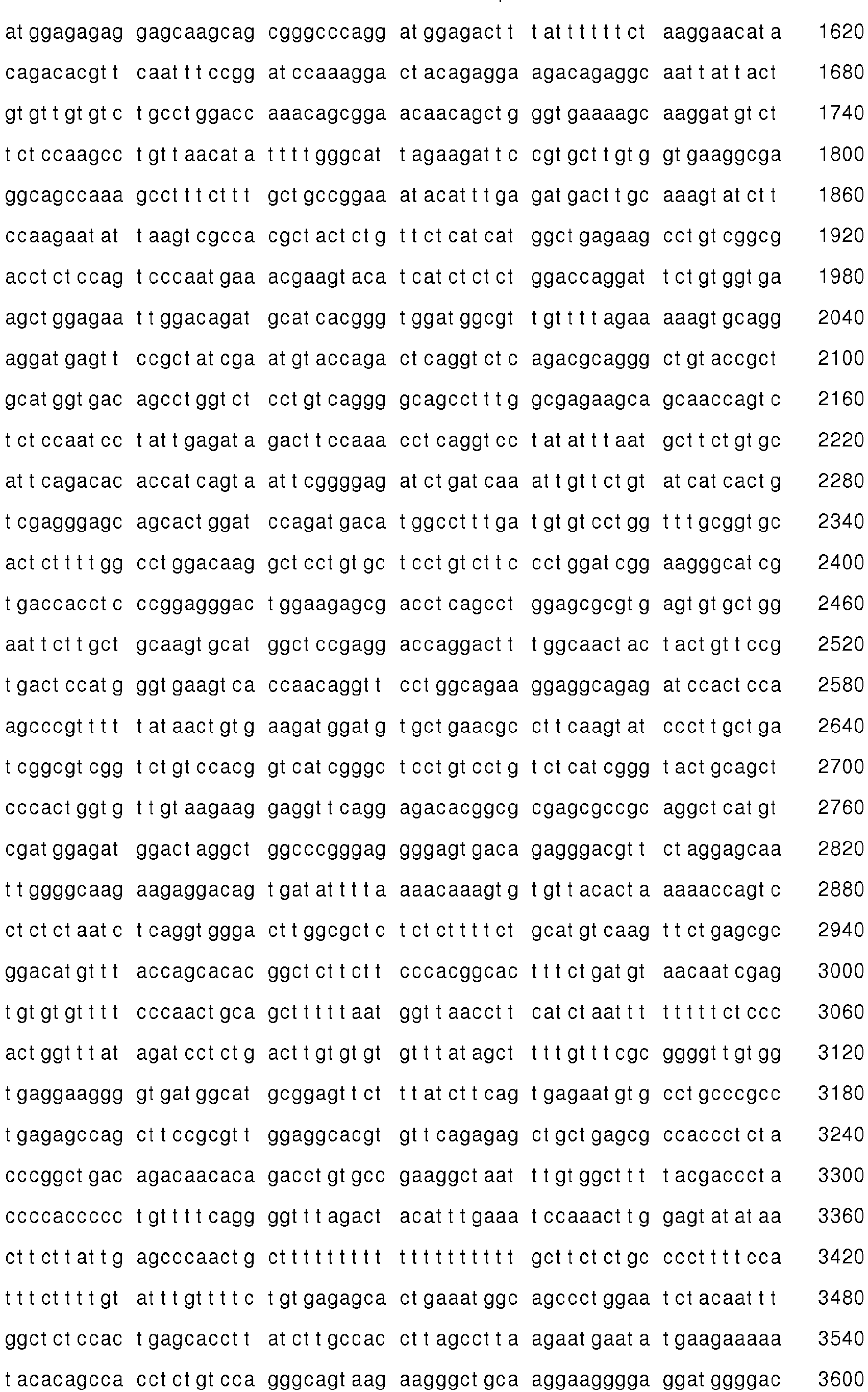


- <210> 2
<211> 924
<212> PRT
<213> Homo sapiens - <400> 2


- <210> 3
<211> 327
<212> DNA
<213> Homo sapiens - <400> 3


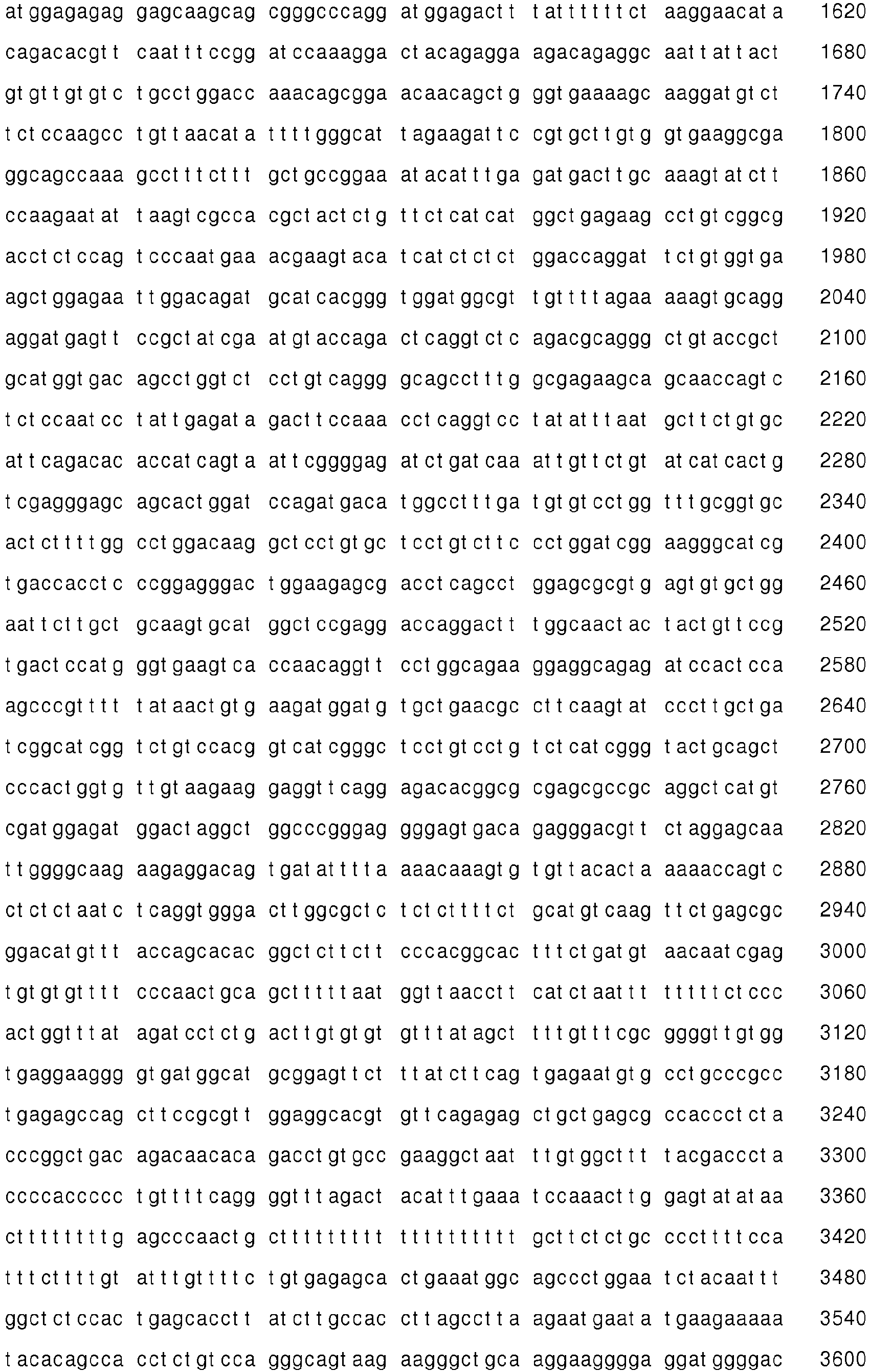


Claims (13)
- A nucleic acid sequence of SEQ ID NO:3, wherein said nucleic acid sequence codes for the polypeptide of SEQ ID NO:4 having anti angiogenic and anti-tumour activity.
- An expression vector comprising at least one nucleic acid sequence according to claim 1.
- A polypeptide of SEQ ID NO: 4, wherein said polypeptide has an anti-angiogenic and an anti-tumour activity.
- A polypeptide according to claim 3, characterized in that it is produced by the expression vector of claim 2.
- A medicament comprising at least one nucleic acid sequence according to claim 1, or at least one expression vector according to claim 2, or at least one polypeptide according to any one of claims 3 to 4.
- A pharmaceutical composition comprising at least one nucleic acid sequence according to claim 1, or at least one expression vector according to claim 2, or at least one polypeptide according to any one of claims 3 to 4, and one or more pharmaceutically acceptable excipients.
- A pharmaceutical composition according to claim 6, further comprising at least one another active substance selected from anti-angiogenic substances or anti- tumour substances.
- A pharmaceutical composition comprising effective amounts of:- a polypeptide according to any one of claims 3 to 4, and- a platinum complex selected from the group consisting of cisplatin and carboplatin.
- The pharmaceutical composition according to any one of claims 6 to 8, being in a form suitable for topical, systemic, oral, subcutaneous, transderm, intramuscular or intra-peritoneal administration.
- The pharmaceutical composition according to any one of claims 6 to 9, wherein said polypeptide is present in an amount from 0.01 to 90% in weight, preferably from 0.1% to 10% in weight, more preferably from 1% to 5% in weight.
- A nucleic acid of claim 1, or an expression vector of claim 2, or a polypeptide of any one of claims 3 to 4, or a medicament of claim 5, or a pharmaceutical composition of any one of claims 6 to 10, for use in treating cancers and/or tumours.
- The nucleic acid, the expression vector, the polypeptide, the medicament or the pharmaceutical composition for use according to claim 11, wherein the tumours are solid tumours.
- The nucleic acid, the expression vector, the polypeptide, the medicament or the pharmaceutical composition for use according to claim 12, wherein the solid tumours are selected from sarcomas, carcinomas, and lymphomas.
Priority Applications (1)
| Application Number | Priority Date | Filing Date | Title |
|---|---|---|---|
| EP08759707.6A EP2158317B1 (en) | 2007-05-16 | 2008-05-16 | Anti-tumor drug, medicament, composition, and use thereof |
Applications Claiming Priority (4)
| Application Number | Priority Date | Filing Date | Title |
|---|---|---|---|
| US11/798,685 US7906621B2 (en) | 2007-05-16 | 2007-05-16 | Anti-tumor drug, medicament, composition, and use thereof |
| EP20070108349 EP1992694A1 (en) | 2007-05-16 | 2007-05-16 | Anti-tumor drug, medicament, composition, and use thereof |
| EP08759707.6A EP2158317B1 (en) | 2007-05-16 | 2008-05-16 | Anti-tumor drug, medicament, composition, and use thereof |
| PCT/EP2008/056075 WO2008138994A1 (en) | 2007-05-16 | 2008-05-16 | Anti-tumor drug, medicament, composition, and use thereof |
Publications (2)
| Publication Number | Publication Date |
|---|---|
| EP2158317A1 EP2158317A1 (en) | 2010-03-03 |
| EP2158317B1 true EP2158317B1 (en) | 2018-03-28 |
Family
ID=39734168
Family Applications (1)
| Application Number | Title | Priority Date | Filing Date |
|---|---|---|---|
| EP08759707.6A Not-in-force EP2158317B1 (en) | 2007-05-16 | 2008-05-16 | Anti-tumor drug, medicament, composition, and use thereof |
Country Status (8)
| Country | Link |
|---|---|
| US (2) | US8742067B2 (en) |
| EP (1) | EP2158317B1 (en) |
| JP (1) | JP5597534B2 (en) |
| CN (1) | CN101688205B (en) |
| AU (1) | AU2008249961B2 (en) |
| CA (1) | CA2685551C (en) |
| ES (1) | ES2674710T3 (en) |
| WO (1) | WO2008138994A1 (en) |
Families Citing this family (2)
| Publication number | Priority date | Publication date | Assignee | Title |
|---|---|---|---|---|
| EP2907823A1 (en) * | 2014-02-14 | 2015-08-19 | Gene Signal International SA | Polypeptide fragments of 168A-T2 and compositions comprising them for use in treating cancer |
| US9539305B1 (en) | 2014-03-14 | 2017-01-10 | Fleurir Abx Llc | Pristinamycin compositions, LpxC compositions, their improvements, and combinations thereof |
Family Cites Families (19)
| Publication number | Priority date | Publication date | Assignee | Title |
|---|---|---|---|---|
| US5747660A (en) | 1995-11-06 | 1998-05-05 | The University Of Colorado | Nucleic acid encoding prostaglandin F2α receptor regulatory protein |
| CA2270875A1 (en) | 1996-11-15 | 1998-05-22 | Cedars-Sinai Medical Center | Nucleic acid encoding schwannomin-binding-proteins and products related thereto |
| EP0996725A1 (en) | 1997-06-27 | 2000-05-03 | Human Genome Sciences, Inc. | Human nk-3 related prostate specific gene-1 |
| US7034132B2 (en) * | 2001-06-04 | 2006-04-25 | Anderson David W | Therapeutic polypeptides, nucleic acids encoding same, and methods of use |
| FR2798674B1 (en) | 1999-09-21 | 2004-01-30 | Mahmood Salman Al | METHOD FOR IDENTIFYING NEW GENES INVOLVED IN THE REGULATION OF ANGIOGENESIS, STUDY OF THESE GENES AND THEIR USE FOR THERAPEUTIC PURPOSES |
| AU2001241541A1 (en) | 2000-02-17 | 2001-08-27 | Millennium Predictive Medicine, Inc. | Novel genes, compositions, kits, and methods for identification, assessment, prevention, and therapy of human prostate cancer |
| US7092985B2 (en) * | 2000-03-30 | 2006-08-15 | United Devices, Inc. | Method of managing workloads and associated distributed processing system |
| AU2001274888A1 (en) * | 2000-05-19 | 2001-12-03 | Human Genome Sciences, Inc. | Nucleic acids, proteins, and antibodies |
| JP2004530409A (en) | 2000-10-27 | 2004-10-07 | インサイト・ゲノミックス・インコーポレイテッド | Transmembrane protein |
| US20020137081A1 (en) | 2001-01-08 | 2002-09-26 | Olga Bandman | Genes differentially expressed in vascular tissue activation |
| US6743619B1 (en) | 2001-01-30 | 2004-06-01 | Nuvelo | Nucleic acids and polypeptides |
| EP1401858A4 (en) * | 2001-06-04 | 2005-12-21 | Curagen Corp | Therapeutic polypeptides, nucleic acids encoding same, and methods of use |
| EP1409549A4 (en) | 2001-06-20 | 2007-10-24 | Genentech Inc | COMPOSITIONS AND METHODS FOR DIAGNOSING AND TREATING TUMORS |
| US7803915B2 (en) * | 2001-06-20 | 2010-09-28 | Genentech, Inc. | Antibody compositions for the diagnosis and treatment of tumor |
| FR2836687A1 (en) | 2002-03-04 | 2003-09-05 | Gene Signal | GENES INVOLVED IN THE REGULATION OF ANGIOGENESIS, PHARMACEUTICAL PREPARATIONS CONTAINING SAME AND THEIR APPLICATIONS |
| US7803906B2 (en) * | 2002-03-22 | 2010-09-28 | Gene Signal International Sa | Composition comprising an angiogenesis related protein |
| FR2837391B1 (en) * | 2002-03-22 | 2007-04-20 | Gene Signal | REGULATORY GENES OF ANGIOGENESIS, PHARMACEUTICAL PREPARATIONS CONTAINING SAME AND APPLICATIONS THEREOF |
| WO2004028479A2 (en) | 2002-09-25 | 2004-04-08 | Genentech, Inc. | Nouvelles compositions et methodes de traitement du psoriasis |
| JP2006512300A (en) * | 2002-10-03 | 2006-04-13 | エピミューン インコーポレイテッド | HLA-binding peptides and uses thereof |
-
2008
- 2008-05-16 CN CN2008800159044A patent/CN101688205B/en not_active Expired - Fee Related
- 2008-05-16 AU AU2008249961A patent/AU2008249961B2/en not_active Ceased
- 2008-05-16 JP JP2010507938A patent/JP5597534B2/en not_active Expired - Fee Related
- 2008-05-16 ES ES08759707.6T patent/ES2674710T3/en active Active
- 2008-05-16 US US12/600,329 patent/US8742067B2/en not_active Expired - Fee Related
- 2008-05-16 EP EP08759707.6A patent/EP2158317B1/en not_active Not-in-force
- 2008-05-16 CA CA2685551A patent/CA2685551C/en not_active Expired - Fee Related
- 2008-05-16 WO PCT/EP2008/056075 patent/WO2008138994A1/en not_active Ceased
-
2014
- 2014-01-17 US US14/157,753 patent/US9539306B2/en not_active Expired - Fee Related
Also Published As
| Publication number | Publication date |
|---|---|
| CA2685551C (en) | 2016-11-29 |
| US20100151051A1 (en) | 2010-06-17 |
| JP2010526549A (en) | 2010-08-05 |
| CN101688205A (en) | 2010-03-31 |
| AU2008249961B2 (en) | 2017-02-02 |
| HK1142631A1 (en) | 2010-12-10 |
| US8742067B2 (en) | 2014-06-03 |
| US20140134276A1 (en) | 2014-05-15 |
| AU2008249961A1 (en) | 2008-11-20 |
| US9539306B2 (en) | 2017-01-10 |
| JP5597534B2 (en) | 2014-10-01 |
| WO2008138994A1 (en) | 2008-11-20 |
| CN101688205B (en) | 2013-07-24 |
| CA2685551A1 (en) | 2008-11-20 |
| EP2158317A1 (en) | 2010-03-03 |
| ES2674710T3 (en) | 2018-07-03 |
Similar Documents
| Publication | Publication Date | Title |
|---|---|---|
| US20210060039A1 (en) | Combination of bcl-2/bcl-xl inhibitors and chemotherapeutic agent and use thereof | |
| EP2144927B1 (en) | Anti-tumor drug, medicament, composition, and use thereof | |
| CN116615244A (en) | Pharmaceutical composition for preventing or treating cancer comprising stabilized galectin 9 recombinant protein | |
| ES2870909T3 (en) | Uses of a compound in the preparation of drugs for the treatment of cerebral glioma | |
| US8188044B2 (en) | Anti-tumor drug, medicament, composition, and use thereof | |
| US9539306B2 (en) | Anti-tumor drug, medicament, composition, and use thereof | |
| EP1992694A1 (en) | Anti-tumor drug, medicament, composition, and use thereof | |
| US7906621B2 (en) | Anti-tumor drug, medicament, composition, and use thereof | |
| EP1980571B1 (en) | Anti-tumor drug, medicament, composition, and use thereof | |
| US8372810B2 (en) | Anti-tumor drug, medicament, composition, and use thereof | |
| US9572855B2 (en) | Combination anti-estrogen receptor cancer therapy using MUC1 peptides and chemotherapeutics | |
| HK1123813B (en) | Anti-tumor drug, medicament, composition, and use thereof | |
| HK1142631B (en) | Anti-tumor drug, medicament, composition, and use thereof | |
| HK40000033B (en) | Uses of compound in preparation of drugs for treating brain glioma | |
| HK40000033A (en) | Uses of compound in preparation of drugs for treating brain glioma | |
| KR20210155229A (en) | Pharmaceutical composition comprising HADP peptide in c-terminal region of HOXA9 protein for preventing, improving or treating lung cancer |
Legal Events
| Date | Code | Title | Description |
|---|---|---|---|
| PUAI | Public reference made under article 153(3) epc to a published international application that has entered the european phase |
Free format text: ORIGINAL CODE: 0009012 |
|
| 17P | Request for examination filed |
Effective date: 20091216 |
|
| AK | Designated contracting states |
Kind code of ref document: A1 Designated state(s): AT BE BG CH CY CZ DE DK EE ES FI FR GB GR HR HU IE IS IT LI LT LU LV MC MT NL NO PL PT RO SE SI SK TR |
|
| AX | Request for extension of the european patent |
Extension state: AL BA MK RS |
|
| RIN1 | Information on inventor provided before grant (corrected) |
Inventor name: COLIN, SYLVIE Inventor name: AL MAHMOOD, SALMAN |
|
| DAX | Request for extension of the european patent (deleted) | ||
| RAP1 | Party data changed (applicant data changed or rights of an application transferred) |
Owner name: GENE SIGNAL INTERNATIONAL SA |
|
| 17Q | First examination report despatched |
Effective date: 20120301 |
|
| RIN1 | Information on inventor provided before grant (corrected) |
Inventor name: COLIN, SYLVIE Inventor name: AL MAHMOOD, SALMAN |
|
| GRAP | Despatch of communication of intention to grant a patent |
Free format text: ORIGINAL CODE: EPIDOSNIGR1 |
|
| INTG | Intention to grant announced |
Effective date: 20170918 |
|
| GRAJ | Information related to disapproval of communication of intention to grant by the applicant or resumption of examination proceedings by the epo deleted |
Free format text: ORIGINAL CODE: EPIDOSDIGR1 |
|
| GRAR | Information related to intention to grant a patent recorded |
Free format text: ORIGINAL CODE: EPIDOSNIGR71 |
|
| GRAS | Grant fee paid |
Free format text: ORIGINAL CODE: EPIDOSNIGR3 |
|
| INTC | Intention to grant announced (deleted) | ||
| GRAA | (expected) grant |
Free format text: ORIGINAL CODE: 0009210 |
|
| AK | Designated contracting states |
Kind code of ref document: B1 Designated state(s): AT BE BG CH CY CZ DE DK EE ES FI FR GB GR HR HU IE IS IT LI LT LU LV MC MT NL NO PL PT RO SE SI SK TR |
|
| INTG | Intention to grant announced |
Effective date: 20180219 |
|
| REG | Reference to a national code |
Ref country code: GB Ref legal event code: FG4D |
|
| RIN1 | Information on inventor provided before grant (corrected) |
Inventor name: AL MAHMOOD, SALMAN Inventor name: COLIN, SYLVIE |
|
| REG | Reference to a national code |
Ref country code: CH Ref legal event code: EP |
|
| REG | Reference to a national code |
Ref country code: AT Ref legal event code: REF Ref document number: 983473 Country of ref document: AT Kind code of ref document: T Effective date: 20180415 |
|
| REG | Reference to a national code |
Ref country code: IE Ref legal event code: FG4D |
|
| REG | Reference to a national code |
Ref country code: DE Ref legal event code: R096 Ref document number: 602008054588 Country of ref document: DE |
|
| REG | Reference to a national code |
Ref country code: FR Ref legal event code: PLFP Year of fee payment: 11 |
|
| REG | Reference to a national code |
Ref country code: ES Ref legal event code: FG2A Ref document number: 2674710 Country of ref document: ES Kind code of ref document: T3 Effective date: 20180703 |
|
| REG | Reference to a national code |
Ref country code: SE Ref legal event code: TRGR |
|
| REG | Reference to a national code |
Ref country code: NL Ref legal event code: FP |
|
| PG25 | Lapsed in a contracting state [announced via postgrant information from national office to epo] |
Ref country code: LT Free format text: LAPSE BECAUSE OF FAILURE TO SUBMIT A TRANSLATION OF THE DESCRIPTION OR TO PAY THE FEE WITHIN THE PRESCRIBED TIME-LIMIT Effective date: 20180328 Ref country code: HR Free format text: LAPSE BECAUSE OF FAILURE TO SUBMIT A TRANSLATION OF THE DESCRIPTION OR TO PAY THE FEE WITHIN THE PRESCRIBED TIME-LIMIT Effective date: 20180328 |
|
| REG | Reference to a national code |
Ref country code: LT Ref legal event code: MG4D |
|
| REG | Reference to a national code |
Ref country code: NO Ref legal event code: T2 Effective date: 20180328 |
|
| PG25 | Lapsed in a contracting state [announced via postgrant information from national office to epo] |
Ref country code: BG Free format text: LAPSE BECAUSE OF FAILURE TO SUBMIT A TRANSLATION OF THE DESCRIPTION OR TO PAY THE FEE WITHIN THE PRESCRIBED TIME-LIMIT Effective date: 20180628 Ref country code: LV Free format text: LAPSE BECAUSE OF FAILURE TO SUBMIT A TRANSLATION OF THE DESCRIPTION OR TO PAY THE FEE WITHIN THE PRESCRIBED TIME-LIMIT Effective date: 20180328 |
|
| PG25 | Lapsed in a contracting state [announced via postgrant information from national office to epo] |
Ref country code: PL Free format text: LAPSE BECAUSE OF FAILURE TO SUBMIT A TRANSLATION OF THE DESCRIPTION OR TO PAY THE FEE WITHIN THE PRESCRIBED TIME-LIMIT Effective date: 20180328 Ref country code: RO Free format text: LAPSE BECAUSE OF FAILURE TO SUBMIT A TRANSLATION OF THE DESCRIPTION OR TO PAY THE FEE WITHIN THE PRESCRIBED TIME-LIMIT Effective date: 20180328 Ref country code: EE Free format text: LAPSE BECAUSE OF FAILURE TO SUBMIT A TRANSLATION OF THE DESCRIPTION OR TO PAY THE FEE WITHIN THE PRESCRIBED TIME-LIMIT Effective date: 20180328 |
|
| PG25 | Lapsed in a contracting state [announced via postgrant information from national office to epo] |
Ref country code: CZ Free format text: LAPSE BECAUSE OF FAILURE TO SUBMIT A TRANSLATION OF THE DESCRIPTION OR TO PAY THE FEE WITHIN THE PRESCRIBED TIME-LIMIT Effective date: 20180328 Ref country code: SK Free format text: LAPSE BECAUSE OF FAILURE TO SUBMIT A TRANSLATION OF THE DESCRIPTION OR TO PAY THE FEE WITHIN THE PRESCRIBED TIME-LIMIT Effective date: 20180328 |
|
| PG25 | Lapsed in a contracting state [announced via postgrant information from national office to epo] |
Ref country code: PT Free format text: LAPSE BECAUSE OF FAILURE TO SUBMIT A TRANSLATION OF THE DESCRIPTION OR TO PAY THE FEE WITHIN THE PRESCRIBED TIME-LIMIT Effective date: 20180730 |
|
| REG | Reference to a national code |
Ref country code: DE Ref legal event code: R097 Ref document number: 602008054588 Country of ref document: DE |
|
| PG25 | Lapsed in a contracting state [announced via postgrant information from national office to epo] |
Ref country code: DK Free format text: LAPSE BECAUSE OF FAILURE TO SUBMIT A TRANSLATION OF THE DESCRIPTION OR TO PAY THE FEE WITHIN THE PRESCRIBED TIME-LIMIT Effective date: 20180328 Ref country code: MC Free format text: LAPSE BECAUSE OF FAILURE TO SUBMIT A TRANSLATION OF THE DESCRIPTION OR TO PAY THE FEE WITHIN THE PRESCRIBED TIME-LIMIT Effective date: 20180328 |
|
| PLBE | No opposition filed within time limit |
Free format text: ORIGINAL CODE: 0009261 |
|
| STAA | Information on the status of an ep patent application or granted ep patent |
Free format text: STATUS: NO OPPOSITION FILED WITHIN TIME LIMIT |
|
| 26N | No opposition filed |
Effective date: 20190103 |
|
| PG25 | Lapsed in a contracting state [announced via postgrant information from national office to epo] |
Ref country code: SI Free format text: LAPSE BECAUSE OF FAILURE TO SUBMIT A TRANSLATION OF THE DESCRIPTION OR TO PAY THE FEE WITHIN THE PRESCRIBED TIME-LIMIT Effective date: 20180328 |
|
| PGFP | Annual fee paid to national office [announced via postgrant information from national office to epo] |
Ref country code: LU Payment date: 20190521 Year of fee payment: 12 Ref country code: NL Payment date: 20190521 Year of fee payment: 12 |
|
| PGFP | Annual fee paid to national office [announced via postgrant information from national office to epo] |
Ref country code: NO Payment date: 20190523 Year of fee payment: 12 Ref country code: ES Payment date: 20190621 Year of fee payment: 12 Ref country code: IE Payment date: 20190522 Year of fee payment: 12 Ref country code: IT Payment date: 20190527 Year of fee payment: 12 Ref country code: DE Payment date: 20190521 Year of fee payment: 12 Ref country code: FI Payment date: 20190522 Year of fee payment: 12 |
|
| PGFP | Annual fee paid to national office [announced via postgrant information from national office to epo] |
Ref country code: BE Payment date: 20190521 Year of fee payment: 12 Ref country code: SE Payment date: 20190521 Year of fee payment: 12 Ref country code: FR Payment date: 20190523 Year of fee payment: 12 |
|
| PGFP | Annual fee paid to national office [announced via postgrant information from national office to epo] |
Ref country code: CH Payment date: 20190521 Year of fee payment: 12 |
|
| PGFP | Annual fee paid to national office [announced via postgrant information from national office to epo] |
Ref country code: AT Payment date: 20190522 Year of fee payment: 12 Ref country code: GB Payment date: 20190521 Year of fee payment: 12 |
|
| PG25 | Lapsed in a contracting state [announced via postgrant information from national office to epo] |
Ref country code: MT Free format text: LAPSE BECAUSE OF NON-PAYMENT OF DUE FEES Effective date: 20180516 |
|
| REG | Reference to a national code |
Ref country code: CH Ref legal event code: PCAR Free format text: NEW ADDRESS: ROUTE DU COUTSET 18, 1485 NUVILLY (CH) |
|
| PG25 | Lapsed in a contracting state [announced via postgrant information from national office to epo] |
Ref country code: TR Free format text: LAPSE BECAUSE OF FAILURE TO SUBMIT A TRANSLATION OF THE DESCRIPTION OR TO PAY THE FEE WITHIN THE PRESCRIBED TIME-LIMIT Effective date: 20180328 |
|
| PG25 | Lapsed in a contracting state [announced via postgrant information from national office to epo] |
Ref country code: HU Free format text: LAPSE BECAUSE OF FAILURE TO SUBMIT A TRANSLATION OF THE DESCRIPTION OR TO PAY THE FEE WITHIN THE PRESCRIBED TIME-LIMIT; INVALID AB INITIO Effective date: 20080516 |
|
| PG25 | Lapsed in a contracting state [announced via postgrant information from national office to epo] |
Ref country code: CY Free format text: LAPSE BECAUSE OF FAILURE TO SUBMIT A TRANSLATION OF THE DESCRIPTION OR TO PAY THE FEE WITHIN THE PRESCRIBED TIME-LIMIT Effective date: 20180328 Ref country code: GR Free format text: LAPSE BECAUSE OF FAILURE TO SUBMIT A TRANSLATION OF THE DESCRIPTION OR TO PAY THE FEE WITHIN THE PRESCRIBED TIME-LIMIT Effective date: 20180328 |
|
| PG25 | Lapsed in a contracting state [announced via postgrant information from national office to epo] |
Ref country code: IS Free format text: LAPSE BECAUSE OF FAILURE TO SUBMIT A TRANSLATION OF THE DESCRIPTION OR TO PAY THE FEE WITHIN THE PRESCRIBED TIME-LIMIT Effective date: 20180728 |
|
| REG | Reference to a national code |
Ref country code: DE Ref legal event code: R119 Ref document number: 602008054588 Country of ref document: DE |
|
| REG | Reference to a national code |
Ref country code: FI Ref legal event code: MAE |
|
| REG | Reference to a national code |
Ref country code: NO Ref legal event code: MMEP |
|
| REG | Reference to a national code |
Ref country code: NL Ref legal event code: MM Effective date: 20200601 |
|
| REG | Reference to a national code |
Ref country code: AT Ref legal event code: MM01 Ref document number: 983473 Country of ref document: AT Kind code of ref document: T Effective date: 20200516 |
|
| PG25 | Lapsed in a contracting state [announced via postgrant information from national office to epo] |
Ref country code: FI Free format text: LAPSE BECAUSE OF NON-PAYMENT OF DUE FEES Effective date: 20200516 Ref country code: SE Free format text: LAPSE BECAUSE OF NON-PAYMENT OF DUE FEES Effective date: 20200517 Ref country code: CH Free format text: LAPSE BECAUSE OF NON-PAYMENT OF DUE FEES Effective date: 20200531 Ref country code: NO Free format text: LAPSE BECAUSE OF NON-PAYMENT OF DUE FEES Effective date: 20200531 Ref country code: LI Free format text: LAPSE BECAUSE OF NON-PAYMENT OF DUE FEES Effective date: 20200531 Ref country code: AT Free format text: LAPSE BECAUSE OF NON-PAYMENT OF DUE FEES Effective date: 20200516 |
|
| PG25 | Lapsed in a contracting state [announced via postgrant information from national office to epo] |
Ref country code: NL Free format text: LAPSE BECAUSE OF NON-PAYMENT OF DUE FEES Effective date: 20200601 |
|
| REG | Reference to a national code |
Ref country code: BE Ref legal event code: MM Effective date: 20200531 |
|
| GBPC | Gb: european patent ceased through non-payment of renewal fee |
Effective date: 20200516 |
|
| PG25 | Lapsed in a contracting state [announced via postgrant information from national office to epo] |
Ref country code: LU Free format text: LAPSE BECAUSE OF NON-PAYMENT OF DUE FEES Effective date: 20200516 |
|
| PG25 | Lapsed in a contracting state [announced via postgrant information from national office to epo] |
Ref country code: GB Free format text: LAPSE BECAUSE OF NON-PAYMENT OF DUE FEES Effective date: 20200516 Ref country code: FR Free format text: LAPSE BECAUSE OF NON-PAYMENT OF DUE FEES Effective date: 20200531 Ref country code: IE Free format text: LAPSE BECAUSE OF NON-PAYMENT OF DUE FEES Effective date: 20200516 |
|
| PG25 | Lapsed in a contracting state [announced via postgrant information from national office to epo] |
Ref country code: BE Free format text: LAPSE BECAUSE OF NON-PAYMENT OF DUE FEES Effective date: 20200531 Ref country code: DE Free format text: LAPSE BECAUSE OF NON-PAYMENT OF DUE FEES Effective date: 20201201 |
|
| REG | Reference to a national code |
Ref country code: ES Ref legal event code: FD2A Effective date: 20211001 |
|
| PG25 | Lapsed in a contracting state [announced via postgrant information from national office to epo] |
Ref country code: IT Free format text: LAPSE BECAUSE OF NON-PAYMENT OF DUE FEES Effective date: 20200516 |
|
| REG | Reference to a national code |
Ref country code: AT Ref legal event code: UEP Ref document number: 983473 Country of ref document: AT Kind code of ref document: T Effective date: 20180328 |
|
| PG25 | Lapsed in a contracting state [announced via postgrant information from national office to epo] |
Ref country code: ES Free format text: LAPSE BECAUSE OF NON-PAYMENT OF DUE FEES Effective date: 20200517 |