EP2157182A2 - Modified short interfering RNA - Google Patents
Modified short interfering RNA Download PDFInfo
- Publication number
- EP2157182A2 EP2157182A2 EP09008116A EP09008116A EP2157182A2 EP 2157182 A2 EP2157182 A2 EP 2157182A2 EP 09008116 A EP09008116 A EP 09008116A EP 09008116 A EP09008116 A EP 09008116A EP 2157182 A2 EP2157182 A2 EP 2157182A2
- Authority
- EP
- European Patent Office
- Prior art keywords
- group
- sirna
- modified
- overhang
- exp
- Prior art date
- Legal status (The legal status is an assumption and is not a legal conclusion. Google has not performed a legal analysis and makes no representation as to the accuracy of the status listed.)
- Withdrawn
Links
- 108020004459 Small interfering RNA Proteins 0.000 title claims abstract description 294
- 239000004055 small Interfering RNA Substances 0.000 title claims description 237
- 125000003729 nucleotide group Chemical group 0.000 claims abstract description 57
- 239000002773 nucleotide Substances 0.000 claims abstract description 34
- ISAKRJDGNUQOIC-UHFFFAOYSA-N Uracil Chemical compound O=C1C=CNC(=O)N1 ISAKRJDGNUQOIC-UHFFFAOYSA-N 0.000 claims description 117
- 238000012986 modification Methods 0.000 claims description 103
- 230000004048 modification Effects 0.000 claims description 99
- 125000005842 heteroatom Chemical group 0.000 claims description 70
- 230000000692 anti-sense effect Effects 0.000 claims description 66
- OPTASPLRGRRNAP-UHFFFAOYSA-N cytosine Chemical compound NC=1C=CNC(=O)N=1 OPTASPLRGRRNAP-UHFFFAOYSA-N 0.000 claims description 66
- UYTPUPDQBNUYGX-UHFFFAOYSA-N guanine Chemical compound O=C1NC(N)=NC2=C1N=CN2 UYTPUPDQBNUYGX-UHFFFAOYSA-N 0.000 claims description 66
- 108091081021 Sense strand Proteins 0.000 claims description 60
- 229940035893 uracil Drugs 0.000 claims description 59
- 238000003786 synthesis reaction Methods 0.000 claims description 49
- 230000015572 biosynthetic process Effects 0.000 claims description 47
- RWQNBRDOKXIBIV-UHFFFAOYSA-N thymine Chemical compound CC1=CNC(=O)NC1=O RWQNBRDOKXIBIV-UHFFFAOYSA-N 0.000 claims description 44
- 125000003545 alkoxy group Chemical group 0.000 claims description 41
- 229930024421 Adenine Natural products 0.000 claims description 33
- GFFGJBXGBJISGV-UHFFFAOYSA-N Adenine Chemical compound NC1=NC=NC2=C1N=CN2 GFFGJBXGBJISGV-UHFFFAOYSA-N 0.000 claims description 33
- 229960000643 adenine Drugs 0.000 claims description 33
- 229940104302 cytosine Drugs 0.000 claims description 33
- 230000014509 gene expression Effects 0.000 claims description 33
- 239000002777 nucleoside Substances 0.000 claims description 32
- 125000003835 nucleoside group Chemical group 0.000 claims description 31
- -1 4-(methoxy)trityl group Chemical group 0.000 claims description 27
- 238000000034 method Methods 0.000 claims description 26
- 125000006239 protecting group Chemical group 0.000 claims description 25
- 125000003808 silyl group Chemical group [H][Si]([H])([H])[*] 0.000 claims description 25
- 125000000956 methoxy group Chemical group [H]C([H])([H])O* 0.000 claims description 23
- 150000008300 phosphoramidites Chemical class 0.000 claims description 22
- 229940113082 thymine Drugs 0.000 claims description 22
- 125000000217 alkyl group Chemical group 0.000 claims description 20
- 125000002221 trityl group Chemical group [H]C1=C([H])C([H])=C([H])C([H])=C1C([*])(C1=C(C(=C(C(=C1[H])[H])[H])[H])[H])C1=C([H])C([H])=C([H])C([H])=C1[H] 0.000 claims description 19
- 229910052760 oxygen Inorganic materials 0.000 claims description 18
- 229910052717 sulfur Inorganic materials 0.000 claims description 18
- 125000002252 acyl group Chemical group 0.000 claims description 15
- MXSMRDDXWJSGMC-UHFFFAOYSA-N n-(6-oxo-3,7-dihydropurin-2-yl)acetamide Chemical compound N1C(NC(=O)C)=NC(=O)C2=C1N=CN2 MXSMRDDXWJSGMC-UHFFFAOYSA-N 0.000 claims description 15
- 108020004707 nucleic acids Proteins 0.000 claims description 15
- 102000039446 nucleic acids Human genes 0.000 claims description 15
- 150000007523 nucleic acids Chemical class 0.000 claims description 15
- 229910052739 hydrogen Inorganic materials 0.000 claims description 13
- 108090000623 proteins and genes Proteins 0.000 claims description 13
- 125000003236 benzoyl group Chemical group [H]C1=C([H])C([H])=C(C([H])=C1[H])C(*)=O 0.000 claims description 11
- ZURGFCUYILNMNA-UHFFFAOYSA-N n-(7h-purin-6-yl)acetamide Chemical compound CC(=O)NC1=NC=NC2=C1NC=N2 ZURGFCUYILNMNA-UHFFFAOYSA-N 0.000 claims description 8
- 239000000126 substance Substances 0.000 claims description 7
- IJCKBIINTQEGLY-UHFFFAOYSA-N N(4)-acetylcytosine Chemical compound CC(=O)NC1=CC=NC(=O)N1 IJCKBIINTQEGLY-UHFFFAOYSA-N 0.000 claims description 6
- 150000003833 nucleoside derivatives Chemical class 0.000 claims description 6
- 230000000295 complement effect Effects 0.000 claims description 4
- 230000002194 synthesizing effect Effects 0.000 claims 2
- 238000005516 engineering process Methods 0.000 abstract description 3
- VLKZOEOYAKHREP-UHFFFAOYSA-N n-Hexane Chemical compound CCCCCC VLKZOEOYAKHREP-UHFFFAOYSA-N 0.000 description 126
- XEKOWRVHYACXOJ-UHFFFAOYSA-N Ethyl acetate Chemical compound CCOC(C)=O XEKOWRVHYACXOJ-UHFFFAOYSA-N 0.000 description 84
- 210000004027 cell Anatomy 0.000 description 83
- HEDRZPFGACZZDS-MICDWDOJSA-N Trichloro(2H)methane Chemical compound [2H]C(Cl)(Cl)Cl HEDRZPFGACZZDS-MICDWDOJSA-N 0.000 description 70
- OKKJLVBELUTLKV-UHFFFAOYSA-N Methanol Chemical compound OC OKKJLVBELUTLKV-UHFFFAOYSA-N 0.000 description 63
- VYPSYNLAJGMNEJ-UHFFFAOYSA-N Silicium dioxide Chemical compound O=[Si]=O VYPSYNLAJGMNEJ-UHFFFAOYSA-N 0.000 description 53
- YMWUJEATGCHHMB-UHFFFAOYSA-N Dichloromethane Chemical compound ClCCl YMWUJEATGCHHMB-UHFFFAOYSA-N 0.000 description 52
- 230000030279 gene silencing Effects 0.000 description 48
- 125000006237 oxymethylenoxy group Chemical group [H]C([H])([*:1])[*:2] 0.000 description 43
- 239000000463 material Substances 0.000 description 40
- 238000001890 transfection Methods 0.000 description 39
- 150000001875 compounds Chemical class 0.000 description 38
- 101001052493 Homo sapiens Mitogen-activated protein kinase 1 Proteins 0.000 description 28
- 102100024193 Mitogen-activated protein kinase 1 Human genes 0.000 description 28
- 239000007787 solid Substances 0.000 description 27
- 229910052681 coesite Inorganic materials 0.000 description 25
- 229910052906 cristobalite Inorganic materials 0.000 description 25
- 239000000377 silicon dioxide Substances 0.000 description 25
- 229910052682 stishovite Inorganic materials 0.000 description 25
- 229910052905 tridymite Inorganic materials 0.000 description 25
- ZMANZCXQSJIPKH-UHFFFAOYSA-N Triethylamine Chemical compound CCN(CC)CC ZMANZCXQSJIPKH-UHFFFAOYSA-N 0.000 description 24
- 239000000203 mixture Substances 0.000 description 24
- 210000002966 serum Anatomy 0.000 description 24
- 239000000243 solution Substances 0.000 description 24
- 238000012226 gene silencing method Methods 0.000 description 23
- 238000004440 column chromatography Methods 0.000 description 21
- JUJWROOIHBZHMG-UHFFFAOYSA-N Pyridine Chemical compound C1=CC=NC=C1 JUJWROOIHBZHMG-UHFFFAOYSA-N 0.000 description 20
- 238000005481 NMR spectroscopy Methods 0.000 description 19
- 238000006243 chemical reaction Methods 0.000 description 19
- 239000006260 foam Substances 0.000 description 19
- QTBSBXVTEAMEQO-UHFFFAOYSA-N Acetic acid Chemical compound CC(O)=O QTBSBXVTEAMEQO-UHFFFAOYSA-N 0.000 description 18
- WSFSSNUMVMOOMR-UHFFFAOYSA-N Formaldehyde Chemical compound O=C WSFSSNUMVMOOMR-UHFFFAOYSA-N 0.000 description 18
- 239000011541 reaction mixture Substances 0.000 description 18
- 238000005160 1H NMR spectroscopy Methods 0.000 description 15
- 239000007790 solid phase Substances 0.000 description 15
- WFDIJRYMOXRFFG-UHFFFAOYSA-N Acetic anhydride Chemical compound CC(=O)OC(C)=O WFDIJRYMOXRFFG-UHFFFAOYSA-N 0.000 description 14
- 102100032857 Cyclin-dependent kinase 1 Human genes 0.000 description 14
- 101000868333 Homo sapiens Cyclin-dependent kinase 1 Proteins 0.000 description 14
- 101000909198 Homo sapiens DNA polymerase delta catalytic subunit Proteins 0.000 description 14
- 108010047294 Lamins Proteins 0.000 description 14
- 102000006835 Lamins Human genes 0.000 description 14
- 210000005053 lamin Anatomy 0.000 description 14
- 125000005647 linker group Chemical group 0.000 description 14
- JGFZNNIVVJXRND-UHFFFAOYSA-N N,N-Diisopropylethylamine (DIPEA) Chemical compound CCN(C(C)C)C(C)C JGFZNNIVVJXRND-UHFFFAOYSA-N 0.000 description 13
- 125000000738 acetamido group Chemical group [H]C([H])([H])C(=O)N([H])[*] 0.000 description 13
- 230000009437 off-target effect Effects 0.000 description 13
- 238000010626 work up procedure Methods 0.000 description 13
- 108091032973 (ribonucleotides)n+m Proteins 0.000 description 12
- IAZDPXIOMUYVGZ-UHFFFAOYSA-N Dimethylsulphoxide Chemical compound CS(C)=O IAZDPXIOMUYVGZ-UHFFFAOYSA-N 0.000 description 12
- YXFVVABEGXRONW-UHFFFAOYSA-N Toluene Chemical compound CC1=CC=CC=C1 YXFVVABEGXRONW-UHFFFAOYSA-N 0.000 description 12
- HRQGCQVOJVTVLU-UHFFFAOYSA-N bis(chloromethyl) ether Chemical compound ClCOCCl HRQGCQVOJVTVLU-UHFFFAOYSA-N 0.000 description 12
- 125000003636 chemical group Chemical group 0.000 description 11
- 239000005289 controlled pore glass Substances 0.000 description 11
- 108020004999 messenger RNA Proteins 0.000 description 11
- 239000011734 sodium Substances 0.000 description 11
- CSNNHWWHGAXBCP-UHFFFAOYSA-L Magnesium sulfate Chemical compound [Mg+2].[O-][S+2]([O-])([O-])[O-] CSNNHWWHGAXBCP-UHFFFAOYSA-L 0.000 description 10
- 108091034117 Oligonucleotide Proteins 0.000 description 10
- 230000000694 effects Effects 0.000 description 10
- UMJSCPRVCHMLSP-UHFFFAOYSA-N pyridine Natural products COC1=CC=CN=C1 UMJSCPRVCHMLSP-UHFFFAOYSA-N 0.000 description 10
- 238000003756 stirring Methods 0.000 description 10
- 239000012096 transfection reagent Substances 0.000 description 10
- 101710163270 Nuclease Proteins 0.000 description 9
- 102000000574 RNA-Induced Silencing Complex Human genes 0.000 description 9
- 108010016790 RNA-Induced Silencing Complex Proteins 0.000 description 9
- 238000007385 chemical modification Methods 0.000 description 9
- 238000004128 high performance liquid chromatography Methods 0.000 description 9
- WEVYAHXRMPXWCK-UHFFFAOYSA-N Acetonitrile Chemical compound CC#N WEVYAHXRMPXWCK-UHFFFAOYSA-N 0.000 description 8
- 108091003079 Bovine Serum Albumin Proteins 0.000 description 8
- XSQUKJJJFZCRTK-UHFFFAOYSA-N Urea Chemical compound NC(N)=O XSQUKJJJFZCRTK-UHFFFAOYSA-N 0.000 description 8
- 239000006143 cell culture medium Substances 0.000 description 8
- 239000012894 fetal calf serum Substances 0.000 description 8
- 238000002360 preparation method Methods 0.000 description 8
- WDYVUKGVKRZQNM-UHFFFAOYSA-N 6-phosphonohexylphosphonic acid Chemical compound OP(O)(=O)CCCCCCP(O)(O)=O WDYVUKGVKRZQNM-UHFFFAOYSA-N 0.000 description 7
- 101000876610 Dictyostelium discoideum Extracellular signal-regulated kinase 2 Proteins 0.000 description 7
- 238000004458 analytical method Methods 0.000 description 7
- 239000012043 crude product Substances 0.000 description 7
- 125000004005 formimidoyl group Chemical group [H]\N=C(/[H])* 0.000 description 7
- 102200082402 rs751610198 Human genes 0.000 description 7
- WSLDOOZREJYCGB-UHFFFAOYSA-N 1,2-Dichloroethane Chemical compound ClCCCl WSLDOOZREJYCGB-UHFFFAOYSA-N 0.000 description 6
- VHYFNPMBLIVWCW-UHFFFAOYSA-N 4-Dimethylaminopyridine Chemical compound CN(C)C1=CC=NC=C1 VHYFNPMBLIVWCW-UHFFFAOYSA-N 0.000 description 6
- LYCAIKOWRPUZTN-UHFFFAOYSA-N Ethylene glycol Chemical compound OCCO LYCAIKOWRPUZTN-UHFFFAOYSA-N 0.000 description 6
- UIIMBOGNXHQVGW-UHFFFAOYSA-M Sodium bicarbonate Chemical compound [Na+].OC([O-])=O UIIMBOGNXHQVGW-UHFFFAOYSA-M 0.000 description 6
- DRTQHJPVMGBUCF-XVFCMESISA-N Uridine Chemical compound O[C@@H]1[C@H](O)[C@@H](CO)O[C@H]1N1C(=O)NC(=O)C=C1 DRTQHJPVMGBUCF-XVFCMESISA-N 0.000 description 6
- 230000015556 catabolic process Effects 0.000 description 6
- HGCIXCUEYOPUTN-UHFFFAOYSA-N cyclohexene Chemical compound C1CCC=CC1 HGCIXCUEYOPUTN-UHFFFAOYSA-N 0.000 description 6
- 238000006731 degradation reaction Methods 0.000 description 6
- 150000002148 esters Chemical class 0.000 description 6
- 238000002474 experimental method Methods 0.000 description 6
- 238000001914 filtration Methods 0.000 description 6
- 238000011068 loading method Methods 0.000 description 6
- 239000002609 medium Substances 0.000 description 6
- 125000000371 nucleobase group Chemical group 0.000 description 6
- 239000012044 organic layer Substances 0.000 description 6
- PCFSNQYXXACUHM-YULOIDQLSA-N 1-[(2r,3r,4s,5r)-5-[[bis(4-methoxyphenyl)-phenylmethoxy]methyl]-3,4-dihydroxyoxolan-2-yl]pyrimidine-2,4-dione Chemical compound C1=CC(OC)=CC=C1C(C=1C=CC(OC)=CC=1)(C=1C=CC=CC=1)OC[C@@H]1[C@@H](O)[C@@H](O)[C@H](N2C(NC(=O)C=C2)=O)O1 PCFSNQYXXACUHM-YULOIDQLSA-N 0.000 description 5
- ZHNUHDYFZUAESO-UHFFFAOYSA-N Formamide Chemical compound NC=O ZHNUHDYFZUAESO-UHFFFAOYSA-N 0.000 description 5
- NIDVTARKFBZMOT-PEBGCTIMSA-N N(4)-acetylcytidine Chemical compound O=C1N=C(NC(=O)C)C=CN1[C@H]1[C@H](O)[C@H](O)[C@@H](CO)O1 NIDVTARKFBZMOT-PEBGCTIMSA-N 0.000 description 5
- 238000012228 RNA interference-mediated gene silencing Methods 0.000 description 5
- JLCPHMBAVCMARE-UHFFFAOYSA-N [3-[[3-[[3-[[3-[[3-[[3-[[3-[[3-[[3-[[3-[[3-[[5-(2-amino-6-oxo-1H-purin-9-yl)-3-[[3-[[3-[[3-[[3-[[3-[[5-(2-amino-6-oxo-1H-purin-9-yl)-3-[[5-(2-amino-6-oxo-1H-purin-9-yl)-3-hydroxyoxolan-2-yl]methoxy-hydroxyphosphoryl]oxyoxolan-2-yl]methoxy-hydroxyphosphoryl]oxy-5-(5-methyl-2,4-dioxopyrimidin-1-yl)oxolan-2-yl]methoxy-hydroxyphosphoryl]oxy-5-(6-aminopurin-9-yl)oxolan-2-yl]methoxy-hydroxyphosphoryl]oxy-5-(6-aminopurin-9-yl)oxolan-2-yl]methoxy-hydroxyphosphoryl]oxy-5-(6-aminopurin-9-yl)oxolan-2-yl]methoxy-hydroxyphosphoryl]oxy-5-(6-aminopurin-9-yl)oxolan-2-yl]methoxy-hydroxyphosphoryl]oxyoxolan-2-yl]methoxy-hydroxyphosphoryl]oxy-5-(5-methyl-2,4-dioxopyrimidin-1-yl)oxolan-2-yl]methoxy-hydroxyphosphoryl]oxy-5-(4-amino-2-oxopyrimidin-1-yl)oxolan-2-yl]methoxy-hydroxyphosphoryl]oxy-5-(5-methyl-2,4-dioxopyrimidin-1-yl)oxolan-2-yl]methoxy-hydroxyphosphoryl]oxy-5-(5-methyl-2,4-dioxopyrimidin-1-yl)oxolan-2-yl]methoxy-hydroxyphosphoryl]oxy-5-(6-aminopurin-9-yl)oxolan-2-yl]methoxy-hydroxyphosphoryl]oxy-5-(6-aminopurin-9-yl)oxolan-2-yl]methoxy-hydroxyphosphoryl]oxy-5-(4-amino-2-oxopyrimidin-1-yl)oxolan-2-yl]methoxy-hydroxyphosphoryl]oxy-5-(4-amino-2-oxopyrimidin-1-yl)oxolan-2-yl]methoxy-hydroxyphosphoryl]oxy-5-(4-amino-2-oxopyrimidin-1-yl)oxolan-2-yl]methoxy-hydroxyphosphoryl]oxy-5-(6-aminopurin-9-yl)oxolan-2-yl]methoxy-hydroxyphosphoryl]oxy-5-(4-amino-2-oxopyrimidin-1-yl)oxolan-2-yl]methyl [5-(6-aminopurin-9-yl)-2-(hydroxymethyl)oxolan-3-yl] hydrogen phosphate Polymers Cc1cn(C2CC(OP(O)(=O)OCC3OC(CC3OP(O)(=O)OCC3OC(CC3O)n3cnc4c3nc(N)[nH]c4=O)n3cnc4c3nc(N)[nH]c4=O)C(COP(O)(=O)OC3CC(OC3COP(O)(=O)OC3CC(OC3COP(O)(=O)OC3CC(OC3COP(O)(=O)OC3CC(OC3COP(O)(=O)OC3CC(OC3COP(O)(=O)OC3CC(OC3COP(O)(=O)OC3CC(OC3COP(O)(=O)OC3CC(OC3COP(O)(=O)OC3CC(OC3COP(O)(=O)OC3CC(OC3COP(O)(=O)OC3CC(OC3COP(O)(=O)OC3CC(OC3COP(O)(=O)OC3CC(OC3COP(O)(=O)OC3CC(OC3COP(O)(=O)OC3CC(OC3COP(O)(=O)OC3CC(OC3COP(O)(=O)OC3CC(OC3CO)n3cnc4c(N)ncnc34)n3ccc(N)nc3=O)n3cnc4c(N)ncnc34)n3ccc(N)nc3=O)n3ccc(N)nc3=O)n3ccc(N)nc3=O)n3cnc4c(N)ncnc34)n3cnc4c(N)ncnc34)n3cc(C)c(=O)[nH]c3=O)n3cc(C)c(=O)[nH]c3=O)n3ccc(N)nc3=O)n3cc(C)c(=O)[nH]c3=O)n3cnc4c3nc(N)[nH]c4=O)n3cnc4c(N)ncnc34)n3cnc4c(N)ncnc34)n3cnc4c(N)ncnc34)n3cnc4c(N)ncnc34)O2)c(=O)[nH]c1=O JLCPHMBAVCMARE-UHFFFAOYSA-N 0.000 description 5
- 230000009918 complex formation Effects 0.000 description 5
- 238000013461 design Methods 0.000 description 5
- 239000000499 gel Substances 0.000 description 5
- 230000009368 gene silencing by RNA Effects 0.000 description 5
- 239000001963 growth medium Substances 0.000 description 5
- 230000002779 inactivation Effects 0.000 description 5
- 229910052943 magnesium sulfate Inorganic materials 0.000 description 5
- 239000000523 sample Substances 0.000 description 5
- 238000012216 screening Methods 0.000 description 5
- 230000035945 sensitivity Effects 0.000 description 5
- HRPVXLWXLXDGHG-UHFFFAOYSA-N Acrylamide Chemical compound NC(=O)C=C HRPVXLWXLXDGHG-UHFFFAOYSA-N 0.000 description 4
- LFQSCWFLJHTTHZ-UHFFFAOYSA-N Ethanol Chemical compound CCO LFQSCWFLJHTTHZ-UHFFFAOYSA-N 0.000 description 4
- 102000003855 L-lactate dehydrogenase Human genes 0.000 description 4
- 108700023483 L-lactate dehydrogenases Proteins 0.000 description 4
- 239000007983 Tris buffer Substances 0.000 description 4
- 239000004202 carbamide Substances 0.000 description 4
- RJGHQTVXGKYATR-UHFFFAOYSA-L dibutyl(dichloro)stannane Chemical compound CCCC[Sn](Cl)(Cl)CCCC RJGHQTVXGKYATR-UHFFFAOYSA-L 0.000 description 4
- JXTHNDFMNIQAHM-UHFFFAOYSA-N dichloroacetic acid Chemical compound OC(=O)C(Cl)Cl JXTHNDFMNIQAHM-UHFFFAOYSA-N 0.000 description 4
- 238000002330 electrospray ionisation mass spectrometry Methods 0.000 description 4
- 125000002887 hydroxy group Chemical group [H]O* 0.000 description 4
- 238000011534 incubation Methods 0.000 description 4
- 238000001840 matrix-assisted laser desorption--ionisation time-of-flight mass spectrometry Methods 0.000 description 4
- 239000012074 organic phase Substances 0.000 description 4
- 125000000636 p-nitrophenyl group Chemical group [H]C1=C([H])C(=C([H])C([H])=C1*)[N+]([O-])=O 0.000 description 4
- 230000003389 potentiating effect Effects 0.000 description 4
- 238000000746 purification Methods 0.000 description 4
- 238000012360 testing method Methods 0.000 description 4
- 125000001382 thioacetal group Chemical group 0.000 description 4
- LENZDBCJOHFCAS-UHFFFAOYSA-N tris Chemical compound OCC(N)(CO)CO LENZDBCJOHFCAS-UHFFFAOYSA-N 0.000 description 4
- QKNYBSVHEMOAJP-UHFFFAOYSA-N 2-amino-2-(hydroxymethyl)propane-1,3-diol;hydron;chloride Chemical compound Cl.OCC(N)(CO)CO QKNYBSVHEMOAJP-UHFFFAOYSA-N 0.000 description 3
- 229960000549 4-dimethylaminophenol Drugs 0.000 description 3
- 0 B[C@@]1O[C@@](COCOC2[C@@](B)O[C@](COC)C2O)C(*)C1* Chemical compound B[C@@]1O[C@@](COCOC2[C@@](B)O[C@](COC)C2O)C(*)C1* 0.000 description 3
- 239000006144 Dulbecco’s modified Eagle's medium Substances 0.000 description 3
- KCXVZYZYPLLWCC-UHFFFAOYSA-N EDTA Chemical compound OC(=O)CN(CC(O)=O)CCN(CC(O)=O)CC(O)=O KCXVZYZYPLLWCC-UHFFFAOYSA-N 0.000 description 3
- PEDCQBHIVMGVHV-UHFFFAOYSA-N Glycerine Chemical compound OCC(O)CO PEDCQBHIVMGVHV-UHFFFAOYSA-N 0.000 description 3
- 102100034170 Interferon-induced, double-stranded RNA-activated protein kinase Human genes 0.000 description 3
- 101710089751 Interferon-induced, double-stranded RNA-activated protein kinase Proteins 0.000 description 3
- BAVYZALUXZFZLV-UHFFFAOYSA-N Methylamine Chemical compound NC BAVYZALUXZFZLV-UHFFFAOYSA-N 0.000 description 3
- 229910006024 SO2Cl2 Inorganic materials 0.000 description 3
- PASDCCFISLVPSO-UHFFFAOYSA-N benzoyl chloride Chemical compound ClC(=O)C1=CC=CC=C1 PASDCCFISLVPSO-UHFFFAOYSA-N 0.000 description 3
- DRTQHJPVMGBUCF-PSQAKQOGSA-N beta-L-uridine Natural products O[C@H]1[C@@H](O)[C@H](CO)O[C@@H]1N1C(=O)NC(=O)C=C1 DRTQHJPVMGBUCF-PSQAKQOGSA-N 0.000 description 3
- 239000000872 buffer Substances 0.000 description 3
- 239000003153 chemical reaction reagent Substances 0.000 description 3
- 239000003795 chemical substances by application Substances 0.000 description 3
- 238000003776 cleavage reaction Methods 0.000 description 3
- 230000000536 complexating effect Effects 0.000 description 3
- 230000003013 cytotoxicity Effects 0.000 description 3
- 231100000135 cytotoxicity Toxicity 0.000 description 3
- 238000010828 elution Methods 0.000 description 3
- 238000002347 injection Methods 0.000 description 3
- 239000007924 injection Substances 0.000 description 3
- 230000007246 mechanism Effects 0.000 description 3
- XKJCHHZQLQNZHY-UHFFFAOYSA-N phthalimide Chemical class C1=CC=C2C(=O)NC(=O)C2=C1 XKJCHHZQLQNZHY-UHFFFAOYSA-N 0.000 description 3
- 108090000765 processed proteins & peptides Proteins 0.000 description 3
- 239000000047 product Substances 0.000 description 3
- 238000011160 research Methods 0.000 description 3
- 239000002342 ribonucleoside Substances 0.000 description 3
- 230000007017 scission Effects 0.000 description 3
- 230000001743 silencing effect Effects 0.000 description 3
- 229910000030 sodium bicarbonate Inorganic materials 0.000 description 3
- BAZAXWOYCMUHIX-UHFFFAOYSA-M sodium perchlorate Chemical compound [Na+].[O-]Cl(=O)(=O)=O BAZAXWOYCMUHIX-UHFFFAOYSA-M 0.000 description 3
- 229910001488 sodium perchlorate Inorganic materials 0.000 description 3
- 235000000346 sugar Nutrition 0.000 description 3
- YBBRCQOCSYXUOC-UHFFFAOYSA-N sulfuryl dichloride Chemical compound ClS(Cl)(=O)=O YBBRCQOCSYXUOC-UHFFFAOYSA-N 0.000 description 3
- DRTQHJPVMGBUCF-UHFFFAOYSA-N uracil arabinoside Natural products OC1C(O)C(CO)OC1N1C(=O)NC(=O)C=C1 DRTQHJPVMGBUCF-UHFFFAOYSA-N 0.000 description 3
- 229940045145 uridine Drugs 0.000 description 3
- 238000003260 vortexing Methods 0.000 description 3
- 125000002103 4,4'-dimethoxytriphenylmethyl group Chemical group [H]C1=C([H])C([H])=C(C([H])=C1[H])C(*)(C1=C([H])C([H])=C(OC([H])([H])[H])C([H])=C1[H])C1=C([H])C([H])=C(OC([H])([H])[H])C([H])=C1[H] 0.000 description 2
- MWIICIBAGQNSQX-UHFFFAOYSA-N 7-(2,3-dinitrophenoxy)-7-oxoheptanoic acid Chemical compound OC(=O)CCCCCC(=O)OC1=CC=CC([N+]([O-])=O)=C1[N+]([O-])=O MWIICIBAGQNSQX-UHFFFAOYSA-N 0.000 description 2
- NLXLAEXVIDQMFP-UHFFFAOYSA-N Ammonia chloride Chemical compound [NH4+].[Cl-] NLXLAEXVIDQMFP-UHFFFAOYSA-N 0.000 description 2
- 108020004414 DNA Proteins 0.000 description 2
- 102100031181 Glyceraldehyde-3-phosphate dehydrogenase Human genes 0.000 description 2
- 101001003584 Homo sapiens Prelamin-A/C Proteins 0.000 description 2
- JRNVZBWKYDBUCA-UHFFFAOYSA-N N-chlorosuccinimide Chemical compound ClN1C(=O)CCC1=O JRNVZBWKYDBUCA-UHFFFAOYSA-N 0.000 description 2
- 229910019142 PO4 Inorganic materials 0.000 description 2
- 102100026531 Prelamin-A/C Human genes 0.000 description 2
- 125000002777 acetyl group Chemical group [H]C([H])([H])C(*)=O 0.000 description 2
- 125000004103 aminoalkyl group Chemical group 0.000 description 2
- 238000005349 anion exchange Methods 0.000 description 2
- 210000001124 body fluid Anatomy 0.000 description 2
- 239000010839 body fluid Substances 0.000 description 2
- 230000010261 cell growth Effects 0.000 description 2
- 230000007541 cellular toxicity Effects 0.000 description 2
- 230000008859 change Effects 0.000 description 2
- IKCMAHCPTMKAAB-UHFFFAOYSA-N chloro-n,n-di(propan-2-yl)phosphonamidous acid Chemical compound CC(C)N(C(C)C)P(O)Cl IKCMAHCPTMKAAB-UHFFFAOYSA-N 0.000 description 2
- HVYWMOMLDIMFJA-DPAQBDIFSA-N cholesterol Chemical compound C1C=C2C[C@@H](O)CC[C@]2(C)[C@@H]2[C@@H]1[C@@H]1CC[C@H]([C@H](C)CCCC(C)C)[C@@]1(C)CC2 HVYWMOMLDIMFJA-DPAQBDIFSA-N 0.000 description 2
- 231100000433 cytotoxic Toxicity 0.000 description 2
- 230000001472 cytotoxic effect Effects 0.000 description 2
- 230000001419 dependent effect Effects 0.000 description 2
- 238000010511 deprotection reaction Methods 0.000 description 2
- 238000001514 detection method Methods 0.000 description 2
- 229960005215 dichloroacetic acid Drugs 0.000 description 2
- 230000008030 elimination Effects 0.000 description 2
- 238000003379 elimination reaction Methods 0.000 description 2
- 238000001704 evaporation Methods 0.000 description 2
- 230000008020 evaporation Effects 0.000 description 2
- 230000037440 gene silencing effect Effects 0.000 description 2
- 108020004445 glyceraldehyde-3-phosphate dehydrogenase Proteins 0.000 description 2
- 230000012010 growth Effects 0.000 description 2
- 238000009396 hybridization Methods 0.000 description 2
- NOESYZHRGYRDHS-UHFFFAOYSA-N insulin Chemical compound N1C(=O)C(NC(=O)C(CCC(N)=O)NC(=O)C(CCC(O)=O)NC(=O)C(C(C)C)NC(=O)C(NC(=O)CN)C(C)CC)CSSCC(C(NC(CO)C(=O)NC(CC(C)C)C(=O)NC(CC=2C=CC(O)=CC=2)C(=O)NC(CCC(N)=O)C(=O)NC(CC(C)C)C(=O)NC(CCC(O)=O)C(=O)NC(CC(N)=O)C(=O)NC(CC=2C=CC(O)=CC=2)C(=O)NC(CSSCC(NC(=O)C(C(C)C)NC(=O)C(CC(C)C)NC(=O)C(CC=2C=CC(O)=CC=2)NC(=O)C(CC(C)C)NC(=O)C(C)NC(=O)C(CCC(O)=O)NC(=O)C(C(C)C)NC(=O)C(CC(C)C)NC(=O)C(CC=2NC=NC=2)NC(=O)C(CO)NC(=O)CNC2=O)C(=O)NCC(=O)NC(CCC(O)=O)C(=O)NC(CCCNC(N)=N)C(=O)NCC(=O)NC(CC=3C=CC=CC=3)C(=O)NC(CC=3C=CC=CC=3)C(=O)NC(CC=3C=CC(O)=CC=3)C(=O)NC(C(C)O)C(=O)N3C(CCC3)C(=O)NC(CCCCN)C(=O)NC(C)C(O)=O)C(=O)NC(CC(N)=O)C(O)=O)=O)NC(=O)C(C(C)CC)NC(=O)C(CO)NC(=O)C(C(C)O)NC(=O)C1CSSCC2NC(=O)C(CC(C)C)NC(=O)C(NC(=O)C(CCC(N)=O)NC(=O)C(CC(N)=O)NC(=O)C(NC(=O)C(N)CC=1C=CC=CC=1)C(C)C)CC1=CN=CN1 NOESYZHRGYRDHS-UHFFFAOYSA-N 0.000 description 2
- 150000002632 lipids Chemical class 0.000 description 2
- 230000007774 longterm Effects 0.000 description 2
- ZIUHHBKFKCYYJD-UHFFFAOYSA-N n,n'-methylenebisacrylamide Chemical compound C=CC(=O)NCNC(=O)C=C ZIUHHBKFKCYYJD-UHFFFAOYSA-N 0.000 description 2
- 125000006501 nitrophenyl group Chemical group 0.000 description 2
- ZRSNZINYAWTAHE-UHFFFAOYSA-N p-methoxybenzaldehyde Chemical compound COC1=CC=C(C=O)C=C1 ZRSNZINYAWTAHE-UHFFFAOYSA-N 0.000 description 2
- 125000000538 pentafluorophenyl group Chemical group FC1=C(F)C(F)=C(*)C(F)=C1F 0.000 description 2
- 235000021317 phosphate Nutrition 0.000 description 2
- 150000004713 phosphodiesters Chemical class 0.000 description 2
- 229920002401 polyacrylamide Polymers 0.000 description 2
- 239000011148 porous material Substances 0.000 description 2
- SCVFZCLFOSHCOH-UHFFFAOYSA-M potassium acetate Chemical compound [K+].CC([O-])=O SCVFZCLFOSHCOH-UHFFFAOYSA-M 0.000 description 2
- 102000004196 processed proteins & peptides Human genes 0.000 description 2
- 230000002035 prolonged effect Effects 0.000 description 2
- 230000002829 reductive effect Effects 0.000 description 2
- 238000003757 reverse transcription PCR Methods 0.000 description 2
- 150000003839 salts Chemical class 0.000 description 2
- DAEPDZWVDSPTHF-UHFFFAOYSA-M sodium pyruvate Chemical compound [Na+].CC(=O)C([O-])=O DAEPDZWVDSPTHF-UHFFFAOYSA-M 0.000 description 2
- 239000002904 solvent Substances 0.000 description 2
- 238000010561 standard procedure Methods 0.000 description 2
- 239000012258 stirred mixture Substances 0.000 description 2
- 150000008163 sugars Chemical class 0.000 description 2
- 231100000331 toxic Toxicity 0.000 description 2
- 230000002588 toxic effect Effects 0.000 description 2
- XLYOFNOQVPJJNP-UHFFFAOYSA-N water Substances O XLYOFNOQVPJJNP-UHFFFAOYSA-N 0.000 description 2
- 239000003643 water by type Substances 0.000 description 2
- 102000040650 (ribonucleotides)n+m Human genes 0.000 description 1
- HNSDLXPSAYFUHK-UHFFFAOYSA-N 1,4-bis(2-ethylhexyl) sulfosuccinate Chemical compound CCCCC(CC)COC(=O)CC(S(O)(=O)=O)C(=O)OCC(CC)CCCC HNSDLXPSAYFUHK-UHFFFAOYSA-N 0.000 description 1
- KBPLFHHGFOOTCA-UHFFFAOYSA-N 1-Octanol Chemical compound CCCCCCCCO KBPLFHHGFOOTCA-UHFFFAOYSA-N 0.000 description 1
- XDQFBMPFEBUDIC-UHFFFAOYSA-N 1h-pyrimidine-2,4-dione Chemical compound O=C1C=CNC(=O)N1.O=C1C=CNC(=O)N1 XDQFBMPFEBUDIC-UHFFFAOYSA-N 0.000 description 1
- XLEYFDVVXLMULC-UHFFFAOYSA-N 2',4',6'-trihydroxyacetophenone Chemical compound CC(=O)C1=C(O)C=C(O)C=C1O XLEYFDVVXLMULC-UHFFFAOYSA-N 0.000 description 1
- HORKBEXCKBOYSL-UHFFFAOYSA-N 2-[2-(4-methylphenyl)imidazo[1,2-a]pyridin-3-yl]acetic acid Chemical compound C1=CC(C)=CC=C1C1=C(CC(O)=O)N2C=CC=CC2=N1 HORKBEXCKBOYSL-UHFFFAOYSA-N 0.000 description 1
- 238000004679 31P NMR spectroscopy Methods 0.000 description 1
- 108091027075 5S-rRNA precursor Proteins 0.000 description 1
- MPVDXIMFBOLMNW-ISLYRVAYSA-N 7-hydroxy-8-[(E)-phenyldiazenyl]naphthalene-1,3-disulfonic acid Chemical compound OC1=CC=C2C=C(S(O)(=O)=O)C=C(S(O)(=O)=O)C2=C1\N=N\C1=CC=CC=C1 MPVDXIMFBOLMNW-ISLYRVAYSA-N 0.000 description 1
- 206010006187 Breast cancer Diseases 0.000 description 1
- 208000026310 Breast neoplasm Diseases 0.000 description 1
- 206010008342 Cervix carcinoma Diseases 0.000 description 1
- 108060002716 Exonuclease Proteins 0.000 description 1
- NYHBQMYGNKIUIF-UUOKFMHZSA-N Guanosine Chemical compound C1=NC=2C(=O)NC(N)=NC=2N1[C@@H]1O[C@H](CO)[C@@H](O)[C@H]1O NYHBQMYGNKIUIF-UUOKFMHZSA-N 0.000 description 1
- 102000004877 Insulin Human genes 0.000 description 1
- 108090001061 Insulin Proteins 0.000 description 1
- ZDXPYRJPNDTMRX-VKHMYHEASA-N L-glutamine Chemical compound OC(=O)[C@@H](N)CCC(N)=O ZDXPYRJPNDTMRX-VKHMYHEASA-N 0.000 description 1
- 101710189567 Lamin-2 Proteins 0.000 description 1
- 108060004795 Methyltransferase Proteins 0.000 description 1
- 101100536247 Mus musculus Tc2n gene Proteins 0.000 description 1
- KWYHDKDOAIKMQN-UHFFFAOYSA-N N,N,N',N'-tetramethylethylenediamine Chemical compound CN(C)CCN(C)C KWYHDKDOAIKMQN-UHFFFAOYSA-N 0.000 description 1
- BTGMTHBOODBMHN-SUHMBNCMSA-N N-[3-[1-[[(3S)-2-hydroxy-5-oxooxolan-3-yl]carbamoyl]cyclopropyl]-2,4-dioxo-1-propan-2-ylpyrimidin-5-yl]-2-methyl-4-(naphthalen-2-ylamino)benzamide Chemical compound CC(C)n1cc(NC(=O)c2ccc(Nc3ccc4ccccc4c3)cc2C)c(=O)n(c1=O)C1(CC1)C(=O)N[C@H]1CC(=O)OC1O BTGMTHBOODBMHN-SUHMBNCMSA-N 0.000 description 1
- 108091028043 Nucleic acid sequence Proteins 0.000 description 1
- 229930040373 Paraformaldehyde Natural products 0.000 description 1
- 239000004793 Polystyrene Substances 0.000 description 1
- 102000001253 Protein Kinase Human genes 0.000 description 1
- 238000010240 RT-PCR analysis Methods 0.000 description 1
- 239000006146 Roswell Park Memorial Institute medium Substances 0.000 description 1
- QAOWNCQODCNURD-UHFFFAOYSA-N Sulfuric acid Chemical compound OS(O)(=O)=O QAOWNCQODCNURD-UHFFFAOYSA-N 0.000 description 1
- 239000002253 acid Substances 0.000 description 1
- 230000004913 activation Effects 0.000 description 1
- 230000010933 acylation Effects 0.000 description 1
- 238000005917 acylation reaction Methods 0.000 description 1
- 238000005804 alkylation reaction Methods 0.000 description 1
- 125000003368 amide group Chemical group 0.000 description 1
- 150000001408 amides Chemical class 0.000 description 1
- 150000001412 amines Chemical class 0.000 description 1
- 235000001014 amino acid Nutrition 0.000 description 1
- 150000001413 amino acids Chemical class 0.000 description 1
- 230000003321 amplification Effects 0.000 description 1
- 238000003556 assay Methods 0.000 description 1
- 239000012298 atmosphere Substances 0.000 description 1
- 125000004429 atom Chemical group 0.000 description 1
- KGBXLFKZBHKPEV-UHFFFAOYSA-N boric acid Chemical compound OB(O)O KGBXLFKZBHKPEV-UHFFFAOYSA-N 0.000 description 1
- 239000004327 boric acid Substances 0.000 description 1
- ZADPBFCGQRWHPN-UHFFFAOYSA-N boronic acid Chemical compound OBO ZADPBFCGQRWHPN-UHFFFAOYSA-N 0.000 description 1
- 201000008275 breast carcinoma Diseases 0.000 description 1
- UDSAIICHUKSCKT-UHFFFAOYSA-N bromophenol blue Chemical compound C1=C(Br)C(O)=C(Br)C=C1C1(C=2C=C(Br)C(O)=C(Br)C=2)C2=CC=CC=C2S(=O)(=O)O1 UDSAIICHUKSCKT-UHFFFAOYSA-N 0.000 description 1
- 229910052799 carbon Inorganic materials 0.000 description 1
- 125000002091 cationic group Chemical group 0.000 description 1
- 238000004113 cell culture Methods 0.000 description 1
- 230000006037 cell lysis Effects 0.000 description 1
- 238000005119 centrifugation Methods 0.000 description 1
- 208000019065 cervical carcinoma Diseases 0.000 description 1
- 235000012000 cholesterol Nutrition 0.000 description 1
- 239000012230 colorless oil Substances 0.000 description 1
- 238000010668 complexation reaction Methods 0.000 description 1
- 229940125782 compound 2 Drugs 0.000 description 1
- 229940126214 compound 3 Drugs 0.000 description 1
- 230000008878 coupling Effects 0.000 description 1
- 238000010168 coupling process Methods 0.000 description 1
- 238000005859 coupling reaction Methods 0.000 description 1
- 239000012228 culture supernatant Substances 0.000 description 1
- 238000005520 cutting process Methods 0.000 description 1
- 210000000805 cytoplasm Anatomy 0.000 description 1
- 210000000172 cytosol Anatomy 0.000 description 1
- 230000003247 decreasing effect Effects 0.000 description 1
- YXVFQADLFFNVDS-UHFFFAOYSA-N diammonium citrate Chemical compound [NH4+].[NH4+].[O-]C(=O)CC(O)(C(=O)O)CC([O-])=O YXVFQADLFFNVDS-UHFFFAOYSA-N 0.000 description 1
- IJKVHSBPTUYDLN-UHFFFAOYSA-N dihydroxy(oxo)silane Chemical compound O[Si](O)=O IJKVHSBPTUYDLN-UHFFFAOYSA-N 0.000 description 1
- RJBIAAZJODIFHR-UHFFFAOYSA-N dihydroxy-imino-sulfanyl-$l^{5}-phosphane Chemical compound NP(O)(O)=S RJBIAAZJODIFHR-UHFFFAOYSA-N 0.000 description 1
- 239000013024 dilution buffer Substances 0.000 description 1
- 239000000539 dimer Substances 0.000 description 1
- 125000001891 dimethoxy group Chemical group [H]C([H])([H])O* 0.000 description 1
- NAGJZTKCGNOGPW-UHFFFAOYSA-K dioxido-sulfanylidene-sulfido-$l^{5}-phosphane Chemical compound [O-]P([O-])([S-])=S NAGJZTKCGNOGPW-UHFFFAOYSA-K 0.000 description 1
- 238000007598 dipping method Methods 0.000 description 1
- 230000003828 downregulation Effects 0.000 description 1
- 238000001035 drying Methods 0.000 description 1
- 238000001962 electrophoresis Methods 0.000 description 1
- 230000001159 endocytotic effect Effects 0.000 description 1
- 125000001033 ether group Chemical group 0.000 description 1
- 210000003527 eukaryotic cell Anatomy 0.000 description 1
- 102000013165 exonuclease Human genes 0.000 description 1
- 238000010195 expression analysis Methods 0.000 description 1
- 238000004108 freeze drying Methods 0.000 description 1
- 125000000524 functional group Chemical group 0.000 description 1
- 238000001502 gel electrophoresis Methods 0.000 description 1
- 208000005017 glioblastoma Diseases 0.000 description 1
- ZDXPYRJPNDTMRX-UHFFFAOYSA-N glutamine Natural products OC(=O)C(N)CCC(N)=O ZDXPYRJPNDTMRX-UHFFFAOYSA-N 0.000 description 1
- 229960002743 glutamine Drugs 0.000 description 1
- 150000004676 glycans Polymers 0.000 description 1
- 229910052736 halogen Inorganic materials 0.000 description 1
- 150000002367 halogens Chemical class 0.000 description 1
- 238000010438 heat treatment Methods 0.000 description 1
- 150000002402 hexoses Chemical class 0.000 description 1
- 238000011065 in-situ storage Methods 0.000 description 1
- 238000010348 incorporation Methods 0.000 description 1
- 230000001939 inductive effect Effects 0.000 description 1
- 229940125396 insulin Drugs 0.000 description 1
- 230000002452 interceptive effect Effects 0.000 description 1
- 230000003834 intracellular effect Effects 0.000 description 1
- 238000002955 isolation Methods 0.000 description 1
- 210000003734 kidney Anatomy 0.000 description 1
- 239000010410 layer Substances 0.000 description 1
- 239000012160 loading buffer Substances 0.000 description 1
- 210000004962 mammalian cell Anatomy 0.000 description 1
- 239000011159 matrix material Substances 0.000 description 1
- 238000001906 matrix-assisted laser desorption--ionisation mass spectrometry Methods 0.000 description 1
- 238000005259 measurement Methods 0.000 description 1
- 230000001404 mediated effect Effects 0.000 description 1
- 239000013642 negative control Substances 0.000 description 1
- 229910052757 nitrogen Inorganic materials 0.000 description 1
- 238000003199 nucleic acid amplification method Methods 0.000 description 1
- 238000001668 nucleic acid synthesis Methods 0.000 description 1
- 230000000269 nucleophilic effect Effects 0.000 description 1
- 238000002515 oligonucleotide synthesis Methods 0.000 description 1
- 150000002905 orthoesters Chemical class 0.000 description 1
- 239000001301 oxygen Substances 0.000 description 1
- 239000010452 phosphate Substances 0.000 description 1
- ACVYVLVWPXVTIT-UHFFFAOYSA-M phosphinate Chemical compound [O-][PH2]=O ACVYVLVWPXVTIT-UHFFFAOYSA-M 0.000 description 1
- UEZVMMHDMIWARA-UHFFFAOYSA-M phosphonate Chemical compound [O-]P(=O)=O UEZVMMHDMIWARA-UHFFFAOYSA-M 0.000 description 1
- FUWGSUOSJRCEIV-UHFFFAOYSA-N phosphonothioic O,O-acid Chemical compound OP(O)=S FUWGSUOSJRCEIV-UHFFFAOYSA-N 0.000 description 1
- PTMHPRAIXMAOOB-UHFFFAOYSA-L phosphoramidate Chemical compound NP([O-])([O-])=O PTMHPRAIXMAOOB-UHFFFAOYSA-L 0.000 description 1
- 150000003013 phosphoric acid derivatives Chemical class 0.000 description 1
- 229920000642 polymer Polymers 0.000 description 1
- 108091033319 polynucleotide Proteins 0.000 description 1
- 102000040430 polynucleotide Human genes 0.000 description 1
- 239000002157 polynucleotide Substances 0.000 description 1
- 229920001184 polypeptide Polymers 0.000 description 1
- 150000004804 polysaccharides Polymers 0.000 description 1
- 229920002223 polystyrene Polymers 0.000 description 1
- 235000011056 potassium acetate Nutrition 0.000 description 1
- GUUBJKMBDULZTE-UHFFFAOYSA-M potassium;2-[4-(2-hydroxyethyl)piperazin-1-yl]ethanesulfonic acid;hydroxide Chemical compound [OH-].[K+].OCCN1CCN(CCS(O)(=O)=O)CC1 GUUBJKMBDULZTE-UHFFFAOYSA-M 0.000 description 1
- 239000000843 powder Substances 0.000 description 1
- 108060006633 protein kinase Proteins 0.000 description 1
- 235000018102 proteins Nutrition 0.000 description 1
- 102000004169 proteins and genes Human genes 0.000 description 1
- 230000009257 reactivity Effects 0.000 description 1
- 238000003753 real-time PCR Methods 0.000 description 1
- 230000001105 regulatory effect Effects 0.000 description 1
- 230000002441 reversible effect Effects 0.000 description 1
- 229920006395 saturated elastomer Polymers 0.000 description 1
- 238000000926 separation method Methods 0.000 description 1
- 239000000741 silica gel Substances 0.000 description 1
- 229910002027 silica gel Inorganic materials 0.000 description 1
- 229960001866 silicon dioxide Drugs 0.000 description 1
- 229940054269 sodium pyruvate Drugs 0.000 description 1
- 238000000638 solvent extraction Methods 0.000 description 1
- 238000001228 spectrum Methods 0.000 description 1
- 238000013112 stability test Methods 0.000 description 1
- 238000003860 storage Methods 0.000 description 1
- KDYFGRWQOYBRFD-UHFFFAOYSA-N succinic acid Chemical group OC(=O)CCC(O)=O KDYFGRWQOYBRFD-UHFFFAOYSA-N 0.000 description 1
- IIACRCGMVDHOTQ-UHFFFAOYSA-N sulfamic acid Chemical compound NS(O)(=O)=O IIACRCGMVDHOTQ-UHFFFAOYSA-N 0.000 description 1
- TZGODTCAKVHMFG-UHFFFAOYSA-N sulfanylmethoxymethanethiol Chemical compound SCOCS TZGODTCAKVHMFG-UHFFFAOYSA-N 0.000 description 1
- 125000000565 sulfonamide group Chemical group 0.000 description 1
- 125000001174 sulfone group Chemical group 0.000 description 1
- 125000003375 sulfoxide group Chemical group 0.000 description 1
- 239000006228 supernatant Substances 0.000 description 1
- 238000012385 systemic delivery Methods 0.000 description 1
- CZDYPVPMEAXLPK-UHFFFAOYSA-N tetramethylsilane Chemical compound C[Si](C)(C)C CZDYPVPMEAXLPK-UHFFFAOYSA-N 0.000 description 1
- RYYWUUFWQRZTIU-UHFFFAOYSA-K thiophosphate Chemical compound [O-]P([O-])([O-])=S RYYWUUFWQRZTIU-UHFFFAOYSA-K 0.000 description 1
- 231100000820 toxicity test Toxicity 0.000 description 1
- 238000012384 transportation and delivery Methods 0.000 description 1
Images














Classifications
-
- C—CHEMISTRY; METALLURGY
- C12—BIOCHEMISTRY; BEER; SPIRITS; WINE; VINEGAR; MICROBIOLOGY; ENZYMOLOGY; MUTATION OR GENETIC ENGINEERING
- C12N—MICROORGANISMS OR ENZYMES; COMPOSITIONS THEREOF; PROPAGATING, PRESERVING, OR MAINTAINING MICROORGANISMS; MUTATION OR GENETIC ENGINEERING; CULTURE MEDIA
- C12N15/00—Mutation or genetic engineering; DNA or RNA concerning genetic engineering, vectors, e.g. plasmids, or their isolation, preparation or purification; Use of hosts therefor
- C12N15/09—Recombinant DNA-technology
- C12N15/11—DNA or RNA fragments; Modified forms thereof; Non-coding nucleic acids having a biological activity
- C12N15/111—General methods applicable to biologically active non-coding nucleic acids
-
- C—CHEMISTRY; METALLURGY
- C07—ORGANIC CHEMISTRY
- C07H—SUGARS; DERIVATIVES THEREOF; NUCLEOSIDES; NUCLEOTIDES; NUCLEIC ACIDS
- C07H19/00—Compounds containing a hetero ring sharing one ring hetero atom with a saccharide radical; Nucleosides; Mononucleotides; Anhydro-derivatives thereof
- C07H19/02—Compounds containing a hetero ring sharing one ring hetero atom with a saccharide radical; Nucleosides; Mononucleotides; Anhydro-derivatives thereof sharing nitrogen
- C07H19/04—Heterocyclic radicals containing only nitrogen atoms as ring hetero atom
-
- C—CHEMISTRY; METALLURGY
- C07—ORGANIC CHEMISTRY
- C07H—SUGARS; DERIVATIVES THEREOF; NUCLEOSIDES; NUCLEOTIDES; NUCLEIC ACIDS
- C07H19/00—Compounds containing a hetero ring sharing one ring hetero atom with a saccharide radical; Nucleosides; Mononucleotides; Anhydro-derivatives thereof
- C07H19/02—Compounds containing a hetero ring sharing one ring hetero atom with a saccharide radical; Nucleosides; Mononucleotides; Anhydro-derivatives thereof sharing nitrogen
- C07H19/04—Heterocyclic radicals containing only nitrogen atoms as ring hetero atom
- C07H19/06—Pyrimidine radicals
- C07H19/10—Pyrimidine radicals with the saccharide radical esterified by phosphoric or polyphosphoric acids
-
- C—CHEMISTRY; METALLURGY
- C07—ORGANIC CHEMISTRY
- C07H—SUGARS; DERIVATIVES THEREOF; NUCLEOSIDES; NUCLEOTIDES; NUCLEIC ACIDS
- C07H19/00—Compounds containing a hetero ring sharing one ring hetero atom with a saccharide radical; Nucleosides; Mononucleotides; Anhydro-derivatives thereof
- C07H19/02—Compounds containing a hetero ring sharing one ring hetero atom with a saccharide radical; Nucleosides; Mononucleotides; Anhydro-derivatives thereof sharing nitrogen
- C07H19/04—Heterocyclic radicals containing only nitrogen atoms as ring hetero atom
- C07H19/16—Purine radicals
- C07H19/20—Purine radicals with the saccharide radical esterified by phosphoric or polyphosphoric acids
-
- C—CHEMISTRY; METALLURGY
- C07—ORGANIC CHEMISTRY
- C07H—SUGARS; DERIVATIVES THEREOF; NUCLEOSIDES; NUCLEOTIDES; NUCLEIC ACIDS
- C07H21/00—Compounds containing two or more mononucleotide units having separate phosphate or polyphosphate groups linked by saccharide radicals of nucleoside groups, e.g. nucleic acids
-
- C—CHEMISTRY; METALLURGY
- C12—BIOCHEMISTRY; BEER; SPIRITS; WINE; VINEGAR; MICROBIOLOGY; ENZYMOLOGY; MUTATION OR GENETIC ENGINEERING
- C12N—MICROORGANISMS OR ENZYMES; COMPOSITIONS THEREOF; PROPAGATING, PRESERVING, OR MAINTAINING MICROORGANISMS; MUTATION OR GENETIC ENGINEERING; CULTURE MEDIA
- C12N15/00—Mutation or genetic engineering; DNA or RNA concerning genetic engineering, vectors, e.g. plasmids, or their isolation, preparation or purification; Use of hosts therefor
- C12N15/09—Recombinant DNA-technology
- C12N15/11—DNA or RNA fragments; Modified forms thereof; Non-coding nucleic acids having a biological activity
- C12N15/113—Non-coding nucleic acids modulating the expression of genes, e.g. antisense oligonucleotides; Antisense DNA or RNA; Triplex- forming oligonucleotides; Catalytic nucleic acids, e.g. ribozymes; Nucleic acids used in co-suppression or gene silencing
-
- C—CHEMISTRY; METALLURGY
- C12—BIOCHEMISTRY; BEER; SPIRITS; WINE; VINEGAR; MICROBIOLOGY; ENZYMOLOGY; MUTATION OR GENETIC ENGINEERING
- C12N—MICROORGANISMS OR ENZYMES; COMPOSITIONS THEREOF; PROPAGATING, PRESERVING, OR MAINTAINING MICROORGANISMS; MUTATION OR GENETIC ENGINEERING; CULTURE MEDIA
- C12N15/00—Mutation or genetic engineering; DNA or RNA concerning genetic engineering, vectors, e.g. plasmids, or their isolation, preparation or purification; Use of hosts therefor
- C12N15/09—Recombinant DNA-technology
- C12N15/11—DNA or RNA fragments; Modified forms thereof; Non-coding nucleic acids having a biological activity
- C12N15/113—Non-coding nucleic acids modulating the expression of genes, e.g. antisense oligonucleotides; Antisense DNA or RNA; Triplex- forming oligonucleotides; Catalytic nucleic acids, e.g. ribozymes; Nucleic acids used in co-suppression or gene silencing
- C12N15/1137—Non-coding nucleic acids modulating the expression of genes, e.g. antisense oligonucleotides; Antisense DNA or RNA; Triplex- forming oligonucleotides; Catalytic nucleic acids, e.g. ribozymes; Nucleic acids used in co-suppression or gene silencing against enzymes
-
- C—CHEMISTRY; METALLURGY
- C12—BIOCHEMISTRY; BEER; SPIRITS; WINE; VINEGAR; MICROBIOLOGY; ENZYMOLOGY; MUTATION OR GENETIC ENGINEERING
- C12Y—ENZYMES
- C12Y207/00—Transferases transferring phosphorus-containing groups (2.7)
- C12Y207/11—Protein-serine/threonine kinases (2.7.11)
- C12Y207/11024—Mitogen-activated protein kinase (2.7.11.24), i.e. MAPK or MAPK2 or c-Jun N-terminal kinase
-
- C—CHEMISTRY; METALLURGY
- C12—BIOCHEMISTRY; BEER; SPIRITS; WINE; VINEGAR; MICROBIOLOGY; ENZYMOLOGY; MUTATION OR GENETIC ENGINEERING
- C12N—MICROORGANISMS OR ENZYMES; COMPOSITIONS THEREOF; PROPAGATING, PRESERVING, OR MAINTAINING MICROORGANISMS; MUTATION OR GENETIC ENGINEERING; CULTURE MEDIA
- C12N2310/00—Structure or type of the nucleic acid
- C12N2310/10—Type of nucleic acid
- C12N2310/14—Type of nucleic acid interfering nucleic acids [NA]
-
- C—CHEMISTRY; METALLURGY
- C12—BIOCHEMISTRY; BEER; SPIRITS; WINE; VINEGAR; MICROBIOLOGY; ENZYMOLOGY; MUTATION OR GENETIC ENGINEERING
- C12N—MICROORGANISMS OR ENZYMES; COMPOSITIONS THEREOF; PROPAGATING, PRESERVING, OR MAINTAINING MICROORGANISMS; MUTATION OR GENETIC ENGINEERING; CULTURE MEDIA
- C12N2310/00—Structure or type of the nucleic acid
- C12N2310/30—Chemical structure
- C12N2310/31—Chemical structure of the backbone
- C12N2310/318—Chemical structure of the backbone where the PO2 is completely replaced, e.g. MMI or formacetal
-
- C—CHEMISTRY; METALLURGY
- C12—BIOCHEMISTRY; BEER; SPIRITS; WINE; VINEGAR; MICROBIOLOGY; ENZYMOLOGY; MUTATION OR GENETIC ENGINEERING
- C12N—MICROORGANISMS OR ENZYMES; COMPOSITIONS THEREOF; PROPAGATING, PRESERVING, OR MAINTAINING MICROORGANISMS; MUTATION OR GENETIC ENGINEERING; CULTURE MEDIA
- C12N2310/00—Structure or type of the nucleic acid
- C12N2310/30—Chemical structure
- C12N2310/31—Chemical structure of the backbone
- C12N2310/319—Chemical structure of the backbone linked by 2'-5' linkages, i.e. having a free 3'-position
-
- C—CHEMISTRY; METALLURGY
- C12—BIOCHEMISTRY; BEER; SPIRITS; WINE; VINEGAR; MICROBIOLOGY; ENZYMOLOGY; MUTATION OR GENETIC ENGINEERING
- C12N—MICROORGANISMS OR ENZYMES; COMPOSITIONS THEREOF; PROPAGATING, PRESERVING, OR MAINTAINING MICROORGANISMS; MUTATION OR GENETIC ENGINEERING; CULTURE MEDIA
- C12N2310/00—Structure or type of the nucleic acid
- C12N2310/30—Chemical structure
- C12N2310/32—Chemical structure of the sugar
- C12N2310/321—2'-O-R Modification
-
- C—CHEMISTRY; METALLURGY
- C12—BIOCHEMISTRY; BEER; SPIRITS; WINE; VINEGAR; MICROBIOLOGY; ENZYMOLOGY; MUTATION OR GENETIC ENGINEERING
- C12N—MICROORGANISMS OR ENZYMES; COMPOSITIONS THEREOF; PROPAGATING, PRESERVING, OR MAINTAINING MICROORGANISMS; MUTATION OR GENETIC ENGINEERING; CULTURE MEDIA
- C12N2310/00—Structure or type of the nucleic acid
- C12N2310/30—Chemical structure
- C12N2310/32—Chemical structure of the sugar
- C12N2310/322—2'-R Modification
-
- C—CHEMISTRY; METALLURGY
- C12—BIOCHEMISTRY; BEER; SPIRITS; WINE; VINEGAR; MICROBIOLOGY; ENZYMOLOGY; MUTATION OR GENETIC ENGINEERING
- C12N—MICROORGANISMS OR ENZYMES; COMPOSITIONS THEREOF; PROPAGATING, PRESERVING, OR MAINTAINING MICROORGANISMS; MUTATION OR GENETIC ENGINEERING; CULTURE MEDIA
- C12N2320/00—Applications; Uses
- C12N2320/50—Methods for regulating/modulating their activity
- C12N2320/51—Methods for regulating/modulating their activity modulating the chemical stability, e.g. nuclease-resistance
Definitions
- the present invention relates to double-stranded, short interfering RNA (siRNA) molecules that down-regulate the expression of target genes, whereby the siRNA molecules are chemically modified. Furthermore, the present invention relates to a support material as well as phosphoramidites suitable for producing respective siRNA molecules.
- siRNA short interfering RNA
- siRNA molecules double-stranded (i.e. duplex) short interfering RNA having a length of 21-23 nucleotides (nt) with terminal 3'-overhangs of 2 nucleotides
- nt 21-23 nucleotides
- 2 nucleotides 2 nucleotides
- siRNA molecules can be used to post-transcriptionally silence gene expression in mammalian cells ( Elbashir et al., Nature 2001, 411:494-498 ).
- Complexing of siRNAs with suitable transfection reagents and application of these complexes onto the cells results in endocytotic uptake of the siRNA-complexes.
- SiRNA is finally released into the cytoplasm and the siRNA molecules are recognized and incorporated into a complex called RISC (RNA induced silencing complex).
- RISC RNA induced silencing complex
- the RISC complex then recognizes a region within the mRNA to which the siRNA sequence is complementary and binds to this region in the mRNA.
- the mRNA is then endonucleolitically cleaved at that position, where the RISC complex is bound.
- the endonucleolitically cleaved mRNA is degraded by exonucleases.
- This mechanism of siRNA mediated gene silencing RNA interference, RNAi
- RNA interference RNA interference
- siRNA duplex is able to knockdown the mRNA level to the same degree. Some siRNAs are able to knockdown the initial level to approx. 10-20%, some others to intermediate levels (20-70%), and still others are not able to knockdown the mRNA level to a measurable level at all. There are certain design rules (so called "Tuschl-rules”) for the design of siRNAs, but even siRNAs designed according to these rules show the above described variability. The reason for this observation is not known. It is believed that also the thermodynamic stability of the duplex may play a role in the efficiency of the siRNA to induce silencing.
- siRNA Transfection of siRNA to cells is shown to lead to off target effects. Specifically, high amounts of siRNA may lead to PKR activation (PKR: Protein Kinase R; double stranded RNA-activated protein kinase). Also, the recognition and incorporation of the sense strand in the RISC instead of the antisense strand might lead also to off target effects.
- PSR Protein Kinase R
- double stranded RNA-activated protein kinase double stranded RNA-activated protein kinase
- the chemically modified siRNA molecules according to the present invention enhance the stability of these molecules in culture media and body fluids, e.g. serum.
- the degradation of siRNA is effectively suppressed, and the full length siRNA will be more active and lead to no off target effects.
- the sensitivity of the siRNA according to the present invention is enhanced. Lower amount of siRNA will be needed to achieve a high level of gene silencing.
- the siRNA may be incorporated into the RISC in the right orientation, so that only the antisense strand will be able to induce silencing, which leads to higher specificity.
- the sense strand is inactivated due to modifications, resulting in the elimination of off target effects.
- siRNA molecules with the combination of the following groups and linkages at the well defined positions of both the sense and antisense strands of the siRNA have not been described previously to simultaneously improve stability, sensitivity and specificity of the siRNA:
- the modified siRNA molecules according to the present invention outperform respective non-modified siRNA molecules with respect to the down-regulation of the expression of a target gene because the modification(s) positively influence the thermostability of the double-stranded (i.e. duplex) RNA. Furthermore, it is assumed that the modification(s) allow for a more efficient opening of the duplex within the RNA-induced silencing complex (RISC), so that the further steps (recognizing of an mRNA sequence, binding to that sequence, and finally cutting same) can be carried out more quickly and with higher efficiency compared to non-modified siRNA.
- RISC RNA-induced silencing complex
- the present invention refers to a double-stranded siRNA molecule comprising a sense strand and an antisense strand, whereby the antisense strand is essentially complementary to the sense strand.
- Each of the sense and the antisense strands comprises at least 17 nucleotides (nt).
- the siRNA further comprises at least one overhang at the 5' and/or 3' end, wherein the overhang residue or the overhang residues are chemically modified and selected independently from each other from the group consisting of:
- the siRNA molecule of the present invention comprises in the sense strand, particularly at the 5' end of the sense strand, at least one modification (a), (b), or (c).
- the siRNA according to the present invention has an overhang at the 3' end of the antisense strand and/or the 3' end of the sense strand. If the siRNA according to the present invention does comprise an overhang at the 3' end of the antisense strand, then the overhang residue or overhang residues comprise preferably at least one modification selected from (a) to (e).
- a further preferred embodiment of the siRNA molecule according to the present invention comprises in at least one of the core nucleotides of the sense strand and/or the antisense strand a modification (a), (b) or (d).
- the overhang of the sense strand and/or the antisense strand of the siRNA molecule according to the present invention comprises two modified nucleosides.
- the nucleobase is preferably selected from the group consisting of adenine, cytosine, guanine, thymine, and uracil, preferably uracil.
- the nucleobase is preferably selected from the group consisting of adenine, cytosine, guanine, and uracil.
- R 8 or R 9 is OCH 3 and R 9 or R 8 , respectively, is OH, thereby forming a 2'-or 3'- methoxy modified nucleoside.
- R 8 and/or R 9 is an alkoxy group
- the alkoxy group can be one having the following chemical structure: O-(CH 2 ) r (Y-CH 2 ) s -CH 3 , wherein Y is a heteroatom or heteroatom groups selected from O, S, and NH.
- Y is O.
- r is an integer in the range from 1 to 12, preferably 1 to 5, most preferably 1 or 2
- s is an integer in the range from 0 to 10, preferably 0 to 5 and most preferably is 0.
- the nucleobase group B in any one of the chemical groups according to formulas Ia, Ib, VIIIa or VIIIb is uracil.
- the selection of the respective nucleobase group will of course depend on the nucleotide which is to be introduced into the nucleic acid, especially the oligoribonucleotide.
- the linker group L is a - C(O)(CH 2 ) n -C(O)O-group, wherein n is an integer from 1 to 10, preferably from 2 to 5, and most preferably is 2 or 5.
- the OL-moiety bonded to the polysaccharide moiety therefore preferably forms a dicarboxylate group, preferably a succinate group,(-O(O)CCH 2 CH 2 C(O)O-) or diheptandioate group, (-O(O)C(CH 2 ) 5 C(O)O-), and most preferably a diheptandioate group (-O(O)C(CH 2 ) 5 C(O)O-)-A preferred loading of the support material with compounds according to Formulas Ia Ib, VIIIa or VIIIb on the material is in the range of 10 to 50 ⁇ mol/g, preferably in the range of 30 to 40 ⁇ mol/g.
- nucleobase in these nucleosides is uracil.
- B is a nucleobase group or derivative thereof, preferably independently selected from the group consisting of adenine, cytosine, thymine, guanine and uracil or derivatives thereof, wherein for the synthesis of oligoribonucleotides adenine, cytosine, guanine and uracil or derivatives thereof are preferred. Uracil or derivatives thereof are especially preferred.
- R 2 is a protective group selected from the group consisting of 4,4'-(dimethoxy)trityl, 4-(methoxy)trityl or silyl.
- R 9 is a group selected from H, OH, OCH 3 , or an alkyloxy group, wherein the alkyl chain in the alkyloxy group may contain one or more heteroatoms or heteroatom groups, said heteroatoms or heteroatom groups preferably being selected from the group consisting of O, S, or NH, and preferably is O.
- R 9 is OR 1 , wherein R 1 is a protective group selected from the group consisting of acyl groups, silyl groups or trialkylsilyloxymethyl groups.
- a chemical bond must be provided between the solid phase material and the chemical compounds according to Formulas IIa, IIb, IXa or IXb. This bond is achieved either by first attaching a linker group at the 2'-O or 3'-O position on the nucleoside carrying the OR 4 group, if R 4 is -H, and then bonding the linker to the solid phase material which preferable comprises functional groups capable of reacting with the linker group.
- the compound is one according to formula IIa or IIb, B is uracil, R 9 is OR 1 wherein R 1 is benzoyl (Bz), R 2 is 4,4'-(dimethoxy)trityl (DMT), R 8 is OR 3 wherein R 3 is (triisopropysilyl)oxymethyl (TOM), R 4 is -C(O)(CH 2 ) n C(O)O-R 5 and n is an integer in the range from 2 to 5 and preferably is 2 or 5, wherein R 5 is 4-nitrophenyl.
- the compounds already comprise the linker group.
- the compound is one according to formula IXa or Ixb and B is preferably selected from the group consisting of adenine, cytosine thymine, guanine and uracil, preferably from adenine, cytosine, guanine and uracil, and most preferably B is uracil.
- R 2 preferably is 4,4'-(Dimethoxy)trityl (DMT), and R4 is preferably selected from H or - C(O)(CH 2 ) n C(O)O-R 5 , wherein n is an integer in the range from 2 to 5 and preferably is 2 or 5, and wherein R 5 is 4-nitrophenyl.
- the present invention provides specially modified phosporamidites which can be used for the syntheses of nucleic acids.
- These phosphoramidites enable the introduction of specially modified nucleosides into nucleic acids, especially into oligoribonucleotides.
- These phosporamidites are represented by the general formula III below.
- the phosphoramidites according to the present invention can be used in the synthesis of nucleic acids, such as oligoribonucleotides, preferably in automated synthesis using standard procedures and equipment.
- the phosphoramidites can either be used with conventional solid support materials or with the specially modified solid support material according to the present invention.
- the phosporamidites can for instance be used in combination with 2'-O-tom-protected ribonucleoside phosporamidites as described by S. Pitsch, P.A. Weiss, L. Jenny, A. Stutz and X. Wu in Helv. Chim. Acta 2001, 84, 3773 - 3795 . They allow the introduction of 2'-acetal modified ribonucleotides into oligoribonucleotides.
- TLC pre-coated silica-gel plates from Merck , stained by dipping into a solution of anisaldehyde (10 ml), H 2 SO 4 (10 ml), and AcOH (20 ml) in EtOH (180 ml). and subsequent heating with a heat gun.
- CC column chromatography: silica gel 60 (230-400 mesh) from Fluka .
- Step1 To a solution of 3 (1.62 g, 2.72 mmol) and cyclohexene (5.44 mmol, 551 ⁇ l) in CH 2 Cl 2 (11 ml) was added at -80 °C SO 2 Cl 2 (2.99 mmol, 242 ⁇ l). After stirring 35 min at -80°C and then 40 min at room temperature, the reaction mixture was evaporated under reduced pressure and dried 10 min at high vacuum.
- Step2 To a solution of 4 (1.76 g, 3.264 mmol) in acetonitrile (13 ml) was added di- tert- butyltin dichloride (1.09g, 3.59 mmol) and diisopropylethylamine (2.23 ml, 13 mmol). After stirring 15 min at room temperature, the crude product fom step 1, dissolved in acetonitrile (5 ml), was added to this mixture and stirred 8 h at room temperature.
- Pimelic acid-dinitrophenylester (893 mg, 2.22 mmol) was dissolved in pyridine (3.7 ml).
- DMAP (22.6 mg, 0.18 mmol) and 5 or 6 (400 mg each, 0.37 mmol) were added. After stirring over night at room temperature, the mixture was evaporated and co-evaporated twice with toluene (20 ml).
- CC (10 g of SiO 2 , AcOEt/hexane 3:7 ⁇ AcOEt/hexane 6:4) gave 7 (243 mg, 46%) and 9 (250 mg, 48%), respectively. Colorless foams.
- Data of 7 TLC (AcOEt/hexane 7:3): Rf 0.72.
- This group is preferably a MENSCH 2 -group.
- Functionalized compound B,a-d is subsequently reacted with the 5'-O-protected nucleosides C,a-d in step 2 (B,a-d + C,a-d ⁇ D,a-d), forming preferentially the 2'-5' formacetal linked compounds D,aa-dd (D,aa-dd stands for the 16 possible combinations of dinucleotides, each containing two of the nucleobase derivatives uracil (a) , N 4 -acetylcytidine (b), N 6 -acetyladenine (c) and N 2 -acetylguanine (d); the first descriptor refers to the nucleotide Y at the 5'-end (containing a 5'-O-DMT group) and the second to the nucleotide X at the 3'-end (containing a 3'-O-benzoyl group)).
- Step2 To a solution of C,a-d (10 mmol) in 1,2-dichlorethane (39 ml) was added di-n-butyltin dichloride (3.2 g, 10.8 mmol) and diisopropylethylamine (3.7 ml, 39 mmol). After stirring 15 min at room temperature, the crude product from step 1, dissolved in 1,2-dichlorethane (15 ml), was added to this mixture and stirred 8 h at room temperature. After workup, using AcOEt as organic layer, the products were isolated by CC (150 g of SiO 2 , AcOEt/hexane or CH 2 Cl 2 /MeOH gradients).
- Preferred embodiments of the phosphoramidites according to the present invention can be prepared according to the synthetic route outlined below in reaction scheme 2.
- step 1 ( 11 ⁇ 12 ) one of the two hydroxyl groups of ethylene glycol 11 is protected by a suitable protective group while the second hydroxyl group is reacted to give a functional thioacetal group.
- step 2 ( 12 ⁇ 13 ) the thioacetal group reacted to yield chloromethylether 13.
- step 3 ( 13 + 14 ⁇ 15a - 15d ), 5'-O-protected nucleosides 14a-14d (prepared according to S. Pitsch, P. A. Weiss, L. Jenny, A. Stutz, X. Wu, Helv. Chim.
- nucleosides 14a-d (1 eq) in 1,2-dichloroethane (0.25 M) were added successively ( i Pr) 2 NEt (3.5 eq) and Bu 2 SnCl 2 (1.2 eq).
- the reaction mixtures were stirred at room temperature for 30 min, heated to 70°, treated with the chloromethylether 13 (1.2 eq) and stirred for 30 min at 70°.
- the reaction mixtures were then subjected to usual work up.
- the organic phase was filtered through Celite, dried with MgSO 4 and evaporated. The residue was purified by FC.
- FC 25 g of SiO 2 , AcOEt/hexane 5:5 to AcOEt then to AcOEt/MeOH 97:3): 15b (680 mg, 45%) as white foam.
- R f 0.57 (CH 2 Cl 2 /MeOH 9:1).
- FC 25 g of SiO 2 , AcOEt/hexane 5:5 to AcOEt then to AcOEt/MeOH 97:3): 15c (840 mg, 54%) as white foam.
- R f 0.42 CH 2 Cl 2 /MeOH 9:1).
- Reaction scheme 3 Synthesis of support material comprising 2'O- or 3'O- octyloxymethyl modified nucleosides.
- Step1 A mixture of octane-1-ol (390 mg, 3 mmol) and para -formaldehyde (90 mg, 3 mmmol) in CH 2 Cl 2 (11 ml) was dissolved in dichloromethane (18 ml). A flow of HCl(g) was bubbled 15 min through this reaction mixture. The resulting organic layer was separated from the aqueous layer, evaporated to dryness and finally dried 10 min under high vaccum.
- Pimelicacid-dinitrophenylester (697 mg, 1.73 mmol) was dissolved in pyridine (2.89 ml).
- DMAP 17.7 mg, 0.14 mmol
- 18 or 19 200 mg, 0.29 mmol each
- CC 10 g of SiO 2 AcOEt/hexane 3:7 to AcOEt/hexane 6:4 gave 20 (121 mg, 46%) and 21 (118 mg, 45 %). Colorless foam.
- TLC (AcOEt/hexane 7:3): Rf 0.70 ( 20 ); 0.67 ( 21 ).
- step 1 the hydroxyl group of phthalimide derivative 24 is reacted to give a functional thioacetal group.
- step 2 the thioacetal group of 25 is reacted in situ to yield the corresponding chloromethylether.
- step 2 25 + 14a-d ⁇ 15a-15d
- 5'-O-protected nucleosides 14a-14d prepared according to S. Pitsch, P. A. Weiss, L. Jenny, A. Stutz, X. Wu, Helv. Chim. Acta, 2001; 84 , 3773
- step 2 25 + 14a-d ⁇ 15a-15d
- 5'-O-protected nucleosides 14a-14d prepared according to S. Pitsch, P. A. Weiss, L. Jenny, A. Stutz, X. Wu, Helv. Chim. Acta, 2001; 84 , 3773
- step 3 nucleosides 26a-26d are reacted with diisopropylphosphoramidochlorodite in the 3'-O position to yield phosphoramidites 27a-27d.
- nucleosides 14a-d (1 eq) and thiomethylether 25 in 1,2-dichloroethane (0.25 M) were added successively ( i Pr) 2 NEt (3.5 eq) and Bu 2 SnCl 2 (1.2 eq).
- the reaction mixtures were stirred at room temperature for 30 min, heated to 70°, treated with N-chlorosuccinimide (2 eq) and stirred for 30 min at 70°.
- the reaction mixtures were then subjected to usual work up.
- the organic phase was filtered through Celite, dried with MgSO 4 and evaporated. The residue was purified by CC.
- RNA oligonucleotides were prepared using a Gene Assembler Plus ( Pharmacia ) with 40 mg of solid support (either conventional solid supports or solid supports according to the present invention) (loading 30 ⁇ mol/g) and 2'- O -tom-protected ribonucleoside phosphoramidites, DNA phosphoramidites (obtained from the Glen Research Corporation, Sterling, VA, USA), 2'OMe ribonculesoide phosphoramidites (obtained from the Glen Research Corporation, Sterling, VA, USA) or phosphoramidites according to the present invention utilizing standard procedures as for instance outlined by S. Pitsch, P. A. Weiss, L. Jenny, A. Stutz, X.
- the solid support was subsequently removed from the cartridge and treated with a 1:1 mixture of 12 M MeNH 2 in H 2 O and 8 M MeNH 2 in EtOH (1 ml) for 5 h at 35 °C. By centrifugation, the supernatent solution was separated from the solid support and evaporated, and the residue was dissolved in 1 M Bu 4 NF-3H 2 O soln. in THF (1 ml). After 14 h at 25°C, 1 M Tris. HCl buffer (pH 7.4, 1ml) was added. The solution was concentrated to 1ml and desalted on NAP-10 column ( Pharmacia ) according to the manufacturer's instructions.
- RNA sequence was purified by AE-HPLC (20-60 % B in A, see below, in 45 min, 3 injections).
- the fractions containing the pure sequence were pooled (30 ml), treated with 1 M aqueous Et 3 N. AcOH (pH 7, 5 ml) and applied to Sepak cartridges ( Waters ).
- Sepak cartridges Waters .
- H 2 O H 2 O
- the sequences was eluted with MeCN/H 2 O 1:1 (5 ml) and finally evaporated to dryness. The residue was redissolved in 1ml water, quantified and analysed by MALDI TOF MS.
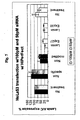
- Figure 1 demonstrates different purification steps of the RNA oligonucleotide.
- the two single strands (sense and antisense strand) in H 2 O were mixed in a 1:1 ratio (total double strand concentration ca. 20 nmol), heated 1 min. to 80°C and slowly cooled to 25°C. After lyophilization, the duplex was dissolved in 50 ⁇ l, mixed with 50 ⁇ l formamide blue (10 ml formamide, 200 ⁇ l 0.5M EDTA, bromphenol blue) and then subjected to a polyacrylamid gel electrophoresis. (12 % acrylamide, 1:40 bisacrylamide, 250 V). After UV revelation the duplex was separated from the gel in a electrolution cell (45 min, 70 V).
- siRNA 2 ⁇ g siRNA were incubated at 37 °C in 300 ⁇ l DMEM/10 % FCS (Dulbecco's Modified Eagle Medium (D-MEM) (1X), Invitrogen-GIBCO). The resulting mixture was analyzed on AE-HPLC (20-60 % B in A, see below, in 25 min, 1 injections) at t 0, 4 h, 24 h, 48 h and 3 d.
- RNA 2 ⁇ l RNA were amplified in a one tube RT-PCR using TaqMan Primer and Probes ("TaqMan probe ® " is a trademark of Applied Biosystems; Foster City, CA, USA). Amplification was performed in parallel for the target gene and GAPDH. Target expression was analyzed as quotient of the GAPDH expression. The absolute target expression of the treated cells using modified siRNA was compared to the absolute target expression of the treated cells using standard (i.e. non-modified) siRNA. The targets used were LaminA/C , MAPK2 and CDC2.
- the "no treatment” bar represents untreated cells.
- "Non specific siRNA” and “non modified siRNA” represent control transfections with nonspecific siRNA and non modified siRNA, respectively.
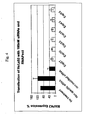
- Exp. 27, Exp. 30, Exp. 33, Exp. 35, Exp. 43, and Exp. 53 represent the remaining MAPK2 expression in cells transfected with different modified MAPK2-siRNAs.
- the modified siRNA shown on these graphs are those, which have shown the best performance in terms of gene silencing and stability against nucleases. From the results shown in Fig. 4 it can be concluded that the chosen modified siRNAs (Exp. 27, 30, 33, 35, 43, and 53).
- siRNA duplexes top row of each paragraph: sense-strand, followed by antisense strands
- modification design that was used for the sense strand is applied to modify the antisense strand this leads to inactivation of the siRNA (e.g. Exp102neg, Exp104neg and Exp120).
- siRNA e.g. Exp102neg, Exp104neg and Exp120.
- the choice of the given design can be used to inactivate the sense strand. It is known that the sense strand may lead to sequence specific off target effects. Inactivation of the sense strand by the given modifications may lead to elimination of sequence specific off target effects.
- the duration of the silencing effects of the modified siRNAs was tested in HeLaS3cells ( Fig.12 ).
- HeLaS3 cells were transfected with HiPerFect and 250pM MAPK2-siRNA.
- MAPK2-downregulation was measured 1, 4 and 6 days after transfection.
- the modified siRNAs (Exp96-114), which were used to induce long term silencing, are compared to non modified siRNA indicated by (ERK2 250pM). No treatment and GFP represent controls of untreated cells and cells treated with non specific siRNA respectively.
- Modified siRNAs Exp 27, Exp 97-98, Exp 101-104, Exp111 and Exp 114 induce a more efficient and prolonged silencing compared to non modified siRNA.
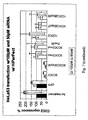
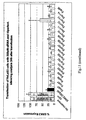
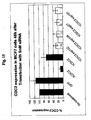
- Fig.13 represent silencing of Lamin A/C in HeLaS3 and MCF7 cells.
- LaminA/C siRNA was modified using the best performing modifications. Again No treatment bars represent Lamin expression in untreated, normal growing cells and GFP non specific in cells treated with control non specific siRNA.
- Lamin non modified represent control transfections with non modified siRNA and
- Lamin Exp27-104 represent the Lamin/AC rest expression in cells, which were transfected with the corresponding modified siRNA.
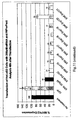
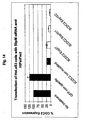
- Fig.14 represents silencing of CDC2 in HeLaS3 and MCF7 cells.
- 3CDC2 siRNA was modified using the best performing modifications.
- No treatment bar represents CDC2 expression in untreated, normal growing cells and GFP non specific in cells treated with control non specific siRNA.
- 3CDC2 non modified represent control transfections with non modified siRNA and 3CDC2 Exp27-102 represent the CDC2 rest expression in cells, which were transfected with the corresponding modified siRNA.
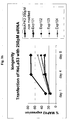
- silencing efficiency siRNA longevity using siRNA against different targets
- HeLaS3 cells were transfected with 250pM chemically modified or non modified siRNA against the MAPK2 target.
- the silencing analysis took place 1, 4 and 6 days after transfection ( Fig.16 ).
- MAPK2 250pM non modified represents the MAPK2 rest expression in HeLaS3 cells, that were treated with the non modified siRNA.
- Exp101-104 represent the MAPK2 rest-expression in cells treated with the corresponding modified siRNAs.
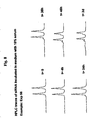
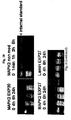
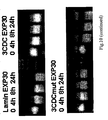
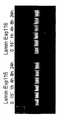
- Modified siRNAs were incubated in inactivated human serum in order to test the stability against nucleases activity. Stability analysis was performed for each modified siRNA separately. For this purpose siRNA was incubated in human serum and at several time points an aliquots was collected and analyzed by PAGE. All siRNAs, that were chemically modified according the design of Exp27 show very similar stability in human serum and culture medium. Fig.17 (A,B,C) represent some examples of modified siRNA and their extended stability in human serum. Modified siRNAs are indicated by the name of the siRNA and the abbreviation Exp with the number of the corresponding modification.
- a method to down-regulate the expression of a target gene wherein a siRNA as described above is used to down-regulate the expression of the target gene.
- siRNA double-stranded short interfering RNA
- Support material suitable for the automated synthesis of nucleic acids comprising:
- the compound described above exhibits one of the following features:
Landscapes
- Chemical & Material Sciences (AREA)
- Life Sciences & Earth Sciences (AREA)
- Health & Medical Sciences (AREA)
- Engineering & Computer Science (AREA)
- Genetics & Genomics (AREA)
- Organic Chemistry (AREA)
- Molecular Biology (AREA)
- Biomedical Technology (AREA)
- Biotechnology (AREA)
- Biochemistry (AREA)
- General Health & Medical Sciences (AREA)
- Bioinformatics & Cheminformatics (AREA)
- Zoology (AREA)
- General Engineering & Computer Science (AREA)
- Wood Science & Technology (AREA)
- Physics & Mathematics (AREA)
- Microbiology (AREA)
- Plant Pathology (AREA)
- Biophysics (AREA)
- Virology (AREA)
- Pharmaceuticals Containing Other Organic And Inorganic Compounds (AREA)
- Saccharide Compounds (AREA)
- Medicines That Contain Protein Lipid Enzymes And Other Medicines (AREA)
Abstract
Description
- The present invention relates to double-stranded, short interfering RNA (siRNA) molecules that down-regulate the expression of target genes, whereby the siRNA molecules are chemically modified. Furthermore, the present invention relates to a support material as well as phosphoramidites suitable for producing respective siRNA molecules.
- It is known that siRNA molecules (double-stranded (i.e. duplex) short interfering RNA having a length of 21-23 nucleotides (nt) with terminal 3'-overhangs of 2 nucleotides) can be used to post-transcriptionally silence gene expression in mammalian cells (Elbashir et al., Nature 2001, 411:494-498 ). Complexing of siRNAs with suitable transfection reagents and application of these complexes onto the cells results in endocytotic uptake of the siRNA-complexes. SiRNA is finally released into the cytoplasm and the siRNA molecules are recognized and incorporated into a complex called RISC (RNA induced silencing complex).. A RISC associated ATP-depended helicase activity unwinds the duplex and enables either of the two strands to independently guide target mRNA recognition (Tuschl, Mol. Interv. 2002, 2:158-167).
- The RISC complex then recognizes a region within the mRNA to which the siRNA sequence is complementary and binds to this region in the mRNA. The mRNA is then endonucleolitically cleaved at that position, where the RISC complex is bound. In a final step, the endonucleolitically cleaved mRNA is degraded by exonucleases. This mechanism of siRNA mediated gene silencing (RNA interference, RNAi) is widely used to perform knockdown experiments in eukaryotic cell cultures.
- It is also known that not every siRNA duplex is able to knockdown the mRNA level to the same degree. Some siRNAs are able to knockdown the initial level to approx. 10-20%, some others to intermediate levels (20-70%), and still others are not able to knockdown the mRNA level to a measurable level at all. There are certain design rules (so called "Tuschl-rules") for the design of siRNAs, but even siRNAs designed according to these rules show the above described variability. The reason for this observation is not known. It is believed that also the thermodynamic stability of the duplex may play a role in the efficiency of the siRNA to induce silencing. This variability as well as the fact that even "good" siRNAs are not able to completely knockout all mRNAs is a severe disadvantage of the siRNA technology (Gong D., Trensd. Biotechnol. 2004, 22:451-454 ; Khvorova A, Cell 2003, 115:209-216 ; Schwarz D.S., Cell 2003, 115:199-208 ; Reynolds A., Nat. Biotechnol. 2004, 22:326-330 ).
- The search for more potent gene silencing either by enhancement of uptake into the cells or by more potent intracellular siRNA duplexes is therefore central to the field of siRNA research.
- Moreover, it is known that several chemical modifications have been tested in order to increase the ability of siRNA molecules to induce silencing and also to increase their stability. Chemical modifications of siRNA molecules or oligonucleotides (ODN) are affecting the nuclease stability of these molecules or their affinity to target mRNAs (Manoharan M, Curr. Opin. in Chem Biol. 2004, 8:570-579 ). Different types of modifications have been described to improve the stability against serum nucleases and/or to improve the affinity to targets. Described are:
- a. 2'-OH modifications with halogen, amine, -O-alkyl, -O-allyl, alkyl-groups;
- b. internucleotid linkages, such as orthoester, phosphate ester, phosphodiester, -triester, phosphorothioate, phosphorodithioate, phosphonate, phosphonothioate, phosphorothiotriester, phosphoramidate, phosphorothioamidate, phosphinate, and boronate linkage, ether-, allyl ether-, allyl sulfide-, formacetal/ketal-sulfide-, sulfoxide-, sulfone-, sulfamate-, sulfonamide-, siloxane-, amide-, cationic alkylpolyamine-, guanidyl-, morpholino-, hexose sugar or amide-containing linkage, or a two to four atom linkage;
- c. conjugates, such as aminoacids, peptides, polypeptides, protein, sugars, carbonhydrates, lipids, polymers, nucleotides, polynucleotides, as well as combinations thereof, passive delivery with cholesterol conjugates.
- Normal (unprotected) siRNAs show a low stability in cell culture media and in body fluids, such as serum. This results in degradation of siRNA during the transfection or the systemic delivery. Accordingly, due to the degradation, less siRNA remains in the cells for efficient silencing, and the degraded (shortened) siRNA may lead to off target effects in cells due to unspecific base pairing.
- Transfection of siRNA to cells is shown to lead to off target effects. Specifically, high amounts of siRNA may lead to PKR activation (PKR: Protein Kinase R; double stranded RNA-activated protein kinase). Also, the recognition and incorporation of the sense strand in the RISC instead of the antisense strand might lead also to off target effects.
- It is therefore the object of the present invention to provide novel and improved siRNA molecules that are protected against degradation so that the gene silencing activity of the siRNA molecules is improved and the amount of siRNA molecules needed for efficient gene silencing is decreased.
- This object is solved by the siRNA molecules according to
independent claim 1, the method according to independent claim 19, the use according toindependent claim 20, the support material according toindependent claim 21, the compound according to independent claim 29, and the phosphoramidite according to independent claim 33. Further advantageous aspects, details and features of the invention are evident from the dependent claims, the description, the examples and the figures. - The chemically modified siRNA molecules according to the present invention enhance the stability of these molecules in culture media and body fluids, e.g. serum. The degradation of siRNA is effectively suppressed, and the full length siRNA will be more active and lead to no off target effects. Moreover, the sensitivity of the siRNA according to the present invention is enhanced. Lower amount of siRNA will be needed to achieve a high level of gene silencing. The siRNA may be incorporated into the RISC in the right orientation, so that only the antisense strand will be able to induce silencing, which leads to higher specificity. In addition, the sense strand is inactivated due to modifications, resulting in the elimination of off target effects. The siRNA according to the present invention enables a more efficient unwinding of the siRNA duplex and hybridization with the target mRNA, leading to an improved target binding affinity. Furthermore, the transfection efficiency of the siRNAs is enhanced and the biodistribution and pharmacokinetic properties are improved.
- Chemically modified siRNA molecules with the combination of the following groups and linkages at the well defined positions of both the sense and antisense strands of the siRNA have not been described previously to simultaneously improve stability, sensitivity and specificity of the siRNA:
- (a) 2'-deoxy modified nucleotides;
- (b) 2'-methoxy modified nucleotides;
- (c) two nucleosides linked by a 3' to 5' or 2' to 5' formacetal linkage;
- (d) nucleotides modified at the 2'-position by a -O-CH2-O-(CH2)2-OH group; and
- (e) nucleotides comprising in the 3'-position a -O-CH2-O-(CH2)7-CH3 group.
- It is believed that the modified siRNA molecules according to the present invention outperform respective non-modified siRNA molecules with respect to the down-regulation of the expression of a target gene because the modification(s) positively influence the thermostability of the double-stranded (i.e. duplex) RNA. Furthermore, it is assumed that the modification(s) allow for a more efficient opening of the duplex within the RNA-induced silencing complex (RISC), so that the further steps (recognizing of an mRNA sequence, binding to that sequence, and finally cutting same) can be carried out more quickly and with higher efficiency compared to non-modified siRNA.
- According to one aspect, the present invention refers to a double-stranded siRNA molecule comprising a sense strand and an antisense strand, whereby the antisense strand is essentially complementary to the sense strand. Each of the sense and the antisense strands comprises at least 17 nucleotides (nt). The siRNA further comprises at least one overhang at the 5' and/or 3' end, wherein the overhang residue or the overhang residues are chemically modified and selected independently from each other from the group consisting of:
- (a) 2'-deoxy modified nucleotides;
- (b) 2'-methoxy modified nucleotides;
- (c) two nucleosides linked by a 3' to 5' or 2' to 5'formacetal linkage;
- (d) nucleotides modified at the 2'-position by a -O-CH2-O-(CH2)2-OH group; and
- (e) nucleotides comprising in the 3'-position a -O-CH2-(CH2)7-CH3 group.
- "Independently of each other" means that the overhang can be modified by (a), (b), (c), (d) or (e) alone or by any combination of modifications (a) to (e). Modifications comprising two of the above-mentioned alternatives are e.g. (a) and (b), (a) and (c), (a) and (d), (a) and (e); (b) and (c), (b) and (d), (b) and (e); (c) and (d), (c) and (e); (d) and (e). Modifications comprising three of the above-mentioned alternatives are e.g. (a), (b) and (c), (a), (b) and (d), (a), (b) and (e), (a), (c) and (d), (a), (c) and (e), (a), (d) and (e); (b), (c) and (d), (b), (c) and (e); (c), (d) and (e). Modifications comprising four of the above-mentioned alternatives are e.g. (a), (b), (c) and (d), (a), (b), (c), and (e), (a), (c), (d) and (e); and (b), (c), (d) and (e). The modification comprising five of the above-mentioned alternatives is (a), (b), (c), (d) and (e).
- "Independently of each other" further means that the 5' end and/or the 3' end of the sense strand and/or the antisense strand of the siRNA molecule can be modified by any of the aforementioned combinations.
- If above and in the following the term "siRNA" is used, this does not mean that the siRNA molecules do contain RNA components exclusively. The siRNA according to the present invention may also contain other components, e.g. modified and/or unmodified DNA moieties as well as modified RNA moieties. More generally, "siRNA" as used herein refers to small interfering nucleic acids (siNA).
- The sense and the antisense strands of the siRNA molecules according to the present invention preferably comprise between 15 and 29 nt, more preferably between 17 and 23 nt, and particularly 19 to 21 nt. These figures refer to the double-stranded part of the siRNA molecule. To this double stranded part there is added a so-called "overhang", which means one or more unpaired bases at the 3' and/or 5' end of the sense and/or antisense strands of the siRNA molecule of the present invention. The double-stranded part of the siRNA is also referred to as the "core" region of the siRNA.
- According to one specific embodiment, the siRNA molecule of the present invention comprises in the sense strand, particularly at the 5' end of the sense strand, at least one modification (a), (b), or (c).
- According to a further specific embodiment, the siRNA molecule according to the present invention comprises in the antisense strand, particularly at the 5' end of the antisense strand, at least one modification (a), (b), or (c).
- According to a further preferred embodiment, the siRNA according to the present invention has no overhang at the 5' end of the antisense strand and/or the 5' end of the sense strand.
- According to a still further embodiment, the siRNA according to the present invention has an overhang at the 3' end of the antisense strand and/or the 3' end of the sense strand. If the siRNA according to the present invention does comprise an overhang at the 3' end of the antisense strand, then the overhang residue or overhang residues comprise preferably at least one modification selected from (a) to (e).
- Moreover, the siRNA according to the present invention preferably comprises at the 3' end of the sense strand an overhang, the overhang comprising at least one modification (c).
- A further preferred embodiment of the siRNA molecule according to the present invention comprises in at least one of the core nucleotides of the sense strand and/or the antisense strand a modification (a), (b) or (d).
- Preferably, the overhang of the sense strand and/or the antisense strand of the siRNA molecule according to the present invention comprises two modified nucleosides.
- According to a still further preferred embodiment, the sense strand of the siRNA molecule according to the present invention has an overhang of two modified nucleotides at the 3' end, said modifications being (c), and the 3' end of the core of the sense strand has at least one modification (a) or (b), and the modification of the overhang at the 5' end of the sense strand is selected from (a) or (b), and the 5' core end of the sense strand has no modification, and the antisense strand has an overhang of two modified nucleotides at the 3' end, the modification being selected from (b), (c), or a combination of (b) and (e), and the antisense strand has no overhang at the 5' end, and the antisense strand has no modification at the 3' end of the core, and the core of the 5' end of the antisense strand comprises a modification (a) and/or (b), preferably (a).
- If the siRNA molecule according to the present invention comprises the modification (c), then the nucleobase is preferably selected from the group consisting of adenine, cytosine, guanine, thymine, and uracil, preferably uracil.
- If the siRNA molecule according to the present invention comprises the modification (d), then the nucleobase is preferably selected from the group consisting of adenine, cytosine, guanine, and uracil.
- In a further preferred embodiment of the siRNA molecule according to the present invention the overhang residue according to modification (c) is one according to formula Va or Vb

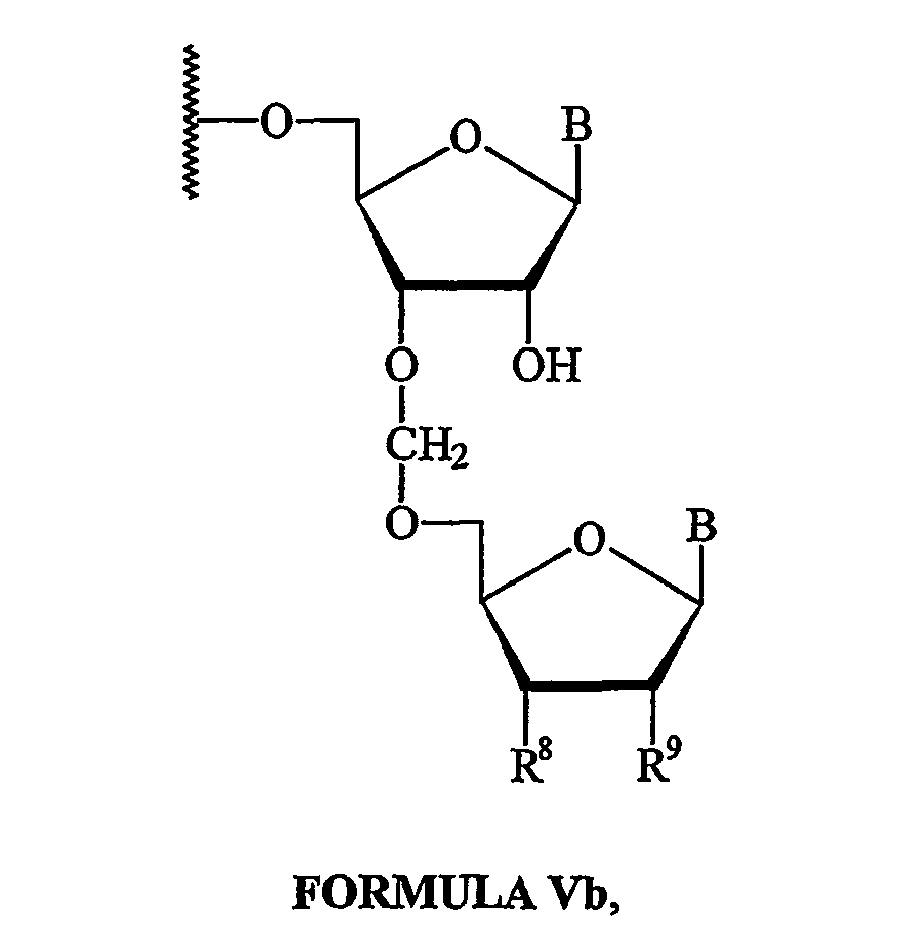
- In a preferred embodiment of the siRNA molecule according to the present invention, R8 is selected from H, OH, and OCH3, and preferably is OH, and R9 is selected from H, OH and OCH3, and preferably is OH.
- In yet a further preferred embodiment of the siRNA molecule according to the invention the core nucleotide comprising the modification (d) is a nucleotide having a chemical structure according to formula VI

- In yet another embodiment of the siRNA molecule according to the present invention, the overhang residue according to modification (e) is one according to formula VIIa or VIIb

- If the siRNA molecule according to the present invention comprises one the modification (e), then the nucleobase is preferably uracil.
- The modified siRNAs according to the present invention are stabilized by means of end-modifications of backbone phosphates or sugars. This requires one minimum changes in the core sequence of the sense strand of the siRNA molecule, and as a consequence, there are even less changes in the core of the antisense strand, which avoids inactivation of the antisense strand and avoids interference with the RNAi mechanism, and additional off target effects. The modification on the sense strand inactivates this strand, and therefore there are less off target effects, which are normally caused by the sense strand's "false" activity. According to the present invention, siRNA was chemically modified using different types of modifications. Particularly, the ends (overhang(s) and/or core end(s)) of the siRNA of the present invention were modified. The sense strand of the siRNA carries modifications that stabilize the siRNA against nuclease cleavage and simultaneously inactivate it, in order to minimize off target effects. The antisense strand is also modified for enhanced serum stability, but to a degree, which does not affect the siRNA activity. In addition, the combination of these modifications on sense and antisense strands enhance the activity of the siRNA in the tested cases, probably by partially changing the thermodynamic stability of duplex.
- With the modifications according to the present invention, siRNAs were obtained which are more stable against serum nucleases and more efficient in inducing gene silencing at the same time. The longevity of these siRNA is also enhanced by these modifications. Moreover, the modifications on the sense strand lead to inactivation of this strand, following minimization of the induced off target effects. Due to higher effectiveness of these new modified siRNA, less siRNA is necessary for efficient gene silencing, and this minimizes also off target and toxic effects in the cells.
- In a further aspect the present invention provides a solid support material suitable for the automated synthesis of nucleic acids, preferably oligoribonucleotides, comprising:
- a) a solid phase material,
- b) a chemical group selected from the groups according to Formulas Ia, Ib, VIIIa or VIIIb which is bonded to the solid phase material via a linker group L:


- In a preferred embodiment of this aspect of the invention, the chemical group in the support material is one according to formulas Ia or Ib, R9 is OR1 wherein R1 is benzoyl (Bz), R2 is 4,4'-(dimethoxy)trityl (DMT), and R8 is OR3 wherein R3 is (triisopropysilyl)oxymethyl (TOM). This combination of protective groups on the respective hydroxy groups is especially suitable for carrying out automated nucleic acid synthesis using standard equipment and procedures known in the art, for instance those described by S. Pitsch, P.A. Weiss, L. Jenny, A. Stutz and X. Wu in Helv. Chim. Acta 2001, 84, 3773 - 3795.
- In a further embodiment of this aspect of the invention, the chemical group in the support material is one according to formulas VIIIa or VIIIb, and R10 is 4,4'(dimethoxy)trityl.
- In a preferred embodiment of this aspect of the present invention, the nucleobase group B in any one of the chemical groups according to formulas Ia, Ib, VIIIa or VIIIb is uracil. The selection of the respective nucleobase group will of course depend on the nucleotide which is to be introduced into the nucleic acid, especially the oligoribonucleotide.
- In a further preferred embodiment the solid phase material in the support material according to the invention is controlled pore glass (CPG), preferably having a pore size in the range between 100 to 1500 Å, most preferably from 500 to 1000 Å. Preferably, the CPG-based support material is functionalized with aminoalkyl groups, which can form a chemical bond, for instance an amide bond, with the linker group L in the chemical groups contained in Formulas Ia and Ib. Other suitable solid phase materials are polystyrene and surfaces.
In yet a further embodiment of the support material according to the present invention, the linker group L is a - C(O)(CH2)n-C(O)O-group, wherein n is an integer from 1 to 10, preferably from 2 to 5, and most preferably is 2 or 5. The OL-moiety bonded to the polysaccharide moiety therefore preferably forms a dicarboxylate group, preferably a succinate group,(-O(O)CCH2CH2C(O)O-) or diheptandioate group, (-O(O)C(CH2)5C(O)O-), and most preferably a diheptandioate group (-O(O)C(CH2)5C(O)O-)-A preferred loading of the support material with compounds according to Formulas Ia Ib, VIIIa or VIIIb on the material is in the range of 10 to 50 µmol/g, preferably in the range of 30 to 40 µmol/g. - The support materials according to the present invention provide a means for introducing specific modifications at the 3'- or 5'- ends of a respective nucleic acid. In the synthesis of the nucleic acid, which is preferably automated, appropriately activated and protected nucleotide building blocks are added stepwise to the chemical groups attached to the solid phase until the desired sequence has been obtained. By using the solid support of the present invention, it is possible to prepare nucleic acids, especially oligoribonucleotides, having modified end groups derived from the chemical groups according to Formulas Ia Ib, VIIIa or VIIIb comprised in the solid support material, i.e. either 2'-5'-formacetal linked nucleosides, 3'-5'-formacetal linked nucleosides or nucleosides having a 2'O- or 3'O-octyloxymethyl modified nucleosides. Preferably, the nucleobase in these nucleosides is uracil.
- In a further aspect, the present invention provides compounds according to Formulas IIa, lib, IXa or IXb as shown below. These compounds can be used for the synthesis of the solid support materials discussed above. In the compounds according to Formulas IIa, IIb, IXa or IXb


- In formulas IIa, IIb, IXa and IXb, B is a nucleobase group or derivative thereof, preferably independently selected from the group consisting of adenine, cytosine, thymine, guanine and uracil or derivatives thereof, wherein for the synthesis of oligoribonucleotides adenine, cytosine, guanine and uracil or derivatives thereof are preferred. Uracil or derivatives thereof are especially preferred.
R2 is a protective group selected from the group consisting of 4,4'-(dimethoxy)trityl, 4-(methoxy)trityl or silyl. R8 is a group selected from H, OH, OCH3, or an alkyloxy group, wherein the alkyl chain in the alkyloxy group may contain one or more heteroatoms or heteroatom groups, said heteroatoms or heteroatom groups preferably being selected from the group consisting of O, S, or NH, and preferably is O. Regarding the nature of the alkyloxy group, the same applies as outlined with reference to the alkyloxy group in formulas Va and Vb. Alternatively, R8 is OR3, wherein R3 is a protective group selected from the group consisting of acyl groups, silyl groups or trialkylsilyloxymethyl groups. R9 is a group selected from H, OH, OCH3, or an alkyloxy group, wherein the alkyl chain in the alkyloxy group may contain one or more heteroatoms or heteroatom groups, said heteroatoms or heteroatom groups preferably being selected from the group consisting of O, S, or NH, and preferably is O. Again, regarding the nature of the alkyloxy group, the same applies as outlined above with reference to the alkyloxy group in formulas Va and Vb. Alternatively, R9 is OR1, wherein R1 is a protective group selected from the group consisting of acyl groups, silyl groups or trialkylsilyloxymethyl groups. The provisio applies that if R8 or R9 is H, only one of R8 and R9 is H
Regarding the selection and nature of the groups R2, R8, R9, R1 and R3, the same applies as outlined with reference to the support materials according to formulas Ia and Ib.
R4 is selected from the group consisting of H and -C(O)(CH2)nC(O)O-R, wherein R5 is a group selected nitrophenyl, tetrafluorophenyl, pentafluorophenyl and H, and n is an integer in the range from 1 to 10. n is preferably an integer in therange form 2 to 5 and preferably is 2 or 5. To attach these compounds to the solid phase material, a chemical bond must be provided between the solid phase material and the chemical compounds according to Formulas IIa, IIb, IXa or IXb. This bond is achieved either by first attaching a linker group at the 2'-O or 3'-O position on the nucleoside carrying the OR4 group, if R4 is -H, and then bonding the linker to the solid phase material which preferable comprises functional groups capable of reacting with the linker group. - In a preferred embodiment of these compounds according to the invention, the compound is one according to formula IIa or IIb, B is uracil, R9 is OR1 wherein R1 is benzoyl (Bz), R2 is 4,4'-(dimethoxy)trityl (DMT), R8 is OR3 wherein R3 is (triisopropysilyl)oxymethyl (TOM), R4 is -C(O)(CH2)nC(O)O-R5 and n is an integer in the range from 2 to 5 and preferably is 2 or 5, wherein R5 is 4-nitrophenyl. In this case, the compounds already comprise the linker group. In an other preferred embodiment, the compound is one according to formula IIa or IIb, B is uracil, R9 is OR1 wherein R1 is benzoyl (Bz), R2 is 4,4'-(dimethoxy)trityl (DMT), R8 is OR3, wherein R3 is (triisopropysilyl)oxymethyl (TOM), and R4 is H. In this case, a linker group is preferably attached to the compound, prior to attaching it to the solid phase material.
- In a further preferred embodiment of the compounds according to the present invention, the compound is one according to formula IXa or Ixb and B is preferably selected from the group consisting of adenine, cytosine thymine, guanine and uracil, preferably from adenine, cytosine, guanine and uracil, and most preferably B is uracil. In this embodiment, R2 preferably is 4,4'-(Dimethoxy)trityl (DMT), and R4 is preferably selected from H or - C(O)(CH2)nC(O)O-R5, wherein n is an integer in the range from 2 to 5 and preferably is 2 or 5, and wherein R5 is 4-nitrophenyl.
- In a further aspect the present invention provides specially modified phosporamidites which can be used for the syntheses of nucleic acids. These phosphoramidites enable the introduction of specially modified nucleosides into nucleic acids, especially into oligoribonucleotides. These phosporamidites are represented by the general formula III below.

- In formula III, B is a nucleobase or derivative thereof, which is preferably selected from the group consisting of adenine, cytosine, thymine, guanine and uracil, wherein adenine, cytosine, guanine and uracil or derivatives thereof are preferred. R2 is a protective group, preferably R2 is a 4,4'-(dimethoxy)trityl group, 4-(methoxy)trityl group or a silyl group. This protective group is selected in such a manner that it can be activated in respective nucleic acid syntheses to enable formation of a 5'-3'-linkage to a further nucleotide. R6 is an acyl group, silyl group or trialkylsilyloxymethyl group. As discussed before, suitable acyl groups include acetyl and benzoyl groups, etc. Suitable silyl groups include triethylsilyl or dimethyltertbutylsilyl groups, etc. In preferred embodiments of the phosporamidites according to the invention, B is selected from the group consisting of N6-Acetlyadenine, N4-acetylcytosine, N2-acetylguanine and uracil. R2 preferably is 4,4'-(dimethoxy)trityl. Preferably, R6 is a benzoyl group.
- The phosphoramidites according to the present invention can be used in the synthesis of nucleic acids, such as oligoribonucleotides, preferably in automated synthesis using standard procedures and equipment. The phosphoramidites can either be used with conventional solid support materials or with the specially modified solid support material according to the present invention. The phosporamidites can for instance be used in combination with 2'-O-tom-protected ribonucleoside phosporamidites as described by S. Pitsch, P.A. Weiss, L. Jenny, A. Stutz and X. Wu in Helv. Chim. Acta 2001, 84, 3773 - 3795. They allow the introduction of 2'-acetal modified ribonucleotides into oligoribonucleotides.
- Reagents and solvents (highest purity) were from various suppliers and used without further purification, unless otherwise stated. 2'-O-tom-protected ribonucleoside phosphoramidites were prepared according to S. Pitsch, P. A. Weiss, L. Jenny, A. Stutz, X. Wu, Helv. Chim. Acta 2001, 84, 3773. Work-up implies partitioning of the reaction mixture between CH2Cl2 and saturated aqueous NaHCO3 solution, drying of the organic layer (MgSO4) and evaporation. TLC: pre-coated silica-gel plates from Merck, stained by dipping into a solution of anisaldehyde (10 ml), H2SO4 (10 ml), and AcOH (20 ml) in EtOH (180 ml). and subsequent heating with a heat gun. CC (column chromatography): silica gel 60 (230-400 mesh) from Fluka. Anion-exchange (AE) HPLC: DNAPAC PA-100 (9.0 × 250 mm; Dionex), flow 2.5 ml/min; eluant A: 12 mM Tris. HCl (pH 7.4), 6 M urea; eluant B: 12 mM Tris. HCl (pH 7.4), 0.5 M NaClO4, 6 M urea; detection at 260 nm, elution at 85°C. NMR (Bruker instrument): chemical shift δ in ppm relative to external standards (1H and 13C: Me4Si); coupling constants J in Hz. MALDI- MS (linear negative mode): Axima CFR Plus (Kratos/Shimadzu); matrix: 2,4,6-trihydroxyacetophenone, diammonium citrate; m/z (rel. intensity in %). Acrylamide solution (30%): 300 g acrylamide, 8 g N,N'-methylendiacrylamide; final volume: 1 1 H2O. 10X TBE (Tris acid Boric EDTA): 54 g Tris base, 27.5 g Boric acid, 20 ml 0.5
M EDTA pH 8, final volume 500 ml (complete with water). Native 1 × TBE 12 % polyacrylamide gel: 6ml Acrylamid solution (30 %), 3 ml 5X TBE, 5 ml H2O, 150 µl APS and 20 µl TEMED. - Preferred embodiments of the support material according to the present invention can be prepared according to the synthetic route outlined below in
reaction scheme 1. -

- According to this reaction scheme in a first synthetic step (1→2) the 5'-O-, and 3'-O-protected uridine is deprotected in 5'-O-postion and the previously non-protected 2'-O-position is protected with a suitable protecting group, which can withstand the reaction conditions required for the subsequent reaction steps. In the second synthetic step (2→3) a suitable reactive group for forming an formacetal linkage is introduced at the 5'-O-position of
compound 2. This group is preferably a MeSCH2-group. Functionalized compound 3 is subsequently reacted with the 5'-O-protecteduridine 4 in step 3 (3 + 4→5 and 6), forming the 3'-5'- or 2'-5' formacetal linkedcompounds 5 and 6. In subsequent synthetic steps, 4a (5→7) and 4b(6→9), preferably carried out after separation of the regioisomers 5 and 6 a linker group is bonded to the non-protected 2'-OH or 3'-OH group of compounds 7 or 9, respectively. Finally, in synthetic steps 5a (7→8)or 5b (9→10), the compounds are bonded to the solid phase material via the linker group. - A preferred embodiment of this general reaction sequence in outlined in the following specific preparation steps.
- To a solution of 1 (5.2 g, 7.11 mmol, prepared according to S. Pitsch, P. A. Weiss, L. Jenny, A. Stutz, X. Wu, Helv. Chim. Acta, 2001, 84, 3773) in pyridine (45 ml) was added benzoyl chloride (989 µl, 8.53 mmol). The resulting reaction mixture was stirred at room temperature overnight. After work-up, the crude product was dissolved in CH2Cl2 (50 ml) and dichloroacetic acid (5 ml) was added. 5 min later the reaction was complete; 3 ml methanol were then added. After work-up and recristallisation in hexane/CH2Cl2 1:1, a colorless solid 2 (2.95 g 78 %) was obtained. TLC (AcOEt/hexane 1:1): Rf 0.35. 1H-NMR (400 MHz, CDCl3): 1.02-1.04 (m, iPr3Si); 3.94 (dd, J = 2.3, 11.3, H-C(5')); 4.05 (dd, J = 2.3, 11.3, H-C(5')); 4.37 (m, H-C(4')); 4.72 (t, J = 5.4 , H-C(2')); 4.91, 5.08 (2d, J = 5.0. OCH2O); 5.57 (t, J= 5.2, H-C(3')); 5.78 (d, J= 8.1, H-C(5)); 6.07 (d, J = 5.1, H-C(1')); 7.45-7.70 (m, 5 arom. H); 8.08 (d, J = 8.3, H-C(6)); 8.26 (br. s, H-N(3)).
- 2 (2.95 g, 5.52 mmol) was dissolved in a 1:1:1 solution of DMSO (7 ml)/Ac2O (7 ml)/AcOH (7 ml) and the reaction mixture was stirred 3 days at room temperature. After work-up with hexane/AcOEt 1:1 as organic layer and CC (50 g of SiO2, AcOEt/hexane 1:9 → AcOEt/hexane 6:4), a colorless solid 3 (1.85 g, 56 %) was obtained. TLC (AcOEt/hexane 1:1): Rf 0.55. 1H-NMR (400 MHz, CDCl3): 1.02-1.04 (m, iPr3Si); 2.24 (s, SCH3); 3.82 (dd, J = 2.5, 10.7, H-C(5')); 3.91 (dd, J = 2.2, 10.7, H-C(5')); 4.50 (m, H-C(4')); 4.60 (dd, J = 3.7, 5.2, H-C(2')); 4.76 (d, J = 5.5, 2H, OCH2S); 4.87, 5.01 (2d, J = 5.0, OCH2O); 5.38 (t, J = 5.6 H-C(3')); 5.85 (d, J = 8.2, H-C(5)); 6.39 (d, J= 6.0, H-C(1')); 7.44-7.57 (m, 2 arom. H); 7.60 (m, 1 arom. H); 7.81 (d, J= 8.2, H-C(6)); 8.06 (m, 2 arom. H); 8.48 (br. s, H-N(3)).
- Step1: To a solution of 3 (1.62 g, 2.72 mmol) and cyclohexene (5.44 mmol, 551 µl) in CH2Cl2 (11 ml) was added at -80 °C SO2Cl2 (2.99 mmol, 242 µl). After stirring 35 min at -80°C and then 40 min at room temperature, the reaction mixture was evaporated under reduced pressure and dried 10 min at high vacuum.
- Step2: To a solution of 4 (1.76 g, 3.264 mmol) in acetonitrile (13 ml) was added di-tert-butyltin dichloride (1.09g, 3.59 mmol) and diisopropylethylamine (2.23 ml, 13 mmol). After stirring 15 min at room temperature, the crude product fom
step 1, dissolved in acetonitrile (5 ml), was added to this mixture and stirred 8 h at room temperature. After workup, using AcOEt as organic layer, the two diastereoisomers were separated by 3 CC (50 g of SiO2, AcOEt/hexane 5:5 →AcOEt 100 %, two time to column volume per gradient). Combined yield: 41 %. (6/5: 7/3) - Data of 5: TLC (AcOEt/
hexane 95/5): Rf 0.80. 1H-NMR (400 MHz, CDCl3): 0.95-1.10 (m, iPr3Si); 3.57 (dd, J = 2.3, 11.3, H-C(5')); 3.63 (dd, J = 2.2, 11.2, H-C(5')); 3.80 (s, 2 MeO); 3.93-3.99 (m, 2 H-C(5')); 4.10 (m, H-C(2')); 4.50 (m, H-C(2')); 4.49-4.65 (m, H-C(4'), H-C(3')); 4.85, 4.98 (2d, J = 5.1, OCH2O); 4.88, 5.37 (2d, J = 6.8, OCH2O); 5.35 (d, J= 6.5, H-C(5)); 5.54 (d, J = 6.9, H-C(5)); 5.94 (d, J = 7.2, H-C(1')); 6.52 (d, J = 7.0, H-C(1')); 6.84-6.90 (m, 4 arom. H); 7.26-7.40 (m, 12 arom. H); 7.87 (d, J = 8.2, H-C(6)); 7.96-7.99 (m, 2 arom. H); 8.14 (d, J= 8.2, H-C(6)); 10.21 (br. s, H-N(3));10.75 (br. s, H-N(3)). MS: fehlt Data of 6: TLC (AcOEt/hexane 95/5): Rf 0.85 (2' isomer). 1H-NMR (400 MHz, CDCl3): 0.95-1.10 (m, iPr3Si); 3.45 (dd, J = 2.3, 11.3, H-C(5')); 3.58-3.67 (m, 2 H-C(5')); 3.80 (s, 2 MeO); 3.87 (dd, J = 3.1, 11.0, H-C(5')); 4.14-4.19 (m, 2 H-C(4')); 4.20-4.26 (m, 2 H-C(2')); 4.38 (m, H-C(3')); 4.83 (m, H-C(3')); 4.85, 4.89 (2d, J = 6.8, OCH2O); 4.91, 4.95 (2d, J = 5.1, OCH2O); 5.35 (d, J = 8.0, H-C(5)); 5.58 (d, J = 2.5 , H-C(1')); 5.73 (d, J = 7.9, H-C(5)); 5.83 (d, J = 2.4, H-C(1')); 6.84-6.90 (m, 4 arom. H); 7.26-7.40 (m, 12 arom. H); -8.08, 7.62 (2m, 2 arom. H); 8.02 (d, J = 8.2, H-C(6)); 8.06 (d, J = 8.3, H-C(6)); 9.35 (br. s, H-N(3)); 9.55 (br. s, H-N(3)). - Pimelic acid-dinitrophenylester (893 mg, 2.22 mmol) was dissolved in pyridine (3.7 ml). DMAP (22.6 mg, 0.18 mmol) and 5 or 6 (400 mg each, 0.37 mmol) were added. After stirring over night at room temperature, the mixture was evaporated and co-evaporated twice with toluene (20 ml). CC (10 g of SiO2, AcOEt/hexane 3:7 → AcOEt/hexane 6:4) gave 7 (243 mg, 46%) and 9 (250 mg, 48%), respectively. Colorless foams.
Data of 7: TLC (AcOEt/hexane 7:3): Rf 0.72. 1H-NMR (400 MHz, CDCl3): 0.95-1.05 (m, iPr3Si); 1.47 (m, CH2); 1.72 (m, CH2); 1.79 (m. CH2); 2.42 (t, J = 7.4, CH2); 2.62 (t, J = 7.3, CH2); 3.50 (dd, J = 2.3, 10.7, H-C(5')); 3.58 (dd, J = 2.2, 10.6, H-C(5')); 3.76 (dd, J = 3.3, 11.2, H-C(5')); 3.80 (s, 2 MeO); 3.85 (dd, J = 2.4, 11.1, H-C(5')); 4.27 (m, H-C(4')); 4.32 (m, H-C(4')); 4.49 (t, J = 5.4, H-C(3')); 4.53 (t, J = 4.7, H-C(3')); 4.76,4.78 (2d, J = 6.9, OCH2O); 4.80, 4.92 (2d, J = 5.0, OCH2O); 5.31,5.36 (2d, J = 7.4, 2 H-C(5)); 5.46 (t, J = 5.1, H-C(2'); 5.67 (dd, J = 2.1, 8.0, H-C(2'); 6.06 (d, J = 5.1, H-C(1')); 6.14 (d, J = 5.1, H-C(1')); 6.83-6.89 (m, 4 arom. H); 7.26-7.45 (m, 16 arom. H); 7.75 (d, J = 8.1, H-C(6)); 8.05-8.07 (m, 2 arom. H); 8.26 (d, J = 8.3, H-C(6)).
Data of 9: TLC (AcOEt/hexane 7:3): Rf 0.72. 1H-NMR (400 MHz, CDCl3): 0.95-1.05 (m, iPr3Si); 1.46 (m, CH2); 1.70 (m, CH2); 1.77 (m. CH2); 2.42 (t, J = 7.6, CH2); 2.62 (t, J= 7.5, CH2); 3.45 (dd, J = 2.3, 11.1, H-C(5')); 3.64 (dd, J = 2.3, 11.2, H-C(5')); 3.73 (dd, J = 3.5, 10.8, H-C(5')); 3.80 (s, 2 MeO); 3.95 (dd, J = 2.9, 10.8, H-C(5')); 4.30 (m, H-C(4')); 4.40 (m, H-C(4')); 4.63 (t, J = 4.8, H-C(3')); 4.57 (dd, J = 5.1, 5.3, H-C(3')); 4.83, 5.02 (2d, J = 6.8, OCH2O); 4.90, 4.97 (2d, J = 5.0, OCH2O); 5.32,5.35 (2d, J = 7.4 2 H-C(5)); 5.48 (t, J= 5.4, H-C(2'); 5.72 (dd, J = 2.3, 8.2, H-C(2'); 6.10 (d, J = 53, H-C(1')); 6.24 (d, J= 4.3, H-C(1')); 6.84-6.90 (m, 4 arom. H); 7.26-7.40 (m, 16 arom. H); 7.90 (d, J= 8.20, H-C(6)); 8.05-8.07 (m, 2 arom. H); 8.26 (d, J = 8.3, H-C(6)). - To a solution of the active ester 7 or 9 (0.13 mmol each) in DMF (4.16 ml) was added long-chain-alkylamino CPG (1.04 g) and then iPr2NEt (0.4 ml). The mixture was shaken for 20 h at room temperature. After filtration, the solid support was washed with DMF and CH2Cl2, dried, suspended in pyridine (2.6 ml) and Ac2O (1.56 ml) and shaken for 2 h at room temperature. After filtration, the solid was washed with DMF and CH2Cl2, and dried under high vacuum. Typical loadings of the solid support were 30 µmol/g with 500-Å CPG.
-

- According to this reaction scheme in a first synthetic step (A,a-d→B,a-d; a-d stands for the four compounds containing the nucleobase derivatives uracil (a). N 4-acetylcytidine (b), N 6-acetyladenine (c) and N 2-acetylguanine (d)) the 5'-O-, and 2'-O-protected uridine is deprotected in 5'-O-postion and the previously non-protected 2'-O-position is protected with a suitable protecting group, which can withstand the reaction conditions required for the subsequent reaction steps, followed by the introduction of a suitable reactive group for forming an formacetal linkage at the 5'-O-position. This group is preferably a MENSCH2-group. Functionalized compound B,a-d is subsequently reacted with the 5'-O-protected nucleosides C,a-d in step 2 (B,a-d + C,a-d→D,a-d), forming preferentially the 2'-5' formacetal linked compounds D,aa-dd (D,aa-dd stands for the 16 possible combinations of dinucleotides, each containing two of the nucleobase derivatives uracil (a), N 4-acetylcytidine (b), N 6-acetyladenine (c) and N 2-acetylguanine (d); the first descriptor refers to the nucleotide Y at the 5'-end (containing a 5'-O-DMT group) and the second to the nucleotide X at the 3'-end (containing a 3'-O-benzoyl group)). In the subsequent synthetic step 4 (D,aa-dd→E,aa-dd), carried out after isolation of the compound D,aa-dd, a linker group is bonded to the non-protected 3'-OH group of compounds E,aa-dd. Finally, in synthetic step 5 (E,aa-dd→F,aa-dd), the compounds are bonded to the solid phase material via the linker group.
- The reaction conditions for this general reaction sequence in outlined in the following specific preparation steps.
- To a solution of A,a-d (20 mmol, prepared according to S. Pitsch, P. A. Weiss, L. Jenny, A. Stutz, X. Wu, Helv. Chim. Acta, 2001, 84, 3773) in pyridine (130 ml) was added benzoyl chloride (3 ml, 25 mmol). The resulting reaction mixture was stirred at room temperature overnight. After work-up, the crude product was dissolved in CH2Cl2 (150 ml) and dichloroacetic acid (15 ml) was added. 5 min later the reaction was complete; 15 ml methanol were then added. After work-up, the crude products were were dissolved in a 1:1:1 solution of DMSO (30 ml)/Ac2O (30 ml)/AcOH (30 ml) and the reaction mixture was stirred 3 days at room temperature. After work-up with hexane/AcOEt 1:1 as organic layer and CC (150 g of SiO2), compounds B,a-d were obtained as colorless solids
Data of B,a (uracil):Yield 75%. TLC (AcOEt/hexane 1:1): Rf 0.59. 1H-NMR (400 MHz, CDCl3): 1.02-1.04 (m, iPr3Si) ; 2.22 (s, SCH3) 3.88-3.90 (m, H-C(5'), H-C(5")); 4.48 (m, H-C(4')) ; 4.69 (dd, J = 5.2, 7.1, H-C(2') ; 4.76 (dd, J = 11.7,18.1, OCH2S) ; 4.92 (m, OCH2O); 5.56 (dd, J = 2.1, 5.2, H-C(3')) ; 5.79 (dd, J = 2.1, 8.2, H-C(5)); 6.34 (d, J = 7.2, H-C(1')) ; 7.50 (m, 2 arom. H); 7.63 (m, 1 arom. H) ; 7.83 (d, J = 8.3. H-C(6)); 8.12 (m, 2 arom. H) ; 8.45 (br, s, H-N(3)).
Data of B,b (N 4-acetylcytosine):Yield 60%. TLC (CH2Cl2/MeOH 19:1): Rf 0.62. 1H-NMR (400 MHz, CDCl3): 1H-RMN (400 MHz, CDCl3) 1.02-1.04 (m, iPr3Si) ; 2.23 (s, SCH3) ; 2.35 (s, N-CH3) ; 3.96 (m, H-(C-5')) ; 3.01 (m, H-C(5')) ; 4.57 (m, H-C(4')) ; 4.66 (1, J = 5.0, H-C(2')) ; 4.76 (dd, J = 7.5, 17.2, OCH2S) ; 5.05 (dd, J = 4.8, 8.7, OCH2O) ; 5.48 (t, J = 5.2, H-C(3')) ; 6.33 (d, J = 5.2, H-C(1')) ; 7.45 (m, 3 arom. H) ; 7.62 (m, H-C(5)) ; 8.12 (m, 2 arom. H) 8.32 (d, J = 7.5, H-C(6)).
Data of B,c (N 6-acetyladenine): Yield 55%. TLC (CH2Cl2/MeOH 19:1): Rf 0.67. 1H-NMR (400 MHz, CDCl3): [WIRD NACHGELIEFERT] - Data of B,d N 2-acetylguanine):
Yield 25%. TLC (CH2Cl2/MeOH 19:1): Rf 0.59. 1H-NMR (400 MHz, CDCl3): 1.03-1.05 (m, iPr3Si) ; 2.23 (s, SCH3) ; 2.32 (s, N-CH3) ; 3.85 (dd, J = 3.3, 10.7, H-(C-5')); 3.96 (dd, J = 3.6, 10.7, H-C(5')) ; 4.57 (m, H-C(4')) ; 4.76 (d, J = 4.5, OCH2S) ; 4.85, 4.90 (2d, J = 5.1, OCH2O) ; 5.17 (dd, J = 5.1, 6.9, H-C(2')) ; 5.74 (dd, J = 2.1, 5.1, H-C(3')) ; 6.10 (d, J = 6.9, H-C(1')) ; 7.51 (m, 2 arom. H) ; 7.65 (m, 1 arom. H); 8.02 (s, H-C(8)) ; 8.13 (m, 2 arom. H). - Step1: To a solution of B,a-d (8 mmol) and cyclohexene (16 mmol, 1.65 ml) in CH2Cl2 (33 ml) was added at -80 °C SO2Cl2 (8 mmol, 0.6 ml). After stirring 35 min at -80°C and then 40 min at room temperature, the reaction mixture was evaporated under reduced pressure and dried 10 min at high vacuum.
- Step2: To a solution of C,a-d (10 mmol) in 1,2-dichlorethane (39 ml) was added di-n-butyltin dichloride (3.2 g, 10.8 mmol) and diisopropylethylamine (3.7 ml, 39 mmol). After stirring 15 min at room temperature, the crude product from
step 1, dissolved in 1,2-dichlorethane (15 ml), was added to this mixture and stirred 8 h at room temperature. After workup, using AcOEt as organic layer, the products were isolated by CC (150 g of SiO2, AcOEt/hexane or CH2Cl2/MeOH gradients).Data of compounds D,aa-D,dd Compound Nucleoside on 5'-end Nucleoside on 3'-end Yield R f -value m/z meas m/z calc D,aa uracil uracil 35% 0.851) 1093 D,ab uracil N 4- acetylcytidine 30% 0.342) 1133 D,ac uracil N 6- acetyladenine 30% 0.422) 1157 D,ad uracil N 2-acetylguanine 35% 0.412) 1173 D,ba N 4- acetylcytidine uracil 20% 0.561) 1133 D,bb N 4-acetylcytidine N 4- acetylcytidine 10% 0.342) 1174 D,bc N 4-acetylcytidine N 6- acetyladenine 15% 0.602) 1198 D,bd N 4-ac-etyleytidine N 2- acetylguanine 10% 0.332) 1215 D,ca N 4- acetyladenine uracil 25% 0.531) 1157 D,cb N 6-acetyladenine N 4- acetylcytidine 25% 0.452) 1198 D,cc N 6-acetyladenine N 6- acetyladenine 25% 0.572) 1223 D,cd N 6-acetyladenine N 2- acetylguanine 10% 0.422) 1239 D,da N 2- acetylguanine uracil 25% 0.271) 1173 D,db N 2-acetylguanine N 4- acetylcytidine 30% 0.402) 1215 D,dc N 2-acetylguanine N 6-acetyladenine 35% 0.462) 1239 D,dd N 2-acetylguanine N 2- acetylguanine 40% 0.292) 1254 1) AcOEt/hexane 19:1; 2) CH2Cl2/MeOH 9:1 - Pimelic acid-dinitrophenylester (2.7 g, 6.5 mmol) was dissolved in pyridine (10 ml). DMAP (70 mg, 0.55 mmol) and compounds D,aa-D,dd (1 mmol each) were added. After stirring over night at room temperature, the mixture was evaporated and co-evaporated twice with toluene (50 ml). CC (30 g of SiO2, AcOEt/hexane gradients) gave compounds E,aa-E,dd in yields between 65% and 75%. Colorless foams.
- To a solution of the active esters E,aa-E,dd (0.4 mmol each) in DMF (12 ml) was added long-chain-alkylamino CPG (3 g, 500-Å) and then iPr2NEt (1.2 ml). The mixture was shaken for 20 h at room temperature. After filtration, the solid support was washed with DMF and CH2Cl2, dried, suspended in pyridine (8 ml) and Ac2O (4.5 ml) and shaken for 2 h at room temperature. After filtration, the solid was washed with DMF and CH2Cl2, and dried under high vacuum. Loadings of the sixteen solid supports F,aa-F,dd were between 30 and 50 µmol/g.
- Preferred embodiments of the phosphoramidites according to the present invention can be prepared according to the synthetic route outlined below in
reaction scheme 2. -
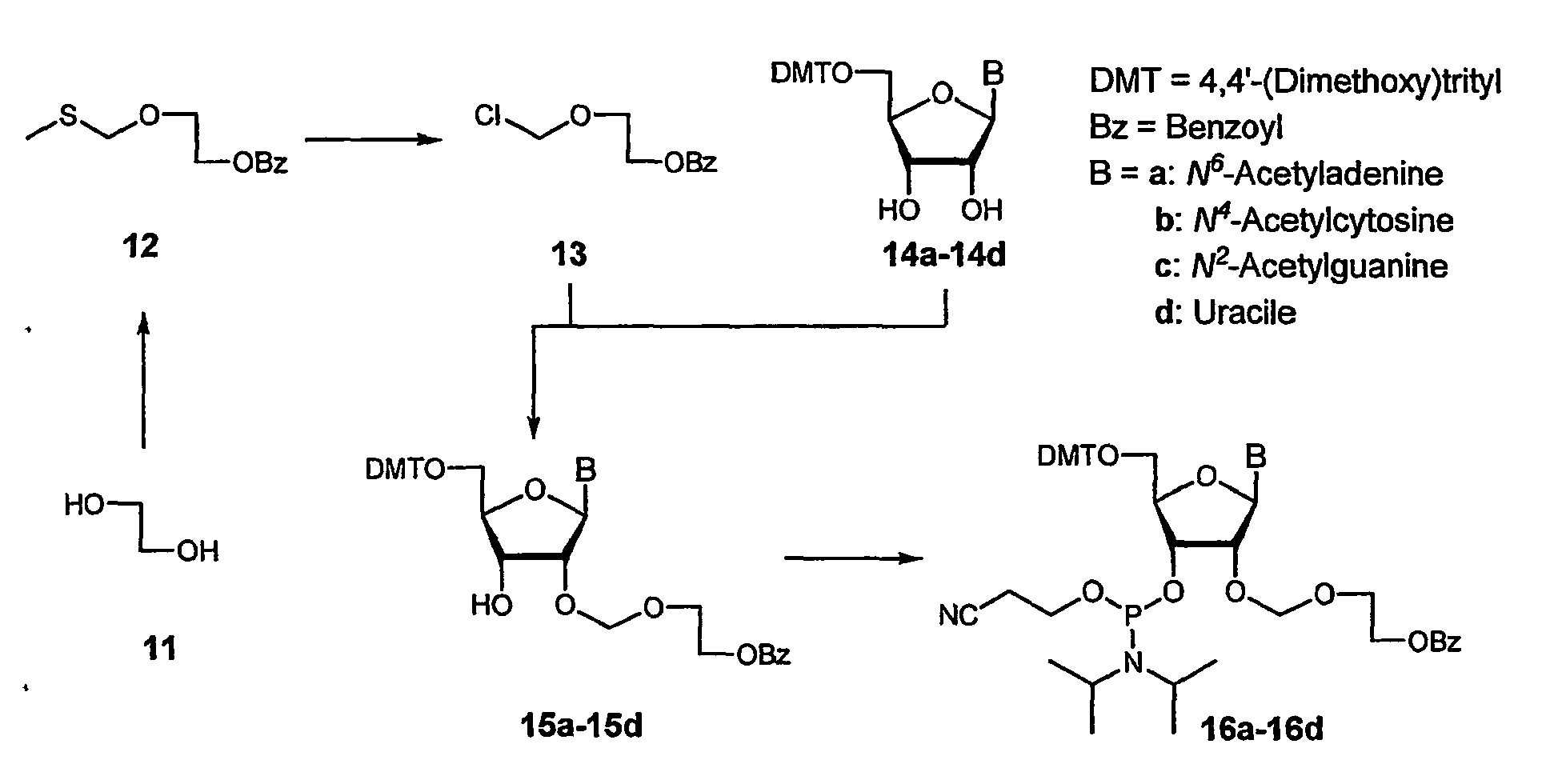
- In synthetic step 1 (11→12) one of the two hydroxyl groups of ethylene glycol 11 is protected by a suitable protective group while the second hydroxyl group is reacted to give a functional thioacetal group. In subsequent step 2 (12→13), the thioacetal group reacted to yield
chloromethylether 13. Subsequently, in step 3 (13 + 14→15a-15d), 5'-O-protected nucleosides 14a-14d (prepared according to S. Pitsch, P. A. Weiss, L. Jenny, A. Stutz, X. Wu, Helv. Chim. Acta, 2001, 84, 3773) are alkylated in the 2'-O-postion to yield 2'-O-formacetal substituted nucleosides 15a-15d. Finally, in step 4 (15a-15d→16a-16d), nucleosides 15a-15d are reacted with diisopropylphosphoramidochlorodite in the 3'-O position to yield phosphoramidites 16a-16d. - Benzoyl chloride (2.3 ml, 20 mmol) was added dropwise to a solution of ethylene glycol (2.2 ml, 40 mmol) in pyridine (80 ml). After 1h of stirring the major part of the pyridine was evaporated. After usual work up, the residue was co-evaporated with
3x 10 ml of toluene. The residue was dissolved in DMSO (20 ml), treated with AcOH (20 ml) and Ac2O (20 ml). After 1 day of stirring, the reaction mixture was poured in a well stirred mixture of 400 ml (AcOEt/Hexane 1:1) and 400 ml of H2O. The organic phase was then extracted with 400 ml of sat. NaHCO3, dried with MgSO4 and evaporated. FC (100 g of SiO2, AcOEt/hexane 5:95 to 15:85): 1 (2.47g, 55%) as colorless oil. Rf 0.58 (AcOEt/Hexane 2:8). 1H -NMR (400 MHz, CDCl3) : 2.15 (s, MeS); 3.89 (m, SCH2); 4.50 (m, CH2O); 4.71 (s, SCH2O); 7.44 (m, 2H arom.); 7.56 (m, 1H arom.); 8.06 (m, 2H arom.). MS: 249.5 (100, [M + Na]+). - At -78°, SO2Cl2 (0.39 ml, 4.9 mmol) was added dropwise to a stirred solution of 12 (1.00 g, 4.4 mmol) and cyclohexene (0.89 ml, 8.8 mmol) in CH2Cl2 (17.5 ml). After 30 min, the reaction mixture was allowed to warm up to room temperature and stirred for another 45 min. After evaporation of the solvent, the residue was dried under high vacuum for 15 min, dissolved in 1,2-dichloroethane and directly used for the alkylation reactions.
- To a solution of nucleosides 14a-d (1 eq) in 1,2-dichloroethane (0.25 M) were added successively (iPr)2NEt (3.5 eq) and Bu2SnCl2 (1.2 eq). The reaction mixtures were stirred at room temperature for 30 min, heated to 70°, treated with the chloromethylether 13 (1.2 eq) and stirred for 30 min at 70°. The reaction mixtures were then subjected to usual work up. The organic phase was filtered through Celite, dried with MgSO4 and evaporated. The residue was purified by FC.
- According to the general procedure with 14a (1.20 g, 2.0 mmol) and
crude 13. FC (25 g of SiO2, AcOEt/hexane 5:5 to AcOEt then to AcOEt/MeOH 97:3): 15a (442 mg, 27%) as white foam. Rf 0.38 (AcOEt). 1H -NMR (400 MHz, CDCl3) : 2.60 (s, MeCO); 2.90 (d, J = 5.4, HO-(C3')); 3.44 (dd, J = 4.0,10.7, H-(C5')); 3.52 (dd, J = 3.0, 10.7, H-(C5')); 3.79-3.84 (m, MeO, 1H CH2O); 3.88-3.94 (m, 1H CH2O); 4.26 (m, H-(C4'); 4.39-4.42 (m, CH2OBz); 4.57 (m, H-(C3')); 4.93-4.96 (m, OCH2O H-(C2')); 6.26 (d, J = 4.4, H-(C1')); 6.79-6.83 (m, 4H arom.); 7.20-7.44 (m, 11H arom); 7.52-7.57 (m, 1H arom); 7.99-8.02 (m, 2H arom); 8.18 (s, H-(C2)); 8.62 (s, H-(C8)); 8.82 (br, s, NHAc). MS: 789 (100, [M]+); 811 (16, [M + Na]+). - According to the general procedure with 14b (1.17 g, 2.0 mmol) and
crude 13. FC (25 g of SiO2, AcOEt/hexane 5:5 to AcOEt then to AcOEt/MeOH 97:3): 15b (680 mg, 45%) as white foam. Rf 0.57 (CH2Cl2/MeOH 9:1). 1H-NMR (400 MHz, CDCl3) : 2.21 (s, MeCO); 2.91 (d, J = 9.2, HO-(C3')); 3.50 (dd, J = 2.4, 11.2, H-(C5')); 3.55 (dd, J = 2.0, 11.3, H-(C5')); 3.81 (s, 2 MeO); 3.92 (m, CH2O) 3.99-4.08 (m, CH2O H-(C4')); 4.27 (d, J = 4.27, H-(C2')); 4.35-4.49 (m, H-(C3')); 4.47-4.50 (m, CH2OBz); 5.03, 5.22 (2d, J = 6.6, OCH2O); 5.98 (s, H-(C1')); 6.84-6.88 (m, 4H arom.); 7.08 (d, J =7.5; H-(C5)); 7.24-7.42 (m, 11H arom.); 7.49-7.53 (m, 1H arom.); 8.01-8.05 (m, 2H arom.); 8.45 (d, J = 7.5; H-(C6)); 9.18 (br, s, NHAc). MS: 765 (100, [M]+); 787 (37, [M + Na]+) 803 (20, [M + K]+). - According to the general procedure with 14c (1.25 g, 2.0 mmol) and
crude 13. FC (25 g of SiO2, AcOEt/hexane 5:5 to AcOEt then to AcOEt/MeOH 97:3): 15c (840 mg, 54%) as white foam. Rf 0.42 (CH2Cl2/MeOH 9:1). 1H -NMR (400 MHz, CDCl3) : 1.92 (s, MeCO); 3.24-3.30 (m, H-(C5'), HO-(C3'); 3.49 (dd, J = 2.1, 10.7, H-(C5')); 3.74 (s, 2 MeO); 3.86 (m, CH2O); 4.20 (m, H-(C4'); 4.40-4.55 (m, CH2OBz, H-(C3'); 4.87 (m, OCH2O, H-(C2')); 6.01 (d, J = 4.6, H-(C1')); 6.74-6.79 (m, 4H arom.); 7.14-7.54 (m, 12H arom); 7.85 (s, H-(C5)); 7.97 (m, 2H arom); 9.29 (br, s, NHAc); 12.02 (br, s H-(N1)). MS: 805 (100, [M]+); 827 (24, [M + Na]+). - According to the general procedure with 14d (1.09 g, 2.0 mmol) and
crude 13. FC (25 g of SiO2, AcOEt/hexane 2:8 to AcOEt): 15d (540 mg, 37%) as white foam. Rf 0.72 (AcOEt). 1H -NMR (400 MHz, CDCl3) :2.72 (d, J = 8.3, OH-(C3')); 3.49 (dd, J = 2.3,11.0, H-(C5')); 3.53 (dd, J = 2.2, 11.0, H-(C5')); 3.79 (s, 2 MeO); 3.90-4.05 (m, CH2O H-(C4'); 4.31 (dd, J = 2.4, 5.2, H-(C2'); 4.45-4.55 (m, CH2OBz, H-(C3'); 4.98, 5.09 (2d, J = 6.8, OCH2O) 5.29 (d, J = 8.1, H-(C5)); 6.02 (d, J = 2.4, H-(C1')); 6.85-6.89 (m, 4H arom.); 7.24-7.45 (m, 11H arom); 7.54-7.58 (m, 1H arom); 7.95 (d, J = 8.1, H-(C6)); 8.05-8.08 (m, 2H arom); 8.47 (br. s, H-(N3)). MS (Pos. Mode): 746 (100, [M + Na]+) ; 762 (13, [M + K]+) - To a solution of the nucleosides 15a-d (1 eq) in CH2Cl2 (0.25 M) were added successively (iPr)2NEt (2.5 eq) and diisopropylphosphoramidochloridite (1.2 eq). The reaction mixtures were stirred for 14 h at room temperature and subjected to FC.
- According to the general procedure with 15a (393 mg, 0.50 mmol). FC: (8 g of SiO2 AcOEt/hexane 2:8 (+2% NEt3) to AcOEt/hexane 8:2 (+2% NEt3)): 16a (390 mg, 79%) as white foam (1:1 mixture of diastereoisomers). Rf 0.70 (AcOEt). 1H -NMR (400 MHz, CDCl3 : 1.06 (d, 3H, J = 6.8, NCH(Me)2); 1.16-1.19 (m, 9H, NCH(Me)2); 2.39 (t, J =6.4, CH2CN); 2.59 (s, MeCO); 2.63 (t, J = 6.4, CH2CN); 3.37 (m, POCH2); 3.50-3.94 (m, 2H-(C5'), MeO, CH2O, NCH(Me)2, POCH2); 4.27-4.44 (m, H-(C4'), CH2OBz); 4.70 (m, H-(C3'); 4.81-4.95 (m, OCH2O); 5.11 (m, H-(C2')); 6.24, 6.26 (2d, J = 6.4, H-(C1'); 6.79-6.82 (m, 4H arom.); 7.18-7.43 (m, 11H arom); 7.52-7.56 (m, 1H arom); 7.96-7.98 (m, 2H arom); 8.18, 8.19 (2s, H-(C2)); 8.58 (br, s, NHAc); 8.60, 8.61 (2s, H-(C8)). MS: 990 (100, [M+H]+).
- According to the general procedure with 15b (579 mg, 0.76 mmol). FC: (11 g of SiO2 AcOEt/hexane 2:8 (+2% NEt3) to AcOEt/hexane 8:2 (+2% NEt3)): 16b (662 mg, 90%) as white foam (1:1 mixture of diastereoisomers). Rf 0.60 (AcOEt). ). 1H -NMR (400 MHz, CDCl3) : 1.00 (d, 3H, J = 6.8, NCH(Me)2); 1.14-1.17 (m, 9H, NCH(Me)2); 1.76, 1.85 (2s, MeCO); 2.32 (t, J =6.3, CH2CN); 2.69 (dt, J = 3.0, 6.6, CH2CN); 3.34-3.62 (m, 2H-(C5'), NCH(Me)2, 2H POCH2); 3.702, 3.712, 3.715 (3s, MeO); 3.83-4.02 (m, CH2O); 4.16-4.22 (m, H-(C4')); 4.27 (m, H-(C2'), 4.35-4.48 (m, H-(C3'), CH2OBz) 4.92-5.02 (m, OCH2O); 5.99 (s, H-(C1'); 6.73-6.78 (m, 4H arom.); 6.82, 6.90 (2d, J = 7.5, H-(C5)); 7.16-7.34 (m, 11H arom); 7.41-7.45 (m, 1H arom); 7.92-7.96 (m, 2H arom); 8.34, 8.43 (2d, J = 7.5, H-(C6)); 9.39, 9.51 (br, 2s, NHAc). MS: 966 (100, [M+H]+); 988 (25, [M+Na]+); 1005 (15, [M+K]+).
- According to the general procedure with 15c (594 mg, 0.74 mmol). FC: (8 g of SiO2 AcOEt/hexane 5:5 (+2% NEt3) to AcOEt (+2% NEt3)):16c (590 mg, 80%) as white foam (1:1 mixture of diastereoisomers). Rf 0.66 (AcOEt). 1H -NMR (400 MHz, CDCl3) :1.00 (d, J = 6.8, NCH(Me)2); 1.14-1.17 (m, NCH(Me)2); 1.76, 1.85 (2s, MeCO); 2.31 (t, J =6.3, CH2CN); 2.69 (dt, J = 2.9, 6.6, CH2CN); 3.24 (m, POCH2); 3.49-4.00 (m, 2H-(C5'), MeO, CH2O, NCH(Me)2, POCH2); 4.27 (m, 0.5 H-(C4')); 4.34-4.56 (m, 0.5 H-(C4'), 0.5 H-(C3'), CH2OBz); 4.62 (m, 0.5 H-(C3')); 4.78, 4.82, 4.85, 4.91 (4d, J = 7.1 OCH2O) 5.07 (m, H-(C2')), 5.95, 6.01 (2d, J = 5.2, 5.9, H-(C1'); 6.78-6.82 (m, 4H arom.); 7.16-7.59 (m, 13H arom); 7.864, 7.866 (2s, H-(C8)); 8.00-8.02 (m, 2H arom); 8.46, 8.76 (br, 2s, NHAc). MS: 1007 (100, [M+H]+); 1028 (11, [M+Na]+).
- According to the general procedure with 15d (497 mg, 0.69 mmol). FC: (10 g of SiO2, AcOEt/hexane 2:8 (+2% NEt3) to AcOEtfhexane 6:4 (+2% NEt3)): 16d (575 mg, 91 %) as white foam (1:1 mixture of diastereoisomers). Rf 0.87 (AcOEt). 1H -NMR (400 MHz, CDCl3) : 1.02 (d, 3H, J = 6.8, NCH(Me)2); 1.14-1.17 (m, 9H, NCH(Me)2); 2.43 (t, J =6.3, CH2CN); 2.64 (dt, J = 2.4, 6.1, CH2CN); 3.41-3.77 (m, 2H-(C5'), NCH(Me)2, 2H POCH2); 3.791, 3.800, 3.803 (3s, MeO); 3.87-4.02 (m, CH2O) 4.19-4.28 (m, H-(C4')); 4.42-4.63 (m, H-(C2'), H-(C3'), CH2OBz); 4.92, 5.03 (2d, J = 6.8, OCH2O) 4.96 (s, OCH2'O); 5.20, 5.24 (2d, J = 8.2, H-(C5)); 6.06 (d, J = 3.1, H-(C1'); 6.82-6.86 (m, 4H arom.); 7.22-7.44 (m, 11H arom); 7.53-7.58 (m, 1H arom); 7.94, 7.99 (2d, J = 8.2, H-(C6)); 8.03-8.06 (m, 2H arom); 8.33 (br, s, NHAc). MS: 925 (100, [M+H]+).
- A preferred embodiment of the synthesis of a support material comprising chemical groups according to Formulas VIIIa and/or VIIIb as defined above and in the claims is described in the following with reference to reaction scheme 3.
-

- Step1: A mixture of octane-1-ol (390 mg, 3 mmol) and para-formaldehyde (90 mg, 3 mmmol) in CH2Cl2 (11 ml) was dissolved in dichloromethane (18 ml). A flow of HCl(g) was bubbled 15 min through this reaction mixture. The resulting organic layer was separated from the aqueous layer, evaporated to dryness and finally dried 10 min under high vaccum.
- Step2: To a solution of 5'-O-(4,4'-dimethoxytrityl) uridine 1 (2g g, 3.658 mmol) in 1,2-dichloroethane (12 ml) was added Bu2SnCl2 (1.33g, 4.39 mmol) and diisopropylethylamine (2.17 ml, 13.8 mmol). The reaction mixture was stirred 15 min at room temperature and then to 70 °C. The crude product fom
step 1, dissolved in dichloromethane (3 ml), was added slowly to the previous mixture and stirred 30 min at 70°C. After workup, the two diastereoisomers 18 (1g, 40 %) and 19 (490 mg, 20% ) were separated by CC (50 g of SiO2, AcOEt/hexane 5:5 to AcOEt 100 %). Global yield: 59 %. TLC (AcOEt/hexane 95/5): Rf 0.80 (18); 0.68 (19). 1H-NMR (400 MHz, CDCl3); 18: 2.83 (d, J = 7.2, OH-(C3')); 3.52-3.68 (m, H-(C5'), H-(OCH2)n); 3.80 (s, 2 MeO); 4.11 (m, H-(C4')); 4.34 (dd, J = 3.6, 5.1, H-(C2'); 4.49 (m, H-(C3')); 4.73, 4.78 (2d, J = 6.9, OCH2O); 5.31 (d, J = 8.2, H-(C5)); 6.04 (d, J = 3.1, H-(C1')); 6.85-6.89 (m, 4H arom.); 7.24-7.45 (m, 9H arom); 7.95 (d, J = 8.2, H-(C6)); 8.23 (br. s, H-(N3)). 19: 3.39-3.60 (m, OH-(C2'), H-(C5'), H-(OCH2)n); 3.80 (s, 2 MeO); 4.26-4.36 (m, H-C(2'), H-C(3'), H-C(4')); 4.73, 4.78 (2d, J = 6.8, OCH2O) 5.37 (d, J = 8.1, H-(C5)); 5.97 (d, J = 3.1, H-(C1')); 6.85-6.89 (m, 4H arom.); 7.24-7.45 (m, 9H arom); 7.85 (d, J = 8.2, H-(C6)); 8.9 (br. s, H-(N3)). - Pimelicacid-dinitrophenylester (697 mg, 1.73 mmol) was dissolved in pyridine (2.89 ml). DMAP (17.7 mg, 0.14 mmol) and 18 or 19 (200 mg, 0.29 mmol each), respectively, were added. After stirring over night at room temperature, the mixture was evaporated and co-evaporated twice with toluene (20 ml). CC (10 g of SiO2 AcOEt/hexane 3:7 to AcOEt/hexane 6:4) gave 20 (121 mg, 46%) and 21 (118 mg, 45 %). Colorless foam. TLC (AcOEt/hexane 7:3): Rf 0.70 (20); 0.67 (21). 1H-NMR (400 MHz, CDCl3); 20: 1.46 (m, CH2); 1.70 (m, CH2); 1.77 (m. CH2); 2.42 (t, J = 7.6, CH2); 2.62 (t, J = 7.5, CH2); 3.52-3.68 (m, H-(C5'), H-(CH2)n); 3.80 (s, 2 MeO); 4.11 (m, H-(C4')); 4.34 (dd, J = 3.6, 5.1, H-(C2'); 4.49 (m, H-(C3')); 4.73, 4.78 (2d, J = 6.9, OCH2O); 5.31 (d, J = 8.2, H-(C5)); 6.04 (d, J = 3.1, H-(C1')); 6.85-6.89 (m, 4H arom.); 7.24-7.45 (m, 9H arom); 7.95 (d, J = 8.2, H-(C6)); 8.23 (br. s, H-(N3)). 21: 1.46 (m, CH2); 1.70 (m, CH2); 1.77 (m. CH2); 2.42 (t, J = 7.6, CH2); 2.62 (t, J = 7.5, CH2); H-(C5'), H-(CH2)n); 3.80 (s, 2 MeO); 4.26-4.36 (m, H-C(2'), H-C(3'), H-C(4')); 4.73, 4.78 (2d, J = 6.8, OCH2O) 5.37 (d, J = 8.1, H-(C5)); 5.97 (d, J = 3.1, H-(C1')); 6.85-6.89 (m, 4H arom.); 7.24-7.45 (m, 9H arom); 7.85 (d, J = 8.2, H-(C6)); 8.9 (br. s, H-(N3)).
- To a solution of the active ester (0.05 mmol) 20 or 21 in DMF (1.6 ml) was added long-chain-alkylamino CPG (400 g) and then iPr2NEt (0.15 ml). The mixture was shaken for 20 h at room temperature. After filtration, the
solid support 22 or 23 was washed with DMF and CH2Cl2, dried, suspended in pyridine (1 ml) and Ac2O (0.64 ml) and shaken for 2 h at room temperature. After filtration, the solid was washed with DMF and CH2Cl2, and dried under high vacuum. Typical loadings of the solid support was 30 µmol/g with 500-Å CPG. -

- In synthetic step 1 (24→25) the hydroxyl group of phthalimide derivative 24 is reacted to give a functional thioacetal group. In
subsequent step 2. the thioacetal group of 25 is reacted in situ to yield the corresponding chloromethylether. Subsequently, in step 2 (25 + 14a-d→15a-15d), 5'-O-protected nucleosides 14a-14d (prepared according to S. Pitsch, P. A. Weiss, L. Jenny, A. Stutz, X. Wu, Helv. Chim. Acta, 2001; 84, 3773) are alkylated in the 2'-O-postion to yield 2'-O-formacetal substituted nucleosides 26a-26d. Finally, in step 3 (26a-26d→27a-27d), nucleosides 26a-26d are reacted with diisopropylphosphoramidochlorodite in the 3'-O position to yield phosphoramidites 27a-27d. - 24 (9.6 g. 50 mmol) was dissolved in DMSO (75 ml), treated with AcOH (75 ml) and Ac2O (75 ml). After 2 days of stirring the reaction mixture was poured in a well stirred mixture of 400 ml (AcOEt/hexane 1:1) and 400 ml of H2O. The organic phase was then extracted with 400 ml of sat. NaHCO3, dried with MgSO4 and evaporated. The residue was dissolved in hot AcOEt (20 ml) and hexane (180 ml) was added. The mixture was stirred overnight at 4°C and the
crystalised product 25 was filtered, washed with AcOEt/Hexane 1:9, and dried under vacuum: 25 (9.3g, 74%) as a white powder. R f 0.58 (AcOEt). 1H-NMR (400 MHz, CDCl3) : 2.06 (s, MeS); 3.83, 3.84 (2t, J = 5.5, SCH2, CH2N); 4.65 (s, SCH2O); 7.73-7.75 (m, 2H arom.); 7.86-7.89 (m, 2H arom.). - To a solution of nucleosides 14a-d (1 eq) and
thiomethylether 25 in 1,2-dichloroethane (0.25 M) were added successively (iPr)2NEt (3.5 eq) and Bu2SnCl2 (1.2 eq). The reaction mixtures were stirred at room temperature for 30 min, heated to 70°, treated with N-chlorosuccinimide (2 eq) and stirred for 30 min at 70°. The reaction mixtures were then subjected to usual work up. The organic phase was filtered through Celite, dried with MgSO4 and evaporated. The residue was purified by CC. - According to general procedure with 14a (2.44 g, 4.0 mmol). CC (50 g of SiO2 AcOEt/hexane 7:3 to AcOEt then to AcOEt/MeOH 97:3): 26a (785 mg, 24%) as a foam. Rf 0.45 (AcOEt/MeOH 95:5). 1H NMR (400 MHz, CDCl3) : 2.65 (s, MeCO), 2.78 (d, J = 5.4 Hz, HO-(C3')), 3.43 (dd, J = 10.6, 4.2 Hz, H-(C5')), 3.49 (dd, J = 10.6, 3.2 Hz, H-(C5')), 3.73-3.88 (m, MeO, CH2O CH2N), 4.24 (q, J = 4.2 Hz, H-(C4'), 4.53 (q, J = 5.1 Hz, H-(C3')); 4.84-4.90 (m, OCH2O H-(C2')), 6.20 (d, J = 4.5 Hz, H-(C1')), 6.79-6.85 (m, 4H arom.), 7.21-7.34 (m, 7H arom.), 7.40-7.45 (m, 2H arom.), 7.68-7.72 (m, 2H arom.), 7.79-7.83 (m, 2H arom.), 8.18 (s, H-(C2)), 8.50 (br, s, NHAc), 8.60 (s, H-(C8)). ESI-MS (Pos. Mode): 815.4 (100, [M + H]+).
- According to general procedure with 14b (2.38 g, 4.0 mmol. CC (50 g of SiO2, AcOEt/hexane 7:3 to AcOEt then to AcOEt/MeOH 97:3): 26b (582 mg, 19%) as light yellow foam. Rf 0.43 (AcOEt/MeOH 95:5). 1H -NMR (400 MHz, CDCl3) : 2.23 (s, MeCO), 2.96 (d, J = 9.3 Hz, HO-(C3')), 3.53 (dd, J = 11.2, 2.6 Hz, H-(C5')), 3.58 (dd, J = 11.5, 2.2 Hz, H-(C5')), 3.84 (d, J = 1.0 Hz, MeO), 3.88-3.98 (m, CH2O CH2N), 4.07 (m, H-(C4')), 4.21 (d, J = 5.1 Hz, H-(C2')), 4.42 (td, J = 9.3, 5.4 Hz, H-(C3')), 4.99 (d, J = 6.7 Hz, OCH2O), 5.17 (d, J = 6.4 Hz, OCH2O). 5.94 (s, H-(C1')), 6.87-6.91 (m, 4H arom.), 7.09 (d, J = 7.5 Hz, H-(C5)), 7.26-7.37 (m, 7H arom.), 7.41-7.45 (m, 2H arom.), 7.68-7.72 (m, 2H arom.), 7.81-7.85 (m, 2H arom.), 8.46 (d, J = 7.5 Hz, H-(C6)), 9.11 (br, s, NHAc). ESI-MS (Pos. Mode): 791.3 (100, [M + H]+).
- According to general procedure with 14c (2.51 g, 4.0 mmol). CC (25 g of SiO2 AcOEt/hexane 8:2 to AcOEt then to AcOEt/MeOH 95:5): 26c (1950 mg, 60%) as yellow foam. Rf 0.38 (AcOEt/MeOH 95:5). 1H -NMR (400 MHz, CDCl3) : 1.99 (s, MeCO), 3.30 (dd, J = 10.9, 4.2 Hz, H-(C5')), 3.51 (dd, J = 10.9, 2.2 Hz, H-(C5')). 3.73-3.99 (m, MeO, CH2O, CH2N), 4.17 (m, H-(C4')), 4.45 (q, J = 5.1 Hz, H-(C3')), 4.79-4.88 (m, OCH2O, H-(C2')). 5.96 (d, J = 4.2 Hz, H-(C1')), 6.79-6.85 (m, 4H arom.), 7.19-7.38 (m, 7H arom.), 7.46-7.50 (m, 2H arom.), 7.70-7.74 (m, 2H arom.), 7.78-7.82 (m. 2H arom.), 7.86 (s, H-(C8)), 8.96 (br, s, NHAc). 12.02 (br, s H-(N1)). ESI-MS (Pos. Mode): 831.3 (100, [M + H]+).
- According to general procedure with 14d (2.18 g, 4.0 mmol). CC (55 g of SiO2, AcOEt/hexane 2:8 to AcOEt): 26d (840 mg, 28%) as white foam. Rf 0.75 (AcOEt/MeOH 95:5). 1H -NMR (400 MHz, CDCl3) : 2.75 (d, J = 7.4 Hz, OH-(C3')), 3.51 (dd, J = 11.2, 2.6 Hz, H-(C5')), 3.55 (dd, J = 11.2, 2.2 Hz, H-(C5')), 3.82 (s, MeO), 3.87-3.98 (m, CH2O, CH2N), 4.05 (m, H-(C4')), 4.24 (dd, J = 5.1, 2.6 Hz, H-(C2')), 4.44 (m, H-(C3')), 4.91 (d, J = 6.7 Hz, OCH2O), 5.00 (d, J = 6.7 Hz, OCH2O), 5.29 (dd, J = 8.3, 1.9 Hz, H-(C5)), 5.96 (d, J = 2.6 Hz, H-(C1')), 6.84-6.90 (m, 4H arom.), 7.23-7.42 (m. 9H arom.), 7.70-7.74 (m, 2H arom.), 7.83-7.87 (m, 2H arom.), 7.94 (d, J = 8.0 Hz, H-(C6)), 8.13 (br. s, H-(N3)).
- To a solution of the nucleosides 26a-d (1 eq) in CH2Cl2 (0.25 M) were added successively (iPr)2NEt (2.5 eq) and diisopropylphosphoramidochloridite (1.2 eq). The reaction mixtures were stirred for 14 h at room temperature and subjected to CC.
- According to general procedure with 26a (870 mg, 1.07 mmol). CC: (17 g of SiO2, AcOEt/hexane 2:8 (+2% NEt3) to AcOEt (+2% NEt3)): 27a (970 mg, 89%) as white foam (1:1 mixture of diastereoisomers). Rf 0.50 (AcOEt). 1H -NMR (400 MHz, CDCl3) 1.07 (d, J = 6.7 Hz, NCH(Me)2), 1.16-1.20 (m, NCH(Me)2), 2.40 (t, J = 6.4 Hz, CH2CN), 2.63-2.69 (m, CH2CN, MeCO), 3.36 (m, 1H POCH2), 3.49-3.97 (m, 2H-(C5'), MeO, CH2N, CH2O, 1H POCH2), 4.36 (m, H-(C4')), 4.69 (m, H-(C3')), 4.76 (d, J = 7.0 Hz, 1H OCH2O) 4.80 (d, J = 7.0 Hz, 0.5H OCH2O), 4.87 (d, J = 6.7 Hz, 0.5H OCH2O), 5.08 (m, H-(C2')), 6.19 (d, J = 5.1 Hz, 0.5H H-(C1')), 6.22 (d, J = 4.8 Hz, 0.5H H-(C1')), 6.78-6.83 (m, 4H arom.), 7.19-7.44 (m, 9H arom.), 7.68-7.74 (m, 2H arom.), 7.77-7.83 (m, 2H arom.), 8.22 (s, H-(C2)), 8.50 (br, s, NHAc), 8.60 (s, H-(C8)). 31P -NMR (161 MHz, CDCl3) : 151.67; 151.77. ESI MS (Pos. Mode): 1015.37 (100, [M + H]+)
- According to general procedure with 26b (550 mg, 0.70 mmol). CC: (11 g of SiO2, AcOEt/hexane 2:8 (+2% NEt3) to AcOEt/hexane 8:2 (+2% NEt3)): 27b (540 mg, 78%) as white foam (1:1 mixture of diastereoisomers). Rf 0.43 (AcOEt). ). 1H -NMR (400 MHz, CDCl3) : 0.99 (d, J = 7.0 Hz, NCH(Me)2), 1.11 (d, J = 6.7 Hz, NCH(Me)2), 1.12 (d, J = 7.0 Hz, NCH(Me)2), 1.16 (d, J = 6.7 Hz, NCH(Me)2), 2.22, 2.23 (2s, MeCO), 2.43 (t, J = 6.4 Hz, CH2CN), 2.66 (m, CH2CN), 3.42-3.78 (m, 2H-(C5'), NCH(Me)2, 2H POCH2), 3.79-4.07 (m, MeO, CH2N, CH2O), 4.24-4.38 (m, H-(C4'), H-(C2')), 4.49 (m, H-(C3')), 4.95 (d, J = 6.7 Hz, 0.5H OCH2O), 4.97 (d, J = 6.7 Hz, 0.5H OCH2O 5.02 (d, J = 6.7 Hz, 0.5H OCH2O), 5.02 (d, J = 6.4 Hz, 0.5H OCH2O), 6.05 (d, J = 1.0 Hz, 0.5H H-(C1')), 6.06 (d, J = 1.3 Hz, 0.5H H-(C1')), 6.85-6.90 (m, 4H arom.), 6.92 (d, J = 7.7 Hz, 0.5H H-(C5)), 7.00 (d, J = 7.7 Hz, 0.5H H-(C5)), 7.26-7.46 (m, 9H arom.), 7.68-7.73 (m, 2H arom.), 7.82-7.86 (m, 2H arom.), 8.44 (d, J = 7.4 Hz, 0.5H H-(C6)), 8.50 (d, J = 7.4 Hz, 0.5H H-(C6)). 8.94, 9.07 (br, 2s, NHAc). 31P-NMR (161 MHz, CDCl3) : 150.88; 152.42. MALDI-TOF MS (Pos. Mode): 1013.9 (100, [M + Na]+) ; 1029.9 (49, [M + K]+
- According to general procedure with 26c (1940 mg, 2.33 mmol). CC: (35 g of SiO2, AcOEt/hexane 5:5 (+2% NEt3) to AcOEt (+2% NEt3)): 276c (1810 mg, 80%) as white foam (1:1 mixtures of diastereoisomers). Rf 0.44 (AcOEt). 1H -NMR (400 MHz, CDCl3) : 1.00 (d, J = 7.0 Hz, NCH(Me)2), 1.15 (d, J = 6.7 Hz, NCH(Me)2), 1.15 (d, J = 6.7 Hz, NCH(Me)2), 1.87, 1.96 (2s, MeCO), 2.32 (t, J = 6.1 Hz, CH2CN), 2.68 (td, J = 6.4, 2.2 Hz, CH2CN), 3.27 (m, 1H POCH2), 3.48-3.99 (m, 1H POCH2, 2H-(C5'), MeO, CH2O, CH2N, NCH(Me)2), 4.30 (m, H-(C4')), 4.51 (m, 0.5 H-(C3')), 4.61 (m, 0.5 H-(C3')), 4.73-4.82 (m, 1.5H OCH2O), 4.89 (d, J = 7.0 Hz, 0.5H, OCH2O) 4.97 (m, H-(C2')), 5.93 (d, J = 4.5 Hz, 0.5H H-(C1')), 5.98 (d, J = 5.1 Hz, 0.5H H-(C1')), 6.79-6.86 (m, 4H arom.), 7.19-7.55 (m, 9H arom.), 7.70-7.77 (m, 2H arom.), 7.79-7.84 (m, 2H arom.), 7.88, 7.91 (2 s, H-(C8)), 8.62, 8.87 (br, 2s, NHAc), 11.93 (br, s, H-(N1)). 31P -NMR (161 MHz, CDCl3) : 150.93; 151.60. MALDI-TOF MS (Pos. Mode): 1031.9 (57, [M + Na]+) 1053.9 (100, [M + Na]+) ; 1069.9 (53, [M + K]+).
- According to general procedure with 26d (473 mg, 0.63 mmol). CC: (10 g of SiO2, AcOEt/hexane 2:8 (+2% NEt3) to AcOEt/hexane 9:1 (+2% NEt3)): 27d (446 mg, 75%) as white foam (1:1 mixture of diastereoisomers). Rf 0.80 (AcOEt). 1H -NMR (400 MHz, CDCl3) : 1.02 (d, J = 6.7 Hz, NCH(Me)2), 1.13-1.18 (m, NCH(Me)2), 2.44 (t, J = 6.1 Hz, CH2CN), 2.70 (m, CH2CN), 3.39-3.84 (m, POCH2, 2H-(C5'), MeO, NCH(Me)2), 3.88-4.01 (m, CH2O, CH2N), 4.20 (m, H-(C4')), 4.40 (m, H-(C2')), 4.55 (m, H-(C3')), 4.83 (d, J = 6.7 Hz, 0.5H OCH2O), 4.87 (s, 1H OCH2O), 4.99 (d, J = 6.7 Hz, 0.5H OCH2O), 5.21 (d, J = 8.3 Hz, 0.5H H-(C5)), 5.28 (d, J = 8.3 Hz, 0.5H H-(C5)), 6.01 (d, J = 3.2 Hz, 0.5H H-(C1')), 6.03 (d, J = 3.5 Hz, 0.5H H-(C1')), 6.83-6.88 (m, 4H arom.), 7.23-7.43 (m, 9H arom.), 7.71-7.76 (m, 2H arom.), 7.83-7.87 (m, 2H arom.), 7.91 (d, J = 8.3 Hz, 0.5H H-(C6)), 7.94 (d, J = 8.3 Hz, 0.5H H-(C6)), 8.09 (br, s, H-(N3)). 31P -NMR (161 MHz, CDCl3) : 151.14; 152.27. MALDI-TOF MS (Pos. Mode): 972.7 (85, [M + Na]+) ; 988.8 (100, [M + K]+).
- The RNA oligonucleotides were prepared using a Gene Assembler Plus (Pharmacia) with 40 mg of solid support (either conventional solid supports or solid supports according to the present invention) (
loading 30 µmol/g) and 2'-O-tom-protected ribonucleoside phosphoramidites, DNA phosphoramidites (obtained from the Glen Research Corporation, Sterling, VA, USA), 2'OMe ribonculesoide phosphoramidites (obtained from the Glen Research Corporation, Sterling, VA, USA) or phosphoramidites according to the present invention utilizing standard procedures as for instance outlined by S. Pitsch, P. A. Weiss, L. Jenny, A. Stutz, X. Wu, Helv. Chim. Acta 2001, 84, 3773. The selection of the solid supports and the selection of the respective phosphoramidites used in the syntheses depend on the nature of the modification of the RNA oligonucleotides. Additionally used modifications in the nucleosides included 2'-deoxy-modified nucleotides, 2'-methoxy-modified nucleotides as well as nucleotides comprising in the 3'-position a -O-CH2-O-(CH2)7-CH3 group. An example of such a modified nucleotide is shown below in Formula IV.
- The solid support was subsequently removed from the cartridge and treated with a 1:1 mixture of 12 M MeNH2 in H2O and 8 M MeNH2 in EtOH (1 ml) for 5 h at 35 °C. By centrifugation, the supernatent solution was separated from the solid support and evaporated, and the residue was dissolved in 1 M Bu4NF-3H2O soln. in THF (1 ml). After 14 h at 25°C, 1 M Tris.HCl buffer (pH 7.4, 1ml) was added. The solution was concentrated to 1ml and desalted on NAP-10 column (Pharmacia) according to the manufacturer's instructions. The crude RNA sequence was purified by AE-HPLC (20-60 % B in A, see below, in 45 min, 3 injections). The fractions containing the pure sequence were pooled (30 ml), treated with 1 M aqueous Et3N. AcOH (pH 7, 5 ml) and applied to Sepak cartridges (Waters). After elution of the salts with 0.1 M aqueous Et3N.AcOH (
pH 7, 10 ml), followed by H2O (20 ml), the sequences was eluted with MeCN/H2O 1:1 (5 ml) and finally evaporated to dryness. The residue was redissolved in 1ml water, quantified and analysed by MALDI TOF MS. - For an example of a RNA oligonucleotide according of the present invention
Figure 1 demonstrates different purification steps of the RNA oligonucleotide. - The two single strands (sense and antisense strand) in H2O were mixed in a 1:1 ratio (total double strand concentration ca. 20 nmol), heated 1 min. to 80°C and slowly cooled to 25°C. After lyophilization, the duplex was dissolved in 50 µl, mixed with 50 µl formamide blue (10 ml formamide, 200 µl 0.5M EDTA, bromphenol blue) and then subjected to a polyacrylamid gel electrophoresis. (12 % acrylamide, 1:40 bisacrylamide, 250 V). After UV revelation the duplex was separated from the gel in a electrolution cell (45 min, 70 V). The crude product was purified by AE-HPLC (20-60 % B in A, see below, in 25 min, 1 injection). The fractions containing the pure duplex were pooled, treated with 1 M aqueous Et3N. AcOH (pH 7) and applied to Sepak cartridges (Waters). After elution of the salts with 0.1 M aqueous Et3N.AcOH (pH 7; 10 ml), followed by H2O (20 ml), the duplex was eluted with MeCN/H2O 1:1 (5 ml) and finally evaporated to dryness.
- 2 µg siRNA were incubated at 37 °C in 300 µl DMEM/10 % FCS (Dulbecco's Modified Eagle Medium (D-MEM) (1X), Invitrogen-GIBCO). The resulting mixture was analyzed on AE-HPLC (20-60 % B in A, see below, in 25 min, 1 injections) at
t - 3 µg siRNA were pipetted in 100
µl 100 % human serum. The siRNA was incubated in serum at 37°C and atdifferent time points 25 µl aliquots were collected and frozen until analysis. - 2 µg siRNA were incubated for 15 min with RNAiFect (obtained from QIAGEN GmbH. Hilden, Germany) in 1:6 ratio (µg siRNA : µl transfection reagent) to form transfections complexes at real transfection conditions. After complex formation the mixture was pipetted in 300 µl cell culture medium with 10 % FCS (fetal calf serum). The transfection complexes were incubated at normal cell growth conditions (i.e. 37°C, 5 % CO2) and at different time points aliquots were collected and frozen until analysis.
- 12% PAA-TBE mini gels (Mini-PROTEAN 3 Electrophoresis System, from Bio-Rad) were used for analysis of the treated siRNAs. 11 µl of each aliquot were mixed with 4 µl Loading Buffer (2.5xTBE, 50 % Formamid, Orange G, 20 % Glycerol) and loaded onto the gel. The samples were separated for 2,5 h at 100 V.
- HPLC analysis was performed under denaturing conditions using the following protocol:
- Column:
DNAPac PA100 Analytical, 4*250 mm - Eluants:
- A: 0.0 M NaClO4, 5 M urea, 12.5 mM Tris HCl (pH= 7.4), final volume: 1 1 (Aqua Braun H2O)
- B: 0.5 M NaClO4, 5 M urea, 12.5 mM Tris HCl (pH= 7.4), final volume: 11 (H2O)
- Gradient: linear gradient from 20 to 60 % B in A
- Time: 25 min.
- Flow rate: 1 ml/min
- Temperature: 80 to 85°C
- Inject volume: 500 µl (300 µl sample + 200 µl buffer A)
- Column wash: 20 % MeOH, 50 mM NH4Cl, final volume: 11 H2O
- Column Storage: 20 % MeOH, 50 mM NH4Cl, final volume: 11 H2O
- The following is a brief description of the drawings:
- Fig. 1
- shows the purification steps of an RNA oligonucleotide according to the present invention;
- Fig. 2
- shows the gene silencing efficiency in HeLAS3 cells transfected with 100 nM modified siRNAs according to the present invention (Examples 1 to 95), 48 h after the transfection;
- Fig. 3
- shows the gene silencing efficiency in HeLAS3 cells transfected with 100 pM modified siRNAs according to the present invention (Examples 27, 30, 33, 35, 43, and 53), with HiPerFect being used as a transfection reagent;
- Fig. 4
- shows the gene silencing efficiency in different cell types (HeLaS3, MCF7, and T98G) transfected with different amounts of modified siRNA according to the present invention (100 nM, 25 nM, 10 nM, 5 nM);
- Fig. 5
- shows the gene silencing efficiency of low performance siRNA compared to modified siRNA according to the present invention (Examples 27 and 30) at different concentrations (100 pM, 1 nM, 5 nM);
- Fig. 6
- shows the gene silencing efficiency in HeLaS3 cells transfected with 100 nM modified siRNA according to the present invention and of T98G cells transfected with 10 nM modified siRNA according to the present invention after 2 days and 6 days, respectively;
- Fig. 7
- shows the gene silencing efficiency in HeLaS3 cells transfected with 100 pM and 50 pM modified siRNA according to the present invention, respectively, with HiPerFect being used as a transfection reagent;
- Fig. 8
- shows the HPLC spectrum of siRNA modified according to the present invention, incubated in medium with 10 % serum (Example 58);
- Fig. 9
- shows the stability of siRNA (non-modified versus modified according to the present invention) over 72 h; from which it is evident that transfection agents can only slightly prevent the degradation of non-modified siRNA;
- Fig. 10
- shows a PAGE which shows that modified siRNAs are stable in 100% human serum for at least 8h, while non-modified siRNA is degraded within minutes.
- The siRNA molecules tested did predominantly comprise 19 nt as the core sequence. In the following Table 1, the core sequence is given between the two straight lines. Left and right of the two straight lines, the 3'- and 5' overhangs are indicated. Moreover, the Table indicates the strand name and the name of the siRNA duplex. The sense strand of each paragraph forms a duplex with one of the antisense strands of the same paragraph. The top row of each paragraph denotes the sense strand (e.g. J8-S, MAPK2S etc.), and the further rows of each paragraph represent the antisense strands (e.g. J8-AS, MAPK2AS etc.). The siRNA duplex name is abbreviated with "
exp 1" to "exp 95". The following further symbols are used in Table 1: - A, C, G, U: nucleotides with nucleobases adenine, cytosine, guanine, uracil
- dA, dC, dG, dT, dU: 2'-deoxy-modified nucleotides
- mA, mC, mG, mT, mU: 2'-methoxy-modified nucleotides
- U3'^5'U: 3'to 5'formacetal linkage
- u2'^5'U: 2'to 5'formacetal linkage
- Ac2, Cc2, Gc2, Tc2, Uc2: 2'-hydroxyethylmethyl-modified nucleotides
- Uc8: 3'-octyloxymethylmodified nucleotides
- MAPK2S and MAPK2AS: nonmodified MAPK2 sense and antisense respectively
- U3'^5'U represents a 3' to 5' formacetal linkage as shown below in formula A:

- u2'^5' represents a 2' to 5' formacetal linkage as shown below in formula B:

- Ac2, Cc2, Gc2, Tc2, Uc2 represent 2'-hydroxyethylmethyl- modified nucleotides according to formula C shown below:

- Uc8 represents 3'-octyloxymethyl modified nucleotides according to formula D shown below:
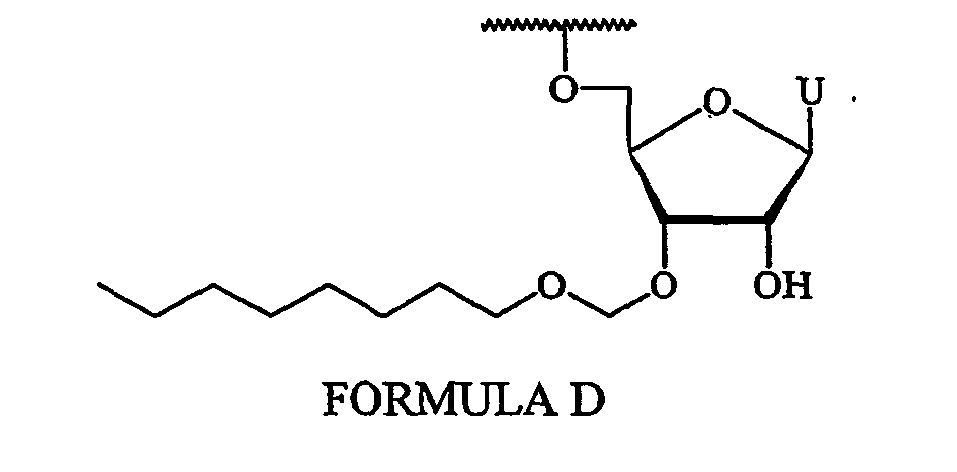
- The compound according to formula D is connected via a phosphodiester to the 5`-oxygen of the nucleoside
Table 1 overhang core sequence overhang strand name siRNA duplex name SEQ ID* 5'- U G C U G A C U C C A A A G C U C U G U3'^5'U -3' J8-S 1 (s/m1)) 3'- U3'^5'U A C G A C U G A G G U U U C G A G A C -5' J8-AS exp 2 1 (a/m2) 3'- dU dU A C G A C U G A G G U U U C G A G A C -5' MAPK2AS exp 5 1 (a/m3) 5'- U G C U G A C U C C A A A G C U C U G U2'^5'U -3' J7-S 1 (s/m4) 3'- U2'^5'U A C G A C U G A G G U U U C G A G A C -5' J7-A MAPK2A exp 1 1 (a/m5) 3'- dU dU A C G A C U G A G G U U U C G A G A C -5' S exp 3 1 (a/m6) 5'- U G C U G A C U C C A A A G C U C U G dU dU -3' MAPK2S 1 (s/m7) 3'- U2'^5'U A C G A C U G A G G U U U C G A G A C -5' J7-AS exp 4 1 (a/m8) 3'- U3'^5'U A C G A C U G A G G U U U C G A G A C -5' J8-AS exp 6 1 (a/m9) 3'- U3'^5'U mA C G A C U G A G G U U U C G A G A C -5' J9-AS exp 9 1 (a/m10) 5'- U G C U G A C U C C A A A G C U C U G U3'^5'U -3' J9-S 1 (s/m11) 3'- U3'^5'U mA C G A C U G A G G U U U C G A G A C -5' J9-AS MAPK2A exp 7 1 (a/m12) 3'- dU dU A C G A C U G A G G U U U C G A G A C -5' S exp 8 1 (a/m13) 5'- mA mA U G C U G A C U C C A A A G C U C U G U3'^5'U -3' J10-S 1 (s/m14) 3'- U3'^5'U A C G A C U G A G G U U U C G A G A C -5' J8-AS exp 10 1 (a/m15) 3'- mU mU A C G A C U G A G G U U U C G A G A C -5' J 15-AS exp 11 1 (a/m16) 3'- mU U A C G A C U G A G G U U U C G A G A C -5' J16-AS MAPK2A exp 12 1 (a/m17) 3'- dU dU A C G A C U G A G G U U U C G A G A C -5' S exp 13 1 (a/m17) 5'- mA mA U G C U G A C U C C A A A G C U C U mG U3'^5'U -3' J13-S 1(s/m18) 3'- U3'^5'U A C G A C U G A G G u U U C G A G A C -5' J8-AS exp 14 1(a/m19) 3'- mU mU A C G A C U G A G G u U U C G A G A C -5' J15-AS exp 15 1(a/m20) 3'- mU U A C G A C U G A G G u U U C G A G A C -5' J16-AS MAPK2A exp 16 1(a/m21) 1(a/m22) 3'- dU dU A C G A C U G A G G U U U C G A G A C -5' S exp 17 5'- mA mA U G C U G A C U C C A A A G C U C U mG mU mU -3' J11-S 1(s/m23) 3'- U3'^5'U A C G A C U G A G G U U U C G A G A C -5' J8-AS exp 18 1(a/m24) 3'- mU mU A C G A C U G A G G U U U C G A G A C -5' J15-AS exp 19 1(a/m25) 3'- mU U A C G A C U G A G G U U U C G A G A C -5' J16-AS MAPK2A exp 20 1(a/m26) 1(a/m27) 3'- dU dU A C G A C U G A G G U U U C G A G A C -5' S exp 21 5'- mA mA U G C U G A C U C C A A A G C U C U mG mU mU -3' J17-S 1(s/m28) 3'- U3'^5'U A C G A C U G A G G U U U C G A G A C -5' J8-AS exp 22 1(a/m29) 3'- mU mU A C G A C U G A G G U U U C G A G A C -5' J15-AS exp 23 1(a/m30) 3'- mU U A C G A C U G A G G U U U C G A G A C -5' J16-AS MAPK2A exp 24 1(a/m31) 1(a/m32) 3'- dU dU A C G A C U G A G G U U U C G A G A C -5' S exp 25 5'- mA mA U G C U G A C U C C A A A G C dU dC dU mG U3'^5'U -3' J18-S 1(s/m33) 3'- U3'^5'U A C G A C U G A G G U U U C G A G A mC -5' J22-AS exp 26 1(a/m34) 3'- U3'^5'U A C G A C U G A G G U U U C G A G A dC -5' J23-AS exp 27 1(a/m35) 3'- U3'^5'U A C G A C U G A G G U U U C G dA dG dA dC -5' J26-AS exp 28 1(a/m36) 3'- mU mU A C G A C U G A G G U U U C G A G A mC -5' J27-AS exp 29 1(a/m37) 3'- mU mU A C G A C U G A G G U U U C G A G A dC -5' J28-AS exp 30 1(a/m38) 3'- mU mU A C G A C U G A G G U U U C G dA dG dA dC -5' J29-AS exp 31 1(a/m39) 3'- Uc8 mU A C G A C U G A G G U U U C G A G A mC -5' J24-AS exp 32 1(a/m40) 3'- Uc8 mU A C G A C U G A G G U U U C G A G A dC -5' J25-AS exp 33 1(a/m41) 5'- dA dA U G C U G A C U C C A A A G C dU dC dU mG U3'^5'U -3' J19-S 1(s/m42) 3'- U3'^5'U A C G A C U G A G G U U U C G A G A mC -5' J22-AS exp 34 1(a/m43) 3'- U3'^5'U A C G A C U G A G G U U U C G A G A dC -5' J23-AS exp 43 1(a/m44) 3'- U3'^5'U A C G A C U G A G G U U U C G dA dG dA dC -5' J26-AS exp 38 1(a/m45) 3'- mU mU A C G A C U G A G G U U U C G A G A mC -5' J27-AS exp 39 1(a/m46) 3'- mU mU A C G A C U G A G G U U U C G A G A dC -5' J28-AS exp 40 1(a/m47) 3'- mU mU A C G A C U G A G G U U U C G dA A dG G dA A dC mC -5' J29-AS J24-AS exp 41 exp 51 1(a/m48) 1(a/m49) 3'- Uc8 mU A C G A C U G A G G U 1(a/m 50) 3'- Uc8 mU A C G A C U G A G G U U U C G A G A dC -5' J25-AS exp 37 5'- mA mA U G C U G A C U C C A A A G C dU dC dU dG U3'^5'U -3' J20-S 1(s/m51) 3'- U3'^5'U A C G A C U G A G G U U U C G A G A mC -5' J22-AS exp 42 1(a/m52) 3'- U3'^5'U A C G A C U G A G G U U U C G A G A dC -5' J23-AS exp 35 1(a/m53) 3'- U3'^5'U A C G A C U G A G G U U U C G dA dG dA dC -5' J26-AS exp 46 1(a/m54) 3'- mU mU A C G A C U G A G G U U U C G A G A mC -5' J27-AS exp 47 1(a/m55) 3'- mU mU A C G A C U G A G G U U U C G A G A dC -5' J28-AS exp 48 1(a/m56) 3'- mU mU A C G A C U G A G G U U U C G dA dG dA dC -5' J29-AS exp 49 1(a/m57) 3'- Uc8 mU A C G A C U G A G G U U U C G A G A mC -5' J24-AS exp 44 1(a/m58) 3'- Uc8 mU A C G A C U G A G G U U U C G A G A dC -5' J25-AS exp 45 1(a/m59) 5'- dA dA U G C U G A C U C C A A A G C dU dC dU dG U3'^5'U -3' J21-S 1(s/m60) 3'- U3'^5'U A C G A C U G A G G U U U C G A G A mC -5' J22-AS exp 50 1(a/m61) 3'- U3'^5'U A C G A C U G A G G U U U C G A G A dC -5' J23-AS exp 36 1(a/m62) 3'- U3'^5'U A C G A C U G A G G U U U C G dA dG dA dC -5' J26-AS exp 54 1(a/m62) 3'- mU mU A C G A C U G A G G U U U C G A G A mC -5' J27-AS exp 55 1(a/m63) 3'- mU mU A C G A C U G A G G U U U C G A G A dC -5' J28-AS exp 56 1(a/m64) 1(a/m65) 3'- mU mU A C G A C U G A G G U U U C G dA dG dA dC -5' J29-AS exp 57 3'- Uc8 mU A C G A C U G A G G U U U C G A G A mC -5' J24-AS exp 52 1(a/m66) 3'- Uc8 mU A C G A C U G A G G U U U C G A G A dC -5' J25-AS exp 53 1(a/m67) 5'- mA mA U G C U G A C U C C A A A G C U C mU mG U3'^5'U -3' J30-S 1(s/m68) 3'- U3'^5'U A C G A C U G A G G U U U C G A G A mC -5' J22-AS exp 58 1(a/m69) 3'- mU mU A C G A C U G A G G U U U C G A G A mC -5' J27-AS exp 59 1(a/m70) 3'- mU mU A C G A C U G A G G U U U C G A G mA mC -5' J35-AS exp 60 1(a/m71) 3'- U3'^5'U A C G A C U G A G G U U U C G A G mA mC -5' J36-AS exp 73 1(a/m72) 3'- U3'^5'U mA C G A C U G A G G U U U C G A G A mC -5' J37-AS exp 74 1(a/m73) 3'- U3'^5'U mA C G A C U G A G G U U U C G A G mA mC -5' J38-AS exp 75 1(a/m74) 5'- mA mA dU dG dC dU dG dA dC dU dC dC dA dA dA dG dC dU dC mU mG U3'^5'U -3' J31-S 1(s/m75) 3'- U3'^5'U A C G A C U G A G G U U U C G A G A mC -5' J22-AS exp 61 1(a/m76) 3'- mU mU A C G A C U G A G G U U U C G A G A mC -5' J27-AS exp 62 1(a/m71) 3'- mU mU A C G A C U G A G G U U U C G A G mA mC -5' J35-AS exp 63 1(a/m78) 5'- mA mA mU dG dC dU dG dA dC dU dC dC dA dA dA dG dC dU mC mU mG U3'^5'U -3' J32-S 1(a/m79) 3'- U3'^5'U A C G A C U G A G G U U U C G A G A mC -5' J22-AS exp 64 1(a/m80) 3'- mU mU A C G A C U G A G G U U U C G A G A mC -5' J27-AS exp 65 1(a/m81) 3'- mU mU A C G A C U G A G G U U U C G A G mA mC -5' J35-AS exp 66 1(a/m82) 5'- mA mA dU dG dC dU dG dA dC dU dC dC dA dA dA dG dC dU mC mU mG U3'^5'U -3' J33-S 1(s/m83) 3'- U3'^5'U A C G A C U G A G G U U U C G A G A mC -5' J22-AS exp 67 1(a/m84) 3'- mU mU A C G A C U G A G G U U U C G A G A mC -5' J27-AS exp 68 1(a/m85) 3'- mU mU A C G A C U G A G G U U U C G A G mA mC -5' J35-AS exp 69 1(a/m86) 5'- mA mA mU dG dC dU dG dA dC dU dC dC dA dA dA dG dC dU dC mU mG U3'^5'U -3' J34-S 1(s/m87) 3'- U3'^5'U A C G A C U G A G G U U U C G A G A mC -5' J22-AS exp 70 1(a/m88) 3'- mU mU A C G A C U G A G G U U U C G A G A mC -5' J27-AS exp 71 1(a/m89) 3'- mU mU A C G A C U G A G G U U U C G A G mA mC -5' J35-AS exp 72 1(a/m90) 5'- mA mA U G C U G A C U C C A A A G C Uc2 Cc2 Uc2 Gc2 U3'^5'U -3' J47-S 1(s/m91) 3'- U3'^5'U A C G A C U G A G G U U U C G A G A Cc2 -5' J49-AS exp 88 1(a/m92) 3'- U3'^5'U A C G A C U G A G G U U U C G A G A dC -5' J23-AS exp 90 1(a/m93) 3'- U3'^5'U mA C G A C U G A G G U U U C G A G A dC -5' J46-AS exp 94 1(a/m94) 5'- mA mA U G C U G A C U C C A A A G C Uc2 Cc2 Uc2 mG U3'^5'U -3' J48-S 1(s/m95) 3'- U3'^5'U A C G A C U G A G G U U U C G A G A Cc2 -5' J49-AS exp 89 1(a/m96) 3'- U3'^5'U A C G A C U G A G G U U U C G A G A dC -5' J23-AS exp 91 1(a/m97) 3'- U3'^5'U mA C G A C U G A G G U U U C G A G A dC -5' J46-AS exp 95 1(a/m98) 5'- dA dA U G C U G A C U C C A A A G C dU dC dU dG U3'^5'U -3' J45-S 1(s/m97) 3'- U3'^5'U mA C G A C U G A G G U U U C G A G A dC -5' J46-AS exp 92 1(a/m98) 3'- U3'^5'U A C G A C U G A G G U U U C G A G A dC -5' J23-AS exp 93 1(a/m99) *: SEQ ID: In this field, the number in front of the parenthesis indicates the SEQ ID NO as listed in field <210> of the sequence listing. The letters "s" or "a" indicate whether the strand is a sense strand (s) or the respective antisense strand (a). The letter "m" in combination with the respective number represents a consecutive numbering of the respective modification of this sense or antisense strand as outlined in field <223> of the sequence listing. - From Table 1, the modifications of siRNA duplexes can be seen. Long chains or other major modification, for example a 2'-acetal modification (modification (d)), on the 5'-end of the antisense strand, are not tolerated by the siRNA. On the 5'end of sense strand, any kind of modification has been tolerated. On the 3'end of the sense and the antisense strand, all kinds of modifications (a) to (e) were also tolerated. Deoxy-modifications on the whole sense strand in combination with the methoxy-modifications on 5'- and 3'-end of this strand (see e.g. Exp. 61- 72) can lead to siRNA inactivation. One or more methoxy modification(s) of the 5'-end of the antisense strand in combination with methoxy-modification(s) on the 3'-end of the antisense strand can decrease siRNA activity (see Exp. 60, Exp. 73-75).
- While Table 1 refers to siRNA sequences for the target MAPK2, Table 2 shows siRNA sequences for the targets Lamin AC and CDC2, respectively. Otherwise, what was said with regard to Table 1, also applies to Table 2.
Table 2 siRNA sequences for the targets Lamin AC and CDC2. overhang core sequence overhang strand name siRNA duplex name SEQ ID* 5'- mA mA C U G G A C U U C C A G A A G dA dA dC mA U3'^5'U -3' J45-S 2(s/m1) 3'- U3'^5'U G A C C U G A A G G U C U U C U U G dU -5' J46-AS Lamin exp27 Lamin 2(a/m2) 3'- mU mU G A C C U G A A G G U C U U C U U G dU -5' J23-AS exp30 2(a/m3) 5'- mU mG G G G U C A G C U C G U U A C dU dC dA mA U3'^5'U -3' J45-S 3(s/m1) 3'- mA mC C C C A G U C G A G C A A U G A G U dU -5' J46-AS 3CDC2 exp30 3(a(m2) 5'- mU mG G G G A C A C C U C G U A A C dU dC dA mA U3'^5'U -3' J45-S 4(s/m1) 3'- mA mC C C C U G U G G A G C A U U G A G U dU -5' J46-AS 3CDC2 mut3 exp30 4(a/m2) 5'- mA mA U G G C A C U G A A U C A U C dC dA dU mA U3'^5'U -3' J45-S 5(s/m1) 3'- U3'^5'U A C C G U G A C U U A G U A G G U A dU -5' J46-AS 1CDC2 exp27 5(a/m2) 3'- mU mU A C C G U G A C U U A G U A G G U A dU -5' J23-AS 1CDC2 exp30 5(a/m3) *: SEQ ID: In this field, the number in front of the parenthesis indicates the SEQ ID NO as listed in field <210> of the sequence listing. The letters "s" or "a" indicate whether the strand is a sense strand (s) or the respective antisense strand (a). The letter "m" in combination with the respective number represents a consecutive numbering of the respective modification of this sense or antisense strand as outlined in field <223> of the sequence listing. - With the modified siRNA molecules (
exp 1 to exp 95), tests were carried out to determine their ability to perform RNAinterference (RNAi). The ability of siRNA coupled with peptide sequences to induce silencing of the corresponding gene was tested compared to standard siRNA transfections using reagents based on the lipid technology. For this purpose LaminA/C, MAPK2/ERK2 (NM_002745.2), and CDC2 (NM_001786) genes were used as target to perform the silencing experiments. LaminA/C-, MAPK2(ERK2)-, and CDC2-siRNAs were modified and transfected to different cells lines. The silencing results were compared to silencing effects induced by the corresponding non-modified siRNAs. Further controls were non-treated cells and cells transfected with non-specific siRNA (GFP22). - The following cell lines were used for the transfections: Human cervix carcinoma; HeLaS3, human breast carcinoma; MCF7, human glioblastoma; T98G, Human embryonic kidney; 293 cell-Line.
Fig. 2 shows the transfection of HeLAS3 cells with 100 nM modified siRNAs 48 hours after transfection (RNAiFect® was used). - The culture conditions prior to transfection were as follows. 24 h before transfection cells were seeded in a density of 5-6
x 104 cells/well. HeLaS3, T98G and 293 cell lines were incubated in standard DMEM complemented with 10 % FCS (Fetal Calf Serum), at 37°C and 5 % CO2 atmosphere. MCF7 cells were incubated in RPMI complemented with 10 % FCS, insulin, glutamine and sodium pyruvate, otherwise under the same conditions as the other cell lines. - Transfection with RNAiFect® was carried out as follows (RNAiFect® is a trademark of QIAGEN GmbH, Hilden, Germany). 0.15-0.6 µg siRNA was diluted in complete medium to a final volume of 100 µl and mixed by a Vortex mixer ("vortexing"). RNAiFect was added in a ratio of 1:6 (RNA (µg) : Reagent (µl)) to the mixture, was mixed by vortexing and incubated for 15 min at room temperature. While complex formation was taking place, the medium was aspirated from the plate and 300µl growth medium with serum was added onto the cells. After the complex formation was completed, the transfection complexes were added drop by drop onto the cells. The plate was swirled gently and cells were incubated for 48h under normal growth conditions. No medium change was required.
- Transfection with HiPerFect was carried out as follows (HiPerFect is a transfection reagent available from QIAGEN GmbH, Hilden, Germany). 0.375-37.5 ng siRNA (dependent on the transfected cell line) were diluted in 100 µl siRNA Dilution Buffer (100 mM potassium acetate, 30 mM HEPES-KOH, 2 mM Mg(OAc)2, pH = 7.4) and mixed by vortexing. 3 µl HiPerFect were added to the mixture, further mixed and incubated for 15 min at room temperature on a plate. While complex formation was taking place, the medium was aspirated from the plate and 500 µl growth medium with 10 % serum was added onto the cells. After the complex formation was complete, the complex was added drop wise onto the cells. The plate was swirled gently and cells were incubated for 48 h or longer under normal growth conditions (37°C, 5 % CO2).
- The modifications to the siRNA molecules were also monitored for possible toxic effects on the cells. The cell toxicity test was carried out as follows. The Roche LDH cytotoxicity detection kit was used for this purpose. The culture supernatants were collected before cell lysis and lactate dehydrogenase (LDH) was measured. The amount of LDH activity released from the cytosol of damaged cells into the supernatant was used to monitor cell toxicity.
- In addition, the transfection efficiency was analyzed. 48 h after the transfection the medium was aspirated from the plates, the cells were lysed in 350 µl RLT buffer and the total RNA was prepared using RNeasy 96 plate and RNeasy 96 protocol ("RNeasy 96" are products available from QIAGEN GmbH, Hilden, Germany).
- 2 µl RNA were amplified in a one tube RT-PCR using TaqMan Primer and Probes ("TaqMan probe®" is a trademark of Applied Biosystems; Foster City, CA, USA). Amplification was performed in parallel for the target gene and GAPDH. Target expression was analyzed as quotient of the GAPDH expression. The absolute target expression of the treated cells using modified siRNA was compared to the absolute target expression of the treated cells using standard (i.e. non-modified) siRNA. The targets used were LaminA/C , MAPK2 and CDC2.
- Primers and Probes used in QuantiTect Duplex RT-PCR analysis ("QuantiTect" is an assay for gene expression analysis using quantitative, real-time RT-PCR available from QIAGEN GmbH, Hilden; Germany; "F" and "For" denotes "Forward", "R" and "Rev" denotes "Reverse"):
Primers Sequence LaminA_776F GGC GGG TGG ATG CTG AGA ACA (SEQ ID NO:6) LaminA_881R TGT CAA TCT CCA CCA GTC GGG (SEQ ID NO:7) MAPK2_F CCT TCC AAC CTG CTG CTC AAC AC (SEQ ID NO:8) MAPK2_R GCC ACA TAT TCT GTC AGG AAC CC (SEQ ID NO:9) CDC2_F AAT AAG CCG GGG ATC TAC CAT AC (SEQ ID NO:10) CDC2_R TTT CAT GGC TAC CAC TTG ACC TG (SEQ ID NO:11) hGAPDH-TM-For GAA GGT GAA GGT CGG AGT (SEQ ID NO:12) hGAPDH-TM-Rev GAA GAT GGT GAT GGG ATT TC (SEQ ID NO:13) TaqMan Probes: Sequence: LaminA_838TM 5'-FAM-ATCTACAGTGAGGAGCTGCGTGAGA-3'-BHQ
(SEQ ID NO:14)MAPK2_TM 5'-FAM-TGGCCCGTGTTGCAGATCCAGAC-3'-BHQ
(SEQ ID NO:15)CDC2_TM 5'-FAM-ATGGAGTTGTGTATAAGGGTAGAC-3'-BHQ
(SEQ ID NO:16)hGAPDH-TM 5'-HEX-CAAGCTTCCCGTTCTCAGCCT-3'-BHQ
(SEQ ID NO:17)(BHQ = Black Hole Quencher; FAM and HEX = Fluorophores; oligonucleotides are synthesised and modified with fluorophores by Operon) - As a next step the gene silencing efficiency of the siRNA molecules according to the present invention were tested. For this purpose, a screening of modified siRNAs was carried out.
Fig. 2 shows the result of this screening experiment. InFig. 2 , the MAPK2 (ERK2) expression in HeLaS3 cells is shown. The "No" bar inFig. 2 represents untreated cells. "GFP" and "ERK2" represent control transfections with nonspecific siRNA and non modified siRNA, respectively. Exp 1-95 represent the residual MAPK2 expression in cells transfected with different modified MAPK2-siRNAs (the type of the modification can be seen from Table 1). Each of the bars for Exp. 1 to Exp. 95 represents the mean value of four measurements. The line indicated at the top of each bar represents the standard deviation for each of Exp. 1 to 95. The cells were tested also for cytotoxicity. None of the tested siRNAs was found to be cytotoxic. - As can be seen from
Fig. 2 , the residual MAPK2 expression in HeLaS3 cells transfected with the different modified MAPK2-siRNAs according to Exp. 27, 30, 33, 35, 43, and 53 (see Table 1 for exact structures) show a convincing gene silencing effect. Taking furthermore into account the stability of the respective siRNAs against nuclease attack, Exp. 27, 30, 33, 35, 43, and 53 have shown the best performance of the modified siRNAs tested. - It can be seen from the above that siRNAs with end modifications do not negatively affect the gene silencing mechanism. Depending on the amount and type of modifications, siRNAs are obtained that enhance the siRNA activity. The screening was performed also with 25 nM siRNA to visualize and specify slight differences between the modified siRNAs (data not shown). The data with 25 nM siRNA confirmed the data obtained with 100 nM. In the following, the best performing siRNAs were used to test sensitivity and longevity of siRNA.
-
Fig. 3 shows the results of experiments in which transfection of HeLAS3 cells with MAPK2-siRNAs in the HiPerFect transfection system was carried out with lower siRNA concentrations than for the experiments shown inFig. 2 (100 pM inFig. 3 compared to 100 nM inFig. 2 ). As can be seen, the difference in performance (gene silencing) between modified and non-modified siRNA is becoming greater at very low siRNA concentrations (100 pM). The modified siRNA according to the present invention induces high gene silencing levels even at concentrations in the pmolar range. - In addition, the gene silencing efficiency (potency/sensitivity) of the siRNA according to the present invention has been investigated. Different cell lines were transfected using RNAiFect or HiPerFect and different siRNA amounts. Very low amounts of siRNA were used to estimate the siRNA sensitivity. Specifically, the gene silencing efficiency of the best performing modified siRNAs (Exp. 27, 30, 33, 35, 43, and 53) has been tested further.
Fig. 4 represents the MAPK2 expression in HeLaS3, MCF7, andT98G cells 48 h after transfection with different concentrations of modified and non modified siRNAs using RNAiFect or HiPerFect. The amount of siRNA, which was sufficient to induce silencing, and which was used for the transfections was estimated for each of the cell lines HeLaS3, MCF7, and T98G. - In
Fig. 4 , the "no treatment" bar represents untreated cells. "Non specific siRNA" and "non modified siRNA" represent control transfections with nonspecific siRNA and non modified siRNA, respectively. Exp. 27, Exp. 30, Exp. 33, Exp. 35, Exp. 43, and Exp. 53 represent the remaining MAPK2 expression in cells transfected with different modified MAPK2-siRNAs. The modified siRNA shown on these graphs (Exp. 27, 30, 33, 35, 43, and 53) are those, which have shown the best performance in terms of gene silencing and stability against nucleases. From the results shown inFig. 4 it can be concluded that the chosen modified siRNAs (Exp. 27, 30, 33, 35, 43, and 53) perform better than non modified, regardless of transfection reagent or cell line. Again it can be seen that the difference in performance between modified and non modified siRNA is getting greater at very low siRNA concentrations. Modified siRNA induce high silencing levels even with concentrations in the pmolar range. - This is also evident from the test results shown in
Fig. 3 . ThisFig. 3 refers to HeLaS3 cells transfected with MAPK2-siRNA using the HiPerFect transfection support system. As can be seen fromFig. 5 , the modified siRNA according to the present invention (Exp. 27, Exp. 30, Exp. 33, Exp. 35, Exp. 43, and Exp. 53) are very effective in an amount of 100 pM only compared to a respective amount of unmodified MAPK2 specific siRNA. E.g., Exp. 30 and Exp. 43 were more than 10 times more effective than the respective non-modified siRNA. -
Fig. 5 shows that an siRNA modified according to the present invention can change a non-potent siRNA into a potent one at reasonable concentrations between 100 pM and 5 nM. The gene expression can be down-regulated with the modified siRNAs according to the present invention to about 10 % of the value obtained with non-treated siRNAs (10 % for 5 nM of the siRNA modified according to Example 27 and 12 % for 5 nM of the siRNA modified according to Example 30). - As a next step, the gene silencing efficiency of the inventive siRNA has been tested in view of the siRNA longevity. The duration of the silencing effects of the best performing modified siRNAs (Exp. 27, 30, 33, 35, 43, and 53) were tested in HeLaS3 and T98G cells. HeLaS3 cells were transfected with RNAiFect and 100 nM MAPK2-siRNA and HiPerFect and 10 nM MAPK2-siRNA, respectively. MAPK2 -down-regulation was measured 2 and 6 days after transfection. The modified siRNAs, which were used to induce long term silencing, are compared to non-modified siRNA. The results are shown in
Fig. 6 . As can easily be seen from these results, siRNAs modified in accordance with the present invention perform better in terms of efficiency and longevity independent of the transfection system used. - Furthermore, the gene silencing efficiency of the inventive siRNAs have been tested using different targets.
Fig. 7 represents gene silencing of Lamin A/C and CDC2 in HeLaS3 cells. LaminA/C- and CDC2-siRNA were modified using the best performing modifications (Exp. 27, Exp. 30). Again "No treatment" bars represent untreated, normal growing cells. "Non specific" and "non modified" represent control transfections with nonspecific siRNA and non modified siRNA, respectively. Exp. 27 and Exp. 30 represent the remaining Lamin/AC or CDC2 expression in cells, which were transfected with the corresponding modified siRNA. The conclusion that can be drawn from the results inFig. 7 is that the modifications used improved the gene silencing performance of active siRNAs and slightly enhanced the siRNA efficiency of moderate active siRNAs. Mutated-negative control siRNA still remains inactive, a false activity due to modifications is excluded. - Furthermore, the stability of the siRNA according to the present invention in cell culture medium has been tested. For this purpose, the stability in 10 % Fetal Calf Serum (FCS) has been determined by HPLC. In the following Table 3, the amount of siRNA remaining after t = 4 h, 24 h, 48 h, and 72 h in percent is given (t = 0 h is 100 %).
Table 3 Example 4h 24 h 48 h 72 h Exp. 26 95 90 Exp. 27 95 90 Exp. 28 90 70 Exp. 34 95 90 Exp. 35 70 Exp. 36 70 Exp. 42 70 Exp. 58 100 95 90 85 Exp. 59 95 90 65 60 Exp. 60 95 90 65 60 Exp. 61 100 95 80 75 Exp. 63 95 55 35 Exp. 64 100 95 80 75 Exp. 66 95 55 65 Exp. 69 90 55 35 Exp. 72 95 55 35 Exp. 73 100 98 90 90 Exp. 74 100 98 98 97 - From the results shown in Table 3 above as well as the data given in
Figs. 8 and9 , it can be seen that the modifications of the siRNA used dramatically enhance the siRNA stability in cell culture media (containing 10 % serum).Fig. 8 shows an HPLC analysis of traces of the modified siRNA (Exp. 58) in cell culture medium with 10 % serum after 4 h, 24 h, 36 h, 48 h, and 72 h (= 3 d). FromFig. 9 , the stability of siRNA in cell culture medium before and after complexing with transfection reagent is shown (modified according to Exp. 28; transfection reagent RNAifect®, trademark of the QIAGEN GmbH, Hilden, Germany; "w/" with transfection agent, "w/o" without transfection agent). Complexing with transfection reagents slightly prevents siRNA degradation, but still a high an unacceptable amount of unmodified siRNA is cleaved by serum nucleases (Fig. 10 , unmodified MAPK2 w/RNAifect). The modifications according to the present invention assure almost full length siRNAs even after three days incubation in cell culture media (seeFigs. 8 and9 ), thereby preventing off-target effects due to shortened (and therefore more unspecific) siRNA. - Finally, the stability of the siRNAs according to the present invention in 100 % human serum has been tested. Specifically, siRNAs with different sequences were tested for their stability in pure human serum. Examples of siRNAs with modifications according to Exp. 30, Exp. 27, Exp. 84, Exp. 90 and Exp. 94 were compared with non modified siRNA. The results are shown in
Fig. 10 . It can be seen from theFig. 10 that the stability of siRNA is strongly depended on the sequence of the tested siRNA. A defined cleavage has been obtained after incubation in 100 % human serum. This cleavage has been dramatically slowed down due to the chemical modifications according to the present invention. After 24 h of incubation, full length modified siRNA is still present, while non-modified siRNA is being completely degraded within minutes. - Additional chemical modifications were tested for their effects in the performance of the siRNA in terms of siRNA potency, longevity and stability. The sequences and modifications are listed in the following table.
- siRNA duplexes (top row of each paragraph: sense-strand, followed by antisense strands)
Legend: - dA, dC, dG, dT, dU: 2'-deoxy-modified nucleotides
- mA, mC, mG, mT, mU: 2'-methoxy-modified nucleotides
- U3'^5'U : 3'to 5'formacetal linkage
- U2'^5'U : 2'to 5'formacetal linkage
- Ac2, Cc2, Gc2, Tc2, Uc2: 2'-acetal-modified nucleotides
- Ac2n, Cc2n, Gc2n, Tc2n, Uc2n: 2'-acetal-amine-modified nuclotides
- The silencing efficiency of the siRNA was tested by transfecting cells with the siRNAs and quantifying the expression of the specific silenced targets by quantitative RT-PCR as describe in material and methods.
-
Fig.11 represents the MAPK2 (ERK2) expression in HeLaS3.
The No treatment bar represents untreated cells. GFP and ERK2 represent control transfections with nonspecific siRNA and non modified siRNA respectively. Exp 96-121 represent the MAPK2 rest expression in cells transfected with different modified MAPK2-siRNAs (see table 1). The cells were tested also for cytotoxicity. None of the tested siRNAs was found to be cytotoxic (data not shown). - The additional tested chemically modified siRNAs perform better than non modified siRNAs. Silencing of higher degree is obtained at very low concentrations of siRNA compared non modified siRNA.
- If the modification design, that was used for the sense strand is applied to modify the antisense strand this leads to inactivation of the siRNA (e.g. Exp102neg, Exp104neg and Exp120).
Thus the choice of the given design can be used to inactivate the sense strand.
It is known that the sense strand may lead to sequence specific off target effects. Inactivation of the sense strand by the given modifications may lead to elimination of sequence specific off target effects. - The duration of the silencing effects of the modified siRNAs was tested in HeLaS3cells (
Fig.12 ). HeLaS3 cells were transfected with HiPerFect and 250pM MAPK2-siRNA. MAPK2-downregulation was measured 1, 4 and 6 days after transfection. The modified siRNAs (Exp96-114), which were used to induce long term silencing, are compared to non modified siRNA indicated by (ERK2 250pM). No treatment and GFP represent controls of untreated cells and cells treated with non specific siRNA respectively. - Modified siRNAs Exp 27, Exp 97-98, Exp 101-104, Exp111 and Exp 114 induce a more efficient and prolonged silencing compared to non modified siRNA.
-
Fig.13 represent silencing of Lamin A/C in HeLaS3 and MCF7 cells. LaminA/C siRNA was modified using the best performing modifications.
Again No treatment bars represent Lamin expression in untreated, normal growing cells and GFP non specific in cells treated with control non specific siRNA.
Lamin non modified represent control transfections with non modified siRNA and Lamin Exp27-104 represent the Lamin/AC rest expression in cells, which were transfected with the corresponding modified siRNA. - Chemical modifications enhance the performance of the Lamin siRNA in HelaS3 and MCF7cells
-
Fig.14 represents silencing of CDC2 in HeLaS3 and MCF7 cells. 3CDC2 siRNA was modified using the best performing modifications.
No treatment bar represents CDC2 expression in untreated, normal growing cells and GFP non specific in cells treated with control non specific siRNA.
3CDC2 non modified represent control transfections with non modified siRNA and 3CDC2 Exp27-102 represent the CDC2 rest expression in cells, which were transfected with the corresponding modified siRNA. - Chemical modification further enhance the performance of the already very good performing 3CDC2 siRNA in HelaS3 and MCF7cells.
- MCF7 cells were transfected with 5nM of different siRNAs against CDC2 (
Fig.15 ).
3CDC2 siRNA is a high active siRNA against CDC2 and 1CDC2 indicates a siRNA of low potency. The No treatment and GFP bar represent CDC2 expression in untreated, normal growing cells and in cells treated with control non specific siRNA respectively.
3CDC2 represents the control transfection for high efficient silencing with non modified siRNA, and 1CDC2 the expression of CDC2 in cells transfected with the non modified siRNA of low potency. 1CDC2 Exp102-101 represent the CDC2 rest expression in cells, which were transfected with the corresponding modified siRNA. - Chemical modifications improved the performance of a less active siRNA.
- HeLaS3 cells were transfected with 250pM chemically modified or non modified siRNA against the MAPK2 target. The silencing analysis took
place Fig.16 ). - "MAPK2 250pM non modified" represents the MAPK2 rest expression in HeLaS3 cells, that were treated with the non modified siRNA. Exp101-104 represent the MAPK2 rest-expression in cells treated with the corresponding modified siRNAs.
- HeLaS3 cells were transfected with 250pM chemically modified or non modified Lamin-siRNA. The Silencing analysis took place similar to the
MAPK2 target Fig.16 ). Lamin 250pM non modified represent the Lamin rest expression in HeLaS3 cells, that were treated with the non modified siRNA. Exp101-104 represent the Lamin rest-expression in cells treated with the corresponding modified siRNAs. - Chemical modifications prolong the duration of silencing in transfected cells, avoiding in this way repeated transfections, which affects the normal cell growth and the significance (accuracy) of the silencing experiment.
- Modified siRNAs were incubated in inactivated human serum in order to test the stability against nucleases activity.
Stability analysis was performed for each modified siRNA separately. For this purpose siRNA was incubated in human serum and at several time points an aliquots was collected and analyzed by PAGE.
All siRNAs, that were chemically modified according the design of Exp27 show very similar stability in human serum and culture medium.
Fig.17 (A,B,C) represent some examples of modified siRNA and their extended stability in human serum.
Modified siRNAs are indicated by the name of the siRNA and the abbreviation Exp with the number of the corresponding modification. - The stability of the siRNA in serum is strongly sequence-depended, but in general unmodified siRNA is getting degraded very fast. Chemical modifications stabilize both stable and less stable siRNAs in presence of serum nucleases. More stable siRNA could be stabilized for over 24h, while non modified siRNA is being degraded within 15 minutes to 1 hour. The stability of unstable siRNAs could be prolonged for several hours as well, while the corresponding non modified ones were cleaved within the very first minutes of incubation.
- In the following, certain objects of the present invention are described:
- A double-stranded siRNA molecule comprising a sense strand and an antisense strand which is essentially complementary to the sense strand, each of the sense and the antisense strands comprising at least 17 nucleotides (nt), the siRNA further comprising at least one overhang at the 5' and/or 3' end, wherein the overhang residue or overhang residues are chemically modified and selected independently from each other from the group consisting of:
- (a) 2'-deoxy modified nucleotides;
- (b) 2'-methoxy modified nucleotides;
- (c) two nucleosides linked by a 3' to 5' or 2' to 5' formacetal linkage;
- (d) nucleotides modified at the 2'-position by a -O-CH2-O-(CH2)2-OH group; and
- (e) nucleotides comprising in the 3'-position a -CH2-O-(CH2)7-CH3 group.
- (i) the core of the sense and the antisense strands each comprise between 17 and 23 nt, particularly 19 nt;
- (ii) the sense strand, particularly the 5' end of the sense strand, comprises at least one modification (a), (b), or (c);
- (iii) the 5' end of the antisense strand comprises at least one modification (a), (b), or (c);
- (iv) the 5' end of the antisense strand and/or the 5' end of the sense strand has no overhang;
- (v) the 3' end of the antisense strand and/or the 3' end of the sense strand has an overhang, preferably the 3' end of the antisense stand has an overhang wherein the overhang residue or overhang residues comprise at least one modification selected from (a) to (e);
- (vi) the 3' end of the sense strand comprises an overhang comprising at least one modification (c);
- (vii) at least one of the core nucleotides of the sense strand and/or the antisense strand comprises a modification (a), (b) or (d);
- (viii) the overhang of the sense strand and/or antisense strand comprises two modified nucleosides;
- (ix) the sense strand has an overhang of two modified nucleotides at the 3' end, said modifications being (c), and the 3' end of the core of the sense strand has at least one modification (a) or (b), and the modification of the overhang at the 5' end of the sense strand is selected from (a) or (b), and the 5' core end of the sense strand has no modification, and the antisense strand has an overhang of two modified nucleotides at the 3' end, the modification being selected from (b), (c), or a combination of (b) and (e), and the antisense strand has no overhang at the 5' end, and the antisense strand has no modification at the 3' end of the core, and the core of the 5' end of the antisense strand comprises a modification (a) and/or (b), preferably (a);
- (x) for the modification (c) the nucleobase is selected from the group consisting of adenine, cytosine, guanine, thymine, and uracil, preferably uracil;
- (xi) the overhang residue according to modification (c) is one according to formula Va or Vb


R8 is selected from the group consisting of H, OH, OCH3, or an alkyloxy group, wherein the alkyl chain in the alkyloxy group may contain one or more heteroatoms or heteroatom groups, said heteroatoms or heteroatom groups preferably being selected from the group consisting of O, S, or NH, and preferably is O,
R9 is selected from the group consisting of H, OH, OCH3, or an alkyloxy group, wherein the alkyl chain in the alkyloxy group may contain one or more heteroatoms or heteroatom groups, said heteroatoms or heteroatom groups preferably being selected from the group consisting of O, S, or NH, and preferably is O,
under the proviso that when R8 and R9 is H, only one of the groups R8 and R9 is H;
wherein preferably R8 is selected from H, OH, and OCH3, and preferably is OH, and
R9 is selected from H, OH and OCH3, and preferably is OH; - (xii) the core nucleotide comprising the modification (d), where present, is a nucleotide having a chemical structure according to formula VI

- (xiii) for the modification (d) the nucleobase is selected from the group consisting of adenine, cytosine, guanine, and uracil;
- (xiv) the overhang residue according to modification (e) is one according to formula VIIa or VIIb


and R11 is selected from the group consisting of H, CH3 or an alkyl group, wherein the alkyl chain may contain one or more heteroatoms or heteroatom groups, said heteroatoms or heteroatom groups preferably being selected from the group consisting of O, S, or NH, and preferably is O,
and R11 preferably is H; - (xv) for the modification (e) the nucleobase is uracil.
- A method to down-regulate the expression of a target gene, wherein a siRNA as described above is used to down-regulate the expression of the target gene.
- The use of a double-stranded short interfering RNA (siRNA) molecule to down-regulate the expression of a target gene, wherein the siRNA is one as described above.
- Support material suitable for the automated synthesis of nucleic acids comprising:
- a) a solid phase material,
- b) a chemical group selected from the groups according to Formulas Ia, Ib, VIIIa or VIIIb which is bonded to the solid phase material via a linker group L:


B is a nucleobase group or derivatives thereof,
R2 and R10 are protective groups selected from the group consisting of 4,4'-dimethoxytrityl, 4-methoxytrityl or silyl,
R8 is a group selected from H, OH, OCH3, or an alkyloxy group, wherein the alkyl chain in the alkyloxy group may contain one or more heteroatoms or heteroatom groups, said heteroatoms or heteroatom groups preferably being selected from the group consisting of O, S, or NH, and preferably is O,
or R8 is OR3, wherein R3 is a protective group selected from the group consisting of acyl groups, silyl groups or trialkylsilyloxymethyl groups,
R9 is a group selected from H, OH, OCH3, or an alkyloxy group, wherein the alkyl chain in the alkyloxy group may contain one or more heteroatoms or heteroatom groups, said heteroatoms or heteroatom groups preferably being selected from the group consisting of O, S, or NH, and preferably is O,
or R9 is OR1, wherein R1 is a protective group selected from the group consisting of acyl groups, silyl groups or trialkylsilyloxymethyl groups,
under the provisio that if R8 or R9 is H, only one of R8 and R9 is H. - In preferred embodiments, the support material described above exhibits one or more of the following features:
- (i) the chemical group is one according to Formulas Ia and/or Ib, and R9 is OR1 wherein R1 is benzoyl (Bz), R2 is 4,4'-(dimethoxy)trityl (DMT), and R8 is OR3 wherein R3 is (triisopropysilyl)oxymethyl (TOM); or the chemical group is one according to Formulas VIIIa and/or VIIIb, and R10 is 4,4'-(dimethoxy)trityl (DMT);
- (ii) the nucleobase in Formulas Ia, Ib, VIIIa or VIIIb is selected from the group consisting of adenine, cytosine, thymine, guanine and uracil, preferably adenine, cytosine, guanine and uracil, and most preferably is uracil;
- (iii) the solid phase material is controlled pore glass (CPG), preferably having a pore size in the range between 100 to 1500 Å, most preferably from 500 to 1000 Å; wherein the controlled pore glass preferably is functionalized with aminoalkyl groups;
- (iv) the linker group L is a -C(O)(CH2)n-C(O)O-group, wherein n is an integer from 1 to 10, preferably from 2 to 5, and most preferably is 2 or 5;
- (v) the support material has a loading of the compounds according to Formulas Ia, Ib, VIIIa or VIIIb on the solid phase material in the range of 10 to 50 µmol/g, preferably in the range of 30 to 40 µmol/g.
- A compound according to Formula IIa, IIb or IXa, IXb


R2 is a protective group selected from the group consisting of 4,4'-(dimethoxy)trityl, 4-(methoxy)trityl or silyl,
R8 is a group selected from H, OH, OCH3, or an alkyloxy group, wherein the alkyl chain in the alkyloxy group may contain one or more heteroatoms or heteroatom groups, said heteroatoms or heteroatom groups preferably being selected from the group consisting of O, S, or NH, and preferably is O,
or R8 is OR3, wherein R3 is a protective group selected from the group consisting of acyl groups, silyl groups or trialkylsilyloxymethyl groups,
R9 is a group selected from H, OH, OCH3, or an alkyloxy group, wherein the alkyl chain in the alkyloxy group may contain one or more heteroatoms or heteroatom groups, said heteroatoms or heteroatom groups preferably being selected from the group consisting of O, S, or NH, and preferably is O,
or R9 is OR1, wherein R1 is a protective group selected from the group consisting of acyl groups, silyl groups or trialkylsilyloxymethyl groups,
under the provisio that if R8 or R9 is H, only one of R8 and R9 is H
R4 is selected from the group consisting of H and -C(O)(CH2)nC(O)O-R5, wherein R5 is a group selected from nitrophenyl, tetrafluorophenyl, pentafluorophenyl and H, and n is an integer in the range from 1 to 10. - In preferred embodiments, the compound described above exhibits one of the following features:
- (i) the compound is one according to formula IIa or IIb,
B is selected from the group consisting of adenine, cytosine, thymine, guanine and uracil, preferably from adenine, cytosine, guanine and uracil, and most preferably is uracil,
R9 is OR1, wherein R1 is benzoyl (Bz),
R2 is 4,4'-(dimethoxy)trityl (DMT),
R8 is OR3, wherein R3 is (triisopropysilyl)oxymethyl (TOM),
R4 is -C(O)(CH2)nC(O)O-R5 and n is an integer in the range from 2 to 5 and preferably is 2 or 5, and wherein R5 is 4-nitrophenyl; - (ii) the compound is one according to formula IIa or IIb
B is selected from the group consisting of adenine, cytosine, thymine, guanine and uracil, preferably from adenine, cytosine, guanine and uracil, and most preferably is uracil,
R9 is OR1, wherein R1 is benzoyl (Bz),
R2 is 4,4'-(dimethoxy)trityl (DMT),
R8 is OR3, wherein R3 is (triisopropysilyl)oxymethyl (TOM),
R4 is H; - (iii) the compound is one according to formula IXa or IXb,
B is selected from the group consisting of adenine, cytosine, thymine, guanine and uracil, preferably from adenine, cytosine, guanine and uracil, and most preferably is uracil,
R2 is 4,4'-(dimethoxy)trityl (DMT), and
R4 is selected from H or -C(O)(CH2)nC(O)O-R5 and n is an integer in the range from 2 to 5 and preferably is 2 or 5, and wherein R5 is 4-nitrophenyl. - A phosporamidite according to Formula III

B is a nucleobase or derivative thereof,
R2 is a 4,4'-(dimethoxy)trityl group, 4-(methoxy)trityl group or a silyl group,
and
R6 is an acyl group, silyl group or trialkylsilyloxymethyl group. - In preferred embodiments, the phosphoramidite described above exhibits one or more of the following features:
- (i) R6 is benzoyl;
- (ii) B is selected from the group consisting of adenine, cytosine, thymine, guanine, uracil, N6-acetlyadenine, N4-acetylcytosine, N2-acetylguanine and preferably is selected from N6-acetlyadenine, N4-acetylcytosine, N2-acetylguanine and uracil;
- (iii) R2 is 4,4'-(dimethoxy)trityl.


| overhang | core sequence | overhang | strand name | siRNA duplex name | |||||||||||||||||||
| (MAPK2) | |||||||||||||||||||||||
| 5'- mA mA | U | G | C | U | G | A | C | u | C | C | A | A | A | G | C | dT | dC | dT | mG | -3' | J51-S | ||
| 3'- U2'^5'U | A | C | G | A | C | U | G | A | G | G | U | U | U | C | G | A | G | A | dC | U2'^5'U | -5' | J50-AS | exp 96 |
| 5'- Ac2 Ac2 | U | G | C | U | G | A | C | U | C | C | A | A | A | G | C | Uc2 | Cc2 | Uc2 | Gc2 | U3'^5'U | -3' | J52-S | |
| 3'- U3'^5'U | A | C | G | A | C | U | G | A | G | G | U | U | U | C | G | A | G | A | C | -5' | J8-AS | exp 97 | |
| 3'- U3'^5'U | A | C | G | A | C | U | G | A | G | G | U | U | U | C | G | A | G | A | dC | -5' | J23-AS | exp 101 | |
| 3'- mU Uc2 | A | C | G | A | C | U | G | A | G | G | U | U | U | C | G | A | G | A | dC | -5' | J63-AS | exp 107 | |
| 3'- Uc2 Uc2 | A | C | G | A | C | U | G | A | G | G | U | U | U | C | G | A | G | A | dC | -5' J64-AS | exp 108 | ||
| 3'- U2'^5'U | A | C | G | A | C | U | G | A | G | G | U | U | U | C | G | A | G | A | dC | -5' | J50-AS | exp 113 | |
| 5'- Ac2 Ac2 | U | G | C | U | G | A | C | U | C | C | A | A | A | G | C | Uc2 | Cc2 | Uc2 | Gc2 | U2'^5'U | -3' | J53-S | |
| 3'- U2'^5'U | A | C | G | A | C | U | G | A | G | G | U | U | U | C | G | A | G | A | C | -5' | J7-AS | exp 98 | |
| 3'- U2'^5'U | A | C | G | A | C | U | G | A | G | G | U | U | U | C | G | A | G | A | dC | -5' | J50-AS | exp 102 | |
| 3'- mU Uc2 | A | C | G | A | C | U | G | A | G | G | U | U | U | C | G | A | G | A | dC | -5' | J63-AS | exp 109 | |
| 3'- Uc2 Uc2 | A | C | G | A | C | U | G | A | G | G | U | U | U | C | G | A | G | A | dC | -5' | J64-AS | exp 110 | |
| 6'- Dc2 Dc2 | U | G | C | U | G | A | C | U | C | C | A | A | A | G | C | Uc2 | Cc2 | Uc2 | Gc2 | U3'^5'U | -3' | J54-S | |
| 3'- U3'^5'U | A | C | G | A | C | U | G | A | G | G | U | U | U | C | G | A | G | A | C | -5' | J8-AS | exp 99 | |
| 3'- U3'^5'U | A | C | G | A | C | U | G | A | G | G | U | U | U | C | G | A | G | A | dC | -5' | J23-AS | exp 103 | |
| 3'- U2'^5'U | A | C | G | A | C | U | G | A | G | G | U | U | U | C | G | A | G | A | dC | -5' | J50-AS | exp 114 | |
| 5'- Dc2 Dc2 | U | G | C | U | G | A | C | U | C | C | A | A | A | G | C | Uc2 | Cc2 | Uc2 | Gc2 | U2'^5'U | -3' | J55-S | |
| 3'- U2'^5'U | A | C | G | A | C | U | G | A | G | G | U | U | U | C | G | A | G | A | C | -5' | J7-AS | exp 100 | |
| 3'- U2'^5'U | A | C | G | A | C | U | G | A | G G | G | U | U | U | C | G | A | G | A | dC | -5' | J50-AS | exp 104 | |
| 3'- mU Uc2 | A | C | G | A | C | U | G | A | G | G | U | U | U | C | G | A | G | A | dC | -5' | J63-AS | exp 111 | |
| 3'- Uc2 Uc2 | A | C | G | A | C | U | G | A | G | G | U | U | U | C | G | A | G | A | dC | -5' | J64-AS | exp 112 | |
| 5'- | dT | G | C | U | G | A | C | U | C | C | A | A | A | G | C | U | C | U | G | U2'^5'U | -3' | J75-S | |
| 3'- U2'^5'U | Ac2 | Cc2 | Gc2 | Ac2 | C | U | G | A | G | G | U | U | U | C | G | A | G | A | C | Ac2 Ac2 | -5' | J70-AS | exp 102 neg |
| dT | G | C | U | G | A | C | U | C | C | A | A | A | G | C | U | C | U | G | U2'^5'U | -3' | J75-S | ||
| 5'- 3'- U2'^5'U | Ac2 | Cc2 | Gc2 | Ac2 | C | U | G | A | G | G | U | U | U | C | G | A | G | A | C | Dc2 Dc2 | -5' | J71-AS | exp 104 neg |
| 5'- Ac2 Ac2 | U | G | C | U | G | A | C | U | C | C | A | A | A | Gc2 | Cc2 | Uc2 | Cc2 | Uc2 | Gc2 | U2'^5'U | -3' | J53-S +2c2 | |
| 3'- U2'^5'U | A | C | G | A | C | U | G | A | G | G | U | U | U | C | G | A | G | A | dC | -5' | J50-AS | exp 115 | |
| 5'- Ac2 Ac2 | U | G | C | U | G | A | C | U | C | C | A | Ac2 | Ac2 | Gc2 | Cc2 | Uc2 | Cc2 | Uc2 | Gc2 | U2'^5'U | -3' | J53-S + 4c2 | |
| 3'- U2'^5'U | A | C | G | A | C | U | G | A | G | G | U | U | U | C | G | A | G | A | dC | -5' | J50-AS | exp 116 | |
| 5'- Ac2 Ac2 | U | G | C | U | G | A | C | U | C | C | A | A | A | G | C | Uc2 | Cc2 | Uc2 | Gc2n dC | U2'^5'U | -3' | J68-S | |
| 3'- U2'^5'U | A | C | G | A | C | U | G | A | G | G | U | U | U | C | G | A | G | A | -5' | J50-AS | exp 117 | ||
| 5'- Ac2 Ac2 | U | G | C | U | G | A | C | U | C | C | A | A | A | G | C | Uc2n | Cc2 | Uc2 | Gc2 | -3' | J89-S | ||
| 3'- U2'^5'U | A | C | G | A | C | U | G | A | G | G | U | U | U | C | G | A | G | A | dC | U2'^5'U | -5' | J50-AS | exp 118 |
| 5'- Ac2n Ac2 | U | G | C | U | G | A | C | U | C | C | A | A | A | G | C | Uc2 | Cc2 | Uc2 | Gc2 | U2'^5'U | -3' | J90-S | |
| 3'- U2'^5'U | A | C | G | A | C | U | G | A | G | G | U | U | U | C | G | A | G | A | dC | -5' | J50-AS | exp 119 | |
| 5'- Ac2 Ac2 | U | G | C | U | G | A | C | U | C | C | A | A | A | G | C | Uc2 | Cc2 | Uc2 | Gc2 | -3' | J53-S | ||
| 3'- U2'^5'U | A | C | G | A | C | U | G | A | G | G | U | U | U | C | G | A | G | A | Cc2n | U2'^5'U | -5' | J91-AS | exp 120 |
| 5'- Ac2 Ac2 | U | G | C | U | G | A | C | U | C | C | A | A | A | G | C | Uc2 | Cc2 | Uc2 | Gc2 | U2'^5'U | -3' | J53-S | |
| 3'- U2'^5'U | Ac2n | C | G | A | C | U | G | A | G | G | U | U | U | C | G | A | G | A | dC | -5' | J91-AS | exp 121 | |
| (Lamin) | |||||||||||||||||||||||
| 5'- Ac2 Ac2 | C | U | G | G | A | C | U | U | C | C | A | G | A | A | G | Ac2 | Ac2 | Cc2 | Ac2 | U3'^5'U | -3' | J58-S | |
| 3'- U3'^5'U | G | A | C | C | U | G | A | A | G | G | U | C | U | U | C | U | U | G | dU | -5' | J46-AS (Lamin) | Lamin exp101 | |
| 5'- Ac2 Ac2 | C | U | G | G | A | C | u | U | C | C | A | G | A | A | G | Ac2 | Ac2 | Cc2 | Ac2 | U2'^5'U | -3' | J65-S | |
| 3'- U2'^5'U | G | A | C | C | U | G | A | A | G | G | U | C | U | U | C | U | U | G | dU | -5' | J72-AS | Lamin exp102 | |
| 5'- Dc2 Dc2 | C | U | G | G | A | C | U | U | C | C | A | G | A | A | G | Ac2 | Ac2 | Cc2 | Ac2 | U3'^5'U | -3' | J59-S | |
| 3'- U3'^5'U | G | A | C | C | U | G | A | A | G | G | U | C | U | U | C | U | U | G | dU | -5' | J46-AS (Lamin) | Lamin exp103 | |
| 5'- Dc2 Dc2 | C | U | G | G | A | C | U | U | C | C | A | G | A | A | G | Ac2 | Ac2 | Cc2 | Ac2 | U2'^5'U | -3' | J66-S | |
| 3'- U2'^5'U | G | A | C | C | U | G | A | A | G | G | U | C | U | U | C | U | U | G | dU | -5' | J72-AS | Lamin exp104 | |
| 5'- Ac2 | C | U | G | G | A | C | U | U | C | C | A | G | A | Ac2 | Gc2 | Ac2 | Ac2 | Cc2 | Ac2 | -3' | JB5-S + 2c2 | ||
| Ac2 3'- U2'^5'U | G | A | C | C | U | G | A | A | G | G | C | U | U | C | U | U | G | dU | U2'^5'U | -5' | J72-AS | Lamin exp115 | |
| 5'- Ac2 Ac2 | C | U | G | G | A | C | U | U | C | C | A | Gc2 | Ac2 | Ac2 | Gc2 | Ac2 | Ac2 | Cc2 | Ac2 | U2'^5'U | -3' | J65-S + 4c2 | |
| 3'- U2'^5'U | G | A | C | C | U | G | A | A | G | G | U | C | U | U | C | U | U | G | dU | -5' | J72-AS | Lamin exp116 | |
| (1CDC2) | |||||||||||||||||||||||
| 5'- Ac2 Ac2 | U | G | G | C | A | C | U | G | A | A | U | C | A | U | C | Cc2 | Ac2 | Uc2 | Ac2 | U3'^5'U | -3' | J60-S | |
| 3'- U3'^5'U | A | C | C | G | U | G | A | C | U | U | A | G | U | A | G | G | U | A | dU | -5' | J46-AS (1CDC2) | 1CDC2 exp101 | |
| 5'- Ac2 Ac2 | U | G | G | C | A | C | U | G | A | A | U | C | A | U | C | Cc2 | Ac2 | Uc2 | Ac2 | U2'^5'U | -3' | J67-S | |
| 3'- U2'^5'U | A | C | C | G | U | G | A | C | U | U | A | G | U | A | G | G | U | A | dU | -5' | J74-AS | 1CDC2 exp102 | |
| 5'- Dc2 Oc2 | U | G | G | C | A | C | U | G | A | A | U | C | A | U | C | Cc2 | Ac2 | Uc2 | Ac2 | U3'^5'U | -3' | J61-S J46-AS | |
| 3'- U2'^5'U | A | C | C | G | U | G | A | C | U | U | A | G | U | A | G | G | U | A | dU | -5' | (1CDC2) | 1CDC2 exp103 | |
| 5'- Dc2 Dc2 | U | G | G | C | A | C | U | G | A | A | U | C | A | U | C | Cc2 | Ac2 | Uc2 | Ac2 | U2'^5'U | -3' | J68-S | |
| 3'- U2'^5'U | A | C | C | G | U | G | A | C | U | U | A | G | U | A | G | G | U | A | dU | -5' | J74-AS | 1CDC2 exp104 | |
| 5'- Uc2 Gc2 | G | G | G | U | C | A | G | C | U | C | G | U | U | A | C | Uc2 | Cc2 | Ac2 | Ac2 | U3'^5'U | -3' | J62-S J46-AS | |
| 3'- A3'^5'C | C | C | C | A | G | U | C | G | A | G | C | A | A | U | G | A | G | U | dU | -5' | (3CDC2) | 3CDC2 exp101 | |
| 5'- Uc2 Gc2 | G | G | G | U | C | A | G | C | U | C | G | U | U | A | C | Uc2 | Cc2 | Ac2 | Ac2 | U2'^5'C | -3' | J69-S | |
| 3'- A2'^5'C | C | C | C | A | G | U | C | G | A | G | C | A | A | U | G | A | G | U | dU | -5' | J73-AS | 3CDC2 exp102 | |
Claims (16)
- A double-stranded siRNA molecule comprising a nucleotide modified at the 2'-position by a -O-CH2-O-(CH2)2-OH group.
- The siRNA molecule according to claim 1, further comprising at least one modification selected from the group consisting of:(a) 2'-deoxy modified nucleotides;(b) 2'-methoxy modified nucleotides;(c) two nucleosides linked by a 3' to 5' or 2' to 5' formacetal linkage;(d) nucleotides modified at the 2'-position by a -O-CH2-O-(CH2)2-OH group; and(e) nucleotides comprising in the 3'-position a -O-CH2-O-(CH2)7-CH3 group.
- The siRNA molecule according to claim 1 or 2, comprising a sense strand and an antisense strand which is essentially complementary to the sense strand, each of the sense and the antisense strands comprising at least 17 nucleotides (nt), the siRNA further comprising at least one overhang at the 5' and/or 3' end, wherein the overhang residue or overhang residues are chemically modified and selected independently from each other from the group consisting of:(a) 2'-deoxy modified nucleotides;(b) 2'-methoxy modified nucleotides;(c) two nucleosides linked by a 3' to 5' or 2' to 5' formacetal linkage;(d) nucleotides modified at the 2'-position by a -O-CH2-O-(CH2)2-OH group; and(e) nucleotides comprising in the 3'-position a -O-CH2-O-(CH2)7-CH3 group,and wherein the siRNA molecule comprises at least one modification (d).
- The siRNA molecule according to any one of the preceding claims, having one or more of the following characteristics:(a) the core of the sense and the antisense strands each comprise between 17 and 23 nt, particularly 19 nt; and/or(b) the sense strand, particularly the 5' end of the sense strand, comprises at least one modification (a), (b), or (c); and/or(c) the antisense strand, particularly the 5' end of the antisense strand, comprises at least one modification (a), (b), or (c); and/or(d) the 5' end of the antisense strand and/or the 5' end of the sense strand has no overhang; and/or(e) the 3' end of the antisense strand and/or the 3' end of the sense strand has an overhang; and/or the 3' end of the antisense stand has an overhang, the overhang residue or overhang residues comprising at least one modification selected from (a) to (e); and/or the 3' end of the sense strand comprises an overhang comprising at least one modification (c); and/or(f) at least one of the core nucleotides of the sense strand and/or the antisense strand comprises a modification (a), (b) or (d); and/or(g) the overhang of the sense strand and/or antisense strand comprises two modified nucleosides.
- The siRNA molecule according to any one of the preceding claims, wherein the sense strand has an overhang of two modified nucleotides at the 3' end, said modifications being (c), and the 3' end of the core of the sense strand has at least one modification (a) or (b), and the modification of the overhang at the 5' end of the sense strand is selected from (a) or (b), and the 5' core end of the sense strand has no modification, and the antisense strand has an overhang of two modified nucleotides at the 3' end, the modification being selected from (b), (c), or a combination of (b) and (e), and the antisense strand has no overhang at the 5' end, and the antisense strand has no modification at the 3' end of the core, and the core of the 5' end of the antisense strand comprises a modification (a) and/or (b), preferably (a).
- The siRNA molecule according to any one of the preceding claims 1 to 5 where appropriate, wherein the 3' end of the sense strand has an overhang, and wherein the 5' end of the sense strand and the 5' end and the 3' end of the antisense strand have no overhang.
- The siRNA molecule according to any one of the preceding claims, having at least one of the following characteristics:(a) wherein the overhang residue according to modification (c) is one according to formula Va or Vb


R8 is selected from the group consisting of H, OH, OCH3, and an alkyloxy group, wherein the alkyl chain in the alkyloxy group may contain one or more heteroatoms or heteroatom groups, said heteroatoms or heteroatom groups preferably being selected from the group consisting of O, S and NH, and preferably is O, and
R9 is selected from the group consisting of H, OH, OCH3, and an alkyloxy group, wherein the alkyl chain in the alkyloxy group may contain one or more heteroatoms or heteroatom groups, said heteroatoms or heteroatom groups preferably being selected from the group consisting of O, S, and NH, and preferably is O,
under the proviso that if R8 or R9 is H, only one of R8 and R9 is H;(b) wherein the overhang residue according to modification (e) is one according to formula VIIa or VIIb

and R11 is selected from the group consisting of H, CH3 and an alkyl group, wherein the alkyl chain may contain one or more heteroatoms or heteroatom groups, said heteroatoms or heteroatom groups preferably being selected from the group consisting of O, S, and NH, and preferably is O,
and R11 preferably is H. - The siRNA molecule according to claim 7 a), wherein
R8 is selected from H, OH, and OCH3, and preferably is OH, and
R9 is selected from H, OH and OCH3, and preferably is OH. - The siRNA molecule according to any one of the preceding claims, wherein the core nucleotide comprising the modification (d) is a nucleotide having a chemical structure according to formula VI

- Method to down-regulate the expression of a target gene, wherein an siRNA according to any one of claims 1 to 9 is used to down-regulate the expression of the target gene.
- Use of a double-stranded short interfering RNA (siRNA) molecule to down-regulate the expression of a target gene, wherein the siRNA is one according to any one of claims 1 to 9.
- Phosporamidite according to Formula III

B is a nucleobase or derivative thereof,
R2 is a protective group, preferably a 4,4'-(dimethoxy)trityl group, 4-(methoxy)trityl group or a silyl group, and
R6 is an acyl group, silyl group or trialkylsilyloxymethyl group. - Phosporamidite according to claim 12, having one or more of the following characteristics:(a) wherein R6 is benzoyl; and/or(b) wherein B is selected from the group consisting of adenine, cytosine, thymine, guanine, uracil, N6-acetyladenine, N4-acetylcytosine and N2-acetylguanine, and preferably is selected from N6-acetyladenine, N4-acetylcytosine, N2-acetylguanine and uracil; and/or(c) wherein R2 is 4,4'-(dimethoxy)trityl.
- Method for synthesizing nucleic acids, wherein a modified nucleotide is introduced into a nucleic acid using the phosphoramidite according to claim 12 or 13.
- Use of the phosphoramidite according to claim 12 or 13 for synthesizing a nucleic acid.
- A nucleic acid obtainable by a synthesis comprising:using a phosporamidite according to Formula III

B is a nucleobase or derivative thereof,
R2 is a protective group, preferably a 4,4'-(dimethoxy)trityl group, 4-(methoxy)trityl group or a silyl group, and
R6 is an acyl group, silyl group or trialkylsilyloxymethyl group,
for introducing a specially modified nucleoside.
Priority Applications (1)
| Application Number | Priority Date | Filing Date | Title |
|---|---|---|---|
| EP09008116A EP2157182A3 (en) | 2005-03-08 | 2006-03-08 | Modified short interfering RNA |
Applications Claiming Priority (3)
| Application Number | Priority Date | Filing Date | Title |
|---|---|---|---|
| EP05005027 | 2005-03-08 | ||
| EP09008116A EP2157182A3 (en) | 2005-03-08 | 2006-03-08 | Modified short interfering RNA |
| EP06723288A EP1863912A2 (en) | 2005-03-08 | 2006-03-08 | Modified short interfering rna |
Related Parent Applications (1)
| Application Number | Title | Priority Date | Filing Date |
|---|---|---|---|
| EP06723288.4 Division | 2006-03-08 |
Publications (2)
| Publication Number | Publication Date |
|---|---|
| EP2157182A2 true EP2157182A2 (en) | 2010-02-24 |
| EP2157182A3 EP2157182A3 (en) | 2012-04-25 |
Family
ID=35686495
Family Applications (2)
| Application Number | Title | Priority Date | Filing Date |
|---|---|---|---|
| EP06723288A Withdrawn EP1863912A2 (en) | 2005-03-08 | 2006-03-08 | Modified short interfering rna |
| EP09008116A Withdrawn EP2157182A3 (en) | 2005-03-08 | 2006-03-08 | Modified short interfering RNA |
Family Applications Before (1)
| Application Number | Title | Priority Date | Filing Date |
|---|---|---|---|
| EP06723288A Withdrawn EP1863912A2 (en) | 2005-03-08 | 2006-03-08 | Modified short interfering rna |
Country Status (3)
| Country | Link |
|---|---|
| US (1) | US8859749B2 (en) |
| EP (2) | EP1863912A2 (en) |
| WO (1) | WO2006102970A2 (en) |
Families Citing this family (14)
| Publication number | Priority date | Publication date | Assignee | Title |
|---|---|---|---|---|
| US20090312534A1 (en) * | 2006-02-27 | 2009-12-17 | Nippon Shinyaku Co., Ltd. | Method for removal of nucleic acid-protecting group |
| EP2125220A1 (en) | 2006-12-13 | 2009-12-02 | Qiagen GmbH | Transfection microarrays |
| EP2264169A1 (en) | 2009-06-15 | 2010-12-22 | Qiagen GmbH | Modified siNA |
| WO2011030353A2 (en) * | 2009-09-08 | 2011-03-17 | University Of Delhi | Regioselective acylation of nucleosides |
| WO2012027206A1 (en) | 2010-08-24 | 2012-03-01 | Merck Sharp & Dohme Corp. | SINGLE-STRANDED RNAi AGENTS CONTAINING AN INTERNAL, NON-NUCLEIC ACID SPACER |
| IN2015DN02055A (en) | 2012-09-17 | 2015-08-14 | Grace W R & Co | |
| EP3137209B1 (en) | 2014-05-02 | 2022-10-05 | W.R. Grace & CO. - CONN. | Functionalized support material and methods of making and using functionalized support material |
| SG10201911134QA (en) | 2015-06-05 | 2020-01-30 | Grace W R & Co | Adsorbent bioprocessing clarification agents and methods of making and using the same |
| JP7129702B2 (en) | 2016-09-29 | 2022-09-02 | 国立大学法人 東京医科歯科大学 | Double-stranded nucleic acid complex with overhangs |
| GB202020534D0 (en) | 2020-12-23 | 2021-02-03 | Argonaute Rna Ltd | Conjugate |
| EP4653532A3 (en) | 2022-12-19 | 2026-04-29 | Arnatar Therapeutics, Inc | Advanced rna targeting (arnatar) |
| EP4680740A1 (en) | 2023-03-14 | 2026-01-21 | Argonaute Rna Limited | Conjugate comprising a double stranded rna molecule linked to a single stranded dna molecule |
| WO2024259134A1 (en) | 2023-06-13 | 2024-12-19 | Arnatar Therapeutics, Inc | Advanced rna targeting (arnatar) for angiotensinogen |
| EP4671372A3 (en) | 2024-01-29 | 2026-03-11 | Arnatar Therapeutics, Inc | Translation enhancing nucleic acid compounds: aso coupled translation - upregulation 1 (act-up1) and uses thereof |
Family Cites Families (6)
| Publication number | Priority date | Publication date | Assignee | Title |
|---|---|---|---|---|
| US20040171032A1 (en) * | 1996-06-06 | 2004-09-02 | Baker Brenda F. | Non-phosphorous-linked oligomeric compounds and their use in gene modulation |
| US20050032068A1 (en) * | 2002-11-05 | 2005-02-10 | Prakash Thazha P. | Sugar and backbone-surrogate-containing oligomeric compounds and compositions for use in gene modulation |
| US20070026394A1 (en) * | 2000-02-11 | 2007-02-01 | Lawrence Blatt | Modulation of gene expression associated with inflammation proliferation and neurite outgrowth using nucleic acid based technologies |
| KR100872437B1 (en) | 2000-12-01 | 2008-12-05 | 막스-플랑크-게젤샤프트 츄어 푀르더룽 데어 비쎈샤프텐 에.파우. | Small RNA molecules that mediate JR interference |
| WO2003099840A1 (en) * | 2002-05-24 | 2003-12-04 | Isis Pharmaceuticals, Inc. | Oligonucleotides having modified nucleoside units |
| EP2123759B1 (en) * | 2004-02-06 | 2014-01-15 | Thermo Fisher Scientific Biosciences Inc. | Stabilized RNAS as transfection controls and silencing reagents |
-
2006
- 2006-03-08 US US11/885,782 patent/US8859749B2/en not_active Expired - Fee Related
- 2006-03-08 EP EP06723288A patent/EP1863912A2/en not_active Withdrawn
- 2006-03-08 WO PCT/EP2006/002131 patent/WO2006102970A2/en not_active Ceased
- 2006-03-08 EP EP09008116A patent/EP2157182A3/en not_active Withdrawn
Non-Patent Citations (9)
| Title |
|---|
| ELBASHIR ET AL., NATURE, vol. 411, 2001, pages 494 - 498 |
| GONG D., TRENSD BIOTECHNOL., vol. 22, 2004, pages 451 - 454 |
| KHVOROVA A, CELL, vol. 115, 2003, pages 209 - 216 |
| MANOHARAN M, CURR. OPIN. IN CHEM. BIOL., vol. 8, 2004, pages 570 - 579 |
| REYNOLDS A., NAT. BIOTECHNOL., vol. 22, 2004, pages 326 - 330 |
| S. PITSCH ET AL., HELV. CHIM. ACTA, vol. 84, 2001, pages 3773 |
| S. PITSCH ET AL., HELV. CHIM. ACTA, vol. 84, 2001, pages 3773 - 3795 |
| SCHWARZ D.S., CELL, vol. 115, 2003, pages 199 - 208 |
| TUSCHL, MOL. INTERV., vol. 2, 2002, pages 158 - 167 |
Also Published As
| Publication number | Publication date |
|---|---|
| WO2006102970A9 (en) | 2016-05-26 |
| US20090197332A1 (en) | 2009-08-06 |
| US8859749B2 (en) | 2014-10-14 |
| EP1863912A2 (en) | 2007-12-12 |
| EP2157182A3 (en) | 2012-04-25 |
| WO2006102970A2 (en) | 2006-10-05 |
| WO2006102970A3 (en) | 2007-05-18 |
Similar Documents
| Publication | Publication Date | Title |
|---|---|---|
| EP3409780B1 (en) | Nucleic acid complex | |
| US8536318B2 (en) | Chemical RNA synthesis method | |
| AU2024200743B2 (en) | Endosomal cleavable linkers | |
| EP2447274B1 (en) | Oligomeric compounds and methods | |
| EP2162538B1 (en) | Oligomers for therapeutics | |
| EP3345915B1 (en) | 5-position modified pyrimidines and their use | |
| EP2601204B1 (en) | Modified nucleosides and oligomeric compounds prepared therefrom | |
| US8859749B2 (en) | Modified short interfering RNA | |
| JP2007514643A5 (en) | ||
| JP2021517126A (en) | Nucleotide precursors, nucleotide analogs and oligomeric compounds containing them | |
| CA3099930A1 (en) | Modified rna agents with reduced off-target effect | |
| JP7016170B2 (en) | Nucleoside derivatives and their uses | |
| WO2004044245A1 (en) | Oligomeric compounds having modified bases for binding to adenine and guanine and their use in gene modulation | |
| Kajino et al. | Synthesis, gene silencing activity, thermal stability, and serum stability of siRNA containing four (S)-5′-C-aminopropyl-2′-O-methylnucleosides (A, adenosine; U, uridine; G, guanosine; and C, cytidine) | |
| EP4052730A1 (en) | Nucleoside derivative and use thereof | |
| WO2025031479A1 (en) | Double-stranded rna containing nucleotide analogue | |
| Marsh et al. | The synthesis and properties of oligoribonucleotide–spermine conjugates | |
| JP6501753B2 (en) | Ribonucleoside analog having an azide group, method for producing the same, and chimeric oligoribonucleotide analog containing triazole-linked oligoribonucleotide formed from the analog | |
| Tomori et al. | Synthesis of 2′-O-[3-(N-methylsulfamoyl) propan-1-yl] ribothymidine as a potentially applicable 2′-modified nucleoside for antisense oligonucleotides | |
| Sato et al. | Synthesis and characterization of novel (S)-5′-C-aminopropyl-2′-fluorouridine modified oligonucleotides as therapeutic siRNAs | |
| JP7173467B2 (en) | Nucleoside derivative and its use | |
| Sawada et al. | Properties and synergistic effects of a nonionic backbone and aminoalkyl modified nucleosides in RNAs | |
| US20050118605A9 (en) | Oligomeric compounds having modified bases for binding to adenine and guanine and their use in gene modulation | |
| WO2025082607A1 (en) | Antisense oligonucleotides and medical use thereof | |
| AU2023470083A1 (en) | Antisense oligonucleotides and medical use thereof |
Legal Events
| Date | Code | Title | Description |
|---|---|---|---|
| PUAI | Public reference made under article 153(3) epc to a published international application that has entered the european phase |
Free format text: ORIGINAL CODE: 0009012 |
|
| AC | Divisional application: reference to earlier application |
Ref document number: 1863912 Country of ref document: EP Kind code of ref document: P |
|
| AK | Designated contracting states |
Kind code of ref document: A2 Designated state(s): AT BE BG CH CY CZ DE DK EE ES FI FR GB GR HU IE IS IT LI LT LU LV MC NL PL PT RO SE SI SK TR |
|
| PUAL | Search report despatched |
Free format text: ORIGINAL CODE: 0009013 |
|
| AK | Designated contracting states |
Kind code of ref document: A3 Designated state(s): AT BE BG CH CY CZ DE DK EE ES FI FR GB GR HU IE IS IT LI LT LU LV MC NL PL PT RO SE SI SK TR |
|
| RIC1 | Information provided on ipc code assigned before grant |
Ipc: C12N 15/113 20100101AFI20120320BHEP Ipc: C07H 21/00 20060101ALI20120320BHEP Ipc: C07H 19/04 20060101ALI20120320BHEP |
|
| 17P | Request for examination filed |
Effective date: 20121025 |
|
| 17Q | First examination report despatched |
Effective date: 20150120 |
|
| STAA | Information on the status of an ep patent application or granted ep patent |
Free format text: STATUS: THE APPLICATION IS DEEMED TO BE WITHDRAWN |
|
| 18D | Application deemed to be withdrawn |
Effective date: 20160722 |