EP2153920A1 - Metal nanoparticle, electrode using the same, and method for production of the same - Google Patents
Metal nanoparticle, electrode using the same, and method for production of the same Download PDFInfo
- Publication number
- EP2153920A1 EP2153920A1 EP08752758A EP08752758A EP2153920A1 EP 2153920 A1 EP2153920 A1 EP 2153920A1 EP 08752758 A EP08752758 A EP 08752758A EP 08752758 A EP08752758 A EP 08752758A EP 2153920 A1 EP2153920 A1 EP 2153920A1
- Authority
- EP
- European Patent Office
- Prior art keywords
- group
- metal
- cyclic phenylazomethine
- metal nanoparticle
- cyclic
- Prior art date
- Legal status (The legal status is an assumption and is not a legal conclusion. Google has not performed a legal analysis and makes no representation as to the accuracy of the status listed.)
- Withdrawn
Links
Images



Classifications
-
- B—PERFORMING OPERATIONS; TRANSPORTING
- B82—NANOTECHNOLOGY
- B82Y—SPECIFIC USES OR APPLICATIONS OF NANOSTRUCTURES; MEASUREMENT OR ANALYSIS OF NANOSTRUCTURES; MANUFACTURE OR TREATMENT OF NANOSTRUCTURES
- B82Y30/00—Nanotechnology for materials or surface science, e.g. nanocomposites
-
- B—PERFORMING OPERATIONS; TRANSPORTING
- B22—CASTING; POWDER METALLURGY
- B22F—WORKING METALLIC POWDER; MANUFACTURE OF ARTICLES FROM METALLIC POWDER; MAKING METALLIC POWDER; APPARATUS OR DEVICES SPECIALLY ADAPTED FOR METALLIC POWDER
- B22F1/00—Metallic powder; Treatment of metallic powder, e.g. to facilitate working or to improve properties
- B22F1/05—Metallic powder characterised by the size or surface area of the particles
- B22F1/054—Nanosized particles
-
- B—PERFORMING OPERATIONS; TRANSPORTING
- B22—CASTING; POWDER METALLURGY
- B22F—WORKING METALLIC POWDER; MANUFACTURE OF ARTICLES FROM METALLIC POWDER; MAKING METALLIC POWDER; APPARATUS OR DEVICES SPECIALLY ADAPTED FOR METALLIC POWDER
- B22F1/00—Metallic powder; Treatment of metallic powder, e.g. to facilitate working or to improve properties
- B22F1/10—Metallic powder containing lubricating or binding agents; Metallic powder containing organic material
- B22F1/102—Metallic powder coated with organic material
-
- B—PERFORMING OPERATIONS; TRANSPORTING
- B22—CASTING; POWDER METALLURGY
- B22F—WORKING METALLIC POWDER; MANUFACTURE OF ARTICLES FROM METALLIC POWDER; MAKING METALLIC POWDER; APPARATUS OR DEVICES SPECIALLY ADAPTED FOR METALLIC POWDER
- B22F2998/00—Supplementary information concerning processes or compositions relating to powder metallurgy
-
- Y—GENERAL TAGGING OF NEW TECHNOLOGICAL DEVELOPMENTS; GENERAL TAGGING OF CROSS-SECTIONAL TECHNOLOGIES SPANNING OVER SEVERAL SECTIONS OF THE IPC; TECHNICAL SUBJECTS COVERED BY FORMER USPC CROSS-REFERENCE ART COLLECTIONS [XRACs] AND DIGESTS
- Y10—TECHNICAL SUBJECTS COVERED BY FORMER USPC
- Y10T—TECHNICAL SUBJECTS COVERED BY FORMER US CLASSIFICATION
- Y10T428/00—Stock material or miscellaneous articles
- Y10T428/29—Coated or structually defined flake, particle, cell, strand, strand portion, rod, filament, macroscopic fiber or mass thereof
- Y10T428/2982—Particulate matter [e.g., sphere, flake, etc.]
- Y10T428/2991—Coated
-
- Y—GENERAL TAGGING OF NEW TECHNOLOGICAL DEVELOPMENTS; GENERAL TAGGING OF CROSS-SECTIONAL TECHNOLOGIES SPANNING OVER SEVERAL SECTIONS OF THE IPC; TECHNICAL SUBJECTS COVERED BY FORMER USPC CROSS-REFERENCE ART COLLECTIONS [XRACs] AND DIGESTS
- Y10—TECHNICAL SUBJECTS COVERED BY FORMER USPC
- Y10T—TECHNICAL SUBJECTS COVERED BY FORMER US CLASSIFICATION
- Y10T428/00—Stock material or miscellaneous articles
- Y10T428/29—Coated or structually defined flake, particle, cell, strand, strand portion, rod, filament, macroscopic fiber or mass thereof
- Y10T428/2982—Particulate matter [e.g., sphere, flake, etc.]
- Y10T428/2991—Coated
- Y10T428/2993—Silicic or refractory material containing [e.g., tungsten oxide, glass, cement, etc.]
-
- Y—GENERAL TAGGING OF NEW TECHNOLOGICAL DEVELOPMENTS; GENERAL TAGGING OF CROSS-SECTIONAL TECHNOLOGIES SPANNING OVER SEVERAL SECTIONS OF THE IPC; TECHNICAL SUBJECTS COVERED BY FORMER USPC CROSS-REFERENCE ART COLLECTIONS [XRACs] AND DIGESTS
- Y10—TECHNICAL SUBJECTS COVERED BY FORMER USPC
- Y10T—TECHNICAL SUBJECTS COVERED BY FORMER US CLASSIFICATION
- Y10T428/00—Stock material or miscellaneous articles
- Y10T428/29—Coated or structually defined flake, particle, cell, strand, strand portion, rod, filament, macroscopic fiber or mass thereof
- Y10T428/2982—Particulate matter [e.g., sphere, flake, etc.]
- Y10T428/2991—Coated
- Y10T428/2993—Silicic or refractory material containing [e.g., tungsten oxide, glass, cement, etc.]
- Y10T428/2995—Silane, siloxane or silicone coating
-
- Y—GENERAL TAGGING OF NEW TECHNOLOGICAL DEVELOPMENTS; GENERAL TAGGING OF CROSS-SECTIONAL TECHNOLOGIES SPANNING OVER SEVERAL SECTIONS OF THE IPC; TECHNICAL SUBJECTS COVERED BY FORMER USPC CROSS-REFERENCE ART COLLECTIONS [XRACs] AND DIGESTS
- Y10—TECHNICAL SUBJECTS COVERED BY FORMER USPC
- Y10T—TECHNICAL SUBJECTS COVERED BY FORMER US CLASSIFICATION
- Y10T428/00—Stock material or miscellaneous articles
- Y10T428/29—Coated or structually defined flake, particle, cell, strand, strand portion, rod, filament, macroscopic fiber or mass thereof
- Y10T428/2982—Particulate matter [e.g., sphere, flake, etc.]
- Y10T428/2991—Coated
- Y10T428/2998—Coated including synthetic resin or polymer
Definitions
- the present invention relates generally to a metal nanoparticle having a nano-level particle diameter, and more specifically to a metal nanoparticle modified with an organic compound, an electrode using the same, and a process of preparing metal nanoparticles.
- an object of the invention is to modify the surfaces of metal nanoparticles with a cyclic phenylazomethine having a multi-ion sensing capability, thereby enabling multiple substances to be sensed.
- a metal nanoparticle which is characterized by being modified by a cyclic phenylazomethine compound having a structure represented by Chemical Formula 1. That cyclic phenylazomethine compound is at least one compound selected from the group consisting of formulae (1), (2) and (3) including imine and a benzene ring.
- R 1 and R 2 that may be identical or different are a hydrogen atom or an aryl or alkyl group with or without a substituent; n is an integer of 2 or greater indicative of the degree of polymerization; m is an integer of 3 or greater indicative of the degree of polymerization; and R is a spacer that directly connects imines together in formulae (1) and (2), makes a direct connection between the imine and the benzene ring in formula (3), or includes a carbon atom and a hydrogen atom.
- the metal nanoparticle of the first aspect is further characterized in that the substituent is at least one substituent selected from the group consisting of an alkoxy group such as a methoxy group and an ethoxy group, and a halogen group such as chlorine and bromine.
- the metal nanoparticle of the first or second aspect of the invention is further characterized in that said metal ion is any one of gold, silver, platinum, palladium, and nickel ions.
- an electrode provided, which is characterized in that a substrate is coated on its surface with the metal nanoparticle of any one of the first, second, and third aspects of the invention.
- metal ions are detected by measuring a change of oxidation-reduction currents occurring when the cyclic phenylazomethine captures the metal ions.
- the amount of metal ions held on the imine can be estimated with high accuracy.
- the electron donating/attracting action of the functional group such as an alkoxy group and a halogen group
- the third aspect of the invention ensures that various metal nanoparticles can be prepared, and they may be applied not only to sensor materials but also to a variety of materials inclusive of catalysts and optical materials.
- the fourth aspect of the invention ensures that modified electrodes can be prepared by a very simple process that involves coating alone without recourse to troublesome operations.
- the fifth aspect of the invention ensures that the metal nanoparticle modified with a high-molecular or polymer material can be synthesized in one stage without recourse to awkward operations: by allowing the reducing agent to act on a mixture of the metal salt and the high-molecular material.
- metal trifluoroacetates for starting metal chlorides, metal trifluoroacetates, metal bromides or the like may be used.
- organic solvents other than tetraoctylammonium bromide, chloroform, dichloromethane or the like may be used.
- the cyclic phenylazomethine compound is at least one selected from the group consisting formulae (1), (2) and (3) including an imine and a benzene ring, as represented by Chemical Formula 1.
- R 1 and R 2 that may be identical or different are a hydrogen atom, and an aryl group (e.g., phenyl or toll group) or an alkyl group (e.g., methyl, ethyl, n-butyl, t-butyl, n-propyl or i-propyl group) that may or may not have a substituent;
- n is an integer of 2 or greater indicative of the degree of polymerisation;
- m is an integer of 3 or greater indicative of the degree of polymerization, and
- R is a spacer that directly connects imines together in formulae (1) and (2), makes a direct connection between the imine and the benzene ring in formula (3), or includes a carbon atom and a hydrogen atom.
- the present invention may be applied not only to the cyclic phenylazomethine compound exemplified in the following example but also to those set forth in Japanese Patent Application Nos. 2005-321913 and 2006-356392 .
- Cyclic phenylazomethine-modified metal nanoparticles are synthesized as follows.
- the cyclic phenylazomethine-modified nanoparticles obtained by the above synthesis process were measured for UV spectra.
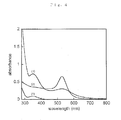
- the UV spectra of the cyclic phenylazomethine are shown together with those of comparative gold nanoparticles (without modification) in Table 1 and Fig. 4 .
- the gold nanoparticles are characterized by having an SPR peak around 500 nm.
- the cyclic phenylazomethine has a peak around 350 nm.
- the cyclic phenylazomethine-modified nanoparticles obtained by the above synthesis process were coated on an electrode for CV and DPV measurements.
- a GCE glassy carbon electrode was used.
- a Pt counter electrode made by BAS
- a reference electrode AG/AG + /ACN/TBAP made by BAS
- organic solvents was used.
- a solvent acetonitrile was used, and for a carrier electrolyte tetrabutylammonium tetrafluoroboroate (0.2M) was used. Measurements were carried out with or without 10 mM of tin (II) chloride.
- the concentration upon measurement was 20 mM of the cyclic phenylazomethine, and the weight of the cyclic phenylazomethine-modified gold nanoparticles in the cyclic phenylazomethine content of 20 ⁇ M was figured out and measured out of the weight ratio at the time of synthesis.
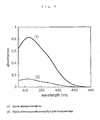
- a peak around 310 nm is one that goes high by the formation of a complex from imine in the cyclic phenylazomethine and tin chloride. From comparisons of such peaks, the difference in the solubility of the cyclic phenylazomethine and the cyclic phenylazomethine-modified nanoparticles in the tin chloride solution can be seen.
- the cyclic phenylazomethine takes a value of 0.83 whereas the cyclic phenylazomethine-modified gold nanoparticles takes a value of 0.14, indicating that the cyclic phenylazomethine-modified nanoparticles are about 1/6 in solubility as low as the cyclic phenylazomethine. It follows that durability or robustness is about 6 times as high.
- the inventive cyclic phenylazomethine-modified gold nanoparticles may be used as a sensor material for sensing or recovering harmful metals, rare metals or the like, for the purposes of sensing biomolecules (proteins, amino acids or the like) and the concentrations of acids, and so on.
Landscapes
- Chemical & Material Sciences (AREA)
- Engineering & Computer Science (AREA)
- Nanotechnology (AREA)
- Inorganic Chemistry (AREA)
- Physics & Mathematics (AREA)
- Composite Materials (AREA)
- Condensed Matter Physics & Semiconductors (AREA)
- General Physics & Mathematics (AREA)
- Materials Engineering (AREA)
- Crystallography & Structural Chemistry (AREA)
- Powder Metallurgy (AREA)
- Manufacture Of Metal Powder And Suspensions Thereof (AREA)
Abstract

Description
- The present invention relates generally to a metal nanoparticle having a nano-level particle diameter, and more specifically to a metal nanoparticle modified with an organic compound, an electrode using the same, and a process of preparing metal nanoparticles.
- Conventional sensing materials are only capable of detecting one type of desired substance because the surfaces of metal nanoparticles are modified with such a substance as being complementarily coupled to the substance to be detected (see
Patent Publications 1 and 2). - Patent Publication 1:
JP(A) 2005-328809 - Patent Publication 2:
JP(A) 2005-181296 - Such being the situations, an object of the invention is to modify the surfaces of metal nanoparticles with a cyclic phenylazomethine having a multi-ion sensing capability, thereby enabling multiple substances to be sensed.
- According to the first aspect of the invention, there is a metal nanoparticle provided, which is
characterized by being modified by a cyclic phenylazomethine compound having a structure represented by Chemical Formula 1.
- According to the second aspect of the invention, the metal nanoparticle of the first aspect is further characterized in that the substituent is at least one substituent selected from the group consisting of an alkoxy group such as a methoxy group and an ethoxy group, and a halogen group such as chlorine and bromine.
- According to the third aspect of the invention, the metal nanoparticle of the first or second aspect of the invention is further characterized in that said metal ion is any one of gold, silver, platinum, palladium, and nickel ions.
- According to the fourth aspect of the invention, there is an electrode provided, which is characterized in that a substrate is coated on its surface with the metal nanoparticle of any one of the first, second, and third aspects of the invention.
- According to the fifth aspect of the invention, there is a process of preparing the metal nanoparticle of any one of the first, second, and third aspects of the invention, characterized by comprising the steps of:
- dispersing an aqueous solution of a metal salt in an organic solvent to obtain a dispersion,
- charging in said dispersion a solution of at least one cyclic phenylazomethine having at least one structure selected from formulae (1), (2) and (3) in Chemical Formula 1 and mixing them together,
- incorporating hydrogenated boron sodium as a reducing agent in the ensuing mixture and stirring them together, and
- drying the ensuing organic solution.
- According to the first aspect of the invention, metal ions are detected by measuring a change of oxidation-reduction currents occurring when the cyclic phenylazomethine captures the metal ions. By use of the cyclic phenylazomethine having a clear-cut structure, the amount of metal ions held on the imine can be estimated with high accuracy. By using recurring units or the compounds of formulae (1) to (3) in any desired combination, it is possible to detect two or more metal ions.
- According to the second aspect of the invention, if the electron donating/attracting action of the functional group such as an alkoxy group and a halogen group is used, it is then possible to change the oxidation-reduction potential of ions or coordination force to metal ions with the result that various metal ions can be detected.
- The third aspect of the invention ensures that various metal nanoparticles can be prepared, and they may be applied not only to sensor materials but also to a variety of materials inclusive of catalysts and optical materials.
- The fourth aspect of the invention ensures that modified electrodes can be prepared by a very simple process that involves coating alone without recourse to troublesome operations.
- The fifth aspect of the invention ensures that the metal nanoparticle modified with a high-molecular or polymer material can be synthesized in one stage without recourse to awkward operations: by allowing the reducing agent to act on a mixture of the metal salt and the high-molecular material.
-
-
Fig. 1 is a flowchart illustrative of exemplary process steps. -
Fig. 2 is indicative of the chemical structure formula of an exemplary cyclic phenylazomethine. -
Fig. 3 is a SEM photograph taken of a metal nanoparticle modified with an exemplary cyclic phenylazomethine. -
Fig. 4 is a graph indicative of the results of measuring UV spectra of a metal nanoparticle modified with an exemplary cyclic phenylazomethine. -
Fig. 5 shows a CV chart measured in a solvent having an exemplary SnCl2 dissolved in it, a CV chart measured in a solvent in which SnCl2 is not dissolved, and a DPV chart measured in a solvent having 10 mM of SnCl2 dissolved in it. -
Fig. 6 is a graph indicative of an exemplary adhesive force (solubility). - Even when the exemplary metal ion is replaced by such a metal ion as coordinating to other cyclic phenylazomethine, similar metal nanoparticles could be obtained. For instance, there is the mention of silver, platinum, palladium, and nickel ions.
- For starting metal substances other than metal chlorides, metal trifluoroacetates, metal bromides or the like may be used.
- For organic solvents other than tetraoctylammonium bromide, chloroform, dichloromethane or the like may be used.
- The cyclic phenylazomethine compound is at least one selected from the group consisting formulae (1), (2) and (3) including an imine and a benzene ring, as represented by Chemical Formula 1. Here R1 and R2 that may be identical or different are a hydrogen atom, and an aryl group (e.g., phenyl or toll group) or an alkyl group (e.g., methyl, ethyl, n-butyl, t-butyl, n-propyl or i-propyl group) that may or may not have a substituent; n is an integer of 2 or greater indicative of the degree of polymerisation; m is an integer of 3 or greater indicative of the degree of polymerization, and R is a spacer that directly connects imines together in formulae (1) and (2), makes a direct connection between the imine and the benzene ring in formula (3), or includes a carbon atom and a hydrogen atom. The substituent, for instance, includes an alkoxy group such as methoxy and ethoxy, and a halogen group such as chlorine and bromine.

- The present invention may be applied not only to the cyclic phenylazomethine compound exemplified in the following example but also to those set forth in Japanese Patent Application Nos.
2005-321913 2006-356392 - Cyclic phenylazomethine-modified metal nanoparticles are synthesized as follows.
- 78.8 mg of gold chloride (HAuCl4·3H2O) dissolved in 60 ml of water are placed in a 500-ml recovery flask.
- After that, 218.7 mg of tetraoctylammonium bromide dissolved in 160 ml of toluene were added to and stirred with the solution. At this time, the aqueous layer turned into colorless and the organic layer turned into orange. 30 mg of cyclic phenylazomethine dissolved in 120 ml of toluene were added to and stirred with the solution at room temperature for about 10 minutes.
- After that, 75.7 mg of hydrogenated boron sodium dissolved in 60 ml of water were added to and vigorously stirred with the solution at room temperature for 12 hours or longer.
- Just after the addition of hydrogenated boron sodium, the organic layer turned into purple.
- After stirring, the organic layer was extracted out, and the filtrate was concentrated and dried to obtain cyclic phneylazomethine-modified nanoparticles.
- The cyclic phenylazomethine-modified nanoparticles obtained by the above synthesis process were measured for UV spectra. The UV spectra of the cyclic phenylazomethine are shown together with those of comparative gold nanoparticles (without modification) in Table 1 and
Fig. 4 . The gold nanoparticles are characterized by having an SPR peak around 500 nm. On the other hand, the cyclic phenylazomethine has a peak around 350 nm. As a result of measurement of UV spectra of the cyclic phenylazomethine-modified nanoparticles, it has been found that there are two peaks around 500 nm coming from the gold nanoparticles and around 350 nm coming from the cyclic phenylazomethine.Table 1 Peak Value (1) Cyclic phenylazomethine about 350 nm (2) Gold nanoparticles (without modification) about 530 nm (3) Cyclic phenylazomethine-modified gold nanoparticles about 350 nm and about 530 nm - The cyclic phenylazomethine-modified nanoparticles obtained by the above synthesis process were coated on an electrode for CV and DPV measurements. For that electrode a GCE glassy carbon electrode was used. For a counter electrode a Pt counter electrode (made by BAS) was used, and for a reference electrode AG/AG+/ACN/TBAP (made by BAS) for organic solvents was used. For a solvent acetonitrile was used, and for a carrier electrolyte tetrabutylammonium tetrafluoroboroate (0.2M) was used. Measurements were carried out with or without 10 mM of tin (II) chloride. In the case of 10 mM tin chloride dissloved, a one-step oxidation-reduction wave was observed. In the case of DPV measurements, too, there was an oxidation-reduction wave found around -0.5 V with the dissolution of 10 mM tin chloride.
- These measurements are shown in
Fig. 5 . - Between the coating of the electrode with the cyclic phenylazomethine alone and the coating of the electrode with the cyclic phenylazomethine-modified gold nanoparticles, there was a difference in the amount of dissolution of the cyclic phenylazomethine in the measuring solvent: it has emerged that the amount of dissolution can be markedly reduced by modification of gold particles with the cyclic phenylazomethine.
- Then, studies were made of differences in the solubility in 1 mM of the cyclic phenylazomethine and the cyclic phenylazomethine-modified gold nanoparticles in a tin chloride solution.
- 1 mM of tin chloride was dissolved in acetonitrile, and the cyclic phenylazomethine and the cyclic phenylazomethine-modified gold nanoparticle were dissolved in the solution for the measurement of UV-vis absorption.
- The concentration upon measurement was 20 mM of the cyclic phenylazomethine, and the weight of the cyclic phenylazomethine-modified gold nanoparticles in the cyclic phenylazomethine content of 20 µM was figured out and measured out of the weight ratio at the time of synthesis.
- A peak around 310 nm is one that goes high by the formation of a complex from imine in the cyclic phenylazomethine and tin chloride. From comparisons of such peaks, the difference in the solubility of the cyclic phenylazomethine and the cyclic phenylazomethine-modified nanoparticles in the tin chloride solution can be seen.
- As a consequence, the cyclic phenylazomethine takes a value of 0.83 whereas the cyclic phenylazomethine-modified gold nanoparticles takes a value of 0.14, indicating that the cyclic phenylazomethine-modified nanoparticles are about 1/6 in solubility as low as the cyclic phenylazomethine. It follows that durability or robustness is about 6 times as high.
- The inventive cyclic phenylazomethine-modified gold nanoparticles may be used as a sensor material for sensing or recovering harmful metals, rare metals or the like, for the purposes of sensing biomolecules (proteins, amino acids or the like) and the concentrations of acids, and so on.
Claims (5)
- A metal nanoparticles, characterized by being modified by a cyclic phenylazomethine compound having a structure represented by Chemical Formula 1:

- The metal nanoparticle according to claim 1 characterized in that said substituent is at least one substituent selected from the group consisting of an alkoxy group such as a methoxy group and an ethoxy group, and a halogen group such as chlorine and bromine.
- The metal nanoparticle according to claim 1, characterized in that said metal ion is any one of gold, silver, platinum, palladium, and nickel ion.
- An electrode, characterized in that a substrate is coated on its surface with the metal nanoparticle of any one of claims 1 to 3.
- A process of preparing the metal nanoparticle of any one of claims 1 to 3, characterized by comprising the steps of:dispersing an aqueous solution of a metal salt in an organic solvent to obtain a dispersion,charging in said dispersion a solution of at least one cyclic phenylazomethine having at least one structure selected from formulae (1), (2) and (3) represented by chemical formula 1 and mixing them together,incorporating hydrogenated boron sodium as a reducing agent in the ensuing mixture and stirring them together, anddrying the ensuing organic solution.
Applications Claiming Priority (2)
| Application Number | Priority Date | Filing Date | Title |
|---|---|---|---|
| JP2007124914 | 2007-05-09 | ||
| PCT/JP2008/058897 WO2008140109A1 (en) | 2007-05-09 | 2008-05-08 | Metal nanoparticle, electrode using the same, and method for production of the same |
Publications (2)
| Publication Number | Publication Date |
|---|---|
| EP2153920A1 true EP2153920A1 (en) | 2010-02-17 |
| EP2153920A4 EP2153920A4 (en) | 2014-06-04 |
Family
ID=40002296
Family Applications (1)
| Application Number | Title | Priority Date | Filing Date |
|---|---|---|---|
| EP08752758.6A Withdrawn EP2153920A4 (en) | 2007-05-09 | 2008-05-08 | METAL NANOPARTICLE, ELECTRODE USING THE SAME, AND PROCESS FOR THE PRODUCTION THEREOF |
Country Status (4)
| Country | Link |
|---|---|
| US (1) | US8088487B2 (en) |
| EP (1) | EP2153920A4 (en) |
| JP (1) | JP5258117B2 (en) |
| WO (1) | WO2008140109A1 (en) |
Cited By (1)
| Publication number | Priority date | Publication date | Assignee | Title |
|---|---|---|---|---|
| US8088487B2 (en) * | 2007-05-09 | 2012-01-03 | National Institute For Materials Science | Metal nanoparticles, an electrode using them and a process of preparing metal nanoparticles |
Family Cites Families (11)
| Publication number | Priority date | Publication date | Assignee | Title |
|---|---|---|---|---|
| JP3914057B2 (en) * | 2002-01-29 | 2007-05-16 | 財団法人神奈川科学技術アカデミー | Metal oxide cluster-encapsulated phenylazomethine dendrimer |
| JP2004189949A (en) | 2002-12-12 | 2004-07-08 | Kanagawa Acad Of Sci & Technol | Electrically responsive cyclic molecular recognition material and method for producing the same |
| JPWO2004076531A1 (en) * | 2003-02-27 | 2006-06-01 | 財団法人神奈川科学技術アカデミー | Metal or metal cluster-containing phenylazomethine dendrimer and method for producing the same |
| JP4224641B2 (en) | 2003-11-28 | 2009-02-18 | 国立大学法人東京工業大学 | Localized surface plasmon sensor, sensing device, and sensing method |
| JP2005287507A (en) * | 2004-03-10 | 2005-10-20 | Japan Science & Technology Agency | Cationic gold nanoparticles and polyethylene glycol modified cationic gold nanoparticles and their complexes with nucleic acids |
| JP2005321913A (en) | 2004-05-07 | 2005-11-17 | Hitachi Ltd | COMPUTER SYSTEM HAVING FILE SHARE APPARATUS AND METHOD FOR MIGRATING FILE SHARE APPARATUS |
| JP2005328809A (en) * | 2004-05-17 | 2005-12-02 | Yukio Nagasaki | Method for producing particle for nucleic acid detection and nucleic acid transportation and use thereof |
| JP2006036866A (en) * | 2004-07-23 | 2006-02-09 | Kanagawa Acad Of Sci & Technol | Metal integrated semiconductor nanoparticles and manufacturing method thereof |
| JP4756241B2 (en) | 2005-11-07 | 2011-08-24 | 独立行政法人物質・材料研究機構 | Cyclic polymer material for metal sensing and metal ion detector |
| JP5165204B2 (en) * | 2006-03-09 | 2013-03-21 | 国立大学法人大阪大学 | Method for producing palladium fine particles |
| US8088487B2 (en) * | 2007-05-09 | 2012-01-03 | National Institute For Materials Science | Metal nanoparticles, an electrode using them and a process of preparing metal nanoparticles |
-
2008
- 2008-05-08 US US12/451,358 patent/US8088487B2/en not_active Expired - Fee Related
- 2008-05-08 JP JP2009514175A patent/JP5258117B2/en not_active Expired - Fee Related
- 2008-05-08 WO PCT/JP2008/058897 patent/WO2008140109A1/en not_active Ceased
- 2008-05-08 EP EP08752758.6A patent/EP2153920A4/en not_active Withdrawn
Cited By (1)
| Publication number | Priority date | Publication date | Assignee | Title |
|---|---|---|---|---|
| US8088487B2 (en) * | 2007-05-09 | 2012-01-03 | National Institute For Materials Science | Metal nanoparticles, an electrode using them and a process of preparing metal nanoparticles |
Also Published As
| Publication number | Publication date |
|---|---|
| JP5258117B2 (en) | 2013-08-07 |
| WO2008140109A1 (en) | 2008-11-20 |
| EP2153920A4 (en) | 2014-06-04 |
| US20100184971A1 (en) | 2010-07-22 |
| JPWO2008140109A1 (en) | 2010-08-05 |
| US8088487B2 (en) | 2012-01-03 |
Similar Documents
| Publication | Publication Date | Title |
|---|---|---|
| Egorova et al. | Reaction-based fluorescent sensing of Au (I)/Au (III) species: mechanistic implications on vinylgold intermediates | |
| Panchompoo et al. | One-step synthesis of fluorescein modified nano-carbon for Pd (II) detection via fluorescence quenching | |
| Safavi et al. | Construction of a carbon nanocomposite electrode based on amino acids functionalized gold nanoparticles for trace electrochemical detection of mercury | |
| EP1666177A1 (en) | Precious metal colloid, precious metal microparticle, composition and process for producing the precious metal microparticle | |
| Wang et al. | High-selective and sensitive voltammetric sensor for butylated hydroxyanisole based on AuNPs–PVP–graphene nanocomposites | |
| Liu et al. | Electrochemical sensing of trichloroacetic acid based on silver nanoparticles doped chitosan hydrogel film prepared with controllable electrodeposition | |
| EP1745280B1 (en) | Potentiometric electrode with a gradient polymer comprising conductive particles and ionophore molecules, its manufacture and use | |
| Chen et al. | Nickel hydroxide nanocrystals-modified glassy carbon electrodes for sensitive l-histidine detection | |
| US20220367844A1 (en) | Aerosol assisted deposition process for forming palladium thin film electrode | |
| Akbari et al. | Lead ion (Pb2+) electrochemical sensors based on novel Schiff base ligands | |
| Safavi et al. | Silver paste nanocomposite electrode as a new metallic electrode for amperometric determination of hydrazine | |
| Singh et al. | Electrochemical sensing of nitro-aromatic explosive compounds using silver nanoparticles modified electrochips | |
| Liang et al. | Electrochemical simultaneous detection of paracetamol and 4-aminophenol based on bis-Schiff base cobalt complex | |
| Narouei et al. | An electrochemical sensor based on conductive polymers/graphite paste electrode for simultaneous determination of dopamine, uric acid and tryptophan in biological samples | |
| de Oliveira et al. | Aggregates of gold nanoparticles with complexes containing ruthenium as modifiers in carbon paste electrodes | |
| dos Santos et al. | Voltammetric behavior of zinc hexacyanoferrate (III) nanoparticles and their application in the detection of N-acetylcysteine | |
| Kumar et al. | Construction of a hydrazine electrochemical sensor using Ag@ ZIF as the electrode material | |
| US8088487B2 (en) | Metal nanoparticles, an electrode using them and a process of preparing metal nanoparticles | |
| Cortés et al. | Ligand influence in electrocatalytic properties of Cu (ii) triazole complexes for hydrogen peroxide detection in aqueous media | |
| Soomro et al. | Highly sensitive shape dependent electro-catalysis of TNT molecules using Pd and Pd–Pt alloy based nanostructures | |
| Neole et al. | Ruthenium (ii) N-heterocyclic carbene polymer based sensors for detection of predatory drugs like ketamine and scopolamine | |
| WO2011074606A1 (en) | Metal nanoparticles and method for producing metal nanoparticles | |
| EP0928966B1 (en) | Reactands for the determination of amines by chemical sensors | |
| Saren et al. | Studies of simultaneous electrochemical sensing of hydroquinone and catechol, and fluorescence sensing of resorcinol by katiragum dialdehyde-histidine Schiff base | |
| Abdel-Hafez et al. | An innovative electrochemical sensor for brinzolamide detection in athletes' urine using a mercury–phen complex: a step forward in anti-doping |
Legal Events
| Date | Code | Title | Description |
|---|---|---|---|
| PUAI | Public reference made under article 153(3) epc to a published international application that has entered the european phase |
Free format text: ORIGINAL CODE: 0009012 |
|
| 17P | Request for examination filed |
Effective date: 20091202 |
|
| AK | Designated contracting states |
Kind code of ref document: A1 Designated state(s): AT BE BG CH CY CZ DE DK EE ES FI FR GB GR HR HU IE IS IT LI LT LU LV MC MT NL NO PL PT RO SE SI SK TR |
|
| AX | Request for extension of the european patent |
Extension state: AL BA MK RS |
|
| DAX | Request for extension of the european patent (deleted) | ||
| A4 | Supplementary search report drawn up and despatched |
Effective date: 20140506 |
|
| RIC1 | Information provided on ipc code assigned before grant |
Ipc: B22F 1/00 20060101AFI20140428BHEP Ipc: H01B 5/00 20060101ALI20140428BHEP Ipc: H01B 13/00 20060101ALI20140428BHEP Ipc: B22F 9/24 20060101ALI20140428BHEP Ipc: B22F 1/02 20060101ALI20140428BHEP |
|
| 17Q | First examination report despatched |
Effective date: 20150807 |
|
| STAA | Information on the status of an ep patent application or granted ep patent |
Free format text: STATUS: THE APPLICATION IS DEEMED TO BE WITHDRAWN |
|
| 18D | Application deemed to be withdrawn |
Effective date: 20171201 |