EP2151434A1 - Alkoxypyrazoles and the process for their preparation - Google Patents
Alkoxypyrazoles and the process for their preparation Download PDFInfo
- Publication number
- EP2151434A1 EP2151434A1 EP08305450A EP08305450A EP2151434A1 EP 2151434 A1 EP2151434 A1 EP 2151434A1 EP 08305450 A EP08305450 A EP 08305450A EP 08305450 A EP08305450 A EP 08305450A EP 2151434 A1 EP2151434 A1 EP 2151434A1
- Authority
- EP
- European Patent Office
- Prior art keywords
- ethyl
- phenyl
- cooet
- group
- alkyl
- Prior art date
- Legal status (The legal status is an assumption and is not a legal conclusion. Google has not performed a legal analysis and makes no representation as to the accuracy of the status listed.)
- Withdrawn
Links
- 238000000034 method Methods 0.000 title claims abstract description 26
- 230000008569 process Effects 0.000 title claims abstract description 20
- 238000002360 preparation method Methods 0.000 title claims abstract description 17
- 150000001875 compounds Chemical class 0.000 claims abstract description 71
- 125000001495 ethyl group Chemical group [H]C([H])([H])C([H])([H])* 0.000 claims description 89
- 125000003754 ethoxycarbonyl group Chemical group C(=O)(OCC)* 0.000 claims description 51
- 125000001997 phenyl group Chemical group [H]C1=C([H])C([H])=C(*)C([H])=C1[H] 0.000 claims description 50
- LFQSCWFLJHTTHZ-UHFFFAOYSA-N Ethanol Chemical compound CCO LFQSCWFLJHTTHZ-UHFFFAOYSA-N 0.000 claims description 48
- 125000002496 methyl group Chemical group [H]C([H])([H])* 0.000 claims description 40
- 229910052739 hydrogen Inorganic materials 0.000 claims description 33
- 125000004169 (C1-C6) alkyl group Chemical group 0.000 claims description 32
- 238000006243 chemical reaction Methods 0.000 claims description 30
- 239000001257 hydrogen Substances 0.000 claims description 27
- 125000001797 benzyl group Chemical group [H]C1=C([H])C([H])=C(C([H])=C1[H])C([H])([H])* 0.000 claims description 21
- 229910052794 bromium Inorganic materials 0.000 claims description 18
- 125000003178 carboxy group Chemical group [H]OC(*)=O 0.000 claims description 18
- 229910052736 halogen Inorganic materials 0.000 claims description 17
- 150000002367 halogens Chemical class 0.000 claims description 17
- 229910052740 iodine Inorganic materials 0.000 claims description 15
- 125000006719 (C6-C10) aryl (C1-C6) alkyl group Chemical group 0.000 claims description 14
- 125000004435 hydrogen atom Chemical group [H]* 0.000 claims description 14
- 125000000882 C2-C6 alkenyl group Chemical group 0.000 claims description 13
- 125000003601 C2-C6 alkynyl group Chemical group 0.000 claims description 13
- 125000004170 methylsulfonyl group Chemical group [H]C([H])([H])S(*)(=O)=O 0.000 claims description 11
- QVGXLLKOCUKJST-UHFFFAOYSA-N atomic oxygen Chemical compound [O] QVGXLLKOCUKJST-UHFFFAOYSA-N 0.000 claims description 10
- 239000002904 solvent Substances 0.000 claims description 10
- 229910052760 oxygen Inorganic materials 0.000 claims description 9
- 239000001301 oxygen Substances 0.000 claims description 9
- 229910052801 chlorine Inorganic materials 0.000 claims description 8
- 238000009835 boiling Methods 0.000 claims description 7
- 229910052731 fluorine Inorganic materials 0.000 claims description 7
- 125000001831 (C6-C10) heteroaryl group Chemical group 0.000 claims description 6
- UFHFLCQGNIYNRP-UHFFFAOYSA-N Hydrogen Chemical compound [H][H] UFHFLCQGNIYNRP-UHFFFAOYSA-N 0.000 claims description 5
- 125000000041 C6-C10 aryl group Chemical group 0.000 claims description 4
- 125000004450 alkenylene group Chemical group 0.000 claims description 4
- 125000004573 morpholin-4-yl group Chemical group N1(CCOCC1)* 0.000 claims description 4
- 125000004191 (C1-C6) alkoxy group Chemical group 0.000 claims description 2
- 125000005233 alkylalcohol group Chemical group 0.000 claims description 2
- 125000002887 hydroxy group Chemical group [H]O* 0.000 claims description 2
- 150000002431 hydrogen Chemical class 0.000 claims 9
- PXBRQCKWGAHEHS-UHFFFAOYSA-N dichlorodifluoromethane Chemical compound FC(F)(Cl)Cl PXBRQCKWGAHEHS-UHFFFAOYSA-N 0.000 claims 2
- HEDRZPFGACZZDS-MICDWDOJSA-N Trichloro(2H)methane Chemical compound [2H]C(Cl)(Cl)Cl HEDRZPFGACZZDS-MICDWDOJSA-N 0.000 description 153
- YMWUJEATGCHHMB-UHFFFAOYSA-N Dichloromethane Chemical compound ClCCl YMWUJEATGCHHMB-UHFFFAOYSA-N 0.000 description 69
- XEKOWRVHYACXOJ-UHFFFAOYSA-N Ethyl acetate Chemical compound CCOC(C)=O XEKOWRVHYACXOJ-UHFFFAOYSA-N 0.000 description 60
- XLYOFNOQVPJJNP-UHFFFAOYSA-N water Substances O XLYOFNOQVPJJNP-UHFFFAOYSA-N 0.000 description 43
- IAZDPXIOMUYVGZ-WFGJKAKNSA-N Dimethyl sulfoxide Chemical compound [2H]C([2H])([2H])S(=O)C([2H])([2H])[2H] IAZDPXIOMUYVGZ-WFGJKAKNSA-N 0.000 description 34
- 238000004896 high resolution mass spectrometry Methods 0.000 description 33
- 238000004587 chromatography analysis Methods 0.000 description 27
- PMZURENOXWZQFD-UHFFFAOYSA-L Sodium Sulfate Chemical compound [Na+].[Na+].[O-]S([O-])(=O)=O PMZURENOXWZQFD-UHFFFAOYSA-L 0.000 description 20
- 229940093499 ethyl acetate Drugs 0.000 description 20
- 235000019439 ethyl acetate Nutrition 0.000 description 20
- VGNILMJYXLNLKI-UHFFFAOYSA-N ethyl 5-ethoxy-1h-pyrazole-4-carboxylate Chemical compound CCOC(=O)C1=CNN=C1OCC VGNILMJYXLNLKI-UHFFFAOYSA-N 0.000 description 19
- 229910052938 sodium sulfate Inorganic materials 0.000 description 19
- 235000011152 sodium sulphate Nutrition 0.000 description 19
- 239000000203 mixture Substances 0.000 description 18
- PNEYBMLMFCGWSK-UHFFFAOYSA-N aluminium oxide Inorganic materials [O-2].[O-2].[O-2].[Al+3].[Al+3] PNEYBMLMFCGWSK-UHFFFAOYSA-N 0.000 description 17
- 230000007935 neutral effect Effects 0.000 description 17
- XKRFYHLGVUSROY-UHFFFAOYSA-N Argon Chemical compound [Ar] XKRFYHLGVUSROY-UHFFFAOYSA-N 0.000 description 16
- JEXVQSWXXUJEMA-UHFFFAOYSA-N pyrazol-3-one Chemical class O=C1C=CN=N1 JEXVQSWXXUJEMA-UHFFFAOYSA-N 0.000 description 16
- UIIMBOGNXHQVGW-UHFFFAOYSA-M Sodium bicarbonate Chemical compound [Na+].OC([O-])=O UIIMBOGNXHQVGW-UHFFFAOYSA-M 0.000 description 15
- 239000000243 solution Substances 0.000 description 15
- XDTMQSROBMDMFD-UHFFFAOYSA-N Cyclohexane Chemical compound C1CCCCC1 XDTMQSROBMDMFD-UHFFFAOYSA-N 0.000 description 14
- IJGRMHOSHXDMSA-UHFFFAOYSA-N Atomic nitrogen Chemical compound N#N IJGRMHOSHXDMSA-UHFFFAOYSA-N 0.000 description 13
- VEXZGXHMUGYJMC-UHFFFAOYSA-N Hydrochloric acid Chemical compound Cl VEXZGXHMUGYJMC-UHFFFAOYSA-N 0.000 description 13
- VYPSYNLAJGMNEJ-UHFFFAOYSA-N Silicium dioxide Chemical compound O=[Si]=O VYPSYNLAJGMNEJ-UHFFFAOYSA-N 0.000 description 12
- LTMHNWPUDSTBKD-UHFFFAOYSA-N diethyl 2-(ethoxymethylidene)propanedioate Chemical compound CCOC=C(C(=O)OCC)C(=O)OCC LTMHNWPUDSTBKD-UHFFFAOYSA-N 0.000 description 12
- 239000000741 silica gel Substances 0.000 description 12
- 229910002027 silica gel Inorganic materials 0.000 description 12
- 239000012267 brine Substances 0.000 description 11
- 239000000843 powder Substances 0.000 description 11
- HPALAKNZSZLMCH-UHFFFAOYSA-M sodium;chloride;hydrate Chemical compound O.[Na+].[Cl-] HPALAKNZSZLMCH-UHFFFAOYSA-M 0.000 description 11
- 239000007787 solid Substances 0.000 description 11
- FERCPYFXAPMDOI-UHFFFAOYSA-N 5-ethoxy-1h-pyrazole Chemical compound CCOC=1C=CNN=1 FERCPYFXAPMDOI-UHFFFAOYSA-N 0.000 description 10
- 239000002253 acid Substances 0.000 description 10
- QFLWZFQWSBQYPS-AWRAUJHKSA-N (3S)-3-[[(2S)-2-[[(2S)-2-[5-[(3aS,6aR)-2-oxo-1,3,3a,4,6,6a-hexahydrothieno[3,4-d]imidazol-4-yl]pentanoylamino]-3-methylbutanoyl]amino]-3-(4-hydroxyphenyl)propanoyl]amino]-4-[1-bis(4-chlorophenoxy)phosphorylbutylamino]-4-oxobutanoic acid Chemical compound CCCC(NC(=O)[C@H](CC(O)=O)NC(=O)[C@H](Cc1ccc(O)cc1)NC(=O)[C@@H](NC(=O)CCCCC1SC[C@@H]2NC(=O)N[C@H]12)C(C)C)P(=O)(Oc1ccc(Cl)cc1)Oc1ccc(Cl)cc1 QFLWZFQWSBQYPS-AWRAUJHKSA-N 0.000 description 9
- MITGKKFYIJJQGL-UHFFFAOYSA-N 9-(4-chlorobenzoyl)-6-methylsulfonyl-2,3-dihydro-1H-carbazol-4-one Chemical compound ClC1=CC=C(C(=O)N2C3=CC=C(C=C3C=3C(CCCC2=3)=O)S(=O)(=O)C)C=C1 MITGKKFYIJJQGL-UHFFFAOYSA-N 0.000 description 9
- HEMHJVSKTPXQMS-UHFFFAOYSA-M Sodium hydroxide Chemical compound [OH-].[Na+] HEMHJVSKTPXQMS-UHFFFAOYSA-M 0.000 description 9
- 125000004432 carbon atom Chemical group C* 0.000 description 9
- 239000000460 chlorine Substances 0.000 description 9
- SICNENSMXHRTBQ-UHFFFAOYSA-N ethyl 3-ethoxy-1-phenylpyrazole-4-carboxylate Chemical compound N1=C(OCC)C(C(=O)OCC)=CN1C1=CC=CC=C1 SICNENSMXHRTBQ-UHFFFAOYSA-N 0.000 description 9
- VNXJDBNOMJOGFY-UHFFFAOYSA-N ethyl 5-ethoxy-1-phenylpyrazole-4-carboxylate Chemical compound CCOC1=C(C(=O)OCC)C=NN1C1=CC=CC=C1 VNXJDBNOMJOGFY-UHFFFAOYSA-N 0.000 description 9
- HXITXNWTGFUOAU-UHFFFAOYSA-N phenylboronic acid Chemical compound OB(O)C1=CC=CC=C1 HXITXNWTGFUOAU-UHFFFAOYSA-N 0.000 description 9
- 239000011734 sodium Substances 0.000 description 9
- 229910052786 argon Inorganic materials 0.000 description 8
- ROTSSEVUVHVRRO-UHFFFAOYSA-N ethyl 3-ethoxy-5-iodo-1h-pyrazole-4-carboxylate Chemical compound CCOC(=O)C1=C(I)NN=C1OCC ROTSSEVUVHVRRO-UHFFFAOYSA-N 0.000 description 8
- 229910052757 nitrogen Inorganic materials 0.000 description 8
- BWHMMNNQKKPAPP-UHFFFAOYSA-L potassium carbonate Chemical compound [K+].[K+].[O-]C([O-])=O BWHMMNNQKKPAPP-UHFFFAOYSA-L 0.000 description 8
- BIVUUOPIAYRCAP-UHFFFAOYSA-N aminoazanium;chloride Chemical compound Cl.NN BIVUUOPIAYRCAP-UHFFFAOYSA-N 0.000 description 7
- 238000006254 arylation reaction Methods 0.000 description 7
- UMYQULJLRGFQGD-UHFFFAOYSA-N ethyl 3-ethoxy-5-iodo-1-phenylpyrazole-4-carboxylate Chemical compound IC1=C(C(=O)OCC)C(OCC)=NN1C1=CC=CC=C1 UMYQULJLRGFQGD-UHFFFAOYSA-N 0.000 description 7
- 150000002430 hydrocarbons Chemical group 0.000 description 7
- 239000012074 organic phase Substances 0.000 description 7
- 239000000047 product Substances 0.000 description 7
- 229910000030 sodium bicarbonate Inorganic materials 0.000 description 7
- 235000017557 sodium bicarbonate Nutrition 0.000 description 7
- TVTJUIAKQFIXCE-HUKYDQBMSA-N 2-amino-9-[(2R,3S,4S,5R)-4-fluoro-3-hydroxy-5-(hydroxymethyl)oxolan-2-yl]-7-prop-2-ynyl-1H-purine-6,8-dione Chemical compound NC=1NC(C=2N(C(N(C=2N=1)[C@@H]1O[C@@H]([C@H]([C@H]1O)F)CO)=O)CC#C)=O TVTJUIAKQFIXCE-HUKYDQBMSA-N 0.000 description 6
- SVTJXLWTVXOXCR-UHFFFAOYSA-N 5-ethoxy-4-iodo-1h-pyrazole Chemical compound CCOC1=NNC=C1I SVTJXLWTVXOXCR-UHFFFAOYSA-N 0.000 description 6
- CPELXLSAUQHCOX-UHFFFAOYSA-N Hydrogen bromide Chemical group Br CPELXLSAUQHCOX-UHFFFAOYSA-N 0.000 description 6
- -1 N1-substituted pyrazol-3-ones Chemical class 0.000 description 6
- KWYUFKZDYYNOTN-UHFFFAOYSA-M Potassium hydroxide Chemical compound [OH-].[K+] KWYUFKZDYYNOTN-UHFFFAOYSA-M 0.000 description 6
- YXFVVABEGXRONW-UHFFFAOYSA-N Toluene Chemical compound CC1=CC=CC=C1 YXFVVABEGXRONW-UHFFFAOYSA-N 0.000 description 6
- 239000008346 aqueous phase Substances 0.000 description 6
- 238000005801 aryl-aryl coupling reaction Methods 0.000 description 6
- 229940125851 compound 27 Drugs 0.000 description 6
- XNSXXTKUKYWLAH-UHFFFAOYSA-N diethyl 2-(dimethylaminomethylidene)propanedioate Chemical compound CCOC(=O)C(=CN(C)C)C(=O)OCC XNSXXTKUKYWLAH-UHFFFAOYSA-N 0.000 description 6
- TUNLYTMSYRTSSF-UHFFFAOYSA-N ethyl 5-bromo-3-ethoxy-1-phenylpyrazole-4-carboxylate Chemical compound BrC1=C(C(=O)OCC)C(OCC)=NN1C1=CC=CC=C1 TUNLYTMSYRTSSF-UHFFFAOYSA-N 0.000 description 6
- QZZAPVACMLDERF-UHFFFAOYSA-N ethyl 5-bromo-3-ethoxy-1h-pyrazole-4-carboxylate Chemical compound CCOC(=O)C1=C(Br)NN=C1OCC QZZAPVACMLDERF-UHFFFAOYSA-N 0.000 description 6
- 238000004895 liquid chromatography mass spectrometry Methods 0.000 description 6
- 238000005887 phenylation reaction Methods 0.000 description 6
- 238000010992 reflux Methods 0.000 description 6
- FTCOWMWIZNVSPP-UHFFFAOYSA-N 2-phenyl-4h-pyrazol-3-one Chemical compound O=C1CC=NN1C1=CC=CC=C1 FTCOWMWIZNVSPP-UHFFFAOYSA-N 0.000 description 5
- AQLMLFFXZZFCJW-UHFFFAOYSA-N 3-ethoxy-1,5-diphenylpyrazole-4-carboxylic acid Chemical compound OC(=O)C=1C(OCC)=NN(C=2C=CC=CC=2)C=1C1=CC=CC=C1 AQLMLFFXZZFCJW-UHFFFAOYSA-N 0.000 description 5
- QCNBQIWOKPGYKC-UHFFFAOYSA-N 4-(4-chlorophenyl)-5-ethoxy-1h-pyrazole Chemical compound N1N=CC(C=2C=CC(Cl)=CC=2)=C1OCC QCNBQIWOKPGYKC-UHFFFAOYSA-N 0.000 description 5
- KWWKEHQKZRJWBK-UHFFFAOYSA-N 5-bromo-4-(4-chlorophenyl)-3-ethoxy-1h-pyrazole Chemical compound CCOC1=NNC(Br)=C1C1=CC=C(Cl)C=C1 KWWKEHQKZRJWBK-UHFFFAOYSA-N 0.000 description 5
- 125000003118 aryl group Chemical group 0.000 description 5
- GDTBXPJZTBHREO-UHFFFAOYSA-N bromine Substances BrBr GDTBXPJZTBHREO-UHFFFAOYSA-N 0.000 description 5
- 229940125773 compound 10 Drugs 0.000 description 5
- NXQGGXCHGDYOHB-UHFFFAOYSA-L cyclopenta-1,4-dien-1-yl(diphenyl)phosphane;dichloropalladium;iron(2+) Chemical compound [Fe+2].Cl[Pd]Cl.[CH-]1C=CC(P(C=2C=CC=CC=2)C=2C=CC=CC=2)=C1.[CH-]1C=CC(P(C=2C=CC=CC=2)C=2C=CC=CC=2)=C1 NXQGGXCHGDYOHB-UHFFFAOYSA-L 0.000 description 5
- PJFXDPZWCVXNQZ-UHFFFAOYSA-N ethyl 3-oxo-1,2-dihydropyrazole-4-carboxylate Chemical compound CCOC(=O)C1=CNNC1=O PJFXDPZWCVXNQZ-UHFFFAOYSA-N 0.000 description 5
- ZLVXBBHTMQJRSX-VMGNSXQWSA-N jdtic Chemical compound C1([C@]2(C)CCN(C[C@@H]2C)C[C@H](C(C)C)NC(=O)[C@@H]2NCC3=CC(O)=CC=C3C2)=CC=CC(O)=C1 ZLVXBBHTMQJRSX-VMGNSXQWSA-N 0.000 description 5
- 239000012044 organic layer Substances 0.000 description 5
- 239000000725 suspension Substances 0.000 description 5
- UNILWMWFPHPYOR-KXEYIPSPSA-M 1-[6-[2-[3-[3-[3-[2-[2-[3-[[2-[2-[[(2r)-1-[[2-[[(2r)-1-[3-[2-[2-[3-[[2-(2-amino-2-oxoethoxy)acetyl]amino]propoxy]ethoxy]ethoxy]propylamino]-3-hydroxy-1-oxopropan-2-yl]amino]-2-oxoethyl]amino]-3-[(2r)-2,3-di(hexadecanoyloxy)propyl]sulfanyl-1-oxopropan-2-yl Chemical compound O=C1C(SCCC(=O)NCCCOCCOCCOCCCNC(=O)COCC(=O)N[C@@H](CSC[C@@H](COC(=O)CCCCCCCCCCCCCCC)OC(=O)CCCCCCCCCCCCCCC)C(=O)NCC(=O)N[C@H](CO)C(=O)NCCCOCCOCCOCCCNC(=O)COCC(N)=O)CC(=O)N1CCNC(=O)CCCCCN\1C2=CC=C(S([O-])(=O)=O)C=C2CC/1=C/C=C/C=C/C1=[N+](CC)C2=CC=C(S([O-])(=O)=O)C=C2C1 UNILWMWFPHPYOR-KXEYIPSPSA-M 0.000 description 4
- OJPCEEZYIKVZPN-UHFFFAOYSA-N 3-ethoxy-4-ethyl-1-phenylpyrazole Chemical compound C1=C(CC)C(OCC)=NN1C1=CC=CC=C1 OJPCEEZYIKVZPN-UHFFFAOYSA-N 0.000 description 4
- HOVDSJVKDGWNIR-UHFFFAOYSA-N 3-ethoxy-4-iodo-1-phenylpyrazole Chemical compound C1=C(I)C(OCC)=NN1C1=CC=CC=C1 HOVDSJVKDGWNIR-UHFFFAOYSA-N 0.000 description 4
- NMOITFUCCDFZIX-UHFFFAOYSA-N 5-ethoxy-3-ethyl-1-phenylpyrazole Chemical compound CCOC1=CC(CC)=NN1C1=CC=CC=C1 NMOITFUCCDFZIX-UHFFFAOYSA-N 0.000 description 4
- ZGSNZVRXASCXRP-UHFFFAOYSA-N 5-methoxy-1h-pyrazole Chemical compound COC=1C=CNN=1 ZGSNZVRXASCXRP-UHFFFAOYSA-N 0.000 description 4
- WKBOTKDWSSQWDR-UHFFFAOYSA-N Bromine atom Chemical compound [Br] WKBOTKDWSSQWDR-UHFFFAOYSA-N 0.000 description 4
- PCLIMKBDDGJMGD-UHFFFAOYSA-N N-bromosuccinimide Chemical compound BrN1C(=O)CCC1=O PCLIMKBDDGJMGD-UHFFFAOYSA-N 0.000 description 4
- LQZMLBORDGWNPD-UHFFFAOYSA-N N-iodosuccinimide Chemical compound IN1C(=O)CCC1=O LQZMLBORDGWNPD-UHFFFAOYSA-N 0.000 description 4
- 238000010934 O-alkylation reaction Methods 0.000 description 4
- KDLHZDBZIXYQEI-UHFFFAOYSA-N Palladium Chemical compound [Pd] KDLHZDBZIXYQEI-UHFFFAOYSA-N 0.000 description 4
- SMNRFWMNPDABKZ-WVALLCKVSA-N [[(2R,3S,4R,5S)-5-(2,6-dioxo-3H-pyridin-3-yl)-3,4-dihydroxyoxolan-2-yl]methoxy-hydroxyphosphoryl] [[[(2R,3S,4S,5R,6R)-4-fluoro-3,5-dihydroxy-6-(hydroxymethyl)oxan-2-yl]oxy-hydroxyphosphoryl]oxy-hydroxyphosphoryl] hydrogen phosphate Chemical compound OC[C@H]1O[C@H](OP(O)(=O)OP(O)(=O)OP(O)(=O)OP(O)(=O)OC[C@H]2O[C@H]([C@H](O)[C@@H]2O)C2C=CC(=O)NC2=O)[C@H](O)[C@@H](F)[C@@H]1O SMNRFWMNPDABKZ-WVALLCKVSA-N 0.000 description 4
- 238000005574 benzylation reaction Methods 0.000 description 4
- 239000007795 chemical reaction product Substances 0.000 description 4
- 238000005859 coupling reaction Methods 0.000 description 4
- 239000013078 crystal Substances 0.000 description 4
- NBEQFRJNUBMABE-UHFFFAOYSA-N ethyl 3-ethoxy-1,5-diphenylpyrazole-4-carboxylate Chemical compound CCOC(=O)C=1C(OCC)=NN(C=2C=CC=CC=2)C=1C1=CC=CC=C1 NBEQFRJNUBMABE-UHFFFAOYSA-N 0.000 description 4
- XUKQRNSKLXGYQL-UHFFFAOYSA-N ethyl 3-ethoxy-5-phenyl-1h-pyrazole-4-carboxylate Chemical compound CCOC1=NNC(C=2C=CC=CC=2)=C1C(=O)OCC XUKQRNSKLXGYQL-UHFFFAOYSA-N 0.000 description 4
- AOPXMQWUTASJRK-UHFFFAOYSA-N ethyl 5-benzyl-3-ethoxy-1h-pyrazole-4-carboxylate Chemical compound N1N=C(OCC)C(C(=O)OCC)=C1CC1=CC=CC=C1 AOPXMQWUTASJRK-UHFFFAOYSA-N 0.000 description 4
- AUTCCPQKLPMHDN-ONEGZZNKSA-N methyl (e)-3-methoxyprop-2-enoate Chemical compound CO\C=C\C(=O)OC AUTCCPQKLPMHDN-ONEGZZNKSA-N 0.000 description 4
- 239000002808 molecular sieve Substances 0.000 description 4
- 229910000027 potassium carbonate Inorganic materials 0.000 description 4
- 229920006395 saturated elastomer Polymers 0.000 description 4
- 238000007789 sealing Methods 0.000 description 4
- URGAHOPLAPQHLN-UHFFFAOYSA-N sodium aluminosilicate Chemical compound [Na+].[Al+3].[O-][Si]([O-])=O.[O-][Si]([O-])=O URGAHOPLAPQHLN-UHFFFAOYSA-N 0.000 description 4
- 239000000126 substance Substances 0.000 description 4
- DQCMJVDIIJIAQP-UHFFFAOYSA-N 2,4-diphenyl-1h-pyrazol-5-one Chemical compound OC1=NN(C=2C=CC=CC=2)C=C1C1=CC=CC=C1 DQCMJVDIIJIAQP-UHFFFAOYSA-N 0.000 description 3
- MKMDCEXRIPLNGJ-UHFFFAOYSA-N 2-phenyl-1h-pyrazol-5-one Chemical compound N1=C(O)C=CN1C1=CC=CC=C1 MKMDCEXRIPLNGJ-UHFFFAOYSA-N 0.000 description 3
- HXBFCQXNPLQNGP-UHFFFAOYSA-N 3-ethoxy-1,4-diphenylpyrazole Chemical compound CCOC1=NN(C=2C=CC=CC=2)C=C1C1=CC=CC=C1 HXBFCQXNPLQNGP-UHFFFAOYSA-N 0.000 description 3
- IRPWAYPTQROFJW-UHFFFAOYSA-N 3-ethoxy-1-phenylpyrazole-4-carboxylic acid Chemical compound C1=C(C(O)=O)C(OCC)=NN1C1=CC=CC=C1 IRPWAYPTQROFJW-UHFFFAOYSA-N 0.000 description 3
- ZEYCITDQGPLEOB-UHFFFAOYSA-N 3-ethoxy-4-iodo-1-methylsulfonylpyrazole Chemical compound CCOC1=NN(S(C)(=O)=O)C=C1I ZEYCITDQGPLEOB-UHFFFAOYSA-N 0.000 description 3
- KUZSBKJSGSKPJH-VXGBXAGGSA-N 5-[(9R)-6-[(3R)-3-methylmorpholin-4-yl]-11-oxa-1,3,5-triazatricyclo[7.4.0.02,7]trideca-2,4,6-trien-4-yl]pyrazin-2-amine Chemical compound C[C@@H]1COCCN1c1nc(nc2N3CCOC[C@H]3Cc12)-c1cnc(N)cn1 KUZSBKJSGSKPJH-VXGBXAGGSA-N 0.000 description 3
- PHOOBTWKKGDLDB-UHFFFAOYSA-N 5-ethoxy-1h-pyrazole-4-carboxylic acid Chemical compound CCOC=1NN=CC=1C(O)=O PHOOBTWKKGDLDB-UHFFFAOYSA-N 0.000 description 3
- PPEBXCMQMYYBAJ-UHFFFAOYSA-N 5-ethoxy-4-iodo-1-phenylpyrazole Chemical compound CCOC1=C(I)C=NN1C1=CC=CC=C1 PPEBXCMQMYYBAJ-UHFFFAOYSA-N 0.000 description 3
- ZCYVEMRRCGMTRW-UHFFFAOYSA-N 7553-56-2 Chemical compound [I] ZCYVEMRRCGMTRW-UHFFFAOYSA-N 0.000 description 3
- NOTFZGFABLVTIG-UHFFFAOYSA-N Cyclohexylethyl acetate Chemical compound CC(=O)OCCC1CCCCC1 NOTFZGFABLVTIG-UHFFFAOYSA-N 0.000 description 3
- OAKJQQAXSVQMHS-UHFFFAOYSA-N Hydrazine Chemical compound NN OAKJQQAXSVQMHS-UHFFFAOYSA-N 0.000 description 3
- OKKJLVBELUTLKV-UHFFFAOYSA-N Methanol Chemical compound OC OKKJLVBELUTLKV-UHFFFAOYSA-N 0.000 description 3
- NINIDFKCEFEMDL-UHFFFAOYSA-N Sulfur Chemical compound [S] NINIDFKCEFEMDL-UHFFFAOYSA-N 0.000 description 3
- 239000005864 Sulphur Substances 0.000 description 3
- ZMANZCXQSJIPKH-UHFFFAOYSA-N Triethylamine Chemical compound CCN(CC)CC ZMANZCXQSJIPKH-UHFFFAOYSA-N 0.000 description 3
- 238000005903 acid hydrolysis reaction Methods 0.000 description 3
- XRWSZZJLZRKHHD-WVWIJVSJSA-N asunaprevir Chemical compound O=C([C@@H]1C[C@H](CN1C(=O)[C@@H](NC(=O)OC(C)(C)C)C(C)(C)C)OC1=NC=C(C2=CC=C(Cl)C=C21)OC)N[C@]1(C(=O)NS(=O)(=O)C2CC2)C[C@H]1C=C XRWSZZJLZRKHHD-WVWIJVSJSA-N 0.000 description 3
- 230000015572 biosynthetic process Effects 0.000 description 3
- FJDQFPXHSGXQBY-UHFFFAOYSA-L caesium carbonate Chemical compound [Cs+].[Cs+].[O-]C([O-])=O FJDQFPXHSGXQBY-UHFFFAOYSA-L 0.000 description 3
- 229910000024 caesium carbonate Inorganic materials 0.000 description 3
- 229940125961 compound 24 Drugs 0.000 description 3
- LNZMEOLVTKHUAS-UHFFFAOYSA-N cyclohexane;dichloromethane Chemical compound ClCCl.C1CCCCC1 LNZMEOLVTKHUAS-UHFFFAOYSA-N 0.000 description 3
- 238000006114 decarboxylation reaction Methods 0.000 description 3
- FHHZOYXKOICLGH-UHFFFAOYSA-N dichloromethane;ethanol Chemical compound CCO.ClCCl FHHZOYXKOICLGH-UHFFFAOYSA-N 0.000 description 3
- 150000002148 esters Chemical class 0.000 description 3
- JFHAMNVZHGKQDQ-UHFFFAOYSA-N ethyl 4,6-dimethyl-2-oxo-3,4-dihydro-1h-pyrimidine-5-carboxylate Chemical compound CCOC(=O)C1=C(C)NC(=O)NC1C JFHAMNVZHGKQDQ-UHFFFAOYSA-N 0.000 description 3
- SLMCEWQJQPGJCV-UHFFFAOYSA-N ethyl 5-ethoxy-3-iodo-1-methylsulfonylpyrazole-4-carboxylate Chemical compound CCOC(=O)C=1C(I)=NN(S(C)(=O)=O)C=1OCC SLMCEWQJQPGJCV-UHFFFAOYSA-N 0.000 description 3
- YOPBTZYJNKHCCN-UHFFFAOYSA-N ethyl 5-ethoxy-3-iodo-1-phenylpyrazole-4-carboxylate Chemical compound CCOC1=C(C(=O)OCC)C(I)=NN1C1=CC=CC=C1 YOPBTZYJNKHCCN-UHFFFAOYSA-N 0.000 description 3
- 239000011521 glass Substances 0.000 description 3
- 238000010438 heat treatment Methods 0.000 description 3
- 125000005842 heteroatom Chemical group 0.000 description 3
- 125000000623 heterocyclic group Chemical group 0.000 description 3
- 125000004430 oxygen atom Chemical group O* 0.000 description 3
- 239000002244 precipitate Substances 0.000 description 3
- BDERNNFJNOPAEC-UHFFFAOYSA-N propan-1-ol Chemical compound CCCO BDERNNFJNOPAEC-UHFFFAOYSA-N 0.000 description 3
- 150000003217 pyrazoles Chemical class 0.000 description 3
- FVAUCKIRQBBSSJ-UHFFFAOYSA-M sodium iodide Chemical compound [Na+].[I-] FVAUCKIRQBBSSJ-UHFFFAOYSA-M 0.000 description 3
- 238000003786 synthesis reaction Methods 0.000 description 3
- SLTBMTIRYMGWLX-XMMPIXPASA-N (2r)-2-[(4-chloroanilino)carbamoylamino]-3-(1h-indol-3-yl)-n-(2-phenylethyl)propanamide Chemical compound C1=CC(Cl)=CC=C1NNC(=O)N[C@@H](C(=O)NCCC=1C=CC=CC=1)CC1=CNC2=CC=CC=C12 SLTBMTIRYMGWLX-XMMPIXPASA-N 0.000 description 2
- AEVBPXDFDKBGLT-YOUFYPILSA-N (2s,3s,4r,5r)-n-[2-[4-(diethoxyphosphorylmethyl)anilino]-2-oxoethyl]-5-(2,4-dioxopyrimidin-1-yl)-3,4-dihydroxyoxolane-2-carboxamide Chemical compound C1=CC(CP(=O)(OCC)OCC)=CC=C1NC(=O)CNC(=O)[C@@H]1[C@@H](O)[C@@H](O)[C@H](N2C(NC(=O)C=C2)=O)O1 AEVBPXDFDKBGLT-YOUFYPILSA-N 0.000 description 2
- UDQTXCHQKHIQMH-KYGLGHNPSA-N (3ar,5s,6s,7r,7ar)-5-(difluoromethyl)-2-(ethylamino)-5,6,7,7a-tetrahydro-3ah-pyrano[3,2-d][1,3]thiazole-6,7-diol Chemical compound S1C(NCC)=N[C@H]2[C@@H]1O[C@H](C(F)F)[C@@H](O)[C@@H]2O UDQTXCHQKHIQMH-KYGLGHNPSA-N 0.000 description 2
- HUWSZNZAROKDRZ-RRLWZMAJSA-N (3r,4r)-3-azaniumyl-5-[[(2s,3r)-1-[(2s)-2,3-dicarboxypyrrolidin-1-yl]-3-methyl-1-oxopentan-2-yl]amino]-5-oxo-4-sulfanylpentane-1-sulfonate Chemical compound OS(=O)(=O)CC[C@@H](N)[C@@H](S)C(=O)N[C@@H]([C@H](C)CC)C(=O)N1CCC(C(O)=O)[C@H]1C(O)=O HUWSZNZAROKDRZ-RRLWZMAJSA-N 0.000 description 2
- KQZLRWGGWXJPOS-NLFPWZOASA-N 1-[(1R)-1-(2,4-dichlorophenyl)ethyl]-6-[(4S,5R)-4-[(2S)-2-(hydroxymethyl)pyrrolidin-1-yl]-5-methylcyclohexen-1-yl]pyrazolo[3,4-b]pyrazine-3-carbonitrile Chemical compound ClC1=C(C=CC(=C1)Cl)[C@@H](C)N1N=C(C=2C1=NC(=CN=2)C1=CC[C@@H]([C@@H](C1)C)N1[C@@H](CCC1)CO)C#N KQZLRWGGWXJPOS-NLFPWZOASA-N 0.000 description 2
- SZCBDIVMCGFVPW-UHFFFAOYSA-N 1-[4-(aminomethyl)-2,6-di(propan-2-yl)phenyl]-3-[1-butyl-4-(3-methoxyphenyl)-2-oxo-1,8-naphthyridin-3-yl]urea;hydrochloride Chemical compound Cl.CC(C)C=1C=C(CN)C=C(C(C)C)C=1NC(=O)NC=1C(=O)N(CCCC)C2=NC=CC=C2C=1C1=CC=CC(OC)=C1 SZCBDIVMCGFVPW-UHFFFAOYSA-N 0.000 description 2
- LTMRRSWNXVJMBA-UHFFFAOYSA-L 2,2-diethylpropanedioate Chemical compound CCC(CC)(C([O-])=O)C([O-])=O LTMRRSWNXVJMBA-UHFFFAOYSA-L 0.000 description 2
- HNFMVVHMKGFCMB-UHFFFAOYSA-N 3-[3-[4-(1-aminocyclobutyl)phenyl]-5-phenylimidazo[4,5-b]pyridin-2-yl]pyridin-2-amine Chemical compound NC1=NC=CC=C1C1=NC2=CC=C(C=3C=CC=CC=3)N=C2N1C1=CC=C(C2(N)CCC2)C=C1 HNFMVVHMKGFCMB-UHFFFAOYSA-N 0.000 description 2
- UZYADURBHIEXJH-UHFFFAOYSA-N 3-ethoxy-1,5-diphenylpyrazole Chemical compound C=1C=CC=CC=1N1N=C(OCC)C=C1C1=CC=CC=C1 UZYADURBHIEXJH-UHFFFAOYSA-N 0.000 description 2
- QNQCXRSVGMJCPN-UHFFFAOYSA-N 3-ethoxy-5-phenyl-1h-pyrazole Chemical compound N1C(OCC)=CC(C=2C=CC=CC=2)=N1 QNQCXRSVGMJCPN-UHFFFAOYSA-N 0.000 description 2
- BZYXZEJFYPILGH-UHFFFAOYSA-N 4-(2-chlorophenyl)-1,2-dihydropyrazol-3-one Chemical compound ClC1=CC=CC=C1C1=CNNC1=O BZYXZEJFYPILGH-UHFFFAOYSA-N 0.000 description 2
- BJUNVMWRHJQONC-UHFFFAOYSA-N 4-(2-chlorophenyl)-5-ethoxy-1h-pyrazole Chemical compound N1N=CC(C=2C(=CC=CC=2)Cl)=C1OCC BJUNVMWRHJQONC-UHFFFAOYSA-N 0.000 description 2
- CEVMEUUOQXFTCA-UHFFFAOYSA-N 4-(4-bromophenyl)-5-ethoxy-1h-pyrazole Chemical compound N1N=CC(C=2C=CC(Br)=CC=2)=C1OCC CEVMEUUOQXFTCA-UHFFFAOYSA-N 0.000 description 2
- KTVUPDGMWAIIMV-UHFFFAOYSA-N 4-(4-chlorophenyl)-1,2-dihydropyrazol-3-one Chemical compound C1=CC(Cl)=CC=C1C1=CNNC1=O KTVUPDGMWAIIMV-UHFFFAOYSA-N 0.000 description 2
- NCPIMDCGAXSWCW-UHFFFAOYSA-N 4-(4-chlorophenyl)-3-ethoxy-5-phenyl-1h-pyrazole Chemical compound CCOC1=NNC(C=2C=CC=CC=2)=C1C1=CC=C(Cl)C=C1 NCPIMDCGAXSWCW-UHFFFAOYSA-N 0.000 description 2
- CTWOOAXFLGCTEL-UHFFFAOYSA-N 4-benzyl-5-ethoxy-1h-pyrazole Chemical compound CCOC1=NNC=C1CC1=CC=CC=C1 CTWOOAXFLGCTEL-UHFFFAOYSA-N 0.000 description 2
- UMXPWADOHPVTDD-UHFFFAOYSA-N 4-phenyl-1,2-dihydropyrazol-3-one Chemical compound O=C1NNC=C1C1=CC=CC=C1 UMXPWADOHPVTDD-UHFFFAOYSA-N 0.000 description 2
- SWGLSEKOQUAYSZ-UHFFFAOYSA-N 5-benzyl-3-ethoxy-1h-pyrazole Chemical compound N1N=C(OCC)C=C1CC1=CC=CC=C1 SWGLSEKOQUAYSZ-UHFFFAOYSA-N 0.000 description 2
- OLDQLUJTIPUMAS-UHFFFAOYSA-N 5-bromo-4-(4-bromophenyl)-3-ethoxy-1h-pyrazole Chemical compound CCOC1=NNC(Br)=C1C1=CC=C(Br)C=C1 OLDQLUJTIPUMAS-UHFFFAOYSA-N 0.000 description 2
- GRAJUTVCCYKFSV-UHFFFAOYSA-N 5-ethoxy-4-(2-phenylethyl)-1h-pyrazole Chemical compound N1N=CC(CCC=2C=CC=CC=2)=C1OCC GRAJUTVCCYKFSV-UHFFFAOYSA-N 0.000 description 2
- AVZLZQVMPGUFQS-UHFFFAOYSA-N 5-ethoxy-4-phenyl-1h-pyrazole Chemical compound CCOC1=NNC=C1C1=CC=CC=C1 AVZLZQVMPGUFQS-UHFFFAOYSA-N 0.000 description 2
- QGZKDVFQNNGYKY-UHFFFAOYSA-N Ammonia Chemical compound N QGZKDVFQNNGYKY-UHFFFAOYSA-N 0.000 description 2
- NLXLAEXVIDQMFP-UHFFFAOYSA-N Ammonia chloride Chemical compound [NH4+].[Cl-] NLXLAEXVIDQMFP-UHFFFAOYSA-N 0.000 description 2
- BVKZGUZCCUSVTD-UHFFFAOYSA-M Bicarbonate Chemical compound OC([O-])=O BVKZGUZCCUSVTD-UHFFFAOYSA-M 0.000 description 2
- CURLTUGMZLYLDI-UHFFFAOYSA-N Carbon dioxide Chemical compound O=C=O CURLTUGMZLYLDI-UHFFFAOYSA-N 0.000 description 2
- RYGMFSIKBFXOCR-UHFFFAOYSA-N Copper Chemical compound [Cu] RYGMFSIKBFXOCR-UHFFFAOYSA-N 0.000 description 2
- DGAQECJNVWCQMB-PUAWFVPOSA-M Ilexoside XXIX Chemical compound C[C@@H]1CC[C@@]2(CC[C@@]3(C(=CC[C@H]4[C@]3(CC[C@@H]5[C@@]4(CC[C@@H](C5(C)C)OS(=O)(=O)[O-])C)C)[C@@H]2[C@]1(C)O)C)C(=O)O[C@H]6[C@@H]([C@H]([C@@H]([C@H](O6)CO)O)O)O.[Na+] DGAQECJNVWCQMB-PUAWFVPOSA-M 0.000 description 2
- KFZMGEQAYNKOFK-UHFFFAOYSA-N Isopropanol Chemical compound CC(C)O KFZMGEQAYNKOFK-UHFFFAOYSA-N 0.000 description 2
- AFVFQIVMOAPDHO-UHFFFAOYSA-N Methanesulfonic acid Chemical compound CS(O)(=O)=O AFVFQIVMOAPDHO-UHFFFAOYSA-N 0.000 description 2
- 239000012359 Methanesulfonyl chloride Substances 0.000 description 2
- YNAVUWVOSKDBBP-UHFFFAOYSA-N Morpholine Chemical compound C1COCCN1 YNAVUWVOSKDBBP-UHFFFAOYSA-N 0.000 description 2
- JUJWROOIHBZHMG-UHFFFAOYSA-N Pyridine Chemical compound C1=CC=NC=C1 JUJWROOIHBZHMG-UHFFFAOYSA-N 0.000 description 2
- FAPWRFPIFSIZLT-UHFFFAOYSA-M Sodium chloride Chemical compound [Na+].[Cl-] FAPWRFPIFSIZLT-UHFFFAOYSA-M 0.000 description 2
- 238000006161 Suzuki-Miyaura coupling reaction Methods 0.000 description 2
- LJOOWESTVASNOG-UFJKPHDISA-N [(1s,3r,4ar,7s,8s,8as)-3-hydroxy-8-[2-[(4r)-4-hydroxy-6-oxooxan-2-yl]ethyl]-7-methyl-1,2,3,4,4a,7,8,8a-octahydronaphthalen-1-yl] (2s)-2-methylbutanoate Chemical compound C([C@H]1[C@@H](C)C=C[C@H]2C[C@@H](O)C[C@@H]([C@H]12)OC(=O)[C@@H](C)CC)CC1C[C@@H](O)CC(=O)O1 LJOOWESTVASNOG-UFJKPHDISA-N 0.000 description 2
- NPUXORBZRBIOMQ-RUZDIDTESA-N [(2R)-1-[[4-[[3-(benzenesulfonylmethyl)-5-methylphenoxy]methyl]phenyl]methyl]-2-pyrrolidinyl]methanol Chemical compound C=1C(OCC=2C=CC(CN3[C@H](CCC3)CO)=CC=2)=CC(C)=CC=1CS(=O)(=O)C1=CC=CC=C1 NPUXORBZRBIOMQ-RUZDIDTESA-N 0.000 description 2
- 125000002947 alkylene group Chemical group 0.000 description 2
- 230000000202 analgesic effect Effects 0.000 description 2
- 229940051880 analgesics and antipyretics pyrazolones Drugs 0.000 description 2
- 239000003472 antidiabetic agent Substances 0.000 description 2
- 125000005418 aryl aryl group Chemical group 0.000 description 2
- 230000004071 biological effect Effects 0.000 description 2
- 230000031709 bromination Effects 0.000 description 2
- 238000005893 bromination reaction Methods 0.000 description 2
- QARVLSVVCXYDNA-UHFFFAOYSA-N bromobenzene Chemical compound BrC1=CC=CC=C1 QARVLSVVCXYDNA-UHFFFAOYSA-N 0.000 description 2
- 238000001460 carbon-13 nuclear magnetic resonance spectrum Methods 0.000 description 2
- 239000003054 catalyst Substances 0.000 description 2
- 229940127204 compound 29 Drugs 0.000 description 2
- 229940125877 compound 31 Drugs 0.000 description 2
- 229910052802 copper Inorganic materials 0.000 description 2
- 239000010949 copper Substances 0.000 description 2
- 230000008878 coupling Effects 0.000 description 2
- 238000010168 coupling process Methods 0.000 description 2
- 238000006880 cross-coupling reaction Methods 0.000 description 2
- 230000008021 deposition Effects 0.000 description 2
- 125000001301 ethoxy group Chemical group [H]C([H])([H])C([H])([H])O* 0.000 description 2
- HWSNWPQVWCJXNC-UHFFFAOYSA-N ethyl 1-benzyl-3-ethoxypyrazole-4-carboxylate Chemical compound N1=C(OCC)C(C(=O)OCC)=CN1CC1=CC=CC=C1 HWSNWPQVWCJXNC-UHFFFAOYSA-N 0.000 description 2
- XRVNNBKUADUYNE-UHFFFAOYSA-N ethyl 1-benzyl-5-ethoxypyrazole-4-carboxylate Chemical compound CCOC1=C(C(=O)OCC)C=NN1CC1=CC=CC=C1 XRVNNBKUADUYNE-UHFFFAOYSA-N 0.000 description 2
- VJRFPJJKQMEIRT-UHFFFAOYSA-N ethyl 3-bromo-5-ethoxy-1-phenylpyrazole-4-carboxylate Chemical compound CCOC1=C(C(=O)OCC)C(Br)=NN1C1=CC=CC=C1 VJRFPJJKQMEIRT-UHFFFAOYSA-N 0.000 description 2
- DKWOSZOUMDCGTH-UHFFFAOYSA-N ethyl 3-ethoxy-1-methylpyrazole-4-carboxylate Chemical compound CCOC(=O)C1=CN(C)N=C1OCC DKWOSZOUMDCGTH-UHFFFAOYSA-N 0.000 description 2
- JDWOWNIITYYTMO-UHFFFAOYSA-N ethyl 3-ethoxy-5-methyl-1h-pyrazole-4-carboxylate Chemical compound CCOC(=O)C1=C(C)NN=C1OCC JDWOWNIITYYTMO-UHFFFAOYSA-N 0.000 description 2
- TUZHLNQGEGSAMF-UHFFFAOYSA-N ethyl 3-ethoxy-5-morpholin-4-yl-1h-pyrazole-4-carboxylate Chemical compound CCOC1=NNC(N2CCOCC2)=C1C(=O)OCC TUZHLNQGEGSAMF-UHFFFAOYSA-N 0.000 description 2
- CXXBRCPRJDHPDP-UHFFFAOYSA-N ethyl 5-ethoxy-1-methylpyrazole-4-carboxylate Chemical compound CCOC(=O)C=1C=NN(C)C=1OCC CXXBRCPRJDHPDP-UHFFFAOYSA-N 0.000 description 2
- 125000001072 heteroaryl group Chemical group 0.000 description 2
- LIAWOTKNAVAKCX-UHFFFAOYSA-N hydrazine;dihydrochloride Chemical compound Cl.Cl.NN LIAWOTKNAVAKCX-UHFFFAOYSA-N 0.000 description 2
- XMBWDFGMSWQBCA-UHFFFAOYSA-N hydrogen iodide Chemical compound I XMBWDFGMSWQBCA-UHFFFAOYSA-N 0.000 description 2
- 239000011630 iodine Substances 0.000 description 2
- OKJPEAGHQZHRQV-UHFFFAOYSA-N iodoform Chemical compound IC(I)I OKJPEAGHQZHRQV-UHFFFAOYSA-N 0.000 description 2
- KWGKDLIKAYFUFQ-UHFFFAOYSA-M lithium chloride Chemical compound [Li+].[Cl-] KWGKDLIKAYFUFQ-UHFFFAOYSA-M 0.000 description 2
- QARBMVPHQWIHKH-UHFFFAOYSA-N methanesulfonyl chloride Chemical compound CS(Cl)(=O)=O QARBMVPHQWIHKH-UHFFFAOYSA-N 0.000 description 2
- 125000004433 nitrogen atom Chemical group N* 0.000 description 2
- 229910052763 palladium Inorganic materials 0.000 description 2
- PXWLVJLKJGVOKE-UHFFFAOYSA-N propyphenazone Chemical compound O=C1C(C(C)C)=C(C)N(C)N1C1=CC=CC=C1 PXWLVJLKJGVOKE-UHFFFAOYSA-N 0.000 description 2
- 238000000425 proton nuclear magnetic resonance spectrum Methods 0.000 description 2
- 238000000746 purification Methods 0.000 description 2
- 125000003226 pyrazolyl group Chemical group 0.000 description 2
- 230000009467 reduction Effects 0.000 description 2
- 150000003839 salts Chemical class 0.000 description 2
- 238000007127 saponification reaction Methods 0.000 description 2
- 229930195734 saturated hydrocarbon Natural products 0.000 description 2
- 229910052708 sodium Inorganic materials 0.000 description 2
- GEHJYWRUCIMESM-UHFFFAOYSA-L sodium sulfite Chemical compound [Na+].[Na+].[O-]S([O-])=O GEHJYWRUCIMESM-UHFFFAOYSA-L 0.000 description 2
- 125000001424 substituent group Chemical group 0.000 description 2
- 230000009466 transformation Effects 0.000 description 2
- 238000000844 transformation Methods 0.000 description 2
- 230000001052 transient effect Effects 0.000 description 2
- YHVLYRZWQLDARE-UHFFFAOYSA-M zinc;ethylbenzene;bromide Chemical compound Br[Zn+].[CH2-]CC1=CC=CC=C1 YHVLYRZWQLDARE-UHFFFAOYSA-M 0.000 description 2
- WRSWIWOVJBYZAW-UHFFFAOYSA-M zinc;methanidylbenzene;bromide Chemical compound Br[Zn+].[CH2-]C1=CC=CC=C1 WRSWIWOVJBYZAW-UHFFFAOYSA-M 0.000 description 2
- UAOUIVVJBYDFKD-XKCDOFEDSA-N (1R,9R,10S,11R,12R,15S,18S,21R)-10,11,21-trihydroxy-8,8-dimethyl-14-methylidene-4-(prop-2-enylamino)-20-oxa-5-thia-3-azahexacyclo[9.7.2.112,15.01,9.02,6.012,18]henicosa-2(6),3-dien-13-one Chemical compound C([C@@H]1[C@@H](O)[C@@]23C(C1=C)=O)C[C@H]2[C@]12C(N=C(NCC=C)S4)=C4CC(C)(C)[C@H]1[C@H](O)[C@]3(O)OC2 UAOUIVVJBYDFKD-XKCDOFEDSA-N 0.000 description 1
- ABJSOROVZZKJGI-OCYUSGCXSA-N (1r,2r,4r)-2-(4-bromophenyl)-n-[(4-chlorophenyl)-(2-fluoropyridin-4-yl)methyl]-4-morpholin-4-ylcyclohexane-1-carboxamide Chemical compound C1=NC(F)=CC(C(NC(=O)[C@H]2[C@@H](C[C@@H](CC2)N2CCOCC2)C=2C=CC(Br)=CC=2)C=2C=CC(Cl)=CC=2)=C1 ABJSOROVZZKJGI-OCYUSGCXSA-N 0.000 description 1
- CNZIQHGDUXRUJS-CIGIFLASSA-N (2R,3S,5E,9R)-5-(1-hydroxyethylidene)-8,8-dimethyl-7,16-diazapentacyclo[9.6.1.02,9.03,7.015,18]octadeca-1(17),11(18),12,14-tetraene-4,6-dione Chemical compound C\C(O)=C1\C(=O)[C@@H]2[C@@H]3[C@@H](Cc4cccc5[nH]cc3c45)C(C)(C)N2C1=O CNZIQHGDUXRUJS-CIGIFLASSA-N 0.000 description 1
- GHYOCDFICYLMRF-UTIIJYGPSA-N (2S,3R)-N-[(2S)-3-(cyclopenten-1-yl)-1-[(2R)-2-methyloxiran-2-yl]-1-oxopropan-2-yl]-3-hydroxy-3-(4-methoxyphenyl)-2-[[(2S)-2-[(2-morpholin-4-ylacetyl)amino]propanoyl]amino]propanamide Chemical compound C1(=CCCC1)C[C@@H](C(=O)[C@@]1(OC1)C)NC([C@H]([C@@H](C1=CC=C(C=C1)OC)O)NC([C@H](C)NC(CN1CCOCC1)=O)=O)=O GHYOCDFICYLMRF-UTIIJYGPSA-N 0.000 description 1
- IUSARDYWEPUTPN-OZBXUNDUSA-N (2r)-n-[(2s,3r)-4-[[(4s)-6-(2,2-dimethylpropyl)spiro[3,4-dihydropyrano[2,3-b]pyridine-2,1'-cyclobutane]-4-yl]amino]-3-hydroxy-1-[3-(1,3-thiazol-2-yl)phenyl]butan-2-yl]-2-methoxypropanamide Chemical compound C([C@H](NC(=O)[C@@H](C)OC)[C@H](O)CN[C@@H]1C2=CC(CC(C)(C)C)=CN=C2OC2(CCC2)C1)C(C=1)=CC=CC=1C1=NC=CS1 IUSARDYWEPUTPN-OZBXUNDUSA-N 0.000 description 1
- YJLIKUSWRSEPSM-WGQQHEPDSA-N (2r,3r,4s,5r)-2-[6-amino-8-[(4-phenylphenyl)methylamino]purin-9-yl]-5-(hydroxymethyl)oxolane-3,4-diol Chemical compound C=1C=C(C=2C=CC=CC=2)C=CC=1CNC1=NC=2C(N)=NC=NC=2N1[C@@H]1O[C@H](CO)[C@@H](O)[C@H]1O YJLIKUSWRSEPSM-WGQQHEPDSA-N 0.000 description 1
- NWZSZGALRFJKBT-KNIFDHDWSA-N (2s)-2,6-diaminohexanoic acid;(2s)-2-hydroxybutanedioic acid Chemical compound OC(=O)[C@@H](O)CC(O)=O.NCCCC[C@H](N)C(O)=O NWZSZGALRFJKBT-KNIFDHDWSA-N 0.000 description 1
- STBLNCCBQMHSRC-BATDWUPUSA-N (2s)-n-[(3s,4s)-5-acetyl-7-cyano-4-methyl-1-[(2-methylnaphthalen-1-yl)methyl]-2-oxo-3,4-dihydro-1,5-benzodiazepin-3-yl]-2-(methylamino)propanamide Chemical compound O=C1[C@@H](NC(=O)[C@H](C)NC)[C@H](C)N(C(C)=O)C2=CC(C#N)=CC=C2N1CC1=C(C)C=CC2=CC=CC=C12 STBLNCCBQMHSRC-BATDWUPUSA-N 0.000 description 1
- OMBVEVHRIQULKW-DNQXCXABSA-M (3r,5r)-7-[3-(4-fluorophenyl)-8-oxo-7-phenyl-1-propan-2-yl-5,6-dihydro-4h-pyrrolo[2,3-c]azepin-2-yl]-3,5-dihydroxyheptanoate Chemical compound O=C1C=2N(C(C)C)C(CC[C@@H](O)C[C@@H](O)CC([O-])=O)=C(C=3C=CC(F)=CC=3)C=2CCCN1C1=CC=CC=C1 OMBVEVHRIQULKW-DNQXCXABSA-M 0.000 description 1
- WZZBNLYBHUDSHF-DHLKQENFSA-N 1-[(3s,4s)-4-[8-(2-chloro-4-pyrimidin-2-yloxyphenyl)-7-fluoro-2-methylimidazo[4,5-c]quinolin-1-yl]-3-fluoropiperidin-1-yl]-2-hydroxyethanone Chemical compound CC1=NC2=CN=C3C=C(F)C(C=4C(=CC(OC=5N=CC=CN=5)=CC=4)Cl)=CC3=C2N1[C@H]1CCN(C(=O)CO)C[C@@H]1F WZZBNLYBHUDSHF-DHLKQENFSA-N 0.000 description 1
- YCGQPIRMLGEWMW-UHFFFAOYSA-N 1-[1-butyl-4-(3-methoxyphenyl)-2-oxo-1,8-naphthyridin-3-yl]-3-[4-[(dimethylamino)methyl]-2,6-di(propan-2-yl)phenyl]urea;hydrochloride Chemical compound Cl.CC(C)C=1C=C(CN(C)C)C=C(C(C)C)C=1NC(=O)NC=1C(=O)N(CCCC)C2=NC=CC=C2C=1C1=CC=CC(OC)=C1 YCGQPIRMLGEWMW-UHFFFAOYSA-N 0.000 description 1
- 238000001644 13C nuclear magnetic resonance spectroscopy Methods 0.000 description 1
- PDAIFTPWQFGJGD-UHFFFAOYSA-N 2-(4-methoxyphenyl)pyrimidine Chemical compound C1=CC(OC)=CC=C1C1=NC=CC=N1 PDAIFTPWQFGJGD-UHFFFAOYSA-N 0.000 description 1
- PYRKKGOKRMZEIT-UHFFFAOYSA-N 2-[6-(2-cyclopropylethoxy)-9-(2-hydroxy-2-methylpropyl)-1h-phenanthro[9,10-d]imidazol-2-yl]-5-fluorobenzene-1,3-dicarbonitrile Chemical compound C1=C2C3=CC(CC(C)(O)C)=CC=C3C=3NC(C=4C(=CC(F)=CC=4C#N)C#N)=NC=3C2=CC=C1OCCC1CC1 PYRKKGOKRMZEIT-UHFFFAOYSA-N 0.000 description 1
- PRLDSDBFYONWHP-UHFFFAOYSA-N 2-[[2-(4-chlorophenyl)cyclohexa-2,5-dien-1-yl]methylsulfanyl]pyrano[4,3-c]pyrazol-3-one Chemical compound C1=CC(Cl)=CC=C1C1=CCC=CC1CSN1C(=O)C2=COC=CC2=N1 PRLDSDBFYONWHP-UHFFFAOYSA-N 0.000 description 1
- YSUIQYOGTINQIN-UZFYAQMZSA-N 2-amino-9-[(1S,6R,8R,9S,10R,15R,17R,18R)-8-(6-aminopurin-9-yl)-9,18-difluoro-3,12-dihydroxy-3,12-bis(sulfanylidene)-2,4,7,11,13,16-hexaoxa-3lambda5,12lambda5-diphosphatricyclo[13.2.1.06,10]octadecan-17-yl]-1H-purin-6-one Chemical compound NC1=NC2=C(N=CN2[C@@H]2O[C@@H]3COP(S)(=O)O[C@@H]4[C@@H](COP(S)(=O)O[C@@H]2[C@@H]3F)O[C@H]([C@H]4F)N2C=NC3=C2N=CN=C3N)C(=O)N1 YSUIQYOGTINQIN-UZFYAQMZSA-N 0.000 description 1
- ILPGQKHPPSSCBS-UHFFFAOYSA-N 2-phenyl-1h-pyrazol-3-one Chemical compound O=C1C=CNN1C1=CC=CC=C1 ILPGQKHPPSSCBS-UHFFFAOYSA-N 0.000 description 1
- BGAJNPLDJJBRHK-UHFFFAOYSA-N 3-[2-[5-(3-chloro-4-propan-2-yloxyphenyl)-1,3,4-thiadiazol-2-yl]-3-methyl-6,7-dihydro-4h-pyrazolo[4,3-c]pyridin-5-yl]propanoic acid Chemical compound C1=C(Cl)C(OC(C)C)=CC=C1C1=NN=C(N2C(=C3CN(CCC(O)=O)CCC3=N2)C)S1 BGAJNPLDJJBRHK-UHFFFAOYSA-N 0.000 description 1
- MNAXEYCEGXEKQT-UHFFFAOYSA-N 3-ethoxy-5-iodo-1h-pyrazole Chemical compound CCOC=1C=C(I)NN=1 MNAXEYCEGXEKQT-UHFFFAOYSA-N 0.000 description 1
- WZECYRMGVFUIDO-UHFFFAOYSA-N 4-[(4-methylsulfanylcyclohexa-2,4-dien-1-yl)methyl]-5-(trifluoromethyl)pyrazol-3-one Chemical compound C1=CC(SC)=CCC1CC1=C(C(F)(F)F)N=NC1=O WZECYRMGVFUIDO-UHFFFAOYSA-N 0.000 description 1
- RXCVUHMIWHRLDF-HXUWFJFHSA-N 5,8-dichloro-2-[(4-methoxy-6-methyl-2-oxo-1H-pyridin-3-yl)methyl]-7-[(R)-methoxy(oxetan-3-yl)methyl]-3,4-dihydroisoquinolin-1-one Chemical compound ClC1=C2CCN(C(C2=C(C(=C1)[C@@H](C1COC1)OC)Cl)=O)CC=1C(NC(=CC=1OC)C)=O RXCVUHMIWHRLDF-HXUWFJFHSA-N 0.000 description 1
- UVFIOUSCAIYXKB-UHFFFAOYSA-N 5-(4-nitrophenyl)-2-phenyl-1h-pyrazol-3-one Chemical compound C1=CC([N+](=O)[O-])=CC=C1C1=CC(=O)N(C=2C=CC=CC=2)N1 UVFIOUSCAIYXKB-UHFFFAOYSA-N 0.000 description 1
- XHZWFUVEKDDQPF-UHFFFAOYSA-N 5-bromo-1h-pyrazole Chemical compound BrC1=CC=NN1 XHZWFUVEKDDQPF-UHFFFAOYSA-N 0.000 description 1
- YCWNBIHSNGBZCM-UHFFFAOYSA-N 5-ethoxy-4-iodo-1-methylsulfonylpyrazole Chemical compound CCOC1=C(I)C=NN1S(C)(=O)=O YCWNBIHSNGBZCM-UHFFFAOYSA-N 0.000 description 1
- RLFWWDJHLFCNIJ-UHFFFAOYSA-N Aminoantipyrine Natural products CN1C(C)=C(N)C(=O)N1C1=CC=CC=C1 RLFWWDJHLFCNIJ-UHFFFAOYSA-N 0.000 description 1
- 238000006443 Buchwald-Hartwig cross coupling reaction Methods 0.000 description 1
- COVZYZSDYWQREU-UHFFFAOYSA-N Busulfan Chemical compound CS(=O)(=O)OCCCCOS(C)(=O)=O COVZYZSDYWQREU-UHFFFAOYSA-N 0.000 description 1
- OJRUSAPKCPIVBY-KQYNXXCUSA-N C1=NC2=C(N=C(N=C2N1[C@H]3[C@@H]([C@@H]([C@H](O3)COP(=O)(CP(=O)(O)O)O)O)O)I)N Chemical compound C1=NC2=C(N=C(N=C2N1[C@H]3[C@@H]([C@@H]([C@H](O3)COP(=O)(CP(=O)(O)O)O)O)O)I)N OJRUSAPKCPIVBY-KQYNXXCUSA-N 0.000 description 1
- UXVMQQNJUSDDNG-UHFFFAOYSA-L Calcium chloride Chemical compound [Cl-].[Cl-].[Ca+2] UXVMQQNJUSDDNG-UHFFFAOYSA-L 0.000 description 1
- VEXZGXHMUGYJMC-UHFFFAOYSA-M Chloride anion Chemical compound [Cl-] VEXZGXHMUGYJMC-UHFFFAOYSA-M 0.000 description 1
- ZAMOUSCENKQFHK-UHFFFAOYSA-N Chlorine atom Chemical compound [Cl] ZAMOUSCENKQFHK-UHFFFAOYSA-N 0.000 description 1
- 238000010485 C−C bond formation reaction Methods 0.000 description 1
- 102000004190 Enzymes Human genes 0.000 description 1
- 108090000790 Enzymes Proteins 0.000 description 1
- KRHYYFGTRYWZRS-UHFFFAOYSA-M Fluoride anion Chemical compound [F-] KRHYYFGTRYWZRS-UHFFFAOYSA-M 0.000 description 1
- PXGOKWXKJXAPGV-UHFFFAOYSA-N Fluorine Chemical compound FF PXGOKWXKJXAPGV-UHFFFAOYSA-N 0.000 description 1
- 238000006945 Knorr synthesis reaction Methods 0.000 description 1
- SECXISVLQFMRJM-UHFFFAOYSA-N N-Methylpyrrolidone Chemical compound CN1CCCC1=O SECXISVLQFMRJM-UHFFFAOYSA-N 0.000 description 1
- 229910017849 NH2—NH2 Inorganic materials 0.000 description 1
- 238000012565 NMR experiment Methods 0.000 description 1
- 238000006411 Negishi coupling reaction Methods 0.000 description 1
- 108010007288 PrPSc Proteins Proteins 0.000 description 1
- 108091000054 Prion Proteins 0.000 description 1
- 102000029797 Prion Human genes 0.000 description 1
- 208000024777 Prion disease Diseases 0.000 description 1
- WTKZEGDFNFYCGP-UHFFFAOYSA-N Pyrazole Chemical compound C=1C=NNC=1 WTKZEGDFNFYCGP-UHFFFAOYSA-N 0.000 description 1
- DWAQJAXMDSEUJJ-UHFFFAOYSA-M Sodium bisulfite Chemical compound [Na+].OS([O-])=O DWAQJAXMDSEUJJ-UHFFFAOYSA-M 0.000 description 1
- 238000006069 Suzuki reaction reaction Methods 0.000 description 1
- 238000006887 Ullmann reaction Methods 0.000 description 1
- PSLUFJFHTBIXMW-WYEYVKMPSA-N [(3r,4ar,5s,6s,6as,10s,10ar,10bs)-3-ethenyl-10,10b-dihydroxy-3,4a,7,7,10a-pentamethyl-1-oxo-6-(2-pyridin-2-ylethylcarbamoyloxy)-5,6,6a,8,9,10-hexahydro-2h-benzo[f]chromen-5-yl] acetate Chemical compound O([C@@H]1[C@@H]([C@]2(O[C@](C)(CC(=O)[C@]2(O)[C@@]2(C)[C@@H](O)CCC(C)(C)[C@@H]21)C=C)C)OC(=O)C)C(=O)NCCC1=CC=CC=N1 PSLUFJFHTBIXMW-WYEYVKMPSA-N 0.000 description 1
- DGEZNRSVGBDHLK-UHFFFAOYSA-N [1,10]phenanthroline Chemical compound C1=CN=C2C3=NC=CC=C3C=CC2=C1 DGEZNRSVGBDHLK-UHFFFAOYSA-N 0.000 description 1
- 238000010521 absorption reaction Methods 0.000 description 1
- 238000009825 accumulation Methods 0.000 description 1
- 238000006640 acetylation reaction Methods 0.000 description 1
- 230000002378 acidificating effect Effects 0.000 description 1
- HSFWRNGVRCDJHI-UHFFFAOYSA-N alpha-acetylene Natural products C#C HSFWRNGVRCDJHI-UHFFFAOYSA-N 0.000 description 1
- 229910021529 ammonia Inorganic materials 0.000 description 1
- 235000019270 ammonium chloride Nutrition 0.000 description 1
- 238000004458 analytical method Methods 0.000 description 1
- 230000000845 anti-microbial effect Effects 0.000 description 1
- 229940125708 antidiabetic agent Drugs 0.000 description 1
- VEQOALNAAJBPNY-UHFFFAOYSA-N antipyrine Chemical compound CN1C(C)=CC(=O)N1C1=CC=CC=C1 VEQOALNAAJBPNY-UHFFFAOYSA-N 0.000 description 1
- 239000012300 argon atmosphere Substances 0.000 description 1
- 125000004429 atom Chemical group 0.000 description 1
- CBHOOMGKXCMKIR-UHFFFAOYSA-N azane;methanol Chemical compound N.OC CBHOOMGKXCMKIR-UHFFFAOYSA-N 0.000 description 1
- 229940073608 benzyl chloride Drugs 0.000 description 1
- ZADPBFCGQRWHPN-UHFFFAOYSA-N boronic acid Chemical compound OBO ZADPBFCGQRWHPN-UHFFFAOYSA-N 0.000 description 1
- 125000001246 bromo group Chemical group Br* 0.000 description 1
- 239000001110 calcium chloride Substances 0.000 description 1
- 229910001628 calcium chloride Inorganic materials 0.000 description 1
- 239000001569 carbon dioxide Substances 0.000 description 1
- 229910002092 carbon dioxide Inorganic materials 0.000 description 1
- 239000011203 carbon fibre reinforced carbon Substances 0.000 description 1
- 150000007942 carboxylates Chemical group 0.000 description 1
- 238000006473 carboxylation reaction Methods 0.000 description 1
- 150000005829 chemical entities Chemical class 0.000 description 1
- 238000003776 cleavage reaction Methods 0.000 description 1
- 238000004440 column chromatography Methods 0.000 description 1
- 229940125797 compound 12 Drugs 0.000 description 1
- 229940125758 compound 15 Drugs 0.000 description 1
- 229940125878 compound 36 Drugs 0.000 description 1
- 229940125807 compound 37 Drugs 0.000 description 1
- 229940127573 compound 38 Drugs 0.000 description 1
- 229940126540 compound 41 Drugs 0.000 description 1
- 229940125936 compound 42 Drugs 0.000 description 1
- 238000009833 condensation Methods 0.000 description 1
- 230000005494 condensation Effects 0.000 description 1
- 238000006482 condensation reaction Methods 0.000 description 1
- 238000001816 cooling Methods 0.000 description 1
- NWFNSTOSIVLCJA-UHFFFAOYSA-L copper;diacetate;hydrate Chemical compound O.[Cu+2].CC([O-])=O.CC([O-])=O NWFNSTOSIVLCJA-UHFFFAOYSA-L 0.000 description 1
- GBRBMTNGQBKBQE-UHFFFAOYSA-L copper;diiodide Chemical compound I[Cu]I GBRBMTNGQBKBQE-UHFFFAOYSA-L 0.000 description 1
- 238000007054 decarboxylative coupling reaction Methods 0.000 description 1
- 238000000354 decomposition reaction Methods 0.000 description 1
- 238000010511 deprotection reaction Methods 0.000 description 1
- 230000001627 detrimental effect Effects 0.000 description 1
- 206010012601 diabetes mellitus Diseases 0.000 description 1
- TWYCKMOLLPVQMA-UHFFFAOYSA-N diethyl 2-(1-ethoxyethylidene)propanedioate Chemical compound CCOC(C)=C(C(=O)OCC)C(=O)OCC TWYCKMOLLPVQMA-UHFFFAOYSA-N 0.000 description 1
- IJKVHSBPTUYDLN-UHFFFAOYSA-N dihydroxy(oxo)silane Chemical compound O[Si](O)=O IJKVHSBPTUYDLN-UHFFFAOYSA-N 0.000 description 1
- 230000006806 disease prevention Effects 0.000 description 1
- 239000003814 drug Substances 0.000 description 1
- 238000000132 electrospray ionisation Methods 0.000 description 1
- IDGUHHHQCWSQLU-UHFFFAOYSA-N ethanol;hydrate Chemical compound O.CCO IDGUHHHQCWSQLU-UHFFFAOYSA-N 0.000 description 1
- MVUMJYQUKKUOHO-AATRIKPKSA-N ethyl (e)-3-(dimethylamino)prop-2-enoate Chemical compound CCOC(=O)\C=C\N(C)C MVUMJYQUKKUOHO-AATRIKPKSA-N 0.000 description 1
- HCWBOJKVQOBWPG-UHFFFAOYSA-N ethyl 3-ethoxy-5-iodo-1-methylsulfonylpyrazole-4-carboxylate Chemical compound CCOC(=O)C=1C(OCC)=NN(S(C)(=O)=O)C=1I HCWBOJKVQOBWPG-UHFFFAOYSA-N 0.000 description 1
- FMVJYQGSRWVMQV-UHFFFAOYSA-N ethyl propiolate Chemical compound CCOC(=O)C#C FMVJYQGSRWVMQV-UHFFFAOYSA-N 0.000 description 1
- 125000002534 ethynyl group Chemical group [H]C#C* 0.000 description 1
- 238000002474 experimental method Methods 0.000 description 1
- 239000011737 fluorine Substances 0.000 description 1
- 125000002541 furyl group Chemical group 0.000 description 1
- 230000026030 halogenation Effects 0.000 description 1
- 238000005658 halogenation reaction Methods 0.000 description 1
- 125000004474 heteroalkylene group Chemical group 0.000 description 1
- 150000002391 heterocyclic compounds Chemical class 0.000 description 1
- 229940083761 high-ceiling diuretics pyrazolone derivative Drugs 0.000 description 1
- IKDUDTNKRLTJSI-UHFFFAOYSA-N hydrazine monohydrate Substances O.NN IKDUDTNKRLTJSI-UHFFFAOYSA-N 0.000 description 1
- 229910000043 hydrogen iodide Inorganic materials 0.000 description 1
- 125000002883 imidazolyl group Chemical group 0.000 description 1
- 229960003444 immunosuppressant agent Drugs 0.000 description 1
- 230000001861 immunosuppressant effect Effects 0.000 description 1
- 239000003018 immunosuppressive agent Substances 0.000 description 1
- 208000027866 inflammatory disease Diseases 0.000 description 1
- 239000003999 initiator Substances 0.000 description 1
- 239000000543 intermediate Substances 0.000 description 1
- 125000002346 iodo group Chemical group I* 0.000 description 1
- 150000002500 ions Chemical class 0.000 description 1
- 125000000959 isobutyl group Chemical group [H]C([H])([H])C([H])(C([H])([H])[H])C([H])([H])* 0.000 description 1
- 125000001449 isopropyl group Chemical group [H]C([H])([H])C([H])(*)C([H])([H])[H] 0.000 description 1
- 239000010410 layer Substances 0.000 description 1
- 238000001819 mass spectrum Methods 0.000 description 1
- 239000000463 material Substances 0.000 description 1
- 229940098779 methanesulfonic acid Drugs 0.000 description 1
- 229940050176 methyl chloride Drugs 0.000 description 1
- 125000000325 methylidene group Chemical group [H]C([H])=* 0.000 description 1
- 230000003278 mimic effect Effects 0.000 description 1
- SYSQUGFVNFXIIT-UHFFFAOYSA-N n-[4-(1,3-benzoxazol-2-yl)phenyl]-4-nitrobenzenesulfonamide Chemical class C1=CC([N+](=O)[O-])=CC=C1S(=O)(=O)NC1=CC=C(C=2OC3=CC=CC=C3N=2)C=C1 SYSQUGFVNFXIIT-UHFFFAOYSA-N 0.000 description 1
- 125000004108 n-butyl group Chemical group [H]C([H])([H])C([H])([H])C([H])([H])C([H])([H])* 0.000 description 1
- 125000001280 n-hexyl group Chemical group C(CCCCC)* 0.000 description 1
- 125000000740 n-pentyl group Chemical group [H]C([H])([H])C([H])([H])C([H])([H])C([H])([H])C([H])([H])* 0.000 description 1
- 125000004123 n-propyl group Chemical group [H]C([H])([H])C([H])([H])C([H])([H])* 0.000 description 1
- 125000001624 naphthyl group Chemical group 0.000 description 1
- IOMMMLWIABWRKL-WUTDNEBXSA-N nazartinib Chemical compound C1N(C(=O)/C=C/CN(C)C)CCCC[C@H]1N1C2=C(Cl)C=CC=C2N=C1NC(=O)C1=CC=NC(C)=C1 IOMMMLWIABWRKL-WUTDNEBXSA-N 0.000 description 1
- QJGQUHMNIGDVPM-UHFFFAOYSA-N nitrogen group Chemical group [N] QJGQUHMNIGDVPM-UHFFFAOYSA-N 0.000 description 1
- 239000000041 non-steroidal anti-inflammatory agent Substances 0.000 description 1
- 229940021182 non-steroidal anti-inflammatory drug Drugs 0.000 description 1
- 230000000269 nucleophilic effect Effects 0.000 description 1
- 238000010534 nucleophilic substitution reaction Methods 0.000 description 1
- PIDFDZJZLOTZTM-KHVQSSSXSA-N ombitasvir Chemical compound COC(=O)N[C@@H](C(C)C)C(=O)N1CCC[C@H]1C(=O)NC1=CC=C([C@H]2N([C@@H](CC2)C=2C=CC(NC(=O)[C@H]3N(CCC3)C(=O)[C@@H](NC(=O)OC)C(C)C)=CC=2)C=2C=CC(=CC=2)C(C)(C)C)C=C1 PIDFDZJZLOTZTM-KHVQSSSXSA-N 0.000 description 1
- 238000005580 one pot reaction Methods 0.000 description 1
- 230000020477 pH reduction Effects 0.000 description 1
- YJVFFLUZDVXJQI-UHFFFAOYSA-L palladium(ii) acetate Chemical compound [Pd+2].CC([O-])=O.CC([O-])=O YJVFFLUZDVXJQI-UHFFFAOYSA-L 0.000 description 1
- 230000037361 pathway Effects 0.000 description 1
- 229960005222 phenazone Drugs 0.000 description 1
- JOVOSQBPPZZESK-UHFFFAOYSA-N phenylhydrazine hydrochloride Chemical compound Cl.NNC1=CC=CC=C1 JOVOSQBPPZZESK-UHFFFAOYSA-N 0.000 description 1
- 229940038531 phenylhydrazine hydrochloride Drugs 0.000 description 1
- 239000002574 poison Substances 0.000 description 1
- 231100000614 poison Toxicity 0.000 description 1
- LJCNRYVRMXRIQR-OLXYHTOASA-L potassium sodium L-tartrate Chemical compound [Na+].[K+].[O-]C(=O)[C@H](O)[C@@H](O)C([O-])=O LJCNRYVRMXRIQR-OLXYHTOASA-L 0.000 description 1
- 229940074439 potassium sodium tartrate Drugs 0.000 description 1
- 230000003389 potentiating effect Effects 0.000 description 1
- 239000012041 precatalyst Substances 0.000 description 1
- 125000004368 propenyl group Chemical group C(=CC)* 0.000 description 1
- 125000002568 propynyl group Chemical group [*]C#CC([H])([H])[H] 0.000 description 1
- 229960002189 propyphenazone Drugs 0.000 description 1
- UMJSCPRVCHMLSP-UHFFFAOYSA-N pyridine Natural products COC1=CC=CN=C1 UMJSCPRVCHMLSP-UHFFFAOYSA-N 0.000 description 1
- 125000004076 pyridyl group Chemical group 0.000 description 1
- 125000000714 pyrimidinyl group Chemical group 0.000 description 1
- 125000000168 pyrrolyl group Chemical group 0.000 description 1
- 239000011541 reaction mixture Substances 0.000 description 1
- 230000009257 reactivity Effects 0.000 description 1
- 238000001953 recrystallisation Methods 0.000 description 1
- 230000007017 scission Effects 0.000 description 1
- 125000002914 sec-butyl group Chemical group [H]C([H])([H])C([H])([H])C([H])(*)C([H])([H])[H] 0.000 description 1
- 230000011664 signaling Effects 0.000 description 1
- 239000011780 sodium chloride Substances 0.000 description 1
- 235000010267 sodium hydrogen sulphite Nutrition 0.000 description 1
- 235000009518 sodium iodide Nutrition 0.000 description 1
- 235000011006 sodium potassium tartrate Nutrition 0.000 description 1
- 235000010265 sodium sulphite Nutrition 0.000 description 1
- 239000007790 solid phase Substances 0.000 description 1
- 238000001228 spectrum Methods 0.000 description 1
- 229960002317 succinimide Drugs 0.000 description 1
- 125000000999 tert-butyl group Chemical group [H]C([H])([H])C(*)(C([H])([H])[H])C([H])([H])[H] 0.000 description 1
- 125000003831 tetrazolyl group Chemical group 0.000 description 1
- 230000001225 therapeutic effect Effects 0.000 description 1
- 125000001544 thienyl group Chemical group 0.000 description 1
- 239000003643 water by type Substances 0.000 description 1
Classifications
-
- C—CHEMISTRY; METALLURGY
- C07—ORGANIC CHEMISTRY
- C07D—HETEROCYCLIC COMPOUNDS
- C07D231/00—Heterocyclic compounds containing 1,2-diazole or hydrogenated 1,2-diazole rings
- C07D231/02—Heterocyclic compounds containing 1,2-diazole or hydrogenated 1,2-diazole rings not condensed with other rings
- C07D231/10—Heterocyclic compounds containing 1,2-diazole or hydrogenated 1,2-diazole rings not condensed with other rings having two or three double bonds between ring members or between ring members and non-ring members
- C07D231/14—Heterocyclic compounds containing 1,2-diazole or hydrogenated 1,2-diazole rings not condensed with other rings having two or three double bonds between ring members or between ring members and non-ring members with hetero atoms or with carbon atoms having three bonds to hetero atoms with at the most one bond to halogen, e.g. ester or nitrile radicals, directly attached to ring carbon atoms
- C07D231/18—One oxygen or sulfur atom
- C07D231/20—One oxygen atom attached in position 3 or 5
-
- A—HUMAN NECESSITIES
- A61—MEDICAL OR VETERINARY SCIENCE; HYGIENE
- A61P—SPECIFIC THERAPEUTIC ACTIVITY OF CHEMICAL COMPOUNDS OR MEDICINAL PREPARATIONS
- A61P29/00—Non-central analgesic, antipyretic or antiinflammatory agents, e.g. antirheumatic agents; Non-steroidal antiinflammatory drugs [NSAID]
-
- A—HUMAN NECESSITIES
- A61—MEDICAL OR VETERINARY SCIENCE; HYGIENE
- A61P—SPECIFIC THERAPEUTIC ACTIVITY OF CHEMICAL COMPOUNDS OR MEDICINAL PREPARATIONS
- A61P3/00—Drugs for disorders of the metabolism
- A61P3/08—Drugs for disorders of the metabolism for glucose homeostasis
- A61P3/10—Drugs for disorders of the metabolism for glucose homeostasis for hyperglycaemia, e.g. antidiabetics
Definitions
- the present invention relates to synthesis of 3-alkoxypyrazoles which can lead to many derivatives including pyrazol-3-ones.
- heterocyclic compounds particularly five membered heterocycles have attracted the attention of pharmaceutical community over the years due to their therapeutic value.
- pyrazol-3-ones having applications in the field of the treatment or prevention of diseases such as diabetes, inflammatory diseases, prion diseases, and of the treatment of pain.
- 1,2-dihydro-4-[[4-(methylthio)phenyl]methyl]-5-(trifluoromethyl)-3H-pyrazol-3-one has been shown to be a potent antihyperglycemic agent 4 .
- Propyphenazone (1,2-dihydro-1,5-dimethyl-4-(1-methylethyl)-2-phenyl-3H-pyrazol-3-one) is a nonsteroidal anti-inflammatory drug frequently used as mild analgesic medicament 5 .
- 5-alkyl-4-(arylmethyl)pyrazol-3-ones have been shown to be the most promising new class of potential antidiabetic agent 6 .
- the new immunosuppressant 2-(4'-chlorophenyl)benzo-thiopyrano-(4,3-c)pyrazol-3-one has been characterized 7 .
- the pyrazole ring system cannot be considered as an original scaffold.
- the analgesic N1-phenyl-pyrazol-5-one antipyrine was first prepared in 1892.
- the core pyrazol-3-one (5) structure with at least three potential nucleophilic centres (the two nitrogens and the oxygen) and two carbons is still an attractive heterocycle.
- Many of these reactive centres may lend themselves to chemical transformations with a potential for "quick" chemical diversity attainable in few reaction steps. This number of reactive centres, although desirable for chemical diversity, does force the chemist to design chemical transformations involving protection and deprotection steps to insure their regioselectivity.
- the patent FR 2862647 describes the generalization of processes 8, 9 involving a transient N-carboxylation 8 or N-acetylation 9 prior to a then selective O-alkylation.
- the present inventors have shown an alternative which shunts the three following steps : preparation of the pyrazol-3-one, its transient N-protection followed by its selective O-alkylation. They prepared the readily O-protected ethyl 3-ethoxy-1H-pyrazole-4-carboxylate ( 8 ) in one step from diethyl 2-(ethoxymethylene)malonate ( 7 ).
- the first object of the present invention relates to a process for the preparation of alkoxypyrazoles of formula (I) or (I') in which
- the molar ratio of said compound of formula (II) to said R 7 -NH-NH 2 , xHX 2 , x is 1 or 2
- X 2 is Cl or Br, is close to 1, preferably comprised between 0.95 and 1.1, more preferably between 1 and 1.05.
- said compound of formula (II) is reacted with 1.05 molar equivalents of R 7 -NH-NH 2 , xHCl, in which R 7 and x are as defined above.
- E is NR ⁇ R ⁇ in the compound of formula (II) and the reaction in step (a) is run with R 7 -NH-NH 2 , 2HCl.
- E is O-F and F is C 1 -C 6 alkyl in the compound of formula (II) and the reaction in step (a) is run with R 7 -NH-NH 2 , HCl.
- R 7 is hydrogen or a phenyl, benzyl or methyl group.
- said R 7 -NH-NH 2 , xHCl is R 7 -NH-NH 2 , HCl (x is 1), more preferably is said R 7 -NH-NH 2 , xHCl is NH 2 -NH 2 , HCl.
- the reaction in step (a) is run at the boiling point of the solvent, preferably for 16 hours.
- reaction in step (a) is run overnight at room temperature.
- the reaction in step (a) is run in ethanol (R 8 is an ethyl group) or isopropanol, more preferably ethanol.
- said compound of formula (II) is diethyl 2-(ethoxymethylene)malonate.
- A stands for a C 1 -C 6 alkyl radical, preferably stands for methyl or ethyl.
- B stands for hydrogen, a - COOH or -COOEt radical.
- D stands for a radical selected from the group consisting of hydrogen or C 1 -C 6 alkyl, preferably methyl.
- E stands for a radical selected from the group consisting of NMeMe or O-ethyl.
- R 7 is a hydrogen atom.
- step (b) the compounds of formula (IV) or (IV') are prepared using N-X-succinimide in boiling cyclohexane.
- Another object of the present invention relates to alkoxypyrazoles of formula I or I' obtainable by the process according to the invention, except compounds of formula (I') wherein simultaneously
- Another object of the present invention relates to alkoxyppyrazoles of formula (V) or (V') in which
- alkoxypyrazoles of formula (V) or (V') are the following ones, in which
- H is hydrogen
- I is iodide
- Br is bromide
- Cl chloride
- F fluoride Et is ethyl.
- halogen is understood to mean an atom of fluorine, bromine, chlorine or iodine.
- C 1 -C 6 alkyl group is understood to mean a saturated, linear or branched hydrocarbon chain comprising from 1 to 6 carbon atoms, in particular the methyl, ethyl, n-propyl, isopropyl, n-butyl, iso-butyl, sec-butyl, tert-butyl, n-pentyl, n-hexyl groups.
- C 2 -C 6 alkenyl group is understood to mean a linear or branched hydrocarbon chain comprising at least one double bond and comprising from 2 to 6 carbon atoms, e.g., such as an ethenyl (vinyl) or propenyl group.
- C 2 -C 6 alkynyl group is understood to mean a linear or branched hydrocarbon chain comprising at least one triple bond and comprising from 2 to 6 carbon atoms, e.g., such as an ethynyl or propynyl group.
- aryl group is understood to mean an aromatic group preferably comprising from 5 to 10 carbon atoms and including one or more fused rings, e.g., such as a phenyl or naphtyl group. This is advantageously phenyl.
- heteroaryl group is understood to mean any aryl group as defined above wherein one or more carbon atoms have been replaced by one or more heteroatoms, advantageously 1 to 4, and even more advantageously 1 to 2, e.g., such as sulphur, nitrogen or oxygen atoms.
- heteroaryl groups are the furyl, thiophenyl, pyrrolyl, pyridyl, pyrimidyl, pyrazolyl, imidazolyl, tetrazolyl or else indyl groups.
- aryl-(C 1 -C 6 )-alkyl group is understood to mean any aryl group as defined above, which is bound to the molecule by means of a (C 1 -C 6 )-alkyl group as defined above.
- a group such as this can be a benzyl group.
- C 4 -C 6 alkylene group is understood to mean a saturated, linear or branched hydrocarbon chain comprising from 4 to 6 carbon atoms which forms a saturated hydrocarbon ring having 5 to 7 members, with the nitrogen atom to which it is linked.
- C 4 -C 6 alkenylene group is understood to mean a linear or branched hydrocarbon chain comprising at least one double bond and comprising from 4 to 6 carbon atoms which forms a saturated hydrocarbon ring having 5 to 7 members, with the nitrogen atom to which it is linked.
- C 4 -C 6 heteroalkylene group is understood to mean any alkylene group as defined above wherein one or more carbon atoms have been replaced by one or more heteroatoms, advantageously 1 to 2, and even more advantageously 1, e.g., such as sulphur, nitrogen or oxygen atoms, advantageously nitrogen.
- C 4 -C 6 heteroalkenylene group is understood to mean any alkenylene group as defined above wherein one or more carbon atoms have been replaced by one or more heteroatoms, advantageously 1 to 2, and even more advantageously 1, e.g., such as sulphur, nitrogen or oxygen atoms, advantageously nitrogen.
- the low resolution mass spectra were obtained on an Agilent 1100 memorize LC/MSD system using an atmospheric electrospray ionisation system and the high resolution mass spectroscopy spectra (HRMS) were obtained using a Waters Micromass Q-Tof with an electrospray ion source.
- 3-Ethoxy-1H-pyrazole ( 10 ) Diethylethoxymethylenemalonate (38.9 g, 0.179 mol) and hydrazine hydrochloride (12.69 g, 0.185 mol) were refluxed in ethanol (500 mL) for 16 hours. The solvent was removed under reduced pressure, the residue was dispersed in 6N hydrochloric acid (100 ml) and heated to reflux until the end of the carbon dioxide evolution (4 hours in the present case). The aqueous phase and slowly made basic by the addition of sodium hydrogenocarbonate and extracted with ethyl acetate four times.
- Ethyl 3-iodo-5-ethoxy-1H-pyrazole-4-carboxylate ( 13 ): Compound 12a (0.99 g, 3.2 mmol) was dispersed in 6N hydrochloric acid (20 mL) and heated to reflux for 4 hours. The aqueous phase was diluted in water, slowly made basic by the addition of concentrated ammonia and extracted with ethyl acetate four times. The organic phase was washed with brine once, with brine once, dried over sodium sulfate and concentrated to dryness to yield compound 13 as an oil (0.52 g, 67 %).
- Ethyl 3-ethoxy-5-methyl-1H-pyrazole-4-carboxylate ( 14 ): This compound was obtained from diethyl 2-(1-ethoxyethylidene)malonate, 14 using the protocol described above, as a solid in a 17 % yield after a chromatography over silica gel (dichloromethane / ethanol 94/6).
- 1 H (CDCl 3 ): 1.35 (t, 3H, J 7.1); 1.43 (m, 3H); 2.47 (s, 3H); 4.30 (m, 4H); 9.2 (s, 1H).
- 13 C (CDCl 3 ): 12.5; 14.3; 14.6; 59.7; 64.9; 97.2; 145.5; 163.0; 163.6. Calcd. for C 9 H 14 N 2 O 3 + Na : 221.0902. Found: m/z, 221.0894.
- Ethyl 3-ethoxy-1-methyl-1H-pyrazole-4-carboxylate ( 16a ): Obtained as an oil in a 17 % yield that crystallizes after a chromatography over neutral alumina containing 1.5 % water (cyclohexane / ethyl acetate 95/5 to 4/1).
- Ethyl 5-ethoxy-1-methyl-1H-pyrazole-4-carboxylate ( 16b ): Obtained as an oil in a 17 % yield after a chromatography over neutral alumina containing 1.5 % water (cyclohexane /ethyl acetate 95/5 to 4/1).
- the readily O-protected ethyl 3-ethoxy-1H-pyrazole-4-carboxylate ( 8 ) was prepared in one step from diethyl 2-(ethoxymethylene)malonate ( 7 ). This is achieved in a 41 % yield by the use of hydrazine hydrochloride in boiling ethanol.
- the other reaction product is the known ethyl 3-hydroxy-1H-pyrazole-4-carboxylate 9 , which is the sole reaction product between hydrazine hydrate and 7. 11 , 8 Surprisingly, this synthetic pathway has no precedent.
- Acid hydrolysis of compounds 18a and 18b In a 60 mL roundbottomed thick glass tube fitted with a PTFE-faced screwcap, a mixture of the considered pyrazole (1 mmol) and 33 % hydrogen bromide in acetic acid (1.5 mL) was heated at 140 °C for 4 hours. The resulting solution was cooled, diluted in water extracted with ethyl acetate. The organic layer was washed with brine, dried over sodium sulfate and concentrated to dryness. The resulting residues were purified in both cases by a chromatography over silica gel (dichloromethane-ethanol 99/1) to yield compound 23a or 23b as described below.
- ester 18a (0.52 g, 2 mmol) was refluxed in a 1/1 water - ethanol solution (20 mL) containing sodium hydroxide (0.3 g, 3.8 mmol) for one hour. The resulting solution was diluted in water, made acid with 2N hydrochloric acid and the precipitate was filtered, washed with water and dried under vacuum to yield compound 24 as a white powder (0.39 g, 85 %).
- Example 3 C4 and C5-phenylation of the N-arylated compounds of Example 2 or of the 5-haloderivatives compounds of Example 1
- 3-Ethoxy-1H-pyrazole-4-carboxylic acid ( 25 ): compound 8 (1 g, 5.43 mmol) was heated to reflux in 1N sodium hydroxide solution (11 mL) for one hour (a shorter time is likely to be better) and upon acidification the precipitate was filtered, washed with water and dried under vacuum to yield 25 as a white powder (0.49 g, 58 %).
- 3-Ethoxy-1,4-diphenyl-1H-pyrazole ( 26 ): In a 10 mL biotage-adapted tube, compound 24 (0.11 g; 0.47 mmol), bromobenzene (0.068 mL; 0.64 mmol), potassium carbonate (0.078 g; 0.57 mmol) copper iodide (0.009 g; 0.047 mmol), phenanthroline (0.013 mg; 0.071 mmol) and 4A molecular sieves (0.02 g) were dispersed in N-methylpyrolidinone (4 mL). The oxygen was removed by a slow stream of argon and palladium acetate (5 mg, 0.023 mmol) was then added before sealing the tube.
- Example 4 C4- arylation, benzylation and phenethylation and C5-benzylation of derivatives of and of compounds of Example 1
- Ethyl 3-ethoxy-5-morpholino-1H-pyrazole-4-carboxylate ( 40 ): In a biotage 5 mL tube, ethyl 3-ethoxy-5-iodo-1H-pyrazole-4-carboxylate (0.2 g; 0.64 mmol) and morpholine (1.2 mL; 13.8 mmol) dissolved in toluene (5 mL). The reaction vessel was then heated at 170 °C for 4 hours using a microwave oven. This was concentrated to dryness and the residue was purified by chromatography on silica gel (dichloromethane - ethanol 98/2) to yield compound 40 as an oil (0.04 g; 23 %) .
- 1,4-diphenyl-1H-pyrazol-3(2H)-one ( 45 ): In a 60 mL roundbottomed thick glass tube fitted with a PTFE-faced screwcap, a mixture of the considered ethoxypyrazole (1 mmol) was degassed with argon. Following this, 33 % hydrogen bromide in acetic acid (1.0 mL) was added; the tube was tightly closed and was heated at 140 °C for 2 hours. The resulting reaction mixture then precipitated in water to give compound 45 in an 83 % yield as a white powder.
Landscapes
- Health & Medical Sciences (AREA)
- Organic Chemistry (AREA)
- Chemical & Material Sciences (AREA)
- Diabetes (AREA)
- General Health & Medical Sciences (AREA)
- Public Health (AREA)
- Medicinal Chemistry (AREA)
- Nuclear Medicine, Radiotherapy & Molecular Imaging (AREA)
- Chemical Kinetics & Catalysis (AREA)
- Pharmacology & Pharmacy (AREA)
- Life Sciences & Earth Sciences (AREA)
- Animal Behavior & Ethology (AREA)
- Veterinary Medicine (AREA)
- General Chemical & Material Sciences (AREA)
- Rheumatology (AREA)
- Pain & Pain Management (AREA)
- Emergency Medicine (AREA)
- Endocrinology (AREA)
- Engineering & Computer Science (AREA)
- Bioinformatics & Cheminformatics (AREA)
- Hematology (AREA)
- Obesity (AREA)
- Pharmaceuticals Containing Other Organic And Inorganic Compounds (AREA)
- Plural Heterocyclic Compounds (AREA)
Abstract
The present invention relates to a process for the preparation of alkoxypyrazoles and new alkoxypyrazole compounds.
Description
- The present invention relates to synthesis of 3-alkoxypyrazoles which can lead to many derivatives including pyrazol-3-ones.
- In the last 20 years, the Suzuki-Miyaura1, 2 aryl-aryl cross coupling reaction has probably increased by at least an order of magnitude the number of compounds that have been synthesised and tested in many medicinal chemistry research programs. Indeed, many successful research programs in the pharmaceutical industry owe their origin to the elaboration of original core scaffolds "dressed" with substituents fine-tuned to bind known enzyme or receptor pockets or to mimic series of compounds with a known biological activity.
- In the same way, heterocyclic compounds particularly five membered heterocycles have attracted the attention of pharmaceutical community over the years due to their therapeutic value.
- In recent years, there has been a growing interest in discovering new pyrazoles having advantageous biological properties.
- Found among these compounds, in particular, are pyrazol-3-ones having applications in the field of the treatment or prevention of diseases such as diabetes, inflammatory diseases, prion diseases, and of the treatment of pain.
- Nineteen pyrazolone derivatives have been shown to inhibit PrP-res (resistant prion protein) accumulation. The most effective compound was 2-phenyl-5-(4-nitrophenyl)-pyrazol-3-one3.
- 1,2-dihydro-4-[[4-(methylthio)phenyl]methyl]-5-(trifluoromethyl)-3H-pyrazol-3-one has been shown to be a potent antihyperglycemic agent4.
- Propyphenazone (1,2-dihydro-1,5-dimethyl-4-(1-methylethyl)-2-phenyl-3H-pyrazol-3-one) is a nonsteroidal anti-inflammatory drug frequently used as mild analgesic medicament5.
- 5-alkyl-4-(arylmethyl)pyrazol-3-ones have been shown to be the most promising new class of potential antidiabetic agent6.
- The new immunosuppressant 2-(4'-chlorophenyl)benzo-thiopyrano-(4,3-c)pyrazol-3-one has been characterized7.
- Moreover, few pyrazole-featuring compounds8-10 have been reported bearing an antimicrobial activity.
- The pyrazole ring system cannot be considered as an original scaffold. For instance, the analgesic N1-phenyl-pyrazol-5-one antipyrine was first prepared in 1892. However, the core pyrazol-3-one (5) structure with at least three potential nucleophilic centres (the two nitrogens and the oxygen) and two carbons is still an attractive heterocycle. Many of these reactive centres may lend themselves to chemical transformations with a potential for "quick" chemical diversity attainable in few reaction steps. This number of reactive centres, although desirable for chemical diversity, does force the chemist to design chemical transformations involving protection and deprotection steps to insure their regioselectivity. In the case of the pyrazol-3-ones this is a problem as the protection steps themselves also face this issue of regioselectivity. From the many N-aryl or N-alkyl hydrazines, the age-old Knorr reaction31-33 provided an easy access to many N1-subtituted pyrazol-5-ones. On the other hand, the isomeric N1-subtituted pyrazol-3-ones are less easy to prepare. This aspect is actually illustrated by a 2007 chemical data base survey. Out of the 156278 compounds featuring a pyrazolone moiety ever reported, some 113469 are N1-aryl-pyrazol-5-ones and "only" 9997 are the isomeric N1-aryl-pyrazol-3-ones. This last number actually includes compounds with a substituent on the other nitrogen (4189) as well as ring-fused 1-arylindazol-3-ones (138). In any case, from a selective O-alkylation of compound (5) to give the O-protected chemical intermediates (6) one could imagine selective chemistry on one of the pyrazole nitrogens. However, only two papers describe the selective O-alkylation of (5) or further chemical transformations.34, 35 It is only quite recently that the problem of selective oxygen protection of pyrazolones such as (5) was breached.
- Thus, there exist important needs for a new process for a simple access to 3-alkoxypyrazoles and then to N1-substituted pyrazol-3-ones.
- The patent
FR 2862647 
- The present inventors have shown an alternative which shunts the three following steps : preparation of the pyrazol-3-one, its transient N-protection followed by its selective O-alkylation. They prepared the readily O-protected ethyl 3-ethoxy-1H-pyrazole-4-carboxylate (8) in one step from diethyl 2-(ethoxymethylene)malonate (7).
- From O-protected ethyl 3-ethoxy-1H-pyrazole-4-carboxylate (8), the present inventors also suited few chemical transformations. These chemical transformations insured the design of accesses to fully original chemical entities.
- First, from the O-protected ethyl 3-ethoxy-1H-pyrazole-4-carboxylate (8) and its 5-haloderivatives, they prepared N1-aryl 3-alkoxypyrazoles.
- Second, the inventors investigated C4- and C5-carbon-carbon forming reactions.
- Therefore, the first object of the present invention relates to a process for the preparation of alkoxypyrazoles of formula (I) or (I')

- R1 stands for a radical selected from the group consisting of C1-C6 alkyl, C2-C6 alkenyl, C2-C6 alkynyl and (C6-C10) aryl (C1-C6) alkyl;
- R2 stands for a radical selected from the group consisting of hydrogen, halogen, -C(O)-O-(C1-C6) alkyl, -C(O)-O(C2-C6) alkenyl, -C(O)-O-(C2-C6)alkynyl;
- R3 stands for a radical selected from the group consisting of hydrogen, halogen, C1-C6 alkyl, C2-C6 alkenyl, C2-C6 alkynyl and (C6-C10)aryl(C1-C6) alkyl, each optionally substituted by R5;
- R5 is a radical selected from the group consisting of halogen, oxygen, hydroxyl, C1-C6 alkyl and C1-C6 alkoxy;
- R7 stands for a radical selected from the group consisting of H, C1-C6 alkyl, C6-C10 aryl, (C6-C10)aryl(C1-C6) alkyl, C6-C10 heteroaryl or (C6-C10)heteroaryl(C1-C6)alkyl, each optionally substituted by a halogen;
- comprising the successive following steps:
- (a) reacting a derivative of formula (II)

- in which A stands for a radical selected from the group consisting of C1-C6 alkyl, C2-C6 alkenyl, C2-C6 alkynyl and (C6-C10)aryl(C1-C6) alkyl;
- B stands for a radical selected from the group consisting of hydrogen, -C(O)-O-(C1-C6)alkyl, -C(O)-O-(C2-C6)alkenyl, -C(O)-O-(C2-C6) alkynyl;
- D stands for a radical selected from the group consisting of hydrogen, C1-C6 alkyl, C2-C6 alkenyl, C2-C6 alkynyl and (C6-C10)aryl(C1-C6) alkyl;
- E stands for a radical O-F or NRαRβ,
- F stand for a radical selected from the group consisting of H, C1-C6 alkyl C2-C6 alkenyl, C2-C6 alkynyl and (C6-C10) aryl (C1-C6) alkyl;
- Rα and Rβ, identical or different, stand for a radical selected from the group consisting of H, C1-C6 alkyl or C6-C10 aryl or Rα and Rβ form together an C4-C6 alkylene radical, an C4-C6 alkenylene, an C4-C6 heteroalkylene radical or an C4-C6 heteroalkenylene radical; with 1 to 1.5 molar equivalents of R7-NH-NH2, xHX2, in which R7 is as defined for compound of formula (I) or (I'), X2 is Cl or Br and x is 1 or 2;
- in an alkylalcohol R8OH as a solvent, in which R8 is a radical selected from the group consisting of C1-C6 alkyl, C2-C6 alkenyl, C2-C6 alkynyl and (C6-C10)aryl(C1-C6)alkyl, (C6-C10)heteroaryl(C1-C6)alkyl;
- to obtain compounds of formula (III) or (III')

- (b) optionally reacting said alkoxypyrazole of formula (III') wherein R7 = H obtained in step (a) with X to prepare compounds of formula (IV) or (IV')

- X represents Br, Cl, I or F;
- A, B and D are as defined above;
- (c) recovering the alkoxypyrazole of formula (I) or (I').
- Advantageously, the molar ratio of said compound of formula (II) to said R7-NH-NH2, xHX2, x is 1 or 2, X2 is Cl or Br, is close to 1, preferably comprised between 0.95 and 1.1, more preferably between 1 and 1.05.
- In a preferred embodiment, said compound of formula (II) is reacted with 1.05 molar equivalents of R7-NH-NH2, xHCl, in which R7 and x are as defined above.
- In a preferred embodiment, E is NRαRβ in the compound of formula (II) and the reaction in step (a) is run with R7-NH-NH2, 2HCl.
- In another preferred embodiment, E is O-F and F is C1-C6 alkyl in the compound of formula (II) and the reaction in step (a) is run with R7-NH-NH2, HCl.
- Advantageously, R7 is hydrogen or a phenyl, benzyl or methyl group.
- Preferably, said R7-NH-NH2, xHCl is R7-NH-NH2, HCl (x is 1), more preferably is said R7-NH-NH2, xHCl is NH2-NH2, HCl.
- In one embodiment, the reaction in step (a) is run at the boiling point of the solvent, preferably for 16 hours.
- In another embodiment, the reaction in step (a) is run overnight at room temperature.
- Preferably, the reaction in step (a) is run in ethanol (R8 is an ethyl group) or isopropanol, more preferably ethanol.
- In a preferred embodiment, 1.05 equivalents of hydrazine monohydrochloride are used in boiling ethanol.
- In a preferred embodiment, said compound of formula (II) is diethyl 2-(ethoxymethylene)malonate.
- In a preferred embodiment, A stands for a C1-C6 alkyl radical, preferably stands for methyl or ethyl.
- In a preferred embodiment, B stands for hydrogen, a - COOH or -COOEt radical.
- In a preferred embodiment, D stands for a radical selected from the group consisting of hydrogen or C1-C6 alkyl, preferably methyl.
- In a preferred embodiment, E stands for a radical selected from the group consisting of NMeMe or O-ethyl.
- Preferably, R7 is a hydrogen atom.
- Advantageously, in step (b) the compounds of formula (IV) or (IV') are prepared using N-X-succinimide in boiling cyclohexane.
- Another object of the present invention relates to alkoxypyrazoles of formula I or I' obtainable by the process according to the invention, except compounds of formula (I') wherein simultaneously
- R1 is ethyl, R2 is H, R3 is phenyl, R7 is H;
- R1 is ethyl, R2 is -COOH,-COOEt or H, R3 and R7 are H;
- R1 is methyl, R2, R3 and R7 are H;
- R1 is ethyl, R2 is-COOEt, R3 is H, R7 is methyl
- and compounds of formula (I) wherein simultaneously
- R1 is ethyl, R2 is -COOEt, R3 is H and R7 is phenyl;
- R1 is ethyl, R2 is -COOEt, R3 is H and R7 is methyl.
- Another object of the present invention relates to alkoxyppyrazoles of formula (V) or (V')

- R11 stands for a radical selected from the group consisting of methyl or ethyl,
- R12 stands for a radical selected from the group consisting of a hydrogen, halogen, benzyl, a phenyl optionally substituted by Cl or Br, -COOH,-COOEt;
- R13 stands for a radical selected from the group consisting of hydrogen, halogen, methyl, phenyl, benzyl, morpholino, R14 stands for a radical selected from the group consisting of hydrogen, phenyl, benzyl, mesyl, -CH3SO2 or methyl, except compounds of formula (V') wherein simultaneously R11 is ethyl, R12 is H, R13 is phenyl, R14 is H;
- R11 is ethyl, R12 is -COOH,-COOEt or H, R13 and R14 are H; R11 is methyl, R12, R13 and R14 are H;
- R11 is ethyl, R12 is-COOEt, R13 is H, R14 is methyl
- and compounds of formula (V) wherein simultaneously
- R11 is ethyl, R12 is -COOEt, R13 is H and R14 is phenyl;
- R11 is ethyl, R12 is -COOEt, R13 is H and R14 is methyl.
- In a preferred embodiment, alkoxypyrazoles of formula (V) or (V') are the following ones, in which
- R11 stands for a radical selected from the group consisting of methyl or ethyl,
- R12 stands for a radical selected from the group consisting of a hydrogen, halogen, -COOH,-COOEt;
- R13 stands for a radical selected from the group consisting of hydrogen, halogen, methyl,
- R14 stands for a radical selected from the group consisting of hydrogen, phenyl, benzyl or methyl,
- except compounds of formula (V') wherein simultaneously
- R11 is ethyl, R12 is H, R13 is phenyl, R14 is H;
- R11 is ethyl, R12 is -COOH,-COOEt or H, R13 and R14 are H;
- R11 is methyl, R12, R13 and R14 are H;
- R11 is ethyl, R12 is-COOEt, R13 is H, R14 is methyl
- and compounds of formula (V) wherein simultaneously
- R11 is ethyl, R12 is -COOEt, R13 is H and R14 is phenyl;
- R11 is ethyl, R12 is -COOEt, R13 is H and R14 is methyl.
- The preferred alkoxypyrazoles according to the invention of formula (V') are the following ones, in which
- R11 is ethyl, R13 is phenyl, R14 is H, R12 is -COOH, -COOEt, 4-BrC6H4 or 4-ClC6H4;
- R11 is ethyl, R13 and R14 are H, R12 is phenyl, I, 4-ClC6H4, 2-ClC6H4, -CH2CH2C6H5, 4-BrC6H4 or -CH2C6H5;
- R11 is ethyl, R12 is COOEt, R14 is H, R13 is Br, I, methyl;
- R11 is ethyl, R12 is -COOEt, R14 is phenyl and R13 is H, I, Br or phenyl;
- R11 is ethyl, R12 is I, R13 is H, R14 is phenyl;
- R11 is ethyl; R13 is H, R14 is phenyl, R12 is H or phenyl;
- R11 is ethyl, R13 is Br, R14 is H, R12 is 4-BrC6H4 or 4 - ClC6H4;
- R11 is ethyl, R12 is -COOH, R13 and R14 are phenyl;
- R11 is ethyl, R12 is -COOEt, R13 is H, R14 is -CH2C6H5;
- R11 is ethyl, R12 is I, R13 is H, R14 is -CH3SO2;
- R11 is ethyl, R12 is -COOEt, R13 is morpholino, R14 is H;
- R11 is ethyl, R12 is -COOEt, R13 is I, R14 is -CH3SO2;
- R11 is ethyl, R12 is H, R13 is I, R14 is H;
- R11 is ethyl, R12 is H, R13 is benzyl, R14 is H;
- R11 is ethyl, R12 is -COOH, R13 is H, R14 is phenyl;
- R11 is ethyl, R12 is H, R13 is phenyl, R14 is phenyl;
- R11 is ethyl, R12 is I, R13 is H, R14 is mesyl;
- R11 is ethyl, R12 is -COOEt, R13 is I, R14 is mesyl.
- The preferred alkoxypyrazoles according to the invention of formula (V) are the following ones, in which
- R11 is ethyl; R13 is H, R14 is phenyl, R12 is H or I;
- R11 is ethyl; R12 is -COOEt, R13 is I or Br, R14 is phenyl;
- R11 is ethyl; R12 is -COOEt, R13 is H, R14 is -CH2C6H5;
- R11 is ethyl; R12 is I, R13 is H, R14 is mesyl;
- R11 is ethyl; R12 is -COOEt, R13 is I, R14 is mesyl;
- R11 is ethyl, R12 is -COOEt, R13 is I, R14 is -CH3SO2;
- R11 is ethyl, R12 is I, R13 is H, R14 is -CH3SO2.
- The abbreviations encountered are defined as follows: H is hydrogen,
I is iodide, Br is bromide, Cl is chloride, F is fluoride Et is ethyl. - Within the meaning of this invention, "halogen" is understood to mean an atom of fluorine, bromine, chlorine or iodine.
- Within the meaning of this invention, "C1-C6 alkyl" group is understood to mean a saturated, linear or branched hydrocarbon chain comprising from 1 to 6 carbon atoms, in particular the methyl, ethyl, n-propyl, isopropyl, n-butyl, iso-butyl, sec-butyl, tert-butyl, n-pentyl, n-hexyl groups.
- Within the meaning of this invention, "C2-C6 alkenyl" group is understood to mean a linear or branched hydrocarbon chain comprising at least one double bond and comprising from 2 to 6 carbon atoms, e.g., such as an ethenyl (vinyl) or propenyl group.
- Within the meaning of the invention, "C2-C6 alkynyl" group is understood to mean a linear or branched hydrocarbon chain comprising at least one triple bond and comprising from 2 to 6 carbon atoms, e.g., such as an ethynyl or propynyl group.
- Within the meaning of this invention, "aryl" group is understood to mean an aromatic group preferably comprising from 5 to 10 carbon atoms and including one or more fused rings, e.g., such as a phenyl or naphtyl group. This is advantageously phenyl.
- Within the meaning of the invention, "heteroaryl" group is understood to mean any aryl group as defined above wherein one or more carbon atoms have been replaced by one or more heteroatoms, advantageously 1 to 4, and even more advantageously 1 to 2, e.g., such as sulphur, nitrogen or oxygen atoms. Examples of heteroaryl groups are the furyl, thiophenyl, pyrrolyl, pyridyl, pyrimidyl, pyrazolyl, imidazolyl, tetrazolyl or else indyl groups.
- Within the meaning of this invention, "aryl-(C1-C6)-alkyl" group is understood to mean any aryl group as defined above, which is bound to the molecule by means of a (C1-C6)-alkyl group as defined above. In particular, a group such as this can be a benzyl group.
- Within the meaning of this invention, "C4-C6 alkylene" group is understood to mean a saturated, linear or branched hydrocarbon chain comprising from 4 to 6 carbon atoms which forms a saturated hydrocarbon ring having 5 to 7 members, with the nitrogen atom to which it is linked.
- Within the meaning of this invention, "C4-C6 alkenylene" group is understood to mean a linear or branched hydrocarbon chain comprising at least one double bond and comprising from 4 to 6 carbon atoms which forms a saturated hydrocarbon ring having 5 to 7 members, with the nitrogen atom to which it is linked.
- Within the meaning of this invention, "C4-C6 heteroalkylene" group is understood to mean any alkylene group as defined above wherein one or more carbon atoms have been replaced by one or more heteroatoms, advantageously 1 to 2, and even more advantageously 1, e.g., such as sulphur, nitrogen or oxygen atoms, advantageously nitrogen.
- Within the meaning of this invention, "C4-C6 heteroalkenylene" group is understood to mean any alkenylene group as defined above wherein one or more carbon atoms have been replaced by one or more heteroatoms, advantageously 1 to 2, and even more advantageously 1, e.g., such as sulphur, nitrogen or oxygen atoms, advantageously nitrogen.
- The invention will be better understood upon reading the following examples, these examples serving solely to illustrate the invention.
- A Biotage initiator 2 microwave oven was used for of the reactions requiring microwaves irradiations. The 1H NMR and 13C NMR spectra were recorded on a Bruker Avance 400 spectrometers at 400 MHz and 100 MHz, respectively. Unless otherwise noted, CDCl3 was the solvent used. Shifts (δ) are given in ppm with respect to the TMS signal and coupling constants (J) are given in Hertz. Column chromatography were performed either with Merck silica gel 60 (0.035 - 0.070 mm) or neutral alumina containing a suitable proportion of water, using a solvent pump operating at pressure between 2 and 7 bar (25-50 mL/mn) and an automated collecting system driven by a UV detector set to 254 nm unless stated otherwise (i.e. if ethylacetate was used then it would be set to 280 nm). Sample deposition was always carried out by absorption of the mixture to be purified on a small amount of the solid phase followed by its deposition of the top of the column. The low resolution mass spectra were obtained on an Agilent 1100 serie LC/MSD system using an atmospheric electrospray ionisation system and the high resolution mass spectroscopy spectra (HRMS) were obtained using a Waters Micromass Q-Tof with an electrospray ion source.
- Diethylethoxymethylenemalonate (7) (37.4 g, 0.172 mol) and hydrazine hydrochloride (12.2 g, 0.178 mol) were refluxed in ethanol (500 mL) for 16 hours. The solvent was removed under reduced pressure, the residue was dispersed in water (500 ml) and slowly made basic by the addition of solid sodium hydrogencarbonate. The aqueous phase was extracted with dichloromethane; this organic phase was washed with a 1N solution of sodium hydrogencarbonate three times, dried over sodium sulfate and concentrated to dryness to yield compound 8 as an oil that solidified very slowly (13.22 g, 41 %). The aqueous phase was cautiously made acid with concentrated hydrochloric acid, saturated with sodium chloride and the resulting precipitate was filtered, washed with water and dried under vacuum while heating at 60 °C to yield compound 9 (10 g, 37 %) as a white powder.
- Alternative preparations of compound 8 : diethyl 2-((dimethylamino)methylene)malonate (6)13 (0.25 g, 1.16 mmol) and hydrazine dihydrochloride (0.12 g, 1.16 mmol) were refluxed in ethanol (30 mL) for five hours. This was concnetrated to dryness and dispersed in dichloromethane. This was washed with a 1 N sodium hydrogenocarbonate, dried over sodium sulfate and concentrated to dryness to yield compound 8 (0.09 g; 42 %) as described below.

- Ethyl 3-ethoxy-1H-pyrazole-4-carboxylate (8): 1H (CDCl3): 1.35 (t, 3H, J = 7.1); 1.46 6 (t, 3H, J = 7.1); 4.30 (q, 2H, J = 7.1); 4.36 (q, 2H, J = 7.1); 7.89 (s, 1H) ; 11.4 (s(1), 1H). 13C (CDCl3): 14.3; 14.5; 60.1; 65.3; 99.0; 134.0; 162.3; 163.8. HRMS: Calcd. for C8H12N2O3 + H : 185.0926. Found: m/z, 185.0971.

- Ethyl 3-oxo-2,3-dihydro-1H-pyrazole-4-carboxylate (9)11, 8: 1H (DMSO-d6 ): 1.23 (t, 3H, J = 7.1); 4.15 (q, 2H, J = 7.1); 7.90 (s(1), 1H); 10.20 (s(1), 1H). 13C (DMSO-d6; D1 set to 10s): 19.6; 64.1; 102.2; 139.5 (1); 165.2 (1); 168.0.


- 3-Ethoxy-4-iodo-1H-pyrazole (11): Compound 10 (8.37 g, 0.074 mol), sodium iodide (11.2 g, 0.082 mol) and potassium carbonate (40 g, 0.289 mol) were dissolved in water (400 mL) and ethanol (100 mL). To this was added iodine (28.5 g, 0.112 mol). The resulting suspension was stirred for 90 minutes hour, decolorized (if necessary) with sodium bisulfite and diluted with brine (400 mL). This was filtered, washed with water and dried under vacuum while heating at 70 °C in a large Petri dish in order to sublimate the iodoform also occurring in this reaction to yield compound 11 as an off-white solid (16.2 g; 91 %). 1H (CDCl3): 1.44 (t, 3H, J = 7.1); 4.31 (q, 2H, J = 7.1); 7.42 (s, 1H); 9.35 (s(l), 1H). 13C (CDCl3): 14.8; 44.2; 65.5; 134.3; 163.2. HRMS: Calcd. for C5H7N2OI + H : 238.9681. Found: m/z, 238.9722.
- Preparation of compound 12a or 12b: Compound 8 (0.74 g; 4.02 mmol) and N-bromosuccinimide (0.75 g; 4.22 mmol) or N-iodosuccinimide (0.94 g, 4.22 mmol) were refluxed in cyclohexane (50 mL) for 30 minutes or 24 hours. The resulting suspension was concentrated to dryness and purified by a chromatography over silica gel (dichloromethane / ethanol 98-2) to yield compound 12a (0.75 g; 60 %) or 12b (0.5 g; 47 %) .

- Ethyl 3-iodo-5-ethoxy-1H-pyrazole-4-carboxylate (12a): Obtained as an oil that slowly solidified. 1H (CDCl3): 1.36 (t, 3H, J = 7.0); 1.39 (t, 3H, J = 7.0); 4.31 (m, 4H). 13C (CDCl3; two broad signals only visible if D1 is increased to 10): 14.2; 14.6; 60.4; 65.5; 87.0; 103.3; 161.9; 162.0. HRMS: Calcd. for C8H11IN2O3 + H : 332.9712. Found: m/z, 332.9722.

- Ethyl 3-bromo-5-ethoxy-1H-pyrazole-4-carboxylate (12b): Obtained as white crystals. 1H (CDCl3): 1.40 (t, 3H, J = 7.0); 1.48 (t, 3H, J = 7.0); 4.33 (m, 4H); 9.5 (s(l), 1H). 13C (CDCl3; two broad signals only visible if D1 is increased to 10): 14.2; 14.5; 60.4; 65.7; 99.0; 119.5 (br); 161.6 (br); 162.0. HRMS: Calcd. for C8H11BrN2O3 + H : 263.0031. Found: m/z, 263.0049.

- Ethyl 3-iodo-5-ethoxy-1H-pyrazole-4-carboxylate (13): Compound 12a (0.99 g, 3.2 mmol) was dispersed in 6N hydrochloric acid (20 mL) and heated to reflux for 4 hours. The aqueous phase was diluted in water, slowly made basic by the addition of concentrated ammonia and extracted with ethyl acetate four times. The organic phase was washed with brine once, with brine once, dried over sodium sulfate and concentrated to dryness to yield compound 13 as an oil (0.52 g, 67 %). 1H (CDCl3): 1.40 (t, 3H, J = 7.0); 4.18 (q, 2H, J = 7.0); 5.85 (s, 1H); 6.90 (s(1), 1H). 13C (CDCl3): 14.7; 65.7; 83.3; 98.4; 162.4. HRMS: Calcd. for C5H7IN2IO + H : 238.9681. Found: m/z, 238.9621.

- Ethyl 3-ethoxy-5-methyl-1H-pyrazole-4-carboxylate (14): This compound was obtained from diethyl 2-(1-ethoxyethylidene)malonate,14 using the protocol described above, as a solid in a 17 % yield after a chromatography over silica gel (dichloromethane / ethanol 94/6). 1H (CDCl3): 1.35 (t, 3H, J = 7.1); 1.43 (m, 3H); 2.47 (s, 3H); 4.30 (m, 4H); 9.2 (s, 1H). 13C (CDCl3): 12.5; 14.3; 14.6; 59.7; 64.9; 97.2; 145.5; 163.0; 163.6. Calcd. for C9H14N2O3 + Na : 221.0902. Found: m/z, 221.0894.

- 3-Methoxy-1H-pyrazole (15). Methyl 3-methoxyacrylate (4) (13.36 g, 0.114 mol) and hydrazine hydrochloride (8.08 g, 0.117 mol)) were refluxed in methanol (200 mL) for 48 hours. The solvent were removed under reduced pressure, the residue was dispersed in water (500 mL) and slowly made basic by the addition of solid sodium hydrogencarbonate. The aqueous phase was saturated with salt, extracted with dichloromethane; this organic phase was washed with a 1 N solution of sodium hydrogencarbonate three times, dried over sodium sulfate and concentrated to dryness. The residue was boiled in water (50 mL) in the presence of potassium hydroxide (3.8 g) for 6 hours. This was extracted with ethyl acetate; the organic phase was washed with brine dried over sodium sulfate and concentrated to dryness to yield compound 15 as an oil (0.85 g, 7.5 %). 1H (CDCl3): 3.92 (s, 3H); 5.73 (d, 1H, J = 2.5); 7.37 (d, 1H, J = 2.5). 13C (CDCl3): 56.6; 89.6; 130.4; 164.4.
- Diethylethoxymethylenemalonate (0.0172 mol) and the relevant hydrazine hydrochloride derivative (0.0178 mol) were refluxed in ethanol (50 mL) for 16 hours. The solvent were removed under reduced pressure, the residue was dispersed in water (50 ml) and slowly made basic by the addition of solid sodium hydrogencarbonate. The aqueous phase was extracted with dichloromethane; this organic phase was washed with a 1 N solution of sodium hydrogencarbonate three times, dried over sodium sulfate and concentrated to dryness before a relevant purification if necessary as described below.

- Ethyl 3-ethoxy-1-methyl-1H-pyrazole-4-carboxylate (16a): Obtained as an oil in a 17 % yield that crystallizes after a chromatography over neutral alumina containing 1.5 % water (cyclohexane / ethyl acetate 95/5 to 4/1). 1H (CDCl3): 1.27 (t, 3H, J = 7.1); 1.41 (t, 3H, J = 7.1); 3.72 (s, 3H); 4.24 (q, 2H, J = 7.1); 4.28 (q, 2H, J = 7.1); 7.63 (s, 1H). 13C (CDCl3): 14.4; 14.7; 39.3; 59.7; 65.1; 99.3; 134.9; 162.1; 162.5. Calcd. for C9H14N2O3 + H : 199.1083. Found: m/z, 199.1046.

- Ethyl 5-ethoxy-1-methyl-1H-pyrazole-4-carboxylate (16b): Obtained as an oil in a 17 % yield after a chromatography over neutral alumina containing 1.5 % water (cyclohexane /ethyl acetate 95/5 to 4/1). 1H (CDCl3): 1.35 (t, 3H, J = 7.1); 1.41 (t, 3H, J = 7.0); 3.68 (s, 3H); 4.27 (q, 2H, J = 7.1); 4.48 (q, 2H, J = 7.0); 7.76 (s, 1H). 13C (CDCl3): 14.4; 15.4; 34.1; 59.9; 71.6; 99.3; 140.7; 154.7; 162.4. Calcd. for C9H14N2O3 + H : 199.1083. Found: m/z, 199.1001.

- Ethyl 1-benzyl-3-ethoxy-1H-pyrazole-4-carboxylate (17a): Obtained as an oil in a 5.7 % yield after a chromatography over neutral alumina containing 1.5 % water (cyclohexane /ethyl acetate 97.5/2.5 to 95/5). 1H (CDCl3): 1.31 (t, 3H, J = 7.1); 1.44 (t, 3H, J = 7.1); 4.23 (q, 2H, J = 7.1); 4.33 (q, 2H, J = 7.1); 5.11 (s, 2H); 7.23 (m, 1H); 7.35 (m, 3H); 7.64 (s, 1H). 13C (CDCl3): 14.4; 14.7; 56.2; 59.8; 65.2; 99.9; 127.9; 128.3; 128.9; 134.2; 135.3; 162.1; 162.6. Calcd. for C15H18N2O3 + Na : 297.1215. Found: m/z, 297.1219.


- Ethyl 3-ethoxy-1-phenyl-1H-pyrazole-4-carboxylate (18a): Obtained as crystals (cyclohexane) in a 1.9 % yield after a chromatography over neutral alumina containing 1.5 % water (cyclohexane / ethyl acetate 97.5/2.5 to 95/5). 1H (CDCl3): 1.38 (t, 3H, J = 7.1); 1.51 (t, 3H, J = 7.1); 4.33 (q, 2H, J = 7.1); 4.46 (q, 2H, J = 7.1); 7.30 (m, 1H); 7.46 (m, 2H); 7.65 (m, 2H) ; 8.25 (s, 1H). 13C (CDCl3): 14.4; 14.7; 60.1; 65.4; 102.2; 118.5; 126.6; 129.5; 131.1; 139.3; 162.5; 162.7. HRMS: Calcd. for C14H16N2O3 + H : 261.1239. Found: m/z, 261.1275.

- Ethyl 5-ethoxy-1-phenyl-1H-pyrazole-4-carboxylate (18b): Obtained as an oil in a 22 % yield after a chromatography over neutral alumina containing 1.5 % water (cyclohexane /ethyl acetate 97.5/2.5 to 95/5). Obtained as an oil 1H (CDCl3): 1.31 (t, 3H, J = 7.1); 1.37 (t, 3H, J = 7.1); 4.32 (q, 2H, J = 7.1); 4.42 (q, 2H, J = 7.1); 7.34 (m, 1H); 7.46 (m, 2H); 7.67 (m, 2H); 7.94 (s, 1H). 13C (CDCl3): 15.7; 16.5; 61.4; 73.4; 102.3; 124.5; 128.8; 130.2; 139.2; 143.2; 156.1; 163.6. HRMS: Calcd. for C14H16N2O3 + H: 261.1239. Found: m/z, 261.1272.
- As shown in scheme 1, the readily O-protected ethyl 3-ethoxy-1H-pyrazole-4-carboxylate (8) was prepared in one step from diethyl 2-(ethoxymethylene)malonate (7). This is achieved in a 41 % yield by the use of hydrazine hydrochloride in boiling ethanol. The other reaction product is the known ethyl 3-hydroxy-1H-pyrazole-4-carboxylate 9, which is the sole reaction product between hydrazine hydrate and 7. 11, 8 Surprisingly, this synthetic pathway has no precedent. This reaction turns out to also proceed in a similar yield when starting using hydrazine dihydrochloride and diethyl 2-((dimethylamino)methylene) malonate (6), which is easily prepared from diethyl malonate (5). 13 On the other hand, lesser amount of 3-ethoxypyrazole (10) were obtained from ethyl 3-(dimethylamino)acrylate or ethylpropiolate. In any case, an acid hydrolysis of the carboxylate moiety of compound 8 also leads to its decarboxylation and thus, in a one pot process, to compound 10 in a 38 % yield from 7. From compound 8 and 10, further transformations allowed the preparation of the two iodo-bearing derivatives 11 and 12. If the synthesis of compound 11 was trouble-free, many attempts were made to prepare the 5-halogenated alkoxypyrazole 12a. Eventually, compound 12 was prepared from 8 in a 60 % yield using N-iodosuccinimide in boiling cyclohexane. The 5-brominated homolog 12b was also obtained, from N-bromosuccinimide, in a 47 % yield. Moreover, under acid condition, compound 12a led to 67 % of the 5-iodo-3-ethoxypyrazole (13). Other salts of hydrazine were tried (hydrobromide) giving the same yields.

- As shown in scheme 2, from the methyl homolog of compound 7, 14 the same reaction gave 17 % of the 5-methyl 3-alkoxy pyrazole 14. Moreover, the condensation of hydrazine hydrochloride with methyl 3-methoxyacrylate led to the 3-methoxypyrazole 15 although in a lesser 7.5 % yield.

- Further work led to the study of the condensation reaction between diethyl 2-(ethoxymethylene)malonate (7) and methyl, benzyl or phenyl hydrazine hydrochloride. As shown in scheme 3, these reactions led, aside from the expected isomeric pyrazolones, to substantial amount of the isomeric 3-ethoxy pyrazoles which could be separated. Their structure assignement was achieved either by long distance 1H, 13C NMR correlation experiments or, for compounds 18a and 18b by further chemical transformations as described below.

- The pyrazole derivative (5.43 mmol), benzeneboronic acid (0.73 g, 5.97 mmol), pyridine (0.88 ml, 10.9 mmol, dried over 4Å molecular sieves), 4Å molecular sieves (2 g) and copper (II) acetate hydrate (1.62 g, 8.15 mmol) were dispersed in dichloromethane (100 mL). The suspension was stirred in open air for 48 hours. After concentration to dryness, the residue was absorbed on a small amount of silica gel and purified as described below for each pair of isomers.
- From compound 8, a chromatography as over neutral alumina containing 1.5 % water (cyclohexane - dichloromethane 8/1) led in this order to compound 18b and then compound 18a (92 %). The fraction containing 18b had to be further purified by a second chromatography over neutral alumina containing 1.5 % water (cyclohexane - ethylacetate 9/1) to yield pure 18b (7 %).
Ethyl 3-ethoxy-1-phenyl-1H-pyrazole-4-carboxylate (18a): as described above
Ethyl 5-ethoxy-1-phenyl-1H-pyrazole-4-carboxylate (18b): as described above. - From compound 11, a chromatography over silica gel (cyclohexane - dichloromethane 8/2) led, in that order, to compound 19a (71 %) and its isomer 19b (1.5 %).

- 3-Ethoxy-4-iodo-1-phenyl-1H-pyrazole (19a): Obtained as an oil. 1.48 (t, 3H, J = 7.0); 4.42 (q, 2H, J = 7.0); 7.24 (m, 1H); 7.43 (m, 2H); 7.58 (m, 2H); 7.79 (s, 1H). 13C (CDCl3): 14.7; 47.0; 65.6; 117.7; 125.7; 129.4; 131.8; 139.8; 163.7. HRMS: Calcd. for C11H11N2OI + H : 314.9995. Found: m/z, 315.0037.

- 5-ethoxy-4-iodo-1-phenyl-1H-pyrazole (19b): Obtained as an oil. 1.32 (t, 3H, J = 7.0); 4.21 (q, 2H, J = 7.0); 7.34 (m, 1H); 7.47 (m, 2H); 7.54 (s, 1H); 7.68 (m, 2H). 13C (CDCl3): 15.3; 45.3; 71.2; 122.4; 127.2; 129.0; 138.4; 144.2; 153.2. HRMS: Calcd. for C11H11N2OI + H : 314.9995. Found: m/z, 315.0053.
- From compound 12a, a chromatography over neutral alumina containing 1.5 % water (cyclohexane - ethyl acetate 96/4) led in this order to compound 20b (26 %) and then compound 20a (60 %).
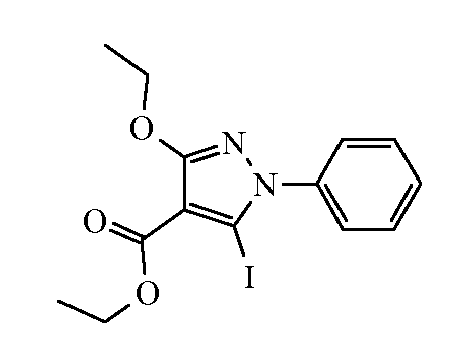
- Ethyl 5-iodo-3-ethoxy-1-phenyl-1H-pyrazole-4-carboxylate (20a): Obtained as a solid. 1.40 (t, 3H, J = 7.0); 1.45 (t, 3H, J = 7.0); 4.37 (m, 4H); 7.48 (m, 5H). 13C (CDCl3): 14.2; 14.6; 60.3; 65.1; 90.2; 105.4; 127.1; 128.9; 129.1; 140.1; 161.9; 163.8. HRMS: Calcd. for C14H15N2O3I + Na : 409.0025. Found: m/z, 409.0036.
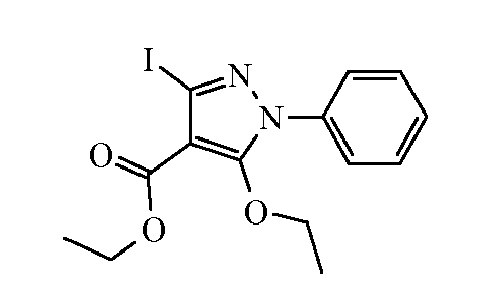
- Ethyl 3-iodo-5-ethoxy-1-phenyl-1H-pyrazole-4-carboxylate (20b): Obtained as an oil. 1.28 (t, 3H, J = 7.1); 1.43 (t, 3H, J = 7.1); 4.27 (q, 2H, J = 7.1); 4.38 (q, 2H, J = 7.1); 7.39 (m, 1H) ; 7.46 (m, 2H); 7.65 (m, 2H). 13C (CDCl3): 14.3; 15.2; 60.5; 72.7; 99.9; 104.7; 123.2; 128.3; 128.8; 137.1; 154.7; 161.2. HRMS: Calcd. for C14H1sN2O3I + Na : 409.0025. Found: m/z, 315.0026.
- From compound 12b, a chromatography over neutral alumina containing 1.5 % water (cyclohexane - ethyl acetate 97/3) led, in that order, to compound 21b (13 %) and then its isomer 21a (54 %).

- Ethyl 5-bromo-3-ethoxy-1-phenyl-1H-pyrazole-4-carboxylate (21a): Obtained as an oil. 1.37 (t, 3H, J = 7.0); 1.46 (t, 3H, J = 7.0); 4.37 (m, 4H); 7.46 (m, 5H). 13C (CDCl3): 14.3; 14.6; 60.4; 65.0; 101.3; 118.4; 126.2; 128.9; 129.0; 138.5; 161.8; 162.7. HRMS: Calcd. for C14H15N2O379Br + Na : 361.0164. Found: m/z, 361.0184.

- Ethyl 3-bromo-5-ethoxy-1-phenyl-1H-pyrazole-4-carboxylate (21b): Obtained as an oil. 1H (CDCl3) : 1.29 (t, 3H, J = 7.0); 1.44 (t, 3H, J = 7.0); 4.28 (q, 2H, J = 7.0); 4.38 (q, 2H, J = 7.0); 7.37 (m, 1H); 7.46 (m, 2H); 7.66 (m, 2H). 13C (CDCl3): 14.3; 15.2; 60.6; 72.8; 101.4; 123.2; 128.1; 128.8; 129.1; 137.1; 155.1; 161.2. HRMS: Calcd. for C14H15N2O3 79Br + Na : 361.0164. Found: m/z, 361.0172.
- From compound 10, a chromatography over neutral alumina containing 1.5 % water (cyclohexane - dichloromethane 9/1 and then 2/1) led, in that order, to compound 22a (56 %) and its isomer 22b (20 %).

- Ethyl 3-ethoxy-1-phenyl-1H-pyrazole (22a): Obtained as an oil. 1H (CDCl3): 1.46 (t, 3H, J = 7.0); 4.33 (q, 2H, J = 7.0); 5.90 (d, 1H, J = 2.5); 7.23 (m, 1H); 7.42 (m, 2H); 7.63 (m, 2H); 7.74 (d, 1H, J = 2.5) . 13C (CDCl3): 14.8; 64.9; 93.7; 117.8; 125.2; 125.5; 129.3; 140.2; 164.5. HRMS Calcd. for C11H12N2O + H : 189.1028. Found: m/z, 189.1061.

- Ethyl 5-ethoxy-1-phenyl-1H-pyrazole (22b): Obtained as an oil. 1H (CDCl3) : 1.47 (t, 3H, J = 7.1); 4.19 (q, 2H, J = 7.1); 5.67 (d, 1H, J = 1.7); 7.28 (m, 1H); 7.42 (m, 2H); 7.51 (d, 1H, J = 1.7); 7.77 (m, 2H) . 13C (CDCl3) : 14.6; 67.9; 86.2; 122.0; 126.2; 128.8; 138.8; 139.6; 154.6. HRMS: Calcd. for C11H12N2O + H : 189.1028. Found: m/z, 189.0971.
- Acid hydrolysis of compounds 18a and 18b: In a 60 mL roundbottomed thick glass tube fitted with a PTFE-faced screwcap, a mixture of the considered pyrazole (1 mmol) and 33 % hydrogen bromide in acetic acid (1.5 mL) was heated at 140 °C for 4 hours. The resulting solution was cooled, diluted in water extracted with ethyl acetate. The organic layer was washed with brine, dried over sodium sulfate and concentrated to dryness. The resulting residues were purified in both cases by a chromatography over silica gel (dichloromethane-ethanol 99/1) to yield compound 23a or 23b as described below.

- 1-phenyl-1H-pyrazol-3(2H)-one (23a): Obtained as a white powder in an 81 % yield. 1H (DMSO-d6 ): 5.80 (d, 1H, J = 2.5); 7.18 (m, 1H); 7.47 (m, 2H); 7.67 (m, 2H); 8.20 (d, 1H, J = 2.5); 10.18 (s(br), 1H). 13C (DMSO-d6 ) : 94.3; 116.7; 124.5; 128.3; 129.3; 139.8; 162.6. HRMS: Calcd. for C9H8N2O + H : 161.0715. Found: m/z, 161.0793.

- 1-phenyl-1H-pyrazol-5(4H)-one (23b): Obtained as an oil which solidified in a 71 % yield. 1H (CDCl3): 3.51 (d, 2H, J = 1.2); 7.21 (m, 1H); 7.43 (m, 2H); 7.49 (t, 1H, J = 1.2); 7.88 (m, 2H). 13C (CDCl3): 40.9; 119.0; 125.4; 128.9; 137.9; 146.8; 169.9. HRMS: Calcd. for C9H8N2O + H : 161.0715. Found: m/z, 161.0799.

- 3-Ethoxy-1-phenyl-1H-pyrazole-4-carboxylic acid (24): ester 18a (0.52 g, 2 mmol) was refluxed in a 1/1 water - ethanol solution (20 mL) containing sodium hydroxide (0.3 g, 3.8 mmol) for one hour. The resulting solution was diluted in water, made acid with 2N hydrochloric acid and the precipitate was filtered, washed with water and dried under vacuum to yield compound 24 as a white powder (0.39 g, 85 %). 1H (DMSO-d6 ): 1.37 (t, 3H, J = 7.1); 4.33 (q, 2H, J = 7.1); 7.32 (m, 1H); 7.48 (m, 2H); 7.85 (m, 2H); 8.20 (s, 1H). 13C (DMSO-d6 ): 15.0; 65.1; 102.6; 118.4; 126.8; 129.9; 133.2; 139.3; 162.4; 163.3. HRMS: Calcd. for C12H12N2O3 + H : 233.0926. Found: m/z, 233.0973.
- Scheme 4 depicts the copper-based N-phenylation of these compounds using phenylboronic acid. 15-18 From compound 8, a 92 % yield of the N-1 phenylation product 18a along with 7 % of its isomer 18b were isolated. The latter isomer is actually the only one which had been partially reported previously.19, 20 The N-phenylation of the 4-iodo bearing compound 11 gave 71 % of the N1-phenylation product 19a and only traces of 19b. On the other hand, this reaction proceeded with a lesser selectivity from compound 12a as compound 20a was obtained in a 60 % yield along with 26 % of 20b. A similar result was observed from 12b which led to compound 21a and 21b in 54 and 13 % yield respectively. And, from compound 10, the isomers 22a and 22b are obtained in 56 and 20 % yield respectively. Arylation of compound 13 also proceeded well; however, despite many trials, we could not separate the 1/3 mixture of the corresponding isomeric products.

- As long distance correlation or NOE-based NMR experiments are of little use to determine the regioselectivity of these N-phenylation reactions, this was ascertained beyond any doubt by the following transformations of the separated isomers. As depicted in scheme 5, an exhaustive acid hydrolysis of 18a and 18b led to compounds 23a and 23b. The 1H and 13C NMR spectra of 23b in deuterated chloroform pointed out the occurrence of a methylene component only compatible with the mesomer 23b drawn in scheme 2. The saponification of the ester function of compound 18a gave the acid 24 which upon heating in the presence of an equivalent amount of methanesulfonic gave 56 % of decarboxylation product corresponding to the isomer 22a. A partial (as the evolving hydrogen iodide poisons the catalyst) palladium-catalysed reduction of compound 19a also gave small amount of the isomer 22a. Under these reduction conditions, the bromine-bearing compound 21a led to the isomer 18a. Moreover, as it is shown below, further chemistry using compound 20a and 21a gave the same reaction product thus completing the structure assignment of all the N-phenyl derivatives.

-

- 3-Ethoxy-1H-pyrazole-4-carboxylic acid (25): compound 8 (1 g, 5.43 mmol) was heated to reflux in 1N sodium hydroxide solution (11 mL) for one hour (a shorter time is likely to be better) and upon acidification the precipitate was filtered, washed with water and dried under vacuum to yield 25 as a white powder (0.49 g, 58 %). 1H (DMSO-d6 ): 1.30 (t, 3H, J = 7.0); 4.20 (q, 2H, J = 7.0); 7.98 (s, 1H); 11.8 (s (1), 1H); 12.5 (s (1), 1H). 13C (DMSO-d6 ): 14.6; 64.0; 98.5; 134.3; 161.4; 163.4. HRMS: Calcd. for C6H8N2O3 + H : 157.0613. Found: m/z, 157.0600.

- 3-Ethoxy-1,4-diphenyl-1H-pyrazole (26): In a 10 mL biotage-adapted tube, compound 24 (0.11 g; 0.47 mmol), bromobenzene (0.068 mL; 0.64 mmol), potassium carbonate (0.078 g; 0.57 mmol) copper iodide (0.009 g; 0.047 mmol), phenanthroline (0.013 mg; 0.071 mmol) and 4A molecular sieves (0.02 g) were dispersed in N-methylpyrolidinone (4 mL). The oxygen was removed by a slow stream of argon and palladium acetate (5 mg, 0.023 mmol) was then added before sealing the tube. This was heated in the microwave oven for 40 minutes at 210 °C. The resulting suspension was concentrated to dryness under high vacuum. The residue was dispersed in water and extracted with ethyl acetate. The organic phase was washed with water, dried over sodium sulfate and concentrated to dryness. The residue was purified by a chromatography over silica gel (cyclohexane /dichloromethane 95-5) to yield compound 26 as a solid (0.010 g; 8 %). 1H (CDCl3): 1.58 (t, 3H, J = 7.0); 4.55 (q, 2H, J = 7.0); 7.27 (m, 2H); 7.48 (m, 4H); 7.70 (m, 2H); 7.81 (m, 2H); 8.04 (s, 1H). 13C (CDCl3): 15.0; 65.0; 109.9; 117.7; 124.4; 125.2; 126.1 (two signals); 128.6; 129.4; 131.8; 140.1; 161.4. HRMS: Calcd. for C17H16N2O + H : 265.1341. Found: m/z, 265.1365.
Under these reaction conditions, the N-phenylated derivative 22a described above was obtained in a 41 % yield from acid 25. - Representative aryl-aryl coupling procedure, preparation of compound 27. In a 10 mL biotage-adapted tube, compound 12b (0.09 g; 0.34 mmol), phenyl boronic acid (0.054 g; 4.42 mmol), cesium carbonate (0.28 g; 8.47 mmol) were dispersed in a mixture of propanol (3 mL) and water (2 mL). The oxygen was removed by a slow stream of argon and [1,1'-bis(diphenylphosphino)ferrocene] dichloropalladium complexed with dichloromethane (0.057 mmol) was then added before sealing the tube. This was heated in the microwave oven for 30 minutes at 120 °C. The resulting suspension was diluted in water, extracted with dichloromethane. The organic layer was washed with brine, dried over sodium sulfate and concentrated to dryness. The residue was purified by a chromatography over silica gel (dichloromethane /ethanol 99-1) to yield compound 27 as an oil (0.065 g; 73 %).

- Ethyl 5-ethoxy-3-phenyl-1H-pyrazole-4-carboxylate (27): 1H (CDCl3): 1.17 (t, 3H, J = 7.0); 1.36 (t, 3H, J = 7.0); 4.16 (q, 2H, J = 7.0); 4.21 (q, 2H, J = 7.0); 7.38 (m, 3H); 7.51 (m, 2H); 10.74 (s(l), 1H). 13C (CDCl3): 14.0; 14.6; 59.8; 65.0; 96.8; 128.1; 129.0; 129.3; 129.5; 147.3; 163.2; 163.3. HRMS: Calcd. for C14H16N2O3 + H : 261.1239. Found: m/z, 261.1228.

- Ethyl 3-ethoxy-1,5-diphenyl-1H-pyrazole-4-carboxylate (28): This compound was obtained from compound 20a (or 21a) using the procedure described for the preparation of compound 27 as an oil that slowly solidifed in 75 % yield. 1H (CDCl3): 1.22 (t, 3H, J = 7.0); 1.31 (t, 3H, J = 7.0); 4.15 (q, 2H, J = 7.0); 4.48 (q, 2H, J = 7.0); 7.28 (m, 10H). 13C (CDCl3): 13.9; 14.8; 59.7; 65.1; 100.1; 125.1; 127.2; 127.9; 128.7; 128.9; 129.8; 130.4; 139.2; 144.4; 162.7; 162.8. HRMS: Calcd. for C20H20N2O3 + H : 337.1552. Found: m/z, 337.1545.

- 3-ethoxy-5-phenyl-1H-pyrazole (29) 21 : Compound 27 (0.08 g, 0.30 mmol) and sodium hydroxide (1 g, 25 mmol) were heated to reflux in a mixture of water (4 mL) and ethanol (2 mL) for 12 hours. The solution was extracted with ethyl acetate, dried over sodium sulfate and concentrated to dryness to yield compound 29 (0.05 g, 86 %) featuring analytical data similar to the reported one.21

- 3-Ethoxy-1,5-diphenyl-1H-pyrazole-4-carboxylic acid (30): The protocol used for the preparation of compound 24 was used from 28 to yield compound 30 as a white powder (94 % yield). 1H (DMSO-d6 ): 1.38 (t, 3H, J = 7.1); 4.32 (q, 2H, J = 7.1); 7.15 (m, 2H); 7.30 (m, 8H). 13C (DMSO-d6 ): 14.7; 64.3; 99.8; 125.4; 127.5; 127.8; 128.7; 128.8; 129.4; 130.3; 138.8; 146.3; 161.7; 163.0. HRMS: Calcd. for C18H16N2O3 + H : 309.1239. Found: m/z, 309.1239.

- 3-ethoxy-1,5-diphenyl-1H-pyrazole (31) 21: Acid 30 (0.08g, 0.25 mmol) and methanesulfonic acid (0.016 mL, 0.25 mmol) were refluxed in toluene (20 mL) for two hours. The solution was washed with a saturated sodium hydrogencarbonate solution dried over sodium sulfate and concentrated to dryness to yield compound 31 as an oil (0.05 g; 73 %). 1H (CDCl3) : 1.46 (t, 3H, J = 7.1); 4.34 (q, 2H, J = 7.1); 5.97 (s, 1H); 7.27 (m, 10H). 13C (CDCl3) : 14.9; 64.7; 93.7; 124.9; 126.7; 128.3; 128.4; 128.7; 128.8; 130.7; 140.1; 144.1; 163.5. HRMS: Calcd. for C17H16N2O + H : 265.1341. Found: m/z, 265.1286.
- From acid 25, readily obtained by the saponification of compound 8, the N-phenylated compound 22a, resulting from an Ullmann/Buchwald-Hartwig reaction,22 was the only product isolated (in a 41 % yield). From acid 24, the expected C-4 arylation product 26, resulting form a decarboxylative coupling reaction, was obtained; although in only an 8 % yield. A far better 72 % yield of 26 was obtained from the 4-iodinated isomer 19a using the more conventional Suzuki-Miyaura aryl-aryl cross coupling reaction. The duration of this coupling reaction was greatly shorten by the use of the [1,1'-bis(diphenylphosphino)ferrocene] dichloropalladium as a precatalyst23, 24 as well as the recourse to a microwave oven. The use of these aryl-aryl coupling conditions successfully led to the C-5 phenyl derivatives 27 or 28, from compound 12a or 20a in 75 and 74 % yield respectively. Very similar results were obtained from the 5-bromo homologues 12b or 21a (giving 73 or 62 % yield of compound 27 or 28 respectively). However, attempts to achieve a direct C-4 arylation of compound 11 only led to extensive decomposition. Even the addition of lithium chloride as described in previously reported palladium-based aryl coupling reaction of heterocycles featuring an NH component did not help.25-28 To complete this synthetic exploration, the removal of the carboxyl moiety of compounds 27 and 28 was also undertook. In the case of compound 27, this was achieved using strongly basic condition leading to the known21 compound 29 in 86 % yield. From ester 28, a two-step sequence was devised leading first to the acid 30 which undertook an acid-catalysed decarboxylation leading to the known21, 9 compound 31 in a 68 % overall yield.
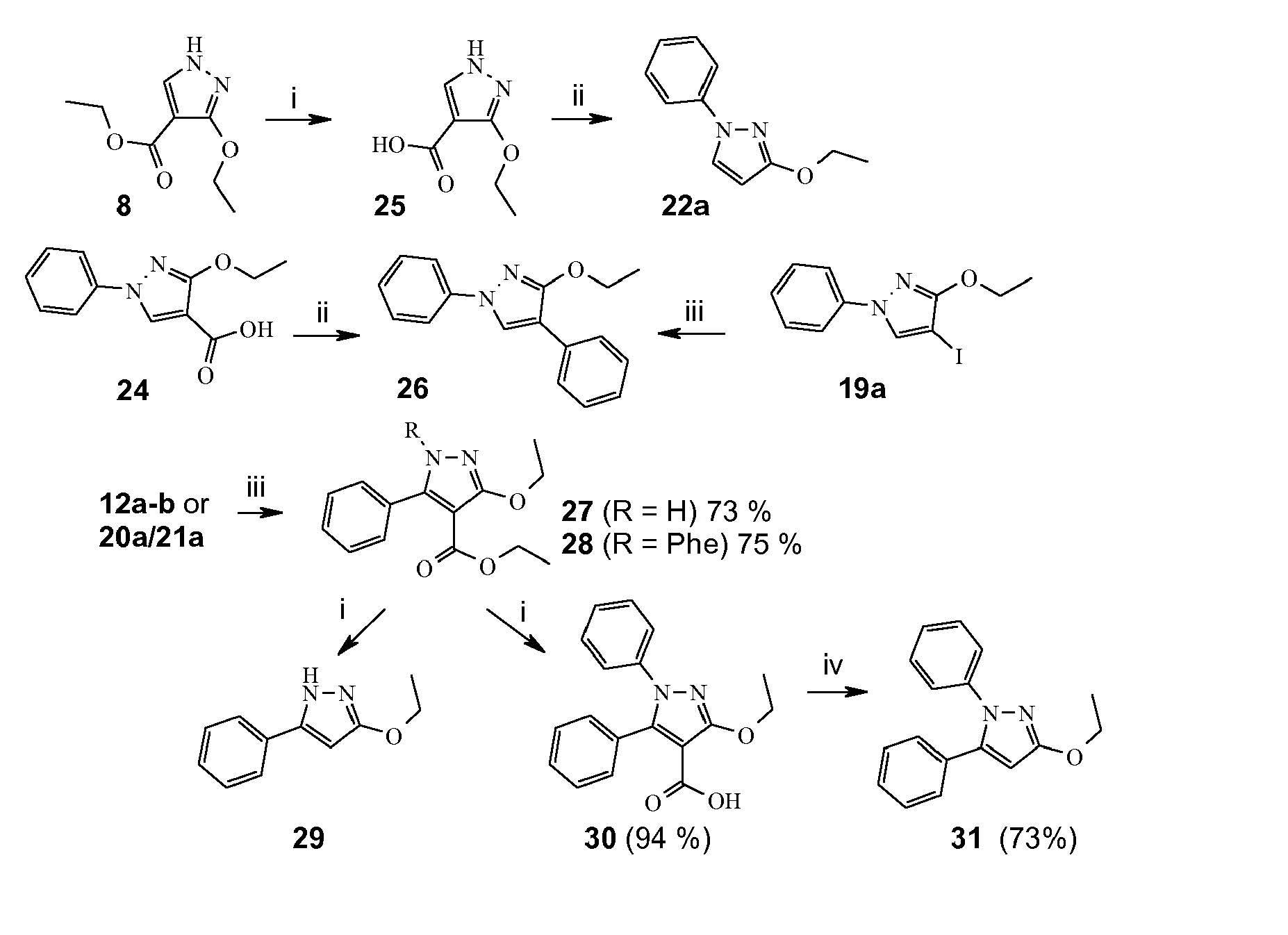

-
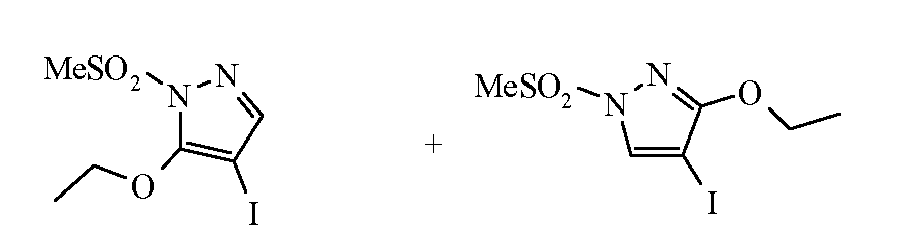
- 5-ethoxy-4-iodo-1-(methylsulfonyl)-1H-pyrazole and 3-ethoxy-4-iodo-1-(methylsulfonyl)-1H-pyrazole (32a-b): compound 11 (2.06 g, 8.65 mmol) was dissolved in ethyl acetate (150 mL), triethylamine (1.9 mL, 13.8 mmol; dried over 4Å molecular sieves) was added followed by mesylchloride (1.0 mL, 13.0 mmol). The solution was protected from moisture by a calcium chloride guard and stirred for two hours at room temperature. This was washed with 2 N potassium carbonate, 0.5 N hydrochloric acid and brine, dried over sodium sulfate and concentrated to dryness to yield the 2/5 mixture of the two isomers as an oil that slowly crystallized (2.68 g, 98 %). 1H (CDCl3): 1.45 (d, 5/7 of 3H, J = 7.1); 1.49 (d, 2/7 of 3H, J = 7.1); 3.25 (s, 5/7 of 3H); 3.31 (s, 2/7 of 3H); 4.41 (m, 2H); 7.61 (s, 2/7 of 1H) ; 7.90 (s, 5/7 of 1H). m/z (LC/MS) = 253.

- ethyl 3-ethoxy-5-iodo-1-(methylsulfonyl)-1H-pyrazole-4-carboxylate and ethyl 5-ethoxy-3-iodo-1-(methylsulfonyl)-1H-pyrazole-4-carboxylate (33a-b): From compound 12a, the protocol described above led to a 1/1 mixture of the possible isomers as a solid (0.46 g, 89 %). 1H (CDCl3): 1.45 (m, 6H); 3.37 (s, 1/2 of 3H); 3.40 (s, 1/2 of 3H); 4.39 (m, 3/4 of 4H); 4.49 (q, 1/4 of 4H, J = 7.1).
- In a 10 mL biotage-adapted tube, the mixture of the mesyl-protected pyrazoles (1.38 g, 4.37 mmol), the relevant boronic acid (5.68 mmol), cesium carbonate (3.56 g; 10.9 mmol) were dispersed in a mixture of propanol (3 mL) and water (2 mL). The oxygen was removed by a slow stream of argon and [1,1'-bis(diphenylphosphino)ferrocene] dichloropalladium complexed with dichloromethane (0.178 g, 0.218 mmol) was then added before sealing the tube. This was heated in the microwave oven for 40 minutes at 120 °C. This was diluted in water, extracted with ethyl acetate; the organic layer was washed with brine and dried over sodium sulfate and concentrated to dryness. The residue was dissolved in ethanol (150 mL) and potassium hydroxide (0.8 g) this was heated at 90 °C for two hours. This was diluted in water, made slightly acid with ammonium chloride, extracted with ethyl acetate, the organic layer was washed with brine and dried over sodium sulfate and concentrated to dryness. The residue was further purified as described below.


- 4-(4-chlorophenyl)-3-ethoxy-1H-pyrazole (35): This compound was purified by a chromatography over neutral alumina containing 1.5 % of water (dichloromethane / ethanol 99/1) to give compound 35 (23 %) as a white powder. 1H (CDCl3) : 1.47 (t, 3H, J = 7.0); 4.38 (q, 2H, J = 7.0); 7.33 (m, 2H); 7.61 (s, 2H); 7.63 (s, 1H). 13C (CDCl3): 14.9; 64.8; 106.1; 127.0; 127.1; 128.9; 130.5; 131.3; 160.6. HRMS: Calcd. for C11H14N2O35Cl + H : 223.0638. Found: m/z, 223.0676.

- 4-(2-chlorophenyl)-3-ethoxy-1H-pyrazole (36): This compound was purified by a chromatography over neutral alumina containing 1.5 % of water (dichloromethane / ethanol 99/1) to give compound 36 (33 %) as a white powder. 1H (CDCl3): 1.44 (t, 3H, J = 7.0); 4.37 (q, 2H, J = 7.0); 7.20 (m, 1H); 7.29 (m, 1H); 7.45 (s, 1H); 7.70 (m, 1H); 7.83 (s, 1H). 13C (CDCl3): 14.9; 65.0; 103.7; 126.6; 127.5; 130.0; 130.3; 130.4; 131.0; 132.3; 160.8. m/z (LC/MS) = 223.
- General procedure for the C-4 benzylation and phenethylation of 11 or C-5 benzylation of 13 and 33a-b. In a biotage 20 mL tube, benzylzinc bromide or phenethyl zinc bromide (0.5 M in THF; 2.52 mmol) and THF (1 mL) were degassed with a slow stream of argon for ten minutes. The pyrazole halide (either 11, 13 or the mixture of 33a-b) (0.84 mol) and [1,1'-bis(diphenylphosphino)ferrocene] dichloropalladium complexed with dichloromethane (0.042 mmol) were then added, and the tube was degassed again with a slow stream of argon for 5 min prior to capping. The reaction vessel was then heated at 85 °C for 4 hours in an oil bath. After cooling to room temperature, water and a 1N solution of potassium sodium tartrate (3 mL) were added. The aqueous layer was extracted with ethyl acetate. The combined organic layers were dried over sodium sulphate, filtered and concentrated to dryness. The residue was purified by chromatography over silica gel (dichloromethane - ethanol 99/1).

- 4-benzyl-3-ethoxy-1H-pyrazole (37): Obtained as an oil. 1H (CDCl3): 1.40 (t, 3H, J = 7.1); 3.74 (s, 2H); 4.28 (q, 2H, J = 7.1); 7.06 (s, 1H); 7.26 (m, 5H). 13C (CDCl3) : 14.9; 28.4; 64.7; 105.3; 125.9; 128.3; 128.5; 128.7; 141.0; 161.4. Calcd. for C12H14N2O + H : 203.1184. Found: m/z, 203.1122.

- 3-ethoxy-4-phenethyl-1H-pyrazole (38): Obtained as an oil. 1H (CDCl3): 1.42 (t, 3H, J = 7.1); 2.71 (m, 2H); 2.88 (m, 2H); 4.28 (q, 2H, J = 7.1); 7.04 (s, 1H); 7.20 (m, 3H); 7.30 (m, 2H). 13C (CDCl3) : 14.9; 24.0; 35.9; 64.5; 105.3; 125.8; 128.1; 128.2; 128.5; 141.9; 161.7. m/z (LC/MS) = 217.

- ethyl 5-benzyl-3-ethoxy-1H-pyrazole-4-carboxylate (39a) Obtained as an oil. 1H (CDCl3): 1.31 (t, 3H, J = 7.1); 1.34 (t, 3H, J = 7.1); 4.28 (m, 6H); 7.28 (m, 5H). 13C (CDCl3): 14.3; 14.6; 32.7; 29.8; 64.9; 97.0; 127.1; 128.8; 128.9; 136.1; 147.5; 163.2; 163.5. m/z (LC/MS) 275.

- 5-benzyl-3-ethoxy-1H-pyrazole (39b) Obtained as colorless crystals. 1H (CDCl3): 1.38 (t, 3H, J = 7.1); 3.96 (s, 2H); 4.17 (q, 2H, J = 7.1); 5.54 (s, 1H); 7.28 (m, 5H). 13C (CDCl3): 14.8; 32.8; 65.0; 89.6; 126.9; 128.7; 128.8; 137.2; 144.5; 163.2. m/z (LC/MS) = 203.

- Ethyl 3-ethoxy-5-morpholino-1H-pyrazole-4-carboxylate (40): In a biotage 5 mL tube, ethyl 3-ethoxy-5-iodo-1H-pyrazole-4-carboxylate (0.2 g; 0.64 mmol) and morpholine (1.2 mL; 13.8 mmol) dissolved in toluene (5 mL). The reaction vessel was then heated at 170 °C for 4 hours using a microwave oven. This was concentrated to dryness and the residue was purified by chromatography on silica gel (dichloromethane - ethanol 98/2) to yield compound 40 as an oil (0.04 g; 23 %) . 1H (CDCl3): 1.33 (t, 3H, J = 7.1); 1.40 (t, 3H, J = 7.1); 3.28 (m, 4H); 3.83 (m, 4H); 4.25 (m, 4H); 7.90 (s(l), 1H). 13C (CDCl3): 14.3; 14.7; 49.4; 59.7; 64.8; 66.3; 87.1; 154.2; 162.4; 163.00. Calcd. for C12H19N3O4 + Na : 292.1273. Found: m/z, 292.1220.
- Despite some trials, the Suzuki-based aryl-aryl coupling reactions with the NH-bearing compound 11 were never very satisfactory. Depending on the catalyst used, some of these trials led to a mixture containing the expected compound as well as unreacted and reduced material. For this reason, we set to protect compound 11 using a mesyl group. The reaction of 11 with mesylchloride under basic conditions led to an isomeric mixture 32a-b which was used whithout further purification in the aryl-aryl coupling step. This allowed us to prepare an array of 4-aryl compounds such as 34-36. Interstingly the Negishi-beased carbon-carbon bond formation reaction turned out to be possible from the NH-bearing compound 11. The use of benzyl or phenethyl zinc bromide allowed the preparation of compound 37 and 38. On the other hand, preparation of the 5-benzyl derivative 39a required the use of the N-protected mixture of compounds 33a-b as little reaction was observed from the NH-bearing compound 12a. On the other hand, from the unprotected compound 13, the Negishi reaction with benzylzinc bromide gave 63 % of the 5-benzylderivative 39b.

- The difference of reactivity between compounds 11 and 12a toward the Suzuki aryl-aryl coupling reaction may have its origin in the difference of lability of the iodine atom. Indeed, it was possible to prepare compound 40 by a nucleophilic substitution without the recourse to copper or palladium-based methods:29, 30 On the other hand, under these conditions, no reaction took place from compound 13 either.


-

- 4-(4-bromophenyl)-3-ethoxy-1H-pyrazole (41): Compound 34 (0.1 g, 0.53 mmol) and bromine (0.031 mL, 0.63 mmol) were heated to reflux in cyclohexane (5 mL) for 2 hours. This was diluted in ethyl acetate washed with water, dried over sodium sulfate and concentrated to dryness. The residu was purified by chromatography over neutral alumina containing 1.5 % of water (dichloromethane / ethanol 99/1) to yield compound 41 as a white solid (0.07 g, 49 %). 1H (CDCl3): 1.49 (t, 3H, J = 7.0); 4.40 (q, 2H, J = 7.0); 7.48 (m, 2H); 7.56 (m, 2H); 7.68 (s, 1H). 13C (CDCl3): 14.9; 65.2; 106.2; 119.5; 127.3; 127.5; 130.7; 131.6; 160.2. m/z (LC/MS) = 189.

- 5-bromo-4-(4-bromophenyl)-3-ethoxy-1H-pyrazole (42): Compound 34 (0.36 g, 1.92 mmol) and bromine (0.3 mL, 5.77 mmol) were heated to reflux in ethanol (50 mL) for 5 minutes. This was concentrated to dryness, diluted in ethyl acetate washed with sodium sulfite, brine, dried over sodium sulfate and concentrated to dryness. The residu was purified by chromatography over neutral alumina containing 1.5 % of water (dichloromethane and then dichloromethane / ethanol 99/1) to yield compound 42 as a white solid (0.07 g, 49 %). 1H (CDCl3): 1.49 (t, 3H, J = 7.0); 4.40 (q, 2H, J = 7.0); 7.48 (m, 2H); 7.56 (m, 2H); 7.68 (s, 1H). 13C (CDC13): 14.9; 65.2; 106.2; 119.5; 127.3; 127.5; 130.7; 131.6; 160.2. HRMS: Calcd. for C11H10N2O79Br2 + H : 344.9238. Found: m/z, 344.9243.

- 5-bromo-4-(4-chlorophenyl)-3-ethoxy-1H-pyrazole (43): 4-(4-chlorophenyl)-3-ethoxy-1H-pyrazole (35) (0.18 g, 0.81 mmol) and potassium carbonate (0.12 g, 0.89 mmol) were dissolved in ethanol (10 mL) and water (3 mL). To this was added bromine (0.046 mL, 0.89 mmol) and the solution was stirred at 25 °C overnight. This was diluted in water, extracted with ethyl acetate, dried over sodium sulfate and concentrated to dryness. The residu was then purified by a chromatography over silica gel (dichloromethane) the fraction containing 43 was then recrystallized in cyclohexane to yield pure 43 as white crystals (0.03 g, 13 %). 1H (CDCl3): 1.47 (t, 3H, J = 7.0); 4.32 (q, 2H, J = 7.0); 7.39 (m, 2H); 7.59 (s, 2H). 13C (CDCl3): 14.7; 65.0; 105.9; 112.6; 120.1; 128.7; 129.6; 132.8; 160.0. HRMS: Calcd. for C11H13N2O35Cl79Br + H : 302.9721. Found: m/z, 302.9715.

- 4-(4-chlorophenyl)-3-ethoxy-5-phenyl-1H-pyrazole (44): In a 5 mL biotage-adapted tube, 5-bromo-4-(4-chlorophenyl)-3-ethoxy-1H-pyrazole (0.03 g; 0.1 mmol), phenyl boronic acid (0.018 g; 0.15 mmol), cesium carbonate (0.081 g; 0.25 mmol) were dispersed in a mixture of propanol (1 mL) and water (1 mL). The oxygen was removed by a slow stream of argon and [1,1'-bis(diphenylphosphino)ferrocene] dichloropalladium complexed with dichloromethane (0.004g, 0.005 mmol) was then added before sealing the tube. This was heated in the microwave oven for 40 minutes at 120 °C. The mixture was concentrated to dryness. The residue was purified by a chromatography over silica gel (dichloromethane / ethanol 99-1) to yield compound 44 as a solid (0.010 g; 73 %). 1H (CDCl3): 1.42 (t, 3H, J = 7.0); 4.34 (q, 2H, J = 7.0); 7.28 (m, 2H); 7.31 (s, 2H); 7.39 (m, 5H) . 13C (CDCl3): 14.9; 64.8; 103.6; 120.0; 127.8; 128.4; 129.0; 129.9; 130.1; 130.3; 131.9; 141.4; 161.3.
- Unexpectedly, bromination of compound 34, turned out to lead to the 4-brominated derivative 41. Further work led to the bisbrominated compound 42. However, little selectivity was observed in our 5-arylation attempts under Suzuki reaction conditions. On the other hand, bromination of the 4-chloroderivative 35 gave the 5-bromo-bearing compound 43. This NH-bearing 5-bromopyrazole, upon coupling with phenyl-boronate led the expected 4.5-bisaryl derivative 44.

-
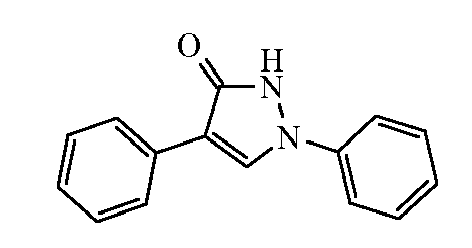
- 1,4-diphenyl-1H-pyrazol-3(2H)-one (45): In a 60 mL roundbottomed thick glass tube fitted with a PTFE-faced screwcap, a mixture of the considered ethoxypyrazole (1 mmol) was degassed with argon. Following this, 33 % hydrogen bromide in acetic acid (1.0 mL) was added; the tube was tightly closed and was heated at 140 °C for 2 hours. The resulting reaction mixture then precipitated in water to give compound 45 in an 83 % yield as a white powder. 1H (DMSO-d6 ): 7.17 (m, 2H); 7.43 (m, 2H); 7.39 (m, 2H); 7.47 (m, 2H); 7.77 (m, 4H); 8.76 (s, 1H); 10.93 (s(l), 1H). 13C (DMSO-d6 ): 109.0; 117.2; 125.3; 125.9; 126.0; 126.1; 128.9; 129.9; 140.0; 160.4. HRMS: Calcd. for C15H12N2O + H : 237.1028. Found: m/z, 237.1043.

- 4-phenyl-1H-pyrazol-3(2H)-one (46): In a 60 mL roundbottomed thick glass tube fitted with a PTFE-faced screwcap, a mixture of the considered alkoxypyrazole (1 mmol) was degassed with argon. Following this, 33 % hydrogen bromide in acetic acid (1.0 mL) was added; the tube was tightly closed and was heated at 140 °C for 3 hours. The resulting solution was concentrated to dryness, made basic with methanolic ammonia, cocnntrated again and the residue was purified by a chromatography over silica gel (dichloromethane / ethanol from 99/1 to 94/6). 1H (DMSO-d6 ): 7.10 (m, 1H); 7.29 (m, 2H); 7.68 (m, 2H); 7.90 (s, 1H).

- 4- (4-chlorophenyl) -1H-pyrazol-3 (2H) -one (47) : By using the protocol described above, compound 47 was obtained as a white powder. 1H (DMSO-d6 ): 7.36 (d, 2H, J = 8.6); 7.70 (d, 2H, J = 8.6); 7.94 (s, 1H). 13C (DMSO-d6 ): 104.5; 126.9; 128.1; 128.7; 129.3; 132.7; 158.8. HRMS: Calcd. for C8H7N2O35Cl + H : 195.0325. Found: m/z, 195.0264.

- 4-(2-chlorophenyl)-1H-pyrazol-3(2H)-one (48) : By using the protocol described above, compound 48 was obtained as a white powder. 1H (DMSO-d6 ): 7.19 (m, 1H); 7.33 (m, 1H); 7.45 (m, 1H); 7.65 (m, 1H); 7.80 (s, 1H). 13C (DMSO-d6 ): 101.4; 126.8; 127.1; 129.6; 129.7; 130.8; 131.1; 131.4; 158.4.
- The ethoxy groups protecting the oxygen moiety of these alkoxypyrazoles were cleaved by the use of hydrogenbromide in acetic acid. It was found that oxygen was detrimental to these reactions which led us to conduct these hydrolyses in a sealed reactor under an argon atmosphere. As an illustration of this process, compounds 45-48 were thus obtained from the corresponding 3-ethoxypyrazoles.

-
- 1. Miyaura, N.; Suzuki, A. Chem. Rev. 1995, 95, 2457-2483.
- 2. Miyaura, N. Top. Curr. Chem. 2002, 219, 12-59.
- 3. Kimata, A.; Nakagawa, H.; Ohyama, R.; Fukuuchi, T.; Ohta, S.; Doh-ura, K.; Suzuki, T.; Miyata, N. J. Med. Chem. 2007, 50, 5053-5056.
- 4. Kees, K.L.; Fitzgerald, J.J.; Steiner, K.E.; Mattes, J.F.; Mihan, B.; Tosi, T.; Mondoro, D.; McCaleb, M.L. J. Med. Chem. 1996, 39, 3920-3928.
- 5. Himly, M.; Jahn-Schmid, B.; Pittertschatscher, K.; Bohle, B.; Grubmayr, K.; Ferreira, F.; Ebner, H.; Ebner, C. J. Allergy Clin. Immunol. 2003, 111, 882-888.
- 6. Kees, K.L.; Caggiano, T.J.; Steiner, K.E.; Fitzgerald, J.J.; Kates, M.J.; Christos, T.E.; Kulishoff, J.M.; Moore, R.D.; McCaleb, M.L. J. Med. Chem. 1995, 38, 617-628.
- 7. Otterness, I.G. Clin. Exp. Immunol. 1981, 46, 332-339.
- 8. Ishimaru, T. Yakugaku Zasshi 1957, 77, 800-802. See Chem. Abstr. 1957: 17893.
- 9. Braibante, M.E.F.; Braibante, H.T.S.; de Carvalho Tavares, L.; Rohte, S.F.; Costa, C.C.; Morel, A.F.; Stüker, C.Z.; Burrow, R.A. Synthesis 2007, 2485-2490.
- 10.
Li, L.; Chen, X.; Cutler, S.T. Patent WO 2001 082930 see Chem. Abstr. 2001 135: 344479 - 11. Willson, T.S.; Henke, B.R.; Momtahen, T.M.; Garrison, D.T.; Moore, L.B.; Geddie, N.G.; Baer, P.G. Bioorg. Med. Chem. Lett. 1996, 6, 1047-1050.
- 12. Cottineau, B.; Toto, P.; Marot, C.; Pipaud, A.; Chenault, J. Bioorg. Med. Chem. Lett. 2002, 12, 2105-2108.
- 13. Wasserman, H.H.; Han, W.T. Tetrahedron Lett. 1984, 25, 3743-3746.
- 14. McElvain, S. M.; Burkett, H. J. Am. Chem. Soc. 1942, 64, 1831-1836.
- 15. Chan, D.M.T.; Monaco, K.L.; Wang, R.-P.; Winters, M.P. Tetrahedron Lett. 1998, 39, 2933-2936.
- 16. Lam, P.Y.S.; Clark, C.G.; Saubern, S.; Adams, J.; Winters, M.P.; Chan, D.M.T.; Combs, A. Tetrahedron Lett. 1998, 39, 2941-2944.
- 17. Lam, P.Y.S.; Vincent, G.; Clark, C.G.; Deudon, S.; Jadhav, P.K. Tetrahedron Lett. 2001, 42, 3415-3418.
- 18. Chan, D.M.T.; Lam, P.Y.S. Recent advances in copper-promoted C-heteroatom bond cross-coupling reactions with boronic acids and derivatives. In Boronic acids; Wiley-VCH Ed., 2005; pp. 205-240.
- 19. Subasinghe, N.L.; Ali, F.; llig, C.R.; Rudolph, M.J.; Klein, S.; Khalil, E.; Soll, R.M.; Bone, R.F.; Spurlino, J.C.; DesJarlais, R.L.; Crysler, C.S.; Cummings, M.D.; Morris, P.E.; Kilpatrick, J.M.; Babu, Y.S. Bioorg. Med. Chem. Lett. 2004, 14, 3043-3047.
- 20.
Dyckman, A.; Das, J.; Leftheris, K.; Liu, C.; Moquin, R.V.; Wrobleski, S.T. Patent WO 2004098518 see Chem. Abstr. 2004 141:424181 - 21. Ohta, T.; Fujisawa, H.; Nakai, Y.; Furukawa, I. Bull. Soc. Chim. Jpn. 2000, 73, 1861-1864.
- 22. Ley, S.V.; Thomas, A.W. Angew. Chem., Int. Ed. 2003, 42, 5400-5449.
- 23.
Jurcak, J.G.; Barrague, M.; Gillespy, T.A.; Edwards, M.L.; Musick, K.Y.; Weintraub, P.M.; Du, Y.; Dharanipragada, R.M.; Parkar, A.A. Patent WO 2005 026175 see Chem. Abstr. 2005 142: 316835 - 24. Guillou, S.; Janin, Y.L. J. Heterocyclic. Chem. 2008 , in print.
- 25. Chu, L.; Fisher, M.H.; Goulet, M.T.; Wyvratt, M.J. Tetrahedron Lett. 1997, 38, 3871-3874.
- 26.
Drysdale, M.J.; Dymock, B.W.; Barril-Alonso, X.; Workman, P.; Pearl, L.H.; Prodromou, C.; MacDonald, E. Patent WO 03 55,860 - 27. Beaulieu, P.L.; Gillard, J; Bykowski, D.; Brochu, C.; Dansereau, N.; Duceppe, J.S.; Haché, B.; Jakalian, A.; Lagacé, L.; LaPlante, S.; McKercher, G.; Moreau, E.; Perreault, S.; Stammers, T.; Thauvette, L.; Warrington, J.; Kukolj, G. Bioorg. Med. Chem. Lett. 2006, 16, 4987-4993.
- 28. Bernal, P.; Tamariz, J. Helv. Chim. Acta 2007, 90, 1449-1454.
- 29. Kwong, F.Y; Klapars, A.; Buchwald, S.L. Org. Lett. 2002, 4, 581-584.
- 30. Conesa, L.I.; Cawley, M.J.; Cloke, F.G.N.; Arentsen, K.; Scott, J.S.; Pearson, S.E.; Hayler, J.; Caddick, S. J. Organomet. Chem. 2005, 690, 5841-5848.
- 31. Knorr, L. Ber. Dtsch. Chem. Ges. 1895, 28, 706-714.
- 32. Stanovik, E.; Svete, J. Product class 1: pyrazoles. In Science of Synthesis; Neier, R. Ed.; Thieme, 2002; Vol. 12; pp. 15-225.
- 33. Varvounis, G.; Fiamegos, Y.; Pilidis, G. Pyrazol-3-ones, Part 1: synthesis and applications. In Adv. Heterocyclic Chem.; Katritzky, A. R. Ed.; Academic Press, 2001; Vol. 80; pp. 74-144.
- 34. Bau, B.; Hofmann, T.; Kloss, J.; Neunhoeffer, H. Sci. Pharm. 1998, 66, 119-136.
- 35. Sustmann, R.; Sicking, W.; Felderhoff, M.; Tabarsi, P. Tetrahedron 1990, 46, 783-792.
Claims (18)
- A process for the preparation of alkoxypyrazoles of formula (I) or (I')
 R1 stands for a radical selected from the group consisting of C1-C6 alkyl, C2-C6 alkenyl, C2-C6 alkynyl and (C6-C10) aryl (C1-C6) alkyl;R2 stands for a radical selected from the group consisting of hydrogen, halogen, -C(O)-O-(C1-C6)alkyl, - C(O)-O-(C2-C6)alkenyl, -C(O)-O-(C2-C6)alkynyl;R3 stands for a radical selected from the group consisting of hydrogen, halogen, C1-C6 alkyl, C2-C6 alkenyl, C2-C6 alkynyl and (C6-C10)aryl(C1-C6)alkyl, each optionally substituted by R5;R5 is a radical selected from the group consisting of halogen, oxygen, hydroxyl, C1-C6 alkyl and C1-C6 alkoxy;R7 stands for a radical selected from the group consisting of H, C1-C6 alkyl, C6-C10 aryl, (C6-C10)aryl(C1-C6)alkyl, C6-C10 heteroaryl or (C6-C10)heteroaryl(C1-C6)alkyl, each optionally substituted by a halogen;comprising the successive following steps:(a) reacting a derivative of formula (II)
 in which A stands for a radical selected from the group consisting of C1-C6 alkyl, C2-C6 alkenyl, C2-C6 alkynyl and (C6-C10)aryl(C1-C6)alkyl;B stands for a radical selected from the group consisting of hydrogen, -C(O)-O-(C1-C6)alkyl, -C(O)-O-(C2-C6)alkenyl, -C(O)-O-(C2-C6)alkynyl;D stands for a radical selected from the group consisting of hydrogen, C1-C6 alkyl, C2-C6 alkenyl, C2-C6 alkynyl and (C6-C10)aryl(C1-C6)alkyl;E stands for a radical O-F or NRαRβ,F stand for a radical selected from the group consisting of H, C1-C6 alkyl, C2-C6 alkenyl, C2-C6 alkynyl and (C6-C10)aryl(C1-C6)alkyl;Rα and Rβ, identical or different, stand for a radical selected from the group consisting of H, C1-C6 alkyl or C6-C10 aryl or Rα and Rβ form together an C4-C6 alkylene radical, an C4-C6 alkenylene, an C4-C6 heteroalkylene radical or an C4-C6 heteroalkenylene radical;with 1 to 1.5 molar equivalents of R7-NH-NH2, xHX2, in which R7 as defined for compound of formula (I) or (I'), X2 is Cl or Br and x is 1 or 2;in an alkylalcohol R80H as a solvent, in which R8 is a radical selected from the group consisting of C1-C6 alkyl, C2-C6 alkenyl, C2-C6 alkynyl and (C6-C10)aryl(C1-C6)alkyl, (C6-C10)heteroaryl(C1-C6)alkyl;to obtain compounds of formula (III) or (III')
 (b) optionally reacting said alkoxypyrazole of formula (III') wherein R7 = H obtained in step (a) with X to prepare compounds of formula (IV) or (IV')
 X represents Br, Cl, I or F;A, B and D are as defined above;(c) recovering the alkoxypyrazole of formula (I) or (I').
 - The process according to claim 1, wherein in step (a) the compound of formula (II) is reacted with 1.05 molar equivalents of R7-NH-NH2, xHX2, in which R7, X2 and x are as defined in claim 1.
- The process according to claims 1 or 2, wherein in step (a) the reaction is run in boiling ethanol.
- The process according to any one of the preceding claims, wherein E is NRαRβ, X2 is Cl and x is 2.
- The process according to any one of claims 1 to 3, wherein E is O-F, F is C1-C6 alkyl, X2 is Cl and x is 1.
- The process according to any one of the preceding claims , wherein R7 is a hydrogen or a methyl, benzyl or phenyl group.
- The process according to any one of the preceding claims, wherein the reaction in step (a) is run at the boiling point of the solvent.
- The process according to claim 5, wherein the reaction in step (a) is run for 16 hours.
- The process according to any one of the preceding claims, wherein R8 is an ethyl group.
- The process according to any one of the preceding claims, wherein A stands for a radical selected from the group consisting of C1-C6 alkyl.
- The process according to any one of the preceding claims, wherein B stands for a radical selected from the group consisting of hydrogen, -COOH or -COOEt.
- The process according to any one of the preceding claims, wherein D stands for a radical selected from the group consisting of hydrogen or methyl.
- The process according to any one of the preceding claims, wherein E stands for a radical selected from the group consisting of NMeMe or O-ethyl.
- Alkoxypyrazoles of formula I or I' obtainable by the process according any one of the preceding claims, except compounds of formula (I') wherein simultaneouslyR1 is ethyl, R2 is H, R3 is phenyl, R7 is H;R1 is ethyl, R2 is -COOH,-COOEt or H, R3 and R7 are H;R1 is methyl, R2, R3 and R7 are H;R1 is ethyl, R2 is-COOEt, R3 is H, R7 is methyland compounds of formula (I) wherein simultaneouslyR1 is ethyl, R2 is -COOEt, R3 is H and R7 is phenyl;R1 is ethyl, R2 is -COOEt, R3 is H and R7 is methyl.
- Alkoxyppyrazoles of formula (V) or (V')
 R11 stands for a radical selected from the group consisting of methyl or ethyl,R12 stands for a radical selected from the group consisting of a hydrogen, halogen, benzyl, a phenyl optionally substituted by Cl or Br, -COOH,-COOEt;R13 stands for a radical selected from the group consisting of hydrogen, halogen, methyl, phenyl, benzyl, morpholino,R14 stands for a radical selected from the group consisting of hydrogen, phenyl, benzyl, mesyl, -CH3SO2 or methyl,except compounds of formula (V') wherein simultaneouslyR11 is ethyl, R12 is H, R13 is phenyl, R14 is H;R11 is ethyl, R12 is -COOH,-COOEt or H, R13 and R14 are H;R11 is methyl, R12, R13 and R14 are H;R11 is ethyl, R12 is-COOEt, R13 is H, R14 is methyland compounds of formula (V) wherein simultaneouslyR11 is ethyl, R12 is -COOEt, R13 is H and R14 is phenyl;R11 is ethyl, R12 is -COOEt, R13 is H and R14 is methyl.
 - Alkoxypyrazoles of formula (V) or (V') according to claim 14,in whichR11 stands for a radical selected from the group consisting of methyl or ethyl,R12 stands for a radical selected from the group consisting of a hydrogen, halogen, -COOH,-COOEt;R13 stands for a radical selected from the group consisting of hydrogen, halogen, methyl,R14 stands for a radical selected from the group consisting of hydrogen, phenyl, benzyl or methyl,except compounds of formula (V') wherein simultaneouslyR11 is ethyl, R12 is H, R13 is phenyl, R14 is H;R11 is ethyl, R12 is -COOH,-COOEt or H, R13 and R14 are H;R11 is methyl, R12, R13 and R14 are H;R11 is ethyl, R12 is-COOEt, R13 is H, R14 is methyland compounds of formula (V) wherein simultaneouslyR11 is ethyl, R12 is -COOEt, R13 is H and R14 is phenyl;R11 is ethyl, R12 is -COOEt, R13 is H and R14 is methyl.
- Alkoxypyrazoles of formula (V'),in whichR11 is ethyl, R13 is phenyl, R14 is H, R12 is -COOH,-COOEt, 4-BrC6H4 or 4-ClC6H4;R11 is ethyl, R13 and R14 are H, R12 is phenyl, I, 4-ClC6H4, 2-ClC6H4, -CH2CH2C6H5, 4-BrC6H4 or -CH2C6H5;R11 is ethyl, R12 is COOEt, R14 is H, R13 is Br, I, methyl;R11 is ethyl, R12 is -COOEt, R14 is phenyl and R13 is H, I, Br or phenyl;R11 is ethyl, R12 is I, R13 is H, R14 is phenyl;R11 is ethyl; R13 is H, R14 is phenyl, R12 is H or phenyl;R11 is ethyl, R13 is Br, R14 is H, R12 is 4-BrC6H4 or 4 -ClC6H4;R11 is ethyl, R12 is -COOH, R13 and R14 are phenyl;R11 is ethyl, R12 is -COOEt, R13 is H, R14 is -CH2C6H5;R11 is ethyl, R12 is I, R13 is H, R14 is -CH3SO2;R11 is ethyl, R12 is -COOEt, R13 is morpholino, R14 is H;R11 is ethyl, R12 is -COOEt, R13 is I, R14 is -CH3SO2;R11 is ethyl, R12 is H, R13 is I, R14 is H;R11 is ethyl, R12 is H, R13 is benzyl, R14 is H;R11 is ethyl, R12 is -COOH, R13 is H, R14 is phenyl;R11 is ethyl, R12 is H, R13 is phenyl, R14 is phenyl;R11 is ethyl, R12 is I, R13 is H, R14 is mesyl;R11 is ethyl, R12 is -COOEt, R13 is I, R14 is mesyl.
- Alkoxypyrazoles of formula (V),in whichR11 is ethyl; R13 is H, R14 is phenyl, R12 is H or I;R11 is ethyl; R12 is -COOEt, R13 is I or Br, R14 is phenyl;R11 is ethyl; R12 is -COOEt, R13 is H, R14 is -CH2C6H5;R11 is ethyl; R12 is I, R13 is H, R14 is mesyl;R11 is ethyl; R12 is -COOEt, R13 is I, R14 is mesyl;R11 is ethyl, R12 is -COOEt, R13 is I, R14 is -CH3SO2;R11 is ethyl, R12 is I, R13 is H, R14 is -CH3SO2.
Priority Applications (2)
| Application Number | Priority Date | Filing Date | Title |
|---|---|---|---|
| EP08305450A EP2151434A1 (en) | 2008-08-05 | 2008-08-05 | Alkoxypyrazoles and the process for their preparation |
| PCT/EP2009/060152 WO2010015656A2 (en) | 2008-08-05 | 2009-08-05 | New alkoxypyrazoles |
Applications Claiming Priority (1)
| Application Number | Priority Date | Filing Date | Title |
|---|---|---|---|
| EP08305450A EP2151434A1 (en) | 2008-08-05 | 2008-08-05 | Alkoxypyrazoles and the process for their preparation |
Publications (1)
| Publication Number | Publication Date |
|---|---|
| EP2151434A1 true EP2151434A1 (en) | 2010-02-10 |
Family
ID=40626829
Family Applications (1)
| Application Number | Title | Priority Date | Filing Date |
|---|---|---|---|
| EP08305450A Withdrawn EP2151434A1 (en) | 2008-08-05 | 2008-08-05 | Alkoxypyrazoles and the process for their preparation |
Country Status (2)
| Country | Link |
|---|---|
| EP (1) | EP2151434A1 (en) |
| WO (1) | WO2010015656A2 (en) |
Cited By (2)
| Publication number | Priority date | Publication date | Assignee | Title |
|---|---|---|---|---|
| CN105418503A (en) * | 2015-12-12 | 2016-03-23 | 常州大学 | Synthesis method for 3-difluromethylation-1-methyl-1H-pyrazol-4-carboxylic acid ethyl ester |
| CN111961052A (en) * | 2020-09-02 | 2020-11-20 | 沈阳师范大学 | Preparation method of gamma-carboline derivative |
Families Citing this family (5)
| Publication number | Priority date | Publication date | Assignee | Title |
|---|---|---|---|---|
| EP2588465B1 (en) | 2010-06-30 | 2017-01-25 | Ironwood Pharmaceuticals, Inc. | Sgc stimulators |
| CN107266433A (en) | 2010-11-09 | 2017-10-20 | 铁木医药有限公司 | sGC stimulators |
| CN106117194A (en) | 2011-12-27 | 2016-11-16 | 铁木医药有限公司 | Can be used as 2 benzyls of SGC stimulant, 3 (pyrimidine 2 base) substituted pyrazoles |
| CN111057006B (en) * | 2019-12-13 | 2021-08-03 | 浙江工业大学 | A kind of preparation method of 1-(4-chlorophenyl)-3-pyrazol alcohol |
| CN114105792B (en) * | 2022-01-14 | 2023-03-31 | 山东国邦药业有限公司 | Preparation method of ciprofloxacin key intermediate |
Citations (8)
| Publication number | Priority date | Publication date | Assignee | Title |
|---|---|---|---|---|
| WO2001082930A1 (en) | 2000-05-03 | 2001-11-08 | Tularik Inc. | Pyrazole antimicrobial agents |
| WO2003055860A1 (en) | 2001-12-21 | 2003-07-10 | Vernalis (Cambridge) Limited | 3,4-diarylpyrazoles and their use in the therapy of cancer |
| US20040186292A1 (en) * | 2002-05-28 | 2004-09-23 | Tao Wang | Indole, azaindole and related heterocyclic 4-alkenyl piperidine amides |
| WO2004098518A2 (en) | 2003-05-01 | 2004-11-18 | Bristol-Myers Squibb Company | Pyrazole-amide compounds useful as kinase inhibitors |
| WO2005026175A1 (en) | 2003-09-08 | 2005-03-24 | Aventis Pharmaceuticals Inc. | Thienopyrazoles |
| FR2862647A1 (en) | 2003-11-25 | 2005-05-27 | Aventis Pharma Sa | New 1-substituted 4-(hetero)aryl-pyrazole derivatives, are alpha-7 nicotinic receptor ligands useful e.g. for treating psychiatric or neurological disorders such as cognitive dysfunction or schizophrenia |
| WO2008011131A2 (en) * | 2006-07-21 | 2008-01-24 | Takeda Pharmaceutical Company Limited | Amide compounds |
| WO2008013925A2 (en) * | 2006-07-27 | 2008-01-31 | E. I. Du Pont De Nemours And Company | Fungicidal azocyclic amides |
-
2008
- 2008-08-05 EP EP08305450A patent/EP2151434A1/en not_active Withdrawn
-
2009
- 2009-08-05 WO PCT/EP2009/060152 patent/WO2010015656A2/en not_active Ceased
Patent Citations (8)
| Publication number | Priority date | Publication date | Assignee | Title |
|---|---|---|---|---|
| WO2001082930A1 (en) | 2000-05-03 | 2001-11-08 | Tularik Inc. | Pyrazole antimicrobial agents |
| WO2003055860A1 (en) | 2001-12-21 | 2003-07-10 | Vernalis (Cambridge) Limited | 3,4-diarylpyrazoles and their use in the therapy of cancer |
| US20040186292A1 (en) * | 2002-05-28 | 2004-09-23 | Tao Wang | Indole, azaindole and related heterocyclic 4-alkenyl piperidine amides |
| WO2004098518A2 (en) | 2003-05-01 | 2004-11-18 | Bristol-Myers Squibb Company | Pyrazole-amide compounds useful as kinase inhibitors |
| WO2005026175A1 (en) | 2003-09-08 | 2005-03-24 | Aventis Pharmaceuticals Inc. | Thienopyrazoles |
| FR2862647A1 (en) | 2003-11-25 | 2005-05-27 | Aventis Pharma Sa | New 1-substituted 4-(hetero)aryl-pyrazole derivatives, are alpha-7 nicotinic receptor ligands useful e.g. for treating psychiatric or neurological disorders such as cognitive dysfunction or schizophrenia |
| WO2008011131A2 (en) * | 2006-07-21 | 2008-01-24 | Takeda Pharmaceutical Company Limited | Amide compounds |
| WO2008013925A2 (en) * | 2006-07-27 | 2008-01-31 | E. I. Du Pont De Nemours And Company | Fungicidal azocyclic amides |
Non-Patent Citations (43)
| Title |
|---|
| BAU, B. ET AL., SCI. PHARM., vol. 66, 1998, pages 119 - 136 |
| BEAULIEU, P.L. ET AL., BIOORG. MED. CHEM. LETT., vol. 16, 2006, pages 4987 - 4993 |
| BERNAL, P.; TAMARIZ, J., HELV. CHIM. ACTA, vol. 90, 2007, pages 1449 - 1454 |
| BERTRAND COTTINEAU ET AL.: "New Synthesis pf 3-methlxy-4-substituted pyrazole derivatives", TETRAHEDRON LETTERS, vol. 47, 2006, pages 817 - 820, XP002528521 * |
| BRAIBANTE, M.E.F. ET AL., SYNTHESIS, 2007, pages 2485 - 2490 |
| CHAN, D.M.T. ET AL., TETRAHEDRON LETT., vol. 39, 1998, pages 2933 - 2936 |
| CHAN, D.M.T.; LAM, P.Y.S.: "Boronic acids", 2005, WILEY-VCH, article "Recent advances in copper- promoted C-heteroatom bond cross-coupling reactions with boronic acids and derivatives", pages: 205 - 240 |
| CHEM. ABSTR., vol. 1957, pages 17893 |
| CHEMICAL ABSTRACTS, Columbus, Ohio, US; abstract no. 135: 344479 |
| CHEMICAL ABSTRACTS, Columbus, Ohio, US; abstract no. 139: 101122K |
| CHEMICAL ABSTRACTS, Columbus, Ohio, US; abstract no. 141:424181 |
| CHEMICAL ABSTRACTS, Columbus, Ohio, US; abstract no. 142: 316835 |
| CHU, L. ET AL., TETRAHEDRON LETT., vol. 38, 1997, pages 3871 - 3874 |
| CONESA, L.I. ET AL., J. ORGANOMET. CHEM., vol. 690, 2005, pages 5841 - 5848 |
| COTTINEAU, B. ET AL., BIOORG. MED. CHEM. LETT., vol. 12, 2002, pages 2105 - 2108 |
| DORN, HELMUT: "Deduction and rationalization of proton NMR parameters for the structural assignment of 1,3- or 1,5-disubstituted pyrazole derivatives", JOURNAL FUER PRAKTISCHE CHEMIE (LEIPZIG) , 319(2), 281-96 CODEN: JPCEAO; ISSN: 0021-8383, 1977, XP002528523 * |
| GUILLOU, S.; JANIN, Y.L., J. HETEROCYCLIC. CHEM., 2008 |
| HIMLY, M. ET AL., ALLERGY CLIN. IMMUNOL., vol. 111, 2003, pages 882 - 888 |
| HOLZER W. ET AL.: "on the tautomerism of pyrazolines: the geminal 2J[pyrazole C-4,H-3(5)] spin coupling constant as a diagnostic tool", TETRAHEDRON, vol. 60, 2004, pages 3791 - 6805, XP002528525 * |
| ISHIMARU, T., YAKUGAKU ZASSHI, vol. 77, 1957, pages 800 - 802 |
| K. KROHN AND C. STENNS: "Chemical Synthesis of Phase-I and Phase-II-Metabolites of Antipyrine", ARCH. PHARM, vol. 322, 1989, pages 351, XP002528520 * |
| KEES, K.L. ET AL., J. MED. CHEM., vol. 38, 1995, pages 617 - 628 |
| KEES, K.L. ET AL., J. MED. CHEM., vol. 39, 1996, pages 3920 - 3928 |
| KIMATA, A. ET AL., J. MED. CHEM., vol. 50, 2007, pages 5053 - 5056 |
| KNORR, L., BER. DTSCH. CHEM. GES., vol. 28, 1895, pages 706 - 714 |
| KWONG, F.Y; KLAPARS, A.; BUCHWALD, S.L., ORG. LETT., vol. 4, 2002, pages 581 - 584 |
| LAM, P.Y.S. ET AL., TETRAHEDRON LETT., vol. 39, 1998, pages 2941 - 2944 |
| LAM, P.Y.S. ET AL., TETRAHEDRON LETT., vol. 42, 2001, pages 3415 - 3418 |
| LEY, S.V.; THOMAS, A.W.: "Angew. Chem.", vol. 42, 2003, pages: 5400 - 5449 |
| MCELVAIN, S. M.; BURKETT, H., J. AM. CHEM. SOC., vol. 64, 1942, pages 1831 - 1836 |
| MIYAURA, N., TOP. CURR. CHEM., vol. 219, 2002, pages 12 - 59 |
| MIYAURA, N.; SUZUKI, A., CHEM. REV., vol. 95, 1995, pages 2457 - 2483 |
| NEWTON C. ET AL.: "Cyclic meso-ionic compounds. Part 21. the Examination of nitro-derivatives of meso-ionic heterocycles as potential pharmaceuticals", J. CHEM. PERKIN. TRANS. I, vol. 1, 1984, pages 63 - 67, XP002528526 * |
| O'BRIEN, D. F. ET AL: "Some reactions of 3-hydroxy-1-phenylpyrazole", JOURNAL OF ORGANIC CHEMISTRY , 31(5), 1538-42 CODEN: JOCEAH; ISSN: 0022-3263, 1966, XP002528522 * |
| OHTA, T. ET AL., BULL. SOC. CHIM. JPN., vol. 73, 2000, pages 1861 - 1864 |
| OTTERNESS, I.G., CLIN. EXP. IMMUNOL., vol. 46, 1981, pages 332 - 339 |
| STANOVIK, E.; SVETE, J.: "Science of Synthesis", vol. 12, 2002, THIEME, article "Product class 1: pyrazoles", pages: 15 - 225 |
| SUBASINGHE, N.L. ET AL., BIOORG. MED. CHEM. LETT., vol. 14, 2004, pages 3043 - 3047 |
| SUSTMANN, R. ET AL., TETRAHEDRON, vol. 46, 1990, pages 783 - 792 |
| SUSTMANN, REINER ET AL: "PMO analysis of cycloadditions. Part 6. Ethoxyacetylene and ethyl vinyl ether, dipolarophiles of opposite regiochemistry in diazomethane cycloadditions", TETRAHEDRON , 46(3), 783-92 CODEN: TETRAB; ISSN: 0040-4020, 1990, XP002528524 * |
| VARVOUNIS, G.; FIAMEGOS, Y.; PILIDIS, G.: "Adv. Heterocyclic Chem.", vol. 80, 2001, ACADEMIC PRESS, article "Pyrazol-3- ones, Part 1: synthesis and applications", pages: 74 - 144 |
| WASSERMAN, H.H.; HAN, W.T., TETRAHEDRON LETT., vol. 25, 1984, pages 3743 - 3746 |
| WILLSON, T.S. ET AL., BIOORG. MED. CHEM. LETT., vol. 6, 1996, pages 1047 - 1050 |
Cited By (3)
| Publication number | Priority date | Publication date | Assignee | Title |
|---|---|---|---|---|
| CN105418503A (en) * | 2015-12-12 | 2016-03-23 | 常州大学 | Synthesis method for 3-difluromethylation-1-methyl-1H-pyrazol-4-carboxylic acid ethyl ester |
| CN111961052A (en) * | 2020-09-02 | 2020-11-20 | 沈阳师范大学 | Preparation method of gamma-carboline derivative |
| CN111961052B (en) * | 2020-09-02 | 2022-06-03 | 沈阳师范大学 | A kind of preparation method of γ-carboline derivative |
Also Published As
| Publication number | Publication date |
|---|---|
| WO2010015656A3 (en) | 2010-06-03 |
| WO2010015656A2 (en) | 2010-02-11 |
Similar Documents
| Publication | Publication Date | Title |
|---|---|---|
| EP2151434A1 (en) | Alkoxypyrazoles and the process for their preparation | |
| EP2151433A1 (en) | Alkoxypyrazoles and the process for their preparation | |
| AU2009241561A1 (en) | Disubstituted phthalazine hedgehog pathway antagonists | |
| EP2416657A1 (en) | Substituted di-arylhydantoin and di-arylthiohydantoin compounds and methods for use thereof | |
| KR20110067029A (en) | Novel Imidazolidine Compounds As Androgen Receptor Modulators | |
| CZ289425B6 (en) | Imidazo[1,2-a]pyridine compounds, their use and pharmaceutical preparation in which the compounds are comprised | |
| NO177637B (en) | Process for the preparation of a biphenyl derivative | |
| KR20210106528A (en) | Synthesis of 3-methyl-1,2,4-thiadiazole-5-carbohydrazide or its methyl-d3 deuterated form | |
| JP5837655B2 (en) | 1-phenylpyrrole compound | |
| CN105849106A (en) | Key Intermediates and Impurities in Apixaban Synthesis: Apixaban Diol Ester | |
| EP3556754A1 (en) | Process for the preparation of alectinib | |
| WO2007144896A1 (en) | A method of manufacture of letrozole | |
| NL8300829A (en) | 1-SUBSTITUTED N- (8ALFA-ERGOLINYL) -N ', N'-DIETHYLUREA AND METHOD OF PREPARATION THEREOF. | |
| US20120142915A1 (en) | Cyclopropyl mida boronate | |
| CA2836804C (en) | Pyrazole derivatives useful as aldosterone synthase inhibitors | |
| AU670708B2 (en) | Palladium catalyzed vinylic substitution reactions with 2-substituted-pyridines | |
| HU192836B (en) | Process for producing substituted azabicyclo-alkane derivatives and pharmaceutical compositions containing them | |
| HRP20020471A2 (en) | Process for the preparation of 6-methyl-2-(4-methyl-phenyl)-imidazo[1,2-a]pyrimidine-3-(n,n-dimethyl-acetamide) and intermediates | |
| NO20025652L (en) | Process for the preparation of trifluoroethoxy-substituted benzoic acids | |
| EP1179532B1 (en) | Process for the production of indole derivatives and intermediates therefor | |
| WO2007005779A2 (en) | Antiviral agents | |
| Basavaiah et al. | Synthesis of substituted maleimide derivatives using the Baylis–Hillman adducts | |
| US5192795A (en) | 2-(aminoalkyl)pyrrolealdehydes, process for their preparation and their use | |
| AU2019218150B2 (en) | Crystal form of 3,4-dihydrothieno[3,2-d]pyrimidine compound and preparation method therefor | |
| JP4541143B2 (en) | Method for producing quinoline derivative |
Legal Events
| Date | Code | Title | Description |
|---|---|---|---|
| PUAI | Public reference made under article 153(3) epc to a published international application that has entered the european phase |
Free format text: ORIGINAL CODE: 0009012 |
|
| AK | Designated contracting states |
Kind code of ref document: A1 Designated state(s): AT BE BG CH CY CZ DE DK EE ES FI FR GB GR HR HU IE IS IT LI LT LU LV MC MT NL NO PL PT RO SE SI SK TR |
|
| AX | Request for extension of the european patent |
Extension state: AL BA MK RS |
|
| AKY | No designation fees paid | ||
| REG | Reference to a national code |
Ref country code: DE Ref legal event code: 8566 |
|
| STAA | Information on the status of an ep patent application or granted ep patent |
Free format text: STATUS: THE APPLICATION IS DEEMED TO BE WITHDRAWN |
|
| 18D | Application deemed to be withdrawn |
Effective date: 20100811 |