EP2150569B1 - Medical devices comprising a co-polymer of a polyamide and a polycarbonate diamine - Google Patents
Medical devices comprising a co-polymer of a polyamide and a polycarbonate diamine Download PDFInfo
- Publication number
- EP2150569B1 EP2150569B1 EP08758451.2A EP08758451A EP2150569B1 EP 2150569 B1 EP2150569 B1 EP 2150569B1 EP 08758451 A EP08758451 A EP 08758451A EP 2150569 B1 EP2150569 B1 EP 2150569B1
- Authority
- EP
- European Patent Office
- Prior art keywords
- natural number
- saturated
- polyamide
- branched
- acid
- Prior art date
- Legal status (The legal status is an assumption and is not a legal conclusion. Google has not performed a legal analysis and makes no representation as to the accuracy of the status listed.)
- Ceased
Links
- 229920002647 polyamide Polymers 0.000 title claims description 80
- 239000004952 Polyamide Substances 0.000 title claims description 79
- 229920001577 copolymer Polymers 0.000 title claims description 76
- 229920000515 polycarbonate Polymers 0.000 title claims description 23
- 239000004417 polycarbonate Substances 0.000 title claims description 23
- 150000004985 diamines Chemical class 0.000 title claims description 21
- 229920006395 saturated elastomer Polymers 0.000 claims description 65
- 239000007943 implant Substances 0.000 claims description 28
- 125000001183 hydrocarbyl group Chemical group 0.000 claims description 24
- 239000000463 material Substances 0.000 claims description 23
- 238000004519 manufacturing process Methods 0.000 claims description 21
- WNLRTRBMVRJNCN-UHFFFAOYSA-N adipic acid Chemical compound OC(=O)CCCCC(O)=O WNLRTRBMVRJNCN-UHFFFAOYSA-N 0.000 claims description 20
- 229910052760 oxygen Inorganic materials 0.000 claims description 19
- 229910052717 sulfur Inorganic materials 0.000 claims description 19
- 229910052799 carbon Inorganic materials 0.000 claims description 18
- 239000002253 acid Substances 0.000 claims description 15
- 238000002156 mixing Methods 0.000 claims description 13
- 125000004178 (C1-C4) alkyl group Chemical group 0.000 claims description 10
- 239000001361 adipic acid Substances 0.000 claims description 10
- 235000011037 adipic acid Nutrition 0.000 claims description 10
- JHWNWJKBPDFINM-UHFFFAOYSA-N Laurolactam Chemical compound O=C1CCCCCCCCCCCN1 JHWNWJKBPDFINM-UHFFFAOYSA-N 0.000 claims description 8
- 229920000299 Nylon 12 Polymers 0.000 claims description 8
- 125000005907 alkyl ester group Chemical group 0.000 claims description 8
- 150000001266 acyl halides Chemical class 0.000 claims description 7
- MUBZPKHOEPUJKR-UHFFFAOYSA-N Oxalic acid Chemical compound OC(=O)C(O)=O MUBZPKHOEPUJKR-UHFFFAOYSA-N 0.000 claims description 6
- 229910052736 halogen Inorganic materials 0.000 claims description 6
- 239000000178 monomer Substances 0.000 claims description 6
- 230000000379 polymerizing effect Effects 0.000 claims description 6
- 150000002367 halogens Chemical class 0.000 claims description 5
- VZCYOOQTPOCHFL-OWOJBTEDSA-N Fumaric acid Chemical compound OC(=O)\C=C\C(O)=O VZCYOOQTPOCHFL-OWOJBTEDSA-N 0.000 claims description 4
- OFOBLEOULBTSOW-UHFFFAOYSA-N Malonic acid Chemical compound OC(=O)CC(O)=O OFOBLEOULBTSOW-UHFFFAOYSA-N 0.000 claims description 4
- TVIDDXQYHWJXFK-UHFFFAOYSA-N dodecanedioic acid Chemical compound OC(=O)CCCCCCCCCCC(O)=O TVIDDXQYHWJXFK-UHFFFAOYSA-N 0.000 claims description 4
- KDYFGRWQOYBRFD-UHFFFAOYSA-N succinic acid Chemical compound OC(=O)CCC(O)=O KDYFGRWQOYBRFD-UHFFFAOYSA-N 0.000 claims description 4
- 229920000571 Nylon 11 Polymers 0.000 claims description 3
- 229920002292 Nylon 6 Polymers 0.000 claims description 3
- 229920002302 Nylon 6,6 Polymers 0.000 claims description 3
- RTBFRGCFXZNCOE-UHFFFAOYSA-N 1-methylsulfonylpiperidin-4-one Chemical compound CS(=O)(=O)N1CCC(=O)CC1 RTBFRGCFXZNCOE-UHFFFAOYSA-N 0.000 claims description 2
- JFCQEDHGNNZCLN-UHFFFAOYSA-N anhydrous glutaric acid Natural products OC(=O)CCCC(O)=O JFCQEDHGNNZCLN-UHFFFAOYSA-N 0.000 claims description 2
- 239000001530 fumaric acid Substances 0.000 claims description 2
- BDJRBEYXGGNYIS-UHFFFAOYSA-N nonanedioic acid Chemical compound OC(=O)CCCCCCCC(O)=O BDJRBEYXGGNYIS-UHFFFAOYSA-N 0.000 claims description 2
- 235000006408 oxalic acid Nutrition 0.000 claims description 2
- CXMXRPHRNRROMY-UHFFFAOYSA-N sebacic acid Chemical compound OC(=O)CCCCCCCCC(O)=O CXMXRPHRNRROMY-UHFFFAOYSA-N 0.000 claims description 2
- 239000001384 succinic acid Substances 0.000 claims description 2
- HQHCYKULIHKCEB-UHFFFAOYSA-N tetradecanedioic acid Chemical compound OC(=O)CCCCCCCCCCCCC(O)=O HQHCYKULIHKCEB-UHFFFAOYSA-N 0.000 claims description 2
- VZCYOOQTPOCHFL-UHFFFAOYSA-N trans-butenedioic acid Natural products OC(=O)C=CC(O)=O VZCYOOQTPOCHFL-UHFFFAOYSA-N 0.000 claims description 2
- DXNCZXXFRKPEPY-UHFFFAOYSA-N tridecanedioic acid Chemical compound OC(=O)CCCCCCCCCCCC(O)=O DXNCZXXFRKPEPY-UHFFFAOYSA-N 0.000 claims description 2
- LWBHHRRTOZQPDM-UHFFFAOYSA-N undecanedioic acid Chemical compound OC(=O)CCCCCCCCCC(O)=O LWBHHRRTOZQPDM-UHFFFAOYSA-N 0.000 claims description 2
- 150000001721 carbon Chemical group 0.000 claims 7
- -1 carbonyl halogen Chemical class 0.000 description 30
- 229920000642 polymer Polymers 0.000 description 19
- 125000004432 carbon atom Chemical group C* 0.000 description 12
- XKRFYHLGVUSROY-UHFFFAOYSA-N Argon Chemical compound [Ar] XKRFYHLGVUSROY-UHFFFAOYSA-N 0.000 description 10
- XLYOFNOQVPJJNP-UHFFFAOYSA-N water Substances O XLYOFNOQVPJJNP-UHFFFAOYSA-N 0.000 description 9
- 125000004169 (C1-C6) alkyl group Chemical group 0.000 description 8
- 238000006243 chemical reaction Methods 0.000 description 7
- 238000001125 extrusion Methods 0.000 description 7
- 238000000034 method Methods 0.000 description 7
- 238000006116 polymerization reaction Methods 0.000 description 7
- 229920002614 Polyether block amide Polymers 0.000 description 6
- 125000003118 aryl group Chemical group 0.000 description 6
- 125000004051 hexyl group Chemical group [H]C([H])([H])C([H])([H])C([H])([H])C([H])([H])C([H])([H])C([H])([H])* 0.000 description 6
- 239000000203 mixture Substances 0.000 description 6
- 125000002947 alkylene group Chemical group 0.000 description 5
- 229910052786 argon Inorganic materials 0.000 description 5
- 230000003902 lesion Effects 0.000 description 5
- 125000000325 methylidene group Chemical group [H]C([H])=* 0.000 description 5
- 229920001778 nylon Polymers 0.000 description 5
- IUVCFHHAEHNCFT-INIZCTEOSA-N 2-[(1s)-1-[4-amino-3-(3-fluoro-4-propan-2-yloxyphenyl)pyrazolo[3,4-d]pyrimidin-1-yl]ethyl]-6-fluoro-3-(3-fluorophenyl)chromen-4-one Chemical compound C1=C(F)C(OC(C)C)=CC=C1C(C1=C(N)N=CN=C11)=NN1[C@@H](C)C1=C(C=2C=C(F)C=CC=2)C(=O)C2=CC(F)=CC=C2O1 IUVCFHHAEHNCFT-INIZCTEOSA-N 0.000 description 4
- 125000003903 2-propenyl group Chemical group [H]C([*])([H])C([H])=C([H])[H] 0.000 description 4
- 239000004677 Nylon Substances 0.000 description 4
- YZCKVEUIGOORGS-IGMARMGPSA-N Protium Chemical compound [1H] YZCKVEUIGOORGS-IGMARMGPSA-N 0.000 description 4
- 238000010521 absorption reaction Methods 0.000 description 4
- 125000000217 alkyl group Chemical group 0.000 description 4
- 238000002399 angioplasty Methods 0.000 description 4
- 239000008280 blood Substances 0.000 description 4
- 210000004369 blood Anatomy 0.000 description 4
- 239000000470 constituent Substances 0.000 description 4
- 125000004122 cyclic group Chemical group 0.000 description 4
- 125000000753 cycloalkyl group Chemical group 0.000 description 4
- 229920001971 elastomer Polymers 0.000 description 4
- 239000000806 elastomer Substances 0.000 description 4
- 239000007789 gas Substances 0.000 description 4
- 125000000623 heterocyclic group Chemical group 0.000 description 4
- VPRUMANMDWQMNF-UHFFFAOYSA-N phenylethane boronic acid Chemical compound OB(O)CCC1=CC=CC=C1 VPRUMANMDWQMNF-UHFFFAOYSA-N 0.000 description 4
- 230000001681 protective effect Effects 0.000 description 4
- 230000002792 vascular Effects 0.000 description 4
- 125000000391 vinyl group Chemical group [H]C([*])=C([H])[H] 0.000 description 4
- 0 CCC*(C(C)OCC(OC(*)(*)C(C)(C)*C(C)(*)CC)=O)C(C)(CC)C(*)(*)N Chemical compound CCC*(C(C)OCC(OC(*)(*)C(C)(C)*C(C)(*)CC)=O)C(C)(CC)C(*)(*)N 0.000 description 3
- 125000001931 aliphatic group Chemical group 0.000 description 3
- 125000003342 alkenyl group Chemical group 0.000 description 3
- 150000005840 aryl radicals Chemical class 0.000 description 3
- 229920001400 block copolymer Polymers 0.000 description 3
- 229910052801 chlorine Inorganic materials 0.000 description 3
- 150000001875 compounds Chemical class 0.000 description 3
- 239000003814 drug Substances 0.000 description 3
- 229940079593 drug Drugs 0.000 description 3
- 238000010438 heat treatment Methods 0.000 description 3
- 125000003187 heptyl group Chemical group [H]C([*])([H])C([H])([H])C([H])([H])C([H])([H])C([H])([H])C([H])([H])C([H])([H])[H] 0.000 description 3
- 125000005842 heteroatom Chemical group 0.000 description 3
- 125000000959 isobutyl group Chemical group [H]C([H])([H])C([H])(C([H])([H])[H])C([H])([H])* 0.000 description 3
- 150000003951 lactams Chemical group 0.000 description 3
- 125000002496 methyl group Chemical group [H]C([H])([H])* 0.000 description 3
- 125000002914 sec-butyl group Chemical group [H]C([H])([H])C([H])([H])C([H])(*)C([H])([H])[H] 0.000 description 3
- FCEHBMOGCRZNNI-UHFFFAOYSA-N 1-benzothiophene Chemical compound C1=CC=C2SC=CC2=C1 FCEHBMOGCRZNNI-UHFFFAOYSA-N 0.000 description 2
- 125000003542 3-methylbutan-2-yl group Chemical group [H]C([H])([H])C([H])(*)C([H])(C([H])([H])[H])C([H])([H])[H] 0.000 description 2
- UJOBWOGCFQCDNV-UHFFFAOYSA-N 9H-carbazole Chemical compound C1=CC=C2C3=CC=CC=C3NC2=C1 UJOBWOGCFQCDNV-UHFFFAOYSA-N 0.000 description 2
- YLQBMQCUIZJEEH-UHFFFAOYSA-N Furan Chemical compound C=1C=COC=1 YLQBMQCUIZJEEH-UHFFFAOYSA-N 0.000 description 2
- UFHFLCQGNIYNRP-UHFFFAOYSA-N Hydrogen Chemical compound [H][H] UFHFLCQGNIYNRP-UHFFFAOYSA-N 0.000 description 2
- SIKJAQJRHWYJAI-UHFFFAOYSA-N Indole Chemical compound C1=CC=C2NC=CC2=C1 SIKJAQJRHWYJAI-UHFFFAOYSA-N 0.000 description 2
- 208000031481 Pathologic Constriction Diseases 0.000 description 2
- 239000004721 Polyphenylene oxide Substances 0.000 description 2
- KYQCOXFCLRTKLS-UHFFFAOYSA-N Pyrazine Chemical compound C1=CN=CC=N1 KYQCOXFCLRTKLS-UHFFFAOYSA-N 0.000 description 2
- JUJWROOIHBZHMG-UHFFFAOYSA-N Pyridine Chemical compound C1=CC=NC=C1 JUJWROOIHBZHMG-UHFFFAOYSA-N 0.000 description 2
- KAESVJOAVNADME-UHFFFAOYSA-N Pyrrole Chemical compound C=1C=CNC=1 KAESVJOAVNADME-UHFFFAOYSA-N 0.000 description 2
- SMWDFEZZVXVKRB-UHFFFAOYSA-N Quinoline Chemical compound N1=CC=CC2=CC=CC=C21 SMWDFEZZVXVKRB-UHFFFAOYSA-N 0.000 description 2
- YTPLMLYBLZKORZ-UHFFFAOYSA-N Thiophene Chemical compound C=1C=CSC=1 YTPLMLYBLZKORZ-UHFFFAOYSA-N 0.000 description 2
- 150000001408 amides Chemical class 0.000 description 2
- IOJUPLGTWVMSFF-UHFFFAOYSA-N benzothiazole Chemical compound C1=CC=C2SC=NC2=C1 IOJUPLGTWVMSFF-UHFFFAOYSA-N 0.000 description 2
- 229910052794 bromium Inorganic materials 0.000 description 2
- 125000000484 butyl group Chemical group [H]C([*])([H])C([H])([H])C([H])([H])C([H])([H])[H] 0.000 description 2
- 239000000460 chlorine Substances 0.000 description 2
- 230000000694 effects Effects 0.000 description 2
- 230000003511 endothelial effect Effects 0.000 description 2
- 125000001495 ethyl group Chemical group [H]C([H])([H])C([H])([H])* 0.000 description 2
- 229910052731 fluorine Inorganic materials 0.000 description 2
- 230000009477 glass transition Effects 0.000 description 2
- 239000001257 hydrogen Substances 0.000 description 2
- 229910052739 hydrogen Inorganic materials 0.000 description 2
- 229910052740 iodine Inorganic materials 0.000 description 2
- AWJUIBRHMBBTKR-UHFFFAOYSA-N isoquinoline Chemical compound C1=NC=CC2=CC=CC=C21 AWJUIBRHMBBTKR-UHFFFAOYSA-N 0.000 description 2
- 125000001971 neopentyl group Chemical group [H]C([*])([H])C(C([H])([H])[H])(C([H])([H])[H])C([H])([H])[H] 0.000 description 2
- 125000002347 octyl group Chemical group [H]C([*])([H])C([H])([H])C([H])([H])C([H])([H])C([H])([H])C([H])([H])C([H])([H])C([H])([H])[H] 0.000 description 2
- 210000000056 organ Anatomy 0.000 description 2
- 238000007254 oxidation reaction Methods 0.000 description 2
- 125000001147 pentyl group Chemical group C(CCCC)* 0.000 description 2
- 125000001997 phenyl group Chemical group [H]C1=C([H])C([H])=C(*)C([H])=C1[H] 0.000 description 2
- 229920000570 polyether Polymers 0.000 description 2
- 125000001436 propyl group Chemical group [H]C([*])([H])C([H])([H])C([H])([H])[H] 0.000 description 2
- 150000003254 radicals Chemical class 0.000 description 2
- 230000036262 stenosis Effects 0.000 description 2
- 208000037804 stenosis Diseases 0.000 description 2
- 239000000126 substance Substances 0.000 description 2
- 125000001424 substituent group Chemical group 0.000 description 2
- 238000006467 substitution reaction Methods 0.000 description 2
- 238000001356 surgical procedure Methods 0.000 description 2
- 125000000999 tert-butyl group Chemical group [H]C([H])([H])C(*)(C([H])([H])[H])C([H])([H])[H] 0.000 description 2
- 125000001973 tert-pentyl group Chemical group [H]C([H])([H])C([H])([H])C(*)(C([H])([H])[H])C([H])([H])[H] 0.000 description 2
- 238000002560 therapeutic procedure Methods 0.000 description 2
- 229920002554 vinyl polymer Polymers 0.000 description 2
- 125000000008 (C1-C10) alkyl group Chemical group 0.000 description 1
- 125000006702 (C1-C18) alkyl group Chemical group 0.000 description 1
- 125000006273 (C1-C3) alkyl group Chemical group 0.000 description 1
- 125000006527 (C1-C5) alkyl group Chemical group 0.000 description 1
- 125000006701 (C1-C7) alkyl group Chemical group 0.000 description 1
- 125000004209 (C1-C8) alkyl group Chemical group 0.000 description 1
- 125000006645 (C3-C4) cycloalkyl group Chemical group 0.000 description 1
- 125000006555 (C3-C5) cycloalkyl group Chemical group 0.000 description 1
- 125000005913 (C3-C6) cycloalkyl group Chemical group 0.000 description 1
- 125000006272 (C3-C7) cycloalkyl group Chemical group 0.000 description 1
- 125000006552 (C3-C8) cycloalkyl group Chemical group 0.000 description 1
- 125000006564 (C4-C8) cycloalkyl group Chemical group 0.000 description 1
- 125000006705 (C5-C7) cycloalkyl group Chemical group 0.000 description 1
- FTNJQNQLEGKTGD-UHFFFAOYSA-N 1,3-benzodioxole Chemical compound C1=CC=C2OCOC2=C1 FTNJQNQLEGKTGD-UHFFFAOYSA-N 0.000 description 1
- PDQRQJVPEFGVRK-UHFFFAOYSA-N 2,1,3-benzothiadiazole Chemical compound C1=CC=CC2=NSN=C21 PDQRQJVPEFGVRK-UHFFFAOYSA-N 0.000 description 1
- PSMDLYIQGVSZDS-UHFFFAOYSA-N 2-butylhexanedioic acid Chemical compound CCCCC(C(O)=O)CCCC(O)=O PSMDLYIQGVSZDS-UHFFFAOYSA-N 0.000 description 1
- UMZCLZPXPCNKML-UHFFFAOYSA-N 2h-imidazo[4,5-d][1,3]thiazole Chemical compound C1=NC2=NCSC2=N1 UMZCLZPXPCNKML-UHFFFAOYSA-N 0.000 description 1
- 125000006519 CCH3 Chemical group 0.000 description 1
- JOYRKODLDBILNP-UHFFFAOYSA-N Ethyl urethane Chemical compound CCOC(N)=O JOYRKODLDBILNP-UHFFFAOYSA-N 0.000 description 1
- JNCMHMUGTWEVOZ-UHFFFAOYSA-N F[CH]F Chemical compound F[CH]F JNCMHMUGTWEVOZ-UHFFFAOYSA-N 0.000 description 1
- 239000002841 Lewis acid Substances 0.000 description 1
- 239000002879 Lewis base Substances 0.000 description 1
- 229910003204 NH2 Inorganic materials 0.000 description 1
- PCNDJXKNXGMECE-UHFFFAOYSA-N Phenazine Natural products C1=CC=CC2=NC3=CC=CC=C3N=C21 PCNDJXKNXGMECE-UHFFFAOYSA-N 0.000 description 1
- 229920003171 Poly (ethylene oxide) Polymers 0.000 description 1
- CZPWVGJYEJSRLH-UHFFFAOYSA-N Pyrimidine Chemical compound C1=CN=CN=C1 CZPWVGJYEJSRLH-UHFFFAOYSA-N 0.000 description 1
- NINIDFKCEFEMDL-UHFFFAOYSA-N Sulfur Chemical group [S] NINIDFKCEFEMDL-UHFFFAOYSA-N 0.000 description 1
- 230000006978 adaptation Effects 0.000 description 1
- 125000006193 alkinyl group Chemical group 0.000 description 1
- 125000003545 alkoxy group Chemical group 0.000 description 1
- 238000002583 angiography Methods 0.000 description 1
- 210000001367 artery Anatomy 0.000 description 1
- 125000004429 atom Chemical group 0.000 description 1
- QVGXLLKOCUKJST-UHFFFAOYSA-N atomic oxygen Chemical group [O] QVGXLLKOCUKJST-UHFFFAOYSA-N 0.000 description 1
- RFRXIWQYSOIBDI-UHFFFAOYSA-N benzarone Chemical compound CCC=1OC2=CC=CC=C2C=1C(=O)C1=CC=C(O)C=C1 RFRXIWQYSOIBDI-UHFFFAOYSA-N 0.000 description 1
- XSCHRSMBECNVNS-UHFFFAOYSA-N benzopyrazine Natural products N1=CC=NC2=CC=CC=C21 XSCHRSMBECNVNS-UHFFFAOYSA-N 0.000 description 1
- QRUDEWIWKLJBPS-UHFFFAOYSA-N benzotriazole Chemical compound C1=CC=C2N[N][N]C2=C1 QRUDEWIWKLJBPS-UHFFFAOYSA-N 0.000 description 1
- 239000012964 benzotriazole Substances 0.000 description 1
- 230000015572 biosynthetic process Effects 0.000 description 1
- 210000004204 blood vessel Anatomy 0.000 description 1
- 125000003178 carboxy group Chemical group [H]OC(*)=O 0.000 description 1
- 238000013130 cardiovascular surgery Methods 0.000 description 1
- 239000003054 catalyst Substances 0.000 description 1
- 125000001309 chloro group Chemical group Cl* 0.000 description 1
- 239000011248 coating agent Substances 0.000 description 1
- 238000000576 coating method Methods 0.000 description 1
- 238000007887 coronary angioplasty Methods 0.000 description 1
- 210000004351 coronary vessel Anatomy 0.000 description 1
- 125000001995 cyclobutyl group Chemical group [H]C1([H])C([H])([H])C([H])(*)C1([H])[H] 0.000 description 1
- 125000000582 cycloheptyl group Chemical group [H]C1([H])C([H])([H])C([H])([H])C([H])([H])C([H])(*)C([H])([H])C1([H])[H] 0.000 description 1
- 125000000113 cyclohexyl group Chemical group [H]C1([H])C([H])([H])C([H])([H])C([H])(*)C([H])([H])C1([H])[H] 0.000 description 1
- 125000000640 cyclooctyl group Chemical group [H]C1([H])C([H])([H])C([H])([H])C([H])([H])C([H])(*)C([H])([H])C([H])([H])C1([H])[H] 0.000 description 1
- 125000001511 cyclopentyl group Chemical group [H]C1([H])C([H])([H])C([H])([H])C([H])(*)C1([H])[H] 0.000 description 1
- 125000004851 cyclopentylmethyl group Chemical group C1(CCCC1)C* 0.000 description 1
- 125000001559 cyclopropyl group Chemical group [H]C1([H])C([H])([H])C1([H])* 0.000 description 1
- 125000004186 cyclopropylmethyl group Chemical group [H]C([H])(*)C1([H])C([H])([H])C1([H])[H] 0.000 description 1
- 125000002704 decyl group Chemical group [H]C([H])([H])C([H])([H])C([H])([H])C([H])([H])C([H])([H])C([H])([H])C([H])([H])C([H])([H])C([H])([H])C([H])([H])* 0.000 description 1
- 230000010339 dilation Effects 0.000 description 1
- 201000010099 disease Diseases 0.000 description 1
- 208000037265 diseases, disorders, signs and symptoms Diseases 0.000 description 1
- 230000002526 effect on cardiovascular system Effects 0.000 description 1
- 150000002148 esters Chemical class 0.000 description 1
- 125000002534 ethynyl group Chemical group [H]C#C* 0.000 description 1
- 125000003914 fluoranthenyl group Chemical group C1(=CC=C2C=CC=C3C4=CC=CC=C4C1=C23)* 0.000 description 1
- 125000003983 fluorenyl group Chemical group C1(=CC=CC=2C3=CC=CC=C3CC12)* 0.000 description 1
- 125000005843 halogen group Chemical group 0.000 description 1
- 229930195733 hydrocarbon Natural products 0.000 description 1
- 150000002430 hydrocarbons Chemical class 0.000 description 1
- 125000002887 hydroxy group Chemical group [H]O* 0.000 description 1
- CBOIHMRHGLHBPB-UHFFFAOYSA-N hydroxymethyl Chemical compound O[CH2] CBOIHMRHGLHBPB-UHFFFAOYSA-N 0.000 description 1
- 125000003392 indanyl group Chemical group C1(CCC2=CC=CC=C12)* 0.000 description 1
- PZOUSPYUWWUPPK-UHFFFAOYSA-N indole Natural products CC1=CC=CC2=C1C=CN2 PZOUSPYUWWUPPK-UHFFFAOYSA-N 0.000 description 1
- RKJUIXBNRJVNHR-UHFFFAOYSA-N indolenine Natural products C1=CC=C2CC=NC2=C1 RKJUIXBNRJVNHR-UHFFFAOYSA-N 0.000 description 1
- 125000001449 isopropyl group Chemical group [H]C([H])([H])C([H])(*)C([H])([H])[H] 0.000 description 1
- 150000007517 lewis acids Chemical class 0.000 description 1
- 150000007527 lewis bases Chemical class 0.000 description 1
- 239000007788 liquid Substances 0.000 description 1
- 239000000155 melt Substances 0.000 description 1
- 210000004165 myocardium Anatomy 0.000 description 1
- 125000004108 n-butyl group Chemical group [H]C([H])([H])C([H])([H])C([H])([H])C([H])([H])* 0.000 description 1
- 125000003136 n-heptyl group Chemical group [H]C([H])([H])C([H])([H])C([H])([H])C([H])([H])C([H])([H])C([H])([H])C([H])([H])* 0.000 description 1
- 125000000740 n-pentyl group Chemical group [H]C([H])([H])C([H])([H])C([H])([H])C([H])([H])C([H])([H])* 0.000 description 1
- 125000004123 n-propyl group Chemical group [H]C([H])([H])C([H])([H])C([H])([H])* 0.000 description 1
- 125000001624 naphthyl group Chemical group 0.000 description 1
- IJGRMHOSHXDMSA-UHFFFAOYSA-N nitrogen Substances N#N IJGRMHOSHXDMSA-UHFFFAOYSA-N 0.000 description 1
- 229910052757 nitrogen Inorganic materials 0.000 description 1
- QJGQUHMNIGDVPM-UHFFFAOYSA-N nitrogen group Chemical group [N] QJGQUHMNIGDVPM-UHFFFAOYSA-N 0.000 description 1
- 125000001400 nonyl group Chemical group [H]C([*])([H])C([H])([H])C([H])([H])C([H])([H])C([H])([H])C([H])([H])C([H])([H])C([H])([H])C([H])([H])[H] 0.000 description 1
- 239000001301 oxygen Chemical group 0.000 description 1
- 230000037361 pathway Effects 0.000 description 1
- LFSXCDWNBUNEEM-UHFFFAOYSA-N phthalazine Chemical compound C1=NN=CC2=CC=CC=C21 LFSXCDWNBUNEEM-UHFFFAOYSA-N 0.000 description 1
- LYKMMUBOEFYJQG-UHFFFAOYSA-N piperoxan Chemical compound C1OC2=CC=CC=C2OC1CN1CCCCC1 LYKMMUBOEFYJQG-UHFFFAOYSA-N 0.000 description 1
- 125000006238 prop-1-en-1-yl group Chemical group [H]\C(*)=C(/[H])C([H])([H])[H] 0.000 description 1
- 238000005086 pumping Methods 0.000 description 1
- UMJSCPRVCHMLSP-UHFFFAOYSA-N pyridine Natural products COC1=CC=CN=C1 UMJSCPRVCHMLSP-UHFFFAOYSA-N 0.000 description 1
- JWVCLYRUEFBMGU-UHFFFAOYSA-N quinazoline Chemical compound N1=CN=CC2=CC=CC=C21 JWVCLYRUEFBMGU-UHFFFAOYSA-N 0.000 description 1
- 230000005855 radiation Effects 0.000 description 1
- 230000035484 reaction time Effects 0.000 description 1
- 239000007787 solid Substances 0.000 description 1
- 239000011593 sulfur Chemical group 0.000 description 1
- 125000005329 tetralinyl group Chemical group C1(CCCC2=CC=CC=C12)* 0.000 description 1
- 239000012815 thermoplastic material Substances 0.000 description 1
- 229930192474 thiophene Natural products 0.000 description 1
- 125000002023 trifluoromethyl group Chemical group FC(F)(F)* 0.000 description 1
- 238000012285 ultrasound imaging Methods 0.000 description 1
- 125000004417 unsaturated alkyl group Chemical group 0.000 description 1
Classifications
-
- C—CHEMISTRY; METALLURGY
- C08—ORGANIC MACROMOLECULAR COMPOUNDS; THEIR PREPARATION OR CHEMICAL WORKING-UP; COMPOSITIONS BASED THEREON
- C08G—MACROMOLECULAR COMPOUNDS OBTAINED OTHERWISE THAN BY REACTIONS ONLY INVOLVING UNSATURATED CARBON-TO-CARBON BONDS
- C08G69/00—Macromolecular compounds obtained by reactions forming a carboxylic amide link in the main chain of the macromolecule
- C08G69/44—Polyester-amides
-
- A—HUMAN NECESSITIES
- A61—MEDICAL OR VETERINARY SCIENCE; HYGIENE
- A61L—METHODS OR APPARATUS FOR STERILISING MATERIALS OR OBJECTS IN GENERAL; DISINFECTION, STERILISATION OR DEODORISATION OF AIR; CHEMICAL ASPECTS OF BANDAGES, DRESSINGS, ABSORBENT PADS OR SURGICAL ARTICLES; MATERIALS FOR BANDAGES, DRESSINGS, ABSORBENT PADS OR SURGICAL ARTICLES
- A61L27/00—Materials for grafts or prostheses or for coating grafts or prostheses
- A61L27/14—Macromolecular materials
- A61L27/18—Macromolecular materials obtained otherwise than by reactions only involving carbon-to-carbon unsaturated bonds
-
- A—HUMAN NECESSITIES
- A61—MEDICAL OR VETERINARY SCIENCE; HYGIENE
- A61L—METHODS OR APPARATUS FOR STERILISING MATERIALS OR OBJECTS IN GENERAL; DISINFECTION, STERILISATION OR DEODORISATION OF AIR; CHEMICAL ASPECTS OF BANDAGES, DRESSINGS, ABSORBENT PADS OR SURGICAL ARTICLES; MATERIALS FOR BANDAGES, DRESSINGS, ABSORBENT PADS OR SURGICAL ARTICLES
- A61L29/00—Materials for catheters, medical tubing, cannulae, or endoscopes or for coating catheters
- A61L29/04—Macromolecular materials
- A61L29/06—Macromolecular materials obtained otherwise than by reactions only involving carbon-to-carbon unsaturated bonds
-
- A—HUMAN NECESSITIES
- A61—MEDICAL OR VETERINARY SCIENCE; HYGIENE
- A61L—METHODS OR APPARATUS FOR STERILISING MATERIALS OR OBJECTS IN GENERAL; DISINFECTION, STERILISATION OR DEODORISATION OF AIR; CHEMICAL ASPECTS OF BANDAGES, DRESSINGS, ABSORBENT PADS OR SURGICAL ARTICLES; MATERIALS FOR BANDAGES, DRESSINGS, ABSORBENT PADS OR SURGICAL ARTICLES
- A61L31/00—Materials for other surgical articles, e.g. stents, stent-grafts, shunts, surgical drapes, guide wires, materials for adhesion prevention, occluding devices, surgical gloves, tissue fixation devices
- A61L31/04—Macromolecular materials
- A61L31/06—Macromolecular materials obtained otherwise than by reactions only involving carbon-to-carbon unsaturated bonds
-
- C—CHEMISTRY; METALLURGY
- C08—ORGANIC MACROMOLECULAR COMPOUNDS; THEIR PREPARATION OR CHEMICAL WORKING-UP; COMPOSITIONS BASED THEREON
- C08G—MACROMOLECULAR COMPOUNDS OBTAINED OTHERWISE THAN BY REACTIONS ONLY INVOLVING UNSATURATED CARBON-TO-CARBON BONDS
- C08G64/00—Macromolecular compounds obtained by reactions forming a carbonic ester link in the main chain of the macromolecule
- C08G64/02—Aliphatic polycarbonates
- C08G64/0208—Aliphatic polycarbonates saturated
- C08G64/0225—Aliphatic polycarbonates saturated containing atoms other than carbon, hydrogen or oxygen
- C08G64/0241—Aliphatic polycarbonates saturated containing atoms other than carbon, hydrogen or oxygen containing nitrogen
-
- C—CHEMISTRY; METALLURGY
- C08—ORGANIC MACROMOLECULAR COMPOUNDS; THEIR PREPARATION OR CHEMICAL WORKING-UP; COMPOSITIONS BASED THEREON
- C08G—MACROMOLECULAR COMPOUNDS OBTAINED OTHERWISE THAN BY REACTIONS ONLY INVOLVING UNSATURATED CARBON-TO-CARBON BONDS
- C08G64/00—Macromolecular compounds obtained by reactions forming a carbonic ester link in the main chain of the macromolecule
- C08G64/04—Aromatic polycarbonates
- C08G64/06—Aromatic polycarbonates not containing aliphatic unsaturation
- C08G64/08—Aromatic polycarbonates not containing aliphatic unsaturation containing atoms other than carbon, hydrogen or oxygen
- C08G64/12—Aromatic polycarbonates not containing aliphatic unsaturation containing atoms other than carbon, hydrogen or oxygen containing nitrogen
-
- C—CHEMISTRY; METALLURGY
- C08—ORGANIC MACROMOLECULAR COMPOUNDS; THEIR PREPARATION OR CHEMICAL WORKING-UP; COMPOSITIONS BASED THEREON
- C08G—MACROMOLECULAR COMPOUNDS OBTAINED OTHERWISE THAN BY REACTIONS ONLY INVOLVING UNSATURATED CARBON-TO-CARBON BONDS
- C08G64/00—Macromolecular compounds obtained by reactions forming a carbonic ester link in the main chain of the macromolecule
- C08G64/18—Block or graft polymers
-
- C—CHEMISTRY; METALLURGY
- C08—ORGANIC MACROMOLECULAR COMPOUNDS; THEIR PREPARATION OR CHEMICAL WORKING-UP; COMPOSITIONS BASED THEREON
- C08G—MACROMOLECULAR COMPOUNDS OBTAINED OTHERWISE THAN BY REACTIONS ONLY INVOLVING UNSATURATED CARBON-TO-CARBON BONDS
- C08G69/00—Macromolecular compounds obtained by reactions forming a carboxylic amide link in the main chain of the macromolecule
- C08G69/46—Post-polymerisation treatment
-
- C—CHEMISTRY; METALLURGY
- C08—ORGANIC MACROMOLECULAR COMPOUNDS; THEIR PREPARATION OR CHEMICAL WORKING-UP; COMPOSITIONS BASED THEREON
- C08G—MACROMOLECULAR COMPOUNDS OBTAINED OTHERWISE THAN BY REACTIONS ONLY INVOLVING UNSATURATED CARBON-TO-CARBON BONDS
- C08G81/00—Macromolecular compounds obtained by interreacting polymers in the absence of monomers, e.g. block polymers
Definitions
- the present invention refers to medical devices comprising a modified Co-Polymer and the modified Co-Polymer itself having high flexibility and high stress resistance, especially tensile strength or tear resistance, in addition to the good physical characteristics of a Block-Co-Polymers of a polyamide and a polycarbonate diamine.
- Block-Co-Polymers of a polyamide and a polyether have been used in the polymer industry for a long time and - due to their enormous range of possible applications - are found in many branches of industrial products. Recently in the area of medicinal devices good use has been made of these materials especially in implants.
- the most popular Block-Co-Polymer of a polyamide and a polyether used in this field is PEBAX TM , besides the polyamides, which include different sorts of Nylons. Even though these materials have certainly been used successfully, due to the strains put on the materials and the necessity to improve their characteristics in the light of growing experience coming from increasing numbers of treated patients, there clearly is a need for improved materials/elastomers allowing for an effective treatment of the patient preferably with an economical production process.
- It is an object of the current invention to provide medical devices comprising modified elastomers or the modified elastomers themselves, preferably Co-Polymers having high flexibility and high stress resistance, especially tensile strength or tear resistance in addition to the good physical characteristics of the Co-Polymers.
- the invention thus refers to the use of a Co-Polymer producible by polymerizing a modified polyamide with a polycarbonate diamine, characterized in that the modified polyamide is producible by contacting/mixing one or more pre-polyamides with an ⁇ , ⁇ -di-carboxylic acid or its alkyl ester or its acyl halides and raising the temperature to above 150° C in the production of implants or medical device.
- the invention further resides in the use of a Co-Polymer according to general formula XI, XIa, XIb or XIc or or or in the production of implants or medical devices.
- the invention furthermore resides in the use of a Co-Polymer according to the invention in the production of medical devices, balloon material, stents, stent grafts, and catheters.
- US 5,932,686 A discloses a stent having a coating with a layer of polycarbonate/urethane polymer.
- the invention thus refers to the use of a Co-Polymer producible by polymerizing a modified polyamide with a polycarbonate diamine, characterized in that the modified polyamide is producible by contacting/mixing one or more pre-polyamides with an ⁇ , ⁇ -di-carboxylic acid or its alkyl ester or its acyl halides and raising the temperature to above 150° C in the production of an implant or medical device.
- the implant or medical device according to the invention is selected from implanted or implantable medical devices, from balloon/balloon material, stents, stent grafts, grafts graft connectors or catheters.
- implant or medical device may be selected from implanted or implantable medical devices or minimal invasive medical devices, from stents, stent grafts, grafts, graft connectors, closure devices, filters, or catheters, delivery catheters, stent delivery catheters, balloon dilatation catheters or medical balloons/balloon material.
- the implant or medical device according to the invention is an implanted, implantable or minimal invasive medical device, preferably is a balloon, or stent, stent graft, graft, graft connector or catheter; more preferably is a balloon catheter or a medical balloon for a medical device, most preferably is a medical balloon for a balloon catheter.
- the implant or medical device according to the invention is an implanted, implantable or minimal invasive medical device, preferably is a balloon, more preferably is a balloon catheter or a medical balloon for a medical device, most preferably is a medical balloon for a balloon catheter.
- “Balloon or balloon material” in the context of this invention especially means a balloon used in coronary balloon angioplasty and the material used for these balloons, especially balloon catheters.
- a balloon catheter is inserted into an artery and advanced to e.g. a narrowing in a coronary artery. The balloon is then inflated to enlarge the lumen.
- balloon of a balloon catheter used in minimally invasive interventions preferably in vascular interventions, more preferably used in coronary or endovascular balloon angioplasty and the material used for these balloons.
- Non-invasive procedures such as percutaneous transluminal angioplasty (PTA), percutaneous transluminal coronary angioplasty (PTCA), stent delivery and deployment, radiation treatment, delivery of a drug at a lesion site and other procedures are used in the treatment of intravascular disease.
- PTA percutaneous transluminal angioplasty
- PTCA percutaneous transluminal coronary angioplasty
- stent delivery and deployment radiation treatment, delivery of a drug at a lesion site and other procedures are used in the treatment of intravascular disease.
- These therapies are well known in the art and usually utilize a balloon catheter pulled over a guide wire. After a guiding catheter is placed into the patient's main vessel, a guide wire is advanced in the guide catheter and beyond the distal end of the guide catheter. The balloon catheter is then advanced over the guidewire until it reaches the treatment site at the lesion or stenosis. The balloon is inflated to compress the lesion site and dilate the previous narrowed lesion or stenosis site. If the balloon carried
- Stenor means an elongate implant with a hollow interior and at least two orifices and usually a circular or elliptical, but also any other, cross section, preferably with a perforated, lattice-like structure that is implanted into vessels, in particular blood vessels, to restore and maintain the vessels patent and functional.
- “Graft” means an elongate implant with a hollow interior and with at least two orifices and usually circular or elliptical, but also any other, a cross section and with at least one closed polymer surface which is homogeneous or, optionally, woven, braided, knitted or spun from various strands.
- the surface preferably is impermeable to corpuscular constituents of blood and/or for water, so that the implant serves as a vascular prosthesis and is usually employed for damaged vessels or in place of vessels.
- Stent graft means a connection between a stent and a graft.
- a stent graft preferably comprises a vascular prosthesis reinforced with a stent (both as defined above), wherein a polymer layer is homogeneous or, optionally, woven from various strands and is impermeable for corpuscular constituents of blood and/or for water.
- the stent graft may be woven, braided, knitted or spun from various strands and may be impermeable for corpuscular constituents of blood and/or for water or may be porous to allow endothelial ingrowth but impermeable to release of emboli or may function as a mere filter for emboli.
- the stent has on at least 20% of its surface a perforated (lattice-like), preferably metallic, outer layer and at least one closed polymer layer that is located inside and/or outside the stent outer layer, or, optionally, is woven, braided, knitted or spun from various strands and may be impermeable for corpuscular constituents of blood and/or for water or may be porous to allow endothelial ingrowth but impermeable to release of emboli or may function as a mere filter for emboli.
- a further perforated (lattice-like), preferably metallic, inner layer may be located inside the polymer layer.
- “Graft connector” means an implant that connects at least two hollow organs, vessels or grafts, consists of the materials defined for grafts or stent grafts and/or has the structure defined for the latter.
- a graft connector has at least two, three or four, orifices, arranged, for example, as an asymmetric "T" shape.
- Catheter means a tubular instrument intended for introduction into hollow organs. More preferably, a catheter may be designed for use in guiding other catheters, or for angiography, ultrasound imaging, or - especially - balloon catheters for dilatation or stent delivery. This includes also a “Catheter pump” meaning a catheter provided on its tip with a propeller able to assist the pumping of the myocardium.
- the Co-Polymer used according to the invention being comprised within the implant or medical device according to the invention is used to form a medical balloon for a medical device, especially situated on or in the medical device, especially a medical balloon situated on or in a balloon catheter, which is either a balloon catheter for stent delivery or a balloon catheter for dilation, thus carrying no stent.
- the invention also refers to a balloon for a medical device formed from a Co-Polymer according to the invention.
- the balloon for a medical device is formed from a length of polymer tubing by radial expansion of the tubing under pressure, the polymer being a Co-Polymer according to the invention.
- this balloon for a medical device is formed from a length of polymer tubing by radial expansion of the tubing under pressure, the polymer being a Co-Polymer producible by polymerizing a modified polyamide with a polycarbonate diamine, characterized in that the modified polyamide is producible by contacting/mixing one or more pre-polyamides with an ⁇ , ⁇ -di-carboxylic acid or its alkyl ester or its acyl halides and raising the temperature to above 150° C.
- the Co-Polymer from which the medical balloon is formed is showing certain attributes. Accordingly, for these embodiments it is preferred if the Co-Polymer according to the invention is showing one or both of the attributes listed below:
- the Co-Polymer producible by polymerizing a modified polyamide with a polycarbonate diamine is characterized in that the modified polyamide is producible by contacting/mixing one or more pre-polyamides with an ⁇ , ⁇ -di-carboxylic acid or its alkyl ester or its acyl halides and raising the temperature to above 150° C.
- the polymerization resulting in the Co-Polymer used according to the invention also being comprised in the implants or medical devices according to the invention is done by contacting/mixing the modified polyamide with the polycarbonate diamine, preferably in the presence of a catalyst, preferably a Lewis base or a Lewis acid and raising the temperature to
- the modified polyamide is polymerized with the polycarbonate diamine in a molar ratio of 0.9 to 1.1, preferably in equimolar amounts.
- the modified polyamide forming a part of the Co-Polymers used according to the invention also being comprised in the implants or medical devices according to the invention is producible by contacting/mixing one or more pre-polyamides, with an ⁇ , ⁇ -di-carboxylic acid or its alkyl ester or its carbonyl halogen and heating to a temperature above 150° C
- the mixing is done under protective gas atmosphere - preferably under argon - in a first heating step at more than 200° C - preferably 220°C - for more than 1h - preferably 2h.
- the temperature was consequently raised within 10 to 30 min - preferably within 20 min - to more than 220°C -preferably to 250 °C - and the mixture was stirred for another 2h.
- contacting/mixing is understood as placing the at least 2 substances (e.g. pre-polyamide and acid or modified polyamide and polycarbonate) in physical contact, e.g. in a common container, optionally mixing them to increase the amount of areas in contact between the substances.
- substances e.g. pre-polyamide and acid or modified polyamide and polycarbonate
- polymerizing is understood as a process of reacting monomers or building blocks together to form a network of polymer chains under suitable reaction conditions.
- alkyl ester of the at least mono-substituted ⁇ , ⁇ -di-carboxylic acid is understood as an ester between the acid function on one end of the acid and a C 1-6 -alkyl group.
- acyl halide of the ⁇ , ⁇ -di-carboxylic acid is understood as the replacement of a hydroxyl group in the acid function by a halogen atom (-C(O)-X) - preferably a chlorine atom.
- At least monsubstituted means either “monosubstituted” or “polysubstituted”.
- aryl is understood as meaning ring systems with at least one aromatic ring but without heteroatoms even in only one of the rings. Examples are phenyl, naphthyl, fluoranthenyl, fluorenyl, tetralinyl or indanyl, in particular 9H-fluorenyl or anthracenyl radicals, which can be unsubstituted or monosubstituted or polysubstituted.
- cycloalkyl radical or group is understood as meaning saturated and unsaturated (but not aromatic) cyclic hydrocarbons (without a heteroatom in the ring), which can be unsubstituted or mono- or polysubstituted.
- C 3-4 -cycloalkyl represents C 3 - or C 4 -cycloalkyl
- C 3-5 -cycloalkyl represents C 3 -, C 4 - or C 5 -cycloalkyl
- C 3-6 -cycloalkyl represents C 3 -, C 4 -, C 5 - or C 6 -cycloalkyl
- C 3-7 -cycloalkyl represents C 3 -, C 4 -, C 5 -, C 6 - or C 7 -cycloalkyl
- C 3-8 -cycloalkyl represents C 3 -, C 4 -, C 5 -, C 6 -, C 7 - or C 8 -cycloalkyl
- C 4-5 -cycloalkyl represents C 4 - or C 5 -cycloalkyl
- C 4-6 -cycloalkyl represents C 4 -, C 5 - or C 6 -cycloalkyl
- C 4-7 -cycloalkyl
- cycloalkyls also in particular fall under the term cycloalkyl as long as the cycloalkyl is not an aromatic system.
- the cycloalkyl radicals are preferably cyclopropyl, 2-methylcyclopropyl, cyclopropylmethyl, cyclobutyl, cyclopentyl, cyclopentylmethyl, cyclohexyl, cycloheptyl, cyclooctyl, and also adamantly.
- heterocyclyl a “heterocyclyl radical” or group or “heterocyclic ring system” is understood as meaning heterocyclic ring systems which contain one or more heteroatoms from the group consisting of nitrogen, oxygen and/or sulfur in the ring or ringsystem, and can also be mono- or polysubstituted.
- the ringsystem may consist either of only one saturated or unsaturated or even aromatic ring or may consist of 2, 3 or 4 saturated or unsaturated or even aromatic rings, which are condensed in that between two or more of the rings ring members are shared.
- heterocyclyls examples which may be mentioned from the group of heterocyclyls are furan, benzofuran, thiophene, benzothiophene, pyrrole, pyridine, pyrimidine, pyrazine, quinoline, isoquinoline, phthalazine, benzo-1,2,5-thiadiazole, imidazo-thiazole, benzothiazole, indole, benzotriazole, benzodioxolane, benzodioxane, carbazole and quinazoline.
- Optionally at least monsubstituted means either “not substituted” if the option is not fulfilled, "monosubstituted” or “polysubstituted”, and “at least monsubstituted” means either “monosubstituted” or "polysubstituted”.
- Aliphatic radicals/groups are optionally mono- or polysubstituted and may be branched or unbranched, saturated or unsaturated.
- Aliphatic radicals as defined in the present invention, include alkyl, alkenyl and alkinyl radicals.
- Unsaturated aliphatic radicals as defined in the present invention, include alkenyl and alkinyl radicals.
- Preferred aliphatic radicals according to the present invention include but are not restricted to methyl, ethyl, vinyl (ethenyl), ethinyl, propyl, n-propyl, isopropyl, allyl (2-propenyl), 1-propinyl, methylethyl, butyl, n-butyl, iso-butyl, sec-butyl, tert-butyl butenyl, butinyl, 1-methylpropyl, 2-methylpropyl, 1,1-dimethylethyl, pentyl, n-pentyl, 1,1-dimethylpropyl, 1,2-dimethylpropyl, 2,2-dimethylpropyl, hexyl, 1-methylpentyl, n-heptyl, n-octyl, n-nonyl and n-decyl.
- alkyl radical or group is understood as meaning saturated and unsaturated, linear or branched hydrocarbons, which can be unsubstituted or mono- or polysubstituted.
- saturated alkyl encompasses e.g. -CH 3 and -CH 2 -CH 3 .
- C 1-2 -alkyl represents C 1 - or C 2 -alkyl
- C 1-3 -alkyl represents C 1 -, C 2 - or C 3 -alkyl
- C 1-4 -alkyl represents C 1 -, C 2 -, C 3 - or C 4 -alkyl
- C 1-5 -alkyl represents C 1 -, C 2 -, C 3 -, C 4 -, or C 5 -alkyl
- C 1-6 -alkyl represents C 1 -, C 2 -, C 3 -, C 4 -, C 5 - or C 6 -alkyl
- C 1-7 -alkyl represents C 1 -, C 2 -, C 3 -, C 4 -, C 5 -, C 6 - or C 7 -alkyl
- C 1-8 -alkyl represents C 1 -, C 2 -, C 3 -, C 4 -, C 5 -, C 6 -, C
- the alkyl radicals are preferably methyl, ethyl, vinyl (ethenyl), propyl, allyl (2-propenyl), 1-propinyl, methylethyl, butyl, 1-methylpropyl, 2-methylpropyl, 1,1-dimethylethyl, pentyl, 1,1-dimethylpropyl, 1,2-dimethylpropyl, 2,2-dimethylpropyl, hexyl, 1-methylpentyl, if substituted also CHF 2 , CF 3 or CH 2 OH etc.
- substituted in the context of this invention is understood as meaning replacement of at least one hydrogen radical by F, Cl, Br, I, NH 2 , SH or OH; within that "monosubstituted” means the substitution of exactly one hydrogen radical, whereas "polysubstituted” means the substitution of more than one hydrogen radical with “polysubstituted” radicals being understood as meaning that the replacement takes effect both on different and on the same atoms several times with the same or different substituents, for example three times on the same C atom, as in the case of CF 3 , or at different places, as in the case of e.g.
- alkylene is understood as meaning a divalent alkyl group like -CH 2 - or-CH 2 -CH 2 - with (CH 2 ) 3-6 being understood as meaning -CH 2 -CH 2 -CH 2 -, -CH 2 -CH 2 -CH 2 -CH 2 -, -CH 2 -CH 2 -CH 2 -CH 2 - and -CH 2 -CH 2 -CH 2 -CH 2 -CH 2 -, (CH 2 ) 1-4 is to be understood as meaning -CH 2 -, -CH 2 -CH 2 -, -CH 2 -CH 2 -CH 2 - and -CH 2 -CH 2 -CH 2 -CH 2 -CH 2 -, (CH 2 ) 4-5 is to be understood as meaning -CH 2 -CH 2 -CH 2 -CH 2 - and -CH 2 -CH 2 -CH 2 -CH 2 -CH 2 -, etc.
- the ⁇ , ⁇ -di-carboxylic acid is selected from oxalic acid (2), malonic acid (3), succinic acid (4), fumaric acid (4), glutaric acid (5), adipic acid, 1,7-heptane-dicarboxylic acid, 1,8-octane-di-carboxylic acid, 1,9-nonane-di-carboxylic acid, 1,10-decane-di-carboxylic acid, 1,11-undecane-dicarboxylic acid, 1,12-dodecane-di-carboxylic acid; preferably from adipic acid or 1,10-decane-di-carboxylic acid.
- forming a part of the Co-Polymer "used” according to the invention is defined as the compound “forming a part” being the source of a building block or building blocks derived from this compound during the production of the Co-Polymer according to the invention.
- these building blocks are being part of the "used” Co-polymer after the final production step (e.g. the polymerisation).
- the ⁇ , ⁇ -di-carboxylic acid is a compound of general formula I HOOC-(CH 2 ) m -COR 2 (I) wherein m is selected from a natural number between 1 and 10; R 2 is selected from OH, halogen or OC 1-4 -alkyl.
- m is 2, 3, 4 or 5; preferably is 4; or m is 5, 6, 7, 8 or 9; preferably is 8; preferably wherein m is 2, 3, 4 or 5; preferably is 4.
- the ⁇ - ⁇ -di-carboxylic acid is adipic acid.
- the pre-polyamide is a structure of general formula III or IIIa or , preferably a structure of general formula III , wherein A is a divalent, branched or linear, saturated or non-saturated, optionally substituted hydrocarbon chain, with optionally at least one carbon atom being replaced by NH, O or S; preferably is a divalent, branched or linear, saturated or non-saturated, optionally substituted hydrocarbon chain, with optionally one carbon atom being replaced by NH, O or S; A' is a divalent, branched or linear, saturated or non-saturated, optionally substituted hydrocarbon chain, with optionally at least one carbon atom being replaced by NH, O or S; preferably is a divalent, branched or linear, saturated or non-saturated, optionally substituted hydrocarbon chain, with optionally one carbon atom being replaced by NH, O or S; B and B' independently
- A is a branched or linear, saturated or non-saturated, optionally substituted divalent aliphatic group; preferably is optionally substituted alkylene; more preferably is -CH 2 -;
- A' is a branched or linear, saturated or non-saturated, optionally substituted divalent aliphatic group; preferably is optionally substituted alkylene; more preferably is -CH 2 -; and/or v is a natural number between 3 and 13, preferably is a natural number between 5 and 11; more preferably is 5, 10 or 11, most preferably is 11 or 5; v' is a natural number between 3 and 13, preferably is a natural number between 5 and 11; more preferably is 5, 10 or 11, most preferably is 11 or 5; preferably,
- A is a branched or linear, saturated or non-saturated, optionally substituted divalent aliphatic group; preferably is optionally substituted alkylene; more preferably is -CH 2 -; and/or v is a natural number between 3 and 13, preferably is a natural number between 5 and 11; more preferably is 5, 10 or 11, most preferably is 11.
- the pre-polyamide is selected from Nylon 6; Nylon 6,6; Nylon 11; or Nylon 12; preferably is Nylon 12.
- the pre-polyamide is selected from Nylon 6; Nylon 6,6; Nylon 11; or Nylon 12; preferably is Nylon 12 and the at least mono-substituted ⁇ , ⁇ -di-carboxylic acid is 3-tert. butyl adipic acid.
- the ⁇ , ⁇ -di-carboxylic acid is added - when producing the modified polyamide - in an amount resulting in a molar ratio between the acid and the pre-polyamide (wherein the molarity of the pre-polyamide is calculated relatively based on the equivalent number of theoretical lactam units in the pre-polyamide) of
- the ⁇ , ⁇ -di-carboxylic acid is added - when producing the modified polyamide - in an amount resulting in a molar ratio between the acid and the pre-polyamide calculated (wherein the molarity of the pre-polyamide is calculated relatively based on the number and molecular weight of polymerized amide building blocks (VIII)) and the molar ratio results in
- the reaction leading to the modified polyamide is executed using reactive extrusion as described in DD 276 290 A1 and Eichhorn et al. (Journal of Applied Polymer Science, Vol. 62, 2053-2060 (1996 ).
- the modified polyamide is of general formula IV or IVa or , preferably IV, wherein A is a divalent, branched or linear, saturated or non-saturated, optionally substituted hydrocarbon chain, with optionally at least one carbon atom being replaced by NH, O or S; preferably is a divalent, branched or linear, saturated or non-saturated, optionally substituted hydrocarbon chain, with optionally one carbon atom being replaced by NH, O or S; A' is a divalent, branched or linear, saturated or non-saturated, optionally substituted hydrocarbon chain, with optionally at least one carbon atom being replaced by NH, O or S; preferably is a divalent, branched or linear, saturated or non-saturated, optionally substituted hydrocarbon chain, with optionally one carbon atom being replaced by NH, O or S; B and B' independently from one another are selected from H or C 1-4
- the modified polyamide is of general formula V , wherein B and B' independently from one another are selected from H or C 1-4 -Alkyl; v is a natural number between 1 and 24; y is a natural number ⁇ 1. y' is a natural number ⁇ 1 or 0.
- the modified polyamide is of general formula IV or V, wherein B and B' are hydrogen; and/or v is a natural number between 3 and 13, preferably is a natural number between 5 and 11; preferably is 5, 10 or 11, more preferably is 5 or 11, most preferably is 11; and/or y' is 0; and/or y + y' is a natural number between 20 and 2000, preferably 40 and 1000.
- the polycarbonate diamine is of general formula VII or VIIa , wherein E is a divalent, branched or linear, saturated or non-saturated, optionally substituted hydrocarbon chain; w is a natural number between 1 and 24; z is a natural number ⁇ 1.
- A is a divalent, branched or linear, saturated or non-saturated, optionally substituted hydrocarbon chain, with optionally one carbon atom being replaced by NH, O or S
- A' is a divalent, branched or linear, saturated or non-saturated, optionally substituted hydrocarbon chain, with optionally one carbon atom being replaced by NH, O or S
- E is a divalent, branched or linear, saturated or non-saturated, optionally substituted hydrocarbon chain
- B' is selected from H or C 1-4 -Alkyl
- v is a natural number between 1 and 24
- v' is a natural number between 1 and 24
- w is a natural number between 1 and 24
- x is a natural number ⁇ 1
- y and y' are independently from one another a natural number ⁇ 1;
- the Co-Polymer is of general formula XIII or XIIIa or , wherein B' is selected from H or C 1-4 -Alkyl; v is a natural number between 1 and 24; w is a natural number between 1 and 24; x is a natural number ⁇ 1 ; y and y' are independently from one another a natural number ⁇ 1: z is a natural number ⁇ 1.
- the Co-Polymer is modified in at least one of the end groups with liquid crystalline oligomers (LCOs/LC-oligomers).
- LCOs/LC-oligomers liquid crystalline oligomers
- Co-Polymer (C) in the production of implants or medical devices according to the invention comprising units derived from polyamide-forming monomers, units derived from polycarbonate diamines and units derived from ⁇ , ⁇ -di-carboxylic acids, wherein the polyamide-forming monomers are represented by the following formulas (IX) or (IXa), the polycarbonate diamines are represented by the following formula (VII) or (VIIa) and the ⁇ , ⁇ -di-carboxylic acids are represented by the following formula (I): , wherein A is a divalent, branched or linear, saturated or non-saturated, optionally substituted hydrocarbon chain, with optionally one carbon atom being replaced by NH, O or S; preferably is methylene, and v is a natural number between 1 and 24; ; preferably is a natural number between 3 and 13, more preferably is a natural number between 5 and 11; more preferably is 5, 10 or 11, even more preferably
- the Co-Polymer contains the units derived from polyamide-forming monomers in an amount of 15 to 90 weight %.
- the Co-Polymer (C) used according to the invention outlined above contains the units derived from polycarbonate diamines in an amount of 15 to 90 weight %.
- Another aspect of the invention provides a process for the production of a modified polyamide forming a part of the Co-Polymer used according to the invention, wherein one or more pre-polyamide/s is contacted/mixed with an ⁇ , ⁇ -di-carboylic acid, preferably adipic acid, and then the mixture is heated to a temperature above 150° C.
- an ⁇ , ⁇ -di-carboylic acid preferably adipic acid
- the ⁇ , ⁇ -di-carboylic acid preferably the adipic acid is added in an amount resulting in a molar ratio between the acid and the pre-polyamide calculated relatively based on the equivalent number of lactam Units in the pre-polyamide
- reaction is executed using reactive extrusion.
- Another aspect of the current invention provides the use of a Co-Polymer used according to the invention in the production of implants or medical devices, preferably implanted or implantable medical devices, more preferably for the production of balloon/balloon material, of stents, stent grafts, grafts graft connectors or catheters.
- a main aspect of the current invention provides implants or medical devices, comprising a Co-Polymer according to the invention, preferably implanted or implantable medical devices, more preferably balloon/balloon material, stents, stent grafts, grafts, graft connectors or catheters.
- reaction of example A1 is carried out in an extruder by way of the so-called (reactive extrusion) as described in DD 276 290 A1 and Eichhorn et al. (Journal of Applied Polymer Science, Vol. 62, 2053-2060 (1996 ). Reaction time in each of the 2 steps is reduced to below 30 min.
- Modified polyamide according to example A1 is mixed with polyhexamethylene-carbonate diamine at 200°C and the mixture is stirred for 4h.
- modified polyamide according to example A1 is mixed with polyhexamethylene carbonate diamine in a roughly or exactly equimolar amount.
- Example D1 From the Material according to example C1 a length of a polymer tubing is formed by extrusion. The proximal and distal portions of the length of tubing is stretched to a reduced diameter while retaining an unstretched central portion, The lengths of polymer tubing is then radially expanded under pressure by expanding the tubing in a mold so that the balloon body is formed from the unstretched central portion of the tubing. The proximal and distal waist portions of the balloon are formed from the stretched proximal and distal portions of the tubing.
- Example D2 From the Material according to example C1 a tubular segment with a predetermined wall thickness and length is formed by extrusion with a proximal end, a distal end and a center portion. The segment is then drawn to a predetermined length while maintaining the temperature of the segment below the highest glass transition temperature of the Co-Polymer according to examples C1 or C2. Thereby the proximal end forms a first waist. Following that, this segment with the first waist is expanded in a mold to produce the balloon. After finishing, the balloon has a body portion, wherein the center portion of the segment forms the balloon body portion.
Landscapes
- Chemical & Material Sciences (AREA)
- Health & Medical Sciences (AREA)
- Chemical Kinetics & Catalysis (AREA)
- Medicinal Chemistry (AREA)
- Polymers & Plastics (AREA)
- Organic Chemistry (AREA)
- Public Health (AREA)
- Life Sciences & Earth Sciences (AREA)
- Animal Behavior & Ethology (AREA)
- General Health & Medical Sciences (AREA)
- Epidemiology (AREA)
- Veterinary Medicine (AREA)
- Oral & Maxillofacial Surgery (AREA)
- Dermatology (AREA)
- Transplantation (AREA)
- Heart & Thoracic Surgery (AREA)
- Surgery (AREA)
- Vascular Medicine (AREA)
- Polyamides (AREA)
- Materials For Medical Uses (AREA)
Description
- The present invention refers to medical devices comprising a modified Co-Polymer and the modified Co-Polymer itself having high flexibility and high stress resistance, especially tensile strength or tear resistance, in addition to the good physical characteristics of a Block-Co-Polymers of a polyamide and a polycarbonate diamine.
- Block-Co-Polymers of a polyamide and a polyether have been used in the polymer industry for a long time and - due to their enormous range of possible applications - are found in many branches of industrial products. Recently in the area of medicinal devices good use has been made of these materials especially in implants. The most popular Block-Co-Polymer of a polyamide and a polyether used in this field is PEBAX™, besides the polyamides, which include different sorts of Nylons. Even though these materials have certainly been used successfully, due to the strains put on the materials and the necessity to improve their characteristics in the light of growing experience coming from increasing numbers of treated patients, there clearly is a need for improved materials/elastomers allowing for an effective treatment of the patient preferably with an economical production process.
- It is an object of the current invention to provide medical devices comprising modified elastomers or the modified elastomers themselves, preferably Co-Polymers having high flexibility and high stress resistance, especially tensile strength or tear resistance in addition to the good physical characteristics of the Co-Polymers.
- The invention thus refers to the use of a Co-Polymer producible by polymerizing a modified polyamide with a polycarbonate diamine, characterized in that the modified polyamide is producible by contacting/mixing one or more pre-polyamides with an α,ω-di-carboxylic acid or its alkyl ester or its acyl halides and raising the temperature to above 150° C in the production of implants or medical device.
- The invention further resides in the use of a Co-Polymer according to general formula XI, XIa, XIb or XIc


- The invention furthermore resides in the use of a Co-Polymer according to the invention in the production of medical devices, balloon material, stents, stent grafts, and catheters.
- The use of stents, balloons, catheters and other medical devices etc. in minimal invasive surgery, especially in the cardiovascular field, has in the last years shown a high growth. As a consequence the need for useful materials fulfilling highly specialized needs in the field of different medicinal devices has clearly risen in a technical area, which traditionally is more governed by bulk products. Especially in the field of balloons used cardiovascular surgery there was a clear desire for an elastomer, which is on one hand flexible enough to be introduced into a vascular environment without causing damage, while on the other hand being stable and rigid enough, especially in the moment of actual surgery, and inflation in the vessel, to not be extended too much inside the vessel. Besides that, the material should also have a low water absorption, because its physicochemical properties, while used or while on the shelf could be severely hampered by accepting too much water, as it could also be hampered by changes during storage due to thermo-oxidation.
-
US 5,932,686 A discloses a stent having a coating with a layer of polycarbonate/urethane polymer. The invention thus refers to the use of a Co-Polymer producible by polymerizing a modified polyamide with a polycarbonate diamine, characterized in that the modified polyamide is producible by contacting/mixing one or more pre-polyamides with an α,ω-di-carboxylic acid or its alkyl ester or its acyl halides and raising the temperature to above 150° C in the production of an implant or medical device. - Preferably the implant or medical device according to the invention is selected from implanted or implantable medical devices, from balloon/balloon material, stents, stent grafts, grafts graft connectors or catheters.
- Also the implant or medical device according to the invention may be selected from implanted or implantable medical devices or minimal invasive medical devices, from stents, stent grafts, grafts, graft connectors, closure devices, filters, or catheters, delivery catheters, stent delivery catheters, balloon dilatation catheters or medical balloons/balloon material.
- In an additional embodiment the implant or medical device according to the invention is an implanted, implantable or minimal invasive medical device, preferably is a balloon, or stent, stent graft, graft, graft connector or catheter; more preferably is a balloon catheter or a medical balloon for a medical device, most preferably is a medical balloon for a balloon catheter.
- Also in one embodiment the implant or medical device according to the invention is an implanted, implantable or minimal invasive medical device, preferably is a balloon, more preferably is a balloon catheter or a medical balloon for a medical device, most preferably is a medical balloon for a balloon catheter.
- "Balloon or balloon material" in the context of this invention especially means a balloon used in coronary balloon angioplasty and the material used for these balloons, especially balloon catheters. In this , e.g. a balloon catheter is inserted into an artery and advanced to e.g. a narrowing in a coronary artery. The balloon is then inflated to enlarge the lumen. Especially it means balloon of a balloon catheter used in minimally invasive interventions, preferably in vascular interventions, more preferably used in coronary or endovascular balloon angioplasty and the material used for these balloons. Non-invasive procedures such as percutaneous transluminal angioplasty (PTA), percutaneous transluminal coronary angioplasty (PTCA), stent delivery and deployment, radiation treatment, delivery of a drug at a lesion site and other procedures are used in the treatment of intravascular disease. These therapies are well known in the art and usually utilize a balloon catheter pulled over a guide wire. After a guiding catheter is placed into the patient's main vessel, a guide wire is advanced in the guide catheter and beyond the distal end of the guide catheter. The balloon catheter is then advanced over the guidewire until it reaches the treatment site at the lesion or stenosis. The balloon is inflated to compress the lesion site and dilate the previous narrowed lesion or stenosis site. If the balloon carried a stent and/or drug, the stent and/or drug is delivered at the site when the balloon is inflated. Likewise, further therapies may also use a balloon catheter for the treatment of the lesion site.
- "Stent" means an elongate implant with a hollow interior and at least two orifices and usually a circular or elliptical, but also any other, cross section, preferably with a perforated, lattice-like structure that is implanted into vessels, in particular blood vessels, to restore and maintain the vessels patent and functional.
- "Graft" means an elongate implant with a hollow interior and with at least two orifices and usually circular or elliptical, but also any other, a cross section and with at least one closed polymer surface which is homogeneous or, optionally, woven, braided, knitted or spun from various strands. The surface preferably is impermeable to corpuscular constituents of blood and/or for water, so that the implant serves as a vascular prosthesis and is usually employed for damaged vessels or in place of vessels.
- "Stent graft" means a connection between a stent and a graft. A stent graft preferably comprises a vascular prosthesis reinforced with a stent (both as defined above), wherein a polymer layer is homogeneous or, optionally, woven from various strands and is impermeable for corpuscular constituents of blood and/or for water. Especially the stent graft may be woven, braided, knitted or spun from various strands and may be impermeable for corpuscular constituents of blood and/or for water or may be porous to allow endothelial ingrowth but impermeable to release of emboli or may function as a mere filter for emboli. More preferably, the stent has on at least 20% of its surface a perforated (lattice-like), preferably metallic, outer layer and at least one closed polymer layer that is located inside and/or outside the stent outer layer, or, optionally, is woven, braided, knitted or spun from various strands and may be impermeable for corpuscular constituents of blood and/or for water or may be porous to allow endothelial ingrowth but impermeable to release of emboli or may function as a mere filter for emboli.. Optionally, where the closed polymer layer is disposed inside the metallic outer layer, a further perforated (lattice-like), preferably metallic, inner layer may be located inside the polymer layer.
- "Graft connector" means an implant that connects at least two hollow organs, vessels or grafts, consists of the materials defined for grafts or stent grafts and/or has the structure defined for the latter. Preferably, a graft connector has at least two, three or four, orifices, arranged, for example, as an asymmetric "T" shape.
- "Catheter" means a tubular instrument intended for introduction into hollow organs. More preferably, a catheter may be designed for use in guiding other catheters, or for angiography, ultrasound imaging, or - especially - balloon catheters for dilatation or stent delivery. This includes also a "Catheter pump" meaning a catheter provided on its tip with a propeller able to assist the pumping of the myocardium.
- Most preferably the Co-Polymer used according to the invention being comprised within the implant or medical device according to the invention is used to form a medical balloon for a medical device, especially situated on or in the medical device, especially a medical balloon situated on or in a balloon catheter, which is either a balloon catheter for stent delivery or a balloon catheter for dilation, thus carrying no stent.
- Accordingly, the invention also refers to a balloon for a medical device formed from a Co-Polymer according to the invention. Preferably the balloon for a medical device is formed from a length of polymer tubing by radial expansion of the tubing under pressure, the polymer being a Co-Polymer according to the invention. Even more preferably this balloon for a medical device is formed from a length of polymer tubing by radial expansion of the tubing under pressure, the polymer being a Co-Polymer producible by polymerizing a modified polyamide with a polycarbonate diamine, characterized in that the modified polyamide is producible by contacting/mixing one or more pre-polyamides with an α,ω-di-carboxylic acid or its alkyl ester or its acyl halides and raising the temperature to above 150° C.
- Especially for these embodiments it is preferable if the Co-Polymer from which the medical balloon is formed is showing certain attributes. Accordingly, for these embodiments it is preferred if the Co-Polymer according to the invention is showing one or both of the attributes listed below:
- the Co-Polymer has a flexural modulus of less than about 150,000 psi; and/or
- the Co-Polymer has a hardness, Shore D scale, of greater than 60.
- In addition it is also preferable for these specific embodiments if the medical balloon according to the invention is showing one or both of the attributes listed below:
- a wall strength of at least 18,000 psi, and/or
- a distension over the range of 88-235 psi of at least 12%.
- Also it is preferable for these specific embodiments if the medical balloon according to the invention is formed by any of the following methods with the medical balloon having proximal and distal waist portions and a central body portion:
- 1) radially expanding a length of polymer tubing (of the Co-Polymer according to the invention) under pressure, with said length of tubing having a proximal and distal portions which are stretched to a reduced diameter and an unstretched central portion, and said radially expanding step is accomplished by expanding said tubing in a mold such that the balloon body is formed from the unstretched central portion of the tubing and the proximal and distal waist portions of the balloon are formed from the stretched proximal and distal portions of the tubing; and/or
- 2) extruding a tubular segment of thermoplastic material (of the Co-Polymer according to the invention) having a predetermined wall thickness and length, the segment having a proximal end, a distal end and a center portion;
drawing the segment to a predetermined length while maintaining the temperature of the segment below the highest glass transition temperature of the Co-Polymer, wherein the proximal end forms a first waist; and expanding the segment having a first waist in a mold to produce the balloon, the balloon having a body portion, wherein the center portion of said segment becomes the balloon body portion. - The Co-Polymer producible by polymerizing a modified polyamide with a polycarbonate diamine, is characterized in that the modified polyamide is producible by contacting/mixing one or more pre-polyamides with an α,ω-di-carboxylic acid or its alkyl ester or its acyl halides and raising the temperature to above 150° C.
- In a preferred embodiment the polymerization resulting in the Co-Polymer used according to the invention also being comprised in the implants or medical devices according to the invention is done by contacting/mixing the modified polyamide with the polycarbonate diamine, preferably in the presence of a catalyst, preferably a Lewis base or a Lewis acid and raising the temperature to
- either above 150°C in case of a melt polymerization or
- above 50°C in case of a polymerization in solution.
- In a preferred embodiment - preferably drawn to the case of polymerization in solution - the raising of the temperature in the polymerization resulting in the Co-Polymer used according to the invention also being comprised in the implants or medical devices according to the invention is done
- a) already during the mixing/contacting and/or
- b) under protective gas atmosphere, preferably under argon and/or
- c) to a temperature above 200° C, preferably above 220°C and/or
- d) in 2 steps with different temperatures preferably divided by an intermediate step in which the second temperature is reached within a certain time limit and/or
- e) over a time period of more than 3 h, preferably of more than 4h.
- In a preferred embodiment - preferably drawn to the case of melt polymerization - the raising of the temperature in the polymerisation resulting in the Co-Polymer used according to the invention also being comprised in the implants or medical devices according to the invention is done
- a) under protective gas atmosphere, preferably under argon.
- In a preferable embodiment of the Co-polymer used according to the invention or of the implant or medical device comprising this Co-Polymer the modified polyamide is polymerized with the polycarbonate diamine in a molar ratio of 0.9 to 1.1, preferably in equimolar amounts.
- The modified polyamide forming a part of the Co-Polymers used according to the invention also being comprised in the implants or medical devices according to the invention is producible by contacting/mixing one or more pre-polyamides, with an α,ω-di-carboxylic acid or its alkyl ester or its carbonyl halogen and heating to a temperature above 150° C
- In a preferred embodiment the heating for the production of the modified polyamide is done
- a) already during the mixing/contacting and/or
- b) under protective gas atmosphere, preferably under argon and/or
- c) to a temperature above 200° C, preferably above 220°C and/or
- d) in 2 steps with different temperatures preferably divided by an intermediate step in which the second temperature is reached within a certain time limit and/or
- e) over a time period of more than 3 h, preferably of more than 4h.
- Most preferably the mixing is done under protective gas atmosphere - preferably under argon - in a first heating step at more than 200° C - preferably 220°C - for more than 1h - preferably 2h. The temperature was consequently raised within 10 to 30 min - preferably within 20 min - to more than 220°C -preferably to 250 °C - and the mixture was stirred for another 2h.
- There are 3 kinds of material used nowadays for medical devices, especially balloons, over which the material of the current invention - if compared case by case - shows advantages.
- a) Nylon: Over Nylon, coming in different sorts, especially Nylon-12, the Co-Polymers of the invention show the advantage, that they are more flexible and/or have a lower water absorption. Especially the lack of flexibility is often considered as a drawback in medical devices using Nylon.
- b) PEBA: Over PEBA (e.g. PEBAX®) the Co-Polymers of the invention show the advantage, that they are slightly more rigid and/or have a lower water absorption, again making them superior for the intended special use and allowing a much needed compromise balancing flexibility and rigidity. In addition the material of the invention seems to show higher stability, especially if compared to the effects of thermo-oxidation shown by PEBA and/or also an improved dimensional stability.
- c) Blend of a) and b): The need for a compromise between the higher rigidity of Nylon and higher flexibility of PEBA has already resulted in blends being used. Still, these have no defined structures or phases, giving the material of the inventions which seems to have a lower water absorption also already an inherent advantage.
- In the context of this invention "contacting/mixing" is understood as placing the at least 2 substances (e.g. pre-polyamide and acid or modified polyamide and polycarbonate) in physical contact, e.g. in a common container, optionally mixing them to increase the amount of areas in contact between the substances.
- In the context of this invention "polymerizing" is understood as a process of reacting monomers or building blocks together to form a network of polymer chains under suitable reaction conditions.
- In the context of this invention "alkyl ester" of the at least mono-substituted α,ω-di-carboxylic acid is understood as an ester between the acid function on one end of the acid and a C1-6-alkyl group.
- In the context of this invention "acyl halide" of the α,ω-di-carboxylic acid is understood as the replacement of a hydroxyl group in the acid function by a halogen atom (-C(O)-X) - preferably a chlorine atom.
- Generally "at least monsubstituted" means either "monosubstituted" or "polysubstituted".
- An "aryl", "aryl radical" or group is understood as meaning ring systems with at least one aromatic ring but without heteroatoms even in only one of the rings. Examples are phenyl, naphthyl, fluoranthenyl, fluorenyl, tetralinyl or indanyl, in particular 9H-fluorenyl or anthracenyl radicals, which can be unsubstituted or monosubstituted or polysubstituted.
- In the context of this invention "cycloalkyl radical" or group is understood as meaning saturated and unsaturated (but not aromatic) cyclic hydrocarbons (without a heteroatom in the ring), which can be unsubstituted or mono- or polysubstituted. Furthermore, C3-4-cycloalkyl represents C3- or C4-cycloalkyl, C3-5-cycloalkyl represents C3-, C4- or C5-cycloalkyl, C3-6-cycloalkyl represents C3-, C4-, C5- or C6-cycloalkyl, C3-7-cycloalkyl represents C3-, C4-, C5-, C6- or C7-cycloalkyl, C3-8-cycloalkyl represents C3-, C4-, C5-, C6-, C7- or C8-cycloalkyl, C4-5-cycloalkyl represents C4- or C5-cycloalkyl, C4-6-cycloalkyl represents C4-, C5- or C6-cycloalkyl, C4-7-cycloalkyl represents C4-, C5-, C6- or C7-cycloalkyl, C4-8-cycloalkyl represents C4-, C5-, C6- C7- or C8-cycloalkyl C5-6-cycloalkyl represents C5- or C6-cycloalkyl and C5-7-cycloalkyl represents C5-, C6- or C7-cycloalkyl. However, mono- or polyunsaturated, preferably monounsaturated, cycloalkyls also in particular fall under the term cycloalkyl as long as the cycloalkyl is not an aromatic system. The cycloalkyl radicals are preferably cyclopropyl, 2-methylcyclopropyl, cyclopropylmethyl, cyclobutyl, cyclopentyl, cyclopentylmethyl, cyclohexyl, cycloheptyl, cyclooctyl, and also adamantly.
- A "heterocyclyl", a "heterocyclyl radical" or group or "heterocyclic ring system" is understood as meaning heterocyclic ring systems which contain one or more heteroatoms from the group consisting of nitrogen, oxygen and/or sulfur in the ring or ringsystem, and can also be mono- or polysubstituted. The ringsystem may consist either of only one saturated or unsaturated or even aromatic ring or may consist of 2, 3 or 4 saturated or unsaturated or even aromatic rings, which are condensed in that between two or more of the rings ring members are shared. Examples which may be mentioned from the group of heterocyclyls are furan, benzofuran, thiophene, benzothiophene, pyrrole, pyridine, pyrimidine, pyrazine, quinoline, isoquinoline, phthalazine, benzo-1,2,5-thiadiazole, imidazo-thiazole, benzothiazole, indole, benzotriazole, benzodioxolane, benzodioxane, carbazole and quinazoline.
- In connection with aryl radical, cycloalkyl radical, or heterocyclyl radical, "substituted" is understood - unless defined otherwise - as meaning replacement of at least one hydrogen radical on the ring-system of the aryl radical, the cycloalkyl radical, or the heterocyclyl radical by OH, SH, =O, halogen (F, Cl, Br, I), CN, NO2, COOH; NRxRy, with Rx and Ry independently being either H or a saturated or unsaturated, linear or branched, substituted or unsubstituted C1-6-alkyl; by a saturated or unsaturated, linear or branched, substituted or unsubstituted C1-6-alkyl; a saturated or unsaturated, linear or branched, substituted or unsubstituted -O-C1-6-alkyl (alkoxy); a saturated or unsaturated, linear or branched, substituted or unsubstituted -S-C1-6-alkyl; a saturated or unsaturated, linear or branched, substituted or unsubstituted -C(O)-C1-6-alkyl; a saturated or unsaturated, linear or branched, substituted or unsubstituted -C(O)-O-C1-6-alkyl; a substituted or unsubstituted phenyl. "Optionally at least monsubstituted" means either "not substituted" if the option is not fulfilled, "monosubstituted" or "polysubstituted", and "at least monsubstituted" means either "monosubstituted" or "polysubstituted".
- Aliphatic radicals/groups, as referred to in the present invention, are optionally mono- or polysubstituted and may be branched or unbranched, saturated or unsaturated. Aliphatic radicals, as defined in the present invention, include alkyl, alkenyl and alkinyl radicals. Unsaturated aliphatic radicals, as defined in the present invention, include alkenyl and alkinyl radicals. Preferred aliphatic radicals according to the present invention include but are not restricted to methyl, ethyl, vinyl (ethenyl), ethinyl, propyl, n-propyl, isopropyl, allyl (2-propenyl), 1-propinyl, methylethyl, butyl, n-butyl, iso-butyl, sec-butyl, tert-butyl butenyl, butinyl, 1-methylpropyl, 2-methylpropyl, 1,1-dimethylethyl, pentyl, n-pentyl, 1,1-dimethylpropyl, 1,2-dimethylpropyl, 2,2-dimethylpropyl, hexyl, 1-methylpentyl, n-heptyl, n-octyl, n-nonyl and n-decyl.
- In the context of this invention, alkyl radical or group is understood as meaning saturated and unsaturated, linear or branched hydrocarbons, which can be unsubstituted or mono- or polysubstituted. Thus unsaturated alkyl is understood to encompass alkenyl and alkinyl groups, like e.g. -CH=CH-CH3 or -C=C-CH3, while saturated alkyl encompasses e.g. -CH3 and -CH2-CH3. In these radicals, C1-2-alkyl represents C1- or C2-alkyl, C1-3-alkyl represents C1-, C2- or C3-alkyl, C1-4-alkyl represents C1-, C2-, C3- or C4-alkyl, C1-5-alkyl represents C1-, C2-, C3-, C4-, or C5-alkyl, C1-6-alkyl represents C1-, C2-, C3-, C4-, C5- or C6-alkyl, C1-7-alkyl represents C1-, C2-, C3-, C4-, C5-, C6- or C7-alkyl, C1-8-alkyl represents C1-, C2-, C3-, C4-, C5-, C6-, C7- or C8-alkyl, C1-10-alkyl represents C1-, C2-, C3-, C4-, C5-, C6-, C7-, C8-, C9- or C10-alkyl and C1-18-alkyl represents C1-, C2-, C3-, C4-, C5-, C6-, C7-, C8-, C9-, C10-, C11-, C12-, C13-, C14-, C15-, C16-, C17- or C18-alkyl. The alkyl radicals are preferably methyl, ethyl, vinyl (ethenyl), propyl, allyl (2-propenyl), 1-propinyl, methylethyl, butyl, 1-methylpropyl, 2-methylpropyl, 1,1-dimethylethyl, pentyl, 1,1-dimethylpropyl, 1,2-dimethylpropyl, 2,2-dimethylpropyl, hexyl, 1-methylpentyl, if substituted also CHF2, CF3 or CH2OH etc.
- In connection with alkylene, alkyl or aliphatic radical or group - unless defined otherwise - the term "substituted" in the context of this invention is understood as meaning replacement of at least one hydrogen radical by F, Cl, Br, I, NH2, SH or OH; within that "monosubstituted" means the substitution of exactly one hydrogen radical, whereas "polysubstituted" means the substitution of more than one hydrogen radical with "polysubstituted" radicals being understood as meaning that the replacement takes effect both on different and on the same atoms several times with the same or different substituents, for example three times on the same C atom, as in the case of CF3, or at different places, as in the case of e.g. -CH(OH)-CH=CH-CHCl2. Therefore, "optionally at least monsubstituted" means either "not substituted" if the option is not fulfilled, "monosubstituted" or "polysubstituted", and "at least monsubstituted" means either "monosubstituted" or "polysubstituted". This definition of "substituted" or the selected substituents generally also applies to the "at least mono-substituted α,ω-di-carboxylic acid or its alkyl ester or its acyl halides" or an acid of formula I.
- The term "alkylene" is understood as meaning a divalent alkyl group like -CH2- or-CH2-CH2- with (CH2)3-6 being understood as meaning -CH2-CH2-CH2-, -CH2-CH2-CH2-CH2-, -CH2-CH2-CH2-CH2-CH2- and -CH2-CH2-CH2-CH2-CH2-CH2-, (CH2)1-4 is to be understood as meaning -CH2-, -CH2-CH2-, -CH2-CH2-CH2- and -CH2-CH2-CH2-CH2-, (CH2)4-5 is to be understood as meaning -CH2-CH2-CH2-CH2- and -CH2-CH2-CH2-CH2-CH2-, etc.
- In a preferred embodiment of the modified polyamide forming a part of the Co-Polymer used according to the invention the α,ω-di-carboxylic acid is selected from oxalic acid (2), malonic acid (3), succinic acid (4), fumaric acid (4), glutaric acid (5), adipic acid, 1,7-heptane-dicarboxylic acid, 1,8-octane-di-carboxylic acid, 1,9-nonane-di-carboxylic acid, 1,10-decane-di-carboxylic acid, 1,11-undecane-dicarboxylic acid, 1,12-dodecane-di-carboxylic acid; preferably from adipic acid or 1,10-decane-di-carboxylic acid.
- In the context of this invention "forming a part of the Co-Polymer "used" according to the invention" is defined as the compound "forming a part" being the source of a building block or building blocks derived from this compound during the production of the Co-Polymer according to the invention. Thus, these building blocks are being part of the "used" Co-polymer after the final production step (e.g. the polymerisation).
- In another preferred embodiment of the modified polyamide forming a part of the Co-Polymer used according to the invention the α,ω-di-carboxylic acid is a compound of general formula I
HOOC-(CH2)m-COR2 (I)
wherein
m is selected from a natural number between 1 and 10;
R2 is selected from OH, halogen or OC1-4-alkyl. - In another preferred embodiment of the modified polyamide according to formula I forming a part of the Co-Polymer used according to the invention
either
m is 2, 3, 4 or 5; preferably is 4;
or
m is 5, 6, 7, 8 or 9; preferably is 8;
preferably wherein
m is 2, 3, 4 or 5; preferably is 4. - In another preferred embodiment of the modified polyamide forming a part of the Co-Polymer used according to the invention the α-ω-di-carboxylic acid is adipic acid.
- In another preferred embodiment of the modified polyamide forming a part of the Co-Polymer used according to the invention the pre-polyamide is a structure of general formula III or IIIa


, wherein
A is a divalent, branched or linear, saturated or non-saturated, optionally substituted hydrocarbon chain, with optionally at least one carbon atom being replaced by NH, O or S; preferably is a divalent, branched or linear, saturated or non-saturated, optionally substituted hydrocarbon chain, with optionally one carbon atom being replaced by NH, O or S;
A' is a divalent, branched or linear, saturated or non-saturated, optionally substituted hydrocarbon chain, with optionally at least one carbon atom being replaced by NH, O or S; preferably is a divalent, branched or linear, saturated or non-saturated, optionally substituted hydrocarbon chain, with optionally one carbon atom being replaced by NH, O or S;
B and B' independently from one another are selected from H or C1-4-Alkyl;
v is a natural number between 1 and 24;
v' is a natural number between 1 and 24;
y is a natural number ≥1. - In another preferred embodiment of the modified polyamide forming a part of the Co-Polymer used according to the invention in the pre-polyamide according to general formula III or IIIa
A is a branched or linear, saturated or non-saturated, optionally substituted divalent aliphatic group; preferably is optionally substituted alkylene; more preferably is -CH2-;
A' is a branched or linear, saturated or non-saturated, optionally substituted divalent aliphatic group; preferably is optionally substituted alkylene; more preferably is -CH2-;
and/or
v is a natural number between 3 and 13, preferably is a natural number between 5 and 11; more preferably is 5, 10 or 11, most preferably is 11 or 5;
v' is a natural number between 3 and 13, preferably is a natural number between 5 and 11; more preferably is 5, 10 or 11, most preferably is 11 or 5;
preferably, - if the pre-polyamide is a structure according to general formula III,
A is a branched or linear, saturated or non-saturated, optionally substituted divalent aliphatic group; preferably is optionally substituted alkylene; more preferably is -CH2-;
and/or
v is a natural number between 3 and 13, preferably is a natural number between 5 and 11; more preferably is 5, 10 or 11, most preferably is 11. - In another pref rred embodiment of the modified polyamide forming a part of the Co-Polymer used according to the invention the pre-polyamide is selected from Nylon 6; Nylon 6,6; Nylon 11; or Nylon 12; preferably is Nylon 12.
- In another pref rred embodiment of the modified polyamide forming a part of the Co-Polymer used according to the invention the pre-polyamide is selected from Nylon 6; Nylon 6,6; Nylon 11; or Nylon 12; preferably is Nylon 12
and
the at least mono-substituted α,ω-di-carboxylic acid is 3-tert. butyl adipic acid. - In another preferred embodiment of the modified polyamide forming a part of the Co-Polymer used according to the invention the α,ω-di-carboxylic acid is added - when producing the modified polyamide - in an amount resulting in a molar ratio between the acid and the pre-polyamide (wherein the molarity of the pre-polyamide is calculated relatively based on the equivalent number of theoretical lactam units in the pre-polyamide) of
- i. between 0.05 and 0.0005, preferably between 0.025 and 0.001; or
- ii. between 1.0 and 0.0005, preferably between 0.75 and 0.00075, and more preferably between 0.5 and 0.001, or between 0.05 and 0.004, or between 0.1 and 0.001.
- In another preferred embodiment of the modified polyamide forming a part of the Co-Polymer used according to the invention the α,ω-di-carboxylic acid is added - when producing the modified polyamide - in an amount resulting in a molar ratio between the acid and the pre-polyamide calculated (wherein the molarity of the pre-polyamide is calculated relatively based on the number and molecular weight of polymerized amide building blocks (VIII))

- between 0.05 and 0.0005, preferably between 0.025 and 0.001; or
- between 1.0 and 0.0005, preferably between 0.75 and 0.00075, and more preferably between 0.5 and 0.001, or between 0.05 and 0.004, or between 0.1 and 0.001.
- Thus, e.g. if mixing Y grams of di-carboxylic acid and X grams of pre-polyamide, the amount of acid is divided by its molecular weight to give the molarity, while the amount of pre-polyamide is divided by the molecular weight of the building block/the theoretical basic lactam unit to give its relative molarity. Then the relative molecular ratio of acid : pre-polyamide is calculated.
- In another preferred embodiment of the modified polyamide forming a part of the Co-Polymer used according to the invention the reaction leading to the modified polyamide is executed using reactive extrusion as described in
DD 276 290 A1 - In another preferred embodiment of the modified polyamide forming a part of the Co-Polymer used according to the invention the modified polyamide is of general formula IV or IVa


wherein
A is a divalent, branched or linear, saturated or non-saturated, optionally substituted hydrocarbon chain, with optionally at least one carbon atom being replaced by NH, O or S; preferably is a divalent, branched or linear, saturated or non-saturated, optionally substituted hydrocarbon chain, with optionally one carbon atom being replaced by NH, O or S;
A' is a divalent, branched or linear, saturated or non-saturated, optionally substituted hydrocarbon chain, with optionally at least one carbon atom being replaced by NH, O or S; preferably is a divalent, branched or linear, saturated or non-saturated, optionally substituted hydrocarbon chain, with optionally one carbon atom being replaced by NH, O or S;
B and B' independently from one another are selected from H or C1-4-Alkyl;
v is a natural number between 1 and 24;
v' is a natural number between 1 and 24;
y is a natural number ≥1;
y' is a natural number ≥1 or 0;
m is a natural number between 1 and 10. - In another preferred embodiment of the modified polyamide forming a part of the Co-Polymer used according to the invention the modified polyamide is of general formula V

B and B' independently from one another are selected from H or C1-4-Alkyl;
v is a natural number between 1 and 24;
y is a natural number ≥1.
y' is a natural number ≥1 or 0. - In another preferred embodiment of the modified polyamide forming a part of the Co-Polymer used according to the invention the modified polyamide is of general formula IV or V, wherein
B and B' are hydrogen;
and/or
v is a natural number between 3 and 13, preferably is a natural number between 5 and 11; preferably is 5, 10 or 11, more preferably is 5 or 11, most preferably is 11;
and/or
y' is 0;
and/or
y + y' is a natural number between 20 and 2000, preferably 40 and 1000. - In another preferred embodiment of the polycarbonate diamine forming a part of the Co-Polymer used according to the invention the polycarbonate diamine is of general formula VII or VIIa


E is a divalent, branched or linear, saturated or non-saturated, optionally substituted hydrocarbon chain;
w is a natural number between 1 and 24;
z is a natural number ≥1. - In another preferred embodiment of the polycarbonate diamine forming a part of the Co-Polymer used according to the invention the polycarbonate diamine is of general formula VIIa, wherein
w is a natural number between 1 and 10; preferably if z =1, w is a natural number between 1 and 10 and if z ≠ 1, w is a natural number between 2 and 10;
and/or
z is a natural number between 1 and 2000, preferably between 2 and 2000, more preferably between 1 and 1000. - In another preferred embodiment of the Co-polymer used according to the invention
- either the reaction leading to the modified polyamide; or
- the polymerization reaction; or
- both reactions
- Another aspect the invention relates to the use of a Co-Polymers (B) according to general formula XI, XIa, XIb or XIc


A is a divalent, branched or linear, saturated or non-saturated, optionally substituted hydrocarbon chain, with optionally one carbon atom being replaced by NH, O or S;
A' is a divalent, branched or linear, saturated or non-saturated, optionally substituted hydrocarbon chain, with optionally one carbon atom being replaced by NH, O or S;
E is a divalent, branched or linear, saturated or non-saturated, optionally substituted hydrocarbon chain;
B' is selected from H or C1-4-Alkyl;
v is a natural number between 1 and 24;
v' is a natural number between 1 and 24;
w is a natural number between 1 and 24;
x is a natural number ≥1;
y and y' are independently from one another a natural number ≥1;
z is a natural number ≥1;
m is a natural number between 1 and 10
in the production of the implants or medical devices according to the invention. - In another preferred embodiment of the Co-Polymer (B) used according to the invention in the production of implants or medical devices according to the invention, the Co-Polymer is of general formula XIII or XIIIa


B' is selected from H or C1-4-Alkyl;
v is a natural number between 1 and 24;
w is a natural number between 1 and 24;
x is a natural number ≥1 ;
y and y' are independently from one another a natural number ≥1:
z is a natural number ≥1. - In another preferred embodiment of the Co-Polymer (B) used according to the invention according to general formula XI, XIa, XIb, XIc, or XIII, XIIIa in the Co-Polymer
B' is hydrogen;
and/or
A is -CH2-;
and/or
E is -CH2-;
and/or
v is a natural number between 3 and 13, preferably is a natural number between 5 and 11; preferably is 5, 10 or 11, more preferably is 5 or 11, most preferably is 11;
and/or
w is a natural number between 1 and 10; preferably if z =1, w is a natural number between 1 and 10 and if z ≠ 1, w is a natural number between 2 and 10;
and/or
z is a natural number between 1 and 2000, preferably between 2 and 2000, more preferably between 1 and 1000;
and/or
y is a natural number between 1 and 2000, preferably 2 and 1000, more preferably between 2 and 200, even more preferably between 2 and 150, most preferably between 2 and 100;
and
y' is a natural number between 1 and 2000, preferably 2 and 1000, more preferably between 2 and 200, even more preferably between 2 and 150, most preferably between 2 and 100;
and
the sum of y + y' is a natural number between 1 and 2000, preferably between 2 and 1000, more preferably between 2 and 200, even more preferably between 2 and 150, most preferably between 2 and 100;
and/or
x is a natural number between 1 and 100. - In another preferred embodiment of the Co-Polymer (B) used according to the invention according to general formula XII or XIII in the Co-Polymer (B)
v is 11; and
w is 6. - In another preferred embodiment of the Co-Polymer used according to the invention the Co-Polymer is modified in at least one of the end groups with liquid crystalline oligomers (LCOs/LC-oligomers).
- Another aspect of the invention provides the use of a Co-Polymer (C) in the production of implants or medical devices according to the invention comprising units derived from polyamide-forming monomers, units derived from polycarbonate diamines and units derived from α,ω-di-carboxylic acids,
wherein the polyamide-forming monomers are represented by the following formulas (IX) or (IXa), the polycarbonate diamines are represented by the following formula (VII) or (VIIa) and the α,ω-di-carboxylic acids are represented by the following formula (I):
A is a divalent, branched or linear, saturated or non-saturated, optionally substituted hydrocarbon chain, with optionally one carbon atom being replaced by NH, O or S; preferably is methylene,
and
v is a natural number between 1 and 24; ; preferably is a natural number between 3 and 13, more preferably is a natural number between 5 and 11; more preferably is 5, 10 or 11, even more preferably is 5 or 11, most preferably is 11;
with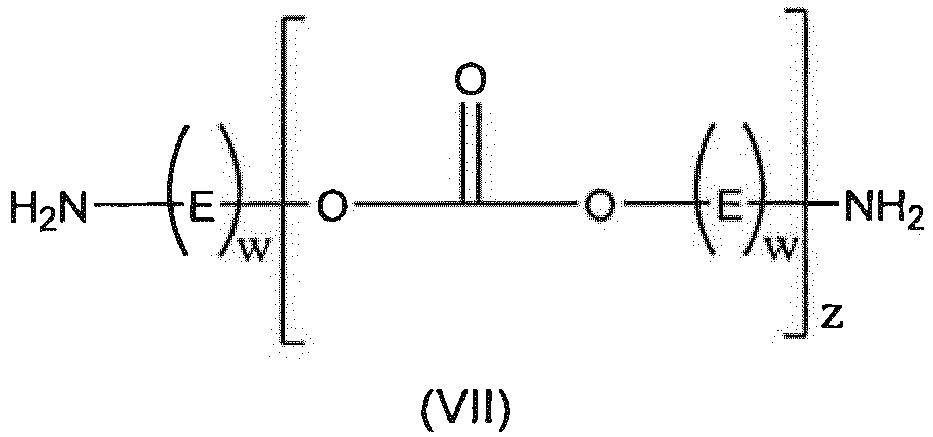

E is a divalent, branched or linear, saturated or non-saturated, optionally substituted hydrocarbon chain; preferably is methylene;
w is a natural number between 1 and 24;
z is a natural number ≥1;
with
HOOC-(CH2)m-COR2 (I)
wherein
m is selected from a natural number between 1 and 10; preferably m is 2, 3, 4 or 5, more preferably is 4;
R2 is selected from OH, halogen or OC1-4-alkyl, preferably is OH. - In a preferred embodiment of the Co-Polymer (C) used according to the invention outlined above
A is -CH2-;
and/or
v is a natural number between 3 and 13, preferably is a natural number between 5 and 11; preferably is 5, 10 or 11, more preferably is 5 or 11, most preferably is 11;
and/or
E is -CH2-;
and/or
w is a natural number between 1 and 10; preferably if z =1, w is a natural number between 1 and 10 and if z ≠ 1, w is a natural number between 2 and 10;
and/or
z is a natural number between 1 and 2000, preferably between 2 and 2000, more preferably between 1 and 1000;
and/or
m is selected from a natural number between 1 and 10;
and/or
R2 is selected from OH, halogen or OC1-4-alkyl. - In a preferred embodiment of the Co-Polymer (C) used according to the invention outlined above the Co-Polymer contains the units derived from polyamide-forming monomers in an amount of 15 to 90 weight %.
- In another preferred embodiment of the Co-Polymer (C) used according to the invention outlined above the Co-Polymer contains the units derived from polycarbonate diamines in an amount of 15 to 90 weight %.
- Another aspect of the invention provides a process for the production of a modified polyamide forming a part of the Co-Polymer used according to the invention, wherein one or more pre-polyamide/s is contacted/mixed with an α,ω-di-carboylic acid, preferably adipic acid, and then the mixture is heated to a temperature above 150° C.
- In another preferred embodiment of the process for the production of a modified polyamide forming a part of the Co-Polymer used according to the invention the α,ω-di-carboylic acid, preferably the adipic acid is added in an amount resulting in a molar ratio between the acid and the pre-polyamide calculated relatively based on the equivalent number of lactam Units in the pre-polyamide
- between 0.05 and 0.0005, preferably between 0.025 and 0.001; or
- between 1.0 and 0.0005, preferably between 0.75 and 0.00075, and more preferably between 0.5 and 0.001, or between 0.05 and 0.004, or between 0.1 and 0.001;
or in an amount resulting in a molar ratio between the acid and the pre-polyamide calculated relatively based on molecular weight of the polymerized amide building block (VIII)
- between 0.05 and 0.0005, preferably between 0.025 and 0.001; or
- between 1.0 and 0.0005, preferably between 0.75 and 0.00075, and more preferably between 0.5 and 0.001, or between 0.05 and 0.004, or between 0.1 and 0.001;.
- In another preferred embodiment of the process for the production of a modified polyamide forming a part of the Co-Polymer used according to the invention the reaction is executed using reactive extrusion.
- Another aspect of the current invention provides the use of a Co-Polymer used according to the invention in the production of implants or medical devices, preferably implanted or implantable medical devices, more preferably for the production of balloon/balloon material, of stents, stent grafts, grafts graft connectors or catheters.
- As described above a main aspect of the current invention provides implants or medical devices, comprising a Co-Polymer according to the invention, preferably implanted or implantable medical devices, more preferably balloon/balloon material, stents, stent grafts, grafts, graft connectors or catheters.
- The examples and figures in the following section describing the use of the polyamides are merely illustrative and the invention cannot be considered in any way as being restricted to these applications.
- 50 g dried Nylon 12 (with a molecular weight of approx. 26000 g/mol) was mixed with 0.639 g (0.0034 mol) adipic acid under argon for 2h at 220° C. The temperature was raised within 20 min to 250 ° C and the mixture was stirred for another 2h. The resulting solid gave a molecular weight of 13000 g/mol. The relative molar ratio (see above) was 0.013, being calculated as 0.0034 mol (acid) : 0.253 rel. mol (Polyamid: MW (building block) 197.3).
- The reaction of example A1 is carried out in an extruder by way of the so-called (reactive extrusion) as described in
DD 276 290 A1 - Modified polyamide according to example A1 is mixed with polyhexamethylene-carbonate diamine at 200°C and the mixture is stirred for 4h.
- In some examples the modified polyamide according to example A1 is mixed with polyhexamethylene carbonate diamine in a roughly or exactly equimolar amount.
- Specific amino-modified polycarbonates, which are not commercially available, can be synthesized by someone skilled in the art following and/or adapting the synthetic pathways known in the art as described e.g. for amino-modified polyethylene oxides. An example is adaptation of the following literature article included here by reference: McManus, N. T. et al., Journal of Applied Polymer Science (2006), 101(6), 4230-4237.
- The material according to example C1 is compared to PEBAX®
- Example D1: From the Material according to example C1 a length of a polymer tubing is formed by extrusion. The proximal and distal portions of the length of tubing is stretched to a reduced diameter while retaining an unstretched central portion, The lengths of polymer tubing is then radially expanded under pressure by expanding the tubing in a mold so that the balloon body is formed from the unstretched central portion of the tubing. The proximal and distal waist portions of the balloon are formed from the stretched proximal and distal portions of the tubing.
- Example D2: From the Material according to example C1 a tubular segment with a predetermined wall thickness and length is formed by extrusion with a proximal end, a distal end and a center portion. The segment is then drawn to a predetermined length while maintaining the temperature of the segment below the highest glass transition temperature of the Co-Polymer according to examples C1 or C2. Thereby the proximal end forms a first waist. Following that, this segment with the first waist is expanded in a mold to produce the balloon. After finishing, the balloon has a body portion, wherein the center portion of the segment forms the balloon body portion.
Claims (15)
- Use of a Co-Polymer producible by polymerizing a modified polyamide with a polycarbonate diamine, characterized in that the modified polyamide is producible by contacting/mixing one or more pre-polyamides with an α,ω-di-carboxylic acid or its alkyl ester or its acyl halides and raising the temperature to above 150° C in the production of implants or medical devices.
- Use according to claim 1, wherein the α,ω-di-carboxyiic acid is selected from oxalic acid (2), malonic acid (3), succinic acid (4), fumaric acid (4), glutaric acid (5), adipic acid, 1,7-heptane-dicarboxylic acid, 1,8-octane-di-carboxylic acid, 1,9-nonane-di-carboxylic acid, 1,10-decane-di-carboxylic acid, 1,11-undecane-di-carboxylic acid, 1,12-dodecane-di-carboxylic acid;
- Use according to claim 2, wherein the α,ω-di-carboxylic acid is selected from adipic acid or 1,10-decane-di-carboxylic acid.
- Use according to claim 1, wherein the pre-polyamide is a structure of general formula III or IIIa


A is a divalent, branched or linear, saturated or non-saturated, optionally substituted hydrocarbon chain, with optionally one carbon atom being replaced by NH, O or S;
A' is a divalent, branched or linear, saturated or non-saturated, optionally substituted hydrocarbon chain, with optionally one carbon atom being replaced by NH, O or S;
B and B' independently from one another are selected from H or C1-4-Alkyl;
v is a natural number between 1 and 24;
v' is a natural number between 1 and 24;
y is a natural number ≥1. - Use according to claim 4, wherein the pre-polyamide is a structure of general formula III.
- Use according to claim 1 wherein the pre-polyamide is selected from Nylon 6; Nylon 6,6; Nylon 11; or Nylon 12;
and
the α,ω-di-carboxylic acid is adipic acid. - Use according to claim 6 wherein the pre-polyamide is Nylon 12;
and
the α,ω-di-carboxylic acid is adipic acid. - Use according to claim 1, characterized in that the modified polyamide is of general formula IV or IVa


A is a divalent, branched or linear, saturated or non-saturated, optionally substituted hydrocarbon chain, with optionally one carbon atom being replaced by NH, O or S;
A' is a divalent, branched or linear, saturated or non-saturated, optionally substituted hydrocarbon chain, with optionally one carbon atom being replaced by NH, O or S;
B and B' independently from one another are selected from H or C1-4-Alkyl;
v is a natural number between 1 and 24;
v' is a natural number between 1 and 24;
y is a natural number ≥1;
y' is a natural number ≥1 or 0;
m is a natural number between 1 and 10. - Use according to claim 8, characterized in that the modified polyamide is of general formula IV.
- Use according to claim 1, characterized in that the modified polyamide is of general formula V

B and B' independently from one another are selected from H or C1-4-Alkyl;
v is a natural number between 1 and 24;
y is a natural number ≥1.
y' is a natural number ≥1 or 0. - Use according to claim 1, wherein the polycarbonate diamine is of general formula VII or VIIa


E is a divalent, branched or linear, saturated or non-saturated, optionally substituted hydrocarbon chain;
w is a natural number between 1 and 24;
z is a natural number ≥1. - Use of a Co-Polymer according to general formula XI, XIa, XIb or XIc,


A is a divalent, branched or linear, saturated or non-saturated, optionally substituted hydrocarbon chain, with optionally one carbon atom being replaced by NH, O or S;
A' is a divalent, branched or linear, saturated or non-saturated, optionally substituted hydrocarbon chain, with optionally one carbon atom being replaced by NH, O or S;
E is a divalent, branched or linear, saturated or non-saturated, optionally substituted hydrocarbon chain;
B' is selected from H or C1-4-Alkyl;
v is a natural number between 1 and 24;
v' is a natural number between 1 and 24;
w is a natural number between 1 and 24;
x is a natural number ≥1;
y and y' independently from one another are a natural number ≥1;
z is a natural number ≥1;
m is a natural number between 1 and 10,
in the production of implants or medical devices. - Use of a Co-Polymer comprising units derived from polyamide-forming monomers, units derived from polycarbonate diamines and units derived from α,ω-di-carboxylic acids,
wherein the polyamide-forming monomers are represented by the following formulas (IX) or (IXa), the polycarbonate diamines are represented by the following formula (VII) or (VIIa) and the α,ω-di-carboxylic acids are represented by the following formula (I):
A is a divalent, branched or linear, saturated or non-saturated, optionally substituted hydrocarbon chain, with optionally one carbon atom being replaced by NH, O or S;
and
v is a natural number between 1 and 24;
with

E is a divalent, branched or linear, saturated or non-saturated, optionally substituted hydrocarbon chain;
w is a natural number between 1 and 24;
z is a natural number ≥1;
with
HOOC-(CH2)m-COR2 (I)
wherein
m is selected from a natural number between 1 and 10;
R2 is selected from OH, halogen or OC1-4-alkyl,
in the production of implants or medical devices. - Use according to any of claims 1 to 13 wherein the implants or medical devices are implanted or implantable medical devices.
- Use according to any of claims 1 to 14 wherein the implants or medical devices are balloon/balloon material, of stents, stent grafts, grafts graft connectors or catheters.
Priority Applications (1)
| Application Number | Priority Date | Filing Date | Title |
|---|---|---|---|
| EP08758451.2A EP2150569B1 (en) | 2007-05-10 | 2008-05-09 | Medical devices comprising a co-polymer of a polyamide and a polycarbonate diamine |
Applications Claiming Priority (3)
| Application Number | Priority Date | Filing Date | Title |
|---|---|---|---|
| EP07009441A EP1990357A1 (en) | 2007-05-10 | 2007-05-10 | Co-polymer of a polyamide and a polycarbonate diamine |
| EP08758451.2A EP2150569B1 (en) | 2007-05-10 | 2008-05-09 | Medical devices comprising a co-polymer of a polyamide and a polycarbonate diamine |
| PCT/EP2008/003773 WO2008138568A1 (en) | 2007-05-10 | 2008-05-09 | Medical devices comprising a co-polymer of a polyamide and a polycarbonate diamine |
Publications (2)
| Publication Number | Publication Date |
|---|---|
| EP2150569A1 EP2150569A1 (en) | 2010-02-10 |
| EP2150569B1 true EP2150569B1 (en) | 2015-06-17 |
Family
ID=38472830
Family Applications (2)
| Application Number | Title | Priority Date | Filing Date |
|---|---|---|---|
| EP07009441A Withdrawn EP1990357A1 (en) | 2007-05-10 | 2007-05-10 | Co-polymer of a polyamide and a polycarbonate diamine |
| EP08758451.2A Ceased EP2150569B1 (en) | 2007-05-10 | 2008-05-09 | Medical devices comprising a co-polymer of a polyamide and a polycarbonate diamine |
Family Applications Before (1)
| Application Number | Title | Priority Date | Filing Date |
|---|---|---|---|
| EP07009441A Withdrawn EP1990357A1 (en) | 2007-05-10 | 2007-05-10 | Co-polymer of a polyamide and a polycarbonate diamine |
Country Status (6)
| Country | Link |
|---|---|
| US (1) | US8492484B2 (en) |
| EP (2) | EP1990357A1 (en) |
| JP (1) | JP5346333B2 (en) |
| CN (1) | CN101702913B (en) |
| AU (1) | AU2008250631B2 (en) |
| WO (1) | WO2008138568A1 (en) |
Cited By (13)
| Publication number | Priority date | Publication date | Assignee | Title |
|---|---|---|---|---|
| US10722631B2 (en) | 2018-02-01 | 2020-07-28 | Shifamed Holdings, Llc | Intravascular blood pumps and methods of use and manufacture |
| US11185677B2 (en) | 2017-06-07 | 2021-11-30 | Shifamed Holdings, Llc | Intravascular fluid movement devices, systems, and methods of use |
| US11511103B2 (en) | 2017-11-13 | 2022-11-29 | Shifamed Holdings, Llc | Intravascular fluid movement devices, systems, and methods of use |
| US11654275B2 (en) | 2019-07-22 | 2023-05-23 | Shifamed Holdings, Llc | Intravascular blood pumps with struts and methods of use and manufacture |
| US11724089B2 (en) | 2019-09-25 | 2023-08-15 | Shifamed Holdings, Llc | Intravascular blood pump systems and methods of use and control thereof |
| US11964145B2 (en) | 2019-07-12 | 2024-04-23 | Shifamed Holdings, Llc | Intravascular blood pumps and methods of manufacture and use |
| US12102815B2 (en) | 2019-09-25 | 2024-10-01 | Shifamed Holdings, Llc | Catheter blood pumps and collapsible pump housings |
| US12121713B2 (en) | 2019-09-25 | 2024-10-22 | Shifamed Holdings, Llc | Catheter blood pumps and collapsible blood conduits |
| US12161857B2 (en) | 2018-07-31 | 2024-12-10 | Shifamed Holdings, Llc | Intravascular blood pumps and methods of use |
| US12220570B2 (en) | 2018-10-05 | 2025-02-11 | Shifamed Holdings, Llc | Intravascular blood pumps and methods of use |
| US12409310B2 (en) | 2019-12-11 | 2025-09-09 | Shifamed Holdings, Llc | Descending aorta and vena cava blood pumps |
| US12465748B2 (en) | 2019-08-07 | 2025-11-11 | Supira Medical, Inc. | Catheter blood pumps and collapsible pump housings |
| US12599758B2 (en) | 2019-12-19 | 2026-04-14 | Shifamed Holdings, Llc | Intravascular blood pumps, motors, and fluid control |
Families Citing this family (19)
| Publication number | Priority date | Publication date | Assignee | Title |
|---|---|---|---|---|
| EP1942128B1 (en) | 2006-12-29 | 2016-09-14 | Abbott Laboratories Vascular Enterprises Limited | Modified polyamides |
| EP1990357A1 (en) | 2007-05-10 | 2008-11-12 | Abbott Laboratories Vascular Enterprises Limited | Co-polymer of a polyamide and a polycarbonate diamine |
| EP1990356A1 (en) | 2007-05-10 | 2008-11-12 | Abbott Laboratories Vascular Enterprises Limited | Co-polymer of a modifed polyamide and a polycarbonate |
| PL2272893T3 (en) * | 2009-06-19 | 2015-04-30 | Agfa Graphics Nv | Polymeric dispersants and non-aqueous dispersions |
| EP2629780A4 (en) | 2010-10-20 | 2014-10-01 | 206 Ortho Inc | Implantable polymer for bone and vascular lesions |
| US10525168B2 (en) | 2010-10-20 | 2020-01-07 | 206 Ortho, Inc. | Method and apparatus for treating bone fractures, and/or for fortifying and/or augmenting bone, including the provision and use of composite implants, and novel composite structures which may be used for medical and non-medical applications |
| US10525169B2 (en) | 2010-10-20 | 2020-01-07 | 206 Ortho, Inc. | Method and apparatus for treating bone fractures, and/or for fortifying and/or augmenting bone, including the provision and use of composite implants, and novel composite structures which may be used for medical and non-medical applications |
| US11291483B2 (en) | 2010-10-20 | 2022-04-05 | 206 Ortho, Inc. | Method and apparatus for treating bone fractures, and/or for fortifying and/or augmenting bone, including the provision and use of composite implants |
| US11207109B2 (en) | 2010-10-20 | 2021-12-28 | 206 Ortho, Inc. | Method and apparatus for treating bone fractures, and/or for fortifying and/or augmenting bone, including the provision and use of composite implants, and novel composite structures which may be used for medical and non-medical applications |
| US9320601B2 (en) | 2011-10-20 | 2016-04-26 | 206 Ortho, Inc. | Method and apparatus for treating bone fractures, and/or for fortifying and/or augmenting bone, including the provision and use of composite implants |
| US11484627B2 (en) | 2010-10-20 | 2022-11-01 | 206 Ortho, Inc. | Method and apparatus for treating bone fractures, and/or for fortifying and/or augmenting bone, including the provision and use of composite implants, and novel composite structures which may be used for medical and non-medical applications |
| US11058796B2 (en) | 2010-10-20 | 2021-07-13 | 206 Ortho, Inc. | Method and apparatus for treating bone fractures, and/or for fortifying and/or augmenting bone, including the provision and use of composite implants, and novel composite structures which may be used for medical and non-medical applications |
| JP2016525379A (en) | 2013-05-23 | 2016-08-25 | 206 オーソ,インコーポレーテッド | Methods and apparatus for treating fractures and / or for reinforcing and / or augmenting bone, including the provision and use of composite implants |
| CN104710776B (en) * | 2013-12-13 | 2018-10-12 | 上海微创医疗器械(集团)有限公司 | Medical nylon composite pipe material and preparation method thereof |
| WO2015137923A1 (en) * | 2014-03-11 | 2015-09-17 | Empire Technology Development Llc | Methods and compounds for producing nylon 12 |
| KR101849832B1 (en) | 2015-12-30 | 2018-04-17 | 롯데첨단소재(주) | Polycarbonate-polyamide copolymer, method for preparing the same and article produced therefrom |
| CA3044464A1 (en) | 2016-10-17 | 2018-04-26 | Orthobond Corporation | Surfaces with oligomeric or polymeric antimicrobials |
| CN112062947B (en) * | 2020-09-17 | 2021-12-28 | 中国科学院长春应用化学研究所 | Preparation method of caprolactam copolymer |
| CN119108149B (en) * | 2024-09-23 | 2025-04-22 | 浙江微力方复合材料有限公司 | A production process for high temperature resistant ultra-fine enameled wire |
Family Cites Families (30)
| Publication number | Priority date | Publication date | Assignee | Title |
|---|---|---|---|---|
| GB551820A (en) | 1941-07-04 | 1943-03-11 | Du Pont | Improvements in and relating to plasticised synthetic linear condensation polymers |
| GB803559A (en) | 1956-03-07 | 1958-10-29 | British Nylon Spinners Ltd | Improvements in or relating to linear polyamides |
| NL260459A (en) | 1960-01-25 | 1964-04-27 | ||
| FR2079969A5 (en) | 1970-02-18 | 1971-11-12 | Inst Francais Du Petrole | |
| US4120928A (en) * | 1976-04-19 | 1978-10-17 | Toyo Boseki Kabushiki Kaisha | Production of biaxially stretched film of polyamide blend |
| JPS6337125A (en) | 1986-08-01 | 1988-02-17 | Mitsui Petrochem Ind Ltd | Modified polyamide based elastomer and production thereof |
| JPS63182342A (en) * | 1987-01-22 | 1988-07-27 | Kuraray Co Ltd | Polyester-polyamide copolymer |
| EP0275988A3 (en) * | 1987-01-22 | 1989-11-15 | Kuraray Co., Ltd. | Polyamide copolymers |
| JPH0764934B2 (en) * | 1987-03-06 | 1995-07-12 | 株式会社クラレ | Polyester polyamide copolymer |
| DE3855663T2 (en) | 1987-08-04 | 1997-06-05 | Asahi Chemical Ind | Copolycarbonates |
| DD276290A1 (en) | 1988-10-13 | 1990-02-21 | Akad Wissenschaften Ddr | PROCESS FOR PREPARING DIFFERENTIALIZED PREPOLYMERS WITH CARBOXYLENE GROUPS AND DEFINED MOLECULAR WEIGHT RANGE |
| US5216087A (en) * | 1989-06-14 | 1993-06-01 | Korea Institute Of Science And Technology | Process for the preparation of sulfonated polyethyleneoxide-substituted polymers with improved blood compatibility |
| US5030693A (en) * | 1990-03-19 | 1991-07-09 | General Electric Company | Copolymer compositions prepared from triazine derivatives of polycarbonates |
| US5068284A (en) * | 1990-08-03 | 1991-11-26 | General Electric Company | Blocked amine terminated polycarbonates and products obtained therefrom |
| JPH0543684A (en) * | 1991-08-13 | 1993-02-23 | Mitsubishi Kasei Corp | Antithrombotic material |
| DE69308764T2 (en) | 1992-12-01 | 1997-07-31 | Terumo Corp | Blood compatible materials |
| DE4301097A1 (en) | 1993-01-18 | 1994-07-21 | Thueringisches Inst Textil | Polyamide hot-melt adhesives prodn., esp. from polyamide re-granulate |
| DE19643143C2 (en) * | 1996-10-18 | 2002-06-20 | Inventa Ag | Adhesion promoter for polyamide composites, process for their production and their use |
| JP3998420B2 (en) | 1998-11-13 | 2007-10-24 | アクゾ ノーベル ナムローゼ フェンノートシャップ | Pervaporation device and irrigation mat |
| JP2004526499A (en) * | 2001-03-16 | 2004-09-02 | エスティーエス バイオポリマーズ,インコーポレイティド | Drug-loaded stent with multi-layer polymer coating |
| FR2824329B1 (en) * | 2001-05-03 | 2003-06-13 | Atofina | ANTISTATIC POLYMER COMPOSITIONS |
| TW200418753A (en) | 2003-02-10 | 2004-10-01 | Kyowa Yuka Kk | A process for preparing the branched adipic acid |
| US7294671B2 (en) | 2004-02-06 | 2007-11-13 | Invista North America S.A.R.L. | Reactive carriers for polymer melt injection |
| JP4665449B2 (en) * | 2004-07-28 | 2011-04-06 | 宇部興産株式会社 | Diaminopolycarbonate and process for producing the same |
| CA2577513A1 (en) | 2004-11-22 | 2006-05-26 | Novartis Ag | Crosslinkable poly(oxyalkylene)-containing polyamide prepolymers |
| EP1783156A1 (en) | 2005-11-03 | 2007-05-09 | Arkema France | Process to make copolymers having polyamide blocks and polyether blocks |
| EP1942128B1 (en) | 2006-12-29 | 2016-09-14 | Abbott Laboratories Vascular Enterprises Limited | Modified polyamides |
| EP1990357A1 (en) | 2007-05-10 | 2008-11-12 | Abbott Laboratories Vascular Enterprises Limited | Co-polymer of a polyamide and a polycarbonate diamine |
| EP1990356A1 (en) * | 2007-05-10 | 2008-11-12 | Abbott Laboratories Vascular Enterprises Limited | Co-polymer of a modifed polyamide and a polycarbonate |
| EP1990358B1 (en) * | 2007-05-10 | 2018-06-13 | Abbott Laboratories Vascular Enterprises Limited | Co-polymer of a modifed polyamide and a polyether |
-
2007
- 2007-05-10 EP EP07009441A patent/EP1990357A1/en not_active Withdrawn
-
2008
- 2008-05-09 WO PCT/EP2008/003773 patent/WO2008138568A1/en not_active Ceased
- 2008-05-09 EP EP08758451.2A patent/EP2150569B1/en not_active Ceased
- 2008-05-09 CN CN200880015576.8A patent/CN101702913B/en not_active Expired - Fee Related
- 2008-05-09 JP JP2010506859A patent/JP5346333B2/en not_active Expired - Fee Related
- 2008-05-09 US US12/599,275 patent/US8492484B2/en not_active Expired - Fee Related
- 2008-05-09 AU AU2008250631A patent/AU2008250631B2/en not_active Ceased
Cited By (16)
| Publication number | Priority date | Publication date | Assignee | Title |
|---|---|---|---|---|
| US11185677B2 (en) | 2017-06-07 | 2021-11-30 | Shifamed Holdings, Llc | Intravascular fluid movement devices, systems, and methods of use |
| US11717670B2 (en) | 2017-06-07 | 2023-08-08 | Shifamed Holdings, LLP | Intravascular fluid movement devices, systems, and methods of use |
| US11511103B2 (en) | 2017-11-13 | 2022-11-29 | Shifamed Holdings, Llc | Intravascular fluid movement devices, systems, and methods of use |
| US12076545B2 (en) | 2018-02-01 | 2024-09-03 | Shifamed Holdings, Llc | Intravascular blood pumps and methods of use and manufacture |
| US11229784B2 (en) | 2018-02-01 | 2022-01-25 | Shifamed Holdings, Llc | Intravascular blood pumps and methods of use and manufacture |
| US10722631B2 (en) | 2018-02-01 | 2020-07-28 | Shifamed Holdings, Llc | Intravascular blood pumps and methods of use and manufacture |
| US12161857B2 (en) | 2018-07-31 | 2024-12-10 | Shifamed Holdings, Llc | Intravascular blood pumps and methods of use |
| US12220570B2 (en) | 2018-10-05 | 2025-02-11 | Shifamed Holdings, Llc | Intravascular blood pumps and methods of use |
| US11964145B2 (en) | 2019-07-12 | 2024-04-23 | Shifamed Holdings, Llc | Intravascular blood pumps and methods of manufacture and use |
| US11654275B2 (en) | 2019-07-22 | 2023-05-23 | Shifamed Holdings, Llc | Intravascular blood pumps with struts and methods of use and manufacture |
| US12465748B2 (en) | 2019-08-07 | 2025-11-11 | Supira Medical, Inc. | Catheter blood pumps and collapsible pump housings |
| US12102815B2 (en) | 2019-09-25 | 2024-10-01 | Shifamed Holdings, Llc | Catheter blood pumps and collapsible pump housings |
| US12121713B2 (en) | 2019-09-25 | 2024-10-22 | Shifamed Holdings, Llc | Catheter blood pumps and collapsible blood conduits |
| US11724089B2 (en) | 2019-09-25 | 2023-08-15 | Shifamed Holdings, Llc | Intravascular blood pump systems and methods of use and control thereof |
| US12409310B2 (en) | 2019-12-11 | 2025-09-09 | Shifamed Holdings, Llc | Descending aorta and vena cava blood pumps |
| US12599758B2 (en) | 2019-12-19 | 2026-04-14 | Shifamed Holdings, Llc | Intravascular blood pumps, motors, and fluid control |
Also Published As
| Publication number | Publication date |
|---|---|
| AU2008250631A1 (en) | 2008-11-20 |
| US8492484B2 (en) | 2013-07-23 |
| JP2010526571A (en) | 2010-08-05 |
| CN101702913B (en) | 2013-01-02 |
| AU2008250631B2 (en) | 2013-09-12 |
| US20110208232A1 (en) | 2011-08-25 |
| EP2150569A1 (en) | 2010-02-10 |
| JP5346333B2 (en) | 2013-11-20 |
| WO2008138568A1 (en) | 2008-11-20 |
| EP1990357A1 (en) | 2008-11-12 |
| CN101702913A (en) | 2010-05-05 |
Similar Documents
| Publication | Publication Date | Title |
|---|---|---|
| US8492484B2 (en) | Medical devices comprising a co-polymer of a polyamide and a polycarbonate diamine | |
| EP2152783B1 (en) | Medical devices comprising a co-polymer of a modified polyamide and a polycarbonate | |
| EP2147039B1 (en) | Medical devices comprising a co-polymer of a modified polyamide and a polyether | |
| US8304498B2 (en) | Medical devices comprising a modified polyamide | |
| EP2207578A1 (en) | Branched polymers in medical devices |
Legal Events
| Date | Code | Title | Description |
|---|---|---|---|
| PUAI | Public reference made under article 153(3) epc to a published international application that has entered the european phase |
Free format text: ORIGINAL CODE: 0009012 |
|
| 17P | Request for examination filed |
Effective date: 20091127 |
|
| AK | Designated contracting states |
Kind code of ref document: A1 Designated state(s): AT BE BG CH CY CZ DE DK EE ES FI FR GB GR HR HU IE IS IT LI LT LU LV MC MT NL NO PL PT RO SE SI SK TR |
|
| AX | Request for extension of the european patent |
Extension state: AL BA MK RS |
|
| DAX | Request for extension of the european patent (deleted) | ||
| 17Q | First examination report despatched |
Effective date: 20101124 |
|
| RIC1 | Information provided on ipc code assigned before grant |
Ipc: C08G 64/12 20060101ALI20150122BHEP Ipc: C08G 81/02 20060101ALI20150122BHEP Ipc: C08G 81/00 20060101ALI20150122BHEP Ipc: C08G 64/18 20060101ALI20150122BHEP Ipc: C08G 64/02 20060101ALI20150122BHEP Ipc: A61L 31/06 20060101ALI20150122BHEP Ipc: A61L 27/18 20060101ALI20150122BHEP Ipc: C08G 69/46 20060101ALI20150122BHEP Ipc: A61L 29/06 20060101ALI20150122BHEP Ipc: C08G 69/44 20060101AFI20150122BHEP |
|
| GRAP | Despatch of communication of intention to grant a patent |
Free format text: ORIGINAL CODE: EPIDOSNIGR1 |
|
| INTG | Intention to grant announced |
Effective date: 20150227 |
|
| GRAS | Grant fee paid |
Free format text: ORIGINAL CODE: EPIDOSNIGR3 |
|
| GRAA | (expected) grant |
Free format text: ORIGINAL CODE: 0009210 |
|
| AK | Designated contracting states |
Kind code of ref document: B1 Designated state(s): AT BE BG CH CY CZ DE DK EE ES FI FR GB GR HR HU IE IS IT LI LT LU LV MC MT NL NO PL PT RO SE SI SK TR |
|
| REG | Reference to a national code |
Ref country code: GB Ref legal event code: FG4D |
|
| REG | Reference to a national code |
Ref country code: CH Ref legal event code: EP |
|
| REG | Reference to a national code |
Ref country code: AT Ref legal event code: REF Ref document number: 731911 Country of ref document: AT Kind code of ref document: T Effective date: 20150715 |
|
| REG | Reference to a national code |
Ref country code: IE Ref legal event code: FG4D |
|
| REG | Reference to a national code |
Ref country code: DE Ref legal event code: R096 Ref document number: 602008038619 Country of ref document: DE |
|
| REG | Reference to a national code |
Ref country code: NL Ref legal event code: T3 |
|
| PG25 | Lapsed in a contracting state [announced via postgrant information from national office to epo] |
Ref country code: NO Free format text: LAPSE BECAUSE OF FAILURE TO SUBMIT A TRANSLATION OF THE DESCRIPTION OR TO PAY THE FEE WITHIN THE PRESCRIBED TIME-LIMIT Effective date: 20150917 Ref country code: LT Free format text: LAPSE BECAUSE OF FAILURE TO SUBMIT A TRANSLATION OF THE DESCRIPTION OR TO PAY THE FEE WITHIN THE PRESCRIBED TIME-LIMIT Effective date: 20150617 Ref country code: HR Free format text: LAPSE BECAUSE OF FAILURE TO SUBMIT A TRANSLATION OF THE DESCRIPTION OR TO PAY THE FEE WITHIN THE PRESCRIBED TIME-LIMIT Effective date: 20150617 Ref country code: FI Free format text: LAPSE BECAUSE OF FAILURE TO SUBMIT A TRANSLATION OF THE DESCRIPTION OR TO PAY THE FEE WITHIN THE PRESCRIBED TIME-LIMIT Effective date: 20150617 |
|
| REG | Reference to a national code |
Ref country code: AT Ref legal event code: MK05 Ref document number: 731911 Country of ref document: AT Kind code of ref document: T Effective date: 20150617 |
|
| REG | Reference to a national code |
Ref country code: LT Ref legal event code: MG4D |
|
| PG25 | Lapsed in a contracting state [announced via postgrant information from national office to epo] |
Ref country code: BG Free format text: LAPSE BECAUSE OF FAILURE TO SUBMIT A TRANSLATION OF THE DESCRIPTION OR TO PAY THE FEE WITHIN THE PRESCRIBED TIME-LIMIT Effective date: 20150917 Ref country code: GR Free format text: LAPSE BECAUSE OF FAILURE TO SUBMIT A TRANSLATION OF THE DESCRIPTION OR TO PAY THE FEE WITHIN THE PRESCRIBED TIME-LIMIT Effective date: 20150918 Ref country code: LV Free format text: LAPSE BECAUSE OF FAILURE TO SUBMIT A TRANSLATION OF THE DESCRIPTION OR TO PAY THE FEE WITHIN THE PRESCRIBED TIME-LIMIT Effective date: 20150617 |
|
| PG25 | Lapsed in a contracting state [announced via postgrant information from national office to epo] |
Ref country code: EE Free format text: LAPSE BECAUSE OF FAILURE TO SUBMIT A TRANSLATION OF THE DESCRIPTION OR TO PAY THE FEE WITHIN THE PRESCRIBED TIME-LIMIT Effective date: 20150617 |
|
| PG25 | Lapsed in a contracting state [announced via postgrant information from national office to epo] |
Ref country code: CZ Free format text: LAPSE BECAUSE OF FAILURE TO SUBMIT A TRANSLATION OF THE DESCRIPTION OR TO PAY THE FEE WITHIN THE PRESCRIBED TIME-LIMIT Effective date: 20150617 Ref country code: ES Free format text: LAPSE BECAUSE OF FAILURE TO SUBMIT A TRANSLATION OF THE DESCRIPTION OR TO PAY THE FEE WITHIN THE PRESCRIBED TIME-LIMIT Effective date: 20150617 Ref country code: IS Free format text: LAPSE BECAUSE OF FAILURE TO SUBMIT A TRANSLATION OF THE DESCRIPTION OR TO PAY THE FEE WITHIN THE PRESCRIBED TIME-LIMIT Effective date: 20151017 Ref country code: PT Free format text: LAPSE BECAUSE OF FAILURE TO SUBMIT A TRANSLATION OF THE DESCRIPTION OR TO PAY THE FEE WITHIN THE PRESCRIBED TIME-LIMIT Effective date: 20151019 Ref country code: AT Free format text: LAPSE BECAUSE OF FAILURE TO SUBMIT A TRANSLATION OF THE DESCRIPTION OR TO PAY THE FEE WITHIN THE PRESCRIBED TIME-LIMIT Effective date: 20150617 Ref country code: RO Free format text: LAPSE BECAUSE OF NON-PAYMENT OF DUE FEES Effective date: 20150617 Ref country code: SK Free format text: LAPSE BECAUSE OF FAILURE TO SUBMIT A TRANSLATION OF THE DESCRIPTION OR TO PAY THE FEE WITHIN THE PRESCRIBED TIME-LIMIT Effective date: 20150617 Ref country code: PL Free format text: LAPSE BECAUSE OF FAILURE TO SUBMIT A TRANSLATION OF THE DESCRIPTION OR TO PAY THE FEE WITHIN THE PRESCRIBED TIME-LIMIT Effective date: 20150617 |
|
| REG | Reference to a national code |
Ref country code: DE Ref legal event code: R097 Ref document number: 602008038619 Country of ref document: DE |
|
| PLBE | No opposition filed within time limit |
Free format text: ORIGINAL CODE: 0009261 |
|
| STAA | Information on the status of an ep patent application or granted ep patent |
Free format text: STATUS: NO OPPOSITION FILED WITHIN TIME LIMIT |
|
| REG | Reference to a national code |
Ref country code: FR Ref legal event code: PLFP Year of fee payment: 9 |
|
| PG25 | Lapsed in a contracting state [announced via postgrant information from national office to epo] |
Ref country code: IT Free format text: LAPSE BECAUSE OF FAILURE TO SUBMIT A TRANSLATION OF THE DESCRIPTION OR TO PAY THE FEE WITHIN THE PRESCRIBED TIME-LIMIT Effective date: 20150617 Ref country code: DK Free format text: LAPSE BECAUSE OF FAILURE TO SUBMIT A TRANSLATION OF THE DESCRIPTION OR TO PAY THE FEE WITHIN THE PRESCRIBED TIME-LIMIT Effective date: 20150617 |
|
| 26N | No opposition filed |
Effective date: 20160318 |
|
| PG25 | Lapsed in a contracting state [announced via postgrant information from national office to epo] |
Ref country code: SI Free format text: LAPSE BECAUSE OF FAILURE TO SUBMIT A TRANSLATION OF THE DESCRIPTION OR TO PAY THE FEE WITHIN THE PRESCRIBED TIME-LIMIT Effective date: 20150617 Ref country code: BE Free format text: LAPSE BECAUSE OF NON-PAYMENT OF DUE FEES Effective date: 20160531 |
|
| PG25 | Lapsed in a contracting state [announced via postgrant information from national office to epo] |
Ref country code: BE Free format text: LAPSE BECAUSE OF FAILURE TO SUBMIT A TRANSLATION OF THE DESCRIPTION OR TO PAY THE FEE WITHIN THE PRESCRIBED TIME-LIMIT Effective date: 20150617 Ref country code: LU Free format text: LAPSE BECAUSE OF FAILURE TO SUBMIT A TRANSLATION OF THE DESCRIPTION OR TO PAY THE FEE WITHIN THE PRESCRIBED TIME-LIMIT Effective date: 20160509 |
|
| REG | Reference to a national code |
Ref country code: CH Ref legal event code: PL |
|
| PG25 | Lapsed in a contracting state [announced via postgrant information from national office to epo] |
Ref country code: LI Free format text: LAPSE BECAUSE OF NON-PAYMENT OF DUE FEES Effective date: 20160531 Ref country code: CH Free format text: LAPSE BECAUSE OF NON-PAYMENT OF DUE FEES Effective date: 20160531 |
|
| REG | Reference to a national code |
Ref country code: FR Ref legal event code: PLFP Year of fee payment: 10 |
|
| PG25 | Lapsed in a contracting state [announced via postgrant information from national office to epo] |
Ref country code: SE Free format text: LAPSE BECAUSE OF FAILURE TO SUBMIT A TRANSLATION OF THE DESCRIPTION OR TO PAY THE FEE WITHIN THE PRESCRIBED TIME-LIMIT Effective date: 20150617 |
|
| REG | Reference to a national code |
Ref country code: FR Ref legal event code: PLFP Year of fee payment: 11 |
|
| PG25 | Lapsed in a contracting state [announced via postgrant information from national office to epo] |
Ref country code: HU Free format text: LAPSE BECAUSE OF FAILURE TO SUBMIT A TRANSLATION OF THE DESCRIPTION OR TO PAY THE FEE WITHIN THE PRESCRIBED TIME-LIMIT; INVALID AB INITIO Effective date: 20080509 Ref country code: CY Free format text: LAPSE BECAUSE OF FAILURE TO SUBMIT A TRANSLATION OF THE DESCRIPTION OR TO PAY THE FEE WITHIN THE PRESCRIBED TIME-LIMIT Effective date: 20150617 |
|
| PG25 | Lapsed in a contracting state [announced via postgrant information from national office to epo] |
Ref country code: MC Free format text: LAPSE BECAUSE OF FAILURE TO SUBMIT A TRANSLATION OF THE DESCRIPTION OR TO PAY THE FEE WITHIN THE PRESCRIBED TIME-LIMIT Effective date: 20150617 Ref country code: MT Free format text: LAPSE BECAUSE OF NON-PAYMENT OF DUE FEES Effective date: 20160531 Ref country code: TR Free format text: LAPSE BECAUSE OF FAILURE TO SUBMIT A TRANSLATION OF THE DESCRIPTION OR TO PAY THE FEE WITHIN THE PRESCRIBED TIME-LIMIT Effective date: 20150617 |
|
| PGFP | Annual fee paid to national office [announced via postgrant information from national office to epo] |
Ref country code: FR Payment date: 20190417 Year of fee payment: 12 |
|
| PGFP | Annual fee paid to national office [announced via postgrant information from national office to epo] |
Ref country code: NL Payment date: 20200421 Year of fee payment: 13 Ref country code: DE Payment date: 20200417 Year of fee payment: 13 Ref country code: IE Payment date: 20200429 Year of fee payment: 13 |
|
| PGFP | Annual fee paid to national office [announced via postgrant information from national office to epo] |
Ref country code: GB Payment date: 20200429 Year of fee payment: 13 |
|
| PG25 | Lapsed in a contracting state [announced via postgrant information from national office to epo] |
Ref country code: FR Free format text: LAPSE BECAUSE OF NON-PAYMENT OF DUE FEES Effective date: 20200531 |
|
| REG | Reference to a national code |
Ref country code: DE Ref legal event code: R119 Ref document number: 602008038619 Country of ref document: DE |
|
| REG | Reference to a national code |
Ref country code: NL Ref legal event code: MM Effective date: 20210601 |
|
| GBPC | Gb: european patent ceased through non-payment of renewal fee |
Effective date: 20210509 |
|
| PG25 | Lapsed in a contracting state [announced via postgrant information from national office to epo] |
Ref country code: IE Free format text: LAPSE BECAUSE OF NON-PAYMENT OF DUE FEES Effective date: 20210509 Ref country code: GB Free format text: LAPSE BECAUSE OF NON-PAYMENT OF DUE FEES Effective date: 20210509 Ref country code: DE Free format text: LAPSE BECAUSE OF NON-PAYMENT OF DUE FEES Effective date: 20211201 |
|
| PG25 | Lapsed in a contracting state [announced via postgrant information from national office to epo] |
Ref country code: NL Free format text: LAPSE BECAUSE OF NON-PAYMENT OF DUE FEES Effective date: 20210601 |