EP2150078A2 - Adjusting the emission of sound beams in a sound projector - Google Patents
Adjusting the emission of sound beams in a sound projector Download PDFInfo
- Publication number
- EP2150078A2 EP2150078A2 EP09165128A EP09165128A EP2150078A2 EP 2150078 A2 EP2150078 A2 EP 2150078A2 EP 09165128 A EP09165128 A EP 09165128A EP 09165128 A EP09165128 A EP 09165128A EP 2150078 A2 EP2150078 A2 EP 2150078A2
- Authority
- EP
- European Patent Office
- Prior art keywords
- sound
- user
- display
- channel
- submenu
- Prior art date
- Legal status (The legal status is an assumption and is not a legal conclusion. Google has not performed a legal analysis and makes no representation as to the accuracy of the status listed.)
- Ceased
Links
Images

Classifications
-
- H—ELECTRICITY
- H04—ELECTRIC COMMUNICATION TECHNIQUE
- H04S—STEREOPHONIC SYSTEMS
- H04S3/00—Systems employing more than two channels, e.g. quadraphonic
- H04S3/002—Non-adaptive circuits, e.g. manually adjustable or static, for enhancing the sound image or the spatial distribution
-
- H—ELECTRICITY
- H04—ELECTRIC COMMUNICATION TECHNIQUE
- H04S—STEREOPHONIC SYSTEMS
- H04S7/00—Indicating arrangements; Control arrangements, e.g. balance control
- H04S7/40—Visual indication of stereophonic sound image
-
- H—ELECTRICITY
- H04—ELECTRIC COMMUNICATION TECHNIQUE
- H04R—LOUDSPEAKERS, MICROPHONES, GRAMOPHONE PICK-UPS OR LIKE ACOUSTIC ELECTROMECHANICAL TRANSDUCERS; ELECTRIC HEARING AIDS; PUBLIC ADDRESS SYSTEMS
- H04R2205/00—Details of stereophonic arrangements covered by H04R5/00 but not provided for in any of its subgroups
- H04R2205/024—Positioning of loudspeaker enclosures for spatial sound reproduction
Definitions
- the present invention relates to a method and system towards adjusting the emission of sound beams in sound projectors comprising an array of speakers.
- Multichannel sound systems widely used nowadays comprises speakers, which are situated at certain positions around the listener so as to surround the latter for producing the surround sound effect.
- a surround sound system comprises typically a left, centre and right speaker disposed at the front half space, as well as two rear speakers at the rear half space.
- the terms front, left, centre, right, and rear are used relatively to the position and orientation of the listener.
- a subwoofer is used and is placed accordingly to any place in the respective setting.
- a surround sound system decrypts input sound data and makes use of such decrypted data to distribute them among channels with different signals. Each channel is typically emitted through one speaker or two speakers.
- a sound projector comprising an array of speakers.
- a sound projector allows to obtain the surround sound effect from a single system, in place of disposing more than one speaker at different positions.
- the sound projector emits sound beams, each representing one of the channels referred to above, and these beams are reflected from surfaces like walls and ceiling and are delivered to the listener, so as to result in a surround effect.
- sound beams each representing one of the channels referred to above
- the third method involves the step of measuring the impulse response between a microphone placed at the listening position and a determined number of reflectors on a panel. And finally the forth method involves the scanning of the room with a sound beam and the detection of the first arriving reflection by means of a microphone.
- the object of the present invention is to provide a method and system, allowing a user to easily make the adjustment of various parameters, whenever it is desired to do so, for adjusting the emission of sound beams in a sound projector.
- Another object of the present invention is to provide a method and system, allowing a user to adjust the parameters of the channels individually, by listening the real sound content of each channel separately during the installation or adjustment of a multichannel sound system.
- Sound projectors produced as a result of the developments with the surround sound system technology are formed by arraying a plurality of small speakers, each comprising its digital amplifier (e.g. the commercially available YSP-1 system with 42 speakers) in a box according to a determined order and by a projection technique, used with the purpose of controlling the direction of sound.
- 5.1 Channel sound broadcasting can be made with this box.
- This system makes the sound waves bounce the walls of the room, so that different channels of the sound come from the different directions of the room. Since the sounds are beam-like focused, the quality of sound is increased once they bounce the wall and come back.
- the sound projectors according to the prior art can be installed according to various room shapes and sizes, but proper walls are necessitated for a proper reflection and projection and the installation thereof is provided with the aid of a guide.
- the surround effect is not satisfactory, if the sound projectors are installed in such rooms, which have walls improper for a convenient reflection of sound beams, have surfaces of acoustic-absorbing surfaces quality, have sizes being out of the range esteemed proper for this system, in which the distance between the positions of the listener and of the speaker is lower than a determined distance, and in which objects and/or furniture is/are present which deflect the direction of sound beams.
- These systems can also be used in such settings not bearing the aforesaid criteria by means of a quite complex installation and a number of adjustments.
- the adjustments such as the angle, focal length or the orientation and projection parameters of each channel must be carried out separately according to the sitting position of the user. While said parameters are adjusted in commercially-available sound projectors, an internal sound is used. These adjustments are made very frequently and the users are expected to make these adjustments; thus, for instance, if a user is to adjust a sound projector connected to a television, the television's sound is instantly interrupted and a sound generated is emitted through each channel or all channels.
- the present invention provides the adjustment of angle, focal length or orientation and projection parameters of sound beams individually deflected or reflected in the room by hearing the real sound through each channel, and therefore allows the adjustment to be made separately for each channel with the real information in the respective channel.
- the sound system (sound projector) in which the method according to the present invention is used comprises a menu, which can be displayed through the electronic device's display means to which it is connected, and can be controlled by means of keys provided on the sound system or by means of a remote control of said sound system.
- a setup menu is displayed through the electronic device's display means to which it is connected, and can be controlled by means of keys provided on the sound system or by means of a remote control of said sound system.
- the user can select the channel which he/she wants to adjust from the channels list provided in the setup submenu.
- the system mutes all channels, except the active one to be adjusted, and emits the real content information through the channel to be adjusted. Then the user can increase/decrease the values of various parameters of that channel by means of control bars provided in the setup submenu, until the desired sound quality is obtained.
- the user can save these adjustments by means of a save/store option provided in the same menu.
- the sound system's menu, submenus, the options and control bars provided therein can be selected and controlled by means of keys, which can be provided on the sound system itself, on the remote control of the sound system, or on the remote control of the device or on the device itself, to which the sound system is connected. It is hereby rendered possible for the user to hear the real sound information through each channel separately and to make a more healthy adjustment. The user is also provided with the ability of controlling the adjustments made for each channel separately with the same method.
- the user may wish to update the sound adjustments while watching a movie.
- the user menu can be accessed via the remote control of the sound system or the keys on the sound system.
- a table containing the options of the menu is displayed on the display of the device to which the sound system is connected. This table can be displayed in a manner that would not intersect the image being watched, on a secondary screen with a lower size, or optionally, that would cover the entire display.
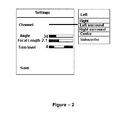
- An exemplary illustration of said menu is given in Figure 2 .
- the user may select the setup menu from the menu.
- the setup menu When the setup menu is selected, one each submenu containing an indicator in which control bars are provided by which the channels and the level of parameters to be adjusted can be changed is displayed on the display screen either in turn, or at the same time. For instance, when the effect of the surround feature is wished to be increased, the surround option is selected among the channels in the (first) submenu. In this case, the system will mute all other channels and emit the sound content of the surround channel of a movie watched, for instance, only through the surround channel, so that the user is enabled to make the adjustment by hearing the surround sound only.
- the parameters to be adjusted can be changed by means of a (second) submenu containing control bars and provided at the left side of the setup menu, as illustrated in Figure 2 .
- any changes made by the user on the parameters of the channel selected will be applied to the real sound content in broadcast during the adjustment through that channel, so that the user can obtain the desired sound quality in a convenient manner, by hearing the real sound output through that channel during the adjustment process.
- the user may enter a store/save command by means of (first/second) submenu, so that the system stores the adjustments made.
- the sound system by which the method according to the present invention is executed is preferably a sound projector, in which more than one speaker are arrayed according to a determined order and by which more than one sound signals are emitted at independent directions, but the subject method can also be used in multichannel sound systems.
- the sound system contains a user menu containing various submenus and it is hereby enabled to display these menus by means of a display of the device to which it is connected.
- the preferred sound system in which the method according to the present invention is used comprises a processor, which makes it possible to mute all other channels, except the one to be adjusted and to emit the real sound content through that channel, while the user makes sound adjustment. Thanks to the method according to the present invention, the users can easily and efficiently adjust the sound parameters of the sound systems.
Landscapes
- Physics & Mathematics (AREA)
- Engineering & Computer Science (AREA)
- Acoustics & Sound (AREA)
- Signal Processing (AREA)
- Circuit For Audible Band Transducer (AREA)
- Stereophonic System (AREA)
Abstract
Description
- The present invention relates to a method and system towards adjusting the emission of sound beams in sound projectors comprising an array of speakers.
- Multichannel sound systems widely used nowadays comprises speakers, which are situated at certain positions around the listener so as to surround the latter for producing the surround sound effect. A surround sound system comprises typically a left, centre and right speaker disposed at the front half space, as well as two rear speakers at the rear half space. The terms front, left, centre, right, and rear are used relatively to the position and orientation of the listener. In addition to said speakers, generally a subwoofer is used and is placed accordingly to any place in the respective setting.
- A surround sound system decrypts input sound data and makes use of such decrypted data to distribute them among channels with different signals. Each channel is typically emitted through one speaker or two speakers.
- In line with the developments in technology, there are developed sound projectors comprising an array of speakers. As differing from the information given above, a sound projector allows to obtain the surround sound effect from a single system, in place of disposing more than one speaker at different positions. The sound projector emits sound beams, each representing one of the channels referred to above, and these beams are reflected from surfaces like walls and ceiling and are delivered to the listener, so as to result in a surround effect. Thus, it becomes possible to obtain a surround effect by means of a single system placed in the room in which the listener is present.
- The installation and adjustment of sound projector systems making use of the method of reflecting acoustic beams, however, are quite difficult, and requires the help of a technician.
- In the published patent application
WO 2004/066673 , four different methods are disclosed, which can either be used individually or together to adjust sound projector systems. One of these methods is the use of a video-supported installation guide. According to this approach, several questions are asked to the user and detailed information is gathered, such as the position at which the sound projector is to be mounted, the shape and dimension of the respective room, the distance of the sound projector to the listening position, etc., whereafter the system is automatically adjusted according to this query. The second method disclosed in this patent application is to use a microphone connected to the sound projector. With the microphone placed at any position in the room, impulse response is calculated and sound reflections are found automatically for a number of beam angles, so that various adjustments are made automatically for each channel. The third method involves the step of measuring the impulse response between a microphone placed at the listening position and a determined number of reflectors on a panel. And finally the forth method involves the scanning of the room with a sound beam and the detection of the first arriving reflection by means of a microphone. - The methods as disclosed in the aforesaid patent application and as presented by other systems of the prior art are quite complex, giving rise to significant difficulties during application and production and failing to provide an adjustment method which would be easily applied by any user when desired.
- The object of the present invention is to provide a method and system, allowing a user to easily make the adjustment of various parameters, whenever it is desired to do so, for adjusting the emission of sound beams in a sound projector.
- Another object of the present invention is to provide a method and system, allowing a user to adjust the parameters of the channels individually, by listening the real sound content of each channel separately during the installation or adjustment of a multichannel sound system.
-
-
Figure 1 is an illustration showing the in-room propagation of sound beams (acoustic beams) emitted from a sound projector in which the method according to the present invention is used. -
Figure 2 is an illustration showing the adjustment menu of a sound system, in which the method according to the present invention is used. - Sound projectors produced as a result of the developments with the surround sound system technology are formed by arraying a plurality of small speakers, each comprising its digital amplifier (e.g. the commercially available YSP-1 system with 42 speakers) in a box according to a determined order and by a projection technique, used with the purpose of controlling the direction of sound. 5.1 Channel sound broadcasting can be made with this box.
- This system makes the sound waves bounce the walls of the room, so that different channels of the sound come from the different directions of the room. Since the sounds are beam-like focused, the quality of sound is increased once they bounce the wall and come back.
- Thanks to focusing the sound to beams and controlling the delay time of the speakers, it is ensured that the listener perceives the sound as if it is coming from an additional speaker disposed in the room, despite the fact that only one single system is provided therein.
- The sound projectors according to the prior art can be installed according to various room shapes and sizes, but proper walls are necessitated for a proper reflection and projection and the installation thereof is provided with the aid of a guide. The surround effect is not satisfactory, if the sound projectors are installed in such rooms, which have walls improper for a convenient reflection of sound beams, have surfaces of acoustic-absorbing surfaces quality, have sizes being out of the range esteemed proper for this system, in which the distance between the positions of the listener and of the speaker is lower than a determined distance, and in which objects and/or furniture is/are present which deflect the direction of sound beams. These systems, however, can also be used in such settings not bearing the aforesaid criteria by means of a quite complex installation and a number of adjustments.
- In order to allow the output channels of a sound projector yield the desired effect, the adjustments such as the angle, focal length or the orientation and projection parameters of each channel must be carried out separately according to the sitting position of the user. While said parameters are adjusted in commercially-available sound projectors, an internal sound is used. These adjustments are made very frequently and the users are expected to make these adjustments; thus, for instance, if a user is to adjust a sound projector connected to a television, the television's sound is instantly interrupted and a sound generated is emitted through each channel or all channels. This fact, however, interrupts the broadcast during an adjustment process and another fact that an internal noise is emitted through the sound system annoys the user; additionally, since the user cannot listen to the real sound to be obtained from each output of the system for each channel, such type of an adjustment turns out to be quite complex.
- As differing from the adjustment methods according to the prior art, the present invention provides the adjustment of angle, focal length or orientation and projection parameters of sound beams individually deflected or reflected in the room by hearing the real sound through each channel, and therefore allows the adjustment to be made separately for each channel with the real information in the respective channel.
- The sound system (sound projector) in which the method according to the present invention is used comprises a menu, which can be displayed through the electronic device's display means to which it is connected, and can be controlled by means of keys provided on the sound system or by means of a remote control of said sound system. When the user wants to adjust the abovementioned sound parameters, he/she selects the setup menu in the user menu of the sound system. Once the setup menu is selected, a setup submenu comprising a list of the channels of the sound system and control bars of the parameters to be adjusted is displayed on the display to which the sound system is connected. An exemplary illustration of the setup submenu is given in
Figure 2 . The user can select the channel which he/she wants to adjust from the channels list provided in the setup submenu. When the channel to be adjusted is selected, the system mutes all channels, except the active one to be adjusted, and emits the real content information through the channel to be adjusted. Then the user can increase/decrease the values of various parameters of that channel by means of control bars provided in the setup submenu, until the desired sound quality is obtained. When the user achieves the desired sound quality at the selected channel, he/she can save these adjustments by means of a save/store option provided in the same menu. The sound system's menu, submenus, the options and control bars provided therein can be selected and controlled by means of keys, which can be provided on the sound system itself, on the remote control of the sound system, or on the remote control of the device or on the device itself, to which the sound system is connected. It is hereby rendered possible for the user to hear the real sound information through each channel separately and to make a more healthy adjustment. The user is also provided with the ability of controlling the adjustments made for each channel separately with the same method. - For instance, the user may wish to update the sound adjustments while watching a movie. In this circumstance, the user menu can be accessed via the remote control of the sound system or the keys on the sound system. Once the user menu is entered, a table containing the options of the menu is displayed on the display of the device to which the sound system is connected. This table can be displayed in a manner that would not intersect the image being watched, on a secondary screen with a lower size, or optionally, that would cover the entire display. An exemplary illustration of said menu is given in
Figure 2 . The user may select the setup menu from the menu. When the setup menu is selected, one each submenu containing an indicator in which control bars are provided by which the channels and the level of parameters to be adjusted can be changed is displayed on the display screen either in turn, or at the same time. For instance, when the effect of the surround feature is wished to be increased, the surround option is selected among the channels in the (first) submenu. In this case, the system will mute all other channels and emit the sound content of the surround channel of a movie watched, for instance, only through the surround channel, so that the user is enabled to make the adjustment by hearing the surround sound only. The parameters to be adjusted can be changed by means of a (second) submenu containing control bars and provided at the left side of the setup menu, as illustrated inFigure 2 . Any changes made by the user on the parameters of the channel selected will be applied to the real sound content in broadcast during the adjustment through that channel, so that the user can obtain the desired sound quality in a convenient manner, by hearing the real sound output through that channel during the adjustment process. Once the parameter changes are made, the user may enter a store/save command by means of (first/second) submenu, so that the system stores the adjustments made. - The sound system by which the method according to the present invention is executed is preferably a sound projector, in which more than one speaker are arrayed according to a determined order and by which more than one sound signals are emitted at independent directions, but the subject method can also be used in multichannel sound systems. The sound system contains a user menu containing various submenus and it is hereby enabled to display these menus by means of a display of the device to which it is connected. The preferred sound system in which the method according to the present invention is used comprises a processor, which makes it possible to mute all other channels, except the one to be adjusted and to emit the real sound content through that channel, while the user makes sound adjustment. Thanks to the method according to the present invention, the users can easily and efficiently adjust the sound parameters of the sound systems.
Claims (7)
- A method for installing a multichannel sound system and for making various sound adjustments, comprising the steps of activating a setup menu of the sound system in response to the commands entered by the user and of displaying such activated menu by means of a display, this method being characterized by further comprising the steps of- displaying a first submenu containing a list of the sound output channels of the sound system on a display, when the user activates said menu;- when a channel is selected by the user via said submenu, muting all channels except the selected one by the system;- emitting the real sound content through the selected channel;- displaying a second submenu on the display, containing adjustment bars by which the parameter values of the selected channel can be changed;- when a change is made on the parameters of the selected channel by means of said adjustment bars by the user, applying such changes to the output of that channel through which the real sound content of such changes are emitted; and- selecting a store/save option by the user, provided on the first or second submenu on the display.
- A method according to Claim 1, wherein said sound system is a sound projector, in which more than one speaker are arrayed according to a determined order for emitting more than one sound signal having independent directions.
- A method according to Claim 1, wherein said display is the display of a device to which the sound system is connected.
- A multichannel sound system comprising a setup menu to conduct the setup and various sound adjustments, as well as means by which said setup menu can be displayed on a display, and can be controlled according to the commands entered by the user, characterized by further comprising- means detecting the commands of the user;- means, whereby a first submenu containing a list of the sound output channels of the sound system is displayed on a display, when the user activates said menu; all channels except the selected one is muted by the system, when a channel is selected by the user via said submenu; the real sound content is emitted through the selected channel; a second submenu is displayed on the display, containing adjustment bars by which the parameter values of the selected channel can be changed; when a change is made on the parameters of the selected channel by means of said adjustment bars by the user, such changes are applied to the output of that channel through which the real sound content of such changes are emitted; and the system stores such changes made, once the user depresses a store/save key provided on the first or second submenu on the display.
- A sound system according to Claim 4, wherein said sound system is a sound projector, in which more than one speaker are arrayed according to a determined order for emitting more than one sound signal having independent directions.
- A sound system according to Claim 4, characterized in that command keys are provided on the sound system to enable a user to transmit said commands.
- A sound system according to Claim 4, characterized in that said sound system comprises a remote control with command keys provided thereon, to enable a user to transmit said commands.
Applications Claiming Priority (1)
| Application Number | Priority Date | Filing Date | Title |
|---|---|---|---|
| TR2008/05702A TR200805702A2 (en) | 2008-08-01 | 2008-08-01 | Adjusting the emission of sound beams on an audio projector |
Publications (2)
| Publication Number | Publication Date |
|---|---|
| EP2150078A2 true EP2150078A2 (en) | 2010-02-03 |
| EP2150078A3 EP2150078A3 (en) | 2010-12-29 |
Family
ID=41258810
Family Applications (1)
| Application Number | Title | Priority Date | Filing Date |
|---|---|---|---|
| EP09165128A Ceased EP2150078A3 (en) | 2008-08-01 | 2009-07-10 | Adjusting the emission of sound beams in a sound projector |
Country Status (2)
| Country | Link |
|---|---|
| EP (1) | EP2150078A3 (en) |
| TR (1) | TR200805702A2 (en) |
Cited By (1)
| Publication number | Priority date | Publication date | Assignee | Title |
|---|---|---|---|---|
| WO2020048220A1 (en) * | 2018-09-04 | 2020-03-12 | Oppo广东移动通信有限公司 | Sound effect adjusting method and apparatus, electronic device, and storage medium |
Citations (1)
| Publication number | Priority date | Publication date | Assignee | Title |
|---|---|---|---|---|
| EP1788846A1 (en) * | 2004-08-26 | 2007-05-23 | Yamaha Corporation | Audio reproducing system |
Family Cites Families (7)
| Publication number | Priority date | Publication date | Assignee | Title |
|---|---|---|---|---|
| GB2301267B (en) * | 1995-05-19 | 2000-03-01 | Sony Uk Ltd | Audio mixing console |
| JP4428552B2 (en) * | 2001-10-24 | 2010-03-10 | ヤマハ株式会社 | Digital mixer |
| US6925186B2 (en) * | 2003-03-24 | 2005-08-02 | Todd Hamilton Bacon | Ambient sound audio system |
| JP4501559B2 (en) * | 2004-07-07 | 2010-07-14 | ヤマハ株式会社 | Directivity control method of speaker device and audio reproducing device |
| WO2006050353A2 (en) * | 2004-10-28 | 2006-05-11 | Verax Technologies Inc. | A system and method for generating sound events |
| JP4591696B2 (en) * | 2005-07-22 | 2010-12-01 | ヤマハ株式会社 | Digital mixer and program |
| US8577048B2 (en) * | 2005-09-02 | 2013-11-05 | Harman International Industries, Incorporated | Self-calibrating loudspeaker system |
-
2008
- 2008-08-01 TR TR2008/05702A patent/TR200805702A2/en unknown
-
2009
- 2009-07-10 EP EP09165128A patent/EP2150078A3/en not_active Ceased
Patent Citations (1)
| Publication number | Priority date | Publication date | Assignee | Title |
|---|---|---|---|---|
| EP1788846A1 (en) * | 2004-08-26 | 2007-05-23 | Yamaha Corporation | Audio reproducing system |
Cited By (2)
| Publication number | Priority date | Publication date | Assignee | Title |
|---|---|---|---|---|
| WO2020048220A1 (en) * | 2018-09-04 | 2020-03-12 | Oppo广东移动通信有限公司 | Sound effect adjusting method and apparatus, electronic device, and storage medium |
| US11474775B2 (en) | 2018-09-04 | 2022-10-18 | Guangdong Oppo Mobile Telecommunications Corp., Ltd. | Sound effect adjustment method, device, electronic device and storage medium |
Also Published As
| Publication number | Publication date |
|---|---|
| EP2150078A3 (en) | 2010-12-29 |
| TR200805702A2 (en) | 2010-02-22 |
Similar Documents
| Publication | Publication Date | Title |
|---|---|---|
| EP1705955B1 (en) | Audio signal supplying apparatus for speaker array | |
| JP4114583B2 (en) | Characteristic correction system | |
| CN101010986B (en) | audio reproduction equipment | |
| US8472652B2 (en) | Audio reproduction system comprising narrow and wide directivity loudspeakers | |
| CN103636238B (en) | Loudspeaker array device | |
| US8638959B1 (en) | Reduced acoustic signature loudspeaker (RSL) | |
| JP2016509429A (en) | Audio apparatus and method therefor | |
| JP2004172786A (en) | Audio signal reproducing method and reproducing apparatus | |
| EP2293597B1 (en) | Multi-directional sound emission means and multi-directional sound emission system | |
| US20250274709A1 (en) | Loudspeaker system with overhead sound image generating elevation module and method and apparatus for direct signal cancellation | |
| US20250203311A1 (en) | Method and apparatus for an ultrasonic emitter system floor audio unit | |
| US9930469B2 (en) | System and method for enhancing virtual audio height perception | |
| WO2007127762A2 (en) | Method and system for sound beam- forming using internal device speakers in conjunction with external speakers | |
| US11882399B2 (en) | Acoustic reflector for height channel speaker | |
| JP2004179711A (en) | Speaker device and sound reproduction method | |
| US7676049B2 (en) | Reconfigurable audio-video surround sound receiver (AVR) and method | |
| CN119318161A (en) | Directional sound generating equipment | |
| JP4096958B2 (en) | Speaker array device | |
| JP2011155500A (en) | Monitor control apparatus and acoustic system | |
| US20240223944A1 (en) | Loudspeaker System for Reflection-Based Imaging | |
| CN112672084A (en) | Display device and loudspeaker sound effect adjusting method | |
| US10820129B1 (en) | System and method for performing automatic sweet spot calibration for beamforming loudspeakers | |
| JP2015043618A (en) | Speaker array system | |
| HK1235954A1 (en) | System and method for enhancing virtual audio height perception | |
| HK1235195A1 (en) | System and method for enhancing virtual audio height perception |
Legal Events
| Date | Code | Title | Description |
|---|---|---|---|
| PUAI | Public reference made under article 153(3) epc to a published international application that has entered the european phase |
Free format text: ORIGINAL CODE: 0009012 |
|
| AK | Designated contracting states |
Kind code of ref document: A2 Designated state(s): AT BE BG CH CY CZ DE DK EE ES FI FR GB GR HR HU IE IS IT LI LT LU LV MC MK MT NL NO PL PT RO SE SI SK SM TR |
|
| AX | Request for extension of the european patent |
Extension state: AL BA RS |
|
| PUAL | Search report despatched |
Free format text: ORIGINAL CODE: 0009013 |
|
| RIC1 | Information provided on ipc code assigned before grant |
Ipc: H04S 7/00 20060101ALI20101118BHEP Ipc: H04S 3/00 20060101AFI20091111BHEP |
|
| AK | Designated contracting states |
Kind code of ref document: A3 Designated state(s): AT BE BG CH CY CZ DE DK EE ES FI FR GB GR HR HU IE IS IT LI LT LU LV MC MK MT NL NO PL PT RO SE SI SK SM TR |
|
| AX | Request for extension of the european patent |
Extension state: AL BA RS |
|
| 17P | Request for examination filed |
Effective date: 20110329 |
|
| 17Q | First examination report despatched |
Effective date: 20111027 |
|
| STAA | Information on the status of an ep patent application or granted ep patent |
Free format text: STATUS: THE APPLICATION HAS BEEN REFUSED |
|
| 18R | Application refused |
Effective date: 20130701 |