EP2148446A1 - Soft decision device and soft decision method - Google Patents
Soft decision device and soft decision method Download PDFInfo
- Publication number
- EP2148446A1 EP2148446A1 EP08764391A EP08764391A EP2148446A1 EP 2148446 A1 EP2148446 A1 EP 2148446A1 EP 08764391 A EP08764391 A EP 08764391A EP 08764391 A EP08764391 A EP 08764391A EP 2148446 A1 EP2148446 A1 EP 2148446A1
- Authority
- EP
- European Patent Office
- Prior art keywords
- value
- function
- bit
- soft decision
- symbol
- Prior art date
- Legal status (The legal status is an assumption and is not a legal conclusion. Google has not performed a legal analysis and makes no representation as to the accuracy of the status listed.)
- Granted
Links
Images



Classifications
-
- H—ELECTRICITY
- H04—ELECTRIC COMMUNICATION TECHNIQUE
- H04L—TRANSMISSION OF DIGITAL INFORMATION, e.g. TELEGRAPHIC COMMUNICATION
- H04L27/00—Modulated-carrier systems
- H04L27/18—Phase-modulated carrier systems, i.e. using phase-shift keying
- H04L27/22—Demodulator circuits; Receiver circuits
-
- H—ELECTRICITY
- H04—ELECTRIC COMMUNICATION TECHNIQUE
- H04L—TRANSMISSION OF DIGITAL INFORMATION, e.g. TELEGRAPHIC COMMUNICATION
- H04L25/00—Baseband systems
- H04L25/02—Details ; arrangements for supplying electrical power along data transmission lines
- H04L25/06—DC level restoring means; Bias distortion correction ; Decision circuits providing symbol by symbol detection
- H04L25/067—DC level restoring means; Bias distortion correction ; Decision circuits providing symbol by symbol detection providing soft decisions, i.e. decisions together with an estimate of reliability
-
- H—ELECTRICITY
- H04—ELECTRIC COMMUNICATION TECHNIQUE
- H04L—TRANSMISSION OF DIGITAL INFORMATION, e.g. TELEGRAPHIC COMMUNICATION
- H04L27/00—Modulated-carrier systems
- H04L27/32—Carrier systems characterised by combinations of two or more of the types covered by groups H04L27/02, H04L27/10, H04L27/18 or H04L27/26
- H04L27/34—Amplitude- and phase-modulated carrier systems, e.g. quadrature-amplitude modulated carrier systems
- H04L27/38—Demodulator circuits; Receiver circuits
Definitions
- the present invention relates to a soft decision device for outputting a soft decision value for each bit of each symbol used for decoding each symbol based on a demodulated signal and to a soft decision method.
- a coding gain is often improved to increase a reception performance on a poor transmission path such that a demodulation circuit is devised and error correction is performed based on a soft decision value.
- a code outputted as a soft decision value is sent to an error corrector as data which indicates an accuracy of 0 to 7 and in which 1-bit data outputted as 0 or 1 in a hard decision is extended to 3 bits for example.
- the accuracy can be obtained by quantizing a demodulated continuous wave by an appropriately determined threshold value.
- FIG. 7 illustrates a relationship between a probability distribution and a soft decision value as to a binary in the case of a binary code.
- the abscissa in the graph of the figure denotes an amplitude of a demodulated wave and the ordinate denotes probability.
- Reference numeral 71 in the figure denotes a curve expressing a probability distribution in the case where a demodulated wave is 1 and reference numeral 72 denotes a curve expressing a probability distribution in the case where the demodulated wave is 0.
- Numerals 0 to 7 are soft decision values allotted to the amplitude of each amplitude range.
- the soft decision for a binary code by BPSK or the like is performed by outputting the soft decision value allotted to the amplitude of the demodulated wave as illustrated in FIG. 7 .
- a soft decision value 0 for a code 0 is most probable and a soft decision value 7 for the code 0 is most improbable.
- a soft decision value 7 for a code 1 is most probable and a soft decision value 0 for the code 1 is most improbable.
- FIG. 8 illustrates an example of soft decision for the case of a four-level code.
- multilevel coding such as four-level coding
- an operation similar to one in FIG. 7 is performed on a complex plane. That is to say, as illustrated in FIG. 8 , the soft decision, similar to that in FIG. 7 , of a received signal is performed both at a real part and at an imaginary part and the soft decision values may be outputted at the respective parts.
- Patent Document 1 for example.
- Patent Document 2 is discussed in a conventional example of Patent Document 2.
- FIG. 9 illustrates an amplitude in the case where a demodulated wave is viewed by a time waveform and the correspondence of the amplitude to the soft decision value allotted to the amplitude.
- the four-level is allotted to an amplitude value of a linear time waveform to enable the soft decision value to be obtained based on the amplitude value of the time waveform.
- FIG. 8 is equivalent to the arrangement of the threshold value of each soft decision value at an equal angle.
- weighting a rate in which the amplitude of a demodulated wave is allotted to each soft decision value.
- FIGS. 8 and 9 are different in the allotment of weighting from each other. In each case, a certain criterion is equally allotted, so that each case is treated as linear weighting.
- the Viterbi decoder processes a soft decision value as a metric, adds the metric for each bit and completes a trellis. Since the metric is a distance between codes, it is desirable that the metric is the probability for the code word.
- a threshold value is arranged at equally spaced intervals as illustrated in FIGS. 7 and 8 , so that the soft decision value does not fully represent an actual probability.
- the graph of FIG. 7 illustrates a probability distribution in which a demodulation bit is 0 or 1 with respect to the amplitude of a demodulated wave on the abscissa under the condition of a certain error rate. If this is rewritten to the probability that a demodulation bit is 1, FIG. 10 is obtained.
- the soft decision value is 0 to 2
- the decoded word is substantially 1.
- the soft decision value is 5 to 7, the decoded word is substantially not 1.
- the probability is reversed between the soft decision values of 3 and 4, which shows that the soft decision value cannot represent the probability.
- the soft decision unit in Patent Document 2 is equipped with an S/N detecting unit in its receiver to vary the threshold value of the soft decision according to reception environment, avoiding the above problem.
- a circuit such as the S/N detecting unit needs adding.
- a plurality of threshold values for soft decision need preparing to perform a complicated process.
- FIG. 11 illustrates the measured values of the probability that the demodulation bit of four-level FSK is 1 at a certain error rate with the abscissa as amplitude and the ordinate as probability. Bit arrangement corresponding to the amplitude is described later.
- the soft decision value is not changed if the amplitude is -3 or less and 3 or more. Actually, however, the probability is decreased due to the intensity of Gauss noise or multipath fading. According to the conventional soft decision method, it is also difficult to reproduce this portion.
- the dispersion of actual quantization noise and Gauss noise is determined by calculation to perform the soft decision decode for the purpose of improving the accuracy of turbo decoding.
- determining the dispersion of Gauss noise allows calculating the probability of a code word from a demodulated wave and also accurately representing decrease in the probability if the amplitude value is large, which however causes a problem that significantly complicates the calculation.
- Patent Document 1 Japanese Patent Application Laid-Open No. H10-136046
- Patent Document 2 Japanese Patent Application Laid-Open No. H06-29951
- Patent Document 3 Japanese Patent Application Laid-Open No. 2005-286624
- a first object of the present invention is to enable the soft decision value to be calculated as an approximate value representing the probability as near the actual probability as possible so that weighting is optimized in allotting a soft decision value to a demodulated wave.
- a second object of the present invention is to make the calculation of the approximate value extremely simple on the assumption that the calculation is performed by software using a DSP or the like.
- a soft decision device is characterized by outputting a soft decision value for each bit of each symbol used for decoding each symbol in correspondence with the function value obtained by applying a predetermined function for each bit to the sample value of each symbol based on the demodulated signal in which the probability distribution of the sample value at each symbol point represents the Gauss distribution due to noise of a communication path, wherein each predetermined function for each bit is approximated to a curve expressing the probability that each bit is 1 or 0 with respect to the sample value of each symbol of the demodulated signal and formed by using a quadratic function.
- a demodulated signal for the case of a four-level FSK modulation or a QPSK modulation corresponds to the demodulated signal in which a potential sample value represents the Gauss distribution due to noise of a communication path.
- a curve obtained by actual measurement or by calculation using probability density functions of Gauss distribution correspond to a curve expressing the probability that each bit is 1 or 0 with respect to the sample value of each symbol of the demodulated signal.
- a function for each bit for obtaining the soft decision value of each bit of each symbol is approximated to a curve expressing the probability that each bit is 1 or 0 with respect to the sample value of each symbol in the demodulated signal, so that the function value obtained by applying each function for each bit to the sample value of each symbol is better approximated to the probability that each bit is 1 or 0. For this reason, the corresponding soft decision value also better represents the probability.
- the function for each bit is formed by using a quadratic function and does not use an exponential function (exp), so that the function value for the sample value can be obtained only by repeating calculations of square, absolute value, addition, and subtraction several times. In other words, the calculation can be described in dozen-line steps by C language, for example. For this reason, this enables calculating and outputting the soft decision value for each bit for each sample value without the need for a large load for a processing apparatus.
- exp exponential function
- a soft decision device in the second aspect of the present invention, is characterized in that , if each bit of the symbol is a first and a second bit in the case of a multi-value number of 2 on the assumption that the demodulated signal is based on a multi-value modulation system and if the symbol points are taken as -3 * a/2, -a/2, a/2, 3 * a/2 in a bipolar expression with "a" as a predetermined constant, the first bit of the function for each bit can be obtained by: performing the aforementioned process (1) by squaring ABS(n-ABS(x))+a-n being a function of "x" with a function value as "a” in a range of "x” where the function value is L or more and a function value as 0 in a range of "x” where the function value is 0 or less, where "x” is the amplitude of a demodulated wave, "n” and “L” are predetermined constants, and ABS
- a soft decision device in the soft decision device according to any one of the first to third aspect of the present invention, is characterized in that , if the predetermined function is taken as f(x), the value of f(x) in the predetermined range at both ends of the range where "x" varies is a half of the range where f(x) varies.
- a soft decision method is characterized by performing a process to output a soft decision value for each bit of each symbol used for decoding each symbol in correspondence with the function value obtained by applying a predetermined function for each bit to the sample value of each symbol based on the demodulated signal in which the probability distribution of the sample value at each symbol point represents the Gauss distribution due to noise of a communication path, wherein each predetermined function for each bit is approximated to a curve expressing the probability that each bit is 1 or 0 with respect to the sample value of each symbol of the demodulated signal and formed by using a quadratic function.
- a function for each bit for obtaining the soft decision value of each bit of each symbol is approximated to a curve expressing the probability that each bit is 1 or 0 with respect to the sample value of each symbol in the demodulated signal, so that the soft decision value for the sample value of each symbol can be outputted as the soft decision value better representing the probability that each bit is 1 or 0.
- the function for each bit is formed by using a quadratic function without using an exponential function (exp) to enable calculating and outputting the soft decision value for each bit for each sample value without the need for a large load for a processing apparatus.
- FIG. 1 is a block diagram illustrating the configuration of a radio equipment according to an embodiment of the present invention.
- a signal inputted through an antenna is converted to an intermediate frequency signal through tuning, heterodyne conversion or the like in an RF circuit 1.
- a demodulated wave is reproduced in a detecting phase circuit 2 based on the signal.
- the demodulated wave is sampled at an appropriate sampling interval by a symbol acquirement unit 3 based on a sampling clock from a clock regeneration unit 4, converted to MSB and LSB soft decision values by a soft decision decoding unit 5 and outputted.
- FIG. 2 illustrates a demodulated wave outputted by the detecting phase circuit 2.
- the abscissa indicates time.
- the demodulated wave is sampled at an appropriate sampling interval by the symbol acquirement unit 3 to provide an amplitude value as a reception symbol.
- the amplitude value is normalized by -3 to +3.
- a gray code is used to determine each amplitude to be "-3,” “-1,” “+1,” and “+3,” thereby providing 2-bit decoded words "11,” “10,” “00,” and "01” per one symbol.
- the first half of the decoded words is referred to as "MSB bit” and the second half of the decoded words is referred to as "LSB bit.”
- the accuracies of the MSB and the LSB bit per one symbol need to be determined.
- the soft decision is performed by the linear weighting, the obtained amplitude value is applied to the correspondence of the amplitude value to the soft decision value in FIG. 9 to allow determining the soft decision value as to the MSB and the LSB bit.
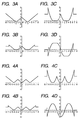
- FIGS. 3 and 4 illustrate procedures for determining a curve expressing the soft decision values of the MSB and the LSB bit in an approximate fashion.
- the curve to be obtained is a curve approximated to the curve in FIG. 11 .
- the amplitude of a demodulated wave is taken as "x”
- a variable for adjusting a curve shape is taken as "n”
- a value for determining the range of approximation is taken as "L.”
- a curve of y ABS (ABS(-ABS(x)+2)-2) is first obtained as illustrated in FIG. 4(a) . Then, the value of y as to the curve is fixed to 2 when y is L or more, thereby the curve of FIG. 4(b) is obtained. The value of y as to the curve of FIG. 4(b) is squared to obtain the curve of FIG. 4(c) . As to the curve of FIG.
- y is subtracted from 4 and taken as a new y when the absolute value of x is 2 or more, and 4 is subtracted from y and taken as a new y when the absolute value of x is 2 or less, thereby the curve of FIG. 4(d) is obtained.
- the curve of FIG. 4(d) is scaled so that the values of y become 0 to 7. This can approximate the curve expressing the soft decision value of the LSB to the curve in FIG. 11 .
- the soft decision decoding unit 5 sequentially performs calculation for the amplitude value sequentially sampled in the symbol acquirement unit 3 according to the procedure for obtaining the curve expressing the soft decision value of the MSB and the LSB bit, allowing sequentially outputting the soft decision values of 0 to 7 for each bit of each symbol. In both the procedures, the range of the scaling finally performed is changed to enable changing the fineness of the soft decision.
- FIG. 5 illustrates a comparison between the approximate curve as to the MSB bit obtained by the procedure in FIG. 3 and the actual measured value in FIG. 11 .
- FIG. 6 illustrates a comparison between the approximate curve as to the LSB bit obtained by the procedure in FIG. 4 and the actual measured value in FIG. 11 . From these figures, it can be seen that the curve of the actually measured probability can be reproduced by the approximate curve.
- the value "L" in the procedure in FIGS. 3 and 4 determines the upper limit of the amplitude value. Actually, a received demodulated wave is filtered, so that the amplitude value exceeding a certain value is not inputted. A large amplitude value does not fall within the curve of the probability, so that the probability as to the amplitude value exceeding the upper limit is taken as 50%.
- the soft decision value for each bit corresponding to the amplitude value can be obtained by a simple calculation processing which follows the procedure in which the curve expressing the soft decision value is formed by using a simple quadratic function.
- the processing can be described by C language with a dozen lines. Since the variable n for adjusting the curve shape and the value L for determining the range of approximation are used in the procedure for forming the curve expressing the soft decision value, these values are changed to enable readily adjusting the curve shape and the approximate range. Properly selecting the range of scaling is readily adaptable to the soft decision value of 256 stages, for example.
- probability density function can be expressed by the following equation.
- ⁇ is average and ⁇ 2 is dispersion.
- the average ⁇ at the symbol point of -3 is taken as -3 and ⁇ and ⁇ 2 may be previously prepared.
- the curve of the MSB bit can be determined by ⁇ N(+1)+N(+3) ⁇ /(N(-1)+N(-3)+N(+1)+N(+3) ⁇ .
- the curve of the LSB bit can be determined by (N(-1)+N(+1) ⁇ /(N(-1)+N(-3)+N(+1)+N(+3) ⁇ . If the MSB and the LSB accuracy are calculated according to the procedure, the existence of the exponential function (exp) in the equation of the probability density function increases a load to significantly slow the processing at the time of performing calculation by DSP or the like.
- the present invention is not limited to the above embodiment and various modifications may be made therein.
- the soft decision value is outputted based on the amplitude waveform of the demodulated signal for the case of the four-level FSK
- the present invention can also be applied to other modulation systems as well as to the four-level FSK as long as the modulation system is capable of allotting the probability density function following the Gauss distribution to each symbol point.
- the present invention can also be applied to the QPSK.
Landscapes
- Engineering & Computer Science (AREA)
- Computer Networks & Wireless Communication (AREA)
- Signal Processing (AREA)
- Power Engineering (AREA)
- Digital Transmission Methods That Use Modulated Carrier Waves (AREA)
- Error Detection And Correction (AREA)
- Dc Digital Transmission (AREA)
Abstract
Description
- The present invention relates to a soft decision device for outputting a soft decision value for each bit of each symbol used for decoding each symbol based on a demodulated signal and to a soft decision method.
- In mobile communication, a coding gain is often improved to increase a reception performance on a poor transmission path such that a demodulation circuit is devised and error correction is performed based on a soft decision value. A code outputted as a soft decision value is sent to an error corrector as data which indicates an accuracy of 0 to 7 and in which 1-bit data outputted as 0 or 1 in a hard decision is extended to 3 bits for example. The accuracy can be obtained by quantizing a demodulated continuous wave by an appropriately determined threshold value.
-
FIG. 7 illustrates a relationship between a probability distribution and a soft decision value as to a binary in the case of a binary code. The abscissa in the graph of the figure denotes an amplitude of a demodulated wave and the ordinate denotes probability.Reference numeral 71 in the figure denotes a curve expressing a probability distribution in the case where a demodulated wave is 1 andreference numeral 72 denotes a curve expressing a probability distribution in the case where the demodulated wave is 0.Numerals 0 to 7 are soft decision values allotted to the amplitude of each amplitude range. In general, the soft decision for a binary code by BPSK or the like is performed by outputting the soft decision value allotted to the amplitude of the demodulated wave as illustrated inFIG. 7 . Asoft decision value 0 for acode 0 is most probable and asoft decision value 7 for thecode 0 is most improbable. Asoft decision value 7 for acode 1 is most probable and asoft decision value 0 for thecode 1 is most improbable. -
FIG. 8 illustrates an example of soft decision for the case of a four-level code. For multilevel coding such as four-level coding, for example, an operation similar to one inFIG. 7 is performed on a complex plane. That is to say, as illustrated inFIG. 8 , the soft decision, similar to that inFIG. 7 , of a received signal is performed both at a real part and at an imaginary part and the soft decision values may be outputted at the respective parts. Such a technique is used inPatent Document 1 for example. Furthermore, such a technique is discussed in a conventional example ofPatent Document 2. -
FIG. 9 illustrates an amplitude in the case where a demodulated wave is viewed by a time waveform and the correspondence of the amplitude to the soft decision value allotted to the amplitude. Thus, the four-level is allotted to an amplitude value of a linear time waveform to enable the soft decision value to be obtained based on the amplitude value of the time waveform. This is applied to the case inFIG. 8 , which is equivalent to the arrangement of the threshold value of each soft decision value at an equal angle. - Incidentally, herein, a rate in which the amplitude of a demodulated wave is allotted to each soft decision value is referred to as "weighting." The allotment of each soft decision value to each range in which the amplitude of a demodulated wave is divided by an equal threshold value, as in the aforementioned example, is referred to as "linear weighting."
FIGS. 8 and 9 are different in the allotment of weighting from each other. In each case, a certain criterion is equally allotted, so that each case is treated as linear weighting. - Error correction in a soft decision decoding method has been often used in a Viterbi decoder, for example. The Viterbi decoder processes a soft decision value as a metric, adds the metric for each bit and completes a trellis. Since the metric is a distance between codes, it is desirable that the metric is the probability for the code word.
- However, according to a conventional linear weighting concerning a soft decision value, a threshold value is arranged at equally spaced intervals as illustrated in
FIGS. 7 and 8 , so that the soft decision value does not fully represent an actual probability. For example, the graph ofFIG. 7 illustrates a probability distribution in which a demodulation bit is 0 or 1 with respect to the amplitude of a demodulated wave on the abscissa under the condition of a certain error rate. If this is rewritten to the probability that a demodulation bit is 1,FIG. 10 is obtained. In other words, if the soft decision value is 0 to 2, the decoded word is substantially 1. If the soft decision value is 5 to 7, the decoded word is substantially not 1. The probability is reversed between the soft decision values of 3 and 4, which shows that the soft decision value cannot represent the probability. - In order to solve the above problem, the soft decision unit in
Patent Document 2 is equipped with an S/N detecting unit in its receiver to vary the threshold value of the soft decision according to reception environment, avoiding the above problem. According to the above method, however, a circuit such as the S/N detecting unit needs adding. Furthermore, a plurality of threshold values for soft decision need preparing to perform a complicated process. -
FIG. 11 illustrates the measured values of the probability that the demodulation bit of four-level FSK is 1 at a certain error rate with the abscissa as amplitude and the ordinate as probability. Bit arrangement corresponding to the amplitude is described later. According to the conventional soft decision method, for the four-level FSK, the soft decision value is not changed if the amplitude is -3 or less and 3 or more. Actually, however, the probability is decreased due to the intensity of Gauss noise or multipath fading. According to the conventional soft decision method, it is also difficult to reproduce this portion. - According to a decoding apparatus and decoding method in
Patent Document 3, the dispersion of actual quantization noise and Gauss noise is determined by calculation to perform the soft decision decode for the purpose of improving the accuracy of turbo decoding. Thus determining the dispersion of Gauss noise allows calculating the probability of a code word from a demodulated wave and also accurately representing decrease in the probability if the amplitude value is large, which however causes a problem that significantly complicates the calculation. - Patent Document 1: Japanese Patent Application Laid-Open No.
H10-136046 - Patent Document 2: Japanese Patent Application Laid-Open No.
H06-29951 - Patent Document 3: Japanese Patent Application Laid-Open No.
2005-286624 - In view of the problems of the aforementioned conventional technique, a first object of the present invention is to enable the soft decision value to be calculated as an approximate value representing the probability as near the actual probability as possible so that weighting is optimized in allotting a soft decision value to a demodulated wave. A second object of the present invention is to make the calculation of the approximate value extremely simple on the assumption that the calculation is performed by software using a DSP or the like.
- To achieve the above object of the present invention, a soft decision device according to a first aspect of the present invention is characterized by outputting a soft decision value for each bit of each symbol used for decoding each symbol in correspondence with the function value obtained by applying a predetermined function for each bit to the sample value of each symbol based on the demodulated signal in which the probability distribution of the sample value at each symbol point represents the Gauss distribution due to noise of a communication path,
wherein each predetermined function for each bit is approximated to a curve expressing the probability that each bit is 1 or 0 with respect to the sample value of each symbol of the demodulated signal and formed by using a quadratic function. - A demodulated signal for the case of a four-level FSK modulation or a QPSK modulation, for example, corresponds to the demodulated signal in which a potential sample value represents the Gauss distribution due to noise of a communication path. A curve obtained by actual measurement or by calculation using probability density functions of Gauss distribution, for example, correspond to a curve expressing the probability that each bit is 1 or 0 with respect to the sample value of each symbol of the demodulated signal.
- In this configuration, a function for each bit for obtaining the soft decision value of each bit of each symbol is approximated to a curve expressing the probability that each bit is 1 or 0 with respect to the sample value of each symbol in the demodulated signal, so that the function value obtained by applying each function for each bit to the sample value of each symbol is better approximated to the probability that each bit is 1 or 0. For this reason, the corresponding soft decision value also better represents the probability.
- The function for each bit is formed by using a quadratic function and does not use an exponential function (exp), so that the function value for the sample value can be obtained only by repeating calculations of square, absolute value, addition, and subtraction several times. In other words, the calculation can be described in dozen-line steps by C language, for example. For this reason, this enables calculating and outputting the soft decision value for each bit for each sample value without the need for a large load for a processing apparatus.
- In the first aspect of the present invention, a soft decision device according to a second aspect thereof is characterized in that, if the predetermined function is taken as y = f(x), f(x) can be obtained by: (1) squaring y of a curve which is expressed by a straight line the slope of which is 1 or -1 in the range of x of a portion formed by the quadratic function and in which y is a constant value in the range of x of other portions; (2) parallel displacing the entire curve to the direction y by a predetermined value and then reversing the value y in the predetermined range of x; and (3) performing scaling so that the value y of the reversed curve corresponds to the soft decision value.
- In the second aspect of the present invention, a soft decision device according to a third aspect thereof is characterized in that, if each bit of the symbol is a first and a second bit in the case of a multi-value number of 2 on the assumption that the demodulated signal is based on a multi-value modulation system and if the symbol points are taken as -3 * a/2, -a/2, a/2, 3 * a/2 in a bipolar expression with "a" as a predetermined constant, the first bit of the function for each bit can be obtained by: performing the aforementioned process (1) by squaring ABS(n-ABS(x))+a-n being a function of "x" with a function value as "a" in a range of "x" where the function value is L or more and a function value as 0 in a range of "x" where the function value is 0 or less, where "x" is the amplitude of a demodulated wave, "n" and "L" are predetermined constants, and ABS is an absolute value; performing the aforementioned process (2) by subtracting the square of "a" from the function obtained by the process in the range where "x" is 0 or more and subtracting the function from the square of "a" in the range where "x" is 0 or less; and performing the aforementioned process (3); on the other hand, the second bit of the function can be obtained by: performing the aforementioned process (1) by squaring ABS(ABS(-ABS(x))+a)-a) being a function of "x" with a function value as "a" in a range of "x" where the function value is L or more; performing the aforementioned process (2) by subtracting the function obtained by the process from the square of "a" in the range where the absolute value of "x" is "a" or more and subtracting the square of "a" from the function in the range where the absolute value of "x" is "a" or less; and performing the aforementioned process (3). Incidentally, the values of the first and the second bit correspond to the case where gray codes used as the symbol value are "11" (-3), "10" (-1), "00" (+1), and "01" (+3).
- In the soft decision device according to any one of the first to third aspect of the present invention, a soft decision device according to a fourth aspect thereof is characterized in that, if the predetermined function is taken as f(x), the value of f(x) in the predetermined range at both ends of the range where "x" varies is a half of the range where f(x) varies.
- A soft decision method according to a fifth aspect of the present invention is characterized by performing a process to output a soft decision value for each bit of each symbol used for decoding each symbol in correspondence with the function value obtained by applying a predetermined function for each bit to the sample value of each symbol based on the demodulated signal in which the probability distribution of the sample value at each symbol point represents the Gauss distribution due to noise of a communication path, wherein each predetermined function for each bit is approximated to a curve expressing the probability that each bit is 1 or 0 with respect to the sample value of each symbol of the demodulated signal and formed by using a quadratic function.
- According to the present invention, a function for each bit for obtaining the soft decision value of each bit of each symbol is approximated to a curve expressing the probability that each bit is 1 or 0 with respect to the sample value of each symbol in the demodulated signal, so that the soft decision value for the sample value of each symbol can be outputted as the soft decision value better representing the probability that each bit is 1 or 0.
- The function for each bit is formed by using a quadratic function without using an exponential function (exp) to enable calculating and outputting the soft decision value for each bit for each sample value without the need for a large load for a processing apparatus.
-
-
FIG. 1 is a block diagram illustrating the configuration of a radio equipment according to an embodiment of the present invention; -
FIG. 2 is a graph illustrating a demodulated wave outputted by a detecting phase circuit of the radio equipment inFIG. 1 ; -
FIG. 3 is a graph illustrating procedures for obtaining in an approximate manner a curve expressing the soft decision value of MSB bit; -
FIG. 4 is a graph illustrating procedures for obtaining in an approximate manner a curve expressing the soft decision value of LSB bit; -
FIG. 5 is a graph illustrating a comparison between the approximate curve obtained by the procedure inFIG. 3 and the actual measurement value; -
FIG. 6 is a graph illustrating a comparison between the approximate curve obtained by the procedure inFIG. 4 and the actual measurement value; -
FIG. 7 is a graph illustrating a relationship between a probability distribution and a soft decision value as to a binary in the case of a binary code according to a conventional example; -
FIG. 8 is a graph illustrating an example of soft decision in the case of a four-level code according to a conventional example; -
FIG. 9 is a diagram illustrating an amplitude in the case where a demodulated wave is viewed by a time waveform and the correspondence of the amplitude to soft decision values allotted to the amplitude according to a conventional example; -
FIG. 10 is a graph in whichFIG. 7 is rewritten for the case of the probability that a demodulation bit is 1; and -
FIG. 11 is a graph illustrating the measured values of the probability that the demodulation bit of four-level FSK is 1 at a certain error rate with the abscissa as amplitude and the ordinate as probability. - 1: RF circuit, 2: Detecting phase circuit, 3:
Symbol acquirement unit, 4: Clock regeneration unit, 5: Soft decision decoding unit, and 71 & 72: Curve expressing probability distribution -
FIG. 1 is a block diagram illustrating the configuration of a radio equipment according to an embodiment of the present invention. In the radio equipment, as illustrated in the same figure, a signal inputted through an antenna is converted to an intermediate frequency signal through tuning, heterodyne conversion or the like in anRF circuit 1. A demodulated wave is reproduced in a detectingphase circuit 2 based on the signal. The demodulated wave is sampled at an appropriate sampling interval by asymbol acquirement unit 3 based on a sampling clock from aclock regeneration unit 4, converted to MSB and LSB soft decision values by a softdecision decoding unit 5 and outputted. -
FIG. 2 illustrates a demodulated wave outputted by the detectingphase circuit 2. The abscissa indicates time. The demodulated wave is sampled at an appropriate sampling interval by thesymbol acquirement unit 3 to provide an amplitude value as a reception symbol. The amplitude value is normalized by -3 to +3. For the hard decision, a gray code is used to determine each amplitude to be "-3," "-1," "+1," and "+3," thereby providing 2-bit decoded words "11," "10," "00," and "01" per one symbol. The first half of the decoded words is referred to as "MSB bit" and the second half of the decoded words is referred to as "LSB bit." - For the soft decision, the accuracies of the MSB and the LSB bit per one symbol need to be determined.
If the soft decision is performed by the linear weighting, the obtained amplitude value is applied to the correspondence of the amplitude value to the soft decision value inFIG. 9 to allow determining the soft decision value as to the MSB and the LSB bit. However, as described above, it is hardly possible to reproduce the curve of the actual probability as to the MSB and the LSB bit. Even though the curve is linearly approximated, it is difficult to obtain the soft decision value correctly representing probability based on the amplitude value. In the present embodiment, therefore, the curve expressing the probability is approximated by a quadratic function.
In order to reduce a load for processing an approximate calculation, a quadratic curve is formed by deforming a simple quadratic curve y = x2. -
FIGS. 3 and 4 illustrate procedures for determining a curve expressing the soft decision values of the MSB and the LSB bit in an approximate fashion. In other words, the curve to be obtained is a curve approximated to the curve inFIG. 11 . In the procedure, the amplitude of a demodulated wave is taken as "x," a variable for adjusting a curve shape is taken as "n," and a value for determining the range of approximation is taken as "L."FIGS. 3 and 4 illustrate the procedures for the cases of n = 2.8 and L = 2.8. - In order to obtain a curve expressing the soft decision value as to the MSB bit, a curve of y = ABS(n-ABS(x))+2-n is first obtained as illustrated in
FIG. 3(a) . Then, the value of y as to the curve is fixed to 2 when y is L or more, and the value of y is taken as 0 when y is 0 or less, thereby the curve ofFIG. 3(b) is obtained. The value of y as to the curve ofFIG. 3(b) is squared to obtain the curve ofFIG. 3(c) . As to the curve ofFIG. 3(c), 4 is subtracted from y and taken as new y when x is 0 or more, and y is subtracted from 4 and taken as a new y when x is 0 or less, thereby the curve ofFIG. 3(d) is obtained. The curve ofFIG. 3(d) is scaled so that the values of y become 0 to 7. This can approximate the curve expressing the soft decision value of the MSB to the curve inFIG. 11 . - On the other hand, in order to obtain a curve expressing the soft decision value as to the LSB, a curve of y = ABS (ABS(-ABS(x)+2)-2) is first obtained as illustrated in
FIG. 4(a) . Then, the value of y as to the curve is fixed to 2 when y is L or more, thereby the curve ofFIG. 4(b) is obtained. The value of y as to the curve ofFIG. 4(b) is squared to obtain the curve ofFIG. 4(c) . As to the curve ofFIG. 4(c) , y is subtracted from 4 and taken as a new y when the absolute value of x is 2 or more, and 4 is subtracted from y and taken as a new y when the absolute value of x is 2 or less, thereby the curve ofFIG. 4(d) is obtained. The curve ofFIG. 4(d) is scaled so that the values of y become 0 to 7. This can approximate the curve expressing the soft decision value of the LSB to the curve inFIG. 11 . - The soft
decision decoding unit 5 sequentially performs calculation for the amplitude value sequentially sampled in thesymbol acquirement unit 3 according to the procedure for obtaining the curve expressing the soft decision value of the MSB and the LSB bit, allowing sequentially outputting the soft decision values of 0 to 7 for each bit of each symbol.
In both the procedures, the range of the scaling finally performed is changed to enable changing the fineness of the soft decision. -
FIG. 5 illustrates a comparison between the approximate curve as to the MSB bit obtained by the procedure inFIG. 3 and the actual measured value inFIG. 11 .FIG. 6 illustrates a comparison between the approximate curve as to the LSB bit obtained by the procedure inFIG. 4 and the actual measured value inFIG. 11 . From these figures, it can be seen that the curve of the actually measured probability can be reproduced by the approximate curve. The value "L" in the procedure inFIGS. 3 and 4 determines the upper limit of the amplitude value. Actually, a received demodulated wave is filtered, so that the amplitude value exceeding a certain value is not inputted. A large amplitude value does not fall within the curve of the probability, so that the probability as to the amplitude value exceeding the upper limit is taken as 50%. - According to the present embodiment, the soft decision value for each bit corresponding to the amplitude value can be obtained by a simple calculation processing which follows the procedure in which the curve expressing the soft decision value is formed by using a simple quadratic function. For example, the processing can be described by C language with a dozen lines. Since the variable n for adjusting the curve shape and the value L for determining the range of approximation are used in the procedure for forming the curve expressing the soft decision value, these values are changed to enable readily adjusting the curve shape and the approximate range. Properly selecting the range of scaling is readily adaptable to the soft decision value of 256 stages, for example.
- In order that the curve expressing the accuracy of the MSB and the LSB bit is determined by actually calculating the probability, probability density functions at respective symbol points (-3, -1, +1, and +3) need solving and adding. The probability density function can be expressed by the following equation.
- Where, µ is average and σ2 is dispersion. The average µ at the symbol point of -3 is taken as -3 and σ and σ2 may be previously prepared. If the probability density function at the symbol point of -3 is taken as N(-3) and, similarly, the probability density functions at respective points are taken as N(-1), N(+1), and N(+3), the curve of the MSB bit can be determined by {N(+1)+N(+3)}/(N(-1)+N(-3)+N(+1)+N(+3)}. The curve of the LSB bit can be determined by (N(-1)+N(+1)}/(N(-1)+N(-3)+N(+1)+N(+3)}. If the MSB and the LSB accuracy are calculated according to the procedure, the existence of the exponential function (exp) in the equation of the probability density function increases a load to significantly slow the processing at the time of performing calculation by DSP or the like.
- It is to be understood that the present invention is not limited to the above embodiment and various modifications may be made therein. Although in the abovementioned embodiment the soft decision value is outputted based on the amplitude waveform of the demodulated signal for the case of the four-level FSK, the present invention can also be applied to other modulation systems as well as to the four-level FSK as long as the modulation system is capable of allotting the probability density function following the Gauss distribution to each symbol point. For example, the present invention can also be applied to the QPSK.
Claims (5)
- A soft decision device characterized by outputting a soft decision value for each bit of each symbol used for decoding each symbol in correspondence with the function value obtained by applying a predetermined function for each bit to the sample value of each symbol based on the demodulated signal in which the probability distribution of the sample value at each symbol point represents the Gauss distribution due to noise of a communication path,
wherein each predetermined function for each said bit is approximated to a curve expressing the probability that each bit is 1 or 0 with respect to the sample value of each symbol of the demodulated signal and formed by using a quadratic function. - The soft decision device according to claim 1,
wherein, if the predetermined function is taken as y = f(x), f(x) can be obtained by:(1) squaring y of a curve which is expressed by a straight line the slope of which is 1 or -1 in the range of x of a portion formed by the quadratic function and in which y is a constant value in the range of x of other portions;(2) parallel displacing the entire curve to the direction y by a predetermined value and then reversing the value y in the predetermined range of x; and(3) performing scaling so that the value y of the reversed curve corresponds to the soft decision value. - The soft decision device according to claim 2,
wherein, if each bit of the symbol is a first and a second bit in the case of a multi-value number of 2 on the assumption that the demodulated signal is based on a multi-value modulation system and if the symbol points are taken as -3 * a/2, -a/2, a/2, 3 * a/2 in a bipolar expression with "a" as a predetermined constant,
the first bit of the function for each said bit can be obtained by: performing the aforementioned process (1) by squaring ABS(n-ABS(x))+a-n being a function of "x" with a function value as "a" in a range of "x" where the function value is L or more and a function value as 0 in a range of "x" where the function value is 0 or less, where "x" is the amplitude of a demodulated wave, "n" and "L" are predetermined constants, and ABS is an absolute value;
performing the aforementioned process (2) by subtracting the square of "a" from the function obtained by the process in the range where "x" is 0 or more and subtracting the function from the square of "a" in the range where "x" is 0 or less; and
performing the aforementioned process (3); on the other hand,
the second bit of the function can be obtained by: performing the aforementioned process (1) by squaring ABS(ABS(-ABS(x))+a)-a) being a function of "x" with a function value as "a" in a range of "x" where the function value is L or more;
performing the aforementioned process (2) by subtracting the function obtained by the process from the square of "a" in the range where the absolute value of "x" is "a" or more and subtracting the square of "a" from the function in the range where the absolute value of "x" is "a" or less; and
performing the aforementioned process (3). - The soft decision device according to any one of claims 1 to 3, wherein, if the predetermined function is taken as f(x), the value of f(x) in the predetermined range at both ends of the range where "x" varies is a half of the range where f(x) varies.
- A soft decision method characterized by performing a process to output a soft decision value for each bit of each symbol used for decoding each symbol in correspondence with the function value obtained by applying a predetermined function for each bit to the sample value of each symbol based on the demodulated signal in which the probability distribution of the sample value at each symbol point represents the Gauss distribution due to noise of a communication path,
wherein each predetermined function for each said bit is approximated to a curve expressing the probability that each bit is 1 or 0 with respect to the sample value of each symbol of the demodulated signal and formed by using a quadratic function.
Applications Claiming Priority (2)
| Application Number | Priority Date | Filing Date | Title |
|---|---|---|---|
| JP2007134655A JP5145766B2 (en) | 2007-05-21 | 2007-05-21 | Soft decision device and soft decision method |
| PCT/JP2008/059231 WO2008143251A1 (en) | 2007-05-21 | 2008-05-20 | Soft decision device and soft decision method |
Publications (3)
| Publication Number | Publication Date |
|---|---|
| EP2148446A1 true EP2148446A1 (en) | 2010-01-27 |
| EP2148446A4 EP2148446A4 (en) | 2014-10-01 |
| EP2148446B1 EP2148446B1 (en) | 2016-08-03 |
Family
ID=40031947
Family Applications (1)
| Application Number | Title | Priority Date | Filing Date |
|---|---|---|---|
| EP08764391.2A Active EP2148446B1 (en) | 2007-05-21 | 2008-05-20 | Soft decision device and soft decision method |
Country Status (9)
| Country | Link |
|---|---|
| US (1) | US8335972B2 (en) |
| EP (1) | EP2148446B1 (en) |
| JP (1) | JP5145766B2 (en) |
| CN (1) | CN101682339B (en) |
| CA (1) | CA2687773C (en) |
| DE (1) | DE08764391T1 (en) |
| MX (1) | MX2009012411A (en) |
| RU (1) | RU2458462C2 (en) |
| WO (1) | WO2008143251A1 (en) |
Cited By (3)
| Publication number | Priority date | Publication date | Assignee | Title |
|---|---|---|---|---|
| WO2022103422A1 (en) * | 2020-11-11 | 2022-05-19 | Marvell Asia Pte, Ltd. | Non-linear neural network equalizer for high-speed data channel |
| US12166595B2 (en) | 2021-01-25 | 2024-12-10 | Marvell Asia Pte Ltd | Ethernet physical layer transceiver with non-linear neural network equalizers |
| US12284059B1 (en) | 2021-02-08 | 2025-04-22 | Marvell Asia Pte Ltd | Non-linear neural network equalizer for high-speed data channel |
Families Citing this family (1)
| Publication number | Priority date | Publication date | Assignee | Title |
|---|---|---|---|---|
| JP6438441B2 (en) * | 2016-08-04 | 2018-12-12 | ファナック株式会社 | Encoder signal processing apparatus, encoder, signal processing method, and program |
Family Cites Families (12)
| Publication number | Priority date | Publication date | Assignee | Title |
|---|---|---|---|---|
| JPH0629951A (en) | 1992-07-06 | 1994-02-04 | Fujitsu Ltd | Soft discrimination device |
| JP2978792B2 (en) * | 1996-10-31 | 1999-11-15 | 株式会社次世代デジタルテレビジョン放送システム研究所 | Soft decision method and receiver |
| US6000054A (en) * | 1997-11-03 | 1999-12-07 | Motorola, Inc. | Method and apparatus for encoding and decoding binary information using restricted coded modulation and parallel concatenated convolution codes |
| EP1195691A4 (en) * | 1999-05-11 | 2005-06-01 | Sakai Yasue | INTERPOLATION CIRCUIT |
| JP4397492B2 (en) * | 1999-12-18 | 2010-01-13 | Nsc株式会社 | Digital-analog converter |
| EP1113580B1 (en) * | 1999-12-28 | 2015-02-25 | Hitachi Kokusai Electric Inc. | Coder with error correction, decoder with error correction and data transmission apparatus using the coder and decoder |
| JP3872950B2 (en) * | 2000-10-05 | 2007-01-24 | 株式会社東芝 | Frequency division multiplex transmission signal receiver |
| KR100441510B1 (en) * | 2002-02-01 | 2004-07-23 | 삼성전자주식회사 | The appartus for correcting error of data using channel state information |
| JP2004032125A (en) * | 2002-06-24 | 2004-01-29 | Hitachi Ltd | Communication system and signal processing method |
| JP3934651B2 (en) * | 2003-01-31 | 2007-06-20 | 富士通株式会社 | Multi-carrier communication system and receiving apparatus thereof |
| KR20040085545A (en) * | 2003-03-31 | 2004-10-08 | 삼성전자주식회사 | Apparatus for decoding error correction doe in communication system and method thereof |
| JP4283721B2 (en) | 2004-03-29 | 2009-06-24 | パナソニック株式会社 | Decoding device and decoding method |
-
2007
- 2007-05-21 JP JP2007134655A patent/JP5145766B2/en active Active
-
2008
- 2008-05-20 DE DE08764391T patent/DE08764391T1/en active Pending
- 2008-05-20 RU RU2009147279/08A patent/RU2458462C2/en active IP Right Revival
- 2008-05-20 EP EP08764391.2A patent/EP2148446B1/en active Active
- 2008-05-20 CA CA2687773A patent/CA2687773C/en active Active
- 2008-05-20 CN CN200880017040XA patent/CN101682339B/en active Active
- 2008-05-20 MX MX2009012411A patent/MX2009012411A/en active IP Right Grant
- 2008-05-20 WO PCT/JP2008/059231 patent/WO2008143251A1/en not_active Ceased
- 2008-05-20 US US12/600,718 patent/US8335972B2/en active Active
Cited By (5)
| Publication number | Priority date | Publication date | Assignee | Title |
|---|---|---|---|---|
| WO2022103422A1 (en) * | 2020-11-11 | 2022-05-19 | Marvell Asia Pte, Ltd. | Non-linear neural network equalizer for high-speed data channel |
| US11570023B2 (en) | 2020-11-11 | 2023-01-31 | Marvell Asia Pte, Ltd. | Non-linear neural network equalizer for high-speed data channel |
| KR20230098577A (en) * | 2020-11-11 | 2023-07-04 | 마벨 아시아 피티이 엘티디. | Non-linear neural network equalizer for high-speed data channels |
| US12166595B2 (en) | 2021-01-25 | 2024-12-10 | Marvell Asia Pte Ltd | Ethernet physical layer transceiver with non-linear neural network equalizers |
| US12284059B1 (en) | 2021-02-08 | 2025-04-22 | Marvell Asia Pte Ltd | Non-linear neural network equalizer for high-speed data channel |
Also Published As
| Publication number | Publication date |
|---|---|
| US20100162086A1 (en) | 2010-06-24 |
| CN101682339B (en) | 2013-07-24 |
| RU2009147279A (en) | 2011-06-27 |
| EP2148446A4 (en) | 2014-10-01 |
| DE08764391T1 (en) | 2010-08-26 |
| JP2008289100A (en) | 2008-11-27 |
| WO2008143251A1 (en) | 2008-11-27 |
| CA2687773A1 (en) | 2008-11-27 |
| CA2687773C (en) | 2013-09-17 |
| JP5145766B2 (en) | 2013-02-20 |
| EP2148446B1 (en) | 2016-08-03 |
| RU2458462C2 (en) | 2012-08-10 |
| US8335972B2 (en) | 2012-12-18 |
| MX2009012411A (en) | 2009-12-09 |
| CN101682339A (en) | 2010-03-24 |
Similar Documents
| Publication | Publication Date | Title |
|---|---|---|
| KR20070042223A (en) | ELL processing device and method for error correction in mobile communication system | |
| US6966024B2 (en) | Method and device for adaptive quantization of soft bits | |
| WO2001069873A2 (en) | Method and apparatus for combined soft-decision based interference cancellation and decoding | |
| KR20030017482A (en) | Decoding system and method for digital communications | |
| EP0731567B1 (en) | Maximum likelihood sequence estimator and maximum likelihood sequence estimating method | |
| CA2108494C (en) | A frequency hopping code division multiple access radio communication unit | |
| JP4536539B2 (en) | Bit string candidate reduction type receiver and reception processing method | |
| KR20140111890A (en) | Apparatus and method for encoding and decoding for frequency-quadrature amplitude modulation in wireless communication system | |
| JPH0548546A (en) | Signal transmitter | |
| CA2687773C (en) | Soft decision device and soft decision method | |
| CN1106716C (en) | Data decording apparatus | |
| KR100771996B1 (en) | Method for Soft-Demodulation and Soft-Modulation of Multi-Antenna System | |
| US20060109935A1 (en) | Receiver system and method for soft-decision decoding of punctured convolutional codes in a wireless communication system | |
| JP2004032125A (en) | Communication system and signal processing method | |
| JP2004512742A (en) | Method for generating soft bit information from gray coded signal | |
| EP1609265A1 (en) | Signal processing apparatus and method | |
| US20080130784A1 (en) | Coding device, decoding device, transmitter and receiver | |
| US20110211536A1 (en) | Decentralized and cooperative reception of data by base stations | |
| GB2434948A (en) | LLR calculation with quantization of values which are scaled depending on SNR. | |
| US9674011B1 (en) | Auto-detection of repeated signals | |
| US8798174B2 (en) | Method and device for quantizing likelihood quotients | |
| Lu et al. | Reducing signal distortion due to transmission error via multiresolution digital modulations | |
| US20070280382A1 (en) | Methods and systems for correlation based on phase quantization | |
| US20060078061A1 (en) | Likelihood calculating method and communication method | |
| US9203557B2 (en) | Receiver and receiving method |
Legal Events
| Date | Code | Title | Description |
|---|---|---|---|
| PUAI | Public reference made under article 153(3) epc to a published international application that has entered the european phase |
Free format text: ORIGINAL CODE: 0009012 |
|
| 17P | Request for examination filed |
Effective date: 20091112 |
|
| AK | Designated contracting states |
Kind code of ref document: A1 Designated state(s): AT BE BG CH CY CZ DE DK EE ES FI FR GB GR HR HU IE IS IT LI LT LU LV MC MT NL NO PL PT RO SE SI SK TR |
|
| AX | Request for extension of the european patent |
Extension state: AL BA MK RS |
|
| R17P | Request for examination filed (corrected) |
Effective date: 20091112 |
|
| EL | Fr: translation of claims filed | ||
| DAX | Request for extension of the european patent (deleted) | ||
| DET | De: translation of patent claims | ||
| RAP1 | Party data changed (applicant data changed or rights of an application transferred) |
Owner name: JVC KENWOOD CORPORATION |
|
| REG | Reference to a national code |
Ref country code: DE Ref legal event code: R079 Ref document number: 602008045442 Country of ref document: DE Free format text: PREVIOUS MAIN CLASS: H03M0013450000 Ipc: H04L0027380000 |
|
| A4 | Supplementary search report drawn up and despatched |
Effective date: 20140902 |
|
| RIC1 | Information provided on ipc code assigned before grant |
Ipc: H04L 25/38 20060101ALI20140827BHEP Ipc: H04L 25/06 20060101ALI20140827BHEP Ipc: H04L 27/38 20060101AFI20140827BHEP |
|
| GRAP | Despatch of communication of intention to grant a patent |
Free format text: ORIGINAL CODE: EPIDOSNIGR1 |
|
| INTG | Intention to grant announced |
Effective date: 20160503 |
|
| GRAS | Grant fee paid |
Free format text: ORIGINAL CODE: EPIDOSNIGR3 |
|
| GRAA | (expected) grant |
Free format text: ORIGINAL CODE: 0009210 |
|
| AK | Designated contracting states |
Kind code of ref document: B1 Designated state(s): AT BE BG CH CY CZ DE DK EE ES FI FR GB GR HR HU IE IS IT LI LT LU LV MC MT NL NO PL PT RO SE SI SK TR |
|
| REG | Reference to a national code |
Ref country code: GB Ref legal event code: FG4D |
|
| REG | Reference to a national code |
Ref country code: CH Ref legal event code: EP Ref country code: AT Ref legal event code: REF Ref document number: 817970 Country of ref document: AT Kind code of ref document: T Effective date: 20160815 |
|
| REG | Reference to a national code |
Ref country code: IE Ref legal event code: FG4D |
|
| REG | Reference to a national code |
Ref country code: DE Ref legal event code: R096 Ref document number: 602008045442 Country of ref document: DE |
|
| REG | Reference to a national code |
Ref country code: NL Ref legal event code: MP Effective date: 20160803 |
|
| REG | Reference to a national code |
Ref country code: LT Ref legal event code: MG4D |
|
| REG | Reference to a national code |
Ref country code: AT Ref legal event code: MK05 Ref document number: 817970 Country of ref document: AT Kind code of ref document: T Effective date: 20160803 |
|
| PG25 | Lapsed in a contracting state [announced via postgrant information from national office to epo] |
Ref country code: IS Free format text: LAPSE BECAUSE OF FAILURE TO SUBMIT A TRANSLATION OF THE DESCRIPTION OR TO PAY THE FEE WITHIN THE PRESCRIBED TIME-LIMIT Effective date: 20161203 Ref country code: FI Free format text: LAPSE BECAUSE OF FAILURE TO SUBMIT A TRANSLATION OF THE DESCRIPTION OR TO PAY THE FEE WITHIN THE PRESCRIBED TIME-LIMIT Effective date: 20160803 Ref country code: IT Free format text: LAPSE BECAUSE OF FAILURE TO SUBMIT A TRANSLATION OF THE DESCRIPTION OR TO PAY THE FEE WITHIN THE PRESCRIBED TIME-LIMIT Effective date: 20160803 Ref country code: NL Free format text: LAPSE BECAUSE OF FAILURE TO SUBMIT A TRANSLATION OF THE DESCRIPTION OR TO PAY THE FEE WITHIN THE PRESCRIBED TIME-LIMIT Effective date: 20160803 Ref country code: HR Free format text: LAPSE BECAUSE OF FAILURE TO SUBMIT A TRANSLATION OF THE DESCRIPTION OR TO PAY THE FEE WITHIN THE PRESCRIBED TIME-LIMIT Effective date: 20160803 Ref country code: NO Free format text: LAPSE BECAUSE OF FAILURE TO SUBMIT A TRANSLATION OF THE DESCRIPTION OR TO PAY THE FEE WITHIN THE PRESCRIBED TIME-LIMIT Effective date: 20161103 Ref country code: LT Free format text: LAPSE BECAUSE OF FAILURE TO SUBMIT A TRANSLATION OF THE DESCRIPTION OR TO PAY THE FEE WITHIN THE PRESCRIBED TIME-LIMIT Effective date: 20160803 |
|
| PG25 | Lapsed in a contracting state [announced via postgrant information from national office to epo] |
Ref country code: AT Free format text: LAPSE BECAUSE OF FAILURE TO SUBMIT A TRANSLATION OF THE DESCRIPTION OR TO PAY THE FEE WITHIN THE PRESCRIBED TIME-LIMIT Effective date: 20160803 Ref country code: GR Free format text: LAPSE BECAUSE OF FAILURE TO SUBMIT A TRANSLATION OF THE DESCRIPTION OR TO PAY THE FEE WITHIN THE PRESCRIBED TIME-LIMIT Effective date: 20161104 Ref country code: ES Free format text: LAPSE BECAUSE OF FAILURE TO SUBMIT A TRANSLATION OF THE DESCRIPTION OR TO PAY THE FEE WITHIN THE PRESCRIBED TIME-LIMIT Effective date: 20160803 Ref country code: SE Free format text: LAPSE BECAUSE OF FAILURE TO SUBMIT A TRANSLATION OF THE DESCRIPTION OR TO PAY THE FEE WITHIN THE PRESCRIBED TIME-LIMIT Effective date: 20160803 Ref country code: LV Free format text: LAPSE BECAUSE OF FAILURE TO SUBMIT A TRANSLATION OF THE DESCRIPTION OR TO PAY THE FEE WITHIN THE PRESCRIBED TIME-LIMIT Effective date: 20160803 Ref country code: PT Free format text: LAPSE BECAUSE OF FAILURE TO SUBMIT A TRANSLATION OF THE DESCRIPTION OR TO PAY THE FEE WITHIN THE PRESCRIBED TIME-LIMIT Effective date: 20161205 Ref country code: PL Free format text: LAPSE BECAUSE OF FAILURE TO SUBMIT A TRANSLATION OF THE DESCRIPTION OR TO PAY THE FEE WITHIN THE PRESCRIBED TIME-LIMIT Effective date: 20160803 |
|
| PG25 | Lapsed in a contracting state [announced via postgrant information from national office to epo] |
Ref country code: RO Free format text: LAPSE BECAUSE OF FAILURE TO SUBMIT A TRANSLATION OF THE DESCRIPTION OR TO PAY THE FEE WITHIN THE PRESCRIBED TIME-LIMIT Effective date: 20160803 Ref country code: EE Free format text: LAPSE BECAUSE OF FAILURE TO SUBMIT A TRANSLATION OF THE DESCRIPTION OR TO PAY THE FEE WITHIN THE PRESCRIBED TIME-LIMIT Effective date: 20160803 |
|
| REG | Reference to a national code |
Ref country code: DE Ref legal event code: R097 Ref document number: 602008045442 Country of ref document: DE |
|
| PG25 | Lapsed in a contracting state [announced via postgrant information from national office to epo] |
Ref country code: BE Free format text: LAPSE BECAUSE OF FAILURE TO SUBMIT A TRANSLATION OF THE DESCRIPTION OR TO PAY THE FEE WITHIN THE PRESCRIBED TIME-LIMIT Effective date: 20160803 Ref country code: BG Free format text: LAPSE BECAUSE OF FAILURE TO SUBMIT A TRANSLATION OF THE DESCRIPTION OR TO PAY THE FEE WITHIN THE PRESCRIBED TIME-LIMIT Effective date: 20161103 Ref country code: DK Free format text: LAPSE BECAUSE OF FAILURE TO SUBMIT A TRANSLATION OF THE DESCRIPTION OR TO PAY THE FEE WITHIN THE PRESCRIBED TIME-LIMIT Effective date: 20160803 Ref country code: CZ Free format text: LAPSE BECAUSE OF FAILURE TO SUBMIT A TRANSLATION OF THE DESCRIPTION OR TO PAY THE FEE WITHIN THE PRESCRIBED TIME-LIMIT Effective date: 20160803 Ref country code: SK Free format text: LAPSE BECAUSE OF FAILURE TO SUBMIT A TRANSLATION OF THE DESCRIPTION OR TO PAY THE FEE WITHIN THE PRESCRIBED TIME-LIMIT Effective date: 20160803 |
|
| PLBE | No opposition filed within time limit |
Free format text: ORIGINAL CODE: 0009261 |
|
| STAA | Information on the status of an ep patent application or granted ep patent |
Free format text: STATUS: NO OPPOSITION FILED WITHIN TIME LIMIT |
|
| 26N | No opposition filed |
Effective date: 20170504 |
|
| PG25 | Lapsed in a contracting state [announced via postgrant information from national office to epo] |
Ref country code: SI Free format text: LAPSE BECAUSE OF FAILURE TO SUBMIT A TRANSLATION OF THE DESCRIPTION OR TO PAY THE FEE WITHIN THE PRESCRIBED TIME-LIMIT Effective date: 20160803 Ref country code: LU Free format text: LAPSE BECAUSE OF NON-PAYMENT OF DUE FEES Effective date: 20170531 |
|
| REG | Reference to a national code |
Ref country code: CH Ref legal event code: PL |
|
| GBPC | Gb: european patent ceased through non-payment of renewal fee |
Effective date: 20170520 |
|
| PG25 | Lapsed in a contracting state [announced via postgrant information from national office to epo] |
Ref country code: MC Free format text: LAPSE BECAUSE OF FAILURE TO SUBMIT A TRANSLATION OF THE DESCRIPTION OR TO PAY THE FEE WITHIN THE PRESCRIBED TIME-LIMIT Effective date: 20160803 |
|
| REG | Reference to a national code |
Ref country code: IE Ref legal event code: MM4A |
|
| PG25 | Lapsed in a contracting state [announced via postgrant information from national office to epo] |
Ref country code: CH Free format text: LAPSE BECAUSE OF NON-PAYMENT OF DUE FEES Effective date: 20170531 Ref country code: LI Free format text: LAPSE BECAUSE OF NON-PAYMENT OF DUE FEES Effective date: 20170531 |
|
| REG | Reference to a national code |
Ref country code: FR Ref legal event code: ST Effective date: 20180131 |
|
| PG25 | Lapsed in a contracting state [announced via postgrant information from national office to epo] |
Ref country code: LU Free format text: LAPSE BECAUSE OF NON-PAYMENT OF DUE FEES Effective date: 20170520 |
|
| PG25 | Lapsed in a contracting state [announced via postgrant information from national office to epo] |
Ref country code: IE Free format text: LAPSE BECAUSE OF NON-PAYMENT OF DUE FEES Effective date: 20170520 Ref country code: GB Free format text: LAPSE BECAUSE OF NON-PAYMENT OF DUE FEES Effective date: 20170520 |
|
| PG25 | Lapsed in a contracting state [announced via postgrant information from national office to epo] |
Ref country code: FR Free format text: LAPSE BECAUSE OF NON-PAYMENT OF DUE FEES Effective date: 20170531 |
|
| PG25 | Lapsed in a contracting state [announced via postgrant information from national office to epo] |
Ref country code: MT Free format text: LAPSE BECAUSE OF NON-PAYMENT OF DUE FEES Effective date: 20170520 |
|
| PG25 | Lapsed in a contracting state [announced via postgrant information from national office to epo] |
Ref country code: HU Free format text: LAPSE BECAUSE OF FAILURE TO SUBMIT A TRANSLATION OF THE DESCRIPTION OR TO PAY THE FEE WITHIN THE PRESCRIBED TIME-LIMIT; INVALID AB INITIO Effective date: 20080520 |
|
| PG25 | Lapsed in a contracting state [announced via postgrant information from national office to epo] |
Ref country code: CY Free format text: LAPSE BECAUSE OF NON-PAYMENT OF DUE FEES Effective date: 20160803 |
|
| PG25 | Lapsed in a contracting state [announced via postgrant information from national office to epo] |
Ref country code: TR Free format text: LAPSE BECAUSE OF FAILURE TO SUBMIT A TRANSLATION OF THE DESCRIPTION OR TO PAY THE FEE WITHIN THE PRESCRIBED TIME-LIMIT Effective date: 20160803 |
|
| PGFP | Annual fee paid to national office [announced via postgrant information from national office to epo] |
Ref country code: DE Payment date: 20250402 Year of fee payment: 18 |