EP2145932A1 - Aqueous ink composition, aqueous ink composition for inkjet recording, and inkjet recording method - Google Patents
Aqueous ink composition, aqueous ink composition for inkjet recording, and inkjet recording method Download PDFInfo
- Publication number
- EP2145932A1 EP2145932A1 EP09165361A EP09165361A EP2145932A1 EP 2145932 A1 EP2145932 A1 EP 2145932A1 EP 09165361 A EP09165361 A EP 09165361A EP 09165361 A EP09165361 A EP 09165361A EP 2145932 A1 EP2145932 A1 EP 2145932A1
- Authority
- EP
- European Patent Office
- Prior art keywords
- group
- ink composition
- aqueous ink
- polymerization initiator
- pigment
- Prior art date
- Legal status (The legal status is an assumption and is not a legal conclusion. Google has not performed a legal analysis and makes no representation as to the accuracy of the status listed.)
- Granted
Links
- 239000000203 mixture Substances 0.000 title claims abstract description 277
- 238000000034 method Methods 0.000 title claims description 76
- 150000001875 compounds Chemical class 0.000 claims abstract description 211
- 230000001235 sensitizing effect Effects 0.000 claims abstract description 105
- 239000003505 polymerization initiator Substances 0.000 claims abstract description 98
- 125000000217 alkyl group Chemical group 0.000 claims abstract description 65
- XLYOFNOQVPJJNP-UHFFFAOYSA-N water Substances O XLYOFNOQVPJJNP-UHFFFAOYSA-N 0.000 claims abstract description 61
- 125000001424 substituent group Chemical group 0.000 claims abstract description 55
- 125000003118 aryl group Chemical group 0.000 claims abstract description 41
- 125000001931 aliphatic group Chemical group 0.000 claims abstract description 39
- 125000004435 hydrogen atom Chemical group [H]* 0.000 claims abstract description 28
- 125000002252 acyl group Chemical group 0.000 claims abstract description 19
- 229910052760 oxygen Inorganic materials 0.000 claims abstract description 19
- 229910052717 sulfur Inorganic materials 0.000 claims abstract description 18
- 239000000049 pigment Substances 0.000 claims description 161
- -1 poly(alkyleneoxy) Polymers 0.000 claims description 108
- 239000003086 colorant Substances 0.000 claims description 43
- 150000003839 salts Chemical class 0.000 claims description 38
- 125000003178 carboxy group Chemical group [H]OC(*)=O 0.000 claims description 28
- 230000001678 irradiating effect Effects 0.000 claims description 7
- 150000001735 carboxylic acids Chemical class 0.000 claims description 3
- 150000007942 carboxylates Chemical class 0.000 claims description 2
- 239000000976 ink Substances 0.000 description 309
- 239000000975 dye Substances 0.000 description 178
- 125000004432 carbon atom Chemical group C* 0.000 description 56
- 230000005855 radiation Effects 0.000 description 47
- 239000002245 particle Substances 0.000 description 40
- 238000003847 radiation curing Methods 0.000 description 40
- 239000002609 medium Substances 0.000 description 39
- 239000000463 material Substances 0.000 description 32
- 125000005843 halogen group Chemical group 0.000 description 31
- 229920001577 copolymer Polymers 0.000 description 30
- 238000001723 curing Methods 0.000 description 30
- 230000000052 comparative effect Effects 0.000 description 26
- 239000006185 dispersion Substances 0.000 description 26
- 125000000623 heterocyclic group Chemical group 0.000 description 24
- 230000035945 sensitivity Effects 0.000 description 23
- 239000002904 solvent Substances 0.000 description 23
- 125000003545 alkoxy group Chemical group 0.000 description 22
- 125000004453 alkoxycarbonyl group Chemical group 0.000 description 22
- 239000002253 acid Substances 0.000 description 21
- 239000000178 monomer Substances 0.000 description 21
- 229920000642 polymer Polymers 0.000 description 21
- 230000000694 effects Effects 0.000 description 19
- 239000004816 latex Substances 0.000 description 19
- 229920000126 latex Polymers 0.000 description 19
- 125000004423 acyloxy group Chemical group 0.000 description 18
- 238000007639 printing Methods 0.000 description 18
- 125000000020 sulfo group Chemical group O=S(=O)([*])O[H] 0.000 description 18
- 239000000126 substance Substances 0.000 description 15
- 239000004094 surface-active agent Substances 0.000 description 15
- 230000015572 biosynthetic process Effects 0.000 description 14
- 239000007787 solid Substances 0.000 description 14
- NIXOWILDQLNWCW-UHFFFAOYSA-M Acrylate Chemical compound [O-]C(=O)C=C NIXOWILDQLNWCW-UHFFFAOYSA-M 0.000 description 13
- IAYPIBMASNFSPL-UHFFFAOYSA-N Ethylene oxide Chemical group C1CO1 IAYPIBMASNFSPL-UHFFFAOYSA-N 0.000 description 13
- 125000003710 aryl alkyl group Chemical group 0.000 description 13
- 125000002887 hydroxy group Chemical group [H]O* 0.000 description 12
- 238000003860 storage Methods 0.000 description 12
- 125000003342 alkenyl group Chemical group 0.000 description 11
- 125000003277 amino group Chemical group 0.000 description 11
- 125000004386 diacrylate group Chemical group 0.000 description 11
- ZFSLODLOARCGLH-UHFFFAOYSA-N isocyanuric acid Natural products OC1=NC(O)=NC(O)=N1 ZFSLODLOARCGLH-UHFFFAOYSA-N 0.000 description 11
- QSHDDOUJBYECFT-UHFFFAOYSA-N mercury Chemical compound [Hg] QSHDDOUJBYECFT-UHFFFAOYSA-N 0.000 description 11
- 229910052753 mercury Inorganic materials 0.000 description 11
- 125000000449 nitro group Chemical group [O-][N+](*)=O 0.000 description 11
- PEDCQBHIVMGVHV-UHFFFAOYSA-N Glycerine Chemical compound OCC(O)CO PEDCQBHIVMGVHV-UHFFFAOYSA-N 0.000 description 10
- 239000002202 Polyethylene glycol Substances 0.000 description 10
- 239000008346 aqueous phase Substances 0.000 description 10
- 239000000839 emulsion Substances 0.000 description 10
- 239000003999 initiator Substances 0.000 description 10
- 239000003921 oil Substances 0.000 description 10
- 229920001223 polyethylene glycol Polymers 0.000 description 10
- 230000007480 spreading Effects 0.000 description 10
- 238000003892 spreading Methods 0.000 description 10
- 125000000547 substituted alkyl group Chemical group 0.000 description 10
- OKTJSMMVPCPJKN-UHFFFAOYSA-N Carbon Chemical group [C] OKTJSMMVPCPJKN-UHFFFAOYSA-N 0.000 description 9
- XEKOWRVHYACXOJ-UHFFFAOYSA-N Ethyl acetate Chemical compound CCOC(C)=O XEKOWRVHYACXOJ-UHFFFAOYSA-N 0.000 description 9
- LYCAIKOWRPUZTN-UHFFFAOYSA-N Ethylene glycol Chemical compound OCCO LYCAIKOWRPUZTN-UHFFFAOYSA-N 0.000 description 9
- GOOHAUXETOMSMM-UHFFFAOYSA-N Propylene oxide Chemical compound CC1CO1 GOOHAUXETOMSMM-UHFFFAOYSA-N 0.000 description 9
- HEMHJVSKTPXQMS-UHFFFAOYSA-M Sodium hydroxide Chemical compound [OH-].[Na+] HEMHJVSKTPXQMS-UHFFFAOYSA-M 0.000 description 9
- PPBRXRYQALVLMV-UHFFFAOYSA-N Styrene Chemical compound C=CC1=CC=CC=C1 PPBRXRYQALVLMV-UHFFFAOYSA-N 0.000 description 9
- 230000009471 action Effects 0.000 description 9
- 125000003282 alkyl amino group Chemical group 0.000 description 9
- 125000004414 alkyl thio group Chemical group 0.000 description 9
- 125000000751 azo group Chemical group [*]N=N[*] 0.000 description 9
- MTHSVFCYNBDYFN-UHFFFAOYSA-N diethylene glycol Chemical compound OCCOCCO MTHSVFCYNBDYFN-UHFFFAOYSA-N 0.000 description 9
- 238000005562 fading Methods 0.000 description 9
- 230000000977 initiatory effect Effects 0.000 description 9
- 238000006116 polymerization reaction Methods 0.000 description 9
- 238000012546 transfer Methods 0.000 description 9
- CERQOIWHTDAKMF-UHFFFAOYSA-M Methacrylate Chemical compound CC(=C)C([O-])=O CERQOIWHTDAKMF-UHFFFAOYSA-M 0.000 description 8
- 150000001252 acrylic acid derivatives Chemical class 0.000 description 8
- 239000000654 additive Substances 0.000 description 8
- 125000000304 alkynyl group Chemical group 0.000 description 8
- 125000004093 cyano group Chemical group *C#N 0.000 description 8
- 238000012217 deletion Methods 0.000 description 8
- 230000037430 deletion Effects 0.000 description 8
- 239000012153 distilled water Substances 0.000 description 8
- 239000012071 phase Substances 0.000 description 8
- 230000001105 regulatory effect Effects 0.000 description 8
- 239000011347 resin Substances 0.000 description 8
- 229920005989 resin Polymers 0.000 description 8
- WKBOTKDWSSQWDR-UHFFFAOYSA-N Bromine atom Chemical group [Br] WKBOTKDWSSQWDR-UHFFFAOYSA-N 0.000 description 7
- 229920003171 Poly (ethylene oxide) Polymers 0.000 description 7
- 238000010521 absorption reaction Methods 0.000 description 7
- 125000002947 alkylene group Chemical group 0.000 description 7
- 239000012736 aqueous medium Substances 0.000 description 7
- 125000004104 aryloxy group Chemical group 0.000 description 7
- 229910052801 chlorine Inorganic materials 0.000 description 7
- 125000001309 chloro group Chemical group Cl* 0.000 description 7
- 239000008367 deionised water Substances 0.000 description 7
- 229910021641 deionized water Inorganic materials 0.000 description 7
- 238000011156 evaluation Methods 0.000 description 7
- 150000002734 metacrylic acid derivatives Chemical class 0.000 description 7
- 125000002496 methyl group Chemical group [H]C([H])([H])* 0.000 description 7
- 229920001451 polypropylene glycol Polymers 0.000 description 7
- 125000000542 sulfonic acid group Chemical group 0.000 description 7
- 0 *C(Cl)=CC=C(C1=C)SCCC1=O Chemical compound *C(Cl)=CC=C(C1=C)SCCC1=O 0.000 description 6
- ZCYVEMRRCGMTRW-UHFFFAOYSA-N 7553-56-2 Chemical group [I] ZCYVEMRRCGMTRW-UHFFFAOYSA-N 0.000 description 6
- PAYRUJLWNCNPSJ-UHFFFAOYSA-N Aniline Chemical compound NC1=CC=CC=C1 PAYRUJLWNCNPSJ-UHFFFAOYSA-N 0.000 description 6
- ISWSIDIOOBJBQZ-UHFFFAOYSA-N Phenol Chemical compound OC1=CC=CC=C1 ISWSIDIOOBJBQZ-UHFFFAOYSA-N 0.000 description 6
- 239000006229 carbon black Substances 0.000 description 6
- 238000004040 coloring Methods 0.000 description 6
- XCJYREBRNVKWGJ-UHFFFAOYSA-N copper(II) phthalocyanine Chemical compound [Cu+2].C12=CC=CC=C2C(N=C2[N-]C(C3=CC=CC=C32)=N2)=NC1=NC([C]1C=CC=CC1=1)=NC=1N=C1[C]3C=CC=CC3=C2[N-]1 XCJYREBRNVKWGJ-UHFFFAOYSA-N 0.000 description 6
- 230000008878 coupling Effects 0.000 description 6
- 238000010168 coupling process Methods 0.000 description 6
- 238000005859 coupling reaction Methods 0.000 description 6
- 239000002270 dispersing agent Substances 0.000 description 6
- 238000001035 drying Methods 0.000 description 6
- 238000002296 dynamic light scattering Methods 0.000 description 6
- 125000005842 heteroatom Chemical group 0.000 description 6
- 229910052739 hydrogen Inorganic materials 0.000 description 6
- 239000001257 hydrogen Substances 0.000 description 6
- 229910052740 iodine Inorganic materials 0.000 description 6
- 239000003960 organic solvent Substances 0.000 description 6
- XNGIFLGASWRNHJ-UHFFFAOYSA-L phthalate(2-) Chemical compound [O-]C(=O)C1=CC=CC=C1C([O-])=O XNGIFLGASWRNHJ-UHFFFAOYSA-L 0.000 description 6
- 230000000704 physical effect Effects 0.000 description 6
- 238000002360 preparation method Methods 0.000 description 6
- 150000003254 radicals Chemical class 0.000 description 6
- XLPJNCYCZORXHG-UHFFFAOYSA-N 1-morpholin-4-ylprop-2-en-1-one Chemical compound C=CC(=O)N1CCOCC1 XLPJNCYCZORXHG-UHFFFAOYSA-N 0.000 description 5
- 229920002126 Acrylic acid copolymer Polymers 0.000 description 5
- CERQOIWHTDAKMF-UHFFFAOYSA-N Methacrylic acid Chemical compound CC(=C)C(O)=O CERQOIWHTDAKMF-UHFFFAOYSA-N 0.000 description 5
- 229910019142 PO4 Inorganic materials 0.000 description 5
- DNIAPMSPPWPWGF-UHFFFAOYSA-N Propylene glycol Chemical compound CC(O)CO DNIAPMSPPWPWGF-UHFFFAOYSA-N 0.000 description 5
- GSEJCLTVZPLZKY-UHFFFAOYSA-N Triethanolamine Chemical compound OCCN(CCO)CCO GSEJCLTVZPLZKY-UHFFFAOYSA-N 0.000 description 5
- ABRVLXLNVJHDRQ-UHFFFAOYSA-N [2-pyridin-3-yl-6-(trifluoromethyl)pyridin-4-yl]methanamine Chemical compound FC(C1=CC(=CC(=N1)C=1C=NC=CC=1)CN)(F)F ABRVLXLNVJHDRQ-UHFFFAOYSA-N 0.000 description 5
- FHLPGTXWCFQMIU-UHFFFAOYSA-N [4-[2-(4-prop-2-enoyloxyphenyl)propan-2-yl]phenyl] prop-2-enoate Chemical compound C=1C=C(OC(=O)C=C)C=CC=1C(C)(C)C1=CC=C(OC(=O)C=C)C=C1 FHLPGTXWCFQMIU-UHFFFAOYSA-N 0.000 description 5
- 230000008901 benefit Effects 0.000 description 5
- 239000012965 benzophenone Substances 0.000 description 5
- 230000000740 bleeding effect Effects 0.000 description 5
- 238000006243 chemical reaction Methods 0.000 description 5
- 239000003085 diluting agent Substances 0.000 description 5
- 230000005611 electricity Effects 0.000 description 5
- 239000003995 emulsifying agent Substances 0.000 description 5
- 150000002148 esters Chemical class 0.000 description 5
- 125000001495 ethyl group Chemical group [H]C([H])([H])C([H])([H])* 0.000 description 5
- 239000000194 fatty acid Substances 0.000 description 5
- 229910052731 fluorine Inorganic materials 0.000 description 5
- 125000001153 fluoro group Chemical group F* 0.000 description 5
- 235000011187 glycerol Nutrition 0.000 description 5
- 125000001820 oxy group Chemical group [*:1]O[*:2] 0.000 description 5
- 235000021317 phosphate Nutrition 0.000 description 5
- 229920000728 polyester Polymers 0.000 description 5
- 125000001436 propyl group Chemical group [H]C([*])([H])C([H])([H])C([H])([H])[H] 0.000 description 5
- 239000000243 solution Substances 0.000 description 5
- 241000894007 species Species 0.000 description 5
- 125000005017 substituted alkenyl group Chemical group 0.000 description 5
- 150000005846 sugar alcohols Polymers 0.000 description 5
- YRHRIQCWCFGUEQ-UHFFFAOYSA-N thioxanthen-9-one Chemical class C1=CC=C2C(=O)C3=CC=CC=C3SC2=C1 YRHRIQCWCFGUEQ-UHFFFAOYSA-N 0.000 description 5
- AZQWKYJCGOJGHM-UHFFFAOYSA-N 1,4-benzoquinone Chemical compound O=C1C=CC(=O)C=C1 AZQWKYJCGOJGHM-UHFFFAOYSA-N 0.000 description 4
- BSWWXRFVMJHFBN-UHFFFAOYSA-N 2,4,6-tribromophenol Chemical compound OC1=C(Br)C=C(Br)C=C1Br BSWWXRFVMJHFBN-UHFFFAOYSA-N 0.000 description 4
- SMZOUWXMTYCWNB-UHFFFAOYSA-N 2-(2-methoxy-5-methylphenyl)ethanamine Chemical compound COC1=CC=C(C)C=C1CCN SMZOUWXMTYCWNB-UHFFFAOYSA-N 0.000 description 4
- NIXOWILDQLNWCW-UHFFFAOYSA-N 2-Propenoic acid Natural products OC(=O)C=C NIXOWILDQLNWCW-UHFFFAOYSA-N 0.000 description 4
- TXBCBTDQIULDIA-UHFFFAOYSA-N 2-[[3-hydroxy-2,2-bis(hydroxymethyl)propoxy]methyl]-2-(hydroxymethyl)propane-1,3-diol Chemical compound OCC(CO)(CO)COCC(CO)(CO)CO TXBCBTDQIULDIA-UHFFFAOYSA-N 0.000 description 4
- LWRBVKNFOYUCNP-UHFFFAOYSA-N 2-methyl-1-(4-methylsulfanylphenyl)-2-morpholin-4-ylpropan-1-one Chemical compound C1=CC(SC)=CC=C1C(=O)C(C)(C)N1CCOCC1 LWRBVKNFOYUCNP-UHFFFAOYSA-N 0.000 description 4
- KWOLFJPFCHCOCG-UHFFFAOYSA-N Acetophenone Chemical compound CC(=O)C1=CC=CC=C1 KWOLFJPFCHCOCG-UHFFFAOYSA-N 0.000 description 4
- SECXISVLQFMRJM-UHFFFAOYSA-N N-Methylpyrrolidone Chemical compound CN1CCCC1=O SECXISVLQFMRJM-UHFFFAOYSA-N 0.000 description 4
- 239000004743 Polypropylene Substances 0.000 description 4
- ZJCCRDAZUWHFQH-UHFFFAOYSA-N Trimethylolpropane Chemical compound CCC(CO)(CO)CO ZJCCRDAZUWHFQH-UHFFFAOYSA-N 0.000 description 4
- 235000010443 alginic acid Nutrition 0.000 description 4
- 239000000783 alginic acid Substances 0.000 description 4
- 229920000615 alginic acid Polymers 0.000 description 4
- 229960001126 alginic acid Drugs 0.000 description 4
- 125000004397 aminosulfonyl group Chemical group NS(=O)(=O)* 0.000 description 4
- 239000003945 anionic surfactant Substances 0.000 description 4
- 150000004056 anthraquinones Chemical class 0.000 description 4
- RWCCWEUUXYIKHB-UHFFFAOYSA-N benzophenone Chemical compound C=1C=CC=CC=1C(=O)C1=CC=CC=C1 RWCCWEUUXYIKHB-UHFFFAOYSA-N 0.000 description 4
- 230000001588 bifunctional effect Effects 0.000 description 4
- QUZSUMLPWDHKCJ-UHFFFAOYSA-N bisphenol A dimethacrylate Chemical compound C1=CC(OC(=O)C(=C)C)=CC=C1C(C)(C)C1=CC=C(OC(=O)C(C)=C)C=C1 QUZSUMLPWDHKCJ-UHFFFAOYSA-N 0.000 description 4
- 125000003917 carbamoyl group Chemical group [H]N([H])C(*)=O 0.000 description 4
- 150000001768 cations Chemical class 0.000 description 4
- 125000004122 cyclic group Chemical group 0.000 description 4
- 235000014113 dietary fatty acids Nutrition 0.000 description 4
- VFHVQBAGLAREND-UHFFFAOYSA-N diphenylphosphoryl-(2,4,6-trimethylphenyl)methanone Chemical compound CC1=CC(C)=CC(C)=C1C(=O)P(=O)(C=1C=CC=CC=1)C1=CC=CC=C1 VFHVQBAGLAREND-UHFFFAOYSA-N 0.000 description 4
- FPVGTPBMTFTMRT-UHFFFAOYSA-L disodium;2-amino-5-[(4-sulfonatophenyl)diazenyl]benzenesulfonate Chemical compound [Na+].[Na+].C1=C(S([O-])(=O)=O)C(N)=CC=C1N=NC1=CC=C(S([O-])(=O)=O)C=C1 FPVGTPBMTFTMRT-UHFFFAOYSA-L 0.000 description 4
- RTZKZFJDLAIYFH-UHFFFAOYSA-N ether Substances CCOCC RTZKZFJDLAIYFH-UHFFFAOYSA-N 0.000 description 4
- 125000001301 ethoxy group Chemical group [H]C([H])([H])C([H])([H])O* 0.000 description 4
- 235000019233 fast yellow AB Nutrition 0.000 description 4
- 229930195729 fatty acid Natural products 0.000 description 4
- 238000010438 heat treatment Methods 0.000 description 4
- 150000002431 hydrogen Chemical class 0.000 description 4
- 230000001771 impaired effect Effects 0.000 description 4
- 230000001976 improved effect Effects 0.000 description 4
- 239000007788 liquid Substances 0.000 description 4
- 229910052751 metal Inorganic materials 0.000 description 4
- 239000002184 metal Substances 0.000 description 4
- 125000000956 methoxy group Chemical group [H]C([H])([H])O* 0.000 description 4
- LVHBHZANLOWSRM-UHFFFAOYSA-N methylenebutanedioic acid Natural products OC(=O)CC(=C)C(O)=O LVHBHZANLOWSRM-UHFFFAOYSA-N 0.000 description 4
- 125000004108 n-butyl group Chemical group [H]C([H])([H])C([H])([H])C([H])([H])C([H])([H])* 0.000 description 4
- 239000002736 nonionic surfactant Substances 0.000 description 4
- BASFCYQUMIYNBI-UHFFFAOYSA-N platinum Chemical compound [Pt] BASFCYQUMIYNBI-UHFFFAOYSA-N 0.000 description 4
- 229920000570 polyether Polymers 0.000 description 4
- 239000000047 product Substances 0.000 description 4
- 125000002914 sec-butyl group Chemical group [H]C([H])([H])C([H])([H])C([H])(*)C([H])([H])[H] 0.000 description 4
- 125000004426 substituted alkynyl group Chemical group 0.000 description 4
- 125000000999 tert-butyl group Chemical group [H]C([H])([H])C(*)(C([H])([H])[H])C([H])([H])[H] 0.000 description 4
- VZCYOOQTPOCHFL-UHFFFAOYSA-N trans-butenedioic acid Natural products OC(=O)C=CC(O)=O VZCYOOQTPOCHFL-UHFFFAOYSA-N 0.000 description 4
- LDHQCZJRKDOVOX-UHFFFAOYSA-N trans-crotonic acid Natural products CC=CC(O)=O LDHQCZJRKDOVOX-UHFFFAOYSA-N 0.000 description 4
- 238000009281 ultraviolet germicidal irradiation Methods 0.000 description 4
- SZCWBURCISJFEZ-UHFFFAOYSA-N (3-hydroxy-2,2-dimethylpropyl) 3-hydroxy-2,2-dimethylpropanoate Chemical compound OCC(C)(C)COC(=O)C(C)(C)CO SZCWBURCISJFEZ-UHFFFAOYSA-N 0.000 description 3
- KJCVRFUGPWSIIH-UHFFFAOYSA-N 1-naphthol Chemical compound C1=CC=C2C(O)=CC=CC2=C1 KJCVRFUGPWSIIH-UHFFFAOYSA-N 0.000 description 3
- JAHNSTQSQJOJLO-UHFFFAOYSA-N 2-(3-fluorophenyl)-1h-imidazole Chemical compound FC1=CC=CC(C=2NC=CN=2)=C1 JAHNSTQSQJOJLO-UHFFFAOYSA-N 0.000 description 3
- JQXYBDVZAUEPDL-UHFFFAOYSA-N 2-methylidene-5-phenylpent-4-enoic acid Chemical compound OC(=O)C(=C)CC=CC1=CC=CC=C1 JQXYBDVZAUEPDL-UHFFFAOYSA-N 0.000 description 3
- GOLORTLGFDVFDW-UHFFFAOYSA-N 3-(1h-benzimidazol-2-yl)-7-(diethylamino)chromen-2-one Chemical compound C1=CC=C2NC(C3=CC4=CC=C(C=C4OC3=O)N(CC)CC)=NC2=C1 GOLORTLGFDVFDW-UHFFFAOYSA-N 0.000 description 3
- MTNFAXLGPSLYEY-UHFFFAOYSA-N 3-(2-ethenylnaphthalen-1-yl)prop-2-enoic acid Chemical compound C1=CC=C2C(C=CC(=O)O)=C(C=C)C=CC2=C1 MTNFAXLGPSLYEY-UHFFFAOYSA-N 0.000 description 3
- CSCPPACGZOOCGX-UHFFFAOYSA-N Acetone Chemical compound CC(C)=O CSCPPACGZOOCGX-UHFFFAOYSA-N 0.000 description 3
- WEVYAHXRMPXWCK-UHFFFAOYSA-N Acetonitrile Chemical compound CC#N WEVYAHXRMPXWCK-UHFFFAOYSA-N 0.000 description 3
- NLHHRLWOUZZQLW-UHFFFAOYSA-N Acrylonitrile Chemical compound C=CC#N NLHHRLWOUZZQLW-UHFFFAOYSA-N 0.000 description 3
- WVDDGKGOMKODPV-UHFFFAOYSA-N Benzyl alcohol Chemical compound OCC1=CC=CC=C1 WVDDGKGOMKODPV-UHFFFAOYSA-N 0.000 description 3
- LFQSCWFLJHTTHZ-UHFFFAOYSA-N Ethanol Chemical compound CCO LFQSCWFLJHTTHZ-UHFFFAOYSA-N 0.000 description 3
- OKKJLVBELUTLKV-UHFFFAOYSA-N Methanol Chemical compound OC OKKJLVBELUTLKV-UHFFFAOYSA-N 0.000 description 3
- ZMXDDKWLCZADIW-UHFFFAOYSA-N N,N-Dimethylformamide Chemical compound CN(C)C=O ZMXDDKWLCZADIW-UHFFFAOYSA-N 0.000 description 3
- WHNWPMSKXPGLAX-UHFFFAOYSA-N N-Vinyl-2-pyrrolidone Chemical compound C=CN1CCCC1=O WHNWPMSKXPGLAX-UHFFFAOYSA-N 0.000 description 3
- 239000004952 Polyamide Substances 0.000 description 3
- 239000004793 Polystyrene Substances 0.000 description 3
- KWYUFKZDYYNOTN-UHFFFAOYSA-M Potassium hydroxide Chemical compound [OH-].[K+] KWYUFKZDYYNOTN-UHFFFAOYSA-M 0.000 description 3
- OFOBLEOULBTSOW-UHFFFAOYSA-N Propanedioic acid Natural products OC(=O)CC(O)=O OFOBLEOULBTSOW-UHFFFAOYSA-N 0.000 description 3
- 206010070834 Sensitisation Diseases 0.000 description 3
- DBMJMQXJHONAFJ-UHFFFAOYSA-M Sodium laurylsulphate Chemical compound [Na+].CCCCCCCCCCCCOS([O-])(=O)=O DBMJMQXJHONAFJ-UHFFFAOYSA-M 0.000 description 3
- ULUAUXLGCMPNKK-UHFFFAOYSA-N Sulfobutanedioic acid Chemical class OC(=O)CC(C(O)=O)S(O)(=O)=O ULUAUXLGCMPNKK-UHFFFAOYSA-N 0.000 description 3
- 238000003848 UV Light-Curing Methods 0.000 description 3
- ZEEBGORNQSEQBE-UHFFFAOYSA-N [2-(3-phenylphenoxy)-6-(trifluoromethyl)pyridin-4-yl]methanamine Chemical compound C1(=CC(=CC=C1)OC1=NC(=CC(=C1)CN)C(F)(F)F)C1=CC=CC=C1 ZEEBGORNQSEQBE-UHFFFAOYSA-N 0.000 description 3
- 150000004781 alginic acids Chemical class 0.000 description 3
- 229910052782 aluminium Inorganic materials 0.000 description 3
- 150000001408 amides Chemical class 0.000 description 3
- 150000001412 amines Chemical class 0.000 description 3
- 125000000129 anionic group Chemical group 0.000 description 3
- PYKYMHQGRFAEBM-UHFFFAOYSA-N anthraquinone Natural products CCC(=O)c1c(O)c2C(=O)C3C(C=CC=C3O)C(=O)c2cc1CC(=O)OC PYKYMHQGRFAEBM-UHFFFAOYSA-N 0.000 description 3
- 125000001769 aryl amino group Chemical group 0.000 description 3
- 239000000987 azo dye Substances 0.000 description 3
- 239000002585 base Substances 0.000 description 3
- ISAOCJYIOMOJEB-UHFFFAOYSA-N benzoin Chemical compound C=1C=CC=CC=1C(O)C(=O)C1=CC=CC=C1 ISAOCJYIOMOJEB-UHFFFAOYSA-N 0.000 description 3
- 229920001400 block copolymer Polymers 0.000 description 3
- 125000001951 carbamoylamino group Chemical group C(N)(=O)N* 0.000 description 3
- 229910052799 carbon Inorganic materials 0.000 description 3
- 125000002843 carboxylic acid group Chemical group 0.000 description 3
- KRKNYBCHXYNGOX-UHFFFAOYSA-N citric acid Chemical compound OC(=O)CC(O)(C(O)=O)CC(O)=O KRKNYBCHXYNGOX-UHFFFAOYSA-N 0.000 description 3
- 239000000084 colloidal system Substances 0.000 description 3
- 239000000470 constituent Substances 0.000 description 3
- 230000001276 controlling effect Effects 0.000 description 3
- 238000000354 decomposition reaction Methods 0.000 description 3
- 230000007423 decrease Effects 0.000 description 3
- 238000010586 diagram Methods 0.000 description 3
- VPWFPZBFBFHIIL-UHFFFAOYSA-L disodium 4-[(4-methyl-2-sulfophenyl)diazenyl]-3-oxidonaphthalene-2-carboxylate Chemical compound [Na+].[Na+].[O-]S(=O)(=O)C1=CC(C)=CC=C1N=NC1=C(O)C(C([O-])=O)=CC2=CC=CC=C12 VPWFPZBFBFHIIL-UHFFFAOYSA-L 0.000 description 3
- 238000009826 distribution Methods 0.000 description 3
- 238000004945 emulsification Methods 0.000 description 3
- 230000005281 excited state Effects 0.000 description 3
- 229910052736 halogen Inorganic materials 0.000 description 3
- 239000000852 hydrogen donor Substances 0.000 description 3
- 230000006872 improvement Effects 0.000 description 3
- XEEYBQQBJWHFJM-UHFFFAOYSA-N iron Substances [Fe] XEEYBQQBJWHFJM-UHFFFAOYSA-N 0.000 description 3
- 125000001449 isopropyl group Chemical group [H]C([H])([H])C([H])(*)C([H])([H])[H] 0.000 description 3
- VZCYOOQTPOCHFL-UPHRSURJSA-N maleic acid Chemical compound OC(=O)\C=C/C(O)=O VZCYOOQTPOCHFL-UPHRSURJSA-N 0.000 description 3
- 239000011976 maleic acid Substances 0.000 description 3
- 238000005259 measurement Methods 0.000 description 3
- 230000007246 mechanism Effects 0.000 description 3
- 229920003145 methacrylic acid copolymer Polymers 0.000 description 3
- SLCVBVWXLSEKPL-UHFFFAOYSA-N neopentyl glycol Chemical compound OCC(C)(C)CO SLCVBVWXLSEKPL-UHFFFAOYSA-N 0.000 description 3
- 229910052757 nitrogen Inorganic materials 0.000 description 3
- 239000012860 organic pigment Substances 0.000 description 3
- 238000007254 oxidation reaction Methods 0.000 description 3
- 125000001997 phenyl group Chemical group [H]C1=C([H])C([H])=C(*)C([H])=C1[H] 0.000 description 3
- NBIIXXVUZAFLBC-UHFFFAOYSA-K phosphate Chemical compound [O-]P([O-])([O-])=O NBIIXXVUZAFLBC-UHFFFAOYSA-K 0.000 description 3
- 239000010452 phosphate Substances 0.000 description 3
- IEQIEDJGQAUEQZ-UHFFFAOYSA-N phthalocyanine Chemical compound N1C(N=C2C3=CC=CC=C3C(N=C3C4=CC=CC=C4C(=N4)N3)=N2)=C(C=CC=C2)C2=C1N=C1C2=CC=CC=C2C4=N1 IEQIEDJGQAUEQZ-UHFFFAOYSA-N 0.000 description 3
- 229940099800 pigment red 48 Drugs 0.000 description 3
- 229920002647 polyamide Polymers 0.000 description 3
- 229920001155 polypropylene Polymers 0.000 description 3
- 229920002223 polystyrene Polymers 0.000 description 3
- 239000004800 polyvinyl chloride Substances 0.000 description 3
- 229920000915 polyvinyl chloride Polymers 0.000 description 3
- 230000001737 promoting effect Effects 0.000 description 3
- 125000002572 propoxy group Chemical group [*]OC([H])([H])C(C([H])([H])[H])([H])[H] 0.000 description 3
- 150000003242 quaternary ammonium salts Chemical class 0.000 description 3
- 230000009467 reduction Effects 0.000 description 3
- 230000008313 sensitization Effects 0.000 description 3
- 229940083575 sodium dodecyl sulfate Drugs 0.000 description 3
- 235000019333 sodium laurylsulphate Nutrition 0.000 description 3
- 150000003440 styrenes Chemical class 0.000 description 3
- 125000003107 substituted aryl group Chemical group 0.000 description 3
- KAKZBPTYRLMSJV-UHFFFAOYSA-N vinyl-ethylene Natural products C=CC=C KAKZBPTYRLMSJV-UHFFFAOYSA-N 0.000 description 3
- 229920003169 water-soluble polymer Polymers 0.000 description 3
- 239000001043 yellow dye Substances 0.000 description 3
- DTCCVIYSGXONHU-CJHDCQNGSA-N (z)-2-(2-phenylethenyl)but-2-enedioic acid Chemical compound OC(=O)\C=C(C(O)=O)\C=CC1=CC=CC=C1 DTCCVIYSGXONHU-CJHDCQNGSA-N 0.000 description 2
- MYWOJODOMFBVCB-UHFFFAOYSA-N 1,2,6-trimethylphenanthrene Chemical compound CC1=CC=C2C3=CC(C)=CC=C3C=CC2=C1C MYWOJODOMFBVCB-UHFFFAOYSA-N 0.000 description 2
- YXIWHUQXZSMYRE-UHFFFAOYSA-N 1,3-benzothiazole-2-thiol Chemical compound C1=CC=C2SC(S)=NC2=C1 YXIWHUQXZSMYRE-UHFFFAOYSA-N 0.000 description 2
- VNQXSTWCDUXYEZ-UHFFFAOYSA-N 1,7,7-trimethylbicyclo[2.2.1]heptane-2,3-dione Chemical compound C1CC2(C)C(=O)C(=O)C1C2(C)C VNQXSTWCDUXYEZ-UHFFFAOYSA-N 0.000 description 2
- UAJRSHJHFRVGMG-UHFFFAOYSA-N 1-ethenyl-4-methoxybenzene Chemical compound COC1=CC=C(C=C)C=C1 UAJRSHJHFRVGMG-UHFFFAOYSA-N 0.000 description 2
- SBASXUCJHJRPEV-UHFFFAOYSA-N 2-(2-methoxyethoxy)ethanol Chemical compound COCCOCCO SBASXUCJHJRPEV-UHFFFAOYSA-N 0.000 description 2
- LEJBBGNFPAFPKQ-UHFFFAOYSA-N 2-(2-prop-2-enoyloxyethoxy)ethyl prop-2-enoate Chemical compound C=CC(=O)OCCOCCOC(=O)C=C LEJBBGNFPAFPKQ-UHFFFAOYSA-N 0.000 description 2
- HZAXFHJVJLSVMW-UHFFFAOYSA-N 2-Aminoethan-1-ol Chemical compound NCCO HZAXFHJVJLSVMW-UHFFFAOYSA-N 0.000 description 2
- GOXQRTZXKQZDDN-UHFFFAOYSA-N 2-Ethylhexyl acrylate Chemical compound CCCCC(CC)COC(=O)C=C GOXQRTZXKQZDDN-UHFFFAOYSA-N 0.000 description 2
- XFCMNSHQOZQILR-UHFFFAOYSA-N 2-[2-(2-methylprop-2-enoyloxy)ethoxy]ethyl 2-methylprop-2-enoate Chemical compound CC(=C)C(=O)OCCOCCOC(=O)C(C)=C XFCMNSHQOZQILR-UHFFFAOYSA-N 0.000 description 2
- INQDDHNZXOAFFD-UHFFFAOYSA-N 2-[2-(2-prop-2-enoyloxyethoxy)ethoxy]ethyl prop-2-enoate Chemical compound C=CC(=O)OCCOCCOCCOC(=O)C=C INQDDHNZXOAFFD-UHFFFAOYSA-N 0.000 description 2
- HCLJOFJIQIJXHS-UHFFFAOYSA-N 2-[2-[2-(2-prop-2-enoyloxyethoxy)ethoxy]ethoxy]ethyl prop-2-enoate Chemical compound C=CC(=O)OCCOCCOCCOCCOC(=O)C=C HCLJOFJIQIJXHS-UHFFFAOYSA-N 0.000 description 2
- XSAYZAUNJMRRIR-UHFFFAOYSA-N 2-acetylnaphthalene Chemical compound C1=CC=CC2=CC(C(=O)C)=CC=C21 XSAYZAUNJMRRIR-UHFFFAOYSA-N 0.000 description 2
- ZCDADJXRUCOCJE-UHFFFAOYSA-N 2-chlorothioxanthen-9-one Chemical compound C1=CC=C2C(=O)C3=CC(Cl)=CC=C3SC2=C1 ZCDADJXRUCOCJE-UHFFFAOYSA-N 0.000 description 2
- VVBLNCFGVYUYGU-UHFFFAOYSA-N 4,4'-Bis(dimethylamino)benzophenone Chemical compound C1=CC(N(C)C)=CC=C1C(=O)C1=CC=C(N(C)C)C=C1 VVBLNCFGVYUYGU-UHFFFAOYSA-N 0.000 description 2
- ZMPZRDHZQFCUSJ-UHFFFAOYSA-N 5,7-dimethoxy-3-(naphthalene-1-carbonyl)chromen-2-one Chemical compound C1=CC=C2C(C(=O)C3=CC4=C(OC)C=C(C=C4OC3=O)OC)=CC=CC2=C1 ZMPZRDHZQFCUSJ-UHFFFAOYSA-N 0.000 description 2
- HRPVXLWXLXDGHG-UHFFFAOYSA-N Acrylamide Chemical compound NC(=O)C=C HRPVXLWXLXDGHG-UHFFFAOYSA-N 0.000 description 2
- QGZKDVFQNNGYKY-UHFFFAOYSA-N Ammonia Chemical compound N QGZKDVFQNNGYKY-UHFFFAOYSA-N 0.000 description 2
- QGZKDVFQNNGYKY-UHFFFAOYSA-O Ammonium Chemical compound [NH4+] QGZKDVFQNNGYKY-UHFFFAOYSA-O 0.000 description 2
- SOGAXMICEFXMKE-UHFFFAOYSA-N Butylmethacrylate Chemical compound CCCCOC(=O)C(C)=C SOGAXMICEFXMKE-UHFFFAOYSA-N 0.000 description 2
- RJHXEPLSJAVTFW-UHFFFAOYSA-N Cc(cc12)ccc1OCCC2=O Chemical compound Cc(cc12)ccc1OCCC2=O RJHXEPLSJAVTFW-UHFFFAOYSA-N 0.000 description 2
- XVZXOLOFWKSDSR-UHFFFAOYSA-N Cc1cc(C)c([C]=O)c(C)c1 Chemical group Cc1cc(C)c([C]=O)c(C)c1 XVZXOLOFWKSDSR-UHFFFAOYSA-N 0.000 description 2
- VEXZGXHMUGYJMC-UHFFFAOYSA-M Chloride anion Chemical compound [Cl-] VEXZGXHMUGYJMC-UHFFFAOYSA-M 0.000 description 2
- IAZDPXIOMUYVGZ-UHFFFAOYSA-N Dimethylsulphoxide Chemical compound CS(C)=O IAZDPXIOMUYVGZ-UHFFFAOYSA-N 0.000 description 2
- ULGZDMOVFRHVEP-RWJQBGPGSA-N Erythromycin Chemical compound O([C@@H]1[C@@H](C)C(=O)O[C@@H]([C@@]([C@H](O)[C@@H](C)C(=O)[C@H](C)C[C@@](C)(O)[C@H](O[C@H]2[C@@H]([C@H](C[C@@H](C)O2)N(C)C)O)[C@H]1C)(C)O)CC)[C@H]1C[C@@](C)(OC)[C@@H](O)[C@H](C)O1 ULGZDMOVFRHVEP-RWJQBGPGSA-N 0.000 description 2
- ZHNUHDYFZUAESO-UHFFFAOYSA-N Formamide Chemical compound NC=O ZHNUHDYFZUAESO-UHFFFAOYSA-N 0.000 description 2
- VZCYOOQTPOCHFL-OWOJBTEDSA-N Fumaric acid Chemical compound OC(=O)\C=C\C(O)=O VZCYOOQTPOCHFL-OWOJBTEDSA-N 0.000 description 2
- UFHFLCQGNIYNRP-UHFFFAOYSA-N Hydrogen Chemical compound [H][H] UFHFLCQGNIYNRP-UHFFFAOYSA-N 0.000 description 2
- KFZMGEQAYNKOFK-UHFFFAOYSA-N Isopropanol Chemical compound CC(C)O KFZMGEQAYNKOFK-UHFFFAOYSA-N 0.000 description 2
- BAPJBEWLBFYGME-UHFFFAOYSA-N Methyl acrylate Chemical compound COC(=O)C=C BAPJBEWLBFYGME-UHFFFAOYSA-N 0.000 description 2
- YNAVUWVOSKDBBP-UHFFFAOYSA-N Morpholine Chemical compound C1COCCN1 YNAVUWVOSKDBBP-UHFFFAOYSA-N 0.000 description 2
- LRHPLDYGYMQRHN-UHFFFAOYSA-N N-Butanol Chemical compound CCCCO LRHPLDYGYMQRHN-UHFFFAOYSA-N 0.000 description 2
- AMQJEAYHLZJPGS-UHFFFAOYSA-N N-Pentanol Chemical compound CCCCCO AMQJEAYHLZJPGS-UHFFFAOYSA-N 0.000 description 2
- 229930192627 Naphthoquinone Natural products 0.000 description 2
- PXHVJJICTQNCMI-UHFFFAOYSA-N Nickel Chemical compound [Ni] PXHVJJICTQNCMI-UHFFFAOYSA-N 0.000 description 2
- 239000004677 Nylon Substances 0.000 description 2
- LIRDJALZRPAZOR-UHFFFAOYSA-N O=C1c(cccc2)c2NC1 Chemical compound O=C1c(cccc2)c2NC1 LIRDJALZRPAZOR-UHFFFAOYSA-N 0.000 description 2
- NBIIXXVUZAFLBC-UHFFFAOYSA-N Phosphoric acid Chemical compound OP(O)(O)=O NBIIXXVUZAFLBC-UHFFFAOYSA-N 0.000 description 2
- GLUUGHFHXGJENI-UHFFFAOYSA-N Piperazine Chemical compound C1CNCCN1 GLUUGHFHXGJENI-UHFFFAOYSA-N 0.000 description 2
- 239000004698 Polyethylene Substances 0.000 description 2
- 239000004721 Polyphenylene oxide Substances 0.000 description 2
- 244000028419 Styrax benzoin Species 0.000 description 2
- 235000000126 Styrax benzoin Nutrition 0.000 description 2
- QAOWNCQODCNURD-UHFFFAOYSA-N Sulfuric acid Chemical compound OS(O)(=O)=O QAOWNCQODCNURD-UHFFFAOYSA-N 0.000 description 2
- 235000008411 Sumatra benzointree Nutrition 0.000 description 2
- XSQUKJJJFZCRTK-UHFFFAOYSA-N Urea Chemical compound NC(N)=O XSQUKJJJFZCRTK-UHFFFAOYSA-N 0.000 description 2
- 235000010724 Wisteria floribunda Nutrition 0.000 description 2
- MCMNRKCIXSYSNV-UHFFFAOYSA-N Zirconium dioxide Chemical compound O=[Zr]=O MCMNRKCIXSYSNV-UHFFFAOYSA-N 0.000 description 2
- 239000006096 absorbing agent Substances 0.000 description 2
- DZBUGLKDJFMEHC-UHFFFAOYSA-N acridine Chemical compound C1=CC=CC2=CC3=CC=CC=C3N=C21 DZBUGLKDJFMEHC-UHFFFAOYSA-N 0.000 description 2
- 230000002776 aggregation Effects 0.000 description 2
- 238000004220 aggregation Methods 0.000 description 2
- 125000004466 alkoxycarbonylamino group Chemical group 0.000 description 2
- 150000005215 alkyl ethers Chemical class 0.000 description 2
- HSFWRNGVRCDJHI-UHFFFAOYSA-N alpha-acetylene Natural products C#C HSFWRNGVRCDJHI-UHFFFAOYSA-N 0.000 description 2
- XAGFODPZIPBFFR-UHFFFAOYSA-N aluminium Chemical compound [Al] XAGFODPZIPBFFR-UHFFFAOYSA-N 0.000 description 2
- VSCWAEJMTAWNJL-UHFFFAOYSA-K aluminium trichloride Chemical compound Cl[Al](Cl)Cl VSCWAEJMTAWNJL-UHFFFAOYSA-K 0.000 description 2
- 125000003368 amide group Chemical group 0.000 description 2
- 239000001000 anthraquinone dye Substances 0.000 description 2
- 239000003429 antifungal agent Substances 0.000 description 2
- 229940121375 antifungal agent Drugs 0.000 description 2
- 239000003963 antioxidant agent Substances 0.000 description 2
- 230000003078 antioxidant effect Effects 0.000 description 2
- 239000003125 aqueous solvent Substances 0.000 description 2
- 125000005162 aryl oxy carbonyl amino group Chemical group 0.000 description 2
- 125000005161 aryl oxy carbonyl group Chemical group 0.000 description 2
- 125000005110 aryl thio group Chemical group 0.000 description 2
- 239000011324 bead Substances 0.000 description 2
- WURBFLDFSFBTLW-UHFFFAOYSA-N benzil Chemical compound C=1C=CC=CC=1C(=O)C(=O)C1=CC=CC=C1 WURBFLDFSFBTLW-UHFFFAOYSA-N 0.000 description 2
- 229960002130 benzoin Drugs 0.000 description 2
- 150000008366 benzophenones Chemical class 0.000 description 2
- 238000009835 boiling Methods 0.000 description 2
- KGBXLFKZBHKPEV-UHFFFAOYSA-N boric acid Chemical class OB(O)O KGBXLFKZBHKPEV-UHFFFAOYSA-N 0.000 description 2
- 229930006711 bornane-2,3-dione Natural products 0.000 description 2
- CQEYYJKEWSMYFG-UHFFFAOYSA-N butyl acrylate Chemical compound CCCCOC(=O)C=C CQEYYJKEWSMYFG-UHFFFAOYSA-N 0.000 description 2
- 239000011575 calcium Substances 0.000 description 2
- 150000001721 carbon Chemical group 0.000 description 2
- 125000005626 carbonium group Chemical group 0.000 description 2
- 239000003093 cationic surfactant Substances 0.000 description 2
- 239000001913 cellulose Substances 0.000 description 2
- 229920002678 cellulose Polymers 0.000 description 2
- PZTQVMXMKVTIRC-UHFFFAOYSA-L chembl2028348 Chemical compound [Ca+2].[O-]S(=O)(=O)C1=CC(C)=CC=C1N=NC1=C(O)C(C([O-])=O)=CC2=CC=CC=C12 PZTQVMXMKVTIRC-UHFFFAOYSA-L 0.000 description 2
- 239000003795 chemical substances by application Substances 0.000 description 2
- 229940125904 compound 1 Drugs 0.000 description 2
- 229910052802 copper Inorganic materials 0.000 description 2
- 239000010949 copper Substances 0.000 description 2
- LDHQCZJRKDOVOX-NSCUHMNNSA-N crotonic acid Chemical compound C\C=C\C(O)=O LDHQCZJRKDOVOX-NSCUHMNNSA-N 0.000 description 2
- 230000003247 decreasing effect Effects 0.000 description 2
- PPSZHCXTGRHULJ-UHFFFAOYSA-N dioxazine Chemical compound O1ON=CC=C1 PPSZHCXTGRHULJ-UHFFFAOYSA-N 0.000 description 2
- CZZYITDELCSZES-UHFFFAOYSA-N diphenylmethane Chemical compound C=1C=CC=CC=1CC1=CC=CC=C1 CZZYITDELCSZES-UHFFFAOYSA-N 0.000 description 2
- 238000004090 dissolution Methods 0.000 description 2
- 238000000295 emission spectrum Methods 0.000 description 2
- 230000007613 environmental effect Effects 0.000 description 2
- 229920001038 ethylene copolymer Polymers 0.000 description 2
- XLLIQLLCWZCATF-UHFFFAOYSA-N ethylene glycol monomethyl ether acetate Natural products COCCOC(C)=O XLLIQLLCWZCATF-UHFFFAOYSA-N 0.000 description 2
- 230000005284 excitation Effects 0.000 description 2
- 239000012530 fluid Substances 0.000 description 2
- 235000019382 gum benzoic Nutrition 0.000 description 2
- 125000004470 heterocyclooxy group Chemical group 0.000 description 2
- ZSIAUFGUXNUGDI-UHFFFAOYSA-N hexan-1-ol Chemical compound CCCCCCO ZSIAUFGUXNUGDI-UHFFFAOYSA-N 0.000 description 2
- 230000002209 hydrophobic effect Effects 0.000 description 2
- 125000005462 imide group Chemical group 0.000 description 2
- 235000019239 indanthrene blue RS Nutrition 0.000 description 2
- 239000003112 inhibitor Substances 0.000 description 2
- 230000002401 inhibitory effect Effects 0.000 description 2
- 238000007641 inkjet printing Methods 0.000 description 2
- 239000001023 inorganic pigment Substances 0.000 description 2
- 125000003010 ionic group Chemical group 0.000 description 2
- 229910052742 iron Inorganic materials 0.000 description 2
- ZXEKIIBDNHEJCQ-UHFFFAOYSA-N isobutanol Chemical compound CC(C)CO ZXEKIIBDNHEJCQ-UHFFFAOYSA-N 0.000 description 2
- 125000002510 isobutoxy group Chemical group [H]C([H])([H])C([H])(C([H])([H])[H])C([H])([H])O* 0.000 description 2
- LDHQCZJRKDOVOX-IHWYPQMZSA-N isocrotonic acid Chemical compound C\C=C/C(O)=O LDHQCZJRKDOVOX-IHWYPQMZSA-N 0.000 description 2
- 239000010410 layer Substances 0.000 description 2
- DZVCFNFOPIZQKX-LTHRDKTGSA-M merocyanine Chemical compound [Na+].O=C1N(CCCC)C(=O)N(CCCC)C(=O)C1=C\C=C\C=C/1N(CCCS([O-])(=O)=O)C2=CC=CC=C2O\1 DZVCFNFOPIZQKX-LTHRDKTGSA-M 0.000 description 2
- 229910001507 metal halide Inorganic materials 0.000 description 2
- 150000005309 metal halides Chemical class 0.000 description 2
- 229910021645 metal ion Inorganic materials 0.000 description 2
- 150000002739 metals Chemical class 0.000 description 2
- VNWKTOKETHGBQD-UHFFFAOYSA-N methane Chemical compound C VNWKTOKETHGBQD-UHFFFAOYSA-N 0.000 description 2
- 125000001434 methanylylidene group Chemical group [H]C#[*] 0.000 description 2
- YDKNBNOOCSNPNS-UHFFFAOYSA-N methyl 1,3-benzoxazole-2-carboxylate Chemical compound C1=CC=C2OC(C(=O)OC)=NC2=C1 YDKNBNOOCSNPNS-UHFFFAOYSA-N 0.000 description 2
- 125000006606 n-butoxy group Chemical group 0.000 description 2
- 150000002791 naphthoquinones Chemical class 0.000 description 2
- 229940117969 neopentyl glycol Drugs 0.000 description 2
- 229920001778 nylon Polymers 0.000 description 2
- 229920002601 oligoester Polymers 0.000 description 2
- 230000003287 optical effect Effects 0.000 description 2
- 230000003647 oxidation Effects 0.000 description 2
- 239000005022 packaging material Substances 0.000 description 2
- 125000002080 perylenyl group Chemical group C1(=CC=C2C=CC=C3C4=CC=CC5=CC=CC(C1=C23)=C45)* 0.000 description 2
- CSHWQDPOILHKBI-UHFFFAOYSA-N peryrene Natural products C1=CC(C2=CC=CC=3C2=C2C=CC=3)=C3C2=CC=CC3=C1 CSHWQDPOILHKBI-UHFFFAOYSA-N 0.000 description 2
- 125000000951 phenoxy group Chemical group [H]C1=C([H])C([H])=C(O*)C([H])=C1[H] 0.000 description 2
- FAQJJMHZNSSFSM-UHFFFAOYSA-N phenylglyoxylic acid Chemical compound OC(=O)C(=O)C1=CC=CC=C1 FAQJJMHZNSSFSM-UHFFFAOYSA-N 0.000 description 2
- 125000001476 phosphono group Chemical group [H]OP(*)(=O)O[H] 0.000 description 2
- 229940104573 pigment red 5 Drugs 0.000 description 2
- 229940067265 pigment yellow 138 Drugs 0.000 description 2
- 229910052697 platinum Inorganic materials 0.000 description 2
- 239000004417 polycarbonate Substances 0.000 description 2
- 229920000515 polycarbonate Polymers 0.000 description 2
- 125000003367 polycyclic group Chemical group 0.000 description 2
- 229920000573 polyethylene Polymers 0.000 description 2
- 229920000139 polyethylene terephthalate Polymers 0.000 description 2
- 239000005020 polyethylene terephthalate Substances 0.000 description 2
- 229920002635 polyurethane Polymers 0.000 description 2
- 239000004814 polyurethane Substances 0.000 description 2
- 229920000036 polyvinylpyrrolidone Polymers 0.000 description 2
- 235000013855 polyvinylpyrrolidone Nutrition 0.000 description 2
- BWHMMNNQKKPAPP-UHFFFAOYSA-L potassium carbonate Substances [K+].[K+].[O-]C([O-])=O BWHMMNNQKKPAPP-UHFFFAOYSA-L 0.000 description 2
- 238000001556 precipitation Methods 0.000 description 2
- 230000002265 prevention Effects 0.000 description 2
- 230000008569 process Effects 0.000 description 2
- 239000001294 propane Substances 0.000 description 2
- JEXVQSWXXUJEMA-UHFFFAOYSA-N pyrazol-3-one Chemical compound O=C1C=CN=N1 JEXVQSWXXUJEMA-UHFFFAOYSA-N 0.000 description 2
- JUJWROOIHBZHMG-UHFFFAOYSA-O pyridinium Chemical compound C1=CC=[NH+]C=C1 JUJWROOIHBZHMG-UHFFFAOYSA-O 0.000 description 2
- IZMJMCDDWKSTTK-UHFFFAOYSA-N quinoline yellow Chemical compound C1=CC=CC2=NC(C3C(C4=CC=CC=C4C3=O)=O)=CC=C21 IZMJMCDDWKSTTK-UHFFFAOYSA-N 0.000 description 2
- 239000007870 radical polymerization initiator Substances 0.000 description 2
- 230000009257 reactivity Effects 0.000 description 2
- 230000002829 reductive effect Effects 0.000 description 2
- 230000004044 response Effects 0.000 description 2
- 238000012552 review Methods 0.000 description 2
- 125000005920 sec-butoxy group Chemical group 0.000 description 2
- 125000004469 siloxy group Chemical group [SiH3]O* 0.000 description 2
- 229920001909 styrene-acrylic polymer Polymers 0.000 description 2
- 125000000475 sulfinyl group Chemical group [*:2]S([*:1])=O 0.000 description 2
- HXJUTPCZVOIRIF-UHFFFAOYSA-N sulfolane Chemical compound O=S1(=O)CCCC1 HXJUTPCZVOIRIF-UHFFFAOYSA-N 0.000 description 2
- 125000000565 sulfonamide group Chemical group 0.000 description 2
- 125000000472 sulfonyl group Chemical group *S(*)(=O)=O 0.000 description 2
- JOUDBUYBGJYFFP-FOCLMDBBSA-N thioindigo Chemical compound S\1C2=CC=CC=C2C(=O)C/1=C1/C(=O)C2=CC=CC=C2S1 JOUDBUYBGJYFFP-FOCLMDBBSA-N 0.000 description 2
- AAAQKTZKLRYKHR-UHFFFAOYSA-N triphenylmethane Chemical compound C1=CC=CC=C1C(C=1C=CC=CC=1)C1=CC=CC=C1 AAAQKTZKLRYKHR-UHFFFAOYSA-N 0.000 description 2
- 238000000108 ultra-filtration Methods 0.000 description 2
- 229920006305 unsaturated polyester Polymers 0.000 description 2
- 150000003673 urethanes Chemical class 0.000 description 2
- 229920002554 vinyl polymer Polymers 0.000 description 2
- 239000001018 xanthene dye Substances 0.000 description 2
- JNELGWHKGNBSMD-UHFFFAOYSA-N xanthone Chemical compound C1=CC=C2C(=O)C3=CC=CC=C3OC2=C1 JNELGWHKGNBSMD-UHFFFAOYSA-N 0.000 description 2
- 239000001052 yellow pigment Substances 0.000 description 2
- PUPZLCDOIYMWBV-UHFFFAOYSA-N (+/-)-1,3-Butanediol Chemical compound CC(O)CCO PUPZLCDOIYMWBV-UHFFFAOYSA-N 0.000 description 1
- NEXZVOLIDKSFBH-UHFFFAOYSA-N (1,1-diphenyl-2-phosphonooxyethyl) 2-methylprop-2-enoate Chemical compound C=1C=CC=CC=1C(COP(O)(O)=O)(OC(=O)C(=C)C)C1=CC=CC=C1 NEXZVOLIDKSFBH-UHFFFAOYSA-N 0.000 description 1
- YRIOTLGRXFJRTJ-UHFFFAOYSA-N (1,1-diphenyl-2-phosphonooxyethyl) prop-2-enoate Chemical compound C=1C=CC=CC=1C(OC(=O)C=C)(COP(O)(=O)O)C1=CC=CC=C1 YRIOTLGRXFJRTJ-UHFFFAOYSA-N 0.000 description 1
- QYPLZYIQAVZEDP-UHFFFAOYSA-N (2,6-dibromo-4-butylphenyl) 2-methylprop-2-enoate Chemical compound CCCCC1=CC(Br)=C(OC(=O)C(C)=C)C(Br)=C1 QYPLZYIQAVZEDP-UHFFFAOYSA-N 0.000 description 1
- JRDYFMQRUKNGTP-UHFFFAOYSA-N (2,6-dibromo-4-butylphenyl) prop-2-enoate Chemical compound CCCCC1=CC(Br)=C(OC(=O)C=C)C(Br)=C1 JRDYFMQRUKNGTP-UHFFFAOYSA-N 0.000 description 1
- HHQAGBQXOWLTLL-UHFFFAOYSA-N (2-hydroxy-3-phenoxypropyl) prop-2-enoate Chemical compound C=CC(=O)OCC(O)COC1=CC=CC=C1 HHQAGBQXOWLTLL-UHFFFAOYSA-N 0.000 description 1
- ZOKCNEIWFQCSCM-UHFFFAOYSA-N (2-methyl-4-phenylpent-4-en-2-yl)benzene Chemical compound C=1C=CC=CC=1C(C)(C)CC(=C)C1=CC=CC=C1 ZOKCNEIWFQCSCM-UHFFFAOYSA-N 0.000 description 1
- JNYAEWCLZODPBN-JGWLITMVSA-N (2r,3r,4s)-2-[(1r)-1,2-dihydroxyethyl]oxolane-3,4-diol Chemical class OC[C@@H](O)[C@H]1OC[C@H](O)[C@H]1O JNYAEWCLZODPBN-JGWLITMVSA-N 0.000 description 1
- DDKMFQGAZVMXQV-UHFFFAOYSA-N (3-chloro-2-hydroxypropyl) 2-methylprop-2-enoate Chemical compound CC(=C)C(=O)OCC(O)CCl DDKMFQGAZVMXQV-UHFFFAOYSA-N 0.000 description 1
- POTYORUTRLSAGZ-UHFFFAOYSA-N (3-chloro-2-hydroxypropyl) prop-2-enoate Chemical compound ClCC(O)COC(=O)C=C POTYORUTRLSAGZ-UHFFFAOYSA-N 0.000 description 1
- PSGCQDPCAWOCSH-UHFFFAOYSA-N (4,7,7-trimethyl-3-bicyclo[2.2.1]heptanyl) prop-2-enoate Chemical compound C1CC2(C)C(OC(=O)C=C)CC1C2(C)C PSGCQDPCAWOCSH-UHFFFAOYSA-N 0.000 description 1
- SWFHGTMLYIBPPA-UHFFFAOYSA-N (4-methoxyphenyl)-phenylmethanone Chemical compound C1=CC(OC)=CC=C1C(=O)C1=CC=CC=C1 SWFHGTMLYIBPPA-UHFFFAOYSA-N 0.000 description 1
- WXPWZZHELZEVPO-UHFFFAOYSA-N (4-methylphenyl)-phenylmethanone Chemical compound C1=CC(C)=CC=C1C(=O)C1=CC=CC=C1 WXPWZZHELZEVPO-UHFFFAOYSA-N 0.000 description 1
- QGKMIGUHVLGJBR-UHFFFAOYSA-M (4z)-1-(3-methylbutyl)-4-[[1-(3-methylbutyl)quinolin-1-ium-4-yl]methylidene]quinoline;iodide Chemical compound [I-].C12=CC=CC=C2N(CCC(C)C)C=CC1=CC1=CC=[N+](CCC(C)C)C2=CC=CC=C12 QGKMIGUHVLGJBR-UHFFFAOYSA-M 0.000 description 1
- QERNPKXJOBLNFM-UHFFFAOYSA-N 1,1,2,2,3,3,4,4-octafluoropentane Chemical compound CC(F)(F)C(F)(F)C(F)(F)C(F)F QERNPKXJOBLNFM-UHFFFAOYSA-N 0.000 description 1
- YJTKZCDBKVTVBY-UHFFFAOYSA-N 1,3-Diphenylbenzene Chemical group C1=CC=CC=C1C1=CC=CC(C=2C=CC=CC=2)=C1 YJTKZCDBKVTVBY-UHFFFAOYSA-N 0.000 description 1
- XGRXUECZGSQQRL-UHFFFAOYSA-N 1-(1-hydroxypropan-2-yloxy)-3-methoxypropan-2-ol;2-methylprop-2-enoic acid Chemical compound CC(=C)C(O)=O.COCC(O)COC(C)CO XGRXUECZGSQQRL-UHFFFAOYSA-N 0.000 description 1
- UHLWGJNVYHBNBV-UHFFFAOYSA-N 1-(1-hydroxypropan-2-yloxy)-3-methoxypropan-2-ol;prop-2-enoic acid Chemical compound OC(=O)C=C.COCC(O)COC(C)CO UHLWGJNVYHBNBV-UHFFFAOYSA-N 0.000 description 1
- BAYUSCHCCGXLAY-UHFFFAOYSA-N 1-(3-methoxyphenyl)ethanone Chemical compound COC1=CC=CC(C(C)=O)=C1 BAYUSCHCCGXLAY-UHFFFAOYSA-N 0.000 description 1
- MAQLWWPSJDSHIT-UHFFFAOYSA-N 1-(4-hexylphenyl)-2-methyl-2-morpholin-4-ylpropan-1-one Chemical compound C1=CC(CCCCCC)=CC=C1C(=O)C(C)(C)N1CCOCC1 MAQLWWPSJDSHIT-UHFFFAOYSA-N 0.000 description 1
- QCZZSANNLWPGEA-UHFFFAOYSA-N 1-(4-phenylphenyl)ethanone Chemical compound C1=CC(C(=O)C)=CC=C1C1=CC=CC=C1 QCZZSANNLWPGEA-UHFFFAOYSA-N 0.000 description 1
- AQVRBCMAYYDFRP-UHFFFAOYSA-N 1-[1-(1-hydroxypropan-2-yloxy)propan-2-yloxy]-3-methoxypropan-2-ol;2-methylprop-2-enoic acid Chemical compound CC(=C)C(O)=O.COCC(O)COC(C)COC(C)CO AQVRBCMAYYDFRP-UHFFFAOYSA-N 0.000 description 1
- GRSGFPUWHKVFJW-UHFFFAOYSA-N 1-[1-(1-hydroxypropan-2-yloxy)propan-2-yloxy]-3-methoxypropan-2-ol;prop-2-enoic acid Chemical compound OC(=O)C=C.COCC(O)COC(C)COC(C)CO GRSGFPUWHKVFJW-UHFFFAOYSA-N 0.000 description 1
- ZDQNWDNMNKSMHI-UHFFFAOYSA-N 1-[2-(2-prop-2-enoyloxypropoxy)propoxy]propan-2-yl prop-2-enoate Chemical compound C=CC(=O)OC(C)COC(C)COCC(C)OC(=O)C=C ZDQNWDNMNKSMHI-UHFFFAOYSA-N 0.000 description 1
- IUPUTCOATBREJA-UHFFFAOYSA-N 1-[3,5-bis(2-methylprop-2-enoyl)-1,3,5-triazinan-1-yl]-2-methylprop-2-en-1-one Chemical compound CC(=C)C(=O)N1CN(C(=O)C(C)=C)CN(C(=O)C(C)=C)C1 IUPUTCOATBREJA-UHFFFAOYSA-N 0.000 description 1
- FYBFGAFWCBMEDG-UHFFFAOYSA-N 1-[3,5-di(prop-2-enoyl)-1,3,5-triazinan-1-yl]prop-2-en-1-one Chemical compound C=CC(=O)N1CN(C(=O)C=C)CN(C(=O)C=C)C1 FYBFGAFWCBMEDG-UHFFFAOYSA-N 0.000 description 1
- WGGLDBIZIQMEGH-UHFFFAOYSA-N 1-bromo-4-ethenylbenzene Chemical compound BrC1=CC=C(C=C)C=C1 WGGLDBIZIQMEGH-UHFFFAOYSA-N 0.000 description 1
- RWNUSVWFHDHRCJ-UHFFFAOYSA-N 1-butoxypropan-2-ol Chemical compound CCCCOCC(C)O RWNUSVWFHDHRCJ-UHFFFAOYSA-N 0.000 description 1
- KTZVZZJJVJQZHV-UHFFFAOYSA-N 1-chloro-4-ethenylbenzene Chemical compound ClC1=CC=C(C=C)C=C1 KTZVZZJJVJQZHV-UHFFFAOYSA-N 0.000 description 1
- GRFNSWBVXHLTCI-UHFFFAOYSA-N 1-ethenyl-4-[(2-methylpropan-2-yl)oxy]benzene Chemical compound CC(C)(C)OC1=CC=C(C=C)C=C1 GRFNSWBVXHLTCI-UHFFFAOYSA-N 0.000 description 1
- AOCWFZYXOMHKQJ-UHFFFAOYSA-N 1-ethoxy-2-(2-hydroxyethoxy)ethanol;2-methylprop-2-enoic acid Chemical compound CC(=C)C(O)=O.CCOC(O)COCCO AOCWFZYXOMHKQJ-UHFFFAOYSA-N 0.000 description 1
- OBNIRVVPHSLTEP-UHFFFAOYSA-N 1-ethoxy-2-(2-hydroxyethoxy)ethanol;prop-2-enoic acid Chemical compound OC(=O)C=C.CCOC(O)COCCO OBNIRVVPHSLTEP-UHFFFAOYSA-N 0.000 description 1
- ARXJGSRGQADJSQ-UHFFFAOYSA-N 1-methoxypropan-2-ol Chemical compound COCC(C)O ARXJGSRGQADJSQ-UHFFFAOYSA-N 0.000 description 1
- JUXXCHAGQCBNTI-UHFFFAOYSA-N 1-n,1-n,2-n,2-n-tetramethylpropane-1,2-diamine Chemical compound CN(C)C(C)CN(C)C JUXXCHAGQCBNTI-UHFFFAOYSA-N 0.000 description 1
- IBLKWZIFZMJLFL-UHFFFAOYSA-N 1-phenoxypropan-2-ol Chemical compound CC(O)COC1=CC=CC=C1 IBLKWZIFZMJLFL-UHFFFAOYSA-N 0.000 description 1
- IKGYAYIDDMNCEI-UHFFFAOYSA-N 1-phenoxythioxanthen-9-one Chemical compound C=12C(=O)C3=CC=CC=C3SC2=CC=CC=1OC1=CC=CC=C1 IKGYAYIDDMNCEI-UHFFFAOYSA-N 0.000 description 1
- YIKSHDNOAYSSPX-UHFFFAOYSA-N 1-propan-2-ylthioxanthen-9-one Chemical compound S1C2=CC=CC=C2C(=O)C2=C1C=CC=C2C(C)C YIKSHDNOAYSSPX-UHFFFAOYSA-N 0.000 description 1
- IGGDKDTUCAWDAN-UHFFFAOYSA-N 1-vinylnaphthalene Chemical class C1=CC=C2C(C=C)=CC=CC2=C1 IGGDKDTUCAWDAN-UHFFFAOYSA-N 0.000 description 1
- VILCJCGEZXAXTO-UHFFFAOYSA-N 2,2,2-tetramine Chemical compound NCCNCCNCCN VILCJCGEZXAXTO-UHFFFAOYSA-N 0.000 description 1
- QTKPMCIBUROOGY-UHFFFAOYSA-N 2,2,2-trifluoroethyl 2-methylprop-2-enoate Chemical compound CC(=C)C(=O)OCC(F)(F)F QTKPMCIBUROOGY-UHFFFAOYSA-N 0.000 description 1
- VBHXIMACZBQHPX-UHFFFAOYSA-N 2,2,2-trifluoroethyl prop-2-enoate Chemical compound FC(F)(F)COC(=O)C=C VBHXIMACZBQHPX-UHFFFAOYSA-N 0.000 description 1
- ZNJXRXXJPIFFAO-UHFFFAOYSA-N 2,2,3,3,4,4,5,5-octafluoropentyl 2-methylprop-2-enoate Chemical compound CC(=C)C(=O)OCC(F)(F)C(F)(F)C(F)(F)C(F)F ZNJXRXXJPIFFAO-UHFFFAOYSA-N 0.000 description 1
- RSVZYSKAPMBSMY-UHFFFAOYSA-N 2,2,3,3-tetrafluoropropyl 2-methylprop-2-enoate Chemical compound CC(=C)C(=O)OCC(F)(F)C(F)F RSVZYSKAPMBSMY-UHFFFAOYSA-N 0.000 description 1
- VHJHZYSXJKREEE-UHFFFAOYSA-N 2,2,3,3-tetrafluoropropyl prop-2-enoate Chemical compound FC(F)C(F)(F)COC(=O)C=C VHJHZYSXJKREEE-UHFFFAOYSA-N 0.000 description 1
- XKNLMAXAQYNOQZ-UHFFFAOYSA-N 2,2-bis(hydroxymethyl)propane-1,3-diol;2-methylprop-2-enoic acid Chemical compound CC(=C)C(O)=O.CC(=C)C(O)=O.CC(=C)C(O)=O.CC(=C)C(O)=O.OCC(CO)(CO)CO XKNLMAXAQYNOQZ-UHFFFAOYSA-N 0.000 description 1
- GZBSIABKXVPBFY-UHFFFAOYSA-N 2,2-bis(hydroxymethyl)propane-1,3-diol;prop-2-enoic acid Chemical compound OC(=O)C=C.OC(=O)C=C.OC(=O)C=C.OC(=O)C=C.OCC(CO)(CO)CO GZBSIABKXVPBFY-UHFFFAOYSA-N 0.000 description 1
- JMIZWXDKTUGEES-UHFFFAOYSA-N 2,2-di(cyclopenten-1-yloxy)ethyl 2-methylprop-2-enoate Chemical compound C=1CCCC=1OC(COC(=O)C(=C)C)OC1=CCCC1 JMIZWXDKTUGEES-UHFFFAOYSA-N 0.000 description 1
- VEPOHXYIFQMVHW-XOZOLZJESA-N 2,3-dihydroxybutanedioic acid (2S,3S)-3,4-dimethyl-2-phenylmorpholine Chemical compound OC(C(O)C(O)=O)C(O)=O.C[C@H]1[C@@H](OCCN1C)c1ccccc1 VEPOHXYIFQMVHW-XOZOLZJESA-N 0.000 description 1
- BTJPUDCSZVCXFQ-UHFFFAOYSA-N 2,4-diethylthioxanthen-9-one Chemical compound C1=CC=C2C(=O)C3=CC(CC)=CC(CC)=C3SC2=C1 BTJPUDCSZVCXFQ-UHFFFAOYSA-N 0.000 description 1
- LCHAFMWSFCONOO-UHFFFAOYSA-N 2,4-dimethylthioxanthen-9-one Chemical compound C1=CC=C2C(=O)C3=CC(C)=CC(C)=C3SC2=C1 LCHAFMWSFCONOO-UHFFFAOYSA-N 0.000 description 1
- KKLBPVXKMBLCQX-UHFFFAOYSA-N 2,5-bis[[4-(diethylamino)phenyl]methylidene]cyclopentan-1-one Chemical compound C1=CC(N(CC)CC)=CC=C1C=C(CC1)C(=O)C1=CC1=CC=C(N(CC)CC)C=C1 KKLBPVXKMBLCQX-UHFFFAOYSA-N 0.000 description 1
- BRLVZIYXQOFFAW-UHFFFAOYSA-N 2-(1-prop-2-enoyloxypropan-2-yloxycarbonyl)benzoic acid Chemical compound C=CC(=O)OCC(C)OC(=O)C1=CC=CC=C1C(O)=O BRLVZIYXQOFFAW-UHFFFAOYSA-N 0.000 description 1
- AZUHIVLOSAPWDM-UHFFFAOYSA-N 2-(1h-imidazol-2-yl)-1h-imidazole Chemical compound C1=CNC(C=2NC=CN=2)=N1 AZUHIVLOSAPWDM-UHFFFAOYSA-N 0.000 description 1
- UBDUTFCZTZGGCC-UHFFFAOYSA-N 2-(2,4,6-tribromophenoxy)ethyl 2-methylprop-2-enoate Chemical compound CC(=C)C(=O)OCCOC1=C(Br)C=C(Br)C=C1Br UBDUTFCZTZGGCC-UHFFFAOYSA-N 0.000 description 1
- AMBJXYFIMKHOQE-UHFFFAOYSA-N 2-(2,4,6-tribromophenoxy)ethyl prop-2-enoate Chemical compound BrC1=CC(Br)=C(OCCOC(=O)C=C)C(Br)=C1 AMBJXYFIMKHOQE-UHFFFAOYSA-N 0.000 description 1
- STMDPCBYJCIZOD-UHFFFAOYSA-N 2-(2,4-dinitroanilino)-4-methylpentanoic acid Chemical compound CC(C)CC(C(O)=O)NC1=CC=C([N+]([O-])=O)C=C1[N+]([O-])=O STMDPCBYJCIZOD-UHFFFAOYSA-N 0.000 description 1
- PITLEXLWAKFCAI-UHFFFAOYSA-N 2-(2-hydroxyethoxy)-1-phenoxyethanol;2-methylprop-2-enoic acid Chemical compound CC(=C)C(O)=O.OCCOCC(O)OC1=CC=CC=C1 PITLEXLWAKFCAI-UHFFFAOYSA-N 0.000 description 1
- IAMASUILMZETHW-UHFFFAOYSA-N 2-(2-hydroxyethoxy)-1-phenoxyethanol;prop-2-enoic acid Chemical compound OC(=O)C=C.OCCOCC(O)OC1=CC=CC=C1 IAMASUILMZETHW-UHFFFAOYSA-N 0.000 description 1
- RKYJPYDJNQXILT-UHFFFAOYSA-N 2-(2-prop-2-enoyloxyethoxycarbonyl)benzoic acid Chemical compound OC(=O)C1=CC=CC=C1C(=O)OCCOC(=O)C=C RKYJPYDJNQXILT-UHFFFAOYSA-N 0.000 description 1
- RLYHOBWTMJVPGB-UHFFFAOYSA-N 2-(3,4-dimethoxyphenyl)-4,6-bis(trichloromethyl)-1,3,5-triazine Chemical compound C1=C(OC)C(OC)=CC=C1C1=NC(C(Cl)(Cl)Cl)=NC(C(Cl)(Cl)Cl)=N1 RLYHOBWTMJVPGB-UHFFFAOYSA-N 0.000 description 1
- ZOSCLVRDFHFOHY-UHFFFAOYSA-N 2-(3-methyl-1,3-benzothiazol-2-ylidene)-1-phenylethanone Chemical compound S1C2=CC=CC=C2N(C)C1=CC(=O)C1=CC=CC=C1 ZOSCLVRDFHFOHY-UHFFFAOYSA-N 0.000 description 1
- QRHHZFRCJDAUNA-UHFFFAOYSA-N 2-(4-methoxyphenyl)-4,6-bis(trichloromethyl)-1,3,5-triazine Chemical compound C1=CC(OC)=CC=C1C1=NC(C(Cl)(Cl)Cl)=NC(C(Cl)(Cl)Cl)=N1 QRHHZFRCJDAUNA-UHFFFAOYSA-N 0.000 description 1
- CERMTQDXDMQZIF-UHFFFAOYSA-N 2-(4-nonylphenoxy)ethyl 2-methylprop-2-enoate Chemical compound CCCCCCCCCC1=CC=C(OCCOC(=O)C(C)=C)C=C1 CERMTQDXDMQZIF-UHFFFAOYSA-N 0.000 description 1
- CRDWUOXPTYBFFU-UHFFFAOYSA-N 2-(4-nonylphenoxy)ethyl prop-2-enoate Chemical compound CCCCCCCCCC1=CC=C(OCCOC(=O)C=C)C=C1 CRDWUOXPTYBFFU-UHFFFAOYSA-N 0.000 description 1
- UXJRBBBJCOAATH-UHFFFAOYSA-N 2-(dimethylamino)-2-ethyl-1-(4-morpholin-4-ylphenyl)butan-1-one Chemical compound C1=CC(C(=O)C(CC)(N(C)C)CC)=CC=C1N1CCOCC1 UXJRBBBJCOAATH-UHFFFAOYSA-N 0.000 description 1
- JKNCOURZONDCGV-UHFFFAOYSA-N 2-(dimethylamino)ethyl 2-methylprop-2-enoate Chemical compound CN(C)CCOC(=O)C(C)=C JKNCOURZONDCGV-UHFFFAOYSA-N 0.000 description 1
- DPBJAVGHACCNRL-UHFFFAOYSA-N 2-(dimethylamino)ethyl prop-2-enoate Chemical compound CN(C)CCOC(=O)C=C DPBJAVGHACCNRL-UHFFFAOYSA-N 0.000 description 1
- CXMQHWRSEIKOTQ-UHFFFAOYSA-N 2-(morpholin-4-ylmethyl)thioxanthen-9-one Chemical compound C1=C2C(=O)C3=CC=CC=C3SC2=CC=C1CN1CCOCC1 CXMQHWRSEIKOTQ-UHFFFAOYSA-N 0.000 description 1
- XNWFRZJHXBZDAG-UHFFFAOYSA-N 2-METHOXYETHANOL Chemical compound COCCO XNWFRZJHXBZDAG-UHFFFAOYSA-N 0.000 description 1
- FWLHAQYOFMQTHQ-UHFFFAOYSA-N 2-N-[8-[[8-(4-aminoanilino)-10-phenylphenazin-10-ium-2-yl]amino]-10-phenylphenazin-10-ium-2-yl]-8-N,10-diphenylphenazin-10-ium-2,8-diamine hydroxy-oxido-dioxochromium Chemical compound O[Cr]([O-])(=O)=O.O[Cr]([O-])(=O)=O.O[Cr]([O-])(=O)=O.Nc1ccc(Nc2ccc3nc4ccc(Nc5ccc6nc7ccc(Nc8ccc9nc%10ccc(Nc%11ccccc%11)cc%10[n+](-c%10ccccc%10)c9c8)cc7[n+](-c7ccccc7)c6c5)cc4[n+](-c4ccccc4)c3c2)cc1 FWLHAQYOFMQTHQ-UHFFFAOYSA-N 0.000 description 1
- IZXIZTKNFFYFOF-UHFFFAOYSA-N 2-Oxazolidone Chemical compound O=C1NCCO1 IZXIZTKNFFYFOF-UHFFFAOYSA-N 0.000 description 1
- COBPKKZHLDDMTB-UHFFFAOYSA-N 2-[2-(2-butoxyethoxy)ethoxy]ethanol Chemical compound CCCCOCCOCCOCCO COBPKKZHLDDMTB-UHFFFAOYSA-N 0.000 description 1
- WFSMVVDJSNMRAR-UHFFFAOYSA-N 2-[2-(2-ethoxyethoxy)ethoxy]ethanol Chemical compound CCOCCOCCOCCO WFSMVVDJSNMRAR-UHFFFAOYSA-N 0.000 description 1
- JQCWCBBBJXQKDE-UHFFFAOYSA-N 2-[2-(2-hydroxyethoxy)ethoxy]-1-methoxyethanol;2-methylprop-2-enoic acid Chemical compound CC(=C)C(O)=O.COC(O)COCCOCCO JQCWCBBBJXQKDE-UHFFFAOYSA-N 0.000 description 1
- COORVRSSRBIIFJ-UHFFFAOYSA-N 2-[2-(2-hydroxyethoxy)ethoxy]-1-methoxyethanol;prop-2-enoic acid Chemical compound OC(=O)C=C.COC(O)COCCOCCO COORVRSSRBIIFJ-UHFFFAOYSA-N 0.000 description 1
- JFZBUNLOTDDXNY-UHFFFAOYSA-N 2-[2-(2-methylprop-2-enoyloxy)propoxy]propyl 2-methylprop-2-enoate Chemical compound CC(=C)C(=O)OCC(C)OCC(C)OC(=O)C(C)=C JFZBUNLOTDDXNY-UHFFFAOYSA-N 0.000 description 1
- MCNPOZMLKGDJGP-UHFFFAOYSA-N 2-[2-(4-methoxyphenyl)ethenyl]-4,6-bis(trichloromethyl)-1,3,5-triazine Chemical compound C1=CC(OC)=CC=C1C=CC1=NC(C(Cl)(Cl)Cl)=NC(C(Cl)(Cl)Cl)=N1 MCNPOZMLKGDJGP-UHFFFAOYSA-N 0.000 description 1
- HWSSEYVMGDIFMH-UHFFFAOYSA-N 2-[2-[2-(2-methylprop-2-enoyloxy)ethoxy]ethoxy]ethyl 2-methylprop-2-enoate Chemical compound CC(=C)C(=O)OCCOCCOCCOC(=O)C(C)=C HWSSEYVMGDIFMH-UHFFFAOYSA-N 0.000 description 1
- OWDBMKZHFCSOOL-UHFFFAOYSA-N 2-[2-[2-(2-methylprop-2-enoyloxy)propoxy]propoxy]propyl 2-methylprop-2-enoate Chemical compound CC(=C)C(=O)OC(C)COC(C)COC(C)COC(=O)C(C)=C OWDBMKZHFCSOOL-UHFFFAOYSA-N 0.000 description 1
- OHCUUVLMXARGTH-UHFFFAOYSA-N 2-[2-[2-(2-prop-2-enoyloxypropoxy)propoxy]propoxy]propyl prop-2-enoate Chemical compound C=CC(=O)OCC(C)OCC(C)OCC(C)OCC(C)OC(=O)C=C OHCUUVLMXARGTH-UHFFFAOYSA-N 0.000 description 1
- LTHJXDSHSVNJKG-UHFFFAOYSA-N 2-[2-[2-[2-(2-methylprop-2-enoyloxy)ethoxy]ethoxy]ethoxy]ethyl 2-methylprop-2-enoate Chemical compound CC(=C)C(=O)OCCOCCOCCOCCOC(=O)C(C)=C LTHJXDSHSVNJKG-UHFFFAOYSA-N 0.000 description 1
- BIVJXJNCTSUKAT-UHFFFAOYSA-N 2-[2-[2-[2-(2-methylprop-2-enoyloxy)propoxy]propoxy]propoxy]propyl 2-methylprop-2-enoate Chemical compound CC(=C)C(=O)OCC(C)OCC(C)OCC(C)OCC(C)OC(=O)C(C)=C BIVJXJNCTSUKAT-UHFFFAOYSA-N 0.000 description 1
- SICQTWWJCGGHIX-UHFFFAOYSA-N 2-[2-[2-[2-(4-benzoylphenoxy)ethoxy]ethoxy]ethoxy]ethyl prop-2-enoate Chemical compound C1=CC(OCCOCCOCCOCCOC(=O)C=C)=CC=C1C(=O)C1=CC=CC=C1 SICQTWWJCGGHIX-UHFFFAOYSA-N 0.000 description 1
- VLJFHOQFPSGZPC-UHFFFAOYSA-N 2-[2-hydroxy-5-(2-methylprop-2-enoyloxy)pentoxy]carbonylbenzoic acid Chemical compound CC(=C)C(=O)OCCCC(O)COC(=O)C1=CC=CC=C1C(O)=O VLJFHOQFPSGZPC-UHFFFAOYSA-N 0.000 description 1
- FDSUVTROAWLVJA-UHFFFAOYSA-N 2-[[3-hydroxy-2,2-bis(hydroxymethyl)propoxy]methyl]-2-(hydroxymethyl)propane-1,3-diol;prop-2-enoic acid Chemical compound OC(=O)C=C.OC(=O)C=C.OC(=O)C=C.OC(=O)C=C.OC(=O)C=C.OCC(CO)(CO)COCC(CO)(CO)CO FDSUVTROAWLVJA-UHFFFAOYSA-N 0.000 description 1
- YCKZAOPKIOWTEH-UHFFFAOYSA-N 2-[[4-(dimethylamino)phenyl]methylidene]-3h-inden-1-one Chemical compound C1=CC(N(C)C)=CC=C1C=C1C(=O)C2=CC=CC=C2C1 YCKZAOPKIOWTEH-UHFFFAOYSA-N 0.000 description 1
- JPPGTVYDWHSNLJ-UHFFFAOYSA-N 2-benzoylbenzo[f]chromen-3-one Chemical compound C=1C(C2=CC=CC=C2C=C2)=C2OC(=O)C=1C(=O)C1=CC=CC=C1 JPPGTVYDWHSNLJ-UHFFFAOYSA-N 0.000 description 1
- UHFFVFAKEGKNAQ-UHFFFAOYSA-N 2-benzyl-2-(dimethylamino)-1-(4-morpholin-4-ylphenyl)butan-1-one Chemical compound C=1C=C(N2CCOCC2)C=CC=1C(=O)C(CC)(N(C)C)CC1=CC=CC=C1 UHFFVFAKEGKNAQ-UHFFFAOYSA-N 0.000 description 1
- POAOYUHQDCAZBD-UHFFFAOYSA-N 2-butoxyethanol Chemical compound CCCCOCCO POAOYUHQDCAZBD-UHFFFAOYSA-N 0.000 description 1
- DJKKWVGWYCKUFC-UHFFFAOYSA-N 2-butoxyethyl 2-methylprop-2-enoate Chemical compound CCCCOCCOC(=O)C(C)=C DJKKWVGWYCKUFC-UHFFFAOYSA-N 0.000 description 1
- PTJDGKYFJYEAOK-UHFFFAOYSA-N 2-butoxyethyl prop-2-enoate Chemical compound CCCCOCCOC(=O)C=C PTJDGKYFJYEAOK-UHFFFAOYSA-N 0.000 description 1
- JSLWEMZSKIWXQB-UHFFFAOYSA-N 2-dodecylthioxanthen-9-one Chemical compound C1=CC=C2C(=O)C3=CC(CCCCCCCCCCCC)=CC=C3SC2=C1 JSLWEMZSKIWXQB-UHFFFAOYSA-N 0.000 description 1
- KMNCBSZOIQAUFX-UHFFFAOYSA-N 2-ethoxy-1,2-diphenylethanone Chemical compound C=1C=CC=CC=1C(OCC)C(=O)C1=CC=CC=C1 KMNCBSZOIQAUFX-UHFFFAOYSA-N 0.000 description 1
- ZNQVEEAIQZEUHB-UHFFFAOYSA-N 2-ethoxyethanol Chemical compound CCOCCO ZNQVEEAIQZEUHB-UHFFFAOYSA-N 0.000 description 1
- SURWYRGVICLUBJ-UHFFFAOYSA-N 2-ethyl-9,10-dimethoxyanthracene Chemical compound C1=CC=CC2=C(OC)C3=CC(CC)=CC=C3C(OC)=C21 SURWYRGVICLUBJ-UHFFFAOYSA-N 0.000 description 1
- SJEBAWHUJDUKQK-UHFFFAOYSA-N 2-ethylanthraquinone Chemical compound C1=CC=C2C(=O)C3=CC(CC)=CC=C3C(=O)C2=C1 SJEBAWHUJDUKQK-UHFFFAOYSA-N 0.000 description 1
- WDQMWEYDKDCEHT-UHFFFAOYSA-N 2-ethylhexyl 2-methylprop-2-enoate Chemical compound CCCCC(CC)COC(=O)C(C)=C WDQMWEYDKDCEHT-UHFFFAOYSA-N 0.000 description 1
- FHFVUEXQSQXWSP-UHFFFAOYSA-N 2-hydroxy-2,2-dimethoxy-1-phenylethanone Chemical compound COC(O)(OC)C(=O)C1=CC=CC=C1 FHFVUEXQSQXWSP-UHFFFAOYSA-N 0.000 description 1
- 239000012957 2-hydroxy-2-methyl-1-phenylpropanone Substances 0.000 description 1
- OMIGHNLMNHATMP-UHFFFAOYSA-N 2-hydroxyethyl prop-2-enoate Chemical compound OCCOC(=O)C=C OMIGHNLMNHATMP-UHFFFAOYSA-N 0.000 description 1
- VHSHLMUCYSAUQU-UHFFFAOYSA-N 2-hydroxypropyl methacrylate Chemical compound CC(O)COC(=O)C(C)=C VHSHLMUCYSAUQU-UHFFFAOYSA-N 0.000 description 1
- GWZMWHWAWHPNHN-UHFFFAOYSA-N 2-hydroxypropyl prop-2-enoate Chemical compound CC(O)COC(=O)C=C GWZMWHWAWHPNHN-UHFFFAOYSA-N 0.000 description 1
- YXYJVFYWCLAXHO-UHFFFAOYSA-N 2-methoxyethyl 2-methylprop-2-enoate Chemical compound COCCOC(=O)C(C)=C YXYJVFYWCLAXHO-UHFFFAOYSA-N 0.000 description 1
- OJIHXJHESAUYPR-UHFFFAOYSA-N 2-methoxyethyl 9-oxothioxanthene-3-carboxylate Chemical compound C1=CC=C2C(=O)C3=CC=C(C(=O)OCCOC)C=C3SC2=C1 OJIHXJHESAUYPR-UHFFFAOYSA-N 0.000 description 1
- HFCUBKYHMMPGBY-UHFFFAOYSA-N 2-methoxyethyl prop-2-enoate Chemical compound COCCOC(=O)C=C HFCUBKYHMMPGBY-UHFFFAOYSA-N 0.000 description 1
- AKVUWTYSNLGBJY-UHFFFAOYSA-N 2-methyl-1-morpholin-4-ylprop-2-en-1-one Chemical compound CC(=C)C(=O)N1CCOCC1 AKVUWTYSNLGBJY-UHFFFAOYSA-N 0.000 description 1
- BURSQOWDCOMQCI-UHFFFAOYSA-N 2-methyl-2-morpholin-4-yl-1-phenylpropan-1-one Chemical compound C=1C=CC=CC=1C(=O)C(C)(C)N1CCOCC1 BURSQOWDCOMQCI-UHFFFAOYSA-N 0.000 description 1
- LETDRANQSOEVCX-UHFFFAOYSA-N 2-methyl-4,6-bis(trichloromethyl)-1,3,5-triazine Chemical compound CC1=NC(C(Cl)(Cl)Cl)=NC(C(Cl)(Cl)Cl)=N1 LETDRANQSOEVCX-UHFFFAOYSA-N 0.000 description 1
- FZLCJFIPLGPELH-UHFFFAOYSA-N 2-methyl-6-(morpholin-4-ylmethyl)thioxanthen-9-one Chemical compound C=1C=C2C(=O)C3=CC(C)=CC=C3SC2=CC=1CN1CCOCC1 FZLCJFIPLGPELH-UHFFFAOYSA-N 0.000 description 1
- YQIGLEFUZMIVHU-UHFFFAOYSA-N 2-methyl-n-propan-2-ylprop-2-enamide Chemical compound CC(C)NC(=O)C(C)=C YQIGLEFUZMIVHU-UHFFFAOYSA-N 0.000 description 1
- JMADMUIDBVATJT-UHFFFAOYSA-N 2-methylprop-2-enamide;propan-2-one Chemical compound CC(C)=O.CC(C)=O.CC(=C)C(N)=O JMADMUIDBVATJT-UHFFFAOYSA-N 0.000 description 1
- OELQSSWXRGADDE-UHFFFAOYSA-N 2-methylprop-2-eneperoxoic acid Chemical class CC(=C)C(=O)OO OELQSSWXRGADDE-UHFFFAOYSA-N 0.000 description 1
- UMIAEABAUAFDPD-UHFFFAOYSA-N 2-methylprop-2-enoic acid propanoic acid Chemical compound C(CC)(=O)O.C(C(=C)C)(=O)O.C(C(=C)C)(=O)O.C(C(=C)C)(=O)O.C(C(=C)C)(=O)O.C(C(=C)C)(=O)O UMIAEABAUAFDPD-UHFFFAOYSA-N 0.000 description 1
- MNZNJOQNLFEAKG-UHFFFAOYSA-N 2-morpholin-4-ylethyl 2-methylprop-2-enoate Chemical compound CC(=C)C(=O)OCCN1CCOCC1 MNZNJOQNLFEAKG-UHFFFAOYSA-N 0.000 description 1
- HWNIMFWVBMOWHI-UHFFFAOYSA-N 2-morpholin-4-ylethyl prop-2-enoate Chemical compound C=CC(=O)OCCN1CCOCC1 HWNIMFWVBMOWHI-UHFFFAOYSA-N 0.000 description 1
- PJKVFARRVXDXAD-UHFFFAOYSA-N 2-naphthaldehyde Chemical compound C1=CC=CC2=CC(C=O)=CC=C21 PJKVFARRVXDXAD-UHFFFAOYSA-N 0.000 description 1
- QCDWFXQBSFUVSP-UHFFFAOYSA-N 2-phenoxyethanol Chemical compound OCCOC1=CC=CC=C1 QCDWFXQBSFUVSP-UHFFFAOYSA-N 0.000 description 1
- CEXQWAAGPPNOQF-UHFFFAOYSA-N 2-phenoxyethyl 2-methylprop-2-enoate Chemical compound CC(=C)C(=O)OCCOC1=CC=CC=C1 CEXQWAAGPPNOQF-UHFFFAOYSA-N 0.000 description 1
- RZVINYQDSSQUKO-UHFFFAOYSA-N 2-phenoxyethyl prop-2-enoate Chemical compound C=CC(=O)OCCOC1=CC=CC=C1 RZVINYQDSSQUKO-UHFFFAOYSA-N 0.000 description 1
- AGBXYHCHUYARJY-UHFFFAOYSA-N 2-phenylethenesulfonic acid Chemical compound OS(=O)(=O)C=CC1=CC=CC=C1 AGBXYHCHUYARJY-UHFFFAOYSA-N 0.000 description 1
- SEILKFZTLVMHRR-UHFFFAOYSA-N 2-phosphonooxyethyl 2-methylprop-2-enoate Chemical compound CC(=C)C(=O)OCCOP(O)(O)=O SEILKFZTLVMHRR-UHFFFAOYSA-N 0.000 description 1
- KTALPKYXQZGAEG-UHFFFAOYSA-N 2-propan-2-ylthioxanthen-9-one Chemical compound C1=CC=C2C(=O)C3=CC(C(C)C)=CC=C3SC2=C1 KTALPKYXQZGAEG-UHFFFAOYSA-N 0.000 description 1
- WUGOQZFPNUYUOO-UHFFFAOYSA-N 2-trimethylsilyloxyethyl 2-methylprop-2-enoate Chemical compound CC(=C)C(=O)OCCO[Si](C)(C)C WUGOQZFPNUYUOO-UHFFFAOYSA-N 0.000 description 1
- RQWCMLILJZDGQG-UHFFFAOYSA-N 2-trimethylsilyloxyethyl prop-2-enoate Chemical compound C[Si](C)(C)OCCOC(=O)C=C RQWCMLILJZDGQG-UHFFFAOYSA-N 0.000 description 1
- IPFDTWHBEBJTLE-UHFFFAOYSA-N 2h-acridin-1-one Chemical compound C1=CC=C2C=C3C(=O)CC=CC3=NC2=C1 IPFDTWHBEBJTLE-UHFFFAOYSA-N 0.000 description 1
- XBNVWXKPFORCRI-UHFFFAOYSA-N 2h-naphtho[2,3-f]quinolin-1-one Chemical class C1=CC=CC2=CC3=C4C(=O)CC=NC4=CC=C3C=C21 XBNVWXKPFORCRI-UHFFFAOYSA-N 0.000 description 1
- HBZFBSFGXQBQTB-UHFFFAOYSA-N 3,3,4,4,5,5,6,6,7,7,8,8,9,9,10,10,10-heptadecafluorodecyl 2-methylprop-2-enoate Chemical compound CC(=C)C(=O)OCCC(F)(F)C(F)(F)C(F)(F)C(F)(F)C(F)(F)C(F)(F)C(F)(F)C(F)(F)F HBZFBSFGXQBQTB-UHFFFAOYSA-N 0.000 description 1
- SBWOBTUYQXLKSS-UHFFFAOYSA-N 3-(2-methylprop-2-enoyloxy)propanoic acid Chemical compound CC(=C)C(=O)OCCC(O)=O SBWOBTUYQXLKSS-UHFFFAOYSA-N 0.000 description 1
- KLVYCTZVPXWQDG-UHFFFAOYSA-N 3-(2-methylpropanoyl)chromen-2-one Chemical compound C1=CC=C2OC(=O)C(C(=O)C(C)C)=CC2=C1 KLVYCTZVPXWQDG-UHFFFAOYSA-N 0.000 description 1
- POTFCSBOXWLDJQ-UHFFFAOYSA-N 3-(2-oxo-5,7-dipropoxychromene-3-carbonyl)-5,7-dipropoxychromen-2-one Chemical compound C1=C(OCCC)C=C2OC(=O)C(C(=O)C3=CC4=C(OCCC)C=C(C=C4OC3=O)OCCC)=CC2=C1OCCC POTFCSBOXWLDJQ-UHFFFAOYSA-N 0.000 description 1
- PYSRRFNXTXNWCD-UHFFFAOYSA-N 3-(2-phenylethenyl)furan-2,5-dione Chemical compound O=C1OC(=O)C(C=CC=2C=CC=CC=2)=C1 PYSRRFNXTXNWCD-UHFFFAOYSA-N 0.000 description 1
- WWJCRUKUIQRCGP-UHFFFAOYSA-N 3-(dimethylamino)propyl 2-methylprop-2-enoate Chemical compound CN(C)CCCOC(=O)C(C)=C WWJCRUKUIQRCGP-UHFFFAOYSA-N 0.000 description 1
- UFQHFMGRRVQFNA-UHFFFAOYSA-N 3-(dimethylamino)propyl prop-2-enoate Chemical compound CN(C)CCCOC(=O)C=C UFQHFMGRRVQFNA-UHFFFAOYSA-N 0.000 description 1
- HAEQAUJYNHQVHV-UHFFFAOYSA-N 3-[4-(aminomethyl)-6-(trifluoromethyl)pyridin-2-yl]oxy-N-phenylbenzamide Chemical compound NCC1=CC(=NC(=C1)C(F)(F)F)OC=1C=C(C(=O)NC2=CC=CC=C2)C=CC=1 HAEQAUJYNHQVHV-UHFFFAOYSA-N 0.000 description 1
- GICKHLNSTBUBFU-UHFFFAOYSA-N 3-benzoyl-5,7-dibutoxychromen-2-one Chemical compound O=C1OC2=CC(OCCCC)=CC(OCCCC)=C2C=C1C(=O)C1=CC=CC=C1 GICKHLNSTBUBFU-UHFFFAOYSA-N 0.000 description 1
- VBOUWLVGAQGQCL-UHFFFAOYSA-N 3-benzoyl-5,7-diethoxychromen-2-one Chemical compound O=C1OC2=CC(OCC)=CC(OCC)=C2C=C1C(=O)C1=CC=CC=C1 VBOUWLVGAQGQCL-UHFFFAOYSA-N 0.000 description 1
- ITJVTQLTIZXPEQ-UHFFFAOYSA-N 3-benzoyl-5,7-dimethoxychromen-2-one Chemical compound O=C1OC2=CC(OC)=CC(OC)=C2C=C1C(=O)C1=CC=CC=C1 ITJVTQLTIZXPEQ-UHFFFAOYSA-N 0.000 description 1
- HBCSDGCFVQHFAP-UHFFFAOYSA-N 3-benzoyl-6,8-dichlorochromen-2-one Chemical compound C=1C2=CC(Cl)=CC(Cl)=C2OC(=O)C=1C(=O)C1=CC=CC=C1 HBCSDGCFVQHFAP-UHFFFAOYSA-N 0.000 description 1
- OLLGFWQKIPAPII-UHFFFAOYSA-N 3-benzoyl-6-chlorochromen-2-one Chemical compound C=1C2=CC(Cl)=CC=C2OC(=O)C=1C(=O)C1=CC=CC=C1 OLLGFWQKIPAPII-UHFFFAOYSA-N 0.000 description 1
- CPVJWBWVJUAOMV-UHFFFAOYSA-N 3-benzoyl-7-(diethylamino)chromen-2-one Chemical compound O=C1OC2=CC(N(CC)CC)=CC=C2C=C1C(=O)C1=CC=CC=C1 CPVJWBWVJUAOMV-UHFFFAOYSA-N 0.000 description 1
- DWDONSBFIIUPQS-UHFFFAOYSA-N 3-benzoyl-7-(dimethylamino)chromen-2-one Chemical compound O=C1OC2=CC(N(C)C)=CC=C2C=C1C(=O)C1=CC=CC=C1 DWDONSBFIIUPQS-UHFFFAOYSA-N 0.000 description 1
- HYORIVUCOQKMOC-UHFFFAOYSA-N 3-benzoyl-7-methoxychromen-2-one Chemical compound O=C1OC2=CC(OC)=CC=C2C=C1C(=O)C1=CC=CC=C1 HYORIVUCOQKMOC-UHFFFAOYSA-N 0.000 description 1
- LPBMPRKJYKSRLL-UHFFFAOYSA-N 3-benzoylchromen-2-one Chemical compound C=1C2=CC=CC=C2OC(=O)C=1C(=O)C1=CC=CC=C1 LPBMPRKJYKSRLL-UHFFFAOYSA-N 0.000 description 1
- MCQKDEFTGAPVRV-UHFFFAOYSA-N 3-chloro-9-oxothioxanthene-1-carbonitrile Chemical compound C1=CC=C2C(=O)C3=C(C#N)C=C(Cl)C=C3SC2=C1 MCQKDEFTGAPVRV-UHFFFAOYSA-N 0.000 description 1
- ULYIFEQRRINMJQ-UHFFFAOYSA-N 3-methylbutyl 2-methylprop-2-enoate Chemical compound CC(C)CCOC(=O)C(C)=C ULYIFEQRRINMJQ-UHFFFAOYSA-N 0.000 description 1
- ZVYGIPWYVVJFRW-UHFFFAOYSA-N 3-methylbutyl prop-2-enoate Chemical compound CC(C)CCOC(=O)C=C ZVYGIPWYVVJFRW-UHFFFAOYSA-N 0.000 description 1
- CYUZOYPRAQASLN-UHFFFAOYSA-N 3-prop-2-enoyloxypropanoic acid Chemical compound OC(=O)CCOC(=O)C=C CYUZOYPRAQASLN-UHFFFAOYSA-N 0.000 description 1
- OKISUZLXOYGIFP-UHFFFAOYSA-N 4,4'-dichlorobenzophenone Chemical compound C1=CC(Cl)=CC=C1C(=O)C1=CC=C(Cl)C=C1 OKISUZLXOYGIFP-UHFFFAOYSA-N 0.000 description 1
- BYSMGCKQWMCPIF-UHFFFAOYSA-N 4,6-bis(ethylsulfanyl)-2-methylisoindole-1,3-dione Chemical compound CCSC1=CC(SCC)=CC2=C1C(=O)N(C)C2=O BYSMGCKQWMCPIF-UHFFFAOYSA-N 0.000 description 1
- XOJWAAUYNWGQAU-UHFFFAOYSA-N 4-(2-methylprop-2-enoyloxy)butyl 2-methylprop-2-enoate Chemical compound CC(=C)C(=O)OCCCCOC(=O)C(C)=C XOJWAAUYNWGQAU-UHFFFAOYSA-N 0.000 description 1
- JAMIBQRHZIWFOT-UHFFFAOYSA-N 4-(5,7-dimethoxy-2-oxochromene-3-carbonyl)benzonitrile Chemical compound O=C1OC2=CC(OC)=CC(OC)=C2C=C1C(=O)C1=CC=C(C#N)C=C1 JAMIBQRHZIWFOT-UHFFFAOYSA-N 0.000 description 1
- JLBJTVDPSNHSKJ-UHFFFAOYSA-N 4-Methylstyrene Chemical compound CC1=CC=C(C=C)C=C1 JLBJTVDPSNHSKJ-UHFFFAOYSA-N 0.000 description 1
- QHVBDWZOQBMLLW-UHFFFAOYSA-N 4-[(5-amino-3-methyl-1-phenylpyrazol-4-yl)diazenyl]-2,5-dichlorobenzenesulfonic acid Chemical compound NC1=C(C(=NN1C1=CC=CC=C1)C)N=NC1=C(C=C(C(=C1)Cl)S(=O)(=O)O)Cl QHVBDWZOQBMLLW-UHFFFAOYSA-N 0.000 description 1
- ZEWLHMQYEZXSBH-UHFFFAOYSA-N 4-[2-(2-methylprop-2-enoyloxy)ethoxy]-4-oxobutanoic acid Chemical compound CC(=C)C(=O)OCCOC(=O)CCC(O)=O ZEWLHMQYEZXSBH-UHFFFAOYSA-N 0.000 description 1
- HVCNXQOWACZAFN-UHFFFAOYSA-N 4-ethylmorpholine Chemical compound CCN1CCOCC1 HVCNXQOWACZAFN-UHFFFAOYSA-N 0.000 description 1
- OWSOTQFVOVGETB-UHFFFAOYSA-N 4-hydroxy-7-[[4-(2-hydroxyethylamino)-6-[[5-hydroxy-6-[(2-hydroxy-5-sulfophenyl)diazenyl]-7-sulfonaphthalen-2-yl]amino]-1,3,5-triazin-2-yl]amino]-3-[(4-methoxy-2-sulfophenyl)diazenyl]naphthalene-2-sulfonic acid Chemical compound COC1=CC=C(N=NC2=C(C=C3C=C(NC4=NC(NCCO)=NC(NC5=CC6=CC(=C(N=NC7=C(O)C=CC(=C7)S(O)(=O)=O)C(O)=C6C=C5)S(O)(=O)=O)=N4)C=CC3=C2O)S(O)(=O)=O)C(=C1)S(O)(=O)=O OWSOTQFVOVGETB-UHFFFAOYSA-N 0.000 description 1
- FUGYGGDSWSUORM-UHFFFAOYSA-N 4-hydroxystyrene Chemical compound OC1=CC=C(C=C)C=C1 FUGYGGDSWSUORM-UHFFFAOYSA-N 0.000 description 1
- DNJWBNGKPHTQGG-UHFFFAOYSA-N 4-methoxybutan-2-yl 2-methylprop-2-enoate Chemical compound COCCC(C)OC(=O)C(C)=C DNJWBNGKPHTQGG-UHFFFAOYSA-N 0.000 description 1
- CCLIJRLAEQWUKH-UHFFFAOYSA-N 4-methoxybutan-2-yl prop-2-enoate Chemical compound COCCC(C)OC(=O)C=C CCLIJRLAEQWUKH-UHFFFAOYSA-N 0.000 description 1
- 125000000590 4-methylphenyl group Chemical group [H]C1=C([H])C(=C([H])C([H])=C1*)C([H])([H])[H] 0.000 description 1
- UZDMJPAQQFSMMV-UHFFFAOYSA-N 4-oxo-4-(2-prop-2-enoyloxyethoxy)butanoic acid Chemical compound OC(=O)CCC(=O)OCCOC(=O)C=C UZDMJPAQQFSMMV-UHFFFAOYSA-N 0.000 description 1
- JHWGFJBTMHEZME-UHFFFAOYSA-N 4-prop-2-enoyloxybutyl prop-2-enoate Chemical compound C=CC(=O)OCCCCOC(=O)C=C JHWGFJBTMHEZME-UHFFFAOYSA-N 0.000 description 1
- RNTNZRPCYDDMIA-UHFFFAOYSA-M 4478-76-6 Chemical compound [Na+].[O-]S(=O)(=O)C1=CC(C)=CC=C1NC1=CC=C2C3=C1C(=O)C1=CC=CC=C1C3=CC(=O)N2C RNTNZRPCYDDMIA-UHFFFAOYSA-M 0.000 description 1
- ZLQGITSKRNWIOT-UHFFFAOYSA-N 5-(dimethylamino)furan-2-carbaldehyde Chemical compound CN(C)C1=CC=C(C=O)O1 ZLQGITSKRNWIOT-UHFFFAOYSA-N 0.000 description 1
- AVERNFJXXRIVQN-XSDYUOFFSA-N 5-[(4-ethoxyphenyl)diazenyl]-2-[(e)-2-[4-[(4-ethoxyphenyl)diazenyl]-2-sulfophenyl]ethenyl]benzenesulfonic acid Chemical compound C1=CC(OCC)=CC=C1N=NC(C=C1S(O)(=O)=O)=CC=C1\C=C\C1=CC=C(N=NC=2C=CC(OCC)=CC=2)C=C1S(O)(=O)=O AVERNFJXXRIVQN-XSDYUOFFSA-N 0.000 description 1
- FEIQOMCWGDNMHM-UHFFFAOYSA-N 5-phenylpenta-2,4-dienoic acid Chemical compound OC(=O)C=CC=CC1=CC=CC=C1 FEIQOMCWGDNMHM-UHFFFAOYSA-N 0.000 description 1
- SAPGBCWOQLHKKZ-UHFFFAOYSA-N 6-(2-methylprop-2-enoyloxy)hexyl 2-methylprop-2-enoate Chemical compound CC(=C)C(=O)OCCCCCCOC(=O)C(C)=C SAPGBCWOQLHKKZ-UHFFFAOYSA-N 0.000 description 1
- OIINRVJPWJSSEK-UHFFFAOYSA-N 6-(dimethoxymethyl)-2-methylthioxanthen-9-one Chemical compound C1=C(C)C=C2C(=O)C3=CC=C(C(OC)OC)C=C3SC2=C1 OIINRVJPWJSSEK-UHFFFAOYSA-N 0.000 description 1
- JTHZUSWLNCPZLX-UHFFFAOYSA-N 6-fluoro-3-methyl-2h-indazole Chemical compound FC1=CC=C2C(C)=NNC2=C1 JTHZUSWLNCPZLX-UHFFFAOYSA-N 0.000 description 1
- FIHBHSQYSYVZQE-UHFFFAOYSA-N 6-prop-2-enoyloxyhexyl prop-2-enoate Chemical compound C=CC(=O)OCCCCCCOC(=O)C=C FIHBHSQYSYVZQE-UHFFFAOYSA-N 0.000 description 1
- GDRWYGWOZQAYRI-UHFFFAOYSA-N 7-(diethylamino)-3-(thiophene-3-carbonyl)chromen-2-one Chemical compound O=C1OC2=CC(N(CC)CC)=CC=C2C=C1C(=O)C=1C=CSC=1 GDRWYGWOZQAYRI-UHFFFAOYSA-N 0.000 description 1
- SANIRTQDABNCHF-UHFFFAOYSA-N 7-(diethylamino)-3-[7-(diethylamino)-2-oxochromene-3-carbonyl]chromen-2-one Chemical compound C1=C(N(CC)CC)C=C2OC(=O)C(C(=O)C3=CC4=CC=C(C=C4OC3=O)N(CC)CC)=CC2=C1 SANIRTQDABNCHF-UHFFFAOYSA-N 0.000 description 1
- NWGXHRTXOZIFLD-UHFFFAOYSA-N 7-(dimethylamino)-3-(2-methylpropanoyl)chromen-2-one Chemical compound C1=C(N(C)C)C=C2OC(=O)C(C(=O)C(C)C)=CC2=C1 NWGXHRTXOZIFLD-UHFFFAOYSA-N 0.000 description 1
- KCURVNYQRJVWPY-UHFFFAOYSA-N 7-methoxy-3-(7-methoxy-2-oxochromene-3-carbonyl)chromen-2-one Chemical compound C1=C(OC)C=C2OC(=O)C(C(=O)C3=CC4=CC=C(C=C4OC3=O)OC)=CC2=C1 KCURVNYQRJVWPY-UHFFFAOYSA-N 0.000 description 1
- BTYUOQGERUGJMA-UHFFFAOYSA-N 7-phenyl-3-sulfanylideneisoindol-1-one Chemical compound C=12C(=O)NC(=S)C2=CC=CC=1C1=CC=CC=C1 BTYUOQGERUGJMA-UHFFFAOYSA-N 0.000 description 1
- XWUCFAJNVTZRLE-UHFFFAOYSA-N 7-thiabicyclo[2.2.1]hepta-1,3,5-triene Chemical compound C1=C(S2)C=CC2=C1 XWUCFAJNVTZRLE-UHFFFAOYSA-N 0.000 description 1
- GJNKQJAJXSUJBO-UHFFFAOYSA-N 9,10-diethoxyanthracene Chemical compound C1=CC=C2C(OCC)=C(C=CC=C3)C3=C(OCC)C2=C1 GJNKQJAJXSUJBO-UHFFFAOYSA-N 0.000 description 1
- JWJMBKSFTTXMLL-UHFFFAOYSA-N 9,10-dimethoxyanthracene Chemical compound C1=CC=C2C(OC)=C(C=CC=C3)C3=C(OC)C2=C1 JWJMBKSFTTXMLL-UHFFFAOYSA-N 0.000 description 1
- YJVIKVWFGPLAFS-UHFFFAOYSA-N 9-(2-methylprop-2-enoyloxy)nonyl 2-methylprop-2-enoate Chemical compound CC(=C)C(=O)OCCCCCCCCCOC(=O)C(C)=C YJVIKVWFGPLAFS-UHFFFAOYSA-N 0.000 description 1
- PGDIJTMOHORACQ-UHFFFAOYSA-N 9-prop-2-enoyloxynonyl prop-2-enoate Chemical compound C=CC(=O)OCCCCCCCCCOC(=O)C=C PGDIJTMOHORACQ-UHFFFAOYSA-N 0.000 description 1
- 244000215068 Acacia senegal Species 0.000 description 1
- 240000005020 Acaciella glauca Species 0.000 description 1
- 229920000178 Acrylic resin Polymers 0.000 description 1
- 239000004925 Acrylic resin Substances 0.000 description 1
- 102000009027 Albumins Human genes 0.000 description 1
- 108010088751 Albumins Proteins 0.000 description 1
- 238000004438 BET method Methods 0.000 description 1
- PXKLMJQFEQBVLD-UHFFFAOYSA-N Bisphenol F Chemical class C1=CC(O)=CC=C1CC1=CC=C(O)C=C1 PXKLMJQFEQBVLD-UHFFFAOYSA-N 0.000 description 1
- 229920002799 BoPET Polymers 0.000 description 1
- WMONOXOCMIPNNU-UHFFFAOYSA-N C=CC(=O)OCCCC(O)COC(=O)C1=CC=CC=C1C(O)=O Chemical compound C=CC(=O)OCCCC(O)COC(=O)C1=CC=CC=C1C(O)=O WMONOXOCMIPNNU-UHFFFAOYSA-N 0.000 description 1
- UOCXJDZSGPPQSF-UHFFFAOYSA-N CN(CCC(c1c2)=O)c1ccc2Cl Chemical compound CN(CCC(c1c2)=O)c1ccc2Cl UOCXJDZSGPPQSF-UHFFFAOYSA-N 0.000 description 1
- OYPRJOBELJOOCE-UHFFFAOYSA-N Calcium Chemical compound [Ca] OYPRJOBELJOOCE-UHFFFAOYSA-N 0.000 description 1
- 239000004215 Carbon black (E152) Substances 0.000 description 1
- 229920002134 Carboxymethyl cellulose Polymers 0.000 description 1
- 108010076119 Caseins Proteins 0.000 description 1
- BYWVVMGBFKFYMY-UHFFFAOYSA-N Cc(cc1)cc2c1SCCC2=O Chemical compound Cc(cc1)cc2c1SCCC2=O BYWVVMGBFKFYMY-UHFFFAOYSA-N 0.000 description 1
- GUCYFKSBFREPBC-UHFFFAOYSA-N Cc1cc(C)c(C(P(C(c2c(C)cc(C)cc2C)=O)(c2ccccc2)=O)=O)c(C)c1 Chemical compound Cc1cc(C)c(C(P(C(c2c(C)cc(C)cc2C)=O)(c2ccccc2)=O)=O)c(C)c1 GUCYFKSBFREPBC-UHFFFAOYSA-N 0.000 description 1
- IQFVPQOLBLOTPF-UHFFFAOYSA-L Congo Red Chemical compound [Na+].[Na+].C1=CC=CC2=C(N)C(N=NC3=CC=C(C=C3)C3=CC=C(C=C3)N=NC3=C(C4=CC=CC=C4C(=C3)S([O-])(=O)=O)N)=CC(S([O-])(=O)=O)=C21 IQFVPQOLBLOTPF-UHFFFAOYSA-L 0.000 description 1
- RYGMFSIKBFXOCR-UHFFFAOYSA-N Copper Chemical compound [Cu] RYGMFSIKBFXOCR-UHFFFAOYSA-N 0.000 description 1
- 241000557626 Corvus corax Species 0.000 description 1
- MQIUGAXCHLFZKX-UHFFFAOYSA-N Di-n-octyl phthalate Natural products CCCCCCCCOC(=O)C1=CC=CC=C1C(=O)OCCCCCCCC MQIUGAXCHLFZKX-UHFFFAOYSA-N 0.000 description 1
- 239000004641 Diallyl-phthalate Substances 0.000 description 1
- HMEKVHWROSNWPD-UHFFFAOYSA-N Erioglaucine A Chemical compound [NH4+].[NH4+].C=1C=C(C(=C2C=CC(C=C2)=[N+](CC)CC=2C=C(C=CC=2)S([O-])(=O)=O)C=2C(=CC=CC=2)S([O-])(=O)=O)C=CC=1N(CC)CC1=CC=CC(S([O-])(=O)=O)=C1 HMEKVHWROSNWPD-UHFFFAOYSA-N 0.000 description 1
- JIGUQPWFLRLWPJ-UHFFFAOYSA-N Ethyl acrylate Chemical compound CCOC(=O)C=C JIGUQPWFLRLWPJ-UHFFFAOYSA-N 0.000 description 1
- PIICEJLVQHRZGT-UHFFFAOYSA-N Ethylenediamine Chemical compound NCCN PIICEJLVQHRZGT-UHFFFAOYSA-N 0.000 description 1
- 108010010803 Gelatin Proteins 0.000 description 1
- 229920000084 Gum arabic Polymers 0.000 description 1
- 244000043261 Hevea brasiliensis Species 0.000 description 1
- 239000004354 Hydroxyethyl cellulose Substances 0.000 description 1
- WOBHKFSMXKNTIM-UHFFFAOYSA-N Hydroxyethyl methacrylate Chemical compound CC(=C)C(=O)OCCO WOBHKFSMXKNTIM-UHFFFAOYSA-N 0.000 description 1
- DGAQECJNVWCQMB-PUAWFVPOSA-M Ilexoside XXIX Chemical compound C[C@@H]1CC[C@@]2(CC[C@@]3(C(=CC[C@H]4[C@]3(CC[C@@H]5[C@@]4(CC[C@@H](C5(C)C)OS(=O)(=O)[O-])C)C)[C@@H]2[C@]1(C)O)C)C(=O)O[C@H]6[C@@H]([C@H]([C@@H]([C@H](O6)CO)O)O)O.[Na+] DGAQECJNVWCQMB-PUAWFVPOSA-M 0.000 description 1
- 235000000177 Indigofera tinctoria Nutrition 0.000 description 1
- WHXSMMKQMYFTQS-UHFFFAOYSA-N Lithium Chemical compound [Li] WHXSMMKQMYFTQS-UHFFFAOYSA-N 0.000 description 1
- FYYHWMGAXLPEAU-UHFFFAOYSA-N Magnesium Chemical compound [Mg] FYYHWMGAXLPEAU-UHFFFAOYSA-N 0.000 description 1
- BWPYBAJTDILQPY-UHFFFAOYSA-N Methoxyphenone Chemical compound C1=C(C)C(OC)=CC=C1C(=O)C1=CC=CC(C)=C1 BWPYBAJTDILQPY-UHFFFAOYSA-N 0.000 description 1
- NQSMEZJWJJVYOI-UHFFFAOYSA-N Methyl 2-benzoylbenzoate Chemical compound COC(=O)C1=CC=CC=C1C(=O)C1=CC=CC=C1 NQSMEZJWJJVYOI-UHFFFAOYSA-N 0.000 description 1
- VVQNEPGJFQJSBK-UHFFFAOYSA-N Methyl methacrylate Chemical compound COC(=O)C(C)=C VVQNEPGJFQJSBK-UHFFFAOYSA-N 0.000 description 1
- FXHOOIRPVKKKFG-UHFFFAOYSA-N N,N-Dimethylacetamide Chemical compound CN(C)C(C)=O FXHOOIRPVKKKFG-UHFFFAOYSA-N 0.000 description 1
- CNCOEDDPFOAUMB-UHFFFAOYSA-N N-Methylolacrylamide Chemical compound OCNC(=O)C=C CNCOEDDPFOAUMB-UHFFFAOYSA-N 0.000 description 1
- AKNUHUCEWALCOI-UHFFFAOYSA-N N-ethyldiethanolamine Chemical compound OCCN(CC)CCO AKNUHUCEWALCOI-UHFFFAOYSA-N 0.000 description 1
- GRYLNZFGIOXLOG-UHFFFAOYSA-N Nitric acid Chemical compound O[N+]([O-])=O GRYLNZFGIOXLOG-UHFFFAOYSA-N 0.000 description 1
- BMFKUTGATOHVPR-UHFFFAOYSA-N O=C(CC1)c2cc(Br)ccc2S1SI Chemical compound O=C(CC1)c2cc(Br)ccc2S1SI BMFKUTGATOHVPR-UHFFFAOYSA-N 0.000 description 1
- MPRCZKCGOXIDOM-UHFFFAOYSA-N O=C(CCOc1c2)c1cc1c2OCO1 Chemical compound O=C(CCOc1c2)c1cc1c2OCO1 MPRCZKCGOXIDOM-UHFFFAOYSA-N 0.000 description 1
- MHDCPTMVJIGAJD-UHFFFAOYSA-N O=C1C2=C(C=CC=C3)C3=CCC2OCC1 Chemical compound O=C1C2=C(C=CC=C3)C3=CCC2OCC1 MHDCPTMVJIGAJD-UHFFFAOYSA-N 0.000 description 1
- AHPJEPLXGKLAEW-UHFFFAOYSA-N O=C1c2cc3ccccc3cc2OCC1 Chemical compound O=C1c2cc3ccccc3cc2OCC1 AHPJEPLXGKLAEW-UHFFFAOYSA-N 0.000 description 1
- KGOKMXKVFZSSOE-UHFFFAOYSA-N OC1c2cc(Cl)ccc2SCC1 Chemical compound OC1c2cc(Cl)ccc2SCC1 KGOKMXKVFZSSOE-UHFFFAOYSA-N 0.000 description 1
- SJEYSFABYSGQBG-UHFFFAOYSA-M Patent blue Chemical compound [Na+].C1=CC(N(CC)CC)=CC=C1C(C=1C(=CC(=CC=1)S([O-])(=O)=O)S([O-])(=O)=O)=C1C=CC(=[N+](CC)CC)C=C1 SJEYSFABYSGQBG-UHFFFAOYSA-M 0.000 description 1
- PCNDJXKNXGMECE-UHFFFAOYSA-N Phenazine Natural products C1=CC=CC2=NC3=CC=CC=C3N=C21 PCNDJXKNXGMECE-UHFFFAOYSA-N 0.000 description 1
- 239000004962 Polyamide-imide Substances 0.000 description 1
- 229920002873 Polyethylenimine Polymers 0.000 description 1
- 239000004642 Polyimide Substances 0.000 description 1
- ZLMJMSJWJFRBEC-UHFFFAOYSA-N Potassium Chemical compound [K] ZLMJMSJWJFRBEC-UHFFFAOYSA-N 0.000 description 1
- JUJWROOIHBZHMG-UHFFFAOYSA-N Pyridine Chemical class C1=CC=NC=C1 JUJWROOIHBZHMG-UHFFFAOYSA-N 0.000 description 1
- NRCMAYZCPIVABH-UHFFFAOYSA-N Quinacridone Chemical compound N1C2=CC=CC=C2C(=O)C2=C1C=C1C(=O)C3=CC=CC=C3NC1=C2 NRCMAYZCPIVABH-UHFFFAOYSA-N 0.000 description 1
- XUIMIQQOPSSXEZ-UHFFFAOYSA-N Silicon Chemical compound [Si] XUIMIQQOPSSXEZ-UHFFFAOYSA-N 0.000 description 1
- UFUQRRYHIHJMPB-DUCFOALUSA-L Sirius red 4B Chemical compound [Na+].[Na+].OS(=O)(=O)c1cc2cc(NC(=O)c3ccccc3)ccc2c([O-])c1\N=N\c1ccc(cc1)\N=N\c1ccc(cc1)S([O-])(=O)=O UFUQRRYHIHJMPB-DUCFOALUSA-L 0.000 description 1
- 229920002125 Sokalan® Polymers 0.000 description 1
- 229920000147 Styrene maleic anhydride Polymers 0.000 description 1
- MRQIXHXHHPWVIL-ISLYRVAYSA-N Sudan I Chemical compound OC1=CC=C2C=CC=CC2=C1\N=N\C1=CC=CC=C1 MRQIXHXHHPWVIL-ISLYRVAYSA-N 0.000 description 1
- YCUVUDODLRLVIC-UHFFFAOYSA-N Sudan black B Chemical compound C1=CC(=C23)NC(C)(C)NC2=CC=CC3=C1N=NC(C1=CC=CC=C11)=CC=C1N=NC1=CC=CC=C1 YCUVUDODLRLVIC-UHFFFAOYSA-N 0.000 description 1
- YSMRWXYRXBRSND-UHFFFAOYSA-N TOTP Chemical compound CC1=CC=CC=C1OP(=O)(OC=1C(=CC=CC=1)C)OC1=CC=CC=C1C YSMRWXYRXBRSND-UHFFFAOYSA-N 0.000 description 1
- DKGAVHZHDRPRBM-UHFFFAOYSA-N Tert-Butanol Chemical compound CC(C)(C)O DKGAVHZHDRPRBM-UHFFFAOYSA-N 0.000 description 1
- LCXXNKZQVOXMEH-UHFFFAOYSA-N Tetrahydrofurfuryl methacrylate Chemical compound CC(=C)C(=O)OCC1CCCO1 LCXXNKZQVOXMEH-UHFFFAOYSA-N 0.000 description 1
- GWEVSGVZZGPLCZ-UHFFFAOYSA-N Titan oxide Chemical compound O=[Ti]=O GWEVSGVZZGPLCZ-UHFFFAOYSA-N 0.000 description 1
- RTAQQCXQSZGOHL-UHFFFAOYSA-N Titanium Chemical compound [Ti] RTAQQCXQSZGOHL-UHFFFAOYSA-N 0.000 description 1
- 229920001615 Tragacanth Polymers 0.000 description 1
- DAKWPKUUDNSNPN-UHFFFAOYSA-N Trimethylolpropane triacrylate Chemical compound C=CC(=O)OCC(CC)(COC(=O)C=C)COC(=O)C=C DAKWPKUUDNSNPN-UHFFFAOYSA-N 0.000 description 1
- OKKRPWIIYQTPQF-UHFFFAOYSA-N Trimethylolpropane trimethacrylate Chemical compound CC(=C)C(=O)OCC(CC)(COC(=O)C(C)=C)COC(=O)C(C)=C OKKRPWIIYQTPQF-UHFFFAOYSA-N 0.000 description 1
- 239000007983 Tris buffer Substances 0.000 description 1
- XTXRWKRVRITETP-UHFFFAOYSA-N Vinyl acetate Chemical compound CC(=O)OC=C XTXRWKRVRITETP-UHFFFAOYSA-N 0.000 description 1
- BZHJMEDXRYGGRV-UHFFFAOYSA-N Vinyl chloride Chemical compound ClC=C BZHJMEDXRYGGRV-UHFFFAOYSA-N 0.000 description 1
- QYKIQEUNHZKYBP-UHFFFAOYSA-N Vinyl ether Chemical class C=COC=C QYKIQEUNHZKYBP-UHFFFAOYSA-N 0.000 description 1
- 101100020289 Xenopus laevis koza gene Proteins 0.000 description 1
- IAXXETNIOYFMLW-COPLHBTASA-N [(1s,3s,4s)-4,7,7-trimethyl-3-bicyclo[2.2.1]heptanyl] 2-methylprop-2-enoate Chemical compound C1C[C@]2(C)[C@@H](OC(=O)C(=C)C)C[C@H]1C2(C)C IAXXETNIOYFMLW-COPLHBTASA-N 0.000 description 1
- GQPVFBDWIUVLHG-UHFFFAOYSA-N [2,2-bis(hydroxymethyl)-3-(2-methylprop-2-enoyloxy)propyl] 2-methylprop-2-enoate Chemical compound CC(=C)C(=O)OCC(CO)(CO)COC(=O)C(C)=C GQPVFBDWIUVLHG-UHFFFAOYSA-N 0.000 description 1
- CQHKDHVZYZUZMJ-UHFFFAOYSA-N [2,2-bis(hydroxymethyl)-3-prop-2-enoyloxypropyl] prop-2-enoate Chemical compound C=CC(=O)OCC(CO)(CO)COC(=O)C=C CQHKDHVZYZUZMJ-UHFFFAOYSA-N 0.000 description 1
- ULQMPOIOSDXIGC-UHFFFAOYSA-N [2,2-dimethyl-3-(2-methylprop-2-enoyloxy)propyl] 2-methylprop-2-enoate Chemical compound CC(=C)C(=O)OCC(C)(C)COC(=O)C(C)=C ULQMPOIOSDXIGC-UHFFFAOYSA-N 0.000 description 1
- JUDXBRVLWDGRBC-UHFFFAOYSA-N [2-(hydroxymethyl)-3-(2-methylprop-2-enoyloxy)-2-(2-methylprop-2-enoyloxymethyl)propyl] 2-methylprop-2-enoate Chemical compound CC(=C)C(=O)OCC(CO)(COC(=O)C(C)=C)COC(=O)C(C)=C JUDXBRVLWDGRBC-UHFFFAOYSA-N 0.000 description 1
- RGDVLRJIQHJYTK-UHFFFAOYSA-N [2-(hydroxymethyl)-3-(2-methylprop-2-enoyloxy)-2-(2-methylprop-2-enoyloxymethyl)propyl] benzoate Chemical compound CC(=C)C(=O)OCC(CO)(COC(=O)C(C)=C)COC(=O)C1=CC=CC=C1 RGDVLRJIQHJYTK-UHFFFAOYSA-N 0.000 description 1
- FHYQKYQCONBVIE-UHFFFAOYSA-N [2-(hydroxymethyl)-3-(2-methylprop-2-enoyloxy)-2-(2-methylprop-2-enoyloxymethyl)propyl] octadecanoate Chemical compound CCCCCCCCCCCCCCCCCC(=O)OCC(CO)(COC(=O)C(C)=C)COC(=O)C(C)=C FHYQKYQCONBVIE-UHFFFAOYSA-N 0.000 description 1
- LGSJXFMTUNHAQK-UHFFFAOYSA-N [2-(hydroxymethyl)-3-prop-2-enoyloxy-2-(prop-2-enoyloxymethyl)propyl] benzoate Chemical compound C=CC(=O)OCC(CO)(COC(=O)C=C)COC(=O)C1=CC=CC=C1 LGSJXFMTUNHAQK-UHFFFAOYSA-N 0.000 description 1
- UXRNWUYCCQFHIH-UHFFFAOYSA-N [2-(hydroxymethyl)-3-prop-2-enoyloxy-2-(prop-2-enoyloxymethyl)propyl] octadecanoate Chemical compound CCCCCCCCCCCCCCCCCC(=O)OCC(CO)(COC(=O)C=C)COC(=O)C=C UXRNWUYCCQFHIH-UHFFFAOYSA-N 0.000 description 1
- HVVWZTWDBSEWIH-UHFFFAOYSA-N [2-(hydroxymethyl)-3-prop-2-enoyloxy-2-(prop-2-enoyloxymethyl)propyl] prop-2-enoate Chemical compound C=CC(=O)OCC(CO)(COC(=O)C=C)COC(=O)C=C HVVWZTWDBSEWIH-UHFFFAOYSA-N 0.000 description 1
- SUJXBUNMDOEWOG-UHFFFAOYSA-N [2-hydroxy-3-[6-(2-hydroxy-3-prop-2-enoyloxypropoxy)hexoxy]propyl] prop-2-enoate Chemical compound C=CC(=O)OCC(O)COCCCCCCOCC(O)COC(=O)C=C SUJXBUNMDOEWOG-UHFFFAOYSA-N 0.000 description 1
- UBQXSJLDDHDTJO-UHFFFAOYSA-N [2-hydroxy-3-[6-[2-hydroxy-3-(2-methylprop-2-enoyloxy)propoxy]hexoxy]propyl] 2-methylprop-2-enoate Chemical compound CC(=C)C(=O)OCC(O)COCCCCCCOCC(O)COC(=O)C(C)=C UBQXSJLDDHDTJO-UHFFFAOYSA-N 0.000 description 1
- MPIAGWXWVAHQBB-UHFFFAOYSA-N [3-prop-2-enoyloxy-2-[[3-prop-2-enoyloxy-2,2-bis(prop-2-enoyloxymethyl)propoxy]methyl]-2-(prop-2-enoyloxymethyl)propyl] prop-2-enoate Chemical compound C=CC(=O)OCC(COC(=O)C=C)(COC(=O)C=C)COCC(COC(=O)C=C)(COC(=O)C=C)COC(=O)C=C MPIAGWXWVAHQBB-UHFFFAOYSA-N 0.000 description 1
- PJZOCHHENUXPLT-UHFFFAOYSA-N [4-(2-hydroxyethylsulfanyl)phenyl]-phenylmethanone Chemical compound C1=CC(SCCO)=CC=C1C(=O)C1=CC=CC=C1 PJZOCHHENUXPLT-UHFFFAOYSA-N 0.000 description 1
- DBHQYYNDKZDVTN-UHFFFAOYSA-N [4-(4-methylphenyl)sulfanylphenyl]-phenylmethanone Chemical compound C1=CC(C)=CC=C1SC1=CC=C(C(=O)C=2C=CC=CC=2)C=C1 DBHQYYNDKZDVTN-UHFFFAOYSA-N 0.000 description 1
- RMGVFHOOTUYICN-UHFFFAOYSA-N [4-(4-methylsulfanylphenyl)phenyl]-phenylmethanone Chemical compound C1=CC(SC)=CC=C1C1=CC=C(C(=O)C=2C=CC=CC=2)C=C1 RMGVFHOOTUYICN-UHFFFAOYSA-N 0.000 description 1
- RSUCJIJELNXPQI-UHFFFAOYSA-N [4-[[4-(2-methylprop-2-enoyloxy)phenyl]methyl]phenyl] 2-methylprop-2-enoate Chemical class C1=CC(OC(=O)C(=C)C)=CC=C1CC1=CC=C(OC(=O)C(C)=C)C=C1 RSUCJIJELNXPQI-UHFFFAOYSA-N 0.000 description 1
- 235000010489 acacia gum Nutrition 0.000 description 1
- 239000000205 acacia gum Substances 0.000 description 1
- 150000008062 acetophenones Chemical class 0.000 description 1
- 125000002777 acetyl group Chemical group [H]C([H])([H])C(*)=O 0.000 description 1
- 125000003668 acetyloxy group Chemical group [H]C([H])([H])C(=O)O[*] 0.000 description 1
- 150000008065 acid anhydrides Chemical class 0.000 description 1
- 239000000980 acid dye Substances 0.000 description 1
- 230000002378 acidificating effect Effects 0.000 description 1
- 239000000999 acridine dye Substances 0.000 description 1
- 229920006243 acrylic copolymer Polymers 0.000 description 1
- 125000003647 acryloyl group Chemical group O=C([*])C([H])=C([H])[H] 0.000 description 1
- 239000012190 activator Substances 0.000 description 1
- 125000004442 acylamino group Chemical group 0.000 description 1
- 150000001298 alcohols Chemical class 0.000 description 1
- 229910052783 alkali metal Inorganic materials 0.000 description 1
- 150000001340 alkali metals Chemical class 0.000 description 1
- 125000005194 alkoxycarbonyloxy group Chemical group 0.000 description 1
- 125000005250 alkyl acrylate group Chemical group 0.000 description 1
- 125000005037 alkyl phenyl group Chemical group 0.000 description 1
- 150000008051 alkyl sulfates Chemical class 0.000 description 1
- 229940045714 alkyl sulfonate alkylating agent Drugs 0.000 description 1
- 150000008052 alkyl sulfonates Chemical class 0.000 description 1
- 125000004390 alkyl sulfonyl group Chemical group 0.000 description 1
- 125000005336 allyloxy group Chemical group 0.000 description 1
- 229910000147 aluminium phosphate Inorganic materials 0.000 description 1
- 229910021529 ammonia Inorganic materials 0.000 description 1
- 235000010407 ammonium alginate Nutrition 0.000 description 1
- 239000000728 ammonium alginate Substances 0.000 description 1
- KPGABFJTMYCRHJ-YZOKENDUSA-N ammonium alginate Chemical compound [NH4+].[NH4+].O1[C@@H](C([O-])=O)[C@@H](OC)[C@H](O)[C@H](O)[C@@H]1O[C@@H]1[C@@H](C([O-])=O)O[C@@H](O)[C@@H](O)[C@H]1O KPGABFJTMYCRHJ-YZOKENDUSA-N 0.000 description 1
- 150000003863 ammonium salts Chemical class 0.000 description 1
- 150000008064 anhydrides Chemical class 0.000 description 1
- 150000001454 anthracenes Chemical class 0.000 description 1
- 238000000149 argon plasma sintering Methods 0.000 description 1
- 150000008365 aromatic ketones Chemical class 0.000 description 1
- 125000004391 aryl sulfonyl group Chemical group 0.000 description 1
- 150000004646 arylidenes Chemical group 0.000 description 1
- 125000005200 aryloxy carbonyloxy group Chemical group 0.000 description 1
- 239000000305 astragalus gummifer gum Substances 0.000 description 1
- 238000004630 atomic force microscopy Methods 0.000 description 1
- 125000005235 azinium group Chemical group 0.000 description 1
- WXLFIFHRGFOVCD-UHFFFAOYSA-L azophloxine Chemical compound [Na+].[Na+].OC1=C2C(NC(=O)C)=CC(S([O-])(=O)=O)=CC2=CC(S([O-])(=O)=O)=C1N=NC1=CC=CC=C1 WXLFIFHRGFOVCD-UHFFFAOYSA-L 0.000 description 1
- LFZDEAVRTJKYAF-UHFFFAOYSA-L barium(2+) 2-[(2-hydroxynaphthalen-1-yl)diazenyl]naphthalene-1-sulfonate Chemical compound [Ba+2].C1=CC=CC2=C(S([O-])(=O)=O)C(N=NC3=C4C=CC=CC4=CC=C3O)=CC=C21.C1=CC=CC2=C(S([O-])(=O)=O)C(N=NC3=C4C=CC=CC4=CC=C3O)=CC=C21 LFZDEAVRTJKYAF-UHFFFAOYSA-L 0.000 description 1
- 150000007514 bases Chemical class 0.000 description 1
- ZYGHJZDHTFUPRJ-UHFFFAOYSA-N benzo-alpha-pyrone Natural products C1=CC=C2OC(=O)C=CC2=C1 ZYGHJZDHTFUPRJ-UHFFFAOYSA-N 0.000 description 1
- 125000003236 benzoyl group Chemical group [H]C1=C([H])C([H])=C(C([H])=C1[H])C(*)=O 0.000 description 1
- AOJOEFVRHOZDFN-UHFFFAOYSA-N benzyl 2-methylprop-2-enoate Chemical compound CC(=C)C(=O)OCC1=CC=CC=C1 AOJOEFVRHOZDFN-UHFFFAOYSA-N 0.000 description 1
- 235000019445 benzyl alcohol Nutrition 0.000 description 1
- 125000001797 benzyl group Chemical group [H]C1=C([H])C([H])=C(C([H])=C1[H])C([H])([H])* 0.000 description 1
- GCTPMLUUWLLESL-UHFFFAOYSA-N benzyl prop-2-enoate Chemical compound C=CC(=O)OCC1=CC=CC=C1 GCTPMLUUWLLESL-UHFFFAOYSA-N 0.000 description 1
- 125000000649 benzylidene group Chemical group [H]C(=[*])C1=C([H])C([H])=C([H])C([H])=C1[H] 0.000 description 1
- 125000000051 benzyloxy group Chemical group [H]C1=C([H])C([H])=C(C([H])=C1[H])C([H])([H])O* 0.000 description 1
- 125000001584 benzyloxycarbonyl group Chemical group C(=O)(OCC1=CC=CC=C1)* 0.000 description 1
- BJQHLKABXJIVAM-UHFFFAOYSA-N bis(2-ethylhexyl) phthalate Chemical compound CCCCC(CC)COC(=O)C1=CC=CC=C1C(=O)OCC(CC)CCCC BJQHLKABXJIVAM-UHFFFAOYSA-N 0.000 description 1
- JTAQPVJHOOJLSP-UHFFFAOYSA-N bis(2-methylprop-2-enoylperoxy)phosphoryl 2-methylprop-2-eneperoxoate Chemical compound CC(=C)C(=O)OOP(=O)(OOC(=O)C(C)=C)OOC(=O)C(C)=C JTAQPVJHOOJLSP-UHFFFAOYSA-N 0.000 description 1
- RFVHVYKVRGKLNK-UHFFFAOYSA-N bis(4-methoxyphenyl)methanone Chemical compound C1=CC(OC)=CC=C1C(=O)C1=CC=C(OC)C=C1 RFVHVYKVRGKLNK-UHFFFAOYSA-N 0.000 description 1
- ZWPWLKXZYNXATK-UHFFFAOYSA-N bis(4-methylphenyl)methanone Chemical compound C1=CC(C)=CC=C1C(=O)C1=CC=C(C)C=C1 ZWPWLKXZYNXATK-UHFFFAOYSA-N 0.000 description 1
- JZQAAQZDDMEFGZ-UHFFFAOYSA-N bis(ethenyl) hexanedioate Chemical compound C=COC(=O)CCCCC(=O)OC=C JZQAAQZDDMEFGZ-UHFFFAOYSA-N 0.000 description 1
- QUDWYFHPNIMBFC-UHFFFAOYSA-N bis(prop-2-enyl) benzene-1,2-dicarboxylate Chemical compound C=CCOC(=O)C1=CC=CC=C1C(=O)OCC=C QUDWYFHPNIMBFC-UHFFFAOYSA-N 0.000 description 1
- HNXWBOWCWPWNPI-UHFFFAOYSA-N bis[2-(2-methoxyethoxy)ethyl] 9-oxothioxanthene-3,4-dicarboxylate Chemical compound C1=CC=C2C(=O)C3=CC=C(C(=O)OCCOCCOC)C(C(=O)OCCOCCOC)=C3SC2=C1 HNXWBOWCWPWNPI-UHFFFAOYSA-N 0.000 description 1
- QDVNNDYBCWZVTI-UHFFFAOYSA-N bis[4-(ethylamino)phenyl]methanone Chemical compound C1=CC(NCC)=CC=C1C(=O)C1=CC=C(NCC)C=C1 QDVNNDYBCWZVTI-UHFFFAOYSA-N 0.000 description 1
- HXTBYXIZCDULQI-UHFFFAOYSA-N bis[4-(methylamino)phenyl]methanone Chemical compound C1=CC(NC)=CC=C1C(=O)C1=CC=C(NC)C=C1 HXTBYXIZCDULQI-UHFFFAOYSA-N 0.000 description 1
- 150000001642 boronic acid derivatives Chemical class 0.000 description 1
- 235000012745 brilliant blue FCF Nutrition 0.000 description 1
- 239000004161 brilliant blue FCF Substances 0.000 description 1
- BTANRVKWQNVYAZ-UHFFFAOYSA-N butan-2-ol Chemical compound CCC(C)O BTANRVKWQNVYAZ-UHFFFAOYSA-N 0.000 description 1
- 125000004106 butoxy group Chemical group [*]OC([H])([H])C([H])([H])C(C([H])([H])[H])([H])[H] 0.000 description 1
- WIYGQQIISXRPOW-UHFFFAOYSA-N butyl 7-methyl-9-oxothioxanthene-3-carboxylate Chemical compound C1=C(C)C=C2C(=O)C3=CC=C(C(=O)OCCCC)C=C3SC2=C1 WIYGQQIISXRPOW-UHFFFAOYSA-N 0.000 description 1
- ANJPBYDLSIMKNF-UHFFFAOYSA-N butyl 9-oxothioxanthene-4-carboxylate Chemical compound S1C2=CC=CC=C2C(=O)C2=C1C(C(=O)OCCCC)=CC=C2 ANJPBYDLSIMKNF-UHFFFAOYSA-N 0.000 description 1
- 125000000484 butyl group Chemical group [H]C([*])([H])C([H])([H])C([H])([H])C([H])([H])[H] 0.000 description 1
- 229910052791 calcium Inorganic materials 0.000 description 1
- 239000004202 carbamide Substances 0.000 description 1
- 150000001728 carbonyl compounds Chemical class 0.000 description 1
- AWGWKAZLSXEUBI-UHFFFAOYSA-N carboxy 2-methylprop-2-enoate Chemical class CC(=C)C(=O)OC(O)=O AWGWKAZLSXEUBI-UHFFFAOYSA-N 0.000 description 1
- 239000001768 carboxy methyl cellulose Substances 0.000 description 1
- 235000010948 carboxy methyl cellulose Nutrition 0.000 description 1
- WUILYKHTEDWVOM-UHFFFAOYSA-N carboxy prop-2-enoate Chemical class OC(=O)OC(=O)C=C WUILYKHTEDWVOM-UHFFFAOYSA-N 0.000 description 1
- 150000001732 carboxylic acid derivatives Chemical class 0.000 description 1
- 229920003090 carboxymethyl hydroxyethyl cellulose Polymers 0.000 description 1
- 239000008112 carboxymethyl-cellulose Substances 0.000 description 1
- 239000005018 casein Substances 0.000 description 1
- BECPQYXYKAMYBN-UHFFFAOYSA-N casein, tech. Chemical compound NCCCCC(C(O)=O)N=C(O)C(CC(O)=O)N=C(O)C(CCC(O)=N)N=C(O)C(CC(C)C)N=C(O)C(CCC(O)=O)N=C(O)C(CC(O)=O)N=C(O)C(CCC(O)=O)N=C(O)C(C(C)O)N=C(O)C(CCC(O)=N)N=C(O)C(CCC(O)=N)N=C(O)C(CCC(O)=N)N=C(O)C(CCC(O)=O)N=C(O)C(CCC(O)=O)N=C(O)C(COP(O)(O)=O)N=C(O)C(CCC(O)=N)N=C(O)C(N)CC1=CC=CC=C1 BECPQYXYKAMYBN-UHFFFAOYSA-N 0.000 description 1
- 235000021240 caseins Nutrition 0.000 description 1
- 150000001767 cationic compounds Chemical class 0.000 description 1
- 239000000919 ceramic Substances 0.000 description 1
- 230000008859 change Effects 0.000 description 1
- 239000013522 chelant Substances 0.000 description 1
- BQFCCCIRTOLPEF-UHFFFAOYSA-N chembl1976978 Chemical compound CC1=CC=CC=C1N=NC1=C(O)C=CC2=CC=CC=C12 BQFCCCIRTOLPEF-UHFFFAOYSA-N 0.000 description 1
- ALLOLPOYFRLCCX-UHFFFAOYSA-N chembl1986529 Chemical compound COC1=CC=CC=C1N=NC1=C(O)C=CC2=CC=CC=C12 ALLOLPOYFRLCCX-UHFFFAOYSA-N 0.000 description 1
- NLMHXPDMNXMQBY-UHFFFAOYSA-L chembl260999 Chemical compound [Na+].[Na+].C1=CC(NC(=O)C)=CC=C1N=NC(C(=CC1=C2)S([O-])(=O)=O)=C(O)C1=CC=C2NC(=O)NC1=CC=C(C(O)=C(N=NC=2C=CC=CC=2)C(=C2)S([O-])(=O)=O)C2=C1 NLMHXPDMNXMQBY-UHFFFAOYSA-L 0.000 description 1
- XRPLBRIHZGVJIC-UHFFFAOYSA-L chembl3182776 Chemical compound [Na+].[Na+].NC1=CC(N)=CC=C1N=NC1=CC=C(C=2C=CC(=CC=2)N=NC=2C(=CC3=CC(=C(N=NC=4C=CC=CC=4)C(O)=C3C=2N)S([O-])(=O)=O)S([O-])(=O)=O)C=C1 XRPLBRIHZGVJIC-UHFFFAOYSA-L 0.000 description 1
- ONTQJDKFANPPKK-UHFFFAOYSA-L chembl3185981 Chemical compound [Na+].[Na+].CC1=CC(C)=C(S([O-])(=O)=O)C=C1N=NC1=CC(S([O-])(=O)=O)=C(C=CC=C2)C2=C1O ONTQJDKFANPPKK-UHFFFAOYSA-L 0.000 description 1
- 239000007795 chemical reaction product Substances 0.000 description 1
- 238000004587 chromatography analysis Methods 0.000 description 1
- 229910052804 chromium Inorganic materials 0.000 description 1
- 238000004140 cleaning Methods 0.000 description 1
- 239000011362 coarse particle Substances 0.000 description 1
- 239000011248 coating agent Substances 0.000 description 1
- 238000000576 coating method Methods 0.000 description 1
- 229940125782 compound 2 Drugs 0.000 description 1
- 238000013329 compounding Methods 0.000 description 1
- 239000011258 core-shell material Substances 0.000 description 1
- 235000001671 coumarin Nutrition 0.000 description 1
- 238000004132 cross linking Methods 0.000 description 1
- 125000006165 cyclic alkyl group Chemical group 0.000 description 1
- HPXRVTGHNJAIIH-UHFFFAOYSA-N cyclohexanol Chemical compound OC1CCCCC1 HPXRVTGHNJAIIH-UHFFFAOYSA-N 0.000 description 1
- OIWOHHBRDFKZNC-UHFFFAOYSA-N cyclohexyl 2-methylprop-2-enoate Chemical compound CC(=C)C(=O)OC1CCCCC1 OIWOHHBRDFKZNC-UHFFFAOYSA-N 0.000 description 1
- 125000000113 cyclohexyl group Chemical group [H]C1([H])C([H])([H])C([H])([H])C([H])(*)C([H])([H])C1([H])[H] 0.000 description 1
- KBLWLMPSVYBVDK-UHFFFAOYSA-N cyclohexyl prop-2-enoate Chemical compound C=CC(=O)OC1CCCCC1 KBLWLMPSVYBVDK-UHFFFAOYSA-N 0.000 description 1
- BOXSCYUXSBYGRD-UHFFFAOYSA-N cyclopenta-1,3-diene;iron(3+) Chemical class [Fe+3].C=1C=C[CH-]C=1.C=1C=C[CH-]C=1 BOXSCYUXSBYGRD-UHFFFAOYSA-N 0.000 description 1
- 125000001511 cyclopentyl group Chemical group [H]C1([H])C([H])([H])C([H])([H])C([H])(*)C1([H])[H] 0.000 description 1
- 238000005034 decoration Methods 0.000 description 1
- GTBGXKPAKVYEKJ-UHFFFAOYSA-N decyl 2-methylprop-2-enoate Chemical compound CCCCCCCCCCOC(=O)C(C)=C GTBGXKPAKVYEKJ-UHFFFAOYSA-N 0.000 description 1
- 125000002704 decyl group Chemical group [H]C([H])([H])C([H])([H])C([H])([H])C([H])([H])C([H])([H])C([H])([H])C([H])([H])C([H])([H])C([H])([H])C([H])([H])* 0.000 description 1
- FWLDHHJLVGRRHD-UHFFFAOYSA-N decyl prop-2-enoate Chemical compound CCCCCCCCCCOC(=O)C=C FWLDHHJLVGRRHD-UHFFFAOYSA-N 0.000 description 1
- 230000006866 deterioration Effects 0.000 description 1
- 125000004663 dialkyl amino group Chemical group 0.000 description 1
- 125000004986 diarylamino group Chemical group 0.000 description 1
- 125000000664 diazo group Chemical group [N-]=[N+]=[*] 0.000 description 1
- AQNSVANSEBPSMK-UHFFFAOYSA-N dicyclopentenyl methacrylate Chemical compound C12CC=CC2C2CC(OC(=O)C(=C)C)C1C2.C12C=CCC2C2CC(OC(=O)C(=C)C)C1C2 AQNSVANSEBPSMK-UHFFFAOYSA-N 0.000 description 1
- ZBCBWPMODOFKDW-UHFFFAOYSA-N diethanolamine Chemical compound OCCNCCO ZBCBWPMODOFKDW-UHFFFAOYSA-N 0.000 description 1
- HPNMFZURTQLUMO-UHFFFAOYSA-O diethylammonium Chemical compound CC[NH2+]CC HPNMFZURTQLUMO-UHFFFAOYSA-O 0.000 description 1
- 229940028356 diethylene glycol monobutyl ether Drugs 0.000 description 1
- 238000002050 diffraction method Methods 0.000 description 1
- 238000009792 diffusion process Methods 0.000 description 1
- 238000007865 diluting Methods 0.000 description 1
- 239000000539 dimer Substances 0.000 description 1
- SZXQTJUDPRGNJN-UHFFFAOYSA-N dipropylene glycol Chemical compound OCCCOCCCO SZXQTJUDPRGNJN-UHFFFAOYSA-N 0.000 description 1
- 229940113120 dipropylene glycol Drugs 0.000 description 1
- PBOIUUROGJVVNC-UHFFFAOYSA-L disodium 2-hydroxy-5-[[4-[[2-methoxy-4-[(3-sulfonatophenyl)diazenyl]phenyl]carbamoylamino]phenyl]diazenyl]benzoate Chemical compound [Na+].[Na+].COc1cc(ccc1NC(=O)Nc1ccc(cc1)N=Nc1ccc(O)c(c1)C([O-])=O)N=Nc1cccc(c1)S([O-])(=O)=O PBOIUUROGJVVNC-UHFFFAOYSA-L 0.000 description 1
- JBGACYCWOALKCS-UHFFFAOYSA-L disodium 3-[(2,4-dimethylphenyl)diazenyl]-4-hydroxynaphthalene-2,7-disulfonate Chemical compound CC1=CC(=C(C=C1)N=NC2=C(C=C3C=C(C=CC3=C2[O-])S(=O)(=O)[O-])S(=O)(=O)O)C.[Na+].[Na+] JBGACYCWOALKCS-UHFFFAOYSA-L 0.000 description 1
- DMYYMROEUDSFIN-UHFFFAOYSA-L disodium 3-hydroxy-4-[[2-methyl-4-[(2-methylphenyl)diazenyl]phenyl]diazenyl]naphthalene-2,7-disulfonate Chemical compound [Na+].[Na+].Cc1ccccc1N=Nc1ccc(N=Nc2c(O)c(cc3cc(ccc23)S([O-])(=O)=O)S([O-])(=O)=O)c(C)c1 DMYYMROEUDSFIN-UHFFFAOYSA-L 0.000 description 1
- UZZFFIUHUDOYPS-UHFFFAOYSA-L disodium 4-amino-3,6-bis[[4-[(2,4-diaminophenyl)diazenyl]phenyl]diazenyl]-5-oxido-7-sulfonaphthalene-2-sulfonate Chemical compound [Na+].[Na+].Nc1ccc(N=Nc2ccc(cc2)N=Nc2c(N)c3c(O)c(N=Nc4ccc(cc4)N=Nc4ccc(N)cc4N)c(cc3cc2S([O-])(=O)=O)S([O-])(=O)=O)c(N)c1 UZZFFIUHUDOYPS-UHFFFAOYSA-L 0.000 description 1
- DHQJMKJYFOHOSY-UHFFFAOYSA-L disodium 4-amino-3-[[4-[4-[(2,4-diaminophenyl)diazenyl]-3-methylphenyl]-2-methylphenyl]diazenyl]-5-oxido-6-phenyldiazenyl-7-sulfonaphthalene-2-sulfonate Chemical compound [Na+].[Na+].Cc1cc(ccc1N=Nc1ccc(N)cc1N)-c1ccc(N=Nc2c(N)c3c(O)c(N=Nc4ccccc4)c(cc3cc2S([O-])(=O)=O)S([O-])(=O)=O)c(C)c1 DHQJMKJYFOHOSY-UHFFFAOYSA-L 0.000 description 1
- XXDRHTUBHMZGEB-UHFFFAOYSA-L disodium 4-amino-3-[[4-[4-[(2-hydroxy-8-sulfonatonaphthalen-1-yl)diazenyl]phenyl]phenyl]diazenyl]naphthalene-1-sulfonate Chemical compound C1=CC=C2C(=C1)C(=CC(=C2N)N=NC3=CC=C(C=C3)C4=CC=C(C=C4)N=NC5=C(C=CC6=C5C(=CC=C6)S(=O)(=O)[O-])[O-])S(=O)(=O)O.[Na+].[Na+] XXDRHTUBHMZGEB-UHFFFAOYSA-L 0.000 description 1
- OYUZMQYZGSMPII-UHFFFAOYSA-L disodium 4-hydroxy-7-[(5-hydroxy-6-phenyldiazenyl-7-sulfonatonaphthalen-2-yl)amino]-3-phenyldiazenylnaphthalene-2-sulfonate Chemical compound [Na+].[Na+].Oc1c(N=Nc2ccccc2)c(cc2cc(Nc3ccc4c(O)c(N=Nc5ccccc5)c(cc4c3)S([O-])(=O)=O)ccc12)S([O-])(=O)=O OYUZMQYZGSMPII-UHFFFAOYSA-L 0.000 description 1
- YCMOBGSVZYLYBZ-UHFFFAOYSA-L disodium 5-[[4-[4-[(2-amino-8-hydroxy-6-sulfonatonaphthalen-1-yl)diazenyl]phenyl]phenyl]diazenyl]-2-hydroxybenzoate Chemical compound NC1=CC=C2C=C(C=C(O)C2=C1N=NC1=CC=C(C=C1)C1=CC=C(C=C1)N=NC1=CC=C(O)C(=C1)C(=O)O[Na])S(=O)(=O)O[Na] YCMOBGSVZYLYBZ-UHFFFAOYSA-L 0.000 description 1
- FCCOTXHFDDRSDO-UHFFFAOYSA-L disodium 5-[[4-[[4-[(3-carboxylato-4-hydroxyphenyl)diazenyl]phenyl]carbamoylamino]phenyl]diazenyl]-2-hydroxybenzoate Chemical compound [Na+].[Na+].Oc1ccc(cc1C([O-])=O)N=Nc1ccc(NC(=O)Nc2ccc(cc2)N=Nc2ccc(O)c(c2)C([O-])=O)cc1 FCCOTXHFDDRSDO-UHFFFAOYSA-L 0.000 description 1
- LGWXIBBJZQOXSO-UHFFFAOYSA-L disodium 5-acetamido-4-hydroxy-3-[(2-methylphenyl)diazenyl]naphthalene-2,7-disulfonate Chemical compound [Na+].[Na+].OC1=C2C(NC(=O)C)=CC(S([O-])(=O)=O)=CC2=CC(S([O-])(=O)=O)=C1N=NC1=CC=CC=C1C LGWXIBBJZQOXSO-UHFFFAOYSA-L 0.000 description 1
- DSCVOQXQGTYXMV-UHFFFAOYSA-L disodium 6-amino-3-[[4-[(3-carboxy-4-hydroxyphenyl)diazenyl]naphthalen-1-yl]diazenyl]-4-oxidonaphthalene-2-sulfonate Chemical compound NC1=CC=C2C=C(C(N=NC3=C4C=CC=CC4=C(C=C3)N=NC3=CC=C(O)C(=C3)C(=O)O[Na])=C(O)C2=C1)S(=O)(=O)O[Na] DSCVOQXQGTYXMV-UHFFFAOYSA-L 0.000 description 1
- SVSHEAJPDAGGCC-UHFFFAOYSA-L disodium 7-hydroxy-8-[[4-[4-[[4-(4-methylphenyl)sulfonyloxyphenyl]diazenyl]phenyl]phenyl]diazenyl]naphthalene-1,3-disulfonate Chemical compound CC1=CC=C(C=C1)S(=O)(=O)OC2=CC=C(C=C2)N=NC3=CC=C(C=C3)C4=CC=C(C=C4)N=NC5=C(C=CC6=CC(=CC(=C65)S(=O)(=O)O)S(=O)(=O)[O-])[O-].[Na+].[Na+] SVSHEAJPDAGGCC-UHFFFAOYSA-L 0.000 description 1
- UWBXIFCTIZXXLS-UHFFFAOYSA-L disodium;2,3,4,5-tetrachloro-6-(2,4,5,7-tetraiodo-3-oxido-6-oxoxanthen-9-yl)benzoate Chemical compound [Na+].[Na+].[O-]C(=O)C1=C(Cl)C(Cl)=C(Cl)C(Cl)=C1C1=C2C=C(I)C(=O)C(I)=C2OC2=C(I)C([O-])=C(I)C=C21 UWBXIFCTIZXXLS-UHFFFAOYSA-L 0.000 description 1
- FTZLWXQKVFFWLY-UHFFFAOYSA-L disodium;2,5-dichloro-4-[3-methyl-5-oxo-4-[(4-sulfonatophenyl)diazenyl]-4h-pyrazol-1-yl]benzenesulfonate Chemical compound [Na+].[Na+].CC1=NN(C=2C(=CC(=C(Cl)C=2)S([O-])(=O)=O)Cl)C(=O)C1N=NC1=CC=C(S([O-])(=O)=O)C=C1 FTZLWXQKVFFWLY-UHFFFAOYSA-L 0.000 description 1
- VQHWSAGRWJWMCJ-UHFFFAOYSA-K disodium;4-chloro-2-methyl-6-[(3-methyl-5-oxo-1-phenylpyrazol-2-id-4-yl)diazenyl]phenolate;chromium(3+);hydron Chemical compound [H+].[Na+].[Na+].[Cr+3].O=C1C(N=NC=2C(=C(C)C=C(Cl)C=2)[O-])=C(C)[N-]N1C1=CC=CC=C1.O=C1C(N=NC=2C(=C(C)C=C(Cl)C=2)[O-])=C(C)[N-]N1C1=CC=CC=C1 VQHWSAGRWJWMCJ-UHFFFAOYSA-K 0.000 description 1
- ZRYQXQUPWQNYSX-UHFFFAOYSA-L disodium;5-[(3-methyl-5-oxo-1-phenyl-4h-pyrazol-4-yl)diazenyl]-2-[4-[(3-methyl-5-oxo-1-phenyl-4h-pyrazol-4-yl)diazenyl]-2-sulfonatophenyl]benzenesulfonate Chemical compound [Na+].[Na+].CC1=NN(C=2C=CC=CC=2)C(=O)C1N=NC(C=C1S([O-])(=O)=O)=CC=C1C(C(=C1)S([O-])(=O)=O)=CC=C1N=NC(C1=O)C(C)=NN1C1=CC=CC=C1 ZRYQXQUPWQNYSX-UHFFFAOYSA-L 0.000 description 1
- BMYUQZABARGLAD-UHFFFAOYSA-L disodium;8-(4-methylanilino)-5-[[4-[(3-sulfonatophenyl)diazenyl]naphthalen-1-yl]diazenyl]naphthalene-1-sulfonate Chemical compound [Na+].[Na+].C1=CC(C)=CC=C1NC(C1=C(C=CC=C11)S([O-])(=O)=O)=CC=C1N=NC(C1=CC=CC=C11)=CC=C1N=NC1=CC=CC(S([O-])(=O)=O)=C1 BMYUQZABARGLAD-UHFFFAOYSA-L 0.000 description 1
- XPRMZBUQQMPKCR-UHFFFAOYSA-L disodium;8-anilino-5-[[4-[(3-sulfonatophenyl)diazenyl]naphthalen-1-yl]diazenyl]naphthalene-1-sulfonate Chemical compound [Na+].[Na+].[O-]S(=O)(=O)C1=CC=CC(N=NC=2C3=CC=CC=C3C(N=NC=3C4=CC=CC(=C4C(NC=4C=CC=CC=4)=CC=3)S([O-])(=O)=O)=CC=2)=C1 XPRMZBUQQMPKCR-UHFFFAOYSA-L 0.000 description 1
- 239000000986 disperse dye Substances 0.000 description 1
- GMSCBRSQMRDRCD-UHFFFAOYSA-N dodecyl 2-methylprop-2-enoate Chemical compound CCCCCCCCCCCCOC(=O)C(C)=C GMSCBRSQMRDRCD-UHFFFAOYSA-N 0.000 description 1
- 125000003438 dodecyl group Chemical group [H]C([H])([H])C([H])([H])C([H])([H])C([H])([H])C([H])([H])C([H])([H])C([H])([H])C([H])([H])C([H])([H])C([H])([H])C([H])([H])C([H])([H])* 0.000 description 1
- 238000010894 electron beam technology Methods 0.000 description 1
- 238000001493 electron microscopy Methods 0.000 description 1
- 238000001962 electrophoresis Methods 0.000 description 1
- YQGOJNYOYNNSMM-UHFFFAOYSA-N eosin Chemical compound [Na+].OC(=O)C1=CC=CC=C1C1=C2C=C(Br)C(=O)C(Br)=C2OC2=C(Br)C(O)=C(Br)C=C21 YQGOJNYOYNNSMM-UHFFFAOYSA-N 0.000 description 1
- SEACYXSIPDVVMV-UHFFFAOYSA-L eosin Y Chemical compound [Na+].[Na+].[O-]C(=O)C1=CC=CC=C1C1=C2C=C(Br)C(=O)C(Br)=C2OC2=C(Br)C([O-])=C(Br)C=C21 SEACYXSIPDVVMV-UHFFFAOYSA-L 0.000 description 1
- 229960003276 erythromycin Drugs 0.000 description 1
- IINNWAYUJNWZRM-UHFFFAOYSA-L erythrosin B Chemical compound [Na+].[Na+].[O-]C(=O)C1=CC=CC=C1C1=C2C=C(I)C(=O)C(I)=C2OC2=C(I)C([O-])=C(I)C=C21 IINNWAYUJNWZRM-UHFFFAOYSA-L 0.000 description 1
- HDERJYVLTPVNRI-UHFFFAOYSA-N ethene;ethenyl acetate Chemical group C=C.CC(=O)OC=C HDERJYVLTPVNRI-UHFFFAOYSA-N 0.000 description 1
- IYNRVIKPUTZSOR-HWKANZROSA-N ethenyl (e)-but-2-enoate Chemical compound C\C=C\C(=O)OC=C IYNRVIKPUTZSOR-HWKANZROSA-N 0.000 description 1
- YCUBDDIKWLELPD-UHFFFAOYSA-N ethenyl 2,2-dimethylpropanoate Chemical compound CC(C)(C)C(=O)OC=C YCUBDDIKWLELPD-UHFFFAOYSA-N 0.000 description 1
- XJELOQYISYPGDX-UHFFFAOYSA-N ethenyl 2-chloroacetate Chemical compound ClCC(=O)OC=C XJELOQYISYPGDX-UHFFFAOYSA-N 0.000 description 1
- IGBZOHMCHDADGY-UHFFFAOYSA-N ethenyl 2-ethylhexanoate Chemical compound CCCCC(CC)C(=O)OC=C IGBZOHMCHDADGY-UHFFFAOYSA-N 0.000 description 1
- FFYWKOUKJFCBAM-UHFFFAOYSA-N ethenyl 2-methylprop-2-enoate Chemical compound CC(=C)C(=O)OC=C FFYWKOUKJFCBAM-UHFFFAOYSA-N 0.000 description 1
- CYKDLUMZOVATFT-UHFFFAOYSA-N ethenyl acetate;prop-2-enoic acid Chemical compound OC(=O)C=C.CC(=O)OC=C CYKDLUMZOVATFT-UHFFFAOYSA-N 0.000 description 1
- MEGHWIAOTJPCHQ-UHFFFAOYSA-N ethenyl butanoate Chemical compound CCCC(=O)OC=C MEGHWIAOTJPCHQ-UHFFFAOYSA-N 0.000 description 1
- GLVVKKSPKXTQRB-UHFFFAOYSA-N ethenyl dodecanoate Chemical compound CCCCCCCCCCCC(=O)OC=C GLVVKKSPKXTQRB-UHFFFAOYSA-N 0.000 description 1
- 150000002170 ethers Chemical class 0.000 description 1
- 125000003754 ethoxycarbonyl group Chemical group C(=O)(OCC)* 0.000 description 1
- SUPCQIBBMFXVTL-UHFFFAOYSA-N ethyl 2-methylprop-2-enoate Chemical compound CCOC(=O)C(C)=C SUPCQIBBMFXVTL-UHFFFAOYSA-N 0.000 description 1
- JNTJRHNDUMUDLI-UHFFFAOYSA-N ethyl 3-(2-morpholin-4-ylpropan-2-yl)-9-oxothioxanthene-1-carboxylate Chemical compound C=1C=2SC3=CC=CC=C3C(=O)C=2C(C(=O)OCC)=CC=1C(C)(C)N1CCOCC1 JNTJRHNDUMUDLI-UHFFFAOYSA-N 0.000 description 1
- GMZGPOQKBSMQOG-UHFFFAOYSA-N ethyl 3-(benzenesulfonyl)-9-oxothioxanthene-1-carboxylate Chemical compound C=1C=2SC3=CC=CC=C3C(=O)C=2C(C(=O)OCC)=CC=1S(=O)(=O)C1=CC=CC=C1 GMZGPOQKBSMQOG-UHFFFAOYSA-N 0.000 description 1
- KMSUHRUWPAUJFI-UHFFFAOYSA-N ethyl 3-amino-9-oxothioxanthene-1-carboxylate Chemical compound S1C2=CC=CC=C2C(=O)C2=C1C=C(N)C=C2C(=O)OCC KMSUHRUWPAUJFI-UHFFFAOYSA-N 0.000 description 1
- FYSWAVWEQXQUGO-UHFFFAOYSA-N ethyl 3-chloro-9-oxothioxanthene-1-carboxylate Chemical compound S1C2=CC=CC=C2C(=O)C2=C1C=C(Cl)C=C2C(=O)OCC FYSWAVWEQXQUGO-UHFFFAOYSA-N 0.000 description 1
- ZZXHOZDGOWOXML-UHFFFAOYSA-N ethyl 3-ethoxy-9-oxothioxanthene-1-carboxylate Chemical compound S1C2=CC=CC=C2C(=O)C2=C1C=C(OCC)C=C2C(=O)OCC ZZXHOZDGOWOXML-UHFFFAOYSA-N 0.000 description 1
- ZFWIVDKRDSZQRR-UHFFFAOYSA-N ethyl 7-methoxy-9-oxothioxanthene-3-carboxylate Chemical compound C1=C(OC)C=C2C(=O)C3=CC=C(C(=O)OCC)C=C3SC2=C1 ZFWIVDKRDSZQRR-UHFFFAOYSA-N 0.000 description 1
- RUTWJXNBRUVCAF-UHFFFAOYSA-N ethyl 7-methyl-9-oxothioxanthene-3-carboxylate Chemical compound C1=C(C)C=C2C(=O)C3=CC=C(C(=O)OCC)C=C3SC2=C1 RUTWJXNBRUVCAF-UHFFFAOYSA-N 0.000 description 1
- PKUZBJXWIOTQFQ-UHFFFAOYSA-N ethyl 9-oxothioxanthene-2-carboxylate Chemical compound C1=CC=C2C(=O)C3=CC(C(=O)OCC)=CC=C3SC2=C1 PKUZBJXWIOTQFQ-UHFFFAOYSA-N 0.000 description 1
- UHESRSKEBRADOO-UHFFFAOYSA-N ethyl carbamate;prop-2-enoic acid Chemical compound OC(=O)C=C.CCOC(N)=O UHESRSKEBRADOO-UHFFFAOYSA-N 0.000 description 1
- PGXXWBOPUNAGKV-UHFFFAOYSA-N ethylbenzene methane Chemical compound C.C(C)C1=CC=CC=C1 PGXXWBOPUNAGKV-UHFFFAOYSA-N 0.000 description 1
- 125000004705 ethylthio group Chemical group C(C)S* 0.000 description 1
- 238000001704 evaporation Methods 0.000 description 1
- 230000008020 evaporation Effects 0.000 description 1
- 150000004665 fatty acids Chemical class 0.000 description 1
- 239000000835 fiber Substances 0.000 description 1
- 239000000945 filler Substances 0.000 description 1
- 239000010419 fine particle Substances 0.000 description 1
- YLQWCDOCJODRMT-UHFFFAOYSA-N fluoren-9-one Chemical compound C1=CC=C2C(=O)C3=CC=CC=C3C2=C1 YLQWCDOCJODRMT-UHFFFAOYSA-N 0.000 description 1
- 239000006081 fluorescent whitening agent Substances 0.000 description 1
- 238000009472 formulation Methods 0.000 description 1
- 239000001530 fumaric acid Substances 0.000 description 1
- 150000002237 fumaric acid derivatives Chemical class 0.000 description 1
- 230000006870 function Effects 0.000 description 1
- 125000002541 furyl group Chemical group 0.000 description 1
- 239000007789 gas Substances 0.000 description 1
- 229920000159 gelatin Polymers 0.000 description 1
- 239000008273 gelatin Substances 0.000 description 1
- 235000019322 gelatine Nutrition 0.000 description 1
- 235000011852 gelatine desserts Nutrition 0.000 description 1
- 239000011521 glass Substances 0.000 description 1
- 229930182478 glucoside Natural products 0.000 description 1
- 150000008131 glucosides Chemical class 0.000 description 1
- 239000003292 glue Substances 0.000 description 1
- 150000002314 glycerols Chemical class 0.000 description 1
- VOZRXNHHFUQHIL-UHFFFAOYSA-N glycidyl methacrylate Chemical compound CC(=C)C(=O)OCC1CO1 VOZRXNHHFUQHIL-UHFFFAOYSA-N 0.000 description 1
- 150000002334 glycols Chemical class 0.000 description 1
- 238000009532 heart rate measurement Methods 0.000 description 1
- 230000020169 heat generation Effects 0.000 description 1
- TZMQHOJDDMFGQX-UHFFFAOYSA-N hexane-1,1,1-triol Chemical compound CCCCCC(O)(O)O TZMQHOJDDMFGQX-UHFFFAOYSA-N 0.000 description 1
- ACCCMOQWYVYDOT-UHFFFAOYSA-N hexane-1,1-diol Chemical compound CCCCCC(O)O ACCCMOQWYVYDOT-UHFFFAOYSA-N 0.000 description 1
- LNCPIMCVTKXXOY-UHFFFAOYSA-N hexyl 2-methylprop-2-enoate Chemical compound CCCCCCOC(=O)C(C)=C LNCPIMCVTKXXOY-UHFFFAOYSA-N 0.000 description 1
- 125000004051 hexyl group Chemical group [H]C([H])([H])C([H])([H])C([H])([H])C([H])([H])C([H])([H])C([H])([H])* 0.000 description 1
- LNMQRPPRQDGUDR-UHFFFAOYSA-N hexyl prop-2-enoate Chemical compound CCCCCCOC(=O)C=C LNMQRPPRQDGUDR-UHFFFAOYSA-N 0.000 description 1
- DKAGJZJALZXOOV-UHFFFAOYSA-N hydrate;hydrochloride Chemical compound O.Cl DKAGJZJALZXOOV-UHFFFAOYSA-N 0.000 description 1
- 229930195733 hydrocarbon Natural products 0.000 description 1
- 150000002430 hydrocarbons Chemical class 0.000 description 1
- 235000019447 hydroxyethyl cellulose Nutrition 0.000 description 1
- 238000005286 illumination Methods 0.000 description 1
- 125000002883 imidazolyl group Chemical group 0.000 description 1
- 239000012535 impurity Substances 0.000 description 1
- 238000010348 incorporation Methods 0.000 description 1
- UHOKSCJSTAHBSO-UHFFFAOYSA-N indanthrone blue Chemical compound C1=CC=C2C(=O)C3=CC=C4NC5=C6C(=O)C7=CC=CC=C7C(=O)C6=CC=C5NC4=C3C(=O)C2=C1 UHOKSCJSTAHBSO-UHFFFAOYSA-N 0.000 description 1
- 229940097275 indigo Drugs 0.000 description 1
- COHYTHOBJLSHDF-UHFFFAOYSA-N indigo powder Natural products N1C2=CC=CC=C2C(=O)C1=C1C(=O)C2=CC=CC=C2N1 COHYTHOBJLSHDF-UHFFFAOYSA-N 0.000 description 1
- 239000001013 indophenol dye Substances 0.000 description 1
- 230000001939 inductive effect Effects 0.000 description 1
- 229910001411 inorganic cation Inorganic materials 0.000 description 1
- JEIPFZHSYJVQDO-UHFFFAOYSA-N iron(III) oxide Inorganic materials O=[Fe]O[Fe]=O JEIPFZHSYJVQDO-UHFFFAOYSA-N 0.000 description 1
- 229940119545 isobornyl methacrylate Drugs 0.000 description 1
- 125000000959 isobutyl group Chemical group [H]C([H])([H])C([H])(C([H])([H])[H])C([H])([H])* 0.000 description 1
- PXZQEOJJUGGUIB-UHFFFAOYSA-N isoindolin-1-one Chemical compound C1=CC=C2C(=O)NCC2=C1 PXZQEOJJUGGUIB-UHFFFAOYSA-N 0.000 description 1
- 150000002576 ketones Chemical class 0.000 description 1
- PBOSTUDLECTMNL-UHFFFAOYSA-N lauryl acrylate Chemical compound CCCCCCCCCCCCOC(=O)C=C PBOSTUDLECTMNL-UHFFFAOYSA-N 0.000 description 1
- 239000004611 light stabiliser Substances 0.000 description 1
- CDOSHBSSFJOMGT-UHFFFAOYSA-N linalool Chemical compound CC(C)=CCCC(C)(O)C=C CDOSHBSSFJOMGT-UHFFFAOYSA-N 0.000 description 1
- 229940057995 liquid paraffin Drugs 0.000 description 1
- SXQCTESRRZBPHJ-UHFFFAOYSA-M lissamine rhodamine Chemical compound [Na+].C=12C=CC(=[N+](CC)CC)C=C2OC2=CC(N(CC)CC)=CC=C2C=1C1=CC=C(S([O-])(=O)=O)C=C1S([O-])(=O)=O SXQCTESRRZBPHJ-UHFFFAOYSA-M 0.000 description 1
- 229910052744 lithium Inorganic materials 0.000 description 1
- 235000010187 litholrubine BK Nutrition 0.000 description 1
- 239000011777 magnesium Substances 0.000 description 1
- 229910052749 magnesium Inorganic materials 0.000 description 1
- 150000002688 maleic acid derivatives Chemical class 0.000 description 1
- 229910052748 manganese Inorganic materials 0.000 description 1
- 238000004519 manufacturing process Methods 0.000 description 1
- LVWZTYCIRDMTEY-UHFFFAOYSA-N metamizole Chemical compound O=C1C(N(CS(O)(=O)=O)C)=C(C)N(C)N1C1=CC=CC=C1 LVWZTYCIRDMTEY-UHFFFAOYSA-N 0.000 description 1
- NYGZLYXAPMMJTE-UHFFFAOYSA-M metanil yellow Chemical group [Na+].[O-]S(=O)(=O)C1=CC=CC(N=NC=2C=CC(NC=3C=CC=CC=3)=CC=2)=C1 NYGZLYXAPMMJTE-UHFFFAOYSA-M 0.000 description 1
- FQPSGWSUVKBHSU-UHFFFAOYSA-N methacrylamide Chemical compound CC(=C)C(N)=O FQPSGWSUVKBHSU-UHFFFAOYSA-N 0.000 description 1
- 229940117841 methacrylic acid copolymer Drugs 0.000 description 1
- 125000001160 methoxycarbonyl group Chemical group [H]C([H])([H])OC(*)=O 0.000 description 1
- MLCOFATYVJHBED-UHFFFAOYSA-N methyl 9-oxothioxanthene-1-carboxylate Chemical compound S1C2=CC=CC=C2C(=O)C2=C1C=CC=C2C(=O)OC MLCOFATYVJHBED-UHFFFAOYSA-N 0.000 description 1
- MCPLVIGCWWTHFH-UHFFFAOYSA-L methyl blue Chemical compound [Na+].[Na+].C1=CC(S(=O)(=O)[O-])=CC=C1NC1=CC=C(C(=C2C=CC(C=C2)=[NH+]C=2C=CC(=CC=2)S([O-])(=O)=O)C=2C=CC(NC=3C=CC(=CC=3)S([O-])(=O)=O)=CC=2)C=C1 MCPLVIGCWWTHFH-UHFFFAOYSA-L 0.000 description 1
- 229920000609 methyl cellulose Polymers 0.000 description 1
- CRVGTESFCCXCTH-UHFFFAOYSA-N methyl diethanolamine Chemical compound OCCN(C)CCO CRVGTESFCCXCTH-UHFFFAOYSA-N 0.000 description 1
- LUCXVPAZUDVVBT-UHFFFAOYSA-N methyl-[3-(2-methylphenoxy)-3-phenylpropyl]azanium;chloride Chemical compound Cl.C=1C=CC=CC=1C(CCNC)OC1=CC=CC=C1C LUCXVPAZUDVVBT-UHFFFAOYSA-N 0.000 description 1
- 239000001923 methylcellulose Substances 0.000 description 1
- 235000010981 methylcellulose Nutrition 0.000 description 1
- 125000002816 methylsulfanyl group Chemical group [H]C([H])([H])S[*] 0.000 description 1
- 239000011859 microparticle Substances 0.000 description 1
- 238000000386 microscopy Methods 0.000 description 1
- 238000003801 milling Methods 0.000 description 1
- 230000004048 modification Effects 0.000 description 1
- 238000012986 modification Methods 0.000 description 1
- 150000002772 monosaccharides Chemical class 0.000 description 1
- ZZSKMNCIAKKVRB-UHFFFAOYSA-N morpholin-4-yl-(2-nitrophenyl)methanone Chemical compound [O-][N+](=O)C1=CC=CC=C1C(=O)N1CCOCC1 ZZSKMNCIAKKVRB-UHFFFAOYSA-N 0.000 description 1
- 125000006518 morpholino carbonyl group Chemical group [H]C1([H])OC([H])([H])C([H])([H])N(C(*)=O)C1([H])[H] 0.000 description 1
- LNOPIUAQISRISI-UHFFFAOYSA-N n'-hydroxy-2-propan-2-ylsulfonylethanimidamide Chemical compound CC(C)S(=O)(=O)CC(N)=NO LNOPIUAQISRISI-UHFFFAOYSA-N 0.000 description 1
- ZIUHHBKFKCYYJD-UHFFFAOYSA-N n,n'-methylenebisacrylamide Chemical compound C=CC(=O)NCNC(=O)C=C ZIUHHBKFKCYYJD-UHFFFAOYSA-N 0.000 description 1
- QRWZCJXEAOZAAW-UHFFFAOYSA-N n,n,2-trimethylprop-2-enamide Chemical compound CN(C)C(=O)C(C)=C QRWZCJXEAOZAAW-UHFFFAOYSA-N 0.000 description 1
- JMCVCHBBHPFWBF-UHFFFAOYSA-N n,n-diethyl-2-methylprop-2-enamide Chemical compound CCN(CC)C(=O)C(C)=C JMCVCHBBHPFWBF-UHFFFAOYSA-N 0.000 description 1
- OVHHHVAVHBHXAK-UHFFFAOYSA-N n,n-diethylprop-2-enamide Chemical compound CCN(CC)C(=O)C=C OVHHHVAVHBHXAK-UHFFFAOYSA-N 0.000 description 1
- 229940088644 n,n-dimethylacrylamide Drugs 0.000 description 1
- YLGYACDQVQQZSW-UHFFFAOYSA-N n,n-dimethylprop-2-enamide Chemical compound CN(C)C(=O)C=C YLGYACDQVQQZSW-UHFFFAOYSA-N 0.000 description 1
- OMNKZBIFPJNNIO-UHFFFAOYSA-N n-(2-methyl-4-oxopentan-2-yl)prop-2-enamide Chemical compound CC(=O)CC(C)(C)NC(=O)C=C OMNKZBIFPJNNIO-UHFFFAOYSA-N 0.000 description 1
- DNTMQTKDNSEIFO-UHFFFAOYSA-N n-(hydroxymethyl)-2-methylprop-2-enamide Chemical compound CC(=C)C(=O)NCO DNTMQTKDNSEIFO-UHFFFAOYSA-N 0.000 description 1
- PZYDAVFRVJXFHS-UHFFFAOYSA-N n-cyclohexyl-2-pyrrolidone Chemical compound O=C1CCCN1C1CCCCC1 PZYDAVFRVJXFHS-UHFFFAOYSA-N 0.000 description 1
- ZQXSMRAEXCEDJD-UHFFFAOYSA-N n-ethenylformamide Chemical compound C=CNC=O ZQXSMRAEXCEDJD-UHFFFAOYSA-N 0.000 description 1
- QNILTEGFHQSKFF-UHFFFAOYSA-N n-propan-2-ylprop-2-enamide Chemical compound CC(C)NC(=O)C=C QNILTEGFHQSKFF-UHFFFAOYSA-N 0.000 description 1
- KKFHAJHLJHVUDM-UHFFFAOYSA-N n-vinylcarbazole Chemical compound C1=CC=C2N(C=C)C3=CC=CC=C3C2=C1 KKFHAJHLJHVUDM-UHFFFAOYSA-N 0.000 description 1
- PSZYNBSKGUBXEH-UHFFFAOYSA-N naphthalene-1-sulfonic acid Chemical class C1=CC=C2C(S(=O)(=O)O)=CC=CC2=C1 PSZYNBSKGUBXEH-UHFFFAOYSA-N 0.000 description 1
- 229920003052 natural elastomer Polymers 0.000 description 1
- 229920005615 natural polymer Polymers 0.000 description 1
- 229920001194 natural rubber Polymers 0.000 description 1
- 125000001971 neopentyl group Chemical group [H]C([*])([H])C(C([H])([H])[H])(C([H])([H])[H])C([H])([H])[H] 0.000 description 1
- 229910052759 nickel Inorganic materials 0.000 description 1
- 229910017604 nitric acid Inorganic materials 0.000 description 1
- 239000001005 nitro dye Substances 0.000 description 1
- 125000004433 nitrogen atom Chemical group N* 0.000 description 1
- 239000001006 nitroso dye Substances 0.000 description 1
- 125000000018 nitroso group Chemical group N(=O)* 0.000 description 1
- HMZGPNHSPWNGEP-UHFFFAOYSA-N octadecyl 2-methylprop-2-enoate Chemical compound CCCCCCCCCCCCCCCCCCOC(=O)C(C)=C HMZGPNHSPWNGEP-UHFFFAOYSA-N 0.000 description 1
- NZIDBRBFGPQCRY-UHFFFAOYSA-N octyl 2-methylprop-2-enoate Chemical compound CCCCCCCCOC(=O)C(C)=C NZIDBRBFGPQCRY-UHFFFAOYSA-N 0.000 description 1
- 229940065472 octyl acrylate Drugs 0.000 description 1
- 125000002347 octyl group Chemical group [H]C([*])([H])C([H])([H])C([H])([H])C([H])([H])C([H])([H])C([H])([H])C([H])([H])C([H])([H])[H] 0.000 description 1
- ANISOHQJBAQUQP-UHFFFAOYSA-N octyl prop-2-enoate Chemical compound CCCCCCCCOC(=O)C=C ANISOHQJBAQUQP-UHFFFAOYSA-N 0.000 description 1
- 125000005447 octyloxy group Chemical group [H]C([H])([H])C([H])([H])C([H])([H])C([H])([H])C([H])([H])C([H])([H])C([H])([H])C([H])([H])O* 0.000 description 1
- 239000013307 optical fiber Substances 0.000 description 1
- 238000000399 optical microscopy Methods 0.000 description 1
- 239000001053 orange pigment Substances 0.000 description 1
- 150000002892 organic cations Chemical class 0.000 description 1
- 239000005416 organic matter Substances 0.000 description 1
- 150000001451 organic peroxides Chemical class 0.000 description 1
- 239000007800 oxidant agent Substances 0.000 description 1
- RPQRDASANLAFCM-UHFFFAOYSA-N oxiran-2-ylmethyl prop-2-enoate Chemical compound C=CC(=O)OCC1CO1 RPQRDASANLAFCM-UHFFFAOYSA-N 0.000 description 1
- JCGNDDUYTRNOFT-UHFFFAOYSA-N oxolane-2,4-dione Chemical compound O=C1COC(=O)C1 JCGNDDUYTRNOFT-UHFFFAOYSA-N 0.000 description 1
- 125000004430 oxygen atom Chemical group O* 0.000 description 1
- 125000003854 p-chlorophenyl group Chemical group [H]C1=C([H])C(*)=C([H])C([H])=C1Cl 0.000 description 1
- 239000003973 paint Substances 0.000 description 1
- 230000036961 partial effect Effects 0.000 description 1
- 230000035515 penetration Effects 0.000 description 1
- UKODFQOELJFMII-UHFFFAOYSA-N pentamethyldiethylenetriamine Chemical compound CN(C)CCN(C)CCN(C)C UKODFQOELJFMII-UHFFFAOYSA-N 0.000 description 1
- UWJJYHHHVWZFEP-UHFFFAOYSA-N pentane-1,1-diol Chemical compound CCCCC(O)O UWJJYHHHVWZFEP-UHFFFAOYSA-N 0.000 description 1
- 125000001147 pentyl group Chemical group C(CCCC)* 0.000 description 1
- PNJWIWWMYCMZRO-UHFFFAOYSA-N pent‐4‐en‐2‐one Natural products CC(=O)CC=C PNJWIWWMYCMZRO-UHFFFAOYSA-N 0.000 description 1
- 150000002976 peresters Chemical class 0.000 description 1
- 229960005323 phenoxyethanol Drugs 0.000 description 1
- HPAFOABSQZMTHE-UHFFFAOYSA-N phenyl-(2,4,6-trimethylphenyl)methanone Chemical compound CC1=CC(C)=CC(C)=C1C(=O)C1=CC=CC=C1 HPAFOABSQZMTHE-UHFFFAOYSA-N 0.000 description 1
- LYXOWKPVTCPORE-UHFFFAOYSA-N phenyl-(4-phenylphenyl)methanone Chemical compound C=1C=C(C=2C=CC=CC=2)C=CC=1C(=O)C1=CC=CC=C1 LYXOWKPVTCPORE-UHFFFAOYSA-N 0.000 description 1
- GVKCHTBDSMQENH-UHFFFAOYSA-L phloxine B Chemical compound [Na+].[Na+].[O-]C(=O)C1=C(Cl)C(Cl)=C(Cl)C(Cl)=C1C1=C2C=C(Br)C(=O)C(Br)=C2OC2=C(Br)C([O-])=C(Br)C=C21 GVKCHTBDSMQENH-UHFFFAOYSA-L 0.000 description 1
- 125000002467 phosphate group Chemical group [H]OP(=O)(O[H])O[*] 0.000 description 1
- 238000000016 photochemical curing Methods 0.000 description 1
- 108091008695 photoreceptors Proteins 0.000 description 1
- 239000001007 phthalocyanine dye Substances 0.000 description 1
- 229940110337 pigment blue 1 Drugs 0.000 description 1
- CLYVDMAATCIVBF-UHFFFAOYSA-N pigment red 224 Chemical compound C=12C3=CC=C(C(OC4=O)=O)C2=C4C=CC=1C1=CC=C2C(=O)OC(=O)C4=CC=C3C1=C42 CLYVDMAATCIVBF-UHFFFAOYSA-N 0.000 description 1
- FSDNTQSJGHSJBG-UHFFFAOYSA-N piperidine-4-carbonitrile Chemical compound N#CC1CCNCC1 FSDNTQSJGHSJBG-UHFFFAOYSA-N 0.000 description 1
- 229920003023 plastic Polymers 0.000 description 1
- 239000004033 plastic Substances 0.000 description 1
- 239000004014 plasticizer Substances 0.000 description 1
- 239000004584 polyacrylic acid Substances 0.000 description 1
- 229920002312 polyamide-imide Polymers 0.000 description 1
- 229920000767 polyaniline Polymers 0.000 description 1
- 229920006149 polyester-amide block copolymer Polymers 0.000 description 1
- 229920001721 polyimide Polymers 0.000 description 1
- 230000000379 polymerizing effect Effects 0.000 description 1
- 229920000193 polymethacrylate Polymers 0.000 description 1
- 229920000098 polyolefin Polymers 0.000 description 1
- 229920002503 polyoxyethylene-polyoxypropylene Polymers 0.000 description 1
- 229920002451 polyvinyl alcohol Polymers 0.000 description 1
- 235000019422 polyvinyl alcohol Nutrition 0.000 description 1
- 229910052700 potassium Inorganic materials 0.000 description 1
- 239000011591 potassium Substances 0.000 description 1
- XAEFZNCEHLXOMS-UHFFFAOYSA-M potassium benzoate Chemical compound [K+].[O-]C(=O)C1=CC=CC=C1 XAEFZNCEHLXOMS-UHFFFAOYSA-M 0.000 description 1
- 229910000027 potassium carbonate Inorganic materials 0.000 description 1
- CSOCSPXOODWGLJ-UHFFFAOYSA-M potassium;(4-methyl-2-oxochromen-7-yl) sulfate Chemical compound [K+].C1=C(OS([O-])(=O)=O)C=CC2=C1OC(=O)C=C2C CSOCSPXOODWGLJ-UHFFFAOYSA-M 0.000 description 1
- VSFOXJWBPGONDR-UHFFFAOYSA-M potassium;3-prop-2-enoyloxypropane-1-sulfonate Chemical compound [K+].[O-]S(=O)(=O)CCCOC(=O)C=C VSFOXJWBPGONDR-UHFFFAOYSA-M 0.000 description 1
- 239000002244 precipitate Substances 0.000 description 1
- 239000003755 preservative agent Substances 0.000 description 1
- 230000002335 preservative effect Effects 0.000 description 1
- 230000003449 preventive effect Effects 0.000 description 1
- 239000011164 primary particle Substances 0.000 description 1
- AZIQALWHRUQPHV-UHFFFAOYSA-N prop-2-eneperoxoic acid Chemical class OOC(=O)C=C AZIQALWHRUQPHV-UHFFFAOYSA-N 0.000 description 1
- XIQGQTYUPQAUBV-UHFFFAOYSA-N prop-2-enoic acid;prop-1-en-2-ylbenzene;styrene Chemical compound OC(=O)C=C.C=CC1=CC=CC=C1.CC(=C)C1=CC=CC=C1 XIQGQTYUPQAUBV-UHFFFAOYSA-N 0.000 description 1
- BDERNNFJNOPAEC-UHFFFAOYSA-N propan-1-ol Chemical compound CCCO BDERNNFJNOPAEC-UHFFFAOYSA-N 0.000 description 1
- BOQSSGDQNWEFSX-UHFFFAOYSA-N propan-2-yl 2-methylprop-2-enoate Chemical compound CC(C)OC(=O)C(C)=C BOQSSGDQNWEFSX-UHFFFAOYSA-N 0.000 description 1
- LYBIZMNPXTXVMV-UHFFFAOYSA-N propan-2-yl prop-2-enoate Chemical compound CC(C)OC(=O)C=C LYBIZMNPXTXVMV-UHFFFAOYSA-N 0.000 description 1
- 125000001501 propionyl group Chemical group O=C([*])C([H])([H])C([H])([H])[H] 0.000 description 1
- NHARPDSAXCBDDR-UHFFFAOYSA-N propyl 2-methylprop-2-enoate Chemical compound CCCOC(=O)C(C)=C NHARPDSAXCBDDR-UHFFFAOYSA-N 0.000 description 1
- PNXMTCDJUBJHQJ-UHFFFAOYSA-N propyl prop-2-enoate Chemical compound CCCOC(=O)C=C PNXMTCDJUBJHQJ-UHFFFAOYSA-N 0.000 description 1
- 235000018102 proteins Nutrition 0.000 description 1
- 108090000623 proteins and genes Proteins 0.000 description 1
- 102000004169 proteins and genes Human genes 0.000 description 1
- KXXXUIKPSVVSAW-UHFFFAOYSA-K pyranine Chemical compound [Na+].[Na+].[Na+].C1=C2C(O)=CC(S([O-])(=O)=O)=C(C=C3)C2=C2C3=C(S([O-])(=O)=O)C=C(S([O-])(=O)=O)C2=C1 KXXXUIKPSVVSAW-UHFFFAOYSA-K 0.000 description 1
- MCSKRVKAXABJLX-UHFFFAOYSA-N pyrazolo[3,4-d]triazole Chemical compound N1=NN=C2N=NC=C21 MCSKRVKAXABJLX-UHFFFAOYSA-N 0.000 description 1
- 150000003222 pyridines Chemical class 0.000 description 1
- 125000004076 pyridyl group Chemical group 0.000 description 1
- HNJBEVLQSNELDL-UHFFFAOYSA-N pyrrolidin-2-one Chemical compound O=C1CCCN1 HNJBEVLQSNELDL-UHFFFAOYSA-N 0.000 description 1
- QEIQICVPDMCDHG-UHFFFAOYSA-N pyrrolo[2,3-d]triazole Chemical compound N1=NC2=CC=NC2=N1 QEIQICVPDMCDHG-UHFFFAOYSA-N 0.000 description 1
- 125000000168 pyrrolyl group Chemical group 0.000 description 1
- 239000001397 quillaja saponaria molina bark Substances 0.000 description 1
- TVRGPOFMYCMNRB-UHFFFAOYSA-N quinizarine green ss Chemical compound C1=CC(C)=CC=C1NC(C=1C(=O)C2=CC=CC=C2C(=O)C=11)=CC=C1NC1=CC=C(C)C=C1 TVRGPOFMYCMNRB-UHFFFAOYSA-N 0.000 description 1
- 229920005604 random copolymer Polymers 0.000 description 1
- 238000011084 recovery Methods 0.000 description 1
- WPPDXAHGCGPUPK-UHFFFAOYSA-N red 2 Chemical compound C1=CC=CC=C1C(C1=CC=CC=C11)=C(C=2C=3C4=CC=C5C6=CC=C7C8=C(C=9C=CC=CC=9)C9=CC=CC=C9C(C=9C=CC=CC=9)=C8C8=CC=C(C6=C87)C(C=35)=CC=2)C4=C1C1=CC=CC=C1 WPPDXAHGCGPUPK-UHFFFAOYSA-N 0.000 description 1
- 235000012739 red 2G Nutrition 0.000 description 1
- 239000001054 red pigment Substances 0.000 description 1
- 235000003499 redwood Nutrition 0.000 description 1
- 230000027756 respiratory electron transport chain Effects 0.000 description 1
- 230000000717 retained effect Effects 0.000 description 1
- PYWVYCXTNDRMGF-UHFFFAOYSA-N rhodamine B Chemical compound [Cl-].C=12C=CC(=[N+](CC)CC)C=C2OC2=CC(N(CC)CC)=CC=C2C=1C1=CC=CC=C1C(O)=O PYWVYCXTNDRMGF-UHFFFAOYSA-N 0.000 description 1
- 229960003138 rose bengal sodium Drugs 0.000 description 1
- 239000004576 sand Substances 0.000 description 1
- 229930182490 saponin Natural products 0.000 description 1
- 235000017709 saponins Nutrition 0.000 description 1
- 150000007949 saponins Chemical class 0.000 description 1
- RSVDRWTUCMTKBV-UHFFFAOYSA-N sbb057044 Chemical compound C12CC=CC2C2CC(OCCOC(=O)C=C)C1C2 RSVDRWTUCMTKBV-UHFFFAOYSA-N 0.000 description 1
- 238000004062 sedimentation Methods 0.000 description 1
- 239000004065 semiconductor Substances 0.000 description 1
- 229910052710 silicon Inorganic materials 0.000 description 1
- 239000010703 silicon Substances 0.000 description 1
- 229910052708 sodium Inorganic materials 0.000 description 1
- 239000011734 sodium Substances 0.000 description 1
- BQHRKYUXVHKLLZ-UHFFFAOYSA-M sodium 7-amino-2-[[4-[(4-aminophenyl)diazenyl]-2-methoxy-5-methylphenyl]diazenyl]-3-sulfonaphthalen-1-olate Chemical compound [Na+].COc1cc(N=Nc2ccc(N)cc2)c(C)cc1N=Nc1c(O)c2cc(N)ccc2cc1S([O-])(=O)=O BQHRKYUXVHKLLZ-UHFFFAOYSA-M 0.000 description 1
- 159000000000 sodium salts Chemical class 0.000 description 1
- NTOOJLUHUFUGQI-UHFFFAOYSA-M sodium;4-(4-acetamidoanilino)-1-amino-9,10-dioxoanthracene-2-sulfonate Chemical compound [Na+].C1=CC(NC(=O)C)=CC=C1NC1=CC(S([O-])(=O)=O)=C(N)C2=C1C(=O)C1=CC=CC=C1C2=O NTOOJLUHUFUGQI-UHFFFAOYSA-M 0.000 description 1
- WYLWMAWLDZBLRN-UHFFFAOYSA-M sodium;4-[3-methyl-4-[[4-methyl-3-(phenylsulfamoyl)phenyl]diazenyl]-5-oxo-4h-pyrazol-1-yl]benzenesulfonate Chemical compound [Na+].CC1=NN(C=2C=CC(=CC=2)S([O-])(=O)=O)C(=O)C1N=NC(C=1)=CC=C(C)C=1S(=O)(=O)NC1=CC=CC=C1 WYLWMAWLDZBLRN-UHFFFAOYSA-M 0.000 description 1
- RBYJOOWYRXEJAM-UHFFFAOYSA-M sodium;5,9-dianilino-7-phenylbenzo[a]phenazin-7-ium-4,10-disulfonate Chemical compound [Na+].C=1C=CC=CC=1[N+]1=C2C=C(NC=3C=CC=CC=3)C(S(=O)(=O)[O-])=CC2=NC(C2=CC=CC(=C22)S([O-])(=O)=O)=C1C=C2NC1=CC=CC=C1 RBYJOOWYRXEJAM-UHFFFAOYSA-M 0.000 description 1
- 238000000527 sonication Methods 0.000 description 1
- 238000005507 spraying Methods 0.000 description 1
- 238000001370 static light scattering Methods 0.000 description 1
- 125000004079 stearyl group Chemical group [H]C([*])([H])C([H])([H])C([H])([H])C([H])([H])C([H])([H])C([H])([H])C([H])([H])C([H])([H])C([H])([H])C([H])([H])C([H])([H])C([H])([H])C([H])([H])C([H])([H])C([H])([H])C([H])([H])C([H])([H])C([H])([H])[H] 0.000 description 1
- 238000003756 stirring Methods 0.000 description 1
- 229920003048 styrene butadiene rubber Polymers 0.000 description 1
- 125000005504 styryl group Chemical group 0.000 description 1
- 238000000859 sublimation Methods 0.000 description 1
- 230000008022 sublimation Effects 0.000 description 1
- IIACRCGMVDHOTQ-UHFFFAOYSA-N sulfamic acid Chemical compound NS(O)(=O)=O IIACRCGMVDHOTQ-UHFFFAOYSA-N 0.000 description 1
- 150000003457 sulfones Chemical class 0.000 description 1
- 150000003462 sulfoxides Chemical class 0.000 description 1
- 125000004434 sulfur atom Chemical group 0.000 description 1
- 239000002344 surface layer Substances 0.000 description 1
- 239000012756 surface treatment agent Substances 0.000 description 1
- 238000003786 synthesis reaction Methods 0.000 description 1
- 229920001059 synthetic polymer Polymers 0.000 description 1
- MUTNCGKQJGXKEM-UHFFFAOYSA-N tamibarotene Chemical compound C=1C=C2C(C)(C)CCC(C)(C)C2=CC=1NC(=O)C1=CC=C(C(O)=O)C=C1 MUTNCGKQJGXKEM-UHFFFAOYSA-N 0.000 description 1
- UJMBCXLDXJUMFB-GLCFPVLVSA-K tartrazine Chemical compound [Na+].[Na+].[Na+].[O-]C(=O)C1=NN(C=2C=CC(=CC=2)S([O-])(=O)=O)C(=O)C1\N=N\C1=CC=C(S([O-])(=O)=O)C=C1 UJMBCXLDXJUMFB-GLCFPVLVSA-K 0.000 description 1
- 235000012756 tartrazine Nutrition 0.000 description 1
- 239000004149 tartrazine Substances 0.000 description 1
- GJWMYLFHBXEWNZ-UHFFFAOYSA-N tert-butyl (4-ethenylphenyl) carbonate Chemical compound CC(C)(C)OC(=O)OC1=CC=C(C=C)C=C1 GJWMYLFHBXEWNZ-UHFFFAOYSA-N 0.000 description 1
- HPBNICVODIHXKB-UHFFFAOYSA-N tert-butyl 4-ethenylbenzoate Chemical compound CC(C)(C)OC(=O)C1=CC=C(C=C)C=C1 HPBNICVODIHXKB-UHFFFAOYSA-N 0.000 description 1
- FAGUFWYHJQFNRV-UHFFFAOYSA-N tetraethylenepentamine Chemical compound NCCNCCNCCNCCN FAGUFWYHJQFNRV-UHFFFAOYSA-N 0.000 description 1
- QTTDXDAWQMDLOF-UHFFFAOYSA-J tetrasodium 3-[[4-[[4-[(6-amino-1-hydroxy-3-sulfonatonaphthalen-2-yl)diazenyl]-6-sulfonatonaphthalen-1-yl]diazenyl]naphthalen-1-yl]diazenyl]naphthalene-1,5-disulfonate Chemical compound [Na+].[Na+].[Na+].[Na+].Nc1ccc2c(O)c(N=Nc3ccc(N=Nc4ccc(N=Nc5cc(c6cccc(c6c5)S([O-])(=O)=O)S([O-])(=O)=O)c5ccccc45)c4ccc(cc34)S([O-])(=O)=O)c(cc2c1)S([O-])(=O)=O QTTDXDAWQMDLOF-UHFFFAOYSA-J 0.000 description 1
- MPCYPRXRVWZKGF-UHFFFAOYSA-J tetrasodium 5-amino-3-[[4-[4-[(8-amino-1-hydroxy-3,6-disulfonatonaphthalen-2-yl)diazenyl]phenyl]phenyl]diazenyl]-4-hydroxynaphthalene-2,7-disulfonate Chemical compound [Na+].[Na+].[Na+].[Na+].C1=C(S([O-])(=O)=O)C=C2C=C(S([O-])(=O)=O)C(N=NC3=CC=C(C=C3)C3=CC=C(C=C3)N=NC3=C(C=C4C=C(C=C(C4=C3O)N)S([O-])(=O)=O)S([O-])(=O)=O)=C(O)C2=C1N MPCYPRXRVWZKGF-UHFFFAOYSA-J 0.000 description 1
- WNQPPENQFWLADQ-UHFFFAOYSA-J tetrasodium;4-hydroxy-5-[[4-[[4-[(8-hydroxy-3,6-disulfonatonaphthalen-1-yl)diazenyl]-2-methoxy-5-methylphenyl]carbamoylamino]-5-methoxy-2-methylphenyl]diazenyl]naphthalene-2,7-disulfonate Chemical compound [Na+].[Na+].[Na+].[Na+].[O-]S(=O)(=O)C1=CC(O)=C2C(N=NC3=C(C)C=C(C(=C3)OC)NC(=O)NC3=CC(C)=C(N=NC=4C5=C(O)C=C(C=C5C=C(C=4)S([O-])(=O)=O)S([O-])(=O)=O)C=C3OC)=CC(S([O-])(=O)=O)=CC2=C1 WNQPPENQFWLADQ-UHFFFAOYSA-J 0.000 description 1
- CBDKQYKMCICBOF-UHFFFAOYSA-N thiazoline Chemical compound C1CN=CS1 CBDKQYKMCICBOF-UHFFFAOYSA-N 0.000 description 1
- 150000003549 thiazolines Chemical class 0.000 description 1
- 125000001544 thienyl group Chemical group 0.000 description 1
- YODZTKMDCQEPHD-UHFFFAOYSA-N thiodiglycol Chemical compound OCCSCCO YODZTKMDCQEPHD-UHFFFAOYSA-N 0.000 description 1
- 229950006389 thiodiglycol Drugs 0.000 description 1
- DMVQYIHNCKYDDL-UHFFFAOYSA-N thioxanthen-1-one Chemical class C1=CC=C2C=C3C(=O)C=CC=C3SC2=C1 DMVQYIHNCKYDDL-UHFFFAOYSA-N 0.000 description 1
- 239000010936 titanium Substances 0.000 description 1
- 229910052719 titanium Inorganic materials 0.000 description 1
- 235000010215 titanium dioxide Nutrition 0.000 description 1
- 238000002834 transmittance Methods 0.000 description 1
- GSEJCLTVZPLZKY-UHFFFAOYSA-O triethanolammonium Chemical compound OCC[NH+](CCO)CCO GSEJCLTVZPLZKY-UHFFFAOYSA-O 0.000 description 1
- ZMANZCXQSJIPKH-UHFFFAOYSA-O triethylammonium ion Chemical compound CC[NH+](CC)CC ZMANZCXQSJIPKH-UHFFFAOYSA-O 0.000 description 1
- ZIBGPFATKBEMQZ-UHFFFAOYSA-N triethylene glycol Chemical compound OCCOCCOCCO ZIBGPFATKBEMQZ-UHFFFAOYSA-N 0.000 description 1
- JLGLQAWTXXGVEM-UHFFFAOYSA-N triethylene glycol monomethyl ether Chemical compound COCCOCCOCCO JLGLQAWTXXGVEM-UHFFFAOYSA-N 0.000 description 1
- GRPURDFRFHUDSP-UHFFFAOYSA-N tris(prop-2-enyl) benzene-1,2,4-tricarboxylate Chemical compound C=CCOC(=O)C1=CC=C(C(=O)OCC=C)C(C(=O)OCC=C)=C1 GRPURDFRFHUDSP-UHFFFAOYSA-N 0.000 description 1
- 238000001132 ultrasonic dispersion Methods 0.000 description 1
- KOZCZZVUFDCZGG-UHFFFAOYSA-N vinyl benzoate Chemical compound C=COC(=O)C1=CC=CC=C1 KOZCZZVUFDCZGG-UHFFFAOYSA-N 0.000 description 1
- 125000000391 vinyl group Chemical group [H]C([*])=C([H])[H] 0.000 description 1
- 239000002699 waste material Substances 0.000 description 1
- XOSXWYQMOYSSKB-LDKJGXKFSA-L water blue Chemical compound CC1=CC(/C(\C(C=C2)=CC=C2NC(C=C2)=CC=C2S([O-])(=O)=O)=C(\C=C2)/C=C/C\2=N\C(C=C2)=CC=C2S([O-])(=O)=O)=CC(S(O)(=O)=O)=C1N.[Na+].[Na+] XOSXWYQMOYSSKB-LDKJGXKFSA-L 0.000 description 1
- 239000003021 water soluble solvent Substances 0.000 description 1
- 239000002023 wood Substances 0.000 description 1
- 229910052724 xenon Inorganic materials 0.000 description 1
- FHNFHKCVQCLJFQ-UHFFFAOYSA-N xenon atom Chemical compound [Xe] FHNFHKCVQCLJFQ-UHFFFAOYSA-N 0.000 description 1
- 229910052725 zinc Inorganic materials 0.000 description 1
- PAPBSGBWRJIAAV-UHFFFAOYSA-N ε-Caprolactone Chemical compound O=C1CCCCCO1 PAPBSGBWRJIAAV-UHFFFAOYSA-N 0.000 description 1
Images

Classifications
-
- C—CHEMISTRY; METALLURGY
- C09—DYES; PAINTS; POLISHES; NATURAL RESINS; ADHESIVES; COMPOSITIONS NOT OTHERWISE PROVIDED FOR; APPLICATIONS OF MATERIALS NOT OTHERWISE PROVIDED FOR
- C09D—COATING COMPOSITIONS, e.g. PAINTS, VARNISHES OR LACQUERS; FILLING PASTES; CHEMICAL PAINT OR INK REMOVERS; INKS; CORRECTING FLUIDS; WOODSTAINS; PASTES OR SOLIDS FOR COLOURING OR PRINTING; USE OF MATERIALS THEREFOR
- C09D11/00—Inks
- C09D11/02—Printing inks
- C09D11/10—Printing inks based on artificial resins
- C09D11/101—Inks specially adapted for printing processes involving curing by wave energy or particle radiation, e.g. with UV-curing following the printing
-
- C—CHEMISTRY; METALLURGY
- C09—DYES; PAINTS; POLISHES; NATURAL RESINS; ADHESIVES; COMPOSITIONS NOT OTHERWISE PROVIDED FOR; APPLICATIONS OF MATERIALS NOT OTHERWISE PROVIDED FOR
- C09D—COATING COMPOSITIONS, e.g. PAINTS, VARNISHES OR LACQUERS; FILLING PASTES; CHEMICAL PAINT OR INK REMOVERS; INKS; CORRECTING FLUIDS; WOODSTAINS; PASTES OR SOLIDS FOR COLOURING OR PRINTING; USE OF MATERIALS THEREFOR
- C09D11/00—Inks
- C09D11/30—Inkjet printing inks
- C09D11/32—Inkjet printing inks characterised by colouring agents
- C09D11/328—Inkjet printing inks characterised by colouring agents characterised by dyes
Definitions
- the present invention relates to a radiation-curing aqueous ink composition used preferably for inkjet recording and to an inkjet recording method. Specifically, the invention relates to a radiation-curing aqueous ink composition which is excellent in jetting reliability and curable with high sensitivity by irradiation with a radiation, a radiation-curing aqueous ink composition for inkjet recording, and an inkjet recording method.
- an image recording method for forming an image on a recording medium such as paper based on an image data signal there are an electrophotographic system, sublimation type and melt type thermal transfer systems, an inkjet system, etc.
- the electrophotographic system a process of forming an electrostatic latent image on a photoreceptor drum by electrically charging and exposing to light is required, and the system is complicated; as a result, there is the problem that the production cost is high.
- the thermal transfer system although the equipment is inexpensive, due to the use of an ink ribbon there is the problem that the running cost is high and waste material is generated.
- the equipment is inexpensive, and since an image is formed directly on a recording medium by jetting an ink only on a required image area, there is an advantage that the ink can be used efficiently and the running cost is low. Furthermore, there is little noise and it is excellent as an image recording system.
- An ink composition that can be cured by irradiation with radiations such as ultraviolet rays is required to be curable with high sensitivity to form a high-quality image. Since high curability by irradiation with radiations is conferred by achieving higher sensitivity, an image recording method is obtained which has a large number of benefits such as a reduction in power consumption, longer lifetime due to a decrease in the load on a radiation generator, and achievement of sufficient curing which enables prevention of reduction in volatilization of uncured low molecular weight material and prevention of reduction in the strength of a formed image.
- radiations such as ultraviolet rays
- the radiation-curing aqueous ink can be preferably used in image printing, in pretreatment for conferring printability on a recording medium and in posttreatment for protection/modification of printed images, is excellent in safety due to use of water as a main solvent, is able to form high-quality images because of a small content of a curable component, is applicable to high-density inkjet recording due to low viscosity, and is thus an art having many excellent features and possibilities.
- Fundamental constituent materials of the radiation-curing aqueous ink are water, a polymerizable material, a polymerization initiator that initiates polymerization by generating a radical or the like by a radiation, and a colorant (a pigment or a dye).
- the polymerizable material and the polymerization initiator are prepared either in an emulsified state or in a solution state with water solubility conferred by suitable substituents.
- Examples of the radiation-curing ink wherein the polymerizable material and the polymerization initiator are water-soluble include those described in, for example, Japanese Patent Application Laid-Open (JP-A) No.
- examples of the active radiation-curing ink wherein the polymerizable material and the polymerization initiator are present in an emulsified state include those described in, for example, JP-A No. 2004-285216 , and ink compositions for inkjet recording which produce films excellent in strength, flexibility and adhesiveness by light irradiation are described therein.
- photopolymerization initiators contained in UV-curing ink compositions for inkjet recording benzil, benzoin, benzoin ethyl ether, Michler's ketone, anthraquinone, acridine, phenazine, benzophenone, and 2-ethylanthraquinone are generally used (see Bruce M. Monroe et al., Chemical Review, Vol. 93, pp. 435-448 (1993 )).
- photopolymerizable compositions containing these photopolymerization initiators have low sensitivity and thus require a long time for image-wise exposure in forming images.
- the ink composition used in the inkjet recording system needs various properties so that during storage, physical properties are not changed or precipitates are not generated (solution stability) and nozzle clogging is not generated (charge stability).
- a radiation-curing aqueous ink composition usable preferably in inkjet recording which can, by irradiation even with a low-power radiation, be cured highly sensitively to form high-quality images and is excellent in storage stability and jetting stability.
- the present invention has been made in view of the above circumstances and provides an aqueous ink composition, an aqueous ink composition for inkjet recording, and an inkjet recording method.
- a first aspect of the invention provides an aqueous ink composition comprising at least:
- a second aspect of the invention provides an ink composition comprising:
- An first object of the invention is to provide a radiation-curing aqueous ink composition which is cured highly sensitively by irradiation even with a low-power radiation, has high storage stability, and does not cause clogging in nozzles during jetting, when used in inkjet recording, and an inkjet recording method which when the aqueous ink composition is used, can form high-quality images.
- a first object of the invention is achieved by the following first exemplary aspect of the invention.
- An ink composition comprising:
- X represents O, S or NR, where R represents a hydrogen atom, an alkyl group or an acyl group; n represents 0 or 1; each of R 1 to R 8 independently represents a hydrogen atom or a monovalent substituent, provided that any neighboring two of R 1 , R 2 , R 3 and R 4 may be bonded to each other to form a ring, and R 5 and R 7 or R 8 , or R 6 and R 7 or R 8 , may be bonded to each other to form an aliphatic ring but do not form an aromatic ring, and wherein the polymerizable compound is present in an emulsified state in the ink composition.
- the action of the compound represented by the formula (i) in the invention is not evident, and the compound is estimated to act as a sensitizing dye on polymerization initiators such as ⁇ -aminoketones and acylphosphine oxides. That is, it is estimated that the compound represented by the formula (i) has high triplet excitation energy and efficiently causes triplet energy transfer to the polymerization initiators such as ⁇ -aminoketones and acylphosphine oxides so that the ink composition can be cured with high sensitivity.
- the compound represented by the formula (i) is hardly precipitated with lower crystallinity than thioxanthone compounds used generally as sensitizing dyes sensitizing with such mechanism, the compound is excellent in stability in a solution of the aqueous ink composition, and the aqueous ink composition containing the same, when used in inkjet recording, can attain excellent jetting stability.
- the aqueous ink composition of the invention can simultaneously meet high sensitization, storage stability and jetting stability.
- a radiation-curing aqueous ink composition which is cured highly sensitively by irradiation even with a low-power radiation, has high storage stability, and does not cause clogging in nozzles during jetting, when used in inkjet recording, and an inkjet recording method which when the aqueous ink composition is used, can form high-quality images.
- An second object of the invention is to provide an active radiation-curing aqueous ink composition which can be cured highly sensitively by irradiation even with a low-power radiation to form high-quality images and does not cause clogging in nozzles during jetting, when used in inkjet recording, and an inkjet recording method using the ink composition.
- the inventors made extensive study, and as a result, found that the second object can be achieved by allowing a polymerizable compound to be present in an emulsified state in a system and simultaneously by using a polymerization initiator in combination with a specific sensitizing dye, and the second exemplary aspect of the invention was thereby completed. That is, the constitution of the second aspect of the invention is as follows:
- X represents O, S or NR, where R represents a hydrogen atom, an alkyl group or an acyl group; n represents 0 or 1; each of R 1 to R 8 independently represents a hydrogen atom or a monovalent substituent, provided that any neighboring two of R 1 , R 2 , R 3 and R 4 may be bonded to each other to form a ring, and R 5 and R 7 or R 8 , or R 6 and R 7 or R 8 , may be bonded to each other to form an aliphatic ring but do not form an aromatic ring, and wherein the polymerizable compound is present in an emulsified state in the ink composition.
- an active radiation-curing aqueous ink composition which can be cured highly sensitively by irradiation even with a low-power radiation to form high-quality images and does not cause clogging in nozzles during jetting, when used in inkjet recording, and an inkjet recording method using the ink composition.
- the first aspect of the invention (also referred to hereinafter as the invention) will be described in detail with reference to a preferable exemplary embodiment.
- the aqueous ink composition containing at least (A) a specific sensitizing dye, (B) an ethylenically unsaturated bond-containing water-soluble polymerizable compound, (C) a polymerization initiator, and (D) water was found to serve as an excellent aqueous ink composition simultaneously meeting high sensitization, solution stability and jetting stability, and the invention was thereby arrived at.
- the radiation usable in the invention includes ultraviolet rays and electron rays.
- the description which follows may proceed by referring, as a typical example, to the UV-curing aqueous ink composition using particularly preferable ultraviolet rays. However, it is not thereby meant that the radiation is limited to ultraviolet rays.
- the radiation-curing aqueous ink composition of the invention shows ink absorption particularly onto plain paper, but for a recording medium in which improvements in the color of a color material and in scratch resistance are considered difficult, the ink composition exhibits a significant effect on such improvements. Further, the radiation-curing aqueous ink composition of the invention enables printing a nonabsorbable recording medium with the aqueous ink composition.
- the radiation-curing aqueous ink composition of the invention in the inkjet recording system, its viscosity should naturally be in an appropriate range, and its surface tension is also preferably optimized from the viewpoint of the balance between curing and penetration to enable formation of high-quality and high-density images particularly on plain paper. Jetting stability is also important, and from this viewpoint, the polymerizable compound and polymerization initiator are preferably those compounds which are highly soluble in an aqueous medium and hardly precipitated in the system.
- aqueous ink composition of the invention will be described.
- the radiation-curing aqueous ink composition of the invention contains at least (A) a sensitizing dye represented by the formula (i) below, (B) an ethylenically unsaturated bond-containing water-soluble polymerizable compound, (C) a polymerization initiator, and (D) water.
- A a sensitizing dye represented by the formula (i) below
- B an ethylenically unsaturated bond-containing water-soluble polymerizable compound
- C a polymerization initiator
- D water
- the ethylenically unsaturated bond-containing water-soluble polymerizable compound (B) to which the polymerization initiator and the specific sensitizing dye are added is used to prepare an aqueous ink composition.
- both the polymerization initiator and the specific polymerization initiator used to prepare an aqueous ink composition are preferably water-soluble.
- the aqueous ink composition of the invention can be prepared by a method of emulsification with a surfactant or the like or a method of dispersion with a pigment.
- anionic surfactants such as dialkyl sulfosuccinates, alkyl naphthalene sulfonates and fatty acid salts
- nonionic surfactants such as polyoxyethylene alkyl ethers, polyoxyethylene alkyl allyl ethers, acetylene glycols, and polyoxyethylene/polyoxypropylene block copolymers
- cationic surfactants such as alkyl amine salts and quaternary ammonium salts.
- anionic surfactants and nonionic surfactants can be preferably used.
- a high-molecular surfactant can also be used, and the following water-soluble resins can be mentioned as preferable high-molecular surfactants, from the viewpoint of jetting stability.
- the high-molecular surfactants that can be preferably used as water-soluble resins include styrene-acrylic acid-alkyl acrylate ester copolymers, styrene-acrylic acid copolymers, styrene-maleic acid-alkyl acrylate ester copolymers, styrene-maleic acid copolymers, styrene-methacrylic acid-alkyl acrylate ester copolymers, styrene-methacrylic acid copolymers, styrene-maleic acid half ester copolymers, vinyl naphthalene-acrylic acid copolymers, and vinyl naphthalene-maleic acid copolymers.
- the compound (A) represented by the formula (i) will be described.
- This compound is estimated to act as a sensitizing dye for polymerization initiators such as ⁇ -aminoketones and acylphosphine oxides.
- the sensitizing dye absorbs a specific radiation to attain an electronically excited state.
- the sensitizing dye in an electronically excited state causes actions such as electron transfer, energy transfer, or heat generation upon contact with the polymerization initiator, thereby inducing a chemical change in the polymerization initiator, that is, promoting the decomposition thereof, to promote formation of active species such as a radical, an acid, or a base, and the active species generated herein polymerizes (B) the ethylenically unsaturated bond-containing water-soluble polymerizable compound to induce and promote the curing reaction.
- the sensitizing dye a compound corresponding to the wavelength of the active radiation that causes a polymerization initiator used in the ink composition to generate an initiating species may be used.
- the sensitizing dye is used in a curing reaction of a general ink composition, preferable examples of the sensitizing dyes belong to those compounds that have an absorption wavelength in the range of 350 to 450 nm.
- the aqueous ink composition of the invention requires incorporation of one or more specific sensitizing dyes belonging to compounds shown later.
- the compound represented by the formula (i) is preferably water-soluble.
- the solubility of this compound in distilled water at room temperature is preferably 0.5 wt% or more, more preferably 1 wt% or more, still more preferably 3 wt% or more.
- R 1 , R 2 , R 3 , R 4 , R 5 , R 6 , R 7 and R 8 independently represent a hydrogen atom or a monovalent substituent, and to make the compound water-soluble, at least one of R 1 , R 2 , R 3 , R 4 , R 5 , R 6 , R 7 and R 8 is preferably a hydrophilic group.
- the hydrophilic group include a carboxyl group (CO 2 H), its salt (the counter salt is not limited.
- the sodium salt, potassium salt, ammonium salt, pyridinium salt or the like is preferable.
- a sulfo group (SO 3 H) SO 3 H
- its salt a hydroxyl group, an amino group, a (poly)ethyleneoxy group, a (poly)propyleneoxy group, etc., among which a carboxyl group (CO 2 H) or its salt is more preferable.
- the compound (A) can be made water-soluble by conferring hydrophilicity by introducing one or more hydrophilic groups into the molecule. Introduction of hydrophilic groups at the positions of R 7 and R 8 in the formula (i) is preferable from the viewpoint of synthesis ease and costs.
- the monovalent substituent includes a halogen atom, an aliphatic group, an aromatic group, a heterocyclic group, a cyano group, a hydroxyl group, a nitro group, an amino group, an alkylamino group, an alkoxy group, an aryloxy group, an amide group, an arylamino group, a ureido group, a sulfamoylamino group, an alkylthio group, an arylthio group, an alkoxycarbonylamino group, a sulfonamide group, a carbamoyl group, a sulfamoyl group, a sulfonyl group, an alkoxycarbonyl group, a heterocyclooxy group, an azo group, an acyloxy group, a carbamoyl group, a sulfamoyl group, an alkoxycarbonyl group, a heterocyclooxy group, an azo group,
- the alkyl group is preferably an alkyl group having 1 to 10 carbon atoms, more preferably an alkyl group having 1 to 4 carbon atoms such as a methyl group, an ethyl group, a propyl group, an n-butyl group, a sec-butyl group, a t-butyl group or the like.
- the alkoxy group is preferably an alkoxy group having 1 to 4 carbon atoms, such as a methoxy group, an ethoxy group, a hydroxyethoxy group, a propoxy group, an n-butoxy group, an isobutoxy group, a sec-butoxy group, a t-butoxy group or the like.
- the halogen atom includes a fluorine atom, a chlorine atom, a bromine atom and an iodine atom.
- Neighboring two of R 1 , R 2 , R 3 and R 4 may be bound (e.g. condensed) to each other to form a ring.
- the ring structure includes a 5- to 6-memberred aliphatic and an aromatic ring and may be a heterocycle containing an element other than carbon atoms, and the rings thus formed may further be combined to form a 2-nucleus ring, for example a condensed ring.
- These ring structures may further have each substituent illustrated as the monovalent substituent represented by each of R 1 to R 8 in the formula (i).
- examples of the heteroatom in the heterocycle include N, O and S.
- n 1, R 5 or R 6 , and R 7 or R 8 , may be bound to each other to form an aliphatic ring but do not form an aromatic ring.
- the aliphatic ring is preferably a 3- to 6-memberred ring, more preferably a 5- or 6-memberred ring.
- the sensitizing dye which can be more preferably used includes sensitizing dyes represented by the following formula (iA):
- R 1A , R 2A , R 3A , R 4A , R 5A , R 6A , R 7A and R 8A independently represent a hydrogen atom, an alkyl group, a halogen atom, a hydroxyl group, a cyano group, a nitro group, an amino group, an alkylthio group, an alkylamino group, an alkoxy group, an alkoxycarbonyl group, an acyloxy group, an acyl group and a carboxyl group (including its salt) or a sulfo group (including its salt), and at least one is preferably a carboxyl group (including its salt) or a sulfo group (including its salt).
- R 1A , R 2A , R 3A and R 4A may be bound (condensed) to each other to form a ring.
- R 5A or R 6A , and R 7A or R 8A may be bound to each other to form an aliphatic ring but do not form an aromatic ring.
- the sensitizing dye which can be preferably used includes sensitizing dyes represented by the following formula (iB):
- X represents O or S.
- R 1B , R 2B , R 3B , R 4B , R 5B , R 6B , R 7B or R 8B independently represent a hydrogen atom, an alkyl group, a halogen atom, a hydroxyl group, a cyano group, a nitro group, an amino group, an alkylthio group, an alkylamino group, an alkoxy group, an alkoxycarbonyl group, an acyloxy group, an acyl group (including its salt) and a carboxyl group (including its salt) or a sulfo group, at least one is preferably a carboxyl group (or its salt) or a sulfo group (or its salt), and at least one is more preferably a carboxyl group (or its salt).
- R 1B , R 2B , R 3B and R 4B may be bound (condensed) to each other to form a ring.
- R 5B or R 6B , and R 7B or R 8B may be bound to each other to form an aliphatic ring but do not form an aromatic ring.
- the sensitizing dye which can be further preferably used includes sensitizing dyes represented by the following formula (iC):
- R 1C , R 2C , R 3C , R 4C , R 5C , R 6C , R 7C and R 8C independently represent a hydrogen atom, an alkyl group, a halogen atom, a hydroxyl group, a cyano group, a nitro group, an amino group, an alkylthio group, an alkylamino group, an alkoxy group, an alkoxycarbonyl group, an acyloxy group, an acyl group, a carboxyl group (or its salt) or a sulfo group (or its salt), at least one is preferably a carboxyl group (or its salt) or a sulfo group (or its salt), and at least one is more preferably a carboxyl group (or its salt).
- R 1C , R 2C , R 3C and R 4C may be bound to each other to form a 5-to 6-memberred aliphatic or an aromatic ring which may be a heterocycle containing an element other than carbon atoms, and the rings thus formed may further be combined to form a 2-nucleus ring, for example a condensed ring.
- These ring structures may further have each substituent illustrated as the monovalent substituent represented by each of R 1 , R 2 , R 3 , R 4 , R 5 , R 6 , R 7 and R 8 in the formula (i).
- examples of the heteroatom in the heterocycle include N, O and S.
- R 5C or R 6C , and R 7C or R 8C may be bound to each other to form an aliphatic ring but do not form an aromatic ring.
- At least one of R 1C , R 2C , R 3C , R 4C , R 5C , R 6C , R 7C and R 8C is preferably a halogen atom. More preferably, each of R 1C , R 2C , R 3C and R 4C is a halogen atom as the substituent, and most preferably R 2C is a halogen atom.
- the number of halogen atoms is preferably 1 or 2, more preferably 1.
- R 2C is preferably a substituent other than hydrogen, more preferably an alkyl group, a halogen atom, an acyloxy group, or an alkoxycarbonyl group, among which an alkyl group and a halogen atom are preferable because of high sensitivity due to good matching with a light source.
- R 7C or R 8C is a substituent group other than hydrogen, and more preferably, both of them are substituent groups other than hydrogen.
- substituent group include an alkyl group, a halogen atom, a carboxyl group and an alkoxycarbonyl group, among which an alkyl group and an alkoxycarbonyl group are preferable, and an alkyl group is most preferable.
- the halogen atom includes a fluorine atom, a chlorine atom, a bromine atom and an iodine atom, among which a chlorine atom, a bromine atom and an iodine atom are preferable.
- the alkyl group is preferably an alkyl group having 1 to 10 carbon atoms, more preferably an alkyl group having 1 to 4 carbon atoms, such as a methyl group, an ethyl group, a propyl group, an n-butyl group, a sec-butyl group, a t-butyl group or the like.
- the acyloxy group is preferably an aliphatic acyloxy group having 2 to 10 carbon atoms, more preferably an aliphatic acyloxy group having 2 to 5 carbon atoms.
- the alkoxycarbonyl group is preferably an aliphatic alkoxycarbonyl group having 2 to 10 carbon atoms, more preferably an alkoxycarbonyl group having 2 to 5 carbon atoms.
- the specific sensitizing dye according to the invention can be synthesized by known methods described in, for example, JP-A Nos. 2-255677 , 2004-189695 , 2004-189695 , Tetrahedron, vol. 49, p. 939 (1993 ), Journal of Organic Chemistry, p. 893 (1945 ), and Journal of Organic Chemistry, p. 4939 (1965 ).
- the content of the specific sensitizing dye in the aqueous ink composition of the invention is preferably in the range of about 0.05 to 30% by weight, more preferably 0.1 to 20% by weight, even more preferably 0.2 to 10% by weight, based on the aqueous ink composition.
- This specific sensitizing dye hardly shows absorption in the visible light range and is thus also advantageous that the dye when added in an amount to exhibit its effect does not influence the hue of the aqueous ink composition.
- the content of the specific sensitizing dye when described in connection with the polymerization initiator described later is that the weight ratio of the polymerization initiator : specific sensitizing dye is 200 : 1 to 1 : 200, preferably 50 : 1 to 1 : 50, more preferably 20 : 1 to 1 : 5.
- known sensitizing dyes can also be used in combination with the specific sensitizing dye described above in such a range that the effect of the invention is not impaired.
- the solubility of other sensitizing dyes in distilled water at room temperature is preferably 0.5 wt% or more, more preferably 1 wt% or more, still more preferably 3 wt% or more.
- Other sensitizing dyes can be added to the specific sensitizing dye such that the specific sensitizing dye : other sensitizing dye weight ratio becomes 1 : 5 to 100 : 1, preferably 1 : 1 to 100 : 1, more preferably 2 : 1 to 100 : 1.
- Examples of usable sensitizing dyes known in the art include benzophenone, thioxanthone, particularly isopropylthioxanthone, anthraquinone and 3-acylcoumarin derivatives, terphenyl, styryl ketone, and 3-(aroylmethylene)thiazoline, camphor quinone, eosin, rhodamine, and erythromycin.
- Benzophenone 4-phenylbenzophenone, 4-methoxybenzophenone, 4,4'-dimethoxybenzophenone, 4,4'-dimethylbenzophenone, 4,4'-dichlorobenzophenone, 4,4'-dimethylaminobenzophenone, 4,4'-diethylaminobenzophenone, 4-methylbenzophenone, 2,4,6-trimethylbenzophenone, 4-(4-methylthiophenyl)benzophenone, 3,3'-dimethyl-4-methoxybenzophenone, methyl-2-benzoyl benzoate, 4-(2-hydroxyethylthio)benzophenone, 4-(4-tolylthio)benzophenone, 4-benzoyl-N,N,N-trimethylbenzene methane aminium chloride, 2-hydroxy-3-(4-benzoylphenoxy)-N,N,N-trimethyl-1-propane aminium chloride monohydrate, 4-(13-acryloy
- the aqueous ink composition of the invention contains (C) a polymerization initiator.
- the polymerization initiator is not particularly limited as long as the initiator when combined with the specific sensitizing dye has an excellent polymerization ability.
- the polymerization initiator is preferably water-soluble.
- the water solubility of the polymerization initiator in distilled water at 25°C is preferably 0.5 wt% or more, more preferably 1% or more, still more preferably 3 wt% or more.
- a polymerization initiator selected from ⁇ -aminoketones and acylphosphine oxides is preferably used.
- ⁇ -aminoketone compound As the ⁇ -aminoketone compound, it is preferable to use a compound having the structure represented by the following formula (1):
- Ar is a phenyl group which is substituted with -SR 13 or -N(R 7E )(R 8E ) wherein R 13 represents a hydrogen atom or an alkyl group.
- R 1D and R 2D independently represent an alkyl group having 1 to 8 carbon atoms.
- R 1D and R 2D may be bound to each other to form an alkylene group having 2 to 9 carbon atoms.
- R 3D and R 4D independently represent a hydrogen atom, an alkyl group having 1 to 12 carbon atoms, an alkyl group having 2 to 4 carbon atoms which is substituted with an alkoxy group having 1 to 4 carbon atoms, or an alkenyl group having 3 to 5 carbon atoms.
- R 3D and R 4D may be bound to form an alkylene group having 3 to 7 carbon atoms, and the alkylene group may contain, in its alkylene chain, -O- or -N(R 12 )- wherein R 12 represents an alkyl group having 1 to 4 carbon atoms.
- R 7E and R 8E independently represent a hydrogen atom, an alkyl group having 1 to 12 carbon atoms, an alkyl group having 2 to 4 carbon atoms which is substituted with an alkoxy group having 1 to 4 carbon atoms, or an alkenyl group having 3 to 5 carbon atoms.
- R 7E and R 8E may be bound to each other to form an alkylene group having 3 to 7 carbon atoms, and the alkylene group may contain, in its alkylene chain, -O- or -N(R 12 )- wherein R 12 has the same meaning as defined above.
- Examples of compounds included in the ⁇ -aminoketones include 2-methyl-1-phenyl-2-morpholinopropan-1-one, 2-methyl-1-[4-(hexyl)phenyl]-2-morpholinopropan-1-one, and 2-ethyl-2-dimethylamino-1-(4-morpholinophenyl)-butan-1-on.
- Irgacure series manufactured by Ciba Specialty Chemicals Inc. for example, IRGACURE 907, IRGACURE 369, AND IRGACURE 379 are available as commercial products, and these are compounds included in the ⁇ -aminoketones and can be preferably used in the invention.
- the compounds included in the acylphosphine oxides are preferably compounds represented by the formula (2) or (3).
- R 5D and R 6D independently represent an aliphatic group, an aromatic group, an aliphatic oxy group, an aromatic oxy group, or a heterocyclic group
- R 7D represents an aliphatic group, an aromatic group, or an heterocyclic group.
- the aliphatic group represented by R 5D , R 6D or R 7D includes, for example, an alkyl group, a substituted alkyl group, an alkenyl group, a substituted alkenyl group, an alkynyl group, a substituted alkynyl group, an aralkyl group and a substituted aralkyl group, and is preferably an alkyl group, a substituted alkyl group, an alkenyl group, a substituted alkenyl group, an aralkyl group or a substituted aralkyl group, more preferably an alkyl group or an substituted alkyl group.
- the aliphatic group may be a cyclic aliphatic group or a linear aliphatic group.
- the cyclic aliphatic group may be branched.
- the alkyl group includes a linear, branched or cyclic alkyl group, and the number of carbon atoms in the alkyl group is preferably 1 to 30, more preferably 1 to 20. The number of carbon atoms in the alkyl moiety of the substituted alkyl group is also preferably in the same range as defined in the alkyl group.
- the alkyl group may be either a substituted alkyl group or an unsubstituted alkyl group.
- the alkyl group includes a methyl group, an ethyl group, a propyl group, a butyl group, a pentyl group, a hexyl group, an octyl group, a 2-ethylhexyl group, a decyl group, a dodecyl group, an octadecyl group, a cyclohexyl group, a cyclopentyl group, a neopentyl group, an isopropyl group, and an isobutyl group.
- the substituent group on the substituted alkyl group includes a carboxyl group, a sulfo group, a cyno group, a halogen atom (for example, a fluorine atom, chlorine atom and bromine atom), a hydroxyl group, an alkoxycarbonyl group having 30 or less carbon atoms (for example, a methoxycarbonyl group, ethoxycarbonyl group, benzyloxycarbonyl group), an alkylsulfonylaminocarbonyl group having 30 or less carbon atoms, an arylsulfonylaminocarbonyl group, an alkylsulfonyl group, an arylsulfonyl group, an acylaminosulfonyl group having 30 or less carbon atoms, an alkoxy group having 30 or less carbon atoms (for example, a methoxy group, ethoxy group, benzyloxy group, phenoxyethoxy group,
- an acyloxy group having 30 or less carbon atoms for example, an acetyloxy group, propionyloxy group etc.
- an acyl group having 30 or less carbon atoms for example, an acetyl group, propionyloxy group etc.
- an acyl group having 30 or less carbon atoms for example, an acetyl group, propionyl group, benzoyl group etc.
- a carbamoyl group for example, a carbamoyl group, N,N-dimethylcarbamoyl group, morpholinocarbonyl group, piperidinocarbonyl group etc.
- a sulfamoyl group for example, a sulfamoyl group, N,N-dimethylsulfamoyl group, morpholinosulfonyl group, piperidinosulfonyl group etc.
- an aryl group having 30 or less carbon atoms for example, a pheny
- the alkenyl group includes a linear, branched or cyclic alkenyl group, and the number of carbon atoms in the alkenyl group is preferably 2 to 30, more preferably 2 to 20.
- the alkenyl group may be a substituted alkenyl group having a substituent group or an unsubstituted alkenyl group, and the number of carbon atoms in the alkenyl moiety of the substituted alkenyl group is also preferably in the same range as defined in the alkenyl group.
- the substituent group on the substituted alkenyl group includes the same substituent group as defined above in the substituted alkyl group.
- the alkynyl group includes a linear, branched or cyclic alkynyl group, and the number of carbon groups in the alkynyl group is preferably 2 to 30, more preferably 2 to 20.
- the alkynyl group may be a substituted alkynyl group having a substituent group or an unsubstituted alkynyl group, and the number of carbon atoms in the alkynyl moiety of the substituted alkynyl group is also preferably in the same range as defined in the alkynyl group.
- the substituent group on the substituted alkynyl group includes the same substituent group as defined above in the substituted alkyl group.
- the aralkyl group includes a linear, branched or cyclic aralkyl group, and the number of carbon atoms in the aralkyl group is preferably 7 to 35, more preferably 7 to 25.
- the aralkyl group may be a substituted aralkyl group having a substituted group or an unsubstituted aralkyl group, and the number of carbon atoms in the aralkyl moiety of the substituted aralkyl group is also preferably in the same range as defined in the aralkyl group.
- the substituent group on the substituted aralkyl group includes the same substituent group as defined above in the substituted alkyl group.
- the aromatic group represented by R 5D , R 6D or R 7D includes, for example, an aryl group and a substituted aryl group.
- the number of carbon atoms in the aryl group is preferably 6 to 30, more preferably 6 to 20.
- the number of carbon atoms in the aryl moiety of the substituted aryl group is also preferably in the same range as defined in the aryl group.
- the aryl group includes, for example, a phenyl group, ⁇ -naphthyl group, ⁇ -naphthyl group etc.
- the substituent group on the substituted aryl group includes the same substituent group as defined above in the substituted alkyl group.
- the aliphatic oxy group represented by R 5D or R 6D is preferably an alkoxy group having 1 to 30 carbon atoms, such as a methoxy group, an ethoxy group, a butoxy group, an octyloxy group, a phenoxyethoxy group or the like.
- the invention is not limited thereto.
- the aromatic oxy group represented by R 5D or R 6D is preferably an aryloxy group having 6 to 30 carbon atoms, such as a phenoxy group, a methylphenyloxy group, a chlorophenyloxy group, a methoxyphenyloxy group, an octyloxyphenyloxy group or the like.
- the invention is not limited thereto.
- the heterocyclic group represented by R 5D , R 6D or R 7D is preferably a heterocyclic group containing an N, O or S atom, such as a pyridyl group, a furyl group, a thienyl group, an imidazolyl group, a pyrrolyl group or the like.
- R 8D and R 10D independently represent an alkyl group, an aryl group or a heterocyclic group
- R 9D represents an alkyl group, an aryl group, an alkoxy group, an aryloxy group or a heterocyclic group.
- the alkyl group, aryl group, heterocyclic group, alkoxy group or aryloxy group represented by R 8D , R 9D or R 10D may have a substituent, and the substituent includes the same substituents as in the formula (2).
- alkyl group, aryl group, heterocyclic group, alkoxy group and aryloxy group in the formula (3) are the same as in the formula (2).
- [2,4,6-trimethylbenzoyl-diphenyl-phosphine oxide] is available under the trade name DAROCUR TPO (manufactured by Ciba Specialty Chemicals Inc.), and [bis(2,4,6-trimethylbenzoyl)-phenylphospine oxide] is available under the trade name IRGACURE 819 (manufactured by Ciba Specialty Chemicals Inc.).
- the content of the polymerization initiator in the aqueous ink composition of the invention is preferably in the range of 0.1 to 30% by weight, more preferably in the range of 0.2 to 20% by weight.
- the aqueous ink composition of the invention more preferably uses a water-soluble acylphosphine oxide.
- the acylphosphine oxide is dissolved in an amount of preferably 0.5 wt% or more, more preferably 1 wt% or more, still more preferably 3 wt% or more, in distilled water at 25°C.
- Such water-soluble acylphosphine oxides include, for example, those compounds (for example, Exemplary Compounds 5, 6 and 7) described in JP-A No. 2005-307199 .
- water-soluble acylphosphine oxides include, but are not limited to, the following compounds:
- the polymerization initiator in the aqueous ink composition of the invention is preferably the acylphosphine oxide, but another polymerization initiator may be used as long as the effect of the invention is not impaired. Another polymerization initiator may be used in combination with the acylphosphine oxide. In this case, a water-soluble polymerization initiator is preferably used.
- the water-soluble polymerization initiator is dissolved in an amount of preferably 0.5 wt% or more, more preferably 1 wt% or more, still more preferably 3 wt% or more, in distilled water at 25°C.
- polymerization initiators that can be used in the invention include camphor quinone, benzophenone, benzophenone derivatives, acetophenone, acetophenone derivatives, for example, ⁇ - hydroxycycloalkyl phenyl ketones, 2-hydroxy-2-methyl-1-phenyl-propanone, dialkoxyacetophenones, ⁇ -hydroxy- or 4-aroyl-1,3-dioxolanes and benzoin alkyl ethers, benzyl ketals, for example, benzyl dimethyl ketal, phenyl glyoxalate and derivatives thereof, dimer phenyl glyoxalate, peresters, for example, benzophenone tetracarboxylic acid peresters (described in, for example, EP 1126,541 ), halomethyl triazines, for example, 2-[2-(4-methoxy-phenyl)-vinyl]-4,6-bis-trichloromethyl
- the content of the polymerization initiator (C) in the aqueous ink composition of the invention is preferably in the range of 0.01 to 35 parts by weight, more preferably 0.1 to 30 parts by weight, still more preferably 0.5 to 30 parts by weight, based on 100 parts by weight of the ethylenically unsaturated bond-containing water-soluble polymerizable compound (B).
- the content of the polymerization initiator means the total content of the polymerization initiator.
- the ink composition of the invention contains (B) an ethylenically unsaturated bond-containing water-soluble polymerizable compound (also referred to hereinafter as specific polymerizable compound).
- the specific polymerizable compound may be any water-soluble compound having, in its molecule, one radial-polymerizable ethylenically unsaturated bond, and includes those compounds having chemical forms such as monomers, oligomers and polymers.
- the specific polymerizable compounds may be used alone or in combination of two or more thereof in an arbitrary ratio to improve intended characteristics. Preferably, two or more of the specific polymerizable compounds are simultaneously used to regulate performance such as reactivity and physical properties.
- the specific polymerizable compound used in the invention is dissolved in distilled water at room temperature in an amount of at least 2 wt% or more, preferably 15 wt% or more, and is particularly preferably one mixable uniformly with water at an arbitrary ratio.
- Examples of the specific polymerizable compound include unsaturated carboxylic acids such as acrylic acid, methacrylic acid, itaconic acid, crotonic acid, isocrotonic acid and maleic acid, esters thereof and salts thereof, anhydrides having an ethylenically unsaturated group, acrylonitrile, styrene, various unsaturated polyesters, unsaturated polyethers, unsaturated polyamides, unsaturated urethanes, vinyl ethers, and allyl ethers, among which acrylic acid, methacrylic acid, esters thereof and salts thereof are preferable.
- unsaturated carboxylic acids such as acrylic acid, methacrylic acid, itaconic acid, crotonic acid, isocrotonic acid and maleic acid, esters thereof and salts thereof
- anhydrides having an ethylenically unsaturated group acrylonitrile, styrene
- various unsaturated polyesters unsaturated polyethers, unsaturated polyamide
- the specific polymerizable compound used in the invention preferably has a poly(ethyleneoxy) chain, a poly(propyleneoxy) chain, or an ionic group (for example, a carboxyl group, a sulfo group etc.).
- the specific polymerizable compound has a poly(ethyleneoxy) chain or a poly(propyleneoxy) chain
- the number of ethyleneoxy or propyleneoxy units is preferably in the range of 1 to 10, more preferably in the range of 1 to 5.
- the chain is long, water solubility is obtained, but a coating upon curing is poor in hardness, adhesion to a recording medium, etc.
- a monoacrylate and a multifunctional acrylate monomer or oligomer having a molecular weight of 400 or more, preferably 500 or more are used preferably as the radical polymerizable compound.
- a monoacrylate selected from the compound group described above, and a multifunctional acrylate monomer or a multifunctional acrylate oligomer are preferably simultaneously used to impart flexibility to a film, to improve adhesiveness to a film, and to increase film strength.
- At least three kinds of polymerizing compounds that are a monofunctional monomer, a bifunctional monomer and a trifunctional or more (multifunctional) monomer are simultaneously used.
- Particularly preferable examples of the specific polymerizable compound include, for example, compounds having the following structures, but the specific polymerizable compound used in the invention is not limited thereto.
- water used as a main solvent is preferably ionic impurity-free water such as deionized water, distilled water or the like.
- the content of water in the ink composition of the invention is selected appropriately depending on the object and is usually preferably 10 to 95% by weight, more preferably 30 to 90% by weight.
- a curable colored radiation-curing aqueous ink composition can be obtained by adding the colorant (E) and can be applied to an inkjet recording system compatible with multicolor, to form multicolor images.
- a fundamental factor of the colorant that can be preferably used in the radiation-curing aqueous ink composition is that the colorant preferably satisfies compatibility with the ethylenically unsaturated bond-containing water-soluble polymerizable compound (B) and the polymerization initiator (D) in order to cure the aqueous ink composition by irradiation with a radiation.
- an aqueous pigment dispersion or an aqueous dye such as one having an anionic dissociable group is more preferably used.
- Black pigments include, for example, carbon black.
- carbon black it is preferable to use carbon black manufactured by a furnace method or a channel method and having, as characteristics, a primary particle size of 15 to 40 ⁇ m, a specific surface area of 50 to 300 m 2 /g as determined by the BET method, a DBP oil absorption of 40 to 150 ml/100 g, a volatile matter content of 0.5 to 10% by weight, and a pH value of 2 to 9.
- Commercial products having such characteristics include, for example, No. 2300, No. 900, MCF88, No. 33, No. 40, No. 52, MA7, MA8, and No.
- Yellow pigments include, for example, Pigment Yellow 1, Pigment Yellow 2, Pigment Yellow 3, Pigment Yellow 12, Pigment Yellow 13, Pigment Yellow 14, Pigment Yellow 16, Pigment Yellow 17, Pigment Yellow 55, Pigment Yellow 73, Pigment Yellow 74, Pigment Yellow 75, Pigment Yellow 83, Pigment Yellow 93, Pigment Yellow 95, Pigment Yellow 97, Pigment Yellow 98, Pigment Yellow 109, Pigment Yellow 110, Pigment Yellow 114, Pigment Yellow 128, Pigment Yellow 138, Pigment Yellow 139, Pigment Yellow 150, Pigment Yellow 151, Pigment Yellow 154, Pigment Yellow 155, and Pigment Yellow 180.
- Magenta pigments include, for example, Pigment Red 5, Pigment Red 7, Pigment Red 12, Pigment Red 48 (Ca), Pigment Red 48 (Mn), Pigment Red 57:1, Pigment Red 57 (Sr), Pigment Red 57:2, Pigment Red 122, Pigment Red 123, Pigment Red 168, Pigment Red 184, Pigment Red 202, and Pigment Red 238.
- Cyan pigments include, for example, Pigment Blue 1, Pigment Blue 2, Pigment Blue 3, Pigment Blue 16, Pigment Blue 22, Pigment Blue 60, Pigment Blue 15:2, Pigment Blue 15:3, Vat Blue 4, and Vat Blue 60.
- the average particle size of the pigment particles is preferably in the range of about 25 nm to 200 nm. This range is sufficiently lower than the wavelength of visible light, so that when scattering is low, printed material said to be sufficiently transparent, although depending on the intended use of the printed material, can be obtained.
- the composition using a dye as the colorant is hardly usable in a state completely free from fading arising from irradiation with a radiation and is accompanied by fading to some degree. From this reason, when a dye is used as the colorant of ink, a so-called azo-containing metal dye that has formed a complex with a metal ion is preferably used because of less fading. However, when the level of fading is not brought into question, even a general water-soluble dye can be used in the aqueous ink composition of the invention.
- black dyes it is possible to preferably use monoazo or disazo complexes coordinated with polyvalent metals such as Cr, Cu, Mn, Al, Zn and Fe, and non-complex azo black dyes such as Direct Black 17, Direct Black 19, Direct Black 51, Direct Black 154, Direct Black 174, and Direct Black 195.
- polyvalent metals such as Cr, Cu, Mn, Al, Zn and Fe
- non-complex azo black dyes such as Direct Black 17, Direct Black 19, Direct Black 51, Direct Black 154, Direct Black 174, and Direct Black 195.
- Yellow dyes include, for example, Acid Yellow 11, Acid Yellow 17, Acid Yellow 23, Acid Yellow 25, Acid Yellow 29, Acid Yellow 42, Acid Yellow 49, Acid Yellow 61, Acid Yellow 71, Direct Yellow 12, Direct Yellow 24, Direct Yellow 26, Direct Yellow 44, Direct Yellow 86, Direct Yellow 87, Direct Yellow 98, Direct Yellow 100, Direct Yellow 130, Direct Yellow 132, and Direct Yellow 142.
- Magenta dyes include, for example, Acid Red 1, Acid Red 6, Acid Red 8, Acid Red 32, Acid Red 35, Acid Red 37, Acid Red 51, Acid Red 52, Acid Red 80, Acid Red 85, Acid Red 87, Acid Red 92, Acid Red 94, Acid Red 115, Acid Red 180, Acid Red 254, Acid Red 256, Acid Red 289, Acid Red 315, Acid Red 317, Direct Red 1, Direct Red 4, Direct Red 13, Direct Red 17, Direct Red 23, Direct Red 28, Direct Red 31, Direct Red 62, Direct Red 79, Direct Red 81, Direct Red 83, Direct Red 89, Direct Red 227, Direct Red 240, Direct Red 242, and Direct Red 243.
- Cyan dyes include, for example, Acid Blue 9, Acid Blue 22, Acid Blue 40, Acid Blue 59, Acid Blue 93, Acid Blue 102, Acid Blue 104, Acid Blue 113, Acid Blue 117, Acid Blue 120, Acid Blue 167, Acid Blue 229, Acid Blue 234, Acid Blue 254, Direct Blue 6, Direct Blue 22, Direct Blue 25, Direct Blue 71, Direct Blue 78, Direct Blue 86, Direct Blue 90, Direct Blue 106, and Direct Blue 199.
- the concentration of the dye in the aqueous ink composition is preferably in the range of 0.1 to 10% by weight based on the total amount of the aqueous ink composition.
- the dye can be applied preferably to light-colored inks among density modulating inks.
- a solvent component is added in a certain amount to the radiation-curing aqueous ink composition of the invention.
- the aqueous ink composition can be made nonvolatile, can reduce its viscosity, and can give wettability to a recording medium.
- the solvent component keeps the dispersion stability of the pigment, which is not only effective for the conventional effect of preventing the aqueous ink from adhering to nozzles, but also effective in reducing curing shrinkage in a system at high polymerization rate wherein the specific polymerizable compound having high reactivity to increase crosslinking density and the polymerization initiator having high initiation efficiency are combined and used as in the radiation-curing aqueous ink composition of the invention.
- the polymerization proceeds to a certain extent in such system, the diffusion of the polymerizable compound and polymerization initiator is suppressed so that the final curing degree may not increase, against which the solvent component also effectively acts.
- Print materials by the inkjet recording system are often appreciated by being taken up by the general public, and it is thus important that the printed materials have a cured film of sufficient strength and flexibility formed thereon, thereby attaining such toughness as not to permit the film to be removed from the recording medium.
- the solvent is preferably selected from glycerin, ethylene glycol, diethylene glycol, and a mixture thereof, all of which have achieved satisfactory results in inkjet recording performance.
- the solvent is contained usually in an amount of 0.5 to 5% by weight based on the total amount of the aqueous ink composition.
- Water is mainly used as the solvent for diluting the specific polymerizable compound and the water-soluble polymerization initiator in the invention, and in addition to water, water-soluble and polymerizable low-viscosity monomers can be used.
- the advantage of using not usual solvent but such compounds is that these compounds do not remain as plasticizers in solids after radiation curing, thus reducing their influence on the physical properties of the solids.
- the reactive diluent component selected for this purpose includes compounds such as acryloyl morpholine, N-vinyl-2-pyrrolidone, N-vinylformamide, acrylamide, methylenebisacrylamide, monosaccharide monoacrylates, oligoethylene oxide monoacrylates, and dibasic acid monoacrylates.
- additives besides the compounds described above may contained in the radiation-curing aqueous ink composition.
- examples of such additives include a pH regulator, a leveling agent, a viscosity regulator, an antioxidant, a hindered amine light stabilizer (HALS), a preservative, an antifungal agent etc.
- HALS hindered amine light stabilizer
- the radiation-curing aqueous ink composition of the invention when prepared in a clear form without incorporating the colorant described above, can be used in applications to an undercoat for conferring image printing performance on a recording medium or to an overcoat intended to protect the surface of an image formed from usual ink or to give decoration or gloss on the surface.
- colorless pigments and fine particles not intended to color the composition can be dispersed and contained.
- the content of the specific polymerizable compound is preferably 10 to 70% by weight based on the total amount of the aqueous ink composition.
- the ink composition is preferably prepared such that the polymerization initiator is contained in an amount of 1 to 10 parts by weight relative to 100 parts by weight of the specific polymerizable compound, and simultaneously the polymerization initiator is contained in an amount of 0.5 part by weight or more relative to 100 parts of the aqueous ink composition.
- the net content of the pigment (that is, a content excluding the content of a surface treatment agent and a dispersant) in the aqueous ink composition is generally preferably in the range of 0.3 to 10% by weight based on the total amount of the aqueous ink composition.
- the pigment when used in the range of about 0.3 to 1% is in such a range to be usable as light-colored ink although the tinting power of the pigment depends on the dispersed state of pigment particles.
- the pigment when used in a higher amount than this range gives density for use in general coloring.
- the amount of water is preferably in the range of 40 to 90% by weight, more preferably in the range of 60 to 75% by weight, based on the total amount of the aqueous ink composition.
- the content of the specific polymerizable compound in the aqueous ink composition is preferably in the range of 1 to 30% by weight, more preferably in the range of 5 to 20% by weight, based on the total amount of the aqueous ink composition.
- the content of the polymerization initiator although varying depending on the content of the specific polymerizable compound, is generally preferably in the range of 0.1 to 7% by weight, more preferably 0.3 to 5% by weight, based on the total amount of the aqueous ink composition.
- the viscosity of the composition is preferably in the range of 5 mPa ⁇ s to 15 mPa ⁇ s.
- the upper limit of the viscosity is preferably 10 mPa ⁇ s.
- the surface tension of the composition is preferably in the range of 35 mN/m (dyne/cm) to 50 mN/m, in consideration of printing on plain paper.
- a usual aqueous inkjet ink is regulated to have surface tension as low as about 30 mN/m to allow the ink to penetrate rapidly into paper thereby preventing a bleeding phenomenon, which is however accompanied by a decrease in image density.
- the radiation-curing aqueous ink composition of the invention can be cured to prevent the ink composition from flowing, and therefore, the surface tension can be increased so that ink droplets are retained as much as possible in the surface layer of a recording medium, thereby permitting both bleeding and image density to be simultaneously satisfied.
- a recording medium For securing image density, a recording medium should be wetted to a certain extent with ink droplets at the time of irradiation with a radiation, and thus the upper limit of the surface tension is more preferably about 50 mN/m.
- the radiation-curing aqueous ink composition of the invention is preferably used in a head in an inkjet jetting system and is effectively used either in an ink reservoir in which the aqueous ink composition is stored or as an ink to be charged into the reservoir.
- the invention brings about an excellent effect in a recording head or a recording apparatus in the Bubble Jet (registered trade mark) system among inkjet recording systems.
- the basic principle disclosed in, for example, US Patent Nos. 4,723,129 and 4,740,796 is preferably used.
- This system can be applied to both an on-demand system and a continuous system.
- the on-demand system is effective because at least one driving signal corresponding to recording information and giving a rapid increase in temperature higher than in nucleate boiling is applied to an electricity/heat converter arranged to correspond to a sheet or a pass for holding ink, thereby allowing the electricity/heat converter to generate heat energy, thereby causing film boiling in the thermal action surface of a recording head, resulting in formation of a bubble in ink corresponding one-on-one to the driving signal.
- This driving signal is particularly preferably in pulse shape so that growth and shrinkage of bubbles are immediately and appropriately carried out, thus achieving ink jetting excellent particularly in response.
- This driving signal in pulse shape is preferably those described in US Patent Nos. 4,463,359 and 4,345,262 .
- the invention is not only effective in the constitution using US Patent Nos. 4,558,333 and 4,459,600 that disclose a constitution wherein a thermal action portion is arranged on a bent region, besides a combined constitution (a linear fluid pass or a right-angled fluid pass) of a jetting opening, a pass and an electricity/heat converter as disclosed in the specifications mentioned above, but is also effective in the jetting system in an air-communicating system described in Japanese Patent No. 2962880 , Japanese Patent No. 3246949 , and JP-A No. 11-188870 .
- the invention is also effective in the constitution wherein a plurality of electricity/heat converters have a common jetting opening as the jetting portion of the electricity/heat converters ( JP-A No. 59-123670 etc.).
- the invention can exhibit the above-described effect more effectively either on the constitution of one integrally formed recording head or on the constitution wherein a plurality of recording heads, as disclosed in the above-mentioned specifications, are combined as recording heads of full line type having length corresponding to the width of the maximum recording medium that can be recorded with a recording apparatus, thereby satisfying the length.
- the invention is effective where an exchangeable recording head of chip type, which can be fit to the main body of the apparatus thereby enabling not only electrical connection to the main body of the apparatus but also feeding of ink from the main body of the apparatus, or a recording head of cartridge type which is formed integrally with the recording head itself, is used.
- an exchangeable recording head of chip type which can be fit to the main body of the apparatus thereby enabling not only electrical connection to the main body of the apparatus but also feeding of ink from the main body of the apparatus, or a recording head of cartridge type which is formed integrally with the recording head itself, is used.
- a recovery unit and a preliminary auxiliary unit arranged as the constitution of the recording apparatus to which the invention is applied is preferable because the effect of the invention can further be stabilized.
- unit for the recording head such as a capping unit, a cleaning unit, a pressurizing or suctioning unit, a heating element other than, or combined with, an electricity-heat converter, and a preliminary jetting aspect for carrying out jetting other than in recording.
- the recording apparatus for carrying out the recording method of the invention is a recording apparatus including an ink tank 1 for accommodating the radiation-curing aqueous ink composition of the invention, a head 2 for actually effecting recording (in the diagram, a multi-head having a large number of heads arranged therein is used), lamps 3 for ultraviolet irradiation in curing, a drive part 4 for driving the head and lamps, a paper jetting portion 5 for delivering a recording medium to be recorded.
- the apparatus further includes a wiping part, a capping part, a paper feeder and a drive motor (not shown).
- nozzles for jetting the radiation-curing aqueous ink composition are bilaterally symmetrically arranged for each color, and the head 2 and lamps 3 are scanned as a unit from side to side, thereby applying the radiation-curing aqueous ink composition onto a recording medium, and immediately thereafter, UV irradiation is carried out (the lamp will be described later in detail). Accordingly, when this recording apparatus is used, spreading of ink droplets in recording on plain paper, and bleeding between colors, can be prevented, and the inkjet recording method that realizes formation of images also excellent in fastness can be achieved.
- the ink tank 1 4 colors of black (Bk), cyan (C), magenta (M) and yellow (Y) are arranged, but 6 colors, that is, the 4 colors plus light cyan (LC) and light magenta (LM) may be arranged for recording finer images. Because the response of black is inferior to other colors, 3 combined colors of cyan, magenta and yellow may be arranged to form process black.
- the tank is preferably one capable of preventing light-transmittance.
- the apparatus in the invention can be constituted appropriately as necessary such that a lamp is arranged on the front of the paper jetting portion, paper is fed or jetted by being wound on a rotating drum, or a drying portion is separately arranged.
- the UV irradiation lamp used preferably in curing the radiation-curing aqueous ink composition of the invention will be described.
- the UV irradiation lamp is preferably a low-pressure mercury lamp wherein the vapor pressure of mercury during light is 1 to 10 Pa, a high-pressure mercury lamp, or a mercury lamp coated with a fluorescent material.
- the emission spectrum in the UV region of these mercury lamps is 450 nm or less, particularly in the range of 184 nm to 450 nm, which is suitable for efficient reaction of the polymerizable compound in the black or colored aqueous ink composition. This also suitable because when the printer is loaded with a power source, a small power source can be used.
- Mercury lamps such as a metal halide lamp, a high-pressure mercury lamp, an ultrahigh-pressure mercury lamp, a xenon flash lamp, a deep UV lamp, a lamp that without electrodes, excites a mercury lamp by external microwaves, and a UV laser, have been practically used, and their emission wavelength range includes the above range, so that as long as the power-source size, input intensity, lamp shape, etc. are allowable, these lamps are fundamentally usable.
- the light source is selected in accordance with the sensitivity of the polymerization initiator used.
- the necessary UV intensity is preferably 500 to 5000 mW/cm 2 in a wavelength range necessary for curing.
- integrated intensity is low, formation of images having high qualities and fastness cannot be achieved.
- radiation intensity is too strong, a recording medium may be damaged, and the coloring material may be faded.
- the second aspect of the invention (also referred to hereinafter as the invention) will be described in detail with reference to preferable exemplary embodiments.
- the radiation usable in the invention includes ultraviolet rays and electron rays as described later in detail. The description which follows may proceed with reference to examples using particularly preferable ultraviolet rays. However, it is not thereby meant that the active energy ray applicable to the invention is limited to ultraviolet rays.
- the ink composition of the invention contains (A) a sensitizing dye represented by the formula (i) (referred to hereinafter as specific sensitizing dye), (B) a polymerization initiator, (C) an ethylenically unsaturated bond-containing water-soluble polymerizable compound, and (D) water, wherein the polymerizable compound (C) is present in an emulsified state in the ink composition.
- a sensitizing dye represented by the formula (i) (referred to hereinafter as specific sensitizing dye)
- specific sensitizing dye a polymerization initiator
- C an ethylenically unsaturated bond-containing water-soluble polymerizable compound
- D water
- the ink composition of the invention contains a polymerization initiator that is decomposed with an active radiation to generate a radical initiating polymerization of the polymerizable compound.
- the polymerization initiator used in the invention can be selected appropriately from arbitrary compounds known generally as photopolymerization initiators, for example (i) aromatic ketones, (ii) aromatic onium salt compounds, (iii) organic peroxides, (iv) hexaarylbisimidazole compounds, (v) ketoxime ester compounds, (vi) borate compounds, (vii) azinium compounds, (viii) metallocene compounds, (ix) active ester compounds, and (x) compounds containing a carbon-halogen bond.
- photopolymerization initiators for example (i) aromatic ketones, (ii) aromatic onium salt compounds, (iii) organic peroxides, (iv) hexaarylbisimidazole compounds, (v) ketoxime ester compounds, (vi) borate compounds, (vii
- the ink composition preferably contains at least one polymerization initiator selected from ⁇ -aminoketones and acylphosphine oxides, and particularly preferably contains both of ⁇ -aminoketones and acylphosphine oxides.
- the ⁇ -aminoketone compound used preferably as the polymerization initiator in the invention includes the compounds represented by the formula (1) described in the first aspect.
- the definition of the compounds represented by the formula (1) and the preferable scope thereof are the same as described above.
- Examples of the compounds included in ⁇ -aminoketones include the compounds described in the first aspect.
- the acylphosphine oxide compound used preferably as the polymerization initiator in the invention includes the compounds represented by the formula (2) or formula (3) described in the first aspect.
- the definition of the compounds represented by the formulae (2) and (3) and the preferable scope thereof are the same as described above.
- the acylphosphine oxide compounds represented by the formula (2) or (3) include, for example, compounds described in Japanese Patent Application Publication (JP-B) Nos. 63-40799 , 5-29234 , JP-A Nos. 10-95788 , and 10-29997 .
- acylphosphine oxide compound examples include the following compounds (Exemplary Compounds (P-1) to (P-26)), but the invention is not limited thereto.
- n represents that the hydrocarbon is a normal structure and iso represents an isomer with respect to a normal structure.
- (P-2) [2,4,6-trimethylbenzoyl-diphenyl-phosphine oxide] is available under the trade name DAROCUR TPO (manufactured by Ciba Specialty Chemicals Inc.)
- (P-19) [bis(2,4,6-trimethylbenzoyl)-phenylphospine oxide] is available under the trade name IRGACURE 819 (manufactured by Ciba Specialty Chemicals Inc.).
- the content of the polymerization initiator (B) in the ink composition of the invention is preferably in the range of 0.1 to 30% by weight, more preferably 0.2 to 20% by weight.
- the polymerizable compound (C) described later should be present as an emulsion in the ink composition, wherein the polymerization initiator (B) may be present in the same phase as that of the polymerizable compound (C) or may be present in the aqueous phase.
- the polymerization initiator (B) is allowed to be present in the aqueous phase, a water-soluble compound having, in its molecule, hydrophilic substituents such as a carboxyl group (including a salt thereof), a sulfo group (including a salt thereof), and an ethyleneoxy group may be selected and used as the polymerization initiator.
- the polymerization initiator (B) is preferably present in the same phase as that of the polymerizable compound (C).
- the ink composition of the invention preferably contains at least the specific polymerization initiator as a photopolymerization initiator, but a photopolymerization initiator other than the preferable specific polymerization initiator described above may be used in place of, or in addition to, the specific polymerization initiator.
- a photopolymerization initiator other than the preferable specific polymerization initiator described above may be used in place of, or in addition to, the specific polymerization initiator.
- the other polymerization initiator the compound mentioned as the "other known polymerization initiator" in the first aspect can be used.
- the content of the polymerization initiator (B) in the ink composition of the invention is contained preferably in the range of 0.01 to 35 parts by weight, more preferably 0.1 to 30 parts by weight, even more preferably 0.5 to 30 parts by weight, based on 100 parts by weight of the ethylenically unsaturated bond-containing water-soluble polymerizable compound (C) described later.
- the content of the polymerization initiator means the total content of the polymerization initiators containing the preferable specific polymerization initiator and other polymerization initiators.
- the ink composition of the invention contains a sensitizing dye for promoting decomposition of the polymerization initiator by irradiation with an active ray, and as the sensitizing dye, a compound represented by the following formula (i) is contained as an essential component.
- the ink composition of the invention should contain at least one specific sensitizing dye belonging to the compounds represented by the following formula (i):
- X represents O, S or NR wherein R represents a hydrogen atom, an alkyl group or an acyl group. R is preferably an alkyl group or an acyl group.
- n is 0 or 1.
- X is preferably O or S, more preferably S. When n is 0, a carbon atom bound to R 7 and R 8 (CR 7 R 8 ) is not present, and heteroatom-containing X is bound directly to a carbon atom bound to R 5 and R 6 to constitute a 5-memberred heterocycle containing X.
- R 1 , R 2 , R 3 , R 4 , R 5 , R 6 , R 7 and R 8 independently represent a hydrogen atom or a monovalent substituent.
- the monovalent substituent includes a halogen atom, an aliphatic group, an aromatic group, a heterocyclic group, a cyano group, a hydroxyl group, a nitro group, an amino group, an alkylamino group, an alkoxy group, an aryloxy group, an amide group, an arylamino group, a ureido group, a sulfamoylamino group, an alkylthio group, an arylthio group, an alkoxycarbonylamino group, a sulfonamide group, a carbamoyl group, a sulfamoyl group, a
- the alkyl group is preferably an alkyl group having 1 to 10 carbon atoms, more preferably an alkyl group having 1 to 4 carbon atoms, such as a methyl group, an ethyl group, a propyl group, an n-butyl group, a sec-butyl group, a t-butyl group or the like.
- the alkoxy group is preferably an alkoxy group having 1 to 4 carbon atoms, such as a methoxy group, an ethoxy group, a hydroxyethoxy group, a propoxy group, an n-butoxy group, an isobutoxy group, a sec-butoxy group, a t-butoxy group or the like.
- the halogen atom includes a fluorine atom, a chlorine atom, a bromine atom and an iodine atom.
- the ring structure includes a 5- to 6-memberred aliphatic or an aromatic ring, and may be a heterocycle containing an element other than carbon atoms, and the rings thus formed may further be combined to form a 2-nucleus ring, for example a condensed ring.
- These ring structures may further have each substituent group illustrated as the monovalent substituent represented by each of R 1 to R 8 in the formula (i).
- the formed ring structure is a heterocycle
- examples of the heteroatom the heterocycle include N, O and S.
- n 1, R 5 or R 6 , and R 7 or R 8 , may be bound to each other to form an aliphatic ring but do not form an aromatic ring.
- the aliphatic ring is preferably a 3- to 6-memberred ring, more preferably a 5- or 6-memberred ring.
- the sensitizing dye which can be more preferably used in the invention includes sensitizing dyes represented by the following formula (iA):
- R 1A , R 2A , R 3A , R 4A , R 5A , R 6A , R 7A and R 8A independently represent a hydrogen atom, an alkyl group, a halogen atom, a hydroxyl group, a cyano group, a nitro group, an amino group, an alkylthio group, an alkylamino group, an alkoxy group, an alkoxycarbonyl group, an acyloxy group, an acyl group, a carboxyl group or a sulfo group.
- R 1A , R 2A , R 3A and R 4A may be bound (condensed) to each other to form a ring.
- R 5A or R 6A , and R 7A or R 8A may be bound to each other to form an aliphatic ring but do not form an aromatic ring.
- the sensitizing dye which can be further preferably used includes sensitizing dyes represented by the following formula (iB):
- X represents O or S.
- R 1B , R 2B , R 3B , R 4B , R 5B , R 6B , R 7B and R 8B independently represent a hydrogen atom, an alkyl group, a halogen atom, a hydroxyl group, a cyano group, a nitro group, an amino group, an alkylthio group, an alkylamino group, an alkoxy group, an alkoxycarbonyl group, an acyloxy group, an acyl group, a carboxyl group or a sulfo group.
- R 1B , R 2B , R 3B and R 4B may be bound (condensed) to each other to form a ring.
- R 5B or R 6B , and R 7B or R 8B may be bound to each other to form an aliphatic ring but do not form an aromatic ring.
- the sensitizing dye which can be further preferably used includes sensitizing dyes represented by the following formula (iC):
- R 1C , R 2C , R 3C , R 4C , R 5C , R 6C , R 7C and R 8C independently represent a hydrogen atom, an alkyl group, a halogen atom, a hydroxyl group, a cyano group, a nitro group, an amino group, an alkylthio group, an alkylamino group, an alkoxy group, an alkoxycarbonyl group, an acyloxy group, an acyl group, a carboxyl group or a sulfo group.
- Neighboring two of R 1C , R 2C , R 3C and R 4C may be bound to each other to form a 5-to 6-memberred aliphatic or an aromatic ring, which may be a heterocycle containing an element other than carbon atoms, and the rings thus formed may further be combined to form a 2-nucleus ring, for example a condensed ring.
- These ring structures may further have each substituent group illustrated as the monovalent substituent represented by each of R 1 , R 2 , R 3 , R 4 , R 5 , R 6 , R 7 and R 8 in the formula (i).
- examples of the heteroatom in the heteroatom include N, O and S.
- R 5C or R 6C , and R 7C or R 8C may be bound to each other to form an aliphatic ring but do not form an aromatic ring.
- At least one of R 1C , R 2C , R 3C , R 4C , R 5C , R 6C , R 7C and R 8C is preferably a halogen atom. More preferably, each of R 1C , R 2C , R 3C , and R 4C is a halogen atom as the substituent, and most preferably R 2C is a halogen atom.
- the number of halogen atoms is preferably 1 or 2, more preferably 1.
- R 2C is preferably a substituent other than hydrogen, more preferably an alkyl group, a halogen atom, an acyloxy group, or an alkoxycarbonyl group, among which an alkyl group and a halogen atom are preferable because of high sensitivity due to good matching with a light source.
- R 7C or R 8C is a substituent group other than hydrogen, and more preferably, both of them are substituent groups other than hydrogen.
- substituent group include an alkyl group, a halogen atom, a carboxyl group and an alkoxycarbonyl group, among which an alkyl group and an alkoxycarbonyl group are preferable, and an alkyl group is most preferable.
- the halogen atom includes a fluorine atom, a chlorine atom, a bromine atom and an iodine atom, among which a chlorine atom, a bromine atom and an iodine atom are preferable.
- the alkyl group is preferably an alkyl group having 1 to 10 carbon atoms, more preferably an alkyl group having 1 to 4 carbon atoms, such as a methyl group, an ethyl group, a propyl group, an n-butyl group, a sec-butyl group, a t-butyl group or the like.
- the acyloxy group is preferably an aliphatic acyloxy group having 2 to 10 carbon atoms, more preferably an aliphatic acyloxy group having 2 to 5 carbon atoms.
- R 1C , R 2C , R 3C , R 4C , R 5C , R 6C , R 7C and R 8C is an alkoxycarbonyl group
- the alkoxycarbonyl group is preferably an aliphatic alkoxycarbonyl group having 2 to 10 carbon atoms, more preferably an alkoxycarbonyl group having 2 to 5 carbon atoms.
- the specific sensitizing dye in the invention can be synthesized by known methods described in, for example, JP-A No. 2004-189695 , Tetrahedron, vol. 49, p. 939 (1993 ), Journal of Organic Chemistry, p. 893. (1945 ), and Journal of Organic Chemistry, p. 4934 (1965 ).
- the content of the specific sensitizing dye in the ink composition of the invention is preferably in the range of about 0.05 to 30% by weight, more preferably 0.1 to 20% by weight, even more preferably 0.2 to 10% by weight, based on the ink composition.
- This specific sensitizing dye hardly shows absorption in the visible light range and is thus advantageous that the dye when added in an amount to exhibit its effect does not influence the hue of the aqueous ink composition.
- the content of the specific sensitizing dye when described in connection with the polymerization initiator (B) is that the weight ratio of the polymerization initiator (the total amount of the specific polymerization initiator and other polymerization initiator) : the specific sensitizing dye is preferably 200 : 1 to 1 : 200, more preferably 50 : 1 to 1 : 50, still more preferably 20 : 1 to 1 : 5.
- the polymerizable compound (C) described later is present as an emulsion in the ink composition, wherein the specific sensitizing dye (A) may be present in the same phase as that of the polymerizable compound or may be present in the aqueous phase.
- the specific sensitizing dye (A) is allowed to be present in the aqueous phase, the sensitizing dye made water-soluble by introducing hydrophilic substituents such as a carboxyl group (including a salt thereof), a sulfo group (including a salt thereof), and an ethyleneoxy group into the molecule of the sensitizing dye may be used.
- the specific sensitizing dye (A) is present preferably in the same phase as that of the polymerizable compound (C), from the viewpoint of sensitivity.
- the specific sensitizing dye (A) is preferably soluble in the polymerizable compound (C).
- the term "soluble" means that the specific sensitizing dye (A) is dissolved at room temperature (25°C) in an amount of 1% by weight or more, preferably 3% by weight or more, in the polymerizable compound (C).
- the amount of the specific sensitizing dye (A) used is preferably less than the upper limit of the amount thereof dissolved in the polymerizable compound (C) and is specifically more preferably 70% by weight or less.
- known sensitizing dyes can also be used in combination with the specific sensitizing dye described above in such a range that the effect of the invention is not impaired.
- the ratio of other sensitizing dyes to the specific sensitizing dye, and the scope of exemplary compounds that can be simultaneously used, are the same as in the first aspect described above.
- the ink composition of the invention contains the ethylenically unsaturated bond-containing polymerizable compound (C) (hereinafter referred to sometimes as "polymerizable compound").
- C polymerizable compound
- One feature of the invention lies in that the ethylenically unsaturated bond-containing polymerizable compound is present in an emulsified state in the ink composition.
- the polymerizable compound (C) is present in a substantially emulsified state in the aqueous ink composition containing water as a main solvent.
- the polymerizable compound is selected from those compounds which are water-insoluble, that is, solids at ordinary temperatures under ordinary pressures in a chemical form of monomer, oligomer or polymer.
- water-insoluble means that the solubility of the compound in water at room temperature (25°C) is less than 5% by weight, and in the invention, the compound having a solubility of less than 2% by weight is preferably used, and the compound having a solubility of less than 1% by weight is more preferably used.
- these polymerizable compounds can be confirmed to be present in an emulsified state by observation under an optical microscope, an electron microscope or the like or by a method such as dynamic light scattering method.
- the particle size of the emulsion is arbitrary as long as jetting performance is influenced, but usually the particle size is preferably in the range 50 to 500 nm.
- the method of measuring the particle size distribution of the emulsion in the invention includes known methods such as optical microscopy, confocal laser microscopy, electron microscopy, atomic force microscopy, static light scattering method, laser diffractometry, dynamic light scattering method, centrifuging sedimentation, electric pulse measurement method, chromatography, ultrasonic attenuation method etc., and apparatuses corresponding to the principle of each method are commercially available.
- the particle size of dispersed particles is measured preferably by the dynamic light scattering method.
- Commercial measuring instruments using dynamic light scattering include NANOTRUCK UPA (Nikkiso Co.,. Ltd.), a dynamic light scattering particle size distribution measuring instrument LB-550 (Horiba, Ltd.), and a density particle size analyzer FPAR-1000 (Otsuka Electronics Co., Ltd.).
- radical-polymerizable compound capable of forming an emulsified state in the aqueous ink composition includes those compounds which have the physical properties described above and are selected from unsaturated carboxylic acids such as acrylic acid, methacrylic acid, itaconic acid, crotonic acid, isocrotonic acid and maleic acid, their salts, esters, urethanes, acid amides and acid anhydrides, and acrylonitrile, styrene derivatives, various unsaturated polyesters, unsaturated polyethers, unsaturated polyamides, and unsaturated polyurethanes, but the invention is not limited thereto.
- the radical-polymerizable compound may be a monofunctional compound having, in a molecule, only one ethylenically unsaturated bond or may be a multifunctional compound having a plurality of ethylenically unsaturated bonds.
- examples of the radical-polymerizable compound used preferably in the invention which can be present in an emulsified state in the aqueous ink composition, are enumerated, but the invention is not limited to these compounds.
- the acrylates preferably used as the polymerizable compound (C) may be monofunctional or multifunctional and includes, for example, the following compounds.
- ⁇ -Carboxyethyl acrylate succinic acid monoacryloyloxyethyl ester, ⁇ -carboxypolycaprolactone monoacrylate, 2-acryloyloxyethylhydrogen phthalate, 2-acryloyloxypropylhydrogen phthalate, 2-acryloyloxypropylhexahydrohydrogen phthalate, and 2-acryloyloxypropyltetrahydrohydrogen phthalate.
- Pentaerythritol tetraacrylate dipentaerythritol pentaacrylate monopropionate, dipentaerythritol hexaacrylate, tetramethylolmethane tetraacrylate, oligoester tetraacrylate, and tris(acryloyloxy)phosphate.
- the methacrylates used preferably as the polymerizable compound (C) in the ink composition of the invention may be monofunctional or multifunctional and includes, for example, the following compounds.
- 2,2,2-Trifluoroethyl methacrylate 2,2,3,3-tetrafluoropropyl methacrylate, 1H-hexafluoroisopropyl methacrylate, 1H,1H,5H-octafluoropentyl methacrylate, 1H,1H,2H,2H-heptadecafluorodecyl methacrylate, 2,6-dibromo-4-butylphenyl methacrylate, 2,4,6-tribromophenoxyethyl methacrylate, and 2,4,6-tribromophenol 3 EO-added methacrylate.
- ⁇ -Carboxyethyl methacrylate succinic acid monomethacryloyloxyethyl ester, ⁇ -carboxypolycaprolactone monomethacrylate, 2-methacryloyloxyethylhydrogen phthalate, 2-methacryloyloxypropylhydrogen phthalate, 2-methacryloyloxypropylhexahydrohydrogen phthalate, and 2-methacryloyloxypropyltetrahydrohydrogen phthalate.
- N,N-Dimethylaminoethyl methacrylate N,N-dimethylaminopropyl methacrylate
- morpholinoethyl methacrylate trimethylsiloxyethyl methacrylate, diphenyl-2-methacryloyloxyethyl phosphate, 2-methacryloyloxyethyl acid phosphate, caprolactone modified 2-methacryloyloxyethyl acid phosphate.
- Pentaerythritol tetramethacrylate dipentaerythritol pentamethacrylate monopropionate, dipentaerythritol hexamethacrylate, tetramethylolmethane tetramethacrylate, oligoester tetramethacrylate, and tris(methacryloyloxy) phosphate.
- Acrylamide N-methylol acrylamide, diacetone acrylamide, N,N-dimethylacrylamide, N,N-diethylacrylamide, N-isopropylacrylamide, acryloyl morpholine, methacrylamide, N-methylolmethacrylamide, diacetone methacrylamide, N,N-dimethylmethacrylamide, N,N-diethylmethacrylamide, N-isopropylmethacrylamide, and methacryloyl morpholine.
- Styrene p-hydroxystyrene, p-chlorostyrene, p-bromostyrene, p-methylstyrene, p-methoxystyrene, p-t-butoxystyrene, p-t-butoxycarbonylstyrene, p-t-butoxycarbonyloxystyrene, and 2,4-diphenyl-4-methyl-1-pentene.
- the polymerizable compound that can exist in a substantially emulsified state includes the following monomer examples and commercial products in addition to the exemplary compounds described above.
- Trifunctional or more monomers pentaerythritol tetraacrylate (trade name: M-450, manufactured by Toa Gosei Co., Ltd.), polyester acrylate (trade name: M-81000, manufactured by Toa Gosei Co., Ltd.), bifunctional monomers: neopentylglycol diacrylate (trade name: NK Ester NPG, manufactured by Shin-Nakamura Chemical Co., Ltd.), urethane acrylate (trade name: M-1210, manufactured by Toa Gosei Co., Ltd.), polyester acrylate (trade name: M-6200, manufactured by Toa Gosei Co., Ltd.), monofunctional monomers: 2-ethylhexyl carbitol acrylate (trade name: M-120, manufactured by Toa Gosei Co., Ltd.), N-vinylpyrrolidone etc.
- the content of the polymerizable compound (C) in the ink composition of the invention may be determined appropriately depending on the content of the polymerization initiator (B) and the preferably weight ratio thereto, but in terms of solid content, is usually preferably in the range of 2 to 70% by weight, more preferably in the range of 3 to 30% by weight, still more preferably in the range of 5 to 20% by weight.
- the ink composition of the invention contains water as a main solvent.
- Water to be used is preferably impurity-free deionized water, distilled water or the like.
- the content of water in the ink composition of the invention is preferably 10 to 97% by weight.
- the water content is preferably 30 to 95% by weight, more preferably 50 to 95% by weight.
- the aqueous ink composition of the invention contains water as a main solvent, and depending on the object, a water-soluble organic solvent is preferably simultaneously used in the solvent.
- the water-soluble organic solvent that can be used in the invention includes, for example, alcohols (for example, methanol, ethanol, propanol, isopropanol, butanol, isobutanol, secondary butanol, tertiary butanol, pentanol, hexanol, cyclohexanol, benzyl alcohol etc.), polyhydric alcohols (for example, ethylene glycol, diethylene glycol, triethylene glycol, polyethylene glycol, propylene glycol, dipropylene glycol, polypropylene glycol, butylene glycol, hexane diol, pentane diol, glycerin, hexane triol, thiodiglycol etc.), polyhydric alcohol ethers (for example, ethylene glycol
- the water-soluble organic solvents may be used alone or in combination thereof.
- the total amount of the water-soluble organic solvents added to the ink composition is 5 to 60% by weight, preferably 10 to 35% by weight.
- the ink composition of the invention When the ink composition of the invention is used in applications such as formation of image regions on a planographic printing plate, formation of colored images is not particularly essential, and for application to such ink, a colorant is not particularly necessary. However, when the visibility of image regions formed by the ink composition is to be improved or colored images are to be formed using the ink composition, a colorant can be contained in the composition.
- the colorant that can be used in the invention is not particularly limited, the polymerizable compound (C) is present in an emulsified state in water in the ink composition, and thus it is possible to use the colorant in any of the following aspects: aspect (1) wherein a pigment is used as the colorant and dispersed in an aqueous medium, aspect (2) wherein an oil-soluble dye is used as the colorant, dissolved in the polymerizable compound and allowed to be present in an emulsion phase formed by the polymerizable compound, and aspect (3) wherein a water-soluble dye is used as the colorant and dissolved in an aqueous phase, and these can be simultaneously used, but because the pigment is generally superior in weatherability to the dye, and thus the pigment is preferably used as the colorant.
- the pigment that can be used as the colorant (E) in the invention can be a conventionally known colored organic or inorganic pigment.
- the pigment include azo pigments such as azo lakes, insoluble azo pigments, condensed azo pigments and chelate azo pigments, polycyclic pigments such as phthalocyanine pigments, perylene and perylene pigments, anthraquinone pigments, quinacridone pigments, dioxazine pigments, thioindigo pigments, isoindolinone pigments and quinophthalone pigments, dye lakes such as basic dyed lakes and acid dyes lakes, organic pigments such as nitro pigments, nitroso pigments, aniline black, and daylight fluorescent pigments, and inorganic pigments such as carbon black.
- azo pigments such as azo lakes, insoluble azo pigments, condensed azo pigments and chelate azo pigments
- polycyclic pigments such as phthalocyanine pigments, perylene and perylene
- Magenta or red pigments include, for example, C.I. Pigment Red 2, C.I. Pigment Red 3, C.I. Pigment Red 5, C.I. Pigment Red 6, C.I. Pigment Red 7, C.I. Pigment Red 15, C.I. Pigment Red 16, C.I. Pigment Red 48:1, C.I. Pigment Red 53:1, C.I. Pigment Red 57:1, C.I. Pigment Red 122, C.I. Pigment Red 123, C.I. Pigment Red 139, C.I. Pigment Red 144, C.I. Pigment Red 149, C.I. Pigment Red 166, C.I. Pigment Red 170, C.I. Pigment Red 177, C.I. Pigment Red 178, C.I. Pigment Red 194, C.I. Pigment Red 209, C.I. Pigment Red 222, and C.I. Pigment Red 224.
- Orange or yellow pigments include, for example, C.I. Pigment Orange 31, C.I. Pigment Orange 43, C.I. Pigment Yellow 12, C.I. Pigment Yellow 13, C.I. Pigment Yellow 14, C.I. Pigment Yellow 15, C.I. Pigment Yellow 17, C.I. Pigment Yellow 74, C.I. Pigment Yellow 93, C.I. Pigment Yellow 94, C.I. Pigment Yellow 128, C.I. Pigment Yellow 138, and C.I. Pigment Yellow 180.
- Green or cyan pigments include, for example, C.I. Pigment Blue 15, C.I. Pigment Blue 15:2, C.I. Pigment Blue 15:3, C.I. Pigment Blue 16, C.I. Pigment Blue 60, C.I. Pigment Green 7, and C.I. Pigment Green 36.
- Black pigments include, for example, carbon black etc.
- White pigments include, for example, Pigment White 6, 18, 21 etc.
- a pigment dispersant may be used if necessary.
- the pigment dispersant that can be used herein includes, for example, activators such as higher fatty acid salts, alkyl sulfates, alkyl ester sulfates, alkyl sulfonates, sulfosuccinates, naphthalene sulfonates, alkyl phosphates, polyoxyalkylene alkyl ether phosphates, polyoxyalkylene alkyl phenyl ethers, polyoxyethylene polyoxypropylene glycols, glycerin esters, sorbitan esters, polyoxyethylene fatty acid amides and amine oxides, as well as a block copolymer, a random copolymer, and a salt thereof, selected from 2 or more monomers such as styrene, styrene derivatives, vinyl naphthalene derivatives, acrylic acid, acrylic acid derivatives, maleic acid, maleic acid derivative
- a self-dispersing pigment in the ink composition of the invention, can also be used.
- the self-dispersing pigment refers to a pigment capable of dispersing without a dispersant and is preferably pigment particles having polar groups on the surface thereof.
- the pigment particles having polar groups on the surface thereof refers to pigment particles modified directly with polar groups on the surface thereof or to an organic matter having organic pigment cores to which polar groups are bound directly or via joint (referred to hereinafter as pigment derivatives).
- the polar group includes, for example, a sulfonic acid group, a carboxylic acid group, a phosphate group, a borate group and a hydroxyl group, and is preferably a sulfonic acid group or a carboxyl group, more preferably a sulfonic acid group.
- the method of obtaining the pigment particles having polar groups on the surface includes those methods described in, for example, WO97/48769 , JP-ANos. 10-110129 , 11-246807 , 11-57458 , 11-189739 , 11-323232 and JP-A No. 2000-265094 wherein the surfaces of pigment particles are oxidized with a suitable oxidizing agent thereby introducing polar groups such as a sulfonic acid group or a salt thereof into at least a part of the surface of the pigment. Specifically, carbon black is oxidized with conc.
- nitric acid, or color pigments can be prepared by oxidization with sulfamic acid, sulfonic acidd pyridine salt or amidosulfuric acid in sulfolane or N-methyl-2-pyrrolidone.
- a reaction product rendered water-soluble by excessive oxidation in these reactions may be removed thereby purifying and giving the intended pigment dispersion.
- the acidic group may be neutralized if necessary with a basic compound.
- pigment particles having polar groups on the surface thereof include those methods described in JP-ANos. 11-49974 , 2000-273383 and 2000-303014 wherein pigment derivatives are adsorbed, by treatment such as milling, onto the surfaces of pigment particles, those methods described in Japanese Patent Application Nos. 2000-377068 , 2001-1495 , and 2001-234966 wherein a pigment is dissolved together with a pigment derivative in a solvent and then crystallized in a poor solvent. In any of these methods, pigment particles having polar groups on the surface can be easily obtained.
- the polar group on the surface of the pigment may be in the form of a free salt or may have a counter salt.
- the counter salt includes, for example, inorganic salts (lithium, sodium, potassium, magnesium, calcium, aluminum, nickel, ammonium) and organic salts (triethyl ammonium, diethyl ammonium, pyridinium, triethanol ammonium etc.) and is preferably a counter salt having monovalency.
- various dispersing machines such as a ball mill, a sand mill, an attritor, a roll mill, an agitator, a Henschel mixer, a colloid mill, an ultrasonic wave homogenizer, a pearl mill, a wet-type jet mill and a paint shaker can be used.
- a centrifugal separator or a filter is also preferable.
- the ink composition of the invention may contain an oil-soluble dye as the colorant.
- the oil-soluble dye that can be used in the invention is explained below.
- the oil-soluble dye that can be used in the invention means a dye that is substantially insoluble in water. Specifically, the solubility in water at 25°C (the weight of dye that can be dissolved in 100 g of water) is 1 g or less, preferably 0.5 g or less, more preferably 0.1 g or less. Therefore, the oil-soluble dye means a so-called water-insoluble pigment or an oil-soluble dye, among which the oil-soluble dye is preferable.
- yellow dyes may be arbitrary ones.
- examples thereof include aryl or heteryl azo dyes having a coupling component such as a phenol, a naphthol, an aniline, a pyrazolone, a pyridone, or an open-chain active methylene compound; azomethine dyes having a coupling component such as an open-chain active methylene compound; methine dyes such as benzylidene dyes and monomethineoxonol dyes; quinone dyes such as naphthoquinone dyes and anthraquinone dyes; and other dye species such as quinophthalone dyes, nitro/nitroso dyes, acridine dyes, and acridinone dyes.
- magenta dyes may be arbitrary ones.
- examples thereof include aryl or heteryl azo dyes having a coupling component such as a phenol, a naphthol, or an aniline; azomethine dyes having a coupling component such as a pyrazolone or a pyrazolotriazole; methine dyes such as arylidene dyes, styryl dyes, merocyanine dyes, and oxonol dyes; carbonium dyes such as diphenylmethane dyes, triphenylmethane dyes, and xanthene dyes; quinone dyes such as naphthoquinones, anthraquinones, or anthrapyridones; and condensed polycyclic dyes such as dioxazine dyes.
- cyan dyes may be any ones. Examples thereof include indoaniline dyes, indophenol dyes, and azomethine dyes having a coupling component such as a pyrrolotriazole; polymethine dyes such as cyanine dyes, oxonol dyes, and merocyanine dyes; carbonium dyes such as diphenylmethane dyes, triphenylmethane dyes, and xanthene dyes; phthalocyanine dyes; anthraquinone dyes; aryl or heteryl azo dyes having a coupling component such as a phenol, a naphthol, or an aniline; and indigo/thioindigo dyes.
- indoaniline dyes indophenol dyes, and azomethine dyes having a coupling component such as a pyrrolotriazole
- polymethine dyes such as cyanine dyes, oxonol dyes,
- the above-mentioned dyes may be dyes that exhibit respective colors of yellow, magenta and cyan, only after a part of their chromophore (chromogenic atomic group) dissociates.
- the counter cation may be an inorganic cation such as an alkali metal or ammonium, may be an organic cation such as pyridinium or a quaternary ammonium salt, or may be a polymer cation having the above cation as a partial structure.
- Preferred specific examples thereof include, but not limited to, C.I. Solvent Black 3, 7, 27, 29, and 34; C.I. Solvent Yellow 14, 16, 19, 29, 30, 56, 82, 93, and 162; C.I. Solvent Red 1, 3, 8, 18, 24, 27, 43, 49, 51, 72, 73, 109, 122, 132, and 218; C.I. Solvent Violet 3; C.I. Solvent Blue 2, 11, 25, 35, 38, 67, and 70; C.I. Solvent Green 3 and 7; and C.I. Solvent Orange 2.
- Particularly preferred examples thereof include Nubian Black PC-0850, Oil Black HBB, Oil Yellow 129, Oil Yellow 105, Oil Pink 312, Oil Red 5B, Oil Scarlet 308, Vali Fast Blue 2606, Oil Blue BOS (manufactured by Orient Chemical Industries, Ltd.), Aizen Spilon Blue GNH (manufactured by Hodogaya Chemical Co., Ltd.), Neopen Yellow 075, Neopen Magenta SE1378, Neopen Blue 808, Neopen Blue FF4012, and Neopen Cyan FF4238 (manufactured by BASF).
- oil-soluble dyes may be used alone or as a mixture of two or more thereof
- oil-soluble dye when used as the colorant, it may be used in combination with other colorants such as water-soluble dyes, disperse dyes and pigments to such an extent that the effect of the invention is not hindered.
- the water-soluble dye that can be used in the ink composition of the invention will be described.
- the composition using a dye as the colorant unlike the composition using the above pigment, is hardly usable in a state completely free from fading arising from irradiation with an active energy ray and is accompanied by fading to some degree. From this reason, when a dye is used as the colorant of ink, a so-called azo-containing metal dye that has formed a complex with a metal ion is preferably used because of less fading.
- the content (total amount of the dyes) in the ink composition is in the range of 0.1 to 10% by weight based on the total amount of the ink composition.
- An ink composition wherein the concentration of the dye is low can be applied preferably to light-colored inks among density modulating inks.
- a surfactant can be added to the ink composition of the invention.
- the surfactant that can be preferably used in the invention includes anionic surfactants such as dialkyl sulfosuccinates, alkyl naphthalene sulfonates and fatty acid salts, nonionic surfactants such as polyoxyethylene alkyl ethers, polyoxyethylene alkyl allyl ethers, acetylene glycols, and polyoxyethylene/polyoxypropylene block copolymers, and cationic surfactants such as alkyl amine salts and quaternary ammonium salts. Particularly, anionic surfactants and nonionic surfactants can be preferably used.
- a high-molecular surfactant can also be used, and the following water-soluble resins can be mentioned as preferable high-molecular surfactants from the viewpoint of jetting stability.
- the preferably used water-soluble resins include a styrene-acrylic acid-alkyl acrylate ester copolymer, a styrene-acrylic acid copolymer, a styrene-maleic acid-alkyl acrylate ester copolymer, a styrene-maleic acid copolymer, a styrene-methacrylic acid-alkyl acrylate ester copolymer, a styrene-methacrylic acid copolymer, a styrene-maleic acid half ester copolymer, a vinyl naphthalene-acrylic acid copolymer, and a vinyl naphthalene-maleic acid copolymer.
- a latex can be added to the ink composition of the invention.
- the latex that can be used in the invention includes, for example, a styrene-butadiene copolymer, polystyrene, an acrylonitrile-butadiene copolymer, an acrylate copolymer, polyurethane, a silicon-acrylic copolymer and an acrylic modified fluorine resin.
- the latex may be a latex wherein polymer particles have been dispersed with an emulsifier or a so-called soap-free latex wherein polymer particles have been dispersed without using an emulsifier.
- a surfactant is often used, and a polymer having a water-soluble group such as a sulfonic acid group, a carboxylic acid group or the like (for example, a polymer to which a soluble group has been graft-bound, a polymer obtained from both a monomer having a soluble monomer and a monomer having an insoluble moiety) is also preferably used.
- a polymer having a water-soluble group such as a sulfonic acid group, a carboxylic acid group or the like (for example, a polymer to which a soluble group has been graft-bound, a polymer obtained from both a monomer having a soluble monomer and a monomer having an insoluble moiety) is also preferably used.
- the soap-free latex refers to a latex not using an emulsifier or to a latex using, as an emulsifier, a polymer having a water-soluble group such as a sulfonic acid group, a carboxylic acid group or the like (for example, a polymer to which a soluble group has been graft-bound, a polymer obtained from both a monomer having a soluble monomer and a monomer having an insoluble moiety).
- a polymer having a water-soluble group such as a sulfonic acid group, a carboxylic acid group or the like
- latex wherein polymer particles that are uniform throughout the particles have been dispersed
- this type of latex can also be preferably used.
- the average particle size of polymer particles in the latex used in the ink composition of the invention is preferably 10 nm to 300 nm, more preferably 10 nm to 100 nm.
- the average particle size of polymer particles in the latex in the ink composition can be determined with a commercially available particle size measuring instrument using light scattering, electrophoresis, or laser Doppler.
- the latex when used in the ink composition of the invention, is added preferably in an amount of 0.1 to 20% by weight, more preferably 0.5 to 10% by weight, in terms of solid content of the latex.
- solid content of the latex added is 0.1% by weight or more, an effect of improving water resistance can be exhibited, while when the solid content is 20% by weight or less, excellent ink storage stability can be maintained without any problems generated by the influence of latex, such as an increase in ink viscosity with time and an increase in the particle diameter of dispersed pigment.
- an aqueous polymer can be added to the ink composition of the invention.
- the aqueous polymer include natural polymers, and specific examples thereof include proteins such as glue, gelatin, casein or albumin, natural rubbers such as gum arabic or tragacanth gum, glucosides such as saponin, alginic acid and alginic acid derivatives such as alginic acid propylene glycol ester, alginic acid triethanolamine, or ammonium alginate, and cellulose derivatives such as methyl cellulose, carboxymethyl cellulose, hydroxyethyl cellulose, or ethylhydroxy cellulose.
- aqueous polymer examples include synthetic polymers and include polyvinyl alcohols, polyvinyl pyrrolidones, acrylic resins such as polyacrylic acid, acrylic acid-acrylonitrile copolymers, potassium acrylate-acrylonitrile copolymers, vinyl acetate-acrylate copolymers, or acrylic acid-acrylate copolymers, styrene acrylic acid resins such as styrene-acrylic acid copolymers, styrene-methacrylic acid copolymers, styrene-methacrylic acid-acrylate copolymers, styrene- ⁇ -methylstyrene-acrylic acid copolymers or styrene- ⁇ -methylstyrene-acrylic acid-acrylate copolymers, styrene-maleic acid copolymers, styrene-maleic anhydride copolymers, vinyl naphthalene-acrylic acid cop
- the molecular weight of the water-soluble polymer that can be used in the invention is preferably 1,000 to 200,000, more preferably 3,000 to 20,000.
- the molecular weight is lower than 1,000, an effect of inhibiting growth and aggregation of pigment particles is decreased.
- the molecular weight is higher than 200,000, there easily occur problems such as an increase in viscosity, dissolution insufficiency, etc.
- the amount of the water-soluble polymer added is preferably 10 to 1,000% by weight, more preferably 50 to 200% by weight, based on the pigment dissolved. When the amount is lower than 10% by weight, an effect of inhibiting growth and aggregation of pigment particles is decreased. When the amount is higher than 1000% by weight, there easily occur problems such as an increase in viscosity, dissolution insufficiency, etc.
- a viscosity regulator for example, a viscosity regulator, a surface tension regulator, a specific resistance regulator, a film forming agent, a dispersant, a surfactant, a UV absorber, an antioxidant, a fading inhibitor, an antifungal agent and a rust preventive, in addition to the respective components described above, can be appropriately selected and used in the ink of the invention.
- examples thereof include oil droplet microparticles of liquid paraffin, dioctyl phthalate, tricresyl phosphate, and silicon oil, the UV absorbers described in JP-ANos.
- the ink composition of the invention contains the polymerizable compound (C) being present in an emulsified state in the ink composition.
- a non-aqueous phase may be first prepared and then dispersed in a usual manner in an aqueous medium to prepare an emulsion.
- the non-aqueous phase contains at least the polymerizable compound and further preferably contains the polymerization initiator, the specific sensitizing dye etc. which are compatible with the polymerizable compound, to form a uniform phase.
- the aqueous medium (aqueous phase) preferably contains the water-soluble polymer, the surfactant etc.
- the previously prepared composition for forming a non-aqueous phase is dispersed in an aqueous solvent to emulsify the polymerizable compound, wherein formation of the emulsion can be carried out using a known method and apparatus to which ultrasonic dispersion, high-pressure emulsification or the like is applied, and as the apparatus, a supersonic dispersing apparatus, a micromixer, a microreactor or the like can be used as necessary.
- the particle size of the emulsion can be regulated by appropriately regulating stirring conditions (shear strength, temperature, pressured) during emulsification, the conditions under which the dispersing apparatus is used, and the ratio of the non-aqueous phase to the aqueous medium phase.
- the ink composition of the invention is constituted as described above, is thus highly sensitively curable with an active radiation and is usable in various applications to ink.
- the ink composition of the invention which is excellent in storage stability and has relatively low viscosity with water as a main component, can be said to exhibit its significant effect when used in inkjet recording.
- the advantage of using the active radiation-curing aqueous ink composition of the invention in image formation with the aqueous inkjet system is that excellent jetting stability is attainable because the component involved in polymerization curing has been added in an emulsified state to the aqueous medium in the ink composition. That is, in order that the aqueous ink composition of the invention is used in the inkjet system, its viscosity should be kept in an appropriate range with an aqueous solvent, and simultaneously the surface tension should be optimized with the solvent.
- the ink composition of the invention has a viscosity of preferably 15 mPa ⁇ s or less, more preferably 5 to 15 mPa ⁇ s or less, at 50°C.
- the ink viscosity (mPa ⁇ s) referred to in the invention is not particularly limited as long as it is tested with a viscosity calibration standards stipulated in JIS Z 8809, and the viscosity is a value measured at 50°C by a known method.
- the viscosity measurement instrument includes a rotating, vibrating or narrow-tube viscometer such as Saybolt viscometer or Redwood viscometer.
- viscometers examples include a cone-and-plate E type viscometer manufactured by Tokimec, E type viscometer (rotating viscometer) manufactured by Toki Sangyo Co., Ltd., Type B viscometer BL manufactured by Tokyo Keiki Kogyo K. K., FVM-80A manufactured by Yamaichi Electrics Co., Ltd., Viscoliner manufactured by Nametore Kogyo, and VISCO MATE MODEL VM-1A and DD-1 manufactured by Yamaichi Electrics Co., Ltd.
- the surface tension of the ink composition of the invention is preferably 35 mN/m or less, more preferably 20 to 35 mN/m.
- the surface tension (mN/m) of the ink composition is surface tension measured at 50°C, and can be determined as described in general reference books in surface chemistry and colloid chemistry, for example, " Shinjikken Kagaku Koza (New Course of Experimental Chemistry), 18th ed., Kaimen to Koroido (Interface and Colloid)" pp. 68 to 117 (1977) edited by the Chemical Society of Japan and published by Maruzen Co., Ltd.
- the surface tension may be measured according to a ring method (Du Nouy method) and a platinum plate method (Wilhelmy method).
- the surface tension (N/m) is measured by the platinum plate method using, for example, a surface tension-measuring device CBVP-Z manufactured by Kyowa Interface Science Co., Ltd.
- the method of attaining the above-defined viscosity or surface tension of the ink composition is not particularly limited, and the desired viscosity or surface tension can be attained by appropriately regulating the type and concentration of the pigment, the type and concentration of the polymerizable compound, and the type and concentration of the surfactant.
- the recording medium used in the invention includes metals such as aluminum, iron and copper, plastics such as vinyl chloride, acryl, polycarbonate, polyethylene terephthalate, acrylonitrile/butadiene/styrene copolymers, polyethylene, and polypropylene, ceramics such as glass, as well as wood, paper, printing paper and fiber.
- metals such as aluminum, iron and copper
- plastics such as vinyl chloride, acryl, polycarbonate, polyethylene terephthalate, acrylonitrile/butadiene/styrene copolymers, polyethylene, and polypropylene
- ceramics such as glass, as well as wood, paper, printing paper and fiber.
- the recording medium to which the ink composition of the invention is applied is preferably a nonabsorbable medium which does not absorb ink, from the viewpoint of the ability of the polymerizable compound contributing to image formation to be present, without absorption, on the surface of the recording medium.
- the base material of such recording medium is also preferably ink-nonabsorbable one.
- ink-nonabsorbable means that the material is not fibrous such as paper to absorb ink, does not use, as an ink-absorbing layer on a film, a resin to be swollen by absorbing ink, or does not have an ink-absorbing layer provided therein with voids by using fillers or resin particles.
- the ink-nonabsorbable material is preferably one generally used as a soft packaging material.
- the material of the soft packaging material is preferably polyester, polyolefin, polyamide, polyester amide, polyether, polyimide, polyamide imide, polystyrene, polycarbonate, poly-p-phenylene sulfide, polyether ester, polyvinyl chloride, poly(meth)acrylates, polyethylene, polypropylene, or nylon.
- a copolymer thereof, a blend thereof, or a crosslinked product thereof can also be used.
- stretched polyethylene terephthalate, polystyrene, polypropylene or nylon is preferable from the viewpoint of dimensional stability, rigidity, environmental burden, and cost.
- the thickness of the film is 2 to 100 ⁇ m, preferably 6 to 45 ⁇ m, more preferably 10 to 30 ⁇ m.
- the inkjet recording method of the invention is a method that comprises jetting the ink composition of the invention for inkjet recording onto a recording medium (a support, a recording material or the like) and irradiating the jetted ink composition with an active irradiation to cure the ink thereby forming an image.
- a recording medium a support, a recording material or the like
- the inkjet recording method of the invention includes (a) jetting the ink composition of the invention onto a recording medium and (b) irradiating the jetted ink composition with an active irradiation to cure the ink composition.
- the inkjet recording method of the invention comprises the steps (a) and (b) described above, thereby forming an image by the ink composition cured on the recording medium.
- An inkjet recording apparatus described in detail below can be used in the step (a) in the inkjet recording method of the invention.
- the inkjet recording apparatus used in the recording method of the invention is not particularly restricted, and a known inkjet recording apparatus capable of achieving intended resolution may be arbitrarily selected and used. That is, any known inkjet recording apparatuses including commercial ones may be used in jetting the ink onto a recording medium in the step (a) in the inkjet recording method of the invention.
- the inkjet recording apparatus that can be used in the invention is equipped with, for example, an ink supply system, a temperature sensor, and an active radiation source.
- the ink supply system comprises, for example, a main tank containing the ink composition of the invention, a supply pipe, an ink supply tank immediately before an inkjet head, a filter, and a piezo system inkjet head.
- the piezo system inkjet head may be driven so as to eject a multisize dot of 1 to 100 pl, preferably 8 to 30 pl, at a resolution of 320 ⁇ 320 dpi to 4,000 ⁇ 4,000 dpi, preferably 400 ⁇ 400 dpi to 1,600 ⁇ 1,600 dpi, more preferably 720 ⁇ 720 dpi.
- dpi means the number of dots per 2.54 cm.
- a section from the ink supply tank to the inkjet head is thermally insulated and heated.
- a method of controlling temperature is not particularly limited, but it is preferable to provide, for example, temperature sensors at a plurality of pipe section positions, thereby controlling heating according to the ink flow rate and the temperature of the surroundings.
- the temperature sensors may be provided on the ink supply tank and in the vicinity of the inkjet head nozzle.
- the head unit that is to be heated is preferably thermally shielded or insulated so that the main body of the apparatus is not influenced by the temperature of the outside air. In order to reduce the printer start-up time required for heating or in order to reduce the thermal energy loss, it is preferable to thermally insulate the head unit from other sections and also to reduce the heat capacity of the entire heated unit.
- the step (b) of irradiating the jetted ink composition with an active radiation to cure the ink composition will be described.
- the ink composition jetted on the recording medium is cured by irradiation with an active radiation.
- the radical polymerization initiator contained in the ink composition of the invention upon irradiation with an active radiation, is decomposed to generate an initiating species such as radical, an acid or a base, to cause and promote, by the function of the initiating species, the polymerization reaction of the specific monofunctional (meth)acrylic acid derivative and another polymerizable compound used in combination as necessary, thereby curing the ink composition.
- the sensitizing dye in the system absorbs an active radiation to be raised to an excited state.
- the excited sensitizing dye when coming into contact with the radical polymerization initiator, promotes the decomposition of the polymerization initiator to achieve a highly sensitive curing reaction.
- the active radiation that is used herein includes ⁇ -rays, ⁇ -rays, electron beam, X-rays, UV-rays, visible rays and IR rays.
- the peak wavelength of the active radiation although depending on the absorption characteristics of the sensitizing dye, is preferably in the range of 200 to 600 nm, more preferably in the range of 300 to 450 nm, still more preferably in the range of 350 to 420 nm.
- the polymerization initiation system in the invention has sufficient sensitivity even by a low-output active radiation.
- the output of the active radiation is preferably up to 2,000 mJ/cm 2 , more preferably in the range of 10 to 2,000 mJ/cm 2 , still more preferably 20 to 1,000 mJ/cm 2 , particularly preferably 50 to 800 mJ/cm 2 .
- the active radiation is irradiated at the exposed surface illuminance of 10 to 2,000 mW/cm 2 , preferably 20 to 1,000 mW/cm 2 .
- a mercury lamp, a gas/solid laser, etc. are mainly used.
- a mercury lamp and a metal halide lamp are widely known.
- LEDs (UV-LED) and LDs (UV-LD) have small dimensions, long life, high efficiency, and low cost, and their use as a photocuring inkjet light source can be expected.
- Light-emitting diodes (LED) and laser diodes (LD) may be used as the source of active radiation.
- a UV-LED or a UV-LD may be used.
- Nichia Corporation has marketed a violet LED having a wavelength of the main emission spectrum of between 365 nm and 420 nm.
- US Pat. No. 6,084,250 discloses an LED that can emit an active radiation whose wavelength is centered between 300 nm and 370 nm.
- another violet LED is available, and irradiation can be carried out with a radiation of different UV bandwidth.
- the active radiation source particularly preferable in the invention is a UV-LED, and a UV-LED having a peak wavelength at 350 to 420 nm is particularly preferable.
- the maximum illumination intensity of the LED on a recording medium is preferably 10 to 2,000 mW/cm 2 , more preferably 20 to 1,000 mW/cm 2 , particularly preferably 50 to 800 mJ/cm 2 .
- the ink composition of the invention is desirably exposed to such active radiation for a time of, for example, 0.01 to 120 sec., preferably 0.1 to 90 sec.
- Irradiation conditions and a basic method for irradiation with active radiation are disclosed in JP-A No. 60-132767 .
- a light source is provided on both sides of a head unit that includes an ink jetting device, and the head unit and the light source are made to scan by a so-called shuttle system.
- Irradiation with active radiation is carried out after a certain time (e.g. 0.01 to 0.5 sec., preferably 0.01 to 0.3 sec., more preferably 0.01 to 0.15 sec.) has elapsed from when the ink has spotted.
- WO99/54415 discloses, as an irradiation method, a method employing an optical fiber and a method in which a collimated light source is incident on a mirror surface provided on a head unit side face, and a recorded area is irradiated with UV light. Such curing method may also be applied to the inkjet recording method of the invention.
- the inkjet recording method By employing such inkjet recording method, it is possible to maintain a uniform dot diameter for spotted ink even for various types of recording media having different surface wettability, thereby improving the image quality.
- By superimposing inks in order from one with low lightness it is easy for radiation to reach a lower ink, the curing sensitivity is improved, the amount of residual monomer decreases, odor is reduced, and an improvement in adhesiveness can be expected.
- it is possible to eject all colors and then expose them at the same time it is preferable to expose one color at a time from the viewpoint of promoting curing.
- the ink composition of the invention is cured with high sensitivity by irradiation with an active radiation, thereby forming a hydrophobic image on the surface of the recording medium.
- the active radiation source used in curing of ink, or preferable irradiation conditions thereof, are also the same as described in the inkjet recording method.
- the ink composition of the invention can be cured with high sensitivity by an active radiation to form hydrophobic regions excellent in adhesion to a support and in film properties. Accordingly, the ink composition can be used not only in formation of colored images or in marking but also in formation of image regions on a planographic printing plate, and by this application, a planographic printing plate excellent in image qualities and in durability can be obtained.
- the ink composition of the invention is not only excellent for use in inkjet recording but is also naturally useful as a generally used ink composition.
- the aqueous ink composition of the invention is an aqueous ink using water as a medium, and thus a drying step can be arranged after the curing step with the active ray irradiation.
- the drying method is not particularly limited, and a known drying unit can be suitably selected and used.
- the drying method includes, for example, a method of spraying hot air having regulated temperature and humidity, a method of delivery on a heat plate, and a method of passage between heating rolls having a heater inside. By such drying step, solvent removal and curing can be accelerated to rapidly achieve image formation.
- the ink composition of the invention is constituted as described above and is thus excellent in jetting stability and curable with high sensitivity. Accordingly, images formed from the ink composition by the inkjet recording method have high qualities.
- the following components were stirred with a high-speed water cooling-type stirrer to obtain an aqueous ink composition for UV inkjet recording.
- the resulting aqueous ink composition was used in printing on a sheet made of polyvinyl chloride and then irradiated with light by allowing the sheet to pass under an iron-doped ultraviolet ray lamp (power of 120 W/cm 2 ) at a velocity varying to attain a desired integrated light exposure (shown in Table 2), thereby curing the ink thereon to form a printed material.
- an iron-doped ultraviolet ray lamp power of 120 W/cm 2
- Table 2 desired integrated light exposure
- UV PowerMAP (trade name, produced by EIT Inc.)
- exposure energy in the curing step was measured.
- the integrated exposure amount of UV rays on the sheet was about 330 mJ/cm 2 , and it was thus confirmed that the ink composition was cured with high sensitivity.
- the curability was judged according to the surface tackiness of the printed material; that is, plain paper (copy paper C2 manufactured by Fuji Xerox Co., Ltd.) was pressed against the printed material just after printing, and curability was judged to be not good when transfer of the coloring liquid occurred, or judged to be good when transfer of the coloring liquid did not occur.
- the resulting aqueous ink composition was stored at room temperature for 4 weeks, and then used in printing on a recording medium with an inkjet recording apparatus having a piezo inkjet nozzle.
- dot deletion and ink spreading were visually observed and evaluated under the following criteria. The results are shown in Table 2.
- C Dot deletion or ink spreading occurred 11 times or more.
- the ink supply system in the inkjet recording apparatus used in evaluation consisted of a main tank, a supply pipe, an ink supply tank immediately before an inkjet head, a filter, and a piezo system inkjet head, wherein a section from the ink supply tank to the inkjet head was thermally insulated and heated.
- a temperature sensor was arranged in the ink feeding tank and in the vicinity of a nozzle of the ink jet head respectively so that the temperature of the nozzle was regulated to be always 40 ⁇ 2°C.
- the piezo system inkjet head was driven so as to eject a multisize dot of 8 to 30 pl at a resolution of 720 ⁇ 720 dpi.
- dpi means the number of dots per 2.54 cm.
- Examples 1 to 7 where the specific sensitizing dye of the invention was used are excellent in curability even with a low exposure, as compared with Comparative Examples 1, 3 and 5 where the sensitizing dye was not used. It can be seen that these examples are excellent in jetting stability as compared with Comparative Examples 2, 4 and 6 where the generally used thioxanthone compound (Comparative Compound 3-1) was used as the sensitizing dye.
- the comparison between Example 1 and Example 5 indicates that the composition using a sensitizing dye having a carboxyl group is superior in jetting stability.
- the comparison between Example 1 and Example 4 indicates that the composition using a sensitizing dye having a halogen atom is superior in curability.
- the following compounds were mixed and then dispersed with a horizontal bead mill (System Zeta Mini, manufactured by Ashizawa) charged to a volume ratio of 60% with zirconia beads of 0.3 mm in diameter. Then, the dispersion was diluted to a pigment concentration of 5% by weight with deionized water and then subjected to ultrafiltration to remove impurities. Then, the dispersion was ion-exchanged and then centrifuged to make the particle size uniform to give a pigment dispersion 1
- System Zeta Mini System Zeta Mini, manufactured by Ashizawa
- polyester diacrylate (bifunctional, acid value 10 or less), 2.0 g of IRGACURE 907 (manufactured by Ciba Specialty Chemicals Inc.), and 1.0 g of Exemplary Compound I-14 were dissolved in 200 g of ethyl acetate, and then 500 ml water and 5 g of sodium dodecylsulfate were added to the mixture which was then dispersed by sonication.
- the ethyl acetate was removed by evaporation with an evaporator, and then the dispersion was centrifuged and then subjedted to ultrafiltration, thereby purifying the dispersion and regulating the particle size distribution, to prepae a polymerizable compound dispersion 1.
- the presence of an emulsion in this polymerizable compound dispersion was confirmed by observing this dispersion under an optical microscope.
- the particle size of the emulsion as determined with a dynamic light scattering particle size measurement instrument NANOTRUCK UPA-EX150 manufactured by Nikkiso Co.,. Ltd. was 0.14 ⁇ m.
- the resulting ink composition was used in printing on a sheet made of polyvinyl chloride and then irradiated with light by allowing the sheet to pass under an iron-doped ultraviolet ray lamp (power of 120 W/cm 2 ) at a velocity varying to attain a desired integrated light exposure (shown in Table 4), thereby curing the ink thereon to form a printed material.
- an iron-doped ultraviolet ray lamp power of 120 W/cm 2
- Table 4 desired integrated light exposure
- UV PowerMAP (trade name, produced by EIT Inc.)
- exposure energy in the curing step was measured.
- the integrated exposure amount of UV rays on the sheet was about 330 mJ/cm 2 , and it was thus confirmed that the ink composition was cured with high sensitivity.
- the curability was judged according to the surface tackiness of the printed material; that is, plain paper (copy paper C2 manufactured by Fuji Xerox Co., Ltd.) was pressed against the printed material just after printing, and curability was judged to be not good when transfer of the coloring liquid occurred, or judged to be good when transfer of the coloring liquid did not occur.
- the resulting ink composition was stored at room temperature for 4 weeks, and then used in printing on a recording medium with an inkjet recording apparatus having a piezo inkjet nozzle.
- inkjet recording apparatus having a piezo inkjet nozzle.
- dot deletion and ink spreading were visually observed and evaluated under the following criteria. The results are shown in Table 4.
- the ink supply system in the inkjet recording apparatus used in evaluation consisted of a main tank, a supply pipe, an ink supply tank immediately before an inkjet head, a filter, and a piezo system inkjet head, wherein a section from the ink supply tank to the inkjet head was thermally insulated and heated.
- a temperature sensor was arranged in the ink feeding tank and in the vicinity of a nozzle of the ink jet head respectively so that the temperature of the nozzle was regulated to be always 40 ⁇ 2°C.
- the piezo system inkjet head was driven so as to eject a multisize dot of 8 to 30 pL at a resolution of 720 ⁇ 720 dpi.
- dpi means the number of dots per 2.54 cm.
- Example 8 The composition of the photopolymerizable composition dispersion used in Example 8 was changed to the compositions shown in Table 4 below, and preparation of pigment dispersions and ink compositions was conducted in the same manner as in Example 8, whereby ink compositions in these examples were obtained.
- Table 4 The results of the ink compositions and printed materials evaluated in the same manner as in Example 8 are shown in Table 4.
- Irgacure 907 (manufactured by Ciba Specialty Chemicals Inc.)
- Example 8 As shown in Table 4, it can be seen that the ink compositions of the invention in Examples 8 to 11 are excellent in curability even with a low exposure, as compared with Comparative Example 7 where the sensitizing dye was not used. It can also be seen that the composition in Comparative Example 8 where the generally used thioxanthone compound was used as the sensitizing dye improves curability but is problematic in jetting stability when used in inkjet recording. The comparison between Example 8 and Example 9 indicates that the composition using, as the specific sensitizing dye, a sensitizing dye having a halogen atom in a molecule is superior in curability.
Landscapes
- Chemical & Material Sciences (AREA)
- Life Sciences & Earth Sciences (AREA)
- Engineering & Computer Science (AREA)
- Materials Engineering (AREA)
- Wood Science & Technology (AREA)
- Organic Chemistry (AREA)
- Ink Jet Recording Methods And Recording Media Thereof (AREA)
- Inks, Pencil-Leads, Or Crayons (AREA)
Abstract
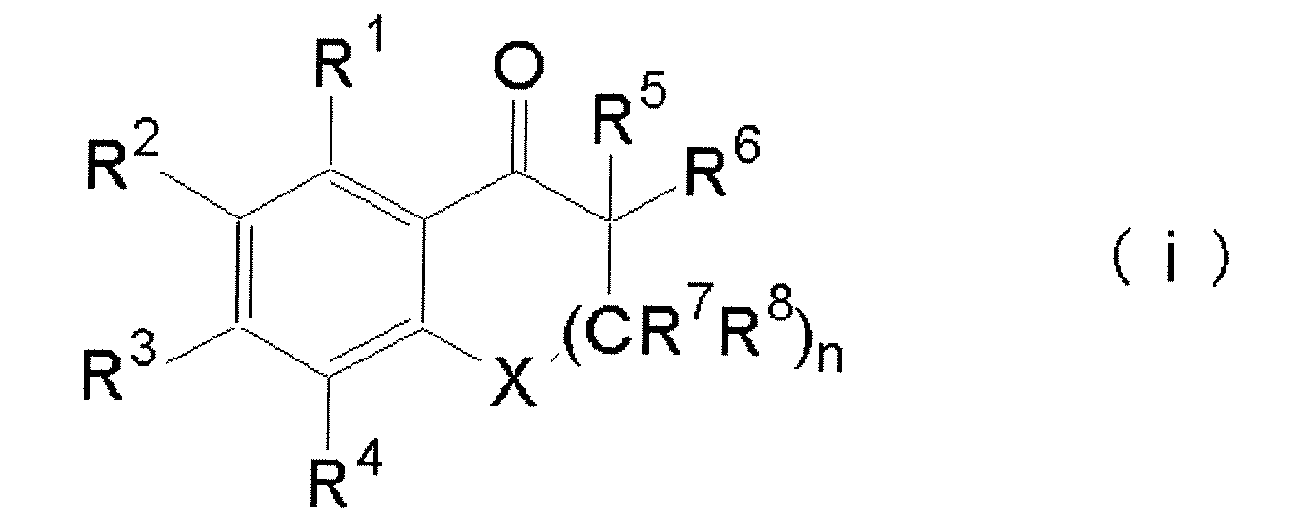
Description
- The present invention relates to a radiation-curing aqueous ink composition used preferably for inkjet recording and to an inkjet recording method. Specifically, the invention relates to a radiation-curing aqueous ink composition which is excellent in jetting reliability and curable with high sensitivity by irradiation with a radiation, a radiation-curing aqueous ink composition for inkjet recording, and an inkjet recording method.
- With regard to an image recording method for forming an image on a recording medium such as paper based on an image data signal, there are an electrophotographic system, sublimation type and melt type thermal transfer systems, an inkjet system, etc. In the electrophotographic system, a process of forming an electrostatic latent image on a photoreceptor drum by electrically charging and exposing to light is required, and the system is complicated; as a result, there is the problem that the production cost is high.
With regard to the thermal transfer system, although the equipment is inexpensive, due to the use of an ink ribbon there is the problem that the running cost is high and waste material is generated.
With regard to the inkjet system, on the other hand, the equipment is inexpensive, and since an image is formed directly on a recording medium by jetting an ink only on a required image area, there is an advantage that the ink can be used efficiently and the running cost is low. Furthermore, there is little noise and it is excellent as an image recording system. - An ink composition that can be cured by irradiation with radiations such as ultraviolet rays (radiation-curing ink composition), for example an ink composition for inkjet recording, is required to be curable with high sensitivity to form a high-quality image.
Since high curability by irradiation with radiations is conferred by achieving higher sensitivity, an image recording method is obtained which has a large number of benefits such as a reduction in power consumption, longer lifetime due to a decrease in the load on a radiation generator, and achievement of sufficient curing which enables prevention of reduction in volatilization of uncured low molecular weight material and prevention of reduction in the strength of a formed image. - In particular, the radiation-curing aqueous ink can be preferably used in image printing, in pretreatment for conferring printability on a recording medium and in posttreatment for protection/modification of printed images, is excellent in safety due to use of water as a main solvent, is able to form high-quality images because of a small content of a curable component, is applicable to high-density inkjet recording due to low viscosity, and is thus an art having many excellent features and possibilities.
- Fundamental constituent materials of the radiation-curing aqueous ink are water, a polymerizable material, a polymerization initiator that initiates polymerization by generating a radical or the like by a radiation, and a colorant (a pigment or a dye). Among them, the polymerizable material and the polymerization initiator are prepared either in an emulsified state or in a solution state with water solubility conferred by suitable substituents. Examples of the radiation-curing ink wherein the polymerizable material and the polymerization initiator are water-soluble include those described in, for example, Japanese Patent Application Laid-Open (JP-A) No.
2005-307199 2004-285216 - As photopolymerization initiators contained in UV-curing ink compositions for inkjet recording, benzil, benzoin, benzoin ethyl ether, Michler's ketone, anthraquinone, acridine, phenazine, benzophenone, and 2-ethylanthraquinone are generally used (see Bruce M. Monroe et al., Chemical Review, Vol. 93, pp. 435-448 (1993)). However, photopolymerizable compositions containing these photopolymerization initiators have low sensitivity and thus require a long time for image-wise exposure in forming images. Therefore, if there is slight vibration during operation, images with good image quality cannot be obtained in the case where fine images are desired to be formed. Further, since a long exposure time is accompanied by an increase in energy radiation in the exposure step, a measure against radiation of the great heat resulting therefrom is needed.
- The ink composition used in the inkjet recording system needs various properties so that during storage, physical properties are not changed or precipitates are not generated (solution stability) and nozzle clogging is not generated (charge stability).
- As a method of improving the radiation sensitivity of the radiation-curing polymerizable composition, use of various polymerization initiation systems is disclosed (Bruce M. Monroe et al., Chemical Review, Vol. 93, pp. 435-448 (1993),
US Patent No. 4134813 ,JP-A No. 1-253731 JP-A6-308727 JP-A No. 2005-307199 - Accordingly, there is an earnest desire for a radiation-curing aqueous ink composition usable preferably in inkjet recording, which can, by irradiation even with a low-power radiation, be cured highly sensitively to form high-quality images and is excellent in storage stability and jetting stability.
- The present invention has been made in view of the above circumstances and provides an aqueous ink composition, an aqueous ink composition for inkjet recording, and an inkjet recording method.
- A first aspect of the invention provides an aqueous ink composition comprising at least:
- a sensitizing dye represented by the following Formula (i);
- an ethylenically unsaturated bond-containing water-soluble polymerizable compound;
- a polymerization initiator; and
- water:

- A second aspect of the invention provides an ink composition comprising:
- a sensitizing dye represented by the following Formula (i);
- a polymerization initiator;
- an ethylenically unsaturated bond-containing water-soluble polymerizable compound; and
- water:

- Exemplary embodiments of the present invention will be described in detail based on the following figure, wherein:
-
Fig. 1 is a schematic diagram of the front of a printer. - An first object of the invention is to provide a radiation-curing aqueous ink composition which is cured highly sensitively by irradiation even with a low-power radiation, has high storage stability, and does not cause clogging in nozzles during jetting, when used in inkjet recording, and an inkjet recording method which when the aqueous ink composition is used, can form high-quality images.
- To achieve the first object, the inventors made extensive study, and as a result, found that the compound represented by formula (i) below (also referred to hereinafter as the specific sensitizing dye) exhibits a high sensitizing effect, and an aqueous ink composition using the specific sensitizing dye in an initiation system has high sensitivity, excellent storage stability and jetting stability, and the invention was thereby completed.
That is, a first object of the invention is achieved by the following first exemplary aspect of the invention. - <1> An ink composition comprising:
- a sensitizing dye represented by the following Formula (i);
- a polymerization initiator;
- an ethylenically unsaturated bond-containing water-soluble polymerizable compound; and
- water:
-

- wherein, in Formula (i), X represents O, S or NR, where R represents a hydrogen atom, an alkyl group or an acyl group; n represents 0 or 1; each of R1 to R8 independently represents a hydrogen atom or a monovalent substituent, provided that any neighboring two of R1, R2, R3 and R4 may be bonded to each other to form a ring, and R5 and R7 or R8, or R6 and R7 or R8, may be bonded to each other to form an aliphatic ring but do not form an aromatic ring, and
wherein the polymerizable compound is present in an emulsified state in the ink composition. -
- <2> The aqueous ink composition of <1>, wherein at least one of R1, R2, R3, R4, R5, R6, R7 and R8 in the sensitizing dye represented by Formula (i) is a substituent having a carboxyl group or a salt thereof.
- <3> The aqueous ink composition of <1> or <2>, wherein the ethylenically unsaturated bond-containing water-soluble polymerizable compound is at least one selected from the group consisting of an unsaturated carboxylic acid, an unsaturated carboxylate, and a compound having both a poly(alkyleneoxy) group and an ethylenically unsaturated group.
-
- <4> The aqueous ink composition of any one of <1> to <3>, wherein the polymerization initiator is a water-soluble polymerization initiator.
- <5> The aqueous ink composition of any one of <1> to <4>, wherein the polymerization initiator is at least one selected from the group consisting of α-aminoketones and acylphosphine oxides.
-
- <6> The aqueous ink composition of any one of <1> to <5>, further comprising a colorant.
-
- <7> An inkjet recording method, comprising:
- (a) jetting the aqueous ink composition of any one of <1> to <6> onto a recording medium, and
- (b) irradiating the jetted aqueous ink composition with active irradiation to cure the aqueous ink composition.
- The action of the compound represented by the formula (i) in the invention is not evident, and the compound is estimated to act as a sensitizing dye on polymerization initiators such as α-aminoketones and acylphosphine oxides. That is, it is estimated that the compound represented by the formula (i) has high triplet excitation energy and efficiently causes triplet energy transfer to the polymerization initiators such as α-aminoketones and acylphosphine oxides so that the ink composition can be cured with high sensitivity. It is also estimated that because the compound represented by the formula (i) is hardly precipitated with lower crystallinity than thioxanthone compounds used generally as sensitizing dyes sensitizing with such mechanism, the compound is excellent in stability in a solution of the aqueous ink composition, and the aqueous ink composition containing the same, when used in inkjet recording, can attain excellent jetting stability.
As described above, the aqueous ink composition of the invention can simultaneously meet high sensitization, storage stability and jetting stability. - According to the first aspect of the invention, there can be provided a radiation-curing aqueous ink composition which is cured highly sensitively by irradiation even with a low-power radiation, has high storage stability, and does not cause clogging in nozzles during jetting, when used in inkjet recording, and an inkjet recording method which when the aqueous ink composition is used, can form high-quality images.
- An second object of the invention is to provide an active radiation-curing aqueous ink composition which can be cured highly sensitively by irradiation even with a low-power radiation to form high-quality images and does not cause clogging in nozzles during jetting, when used in inkjet recording, and an inkjet recording method using the ink composition.
- To achieve the second object, the inventors made extensive study, and as a result, found that the second object can be achieved by allowing a polymerizable compound to be present in an emulsified state in a system and simultaneously by using a polymerization initiator in combination with a specific sensitizing dye, and the second exemplary aspect of the invention was thereby completed.
That is, the constitution of the second aspect of the invention is as follows: - [1] An ink composition comprising:
- a sensitizing dye represented by the following Formula (i);
- a polymerization initiator;
- an ethylenically unsaturated bond-containing water-soluble polymerizable compound; and
- water:
-

- wherein, in Formula (i), X represents O, S or NR, where R represents a hydrogen atom, an alkyl group or an acyl group; n represents 0 or 1; each of R1 to R8 independently represents a hydrogen atom or a monovalent substituent, provided that any neighboring two of R1, R2, R3 and R4 may be bonded to each other to form a ring, and R5 and R7 or R8, or R6 and R7 or R8, may be bonded to each other to form an aliphatic ring but do not form an aromatic ring, and
wherein the polymerizable compound is present in an emulsified state in the ink composition. - [2] The ink composition of [1], wherein the polymerization initiator comprises at least one selected from the group consisting of α-aminoketones and acylphosphine oxides.
- [3] The ink composition of [1] or [2], further comprising a colorant which is a pigment.
- [4] An inkjet recording method, comprising:
- (a) jetting the ink composition of any one of [1] to [3] onto a recording medium, and
- (b) irradiating the jetted ink composition with active irradiation to cure the ink composition.
- Although the action of the compound in the invention is not evident, the working mechanism of the compound is estimated as follows:
- The sensitizing dye represented by the formula (i), which is used in the invention, has high triplet excitation energy and efficiently causes triplet energy transfer to a simultaneously used polymerization initiator, particularly to the polymerization initiator used in a preferable aspect of the invention, such as α-aminoketone and acylphosphine oxide, thereby highly accurately generating an initiating species with which the polymerizable compound present in an emulsified state in an aqueous medium can be cured with high accuracy. It is also estimated that because the compound represented by the formula (i) is hardly precipitated with lower crystallinity than thioxanthone compounds used generally as sensitizing dyes sensitizing with such mechanism, the compound is excellent in stability in a solution of the ink composition, and the ink composition containing the same, when used for inkjet recording, can attain excellent jetting stability.
- As described above, it is considered that the invention can simultaneously meet high sensitization, storage stability and jetting stability.
- According to the second aspect of the invention, there can be provided an active radiation-curing aqueous ink composition which can be cured highly sensitively by irradiation even with a low-power radiation to form high-quality images and does not cause clogging in nozzles during jetting, when used in inkjet recording, and an inkjet recording method using the ink composition.
- Hereinafter, the first aspect of the invention (also referred to hereinafter as the invention) will be described in detail with reference to a preferable exemplary embodiment. In view of an object described above, the aqueous ink composition containing at least (A) a specific sensitizing dye, (B) an ethylenically unsaturated bond-containing water-soluble polymerizable compound, (C) a polymerization initiator, and (D) water was found to serve as an excellent aqueous ink composition simultaneously meeting high sensitization, solution stability and jetting stability, and the invention was thereby arrived at.
- Hereinafter, the action and effect of printing by the inkjet recording system as the main example to which the radiation-curing aqueous ink composition of the invention can be applied will be described.
The radiation usable in the invention includes ultraviolet rays and electron rays. The description which follows may proceed by referring, as a typical example, to the UV-curing aqueous ink composition using particularly preferable ultraviolet rays. However, it is not thereby meant that the radiation is limited to ultraviolet rays. - The radiation-curing aqueous ink composition of the invention shows ink absorption particularly onto plain paper, but for a recording medium in which improvements in the color of a color material and in scratch resistance are considered difficult, the ink composition exhibits a significant effect on such improvements. Further, the radiation-curing aqueous ink composition of the invention enables printing a nonabsorbable recording medium with the aqueous ink composition.
- To use the radiation-curing aqueous ink composition of the invention in the inkjet recording system, its viscosity should naturally be in an appropriate range, and its surface tension is also preferably optimized from the viewpoint of the balance between curing and penetration to enable formation of high-quality and high-density images particularly on plain paper. Jetting stability is also important, and from this viewpoint, the polymerizable compound and polymerization initiator are preferably those compounds which are highly soluble in an aqueous medium and hardly precipitated in the system.
- Now, the constituent materials in the radiation-curing aqueous ink composition of the invention having the excellent action and effect described above, and the inkjet recording method using the radiation-curing aqueous ink composition, are specifically described.
- The aqueous ink composition of the invention will be described.
- The radiation-curing aqueous ink composition of the invention contains at least (A) a sensitizing dye represented by the formula (i) below, (B) an ethylenically unsaturated bond-containing water-soluble polymerizable compound, (C) a polymerization initiator, and (D) water.
-

- In the formula (i), X represents O, S or NR; n represents an integer of 0 or 1; R represents a hydrogen atom, an alkyl group or an acyl group; each of R1, R2, R3, R4, R5, R6, R7 and R8 independently represents a hydrogen atom or a monovalent substituent, provided that any neighboring two of R1, R2, R3 and R4 may be bonded to each other to form a ring, and R5 and R7 or R8, or R6 and R7 or R8, may be bonded to each other to form an aliphatic ring but do not form an aromatic ring.
- In the invention, the ethylenically unsaturated bond-containing water-soluble polymerizable compound (B) to which the polymerization initiator and the specific sensitizing dye are added is used to prepare an aqueous ink composition. At this time, both the polymerization initiator and the specific polymerization initiator used to prepare an aqueous ink composition are preferably water-soluble. When a water-insoluble specific sensitizing dye not having a hydrophilic group or a water-insoluble polymerization initiator is used, the aqueous ink composition of the invention can be prepared by a method of emulsification with a surfactant or the like or a method of dispersion with a pigment.
- As the surfactant described above, it is possible to employ anionic surfactants such as dialkyl sulfosuccinates, alkyl naphthalene sulfonates and fatty acid salts, nonionic surfactants such as polyoxyethylene alkyl ethers, polyoxyethylene alkyl allyl ethers, acetylene glycols, and polyoxyethylene/polyoxypropylene block copolymers, and cationic surfactants such as alkyl amine salts and quaternary ammonium salts. Particularly, anionic surfactants and nonionic surfactants can be preferably used.
- In the invention, a high-molecular surfactant can also be used, and the following water-soluble resins can be mentioned as preferable high-molecular surfactants, from the viewpoint of jetting stability. The high-molecular surfactants that can be preferably used as water-soluble resins include styrene-acrylic acid-alkyl acrylate ester copolymers, styrene-acrylic acid copolymers, styrene-maleic acid-alkyl acrylate ester copolymers, styrene-maleic acid copolymers, styrene-methacrylic acid-alkyl acrylate ester copolymers, styrene-methacrylic acid copolymers, styrene-maleic acid half ester copolymers, vinyl naphthalene-acrylic acid copolymers, and vinyl naphthalene-maleic acid copolymers.
- The compound (A) represented by the formula (i) will be described. This compound is estimated to act as a sensitizing dye for polymerization initiators such as α-aminoketones and acylphosphine oxides. Generally, the sensitizing dye absorbs a specific radiation to attain an electronically excited state. It is estimated that the sensitizing dye in an electronically excited state causes actions such as electron transfer, energy transfer, or heat generation upon contact with the polymerization initiator, thereby inducing a chemical change in the polymerization initiator, that is, promoting the decomposition thereof, to promote formation of active species such as a radical, an acid, or a base, and the active species generated herein polymerizes (B) the ethylenically unsaturated bond-containing water-soluble polymerizable compound to induce and promote the curing reaction.
- As the sensitizing dye, a compound corresponding to the wavelength of the active radiation that causes a polymerization initiator used in the ink composition to generate an initiating species may be used. However, considering that the sensitizing dye is used in a curing reaction of a general ink composition, preferable examples of the sensitizing dyes belong to those compounds that have an absorption wavelength in the range of 350 to 450 nm. The aqueous ink composition of the invention requires incorporation of one or more specific sensitizing dyes belonging to compounds shown later.
- The compound represented by the formula (i) is preferably water-soluble. The solubility of this compound in distilled water at room temperature is preferably 0.5 wt% or more, more preferably 1 wt% or more, still more preferably 3 wt% or more.
- R1, R2, R3, R4, R5, R6, R7 and R8 independently represent a hydrogen atom or a monovalent substituent, and to make the compound water-soluble, at least one of R1, R2, R3, R4, R5, R6, R7 and R8 is preferably a hydrophilic group. Specific examples of the hydrophilic group include a carboxyl group (CO2H), its salt (the counter salt is not limited. The sodium salt, potassium salt, ammonium salt, pyridinium salt or the like is preferable.), a sulfo group (SO3H), its salt, a hydroxyl group, an amino group, a (poly)ethyleneoxy group, a (poly)propyleneoxy group, etc., among which a carboxyl group (CO2H) or its salt is more preferable.
The compound (A) can be made water-soluble by conferring hydrophilicity by introducing one or more hydrophilic groups into the molecule. Introduction of hydrophilic groups at the positions of R7 and R8 in the formula (i) is preferable from the viewpoint of synthesis ease and costs. - When R1, R2, R3, R4, R5, R6, R7 or R8 represents a monovalent substituent, the monovalent substituent includes a halogen atom, an aliphatic group, an aromatic group, a heterocyclic group, a cyano group, a hydroxyl group, a nitro group, an amino group, an alkylamino group, an alkoxy group, an aryloxy group, an amide group, an arylamino group, a ureido group, a sulfamoylamino group, an alkylthio group, an arylthio group, an alkoxycarbonylamino group, a sulfonamide group, a carbamoyl group, a sulfamoyl group, a sulfonyl group, an alkoxycarbonyl group, a heterocyclooxy group, an azo group, an acyloxy group, a carbamoyloxy group, a silyloxy group, an aryloxycarbonyl group, an aryloxycarbonylamino group, an imide group, a heterocyclothio group, a sulfinyl group, a phosphoryl group, an acyl group, a carboxyl group and a sulfo group, among which an alkyl group and a halogen atom are preferable.
- When R1, R2, R3, R4, R5, R6, R7 or R8 in the formula (i) represents an alkyl group as the monovalent substituent, the alkyl group is preferably an alkyl group having 1 to 10 carbon atoms, more preferably an alkyl group having 1 to 4 carbon atoms such as a methyl group, an ethyl group, a propyl group, an n-butyl group, a sec-butyl group, a t-butyl group or the like.
When the monovalent substituent is an alkoxy group, the alkoxy group is preferably an alkoxy group having 1 to 4 carbon atoms, such as a methoxy group, an ethoxy group, a hydroxyethoxy group, a propoxy group, an n-butoxy group, an isobutoxy group, a sec-butoxy group, a t-butoxy group or the like.
The halogen atom includes a fluorine atom, a chlorine atom, a bromine atom and an iodine atom. - Neighboring two of R1, R2, R3 and R4 may be bound (e.g. condensed) to each other to form a ring.
When these groups form a ring, the ring structure includes a 5- to 6-memberred aliphatic and an aromatic ring and may be a heterocycle containing an element other than carbon atoms, and the rings thus formed may further be combined to form a 2-nucleus ring, for example a condensed ring. These ring structures may further have each substituent illustrated as the monovalent substituent represented by each of R1 to R8 in the formula (i). When the formed ring structure is a heterocycle, examples of the heteroatom in the heterocycle include N, O and S. - When n = 1, R5 or R6, and R7 or R8, may be bound to each other to form an aliphatic ring but do not form an aromatic ring. The aliphatic ring is preferably a 3- to 6-memberred ring, more preferably a 5- or 6-memberred ring.
- The sensitizing dye which can be more preferably used includes sensitizing dyes represented by the following formula (iA):
-

- In the formula (iA), X represents O or S. n represents 0 or 1. R1A, R2A, R3A, R4A, R5A, R6A, R7A and R8A independently represent a hydrogen atom, an alkyl group, a halogen atom, a hydroxyl group, a cyano group, a nitro group, an amino group, an alkylthio group, an alkylamino group, an alkoxy group, an alkoxycarbonyl group, an acyloxy group, an acyl group and a carboxyl group (including its salt) or a sulfo group (including its salt), and at least one is preferably a carboxyl group (including its salt) or a sulfo group (including its salt). Neighboring two of R1A, R2A, R3A and R4A may be bound (condensed) to each other to form a ring. R5A or R6A, and R7A or R8A, may be bound to each other to form an aliphatic ring but do not form an aromatic ring.
- The sensitizing dye which can be preferably used includes sensitizing dyes represented by the following formula (iB):
-

- In the formula (iB), X represents O or S. R1B, R2B, R3B, R4B, R5B, R6B, R7B or R8B independently represent a hydrogen atom, an alkyl group, a halogen atom, a hydroxyl group, a cyano group, a nitro group, an amino group, an alkylthio group, an alkylamino group, an alkoxy group, an alkoxycarbonyl group, an acyloxy group, an acyl group (including its salt) and a carboxyl group (including its salt) or a sulfo group, at least one is preferably a carboxyl group (or its salt) or a sulfo group (or its salt), and at least one is more preferably a carboxyl group (or its salt). Neighboring two of R1B, R2B, R3B and R4B may be bound (condensed) to each other to form a ring. R5B or R6B, and R7B or R8B, may be bound to each other to form an aliphatic ring but do not form an aromatic ring.
- The sensitizing dye which can be further preferably used includes sensitizing dyes represented by the following formula (iC):
-

- In the formula (iC), R1C, R2C, R3C, R4C, R5C, R6C, R7C and R8C independently represent a hydrogen atom, an alkyl group, a halogen atom, a hydroxyl group, a cyano group, a nitro group, an amino group, an alkylthio group, an alkylamino group, an alkoxy group, an alkoxycarbonyl group, an acyloxy group, an acyl group, a carboxyl group (or its salt) or a sulfo group (or its salt), at least one is preferably a carboxyl group (or its salt) or a sulfo group (or its salt), and at least one is more preferably a carboxyl group (or its salt).
- Neighboring two of R1C, R2C, R3C and R4C may be bound to each other to form a 5-to 6-memberred aliphatic or an aromatic ring which may be a heterocycle containing an element other than carbon atoms, and the rings thus formed may further be combined to form a 2-nucleus ring, for example a condensed ring. These ring structures may further have each substituent illustrated as the monovalent substituent represented by each of R1, R2, R3, R4, R5, R6, R7 and R8 in the formula (i). When the ring structure is a heterocycle, examples of the heteroatom in the heterocycle include N, O and S. R5C or R6C, and R7C or R8C, may be bound to each other to form an aliphatic ring but do not form an aromatic ring.
- At least one of R1C, R2C, R3C, R4C, R5C, R6C, R7C and R8C is preferably a halogen atom. More preferably, each of R1C, R2C, R3C and R4C is a halogen atom as the substituent, and most preferably R2C is a halogen atom. The number of halogen atoms is preferably 1 or 2, more preferably 1.
- R2C is preferably a substituent other than hydrogen, more preferably an alkyl group, a halogen atom, an acyloxy group, or an alkoxycarbonyl group, among which an alkyl group and a halogen atom are preferable because of high sensitivity due to good matching with a light source.
- Preferably, either of R7C or R8C is a substituent group other than hydrogen, and more preferably, both of them are substituent groups other than hydrogen. Preferable examples of the substituent group include an alkyl group, a halogen atom, a carboxyl group and an alkoxycarbonyl group, among which an alkyl group and an alkoxycarbonyl group are preferable, and an alkyl group is most preferable.
The halogen atom includes a fluorine atom, a chlorine atom, a bromine atom and an iodine atom, among which a chlorine atom, a bromine atom and an iodine atom are preferable. - The alkyl group is preferably an alkyl group having 1 to 10 carbon atoms, more preferably an alkyl group having 1 to 4 carbon atoms, such as a methyl group, an ethyl group, a propyl group, an n-butyl group, a sec-butyl group, a t-butyl group or the like.
- The acyloxy group is preferably an aliphatic acyloxy group having 2 to 10 carbon atoms, more preferably an aliphatic acyloxy group having 2 to 5 carbon atoms.
The alkoxycarbonyl group is preferably an aliphatic alkoxycarbonyl group having 2 to 10 carbon atoms, more preferably an alkoxycarbonyl group having 2 to 5 carbon atoms. - Specific examples of the specific sensitizing dye [Exemplary Compounds (i-1) to (i-28)] which can be used preferably in the invention are shown below, but the invention is not limited thereto. In the exemplified compounds (i-1) to (i-28), Me represents methyl group, But represents tertiary-butyl group and Pri represents isopropyl group. n in the exemplary compound i-8 represents an integer of from 1 to 200.
-

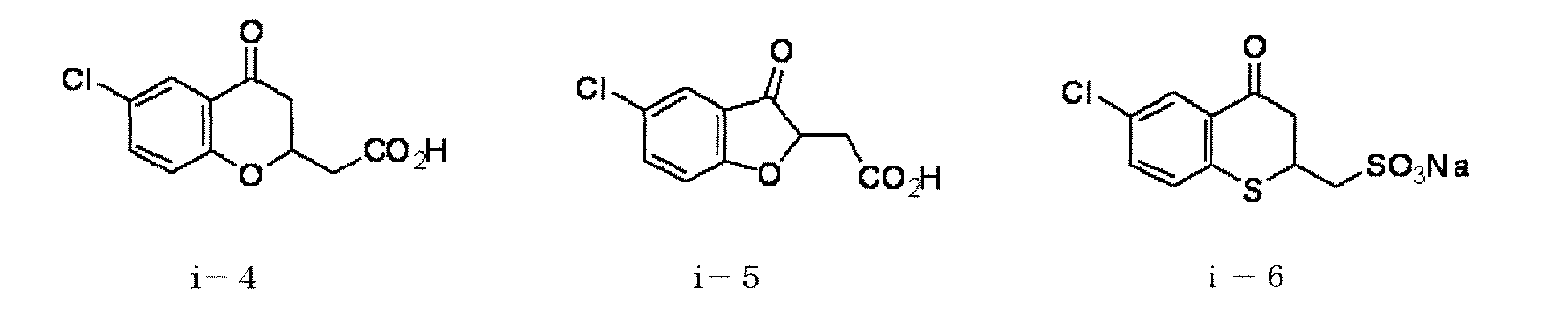

-

-


-

- The specific sensitizing dye according to the invention can be synthesized by known methods described in, for example,
JP-A Nos. 2-255677 2004-189695 2004-189695 - The content of the specific sensitizing dye in the aqueous ink composition of the invention, in terms of solid content, is preferably in the range of about 0.05 to 30% by weight, more preferably 0.1 to 20% by weight, even more preferably 0.2 to 10% by weight, based on the aqueous ink composition.
This specific sensitizing dye hardly shows absorption in the visible light range and is thus also advantageous that the dye when added in an amount to exhibit its effect does not influence the hue of the aqueous ink composition.
The content of the specific sensitizing dye when described in connection with the polymerization initiator described later is that the weight ratio of the polymerization initiator : specific sensitizing dye is 200 : 1 to 1 : 200, preferably 50 : 1 to 1 : 50, more preferably 20 : 1 to 1 : 5. - In the invention, known sensitizing dyes can also be used in combination with the specific sensitizing dye described above in such a range that the effect of the invention is not impaired. The solubility of other sensitizing dyes in distilled water at room temperature is preferably 0.5 wt% or more, more preferably 1 wt% or more, still more preferably 3 wt% or more. Other sensitizing dyes can be added to the specific sensitizing dye such that the specific sensitizing dye : other sensitizing dye weight ratio becomes 1 : 5 to 100 : 1, preferably 1 : 1 to 100 : 1, more preferably 2 : 1 to 100 : 1.
- Examples of usable sensitizing dyes known in the art include benzophenone, thioxanthone, particularly isopropylthioxanthone, anthraquinone and 3-acylcoumarin derivatives, terphenyl, styryl ketone, and 3-(aroylmethylene)thiazoline, camphor quinone, eosin, rhodamine, and erythromycin.
- Further examples of the usable sensitizing dyes are as follows:
- Thioxanthone, 2-isopropylthioxanthone, 2-chlorothioxanthone, 2-dodecylthioxanthone, 2,4-di-ethylthioxanthone, 2,4-dimethylthioxanthone, 1-methoxycarbonylthioxanthone, 2-ethoxycarbonylthioxanthone, 3-(2-methoxyethoxycarbonyl)thioxanthone, 4-butoxycarbonylthioxanthone, 3-butoxycarbonyl-7-methylthioxanthone, 1-cyano-3-chlorothioxanthone, 1-ethoxycarbonyl-3-chlorothioxanthone, 1-ethoxycarbonyl-3-ethoxythioxanthone, 1-ethoxycarbonyl-3-aminothioxanthone, 1-ethoxycarbonyl-3-phenylsulfurylthioxanthone, 3,4-di-[2-(2-methoxyethoxy) ethoxycarbonyl] thioxanthone, 1-ethoxycarbonyl-3-(1-methyl-1-morpholinoethyl)thioxanthone, 2-methyl-6-dimethoxymethylthioxanthone, 2-methyl-6-(1,1-dimethoxybenzyl)thioxanthone, 2-morpholinomethylthioxanthone, 2-methyl-6-morpholinomethylthioxanthone, n-allylthioxanthoine-3,4-dicarboxyimide, n-octylthioxanthone-3,4-dicarboxyimide, N-(1,1,3,3-tetramethylbutyl)thioxanthone-3,4-dicarboxyimide, 1-phenoxythioxanthone, 6-ethoxycarbonyl-2-methoxythioxanthone, 6-ethoxycarbonyl-2-methylthioxanthone, thioxanthone-2-polyethylene glycol ester, and 2-hydroxy-3-(3,4-dimethyl-9-oxo-9H-thioxanthon-2-yloxy)-N,N,N-trimethyl-1-propane aluminum chloride.
- Benzophenone, 4-phenylbenzophenone, 4-methoxybenzophenone, 4,4'-dimethoxybenzophenone, 4,4'-dimethylbenzophenone, 4,4'-dichlorobenzophenone, 4,4'-dimethylaminobenzophenone, 4,4'-diethylaminobenzophenone, 4-methylbenzophenone, 2,4,6-trimethylbenzophenone, 4-(4-methylthiophenyl)benzophenone, 3,3'-dimethyl-4-methoxybenzophenone, methyl-2-benzoyl benzoate, 4-(2-hydroxyethylthio)benzophenone, 4-(4-tolylthio)benzophenone, 4-benzoyl-N,N,N-trimethylbenzene methane aminium chloride, 2-hydroxy-3-(4-benzoylphenoxy)-N,N,N-trimethyl-1-propane aminium chloride monohydrate, 4-(13-acryloyl-1,4,7,10,13-pentaoxatridecyl)benzophenone, 4-benzoyl-N,N-dimethyl-N-[2-(1-oxo-2-propenyl)oxy] ethylbenzene methane aminium chloride.
- 3-Benzoylcoumarin, 3-benzoyl-7-methoxycoumarin, 3-benzoyl-5,7-di(propoxy) coumarin, 3-benzoyl-6,8-dichlorocoumarin, 3-benzoyl-6-chlorocoumarin, 3,3'-carbonylbis[5,7-di(propoxy)coumarin], 3,3'-carbonylbis(7-methoxycoumarin), 3,3'-carbonylbis(7-diethylaminocoumarin), 3-isobutyroylcoumarin, 3-benzoyl-5,7-dimethoxycoumarin, 3-benzoyl-5,7-diethoxycoumarin, 3-benzoyl-5,7-dibutoxycoumarin, 3-benzoyl-5,7-di(methoxyethoxy) coumarin, 3-benzoyl-5,7-di(allyloxy) coumarin, 3-benzoyl-7-dimethylaminocoumarin, 3-benzoyl-7-diethylaminocoumarin, 3-isobutyroyl-7-dimethylaminocoumarin, 5,7-dimethoxy-3-(1-naphthoyl)coumarin, 5,7-dimethoxy-3-(1-naphthoyl)coumarin, 3-benzoylbenzo[f]coumarin, 7-diethylamino-3-thienoylcoumarin, and 3-(4-cyanobenzoyl)-5,7-dimethoxycoumarin.
- 3-Methyl-2-benzoylmethylene-β-naphthothiazoline, 3-methyl-2-benzoylmethylenebenzothiazoline, 3-ethyl-2-propionylmethylene-β-naphthothiazoline.
- 9,10-Dimethoxy-anthracene, 9,10-diethoxy-anthracene, 9,10-dimethoxy-2-ethyl-anthracene.
- Acetophenone, 3-methoxyacetophenone, 4-phenylacetophenone, benzil, 2-acetylnaphthalene, 2-naphthoaldehyde, 9,10-naphthoquinone, 9-fluorenone, dibenzosuberon, xanthone, 2,5-bis(4-diethylaminobenzylidene)cyclopentanone, α-(p-dimethylaminobenzylidene)ketone, for example 2-(4-dimethylaminobenzylidene)indan-1-one or 3-(4-dimethylaminophenyl)-1-indan-5-ylpropenone, 3-phenylthiophthalimide, and N-methyl-3,5-di(ethylthio)phthalimide.
- The aqueous ink composition of the invention contains (C) a polymerization initiator.
In the invention, the polymerization initiator is not particularly limited as long as the initiator when combined with the specific sensitizing dye has an excellent polymerization ability. The polymerization initiator is preferably water-soluble. The water solubility of the polymerization initiator in distilled water at 25°C is preferably 0.5 wt% or more, more preferably 1% or more, still more preferably 3 wt% or more.
A polymerization initiator selected from α-aminoketones and acylphosphine oxides is preferably used. - As the α-aminoketone compound, it is preferable to use a compound having the structure represented by the following formula (1):
-
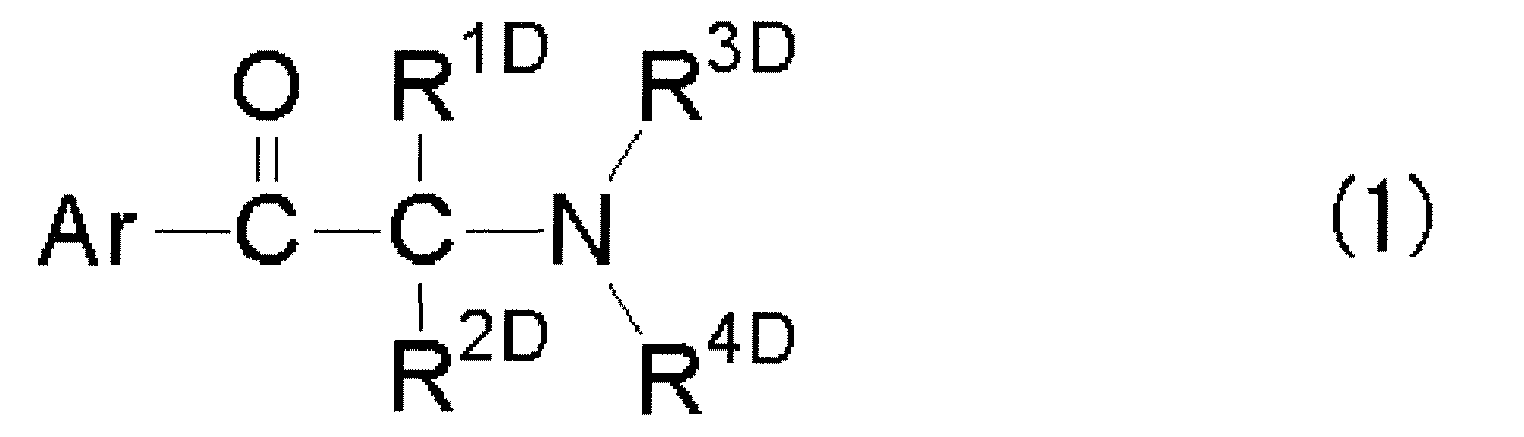
- In the formula (1), Ar is a phenyl group which is substituted with -SR13 or -N(R7E)(R8E) wherein R13 represents a hydrogen atom or an alkyl group.
R1D and R2D independently represent an alkyl group having 1 to 8 carbon atoms. R1D and R2D may be bound to each other to form an alkylene group having 2 to 9 carbon atoms. R3D and R4D independently represent a hydrogen atom, an alkyl group having 1 to 12 carbon atoms, an alkyl group having 2 to 4 carbon atoms which is substituted with an alkoxy group having 1 to 4 carbon atoms, or an alkenyl group having 3 to 5 carbon atoms. R3D and R4D may be bound to form an alkylene group having 3 to 7 carbon atoms, and the alkylene group may contain, in its alkylene chain, -O- or -N(R12)- wherein R12 represents an alkyl group having 1 to 4 carbon atoms.
R7E and R8E independently represent a hydrogen atom, an alkyl group having 1 to 12 carbon atoms, an alkyl group having 2 to 4 carbon atoms which is substituted with an alkoxy group having 1 to 4 carbon atoms, or an alkenyl group having 3 to 5 carbon atoms. R7E and R8E may be bound to each other to form an alkylene group having 3 to 7 carbon atoms, and the alkylene group may contain, in its alkylene chain, -O- or -N(R12)- wherein R12 has the same meaning as defined above. - Examples of compounds included in the α-aminoketones include 2-methyl-1-phenyl-2-morpholinopropan-1-one, 2-methyl-1-[4-(hexyl)phenyl]-2-morpholinopropan-1-one, and 2-ethyl-2-dimethylamino-1-(4-morpholinophenyl)-butan-1-on. Irgacure series manufactured by Ciba Specialty Chemicals Inc., for example, IRGACURE 907, IRGACURE 369, AND IRGACURE 379 are available as commercial products, and these are compounds included in the α-aminoketones and can be preferably used in the invention.
- The compounds included in the acylphosphine oxides are preferably compounds represented by the formula (2) or (3).
-

- In the formula (2), R5D and R6D independently represent an aliphatic group, an aromatic group, an aliphatic oxy group, an aromatic oxy group, or a heterocyclic group, and R7D represents an aliphatic group, an aromatic group, or an heterocyclic group.
- The aliphatic group represented by R5D, R6D or R7D includes, for example, an alkyl group, a substituted alkyl group, an alkenyl group, a substituted alkenyl group, an alkynyl group, a substituted alkynyl group, an aralkyl group and a substituted aralkyl group, and is preferably an alkyl group, a substituted alkyl group, an alkenyl group, a substituted alkenyl group, an aralkyl group or a substituted aralkyl group, more preferably an alkyl group or an substituted alkyl group. The aliphatic group may be a cyclic aliphatic group or a linear aliphatic group. The cyclic aliphatic group may be branched.
- The alkyl group includes a linear, branched or cyclic alkyl group, and the number of carbon atoms in the alkyl group is preferably 1 to 30, more preferably 1 to 20. The number of carbon atoms in the alkyl moiety of the substituted alkyl group is also preferably in the same range as defined in the alkyl group. The alkyl group may be either a substituted alkyl group or an unsubstituted alkyl group. The alkyl group includes a methyl group, an ethyl group, a propyl group, a butyl group, a pentyl group, a hexyl group, an octyl group, a 2-ethylhexyl group, a decyl group, a dodecyl group, an octadecyl group, a cyclohexyl group, a cyclopentyl group, a neopentyl group, an isopropyl group, and an isobutyl group.
- The substituent group on the substituted alkyl group includes a carboxyl group, a sulfo group, a cyno group, a halogen atom (for example, a fluorine atom, chlorine atom and bromine atom), a hydroxyl group, an alkoxycarbonyl group having 30 or less carbon atoms (for example, a methoxycarbonyl group, ethoxycarbonyl group, benzyloxycarbonyl group), an alkylsulfonylaminocarbonyl group having 30 or less carbon atoms, an arylsulfonylaminocarbonyl group, an alkylsulfonyl group, an arylsulfonyl group, an acylaminosulfonyl group having 30 or less carbon atoms, an alkoxy group having 30 or less carbon atoms (for example, a methoxy group, ethoxy group, benzyloxy group, phenoxyethoxy group, phenethyloxy group etc.), an alkylthio group having 30 or less carbon atoms (for example, a methylthio group, ethylthio group, methylthioethylthioethyl group etc.), an aryloxy group having 30 or less carbon atoms (for example, a phenoxy group, p-tolyloxy group, 1-naphthoxy group, 2-naphthoxy group etc.), a nitro group, an alkyl group having 30 or less carbon atoms, an alkoxycarbonyloxy group, an aryloxycarbonyloxy group,
- an acyloxy group having 30 or less carbon atoms (for example, an acetyloxy group, propionyloxy group etc.), an acyl group having 30 or less carbon atoms (for example, an acetyl group, propionyl group, benzoyl group etc.), a carbamoyl group (for example, a carbamoyl group, N,N-dimethylcarbamoyl group, morpholinocarbonyl group, piperidinocarbonyl group etc.), a sulfamoyl group (for example, a sulfamoyl group, N,N-dimethylsulfamoyl group, morpholinosulfonyl group, piperidinosulfonyl group etc.), an aryl group having 30 or less carbon atoms (for example, a phenyl group, 4-chlorophenyl group, 4-methylphenyl group, α-naphthyl group etc.), a substituted amino group (for example, an amino group, alkylamino group, dialkylamino group, arylamino group, diarylamino group, acylamino group etc.), a substituted ureido group, a substituted phosphono group, a heterocyclic group etc. The carboxyl group, sulfo group, hydroxy group or phosphono group may be in the form of a salt. The cation forming the salt includes M+ etc. described later.
- The alkenyl group includes a linear, branched or cyclic alkenyl group, and the number of carbon atoms in the alkenyl group is preferably 2 to 30, more preferably 2 to 20. The alkenyl group may be a substituted alkenyl group having a substituent group or an unsubstituted alkenyl group, and the number of carbon atoms in the alkenyl moiety of the substituted alkenyl group is also preferably in the same range as defined in the alkenyl group. The substituent group on the substituted alkenyl group includes the same substituent group as defined above in the substituted alkyl group.
- The alkynyl group includes a linear, branched or cyclic alkynyl group, and the number of carbon groups in the alkynyl group is preferably 2 to 30, more preferably 2 to 20. The alkynyl group may be a substituted alkynyl group having a substituent group or an unsubstituted alkynyl group, and the number of carbon atoms in the alkynyl moiety of the substituted alkynyl group is also preferably in the same range as defined in the alkynyl group. The substituent group on the substituted alkynyl group includes the same substituent group as defined above in the substituted alkyl group.
- The aralkyl group includes a linear, branched or cyclic aralkyl group, and the number of carbon atoms in the aralkyl group is preferably 7 to 35, more preferably 7 to 25. The aralkyl group may be a substituted aralkyl group having a substituted group or an unsubstituted aralkyl group, and the number of carbon atoms in the aralkyl moiety of the substituted aralkyl group is also preferably in the same range as defined in the aralkyl group. The substituent group on the substituted aralkyl group includes the same substituent group as defined above in the substituted alkyl group.
- The aromatic group represented by R5D, R6D or R7D includes, for example, an aryl group and a substituted aryl group. The number of carbon atoms in the aryl group is preferably 6 to 30, more preferably 6 to 20. The number of carbon atoms in the aryl moiety of the substituted aryl group is also preferably in the same range as defined in the aryl group. The aryl group includes, for example, a phenyl group, α-naphthyl group, β-naphthyl group etc. The substituent group on the substituted aryl group includes the same substituent group as defined above in the substituted alkyl group.
- The aliphatic oxy group represented by R5D or R6D is preferably an alkoxy group having 1 to 30 carbon atoms, such as a methoxy group, an ethoxy group, a butoxy group, an octyloxy group, a phenoxyethoxy group or the like. However, the invention is not limited thereto.
- The aromatic oxy group represented by R5D or R6D is preferably an aryloxy group having 6 to 30 carbon atoms, such as a phenoxy group, a methylphenyloxy group, a chlorophenyloxy group, a methoxyphenyloxy group, an octyloxyphenyloxy group or the like. However, the invention is not limited thereto.
- The heterocyclic group represented by R5D, R6D or R7D is preferably a heterocyclic group containing an N, O or S atom, such as a pyridyl group, a furyl group, a thienyl group, an imidazolyl group, a pyrrolyl group or the like.
-

- In the formula (3), R8D and R10D independently represent an alkyl group, an aryl group or a heterocyclic group, and R9D represents an alkyl group, an aryl group, an alkoxy group, an aryloxy group or a heterocyclic group. The alkyl group, aryl group, heterocyclic group, alkoxy group or aryloxy group represented by R8D, R9D or R10D may have a substituent, and the substituent includes the same substituents as in the formula (2).
- The alkyl group, aryl group, heterocyclic group, alkoxy group and aryloxy group in the formula (3) are the same as in the formula (2).
- In the exemplary compounds described above, for example, [2,4,6-trimethylbenzoyl-diphenyl-phosphine oxide] is available under the trade name DAROCUR TPO (manufactured by Ciba Specialty Chemicals Inc.), and [bis(2,4,6-trimethylbenzoyl)-phenylphospine oxide] is available under the trade name IRGACURE 819 (manufactured by Ciba Specialty Chemicals Inc.).
- The content of the polymerization initiator in the aqueous ink composition of the invention, in terms of solid content, is preferably in the range of 0.1 to 30% by weight, more preferably in the range of 0.2 to 20% by weight.
- The aqueous ink composition of the invention more preferably uses a water-soluble acylphosphine oxide. The acylphosphine oxide is dissolved in an amount of preferably 0.5 wt% or more, more preferably 1 wt% or more, still more preferably 3 wt% or more, in distilled water at 25°C. Such water-soluble acylphosphine oxides include, for example, those compounds (for example,
Exemplary Compounds 5, 6 and 7) described inJP-A No. 2005-307199 - Preferable examples of the water-soluble acylphosphine oxides include, but are not limited to, the following compounds:
-

-

-

- The polymerization initiator in the aqueous ink composition of the invention is preferably the acylphosphine oxide, but another polymerization initiator may be used as long as the effect of the invention is not impaired. Another polymerization initiator may be used in combination with the acylphosphine oxide. In this case, a water-soluble polymerization initiator is preferably used. The water-soluble polymerization initiator is dissolved in an amount of preferably 0.5 wt% or more, more preferably 1 wt% or more, still more preferably 3 wt% or more, in distilled water at 25°C.
- Other known polymerization initiators that can be used in the invention include camphor quinone, benzophenone, benzophenone derivatives, acetophenone, acetophenone derivatives, for example, α- hydroxycycloalkyl phenyl ketones, 2-hydroxy-2-methyl-1-phenyl-propanone, dialkoxyacetophenones, α-hydroxy- or 4-aroyl-1,3-dioxolanes and benzoin alkyl ethers, benzyl ketals, for example, benzyl dimethyl ketal, phenyl glyoxalate and derivatives thereof, dimer phenyl glyoxalate, peresters, for example, benzophenone tetracarboxylic acid peresters (described in, for example,
EP 1126,541 ), halomethyl triazines, for example, 2-[2-(4-methoxy-phenyl)-vinyl]-4,6-bis-trichloromethyl [1,3,5] triazine, 2-(4-methoxy-phenyl)-4,6-bis-trichloromethyl [1,3,5] triazine, 2-(3,4-dimethoxy-phenyl)-4,6-bis-trichloromethyl [1,3,5] triazine, 2-methyl-4,6-bis-trichloromethyl [1,3,5] triazine, hexaaryl bisimidazole/co-initiator systems, for example, o-chlorohexaphenyl-bisimidazole combined with 2-mercaptobenzothiazole; ferrocenium compounds or titanocenes, for example, dicyclopentadienyl-bis(2,6-difluoro-3-pyrrolo-phenyl) titanium; for example, mixtures with O-acyloxime ester compounds as described inGB 2,339,571 - The content of the polymerization initiator (C) in the aqueous ink composition of the invention is preferably in the range of 0.01 to 35 parts by weight, more preferably 0.1 to 30 parts by weight, still more preferably 0.5 to 30 parts by weight, based on 100 parts by weight of the ethylenically unsaturated bond-containing water-soluble polymerizable compound (B). Herein, the content of the polymerization initiator means the total content of the polymerization initiator.
- The ink composition of the invention contains (B) an ethylenically unsaturated bond-containing water-soluble polymerizable compound (also referred to hereinafter as specific polymerizable compound). The specific polymerizable compound may be any water-soluble compound having, in its molecule, one radial-polymerizable ethylenically unsaturated bond, and includes those compounds having chemical forms such as monomers, oligomers and polymers. The specific polymerizable compounds may be used alone or in combination of two or more thereof in an arbitrary ratio to improve intended characteristics. Preferably, two or more of the specific polymerizable compounds are simultaneously used to regulate performance such as reactivity and physical properties.
- The specific polymerizable compound used in the invention is dissolved in distilled water at room temperature in an amount of at least 2 wt% or more, preferably 15 wt% or more, and is particularly preferably one mixable uniformly with water at an arbitrary ratio.
- Examples of the specific polymerizable compound include unsaturated carboxylic acids such as acrylic acid, methacrylic acid, itaconic acid, crotonic acid, isocrotonic acid and maleic acid, esters thereof and salts thereof, anhydrides having an ethylenically unsaturated group, acrylonitrile, styrene, various unsaturated polyesters, unsaturated polyethers, unsaturated polyamides, unsaturated urethanes, vinyl ethers, and allyl ethers, among which acrylic acid, methacrylic acid, esters thereof and salts thereof are preferable.
- For conferring water solubility, the specific polymerizable compound used in the invention preferably has a poly(ethyleneoxy) chain, a poly(propyleneoxy) chain, or an ionic group (for example, a carboxyl group, a sulfo group etc.). When the specific polymerizable compound has a poly(ethyleneoxy) chain or a poly(propyleneoxy) chain, the number of ethyleneoxy or propyleneoxy units is preferably in the range of 1 to 10, more preferably in the range of 1 to 5. When the chain is long, water solubility is obtained, but a coating upon curing is poor in hardness, adhesion to a recording medium, etc.
- In order to further improve sensitivity, to lower bleeding and to improve adhesiveness to a recording medium, a monoacrylate and a multifunctional acrylate monomer or oligomer having a molecular weight of 400 or more, preferably 500 or more, are used preferably as the radical polymerizable compound. Particularly in the ink composition used in recording on a flexible recording medium such as a PET film or PP film, a monoacrylate selected from the compound group described above, and a multifunctional acrylate monomer or a multifunctional acrylate oligomer, are preferably simultaneously used to impart flexibility to a film, to improve adhesiveness to a film, and to increase film strength.
From the viewpoint of maintaining safety, further improving sensitivity, lowering bleeding and improving adhesiveness to a recording medium, it is in a preferable aspect that at least three kinds of polymerizing compounds that are a monofunctional monomer, a bifunctional monomer and a trifunctional or more (multifunctional) monomer are simultaneously used. - Particularly preferable examples of the specific polymerizable compound include, for example, compounds having the following structures, but the specific polymerizable compound used in the invention is not limited thereto.
-

-

-

-

- Compounds having an ionic group, such as methacrylic acid and potassium 3-sulfopropylacrylate, are also preferably used in addition to the exemplary compounds.
- In the aqueous ink composition of the invention, water used as a main solvent is preferably ionic impurity-free water such as deionized water, distilled water or the like.
The content of water in the ink composition of the invention is selected appropriately depending on the object and is usually preferably 10 to 95% by weight, more preferably 30 to 90% by weight. - In the invention, a curable colored radiation-curing aqueous ink composition can be obtained by adding the colorant (E) and can be applied to an inkjet recording system compatible with multicolor, to form multicolor images. A fundamental factor of the colorant that can be preferably used in the radiation-curing aqueous ink composition is that the colorant preferably satisfies compatibility with the ethylenically unsaturated bond-containing water-soluble polymerizable compound (B) and the polymerization initiator (D) in order to cure the aqueous ink composition by irradiation with a radiation. Specifically, an aqueous pigment dispersion or an aqueous dye such as one having an anionic dissociable group is more preferably used.
- Black pigments include, for example, carbon black. As carbon black, it is preferable to use carbon black manufactured by a furnace method or a channel method and having, as characteristics, a primary particle size of 15 to 40 µm, a specific surface area of 50 to 300 m2/g as determined by the BET method, a DBP oil absorption of 40 to 150 ml/100 g, a volatile matter content of 0.5 to 10% by weight, and a pH value of 2 to 9. Commercial products having such characteristics include, for example, No. 2300, No. 900, MCF88, No. 33, No. 40, No. 52, MA7, MA8, and No. 2200B (all manufactured by Mitsubishi Chemical Corporation), RAVEN 1255 (manufactured by Colombian Carbon), REGAL 400R, REGAL 330R, REGAL 660R, and MOGUL L (all manufactured by Cabot Corporation), and COLOR BLACK FW1, COLOR BLACK FW18, COLOR BLACK S 170, COLOR BLACK S 150, PRINTEX 35, AND PRINTEX U (all manufactured by Degussa Corporation), all of which can be preferably used.
- Yellow pigments include, for example, Pigment Yellow 1,
Pigment Yellow 2,Pigment Yellow 3, Pigment Yellow 12, Pigment Yellow 13, Pigment Yellow 14, Pigment Yellow 16, Pigment Yellow 17, Pigment Yellow 55, Pigment Yellow 73, Pigment Yellow 74, Pigment Yellow 75, Pigment Yellow 83, Pigment Yellow 93, Pigment Yellow 95, Pigment Yellow 97, Pigment Yellow 98, Pigment Yellow 109, Pigment Yellow 110, Pigment Yellow 114, Pigment Yellow 128, Pigment Yellow 138, Pigment Yellow 139, Pigment Yellow 150, Pigment Yellow 151, Pigment Yellow 154, Pigment Yellow 155, and Pigment Yellow 180. - Magenta pigments include, for example,
Pigment Red 5, Pigment Red 7, Pigment Red 12, Pigment Red 48 (Ca), Pigment Red 48 (Mn), Pigment Red 57:1, Pigment Red 57 (Sr), Pigment Red 57:2, Pigment Red 122, Pigment Red 123, Pigment Red 168, Pigment Red 184, Pigment Red 202, and Pigment Red 238. - Cyan pigments include, for example, Pigment Blue 1,
Pigment Blue 2,Pigment Blue 3, Pigment Blue 16, Pigment Blue 22, Pigment Blue 60, Pigment Blue 15:2, Pigment Blue 15:3,Vat Blue 4, and Vat Blue 60. - The average particle size of the pigment particles is preferably in the range of about 25 nm to 200 nm. This range is sufficiently lower than the wavelength of visible light, so that when scattering is low, printed material said to be sufficiently transparent, although depending on the intended use of the printed material, can be obtained.
- The composition using a dye as the colorant, unlike the composition using the above pigment, is hardly usable in a state completely free from fading arising from irradiation with a radiation and is accompanied by fading to some degree. From this reason, when a dye is used as the colorant of ink, a so-called azo-containing metal dye that has formed a complex with a metal ion is preferably used because of less fading. However, when the level of fading is not brought into question, even a general water-soluble dye can be used in the aqueous ink composition of the invention.
- As black dyes, it is possible to preferably use monoazo or disazo complexes coordinated with polyvalent metals such as Cr, Cu, Mn, Al, Zn and Fe, and non-complex azo black dyes such as Direct Black 17, Direct Black 19, Direct Black 51, Direct Black 154, Direct Black 174, and Direct Black 195.
- Yellow dyes include, for example, Acid Yellow 11, Acid Yellow 17, Acid Yellow 23, Acid Yellow 25, Acid Yellow 29, Acid Yellow 42, Acid Yellow 49, Acid Yellow 61, Acid Yellow 71, Direct Yellow 12, Direct Yellow 24, Direct Yellow 26, Direct Yellow 44, Direct Yellow 86, Direct Yellow 87, Direct Yellow 98, Direct Yellow 100, Direct Yellow 130, Direct Yellow 132, and Direct Yellow 142.
- Magenta dyes include, for example, Acid Red 1, Acid Red 6, Acid Red 8, Acid Red 32, Acid Red 35, Acid Red 37, Acid Red 51, Acid Red 52, Acid Red 80, Acid Red 85, Acid Red 87, Acid Red 92, Acid Red 94, Acid Red 115, Acid Red 180, Acid Red 254, Acid Red 256, Acid Red 289, Acid Red 315, Acid Red 317, Direct Red 1,
Direct Red 4, Direct Red 13, Direct Red 17, Direct Red 23, Direct Red 28, Direct Red 31, Direct Red 62, Direct Red 79, Direct Red 81, Direct Red 83, Direct Red 89, Direct Red 227, Direct Red 240, Direct Red 242, and Direct Red 243. - Cyan dyes include, for example, Acid Blue 9, Acid Blue 22, Acid Blue 40, Acid Blue 59, Acid Blue 93, Acid Blue 102, Acid Blue 104, Acid Blue 113, Acid Blue 117, Acid Blue 120, Acid Blue 167, Acid Blue 229, Acid Blue 234, Acid Blue 254, Direct Blue 6, Direct Blue 22, Direct Blue 25, Direct Blue 71, Direct Blue 78, Direct Blue 86, Direct Blue 90, Direct Blue 106, and Direct Blue 199.
- The concentration of the dye in the aqueous ink composition is preferably in the range of 0.1 to 10% by weight based on the total amount of the aqueous ink composition. When the concentration is low, the dye can be applied preferably to light-colored inks among density modulating inks.
- Hereinafter, the components which can be used as necessary in the aqueous ink composition of the invention will be described.
- Preferably, a solvent component is added in a certain amount to the radiation-curing aqueous ink composition of the invention. By using the solvent component, the aqueous ink composition can be made nonvolatile, can reduce its viscosity, and can give wettability to a recording medium.
- The solvent component keeps the dispersion stability of the pigment, which is not only effective for the conventional effect of preventing the aqueous ink from adhering to nozzles, but also effective in reducing curing shrinkage in a system at high polymerization rate wherein the specific polymerizable compound having high reactivity to increase crosslinking density and the polymerization initiator having high initiation efficiency are combined and used as in the radiation-curing aqueous ink composition of the invention.
When the polymerization proceeds to a certain extent in such system, the diffusion of the polymerizable compound and polymerization initiator is suppressed so that the final curing degree may not increase, against which the solvent component also effectively acts. - Printed materials by the inkjet recording system are often appreciated by being taken up by the general public, and it is thus important that the printed materials have a cured film of sufficient strength and flexibility formed thereon, thereby attaining such toughness as not to permit the film to be removed from the recording medium.
- The solvent is preferably selected from glycerin, ethylene glycol, diethylene glycol, and a mixture thereof, all of which have achieved satisfactory results in inkjet recording performance. The solvent is contained usually in an amount of 0.5 to 5% by weight based on the total amount of the aqueous ink composition.
- Water is mainly used as the solvent for diluting the specific polymerizable compound and the water-soluble polymerization initiator in the invention, and in addition to water, water-soluble and polymerizable low-viscosity monomers can be used. The advantage of using not usual solvent but such compounds is that these compounds do not remain as plasticizers in solids after radiation curing, thus reducing their influence on the physical properties of the solids.
- The reactive diluent component selected for this purpose includes compounds such as acryloyl morpholine, N-vinyl-2-pyrrolidone, N-vinylformamide, acrylamide, methylenebisacrylamide, monosaccharide monoacrylates, oligoethylene oxide monoacrylates, and dibasic acid monoacrylates.
- In the invention, arbitrary additives besides the compounds described above may contained in the radiation-curing aqueous ink composition. Examples of such additives include a pH regulator, a leveling agent, a viscosity regulator, an antioxidant, a hindered amine light stabilizer (HALS), a preservative, an antifungal agent etc. When such additives are used, they are contained usually in an amount of 0.1 to 5% by weight based on the total amount of the aqueous ink composition.
- The radiation-curing aqueous ink composition of the invention, when prepared in a clear form without incorporating the colorant described above, can be used in applications to an undercoat for conferring image printing performance on a recording medium or to an overcoat intended to protect the surface of an image formed from usual ink or to give decoration or gloss on the surface. In the aqueous clear ink composition, colorless pigments and fine particles not intended to color the composition can be dispersed and contained. By adding them to either an undercoat or an overcoat, various properties of printed material, such as image qualities, fastness, and performance (handleability) can be improved.
- For application to such clear aqueous ink composition, the content of the specific polymerizable compound is preferably 10 to 70% by weight based on the total amount of the aqueous ink composition. The ink composition is preferably prepared such that the polymerization initiator is contained in an amount of 1 to 10 parts by weight relative to 100 parts by weight of the specific polymerizable compound, and simultaneously the polymerization initiator is contained in an amount of 0.5 part by weight or more relative to 100 parts of the aqueous ink composition.
- When a colorant, for example, a pigment is used in the radiation-curing aqueous ink composition of the invention, the net content of the pigment (that is, a content excluding the content of a surface treatment agent and a dispersant) in the aqueous ink composition is generally preferably in the range of 0.3 to 10% by weight based on the total amount of the aqueous ink composition. The pigment when used in the range of about 0.3 to 1% is in such a range to be usable as light-colored ink although the tinting power of the pigment depends on the dispersed state of pigment particles. The pigment when used in a higher amount than this range gives density for use in general coloring.
- As another compounding amount, the amount of water is preferably in the range of 40 to 90% by weight, more preferably in the range of 60 to 75% by weight, based on the total amount of the aqueous ink composition. The content of the specific polymerizable compound in the aqueous ink composition is preferably in the range of 1 to 30% by weight, more preferably in the range of 5 to 20% by weight, based on the total amount of the aqueous ink composition. The content of the polymerization initiator, although varying depending on the content of the specific polymerizable compound, is generally preferably in the range of 0.1 to 7% by weight, more preferably 0.3 to 5% by weight, based on the total amount of the aqueous ink composition.
- When the radiation-curing aqueous ink composition of the invention is applied to the inkjet recording system, the viscosity of the composition is preferably in the range of 5 mPa·s to 15 mPa·s. In the case of the inkjet recording system provided with fine high-density high-drive-wavelength nozzles, the upper limit of the viscosity is preferably 10 mPa·s.
- The surface tension of the composition is preferably in the range of 35 mN/m (dyne/cm) to 50 mN/m, in consideration of printing on plain paper. A usual aqueous inkjet ink is regulated to have surface tension as low as about 30 mN/m to allow the ink to penetrate rapidly into paper thereby preventing a bleeding phenomenon, which is however accompanied by a decrease in image density. The radiation-curing aqueous ink composition of the invention, on the other hand, can be cured to prevent the ink composition from flowing, and therefore, the surface tension can be increased so that ink droplets are retained as much as possible in the surface layer of a recording medium, thereby permitting both bleeding and image density to be simultaneously satisfied.
- For securing image density, a recording medium should be wetted to a certain extent with ink droplets at the time of irradiation with a radiation, and thus the upper limit of the surface tension is more preferably about 50 mN/m.
- Hereinafter, the inkjet recording method for applying the radiation-curing aqueous ink composition as described above, onto a recording medium, by an inkjet system and curing it by irradiation with a radiation will be described.
- The radiation-curing aqueous ink composition of the invention is preferably used in a head in an inkjet jetting system and is effectively used either in an ink reservoir in which the aqueous ink composition is stored or as an ink to be charged into the reservoir. Particularly, the invention brings about an excellent effect in a recording head or a recording apparatus in the Bubble Jet (registered trade mark) system among inkjet recording systems.
- With respect to its typical constitution and principle, the basic principle disclosed in, for example,
US Patent Nos. 4,723,129 and4,740,796 is preferably used. This system can be applied to both an on-demand system and a continuous system. Particularly, the on-demand system is effective because at least one driving signal corresponding to recording information and giving a rapid increase in temperature higher than in nucleate boiling is applied to an electricity/heat converter arranged to correspond to a sheet or a pass for holding ink, thereby allowing the electricity/heat converter to generate heat energy, thereby causing film boiling in the thermal action surface of a recording head, resulting in formation of a bubble in ink corresponding one-on-one to the driving signal. By growth and shrinkage of this bubble, the ink is jetted via a jetting opening to form at least one droplet. This driving signal is particularly preferably in pulse shape so that growth and shrinkage of bubbles are immediately and appropriately carried out, thus achieving ink jetting excellent particularly in response. This driving signal in pulse shape is preferably those described inUS Patent Nos. 4,463,359 and4,345,262 . When the conditions described inUS Patent No. 4,313,124 directed to an invention concerning the rate of temperature rise on the thermal action surface are used, further excellent recording can be carried out. - With respect to the constitution of the recording head, the invention is not only effective in the constitution using
US Patent Nos. 4,558,333 and4,459,600 that disclose a constitution wherein a thermal action portion is arranged on a bent region, besides a combined constitution (a linear fluid pass or a right-angled fluid pass) of a jetting opening, a pass and an electricity/heat converter as disclosed in the specifications mentioned above, but is also effective in the jetting system in an air-communicating system described in Japanese Patent No.2962880 3246949 JP-A No. 11-188870 JP-A No. 59-123670 - In addition, the invention is effective where an exchangeable recording head of chip type, which can be fit to the main body of the apparatus thereby enabling not only electrical connection to the main body of the apparatus but also feeding of ink from the main body of the apparatus, or a recording head of cartridge type which is formed integrally with the recording head itself, is used. The addition, to the recording head, of a recovery unit and a preliminary auxiliary unit arranged as the constitution of the recording apparatus to which the invention is applied is preferable because the effect of the invention can further be stabilized. Specific examples of these units include unit for the recording head, such as a capping unit, a cleaning unit, a pressurizing or suctioning unit, a heating element other than, or combined with, an electricity-heat converter, and a preliminary jetting aspect for carrying out jetting other than in recording.
- As shown in the schematic diagram of the front of a printer in
FIG 1 , the recording apparatus for carrying out the recording method of the invention is a recording apparatus including an ink tank 1 for accommodating the radiation-curing aqueous ink composition of the invention, ahead 2 for actually effecting recording (in the diagram, a multi-head having a large number of heads arranged therein is used),lamps 3 for ultraviolet irradiation in curing, adrive part 4 for driving the head and lamps, apaper jetting portion 5 for delivering a recording medium to be recorded. The apparatus further includes a wiping part, a capping part, a paper feeder and a drive motor (not shown). - In the
head 2 inFIG. 1 , nozzles for jetting the radiation-curing aqueous ink composition are bilaterally symmetrically arranged for each color, and thehead 2 andlamps 3 are scanned as a unit from side to side, thereby applying the radiation-curing aqueous ink composition onto a recording medium, and immediately thereafter, UV irradiation is carried out (the lamp will be described later in detail). Accordingly, when this recording apparatus is used, spreading of ink droplets in recording on plain paper, and bleeding between colors, can be prevented, and the inkjet recording method that realizes formation of images also excellent in fastness can be achieved. - In the
ink tank 1, 4 colors of black (Bk), cyan (C), magenta (M) and yellow (Y) are arranged, but 6 colors, that is, the 4 colors plus light cyan (LC) and light magenta (LM) may be arranged for recording finer images. Because the response of black is inferior to other colors, 3 combined colors of cyan, magenta and yellow may be arranged to form process black. In the invention, the tank is preferably one capable of preventing light-transmittance. - Besides the recording system described above, the apparatus in the invention can be constituted appropriately as necessary such that a lamp is arranged on the front of the paper jetting portion, paper is fed or jetted by being wound on a rotating drum, or a drying portion is separately arranged.
- Hereinafter, the UV irradiation lamp used preferably in curing the radiation-curing aqueous ink composition of the invention will be described. The UV irradiation lamp is preferably a low-pressure mercury lamp wherein the vapor pressure of mercury during light is 1 to 10 Pa, a high-pressure mercury lamp, or a mercury lamp coated with a fluorescent material. The emission spectrum in the UV region of these mercury lamps is 450 nm or less, particularly in the range of 184 nm to 450 nm, which is suitable for efficient reaction of the polymerizable compound in the black or colored aqueous ink composition. This also suitable because when the printer is loaded with a power source, a small power source can be used. Mercury lamps such as a metal halide lamp, a high-pressure mercury lamp, an ultrahigh-pressure mercury lamp, a xenon flash lamp, a deep UV lamp, a lamp that without electrodes, excites a mercury lamp by external microwaves, and a UV laser, have been practically used, and their emission wavelength range includes the above range, so that as long as the power-source size, input intensity, lamp shape, etc. are allowable, these lamps are fundamentally usable. The light source is selected in accordance with the sensitivity of the polymerization initiator used.
- The necessary UV intensity is preferably 500 to 5000 mW/cm2 in a wavelength range necessary for curing. When integrated intensity is low, formation of images having high qualities and fastness cannot be achieved. When radiation intensity is too strong, a recording medium may be damaged, and the coloring material may be faded.
- Hereinafter, the second aspect of the invention (also referred to hereinafter as the invention) will be described in detail with reference to preferable exemplary embodiments.
First, the features of the aqueous ink composition of the invention, and the action and effect of printing by the inkjet recording system as the main example to which the active ray-curing aqueous ink composition of the invention can be applied will be described.
The radiation usable in the invention includes ultraviolet rays and electron rays as described later in detail. The description which follows may proceed with reference to examples using particularly preferable ultraviolet rays. However, it is not thereby meant that the active energy ray applicable to the invention is limited to ultraviolet rays. - First, the constituent materials of the active energy ray-curing aqueous ink composition of the invention will be specifically described.
The ink composition of the invention contains (A) a sensitizing dye represented by the formula (i) (referred to hereinafter as specific sensitizing dye), (B) a polymerization initiator, (C) an ethylenically unsaturated bond-containing water-soluble polymerizable compound, and (D) water, wherein the polymerizable compound (C) is present in an emulsified state in the ink composition. - The ink composition of the invention contains a polymerization initiator that is decomposed with an active radiation to generate a radical initiating polymerization of the polymerizable compound.
The polymerization initiator used in the invention can be selected appropriately from arbitrary compounds known generally as photopolymerization initiators, for example (i) aromatic ketones, (ii) aromatic onium salt compounds, (iii) organic peroxides, (iv) hexaarylbisimidazole compounds, (v) ketoxime ester compounds, (vi) borate compounds, (vii) azinium compounds, (viii) metallocene compounds, (ix) active ester compounds, and (x) compounds containing a carbon-halogen bond. From the viewpoint of curing sensitivity, the ink composition preferably contains at least one polymerization initiator selected from α-aminoketones and acylphosphine oxides, and particularly preferably contains both of α-aminoketones and acylphosphine oxides. - The α-aminoketone compound used preferably as the polymerization initiator in the invention includes the compounds represented by the formula (1) described in the first aspect. The definition of the compounds represented by the formula (1) and the preferable scope thereof are the same as described above. Examples of the compounds included in α-aminoketones include the compounds described in the first aspect.
- The acylphosphine oxide compound used preferably as the polymerization initiator in the invention includes the compounds represented by the formula (2) or formula (3) described in the first aspect. The definition of the compounds represented by the formulae (2) and (3) and the preferable scope thereof are the same as described above.
- The acylphosphine oxide compounds represented by the formula (2) or (3) include, for example, compounds described in Japanese Patent Application Publication (JP-B) Nos.
63-40799 5-29234 JP-A Nos. 10-95788 10-29997 - Specific examples of the acylphosphine oxide compound include the following compounds (Exemplary Compounds (P-1) to (P-26)), but the invention is not limited thereto. Note that, in the exemplified compounds (P-1) to (P-26), n represents that the hydrocarbon is a normal structure and iso represents an isomer with respect to a normal structure.
-

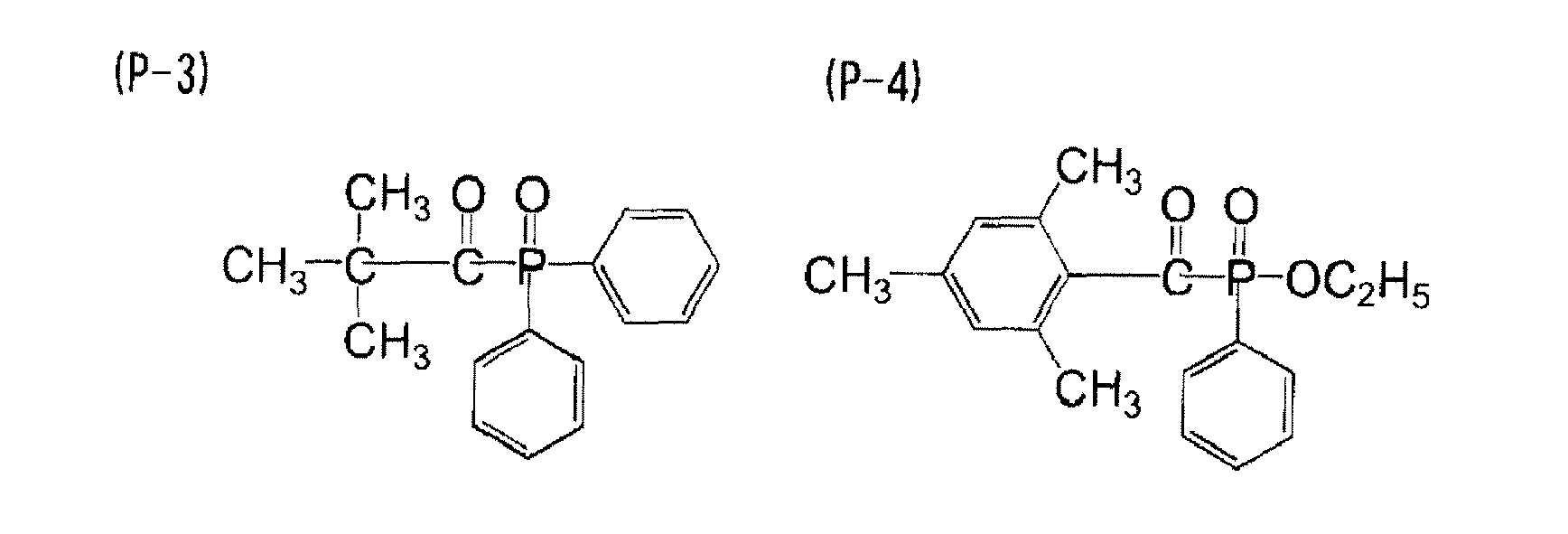


-


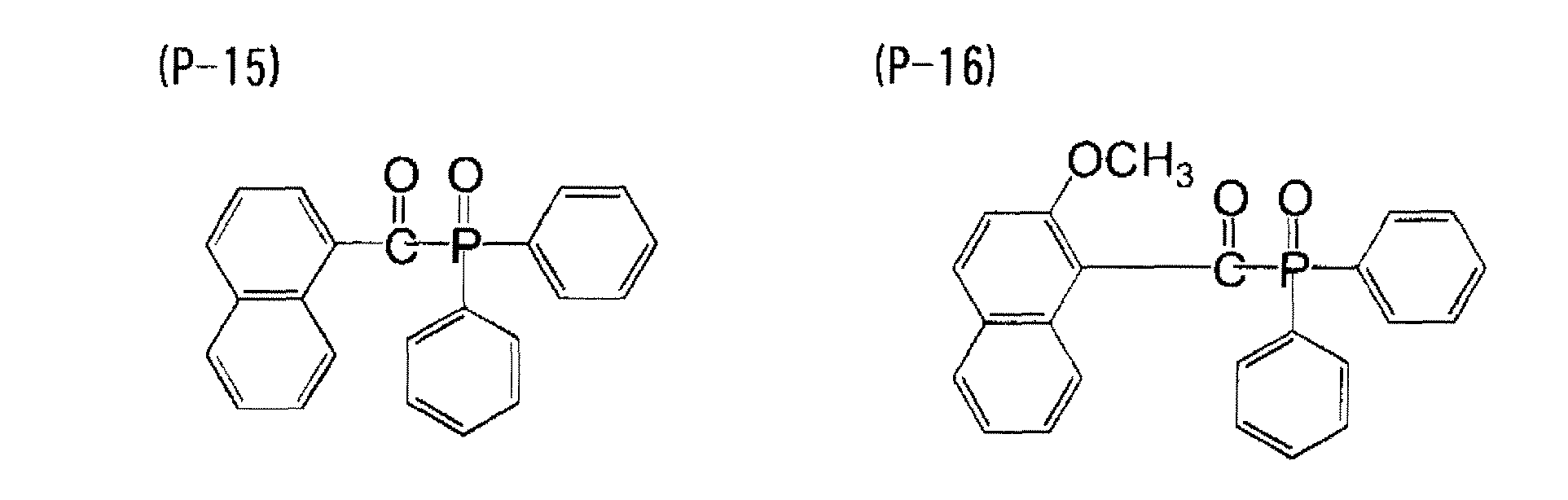


-

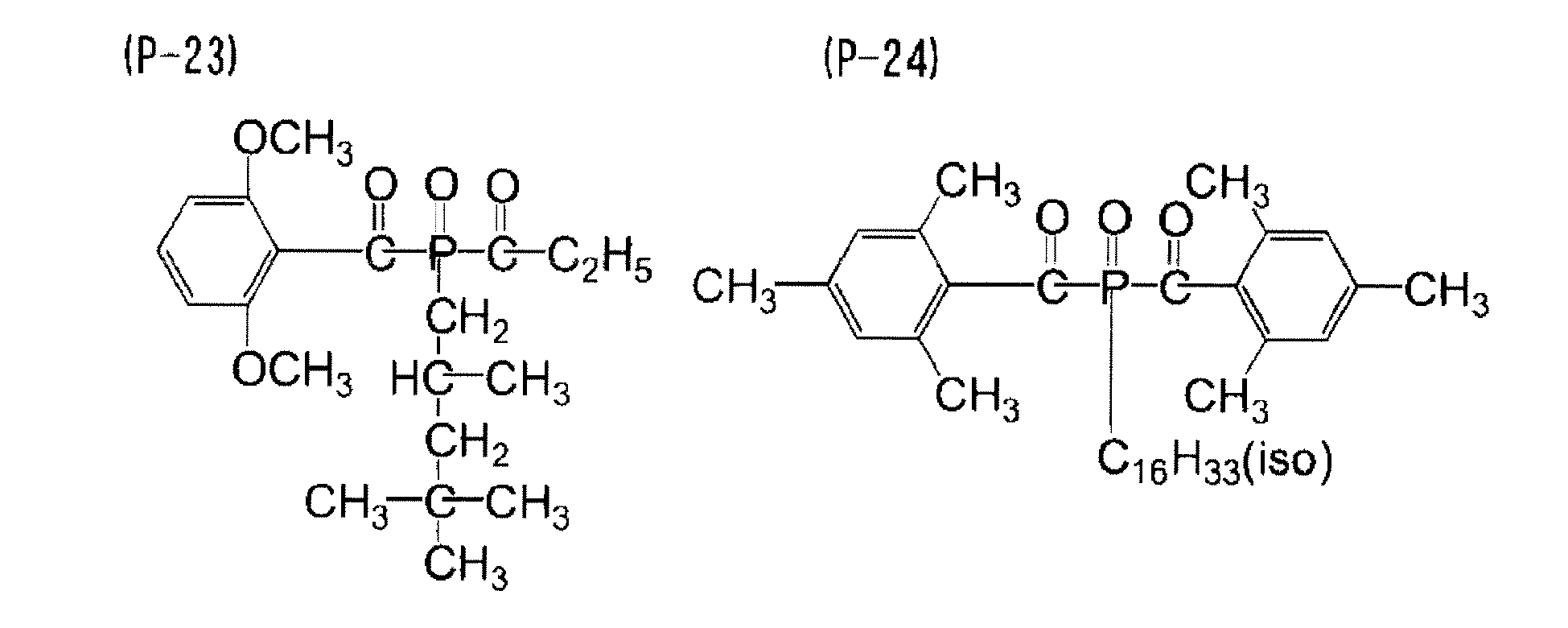
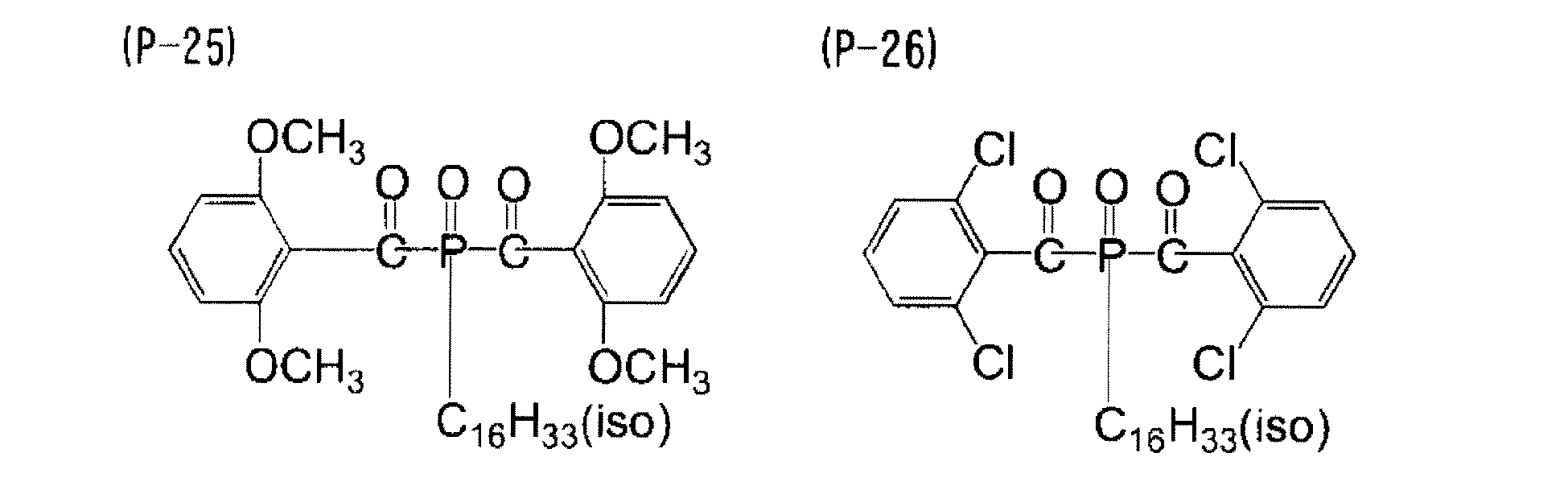
- In the exemplary compounds mentioned above, for example, (P-2) [2,4,6-trimethylbenzoyl-diphenyl-phosphine oxide] is available under the trade name DAROCUR TPO (manufactured by Ciba Specialty Chemicals Inc.), and (P-19) [bis(2,4,6-trimethylbenzoyl)-phenylphospine oxide] is available under the trade name IRGACURE 819 (manufactured by Ciba Specialty Chemicals Inc.).
- The content of the polymerization initiator (B) in the ink composition of the invention, in terms of solid content, is preferably in the range of 0.1 to 30% by weight, more preferably 0.2 to 20% by weight.
- In the ink composition of the invention, the polymerizable compound (C) described later should be present as an emulsion in the ink composition, wherein the polymerization initiator (B) may be present in the same phase as that of the polymerizable compound (C) or may be present in the aqueous phase.
When the polymerization initiator (B) is allowed to be present in the aqueous phase, a water-soluble compound having, in its molecule, hydrophilic substituents such as a carboxyl group (including a salt thereof), a sulfo group (including a salt thereof), and an ethyleneoxy group may be selected and used as the polymerization initiator.
From the viewpoint of sensitivity, the polymerization initiator (B) is preferably present in the same phase as that of the polymerizable compound (C). - The ink composition of the invention preferably contains at least the specific polymerization initiator as a photopolymerization initiator, but a photopolymerization initiator other than the preferable specific polymerization initiator described above may be used in place of, or in addition to, the specific polymerization initiator.
As the other polymerization initiator, the compound mentioned as the "other known polymerization initiator" in the first aspect can be used. - The content of the polymerization initiator (B) in the ink composition of the invention is contained preferably in the range of 0.01 to 35 parts by weight, more preferably 0.1 to 30 parts by weight, even more preferably 0.5 to 30 parts by weight, based on 100 parts by weight of the ethylenically unsaturated bond-containing water-soluble polymerizable compound (C) described later. The content of the polymerization initiator means the total content of the polymerization initiators containing the preferable specific polymerization initiator and other polymerization initiators.
- The ink composition of the invention contains a sensitizing dye for promoting decomposition of the polymerization initiator by irradiation with an active ray, and as the sensitizing dye, a compound represented by the following formula (i) is contained as an essential component.
- The ink composition of the invention should contain at least one specific sensitizing dye belonging to the compounds represented by the following formula (i):
-

- In the formula (i), X represents O, S or NR wherein R represents a hydrogen atom, an alkyl group or an acyl group. R is preferably an alkyl group or an acyl group. n is 0 or 1.
X is preferably O or S, more preferably S. When n is 0, a carbon atom bound to R7 and R8 (CR7R8) is not present, and heteroatom-containing X is bound directly to a carbon atom bound to R5 and R6 to constitute a 5-memberred heterocycle containing X. - R1, R2, R3, R4, R5, R6, R7 and R8 independently represent a hydrogen atom or a monovalent substituent.
When R1, R2, R3, R4, R5, R6, R7 or R8 represents a monovalent substituent, the monovalent substituent includes a halogen atom, an aliphatic group, an aromatic group, a heterocyclic group, a cyano group, a hydroxyl group, a nitro group, an amino group, an alkylamino group, an alkoxy group, an aryloxy group, an amide group, an arylamino group, a ureido group, a sulfamoylamino group, an alkylthio group, an arylthio group, an alkoxycarbonylamino group, a sulfonamide group, a carbamoyl group, a sulfamoyl group, a sulfonyl group, an alkoxycarbonyl group, a heterocyclooxy group, an azo group, an acyloxy group, a carbamoyloxy group, a silyloxy group, an aryloxycarbonyl group, an aryloxycarbonylamino group, an imide group, a heterocyclothio group, a sulfinyl group, a phosphoryl group, an acyl group, a carboxyl group, and a sulfo group, among which an alkyl group, an alkoxy group and a halogen atom are preferable. - When R1, R2, R3, R4, R5, R6, R7 or R8 in the formula (i) represents an alkyl group as the monovalent substituent, the alkyl group is preferably an alkyl group having 1 to 10 carbon atoms, more preferably an alkyl group having 1 to 4 carbon atoms, such as a methyl group, an ethyl group, a propyl group, an n-butyl group, a sec-butyl group, a t-butyl group or the like.
When the monovalent substituent is an alkoxy group, the alkoxy group is preferably an alkoxy group having 1 to 4 carbon atoms, such as a methoxy group, an ethoxy group, a hydroxyethoxy group, a propoxy group, an n-butoxy group, an isobutoxy group, a sec-butoxy group, a t-butoxy group or the like.
The halogen atom includes a fluorine atom, a chlorine atom, a bromine atom and an iodine atom. - Neighboring two of R1, R2, R3 and R4 may be bound (e.g. condensed) to each other to form a ring.
When these groups form a ring, the ring structure includes a 5- to 6-memberred aliphatic or an aromatic ring, and may be a heterocycle containing an element other than carbon atoms, and the rings thus formed may further be combined to form a 2-nucleus ring, for example a condensed ring. These ring structures may further have each substituent group illustrated as the monovalent substituent represented by each of R1 to R8 in the formula (i). When the formed ring structure is a heterocycle, examples of the heteroatom the heterocycle include N, O and S. - When n = 1, R5 or R6, and R7 or R8, may be bound to each other to form an aliphatic ring but do not form an aromatic ring. The aliphatic ring is preferably a 3- to 6-memberred ring, more preferably a 5- or 6-memberred ring.
- The sensitizing dye which can be more preferably used in the invention includes sensitizing dyes represented by the following formula (iA):
-

- In the formula (iA), X represents O or S. n represents 0 or 1. R1A, R2A, R3A, R4A, R5A, R6A, R7A and R8A independently represent a hydrogen atom, an alkyl group, a halogen atom, a hydroxyl group, a cyano group, a nitro group, an amino group, an alkylthio group, an alkylamino group, an alkoxy group, an alkoxycarbonyl group, an acyloxy group, an acyl group, a carboxyl group or a sulfo group. Neighboring two of R1A, R2A, R3A and R4A may be bound (condensed) to each other to form a ring. R5A or R6A, and R7A or R8A, may be bound to each other to form an aliphatic ring but do not form an aromatic ring.
- The sensitizing dye which can be further preferably used includes sensitizing dyes represented by the following formula (iB):
-

- In the formula (iB), X represents O or S. R1B, R2B, R3B, R4B, R5B, R6B, R7B and R8B independently represent a hydrogen atom, an alkyl group, a halogen atom, a hydroxyl group, a cyano group, a nitro group, an amino group, an alkylthio group, an alkylamino group, an alkoxy group, an alkoxycarbonyl group, an acyloxy group, an acyl group, a carboxyl group or a sulfo group. Neighboring two of R1B, R2B, R3B and R4B may be bound (condensed) to each other to form a ring. R5B or R6B, and R7B or R8B, may be bound to each other to form an aliphatic ring but do not form an aromatic ring.
- The sensitizing dye which can be further preferably used includes sensitizing dyes represented by the following formula (iC):
-

- In the formula (iC), R1C, R2C, R3C, R4C, R5C, R6C, R7C and R8C independently represent a hydrogen atom, an alkyl group, a halogen atom, a hydroxyl group, a cyano group, a nitro group, an amino group, an alkylthio group, an alkylamino group, an alkoxy group, an alkoxycarbonyl group, an acyloxy group, an acyl group, a carboxyl group or a sulfo group.
Neighboring two of R1C, R2C, R3C and R4C may be bound to each other to form a 5-to 6-memberred aliphatic or an aromatic ring, which may be a heterocycle containing an element other than carbon atoms, and the rings thus formed may further be combined to form a 2-nucleus ring, for example a condensed ring. These ring structures may further have each substituent group illustrated as the monovalent substituent represented by each of R1, R2, R3, R4, R5, R6, R7 and R8 in the formula (i). When the ring structure is a heterocycle, examples of the heteroatom in the heteroatom include N, O and S. R5C or R6C, and R7C or R8C, may be bound to each other to form an aliphatic ring but do not form an aromatic ring. - At least one of R1C, R2C, R3C, R4C, R5C, R6C, R7C and R8C is preferably a halogen atom. More preferably, each of R1C, R2C, R3C, and R4C is a halogen atom as the substituent, and most preferably R2C is a halogen atom. The number of halogen atoms is preferably 1 or 2, more preferably 1.
- R2C is preferably a substituent other than hydrogen, more preferably an alkyl group, a halogen atom, an acyloxy group, or an alkoxycarbonyl group, among which an alkyl group and a halogen atom are preferable because of high sensitivity due to good matching with a light source.
- Preferably, either of R7C or R8C is a substituent group other than hydrogen, and more preferably, both of them are substituent groups other than hydrogen. Preferable examples of the substituent group include an alkyl group, a halogen atom, a carboxyl group and an alkoxycarbonyl group, among which an alkyl group and an alkoxycarbonyl group are preferable, and an alkyl group is most preferable.
The halogen atom includes a fluorine atom, a chlorine atom, a bromine atom and an iodine atom, among which a chlorine atom, a bromine atom and an iodine atom are preferable. - When any one of R1C, R2C, R3C, R4C, R5C, R6C, R7C and R8C is an alkyl group, the alkyl group is preferably an alkyl group having 1 to 10 carbon atoms, more preferably an alkyl group having 1 to 4 carbon atoms, such as a methyl group, an ethyl group, a propyl group, an n-butyl group, a sec-butyl group, a t-butyl group or the like.
- When any one of R1C, R2C, R3C, R4C, R5C, R6C, R7C and R8C is an acyloxy group, the acyloxy group is preferably an aliphatic acyloxy group having 2 to 10 carbon atoms, more preferably an aliphatic acyloxy group having 2 to 5 carbon atoms.
When any one of R1C, R2C, R3C, R4C, R5C, R6C, R7C and R8C is an alkoxycarbonyl group, the alkoxycarbonyl group is preferably an aliphatic alkoxycarbonyl group having 2 to 10 carbon atoms, more preferably an alkoxycarbonyl group having 2 to 5 carbon atoms. - Specific examples of the specific sensitizing dye [Exemplary Compounds (I-1) to (I-133)] which can be preferably used in the invention are shown below, but the invention is not limited thereto. In the exemplified compounds (I-1) to (I-133), Me represents methyl group, But represents tertiary-butyl group and Pri represents isopropyl group.
-


-


-


-


-


-


-


-

-

-


- The specific sensitizing dye in the invention can be synthesized by known methods described in, for example,
JP-A No. 2004-189695 - The content of the specific sensitizing dye in the ink composition of the invention, in terms of solid content, is preferably in the range of about 0.05 to 30% by weight, more preferably 0.1 to 20% by weight, even more preferably 0.2 to 10% by weight, based on the ink composition.
This specific sensitizing dye hardly shows absorption in the visible light range and is thus advantageous that the dye when added in an amount to exhibit its effect does not influence the hue of the aqueous ink composition. The content of the specific sensitizing dye when described in connection with the polymerization initiator (B) is that the weight ratio of the polymerization initiator (the total amount of the specific polymerization initiator and other polymerization initiator) : the specific sensitizing dye is preferably 200 : 1 to 1 : 200, more preferably 50 : 1 to 1 : 50, still more preferably 20 : 1 to 1 : 5. - In the ink composition of the invention, the polymerizable compound (C) described later is present as an emulsion in the ink composition, wherein the specific sensitizing dye (A) may be present in the same phase as that of the polymerizable compound or may be present in the aqueous phase.
When the specific sensitizing dye (A) is allowed to be present in the aqueous phase, the sensitizing dye made water-soluble by introducing hydrophilic substituents such as a carboxyl group (including a salt thereof), a sulfo group (including a salt thereof), and an ethyleneoxy group into the molecule of the sensitizing dye may be used.
In the invention, the specific sensitizing dye (A) is present preferably in the same phase as that of the polymerizable compound (C), from the viewpoint of sensitivity.
At this time, the specific sensitizing dye (A) is preferably soluble in the polymerizable compound (C). The term "soluble" means that the specific sensitizing dye (A) is dissolved at room temperature (25°C) in an amount of 1% by weight or more, preferably 3% by weight or more, in the polymerizable compound (C). From the viewpoint of preventing precipitation of the specific sensitizing dye (A), the amount of the specific sensitizing dye (A) used is preferably less than the upper limit of the amount thereof dissolved in the polymerizable compound (C) and is specifically more preferably 70% by weight or less. - In the invention, known sensitizing dyes can also be used in combination with the specific sensitizing dye described above in such a range that the effect of the invention is not impaired. The ratio of other sensitizing dyes to the specific sensitizing dye, and the scope of exemplary compounds that can be simultaneously used, are the same as in the first aspect described above.
- The ink composition of the invention contains the ethylenically unsaturated bond-containing polymerizable compound (C) (hereinafter referred to sometimes as "polymerizable compound").
One feature of the invention lies in that the ethylenically unsaturated bond-containing polymerizable compound is present in an emulsified state in the ink composition. As such polymerizable comound, a compound having, in its molecule, at least one radical polymerizable ethylenically unsaturated bond, such as a compound having acryloyl and methacryloyl groups, is used. - One feature of the invention is that the polymerizable compound (C) is present in a substantially emulsified state in the aqueous ink composition containing water as a main solvent. Accordingly, the polymerizable compound is selected from those compounds which are water-insoluble, that is, solids at ordinary temperatures under ordinary pressures in a chemical form of monomer, oligomer or polymer.
For forming an emulsified state in the solvent containing water as a major component, it is necessary to select a polymerizable compound which is solid at ordinary temperature (25°C) under ordinary pressure or is water-insoluble with lipophilicity or hydrophobicity as physical property thereof.
In the invention, the term "water-insoluble" means that the solubility of the compound in water at room temperature (25°C) is less than 5% by weight, and in the invention, the compound having a solubility of less than 2% by weight is preferably used, and the compound having a solubility of less than 1% by weight is more preferably used. - In the aqueous ink composition, these polymerizable compounds can be confirmed to be present in an emulsified state by observation under an optical microscope, an electron microscope or the like or by a method such as dynamic light scattering method. The particle size of the emulsion is arbitrary as long as jetting performance is influenced, but usually the particle size is preferably in the range 50 to 500 nm.
The method of measuring the particle size distribution of the emulsion in the invention includes known methods such as optical microscopy, confocal laser microscopy, electron microscopy, atomic force microscopy, static light scattering method, laser diffractometry, dynamic light scattering method, centrifuging sedimentation, electric pulse measurement method, chromatography, ultrasonic attenuation method etc., and apparatuses corresponding to the principle of each method are commercially available. - For the particle size range in the invention and ease in measurement, the particle size of dispersed particles is measured preferably by the dynamic light scattering method. Commercial measuring instruments using dynamic light scattering include NANOTRUCK UPA (Nikkiso Co.,. Ltd.), a dynamic light scattering particle size distribution measuring instrument LB-550 (Horiba, Ltd.), and a density particle size analyzer FPAR-1000 (Otsuka Electronics Co., Ltd.).
- Examples of the radical-polymerizable compound capable of forming an emulsified state in the aqueous ink composition includes those compounds which have the physical properties described above and are selected from unsaturated carboxylic acids such as acrylic acid, methacrylic acid, itaconic acid, crotonic acid, isocrotonic acid and maleic acid, their salts, esters, urethanes, acid amides and acid anhydrides, and acrylonitrile, styrene derivatives, various unsaturated polyesters, unsaturated polyethers, unsaturated polyamides, and unsaturated polyurethanes, but the invention is not limited thereto. The radical-polymerizable compound may be a monofunctional compound having, in a molecule, only one ethylenically unsaturated bond or may be a multifunctional compound having a plurality of ethylenically unsaturated bonds.
- Hereinafter, examples of the radical-polymerizable compound used preferably in the invention, which can be present in an emulsified state in the aqueous ink composition, are enumerated, but the invention is not limited to these compounds.
- In the ink composition of the invention, the acrylates preferably used as the polymerizable compound (C) may be monofunctional or multifunctional and includes, for example, the following compounds.
- Methyl acrylate, ethyl acrylate, propyl acrylate, isopropyl acrylate, butyl acrylate, isoamyl acrylate, hexyl acrylate, 2-ethylhexyl acrylate, octyl acrylate, decyl acrylate, lauryl acrylate, stearyl acrylate, isobornyl acrylate, cyclohexyl acrylate, dicyclopentenyl acrylate, dicyclopentenyloxyethyl acrylate, and benzyl acrylate.
- 2-Hydroxyethyl acrylate, 2-hydroxypropyl acrylate, 2-hydroxy-3-chloropropyl acrylate, 2-hydroxy-3-phenoxypropyl acrylate, 2-hydroxy-3-allyloxypropyl acrylate, 2-acryloyloxyethyl-2-hydroxypropyl phthalate.
- 2,2,2-Trifluoroethyl acrylate, 2,2,3,3-tetrafluoropropyl acrylate, 1H-hexafluoroisopropyl acrylate, 1H,1H,5H-octafluoropentyl acrylate, 1H,1H,2H,2H-heptadecafluorodecyl acrylate, 2,6-dibromo-4-butylphenyl acrylate, 2,4,6-tribromophenoxyethyl acrylate, and 2,4,6-
tribromophenol 3 EO-added acrylate. - 2-Methoxyethyl acrylate, 1,3-butyleneglycol methyl ether acrylate, butoxyethyl acrylate, methoxytriethyleneglycol acrylate, methoxypolyethyleneglycol #400 acrylate, methoxydipropyleneglycol acrylate, methoxytripropyleneglycol acrylate, methoxypolypropyleneglycol acrylate, ethoxydiethyleneglycol acrylate, 2-ethylhexylcarbitol acrylate, tetrahydrofurfuryl acrylate, phenoxyethyl acrylate, phenoxydiethyleneglycol acrylate, phenoxypolyethyleneglycol acrylate, cresylpolyethyleneglycol acrylate, p-nonylphenoxyethyl acrylate, p-nonylphenoxypolyethyleneglycol acrylate, and glycidyl acrylate.
- β-Carboxyethyl acrylate, succinic acid monoacryloyloxyethyl ester, ω-carboxypolycaprolactone monoacrylate, 2-acryloyloxyethylhydrogen phthalate, 2-acryloyloxypropylhydrogen phthalate, 2-acryloyloxypropylhexahydrohydrogen phthalate, and 2-acryloyloxypropyltetrahydrohydrogen phthalate.
- N,N-Dimethylaminoethyl acrylate, N,N-dimethylaminopropyl acrylate, morpholinoethyl acrylate, trimethylsiloxyethyl acrylate, diphenyl-2-acryloyloxyethyl phosphate, 2-acryloyloxyethyl acid phosphate, and caprolactone modified 2-acryloyloxyethyl acid phosphate.
- 1,4-Butanediol diacrylate, 1,6-hexanediol diacrylate, diethyleneglycol diacrylate, triethyleneglycol diacrylate, tetraethyleneglycol diacrylate, polyethyleneglycol #200 diacrylate, polyethyleneglycol #300 diacrylate, polyethyleneglycol #400 diacrylate, polyethyleneglycol #600 diacrylate, dipropyleneglycol diacrylate, tripropyleneglycol diacrylate, tetrapropyleneglycol diacrylate, polypropyleneglycol #400 diacrylate, polypropylene glycol #700 diacrylate, neopentylglycol diacrylate, neopentylglycol PO (propylene oxide) modified diacrylate, hydroxypivalic acid neopentyl glycol ester diacrylate, hydroxypivalic acid neopentyl glycol ester caprolactone-added diacrylate, 1,6-hexanediol bis(2-hydroxy-3-acryloyloxypropyl) ether, 1,9-nonanediol diacrylate, pentaerythritol diacrylate, pentaerythritol diacrylate monostearate, pentaerythritol diacrylate monobenzoate, bisphenol A diacrylate, EO (ethylene oxide) modified bisphenol A diacrylate, PO modified bisphenol A diacrylate, hydrogenated bisphenol A diacrylate, EO modified hydrogenated bisphenol A diacrylate, PO modified hydrogenated bisphenol A diacrylate, bisphenol F diacrylate, EO modified bisphenol F diacrylate, PO modified bisphenol F diacrylate, EO modified tetrabromobisphenol A diacrylate, tricyclodecanedimethylol diacrylate, and isocyanuric acid EO modified diacrylate.
- Glycerin PO modified triacrylate, trimethylolpropane triacrylate, trimethylolpropane EO modified triacrylate, trimethylolpropane PO modified triacrylate, isocyanuric acid EO modified triacrylate, isocyanuric acid EO modified ε-caprolactone modified triacrylate, 1,3,5-triacryloylhexahydro-s-triazine, pentaerythritol triacrylate, and dipentaerythritol triacrylate tripropionate.
- Pentaerythritol tetraacrylate, dipentaerythritol pentaacrylate monopropionate, dipentaerythritol hexaacrylate, tetramethylolmethane tetraacrylate, oligoester tetraacrylate, and tris(acryloyloxy)phosphate.
- The methacrylates used preferably as the polymerizable compound (C) in the ink composition of the invention may be monofunctional or multifunctional and includes, for example, the following compounds.
- Methyl methacrylate, ethyl methacrylate, propyl methacrylate, isopropyl methacrylate, butyl methacrylate, isoamyl methacrylate, hexyl methacrylate, 2-ethylhexyl methacrylate, octyl methacrylate, decyl methacrylate, lauryl methacrylate, stearyl methacrylate, isobornyl methacrylate, cyclohexyl methacrylate, dicyclopentenyl methacrylate, dicyclopentenyloxyethyl methacrylate, and benzyl methacrylate.
- 2-Hydroxyethyl methacrylate, 2-hydroxypropyl methacrylate, 2-hydroxy-3-chloropropyl methacrylate, 2-hydroxy-3-phenoxypropyl methacrylate, 2-hydroxy-3-allyloxypropyl methacrylate, and 2-methacryloyloxyethyl-2-hydroxypropyl phthalate.
- 2,2,2-Trifluoroethyl methacrylate, 2,2,3,3-tetrafluoropropyl methacrylate, 1H-hexafluoroisopropyl methacrylate, 1H,1H,5H-octafluoropentyl methacrylate, 1H,1H,2H,2H-heptadecafluorodecyl methacrylate, 2,6-dibromo-4-butylphenyl methacrylate, 2,4,6-tribromophenoxyethyl methacrylate, and 2,4,6-
tribromophenol 3 EO-added methacrylate. - 2-Methoxyethyl methacrylate, 1,3-butyleneglycol methyl ether methacrylate, butoxyethyl methacrylate, methoxytriethyleneglycol methacrylate, methoxypolyethyleneglycol #400 methacrylate, methoxydipropyleneglycol methacrylate, methoxytripropyleneglycol methacrylate, methoxypolypropyleneglycol methacrylate, ethoxydiethyleneglycol methacrylate, 2-ethylhexylcarbitol methacrylate, tetrahydrofurfuryl methacrylate, phenoxyethyl methacrylate, phenoxydiethyleneglycol methacrylate, phenoxypolyethyleneglycol methacrylate, cresylpolyethyleneglycol methacrylate, p-nonylphenoxyethyl methacrylate, p-nonylphenoxypolyethyleneglycol methacrylate, and glycidyl methacrylate.
- β-Carboxyethyl methacrylate, succinic acid monomethacryloyloxyethyl ester, ω-carboxypolycaprolactone monomethacrylate, 2-methacryloyloxyethylhydrogen phthalate, 2-methacryloyloxypropylhydrogen phthalate, 2-methacryloyloxypropylhexahydrohydrogen phthalate, and 2-methacryloyloxypropyltetrahydrohydrogen phthalate.
- N,N-Dimethylaminoethyl methacrylate, N,N-dimethylaminopropyl methacrylate, morpholinoethyl methacrylate, trimethylsiloxyethyl methacrylate, diphenyl-2-methacryloyloxyethyl phosphate, 2-methacryloyloxyethyl acid phosphate, caprolactone modified 2-methacryloyloxyethyl acid phosphate.
- 1,4-Butanediol dimethacrylate, 1,6-hexanediol dimethacrylate, diethyleneglycol dimethacrylate, triethyleneglycol dimethacrylate, tetraethyleneglycol dimethacrylate, polyethyleneglycol #200 dimethacrylate, polyethyleneglycol #300 dimethacrylate, polyethyleneglycol #400 dimethacrylate, polyethyleneglycol #600 dimethacrylate, dipropyleneglycol dimethacrylate, tripropyleneglycol dimethacrylate, tetrapropyleneglycol dimethacrylate, polypropyleneglycol #400 dimethacrylate, polypropyleneglycol #700 dimethacrylate, neopentylglycol dimethacrylate, neopentylglycol PO modified dimethacrylate, hydroxypivalic acid neopentyl glycol ester dimethacrylate, hydroxypivalic acid neopentyl glycol ester caprolactone-added dimethacrylate, 1,6-hexanediol bis(2-hydroxy-3-methacryloyloxypropyl) ether, 1,9-nonanediol dimethacrylate, pentaerythritol dimethacrylate, pentaerythritol dimethacrylate monostearate, pentaerythritol dimethacrylate monobenzoate, bisphenol A dimethacrylate, EO modified bisphenol A dimethacrylate, PO modified bisphenol A dimethacrylate, hydrogenated bisphenol A dimethacrylate, EO modified hydrogenated bisphenol A dimethacrylate, PO modified hydrogenated bisphenol A dimethacrylate, bisphenol F dimethacrylate, EO modified bisphenol F dimethacrylate, PO modified bisphenol F dimethacrylate, EO modified tetrabromobisphenol A dimethacrylate, tricyclodecanedimethylol dimethacrylate, and isocyanuric acid EO modified dimethacrylate.
- Glycerin PO modified trimethacrylate, trimethylolpropane trimethacrylate, trimethylolpropane EO modified trimethacrylate, trimethylolpropane PO modified trimethacrylate, isocyanuric acid EO modified trimethacrylate, isocyanuric acid EO modified ε-caprolactone modified trimethacrylate, 1,3,5-trimethacryloylhexahydro-s-triazine, pentaerythritol trimethacrylate, and dipentaerythritol trimethacrylate tripropionate.
- Pentaerythritol tetramethacrylate, dipentaerythritol pentamethacrylate monopropionate, dipentaerythritol hexamethacrylate, tetramethylolmethane tetramethacrylate, oligoester tetramethacrylate, and tris(methacryloyloxy) phosphate.
- Hereinafter, compounds, which are used preferably as the polymerizable compound (C) in the invention other than acrylates and methacrylates, are mentioned.
- Allyl glycidyl ether, diallyl phthalate, triallyl trimellitate, and isocyanuric acid triarylate.
- Acrylamide, N-methylol acrylamide, diacetone acrylamide, N,N-dimethylacrylamide, N,N-diethylacrylamide, N-isopropylacrylamide, acryloyl morpholine, methacrylamide, N-methylolmethacrylamide, diacetone methacrylamide, N,N-dimethylmethacrylamide, N,N-diethylmethacrylamide, N-isopropylmethacrylamide, and methacryloyl morpholine.
- Styrene, p-hydroxystyrene, p-chlorostyrene, p-bromostyrene, p-methylstyrene, p-methoxystyrene, p-t-butoxystyrene, p-t-butoxycarbonylstyrene, p-t-butoxycarbonyloxystyrene, and 2,4-diphenyl-4-methyl-1-pentene.
- Vinyl acetate, vinyl monochloroacetate, vinyl benzoate, vinyl pivalate, vinyl butyrate, vinyl laurate, divinyl adipate, vinyl methacrylate, vinyl crotonate, vinyl 2-ethylhexanoate, N-vinylcarbazole, N-vinylpyrrolidone etc.
- In the aqueous ink composition, the polymerizable compound that can exist in a substantially emulsified state includes the following monomer examples and commercial products in addition to the exemplary compounds described above.
- Trifunctional or more monomers: pentaerythritol tetraacrylate (trade name: M-450, manufactured by Toa Gosei Co., Ltd.), polyester acrylate (trade name: M-81000, manufactured by Toa Gosei Co., Ltd.), bifunctional monomers: neopentylglycol diacrylate (trade name: NK Ester NPG, manufactured by Shin-Nakamura Chemical Co., Ltd.), urethane acrylate (trade name: M-1210, manufactured by Toa Gosei Co., Ltd.), polyester acrylate (trade name: M-6200, manufactured by Toa Gosei Co., Ltd.), monofunctional monomers: 2-ethylhexyl carbitol acrylate (trade name: M-120, manufactured by Toa Gosei Co., Ltd.), N-vinylpyrrolidone etc.
- The content of the polymerizable compound (C) in the ink composition of the invention may be determined appropriately depending on the content of the polymerization initiator (B) and the preferably weight ratio thereto, but in terms of solid content, is usually preferably in the range of 2 to 70% by weight, more preferably in the range of 3 to 30% by weight, still more preferably in the range of 5 to 20% by weight.
- The ink composition of the invention contains water as a main solvent.
Water to be used is preferably impurity-free deionized water, distilled water or the like.
The content of water in the ink composition of the invention is preferably 10 to 97% by weight. In the case of the inkjet recording ink composition, the water content is preferably 30 to 95% by weight, more preferably 50 to 95% by weight. - The aqueous ink composition of the invention contains water as a main solvent, and depending on the object, a water-soluble organic solvent is preferably simultaneously used in the solvent.
The water-soluble organic solvent that can be used in the invention includes, for example, alcohols (for example, methanol, ethanol, propanol, isopropanol, butanol, isobutanol, secondary butanol, tertiary butanol, pentanol, hexanol, cyclohexanol, benzyl alcohol etc.), polyhydric alcohols (for example, ethylene glycol, diethylene glycol, triethylene glycol, polyethylene glycol, propylene glycol, dipropylene glycol, polypropylene glycol, butylene glycol, hexane diol, pentane diol, glycerin, hexane triol, thiodiglycol etc.), polyhydric alcohol ethers (for example, ethylene glycol monomethyl ether, ethylene glycol monoethyl ether, ethylene glycol monobutyl ether, diethylene glycol monomethyl ether, diethylene glycol monomethyl ether, diethylene glycol monobutyl ether, propylene glycol monomethyl ether, propylene glycol monobutyl ether, ethylene glycol monomethyl ether acetate, triethylene glycol monomethyl ether, triethylene glycol monoethyl ether, triethylene glycol monobutyl ether, ethylene glycol monophenyl ether, propylene glycol monophenyl ether etc.), amines (for example, ethanolamine, diethanolamine, triethanolamine, N-methyldiethanolamine, N-ethyldiethanolamine, morpholine, N-ethyl morpholine, ethylenediamine, diethylenediamine, triethylenetetramine, tetraethylenepentamine, polyethyleneimine, pentamethyldiethylenetriamine, tetramethylpropylenediamine etc.), amides (for example, formamide, N,N-dimethylformamide, N,N-dimethylacetamide etc.), heterocycles (for example, 2-pyrrolidone, N-methyl-2-pyrrolidone, cyclohexyl pyrrolidone, 2-oxazolidone, 1,3-dimethyl-2-imidazolizinone etc.), sulfoxides (for example, dimethylsulfoxide etc.), sulfones (for example, sulfolane etc.), urea, acetonitrile, acetone etc. Preferable examples of the water-soluble organic solvent include polyhydric alcohols. The polyhydric alcohol and polyhydric alcohol ether are preferably simultaneously used. - The water-soluble organic solvents may be used alone or in combination thereof. The total amount of the water-soluble organic solvents added to the ink composition is 5 to 60% by weight, preferably 10 to 35% by weight.
- When the ink composition of the invention is used in applications such as formation of image regions on a planographic printing plate, formation of colored images is not particularly essential, and for application to such ink, a colorant is not particularly necessary. However, when the visibility of image regions formed by the ink composition is to be improved or colored images are to be formed using the ink composition, a colorant can be contained in the composition.
- Although the colorant that can be used in the invention is not particularly limited, the polymerizable compound (C) is present in an emulsified state in water in the ink composition, and thus it is possible to use the colorant in any of the following aspects: aspect (1) wherein a pigment is used as the colorant and dispersed in an aqueous medium, aspect (2) wherein an oil-soluble dye is used as the colorant, dissolved in the polymerizable compound and allowed to be present in an emulsion phase formed by the polymerizable compound, and aspect (3) wherein a water-soluble dye is used as the colorant and dissolved in an aqueous phase, and these can be simultaneously used, but because the pigment is generally superior in weatherability to the dye, and thus the pigment is preferably used as the colorant.
- The pigment that can be used as the colorant (E) in the invention can be a conventionally known colored organic or inorganic pigment.
Examples of the pigment include azo pigments such as azo lakes, insoluble azo pigments, condensed azo pigments and chelate azo pigments, polycyclic pigments such as phthalocyanine pigments, perylene and perylene pigments, anthraquinone pigments, quinacridone pigments, dioxazine pigments, thioindigo pigments, isoindolinone pigments and quinophthalone pigments, dye lakes such as basic dyed lakes and acid dyes lakes, organic pigments such as nitro pigments, nitroso pigments, aniline black, and daylight fluorescent pigments, and inorganic pigments such as carbon black. - Magenta or red pigments include, for example, C.I.
Pigment Red 2, C.I.Pigment Red 3, C.I.Pigment Red 5, C.I. Pigment Red 6, C.I. Pigment Red 7, C.I. Pigment Red 15, C.I. Pigment Red 16, C.I. Pigment Red 48:1, C.I. Pigment Red 53:1, C.I. Pigment Red 57:1, C.I. Pigment Red 122, C.I. Pigment Red 123, C.I. Pigment Red 139, C.I. Pigment Red 144, C.I. Pigment Red 149, C.I. Pigment Red 166, C.I. Pigment Red 170, C.I. Pigment Red 177, C.I. Pigment Red 178, C.I. Pigment Red 194, C.I. Pigment Red 209, C.I. Pigment Red 222, and C.I. Pigment Red 224. - Orange or yellow pigments include, for example, C.I. Pigment Orange 31, C.I. Pigment Orange 43, C.I. Pigment Yellow 12, C.I. Pigment Yellow 13, C.I. Pigment Yellow 14, C.I. Pigment Yellow 15, C.I. Pigment Yellow 17, C.I. Pigment Yellow 74, C.I. Pigment Yellow 93, C.I. Pigment Yellow 94, C.I. Pigment Yellow 128, C.I. Pigment Yellow 138, and C.I. Pigment Yellow 180.
- Green or cyan pigments include, for example, C.I. Pigment Blue 15, C.I. Pigment Blue 15:2, C.I. Pigment Blue 15:3, C.I. Pigment Blue 16, C.I. Pigment Blue 60, C.I. Pigment Green 7, and C.I. Pigment Green 36.
- Black pigments include, for example, carbon black etc. White pigments include, for example, Pigment White 6, 18, 21 etc.
- In these pigments, a pigment dispersant may be used if necessary. The pigment dispersant that can be used herein includes, for example, activators such as higher fatty acid salts, alkyl sulfates, alkyl ester sulfates, alkyl sulfonates, sulfosuccinates, naphthalene sulfonates, alkyl phosphates, polyoxyalkylene alkyl ether phosphates, polyoxyalkylene alkyl phenyl ethers, polyoxyethylene polyoxypropylene glycols, glycerin esters, sorbitan esters, polyoxyethylene fatty acid amides and amine oxides, as well as a block copolymer, a random copolymer, and a salt thereof, selected from 2 or more monomers such as styrene, styrene derivatives, vinyl naphthalene derivatives, acrylic acid, acrylic acid derivatives, maleic acid, maleic acid derivatives, itaconic acid, itaconic acid derivatives, fumaric acid, and fumaric acid derivatives.
- In the ink composition of the invention, a self-dispersing pigment can also be used. As used herein, the self-dispersing pigment refers to a pigment capable of dispersing without a dispersant and is preferably pigment particles having polar groups on the surface thereof.
- As used herein, the pigment particles having polar groups on the surface thereof refers to pigment particles modified directly with polar groups on the surface thereof or to an organic matter having organic pigment cores to which polar groups are bound directly or via joint (referred to hereinafter as pigment derivatives).
The polar group includes, for example, a sulfonic acid group, a carboxylic acid group, a phosphate group, a borate group and a hydroxyl group, and is preferably a sulfonic acid group or a carboxyl group, more preferably a sulfonic acid group. - The method of obtaining the pigment particles having polar groups on the surface includes those methods described in, for example,
WO97/48769 JP-ANos. 10-110129 11-246807 11-57458 11-189739 11-323232 JP-A No. 2000-265094 - Other methods of obtaining pigment particles having polar groups on the surface thereof include those methods described in
JP-ANos. 11-49974 2000-273383 2000-303014 2000-377068 2001-1495 2001-234966 - The polar group on the surface of the pigment may be in the form of a free salt or may have a counter salt. The counter salt includes, for example, inorganic salts (lithium, sodium, potassium, magnesium, calcium, aluminum, nickel, ammonium) and organic salts (triethyl ammonium, diethyl ammonium, pyridinium, triethanol ammonium etc.) and is preferably a counter salt having monovalency.
- In a method of dispersing the pigment, various dispersing machines such as a ball mill, a sand mill, an attritor, a roll mill, an agitator, a Henschel mixer, a colloid mill, an ultrasonic wave homogenizer, a pearl mill, a wet-type jet mill and a paint shaker can be used. For the purpose of removing coarse particles in the pigment dispersion, use of a centrifugal separator or a filter is also preferable.
- As described above, the ink composition of the invention may contain an oil-soluble dye as the colorant.
The oil-soluble dye that can be used in the invention is explained below.
The oil-soluble dye that can be used in the invention means a dye that is substantially insoluble in water. Specifically, the solubility in water at 25°C (the weight of dye that can be dissolved in 100 g of water) is 1 g or less, preferably 0.5 g or less, more preferably 0.1 g or less. Therefore, the oil-soluble dye means a so-called water-insoluble pigment or an oil-soluble dye, among which the oil-soluble dye is preferable. - Among the oil-soluble dyes that can be used in the invention, yellow dyes may be arbitrary ones. Examples thereof include aryl or heteryl azo dyes having a coupling component such as a phenol, a naphthol, an aniline, a pyrazolone, a pyridone, or an open-chain active methylene compound; azomethine dyes having a coupling component such as an open-chain active methylene compound; methine dyes such as benzylidene dyes and monomethineoxonol dyes; quinone dyes such as naphthoquinone dyes and anthraquinone dyes; and other dye species such as quinophthalone dyes, nitro/nitroso dyes, acridine dyes, and acridinone dyes.
- Among the above-mentioned oil-soluble dyes that can be used in the invention, magenta dyes may be arbitrary ones. Examples thereof include aryl or heteryl azo dyes having a coupling component such as a phenol, a naphthol, or an aniline; azomethine dyes having a coupling component such as a pyrazolone or a pyrazolotriazole; methine dyes such as arylidene dyes, styryl dyes, merocyanine dyes, and oxonol dyes; carbonium dyes such as diphenylmethane dyes, triphenylmethane dyes, and xanthene dyes; quinone dyes such as naphthoquinones, anthraquinones, or anthrapyridones; and condensed polycyclic dyes such as dioxazine dyes.
- Among the oil-soluble dyes that can be used in the invention, cyan dyes may be any ones. Examples thereof include indoaniline dyes, indophenol dyes, and azomethine dyes having a coupling component such as a pyrrolotriazole; polymethine dyes such as cyanine dyes, oxonol dyes, and merocyanine dyes; carbonium dyes such as diphenylmethane dyes, triphenylmethane dyes, and xanthene dyes; phthalocyanine dyes; anthraquinone dyes; aryl or heteryl azo dyes having a coupling component such as a phenol, a naphthol, or an aniline; and indigo/thioindigo dyes.
- The above-mentioned dyes may be dyes that exhibit respective colors of yellow, magenta and cyan, only after a part of their chromophore (chromogenic atomic group) dissociates. In this case, the counter cation may be an inorganic cation such as an alkali metal or ammonium, may be an organic cation such as pyridinium or a quaternary ammonium salt, or may be a polymer cation having the above cation as a partial structure.
- Preferred specific examples thereof include, but not limited to, C.I.
Solvent Black 3, 7, 27, 29, and 34; C.I. Solvent Yellow 14, 16, 19, 29, 30, 56, 82, 93, and 162; C.I.Solvent Red 1, 3, 8, 18, 24, 27, 43, 49, 51, 72, 73, 109, 122, 132, and 218; C.I.Solvent Violet 3; C.I.Solvent Blue 2, 11, 25, 35, 38, 67, and 70; C.I.Solvent Green 3 and 7; and C.I.Solvent Orange 2.
Particularly preferred examples thereof include Nubian Black PC-0850, Oil Black HBB, Oil Yellow 129, Oil Yellow 105, Oil Pink 312, Oil Red 5B, Oil Scarlet 308, Vali Fast Blue 2606, Oil Blue BOS (manufactured by Orient Chemical Industries, Ltd.), Aizen Spilon Blue GNH (manufactured by Hodogaya Chemical Co., Ltd.), Neopen Yellow 075, Neopen Magenta SE1378, Neopen Blue 808, Neopen Blue FF4012, and Neopen Cyan FF4238 (manufactured by BASF). - In the invention, oil-soluble dyes may be used alone or as a mixture of two or more thereof
When the oil-soluble dye is used as the colorant, it may be used in combination with other colorants such as water-soluble dyes, disperse dyes and pigments to such an extent that the effect of the invention is not hindered. - The water-soluble dye that can be used in the ink composition of the invention will be described.
The composition using a dye as the colorant, unlike the composition using the above pigment, is hardly usable in a state completely free from fading arising from irradiation with an active energy ray and is accompanied by fading to some degree. From this reason, when a dye is used as the colorant of ink, a so-called azo-containing metal dye that has formed a complex with a metal ion is preferably used because of less fading. - The scope of the water-soluble black dyes, yellow dyes, magenta days and cyan dyes are the same as in the first aspect described above.
- When the oil-soluble dye and water-soluble dye are used as the colorant, the content (total amount of the dyes) in the ink composition is in the range of 0.1 to 10% by weight based on the total amount of the ink composition. An ink composition wherein the concentration of the dye is low can be applied preferably to light-colored inks among density modulating inks.
- In the ink composition of the invention, known additives can be simultaneously used besides the essential components (A) to (D) and the colorant (E) in such a range that the effect of the invention is not impaired. Hereinafter, additives that can be used in the ink composition will be described.
- A surfactant can be added to the ink composition of the invention. The surfactant that can be preferably used in the invention includes anionic surfactants such as dialkyl sulfosuccinates, alkyl naphthalene sulfonates and fatty acid salts, nonionic surfactants such as polyoxyethylene alkyl ethers, polyoxyethylene alkyl allyl ethers, acetylene glycols, and polyoxyethylene/polyoxypropylene block copolymers, and cationic surfactants such as alkyl amine salts and quaternary ammonium salts. Particularly, anionic surfactants and nonionic surfactants can be preferably used.
- In the invention, a high-molecular surfactant can also be used, and the following water-soluble resins can be mentioned as preferable high-molecular surfactants from the viewpoint of jetting stability. Examples of the preferably used water-soluble resins include a styrene-acrylic acid-alkyl acrylate ester copolymer, a styrene-acrylic acid copolymer, a styrene-maleic acid-alkyl acrylate ester copolymer, a styrene-maleic acid copolymer, a styrene-methacrylic acid-alkyl acrylate ester copolymer, a styrene-methacrylic acid copolymer, a styrene-maleic acid half ester copolymer, a vinyl naphthalene-acrylic acid copolymer, and a vinyl naphthalene-maleic acid copolymer.
- A latex can be added to the ink composition of the invention. The latex that can be used in the invention includes, for example, a styrene-butadiene copolymer, polystyrene, an acrylonitrile-butadiene copolymer, an acrylate copolymer, polyurethane, a silicon-acrylic copolymer and an acrylic modified fluorine resin. The latex may be a latex wherein polymer particles have been dispersed with an emulsifier or a so-called soap-free latex wherein polymer particles have been dispersed without using an emulsifier. As the emulsifier, a surfactant is often used, and a polymer having a water-soluble group such as a sulfonic acid group, a carboxylic acid group or the like (for example, a polymer to which a soluble group has been graft-bound, a polymer obtained from both a monomer having a soluble monomer and a monomer having an insoluble moiety) is also preferably used.
- The soap-free latex refers to a latex not using an emulsifier or to a latex using, as an emulsifier, a polymer having a water-soluble group such as a sulfonic acid group, a carboxylic acid group or the like (for example, a polymer to which a soluble group has been graft-bound, a polymer obtained from both a monomer having a soluble monomer and a monomer having an insoluble moiety).
- Besides the latex wherein polymer particles that are uniform throughout the particles have been dispersed, there is in recent years a latex wherein core-shell type polymer particles different in composition between the core and shell thereof have been dispersed, and this type of latex can also be preferably used.
- The average particle size of polymer particles in the latex used in the ink composition of the invention is preferably 10 nm to 300 nm, more preferably 10 nm to 100 nm. When the average particle size of the polymer particles in the latex in the ink composition is within the range defined above, the gloss of an image, water resistance, and scratch resistance can be improved. The average particle size of polymer particles in the latex can be determined with a commercially available particle size measuring instrument using light scattering, electrophoresis, or laser Doppler.
- The latex, when used in the ink composition of the invention, is added preferably in an amount of 0.1 to 20% by weight, more preferably 0.5 to 10% by weight, in terms of solid content of the latex. When the solid content of the latex added is 0.1% by weight or more, an effect of improving water resistance can be exhibited, while when the solid content is 20% by weight or less, excellent ink storage stability can be maintained without any problems generated by the influence of latex, such as an increase in ink viscosity with time and an increase in the particle diameter of dispersed pigment.
- An aqueous polymer can be added to the ink composition of the invention.
Preferable examples of the aqueous polymer include natural polymers, and specific examples thereof include proteins such as glue, gelatin, casein or albumin, natural rubbers such as gum arabic or tragacanth gum, glucosides such as saponin, alginic acid and alginic acid derivatives such as alginic acid propylene glycol ester, alginic acid triethanolamine, or ammonium alginate, and cellulose derivatives such as methyl cellulose, carboxymethyl cellulose, hydroxyethyl cellulose, or ethylhydroxy cellulose. - Other preferable examples of the aqueous polymer include synthetic polymers and include polyvinyl alcohols, polyvinyl pyrrolidones, acrylic resins such as polyacrylic acid, acrylic acid-acrylonitrile copolymers, potassium acrylate-acrylonitrile copolymers, vinyl acetate-acrylate copolymers, or acrylic acid-acrylate copolymers, styrene acrylic acid resins such as styrene-acrylic acid copolymers, styrene-methacrylic acid copolymers, styrene-methacrylic acid-acrylate copolymers, styrene-α-methylstyrene-acrylic acid copolymers or styrene-α-methylstyrene-acrylic acid-acrylate copolymers, styrene-maleic acid copolymers, styrene-maleic anhydride copolymers, vinyl naphthalene-acrylic acid copolymers, vinyl naphthalene-maleic acid copolymers, and vinyl acetate copolymers such as vinyl acetate-ethylene copolymers, vinyl acetate-fatty acid vinyl ethylene copolymers, vinyl acetate-maleate copolymers, vinyl acetate-crotonic acid copolymers, or vinyl acetate-acrylic acid copolymers, and salts thereof Among them, polyvinyl pyrrolidones can be mentioned as particularly preferable examples.
- The molecular weight of the water-soluble polymer that can be used in the invention is preferably 1,000 to 200,000, more preferably 3,000 to 20,000. When the molecular weight is lower than 1,000, an effect of inhibiting growth and aggregation of pigment particles is decreased. When the molecular weight is higher than 200,000, there easily occur problems such as an increase in viscosity, dissolution insufficiency, etc.
- The amount of the water-soluble polymer added is preferably 10 to 1,000% by weight, more preferably 50 to 200% by weight, based on the pigment dissolved. When the amount is lower than 10% by weight, an effect of inhibiting growth and aggregation of pigment particles is decreased. When the amount is higher than 1000% by weight, there easily occur problems such as an increase in viscosity, dissolution insufficiency, etc.
- Depending on the object of improving jetting stability, compatibility with a print head and an ink cartridge, storage stability, image storage stability and other properties as necessary, various additives known in the art, for example, a viscosity regulator, a surface tension regulator, a specific resistance regulator, a film forming agent, a dispersant, a surfactant, a UV absorber, an antioxidant, a fading inhibitor, an antifungal agent and a rust preventive, in addition to the respective components described above, can be appropriately selected and used in the ink of the invention. Examples thereof include oil droplet microparticles of liquid paraffin, dioctyl phthalate, tricresyl phosphate, and silicon oil, the UV absorbers described in
JP-ANos. 57-74193 57-87988 62-261476 JP-ANos. 57-74192 57-87989 60-72785 61-146591 1-95091 3-13376 JP-A Nos. 59-42993 59-52689 62-280069 61-242871 4-219266 - The ink composition of the invention contains the polymerizable compound (C) being present in an emulsified state in the ink composition. For preparation of such ink composition, a non-aqueous phase may be first prepared and then dispersed in a usual manner in an aqueous medium to prepare an emulsion.
The non-aqueous phase contains at least the polymerizable compound and further preferably contains the polymerization initiator, the specific sensitizing dye etc. which are compatible with the polymerizable compound, to form a uniform phase.
For improving dispersion stability, the aqueous medium (aqueous phase) preferably contains the water-soluble polymer, the surfactant etc.
The previously prepared composition for forming a non-aqueous phase is dispersed in an aqueous solvent to emulsify the polymerizable compound, wherein formation of the emulsion can be carried out using a known method and apparatus to which ultrasonic dispersion, high-pressure emulsification or the like is applied, and as the apparatus, a supersonic dispersing apparatus, a micromixer, a microreactor or the like can be used as necessary.
The particle size of the emulsion can be regulated by appropriately regulating stirring conditions (shear strength, temperature, pressured) during emulsification, the conditions under which the dispersing apparatus is used, and the ratio of the non-aqueous phase to the aqueous medium phase. - The ink composition of the invention is constituted as described above, is thus highly sensitively curable with an active radiation and is usable in various applications to ink.
In particular, the ink composition of the invention, which is excellent in storage stability and has relatively low viscosity with water as a main component, can be said to exhibit its significant effect when used in inkjet recording. - The advantage of using the active radiation-curing aqueous ink composition of the invention in image formation with the aqueous inkjet system is that excellent jetting stability is attainable because the component involved in polymerization curing has been added in an emulsified state to the aqueous medium in the ink composition.
That is, in order that the aqueous ink composition of the invention is used in the inkjet system, its viscosity should be kept in an appropriate range with an aqueous solvent, and simultaneously the surface tension should be optimized with the solvent. From the viewpoint of jetting stability, there is also an advantage that since the polymerizable compound present in an emulsified state, and the polymerization initiator and the sensitizing dye, coexist in the same phase in the preferable aspect of the invention, an excellent jetting ability can be achieved, and unlike the case where such compounds are dissolved in a water-soluble solvent, there is no concern about the deterioration in jetting ability by precipitation, in the solvent, of the component involved in curing. - The ink composition of the invention has a viscosity of preferably 15 mPa·s or less, more preferably 5 to 15 mPa·s or less, at 50°C.
The ink viscosity (mPa·s) referred to in the invention is not particularly limited as long as it is tested with a viscosity calibration standards stipulated in JIS Z 8809, and the viscosity is a value measured at 50°C by a known method. The viscosity measurement instrument includes a rotating, vibrating or narrow-tube viscometer such as Saybolt viscometer or Redwood viscometer. Examples of such viscometers include a cone-and-plate E type viscometer manufactured by Tokimec, E type viscometer (rotating viscometer) manufactured by Toki Sangyo Co., Ltd., Type B viscometer BL manufactured by Tokyo Keiki Kogyo K. K., FVM-80A manufactured by Yamaichi Electrics Co., Ltd., Viscoliner manufactured by Nametore Kogyo, and VISCO MATE MODEL VM-1A and DD-1 manufactured by Yamaichi Electrics Co., Ltd. - The surface tension of the ink composition of the invention is preferably 35 mN/m or less, more preferably 20 to 35 mN/m.
The surface tension (mN/m) of the ink composition is surface tension measured at 50°C, and can be determined as described in general reference books in surface chemistry and colloid chemistry, for example, "Shinjikken Kagaku Koza (New Course of Experimental Chemistry), 18th ed., Kaimen to Koroido (Interface and Colloid)" pp. 68 to 117 (1977) edited by the Chemical Society of Japan and published by Maruzen Co., Ltd. Specifically, the surface tension may be measured according to a ring method (Du Nouy method) and a platinum plate method (Wilhelmy method). In the invention, the surface tension (N/m) is measured by the platinum plate method using, for example, a surface tension-measuring device CBVP-Z manufactured by Kyowa Interface Science Co., Ltd. - The method of attaining the above-defined viscosity or surface tension of the ink composition is not particularly limited, and the desired viscosity or surface tension can be attained by appropriately regulating the type and concentration of the pigment, the type and concentration of the polymerizable compound, and the type and concentration of the surfactant.
- Then, the inkjet recording medium that can be used in the invention will be described.
The recording medium used in the invention includes metals such as aluminum, iron and copper, plastics such as vinyl chloride, acryl, polycarbonate, polyethylene terephthalate, acrylonitrile/butadiene/styrene copolymers, polyethylene, and polypropylene, ceramics such as glass, as well as wood, paper, printing paper and fiber. - The recording medium to which the ink composition of the invention is applied is preferably a nonabsorbable medium which does not absorb ink, from the viewpoint of the ability of the polymerizable compound contributing to image formation to be present, without absorption, on the surface of the recording medium.
The base material of such recording medium is also preferably ink-nonabsorbable one. The term "ink-nonabsorbable" means that the material is not fibrous such as paper to absorb ink, does not use, as an ink-absorbing layer on a film, a resin to be swollen by absorbing ink, or does not have an ink-absorbing layer provided therein with voids by using fillers or resin particles. Specifically, the ink-nonabsorbable material is preferably one generally used as a soft packaging material. The material of the soft packaging material is preferably polyester, polyolefin, polyamide, polyester amide, polyether, polyimide, polyamide imide, polystyrene, polycarbonate, poly-p-phenylene sulfide, polyether ester, polyvinyl chloride, poly(meth)acrylates, polyethylene, polypropylene, or nylon. Alternatively, a copolymer thereof, a blend thereof, or a crosslinked product thereof can also be used. In particular, stretched polyethylene terephthalate, polystyrene, polypropylene or nylon is preferable from the viewpoint of dimensional stability, rigidity, environmental burden, and cost. The thickness of the film is 2 to 100 µm, preferably 6 to 45 µm, more preferably 10 to 30 µm. - Then, the inkjet recording method of the invention and the inkjet recording apparatus applicable to the method will be described.
The inkjet recording method of the invention is a method that comprises jetting the ink composition of the invention for inkjet recording onto a recording medium (a support, a recording material or the like) and irradiating the jetted ink composition with an active irradiation to cure the ink thereby forming an image. - That is, the inkjet recording method of the invention includes (a) jetting the ink composition of the invention onto a recording medium and (b) irradiating the jetted ink composition with an active irradiation to cure the ink composition.
The inkjet recording method of the invention comprises the steps (a) and (b) described above, thereby forming an image by the ink composition cured on the recording medium. - An inkjet recording apparatus described in detail below can be used in the step (a) in the inkjet recording method of the invention.
- The inkjet recording apparatus used in the recording method of the invention is not particularly restricted, and a known inkjet recording apparatus capable of achieving intended resolution may be arbitrarily selected and used. That is, any known inkjet recording apparatuses including commercial ones may be used in jetting the ink onto a recording medium in the step (a) in the inkjet recording method of the invention.
- The inkjet recording apparatus that can be used in the invention is equipped with, for example, an ink supply system, a temperature sensor, and an active radiation source.
The ink supply system comprises, for example, a main tank containing the ink composition of the invention, a supply pipe, an ink supply tank immediately before an inkjet head, a filter, and a piezo system inkjet head. The piezo system inkjet head may be driven so as to eject a multisize dot of 1 to 100 pl, preferably 8 to 30 pl, at a resolution of 320 × 320 dpi to 4,000 × 4,000 dpi, preferably 400 × 400 dpi to 1,600 × 1,600 dpi, more preferably 720 × 720 dpi. As used herein, "dpi" means the number of dots per 2.54 cm. - As described above, since it is desirable that the radiation-curing ink be jetted at a constant temperature, a section from the ink supply tank to the inkjet head is thermally insulated and heated. A method of controlling temperature is not particularly limited, but it is preferable to provide, for example, temperature sensors at a plurality of pipe section positions, thereby controlling heating according to the ink flow rate and the temperature of the surroundings. The temperature sensors may be provided on the ink supply tank and in the vicinity of the inkjet head nozzle. The head unit that is to be heated is preferably thermally shielded or insulated so that the main body of the apparatus is not influenced by the temperature of the outside air. In order to reduce the printer start-up time required for heating or in order to reduce the thermal energy loss, it is preferable to thermally insulate the head unit from other sections and also to reduce the heat capacity of the entire heated unit.
- Then, the step (b) of irradiating the jetted ink composition with an active radiation to cure the ink composition will be described.
The ink composition jetted on the recording medium is cured by irradiation with an active radiation. This is because the radical polymerization initiator contained in the ink composition of the invention, upon irradiation with an active radiation, is decomposed to generate an initiating species such as radical, an acid or a base, to cause and promote, by the function of the initiating species, the polymerization reaction of the specific monofunctional (meth)acrylic acid derivative and another polymerizable compound used in combination as necessary, thereby curing the ink composition. At this time, when the polymerization initiator and the sensitizing dye are coexistent in the ink composition, the sensitizing dye in the system absorbs an active radiation to be raised to an excited state. The excited sensitizing dye, when coming into contact with the radical polymerization initiator, promotes the decomposition of the polymerization initiator to achieve a highly sensitive curing reaction. - The active radiation that is used herein includes α-rays, γ-rays, electron beam, X-rays, UV-rays, visible rays and IR rays. The peak wavelength of the active radiation, although depending on the absorption characteristics of the sensitizing dye, is preferably in the range of 200 to 600 nm, more preferably in the range of 300 to 450 nm, still more preferably in the range of 350 to 420 nm.
The polymerization initiation system in the invention has sufficient sensitivity even by a low-output active radiation. Accordingly, the output of the active radiation is preferably up to 2,000 mJ/cm2, more preferably in the range of 10 to 2,000 mJ/cm2, still more preferably 20 to 1,000 mJ/cm2, particularly preferably 50 to 800 mJ/cm2.
Desirably, the active radiation is irradiated at the exposed surface illuminance of 10 to 2,000 mW/cm2, preferably 20 to 1,000 mW/cm2. - As an active radiation source, a mercury lamp, a gas/solid laser, etc. are mainly used. For UV-curing inkjet recording ink, a mercury lamp and a metal halide lamp are widely known. However, from the viewpoint of protection of the environment, there has recently been a strong desire for mercury-free ink, and replacement by a GaN semiconductor UV light emitting device is very useful from industrial and environmental viewpoints. Furthermore, LEDs (UV-LED) and LDs (UV-LD) have small dimensions, long life, high efficiency, and low cost, and their use as a photocuring inkjet light source can be expected.
Light-emitting diodes (LED) and laser diodes (LD) may be used as the source of active radiation. Particularly when a LTV ray source is needed, a UV-LED or a UV-LD may be used. For example, Nichia Corporation has marketed a violet LED having a wavelength of the main emission spectrum of between 365 nm and 420 nm. When a shorter wavelength is needed,US Pat. No. 6,084,250 discloses an LED that can emit an active radiation whose wavelength is centered between 300 nm and 370 nm. Further, another violet LED is available, and irradiation can be carried out with a radiation of different UV bandwidth. The active radiation source particularly preferable in the invention is a UV-LED, and a UV-LED having a peak wavelength at 350 to 420 nm is particularly preferable.
The maximum illumination intensity of the LED on a recording medium is preferably 10 to 2,000 mW/cm2, more preferably 20 to 1,000 mW/cm2, particularly preferably 50 to 800 mJ/cm2. - The ink composition of the invention is desirably exposed to such active radiation for a time of, for example, 0.01 to 120 sec., preferably 0.1 to 90 sec.
Irradiation conditions and a basic method for irradiation with active radiation are disclosed inJP-A No. 60-132767
Curing may be completed using another light source that is not driven.WO99/54415 - By employing such inkjet recording method, it is possible to maintain a uniform dot diameter for spotted ink even for various types of recording media having different surface wettability, thereby improving the image quality. In order to obtain a color image, it is preferable to superimpose colors in order from those with low luminosity. By superimposing inks in order from one with low lightness, it is easy for radiation to reach a lower ink, the curing sensitivity is improved, the amount of residual monomer decreases, odor is reduced, and an improvement in adhesiveness can be expected. Although it is possible to eject all colors and then expose them at the same time, it is preferable to expose one color at a time from the viewpoint of promoting curing.
In this way, the ink composition of the invention is cured with high sensitivity by irradiation with an active radiation, thereby forming a hydrophobic image on the surface of the recording medium. - The active radiation source used in curing of ink, or preferable irradiation conditions thereof, are also the same as described in the inkjet recording method.
The ink composition of the invention can be cured with high sensitivity by an active radiation to form hydrophobic regions excellent in adhesion to a support and in film properties. Accordingly, the ink composition can be used not only in formation of colored images or in marking but also in formation of image regions on a planographic printing plate, and by this application, a planographic printing plate excellent in image qualities and in durability can be obtained.
For the above reason, the ink composition of the invention is not only excellent for use in inkjet recording but is also naturally useful as a generally used ink composition. - The aqueous ink composition of the invention is an aqueous ink using water as a medium, and thus a drying step can be arranged after the curing step with the active ray irradiation.
The drying method is not particularly limited, and a known drying unit can be suitably selected and used. The drying method includes, for example, a method of spraying hot air having regulated temperature and humidity, a method of delivery on a heat plate, and a method of passage between heating rolls having a heater inside. By such drying step, solvent removal and curing can be accelerated to rapidly achieve image formation. - The ink composition of the invention is constituted as described above and is thus excellent in jetting stability and curable with high sensitivity. Accordingly, images formed from the ink composition by the inkjet recording method have high qualities.
- Hereinafter, the first and second aspects of the present invention will be described with reference to Examples, but the invention is not limited to these Examples. The following Examples relate to aqueous ink compositions for UV inkjet recording having various colors. The term "part" means "part by weight", unless otherwise indicated.
- The following components were stirred with a high-speed water cooling-type stirrer to obtain an aqueous ink composition for UV inkjet recording.
-
- Pigment Blue 15:3 pigment dispersion (pigment 10%) 40.0 parts
- Polymerizable compound: Exemplary Compound 2-3 15.0 parts
- Polymerization initiator: Exemplary Compound 1-1 1.5 parts
- Sensitizing dye: Exemplary Compound I-1 0.5 part
- Reactive diluent: acryloyl morpholine 5.0 parts
- Hydrogen donor: triethanolamine 0.5 part
- Deionized water 37.5 parts
- 2 N aqueous sodium hydroxide amount for adjustment to pH 8.5
- The resulting aqueous ink composition was used in printing on a sheet made of polyvinyl chloride and then irradiated with light by allowing the sheet to pass under an iron-doped ultraviolet ray lamp (power of 120 W/cm2) at a velocity varying to attain a desired integrated light exposure (shown in Table 2), thereby curing the ink thereon to form a printed material. The evaluation results of the aqueous ink composition and the printed material are shown in Table 2.
- With an integrating actiometer UV PowerMAP (trade name, produced by EIT Inc.), exposure energy in the curing step was measured. As a result, it was confirmed that the integrated exposure amount of UV rays on the sheet was about 330 mJ/cm2, and it was thus confirmed that the ink composition was cured with high sensitivity. The curability was judged according to the surface tackiness of the printed material; that is, plain paper (copy paper C2 manufactured by Fuji Xerox Co., Ltd.) was pressed against the printed material just after printing, and curability was judged to be not good when transfer of the coloring liquid occurred, or judged to be good when transfer of the coloring liquid did not occur.
- The resulting aqueous ink composition was stored at room temperature for 4 weeks, and then used in printing on a recording medium with an inkjet recording apparatus having a piezo inkjet nozzle. When printing was continued at ordinary temperature for 48 hours, dot deletion and ink spreading were visually observed and evaluated under the following criteria. The results are shown in Table 2. A: Dot deletion or ink spreading did not occur, or occurred 3 times or less. B: Dot deletion or ink spreading occurred 4 to 10 times. C: Dot deletion or ink spreading occurred 11 times or more.
- The ink supply system in the inkjet recording apparatus used in evaluation consisted of a main tank, a supply pipe, an ink supply tank immediately before an inkjet head, a filter, and a piezo system inkjet head, wherein a section from the ink supply tank to the inkjet head was thermally insulated and heated. A temperature sensor was arranged in the ink feeding tank and in the vicinity of a nozzle of the ink jet head respectively so that the temperature of the nozzle was regulated to be always 40±2°C. The piezo system inkjet head was driven so as to eject a multisize dot of 8 to 30 pl at a resolution of 720 × 720 dpi. As used herein, "dpi" means the number of dots per 2.54 cm.
- Mixtures having the compositions in Tables 1 and 2 below were stirred with a high-speed water cooling-type stirrer to yield UV inkjet ink compositions. The pH was adjusted to 8.5 with 2 N aqueous sodium hydroxide. The results of the aqueous ink compositions and printed materials evaluated in the same manner as in Example 1 are shown in Table 3. Comparative Compound 3-1 used in Tables 1 and 2 is the following compound:
-

-
Table 1 Example 1 Example 2 Example 3 Example 4 Example 5 Example 6 Example 7 Colorant PB15:3 dispersion (pigment 10%) 40 40 40 40 40 40 40 Polymerizablecompound Exemplary Compound 2-1 12 Exemplary Compound 2-2 3 10 Exemplary Compound 2-3 15 15 15 15 15 Exemplary Compound 2-4 5 Polymerization initiator Exemplary Compound 1-1 1.5 1.5 1.5 1.5 1.5 1.5 Exemplary Compound 1-2 1.5 Sensitizing dye Exemplary Compound i-1 0.5 0.5 0.5 0.5 0.5 Exemplary Compound i-7 0.5 Exemplary Compound i-8
(n: average D)0.5 Comparative Compound 3-1 Hydrogen donor Triethanolamine 0.5 0.5 0.5 0.5 0.5 0.5 Reactive diluent Acryloyl morpholine 5 5 5 5 5 5 5 Deionized water 37.5 37.5 38 37.5 37.5 37.5 37.5 -
Table 2 Comparative Example 1 Comparative Example 2 Comparative Example 3 Comparative Example 4 Comparative Example 5 Comparative Example 6 Colorant PB 15:3 dispersion (pigment 10%) 40 40 40 40 40 40 Polymerizable compound Exemplary Compound 2 -1 12 12 Exemplary Compound 2-2 3 3 10 10 Exemplary Compound 2-3 15 15 Exemplary Compound 2-4 5 5 Polymerization initiator Exemplary Compound 1-1 1.5 1.5 1.5 1.5 1.5 1.5 Exemplary Compound 1-2 1.5 Sensitizing dye Exemplary Compound 1-1 Exemplary Compound 1-7 Exemplary Compound i-8 (n: average D) Comparative Compound 3-1 0.5 0.5 0.5 Hydrogen donor Triethanolamine 0.5 0.5 0.5 0.5 0.5 0.5 Reactive diluent Acryloyl morpholine 5 5 5 5 5 5 Deionized water 38 37.5 38 37.5 38 37.5 -
Table 3 Integrated light exposure (mJ/cm2) Curability Jetting stability Example 1 540 Good A Example 2 540 Good A Example 3 660 Good A Example 4 720 Good A Example 5 540 Good B Example 6 540 Good A Example 7 540 Good A Comparative Example 1 720 not good A Comparative Example 2 600 Good C Comparative Example 3 720 not good A Comparative Example 4 660 Good C Comparative Example 5 720 not good A Comparative Example 6 660 Good C - As shown in Table 2, it can be seen that Examples 1 to 7 where the specific sensitizing dye of the invention was used are excellent in curability even with a low exposure, as compared with Comparative Examples 1, 3 and 5 where the sensitizing dye was not used. It can be seen that these examples are excellent in jetting stability as compared with Comparative Examples 2, 4 and 6 where the generally used thioxanthone compound (Comparative Compound 3-1) was used as the sensitizing dye. The comparison between Example 1 and Example 5 indicates that the composition using a sensitizing dye having a carboxyl group is superior in jetting stability. The comparison between Example 1 and Example 4 indicates that the composition using a sensitizing dye having a halogen atom is superior in curability.
- The following compounds were mixed and then dispersed with a horizontal bead mill (System Zeta Mini, manufactured by Ashizawa) charged to a volume ratio of 60% with zirconia beads of 0.3 mm in diameter. Then, the dispersion was diluted to a pigment concentration of 5% by weight with deionized water and then subjected to ultrafiltration to remove impurities. Then, the dispersion was ion-exchanged and then centrifuged to make the particle size uniform to give a pigment dispersion 1
-
- C.I. Pigment Yellow 128 166 g
- Polymer dispersant (styrene/2-ethylhexyl acrylate/n-butyl acrylate/styrenesulfonic acid = 64/16/15/5) 32 g
- Diethylene glycol 180 g
- Deionized water 1000 g
- 100 g of polyester diacrylate (bifunctional, acid value 10 or less), 2.0 g of IRGACURE 907 (manufactured by Ciba Specialty Chemicals Inc.), and 1.0 g of Exemplary Compound I-14 were dissolved in 200 g of ethyl acetate, and then 500 ml water and 5 g of sodium dodecylsulfate were added to the mixture which was then dispersed by sonication. From the resulting polymerizable compound dispersion, the ethyl acetate was removed by evaporation with an evaporator, and then the dispersion was centrifuged and then subjedted to ultrafiltration, thereby purifying the dispersion and regulating the particle size distribution, to prepae a polymerizable compound dispersion 1. The presence of an emulsion in this polymerizable compound dispersion was confirmed by observing this dispersion under an optical microscope. The particle size of the emulsion as determined with a dynamic light scattering particle size measurement instrument NANOTRUCK UPA-EX150 manufactured by Nikkiso Co.,. Ltd. was 0.14 µm.
- 30 g (in terms of solid content) of the pigment dispersion 1 prepared above, 330 g of the polymerizable compound dispersion 1 prepared above and 100 g of ethylene glycol were mixed, and further glycerin as a viscosity regulator, sodium dodecylsulfate as a surface tension regulator, and ammonia as a pH regulator were added appropriately thereto, and the volume of the mixture was adjusted to 1 L with water to prepare a yellow ink composition wherein the polymerizable compound was present in an emulsified state.
- The resulting ink composition was used in printing on a sheet made of polyvinyl chloride and then irradiated with light by allowing the sheet to pass under an iron-doped ultraviolet ray lamp (power of 120 W/cm2) at a velocity varying to attain a desired integrated light exposure (shown in Table 4), thereby curing the ink thereon to form a printed material. The evaluation results of the ink composition and the printed material are shown in Table 4.
- With an integrating actiometer UV PowerMAP (trade name, produced by EIT Inc.), exposure energy in the curing step was measured. As a result, it was confirmed that the integrated exposure amount of UV rays on the sheet was about 330 mJ/cm2, and it was thus confirmed that the ink composition was cured with high sensitivity. The curability was judged according to the surface tackiness of the printed material; that is, plain paper (copy paper C2 manufactured by Fuji Xerox Co., Ltd.) was pressed against the printed material just after printing, and curability was judged to be not good when transfer of the coloring liquid occurred, or judged to be good when transfer of the coloring liquid did not occur.
- The resulting ink composition was stored at room temperature for 4 weeks, and then used in printing on a recording medium with an inkjet recording apparatus having a piezo inkjet nozzle. When printing was continued at ordinary temperature for 48 hours, dot deletion and ink spreading were visually observed and evaluated under the following criteria.
The results are shown in Table 4. - A: Dot deletion or ink spreading did not occur, or occurred 3 times or less.
- B: Dot deletion or ink spreading occurred 4 to 10 times.
- C: Dot deletion or ink spreading occurred 11 times or more.
- The ink supply system in the inkjet recording apparatus used in evaluation consisted of a main tank, a supply pipe, an ink supply tank immediately before an inkjet head, a filter, and a piezo system inkjet head, wherein a section from the ink supply tank to the inkjet head was thermally insulated and heated. A temperature sensor was arranged in the ink feeding tank and in the vicinity of a nozzle of the ink jet head respectively so that the temperature of the nozzle was regulated to be always 40±2°C. The piezo system inkjet head was driven so as to eject a multisize dot of 8 to 30 pL at a resolution of 720 × 720 dpi. As used herein, "dpi" means the number of dots per 2.54 cm.
- The composition of the photopolymerizable composition dispersion used in Example 8 was changed to the compositions shown in Table 4 below, and preparation of pigment dispersions and ink compositions was conducted in the same manner as in Example 8, whereby ink compositions in these examples were obtained.
The results of the ink compositions and printed materials evaluated in the same manner as in Example 8 are shown in Table 4. - Irgacure 907 (manufactured by Ciba Specialty Chemicals Inc.)
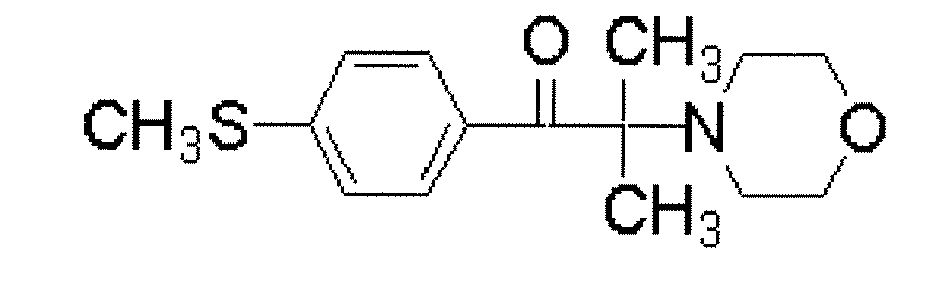
- (2-Chlorothioxanthone)
- Comparative Compound 1

-
Table 4 Example 8 Example 9 Example 10 Example 11 Comparative Example 7 Comparative Example 8 (C) Polymerizable compound Polyester diacrylate 100g 100g 100g 100g 100g 100g (B) Polymerization initiator Irgacure 907 2.0g 2.0g - 0.7g 3.0g 2.0g Exemplary Compound (P-2) - - 2.0g 1.3g - - Sensitizing dye Exemplary Compound (I-14) 1.0g - 1.0g 1.0g - - Exemplary Compound (I-15) - 1.0g - - - - Comparative Compound 1 - - - - - 1.0g Surfactant Sodium dodecylsulfate 5g 5g 5g 5g 5g 5g Ethyl acetate 200g 200g 200g 200g 200g 200g Water 500ml 500ml 500ml 500ml 500ml 500ml Integrated light exposure (mJ/cm2) 600 720 660 540 1200 600 Evaluation results Curability good good good good not good good Jetting stability A A A A A C - As shown in Table 4, it can be seen that the ink compositions of the invention in Examples 8 to 11 are excellent in curability even with a low exposure, as compared with Comparative Example 7 where the sensitizing dye was not used. It can also be seen that the composition in Comparative Example 8 where the generally used thioxanthone compound was used as the sensitizing dye improves curability but is problematic in jetting stability when used in inkjet recording. The comparison between Example 8 and Example 9 indicates that the composition using, as the specific sensitizing dye, a sensitizing dye having a halogen atom in a molecule is superior in curability.
wherein the polymerizable compound is present in an emulsified state in the ink composition.
Claims (11)
- An aqueous ink composition comprising at least:a sensitizing dye represented by the following Formula (i);an ethylenically unsaturated bond-containing water-soluble polymerizable compound;a polymerization initiator; andwater:wherein, in Formula (i), X represents O, S or NR; n represents an integer of 0 or 1; R represents a hydrogen atom, an alkyl group or an acyl group; each of R1, R2, R3, R4, R5, R6, R7 and R8 independently represents a hydrogen atom or a monovalent substituent, provided that any neighboring two of R1, R2, R3 and R4 may be bonded to each other to form a ring, and R5 and R7 or R8, or R6 and R7 or R8, may be bonded to each other to form an aliphatic ring but do not form an aromatic ring.

- The aqueous ink composition of claim 1, wherein at least one of R1, R2, R3, R4, R5, R6, R7 and R8 in the sensitizing dye represented by Formula (i) is a substituent having a carboxyl group or a salt thereof.
- The aqueous ink composition of claim 1, wherein the ethylenically unsaturated bond-containing water-soluble polymerizable compound is at least one selected from the group consisting of an unsaturated carboxylic acid, an unsaturated carboxylate, and a compound having both a poly(alkyleneoxy) group and an ethylenically unsaturated group.
- The aqueous ink composition of claim 1, wherein the polymerization initiator is a water-soluble polymerization initiator.
- The aqueous ink composition of claim 1, wherein the polymerization initiator is at least one selected from the group consisting of α-aminoketones and acylphosphine oxides.
- The aqueous ink composition of claim 1, further comprising a colorant.
- An inkjet recording method, comprising:(a) jetting the aqueous ink composition of claim 1 onto a recording medium, and(b) irradiating the jetted aqueous ink composition with active irradiation to cure the aqueous ink composition.
- An ink composition comprising:a sensitizing dye represented by the following Formula (i);a polymerization initiator;an ethylenically unsaturated bond-containing water-soluble polymerizable compound; andwater:
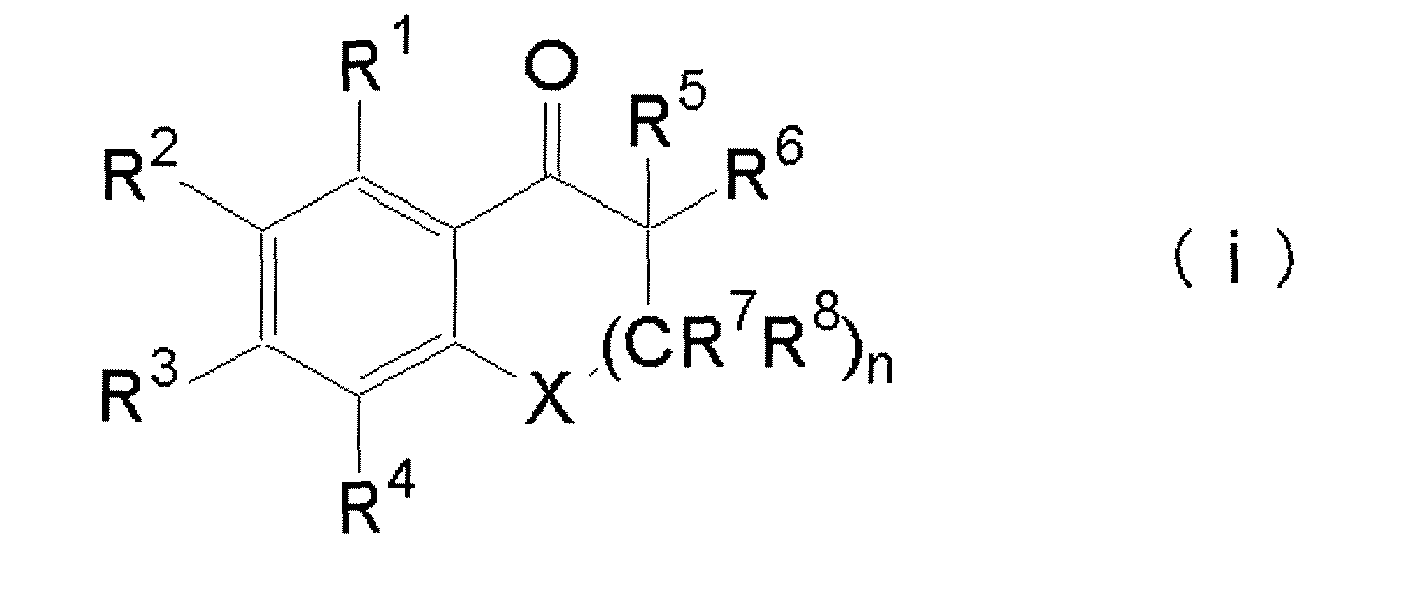 wherein, in Formula (i), X represents O, S or NR, where R represents a hydrogen atom, an alkyl group or an acyl group; n represents 0 or 1; each of R1 to R8 independently represents a hydrogen atom or a monovalent substituent, provided that any neighboring two of R1, R2, R3 and R4 may be bonded to each other to form a ring, and R5 and R7 or R8, or R6 and R7 or R8, may be bonded to each other to form an aliphatic ring but do not form an aromatic ring, andwherein the polymerizable compound is present in an emulsified state in the ink composition.
 - The ink composition of claim 8, wherein the polymerization initiator comprises at least one selected from the group consisting of α-aminoketones and acylphosphine oxides.
- The ink composition of claim 8, further comprising a colorant which is a pigment.
- An inkjet recording method, comprising:(a) jetting the ink comp osition of claim 8 onto a recording medium, and(b) irradiating the jetted ink composition with active irradiation to cure the ink composition.
Applications Claiming Priority (2)
| Application Number | Priority Date | Filing Date | Title |
|---|---|---|---|
| JP2008185207A JP5258429B2 (en) | 2008-07-16 | 2008-07-16 | Ink composition and ink jet recording method using the same |
| JP2008184510A JP5258428B2 (en) | 2008-07-16 | 2008-07-16 | Aqueous ink composition, aqueous ink composition for inkjet recording, and inkjet recording method |
Publications (2)
| Publication Number | Publication Date |
|---|---|
| EP2145932A1 true EP2145932A1 (en) | 2010-01-20 |
| EP2145932B1 EP2145932B1 (en) | 2013-11-20 |
Family
ID=41170965
Family Applications (1)
| Application Number | Title | Priority Date | Filing Date |
|---|---|---|---|
| EP09165361.8A Not-in-force EP2145932B1 (en) | 2008-07-16 | 2009-07-14 | Aqueous ink composition, aqueous ink composition for inkjet recording, and inkjet recording method |
Country Status (2)
| Country | Link |
|---|---|
| US (1) | US8378002B2 (en) |
| EP (1) | EP2145932B1 (en) |
Cited By (2)
| Publication number | Priority date | Publication date | Assignee | Title |
|---|---|---|---|---|
| EP3000853A1 (en) * | 2014-09-29 | 2016-03-30 | Agfa-Gevaert | Etch-resistant inkjet inks for manufacturing conductive patterns |
| US12409666B2 (en) | 2020-10-08 | 2025-09-09 | Canon Kabushiki Kaisha | Ink jet printing method, ink jet printing apparatus, method of producing porous body, and apparatus for producing porous body |
Families Citing this family (16)
| Publication number | Priority date | Publication date | Assignee | Title |
|---|---|---|---|---|
| CN102336081A (en) * | 2010-05-19 | 2012-02-01 | 富士胶片株式会社 | Printing method, method for preparing overprint, method for processing laminate, light-emitting diode curable coating composition, and light-emitting diode curable ink composition |
| US20130189499A1 (en) * | 2012-01-24 | 2013-07-25 | Thomas Nelson Blanton | Antibacterial and antifungal protection for ink jet image |
| US20130186301A1 (en) * | 2012-01-24 | 2013-07-25 | Thomas Nelson Blanton | Ink having antibacterial and antifungal protection |
| US9822275B2 (en) | 2013-03-15 | 2017-11-21 | Valspar Sourcing, Inc. | Water-based compositions that resist dirt pick-up |
| US10221322B2 (en) | 2013-03-15 | 2019-03-05 | The Sherwin-Williams Company | Dirt pick-up resistant composition |
| US10196537B2 (en) | 2013-03-15 | 2019-02-05 | The Sherwin-Williams Company | Dirt pick-up resistant composition |
| EP3191553A4 (en) | 2014-09-12 | 2018-08-22 | Valspar Sourcing, Inc. | Water-based coating compositions that resist dirt pickup |
| US10071353B2 (en) | 2015-01-29 | 2018-09-11 | Hewlett-Packard Development Company, L.P. | Aqueous dispersant formulation |
| US10882245B2 (en) * | 2015-07-06 | 2021-01-05 | Ricoh Company, Ltd. | Method of manufacturing three-dimensional object, liquid set for manufacturing three-dimensional object, device for manufacturing three-dimensional object, and gel object |
| JP6638125B2 (en) * | 2015-07-08 | 2020-01-29 | 株式会社ミマキエンジニアリング | Method for producing ink composition and printed matter |
| JP6901292B2 (en) * | 2017-03-15 | 2021-07-14 | 株式会社Adeka | A water-soluble composition, a method for producing a cured product thereof, a cured product thereof, and an acylphosphinate. |
| CN107474182A (en) * | 2017-08-02 | 2017-12-15 | 李晖 | A kind of method that fluororesin is prepared using micro passage reaction |
| WO2019232051A1 (en) | 2018-05-29 | 2019-12-05 | Swimc Llc | Water-based compositions with long term gloss retention |
| US11572483B2 (en) * | 2019-04-10 | 2023-02-07 | Xerox Corporation | Aqueous ink compositions for inkjet printing on non-porous substrates |
| JP7443386B2 (en) * | 2019-09-30 | 2024-03-05 | 富士フイルム株式会社 | Ink set and printing method for textile printing |
| EP3828242A1 (en) | 2019-11-29 | 2021-06-02 | TIGER Coatings GmbH & Co. KG | Aqueous inkjet ink and use thereof |
Citations (54)
| Publication number | Priority date | Publication date | Assignee | Title |
|---|---|---|---|---|
| US4134813A (en) | 1976-12-24 | 1979-01-16 | Basf Aktiengesellschaft | Photopolymerizable composition and its use |
| US4313124A (en) | 1979-05-18 | 1982-01-26 | Canon Kabushiki Kaisha | Liquid jet recording process and liquid jet recording head |
| JPS5774193A (en) | 1980-10-28 | 1982-05-10 | Fuji Photo Film Co Ltd | Ink jet recording picture forming method |
| JPS5774192A (en) | 1980-10-28 | 1982-05-10 | Fuji Photo Film Co Ltd | Ink jet recording picture forming method |
| JPS5787989A (en) | 1980-11-21 | 1982-06-01 | Matsushita Electric Ind Co Ltd | Ink jet recording paper |
| JPS5787988A (en) | 1980-11-21 | 1982-06-01 | Matsushita Electric Ind Co Ltd | Ink jet recording paper |
| US4345262A (en) | 1979-02-19 | 1982-08-17 | Canon Kabushiki Kaisha | Ink jet recording method |
| JPS5942993A (en) | 1982-09-03 | 1984-03-09 | Canon Inc | Ink jet recording method |
| JPS5952689A (en) | 1982-09-17 | 1984-03-27 | Mitsubishi Paper Mills Ltd | Recording paper |
| US4459600A (en) | 1978-10-31 | 1984-07-10 | Canon Kabushiki Kaisha | Liquid jet recording device |
| JPS59123670A (en) | 1982-12-28 | 1984-07-17 | Canon Inc | Ink jet head |
| US4463359A (en) | 1979-04-02 | 1984-07-31 | Canon Kabushiki Kaisha | Droplet generating method and apparatus thereof |
| JPS6072785A (en) | 1983-09-30 | 1985-04-24 | Nippon Shokubai Kagaku Kogyo Co Ltd | Ink jet recording paper |
| JPS60132767A (en) | 1983-12-21 | 1985-07-15 | Seikosha Co Ltd | Inkjet printer |
| US4558333A (en) | 1981-07-09 | 1985-12-10 | Canon Kabushiki Kaisha | Liquid jet recording head |
| JPS61146591A (en) | 1984-12-20 | 1986-07-04 | Mitsubishi Paper Mills Ltd | Ink jet recording medium |
| JPS61242871A (en) | 1985-04-22 | 1986-10-29 | Canon Inc | Recording material |
| JPS62261476A (en) | 1986-05-08 | 1987-11-13 | Canon Inc | Recording material and recording method using the same |
| JPS62280069A (en) | 1986-05-30 | 1987-12-04 | Canon Inc | Recording material |
| US4723129A (en) | 1977-10-03 | 1988-02-02 | Canon Kabushiki Kaisha | Bubble jet recording method and apparatus in which a heating element generates bubbles in a liquid flow path to project droplets |
| JPS6340799B2 (en) | 1978-07-14 | 1988-08-12 | Basf Ag | |
| JPH0195091A (en) | 1987-10-08 | 1989-04-13 | Asahi Glass Co Ltd | Manufacture of ink jet recording medium |
| JPH01253731A (en) | 1988-04-01 | 1989-10-11 | Canon Inc | Photopolymerizable composition and recording medium using same |
| JPH02255677A (en) | 1989-03-27 | 1990-10-16 | Taisho Pharmaceut Co Ltd | 4-thiochromanone derivative |
| JPH0313376A (en) | 1989-06-09 | 1991-01-22 | Canon Inc | Recording material and inkjet recording method using the same |
| JPH04219266A (en) | 1990-11-30 | 1992-08-10 | Oji Paper Co Ltd | Ink jet recording paper |
| JPH0529234B2 (en) | 1984-11-27 | 1993-04-28 | Esupe Fuaburiiku Fuarumatsuoiteitsusheru Pureparaate Gmbh Unto Co Kg | |
| JPH06308727A (en) | 1993-04-19 | 1994-11-04 | Fuji Photo Film Co Ltd | Photopolymerizable composition |
| WO1997048769A1 (en) | 1996-06-17 | 1997-12-24 | Cabot Corporation | Colored pigment and aqueous compositions containing same |
| JPH1029997A (en) | 1996-03-04 | 1998-02-03 | Ciba Specialty Chem Holding Inc | Alkylphenyl bisacylphosphine oxide and photoinitiator mixture |
| JPH1095788A (en) | 1996-08-28 | 1998-04-14 | Ciba Specialty Chem Holding Inc | Molecular complex compounds as photoinitiators |
| JPH10110129A (en) | 1996-10-07 | 1998-04-28 | Toyo Ink Mfg Co Ltd | Inkjet recording liquid |
| JPH1149974A (en) | 1996-12-20 | 1999-02-23 | Seiko Epson Corp | Pigment bulk material and production thereof, pigment aqueous dispersion and aqueous ink composition |
| JPH1157458A (en) | 1997-08-14 | 1999-03-02 | Stanley Electric Co Ltd | Ultrafine particle manufacturing method and modified ultrafine particle material |
| JPH11188870A (en) | 1997-12-26 | 1999-07-13 | Canon Inc | Liquid ejection method |
| JPH11189739A (en) | 1997-10-22 | 1999-07-13 | Orient Chem Ind Ltd | Aqueous pigment ink composition |
| JPH11246807A (en) | 1998-03-02 | 1999-09-14 | Toyo Ink Mfg Co Ltd | Aqueous pigment dispersion and recording liquid for inkjet |
| JP2962880B2 (en) | 1991-07-10 | 1999-10-12 | キヤノン株式会社 | Liquid jet recording method, liquid jet recording head, and recording apparatus |
| WO1999054415A1 (en) | 1998-04-15 | 1999-10-28 | Nof Corporation | Method for formation of coating film and coating composition |
| JPH11323232A (en) | 1998-05-13 | 1999-11-26 | Toyo Ink Mfg Co Ltd | Inkjet recording liquid and recording method using the same |
| GB2339571A (en) | 1998-06-26 | 2000-02-02 | Ciba Sc Holding Ag | O-Acyloxime compounds as photoinitiators |
| US6084250A (en) | 1997-03-03 | 2000-07-04 | U.S. Philips Corporation | White light emitting diode |
| JP2000265094A (en) | 1999-03-11 | 2000-09-26 | Sharp Corp | Yellow recording liquid, method for producing and using the same |
| JP2000273383A (en) | 1999-03-23 | 2000-10-03 | Toyo Ink Mfg Co Ltd | Aqueous pigment dispersion and recording liquid for inkjet |
| JP2000303014A (en) | 1999-04-19 | 2000-10-31 | Toyo Ink Mfg Co Ltd | Aqueous pigment dispersion and recording liquid for inkjet |
| JP2001001495A (en) | 1999-06-24 | 2001-01-09 | Toppan Printing Co Ltd | Blanket dirt prevention apparatus and blanket dirt prevention method using the same |
| EP1126541A1 (en) | 2000-02-01 | 2001-08-22 | Murata Manufacturing Co., Ltd. | Filter, duplexer, and communication device |
| JP2001234966A (en) | 1999-12-30 | 2001-08-31 | Diebolt Internatl Inc | Gas spring having little impact |
| JP3246949B2 (en) | 1991-08-12 | 2002-01-15 | キヤノン株式会社 | Injection recording method |
| JP2004189695A (en) | 2002-12-13 | 2004-07-08 | National Institute Of Advanced Industrial & Technology | Method for producing chromanones or thiochromanones |
| JP2004285216A (en) | 2003-03-24 | 2004-10-14 | Konica Minolta Holdings Inc | Ink set, and inkjet recording method using the same |
| JP2005307199A (en) | 2004-03-26 | 2005-11-04 | Canon Inc | Active energy ray-curable aqueous ink composition, ink jet recording method, ink cartridge, recording unit and ink jet recording apparatus using the same |
| US20050288384A1 (en) * | 2004-03-26 | 2005-12-29 | Canon Kabushiki Kaisha | Active energy ray curable aqueous ink, and ink-jet recording process, ink cartridge, recording unit and ink-jet recording apparatus using the same |
| EP1944173A1 (en) * | 2007-01-15 | 2008-07-16 | FUJIFILM Corporation | Ink composition and inkjet recording method using the same |
Family Cites Families (1)
| Publication number | Priority date | Publication date | Assignee | Title |
|---|---|---|---|---|
| US7037953B2 (en) * | 2000-03-29 | 2006-05-02 | Sun Chemical Corporation | Radiation curable aqueous compositions |
-
2009
- 2009-07-08 US US12/499,091 patent/US8378002B2/en not_active Expired - Fee Related
- 2009-07-14 EP EP09165361.8A patent/EP2145932B1/en not_active Not-in-force
Patent Citations (55)
| Publication number | Priority date | Publication date | Assignee | Title |
|---|---|---|---|---|
| US4134813A (en) | 1976-12-24 | 1979-01-16 | Basf Aktiengesellschaft | Photopolymerizable composition and its use |
| US4723129A (en) | 1977-10-03 | 1988-02-02 | Canon Kabushiki Kaisha | Bubble jet recording method and apparatus in which a heating element generates bubbles in a liquid flow path to project droplets |
| US4740796A (en) | 1977-10-03 | 1988-04-26 | Canon Kabushiki Kaisha | Bubble jet recording method and apparatus in which a heating element generates bubbles in multiple liquid flow paths to project droplets |
| JPS6340799B2 (en) | 1978-07-14 | 1988-08-12 | Basf Ag | |
| US4459600A (en) | 1978-10-31 | 1984-07-10 | Canon Kabushiki Kaisha | Liquid jet recording device |
| US4345262A (en) | 1979-02-19 | 1982-08-17 | Canon Kabushiki Kaisha | Ink jet recording method |
| US4463359A (en) | 1979-04-02 | 1984-07-31 | Canon Kabushiki Kaisha | Droplet generating method and apparatus thereof |
| US4313124A (en) | 1979-05-18 | 1982-01-26 | Canon Kabushiki Kaisha | Liquid jet recording process and liquid jet recording head |
| JPS5774193A (en) | 1980-10-28 | 1982-05-10 | Fuji Photo Film Co Ltd | Ink jet recording picture forming method |
| JPS5774192A (en) | 1980-10-28 | 1982-05-10 | Fuji Photo Film Co Ltd | Ink jet recording picture forming method |
| JPS5787989A (en) | 1980-11-21 | 1982-06-01 | Matsushita Electric Ind Co Ltd | Ink jet recording paper |
| JPS5787988A (en) | 1980-11-21 | 1982-06-01 | Matsushita Electric Ind Co Ltd | Ink jet recording paper |
| US4558333A (en) | 1981-07-09 | 1985-12-10 | Canon Kabushiki Kaisha | Liquid jet recording head |
| JPS5942993A (en) | 1982-09-03 | 1984-03-09 | Canon Inc | Ink jet recording method |
| JPS5952689A (en) | 1982-09-17 | 1984-03-27 | Mitsubishi Paper Mills Ltd | Recording paper |
| JPS59123670A (en) | 1982-12-28 | 1984-07-17 | Canon Inc | Ink jet head |
| JPS6072785A (en) | 1983-09-30 | 1985-04-24 | Nippon Shokubai Kagaku Kogyo Co Ltd | Ink jet recording paper |
| JPS60132767A (en) | 1983-12-21 | 1985-07-15 | Seikosha Co Ltd | Inkjet printer |
| JPH0529234B2 (en) | 1984-11-27 | 1993-04-28 | Esupe Fuaburiiku Fuarumatsuoiteitsusheru Pureparaate Gmbh Unto Co Kg | |
| JPS61146591A (en) | 1984-12-20 | 1986-07-04 | Mitsubishi Paper Mills Ltd | Ink jet recording medium |
| JPS61242871A (en) | 1985-04-22 | 1986-10-29 | Canon Inc | Recording material |
| JPS62261476A (en) | 1986-05-08 | 1987-11-13 | Canon Inc | Recording material and recording method using the same |
| JPS62280069A (en) | 1986-05-30 | 1987-12-04 | Canon Inc | Recording material |
| JPH0195091A (en) | 1987-10-08 | 1989-04-13 | Asahi Glass Co Ltd | Manufacture of ink jet recording medium |
| JPH01253731A (en) | 1988-04-01 | 1989-10-11 | Canon Inc | Photopolymerizable composition and recording medium using same |
| JPH02255677A (en) | 1989-03-27 | 1990-10-16 | Taisho Pharmaceut Co Ltd | 4-thiochromanone derivative |
| JPH0313376A (en) | 1989-06-09 | 1991-01-22 | Canon Inc | Recording material and inkjet recording method using the same |
| JPH04219266A (en) | 1990-11-30 | 1992-08-10 | Oji Paper Co Ltd | Ink jet recording paper |
| JP2962880B2 (en) | 1991-07-10 | 1999-10-12 | キヤノン株式会社 | Liquid jet recording method, liquid jet recording head, and recording apparatus |
| JP3246949B2 (en) | 1991-08-12 | 2002-01-15 | キヤノン株式会社 | Injection recording method |
| JPH06308727A (en) | 1993-04-19 | 1994-11-04 | Fuji Photo Film Co Ltd | Photopolymerizable composition |
| JPH1029997A (en) | 1996-03-04 | 1998-02-03 | Ciba Specialty Chem Holding Inc | Alkylphenyl bisacylphosphine oxide and photoinitiator mixture |
| WO1997048769A1 (en) | 1996-06-17 | 1997-12-24 | Cabot Corporation | Colored pigment and aqueous compositions containing same |
| JPH1095788A (en) | 1996-08-28 | 1998-04-14 | Ciba Specialty Chem Holding Inc | Molecular complex compounds as photoinitiators |
| JPH10110129A (en) | 1996-10-07 | 1998-04-28 | Toyo Ink Mfg Co Ltd | Inkjet recording liquid |
| JPH1149974A (en) | 1996-12-20 | 1999-02-23 | Seiko Epson Corp | Pigment bulk material and production thereof, pigment aqueous dispersion and aqueous ink composition |
| US6084250A (en) | 1997-03-03 | 2000-07-04 | U.S. Philips Corporation | White light emitting diode |
| JPH1157458A (en) | 1997-08-14 | 1999-03-02 | Stanley Electric Co Ltd | Ultrafine particle manufacturing method and modified ultrafine particle material |
| JPH11189739A (en) | 1997-10-22 | 1999-07-13 | Orient Chem Ind Ltd | Aqueous pigment ink composition |
| JPH11188870A (en) | 1997-12-26 | 1999-07-13 | Canon Inc | Liquid ejection method |
| JPH11246807A (en) | 1998-03-02 | 1999-09-14 | Toyo Ink Mfg Co Ltd | Aqueous pigment dispersion and recording liquid for inkjet |
| WO1999054415A1 (en) | 1998-04-15 | 1999-10-28 | Nof Corporation | Method for formation of coating film and coating composition |
| JPH11323232A (en) | 1998-05-13 | 1999-11-26 | Toyo Ink Mfg Co Ltd | Inkjet recording liquid and recording method using the same |
| GB2339571A (en) | 1998-06-26 | 2000-02-02 | Ciba Sc Holding Ag | O-Acyloxime compounds as photoinitiators |
| JP2000265094A (en) | 1999-03-11 | 2000-09-26 | Sharp Corp | Yellow recording liquid, method for producing and using the same |
| JP2000273383A (en) | 1999-03-23 | 2000-10-03 | Toyo Ink Mfg Co Ltd | Aqueous pigment dispersion and recording liquid for inkjet |
| JP2000303014A (en) | 1999-04-19 | 2000-10-31 | Toyo Ink Mfg Co Ltd | Aqueous pigment dispersion and recording liquid for inkjet |
| JP2001001495A (en) | 1999-06-24 | 2001-01-09 | Toppan Printing Co Ltd | Blanket dirt prevention apparatus and blanket dirt prevention method using the same |
| JP2001234966A (en) | 1999-12-30 | 2001-08-31 | Diebolt Internatl Inc | Gas spring having little impact |
| EP1126541A1 (en) | 2000-02-01 | 2001-08-22 | Murata Manufacturing Co., Ltd. | Filter, duplexer, and communication device |
| JP2004189695A (en) | 2002-12-13 | 2004-07-08 | National Institute Of Advanced Industrial & Technology | Method for producing chromanones or thiochromanones |
| JP2004285216A (en) | 2003-03-24 | 2004-10-14 | Konica Minolta Holdings Inc | Ink set, and inkjet recording method using the same |
| JP2005307199A (en) | 2004-03-26 | 2005-11-04 | Canon Inc | Active energy ray-curable aqueous ink composition, ink jet recording method, ink cartridge, recording unit and ink jet recording apparatus using the same |
| US20050288384A1 (en) * | 2004-03-26 | 2005-12-29 | Canon Kabushiki Kaisha | Active energy ray curable aqueous ink, and ink-jet recording process, ink cartridge, recording unit and ink-jet recording apparatus using the same |
| EP1944173A1 (en) * | 2007-01-15 | 2008-07-16 | FUJIFILM Corporation | Ink composition and inkjet recording method using the same |
Non-Patent Citations (6)
| Title |
|---|
| "Kaimen to Koroido", 1977, CHEMICAL SOCIETY OF JAPAN AND PUBLISHED BY MARUZEN CO., LTD., article "Shinjikken Kagaku Koza", pages: 68 - 117 |
| BRUCE M. MONROE ET AL., CHEMICAL REVIEW, vol. 93, 1993, pages 435 - 448 |
| JOURNAL OF ORGANIC CHEMISTRY, 1945, pages 893 |
| JOURNAL OF ORGANIC CHEMISTRY, 1965, pages 4934 |
| JOURNAL OF ORGANIC CHEMISTRY, 1965, pages 4939 |
| TETRAHEDRON, vol. 49, 1993, pages 939 |
Cited By (7)
| Publication number | Priority date | Publication date | Assignee | Title |
|---|---|---|---|---|
| EP3000853A1 (en) * | 2014-09-29 | 2016-03-30 | Agfa-Gevaert | Etch-resistant inkjet inks for manufacturing conductive patterns |
| WO2016050371A1 (en) * | 2014-09-29 | 2016-04-07 | Agfa-Gevaert | Digital fabrication of metallic articles |
| WO2016050372A1 (en) * | 2014-09-29 | 2016-04-07 | Agfa Graphics Nv | Methods of manufacturing embossing elements |
| WO2016050504A1 (en) * | 2014-09-29 | 2016-04-07 | Agfa-Gevaert | Etch-resistant inkjet inks for manufacturing conductive patterns |
| US9938420B2 (en) | 2014-09-29 | 2018-04-10 | Agfa-Gevaert | Digital fabrication of metallic articles |
| US10662532B2 (en) | 2014-09-29 | 2020-05-26 | Agfa-Gevaert N.V. | Methods of manufacturing embossing elements |
| US12409666B2 (en) | 2020-10-08 | 2025-09-09 | Canon Kabushiki Kaisha | Ink jet printing method, ink jet printing apparatus, method of producing porous body, and apparatus for producing porous body |
Also Published As
| Publication number | Publication date |
|---|---|
| EP2145932B1 (en) | 2013-11-20 |
| US8378002B2 (en) | 2013-02-19 |
| US20100015360A1 (en) | 2010-01-21 |
Similar Documents
| Publication | Publication Date | Title |
|---|---|---|
| US8378002B2 (en) | Aqueous ink composition, aqueous ink composition for inkjet recording, and inkjet recording method | |
| JP5258428B2 (en) | Aqueous ink composition, aqueous ink composition for inkjet recording, and inkjet recording method | |
| EP2471879B1 (en) | Ink set for inkjet recording, inkjet recording method, and printed material | |
| EP2423276B1 (en) | Aqueous ink composition, inkjet recording method, and inkjet printed article | |
| JP5620700B2 (en) | Ink composition for ink jet recording, ink jet recording method, and printed matter | |
| JP5244899B2 (en) | Ink composition, inkjet recording method, and printed matter | |
| JP5395721B2 (en) | Ink composition for ink jet recording, ink jet recording method, and printed matter | |
| EP2412765A1 (en) | Inkjet recording method, and printed material | |
| JP2012140491A (en) | Ink composition, inkjet recording method, and printed material | |
| EP2415607A1 (en) | Inkjet recording method, and printed material | |
| JP2010059244A (en) | Ink composition and inkjet recording method | |
| EP2995658B1 (en) | Polymerizable composition, ink composition for inkjet recording, inkkjet recording method and recorded matter | |
| JP2011208088A (en) | Active energy ray curable composition, active energy ray curable ink composition, inkjet recording method, and printed matter | |
| EP2546311B1 (en) | Inkjet ink composition and inkjet recording method | |
| JP5241211B2 (en) | Ink composition and inkjet recording method | |
| JP2008024830A (en) | Inkjet ink and inkjet recording method | |
| JP5258429B2 (en) | Ink composition and ink jet recording method using the same | |
| JP2010006977A (en) | Photocurable composition, ink composition, and inkjet recording method using the ink composition | |
| EP2626391A2 (en) | Ink composition for inkjet recording, inkjet recording method, and printed material | |
| JP5224694B2 (en) | Ink composition for ink jet recording and ink jet recording method | |
| JP2015047746A (en) | Image forming method | |
| EP1767597B1 (en) | Ink-jet ink, ink-jet ink set and ink-jet recording method | |
| JP5159118B2 (en) | Ink composition and ink jet recording method using the same | |
| JP5623933B2 (en) | Inkjet recording method and printed matter | |
| JP2008297483A (en) | Ink for inkjet and inkjet recording method |
Legal Events
| Date | Code | Title | Description |
|---|---|---|---|
| PUAI | Public reference made under article 153(3) epc to a published international application that has entered the european phase |
Free format text: ORIGINAL CODE: 0009012 |
|
| AK | Designated contracting states |
Kind code of ref document: A1 Designated state(s): AT BE BG CH CY CZ DE DK EE ES FI FR GB GR HR HU IE IS IT LI LT LU LV MC MK MT NL NO PL PT RO SE SI SK SM TR |
|
| AX | Request for extension of the european patent |
Extension state: AL BA RS |
|
| 17P | Request for examination filed |
Effective date: 20100720 |
|
| 17Q | First examination report despatched |
Effective date: 20110316 |
|
| GRAP | Despatch of communication of intention to grant a patent |
Free format text: ORIGINAL CODE: EPIDOSNIGR1 |
|
| GRAS | Grant fee paid |
Free format text: ORIGINAL CODE: EPIDOSNIGR3 |
|
| GRAA | (expected) grant |
Free format text: ORIGINAL CODE: 0009210 |
|
| AK | Designated contracting states |
Kind code of ref document: B1 Designated state(s): AT BE BG CH CY CZ DE DK EE ES FI FR GB GR HR HU IE IS IT LI LT LU LV MC MK MT NL NO PL PT RO SE SI SK SM TR |
|
| REG | Reference to a national code |
Ref country code: GB Ref legal event code: FG4D |
|
| REG | Reference to a national code |
Ref country code: CH Ref legal event code: EP |
|
| REG | Reference to a national code |
Ref country code: AT Ref legal event code: REF Ref document number: 641643 Country of ref document: AT Kind code of ref document: T Effective date: 20131215 |
|
| REG | Reference to a national code |
Ref country code: IE Ref legal event code: FG4D |
|
| REG | Reference to a national code |
Ref country code: DE Ref legal event code: R096 Ref document number: 602009020180 Country of ref document: DE Effective date: 20140116 |
|
| REG | Reference to a national code |
Ref country code: NL Ref legal event code: VDEP Effective date: 20131120 |
|
| REG | Reference to a national code |
Ref country code: AT Ref legal event code: MK05 Ref document number: 641643 Country of ref document: AT Kind code of ref document: T Effective date: 20131120 |
|
| REG | Reference to a national code |
Ref country code: LT Ref legal event code: MG4D |
|
| PG25 | Lapsed in a contracting state [announced via postgrant information from national office to epo] |
Ref country code: NO Free format text: LAPSE BECAUSE OF FAILURE TO SUBMIT A TRANSLATION OF THE DESCRIPTION OR TO PAY THE FEE WITHIN THE PRESCRIBED TIME-LIMIT Effective date: 20140220 Ref country code: FI Free format text: LAPSE BECAUSE OF FAILURE TO SUBMIT A TRANSLATION OF THE DESCRIPTION OR TO PAY THE FEE WITHIN THE PRESCRIBED TIME-LIMIT Effective date: 20131120 Ref country code: NL Free format text: LAPSE BECAUSE OF FAILURE TO SUBMIT A TRANSLATION OF THE DESCRIPTION OR TO PAY THE FEE WITHIN THE PRESCRIBED TIME-LIMIT Effective date: 20131120 Ref country code: HR Free format text: LAPSE BECAUSE OF FAILURE TO SUBMIT A TRANSLATION OF THE DESCRIPTION OR TO PAY THE FEE WITHIN THE PRESCRIBED TIME-LIMIT Effective date: 20131120 Ref country code: SE Free format text: LAPSE BECAUSE OF FAILURE TO SUBMIT A TRANSLATION OF THE DESCRIPTION OR TO PAY THE FEE WITHIN THE PRESCRIBED TIME-LIMIT Effective date: 20131120 Ref country code: IS Free format text: LAPSE BECAUSE OF FAILURE TO SUBMIT A TRANSLATION OF THE DESCRIPTION OR TO PAY THE FEE WITHIN THE PRESCRIBED TIME-LIMIT Effective date: 20140320 Ref country code: LT Free format text: LAPSE BECAUSE OF FAILURE TO SUBMIT A TRANSLATION OF THE DESCRIPTION OR TO PAY THE FEE WITHIN THE PRESCRIBED TIME-LIMIT Effective date: 20131120 |
|
| PG25 | Lapsed in a contracting state [announced via postgrant information from national office to epo] |
Ref country code: LV Free format text: LAPSE BECAUSE OF FAILURE TO SUBMIT A TRANSLATION OF THE DESCRIPTION OR TO PAY THE FEE WITHIN THE PRESCRIBED TIME-LIMIT Effective date: 20131120 Ref country code: BE Free format text: LAPSE BECAUSE OF FAILURE TO SUBMIT A TRANSLATION OF THE DESCRIPTION OR TO PAY THE FEE WITHIN THE PRESCRIBED TIME-LIMIT Effective date: 20131120 Ref country code: ES Free format text: LAPSE BECAUSE OF FAILURE TO SUBMIT A TRANSLATION OF THE DESCRIPTION OR TO PAY THE FEE WITHIN THE PRESCRIBED TIME-LIMIT Effective date: 20131120 Ref country code: AT Free format text: LAPSE BECAUSE OF FAILURE TO SUBMIT A TRANSLATION OF THE DESCRIPTION OR TO PAY THE FEE WITHIN THE PRESCRIBED TIME-LIMIT Effective date: 20131120 |
|
| PG25 | Lapsed in a contracting state [announced via postgrant information from national office to epo] |
Ref country code: PT Free format text: LAPSE BECAUSE OF FAILURE TO SUBMIT A TRANSLATION OF THE DESCRIPTION OR TO PAY THE FEE WITHIN THE PRESCRIBED TIME-LIMIT Effective date: 20140320 |
|
| PG25 | Lapsed in a contracting state [announced via postgrant information from national office to epo] |
Ref country code: EE Free format text: LAPSE BECAUSE OF FAILURE TO SUBMIT A TRANSLATION OF THE DESCRIPTION OR TO PAY THE FEE WITHIN THE PRESCRIBED TIME-LIMIT Effective date: 20131120 |
|
| REG | Reference to a national code |
Ref country code: DE Ref legal event code: R097 Ref document number: 602009020180 Country of ref document: DE |
|
| PG25 | Lapsed in a contracting state [announced via postgrant information from national office to epo] |
Ref country code: CZ Free format text: LAPSE BECAUSE OF FAILURE TO SUBMIT A TRANSLATION OF THE DESCRIPTION OR TO PAY THE FEE WITHIN THE PRESCRIBED TIME-LIMIT Effective date: 20131120 Ref country code: PL Free format text: LAPSE BECAUSE OF FAILURE TO SUBMIT A TRANSLATION OF THE DESCRIPTION OR TO PAY THE FEE WITHIN THE PRESCRIBED TIME-LIMIT Effective date: 20131120 Ref country code: RO Free format text: LAPSE BECAUSE OF FAILURE TO SUBMIT A TRANSLATION OF THE DESCRIPTION OR TO PAY THE FEE WITHIN THE PRESCRIBED TIME-LIMIT Effective date: 20131120 Ref country code: SK Free format text: LAPSE BECAUSE OF FAILURE TO SUBMIT A TRANSLATION OF THE DESCRIPTION OR TO PAY THE FEE WITHIN THE PRESCRIBED TIME-LIMIT Effective date: 20131120 |
|
| PLBE | No opposition filed within time limit |
Free format text: ORIGINAL CODE: 0009261 |
|
| STAA | Information on the status of an ep patent application or granted ep patent |
Free format text: STATUS: NO OPPOSITION FILED WITHIN TIME LIMIT |
|
| PG25 | Lapsed in a contracting state [announced via postgrant information from national office to epo] |
Ref country code: DK Free format text: LAPSE BECAUSE OF FAILURE TO SUBMIT A TRANSLATION OF THE DESCRIPTION OR TO PAY THE FEE WITHIN THE PRESCRIBED TIME-LIMIT Effective date: 20131120 |
|
| 26N | No opposition filed |
Effective date: 20140821 |
|
| REG | Reference to a national code |
Ref country code: DE Ref legal event code: R097 Ref document number: 602009020180 Country of ref document: DE Effective date: 20140821 |
|
| PG25 | Lapsed in a contracting state [announced via postgrant information from national office to epo] |
Ref country code: LU Free format text: LAPSE BECAUSE OF FAILURE TO SUBMIT A TRANSLATION OF THE DESCRIPTION OR TO PAY THE FEE WITHIN THE PRESCRIBED TIME-LIMIT Effective date: 20140714 Ref country code: SI Free format text: LAPSE BECAUSE OF FAILURE TO SUBMIT A TRANSLATION OF THE DESCRIPTION OR TO PAY THE FEE WITHIN THE PRESCRIBED TIME-LIMIT Effective date: 20131120 |
|
| REG | Reference to a national code |
Ref country code: CH Ref legal event code: PL |
|
| REG | Reference to a national code |
Ref country code: IE Ref legal event code: MM4A |
|
| REG | Reference to a national code |
Ref country code: FR Ref legal event code: ST Effective date: 20150331 |
|
| PG25 | Lapsed in a contracting state [announced via postgrant information from national office to epo] |
Ref country code: CH Free format text: LAPSE BECAUSE OF NON-PAYMENT OF DUE FEES Effective date: 20140731 Ref country code: IT Free format text: LAPSE BECAUSE OF FAILURE TO SUBMIT A TRANSLATION OF THE DESCRIPTION OR TO PAY THE FEE WITHIN THE PRESCRIBED TIME-LIMIT Effective date: 20131120 Ref country code: LI Free format text: LAPSE BECAUSE OF NON-PAYMENT OF DUE FEES Effective date: 20140731 |
|
| PG25 | Lapsed in a contracting state [announced via postgrant information from national office to epo] |
Ref country code: FR Free format text: LAPSE BECAUSE OF NON-PAYMENT OF DUE FEES Effective date: 20140731 |
|
| PG25 | Lapsed in a contracting state [announced via postgrant information from national office to epo] |
Ref country code: IE Free format text: LAPSE BECAUSE OF NON-PAYMENT OF DUE FEES Effective date: 20140714 |
|
| PG25 | Lapsed in a contracting state [announced via postgrant information from national office to epo] |
Ref country code: MC Free format text: LAPSE BECAUSE OF FAILURE TO SUBMIT A TRANSLATION OF THE DESCRIPTION OR TO PAY THE FEE WITHIN THE PRESCRIBED TIME-LIMIT Effective date: 20131120 Ref country code: SM Free format text: LAPSE BECAUSE OF FAILURE TO SUBMIT A TRANSLATION OF THE DESCRIPTION OR TO PAY THE FEE WITHIN THE PRESCRIBED TIME-LIMIT Effective date: 20131120 |
|
| PG25 | Lapsed in a contracting state [announced via postgrant information from national office to epo] |
Ref country code: GR Free format text: LAPSE BECAUSE OF FAILURE TO SUBMIT A TRANSLATION OF THE DESCRIPTION OR TO PAY THE FEE WITHIN THE PRESCRIBED TIME-LIMIT Effective date: 20140221 Ref country code: CY Free format text: LAPSE BECAUSE OF FAILURE TO SUBMIT A TRANSLATION OF THE DESCRIPTION OR TO PAY THE FEE WITHIN THE PRESCRIBED TIME-LIMIT Effective date: 20131120 Ref country code: MT Free format text: LAPSE BECAUSE OF FAILURE TO SUBMIT A TRANSLATION OF THE DESCRIPTION OR TO PAY THE FEE WITHIN THE PRESCRIBED TIME-LIMIT Effective date: 20131120 Ref country code: BG Free format text: LAPSE BECAUSE OF FAILURE TO SUBMIT A TRANSLATION OF THE DESCRIPTION OR TO PAY THE FEE WITHIN THE PRESCRIBED TIME-LIMIT Effective date: 20131120 |
|
| PG25 | Lapsed in a contracting state [announced via postgrant information from national office to epo] |
Ref country code: HU Free format text: LAPSE BECAUSE OF FAILURE TO SUBMIT A TRANSLATION OF THE DESCRIPTION OR TO PAY THE FEE WITHIN THE PRESCRIBED TIME-LIMIT; INVALID AB INITIO Effective date: 20090714 Ref country code: TR Free format text: LAPSE BECAUSE OF FAILURE TO SUBMIT A TRANSLATION OF THE DESCRIPTION OR TO PAY THE FEE WITHIN THE PRESCRIBED TIME-LIMIT Effective date: 20131120 |
|
| PG25 | Lapsed in a contracting state [announced via postgrant information from national office to epo] |
Ref country code: MK Free format text: LAPSE BECAUSE OF FAILURE TO SUBMIT A TRANSLATION OF THE DESCRIPTION OR TO PAY THE FEE WITHIN THE PRESCRIBED TIME-LIMIT Effective date: 20131120 |
|
| PGFP | Annual fee paid to national office [announced via postgrant information from national office to epo] |
Ref country code: GB Payment date: 20210616 Year of fee payment: 13 |
|
| PGFP | Annual fee paid to national office [announced via postgrant information from national office to epo] |
Ref country code: DE Payment date: 20210616 Year of fee payment: 13 |
|
| REG | Reference to a national code |
Ref country code: DE Ref legal event code: R119 Ref document number: 602009020180 Country of ref document: DE |
|
| GBPC | Gb: european patent ceased through non-payment of renewal fee |
Effective date: 20220714 |
|
| PG25 | Lapsed in a contracting state [announced via postgrant information from national office to epo] |
Ref country code: GB Free format text: LAPSE BECAUSE OF NON-PAYMENT OF DUE FEES Effective date: 20220714 Ref country code: DE Free format text: LAPSE BECAUSE OF NON-PAYMENT OF DUE FEES Effective date: 20230201 |