EP2145447B1 - Architektur eines offenen lokalen netzwerks für audiodienstunterstützung zwischen benutzern partitionierter domänen - Google Patents
Architektur eines offenen lokalen netzwerks für audiodienstunterstützung zwischen benutzern partitionierter domänen Download PDFInfo
- Publication number
- EP2145447B1 EP2145447B1 EP08735758.8A EP08735758A EP2145447B1 EP 2145447 B1 EP2145447 B1 EP 2145447B1 EP 08735758 A EP08735758 A EP 08735758A EP 2145447 B1 EP2145447 B1 EP 2145447B1
- Authority
- EP
- European Patent Office
- Prior art keywords
- audio
- network
- security level
- marker
- filtering
- Prior art date
- Legal status (The legal status is an assumption and is not a legal conclusion. Google has not performed a legal analysis and makes no representation as to the accuracy of the status listed.)
- Active
Links
Images


Classifications
-
- H—ELECTRICITY
- H04—ELECTRIC COMMUNICATION TECHNIQUE
- H04L—TRANSMISSION OF DIGITAL INFORMATION, e.g. TELEGRAPHIC COMMUNICATION
- H04L63/00—Network architectures or network communication protocols for network security
- H04L63/02—Network architectures or network communication protocols for network security for separating internal from external traffic, e.g. firewalls
- H04L63/0227—Filtering policies
-
- H—ELECTRICITY
- H04—ELECTRIC COMMUNICATION TECHNIQUE
- H04L—TRANSMISSION OF DIGITAL INFORMATION, e.g. TELEGRAPHIC COMMUNICATION
- H04L63/00—Network architectures or network communication protocols for network security
- H04L63/10—Network architectures or network communication protocols for network security for controlling access to devices or network resources
- H04L63/105—Multiple levels of security
-
- H—ELECTRICITY
- H04—ELECTRIC COMMUNICATION TECHNIQUE
- H04L—TRANSMISSION OF DIGITAL INFORMATION, e.g. TELEGRAPHIC COMMUNICATION
- H04L65/00—Network arrangements, protocols or services for supporting real-time applications in data packet communication
- H04L65/1066—Session management
- H04L65/1076—Screening of IP real time communications, e.g. spam over Internet telephony [SPIT]
Definitions
- the invention relates to an architecture in a local area network. It concerns, in particular, the domain of open-ended multi-service Voice over IP (VoIP) networks (with access to external subscribers) of audio communication in an environment that requires security constraints.
- VoIP Voice over IP
- the exchanged data can have an audio or multimedia format.
- open local network it implies a local network allowing access to external subscribers.
- An analog type equipment N2 safety level domain is, for example, in connection with the N1 security level network N1 through one of said analog filtering gateways provided with said FISI-N2 means, said analog filtering gateway being of type A-GTW-N2, adapted to perform the necessary protocol break between the analogue and the IP protocol, the protocol break of transforming into audio signal BF audio streams received from the network N1, which are provided with said marker N2, to destination of said audio equipment and transform into audio stream encoded VoIP audio BF signals received from said analog type equipment intended for a device or an AUT terminal connected to the network N1.
- An analog type equipment N1 safety level domain is, for example, in connection with the N1 security level network N1 through one of said analog filtering gateways provided with said FISI-N1 means, said analog filter gateway being of type A-GTW-N1, adapted to perform the necessary protocol break between the analog and the IP protocol, the protocol break of transforming into audio signal BF audio streams received from the network N1, which are provided with said marker N1, to destination of said audio equipment and transform into audio stream encoded VoIP audio BF signals received from said analog type equipment intended for a device or an AUT terminal connected to the network N1.
- At least one of said ISI means positioned in an AUT terminal can be adapted to control a display, for example by means of directly connected LEDs, in order to confirm the insertion of a marker N1 or N2 in the audio stream generated towards the network N1.
- At least one of said ISI means positioned in an AUT terminal is, for example, adapted to insert said marker at a chosen period to ensure a distribution of the sub-multiple marker of the transmission period of the audio packet.
- Said markers N1 or N2 differ, for example, from each other by at least one bit, in any comparison after all circular rotations of one of the markers relative to the other.
- Said markers N1 or N2 may differ from one another by at least one bit, over any portion of a given length, at least during any comparison after all circular rotations of one of the markers relative to the other, said given length being in relation with a detection threshold, either of blocking or of transit authorization, of said audio stream, in at least one of said corresponding means FISI-N1 or FISI-N2.
- At least one of said FISI means positioned in one of said filtering gateways is, for example, adapted to transmit in the return channel of said audio stream a non-detection alert tone of the configured marker, when said marker has not been detected.
- the PTT signal may be carried either in at least one M bit encoded in the RTP protocol of said audio stream, in the RTCP signaling encoded in the RTP protocol of said audio stream, or in the audio band of the loads encoded in the RTP protocol.
- the system may include a filtering device adapted to accept a packet loss without loss of detection of marking and thus blocking of the audio stream.
- the encoding of at least one of said audio streams is, for example, performed using the G711 A-law or mu-law format.
- the protocol break consists in transmitting the signaling information and the user information received on one port of the equipment in one protocol, on another port of the equipment, in another protocol.
- ISDN protocol the VoIP-encoded audio streams received from the N1,1 network switches, N1 level, and for the IP-BX, 4, to translate the flows from the switches of the N2 level network into ISDN protocol.
- the audio streams exchanged between the ISDN ISDN-GTW-N2 filter gateway, 24, and the IP-BX, 4, are encoded streams according to the ISDN protocol well known to those skilled in the art.
- the protocol breaks implemented by analog filter gateways of the A-GTW type (A-GTW-N1 or A-GTW-N2) 17, 18, 19, 21 consist in transforming the flows into low-frequency audio signals (BF).
- IP received from the switches 1i of the network N1 for the audio equipment connected to the network concerned and to transform into IP stream the audio signals (BF) received from the audio equipment intended for the IP network.
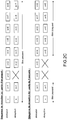
- the Figures 2A , 2B and 2C are examples of embedding markers in audio streams.
- this principle is applicable to the VoIP network using the H323 or SIP or MGCP protocols.
- This invention is applied to IP streams carrying at least one audio channel (audio stream) whose encoding is capable of being tagged which causes acceptable audio quality degradation.
- the teaching is therefore limited to such encodings and must be adapted to the particular characteristics of the encoding retained.
- the G711 encoding of the ITU-T is preferably used in A-law and / or mu-law.
- the coding of such an IP flow is carried out as the emitter of the IP flow in accordance with an IP / VoIP protocol stack and includes the implementation of a virtual channel RTP (Real Time Protocol) to ensure the transport of end-to-end audio loads in IP packets.
- the IP stream may exceptionally experience IP packet loss or mis-sequencing.
- a decoding IP / VoIP protocol stack performs the reception of the IP stream, the reordering of the charges constituting the audio stream in the limit of an anti-jitter buffer, the possible introduction of substitution charges in the event of loss of IP packet or jitter greater than the threshold allowed by the anti-jitter buffer, and restores the digital audio stream in the applicable coding law.
- a device inserted in cut-off on the audio stream integrates in the audio stream identification information, which can not be separated therefrom.
- the system comprises, for example, a marker insertion device according to the period chosen to ensure a distribution of the sub-multiple marker of the transmission period of the audio packet.
- a device inserted into a cutoff on the audio stream analyzes the audio stream and allows the passage of the latter only if the marking has been found.
- the audio signal is periodically sampled, encoded and compressed. Each sample therefore represents the instantaneous amplitude of the signal. Whatever the encoding law used, the least significant bit (LSB) of a sample is the least significant. It is therefore possible to periodically alter this last bit without significantly degrading the quality of the signal.
- LSB least significant bit
- the loss of a packet containing the audio stream can not be excluded (jitter, momentary saturation, clock slip). Therefore the inserter mechanism and mark filtering must be robust to packet loss.
- the parameters characterizing the mark are, for example, functions of the expected performances (example: latency time, signal / noise ratio), characteristics of the encoding, in particular the size of the blocks of encoded audio (1 byte in the case of the law G711), the position of the low-order bits capable of undergoing the marking, characteristics of the protocol, in particular the number of samples or encoded blocks transmitted per packet, network performance (transmission error rate ).
- the step (P) is a sub-multiple of the number of samples transmitted in a packet (E).
- the Figure 2B presents an extract of the sequence of packets constituting the audio stream provided with its marking as defined above.
- the packets transmitted in the order of the numbering (n) to (n + 7) comprise a marking in the samples according to the preceding teaching: the successive bits constituting the successive positions of the marker are represented by increasing numbers framed, and positioned in the LSB of the marked samples.
- the filtering device is for example adapted to accept packet loss without loss of detection of marking and therefore blocking of the audio stream.
- the principle of securing the filtering / marking functions consists, respectively, in inserting / analyzing a marker representative of the sensitivity of the information in the transported data.
- This marker is inserted by a device in accordance with the principle defined above made according to the techniques known to those skilled in the art.
- the marker makes it possible to warn the user of the terminal connected on the network N1 of the sensitivity of the communication.
- the filtering mechanism checks the tagging and only allows the output of the streams whose flag is consistent with the sensitivity level of the communication. This function makes it possible to guard against a possible fault of routing of the flows.
- the function implemented in the filtering gateways analyzes the marking of the flows and performs the filtering operations (allowing the authorization of the output of a stream or not of a network).
- Each network, N1 and N2 has its own MCU lecturer N1, 12, for the network N1 and MCU N2, 5, for the network N2.
- the lecturers are, for example, equipment called COTS shelf equipment. They erase all marking; the output flows of these devices are no longer marked, regardless of their input marking.
- Some A-GTW analog filter gateways have their own built-in speaker.
- Point-to-point communications between a MUT radio and an AUT terminal or between a MUT terminal and an IP-Phone pass through the PMR "ISDN Gateway” (P_RNIS) 22 and the IP-BX 4.
- P_RNIS PMR "ISDN Gateway”
- P_RNIS ISDN gateway
- Conference type communications (MUT radio set participating in a conference between AUT or AUT terminals participating in a “talk group") pass through the "mobile / analog radio gateway” (ANALOG) 27 of the PMR system and by a filtering gateway analogue A-GTW-N2 21 provided with a filter N2.
- the "conferences” type "radio station MUT participating in a conference between a terminal AUT” require a speaker; it is the speaker integrated in the analog filtering gateway A-GTW-N2 21 which is implemented. Talkgroup type conferences are handled at the PMR level.
- a "radio return" is output from the analog filter gateway A-GTW-N1, 18 or A-GTW-N2, 17, analogue gateway A-GTW-N1, 18 or A -GTW-N2, corresponding 17, to all the terminals AUT, 26 participating in the radio channel and / or the recorder Record. N1, 14. These output flows from an analog filter gateway A-GTW are no longer marked, regardless of their input marking.
- the encoding law of audio is the G711 of the ITU-T.
- the step (P) indicating the number of samples between 2 consecutive bits of the marker will preferably be between 4 and 16, the value 4 corresponding to the acceptable noise threshold that is introduced by the marker in the audio stream.
- the number (E) of samples in a packet will preferably be one of the usual values in Voice over IP, for example for a G711 law A or ⁇ coding: 80 bytes (10 milliseconds of audio encoded in G711), 160 bytes (20 bytes). milliseconds of audio encoded in G711), 240 bytes (30 milliseconds of audio encoded in G711).
- the length of the marker is between a few tens of bit and can reach a high value, for example 10000 when P is low.
- the FISI filter N1 or FISI N2 is passed as soon as a signaling of PTT associated with the stream is detected. audio and hangs when it has not detected some of the marker after a certain delay.
- This last variant has the advantage of not deleting the first phonemes carried by the audio stream controlled by the analog filtering gateway A-GTW-N1, A-GTW-N2 or by the ISDN ISDN-GTW-N2 filtering gateway.
- An advantage of the invention is that the use of markers whose length L is high, optionally coupled to a non-zero value of N, make it difficult to detect the markant by analyzing the packets of the marked audio streams.
- Alternative choices of markers parameters are possible without departing from the scope of the invention.
- the markings must be at least different in any comparison after all circular rotations of one of the markers relative to the other.
- the markers N1 and N2 When the filter is designed to unblock (or lock) in anticipation after receiving only a portion of the marker, the markers N1 and N2 must differ from each other over any portion of the length of the party considered, for all circular rotations of one of the markers relative to the other.
- those skilled in the art can define markers with particular properties without departing from the scope of the invention.
- the main constituents considered as origin or destination of the audio streams are the interphone terminals (AUT), the radio stations (MUT) of the PMR subsystem, the IP-Phone terminals, the Underwater phones (UWT), the Radio Clear subsystem and the Encrypted Radio subsystem.
- the encrypted Radio or Radio Tuner subsystem generates a modulation control (side tone): this control of modulation can be generated at the level of the analog filtering gateway A-GTW by copying of the channel emission before the application of the mark filter function. It can be the starting point of an autonomous audio stream whose origin is called Radio Encrypted Return or Radio Clear Return, or to be mixed with the radio reception channel by means of a speaker in the A-GTW.
- the main constituents in transit of audio streams or recordings are: the IP-BX PBX (in voice over IP technology with ISDN access), the A-GTW-N1, A-GTW-N2 analog filter gateways, the N1 LANs and N2, audio stream recorders (Record N1, Record N2), presenters (MCU N1, MCU N2) to duplicate a point-to-multipoint audio stream, Order and Alert Diffuser (DOA) .
- the Radio Clear and Radio Encrypted subsystems include a Transmitter / Receiver (E / R) equipment, and possibly a cryptographic equipment (crypto) in the case of Radio Encrypted.
- the tables detail the implementation of each of the three categories of relationships between different constituents: the rows of the table (labeled "Origin”) correspond to flows whose origin is the constituent indicated and whose destination (or destinations) (s) is the constituent listed in the column label (labeled "Destination").
- Two subcolumns not marked with a separator are labeled "Equipment” and "Protocol Action”.
- the sub-column "Equipment” lists the constituents crossed successively by the audio stream (departure, transit, destination) and the sub-column "Protocol Action” list next to each constituent processing information applicable to the audio stream that passes through the constituent, and / or to the constituent itself.
- the actions in connection with a “crypto” device are: “Digit” which means encrypting a BF audio signal to obtain a signal depending on the cryptographic equipment, for example modulated BF, "Deciphering” which means decrypting a signal depending on the cryptographic equipment for producing a BF audio signal.
- Actions in relation to a constituent "Registration” are: "Record” which means to record the audio stream corresponding to the IP stream in the recorder.
- ISDN side which means that the link is implemented via the IP-BX / ISDN access
- Analog side which means that the link is implemented via a analog gateway.
- An "X" box means that the original stream (label of the indicated line) can not reach the destination (label of the indicated column).
- the audio stream is encoded in the AUT 1 without marking, the Led 1 is green and the Led 2 is flashing red on the terminal AUT 1 (transmitter of the audio stream).
- the audio stream passes through LAN N1 using the IP protocol.
- the recipient is an AUT 2 terminal.
- the audio stream is encoded in the AUT 1 with N1 marking, the Led 1 is green fixed and the Led 2 is red off on the terminal AUT 1 (transmitter of the audio stream).
- the audio stream passes through LAN N1 using the IP protocol.
- the flow passes through the analog filtering gateway A-GTW-N2 which is passing in the presence of the marker N2, demarcates the stream by converting it into a signal BF, said signal being encrypted in the cryptographic equipment "Crypto" to be transmitted by the transmitter / receiver (E / R).
- An "X" box means that the original stream (label of the indicated line) can not reach the destination (label of the indicated column).
- the audio stream is encoded in the AUT 1 without marking, the Led 1 is green and the Led 2 is flashing red on the terminal AUT 1 (transmitter of the audio stream).
- the audio stream passes through LAN N1 using the IP protocol.
- the intermediate recipient is the MCU N1 speaker that demarcates the IP stream and broadcasts the corresponding audio stream to a terminal AUT 2 on the one hand and to a recorder REC. N1 on the other hand.
- Each of these audio streams is encoded into an IP stream that traverses the N1 LAN using the IP protocol.
- An "X" box means that the original stream (label of the indicated line) can not reach the destination (label of the indicated column).
- the audio stream is encoded in the AUT 1 without marking, the Led 1 is green and the Led 2 is flashing red on the terminal AUT 1 (transmitter of the audio stream).
- the audio stream passes through LAN N1 using the IP protocol.
- the intermediate recipient is the MCU N1 speaker that demarcates the IP stream and broadcasts the corresponding audio stream to several AUT terminals.
- Each of these audio streams is encoded into an IP stream that traverses the N1 LAN using the IP protocol.
- the system comprises at least one of the filtering gateways which is of the ISDN-GTW-N2 type, 24, connected to an IP-BX, 4, this ISDN-A-filtering gateway.
- GTW-N2 being adapted to translate into ISDN protocol, the VoIP audio streams from the N1 level network, 1.
- the streams exchanged between this ISDN-A-GTW-N2 filter gateway and this IP-BX are ISDN flows.
- the IP-BX, 4, or at least one of the IP-BXs is connected to a network N2, 2, of security level N2.
- ISDN ISDN-GTW-N2 gateway systems The two previous special modes of the system are referred to as ISDN ISDN-GTW-N2 gateway systems.
- the system includes a device professional radio, 9, comprising several mobile radios connected to the network N2, 2, security level N2 via an ISDN gateway, P_RNIS, 22, and the IP-BX device, 4.
- the system includes a professional radio device, 9, comprising a plurality of radios, the radios being in communication with AUT terminals, 26, via an analog gateway, 27, the device and an analog filtering gateway, 21.
- the system includes an IP-BX, 4, or at least one of the IP-BXs that is connected to a network.
- ISDN gateway P_RNIS 22, itself in connection with the MUT stations, 28, of a PMR subsystem, 9, said MUT stations themselves being in relation with an analogue gateway ANALOG, 27, itself interconnected with one of the filtering gateways A-GTW-N2, 21, connected to the network N1, 1.
- the system comprises an analog type equipment, 11, 27, 15, of the security level domain N2 which is in connection with the network N1, 1, of security level. N1 thanks to one of the analog filtering gateways which is equipped with the FISI N2 medium.
- This analog filtering gateway is of the A-GTW-N2 type, 19, 21, 17.
- This analog filtering gateway is adapted to perform the necessary protocol break between the analogue and the IP protocol, the protocol breaking by transforming into a signal audio BF the audio streams received from the network N1, which are provided with said marker N2, for audio equipment and transform into audio streams encoded in VoIP audio signals received from this type of analog equipment BF intended for a device or a terminal AUT, 26, connected to the N1 network.
- the system comprises an analog type equipment, 10, 16, of the security level domain N1, which is in connection with the network N1, 1, of security level N1.
- This analog filtering gateway is of type A-GTW-N1, 20, 18.
- This analog filtering gateway is adapted to carry out the necessary protocol break between the analog and the IP protocol, the protocol breaking of transforming into audio signal (BF) the audio streams received from the network N1, which are equipped with said marker N1, to said audio equipment and to convert into VoIP-encoded audio stream the audio signals (BF) received from the analog type equipment for a terminal or terminal AUT, 26, connected to the network N1.
- the system comprises at least one of the ISI means positioned in an AUT terminal 26, which is adapted to control a display, for example by means of directly connected LEDs, in order to confirm inserting a marker N1 or N2 in the audio stream generated to the network N1, 1.
- the system comprises at least one of the ISI means positioned in an AUT terminal, 26, which is adapted to insert the marker at a chosen period in order to guarantee a distribution of the underlining marker. multiple of the transmission period of the audio packet.
- the markers N1 or N2 differ from each other by at least one bit in any comparison after all circular rotations of one of the markers relative to the other.
- the system comprises markers N1 or N2 which differ from one another by at least one bit, over any portion of a given length, at least when any comparison after all circular rotations of one of the markers with respect to the other, said given length being in relation with a detection threshold, either of blocking or of transit authorization, of said audio stream, in at least one of said corresponding FISI-N1 or FISI-N2 medium.
- the system comprises at least one of the FISI means positioned in one of the filtering gateways which is adapted to emit in the return channel of the audio stream a warning tone of non-detection of the scoring configured when the scoring was not detected after a delay in connection with the detection of a PTT signal carried in the VoIP encoding of said audio stream.
- the system comprises a transport of the signal PTT, either in at least one M bit encoded in the RTP protocol of said audio stream, or in the RTCP signaling encoded in the RTP protocol of said audio stream, or in the audio bandloads encoded in the RTP protocol.
- the system comprises a filtering device adapted to accept packet loss without loss of detection of marking and thus blocking of the audio stream.
- the system includes the encoding of at least one of the audio streams that is performed with the G711 A-law or the mu-law format.
Landscapes
- Engineering & Computer Science (AREA)
- Computer Networks & Wireless Communication (AREA)
- Signal Processing (AREA)
- Computer Security & Cryptography (AREA)
- Computer Hardware Design (AREA)
- Computing Systems (AREA)
- General Engineering & Computer Science (AREA)
- Multimedia (AREA)
- Business, Economics & Management (AREA)
- General Business, Economics & Management (AREA)
- Telephonic Communication Services (AREA)
- Data Exchanges In Wide-Area Networks (AREA)
Claims (15)
- System, das den Austausch von Daten zwischen wenigstens einer ersten Domäne mit einer ersten Sicherheitsstufe N1 und einer zweiten Domäne mit einer zweiten Sicherheitsstufe N2 zulässt, wobei die erste Sicherheitsstufe N1 höher ist als die zweite Sicherheitsstufe N2, wobei die erste Sicherheitsdomäne ein erstes Netzwerk umfasst (1), das Audiodatenflüsse transportiert, die wenigstens die Internetprotokolle IP und VoIP nutzen, dadurch gekennzeichnet, dass es wenigstens die folgenden Schritte beinhaltet:• Markierungsmittel, ausgelegt zum Einfügen einer Markierung der ersten Sicherheitsstufe N1 oder der zweiten Sicherheitsstufe N2 in die Audiodatenflüsse je nach ihrer Sicherheitsstufe, wobei die Mittel in Endgeräten (26) positioniert sind, die an das Netzwerk (1) der ersten Domäne mit Sicherheitsstufe N1 angeschlossen sind,• Filtermittel FISI N1 und FISI N2, ausgelegt zum Filtern der Audiodatenflüsse, wobei das oder die Filtermittel FISI N1 in wenigstens einem ersten Filter-Gateway (17, 18, 20) positioniert ist/sind und das oder die Filtermittel FISI N2 in wenigstens einem anderen Filter-Gateway (17, 19, 21, 24) positioniert ist/sind, wobei die Gateways an wenigstens ein Netzwerk (1) der Domäne der ersten Sicherheitsstufe N1 angeschlossen sind, wobei die Gateways zum Realisieren einer Protokollunterbrechung ausgelegt sind, bestehend im Umwandeln eines Audiodatenfluss-Kommunikationsprotokolls in ein anderes Kommunikationsprotokoll, zum Erkennen der Anwesenheit einer Markierung der Sicherheitsstufe N1 oder N2 in dem Audiodatenfluss vom ersten Netzwerk, und zum Steuern der Übertragung des Audiodatenflusses in Relation mit der Kohärenz zwischen der erkannten Markierung und der in dem Gateway konfigurierten Markierung.
- System nach Anspruch 1, dadurch gekennzeichnet, dass wenigstens ein Audiodatenfluss ein bestimmter Kanal einer Multimedia-Kommunikationssitzung ist.
- System nach Anspruch 1 oder 2, dadurch gekennzeichnet, dass wenigstens eines der Filter-Gateways ein ISDN-Filter-Gateway umfasst, das mit einer Telefonieselbstwähleinrichtung IP-BX (4) verbunden ist, wobei das ISDN-Filter-Gateway zum Umsetzen der VoIP-Audiodatenflüsse in ein ISDN-Protokoll ausgelegt ist, ausgegeben vom ersten Netzwerk der ersten Stufe, wobei die zwischen dem ISDN-Filter-Gateway und der Selbstwähleinrichtung ausgetauschten Datenflüsse ISDN-Datenflüsse umfassen.
- System nach Anspruch 3, dadurch gekennzeichnet, dass die Selbstwähleinrichtung IP-BX (4) oder wenigstens eine der Selbstwähleinrichtungen IP-BX mit einem zweiten Netzwerk (2) der zweiten Sicherheitsstufe N2 verbunden ist.
- System nach Anspruch 3 oder 4, dadurch gekennzeichnet, dass wenigstens eine der Selbstwähleinrichtungen IP-BX mit einem ISDN-Gateway (22) verbunden ist, das wiederum mit mehreren Funkstationen (28) eines Funksubsystems (9) in Relation ist, wobei die Funkstationen wiederum mit einem analogen Gateway (27) in Relation ist, das wiederum mit einem der Filter-Gateways des ersten Netzwerks verbunden ist.
- System nach Anspruch 1, 2, 3, 4 oder 5, dadurch gekennzeichnet, dass ein Gerät des analogen Typs (11, 27, 15) der zweiten Domäne mit der zweiten Sicherheitsstufe N2 mit dem ersten Netzwerk (1) der Sicherheitsstufe N1 dank eines der analogen Filter-Gateways in Verbindung ist, konfiguriert zum Realisieren einer IP/Analog-Protokollunterbrechung und eines Datenflussfilterverfahrens, wobei die Protokollunterbrechung darin besteht, die vom ersten Netzwerk N1 empfangenen, mit einer Markierung entsprechend einer zweiten Sicherheitsstufe N2 versehenen Audioflüsse in ein Audiosignal BF umzuwandeln, und darin, die vom Gerät des analogen Typs empfangenen, für an das erste Netzwerk (1) angeschlossenes Gerät oder Endgerät (26) bestimmten Audiosignale BF in einen in VoIP codierten Audiodatenfluss umzuwandeln.
- System nach Anspruch 1, 2, 3, 4, 5 oder 6, dadurch gekennzeichnet, dass ein Gerät des analogen Typs (10, 16) der ersten Domäne der ersten Sicherheitsstufe (N1) mit dem ersten Netzwerk (1) dank eines der analogen Filter-Gateways in Verbindung ist, konfiguriert zum Realisieren einer Protokollunterbrechung zwischen dem IP-Protokoll und dem Analogprotokoll und zum Filtern der Flüsse, wobei die Protokollunterbrechung besteht aus:∘ Umwandeln der vom ersten Netzwerk empfangenen, für die Audiogeräte bestimmten Audioflüsse, die mit einer Markierung entsprechend einer ersten Sicherheitsstufe versehen sind, in ein Audiosignal BF, und∘ Umwandeln der von dem Gerät des analogen Typs empfangenen, für das erste Netzwerk angeschlossene Gerät oder Endgerät (26) bestimmten Audiosignale BF in einen in VoIP codierten Audiodatenfluss.
- System nach Anspruch 1, 2, 3, 4, 5, 6 oder 7, dadurch gekennzeichnet, dass wenigstens eines der in einem Endgerät (26) positionierten Markierungsmittel zum Steuern einer Anzeige mittels direkt angeschlossener LEDs ausgelegt sind, um das Einfügen einer Markierung in den erzeugten Audiofluss zum ersten Netzwerk (1) zu bestätigen.
- System nach Anspruch 1, 2, 3, 4, 5, 6, 7 oder 8, dadurch gekennzeichnet, dass wenigstens eines der in einem Endgerät (26) positionierten Markierungsmittel zum Einfügen der Markierung ausgelegt ist, gemäß einer Periode, gewählt zum Garantieren einer Verteilung des Markierungsbruchteils der Sendeperiode des Audiopakets.
- System nach Anspruch 1, 2, 3, 4, 5, 6, 7, 8 oder 9, dadurch gekennzeichnet, dass die Markierungen der ersten Sicherheitsstufe N1 oder der zweiten Sicherheitsstufe N2 sich voneinander um mindestens ein Bit während des gesamten Vergleichs nach Umläufen von einer der Markierungen in Bezug auf die andere unterscheiden.
- System nach Anspruch 1, 2, 3, 4, 5, 6, 7, 8 oder 9, dadurch gekennzeichnet, dass sich die Markierungen der ersten Sicherheitsstufe N1 oder der zweiten Sicherheitsstufe N2 voneinander um mindestens ein Bit über den gesamten Teil einer gegebenen Länge unterscheiden, wenigstens während des gesamten Vergleichs nach allen Umläufen einer der Markierungen in Bezug auf die andere, wobei die gegebene Länge in Relation mit einer Erkennungsschwelle entweder der Übertragungssperrung oder -autorisierung des Audiodatenflusses in wenigstens einem der Filter-Gateways ist.
- System nach Anspruch 1, 2, 3, 4, 5, 6, 7, 8, 9, 10 oder 11, dadurch gekennzeichnet, dass wenigstens eines der in einem der Filter-Gateways positionierten Filtermittel zum Senden einer Alarmierungstonalität der Nichterkennung der konfigurierten Markierung auf dem Rückkanal des Audiodatenflusses ausgelegt ist, wenn die Markierung nach einer Verzögerung in Bezug auf die Erkennung eines in der VoIP-Codierung des Audioflusses transportierten PTT-Signals nicht erkannt wurde.
- System nach Anspruch 12, dadurch gekennzeichnet, dass das PTT-Signal entweder in mindestens einem im RTP-Protokoll des Audiodatenflusses codierten Bit M oder in der im RTP-Protokoll des Audiodatenflusses codierten RTCP-Signalisierung oder in dem im RTP-Protokoll codierten Audioband von Ladungen transportiert wird.
- System nach einem der vorherigen Ansprüche, dadurch gekennzeichnet, dass es eine Filtervorrichtung zum Akzeptieren eines Paketverlusts ohne Markierungserkennungsverlust und somit Sperrung des Audiodatenflusses umfasst.
- System nach einem der vorherigen Ansprüche, dadurch gekennzeichnet, dass die Codierung von wenigstens einem der Audiodatenflüsse im Format G711 A-Gesetz oder µ-Gesetz erfolgt.
Applications Claiming Priority (3)
| Application Number | Priority Date | Filing Date | Title |
|---|---|---|---|
| FR0702438A FR2914805A1 (fr) | 2007-04-03 | 2007-04-03 | Architecture d'un reseau local ouvert support de services audio entre usagers ip appartenant a des domaines cloisonnes |
| FR0703383A FR2914806B1 (fr) | 2007-04-03 | 2007-05-11 | Architecture d'un reseau local ouvert support de services audio entre usagers appartenant a des domaines cloisonnes. |
| PCT/EP2008/054012 WO2008125510A1 (fr) | 2007-04-03 | 2008-04-03 | Architecture d'un reseau local ouvert support de services audio entre usagers appartenant a des domaines cloisonnes |
Publications (2)
| Publication Number | Publication Date |
|---|---|
| EP2145447A1 EP2145447A1 (de) | 2010-01-20 |
| EP2145447B1 true EP2145447B1 (de) | 2018-02-28 |
Family
ID=38776121
Family Applications (1)
| Application Number | Title | Priority Date | Filing Date |
|---|---|---|---|
| EP08735758.8A Active EP2145447B1 (de) | 2007-04-03 | 2008-04-03 | Architektur eines offenen lokalen netzwerks für audiodienstunterstützung zwischen benutzern partitionierter domänen |
Country Status (6)
| Country | Link |
|---|---|
| US (1) | US8948379B2 (de) |
| EP (1) | EP2145447B1 (de) |
| AU (1) | AU2008238000B2 (de) |
| CA (1) | CA2682777C (de) |
| FR (2) | FR2914805A1 (de) |
| WO (1) | WO2008125510A1 (de) |
Families Citing this family (8)
| Publication number | Priority date | Publication date | Assignee | Title |
|---|---|---|---|---|
| EP2661902A1 (de) | 2011-01-07 | 2013-11-13 | BAE Systems Plc. | Kommunikationsnetzwerkrouter und system |
| US9497233B2 (en) | 2011-02-18 | 2016-11-15 | Bae Systems Plc | Application of a non-secure warning tone to a packetised voice signal |
| EP2490428A1 (de) * | 2011-02-18 | 2012-08-22 | BAE Systems PLC | Sprachverkehr-Gateway |
| EP2490429A1 (de) * | 2011-02-18 | 2012-08-22 | BAE Systems PLC | Sprachverkehr-Gateway |
| AU2012219222B2 (en) * | 2011-02-18 | 2015-07-30 | Bae Systems Plc | Voice traffic gateway |
| US8880868B1 (en) * | 2012-06-15 | 2014-11-04 | Rockwell Collins, Inc. | Secure deterministic fabric for safe and secure product design |
| US9659192B1 (en) * | 2015-09-10 | 2017-05-23 | Rockwell Collins, Inc. | Secure deterministic fabric switch system and method |
| CN105611528B (zh) * | 2015-12-28 | 2019-02-26 | 北京元心科技有限公司 | 多系统智能终端及其加密电话通信方法 |
Family Cites Families (8)
| Publication number | Priority date | Publication date | Assignee | Title |
|---|---|---|---|---|
| FR2721781B1 (fr) | 1994-06-28 | 1996-07-19 | Thomson Csf | Procédé pour assurer la confidentialité d'une liaison phonique et réseau local de télécommunication mettant en Óoeuvre le procédé. |
| US5845068A (en) * | 1996-12-18 | 1998-12-01 | Sun Microsystems, Inc. | Multilevel security port methods, apparatuses, and computer program products |
| US6889321B1 (en) * | 1999-12-30 | 2005-05-03 | At&T Corp. | Protected IP telephony calls using encryption |
| JP4051924B2 (ja) * | 2001-12-05 | 2008-02-27 | 株式会社日立製作所 | 送信制御可能なネットワークシステム |
| GB0404444D0 (en) * | 2004-02-27 | 2004-09-01 | Bae Sys Defence Sys Ltd | Secure computer communication |
| US8015403B2 (en) * | 2005-03-28 | 2011-09-06 | Cisco Technology, Inc. | Method and system indicating a level of security for VoIP calls through presence |
| FR2890510B1 (fr) * | 2005-09-06 | 2008-02-29 | Checkphone Soc Par Actions Sim | Securisation des flux en telephone sur ip |
| US8171557B2 (en) * | 2006-05-17 | 2012-05-01 | Galois, Inc. | Document accessing through multiple security domains |
-
2007
- 2007-04-03 FR FR0702438A patent/FR2914805A1/fr active Pending
- 2007-05-11 FR FR0703383A patent/FR2914806B1/fr not_active Expired - Fee Related
-
2008
- 2008-04-03 CA CA2682777A patent/CA2682777C/en not_active Expired - Fee Related
- 2008-04-03 EP EP08735758.8A patent/EP2145447B1/de active Active
- 2008-04-03 AU AU2008238000A patent/AU2008238000B2/en not_active Ceased
- 2008-04-03 US US12/594,799 patent/US8948379B2/en not_active Expired - Fee Related
- 2008-04-03 WO PCT/EP2008/054012 patent/WO2008125510A1/fr not_active Ceased
Also Published As
| Publication number | Publication date |
|---|---|
| FR2914806B1 (fr) | 2009-09-25 |
| FR2914806A1 (fr) | 2008-10-10 |
| CA2682777C (en) | 2016-05-31 |
| US20100115630A1 (en) | 2010-05-06 |
| WO2008125510A1 (fr) | 2008-10-23 |
| US8948379B2 (en) | 2015-02-03 |
| CA2682777A1 (en) | 2008-10-23 |
| AU2008238000A1 (en) | 2008-10-23 |
| AU2008238000B2 (en) | 2012-02-09 |
| EP2145447A1 (de) | 2010-01-20 |
| FR2914805A1 (fr) | 2008-10-10 |
Similar Documents
| Publication | Publication Date | Title |
|---|---|---|
| EP2145447A1 (de) | Architektur eines offenen lokalen netzwerks für audiodienstunterstützung zwischen benutzern partitionierter domänen | |
| US7055174B1 (en) | Method and system for wiretapping of packet-based communications | |
| US7873035B2 (en) | Method and apparatus for voice-over-IP call recording and analysis | |
| US8427981B2 (en) | System and method for recording and monitoring communications using a media server | |
| US20120134301A1 (en) | Wide area voice environment multi-channel communications system and method | |
| EP1935142B1 (de) | Verfahren und System zum Sichern von IP-Telefonieflüssen | |
| EP1864453A2 (de) | Verfahren und vorrichtung zur voice-over-ip-anrufaufzeichnung | |
| US8553851B2 (en) | System and method for recording calls in an IP-based communications system | |
| EP1649677B1 (de) | Verfahren und einrichtungen zur auswertung von übertragungszeiten und zum verarbeiten eines in einem mit einem paketnetz verbundenen endgerät empfangenen voice-signals | |
| US8923832B2 (en) | Multiplexing VoIP streams for conferencing and selective playback of audio streams | |
| US9148306B2 (en) | System and method for classification of media in VoIP sessions with RTP source profiling/tagging | |
| EP2186286B1 (de) | Verbesserungen in bezug auf die überwachung in einer domäne des internet-protokolls (ip) | |
| WO2007048684A1 (en) | Method and network elements for content duplication in packet networks | |
| EP1401175A1 (de) | Verfahren und Vorrichtung zum Abfangen von dienstgüterelarierten Steuerungsdaten | |
| EP0726015A1 (de) | Zweimoden-bildfernsprechstation für isdn und öffentliche telefonnetze | |
| EP1921835A1 (de) | Bereicherung der Signalübertragung in einer Kommunikatonssession vom Typ "Push to Talk" durch Einführen einer Visitenkarte | |
| Simon et al. | Voice over IP: Forensic computing implications | |
| RU2649414C1 (ru) | Переносной многофункциональный комплекс связи | |
| GB2496850A (en) | Modification of session establishment messages to redirect associated media messages. | |
| EP2604013B1 (de) | Verfahren und architektur eines systems zur öffnung von kanälen bei der herstellung einer voip-kommunikation im p-bgan--clearmode, swiftbroadband und fleetbroadband | |
| FR3037464A1 (fr) | Procede et dispositif de mise a jour d'une liste de filtrage des communications destinees a un terminal destinataire | |
| EP2050265A1 (de) | System zur ermöglichung des zusammenschaltens von voip-benutzern und verteilten analogen betriebsmitteln | |
| EP2245884A1 (de) | Verfahren zur optimierung von übertragungsressourcen anhand von interzellularem loop-back in einem mobilfunknetz sowie entsprechendes lokales netz und adapter | |
| CN101437249A (zh) | 视频呼叫的监听方法及其应用 | |
| Acar et al. | Fraudulent Activities Detection and VoIP Security Bypass Via SIP/RTP Tunneling |
Legal Events
| Date | Code | Title | Description |
|---|---|---|---|
| PUAI | Public reference made under article 153(3) epc to a published international application that has entered the european phase |
Free format text: ORIGINAL CODE: 0009012 |
|
| 17P | Request for examination filed |
Effective date: 20091007 |
|
| AK | Designated contracting states |
Kind code of ref document: A1 Designated state(s): AT BE BG CH CY CZ DE DK EE ES FI FR GB GR HR HU IE IS IT LI LT LU LV MC MT NL NO PL PT RO SE SI SK TR |
|
| AX | Request for extension of the european patent |
Extension state: AL BA MK RS |
|
| DAX | Request for extension of the european patent (deleted) | ||
| 17Q | First examination report despatched |
Effective date: 20170202 |
|
| GRAP | Despatch of communication of intention to grant a patent |
Free format text: ORIGINAL CODE: EPIDOSNIGR1 |
|
| INTG | Intention to grant announced |
Effective date: 20171005 |
|
| GRAS | Grant fee paid |
Free format text: ORIGINAL CODE: EPIDOSNIGR3 |
|
| GRAA | (expected) grant |
Free format text: ORIGINAL CODE: 0009210 |
|
| AK | Designated contracting states |
Kind code of ref document: B1 Designated state(s): AT BE BG CH CY CZ DE DK EE ES FI FR GB GR HR HU IE IS IT LI LT LU LV MC MT NL NO PL PT RO SE SI SK TR |
|
| RAP1 | Party data changed (applicant data changed or rights of an application transferred) |
Owner name: THALES |
|
| REG | Reference to a national code |
Ref country code: GB Ref legal event code: FG4D Free format text: NOT ENGLISH Ref country code: CH Ref legal event code: EP |
|
| REG | Reference to a national code |
Ref country code: AT Ref legal event code: REF Ref document number: 975309 Country of ref document: AT Kind code of ref document: T Effective date: 20180315 |
|
| REG | Reference to a national code |
Ref country code: IE Ref legal event code: FG4D Free format text: LANGUAGE OF EP DOCUMENT: FRENCH |
|
| REG | Reference to a national code |
Ref country code: FR Ref legal event code: PLFP Year of fee payment: 11 |
|
| REG | Reference to a national code |
Ref country code: DE Ref legal event code: R096 Ref document number: 602008054204 Country of ref document: DE |
|
| REG | Reference to a national code |
Ref country code: NL Ref legal event code: MP Effective date: 20180228 |
|
| REG | Reference to a national code |
Ref country code: LT Ref legal event code: MG4D |
|
| REG | Reference to a national code |
Ref country code: AT Ref legal event code: MK05 Ref document number: 975309 Country of ref document: AT Kind code of ref document: T Effective date: 20180228 |
|
| PG25 | Lapsed in a contracting state [announced via postgrant information from national office to epo] |
Ref country code: FI Free format text: LAPSE BECAUSE OF FAILURE TO SUBMIT A TRANSLATION OF THE DESCRIPTION OR TO PAY THE FEE WITHIN THE PRESCRIBED TIME-LIMIT Effective date: 20180228 Ref country code: NO Free format text: LAPSE BECAUSE OF FAILURE TO SUBMIT A TRANSLATION OF THE DESCRIPTION OR TO PAY THE FEE WITHIN THE PRESCRIBED TIME-LIMIT Effective date: 20180528 Ref country code: CY Free format text: LAPSE BECAUSE OF FAILURE TO SUBMIT A TRANSLATION OF THE DESCRIPTION OR TO PAY THE FEE WITHIN THE PRESCRIBED TIME-LIMIT Effective date: 20180228 Ref country code: NL Free format text: LAPSE BECAUSE OF FAILURE TO SUBMIT A TRANSLATION OF THE DESCRIPTION OR TO PAY THE FEE WITHIN THE PRESCRIBED TIME-LIMIT Effective date: 20180228 Ref country code: LT Free format text: LAPSE BECAUSE OF FAILURE TO SUBMIT A TRANSLATION OF THE DESCRIPTION OR TO PAY THE FEE WITHIN THE PRESCRIBED TIME-LIMIT Effective date: 20180228 Ref country code: ES Free format text: LAPSE BECAUSE OF FAILURE TO SUBMIT A TRANSLATION OF THE DESCRIPTION OR TO PAY THE FEE WITHIN THE PRESCRIBED TIME-LIMIT Effective date: 20180228 Ref country code: HR Free format text: LAPSE BECAUSE OF FAILURE TO SUBMIT A TRANSLATION OF THE DESCRIPTION OR TO PAY THE FEE WITHIN THE PRESCRIBED TIME-LIMIT Effective date: 20180228 |
|
| PG25 | Lapsed in a contracting state [announced via postgrant information from national office to epo] |
Ref country code: BG Free format text: LAPSE BECAUSE OF FAILURE TO SUBMIT A TRANSLATION OF THE DESCRIPTION OR TO PAY THE FEE WITHIN THE PRESCRIBED TIME-LIMIT Effective date: 20180528 Ref country code: GR Free format text: LAPSE BECAUSE OF FAILURE TO SUBMIT A TRANSLATION OF THE DESCRIPTION OR TO PAY THE FEE WITHIN THE PRESCRIBED TIME-LIMIT Effective date: 20180529 Ref country code: AT Free format text: LAPSE BECAUSE OF FAILURE TO SUBMIT A TRANSLATION OF THE DESCRIPTION OR TO PAY THE FEE WITHIN THE PRESCRIBED TIME-LIMIT Effective date: 20180228 Ref country code: LV Free format text: LAPSE BECAUSE OF FAILURE TO SUBMIT A TRANSLATION OF THE DESCRIPTION OR TO PAY THE FEE WITHIN THE PRESCRIBED TIME-LIMIT Effective date: 20180228 Ref country code: SE Free format text: LAPSE BECAUSE OF FAILURE TO SUBMIT A TRANSLATION OF THE DESCRIPTION OR TO PAY THE FEE WITHIN THE PRESCRIBED TIME-LIMIT Effective date: 20180228 |
|
| PG25 | Lapsed in a contracting state [announced via postgrant information from national office to epo] |
Ref country code: MT Free format text: LAPSE BECAUSE OF FAILURE TO SUBMIT A TRANSLATION OF THE DESCRIPTION OR TO PAY THE FEE WITHIN THE PRESCRIBED TIME-LIMIT Effective date: 20180228 |
|
| PG25 | Lapsed in a contracting state [announced via postgrant information from national office to epo] |
Ref country code: EE Free format text: LAPSE BECAUSE OF FAILURE TO SUBMIT A TRANSLATION OF THE DESCRIPTION OR TO PAY THE FEE WITHIN THE PRESCRIBED TIME-LIMIT Effective date: 20180228 Ref country code: PL Free format text: LAPSE BECAUSE OF FAILURE TO SUBMIT A TRANSLATION OF THE DESCRIPTION OR TO PAY THE FEE WITHIN THE PRESCRIBED TIME-LIMIT Effective date: 20180228 Ref country code: RO Free format text: LAPSE BECAUSE OF FAILURE TO SUBMIT A TRANSLATION OF THE DESCRIPTION OR TO PAY THE FEE WITHIN THE PRESCRIBED TIME-LIMIT Effective date: 20180228 Ref country code: IT Free format text: LAPSE BECAUSE OF FAILURE TO SUBMIT A TRANSLATION OF THE DESCRIPTION OR TO PAY THE FEE WITHIN THE PRESCRIBED TIME-LIMIT Effective date: 20180228 |
|
| REG | Reference to a national code |
Ref country code: DE Ref legal event code: R097 Ref document number: 602008054204 Country of ref document: DE |
|
| PG25 | Lapsed in a contracting state [announced via postgrant information from national office to epo] |
Ref country code: MC Free format text: LAPSE BECAUSE OF FAILURE TO SUBMIT A TRANSLATION OF THE DESCRIPTION OR TO PAY THE FEE WITHIN THE PRESCRIBED TIME-LIMIT Effective date: 20180228 Ref country code: DK Free format text: LAPSE BECAUSE OF FAILURE TO SUBMIT A TRANSLATION OF THE DESCRIPTION OR TO PAY THE FEE WITHIN THE PRESCRIBED TIME-LIMIT Effective date: 20180228 Ref country code: SK Free format text: LAPSE BECAUSE OF FAILURE TO SUBMIT A TRANSLATION OF THE DESCRIPTION OR TO PAY THE FEE WITHIN THE PRESCRIBED TIME-LIMIT Effective date: 20180228 Ref country code: CZ Free format text: LAPSE BECAUSE OF FAILURE TO SUBMIT A TRANSLATION OF THE DESCRIPTION OR TO PAY THE FEE WITHIN THE PRESCRIBED TIME-LIMIT Effective date: 20180228 |
|
| REG | Reference to a national code |
Ref country code: CH Ref legal event code: PL |
|
| REG | Reference to a national code |
Ref country code: BE Ref legal event code: MM Effective date: 20180430 |
|
| PLBE | No opposition filed within time limit |
Free format text: ORIGINAL CODE: 0009261 |
|
| STAA | Information on the status of an ep patent application or granted ep patent |
Free format text: STATUS: NO OPPOSITION FILED WITHIN TIME LIMIT |
|
| REG | Reference to a national code |
Ref country code: IE Ref legal event code: MM4A |
|
| PG25 | Lapsed in a contracting state [announced via postgrant information from national office to epo] |
Ref country code: LU Free format text: LAPSE BECAUSE OF NON-PAYMENT OF DUE FEES Effective date: 20180403 |
|
| 26N | No opposition filed |
Effective date: 20181129 |
|
| PG25 | Lapsed in a contracting state [announced via postgrant information from national office to epo] |
Ref country code: CH Free format text: LAPSE BECAUSE OF NON-PAYMENT OF DUE FEES Effective date: 20180430 Ref country code: SI Free format text: LAPSE BECAUSE OF FAILURE TO SUBMIT A TRANSLATION OF THE DESCRIPTION OR TO PAY THE FEE WITHIN THE PRESCRIBED TIME-LIMIT Effective date: 20180228 Ref country code: LI Free format text: LAPSE BECAUSE OF NON-PAYMENT OF DUE FEES Effective date: 20180430 Ref country code: BE Free format text: LAPSE BECAUSE OF NON-PAYMENT OF DUE FEES Effective date: 20180430 |
|
| PG25 | Lapsed in a contracting state [announced via postgrant information from national office to epo] |
Ref country code: IE Free format text: LAPSE BECAUSE OF NON-PAYMENT OF DUE FEES Effective date: 20180403 |
|
| PG25 | Lapsed in a contracting state [announced via postgrant information from national office to epo] |
Ref country code: TR Free format text: LAPSE BECAUSE OF FAILURE TO SUBMIT A TRANSLATION OF THE DESCRIPTION OR TO PAY THE FEE WITHIN THE PRESCRIBED TIME-LIMIT Effective date: 20180228 |
|
| PG25 | Lapsed in a contracting state [announced via postgrant information from national office to epo] |
Ref country code: HU Free format text: LAPSE BECAUSE OF FAILURE TO SUBMIT A TRANSLATION OF THE DESCRIPTION OR TO PAY THE FEE WITHIN THE PRESCRIBED TIME-LIMIT; INVALID AB INITIO Effective date: 20080403 Ref country code: PT Free format text: LAPSE BECAUSE OF FAILURE TO SUBMIT A TRANSLATION OF THE DESCRIPTION OR TO PAY THE FEE WITHIN THE PRESCRIBED TIME-LIMIT Effective date: 20180228 |
|
| PG25 | Lapsed in a contracting state [announced via postgrant information from national office to epo] |
Ref country code: IS Free format text: LAPSE BECAUSE OF FAILURE TO SUBMIT A TRANSLATION OF THE DESCRIPTION OR TO PAY THE FEE WITHIN THE PRESCRIBED TIME-LIMIT Effective date: 20180628 |
|
| REG | Reference to a national code |
Ref country code: DE Ref legal event code: R079 Ref document number: 602008054204 Country of ref document: DE Free format text: PREVIOUS MAIN CLASS: H04L0029060000 Ipc: H04L0065000000 |
|
| P01 | Opt-out of the competence of the unified patent court (upc) registered |
Effective date: 20230517 |
|
| PGFP | Annual fee paid to national office [announced via postgrant information from national office to epo] |
Ref country code: GB Payment date: 20260325 Year of fee payment: 19 |
|
| PGFP | Annual fee paid to national office [announced via postgrant information from national office to epo] |
Ref country code: FR Payment date: 20260323 Year of fee payment: 19 |
|
| PGFP | Annual fee paid to national office [announced via postgrant information from national office to epo] |
Ref country code: DE Payment date: 20260317 Year of fee payment: 19 |