EP2142519B1 - Dpp-iv inhibitor including beta-amino group, preparation method thereof and pharmaceutical composition containing the same for preventing and treating a diabetes or an obesity - Google Patents
Dpp-iv inhibitor including beta-amino group, preparation method thereof and pharmaceutical composition containing the same for preventing and treating a diabetes or an obesity Download PDFInfo
- Publication number
- EP2142519B1 EP2142519B1 EP08741448.8A EP08741448A EP2142519B1 EP 2142519 B1 EP2142519 B1 EP 2142519B1 EP 08741448 A EP08741448 A EP 08741448A EP 2142519 B1 EP2142519 B1 EP 2142519B1
- Authority
- EP
- European Patent Office
- Prior art keywords
- amino
- butanoyl
- trifluorophenyl
- piperazin
- compound
- Prior art date
- Legal status (The legal status is an assumption and is not a legal conclusion. Google has not performed a legal analysis and makes no representation as to the accuracy of the status listed.)
- Active
Links
- 0 *C[C@@](C(NCC1)=O)N1C(C[C@@](Cc(cc(c(F)c1)F)c1F)N)=O Chemical compound *C[C@@](C(NCC1)=O)N1C(C[C@@](Cc(cc(c(F)c1)F)c1F)N)=O 0.000 description 2
Images

Classifications
-
- C—CHEMISTRY; METALLURGY
- C07—ORGANIC CHEMISTRY
- C07D—HETEROCYCLIC COMPOUNDS
- C07D241/00—Heterocyclic compounds containing 1,4-diazine or hydrogenated 1,4-diazine rings
- C07D241/02—Heterocyclic compounds containing 1,4-diazine or hydrogenated 1,4-diazine rings not condensed with other rings
- C07D241/06—Heterocyclic compounds containing 1,4-diazine or hydrogenated 1,4-diazine rings not condensed with other rings having one or two double bonds between ring members or between ring members and non-ring members
- C07D241/08—Heterocyclic compounds containing 1,4-diazine or hydrogenated 1,4-diazine rings not condensed with other rings having one or two double bonds between ring members or between ring members and non-ring members with oxygen atoms directly attached to ring carbon atoms
-
- A—HUMAN NECESSITIES
- A61—MEDICAL OR VETERINARY SCIENCE; HYGIENE
- A61K—PREPARATIONS FOR MEDICAL, DENTAL OR TOILETRY PURPOSES
- A61K31/00—Medicinal preparations containing organic active ingredients
- A61K31/33—Heterocyclic compounds
- A61K31/395—Heterocyclic compounds having nitrogen as a ring hetero atom, e.g. guanethidine or rifamycins
- A61K31/495—Heterocyclic compounds having nitrogen as a ring hetero atom, e.g. guanethidine or rifamycins having six-membered rings with two or more nitrogen atoms as the only ring heteroatoms, e.g. piperazine or tetrazines
- A61K31/4965—Non-condensed pyrazines
-
- A—HUMAN NECESSITIES
- A61—MEDICAL OR VETERINARY SCIENCE; HYGIENE
- A61P—SPECIFIC THERAPEUTIC ACTIVITY OF CHEMICAL COMPOUNDS OR MEDICINAL PREPARATIONS
- A61P3/00—Drugs for disorders of the metabolism
- A61P3/04—Anorexiants; Antiobesity agents
-
- A—HUMAN NECESSITIES
- A61—MEDICAL OR VETERINARY SCIENCE; HYGIENE
- A61P—SPECIFIC THERAPEUTIC ACTIVITY OF CHEMICAL COMPOUNDS OR MEDICINAL PREPARATIONS
- A61P3/00—Drugs for disorders of the metabolism
- A61P3/08—Drugs for disorders of the metabolism for glucose homeostasis
- A61P3/10—Drugs for disorders of the metabolism for glucose homeostasis for hyperglycaemia, e.g. antidiabetics
Definitions
- the present invention relates to a heterocyclic compound containing a beta-amino group, which has excellent inhibitory activity on dipeptidyl peptidase-IV (hereinafter, referred to as "DPP-IV") and high bioavailability, and a pharmaceutical composition comprising the same heterocyclic compound or a pharmaceutically acceptable salt thereof as an active ingredient.
- DPP-IV dipeptidyl peptidase-IV
- the enzyme dipeptidyl peptidase IV herein abbreviated DPP-IV (and elsewhere as DP-IV, DP-4 or DAP-IV) and also known by the classification EC. 3. 4. 14. 5, is a serine protease ( Barrett A. J. et al., Arch. Biochem. Biophys., 1995, 247-250 ), which cleaves the N-terminal dipeptide from peptides that begin with the sequence H-Xaa-Pro-Y or H-Xaa-Ala-Y wherein Xaa represents any lipophilic amino acid, Pro represents proline, and Ala represents alanine ( Heins J., et al., Biochim. et Biophys.
- DPP-IV is widely distributed and found in a variety of mammalian tissues such as kidney, liver and small intestine ( Hegen M. et al., J. Immunol., 1990, 2908-2914 ). DPP-IV was first identified as a membrane-bound protein. More recently a soluble form has been identified ( Duke-Cohan J. S. et al., J. Biol. Chem., 1995, 14107-14114 ). According to the recently published study and report, it was revealed that such a soluble form of DPP-IV has the same structure and function as a membrane-bound form of the enzyme and is found without a certain membrane-bound domain in blood ( Christine D. et. al, Eur. J. Biochem., 2000, 5608-5613 ).
- DPP-IV responsible for the activation of T lymphocytes was specifically designated CD26.
- CD26 binds to or interacts with human immunodeficiency virus (HIV)
- HAV human immunodeficiency virus
- DPP-IV is a key enzyme implicated in the degradation of glucagon-like protein-1 (hereinafter, referred to as "GLP-1") in the small intestine ( Mentlein R. et al., Eur. J. Biochem., 1993, 829-835 ). GLP-1 is the 30 amino-acid peptide hormone which is secreted by intestinal L cells as a response to food intake of the small intestine ( Goke R. et. al, J. Biol. Chem., 1993, 19650-19655 ).
- DPP-IV inhibitors might also be usefully employed in the treatment of type 2 diabetes. Based on this assumption, an early form of the DPP-IV inhibitor was developed with some reports demonstrating the therapeutic effectiveness of a medicine in animal experiments ( Pauly R. P. et al., Metabolism, 1999, 385-389 ).
- DPP-IV-deficient mice or rats maintained GLP-1 activity and high insulin levels, resulting in decreased blood glucose levels and such a genetic disruption or mutation of the DPP-IV gene exhibited no significant effect on the survival of individual animals ( Marguet D. et al., Proc. Natl. Acad. Sci., 2000, 6874-6879 ).
- DPP-IV is feasible as a potent therapeutic agent for the treatment of type 2 diabetes, which resulted in accelerated research and development of the DPP-IV inhibitor.
- GLP-1 Binding of GLP-1 with a receptor in a variety of tissues results in satiety (feelings of fullness), delayed gastric emptying, and facilitated growth of pancreatic beta-cells. Therefore, clinical trials for the treatment of type 2 diabetes are gradually increasing through intravenous administration of GLP-1 per se ( Verdich C. et al., J. Clin. Endocrinol. Metab., 2001, 4382-4389 ). An in vivo half-life of GLP-1 is merely 2 min ( Kieffer T. J., et al., Endocrinology, 1995, 3585-3596 ), so such a short half-life is a major obstacle to direct use of GLP-1 as a therapeutic agent.
- DPP-IV inhibitors were similar to the development trend of other inhibitors. That is, most of the research results were for substrate analogues.
- a representative one of these substrate analogues is a dipeptide derivative which was obtained as the product of the early research which was performed on a parent nucleus having a structure similar to that of Proline (Pro), based on the fact that DPP-IV exhibits pronounced affinity for a peptide containing a certain amino acid Proline ( Chinnaswamy T. et al., J. Biol. Chem., 1990, 1476-1483 ).
- Proline-like structures include pyrrolidide and thiazolidide, and derivatives containing these parent nucleus compounds exhibit reversible and competitive inhibitory activity for the DPP-IV enzyme ( Augustyns KJL., et al., Eur. J. Med. Chem., 1997, 301-309 ).
- Val-Pyr Valine-Pyrrolidide
- Ile-Thia Isoleucine-Thiazolidide
- a great deal of attention has been focused on Ile-Thia, because the Val-Pyr structure exhibited relatively poor inhibitory activity on DPP-IV ( Hanne B. R., et al., Nat. Struct. Biol., 2003, 19-25 ), which as such prompted intensive research and study on derivatives of the Ile-Thia compound.
- the inventors of the present invention discovered that when a substitution including a hetero atom is made on a piperazinone moiety, the thus-modified compound not only has excellent DPP-IV inhibitory activity, but also is capable of achieving significantly improved bioavailability as compared to a conventional DPP-IV inhibitor, and then succeeded in synthesis of a novel heterocyclic compound containing a beta-amino group.
- the present invention has been completed based on these findings.
- the present invention provides a heterocyclic compounds with a beta-amino group represented by Formula 1: wherein X is OR1, SR1 or NR1R2 wherein R1 and R2 are independently C 1 to C 5 alkyl, and R1 and R2 of NR1R2 may form a 5 to 7-membered ring with inclusion of a hetero atom O; or a pharmaceutically acceptable salt thereof.
- X is OR1, SR1 or NR1R2 wherein R1 and R2 are independently C 1 to C 5 alkyl, and R1 and R2 of NR1R2 may form a 5 to 7-membered ring with inclusion of a hetero atom O; or a pharmaceutically acceptable salt thereof.
- the compound of Formula 1 in accordance with the present invention encompasses a compound of Formula 2, which is a stereoisomer inducing optical activity on a carbon atom at position 3 of a piperazinone ring and is represented by Formula 2 below. wherein X is as defined in Formula 1.
- the compound of Formula 1 can have two asymmetric centers.
- the compound of Formula 1, as shown Formula 2 can have asymmetric centers at the beta carbon and at carbon of position 3 of the piperazinone ring, so it can be present in the form of a single diastereoisomer, racemate, racemic mixture or diastereoisomeric mixture, all of which fall within the compound of Formula 1 in accordance with the present invention.
- the compound of Formula 1 can be partially present as a tautomer. Also included in the compound of Formula 1 are individual tautomers as well as mixtures thereof.
- the stereoisomeric form of the compound of Formula 1 may be obtained by stereoselective synthesis according to a conventional method known in the art, using an optically pure starting material or a known reagent.
- beta-amino group-containing heterocyclic compound of Formula 1 in accordance with the present invention may include the following compounds:
- the beta-amino group-containing heterocyclic compound of Formula 1 in accordance with the present invention includes a pharmaceutically acceptable salt thereof as well as a hydrate and solvate that can be prepared therefrom.
- the pharmaceutically acceptable salt of the heterocyclic compound of Formula 1 may be prepared by any conventional method for preparation of salts known in the art.
- the term "pharmaceutically acceptable salt” refers to a salt prepared from a pharmaceutically acceptable non-toxic base or acid including an inorganic or organic base and an inorganic or organic acid.
- the pharmaceutically acceptable salt may include salts of Compound 1 with an inorganic base, e.g. aluminum, ammonium, calcium, copper, ferric, ferrous, lithium, magnesium, manganate, manganese, potassium, sodium or zinc ion. Particularly preferred are ammonium, calcium, magnesium, potassium and sodium salts.
- a solid salt may have one or more crystal structures, or otherwise may be in the form of a hydrate.
- Examples of the pharmaceutically acceptable non-toxic organic salt may include salts of Compound 1 with a primary, secondary or tertiary amine, a substituted amine such as a naturally-occurring substituted amine, a cyclic amine, or a basic ion exchange resin such as arginine, betaine, caffeine, choline, N,N'-dibenzylethylenediamine, diethylamine, 2-diethylaminoethanol, 2-dimethylaminoethanol, ethanolamine, ethylenediamine, N-ethylmorpholine, N-ethylpiperidine, glucamine, glucosamine, histidine, hydrabamine, isopropylamine, lysine, methylglucamine, morpholine, piperazine, piperidine, polyamine resin, procaine, purine, theobromine, triethylamine, trimethylamine, tripropylamine, and tromethamine.
- a salt thereof may be prepared from pharmaceutically acceptable non-toxic acids including inorganic and organic acids.
- the acid may include acetic acid, benzenesulfonic acid, benzoic acid, camphorsulfonic acid, citric acid, ethanesulfonic acid, fumaric acid, gluconic acid, glutamic acid, hydrobromic acid, hydrochloric acid, isethionic acid, lactic acid, maleic acid, malic acid, mandelic acid, methanesulfonic acid, mucic acid, nitric acid, pamoic acid, pantothenic acid, phosphoric acid, succinic acid, sulfuric acid, tartaric acid, p-toluene sulfonic acid, and adipic acid.
- Particularly preferred are acetic, citric, hydrochloric, malic, phosphoric, succinic, tartaric and adipic acids.
- hydrate means a compound of Formula 1 or a pharmaceutically acceptable salt thereof, which further includes a stoichiometric or non-stoichiometric amount of water bound thereto by non-covalent intermolecular forces.
- the hydrate may contain more than 1 equivalent of water, typically 1 to 5 equivalents of water.
- the hydrate may be prepared by crystallization of the compound of Formula 1 or a pharmaceutically acceptable salt thereof in water or water-containing solvent.
- solvate means a compound of Formula 1 or a salt thereof, which further includes a stoichiometric or non-stoichiometric amount of a solvent bound thereto by non-covalent intermolecular forces.
- Preferred solvents are volatile, non-toxic, and/or acceptable for administration to humans. For example, mention may be made of ethanol, methanol, propanol, methylene chloride, etc.
- the present invention includes a method for preparing a heterocyclic compound represented by Formula 2, comprising 1) reacting a compound of Formula 3 having a beta amino group with a substituted heterocyclic compound of Formula 4 in the presence of 1-hydroxybenzotriazole (HOBT), 1-ethyl-3-(3-dimethylaminopropyl)carbodiimide (EDC) and tertiary amine to thereby prepare a compound of Formula 5 having a peptide bond, and 2) reacting the compound of Formula 5 in the presence of an acid to prepare a heterocyclic compound of Formula 2 having a beta-amino group.
- HOBT 1-hydroxybenzotriazole
- EDC 1-ethyl-3-(3-dimethylaminopropyl)carbodiimide
- X is as defined in Formula 1.
- an intermediate of Formula 5 may be obtained by reacting the compound of Formula 3 and the compound of Formula 4 conventionally in a solvent such as N,N-dimethylformamide (DMF) or dichloromethane in the presence of a coupling reagent such as 1-ethyl-3-(3-dimethylaminopropyl)carbodiimide (EDC) or 1-hydroxybenzotriazole (HOBT), and a base such as diisopropylethylamine or triethylamine at 0°C to room temperature for 3 to 48 hours.
- a solvent such as N,N-dimethylformamide (DMF) or dichloromethane
- a coupling reagent such as 1-ethyl-3-(3-dimethylaminopropyl)carbodiimide (EDC) or 1-hydroxybenzotriazole (HOBT)
- a nitrogen atom of the intermediate of Formula 5 which was prepared by peptidization is protected with a protective group.
- the desired heterocyclic compound of Formula 2 having a beta-amino group may be obtained by removal of the protective group through deprotection. That is, because the protective group is Boc, removal of the protective group may be carried out under acidic conditions, typically using trifluoroacetic acid/dichloromethane, ethyl acetate/hydrogen chloride, hydrogen chloride/dichloromethane or methanol/hydrogen chloride, at 0°C to room temperature for 1 to 24 hours.
- the compound of Formula 2 prepared by the peptide bond reaction and deprotection may be purified from undesirable by-products by any conventional method such as recrystallization, trituration, preparative thin-layer chromatography, silica gel flash chromatography (see W.C. Still et al., J. Org. Chem., 43, 2923 (1978 )), or HPLC.
- the compound purified by HPLC may be separated as the corresponding salt thereof.
- the compound of Formula 5 can also be purified in the same manner.
- a stereoisomeric mixture of a compound of Formula 1 is prepared by using a mixture of stereoisomers as a starting material, and the resulting mixture is separated into individual stereoisomers to thereby obtain a compound of Formula 1.
- each stereoisomer of the compound of Formula 1 may be prepared by using each stereoisomer as a starting material. Separation of the stereoisomer may be carried out by conventional column chromatography or recrystallization.
- the compound of Formula 4 used in Reaction Scheme 1 may be prepared according to the synthetic pathway of Reaction Scheme 2 and Reaction Scheme 3.
- Compound 6 may be commercially available or may not be commercially available depending on a substituent X, so Compound 6 is commercially available one or may be readily prepared by any method known in the art, for example the method as depicted in Reaction Scheme 3 below.
- Compound 4 used to prepare the compound of the present invention can be prepared from Compound 6. Specifically, Compound 6 is reacted with N-butyloxycarbonyl-2-amino acetaldehyde in the presence of a reducing agent to obtain Compound 7 from which Compound 8 having a secondary amine protected by benzyloxycarbonyl (Cbz) is then prepared, followed by deprotection to thereby prepare Compound 9 where butyloxycarbonyl (Boc) was deprotected. Compound 9 is then cyclized using trimethyl aluminum (or diisopropylethylamine/ethanol, sodium hydrogen carbonate/methanol, etc.) to obtain Compound 10 which is followed by deprotection of Cbz to prepare Compound 4.
- the reducing agent that can be used in the preparation of Compound 7 from Compound 6 may include sodium cyanoborohydride, sodium triacetoxyborohydride, sodium borohydride, and the like. wherein X is as defined in Formula 1.
- reaction conditions and reaction sequences may vary as desired.
- a pharmaceutical composition for the prevention and treatment of diabetes or obesity comprising a compound of Formula 1 or a pharmaceutically acceptable salt thereof as an active ingredient.
- the compound of Formula 1 in accordance with the present invention exhibits excellent inhibitory activity on DPP-IV.
- IC 50 the concentration of drug that is required to inhibit the enzymatic reaction of DPP-IV by 50%
- IC 50 the concentration of drug that is required to inhibit the enzymatic reaction of DPP-IV by 50%
- the compound of Formula 1 in accordance with the present invention has high oral glucose tolerance.
- the oral glucose tolerance test OGTT
- the compound of Formula 1 was measured to have blood glucose-lowering effects of more than 35%, preferably more than 50%, thus representing that it has superior bioavailability as compared to conventional DPP-IV inhibitors.
- OGTT oral glucose tolerance test
- the pharmaceutical composition comprising the compound of Formula 1 as an active ingredient may be effectively used for the treatment and prevention of diabetes and obesity which are representative diseases caused by DPP-IV.
- compositions comprising the compound of Formula 1, or a stereoisomer, pharmaceutically acceptable salt, hydrate or solvate thereof as an active ingredient may be formulated into a variety of the following oral or parenteral dosage forms without being limited thereto.
- Examples of the dosage form for oral administration may include tablets, pills, soft and hard capsules, solutions, suspensions, emulsions, syrups, granules, elixirs, and the like.
- These pharmaceutical formulations may comprise, in addition to the aforesaid active ingredient, one or more conventional diluents or excipients, such as fillers, extenders, wetting agents, disintegrants, glidants, binders, and surfactants.
- Examples of the disintegrants may include agar, starch, alginic acid or a sodium salt thereof, anhydrous calcium monohydrogen phosphate, and the like.
- the glidants may include silica, talc, stearic acid or a magnesium or calcium salt thereof, polyethylene glycol, and the like.
- the binder may include magnesium aluminum silicate, starch paste, gelatin, tragacanth, methylcellulose, sodium carboxymethylcellulose, polyvinylpyrrolidone, low-substituted hydroxypropyl cellulose, and the like.
- the pharmaceutical formulation may comprise diluents, e.g. lactose, dextrose, sucrose, mannitol, sorbitol, cellulose and/or glycine. If desired, the formulation may further comprise conventionally known effervescent mixtures, absorbents, colorants, flavors and sweeteners.
- the pharmaceutical composition comprising the compound of Formula 1 or a pharmaceutically acceptable salt thereof as an active ingredient may be administered via a parenteral route, for example a suppository, subcutaneous injection, intravenous injection, intramuscular injection or intrathoracic injection.
- a parenteral route for example a suppository, subcutaneous injection, intravenous injection, intramuscular injection or intrathoracic injection.
- the compound of Formula 1 or a pharmaceutically acceptable salt thereof is mixed with a stabilizer or buffer in the presence of water to prepare a solution or suspension which is then manufactured in the unit dosage form of ampoules or vials.
- composition may be sterilized and/or comprise adjuvants such as preservatives, stabilizers, hydrating agents, emulsifiers, salts for controlling osmotic pressure, and/or buffers, and therapeutically useful substances, and can be formulated according to conventional methods such as mixing, granulation and coating.
- adjuvants such as preservatives, stabilizers, hydrating agents, emulsifiers, salts for controlling osmotic pressure, and/or buffers, and therapeutically useful substances
- the compound of Formula 1 or the pharmaceutical composition comprising the same as an active ingredient may be administered in combination with other drugs, for example, anti-diabetic drugs.
- the compound of Formula 1 When the compound of Formula 1 or the pharmaceutical composition comprising the same as an active ingredient is formulated into a unit dosage form, the compound of Formula 1 is applied preferably in a unit dose of approx. 0.1 to 1,500 mg in terms of active ingredient.
- the effective dose of the active compound in accordance with the present invention may be determined according to physician's prescription, depending on various factors such as body weight and age of patients, the nature and severity of disease, and the like.
- the effective dose of the active compound is typically in a range of about 1 to 500 mg/day, taking into consideration administration frequency and intensity.
- about 5 to 300 mg of the total dose divided into several unit doses may be appropriate a day, even though a higher daily dose may be required for some patients.
- the present invention provides a heterocyclic compound containing a beta-amino group and having excellent inhibitory effects on the enzymatic activity of DPP-IV.
- a pharmaceutical composition comprising the same compound of the present invention as an active ingredient exhibits excellent DPP-IV inhibitory activity and bioavailability and then can be useful for the prophylaxis or treatment of various diseases considered to be caused by DPP-IV, such as diabetes and obesity.
- reaction mixture was stirred for 5 min and 139 mL of methane sulfonyl chloride was slowly added thereto.
- the reaction mixture was warmed to room temperature, stirred for another 4 hours and then refluxed for 12 hours.
- the reaction mixture was cooled to room temperature, and washed with 4 L of water and then 3 L of brine.
- the organic layer was dried over magnesium sulfate and concentrated to dryness under reduced pressure. 3 L of ethanol was added to the resulting residue which was then stirred. The resulting solids were filtered to afford 329 g of the title compound.
- Step 3 Preparation of ( R )- 2 - amino - 3 - t - butoxypropane methyl ester
- Step 4) Preparation of (R)-3-tert-butoxy-2-(2-(tert-butoxycarbonylamino) ethylamino)propionic acid methyl ester
- Step 5) Preparation of (R)-2-((benzyloxycarbonyl)(2-t-butoxycarbonylamino) ethyl)amino)-3-tert-butoxypropionic acid methyl ester
- Step 8) Preparation of tert-butyl (R)-4-[(R)-2-(tert-butoxymethyl)-3-oxopiperazin-1-yl]-4-oxo-1-(2,4,5-trifluoronhenyl)butan-2-ylcarbamate
- reaction mixture was diluted with 10 mL of ethyl acetate and washed two times with brine. The organic layer was dried over magnesium sulfate and concentrated. The resulting residue was purified by column chromatography to afford 97 mg of the title compound.
- Example 1 60 mg of the compound obtained in Example 1 was added to 10 mL of a 5% sodium hydrogen carbonate aqueous solution, and the mixture was extracted two times with 10 mL of a mixed solution of dichloromethane/2-propanol (4/1(v/v)). The organic layer was dried under reduced pressure to afford 55 mg of the title compound as a solid.
- Example 11 55 mg of the compound obtained in Example 11 was dissolved in 0.56 mL of acetone to which a solution of 26 mg of L-tartaric acid in 0.35 mL of ethanol/water (9/1 (v/v)) was then slowly added, followed by stirring for 30 min. 0.56 mL of 2-propanol was added thereto, followed by stirring for 10 min and filtration to afford 77 mg of the title compound as a solid.
- Example 11 501 mg of the compound obtained in Example 11 was dissolved in 3 mL of 2-propanol, to which 84 ⁇ l of a 85% phosphoric acid aqueous solution was then slowly added followed by stirring for 30 min. 3 mL of 2-propanol was added thereto, and the resulting mixture was stirred for 10 min and filtered to afford 100 mg of the title compound as a solid.
- Example 11 498 mg of the compound obtained in Example 11 was dissolved in 4 mL of acetone to which a solution of 166 mg of L-malic acid in 1 mL of acetone was then slowly added followed by stirring for 30 min. The reaction mixture was concentrated, to which 2 mL of ethyl acetate and 1 mL of 2-propanol were then added followed by stirring. 15 mL of hexane was added thereto, and the resulting mixture was stirred for 10 min and filtered to afford 506 mg of the title compound as a solid.
- Example 11 498 mg of the compound obtained in Example 11 was dissolved in 3 mL of acetone to which a solution of 147 mg of succinic acid in 2 mL of acetone/water (20/1 (v/v)) was then slowly added followed by stirring for 30 min. The reaction mixture was concentrated to dryness under reduced pressure to afford 596 mg of the title compound as a solid.
- Example 11 503 mg of the compound obtained in Example 11 was dissolved in 4 mL of ethyl acetate to which a solution of 183 mg of adipic acid in 3 mL of acetone/water (30/1 (v/v)) was then slowly added followed by stirring for 30 min.
- the reaction mixture was concentrated, to which 2 mL of ethyl acetate and 1 mL of 2-propanol were then added followed by stirring. 15 mL of hexane was added thereto, and resulting mixture was stirred for 10 min and filtered to afford 336 mg of the title compound as a solid.
- DPP-IV known as serine protease was purchased from R & D Systems. MK-0431 as control was prepared according to the method as disclosed in J. Med. Chem., 2005, 48, 141-151 .
- the binding activity of synthetic DPP-IV inhibitors was measured using the fluorogenic substrate Gly-Pro-AMC.
- the enzymatic reaction was carried out at 25 °C in a buffer solution containing 25 mM Tris/HCl (pH 8.0) by using 50 ⁇ M of Gly-Pro-AMC relative to 100 ng/mL of DPP-IV with varying concentrations of the inhibitor.
- IC 50 which is an inhibition constant of the inhibitor, was given by measuring the fluorescence with a spectrofluorometer after the enzymatic reaction for 1 hour, and then calculating a concentration of the inhibitor that is required to inhibit the enzymatic reaction of DPP-IV by 50%.
- the spectrofluorometer was a Tecan SpectraFluor spectrophotometer with an excitation wavelength of 360 nm and an emission wavelength of 465 nm.
- IC 50 measured as the capacity of the compound of Formula 1 to inhibit the activity of DPP-IV, was in the range of 0.5 to 20 nM (Table 1: in vitro human DPP-IV inhibitory activity).
- OGTT oral glucose tolerance test
- Examples 1, 3 and 12 exhibited superior blood glucose-lowering effects of 54%, 52% and 62%, respectively, at a dose of 1 mg/kg, as compared to the control group (no administration of a composition with a carrier). From these results, it can be seen that Inventive Compound of Formula 1 can be useful for the treatment of DPP-IV-related diseases including diabetes and obesity, because of high bioavailability.
- the plasma DPP-IV activity was given by measuring an amount of fluorescent AMC (7-Amino-4-methylcoumarin) liberated by the action of DPP-IV upon using Gly-Pro-AMC (Bachem, Switzerland) as a substrate.
- AMC 7-Amino-4-methylcoumarin
- Gly-Pro-AMC Bachem, Switzerland
- 50 ⁇ l of plasma was added to a reaction solution (100 mM HEPES, pH 7.6, 0.1 mg/mL, 50 ⁇ M Gly-Pro-AMC), and an AMC-release rate was calculated at 25 °C for 5 min.
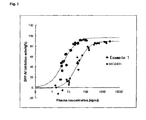
- the compound of Formula 1 (Example 1) exhibited 4 to 5-fold higher inhibitory activity at a plasma concentration of 10 ng/mL, in conjunction with 8 to 9-fold superior EC 50 (50% effective concentration) and EC 80 (80% effective concentration), when compared with MK-0431 (see Fig. 1 ).
- Inventive Compound at a dose of 10 mg/kg was found to retain 90% or more of DPP-IV inhibitory activity until 24 hours after administration, which is significantly higher activity, upon considering the fact that MK-0431 retained only about 50% of DPP-IV inhibitory activity after the same period of 24 hours (see Fig. 2 ).
- Inventive Compound of Formula 1 In order to measure an in vivo half-life of Inventive Compound of Formula 1, normal SD rats (8-week old) were administered orally with MK-0431 and Inventive Compound (Examples 1, 3 and 12) at a dose of 10 mg/kg. Blood was sampled from the femoral aorta periodically and the in vivo retention time of the original compound was measured. As a result, Inventive Compound exhibited superior in vivo half-life (T1/2) to that of MK-0431. [Table 1] Example 1 Example 3 Example 12 MK-0431 T1/2 (hour) 7.9 7.6 5.5 4.8
- the present invention enables production of a heterocyclic compound containing a beta-amino group, which has excellent inhibitory effects on activity of DPP-IV.
- a pharmaceutical composition comprising the same compound of the present invention as an active ingredient exhibits excellent DPP-IV inhibitory activity and bioavailability and then can be useful for the prophylaxis or treatment of various diseases considered to be caused by DPP-IV, such as diabetes and obesity.
Landscapes
- Health & Medical Sciences (AREA)
- Chemical & Material Sciences (AREA)
- Organic Chemistry (AREA)
- Diabetes (AREA)
- Medicinal Chemistry (AREA)
- Veterinary Medicine (AREA)
- Public Health (AREA)
- General Health & Medical Sciences (AREA)
- Animal Behavior & Ethology (AREA)
- Life Sciences & Earth Sciences (AREA)
- Pharmacology & Pharmacy (AREA)
- Hematology (AREA)
- Nuclear Medicine, Radiotherapy & Molecular Imaging (AREA)
- General Chemical & Material Sciences (AREA)
- Chemical Kinetics & Catalysis (AREA)
- Obesity (AREA)
- Bioinformatics & Cheminformatics (AREA)
- Engineering & Computer Science (AREA)
- Endocrinology (AREA)
- Emergency Medicine (AREA)
- Child & Adolescent Psychology (AREA)
- Epidemiology (AREA)
- Pharmaceuticals Containing Other Organic And Inorganic Compounds (AREA)
- Acyclic And Carbocyclic Compounds In Medicinal Compositions (AREA)
- Medicines That Contain Protein Lipid Enzymes And Other Medicines (AREA)
Description
- The present invention relates to a heterocyclic compound containing a beta-amino group, which has excellent inhibitory activity on dipeptidyl peptidase-IV (hereinafter, referred to as "DPP-IV") and high bioavailability, and a pharmaceutical composition comprising the same heterocyclic compound or a pharmaceutically acceptable salt thereof as an active ingredient.
- The enzyme dipeptidyl peptidase IV, herein abbreviated DPP-IV (and elsewhere as DP-IV, DP-4 or DAP-IV) and also known by the classification EC. 3. 4. 14. 5, is a serine protease (Barrett A. J. et al., Arch. Biochem. Biophys., 1995, 247-250), which cleaves the N-terminal dipeptide from peptides that begin with the sequence H-Xaa-Pro-Y or H-Xaa-Ala-Y wherein Xaa represents any lipophilic amino acid, Pro represents proline, and Ala represents alanine (Heins J., et al., Biochim. et Biophys. Acta 1988, 161). DPP-IV is widely distributed and found in a variety of mammalian tissues such as kidney, liver and small intestine (Hegen M. et al., J. Immunol., 1990, 2908-2914). DPP-IV was first identified as a membrane-bound protein. More recently a soluble form has been identified (Duke-Cohan J. S. et al., J. Biol. Chem., 1995, 14107-14114). According to the recently published study and report, it was revealed that such a soluble form of DPP-IV has the same structure and function as a membrane-bound form of the enzyme and is found without a certain membrane-bound domain in blood (Christine D. et. al, Eur. J. Biochem., 2000, 5608-5613).
- Initial interest in DPP-IV has focused on its role in the activation of T lymphocytes. DPP-IV responsible for the activation of T lymphocytes was specifically designated CD26. With the report showing that CD26 binds to or interacts with human immunodeficiency virus (HIV) (Guteil W. G. et al., Proc. Natl. Acad. Sci., 1994, 6594-6598), it was proposed that DPP-IV inhibitors could be useful in the treatment of AIDS (Doreen M. A. et al., Bioorg. Med. Chem. Lett., 1996, 2745-2748).
- In addition to a critical role participating in the immune system, the main function of DPP-IV stems from its peptidolytic activity as described above. Attention was particularly given to the role of DPP-IV as it is found that DPP-IV is a key enzyme implicated in the degradation of glucagon-like protein-1 (hereinafter, referred to as "GLP-1") in the small intestine (Mentlein R. et al., Eur. J. Biochem., 1993, 829-835). GLP-1 is the 30 amino-acid peptide hormone which is secreted by intestinal L cells as a response to food intake of the small intestine (Goke R. et. al, J. Biol. Chem., 1993, 19650-19655). Since GLP-1 is known to have potentiating effects on the action of insulin in the control of postprandial blood glucose levels (Holst J. J. et al., Diabetes Care, 1996, 580-586), it was postulated that DPP-IV inhibitors might also be usefully employed in the treatment of type 2 diabetes. Based on this assumption, an early form of the DPP-IV inhibitor was developed with some reports demonstrating the therapeutic effectiveness of a medicine in animal experiments (Pauly R. P. et al., Metabolism, 1999, 385-389). Further, DPP-IV-deficient mice or rats maintained GLP-1 activity and high insulin levels, resulting in decreased blood glucose levels and such a genetic disruption or mutation of the DPP-IV gene exhibited no significant effect on the survival of individual animals (Marguet D. et al., Proc. Natl. Acad. Sci., 2000, 6874-6879). As a consequence, it was proposed that DPP-IV is feasible as a potent therapeutic agent for the treatment of type 2 diabetes, which resulted in accelerated research and development of the DPP-IV inhibitor.
- Binding of GLP-1 with a receptor in a variety of tissues results in satiety (feelings of fullness), delayed gastric emptying, and facilitated growth of pancreatic beta-cells. Therefore, clinical trials for the treatment of type 2 diabetes are gradually increasing through intravenous administration of GLP-1 per se (Verdich C. et al., J. Clin. Endocrinol. Metab., 2001, 4382-4389). An in vivo half-life of GLP-1 is merely 2 min (Kieffer T. J., et al., Endocrinology, 1995, 3585-3596), so such a short half-life is a major obstacle to direct use of GLP-1 as a therapeutic agent. Since then, numerous research groups and institutions have made many attempts toward derivatization of GLP-1, resulting in development and commercialization of a peptide which is capable of protracting the short in vivo half-life (Deacon C. F., Diabetes, 2004, 2181-2189). However, such a GLP-1 derivative still suffers from a fundamental limitation in that it is an injectable formulation. Further, a great deal of interest has been increasingly focused on development of an efficient DPP-IV inhibitor, due to the fact that active GLP-1 (7-36) is degraded by DPP-IV and then converted into inactive GLP-1(9-36) only within a short period of time, e.g. 2 min.
- The beginning in the development of DPP-IV inhibitors was similar to the development trend of other inhibitors. That is, most of the research results were for substrate analogues. A representative one of these substrate analogues is a dipeptide derivative which was obtained as the product of the early research which was performed on a parent nucleus having a structure similar to that of Proline (Pro), based on the fact that DPP-IV exhibits pronounced affinity for a peptide containing a certain amino acid Proline (Chinnaswamy T. et al., J. Biol. Chem., 1990, 1476-1483). Typical examples of Proline-like structures include pyrrolidide and thiazolidide, and derivatives containing these parent nucleus compounds exhibit reversible and competitive inhibitory activity for the DPP-IV enzyme (Augustyns KJL., et al., Eur. J. Med. Chem., 1997, 301-309).
- Among products of such extensive research and development, there are continuing experiments on the action mechanism and efficacy of certain compounds, specifically Val-Pyr (Valine-Pyrrolidide), Ile-Thia (Isoleucine-Thiazolidide), and the like. Particularly, a great deal of attention has been focused on Ile-Thia, because the Val-Pyr structure exhibited relatively poor inhibitory activity on DPP-IV (Hanne B. R., et al., Nat. Struct. Biol., 2003, 19-25), which as such prompted intensive research and study on derivatives of the Ile-Thia compound.
- Out of the Ile-Thia derivative compounds focused and obtained by the above-mentioned research and study, a compound having the most prominent activity was beta-amino acid thiazolidide series which was attempted to be developed by Merck & Co., Inc. However, according to the results of pharmacodynamic and pharmacokinetic experiments performed in rats, the obtained compound exhibited significantly low bioavailability in conjunction with an apparent limitation in the inhibition of enzymatic activity (Jinyou Xu, et al., Bioorg. Med. Chem. Lett., 2004, 4759-4762). As a consequence, further development on compounds of this class was discontinued due to profound disadvantages.
- During the above-mentioned investigation, Merck noticed that a beta-amino acid, in addition to a thiazolidide parent nucleus, is also a key factor having significant effects on the DPP-IV inhibitory activity. This finding was applied to the approach for substitution of the thiazolidide parent nucleus with a different parent nucleus compound (Linda L. B., et al., Bioorg. Med. Chem. Lett., 2004, 4763-4766). With such a subsequent research, a variety of derivatives having substitution of the thiazolidide parent nucleus with a piperazine parent nucleus were synthesized with drug efficacy testing and pharmacodynamic studies. Unfortunately, the piperazine derivatives of Merck still suffered from significantly poor bioavailability. According to the compound optimization to cope with such a disadvantage, the product MK-0431 (trade name: JANUVIA) was developed with modification of a piperazine moiety to a triazolopiperazine moiety. This product is now commercially available under new drug approval by US FDA in 2006. Further, subsequent to MK-0431, a compound with incorporation of a diazepanone moiety (seven-membered ring) is currently under development (
WO 2004037169 ;WO2005011581 ;WO2006104997 ; and Bioorg. Med. Chem. Lett., 2007, 49-52). Particularly according to the article published in the journal (Bioorg. Med. Chem. Lett., 2007, 49-52), it was demonstrated that imidazolone (five-membered ring) and piperazinone (six-membered ring) exhibit remarkably lower in vitro activity, as compared to diazepanone, thus resulting in an intensive focus on the optimization of diazepanone.
- As a result of a variety of extensive and intensive studies and experiments to solve the problems as described above and to achieve the optimization of a compound of interest, the inventors of the present invention discovered that when a substitution including a hetero atom is made on a piperazinone moiety, the thus-modified compound not only has excellent DPP-IV inhibitory activity, but also is capable of achieving significantly improved bioavailability as compared to a conventional DPP-IV inhibitor, and then succeeded in synthesis of a novel heterocyclic compound containing a beta-amino group. The present invention has been completed based on these findings.
- It is an object of the present invention to provide a heterocyclic compound containing a beta-amino group and having DPP-IV inhibitory activity, or a pharmaceutically acceptable salt, hydrate or solvate thereof.
- It is another object of the present invention to provide a pharmaceutical composition for the prevention and treatment of diabetes or obesity, comprising the aforesaid heterocyclic compound, or a pharmaceutically acceptable salt, hydrate or solvate thereof as an active ingredient.
- Hereinafter, the present invention will be described in more detail.
- The present invention provides a heterocyclic compounds with a beta-amino group represented by Formula 1:

- Preferably, the compound of
Formula 1 in accordance with the present invention encompasses a compound of Formula 2, which is a stereoisomer inducing optical activity on a carbon atom at position 3 of a piperazinone ring and is represented by Formula 2 below.
Formula 1. - That is, the compound of
Formula 1 can have two asymmetric centers. Specifically, the compound ofFormula 1, as shown Formula 2, can have asymmetric centers at the beta carbon and at carbon of position 3 of the piperazinone ring, so it can be present in the form of a single diastereoisomer, racemate, racemic mixture or diastereoisomeric mixture, all of which fall within the compound ofFormula 1 in accordance with the present invention. - Further, the compound of
Formula 1 can be partially present as a tautomer. Also included in the compound ofFormula 1 are individual tautomers as well as mixtures thereof. - The stereoisomeric form of the compound of
Formula 1 may be obtained by stereoselective synthesis according to a conventional method known in the art, using an optically pure starting material or a known reagent. - Preferred examples of the beta-amino group-containing heterocyclic compound of
Formula 1 in accordance with the present invention may include the following compounds: - 1) (R)-4-[(R)-3-amino-4-(2,4,5-trifluorophenyl)butanoyl]-3-(t-butoxymethyl)piperazin-2-one hydrochloride;
- 2) (R)-4-[(R)-3-amino-4-(2,4,5-frifluorophenyl)butanoyl]-3-(methoxymethyl)piperazin-2-one hydrochloride;
- 3) (R)-4-[(R)-3-amino-4-(2,4,5-trifluorophenyl)butanoyl]-3-(ethoxymethyl)piperazin-2-one hydrochloride;
- 4) (R)-4-[(R)-3-amino-4-(2,4,5-trifluorophenyl)butanoyl]-3-(isopropoxymethyl) piperazin-2-one hydrochloride;
- 5) (R)-4-[(R)-3-amino-4-(2,4,5-trifluorophenyl)butanoyl]-3-(cyclopentyloxymethyl) piperazin-2-one hydrochloride;
- 6) (R)-4-[(R)-3-amino-4-(2,4,5-trifluorophenyl)butanoyl]-3-[(diethylamino)methyl] piperazin- 2-one dihydrochloride;
- 7) (R)-4-[(R)-3-amino-4-(2,4,5-trifluorophenyl)butanoyl]-3-[(ethylmethylamino)methyl] piperazin-2-one dihydrochloride;
- 8) (R)-4-((R)-3-amino-4-(2,4,5-trifluorophenyl)butanoyl]-3-(morpholinomethyl) piperazin-2-one dihydrochloride;
- 9) (R)-4-[(R)-3-amino-4-(2,4,5-trifluorophenyl)butanoyl]-3-(t-butylthiomethyl)piperazin -2-one hydrochloride;
- 10) (S)-4-[(R)-3-amino-4-(2,4,5-trifluorophenyl)butanoyl]-3-(t-butoxymethyl)piperazin-2-one hydrochloride;
- 11) (R)-4-[(R)-3-arnino-4-(2,4,5-trifluorophenyl) butanoyl]-3-(t-butoxymethyl) piperazin-2-one;
- 12) (R)-4-[(R)-3-amino-4-(2,4,5-trifluorophenyl)butanoyl]-3-(t-butoxymethyl)piperazin-2-one tartrate;
- 13) (R)-4-[(R)-3-amino-4-(2,4,5-trifluorophenyl)butanoyl]-3-(t-butoxymethyl)piperazin-2-one citrate;
- 14) (R)-4-[{R)-3-amino-4-(2,4,5-trifluorophenyl)butanoyl]-3-(t-butoxymethyl)piperazin-2-one phosphate;
- 15) (R)-4-[(R)-3-amino-4-(2,4,5-trifluorophenyl)butanoyl]-3-(t-butoxymethyl)piperazin-2-one acetate;
- 16) (R)-4-[(R)-3-amino-4-(2,4,5-trifluorophenyl)butanoyl]-3-(t-butoxymethyl)piperazin-2-one malate;
- 17) (R)-4-[(R)-3-amino-4-(2,4,5-trifluorophenyl)butanoyl]-3-(t-butoxymethyl)piperazin-2-one succinate; and
- 18) (R)-4-[(R)-3-amino-4-(2,4,5-trifluorophenyl)butanoyl]-3-(t-butoxymethyl)piperazin-2-one adipate.
- The beta-amino group-containing heterocyclic compound of
Formula 1 in accordance with the present invention includes a pharmaceutically acceptable salt thereof as well as a hydrate and solvate that can be prepared therefrom. - The pharmaceutically acceptable salt of the heterocyclic compound of
Formula 1 may be prepared by any conventional method for preparation of salts known in the art. - As used herein, the term "pharmaceutically acceptable salt" refers to a salt prepared from a pharmaceutically acceptable non-toxic base or acid including an inorganic or organic base and an inorganic or organic acid. Examples of the pharmaceutically acceptable salt may include salts of
Compound 1 with an inorganic base, e.g. aluminum, ammonium, calcium, copper, ferric, ferrous, lithium, magnesium, manganate, manganese, potassium, sodium or zinc ion. Particularly preferred are ammonium, calcium, magnesium, potassium and sodium salts. A solid salt may have one or more crystal structures, or otherwise may be in the form of a hydrate. Examples of the pharmaceutically acceptable non-toxic organic salt may include salts ofCompound 1 with a primary, secondary or tertiary amine, a substituted amine such as a naturally-occurring substituted amine, a cyclic amine, or a basic ion exchange resin such as arginine, betaine, caffeine, choline, N,N'-dibenzylethylenediamine, diethylamine, 2-diethylaminoethanol, 2-dimethylaminoethanol, ethanolamine, ethylenediamine, N-ethylmorpholine, N-ethylpiperidine, glucamine, glucosamine, histidine, hydrabamine, isopropylamine, lysine, methylglucamine, morpholine, piperazine, piperidine, polyamine resin, procaine, purine, theobromine, triethylamine, trimethylamine, tripropylamine, and tromethamine. - When the compound of the present invention is basic, a salt thereof may be prepared from pharmaceutically acceptable non-toxic acids including inorganic and organic acids. Examples of the acid may include acetic acid, benzenesulfonic acid, benzoic acid, camphorsulfonic acid, citric acid, ethanesulfonic acid, fumaric acid, gluconic acid, glutamic acid, hydrobromic acid, hydrochloric acid, isethionic acid, lactic acid, maleic acid, malic acid, mandelic acid, methanesulfonic acid, mucic acid, nitric acid, pamoic acid, pantothenic acid, phosphoric acid, succinic acid, sulfuric acid, tartaric acid, p-toluene sulfonic acid, and adipic acid. Particularly preferred are acetic, citric, hydrochloric, malic, phosphoric, succinic, tartaric and adipic acids.
- When the compound of
Formula 1 is designated herein, this term is intended to embrace a pharmaceutically acceptable salt thereof. - As used herein, the term "hydrate" means a compound of
Formula 1 or a pharmaceutically acceptable salt thereof, which further includes a stoichiometric or non-stoichiometric amount of water bound thereto by non-covalent intermolecular forces. The hydrate may contain more than 1 equivalent of water, typically 1 to 5 equivalents of water. The hydrate may be prepared by crystallization of the compound ofFormula 1 or a pharmaceutically acceptable salt thereof in water or water-containing solvent. - As used herein, the term "solvate" means a compound of
Formula 1 or a salt thereof, which further includes a stoichiometric or non-stoichiometric amount of a solvent bound thereto by non-covalent intermolecular forces. Preferred solvents are volatile, non-toxic, and/or acceptable for administration to humans. For example, mention may be made of ethanol, methanol, propanol, methylene chloride, etc. - In accordance with another aspect of the present invention, there is provided a method for preparing a heterocyclic compound with a beta-amino group represented by
Formula 1 or a pharmaceutically acceptable salt thereof. - The present invention, as shown in
Reaction Scheme 1 below, includes a method for preparing a heterocyclic compound represented by Formula 2, comprising 1) reacting a compound of Formula 3 having a beta amino group with a substituted heterocyclic compound ofFormula 4 in the presence of 1-hydroxybenzotriazole (HOBT), 1-ethyl-3-(3-dimethylaminopropyl)carbodiimide (EDC) and tertiary amine to thereby prepare a compound of Formula 5 having a peptide bond, and 2) reacting the compound of Formula 5 in the presence of an acid to prepare a heterocyclic compound of Formula 2 having a beta-amino group.
Formula 1. - For example, an intermediate of Formula 5 may be obtained by reacting the compound of Formula 3 and the compound of
Formula 4 conventionally in a solvent such as N,N-dimethylformamide (DMF) or dichloromethane in the presence of a coupling reagent such as 1-ethyl-3-(3-dimethylaminopropyl)carbodiimide (EDC) or 1-hydroxybenzotriazole (HOBT), and a base such as diisopropylethylamine or triethylamine at 0°C to room temperature for 3 to 48 hours. - In order to prevent participation of a compound in peptidization, a nitrogen atom of the intermediate of Formula 5 which was prepared by peptidization is protected with a protective group. The desired heterocyclic compound of Formula 2 having a beta-amino group may be obtained by removal of the protective group through deprotection. That is, because the protective group is Boc, removal of the protective group may be carried out under acidic conditions, typically using trifluoroacetic acid/dichloromethane, ethyl acetate/hydrogen chloride, hydrogen chloride/dichloromethane or methanol/hydrogen chloride, at 0°C to room temperature for 1 to 24 hours.
- If necessary, the compound of Formula 2 prepared by the peptide bond reaction and deprotection may be purified from undesirable by-products by any conventional method such as recrystallization, trituration, preparative thin-layer chromatography, silica gel flash chromatography (see W.C. Still et al., J. Org. Chem., 43, 2923 (1978)), or HPLC. The compound purified by HPLC may be separated as the corresponding salt thereof. The compound of Formula 5 can also be purified in the same manner.
- In the present invention, a stereoisomeric mixture of a compound of
Formula 1 is prepared by using a mixture of stereoisomers as a starting material, and the resulting mixture is separated into individual stereoisomers to thereby obtain a compound ofFormula 1. Further, each stereoisomer of the compound ofFormula 1 may be prepared by using each stereoisomer as a starting material. Separation of the stereoisomer may be carried out by conventional column chromatography or recrystallization. - In the preparation of the compound of Formula 2, the compound of Formula 3 used in
Reaction Scheme 1 is commercially available or may be readily prepared by any method known in the art. - In the preparation of the compound of Formula 2, the compound of
Formula 4 used inReaction Scheme 1 may be prepared according to the synthetic pathway of Reaction Scheme 2 and Reaction Scheme 3. - In Reaction Scheme 2, Compound 6 may be commercially available or may not be commercially available depending on a substituent X, so Compound 6 is commercially available one or may be readily prepared by any method known in the art, for example the method as depicted in Reaction Scheme 3 below.
- In Reaction Scheme 2,
Compound 4 used to prepare the compound of the present invention can be prepared from Compound 6. Specifically, Compound 6 is reacted with N-butyloxycarbonyl-2-amino acetaldehyde in the presence of a reducing agent to obtain Compound 7 from which Compound 8 having a secondary amine protected by benzyloxycarbonyl (Cbz) is then prepared, followed by deprotection to thereby prepare Compound 9 where butyloxycarbonyl (Boc) was deprotected. Compound 9 is then cyclized using trimethyl aluminum (or diisopropylethylamine/ethanol, sodium hydrogen carbonate/methanol, etc.) to obtainCompound 10 which is followed by deprotection of Cbz to prepareCompound 4. Examples of the reducing agent that can be used in the preparation of Compound 7 from Compound 6 may include sodium cyanoborohydride, sodium triacetoxyborohydride, sodium borohydride, and the like.
Formula 1. - When Compound 6 in Reaction Scheme 2 is not commercially available, it may be prepared analogously to Reaction Scheme 3 below. Compound 6 having a variety of substituents R1 in Reaction Scheme 3 is prepared by substituting D-serine methyl ester with trityl chloride to obtain Compound 11, and substituting a hydroxyl group of Compound 11 with a mesyl group, followed by reflux to thereby prepare an aziridine compound 12. Then, the trityl group of Compound 12 is removed using trifluoroacetic acid, followed by benzyloxycarbonyl (Cbz) protection to prepare Compound 13. Compound 13 is then reacted with HX having a variety of substituents R1 to prepare Compound 14, followed by Cbz deprotection to prepare Compound 6.


Formula 1. - In order to facilitate the reaction of interest or avoid formation of the undesired reaction product for some of compounds of
Formula 1 of the present invention, the aforementioned reaction conditions and reaction sequences may vary as desired. - As described above, compounds of
Formula 1 of the present invention, starting materials and intermediates may be synthesized by a variety of methods known in the art. - In accordance with a further aspect of the present invention, there is provided a pharmaceutical composition for the prevention and treatment of diabetes or obesity, comprising a compound of
Formula 1 or a pharmaceutically acceptable salt thereof as an active ingredient. - The compound of
Formula 1 in accordance with the present invention exhibits excellent inhibitory activity on DPP-IV. When inhibitory capacity of the compound ofFormula 1 on the enzyme DPP-IV was measured, IC50, the concentration of drug that is required to inhibit the enzymatic reaction of DPP-IV by 50%, almost exhibits a range of 0.5 to 20 nM, which represents superior DPP-IV inhibitory activity, as compared to a conventional DPP-IV inhibitor reported to have IC50 of several hundreds of nM to several thousands of nM, or to even several tens of thousands of nM (Jinyou Xu, et al., Bioorg. Med. Chem. Lett., 2004, 4759-4762; and Linda L. B., et al., Bioorg. Med. Chem. Lett., 2004,4763-4766). - Further, the compound of
Formula 1 in accordance with the present invention has high oral glucose tolerance. According to the oral glucose tolerance test (OGTT), the compound ofFormula 1 was measured to have blood glucose-lowering effects of more than 35%, preferably more than 50%, thus representing that it has superior bioavailability as compared to conventional DPP-IV inhibitors. In addition, in vivo experimental results, including pharmacokinetic/pharmacodynamic correlations, measurement of a duration period of DPP-IV inhibitory activity, and in vivo kinetic experiments, demonstrate that the compound of the present invention is superior in DPP-IV inhibitory activity and bioavailability. - Therefore, the pharmaceutical composition comprising the compound of
Formula 1 as an active ingredient may be effectively used for the treatment and prevention of diabetes and obesity which are representative diseases caused by DPP-IV. - The pharmaceutical composition comprising the compound of
Formula 1, or a stereoisomer, pharmaceutically acceptable salt, hydrate or solvate thereof as an active ingredient may be formulated into a variety of the following oral or parenteral dosage forms without being limited thereto. - Examples of the dosage form for oral administration may include tablets, pills, soft and hard capsules, solutions, suspensions, emulsions, syrups, granules, elixirs, and the like. These pharmaceutical formulations may comprise, in addition to the aforesaid active ingredient, one or more conventional diluents or excipients, such as fillers, extenders, wetting agents, disintegrants, glidants, binders, and surfactants. Examples of the disintegrants may include agar, starch, alginic acid or a sodium salt thereof, anhydrous calcium monohydrogen phosphate, and the like. Examples of the glidants may include silica, talc, stearic acid or a magnesium or calcium salt thereof, polyethylene glycol, and the like. Examples of the binder may include magnesium aluminum silicate, starch paste, gelatin, tragacanth, methylcellulose, sodium carboxymethylcellulose, polyvinylpyrrolidone, low-substituted hydroxypropyl cellulose, and the like. In addition, the pharmaceutical formulation may comprise diluents, e.g. lactose, dextrose, sucrose, mannitol, sorbitol, cellulose and/or glycine. If desired, the formulation may further comprise conventionally known effervescent mixtures, absorbents, colorants, flavors and sweeteners.
- The pharmaceutical composition comprising the compound of
Formula 1 or a pharmaceutically acceptable salt thereof as an active ingredient may be administered via a parenteral route, for example a suppository, subcutaneous injection, intravenous injection, intramuscular injection or intrathoracic injection. For formulation of the composition of the present invention into a preparation for parental administration, the compound ofFormula 1 or a pharmaceutically acceptable salt thereof is mixed with a stabilizer or buffer in the presence of water to prepare a solution or suspension which is then manufactured in the unit dosage form of ampoules or vials. - The composition may be sterilized and/or comprise adjuvants such as preservatives, stabilizers, hydrating agents, emulsifiers, salts for controlling osmotic pressure, and/or buffers, and therapeutically useful substances, and can be formulated according to conventional methods such as mixing, granulation and coating.
- If desired, the compound of
Formula 1 or the pharmaceutical composition comprising the same as an active ingredient may be administered in combination with other drugs, for example, anti-diabetic drugs. - When the compound of
Formula 1 or the pharmaceutical composition comprising the same as an active ingredient is formulated into a unit dosage form, the compound ofFormula 1 is applied preferably in a unit dose of approx. 0.1 to 1,500 mg in terms of active ingredient. As will be apparent to those skilled in the art, the effective dose of the active compound in accordance with the present invention may be determined according to physician's prescription, depending on various factors such as body weight and age of patients, the nature and severity of disease, and the like. For adults, the effective dose of the active compound is typically in a range of about 1 to 500 mg/day, taking into consideration administration frequency and intensity. In case of intramuscular or intravenous injection to adults, about 5 to 300 mg of the total dose divided into several unit doses may be appropriate a day, even though a higher daily dose may be required for some patients. - As will be specifically illustrated hereinafter, the present invention provides a heterocyclic compound containing a beta-amino group and having excellent inhibitory effects on the enzymatic activity of DPP-IV. A pharmaceutical composition comprising the same compound of the present invention as an active ingredient exhibits excellent DPP-IV inhibitory activity and bioavailability and then can be useful for the prophylaxis or treatment of various diseases considered to be caused by DPP-IV, such as diabetes and obesity.
-
-
Fig. 1 shows correlations between plasma DPP-IV activity and drug dose, obtained for MK-0431 and a compound of Example 1; and -
Fig. 2 shows measurement and comparison results of the duration of DPP-IV inhibitory activity obtained for MK-0431 and a compound of Example 1 in laboratory rats. - Now, the present invention will be described in more detail with reference to the following Examples.
- 200 g of D-serine methyl ester hydrochloride was added to 1.8 L of chloroform, and the reaction solution was cooled to 0°C, to which 448 mL of triethylamine was then slowly added. 358.4 g of trityl chloride was slowly added to the reaction mixture which was then stirred for 1 hour. The reaction mixture was warmed to room temperature, and 1 L of chloroform was added thereto, followed by washing with 2.5 L of water. The organic layer was dried over magnesium sulfate and cooled to 0°C, to which 484 mL of triethylamine and 15.7 g of 4-methylaminopyridine were then sequentially and slowly added. The reaction mixture was stirred for 5 min and 139 mL of methane sulfonyl chloride was slowly added thereto. The reaction mixture was warmed to room temperature, stirred for another 4 hours and then refluxed for 12 hours. The reaction mixture was cooled to room temperature, and washed with 4 L of water and then 3 L of brine. The organic layer was dried over magnesium sulfate and concentrated to dryness under reduced pressure. 3 L of ethanol was added to the resulting residue which was then stirred. The resulting solids were filtered to afford 329 g of the title compound.
- 1H NMR (400 MHz, CDC13): 7.42 to 7.49(m, 6H), 7.18 to 7.32(m, 9H), 7.68(s, 1H), 3.74(s, 3H), 2.24(m, 1H), 1.87(m, 1H), and 1.40(m, 1H)
- 328.4 g of (R)-methyl 1-tritylaziridine-2-carboxylate was dissolved in 1.4 L of chloroform and the reaction solution was cooled to 0°C, to which 462 mL of trifluoroacetic acid was then slowly added. The reaction mixture was stirred for 1 hour, to which 2 L of water was then added, followed by stirring for 10 min and removal of the organic layer. The aqueous layer was neutralized with sodium hydrogen carbonate and used in subsequent reactions without further purification.
- 2 L of diethyl ether and 120.5 g of sodium hydrogen carbonate were added to the aqueous layer, and the reaction solution was cooled to 0°C, to which 165 mL of benzyl chloroformate was then slowly added dropwise. The reaction mixture was stirred for another 2 hours and the aqueous layer was discarded. The organic layer was dried over magnesium sulfate, concentrated and dried under reduced pressure, and purified by column chromatography, thereby affording 108.5 g of the title compound.
- 1H NMR (400 MHz, DMSO): 7.32-7.36(m, 5H), 5.13(s, 2H), 3.09(dd, J=3.2, 5.4Hz, 1H), 2.58(dd, J=1.2, 3.2Hz, 1H), and 2.47(dd, J=1.2, 5.4Hz, 1H)
- 1.1 g of (R)-1-benzyl 2-methyl aziridine-1,2-dicarboxylate was dissolved in 11 mL of chloroform, to which 18 mL of t-butanol was then added. To the reaction mixture was slowly added dropwise 1.2 mL of BF3OEt2, followed by stirring for 12 hours. The reaction was terminated with addition of 2 L of water to the reaction mixture. Then, the organic layer was separated and dried over magnesium sulfate, concentrated and dried under reduced pressure, and then used in subsequent reactions without further purification.
- The resulting residue was dissolved in 10 mL of methanol, to which 740 mg of palladium/carbon in 2 mL of ethyl acetate was then added, followed by hydrogen bubbling for 1 hour under ambient atmospheric pressure. The reaction mixture was filtered and dried under reduced pressure to afford 736 mg of the title compound.
- 1H NMR (400 MHz, CD3OD): 4.21(m, 1H), 3.82(s, 3H), 3.74-3.88(m, 2H), and 1.20(s, 9H)
- 736 mg of (R)-2-amino-3-t-butoxypropane methyl ester prepared in Step 3 was dissolved in 14 mL of dichloromethane, to which 6335 mg of N-t-butoxycarbonyl-2-aminoacetaldehyde methanol was then slowly added. The reaction mixture was cooled to 0°C, followed by gradual addition of 1.2 mL of triethylamine and 1.78 g of sodium triacetoxyborohydride. The reaction mixture was warmed to room temperature, followed by stirring for 12 hours. A saturated sodium hydrogen carbonate solution was added to terminate the reaction, and the organic layer was washed with 10 mL of water and brine, concentrated and dried under reduced pressure. The resulting residue was purified by column chromatography, thereby affording 355 mg of the title compound.
- 1H NMR (400 MHz, CDCl3): 5.10(m, 1H), 3.71(s, 3H), 3.56(m, 2H), 3.40(m, 1H), 3.15-3.28(m, 2H), 2.81(m, 1H), 2.67(m, 1H), 1.42(s, 9H), and 1.13(s, 9H)
- 355 mg of (R)-3-tert-butoxy-2-(2-(tert-butoxycarbonylamino)ethylamino)propionic acid methyl ester prepared in
Step 4 was dissolved in 11 mL of tetrahydrofuran, and the reaction mixture was cooled to 0°C, to which 187 mg of sodium hydrogen carbonate was then added. 192 µℓ of benzylchloroformate was slowly added dropwise thereto, and the reaction mixture was warmed to room temperature. After 12 hours, the reaction mixture was dried under reduced pressure, followed by addition of 10 mL of ethyl acetate, and the organic layer was washed with 10 mL of water. The organic layer was dried over magnesium sulfate, dried under reduced pressure, and purified by column chromatography, thereby affording 410 mg of the title compound. - 1H NMR (400 MHz, CDCl3): 7.36-7.25(m, 5H), 5.82-5.72 (m, 1H), 5.17-5.03 (m, 2H), 4.15(m, 1H), 3.98(m, 1H), 3.81(m, 1H), 3.73(s, 3H), 3.60(m, 1H), 3.42-3.28 (m, 3H), 1.40(s, 9H), and 1.14(s, 9H)
- 410 mg of (R)-2-((benzyloxycarbonyl)(2-t-butoxycarbonylamino)ethyl)amino)-3-tert-butoxypropionic acid methyl ester prepared in Step 5 was dissolved in 10 mL of methanol, and the reaction mixture was cooled to 0°C, to which 4 mL of 2-N hydrochloric acid/diethyl ether was then slowly added, followed by stirring for 3 hours. The reaction mixture was dried under reduced pressure and used in subsequent reactions without further purification.
- The resulting residue was dissolved in 10 mL of dichloromethane and the reaction mixture was cooled to 0°C, to which 152 µℓ of triethylamine was then slowly added. 1.1 mL of trimethylaluminum (2.0 M solution in toluene) was slowly added thereto, and the reaction mixture was warmed to room temperature and then stirred for 12 hours. The reaction mixture was cooled to 0°C and a saturated ammonium chloride aqueous solution was added to terminate the reaction. 10 mL of ethyl acetate was added to the reaction mixture which was then washed with 10 mL of brine. The organic layer was dried over magnesium sulfate and dried under reduced pressure. The resulting residue was purified by column chromatography to afford 103 mg of the title compound.
- 1H NMR (400 MHz, CDCl3): 7.34-7.25(m, 5H), 6.27 (m, 1H), 5.14(m, 2H), 4.57(m, 1H), 4.19(m, 1H), 4.08(m, 1H), 3.94(m, 1H), 3.74(m, 1H), 3.64 (m, 1H), 3.42(m, 1H), 3.29(m, 1H), and 1.09(s, 9H)
- 103 mg of (R)-benzyl 2-(tert-butoxymethyl)-3-oxopiperazine-1-carboxylate prepared in Step 6 was dissolved in 2 mL of methanol, to which 50 mg of palladium/carbon in 1 mL of ethyl acetate was then added, followed by hydrogen bubbling for 1 hour under ambient atmospheric pressure. The reaction mixture was filtered and dried under reduced pressure to afford 58 mg of the title compound.
- 1H NMR (400 MHz, CDCl3): 6.41(brs, 1H), 3.76(m, 3H), 3.63 (m, 1H), 3.52(m, 1H), 3.42(m, 1H), 3.28(m, 1H), 3.16(m, 1H), 2.95(m, 1H), 2.45(brs, 1H), and 1.17(s, 9H)
- 104 mg of (3R)-t-butoxycarbonylamino-4-(2,4,5-trifluorophenyl)butanoic acid and 58 mg of (R)-(3-tert-butoxymethyl)piperazin-2-one were added to 4 mL of N,N-dimethylformamide, to which 63 mg of 1-hydroxybenzotriazole (HOBT) and 217 µℓ of diisopropylethylamine were then added. The reaction mixture was cooled to 0°C and 78 mg of 1-ethyl-3-(3-dimethylaminopropyl)carbodiimide (EDC) was added thereto, followed by stirring at room temperature for 12 hours. The reaction mixture was diluted with 10 mL of ethyl acetate and washed two times with brine. The organic layer was dried over magnesium sulfate and concentrated. The resulting residue was purified by column chromatography to afford 97 mg of the title compound.
- 1H NMR (400 MHz, CDC13): 7.03(m, 1H), 6.88(m, 1H), 5.97(m, 1H), 5.48(m, 1H), 4.16-4.07(m, 1H), 4.02-3.91(m, 1H), 3.74(m, 2H) 3.37(m, 2H), 3.24(m, 1H), 2.92(m, 2H), 2.80(m, 1 H), 2.59(m, 2H), 1.34(d, 9H), and 1.13(s, 9H)
- 97 mg of tert-butyl (R)-4-[(R)-2-(tert-butoxymethyl)-3-oxopiperazin-1-yl]-4-oxo-1-(2,4,5-trifluorophenyl)butan-2-ylcarbamate prepared in Step 8 was dissolved in 3 mL of methanol, followed by addition of 2 mL of 2N-hydrochloric acid/diethyl ether and stirring at room temperature for 3 hours. The reaction mixture was concentrated and dried under reduced pressure to afford 64 mg of the title compound as a foamy solid.
- 1H NMR (400 MHz, CD3OD): 7.37(m, 1H), 7.23(m, 1H), 4.80(m, 1H), 4.59-4.40(m, 1H), 3.93(m, 1H), 3.90-3.83(m, 2H), 3.70(m, 1H), 3.38(m, 2H), 3.27(m, 1H), 3.07(m, 2H), 2.89-2.66(m, 2H), 1.18(s, 3H), and 1.11(s, 6H)
Mass (M+1): 402 - Methanol was used instead of t-butanol in Step 3 of Example 1, and 40 mg of the title compound was then synthesized analogously to
Steps 4 through 9 of Example 1. - 1H NMR (400 MHz, CD3OD): 7.34(m, 1H), 7.23(m, 1H), 4.82(m, 1H), 4.62-4.46(m, 1H), 3.92(m, 1H), 3.87-3.82(m, 2H), 3.66(m, 1H), 3.35(m, 2H), 3.24(m, 1H), 3.04(m, 2H), 2.94-2.72(m, 2H), and 3.27(s, 3H)
Mass (M+1): 360 - Ethanol was used instead of t-butanol in Step 3 of Example 1, and 66 mg of the title compound was then synthesized analogously to
Steps 4 through 9 of Example 1. - 1H NMR (400 MHz, CD3OD): 7.38(m, 1H), 7.23(m, 1H), 4.83(m, 1H), 4.54-4.44(m, 1H), 3.98(m, 1H), 3.93-3.82(m, 2H), 3.71(m, 1H), 3.53(m, 2H), 3.36(m, 2H), 3.26(m, 1H), 3.07(m, 2H), 2.90-2.70(m, 2H), and 1.11(t, 3H)
Mass (M+1): 374 - Isopropanol was used instead of t-butanol in Step 3 of Example 1, and 69 mg of the title compound was then synthesized analogously to
Steps 4 through 9 of Example 1. - 1H NMR (400 MHz, CD3OD): 7.38(m, 1H), 7.23(m, 1H), 4.86(m, 1H), 4.62-4.43(m, 1H), 3.96(m, 1H), 3.90-3.87(m, 2H), 3.77(m, 1H), 3.69(m, 1H), 3.44(m, 2H), 3.26(m, 1H), 3.08(m, 2H), 2.95-2.69(m, 2H), and 1.15(m, 6H)
Mass (M+1): 388 - Cyclopentanol was used instead of t-butanol in Step 3 of Example 1, and 51 mg of the title compound was then synthesized analogously to
Steps 4 through 9 of Example 1. - 1H NMR (400 MHz, CD3OD): 7.38(m, 1H), 7.23(m, 1H), 4.82(m, 1H), 4.61-4.42(m, 1H), 3.93(m, 1H), 3.90-3.82(m, 2H), 3.67(m, 1H), 3.40(m, 1H), 3.36(m, 2H), 3.25(m, 1H), 3.08(m, 2H), 3.01-2.62(m, 2H), and 1.67-1.50(m, 8H)
Mass (M+1): 414 - Diethylamine was added instead of t-butanol and reflux was carried out instead of addition of BF3OEt2 in Step 3 of Example 1, and 68 mg of the title compound was then synthesized analogously to
Steps 4 through 9 of Example 1. - 1H NMR (400 MHz, CD30D): 7.41(m, 1H), 7.24(m, 1H), 5.21(m, 1H), 3.59-3.53(m, 2H), 3.50-3.53(m, 4H), 3.43-3.37(m, 4H), 3.35(m, 2H), 3.09(m, 2H), 2.97-2.81(m, 2H), and 1.37(m, 6H)
Mass (M+1): 401 - Ethylmethylamine was added instead of t-butanol and reflux was carried out instead of addition of BF3OEt2 in Step 3 of Example 1, and 67 mg of the title compound was then synthesized analogously to
Steps 4 through 9 of Example 1. - 1H NMR (400 MHz, CD3OD): 7.42(m, 1H), 7.24(m, 1H), 5.22(m, 1H), 4.08-3.87(m, 2H), 3.86-3.75(m, 2H), 3.68-3.57(m, 2H), 3.56-3.33(m, 4H), 3.09(m, 2H), 3.02-2.81 (m, 5H), and 1.38(m, 3H)
Mass (M+1): 387 - Morpholine was added instead of t-butanol and reflux was carried out instead of addition of BF3OEt2 in Step 3 of Example 1, and 27 mg of the title compound was then synthesized analogously to
Steps 4 through 9 of Example 1. - 1H NMR (400 MHz, CD30D): 7.37(m, 1H), 7.23(m, 1H), 5.32(m, 1H), 4.12-3.98(m, 4H), 3.97-3.77(m, 4H), 3.74-3.52(m, 4H), 3.48-3.39(m, 2H), 3.14-2.91(m, 4H), and 2.86-2.72(m, 2H)
Mass (M+1): 415 - t-butyl thiol was used instead of t-butanol in Step 3 of Example 1, and 25 mg of the title compound was then synthesized analogously to
Steps 4 through 9 of Example 1. - 1H NMR (400 MHz, CD3OD): 7.34(m, 1H), 7.25(m, 1H), 5.04(m, 1H), 4.60(s, 1H), 4.60-4.41 (m, 1H), 3.86(m, 2H), 3.70(m, 1H), 3.40(m, 2H), 3.25(m, 1H), 3.05(m, 2H), 2.95(m, 1H), 2.81 (m, 2H), and 1.26(s, 9H)
Mass (M+1): 418 - L-serine methyl ester hydrochloride was used instead of D-serine methyl ester hydrochloride in
Step 1 of Example 1, and 31 mg of the title compound was then synthesized analogously to Steps 2 through 9 of Example 1. - 1H NMR (400 MHz, CD3OD): 7.34(m, 1H), 7.24(m, 1H), 4.79(m, 1H), 4.580-4.40(m, 1H), 3.96(m, 1H), 3.86-3.74(m, 2H), 3.70(m, 1H), 3.36(m, 2H), 3.19(m, 1H), 3.05-2.86(m, 3H), 2.67(m, 1H), 1.15(s, 4H), and 1.03(s, 5H)
Mass (M+1): 402 - 60 mg of the compound obtained in Example 1 was added to 10 mL of a 5% sodium hydrogen carbonate aqueous solution, and the mixture was extracted two times with 10 mL of a mixed solution of dichloromethane/2-propanol (4/1(v/v)). The organic layer was dried under reduced pressure to afford 55 mg of the title compound as a solid.
- 1H NMR (400 MHz, CD3OD): 7.27 (m, 1H), 7.14(m, 1H), 4.56-4.39(m, 1H), 3.96-3.81(m, 3H), 3.70(m, 1H), 3.46(m, 1H), 3.43-3.32(m, 1H), 2.83-2.65(m, 3H), 2.58-2.40(m, 2H), 1.16(s, 3H), and 1.11(s, 6H)
Mass (M+1): 402 - 55 mg of the compound obtained in Example 11 was dissolved in 0.56 mL of acetone to which a solution of 26 mg of L-tartaric acid in 0.35 mL of ethanol/water (9/1 (v/v)) was then slowly added, followed by stirring for 30 min. 0.56 mL of 2-propanol was added thereto, followed by stirring for 10 min and filtration to afford 77 mg of the title compound as a solid.
- 1H NMR (400 MHz, CD3OD): 7.38(m, 1H), 7.22(m, 1H), 4.80(m, 1H), 4.59-4.40(m, 1H), 4.40(s, 2H), 3.93(m, 1H), 3.90-3.83(m, 2H), 3.70(m, 1H), 3.38(m, 2H), 3.27(m, 1H), 3.07(m, 2H), 2.89-2.66(m, 2H), 1.15(s, 3H), and 1.11 (s, 6H)
Mass (M+1): 402 - 496 mg of the compound obtained in Example 11 was dissolved in 2 mL of ethanol, to which a solution of 273 mg of anhydrous citric acid in 1 mL of water was then slowly added, followed by stirring for 30 min. The reaction mixture was concentrated, to which 2 mL of ethyl acetate and 1 mL of 2-propanol were then added followed by stirring. 15 mL of hexane was added thereto followed by stirring for 10 min and filtration to afford 637 mg of the title compound as a solid.
- 1H NMR (400MHz, CD30D): 7.34(m, 1H), 7.22(m, 1H), 4.81(m, 1H), 4.58-4.40(m, 1H), 3.94(m, 1H), 3.87(m, 2H), 3.70(m, 1H), 3.36(m, 2H), 3.25(m, 1H), 3.03(m, 2H), 2.94-2.70(m, 4H), 1.18(s, 3H), and 1.12(s, 6H)
Mass (M+1): 402 - 501 mg of the compound obtained in Example 11 was dissolved in 3 mL of 2-propanol, to which 84 µℓ of a 85% phosphoric acid aqueous solution was then slowly added followed by stirring for 30 min. 3 mL of 2-propanol was added thereto, and the resulting mixture was stirred for 10 min and filtered to afford 100 mg of the title compound as a solid.
- 1H NMR (400MHz, CD30D): 7.33(m, 1H), 7.19(m, 1H), 4.81(m, 1H), 4.58-4.41 (m, 1H), 3.94(m, 1H), 3.85(m, 2H), 3.65(m, 1H), 3.37(m, 2H), 3.22(m, 1H), 2.95(m, 2H), 2.69(m, 2H), 1.17(s, 3H), and 1.12(s, 6H)
Mass (M+1): 402 - 500 mg of the compound obtained in Example 11 was dissolved in 3 mL of ethyl acetate to which a solution of 74.5 mg of acetic acid in 1 mL of ethyl acetate was then slowly added followed by stirring for 30 min. The reaction mixture was concentrated, to which 2 mL of ethyl acetate and 1 mL of 2-propanol were then added followed by stirring. 15 mL of hexane was added thereto, and the resulting mixture was stirred for 10 min and filtered to afford 495 mg of the title compound as a solid.
- 1H NMR (400MHz, CD3OD): 7.32(m, 1H), 7.20(m, 1H), 4.79(m, 1H), 4.60-4.40(m, 1H), 3.94(m, 1H), 3.87(m, 2H), 3.70(m, 1H), 3.34(m, 2H), 3.24(m, 1H), 2.90(m, 2H), 2.76-2.58(m, 2H), 1.94(s, 3H), 1.17(s, 3H), and 1.12(s, 6H)
Mass (M+1): 402 - 498 mg of the compound obtained in Example 11 was dissolved in 4 mL of acetone to which a solution of 166 mg of L-malic acid in 1 mL of acetone was then slowly added followed by stirring for 30 min. The reaction mixture was concentrated, to which 2 mL of ethyl acetate and 1 mL of 2-propanol were then added followed by stirring. 15 mL of hexane was added thereto, and the resulting mixture was stirred for 10 min and filtered to afford 506 mg of the title compound as a solid.
- 1H NMR (400MHz,, CD3OD): 7.34(m, 1H), 7.21 (m, 1H), 4.80(m, 1H), 4.58-4.39(m, 1H), 4.26(m, 1H), 3.94(m, 1H), 3.84(m, 2H), 3.71(m, 1H), 3.36(m, 2H), 3.22(m, 1H), 3.02(m, 2H), 2.82-2.63(m, 3H), 2.50(m, 1 H), 1.17(s, 3H), and 1.12(s, 6H)
Mass (M+1): 402 - 498 mg of the compound obtained in Example 11 was dissolved in 3 mL of acetone to which a solution of 147 mg of succinic acid in 2 mL of acetone/water (20/1 (v/v)) was then slowly added followed by stirring for 30 min. The reaction mixture was concentrated to dryness under reduced pressure to afford 596 mg of the title compound as a solid.
- 1H NMR (400MHz, CD3OD): 7.34(m, 1H), 7.21 (m, 1H), 4.81(m, 1H), 4.58-4.40(m, 1H), 3.95(m, 1H), 3.85(m, 2H), 3.70(m, 1H), 3.36(m, 2H), 3.25(m, 1H), 2.92(m, 2H), 2.81-2.64(m, 2H), 2.51(s, 4H), 1.18(s, 3H), and 1.12(s, 6H)
Mass (M+1): 402 - 503 mg of the compound obtained in Example 11 was dissolved in 4 mL of ethyl acetate to which a solution of 183 mg of adipic acid in 3 mL of acetone/water (30/1 (v/v)) was then slowly added followed by stirring for 30 min. The reaction mixture was concentrated, to which 2 mL of ethyl acetate and 1 mL of 2-propanol were then added followed by stirring. 15 mL of hexane was added thereto, and resulting mixture was stirred for 10 min and filtered to afford 336 mg of the title compound as a solid.
- 1H NMR (400MHz, CD3OD): 7.32(m, 1H), 7.19(m, 1H), 4.80(m, 1H), 4.56-4.40(m, 1H), 3.94(m, 1H), 3.87(m, 2H), 3.70(m, 1H), 3.35(m, 2H), 3.25(m, 1H), 2.92(m, 2H), 2.83-2.58(m, 2H), 2.25(m, 4H), 1.63(m, 4H), 1.21(s, 3H), and 1.12(s, 6H)
Mass (M+1): 402 - In order to examine DPP-IV inhibitory capacity of Inventive Compounds of
Formula 1 prepared in Examples 1 through 18, the following experiments were carried out. - DPP-IV known as serine protease was purchased from R & D Systems. MK-0431 as control was prepared according to the method as disclosed in J. Med. Chem., 2005, 48, 141-151. In order to evaluate drug efficacy of Inventive Compounds of
Formula 1, the binding activity of synthetic DPP-IV inhibitors was measured using the fluorogenic substrate Gly-Pro-AMC. The enzymatic reaction was carried out at 25 °C in a buffer solution containing 25 mM Tris/HCl (pH 8.0) by using 50 µM of Gly-Pro-AMC relative to 100 ng/mL of DPP-IV with varying concentrations of the inhibitor. IC50, which is an inhibition constant of the inhibitor, was given by measuring the fluorescence with a spectrofluorometer after the enzymatic reaction for 1 hour, and then calculating a concentration of the inhibitor that is required to inhibit the enzymatic reaction of DPP-IV by 50%. The spectrofluorometer was a Tecan SpectraFluor spectrophotometer with an excitation wavelength of 360 nm and an emission wavelength of 465 nm. As a result, IC50, measured as the capacity of the compound ofFormula 1 to inhibit the activity of DPP-IV, was in the range of 0.5 to 20 nM (Table 1: in vitro human DPP-IV inhibitory activity). From this result, it can be seen that Inventive Compound ofFormula 1 has very excellent DPP-IV inhibitory activity, as compared to the IC50 value reported for commercially available JANUVIA or conventional DPP-IV inhibitor compounds (ranging from several hundreds of nM to several thousands of nM).[Table 1] Example No. IC50 (nM) MK-0431 28.3 Example 1 0.72 Example 2 7.4 Example 3 2.2 Example 4 4.3 Example 5 1.7 Example 6 11.0 Example 7 17.4 Example 8 5.2 Example 9 1.3 Example 10 48.7 Example 11 0.8 Example 12 1.05 Example 13 0.81 Example 14 0.92 Example 15 0.87 Example 16 0.73 Example 17 1.2 Example 18 0.71 - In order to investigate anti-diabetic effects of a pharmaceutical composition comprising Inventive Compound of
Formula 1 as an active ingredient, the oral glucose tolerance test (OGTT) was carried out which measures the body's ability to metabolize glucose within a given period of time. - For this purpose, laboratory animals (C57BL/6 mice) were fasted for 16 to 17 hours prior to the experiments. Blood was collected from caudal veins of animals in the morning on the day of the experiment and a blood glucose level was measured with an Accu-Chek Active Blood Glucose Meter (Roche Diagnostics). The pharmaceutical composition with a carrier was given orally 30 min prior to glucose administration (-30 min), followed by oral administration of a glucose solution (2 g/kg/10 mL) after 30 min (0 min). Blood collection was made at designated time points - just prior to drug administration, just prior to glucose administration, and 5, 15, 30, 60 and 90 min after glucose administration.
- As a result, Examples 1, 3 and 12 exhibited superior blood glucose-lowering effects of 54%, 52% and 62%, respectively, at a dose of 1 mg/kg, as compared to the control group (no administration of a composition with a carrier). From these results, it can be seen that Inventive Compound of
Formula 1 can be useful for the treatment of DPP-IV-related diseases including diabetes and obesity, because of high bioavailability. - In order to ascertain anti-diabetic effects of Inventive Compound of
Formula 1, comparative evaluation was made on the plasma DPP-IV inhibitory activity between Inventive Compounds and MK-0431. 8-week-old C57BL6 mice were orally administered with MK-0431 and Inventive Compound (compound of Example 1) at individual doses, followed by administration of glucose at a dose of 2 g/kg after 1 hour. 10 min later, blood was collected from eyes of animals. Blood plasma was obtained from the collected blood, and the plasma DPP-IV activity and plasma drug concentration were measured. - The plasma DPP-IV activity was given by measuring an amount of fluorescent AMC (7-Amino-4-methylcoumarin) liberated by the action of DPP-IV upon using Gly-Pro-AMC (Bachem, Switzerland) as a substrate. For this purpose, 50 µℓ of plasma was added to a reaction solution (100 mM HEPES, pH 7.6, 0.1 mg/mL, 50 µM Gly-Pro-AMC), and an AMC-release rate was calculated at 25 °C for 5 min.
- As a result, the compound of Formula 1 (Example 1) exhibited 4 to 5-fold higher inhibitory activity at a plasma concentration of 10 ng/mL, in conjunction with 8 to 9-fold superior EC50 (50% effective concentration) and EC80 (80% effective concentration), when compared with MK-0431 (see
Fig. 1 ). - In order to investigate anti-diabetic effects of Inventive Compound of
Formula 1, the plasma DPP-IV inhibitory activity and a duration thereof were comparatively evaluated between MK-0431 and Inventive Compound (Example 1), after administration of drug compounds in normal SD rats. - For this purpose, laboratory animals (SD rats) were fasted for 16 to 17 hours prior to the experiments. On the day of the experiment, the fasted animals were anesthetized with ether, followed by abdominal aortic cannulation. Thereafter, MK-0431 and Inventive Compound (Example 1) were diluted to 0.5% MC and administered to animals. Prior to drug administration (0h) and after designated periods of time following the drug administration, blood was collected in previously prepared 500 µℓ heparin tubes and the plasma was separated. 50 µℓ of plasma was added to each reaction solution (0.1M HEPES, pH 7.6, 0.1 mg/mL, 50 µM Gly-Pro-AMC) and a kinetic study was carried out for 5 min to calculate a reaction rate.
- As a result, Inventive Compound at a dose of 10 mg/kg was found to retain 90% or more of DPP-IV inhibitory activity until 24 hours after administration, which is significantly higher activity, upon considering the fact that MK-0431 retained only about 50% of DPP-IV inhibitory activity after the same period of 24 hours (see
Fig. 2 ). - In order to measure an in vivo half-life of Inventive Compound of
Formula 1, normal SD rats (8-week old) were administered orally with MK-0431 and Inventive Compound (Examples 1, 3 and 12) at a dose of 10 mg/kg. Blood was sampled from the femoral aorta periodically and the in vivo retention time of the original compound was measured. As a result, Inventive Compound exhibited superior in vivo half-life (T1/2) to that of MK-0431.[Table 1] Example 1 Example 3 Example 12 MK-0431 T1/2 (hour) 7.9 7.6 5.5 4.8 - As apparent from the above description, the present invention enables production of a heterocyclic compound containing a beta-amino group, which has excellent inhibitory effects on activity of DPP-IV. Further, a pharmaceutical composition comprising the same compound of the present invention as an active ingredient exhibits excellent DPP-IV inhibitory activity and bioavailability and then can be useful for the prophylaxis or treatment of various diseases considered to be caused by DPP-IV, such as diabetes and obesity.
Claims (12)
- A compound represented by Formula 1:

- The compound of claim 1, wherein the compound is represented by Formula 2:

- The compound of claim 1, wherein the compound is selected from the group consisting of:1) (R)-4-[(R)-3-amino-4-(2,4,5-trifluorophenyl)butanoyl]-3-(methoxymethyl)piperazin-2-one hydrochloride;2) (R)-4-[(R)-3-amino-4-(2,4,5-trifluorophenyl)butanoyl]-3-(ethoxymethyl)piperazin-2-one hydrochloride;3) (R)-4-[(R)-3-amino-4-(2,4,5-trifluorophenyl)butanoyl]-3-(isopropoxymethyl) piperazin-2-one hydrochloride;4) (R)-4-[(R)-3-amino-4-(2,4,5-trifluorophenyl)butanoyl]-3-(t-butoxymethyl)piperazin-2-one hydrochloride;5) (R)-4-[(R)-3-amino-4-(2,4,5-trifluorophenyl)butanoyl]-3-(cyclopentyloxymethyl) piperazin-2-one hydrochloride;6) (R)-4-[(R)-3-amino-4-(2,4,5-trifluorophenyl)butanoyl]-3-[(diethylamino)methyl] piperazin-2-one dihydrochloride;7) (R)-4-[(R)-3-amino-4-(2,4,5-trifluorophenyl)butanoyl]-3-[(ethylmethylamino) methyl]piperazin-2-one dihydrochloride;8) (R)-4-[(R)-3-amino-4-(2,4,5-trifluorophenyl)butanoyl]-3-(morpholinomethyl) piperazine-2-one dihydrochloride;9) (R)-4-[(R)-3-amino-4-(2,4,5-trifluorophenyl)butanoyl]-3-(t-butylthiomethyl) piperazin-2-one hydrochloride;10) (S)-4-[(R)-3-amino-4-(2,4,5-trifluorophenyl)butanoyl]-3-(t-butoxymethyl) piperazin-2-one hydrochloride;11) (R)-4-[(R)-3-amino-4-(2,4,5-trifluorophenyl)butanoyl]-3-(t-butoxymethyl) piperazin-2-one;12) (R)-4-[(R)-3-amino-4-(2,4,5-trifluorophenyl)butanoyl]-3-(t-butoxymethyl) piperazin-2-one tartrate;13) (R)-4-[(R)-3-amino-4-(2,4,5-trifluorophenyl)butanoyl]-3-(t-butoxymethyl) piperazin-2-one citrate;14) (R)-4-[(R)-3-amino-4-(2,4,5-trifluorophenyl)butanoyl]-3-(t-butoxymethyl) piperazin-2-one phosphate;15) (R)-4-[(R)-3-amino-4-(2,4,5-trifluorophenyl)butanoyl]-3-(t-butoxymethyl) piperazin-2-one acetate;16) (R)-4-[(R)-3-amino-4-(2,4,5-trifluorophenyl)butanoyl]-3-(t-butoxymethyl) piperazin-2-one malate;17) (R)-4-[(R)-3-amino-4-(2,4,5-trifluorophenyl)butanoyl]-3-(t-butoxymethyl) piperazin-2-one succinate; and18) (R)-4-[(R)-3-amino-4-(2,4,5-trifluorophenyl)butanoyl]-3-(t-butoxymethyl) piperazin-2-one adipate.
- A method for preparing a compound represented by Formula 2 of claim 2, comprising:1) reacting a compound of Formula 3 having a beta amino group with a substituted heterocyclic compound of Formula 4 in the presence of 1-hydroxybenzotriazole (HOBT), 1-ethyl-3-(3-dimethylaminopropyl)carbodiimide (EDC) and tertiary amine to thereby prepare a compound of Formula 5, and2) treating the compound of Formula 5 obtained from step (1) with an acid to prepare a compound of Formula 2:wherein X is OR1, SR1 or NR1R2 wherein R1 and R2 are independently C1 to C5 alkyl, and R1 and R2 of NR1R2 may form a 5 to 7-membered ring with inclusion of a hetero atom O.


- A pharmaceutical composition for the prevention and treatment of diabetes or obesity, comprising a compound of claim 1 represented by Formula 1 or a stereoisomer, pharmaceutically acceptable salt, hydrate or solvate thereof as an active ingredient.
- The composition of claim 5, wherein the compound is selected from the group consisting of:1) (R)-4-[(R)-3-amino-4-(2,4,5-trifluorophenyl)butanoyl]-3-(t-butoxymethyl)piperazin-2-one hydrochloride;2) (R)-4-[(R)-3-amino-4-(2,4,5-trifluorophenyl)butanoyl]-3-(ethoxymethyl)piperazin-2-one hydrochloride;3) (R)-4-[(R)-3-amino-4-(2,4,5-trifluorophenyl)butanoyl]-3-(isopropoxymethyl) piperazin-2-one hydrochloride;4) (R)-4-[(R)-3-amino-4-(2,4,5-trifluorophenyl)butanoyl]-3-(methoxymethyl)piperazin-2-one hydrochloride;5) (R)-4-[(R)-3-amino-4-(2,4,5-trifluorophenyl)butanoyl]-3-(cyclopentyloxymethyl) piperazin-2-one hydrochloride;6) (R)-4-[(R)-3-amino-4-(2,4,5-trifluorophenyl)butanoyl]-3-[(diethylamino)methyl] piperazin-2-one dihydrochloride;7) (R)-4-[(R)-3-amino-4-(2,4,5-trifluorophenyl)butanoyl]-3-[(ethylmethylamino)methyl] piperazin-2-one dihydrochloride;8) (R)-4-[(R)-3-amino-4-(2,4,5-trifluorophenyl)butanoyl]-3-(morpholinomethyl) piperazin-2-one dihydrochloride;9) (R)-4-[(R)-3-amino-4-(2,4,5-trifluorophenyl)butanoyl]-3-(t-butylthiomethyl) piperazin-2-one hydrochloride;10) (S)-4-[(R)-3-amino-4-(2,4,5-trifluorophenyl)butanoyl]-3-(t-butoxymethyl) piperazin-2-one hydrochloride;11) (R)-4-[(R)-3-amino-4-(2,4,5-trifluorophenyl)butanoyl]-3-(t-butoxymethyl) piperazin-2-one;12) (R)-4-[(R)-3-amino-4-(2,4,5-trifluorophenyl)butanoyl]-3-(t-butoxymethyl) piperazin-2-one tartrate;13) (R)-4-[(R)-3-amino-4-(2,4,5-trifluorophenyl)butanoyl]-3-(t-butoxymethyl) piperazin-2-one citrate;14) (R)-4-[(R)-3-amino-4-(2,4,5-trifluorophenyl)butanoyl]-3-(t-butoxymethyl) piperazin-2-one phosphate;15) (R)-4-[(R)-3-amino-4-(2,4,5-trifluorophenyl)butanoyl]-3-(t-butoxymethyl) piperazin-2-one acetate;16) (R)-4-[(R)-3-amino-4-(2,4,5-trifluorophenyl)butanoyl]-3-(t-butoxymethyl) piperazin-2-one malate;17) (R)-4-[(R)-3-amino-4-(2,4,5-trifluorophenyl)butanoyl]-3-(t-butoxymethyl) piperazin-2-one succinate; and18) (R)-4-[(R)-3-amino-4-(2,4,5-trifluorophenyl)butanoyl]-3-(t-butoxymethyl) piperazin-2-one adipate.
- A compound of any one of claims 1 to 3 for use in a method of treating or preventing diabetes or obesity in a mammal.
- A use of a pharmaceutical composition comprising the compound of any one of claims 1 to 3, for the preparation of a medicament for the prevention and treatment of diabetes or obesity.
- The method of claim 4, wherein the PG is Boc.
- A compound represented by Formula 4, used for preparing a compound of Formula 2 of claim 2:

- The compound of claim 10, wherein the X is selected from the group consisting of tert-butoxy, methoxy, ethoxy, isopropoxy, cyclopentyloxy, diethylamino, ethylmethylamino, morpholino and tert-butylthio.
- The compound of claim 10, wherein the X is tert-butoxy.
Applications Claiming Priority (2)
| Application Number | Priority Date | Filing Date | Title |
|---|---|---|---|
| KR20070038462 | 2007-04-19 | ||
| PCT/KR2008/002203 WO2008130151A1 (en) | 2007-04-19 | 2008-04-18 | Dpp-iv inhibitor including beta-amino group, preparation method thereof and pharmaceutical composition containing the same for preventing and treating a diabetes or an obesity |
Publications (3)
| Publication Number | Publication Date |
|---|---|
| EP2142519A1 EP2142519A1 (en) | 2010-01-13 |
| EP2142519A4 EP2142519A4 (en) | 2011-07-13 |
| EP2142519B1 true EP2142519B1 (en) | 2014-09-24 |
Family
ID=39875638
Family Applications (1)
| Application Number | Title | Priority Date | Filing Date |
|---|---|---|---|
| EP08741448.8A Active EP2142519B1 (en) | 2007-04-19 | 2008-04-18 | Dpp-iv inhibitor including beta-amino group, preparation method thereof and pharmaceutical composition containing the same for preventing and treating a diabetes or an obesity |
Country Status (15)
| Country | Link |
|---|---|
| US (1) | US8030315B2 (en) |
| EP (1) | EP2142519B1 (en) |
| JP (1) | JP5148686B2 (en) |
| KR (1) | KR101007497B1 (en) |
| CN (2) | CN102516184B (en) |
| AU (1) | AU2008241692B2 (en) |
| BR (1) | BRPI0810246B1 (en) |
| CA (1) | CA2683696C (en) |
| ES (1) | ES2526338T3 (en) |
| IL (1) | IL201524A (en) |
| MX (1) | MX2009011276A (en) |
| NZ (1) | NZ580701A (en) |
| PT (1) | PT2142519E (en) |
| RU (1) | RU2419615C1 (en) |
| WO (1) | WO2008130151A1 (en) |
Families Citing this family (23)
| Publication number | Priority date | Publication date | Assignee | Title |
|---|---|---|---|---|
| KR101054911B1 (en) * | 2008-10-17 | 2011-08-05 | 동아제약주식회사 | Pharmaceutical composition for the prevention and treatment of diabetes or obesity containing a compound that inhibits the activity of dipeptidyl peptidase-IV and other anti-diabetic or anti-obesity drugs as an active ingredient |
| MX2011010205A (en) | 2009-03-30 | 2011-10-17 | Dong A Pharm Co Ltd | Improved method for manufacturing dipeptidyl peptidase-iv inhibitor and intermediate. |
| EP2669265A3 (en) * | 2009-03-30 | 2014-03-26 | Dong-A Pharmaceutical Co., Ltd. | Improved method for preparing dipeptidyl peptidase-IV inhibitor and intermediate |
| WO2011107494A1 (en) | 2010-03-03 | 2011-09-09 | Sanofi | Novel aromatic glycoside derivatives, medicaments containing said compounds, and the use thereof |
| BR112012023139A2 (en) * | 2010-03-24 | 2018-06-26 | Dong A Pharm Co Ltd | pharmaceutical composition for the prevention or treatment of non-alcoholic fatty liver disease and the method for the prevention or treatment of non-alcoholic fatty liver disease using the same. |
| KR101180174B1 (en) | 2010-04-23 | 2012-09-05 | 동아제약주식회사 | Novel benzamide derivatives |
| US8530413B2 (en) | 2010-06-21 | 2013-09-10 | Sanofi | Heterocyclically substituted methoxyphenyl derivatives with an oxo group, processes for preparation thereof and use thereof as medicaments |
| TW201221505A (en) | 2010-07-05 | 2012-06-01 | Sanofi Sa | Aryloxyalkylene-substituted hydroxyphenylhexynoic acids, process for preparation thereof and use thereof as a medicament |
| TW201215388A (en) | 2010-07-05 | 2012-04-16 | Sanofi Sa | (2-aryloxyacetylamino)phenylpropionic acid derivatives, processes for preparation thereof and use thereof as medicaments |
| TW201215387A (en) | 2010-07-05 | 2012-04-16 | Sanofi Aventis | Spirocyclically substituted 1,3-propane dioxide derivatives, processes for preparation thereof and use thereof as a medicament |
| KR101290029B1 (en) | 2011-01-20 | 2013-07-30 | 에스티팜 주식회사 | Preparation method of intermediate of sitagliptin |
| CN102321014A (en) * | 2011-05-27 | 2012-01-18 | 沈阳亿灵医药科技有限公司 | Novel di-phenylpyridine derivative |
| WO2012166420A1 (en) * | 2011-05-27 | 2012-12-06 | Merck Sharp & Dohme Corp. | Phosphoric acid salts of sitagliptin |
| WO2012170702A1 (en) | 2011-06-08 | 2012-12-13 | Arena Pharmaceuticals, Inc. | Modulators of the gpr119 receptor and the treatment of disorders related thereto |
| WO2013037390A1 (en) | 2011-09-12 | 2013-03-21 | Sanofi | 6-(4-hydroxy-phenyl)-3-styryl-1h-pyrazolo[3,4-b]pyridine-4-carboxylic acid amide derivatives as kinase inhibitors |
| WO2013045413A1 (en) | 2011-09-27 | 2013-04-04 | Sanofi | 6-(4-hydroxy-phenyl)-3-alkyl-1h-pyrazolo[3,4-b]pyridine-4-carboxylic acid amide derivatives as kinase inhibitors |
| WO2014064215A1 (en) | 2012-10-24 | 2014-05-01 | INSERM (Institut National de la Santé et de la Recherche Médicale) | TPL2 KINASE INHIBITORS FOR PREVENTING OR TREATING DIABETES AND FOR PROMOTING β-CELL SURVIVAL |
| US10159667B2 (en) | 2013-06-26 | 2018-12-25 | Dong-A St Co., Ltd | Composition containing a DPP-IV inhibitor for preventing or treating renal diseases |
| WO2016151018A1 (en) | 2015-03-24 | 2016-09-29 | INSERM (Institut National de la Santé et de la Recherche Médicale) | Method and pharmaceutical composition for use in the treatment of diabetes |
| KR101709127B1 (en) * | 2015-06-16 | 2017-02-22 | 경동제약 주식회사 | Novel intermediates for preparing DPP-IV inhibitors, preparing method thereof and preparing method of DPP-IV inhibitors using the same |
| CN107382757A (en) * | 2017-08-11 | 2017-11-24 | 苏州信恩医药科技有限公司 | Application of the asymmetric allylic substitution in the synthesis of Yi Gelieting intermediates |
| CN107417554A (en) * | 2017-08-15 | 2017-12-01 | 苏州信恩医药科技有限公司 | A kind of synthetic method of Yi Gelieting intermediates |
| KR20220165346A (en) | 2021-06-08 | 2022-12-15 | 동아에스티 주식회사 | Formulation comprising evogliptin with improved stability |
Family Cites Families (13)
| Publication number | Priority date | Publication date | Assignee | Title |
|---|---|---|---|---|
| HUP0302015A2 (en) * | 2000-05-25 | 2003-10-28 | F. Hoffmann-La Roche Ag. | Substituted 1-aminoalkyl-lactams and their use as muscarinic receptor antagonists |
| EP1289965B1 (en) * | 2000-05-25 | 2005-10-26 | F. Hoffmann-La Roche Ag | Substituted 1-aminoalkyl-lactams and their use as muscarinic receptor antagonists |
| JP2002088070A (en) * | 2000-09-18 | 2002-03-27 | Mitsubishi Rayon Co Ltd | Novel piperazinone derivative and method for producing the same |
| ATE370141T1 (en) * | 2002-10-07 | 2007-09-15 | Merck & Co Inc | ANTIDIABETIC HETEROCYCLIC BETA-AMINO COMPOUNDS AS INHIBITORS OF DIPEPTIDYLPEPTIDASE |
| DK1556362T3 (en) | 2002-10-18 | 2008-06-09 | Merck & Co Inc | Heterocyclic beta-aminodipeptidyl peptidase inhibitors for the treatment or prevention of diabetes |
| AU2004261186A1 (en) | 2003-07-31 | 2005-02-10 | Merck & Co., Inc. | Hexahydrodiazepinones as dipeptidyl peptidase-IV inhibitors for the treatment or prevention of diabetes |
| EP1541143A1 (en) * | 2003-12-09 | 2005-06-15 | Graffinity Pharmaceuticals Aktiengesellschaft | Dpp-iv inhibitors |
| CN1890228B (en) * | 2003-12-11 | 2011-07-20 | 田边三菱制药株式会社 | α-amino acid derivatives and their use as medicines |
| EP1593671A1 (en) * | 2004-03-05 | 2005-11-09 | Graffinity Pharmaceuticals AG | DPP-IV inhibitors |
| EP1604989A1 (en) * | 2004-06-08 | 2005-12-14 | Santhera Pharmaceuticals (Deutschland) Aktiengesellschaft | DPP-IV inhibitors |
| GB0413389D0 (en) * | 2004-06-16 | 2004-07-21 | Astrazeneca Ab | Chemical compounds |
| US20090124601A1 (en) | 2005-03-29 | 2009-05-14 | Song Zhiguo J | Tartaric Acid Salts of a Dipeptidyl Peptidase-IV Inhibitor |
| JP2008031064A (en) * | 2006-07-27 | 2008-02-14 | Astellas Pharma Inc | Diacyl piperazine derivatives |
-
2008
- 2008-04-18 ES ES08741448.8T patent/ES2526338T3/en active Active
- 2008-04-18 CA CA2683696A patent/CA2683696C/en active Active
- 2008-04-18 US US12/596,281 patent/US8030315B2/en active Active
- 2008-04-18 KR KR1020080036052A patent/KR101007497B1/en active Active
- 2008-04-18 PT PT87414488T patent/PT2142519E/en unknown
- 2008-04-18 CN CN201110329468.1A patent/CN102516184B/en active Active
- 2008-04-18 EP EP08741448.8A patent/EP2142519B1/en active Active
- 2008-04-18 CN CN2008800126267A patent/CN101663282B/en active Active
- 2008-04-18 AU AU2008241692A patent/AU2008241692B2/en active Active
- 2008-04-18 BR BRPI0810246-5A patent/BRPI0810246B1/en active IP Right Grant
- 2008-04-18 NZ NZ580701A patent/NZ580701A/en unknown
- 2008-04-18 JP JP2010503979A patent/JP5148686B2/en active Active
- 2008-04-18 WO PCT/KR2008/002203 patent/WO2008130151A1/en not_active Ceased
- 2008-04-18 MX MX2009011276A patent/MX2009011276A/en active IP Right Grant
- 2008-04-18 RU RU2009142602/04A patent/RU2419615C1/en active
-
2009
- 2009-10-14 IL IL201524A patent/IL201524A/en not_active IP Right Cessation
Also Published As
| Publication number | Publication date |
|---|---|
| IL201524A (en) | 2014-09-30 |
| JP5148686B2 (en) | 2013-02-20 |
| CA2683696C (en) | 2012-05-22 |
| JP2011500508A (en) | 2011-01-06 |
| EP2142519A4 (en) | 2011-07-13 |
| HK1172613A1 (en) | 2013-04-26 |
| AU2008241692A1 (en) | 2008-10-30 |
| US20100120790A1 (en) | 2010-05-13 |
| KR101007497B1 (en) | 2011-01-12 |
| CN101663282B (en) | 2012-02-15 |
| EP2142519A1 (en) | 2010-01-13 |
| IL201524A0 (en) | 2010-05-31 |
| KR20080094604A (en) | 2008-10-23 |
| CN101663282A (en) | 2010-03-03 |
| MX2009011276A (en) | 2010-01-15 |
| RU2419615C1 (en) | 2011-05-27 |
| NZ580701A (en) | 2011-07-29 |
| CN102516184B (en) | 2015-03-25 |
| AU2008241692B2 (en) | 2011-02-10 |
| CA2683696A1 (en) | 2008-10-30 |
| BRPI0810246A2 (en) | 2015-08-18 |
| CN102516184A (en) | 2012-06-27 |
| WO2008130151A1 (en) | 2008-10-30 |
| HK1138272A1 (en) | 2010-08-20 |
| BRPI0810246B1 (en) | 2021-11-30 |
| US8030315B2 (en) | 2011-10-04 |
| ES2526338T3 (en) | 2015-01-09 |
| PT2142519E (en) | 2014-12-11 |
Similar Documents
| Publication | Publication Date | Title |
|---|---|---|
| CA2683696C (en) | Dpp-iv inhibitor including beta-amino group, preparation method thereof and pharmaceutical composition containing the same for preventing and treating a diabetes or an obesity | |
| US10398677B2 (en) | N-phenyl-carboxamide derivatives and the use thereof as medicaments for the treatment of hepatitis B | |
| JP3798337B2 (en) | Novel α-amino acid compound, process for its preparation and pharmaceutical composition containing it | |
| US20080255126A1 (en) | Inhibitors of post-proline cleaving proteases | |
| TW200938530A (en) | Pyrrolidine compounds | |
| US11447479B2 (en) | Compounds active towards nuclear receptors | |
| JP2010533672A (en) | Novel heterocyclyl compounds and their use as chemokine antagonists | |
| US10654834B2 (en) | Non-systemic TGR5 agonists | |
| US6855716B2 (en) | Dihydropyrimidine compounds and compositions containing the same | |
| US10807971B2 (en) | Pyrrolidinone compounds | |
| EP2351567B1 (en) | Pharmaceutical composition for prevention and treatment of diabetes or obesity comprising a compound that inhibits activity of dipeptidyl peptidase-iv, and other antidiabetic or antiobesity agents as active ingredients | |
| US8569313B2 (en) | Meta-substituted phenyl sulfonyl amides of secondary amino acid amides, the production thereof, and use thereof as matriptase inhibitors | |
| HK1172613B (en) | Dpp-iv inhibitor including beta-amino group, preparation method thereof and pharmaceutical composition containing the same for preventing and treating a diabetes or an obesity | |
| HK1138272B (en) | Dpp-iv inhibitor including beta-amino group, preparation method thereof and pharmaceutical composition containing the same for preventing and treating a diabetes or an obesity | |
| CN108164506A (en) | A kind of DPP-4 enzyme inhibitors and its preparation and application | |
| WO2025196447A1 (en) | Thiadiazoles as glutaminase 1 inhibitors | |
| CN105777709A (en) | Preparation method of alogliptin |
Legal Events
| Date | Code | Title | Description |
|---|---|---|---|
| PUAI | Public reference made under article 153(3) epc to a published international application that has entered the european phase |
Free format text: ORIGINAL CODE: 0009012 |
|
| 17P | Request for examination filed |
Effective date: 20091102 |
|
| AK | Designated contracting states |
Kind code of ref document: A1 Designated state(s): AT BE BG CH CY CZ DE DK EE ES FI FR GB GR HR HU IE IS IT LI LT LU LV MC MT NL NO PL PT RO SE SI SK TR |
|
| AX | Request for extension of the european patent |
Extension state: AL BA MK RS |
|
| A4 | Supplementary search report drawn up and despatched |
Effective date: 20110616 |
|
| 17Q | First examination report despatched |
Effective date: 20130919 |
|
| GRAP | Despatch of communication of intention to grant a patent |
Free format text: ORIGINAL CODE: EPIDOSNIGR1 |
|
| INTG | Intention to grant announced |
Effective date: 20140502 |
|
| RIN1 | Information on inventor provided before grant (corrected) |
Inventor name: KIM, HEUNG JAE Inventor name: YOO, MOOHI Inventor name: SON, MOON-HO Inventor name: JANG, JI MYUN Inventor name: CHOI, SONG-HYEN Inventor name: MIN, JONG PIL Inventor name: KIM, HADONG Inventor name: KIM, MI-KYUNG Inventor name: SHIN, CHANG YELL Inventor name: KWAK, WOO YOUNG Inventor name: YOON, TAE HYUN Inventor name: PARK, KYUNG JIN Inventor name: LEE, JAE YOUNG Inventor name: KIM, SOON HOE Inventor name: KIM, HAE-SUN |
|
| GRAS | Grant fee paid |
Free format text: ORIGINAL CODE: EPIDOSNIGR3 |
|
| GRAA | (expected) grant |
Free format text: ORIGINAL CODE: 0009210 |
|
| AK | Designated contracting states |
Kind code of ref document: B1 Designated state(s): AT BE BG CH CY CZ DE DK EE ES FI FR GB GR HR HU IE IS IT LI LT LU LV MC MT NL NO PL PT RO SE SI SK TR |
|
| AX | Request for extension of the european patent |
Extension state: AL BA MK RS |
|
| REG | Reference to a national code |
Ref country code: GB Ref legal event code: FG4D |
|
| REG | Reference to a national code |
Ref country code: CH Ref legal event code: EP |
|
| REG | Reference to a national code |
Ref country code: AT Ref legal event code: REF Ref document number: 688575 Country of ref document: AT Kind code of ref document: T Effective date: 20141015 |
|
| REG | Reference to a national code |
Ref country code: IE Ref legal event code: FG4D |
|
| REG | Reference to a national code |
Ref country code: DE Ref legal event code: R096 Ref document number: 602008034551 Country of ref document: DE Effective date: 20141106 |
|
| REG | Reference to a national code |
Ref country code: PT Ref legal event code: SC4A Free format text: AVAILABILITY OF NATIONAL TRANSLATION Effective date: 20141125 |
|
| REG | Reference to a national code |
Ref country code: CH Ref legal event code: NV Representative=s name: BOVARD AG, CH |
|
| REG | Reference to a national code |
Ref country code: NL Ref legal event code: T3 |
|
| REG | Reference to a national code |
Ref country code: ES Ref legal event code: FG2A Ref document number: 2526338 Country of ref document: ES Kind code of ref document: T3 Effective date: 20150109 |
|
| PG25 | Lapsed in a contracting state [announced via postgrant information from national office to epo] |
Ref country code: NO Free format text: LAPSE BECAUSE OF FAILURE TO SUBMIT A TRANSLATION OF THE DESCRIPTION OR TO PAY THE FEE WITHIN THE PRESCRIBED TIME-LIMIT Effective date: 20141224 Ref country code: SE Free format text: LAPSE BECAUSE OF FAILURE TO SUBMIT A TRANSLATION OF THE DESCRIPTION OR TO PAY THE FEE WITHIN THE PRESCRIBED TIME-LIMIT Effective date: 20140924 Ref country code: LT Free format text: LAPSE BECAUSE OF FAILURE TO SUBMIT A TRANSLATION OF THE DESCRIPTION OR TO PAY THE FEE WITHIN THE PRESCRIBED TIME-LIMIT Effective date: 20140924 |
|
| REG | Reference to a national code |
Ref country code: LT Ref legal event code: MG4D |
|
| PG25 | Lapsed in a contracting state [announced via postgrant information from national office to epo] |
Ref country code: HR Free format text: LAPSE BECAUSE OF FAILURE TO SUBMIT A TRANSLATION OF THE DESCRIPTION OR TO PAY THE FEE WITHIN THE PRESCRIBED TIME-LIMIT Effective date: 20140924 Ref country code: CY Free format text: LAPSE BECAUSE OF FAILURE TO SUBMIT A TRANSLATION OF THE DESCRIPTION OR TO PAY THE FEE WITHIN THE PRESCRIBED TIME-LIMIT Effective date: 20140924 Ref country code: LV Free format text: LAPSE BECAUSE OF FAILURE TO SUBMIT A TRANSLATION OF THE DESCRIPTION OR TO PAY THE FEE WITHIN THE PRESCRIBED TIME-LIMIT Effective date: 20140924 |
|
| REG | Reference to a national code |
Ref country code: GR Ref legal event code: EP Ref document number: 20140402586 Country of ref document: GR Effective date: 20150128 |
|
| PG25 | Lapsed in a contracting state [announced via postgrant information from national office to epo] |
Ref country code: EE Free format text: LAPSE BECAUSE OF FAILURE TO SUBMIT A TRANSLATION OF THE DESCRIPTION OR TO PAY THE FEE WITHIN THE PRESCRIBED TIME-LIMIT Effective date: 20140924 Ref country code: SK Free format text: LAPSE BECAUSE OF FAILURE TO SUBMIT A TRANSLATION OF THE DESCRIPTION OR TO PAY THE FEE WITHIN THE PRESCRIBED TIME-LIMIT Effective date: 20140924 Ref country code: IS Free format text: LAPSE BECAUSE OF FAILURE TO SUBMIT A TRANSLATION OF THE DESCRIPTION OR TO PAY THE FEE WITHIN THE PRESCRIBED TIME-LIMIT Effective date: 20150124 Ref country code: RO Free format text: LAPSE BECAUSE OF FAILURE TO SUBMIT A TRANSLATION OF THE DESCRIPTION OR TO PAY THE FEE WITHIN THE PRESCRIBED TIME-LIMIT Effective date: 20140924 |
|
| RAP2 | Party data changed (patent owner data changed or rights of a patent transferred) |
Owner name: DONG-A ST CO., LTD. |
|
| REG | Reference to a national code |
Ref country code: HU Ref legal event code: AG4A Ref document number: E022583 Country of ref document: HU |
|
| PG25 | Lapsed in a contracting state [announced via postgrant information from national office to epo] |
Ref country code: PL Free format text: LAPSE BECAUSE OF FAILURE TO SUBMIT A TRANSLATION OF THE DESCRIPTION OR TO PAY THE FEE WITHIN THE PRESCRIBED TIME-LIMIT Effective date: 20140924 |
|
| RAP2 | Party data changed (patent owner data changed or rights of a patent transferred) |
Owner name: DONG-A ST CO., LTD. |
|
| REG | Reference to a national code |
Ref country code: PT Ref legal event code: PC4A Owner name: DONG-A ST CO., LTD., KR Effective date: 20150527 |
|
| REG | Reference to a national code |
Ref country code: DE Ref legal event code: R097 Ref document number: 602008034551 Country of ref document: DE |
|
| REG | Reference to a national code |
Ref country code: NL Ref legal event code: SD Effective date: 20150630 |
|
| REG | Reference to a national code |
Ref country code: GB Ref legal event code: 732E Free format text: REGISTERED BETWEEN 20150618 AND 20150624 |
|
| PG25 | Lapsed in a contracting state [announced via postgrant information from national office to epo] |
Ref country code: DK Free format text: LAPSE BECAUSE OF FAILURE TO SUBMIT A TRANSLATION OF THE DESCRIPTION OR TO PAY THE FEE WITHIN THE PRESCRIBED TIME-LIMIT Effective date: 20140924 |
|
| PLBE | No opposition filed within time limit |
Free format text: ORIGINAL CODE: 0009261 |
|
| STAA | Information on the status of an ep patent application or granted ep patent |
Free format text: STATUS: NO OPPOSITION FILED WITHIN TIME LIMIT |
|
| REG | Reference to a national code |
Ref country code: DE Ref legal event code: R082 Ref document number: 602008034551 Country of ref document: DE Representative=s name: GRUENECKER PATENT- UND RECHTSANWAELTE PARTG MB, DE Ref country code: DE Ref legal event code: R081 Ref document number: 602008034551 Country of ref document: DE Owner name: DONG-A ST CO., LTD., KR Free format text: FORMER OWNER: DONG-A PHARM.CO., LTD., SEOUL, KR |
|
| 26N | No opposition filed |
Effective date: 20150625 |
|
| PG25 | Lapsed in a contracting state [announced via postgrant information from national office to epo] |
Ref country code: LU Free format text: LAPSE BECAUSE OF FAILURE TO SUBMIT A TRANSLATION OF THE DESCRIPTION OR TO PAY THE FEE WITHIN THE PRESCRIBED TIME-LIMIT Effective date: 20150418 Ref country code: MC Free format text: LAPSE BECAUSE OF FAILURE TO SUBMIT A TRANSLATION OF THE DESCRIPTION OR TO PAY THE FEE WITHIN THE PRESCRIBED TIME-LIMIT Effective date: 20140924 |
|
| REG | Reference to a national code |
Ref country code: IE Ref legal event code: MM4A |
|
| PG25 | Lapsed in a contracting state [announced via postgrant information from national office to epo] |
Ref country code: SI Free format text: LAPSE BECAUSE OF FAILURE TO SUBMIT A TRANSLATION OF THE DESCRIPTION OR TO PAY THE FEE WITHIN THE PRESCRIBED TIME-LIMIT Effective date: 20140924 |
|
| REG | Reference to a national code |
Ref country code: FR Ref legal event code: PLFP Year of fee payment: 9 |
|
| PG25 | Lapsed in a contracting state [announced via postgrant information from national office to epo] |
Ref country code: IE Free format text: LAPSE BECAUSE OF NON-PAYMENT OF DUE FEES Effective date: 20150418 |
|
| PG25 | Lapsed in a contracting state [announced via postgrant information from national office to epo] |
Ref country code: MT Free format text: LAPSE BECAUSE OF FAILURE TO SUBMIT A TRANSLATION OF THE DESCRIPTION OR TO PAY THE FEE WITHIN THE PRESCRIBED TIME-LIMIT Effective date: 20140924 |
|
| REG | Reference to a national code |
Ref country code: FR Ref legal event code: PLFP Year of fee payment: 10 |
|
| PG25 | Lapsed in a contracting state [announced via postgrant information from national office to epo] |
Ref country code: BG Free format text: LAPSE BECAUSE OF FAILURE TO SUBMIT A TRANSLATION OF THE DESCRIPTION OR TO PAY THE FEE WITHIN THE PRESCRIBED TIME-LIMIT Effective date: 20140924 |
|
| REG | Reference to a national code |
Ref country code: FR Ref legal event code: PLFP Year of fee payment: 11 |
|
| PG25 | Lapsed in a contracting state [announced via postgrant information from national office to epo] |
Ref country code: MT Free format text: LAPSE BECAUSE OF FAILURE TO SUBMIT A TRANSLATION OF THE DESCRIPTION OR TO PAY THE FEE WITHIN THE PRESCRIBED TIME-LIMIT Effective date: 20150418 |
|
| PGFP | Annual fee paid to national office [announced via postgrant information from national office to epo] |
Ref country code: NL Payment date: 20250326 Year of fee payment: 18 |
|
| PGFP | Annual fee paid to national office [announced via postgrant information from national office to epo] |
Ref country code: GR Payment date: 20250327 Year of fee payment: 18 Ref country code: BE Payment date: 20250326 Year of fee payment: 18 |
|
| PGFP | Annual fee paid to national office [announced via postgrant information from national office to epo] |
Ref country code: FR Payment date: 20250321 Year of fee payment: 18 |
|
| PGFP | Annual fee paid to national office [announced via postgrant information from national office to epo] |
Ref country code: GB Payment date: 20250320 Year of fee payment: 18 |
|
| PGFP | Annual fee paid to national office [announced via postgrant information from national office to epo] |
Ref country code: FI Payment date: 20250421 Year of fee payment: 18 |
|
| PGFP | Annual fee paid to national office [announced via postgrant information from national office to epo] |
Ref country code: DE Payment date: 20250319 Year of fee payment: 18 |
|
| PGFP | Annual fee paid to national office [announced via postgrant information from national office to epo] |
Ref country code: ES Payment date: 20250506 Year of fee payment: 18 |
|
| PGFP | Annual fee paid to national office [announced via postgrant information from national office to epo] |
Ref country code: HU Payment date: 20250415 Year of fee payment: 18 |
|
| PGFP | Annual fee paid to national office [announced via postgrant information from national office to epo] |
Ref country code: IT Payment date: 20250326 Year of fee payment: 18 |
|
| PGFP | Annual fee paid to national office [announced via postgrant information from national office to epo] |
Ref country code: PT Payment date: 20250417 Year of fee payment: 18 |
|
| PGFP | Annual fee paid to national office [announced via postgrant information from national office to epo] |
Ref country code: CH Payment date: 20250501 Year of fee payment: 18 |
|
| PGFP | Annual fee paid to national office [announced via postgrant information from national office to epo] |
Ref country code: AT Payment date: 20250325 Year of fee payment: 18 |
|
| PGFP | Annual fee paid to national office [announced via postgrant information from national office to epo] |
Ref country code: TR Payment date: 20250409 Year of fee payment: 18 |
|
| PGFP | Annual fee paid to national office [announced via postgrant information from national office to epo] |
Ref country code: CZ Payment date: 20250331 Year of fee payment: 18 |
|
| REG | Reference to a national code |
Ref country code: CH Ref legal event code: U11 Free format text: ST27 STATUS EVENT CODE: U-0-0-U10-U11 (AS PROVIDED BY THE NATIONAL OFFICE) Effective date: 20260501 |