EP2139291A1 - Method for communication using a half duplex radio channel in a radio network - Google Patents
Method for communication using a half duplex radio channel in a radio network Download PDFInfo
- Publication number
- EP2139291A1 EP2139291A1 EP08011715A EP08011715A EP2139291A1 EP 2139291 A1 EP2139291 A1 EP 2139291A1 EP 08011715 A EP08011715 A EP 08011715A EP 08011715 A EP08011715 A EP 08011715A EP 2139291 A1 EP2139291 A1 EP 2139291A1
- Authority
- EP
- European Patent Office
- Prior art keywords
- communication method
- time
- subscriber
- telegram
- participant
- Prior art date
- Legal status (The legal status is an assumption and is not a legal conclusion. Google has not performed a legal analysis and makes no representation as to the accuracy of the status listed.)
- Granted
Links
Images
Classifications
-
- H—ELECTRICITY
- H04—ELECTRIC COMMUNICATION TECHNIQUE
- H04W—WIRELESS COMMUNICATION NETWORKS
- H04W74/00—Wireless channel access
- H04W74/04—Scheduled access
-
- H—ELECTRICITY
- H04—ELECTRIC COMMUNICATION TECHNIQUE
- H04W—WIRELESS COMMUNICATION NETWORKS
- H04W74/00—Wireless channel access
- H04W74/08—Non-scheduled access, e.g. ALOHA
- H04W74/0808—Non-scheduled access, e.g. ALOHA using carrier sensing, e.g. carrier sense multiple access [CSMA]
- H04W74/0816—Non-scheduled access, e.g. ALOHA using carrier sensing, e.g. carrier sense multiple access [CSMA] with collision avoidance
Definitions
- the invention relates to a communication method for a radio network, with at least two participants, wherein a radio channel is indeed used in both directions between the participants, but always only one after the other in one direction and then in the other direction, that is not simultaneously in both directions.
- half-duplex methods are used.
- telegrams are sent one after the other in one direction or the other.
- the simultaneous use of such a radio link in both directions would lead to collisions and must therefore be avoided.
- polling is followed by a cyclical polling.
- a query is sent by a master to a slave of a communication network in one direction, and the slave then responds by transmitting a present useful message in the other direction. In the absence of usage data, this can be communicated in the response telegram.
- this half-duplex method correspondingly long times are reserved for the queries and response telegrams, which results in long response times for many queries.
- the invention is based on the object to improve a method of the type mentioned above so that the shortest possible reaction times can be achieved.
- the object is achieved by a method having the features of claim 1.
- the subscribers are each given transmission times in a time frame at which one subscriber may send a user message to the other subscriber, with a recognition signal at the beginning in each user message embedded or such a detection signal is preceded by the Nutztelegramm, and wherein the detection signal is used to notify the receiving subscriber the assignment of the radio link.
- the detection signal is used to notify the receiving subscriber the assignment of the radio link.
- a particularly advantageous embodiment of the invention is when according to claim 2, a subscriber only sends out a payload telegram in the allowable send time if no detection signal was received from the other party.
- the invention is designed according to claim 3. Accordingly, the time interval of a transmission time in the time frame, which is assigned to the transmission of a user telegram to the following transmission time in the time frame, which is assigned to the transmission of a useful telegram to the respective other participants, essentially by the duration of the detection signal on the radio link between intended for both participants.
- This embodiment allows particularly short reaction times.
- the transmission times predetermined for the one user are time-synchronized for transmitting a useful telegram with respect to the transmission times that are predetermined for the respective other user for transmitting a useful telegram.
- a further advantageous embodiment of the invention is given if, according to claim 5, the transmission times for transmitting a payload telegram to the two subscribers are each predetermined by a time ruler with a time frame which is determined by the time interval.
- the detection signal is at least partially bit-coded.
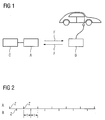
- FIG. 1 shows a radio channel F between two subscribers A and B.
- the radio channel F can be used only one after the other in one direction and then in the other direction to avoid collisions in the communication.
- the radio channel F is used for the vehicle diagnosis.
- the subscriber A is therefore connected to an evaluation unit C and the subscriber B, for example, connected via a diagnostic connector to a vehicle.
- the subscriber B picks up the vehicle data and transmits them via the radio channel F to the subscriber A, who forwards them to the evaluation unit C for evaluation.
- the subscriber B can receive a specification for changing a setting on the vehicle via the radio channel F.
- the case applicable communication method according to the invention allows both participants A and B can send equal pay telegrams to the other participants B or A without long reaction times.
- both subscribers A and B are each given transmission times in a time frame to which a subscriber A or B may send a payload to the other subscriber B or A. These transmission times are starting times for the transmission of the payload telegrams.
- the communication method according to the invention ensures that at the respective transmission time of the subscriber A or B of the radio channel F is not currently occupied by the other participant B or A.
- the information about the assignment is based on a detection signal, which is embedded at the beginning of the useful telegram or prefixed to the user telegram.
- a subscriber A or B may send a payload telegram at a transmission time assigned to him if no detection signal was received at that time by the respective other subscriber B or A, which means at the same time that the radio channel F is currently not busy and free for sending a payload telegram is.
- the duration of the detection signal via the radio channel F from one to the other subscriber essentially determines the time interval t from a transmission time Z in the time frame, which is assigned to a user telegram A or B, for the following transmission time Z in the time frame.
- This time grid with the time intervals t is according to a time ruler according to FIG. 2 shown.
- the detection signal is advantageously at least partially bit-coded and allows the fast detection of the busy state.
- the transmission times (Z) for the transmission of a useful telegram specified by one subscriber (A or B) are time-synchronized with respect to the transmission times (Z) which are predetermined for each other subscriber (B or A) for transmitting a payload telegram.
- FIG. 2 achieved, with one participant (A or B) dictates the time ruler and the other participant (B or A) adapts its time ruler of the default.
- the participant who prescribes the time ruler only has a master function in this regard. Otherwise, both participants have equal rights in the communication procedure described above.
Landscapes
- Engineering & Computer Science (AREA)
- Computer Networks & Wireless Communication (AREA)
- Signal Processing (AREA)
- Mobile Radio Communication Systems (AREA)
- Time-Division Multiplex Systems (AREA)
Abstract
Die Erfindung betrifft ein Kommunikationsverfahren für ein Funknetzwerk, mit mindestens zwei Teilnehmern (A,B), wobei ein Funkkanal (F) zwar in beiden Richtungen zwischen den Teilnehmern (A,B) genutzt wird, aber dies stets nur nacheinander in der einen und dann in der anderen Richtung, das heißt nicht gleichzeitig in beiden Richtungen. Erfindungsgemäß ist vorgesehen, dass den Teilnehmern (A,B) jeweils Sendezeitpunkte (Z) in einem Zeitraster vorgegeben werden, zu denen ein Teilnehmer (A oder B) dem jeweils anderen Teilnehmer (B oder A) ein Nutztelegramm zusenden darf, wobei in jedem Nutztelegramm an seinem Anfang ein Erkennungssignal eingebettet oder ein solches Erkennungssignal dem Nutztelegramm vorangestellt ist, und wobei das Erkennungssignal dazu dient, dem empfangenden Teilnehmer (A oder B) die Belegung des Funkkanal (F) mitzuteilen.

Description
Die Erfindung betrifft ein Kommunikationsverfahren für ein Funknetzwerk, mit mindestens zwei Teilnehmern, wobei ein Funkkanal zwar in beiden Richtungen zwischen den Teilnehmern genutzt wird, aber dies stets nur nacheinander in der einen und dann in der anderen Richtung, das heißt nicht gleichzeitig in beiden Richtungen.The invention relates to a communication method for a radio network, with at least two participants, wherein a radio channel is indeed used in both directions between the participants, but always only one after the other in one direction and then in the other direction, that is not simultaneously in both directions.
In diversen Kommunikationsanwendungen zum Datenaustausch steht nur ein einziger Funkkanal zur Verfügung. In diesem Fall kommen Halb-Duplexverfahren zum Einsatz. Dabei werden Telegramme nur nacheinander in der einen oder anderen Richtung versendet. Die gleichzeitige Nutzung einer solchen Funkstrecke in beiden Richtungen würde zu Kollisionen führen und muss daher vermieden werden. Um derartige Kollisionen auszuschließen, erfolgt beim "Polling" eine zyklische Abfrage. Hierbei wird zum Beispiel von einem Master an einen Slave eines Kommunikationsnetzwerks in der einen Richtung eine Abfrage versandt und der Slave antwortet anschließend mit dem Übersenden eines vorliegenden Nutztelegramms in der anderen Richtung. Bei Nichtvorliegen von Nutzungsdaten kann dies im Antworttelegramm mitgeteilt werden. Bei diesem Halb-Duplexverfahren werden für die Abfragen und Antworttelegramme entsprechend lange Zeiten reserviert, was bei vielen Abfragen lange Reaktionszeiten zur Folge hat.In various communication applications for data exchange, only a single radio channel is available. In this case, half-duplex methods are used. In this case, telegrams are sent one after the other in one direction or the other. The simultaneous use of such a radio link in both directions would lead to collisions and must therefore be avoided. In order to exclude such collisions, polling is followed by a cyclical polling. In this case, for example, a query is sent by a master to a slave of a communication network in one direction, and the slave then responds by transmitting a present useful message in the other direction. In the absence of usage data, this can be communicated in the response telegram. With this half-duplex method, correspondingly long times are reserved for the queries and response telegrams, which results in long response times for many queries.
Daher liegt der Erfindung die Aufgabe zu Grunde, ein Verfahren der oben genannten Art dahingehend zu verbessern, dass möglichst kurze Reaktionszeiten erreicht werden.Therefore, the invention is based on the object to improve a method of the type mentioned above so that the shortest possible reaction times can be achieved.
Die Aufgabe wird mit einem Verfahren mit den Merkmalen nach Anspruch 1 gelöst. Dabei werden den Teilnehmern jeweils Sendezeitpunkte in einem Zeitraster vorgegeben, zu denen ein Teilnehmer dem jeweils anderen Teilnehmer ein Nutztelegramm zusenden darf, wobei in jedem Nutztelegramm am Anfang ein Erkennungssignal eingebettet oder ein solches Erkennungssignal dem Nutztelegramm vorangestellt ist, und wobei das Erkennungssignal dazu dient, dem empfangenden Teilnehmer die Belegung der Funkstrecke mitzuteilen. Durch die Anwendung des Erkennungssignals lässt sich eine performantere Informationsübertragung bei einkanaliger Funkstrecke als nach dem bisher bekannten Halb-Duplexverfahren erreichen.The object is achieved by a method having the features of claim 1. In this case, the subscribers are each given transmission times in a time frame at which one subscriber may send a user message to the other subscriber, with a recognition signal at the beginning in each user message embedded or such a detection signal is preceded by the Nutztelegramm, and wherein the detection signal is used to notify the receiving subscriber the assignment of the radio link. By using the detection signal, a more performant information transmission can be achieved with a single-channel radio link than with the hitherto known half-duplex method.
Vorteilhafte Weiterbildungen der Erfindung sind Ideen oder Ansprüchen 2 bis 12 zu entnehmen.Advantageous developments of the invention are to be taken from ideas or claims 2 to 12.
Eine besonders vorteilhafte Ausführungsform der Erfindung besteht, wenn gemäß Anspruch 2 ein Teilnehmer nur dann ein Nutztelegramm im zulässigen Sendezeitpunkt aussendet, wenn vom anderen Teilnehmer kein Erkennungssignal empfangen wurde.A particularly advantageous embodiment of the invention is when according to claim 2, a subscriber only sends out a payload telegram in the allowable send time if no detection signal was received from the other party.
Weiterhin ist es vorteilhaft, wenn die Erfindung gemäß Anspruch 3 ausgeführt ist. Demgemäß ist das Zeitintervall von einem Sendezeitpunkt im Zeitraster, der zur Aussendung eines Nutztelegramms einem Teilnehmer zugeordnet ist, zum folgenden Sendezeitpunkt in dem Zeitraster, der zur Aussendung eines Nutztelegramms dem jeweils anderen Teilnehmer zugeordnet ist, im wesentlichen durch die Laufzeit des Erkennungssignals auf der Funkstrecke zwischen beiden Teilnehmern bestimmt. Diese Ausführungsform ermöglicht besonders kurze Reaktionszeiten.Furthermore, it is advantageous if the invention is designed according to claim 3. Accordingly, the time interval of a transmission time in the time frame, which is assigned to the transmission of a user telegram to the following transmission time in the time frame, which is assigned to the transmission of a useful telegram to the respective other participants, essentially by the duration of the detection signal on the radio link between intended for both participants. This embodiment allows particularly short reaction times.
Außerdem ist von Vorteil, wenn gemäß Anspruch 4 die dem einen Teilnehmer vorgegebenen Sendezeitpunkte zum Aussenden eines Nutztelegramms gegenüber den Sendezeitpunkten, die dem jeweils anderen Teilnehmer zum Aussenden eines Nutztelegramms vorgegeben sind, zeitsynchron sind.It is also advantageous if, according to claim 4, the transmission times predetermined for the one user are time-synchronized for transmitting a useful telegram with respect to the transmission times that are predetermined for the respective other user for transmitting a useful telegram.
Eine weitere vorteilhafte Ausführungsform der Erfindung ist gegeben, wenn gemäß Anspruch 5 die Sendezeitpunkte zum Aussenden eines Nutztelegramms den beiden Teilnehmern jeweils durch ein Zeitlineal mit einem Zeitraster vorgegeben werden, das durch das Zeitintervall bestimmt ist.A further advantageous embodiment of the invention is given if, according to claim 5, the transmission times for transmitting a payload telegram to the two subscribers are each predetermined by a time ruler with a time frame which is determined by the time interval.
Zur sicheren Übertragung des Erkennungssignals ist es besonders vorteilhaft, wenn gemäß Anspruch 6 das Erkennungssignal zumindest teilweise bitcodiert ist.For secure transmission of the detection signal, it is particularly advantageous if, according to claim 6, the detection signal is at least partially bit-coded.
Im Folgenden wird ein Ausführungsbeispiel der Erfindung anhand einer Zeichnung näher erläutert. Es zeigen:
- FIG 1
- ein Blockschaltbild einer Prüfstation zur Fahrzeugdiagnose mit dem erfindungsgemäßen Kommunikationsverfahren über einen Funkkanal und
- FIG 2
- ein Zeitlineal mit einem Zeitraster für das erfindungsgemäße Kommunikationsverfahren.
- FIG. 1
- a block diagram of a test station for vehicle diagnosis with the communication method according to the invention via a radio channel and
- FIG. 2
- a time ruler with a time grid for the communication method according to the invention.
Das hierbei anwendbare erfindungsgemäße Kommunikationsverfahren ermöglicht, dass beide Teilnehmer A und B gleichberechtigt Nutztelegramme an den jeweils anderen Teilnehmer B oder A ohne lange Reaktionszeiten versenden können. Hierzu werden beiden Teilnehmern A und B jeweils Sendezeitpunkte in einem Zeitraster vorgegeben, zu denen ein Teilnehmer A oder B dem jeweils anderen Teilnehmer B oder A ein Nutztelegramm zusenden darf. Diese Sendezeitpunkte sind Startzeitpunkte für die Versendung der Nutztelegramme. Um dabei Kollisionen zu vermeiden, wird gemäß dem erfindungsgemäßen Kommunikationsverfahren sichergestellt, dass zum jeweiligen Sendezeitpunkt des Teilnehmers A oder B der Funkkanal F nicht gerade durch den jeweils anderen Teilnehmers B oder A belegt ist. Die Information über die Belegung erfolgt anhand eines Erkennungssignals, das am Anfang des Nutztelegramms eingebettet oder dem Nutztelegramm vorangestellt wird. Ein Teilnehmer A oder B darf an einem ihm zugeordneten Sendezeitpunkt ein Nutztelegramm versenden, wenn zu diesem Zeitpunkt von dem jeweils anderen Teilnehmer B oder A kein Erkennungssignal empfangen wurde, was zugleich bedeutet, dass der Funkkanal F gerade nicht belegt und für die Versendung eines Nutztelegramms frei ist. Die Laufzeit des Erkennungssignals über den Funkkanal F von einem zum anderen Teilnehmer bestimmt im wesentlichen das Zeitintervall t von einem Sendezeitpunkt Z im Zeitraster, der zur Aussendung eines Nutztelegramms einem Teilnehmer A oder B zugeordnet ist, zum folgenden Sendezeitpunkt Z in dem Zeitraster. Dieses Zeitraster mit den Zeitintervallen t ist an einem Zeitlineal gemäß
Die dem einen Teilnehmer(A oder B) vorgegebenen Sendezeitpunkte(Z) zum Aussenden eines Nutztelegramms sind gegenüber den Sendezeitpunkten(Z), die dem jeweils anderen Teilnehmer(B oder A) zum Aussenden eines Nutztelegramms vorgegeben sind, zeitsynchron.The transmission times (Z) for the transmission of a useful telegram specified by one subscriber (A or B) are time-synchronized with respect to the transmission times (Z) which are predetermined for each other subscriber (B or A) for transmitting a payload telegram.
Dies wird z.B. durch zwei Zeitlineale mit gleichem Zeitraster gem.
Claims (12)
Priority Applications (5)
| Application Number | Priority Date | Filing Date | Title |
|---|---|---|---|
| EP08011715A EP2139291B1 (en) | 2008-06-27 | 2008-06-27 | Method for communication using a half duplex radio channel in a radio network |
| ES08011715T ES2371119T3 (en) | 2008-06-27 | 2008-06-27 | COMMUNICATION METHOD THROUGH A SEMI-DUPLEX RADIO CHANNEL IN A RADIO NETWORK. |
| AT08011715T ATE519351T1 (en) | 2008-06-27 | 2008-06-27 | METHOD FOR COMMUNICATION OVER A HALF-DUPLEX RADIO CHANNEL IN A RADIO NETWORK |
| PCT/EP2009/057936 WO2009156460A1 (en) | 2008-06-27 | 2009-06-25 | Method for communicating via a half-duplex radio channel in a radio network |
| US13/001,464 US20110211498A1 (en) | 2008-06-27 | 2009-06-25 | Method For Communication Via A Half-Duplex Radio Channel In A Radio Network |
Applications Claiming Priority (1)
| Application Number | Priority Date | Filing Date | Title |
|---|---|---|---|
| EP08011715A EP2139291B1 (en) | 2008-06-27 | 2008-06-27 | Method for communication using a half duplex radio channel in a radio network |
Publications (2)
| Publication Number | Publication Date |
|---|---|
| EP2139291A1 true EP2139291A1 (en) | 2009-12-30 |
| EP2139291B1 EP2139291B1 (en) | 2011-08-03 |
Family
ID=40193936
Family Applications (1)
| Application Number | Title | Priority Date | Filing Date |
|---|---|---|---|
| EP08011715A Active EP2139291B1 (en) | 2008-06-27 | 2008-06-27 | Method for communication using a half duplex radio channel in a radio network |
Country Status (5)
| Country | Link |
|---|---|
| US (1) | US20110211498A1 (en) |
| EP (1) | EP2139291B1 (en) |
| AT (1) | ATE519351T1 (en) |
| ES (1) | ES2371119T3 (en) |
| WO (1) | WO2009156460A1 (en) |
Citations (2)
| Publication number | Priority date | Publication date | Assignee | Title |
|---|---|---|---|---|
| WO1999026430A1 (en) * | 1997-11-19 | 1999-05-27 | Ensemble Communications, Inc. | An adaptive time division duplexing method and apparatus for dynamic bandwidth allocation within a wireless communication system |
| WO2002041520A2 (en) * | 2000-11-15 | 2002-05-23 | Ensemble Communications, Inc. | Improved frame structure for a communication system using adaptive modulation |
Family Cites Families (1)
| Publication number | Priority date | Publication date | Assignee | Title |
|---|---|---|---|---|
| US7415508B2 (en) * | 2001-08-31 | 2008-08-19 | Temic Automotive Of North America, Inc. | Linked vehicle active networks |
-
2008
- 2008-06-27 EP EP08011715A patent/EP2139291B1/en active Active
- 2008-06-27 AT AT08011715T patent/ATE519351T1/en active
- 2008-06-27 ES ES08011715T patent/ES2371119T3/en active Active
-
2009
- 2009-06-25 WO PCT/EP2009/057936 patent/WO2009156460A1/en not_active Ceased
- 2009-06-25 US US13/001,464 patent/US20110211498A1/en not_active Abandoned
Patent Citations (2)
| Publication number | Priority date | Publication date | Assignee | Title |
|---|---|---|---|---|
| WO1999026430A1 (en) * | 1997-11-19 | 1999-05-27 | Ensemble Communications, Inc. | An adaptive time division duplexing method and apparatus for dynamic bandwidth allocation within a wireless communication system |
| WO2002041520A2 (en) * | 2000-11-15 | 2002-05-23 | Ensemble Communications, Inc. | Improved frame structure for a communication system using adaptive modulation |
Also Published As
| Publication number | Publication date |
|---|---|
| US20110211498A1 (en) | 2011-09-01 |
| WO2009156460A1 (en) | 2009-12-30 |
| ATE519351T1 (en) | 2011-08-15 |
| ES2371119T3 (en) | 2011-12-27 |
| EP2139291B1 (en) | 2011-08-03 |
Similar Documents
| Publication | Publication Date | Title |
|---|---|---|
| EP1096350B1 (en) | Vehicle service system and method for testing and maintenance of a component especially for a functional component or a drive unit | |
| EP2443557A1 (en) | Method for transmitting data between subscriber stations of a bus system | |
| DE3687281T2 (en) | COMMUNICATION SYSTEM WITH INTERRUPTABILITY FOR LANGUAGE DURING DATA TRANSMISSION AND OPERATION. | |
| EP2823602B1 (en) | Bus communication apparatus | |
| DE60101022T2 (en) | Transmission of requests from a mobile device in the uplink in a wireless system | |
| DE102011089587A1 (en) | Subscriber station of a bus system and method for transmitting messages between subscriber stations of a bus system | |
| DE102014214457B4 (en) | Station and method for serial data transmission with dynamic reprioritization of data frames | |
| EP2733910B1 (en) | BUS system, method for operating a BUS system and fluid system with a BUS system | |
| DE102015213680A1 (en) | Access method with access slots and priority resolution | |
| EP3632016B1 (en) | Embedded cyclical redundancy check values | |
| DE3139959C2 (en) | Data device diagnostic system | |
| EP3172930B1 (en) | Management of bluetooth and wlan coexistence | |
| DE102017223774A1 (en) | Subscriber station for a serial bus system and method for error signaling for a message received in a serial bus system | |
| EP2139291B1 (en) | Method for communication using a half duplex radio channel in a radio network | |
| DE102021213400B3 (en) | Method of sending vehicle-to-X messages and vehicle-to-X communication module | |
| EP2338248B1 (en) | Method for operating a communication system with a plurality of nodes and communication system therefor | |
| DE102020103480B4 (en) | Battery system with several self-switching storage units and motor vehicle with this battery system and operating method for the battery system | |
| DE102018207659A1 (en) | Master-slave system | |
| EP0088310B1 (en) | Method of determining the duration of the existence of a connection between subscriber stations of a data exchange | |
| DE19849784B4 (en) | Method for allocating radio resources from radio links connecting central and decentralized communication devices | |
| EP3275106B1 (en) | Method and device for the configuration of a transmission link | |
| DE102011122801A1 (en) | Method and device for adapting the data transmission security in a serial bus system | |
| EP2134023A1 (en) | Method for communication in a wireless network | |
| DE10234348A1 (en) | Method and device for monitoring a data transmission | |
| DE10106209A1 (en) | Method and device for logging in a DECT / GAP handset or a system terminal for the first time into a DECT telecommunication system |
Legal Events
| Date | Code | Title | Description |
|---|---|---|---|
| PUAI | Public reference made under article 153(3) epc to a published international application that has entered the european phase |
Free format text: ORIGINAL CODE: 0009012 |
|
| AK | Designated contracting states |
Kind code of ref document: A1 Designated state(s): AT BE BG CH CY CZ DE DK EE ES FI FR GB GR HR HU IE IS IT LI LT LU LV MC MT NL NO PL PT RO SE SI SK TR |
|
| AX | Request for extension of the european patent |
Extension state: AL BA MK RS |
|
| 17P | Request for examination filed |
Effective date: 20100521 |
|
| 17Q | First examination report despatched |
Effective date: 20100611 |
|
| AKX | Designation fees paid |
Designated state(s): AT BE BG CH CY CZ DE DK EE ES FI FR GB GR HR HU IE IS IT LI LT LU LV MC MT NL NO PL PT RO SE SI SK TR |
|
| GRAP | Despatch of communication of intention to grant a patent |
Free format text: ORIGINAL CODE: EPIDOSNIGR1 |
|
| GRAS | Grant fee paid |
Free format text: ORIGINAL CODE: EPIDOSNIGR3 |
|
| GRAA | (expected) grant |
Free format text: ORIGINAL CODE: 0009210 |
|
| AK | Designated contracting states |
Kind code of ref document: B1 Designated state(s): AT BE BG CH CY CZ DE DK EE ES FI FR GB GR HR HU IE IS IT LI LT LU LV MC MT NL NO PL PT RO SE SI SK TR |
|
| REG | Reference to a national code |
Ref country code: GB Ref legal event code: FG4D Free format text: NOT ENGLISH |
|
| REG | Reference to a national code |
Ref country code: CH Ref legal event code: EP |
|
| REG | Reference to a national code |
Ref country code: IE Ref legal event code: FG4D Free format text: LANGUAGE OF EP DOCUMENT: GERMAN |
|
| REG | Reference to a national code |
Ref country code: DE Ref legal event code: R096 Ref document number: 502008004351 Country of ref document: DE Effective date: 20110929 |
|
| REG | Reference to a national code |
Ref country code: NL Ref legal event code: VDEP Effective date: 20110803 |
|
| REG | Reference to a national code |
Ref country code: ES Ref legal event code: FG2A Ref document number: 2371119 Country of ref document: ES Kind code of ref document: T3 Effective date: 20111227 |
|
| LTIE | Lt: invalidation of european patent or patent extension |
Effective date: 20110803 |
|
| PG25 | Lapsed in a contracting state [announced via postgrant information from national office to epo] |
Ref country code: SE Free format text: LAPSE BECAUSE OF FAILURE TO SUBMIT A TRANSLATION OF THE DESCRIPTION OR TO PAY THE FEE WITHIN THE PRESCRIBED TIME-LIMIT Effective date: 20110803 Ref country code: IS Free format text: LAPSE BECAUSE OF FAILURE TO SUBMIT A TRANSLATION OF THE DESCRIPTION OR TO PAY THE FEE WITHIN THE PRESCRIBED TIME-LIMIT Effective date: 20111203 Ref country code: FI Free format text: LAPSE BECAUSE OF FAILURE TO SUBMIT A TRANSLATION OF THE DESCRIPTION OR TO PAY THE FEE WITHIN THE PRESCRIBED TIME-LIMIT Effective date: 20110803 Ref country code: HR Free format text: LAPSE BECAUSE OF FAILURE TO SUBMIT A TRANSLATION OF THE DESCRIPTION OR TO PAY THE FEE WITHIN THE PRESCRIBED TIME-LIMIT Effective date: 20110803 Ref country code: NL Free format text: LAPSE BECAUSE OF FAILURE TO SUBMIT A TRANSLATION OF THE DESCRIPTION OR TO PAY THE FEE WITHIN THE PRESCRIBED TIME-LIMIT Effective date: 20110803 Ref country code: PT Free format text: LAPSE BECAUSE OF FAILURE TO SUBMIT A TRANSLATION OF THE DESCRIPTION OR TO PAY THE FEE WITHIN THE PRESCRIBED TIME-LIMIT Effective date: 20111205 Ref country code: LT Free format text: LAPSE BECAUSE OF FAILURE TO SUBMIT A TRANSLATION OF THE DESCRIPTION OR TO PAY THE FEE WITHIN THE PRESCRIBED TIME-LIMIT Effective date: 20110803 Ref country code: NO Free format text: LAPSE BECAUSE OF FAILURE TO SUBMIT A TRANSLATION OF THE DESCRIPTION OR TO PAY THE FEE WITHIN THE PRESCRIBED TIME-LIMIT Effective date: 20111103 |
|
| PG25 | Lapsed in a contracting state [announced via postgrant information from national office to epo] |
Ref country code: GR Free format text: LAPSE BECAUSE OF FAILURE TO SUBMIT A TRANSLATION OF THE DESCRIPTION OR TO PAY THE FEE WITHIN THE PRESCRIBED TIME-LIMIT Effective date: 20111104 Ref country code: PL Free format text: LAPSE BECAUSE OF FAILURE TO SUBMIT A TRANSLATION OF THE DESCRIPTION OR TO PAY THE FEE WITHIN THE PRESCRIBED TIME-LIMIT Effective date: 20110803 Ref country code: LV Free format text: LAPSE BECAUSE OF FAILURE TO SUBMIT A TRANSLATION OF THE DESCRIPTION OR TO PAY THE FEE WITHIN THE PRESCRIBED TIME-LIMIT Effective date: 20110803 Ref country code: SI Free format text: LAPSE BECAUSE OF FAILURE TO SUBMIT A TRANSLATION OF THE DESCRIPTION OR TO PAY THE FEE WITHIN THE PRESCRIBED TIME-LIMIT Effective date: 20110803 Ref country code: CY Free format text: LAPSE BECAUSE OF FAILURE TO SUBMIT A TRANSLATION OF THE DESCRIPTION OR TO PAY THE FEE WITHIN THE PRESCRIBED TIME-LIMIT Effective date: 20110803 |
|
| REG | Reference to a national code |
Ref country code: IE Ref legal event code: FD4D |
|
| PG25 | Lapsed in a contracting state [announced via postgrant information from national office to epo] |
Ref country code: SK Free format text: LAPSE BECAUSE OF FAILURE TO SUBMIT A TRANSLATION OF THE DESCRIPTION OR TO PAY THE FEE WITHIN THE PRESCRIBED TIME-LIMIT Effective date: 20110803 Ref country code: IE Free format text: LAPSE BECAUSE OF FAILURE TO SUBMIT A TRANSLATION OF THE DESCRIPTION OR TO PAY THE FEE WITHIN THE PRESCRIBED TIME-LIMIT Effective date: 20110803 Ref country code: CZ Free format text: LAPSE BECAUSE OF FAILURE TO SUBMIT A TRANSLATION OF THE DESCRIPTION OR TO PAY THE FEE WITHIN THE PRESCRIBED TIME-LIMIT Effective date: 20110803 |
|
| REG | Reference to a national code |
Ref country code: HU Ref legal event code: AG4A Ref document number: E012697 Country of ref document: HU |
|
| PG25 | Lapsed in a contracting state [announced via postgrant information from national office to epo] |
Ref country code: EE Free format text: LAPSE BECAUSE OF FAILURE TO SUBMIT A TRANSLATION OF THE DESCRIPTION OR TO PAY THE FEE WITHIN THE PRESCRIBED TIME-LIMIT Effective date: 20110803 Ref country code: RO Free format text: LAPSE BECAUSE OF FAILURE TO SUBMIT A TRANSLATION OF THE DESCRIPTION OR TO PAY THE FEE WITHIN THE PRESCRIBED TIME-LIMIT Effective date: 20110803 |
|
| PLBE | No opposition filed within time limit |
Free format text: ORIGINAL CODE: 0009261 |
|
| STAA | Information on the status of an ep patent application or granted ep patent |
Free format text: STATUS: NO OPPOSITION FILED WITHIN TIME LIMIT |
|
| PG25 | Lapsed in a contracting state [announced via postgrant information from national office to epo] |
Ref country code: DK Free format text: LAPSE BECAUSE OF FAILURE TO SUBMIT A TRANSLATION OF THE DESCRIPTION OR TO PAY THE FEE WITHIN THE PRESCRIBED TIME-LIMIT Effective date: 20110803 |
|
| 26N | No opposition filed |
Effective date: 20120504 |
|
| REG | Reference to a national code |
Ref country code: DE Ref legal event code: R097 Ref document number: 502008004351 Country of ref document: DE Effective date: 20120504 |
|
| PGFP | Annual fee paid to national office [announced via postgrant information from national office to epo] |
Ref country code: IT Payment date: 20120626 Year of fee payment: 5 |
|
| BERE | Be: lapsed |
Owner name: SIEMENS A.G. Effective date: 20120630 |
|
| PG25 | Lapsed in a contracting state [announced via postgrant information from national office to epo] |
Ref country code: MC Free format text: LAPSE BECAUSE OF NON-PAYMENT OF DUE FEES Effective date: 20120630 |
|
| REG | Reference to a national code |
Ref country code: CH Ref legal event code: PL |
|
| REG | Reference to a national code |
Ref country code: CH Ref legal event code: PL |
|
| PG25 | Lapsed in a contracting state [announced via postgrant information from national office to epo] |
Ref country code: BE Free format text: LAPSE BECAUSE OF NON-PAYMENT OF DUE FEES Effective date: 20120630 Ref country code: CH Free format text: LAPSE BECAUSE OF NON-PAYMENT OF DUE FEES Effective date: 20120630 Ref country code: LI Free format text: LAPSE BECAUSE OF NON-PAYMENT OF DUE FEES Effective date: 20120630 |
|
| PG25 | Lapsed in a contracting state [announced via postgrant information from national office to epo] |
Ref country code: BG Free format text: LAPSE BECAUSE OF FAILURE TO SUBMIT A TRANSLATION OF THE DESCRIPTION OR TO PAY THE FEE WITHIN THE PRESCRIBED TIME-LIMIT Effective date: 20111103 |
|
| PG25 | Lapsed in a contracting state [announced via postgrant information from national office to epo] |
Ref country code: MT Free format text: LAPSE BECAUSE OF FAILURE TO SUBMIT A TRANSLATION OF THE DESCRIPTION OR TO PAY THE FEE WITHIN THE PRESCRIBED TIME-LIMIT Effective date: 20110803 |
|
| PG25 | Lapsed in a contracting state [announced via postgrant information from national office to epo] |
Ref country code: LU Free format text: LAPSE BECAUSE OF NON-PAYMENT OF DUE FEES Effective date: 20120627 Ref country code: IT Free format text: LAPSE BECAUSE OF NON-PAYMENT OF DUE FEES Effective date: 20130627 |
|
| REG | Reference to a national code |
Ref country code: AT Ref legal event code: MM01 Ref document number: 519351 Country of ref document: AT Kind code of ref document: T Effective date: 20130627 |
|
| PGFP | Annual fee paid to national office [announced via postgrant information from national office to epo] |
Ref country code: TR Payment date: 20140528 Year of fee payment: 7 |
|
| PG25 | Lapsed in a contracting state [announced via postgrant information from national office to epo] |
Ref country code: AT Free format text: LAPSE BECAUSE OF NON-PAYMENT OF DUE FEES Effective date: 20130627 |
|
| REG | Reference to a national code |
Ref country code: FR Ref legal event code: PLFP Year of fee payment: 9 |
|
| REG | Reference to a national code |
Ref country code: FR Ref legal event code: PLFP Year of fee payment: 10 |
|
| PG25 | Lapsed in a contracting state [announced via postgrant information from national office to epo] |
Ref country code: TR Free format text: LAPSE BECAUSE OF NON-PAYMENT OF DUE FEES Effective date: 20150627 |
|
| REG | Reference to a national code |
Ref country code: FR Ref legal event code: PLFP Year of fee payment: 11 |
|
| PGFP | Annual fee paid to national office [announced via postgrant information from national office to epo] |
Ref country code: FR Payment date: 20230905 Year of fee payment: 17 |
|
| PGFP | Annual fee paid to national office [announced via postgrant information from national office to epo] |
Ref country code: DE Payment date: 20230913 Year of fee payment: 17 |
|
| PGFP | Annual fee paid to national office [announced via postgrant information from national office to epo] |
Ref country code: GB Payment date: 20240704 Year of fee payment: 17 |
|
| PGFP | Annual fee paid to national office [announced via postgrant information from national office to epo] |
Ref country code: ES Payment date: 20240923 Year of fee payment: 17 |
|
| PGFP | Annual fee paid to national office [announced via postgrant information from national office to epo] |
Ref country code: HU Payment date: 20240823 Year of fee payment: 17 |
|
| REG | Reference to a national code |
Ref country code: DE Ref legal event code: R119 Ref document number: 502008004351 Country of ref document: DE |
|
| PG25 | Lapsed in a contracting state [announced via postgrant information from national office to epo] |
Ref country code: HU Free format text: LAPSE BECAUSE OF NON-PAYMENT OF DUE FEES Effective date: 20250628 |
|
| GBPC | Gb: european patent ceased through non-payment of renewal fee |
Effective date: 20250627 |
|
| PG25 | Lapsed in a contracting state [announced via postgrant information from national office to epo] |
Ref country code: GB Free format text: LAPSE BECAUSE OF NON-PAYMENT OF DUE FEES Effective date: 20250627 |
|
| PG25 | Lapsed in a contracting state [announced via postgrant information from national office to epo] |
Ref country code: DE Free format text: LAPSE BECAUSE OF NON-PAYMENT OF DUE FEES Effective date: 20260101 |
|
| PG25 | Lapsed in a contracting state [announced via postgrant information from national office to epo] |
Ref country code: FR Free format text: LAPSE BECAUSE OF NON-PAYMENT OF DUE FEES Effective date: 20250630 |