EP2139252B1 - Method and equipment for reporting support capability of cell to uplink high-order modulation - Google Patents
Method and equipment for reporting support capability of cell to uplink high-order modulation Download PDFInfo
- Publication number
- EP2139252B1 EP2139252B1 EP07845766.0A EP07845766A EP2139252B1 EP 2139252 B1 EP2139252 B1 EP 2139252B1 EP 07845766 A EP07845766 A EP 07845766A EP 2139252 B1 EP2139252 B1 EP 2139252B1
- Authority
- EP
- European Patent Office
- Prior art keywords
- capability
- order modulation
- uplink high
- supporting
- cell
- Prior art date
- Legal status (The legal status is an assumption and is not a legal conclusion. Google has not performed a legal analysis and makes no representation as to the accuracy of the status listed.)
- Active
Links
Images

Classifications
-
- H—ELECTRICITY
- H04—ELECTRIC COMMUNICATION TECHNIQUE
- H04W—WIRELESS COMMUNICATION NETWORKS
- H04W8/00—Network data management
- H04W8/22—Processing or transfer of terminal data, e.g. status or physical capabilities
-
- H—ELECTRICITY
- H04—ELECTRIC COMMUNICATION TECHNIQUE
- H04W—WIRELESS COMMUNICATION NETWORKS
- H04W24/00—Supervisory, monitoring or testing arrangements
- H04W24/10—Scheduling measurement reports ; Arrangements for measurement reports
-
- H—ELECTRICITY
- H04—ELECTRIC COMMUNICATION TECHNIQUE
- H04W—WIRELESS COMMUNICATION NETWORKS
- H04W88/00—Devices specially adapted for wireless communication networks, e.g. terminals, base stations or access point devices
- H04W88/12—Access point controller devices
-
- H—ELECTRICITY
- H04—ELECTRIC COMMUNICATION TECHNIQUE
- H04W—WIRELESS COMMUNICATION NETWORKS
- H04W92/00—Interfaces specially adapted for wireless communication networks
- H04W92/16—Interfaces between hierarchically similar devices
- H04W92/22—Interfaces between hierarchically similar devices between access point controllers
Definitions
- the present invention relates to radio communication system, and in particular to a method and device of reporting the capability of a cell to support uplink high-order modulation, in which a drift radio network controller (DRNC) is used for reporting whether the relative cell controlled by it supports uplink high-order modulation.
- DRNC drift radio network controller
- An access network comprises one or more radio network subsystems, each of which is a sub-network of the access network and comprises a radio network controller and one or more nodes B.
- the access network controller is a network element responsible for controlling the radio resource of the access network.
- the main function of the Node B is to process the air interface physical layer and besides to perform some basic management operation on radio resource.
- SRNC serving radio network controller
- DRNC drift radio network controller
- the DRNC is further responsible for transmitting to the SRNC the supporting capability of the cell of Node B under its' control.
- the terminal supporting this technology can utilize the function of the technology only when being cooperated by the Node B which supports this technology.
- the access network side needs to take the backward compatibility into account and to determine whether Node B can use the technology, so as to make an exact decision.
- publication US 2005/207359 discloses an enhanced uplink dedicated channel wherein parameters are defined for use on an interface between network elements to enable a configuration setup of an enhanced radio uplink. It is further noted that patent publication WO 01/50669 discloses a self-optimizing multi-variable point to multipoint communication system.
- the wireless physical layer and the wireless media-access-control layer collectively include a set of parameters, which are adaptively modified by a base station controller for communication with a plurality of customer premises equipment.
- the present invention provides a method and device for reporting the capability of a cell to support uplink high-order modulation, in which DRNC is used to report whether the relative cell controlled by it supports uplink high-order modulation.
- DRNC is used to report SRNC whether the relative cell controlled by it supports uplink high-order modulation to, thus enabling the SRNC to obtain the information to determine whether to employ uplink high-order modulation on the UE.
- the present invention provides a method for reporting the capability of a cell to support uplink high-order modulation, in which the DRNC is used for reporting whether the relative cell controlled by it supports uplink high-order modulation, comprising the following steps: after receiving a request message from the SRNC, the DRNC reports via signaling to the SRNC the information about the capability of the relative cell to support uplink high-order modulation.
- the request message may comprise any one of the following: radio link setup request message and radio link addition request message.
- the signaling may comprise any one of the following or the combination thereof: radio link setup response message, radio link setup failure message, radio link addition response message, and radio link addition failure message.
- the DRNC when the DRNC receives a radio link setup request message or a radio link addition request message and one or more desired links have been setup or added successfully, the information about the capability of the relative cell to support uplink high-order modulation is carried in the radio link setup response message or a radio link addition response message which is delivered to the SRNC.
- the DRNC when the DRNC receives a radio link setup request message or a radio link addition request message and some of the plural links have been successfully setup or added but some of those have been failed to be setup or added, the information about the capability of the relative cell to support uplink high-order modulation is carried in the radio link setup failure message or a radio link addition failure message which is delivered to the SRNC.
- the relative cell is the neighboring cell with successfully setup or added links after the DRNC receives the said request message.
- the reporting using signaling can be effected by adding the information about the capability of supporting uplink high-order modulation into the value of the cell capability container of the existing information cell.
- the capability of supporting uplink high-order modulation can be represented in form of bit with "0" denoting not-supporting uplink high-order modulation and "1" denoting supporting uplink high-order modulation.
- the capability of supporting uplink high-order modulation is indicated by adding the expanded cell capability information.
- the information about the supporting capability for uplink high-order modulation is represented by the supporting indication or the not-supporting indication.
- the capability of supporting uplink high-order modulation may comprise any one of the following or the combination thereof: uplink 16QAM supporting capability, 64QAM supporting capability, OQAM supporting capability, the supporting capability for all modulation modes of 16QAM and QAM with less levels, the supporting capability for all modulation modes of 64QAM and QAM with less levels, and the supporting capability for all modulation modes of OQAM and QAM with less levels.
- the present invention provides a device for reporting the capability of a cell to support uplink high-order modulation, in which DRNC is used to report whether the relative cell controlled by it supports uplink high-order modulation and the device can comprise a reporting unit for reporting via signaling to SRNC the information about the capability of the relative cell to support uplink high-order modulation, after receiving the request message from SRNC.
- the request message can comprise any one of the following: radio link setup request message and radio link addition request message.
- the signaling can comprise any one of the following: radio link setup response message, radio link setup failure message, radio link addition response message, and radio link addition failure message.
- the DRNC when the DRNC receives a radio link setup request message or a radio link addition request message and one or more desired links have been setup or added successfully, the information about the capability of the relative cell to support uplink high-order modulation is carried in the radio link setup response message or the radio link addition response message delivered to the SRNC by the reporting unit.
- the DRNC when the DRNC receives a radio link setup request message or a radio link addition request message and some of the plural links have been successfully setup or added while some of those have been failed to be setup or added, the information about the capability of the relative cell to support uplink high-order modulation is carried in the radio link setup failure message or the radio link addition failure message delivered to the SRNC by the reporting unit.
- the relative cell including one or more cells, may be the neighboring cell with successfully setup or added links after the DRNC receives the request message.
- the reporting using signaling can be effected by adding the information about the capability of supporting uplink high-order modulation into the cell capability container value of the existing information cell.
- the supporting capability for uplink high-order modulation can be represented in form of bit with "0" denoting not-supporting uplink high-order modulation and "1" denoting supporting uplink high-order modulation.
- the supporting capability for uplink high-order modulation can be indicated by adding the expanded cell capability information.
- the information about the supporting capability for uplink high-order modulation is represented by indicating the supporting or indicating the not-supporting.
- the supporting capability for uplink high-order modulation may comprise any one of the following or the combination thereof: uplink 16QAM supporting capability, 64QAM supporting capability, OQAM supporting capability, the supporting capability for all modulation modes of 16QAM and the QAM with less levels, the supporting capability for all modulation modes of 64QAM and the QAM with less levels, the supporting capability for all modulation modes of OQAM and the QAM with less levels.
- the present invention provides a method and device in which DRNC is used for reporting the capability of the cell controlled by it to support uplink high-order modulation, wherein the DRNC is used to report to the SRNC whether the cell controlled by the DRNC supports uplink high-order modulation, such that the SRNC obtain the information to determine whether uplink high-order modulation method is used on the UE.
- the object of the present invention is to provide a method and device in which DRNC is used for reporting the capability of the cell controlled by it to support uplink high-order modulation, wherein the DRNC is used to report to the SRNC whether the cell controlled by the DRNC supports uplink high-order modulation, such that the SRNC obtains the information to determine whether the uplink high-order modulation method is used on the UE.
- the method for reporting the capability of a cell to support uplink high-order modulation comprises one step: the DRNC reports the capability of the relative cell to support uplink high-order modulation by using signaling.
- the DRNC reports via signaling to SRNC the information about the capability of the relative cell to support uplink high-order modulation
- the mentioned signaling is any one of the following messages:
- the relative cell is the neighboring cell with successfully setup or added links after the DRNC receives the request message, and the relative cell may be single or plural.
- the DRNC When the DRNC receives radio link setup request message or radio link addition request message and one or more desired links have been setup successfully, the information on the neighboring cell with successfully setup or added links is carried in the radio link setup response message or radio link addition response message.
- the DRNC when the DRNC receives the radio link setup request message or the radio link addition request message in which plural radio links need to be setup or added wherein some of the links are successfully setup or added while some of the links are failed to be setup or added, the information on the relative cell with successfully setup and added links is carried in the radio link setup failure message or the radio link addition failure message.
- Uplink high-order modulation mode refers to the modulation mode of 16QAM, or 64QAM, or OQAM.
- the cell capability information indicates high-order modulation supporting information by the following method:
- Fig.1 is an interaction diagram of the method for reporting the capability of a cell to support uplink high-order modulation according to a first embodiment of the present invention
- Fig.2 is an interaction diagram of the method for reporting the capability of a cell to support uplink high-order modulation according to a second embodiment of the present invention.
- the method for reporting the capability of a cell to support uplink high-order modulation will be described in connection with Fig. 1 and Fig.2 in the following description.
- Fig.1 is the interaction diagram of the method for reporting the capability of a cell to support uplink high-order modulation according to the first embodiment of the present invention.
- a method in which DRNC reports the capability of the cell controlled by it to support uplink high-order modulation through the process of successfully setup or added links can comprise the following steps:
- Fig.2 is the interaction diagram of the method for reporting the capability of a cell to support uplink high-order modulation according to the second embodiment of the present invention.
- a method in which the DRNC reports the capability of the cell controlled by the DRNC to support uplink high-order modulation through the process of unsuccessfully setup or added links may comprise the following steps:
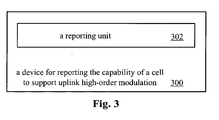
- Fig.3 is the block diagram of the device 300 for reporting the capability of a cell to support uplink high-order modulation according to the present invention.
- the device comprises: a reporting unit 302 which reports via signaling to the SRNC the information about the capability of the relative cell to support uplink high-order modulation, after receiving the request message from the SRNC.
- the request message can comprise any one of the following: radio link setup request message and radio link addition request message.
- the signaling can comprise any one of the following: radio link setup response message, radio link setup failure message, radio link addition response message, and radio link addition failure message.
- the DRNC When the DRNC receives the radio link setup request message or the radio link addition request message and one or more desired links have been setup or added successfully, the information about the capability of the relative cell to support uplink high-order modulation is carried in the radio link setup response message or the radio link addition response message delivered to the SRNC by the reporting unit.
- the DRNC When the DRNC receives the radio link setup request message or the radio link addition request message and some of the plural links have been successfully setup or added but some of those have been failed to be setup or added, the information about the capability of the relative cell to support uplink high-order modulation is carried in the radio link setup failure message or the radio link addition failure message delivered to the SRNC by the reporting unit.
- the relative cell including one or more cells, is the neighboring cell with successfully setup or added links after the DRNC has received the request message.
- the reporting using signaling can be effected by adding the information about the supporting capability for uplink high-order modulation into the each of the cell capability container of the existing information cell.
- the supporting capability for uplink high-order modulation can be indicated in form of bit, with "0" denoting not-supporting uplink high-order modulation, and "1" denoting supporting uplink high-order modulation.
- the supporting capability for uplink high-order modulation can be indicated by adding expanded cell capability information.
- the information about the supporting capability for uplink high-order modulation is represented by the supporting indication or the not-supporting indication.
- the supporting capability for uplink high-order modulation can comprise any one of the following or the combination thereof: uplink 16QAM supporting capability, 64QAM supporting capability, OQAM supporting capability, the support capabilities for all modulation modes of 16QAM and the QAM with less levels, the supporting capabilities for all modulation modes of 64QAM and the QAM with less levels, the support capabilities for all modulation modes of OQAM and the QAM with less levels.
- the present invention provides a method and device in which the DRNC reports the capability of the cell controlled by the DRNC to support uplink high-order modulation, wherein the DRNC reports to the SRNC whether the cell controlled by the DRNC supports uplink high-order modulation, such that the SRNC can obtain the information to determine whether to use uplink high-order modulation method on the UE.
Landscapes
- Engineering & Computer Science (AREA)
- Computer Networks & Wireless Communication (AREA)
- Signal Processing (AREA)
- Databases & Information Systems (AREA)
- Mobile Radio Communication Systems (AREA)
- Digital Transmission Methods That Use Modulated Carrier Waves (AREA)
Description
- The present invention relates to radio communication system, and in particular to a method and device of reporting the capability of a cell to support uplink high-order modulation, in which a drift radio network controller (DRNC) is used for reporting whether the relative cell controlled by it supports uplink high-order modulation.
- An access network comprises one or more radio network subsystems, each of which is a sub-network of the access network and comprises a radio network controller and one or more nodes B. The access network controller is a network element responsible for controlling the radio resource of the access network. The main function of the Node B is to process the air interface physical layer and besides to perform some basic management operation on radio resource.
- When a user equipment (UE) is setting up communication with a plurality of radio network controllers, if different radio network controls are connected via Iur port, the radio network controller responsible for linking the UE and the core network is referred to as serving radio network controller (SRNC), and the radio network controller responsible for transmitting the signaling and data of that UE but not linking it with the core network is referred to as drift radio network controller (DRNC). In addition, the DRNC is further responsible for transmitting to the SRNC the supporting capability of the cell of Node B under its' control.
- In the technology optimization for existing system, in order to improve users' experience quality and system throughout, the high speed uplink packet access technology is continuously developed and so far 16QAM high-order modulation mode has been introduced.
- Thus, because the technology is newly introduced, only new Node B supports it, while old Node B does not support it. The terminal supporting this technology can utilize the function of the technology only when being cooperated by the Node B which supports this technology. During making the decision whether to use this technology, the access network side needs to take the backward compatibility into account and to determine whether Node B can use the technology, so as to make an exact decision.
- Therefore, it is necessary to provide a method and device for reporting the capability of a cell to support uplink high-order modulation, in which a drift radio network controller is used to report whether the relative cell controlled by it supports uplink high-order modulation, in order to solve the above problem.
- It is noted that publication
US 2005/207359 discloses an enhanced uplink dedicated channel wherein parameters are defined for use on an interface between network elements to enable a configuration setup of an enhanced radio uplink. It is further noted that patent publicationWO 01/50669 - Therefore, in order to solve the above problem, the present invention provides a method and device for reporting the capability of a cell to support uplink high-order modulation, in which DRNC is used to report whether the relative cell controlled by it supports uplink high-order modulation. In this method and device, DRNC is used to report SRNC whether the relative cell controlled by it supports uplink high-order modulation to, thus enabling the SRNC to obtain the information to determine whether to employ uplink high-order modulation on the UE.
- In one aspect of the present invention, it provides a method for reporting the capability of a cell to support uplink high-order modulation, in which the DRNC is used for reporting whether the relative cell controlled by it supports uplink high-order modulation, comprising the following steps: after receiving a request message from the SRNC, the DRNC reports via signaling to the SRNC the information about the capability of the relative cell to support uplink high-order modulation.
- Meanwhile, the request message may comprise any one of the following: radio link setup request message and radio link addition request message. The signaling may comprise any one of the following or the combination thereof: radio link setup response message, radio link setup failure message, radio link addition response message, and radio link addition failure message.
- According to one aspect of the present invention, when the DRNC receives a radio link setup request message or a radio link addition request message and one or more desired links have been setup or added successfully, the information about the capability of the relative cell to support uplink high-order modulation is carried in the radio link setup response message or a radio link addition response message which is delivered to the SRNC.
- Optionally, when the DRNC receives a radio link setup request message or a radio link addition request message and some of the plural links have been successfully setup or added but some of those have been failed to be setup or added, the information about the capability of the relative cell to support uplink high-order modulation is carried in the radio link setup failure message or a radio link addition failure message which is delivered to the SRNC.
- According to one aspect of the present invention, the relative cell, including one or more cells, is the neighboring cell with successfully setup or added links after the DRNC receives the said request message. The reporting using signaling can be effected by adding the information about the capability of supporting uplink high-order modulation into the value of the cell capability container of the existing information cell.
- In addition, according to one aspect of the present invention, the capability of supporting uplink high-order modulation can be represented in form of bit with "0" denoting not-supporting uplink high-order modulation and "1" denoting supporting uplink high-order modulation. In the information about the capability of supporting uplink high-order modulation, the capability of supporting uplink high-order modulation is indicated by adding the expanded cell capability information. The information about the supporting capability for uplink high-order modulation is represented by the supporting indication or the not-supporting indication.
- According to one aspect of the present invention, the capability of supporting uplink high-order modulation may comprise any one of the following or the combination thereof: uplink 16QAM supporting capability, 64QAM supporting capability, OQAM supporting capability, the supporting capability for all modulation modes of 16QAM and QAM with less levels, the supporting capability for all modulation modes of 64QAM and QAM with less levels, and the supporting capability for all modulation modes of OQAM and QAM with less levels.
- According to another aspect of the present invention, it provides a device for reporting the capability of a cell to support uplink high-order modulation, in which DRNC is used to report whether the relative cell controlled by it supports uplink high-order modulation and the device can comprise a reporting unit for reporting via signaling to SRNC the information about the capability of the relative cell to support uplink high-order modulation, after receiving the request message from SRNC.
- Meanwhile, the request message can comprise any one of the following: radio link setup request message and radio link addition request message. The signaling can comprise any one of the following: radio link setup response message, radio link setup failure message, radio link addition response message, and radio link addition failure message.
- According to another aspect of the present invention, when the DRNC receives a radio link setup request message or a radio link addition request message and one or more desired links have been setup or added successfully, the information about the capability of the relative cell to support uplink high-order modulation is carried in the radio link setup response message or the radio link addition response message delivered to the SRNC by the reporting unit.
- According to another aspect of the present invention, when the DRNC receives a radio link setup request message or a radio link addition request message and some of the plural links have been successfully setup or added while some of those have been failed to be setup or added, the information about the capability of the relative cell to support uplink high-order modulation is carried in the radio link setup failure message or the radio link addition failure message delivered to the SRNC by the reporting unit.
- According to another aspect of the present invention, the relative cell, including one or more cells, may be the neighboring cell with successfully setup or added links after the DRNC receives the request message.
- In addition, the reporting using signaling can be effected by adding the information about the capability of supporting uplink high-order modulation into the cell capability container value of the existing information cell. The supporting capability for uplink high-order modulation can be represented in form of bit with "0" denoting not-supporting uplink high-order modulation and "1" denoting supporting uplink high-order modulation.
- In the information about the supporting capability for uplink high-order modulation, the supporting capability for uplink high-order modulation can be indicated by adding the expanded cell capability information. The information about the supporting capability for uplink high-order modulation is represented by indicating the supporting or indicating the not-supporting.
- According to another aspect of the present invention, the supporting capability for uplink high-order modulation may comprise any one of the following or the combination thereof: uplink 16QAM supporting capability, 64QAM supporting capability, OQAM supporting capability, the supporting capability for all modulation modes of 16QAM and the QAM with less levels, the supporting capability for all modulation modes of 64QAM and the QAM with less levels, the supporting capability for all modulation modes of OQAM and the QAM with less levels.
- Therefore, the present invention provides a method and device in which DRNC is used for reporting the capability of the cell controlled by it to support uplink high-order modulation, wherein the DRNC is used to report to the SRNC whether the cell controlled by the DRNC supports uplink high-order modulation, such that the SRNC obtain the information to determine whether uplink high-order modulation method is used on the UE.
- Other features and advantages of the present invention will be set forth in the following description, and become obvious partly from the description, or can be understood through implementing the present invention. The purposes and other advantages of the present invention can be achieved and obtained through the structures specified by the specification, claims and drawings.
- The drawings, provided for further understanding the present invention, are constitutes a part of the Specification and used for explaining the present invention along with the embodiments of the present invention, without limiting the present invention, in which:
-
Fig.1 is an interaction diagram of the method for reporting the capability of a cell to support uplink high-order modulation according to a first embodiment of the present invention; -
Fig.2 is an interaction diagram of the method for reporting the capability of a cell to support the uplink high-order modulation according to the second embodiment of the present invention; and -
Fig.3 is a block diagram of the device for reporting the capability of a cell to support uplink high-order modulation according to the present invention. - The present invention will be described in connection with the drawings. It is to be noted that the preferred embodiments detailed herein are only used for explaining and illustrating the present invention, not for the purpose of limiting the present invention.
- The object of the present invention is to provide a method and device in which DRNC is used for reporting the capability of the cell controlled by it to support uplink high-order modulation, wherein the DRNC is used to report to the SRNC whether the cell controlled by the DRNC supports uplink high-order modulation, such that the SRNC obtains the information to determine whether the uplink high-order modulation method is used on the UE.
- The method for reporting the capability of a cell to support uplink high-order modulation according to the present invention comprises one step: the DRNC reports the capability of the relative cell to support uplink high-order modulation by using signaling. In particular, after the DRNC receives the request message from SRNC, the DRNC reports via signaling to SRNC the information about the capability of the relative cell to support uplink high-order modulation
- Meanwhile, the mentioned signaling is any one of the following messages:
- (1) radio link setup response message, which is triggered by radio link setup request message;
- (2) radio link addition response message, which is triggered by radio link addition request message;
- (3) radio link setup failure message, which is triggered by radio link setup request message; and
- (4) radio link addition failure message, which is triggered by radio link addition request message.
- The relative cell is the neighboring cell with successfully setup or added links after the DRNC receives the request message, and the relative cell may be single or plural.
- When the DRNC receives radio link setup request message or radio link addition request message and one or more desired links have been setup successfully, the information on the neighboring cell with successfully setup or added links is carried in the radio link setup response message or radio link addition response message.
- Optionally, when the DRNC receives the radio link setup request message or the radio link addition request message in which plural radio links need to be setup or added wherein some of the links are successfully setup or added while some of the links are failed to be setup or added, the information on the relative cell with successfully setup and added links is carried in the radio link setup failure message or the radio link addition failure message.
- Uplink high-order modulation mode refers to the modulation mode of 16QAM, or 64QAM, or OQAM.
- In addition, the following method can be used to indicate the information about whether to support high-order modulation:
- 1. adding the supporting capabilities for uplink 16QAM, and/or 64QAM, and/or OQAM into the value of the "cell capability container" of the existing information cell, as in form of bit and with "0" indicating not-supporting and "1" indicating supporting;
- 2. adding the supporting capabilities for uplink 16QAM, and/or all modulation modes of 64QAM and the QAM with less levels, and/or all modulation modes of OQAM and the QAM with less levels into the value of the "cell capability container" of the existing information cell, as in form of bit and with "0" indicating not-supporting and "1" indicating supporting;
- 3. adding the support capabilities for all modulation modes of uplink 16QAM and the QAM with less levels, and/or all modulation modes of 64QAM and the QAM with less levels, and/or all modulation modes of OQAM and the QAM with less levels into the value of the "cell capability container" of the existing information cell, as in form of bit and with "0" indicating not-supporting and "1" indicating supporting; or
- 4. adding the expanded cell capability information.
- Meanwhile, the cell capability information indicates high-order modulation supporting information by the following method:
- (1) the supporting indication of 16QAM, and/or the supporting indication of 64QAM, and/or the supporting indication of OQAM;
- (2) the supporting indication of 16QAM, and/or the supporting indication of all modulation capabilities of 64QAM and the QAM with less levels, and/or the supporting indications of all modulation capabilities of OQAM and the QAM with less levels; and
- (3) the supporting indication of all modulation capabilities of 16QAM and the QAM with less levels, and/or the supporting indication of all modulation capabilities of 64QAM and the QAM with less levels, and/or the supporting indication of all modulation capabilities of OQAM and the QAM with less levels.
-
Fig.1 is an interaction diagram of the method for reporting the capability of a cell to support uplink high-order modulation according to a first embodiment of the present invention; andFig.2 is an interaction diagram of the method for reporting the capability of a cell to support uplink high-order modulation according to a second embodiment of the present invention. The method for reporting the capability of a cell to support uplink high-order modulation will be described in connection withFig. 1 and Fig.2 in the following description. -
Fig.1 is the interaction diagram of the method for reporting the capability of a cell to support uplink high-order modulation according to the first embodiment of the present invention. As shown inFig.1 , there is provided a method in which DRNC reports the capability of the cell controlled by it to support uplink high-order modulation through the process of successfully setup or added links. The method can comprise the following steps: - Step S110, the SRNC sends to the DRNC a radio link setup request message or a radio link addition request message; and
- Step S120, when the DRNC has successfully setup or added the links needed to be setup or added, the DRNC sends to the SRNC a radio link setup response message or a radio link addition response message in which the information about the capability of the neighboring cell to support uplink 16QAM is carried, with the neighboring cell having successfully setup links.
-
Fig.2 is the interaction diagram of the method for reporting the capability of a cell to support uplink high-order modulation according to the second embodiment of the present invention. As shown inFig.2 , there is provided a method in which the DRNC reports the capability of the cell controlled by the DRNC to support uplink high-order modulation through the process of unsuccessfully setup or added links. The method may comprise the following steps: - Step S210, the SRNC sends to the DRNC the radio link setup request message or the radio link addition request message; and
- Step S220, when the DRNC has partly setup or added the links needed to be setup or added, the DRNC sends to the SRNC the radio link setup failure message or the radio link addition failure message in which the information about the capability of the neighboring cell to support uplink 16QAM is carried, with the neighboring cell having successfully setup links.
-
Fig.3 is the block diagram of thedevice 300 for reporting the capability of a cell to support uplink high-order modulation according to the present invention. As shown inFig.3 , the device comprises: areporting unit 302 which reports via signaling to the SRNC the information about the capability of the relative cell to support uplink high-order modulation, after receiving the request message from the SRNC. - Meanwhile, the request message can comprise any one of the following: radio link setup request message and radio link addition request message. The signaling can comprise any one of the following: radio link setup response message, radio link setup failure message, radio link addition response message, and radio link addition failure message.
- When the DRNC receives the radio link setup request message or the radio link addition request message and one or more desired links have been setup or added successfully, the information about the capability of the relative cell to support uplink high-order modulation is carried in the radio link setup response message or the radio link addition response message delivered to the SRNC by the reporting unit.
- When the DRNC receives the radio link setup request message or the radio link addition request message and some of the plural links have been successfully setup or added but some of those have been failed to be setup or added, the information about the capability of the relative cell to support uplink high-order modulation is carried in the radio link setup failure message or the radio link addition failure message delivered to the SRNC by the reporting unit.
- Meanwhile, the relative cell, including one or more cells, is the neighboring cell with successfully setup or added links after the DRNC has received the request message.
- In addition, the reporting using signaling can be effected by adding the information about the supporting capability for uplink high-order modulation into the each of the cell capability container of the existing information cell. The supporting capability for uplink high-order modulation can be indicated in form of bit, with "0" denoting not-supporting uplink high-order modulation, and "1" denoting supporting uplink high-order modulation.
- In the information about the supporting capability for uplink high-order modulation, the supporting capability for uplink high-order modulation can be indicated by adding expanded cell capability information. The information about the supporting capability for uplink high-order modulation is represented by the supporting indication or the not-supporting indication.
- The supporting capability for uplink high-order modulation can comprise any one of the following or the combination thereof: uplink 16QAM supporting capability, 64QAM supporting capability, OQAM supporting capability, the support capabilities for all modulation modes of 16QAM and the QAM with less levels, the supporting capabilities for all modulation modes of 64QAM and the QAM with less levels, the support capabilities for all modulation modes of OQAM and the QAM with less levels.
- Collectively, the present invention provides a method and device in which the DRNC reports the capability of the cell controlled by the DRNC to support uplink high-order modulation, wherein the DRNC reports to the SRNC whether the cell controlled by the DRNC supports uplink high-order modulation, such that the SRNC can obtain the information to determine whether to use uplink high-order modulation method on the UE.
Claims (15)
- A method for reporting the capability of a cell to support uplink high-order modulation, in which a drift radio network controller, DRNC, is used for reporting whether the relative cell supports uplink high-order modulation, characterized in that comprising the following steps:after receiving a request message from a serving radio network controller, SRNC, said drift radio network controller reports via signaling to the serving radio network controller the information about the capability of the relative cell to support the uplink high-order modulation.
- The method according to Claim 1, characterized in that said request message comprises any one of the following: radio link setup request message, and radio link addition request message.
- The method according to Claim 2, characterized in that said signaling comprises any one of the following or the combination thereof: radio link setup response message, radio link setup failure message, radio link addition response message, and radio link addition failure message.
- The method according to Claim 3, characterized in that, when said drift radio network controller receives the radio link setup request message or the radio link addition request message and one or more desired links have been setup or added successfully, the information about the capability of the relative cell to support the uplink high-order modulation is carried in the radio link setup response message or the radio link addition response message delivered to said serving radio network controller.
- The method according to Claim 3, characterized in that, when said drift radio network controller receives the radio link setup request message or the radio link addition request message and some of the plural links have been successfully setup or added but some of those have been failed to be setup or added, the information about the capability of the relative cell to support the uplink high-order modulation is carried in the radio link setup failure message or the radio link addition failure message delivered to said serving radio network controller.
- The method according to anyone of Claims 1-5, characterized in that, said relative cell is the neighboring cell with successfully setup or added links after said drift radio network controller receives said request message and said relative cell includes one or more cells.
- The method according to anyone of Claims 1-5, characterized in that, said reporting using signaling are effected by adding the information about the supporting capability for the uplink high-order modulation into the value of the cell capability container of the existing information cell.
- The method according to Claim 7, characterized in that said supporting capability for the uplink high-order modulation is indicated in the form of bit, with "0" denoting not-supporting the uplink high-order modulation, and "1" denoting supporting the uplink high-order modulation.
- The method according to anyone of Claims 1-5, characterized in that, in the information about the supporting capability for the uplink high-order modulation, the supporting capability for the uplink high-order modulation is indicated by adding expanded cell capability information.
- The method according to Claim 9, characterized in that the information about the support capability for the uplink high-order modulation is represented by a supporting indication or a not-supporting indication.
- The method according to Claim 1, characterized in that the supporting capability for the uplink high-order modulation comprises any one of the following or the combination thereof: uplink 16QAM supporting capability, 64QAM supporting capability, OQAM supporting capability, the support capabilities for all modulation modes of 16QAM and the QAM with less levels, the support capabilities for all modulation modes of 64QAM and the QAM with less levels, the support capabilities for all modulation modes of OQAM and the QAM with less levels.
- A device (300) for reporting the capability of a cell to support uplink high-order modulation, in which a drift radio network controller, DRNC, is used for reporting whether relative cell supports uplink high-order modulation, characterized in that the device comprises:a reporting unit (302), which, after receiving a request message from a serving radio network controller, SRNC, is adapted to report via signaling to the serving radio network controller the information about the capability of the relative cell to support the uplink high-order modulation.
- The device according to Claim 12, wherein the device is arranged to report using signaling by adding the information about the supporting capability for the uplink high-order modulation into the value of the cell capability container of the existing information cell, and to indicate supporting capability for the uplink high-order modulation in the form of bit, wherein "0" denotes not-supporting the uplink high-order modulation, and "1" denotes supporting the uplink high-order modulation.
- The device according to Claim 12, wherein the device is arranged to represent, in the information about the supporting capability for the uplink high-order modulation, the supporting capability for the uplink high-order modulation by adding the expanded cell capability information, and to represent the information about the supporting capability for the uplink high-order modulation by a supporting indication or a not-supporting indication.
- A computer program product for reporting the capability of a cell to support uplink high-order modulation, in which a drift radio network controller is used for reporting whether the relative cell supports uplink high-order modulation, which computer program product comprises instructions for causing a processor to perform the steps of method of:after receiving a request message from a serving radio network controller, SRNC, said drift radio network controller reports via signaling to the serving radio network controller the information about the capability of the relative cell to support the uplink high-order modulation.
Applications Claiming Priority (2)
| Application Number | Priority Date | Filing Date | Title |
|---|---|---|---|
| CN2007100872522A CN101188550B (en) | 2007-03-21 | 2007-03-21 | Method and device for reporting cell's ability to support uplink high-order modulation |
| PCT/CN2007/003403 WO2008113233A1 (en) | 2007-03-21 | 2007-11-30 | Method and equipment for reporting support capability of cell to uplink high-order modulation |
Publications (3)
| Publication Number | Publication Date |
|---|---|
| EP2139252A1 EP2139252A1 (en) | 2009-12-30 |
| EP2139252A4 EP2139252A4 (en) | 2013-11-27 |
| EP2139252B1 true EP2139252B1 (en) | 2014-12-24 |
Family
ID=39480747
Family Applications (1)
| Application Number | Title | Priority Date | Filing Date |
|---|---|---|---|
| EP07845766.0A Active EP2139252B1 (en) | 2007-03-21 | 2007-11-30 | Method and equipment for reporting support capability of cell to uplink high-order modulation |
Country Status (6)
| Country | Link |
|---|---|
| US (1) | US20100087187A1 (en) |
| EP (1) | EP2139252B1 (en) |
| JP (1) | JP5202547B2 (en) |
| KR (1) | KR20100015728A (en) |
| CN (1) | CN101188550B (en) |
| WO (1) | WO2008113233A1 (en) |
Families Citing this family (1)
| Publication number | Priority date | Publication date | Assignee | Title |
|---|---|---|---|---|
| CN102447668A (en) * | 2010-09-30 | 2012-05-09 | 华为技术有限公司 | High-order modulation configuration method and device for cell forward access channel state user equipment |
Family Cites Families (14)
| Publication number | Priority date | Publication date | Assignee | Title |
|---|---|---|---|---|
| US6654384B1 (en) * | 1999-12-30 | 2003-11-25 | Aperto Networks, Inc. | Integrated self-optimizing multi-parameter and multi-variable point to multipoint communication system |
| GB0104610D0 (en) * | 2001-02-23 | 2001-04-11 | Koninkl Philips Electronics Nv | Radio communication system |
| KR100918765B1 (en) * | 2001-10-20 | 2009-09-24 | 삼성전자주식회사 | Apparatus and Method for Encoding and Rate Matching in Code Division Multiple Access Mobile Communication System |
| GB2382273B (en) * | 2001-11-20 | 2003-11-26 | Ericsson Telefon Ab L M | Abnormal release recovery in a UTRAN of a UMTS network |
| EP2846592B1 (en) * | 2002-05-09 | 2016-06-08 | Microsoft Technology Licensing, LLC | HSDPA CQI, ACK, NACK power offset known in node B and in SRNC |
| KR20040058426A (en) * | 2002-12-26 | 2004-07-05 | 엘지전자 주식회사 | RNSAP having a DRNC reset message function and controlling method therefore |
| EP1503606B1 (en) * | 2003-07-31 | 2008-03-26 | Nokia Siemens Networks Gmbh & Co. Kg | Common radio resource management method in a multi-rat cellular telephone network |
| US8243633B2 (en) * | 2004-03-16 | 2012-08-14 | Nokia Corporation | Enhanced uplink dedicated channel—application protocol over lub/lur |
| JP2005328525A (en) * | 2004-05-04 | 2005-11-24 | Samsung Electronics Co Ltd | Method and apparatus for selecting optimal scheduling cell of soft handover terminal in uplink packet transmission system |
| JP2006067433A (en) * | 2004-08-30 | 2006-03-09 | Fujitsu Ltd | Mobile communication system, radio base station |
| KR20060026722A (en) * | 2004-09-21 | 2006-03-24 | 삼성전자주식회사 | Handover Method of Multimedia Broadcasting / Multicast Service Considering User Terminal Mobility |
| KR100663417B1 (en) * | 2004-12-23 | 2007-01-02 | 삼성전자주식회사 | Method and apparatus for providing multimedia/multicast broadcast service on ue mobility |
| CN100490579C (en) * | 2005-05-24 | 2009-05-20 | 大唐移动通信设备有限公司 | Set-up/adding method of radio link of cell switchover |
| CN100484267C (en) * | 2006-03-29 | 2009-04-29 | 华为技术有限公司 | SRNS migrating method based on mobile network multicast service data |
-
2007
- 2007-03-21 CN CN2007100872522A patent/CN101188550B/en active Active
- 2007-11-30 KR KR1020097021875A patent/KR20100015728A/en not_active Ceased
- 2007-11-30 WO PCT/CN2007/003403 patent/WO2008113233A1/en not_active Ceased
- 2007-11-30 EP EP07845766.0A patent/EP2139252B1/en active Active
- 2007-11-30 JP JP2009553885A patent/JP5202547B2/en active Active
- 2007-11-30 US US12/532,124 patent/US20100087187A1/en not_active Abandoned
Also Published As
| Publication number | Publication date |
|---|---|
| JP5202547B2 (en) | 2013-06-05 |
| KR20100015728A (en) | 2010-02-12 |
| EP2139252A4 (en) | 2013-11-27 |
| WO2008113233A1 (en) | 2008-09-25 |
| US20100087187A1 (en) | 2010-04-08 |
| EP2139252A1 (en) | 2009-12-30 |
| CN101188550A (en) | 2008-05-28 |
| CN101188550B (en) | 2010-12-08 |
| JP2010521898A (en) | 2010-06-24 |
Similar Documents
| Publication | Publication Date | Title |
|---|---|---|
| EP3007481B1 (en) | Device and system for network resource configuration | |
| EP2398268B1 (en) | Method and apparatus of setting a plurality of parameters in a wireless telecommunication network | |
| KR20140023427A (en) | Method, terminal and network device for distributing data to wireless local area network | |
| JP2012054736A (en) | Mobile communication system and load distribution method for the same | |
| US8374598B2 (en) | Method for drift radio network controller to report that cell does not support transmission interval | |
| CN101631362B (en) | Method, base station, base station controller and system for constructing wireless link | |
| CN101442779A (en) | Method, apparatus and system for updating carrier frequency resource | |
| JP2010521938A5 (en) | ||
| EP2139252B1 (en) | Method and equipment for reporting support capability of cell to uplink high-order modulation | |
| US8830956B2 (en) | Method of configuring the absolute grant mapping table for drifting radio network controller | |
| EP2157807B1 (en) | Method of network controller reporting on the cycle period ability of the maximal discontinuous transmission in a cell | |
| CN101335983A (en) | Method for reporting uplink dedicated physical control channel time slot format 4 support capability | |
| CN100366012C (en) | A method for a user terminal to access a core network via a wireless access network | |
| EP2139254A1 (en) | Method and apparatus for reporting supporting capability of a cell for downlink high-level modulation | |
| EP2139251B1 (en) | Method for reporting that a cell does not support an uplink high-order modulation and apparatus thereof | |
| CN101277147B (en) | Method for non supporting high speed downstream packet data access information to report to a leadership for subdistrict | |
| CN102333349B (en) | Message processing method and device and communication system | |
| CN104115523B (en) | Method, device and system for information exchange between public enhanced dedicated channel and authorized channel E-RGCH | |
| US20140213270A1 (en) | Method and Device for Capacity Management | |
| CN112492650B (en) | Resource information processing method and device | |
| CN101272579A (en) | A drift radio network controller reporting spreading factor does not support capability method | |
| JP2008011109A (en) | Mobile communication system and physical line changing method |
Legal Events
| Date | Code | Title | Description |
|---|---|---|---|
| PUAI | Public reference made under article 153(3) epc to a published international application that has entered the european phase |
Free format text: ORIGINAL CODE: 0009012 |
|
| 17P | Request for examination filed |
Effective date: 20090929 |
|
| AK | Designated contracting states |
Kind code of ref document: A1 Designated state(s): AT BE BG CH CY CZ DE DK EE ES FI FR GB GR HU IE IS IT LI LT LU LV MC MT NL PL PT RO SE SI SK TR |
|
| RIC1 | Information provided on ipc code assigned before grant |
Ipc: H04W 4/00 20090101AFI20091127BHEP |
|
| DAX | Request for extension of the european patent (deleted) | ||
| A4 | Supplementary search report drawn up and despatched |
Effective date: 20131030 |
|
| RIC1 | Information provided on ipc code assigned before grant |
Ipc: H04W 4/00 20090101AFI20131023BHEP |
|
| GRAP | Despatch of communication of intention to grant a patent |
Free format text: ORIGINAL CODE: EPIDOSNIGR1 |
|
| INTG | Intention to grant announced |
Effective date: 20140711 |
|
| GRAS | Grant fee paid |
Free format text: ORIGINAL CODE: EPIDOSNIGR3 |
|
| GRAA | (expected) grant |
Free format text: ORIGINAL CODE: 0009210 |
|
| AK | Designated contracting states |
Kind code of ref document: B1 Designated state(s): AT BE BG CH CY CZ DE DK EE ES FI FR GB GR HU IE IS IT LI LT LU LV MC MT NL PL PT RO SE SI SK TR |
|
| REG | Reference to a national code |
Ref country code: GB Ref legal event code: FG4D |
|
| REG | Reference to a national code |
Ref country code: CH Ref legal event code: EP |
|
| REG | Reference to a national code |
Ref country code: IE Ref legal event code: FG4D |
|
| REG | Reference to a national code |
Ref country code: AT Ref legal event code: REF Ref document number: 703659 Country of ref document: AT Kind code of ref document: T Effective date: 20150115 |
|
| REG | Reference to a national code |
Ref country code: DE Ref legal event code: R096 Ref document number: 602007039816 Country of ref document: DE Effective date: 20150212 |
|
| REG | Reference to a national code |
Ref country code: NL Ref legal event code: T3 |
|
| PG25 | Lapsed in a contracting state [announced via postgrant information from national office to epo] |
Ref country code: FI Free format text: LAPSE BECAUSE OF FAILURE TO SUBMIT A TRANSLATION OF THE DESCRIPTION OR TO PAY THE FEE WITHIN THE PRESCRIBED TIME-LIMIT Effective date: 20141224 Ref country code: LT Free format text: LAPSE BECAUSE OF FAILURE TO SUBMIT A TRANSLATION OF THE DESCRIPTION OR TO PAY THE FEE WITHIN THE PRESCRIBED TIME-LIMIT Effective date: 20141224 |
|
| REG | Reference to a national code |
Ref country code: LT Ref legal event code: MG4D |
|
| PG25 | Lapsed in a contracting state [announced via postgrant information from national office to epo] |
Ref country code: GR Free format text: LAPSE BECAUSE OF FAILURE TO SUBMIT A TRANSLATION OF THE DESCRIPTION OR TO PAY THE FEE WITHIN THE PRESCRIBED TIME-LIMIT Effective date: 20150325 Ref country code: SE Free format text: LAPSE BECAUSE OF FAILURE TO SUBMIT A TRANSLATION OF THE DESCRIPTION OR TO PAY THE FEE WITHIN THE PRESCRIBED TIME-LIMIT Effective date: 20141224 Ref country code: LV Free format text: LAPSE BECAUSE OF FAILURE TO SUBMIT A TRANSLATION OF THE DESCRIPTION OR TO PAY THE FEE WITHIN THE PRESCRIBED TIME-LIMIT Effective date: 20141224 |
|
| REG | Reference to a national code |
Ref country code: AT Ref legal event code: MK05 Ref document number: 703659 Country of ref document: AT Kind code of ref document: T Effective date: 20141224 |
|
| PG25 | Lapsed in a contracting state [announced via postgrant information from national office to epo] |
Ref country code: RO Free format text: LAPSE BECAUSE OF FAILURE TO SUBMIT A TRANSLATION OF THE DESCRIPTION OR TO PAY THE FEE WITHIN THE PRESCRIBED TIME-LIMIT Effective date: 20141224 Ref country code: ES Free format text: LAPSE BECAUSE OF FAILURE TO SUBMIT A TRANSLATION OF THE DESCRIPTION OR TO PAY THE FEE WITHIN THE PRESCRIBED TIME-LIMIT Effective date: 20141224 Ref country code: EE Free format text: LAPSE BECAUSE OF FAILURE TO SUBMIT A TRANSLATION OF THE DESCRIPTION OR TO PAY THE FEE WITHIN THE PRESCRIBED TIME-LIMIT Effective date: 20141224 Ref country code: SK Free format text: LAPSE BECAUSE OF FAILURE TO SUBMIT A TRANSLATION OF THE DESCRIPTION OR TO PAY THE FEE WITHIN THE PRESCRIBED TIME-LIMIT Effective date: 20141224 Ref country code: CZ Free format text: LAPSE BECAUSE OF FAILURE TO SUBMIT A TRANSLATION OF THE DESCRIPTION OR TO PAY THE FEE WITHIN THE PRESCRIBED TIME-LIMIT Effective date: 20141224 |
|
| PG25 | Lapsed in a contracting state [announced via postgrant information from national office to epo] |
Ref country code: AT Free format text: LAPSE BECAUSE OF FAILURE TO SUBMIT A TRANSLATION OF THE DESCRIPTION OR TO PAY THE FEE WITHIN THE PRESCRIBED TIME-LIMIT Effective date: 20141224 Ref country code: PL Free format text: LAPSE BECAUSE OF FAILURE TO SUBMIT A TRANSLATION OF THE DESCRIPTION OR TO PAY THE FEE WITHIN THE PRESCRIBED TIME-LIMIT Effective date: 20141224 Ref country code: IS Free format text: LAPSE BECAUSE OF FAILURE TO SUBMIT A TRANSLATION OF THE DESCRIPTION OR TO PAY THE FEE WITHIN THE PRESCRIBED TIME-LIMIT Effective date: 20150424 |
|
| REG | Reference to a national code |
Ref country code: DE Ref legal event code: R097 Ref document number: 602007039816 Country of ref document: DE |
|
| PG25 | Lapsed in a contracting state [announced via postgrant information from national office to epo] |
Ref country code: DK Free format text: LAPSE BECAUSE OF FAILURE TO SUBMIT A TRANSLATION OF THE DESCRIPTION OR TO PAY THE FEE WITHIN THE PRESCRIBED TIME-LIMIT Effective date: 20141224 |
|
| PLBE | No opposition filed within time limit |
Free format text: ORIGINAL CODE: 0009261 |
|
| STAA | Information on the status of an ep patent application or granted ep patent |
Free format text: STATUS: NO OPPOSITION FILED WITHIN TIME LIMIT |
|
| REG | Reference to a national code |
Ref country code: FR Ref legal event code: PLFP Year of fee payment: 9 |
|
| 26N | No opposition filed |
Effective date: 20150925 |
|
| PG25 | Lapsed in a contracting state [announced via postgrant information from national office to epo] |
Ref country code: IT Free format text: LAPSE BECAUSE OF FAILURE TO SUBMIT A TRANSLATION OF THE DESCRIPTION OR TO PAY THE FEE WITHIN THE PRESCRIBED TIME-LIMIT Effective date: 20141224 |
|
| PG25 | Lapsed in a contracting state [announced via postgrant information from national office to epo] |
Ref country code: SI Free format text: LAPSE BECAUSE OF FAILURE TO SUBMIT A TRANSLATION OF THE DESCRIPTION OR TO PAY THE FEE WITHIN THE PRESCRIBED TIME-LIMIT Effective date: 20141224 |
|
| PG25 | Lapsed in a contracting state [announced via postgrant information from national office to epo] |
Ref country code: BE Free format text: LAPSE BECAUSE OF FAILURE TO SUBMIT A TRANSLATION OF THE DESCRIPTION OR TO PAY THE FEE WITHIN THE PRESCRIBED TIME-LIMIT Effective date: 20141224 |
|
| PG25 | Lapsed in a contracting state [announced via postgrant information from national office to epo] |
Ref country code: LU Free format text: LAPSE BECAUSE OF FAILURE TO SUBMIT A TRANSLATION OF THE DESCRIPTION OR TO PAY THE FEE WITHIN THE PRESCRIBED TIME-LIMIT Effective date: 20151130 Ref country code: MC Free format text: LAPSE BECAUSE OF FAILURE TO SUBMIT A TRANSLATION OF THE DESCRIPTION OR TO PAY THE FEE WITHIN THE PRESCRIBED TIME-LIMIT Effective date: 20141224 |
|
| REG | Reference to a national code |
Ref country code: CH Ref legal event code: PL |
|
| PG25 | Lapsed in a contracting state [announced via postgrant information from national office to epo] |
Ref country code: CH Free format text: LAPSE BECAUSE OF NON-PAYMENT OF DUE FEES Effective date: 20151130 Ref country code: LI Free format text: LAPSE BECAUSE OF NON-PAYMENT OF DUE FEES Effective date: 20151130 |
|
| REG | Reference to a national code |
Ref country code: IE Ref legal event code: MM4A |
|
| PG25 | Lapsed in a contracting state [announced via postgrant information from national office to epo] |
Ref country code: IE Free format text: LAPSE BECAUSE OF NON-PAYMENT OF DUE FEES Effective date: 20151130 |
|
| REG | Reference to a national code |
Ref country code: FR Ref legal event code: PLFP Year of fee payment: 10 |
|
| PG25 | Lapsed in a contracting state [announced via postgrant information from national office to epo] |
Ref country code: HU Free format text: LAPSE BECAUSE OF FAILURE TO SUBMIT A TRANSLATION OF THE DESCRIPTION OR TO PAY THE FEE WITHIN THE PRESCRIBED TIME-LIMIT; INVALID AB INITIO Effective date: 20071130 Ref country code: BG Free format text: LAPSE BECAUSE OF FAILURE TO SUBMIT A TRANSLATION OF THE DESCRIPTION OR TO PAY THE FEE WITHIN THE PRESCRIBED TIME-LIMIT Effective date: 20141224 |
|
| PG25 | Lapsed in a contracting state [announced via postgrant information from national office to epo] |
Ref country code: CY Free format text: LAPSE BECAUSE OF FAILURE TO SUBMIT A TRANSLATION OF THE DESCRIPTION OR TO PAY THE FEE WITHIN THE PRESCRIBED TIME-LIMIT Effective date: 20141224 |
|
| PG25 | Lapsed in a contracting state [announced via postgrant information from national office to epo] |
Ref country code: MT Free format text: LAPSE BECAUSE OF FAILURE TO SUBMIT A TRANSLATION OF THE DESCRIPTION OR TO PAY THE FEE WITHIN THE PRESCRIBED TIME-LIMIT Effective date: 20141224 Ref country code: TR Free format text: LAPSE BECAUSE OF FAILURE TO SUBMIT A TRANSLATION OF THE DESCRIPTION OR TO PAY THE FEE WITHIN THE PRESCRIBED TIME-LIMIT Effective date: 20141224 |
|
| REG | Reference to a national code |
Ref country code: FR Ref legal event code: PLFP Year of fee payment: 11 |
|
| PG25 | Lapsed in a contracting state [announced via postgrant information from national office to epo] |
Ref country code: PT Free format text: LAPSE BECAUSE OF FAILURE TO SUBMIT A TRANSLATION OF THE DESCRIPTION OR TO PAY THE FEE WITHIN THE PRESCRIBED TIME-LIMIT Effective date: 20141224 |
|
| P01 | Opt-out of the competence of the unified patent court (upc) registered |
Effective date: 20230530 |
|
| PGFP | Annual fee paid to national office [announced via postgrant information from national office to epo] |
Ref country code: FR Payment date: 20250930 Year of fee payment: 19 |
|
| PGFP | Annual fee paid to national office [announced via postgrant information from national office to epo] |
Ref country code: NL Payment date: 20251003 Year of fee payment: 19 |
|
| PGFP | Annual fee paid to national office [announced via postgrant information from national office to epo] |
Ref country code: DE Payment date: 20250930 Year of fee payment: 19 |
|
| PGFP | Annual fee paid to national office [announced via postgrant information from national office to epo] |
Ref country code: GB Payment date: 20251001 Year of fee payment: 19 |