EP2139141A2 - Method and apparatus for designing modulation and coding set of communication system - Google Patents
Method and apparatus for designing modulation and coding set of communication system Download PDFInfo
- Publication number
- EP2139141A2 EP2139141A2 EP09163820A EP09163820A EP2139141A2 EP 2139141 A2 EP2139141 A2 EP 2139141A2 EP 09163820 A EP09163820 A EP 09163820A EP 09163820 A EP09163820 A EP 09163820A EP 2139141 A2 EP2139141 A2 EP 2139141A2
- Authority
- EP
- European Patent Office
- Prior art keywords
- modulation
- communication system
- coding schemes
- received signal
- quality
- Prior art date
- Legal status (The legal status is an assumption and is not a legal conclusion. Google has not performed a legal analysis and makes no representation as to the accuracy of the status listed.)
- Withdrawn
Links
Images

Classifications
-
- H—ELECTRICITY
- H04—ELECTRIC COMMUNICATION TECHNIQUE
- H04L—TRANSMISSION OF DIGITAL INFORMATION, e.g. TELEGRAPHIC COMMUNICATION
- H04L1/00—Arrangements for detecting or preventing errors in the information received
- H04L1/0001—Systems modifying transmission characteristics according to link quality, e.g. power backoff
- H04L1/0002—Systems modifying transmission characteristics according to link quality, e.g. power backoff by adapting the transmission rate
- H04L1/0003—Systems modifying transmission characteristics according to link quality, e.g. power backoff by adapting the transmission rate by switching between different modulation schemes
-
- H—ELECTRICITY
- H04—ELECTRIC COMMUNICATION TECHNIQUE
- H04L—TRANSMISSION OF DIGITAL INFORMATION, e.g. TELEGRAPHIC COMMUNICATION
- H04L27/00—Modulated-carrier systems
-
- H—ELECTRICITY
- H04—ELECTRIC COMMUNICATION TECHNIQUE
- H04L—TRANSMISSION OF DIGITAL INFORMATION, e.g. TELEGRAPHIC COMMUNICATION
- H04L1/00—Arrangements for detecting or preventing errors in the information received
- H04L1/0001—Systems modifying transmission characteristics according to link quality, e.g. power backoff
- H04L1/0009—Systems modifying transmission characteristics according to link quality, e.g. power backoff by adapting the channel coding
-
- H—ELECTRICITY
- H04—ELECTRIC COMMUNICATION TECHNIQUE
- H04L—TRANSMISSION OF DIGITAL INFORMATION, e.g. TELEGRAPHIC COMMUNICATION
- H04L1/00—Arrangements for detecting or preventing errors in the information received
- H04L1/0001—Systems modifying transmission characteristics according to link quality, e.g. power backoff
- H04L1/0015—Systems modifying transmission characteristics according to link quality, e.g. power backoff characterised by the adaptation strategy
- H04L1/0019—Systems modifying transmission characteristics according to link quality, e.g. power backoff characterised by the adaptation strategy in which mode-switching is based on a statistical approach
-
- H—ELECTRICITY
- H04—ELECTRIC COMMUNICATION TECHNIQUE
- H04W—WIRELESS COMMUNICATION NETWORKS
- H04W24/00—Supervisory, monitoring or testing arrangements
- H04W24/02—Arrangements for optimising operational condition
Definitions
- the present invention relates to a design of modulation and coding set of communication system, and more particularly, to method and apparatus for designing modulation and coding set of communication system, which enable achieving an optimum system performance, such as system throughput.
- modulation-demodulation and channel coding-decoding are usually required to be designed for the receiving and transiting ends, especially in the wireless transmission system.
- Each modulation and coding scheme (MCS) combination has a corresponding spectral efficiency, e.g., the combination of a QPSK modulation and a convolution code or Turbo code with a code rate of 1/2 can achieve a transmission efficiency of 1 bit / symbol.
- Multiple MCS combinations can be achieved by changing the modulation order (QPSK, M-PSK, 16QAM, M-QAM, etc.) and the code rate (1/2, 2/3, 3/4, etc.). Different MCSs can be applied to different transmission environments.
- a channel of a good transmission environment can transmit more information with the MCS of a higher spectral efficiency; whereas a channel of a poor transmission environment can transmit less information with the MCS of a lower spectral efficiency, so as to ensure the transmission quality.
- the transmission conditions can be indicated by the received signal to interference plus noise ratio (SINR).
- SINR received signal to interference plus noise ratio
- the channel quality can also be indicated with other indexes.
- SINR in order to meet certain transmission requirement, such as that the transmission error rate is below certain threshold (e.g., 10% block error rate (BLER)), the MCS of a spectral efficiency as high as possible may be selected.
- BLER block error rate
- Each MCS has a different BLER under a different SINR, and this can be indicated with a BLER-SINR graph.
- the transmission throughput of the system can be improved as far as possible by selecting different MCSs in accordance with different received SINRs, and this technique is called adaptive MCS selection.
- the variation range of the received SINR depends on many factors, such as system configuration, transmission medium distribution, user state change in system service, etc.. Taking the cellular mobile wireless communication system as an example, a user close to a base station experiences less wireless signal transmission attenuation, and the received SINR is higher, while a user far from the base station experiences more signal attenuation, and the received SINR is lower; with respect to a cellular system having a reuse factor of 1 in multiple base stations, a user at the edge of the cell is interfered by a non-service base station, thus the SINR is lower than that of a user at the cell center.
- the magnitude of the received SINR to each user depends on factors such as system configuration, user state, etc..
- the magnitude of the received SINR to a user can be indicated by probability distributions, such as cumulate density function (CDF) or probability density function (PDF). From those distribution curves, the variation range of the user SINR in the system can be approximately known.
- an adaptive MCS selection shall reflect the condition of the current transmission channel, i.e., to select a MCS of a spectral efficiency as high as possible, which meets the BLER requirement, under the current received SINR value.
- the receiving end shall, in certain way, inform the transmitting end of the selected MCS, so that the transmitting end can transmit correctly.
- the number of MCS combinations supported by the system shall be limited, and many communication standards specify MCS combinations supported both by the transmitting and receiving parties.
- IEEE 802.16E [1] specifies the following 11 MCS combinations: QPSK 1 ⁇ 2 with a repetition factor of 6, QPSK 1 ⁇ 2 with a repetition factor of 4, QPSK 1 ⁇ 2 with a repetition factor of 2, QPSK 1 ⁇ 2, QPSK 3 ⁇ 4, 16QAM 1 ⁇ 2, 16QAM 3 ⁇ 4, 64 QAM 1 ⁇ 2, 64 QAM 2 / 3 , 64 QAM 3 ⁇ 4, and 64 QAM 5 / 6 .
- the current research mainly discusses designing the MCS structure under a given spectral efficiency, namely designing the modulation scheme and the coder structure, so that the BLER-SINR curve is more steep, i.e., the BLER is smaller under the given SINR.
- spectral efficiency level i.e., which MCS and spectral efficiency level are to be supported by the system
- embodiments of the present invention provide a method for MCS level design based on a probability method, with an object of tending to improve the system throughput.
- the method of invention embodiments can determine MCS levels to be supported by the system when designing the communication system, or revise the existing MCS levels when configurations of the communication system are changed, so as to sufficiently utilize the system capacity.
- the present invention embodiments select the MCS set suitable for the current system configuration, by combining error performance curves at different MCS levels and corresponding spectral efficiencies, and the probability distribution of received signal qualities under different system configurations, and directs selecting concrete MCS scheme, including corresponding modulation method and coding method.
- the method of the present invention can determine MCS levels to be supported by the system when designing the communication system, or revise the existing MCS levels when configurations of the communication system are changed, so as to sufficiently utilize the system capacity.
- Embodiments of a first aspect of the invention provide a method of designing a set of MCSs for use in a communication system, in accordance with a probability distribution of quality of a received signal in the communication system, wherein the method comprises the steps of: acquiring the probability distribution of the quality of the received signal in the communication system; performing a calculation on the target performance of the communication system based on the acquired probability distribution of the quality of the received signal and a plurality of MCSs via traversing various possible sets of MCSs selected from the plurality of MCSs, to design a proper set of MCSs for the communication system, so that the number of MCSs available at different quality levels is selected in accordance with the probability distribution.
- the number of MCSs available for providing a specific quality level is for example related to the frequency with which the level is likely to appear in the system. Therefore, a quality region where the probability of the quality of the received signal appears more frequently is provided with more levels of the MCSs.
- more suitable MCSs may be provided than for ranges of quality less likely to appear in practice in the system.
- the quality of the received signal is a SINR of the received signal.
- the probability distribution of the quality of the received signal may be acquired via system simulation before a network of the communication system is actually deployed, or via actual path test after the network of the communication system is deployed.
- the calculation of system throughput of the communication system is performed on the basis of the acquired probability distribution of the SINR of the communication system and an error performance curve of each of a plurality of predetermined MCSs via traversing the various possible sets of MCSs selected from the plurality of predetermined MCSs, so as to select the proper set of MCSs for use in the communication system.
- p is a value of the SINR
- f(p) is a probability distribution function of the SINR
- xi is a spectrum efficiency of the ith MCS
- i is an integer smaller than M
- BLER(x i ,p) is a block error rate with regard to the ith MCS and the
- the method may further comprising the steps of: based on a plurality of designated spectrum efficiencies, designing a plurality of MCSs corresponding to the respective spectrum efficiencies; acquiring an error performance curve of each MCS via simulation; and performing a calculation on the target performance of the communication system based on the probability distribution of the quality of the received signal and the acquired error performance curve of the MCS via traversing all possible spectrum efficiencies and corresponding MCSs to select the proper set of MCSs for the communication system.
- Embodiments of a second aspect of the invention provide an apparatus of designing a set of MCSs for the communication system, in accordance with the probability distribution of quality of the received signal in the communication system, wherein the apparatus comprises: a received signal quality acquiring means, for acquiring the probability distribution of the quality of the received signal of the communication system; and a MCS set designing means, for performing a calculation on the target performance of the communication system based on the acquired probability distribution of the quality of the received signal and a plurality of MCSs via traversing various possible sets of MCSs selected from the plurality of MCSs, to design a proper set of MCSs for the communication system, so that a region where the probability of the quality of the received signal appears more frequently are provided with more levels of the MCSs.
- the MCS set designing means may comprise: a MCS designing unit, for designating a plurality of MCSs corresponding to respective spectrum efficiencies; an error performance curve acquiring unit, for acquiring an error performance curve of each MCS via simulation; and a MCS set selecting unit, for performing a calculation on the target performance of the communication system based on the probability distribution of the quality of the received signal and the acquired error performance curve of the MCS via traversing all possible spectrum efficiencies and corresponding MCSs to select the proper set of MCSs for the communication system.
- Embodiments of a third aspect of the invention provide a computer program.
- the computer program When the computer program is loaded into a computer and executed by the computer, the method of the invention mentioned above for designing the MCS set for use in the communication system can be realized.
- Embodiments of a fourth aspect of the invention provide a computer-readable record medium containing the above computer program.
- the computer-readable record medium can be read by the computer to load the computer program therein to the computer and then executed by the computer, so as to realize the method of the invention mentioned above for designing the MCS set for use in the communication system.
- Embodiments of the present invention can mainly solve two problems.
- One problem is to select a proper MCS set from known MCSs, so as to maximize the overall performance (system throughput) of the communication system.
- the other problem is to design a new MCS set for a new communication system or communication system with its configuration changed, so as to maximize the overall performance (system throughput) of the communication system.
- the probability distribution of received signal SINRs at the receiving end of the system shall be calculated.
- the probability distribution of received signal SINRs is acquired, e.g., via system simulation before a network of the communication system is actually deployed, or via actual path test after the network of the communication system is deployed. In order to reflect the actual conditions, user received signal SINRs under different base stations shall be counted.
- Fig. 1 illustrates a probability distribution diagram of received signal SINRs acquired via system simulation.
- the appearance probabilities of different SINRs are also different.
- the appearance probabilities of SINRs in an intermediate range are relatively high.
- the probability distributions of received signal SINRs are also different.
- the figure is taken as an example to describe how to design MCS levels so that the capacity of the communication system can be maximized, as follows:
- the received SINRs vary in a large range, as shown in Fig. 1 , the variation range of SINR may be from -30 dB to +30 dB.
- the probabilities of SINRs appearing in an intermediate range (-10 ⁇ 10 dB) are relatively high, because in the cellular wireless communication system, each user is certainly covered by certain service base station, thus the variation ranges of SINRs of most users are not very large. Therefore, we can consider optimizing MCS levels based on variation characteristics of the SINRs.
- a region having higher appearance probabilities of SINRs can be provided with more MCSs levels, while a region having lower appearance probabilities of SINRs can be provided with less MCSs levels. That is, when the SINRs are not evenly distributed, corresponding MCS levels are also designed to be unevenly distributed; while when the SINRs are evenly distributed, the MCS levels are also designed to be evenly distributed.
- the object of maximizing the system capacity is achieved by matching the MCS level design with the SINR distribution.
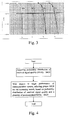
- Fig. 3 illustrates the BLER curve of four MCS levels (the BLER curve can be changed by designing concrete MCS).
- the above problem can be solved via traversing search method.
- the parameters to be optimized are different spectral efficiency sets ⁇ x i ⁇ M , and corresponding BLER (x i , p) curve under each spectral efficiency.
- the BLER (x i , p) curve is related to concrete MCS, e.g., in some systems, different spectral efficiencies are achieved only by changing puncture schemes of the coder, and different puncture schemes lead to different BLER curves. In this way, we can calculate the system throughput under corresponding spectral efficiency set, by changing the spectral efficiency and the produced BLER curve.
- the spectral efficiency set and MCS leading to the maximum system throughput is selected from various sets, and that is the optimum MCS set under the system configuration.
- Fig. 4 illustrates a method for selecting a proper MCS set from a plurality of predetermined MCSs
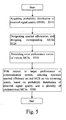
- Fig. 5 illustrates a method for designing a completely new MCS set.
- step S410 firstly, the probability distribution of received signal SINR of the communication system via system simulation or actual path test.
- SINR system simulation or actual path test.
- other quality index of received signal also can be used.
- step S420 selecting a proper MCS set from the plurality of predetermined MCSs according to the previously mentioned calculation method, based on the acquired received signal SINR.
- the system throughput is calculated via equation (1). Wherein the MCS set maximizing the system throughput is the MCS set finally to be used.
- a new and suitable MCS set can be designed according to the method of the invention.
- step S510 obtaining the probability distribution of received signal SINR of the communication system via system simulation or actual path test.
- SINR received signal SINR
- other quality index of received signal also can be used.
- step S520 designating a group of spectral efficiencies, and with respect to these spectral efficiencies, designing corresponding MCSs respectively.
- designing corresponding MCS based on spectral efficiency is a prior art in the field, instead of a key of the invention, and hence is not described detailedly herein.
- step S530 simulating error performance curves of respective MCSs.
- step S540 calculating the system throughput via equation (1), based on the probability distribution of SINRs acquired in step S510 and the error performance curves acquired in step S530.
- the calculation is performed by traversing all possible spectral efficiencies and corresponding designed MCSs, and searching the spectral efficiency set and MCS set maximizing the calculated system throughput.
- a proper spectral efficiency level and MCS level are designed for the communication system.
- the above MCS design method of the invention used in communication system is adaptable to any multiple-access communication system, broadcast/multicast/ unicast communication system, which can be based on any multiple-access technique, such as OFDMA, CDMA and TDMA.
- the invention also provides a computer program or a computer program product for carrying out any of the methods described herein, and a computer readable medium having stored thereon a program for carrying out any of the methods described herein.
- a computer program embodying the invention may be stored on a computer-readable medium, or it could, for example, be in the form of a signal such as a downloadable data signal provided from an Internet website, or it could be in any other form.
Landscapes
- Engineering & Computer Science (AREA)
- Computer Networks & Wireless Communication (AREA)
- Signal Processing (AREA)
- Quality & Reliability (AREA)
- Physics & Mathematics (AREA)
- Probability & Statistics with Applications (AREA)
- Mobile Radio Communication Systems (AREA)
- Detection And Prevention Of Errors In Transmission (AREA)
Abstract
Description
- The present invention relates to a design of modulation and coding set of communication system, and more particularly, to method and apparatus for designing modulation and coding set of communication system, which enable achieving an optimum system performance, such as system throughput.
- The transmission reliability of any communication system is surely reduced due to the influence of the transmission medium. In order to improve the transmission reliability, modulation-demodulation and channel coding-decoding are usually required to be designed for the receiving and transiting ends, especially in the wireless transmission system.
- Each modulation and coding scheme (MCS) combination has a corresponding spectral efficiency, e.g., the combination of a QPSK modulation and a convolution code or Turbo code with a code rate of 1/2 can achieve a transmission efficiency of 1 bit / symbol. Multiple MCS combinations can be achieved by changing the modulation order (QPSK, M-PSK, 16QAM, M-QAM, etc.) and the code rate (1/2, 2/3, 3/4, etc.). Different MCSs can be applied to different transmission environments. E.g., a channel of a good transmission environment can transmit more information with the MCS of a higher spectral efficiency; whereas a channel of a poor transmission environment can transmit less information with the MCS of a lower spectral efficiency, so as to ensure the transmission quality.
- Generally, in a communication system, the transmission conditions can be indicated by the received signal to interference plus noise ratio (SINR). Of course, the channel quality can also be indicated with other indexes. Under a given SINR, in order to meet certain transmission requirement, such as that the transmission error rate is below certain threshold (e.g., 10% block error rate (BLER)), the MCS of a spectral efficiency as high as possible may be selected. Each MCS has a different BLER under a different SINR, and this can be indicated with a BLER-SINR graph. The transmission throughput of the system can be improved as far as possible by selecting different MCSs in accordance with different received SINRs, and this technique is called adaptive MCS selection. The variation range of the received SINR depends on many factors, such as system configuration, transmission medium distribution, user state change in system service, etc.. Taking the cellular mobile wireless communication system as an example, a user close to a base station experiences less wireless signal transmission attenuation, and the received SINR is higher, while a user far from the base station experiences more signal attenuation, and the received SINR is lower; with respect to a cellular system having a reuse factor of 1 in multiple base stations, a user at the edge of the cell is interfered by a non-service base station, thus the SINR is lower than that of a user at the cell center. In a word, the magnitude of the received SINR to each user depends on factors such as system configuration, user state, etc.. Statistically, the magnitude of the received SINR to a user can be indicated by probability distributions, such as cumulate density function (CDF) or probability density function (PDF). From those distribution curves, the variation range of the user SINR in the system can be approximately known.
- In order to utilize the system capacity as far as possible, an adaptive MCS selection shall reflect the condition of the current transmission channel, i.e., to select a MCS of a spectral efficiency as high as possible, which meets the BLER requirement, under the current received SINR value. Of course, the receiving end shall, in certain way, inform the transmitting end of the selected MCS, so that the transmitting end can transmit correctly. As transmitting MCS message also occupies the transmission channel, the number of MCS combinations supported by the system shall be limited, and many communication standards specify MCS combinations supported both by the transmitting and receiving parties. For instance, IEEE 802.16E [1] specifies the following 11 MCS combinations: QPSK ½ with a repetition factor of 6, QPSK ½ with a repetition factor of 4, QPSK ½ with a repetition factor of 2, QPSK ½, QPSK ¾, 16QAM ½, 16QAM ¾, 64 QAM ½, 64 QAM 2/3, 64 QAM ¾, and 64 QAM 5/6.
- The current research mainly discusses designing the MCS structure under a given spectral efficiency, namely designing the modulation scheme and the coder structure, so that the BLER-SINR curve is more steep, i.e., the BLER is smaller under the given SINR. However, in an aspect of system design, for example when a number of MCS combinations is given, how to design the MCS and spectral efficiency level (i.e., which MCS and spectral efficiency level are to be supported by the system), so that the system capacity is maximized, is very important for improving the whole performance of the communication system.
- The references of the present application are listed as follows, and incorporated herein by reference, as described in detail in the Description.
- 1. [Non-patent literature 1]: IEEE P802.16e/D12 - Draft IEEE Standard for Local and Metropolitan area Networks - Part 16: Air Interface for Fixed and Mobile Broadband Wireless Access Systems - Amendment for Physical and Medium Access Control Layers for Combined Fixed and Mobile Operation in Licensed Bands, Institute of Electrical and Electronic Engineers, New York, NY, USA, October 2005,
- 2. [Non-patent literature 2]: Harsini and Lahouti. Optimized link adaptation for wireless packet communications based on discrete-rate modulation and coding schemes, Signal Processing Advances in Wireless Communications IEEE 2007,
- 3. [Non-patent literature 3]: T. Sampei, S.Morinaga. Symbol rate and modulation level controlled adaptive modulation/TDMA/TDD for personal communication systems, IEEE VTC 1995,
- 4. [Non-patent literature 4]: Rohling and Grunheid R. Adaptive coding and modulation in an OFDM-TDMA communication system, IEEE VTC 1998.
- The invention is defined in the independent claims, to which reference should now be made. Advantageous embodiments are set out in the sub claims.
- With respect to the above problems of the prior art, embodiments of the present invention provide a method for MCS level design based on a probability method, with an object of tending to improve the system throughput. The method of invention embodiments can determine MCS levels to be supported by the system when designing the communication system, or revise the existing MCS levels when configurations of the communication system are changed, so as to sufficiently utilize the system capacity.
- With the final design object of tending to improve the system throughput, at least under most circumstances, the present invention embodiments select the MCS set suitable for the current system configuration, by combining error performance curves at different MCS levels and corresponding spectral efficiencies, and the probability distribution of received signal qualities under different system configurations, and directs selecting concrete MCS scheme, including corresponding modulation method and coding method. The method of the present invention can determine MCS levels to be supported by the system when designing the communication system, or revise the existing MCS levels when configurations of the communication system are changed, so as to sufficiently utilize the system capacity.
- Embodiments of a first aspect of the invention provide a method of designing a set of MCSs for use in a communication system, in accordance with a probability distribution of quality of a received signal in the communication system, wherein the method comprises the steps of: acquiring the probability distribution of the quality of the received signal in the communication system; performing a calculation on the target performance of the communication system based on the acquired probability distribution of the quality of the received signal and a plurality of MCSs via traversing various possible sets of MCSs selected from the plurality of MCSs, to design a proper set of MCSs for the communication system, so that the number of MCSs available at different quality levels is selected in accordance with the probability distribution. The number of MCSs available for providing a specific quality level (or range) is for example related to the frequency with which the level is likely to appear in the system. Therefore, a quality region where the probability of the quality of the received signal appears more frequently is provided with more levels of the MCSs. Thus for the more likely quality ranges (say for SINR ranges of -10 to +10 dB in one example) more suitable MCSs may be provided than for ranges of quality less likely to appear in practice in the system.
- Advantageously, the quality of the received signal is a SINR of the received signal.
- The probability distribution of the quality of the received signal may be acquired via system simulation before a network of the communication system is actually deployed, or via actual path test after the network of the communication system is deployed.
- Preferably the calculation of system throughput of the communication system is performed on the basis of the acquired probability distribution of the SINR of the communication system and an error performance curve of each of a plurality of predetermined MCSs via traversing the various possible sets of MCSs selected from the plurality of predetermined MCSs, so as to select the proper set of MCSs for use in the communication system.
- A proper set of MCSs may be designed for the communication system by performing a calculation on the system throughput of the communication system expressed by the following equation:

where p is a value of the SINR, f(p) is a probability distribution function of the SINR, xi is a spectrum efficiency of the ith MCS, i is an integer smaller than M, BLER(xi,p) is a block error rate with regard to the ith MCS and the value p of the SINR, T indicates the system throughput of the communication system, parameters Si and Si+1 are so selected that BLER(xi,si) ≤BLER_Threshold and BLER(xi+1,si+1) ≥BLER_Threshold, and BLER_Threshold is a threshold selected in accordance with system demand. - The method may further comprising the steps of: based on a plurality of designated spectrum efficiencies, designing a plurality of MCSs corresponding to the respective spectrum efficiencies; acquiring an error performance curve of each MCS via simulation; and performing a calculation on the target performance of the communication system based on the probability distribution of the quality of the received signal and the acquired error performance curve of the MCS via traversing all possible spectrum efficiencies and corresponding MCSs to select the proper set of MCSs for the communication system.
- Embodiments of a second aspect of the invention provide an apparatus of designing a set of MCSs for the communication system, in accordance with the probability distribution of quality of the received signal in the communication system, wherein the apparatus comprises: a received signal quality acquiring means, for acquiring the probability distribution of the quality of the received signal of the communication system; and a MCS set designing means, for performing a calculation on the target performance of the communication system based on the acquired probability distribution of the quality of the received signal and a plurality of MCSs via traversing various possible sets of MCSs selected from the plurality of MCSs, to design a proper set of MCSs for the communication system, so that a region where the probability of the quality of the received signal appears more frequently are provided with more levels of the MCSs.
- The MCS set designing means may comprise: a MCS designing unit, for designating a plurality of MCSs corresponding to respective spectrum efficiencies; an error performance curve acquiring unit, for acquiring an error performance curve of each MCS via simulation; and a MCS set selecting unit, for performing a calculation on the target performance of the communication system based on the probability distribution of the quality of the received signal and the acquired error performance curve of the MCS via traversing all possible spectrum efficiencies and corresponding MCSs to select the proper set of MCSs for the communication system.
- Embodiments of a third aspect of the invention provide a computer program. When the computer program is loaded into a computer and executed by the computer, the method of the invention mentioned above for designing the MCS set for use in the communication system can be realized.
- Embodiments of a fourth aspect of the invention provide a computer-readable record medium containing the above computer program. The computer-readable record medium can be read by the computer to load the computer program therein to the computer and then executed by the computer, so as to realize the method of the invention mentioned above for designing the MCS set for use in the communication system.
- These and other aspects of the invention will be clear by referring to the following descriptions and drawings. In the descriptions and drawings, the embodiments of the invention are disclosed in details to indicate some ways for implementing the invention, but it shall be understood that the range of the invention is not limited thereby. On the contrary, the present invention includes all changes, modifications and equivalents, which fall into the scope of the attached claims.
- Features described and / or illustrated with respect to one embodiment, can be used in the same or similar way in one or more other embodiments, and/or be combined with or replace features of other embodiments.
- To be emphasized, the word "comprising/comprise(s)" is used in the Description to indicate the existence of the features, integers, steps or compositions, but it does not exclude the existence or addition of one or more other features, integers, steps, compositions, or their combinations.
- The drawings are provided for further understanding of the present invention, and constitute a part of the Description. The drawings illustrate the preferred embodiments of the present invention, and explain the principle of the present invention in conjunction with the textual descriptions, in which:
-
Fig. 1 is a diagram indicating probability distribution of received signal SINRs in a communication system acquired via simulation; -
Fig. 2 is an error code performance curve indicating relationship between BLER and SINR of a MCS; -
Fig. 3 illustrates BLER curves of four MCS levels; -
Fig. 4 is a flow chart indicating an entire process of the method for a MCS set design in one embodiment of the invention; and -
Fig. 5 is a flow chart indicating an entire process of the method for a MCS set design in another embodiment of the invention. - In a communication system, there are many MCS levels supported by both the transmitting and receiving parties. As mentioned previously, combinations of different modulation methods and channel coding schemes of different code rates can produce a plurality of MCS levels of different spectral efficiencies.
- Embodiments of the present invention can mainly solve two problems. One problem is to select a proper MCS set from known MCSs, so as to maximize the overall performance (system throughput) of the communication system. The other problem is to design a new MCS set for a new communication system or communication system with its configuration changed, so as to maximize the overall performance (system throughput) of the communication system.
- For this purpose, the probability distribution of received signal SINRs at the receiving end of the system shall be calculated. The probability distribution of received signal SINRs is acquired, e.g., via system simulation before a network of the communication system is actually deployed, or via actual path test after the network of the communication system is deployed. In order to reflect the actual conditions, user received signal SINRs under different base stations shall be counted.
-
Fig. 1 illustrates a probability distribution diagram of received signal SINRs acquired via system simulation. As shown in the figure, the appearance probabilities of different SINRs are also different. In this example, the appearance probabilities of SINRs in an intermediate range are relatively high. Of course, with respect to different network configurations, the probability distributions of received signal SINRs are also different. The figure is taken as an example to describe how to design MCS levels so that the capacity of the communication system can be maximized, as follows: - In general, the received SINRs vary in a large range, as shown in
Fig. 1 , the variation range of SINR may be from -30 dB to +30 dB. Meanwhile, it shall be noted that the probabilities of SINRs appearing in an intermediate range (-10 ∼10 dB) are relatively high, because in the cellular wireless communication system, each user is certainly covered by certain service base station, thus the variation ranges of SINRs of most users are not very large. Therefore, we can consider optimizing MCS levels based on variation characteristics of the SINRs. - In brief, a region having higher appearance probabilities of SINRs can be provided with more MCSs levels, while a region having lower appearance probabilities of SINRs can be provided with less MCSs levels. That is, when the SINRs are not evenly distributed, corresponding MCS levels are also designed to be unevenly distributed; while when the SINRs are evenly distributed, the MCS levels are also designed to be evenly distributed. Thus the object of maximizing the system capacity is achieved by matching the MCS level design with the SINR distribution.
- Our method is described via simple equation calculations as follows. It is assumed that there are M MCS levels being supportable in the system (as mentioned above, transmitting MCS message will occupy the transmission channel, thus the number of MCS levels shall be limited). It is assumed that the parameter to be designed is to search spectral efficiency set {xi}M, wherein xi is the spectral efficiency corresponding to the ith MCS level MCSi. The MCS for achieving each spectral efficiency has a corresponding error code performance curve, which can be represented as a function of SINR, as shown in
Fig. 2 . - The optimization object is to maximize the following equation (1):

where p is a value of the SINR, f(p) is a probability distribution function of the SINR, BLER(xi, p) is a BLER with regard to the given MCSi and the value p of the SINR, parameters Si and Si+1 are selected so that BLER(xi, si) ≤BLER_Threshold and BLER(xi+1, si+1) ≥BLER_Threshold, and BLER_Threshold can be selected in accordance with the system demand (e.g., some systems demand 10%). The parameters to be optimized are BLER(xi, p) and {X¡}M, the optimization can be carried out by using the general optimization technique, or by simplifying the above equation, and the details are not described herein. - Next, our method is illustrated by assuming M=4.
Fig. 3 illustrates the BLER curve of four MCS levels (the BLER curve can be changed by designing concrete MCS). The optimization can be represented in the following equation (2):
- The above problem can be solved via traversing search method. The parameters to be optimized are different spectral efficiency sets {xi}M, and corresponding BLER (xi, p) curve under each spectral efficiency. As the BLER (xi, p) curve is related to concrete MCS, e.g., in some systems, different spectral efficiencies are achieved only by changing puncture schemes of the coder, and different puncture schemes lead to different BLER curves. In this way, we can calculate the system throughput under corresponding spectral efficiency set, by changing the spectral efficiency and the produced BLER curve. The spectral efficiency set and MCS leading to the maximum system throughput is selected from various sets, and that is the optimum MCS set under the system configuration.
- Next, the method for designing MCS set in communication system of the present invention is described by referring to
Figs. 4 and5 .Fig. 4 illustrates a method for selecting a proper MCS set from a plurality of predetermined MCSs, whileFig. 5 illustrates a method for designing a completely new MCS set. - As shown in
Fig. 4 , in step S410, firstly, the probability distribution of received signal SINR of the communication system via system simulation or actual path test. To be noted, other quality index of received signal also can be used. - Next, in step S420, selecting a proper MCS set from the plurality of predetermined MCSs according to the previously mentioned calculation method, based on the acquired received signal SINR. In details, selecting various possible MCS sets from the plurality of MCSs, with respect to the required number of MCS levels. For each of the selected MCS sets, the system throughput is calculated via equation (1). Wherein the MCS set maximizing the system throughput is the MCS set finally to be used.
- In addition, for a new communication system, a new and suitable MCS set can be designed according to the method of the invention.
- Referring to
Fig. 5 , firstly, in step S510, obtaining the probability distribution of received signal SINR of the communication system via system simulation or actual path test. To be noted, other quality index of received signal also can be used. - Next, in step S520, designating a group of spectral efficiencies, and with respect to these spectral efficiencies, designing corresponding MCSs respectively. To be noted, designing corresponding MCS based on spectral efficiency is a prior art in the field, instead of a key of the invention, and hence is not described detailedly herein.
- Next, in step S530, simulating error performance curves of respective MCSs.
- Next, in step S540, calculating the system throughput via equation (1), based on the probability distribution of SINRs acquired in step S510 and the error performance curves acquired in step S530. The calculation is performed by traversing all possible spectral efficiencies and corresponding designed MCSs, and searching the spectral efficiency set and MCS set maximizing the calculated system throughput. Thus a proper spectral efficiency level and MCS level are designed for the communication system.
- The above MCS design method of the invention used in communication system is adaptable to any multiple-access communication system, broadcast/multicast/ unicast communication system, which can be based on any multiple-access technique, such as OFDMA, CDMA and TDMA.
- Although the present invention is only illustrated with the preferred embodiments, on the basis of the disclosure herein, persons skilled in the art can easily make various changes and modifications without departing from the scope of invention as defined in the attached claims. The descriptions of the above embodiments are only exemplary, and do not constitute limitations to the invention defined by the attached claims and their equivalents.
- In any of the above aspects, the various features may be implemented in hardware, or as software modules running on one or more processors. Features of one aspect may be applied to any of the other aspects.
- The invention also provides a computer program or a computer program product for carrying out any of the methods described herein, and a computer readable medium having stored thereon a program for carrying out any of the methods described herein. A computer program embodying the invention may be stored on a computer-readable medium, or it could, for example, be in the form of a signal such as a downloadable data signal provided from an Internet website, or it could be in any other form.
Claims (12)
- A method of designing a set of modulation and coding schemes for use in a communication system in accordance with probability distribution of quality of a received signal in the communication system, the method comprising:acquiring the probability distribution of the quality of the received signal in the communication system; andperforming calculation on the target performance of the communication system based on the acquired probability distribution of the quality of the received signal and a plurality of modulation and coding schemes via traversing various possible sets of modulation and coding schemes selected from the plurality of modulation and coding schemes to design a proper set of modulation and coding schemes for the communication system, so that the modulation and coding schemes are selected in accordance with the probability distribution.
- A method according to claim 1, wherein a range where the probability of the quality of the received signal appears more frequently is provided with more levels of the modulation and coding schemes.
- The method according to claim 1 or 2, wherein the quality of the received signal is a signal to interference plus noise ratio of the received signal.
- The method according to any of the preceding claims, wherein the probability distribution of the quality of the received signal is acquired via system simulation before a network of the communication system is actually deployed, or via actual path test after the network of the communication system is deployed.
- The method according to claim 3, wherein calculation on system throughput of the communication system is performed on the basis of the acquired probability distribution of the signal to interference plus noise ratio of the communication system and an error performance curve of each of a predetermined plurality of predetermined modulation and coding schemes via traversing the various possible sets of modulation and coding schemes selected from the predetermined plurality of modulation and coding schemes, so as to select the proper set of modulation and coding scheme for use in the communication system.
- The method according to claim 5, wherein the proper set of modulation and coding schemes is designed for the communication system by performing calculation on the system throughput of the communication system expressed by the following equation:

where p is a value of the signal to interference plus noise ratio, f(p) is a probability distribution function of the signal to interference plus noise ratio, xi is a spectrum efficiency of the ith modulation and coding scheme, i is an integer smaller than M, BLER(xi,p) is a block error rate with regard to the ith modulation and coding scheme and the value p of the signal to interference plus noise ratio, T indicates the system throughput of the communication system, parameters Si and S i+1 are so selected that BLER(xi,si) ≤BLER_Threshold and BLER(x i+ 1,s i+ 1) ≥BLER_Threshold, and BLER_Threshold is a threshold value selected in accordance with system demand. - The method according to any of the preceding claims, further comprising:designating a plurality of spectrum efficiencies, and designing a plurality of modulation and coding schemes corresponding to each of the plurality of spectrum efficiencies;acquiring an error performance curve of each modulation and coding scheme via simulation; andperforming calculation on the target performance of the communication system based on the probability distribution of the quality of the received signal and the acquired error performance curve of the modulation and coding scheme via traversing all possible spectrum efficiencies and modulation and coding schemes corresponding thereto to select the proper set of modulation and coding schemes for the communication system.
- An apparatus for designing a set of modulation and coding schemes for use in a communication system in accordance with probability distribution of quality of a received signal in the communication system, the apparatus comprising:a received signal quality acquiring means, for acquiring the probability distribution of the quality of the received signal in the communication system; anda modulation and coding scheme set designing means, for performing calculation on the target performance of the communication system based on the acquired probability distribution of the quality of the received signal and a plurality of modulation and coding schemes via traversing various possible sets of modulation and coding schemes selected from the plurality of modulation and coding schemes to design a proper set of modulation and coding schemes for the communication system, so that the modulation and coding schemes are selected in accordance with the probability distribution.
- An apparatus according to claim 8, wherein a range where the probability of the quality of the received signal appears more frequently is provided with more levels of the modulation and coding schemes.
- The apparatus according to claim 8 or 9, wherein the modulation and coding scheme set designing means comprises:a modulation and coding scheme designing unit, for designating a plurality of spectrum efficiencies and designing a plurality of modulation and coding schemes corresponding to each of the plurality of spectrum efficiencies;an error performance curve acquiring unit, for acquiring an error performance curve of each modulation and coding scheme via simulation; anda modulation and coding scheme set selecting unit, for performing calculation on the target performance of the communication system based on the probability distribution of the quality of the received signal and the acquired error performance curve of the modulation and coding scheme via traversing all possible spectrum efficiencies and modulation and coding schemes corresponding thereto to select the proper set of modulation and coding schemes for the communication system.
- A computer program which when executed on a processor of a telecommunications device carries out a method according to any of the preceding claims.
- A computer program which when downloaded onto a telecommunications device causes it to become the apparatus of any of the preceding apparatus claims.
Applications Claiming Priority (1)
| Application Number | Priority Date | Filing Date | Title |
|---|---|---|---|
| CN2008101319038A CN101615974B (en) | 2008-06-27 | 2008-06-27 | Method and device for designing modulation code set for communication system |
Publications (2)
| Publication Number | Publication Date |
|---|---|
| EP2139141A2 true EP2139141A2 (en) | 2009-12-30 |
| EP2139141A3 EP2139141A3 (en) | 2013-09-18 |
Family
ID=41060006
Family Applications (1)
| Application Number | Title | Priority Date | Filing Date |
|---|---|---|---|
| EP09163820.5A Withdrawn EP2139141A3 (en) | 2008-06-27 | 2009-06-25 | Method and apparatus for designing modulation and coding set of communication system |
Country Status (5)
| Country | Link |
|---|---|
| US (1) | US8315295B2 (en) |
| EP (1) | EP2139141A3 (en) |
| JP (1) | JP5233871B2 (en) |
| KR (1) | KR101057292B1 (en) |
| CN (1) | CN101615974B (en) |
Cited By (3)
| Publication number | Priority date | Publication date | Assignee | Title |
|---|---|---|---|---|
| CN103329591A (en) * | 2011-01-28 | 2013-09-25 | 日本电气株式会社 | Throughput estimation device |
| WO2019173957A1 (en) | 2018-03-13 | 2019-09-19 | Telefonaktiebolaget Lm Ericsson (Publ) | Method and network node, for handling link adaption of a channel |
| WO2020227854A1 (en) * | 2019-05-10 | 2020-11-19 | Telefonaktiebolaget Lm Ericsson (Publ) | Method and network device for link adaptation |
Families Citing this family (15)
| Publication number | Priority date | Publication date | Assignee | Title |
|---|---|---|---|---|
| JP3463199B2 (en) | 2000-11-24 | 2003-11-05 | 株式会社明星金属工業所 | New Matrix transfer system with bucket equipped with defective product mixing lot knockout device and zero adjustment mechanism for weighing |
| CN101686098B (en) * | 2008-09-27 | 2012-11-21 | 富士通株式会社 | Method and device for selecting modulation and coding scheme combination, and communication system |
| KR101563747B1 (en) * | 2009-08-19 | 2015-10-27 | 삼성전자주식회사 | Method and apparatus for generating adaptive channel quality information in a wireless communication system |
| CN102742237B (en) * | 2010-02-09 | 2015-01-28 | 富士通株式会社 | Method and device for generating precoding matrix codebook and method for specifying precoding matrix |
| CN102271389B (en) | 2010-06-04 | 2014-03-19 | 中兴通讯股份有限公司 | Uplink power control method and system |
| US9300431B2 (en) * | 2012-06-04 | 2016-03-29 | Alcatel Lucent | Apparatus, method and computer readable medium for payload segmentation of wireless packet data transmissions |
| CN103856293B (en) * | 2012-12-07 | 2017-06-06 | 普天信息技术研究院有限公司 | A kind of system of selection of modulation coding mode and device |
| CN103117964B (en) * | 2013-01-09 | 2018-06-05 | 北京邮电大学 | Signal detecting method and device under a kind of 60GHz millimeter-wave communication systems |
| EP2787670A1 (en) * | 2013-04-05 | 2014-10-08 | Panasonic Intellectual Property Corporation of America | MCS table adaptation for 256-QAM |
| KR20160078597A (en) | 2014-12-24 | 2016-07-05 | 주식회사 오디텍 | Laser Detecter for Laser Beam Printer and manufacturing method the same |
| CN110463109B (en) * | 2017-02-06 | 2023-01-20 | 瑞典爱立信有限公司 | Method, apparatus and storage medium for transmitting puncturing signal |
| US10637578B1 (en) | 2017-08-17 | 2020-04-28 | Acacia Communications, Inc. | Encoding a first modulation type with a first spectral efficiency into a second modulation type capable of having a second spectral efficiency |
| US11700424B2 (en) * | 2019-12-31 | 2023-07-11 | Hughes Network Systems, Llc | DVB-S2 downlink ACM algorithm enhancement to improve data throughput |
| CN112910537B (en) * | 2020-11-13 | 2022-09-27 | 中国空间技术研究院 | Method and device for determining satellite communication adaptive coding modulation mode |
| CN119483840A (en) * | 2023-08-11 | 2025-02-18 | 中兴通讯股份有限公司 | Adaptive modulation coding method and device, storage medium |
Family Cites Families (10)
| Publication number | Priority date | Publication date | Assignee | Title |
|---|---|---|---|---|
| US6751187B2 (en) * | 2001-05-17 | 2004-06-15 | Qualcomm Incorporated | Method and apparatus for processing data for transmission in a multi-channel communication system using selective channel transmission |
| CN1192647C (en) * | 2001-09-06 | 2005-03-09 | 华为技术有限公司 | Self-adapting method for mobile communication transmitting signals |
| AU2002233136A1 (en) * | 2002-02-08 | 2003-09-02 | Linkair Communications, Inc. | A adaptive modulation and encoding method for high speed data transmission |
| JP2004312458A (en) * | 2003-04-08 | 2004-11-04 | Matsushita Electric Ind Co Ltd | Base station apparatus and adaptive modulation method |
| US20060268976A1 (en) * | 2005-05-03 | 2006-11-30 | Motorola, Inc. | Method and apparatus for determining channel quality and performing adaptive modulation coding within a multi carrier communication system |
| JP2007251924A (en) * | 2006-02-15 | 2007-09-27 | Matsushita Electric Ind Co Ltd | Wireless communication system, wireless reception device, wireless transmission device, and CQI quantization method |
| US7751368B2 (en) * | 2006-05-01 | 2010-07-06 | Intel Corporation | Providing CQI feedback to a transmitter station in a closed-loop MIMO system |
| US7830977B2 (en) * | 2006-05-01 | 2010-11-09 | Intel Corporation | Providing CQI feedback with common code rate to a transmitter station |
| US8553818B2 (en) * | 2006-11-02 | 2013-10-08 | Lg Electronics Inc. | Method for determining modulation and coding scheme |
| US20090245337A1 (en) * | 2008-03-31 | 2009-10-01 | Motorola, Inc. | Method for reducing channel quality information in ofdma systems |
-
2008
- 2008-06-27 CN CN2008101319038A patent/CN101615974B/en not_active Expired - Fee Related
-
2009
- 2009-06-17 US US12/486,574 patent/US8315295B2/en not_active Expired - Fee Related
- 2009-06-24 KR KR1020090056682A patent/KR101057292B1/en not_active Expired - Fee Related
- 2009-06-25 EP EP09163820.5A patent/EP2139141A3/en not_active Withdrawn
- 2009-06-26 JP JP2009152867A patent/JP5233871B2/en active Active
Cited By (7)
| Publication number | Priority date | Publication date | Assignee | Title |
|---|---|---|---|---|
| CN103329591A (en) * | 2011-01-28 | 2013-09-25 | 日本电气株式会社 | Throughput estimation device |
| US9271186B2 (en) | 2011-01-28 | 2016-02-23 | Nec Corporation | Throughput estimation device |
| CN103329591B (en) * | 2011-01-28 | 2016-06-15 | 日本电气株式会社 | Throughput estimation device and method |
| WO2019173957A1 (en) | 2018-03-13 | 2019-09-19 | Telefonaktiebolaget Lm Ericsson (Publ) | Method and network node, for handling link adaption of a channel |
| US11296817B2 (en) * | 2018-03-13 | 2022-04-05 | Telefonaktiebolaget Lm Ericsson (Publ) | Method and network node, for handling link adaption of a channel |
| WO2020227854A1 (en) * | 2019-05-10 | 2020-11-19 | Telefonaktiebolaget Lm Ericsson (Publ) | Method and network device for link adaptation |
| US12328752B2 (en) | 2019-05-10 | 2025-06-10 | Telefonaktiebolaget Lm Ericsson (Publ) | Method and network device for link adaptation |
Also Published As
| Publication number | Publication date |
|---|---|
| CN101615974B (en) | 2012-11-14 |
| US8315295B2 (en) | 2012-11-20 |
| CN101615974A (en) | 2009-12-30 |
| US20090323792A1 (en) | 2009-12-31 |
| JP5233871B2 (en) | 2013-07-10 |
| KR20100002178A (en) | 2010-01-06 |
| KR101057292B1 (en) | 2011-08-16 |
| JP2010011464A (en) | 2010-01-14 |
| EP2139141A3 (en) | 2013-09-18 |
Similar Documents
| Publication | Publication Date | Title |
|---|---|---|
| US8315295B2 (en) | Method and apparatus for designing modulation and coding set of communication system | |
| JP5493598B2 (en) | Method, apparatus and communication system for selecting a combination of modulation and coding scheme | |
| CN109673056B (en) | PDCCH (physical Downlink control channel) adaptive blind detection method based on power measurement in 5G (third generation) system | |
| US7277498B2 (en) | Mapping method of code word with QAM modulation | |
| EP1622330B1 (en) | Fair sub-carrier allocation in OFDM | |
| EP1681820A1 (en) | Radio communication apparatus and mcs deciding method | |
| EP2545668B1 (en) | Rate adaptation for sdma | |
| US7023824B2 (en) | Method, apparatus, and system for optimizing transmission power and bit rate in multi-transmission scheme communication systems | |
| JP2014140256A (en) | Terminal device, base station device, radio communication method, and program | |
| WO2010101805A2 (en) | Transmission of channel quality data in wireless communication systems | |
| US20110268065A1 (en) | Apparatus and method for improving transmission efficiency in wireless communication system | |
| CN108923885A (en) | A kind of selection method of the repetition transmission number for narrowband Internet of things system | |
| EP1946577B1 (en) | Selection of radio resources in a radio communications network | |
| US20140301331A1 (en) | Selecting a Transport Format for Transmission of Data Blocks Between a Base Station and a Mobile Terminal | |
| EP2280500A1 (en) | Radio communication system, radio communication device, and radio communication method | |
| Liu et al. | Rate splitting multiple access for semi-grant-free transmissions | |
| US20060182068A1 (en) | Establishing parameters for transmissions in wireless communications network | |
| Kim et al. | Throughput analysis of band AMC scheme in broadband wireless OFDMA system | |
| RU2344546C1 (en) | Adaptation of data transfer speed in ofdm system in presence of noises | |
| Balevi | Multiuser diversity gain in uplink NOMA | |
| KR100726334B1 (en) | Subchannel Allocation Apparatus and Method Considering Maximizing the Transmission Efficiency among Users of OPDMA System | |
| Moiseev et al. | Optimal average number of data block transmissions for the ARQ mechanism in the IEEE 802.16 OFDMA system | |
| CN110830186B (en) | Uplink common control channel transmission method and device for wireless communication | |
| CN1933609A (en) | Method for determining modulation coding mode | |
| Featherstone et al. | Performance analysis of varying the link adaptation BLER switching point in EGPRS |
Legal Events
| Date | Code | Title | Description |
|---|---|---|---|
| PUAI | Public reference made under article 153(3) epc to a published international application that has entered the european phase |
Free format text: ORIGINAL CODE: 0009012 |
|
| AK | Designated contracting states |
Kind code of ref document: A2 Designated state(s): AT BE BG CH CY CZ DE DK EE ES FI FR GB GR HR HU IE IS IT LI LT LU LV MC MK MT NL NO PL PT RO SE SI SK TR |
|
| PUAL | Search report despatched |
Free format text: ORIGINAL CODE: 0009013 |
|
| AK | Designated contracting states |
Kind code of ref document: A3 Designated state(s): AT BE BG CH CY CZ DE DK EE ES FI FR GB GR HR HU IE IS IT LI LT LU LV MC MK MT NL NO PL PT RO SE SI SK TR |
|
| RIC1 | Information provided on ipc code assigned before grant |
Ipc: H04L 1/00 20060101AFI20130815BHEP |
|
| 17P | Request for examination filed |
Effective date: 20140312 |
|
| RBV | Designated contracting states (corrected) |
Designated state(s): AT BE BG CH CY CZ DE DK EE ES FI FR GB GR HR HU IE IS IT LI LT LU LV MC MK MT NL NO PL PT RO SE SI SK TR |
|
| GRAP | Despatch of communication of intention to grant a patent |
Free format text: ORIGINAL CODE: EPIDOSNIGR1 |
|
| INTG | Intention to grant announced |
Effective date: 20161018 |
|
| STAA | Information on the status of an ep patent application or granted ep patent |
Free format text: STATUS: THE APPLICATION IS DEEMED TO BE WITHDRAWN |
|
| 18D | Application deemed to be withdrawn |
Effective date: 20170301 |