EP2138482A1 - Bicyclic heterocyclic compound - Google Patents
Bicyclic heterocyclic compound Download PDFInfo
- Publication number
- EP2138482A1 EP2138482A1 EP08740535A EP08740535A EP2138482A1 EP 2138482 A1 EP2138482 A1 EP 2138482A1 EP 08740535 A EP08740535 A EP 08740535A EP 08740535 A EP08740535 A EP 08740535A EP 2138482 A1 EP2138482 A1 EP 2138482A1
- Authority
- EP
- European Patent Office
- Prior art keywords
- fab
- compound
- lower alkylene
- cyclopentyl
- dioxo
- Prior art date
- Legal status (The legal status is an assumption and is not a legal conclusion. Google has not performed a legal analysis and makes no representation as to the accuracy of the status listed.)
- Withdrawn
Links
- 125000002618 bicyclic heterocycle group Chemical group 0.000 title claims abstract description 10
- 150000001875 compounds Chemical class 0.000 claims abstract description 195
- 125000000217 alkyl group Chemical group 0.000 claims abstract description 32
- 229940127218 antiplatelet drug Drugs 0.000 claims abstract description 21
- 239000000106 platelet aggregation inhibitor Substances 0.000 claims abstract description 20
- 125000000753 cycloalkyl group Chemical group 0.000 claims abstract description 19
- 101000783577 Dendroaspis angusticeps Thrombostatin Proteins 0.000 claims abstract description 17
- 101000783578 Dendroaspis jamesoni kaimosae Dendroaspin Proteins 0.000 claims abstract description 17
- 239000002172 P2Y12 inhibitor Substances 0.000 claims abstract description 8
- 238000004519 manufacturing process Methods 0.000 claims description 62
- QTBSBXVTEAMEQO-UHFFFAOYSA-N Acetic acid Chemical compound CC(O)=O QTBSBXVTEAMEQO-UHFFFAOYSA-N 0.000 claims description 32
- 150000003839 salts Chemical class 0.000 claims description 25
- 125000000623 heterocyclic group Chemical group 0.000 claims description 21
- 125000003118 aryl group Chemical group 0.000 claims description 19
- 229910052736 halogen Inorganic materials 0.000 claims description 15
- 150000002367 halogens Chemical class 0.000 claims description 15
- 125000001495 ethyl group Chemical group [H]C([H])([H])C([H])([H])* 0.000 claims description 12
- 125000005275 alkylenearyl group Chemical group 0.000 claims description 10
- 125000000392 cycloalkenyl group Chemical group 0.000 claims description 10
- 125000002947 alkylene group Chemical group 0.000 claims description 9
- 125000002924 primary amino group Chemical group [H]N([H])* 0.000 claims description 9
- 125000004450 alkenylene group Chemical group 0.000 claims description 8
- 239000008194 pharmaceutical composition Substances 0.000 claims description 7
- 229910052757 nitrogen Inorganic materials 0.000 claims description 6
- 229910052727 yttrium Inorganic materials 0.000 claims description 4
- FFNPFDZCXLJERN-IZZDOVSWSA-N (e)-4-[7-(cyclohexylamino)-1-cyclopentyl-6-fluoro-2,4-dioxoquinazolin-3-yl]but-2-enoic acid Chemical compound C12=CC(NC3CCCCC3)=C(F)C=C2C(=O)N(C/C=C/C(=O)O)C(=O)N1C1CCCC1 FFNPFDZCXLJERN-IZZDOVSWSA-N 0.000 claims description 3
- FERIUCNNQQJTOY-UHFFFAOYSA-N Butyric acid Natural products CCCC(O)=O FERIUCNNQQJTOY-UHFFFAOYSA-N 0.000 claims description 3
- 125000003342 alkenyl group Chemical group 0.000 claims description 3
- 239000003937 drug carrier Substances 0.000 claims description 3
- BZLJVNVWMRGBTN-UHFFFAOYSA-N 2-[7-(cyclohexylamino)-1-cyclopentyl-6-fluoro-2,4-dioxoquinazolin-3-yl]oxyacetic acid Chemical compound C12=CC(NC3CCCCC3)=C(F)C=C2C(=O)N(OCC(=O)O)C(=O)N1C1CCCC1 BZLJVNVWMRGBTN-UHFFFAOYSA-N 0.000 claims description 2
- 125000004200 2-methoxyethyl group Chemical group [H]C([H])([H])OC([H])([H])C([H])([H])* 0.000 claims description 2
- JZCIWTXQXGMEMV-UHFFFAOYSA-N 3-(3-chlorophenyl)-1-methyl-7-(2-methylpropylamino)quinazoline-2,4-dione Chemical compound C=1C(NCC(C)C)=CC=C(C2=O)C=1N(C)C(=O)N2C1=CC=CC(Cl)=C1 JZCIWTXQXGMEMV-UHFFFAOYSA-N 0.000 claims description 2
- CBZMIRWOYYDVKE-UHFFFAOYSA-N 4-[7-(cyclohexylamino)-1-cyclopentyl-6-fluoro-2,4-dioxoquinazolin-3-yl]-2-methylbutanoic acid Chemical compound C12=CC(NC3CCCCC3)=C(F)C=C2C(=O)N(CCC(C)C(O)=O)C(=O)N1C1CCCC1 CBZMIRWOYYDVKE-UHFFFAOYSA-N 0.000 claims description 2
- UHZMSXOJCCYEPU-UHFFFAOYSA-N 4-[7-(cyclohexylamino)-1-cyclopentyl-6-fluoro-2,4-dioxoquinazolin-3-yl]oxybutanoic acid Chemical compound C12=CC(NC3CCCCC3)=C(F)C=C2C(=O)N(OCCCC(=O)O)C(=O)N1C1CCCC1 UHZMSXOJCCYEPU-UHFFFAOYSA-N 0.000 claims description 2
- XEXCNTPASVBYPH-UHFFFAOYSA-N 4-[[1-cyclopentyl-7-(cyclopropylmethylamino)-6-fluoro-2,4-dioxoquinazolin-3-yl]amino]butanoic acid Chemical compound C12=CC(NCC3CC3)=C(F)C=C2C(=O)N(NCCCC(=O)O)C(=O)N1C1CCCC1 XEXCNTPASVBYPH-UHFFFAOYSA-N 0.000 claims description 2
- CDZLIAAHCOENHF-UHFFFAOYSA-N 4-[[7-(cyclohexylamino)-1-cyclopentyl-6-fluoro-2,4-dioxoquinazolin-3-yl]amino]butanoic acid Chemical compound C12=CC(NC3CCCCC3)=C(F)C=C2C(=O)N(NCCCC(=O)O)C(=O)N1C1CCCC1 CDZLIAAHCOENHF-UHFFFAOYSA-N 0.000 claims description 2
- 229960005190 phenylalanine Drugs 0.000 claims description 2
- VPHFJOZGSHJXSB-UHFFFAOYSA-N 4-[7-(cyclohexylamino)-1-cyclopentyl-6-fluoro-2,4-dioxoquinazolin-3-yl]butanoic acid Chemical compound C12=CC(NC3CCCCC3)=C(F)C=C2C(=O)N(CCCC(=O)O)C(=O)N1C1CCCC1 VPHFJOZGSHJXSB-UHFFFAOYSA-N 0.000 claims 1
- NQPDZGIKBAWPEJ-UHFFFAOYSA-N Valeric acid Natural products CCCCC(O)=O NQPDZGIKBAWPEJ-UHFFFAOYSA-N 0.000 claims 1
- HUPQYPMULVBQDL-UHFFFAOYSA-N pentanoic acid Chemical compound CCCCC(O)=O.CCCCC(O)=O HUPQYPMULVBQDL-UHFFFAOYSA-N 0.000 claims 1
- 230000002401 inhibitory effect Effects 0.000 abstract description 33
- 208000010110 spontaneous platelet aggregation Diseases 0.000 abstract description 21
- 101710192338 P2Y purinoceptor 12 Proteins 0.000 abstract description 18
- 239000003814 drug Substances 0.000 abstract description 8
- 229940079593 drug Drugs 0.000 abstract description 6
- 125000003277 amino group Chemical group 0.000 abstract description 4
- VDBNYAPERZTOOF-UHFFFAOYSA-N isoquinolin-1(2H)-one Chemical compound C1=CC=C2C(=O)NC=CC2=C1 VDBNYAPERZTOOF-UHFFFAOYSA-N 0.000 abstract description 4
- SDQJTWBNWQABLE-UHFFFAOYSA-N 1h-quinazoline-2,4-dione Chemical compound C1=CC=C2C(=O)NC(=O)NC2=C1 SDQJTWBNWQABLE-UHFFFAOYSA-N 0.000 abstract description 3
- 239000000243 solution Substances 0.000 description 102
- 239000000203 mixture Substances 0.000 description 91
- XEKOWRVHYACXOJ-UHFFFAOYSA-N Ethyl acetate Chemical compound CCOC(C)=O XEKOWRVHYACXOJ-UHFFFAOYSA-N 0.000 description 90
- 238000006243 chemical reaction Methods 0.000 description 76
- XLYOFNOQVPJJNP-UHFFFAOYSA-N water Substances O XLYOFNOQVPJJNP-UHFFFAOYSA-N 0.000 description 76
- 239000002904 solvent Substances 0.000 description 69
- 239000007788 liquid Substances 0.000 description 62
- ZMXDDKWLCZADIW-UHFFFAOYSA-N N,N-Dimethylformamide Chemical compound CN(C)C=O ZMXDDKWLCZADIW-UHFFFAOYSA-N 0.000 description 55
- -1 1-methylvinyl Chemical group 0.000 description 50
- 230000002829 reductive effect Effects 0.000 description 45
- 239000012295 chemical reaction liquid Substances 0.000 description 43
- 0 Cc1c(*)c(*)c(C(N*)=O)c(N*)c1 Chemical compound Cc1c(*)c(*)c(C(N*)=O)c(N*)c1 0.000 description 39
- VEXZGXHMUGYJMC-UHFFFAOYSA-N Hydrochloric acid Chemical compound Cl VEXZGXHMUGYJMC-UHFFFAOYSA-N 0.000 description 36
- 229910002092 carbon dioxide Inorganic materials 0.000 description 36
- YMWUJEATGCHHMB-UHFFFAOYSA-N Dichloromethane Chemical compound ClCCl YMWUJEATGCHHMB-UHFFFAOYSA-N 0.000 description 33
- WYURNTSHIVDZCO-UHFFFAOYSA-N Tetrahydrofuran Chemical compound C1CCOC1 WYURNTSHIVDZCO-UHFFFAOYSA-N 0.000 description 32
- BWHMMNNQKKPAPP-UHFFFAOYSA-L potassium carbonate Chemical compound [K+].[K+].[O-]C([O-])=O BWHMMNNQKKPAPP-UHFFFAOYSA-L 0.000 description 32
- ZMANZCXQSJIPKH-UHFFFAOYSA-N Triethylamine Chemical compound CCN(CC)CC ZMANZCXQSJIPKH-UHFFFAOYSA-N 0.000 description 30
- 238000001914 filtration Methods 0.000 description 28
- LFQSCWFLJHTTHZ-UHFFFAOYSA-N Ethanol Chemical compound CCO LFQSCWFLJHTTHZ-UHFFFAOYSA-N 0.000 description 27
- PMZURENOXWZQFD-UHFFFAOYSA-L Sodium Sulfate Chemical compound [Na+].[Na+].[O-]S([O-])(=O)=O PMZURENOXWZQFD-UHFFFAOYSA-L 0.000 description 27
- 239000002198 insoluble material Substances 0.000 description 27
- 235000002639 sodium chloride Nutrition 0.000 description 26
- 238000001816 cooling Methods 0.000 description 25
- 238000010898 silica gel chromatography Methods 0.000 description 25
- HPALAKNZSZLMCH-UHFFFAOYSA-M sodium;chloride;hydrate Chemical class O.[Na+].[Cl-] HPALAKNZSZLMCH-UHFFFAOYSA-M 0.000 description 25
- 239000003795 chemical substances by application Substances 0.000 description 24
- 238000000034 method Methods 0.000 description 24
- IAZDPXIOMUYVGZ-UHFFFAOYSA-N Dimethylsulphoxide Chemical compound CS(C)=O IAZDPXIOMUYVGZ-UHFFFAOYSA-N 0.000 description 22
- JUJWROOIHBZHMG-UHFFFAOYSA-N Pyridine Chemical compound C1=CC=NC=C1 JUJWROOIHBZHMG-UHFFFAOYSA-N 0.000 description 22
- HEMHJVSKTPXQMS-UHFFFAOYSA-M Sodium hydroxide Chemical compound [OH-].[Na+] HEMHJVSKTPXQMS-UHFFFAOYSA-M 0.000 description 21
- 238000005406 washing Methods 0.000 description 21
- HEDRZPFGACZZDS-UHFFFAOYSA-N Chloroform Chemical compound ClC(Cl)Cl HEDRZPFGACZZDS-UHFFFAOYSA-N 0.000 description 18
- UIIMBOGNXHQVGW-UHFFFAOYSA-M Sodium bicarbonate Chemical compound [Na+].OC([O-])=O UIIMBOGNXHQVGW-UHFFFAOYSA-M 0.000 description 16
- 150000002170 ethers Chemical class 0.000 description 16
- 229910000027 potassium carbonate Inorganic materials 0.000 description 16
- 239000007858 starting material Substances 0.000 description 16
- YLQBMQCUIZJEEH-UHFFFAOYSA-N tetrahydrofuran Natural products C=1C=COC=1 YLQBMQCUIZJEEH-UHFFFAOYSA-N 0.000 description 16
- RTZKZFJDLAIYFH-UHFFFAOYSA-N Diethyl ether Chemical compound CCOCC RTZKZFJDLAIYFH-UHFFFAOYSA-N 0.000 description 15
- SJRJJKPEHAURKC-UHFFFAOYSA-N N-Methylmorpholine Chemical compound CN1CCOCC1 SJRJJKPEHAURKC-UHFFFAOYSA-N 0.000 description 15
- YXFVVABEGXRONW-UHFFFAOYSA-N Toluene Chemical compound CC1=CC=CC=C1 YXFVVABEGXRONW-UHFFFAOYSA-N 0.000 description 15
- 238000003756 stirring Methods 0.000 description 15
- 101150117004 atg18 gene Proteins 0.000 description 14
- 239000002585 base Substances 0.000 description 14
- 150000008282 halocarbons Chemical class 0.000 description 14
- 229920006395 saturated elastomer Polymers 0.000 description 14
- 125000001424 substituent group Chemical group 0.000 description 13
- KWYUFKZDYYNOTN-UHFFFAOYSA-M Potassium hydroxide Chemical compound [OH-].[K+] KWYUFKZDYYNOTN-UHFFFAOYSA-M 0.000 description 12
- 239000002253 acid Substances 0.000 description 12
- VLKZOEOYAKHREP-UHFFFAOYSA-N n-Hexane Chemical compound CCCCCC VLKZOEOYAKHREP-UHFFFAOYSA-N 0.000 description 12
- 238000012360 testing method Methods 0.000 description 12
- 150000004945 aromatic hydrocarbons Chemical class 0.000 description 11
- UMJSCPRVCHMLSP-UHFFFAOYSA-N pyridine Natural products COC1=CC=CN=C1 UMJSCPRVCHMLSP-UHFFFAOYSA-N 0.000 description 11
- NLXLAEXVIDQMFP-UHFFFAOYSA-N Ammonia chloride Chemical compound [NH4+].[Cl-] NLXLAEXVIDQMFP-UHFFFAOYSA-N 0.000 description 10
- JGFZNNIVVJXRND-UHFFFAOYSA-N N,N-Diisopropylethylamine (DIPEA) Chemical compound CCN(C(C)C)C(C)C JGFZNNIVVJXRND-UHFFFAOYSA-N 0.000 description 10
- 235000011054 acetic acid Nutrition 0.000 description 10
- 210000004027 cell Anatomy 0.000 description 10
- 239000012442 inert solvent Substances 0.000 description 10
- CTSLXHKWHWQRSH-UHFFFAOYSA-N oxalyl chloride Chemical compound ClC(=O)C(Cl)=O CTSLXHKWHWQRSH-UHFFFAOYSA-N 0.000 description 10
- 238000010992 reflux Methods 0.000 description 10
- WEVYAHXRMPXWCK-UHFFFAOYSA-N Acetonitrile Chemical compound CC#N WEVYAHXRMPXWCK-UHFFFAOYSA-N 0.000 description 9
- KEAYESYHFKHZAL-UHFFFAOYSA-N Sodium Chemical compound [Na] KEAYESYHFKHZAL-UHFFFAOYSA-N 0.000 description 9
- FAPWRFPIFSIZLT-UHFFFAOYSA-M Sodium chloride Chemical compound [Na+].[Cl-] FAPWRFPIFSIZLT-UHFFFAOYSA-M 0.000 description 9
- 230000015572 biosynthetic process Effects 0.000 description 9
- PFKFTWBEEFSNDU-UHFFFAOYSA-N carbonyldiimidazole Chemical compound C1=CN=CN1C(=O)N1C=CN=C1 PFKFTWBEEFSNDU-UHFFFAOYSA-N 0.000 description 9
- 201000010099 disease Diseases 0.000 description 9
- 208000037265 diseases, disorders, signs and symptoms Diseases 0.000 description 9
- 230000008030 elimination Effects 0.000 description 9
- 238000003379 elimination reaction Methods 0.000 description 9
- 230000005764 inhibitory process Effects 0.000 description 9
- 239000012312 sodium hydride Substances 0.000 description 9
- 229910000104 sodium hydride Inorganic materials 0.000 description 9
- 208000007536 Thrombosis Diseases 0.000 description 8
- 210000004623 platelet-rich plasma Anatomy 0.000 description 8
- 229910000030 sodium bicarbonate Inorganic materials 0.000 description 8
- 235000017557 sodium bicarbonate Nutrition 0.000 description 8
- 239000000725 suspension Substances 0.000 description 8
- 238000003786 synthesis reaction Methods 0.000 description 8
- GQHTUMJGOHRCHB-UHFFFAOYSA-N 2,3,4,6,7,8,9,10-octahydropyrimido[1,2-a]azepine Chemical compound C1CCCCN2CCCN=C21 GQHTUMJGOHRCHB-UHFFFAOYSA-N 0.000 description 7
- KDLHZDBZIXYQEI-UHFFFAOYSA-N Palladium Chemical compound [Pd] KDLHZDBZIXYQEI-UHFFFAOYSA-N 0.000 description 7
- 210000004369 blood Anatomy 0.000 description 7
- 239000008280 blood Substances 0.000 description 7
- 239000003054 catalyst Substances 0.000 description 7
- 125000006239 protecting group Chemical group 0.000 description 7
- CSCPPACGZOOCGX-UHFFFAOYSA-N Acetone Chemical compound CC(C)=O CSCPPACGZOOCGX-UHFFFAOYSA-N 0.000 description 6
- WVDDGKGOMKODPV-UHFFFAOYSA-N Benzyl alcohol Chemical compound OCC1=CC=CC=C1 WVDDGKGOMKODPV-UHFFFAOYSA-N 0.000 description 6
- QGJOPFRUJISHPQ-UHFFFAOYSA-N Carbon disulfide Chemical compound S=C=S QGJOPFRUJISHPQ-UHFFFAOYSA-N 0.000 description 6
- KFZMGEQAYNKOFK-UHFFFAOYSA-N Isopropanol Chemical compound CC(C)O KFZMGEQAYNKOFK-UHFFFAOYSA-N 0.000 description 6
- OKKJLVBELUTLKV-UHFFFAOYSA-N Methanol Chemical compound OC OKKJLVBELUTLKV-UHFFFAOYSA-N 0.000 description 6
- DNIAPMSPPWPWGF-UHFFFAOYSA-N Propylene glycol Chemical compound CC(O)CO DNIAPMSPPWPWGF-UHFFFAOYSA-N 0.000 description 6
- VYPSYNLAJGMNEJ-UHFFFAOYSA-N Silicium dioxide Chemical compound O=[Si]=O VYPSYNLAJGMNEJ-UHFFFAOYSA-N 0.000 description 6
- CDBYLPFSWZWCQE-UHFFFAOYSA-L Sodium Carbonate Chemical compound [Na+].[Na+].[O-]C([O-])=O CDBYLPFSWZWCQE-UHFFFAOYSA-L 0.000 description 6
- 239000012298 atmosphere Substances 0.000 description 6
- LPIQUOYDBNQMRZ-UHFFFAOYSA-N cyclopentene Chemical compound C1CC=CC1 LPIQUOYDBNQMRZ-UHFFFAOYSA-N 0.000 description 6
- 125000002496 methyl group Chemical group [H]C([H])([H])* 0.000 description 6
- 150000007530 organic bases Chemical class 0.000 description 6
- 239000000047 product Substances 0.000 description 6
- 238000011282 treatment Methods 0.000 description 6
- RYHBNJHYFVUHQT-UHFFFAOYSA-N 1,4-Dioxane Chemical compound C1COCCO1 RYHBNJHYFVUHQT-UHFFFAOYSA-N 0.000 description 5
- QKNYBSVHEMOAJP-UHFFFAOYSA-N 2-amino-2-(hydroxymethyl)propane-1,3-diol;hydron;chloride Chemical compound Cl.OCC(N)(CO)CO QKNYBSVHEMOAJP-UHFFFAOYSA-N 0.000 description 5
- 208000024172 Cardiovascular disease Diseases 0.000 description 5
- KRKNYBCHXYNGOX-UHFFFAOYSA-K Citrate Chemical compound [O-]C(=O)CC(O)(CC([O-])=O)C([O-])=O KRKNYBCHXYNGOX-UHFFFAOYSA-K 0.000 description 5
- GSNUFIFRDBKVIE-UHFFFAOYSA-N DMF Natural products CC1=CC=C(C)O1 GSNUFIFRDBKVIE-UHFFFAOYSA-N 0.000 description 5
- UFHFLCQGNIYNRP-UHFFFAOYSA-N Hydrogen Chemical compound [H][H] UFHFLCQGNIYNRP-UHFFFAOYSA-N 0.000 description 5
- FXHOOIRPVKKKFG-UHFFFAOYSA-N N,N-Dimethylacetamide Chemical compound CN(C)C(C)=O FXHOOIRPVKKKFG-UHFFFAOYSA-N 0.000 description 5
- SECXISVLQFMRJM-UHFFFAOYSA-N N-Methylpyrrolidone Chemical compound CN1CCCC1=O SECXISVLQFMRJM-UHFFFAOYSA-N 0.000 description 5
- 102100023038 WD and tetratricopeptide repeats protein 1 Human genes 0.000 description 5
- 238000007112 amidation reaction Methods 0.000 description 5
- 235000019270 ammonium chloride Nutrition 0.000 description 5
- 239000003153 chemical reaction reagent Substances 0.000 description 5
- PFYQAGNTJWHTTL-UHFFFAOYSA-N ethyl 2-[6-(cyclohexylamino)-4-cyclopentyl-7-fluoro-1-oxo-3,4-dihydroisoquinolin-2-yl]acetate Chemical compound C12=CC(NC3CCCCC3)=C(F)C=C2C(=O)N(CC(=O)OCC)CC1C1CCCC1 PFYQAGNTJWHTTL-UHFFFAOYSA-N 0.000 description 5
- 239000001257 hydrogen Substances 0.000 description 5
- 229910052739 hydrogen Inorganic materials 0.000 description 5
- 239000010410 layer Substances 0.000 description 5
- UKVIEHSSVKSQBA-UHFFFAOYSA-N methane;palladium Chemical compound C.[Pd] UKVIEHSSVKSQBA-UHFFFAOYSA-N 0.000 description 5
- 239000011259 mixed solution Substances 0.000 description 5
- 239000000843 powder Substances 0.000 description 5
- 239000011780 sodium chloride Substances 0.000 description 5
- DTQVDTLACAAQTR-UHFFFAOYSA-N trifluoroacetic acid Substances OC(=O)C(F)(F)F DTQVDTLACAAQTR-UHFFFAOYSA-N 0.000 description 5
- RNOJBHZXRJFSOT-UHFFFAOYSA-N 1-cyclopentyl-6,7-difluoroquinazoline-2,4-dione Chemical compound O=C1NC(=O)C=2C=C(F)C(F)=CC=2N1C1CCCC1 RNOJBHZXRJFSOT-UHFFFAOYSA-N 0.000 description 4
- YYROPELSRYBVMQ-UHFFFAOYSA-N 4-toluenesulfonyl chloride Chemical compound CC1=CC=C(S(Cl)(=O)=O)C=C1 YYROPELSRYBVMQ-UHFFFAOYSA-N 0.000 description 4
- IJGRMHOSHXDMSA-UHFFFAOYSA-N Atomic nitrogen Chemical group N#N IJGRMHOSHXDMSA-UHFFFAOYSA-N 0.000 description 4
- TWRXJAOTZQYOKJ-UHFFFAOYSA-L Magnesium chloride Chemical compound [Mg+2].[Cl-].[Cl-] TWRXJAOTZQYOKJ-UHFFFAOYSA-L 0.000 description 4
- AHVYPIQETPWLSZ-UHFFFAOYSA-N N-methyl-pyrrolidine Natural products CN1CC=CC1 AHVYPIQETPWLSZ-UHFFFAOYSA-N 0.000 description 4
- 206010038563 Reocclusion Diseases 0.000 description 4
- QAOWNCQODCNURD-UHFFFAOYSA-N Sulfuric acid Chemical compound OS(O)(=O)=O QAOWNCQODCNURD-UHFFFAOYSA-N 0.000 description 4
- 150000001298 alcohols Chemical class 0.000 description 4
- 230000009435 amidation Effects 0.000 description 4
- 230000027455 binding Effects 0.000 description 4
- FJDQFPXHSGXQBY-UHFFFAOYSA-L caesium carbonate Chemical compound [Cs+].[Cs+].[O-]C([O-])=O FJDQFPXHSGXQBY-UHFFFAOYSA-L 0.000 description 4
- 229910000024 caesium carbonate Inorganic materials 0.000 description 4
- 125000003178 carboxy group Chemical group [H]OC(*)=O 0.000 description 4
- 239000000306 component Substances 0.000 description 4
- 125000000113 cyclohexyl group Chemical group [H]C1([H])C([H])([H])C([H])([H])C([H])(*)C([H])([H])C1([H])[H] 0.000 description 4
- PAFZNILMFXTMIY-UHFFFAOYSA-N cyclohexylamine Chemical compound NC1CCCCC1 PAFZNILMFXTMIY-UHFFFAOYSA-N 0.000 description 4
- 125000001511 cyclopentyl group Chemical group [H]C1([H])C([H])([H])C([H])([H])C([H])(*)C1([H])[H] 0.000 description 4
- DJJGROHZGYUKDX-UHFFFAOYSA-N ethyl 2-[2-[7-(cyclohexylamino)-1-cyclopentyl-6-fluoro-2,4-dioxoquinazolin-3-yl]ethylamino]acetate Chemical compound C12=CC(NC3CCCCC3)=C(F)C=C2C(=O)N(CCNCC(=O)OCC)C(=O)N1C1CCCC1 DJJGROHZGYUKDX-UHFFFAOYSA-N 0.000 description 4
- SNYLJKDNZKCQSB-UHFFFAOYSA-N ethyl 2-[6-(cyclohexylamino)-4-cyclopentyl-7-fluoro-1-oxoisoquinolin-2-yl]acetate Chemical compound C12=CC(NC3CCCCC3)=C(F)C=C2C(=O)N(CC(=O)OCC)C=C1C1CCCC1 SNYLJKDNZKCQSB-UHFFFAOYSA-N 0.000 description 4
- MVEAAGBEUOMFRX-UHFFFAOYSA-N ethyl acetate;hydrochloride Chemical compound Cl.CCOC(C)=O MVEAAGBEUOMFRX-UHFFFAOYSA-N 0.000 description 4
- 125000000524 functional group Chemical group 0.000 description 4
- 239000011521 glass Substances 0.000 description 4
- 239000007924 injection Substances 0.000 description 4
- 238000002347 injection Methods 0.000 description 4
- BDAGIHXWWSANSR-UHFFFAOYSA-N methanoic acid Natural products OC=O BDAGIHXWWSANSR-UHFFFAOYSA-N 0.000 description 4
- 239000012046 mixed solvent Substances 0.000 description 4
- 230000003287 optical effect Effects 0.000 description 4
- 125000003538 pentan-3-yl group Chemical group [H]C([H])([H])C([H])([H])C([H])(*)C([H])([H])C([H])([H])[H] 0.000 description 4
- 125000001997 phenyl group Chemical group [H]C1=C([H])C([H])=C(*)C([H])=C1[H] 0.000 description 4
- BASFCYQUMIYNBI-UHFFFAOYSA-N platinum Chemical compound [Pt] BASFCYQUMIYNBI-UHFFFAOYSA-N 0.000 description 4
- SCVFZCLFOSHCOH-UHFFFAOYSA-M potassium acetate Chemical compound [K+].CC([O-])=O SCVFZCLFOSHCOH-UHFFFAOYSA-M 0.000 description 4
- 238000002360 preparation method Methods 0.000 description 4
- 230000002265 prevention Effects 0.000 description 4
- 229940002612 prodrug Drugs 0.000 description 4
- 239000000651 prodrug Substances 0.000 description 4
- 239000000126 substance Substances 0.000 description 4
- 239000006228 supernatant Substances 0.000 description 4
- 238000010998 test method Methods 0.000 description 4
- RIOQSEWOXXDEQQ-UHFFFAOYSA-N triphenylphosphine Chemical compound C1=CC=CC=C1P(C=1C=CC=CC=1)C1=CC=CC=C1 RIOQSEWOXXDEQQ-UHFFFAOYSA-N 0.000 description 4
- FPQQSJJWHUJYPU-UHFFFAOYSA-N 3-(dimethylamino)propyliminomethylidene-ethylazanium;chloride Chemical compound Cl.CCN=C=NCCCN(C)C FPQQSJJWHUJYPU-UHFFFAOYSA-N 0.000 description 3
- WFDIJRYMOXRFFG-UHFFFAOYSA-N Acetic anhydride Chemical compound CC(=O)OC(C)=O WFDIJRYMOXRFFG-UHFFFAOYSA-N 0.000 description 3
- UHOVQNZJYSORNB-UHFFFAOYSA-N Benzene Chemical compound C1=CC=CC=C1 UHOVQNZJYSORNB-UHFFFAOYSA-N 0.000 description 3
- 206010053567 Coagulopathies Diseases 0.000 description 3
- WMFOQBRAJBCJND-UHFFFAOYSA-M Lithium hydroxide Chemical compound [Li+].[OH-] WMFOQBRAJBCJND-UHFFFAOYSA-M 0.000 description 3
- OFOBLEOULBTSOW-UHFFFAOYSA-N Malonic acid Chemical compound OC(=O)CC(O)=O OFOBLEOULBTSOW-UHFFFAOYSA-N 0.000 description 3
- PXHVJJICTQNCMI-UHFFFAOYSA-N Nickel Chemical compound [Ni] PXHVJJICTQNCMI-UHFFFAOYSA-N 0.000 description 3
- MUBZPKHOEPUJKR-UHFFFAOYSA-N Oxalic acid Chemical compound OC(=O)C(O)=O MUBZPKHOEPUJKR-UHFFFAOYSA-N 0.000 description 3
- 102100037600 P2Y purinoceptor 1 Human genes 0.000 description 3
- 108010085249 Purinergic P2 Receptors Proteins 0.000 description 3
- 238000007239 Wittig reaction Methods 0.000 description 3
- 230000001154 acute effect Effects 0.000 description 3
- 150000001299 aldehydes Chemical class 0.000 description 3
- 239000004599 antimicrobial Substances 0.000 description 3
- FFBHFFJDDLITSX-UHFFFAOYSA-N benzyl N-[2-hydroxy-4-(3-oxomorpholin-4-yl)phenyl]carbamate Chemical compound OC1=C(NC(=O)OCC2=CC=CC=C2)C=CC(=C1)N1CCOCC1=O FFBHFFJDDLITSX-UHFFFAOYSA-N 0.000 description 3
- HSDAJNMJOMSNEV-UHFFFAOYSA-N benzyl chloroformate Chemical compound ClC(=O)OCC1=CC=CC=C1 HSDAJNMJOMSNEV-UHFFFAOYSA-N 0.000 description 3
- 230000037396 body weight Effects 0.000 description 3
- 238000005119 centrifugation Methods 0.000 description 3
- 239000000460 chlorine Substances 0.000 description 3
- 229910052801 chlorine Inorganic materials 0.000 description 3
- KRKNYBCHXYNGOX-UHFFFAOYSA-N citric acid Chemical compound OC(=O)CC(O)(C(O)=O)CC(O)=O KRKNYBCHXYNGOX-UHFFFAOYSA-N 0.000 description 3
- 230000035602 clotting Effects 0.000 description 3
- 125000004122 cyclic group Chemical group 0.000 description 3
- XBDQKXXYIPTUBI-UHFFFAOYSA-N dimethylselenoniopropionate Natural products CCC(O)=O XBDQKXXYIPTUBI-UHFFFAOYSA-N 0.000 description 3
- OAYLNYINCPYISS-UHFFFAOYSA-N ethyl acetate;hexane Chemical compound CCCCCC.CCOC(C)=O OAYLNYINCPYISS-UHFFFAOYSA-N 0.000 description 3
- 230000020764 fibrinolysis Effects 0.000 description 3
- IXCSERBJSXMMFS-UHFFFAOYSA-N hydrogen chloride Substances Cl.Cl IXCSERBJSXMMFS-UHFFFAOYSA-N 0.000 description 3
- 229910000041 hydrogen chloride Inorganic materials 0.000 description 3
- 150000007529 inorganic bases Chemical class 0.000 description 3
- INQOMBQAUSQDDS-UHFFFAOYSA-N iodomethane Chemical compound IC INQOMBQAUSQDDS-UHFFFAOYSA-N 0.000 description 3
- 125000001449 isopropyl group Chemical group [H]C([H])([H])C([H])(*)C([H])([H])[H] 0.000 description 3
- 239000006210 lotion Substances 0.000 description 3
- 238000005259 measurement Methods 0.000 description 3
- 125000002950 monocyclic group Chemical group 0.000 description 3
- 229910052763 palladium Inorganic materials 0.000 description 3
- RGSFGYAAUTVSQA-UHFFFAOYSA-N pentamethylene Natural products C1CCCC1 RGSFGYAAUTVSQA-UHFFFAOYSA-N 0.000 description 3
- 239000000546 pharmaceutical excipient Substances 0.000 description 3
- 210000002381 plasma Anatomy 0.000 description 3
- 230000008569 process Effects 0.000 description 3
- 230000000069 prophylactic effect Effects 0.000 description 3
- 108090000623 proteins and genes Proteins 0.000 description 3
- 150000007660 quinolones Chemical class 0.000 description 3
- 230000002285 radioactive effect Effects 0.000 description 3
- 229910000029 sodium carbonate Inorganic materials 0.000 description 3
- 239000008247 solid mixture Substances 0.000 description 3
- 239000003381 stabilizer Substances 0.000 description 3
- 239000000375 suspending agent Substances 0.000 description 3
- 238000002560 therapeutic procedure Methods 0.000 description 3
- 229920002554 vinyl polymer Polymers 0.000 description 3
- BAKRFQQSOUNPNV-IZZDOVSWSA-N (e)-4-[7-(cyclohexylamino)-1-cyclopentyl-6-fluoro-2,4-dioxoquinazolin-3-yl]but-2-enehydrazide Chemical compound C12=CC(NC3CCCCC3)=C(F)C=C2C(=O)N(C/C=C/C(=O)NN)C(=O)N1C1CCCC1 BAKRFQQSOUNPNV-IZZDOVSWSA-N 0.000 description 2
- 125000006021 1-methyl-2-propenyl group Chemical group 0.000 description 2
- VBICKXHEKHSIBG-UHFFFAOYSA-N 1-monostearoylglycerol Chemical compound CCCCCCCCCCCCCCCCCC(=O)OCC(O)CO VBICKXHEKHSIBG-UHFFFAOYSA-N 0.000 description 2
- RKSLLVGHISXGDV-UHFFFAOYSA-N 2-(cyclopentylamino)-4,5-difluorobenzoic acid Chemical compound OC(=O)C1=CC(F)=C(F)C=C1NC1CCCC1 RKSLLVGHISXGDV-UHFFFAOYSA-N 0.000 description 2
- HZAXFHJVJLSVMW-UHFFFAOYSA-N 2-Aminoethan-1-ol Chemical compound NCCO HZAXFHJVJLSVMW-UHFFFAOYSA-N 0.000 description 2
- OFYSOZYZMPMMNW-UHFFFAOYSA-N 2-[7-(cyclohexylamino)-1-cyclopentyl-6-fluoro-2,4-dioxoquinazolin-3-yl]acetaldehyde Chemical compound FC1=CC(C(N(CC=O)C(=O)N2C3CCCC3)=O)=C2C=C1NC1CCCCC1 OFYSOZYZMPMMNW-UHFFFAOYSA-N 0.000 description 2
- LKSGCUDUNZKKRB-UHFFFAOYSA-N 2-[7-(cyclohexylamino)-1-cyclopentyl-6-fluoro-2,4-dioxoquinazolin-3-yl]acetic acid Chemical compound C12=CC(NC3CCCCC3)=C(F)C=C2C(=O)N(CC(=O)O)C(=O)N1C1CCCC1 LKSGCUDUNZKKRB-UHFFFAOYSA-N 0.000 description 2
- SJAAJPCECANZEE-UHFFFAOYSA-N 3-(2-aminoethyl)-7-(cyclohexylamino)-1-cyclopentyl-6-fluoroquinazoline-2,4-dione Chemical compound C12=CC(NC3CCCCC3)=C(F)C=C2C(=O)N(CCN)C(=O)N1C1CCCC1 SJAAJPCECANZEE-UHFFFAOYSA-N 0.000 description 2
- IMWZKIHDBVJBFD-UHFFFAOYSA-N 3-amino-7-(cyclohexylamino)-1-cyclopentyl-6-fluoroquinazoline-2,4-dione Chemical compound C12=CC(NC3CCCCC3)=C(F)C=C2C(=O)N(N)C(=O)N1C1CCCC1 IMWZKIHDBVJBFD-UHFFFAOYSA-N 0.000 description 2
- BMYNFMYTOJXKLE-UHFFFAOYSA-N 3-azaniumyl-2-hydroxypropanoate Chemical compound NCC(O)C(O)=O BMYNFMYTOJXKLE-UHFFFAOYSA-N 0.000 description 2
- OSWFIVFLDKOXQC-UHFFFAOYSA-N 4-(3-methoxyphenyl)aniline Chemical compound COC1=CC=CC(C=2C=CC(N)=CC=2)=C1 OSWFIVFLDKOXQC-UHFFFAOYSA-N 0.000 description 2
- VHYFNPMBLIVWCW-UHFFFAOYSA-N 4-Dimethylaminopyridine Chemical compound CN(C)C1=CC=NC=C1 VHYFNPMBLIVWCW-UHFFFAOYSA-N 0.000 description 2
- HZAXYFRIYPSDKS-UHFFFAOYSA-N 4-[7-(cyclohexylamino)-1-cyclopentyl-6-fluoro-2,4-dioxoquinazolin-3-yl]butanal Chemical compound FC1=CC(C(N(CCCC=O)C(=O)N2C3CCCC3)=O)=C2C=C1NC1CCCCC1 HZAXYFRIYPSDKS-UHFFFAOYSA-N 0.000 description 2
- XZUBIBFIGGEWMC-UHFFFAOYSA-N 6,7-difluoro-4-iodo-2h-isoquinolin-1-one Chemical compound IC1=CNC(=O)C2=C1C=C(F)C(F)=C2 XZUBIBFIGGEWMC-UHFFFAOYSA-N 0.000 description 2
- KKJUPNGICOCCDW-UHFFFAOYSA-N 7-N,N-Dimethylamino-1,2,3,4,5-pentathiocyclooctane Chemical compound CN(C)C1CSSSSSC1 KKJUPNGICOCCDW-UHFFFAOYSA-N 0.000 description 2
- QGZKDVFQNNGYKY-UHFFFAOYSA-N Ammonia Chemical compound N QGZKDVFQNNGYKY-UHFFFAOYSA-N 0.000 description 2
- 239000005552 B01AC04 - Clopidogrel Substances 0.000 description 2
- 239000005528 B01AC05 - Ticlopidine Substances 0.000 description 2
- FERIUCNNQQJTOY-UHFFFAOYSA-M Butyrate Chemical compound CCCC([O-])=O FERIUCNNQQJTOY-UHFFFAOYSA-M 0.000 description 2
- XDTMQSROBMDMFD-UHFFFAOYSA-N C1CCCCC1 Chemical compound C1CCCCC1 XDTMQSROBMDMFD-UHFFFAOYSA-N 0.000 description 2
- UAEPNZWRGJTJPN-UHFFFAOYSA-N CC1CCCCC1 Chemical compound CC1CCCCC1 UAEPNZWRGJTJPN-UHFFFAOYSA-N 0.000 description 2
- CURLTUGMZLYLDI-UHFFFAOYSA-N Carbon dioxide Chemical compound O=C=O CURLTUGMZLYLDI-UHFFFAOYSA-N 0.000 description 2
- ZAMOUSCENKQFHK-UHFFFAOYSA-N Chlorine atom Chemical compound [Cl] ZAMOUSCENKQFHK-UHFFFAOYSA-N 0.000 description 2
- FBPFZTCFMRRESA-KVTDHHQDSA-N D-Mannitol Chemical compound OC[C@@H](O)[C@@H](O)[C@H](O)[C@H](O)CO FBPFZTCFMRRESA-KVTDHHQDSA-N 0.000 description 2
- IAZDPXIOMUYVGZ-WFGJKAKNSA-N Dimethyl sulfoxide Chemical compound [2H]C([2H])([2H])S(=O)C([2H])([2H])[2H] IAZDPXIOMUYVGZ-WFGJKAKNSA-N 0.000 description 2
- 239000006144 Dulbecco’s modified Eagle's medium Substances 0.000 description 2
- KCXVZYZYPLLWCC-UHFFFAOYSA-N EDTA Chemical compound OC(=O)CN(CC(O)=O)CCN(CC(O)=O)CC(O)=O KCXVZYZYPLLWCC-UHFFFAOYSA-N 0.000 description 2
- QUSNBJAOOMFDIB-UHFFFAOYSA-N Ethylamine Chemical compound CCN QUSNBJAOOMFDIB-UHFFFAOYSA-N 0.000 description 2
- VZCYOOQTPOCHFL-OWOJBTEDSA-N Fumaric acid Chemical compound OC(=O)\C=C\C(O)=O VZCYOOQTPOCHFL-OWOJBTEDSA-N 0.000 description 2
- 241000282414 Homo sapiens Species 0.000 description 2
- 206010061216 Infarction Diseases 0.000 description 2
- AFVFQIVMOAPDHO-UHFFFAOYSA-N Methanesulfonic acid Chemical compound CS(O)(=O)=O AFVFQIVMOAPDHO-UHFFFAOYSA-N 0.000 description 2
- BAVYZALUXZFZLV-UHFFFAOYSA-N Methylamine Chemical compound NC BAVYZALUXZFZLV-UHFFFAOYSA-N 0.000 description 2
- MZRVEZGGRBJDDB-UHFFFAOYSA-N N-Butyllithium Chemical compound [Li]CCCC MZRVEZGGRBJDDB-UHFFFAOYSA-N 0.000 description 2
- LQZMLBORDGWNPD-UHFFFAOYSA-N N-iodosuccinimide Chemical compound IN1C(=O)CCC1=O LQZMLBORDGWNPD-UHFFFAOYSA-N 0.000 description 2
- XYFCBTPGUUZFHI-UHFFFAOYSA-N Phosphine Chemical compound P XYFCBTPGUUZFHI-UHFFFAOYSA-N 0.000 description 2
- NBIIXXVUZAFLBC-UHFFFAOYSA-N Phosphoric acid Chemical compound OP(O)(O)=O NBIIXXVUZAFLBC-UHFFFAOYSA-N 0.000 description 2
- 239000002202 Polyethylene glycol Substances 0.000 description 2
- 229920002472 Starch Polymers 0.000 description 2
- NINIDFKCEFEMDL-UHFFFAOYSA-N Sulfur Chemical group [S] NINIDFKCEFEMDL-UHFFFAOYSA-N 0.000 description 2
- OKJPEAGHQZHRQV-UHFFFAOYSA-N Triiodomethane Natural products IC(I)I OKJPEAGHQZHRQV-UHFFFAOYSA-N 0.000 description 2
- WLMZTKAZJUWXCB-KQYNXXCUSA-N [(2r,3s,4r,5r)-5-(6-amino-2-methylsulfanylpurin-9-yl)-3,4-dihydroxyoxolan-2-yl]methyl phosphono hydrogen phosphate Chemical compound C12=NC(SC)=NC(N)=C2N=CN1[C@@H]1O[C@H](COP(O)(=O)OP(O)(O)=O)[C@@H](O)[C@H]1O WLMZTKAZJUWXCB-KQYNXXCUSA-N 0.000 description 2
- SPEUIVXLLWOEMJ-UHFFFAOYSA-N acetaldehyde dimethyl acetal Natural products COC(C)OC SPEUIVXLLWOEMJ-UHFFFAOYSA-N 0.000 description 2
- 150000007513 acids Chemical class 0.000 description 2
- 239000000654 additive Substances 0.000 description 2
- 230000002862 amidating effect Effects 0.000 description 2
- 239000005557 antagonist Substances 0.000 description 2
- 239000007864 aqueous solution Substances 0.000 description 2
- QVGXLLKOCUKJST-UHFFFAOYSA-N atomic oxygen Chemical group [O] QVGXLLKOCUKJST-UHFFFAOYSA-N 0.000 description 2
- 125000000499 benzofuranyl group Chemical group O1C(=CC2=C1C=CC=C2)* 0.000 description 2
- 125000004196 benzothienyl group Chemical group S1C(=CC2=C1C=CC=C2)* 0.000 description 2
- 235000019445 benzyl alcohol Nutrition 0.000 description 2
- HTZCNXWZYVXIMZ-UHFFFAOYSA-M benzyl(triethyl)azanium;chloride Chemical compound [Cl-].CC[N+](CC)(CC)CC1=CC=CC=C1 HTZCNXWZYVXIMZ-UHFFFAOYSA-M 0.000 description 2
- 229910052794 bromium Inorganic materials 0.000 description 2
- IYYIVELXUANFED-UHFFFAOYSA-N bromo(trimethyl)silane Chemical compound C[Si](C)(C)Br IYYIVELXUANFED-UHFFFAOYSA-N 0.000 description 2
- 125000004369 butenyl group Chemical group C(=CCC)* 0.000 description 2
- 239000002775 capsule Substances 0.000 description 2
- 125000004432 carbon atom Chemical group C* 0.000 description 2
- 230000000747 cardiac effect Effects 0.000 description 2
- 238000011072 cell harvest Methods 0.000 description 2
- 210000000170 cell membrane Anatomy 0.000 description 2
- 230000002490 cerebral effect Effects 0.000 description 2
- 239000003638 chemical reducing agent Substances 0.000 description 2
- 238000004587 chromatography analysis Methods 0.000 description 2
- 230000001684 chronic effect Effects 0.000 description 2
- GKTWGGQPFAXNFI-HNNXBMFYSA-N clopidogrel Chemical compound C1([C@H](N2CC=3C=CSC=3CC2)C(=O)OC)=CC=CC=C1Cl GKTWGGQPFAXNFI-HNNXBMFYSA-N 0.000 description 2
- 229960003009 clopidogrel Drugs 0.000 description 2
- 238000004440 column chromatography Methods 0.000 description 2
- 238000009833 condensation Methods 0.000 description 2
- 230000005494 condensation Effects 0.000 description 2
- 239000013078 crystal Substances 0.000 description 2
- 238000002425 crystallisation Methods 0.000 description 2
- 230000008025 crystallization Effects 0.000 description 2
- 125000001995 cyclobutyl group Chemical group [H]C1([H])C([H])([H])C([H])(*)C1([H])[H] 0.000 description 2
- 125000000582 cycloheptyl group Chemical group [H]C1([H])C([H])([H])C([H])([H])C([H])([H])C([H])(*)C([H])([H])C1([H])[H] 0.000 description 2
- 125000000596 cyclohexenyl group Chemical group C1(=CCCCC1)* 0.000 description 2
- BGTOWKSIORTVQH-UHFFFAOYSA-N cyclopentanone Chemical compound O=C1CCCC1 BGTOWKSIORTVQH-UHFFFAOYSA-N 0.000 description 2
- 125000002433 cyclopentenyl group Chemical group C1(=CCCC1)* 0.000 description 2
- 125000001559 cyclopropyl group Chemical group [H]C1([H])C([H])([H])C1([H])* 0.000 description 2
- 239000012153 distilled water Substances 0.000 description 2
- 230000000694 effects Effects 0.000 description 2
- 210000002889 endothelial cell Anatomy 0.000 description 2
- 125000001301 ethoxy group Chemical group [H]C([H])([H])C([H])([H])O* 0.000 description 2
- IFWBAWJIWFWYMS-MDWZMJQESA-N ethyl (e)-4-[7-(cyclohexylamino)-1-cyclopentyl-6-fluoro-2,4-dioxoquinazolin-3-yl]but-2-enoate Chemical compound C12=CC(NC3CCCCC3)=C(F)C=C2C(=O)N(C/C=C/C(=O)OCC)C(=O)N1C1CCCC1 IFWBAWJIWFWYMS-MDWZMJQESA-N 0.000 description 2
- ZQQFOPVNOXUFJE-UHFFFAOYSA-N ethyl 4-[7-(cyclohexylamino)-1-cyclopentyl-6-fluoro-2,4-dioxoquinazolin-3-yl]-2-hydroxybutanoate Chemical compound C12=CC(NC3CCCCC3)=C(F)C=C2C(=O)N(CCC(O)C(=O)OCC)C(=O)N1C1CCCC1 ZQQFOPVNOXUFJE-UHFFFAOYSA-N 0.000 description 2
- GSNGTHBCXIYKFA-UHFFFAOYSA-N ethyl 4-[[2-[(2-chloroacetyl)-cyclopentylamino]-4,5-difluorobenzoyl]amino]butanoate Chemical compound CCOC(=O)CCCNC(=O)C1=CC(F)=C(F)C=C1N(C(=O)CCl)C1CCCC1 GSNGTHBCXIYKFA-UHFFFAOYSA-N 0.000 description 2
- IXZFDJXHLQQSGQ-UHFFFAOYSA-N ethyl 4-chloro-4-oxobutanoate Chemical compound CCOC(=O)CCC(Cl)=O IXZFDJXHLQQSGQ-UHFFFAOYSA-N 0.000 description 2
- DKKOIPGUASHQKU-UHFFFAOYSA-N ethyl 5-[[7-(cyclohexylamino)-6-fluoro-2,4-dioxo-1-propan-2-ylquinazolin-3-yl]-phenylmethoxycarbonylamino]pentanoate Chemical compound O=C1N(C(C)C)C2=CC(NC3CCCCC3)=C(F)C=C2C(=O)N1N(CCCCC(=O)OCC)C(=O)OCC1=CC=CC=C1 DKKOIPGUASHQKU-UHFFFAOYSA-N 0.000 description 2
- RIFGWPKJUGCATF-UHFFFAOYSA-N ethyl chloroformate Chemical compound CCOC(Cl)=O RIFGWPKJUGCATF-UHFFFAOYSA-N 0.000 description 2
- 230000001747 exhibiting effect Effects 0.000 description 2
- 239000003889 eye drop Substances 0.000 description 2
- 229940012356 eye drops Drugs 0.000 description 2
- 239000003885 eye ointment Substances 0.000 description 2
- 229910052731 fluorine Inorganic materials 0.000 description 2
- 235000019253 formic acid Nutrition 0.000 description 2
- 125000002541 furyl group Chemical group 0.000 description 2
- 239000001963 growth medium Substances 0.000 description 2
- 210000002767 hepatic artery Anatomy 0.000 description 2
- 125000001072 heteroaryl group Chemical group 0.000 description 2
- BXWNKGSJHAJOGX-UHFFFAOYSA-N hexadecan-1-ol Chemical compound CCCCCCCCCCCCCCCCO BXWNKGSJHAJOGX-UHFFFAOYSA-N 0.000 description 2
- 125000002883 imidazolyl group Chemical group 0.000 description 2
- 150000002466 imines Chemical class 0.000 description 2
- 239000003701 inert diluent Substances 0.000 description 2
- 230000007574 infarction Effects 0.000 description 2
- 238000001990 intravenous administration Methods 0.000 description 2
- 150000002500 ions Chemical class 0.000 description 2
- 208000023589 ischemic disease Diseases 0.000 description 2
- 150000002576 ketones Chemical class 0.000 description 2
- JVTAAEKCZFNVCJ-UHFFFAOYSA-N lactic acid Chemical compound CC(O)C(O)=O JVTAAEKCZFNVCJ-UHFFFAOYSA-N 0.000 description 2
- 239000000314 lubricant Substances 0.000 description 2
- 229910001629 magnesium chloride Inorganic materials 0.000 description 2
- HQKMJHAJHXVSDF-UHFFFAOYSA-L magnesium stearate Chemical compound [Mg+2].CCCCCCCCCCCCCCCCCC([O-])=O.CCCCCCCCCCCCCCCCCC([O-])=O HQKMJHAJHXVSDF-UHFFFAOYSA-L 0.000 description 2
- 229960001855 mannitol Drugs 0.000 description 2
- 229910052751 metal Inorganic materials 0.000 description 2
- 239000002184 metal Substances 0.000 description 2
- 229920000609 methyl cellulose Polymers 0.000 description 2
- 239000001923 methylcellulose Substances 0.000 description 2
- 235000010981 methylcellulose Nutrition 0.000 description 2
- 125000002757 morpholinyl group Chemical group 0.000 description 2
- 125000004123 n-propyl group Chemical group [H]C([H])([H])C([H])([H])C([H])([H])* 0.000 description 2
- 125000001624 naphthyl group Chemical group 0.000 description 2
- 239000012457 nonaqueous media Substances 0.000 description 2
- 230000009871 nonspecific binding Effects 0.000 description 2
- YLACRFYIUQZNIV-UHFFFAOYSA-N o-(2,4-dinitrophenyl)hydroxylamine Chemical compound NOC1=CC=C([N+]([O-])=O)C=C1[N+]([O-])=O YLACRFYIUQZNIV-UHFFFAOYSA-N 0.000 description 2
- GLDOVTGHNKAZLK-UHFFFAOYSA-N octadecan-1-ol Chemical compound CCCCCCCCCCCCCCCCCCO GLDOVTGHNKAZLK-UHFFFAOYSA-N 0.000 description 2
- 239000002674 ointment Substances 0.000 description 2
- 239000003883 ointment base Substances 0.000 description 2
- 150000007524 organic acids Chemical class 0.000 description 2
- 125000001715 oxadiazolyl group Chemical group 0.000 description 2
- 125000002971 oxazolyl group Chemical group 0.000 description 2
- 125000004043 oxo group Chemical group O=* 0.000 description 2
- 229910052760 oxygen Inorganic materials 0.000 description 2
- 239000001301 oxygen Substances 0.000 description 2
- YJVFFLUZDVXJQI-UHFFFAOYSA-L palladium(ii) acetate Chemical compound [Pd+2].CC([O-])=O.CC([O-])=O YJVFFLUZDVXJQI-UHFFFAOYSA-L 0.000 description 2
- NFHFRUOZVGFOOS-UHFFFAOYSA-N palladium;triphenylphosphane Chemical compound [Pd].C1=CC=CC=C1P(C=1C=CC=CC=1)C1=CC=CC=C1.C1=CC=CC=C1P(C=1C=CC=CC=1)C1=CC=CC=C1.C1=CC=CC=C1P(C=1C=CC=CC=1)C1=CC=CC=C1.C1=CC=CC=C1P(C=1C=CC=CC=1)C1=CC=CC=C1 NFHFRUOZVGFOOS-UHFFFAOYSA-N 0.000 description 2
- 238000007911 parenteral administration Methods 0.000 description 2
- XHXFXVLFKHQFAL-UHFFFAOYSA-N phosphoryl trichloride Chemical compound ClP(Cl)(Cl)=O XHXFXVLFKHQFAL-UHFFFAOYSA-N 0.000 description 2
- 239000006187 pill Substances 0.000 description 2
- 125000004193 piperazinyl group Chemical group 0.000 description 2
- 229910052697 platinum Inorganic materials 0.000 description 2
- 229920001223 polyethylene glycol Polymers 0.000 description 2
- 235000011056 potassium acetate Nutrition 0.000 description 2
- IUBQJLUDMLPAGT-UHFFFAOYSA-N potassium bis(trimethylsilyl)amide Chemical compound C[Si](C)(C)N([K])[Si](C)(C)C IUBQJLUDMLPAGT-UHFFFAOYSA-N 0.000 description 2
- 125000004368 propenyl group Chemical group C(=CC)* 0.000 description 2
- 235000019260 propionic acid Nutrition 0.000 description 2
- 125000004076 pyridyl group Chemical group 0.000 description 2
- 125000000719 pyrrolidinyl group Chemical group 0.000 description 2
- 125000000168 pyrrolyl group Chemical group 0.000 description 2
- 125000005493 quinolyl group Chemical group 0.000 description 2
- 230000004044 response Effects 0.000 description 2
- NDVLTYZPCACLMA-UHFFFAOYSA-N silver oxide Chemical compound [O-2].[Ag+].[Ag+] NDVLTYZPCACLMA-UHFFFAOYSA-N 0.000 description 2
- 239000011734 sodium Substances 0.000 description 2
- 229910052708 sodium Inorganic materials 0.000 description 2
- 239000012279 sodium borohydride Substances 0.000 description 2
- 229910000033 sodium borohydride Inorganic materials 0.000 description 2
- 239000001509 sodium citrate Substances 0.000 description 2
- NLJMYIDDQXHKNR-UHFFFAOYSA-K sodium citrate Chemical compound O.O.[Na+].[Na+].[Na+].[O-]C(=O)CC(O)(CC([O-])=O)C([O-])=O NLJMYIDDQXHKNR-UHFFFAOYSA-K 0.000 description 2
- 239000012321 sodium triacetoxyborohydride Substances 0.000 description 2
- 239000007787 solid Substances 0.000 description 2
- 239000012453 solvate Substances 0.000 description 2
- 239000007921 spray Substances 0.000 description 2
- 239000008107 starch Substances 0.000 description 2
- 235000019698 starch Nutrition 0.000 description 2
- 238000006467 substitution reaction Methods 0.000 description 2
- 229910052717 sulfur Inorganic materials 0.000 description 2
- 239000011593 sulfur Chemical group 0.000 description 2
- 238000001356 surgical procedure Methods 0.000 description 2
- 125000000999 tert-butyl group Chemical group [H]C([H])([H])C(*)(C([H])([H])[H])C([H])([H])[H] 0.000 description 2
- NHGXDBSUJJNIRV-UHFFFAOYSA-M tetrabutylammonium chloride Chemical compound [Cl-].CCCC[N+](CCCC)(CCCC)CCCC NHGXDBSUJJNIRV-UHFFFAOYSA-M 0.000 description 2
- 125000003831 tetrazolyl group Chemical group 0.000 description 2
- 229940124597 therapeutic agent Drugs 0.000 description 2
- 125000000335 thiazolyl group Chemical group 0.000 description 2
- 125000001544 thienyl group Chemical group 0.000 description 2
- FYSNRJHAOHDILO-UHFFFAOYSA-N thionyl chloride Chemical compound ClS(Cl)=O FYSNRJHAOHDILO-UHFFFAOYSA-N 0.000 description 2
- PHWBOXQYWZNQIN-UHFFFAOYSA-N ticlopidine Chemical compound ClC1=CC=CC=C1CN1CC(C=CS2)=C2CC1 PHWBOXQYWZNQIN-UHFFFAOYSA-N 0.000 description 2
- 229960005001 ticlopidine Drugs 0.000 description 2
- 210000001519 tissue Anatomy 0.000 description 2
- JOXIMZWYDAKGHI-UHFFFAOYSA-N toluene-4-sulfonic acid Chemical compound CC1=CC=C(S(O)(=O)=O)C=C1 JOXIMZWYDAKGHI-UHFFFAOYSA-N 0.000 description 2
- VZCYOOQTPOCHFL-UHFFFAOYSA-N trans-butenedioic acid Natural products OC(=O)C=CC(O)=O VZCYOOQTPOCHFL-UHFFFAOYSA-N 0.000 description 2
- 125000001425 triazolyl group Chemical group 0.000 description 2
- YNJBWRMUSHSURL-UHFFFAOYSA-N trichloroacetic acid Chemical compound OC(=O)C(Cl)(Cl)Cl YNJBWRMUSHSURL-UHFFFAOYSA-N 0.000 description 2
- 229960004319 trichloroacetic acid Drugs 0.000 description 2
- 125000002023 trifluoromethyl group Chemical group FC(F)(F)* 0.000 description 2
- GETQZCLCWQTVFV-UHFFFAOYSA-N trimethylamine Chemical compound CN(C)C GETQZCLCWQTVFV-UHFFFAOYSA-N 0.000 description 2
- UCPYLLCMEDAXFR-UHFFFAOYSA-N triphosgene Chemical compound ClC(Cl)(Cl)OC(=O)OC(Cl)(Cl)Cl UCPYLLCMEDAXFR-UHFFFAOYSA-N 0.000 description 2
- 230000002792 vascular Effects 0.000 description 2
- 125000000391 vinyl group Chemical group [H]C([*])=C([H])[H] 0.000 description 2
- 239000000080 wetting agent Substances 0.000 description 2
- CUNWUEBNSZSNRX-RKGWDQTMSA-N (2r,3r,4r,5s)-hexane-1,2,3,4,5,6-hexol;(z)-octadec-9-enoic acid Chemical compound OC[C@H](O)[C@@H](O)[C@H](O)[C@H](O)CO.OC[C@H](O)[C@@H](O)[C@H](O)[C@H](O)CO.CCCCCCCC\C=C/CCCCCCCC(O)=O.CCCCCCCC\C=C/CCCCCCCC(O)=O.CCCCCCCC\C=C/CCCCCCCC(O)=O CUNWUEBNSZSNRX-RKGWDQTMSA-N 0.000 description 1
- NWZSZGALRFJKBT-KNIFDHDWSA-N (2s)-2,6-diaminohexanoic acid;(2s)-2-hydroxybutanedioic acid Chemical compound OC(=O)[C@@H](O)CC(O)=O.NCCCC[C@H](N)C(O)=O NWZSZGALRFJKBT-KNIFDHDWSA-N 0.000 description 1
- QZNNVYOVQUKYSC-JEDNCBNOSA-N (2s)-2-amino-3-(1h-imidazol-5-yl)propanoic acid;hydron;chloride Chemical compound Cl.OC(=O)[C@@H](N)CC1=CN=CN1 QZNNVYOVQUKYSC-JEDNCBNOSA-N 0.000 description 1
- 125000004169 (C1-C6) alkyl group Chemical group 0.000 description 1
- 125000003161 (C1-C6) alkylene group Chemical group 0.000 description 1
- 125000006656 (C2-C4) alkenyl group Chemical group 0.000 description 1
- 125000006590 (C2-C6) alkenylene group Chemical group 0.000 description 1
- 125000006552 (C3-C8) cycloalkyl group Chemical group 0.000 description 1
- BJEPYKJPYRNKOW-REOHCLBHSA-N (S)-malic acid Chemical compound OC(=O)[C@@H](O)CC(O)=O BJEPYKJPYRNKOW-REOHCLBHSA-N 0.000 description 1
- USVVENVKYJZFMW-ONEGZZNKSA-N (e)-carboxyiminocarbamic acid Chemical class OC(=O)\N=N\C(O)=O USVVENVKYJZFMW-ONEGZZNKSA-N 0.000 description 1
- WSLDOOZREJYCGB-UHFFFAOYSA-N 1,2-Dichloroethane Chemical compound ClCCCl WSLDOOZREJYCGB-UHFFFAOYSA-N 0.000 description 1
- 125000004815 1,2-dimethylethylene group Chemical group [H]C([H])([H])C([H])([*:1])C([H])([*:2])C([H])([H])[H] 0.000 description 1
- LMDZBCPBFSXMTL-UHFFFAOYSA-N 1-Ethyl-3-(3-dimethylaminopropyl)carbodiimide Substances CCN=C=NCCCN(C)C LMDZBCPBFSXMTL-UHFFFAOYSA-N 0.000 description 1
- ASOKPJOREAFHNY-UHFFFAOYSA-N 1-Hydroxybenzotriazole Chemical compound C1=CC=C2N(O)N=NC2=C1 ASOKPJOREAFHNY-UHFFFAOYSA-N 0.000 description 1
- TUBYDSIFLCICKF-UHFFFAOYSA-N 1-[2-[7-(cyclohexylamino)-1-cyclopentyl-6-fluoro-2,4-dioxoquinazolin-3-yl]ethyl]piperidine-3-carboxylic acid Chemical compound C1C(C(=O)O)CCCN1CCN1C(=O)C2=CC(F)=C(NC3CCCCC3)C=C2N(C2CCCC2)C1=O TUBYDSIFLCICKF-UHFFFAOYSA-N 0.000 description 1
- XEZNGIUYQVAUSS-UHFFFAOYSA-N 18-crown-6 Chemical compound C1COCCOCCOCCOCCOCCO1 XEZNGIUYQVAUSS-UHFFFAOYSA-N 0.000 description 1
- 238000005160 1H NMR spectroscopy Methods 0.000 description 1
- KRGDHNPMWOBKPN-UHFFFAOYSA-N 1h-1,2,4-triazole-5-sulfonyl chloride Chemical compound ClS(=O)(=O)C1=NC=NN1 KRGDHNPMWOBKPN-UHFFFAOYSA-N 0.000 description 1
- MEKOFIRRDATTAG-UHFFFAOYSA-N 2,2,5,8-tetramethyl-3,4-dihydrochromen-6-ol Chemical compound C1CC(C)(C)OC2=C1C(C)=C(O)C=C2C MEKOFIRRDATTAG-UHFFFAOYSA-N 0.000 description 1
- YQRPJVUZSKXCJN-UHFFFAOYSA-N 2,4,5-trifluorobenzamide Chemical compound NC(=O)C1=CC(F)=C(F)C=C1F YQRPJVUZSKXCJN-UHFFFAOYSA-N 0.000 description 1
- BPXKZEMBEZGUAH-UHFFFAOYSA-N 2-(chloromethoxy)ethyl-trimethylsilane Chemical compound C[Si](C)(C)CCOCCl BPXKZEMBEZGUAH-UHFFFAOYSA-N 0.000 description 1
- DGOZIZVTANAGCA-UHFFFAOYSA-N 2-amino-4,5-difluorobenzoic acid Chemical compound NC1=CC(F)=C(F)C=C1C(O)=O DGOZIZVTANAGCA-UHFFFAOYSA-N 0.000 description 1
- YOETUEMZNOLGDB-UHFFFAOYSA-N 2-methylpropyl carbonochloridate Chemical compound CC(C)COC(Cl)=O YOETUEMZNOLGDB-UHFFFAOYSA-N 0.000 description 1
- ZQMRSHUSMQBVJC-UHFFFAOYSA-N 3-(2-aminoethyl)-7-(cyclohexylamino)-6-fluoro-1-propan-2-ylquinazoline-2,4-dione;dihydrochloride Chemical compound Cl.Cl.FC=1C=C2C(=O)N(CCN)C(=O)N(C(C)C)C2=CC=1NC1CCCCC1 ZQMRSHUSMQBVJC-UHFFFAOYSA-N 0.000 description 1
- ZVJYVVGFRCYMFV-UHFFFAOYSA-N 3-[[2-[7-(cyclohexylamino)-1-cyclopentyl-6-fluoro-2,4-dioxoquinazolin-3-yl]acetyl]sulfamoyl]propyl acetate Chemical compound C12=CC(NC3CCCCC3)=C(F)C=C2C(=O)N(CC(=O)NS(=O)(=O)CCCOC(=O)C)C(=O)N1C1CCCC1 ZVJYVVGFRCYMFV-UHFFFAOYSA-N 0.000 description 1
- NDIXNYNPRADIDL-UHFFFAOYSA-N 3-sulfamoylpropyl acetate Chemical compound CC(=O)OCCCS(N)(=O)=O NDIXNYNPRADIDL-UHFFFAOYSA-N 0.000 description 1
- ASNHGEVAWNWCRQ-UHFFFAOYSA-N 4-(hydroxymethyl)oxolane-2,3,4-triol Chemical compound OCC1(O)COC(O)C1O ASNHGEVAWNWCRQ-UHFFFAOYSA-N 0.000 description 1
- RJWWHSGETHVXGN-UHFFFAOYSA-N 4-[7-(cyclohexylamino)-1-cyclopentyl-6-fluoro-2,4-dioxoquinazolin-3-yl]-3-phenylmethoxybutanoic acid Chemical compound C=1C=CC=CC=1COC(CC(=O)O)CN(C(C1=CC(F)=C(NC2CCCCC2)C=C11)=O)C(=O)N1C1CCCC1 RJWWHSGETHVXGN-UHFFFAOYSA-N 0.000 description 1
- TUZNRSFNKURVMK-UHFFFAOYSA-N 4-[7-(cyclohexylamino)-1-cyclopentyl-6-fluoro-2,4-dioxoquinazolin-3-yl]butanenitrile Chemical compound FC1=CC(C(N(CCCC#N)C(=O)N2C3CCCC3)=O)=C2C=C1NC1CCCCC1 TUZNRSFNKURVMK-UHFFFAOYSA-N 0.000 description 1
- JLXKZLCGMHNELB-UHFFFAOYSA-N 4-[[7-(cyclohexylamino)-6-fluoro-2,4-dioxo-1-propan-2-ylquinazolin-3-yl]amino]butanoic acid Chemical compound FC=1C=C2C(=O)N(NCCCC(O)=O)C(=O)N(C(C)C)C2=CC=1NC1CCCCC1 JLXKZLCGMHNELB-UHFFFAOYSA-N 0.000 description 1
- BIDNBXASCYPWEW-UHFFFAOYSA-N 4-cyclopent-2-en-1-yl-6,7-difluoro-2-(2-trimethylsilylethoxymethyl)isoquinolin-1-one Chemical compound C12=CC(F)=C(F)C=C2C(=O)N(COCC[Si](C)(C)C)C=C1C1CCC=C1 BIDNBXASCYPWEW-UHFFFAOYSA-N 0.000 description 1
- KWABDQFETGBDHB-UHFFFAOYSA-N 4-cyclopent-2-en-1-yl-6,7-difluoro-2h-isoquinolin-1-one Chemical compound C=1NC(=O)C=2C=C(F)C(F)=CC=2C=1C1CCC=C1 KWABDQFETGBDHB-UHFFFAOYSA-N 0.000 description 1
- JRQMLYMWQYPCAU-UHFFFAOYSA-N 5-[[1-cyclopentyl-7-(cyclopropylmethylamino)-6-fluoro-2,4-dioxoquinazolin-3-yl]amino]pentanoic acid Chemical compound C12=CC(NCC3CC3)=C(F)C=C2C(=O)N(NCCCCC(=O)O)C(=O)N1C1CCCC1 JRQMLYMWQYPCAU-UHFFFAOYSA-N 0.000 description 1
- IJIBRSFAXRFPPN-UHFFFAOYSA-N 5-bromo-2-methoxybenzaldehyde Chemical compound COC1=CC=C(Br)C=C1C=O IJIBRSFAXRFPPN-UHFFFAOYSA-N 0.000 description 1
- ZEWXWVMRDCZPIB-UHFFFAOYSA-N 6,7-difluoro-2h-isoquinolin-1-one Chemical compound C1=CNC(=O)C2=C1C=C(F)C(F)=C2 ZEWXWVMRDCZPIB-UHFFFAOYSA-N 0.000 description 1
- YIMLNHNIEITIQA-UHFFFAOYSA-N 6,7-difluoro-4-iodo-2-(2-trimethylsilylethoxymethyl)isoquinolin-1-one Chemical compound FC1=C(F)C=C2C(=O)N(COCC[Si](C)(C)C)C=C(I)C2=C1 YIMLNHNIEITIQA-UHFFFAOYSA-N 0.000 description 1
- DRUGAESZKBOYEJ-UHFFFAOYSA-N 7-(cyclohexylamino)-1-cyclopentyl-3-[(2,2-dimethyl-1,3-dioxolan-4-yl)methyl]-6-fluoroquinazoline-2,4-dione Chemical compound O1C(C)(C)OCC1CN1C(=O)C2=CC(F)=C(NC3CCCCC3)C=C2N(C2CCCC2)C1=O DRUGAESZKBOYEJ-UHFFFAOYSA-N 0.000 description 1
- UZZZUAYKJIAHLB-UHFFFAOYSA-N 7-(cyclohexylamino)-1-cyclopentyl-5-fluoro-3-(2-hydroxyethyl)quinazoline-2,4-dione Chemical compound C12=CC(NC3CCCCC3)=CC(F)=C2C(=O)N(CCO)C(=O)N1C1CCCC1 UZZZUAYKJIAHLB-UHFFFAOYSA-N 0.000 description 1
- DMMDOTTXSUJHIT-UHFFFAOYSA-N 7-(cyclohexylamino)-1-cyclopentyl-6-fluoro-3-(4-hydroxybutyl)quinazoline-2,4-dione Chemical compound C12=CC(NC3CCCCC3)=C(F)C=C2C(=O)N(CCCCO)C(=O)N1C1CCCC1 DMMDOTTXSUJHIT-UHFFFAOYSA-N 0.000 description 1
- BJWJZNQNAXOFIY-IZZDOVSWSA-N 7-(cyclohexylamino)-1-cyclopentyl-6-fluoro-3-[(e)-3-(2-sulfanylidene-3h-1,3,4-oxadiazol-5-yl)prop-2-enyl]quinazoline-2,4-dione Chemical compound FC1=CC(C(N(C\C=C\C=2OC(=S)NN=2)C(=O)N2C3CCCC3)=O)=C2C=C1NC1CCCCC1 BJWJZNQNAXOFIY-IZZDOVSWSA-N 0.000 description 1
- UWWWFZCCRUXRKG-UHFFFAOYSA-N 7-(cyclohexylamino)-1-cyclopentyl-6-fluoro-3-[3-(2h-tetrazol-5-yl)propyl]quinazoline-2,4-dione Chemical compound FC1=CC(C(N(CCCC=2NN=NN=2)C(=O)N2C3CCCC3)=O)=C2C=C1NC1CCCCC1 UWWWFZCCRUXRKG-UHFFFAOYSA-N 0.000 description 1
- FJXGUGRWVZUJLQ-UHFFFAOYSA-N 7-(cyclohexylamino)-1-cyclopentyl-6-fluoroquinazoline-2,4-dione Chemical compound FC1=CC(C(NC(=O)N2C3CCCC3)=O)=C2C=C1NC1CCCCC1 FJXGUGRWVZUJLQ-UHFFFAOYSA-N 0.000 description 1
- ZCYVEMRRCGMTRW-UHFFFAOYSA-N 7553-56-2 Chemical compound [I] ZCYVEMRRCGMTRW-UHFFFAOYSA-N 0.000 description 1
- 102000016912 Aldehyde Reductase Human genes 0.000 description 1
- 108010053754 Aldehyde reductase Proteins 0.000 description 1
- GUBGYTABKSRVRQ-XLOQQCSPSA-N Alpha-Lactose Chemical compound O[C@@H]1[C@@H](O)[C@@H](O)[C@@H](CO)O[C@H]1O[C@@H]1[C@@H](CO)O[C@H](O)[C@H](O)[C@H]1O GUBGYTABKSRVRQ-XLOQQCSPSA-N 0.000 description 1
- 206010002383 Angina Pectoris Diseases 0.000 description 1
- 206010002388 Angina unstable Diseases 0.000 description 1
- 208000031104 Arterial Occlusive disease Diseases 0.000 description 1
- 206010003210 Arteriosclerosis Diseases 0.000 description 1
- BSYNRYMUTXBXSQ-UHFFFAOYSA-N Aspirin Chemical compound CC(=O)OC1=CC=CC=C1C(O)=O BSYNRYMUTXBXSQ-UHFFFAOYSA-N 0.000 description 1
- 208000023275 Autoimmune disease Diseases 0.000 description 1
- WKBOTKDWSSQWDR-UHFFFAOYSA-N Bromine atom Chemical compound [Br] WKBOTKDWSSQWDR-UHFFFAOYSA-N 0.000 description 1
- 125000000882 C2-C6 alkenyl group Chemical group 0.000 description 1
- ALXQYETWMSFKIP-UHFFFAOYSA-N CC(C)(C)OC(CN(CCN(C(c(cc(c(NC1CCCCC1)c1)F)c1N1C2CCCC2)=O)C1=O)C1=CCCC=C1)=O Chemical compound CC(C)(C)OC(CN(CCN(C(c(cc(c(NC1CCCCC1)c1)F)c1N1C2CCCC2)=O)C1=O)C1=CCCC=C1)=O ALXQYETWMSFKIP-UHFFFAOYSA-N 0.000 description 1
- ULKAACFDQXHXNL-UHFFFAOYSA-N CC(C)N(c(cc(c(F)c1)NC2CCCCC2)c1C(N1CCN(CC(O)=O)c2ccccc2)=O)C1=O Chemical compound CC(C)N(c(cc(c(F)c1)NC2CCCCC2)c1C(N1CCN(CC(O)=O)c2ccccc2)=O)C1=O ULKAACFDQXHXNL-UHFFFAOYSA-N 0.000 description 1
- WYBRXXARPUGWFF-UHFFFAOYSA-N CC(c(c(C(I)=C)c1)cc(F)c1F)=O Chemical compound CC(c(c(C(I)=C)c1)cc(F)c1F)=O WYBRXXARPUGWFF-UHFFFAOYSA-N 0.000 description 1
- LANJCDAKZGPLKY-UHFFFAOYSA-N CC1(C)OC(CNC(CNC(c(cc(c(NC2CCCCC2)c2)F)c2NC2CCCC2)=O)=O)CO1 Chemical compound CC1(C)OC(CNC(CNC(c(cc(c(NC2CCCCC2)c2)F)c2NC2CCCC2)=O)=O)CO1 LANJCDAKZGPLKY-UHFFFAOYSA-N 0.000 description 1
- LBLXYXMENVXOLB-UHFFFAOYSA-N CCOC(C1N(CCN(C(C(C(N2C3CCCC3)=CC3NC4CCCCC4)=CC3F)=O)C2=O)CCCC1)=O Chemical compound CCOC(C1N(CCN(C(C(C(N2C3CCCC3)=CC3NC4CCCCC4)=CC3F)=O)C2=O)CCCC1)=O LBLXYXMENVXOLB-UHFFFAOYSA-N 0.000 description 1
- HWYXUJDPSXRBOK-UHFFFAOYSA-N CCOC(CCCN(C)N(C(c(cc(c(NC1CCCCC1)c1)F)c1N1C2CCCC2)=O)C1=O)=O Chemical compound CCOC(CCCN(C)N(C(c(cc(c(NC1CCCCC1)c1)F)c1N1C2CCCC2)=O)C1=O)=O HWYXUJDPSXRBOK-UHFFFAOYSA-N 0.000 description 1
- RENMXTHVHWBDMQ-UHFFFAOYSA-N CCOC(CCCON(C(c(cc(c(NC1CCCCC1)c1)F)c1N1C2CCCC2)=O)C1=O)=O Chemical compound CCOC(CCCON(C(c(cc(c(NC1CCCCC1)c1)F)c1N1C2CCCC2)=O)C1=O)=O RENMXTHVHWBDMQ-UHFFFAOYSA-N 0.000 description 1
- IDMOIPOTUFZVAK-UHFFFAOYSA-N CCOC(CCN(C(c(cc(c(NC1CCCCC1)c1)F)c1N1C2CCCC2)O)C1O)=O Chemical compound CCOC(CCN(C(c(cc(c(NC1CCCCC1)c1)F)c1N1C2CCCC2)O)C1O)=O IDMOIPOTUFZVAK-UHFFFAOYSA-N 0.000 description 1
- NYGVWRYGGGVXNE-HSZRJFAPSA-N CCOC(CN([C@H](N(C1CCCC1)c(c1c2)cc(NC3CCCCC3)c2F)O)C1=O)=O Chemical compound CCOC(CN([C@H](N(C1CCCC1)c(c1c2)cc(NC3CCCCC3)c2F)O)C1=O)=O NYGVWRYGGGVXNE-HSZRJFAPSA-N 0.000 description 1
- GSGBHGFVSMMYRD-AREMUKBSSA-N COC(C1=CC=CC2=C(CNC(c(cc(c(NC3CCCCC3)c3)F)c3NC3CCCC3)=O)[C@@H]12)=O Chemical compound COC(C1=CC=CC2=C(CNC(c(cc(c(NC3CCCCC3)c3)F)c3NC3CCCC3)=O)[C@@H]12)=O GSGBHGFVSMMYRD-AREMUKBSSA-N 0.000 description 1
- OYPRJOBELJOOCE-UHFFFAOYSA-N Calcium Chemical compound [Ca] OYPRJOBELJOOCE-UHFFFAOYSA-N 0.000 description 1
- KXDHJXZQYSOELW-UHFFFAOYSA-M Carbamate Chemical compound NC([O-])=O KXDHJXZQYSOELW-UHFFFAOYSA-M 0.000 description 1
- PTHCMJGKKRQCBF-UHFFFAOYSA-N Cellulose, microcrystalline Chemical compound OC1C(O)C(OC)OC(CO)C1OC1C(O)C(O)C(OC)C(CO)O1 PTHCMJGKKRQCBF-UHFFFAOYSA-N 0.000 description 1
- VGCXGMAHQTYDJK-UHFFFAOYSA-N Chloroacetyl chloride Chemical compound ClCC(Cl)=O VGCXGMAHQTYDJK-UHFFFAOYSA-N 0.000 description 1
- 208000001778 Coronary Occlusion Diseases 0.000 description 1
- 201000000054 Coronary Restenosis Diseases 0.000 description 1
- 201000000057 Coronary Stenosis Diseases 0.000 description 1
- 206010011086 Coronary artery occlusion Diseases 0.000 description 1
- 206010056489 Coronary artery restenosis Diseases 0.000 description 1
- 102000004163 DNA-directed RNA polymerases Human genes 0.000 description 1
- 108090000626 DNA-directed RNA polymerases Proteins 0.000 description 1
- FEWJPZIEWOKRBE-JCYAYHJZSA-N Dextrotartaric acid Chemical compound OC(=O)[C@H](O)[C@@H](O)C(O)=O FEWJPZIEWOKRBE-JCYAYHJZSA-N 0.000 description 1
- QOSSAOTZNIDXMA-UHFFFAOYSA-N Dicylcohexylcarbodiimide Chemical compound C1CCCCC1N=C=NC1CCCCC1 QOSSAOTZNIDXMA-UHFFFAOYSA-N 0.000 description 1
- ZAFNJMIOTHYJRJ-UHFFFAOYSA-N Diisopropyl ether Chemical compound CC(C)OC(C)C ZAFNJMIOTHYJRJ-UHFFFAOYSA-N 0.000 description 1
- XTHFKEDIFFGKHM-UHFFFAOYSA-N Dimethoxyethane Chemical compound COCCOC XTHFKEDIFFGKHM-UHFFFAOYSA-N 0.000 description 1
- PXGOKWXKJXAPGV-UHFFFAOYSA-N Fluorine Chemical compound FF PXGOKWXKJXAPGV-UHFFFAOYSA-N 0.000 description 1
- WQZGKKKJIJFFOK-GASJEMHNSA-N Glucose Natural products OC[C@H]1OC(O)[C@H](O)[C@@H](O)[C@@H]1O WQZGKKKJIJFFOK-GASJEMHNSA-N 0.000 description 1
- WHUUTDBJXJRKMK-UHFFFAOYSA-N Glutamic acid Natural products OC(=O)C(N)CCC(O)=O WHUUTDBJXJRKMK-UHFFFAOYSA-N 0.000 description 1
- 101001120086 Homo sapiens P2Y purinoceptor 12 Proteins 0.000 description 1
- 238000006546 Horner-Wadsworth-Emmons reaction Methods 0.000 description 1
- 229920002153 Hydroxypropyl cellulose Polymers 0.000 description 1
- DGAQECJNVWCQMB-PUAWFVPOSA-M Ilexoside XXIX Chemical compound C[C@@H]1CC[C@@]2(CC[C@@]3(C(=CC[C@H]4[C@]3(CC[C@@H]5[C@@]4(CC[C@@H](C5(C)C)OS(=O)(=O)[O-])C)C)[C@@H]2[C@]1(C)O)C)C(=O)O[C@H]6[C@@H]([C@H]([C@@H]([C@H](O6)CO)O)O)O.[Na+] DGAQECJNVWCQMB-PUAWFVPOSA-M 0.000 description 1
- 206010061218 Inflammation Diseases 0.000 description 1
- 101710149643 Integrin alpha-IIb Proteins 0.000 description 1
- 102100025306 Integrin alpha-IIb Human genes 0.000 description 1
- 108010041012 Integrin alpha4 Proteins 0.000 description 1
- QZRGKCOWNLSUDK-UHFFFAOYSA-N Iodochlorine Chemical compound ICl QZRGKCOWNLSUDK-UHFFFAOYSA-N 0.000 description 1
- AHLPHDHHMVZTML-BYPYZUCNSA-N L-Ornithine Chemical compound NCCC[C@H](N)C(O)=O AHLPHDHHMVZTML-BYPYZUCNSA-N 0.000 description 1
- CKLJMWTZIZZHCS-REOHCLBHSA-N L-aspartic acid Chemical compound OC(=O)[C@@H](N)CC(O)=O CKLJMWTZIZZHCS-REOHCLBHSA-N 0.000 description 1
- WHUUTDBJXJRKMK-VKHMYHEASA-N L-glutamic acid Chemical compound OC(=O)[C@@H](N)CCC(O)=O WHUUTDBJXJRKMK-VKHMYHEASA-N 0.000 description 1
- JVTAAEKCZFNVCJ-REOHCLBHSA-N L-lactic acid Chemical compound C[C@H](O)C(O)=O JVTAAEKCZFNVCJ-REOHCLBHSA-N 0.000 description 1
- KDXKERNSBIXSRK-YFKPBYRVSA-N L-lysine Chemical compound NCCCC[C@H](N)C(O)=O KDXKERNSBIXSRK-YFKPBYRVSA-N 0.000 description 1
- GUBGYTABKSRVRQ-QKKXKWKRSA-N Lactose Natural products OC[C@H]1O[C@@H](O[C@H]2[C@H](O)[C@@H](O)C(O)O[C@@H]2CO)[C@H](O)[C@@H](O)[C@H]1O GUBGYTABKSRVRQ-QKKXKWKRSA-N 0.000 description 1
- 229920002884 Laureth 4 Polymers 0.000 description 1
- 239000012097 Lipofectamine 2000 Substances 0.000 description 1
- KDXKERNSBIXSRK-UHFFFAOYSA-N Lysine Natural products NCCCCC(N)C(O)=O KDXKERNSBIXSRK-UHFFFAOYSA-N 0.000 description 1
- 239000004472 Lysine Substances 0.000 description 1
- FYYHWMGAXLPEAU-UHFFFAOYSA-N Magnesium Chemical compound [Mg] FYYHWMGAXLPEAU-UHFFFAOYSA-N 0.000 description 1
- WAEMQWOKJMHJLA-UHFFFAOYSA-N Manganese(2+) Chemical compound [Mn+2] WAEMQWOKJMHJLA-UHFFFAOYSA-N 0.000 description 1
- 229930195725 Mannitol Natural products 0.000 description 1
- 206010027476 Metastases Diseases 0.000 description 1
- 229920000168 Microcrystalline cellulose Polymers 0.000 description 1
- 238000006751 Mitsunobu reaction Methods 0.000 description 1
- 206010028980 Neoplasm Diseases 0.000 description 1
- GRYLNZFGIOXLOG-UHFFFAOYSA-N Nitric acid Chemical compound O[N+]([O-])=O GRYLNZFGIOXLOG-UHFFFAOYSA-N 0.000 description 1
- CTQNGGLPUBDAKN-UHFFFAOYSA-N O-Xylene Chemical compound CC1=CC=CC=C1C CTQNGGLPUBDAKN-UHFFFAOYSA-N 0.000 description 1
- SUQYNTKXKIVTTM-UHFFFAOYSA-N O=C(CC(CN(C=C(C1C=CCC1)c(c1c2)cc(NC3CCCCC3)c2F)C1=O)NC1CCCCC1)N=O Chemical compound O=C(CC(CN(C=C(C1C=CCC1)c(c1c2)cc(NC3CCCCC3)c2F)C1=O)NC1CCCCC1)N=O SUQYNTKXKIVTTM-UHFFFAOYSA-N 0.000 description 1
- WAGOSVPZICMDSD-UHFFFAOYSA-N OCCOCCN(C(c(cc(c(NC1CCCCC1)c1)F)c1N1)=O)C1=O Chemical compound OCCOCCN(C(c(cc(c(NC1CCCCC1)c1)F)c1N1)=O)C1=O WAGOSVPZICMDSD-UHFFFAOYSA-N 0.000 description 1
- AHLPHDHHMVZTML-UHFFFAOYSA-N Orn-delta-NH2 Natural products NCCCC(N)C(O)=O AHLPHDHHMVZTML-UHFFFAOYSA-N 0.000 description 1
- UTJLXEIPEHZYQJ-UHFFFAOYSA-N Ornithine Natural products OC(=O)C(C)CCCN UTJLXEIPEHZYQJ-UHFFFAOYSA-N 0.000 description 1
- 208000005764 Peripheral Arterial Disease Diseases 0.000 description 1
- 208000018262 Peripheral vascular disease Diseases 0.000 description 1
- YGYAWVDWMABLBF-UHFFFAOYSA-N Phosgene Chemical compound ClC(Cl)=O YGYAWVDWMABLBF-UHFFFAOYSA-N 0.000 description 1
- 102000004160 Phosphoric Monoester Hydrolases Human genes 0.000 description 1
- 108090000608 Phosphoric Monoester Hydrolases Proteins 0.000 description 1
- 206010050661 Platelet aggregation inhibition Diseases 0.000 description 1
- ZLMJMSJWJFRBEC-UHFFFAOYSA-N Potassium Chemical compound [K] ZLMJMSJWJFRBEC-UHFFFAOYSA-N 0.000 description 1
- 229940124158 Protease/peptidase inhibitor Drugs 0.000 description 1
- 239000007868 Raney catalyst Substances 0.000 description 1
- 229910000564 Raney nickel Inorganic materials 0.000 description 1
- 208000032851 Subarachnoid Hemorrhage Diseases 0.000 description 1
- KDYFGRWQOYBRFD-UHFFFAOYSA-N Succinic acid Natural products OC(=O)CCC(O)=O KDYFGRWQOYBRFD-UHFFFAOYSA-N 0.000 description 1
- FEWJPZIEWOKRBE-UHFFFAOYSA-N Tartaric acid Natural products [H+].[H+].[O-]C(=O)C(O)C(O)C([O-])=O FEWJPZIEWOKRBE-UHFFFAOYSA-N 0.000 description 1
- 206010052779 Transplant rejections Diseases 0.000 description 1
- DTQVDTLACAAQTR-UHFFFAOYSA-M Trifluoroacetate Chemical group [O-]C(=O)C(F)(F)F DTQVDTLACAAQTR-UHFFFAOYSA-M 0.000 description 1
- 239000005703 Trimethylamine hydrochloride Substances 0.000 description 1
- 239000007983 Tris buffer Substances 0.000 description 1
- 208000007814 Unstable Angina Diseases 0.000 description 1
- 206010047163 Vasospasm Diseases 0.000 description 1
- 230000001133 acceleration Effects 0.000 description 1
- 125000002777 acetyl group Chemical group [H]C([H])([H])C(*)=O 0.000 description 1
- 229960001138 acetylsalicylic acid Drugs 0.000 description 1
- 230000003213 activating effect Effects 0.000 description 1
- 239000004480 active ingredient Substances 0.000 description 1
- 239000000853 adhesive Substances 0.000 description 1
- 230000001070 adhesive effect Effects 0.000 description 1
- 239000002671 adjuvant Substances 0.000 description 1
- 239000000443 aerosol Substances 0.000 description 1
- 230000004931 aggregating effect Effects 0.000 description 1
- 230000002152 alkylating effect Effects 0.000 description 1
- 230000029936 alkylation Effects 0.000 description 1
- 238000005804 alkylation reaction Methods 0.000 description 1
- 125000001118 alkylidene group Chemical group 0.000 description 1
- BJEPYKJPYRNKOW-UHFFFAOYSA-N alpha-hydroxysuccinic acid Natural products OC(=O)C(O)CC(O)=O BJEPYKJPYRNKOW-UHFFFAOYSA-N 0.000 description 1
- 229910052782 aluminium Inorganic materials 0.000 description 1
- XAGFODPZIPBFFR-UHFFFAOYSA-N aluminium Chemical compound [Al] XAGFODPZIPBFFR-UHFFFAOYSA-N 0.000 description 1
- 229910000147 aluminium phosphate Inorganic materials 0.000 description 1
- 229910021529 ammonia Inorganic materials 0.000 description 1
- 150000003863 ammonium salts Chemical class 0.000 description 1
- 238000004458 analytical method Methods 0.000 description 1
- 150000008064 anhydrides Chemical class 0.000 description 1
- 230000003466 anti-cipated effect Effects 0.000 description 1
- 239000003146 anticoagulant agent Substances 0.000 description 1
- 206010002906 aortic stenosis Diseases 0.000 description 1
- 125000002029 aromatic hydrocarbon group Chemical group 0.000 description 1
- 208000011775 arteriosclerosis disease Diseases 0.000 description 1
- 235000003704 aspartic acid Nutrition 0.000 description 1
- 125000003725 azepanyl group Chemical group 0.000 description 1
- 125000005872 benzooxazolyl group Chemical group 0.000 description 1
- 125000005874 benzothiadiazolyl group Chemical group 0.000 description 1
- 125000001164 benzothiazolyl group Chemical group S1C(=NC2=C1C=CC=C2)* 0.000 description 1
- 125000001797 benzyl group Chemical group [H]C1=C([H])C([H])=C(C([H])=C1[H])C([H])([H])* 0.000 description 1
- VZWZQXGZCHUFGZ-UHFFFAOYSA-N benzyl n-[7-(cyclohexylamino)-1-cyclopentyl-6-fluoro-2,4-dioxoquinazolin-3-yl]carbamate Chemical compound FC1=CC(C(N(NC(=O)OCC=2C=CC=CC=2)C(=O)N2C3CCCC3)=O)=C2C=C1NC1CCCCC1 VZWZQXGZCHUFGZ-UHFFFAOYSA-N 0.000 description 1
- WQZGKKKJIJFFOK-VFUOTHLCSA-N beta-D-glucose Chemical compound OC[C@H]1O[C@@H](O)[C@H](O)[C@@H](O)[C@@H]1O WQZGKKKJIJFFOK-VFUOTHLCSA-N 0.000 description 1
- OQFSQFPPLPISGP-UHFFFAOYSA-N beta-carboxyaspartic acid Natural products OC(=O)C(N)C(C(O)=O)C(O)=O OQFSQFPPLPISGP-UHFFFAOYSA-N 0.000 description 1
- 210000000601 blood cell Anatomy 0.000 description 1
- 239000012503 blood component Substances 0.000 description 1
- GDTBXPJZTBHREO-UHFFFAOYSA-N bromine Substances BrBr GDTBXPJZTBHREO-UHFFFAOYSA-N 0.000 description 1
- XZOWIJDBQIHMFC-UHFFFAOYSA-N butanamide Chemical compound CCCC(N)=O.CCCC(N)=O XZOWIJDBQIHMFC-UHFFFAOYSA-N 0.000 description 1
- KDYFGRWQOYBRFD-NUQCWPJISA-N butanedioic acid Chemical compound O[14C](=O)CC[14C](O)=O KDYFGRWQOYBRFD-NUQCWPJISA-N 0.000 description 1
- 125000005569 butenylene group Chemical group 0.000 description 1
- 239000011575 calcium Substances 0.000 description 1
- 229910052791 calcium Inorganic materials 0.000 description 1
- 201000011510 cancer Diseases 0.000 description 1
- 239000001569 carbon dioxide Substances 0.000 description 1
- 125000002915 carbonyl group Chemical group [*:2]C([*:1])=O 0.000 description 1
- 150000001732 carboxylic acid derivatives Chemical class 0.000 description 1
- 238000007675 cardiac surgery Methods 0.000 description 1
- 239000004359 castor oil Substances 0.000 description 1
- 235000019438 castor oil Nutrition 0.000 description 1
- 229960001777 castor oil Drugs 0.000 description 1
- 239000007765 cera alba Substances 0.000 description 1
- 206010008118 cerebral infarction Diseases 0.000 description 1
- 208000026106 cerebrovascular disease Diseases 0.000 description 1
- 229960000541 cetyl alcohol Drugs 0.000 description 1
- 125000003016 chromanyl group Chemical group O1C(CCC2=CC=CC=C12)* 0.000 description 1
- 125000004617 chromonyl group Chemical group O1C(=CC(C2=CC=CC=C12)=O)* 0.000 description 1
- RRGUKTPIGVIEKM-UHFFFAOYSA-N cilostazol Chemical compound C=1C=C2NC(=O)CCC2=CC=1OCCCCC1=NN=NN1C1CCCCC1 RRGUKTPIGVIEKM-UHFFFAOYSA-N 0.000 description 1
- 229960004588 cilostazol Drugs 0.000 description 1
- 235000015165 citric acid Nutrition 0.000 description 1
- 239000006071 cream Substances 0.000 description 1
- 150000001925 cycloalkenes Chemical class 0.000 description 1
- 125000003678 cyclohexadienyl group Chemical group C1(=CC=CCC1)* 0.000 description 1
- 125000000640 cyclooctyl group Chemical group [H]C1([H])C([H])([H])C([H])([H])C([H])([H])C([H])(*)C([H])([H])C([H])([H])C1([H])[H] 0.000 description 1
- 125000000058 cyclopentadienyl group Chemical group C1(=CC=CC1)* 0.000 description 1
- NISGSNTVMOOSJQ-UHFFFAOYSA-N cyclopentanamine Chemical compound NC1CCCC1 NISGSNTVMOOSJQ-UHFFFAOYSA-N 0.000 description 1
- 125000006312 cyclopentyl amino group Chemical group [H]N(*)C1([H])C([H])([H])C([H])([H])C([H])([H])C1([H])[H] 0.000 description 1
- 125000004186 cyclopropylmethyl group Chemical group [H]C([H])(*)C1([H])C([H])([H])C1([H])[H] 0.000 description 1
- 239000012024 dehydrating agents Substances 0.000 description 1
- 230000018044 dehydration Effects 0.000 description 1
- 238000006297 dehydration reaction Methods 0.000 description 1
- 239000007933 dermal patch Substances 0.000 description 1
- 239000000645 desinfectant Substances 0.000 description 1
- JAUGGEIKQIHSMF-UHFFFAOYSA-N dialuminum;dimagnesium;dioxido(oxo)silane;oxygen(2-);hydrate Chemical compound O.[O-2].[O-2].[Mg+2].[Mg+2].[Al+3].[Al+3].[O-][Si]([O-])=O.[O-][Si]([O-])=O.[O-][Si]([O-])=O JAUGGEIKQIHSMF-UHFFFAOYSA-N 0.000 description 1
- 125000005959 diazepanyl group Chemical group 0.000 description 1
- FAMRKDQNMBBFBR-BQYQJAHWSA-N diethyl azodicarboxylate Substances CCOC(=O)\N=N\C(=O)OCC FAMRKDQNMBBFBR-BQYQJAHWSA-N 0.000 description 1
- 125000004177 diethyl group Chemical group [H]C([H])([H])C([H])([H])* 0.000 description 1
- VLNZUSMTOFYNPS-UHFFFAOYSA-N diethylphosphorylformonitrile Chemical compound CCP(=O)(CC)C#N VLNZUSMTOFYNPS-UHFFFAOYSA-N 0.000 description 1
- 125000001028 difluoromethyl group Chemical group [H]C(F)(F)* 0.000 description 1
- MKRTXPORKIRPDG-UHFFFAOYSA-N diphenylphosphoryl azide Chemical compound C=1C=CC=CC=1P(=O)(N=[N+]=[N-])C1=CC=CC=C1 MKRTXPORKIRPDG-UHFFFAOYSA-N 0.000 description 1
- IZEKFCXSFNUWAM-UHFFFAOYSA-N dipyridamole Chemical compound C=12N=C(N(CCO)CCO)N=C(N3CCCCC3)C2=NC(N(CCO)CCO)=NC=1N1CCCCC1 IZEKFCXSFNUWAM-UHFFFAOYSA-N 0.000 description 1
- 229960002768 dipyridamole Drugs 0.000 description 1
- 239000002270 dispersing agent Substances 0.000 description 1
- 238000004090 dissolution Methods 0.000 description 1
- 238000009510 drug design Methods 0.000 description 1
- 238000002451 electron ionisation mass spectrometry Methods 0.000 description 1
- 238000002330 electrospray ionisation mass spectrometry Methods 0.000 description 1
- 239000003995 emulsifying agent Substances 0.000 description 1
- 239000000839 emulsion Substances 0.000 description 1
- ZSWFCLXCOIISFI-UHFFFAOYSA-N endo-cyclopentadiene Natural products C1C=CC=C1 ZSWFCLXCOIISFI-UHFFFAOYSA-N 0.000 description 1
- 125000004185 ester group Chemical group 0.000 description 1
- 230000032050 esterification Effects 0.000 description 1
- 238000005886 esterification reaction Methods 0.000 description 1
- CCIVGXIOQKPBKL-UHFFFAOYSA-N ethanesulfonic acid Chemical compound CCS(O)(=O)=O CCIVGXIOQKPBKL-UHFFFAOYSA-N 0.000 description 1
- DKQMDEACEPNJLL-GHRIWEEISA-N ethyl (e)-4-[7-(cyclohexylamino)-1-cyclopentyl-6-fluoro-2,4-dioxoquinazolin-3-yl]-2-methylbut-2-enoate Chemical compound C12=CC(NC3CCCCC3)=C(F)C=C2C(=O)N(C/C=C(\C)C(=O)OCC)C(=O)N1C1CCCC1 DKQMDEACEPNJLL-GHRIWEEISA-N 0.000 description 1
- AIMNZBZDBANSEI-MDWZMJQESA-N ethyl (e)-4-[[7-(cyclohexylamino)-1-cyclopentyl-6-fluoro-2,4-dioxoquinazolin-3-yl]amino]but-2-enoate Chemical compound C12=CC(NC3CCCCC3)=C(F)C=C2C(=O)N(NC/C=C/C(=O)OCC)C(=O)N1C1CCCC1 AIMNZBZDBANSEI-MDWZMJQESA-N 0.000 description 1
- JGKASEYXFUFQDC-VIZOYTHASA-N ethyl (e)-6-[7-(cyclohexylamino)-1-cyclopentyl-6-fluoro-2,4-dioxoquinazolin-3-yl]hex-2-enoate Chemical compound C12=CC(NC3CCCCC3)=C(F)C=C2C(=O)N(CCC/C=C/C(=O)OCC)C(=O)N1C1CCCC1 JGKASEYXFUFQDC-VIZOYTHASA-N 0.000 description 1
- MYGGRAXHITYYHY-UHFFFAOYSA-N ethyl 2-(1-cyclopentyl-6,7-difluoro-2,4-dioxoquinazolin-3-yl)acetate Chemical compound C12=CC(F)=C(F)C=C2C(=O)N(CC(=O)OCC)C(=O)N1C1CCCC1 MYGGRAXHITYYHY-UHFFFAOYSA-N 0.000 description 1
- HLHBGNWJECETFD-UHFFFAOYSA-N ethyl 2-(4-cyclopent-2-en-1-yl-6,7-difluoro-1-oxoisoquinolin-2-yl)acetate Chemical compound C12=CC(F)=C(F)C=C2C(=O)N(CC(=O)OCC)C=C1C1CCC=C1 HLHBGNWJECETFD-UHFFFAOYSA-N 0.000 description 1
- HWYBISGNUMJXMX-UHFFFAOYSA-N ethyl 2-(6,7-difluoro-4-iodo-1-oxoisoquinolin-2-yl)acetate Chemical compound FC1=C(F)C=C2C(=O)N(CC(=O)OCC)C=C(I)C2=C1 HWYBISGNUMJXMX-UHFFFAOYSA-N 0.000 description 1
- SSBDKBOBNLJCKI-UHFFFAOYSA-N ethyl 2-[2-[7-(cyclohexylamino)-1-cyclopentyl-6-fluoro-2,4-dioxoquinazolin-3-yl]ethyl-methoxycarbonylamino]acetate Chemical compound C12=CC(NC3CCCCC3)=C(F)C=C2C(=O)N(CCN(CC(=O)OCC)C(=O)OC)C(=O)N1C1CCCC1 SSBDKBOBNLJCKI-UHFFFAOYSA-N 0.000 description 1
- SQYOLCPAAGGLJR-UHFFFAOYSA-N ethyl 2-[2-[7-(cyclohexylamino)-1-cyclopentyl-6-fluoro-2,4-dioxoquinazolin-3-yl]ethyl-methylamino]acetate Chemical compound C12=CC(NC3CCCCC3)=C(F)C=C2C(=O)N(CCN(C)CC(=O)OCC)C(=O)N1C1CCCC1 SQYOLCPAAGGLJR-UHFFFAOYSA-N 0.000 description 1
- YJMFUMDKHPYTRY-UHFFFAOYSA-N ethyl 2-[2-[7-(cyclohexylamino)-1-cyclopentyl-6-fluoro-2,4-dioxoquinazolin-3-yl]ethyl-methylamino]acetate hydrochloride Chemical compound Cl.C12=CC(NC3CCCCC3)=C(F)C=C2C(=O)N(CCN(C)CC(=O)OCC)C(=O)N1C1CCCC1 YJMFUMDKHPYTRY-UHFFFAOYSA-N 0.000 description 1
- RTBHCYRYHZGEEE-UHFFFAOYSA-N ethyl 2-[2-[7-(cyclohexylamino)-1-cyclopentyl-6-fluoro-2,4-dioxoquinazolin-3-yl]ethyl-methylsulfanylcarbothioylamino]acetate Chemical compound C12=CC(NC3CCCCC3)=C(F)C=C2C(=O)N(CCN(CC(=O)OCC)C(=S)SC)C(=O)N1C1CCCC1 RTBHCYRYHZGEEE-UHFFFAOYSA-N 0.000 description 1
- TXLUPYMOHINLRG-UHFFFAOYSA-N ethyl 2-[2-[7-(cyclohexylamino)-1-cyclopentyl-6-fluoro-2,4-dioxoquinazolin-3-yl]ethylamino]-2-oxoacetate Chemical compound C12=CC(NC3CCCCC3)=C(F)C=C2C(=O)N(CCNC(=O)C(=O)OCC)C(=O)N1C1CCCC1 TXLUPYMOHINLRG-UHFFFAOYSA-N 0.000 description 1
- HZQWTEFJDCHDSD-UHFFFAOYSA-N ethyl 2-[6-(cyclohexylamino)-4-cyclopent-2-en-1-yl-7-fluoro-1-oxoisoquinolin-2-yl]acetate Chemical compound C12=CC(NC3CCCCC3)=C(F)C=C2C(=O)N(CC(=O)OCC)C=C1C1CCC=C1 HZQWTEFJDCHDSD-UHFFFAOYSA-N 0.000 description 1
- JMBGPBARXZKGIL-UHFFFAOYSA-N ethyl 2-[7-(cyclohexylamino)-1-cyclopentyl-6-fluoro-2,4-dioxoquinazolin-3-yl]acetate Chemical compound C12=CC(NC3CCCCC3)=C(F)C=C2C(=O)N(CC(=O)OCC)C(=O)N1C1CCCC1 JMBGPBARXZKGIL-UHFFFAOYSA-N 0.000 description 1
- JFVYTJQJHFEWMF-UHFFFAOYSA-N ethyl 2-[[2-[7-(cyclohexylamino)-1-cyclopentyl-6-fluoro-2,4-dioxoquinazolin-3-yl]acetyl]-(2-oxo-2-phenylmethoxyethyl)amino]acetate Chemical compound O=C1N(C2CCCC2)C2=CC(NC3CCCCC3)=C(F)C=C2C(=O)N1CC(=O)N(CC(=O)OCC)CC(=O)OCC1=CC=CC=C1 JFVYTJQJHFEWMF-UHFFFAOYSA-N 0.000 description 1
- NZVWORMDZSDTJV-UHFFFAOYSA-N ethyl 2-[acetyl-[2-[7-(cyclohexylamino)-1-cyclopentyl-6-fluoro-2,4-dioxoquinazolin-3-yl]ethyl]amino]acetate Chemical compound C12=CC(NC3CCCCC3)=C(F)C=C2C(=O)N(CCN(CC(=O)OCC)C(C)=O)C(=O)N1C1CCCC1 NZVWORMDZSDTJV-UHFFFAOYSA-N 0.000 description 1
- OWZFULPEVHKEKS-UHFFFAOYSA-N ethyl 2-chloro-2-oxoacetate Chemical compound CCOC(=O)C(Cl)=O OWZFULPEVHKEKS-UHFFFAOYSA-N 0.000 description 1
- BVSRWCMAJISCTD-UHFFFAOYSA-N ethyl 2-diethoxyphosphorylpropanoate Chemical compound CCOC(=O)C(C)P(=O)(OCC)OCC BVSRWCMAJISCTD-UHFFFAOYSA-N 0.000 description 1
- WTLZLMPOZIKMPK-UHFFFAOYSA-N ethyl 4-(1-cyclopentyl-5,7-difluoro-2,4-dioxoquinazolin-3-yl)butanoate Chemical compound C12=CC(F)=CC(F)=C2C(=O)N(CCCC(=O)OCC)C(=O)N1C1CCCC1 WTLZLMPOZIKMPK-UHFFFAOYSA-N 0.000 description 1
- FRBLNEYKGCBGFD-UHFFFAOYSA-N ethyl 4-(1-cyclopentyl-6,7-difluoro-2,4-dioxoquinazolin-3-yl)oxybutanoate Chemical compound C12=CC(F)=C(F)C=C2C(=O)N(OCCCC(=O)OCC)C(=O)N1C1CCCC1 FRBLNEYKGCBGFD-UHFFFAOYSA-N 0.000 description 1
- STCSOVJSTYGDEZ-UHFFFAOYSA-N ethyl 4-(1-cyclopentyl-7,8-difluoro-2,5-dioxo-3h-1,4-benzodiazepin-4-yl)butanoate Chemical compound C12=CC(F)=C(F)C=C2C(=O)N(CCCC(=O)OCC)CC(=O)N1C1CCCC1 STCSOVJSTYGDEZ-UHFFFAOYSA-N 0.000 description 1
- AMPAASGQPORFJA-UHFFFAOYSA-N ethyl 4-[7-(cyclohexylamino)-1-cyclopentyl-6-fluoro-2,4-dioxoquinazolin-3-yl]-2-methoxybutanoate Chemical compound C12=CC(NC3CCCCC3)=C(F)C=C2C(=O)N(CCC(C(=O)OCC)OC)C(=O)N1C1CCCC1 AMPAASGQPORFJA-UHFFFAOYSA-N 0.000 description 1
- OKLRJYNOQMECOF-UHFFFAOYSA-N ethyl 4-[[2-(cyclopentylamino)-4,5-difluorobenzoyl]amino]butanoate Chemical compound CCOC(=O)CCCNC(=O)C1=CC(F)=C(F)C=C1NC1CCCC1 OKLRJYNOQMECOF-UHFFFAOYSA-N 0.000 description 1
- PJLSTCFFMGZPFK-UHFFFAOYSA-N ethyl 4-[[2-(cyclopentylamino)-4,5-difluorobenzoyl]amino]oxybutanoate Chemical compound CCOC(=O)CCCONC(=O)C1=CC(F)=C(F)C=C1NC1CCCC1 PJLSTCFFMGZPFK-UHFFFAOYSA-N 0.000 description 1
- VJPYDSJYWVJAAN-UHFFFAOYSA-N ethyl 4-[[7-(cyclohexylamino)-1-cyclopentyl-6-fluoro-2,4-dioxoquinazolin-3-yl]amino]-4-oxobutanoate Chemical compound C12=CC(NC3CCCCC3)=C(F)C=C2C(=O)N(NC(=O)CCC(=O)OCC)C(=O)N1C1CCCC1 VJPYDSJYWVJAAN-UHFFFAOYSA-N 0.000 description 1
- DTUSAUAECPMVPF-UHFFFAOYSA-N ethyl 4-aminooxybutanoate Chemical compound CCOC(=O)CCCON DTUSAUAECPMVPF-UHFFFAOYSA-N 0.000 description 1
- AFRWBGJRWRHQOV-UHFFFAOYSA-N ethyl 5-bromopentanoate Chemical compound CCOC(=O)CCCCBr AFRWBGJRWRHQOV-UHFFFAOYSA-N 0.000 description 1
- WDCDAAMJNUHOIY-UHFFFAOYSA-N ethyl acetate;2-propan-2-yloxypropane Chemical compound CCOC(C)=O.CC(C)OC(C)C WDCDAAMJNUHOIY-UHFFFAOYSA-N 0.000 description 1
- PQJJJMRNHATNKG-UHFFFAOYSA-N ethyl bromoacetate Chemical compound CCOC(=O)CBr PQJJJMRNHATNKG-UHFFFAOYSA-N 0.000 description 1
- FAMRKDQNMBBFBR-UHFFFAOYSA-N ethyl n-ethoxycarbonyliminocarbamate Chemical compound CCOC(=O)N=NC(=O)OCC FAMRKDQNMBBFBR-UHFFFAOYSA-N 0.000 description 1
- KFZYRZDGZDSFRF-UHFFFAOYSA-N ethyl n-ethoxycarbonyliminocarbamate;toluene Chemical compound CC1=CC=CC=C1.CCOC(=O)N=NC(=O)OCC KFZYRZDGZDSFRF-UHFFFAOYSA-N 0.000 description 1
- 238000011156 evaluation Methods 0.000 description 1
- 238000000605 extraction Methods 0.000 description 1
- 238000004992 fast atom bombardment mass spectroscopy Methods 0.000 description 1
- 239000000706 filtrate Substances 0.000 description 1
- 239000000796 flavoring agent Substances 0.000 description 1
- 235000019634 flavors Nutrition 0.000 description 1
- 239000011737 fluorine Substances 0.000 description 1
- 125000004216 fluoromethyl group Chemical group [H]C([H])(F)* 0.000 description 1
- 235000003599 food sweetener Nutrition 0.000 description 1
- 239000001530 fumaric acid Substances 0.000 description 1
- 239000007789 gas Substances 0.000 description 1
- 238000007429 general method Methods 0.000 description 1
- 239000008103 glucose Substances 0.000 description 1
- 235000001727 glucose Nutrition 0.000 description 1
- 239000004220 glutamic acid Substances 0.000 description 1
- 235000013922 glutamic acid Nutrition 0.000 description 1
- MNQZXJOMYWMBOU-UHFFFAOYSA-N glyceraldehyde Chemical compound OCC(O)C=O MNQZXJOMYWMBOU-UHFFFAOYSA-N 0.000 description 1
- ZEMPKEQAKRGZGQ-XOQCFJPHSA-N glycerol triricinoleate Natural products CCCCCC[C@@H](O)CC=CCCCCCCCC(=O)OC[C@@H](COC(=O)CCCCCCCC=CC[C@@H](O)CCCCCC)OC(=O)CCCCCCCC=CC[C@H](O)CCCCCC ZEMPKEQAKRGZGQ-XOQCFJPHSA-N 0.000 description 1
- 229940075507 glyceryl monostearate Drugs 0.000 description 1
- 239000008187 granular material Substances 0.000 description 1
- 150000004820 halides Chemical class 0.000 description 1
- 230000023597 hemostasis Effects 0.000 description 1
- 230000002439 hemostatic effect Effects 0.000 description 1
- 125000005842 heteroatom Chemical group 0.000 description 1
- 102000043971 human P2RY12 Human genes 0.000 description 1
- 150000004677 hydrates Chemical class 0.000 description 1
- IKDUDTNKRLTJSI-UHFFFAOYSA-N hydrazine monohydrate Substances O.NN IKDUDTNKRLTJSI-UHFFFAOYSA-N 0.000 description 1
- 150000005828 hydrofluoroalkanes Chemical class 0.000 description 1
- XMBWDFGMSWQBCA-UHFFFAOYSA-N hydrogen iodide Chemical compound I XMBWDFGMSWQBCA-UHFFFAOYSA-N 0.000 description 1
- 229940071870 hydroiodic acid Drugs 0.000 description 1
- 230000007062 hydrolysis Effects 0.000 description 1
- 238000006460 hydrolysis reaction Methods 0.000 description 1
- 125000002887 hydroxy group Chemical group [H]O* 0.000 description 1
- 239000001863 hydroxypropyl cellulose Substances 0.000 description 1
- 235000010977 hydroxypropyl cellulose Nutrition 0.000 description 1
- 230000028993 immune response Effects 0.000 description 1
- 125000003453 indazolyl group Chemical group N1N=C(C2=C1C=CC=C2)* 0.000 description 1
- 125000003387 indolinyl group Chemical group N1(CCC2=CC=CC=C12)* 0.000 description 1
- 125000001041 indolyl group Chemical group 0.000 description 1
- 208000015181 infectious disease Diseases 0.000 description 1
- 208000027866 inflammatory disease Diseases 0.000 description 1
- 230000004054 inflammatory process Effects 0.000 description 1
- 238000001802 infusion Methods 0.000 description 1
- 229910052500 inorganic mineral Inorganic materials 0.000 description 1
- 201000004332 intermediate coronary syndrome Diseases 0.000 description 1
- 210000000936 intestine Anatomy 0.000 description 1
- 238000007918 intramuscular administration Methods 0.000 description 1
- PNDPGZBMCMUPRI-UHFFFAOYSA-N iodine Chemical compound II PNDPGZBMCMUPRI-UHFFFAOYSA-N 0.000 description 1
- 229910052740 iodine Inorganic materials 0.000 description 1
- 239000011630 iodine Substances 0.000 description 1
- 238000000752 ionisation method Methods 0.000 description 1
- 230000000302 ischemic effect Effects 0.000 description 1
- 125000000959 isobutyl group Chemical group [H]C([H])([H])C([H])(C([H])([H])[H])C([H])([H])* 0.000 description 1
- 125000000904 isoindolyl group Chemical group C=1(NC=C2C=CC=CC12)* 0.000 description 1
- 238000002955 isolation Methods 0.000 description 1
- 125000005956 isoquinolyl group Chemical group 0.000 description 1
- 125000001786 isothiazolyl group Chemical group 0.000 description 1
- 235000015110 jellies Nutrition 0.000 description 1
- 239000008274 jelly Substances 0.000 description 1
- 239000004310 lactic acid Substances 0.000 description 1
- 235000014655 lactic acid Nutrition 0.000 description 1
- 239000008101 lactose Substances 0.000 description 1
- 239000011344 liquid material Substances 0.000 description 1
- 229910052744 lithium Inorganic materials 0.000 description 1
- 239000011777 magnesium Substances 0.000 description 1
- 229910052749 magnesium Inorganic materials 0.000 description 1
- 235000019359 magnesium stearate Nutrition 0.000 description 1
- VZCYOOQTPOCHFL-UPHRSURJSA-N maleic acid Chemical compound OC(=O)\C=C/C(O)=O VZCYOOQTPOCHFL-UPHRSURJSA-N 0.000 description 1
- 239000011976 maleic acid Substances 0.000 description 1
- 239000001630 malic acid Substances 0.000 description 1
- 235000011090 malic acid Nutrition 0.000 description 1
- 239000000594 mannitol Substances 0.000 description 1
- 235000010355 mannitol Nutrition 0.000 description 1
- 230000007246 mechanism Effects 0.000 description 1
- 239000012528 membrane Substances 0.000 description 1
- 239000002207 metabolite Substances 0.000 description 1
- 230000009401 metastasis Effects 0.000 description 1
- 229940098779 methanesulfonic acid Drugs 0.000 description 1
- JRSYYLJDKVSNJH-HYDMIIDASA-N methyl (e,4r)-4-[(2-methylpropan-2-yl)oxycarbonylamino]pent-2-enoate Chemical compound COC(=O)\C=C\[C@@H](C)NC(=O)OC(C)(C)C JRSYYLJDKVSNJH-HYDMIIDASA-N 0.000 description 1
- SFEGJJRHIKYLHL-NHVBXQNASA-N methyl (e,4r)-4-aminopent-2-enoate;2,2,2-trifluoroacetic acid Chemical compound OC(=O)C(F)(F)F.COC(=O)\C=C\[C@@H](C)N SFEGJJRHIKYLHL-NHVBXQNASA-N 0.000 description 1
- XMJHPCRAQCTCFT-UHFFFAOYSA-N methyl chloroformate Chemical compound COC(Cl)=O XMJHPCRAQCTCFT-UHFFFAOYSA-N 0.000 description 1
- 239000008108 microcrystalline cellulose Substances 0.000 description 1
- 229940016286 microcrystalline cellulose Drugs 0.000 description 1
- 235000019813 microcrystalline cellulose Nutrition 0.000 description 1
- 235000010755 mineral Nutrition 0.000 description 1
- 239000011707 mineral Substances 0.000 description 1
- 150000007522 mineralic acids Chemical class 0.000 description 1
- 238000002156 mixing Methods 0.000 description 1
- 239000002808 molecular sieve Substances 0.000 description 1
- 239000001788 mono and diglycerides of fatty acids Substances 0.000 description 1
- WEDKJJMDZACDAZ-UHFFFAOYSA-N n-(cyclopentylcarbamoyl)-2,4,5-trifluorobenzamide Chemical compound C1=C(F)C(F)=CC(F)=C1C(=O)NC(=O)NC1CCCC1 WEDKJJMDZACDAZ-UHFFFAOYSA-N 0.000 description 1
- XNCOHRMDGBBCLN-UHFFFAOYSA-N n-[2-[7-(cyclohexylamino)-1-cyclopentyl-6-fluoro-2,4-dioxoquinazolin-3-yl]ethyl]-1h-1,2,4-triazole-5-sulfonamide Chemical compound FC1=CC(C(N(CCNS(=O)(=O)C2=NNC=N2)C(=O)N2C3CCCC3)=O)=C2C=C1NC1CCCCC1 XNCOHRMDGBBCLN-UHFFFAOYSA-N 0.000 description 1
- 125000004108 n-butyl group Chemical group [H]C([H])([H])C([H])([H])C([H])([H])C([H])([H])* 0.000 description 1
- GOQYKNQRPGWPLP-UHFFFAOYSA-N n-heptadecyl alcohol Natural products CCCCCCCCCCCCCCCCCO GOQYKNQRPGWPLP-UHFFFAOYSA-N 0.000 description 1
- 125000001280 n-hexyl group Chemical group C(CCCCC)* 0.000 description 1
- 125000000740 n-pentyl group Chemical group [H]C([H])([H])C([H])([H])C([H])([H])C([H])([H])C([H])([H])* 0.000 description 1
- 229910052759 nickel Inorganic materials 0.000 description 1
- 229910017604 nitric acid Inorganic materials 0.000 description 1
- 238000013421 nuclear magnetic resonance imaging Methods 0.000 description 1
- 238000010534 nucleophilic substitution reaction Methods 0.000 description 1
- 239000004006 olive oil Substances 0.000 description 1
- 235000008390 olive oil Nutrition 0.000 description 1
- 235000005985 organic acids Nutrition 0.000 description 1
- 239000012044 organic layer Substances 0.000 description 1
- 229960003104 ornithine Drugs 0.000 description 1
- 235000006408 oxalic acid Nutrition 0.000 description 1
- KJIFKLIQANRMOU-UHFFFAOYSA-N oxidanium;4-methylbenzenesulfonate Chemical compound O.CC1=CC=C(S(O)(=O)=O)C=C1 KJIFKLIQANRMOU-UHFFFAOYSA-N 0.000 description 1
- 230000003647 oxidation Effects 0.000 description 1
- 238000007254 oxidation reaction Methods 0.000 description 1
- MUMZUERVLWJKNR-UHFFFAOYSA-N oxoplatinum Chemical compound [Pt]=O MUMZUERVLWJKNR-UHFFFAOYSA-N 0.000 description 1
- 239000003002 pH adjusting agent Substances 0.000 description 1
- NXJCBFBQEVOTOW-UHFFFAOYSA-L palladium(2+);dihydroxide Chemical compound O[Pd]O NXJCBFBQEVOTOW-UHFFFAOYSA-L 0.000 description 1
- 125000006340 pentafluoro ethyl group Chemical group FC(F)(F)C(F)(F)* 0.000 description 1
- 125000002255 pentenyl group Chemical group C(=CCCC)* 0.000 description 1
- 239000000137 peptide hydrolase inhibitor Substances 0.000 description 1
- 235000019271 petrolatum Nutrition 0.000 description 1
- 230000000144 pharmacologic effect Effects 0.000 description 1
- PARWUHTVGZSQPD-UHFFFAOYSA-N phenylsilane Chemical compound [SiH3]C1=CC=CC=C1 PARWUHTVGZSQPD-UHFFFAOYSA-N 0.000 description 1
- 229910000073 phosphorus hydride Inorganic materials 0.000 description 1
- 125000004592 phthalazinyl group Chemical group C1(=NN=CC2=CC=CC=C12)* 0.000 description 1
- 238000000053 physical method Methods 0.000 description 1
- 230000004962 physiological condition Effects 0.000 description 1
- 239000002504 physiological saline solution Substances 0.000 description 1
- 125000003386 piperidinyl group Chemical group 0.000 description 1
- 125000005936 piperidyl group Chemical group 0.000 description 1
- 239000013612 plasmid Substances 0.000 description 1
- 229910003446 platinum oxide Inorganic materials 0.000 description 1
- 239000000244 polyoxyethylene sorbitan monooleate Substances 0.000 description 1
- 235000010482 polyoxyethylene sorbitan monooleate Nutrition 0.000 description 1
- 229940068968 polysorbate 80 Drugs 0.000 description 1
- 229920000053 polysorbate 80 Polymers 0.000 description 1
- 239000011591 potassium Substances 0.000 description 1
- 229910052700 potassium Inorganic materials 0.000 description 1
- LPNYRYFBWFDTMA-UHFFFAOYSA-N potassium tert-butoxide Chemical compound [K+].CC(C)(C)[O-] LPNYRYFBWFDTMA-UHFFFAOYSA-N 0.000 description 1
- 239000002244 precipitate Substances 0.000 description 1
- 230000002062 proliferating effect Effects 0.000 description 1
- QQONPFPTGQHPMA-UHFFFAOYSA-N propylene Natural products CC=C QQONPFPTGQHPMA-UHFFFAOYSA-N 0.000 description 1
- 125000004805 propylene group Chemical group [H]C([H])([H])C([H])([*:1])C([H])([H])[*:2] 0.000 description 1
- GMVPRGQOIOIIMI-DWKJAMRDSA-N prostaglandin E1 Chemical compound CCCCC[C@H](O)\C=C\[C@H]1[C@H](O)CC(=O)[C@@H]1CCCCCCC(O)=O GMVPRGQOIOIIMI-DWKJAMRDSA-N 0.000 description 1
- KAQKFAOMNZTLHT-OZUDYXHBSA-N prostaglandin I2 Chemical compound O1\C(=C/CCCC(O)=O)C[C@@H]2[C@@H](/C=C/[C@@H](O)CCCCC)[C@H](O)C[C@@H]21 KAQKFAOMNZTLHT-OZUDYXHBSA-N 0.000 description 1
- 238000000746 purification Methods 0.000 description 1
- 239000008213 purified water Substances 0.000 description 1
- 125000003373 pyrazinyl group Chemical group 0.000 description 1
- 125000003072 pyrazolidinyl group Chemical group 0.000 description 1
- 125000003226 pyrazolyl group Chemical group 0.000 description 1
- 125000002098 pyridazinyl group Chemical group 0.000 description 1
- 125000000714 pyrimidinyl group Chemical group 0.000 description 1
- HNJBEVLQSNELDL-UHFFFAOYSA-N pyrrolidin-2-one Chemical compound O=C1CCCN1 HNJBEVLQSNELDL-UHFFFAOYSA-N 0.000 description 1
- 125000002294 quinazolinyl group Chemical group N1=C(N=CC2=CC=CC=C12)* 0.000 description 1
- IUVKMZGDUIUOCP-BTNSXGMBSA-N quinbolone Chemical compound O([C@H]1CC[C@H]2[C@H]3[C@@H]([C@]4(C=CC(=O)C=C4CC3)C)CC[C@@]21C)C1=CCCC1 IUVKMZGDUIUOCP-BTNSXGMBSA-N 0.000 description 1
- 125000001567 quinoxalinyl group Chemical group N1=C(C=NC2=CC=CC=C12)* 0.000 description 1
- 102000005962 receptors Human genes 0.000 description 1
- 108020003175 receptors Proteins 0.000 description 1
- 230000009467 reduction Effects 0.000 description 1
- 238000006722 reduction reaction Methods 0.000 description 1
- 238000012827 research and development Methods 0.000 description 1
- 208000037803 restenosis Diseases 0.000 description 1
- 238000007363 ring formation reaction Methods 0.000 description 1
- 125000002914 sec-butyl group Chemical group [H]C([H])([H])C([H])([H])C([H])(*)C([H])([H])[H] 0.000 description 1
- 230000009863 secondary prevention Effects 0.000 description 1
- 229910001923 silver oxide Inorganic materials 0.000 description 1
- URGAHOPLAPQHLN-UHFFFAOYSA-N sodium aluminosilicate Chemical compound [Na+].[Al+3].[O-][Si]([O-])=O.[O-][Si]([O-])=O URGAHOPLAPQHLN-UHFFFAOYSA-N 0.000 description 1
- BEOOHQFXGBMRKU-UHFFFAOYSA-N sodium cyanoborohydride Chemical compound [Na+].[B-]C#N BEOOHQFXGBMRKU-UHFFFAOYSA-N 0.000 description 1
- AKHNMLFCWUSKQB-UHFFFAOYSA-L sodium thiosulfate Chemical compound [Na+].[Na+].[O-]S([O-])(=O)=S AKHNMLFCWUSKQB-UHFFFAOYSA-L 0.000 description 1
- 235000019345 sodium thiosulphate Nutrition 0.000 description 1
- RNVYQYLELCKWAN-UHFFFAOYSA-N solketal Chemical compound CC1(C)OCC(CO)O1 RNVYQYLELCKWAN-UHFFFAOYSA-N 0.000 description 1
- 238000003797 solvolysis reaction Methods 0.000 description 1
- 229960005078 sorbitan sesquioleate Drugs 0.000 description 1
- 229940012831 stearyl alcohol Drugs 0.000 description 1
- 239000008223 sterile water Substances 0.000 description 1
- 210000002784 stomach Anatomy 0.000 description 1
- 238000000547 structure data Methods 0.000 description 1
- 125000003107 substituted aryl group Chemical group 0.000 description 1
- UDYFLDICVHJSOY-UHFFFAOYSA-N sulfur trioxide-pyridine complex Substances O=S(=O)=O.C1=CC=NC=C1 UDYFLDICVHJSOY-UHFFFAOYSA-N 0.000 description 1
- 239000000829 suppository Substances 0.000 description 1
- 239000004094 surface-active agent Substances 0.000 description 1
- 239000003765 sweetening agent Substances 0.000 description 1
- 208000024891 symptom Diseases 0.000 description 1
- 238000001308 synthesis method Methods 0.000 description 1
- 239000006188 syrup Substances 0.000 description 1
- 235000020357 syrup Nutrition 0.000 description 1
- 239000011975 tartaric acid Substances 0.000 description 1
- 235000002906 tartaric acid Nutrition 0.000 description 1
- GVYAMSVVALCVAT-UHFFFAOYSA-N tert-butyl 2-(1-cyclopentyl-6,7-difluoro-2,4-dioxoquinazolin-3-yl)oxyacetate Chemical compound C12=CC(F)=C(F)C=C2C(=O)N(OCC(=O)OC(C)(C)C)C(=O)N1C1CCCC1 GVYAMSVVALCVAT-UHFFFAOYSA-N 0.000 description 1
- ZFLLSMRWEOQSGI-UHFFFAOYSA-N tert-butyl 2-[7-(cyclohexylamino)-1-cyclopentyl-6-fluoro-2,4-dioxoquinazolin-3-yl]oxyacetate Chemical compound C12=CC(NC3CCCCC3)=C(F)C=C2C(=O)N(OCC(=O)OC(C)(C)C)C(=O)N1C1CCCC1 ZFLLSMRWEOQSGI-UHFFFAOYSA-N 0.000 description 1
- OVOTZWUKIRKHRB-UHFFFAOYSA-N tert-butyl 2-[n-(2-hydroxyethyl)anilino]acetate Chemical compound CC(C)(C)OC(=O)CN(CCO)C1=CC=CC=C1 OVOTZWUKIRKHRB-UHFFFAOYSA-N 0.000 description 1
- HJQNIVTZRGFALZ-UHFFFAOYSA-N tert-butyl 2-[n-[2-(4-methylphenyl)sulfonyloxyethyl]anilino]acetate Chemical compound C1=CC(C)=CC=C1S(=O)(=O)OCCN(CC(=O)OC(C)(C)C)C1=CC=CC=C1 HJQNIVTZRGFALZ-UHFFFAOYSA-N 0.000 description 1
- VKTGBABNPTZQIA-UHFFFAOYSA-N tert-butyl 3-[2-[7-(cyclohexylamino)-1-cyclopentyl-6-fluoro-2,4-dioxoquinazolin-3-yl]ethyl-methylamino]propanoate Chemical compound C12=CC(NC3CCCCC3)=C(F)C=C2C(=O)N(CCN(CCC(=O)OC(C)(C)C)C)C(=O)N1C1CCCC1 VKTGBABNPTZQIA-UHFFFAOYSA-N 0.000 description 1
- SDWVVIIJJDYQHG-UHFFFAOYSA-N tert-butyl n-[2-[7-(cyclohexylamino)-1-cyclopentyl-6-fluoro-2,4-dioxoquinazolin-3-yl]ethyl]carbamate Chemical compound C12=CC(NC3CCCCC3)=C(F)C=C2C(=O)N(CCNC(=O)OC(C)(C)C)C(=O)N1C1CCCC1 SDWVVIIJJDYQHG-UHFFFAOYSA-N 0.000 description 1
- GRRIYYWDIFDKDU-UHFFFAOYSA-N tert-butyl n-[2-[7-(cyclohexylamino)-6-fluoro-2,4-dioxo-1-propan-2-ylquinazolin-3-yl]ethyl]carbamate Chemical compound FC=1C=C2C(=O)N(CCNC(=O)OC(C)(C)C)C(=O)N(C(C)C)C2=CC=1NC1CCCCC1 GRRIYYWDIFDKDU-UHFFFAOYSA-N 0.000 description 1
- UQCWXKSHRQJGPH-UHFFFAOYSA-M tetrabutylazanium;fluoride;hydrate Chemical compound O.[F-].CCCC[N+](CCCC)(CCCC)CCCC UQCWXKSHRQJGPH-UHFFFAOYSA-M 0.000 description 1
- 125000001412 tetrahydropyranyl group Chemical group 0.000 description 1
- 230000001225 therapeutic effect Effects 0.000 description 1
- 125000001113 thiadiazolyl group Chemical group 0.000 description 1
- 239000002562 thickening agent Substances 0.000 description 1
- 125000000464 thioxo group Chemical group S=* 0.000 description 1
- 230000002537 thrombolytic effect Effects 0.000 description 1
- 230000001732 thrombotic effect Effects 0.000 description 1
- VXUYXOFXAQZZMF-UHFFFAOYSA-N titanium(IV) isopropoxide Chemical compound CC(C)O[Ti](OC(C)C)(OC(C)C)OC(C)C VXUYXOFXAQZZMF-UHFFFAOYSA-N 0.000 description 1
- 239000012929 tonicity agent Substances 0.000 description 1
- 239000012096 transfection reagent Substances 0.000 description 1
- 230000001052 transient effect Effects 0.000 description 1
- 125000004306 triazinyl group Chemical group 0.000 description 1
- GGUBFICZYGKNTD-UHFFFAOYSA-N triethyl phosphonoacetate Chemical compound CCOC(=O)CP(=O)(OCC)OCC GGUBFICZYGKNTD-UHFFFAOYSA-N 0.000 description 1
- 125000004205 trifluoroethyl group Chemical group [H]C([H])(*)C(F)(F)F 0.000 description 1
- SZYJELPVAFJOGJ-UHFFFAOYSA-N trimethylamine hydrochloride Chemical compound Cl.CN(C)C SZYJELPVAFJOGJ-UHFFFAOYSA-N 0.000 description 1
- LENZDBCJOHFCAS-UHFFFAOYSA-N tris Chemical compound OCC(N)(CO)CO LENZDBCJOHFCAS-UHFFFAOYSA-N 0.000 description 1
- 125000005455 trithianyl group Chemical group 0.000 description 1
- 238000005199 ultracentrifugation Methods 0.000 description 1
- 208000019553 vascular disease Diseases 0.000 description 1
- 238000007631 vascular surgery Methods 0.000 description 1
- 235000015112 vegetable and seed oil Nutrition 0.000 description 1
- 239000008158 vegetable oil Substances 0.000 description 1
- 239000003871 white petrolatum Substances 0.000 description 1
- 239000008096 xylene Substances 0.000 description 1
Classifications
-
- C—CHEMISTRY; METALLURGY
- C07—ORGANIC CHEMISTRY
- C07D—HETEROCYCLIC COMPOUNDS
- C07D217/00—Heterocyclic compounds containing isoquinoline or hydrogenated isoquinoline ring systems
- C07D217/22—Heterocyclic compounds containing isoquinoline or hydrogenated isoquinoline ring systems with hetero atoms or with carbon atoms having three bonds to hetero atoms with at the most one bond to halogen, e.g. ester or nitrile radicals, directly attached to carbon atoms of the nitrogen-containing ring
- C07D217/24—Oxygen atoms
-
- A—HUMAN NECESSITIES
- A61—MEDICAL OR VETERINARY SCIENCE; HYGIENE
- A61P—SPECIFIC THERAPEUTIC ACTIVITY OF CHEMICAL COMPOUNDS OR MEDICINAL PREPARATIONS
- A61P29/00—Non-central analgesic, antipyretic or antiinflammatory agents, e.g. antirheumatic agents; Non-steroidal antiinflammatory drugs [NSAID]
-
- A—HUMAN NECESSITIES
- A61—MEDICAL OR VETERINARY SCIENCE; HYGIENE
- A61P—SPECIFIC THERAPEUTIC ACTIVITY OF CHEMICAL COMPOUNDS OR MEDICINAL PREPARATIONS
- A61P35/00—Antineoplastic agents
- A61P35/04—Antineoplastic agents specific for metastasis
-
- A—HUMAN NECESSITIES
- A61—MEDICAL OR VETERINARY SCIENCE; HYGIENE
- A61P—SPECIFIC THERAPEUTIC ACTIVITY OF CHEMICAL COMPOUNDS OR MEDICINAL PREPARATIONS
- A61P37/00—Drugs for immunological or allergic disorders
- A61P37/02—Immunomodulators
- A61P37/06—Immunosuppressants, e.g. drugs for graft rejection
-
- A—HUMAN NECESSITIES
- A61—MEDICAL OR VETERINARY SCIENCE; HYGIENE
- A61P—SPECIFIC THERAPEUTIC ACTIVITY OF CHEMICAL COMPOUNDS OR MEDICINAL PREPARATIONS
- A61P43/00—Drugs for specific purposes, not provided for in groups A61P1/00-A61P41/00
-
- A—HUMAN NECESSITIES
- A61—MEDICAL OR VETERINARY SCIENCE; HYGIENE
- A61P—SPECIFIC THERAPEUTIC ACTIVITY OF CHEMICAL COMPOUNDS OR MEDICINAL PREPARATIONS
- A61P7/00—Drugs for disorders of the blood or the extracellular fluid
- A61P7/02—Antithrombotic agents; Anticoagulants; Platelet aggregation inhibitors
-
- A—HUMAN NECESSITIES
- A61—MEDICAL OR VETERINARY SCIENCE; HYGIENE
- A61P—SPECIFIC THERAPEUTIC ACTIVITY OF CHEMICAL COMPOUNDS OR MEDICINAL PREPARATIONS
- A61P9/00—Drugs for disorders of the cardiovascular system
- A61P9/10—Drugs for disorders of the cardiovascular system for treating ischaemic or atherosclerotic diseases, e.g. antianginal drugs, coronary vasodilators, drugs for myocardial infarction, retinopathy, cerebrovascula insufficiency, renal arteriosclerosis
-
- C—CHEMISTRY; METALLURGY
- C07—ORGANIC CHEMISTRY
- C07D—HETEROCYCLIC COMPOUNDS
- C07D239/00—Heterocyclic compounds containing 1,3-diazine or hydrogenated 1,3-diazine rings
- C07D239/70—Heterocyclic compounds containing 1,3-diazine or hydrogenated 1,3-diazine rings condensed with carbocyclic rings or ring systems
- C07D239/72—Quinazolines; Hydrogenated quinazolines
- C07D239/95—Quinazolines; Hydrogenated quinazolines with hetero atoms directly attached in positions 2 and 4
- C07D239/96—Two oxygen atoms
-
- C—CHEMISTRY; METALLURGY
- C07—ORGANIC CHEMISTRY
- C07D—HETEROCYCLIC COMPOUNDS
- C07D243/00—Heterocyclic compounds containing seven-membered rings having two nitrogen atoms as the only ring hetero atoms
- C07D243/06—Heterocyclic compounds containing seven-membered rings having two nitrogen atoms as the only ring hetero atoms having the nitrogen atoms in positions 1 and 4
- C07D243/10—Heterocyclic compounds containing seven-membered rings having two nitrogen atoms as the only ring hetero atoms having the nitrogen atoms in positions 1 and 4 condensed with carbocyclic rings or ring systems
- C07D243/14—1,4-Benzodiazepines; Hydrogenated 1,4-benzodiazepines
-
- C—CHEMISTRY; METALLURGY
- C07—ORGANIC CHEMISTRY
- C07D—HETEROCYCLIC COMPOUNDS
- C07D401/00—Heterocyclic compounds containing two or more hetero rings, having nitrogen atoms as the only ring hetero atoms, at least one ring being a six-membered ring with only one nitrogen atom
- C07D401/02—Heterocyclic compounds containing two or more hetero rings, having nitrogen atoms as the only ring hetero atoms, at least one ring being a six-membered ring with only one nitrogen atom containing two hetero rings
- C07D401/06—Heterocyclic compounds containing two or more hetero rings, having nitrogen atoms as the only ring hetero atoms, at least one ring being a six-membered ring with only one nitrogen atom containing two hetero rings linked by a carbon chain containing only aliphatic carbon atoms
-
- C—CHEMISTRY; METALLURGY
- C07—ORGANIC CHEMISTRY
- C07D—HETEROCYCLIC COMPOUNDS
- C07D403/00—Heterocyclic compounds containing two or more hetero rings, having nitrogen atoms as the only ring hetero atoms, not provided for by group C07D401/00
- C07D403/02—Heterocyclic compounds containing two or more hetero rings, having nitrogen atoms as the only ring hetero atoms, not provided for by group C07D401/00 containing two hetero rings
- C07D403/12—Heterocyclic compounds containing two or more hetero rings, having nitrogen atoms as the only ring hetero atoms, not provided for by group C07D401/00 containing two hetero rings linked by a chain containing hetero atoms as chain links
-
- C—CHEMISTRY; METALLURGY
- C07—ORGANIC CHEMISTRY
- C07D—HETEROCYCLIC COMPOUNDS
- C07D405/00—Heterocyclic compounds containing both one or more hetero rings having oxygen atoms as the only ring hetero atoms, and one or more rings having nitrogen as the only ring hetero atom
- C07D405/02—Heterocyclic compounds containing both one or more hetero rings having oxygen atoms as the only ring hetero atoms, and one or more rings having nitrogen as the only ring hetero atom containing two hetero rings
- C07D405/04—Heterocyclic compounds containing both one or more hetero rings having oxygen atoms as the only ring hetero atoms, and one or more rings having nitrogen as the only ring hetero atom containing two hetero rings directly linked by a ring-member-to-ring-member bond
-
- C—CHEMISTRY; METALLURGY
- C07—ORGANIC CHEMISTRY
- C07D—HETEROCYCLIC COMPOUNDS
- C07D405/00—Heterocyclic compounds containing both one or more hetero rings having oxygen atoms as the only ring hetero atoms, and one or more rings having nitrogen as the only ring hetero atom
- C07D405/02—Heterocyclic compounds containing both one or more hetero rings having oxygen atoms as the only ring hetero atoms, and one or more rings having nitrogen as the only ring hetero atom containing two hetero rings
- C07D405/06—Heterocyclic compounds containing both one or more hetero rings having oxygen atoms as the only ring hetero atoms, and one or more rings having nitrogen as the only ring hetero atom containing two hetero rings linked by a carbon chain containing only aliphatic carbon atoms
-
- C—CHEMISTRY; METALLURGY
- C07—ORGANIC CHEMISTRY
- C07D—HETEROCYCLIC COMPOUNDS
- C07D413/00—Heterocyclic compounds containing two or more hetero rings, at least one ring having nitrogen and oxygen atoms as the only ring hetero atoms
- C07D413/02—Heterocyclic compounds containing two or more hetero rings, at least one ring having nitrogen and oxygen atoms as the only ring hetero atoms containing two hetero rings
- C07D413/06—Heterocyclic compounds containing two or more hetero rings, at least one ring having nitrogen and oxygen atoms as the only ring hetero atoms containing two hetero rings linked by a carbon chain containing only aliphatic carbon atoms
-
- C—CHEMISTRY; METALLURGY
- C07—ORGANIC CHEMISTRY
- C07D—HETEROCYCLIC COMPOUNDS
- C07D417/00—Heterocyclic compounds containing two or more hetero rings, at least one ring having nitrogen and sulfur atoms as the only ring hetero atoms, not provided for by group C07D415/00
- C07D417/02—Heterocyclic compounds containing two or more hetero rings, at least one ring having nitrogen and sulfur atoms as the only ring hetero atoms, not provided for by group C07D415/00 containing two hetero rings
- C07D417/06—Heterocyclic compounds containing two or more hetero rings, at least one ring having nitrogen and sulfur atoms as the only ring hetero atoms, not provided for by group C07D415/00 containing two hetero rings linked by a carbon chain containing only aliphatic carbon atoms
Definitions
- the present invention relates to a novel bicyclic heterocyclic compound useful as a medical drug, particularly, as a platelet aggregation inhibitor and a P2Y12 inhibitor, or a pharmaceutically acceptable salt thereof.
- Platelets were discovered by Donne in 1842 and since then, platelets have long been regarded as one of the blood components necessary in hemostasis. At present, it is well known that platelets not only play the main role in hemostatic mechanism but also exhibit multiple functions relating to such areas as arteriosclerosis formation which attracts clinical attention; circulatory diseases including thrombotic diseases; cancer metastasis, inflammation, post-transplant rejection response, and immune response, etc.
- Non-patent Document 1 it has been found that, when the recanalization is completed by applying a thrombolytic therapy using t-PA and the like, the fibrinolysis function and the clotting function are activated so that the balance of fibrinolysis and clotting throughout the body deteriorates. This leads to reocclusion which causes significant problems for clinical treatment (refer to Non-patent Document 1).
- platelet aggregation inhibitors such as aspirin, cilostazol, prostaglandin I 2 , prostaglandin E 1 , ticlopidine, clopidogrel, dipyridamole, and the like have been used.
- GPIIb/IIIa antagonists exhibiting a strong platelet aggregation inhibiting activity by inhibiting the last phase of the platelet aggregation.
- the use of the antagonists is limited as drip infusions for thrombosis during the acute phase (refer to Non-patent Document 2).
- Patent Document 1 there is described that an isoquinolone derivative presented by a formula (A) exhibits a platelet aggregation inhibitory action and is useful as a platelet aggregation inhibitor.
- the isoquinolone derivative represented by the formula (A) there is no substituent corresponding to R 2 in a compound of the present invention. (See said official gazette for symbols in the formula)
- Patent Document 2 there is described that a quinolone derivative presented by a formula (B) exhibits a P2Y12 inhibitory action and is useful as a platelet aggregation inhibitor. (See said official gazette for symbols in the formula)
- Patent Document 3 there is described that a quinolone derivative presented by a formula (C) exhibits a P2Y12 inhibitory action and is useful as a platelet aggregation inhibitor. (See said official gazette for symbols in the formula)
- Patent Document 4 there is described that a quinolone derivative presented by a formula (D) exhibits a P2Y12 inhibitory action and is useful as a platelet aggregation inhibitor. (See said official gazette for symbols in the formula)
- Patent Document 6 there is described that a compound presented by a formula (F) exhibits a platelet ADP receptor inhibitory action and is useful for prevention and treatment of diseases relating to cardiovascular diseases, particularly thrombosis.
- a compound presented by a formula (F) exhibits a platelet ADP receptor inhibitory action and is useful for prevention and treatment of diseases relating to cardiovascular diseases, particularly thrombosis.
- there is no specific disclosure of a compound of the invention. See said official gazette for symbols in the formula
- Patent Document 7 published after the priority date of the present application, there is described that a compound presented by a formula (G) exhibits a platelet ADP receptor inhibitory action and is useful for prevention and treatment of diseases relating to cardiovascular diseases, particularly thrombosis.
- a compound presented by a formula (G) exhibits a platelet ADP receptor inhibitory action and is useful for prevention and treatment of diseases relating to cardiovascular diseases, particularly thrombosis.
- R 2 there is no substituent corresponding to R 2 in a compound of the invention. (See said official gazette for symbols in the formula)
- Patent Document 8 there is described that a compound presented by a formula (H) exhibits an aldose reductase inhibitory action and a platelet aggregation inhibitory action.
- a compound presented by a formula (H) exhibits an aldose reductase inhibitory action and a platelet aggregation inhibitory action.
- Patent Document 9 there is described that a compound presented by a formula (J) exhibits a phosphatase inhibitory action and is useful for autoimmune diseases, proliferative diseases, and the like.
- a compound of the invention there is no specific disclosure of a compound of the invention.
- P2Y12 inhibitory action and a platelet aggregation inhibitory action there are no descriptions of a P2Y12 inhibitory action and a platelet aggregation inhibitory action. (See said official gazette for symbols in the formula)
- Patent Document 10 there is described that a compound presented by a formula (K) exhibits a ⁇ 4 integrin inhibitory action and is useful for inflammatory diseases, cardiovascular diseases, and the like.
- a P2Y12 inhibitory action and a platelet aggregation inhibitory action See said official gazette for symbols in the formula.
- Patent Document 11 there is described that a compound presented by a formula (L) exhibits a RNA polymerase inhibitory action and is useful for preventing or treating HCV infections. However, only one of the portions of the compound (H) corresponding to R 3 and R 4 -NH- of the present application is substituted. In addition, there are no descriptions of a P2Y12 inhibitory action and a platelet aggregation inhibitory action.
- the present invention is to provide a compound, which exhibits a P2Y12 inhibitory action and is useful as a medical drug, particularly, as a platelet aggregation inhibitor.
- the present inventors have made extensive studies to find an excellent platelet aggregation inhibitor. As a result, the inventors have found that a bicyclic heterocyclic compound such as quinazolinedione, isoquinolone, and the like having an amino group substituted with lower alkyl, cycloalkyl, or lower alkylene-cycloalkyl at the specific position exhibits an excellent platelet aggregation inhibitory action, thereby completing the present invention.
- the present invention relates to a bicyclic heterocyclic compound presented by the formula (I) or a pharmaceutically acceptable salt thereof.
- the present invention also relates to a pharmaceutical composition
- a pharmaceutical composition comprising as an active ingredient a bicyclic heterocyclic compound presented by the formula (I) or a pharmaceutically acceptable salt thereof, especially, a P2Y12 inhibitor and/or a platelet aggregation inhibitor.
- the present invention relates to use of a bicyclic heterocyclic compound presented by the formula (I) or a pharmaceutically acceptable salt thereof for the manufacture of a P2Y12 inhibitor and/or a platelet aggregation inhibitor and a method for treating cardiovascular diseases which closely relate to thrombogenesis by platelet aggregation. That is:
- a compound of the present invention exhibits an excellent P2Y12 inhibitory action, it is useful as a medical drug, particularly, as a platelet aggregation inhibitor.
- Preferred example of 'lower alkyl' in the present Specification includes linear or branched alkyl having 1 to 6 (hereinafter, abbreviated as C 1-6 ) of carbon atoms, particularly, a group such as methyl, ethyl, n-propyl, isopropyl, n-butyl, isobutyl, sec-butyl, tert-butyl, n-pentyl, 3-pentyl, n-hexyl, or the like.
- C 1-5 alkyl is more preferable, and methyl, ethyl, n-propyl, isopropyl, tert-butyl, or 3-pentyl is further preferable.
- Preferred example of 'lower alkenyl' includes linear or branched C 2-6 alkenyl, particularly, a group such as vinyl, propenyl, butenyl, pentenyl, 1-methylvinyl, 1-methyl-2-propenyl, 1,3-butadienyl, 1,3-pentadienyl, or the like.
- C 2-4 alkenyl is more preferable, and vinyl, propenyl, butenyl, 1-methylvinyl, or 1-methyl-2-propenyl is further preferable.
- Preferred example of 'lower alkylene' includes linear or branched C 1-6 alkylene, particularly, a group such as methylene, ethylene, trimethylene, tetramethylene, pentamethylene, hexamethylene, propylene, methylmethylene, ethylethylene, 1,2-dimethylethylene, 1,1,2,2-tetramethylethylene, or the like.
- C 2-4 alkylene is more preferable, and methylene, ethylene, trimethylene, tetramethylene, methylmethylene, propylene, or 1,2-dimethylethylene is further preferable.
- Preferred example of 'lower alkenylene' includes linear or branched C 2-6 alkenylene, particularly, a group such as vinylene, ethylidene, propenylene, butenylene, pentenylene, hexenylene, 1,3-butadienylene, 1,3-pentadienylene, or the like.
- C 2-4 alkenylene is more preferable, and vinylene, ethylidene, propenylene, or butenylene is further preferable.
- the 'halogen' indicate F, Cl, Br, or I.
- the 'halogeno-lower alkyl' is C 1-6 alkyl substituted with one or more of halogens; preferably lower alkyl substituted with 1 to 5 halogens; more preferably fluoromethyl, difluoromethyl, trifluoromethyl, trifluoroethyl, or pentafluoroethyl; and further preferably trifluoromethyl.
- the 'cycloalkyl' is a C 3-10 saturated cyclic hydrocarbon group which may include bridges.
- it is a group such as cyclopropyl, cyclobutyl, cyclopentyl, cyclohexyl, cycloheptyl, cyclooctyl, adamantly, or the like.
- C 3-8 cycloalkyl is preferable, and cyclopropyl, cyclobutyl, cyclopentyl, cyclohexyl, or cycloheptyl is more preferable.
- the 'cycloalkenyl,' is C 3-15 cycloalkenyl, which may include bridges and contains a cyclic group condensed with benzene ring at a double-bonded site.
- it is a group such as cyclopentenyl, cyclopentadienyl, cyclohexenyl, cyclohexadienyl, 1-tetrahydronaphthyl, 1-indenyl, 9-fluorenyl, or the like.
- C 5-10 cycloalkenyl is preferable, and cyclopentenyl or cyclohexenyl is more preferable.
- the 'aryl' is a C 6-14 monocyclic to tricyclic aromatic hydrocarbon group which contains a cyclic group condensed with C 5-8 cycloalkene at a double-bonded site.
- it is a group such as phenyl, naphthyl, 5-tetrahydronaphthyl, 4-indenyl, 1-fluorenyl, or the like; more preferably phenyl or naphthyl; and further preferably phenyl.
- the 'heterocyclic' group is a 3 to 15-membered, preferably 5 to 10-membered, monocyclic to tricyclic heterocyclic group containing 1 to 4 heteroatoms selected from oxygen, sulfur, and nitrogen; and contains a saturated ring, an aromatic ring, and a partially hydrogenated cyclic group.
- a cyclic atom such as sulfur or nitrogen may be oxidized to form an oxide or a dioxide.
- the heterocyclic group is a group such as pyridyl, pyrazinyl, pyrimidinyl, pyridazinyl, imidazolyl, benzoimidazolyl, benzofuranyl, benzothienyl, benzothiadiazolyl, benzothiazolyl, benzoisothiazolyl, benzooxazolyl, benzoisooxazolyl, pyrrolyl, pyrrolidinyl, thienyl, furyl, dioxazolyl, dioxoranyl, triazinyl, triazolyl, tetrazolyl, thiazolyl, thiadiazolyl, oxadiazolyl, pyrazolyl, pyrazolidinyl, isothiazolyl, oxazolyl, isooxazolyl, quinolyl, isoquinolyl, tetrahydroquinolyl, tetrahydroiso
- the heterocyclic group is preferably a 5 to 10-membered monocyclic to bicyclic heterocyclic group, and more preferably pyrrolyl, imidazolyl, triazolyl, tetrazolyl, furyl, oxazolyl, oxadiazolyl, thienyl, thiazolyl, pyridyl, benzofuranyl, benzothienyl, quinolyl, pyrrolidinyl, piperidinyl, piperazinyl, or morpholinyl.
- the meaning of 'may be substituted' is 'no substitution' or 'having 1 to 5 substituents which are the same with or different from each other'.
- the meaning of 'is substituted' is 'having 1 to 5 substituents which are the same with or different from each other'.
- the substituents may be the same with or different from each other.
- the substituents for the 'lower alkylene' and the 'lower alkenylene', which may be substituted, according to R 1 ; and the 'lower alkylene' and the 'lower alkenylene', which may be substituted, according to R 11 are preferably groups selected from halogens, -OR 0 , and -CO 2 R 0 .
- the substituents for the 'aryl', which may be substituted, according to R 1 ; the 'aryl', which may be substituted, according to R 10 ; and the 'aryl', which may be substituted, according to R 11 are preferably groups selected from the following G 1 group.
- G 1 group halogen, lower alkyl, halogeno-lower alkyl, -OR 0 , -O-halogeno-lower alkyl, -CO 2 R 0 , -O-lower alkylene-CO 2 R 0 , lower alkylene-CO 2 R 0 , and lower alkenylene-CO 2 R 0 .
- the substituents for the 'heterocyclic group', which may be substituted, according to R 1 ; the 'heterocyclic group', which may be substituted, according to R 10 ; and the 'heterocyclic group', which may be substituted, according to R 11 are preferably groups selected from the following G 2 group.
- G 2 group halogen, lower alkyl, halogeno-lower alkyl, -OR 0 , -O-halogeno-lower alkyl, -CO 2 R 0 , -O-lower alkylene-CO 2 R lower alkylene-CO 2 R 0 , lower alkenylene-CO 2 R 0 , -SR 0 , oxo, and thioxo.
- the substituents for the 'cycloalkyl' and the 'cycloalkenyl', which may be substituted, according to R 11 are preferably groups selected from halogens, -OR 0 , and-CO 2 R 0 .
- tautomers or geometrical isomers of the compound of the invention may exist.
- the compound (I) may contain asymmetrical carbon atoms and axial asymmetry. Therefore, optical isomers such as (R) form and (S) form based on the compound may exist. Both a compound mixed with these optical isomers and a compound isolated from these isomers is included in the invention.
- a pharmacologically acceptable prodrug of the compound (I) is included in the invention.
- a pharmacologically acceptable prodrug represents a compound having a group capable of being converted into the amino group, OH, CO 2 H, and the like of the invention by solvolysis or under physiological conditions.
- Examples of the group which forms the prodrug include groups described in Prog. Med., 5,2157 to 2161 (1985 ) and 'Pharmaceutical Research and Development', Drug Design, Hirogawa Publishing Company, Vol. 7,163 to 198 (1990 ).
- the compound of the invention may form an acid addition salt or a salt with base. Only when the resulting salt is a pharmaceutically acceptable salt, it is included in the invention.
- the salt include acid addition salts with an inorganic acid such as hydrochloric acid, hydrobromic acid, hydroiodic acid, sulfuric acid, nitric acid, phosphoric acid, or the like, and an organic acid such as formic acid, acetic acid, propionic acid, oxalic acid, malonic acid, succinic acid, fumaric acid, maleic acid, lactic acid, malic acid, tartaric acid, citric acid, methanesulfonic acid, ethansulfonic acid, p-toluenesulfonic acid, aspartic acid, glutamic acid, or the like; salts with an inorganic base such as sodium, potassium, magnesium, calcium, aluminum, or the like, and an organic base such as methylamine, ethylamine, ethanolamine,
- various hydrates, solvates, and substances having crystal polymorphism of the compound of the invention and a pharmaceutically acceptable salt thereof are included in the invention.
- a compound labeled with a radioactive isotope or a nonradioactive isotope is included in the invention.
- a compound of the invention and a pharmaceutically acceptable salt thereof may be produced by using the characteristics based on the type of a basic structure or substituents thereof and applying various known synthesis methods.
- a functional group it may technically be effective in production when the functional group is replaced with an appropriate protective group (a group capable of being readily converted into the functional group) at the stage of a starting material or an intermediate.
- the functional group include an amino group, a hydroxyl group, a carboxyl group, and the like.
- the protective group include protective groups described in 'Protective Groups in Organic Synthesis (3rd edition, 1999)' written by Greene and Wuts . It is preferable that these groups are appropriately selected for a use according to the reaction conditions.
- the desired compound when a reaction is carried out by introducing the protective group and then the protective group is removed according to need, the desired compound may be obtained.
- the prodrug of the compound (I) may be produced by introducing the specific group at the stage of a starting material or an intermediate in the same manner as the above protective group or by carrying out a reaction using the resulting compound (I).
- the reaction may be carried out by a person skilled in the art applying the known methods such as normal esterification, amidation, dehydration, and the like.
- the typical method for producing the compound of the invention will be described below. However, the production method of the invention is not limited to the following examples.
- This production process includes making a compound (1) undergo a reaction with a compound (2) to obtain the compound (I) of the present invention.
- Lv 1 is an elimination group and for example, halogens, methanesulfonyloxy, p-toluenesulfonyloxy, and the like may be exemplified.
- the reaction the same amount of the compound (1) and the compound (2) or an excess amount of one of the compounds is used for the reaction.
- the reaction is carried out in an inert solvent or without a solvent under a cooled condition to heated by reflux, preferably at the temperature of 0°C to 100°C, and stirred generally for 0.1 hours to 5 days.
- the solvent it is not particularly limited but examples of the solvent include aromatic hydrocarbons such as benzene, toluene, xylene, and the like; ethers such as diethyl ether, tetrahydrofuran (THF), dioxane, dimethoxyethane, and the like; halogenated hydrocarbons such as dichloromethane, 1,2-dichloroethane, chloroform, and the like; N,N-dimethylformamide (DMF); N,N-dimethylacetamide (DMA); N-methylpyrrolidine-2-one (NMP); dimethyl sulfoxide (DMSO); ethyl acetate; acetonitrile; or mixtures thereof.
- aromatic hydrocarbons such as benzene
- an organic base such as triethylamine, N,N-diisopropylethylamine, N-methylmorpholine, or the like
- an inorganic base such as potassium carbonate, sodium carbonate, or potassium hydroxide, or the like
- This production process includes making a compound (3) undergo a reaction with a compound (4) to obtain the compound (I) of the present invention.
- Lv 2 is an elimination group and for example, halogens, methanesulfonyloxy, p-toluenesulfonyloxy, and the like may be exemplified.
- the reaction when Lv 2 is an elimination group, the same amount of the compound (3) and the compound (4) or an excess amount of one of the compounds is used for the reaction.
- the reaction is carried out in an inert solvent or without a solvent, under a cooled condition to heated by reflux, preferably at the temperature of 0°C to 100°C, and stirred generally for 0.1 hours to 5 days.
- the solvent it is not particularly limited but examples of the solvent include aromatic hydrocarbons, ethers, halogenated hydrocarbons, DMF, DMA, NMP, DMSO, ethyl acetate, acetonitrile, or mixtures thereof.
- the reaction is carried out in the presence of an organic base such as triethylamine, N,N-diisopropylethylamine, N-methylmorpholine, or the like, or an inorganic base such as potassium carbonate, sodium carbonate, or potassium hydroxide, or the like, it may be advantageous to smoothly proceed the reaction.
- an organic base such as triethylamine, N,N-diisopropylethylamine, N-methylmorpholine, or the like
- an inorganic base such as potassium carbonate, sodium carbonate, or potassium hydroxide, or the like
- the compound (4) in which Lv 2 is - OH may be used to obtain the compound (I) of the invention by a Mitsunobu reaction or the modified method thereof.
- the reaction can be carried out in solvents such as ethers, halogenated hydrocarbons, and the like under a cooled condition, at room temperature to under a heated condition.
- solvents such as ethers, halogenated hydrocarbons, and the like
- This production process includes hydrogenating a compound (I-a) of the invention to obtain a compound (I-b) of the invention.
- the reaction is carried out under a hydrogen atmosphere the compound (I-a), in an inert solvent for a reaction, is stirred in the presence of metal catalysts generally for 1 hour to 5 days.
- this reaction is carried out under a cooled condition to a heated condition, and preferably at room temperature.
- the solvent are not particularly limited but include alcohols such as methanol, ethanol, 2-propanol, and the like; ethers; water; ethyl acetate; DMF; and the like.
- palladium catalysts such as palladium carbon, palladium black, palladium hydroxide, and the like
- platinum catalysts such as a platinum plate, platinum oxide, and the like
- nickel catalysts such as Raney nickel and the like are preferably used.
- acids such as acetic acid, hydrochloric acid, and the like.
- This production process includes making a compound (5) undergo a reaction with a compound (6) or the reactive derivative thereof to perform amidation and obtain a compound (I-c) of the present invention.
- a method which includes using a condensation agent such as carbonyldiimidazole (CDI), 1-ethyl-3-(3-dimethylaminopropyl)carbodiimide hydrochloride (WSC ⁇ HCl), dicyclohexylcarbodiimide, diphenylphosphoryl azide, diethylphosphoryl cyanide, and the like; a method which includes using isobutyl chloroformate, ethyl chloroformate, and the like to obtain the compound via a mixed anhydride; and a method which includes using thionyl chloride, phosphorus oxychloride, or the like to obtain the compound via an acid halide are suitably applied.
- a condensation agent such as carbonyldiimidazole (CDI), 1-ethyl-3-
- reaction conditions may be suitably selected in accordance with the reactive derivative and the condensation agent to be used, and the reaction may be generally carried out in an inert solvent for a reaction, such as, halogenated hydrocarbons, aromatic hydrocarbons, ethers, pyridine, DMF, DMSO, and the like, under a cooled condition, a cooled condition to room temperature, and room temperature to a heated condition.
- an inert solvent for a reaction such as, halogenated hydrocarbons, aromatic hydrocarbons, ethers, pyridine, DMF, DMSO, and the like
- an organic base triethylamine, diisopropylethylamine, N-methylmorpholine, pyridine, 4-(N,N-dimethylamino)pyridine, or the like is suitably used
- a metallic base potassium carbonate, cesium carbonate, or the like is suitably used.
- This production process includes making the compound (5) to undergo a reaction with a compound (7) to obtain a compound (I-d) of the present invention.
- the reaction is carried out in an inert solvent for a reaction, such as, halogenated hydrocarbons, aromatic hydrocarbons, ethers, pyridine, DMF, DMSO, or the like, under a cooled condition, a cooled condition to room temperature, and room temperature to a heated condition.
- an organic base triethylamine, diisopropylethylamine, N-methylmorpholine, pyridine, 4-(N,N-dimethylamino)pyridine, or the like is suitably used
- a metallic base potassium carbonate, cesium carbonate, or the like is suitably used.
- a number of the compounds represented by the formula (I) may be produced by using the compound of the invention obtained as mentioned above and by arbitrarily combining processes which the person skilled in the art can generally employ, such as, the known amidation, hydrolysis, a Homer-Emmons reaction, a Wittig reaction, oxidation, reduction, alkylation, and the like. For example, the following reactions may be employed.
- the reaction can be carried out in an inert solvent for a reaction, such as aromatic hydrocarbons, ethers, halogenated hydrocarbons, alcohols, DMF, DMSO, pyridine, water, and the like, in the presence of an acid such as mineral acids, for example, sulfuric acid, hydrochloric acid, hydrobromic acid, and the like, and organic acids, for example, formic acid, acetic acid, and the like; or in the presence of a base such as lithium hydroxide, sodium hydroxide, potassium hydroxide, potassium carbonate, sodium carbonate, cesium carbonate, ammonia, or the like, under a cooled condition to a heated condition.
- an inert solvent for a reaction such as aromatic hydrocarbons, ethers, halogenated hydrocarbons, alcohols, DMF, DMSO, pyridine, water, and the like
- an acid such as mineral acids, for example, sulfuric acid, hydrochloric acid, hydrobromic acid, and the like, and organic acids, for example,
- a compound containing an aldehyde and a ketone is subjected to a Homer-Emmons reaction or a Wittig reaction, it is possible to convert an oxo group to an alkylidene group.
- a method which the person skilled in the art generally uses may be employed.
- the reaction in the presence of a Horner-Emmons reagent or a Wittig reagent, the reaction can be carried out in a solvent such as aromatic hydrocarbons, ethers, halogenated hydrocarbons, DMF, DMA, NMP, DMSO, acetonitrile, or the like under a cooled condition to a heated condition.
- a base such as potassium carbonate, tert-butoxy potassium, sodium hydride, alkyl lithium such as n-butyl lithium, and the like.
- Lv 4 represents an elimination group, for example, halogens such as fluorine, chlorine, and the like. The same will be applied hereinafter
- This step includes making acylisocyanate, which is obtained by reacting a compound (8) to oxalyl chloride (9), undergo a reaction with a compound (10) to obtain a compound (11).
- the reaction between the compound (8) and oxalyl chloride (9) can be carried out by using the same amount or an excess amount of one of the compounds in a solvent such as ethers, halogenated hydrocarbons, or the like under ice cooling, at room temperature to under a heated condition.
- the resulting acylisocyanate may be isolated or not be isolated to be used for a reaction with the compound (10).
- the reaction between the resulting acylisocyanate and the compound (10) can be carried out by using the same amount or an excess amount of one of the compounds in a solvent such as ethers, halogenated hydrocarbons, aromatic hydrocarbons, or the like under a cooled condition, at room temperature to under a heated condition.
- a solvent such as ethers, halogenated hydrocarbons, aromatic hydrocarbons, or the like
- This step includes cyclizing a compound (11) within a molecule to obtain a compound (12).
- a base such as sodium hydride, potassium bis(trimethylsilyl)amide, and the like
- the reaction is carried out in an inert solvent or without a solvent under a cooled condition to heated by reflux, preferably at the temperature of 0°C to 100°C, and stirred generally for 0.1 hours to 5 days.
- the solvent it is not particularly limited but examples of the solvent include aromatic hydrocarbons, ethers, halogenated hydrocarbons, DMF, and the like.
- This step includes making a compound (12) undergo a reaction with the compound (2) to obtain a compound (13).
- the reaction can be carried out in the same manner as in Production Process 1.
- This process includes making a compound (14) undergo a reaction with the compound (4) to obtain a compound (15).
- the reaction can be carried out in the same manner as in Production Process 2.
- R 2a and R 2b indicate remnants of an aldehyde or a ketone corresponding to R 2 . The same will be applied hereinafter
- This step includes reductively alkylating a compound (16) and an aldehyde or a ketone compound (17) corresponding to R 2 to obtain a compound (18).
- the reaction is carried out in an inert solvent for a reaction and from -45°C to heated by reflux, preferably up to 0°C to room temperature, and stirred for generally 0.1 hours to 5 days.
- the solvent it is not particularly limited but examples of the solvent include alcohols, ethers, or the mixture thereof.
- the reducing agent examples include sodium cyanoborohydride, sodium triacetoxyborohydride, sodium borohydride, and the like. It may be preferable to carry out the reaction in the presence of a dehydrating agent such as molecular sieves and the like, or an acid such as acetic acid, hydrochloric acid, titanium (IV) isopropoxide complex, and the like.
- a dehydrating agent such as molecular sieves and the like, or an acid such as acetic acid, hydrochloric acid, titanium (IV) isopropoxide complex, and the like.
- This step includes amidating a compound (18) and a compound (19) to obtain a compound (20).
- the reaction can be carried out in the same manner as in Production Process 4.
- This step includes making the compound (20) undergo a reaction with a carbonylating agent for cyclization to obtain a compound (21).
- a carbonylating agent such as phosgene, triphosgene, CDI, ethyl chloroformate, and the like or an excess amount of one of the compounds
- the reaction can be carried out in a solvent such as ethers, halogenated hydrocarbons, DMF, and the like at room temperature to under a heated condition.
- reaction it may be advantageous to carry out the reaction in the presence of an organic base (triethylamine, diisopropylethylamine, N-methylmorpholine, pyridine, or the like is suitably used) or a metallic base (sodium hydride, potassium carbonate, cesium carbonate, or the like is suitably used).
- organic base triethylamine, diisopropylethylamine, N-methylmorpholine, pyridine, or the like is suitably used
- metallic base sodium hydride, potassium carbonate, cesium carbonate, or the like is suitably used.
- Lv 5 represents an elimination group such as 2,4-dinitrophenoxy and the like. The same will be applied hereinafter.
- This step includes making the compound (12) undergo a reaction with a compound (22) to obtain a compound (23).
- a reaction By using the same amount of the compound (12) and the compound (22) or an excess amount of one of the compounds and in the presence of a base such as sodium hydride, potassium carbonate, and the like, the reaction can be carried out in a solvent such as ethers, DMF, DMA, NMP, and the like at room temperature to under a heated condition.
- This step includes making the compound (23) undergo a nucleophilic substitution reaction with the compound (2) to obtain a compound (24).
- the reaction can be carried out in the same manner as in Production Process 1.
- Lv 6 represents an elimination group such as chlorine, bromine, and the like. The same will be applied hereinafter.
- This step includes amidating the compound (20) and a compound (25) to obtain a compound (26).
- the amidation can be carried out in the same manner as in Production Process 4.
- This step includes cyclizing the compound (26) within a molecule to obtain a compound (27) of the invention.
- the reaction can be carried out by subjecting the compound (26) to the reaction in the presence of a base such as sodium hydride and the like in an inert solvent for a reaction, such as aromatic hydrocarbons, ethers, halogenated hydrocarbons, DMF, and the like, under a cooled condition to a heated condition under reflux.
- a base such as sodium hydride and the like
- an inert solvent for a reaction such as aromatic hydrocarbons, ethers, halogenated hydrocarbons, DMF, and the like
- This step includes making a compound (28) undergo a reaction with an iodizing agent to obtain a compound (29).
- an iodizing agent such as iodine, iodine monochloride, N-iodosuccinimide, and the like or an excess amount of one of the compounds
- the reaction can be carried out in a solvent such as aromatic hydrocarbons, halogenated hydrocarbons, pyridine, and the like at room temperature to under a heated condition.
- This step includes making the compound (29) undergo a reaction with the compound (4) to obtain a compound (30).
- the reaction can be carried out in the same manner as in Production Process 2.
- This step includes making the compound (30) undergo a reaction with cyclopentene to obtain a compound (31).
- the reaction can be carried out in an inert solvent for a reaction in the presence of a base and a palladium catalyst at room temperature to under a heated condition under reflux.
- the solvent are not particularly limited but include aromatic hydrocarbons, ethers, halogenated hydrocarbons, DMF, and the like.
- the base potassium carbonate, potassium acetate, and the like are preferable.
- the palladium catalyst tetrakis(triphenylphosphine)palladium, palladium acetate, and the like are preferable.
- the compound of the invention is isolated as a free compound or a pharmaceutically acceptable salt thereof, a hydrate, a solvate, or a substance having crystal polymorphism, and then purified.
- a pharmaceutically acceptable salt of the compound (1) of the invention can be produced according to the processes included in a common salt productive reaction.
- the isolation and the purification of the compound are carried out by applying common chemical operations such as extraction, fractionated crystallization, various differential chromatographies, and the like. It is possible to separate the various isomers by selecting the suitable starting compounds or using the difference in physicochemical properties between the isomers.
- an optical isomer for example, it is possible to lead an optical isomer to a stereochemically pure isomer according to the general optical resolution methods (for example, fractionated crystallization which leads to an optically-active diastereomeric salt with a base or an acid, chromatography in which a chiral column is used, and the like).
- the isomer from the suitably optically-active starting compound.
- the PPP was added to the PRP to adjust the number of the platelets to 3 ⁇ 10 8 /ml, thereby using the platelets for the following tests.
- ADP which is a platelet aggregating agent
- MC Medical Inc. a product manufactured by MC Medical Inc. was used.
- the platelet aggregation was measured using a platelet aggregometer (MCM Hematracer 212; MC medical Inc).
- C6-15 cells were spread to be 1 x 10 6 of cells by using a DMEM culture medium and cultured for 1 day.
- genes of plasmids such as 8 ⁇ g of pEF-BOS-dhfr-human P2Y12 and 0.8 ⁇ g ofpEF-BOS-neo (Nucleic ⁇ cid Res., 18, 5322, 1990) were introduced to the cells using a transfection reagent (LipofectAMINE 2000; manufactured by GIBCO BRL Inc).
- the cells to which the genes were introduced were recovered and suspended in a DMEM culture medium containing 0.6 mg/ml of G418 (manufactured by GIBCO BRL Inc). After that, the cells were serially diluted and spread on a 10 cm petri dish. Colonies appeared after 2 weeks later were individually collected and used in the following tests as P2Y12 protein-expressing C6-15 cells ( WO 02/36631 , Mol. Pharmacol., 60, 432, 2001 ). The P2Y12 protein-expressing C6-15 cells were cultured and then the cells were recovered.
- the cells were washed with PBS, suspended in 20 mM Tris-HCl (pH 7.4) containing 5 mmol/l EDTA and Complete TM (manufactured by Boehringer Mannheim) which is a protease inhibitor cocktail set, and homogenized by Polytron.
- the cells were subjected to an ultracentrifugation and a precipitate is suspended in 50 mM Tris-HCl (pH 7.4) containing 1 mM of EDTA, 100 mM NaCl, and Complete TM to perform membrane fraction.
- aqueous sodium hydroxide solution and the same amount of a 1% aqueous methyl cellulose solution were added to the compound of the invention to prepare a 0.5% aqueous methyl cellulose solution or a suspension solution.
- This preparation solution was orally administered to a male SD rat (5 to 7 weeks old) which has been fasted over 12 hours using a sonde at a dose of 30 mg/kg. After 2 hours later since the administration of the compound, using a syringe in which 1/10 vol of a 3.8% sodium citrate solution is contained, a blood was collected.
- a PPP and a PRP having the number of the platelets as 3 x 10 8 /ml were prepared.
- the mixture was incubated in 50 mM Tris-HCl (pH 7.4) containing 100 mM NaCl and 50 mM MgCl 2 at room temperature for 1 hour, and then recovered by cell harvest on a glass filter. Microscintillators were added to the glass filter and the radioactive activity was measured by a liquid scintillation counter.
- a binding inhibition curve calculated based on the measurement results from the PPP containing the consecutively diluted compound of the invention was set as a standard curve, and then based on the result from the PPP-derived from the rat to which the compound of the invention is administered, the concentration of the compound of the invention in the PPP was converted. The results are shown in Table 3.
- the compound of the invention exhibits excellent P2Y12 inhibitory action, platelet aggregation inhibitory action, and disposition. Therefore, the compound of the invention is useful as a prophylactic and/or therapeutic agent for circulatory diseases closely related to formation of blood clot due to platelet aggregation, for example, ischemic diseases such as reocclusion and restenosis, which are subsequent to unstable angina, acute cardiac infarction and the secondary prevention thereof, hepatic artery bypass surgery, and a PTCA method or the stent placement surgery, acceleration of dissolution of blood clot in hepatic artery, and prevention of reocclusion; cerebral vascular disorders such as transient cerebral ischemic attack (TIA) cerebral infarction, subarachnoid hemorrhage (vasospasm), and the like; peripheral arterial diseases such as chronic arterial occlusive disease and the like; etc. and as an adjunctive agent at the time of cardiac surgery or vascular surgery
- ischemic diseases such as reocclusion and restenosis,
- the administration it may be the oral administration by using a tablet, a pill, a capsule, a granuled agent, a powdered agent, a liquid agent, and the like; or the parenteral administration by using an injection agent for intra-articular, intravenous, intramuscular, and the like, suppository, eye-drops, ophthalmic ointments, transdermal solutions, ointments, adhesive skin patches, transmucosal solutions, transmucosal patches, inhalers, and the like.
- a solid composition for the oral administration according to the invention a tablet, a powdered agent, a granule agent, and the like are used.
- one or two or more kinds of the effective components are mixed with at least one kind of inert excipient, for example, lactose, mannitol, glucose, hydroxypropyl cellulose, microcrystalline cellulose, starch, polyvinyl pyrollidone, and/or magnesium aluminometasilicate.
- inert excipient for example, lactose, mannitol, glucose, hydroxypropyl cellulose, microcrystalline cellulose, starch, polyvinyl pyrollidone, and/or magnesium aluminometasilicate.
- the composition may contain inert additives, for example, a lubricant such as magnesium stearate, a disintegrating agent such as sodium carboxymethyl starch and the like, a stabilizing agent, and a solubilizing agent.
- a liquid composition for the oral administration examples include a pharmaceutically acceptable opalizers, solutions, suspension agents, syrups, elixirs, or the generally used inert diluents, for example, purified water or ethanol.
- the liquid composition may contain adjuvants such as a solubilizing agent, a wetting agent, and a suspension agent, sweetener, flavor, aromatic, and antiseptic agents as well as inert diluents.
- an injection agent for the parenteral administration examples include aseptic aqueous or nonaqueous solutions, suspention agents, or opalizers.
- aqueous solutions examples include distilled water for injection or physiological saline.
- nonaqueous solutions include propylene glycol, polyethylene glycol, vegetable oil such as olive oil, alcohols such as ethanol, polysorbate 80 (Japanese Pharmacopoeia), or the like.
- These compositions may further contain a tonicity agent, an antiseptic agent, a wetting agent, an emulsifying agent, a dispersant, a stabilizing agent, or a solubilizing agent. These are sterilized by, for example, filtration through a bacteri-holding filter, combination with disinfecting agents, or irridation.
- a sterile solid composition is produced by using these additives and before using them, they are dissolved or suspended in sterile water or sterile solvents for injection and then used.
- an agent for external use include ointments, plasters, cream, jelly, patches, sprays, lotions, eye-drops, ophthalmic ointments, and the like.
- the generally used ointment base, lotion base, aqueous or nonaqueous liquid, suspension agents, emulsion, and the like are included.
- ointment base or lotion base examples include polyethylene glycol, propylene glycol, white petrolatum, white beeswax, polyoxyethylene-hydrogenated castor oil, glyceryl monostearate, stearyl alcohol, cetyl alcohol, lauromacrogol, sorbitan sesquioleate, and the like.
- transmucosal products such as inhalers, transnasal products, solid, liquid, or semisolid products have been used and it is possible to produce the products according to the known methods.
- a device for appropriate inhalation or insufflations may be used.
- the known devices such as a measured administration inhalation device and the like or a sprayer may be used to administer compounds as the compound itself, the prescribed powdered mixture, or a solution or a suspension solution in which the compound is combined with a pharmaceutically acceptable carrier.
- the dried powder inhaler it may be a disposable inhaler or an inhaler capable of once or multiple administrations.
- dried powders or a powder-containing capsule may be used.
- the inhaler may be a suitable ejection product, for example, a pressurized aerosol spray type in which the most appropriate gas such as chlorofluoroalkane, hydrofluoroalkane, or carbon dioxide is used, etc.
- the daily dose is generally from about 0.001 to 100 mg/kg, preferably from 0.1 to 30 mg/kg, and more preferably 0.1 to 10 mg/kg per body weight, administered in one portion or in 2 to 4 divided portions.
- the daily dose is suitably administered from around 0.0001 to 10 mg/kg per body weight, once a day or two or more times a day.
- at a dose of from around 0.001 to 100 mg/kg per body weight is administered once a day or two or more times a day. The dose is appropriately decided in response to the individual case taking the symptoms, the ages, the genders, and the like into consideration.
- the compound of the present invention may be used in combination with various therapeutic or prophylactic agents for the diseases for which the above-mentioned compound of the invention are considered to be effective.
- the combined preparation may be administered simultaneously, or may be separately administered in succession or at desired intervals.
- the preparations to be co-administered may be a blend, or may be prepared individually.
- HCl in structural formulae represents hydrochloride and TFA represents trifluoro acetate (the number in front of an acid component represents the molar ratio of the acid component, for example, 2 HCl represents dihydrochloride).
- DBU represents 1,8-diazabicyclo[5.4.0]-7-undecene.
- the resulting reaction liquid was added to a mixed solution of a 10% aqueous citrate solution (150 ml) and 1M hydrochloric acid (150 ml) under ice cooling and the liquid was extracted with ethyl acetate, followed by washing with water and saturated brine in this order.
- the liquid was dried over anhydrous sodium sulfate and the solvent was evaporated under reduced pressure to obtain residues.
- the residues were purified by silica gel column chromatography to obtain 9.19 g of 1-cyclopentyl-6,7-difluoroquinazoline-2,4(1H,3H)-dione.
- the resulting reaction liquid was neutralized by 1M aqueous hydrochloric acid solution and 1M aqueous sodium hydroxide solution was added to the liquid and stirred for one night.
- To the resulting reaction liquid were added 1M hydrochloric acid and water, and the liquid was extracted with ethyl acetate, followed by washing with saturated brine. The liquid was dried over anhydrous sodium sulfate and the solvent was evaporated under reduced pressure to obtain residues.
- a pyridine (20 ml)suspension of 3-amino-7-(cyclohexylamino)-1-cyclopentyl-6-fluoroquinazoline-2,4(1H,3H)-dione (1.01 g) was added dropwise a dichloromethane (9 ml) solution of benzyl chloroformate (600 ⁇ l) under ice cooling, and the mixture was stirred under ice cooling for 45 minutes and at room temperature for 45 minutes. Under ice cooling, to the mixture was added dropwise a dichloromethane (6 ml)solution of benzyl chloroformate (600 ⁇ l), and the mixture was stirred under ice cooling for 30 minutes.
- a compound of the present invention exhibits an excellent P2Y12 inhibitory action, it is useful as a medical drug, particularly, as a platelet aggregation inhibitor.
Landscapes
- Organic Chemistry (AREA)
- Chemical & Material Sciences (AREA)
- Health & Medical Sciences (AREA)
- Engineering & Computer Science (AREA)
- Bioinformatics & Cheminformatics (AREA)
- Medicinal Chemistry (AREA)
- Nuclear Medicine, Radiotherapy & Molecular Imaging (AREA)
- Chemical Kinetics & Catalysis (AREA)
- Pharmacology & Pharmacy (AREA)
- Life Sciences & Earth Sciences (AREA)
- Animal Behavior & Ethology (AREA)
- General Health & Medical Sciences (AREA)
- Public Health (AREA)
- Veterinary Medicine (AREA)
- General Chemical & Material Sciences (AREA)
- Immunology (AREA)
- Diabetes (AREA)
- Transplantation (AREA)
- Urology & Nephrology (AREA)
- Vascular Medicine (AREA)
- Cardiology (AREA)
- Heart & Thoracic Surgery (AREA)
- Oncology (AREA)
- Hematology (AREA)
- Pain & Pain Management (AREA)
- Rheumatology (AREA)
- Pharmaceuticals Containing Other Organic And Inorganic Compounds (AREA)
- Other In-Based Heterocyclic Compounds (AREA)
- Plural Heterocyclic Compounds (AREA)
Abstract
[Problem]
Provided is a compound, which exhibits a P2Y12 inhibitory action and is useful as a medical drug, particularly, as a platelet aggregation inhibitor.
[Means for solution]
The inventors have eagerly investigated P2Y12 inhibitors. As a result, the inventors have found that a bicyclic heterocyclic compound such as quinazolinedione, isoquinolone, and the like having an amino group substituted with lower alkyl, cycloalkyl, or lower alkylene-cycloalkyl at the specific position exhibits an excellent platelet aggregation inhibitory action, thereby completing the present invention. Since the compound of the invention exhibits excellent P2Y12 inhibitory action and platelet aggregation inhibitory action, it is useful as a platelet aggregation inhibitor.
Description
- The present invention relates to a novel bicyclic heterocyclic compound useful as a medical drug, particularly, as a platelet aggregation inhibitor and a P2Y12 inhibitor, or a pharmaceutically acceptable salt thereof.
- Platelets were discovered by Donne in 1842 and since then, platelets have long been regarded as one of the blood components necessary in hemostasis. At present, it is well known that platelets not only play the main role in hemostatic mechanism but also exhibit multiple functions relating to such areas as arteriosclerosis formation which attracts clinical attention; circulatory diseases including thrombotic diseases; cancer metastasis, inflammation, post-transplant rejection response, and immune response, etc.
- For thrombotic diseases and ischemic diseases, in general, treatment has been carried out to restore the circulation of the blood by the use of medical agents or the application of physical methods. However, recently, it has been found that, after restoring the circulation of the blood, due to the disruption of vascular tissues including endothelial cells or the loss in the balance of fibrinolysis and clotting because of the medical agents, platelets are activated and the adhesion and cohesion of the platelets are accelerated, thereby leading to clinical problems. For example, it has been found that, when the recanalization is completed by applying a thrombolytic therapy using t-PA and the like, the fibrinolysis function and the clotting function are activated so that the balance of fibrinolysis and clotting throughout the body deteriorates. This leads to reocclusion which causes significant problems for clinical treatment (refer to Non-patent Document 1).
- On the other hand, for treating diseases such as angina, cardiac infarction, and the like caused by coronary stenosis and aortic stenosis, PTCA therapy and the stent placement have rapidly become widespread and achieved a certain of progress. However, since these treatments may cause damages to the vascular tissues including endothelial cells, thereby leading to acute coronary occlusion as well as restenosis occurring during the chronic phase, problems arise. The platelets have played a critical role in various harmful thrombotic effects (such as reocclusion and the like) after carrying out a therapy for restoring the circulation of the blood. Therefore, it has been anticipated to have the efficacy of an anti-platelet agent. However, among the known anti-platelet agents, there is none which is approved that it has a sufficient effect.
- As a prophylactic or therapeutic agent for these circulatory diseases, platelet aggregation inhibitors such as aspirin, cilostazol, prostaglandin I2, prostaglandin E1, ticlopidine, clopidogrel, dipyridamole, and the like have been used. In recent, there have been developed GPIIb/IIIa antagonists exhibiting a strong platelet aggregation inhibiting activity by inhibiting the last phase of the platelet aggregation. However, the use of the antagonists is limited as drip infusions for thrombosis during the acute phase (refer to Non-patent Document 2).
- In recent, as for ticlopidine and clopidogrel used as anti-platelet agents, it has been found that the active metabolites thereof inhibit the fuction of P2Y12, which is a receptor for ADP, thereby exhibiting a platelet aggregation inhibitory action.
- According to Patent Document 1, there is described that an isoquinolone derivative presented by a formula (A) exhibits a platelet aggregation inhibitory action and is useful as a platelet aggregation inhibitor. However, in the isoquinolone derivative represented by the formula (A), there is no substituent corresponding to R2 in a compound of the present invention.

- According to Patent Document 2, there is described that a quinolone derivative presented by a formula (B) exhibits a P2Y12 inhibitory action and is useful as a platelet aggregation inhibitor.

- According to Patent Document 3, there is described that a quinolone derivative presented by a formula (C) exhibits a P2Y12 inhibitory action and is useful as a platelet aggregation inhibitor.

- According to Patent Document 4, there is described that a quinolone derivative presented by a formula (D) exhibits a P2Y12 inhibitory action and is useful as a platelet aggregation inhibitor.

- According to Patent Document 5, there is described that the broad range of compounds shown as formulae (E-1) to (E-8) exhibit a platelet ADP receptor inhibitory action and are useful for prevention and treatment of diseases relating to cardiovascular diseases, particularly thrombosis. However, there is no specific disclosure of a compound of the invention.


W: aryl, substituted aryl, heteroaryl, or substituted heteroaryl; as for the other symbols, refer to this publication) - According to Patent Document 6, there is described that a compound presented by a formula (F) exhibits a platelet ADP receptor inhibitory action and is useful for prevention and treatment of diseases relating to cardiovascular diseases, particularly thrombosis. However, there is no specific disclosure of a compound of the invention.


- According to Patent Document 7 published after the priority date of the present application, there is described that a compound presented by a formula (G) exhibits a platelet ADP receptor inhibitory action and is useful for prevention and treatment of diseases relating to cardiovascular diseases, particularly thrombosis. However, there is no substituent corresponding to R2 in a compound of the invention.

- According to Patent Document 8, there is described that a compound presented by a formula (H) exhibits an aldose reductase inhibitory action and a platelet aggregation inhibitory action. However, there is no specific disclosure of a compound of the invention.
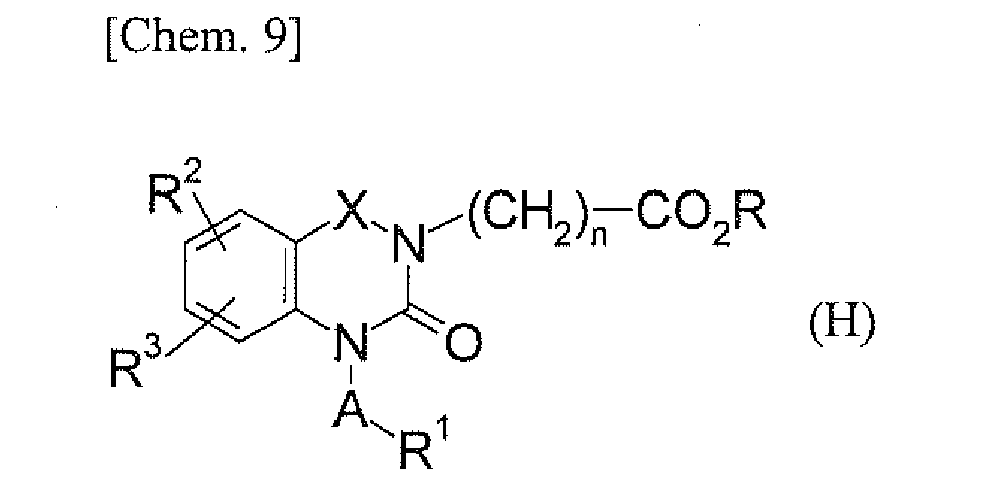
- According to Patent Document 9, there is described that a compound presented by a formula (J) exhibits a phosphatase inhibitory action and is useful for autoimmune diseases, proliferative diseases, and the like. However, there is no specific disclosure of a compound of the invention. In addition, there are no descriptions of a P2Y12 inhibitory action and a platelet aggregation inhibitory action.

- According to Patent Document 10, there is described that a compound presented by a formula (K) exhibits a α4 integrin inhibitory action and is useful for inflammatory diseases, cardiovascular diseases, and the like. However, there are no descriptions of a P2Y12 inhibitory action and a platelet aggregation inhibitory action.

- According to Patent Document 11, there is described that a compound presented by a formula (L) exhibits a RNA polymerase inhibitory action and is useful for preventing or treating HCV infections. However, only one of the portions of the compound (H) corresponding to R3 and R4-NH- of the present application is substituted. In addition, there are no descriptions of a P2Y12 inhibitory action and a platelet aggregation inhibitory action.

-
- [Non-patent Document 1] 'Journal of the American College of Cardiology', 1988, Vol. 12, p. 616-623
- [Non-patent Document 2] 'The Clinics' 2003, Vol. 52, p. 1516-1521
- [Patent Document 1] Pamphlet of International Publication No.
WO 2005/035520 - [Patent Document 2] Pamphlet of International Publication No.
WO 2005/009971 - [Patent Document 3] Pamphlet of International Publication No.
WO 2006/077851 - [Patent Document 4] Pamphlet of International Publication No.
WO 2007/105751 - [Patent Document 5] Pamphlet of International Publication No.
WO 2003/011872 - [Patent Document 6] Pamphlet of International Publication No.
WO 2005/032488 - [Patent Document 7] Pamphlet of International Publication No.
WO 2007/056219 - [Patent Document 8]
JP-A-03-181469 - [Patent Document 9] Pamphlet of International Publication No.
WO 2004/060878 - [Patent Document 10] Pamphlet of International Publication No.
WO 2005/061466 - [Patent Document 11] Pamphlet of International Publication No.
WO 2007/028789 - The present invention is to provide a compound, which exhibits a P2Y12 inhibitory action and is useful as a medical drug, particularly, as a platelet aggregation inhibitor. Means for Solving the Problem
- The present inventors have made extensive studies to find an excellent platelet aggregation inhibitor. As a result, the inventors have found that a bicyclic heterocyclic compound such as quinazolinedione, isoquinolone, and the like having an amino group substituted with lower alkyl, cycloalkyl, or lower alkylene-cycloalkyl at the specific position exhibits an excellent platelet aggregation inhibitory action, thereby completing the present invention.
Thus, the present invention relates to a bicyclic heterocyclic compound presented by the formula (I) or a pharmaceutically acceptable salt thereof.
A bicyclic heterocyclic compound presented by the formula (I) or a pharmaceutically acceptable salt thereof:
- X: C(R6) or N;
- Y: (i) CH(R7) when X is C(R6), and (ii) C(O) or *-C(O)-CH2- when X is N, wherein * represents a bond to X;
- R6 and R7 indicate H, or
- R1: lower alkyl, halogeno-lower alkyl, lower alkylene-R10, lower alkenylene-R10, aryl, or a heterocyclic group, in which lower alkylene, lower alkenylene, aryl, and the heterocyclic group may be substituted;
- L: a single bond, -O-, -N(R11)-, -N(R11)C(O)-*, or -N(R11)C(O)O-*, wherein * represents a bond to R1;
- R10: -OR11, -CN, -C(O)R11, -CO2R0, -CO2-lowe alkylene-aryl, -C(O)N(R11)2, -C(O)N(R0)-S(O)2-R11, -C(O)N(R0)-OR0, -C(O)N(R0)O-heterocyclic group, -C(O)N(R0)N(R0)2, -N(R11)2, -N(R11)C(O)R11, -N(R11)-CO2R0, -N(R0)C(O)CO2R0, -N(R11)-S(O)2-R11, -N(R11)C(S)S-R0, -P(O)(OR0)2, aryl, or a heterocyclic group, in which aryl and the heterocyclic group may be substituted;
- R0: the same with or different from each other, and -H or lower alkyl;
- R11: the same with or different from each other, and -H, lower alkyl, halogeno-lower alkyl, lower alkenyl, cycloalkyl, cycloalkenyl, aryl, heterocyclic group, lower alkylene-OR0, lower alkylene-CO2R0, lower alkylene-CO2-lower alkylene-aryl, lower alkylene-aryl, lower alkylene-heterocyclic group, lower alkylene-OC(O)R0, lower alkylene-P(O)(OR0)2, lower alkylene-O-lower alkylene-aryl, lower alkenylene-OR0, lower alkenylene-CO2R0, lower alkenylene-aryl, lower alkenylene-heterocyclic group, or lower alkenylene-P(O)(OR0)2, in which lower alkylene, lower alkenylene, cycloalkyl, cycloalkenyl, aryl, and heterocyclic group may be substituted;
- R2: lower alkyl, cycloalkyl, cycloalkenyl, or a heterocyclic group;
- R3: lower alkyl, cycloalkyl, or lower alkylene-cycloalkyl;
- R4 : -H or halogen;
- R5: -H, halogen, -OR0, -O-halogeno-lower alkyl, or -O-lower alkylene-aryl, wherein, N-(2,6-dichlorobenzoyl)-4-[7-(ethylamino)-1-methyl-2,4-dioxo-1,4-dihydroquinazolin-3(2H)-yl]-L-phenylalanine and 3-(3-chlorophenyl)-7-(isobutylamino)-1-methylquinazoline-2,4(1H,3H)-dione are excluded) (the same shall apply hereinafter).
- The present invention also relates to a pharmaceutical composition comprising as an active ingredient a bicyclic heterocyclic compound presented by the formula (I) or a pharmaceutically acceptable salt thereof, especially, a P2Y12 inhibitor and/or a platelet aggregation inhibitor.
Further, the present invention relates to use of a bicyclic heterocyclic compound presented by the formula (I) or a pharmaceutically acceptable salt thereof for the manufacture of a P2Y12 inhibitor and/or a platelet aggregation inhibitor and a method for treating cardiovascular diseases which closely relate to thrombogenesis by platelet aggregation.
That is: - (1) A pharmaceutical composition comprising the compound of the formula (I) or a pharmaceutically acceptable salt thereof, and a pharmaceutically acceptable carrier.
- (2) The pharmaceutical composition according to (1), which is a platelet aggregation inhibitor.
- (3) The pharmaceutical composition according to (1), which is a P2Y12 inhibitor.
- (4) Use of the compound described in the general formula (I) or a pharmaceutically acceptable salt thereof for the manufacture of a platelet aggregation inhibitor or a P2Y12 inhibitor.
- Since a compound of the present invention exhibits an excellent P2Y12 inhibitory action, it is useful as a medical drug, particularly, as a platelet aggregation inhibitor.
- Hereinbelow, the present invention will be described in detail.
Preferred example of 'lower alkyl' in the present Specification includes linear or branched alkyl having 1 to 6 (hereinafter, abbreviated as C1-6) of carbon atoms, particularly, a group such as methyl, ethyl, n-propyl, isopropyl, n-butyl, isobutyl, sec-butyl, tert-butyl, n-pentyl, 3-pentyl, n-hexyl, or the like. C1-5 alkyl is more preferable, and methyl, ethyl, n-propyl, isopropyl, tert-butyl, or 3-pentyl is further preferable. - Preferred example of 'lower alkenyl' includes linear or branched C2-6 alkenyl, particularly, a group such as vinyl, propenyl, butenyl, pentenyl, 1-methylvinyl, 1-methyl-2-propenyl, 1,3-butadienyl, 1,3-pentadienyl, or the like. C2-4 alkenyl is more preferable, and vinyl, propenyl, butenyl, 1-methylvinyl, or 1-methyl-2-propenyl is further preferable.
- Preferred example of 'lower alkylene' includes linear or branched C1-6 alkylene, particularly, a group such as methylene, ethylene, trimethylene, tetramethylene, pentamethylene, hexamethylene, propylene, methylmethylene, ethylethylene, 1,2-dimethylethylene, 1,1,2,2-tetramethylethylene, or the like. C2-4 alkylene is more preferable, and methylene, ethylene, trimethylene, tetramethylene, methylmethylene, propylene, or 1,2-dimethylethylene is further preferable.
- Preferred example of 'lower alkenylene' includes linear or branched C2-6 alkenylene, particularly, a group such as vinylene, ethylidene, propenylene, butenylene, pentenylene, hexenylene, 1,3-butadienylene, 1,3-pentadienylene, or the like. C2-4 alkenylene is more preferable, and vinylene, ethylidene, propenylene, or butenylene is further preferable.
- The 'halogen' indicate F, Cl, Br, or I.
The 'halogeno-lower alkyl' is C1-6 alkyl substituted with one or more of halogens; preferably lower alkyl substituted with 1 to 5 halogens; more preferably fluoromethyl, difluoromethyl, trifluoromethyl, trifluoroethyl, or pentafluoroethyl; and further preferably trifluoromethyl. - The 'cycloalkyl' is a C3-10 saturated cyclic hydrocarbon group which may include bridges. In particular, it is a group such as cyclopropyl, cyclobutyl, cyclopentyl, cyclohexyl, cycloheptyl, cyclooctyl, adamantly, or the like. C3-8 cycloalkyl is preferable, and cyclopropyl, cyclobutyl, cyclopentyl, cyclohexyl, or cycloheptyl is more preferable.
- The 'cycloalkenyl,' is C3-15 cycloalkenyl, which may include bridges and contains a cyclic group condensed with benzene ring at a double-bonded site. In particular, it is a group such as cyclopentenyl, cyclopentadienyl, cyclohexenyl, cyclohexadienyl, 1-tetrahydronaphthyl, 1-indenyl, 9-fluorenyl, or the like. C5-10 cycloalkenyl is preferable, and cyclopentenyl or cyclohexenyl is more preferable.
- The 'aryl' is a C6-14 monocyclic to tricyclic aromatic hydrocarbon group which contains a cyclic group condensed with C5-8 cycloalkene at a double-bonded site. In particular, it is a group such as phenyl, naphthyl, 5-tetrahydronaphthyl, 4-indenyl, 1-fluorenyl, or the like; more preferably phenyl or naphthyl; and further preferably phenyl.
- The 'heterocyclic' group is a 3 to 15-membered, preferably 5 to 10-membered, monocyclic to tricyclic heterocyclic group containing 1 to 4 heteroatoms selected from oxygen, sulfur, and nitrogen; and contains a saturated ring, an aromatic ring, and a partially hydrogenated cyclic group. A cyclic atom such as sulfur or nitrogen may be oxidized to form an oxide or a dioxide. In particular, the heterocyclic group is a group such as pyridyl, pyrazinyl, pyrimidinyl, pyridazinyl, imidazolyl, benzoimidazolyl, benzofuranyl, benzothienyl, benzothiadiazolyl, benzothiazolyl, benzoisothiazolyl, benzooxazolyl, benzoisooxazolyl, pyrrolyl, pyrrolidinyl, thienyl, furyl, dioxazolyl, dioxoranyl, triazinyl, triazolyl, tetrazolyl, thiazolyl, thiadiazolyl, oxadiazolyl, pyrazolyl, pyrazolidinyl, isothiazolyl, oxazolyl, isooxazolyl, quinolyl, isoquinolyl, tetrahydroquinolyl, tetrahydroisoquinolyl, quinazolinyl, quinoxalinyl, phthalazinyl, piperidyl, piperazinyl, azepanyl, diazepanyl, tetraydhrofuranyl, tetrahydropyranyl, morpholinyl, methylenedioxyphenyl, ethylenedioxyphenyl, trithianyl, indolyl, isoindolyl, indolinyl, indazolyl, tetrahydrobenzoimidazolyl, chromanyl, chromonyl, benzoimidazolonyl, or the like. The heterocyclic group is preferably a 5 to 10-membered monocyclic to bicyclic heterocyclic group, and more preferably pyrrolyl, imidazolyl, triazolyl, tetrazolyl, furyl, oxazolyl, oxadiazolyl, thienyl, thiazolyl, pyridyl, benzofuranyl, benzothienyl, quinolyl, pyrrolidinyl, piperidinyl, piperazinyl, or morpholinyl.
- The meaning of 'may be substituted' is 'no substitution' or 'having 1 to 5 substituents which are the same with or different from each other'. The meaning of 'is substituted' is 'having 1 to 5 substituents which are the same with or different from each other'. In addition, in case of having a plurality of substituents, the substituents may be the same with or different from each other.
- The substituents for the 'lower alkylene' and the 'lower alkenylene', which may be substituted, according to R1; and the 'lower alkylene' and the 'lower alkenylene', which may be substituted, according to R11 are preferably groups selected from halogens, -OR0, and -CO2R0.
- The substituents for the 'aryl', which may be substituted, according to R1; the 'aryl', which may be substituted, according to R10; and the 'aryl', which may be substituted, according to R11 are preferably groups selected from the following G1 group.
G1 group: halogen, lower alkyl, halogeno-lower alkyl, -OR0, -O-halogeno-lower alkyl, -CO2R0, -O-lower alkylene-CO2R0, lower alkylene-CO2R0, and lower alkenylene-CO2R0. - The substituents for the 'heterocyclic group', which may be substituted, according to R1; the 'heterocyclic group', which may be substituted, according to R10; and the 'heterocyclic group', which may be substituted, according to R11 are preferably groups selected from the following G2 group.
G2 group: halogen, lower alkyl, halogeno-lower alkyl, -OR0, -O-halogeno-lower alkyl, -CO2R0, -O-lower alkylene-CO2R lower alkylene-CO2R0, lower alkenylene-CO2R0, -SR0, oxo, and thioxo. - The substituents for the 'cycloalkyl' and the 'cycloalkenyl', which may be substituted, according to R11 are preferably groups selected from halogens, -OR0, and-CO2R0.
- Preferred embodiments of the present invention will be described below.
- (a) Preferred example of R1 includes -(lower alkylene which may be substituted with -OR0)-OR0, lower alkenylene-OR0, lower aikylene-CO2R0, lower alkenylene-CO2R0, lower alkylene-N(R0)-lower alkylene-OR0, lower alkylene-N(R0)-lower alkylene-CO2R0, lower alkylene-N(lower alkylene-OR0)-lower alkylene-CO2R0, lower alkylene-C(O)N(R0)-lower alkylene-OR0, lower alkylene-C(O)N(R0)-lower alkylcne-CO2R0, or lower alkylene-(heterocyclic group substituted with -CO2R0). More preferred example thereof includes lower alkylene-CO2R0 lower alkenylene-CO2R0, lower alkylene-N(R0)-lower alkylene-CO2R0, lower alkylene-N(lower alkylene-OR0)-lower alkylene-CO2R0, lower alkylene-C(O)N(R0)-lower alkylene-CO2R0, or lower alkylene-(heterocyclic group substituted with -CO2R0). Further preferred example thereof includes lower alkylene-CO2R0 or lower alkylene-N(R0)-lower alkylene-CO2R0. The most preferred example thereof includes lower alkylene-CO2H.
- (b) Preferred example of L includes a single bond, -O-, or -NH-.
- (c) Preferred example of X includes N.
- (d) Preferred example of Y includes C(O).
- (e) Preferred example of R2 includes lower alkyl or cycloalkyl. Isopropyl, 3-pentyl, or cyclopentyl is more preferable; and 3-pentyl or cyclopentyl is further preferable.
- (f) Preferred example of R3 includes cycloalkyl or lower alkylene-cycloalkyl. Cyclohexyl or cyclopropylmethyl is more preferable; and cyclohexyl is further preferable.
- (g) Preferred example of R4 includes -F.
- (h) Preferred example of R5 includes -H.
- In addition, the other preferred embodiments of the compound of the present invention shown as the general formula (I) will be described below.
- (1) The compound according to the formula (I) in which X is N, and Y is C(O).
- (2) The compound according to (1) in which R3 is cycloalkyl or lower alkylene-cycloalkyl.
- (3) The compound according to (2) in which R4 is -F.
- (4) The compound according to (3) in which R5 is -H.
- (5) The compound according to (4) in which R2 is lower alkyl or cycloalkyl.
- (6) The compound according to (5) in which L is a single bond, -O-, or -NH-.
- (7) The compound according to (6) in which R1 is lower alkylene-CO2R0, lower alkenylene-CO2R0, lower alkylene-N(R0)-lower alkylene-CO2R0, lower alkylene-N(lower alkylene-OR0)-lower alkylene-CO2R0, lower alkylene-C(O)N(R0)-lower alkylene-CO2R0, or lower alkylene-(heterocyclic group substituted with -CO2R0).
- (8) The compound according to the formula (1) in which X is C(R6), and Y is CH(R7).
- (9) The compound according to the formula (I) in which X is N, and Y is *-C(O)-CH2- (wherein, * represents a bond to X).
- (10) The compound according to the formula (I) selected from a group composed of 4-[7-(cyclnhexylamino)-1-cyclopentyl-6-fluoro-2,4-dioxo-1,4-dihydroquinazolin-3(2H)-yl]butanoic acid; 4-[7-(cyclohexylamino)-1-cyclopentyl-6-fluoro-2,4-dioxo-1,4-dihydroquinazolin-3(2H)-yl]-2-methylbutanoic acid; 4-{[7-(cyclohexylamino)-1-cyclopentyl-6-fluoro-2,4-dioxo-1,4-dihydroquinazolin-3(2H)-yl]amino}butanoic acid; 4-{[7-(cyclohexylamino)-1-cyclopentyl-6-fluoro-2,4-dioxo-1,4-dihydroquinazolin-3(2H)-yl]oxy}butanoic acid; [{2-[7-(cyclohexylamino)-1-cyclopentyl-6-fluoro-2,4-dioxo-1,4-dihydroquinazolin-3(2H)-yl]ethyl}(2-methoxyethyl)amino]acetic acid; 4-({1-cyclopentyl-7-[(cyclopropylmethyl)amino]-6-fluoro-2,4-dioxo-1,4-dihydroquinazolin-3(2H)-yl}amino)butanoic acid; 4-{[7-(cyclohexylamino)-6-fluoro-1-isopropyl-2,4-dioxo-1,4-dihydroquinazolin-3(2H)-yl]amino}butanoic acid; 5-({1-cyclopentyl-7-[(cyclopropylmethyl)amino]-6-fluoro-2,4-dioxo-1,4-dihydroquinazolin-3(2H)-yl}amino)pentanoic acid; 1-{2-[7-(cyclohexylamino)-1-cyclopentyl-6-fluoro-2,4-dioxo-1,4-dihydroquinazolin-3(2H)-yl]ethyl}piperidine-3-carboxylic acid; (2E)-4-[7-(cyclohexylamino)-1-cyclopentyl-6-fluoro-2,4-dioxo-1,4-dihydroquinazolin-3(2H)-yl]-2-butenoic acid; and {[7-(cyclohexylamino)-1-cyclopentyl-6-fluoro-2,4-dioxo-1,4-dihydroquinazolin-3(2H)-yl]oxy}acetic acid, or a pharmaceutically acceptable salt thereof.
- According to the type of the substituents, tautomers or geometrical isomers of the compound of the invention may exist. In the present specification, only one form of the isomers of the compound is described. However, a compound separated from the isomers or a mixed isomer, as well as the isomers, is included in the invention.
In addition, the compound (I) may contain asymmetrical carbon atoms and axial asymmetry. Therefore, optical isomers such as (R) form and (S) form based on the compound may exist. Both a compound mixed with these optical isomers and a compound isolated from these isomers is included in the invention.
Moreover, a pharmacologically acceptable prodrug of the compound (I) is included in the invention. A pharmacologically acceptable prodrug represents a compound having a group capable of being converted into the amino group, OH, CO2H, and the like of the invention by solvolysis or under physiological conditions. Examples of the group which forms the prodrug include groups described in Prog. Med., 5,2157 to 2161 (1985) and 'Pharmaceutical Research and Development', Drug Design, Hirogawa Publishing Company, Vol. 7,163 to 198 (1990). - According to the type of the substituent, the compound of the invention may form an acid addition salt or a salt with base. Only when the resulting salt is a pharmaceutically acceptable salt, it is included in the invention. Specific examples of the salt include acid addition salts with an inorganic acid such as hydrochloric acid, hydrobromic acid, hydroiodic acid, sulfuric acid, nitric acid, phosphoric acid, or the like, and an organic acid such as formic acid, acetic acid, propionic acid, oxalic acid, malonic acid, succinic acid, fumaric acid, maleic acid, lactic acid, malic acid, tartaric acid, citric acid, methanesulfonic acid, ethansulfonic acid, p-toluenesulfonic acid, aspartic acid, glutamic acid, or the like; salts with an inorganic base such as sodium, potassium, magnesium, calcium, aluminum, or the like, and an organic base such as methylamine, ethylamine, ethanolamine, lysine, ornithine, or the like; ammonium salts; and the like.
In addition, various hydrates, solvates, and substances having crystal polymorphism of the compound of the invention and a pharmaceutically acceptable salt thereof are included in the invention. Moreover, a compound labeled with a radioactive isotope or a nonradioactive isotope is included in the invention. - A compound of the invention and a pharmaceutically acceptable salt thereof may be produced by using the characteristics based on the type of a basic structure or substituents thereof and applying various known synthesis methods. At this time, according to the type of a functional group, it may technically be effective in production when the functional group is replaced with an appropriate protective group (a group capable of being readily converted into the functional group) at the stage of a starting material or an intermediate. Examples of the functional group include an amino group, a hydroxyl group, a carboxyl group, and the like. Examples of the protective group include protective groups described in 'Protective Groups in Organic Synthesis (3rd edition, 1999)' written by Greene and Wuts. It is preferable that these groups are appropriately selected for a use according to the reaction conditions. According to the methods, when a reaction is carried out by introducing the protective group and then the protective group is removed according to need, the desired compound may be obtained.
The prodrug of the compound (I) may be produced by introducing the specific group at the stage of a starting material or an intermediate in the same manner as the above protective group or by carrying out a reaction using the resulting compound (I).
The reaction may be carried out by a person skilled in the art applying the known methods such as normal esterification, amidation, dehydration, and the like.
The typical method for producing the compound of the invention will be described below. However, the production method of the invention is not limited to the following examples. -

This production process includes making a compound (1) undergo a reaction with a compound (2) to obtain the compound (I) of the present invention. Herein, Lv1 is an elimination group and for example, halogens, methanesulfonyloxy, p-toluenesulfonyloxy, and the like may be exemplified.
As for the reaction, the same amount of the compound (1) and the compound (2) or an excess amount of one of the compounds is used for the reaction. The reaction is carried out in an inert solvent or without a solvent under a cooled condition to heated by reflux, preferably at the temperature of 0°C to 100°C, and stirred generally for 0.1 hours to 5 days. Herein, as the solvent, it is not particularly limited but examples of the solvent include aromatic hydrocarbons such as benzene, toluene, xylene, and the like; ethers such as diethyl ether, tetrahydrofuran (THF), dioxane, dimethoxyethane, and the like; halogenated hydrocarbons such as dichloromethane, 1,2-dichloroethane, chloroform, and the like; N,N-dimethylformamide (DMF); N,N-dimethylacetamide (DMA); N-methylpyrrolidine-2-one (NMP); dimethyl sulfoxide (DMSO); ethyl acetate; acetonitrile; or mixtures thereof. When the reaction is carried out in the presence of an organic base such as triethylamine, N,N-diisopropylethylamine, N-methylmorpholine, or the like, or an inorganic base such as potassium carbonate, sodium carbonate, or potassium hydroxide, or the like, it may be advantageous to smoothly proceed the reaction. -

This production process includes making a compound (3) undergo a reaction with a compound (4) to obtain the compound (I) of the present invention. Herein, Lv2 is an elimination group and for example, halogens, methanesulfonyloxy, p-toluenesulfonyloxy, and the like may be exemplified.
As for the reaction, when Lv2 is an elimination group, the same amount of the compound (3) and the compound (4) or an excess amount of one of the compounds is used for the reaction. The reaction is carried out in an inert solvent or without a solvent, under a cooled condition to heated by reflux, preferably at the temperature of 0°C to 100°C, and stirred generally for 0.1 hours to 5 days. Herein, as the solvent, it is not particularly limited but examples of the solvent include aromatic hydrocarbons, ethers, halogenated hydrocarbons, DMF, DMA, NMP, DMSO, ethyl acetate, acetonitrile, or mixtures thereof. When the reaction is carried out in the presence of an organic base such as triethylamine, N,N-diisopropylethylamine, N-methylmorpholine, or the like, or an inorganic base such as potassium carbonate, sodium carbonate, or potassium hydroxide, or the like, it may be advantageous to smoothly proceed the reaction.
In addition, in accordance with a compound, the compound (4) in which Lv2 is - OH may be used to obtain the compound (I) of the invention by a Mitsunobu reaction or the modified method thereof. For example, by using an activating agent prepared from azodicarboxylic acid derivatives such as diethyl azodicarboxylate and the like, and phosphine reagents such as triphenylphosphine and the like, the reaction can be carried out in solvents such as ethers, halogenated hydrocarbons, and the like under a cooled condition, at room temperature to under a heated condition. -

The reaction is carried out under a hydrogen atmosphere the compound (I-a), in an inert solvent for a reaction, is stirred in the presence of metal catalysts generally for 1 hour to 5 days. In general, this reaction is carried out under a cooled condition to a heated condition, and preferably at room temperature. Herein, examples of the solvent are not particularly limited but include alcohols such as methanol, ethanol, 2-propanol, and the like; ethers; water; ethyl acetate; DMF; and the like. As the metal catalysts, palladium catalysts such as palladium carbon, palladium black, palladium hydroxide, and the like; platinum catalysts such as a platinum plate, platinum oxide, and the like; and nickel catalysts such as Raney nickel and the like are preferably used. In accordance with a compound, it may be advantageous to carry out the reaction in the presence of acids such as acetic acid, hydrochloric acid, and the like. -

For the amidation reaction, a method which includes using a condensation agent such as carbonyldiimidazole (CDI), 1-ethyl-3-(3-dimethylaminopropyl)carbodiimide hydrochloride (WSC·HCl), dicyclohexylcarbodiimide, diphenylphosphoryl azide, diethylphosphoryl cyanide, and the like; a method which includes using isobutyl chloroformate, ethyl chloroformate, and the like to obtain the compound via a mixed anhydride; and a method which includes using thionyl chloride, phosphorus oxychloride, or the like to obtain the compound via an acid halide are suitably applied. The reaction conditions may be suitably selected in accordance with the reactive derivative and the condensation agent to be used, and the reaction may be generally carried out in an inert solvent for a reaction, such as, halogenated hydrocarbons, aromatic hydrocarbons, ethers, pyridine, DMF, DMSO, and the like, under a cooled condition, a cooled condition to room temperature, and room temperature to a heated condition. In accordance with the reactions, it may be advantageous to carry out the reaction in the presence of an organic base (triethylamine, diisopropylethylamine, N-methylmorpholine, pyridine, 4-(N,N-dimethylamino)pyridine, or the like is suitably used) or a metallic base (potassium carbonate, cesium carbonate, or the like is suitably used). -

This production process includes making the compound (5) to undergo a reaction with a compound (7) to obtain a compound (I-d) of the present invention.
The reaction is carried out in an inert solvent for a reaction, such as, halogenated hydrocarbons, aromatic hydrocarbons, ethers, pyridine, DMF, DMSO, or the like, under a cooled condition, a cooled condition to room temperature, and room temperature to a heated condition. In accordance with the reactions, it may be advantageous to carry out the reaction in the presence of an organic base (triethylamine, diisopropylethylamine, N-methylmorpholine, pyridine, 4-(N,N-dimethylamino)pyridine, or the like is suitably used) or a metallic base (potassium carbonate, cesium carbonate, or the like is suitably used). - A number of the compounds represented by the formula (I) may be produced by using the compound of the invention obtained as mentioned above and by arbitrarily combining processes which the person skilled in the art can generally employ, such as, the known amidation, hydrolysis, a Homer-Emmons reaction, a Wittig reaction, oxidation, reduction, alkylation, and the like. For example, the following reactions may be employed.
- When carboxylic acid and an amine compound is amidated, it is possible to produce an amide compound.
The reaction can be carried out in the same manner as in Production Process 4. - When a compound containing an ester group is hydrolyzed, it is possible to produce a compound containing a carboxyl group. For example, the reaction can be carried out in an inert solvent for a reaction, such as aromatic hydrocarbons, ethers, halogenated hydrocarbons, alcohols, DMF, DMSO, pyridine, water, and the like, in the presence of an acid such as mineral acids, for example, sulfuric acid, hydrochloric acid, hydrobromic acid, and the like, and organic acids, for example, formic acid, acetic acid, and the like; or in the presence of a base such as lithium hydroxide, sodium hydroxide, potassium hydroxide, potassium carbonate, sodium carbonate, cesium carbonate, ammonia, or the like, under a cooled condition to a heated condition.
- When a compound containing an aldehyde and a ketone is subjected to a Homer-Emmons reaction or a Wittig reaction, it is possible to convert an oxo group to an alkylidene group.
For the Homer-Emmons reaction or the Wittig reaction, a method which the person skilled in the art generally uses may be employed. For example, in the presence of a Horner-Emmons reagent or a Wittig reagent, the reaction can be carried out in a solvent such as aromatic hydrocarbons, ethers, halogenated hydrocarbons, DMF, DMA, NMP, DMSO, acetonitrile, or the like under a cooled condition to a heated condition. In accordance with the type of the Homer-Emmons reagent or the Wittig reagent, it is preferable to carry out the reaction in the presence of a base such as potassium carbonate, tert-butoxy potassium, sodium hydride, alkyl lithium such as n-butyl lithium, and the like. - Starting compounds used for the production of the compound (I) of the invention can be synthesized by applying the following methods, the known methods, or the modified methods thereof.
-

- This step includes making acylisocyanate, which is obtained by reacting a compound (8) to oxalyl chloride (9), undergo a reaction with a compound (10) to obtain a compound (11).
The reaction between the compound (8) and oxalyl chloride (9) can be carried out by using the same amount or an excess amount of one of the compounds in a solvent such as ethers, halogenated hydrocarbons, or the like under ice cooling, at room temperature to under a heated condition. The resulting acylisocyanate may be isolated or not be isolated to be used for a reaction with the compound (10).
The reaction between the resulting acylisocyanate and the compound (10) can be carried out by using the same amount or an excess amount of one of the compounds in a solvent such as ethers, halogenated hydrocarbons, aromatic hydrocarbons, or the like under a cooled condition, at room temperature to under a heated condition. - This step includes cyclizing a compound (11) within a molecule to obtain a compound (12).
In the presence of a base such as sodium hydride, potassium bis(trimethylsilyl)amide, and the like, the reaction is carried out in an inert solvent or without a solvent under a cooled condition to heated by reflux, preferably at the temperature of 0°C to 100°C, and stirred generally for 0.1 hours to 5 days. Herein, as the solvent, it is not particularly limited but examples of the solvent include aromatic hydrocarbons, ethers, halogenated hydrocarbons, DMF, and the like. - This step includes making a compound (12) undergo a reaction with the compound (2) to obtain a compound (13).
The reaction can be carried out in the same manner as in Production Process 1. -

The reaction can be carried out in the same manner as in Production Process 2. -


- This step includes reductively alkylating a compound (16) and an aldehyde or a ketone compound (17) corresponding to R2 to obtain a compound (18).
By using the same amount of the compound (16) and the compound (17) or an excess amount of one of the compounds and in the presence of a reducing agent, the reaction is carried out in an inert solvent for a reaction and from -45°C to heated by reflux, preferably up to 0°C to room temperature, and stirred for generally 0.1 hours to 5 days. Herein, as the solvent, it is not particularly limited but examples of the solvent include alcohols, ethers, or the mixture thereof. Examples of the reducing agent include sodium cyanoborohydride, sodium triacetoxyborohydride, sodium borohydride, and the like. It may be preferable to carry out the reaction in the presence of a dehydrating agent such as molecular sieves and the like, or an acid such as acetic acid, hydrochloric acid, titanium (IV) isopropoxide complex, and the like. In accordance with the reaction, in the case where it is possible to stably isolate an imine body formed as an intermediate in a reaction system, it is permissible to separately carry out a reductive reaction after obtaining the imine body. - This step includes amidating a compound (18) and a compound (19) to obtain a compound (20).
The reaction can be carried out in the same manner as in Production Process 4. - This step includes making the compound (20) undergo a reaction with a carbonylating agent for cyclization to obtain a compound (21).
By using the same amount of the compound (20) and the carbonylating agent such as phosgene, triphosgene, CDI, ethyl chloroformate, and the like or an excess amount of one of the compounds, the reaction can be carried out in a solvent such as ethers, halogenated hydrocarbons, DMF, and the like at room temperature to under a heated condition. In accordance with the reaction, it may be advantageous to carry out the reaction in the presence of an organic base (triethylamine, diisopropylethylamine, N-methylmorpholine, pyridine, or the like is suitably used) or a metallic base (sodium hydride, potassium carbonate, cesium carbonate, or the like is suitably used). -

- This step includes making the compound (12) undergo a reaction with a compound (22) to obtain a compound (23).
By using the same amount of the compound (12) and the compound (22) or an excess amount of one of the compounds and in the presence of a base such as sodium hydride, potassium carbonate, and the like, the reaction can be carried out in a solvent such as ethers, DMF, DMA, NMP, and the like at room temperature to under a heated condition. - This step includes making the compound (23) undergo a nucleophilic substitution reaction with the compound (2) to obtain a compound (24).
The reaction can be carried out in the same manner as in Production Process 1. -

- This step includes amidating the compound (20) and a compound (25) to obtain a compound (26).
The amidation can be carried out in the same manner as in Production Process 4. - This step includes cyclizing the compound (26) within a molecule to obtain a compound (27) of the invention.
The reaction can be carried out by subjecting the compound (26) to the reaction in the presence of a base such as sodium hydride and the like in an inert solvent for a reaction, such as aromatic hydrocarbons, ethers, halogenated hydrocarbons, DMF, and the like, under a cooled condition to a heated condition under reflux. -

- This step includes making a compound (28) undergo a reaction with an iodizing agent to obtain a compound (29).
By using the same amount of the compound (28) and the iodizing agent such as iodine, iodine monochloride, N-iodosuccinimide, and the like or an excess amount of one of the compounds, the reaction can be carried out in a solvent such as aromatic hydrocarbons, halogenated hydrocarbons, pyridine, and the like at room temperature to under a heated condition. - This step includes making the compound (29) undergo a reaction with the compound (4) to obtain a compound (30).
The reaction can be carried out in the same manner as in Production Process 2. - This step includes making the compound (30) undergo a reaction with cyclopentene to obtain a compound (31).
By using the same amount of the compound (30) and cyclopentene or an excess amount of one of the compounds, the reaction can be carried out in an inert solvent for a reaction in the presence of a base and a palladium catalyst at room temperature to under a heated condition under reflux. Herein, examples of the solvent are not particularly limited but include aromatic hydrocarbons, ethers, halogenated hydrocarbons, DMF, and the like. As the base, potassium carbonate, potassium acetate, and the like are preferable. As the palladium catalyst, tetrakis(triphenylphosphine)palladium, palladium acetate, and the like are preferable. - The compound of the invention is isolated as a free compound or a pharmaceutically acceptable salt thereof, a hydrate, a solvate, or a substance having crystal polymorphism, and then purified. A pharmaceutically acceptable salt of the compound (1) of the invention can be produced according to the processes included in a common salt productive reaction.
The isolation and the purification of the compound are carried out by applying common chemical operations such as extraction, fractionated crystallization, various differential chromatographies, and the like.
It is possible to separate the various isomers by selecting the suitable starting compounds or using the difference in physicochemical properties between the isomers. For example, it is possible to lead an optical isomer to a stereochemically pure isomer according to the general optical resolution methods (for example, fractionated crystallization which leads to an optically-active diastereomeric salt with a base or an acid, chromatography in which a chiral column is used, and the like). In addition, it is possible to produce the isomer from the suitably optically-active starting compound. - Pharmacological activities of the compound of the invention have been confirmed by the following tests.
- Using a syringe in which 1/10 vol of a 3.8% sodium citrate solution is contained, blood was collected from a healthy volunteer (adult male). The blood was subjected to a centrifugation at 160 × g for 10 minutes and a supernatant platelet rich plasma (PRP) was separated. The remaining blood of which the PRP has been collected was subjected to a centrifugation at 1,800 × g for 10 minutes and a platelet poor plasma (PPP) was separated. The number of the platelets in the PRP was measured using an automatic blood cell counter (MEK-6258, Nihon Kohden Corporation). After that, the PPP was added to the PRP to adjust the number of the platelets to 3 × 10⁸ /ml, thereby using the platelets for the following tests. As an ADP, which is a platelet aggregating agent, a product manufactured by MC Medical Inc. was used. The platelet aggregation was measured using a platelet aggregometer (MCM Hematracer 212; MC medical Inc). That is, 80 µl of the PRP having the number of the platelets of 3 x 10⁸ /ml and 10 µl of a test compound solution or solvent (10% DMSO or 10% DMSO-9% hydroxypropyl-β-cyclodextrin-4.5% d-mannitol) were incubated at 37°C for 1 minute and then 10 µl of ADP (50 µM) was added to the mixture to cause platelet aggregation, thereby recording a variation in transmitted light for 5 minutes. An inhibition rate was calculated using an area under the platelet aggregation curve as an index. The result when the compound of the invention has 10 µM (final concentration) is shown in Table 1. In addition, Ex represents a number of the compounds of Examples.
[Table 1] Ex % Inhibition 24 89 42 75 65 86 69 50 77 88 114 91 155 93 - In a 10 cm petri dish, C6-15 cells were spread to be 1 x 10⁶ of cells by using a DMEM culture medium and cultured for 1 day. After that, genes of plasmids such as 8 µg of pEF-BOS-dhfr-human P2Y12 and 0.8 µg ofpEF-BOS-neo (Nucleic Åcid Res., 18, 5322, 1990) were introduced to the cells using a transfection reagent (LipofectAMINE 2000; manufactured by GIBCO BRL Inc).
After 24 hours since the above-mentioned gene introduction operation had been completed, the cells to which the genes were introduced were recovered and suspended in a DMEM culture medium containing 0.6 mg/ml of G418 (manufactured by GIBCO BRL Inc). After that, the cells were serially diluted and spread on a 10 cm petri dish. Colonies appeared after 2 weeks later were individually collected and used in the following tests as P2Y12 protein-expressing C6-15 cells (WO 02/36631
The P2Y12 protein-expressing C6-15 cells were cultured and then the cells were recovered. The cells were washed with PBS, suspended in 20 mM Tris-HCl (pH 7.4) containing 5 mmol/l EDTA and Complete™ (manufactured by Boehringer Mannheim) which is a protease inhibitor cocktail set, and homogenized by Polytron. The cells were subjected to an ultracentrifugation and a precipitate is suspended in 50 mM Tris-HCl (pH 7.4) containing 1 mM of EDTA, 100 mM NaCl, and Complete™ to perform membrane fraction.
To 100 µl of the P2Y12 protein-expressing C6-15 cell membrane fraction (100 µg/ml) produced as mentioned above, 1.5 µl of a test compound solution and 50 µl of 0.75 nM [33P]-2-MeS-ADP (2100 Ci/ mmol, manufactured by PerkinElmer Inc) were added. The mixture was incubated in 50 mM Tris-HCl (pH 7.4) containing 100 mM NaCl and 50 mM MgCI2 at room temperature for 1 hour, and then recovered by cell harvest on a glass filter. Microscintillators were added to the glass filter and the radioactive activity was measured by a liquid scintillation counter. In addition, simultaneously, the radioactivity in the case where only a solvent is added to the above-mentioned test and in the case where 1.5 µl of 250 µM ADP is added thereto were measured respectively as the total binding amount and the nonspecific binding amount. The total binding amount and the nonspecific binding amount were set respectively as the inhibition rate of 0% and the inhibition rate of 100% to calculate the inhibition rate (%) of the test compound. The result when the compound of the invention has 30 nM (final concentration) is shown in Table 2.[Table 2] Ex % Inhibition 24 60 42 56 114 71 155 72 157 67 - An aqueous sodium hydroxide solution and the same amount of a 1% aqueous methyl cellulose solution were added to the compound of the invention to prepare a 0.5% aqueous methyl cellulose solution or a suspension solution. This preparation solution was orally administered to a male SD rat (5 to 7 weeks old) which has been fasted over 12 hours using a sonde at a dose of 30 mg/kg. After 2 hours later since the administration of the compound, using a syringe in which 1/10 vol of a 3.8% sodium citrate solution is contained, a blood was collected. In the same manner as in Test Method (1), a PPP and a PRP having the number of the platelets as 3 x 10⁸ /ml were prepared. 90 µl of the PRP having the number of the platelets of 3 x 10⁸ /ml was incubated at 37°C for 1 minute and then 10 µl of ADP (50 µM) was added thereto to cause platelet aggregation, thereby recording a variation in transmitted light for 5 minutes. An inhibition rate was calculated using an area under the platelet aggregation curve as an index.
The PPP prepared as mentioned above was used to measure the concentration of the PPP in the plasma. In order to form a standard curve, a PPP of a SD rat to which the compound is not administered has been separated and the compounds of the invention consecutively diluted (final concentration of 30 µM to 0.0003 µM: suitably selected according to the compounds) by such PPP are also prepared. To 100 µl of PPP of the rat to which the compound of the invention is administered and PPP which contains the diluted compounds of the invention, distilled water (equal amount) and 5% trichloro acetic acid were added, thereby mixing them. The mixtures were placed under ice cooling for 10 minutes and subjected to a centrifugation operation to recover supernatants. To the supernatants was added 2M Tris base (3 µl), and they were mixed to neutralize the supernatants. 50 µl of the P2Y12 protein-expressing C6-15 cell membrane fraction (200 µg/ ml) and 50 µl of the PPP (according to the compounds, the PPP diluted with 50 mM Tris-HCl (pH 7.4) in which 100 mM NaCl and 50 mM MgCl2 are contained was used) treated with trichloro acetic acid were mixed. After that, 50 µl of 0.75 nM [33P]-2-MeS-ADP (2100 Ci/ mmol, manufactured by PerkinElmer Inc.) was added to the mixture. The mixture was incubated in 50 mM Tris-HCl (pH 7.4) containing 100 mM NaCl and 50 mM MgCl2 at room temperature for 1 hour, and then recovered by cell harvest on a glass filter. Microscintillators were added to the glass filter and the radioactive activity was measured by a liquid scintillation counter. A binding inhibition curve calculated based on the measurement results from the PPP containing the consecutively diluted compound of the invention was set as a standard curve, and then based on the result from the PPP-derived from the rat to which the compound of the invention is administered, the concentration of the compound of the invention in the PPP was converted.
The results are shown in Table 3. As a result from evaluation according to the above-mentioned method, it has been cleared that the compound of the invention exhibits an excellent platelet aggregation inhibitory activity when it is orally administered and also exhibits satisfactory disposition.[Table 3] Ex % Inhibition 65 56 114 90 - As results from each of the above-mentioned tests, it has been found that the compound of the invention exhibits excellent P2Y12 inhibitory action, platelet aggregation inhibitory action, and disposition. Therefore, the compound of the invention is useful as a prophylactic and/or therapeutic agent for circulatory diseases closely related to formation of blood clot due to platelet aggregation, for example, ischemic diseases such as reocclusion and restenosis, which are subsequent to unstable angina, acute cardiac infarction and the secondary prevention thereof, hepatic artery bypass surgery, and a PTCA method or the stent placement surgery, acceleration of dissolution of blood clot in hepatic artery, and prevention of reocclusion; cerebral vascular disorders such as transient cerebral ischemic attack (TIA) cerebral infarction, subarachnoid hemorrhage (vasospasm), and the like; peripheral arterial diseases such as chronic arterial occlusive disease and the like; etc. and as an adjunctive agent at the time of cardiac surgery or vascular surgery.
- It is possible to prepare a drug preparation containing the compound (I) of the present invention and 1 or 2 or more kinds of the salts thereof as effective components according to the methods generally applied using a carrier for a medical agent, excipient, and the like which have been generally used in this field.
For the administration, it may be the oral administration by using a tablet, a pill, a capsule, a granuled agent, a powdered agent, a liquid agent, and the like; or the parenteral administration by using an injection agent for intra-articular, intravenous, intramuscular, and the like, suppository, eye-drops, ophthalmic ointments, transdermal solutions, ointments, adhesive skin patches, transmucosal solutions, transmucosal patches, inhalers, and the like.
As a solid composition for the oral administration according to the invention, a tablet, a powdered agent, a granule agent, and the like are used. In these solid compositions, one or two or more kinds of the effective components are mixed with at least one kind of inert excipient, for example, lactose, mannitol, glucose, hydroxypropyl cellulose, microcrystalline cellulose, starch, polyvinyl pyrollidone, and/or magnesium aluminometasilicate. According to the general methods, it is permissible that the composition may contain inert additives, for example, a lubricant such as magnesium stearate, a disintegrating agent such as sodium carboxymethyl starch and the like, a stabilizing agent, and a solubilizing agent. If necessary, it is permissible that the tablet and the pill are coated with sugar or films made of substance soluble in the stomach or the intestines.
Examples of a liquid composition for the oral administration include a pharmaceutically acceptable opalizers, solutions, suspension agents, syrups, elixirs, or the generally used inert diluents, for example, purified water or ethanol. The liquid composition may contain adjuvants such as a solubilizing agent, a wetting agent, and a suspension agent, sweetener, flavor, aromatic, and antiseptic agents as well as inert diluents.
Examples of an injection agent for the parenteral administration include aseptic aqueous or nonaqueous solutions, suspention agents, or opalizers. Examples of the aqueous solutions include distilled water for injection or physiological saline. Examples of the nonaqueous solutions include propylene glycol, polyethylene glycol, vegetable oil such as olive oil, alcohols such as ethanol, polysorbate 80 (Japanese Pharmacopoeia), or the like. These compositions may further contain a tonicity agent, an antiseptic agent, a wetting agent, an emulsifying agent, a dispersant, a stabilizing agent, or a solubilizing agent. These are sterilized by, for example, filtration through a bacteri-holding filter, combination with disinfecting agents, or irridation. In addition, it is permissible that a sterile solid composition is produced by using these additives and before using them, they are dissolved or suspended in sterile water or sterile solvents for injection and then used.
Examples of an agent for external use include ointments, plasters, cream, jelly, patches, sprays, lotions, eye-drops, ophthalmic ointments, and the like. The generally used ointment base, lotion base, aqueous or nonaqueous liquid, suspension agents, emulsion, and the like are included. Examples of the ointment base or lotion base include polyethylene glycol, propylene glycol, white petrolatum, white beeswax, polyoxyethylene-hydrogenated castor oil, glyceryl monostearate, stearyl alcohol, cetyl alcohol, lauromacrogol, sorbitan sesquioleate, and the like.
As the transmucosal products such as inhalers, transnasal products, solid, liquid, or semisolid products have been used and it is possible to produce the products according to the known methods. For example, it is permissible appropriately to add the known excipients, pH adjusting agents, an antiseptic agent, surfactants, lubricant, a stabilizing agent, a thickening agent, and the like. For the administration, a device for appropriate inhalation or insufflations may be used. For example, the known devices such as a measured administration inhalation device and the like or a sprayer may be used to administer compounds as the compound itself, the prescribed powdered mixture, or a solution or a suspension solution in which the compound is combined with a pharmaceutically acceptable carrier. For the dried powder inhaler, it may be a disposable inhaler or an inhaler capable of once or multiple administrations. In addition, dried powders or a powder-containing capsule may be used. On the other hand, the inhaler may be a suitable ejection product, for example, a pressurized aerosol spray type in which the most appropriate gas such as chlorofluoroalkane, hydrofluoroalkane, or carbon dioxide is used, etc. - In the case of oral administration, the daily dose is generally from about 0.001 to 100 mg/kg, preferably from 0.1 to 30 mg/kg, and more preferably 0.1 to 10 mg/kg per body weight, administered in one portion or in 2 to 4 divided portions. In the case of the intravenous administration, the daily dose is suitably administered from around 0.0001 to 10 mg/kg per body weight, once a day or two or more times a day. In addition, in the case of the transmucosal agents, at a dose of from around 0.001 to 100 mg/kg per body weight is administered once a day or two or more times a day. The dose is appropriately decided in response to the individual case taking the symptoms, the ages, the genders, and the like into consideration.
- The compound of the present invention may be used in combination with various therapeutic or prophylactic agents for the diseases for which the above-mentioned compound of the invention are considered to be effective. The combined preparation may be administered simultaneously, or may be separately administered in succession or at desired intervals. The preparations to be co-administered may be a blend, or may be prepared individually.
- The production processes of the compound (I) of the invention will be described below in detail on the basis of Examples. However, the compound of the invention is not limited to the compounds described in the following Examples. The production processes of a starting compound are represented in Production Examples.
- As for Production Examples, Examples, and Tables described below, the following abbreviations will be used.
PEx: Production Examples, Ex: Examples, No: number of compounds, MS: m/z value of mass analysis (EI: EI-MS; FAB: FAB-MS; ESI: ESI-MS; + described following to an ionization method represents a positive ion, and - represents a negative ion; and when there is no particular limitation, in the case of EI, it represents (M)+, in the case of FAB+ and ESI+, it represents (M+H)+, and in the case of FAB- and ESI-, it represents (M-H)-), NMRI: δ(ppm) of 1H NMR in DMSO-d6, Syn: Production Method (the number represents that similar to the compounds of Examples having the number as Example number, it was produced using the corresponding starting materials; and when P is described in front of the number, the number represents that similar to the compounds of Production Examples having the number as Production Example, it wasproduced using the corresponding starting materials). When the number is plural, it represent that it was produced by carrying out the reaction similarly in this order. In addition, HCl in structural formulae represents hydrochloride and TFA represents trifluoro acetate (the number in front of an acid component represents the molar ratio of the acid component, for example, 2 HCl represents dihydrochloride). In addition, DBU represents 1,8-diazabicyclo[5.4.0]-7-undecene. - To a dichloromethane (9 ml) solution of 2,4,5-trifluorobenzamide (430 mg) was added oxalyl dichloride (0.3 ml) at 0°C, followed by stirring at 45°C for 4 hours. The solvent was evaporated under reduced pressure, and dioxane (8.6 ml) and cyclopentylamine (0.3 ml) were added to the resulting residues and the mixture was stirred at room temperature for 12 hours. Water was added to the resulting reaction liquid, and the liquid was extracted with ethyl acetate, followed by washing with saturated brine. The liquid was dried over anhydrous sodium sulfate and the solvent was evaporated under reduced pressure to obtain residues. The residues were washed with a mixed solvent of ethyl acetate-hexane to obtain N-[(cyclopentylamino)carbonyl]-2,4,5-trifluoroberzamide (370 mg).
- To a THF (220 ml) suspension of N-[(cyclopentylamino)carbonyl]-2,4,5-trifluorobenzamide (14.76 g) was added dropwise a toluene solution (217 ml) of 0.5 M potassium bis(trimethylsilyl)amide at -20°C. The temperature was raised to room temperature. After that, 1,4,7,10,13,16-hexaoxacyclooctadecane (2.75 g) was added to the mixture and the mixture was stirred at 100°C for 8 hours. The resulting reaction liquid was added to a mixed solution of a 10% aqueous citrate solution (150 ml) and 1M hydrochloric acid (150 ml) under ice cooling and the liquid was extracted with ethyl acetate, followed by washing with water and saturated brine in this order. The liquid was dried over anhydrous sodium sulfate and the solvent was evaporated under reduced pressure to obtain residues. The residues were purified by silica gel column chromatography to obtain 9.19 g of 1-cyclopentyl-6,7-difluoroquinazoline-2,4(1H,3H)-dione.
- To a DMF (5 ml) solution of 1-cyclopentyl-6,7-difluoroquinazoline-2,4(1H,3H)-dione (320 mg) were added potassium carbonate (200 mg) and ethyl bromoacetate (0.15 ml), followed by stirring at 60°C for 12 hours. Water was added to the resulting reaction liquid and insoluble materials were collected by filtration to obtain ethyl (1-cyclopentyl-6,7-difluoro-2,4-dioxo-1,4-dihydroquinazolin-3(2H)-yl)acetate (270 mg).
- To a DMSO (2 ml) solution of 1-cyclopentyl-6,7-difluoroquinazoline-2,4(1H,3H)-dione (100 mg) was added cyclohexylamine (0.13 ml), followed by stirring at 100°C for 12 hours. Water was added to the resulting reaction liquid and insoluble materials were collected by filtration to obtain 7-(cyclohexylamino)-1-cyclopentyl-6-fluoroquinazoline-2,4(1H,3H)-dione (110 mg).
- To a toluene (8 ml) solution of ethyl 4-(1-cyclopentyl-5,7-difluoro-2,4-dioxo-1,4-dihydroquinazolin-3(2H)-yl)butanoate (400 mg) were added benzyl alcohol (0.24 ml) and potassium carbonate (320 mg), followed by stirring at 100°C for 12 hours. Water was added to the resulting liquid, and the liquid was extracted with ethyl acetate, followed by washing with saturated brine. The liquid was dried over anhydrous sodium sulfate and the solvent was evaporated under reduced pressure to obtain residues. The residues were purified by silica gel column chromatography to obtain ethyl 4-[5-(benzyloxy)-1-cyclopentyl-7-fluoro-2,4,-dioxo-1,4-dihydroquinazolin-3(2H)-yl]butanoate (470 mg).
- To a THF (40 ml) solution of 1-cyclopentyl-6,7-difluoroquinazoline-2,4(1H,3H)-dione (1.5 g) was added 320 mg of 55% sodium hydride under ice cooling, followed by stirring at room temperature for 30 minutes. O-(2,4-dinitrophenyl)hydroxylamine (1.5 g) was added to the mixture and the mixture was heated under reflux for 3 hours. After that, O-(2,4-dinitrophenyl)hydroxylamine (1.5 g) was added to the mixture and the mixture was heated under reflux for 3 hours. Ethyl acetate was added to the reaction liquid and the liquid was washed with a saturated aqueous ammonium chloride solution, water and saturated brine in this order. The liquid was dried over anhydrous sodium sulfate and the solvent was evaporated under reduced pressure to obtain residues. The residues were purified by silica gel column chromatography to obtain 3-amino-1-cyclopenyl-6,7-difluoroquinazoline-2,4,(1H,3H)-dione (700 mg).
- To an acetic acid (360 ml)suspension of 2-amino-4,5-difluorobenzoicacid (10.0 g) was added cyclopentanone (20.5 ml), followed by stirring for 4 days. Sodium triacetoxyborohydride (24.6 g) and acetic acid (40 ml) were added to the reaction liquid and the liquid was stirred for 4.5 hours. Water (50 ml) was added to the liquid and the solvent was evaporated under reduced pressure until the amount of the liquid to be around 1/3. Water (300 ml) was added to the liquid and insoluble materials were collected by filtration to obtain 2-(cyclopentylamino)-4,5-difluorobenzoic acid (6.24 g).
- To a DMF (15 ml) solution of 2-(cyclopentylamino)-4,5-difluorobenzoic acid (1.00 g) and ethyl 4-(aminooxy)butanoate (930 mg) were added N-[3-(dimethylamino)propyl]-N'-ethylcarbodiimide hydrochloride (1.21 g) and 1-hydroxybenzotriazol (846 mg), followed by stirring for 3 days. The solvent was evaporated under reduced pressure and a 10% citrate solution was added to the mixture. The liquid was extracted with ethyl acetate, followed by washing with water and saturated brine. The liquid was dried over anhydrous sodium sulfate and the solvent was evaporated under reduced pressure to obtain residues. The residues were purified by column chromatography to obtain ethyl 4-({[2-(cyclopentylamino)-4,5-difluorobenzoyl]amino}oxy)butanoate (1.34 g).
- To a dichloromethane (30 ml) solution of ethyl 4-({[2-(cyclopentylaimino)-4,5-difluorobenzoyl]amino}oxy)butanoate (1.29 g) were added a water (16 ml) solution of potassium carbonate (972 mg) and a dichloromethane (10 ml) solution of triphosgene (526 mg), followed by stirring overnight. A saturated aqueous ammonium chloride solution was added to the reaction liquid and the liquid was extracted with chloroform and the liquid was dried over anhydrous sodium sulfate. The solvent was evaporated under reduced pressure to obtain residues. The residues were purified by column chromatography to obtain ethyl 4-[(1-cyclopentyl-6,7-difluoro-2,4-dioxo-1,4-dihydroquinazolin-3(2H)-yl)oxy]butanoate (1.06 g).
- To a toluene (50 ml) solution of ethyl 4-{[2-(cyclopentylamino)-4,5-difluorobenzoyl]amino}butanoate (2.0 g) was added chloroacetyl chloride (0.67 ml) at room temperature, followed by stirring at 60°C for 8 hours. The solution was cooled down to room temperature. After that, a saturated aqueous sodium hydrogen carbonate solution was added to the reaction liquid and the liquid was extracted with ethyl acetate, followed by washing with saturated brine. The liquid was dried over anhydrous sodium sulfate and the solvent was evaporated under reduced pressure to obtain residues. The residues were purified by silica gel column chromatography to obtain ethyl 4-({2-[(chloroacetyl)(cyclopentyl)amino]-4,5-difluorobenzoyl}amino}butanoate (2.2 g).
- To a dioxane (30 ml) solution of ethyl 4-({2-[(chloroacetyl)(cyclopentyl)amino]-4,5-difluorobenzoyl}amino}butanoate (2.15 g) was added 55% sodium hydride (262 mg) under ice cooling, followed by stirring at 60°C for 3 days. Under ice cooling, a saturated aqueous ammonium chloride solution was added to the reaction liquid and the liquid was extracted with ethyl acetate, followed by washing with saturated brine. The liquid was dried over anhydrous sodium sulfate and the solvent was evaporated under reduced pressure to obtain residues. The residues were purified by silica gel column chromatography to obtain ethyl 4-(1-cyclopentyl-7,8-difluoro-2,5-dioxo-1,2,3,5-tetrahydro-4H-1,4-benzodiazepin-4-yl)butanoate (1.27 g).
- To a pyridine (10 ml) solution of 6,7-difluoroisoquinoline-1(2H)-one (500 mg) was added iodine (1.4 g) at room temperature, followed by stirring at 48°C for 6 hours. After cooling the solution, a saturated aqueous sodium hydrogen carbonate solution and a 10% aqueous sodium thiosulfate solution were added to the reaction liquid and the liquid was extracted with ethyl acetate, followed by washing with saturated brine. The liquid was dried over anhydrous sodium sulfate and the solvent was evaporated under reduced pressure to obtain 6,7-difluoro-4-iodoisoquinoline-1(2H)-one (659 mg).
- To a DMF (5 ml) solution of ethyl (6,7-difluoro-4-iodo-1-oxoisoquinolin-2(1H)-yl)acetate (200 mg) were added potassium acetate (150 mg), tetrabutylammonium chloride (142 mg), cyclopentene (0.45 ml) and palladium acetate (57 mg) at room temperature, followed by stirring at 80°C for overnight in a sealed tube. After cooling the mixture, water and ethyl acetate were added to the reaction liquid and insoluble materials were removed through celite, thereby carrying out a liquid-separating operation. An organic layer was washed with saturated brine and dried over anhydrous sodium sulfate. After that, filtration was carried out and the solvent was evaporated under reduced pressure. The resulting residues were purified by silica gel column chromatography to obtain ethyl (4-cyclopent-2-en-1-yl-6,7-difluoro-1-oxoisoquinolin-2(1H)-yl)acetate (162 mg).
- To a THF (30 ml) suspension of 6,7-difluoro-4-iodoisoquinoline-1(2H)-one (1.6 g) were added a THF (5 ml) solution af DBU (2.8 ml) and a THF (5 ml) solution of [2-(chloromethoxy)ethyl](trimethyl)silane (2.3 ml) at -78°C, followed by stirring for 2 hours and 40 minutes. 1M of hydrochloric acid was added to the reaction liquid and the liquid was extracted with ethyl acetate, followed by washing with water and saturated brine. The liquid was dried over anhydrous sodium sulfate and the solvent was evaporated under reduced pressure. The resulting solution was purified by silica gel column chromatography to obtain 6,7-difluoro-4-iodo-2-{[2-(trimethylsilyl)ethoxy]methyl}isoquinoline-1(2H)-one (1.0 g).
- To a THF (7 ml) solution of 4-cyclopent-2-en-1-yl-6,7-difluoro-2-{[2-(trimethylsilyl)ethoxy]methyl}isoquinoline-1(2H)-one (1.0 g) was added tetrabutylammonium fluoride hydrate (4.8 g), followed by stirring for 12 hours. The solvent was evaporated under reduced pressure and the residues were purified by silica gel column chromatography to obtain 4-cyclopent-2-en-1-yl-6,7-difluoroisoquinoline-1(2H)-one (400 mg).
- Methyl (2E,4R)-4-[(tert-butoxycarbonyl)amino]pent-2-enoate (2.76 g) was dissolved in chloroform (15 ml). Trifluoroacetic acid (15 ml) was added to the mixture at room temperature and the mixture was stirred for 4 hours. The reaction liquid was concentrated under reduced pressure, and ethyl acetate and diethyl ether were added to the resulting residues. The resulting insoluble materials were collected by filtration to obtain methyl (2E,4R)-4-aminopent-2-enoate trifluoroacetate (2.93 g).
- To a toluene (6 ml) solution of tert-butyl [(2-hydroxyethyl)(phenyl)amino]acetate (380 mg) were added p-toluenesulfonyl chloride (320 mg), triethylamine (0.25 ml) and trimethylamine hydrochloride (15 mg), followed by stirring overnight. In addition, p-toluenesulfonyl chloride (144 mg) and trimethylamine (0.13 ml) were added to the liquid and the liquid was stirred overnight. Water was added to the resulting reaction liquid and the solution was extracted with ethyl acetate, followed by washing with saturated brine. The liquid was dried over anhydrous sodium sulfate and the solvent was evaporated under reduced pressure. The resulting residues were purified by silica gel column chromatography to obtain tert-butyl [(2-{[(4-methylphenyl)sulfonyl]oxy}ethyl)(phenyl)amino]acetate (460 mg).
- In the same manner as in the methods in Production Examples 1 to 17 and Examples described below, compounds of Production Examples 18 to 51 shown in Tables described below were produced. Structures, production methods, and physicochemical data of the compounds of Production Examples are shown in Tables 4 to 11.
- To a THF (6.2 ml) and ethanol (3.1 ml) mixed solution of ethyl [7-(cyclohexylamino)-1-cyclopentyl-6-fluoro-2,4-dioxo-1,4-dihydroquinazolin-3(2H)-yl]acetate (310 mg) was added a 1M aqueous sodium hydroxide solution (2.1 ml), and the mixed solution was stirred at room temperature for 12 hours. To the resulting reaction liquid were added a 1M aqueous hydrochloric acid solution (2.1 ml) and water. The insoluble materials were collected by filtration to obtain [7-(cyclohexylamino)-1-cyclopentyl-6-fluoro-2,4-dioxo-1,4-dihydroquinazolin-3(2H)-yl]acetate (265 mg).
- To a ethyl acetate (3 ml) and ethanol (3 ml) mixed solution of ethyl [6-(cyclohexylamino)-4-cyclopent-2-en-1-yl-7-fluoro-1-oxoisoquinoline-2(1H)-yl]acetate (90 mg) was added 10% palladium-carbon (15 mg), and the solution was stirred over night at room temperature under a hydrogen atmosphere. The solution was filtered through celite and the solvent was evaporated under reduced pressure. The resulting residues were purified by silica gel column chromatography to obtain ethyl [6-(cyclohexylamino)-4-cyclopentyl-7-fluoro-1-oxoisoquinoline-2(1H)-yl]acetate (Example 2) (48 mg) and ethyl [6-(cyclohexylamino)-4-cyclopentyl-7-fluoro-1-oxo-3,4-dihydroisoquinoline-2(1H)-yl]acetate (Example 3) (35 mg) respectively.
- To a dichloromethane (2 ml) solution of 7-(cycolohexylamino)-1-cyclopentyl-6-fluoroquinazoline-2,4,(1H,3H)-dione (100 mg)were added triphenylphosphine (150 mg), (2,2-dimethyl-1,3-dioxolan-4-yl)methanol (0.07 ml) and a 2.2 M diethyl azodicarboxylate toluene solution (0.26 m), and the mixture was stirred for 12 hours. The solvent was evaporated under reduced pressure, and the resulting residues were purified by silica gel column chromatography to obtain 7-(cyclohexylamino)-1-cyclopentyl-3-[(2,2-dimethyl-1,3-dioxolan-4-yl)methyl]-6-fluoroquinazoline-2,4 (1H,3H)-dione (50 mg).
- To 7-(cyclohexylamino)-1-cyclopentyl-3-[(2,2-dimethyl-1,3-dioxolan-4-yl)methyl]-6-fluoroquinazoline-2,4,(1H,3H)-dione (50 mg) was added a 90% aqueous acetic acid solution (1.2 ml) and the mixture was stirred at 90°C for 12 hours. After cooling the mixture to room temperature, water was added to the mixture. The insoluble materials were collected by filtration to obtain 7-(cyclohexylamino)-1-cyclopentyl-3-[(2,3-dihydroxylpropyl)-6-fluoroquinazoline-2,4(1H,3H)-dione (25 mg).
- To a dichloromethane (2 ml) solution of diethyl {[7-(cyclohexylamino)-1-cyclopentyl-6-fluoro-2,4-dioxo-1,4-dihydroquinazolin-3(2H)-yl]methyl}}phosphonate (80 mg) was added bromotrimethylsilane (0.1 ml), and the mixture was stirred for 12 hours. To the mixture were added DMF (2 ml) and bromotrimethylsilane (0.1 ml), and the mixture was stirred at 60°C for 12 hours. To the resulting reaction liquid was added methanol and the solvent was evaporated under reduced pressure. To the resulting residues were added ethyl acetate and a saturated aqueous sodium hydrogen carbonate solution to carry out a liquid-separating operation. To a water layer were added 1M hydrochloric acid and water and the insoluble materials were collected by filtration to obtain {[7-(cyclohexylamino)-1-cyclopentyl-6-fluoro-2,4-dioxo-1,4-dihydroquinazolin-3(2H)-yl]methyl}}phosphonate (31 mg). [0091]
- To a DMF (4 ml) solution of 4-[7-(cyclohexylamino)-I-cyclopentyl-6-fluoro-2,4-dioxo-1,4-dihydroquinazolin-3(2H)-yl]acetate (200 mg) was added 1,1'-carbonyldiimidazole (120 mg), and the mixture was stirred overnight. To the resulting reaction liquid was added water and the insoluble materials were collected by filtration. To the resulting solid were added THF (3 ml), water (2 ml) and sodium borohydride (30 mg), and the mixture was stirred for 3 hours. The solvent was evaporated under reduced pressure. To the reaction liquid was poured water, and the insoluble materials were collected by filtration to obtain 7-(cyclohexylamino)-1-cyclopentyl-6-fluoro-3-(4-hydroxyethyl)quinazoline-2,4(1H,3H)-dione (87 mg).
- To a DMSO (2 ml) solution of 7-(cyclohexylamino)-1-cyclopentyl-6-fluoro-3-(4-hydroxybutyl)quinazoline-2,4(1H,3H)-dione (55 mg) were added a sulfur trioxidepyridine complex (63 mg) and triethylamine (0.1 ml), and the mixture was stirred for 12 hours. To the resulting reaction liquid was added water, and the insoluble materials were collected by filtration to obtain 4-[7-(cyclohexylamino)-1-cyclopentyl-6-fluoro-2,4-dioxo-1,4-dihydroquinazolin-3(2H)-yl]butanal (50 mg).
- To a DMF (1 ml) solution of 4-[7-(cyclohexylamino)-1-cyclopentyl-6-fluoro-2,4-dioxo-1,4-dihydroquinazolin-3(2H)-yl]butanal (50 mg) were added potassium carbonate (50 mg) and ethyl (diethoxyphosphoryl)acetate (0.07 ml), the mixture was stirred at 60°C for 12 hours. To the resulting reaction liquid was added water, and the insoluble materials were collected by filtration to obtain ethyl (2E)-6-[7-(cyclohexylamino)-1-cyclopentyl-6-fluoro-2,4-dioxo-1,4-dihydroquinazolin-3(2H)-yl]hex-2-enoate (100 mg).
- To a DMF (2 ml) solution of ethyl 2-(diethoxyphosphoryl)propanoate(0.09 ml) was added 55% sodium hydride (17 mg) under ice cooling, and the mixture was stirred for 30 minutes. To the resulting reaction liquid was added [7-(cyclohexylamino)-1-cyclopentyl-6-fluoro-2,4-dioxo-1,4-dihydroquinazolin-3(2H)-yl]acetaldehyde (100 mg), and the mixture was stirred at room temperature for 12 hours. To the resulting liquid was added water, and the insoluble materials were collected by filtration and then purified by silica gel column chromatography to obtain ethyl (2E)-4-[7-(cyclohexylamino)-1-cyclopentyl-6-fluoro-2,4-dioxo-1,4-dihydroquinazolin-3(2H)-yl]-2-methylbut-2-enoate (11mg).
- To tert-butyl {2-[7-(cyclohexylamino)-1-cyclopentyl-6-fluoro-2,4-dioxo-1,4-dihydroquinazolin-3(2H)-yl]ethyl}carbamate (200 mg) was added 4 M hydrogen chloride ethyl acetate solution (2 ml), and the mixture was stirred for 12 hours. To the resulting reaction liquid was added a saturated aqueous sodium hydrogen carbonate solution, and the mixture was extracted with ethyl acetate, followed by washing with saturated brine. The resulting mixture was dried over anhydrous sodium sulfate and the solvent was evaporated under reduced pressure to obtain residues. The residues were washed with a mixed solvent of ethyl acetate-hexane to obtain 3-(2-aminoethyl)-7-(cyclohexylamino)-1-cyclopentyl-6-fluoroquinazolin-2,4(1H,3H)-dione (160 mg).
- To a DMF (4.0 ml) solution of [7-(cyclohexylamino)-1-cyclopentyl-6-fluoro-2,4-dioxo-1,4-dihydroquinazolin-3(2H)-yl]acetic acid (200 mg) was added 1,1'-carbonyldiimidazole (120 mg), and the mixture was stirred for 12 hours. To the resulting reaction liquid was added cold water and the insoluble materials were collected by filtration. The resulting insoluble materials were dissolved in dioxane (4 ml) and then DBU (0.085 ml) and 3-(aminosulfonyl)propyl acetate (100 mg) were added, and the mixture was stirred at 60°C for 12 hours. To the resulting reaction liquid was added water and the liquid was extracted with ethyl acetate, followed by washing with saturated brine. The resulting liquid was dried over anhydrous sodium sulfate and the solvent was evaporated under reduced pressure to obtain residues. The residues were purified by silica gel column chromatography to obtain 3-[({2-[7-(cyclohexylamino)-1-cyclopentyl-6-fluoro-2,4-dioxo-1,4-dihydroquinazolin-3(2H)-yl]acetyl}amino)sulfonyl]propyl acetate (240 mg).
- To an ethanol (2 ml) solution of 4-[7-(cyclohexylamino)-1-eyelopentyl-6-fluoro-2,4-dioxo-1,4-dihydroquinazolin-3(2H)-yl]-N-(tetrahdro-2H-pyran-2-yloxy)butanamide (100 mg) was added p-toluenesulfonic acid hydrate (40 mg), and the mixture was stirred for 12 hours. To the resulting reaction liquid was added water and the insoluble materials were collected by filtration to obtain 4-[7-(cyclohexylamino)-1-cyclopentyl-6-fluoro-2,4-dioxo-1,4-dihydroquinzolin-3(2H)-yl]-N-hydroxybutanamide (73 mg).
- To a DMF (5 ml) solution of (2E)-4-[7-(cyclohexylamino)-1-cyclopentyl-6-fluoro-2,4-dioxo-1,4-dihydroquinazolin-3(2H)-yl]-2-butenoic acid (120 mg) was added 1,1'-carbonyldiimidazole (60 mg) under ice cooling, and the mixture was stirred at the same temperature for 2 hours. At the same temperature, to the mixture was added a hydrazine hydrate (60 µl), and the mixture was stirred at room temperature for 2 hours. To the resulting liquid were added water and a saturated aqueous sodium hydrogen carbonate solution, and the liquid was extracted with ethyl acetate, followed by washing with saturated brine. The resulting liquid was dried over anhydrous sodium sulfate and the solvent was evaporated under reduced pressure to obtain residues. The residues were purified by silica gel column chromatography to obtain (2E)-4-[7-(cyclohexylamino)-1-cyclopentyl-6-fluoro-2,4-dioxo-1,4-dihydroquinazolin-3(2H)-yl]but-2-enohydrazide (60 mg).
- To a ethanol (4 ml) solution of (2E)-4-[7-(cyclohexylamino)-1-cyclopentyl-6-fluoro-2,4-dioxo-1,4-dihydroquinazolin-3(2H)-yl]but-2-enohydrazide (60 mg) were added carbon disulfide (30 µl) and potassium hydroxide (10 mg) under ice cooling, and the mixture was stirred under ice cooling for 30 minutes and at room temperature for 1 hour and was heated under reflux for 6 hours. To the resulting reaction liquid was added water and the liquid was washed with diethyl ether. To a water layer was added 1M hydrochloric acid under ice cooling and the water layer was extracted with ethyl acetate, followed by washing with saturated brine. The resulting mixture was dried over anhydrous sodium sulfate and the solvent was evaporated under reduced pressure to obtain residues. The residues were purified by silica gel column chromatography to obtain 7-(cyclohexylamino)-1-cyclopentyl-6-fluoro-3-[(2E)-3-(5-thioxo-4,5-dihydro-1,3,4-oxadiazol-2-yl)prop-2-en-1-yl]quinazoline-2,4(1H,3H)-dione (58 mg).
- To a 2-propanol (4 ml) solution of ethyl (2E)-4-[7-(cyclohexylamino)-1-cyclopentyl-6-fluoro-2,4-dioxo-1,4-dihydroquinazolin-3(2H)-yl]but-2-enoate (200 mg) were added bis(2,4-pentanedionate)manganese(II) (2.2 mg) and phenylsilane (0.1 ml), and the mixture was stirred under oxygen atmosphere at 60°C for 12 hours. The resulting reaction liquid was cooled down to room temperature and subjected to celite filtration, and the solvent was evaporated under reduced pressure. The resulting residues were purified by silica gel column chromatography to obtain ethyl 4-[7-(cyclohexylamino)-1-cyclopentyl-6-fluoro-2,4-dioxo-1,4-dihydroquinazolin-3(2H)-yl]-2-hydroxybutanoate (120 mg).
- To a DMF (1.25 ml) solution of ethyl 4-[7-(cyclohexylamino)-1-cyclopentyl-6-fluoro-2,4-dioxo-1,4-dihydroquinazolin-3(2H)-yl]-2-hydroxybutanoate (50 mg) were added silver oxide (I) (120 mg) and iodomethane (0.03 ml), and the mixture was stirred for 12 hours. The insoluble materials were collected by filtration and the solvent was evaporated under reduced pressure. The resulting residues were purified by silica gel column chromatography to obtain ethyl 4-[7-(cyclohexylamino)-1-cyclopentyl-6-fluoro-2,4-dioxo-1,4-dihydroquinazolin-3(2H)-yl]-2-methoxybutanoate (18 mg).
- To a dioxane (10 ml) solution of 4-[7-(cyclohexylamino)-1-cyclopentyl-6-fluoro-2,4-dioxo-1,4-dihydroquinazolin-3(2H)-yl]butanenitrile (80 mg) was added tributyltin azide (0.25 ml), and the mixture was heated under reflux for 12 hours. To the reaction liquid was added 1M aqueous sodium hydroxide solution, and the liquid was washed with diethyl ether. To a water layer was added 1M hydrochloric acid, and the water layer was extracted with chloroform, followed by washing with saturated brine. The resulting mixture was dried over anhydrous sodium sulfate and the solvent was evaporated under reduced pressure to obtain residues. The residues were purified by silica gel column chromatography and washed using diethyl ether to obtain 7-(cyclohexylamino)-1-cyclopentyl-6-fluoro-3-[3-(1H-tetrazole-5-yl)propyl]quinazoline-2,4(1H,3H)-dione (55 mg).
- To an acetone (8 ml) solution of 7-(cyclohexylamino)-1-cyclopentyl-3-(1,3-diaxolan-2-ylmethyl)-6-fluoroquinazoline-2,4(1H,3H)-dione (340 mg) an acetone solution (8 ml) was added 1M hydrochloric acid (0.8 ml), and the mixture was stirred at 60°C for 12 hours. To the resulting reaction liquid was added water and the insoluble materials were collected by filtration to obtain [7-(cyclohexylamino)-1-cyclopentyl-6-fluoro-2,4-dioxo-1,4-dihydroquinazolin-3(2H)-yl]-acetaldehyde (110 mg).
- To a DMF (4 ml) solution of 55% sodium hydride (50 mg) a DMF solution (4 ml) was added benzyl alcohol (1 ml), and the mixture was stirred for 30 minutes. To the resulting reaction liquid was added ethyl (2E)-4-[7-(cyclohexylamino)-1-cyclopentyl-6-fluoro-2,4-dioxo-1,4-dihydroquinazolin-3(2H)-yl]but-2-enoate (200 mg), and the mixture was stirred for 12 hours. The resulting reaction liquid was neutralized by 1M aqueous hydrochloric acid solution and 1M aqueous sodium hydroxide solution was added to the liquid and stirred for one night. To the resulting reaction liquid were added 1M hydrochloric acid and water, and the liquid was extracted with ethyl acetate, followed by washing with saturated brine. The liquid was dried over anhydrous sodium sulfate and the solvent was evaporated under reduced pressure to obtain residues. The residues were washed with a mixed solvent of ethyl acetate-hexane to obtain 3-(benzyloxy)-4-[7-(cyclohexylamino)-1-cyclopentyl-6-fluoro-2,4-dioxo-1,4-dihydroquinazolin-3(2H)-yl]butanoic acid (150 mg).
- To an ethyl 2(S)-2-hydroxypropanoate (3.0 ml) solution of 7-(cyclohexylamino)-1-cyclopentyl-5-fluoro-3-(2-hydroxyethyl)quinazoline-2,4(1H,3H)-dione (145 mg) was added tosilic acid hydrate (100 mg), and the mixture was stirred at 120°C for 12 hours. To the resulting reaction liquid was added a saturated aqueous sodium hydrogen carbonate solution, and the liquid was extracted with chloroform, followed by washing with saturated brine. The liquid was dried over anhydrous sodium sulfate and the solvent was evaporated under reduced pressure to obtain residues. The residues were purified by silica gel column chromatography to obtain ethyl 2-{2-[7-(cyclohexylamino)-1-cyclopentyl-6-fluoro-6,4-dioxo-1,4-dihydroquinazolin-3(2H)-yl]ethoxy}propanoic acid. To the resulting compound were added ethanol (1.0 ml), THF (2.0 ml), and a 1M aqueous sodium hydroxide solution (1 ml), and the mixture was stirred at room temperature over night. To the resulting reaction liquid were added water and 1M hydrochloric acid, and the liquid was extracted with chloroform, followed by washing with saturated brine. The liquid was dried over anhydrous sodium sulfate and the solvent was evaporated under reduced pressure to obtain residues. The residues were purified by silica gel column chromatography to obtain 2-{2-[7-(cyclohexylamino)-1-eyclopentyl-6-fluoro-2,4-dioxo-1,4-dihydroquinazolin-3(2H)-yl]ethoxy}prapanoic acid (44 mg).
- To a pyridine (2.0 ml) solution of ethyl ({2-[7-(cyclohexylamino)-1-cyclopentyl-6-fluoro-2,4-dioxo-1,4-dihydroquinazolin-3(2H)-yl]ethyl}amino)acetate (100 mg) was added acetic anhydride (30 µl), and the mixture was stirred at room temperature for 12 hours. To the resulting reaction liquid was added 1M hydrochloric acid, and the liquid was extracted with ethyl acetate, followed by washing with saturated brine. The liquid was dried over anhydrous sodium sulfate and the solvent was evaporated under reduced pressure to obtain ethyl (acetyl{2-[7-(cyclohexylamino)-1-cyclopentyl-6-fluoro-2,4-dioxo-1,4-dihydroquinazolin-3(2H)-yl]ethyl}amino)acetate (80 mg).
- To a THF (3.0 ml) solution of 3-(2-aminoethyl)-7-(cyclohexylamino)-1-cyclopentyl-6-fluoroquinazoline-2,4(1H,3H)-dione (150 mg) were added ethyl chloro(oxo)acetate (50 µl) and triethylamine (70 µl), and the mixture was stirred at room temperature for 12 hours. To the resulting reaction liquid was added water, and the insoluble materials were collected by filtration to obtain ethyl ({2-[7-(cyclohexylamino)-1-cyclopentyl-6-fluoro-2,4-dioxo-1,4-dihydroquinazolin-3(2H)-yl]ethyl}amino)(oxo)acetate (160 mg).
- To a DMSO (7.8 ml) solution of tert-butyl [(1-cyclopentyl-6,7-difluoro-2,4-dioxo-1,4-dihydroquinazolin-3(2H)-yl)oxy]acetate (310 mg) was added cyclohexylamine (0.5 ml), and the mixture was stirred at 80°C overnight. To the resulting reaction liquid was added an aqueous citrate solution and the liquid was extracted with ethyl acetate, washed with water and saturated brine, and then dried over anhydrous sodium sulfate. The solvent was evaporated under reduced pressure. The resulting residues were purified by silica gel column chromatography to obtain tert-butyl {[7-(cyclohexylamino)-1-cyclopentyl-6-fluoro-2,4-dioxo-1,4-dihydroquinazolin-3(2H)-yl]oxy} acetate (140 mg). To a dichloromethane solution (4 ml) of the resulting compound (130 mg) was added dropwise trifluoroacetic acid (4 ml) under ice cooling, and the mixture was stirred at room temperature for 2 hours. The solvent was evaporated under reduced pressure. After that, to the resulting liquid were added chloroform, a saturated aqueous sodium hydrogen carbonate solution and an aqueous citrate solution, and the liquid was extracted with chloroform, followed by washing with saturated brine. The liquid was dried over anhydrous sodium sulfate. After that, the solvent was evaporated under reduced pressure. The resulting residues were washed with diisopropyl ether to obtain {[7-(cyclohexylamino)-1-cyclopetyl-6-fluoro-2,4-dioxo-1,4-dihydroquinazolin-3(2H)-yl]oxy}acetic acid (116 mg).
- To a THF (6.0 ml) solution of ethyl ({2-[7-(cyclohexylamino)-1-cyclopentyl-6-fluoro-2,4-dioxo-1,4-dihydroquinazolin-3(2H)-yl]ethyl}amino)acetate (292 mg) were added potassium carbonate (120 mg) and methyl iodide (0.05 ml), and the mixture was stirred at room temperature for 12 hours. To the resulting reaction liquid was added water, and the liquid was extracted with ethyl acetate, followed by washing with saturated brine. The liquid was dried over anhydrous sodium sulfate. After that, the solvent was evaporated under reduced pressure. The resulting residues were purified by silica gel column chromatography to obtain ethyl [{2-[7-(cyclohexylamino)-1-cyclopentyl-6-fluoro-2,4-dioxo-1,4-dihydroquinazolin-3(2H)-yl]ethyl}(methyl)amino]acetate. To the resulting compound was added 4M hydrogen chloride ethyl acetate solution, and the mixture was stirred at room temperature for 12 hours. To the resulting liquid was added hexane, and the insoluble materials were collected by filtration to obtain ethyl [{2-[7-(cyclohexylamino)-1-cyclopentyl-6-fluoro-2,4-dioxo-1,4-dihydroquinazolin-3(2H)-yl]ethyl}(methyl)amino]acetate hydrochloride (228 mg).
- To an ethyl acetate (15 ml) solution of ethyl (2E)-4-{[7-(cyclohexylamino)-1-cyclopentyl-6-fluoro-2,4-dioxo-1,4-dihydroquinazolin-3(2H)-yl]amino}but-2-enoate (348 mg) was added 10% palladium-carbon (80 mg), and the mixture was stirred under hydrogen atmosphere at room temperature for 2 hours. The mixture was filtered through celite and the solvent was evaporated under reduced pressure. The resulting residues were purified by silica gel column chromatography and then washed with a mixed solvent of ethyl acetate-diisopropyl ether to obtain ethyl (2E)-4-{[7-(cyclohexylamino)-1-cyclopentyl-6-fluoro-2,4-dioxo-1,4-dihydroquinazolin-3(2H)-yl]amino}butanoate (264 mg).
- To a THF (4 ml) and ethyl acetate (4 ml) mixed solution of benzyl ethyl 2,2'({[7-(cyclohexylamino)-1-cyclopentyl-6-fluoro-2,4-dioxo-1,4-dihydroquinazolin-3(2H)-yl]acetyl}imino)diacetate (200mg) was added 10% palladium-carbon (50 mg), and the mixture was stirred under hydrogen atmosphere at room temperature overnight. The mixture was filtered through celite and the solvent was evaporated under reduced pressure. To the resulting residues was added ethyl acetate and the insoluble materials were collected by filtration to obtain [{[7-(cyclohexylamino)-1-cyclopentyl-6-fluoro-2,4-dioxo-1,4-dihydroquinazolin-3(2H)-yl]acetyl}(2-ethoxy-2-oxoethyl)amino]acetic acid (100 mg).
- To a THF (1.0 ml) solution of 3-(2-aminoethyl)-7-(cyc1ohexylamino)-1-cyclopentyl-6-fluoroquinazolinc-2,4(1H,3H)-dione (50 mg) were added 1H-1,2,4-triazole-3-sulfonyl chloride (25 mg) and triethylamine (25 µl) at room temperature, and the mixture was stirred for 12 hours. To the resulting reaction liquid was added water, and the insoluble materials were collected by filtration to obtain N-{2-[7-(cyclohexylamino)-1-cyclopentyl-6-fluoro-2,4-dioxo-1,4-dihydroquinazolin-3(2H)-yl]ethyl}-1H-1,2,4-triazole-3-sulfonamide (58 mg).
- To a DMF (1.0 ml) solution of ethyl ({2-[7-(cyclohexylamino)-1-cyclopentyl-6-fluoro-2,4-dioxo-1,4-dihydroquinazolin-3(2H)-yl]ethyl}amino)acetate (50 mg) were added carbon disulfide (10 µl) and potassium carbonate (22 mg), and the mixture was stirred at room temperature for 12 hour. To the resulting reaction liquid was added iodomethane (10 µl), and the mixture was stirred at room temperature for 2 hours. To the liquid was added water and the insoluble materials were collected by filtration to obtain ethyl ({2-[7-(cyclohexylamino)-1-cyclopentyl-6-fluoro-2,4-dioxo-1,4-dihydroquinazolin-3(2H)-yl]ethyl}[(methylsulfanyl)carbothioyl]amino)acetate (50 mg).
- To a pyridine (5 ml) solution of 3-amino-7-(cyclohexylamino)-1-cyclopentyl-6-fluoroquinazoline-2,4(1H,3H)-dione (152 mg) was added dropwise ethyl 4-chloro-4-oxobutanoate (65 µl) under ice cooling, and the mixture was stirred under ice cooling for 1 hour and at room temperature for 3 hours. Under ice cooling, ethyl 4-chloro-4-oxobutanoate (100 µl) was added dropwise to the resulting mixture and the mixture was stirred under ice cooling for 30 minutes and at room temperature for 1 hour. The solvent was evaporated under reduced pressure. To the resulting mixture was added a saturated aqueous ammonium chloride solution and the mixture was extracted with ethyl acetate, followed by washing with the saturated aqueous ammonium chloride solution, water and saturated brine in this order. The mixture was dried over anhydrous sodium sulfate. After that, the solvent was evaporated under reduced pressure. The resulting residues were purified by silica gel column chromatography to obtain ethyl 4-{[7-(cyclohexylamino)-1-cyclopentyl-6-fluoro-2,4-dioxo-1,4-dihydroquinazolin-3(2H)-yl]amino}-4-oxobutanoate (199 mg).
- A pyridine (20 ml)suspension of 3-amino-7-(cyclohexylamino)-1-cyclopentyl-6-fluoroquinazoline-2,4(1H,3H)-dione (1.01 g) was added dropwise a dichloromethane (9 ml) solution of benzyl chloroformate (600 µl) under ice cooling, and the mixture was stirred under ice cooling for 45 minutes and at room temperature for 45 minutes. Under ice cooling, to the mixture was added dropwise a dichloromethane (6 ml)solution of benzyl chloroformate (600 µl), and the mixture was stirred under ice cooling for 30 minutes. Under ice cooling, to the mixture was added dropwise a dichloromethane (4 ml) solution of benzyl chloroformate (400 µl) and the mixture was stirred under ice cooling for 30 minutes. The solvent was evaporated under reduced pressure. To the resulting residues was added a 10% aqueous citrate solution. The insoluble materials were collected by filtration, washed with water and hexane, and dried to obtain a powder (1.53 g). To a THF (18.8 ml) suspension liquid of the resulting powder (936 mg) was added a 1M aqueous sodium hydroxide solution, and the mixture was stirred at room temperature for 3.5 hours. To the mixture were added water (18.8 ml), 1M hydrochloric acid (6.0 ml) and water (18.8 ml) in this order, and then the mixture was stirred for 30 minutes. The insoluble materials were collected by filtration, washed with water and hexane in this order, and then dried to obtain benzyl [7-(cyclohexylamino)-1-cyclopentyl-6-fluoro-2,4-dioxo-1,4-dihydroquinazolin-3(2H)-yl]carbamate (842 mg).
- To a DMF (6 ml) suspension of benzyl [7-(cyclohexylamino)-6-fluoro-1-opropyl-2,4-dioxo-1,4-dihydroquinazol-3(2H)-yl]carbamate (263 mg) and potassium carbonate (310 mg) were added ethyl 5-bromopentanoate (110 µl) and benzyltriethylammonium chloride (31 mg), and the mixture was stirred at room temperature overnight. To the resulting reaction liquid was added water, the liquid was extracted with ethyl acetate, washed with water and saturated brine in this order, and then dried over anhydrous sodium sulfate. The solvent was evaporated under reduced pressure. The resulting residues were purified by silica gel column chromatography to obtain ethyl 5-{[(benzyloxy)carbonyl][7-(cyclohexylamino)-6-fluoro-1-isopropyl-2,4-dioxo-1,4-dihydroquinazolin-3(2H)-yl]amino}pentanoate (273 mg).
- To a ethanol (8 ml) solution of ethyl 5-{[(benzyloxy)carbonyl][7-(cyclohexylamino)-6-fluoro-1-isopropyl-2,4-dioxo-1,4-dihydroquinazolin-3(2H)-yl]amino}pentanoate (266 mg) was added 10% palladium-carbon (66 mg), and the mixture was stirred under hydrogen atmosphere for 2.5 hours. The mixture was filtered through celite and the solvent of the filtrate was evaporated under reduced pressure to obtain ethyl 5- {[7-(cyclohexylamino)-6-fluoro-1-isopropyl-2,4-dioxo-1,4-dihydroquinazlin-3(2H)-yl]amino}pentanoate (215 mg).
- To tert-butyl 3-[{2-[7-(cyclohexylamino)-1-cyclopentyl-6-fluoro-2,4-dioxo-1,4-dihydroquinazolin-3(2H)-yl]ethyl}(methyl)amino]propanoate (100 mg) was added a 4M hydrogen chloride ethyl acetate solution (1 ml), and the mixture was stirred at room temperature overnight. The insoluble materials were collected by filtration to obtain 3-[{2-[7-(cyclohexylamino)-1-cyclopentyl-6-fluoxo-2,4-dioxo-1,4-dihydroquinazolin-3(2H)-yl]ethyl}(methyl)amino]propanoic acid hydrochloride (16 mg).
- To a dichloromethane (1 ml) solution of ethyl ((2-[7-(cyclohexylamino)-1-cyclopentyl-6-fluoro-2,4-dioxo-1,4-dihydroquinazolin-3(2H)-yl]ethyl}amino)acetate (50 mg) were added triethylamine (20 µl) and methyl chloroformate (10 µl), and the mixture was stirred overnight. To the resulting reaction liquid was added water, and the liquid was extracted with chloroform, washed with a saturated aqueous sodium hydrogen carbonate solution, and then dried over anhydrous sodium sulfate. The solvent was evaporated under reduced pressure to obtain ethyl [{2-[7-(cyclohexylamino)-1-cyclopentyl-6-fluoro-2,4-dioxo-1,4-dihydroquinazolin-3(2H)-yl]ethyl}(methoxycarbonyl)amino]acetate (54 mg)
- To tert-butyl {2-[7-(cyclohexylamino)-6-fluoro-1-isopropyl-2,4-dioxo-1,4-dihydroquinazolin-3(2H)-yl]ethyl}carbamate (1.5 g) was added a 4M hydrogen chloride ethyl acetate solution (30 ml), and the mixture was stirred overnight. To the resulting reaction liquid was added hexane (50 ml), and the insoluble materials were collected by filtration to obtain 3-(2-aminoethyl)-7-(cyclohexylamino)-6-fluoro-1-isopropylquinazolin-2,4(1H,3H)-dione dihydrochloride (1.2 g).
- In the same manner as in the methods in Examples 1 to 36 and the above-mentioned Production Examples, compounds of Examples 37 to 316 shown in Tables described below were produced using the respectively corresponding starting materials. Structures of each of the compounds of Examples are shown in Tables 12 to 62, and physicochemical data and the production methods thereof are shown in Tables 63 to 72.
- In addition, in Tables 73 to 75, structures of the other compounds of the invention are shown. It is possible to easily synthesize these compounds according to the methods described in the above-mentioned Production Methods and Examples, the method obvious to the person skilled in the art, or the modified methods thereof.
-
[Table 4] PEx Syn Structure Data 12 P12 
FAB+: 308 18 P3 
FAB+: 394 13 P13 
FAB+: 334 1 P1 
FAB+: 287 2 P2 
FAB+: 267 3 P3 
FAB+: 353 19 P3 
FAB+: 420 -
[Table 5] 20 P13 
FAB+: 360 21 P3 
FAB+: 379 22 26 
FAB+: 381 7 P7 
EI: 241 23 P2 
ESI+: 269 14 P14 
FAB+: 438 24 P1 
FAB+: 289 -
[Table 6] 25 P3 
FAB+: 355 26 P1 
FAB+: 261 27 P2 
ESI+: 241 28 P3 
FAB+: 353 29 P1 
FAB+: 287 30 26 
FAB+: 355 31 P2 
ESI+: 267 32 P1 
FAB+: 269 -
[Table 7] 33 P2 
FAB+: 249 34 P3 
FAB+: 381 35 P13 
FAB+: 378 15 P15 
EI: 247 36 P3 
FAB+: 362 37 P8 
FAB+: 355 -
[Table 8] 5 P5 
FAB+: 469 38 P1 
FAB+: 289 10 P10 
FAB+: 431 11 P11 
FAB+: 395 39 P2 
ESI+: 269 8 P8 
FAB+: 371 -
[Table 9] 6 P6 
EI: 281 40 P4 
FAB:+ 361 9 P9 
ESI+: 397 4 P4 
ESI+: 346 41 P4 
FAB+: 318 42 P4 
Fay+: 348 -
[Table 10] 43 P4 
FAB+: 328 44 P4 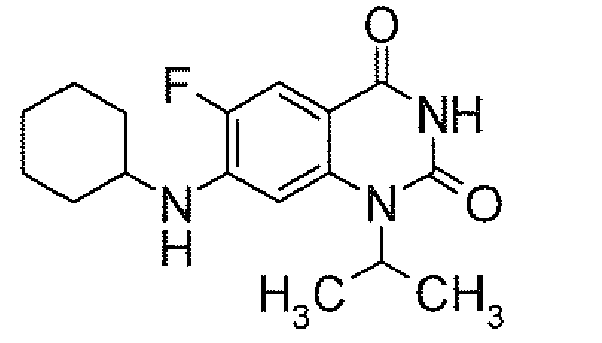
FAB+: 320 45 P4 
FAB+: 348 46 P4 
FAB+: 320 47 P16 
FAB+: 130 16 P16 
FAB+: 130 48 P6 
EI: 255 -
[Table 11] 49 P4 
ESI+: 333 50 P4 
ESI+: 335 51 P3 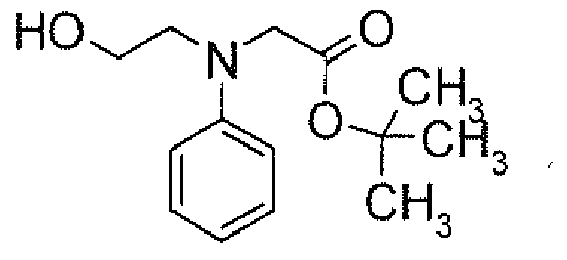
ESI+: 252 17 P17 
FAB-: 404 -
[Table 12] Ex Structure 37 
38 
39 
1 
40 
41 
-
[Table 13] 42 
43 
44 
45 
46 
47 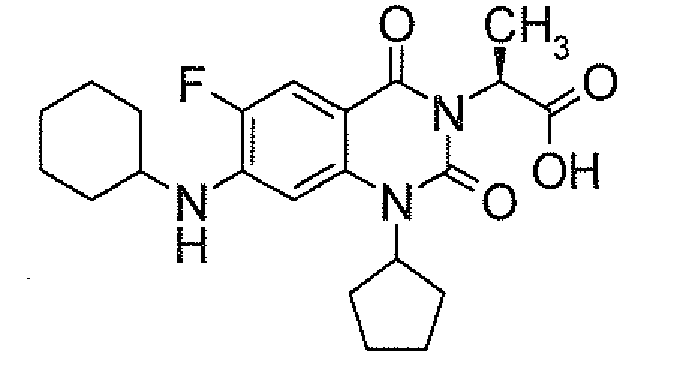
48 
-
[Table 14] 49 
7 
50 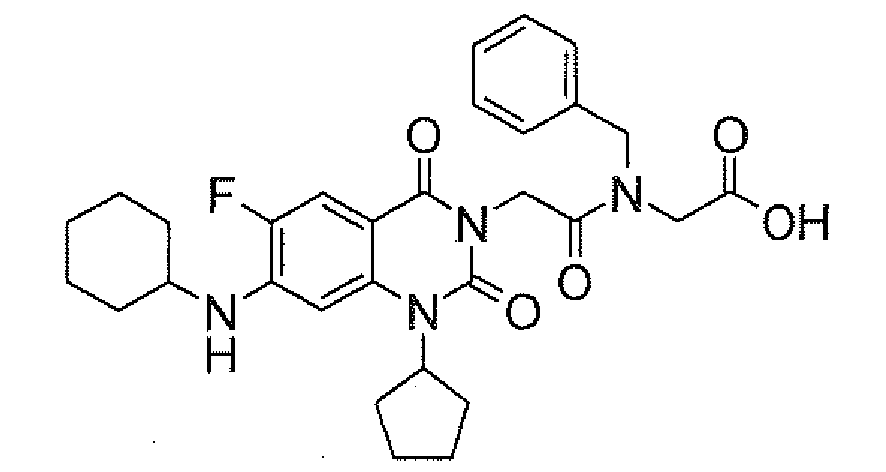
51 
52 
53 
-
[Table 15] 54 
55 
6 
5 
56 
57 
-
[Table 16] 58 
59 
60 
61 
62 
63 
-
[Table 17] 64 
65 
66 
67 
68 
69 
-
[Table 18] 70 
71 
72 
73 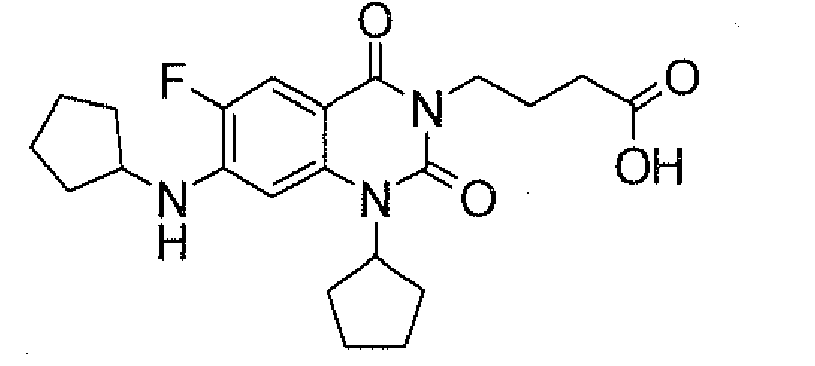
74 
75 
-
[Table 19] 76 
77 
78 
8 
9 
79 
-
[Table 20] 80 
81 
82 
83 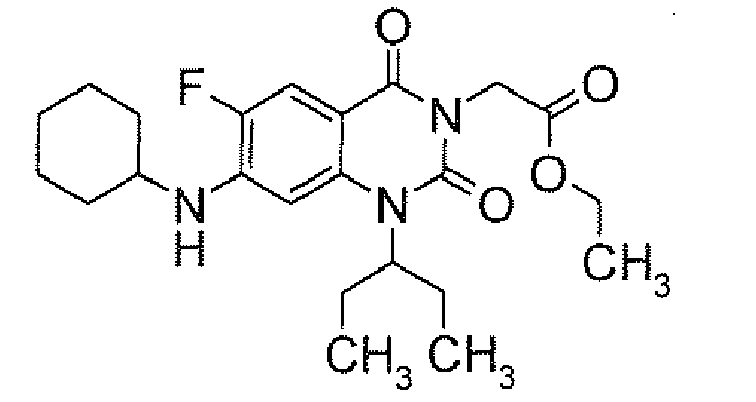
84 
4 
-
[Table 21] 85 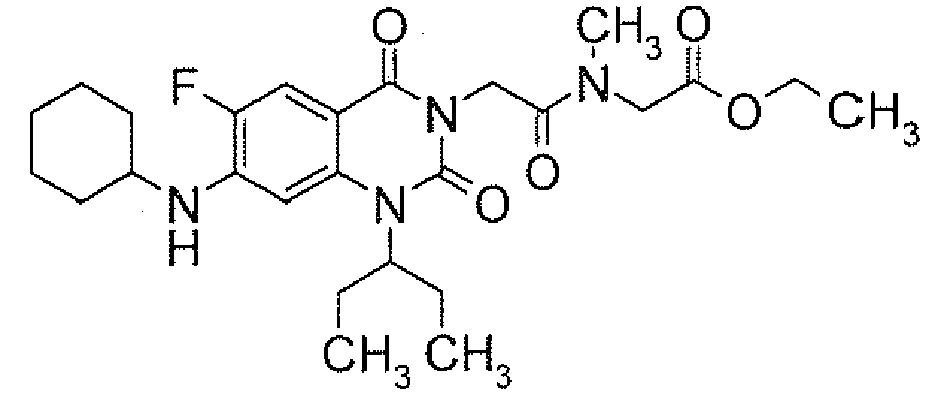
19 
86 
87 
88 
89 
-
[Table 22] 90 
91 
92 
93 
94 
95 
96 
-
[Table 23] 97 
98 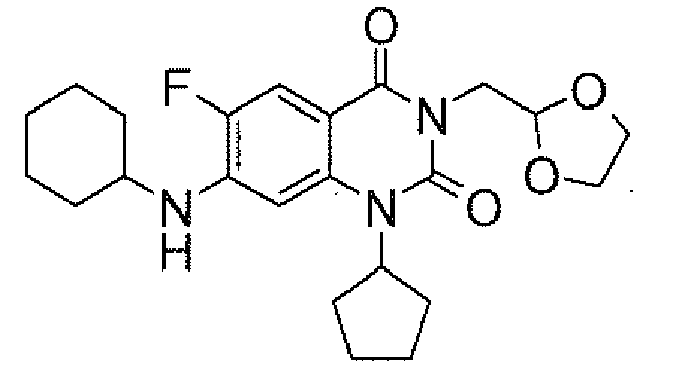
99 
100 
101 
102 
103 
-
[Table 24] 104 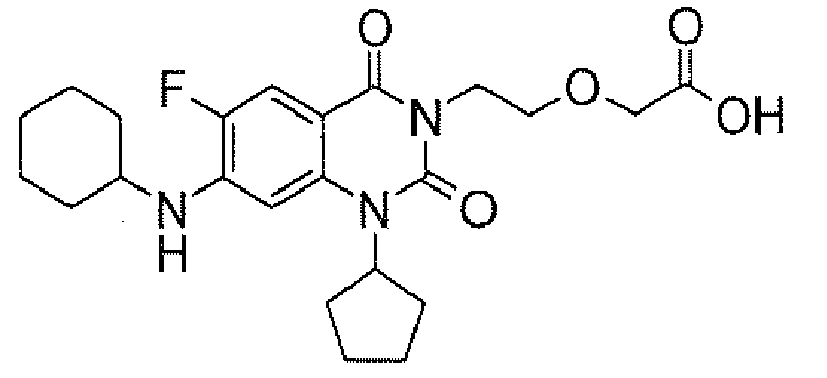
105 
106 
107 
12 
108 
-
[Table 25] 109 
110 
111 
112 
113 
114 
-
[Table 26] 18 
14 
15 
115 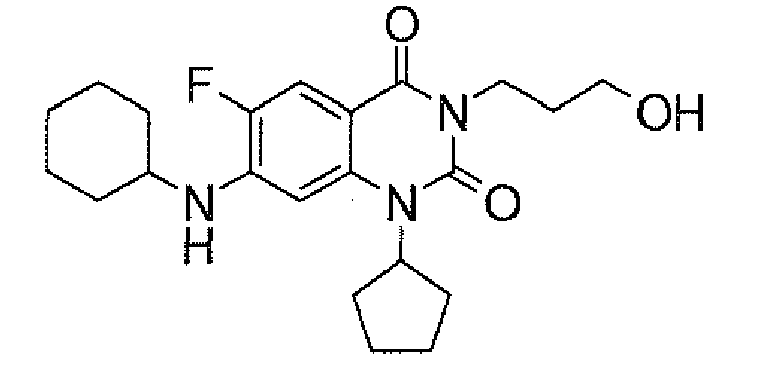
116 
117 
-
[Table 27] 118 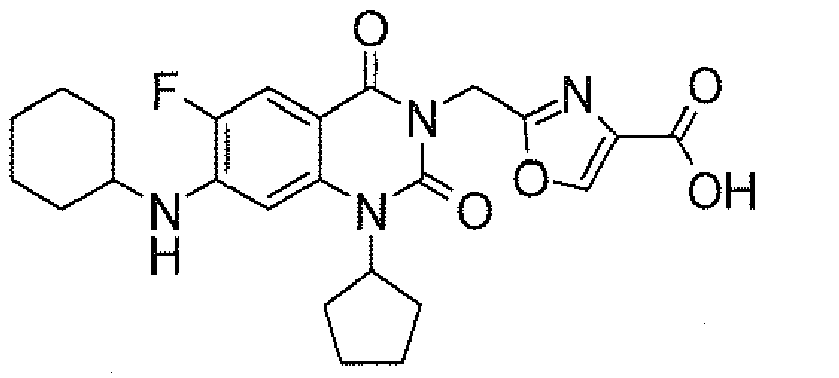
119 
120 
121 
122 
123 
124 
-
[Table 28] 125 
126 
127 
128 
10 
11 
-
[Table 29] 129 
130 
131 
132 
133 
134 
-
[Table 30] 135 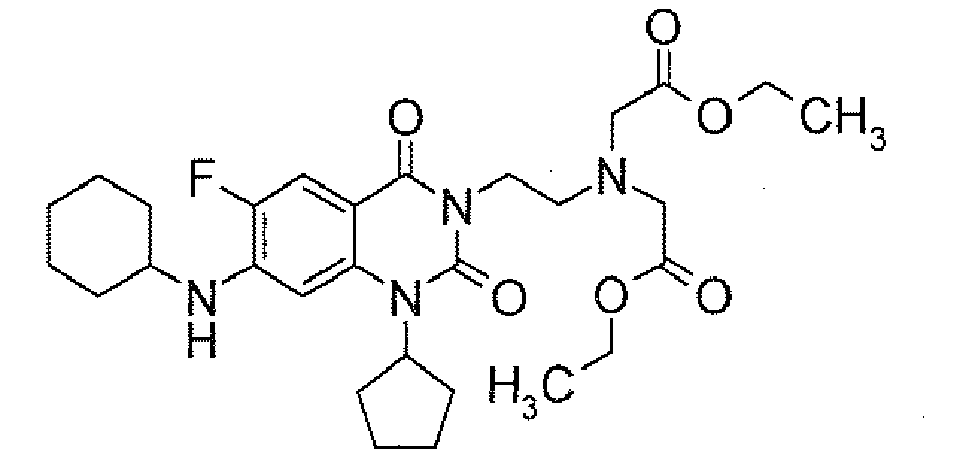
136 
137 
138 
139 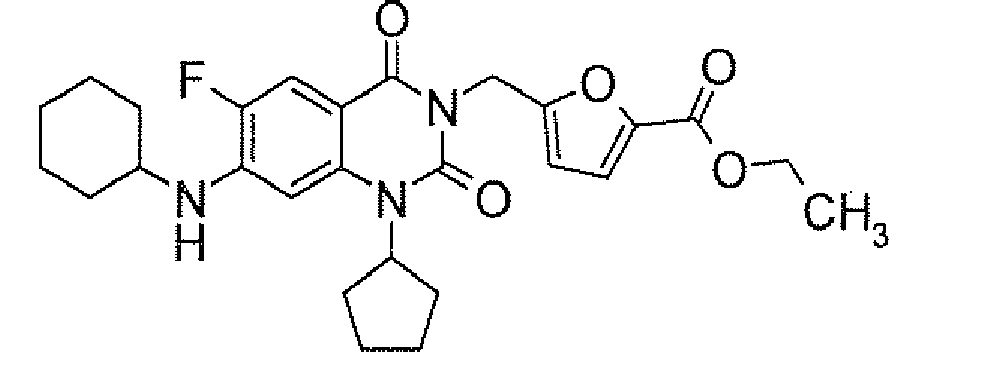
140 
-
[Table 31] 141 
142 
143 
144 
145 
146 
147 
-
[Table 32] 148 
149 
150 
151 
152 
153 
26 
-
[Table 33] 154 
155 
30 
156 
27 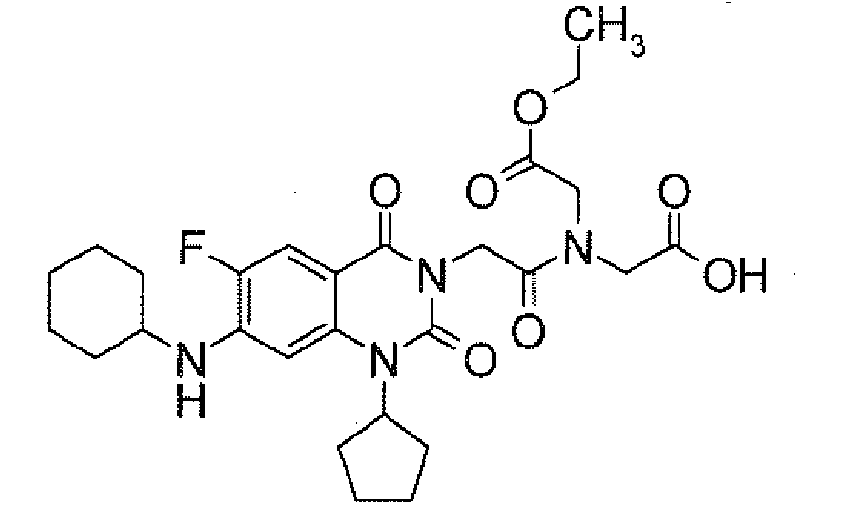
157 
-
[Table 34] 158 
159 
160 
161 
162 
20 
163 
-
[Table 35] 164 
165 
166 
167 
168 
169 
170 
-
[Table 36] 171 
172 
173 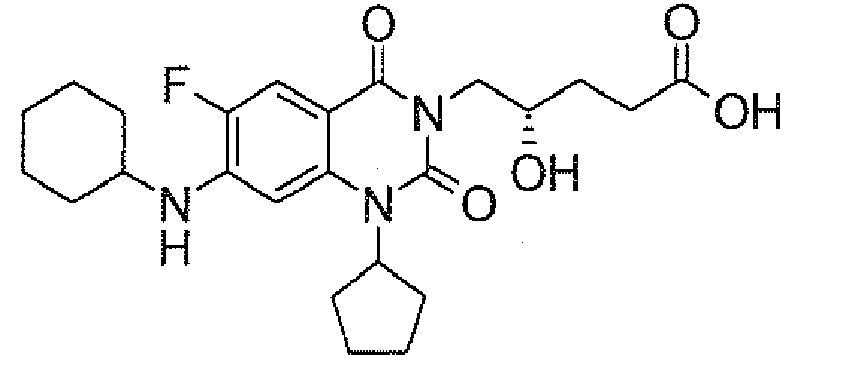
174 
13 
175 
-
[Table 37] 176 
177 
178 
179 
180 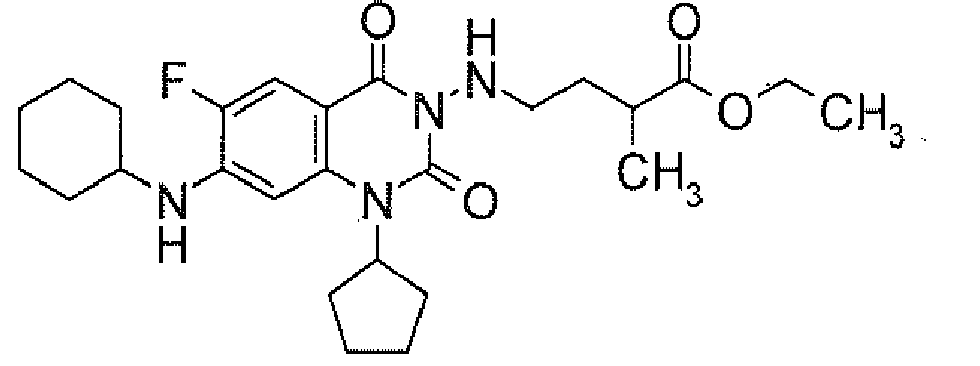
16 
-
[Table 38] 181 
182 
183 
184 
185 
186 
-
[Table 39] 17 
187 
188 
189 
190 
191 
-
[Table 40] 192 
193 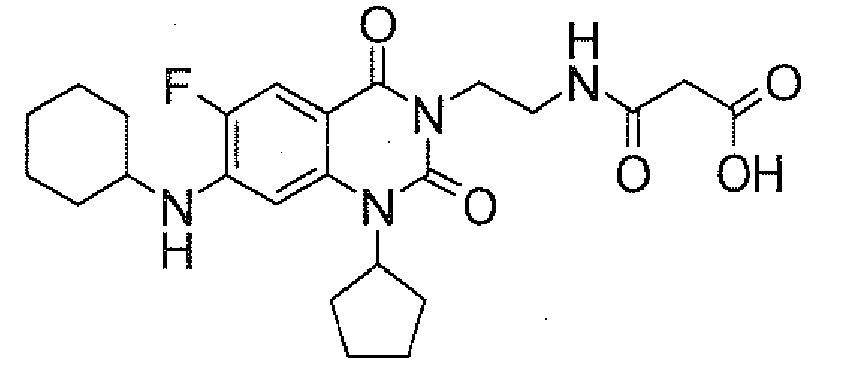
194 
21 
195 
196 
197 
-
[Table 41] 198 
199 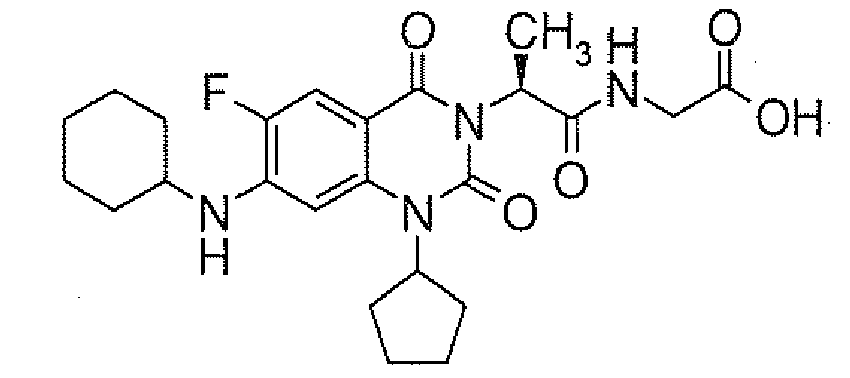
200 
201 
202 
203 
-
[Table 42] 204 
205 
206 
28 
29 
207 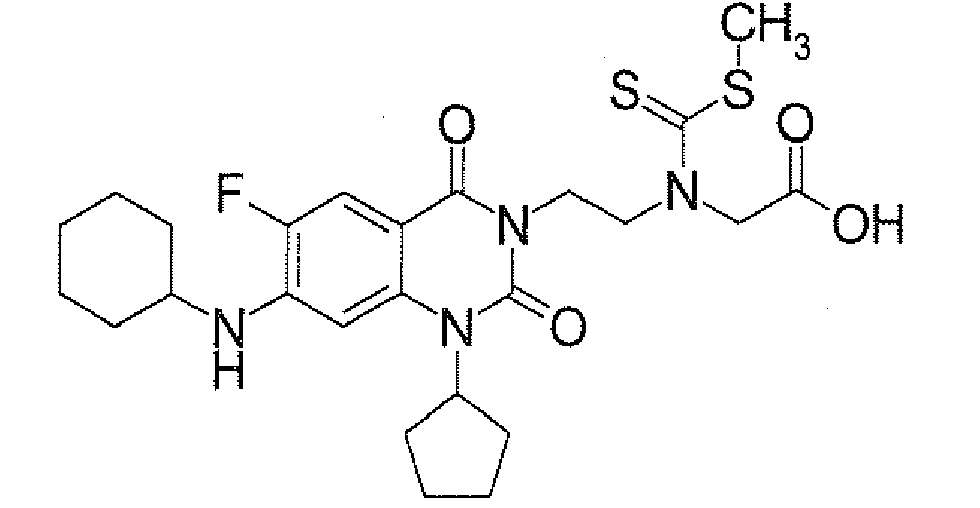
-
[Table 43] 24 
208 
209 
210 
211 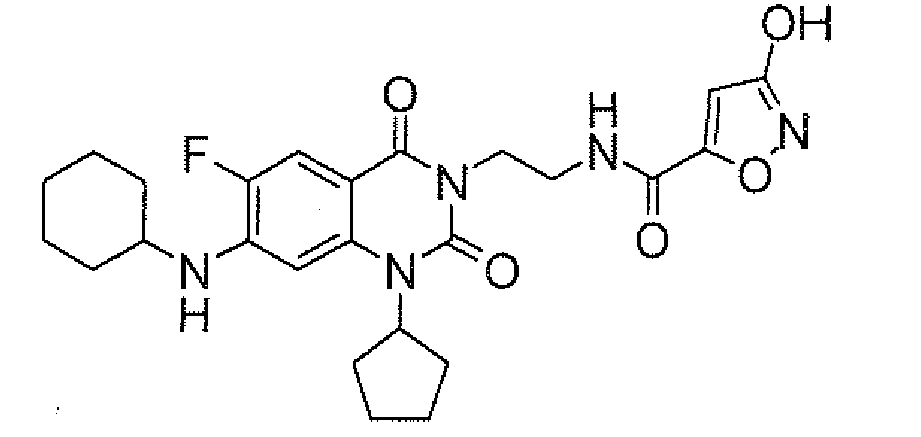
212 
-
[Table 44] 25 
213 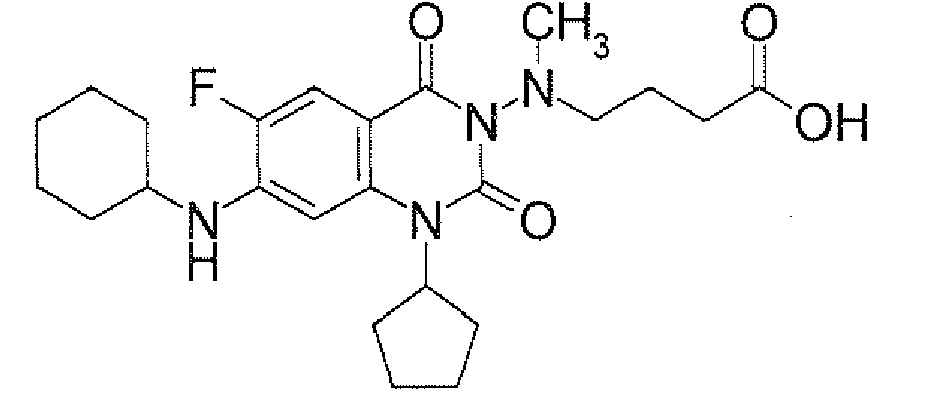
214 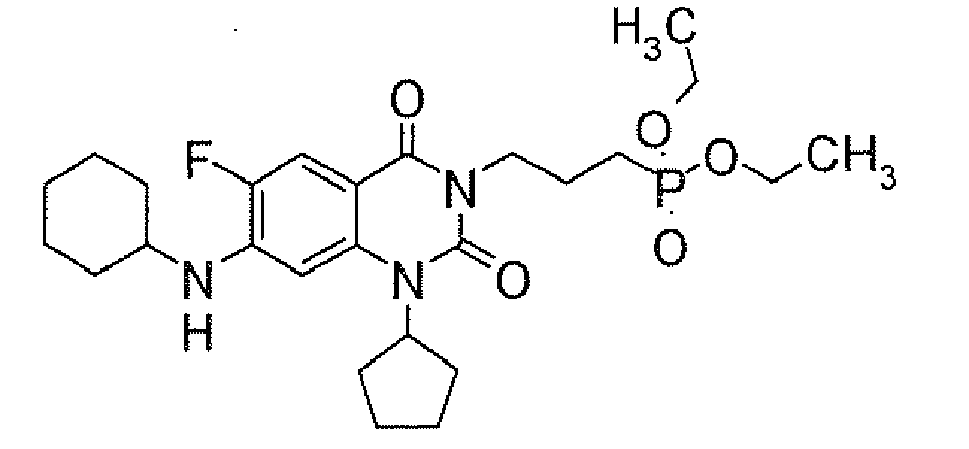
215 
216 
217 
-
[Table 45] 23 
218 
219 
220 
221 
222 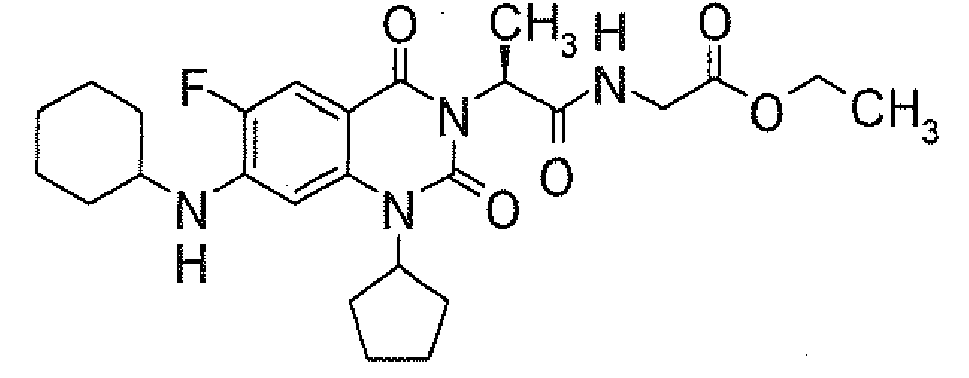
-
[Table 46] 223 
224 
22 
225 
226 
227 
-
[Table 47] 228 
229 
230 
231 
232 
233 
-
[Table 48] 234 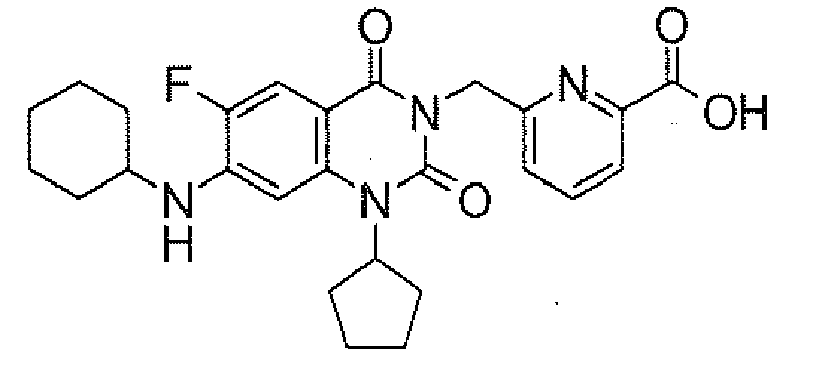
235 
236 
237 
238 
239 
2 
-
[Table 49] 3 
240 
241 
242 
243 
244 
245 
-
[Table 50] 246 
247 
248 
249 
250 
251 
252 
-
[Table 51] 253 
254 
255 
256 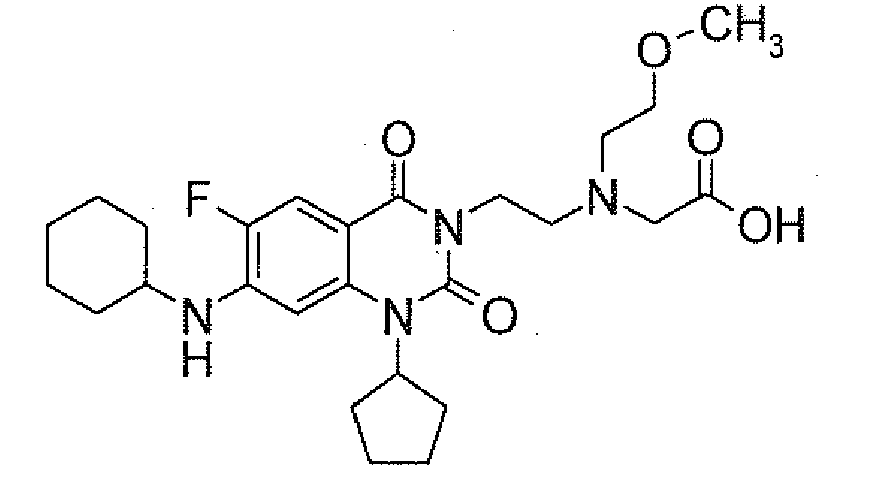
257 
34 
-
[Table 52] 36 
258 
259 
260 
261 
262 
-
[Table 53] 35 
263 
264 
265 
266 
267 
-
[Table 54] 268 
269 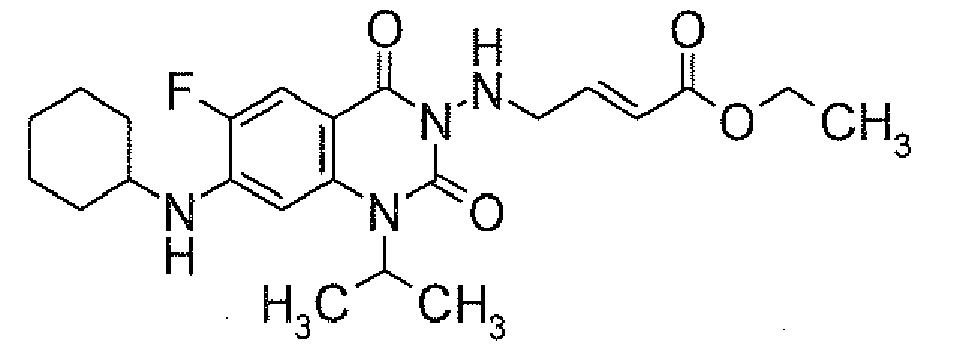
270 
271 
272 
273 
-
[Table 55] 274 
275 
276 
277 
278 
279 
280 
-
[Table 56] 281 
32 
282 
283 
284 
285 
-
[Table 57] 286 
33 
287 
288 
289 
290 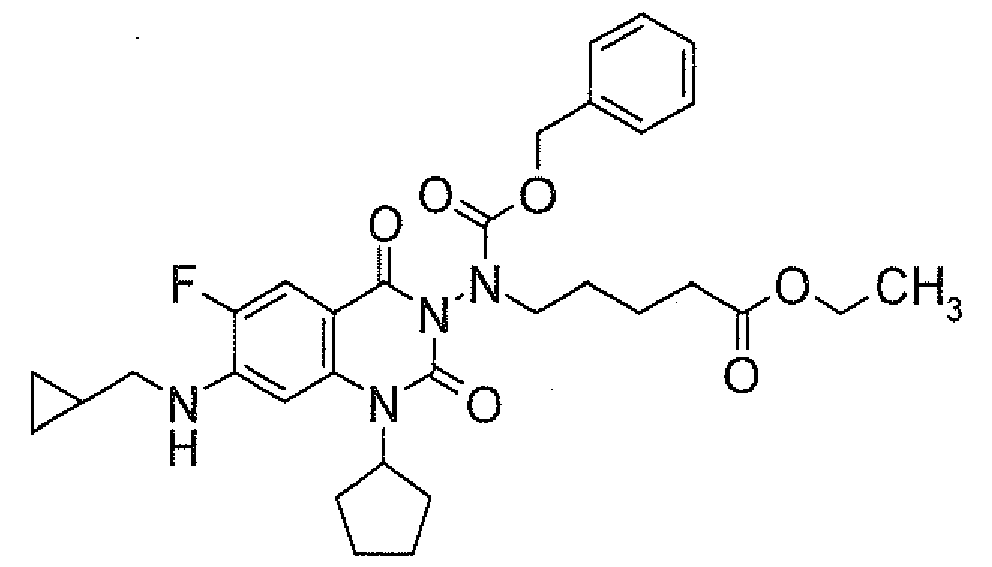
-
[Table 58] 291 
292 
293 
294 
295 
296 
-
[Table 59] 297 
298 
299 
300 
301 
-
[Table 60] 302 
31 
303 
304 
305 
306 
-
[Table 61] 307 
308 
309 
310 
311 
312 
-
[Table 62] 313 
314 
315 
316 
-
[Table 63] Ex Syn Data 37 1 FAB+: 385 38 1 FAB+: 387 39 1 FAB+: 389 1 1 FAB+: 404 40 P4 FAB+: 432 41 1 FAB+: 475 42 1 FAB+: 461 NMR1: 1.10-1.25 (1H, m), 1.27-1.43 (4H, m), 1.60-1.81 (5H, m), 1.86-1.99 (6H,m), 2.01-2.13 (2H, m), 3.37-3.50 (1H, m), 3.77 (2H, d, J = 5.8 Hz), 4.53 (2H, s), 5.36 (1H, quintet, J = 8.7 Hz), 6.39 (1H, dd, J = 2.1, 8.0 Hz), 6.43 (1H, d, J = 7.1 Hz), 7.51 (1H, d, J = 11.6 Hz), 8.42 (1H, t, J = 5.7 Hz), 12.40-12.70 (1H, br) 43 P8 FAB+: 503 44 1 FAB+: 510 45 P8 FAB+: 489 46 1 FAB+: 432 NMR1: 1.09-1.24 (1H, m), 1.27-1.43 (4H, m), 1.60-1.84 (7H, m), 1.86-2.00 (6H, m), 2.02-2.14 (2H, m), 2.23 (2H, t, J = 7.4 Hz), 3.36-3.47 (1H, m), 3.92 (2H, t, J = 6.9 Hz), 5.36 (1H, quintet, J = 8.7 Hz), 6.33 (1H, dd, J = 2.0, 8.0 Hz), 6.41 (1H, d, J = 7.1 Hz), 7.51 (1H, d, J=11.7 Hz), 12.02 (1H, brs) 47 1 FAB+: 418 48 1 FAB+: 418 49 P3, 1 FAB+: 418 7 7 FAB+: 390 50 1 FAB+: 551 51 1 FAB+: 489 52 1 FAB+: 489 53 P8 ESI+: 491 54 1 FAB+: 406 55 1 ESI+:458 6 6 ESI+:440 5 5 FAB+: 420 56 5 FAB+: 477 57 P8 FAB+: 491 58 1 FAB+: 477 59 P3 FAB+: 432 60 P3 FAB+: 458 61 P3 FAB+: 432 -
[Table 64] 62 26 FAB+: 460 63 1 FAB+: 404 64 26 FAB+: 406 65 1 FAB+: 430 NMR1: 1.10-1.22 (1H, m), 1.26-1.43 (4H, m), 1.60-1.82 (5H, m), 1.87-2.00 (6H, m), 2.02-2.14 (2H, m), 3.38-3.50 (1H, m), 4.64 (2H, d, J = 4.2 Hz), 5.31-5.44 (1H, m), 5.66 (1H, d, J = 15.9 Hz), 6.43 (2H, t, J = 6.7 Hz), 6.81 (1H, dt, Jd = 15.9 Hz, Jt = 4.9 Hz), 7.53 (1H, d, J = 11.7 Hz), 12.32 (1H, brs) 66 P8 FAB+: 461 67 P8 FAB+: 503 68 P8 FAB+: 489 69 1 FAB+: 376 NMR1: -0.04-0.03 (2H, m), 0.18-0.25 (2H, m), 0.77-0.89 (1H, m), 1.30-1.44 (2H, m), 1.57-1.70 (4H, m), 1.72-1.84 (2H, m), 2.89 (2H, t, J = 6.1 Hz), 4.25 (2H, s), 4.94 (1H, quintet, J = 8.4 Hz), 6.30 (1H, d, J = 7.1 Hz), 6.51-6.57 (1H, m), 7.23 (1H, d, J = 11.5 Hz), 12.62 (1H, brs) 70 1 FAB+: 446 71 1 FAB+: 404 72 1 FAB+: 446 73 1 FAB+: 418 74 1 FAB+: 420 75 P8 FAB+: 529 76 1 FAB+: 432 77 1 FAB+: 406 NMR1: 1.09-1.24 (1H, m), 1.26-1.46 (4H, m), 1.49 (6H, d, J = 6-8 Hz), 1.59-1.68 (1H, m), 1.72-1.83 (4H, m), 1.88-1.96 (2H, m), 2.22 (2H, t, J = 7.4 Hz), 3.43-3.55 (1H, m), 3.90 (2H, t, J = 6.9 Hz), 4.90-5.14 (1H, m), 6.30 (1H, d, J = 6.5 Hz), 6.54 (1H, d, J = 7.0 Hz), 7.50 (1H, d, J = 11.7 Hz), 12.00 (1H, brs) 78 1 FAB+: 378 8 8 ESI+: 416 9 9 ESI+: 486 79 P8 FAB+: 579 80 P8 FAB+: 517 81 P8 FAB+: 517 82 P3 FAB+: 496 83 P4 FAB+: 434 84 P8 ESI+: 517 4 4 FAB+: 460 85 P8 ESI+: 505 19 19 FAB+: 388 -
[Table 65] 86 P3 FAB+: 460 87 4 FAB+: 460 88 P3 FAB+: 404 89 P3 FAB+: 432 90 P4 FAB+: 474 91 P4 FAB+: 446 92 P4 FAB+: 448 93 P4 FAB+: 434 94 P4 FAB+: 406 95 26 FAB+: 434 96 1 ESI+; 412 97 26 FAB+: 414 98 P3 FAB+: 432 99 P3 ESI+: 440 100 P3 FAB+: 489 101 1 FAB+: 420 102 1 FAB+: 446 103 1 FAB+: 418 104 I FAB+: 448 105 1 FAB+: 413 106 2 FAB+: 443 107 1 FAB+: 415 12 12 FAB+: 567 108 1 FAB+: 520 109 1 FAB+: 525 110 1 ESI+:444 111 1 ESI+: 505 112 1 FAB+: 447 113 27 FAB+: 430 114 1 FAB+: 446 NMR1: 1.10 (3H, d, J = 7.1 Hz), 1.12-1.43 (5H, m), 1.48-1.81 (6H, m), 1.83-1.99 (7H, m), 2.01-2.14 (2H, m), 2.27-2.39 (1H, m), 3.39-3.48 (1H, m), 3.84-3.99 (2H, m), 5.36 (1H, quintet, J = 8.7 Hz), 6.34 (1H, dd, J = 2.1, 8.0 Hz), 6.41 (1H, d, J = 7.1 Hz), 7.51 (1H, d, J = 11.7 Hz) 18 18 FAB+: 456 14 14 FAB+: 444 15 15 FAB+: 486 115 27 FAB+: 404 116 1 ESI+: 515 117 P3 FAB+: 485 -
[Table 66] 118 1 FAB+: 471 119 1 FAB+: 487 120 1 FAB+: 470 121 1 FAB+: 480 122 27 FAB+: 434 123 7 FAB+: 404 124 P4 FAB+: 448 125 P4 ESI+: 548 126 P8 FAB+: 475 127 P3 FAB+: 474 128 P3 FAB+: 446 10 10 FAB+: 472 11 11 FAB+: 389 129 1 FAB+: 519 130 I FAB+: 420 131 1 FAB+: 434 132 4 FAB+: 476 133 4,5 ESI+: 448 134 P3 ESI+: 475 135 P3 ESI+: 561 136 P3 FAB+: 460 137 P3 FAB+: 494 138 P8 FAB+: 543 139 P3 FAB+: 498 140 P3 FAB+: 515 141 P3 FAB+: 494 142 P3 ESI+: 402 143 4 FAB+: 524 144 1 FAB+: 444 145 1 FAB+: 378 146 1 FAB+: 454 147 1 FAB+: 446 148 14 FAB+: 509 149 1 FAB+: 420 150 P8 FAB+: 419 151 P8 FAB+: 575 152 1 FAB+: 449 153 1 FAB+: 510 26 26 FAB+: 475 154 1 FAB+: 434 -
[Table 67] 155 1 FAB+: 447 NMR1: 1.09-1.22 (1H, m), 1.25-1.43 (4H, m), 1.56-1.81 (7H, m), 1.86-2.00 (6H, m), 2.02-2.14 (2H, m), 2.35 (2H, t, J = 7.3 Hz), 2.80-2.88 (2H, m), 3.35-3.48 (1H, m), 5.34 (1H, quintet, J = 8.6 Hz), 5.72 (1H, brs), 6.36 (1H, d, J = 6.4 Hz), 6.42 (1H, d, J = 7.0 Hz), 7.52 (1H, d, J = 11.7 Hz), 11.99 (1H, brs) 30 30 ESI+: 489 156 1 ESI+: 461 27 27 FAB+: 547 157 1 FAB+: 510 NMR1: 1.08-1.24 (1H, m), 1.27-1.43 (4H, m), 1.59-1.82 (5H, m), 1.87-1.98 (6H, m), 2.02-2.14 (2H, m), 3.37-3.47 (1H, m), 4.61 (2H, s), 5.04 (2H, s), 5.38 (1H, quintet, J = 8.7 Hz), 6.41 (1H, dd, J = 2.3, 8.2 Hz), 6.44 (1H, d, J = 7.2 Hz), 6.76 (1H, dd, J = 2.5, 8.1 Hz), 6.81 (1H, s), 6.84 (1H, d, J = 7.9 Hz), 7.20 (1H, t, J = 7.9 Hz), 7.54 (1H, d, J = 11.7 Hz), 12.97 (1H, brs) 158 P3 FAB+: 448 159 P3 FAB+: 462 160 12 FAB+: 551 161 1 FAB+: 537 162 P8 FAB+: 418 20 20 FAB+: 538 163 P3 FAB+: 406 164 P3 ESI+: 468 165 P8 FAB+: 477 166 4 FAB+: 524 167 4 FAB+: 538 168 P8 FAB+: 551 169 4 FAB+: 444 170 P3 FAB+: 462 171 P8 FAB+: 637 172 1 FAB+: 446 173 1 FAB+: 462 174 15 ESI-: 458 13 13 FAB+: 447 175 1 FAB+: 460 176 1 FAB+: 448 177 1 FAB+: 418 178 6 FAB+: 442 179 1 FAB+: 462 180 26 FAB+: 489 16 16 ESI+: 476 -
[Table 68] 181 P3 FAB+: 498 182 1 ESI+: 462 183 1 FAB+: 461 184 4 ESI+: 488 185 1 ESI+: 448 NMR1: 1.10-1.43 (5H, m), 1.60-2.00 (13H, m), 2.02-2.14 (2H, m), 2.46 (2H, t, J = 7.3 Hz), 3.37-3.47 (1H, m), 4.05 (2H, t, J = 6.2 Hz), 5.32 (1H, quintet, J = 8.5 Hz), 6.41 (2H, d, J = 7.1 Hz), 7.52 (1H, d, J = 11.6 Hz), 12.09 (1H, s) 186 P4 ESI+: 476 17 17 ESI+: 490 187 P3 ESI+: 432 188 12 ESI+: 531 189 16 ESI+: 476 190 4 FAB+: 458 191 6 ESI+: 468 192 1 ESI+: 461 193 1 ESI+: 475 194 1 ESI+: 489 21 21 FAB+: 462 195 1 FAB+: 501 196 1 FAB+: 501 197 6 ESI+: 575 198 1 FAB+: 527 199 1 ESI+: 475 200 1 ESI+: 461 201 26 FAB+: 503 202 26 ESI+: 503 203 1 ESI+: 489 204 P8 ESI+: 515 205 P8 ESI+: 529 206 P8 ESI-: 469 28 28 ESI+: 520 29 29 ESI+: 565 207 1 ESI+: 537 24 24 ESI+: 420 NMR1: 1.10-1.23 (1H,m), 1.26-1.43 (4H,m), 1.60-1.81 (5H, m), 1.86-2.00 (6H, m), 2.03-2.15 (2H, m), 3.39-3.50 (1H, m), 4.62 (2H, s), 5.30 (1H, quintet, J = 8.6 Hz), 6.41-6.48 (2H, m), 7.53 (1H, d, J = 11.5 Hz), 13.14 (1H, brs) 208 P8 ESI+: 516 209 P8 FAB+: 499 -
[Table 69] 210 P8 ESI+: 499 211 P8 ESI+: 500 212 1 ESI+: 475 25 25 ESI+: 489 213 1 FAB+: 461 214 P3 FAB+: 524 215 P3 ESI+: 480 216 P8 ESI+: 503 217 P8 ESI+: 517 23 23 ESI+: 489 218 P8 FAB+: 515 219 P8 FAB+: 515 220 P8 ESI+: 555 221 P8 ESI+: 603 222 P8 FAB+: 503 223 P8 ESI+: 371 224 P9 FAB+: 397 22 22 FAB+: 517 225 P3 ESI+: 503 226 P3 ESI+: 489 227 11 ESI+: 403 228 4 ESI+: 503 229 P3 FAB+: 489 230 P3,1 ESI+: 510 231 P3,1 ESI+: 480 232 P3,1 ESI+: 480 233 P3,1 ESI+: 520 234 P3,1 ESI+: 481 235 P3,1 ESI+: 488 236 P3,1 ESI+:448 237 P3,1 ESI+: 430 238 P3,1 ESI+: 474 239 P4 FAB+: 413 2 2 FAB+: 415 3 3 FAB+: 417 240 P4 FAB+: 538 241 P4 FAB+: 460 242 P3 FAB+: 432 243 P4 FAB+: 441 244 P3 FAB+: 413 -
[Table 70] 245 P3 FAB+: 473 246 P3 FAB+: 434 247 P4 FAB+: 474 248 P3 FAB+: 487 249 P3 FAB+: 487 250 26 FAB+: 489 251 1 FAB+: 461 252 P3 ESI+: 463 253 11,28 ESI+: 494 254 26,1 FAB+: 507 255 P3 ESI+: 533 256 1 ESI+: 505 NMR1: 1.10-1.43 (5H, m), 1.60-1.81 (5H,m), 1.86-1.99 (6H, m), 2.02-2.14 (2H, m), 2.75-2.83 (4H, m), 3.13 (3H, s), 3.94 (2H, t, J = 6.7 Hz), 5.36 (1H, quintet, J = 8.6 Hz), 6.33 (1H, dd, J = 2.3, 8.1 Hz), 6.41 (1H, d, J = 7.1 Hz), 7.51 (1H, d, J = 11.7 Hz) 257 P7 ESI+: 531 34 34 ESI+: 475 36 36 ESI+: 363 258 P3 ESI+: 520 259 1 FAB+: 506 260 P3 ESI+: 517 261 P3 ESI+: 445 262 2 ESI+: 508 35 35 ESI+: 533 263 28 ESI+: 553 264 P8 ESI+: 503 265 1 ESI+: 489 266 26 ESI+: 447 267 26 FAB+: 475 268 1 ESI+: 525 269 P3 ESI+: 447 270 1 ESI+: 505 271 1 FAB+: 461 -
[Table 71] 272 1 ESI+: 419 NMR1: 0.25-0.30 (2H, m), 0.46-0.52 (2H,m), 1.06-1.16 (1H, m), 1.56-1.72 (4H, m), 1.87-2.00 (4H, m), 2.03-2.15 (2H, m), 2.35 (2H, t, J = 7.3 Hz), 2.80-2.88 (2H, m), 3.16 (2H, t, J = 6.1 Hz), 5.21 (1H, quintet, J = 8.3 Hz), 5.68-5.76 (1H, m), 6.55 (1H, d, J = 7.0 Hz), 6.71-6.77 (1H, m), 7.52 (1H, d, J =11.6 Hz), 11.99 (1H, brs) 273 32 ESI+: 637 274 33 East+: 503 275 P8 ESI+: 505 276 P8 ESI+: 604 277 P8 ESI+: 489 278 P8 ESI+: 517 279 1 ESI+: 475 280 P3,1 FAB+: 404 281 31 ESI+: 469 32 32 ESI+: 597 282 26 ESI+: 449 283 1 ESI+: 491 284 1 ESI+: 590 285 1 ESI+: 475 286 1 ESI+: 489 33 33 ESI+: 463 287 1 ESI+: 421 NMR1: 1.10-1.22 (1H, m), 1.25-1.47 (4H, m), 1.50 (6H, d, J = 6.8 Hz), 1.57-1.67 (3H, m), 1.71-1.79 (2H, m), 1.88-1.95 (2H, m), 2.35 (2H, t, J = 7.3 Hz), 2.80-2.88 (2H, m), 3.44-3.55 (1H, m), 4.95-5.07 (1H, m), 5.65-5.74 (1H, m), 6.30 (1H, d, J = 7.1 Hz), 6.55 (1H, d, J = 6.9 Hz), 7.50 (1H, d, J = 11.7 Hz), 11.97 (1H, brs) 288 1 ESI+; 435 289 31 ESI+: 467 290 32 ESI+: 595 291 33 ESI+: 461 292 1 ESI+: 475 293 36 ESI+: 490 -
[Table 72] 294 1 ESI+: 433 NMR1: 0.24-0.30 (2H, m), 0.46-0.52 (2H, m), 1.06-1.14 (1H, m), 1.43 (2H, quintet, J = 7.1 Hz), 1.57 (2H, quintet, J = 7.5 Hz), 1.62-1.72 (2H, m), 1.87-1.98 (4H, m), 2.03-2.14 (2H, m), 2.23 (2H, t, J = 7.3 Hz), 2.78-2.86 (2H, m), 3.16 (2H, t, J = 6.0 Hz), 5.21 (1H, quintet, J = 8.3 Hz), 5.59-5.68 (1H, m), 6.55 (1H, d, J = 7.0 Hz), 6.69-6.75 (1H, m), 7.52 (1H, d, J = 11.6 Hz), 11.96 (1H, s) 295 P7 ESI+: 517 296 1 ESI+: 503 297 32 ESI+: 623 298 33 ESI+: 489 299 1 ESI+: 461 300 P3 ESI+: 579 301 34 ESI+: 523 302 P7 ESI+: 529 31 31 ESI+: 495 303 1 FAB+: 501 304 P7 ESI+: 501 305 P7 ESI+: 529 306 P7 ESI+: 529 307 P7 ESI+: 501 308 1 ESI+: 487 309 1 ESI+: 501 310 1 ESI+: 487 311 1 FAB+: 501 312 P7 ESI+: 517 313 1 FAB+: 503 314 P3 FAB+: 559 315 P3 FAB+: 473 316 P3 ESI+: 463 -
[Table 73] No Structure 1 
2 
3 
4 
5 
-
[Table 74] 6 
7 
8 
9 
10 
11 
-
[Table 75] 12 
13 
14 
- Since a compound of the present invention exhibits an excellent P2Y12 inhibitory action, it is useful as a medical drug, particularly, as a platelet aggregation inhibitor.
Claims (15)
- A bicyclic heterocyclic compound presented by the formula (I) or a pharmaceutically acceptable salt thereof:
 X: C(R6) or N;Y: (i) CH(R7) when X is C(R6), and (ii) C(O) or *-C(O)-CH2- when X is N, wherein * represents a bond to X;R6 and R7 indicate H, orR6 and R7 may form a bond together;R1: lower alkyl, halogeno-lower alkyl, lower alkylene-R10, lower alkenylene-R10, aryl, or a heterocyclic group, in which lower alkylene, lower alkenylene, aryl, and the heterocyclic group may be substituted;L: a single bond, -O-, -N(R11)-, -N(R11)C(O)-*, or -N(R11)C(O)O-*, wherein * represents a bond to R1;R10: -OR11, -CN, -C(O)R11, -CO2R0, -CO2-lower alkylene-aryl, -C(O)N(R11)2, -C(O)N(R0)-S(O)2-R11, -C(O)N(R0)-OR0, -C(O)N(R0)O-heterocyclic group, -C(O)N(R0)N(R0)2, -N(R11)2, -N(R11)C(O)R11, -N(R11)-CO2R0, -N(R0)C(O)CO2R0, -N(R11)-S(O)2-R11, -N(R11)C(S)S-R0, -P(O)(OR0)2, aryl, or a heterocyclic group, in which aryl and the heterocyclic group may be substituted;R0: the same with or different from each other, and -H or lower alkyl;R11: the same with or different from each other, and -H, lower alkyl, halogeno-lower alkyl, lower alkenyl, cycloalkyl, cycloalkenyl, aryl, heterocyclic group, lower alkylene-OR0, lower alkylene-CO2R0, lower alkylene-CO2-lower alkylene-aryl, lower alkylene-aryl, lower alkylene-heterocyclic group, lower alkylene-OC(O)R0, lower alkylene-P(O)(OR0)2, lower alkylene-O-lower alkylene-aryl, lower alkenylene-OR0, lower alkenylene-CO2R0, lower alkenylene-aryl, lower alkenylene-heterocyclic group, or lower alkenylene-P(O)(OR0)2, in which lower alkylene, lower alkenylene, cycloalkyl, cycloalkenyl, aryl, and heterocyclic group may be substituted;R2: lower alkyl, cycloalkyl, cycloalkenyl, or a heterocyclic group;R3: lower alkyl, cycloalkyl, or lower alkylene-cycloalkyl;R4: -H or halogen;R5: -H, halogen, -OR0, -O-halogeno-lower alkyl, or -O-lower alkylene-aryl, wherein, N-(2,6-dichloro benzoyl)-4-[7-(ethylamino)-1-methyl-2,4-dioxo-1,4-dihydroquinazolin-3(2H)-yl]-L-phenylalanine and 3-(3-chlorophenyl)-7-(isobutylamino)-1-methylquinazoline-2,4(1H,3H)-dione are excluded).
 - The compound according to Claim 1, wherein X is N, and Y is C(O).
- The compound according to Claim 2, wherein R3 is cycloalkyl or lower alkylene-cycloalkyl.
- The compound according to Claim 3, wherein R4 is -F.
- The compound according to Claim 4, wherein R5 is -H.
- The compound according to Claim 5, wherein R2 is lower alkyl or cycloalkyl.
- The compound according to Claim 6, wherein L is a single bond, -O-, or -NH-.
- The compound according to Claim 7,
wherein R1 is lower alkylene-CO2R0, lower alkenylene-CO2R0, lower alkylene-N(R0)-lower alkylene-CO2R0, lower alkylene-N(lower alkylene-OR0)-lower alkylene-CO2R0, lower alkylene-C(O)N(R0)-lower alkylene-CO2R0, or lower alkylene-(heterocyclic group substituted with -CO2R0). - The compound according to Claim 1, wherein X is C(R6), and Y is CH(R7).
- The compound according to Claim 1, wherein X is N, and Y is *-C(O)-CH2-(wherein, * represents a bond to X).
- The compound or a pharmaceutically acceptable salt thereof according to Claim 1, which is selected from the group consisting of 4-[7-(cyclohexylamino)-1-cyclopentyl-6-fluoro-2,4-dioxo-1,4-dihydroquinazolin-3(2H)-yl]butanoic acid; 4-[7-(cyclohexylamino)-1-cyclopentyl-6-fluoro-2,4-dioxo-1,4-dihydroquinazolin-3(2H)-yl]-2-methylbutanoic acid; 4-{[7-(cyclohexylamino)-1-cyclopentyl-6-fluoro-2,4-dioxo-1,4-dihydroquinazolin-3(2H)-yl]amino}butanoic acid; 4-{[7-(cyclohexylamino)-1-cyclopentyl-6-fluoro-2,4-dioxo-1,4-dihydroquinazolin-3(2H)-yl]oxy}butanoic acid; [{2-[7-(cyclohexylamino)-1-cyclopentyl-6-fluoro-2,4-dioxo-1,4-dihydroquinazolin-3(2H)-yl]ethyl}(2-methoxyethyl)amino]acetic acid; 4-({1-cyclopentyl-7-[(cyclopropylmethyl)amino]-6-fluoro-2,4-dioxo-1,4-dihydroquinazolin-3(2H)-yl} amino)butanoic acid; 4-{{[7-(cyclohexylamino)-6-fluoro-1-isopropyl-2,4-dioxo-1,4-dihydroquinazolin-3(2H)-yl)amino}butanoic acid; 5-({1-cyclopentyl-7-(cyclopropylmethyl)amino]-6-fluoro-2,4-dioxo-1,4-dihydroquinazolin-3(2H)-yl}amino)pentanoic acid; 1-{2-[7-(cyclohexylamino)-1-cyclopentyl-6-fluoro-2,4-dioxo-1,4-dihydroquinazolin-3(2H)-yl]ethyl}pipendine-3-carboxylic acid; (2E)-4-[7-(cyclohexylamino)-1-cyclopentyl-6-fluoro-2,4-dioxo-1,4-dihydroquinazolin-3(2H)-yl]-2-butenoic acid; and {[7-(cyclohexylamino)-1-cyclopentyl-6-fluoro-2,4-dioxo-1,4-dihydroquinazolin-3(2H)-yl]oxy} acetic acid.
- A pharmaceutical composition comprising the compound or a pharmaceutically acceptable salt thereof according to Claim 1, and a pharmaceutically acceptable carrier.
- The pharmaceutical composition according to Claim 12, which is a platelet aggregation inhibitor.
- The pharmaceutical composition according to Claim 12, which is a P2Y12 inhibitor.
- Use of the compound or a pharmaceutically acceptable salt thereof according to Claim 1 for the manufacture of a platelet aggregation inhibitor or a P2Y12 inhibitor.
Applications Claiming Priority (2)
| Application Number | Priority Date | Filing Date | Title |
|---|---|---|---|
| JP2007109958 | 2007-04-19 | ||
| PCT/JP2008/057465 WO2008133155A1 (en) | 2007-04-19 | 2008-04-17 | Bicyclic heterocyclic compound |
Publications (2)
| Publication Number | Publication Date |
|---|---|
| EP2138482A1 true EP2138482A1 (en) | 2009-12-30 |
| EP2138482A4 EP2138482A4 (en) | 2011-06-15 |
Family
ID=39925611
Family Applications (1)
| Application Number | Title | Priority Date | Filing Date |
|---|---|---|---|
| EP08740535A Withdrawn EP2138482A4 (en) | 2007-04-19 | 2008-04-17 | Bicyclic heterocyclic compound |
Country Status (5)
| Country | Link |
|---|---|
| US (1) | US20100113391A1 (en) |
| EP (1) | EP2138482A4 (en) |
| JP (1) | JPWO2008133155A1 (en) |
| TW (1) | TW200911755A (en) |
| WO (1) | WO2008133155A1 (en) |
Cited By (5)
| Publication number | Priority date | Publication date | Assignee | Title |
|---|---|---|---|---|
| WO2019166633A1 (en) * | 2018-03-02 | 2019-09-06 | Inflazome Limited | Sulfonamide derivates as nlrp3 inhibitors |
| US11530200B2 (en) | 2018-03-02 | 2022-12-20 | Inflazome Limited | Compounds |
| US11834433B2 (en) | 2018-03-02 | 2023-12-05 | Inflazome Limited | Compounds |
| US11884645B2 (en) | 2018-03-02 | 2024-01-30 | Inflazome Limited | Sulfonyl acetamides as NLRP3 inhibitors |
| US12030879B2 (en) | 2018-03-02 | 2024-07-09 | Inflazome Limited | Sulfonyl acetamides as NLRP3 inhibitors |
Families Citing this family (12)
| Publication number | Priority date | Publication date | Assignee | Title |
|---|---|---|---|---|
| US8107260B2 (en) * | 2007-11-15 | 2012-01-31 | Illinois Tool Works Inc. | EMI shielding and environmental seal device |
| FR2944206B1 (en) | 2009-04-09 | 2012-12-28 | Sanofi Aventis | THERAPEUTIC APPLICATIONS IN THE CARDIOVASCULAR FIELD OF QUINAZOLINEDIONE DERIVATIVES |
| FR2944282B1 (en) | 2009-04-09 | 2013-05-03 | Sanofi Aventis | QUINAZOLINEDIONE DERIVATIVES, THEIR PREPARATION AND THEIR VARIOUS THERAPEUTIC APPLICATIONS |
| US8729095B2 (en) | 2009-08-28 | 2014-05-20 | Daiichi Sankyo Company, Limited | 3-(biaryloxy)propionic acid derivatives for prevention and/or treatment of thromboembolic diseases |
| WO2012174013A2 (en) * | 2011-06-14 | 2012-12-20 | Cardeus Pharmaceuticals, Inc. | Treatment of cardiovascular disease, stroke, and inflammatory conditions |
| US9539246B2 (en) | 2011-08-30 | 2017-01-10 | University Of Utah Research Foundation | Methods and compositions for treating nephrogenic diabetes insipidus |
| ES2751698T3 (en) * | 2014-11-03 | 2020-04-01 | Olon Spa | Procedure for the preparation of 1- (2-halogen-ethyl) -4-piperidine-carboxylic acid ethyl ester |
| IL297879A (en) * | 2020-06-22 | 2023-01-01 | Hoffmann La Roche | Amidopyrimidone derivatives |
| IL302906A (en) * | 2020-11-20 | 2023-07-01 | Denali Therapeutics Inc | Compounds, preparations and methods |
| JP2025534288A (en) | 2022-09-26 | 2025-10-15 | エッジワイズ セラピューティクス, インコーポレイテッド | 1,4-Dihydroquinazolinone Compounds and Uses Thereof |
| WO2024206339A1 (en) | 2023-03-27 | 2024-10-03 | Edgewise Therapeutics, Inc. | Quinolinone amide compounds and uses thereof |
| EP4688756A1 (en) * | 2023-03-27 | 2026-02-11 | Edgewise Therapeutics, Inc. | Quinazoline dione compounds and uses thereof |
Family Cites Families (14)
| Publication number | Priority date | Publication date | Assignee | Title |
|---|---|---|---|---|
| EP0293500A1 (en) * | 1987-06-01 | 1988-12-07 | American Cyanamid Company | 3-heteroalkyl-2,4.quinzaoline-diones |
| JPH0747582B2 (en) | 1989-12-11 | 1995-05-24 | 杏林製薬株式会社 | Quinazoline-3-alkanoic acid derivative and its salt and process for producing the same |
| WO1994029273A1 (en) * | 1993-06-09 | 1994-12-22 | Smithkline Beecham Corporation | Bicyclic fibrinogen antagonists |
| US6906063B2 (en) * | 2000-02-04 | 2005-06-14 | Portola Pharmaceuticals, Inc. | Platelet ADP receptor inhibitors |
| AU2002210982A1 (en) | 2000-11-01 | 2002-05-15 | Yamanouchi Pharmaceutical Co..Ltd. | Method of screening antiplatelet |
| CA2511925C (en) | 2002-12-31 | 2012-11-13 | Vertex Pharmaceuticals Incorporated | Heterocyclic inhibitors of phosphatases, compositions and uses thereof |
| WO2005009971A1 (en) | 2003-07-24 | 2005-02-03 | Astellas Pharma Inc. | Quinolone derivative or salt thereof |
| ES2334795T3 (en) | 2003-10-03 | 2010-03-16 | Portola Pharmaceuticals, Inc. | SULFONILUREAS 2,4-DIOXO-3-QUINAZOLINILARILO. |
| KR20060113699A (en) | 2003-10-03 | 2006-11-02 | 포톨라 파마슈티컬스, 인코포레이티드 | Substituted isoquinolinones |
| US7345049B2 (en) | 2003-12-22 | 2008-03-18 | Ajinomoto Co., Inc. | Phenylalanine derivatives |
| JP2008094720A (en) | 2005-01-20 | 2008-04-24 | Astellas Pharma Inc | Prodrug of quinolone derivative or salt thereof |
| WO2007028789A1 (en) | 2005-09-07 | 2007-03-15 | Istituto Di Ricerche Di Biologia Molecolare P. Angeletti Spa | Quinazoline derivatives as antiviral agents |
| PT1951254E (en) | 2005-11-03 | 2012-04-12 | Portola Pharm Inc | [4-(6-halo-7-substituted-2,4-dioxo-1,4-dihydro-2h-quinazolin-3-yl)-phenyl]-5-chloro-thiophen-2-yl-sulfonylureas and forms and methods related thereto |
| TWI391378B (en) | 2006-03-16 | 2013-04-01 | Astellas Pharma Inc | Quinolone derivative or pharmaceutically acceptable salt thereof |
-
2008
- 2008-04-17 US US12/596,643 patent/US20100113391A1/en not_active Abandoned
- 2008-04-17 JP JP2009511835A patent/JPWO2008133155A1/en not_active Withdrawn
- 2008-04-17 EP EP08740535A patent/EP2138482A4/en not_active Withdrawn
- 2008-04-17 WO PCT/JP2008/057465 patent/WO2008133155A1/en not_active Ceased
- 2008-04-17 TW TW097113974A patent/TW200911755A/en unknown
Cited By (6)
| Publication number | Priority date | Publication date | Assignee | Title |
|---|---|---|---|---|
| WO2019166633A1 (en) * | 2018-03-02 | 2019-09-06 | Inflazome Limited | Sulfonamide derivates as nlrp3 inhibitors |
| US11530200B2 (en) | 2018-03-02 | 2022-12-20 | Inflazome Limited | Compounds |
| US11834433B2 (en) | 2018-03-02 | 2023-12-05 | Inflazome Limited | Compounds |
| US11884645B2 (en) | 2018-03-02 | 2024-01-30 | Inflazome Limited | Sulfonyl acetamides as NLRP3 inhibitors |
| US12030879B2 (en) | 2018-03-02 | 2024-07-09 | Inflazome Limited | Sulfonyl acetamides as NLRP3 inhibitors |
| US12168653B2 (en) | 2018-03-02 | 2024-12-17 | Inflazome Limited | Sulfonamide derivates as NLRP3 inhibitors |
Also Published As
| Publication number | Publication date |
|---|---|
| EP2138482A4 (en) | 2011-06-15 |
| TW200911755A (en) | 2009-03-16 |
| JPWO2008133155A1 (en) | 2010-07-22 |
| US20100113391A1 (en) | 2010-05-06 |
| WO2008133155A1 (en) | 2008-11-06 |
Similar Documents
| Publication | Publication Date | Title |
|---|---|---|
| EP2138482A1 (en) | Bicyclic heterocyclic compound | |
| AU741173B2 (en) | Substituted N-((aminoiminomethyl or aminomethyl)phenyl) propyl amides | |
| USRE43481E1 (en) | Diazepan derivatives or salts thereof | |
| US9920034B2 (en) | Crystalline forms of a factor XIa inhibitor | |
| JPWO2001074791A1 (en) | Diazepam derivatives or their salts | |
| JP2000502330A (en) | Metalloproteinase inhibitors, pharmaceutical compositions containing them and their use as medicaments, and methods and intermediates useful for their production | |
| JP2000508334A (en) | Pyrazinone thrombin inhibitors | |
| TW201326138A (en) | Canine uric acid-3-monooxygenase inhibitor, pharmaceutical composition thereof and use method thereof | |
| JP2013121919A (en) | Plasma kallikrein inhibitor | |
| JP2012502882A (en) | Heterocyclic carboxamide compounds | |
| SK1272000A3 (en) | Heterocyclic derivatives which inhibit factor xa | |
| MX2011004704A (en) | Carbamate compound or salt thereof. | |
| EP2149561B1 (en) | Tetrahydroisoquinolin-1-one derivative or salt thereof | |
| JP2002513790A (en) | Heterocyclic derivatives inhibiting factor Xa | |
| JP2000302765A (en) | New diazepan derivative or its salt | |
| TW200829568A (en) | Quinolone derivative or pharmaceutically acceptable salt thereof | |
| TWI257389B (en) | Pharmaceutical compound | |
| JP2002536443A (en) | Heterocyclic derivatives as factor Xa inhibitors | |
| JP5796872B2 (en) | Crystalline salt of factor Xa inhibitor | |
| WO2007055183A1 (en) | Benzene derivative or salt thereof | |
| JP2004083511A (en) | Acrylamide derivative | |
| CZ2000293A3 (en) | Heterocyclic derivatives inhibiting Xa factor | |
| CZ20004049A3 (en) | Heterocyclic derivatives inhibiting factor Xa | |
| HK1212333B (en) | Crystalline forms of a factor xia inhibitor | |
| MXPA00000505A (en) | Heterocyclic derivatives which inhibit factor xa |
Legal Events
| Date | Code | Title | Description |
|---|---|---|---|
| PUAI | Public reference made under article 153(3) epc to a published international application that has entered the european phase |
Free format text: ORIGINAL CODE: 0009012 |
|
| 17P | Request for examination filed |
Effective date: 20091019 |
|
| AK | Designated contracting states |
Kind code of ref document: A1 Designated state(s): AT BE BG CH CY CZ DE DK EE ES FI FR GB GR HR HU IE IS IT LI LT LU LV MC MT NL NO PL PT RO SE SI SK TR |
|
| DAX | Request for extension of the european patent (deleted) | ||
| A4 | Supplementary search report drawn up and despatched |
Effective date: 20110517 |
|
| 17Q | First examination report despatched |
Effective date: 20111228 |
|
| STAA | Information on the status of an ep patent application or granted ep patent |
Free format text: STATUS: THE APPLICATION IS DEEMED TO BE WITHDRAWN |
|
| 18D | Application deemed to be withdrawn |
Effective date: 20120508 |