EP2135862A1 - Cyclic guanidine ionic liquid - Google Patents
Cyclic guanidine ionic liquid Download PDFInfo
- Publication number
- EP2135862A1 EP2135862A1 EP08720881A EP08720881A EP2135862A1 EP 2135862 A1 EP2135862 A1 EP 2135862A1 EP 08720881 A EP08720881 A EP 08720881A EP 08720881 A EP08720881 A EP 08720881A EP 2135862 A1 EP2135862 A1 EP 2135862A1
- Authority
- EP
- European Patent Office
- Prior art keywords
- group
- formula
- ionic liquid
- represented
- cyclic
- Prior art date
- Legal status (The legal status is an assumption and is not a legal conclusion. Google has not performed a legal analysis and makes no representation as to the accuracy of the status listed.)
- Withdrawn
Links
- 0 COCCNCCNCC* Chemical compound COCCNCCNCC* 0.000 description 2
- YNAVUWVOSKDBBP-UHFFFAOYSA-N C1NCCOC1 Chemical compound C1NCCOC1 YNAVUWVOSKDBBP-UHFFFAOYSA-N 0.000 description 1
- MHQBNQSLQDYOBK-UHFFFAOYSA-N CCOCCNCCN Chemical compound CCOCCNCCN MHQBNQSLQDYOBK-UHFFFAOYSA-N 0.000 description 1
- FMIQDBOZNIIQMO-UHFFFAOYSA-N COCCNCCN Chemical compound COCCNCCN FMIQDBOZNIIQMO-UHFFFAOYSA-N 0.000 description 1
Classifications
-
- C—CHEMISTRY; METALLURGY
- C07—ORGANIC CHEMISTRY
- C07D—HETEROCYCLIC COMPOUNDS
- C07D233/00—Heterocyclic compounds containing 1,3-diazole or hydrogenated 1,3-diazole rings, not condensed with other rings
- C07D233/04—Heterocyclic compounds containing 1,3-diazole or hydrogenated 1,3-diazole rings, not condensed with other rings having one double bond between ring members or between a ring member and a non-ring member
- C07D233/28—Heterocyclic compounds containing 1,3-diazole or hydrogenated 1,3-diazole rings, not condensed with other rings having one double bond between ring members or between a ring member and a non-ring member with hetero atoms or with carbon atoms having three bonds to hetero atoms with at the most one bond to halogen, e.g. ester or nitrile radicals, directly attached to ring carbon atoms
- C07D233/44—Nitrogen atoms not forming part of a nitro radical
- C07D233/48—Nitrogen atoms not forming part of a nitro radical with acyclic hydrocarbon or substituted acyclic hydrocarbon radicals, attached to said nitrogen atoms
-
- H—ELECTRICITY
- H01—ELECTRIC ELEMENTS
- H01M—PROCESSES OR MEANS, e.g. BATTERIES, FOR THE DIRECT CONVERSION OF CHEMICAL ENERGY INTO ELECTRICAL ENERGY
- H01M10/00—Secondary cells; Manufacture thereof
- H01M10/05—Accumulators with non-aqueous electrolyte
- H01M10/056—Accumulators with non-aqueous electrolyte characterised by the materials used as electrolytes, e.g. mixed inorganic/organic electrolytes
- H01M10/0564—Accumulators with non-aqueous electrolyte characterised by the materials used as electrolytes, e.g. mixed inorganic/organic electrolytes the electrolyte being constituted of organic materials only
- H01M10/0566—Liquid materials
- H01M10/0568—Liquid materials characterised by the solutes
-
- C—CHEMISTRY; METALLURGY
- C07—ORGANIC CHEMISTRY
- C07D—HETEROCYCLIC COMPOUNDS
- C07D233/00—Heterocyclic compounds containing 1,3-diazole or hydrogenated 1,3-diazole rings, not condensed with other rings
- C07D233/04—Heterocyclic compounds containing 1,3-diazole or hydrogenated 1,3-diazole rings, not condensed with other rings having one double bond between ring members or between a ring member and a non-ring member
- C07D233/28—Heterocyclic compounds containing 1,3-diazole or hydrogenated 1,3-diazole rings, not condensed with other rings having one double bond between ring members or between a ring member and a non-ring member with hetero atoms or with carbon atoms having three bonds to hetero atoms with at the most one bond to halogen, e.g. ester or nitrile radicals, directly attached to ring carbon atoms
- C07D233/44—Nitrogen atoms not forming part of a nitro radical
-
- C—CHEMISTRY; METALLURGY
- C07—ORGANIC CHEMISTRY
- C07D—HETEROCYCLIC COMPOUNDS
- C07D239/00—Heterocyclic compounds containing 1,3-diazine or hydrogenated 1,3-diazine rings
- C07D239/02—Heterocyclic compounds containing 1,3-diazine or hydrogenated 1,3-diazine rings not condensed with other rings
- C07D239/06—Heterocyclic compounds containing 1,3-diazine or hydrogenated 1,3-diazine rings not condensed with other rings having one double bond between ring members or between a ring member and a non-ring member
- C07D239/08—Heterocyclic compounds containing 1,3-diazine or hydrogenated 1,3-diazine rings not condensed with other rings having one double bond between ring members or between a ring member and a non-ring member with hetero atoms directly attached in position 2
- C07D239/12—Nitrogen atoms not forming part of a nitro radical
-
- C—CHEMISTRY; METALLURGY
- C07—ORGANIC CHEMISTRY
- C07D—HETEROCYCLIC COMPOUNDS
- C07D239/00—Heterocyclic compounds containing 1,3-diazine or hydrogenated 1,3-diazine rings
- C07D239/02—Heterocyclic compounds containing 1,3-diazine or hydrogenated 1,3-diazine rings not condensed with other rings
- C07D239/06—Heterocyclic compounds containing 1,3-diazine or hydrogenated 1,3-diazine rings not condensed with other rings having one double bond between ring members or between a ring member and a non-ring member
- C07D239/08—Heterocyclic compounds containing 1,3-diazine or hydrogenated 1,3-diazine rings not condensed with other rings having one double bond between ring members or between a ring member and a non-ring member with hetero atoms directly attached in position 2
- C07D239/12—Nitrogen atoms not forming part of a nitro radical
- C07D239/14—Nitrogen atoms not forming part of a nitro radical with only hydrogen atoms, hydrocarbon or substituted hydrocarbon radicals, attached to said nitrogen atoms
-
- C—CHEMISTRY; METALLURGY
- C07—ORGANIC CHEMISTRY
- C07D—HETEROCYCLIC COMPOUNDS
- C07D401/00—Heterocyclic compounds containing two or more hetero rings, having nitrogen atoms as the only ring hetero atoms, at least one ring being a six-membered ring with only one nitrogen atom
- C07D401/02—Heterocyclic compounds containing two or more hetero rings, having nitrogen atoms as the only ring hetero atoms, at least one ring being a six-membered ring with only one nitrogen atom containing two hetero rings
- C07D401/04—Heterocyclic compounds containing two or more hetero rings, having nitrogen atoms as the only ring hetero atoms, at least one ring being a six-membered ring with only one nitrogen atom containing two hetero rings directly linked by a ring-member-to-ring-member bond
-
- C—CHEMISTRY; METALLURGY
- C07—ORGANIC CHEMISTRY
- C07D—HETEROCYCLIC COMPOUNDS
- C07D403/00—Heterocyclic compounds containing two or more hetero rings, having nitrogen atoms as the only ring hetero atoms, not provided for by group C07D401/00
- C07D403/02—Heterocyclic compounds containing two or more hetero rings, having nitrogen atoms as the only ring hetero atoms, not provided for by group C07D401/00 containing two hetero rings
- C07D403/04—Heterocyclic compounds containing two or more hetero rings, having nitrogen atoms as the only ring hetero atoms, not provided for by group C07D401/00 containing two hetero rings directly linked by a ring-member-to-ring-member bond
-
- C—CHEMISTRY; METALLURGY
- C07—ORGANIC CHEMISTRY
- C07D—HETEROCYCLIC COMPOUNDS
- C07D417/00—Heterocyclic compounds containing two or more hetero rings, at least one ring having nitrogen and sulfur atoms as the only ring hetero atoms, not provided for by group C07D415/00
- C07D417/02—Heterocyclic compounds containing two or more hetero rings, at least one ring having nitrogen and sulfur atoms as the only ring hetero atoms, not provided for by group C07D415/00 containing two hetero rings
- C07D417/04—Heterocyclic compounds containing two or more hetero rings, at least one ring having nitrogen and sulfur atoms as the only ring hetero atoms, not provided for by group C07D415/00 containing two hetero rings directly linked by a ring-member-to-ring-member bond
-
- H—ELECTRICITY
- H01—ELECTRIC ELEMENTS
- H01G—CAPACITORS; CAPACITORS, RECTIFIERS, DETECTORS, SWITCHING DEVICES, LIGHT-SENSITIVE OR TEMPERATURE-SENSITIVE DEVICES OF THE ELECTROLYTIC TYPE
- H01G11/00—Hybrid capacitors, i.e. capacitors having different positive and negative electrodes; Electric double-layer [EDL] capacitors; Processes for the manufacture thereof or of parts thereof
- H01G11/54—Electrolytes
- H01G11/58—Liquid electrolytes
-
- H—ELECTRICITY
- H01—ELECTRIC ELEMENTS
- H01G—CAPACITORS; CAPACITORS, RECTIFIERS, DETECTORS, SWITCHING DEVICES, LIGHT-SENSITIVE OR TEMPERATURE-SENSITIVE DEVICES OF THE ELECTROLYTIC TYPE
- H01G11/00—Hybrid capacitors, i.e. capacitors having different positive and negative electrodes; Electric double-layer [EDL] capacitors; Processes for the manufacture thereof or of parts thereof
- H01G11/54—Electrolytes
- H01G11/58—Liquid electrolytes
- H01G11/62—Liquid electrolytes characterised by the solute, e.g. salts, anions or cations therein
-
- H—ELECTRICITY
- H01—ELECTRIC ELEMENTS
- H01G—CAPACITORS; CAPACITORS, RECTIFIERS, DETECTORS, SWITCHING DEVICES, LIGHT-SENSITIVE OR TEMPERATURE-SENSITIVE DEVICES OF THE ELECTROLYTIC TYPE
- H01G9/00—Electrolytic capacitors, rectifiers, detectors, switching devices, light-sensitive or temperature-sensitive devices; Processes of their manufacture
- H01G9/20—Light-sensitive devices
- H01G9/2004—Light-sensitive devices characterised by the electrolyte, e.g. comprising an organic electrolyte
- H01G9/2013—Light-sensitive devices characterised by the electrolyte, e.g. comprising an organic electrolyte the electrolyte comprising ionic liquids, e.g. alkyl imidazolium iodide
-
- H—ELECTRICITY
- H01—ELECTRIC ELEMENTS
- H01M—PROCESSES OR MEANS, e.g. BATTERIES, FOR THE DIRECT CONVERSION OF CHEMICAL ENERGY INTO ELECTRICAL ENERGY
- H01M10/00—Secondary cells; Manufacture thereof
- H01M10/36—Accumulators not provided for in groups H01M10/05-H01M10/34
-
- H—ELECTRICITY
- H01—ELECTRIC ELEMENTS
- H01M—PROCESSES OR MEANS, e.g. BATTERIES, FOR THE DIRECT CONVERSION OF CHEMICAL ENERGY INTO ELECTRICAL ENERGY
- H01M14/00—Electrochemical current or voltage generators not provided for in groups H01M6/00 - H01M12/00; Manufacture thereof
- H01M14/005—Photoelectrochemical storage cells
-
- H—ELECTRICITY
- H01—ELECTRIC ELEMENTS
- H01G—CAPACITORS; CAPACITORS, RECTIFIERS, DETECTORS, SWITCHING DEVICES, LIGHT-SENSITIVE OR TEMPERATURE-SENSITIVE DEVICES OF THE ELECTROLYTIC TYPE
- H01G9/00—Electrolytic capacitors, rectifiers, detectors, switching devices, light-sensitive or temperature-sensitive devices; Processes of their manufacture
- H01G9/20—Light-sensitive devices
- H01G9/2027—Light-sensitive devices comprising an oxide semiconductor electrode
- H01G9/2031—Light-sensitive devices comprising an oxide semiconductor electrode comprising titanium oxide, e.g. TiO2
-
- H—ELECTRICITY
- H01—ELECTRIC ELEMENTS
- H01G—CAPACITORS; CAPACITORS, RECTIFIERS, DETECTORS, SWITCHING DEVICES, LIGHT-SENSITIVE OR TEMPERATURE-SENSITIVE DEVICES OF THE ELECTROLYTIC TYPE
- H01G9/00—Electrolytic capacitors, rectifiers, detectors, switching devices, light-sensitive or temperature-sensitive devices; Processes of their manufacture
- H01G9/20—Light-sensitive devices
- H01G9/2059—Light-sensitive devices comprising an organic dye as the active light absorbing material, e.g. adsorbed on an electrode or dissolved in solution
-
- Y—GENERAL TAGGING OF NEW TECHNOLOGICAL DEVELOPMENTS; GENERAL TAGGING OF CROSS-SECTIONAL TECHNOLOGIES SPANNING OVER SEVERAL SECTIONS OF THE IPC; TECHNICAL SUBJECTS COVERED BY FORMER USPC CROSS-REFERENCE ART COLLECTIONS [XRACs] AND DIGESTS
- Y02—TECHNOLOGIES OR APPLICATIONS FOR MITIGATION OR ADAPTATION AGAINST CLIMATE CHANGE
- Y02E—REDUCTION OF GREENHOUSE GAS [GHG] EMISSIONS, RELATED TO ENERGY GENERATION, TRANSMISSION OR DISTRIBUTION
- Y02E10/00—Energy generation through renewable energy sources
- Y02E10/50—Photovoltaic [PV] energy
- Y02E10/542—Dye sensitized solar cells
-
- Y—GENERAL TAGGING OF NEW TECHNOLOGICAL DEVELOPMENTS; GENERAL TAGGING OF CROSS-SECTIONAL TECHNOLOGIES SPANNING OVER SEVERAL SECTIONS OF THE IPC; TECHNICAL SUBJECTS COVERED BY FORMER USPC CROSS-REFERENCE ART COLLECTIONS [XRACs] AND DIGESTS
- Y02—TECHNOLOGIES OR APPLICATIONS FOR MITIGATION OR ADAPTATION AGAINST CLIMATE CHANGE
- Y02E—REDUCTION OF GREENHOUSE GAS [GHG] EMISSIONS, RELATED TO ENERGY GENERATION, TRANSMISSION OR DISTRIBUTION
- Y02E60/00—Enabling technologies; Technologies with a potential or indirect contribution to GHG emissions mitigation
- Y02E60/10—Energy storage using batteries
-
- Y—GENERAL TAGGING OF NEW TECHNOLOGICAL DEVELOPMENTS; GENERAL TAGGING OF CROSS-SECTIONAL TECHNOLOGIES SPANNING OVER SEVERAL SECTIONS OF THE IPC; TECHNICAL SUBJECTS COVERED BY FORMER USPC CROSS-REFERENCE ART COLLECTIONS [XRACs] AND DIGESTS
- Y02—TECHNOLOGIES OR APPLICATIONS FOR MITIGATION OR ADAPTATION AGAINST CLIMATE CHANGE
- Y02E—REDUCTION OF GREENHOUSE GAS [GHG] EMISSIONS, RELATED TO ENERGY GENERATION, TRANSMISSION OR DISTRIBUTION
- Y02E60/00—Enabling technologies; Technologies with a potential or indirect contribution to GHG emissions mitigation
- Y02E60/13—Energy storage using capacitors
-
- Y—GENERAL TAGGING OF NEW TECHNOLOGICAL DEVELOPMENTS; GENERAL TAGGING OF CROSS-SECTIONAL TECHNOLOGIES SPANNING OVER SEVERAL SECTIONS OF THE IPC; TECHNICAL SUBJECTS COVERED BY FORMER USPC CROSS-REFERENCE ART COLLECTIONS [XRACs] AND DIGESTS
- Y02—TECHNOLOGIES OR APPLICATIONS FOR MITIGATION OR ADAPTATION AGAINST CLIMATE CHANGE
- Y02P—CLIMATE CHANGE MITIGATION TECHNOLOGIES IN THE PRODUCTION OR PROCESSING OF GOODS
- Y02P70/00—Climate change mitigation technologies in the production process for final industrial or consumer products
- Y02P70/50—Manufacturing or production processes characterised by the final manufactured product
Definitions
- This invention relates to a novel ionic liquid containing a cyclic guanidine cation useful as an electrolyte for electrochemical devices.
- ionic liquid is commonly used for a compound which consists of a combination of anions and cations and has a melting point of 100°C or below and it is reported in the non-patent document 1 that a combination of ions to suit the purpose can display required characteristics.
- the inventors of this invention have searched for a novel skeleton aiming at developing electrolytes useful for electrochemical devices and devoted attention to a singularity in the chemical structure of guanidine compounds, namely, the structure of nonlocalized electrons.
- Guanidine compounds have hitherto been used as raw materials for pharmaceuticals, dyes, paints, photographic chemicals, and additives for polymers.
- reports on the Bronsted acid salts of acyclic tetramethylguanidine are known (patent document 9 and non-patent document 2), but the salts are limited to protonic compounds.
- non-patent document 2 a compound having a hexaalkylguanidine cation is reported (non-patent document 2), but an account in the report is limited to applications of acyclic quaternary guanidine compounds to dye-sensitized solar cells.
- An object of this invention is to provide an ionic liquid which is stable over a wide potential range and exhibits a high ionic conductivity.
- the inventors have conducted extensive researches to solve the aforementioned problems, found that an ionic liquid containing a cation derived from a cyclic guanidine is stable over a wide potential range and exhibits a high ionic conductivity, and arrived at this invention.
- This invention relates to an ionic liquid comprising a cyclic guanidine salt represented by the following formula (1): wherein R 1 and R 2 each is an alkyl group or an alkoxyalkyl group and X is a methylene group, an oxygen atom, a sulfur atom, or R 3 N; R 3 is an alkyl group, an alkoxyalkyl group, or an acyl group; l, m, and n each is independently an integer of 1-6; and Y - is a monovalent anion.
- R 1 and R 2 each is an alkyl group or an alkoxyalkyl group and X is a methylene group, an oxygen atom, a sulfur atom, or R 3 N;
- R 3 is an alkyl group, an alkoxyalkyl group, or an acyl group;
- l, m, and n each is independently an integer of 1-6; and
- Y - is a monovalent anion.
- Y - is selected preferably from the group of (R 4 SO 2 ) 2 N - , R 4 SO 3 - , R 4 COO - , BF 4 - , PF 6 - , NO 3 - , (CN) 2 N - , (CHO) 2 N - , NCS - , R 4 OSO 3 - , R 4 SO 2 S - and halogen ions.
- R 4 is a perfluoroalkyl group, an alkyl group, or an aromatic group.
- this invention relates to a method for producing an ionic liquid represented by formula (1) by the reaction of a cyclic urea represented by formula (2) with a compound represented by formula (3): wherein, R 1 , R 2 and n have the same meaning as in formula (1). wherein, X, l, and m have the same meaning as in formula (1).
- reaction of a cyclic urea represented by formula (2) with a compound represented by formula (3) is accelerated either by allowing a reaction accelerator to exist with the reactants or by reacting a cyclic urea represented by formula (2) first with a reaction accelerator and then with a compound represented by formula (3).
- this invention relates to an electrolyte containing an ionic liquid represented by formula (1) and, still further, this invention relates to an electrochemical cell using an electrolyte containing said ionic liquid.
- An ionic liquid according to this invention comprises a cyclic guanidine salt represented by the aforementioned formula (1) and said ionic liquid itself is also represented by formula (1).
- R 1 and R 2 each is an alkyl group or an alkoxyalkyl group and R 1 may be identical with or different from R 2 .
- Preferable examples of the alkyl group include alkyl groups of 1-12 carbon atoms.
- alkoxyalkyl group examples include lower alkoxyalkyl groups of 1-8 carbon atoms; for example, a methoxymethyl group, a methoxyethyl group, a methoxypropyl group, an ethoxyethyl group, an ethoxypropyl group, an ethoxybutyl group, a propyloxyethyl group, an isopropyloxyethyl group, an isopropyloxypropyl group, a butoxyethyl group, a butoxypropyl group, and a butoxybutyl group.
- the group X is a methylene group, an alkoxyalkylamino group, an oxygen atom, a sulfur atom, or R 3 N;
- R 3 is an alkyl group, an alkoxyalkyl group, or an acyl group.
- R 3 is an alkyl group or an alkoxyalkyl group
- the alkyl or alkoxyalkyl group is preferably the same as those cited above.
- X is an alkoxyalkylamino group
- the alkoxyalkyl moiety is preferably the same as those cited above.
- R 3 is an acyl group; for example, an acetyl group, an ethylcarbonyl group, and a benzoyl group.
- the numbers 1, m, and n each is independently an integer of 1-6 and, preferably, 1 and m each is an integer of 1-3 and n is 2 or 3.
- the group Y - is a monovalent anion and selected preferably from (R 4 SO 2 ) 2 N-, R 4 SO 3 - , R 4 COO - , BF 4 - , PF 6 - , NO: 3 - , (CN) 2 N - , (CHO) 2 N - , NCS - , R 4 OSO 3 - , R 4 SO 2 S - , and halogen ions.
- R 4 is a perfluoroalkyl group, an alkyl group, or an aromatic group. Perfluoroalkyl groups of 1-8 carbon atoms or alkyl groups of 1-12 carbon atoms are preferred.
- the aromatic group may be substituted or unsubstituted and an unsubstituted or substituted phenyl group is preferred.
- phenyl groups include a phenyl group, alkylphenyl groups, alkyloxyphenyl groups, halogenated phenyl groups, nitrophenyl groups, acylphenyl groups, and alkoxycarbonylphenyl groups.
- a cyclic guanidine salt represented by formula (1) can be prepared by a known method, it can be prepared efficiently according to the reaction shown below.
- This method is based on the reaction of a cyclic urea compound represented by formula (2) with a compound represented by formula (3) and R 1 , R 2 , and n in formula (2) and X, l, and m in formula (3) have the same meaning as in formula (1).
- a leaving group to the carbon atom of the carbonyl group in a cyclic urea compound represented by formula (2) by means of a reaction accelerator in order to enhance the reactivity of the cyclic urea compound and then to allow a leaving group-containing cyclic urea derivative to react with a compound represented by formula (3).
- a halogen such as chlorine and bromine is preferably used as a leaving group.
- this procedure is carried out as follows: a chlorinating agent as a reaction accelerator is allowed to react with a cyclic urea compound represented by formula (2) to chlorinate the carbonyl carbon of the cyclic urea compound thereby yielding a chlorinated derivative of the cyclic urea compound and said derivative is then submitted to the reaction with a compound represented by formula (3).
- This chlorination reaction is usually carried out in a solvent in the presence of the chlorinating agent.
- the chlorinating agents useful for the reaction include phosphorus oxychloride, phosgene, and thionyl chloride.
- the chlorinating agent is normally used in an amount more than is theoretically required for the reaction with a cyclic urea compound represented by formula (2).
- the aforementioned chlorination reaction is carried out advantageously in a solvent.
- Any solvent which does not interfere with the reaction may be used and preferable examples include aliphatic hydrocarbons such as hexane, heptane, and petroleum ether, aromatic hydrocarbons such as benzene, toluene, and xylene, organic nitro compounds such as nitromethane and nitrobenzene, cyclic ethers such as tetrahydrofuran and dioxane, and halogen-containing compounds such as dichloromethane, chloroform, and tetrachloroethane.
- the reaction temperature for the chlorination reaction usually ranges from room temperature to 150°C, preferably from 50 to 100°C.
- the reaction time is usually in the range of 0.5-24 hours, preferably in the range of 1-10 hours.
- a cyclic urea compound represented by formula (2) is chlorinated first and the reaction mixture is then made to react with a compound represented by formula (3), it is optional either to isolate the chlorinated product from the reaction mixture or to add a compound represented by formula (3) to the reaction mixture. After the chlorination reaction is over, there may arise a case where the chlorinated product does not dissolve in the reaction solvent and precipitates out or undergoes phase separation. In such a case, a solvent is newly added to dissolve the chlorinated product. The same solvent as used in the chlorination reaction can be used here.
- a compound represented by formula (3) is added at a rate of 1 mole or more, preferably 1-2.5 moles, to 1 mole of a chlorinating agent.
- the useful base catalysts include tertiary alkylamines such as triethylamine, tertiary alicyclic amines such as N-methylpyrrolidone, and aromatic amines such as pyridine and quinoline.
- the reaction temperature is normally in the range of room temperature to 100°C, preferably in the range of 30-70°C.
- the reaction time is normally in the range of 0.5-24 hours, preferably in the range of 1-10 hours.
- a cyclic guanidine salt represented by formula (1) Upon completion of the reaction, the reaction mixture is treated in the usual manner to give a cyclic guanidine salt represented by formula (1).
- the anion Y - can be obtained as desired according to the treating method used and, preferably, a variety of cyclic guanidine salts differing in Y - can be obtained as follows.
- the chlorinated product is made to react with a compound represented by formula (3)
- the reaction mixture is treated with an adsorbent such as silica gel to remove the byproducts and unchanged raw materials, and the solvent is distilled off to give a cyclic guanidine salt having Cl - as an anion.
- said cyclic guanidine salt is submitted to salt exchange reaction, which can be carried out as in the salt exchange reactions known for quaternary ammonium salts and the like.
- cyclic guanidine salt less Y - examples of the cationic moieties (cyclic guanidine salt less Y - ) of the cyclic guanidine salts represented by formula (1) are shown below, but the cations useful for this invention are not limited to these examples. A number is assigned to each cation beneath its chemical formula.
- Preferable cyclic guanidine salts comprise the cations listed here and the anions represented by Y - .
- a cyclic guanidine salt represented by formula (1) generally has a low melting point and exhibits a high ionic conductivity; hence, it can be used as an electrolyte for a variety of electrochemical devices such as lithium ion primary batteries, lithium ion secondary batteries, dye-sensitized solar cells, electric double layer capacitors, and electrochromic devices.
- an ionic liquid represented by formula (1) according to this invention is used in the aforementioned applications, it is optional either to use a single kind or to use a mixture of two kinds or more.
- an ionic liquid of this invention is used in an application requiring an ionic liquid, it is allowable for said ionic liquid to contain other components which do not harm the function of said ionic liquid.
- a cyclic guanidine salt represented by formula (1) when it is used as an electrolyte in an electrochemical device, a cyclic guanidine salt represented by formula (1) may be mixed with another salt which can be used as an electrolyte in said electrochemical device. Moreover, a cyclic guanidine salt represented by formula (1) or its mixture with another salt may be used dissolved in a solvent.
- the activated carbon was removed by filtration and the filtrate was concentrated and purified by column chromatography (activated alumina) to give a cyclic guanidine salt having the ion designated by chemical formula 1 as a cation and a bis(trifluoromethanesulfonyl)imide ion as an anion in the form of a light yellow oil.
- a 2M propylene carbonate solution of the cyclic guanidine salt obtained above was measured for the ionic conductivity by the AC impedance method and the results are shown in Table 1.
- a CV measurement made on the cyclic guanidine salt showed that the potential window was from -2.77 to 1.63 V against Ag/Ag+.
- Cyclic guanidine salts having a bis(trifluoromethanesulfonyl)imide ion as an anion were obtained as in Example 1 except substituting the compounds shown in Table 2 for pyrrolidine.
- the cyclic guanidine salts thus obtained were dissolved in propylene carbonate to a concentration of 2M and measured for the ionic conductivity by the AC impedance method at 20°C on the one hand and they were analyzed by 1H-NMR (CDCl3) on the other and the results are shown in Table 2. All of the cyclic guanidine salts obtained in Examples 1-5 are ionic liquids.
- Cyclic guanidine salts were obtained according to the same procedure as in Example 6 with the exception of substituting the raw materials shown below for sodium dicyandiamide.
- An electrochemical device such as a lithium ion primary battery, a lithium ion secondary battery, a dye-sensitized solar cell, an electric double layer capacitor, and an electrochromic device fabricated by the use of an electrolyte containing an ionic liquid comprising a cyclic guanidine salt of this invention exhibits excellent low-temperature properties and long-term stability.
Landscapes
- Chemical & Material Sciences (AREA)
- Organic Chemistry (AREA)
- Chemical Kinetics & Catalysis (AREA)
- Electrochemistry (AREA)
- Engineering & Computer Science (AREA)
- Power Engineering (AREA)
- Microelectronics & Electronic Packaging (AREA)
- General Chemical & Material Sciences (AREA)
- Manufacturing & Machinery (AREA)
- Condensed Matter Physics & Semiconductors (AREA)
- Physics & Mathematics (AREA)
- General Physics & Mathematics (AREA)
- Inorganic Chemistry (AREA)
- Hybrid Cells (AREA)
- Secondary Cells (AREA)
- Organic Low-Molecular-Weight Compounds And Preparation Thereof (AREA)
- Electric Double-Layer Capacitors Or The Like (AREA)
- Primary Cells (AREA)
- Plural Heterocyclic Compounds (AREA)
- Separation Using Semi-Permeable Membranes (AREA)
Abstract

Description
- This invention relates to a novel ionic liquid containing a cyclic guanidine cation useful as an electrolyte for electrochemical devices.
- Solutions of electrolytes in organic solvents such as propylene carbonate, γ -butyrolactone, and acetonitrile have been used as nonaqueous electrolytes for electrochemical devices such as lithium batteries, electric double-layer capacitors, electrochromic devices, and dye-sensitized solar cells. However, organic solvents used for these electrolyte solutions volatilize easily and besides they themselves are hazardous materials; therefore, concern has been expressed over their reliability, durability, and safety over a long period of time.
- One of the methods to solve the aforementioned problems is to use an ionic liquid for an electrolyte. The term "ionic liquid" is commonly used for a compound which consists of a combination of anions and cations and has a melting point of 100°C or below and it is reported in the non-patent document 1 that a combination of ions to suit the purpose can display required characteristics.
- Several proposals have been made on electrolytes useful for electrochemical devices. For example, alkyl-substituted imidazolium salts are described in the patent documents 1-4 and quaternary alkylammonium salts in the patent documents 5-8.
- In spite of the aforementioned report on the possibility that a combination of ions to suit the purpose can display required characteristics, what are actually used in most of current developmental works are quaternary imidazolium salts, alicyclic quaternary ammonium salts, quaternary alkylammonium salts, and the like and it has been considered necessary to develop materials of a novel skeleton for a breakthrough.
- The inventors of this invention have searched for a novel skeleton aiming at developing electrolytes useful for electrochemical devices and devoted attention to a singularity in the chemical structure of guanidine compounds, namely, the structure of nonlocalized electrons. Guanidine compounds have hitherto been used as raw materials for pharmaceuticals, dyes, paints, photographic chemicals, and additives for polymers. Regarding the electrochemical properties of guanidine compounds, reports on the Bronsted acid salts of acyclic tetramethylguanidine are known (patent document 9 and non-patent document 2), but the salts are limited to protonic compounds. Regarding quaternary guanidine compounds, a compound having a hexaalkylguanidine cation is reported (non-patent document 2), but an account in the report is limited to applications of acyclic quaternary guanidine compounds to dye-sensitized solar cells.
-
- Patent document 1:
JP8-259543 A - Patent document. 2:
JP2003-62467 A - Patent document 3:
JPH11-86905 A - Patent document 4:
JP347213 C - Patent document 5:
WO02/076924 A - Patent document 6:
JP2003-331918 A - Patent document 7:
JP2981545 C - Patent document 8:
JP2004-67543A - Patent document 9:
JP2004-253357 A - Non-patent document 1: Chem. & Eng. News, May 15, 2000
- Non-patent document 2: Synthetic Communication, Vol. 34, pp. 3083-3089 (2004)
- Non-patent document 3: Appl. Phys. A, 79, 73-77 (2004)
- An object of this invention is to provide an ionic liquid which is stable over a wide potential range and exhibits a high ionic conductivity.
- The inventors have conducted extensive researches to solve the aforementioned problems, found that an ionic liquid containing a cation derived from a cyclic guanidine is stable over a wide potential range and exhibits a high ionic conductivity, and arrived at this invention.
- This invention relates to an ionic liquid comprising a cyclic guanidine salt represented by the following formula (1):

- In formula (1), Y- is selected preferably from the group of (R4SO2)2N-, R4SO3 -, R4COO-, BF4 -, PF6 -, NO3 -, (CN)2N-, (CHO)2N-, NCS-, R4OSO3 -, R4SO2S- and halogen ions. In (R4SO2)2N-, R4SO3 -, R4COO-, R4OSO3 -, and R4SO2S-, R4 is a perfluoroalkyl group, an alkyl group, or an aromatic group.
- Further, this invention relates to a method for producing an ionic liquid represented by formula (1) by the reaction of a cyclic urea represented by formula (2) with a compound represented by formula (3):
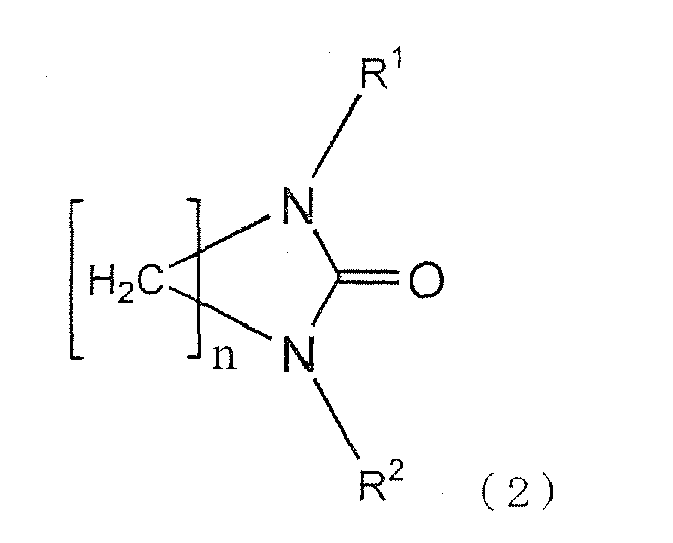

- The reaction of a cyclic urea represented by formula (2) with a compound represented by formula (3) is accelerated either by allowing a reaction accelerator to exist with the reactants or by reacting a cyclic urea represented by formula (2) first with a reaction accelerator and then with a compound represented by formula (3).
- Further, this invention relates to an electrolyte containing an ionic liquid represented by formula (1) and, still further, this invention relates to an electrochemical cell using an electrolyte containing said ionic liquid.
- An ionic liquid according to this invention comprises a cyclic guanidine salt represented by the aforementioned formula (1) and said ionic liquid itself is also represented by formula (1). In the formula, R1 and R2 each is an alkyl group or an alkoxyalkyl group and R1 may be identical with or different from R2. Preferable examples of the alkyl group include alkyl groups of 1-12 carbon atoms. Preferable examples of the alkoxyalkyl group include lower alkoxyalkyl groups of 1-8 carbon atoms; for example, a methoxymethyl group, a methoxyethyl group, a methoxypropyl group, an ethoxyethyl group, an ethoxypropyl group, an ethoxybutyl group, a propyloxyethyl group, an isopropyloxyethyl group, an isopropyloxypropyl group, a butoxyethyl group, a butoxypropyl group, and a butoxybutyl group.
- The group X is a methylene group, an alkoxyalkylamino group, an oxygen atom, a sulfur atom, or R3N; R3 is an alkyl group, an alkoxyalkyl group, or an acyl group. In the case where R3 is an alkyl group or an alkoxyalkyl group, the alkyl or alkoxyalkyl group is preferably the same as those cited above. In the case where X is an alkoxyalkylamino group, the alkoxyalkyl moiety is preferably the same as those cited above. An acyl group of 1-8 carbon atoms is preferable where R3 is an acyl group; for example, an acetyl group, an ethylcarbonyl group, and a benzoyl group.
The numbers 1, m, and n each is independently an integer of 1-6 and, preferably, 1 and m each is an integer of 1-3 and n is 2 or 3. - The group Y- is a monovalent anion and selected preferably from (R4SO2)2N-, R4SO3 -, R4COO-, BF4 -, PF6 -, NO:3 -, (CN)2N-, (CHO)2N-, NCS-, R4OSO3 -, R4SO2S-, and halogen ions. Here, R4 is a perfluoroalkyl group, an alkyl group, or an aromatic group. Perfluoroalkyl groups of 1-8 carbon atoms or alkyl groups of 1-12 carbon atoms are preferred. The aromatic group may be substituted or unsubstituted and an unsubstituted or substituted phenyl group is preferred. Examples of such phenyl groups include a phenyl group, alkylphenyl groups, alkyloxyphenyl groups, halogenated phenyl groups, nitrophenyl groups, acylphenyl groups, and alkoxycarbonylphenyl groups.
- Although a cyclic guanidine salt represented by formula (1) can be prepared by a known method, it can be prepared efficiently according to the reaction shown below.

- This method is based on the reaction of a cyclic urea compound represented by formula (2) with a compound represented by formula (3) and R1, R2, and n in formula (2) and X, l, and m in formula (3) have the same meaning as in formula (1).
- In the aforementioned method using a cyclic urea compound represented by formula (2) and a compound represented by formula (3), it is preferable to introduce a leaving group to the carbon atom of the carbonyl group in a cyclic urea compound represented by formula (2) by means of a reaction accelerator in order to enhance the reactivity of the cyclic urea compound and then to allow a leaving group-containing cyclic urea derivative to react with a compound represented by formula (3). A halogen such as chlorine and bromine is preferably used as a leaving group. For example, this procedure is carried out as follows: a chlorinating agent as a reaction accelerator is allowed to react with a cyclic urea compound represented by formula (2) to chlorinate the carbonyl carbon of the cyclic urea compound thereby yielding a chlorinated derivative of the cyclic urea compound and said derivative is then submitted to the reaction with a compound represented by formula (3). This chlorination reaction is usually carried out in a solvent in the presence of the chlorinating agent. The chlorinating agents useful for the reaction include phosphorus oxychloride, phosgene, and thionyl chloride. The chlorinating agent is normally used in an amount more than is theoretically required for the reaction with a cyclic urea compound represented by formula (2). On the other hand, consideration of difficulty or ease of availability of cyclic urea compounds and of removal of byproducts formed by the chlorinating agent in the reaction may sometimes economically favors the use of less chlorinating agent than is theoretically required on a molar basis. The aforementioned chlorinated product is assumed to be a compound shown by the following formula.

- The aforementioned chlorination reaction is carried out advantageously in a solvent. Any solvent which does not interfere with the reaction may be used and preferable examples include aliphatic hydrocarbons such as hexane, heptane, and petroleum ether, aromatic hydrocarbons such as benzene, toluene, and xylene, organic nitro compounds such as nitromethane and nitrobenzene, cyclic ethers such as tetrahydrofuran and dioxane, and halogen-containing compounds such as dichloromethane, chloroform, and tetrachloroethane. The reaction temperature for the chlorination reaction usually ranges from room temperature to 150°C, preferably from 50 to 100°C. The reaction time is usually in the range of 0.5-24 hours, preferably in the range of 1-10 hours.
- In the case where a cyclic urea compound represented by formula (2) is chlorinated first and the reaction mixture is then made to react with a compound represented by formula (3), it is optional either to isolate the chlorinated product from the reaction mixture or to add a compound represented by formula (3) to the reaction mixture. After the chlorination reaction is over, there may arise a case where the chlorinated product does not dissolve in the reaction solvent and precipitates out or undergoes phase separation. In such a case, a solvent is newly added to dissolve the chlorinated product. The same solvent as used in the chlorination reaction can be used here. A compound represented by formula (3) is added at a rate of 1 mole or more, preferably 1-2.5 moles, to 1 mole of a chlorinating agent. In order to advance the reaction of the chlorinated product with the compound represented by formula (3) smoothly, it is allowable to use a base catalyst. The useful base catalysts include tertiary alkylamines such as triethylamine, tertiary alicyclic amines such as N-methylpyrrolidone, and aromatic amines such as pyridine and quinoline. The reaction temperature is normally in the range of room temperature to 100°C, preferably in the range of 30-70°C. The reaction time is normally in the range of 0.5-24 hours, preferably in the range of 1-10 hours.
- Upon completion of the reaction, the reaction mixture is treated in the usual manner to give a cyclic guanidine salt represented by formula (1). The anion Y- can be obtained as desired according to the treating method used and, preferably, a variety of cyclic guanidine salts differing in Y- can be obtained as follows. After the chlorination of a cyclic urea represented by formula (2) is over, the chlorinated product is made to react with a compound represented by formula (3), the reaction mixture is treated with an adsorbent such as silica gel to remove the byproducts and unchanged raw materials, and the solvent is distilled off to give a cyclic guanidine salt having Cl- as an anion. If necessary, said cyclic guanidine salt is submitted to salt exchange reaction, which can be carried out as in the salt exchange reactions known for quaternary ammonium salts and the like.
- Examples of the cationic moieties (cyclic guanidine salt less Y-) of the cyclic guanidine salts represented by formula (1) are shown below, but the cations useful for this invention are not limited to these examples. A number is assigned to each cation beneath its chemical formula. Preferable cyclic guanidine salts comprise the cations listed here and the anions represented by Y-.
-


- A cyclic guanidine salt represented by formula (1) generally has a low melting point and exhibits a high ionic conductivity; hence, it can be used as an electrolyte for a variety of electrochemical devices such as lithium ion primary batteries, lithium ion secondary batteries, dye-sensitized solar cells, electric double layer capacitors, and electrochromic devices. When an ionic liquid represented by formula (1) according to this invention is used in the aforementioned applications, it is optional either to use a single kind or to use a mixture of two kinds or more. When an ionic liquid of this invention is used in an application requiring an ionic liquid, it is allowable for said ionic liquid to contain other components which do not harm the function of said ionic liquid. For example, when it is used as an electrolyte in an electrochemical device, a cyclic guanidine salt represented by formula (1) may be mixed with another salt which can be used as an electrolyte in said electrochemical device. Moreover, a cyclic guanidine salt represented by formula (1) or its mixture with another salt may be used dissolved in a solvent.
- This invention will be described in more detail below with reference to the examples.
- In a three-necked flask equipped with a dropping funnel and a reflux condenser were placed 19.4 g (170 millimoles) of 1,3-dimethyl-2-imidazolidinone and 50 mL of toluene in an atmosphere of nitrogen. Then, 13.0 g (85 millimoles) of phosphorus oxychloride was added and stirred at 65°C. Heating was stopped after 1 hour, the flask was cooled in an ice bath, and a solution containing the chlorination product of 1,3-dimethyl-2-imidazolidinone was obtained. To this solution were added 50 mL of dichloromethane and 23.6 mL (170 millimoles) of triethylamine in succession. To the resulting solution was added dropwise a solution of 13.8 mL (170 millimoles) of pyrrolidine in 50 mL of dichloromethane over a period of approximately 30 minutes while cooling the solution in an ice bath. Upon completion of the dropwise addition, the ice bath was removed and the solution was stirred at 55°C. The reaction mixture was cooled to room temperature after 1 hour, the insoluble matters were removed by filtration, and the filtrate was distilled off under reduced pressure. The residue was purified by column chromatography to give 15.9 g of 4,5-dihydro-1,3-dimethyl-2-(1-pyrrolidinyl)-1H-imidazolium chloride as a light yellow solid; this compound is a cyclic guanidine salt comprising the cation designated by chemical formula 1 and Cl- and is hereinafter referred to as cyclic guanidine salt 1. The solid showed a melting point of 49°C and was hence a cyclic guanidine salt qualified for an ionic liquid.
- In 100 mL of dichloromethane was dissolved 5.08 g (24.9 millimoles) of cyclic guanidine salt 1 obtained above. To this solution was added 7.30 g (25.4 millimoles) of lithium bis(trifluoromethanesulfonyl)imide and the mixture was stirred at room temperature for 1 hour. The white precipitate formed was filtered off and the filtrate was washed with deionized water and concentrated in a rotary evaporator. The residue was dissolved in methanol and the solution was stirred with activated carbon at room temperature for 1 hour. The activated carbon was removed by filtration and the filtrate was concentrated and purified by column chromatography (activated alumina) to give a cyclic guanidine salt having the ion designated by chemical formula 1 as a cation and a bis(trifluoromethanesulfonyl)imide ion as an anion in the form of a light yellow oil. 1H-NMR CCDCl3); δ 3.70 (s, 4H), 3.63 (t, J = 6.58, 4H), 3.06 (s, 6H), 1.96 (t, J = 6.58 Hz, 4H).
- A 2M propylene carbonate solution of the cyclic guanidine salt obtained above was measured for the ionic conductivity by the AC impedance method and the results are shown in Table 1. A CV measurement made on the cyclic guanidine salt showed that the potential window was from -2.77 to 1.63 V against Ag/Ag+.
-
[Table 1] Temperature (°C) Ionic conductivity (mS/cm) 40 13.4 30 10.5 20 8.1 10 6.0 0 4.3 -10 2.9 - Cyclic guanidine salts having a bis(trifluoromethanesulfonyl)imide ion as an anion were obtained as in Example 1 except substituting the compounds shown in Table 2 for pyrrolidine. The cyclic guanidine salts thus obtained were dissolved in propylene carbonate to a concentration of 2M and measured for the ionic conductivity by the AC impedance method at 20°C on the one hand and they were analyzed by 1H-NMR (CDCl3) on the other and the results are shown in Table 2. All of the cyclic guanidine salts obtained in Examples 1-5 are ionic liquids.
-
[Table 2] Ex. Raw material Property Ionic conductivity (mS/cm) 1H-NMR(CDCl3) 2 
Yellow oil 5.6 δ 3.74(s, 4H), 3.36(brs, 4H), 3.00(s, 6H,), 1.69(brs, 6H,). 3 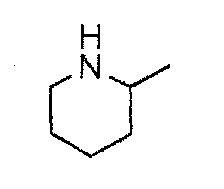
Light yellow solid m. p. 40°C 5.2 δ 4.01(m, 2H), 3.78(m, 1H), 3.54(m, 2H), 3.41 (m, 1 H), 3.27(m, 1H), 2.99(s, 6H), 1.67(m, 6H), 1.33(d, 3H) 4 
Light yellow solid m. p. 53°C 4.8 δ 3.79(t, J=4.64Hz, 4H), 3.78(s, 4H), 3.45(t, J = 4.64 Hz, 4H,), 3.03(s, 6H). 5 
Yellow oil 5.3 δ 4.50(s, 2H), 3.80(s,4H), 3.81(t, J = 6.34Hz, 2H), 3.13(t, J = 6.34Hz, 2H), 3.08(s, 6H). - In 20 mL of dichloromethane was dissolved 2.03 g (10 millimoles) of the cyclic guanidine salt obtained in accordance with the procedure of Example 1. To this solution was added. 0.89 g (10 millimoles) of sodium dicyanamide and stirred at room temperature for 12 hours. The white precipitate formed was removed by filtration and the filtrate was concentrated in a rotary evaporator. The residue was purified by column chromatography (activated alumina) to give a cyclic guanidine salt having the ion designated by chemical formula 1 as a cation and a dicyanamide ion as an anion. The cyclic guanidine salt thus obtained is an ionic liquid with a melting point of 62°C.
- Cyclic guanidine salts were obtained according to the same procedure as in Example 6 with the exception of substituting the raw materials shown below for sodium dicyandiamide.
- Example 7: Diformyl sodium
- Example 8: Sodium thiocyanate
- Example 9: Sodium methyl sulfate
- Example 10: Sodium dodecanesulfonate
- Example 11: S-Sodium ethanethiosulfonate
- A 2M propylene carbonate solution of each of the cyclic guanidine salts obtained in Examples 6-11 was measured for the ionic conductivity at 20° and the results are shown in Table 3. All of the cyclic guanidine salts obtained in Examples 6-11 are ionic liquids.
-
[Table 3] Ex. Property Ionic conductivity (mS/cm) 6 White solid m. p. 62°C 20.0 7 Yellow oil 7.6 8 White solid m. p. 82°C 17.9 9 Colorless oil 13.0 10 Colorless oil 4.5 11 Brown oil 9.5 - An electrochemical device such as a lithium ion primary battery, a lithium ion secondary battery, a dye-sensitized solar cell, an electric double layer capacitor, and an electrochromic device fabricated by the use of an electrolyte containing an ionic liquid comprising a cyclic guanidine salt of this invention exhibits excellent low-temperature properties and long-term stability.
Claims (7)
- An ionic liquid comprising a cyclic guanidine salt represented by the following formula (1):

- An ionic liquid as described in claim 1 wherein Y- in formula (1) is an anion selected from the group of (R4SO2)2N-, R4SO3 -, R4COO-, BF4 -, PF6 -, NO3 -, (CN)2N-, (CHO)2N-, NCS-, R4OSO3 -, R4SO2S-, and halogen ions and R4 is a perfluoroalkyl group, an alkyl group, or an aromatic group.
- A method for producing the ionic liquid described in claim 1 which comprises using a cyclic urea represented by formula (2) and a compound represented by formula (3) as raw materials and reacting them:


- A method for producing an ionic liquid as described in claim 3 wherein a reaction accelerator is allowed to exist in the reaction of the cyclic urea represented by formula (2) with the compound represented by formula (3).
- A method for producing an ionic liquid as described in claim 3 wherein the cyclic urea represented by formula (2) is first made to react with the reaction accelerator and then with the compound represented by formula (3).
- An electrolyte comprising the ionic liquid described in claim 1.
- An electrochemical cell using the electrolyte described in claim 6 as its electrolyte.
Applications Claiming Priority (2)
| Application Number | Priority Date | Filing Date | Title |
|---|---|---|---|
| JP2007055629 | 2007-03-06 | ||
| PCT/JP2008/053295 WO2008108221A1 (en) | 2007-03-06 | 2008-02-26 | Cyclic guanidine ionic liquid |
Publications (2)
| Publication Number | Publication Date |
|---|---|
| EP2135862A1 true EP2135862A1 (en) | 2009-12-23 |
| EP2135862A4 EP2135862A4 (en) | 2014-10-01 |
Family
ID=39738113
Family Applications (1)
| Application Number | Title | Priority Date | Filing Date |
|---|---|---|---|
| EP08720881.5A Withdrawn EP2135862A4 (en) | 2007-03-06 | 2008-02-26 | IONIC LIQUID OF CYCLIC GUANIDINE |
Country Status (6)
| Country | Link |
|---|---|
| US (2) | US8129543B2 (en) |
| EP (1) | EP2135862A4 (en) |
| JP (1) | JP5243404B2 (en) |
| KR (1) | KR101451355B1 (en) |
| CN (1) | CN101616898B (en) |
| WO (1) | WO2008108221A1 (en) |
Cited By (1)
| Publication number | Priority date | Publication date | Assignee | Title |
|---|---|---|---|---|
| WO2014124796A1 (en) * | 2013-02-12 | 2014-08-21 | Siemens Aktiengesellschaft | Thin‑layer capacitors with large scale integration |
Families Citing this family (9)
| Publication number | Priority date | Publication date | Assignee | Title |
|---|---|---|---|---|
| US8129543B2 (en) * | 2007-03-06 | 2012-03-06 | Nippon Steel Chemical Co., Ltd. | Cyclic guanidine ionic liquid |
| CN101875635A (en) * | 2010-06-30 | 2010-11-03 | 彩虹集团公司 | Annular guanidinium ionic liquid and preparation method therof |
| US8865094B2 (en) | 2012-09-13 | 2014-10-21 | Ut-Battelle, Llc | Methods for separating medical isotopes using ionic liquids |
| US9300009B2 (en) | 2012-10-22 | 2016-03-29 | Ut-Battelle, Llc | Electrolyte compositions for lithium ion batteries |
| US9455439B2 (en) | 2012-11-21 | 2016-09-27 | Ut-Battelle, Llc | Nitrogen—sulfur—carbon nanocomposites and their application as cathode materials in lithium—sulfur batteries |
| US11005127B2 (en) | 2015-05-05 | 2021-05-11 | Ut-Battelle, Llc | Stable fluorinated alkylated lithium malonatoborate salts for lithium-ion battery applications |
| CN106111086B (en) * | 2016-06-22 | 2018-06-08 | 江南大学 | A kind of absorption Pd2+Ionic polymeric sorbent of metal ion and preparation method thereof |
| US11795583B2 (en) | 2021-01-21 | 2023-10-24 | Ut-Battelle, Llc | Plasticized melt spinning process using ionic liquids for production of polyacrylonitrile fibers |
| CN113522357B (en) * | 2021-08-20 | 2022-11-25 | 山东瑞博龙化工科技股份有限公司 | Ionic liquid catalyst and preparation method and application thereof |
Family Cites Families (14)
| Publication number | Priority date | Publication date | Assignee | Title |
|---|---|---|---|---|
| FR2623915B1 (en) | 1987-11-26 | 1990-04-13 | Corning Glass Works | PROCESS FOR PRODUCING AN INTEGRATED GLASS OPTICAL COMPONENT COMPRISING POSITIONING TRENCHES AND FIXING OPTICAL FIBERS IN ALIGNMENT WITH WAVEGUIDES AND COMPONENTS THUS PRODUCED |
| EP0718288B8 (en) | 1994-12-21 | 2005-10-26 | Hydro Quebec | Liquid hydrophobic salts, their preparation and their use in electrochemistry |
| JP2001035552A (en) * | 1999-07-23 | 2001-02-09 | Fuji Photo Film Co Ltd | Electrolyte composition, photoelectric conversion element, and photoelectrochemical cell |
| EP2135859B1 (en) | 2001-03-26 | 2015-10-14 | Nisshinbo Industries, Inc. | Liquid electrolytes containing N-methoxyethyl-N-methylpyrrolidinium tretrafluoroborate, and related electrical storage devices |
| JP4039828B2 (en) | 2001-08-24 | 2008-01-30 | セントラル硝子株式会社 | Ionic liquid composition |
| EP1363345A3 (en) | 2002-05-09 | 2005-04-27 | Wilson Greatbatch Technologies, Inc. | Guanidine derivatives as cations for ambient temperature molten salts in electrochemical power sources |
| JP3962806B2 (en) | 2002-05-16 | 2007-08-22 | 独立行政法人産業技術総合研究所 | Lithium secondary battery using room temperature molten salt and room temperature molten salt |
| JP4339559B2 (en) | 2002-08-02 | 2009-10-07 | 広栄化学工業株式会社 | N-alkoxyethyl alicyclic ammonium salt and process for producing the same |
| CN1491939A (en) * | 2003-09-09 | 2004-04-28 | 中国科学院长春应用化学研究所 | Hexaalkylguanidinium salt ionic liquid and preparation method thereof |
| DE102004005404A1 (en) * | 2004-02-03 | 2005-08-25 | Merck Patent Gmbh | Process for the preparation of guanidinium salts |
| DE102004010662A1 (en) | 2004-03-04 | 2005-09-22 | Basf Ag | Process for the preparation of compounds with quaternary sp2-hybridized nitrogen atoms |
| DE102004034543A1 (en) | 2004-07-16 | 2006-02-16 | Merck Patent Gmbh | Process for the preparation of low chloride onium salts |
| CN100569754C (en) * | 2006-12-06 | 2009-12-16 | 中国科学院长春应用化学研究所 | Synthesis and application of a series of ionic liquids with anticancer activity as drug candidates |
| US8129543B2 (en) * | 2007-03-06 | 2012-03-06 | Nippon Steel Chemical Co., Ltd. | Cyclic guanidine ionic liquid |
-
2008
- 2008-02-26 US US12/529,590 patent/US8129543B2/en not_active Expired - Fee Related
- 2008-02-26 WO PCT/JP2008/053295 patent/WO2008108221A1/en not_active Ceased
- 2008-02-26 KR KR1020097018938A patent/KR101451355B1/en not_active Expired - Fee Related
- 2008-02-26 CN CN2008800056705A patent/CN101616898B/en not_active Expired - Fee Related
- 2008-02-26 EP EP08720881.5A patent/EP2135862A4/en not_active Withdrawn
- 2008-02-26 JP JP2009502523A patent/JP5243404B2/en active Active
-
2012
- 2012-01-25 US US13/358,491 patent/US8450478B2/en not_active Expired - Fee Related
Non-Patent Citations (2)
| Title |
|---|
| No further relevant documents disclosed * |
| See also references of WO2008108221A1 * |
Cited By (1)
| Publication number | Priority date | Publication date | Assignee | Title |
|---|---|---|---|---|
| WO2014124796A1 (en) * | 2013-02-12 | 2014-08-21 | Siemens Aktiengesellschaft | Thin‑layer capacitors with large scale integration |
Also Published As
| Publication number | Publication date |
|---|---|
| EP2135862A4 (en) | 2014-10-01 |
| US8129543B2 (en) | 2012-03-06 |
| KR101451355B1 (en) | 2014-10-15 |
| US8450478B2 (en) | 2013-05-28 |
| CN101616898B (en) | 2012-01-04 |
| JPWO2008108221A1 (en) | 2010-06-10 |
| CN101616898A (en) | 2009-12-30 |
| US20120123115A1 (en) | 2012-05-17 |
| JP5243404B2 (en) | 2013-07-24 |
| US20100121074A1 (en) | 2010-05-13 |
| WO2008108221A1 (en) | 2008-09-12 |
| KR20090118969A (en) | 2009-11-18 |
Similar Documents
| Publication | Publication Date | Title |
|---|---|---|
| US8450478B2 (en) | Cyclic guanidine ionic liquid | |
| US7253289B2 (en) | One-step process for the preparation of halide-free hydrophobic salts | |
| JP5264488B2 (en) | Method for synthesizing spiro quaternary ammonium compounds | |
| KR100770925B1 (en) | Superhigh purity ionic liquid | |
| DE60124411D1 (en) | IONIC LIQUIDS AND ITS USE AS SOLVENTS | |
| US9676700B2 (en) | Preparation of fluorosulfonate esters and onium salts derived therefrom | |
| JP5014854B2 (en) | Aminosiloxane ionic liquid | |
| CN100532365C (en) | Continuous Synthesis Method of Room Temperature Ionic Liquids | |
| KR102098726B1 (en) | Ionic liquid | |
| JP2008285417A (en) | Ionic compound and electrolyte material | |
| JP5227524B2 (en) | Ionic liquid having sulfonium cation containing SN bond and method for producing the same | |
| CN101210000A (en) | Ionic liquid with high electrochemical stability and preparation method thereof | |
| JP2005325052A (en) | Quaternary ammonium dicyanamide, method for producing the same and use thereof | |
| WO2015151977A1 (en) | Zwitterionic compound and ion conductor | |
| US20230117960A1 (en) | Fluorine-containing pyrimidine compound, and method for producing same | |
| US12428400B2 (en) | Fluorine-containing fused ring pyrimidine compound and method for producing same | |
| US20050000824A1 (en) | Phosphorus-borates with low melting points | |
| WO2019183716A1 (en) | Phosphaviologen derivatives, methods of making the same, and uses thereof | |
| JP2004307446A (en) | New ionic liquid | |
| KR102216570B1 (en) | Solvent for solid electrolytes synthesis including onium composite and solid electrolytes synthesis method using the same | |
| CN107226796A (en) | A kind of visible light catalytic piperazine compounds selectively cyanalation method | |
| US8765296B2 (en) | Ionic liquid | |
| PL215615B1 (en) | Imidazole ionic liquids with bensotriasol anion and production method of imidazole ionic liquids with bensotriasol anion |
Legal Events
| Date | Code | Title | Description |
|---|---|---|---|
| PUAI | Public reference made under article 153(3) epc to a published international application that has entered the european phase |
Free format text: ORIGINAL CODE: 0009012 |
|
| 17P | Request for examination filed |
Effective date: 20091006 |
|
| AK | Designated contracting states |
Kind code of ref document: A1 Designated state(s): AT BE BG CH CY CZ DE DK EE ES FI FR GB GR HR HU IE IS IT LI LT LU LV MC MT NL NO PL PT RO SE SI SK TR |
|
| DAX | Request for extension of the european patent (deleted) | ||
| RAP1 | Party data changed (applicant data changed or rights of an application transferred) |
Owner name: NIPPON STEEL & SUMIKIN CHEMICAL CO., LTD. |
|
| A4 | Supplementary search report drawn up and despatched |
Effective date: 20140903 |
|
| RIC1 | Information provided on ipc code assigned before grant |
Ipc: C07D 233/48 20060101AFI20140828BHEP Ipc: H01M 14/00 20060101ALI20140828BHEP Ipc: H01M 10/36 20100101ALI20140828BHEP Ipc: H01L 31/04 20140101ALI20140828BHEP Ipc: C07D 417/04 20060101ALI20140828BHEP |
|
| 17Q | First examination report despatched |
Effective date: 20150127 |
|
| GRAP | Despatch of communication of intention to grant a patent |
Free format text: ORIGINAL CODE: EPIDOSNIGR1 |
|
| INTG | Intention to grant announced |
Effective date: 20160510 |
|
| STAA | Information on the status of an ep patent application or granted ep patent |
Free format text: STATUS: THE APPLICATION IS DEEMED TO BE WITHDRAWN |
|
| 18D | Application deemed to be withdrawn |
Effective date: 20160920 |