EP2135829A2 - Tandem finishing - Google Patents
Tandem finishing Download PDFInfo
- Publication number
- EP2135829A2 EP2135829A2 EP09163030A EP09163030A EP2135829A2 EP 2135829 A2 EP2135829 A2 EP 2135829A2 EP 09163030 A EP09163030 A EP 09163030A EP 09163030 A EP09163030 A EP 09163030A EP 2135829 A2 EP2135829 A2 EP 2135829A2
- Authority
- EP
- European Patent Office
- Prior art keywords
- pages
- speed
- finishers
- marking system
- job
- Prior art date
- Legal status (The legal status is an assumption and is not a legal conclusion. Google has not performed a legal analysis and makes no representation as to the accuracy of the status listed.)
- Granted
Links
Images


Classifications
-
- B—PERFORMING OPERATIONS; TRANSPORTING
- B65—CONVEYING; PACKING; STORING; HANDLING THIN OR FILAMENTARY MATERIAL
- B65H—HANDLING THIN OR FILAMENTARY MATERIAL, e.g. SHEETS, WEBS, CABLES
- B65H33/00—Forming counted batches in delivery pile or stream of articles
- B65H33/14—Forming counted batches in delivery pile or stream of articles by diverting batches to separate receivers
-
- B—PERFORMING OPERATIONS; TRANSPORTING
- B65—CONVEYING; PACKING; STORING; HANDLING THIN OR FILAMENTARY MATERIAL
- B65H—HANDLING THIN OR FILAMENTARY MATERIAL, e.g. SHEETS, WEBS, CABLES
- B65H29/00—Delivering or advancing articles from machines; Advancing articles to or into piles
- B65H29/58—Article switches or diverters
- B65H29/60—Article switches or diverters diverting the stream into alternative paths
-
- B—PERFORMING OPERATIONS; TRANSPORTING
- B65—CONVEYING; PACKING; STORING; HANDLING THIN OR FILAMENTARY MATERIAL
- B65H—HANDLING THIN OR FILAMENTARY MATERIAL, e.g. SHEETS, WEBS, CABLES
- B65H39/00—Associating, collating, or gathering articles or webs
- B65H39/10—Associating articles from a single source, to form, e.g. a writing-pad
-
- G—PHYSICS
- G03—PHOTOGRAPHY; CINEMATOGRAPHY; ANALOGOUS TECHNIQUES USING WAVES OTHER THAN OPTICAL WAVES; ELECTROGRAPHY; HOLOGRAPHY
- G03G—ELECTROGRAPHY; ELECTROPHOTOGRAPHY; MAGNETOGRAPHY
- G03G15/00—Apparatus for electrographic processes using a charge pattern
- G03G15/65—Apparatus which relate to the handling of copy material
- G03G15/6582—Special processing for irreversibly adding or changing the sheet copy material characteristics or its appearance, e.g. stamping, annotation printing, punching
-
- G—PHYSICS
- G06—COMPUTING OR CALCULATING; COUNTING
- G06F—ELECTRIC DIGITAL DATA PROCESSING
- G06F3/00—Input arrangements for transferring data to be processed into a form capable of being handled by the computer; Output arrangements for transferring data from processing unit to output unit, e.g. interface arrangements
- G06F3/12—Digital output to print unit, e.g. line printer, chain printer
- G06F3/1201—Dedicated interfaces to print systems
- G06F3/1202—Dedicated interfaces to print systems specifically adapted to achieve a particular effect
- G06F3/1211—Improving printing performance
- G06F3/1215—Improving printing performance achieving increased printing speed, i.e. reducing the time between printing start and printing end
-
- G—PHYSICS
- G06—COMPUTING OR CALCULATING; COUNTING
- G06F—ELECTRIC DIGITAL DATA PROCESSING
- G06F3/00—Input arrangements for transferring data to be processed into a form capable of being handled by the computer; Output arrangements for transferring data from processing unit to output unit, e.g. interface arrangements
- G06F3/12—Digital output to print unit, e.g. line printer, chain printer
- G06F3/1201—Dedicated interfaces to print systems
- G06F3/1223—Dedicated interfaces to print systems specifically adapted to use a particular technique
- G06F3/1237—Print job management
- G06F3/126—Job scheduling, e.g. queuing, determine appropriate device
- G06F3/1264—Job scheduling, e.g. queuing, determine appropriate device by assigning post-processing resources
-
- G—PHYSICS
- G06—COMPUTING OR CALCULATING; COUNTING
- G06F—ELECTRIC DIGITAL DATA PROCESSING
- G06F3/00—Input arrangements for transferring data to be processed into a form capable of being handled by the computer; Output arrangements for transferring data from processing unit to output unit, e.g. interface arrangements
- G06F3/12—Digital output to print unit, e.g. line printer, chain printer
- G06F3/1201—Dedicated interfaces to print systems
- G06F3/1278—Dedicated interfaces to print systems specifically adapted to adopt a particular infrastructure
- G06F3/1282—High volume printer device
-
- B—PERFORMING OPERATIONS; TRANSPORTING
- B65—CONVEYING; PACKING; STORING; HANDLING THIN OR FILAMENTARY MATERIAL
- B65H—HANDLING THIN OR FILAMENTARY MATERIAL, e.g. SHEETS, WEBS, CABLES
- B65H2301/00—Handling processes for sheets or webs
- B65H2301/20—Continuous handling processes
- B65H2301/21—Continuous handling processes of batches of material of different characteristics
-
- B—PERFORMING OPERATIONS; TRANSPORTING
- B65—CONVEYING; PACKING; STORING; HANDLING THIN OR FILAMENTARY MATERIAL
- B65H—HANDLING THIN OR FILAMENTARY MATERIAL, e.g. SHEETS, WEBS, CABLES
- B65H2301/00—Handling processes for sheets or webs
- B65H2301/40—Type of handling process
- B65H2301/42—Piling, depiling, handling piles
- B65H2301/421—Forming a pile
- B65H2301/4217—Forming multiple piles
- B65H2301/42172—Forming multiple piles simultaneously
-
- B—PERFORMING OPERATIONS; TRANSPORTING
- B65—CONVEYING; PACKING; STORING; HANDLING THIN OR FILAMENTARY MATERIAL
- B65H—HANDLING THIN OR FILAMENTARY MATERIAL, e.g. SHEETS, WEBS, CABLES
- B65H2301/00—Handling processes for sheets or webs
- B65H2301/40—Type of handling process
- B65H2301/43—Gathering; Associating; Assembling
- B65H2301/431—Features with regard to the collection, nature, sequence and/or the making thereof
- B65H2301/4312—Gathering material delivered from a digital printing machine
-
- B—PERFORMING OPERATIONS; TRANSPORTING
- B65—CONVEYING; PACKING; STORING; HANDLING THIN OR FILAMENTARY MATERIAL
- B65H—HANDLING THIN OR FILAMENTARY MATERIAL, e.g. SHEETS, WEBS, CABLES
- B65H2301/00—Handling processes for sheets or webs
- B65H2301/40—Type of handling process
- B65H2301/44—Moving, forwarding, guiding material
- B65H2301/445—Moving, forwarding, guiding material stream of articles separated from each other
- B65H2301/4455—Diverting a main stream into part streams
- B65H2301/44552—Diverting a main stream into part streams by alternatively directing articles following each other to appropriate part stream
-
- B—PERFORMING OPERATIONS; TRANSPORTING
- B65—CONVEYING; PACKING; STORING; HANDLING THIN OR FILAMENTARY MATERIAL
- B65H—HANDLING THIN OR FILAMENTARY MATERIAL, e.g. SHEETS, WEBS, CABLES
- B65H2511/00—Dimensions; Position; Numbers; Identification; Occurrences
- B65H2511/30—Numbers, e.g. of windings or rotations
-
- B—PERFORMING OPERATIONS; TRANSPORTING
- B65—CONVEYING; PACKING; STORING; HANDLING THIN OR FILAMENTARY MATERIAL
- B65H—HANDLING THIN OR FILAMENTARY MATERIAL, e.g. SHEETS, WEBS, CABLES
- B65H2511/00—Dimensions; Position; Numbers; Identification; Occurrences
- B65H2511/40—Identification
- B65H2511/415—Identification of job
-
- B—PERFORMING OPERATIONS; TRANSPORTING
- B65—CONVEYING; PACKING; STORING; HANDLING THIN OR FILAMENTARY MATERIAL
- B65H—HANDLING THIN OR FILAMENTARY MATERIAL, e.g. SHEETS, WEBS, CABLES
- B65H2513/00—Dynamic entities; Timing aspects
- B65H2513/40—Movement
- B65H2513/42—Route, path
-
- B—PERFORMING OPERATIONS; TRANSPORTING
- B65—CONVEYING; PACKING; STORING; HANDLING THIN OR FILAMENTARY MATERIAL
- B65H—HANDLING THIN OR FILAMENTARY MATERIAL, e.g. SHEETS, WEBS, CABLES
- B65H2801/00—Application field
- B65H2801/03—Image reproduction devices
- B65H2801/15—Digital printing machines
-
- B—PERFORMING OPERATIONS; TRANSPORTING
- B65—CONVEYING; PACKING; STORING; HANDLING THIN OR FILAMENTARY MATERIAL
- B65H—HANDLING THIN OR FILAMENTARY MATERIAL, e.g. SHEETS, WEBS, CABLES
- B65H2801/00—Application field
- B65H2801/24—Post -processing devices
-
- G—PHYSICS
- G03—PHOTOGRAPHY; CINEMATOGRAPHY; ANALOGOUS TECHNIQUES USING WAVES OTHER THAN OPTICAL WAVES; ELECTROGRAPHY; HOLOGRAPHY
- G03G—ELECTROGRAPHY; ELECTROPHOTOGRAPHY; MAGNETOGRAPHY
- G03G2215/00—Apparatus for electrophotographic processes
- G03G2215/00362—Apparatus for electrophotographic processes relating to the copy medium handling
- G03G2215/00886—Sorting or discharging
- G03G2215/0089—Shifting jobs
Definitions
- the subject application relates to finishers in a printing system. While the systems and methods described herein relate to providing finisher resources to meet high-speed marking system demands, it will be appreciated that the described techniques may find application in other printing systems, other xerographic applications, and/or other finishing systems.
- a conventional approach to increasing printing throughput is to increase the speed of the printer.
- increasing printer speed typically results in greater stress on the individual components of the printer.
- Another approach is to employ several marking engines, which can be vertically and/or horizontally stacked, within a printing platform.
- Multiple marking engine systems provide relatively higher overall output by parallel printing processes, wherein portions of the same document are printed on multiple printers or concurrently processing multiple print jobs.
- an electronic print job that includes color and monochrome portions may be partitioned and distributed across color and monochrome printers.
- Print media substrate e.g., paper, velum, plastic
- Printed substrate is conveyed to a finisher where the media associated with a single print job are assembled.
- Such systems are commonly referred to as “tandem engine” printers, "parallel” printers, or “cluster printing” printers.
- finishing device(s) keep pace with the marking system. It is becoming increasingly difficult for the finishing device(s) to match marking system speed while providing a large number of features.
- Existing high speed finishers tend to be limited in their capabilities and/or become very expensive in order to meet marking system speed requirements.
- a method of employing low-speed finishers to finish pages output from a high-speed marking system comprises receiving print job information describing one or more print jobs to be executed, planning and scheduling the one or more print jobs, determining a number of low-speed finishers to be employed to finish printed pages output by the marking system, and interleaving pages as they are output from the high-speed marking system to at least two low-speed finishers arranged in a tandem configuration.
- a tandem finishing system comprises a high-speed marking system that executes one or more print jobs comprising one or more pages or sets of pages, and at least two low-speed finishers arranged in a tandem configuration to receive interleaved pages as they are output from the marking system.
- the system further comprises a memory that stores one or more of job composition information, user preference information, and job plans and/or schedules.
- the processor executes instructions stored in the memory for tracking pages as they are printed and finished to facilitate paper jam recovery.
- the at least two low-speed finishers comprise two sets of at least two tandem finishers, the sets are arranged in parallel with each other.
- system comprises N low-speed finishers, where N is an integer greater than or equal to 2, and is greater than or equal to the ratio of the maximum operational speed of the high-speed marking system to the maximum operational speed of one of the low-speed finishers.
- system further comprises a processor that receives job composition information and user preference information, and generates a job plan and schedule for the one or more print jobs.
- Yet another feature relates to an apparatus for employing low-speed finishers to finish pages output from a high-speed marking system, the apparatus comprising means for receiving print job information describing one or more print jobs to be executed, means for planning and scheduling the one or more print jobs, means for determining a number of low-speed finishers to be employed to finish printed pages output by the marking system, and means for interleaving pages as they are output from the high-speed marking system to at least two low-speed finishers arranged in a tandem configuration.
- FIGURE 1 illustrates a tandem finishing system that facilitates meeting marking system speed requirements using low-speed finishers.
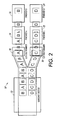
- FIGURE 2 illustrates a tandem finishing system in which four finishers are employed in a parallel tandem configuration.
- FIGURE 3 illustrates a system that facilitates employing N low-cost finishers, or groups of tandem low-cost finishers, each having a maximum speed that is less than a maximum speed of a marking system employed to print pages.
- FIGURE 4 illustrates a method related to employing multiple low-speed, low-cost finishers in tandem and/or parallel to enable a high-speed marking system to operate at maximum speed without being hindered by the slower-speed finishers, in accordance with various features.
- a tandem finishing system 10 that facilitates meeting marking system 12 speed requirements using low-speed finishers 14,16.
- each successive sheet is sent to a different finisher until all the finishers have been used, at which point the process starts over from the first finisher.
- the system 10 intelligently decides what to print based on job composition and user preferences. For example, if every sheet of a print job is the same, or if sheet order is not important, then the system can print as previously described.
- the system 10 interleaves N number of sets of sheets, where N is also the number of finishers used. Interleaving is performed in such a way that all the sheets for a particular set are sent to the same finisher. If the set order is specified, then the system 10 interleaves jobs such that all sheets or sets of sheets in a particular job go to one finisher, allowing the system 10 to print N jobs at the same time. This technique permits slow-cut sheet finishers to be attached to high speed web printers, allowing the mixing of high speed web printing with cut-sheet work flows, etc.
- the marking system 12 alternates printing sheets for the first finisher 14 and the second finisher 16. This configuration enables the marking system 12 to run at twice the rate of the finishers 14, 16.
- the system can employ different modes of printing depending on the type of job being run.
- odd pages can be directed to finisher A 14 and even pages can be directed to finisher B 16, or vice versa.
- system can print two sets simultaneously, alternating sheets between the two different sets.
- a three sheet set can be printed as follows, with the marking system 12 routing sheets to respective finishers:
- Sets that are not identical can be printed in a similar manner when set order is not a concern.
- the marking system 12 routes pages or sheets as follows:
- FIGURE 2 illustrates a tandem finishing system 10' in which four finishers are employed in a parallel tandem configuration.
- the system 10' includes the marking system 12 or printer, which is coupled to a pair of sheet cutters 18, 20, or trimmers.
- Sheet cutter 18 trims sheets from jobs A and B as they come from the marking system 12, before they are passed on to finishers 14 and 16.
- Sheet cutter 20 trims sheets from jobs C and D as they come from the marking system 12, before they are passed on to finishers 22 and 24.
- the marking system 12 operates at up to twice the speed of the respective sheet cutters and up to four times the speed of the respective finishers.
- the configuration allows the marking system 12, which may be a high-speed continuous feed marking system, to be connected to slower-speed cut sheet finishers 18, 20, thereby allowing a cut sheet workflow to be added to the end of a continuous feed system.
- the system 10' can employ the same or similar modes of operation as the two-finisher tandem system of Figure 1 , but with double the capacity.
- multiple jobs can be tracked by the marking system 12 to facilitate paper jam recovery.
- the system 10' does not include the sheet cutters, and the marking system 12 operates at approximately four times the speed of the respective finishers.
- finishers e.g., when the marking system is a continuous feed system
- cutters e.g., when the marking system is a continuous feed system
- any number of finishers, cutters may be employed to provide a scalable configuration of tandem and/or parallel finishers and/or cutters that mitigates the occurrence of a bottleneck at the finisher(s) and permits the marking system to operate at full speed, in accordance with the various aspects and/or embodiments described herein.
- FIGURE 3 illustrates a system 10" that facilitates employing N low-cost finishers, or groups of tandem low-cost finishers, each having a maximum speed that is less than a maximum speed of a marking system employed to print pages.
- the number N of finishers employed is equal to or greater than the ratio of the maximum speed of the marking system to the maximum speed of each finisher. For example, if the maximum marking system speed is less than or equal to twice the maximum speed of the finishers, then two finishers may be employed in a tandem or parallel configuration to permit the marking system to run at maximum speed without being impeded by the slower finisher speed. If the if the maximum marking system speed is less than or equal to three times the maximum speed of the finishers, then three finishers may be employed in a tandem and/or parallel configuration to permit the marking system to run at maximum speed, and so on.
- the system 10 includes a marking system 12 that prints pages for one or more print jobs, and an optional router 30, which may be integral to the marking system 12, that routes pages associated with respective print jobs to respective finishers, so that each of a plurality of pages or sets of pages is routed to a specific finisher.
- the system further comprises a first finisher, finisher A 14, a second finisher, finisher B 16, through an Nth finisher, finisher N 32.
- N is equal to the number of print jobs to be concurrently executed by the marking system.
- the system 10 additionally comprises a processor 34 that executes, and a memory 36 that stores, machine-executable instructions for carrying out the various actions described herein.
- the processor receives job information related to one or more print jobs to be executed by the system, and performs planning and scheduling tasks for the marking system.
- the memory 36 stores, and the processor 34 executes, instructions for tracking pages within and across print jobs, so that in the event of a paper jam in the marking system 12 or anywhere else in the system 10", all print jobs can be resumed after resolution of the paper jam.
- FIGURE 4 illustrates a method related to employing multiple low-speed, low-cost finishers in tandem and/or parallel to enable a high-speed marking system to operate at maximum speed without being hindered by the slower-speed finishers, in accordance with various features. While the methods are described as a series of acts, it will be understood that not all acts may be required to achieve the described goals and/or outcomes, and that some acts may, in accordance with certain aspects, be performed in an order different that the specific orders described.
- job information describing one or more print jobs is received.
- the job information may include, without being limited to, job composition information (e.g., number of pages, sets of pages, jobs, etc.), user preferences (e.g., set ordering, page ordering, job ordering, etc.).
- job composition information e.g., number of pages, sets of pages, jobs, etc.
- user preferences e.g., set ordering, page ordering, job ordering, etc.
- the print job(s) are planned and scheduled.
- a number of tandem finishers to be employed is determined as a function of the job composition(s) and user preferences.
- pages and/or sets of pages are interleaved as they exit a high-speed marking system to be routed to respective low-speed finishers.
- a plurality of low-speed finishers (e.g., 2, 3, 4, 6, etc.) are coupled to the marking system in tandem and/or parallel tandem configurations. 2 or more of the plurality of finishers are identified at 54 for a given job, up to and including all of the plurality of finishers.
- odd pages can be directed to a first finisher and even pages can be directed to a second finisher, or vice versa.
- N sets can be printed concurrently using N finishers, alternating sheets between the different sets, in a manner similar to that set forth in the dual-finisher example with regard to Figure 1 .
- Sets that are not identical can be printed in a similar manner when set order is not a concern.
- N different jobs can be printed in parallel using N finishers.
- a marking system routes pages or sheets in a manner prescribed by the ordering of sheets in each set, and the ordering of sets, etc.
- a continuous feed marking system employs the method, and pages are routed to one or more cutters or trimmers as they are output from the marking system. Each cutter then routes pages to two or more tandem finishers according to one or more of the routing algorithms described herein.
- Finisher arrangements may be purely tandem (e.g., having two or more finishers in series), or a combination of tandem finisher sets arranged in parallel with each other, in accordance with the various aspects and/or embodiments described herein.
Landscapes
- Engineering & Computer Science (AREA)
- Theoretical Computer Science (AREA)
- Physics & Mathematics (AREA)
- General Physics & Mathematics (AREA)
- Human Computer Interaction (AREA)
- General Engineering & Computer Science (AREA)
- Mechanical Engineering (AREA)
- Control Or Security For Electrophotography (AREA)
- Paper Feeding For Electrophotography (AREA)
- Separation, Sorting, Adjustment, Or Bending Of Sheets To Be Conveyed (AREA)
- Accessory Devices And Overall Control Thereof (AREA)
- Folding Of Thin Sheet-Like Materials, Special Discharging Devices, And Others (AREA)
Abstract
Description
- The subject application relates to finishers in a printing system. While the systems and methods described herein relate to providing finisher resources to meet high-speed marking system demands, it will be appreciated that the described techniques may find application in other printing systems, other xerographic applications, and/or other finishing systems.
- A conventional approach to increasing printing throughput is to increase the speed of the printer. However, increasing printer speed typically results in greater stress on the individual components of the printer. Another approach is to employ several marking engines, which can be vertically and/or horizontally stacked, within a printing platform. Multiple marking engine systems provide relatively higher overall output by parallel printing processes, wherein portions of the same document are printed on multiple printers or concurrently processing multiple print jobs. For example, an electronic print job that includes color and monochrome portions may be partitioned and distributed across color and monochrome printers. Print media substrate (e.g., paper, velum, plastic...) is fed from a common or different source to the printers. Printed substrate is conveyed to a finisher where the media associated with a single print job are assembled. Such systems are commonly referred to as "tandem engine" printers, "parallel" printers, or "cluster printing" printers.
- As the speeds of the marking system increase, it is desirable that the finishing device(s) keep pace with the marking system. It is becoming increasingly difficult for the finishing device(s) to match marking system speed while providing a large number of features. Existing high speed finishers tend to be limited in their capabilities and/or become very expensive in order to meet marking system speed requirements.
- Accordingly, there is an unmet need for systems and/or methods that facilitate overcoming the aforementioned deficiencies.
- In accordance with various aspects described herein, systems and methods are described that facilitate maximizing output from a high-speed marking system using a plurality of low-speed finishers arranged in tandem. For example, a method of employing low-speed finishers to finish pages output from a high-speed marking system comprises receiving print job information describing one or more print jobs to be executed, planning and scheduling the one or more print jobs, determining a number of low-speed finishers to be employed to finish printed pages output by the marking system, and interleaving pages as they are output from the high-speed marking system to at least two low-speed finishers arranged in a tandem configuration.
- According to another feature described herein, a tandem finishing system comprises a high-speed marking system that executes one or more print jobs comprising one or more pages or sets of pages, and at least two low-speed finishers arranged in a tandem configuration to receive interleaved pages as they are output from the marking system.
In a further embodiment the system further comprises a memory that stores one or more of job composition information, user preference information, and job plans and/or schedules.
In a further embodiment the processor executes instructions stored in the memory for tracking pages as they are printed and finished to facilitate paper jam recovery.
In a further embodiment the at least two low-speed finishers comprise two sets of at least two tandem finishers, the sets are arranged in parallel with each other.
In a further embodiment the system comprises N low-speed finishers, where N is an integer greater than or equal to 2, and is greater than or equal to the ratio of the maximum operational speed of the high-speed marking system to the maximum operational speed of one of the low-speed finishers.
In a further embodiment the system further comprises a processor that receives job composition information and user preference information, and generates a job plan and schedule for the one or more print jobs. - Yet another feature relates to an apparatus for employing low-speed finishers to finish pages output from a high-speed marking system, the apparatus comprising means for receiving print job information describing one or more print jobs to be executed, means for planning and scheduling the one or more print jobs, means for determining a number of low-speed finishers to be employed to finish printed pages output by the marking system, and means for interleaving pages as they are output from the high-speed marking system to at least two low-speed finishers arranged in a tandem configuration.
-
FIGURE 1 illustrates a tandem finishing system that facilitates meeting marking system speed requirements using low-speed finishers. -
FIGURE 2 illustrates a tandem finishing system in which four finishers are employed in a parallel tandem configuration. -
FIGURE 3 illustrates a system that facilitates employing N low-cost finishers, or groups of tandem low-cost finishers, each having a maximum speed that is less than a maximum speed of a marking system employed to print pages. -
FIGURE 4 illustrates a method related to employing multiple low-speed, low-cost finishers in tandem and/or parallel to enable a high-speed marking system to operate at maximum speed without being hindered by the slower-speed finishers, in accordance with various features. - In accordance with various features described herein, systems and methods are described that allow multiple finishers to be run to concurrently distribute a page load across all the finishers, allowing the finishers to run at slower speeds than the marking system. With reference to
FIGURE 1 , atandem finishing system 10 is illustrated that facilitatesmeeting marking system 12 speed requirements using low-speed finishers system 10 intelligently decides what to print based on job composition and user preferences. For example, if every sheet of a print job is the same, or if sheet order is not important, then the system can print as previously described. Alternatively, if several identical sets of different sheets are printed, or if set order is not important, then thesystem 10 interleaves N number of sets of sheets, where N is also the number of finishers used. Interleaving is performed in such a way that all the sheets for a particular set are sent to the same finisher. If the set order is specified, then thesystem 10 interleaves jobs such that all sheets or sets of sheets in a particular job go to one finisher, allowing thesystem 10 to print N jobs at the same time. This technique permits slow-cut sheet finishers to be attached to high speed web printers, allowing the mixing of high speed web printing with cut-sheet work flows, etc. - According to the figure, the
marking system 12 alternates printing sheets for thefirst finisher 14 and thesecond finisher 16. This configuration enables themarking system 12 to run at twice the rate of thefinishers - According to one example, if every page of the job is the same, or if sheet order is not important, then odd pages can be directed to finisherA 14 and even pages can be directed to finisherB 16, or vice versa.
- According to another example, if every set of sheets or pages in a job is the same, then system can print two sets simultaneously, alternating sheets between the two different sets. For instance, a three sheet set can be printed as follows, with the
marking system 12 routing sheets to respective finishers: - Set 1 Page 1 → Finisher A
- Set 2 Page 1 → Finisher B
- Set 1 Page 2 → Finisher A
- Set 2 Page 2 → Finisher B
- Set 1 Page 3 → Finisher A
- Set 2 Page 3 → Finisher B
- Set 3 Page 1 → Finisher A
- Set 4 Page 1 → Finisher B
- Sets that are not identical can be printed in a similar manner when set order is not a concern.
- When sheet order and set order are specified, then the
system 10 can print two different jobs in parallel. For instance, themarking system 12 routes pages or sheets as follows: - Job 1 Set 1 Page 1 → Finisher A
- Job 2 Set 1 Page 1 → Finisher B
- Job 1 Set 1 Page 2 → Finisher A
- Job 2 Set 1 Page 2 → Finisher B
- Job 1 Set 1 Page 3 → Finisher A
- Job 2 Set 1 Page 3 → Finisher B
- Job 1 Set 2 Page 1 → Finisher A
- Job 2 Set 1 Page 4 → Finisher B
-
FIGURE 2 illustrates a tandem finishing system 10' in which four finishers are employed in a parallel tandem configuration. The system 10' includes the markingsystem 12 or printer, which is coupled to a pair ofsheet cutters Sheet cutter 18 trims sheets from jobs A and B as they come from the markingsystem 12, before they are passed on tofinishers Sheet cutter 20 trims sheets from jobs C and D as they come from the markingsystem 12, before they are passed on tofinishers system 12 operates at up to twice the speed of the respective sheet cutters and up to four times the speed of the respective finishers. - The configuration allows the marking
system 12, which may be a high-speed continuous feed marking system, to be connected to slower-speedcut sheet finishers Figure 1 , but with double the capacity. - According to another embodiment, multiple jobs can be tracked by the marking
system 12 to facilitate paper jam recovery. In yet another embodiment, the system 10' does not include the sheet cutters, and the markingsystem 12 operates at approximately four times the speed of the respective finishers. - It will be appreciated that any number of finishers, cutters (e.g., when the marking system is a continuous feed system), etc. may be employed to provide a scalable configuration of tandem and/or parallel finishers and/or cutters that mitigates the occurrence of a bottleneck at the finisher(s) and permits the marking system to operate at full speed, in accordance with the various aspects and/or embodiments described herein.
-
FIGURE 3 illustrates asystem 10" that facilitates employing N low-cost finishers, or groups of tandem low-cost finishers, each having a maximum speed that is less than a maximum speed of a marking system employed to print pages. According to one embodiment, the number N of finishers employed is equal to or greater than the ratio of the maximum speed of the marking system to the maximum speed of each finisher. For example, if the maximum marking system speed is less than or equal to twice the maximum speed of the finishers, then two finishers may be employed in a tandem or parallel configuration to permit the marking system to run at maximum speed without being impeded by the slower finisher speed. If the if the maximum marking system speed is less than or equal to three times the maximum speed of the finishers, then three finishers may be employed in a tandem and/or parallel configuration to permit the marking system to run at maximum speed, and so on. - Accordingly, the
system 10" includes amarking system 12 that prints pages for one or more print jobs, and anoptional router 30, which may be integral to themarking system 12, that routes pages associated with respective print jobs to respective finishers, so that each of a plurality of pages or sets of pages is routed to a specific finisher. The system further comprises a first finisher,finisher A 14, a second finisher,finisher B 16, through an Nth finisher,finisher N 32. In one embodiment, N is equal to the number of print jobs to be concurrently executed by the marking system. - The
system 10" additionally comprises aprocessor 34 that executes, and amemory 36 that stores, machine-executable instructions for carrying out the various actions described herein. The processor receives job information related to one or more print jobs to be executed by the system, and performs planning and scheduling tasks for the marking system. Additionally, thememory 36 stores, and theprocessor 34 executes, instructions for tracking pages within and across print jobs, so that in the event of a paper jam in themarking system 12 or anywhere else in thesystem 10", all print jobs can be resumed after resolution of the paper jam. -
FIGURE 4 illustrates a method related to employing multiple low-speed, low-cost finishers in tandem and/or parallel to enable a high-speed marking system to operate at maximum speed without being hindered by the slower-speed finishers, in accordance with various features. While the methods are described as a series of acts, it will be understood that not all acts may be required to achieve the described goals and/or outcomes, and that some acts may, in accordance with certain aspects, be performed in an order different that the specific orders described. - At 50, job information describing one or more print jobs is received. The job information may include, without being limited to, job composition information (e.g., number of pages, sets of pages, jobs, etc.), user preferences (e.g., set ordering, page ordering, job ordering, etc.). At 52, the print job(s) are planned and scheduled. At 54, a number of tandem finishers to be employed is determined as a function of the job composition(s) and user preferences. At 56, pages and/or sets of pages are interleaved as they exit a high-speed marking system to be routed to respective low-speed finishers. In one embodiment, a plurality of low-speed finishers (e.g., 2, 3, 4, 6, etc.) are coupled to the marking system in tandem and/or parallel tandem configurations. 2 or more of the plurality of finishers are identified at 54 for a given job, up to and including all of the plurality of finishers.
- According to an example, if every page of the print job is the same, or if sheet order is not specified (e.g., by a user), then odd pages can be directed to a first finisher and even pages can be directed to a second finisher, or vice versa.
- According to another example, if every set of sheets or pages in a job is the same, then N sets can be printed concurrently using N finishers, alternating sheets between the different sets, in a manner similar to that set forth in the dual-finisher example with regard to
Figure 1 . Sets that are not identical can be printed in a similar manner when set order is not a concern. - When sheet order and set order are specified, then N different jobs can be printed in parallel using N finishers. For instance, a marking system routes pages or sheets in a manner prescribed by the ordering of sheets in each set, and the ordering of sets, etc.
- In one embodiment, a continuous feed marking system employs the method, and pages are routed to one or more cutters or trimmers as they are output from the marking system. Each cutter then routes pages to two or more tandem finishers according to one or more of the routing algorithms described herein.
- Finisher arrangements may be purely tandem (e.g., having two or more finishers in series), or a combination of tandem finisher sets arranged in parallel with each other, in accordance with the various aspects and/or embodiments described herein.
- It will be appreciated that various of the above-disclosed and other features and functions, or alternatives thereof, may be desirably combined into many other different systems or applications.
Claims (15)
- A method of employing low-speed finishers to finish pages output from a high-speed marking system, comprising:receiving print job information describing one or more print jobs to be executed;planning and scheduling the one or more print jobs;determining a number of low-speed finishers to be employed to finish printed pages output by the marking system; andinterleaving pages as they are output from the high-speed marking system to at least two low-speed finishers arranged in a tandem configuration.
- The method of claim 1, wherein the print job information comprises job composition information and user preference information.
- The method of claim 2, wherein the job composition information comprises a number of jobs to be printed, a number of sets of pages in each job, and a number of pages in each set.
- The method of claim 3, wherein the user preference information comprises information related to page ordering, set ordering, and job ordering.
- The method of claim 4, further comprising routing odd pages to a first finisher and even pages to a second finisher when all pages of a job are the same.
- The method of claim 4, further comprising routing odd pages to a first finisher and even pages to a second finisher when user preference information does not specify a page ordering.
- The method of claim 4, further comprising routing N sets of pages to N finishers, where N is an integer greater than or equal to two, wherein each page in a given set is routed to a single finisher, when the job composition information indicates that all sets of pages are the same.
- The method of claim 4, further comprising routing N jobs, each job comprising one or more pages, to N finishers, where N is an integer greater than or equal to two, when the user preference information specifies a page ordering and set ordering.
- The method of claim 1, further comprising cutting pages as they are output from the marking system when the marking system is a continuous feed marking system.
- The system of claim 1, further comprising dividing the maximum operational speed of the marking system by the maximum operational speed of one of the finishers to determine the number of finishers to be employed to finish the printed pages, where all of the finishers have a substantially similar maximum operational speed.
- A tandem finishing system, comprising:a high-speed marking system that executes one or more print jobs comprising one or more pages or sets of pages; andat least two low-speed finishers arranged in a tandem configuration to receive interleaved pages as they are output from the marking system.
- The system of claim 11, wherein the marking system is a continuous feed marking system.
- The system of claim 12, further comprising a cutter that cuts pages for routing to respective finishers as they are output from the continuous feed marking system.
- An apparatus for employing low-speed finishers to finish pages output from a high-speed marking system, comprising:means for receiving print job information describing one or more print jobs to be executed;means for planning and scheduling the one or more print jobs;means for determining a number of low-speed finishers to be employed to finish printed pages output by the marking system; andmeans for interleaving pages as they are output from the high-speed marking system to at least two low-speed finishers arranged in a tandem configuration.
- The apparatus of claim 14, further comprising:means for cutting the pages as they are output from the high-speed marking system;wherein the high speed marking system is a continuous-feed marking system.
Applications Claiming Priority (1)
| Application Number | Priority Date | Filing Date | Title |
|---|---|---|---|
| US12/142,247 US7894739B2 (en) | 2008-06-19 | 2008-06-19 | Tandem finishing |
Publications (3)
| Publication Number | Publication Date |
|---|---|
| EP2135829A2 true EP2135829A2 (en) | 2009-12-23 |
| EP2135829A3 EP2135829A3 (en) | 2015-01-21 |
| EP2135829B1 EP2135829B1 (en) | 2016-10-12 |
Family
ID=41170457
Family Applications (1)
| Application Number | Title | Priority Date | Filing Date |
|---|---|---|---|
| EP09163030.1A Not-in-force EP2135829B1 (en) | 2008-06-19 | 2009-06-18 | Tandem finishing |
Country Status (3)
| Country | Link |
|---|---|
| US (1) | US7894739B2 (en) |
| EP (1) | EP2135829B1 (en) |
| JP (1) | JP5345001B2 (en) |
Families Citing this family (4)
| Publication number | Priority date | Publication date | Assignee | Title |
|---|---|---|---|---|
| JP5446431B2 (en) * | 2009-04-28 | 2014-03-19 | 富士ゼロックス株式会社 | Image forming apparatus |
| JP5310319B2 (en) * | 2009-07-03 | 2013-10-09 | コニカミノルタ株式会社 | Image forming system |
| US8928920B2 (en) | 2013-04-17 | 2015-01-06 | Xerox Corporation | Multi-color banner pages for print job finishing workflows |
| EP3676100B1 (en) | 2017-09-01 | 2024-10-30 | Hewlett-Packard Development Company, L.P. | Print media accumulators controlled by print job attributes |
Family Cites Families (13)
| Publication number | Priority date | Publication date | Assignee | Title |
|---|---|---|---|---|
| JPH08191362A (en) * | 1995-01-12 | 1996-07-23 | Fuji Xerox Co Ltd | Image processor |
| JPH09272656A (en) * | 1996-04-03 | 1997-10-21 | Fuji Xerox Co Ltd | Image formation device |
| US5697040A (en) * | 1996-07-10 | 1997-12-09 | Xerox Corporation | Print job intermixing within marking machine |
| JP2003016056A (en) * | 2001-07-05 | 2003-01-17 | Fuji Xerox Co Ltd | Processing apparatus for document and processing method therefor |
| US7137625B2 (en) * | 2002-02-12 | 2006-11-21 | Ricoh Company, Ltd. | Sheet finisher including means for setting cutting position image forming system including the sheet finisher |
| JP2004205772A (en) * | 2002-12-25 | 2004-07-22 | Konica Minolta Holdings Inc | Image forming system equipped with sheet post-processor |
| JP2004338278A (en) * | 2003-05-16 | 2004-12-02 | Canon Inc | Image recording apparatus and control method thereof |
| JP2005172890A (en) * | 2003-12-08 | 2005-06-30 | Konica Minolta Business Technologies Inc | Image forming system |
| US6973286B2 (en) * | 2004-01-21 | 2005-12-06 | Xerox Corporation | High print rate merging and finishing system for parallel printing |
| US7839513B2 (en) * | 2004-02-24 | 2010-11-23 | Xerox Corporation | Hybrid document automation system |
| JP4569214B2 (en) * | 2004-08-10 | 2010-10-27 | コニカミノルタビジネステクノロジーズ株式会社 | Image forming system |
| US7619769B2 (en) * | 2005-05-25 | 2009-11-17 | Xerox Corporation | Printing system |
| US7880912B2 (en) * | 2005-12-07 | 2011-02-01 | Xerox Corporation | Network printing system having automated selection of a destination printer |
-
2008
- 2008-06-19 US US12/142,247 patent/US7894739B2/en active Active
-
2009
- 2009-06-15 JP JP2009141889A patent/JP5345001B2/en not_active Expired - Fee Related
- 2009-06-18 EP EP09163030.1A patent/EP2135829B1/en not_active Not-in-force
Also Published As
| Publication number | Publication date |
|---|---|
| US7894739B2 (en) | 2011-02-22 |
| JP2010000790A (en) | 2010-01-07 |
| EP2135829A3 (en) | 2015-01-21 |
| EP2135829B1 (en) | 2016-10-12 |
| US20090317119A1 (en) | 2009-12-24 |
| JP5345001B2 (en) | 2013-11-20 |
Similar Documents
| Publication | Publication Date | Title |
|---|---|---|
| US8468527B2 (en) | Method and system for optimal batching in a production environment | |
| EP0778515B1 (en) | Generic assembly trees for job control and mix and match of modules | |
| CN102200896B (en) | Print control unit, image formation system and image processing method | |
| US7619769B2 (en) | Printing system | |
| JP5189814B2 (en) | Print shop management method and apparatus for printing using a plurality of apparatuses | |
| US7302199B2 (en) | Document processing system and methods for reducing stress therein | |
| EP1630663A2 (en) | Print sequence scheduling for reliability | |
| US20100195141A1 (en) | Print job scheduling | |
| US8654375B2 (en) | Resource partitioning in a print system | |
| JP2010058506A (en) | Run cost optimization for multi-engine printing system | |
| CN103796837A (en) | Method for operating selectively interconnected modular printing system | |
| EP2135829B1 (en) | Tandem finishing | |
| US20110122433A1 (en) | Page parallel rip printing methods and systems | |
| US7647018B2 (en) | Printing system | |
| CN102375706A (en) | Information processing apparatus and control method therefore | |
| US7812997B2 (en) | Job ganging via automatic proportional concatenation | |
| US8218987B2 (en) | Systems and methods for tandem printing and print job scheduling | |
| US20070201078A1 (en) | Distributed printing system with improved load balancing | |
| US8463416B2 (en) | System and method for on-line planning utilizing multiple planning queues | |
| JP2018520910A (en) | How to control a printing system | |
| US8477333B2 (en) | Printing system and bottleneck obviation through print job sequencing | |
| JP2022146043A (en) | Printing system and printing method | |
| JP2004178095A (en) | Image forming system | |
| JP2019171666A (en) | Image formation apparatus, image formation method and program | |
| JP2012153024A (en) | Printing apparatus and processing method thereof |
Legal Events
| Date | Code | Title | Description |
|---|---|---|---|
| PUAI | Public reference made under article 153(3) epc to a published international application that has entered the european phase |
Free format text: ORIGINAL CODE: 0009012 |
|
| AK | Designated contracting states |
Kind code of ref document: A2 Designated state(s): AT BE BG CH CY CZ DE DK EE ES FI FR GB GR HR HU IE IS IT LI LT LU LV MC MK MT NL NO PL PT RO SE SI SK TR |
|
| RIC1 | Information provided on ipc code assigned before grant |
Ipc: B65H 39/10 20060101ALI20140926BHEP Ipc: G03G 15/00 20060101ALI20140926BHEP Ipc: B65H 33/14 20060101AFI20140926BHEP Ipc: G06F 3/12 20060101ALI20140926BHEP Ipc: B65H 29/60 20060101ALI20140926BHEP |
|
| PUAL | Search report despatched |
Free format text: ORIGINAL CODE: 0009013 |
|
| AK | Designated contracting states |
Kind code of ref document: A3 Designated state(s): AT BE BG CH CY CZ DE DK EE ES FI FR GB GR HR HU IE IS IT LI LT LU LV MC MK MT NL NO PL PT RO SE SI SK TR |
|
| AX | Request for extension of the european patent |
Extension state: AL BA RS |
|
| RIC1 | Information provided on ipc code assigned before grant |
Ipc: B65H 29/60 20060101ALI20141216BHEP Ipc: B65H 33/14 20060101AFI20141216BHEP Ipc: G06F 3/12 20060101ALI20141216BHEP Ipc: B65H 39/10 20060101ALI20141216BHEP Ipc: G03G 15/00 20060101ALI20141216BHEP |
|
| 17P | Request for examination filed |
Effective date: 20150527 |
|
| RBV | Designated contracting states (corrected) |
Designated state(s): AT BE BG CH CY CZ DE DK EE ES FI FR GB GR HR HU IE IS IT LI LT LU LV MC MK MT NL NO PL PT RO SE SI SK TR |
|
| 17Q | First examination report despatched |
Effective date: 20150921 |
|
| GRAP | Despatch of communication of intention to grant a patent |
Free format text: ORIGINAL CODE: EPIDOSNIGR1 |
|
| INTG | Intention to grant announced |
Effective date: 20160603 |
|
| GRAS | Grant fee paid |
Free format text: ORIGINAL CODE: EPIDOSNIGR3 |
|
| GRAA | (expected) grant |
Free format text: ORIGINAL CODE: 0009210 |
|
| AK | Designated contracting states |
Kind code of ref document: B1 Designated state(s): AT BE BG CH CY CZ DE DK EE ES FI FR GB GR HR HU IE IS IT LI LT LU LV MC MK MT NL NO PL PT RO SE SI SK TR |
|
| REG | Reference to a national code |
Ref country code: GB Ref legal event code: FG4D |
|
| REG | Reference to a national code |
Ref country code: CH Ref legal event code: EP |
|
| REG | Reference to a national code |
Ref country code: AT Ref legal event code: REF Ref document number: 836300 Country of ref document: AT Kind code of ref document: T Effective date: 20161015 |
|
| REG | Reference to a national code |
Ref country code: IE Ref legal event code: FG4D |
|
| REG | Reference to a national code |
Ref country code: DE Ref legal event code: R096 Ref document number: 602009041649 Country of ref document: DE |
|
| REG | Reference to a national code |
Ref country code: LT Ref legal event code: MG4D |
|
| REG | Reference to a national code |
Ref country code: NL Ref legal event code: MP Effective date: 20161012 |
|
| PG25 | Lapsed in a contracting state [announced via postgrant information from national office to epo] |
Ref country code: LV Free format text: LAPSE BECAUSE OF FAILURE TO SUBMIT A TRANSLATION OF THE DESCRIPTION OR TO PAY THE FEE WITHIN THE PRESCRIBED TIME-LIMIT Effective date: 20161012 |
|
| REG | Reference to a national code |
Ref country code: AT Ref legal event code: MK05 Ref document number: 836300 Country of ref document: AT Kind code of ref document: T Effective date: 20161012 |
|
| PG25 | Lapsed in a contracting state [announced via postgrant information from national office to epo] |
Ref country code: NO Free format text: LAPSE BECAUSE OF FAILURE TO SUBMIT A TRANSLATION OF THE DESCRIPTION OR TO PAY THE FEE WITHIN THE PRESCRIBED TIME-LIMIT Effective date: 20170112 Ref country code: LT Free format text: LAPSE BECAUSE OF FAILURE TO SUBMIT A TRANSLATION OF THE DESCRIPTION OR TO PAY THE FEE WITHIN THE PRESCRIBED TIME-LIMIT Effective date: 20161012 Ref country code: SE Free format text: LAPSE BECAUSE OF FAILURE TO SUBMIT A TRANSLATION OF THE DESCRIPTION OR TO PAY THE FEE WITHIN THE PRESCRIBED TIME-LIMIT Effective date: 20161012 Ref country code: GR Free format text: LAPSE BECAUSE OF FAILURE TO SUBMIT A TRANSLATION OF THE DESCRIPTION OR TO PAY THE FEE WITHIN THE PRESCRIBED TIME-LIMIT Effective date: 20170113 |
|
| REG | Reference to a national code |
Ref country code: FR Ref legal event code: PLFP Year of fee payment: 9 |
|
| PG25 | Lapsed in a contracting state [announced via postgrant information from national office to epo] |
Ref country code: FI Free format text: LAPSE BECAUSE OF FAILURE TO SUBMIT A TRANSLATION OF THE DESCRIPTION OR TO PAY THE FEE WITHIN THE PRESCRIBED TIME-LIMIT Effective date: 20161012 Ref country code: IS Free format text: LAPSE BECAUSE OF FAILURE TO SUBMIT A TRANSLATION OF THE DESCRIPTION OR TO PAY THE FEE WITHIN THE PRESCRIBED TIME-LIMIT Effective date: 20170212 Ref country code: ES Free format text: LAPSE BECAUSE OF FAILURE TO SUBMIT A TRANSLATION OF THE DESCRIPTION OR TO PAY THE FEE WITHIN THE PRESCRIBED TIME-LIMIT Effective date: 20161012 Ref country code: NL Free format text: LAPSE BECAUSE OF FAILURE TO SUBMIT A TRANSLATION OF THE DESCRIPTION OR TO PAY THE FEE WITHIN THE PRESCRIBED TIME-LIMIT Effective date: 20161012 Ref country code: PT Free format text: LAPSE BECAUSE OF FAILURE TO SUBMIT A TRANSLATION OF THE DESCRIPTION OR TO PAY THE FEE WITHIN THE PRESCRIBED TIME-LIMIT Effective date: 20170213 Ref country code: BE Free format text: LAPSE BECAUSE OF FAILURE TO SUBMIT A TRANSLATION OF THE DESCRIPTION OR TO PAY THE FEE WITHIN THE PRESCRIBED TIME-LIMIT Effective date: 20161012 Ref country code: HR Free format text: LAPSE BECAUSE OF FAILURE TO SUBMIT A TRANSLATION OF THE DESCRIPTION OR TO PAY THE FEE WITHIN THE PRESCRIBED TIME-LIMIT Effective date: 20161012 Ref country code: PL Free format text: LAPSE BECAUSE OF FAILURE TO SUBMIT A TRANSLATION OF THE DESCRIPTION OR TO PAY THE FEE WITHIN THE PRESCRIBED TIME-LIMIT Effective date: 20161012 Ref country code: AT Free format text: LAPSE BECAUSE OF FAILURE TO SUBMIT A TRANSLATION OF THE DESCRIPTION OR TO PAY THE FEE WITHIN THE PRESCRIBED TIME-LIMIT Effective date: 20161012 |
|
| REG | Reference to a national code |
Ref country code: DE Ref legal event code: R097 Ref document number: 602009041649 Country of ref document: DE |
|
| PG25 | Lapsed in a contracting state [announced via postgrant information from national office to epo] |
Ref country code: EE Free format text: LAPSE BECAUSE OF FAILURE TO SUBMIT A TRANSLATION OF THE DESCRIPTION OR TO PAY THE FEE WITHIN THE PRESCRIBED TIME-LIMIT Effective date: 20161012 Ref country code: DK Free format text: LAPSE BECAUSE OF FAILURE TO SUBMIT A TRANSLATION OF THE DESCRIPTION OR TO PAY THE FEE WITHIN THE PRESCRIBED TIME-LIMIT Effective date: 20161012 Ref country code: CZ Free format text: LAPSE BECAUSE OF FAILURE TO SUBMIT A TRANSLATION OF THE DESCRIPTION OR TO PAY THE FEE WITHIN THE PRESCRIBED TIME-LIMIT Effective date: 20161012 Ref country code: RO Free format text: LAPSE BECAUSE OF FAILURE TO SUBMIT A TRANSLATION OF THE DESCRIPTION OR TO PAY THE FEE WITHIN THE PRESCRIBED TIME-LIMIT Effective date: 20161012 Ref country code: SK Free format text: LAPSE BECAUSE OF FAILURE TO SUBMIT A TRANSLATION OF THE DESCRIPTION OR TO PAY THE FEE WITHIN THE PRESCRIBED TIME-LIMIT Effective date: 20161012 |
|
| PLBE | No opposition filed within time limit |
Free format text: ORIGINAL CODE: 0009261 |
|
| STAA | Information on the status of an ep patent application or granted ep patent |
Free format text: STATUS: NO OPPOSITION FILED WITHIN TIME LIMIT |
|
| PG25 | Lapsed in a contracting state [announced via postgrant information from national office to epo] |
Ref country code: IT Free format text: LAPSE BECAUSE OF FAILURE TO SUBMIT A TRANSLATION OF THE DESCRIPTION OR TO PAY THE FEE WITHIN THE PRESCRIBED TIME-LIMIT Effective date: 20161012 Ref country code: BG Free format text: LAPSE BECAUSE OF FAILURE TO SUBMIT A TRANSLATION OF THE DESCRIPTION OR TO PAY THE FEE WITHIN THE PRESCRIBED TIME-LIMIT Effective date: 20170112 |
|
| 26N | No opposition filed |
Effective date: 20170713 |
|
| PG25 | Lapsed in a contracting state [announced via postgrant information from national office to epo] |
Ref country code: SI Free format text: LAPSE BECAUSE OF FAILURE TO SUBMIT A TRANSLATION OF THE DESCRIPTION OR TO PAY THE FEE WITHIN THE PRESCRIBED TIME-LIMIT Effective date: 20161012 |
|
| PG25 | Lapsed in a contracting state [announced via postgrant information from national office to epo] |
Ref country code: MC Free format text: LAPSE BECAUSE OF FAILURE TO SUBMIT A TRANSLATION OF THE DESCRIPTION OR TO PAY THE FEE WITHIN THE PRESCRIBED TIME-LIMIT Effective date: 20161012 |
|
| REG | Reference to a national code |
Ref country code: CH Ref legal event code: PL |
|
| REG | Reference to a national code |
Ref country code: IE Ref legal event code: MM4A |
|
| PG25 | Lapsed in a contracting state [announced via postgrant information from national office to epo] |
Ref country code: IE Free format text: LAPSE BECAUSE OF NON-PAYMENT OF DUE FEES Effective date: 20170618 Ref country code: LI Free format text: LAPSE BECAUSE OF NON-PAYMENT OF DUE FEES Effective date: 20170630 Ref country code: CH Free format text: LAPSE BECAUSE OF NON-PAYMENT OF DUE FEES Effective date: 20170630 Ref country code: LU Free format text: LAPSE BECAUSE OF NON-PAYMENT OF DUE FEES Effective date: 20170618 |
|
| REG | Reference to a national code |
Ref country code: FR Ref legal event code: PLFP Year of fee payment: 10 |
|
| PG25 | Lapsed in a contracting state [announced via postgrant information from national office to epo] |
Ref country code: MT Free format text: LAPSE BECAUSE OF NON-PAYMENT OF DUE FEES Effective date: 20170618 |
|
| PG25 | Lapsed in a contracting state [announced via postgrant information from national office to epo] |
Ref country code: HU Free format text: LAPSE BECAUSE OF FAILURE TO SUBMIT A TRANSLATION OF THE DESCRIPTION OR TO PAY THE FEE WITHIN THE PRESCRIBED TIME-LIMIT; INVALID AB INITIO Effective date: 20090618 |
|
| PG25 | Lapsed in a contracting state [announced via postgrant information from national office to epo] |
Ref country code: CY Free format text: LAPSE BECAUSE OF NON-PAYMENT OF DUE FEES Effective date: 20161012 |
|
| PG25 | Lapsed in a contracting state [announced via postgrant information from national office to epo] |
Ref country code: MK Free format text: LAPSE BECAUSE OF FAILURE TO SUBMIT A TRANSLATION OF THE DESCRIPTION OR TO PAY THE FEE WITHIN THE PRESCRIBED TIME-LIMIT Effective date: 20161012 |
|
| PG25 | Lapsed in a contracting state [announced via postgrant information from national office to epo] |
Ref country code: TR Free format text: LAPSE BECAUSE OF FAILURE TO SUBMIT A TRANSLATION OF THE DESCRIPTION OR TO PAY THE FEE WITHIN THE PRESCRIBED TIME-LIMIT Effective date: 20161012 |
|
| PGFP | Annual fee paid to national office [announced via postgrant information from national office to epo] |
Ref country code: DE Payment date: 20200519 Year of fee payment: 12 Ref country code: FR Payment date: 20200520 Year of fee payment: 12 |
|
| PGFP | Annual fee paid to national office [announced via postgrant information from national office to epo] |
Ref country code: GB Payment date: 20200525 Year of fee payment: 12 |
|
| REG | Reference to a national code |
Ref country code: DE Ref legal event code: R119 Ref document number: 602009041649 Country of ref document: DE |
|
| GBPC | Gb: european patent ceased through non-payment of renewal fee |
Effective date: 20210618 |
|
| PG25 | Lapsed in a contracting state [announced via postgrant information from national office to epo] |
Ref country code: GB Free format text: LAPSE BECAUSE OF NON-PAYMENT OF DUE FEES Effective date: 20210618 Ref country code: DE Free format text: LAPSE BECAUSE OF NON-PAYMENT OF DUE FEES Effective date: 20220101 |
|
| PG25 | Lapsed in a contracting state [announced via postgrant information from national office to epo] |
Ref country code: FR Free format text: LAPSE BECAUSE OF NON-PAYMENT OF DUE FEES Effective date: 20210630 |