EP2134662B1 - Use of photocatalytically coated particles for decomposition of air pollutants - Google Patents
Use of photocatalytically coated particles for decomposition of air pollutants Download PDFInfo
- Publication number
- EP2134662B1 EP2134662B1 EP08718374A EP08718374A EP2134662B1 EP 2134662 B1 EP2134662 B1 EP 2134662B1 EP 08718374 A EP08718374 A EP 08718374A EP 08718374 A EP08718374 A EP 08718374A EP 2134662 B1 EP2134662 B1 EP 2134662B1
- Authority
- EP
- European Patent Office
- Prior art keywords
- iron oxide
- photocatalytic
- cement
- sample
- conversion
- Prior art date
- Legal status (The legal status is an assumption and is not a legal conclusion. Google has not performed a legal analysis and makes no representation as to the accuracy of the status listed.)
- Active
Links
Images


Classifications
-
- C—CHEMISTRY; METALLURGY
- C04—CEMENTS; CONCRETE; ARTIFICIAL STONE; CERAMICS; REFRACTORIES
- C04B—LIME, MAGNESIA; SLAG; CEMENTS; COMPOSITIONS THEREOF, e.g. MORTARS, CONCRETE OR LIKE BUILDING MATERIALS; ARTIFICIAL STONE; CERAMICS; REFRACTORIES; TREATMENT OF NATURAL STONE
- C04B20/00—Use of materials as fillers for mortars, concrete or artificial stone according to more than one of groups C04B14/00 - C04B18/00 and characterised by shape or grain distribution; Treatment of materials according to more than one of the groups C04B14/00 - C04B18/00 specially adapted to enhance their filling properties in mortars, concrete or artificial stone; Expanding or defibrillating materials
- C04B20/10—Coating or impregnating
- C04B20/1055—Coating or impregnating with inorganic materials
- C04B20/1059—Pigments or precursors thereof
-
- C—CHEMISTRY; METALLURGY
- C04—CEMENTS; CONCRETE; ARTIFICIAL STONE; CERAMICS; REFRACTORIES
- C04B—LIME, MAGNESIA; SLAG; CEMENTS; COMPOSITIONS THEREOF, e.g. MORTARS, CONCRETE OR LIKE BUILDING MATERIALS; ARTIFICIAL STONE; CERAMICS; REFRACTORIES; TREATMENT OF NATURAL STONE
- C04B20/00—Use of materials as fillers for mortars, concrete or artificial stone according to more than one of groups C04B14/00 - C04B18/00 and characterised by shape or grain distribution; Treatment of materials according to more than one of the groups C04B14/00 - C04B18/00 specially adapted to enhance their filling properties in mortars, concrete or artificial stone; Expanding or defibrillating materials
- C04B20/10—Coating or impregnating
- C04B20/1055—Coating or impregnating with inorganic materials
- C04B20/1066—Oxides, Hydroxides
-
- C—CHEMISTRY; METALLURGY
- C04—CEMENTS; CONCRETE; ARTIFICIAL STONE; CERAMICS; REFRACTORIES
- C04B—LIME, MAGNESIA; SLAG; CEMENTS; COMPOSITIONS THEREOF, e.g. MORTARS, CONCRETE OR LIKE BUILDING MATERIALS; ARTIFICIAL STONE; CERAMICS; REFRACTORIES; TREATMENT OF NATURAL STONE
- C04B41/00—After-treatment of mortars, concrete, artificial stone or ceramics; Treatment of natural stone
- C04B41/009—After-treatment of mortars, concrete, artificial stone or ceramics; Treatment of natural stone characterised by the material treated
-
- C—CHEMISTRY; METALLURGY
- C04—CEMENTS; CONCRETE; ARTIFICIAL STONE; CERAMICS; REFRACTORIES
- C04B—LIME, MAGNESIA; SLAG; CEMENTS; COMPOSITIONS THEREOF, e.g. MORTARS, CONCRETE OR LIKE BUILDING MATERIALS; ARTIFICIAL STONE; CERAMICS; REFRACTORIES; TREATMENT OF NATURAL STONE
- C04B41/00—After-treatment of mortars, concrete, artificial stone or ceramics; Treatment of natural stone
- C04B41/45—Coating or impregnating, e.g. injection in masonry, partial coating of green or fired ceramics, organic coating compositions for adhering together two concrete elements
- C04B41/50—Coating or impregnating, e.g. injection in masonry, partial coating of green or fired ceramics, organic coating compositions for adhering together two concrete elements with inorganic materials
- C04B41/5076—Coating or impregnating, e.g. injection in masonry, partial coating of green or fired ceramics, organic coating compositions for adhering together two concrete elements with inorganic materials with masses bonded by inorganic cements
- C04B41/5089—Silica sols, alkyl, ammonium or alkali metal silicate cements
-
- C—CHEMISTRY; METALLURGY
- C09—DYES; PAINTS; POLISHES; NATURAL RESINS; ADHESIVES; COMPOSITIONS NOT OTHERWISE PROVIDED FOR; APPLICATIONS OF MATERIALS NOT OTHERWISE PROVIDED FOR
- C09D—COATING COMPOSITIONS, e.g. PAINTS, VARNISHES OR LACQUERS; FILLING PASTES; CHEMICAL PAINT OR INK REMOVERS; INKS; CORRECTING FLUIDS; WOODSTAINS; PASTES OR SOLIDS FOR COLOURING OR PRINTING; USE OF MATERIALS THEREFOR
- C09D5/00—Coating compositions, e.g. paints, varnishes or lacquers, characterised by their physical nature or the effects produced; Filling pastes
-
- C—CHEMISTRY; METALLURGY
- C09—DYES; PAINTS; POLISHES; NATURAL RESINS; ADHESIVES; COMPOSITIONS NOT OTHERWISE PROVIDED FOR; APPLICATIONS OF MATERIALS NOT OTHERWISE PROVIDED FOR
- C09D—COATING COMPOSITIONS, e.g. PAINTS, VARNISHES OR LACQUERS; FILLING PASTES; CHEMICAL PAINT OR INK REMOVERS; INKS; CORRECTING FLUIDS; WOODSTAINS; PASTES OR SOLIDS FOR COLOURING OR PRINTING; USE OF MATERIALS THEREFOR
- C09D7/00—Features of coating compositions, not provided for in group C09D5/00; Processes for incorporating ingredients in coating compositions
- C09D7/40—Additives
- C09D7/60—Additives non-macromolecular
- C09D7/61—Additives non-macromolecular inorganic
- C09D7/62—Additives non-macromolecular inorganic modified by treatment with other compounds
-
- B—PERFORMING OPERATIONS; TRANSPORTING
- B01—PHYSICAL OR CHEMICAL PROCESSES OR APPARATUS IN GENERAL
- B01J—CHEMICAL OR PHYSICAL PROCESSES, e.g. CATALYSIS OR COLLOID CHEMISTRY; THEIR RELEVANT APPARATUS
- B01J21/00—Catalysts comprising the elements, oxides, or hydroxides of magnesium, boron, aluminium, carbon, silicon, titanium, zirconium, or hafnium
- B01J21/06—Silicon, titanium, zirconium or hafnium; Oxides or hydroxides thereof
- B01J21/063—Titanium; Oxides or hydroxides thereof
-
- B—PERFORMING OPERATIONS; TRANSPORTING
- B01—PHYSICAL OR CHEMICAL PROCESSES OR APPARATUS IN GENERAL
- B01J—CHEMICAL OR PHYSICAL PROCESSES, e.g. CATALYSIS OR COLLOID CHEMISTRY; THEIR RELEVANT APPARATUS
- B01J23/00—Catalysts comprising metals or metal oxides or hydroxides, not provided for in group B01J21/00
- B01J23/70—Catalysts comprising metals or metal oxides or hydroxides, not provided for in group B01J21/00 of the iron group metals or copper
- B01J23/74—Iron group metals
- B01J23/745—Iron
-
- B—PERFORMING OPERATIONS; TRANSPORTING
- B01—PHYSICAL OR CHEMICAL PROCESSES OR APPARATUS IN GENERAL
- B01J—CHEMICAL OR PHYSICAL PROCESSES, e.g. CATALYSIS OR COLLOID CHEMISTRY; THEIR RELEVANT APPARATUS
- B01J35/00—Catalysts, in general, characterised by their form or physical properties
- B01J35/30—Catalysts, in general, characterised by their form or physical properties characterised by their physical properties
- B01J35/39—Photocatalytic properties
-
- C—CHEMISTRY; METALLURGY
- C04—CEMENTS; CONCRETE; ARTIFICIAL STONE; CERAMICS; REFRACTORIES
- C04B—LIME, MAGNESIA; SLAG; CEMENTS; COMPOSITIONS THEREOF, e.g. MORTARS, CONCRETE OR LIKE BUILDING MATERIALS; ARTIFICIAL STONE; CERAMICS; REFRACTORIES; TREATMENT OF NATURAL STONE
- C04B2111/00—Mortars, concrete or artificial stone or mixtures to prepare them, characterised by specific function, property or use
- C04B2111/20—Resistance against chemical, physical or biological attack
- C04B2111/2038—Resistance against physical degradation
- C04B2111/2061—Materials containing photocatalysts, e.g. TiO2, for avoiding staining by air pollutants or the like
-
- C—CHEMISTRY; METALLURGY
- C08—ORGANIC MACROMOLECULAR COMPOUNDS; THEIR PREPARATION OR CHEMICAL WORKING-UP; COMPOSITIONS BASED THEREON
- C08K—Use of inorganic or non-macromolecular organic substances as compounding ingredients
- C08K3/00—Use of inorganic substances as compounding ingredients
- C08K3/18—Oxygen-containing compounds, e.g. metal carbonyls
- C08K3/20—Oxides; Hydroxides
- C08K3/22—Oxides; Hydroxides of metals
-
- C—CHEMISTRY; METALLURGY
- C08—ORGANIC MACROMOLECULAR COMPOUNDS; THEIR PREPARATION OR CHEMICAL WORKING-UP; COMPOSITIONS BASED THEREON
- C08K—Use of inorganic or non-macromolecular organic substances as compounding ingredients
- C08K9/00—Use of pretreated ingredients
- C08K9/02—Ingredients treated with inorganic substances
Definitions
- the invention relates to use of iron oxide particles coated with titanium dioxide, and in particular to their use for decomposing air pollutants photocatalytically.
- Air pollutants are mainly emitted into the environment by production processes such as industrial activities or combustion processes such as heating, power generation and motor vehicles. These pollutants can contribute to urban air quality problems, for example photochemical smog, as well as adversely affect human health and the health of other living things.
- NO x and VOCs are also referred to as ozone precursors as the majority of tropospheric ozone formation occurs when NO x and VOCs react in the atmosphere in the presence of sunlight and carbon monoxide.
- reaction of NO X and VOCs in the presence of sunlight causes photochemical smog containing inter alia peroxyacetyl nitrate (PAN) which is a significant form of air pollution, especially in the summer.
- PAN peroxyacetyl nitrate
- WO 02/38272 discloses a photocatalytic coating film having oxidizing properties on toluene and which is suitable for deodorization of indoor ambient and purification of gaseous streams contaminated by VOCs.
- a building material with photocatalytic activity towards air pollutants such as NOx is described in WO 2006/000565 , wherein the photocatalytic activity arises from the presence of TiO 2 nanoparticles physically mixed with cement.
- a photocatalytic reactor for oxidation of organic contaminants from gases or water is described in US 6136186 , wherein the photocatalyst is a porous layer or surface of TiO 2 or a binary TiO 2 oxide, eventually doped with another metal catalyst, formed on a porous surface.
- WO 2006/008434 describes a titanium dioxide coating having VOC degrading as well as self-cleaning and antimicrobial properties.
- EP1559753 relates to a photocatalytic potassium silicate paint that contains TiO 2 in the anatase form.
- the paint is designed for use in residential and public buildings to give anti-pollutant, self cleaning properties.
- JP 2004 161978 A describes paints capable of sufficiently performing a photocatalytic function for the decomposition of organic materials. These paints comprise titanium oxide photocatalyst coated on the surface of pigment particles.
- EP 0 666 107 A2 describes a titanium oxide photocatalyst having an excellent photocatalytic property and comprising titanium oxide particles which have part or the whole of an iron compound contained therein and supported thereon.
- An object of the present invention is the provision of a photocatalytically active material for effectively decomposing air pollutants.
- the present invention is directed to the use of a suitable material for photocatalytically decomposing air pollutants selected from nitrogen oxides (NO x ) .
- a suitable material for photocatalytically decomposing air pollutants selected from nitrogen oxides (NO x ) .
- Still another object of the present invention is the use of such materials for decomposing air pollutants, selected from NO x , in building materials.
- Still another object of the present invention is the use of such materials for decomposing air pollutants, selected from NO x , in paint.
- a further object of the present invention is the provision use of a suitable material for reducing photo-corrosion during photocatalytically decomposing air pollutants selected from nitrogen oxides (NO x ) .
- the invention is directed to the use of iron oxide particles being at least partially coated with titanium dioxide for photocatalytically decomposing NO at reduced NO 2 production.
- the invention is directed to the use of iron oxide particles being at least partially coated with titanium dioxide for photocatalytic decomposition of air pollutants selected from nitrogen oxides (NO x ) .
- the invention is directed to the use of iron oxide particles being at least partially coated with titanium dioxide for photocatalytically decomposing NO under UV and/or visible light.
- iron oxide particles coated with titanium dioxide for photocatalytically decomposing NO x is highly advantageous, since it allows the provision of conventionally used pigments for colouring applications with photocatalytic properties, e.g. for colouring of building materials, in the paint and coating field or in the paper manufacturing industry.
- iron oxide particles used for photocatalytically decomposing air pollutants selected from nitrogen oxides (NO x ) are at least partially coated with titanium dioxide. In another embodiment of the present invention the iron oxide particles used for photocatalytically decomposing air pollutants selected from nitrogen oxides (NO x ) are completely coated with titanium dioxide.
- the titanium dioxide can be randomly distributed on the surface of the inorganic particulate material, e.g. in the form of more or less densely distributed crystalline spots, preferably nano-sized crystallites of titanium dioxide. Alternatively, at higher loadings, the titanium dioxide may also form larger areas of crystalline material on the carrier particle's surface, up to substantially complete coverage.
- the iron oxide particles being at least partially coated with titanium dioxide are incorporated into a building material.
- the particles can be mixed with the building material.
- the iron oxide particles being at least partially coated with titanium dioxide are applied on a building material.
- the particles can be applied on a building material in form of a water-based coating or paint.
- the building material of the present invention can comprise an inorganic material such as concrete, cement, mortar, limestone or gypsum.
- the iron oxide particles being at least partially coated with titanium dioxide are incorporated into a paint.
- the particles can be mixed with the paint or dispersed in the paint.
- the paint can comprise, e.g., a silicate based paint, an acrylic paint, oil paint or water-based paint.
- the particles for the use described in the present invention can be manufactured by a process as described in applicant's co-pending patent application no. PCT/EP2006/068245 , wherein, for example, an inorganic iron oxide dispersion is mixed with an aqueous solution of at least one titanyl salt, e.g., titanyl sulfate, titanium chloride or titanyl oxalate, and precipitating titanium dioxide on said iron oxide particle by adding an alkali, wherein the titanium oxide is precipitated at least partially.
- the iron oxide particle coated with the photocatalytically active compound is isolated from the reaction mixture by, for example, filtration and subsequent washing and drying at low temperatures.
- the particles suitable for the uses of the present invention may have a particle size ranging from 0.01 to 100 ⁇ m and may have a surface area ranging from about 5 to 200 m 2 /g.
- the particles can be provided in shaped form, e.g. granulates, pellets or tablets.
- nitrogen oxides (NO x ) and volatile organic compounds (VOC) can be disintegrated in the presence of titanium dioxide coated iron oxide particles, which produces radicals and/or other active species which interact with the pollutants.
- the concentration of these substances e.g. on building materials, is reduced, resulting in a maintained brilliance of the colour for an extended period of time and, furthermore, to a reduced concentration of environmental polluting substances in the environment.
- the quality of the air can be improved, resulting in an anti-smog-effect.
- the inventors have found that the use of titanium dioxide coated iron oxide particles instead of conventional pigments in colouring applications results in an improved colour fastness for an extended period of time. Moreover, the inventors have found that titanium dioxide coated iron oxide particles show reduced photo-corrosion in comparison with conventional iron oxide pigments.
- Figure 7 shows that photodissolution of Fe(II) is evident only for the cement block including standard iron oxide pigment but not for the cement block including titanium dioxide coated iron oxide particles.
- the present invention also provides for a long term stability of the iron oxide pigments by reducing photo-corrosive effects.
- the inventors have found that with the use of titanium dioxide coated iron oxide particles a greater stability of nitric oxide conversion over time of exposure compared to the use of conventional photocatalytic compounds can be attained.
- Fig. 5 and 6 the decrease in nitric oxide conversion during UV exposure is less pronounced for the coloured cement blocks made with titanium dioxide coated iron oxide particles compared to the coloured cement blocks comprising conventional photocatalytic cement and an iron oxide pigment.
- figure 3 shows the cements blocks made with titanium coated iron oxide particles exhibit greater stability of nitric oxide conversion compared with the cement blocks made with colored photocatalytic cement.
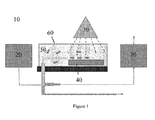
- the experimental apparatus (10) used for the nitrogen oxide (NO) conversion tests is shown schematically in Fig. 1 .
- the sample (40) is placed inside a 3.6 1 cell (50) through which the test gas obtained from a gas cylinder (20) is passed at a flow rate of 1.5 1/min.
- the sample is illuminated through a glass cover (60) by the selected light source (30) mounted above the cell (50).
- the sample was irradiated with a Hg HP125 (radiant power 40 Wm -2 in the range 290-400 nm) lamp emitting in the UV region.
- the concentration of NO in the outlet gas was continuously analyzed by gas chromatography (70).
- the irradiating source was a Philips PAR30S lamp (100 W, radiant power 178 W m -2 in the range 400-700nm) or a Xenon LOT Oriel lamp (150 W operated at 140 W, 25% power of the Philips lamp and 36% Hg lamp), respectively.
- the experimental arrangement was similar to the NO conversion test described above, the outlet gas was analyzed in a discontinuous way (every 30-40 min) after trapping in a cryogenic apparatus by gas-mass quadrupole spectroscope.
- the inlet gas was a BTEX mixture (13.5 ppbv toluene, 23 ppbv ethylbenzene, 20 ppbv o-xylene, 20 ppbv benzene) of 76.5 ppbv total partial pressure flowing at 1.5 l/min.
- the colorimetric measurements are performed on the concrete sample using a Minolta Konica DP301 coupled with an illuminating system CR310 with a D65 lamp. Data are expressed using the CieLab scale.
- Tinting strength values are based on the difference between areas under the reflectance curves for the tested samples and the standard sample.
- Method 1 Concrete samples were prepared by mixing the respective pigment with white Portland cement (Aquila Bianca CEM II/B-LL 32,5R), sand (Sibelco 2, Sibelco 5/RD) and water. The relative quantities are given in the table below: weight (g) wt.-% based on... Sibelco 2 289 72.3 total sand weight Sibelco 5/RD 111 27.7 total sand weight Water 46.2 35 total cement weight Cement 132 33 total sand weight
- Sand, pigment and water were mixed with an electric mixer (Bifinet KH203, 230 W, 5 speed) with one metal beater for 30 s at speed 2, then cement was added and mixed for another 30 s at speed 2. Subsequently, the obtained material is manually mixed with a spatula followed by another 60 s of electric mixing at speed 3. The concrete mixture is poured into a rounded mould having a diameter of 7 cm. The samples were dried in an oven at 110°C for two hours inside a plastic bag and for another 15 min in contact with the atmosphere.
- an electric mixer Bos KH203, 230 W, 5 speed
- Method 2 Samples were prepared using normalised sand DIN EN 196-1 (Normensand) mixed in the following quantities weight (g) wt.-% based on... Normalised sand 400 77 total mixture weight Water 27 30 total cement weight Cement 90 22.5 total sand weight
- Example a The NO conversion under UV lamp of a photo-catalytic iron oxide sample (TiO 2 23 wt.-% based on total pigment weight) was measured, under UV illumination, on the pigment itself and when included (6 wt.-% pigment based on cement weight) in a concrete matrix (Sample a ).
- a concrete sample, (Sample b ) was made with photo-catalytic cement (TX Aria white) and 6% Ferroxide 48. All concrete samples were prepared according to Method 2 above and tested after 3 months outdoor aging.
- Fig. 2 shows the conversion versus time of irradiation for sample a. As can be seen from the plot the conversion starts from 0 and increases in few minutes after switching the light, reaches an equilibrium value, and then remains stable under irradiation.
- the photocatalytic material of this invention exhibits greater stability of nitric oxide conversion over time of exposure compared to reference photocatalytic cements.
- the reaction over photocatalytic iron oxide generates less NO 2 . While the inventors do not wish to be bound by the theory, these two considerations suggest a synergetic effect of the two oxides (iron and titanium) when in intimate contact.
- Photocatalytic iron oxide 1 and 2 are materials prepared as described in patent application no. PCT/EP2006/068245 following two different preparation steps.
- Figures 5 and 6 show that the decrease in NO conversion with time of UV exposure is less pronounced for the coloured blocks made with photocatalytic pigment compared to the coloured blocks made with photocatalytic cement showing a higher NO conversion stability of these materials.
- the conversion plots also shows that the conversion under UV light in presence of NO did not produce ozone.
- Tinting strength was measured against Ferroxide 48 at 3.8 wt.-% based on total cement weight (equal iron oxide contents).
- Fe(II) was determined on the extraction liquid after different lengths of time, wherein the extraction procedure was performed as follows: The concrete block was percolated with H 2 SO 4 2 mM previously deoxygenated and exposed for 10 min to microwave at 375 W. The solution was filtered and Fe(II) was measured by the Absorbtion at a wavelength of 510 nm after o-phenanthro line addition. Data are plotted in the Fig. 7 showing that photodissolution of Fe(II) is evident only for the standard iron oxide (Ferroxide 48) under UV-NO condition but not for the photocatalytic iron oxide.
- Photocatalytic iron oxide yellows A and B were both prepared according to PCT/EP2006/068245 with 45 wt.-% TiO 2 loading based on total pigment weight.
- VOCs under UV light were measured as described above. Percentages of conversion are reported in the following table: conversion in % benzene toluene ethylbenzene o-xylene average BTEX conversion in % a 0 3.6 1.1 1 1.4 b 1.5 3.3 4.6 4 3.4 c 2.7 5.1 4.3 4.5 4.2 d 4.3 5.9 5.9 6.2 5.6
Landscapes
- Chemical & Material Sciences (AREA)
- Engineering & Computer Science (AREA)
- Ceramic Engineering (AREA)
- Organic Chemistry (AREA)
- Materials Engineering (AREA)
- Inorganic Chemistry (AREA)
- Structural Engineering (AREA)
- Life Sciences & Earth Sciences (AREA)
- Wood Science & Technology (AREA)
- Catalysts (AREA)
- Exhaust Gas Treatment By Means Of Catalyst (AREA)
- Building Environments (AREA)
- Curing Cements, Concrete, And Artificial Stone (AREA)
Abstract
Description
- The invention relates to use of iron oxide particles coated with titanium dioxide, and in particular to their use for decomposing air pollutants photocatalytically.
- In recent years, pollution of air, water and soil has become a key issue especially in urban areas. Air pollutants are mainly emitted into the environment by production processes such as industrial activities or combustion processes such as heating, power generation and motor vehicles. These pollutants can contribute to urban air quality problems, for example photochemical smog, as well as adversely affect human health and the health of other living things.
- Two of the major environmental polluting substances include nitrogen oxides (NOx) and volatile organic compounds (VOCs). In particular, these compounds are dangerous as they initiate formation of secondary polluting substances. NOx and VOCs are also referred to as ozone precursors as the majority of tropospheric ozone formation occurs when NOx and VOCs react in the atmosphere in the presence of sunlight and carbon monoxide. Moreover, reaction of NOX and VOCs in the presence of sunlight causes photochemical smog containing inter alia peroxyacetyl nitrate (PAN) which is a significant form of air pollution, especially in the summer. Children, people with lung diseases such as asthma, and people who work or exercise outside are susceptible to adverse effects of photochemical smog such as damage to lung tissue and reduction in lung function.
- Various solutions have been proposed to reduce the concentration of air polluting substances in the environment.
-
WO 02/38272 - A building material with photocatalytic activity towards air pollutants such as NOx is described in
WO 2006/000565 , wherein the photocatalytic activity arises from the presence of TiO2 nanoparticles physically mixed with cement. - A photocatalytic reactor for oxidation of organic contaminants from gases or water is described in
US 6136186 , wherein the photocatalyst is a porous layer or surface of TiO2 or a binary TiO2 oxide, eventually doped with another metal catalyst, formed on a porous surface. -
WO 2006/008434 describes a titanium dioxide coating having VOC degrading as well as self-cleaning and antimicrobial properties. -
EP1559753 relates to a photocatalytic potassium silicate paint that contains TiO2 in the anatase form. The paint is designed for use in residential and public buildings to give anti-pollutant, self cleaning properties. -
JP 2004 161978 A -
EP 0 666 107 A2 - There remains a need for materials with improved capability to decompose polluting substances such as nitrogen oxides (NOx) and volatile organic compounds (VOC) in the environment.
- An object of the present invention is the provision of a photocatalytically active material for effectively decomposing air pollutants. The present invention is directed to the use of a suitable material for photocatalytically decomposing air pollutants selected from nitrogen oxides (NOx) . Still another object of the present invention is the use of such materials for decomposing air pollutants, selected from NOx, in building materials. Still another object of the present invention is the use of such materials for decomposing air pollutants, selected from NOx, in paint.
- A further object of the present invention is the provision use of a suitable material for reducing photo-corrosion during photocatalytically decomposing air pollutants selected from nitrogen oxides (NOx) .
- Furthermore, the invention is directed to the use of iron oxide particles being at least partially coated with titanium dioxide for photocatalytically decomposing NO at reduced NO2 production.
- Furthermore, the invention is directed to the use of iron oxide particles being at least partially coated with titanium dioxide for photocatalytic decomposition of air pollutants selected from nitrogen oxides (NOx) .
- Furthermore, the invention is directed to the use of iron oxide particles being at least partially coated with titanium dioxide for photocatalytically decomposing NO under UV and/or visible light.
- These and other objects of the present invention can be solved by the use described in the claims. Preferred embodiments arise from a combination of the features of the dependent claims with those of the independent claims.
-
-
Fig. 1 shows a scheme of an experimental setup (10) suitable for nitrogen conversion tests. The sample (40) is placed inside a 3.61 cell (50) through which the test gas obtained from a gas cylinder (20) is passed at a flow rate of 1.5 1/min. The sample is illuminated through a glass cover (60) by the selected light source (30) mounted above the cell (50). The NO concentration in the outlet gas is analyzed continuously using a gas chromatograph (70). -
Fig. 2 shows the NO, NO2, NOx and O3 conversion versus time of irradiation for sample a of Example 1 which is a concrete block containing 6% photocatalytic iron oxide and standard cement. -
Fig. 3 and Fig. 4 show the photocatalytic conversion of NO and NO2, respectively, measured before aging, after 96 h and after 192 h for the 4 samples described in example 3.Sample 1 is a photocatalytic cement containing no pigment;sample 2 is a photocatalytic cement containing standard iron oxide yellow (3.8 wt.-% based on total cement weight);sample 3 is a standard cement containing photocatalytic iron oxide 1 (45 wt.-% TiO2 based on total pigment weight) in an amount of 6.8 wt.-% based on total cement weight; andsample 4 is a standard cement containing photocatalytic iron oxide 2 (45 wt.-% TiO2 based on total pigment weight) in an amount of 6.8 wt.-% based on total cement weight). -
Fig. 5 andFig. 6 show the NO, NO2 NOx and O2 conversion versus time of UV irradiation forsample 2 andsample 3 of Example 2, respectively.Sample 2 is a coloured block made with photocatalytic cement and standard iron oxide andsample 3 is a coloured block made with photocatalytic pigment and standard cement. -
Fig. 7 shows the photodissolution data of Fe(II) for three different samples of Example 3. The plot shows the Fe(II) concentration in the water extract obtained from concrete samples exposed to NO and UV light for different lengths of time as described in example 3. Sample a is Ferroxide 48(3 wt.-%) on cement; sample b is a photocatalytic iron oxide (TiO2 21 wt.-% based on total pigment weight) in an amount of 5 wt.-% based on total cement weight; and sample c is Ferroxide 48 (3%) on photocatalytic cement. -
Fig. 8 andFig. 9 illustrate the conversion and the average conversion, respectively, ofVOCs under UV light for four different samples of Example 4.Fig. 8 shows conversion ofVOCs under UV light as described in example 4. Sample a is a photocatalytic cement containing no pigment; sample b is a photocatalytic cement containing standard iron oxide yellow (3.8 wt.-% based on total cement weighty sample c is a standard cement containing photocatalytic iron oxide yellow A (TiO 2 45 wt.-% based on total pigment weight) in an amount of 6.8 wt.-% based on total cement weight; and sample d is a standard cement containing photocatalytic iron oxide yellow B (TiO 2 45 wt.-% based on total pigment weight) in an amount of 6.8 wt.-% based on total cement weight.Fig. 9 shows the total conversion of a mixture of Benzene, Ethylbenzene, Toluene and o-styrene, under UV light as descibed in example 4. Sample a is a photocatalytic cement containing no pigment; sample b is a photocatalytic cement containg standard iron oxide yellow (3.8 wt.-% based on total cement weight); sample c is a standard cement containing photocatalytic iron oxide yellow A (TiO 2 45 wt.-% based on total pigment weight) in an amount of 6.8 wt.-% based on total cement weight; and sample d is a standard cement containing photocatalytic iron oxide yellow B ((TiO 2 45 wt.-% based on total pigment weight) in an amount of 6.8 wt.-% based on total cement weight. -
Fig. 10 show the NO, NO2 NOx and O3 conversion versus time of irradiation for a silicate paint coloured with 5% of a photocatalytic iron oxide (23 wt.-% TiO2 based on total pigment weight) as described in Example 6. - Surprisingly, it has been found that a specific type of photocatalytic material, titanium dioxide coated iron oxide particles, are especially suitable for highly effective photocatalytic decomposition of air pollutants, specifically NOx.
- The use of iron oxide particles coated with titanium dioxide for photocatalytically decomposing NOx is highly advantageous, since it allows the provision of conventionally used pigments for colouring applications with photocatalytic properties, e.g. for colouring of building materials, in the paint and coating field or in the paper manufacturing industry.
- Furthermore, it has been observed that with conventionally used photocatalysts that are solely titanium dioxide based, the photocatalytic activity degrades over time. With the use of titanium dioxide coated iron particles, the photocatalytic titanium dioxide as well as the pigment are significantly more stable under UV and visible radiation, allowing for extended lifetime of the pigment as well as the photocatalyst. Also, with the use of titanium dioxide coated iron oxide particles as photocatalysts for degrading NOx, a broader spectrum of radiation can be used, ranging from UV to visible light. It is believed that this is due to a synergistic effect between iron oxide and titanium dioxide.
- Also, with the use of titanium dioxide coated iron oxide particles as photocatalysts for degrading NOx, the NO2 production regularly occurring during the degradation of NO is significantly reduced. Ozone production, that may occur during irradiation with UV and visible light in the presence of NOx, has been measured and observed to be limited with these photo-catalytic materials.
- In one embodiment of the present invention iron oxide particles used for photocatalytically decomposing air pollutants selected from nitrogen oxides (NOx) are at least partially coated with titanium dioxide. In another embodiment of the present invention the iron oxide particles used for photocatalytically decomposing air pollutants selected from nitrogen oxides (NOx) are completely coated with titanium dioxide.
- The titanium dioxide can be randomly distributed on the surface of the inorganic particulate material, e.g. in the form of more or less densely distributed crystalline spots, preferably nano-sized crystallites of titanium dioxide. Alternatively, at higher loadings, the titanium dioxide may also form larger areas of crystalline material on the carrier particle's surface, up to substantially complete coverage.
- In an exemplary embodiment of the uses of the present invention the iron oxide particles being at least partially coated with titanium dioxide are incorporated into a building material. For example, the particles can be mixed with the building material. In another exemplary embodiment of the uses of the present invention the iron oxide particles being at least partially coated with titanium dioxide are applied on a building material. For example, the particles can be applied on a building material in form of a water-based coating or paint. The building material of the present invention can comprise an inorganic material such as concrete, cement, mortar, limestone or gypsum.
- In another exemplary embodiment of the uses of the present invention the iron oxide particles being at least partially coated with titanium dioxide are incorporated into a paint. For example, the particles can be mixed with the paint or dispersed in the paint. The paint can comprise, e.g., a silicate based paint, an acrylic paint, oil paint or water-based paint.
- The particles for the use described in the present invention can be manufactured by a process as described in applicant's co-pending patent application no.
PCT/EP2006/068245 - Without wishing to be bound to any theory, it is believed that upon exposure to sunlight, the polluting substances nitrogen oxides (NOx) and volatile organic compounds (VOC) can be disintegrated in the presence of titanium dioxide coated iron oxide particles, which produces radicals and/or other active species which interact with the pollutants. This results in degradation or decomposition reactions of these molecules, e.g., nitrogen oxide gases can be oxidized to nitrates, and can substantially reduce concentrations of such pollutants. Thus, the concentration of these substances, e.g. on building materials, is reduced, resulting in a maintained brilliance of the colour for an extended period of time and, furthermore, to a reduced concentration of environmental polluting substances in the environment. In addition, the quality of the air can be improved, resulting in an anti-smog-effect.
- The inventors have found that the use of titanium dioxide coated iron oxide particles instead of conventional pigments in colouring applications results in an improved colour fastness for an extended period of time. Moreover, the inventors have found that titanium dioxide coated iron oxide particles show reduced photo-corrosion in comparison with conventional iron oxide pigments.
Figure 7 shows that photodissolution of Fe(II) is evident only for the cement block including standard iron oxide pigment but not for the cement block including titanium dioxide coated iron oxide particles. Thus, the present invention also provides for a long term stability of the iron oxide pigments by reducing photo-corrosive effects. - Furthermore, the inventors have found that with the use of titanium dioxide coated iron oxide particles a greater stability of nitric oxide conversion over time of exposure compared to the use of conventional photocatalytic compounds can be attained. As shown in
Fig. 5 and6 the decrease in nitric oxide conversion during UV exposure is less pronounced for the coloured cement blocks made with titanium dioxide coated iron oxide particles compared to the coloured cement blocks comprising conventional photocatalytic cement and an iron oxide pigment. In additionfigure 3 shows the cements blocks made with titanium coated iron oxide particles exhibit greater stability of nitric oxide conversion compared with the cement blocks made with colored photocatalytic cement. - Also, it was found that with the use of titanium dioxide coated iron oxide particles the formation of NO2 regularly occurring during the photocatalytic process is significantly reduced compared the use of conventional photocatalytic compounds. Without wishing to be bound to any theory, the inventors believe that at least some of the aforementioned observations suggest a synergetic effect of iron oxide and titanium oxide when being in intimate contact.
- The experimental apparatus (10) used for the nitrogen oxide (NO) conversion tests is shown schematically in
Fig. 1 . The sample (40) is placed inside a 3.6 1 cell (50) through which the test gas obtained from a gas cylinder (20) is passed at a flow rate of 1.5 1/min. The sample is illuminated through a glass cover (60) by the selected light source (30) mounted above the cell (50). - A mixture of synthetic humid air (79% N2, 21 % O2, 50% relative humidity) and 0.5 ppmv of NO at 1.5 1/min was used as inlet gas. For testing under UV illumination the sample was irradiated with a Hg HP125 (
radiant power 40 Wm-2 in the range 290-400 nm) lamp emitting in the UV region. The concentration of NO in the outlet gas was continuously analyzed by gas chromatography (70). - For measurement under visible or UV-visible light, the irradiating source was a Philips PAR30S lamp (100 W, radiant power 178 W m-2 in the range 400-700nm) or a Xenon LOT Oriel lamp (150 W operated at 140 W, 25% power of the Philips lamp and 36% Hg lamp), respectively.
- The percentages of NO converted into NO2 are defined as:


- NOx is the NO converted in products different from NO2 and is defined as:

- The experimental arrangement was similar to the NO conversion test described above, the outlet gas was analyzed in a discontinuous way (every 30-40 min) after trapping in a cryogenic apparatus by gas-mass quadrupole spectroscope. The inlet gas was a BTEX mixture (13.5 ppbv toluene, 23 ppbv ethylbenzene, 20 ppbv o-xylene, 20 ppbv benzene) of 76.5 ppbv total partial pressure flowing at 1.5 l/min.
- The colorimetric measurements are performed on the concrete sample using a Minolta Konica DP301 coupled with an illuminating system CR310 with a D65 lamp. Data are expressed using the CieLab scale.
- For the tinting strength a Gardner-BYK colorimeter (45/0 measurement angle) was used. Tinting strength values are based on the difference between areas under the reflectance curves for the tested samples and the standard sample.
- Method 1: Concrete samples were prepared by mixing the respective pigment with white Portland cement (Aquila Bianca CEM II/B-LL 32,5R), sand (
Sibelco 2,Sibelco 5/RD) and water. The relative quantities are given in the table below:weight (g) wt.-% based on... Sibelco 2289 72.3 total sand weight Sibelco 5/RD 111 27.7 total sand weight Water 46.2 35 total cement weight Cement 132 33 total sand weight - Sand, pigment and water were mixed with an electric mixer (Bifinet KH203, 230 W, 5 speed) with one metal beater for 30 s at
speed 2, then cement was added and mixed for another 30 s atspeed 2. Subsequently, the obtained material is manually mixed with a spatula followed by another 60 s of electric mixing atspeed 3. The concrete mixture is poured into a rounded mould having a diameter of 7 cm. The samples were dried in an oven at 110°C for two hours inside a plastic bag and for another 15 min in contact with the atmosphere. - In some tests, instead of Portland cement, a photocatalytic cement was used (TX Aria white). The pigment employed as standard yellow iron oxide was Ferroxide 48 produced by Rockwood Pigment. After drying in a vented oven, the samples were aged at 90°C and 95% relative humidity for 192 h to accelerate the deactivating effect of ageing.
- Method 2: Samples were prepared using normalised sand DIN EN 196-1 (Normensand) mixed in the following quantities
weight (g) wt.-% based on... Normalised sand 400 77 total mixture weight Water 27 30 total cement weight Cement 90 22.5 total sand weight - Mixing and drying procedure were as in
Method 1. - Samples were tested after 3 months outdoor aging.
- The NO conversion under UV lamp of a photo-catalytic iron oxide sample (TiO2 23 wt.-% based on total pigment weight) was measured, under UV illumination, on the pigment itself and when included (6 wt.-% pigment based on cement weight) in a concrete matrix (Sample a). In addition, a concrete sample, (Sample b), was made with photo-catalytic cement (TX Aria white) and 6% Ferroxide 48. All concrete samples were prepared according to
Method 2 above and tested after 3 months outdoor aging. - Results are reported in the following table:
converted % NO at 180 min converted % NO2 at 180 min % NO2 produced Pigment 66.4 45.4 68.4 Sample a 31.5 1 3.2 Sample b 30 7 23.3 - The data show that the cement containing photocatalytic iron oxide produces less NO2 than the reference photocatalytic cement commercially in use today.
-
Fig. 2 shows the conversion versus time of irradiation for sample a. As can be seen from the plot the conversion starts from 0 and increases in few minutes after switching the light, reaches an equilibrium value, and then remains stable under irradiation. - It should be noted that the conversion plot shown in
Fig. 5 and reported in Example 2 for sample 2 (photocatalytic cement/ iron oxide) instead shows a different profile, evidencing the different conversion mechanism of the two photocatalytic materials. - The photocatalytic material of this invention exhibits greater stability of nitric oxide conversion over time of exposure compared to reference photocatalytic cements. In addition the reaction over photocatalytic iron oxide generates less NO2. While the inventors do not wish to be bound by the theory, these two considerations suggest a synergetic effect of the two oxides (iron and titanium) when in intimate contact.
- Four concrete samples were prepared as described in
Method 1 and left in a humidity chamber at T=95°C and 90% humidity (accelerated aging) for different length of time. The following samples were prepared: - Sample 1:
- Photocatalytic cement, no pigment
- Sample 2:
- Photocatalytic cement, standard iron oxide yellow (3.8 wt.-% based on total cement weight)
- Sample 3:
- Standard cement, photocatalytic iron oxide 1 (45 wt.-% TiO2 based on total pigment weight), 6.8 wt.% based on total cement weight
- Sample 4:
- Standard cement, photocatalytic iron oxide 2 (45 wt.-% TiO2 based on total pigment weight), 6.8 wt.-% based on total cement weight
-
Photocatalytic iron oxide PCT/EP2006/068245 - The photocatalytic conversion under UV light was measured before aging, after 96 h and after 192 h. The data are reported in
Fig. 3 and 4 and in the following tables:Sample conversion at 0 h conversion at 96 h conversion at 192 h % NO % not % NO % not % NO % NO 21 41.7 5.39 26.3 4.02 14.6 2.58 2 42.7 4.49 9.56 1.8 6.7 2.23 3 21.9 3.3 6.93 1.12 7.5 1.2 4 23.6 2.37 8.89 0.92 6.2 1.6 Sample Δ( converted %) NO 196 h - 0 h aging 1 -65% 2 -84% 3 -66% 4 -74% - Furthermore, the NO conversion of the two photocatalytic oxides was comparable to the coloured block produced with photocatalytic cement.
-
Figures 5 and6 show that the decrease in NO conversion with time of UV exposure is less pronounced for the coloured blocks made with photocatalytic pigment compared to the coloured blocks made with photocatalytic cement showing a higher NO conversion stability of these materials. The conversion plots also shows that the conversion under UV light in presence of NO did not produce ozone. - For
sample - Tinting strength was measured against Ferroxide 48 at 3.8 wt.-% based on total cement weight (equal iron oxide contents).
L a b TS% Sample 3 74.76 2.96 36.04 83.9 Sample 473.94 3.77 35.94 81.8 - Two concrete samples were prepared as in
Method 1 and irradiated under UV light: - Sample a:
Ferroxide 48,3% on cement - Sample b: Photocatalytic iron oxide (TiO2 21 wt.-% based on total pigment weight,) 5 wt.-% based on total cement weight
- As in the NO conversion test the samples were exposed to UV light in presence of NO. Fe(II) was determined on the extraction liquid after different lengths of time, wherein the extraction procedure was performed as follows: The concrete block was percolated with H2SO4 2 mM previously deoxygenated and exposed for 10 min to microwave at 375 W. The solution was filtered and Fe(II) was measured by the Absorbtion at a wavelength of 510 nm after o-phenanthro line addition. Data are plotted in the
Fig. 7 showing that photodissolution of Fe(II) is evident only for the standard iron oxide (Ferroxide 48) under UV-NO condition but not for the photocatalytic iron oxide.Soluble iron(II) µM/cm2 Time min Sample a Sample b 0 1.5 · 10-03 7.0-10-04 190 2.3 · 10-03 7.0 · 10-04 370 7.7 · 10-03 6.0 · 10-04 530 5.5 · 10-03 7.0 · 10-04 720 6.0 · 10-03 8.0 · 10-04 - Those data may be compared with the value for a concrete block made of photocatalytic cement and 3% Ferroxide (Sample c) which is also shown in
Fig. 7 . After 250 min the Fe(II) present in the extract was 4.23·10-03, higher than for the photocatalytic oxide used according to the invention. - Four concrete samples were prepared as described in Example 1 and left in a humidity chamber at T=95°C and 90% humidity (accelerated aging) for 192 hours. The following samples were prepared:
- Sample a:
- Photocatalytic cement, no pigment
- Sample b:
- Photocatalytic cement, standard iron oxide yellow 3.8 wt.-% based on total cement weight
- Sample c:
- Standard cement, photocatalytic iron oxide yellow A (
TiO 2 45 wt.-% based on total pigment weight), 6.8 wt.-% based on total cement weight - Sample d:
- Standard cement, photocatalytic iron oxide yellow B ((
TiO 2 45 wt.-% based on total pigment weight), 6.8 wt.% based on total cement weight - Photocatalytic iron oxide yellows A and B were both prepared according to
PCT/EP2006/068245 - Conversion of VOCs under UV light were measured as described above. Percentages of conversion are reported in the following table:
conversion in % benzene toluene ethylbenzene o-xylene average BTEX conversion in % a 0 3.6 1.1 1 1.4 b 1.5 3.3 4.6 4 3.4 c 2.7 5.1 4.3 4.5 4.2 d 4.3 5.9 5.9 6.2 5.6 - The results plotted in
Fig. 8 and9 demonstrate that the photocatalytic iron oxides of the present invention show a greater capacity to remove VOC's than the conventional photocatalytic materials in use today. - Two concrete samples were prepared as described in Example 1 and left in a humidity chamber at T=95°C and 90% humidity (accelerated aging) for 192 hours. The following samples were prepared:
- Sample 1:
- Standard cement, photocatalytic iron oxide yellow (Sample A) (
TiO 2 45 wt.-% based on total pigment weight, Sample a) 6.8 wt.-% based on total cement weight - Sample 2:
- Standard cement, photocatalytic iron oxide yellow (Sample B) (
TiO 2 45 wt.-% based on total pigment weight, Sample b) 6.8 wt.-% based on total cement weight - Both photocatalytic oxides convert NO when irradiated with light in the visible spectra region as can be seen from the data shown in the following table. As in Example 4 with UV irradiation, ozone is not produced during the reaction.
Sample % converted NO % converted NO2 % converted O3, A 7.9 2.2 0 B 6.2 3.1 0 - 5% of a photocatalytic iron oxide (23 wt.-%TiO2 based on total pigment weight) has been incorporated into a silicate based paint (based on 28.25% water, 23% Consolref K, 38% inerts, 9% styrene acrylate) and applied on a concrete surface. Conversion of NO was measured in the standard method, and conversion plot is shown in
Fig. 10 .
Claims (9)
- A use of iron oxide particles being at least partially coated with titanium dioxide, for photocatalytically decomposing air pollutants selected from nitrogen oxides (NOx) that come into contact with said particles.
- The use according to claim 1, wherein the iron oxide particles are incorporated into a building material.
- The use according to claim 1, wherein the iron oxide particles are applied on a building material.
- The use according to claim 2 or 3, wherein the building material is selected from the group consisting of concrete, cement, mortar, limestone or gypsum.
- The use according to claim 1, wherein the iron oxide particles are incorporated into a paint.
- The use according to claim 1 for photocatalytically decomposing NO at reduced NO2 production.
- The use according to claim 1 for avoiding ozone production during photocatalytic decomposition of air pollutants selected from nitrogen oxides (NOx).
- The use according to claim 1 for photocatalytically decomposing NO under UV and/or visible light.
- The use according to claim 1 for reducing photo-corrosive effects of the iron oxide particles during photocatalytically decomposing air pollutants selected from nitrogenoxides (NOx).
Priority Applications (1)
| Application Number | Priority Date | Filing Date | Title |
|---|---|---|---|
| PL08718374T PL2134662T3 (en) | 2008-03-31 | 2008-03-31 | Use of photocatalytically coated particles for decomposition of air pollutants |
Applications Claiming Priority (1)
| Application Number | Priority Date | Filing Date | Title |
|---|---|---|---|
| PCT/EP2008/053854 WO2009121396A1 (en) | 2008-03-31 | 2008-03-31 | Use of photocatalytically coated particles for decomposition of air pollutants |
Publications (2)
| Publication Number | Publication Date |
|---|---|
| EP2134662A1 EP2134662A1 (en) | 2009-12-23 |
| EP2134662B1 true EP2134662B1 (en) | 2012-03-21 |
Family
ID=40291116
Family Applications (1)
| Application Number | Title | Priority Date | Filing Date |
|---|---|---|---|
| EP08718374A Active EP2134662B1 (en) | 2008-03-31 | 2008-03-31 | Use of photocatalytically coated particles for decomposition of air pollutants |
Country Status (10)
| Country | Link |
|---|---|
| US (1) | US20110070138A1 (en) |
| EP (1) | EP2134662B1 (en) |
| JP (1) | JP5739801B2 (en) |
| CN (1) | CN101980988A (en) |
| AT (1) | ATE550308T1 (en) |
| AU (1) | AU2008353902B2 (en) |
| BR (1) | BRPI0822585A2 (en) |
| ES (1) | ES2386685T3 (en) |
| PL (1) | PL2134662T3 (en) |
| WO (1) | WO2009121396A1 (en) |
Families Citing this family (5)
| Publication number | Priority date | Publication date | Assignee | Title |
|---|---|---|---|---|
| CN105498821B (en) * | 2015-12-17 | 2018-06-12 | 苏州大学 | It is a kind of for composite material of catalytic degradation nitrogen oxides and its preparation method and application |
| FR3077306B1 (en) | 2018-01-29 | 2022-07-01 | Centre Nat Rech Scient | CONSTRUCTION ELEMENT FOR URBAN ROAD SANITATION |
| US20250135256A1 (en) * | 2022-02-11 | 2025-05-01 | Drexel University | Nanomaterial-based processing of dyes and organic compounds |
| CN115073119B (en) * | 2022-06-24 | 2023-04-14 | 昆明理工大学 | A visible light catalyzed light-transmitting concrete material and its preparation method and application |
| CN116809067B (en) * | 2023-07-02 | 2025-08-22 | 华中科技大学 | A core-shell catalyst and its preparation method and application |
Family Cites Families (41)
| Publication number | Priority date | Publication date | Assignee | Title |
|---|---|---|---|---|
| US2732310A (en) * | 1956-01-24 | Miller | ||
| JPS517176B2 (en) * | 1971-11-12 | 1976-03-05 | ||
| US4175110A (en) * | 1978-08-22 | 1979-11-20 | Uop Inc. | Recovery of titanium metal values |
| US4277288A (en) * | 1978-10-06 | 1981-07-07 | Ciba-Geigy Corporation | Fluidized granulation of pigments using organic granulating assistant |
| DE3619363A1 (en) * | 1986-06-09 | 1987-12-10 | Brockhues Chem Werke Ag | METHOD FOR COLORING CONCRETE |
| EP0282329B1 (en) * | 1987-03-11 | 1992-01-29 | Tayca Corporation | Titanium dioxide coated micaceous iron oxide pigments and method for producing the same |
| JP3476019B2 (en) * | 1992-11-27 | 2003-12-10 | 株式会社資生堂 | Photocatalyst having magnetism and method for producing the same |
| DE4302896A1 (en) * | 1993-02-02 | 1994-08-04 | Degussa | Iron oxide-containing titanium dioxide powder |
| AU676299B2 (en) * | 1993-06-28 | 1997-03-06 | Akira Fujishima | Photocatalyst composite and process for producing the same |
| JP2909403B2 (en) * | 1994-02-07 | 1999-06-23 | 石原産業株式会社 | Titanium oxide for photocatalyst and method for producing the same |
| TW431907B (en) * | 1994-02-07 | 2001-05-01 | Ishihara Sangyo Kaisha | Method of removing harmful materials |
| US5837050A (en) * | 1995-08-11 | 1998-11-17 | Ishihara Sangyo Kaisha, Ltd. | Ultrafine iron-containing rutile titanium oxide and process for producing the same |
| IT1286492B1 (en) * | 1996-08-07 | 1998-07-15 | Italcementi Spa | HYDRAULIC BINDER WITH IMPROVED COLOR CONSTANCE PROPERTIES |
| US6136186A (en) * | 1997-01-31 | 2000-10-24 | Lynntech, Inc. | Photocatalytic oxidation of organics using a porous titanium dioxide membrane and an efficient oxidant |
| US6956006B1 (en) * | 1998-02-24 | 2005-10-18 | Rotem Amfert Negev Ltd. | Modified titanium dioxide and a method for its preparation |
| US6562120B2 (en) * | 1998-09-08 | 2003-05-13 | Elementis Uk Limited | Granular pigments |
| JP3483244B2 (en) * | 1999-02-12 | 2004-01-06 | 太平洋セメント株式会社 | Photocatalyst supporting composition |
| US6653356B2 (en) * | 1999-12-13 | 2003-11-25 | Jonathan Sherman | Nanoparticulate titanium dioxide coatings, and processes for the production and use thereof |
| JP2001179109A (en) * | 1999-12-27 | 2001-07-03 | Yamaha Corp | Photocatalyst granules and method for producing the same |
| DE10002559B4 (en) * | 2000-01-21 | 2004-07-15 | Brockhues Gmbh & Co. Kg | Pigment granules for coloring building materials and processes for their production |
| US6569520B1 (en) * | 2000-03-21 | 2003-05-27 | 3M Innovative Properties Company | Photocatalytic composition and method for preventing algae growth on building materials |
| KR100385301B1 (en) * | 2000-11-28 | 2003-05-23 | 한국화학연구원 | Novel titania photocatalyst and its manufacturing method |
| JP2002166169A (en) * | 2000-12-01 | 2002-06-11 | National Institute For Materials Science | Zinc oxide photocatalyst |
| US20020187082A1 (en) * | 2001-06-06 | 2002-12-12 | Chang-Yu Wu | Photocatalyst coated magnetic composite particle |
| JP3986786B2 (en) * | 2001-09-21 | 2007-10-03 | 株式会社日本触媒 | Photocatalyst for nitrogen oxide removal |
| DE60233339D1 (en) * | 2001-09-27 | 2009-09-24 | Nat Inst Of Advanced Ind Scien | CLEANING SUPPLIES |
| JP4061464B2 (en) * | 2002-01-28 | 2008-03-19 | 戸田工業株式会社 | Catalyst for treating organic compounds |
| US6758893B2 (en) * | 2002-06-20 | 2004-07-06 | Elementis Pigments, Inc. | Granular pigments useful to color concrete |
| JP4365159B2 (en) * | 2002-08-06 | 2009-11-18 | エスケー化研株式会社 | Photocatalyst composite powder |
| JP2004161978A (en) * | 2002-09-24 | 2004-06-10 | Yoshiyuki Nagae | Photocatalyst-coated pigment, paint, method for manufacturing photocatalyst-coated pigment and method for manufacturing paint |
| US6844067B2 (en) * | 2002-10-24 | 2005-01-18 | Toda Kogyo Corporation | Black iron-based particles and black toner containing the same |
| DE10258373A1 (en) * | 2002-12-12 | 2004-07-08 | Henkel Kgaa | Manufacture of magnetic titanium dioxide particles |
| JP2005095804A (en) * | 2003-09-25 | 2005-04-14 | Shimadzu Corp | Mixed catalyst and honeycomb using the same |
| ES2360088T3 (en) * | 2003-12-09 | 2011-05-31 | Central Research Institute Of Electric Power Industry (Criepi) | MULTIFUNCTIONAL MATERIAL THAT PRESENTS A COAT OF CARBON TITANIUM OXIDE |
| US20050159309A1 (en) * | 2004-01-12 | 2005-07-21 | Hubbell David A. | Environmental coatings assemblies |
| JP2006007806A (en) * | 2004-06-22 | 2006-01-12 | Shigeaki Kokubo | Air cleaner for automobile |
| JP2006273660A (en) * | 2005-03-29 | 2006-10-12 | Konoshima Chemical Co Ltd | Photocatalytic inorganic building materials |
| GB0507663D0 (en) * | 2005-04-15 | 2005-05-25 | Marley Building Materials Ltd | Concrete roof tiles and wall cladding elements |
| US7358218B2 (en) * | 2005-06-03 | 2008-04-15 | Research Foundation Of The University Of Central Florida, Inc. | Method for masking and removing stains from rugged solid surfaces |
| WO2007004426A1 (en) * | 2005-07-04 | 2007-01-11 | Mitsubishi Electric Corporation | Apparatus for volatile organic compound treatment and method of volatile organic compound treatment |
| US7833935B2 (en) * | 2006-11-08 | 2010-11-16 | Rockwood Italia S.P.A. | Iron oxide containing precipitated crystalline titanium dioxide and process for the manufacture thereof |
-
2008
- 2008-03-31 WO PCT/EP2008/053854 patent/WO2009121396A1/en not_active Ceased
- 2008-03-31 EP EP08718374A patent/EP2134662B1/en active Active
- 2008-03-31 ES ES08718374T patent/ES2386685T3/en active Active
- 2008-03-31 CN CN2008801281908A patent/CN101980988A/en active Pending
- 2008-03-31 US US12/518,985 patent/US20110070138A1/en not_active Abandoned
- 2008-03-31 JP JP2011502234A patent/JP5739801B2/en not_active Expired - Fee Related
- 2008-03-31 AT AT08718374T patent/ATE550308T1/en active
- 2008-03-31 BR BRPI0822585-0A patent/BRPI0822585A2/en not_active Application Discontinuation
- 2008-03-31 PL PL08718374T patent/PL2134662T3/en unknown
- 2008-03-31 AU AU2008353902A patent/AU2008353902B2/en not_active Ceased
Also Published As
| Publication number | Publication date |
|---|---|
| CN101980988A (en) | 2011-02-23 |
| US20110070138A1 (en) | 2011-03-24 |
| ATE550308T1 (en) | 2012-04-15 |
| ES2386685T3 (en) | 2012-08-27 |
| WO2009121396A1 (en) | 2009-10-08 |
| JP2011518657A (en) | 2011-06-30 |
| AU2008353902B2 (en) | 2014-06-26 |
| EP2134662A1 (en) | 2009-12-23 |
| AU2008353902A1 (en) | 2009-10-08 |
| PL2134662T3 (en) | 2012-10-31 |
| BRPI0822585A2 (en) | 2015-06-23 |
| JP5739801B2 (en) | 2015-06-24 |
Similar Documents
| Publication | Publication Date | Title |
|---|---|---|
| Folli et al. | TiO2 photocatalysis in cementitious systems: Insights into self-cleaning and depollution chemistry | |
| Lucas et al. | Incorporation of titanium dioxide nanoparticles in mortars—Influence of microstructure in the hardened state properties and photocatalytic activity | |
| EP2163304B1 (en) | Coating composition comprising photocatalyst coated with apatite and radiant heating system having the same | |
| Diamanti et al. | Photocatalytic and self-cleaning activity of colored mortars containing TiO2 | |
| DK1535886T4 (en) | Use of building concrete containing photocatalyst particles | |
| Chen et al. | Photocatalytic cement-based materials: Comparison of nitrogen oxides and toluene removal potentials and evaluation of self-cleaning performance | |
| KR20240022535A (en) | A highly efficient decontamination additive comprising metal oxide nanoparticles in a metallic or semi-metallic nanoparticle matrix, useful for addition to paints, formulations, etc. to protect, coat or decorate soft or hard surfaces. | |
| Binas et al. | Study of innovative photocatalytic cement based coatings: The effect of supporting materials | |
| CN101544854B (en) | Antibacterial, mildewproof, self-cleaning, air cleaning and environment-friendly spray coating liquid and preparation and application thereof | |
| AU2008353902B2 (en) | Use of photocatalytically coated particles for decomposition of air pollutants | |
| EP3670469A1 (en) | A cementitious composition with photocatalytic activity under visible light | |
| JP4878141B2 (en) | Composite photocatalyst | |
| Ghosh et al. | Developing scenario of titania-based building materials for environmental remediation | |
| Cassar | Nanotechnology and photocatalysis in cementitious materials | |
| Homa et al. | Impact of paint matrix composition and thickness of paint layer on the activity of photocatalytic paints | |
| Enea et al. | Photocatalytic properties of cement-based plasters and paints containing mineral pigments | |
| US20240383809A1 (en) | Composite architectural ultra-high performance concrete mixtures and panels with enhanced photocatalytic activity | |
| Gatto | Photocatalytic activity assessment of micro-sized TiO2 used as powders and as starting material for porcelain gres tiles production | |
| KR102419051B1 (en) | NOX reduction coating and NOX reduction method thereby | |
| Ibáñez Gómez et al. | Photocatalytic Lime Render for Indoor and Outdoor Air Quality Improvement. Catalysts 2021, 11, 296 | |
| Saini et al. | Photocatalytic Cement: Self-cleaning | |
| KR20020058946A (en) | Environmental affinitive building materials immobilized titanium oxide having nitrogen oxides decomposition capability | |
| Lucas | Indoor environment control with functional mortars | |
| CN105032174A (en) | Application of photo-catalytic coating particles in decomposition of air pollutants | |
| Saini et al. | A Review on Titanium Dioxide Based Photocatalytic Cement: Self-cleaning Cement |
Legal Events
| Date | Code | Title | Description |
|---|---|---|---|
| PUAI | Public reference made under article 153(3) epc to a published international application that has entered the european phase |
Free format text: ORIGINAL CODE: 0009012 |
|
| 17P | Request for examination filed |
Effective date: 20090408 |
|
| AK | Designated contracting states |
Kind code of ref document: A1 Designated state(s): AT BE BG CH CY CZ DE DK EE ES FI FR GB GR HR HU IE IS IT LI LT LU LV MC MT NL NO PL PT RO SE SI SK TR |
|
| 17Q | First examination report despatched |
Effective date: 20100301 |
|
| RBV | Designated contracting states (corrected) |
Designated state(s): AT BE BG CH CY CZ DE DK EE ES FI FR GB GR HR HU IE IS IT LI LT LU LV MC MT NL NO PL PT RO SE SI SK TR |
|
| DAX | Request for extension of the european patent (deleted) | ||
| GRAP | Despatch of communication of intention to grant a patent |
Free format text: ORIGINAL CODE: EPIDOSNIGR1 |
|
| GRAS | Grant fee paid |
Free format text: ORIGINAL CODE: EPIDOSNIGR3 |
|
| GRAA | (expected) grant |
Free format text: ORIGINAL CODE: 0009210 |
|
| AK | Designated contracting states |
Kind code of ref document: B1 Designated state(s): AT BE BG CH CY CZ DE DK EE ES FI FR GB GR HR HU IE IS IT LI LT LU LV MC MT NL NO PL PT RO SE SI SK TR |
|
| REG | Reference to a national code |
Ref country code: GB Ref legal event code: FG4D |
|
| REG | Reference to a national code |
Ref country code: CH Ref legal event code: EP |
|
| REG | Reference to a national code |
Ref country code: IE Ref legal event code: FG4D |
|
| REG | Reference to a national code |
Ref country code: AT Ref legal event code: REF Ref document number: 550308 Country of ref document: AT Kind code of ref document: T Effective date: 20120415 |
|
| REG | Reference to a national code |
Ref country code: DE Ref legal event code: R096 Ref document number: 602008014262 Country of ref document: DE Effective date: 20120516 |
|
| REG | Reference to a national code |
Ref country code: NL Ref legal event code: T3 |
|
| REG | Reference to a national code |
Ref country code: CH Ref legal event code: NV Representative=s name: MAIWALD PATENTANWALTSGESELLSCHAFT (SCHWEIZ) MBH |
|
| PG25 | Lapsed in a contracting state [announced via postgrant information from national office to epo] |
Ref country code: LT Free format text: LAPSE BECAUSE OF FAILURE TO SUBMIT A TRANSLATION OF THE DESCRIPTION OR TO PAY THE FEE WITHIN THE PRESCRIBED TIME-LIMIT Effective date: 20120321 Ref country code: HR Free format text: LAPSE BECAUSE OF FAILURE TO SUBMIT A TRANSLATION OF THE DESCRIPTION OR TO PAY THE FEE WITHIN THE PRESCRIBED TIME-LIMIT Effective date: 20120321 Ref country code: NO Free format text: LAPSE BECAUSE OF FAILURE TO SUBMIT A TRANSLATION OF THE DESCRIPTION OR TO PAY THE FEE WITHIN THE PRESCRIBED TIME-LIMIT Effective date: 20120621 |
|
| LTIE | Lt: invalidation of european patent or patent extension |
Effective date: 20120321 |
|
| REG | Reference to a national code |
Ref country code: ES Ref legal event code: FG2A Ref document number: 2386685 Country of ref document: ES Kind code of ref document: T3 Effective date: 20120827 |
|
| PG25 | Lapsed in a contracting state [announced via postgrant information from national office to epo] |
Ref country code: LV Free format text: LAPSE BECAUSE OF FAILURE TO SUBMIT A TRANSLATION OF THE DESCRIPTION OR TO PAY THE FEE WITHIN THE PRESCRIBED TIME-LIMIT Effective date: 20120321 Ref country code: GR Free format text: LAPSE BECAUSE OF FAILURE TO SUBMIT A TRANSLATION OF THE DESCRIPTION OR TO PAY THE FEE WITHIN THE PRESCRIBED TIME-LIMIT Effective date: 20120622 Ref country code: FI Free format text: LAPSE BECAUSE OF FAILURE TO SUBMIT A TRANSLATION OF THE DESCRIPTION OR TO PAY THE FEE WITHIN THE PRESCRIBED TIME-LIMIT Effective date: 20120321 |
|
| PG25 | Lapsed in a contracting state [announced via postgrant information from national office to epo] |
Ref country code: CY Free format text: LAPSE BECAUSE OF FAILURE TO SUBMIT A TRANSLATION OF THE DESCRIPTION OR TO PAY THE FEE WITHIN THE PRESCRIBED TIME-LIMIT Effective date: 20120321 |
|
| PG25 | Lapsed in a contracting state [announced via postgrant information from national office to epo] |
Ref country code: SE Free format text: LAPSE BECAUSE OF FAILURE TO SUBMIT A TRANSLATION OF THE DESCRIPTION OR TO PAY THE FEE WITHIN THE PRESCRIBED TIME-LIMIT Effective date: 20120321 Ref country code: MC Free format text: LAPSE BECAUSE OF NON-PAYMENT OF DUE FEES Effective date: 20120331 Ref country code: CZ Free format text: LAPSE BECAUSE OF FAILURE TO SUBMIT A TRANSLATION OF THE DESCRIPTION OR TO PAY THE FEE WITHIN THE PRESCRIBED TIME-LIMIT Effective date: 20120321 Ref country code: EE Free format text: LAPSE BECAUSE OF FAILURE TO SUBMIT A TRANSLATION OF THE DESCRIPTION OR TO PAY THE FEE WITHIN THE PRESCRIBED TIME-LIMIT Effective date: 20120321 Ref country code: SI Free format text: LAPSE BECAUSE OF FAILURE TO SUBMIT A TRANSLATION OF THE DESCRIPTION OR TO PAY THE FEE WITHIN THE PRESCRIBED TIME-LIMIT Effective date: 20120321 Ref country code: RO Free format text: LAPSE BECAUSE OF FAILURE TO SUBMIT A TRANSLATION OF THE DESCRIPTION OR TO PAY THE FEE WITHIN THE PRESCRIBED TIME-LIMIT Effective date: 20120321 Ref country code: IS Free format text: LAPSE BECAUSE OF FAILURE TO SUBMIT A TRANSLATION OF THE DESCRIPTION OR TO PAY THE FEE WITHIN THE PRESCRIBED TIME-LIMIT Effective date: 20120721 |
|
| REG | Reference to a national code |
Ref country code: PL Ref legal event code: T3 |
|
| PG25 | Lapsed in a contracting state [announced via postgrant information from national office to epo] |
Ref country code: PT Free format text: LAPSE BECAUSE OF FAILURE TO SUBMIT A TRANSLATION OF THE DESCRIPTION OR TO PAY THE FEE WITHIN THE PRESCRIBED TIME-LIMIT Effective date: 20120723 Ref country code: SK Free format text: LAPSE BECAUSE OF FAILURE TO SUBMIT A TRANSLATION OF THE DESCRIPTION OR TO PAY THE FEE WITHIN THE PRESCRIBED TIME-LIMIT Effective date: 20120321 |
|
| PLBE | No opposition filed within time limit |
Free format text: ORIGINAL CODE: 0009261 |
|
| STAA | Information on the status of an ep patent application or granted ep patent |
Free format text: STATUS: NO OPPOSITION FILED WITHIN TIME LIMIT |
|
| PG25 | Lapsed in a contracting state [announced via postgrant information from national office to epo] |
Ref country code: DK Free format text: LAPSE BECAUSE OF FAILURE TO SUBMIT A TRANSLATION OF THE DESCRIPTION OR TO PAY THE FEE WITHIN THE PRESCRIBED TIME-LIMIT Effective date: 20120321 |
|
| 26N | No opposition filed |
Effective date: 20130102 |
|
| REG | Reference to a national code |
Ref country code: DE Ref legal event code: R097 Ref document number: 602008014262 Country of ref document: DE Effective date: 20130102 |
|
| PG25 | Lapsed in a contracting state [announced via postgrant information from national office to epo] |
Ref country code: BG Free format text: LAPSE BECAUSE OF FAILURE TO SUBMIT A TRANSLATION OF THE DESCRIPTION OR TO PAY THE FEE WITHIN THE PRESCRIBED TIME-LIMIT Effective date: 20120621 Ref country code: MT Free format text: LAPSE BECAUSE OF FAILURE TO SUBMIT A TRANSLATION OF THE DESCRIPTION OR TO PAY THE FEE WITHIN THE PRESCRIBED TIME-LIMIT Effective date: 20120321 |
|
| PG25 | Lapsed in a contracting state [announced via postgrant information from national office to epo] |
Ref country code: TR Free format text: LAPSE BECAUSE OF FAILURE TO SUBMIT A TRANSLATION OF THE DESCRIPTION OR TO PAY THE FEE WITHIN THE PRESCRIBED TIME-LIMIT Effective date: 20120321 |
|
| PG25 | Lapsed in a contracting state [announced via postgrant information from national office to epo] |
Ref country code: LU Free format text: LAPSE BECAUSE OF NON-PAYMENT OF DUE FEES Effective date: 20120331 |
|
| PG25 | Lapsed in a contracting state [announced via postgrant information from national office to epo] |
Ref country code: HU Free format text: LAPSE BECAUSE OF FAILURE TO SUBMIT A TRANSLATION OF THE DESCRIPTION OR TO PAY THE FEE WITHIN THE PRESCRIBED TIME-LIMIT Effective date: 20080331 |
|
| REG | Reference to a national code |
Ref country code: FR Ref legal event code: PLFP Year of fee payment: 9 |
|
| REG | Reference to a national code |
Ref country code: CH Ref legal event code: PFA Owner name: ROCKWOOD ITALIA SPA, IT Free format text: FORMER OWNER: ROCKWOOD ITALIA SPA, IT |
|
| REG | Reference to a national code |
Ref country code: FR Ref legal event code: PLFP Year of fee payment: 10 |
|
| REG | Reference to a national code |
Ref country code: FR Ref legal event code: PLFP Year of fee payment: 11 |
|
| PGFP | Annual fee paid to national office [announced via postgrant information from national office to epo] |
Ref country code: PL Payment date: 20221221 Year of fee payment: 16 |
|
| PGFP | Annual fee paid to national office [announced via postgrant information from national office to epo] |
Ref country code: NL Payment date: 20230215 Year of fee payment: 16 |
|
| PGFP | Annual fee paid to national office [announced via postgrant information from national office to epo] |
Ref country code: IE Payment date: 20230223 Year of fee payment: 16 Ref country code: FR Payment date: 20230209 Year of fee payment: 16 Ref country code: AT Payment date: 20230223 Year of fee payment: 16 |
|
| PGFP | Annual fee paid to national office [announced via postgrant information from national office to epo] |
Ref country code: IT Payment date: 20230310 Year of fee payment: 16 Ref country code: GB Payment date: 20230208 Year of fee payment: 16 Ref country code: DE Payment date: 20230210 Year of fee payment: 16 Ref country code: BE Payment date: 20230213 Year of fee payment: 16 |
|
| PGFP | Annual fee paid to national office [announced via postgrant information from national office to epo] |
Ref country code: ES Payment date: 20230403 Year of fee payment: 16 Ref country code: CH Payment date: 20230402 Year of fee payment: 16 |
|
| REG | Reference to a national code |
Ref country code: DE Ref legal event code: R119 Ref document number: 602008014262 Country of ref document: DE |
|
| REG | Reference to a national code |
Ref country code: CH Ref legal event code: PL |
|
| REG | Reference to a national code |
Ref country code: NL Ref legal event code: MM Effective date: 20240401 |
|
| REG | Reference to a national code |
Ref country code: AT Ref legal event code: MM01 Ref document number: 550308 Country of ref document: AT Kind code of ref document: T Effective date: 20240331 |
|
| GBPC | Gb: european patent ceased through non-payment of renewal fee |
Effective date: 20240331 |
|
| PG25 | Lapsed in a contracting state [announced via postgrant information from national office to epo] |
Ref country code: NL Free format text: LAPSE BECAUSE OF NON-PAYMENT OF DUE FEES Effective date: 20240401 |
|
| REG | Reference to a national code |
Ref country code: BE Ref legal event code: MM Effective date: 20240331 |
|
| PG25 | Lapsed in a contracting state [announced via postgrant information from national office to epo] |
Ref country code: NL Free format text: LAPSE BECAUSE OF NON-PAYMENT OF DUE FEES Effective date: 20240401 |
|
| PG25 | Lapsed in a contracting state [announced via postgrant information from national office to epo] |
Ref country code: DE Free format text: LAPSE BECAUSE OF NON-PAYMENT OF DUE FEES Effective date: 20241001 |
|
| PG25 | Lapsed in a contracting state [announced via postgrant information from national office to epo] |
Ref country code: BE Free format text: LAPSE BECAUSE OF NON-PAYMENT OF DUE FEES Effective date: 20240331 |
|
| PG25 | Lapsed in a contracting state [announced via postgrant information from national office to epo] |
Ref country code: GB Free format text: LAPSE BECAUSE OF NON-PAYMENT OF DUE FEES Effective date: 20240331 |
|
| PG25 | Lapsed in a contracting state [announced via postgrant information from national office to epo] |
Ref country code: FR Free format text: LAPSE BECAUSE OF NON-PAYMENT OF DUE FEES Effective date: 20240331 |
|
| PG25 | Lapsed in a contracting state [announced via postgrant information from national office to epo] |
Ref country code: AT Free format text: LAPSE BECAUSE OF NON-PAYMENT OF DUE FEES Effective date: 20240331 |
|
| PG25 | Lapsed in a contracting state [announced via postgrant information from national office to epo] |
Ref country code: IE Free format text: LAPSE BECAUSE OF NON-PAYMENT OF DUE FEES Effective date: 20240331 |
|
| PG25 | Lapsed in a contracting state [announced via postgrant information from national office to epo] |
Ref country code: IE Free format text: LAPSE BECAUSE OF NON-PAYMENT OF DUE FEES Effective date: 20240331 Ref country code: GB Free format text: LAPSE BECAUSE OF NON-PAYMENT OF DUE FEES Effective date: 20240331 Ref country code: FR Free format text: LAPSE BECAUSE OF NON-PAYMENT OF DUE FEES Effective date: 20240331 Ref country code: DE Free format text: LAPSE BECAUSE OF NON-PAYMENT OF DUE FEES Effective date: 20241001 Ref country code: BE Free format text: LAPSE BECAUSE OF NON-PAYMENT OF DUE FEES Effective date: 20240331 Ref country code: AT Free format text: LAPSE BECAUSE OF NON-PAYMENT OF DUE FEES Effective date: 20240331 Ref country code: CH Free format text: LAPSE BECAUSE OF NON-PAYMENT OF DUE FEES Effective date: 20240331 |
|
| PG25 | Lapsed in a contracting state [announced via postgrant information from national office to epo] |
Ref country code: IT Free format text: LAPSE BECAUSE OF NON-PAYMENT OF DUE FEES Effective date: 20240331 |
|
| REG | Reference to a national code |
Ref country code: ES Ref legal event code: FD2A Effective date: 20250506 |
|
| PG25 | Lapsed in a contracting state [announced via postgrant information from national office to epo] |
Ref country code: ES Free format text: LAPSE BECAUSE OF NON-PAYMENT OF DUE FEES Effective date: 20240401 |
|
| PG25 | Lapsed in a contracting state [announced via postgrant information from national office to epo] |
Ref country code: PL Free format text: LAPSE BECAUSE OF NON-PAYMENT OF DUE FEES Effective date: 20240331 |