EP2126775B1 - System and method for interlocking to protect software-mediated program and device behaviours - Google Patents
System and method for interlocking to protect software-mediated program and device behaviours Download PDFInfo
- Publication number
- EP2126775B1 EP2126775B1 EP08714653.6A EP08714653A EP2126775B1 EP 2126775 B1 EP2126775 B1 EP 2126775B1 EP 08714653 A EP08714653 A EP 08714653A EP 2126775 B1 EP2126775 B1 EP 2126775B1
- Authority
- EP
- European Patent Office
- Prior art keywords
- expression
- boolean
- constant
- code
- bitwise
- Prior art date
- Legal status (The legal status is an assumption and is not a legal conclusion. Google has not performed a legal analysis and makes no representation as to the accuracy of the status listed.)
- Active
Links
Images


Classifications
-
- G—PHYSICS
- G06—COMPUTING OR CALCULATING; COUNTING
- G06F—ELECTRIC DIGITAL DATA PROCESSING
- G06F21/00—Security arrangements for protecting computers, components thereof, programs or data against unauthorised activity
- G06F21/10—Protecting distributed programs or content, e.g. vending or licensing of copyrighted material ; Digital rights management [DRM]
- G06F21/12—Protecting executable software
- G06F21/121—Restricting unauthorised execution of programs
- G06F21/125—Restricting unauthorised execution of programs by manipulating the program code, e.g. source code, compiled code, interpreted code, machine code
-
- G—PHYSICS
- G06—COMPUTING OR CALCULATING; COUNTING
- G06F—ELECTRIC DIGITAL DATA PROCESSING
- G06F21/00—Security arrangements for protecting computers, components thereof, programs or data against unauthorised activity
- G06F21/10—Protecting distributed programs or content, e.g. vending or licensing of copyrighted material ; Digital rights management [DRM]
- G06F21/12—Protecting executable software
- G06F21/14—Protecting executable software against software analysis or reverse engineering, e.g. by obfuscation
-
- H—ELECTRICITY
- H04—ELECTRIC COMMUNICATION TECHNIQUE
- H04L—TRANSMISSION OF DIGITAL INFORMATION, e.g. TELEGRAPHIC COMMUNICATION
- H04L9/00—Cryptographic mechanisms or cryptographic arrangements for secret or secure communications; Network security protocols
- H04L9/002—Countermeasures against attacks on cryptographic mechanisms
-
- G—PHYSICS
- G06—COMPUTING OR CALCULATING; COUNTING
- G06F—ELECTRIC DIGITAL DATA PROCESSING
- G06F21/00—Security arrangements for protecting computers, components thereof, programs or data against unauthorised activity
- G06F21/10—Protecting distributed programs or content, e.g. vending or licensing of copyrighted material ; Digital rights management [DRM]
- G06F21/106—Enforcing content protection by specific content processing
- G06F21/1066—Hiding content
-
- H—ELECTRICITY
- H04—ELECTRIC COMMUNICATION TECHNIQUE
- H04L—TRANSMISSION OF DIGITAL INFORMATION, e.g. TELEGRAPHIC COMMUNICATION
- H04L2209/00—Additional information or applications relating to cryptographic mechanisms or cryptographic arrangements for secret or secure communication H04L9/00
- H04L2209/04—Masking or blinding
-
- H—ELECTRICITY
- H04—ELECTRIC COMMUNICATION TECHNIQUE
- H04L—TRANSMISSION OF DIGITAL INFORMATION, e.g. TELEGRAPHIC COMMUNICATION
- H04L2209/00—Additional information or applications relating to cryptographic mechanisms or cryptographic arrangements for secret or secure communication H04L9/00
- H04L2209/04—Masking or blinding
- H04L2209/046—Masking or blinding of operations, operands or results of the operations
-
- H—ELECTRICITY
- H04—ELECTRIC COMMUNICATION TECHNIQUE
- H04L—TRANSMISSION OF DIGITAL INFORMATION, e.g. TELEGRAPHIC COMMUNICATION
- H04L2209/00—Additional information or applications relating to cryptographic mechanisms or cryptographic arrangements for secret or secure communication H04L9/00
- H04L2209/16—Obfuscation or hiding, e.g. involving white box
-
- H—ELECTRICITY
- H04—ELECTRIC COMMUNICATION TECHNIQUE
- H04L—TRANSMISSION OF DIGITAL INFORMATION, e.g. TELEGRAPHIC COMMUNICATION
- H04L2209/00—Additional information or applications relating to cryptographic mechanisms or cryptographic arrangements for secret or secure communication H04L9/00
- H04L2209/20—Manipulating the length of blocks of bits, e.g. padding or block truncation
Definitions
- the present invention relates generally to compiler technology. More specifically, the present invention relates to methods and devices for thwarting control flow and code editing based attacks on software.
- VHDL program can be used either to generate a program which can be run and debugged, or a more detailed formal hardware description, or ultimately a hardware circuit whose behavior mirrors that of the program, but typically at enormously faster speeds.
- a circuit as the implementation of a software program written in an appropriate parallel-execution language supporting low-level data types, such as VHDL.
- a circuit providing behavior is a software entity or component if it was created by processing a source program in some appropriate hardware-description programming language such as VHDL or if such a source program describing the circuit, however the circuit was actually designed, is available or can readily be provided.
- An SBE is frequently distributed by its provider to a recipient, some of whose goals may be at variance with, or even outright inimical to, the goals of its provider.
- a recipient may wish to eliminate program logic in the distributed software or hardware-software systems intended to prevent unauthorized use or use without payment, or may wish to prevent a billing function in the software from recording the full extent of use in order to reduce or eliminate the recipients' payments to the provider, or may wish to steal copyrighted information for illicit redistribution, at low cost and with consequently high profit to the thief.
- Software may resist tampering in various ways. It may be rendered aggressively fragile under modification by increasing the interdependency of parts of the software: various methods and systems for inducing such fragility in various degrees are disclosed in [2, 3, 4, 6, 16, 17, 18, 19, 27]. It may deploy mechanisms which render normal debuggers non-functional. It may deploy integrity verification mechanisms which check that the currently executing software is in the form intended by its providers by periodically checksumming the code, and emitting a tampering diagnostic when a checksum mismatch occurs, or replacing modified code by the original code (code healing) as in Arxan EnforceITTM .
- the targeted set of specific SBE behaviors is implemented by means of specific, localized software elements, or the interactions of such elements --- routines, control structures such as particular loops, and the like --- within the software mediating the behavior of the SBE.
- An improved method for rendering a software program resistant to reverse engineering analysis whereby existing methods are based on substituting, modifying, or encoding computational expressions or statements, whether the computational expressions or statements themselves are to be protected, or the computational expressions or statements are used to render control flow obscure or tamper-resistant, or the computational expressions or statements are used to render data addressing obscure or tamper-resistant, or the computational expressions or statements are used to render accesses to large bodies of data obscure or tamper-resistant, or the computational expressions or statements are used for some combination of the previously-listed purposes (computation protection, control-flow protection, data- addressing-protection, or protection of accesses to large bodies of data), tampering with one basic block's code causes other basic blocks to malfunction when executed.
- the method most generally comprises the steps of replacing at least one first constant, mathematical expression, Boolean expression, or bitwise-Boolean expression in such a computational expression or statement, whether the computational expression or statement is in source code or binary code form, of the software program, with a second mixed mathematical and bitwise-Boolean expression, the first constant or expression being simpler than the second expression and the second expression being based on the value or the variables found in the first expression, wherein evaluation of the second mixed mathematical and bitwise-Boolean expression produces a value which preserves the value of the first constant or expression, either: with the original value of the first constant or the original value of the result of the first expression, in which case the second mixed mathematical and bitwise-Boolean expression is obtained from the first constant or expression by converting the first constant or expression by mathematical identities; or, in an encoded form, that is, as a new value, which can be converted back to the original the value of the first constant or expression by applying an information-preserving (that is, bijective) decoding function,
- the second expression resulting from the performance, or a subexpression of the second expression is itself again converted according to those steps one or more times, so that that method is applied more than once to the original constant or expression or its subexpressions.
- the first expression may be a Boolean inequality comparison expression and the second expression may be preceded by conversion according to the Boolean identity that x ⁇ y iff (( x ⁇ y ⁇ ) ⁇ (( ⁇ ( x ⁇ y )) ⁇ ( x - y ))) ⁇ 0 wherein x and y are variables, thereby further obfuscating and complicating the resulting code.
- the first expression may be a Boolean inequality comparison expression and the second expression may be preceded by conversion according to the Boolean identity that x ⁇ y iff (( x ⁇ ⁇ y ) ⁇ (( x ⁇ ⁇ y ) ⁇ ( x - y))) ⁇ 0 wherein x and y are variables, thereby further obfuscating and complicating the resulting code.
- the first constant or expression may be a bitwise-Boolean constant or expression
- the automated method may provide that the identities are obtained and stored in an initial setup phase and in which the replacement of the first constant or expression by the second expression is performed in a second, subsequent phase by matching the first expression or an expression for the first constant with the identities obtained in the initial phase and performing the replacement by selecting a randomly chosen matching identity, with or without encoding by a bijective function.
- the initial phase may not be performed whenever the method is applied, but rather may be performed once, or may be performed only infrequently, whereas the second phase of matching and replacement may be performed whenever the method is applied, so that the initial phase, which is computationally intensive, is performed rarely, whereas the second phase, which is less computationally demanding, is performed frequently.
- the initial phase may be performed once during the construction of a compiler or compiler-like program translation tool, and in which the second phase may be performed by the compiler or compiler-like translation tool acting on software to be protected according to the foregoing methods.
- the compiler or compiler-like program may be an obfuscating compiler or a compiler which adds tamper-resistance to software or which adds a combination of obfuscation and tamper-resistance to the programs which it processes, and for which the addition of obfuscation and tamper-resistance is augmented by taking as the first constant or expression, a constant or expression installed by the obfuscating or tamper-resistance-adding compiler for the purpose of adding obfuscation or tamper resistance, and strengthening the obfuscation or tamper-resistance by replacing an expression for the first constant or the first expression according to stored identities obtained and stored in the first phase, and applied during
- the method may provide that the at least one first constant, mathematical expression, Boolean expression in source code is an expression producing a vector-valued result, the constants or variables of which include a vector-valued variable or variables, and in which the value of the second mixed mathematical and bitwise-Boolean expression preserves the value of the at least one first constant, mathematical expression, Boolean expression or bitwise-Boolean expression in source code in encoded form, where the encoding employed in the encoded form is obtained by computing a function of the result of the first constant, mathematical expression, Boolean expression, or bitwise-Boolean expression, the function being a deeply nonlinear function f constructed by a method comprising:
- the method may provide that the linear functions L : U p ⁇ U q and G 0 ,G 1 ,..., G k- 1 : V p ⁇ V q , are not merely 1-to-1, but also bijective, so that both f and its inverse are bijective deeply nonlinear encodings.
- linear functions L U p ⁇ U q and G 0 , G 1 ,..., G k- 1 : V p ⁇ V q , may not be merely 1-to-1, but also maximum distance separable, so that the input information is distributed evenly over the output, and so that f , and also its inverse f 1 if f is bijective, are maximum distance separable deeply nonlinear functions.
- a system receives the source code of a piece of software and subdivides that source code into various basic blocks of logic. These basic blocks are, based on their contents and on their position in the logic and control flow of the program, amended to increase or create dependence between the various basic blocks.
- the amendment to the basic blocks has the effect of extending the outputs of some basic blocks while similarly extending the inputs of other corresponding basic blocks.
- the extended output contains the output of the original as well as extra information introduced or injected by the code amendments.
- the extended input requires the regular input of the original basic block as well as the extra information of the extended output.
- an interlock to be a connection among parts of a system, mechanism, or device in which the operation of some part or parts Y of the system is affected by the operation of some other part or parts X , in such a fashion that tampering with the behavior of part or parts X will cause malfunctioning or failure of the part or parts Y with high probability.
- connection between parts of a system which are interlocked is aggressively fragile under tampering.
- the purpose is to provide a general, powerful, targeted facility for inducing such aggressive fragility affecting specific SBE behaviors.
- the motivation is generally to modify the behavior of the program in some specific way. For example, if an application checks some piece of data, such as a password or a data token, which must be validated before the user may employ the application, an attacker may wish to produce a new version of the program which is similar to the original, but which does not perform such validation, thus obtaining unrestricted and unchecked access to the facilities of the application. Similarly, if an application meters usage for the purpose of billing, an attacker may wish to modify the application so that it performs the same services, but its usage metrics record little or no usage, thereby reducing or eliminating the cost of employing the application.
- some piece of data such as a password or a data token
- tampering with the software or data of a program is that it is a goal-directed activity which seeks specific behavioral change. If the attacker simply wished to destroy the application, there would be a number of trivial ways to accomplish that with no need for a sophisticated attack: for example, the application executable file could be deleted, or it could be modified randomly by changing random bits of that file, rendering it effectively unexecutable with high probability.
- the protections of the instant invention are not directed against attacks with such limited goals, but against more sophisticated attacks aimed at specific behavioral modifications.
- Table B further contains abbreviations used throughout this document along with their meanings.
- TABLE B Abbreviation Expansion AES Advanced Encryption Standard agg aggregation API application procedural interface
- BA Boolean-arithmetic
- BB basic block
- DES Data Encryption Standard
- IA intervening aggregation iff if and only if MBA mixed Boolean-arithmetic MDS maximum distance separable MF multi-function OE output extension PE partial evaluation PLPB point-wise linear partitioned bijection RSA Rivest--Shamir--Adleman RNS residual number system RPE reverse partial evaluation TR tamper resistance SB substitution box SBE software-based entity so shared object VHDL very high speed integrated circuit hardware description language
- a ⁇ B is the Cartesian product of A and B ; i.e., the set of all pairs ( a , b ) where a ⁇ A (i.e., a is a member of A ) and b ⁇ B (i.e., b is a member of B ) .
- ( a, b) ⁇ A ⁇ B .
- k ; i.e., the tuple has k element positions). For any x , we consider x to be the same as ( x ) --- a tuple of length one whose sole element is x.
- u and v are two tuples, then u ⁇ v is the tuple of length
- obtained by creating a tuple containing the elements of u in order and then the elements of v in order: e.g., ( a,b,c,d ) ⁇ ( x,y,z ) ( a, b, c, d, x, y, z ) .
- a k -ary relation on a Cartesian product S 1 ⁇ S k of k sets is any set R ⁇ S 1 ⁇ S k .
- R ⁇ A ⁇ B for two sets A, B (not necessarily distinct).
- R b for such a binary relation, we write a R b to indicate that ( a , b ) ⁇ R.
- the binary relation ⁇ ⁇ R ⁇ R on pairs of real numbers is the set of all pairs of real numbers ( x , y ) such that x is smaller than y, and when we write x ⁇ y it means that ( x , y ) ⁇ ⁇ .
- the notation R indicates that R ⁇ A ⁇ B ; i.e., that R is a binary relation on A ⁇ B .
- This notation is similar to that used for functions below. Its intent is to indicate that the binary relation is interpreted as a multi-function (MF), the relational abstraction of a computation --- not necessarily deterministic --- which takes an input from set A and returns an output in set B. In the case of a function, this computation must be deterministic, whereas in the case of an MF, the computation need not be deterministic, and so it is a better mathematical model for much software in which external events may effect the progress of execution within a given process.
- A is the domain of MF R
- B is the codomain of MF R.
- R ⁇ X ⁇ ⁇ y ⁇ B
- R ⁇ X ⁇ is the image of X under R .
- R ⁇ 1 b a
- a b ⁇ R R -1 is the inverse of R.
- S ⁇ R is the composition of S with R .
- binary relations R 1 , R 2 ,..., R k we may freely write R k ⁇ ... ⁇ R 2 ⁇ R 1 without parentheses because the expression has the same meaning no matter where we put them.
- R k ⁇ ⁇ ⁇ R 2 ⁇ R 1 X R k ⁇ R 2 R 1 X ⁇ in which we first take the image of X under R 1 , and then that image's image under R 2 , and so on up to the penultimate image's image under R k , which is the reason that the R i 's in the composition on the left are written in the reverse order of the imaging operations, just like the R i 's in the imaging expression on the right.
- [ R 1 ,..., R k ] is the aggregation of R 1 ,..., R k .
- ⁇ R 1 ,..., R k ⁇ is the conglomeration of R 1 ,..., R k .
- the shortest possible path has the form ( n 1 ) with length zero.
- S + S 1 ⁇ S 2 ⁇ S 3 ⁇ ... --- the infinite union of all Cartesian products for S of all possible lengths.
- every path in C is an element of N + .
- a node y ⁇ N is reachable from a node x ⁇ N if there is a path in G which begins with x and ends with y . (Hence every node is reachable from itself.)
- the reach of a node x in N is the set of nodes which are reachable from x.
- Two nodes x, y are connected in G iff one of the two following conditions hold recursively:
- a DG G ( N, A ) is a control-flow graph (CFG) iff it has a distinguished source node n 0 ⁇ N from which every node n ⁇ N is reachable.
- G (N, A) be a CFG with source node n 0 .
- a node x ⁇ N dominates a node y ⁇ N iff every path beginning with n 0 and ending with y contains x . (Note that, by this definition and the remarks above, every node dominates itself.)
- B n the set of all length- n bit-vectors
- a computer with n -bit words typically provides bitwise and ( ⁇ ), inclusive or ( ⁇ ) and not ( ⁇ ).
- (B n , ⁇ , ⁇ , ⁇ ) is a Boolean algebra. In (B, ⁇ , ⁇ , ⁇ ), in which the vector-length is one, 0 is false and 1 is true.
- a matrix over Z/(2 n ) may have a nonzero determinant and still have no inverse.
- the matrix 1 0 0 2 is not invertible over Z/(2 n ) for any n ⁇ N , even though its determinant is 2 .
- a matrix over Z / ( 2 n ) is invertible iff its determinant is odd.
- BA[1] is a special case, because + and ⁇ are identical in this BA algebra ( ⁇ is sometimes called "add without carry", and in BA[1] the vector length is one, so + cannot be affected by carry bits.)
- c 1 ,c 2 ,..., c k ⁇ B n and e 1 e 2 ,..., e k are expressions of a set of variables over (B n , ⁇ , ⁇ , ⁇ )
- a non-constant polynomial is irreducible if it cannot be written as the product of two or more non-constant polynomials. Irreducible polynomials play a consideration for polynomials similar to that played by primes for the integers.
- variable x has no special significance: as regards a particular polynomial, it is just a place-holder. Of course, we may substitute a value for x to evaluate the polynomialthat is, variable x is only significant when we substitute something for it.
- Z/( p ) is not only a modular integer ring, but a modular integer field. It is differentiated from a mere finite ring in that every element has a unique inverse.
- GF p n elements
- the field can be generated by polynomials of degrees 0 to n -1, inclusive, over the modular ring Z/( p ), with polynomial computations performed modulo an irreducible polynomial of degree n .
- AES advanced encryption standard
- Matrix operations over GF (2 n ) are rendered much more convenient due to the fact that functions which are linear over GF (2 n ) are also linear over GF (2) ; i.e., they can be computed using bit-matrices.
- Virtually every modern computer is a 'vector machine' for bit-vectors up to the length of the machine word (typically 32 or 64), which facilitates computations based on such bit-matrices.
- a partial evaluation (PE) of an MF is the generation of a MF by freezing some of the inputs of some other MF (or the MF so generated). More formally, let f :: X ⁇ Y ⁇ Z be an MF .
- the partial evaluation (PE) of f for constant c ⁇ Y is the derivation of that MF g :: X ⁇ Z such that, for any x ⁇ X and z ⁇ Z , g ( x ) ⁇ z iff f ( x , c ) ⁇ z .
- g ( ⁇ ) ⁇ f ( ⁇ , c ) we may also write g ( ⁇ ) ⁇ f ( ⁇ , c ).
- f and g above are programs, and x , c are program inputs, and the more specific program g is derived from the more general program f by pre-evaluating computations in f based on the assumption that its rightmost input or inputs will be the constant c .
- x , c may contain arbitrary amounts of information.
- X (the input set which the PE retains) is S (the set of source code files)
- Y (the input set which the PE removes by choosing a specific member of it) is D ⁇ T (the Cartesian product of the set D of source semantic descriptions and the set T of target platform semantic descriptions)
- Z (the output set) is E (the set of object code files).
- PE is used in [7, 8]: the AES -128 cipher [15] and the DES cipher [12] are partially evaluated with respect to the key in order to hide the key from attackers.
- a more detailed description of the underlying methods and system is given in [17, 18].
- Optimizing compilers perform PE when they replace general computations with more specific ones by determining where operands will be constant at run-time, and then replacing their operations with constants or with more specific operations which no longer need to input the (effectively constant) operands.
- OE output extension
- function f is implemented as a routine or other program fragment
- RPE tends to be specific and deterministic
- RPE offers an indefinitely large number of alternatives: for a given g, there can be any number of different tuples ( f,c,Y ) every one of which qualifies as an RPE of g .
- Finding an efficient program which is the PE of a more general program may be very difficult --- that is, the problem is very tightly constrained.
- Finding an efficient RPE of a given specific program is normally quite easy because we have so many legitimate choices -- - that is, the problem is very loosely constrained.
- control is potentially directed from U to V by a failure of the dynamic_cast of, say, a reference y to a reference to an object in class A:
- node n is taken to denote a specific BB , and that BB computes an mf determined by the code which BB n contains: some function f :: X ⁇ Y , where X represents the set of all possible values read and used by the code of n (and hence the inputs to function f ), and Y represents the set of all possible values written out by the code of n (and hence the outputs from function f ).
- f is a function, but if f makes use of nondeterministic inputs such as the current reading of a high-resolution hardware clock, f is an MF but not a function.
- some computer hardware includes instructions which may produce nondeterministic results, which, again, may cause f to be an MF, but not a function.
- N the set of BB s of the program
- n 0 the BB appearing at the starting point of the program (typically the beginning BB of the routine main() for a C or C++ program)
- T the beginning BB of the routine main() for a C or C++ program
- the concept of a slice is used in goal-directed analysis of programs, where analysis of the full program may consume excessive resources, but if attention is focussed on only a part of the computation, a deeper analysis of that part is feasible.
- the single-process non-parallel program C may be embedded in a larger parallel program C so that C occupies more than one process, but with respect to the computations in the elements of N , the computations are effectively sequential, because of messaging constraints or other constraints imposed by C .
- a BB may also include routines.
- a routine itself contains a CFG , and is constructed to permit this CFG to be executed by a call which passes into the routine initial parts of its state (arguments), with execution returning immediately after the call.
- the instant invention describes a technique based on the concepts of partial evaluation (PE) of MFs, output extension (OE) of MFs, reverse partial evaluation (RPE) of MFs, and dominating nodes and sets in control-flow graphs.
- PE partial evaluation
- OE output extension
- RPE reverse partial evaluation
- R was an original computation, transforming a computation state a ⁇ A to a state b ⁇ B.
- R' is the computation after it has been modified according to the instant invention.
- R ' is the modified computation, transforming an extended state a' ⁇ A' to an extended state b' ⁇ B'.
- a' and b' contain all of the information in a and b , respectively, plus additional information.
- the additional information can be used to determine whether (1) b' arose from the intended computation R' on a', or (2) b' instead arose from code which has been modified by an attacker, and/or from modified data replacing a' due to tampering by an attacker. This extra information, and the fact that it can be checked for validity, is the essential core of an interlock.
- Fig. 1 shows initial and final program states connected by a computation.
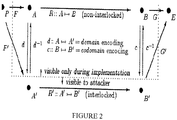
- This diagram applies to an interlock operating in isolation, where no significant data states precede the occurrence of the interlock and no significant data states follow it: i.e., such an interlock is derived by omissions from the interlock structure shown in Fig 2 on: the (interlock-information-) production code F' of the interlock, which sets up (interlock-information-) produced state A' from some normal prologue state P and transitions the state to A', and the (interlock-information-) consumption code of the interlock, which transitions the (interlock-information-) transferred state B' to some normal epilogue state E , are computed elsewhere.
- the (interlock-information-) production code F' of the interlock which sets up (interlock-information-) produced state A' from some normal prologue state P and transitions the state to A'
- the (interlock-information-) consumption code of the interlock which transitions the (interlock-information-) transferred state B' to some normal epi
- Figure 2 shows exactly the same inner structure as Figure 1 in a typical interlocking situation, where execution along the lower path is interlocked by diverting execution from the A-to-B path at some preceding state P onto the encoded or obfuscated A'-to-B' path, and then returned to normal, unencoded or unobfuscated computation at some unencoded or unobfuscated ending state E which ends the interlock.
- execution along the lower path is interlocked by diverting execution from the A-to-B path at some preceding state P onto the encoded or obfuscated A'-to-B' path, and then returned to normal, unencoded or unobfuscated computation at some unencoded or unobfuscated ending state E which ends the interlock.
- execution along the lower path is interlocked by diverting execution from the A-to-B path at some preceding state P onto the encoded or obfuscated A'-to-B' path, and then returned to
- prologue state P convert it to the produced state A' by production computation F', where A is related to A' by domain encoding relation d, convert A' to the transferred state B ⁇ by transfer computation R' , where B is related to B' by codomain encoding c, and convert B' to the epilogue state E by consumption computation G'.
- the components of the installed interlock are the production F', the produced state A', the transfer R', the transferred state B', and the consumption G'.
- the corresponding components before installation of the interlock are named by adding the prefix "pre" to indicate that the interlock installation modifications have not yet been made: the preproduction F, the preproduced state A, the pretransfer R, the pretransferred state B , and the preconsumption G .
- the prologue state P and the epilogue state E are present both before and after the interlock is installed.
- F' is derived from F by output extension (OE).
- OE output extension
- F OE P ⁇ A x J of F; i.e., we modify F to compute extra information J by output extension.
- F ' is an encoded version of an OE F OE of the original F .
- R':: A' ⁇ B' is derived from R:: A ⁇ B by aggregation.
- the original computation intervening between A and B, namely R: A ⁇ B, must be replaced by a computation which takes us from A' to B'.
- A' ( A ⁇ J )' .
- Preserving Information Functions which lose no information are well known in computer arithmetic and in finite rings and fields. For example, adding a constant c loses no information (the original can be recovered by subtracting c ); exclusive-or with c loses no information (the original can be recovered by a second exclusive-or with c ), multiplication by a nonsingular (i.e., invertible) matrix over a finite field or ring loses no information (the original vector is recovered by multiplying by its inverse), application of a deeply nonlinear bijective function to a vector, where the function is implemented according to the method described in The Solution: Use Wide-Input Deeply Nonlinear Functions loses no information (the original vector is retrieved by applying the inverse of that function derived as described in Inverting the Constructed Deeply Nonlinear Function ). A wide choice of such functions is available for anyone versed in the properties of computer arithmetic and college algebra.
- RPE reverse partial evaluation
- G RPE and B ⁇ K where the encoding of B ⁇ K is that chosen when we created R '.
- G' is an encoded version of an RPE G RPE of the original G . N.B. : The actual interlocked computation is R '.
- F, R, G, d , d - 1 , r, r - 1 and states A, B do not exist in the final implementation; they are only used during construction of the interlock production computation F', which transitions the state from P , not modified by insertion of the interlock, to A' , the state which sets up the interlock dependency, the interlocked computation R' , based on the non-interlocked computation R , where R' is the computation which carries the interlock dependency from state A' to state B', and the interlock epilogue computation G' , which transitions the state from B' back to E , the interlock epilogue state, which is not modified by the insertion of the interlock.
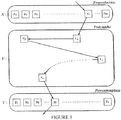
- FIG. 3 shows a path through the BB sets, pre-interlocking.
- the path would be similar, but instead of X,V,Y, x 1 ,x 2 ,x 3 ,...,x i ,...,x m , ⁇ ⁇ , ⁇ ⁇ , ⁇ ⁇ ,..., ⁇ ⁇ , y 1 ,y 2 , y 3 ,..., y j ,..., y n
- the BB set and BB labels would be X',V',Y' , x ' 1 , x ' 2 , x ' 3 ,..., x ' i ,..., x ' m , ⁇ ' ⁇ , ⁇ ⁇ ', ⁇ ' ⁇ ,..., ⁇ ' ⁇ , y ' 1 , y ' 2 , y ' 3 ,..., y
- state information as in the prologue states P 1 ,..., P m , the preproduced states A 1 ,...,A m, the produced states A ' 1 ,... A ' m , the pretransferred states B 1 , ...,B n , the transferred states B' 1 ,..., B' n , and the epilogue states E 1 ,...,E n , includes program counter information; i.e., the current execution position in the program is associated with the state.
- r i,j and s i , j is computed stepwise along the path which is originally ( ⁇ ⁇ ,..., ⁇ ⁇ ) and finally is ( ⁇ ' ⁇ ,..., ⁇ ' ⁇ ).
- BBs X perform computation F
- BB s Y perform computation G
- BB s X' perform computation F'
- BB s Y' perform computation G
- BB s V perform computation R
- BB s V' perform computation R '.
- Software can be rendered obscure by a variety of techniques affecting various aspects of the code: see, for example, [2, 3, 4, 5, 7, 9, 17, 18, 19, 20, 27]. Use of some of these techniques can also be used to make computation of the extra output of an output extension integral to the original computation: see, for example, [2, 3, 4, 5, 19].
- a purple duck in a flock of white ducks.
- Three exemplary ways to make a purple duck resemble the white ducks making up the remainder of its flock are: (1) color the purple duck white; (2) color the white ducks purple; or (3) color all of the ducks green.
- BA[ n ] 2 's Complement and Unsigned Comparative Properties Certain properties applying to 2's complement arithmetic and comparisons on signed and unsigned quantities with representation as elements of B n in the algebraic structure BA[ n ] of computer arithmetic on n -bit words are crucial for generating effective interlocks. We list them here.
- any variable can be represented as an additive equivalent; i.e., any value ⁇ can be represented as a sum of values ⁇ 1 + ⁇ + ⁇ k for some choice of ⁇ 1 ,..., ⁇ k . Indeed, if we fix all but ⁇ i in the list ⁇ 1 ,..., ⁇ k , we can still produce the desired sum ⁇ by appropriately choosing the unfixed ⁇ i of ⁇ 1 ,..., ⁇ k , where k ⁇ 2.
- n ⁇ m vector functions f and constant extraction functions g can be found by using the identities disclosed in [2,4, 5, 20], or disclosed or quoted in ⁇ 2.5.3 or disclosed in ⁇ 2.5.4, or identities found using the methods of ⁇ 2.5.1 or ⁇ 2.5.2, or identities found by applying the inverses provided by the mappings in [20] or their extension by means of the additional nonlinear mappings in ⁇ 2.7.7, or by any combination of the above, as would be evident to persons versed in the art of algebraic manipulation. Only straightforward derivations, readily performed by beginning college-level students of modular integer rings, and therefore readily automatable as manipulations performed by computer programs, need be considered --- this provides a huge variety of choices, more than sufficient to provide adequate obfuscation.
- the matrix method given above could employ a matrix over the infinite ring of the integers, and nevertheless return a value interpreted as a bit-string representing a polynomial over GF(2), with the bits of the constant representing the coefficients of the polynomial.
- Constant values of any size can be accommodated by generating the constants in segments, where each segment has a size convenient for the target platform of the software to be protected. For example, a matrix constant can be generated by using the above method separately, once per matrix element.
- the residue, bit-exploded, bit-imploded, custom-base, and bit-tabulated encodings of [2] and [4] can have significant overheads.
- encodings based on the finite ring Z/(2 n ), where n is the target computer word size in bits we can reduce the overhead and strengthen the security by employing the linear ring encodings of [20] and their polynomial extension to quadratic, cubic, and quartic polynomials with quadratic, cubic, and quartic polynomial inverses, as disclosed herein in ⁇ 2.7.7.
- the overhead of [3], or of ]3] extended according to ⁇ 2.7.3, can be substantial, since a lump (see column 16, item 5 in [3]) generally contains at least two pieces (see column 16, item 4 in[3]), and each piece is typically included in more than one lump, in order to achieve the m-to-n mapping (with m > 1 and n > 1) of functionality to locations in the code. That is, each individual computation in the code to be protected typically appears two or more times in the modified code in which the protections of [3] have been applied.
- Every piece is executed emulatively (i.e., to perform useful computation), in contrast to the normal behavior of code protected according to [3], in which some executions of a given occurrence of a piece in a given lump are emulative, while others are merely connective (i.e., carrying entropy around for randomization purposes, but not performing computations of the original program).
- substitution boxes SBs
- lookup tables i.e., lookup tables
- Such tables can be large, and a valuable alternative for such encodings is to employ arbitrary choices among the encodings of [20] with the enhancements thereto disclosed in ⁇ 2.7.7; i.e., instead of strictly random functions, employ permutation polynomials of orders 1 through 4 inclusive. For such functions, only the coefficients are needed rather than the entire tables, which may provide a very great space saving, and polynomials and their inverses according to the above methods are easily composed.
- any data transformation computed by an input-output-encoded implementation of such a blocked matrix representation which is implemented as a network of substitution boxes, or a similar devices for representing essentially arbitrary random functions, is linear up to I / O encoding; that is, any such transformation can be converted to a linear function by individually recoding each input vector element and individually recoding each output vector element.
- the attack method in [1] is a particular instance of a class of attacks based on homomorphic mapping.
- the attack takes advantage of the known properties of linear functions, in this case over GF (2 8 ) since that is the algebraic basis of the computations in the AES.
- addition in GF (2 n ) is performed using bitwise ⁇ (exclusive or ), and this function defines a Latin square of precisely known form.
- the Solution Use Wide-Input Deeply Nonlinear Functions.
- the solution is to replace such matrix functions with functions which are (1) wide-input; that is, the number of bits comprising a single input is large, so that the set of possible input values is extremely large, and (2) deeply nonlinear; that is, functions which cannot possibly be converted into linear functions by i/o encoding (i.e., by individually recoding individual inputs and individual outputs).
- G our chosen representation of GF (2 n ) (respectively, of Z/(2 n ))
- G u our chosen representation of GF (2 u ) (respectively, of Z/(2 n ))
- G v our chosen representation of GF (2 v ) (respectively, of Z/(2 v )).
- V W S 1 ⁇ T 1 , S 2 ⁇ T 2 , ... , S z ⁇ T z ; i.e., each element of interleave ( V , W ) is the concatenation of the corresponding element of V with the corresponding element of W .
- step (5) we may increase the number of g functions with randomly selected distinct groups of three inputs and one output, for which we must show that the f' instance count is not obtainable by matrix. The more of these we test, the more we ensure that f is not only deeply nonlinear, but is deeply nonlinear over all parts of its domain. We must balance the cost of such testing against the importance of obtaining a deeply nonlinear function which is guaranteed to be deeply nonlinear over more and more of its domain.
- a maximum distance separable (MDS) function ⁇ S p ⁇ S q
- S is a finite set and
- S is a finite field or finite ring and f is a function computed by a q ⁇ p matrix (an MDS matrix, since the vector transform it computes is MDS), say M , then any z ⁇ z matrix M' obtained by deleting all but z of the rows of M and then deleting all but z of the columns (where z ⁇ 1), is nonsingular; i.e., every square sub-matrix of M is nonsingular.
- Such MDS functions are important in cryptography: they are used to perform a kind of 'ideal mixing'.
- the AES cipher[15] employs an MDS function as one of the two state-element mixing functions in each of its rounds except the last.
- This method can be employed when function s (see step (3) of the construction) is constructed from a linear function s 1 and a final function s 2 is employed to map the output of s 1 onto ⁇ 0,..., k -1 ⁇ , where s 2 is computed as the remainder from dividing the s 1 , result by k. (If k is a power of two, we may compute s 2 by taking the log 2 k low-order bits of the s 1 result, which is a convenience, but is not actually required for our current purpose).
- [9] proposes to measure security by means of metrics which, while varying positively with the security of an implementation, do not provide a security metric measuring how much work an attacker must perform to penetrate the security.
- [5] provides a work-related metric: the metric is the number of distinct original computations, prior to encoding, which could map to exactly the same encoded computation. (This possibility arises because the meaning of an encoded computation depends on the context in which it occurs.
- the compositional inverse of a permutation polynomial of low degree is typically a permutation polynomial of very high degreeusually close to the size of the ring (i.e., close to the number of elements it contains, which for rings of size 2 32 or 2 64 is a very high degree indeed).
- the polynomial inverses in the quadratic (degree 2) or higher analogues of the method of [20] is prohibitively expensive due to the massive exponentiations needed to compute inverses.
- [9] proposes opaque computational values, and especially opaque predicates (see [9] ⁇ 6.1 column 15, ⁇ 8 column 26) for protecting control flow by making conditional branch (if) conditions obscure.
- a much better method is to transform predicates using substitutions according to the identities disclosed or quoted herein in ⁇ 2.5.3, or disclosed in ⁇ 2.5.4, or discovered by employing the methods given herein in ⁇ 2.5.1 and ⁇ 2.5.2, which provide virtually unlimited, and hence unsearchably large, sets of usable identities, or preferably a combination of two or more the above, thereby rendering these encodings incapable of analysis using tools such as Mathematic TM , Matlab TM , or Maple TM , due to the simultaneous use of multiple, profoundly different mathematical domains within computations, while incurring substantially less overhead in code bulk and permitting much faster execution.
- x f ( x 1 , x 2 )
- RNS residual number system
- a permutation polynomial is an invertible polynomial, such as the degree-1 (affine) polynomials used for encoding in [20] or the degree-2 (quadratic), degree-3 (cubic), and degree-4 (quartic) polynomials added thereto in ⁇ 2.7.7.
- Such permutation polynomials map elements to locations in a quasi-random, hash-table-like manner, and applying pre- and/or post-modifications of the indexing code employing substitutions according to the identities disclosed or quoted herein in ⁇ 2.5.3, or disclosed in ⁇ 2.5.4, or discovered by employing the methods given herein in ⁇ 2.5.1 and ⁇ 2.5.2, which provided access to an effectively unlimited, and hence unsearchably large, set of identities, or some combination of two or more of the above, will render such indexing computations incapable of analysis using tools such as Mathematica TM , Matlab TM , or Maple TM , due to the simultaneous use of multiple, profoundly different mathematical domains within computations, and will thus provide very much stronger obfuscation than that provided by the teachings of [9] ⁇ 7.2.2 without the enhancements disclosed here.
- the level of protection afforded by [19] can be further improved by post-modifying the intertwined computations and cascades employing substitutions according to the identities disclosed or quoted herein in ⁇ 2.5.3, or disclosed in ⁇ 2.5.4, or discovered by employing the methods given herein in ⁇ 2.5.1 and ⁇ 2.5.2, which provided access to an effectively unlimited, and hence unsearchably large, set of identities, or some combination of two or more of the above, thereby rendering the intertwined computations and cascades incapable of analysis using tools such as Mathematica TM , Matlab TM , or Maple TM , due to the simultaneous use of multiple, profoundly different mathematical domains within computations.
- tools such as Mathematica TM , Matlab TM , or Maple TM
- k be either a prime number, preferably the smallest prime at least as large as that dimension, or a number of the form 2 n , preferably choosing the smallest n for which 2 n is at least as large as that dimension.
- Z /( k ) GF( k )
- a matrix is invertible precisely if its determinant is nonzero.
- Z/(2 n ) is a modular ring with a modulus typically having fewer bits that the platform's preferred computational word has, so that (unlike the other contexts in which the instant disclosure employs such rings) the modulus operation must be performed explicitly by a bitwise ⁇ ( and ) operation which ands the results of computations with a mask containing all zeros except for n low-order 1-bits. In that case, the linear algebra must be adjusted since a matrix is only invertible if its determinant is odd.
- the permutation polynomials above should be of low degree (for example, of degrees 1, 2, 3, or 4), but with inverses of high degrees, since there is no need in this use of permutation polynomials for inverting the polynomials. This makes computation of the polynomials inexpensive and computation of their inverses expensive, which is just what we want: it gives us substantial obscurity at low cost. Finding such permutation polynomials is easy: most permutation polynomials of low degree have inverses of high degree.
- RPEs added to the computation of the preconsumption G computed in the preconsumption BB set Y when converting them into the consumption computation G' computed by the consumption BB set Y' must be essential; that is, the RPEs must be so combined with the normal computation which was present prior to installation of the interlock that the normal functionality can only occur, barring some extremely improbable coincidence, if the inputs expected by the rpe s on the basis of the production F' and the transfer R' have not suffered tampering.
- the preproduction MF F computed by the preproduction BB set X there may be values produced by computing F in X which are consumed by the preconsumption MF G computed by the preconsumption BB set Y , possibly after further modification by the pretransfer MF R computed by the pretransfer BB set V . Computation of these values is integral to the computation F by X, and normally, possibly after further modification by computation of R by V , they are essential to the computation of G by Y .
- Case 1 Absent or Weak X ⁇ Y Data Dependency. If there are no such values, or insufficiently many such values computed in the preproduction BB set X and subsequently employed in the preconsumption BB set Y , possibly after further modifications in the pretransfer BB set V , we must add or increase the number of such dependencies. After this has been done to a sufficient degree, we have established strong X ⁇ Y data dependency, and can proceed as indicated in Case 2: Strong X ⁇ Y Data Dependency below.
- any or all of the above methods may be further augmented by employing encodings obtained by further modifying those encodings listed in [2, 4, 5, 17, 18, 20] by employing the identities we disclose or quote in ⁇ 2.5.3, or disclose in ⁇ 2.5.4, or by means of identities created using the methods taught herein in ⁇ 2.5.1 or ⁇ 2.5.2, or identities found in the extension of [20] given in ⁇ 2.7.7.
- encodings obtained by further modifying those encodings listed in [2, 4, 5, 17, 18, 20] by employing the identities we disclose or quote in ⁇ 2.5.3, or disclose in ⁇ 2.5.4, or by means of identities created using the methods taught herein in ⁇ 2.5.1 or ⁇ 2.5.2, or identities found in the extension of [20] given in ⁇ 2.7.7.
- k is a constant
- ⁇ and ⁇ denote bitwise operations
- + is performed in the natural two's complement modular ring of the target hardware.
- Many such information-preserving alternatives would be obvious to those skilled in the art --- so many, in fact, that it would be easy to choose them algorithmically on the basis of a random input during interlock installation.
- v ' in some way related to v , then the likelihood of achieving the relationship accidentally by tampering decreases as the relationship becomes more restrictive.
- a randomly chosen member of BA[32] will match v on average only once in 2 32 ⁇ 4.29 ⁇ 10 9 random trials. However, a randomly chosen member of BA[32] will be typically be greater than, or less than, v , very much more often: i.e., these relations are not preferred because they are not very restrictive.
- Our preferred method for doing this is to take advantage of the fact that the contents of the variables whose states are captured in v + are identical (at this point) to the states of the corresponding variables captured in v , where the v + variables are a subset of the v variables.
- N.B. Above, we speak of using the original values and their duplicates. (More generally, this may be replaced with the original values and their related values, or the inputs to the computation of the original values and the duplicates or values related to those inputs.) Instead of using the original values and their duplicates, we may also employ values and duplicates which are computed by means of these values; i.e., using these values as inputs, even if these values are computed after execution of the code in Y. That is, we may use the duplicates from X' to create more duplicates in Y', and then employ those duplicates (or perhaps other forms of related values) in computations so as to induce highly probable failure when tampering occurs. This permits us many more choices of what copies to employ in generating code failing under tampering, thereby increasing the obscurity of the RPE G RPE which we choose when installing the interlock.
- Our preferred method of achieving this is to apply the same method or methods of injecting tamper-resistance to both the code added to create the interlocks and to the other code in the vicinity of that code, with the intensity of tamper-resistance varied from a high level for the interlock code itself and code in its immediate vicinity, to decreasing intensities for code increasingly remote from the interlock code, until finally we reach the greater bulk of the SBE's code, which may remain unchanged, since it is sufficiently remote from the interlock code so that no special protection is required to protect the installed interlocks.
- the intensity of the protection can be varied from high to low by transforming a greater or lesser number of computations, a greater or lesser number of values, and by choosing transformations with higher or lower overheads and correspondingly higher or lower security. Analysis of such choices is provided by [5]. Such methods are applicable to all interlock components.
- Additional tamper-resistance methods applicable to all interlock components can be obtained by combining any or all of [2, 4, 5, 9, 19, 20] or their extensions in ⁇ 2.7 and ⁇ 2.8 above with additional data and computation obfuscations obtained by adding any number of the identities disclosed or quoted in ⁇ 2.5.3, or disclosed in ⁇ 2.5.4, or generated by the methods in ⁇ 2.5.1 or ⁇ 2.5.2 to the identities employed to create the data and computation encodings of [2, 4, 5, 9, 19, 20], or the identities provided in the extension of [20] given in ⁇ 2.7.7.
- obfuscation of greater or lesser intensity can be obtained by performing larger or smaller numbers of substitutions of expressions in the code to be obfuscated, where the substitutions replace expressions by equivalent expressions according to the identities disclosed or quoted in ⁇ 2.5.3, or disclosed in ⁇ 2.5.5, or generated by the methods in ⁇ 2.5.1 or ⁇ 2.5.2 to the identities employed to create the data and computation encodings of [2, 4, 5, 9, 19, 20], or their extensions in ⁇ 2.7 and ⁇ 2.8.
- the number of such identities discoverable by such means grows so rapidly with the size of expressions that the supply of identities is virtually unlimited. Again, such obfuscation is applicable to all interlock components.
- Tamper-resistance is preferred to mere obfuscation, however, since tamper-resistance implies obscurity but also chaotic behavior under fault-injection attacks and other code-modification attacks.
- X is basically interlocked to Y by identities concerning pairs of values initially computed in an OE of F and then employed in an RPE of G computed by Z in such a fashion that tampering which causes the members of these pairs to differ will cause G RPE to fail to preserve the functionality of G; i.e., it will cause computation of G RPE to fail.
- BB set Y there is nothing forcing us to have only one such preconsumption BB set Y.
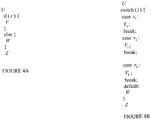
- condition c When a conditional binary branch occurs, as in the if-statement of Fig. 4(a) , the condition c , typically computed using values provided in U, controls which of V or W is executed. This in turn affects values which are used in Z and thereafter. Thus the effect of the if-statement is ultimately to determine an effect on the state of the variables of the program as seen by Z and its sequel. If we can produce that same conditional effect without making V and W strictly alternative to one another, we can produce the effect of the if-statement without the conditional branch controlled by c.
- conditional index i typically computed using values provided in U , controls which of V 1 or V 2 or ⁇ or V k or W is executed. This in turn affects values which are used in Z and thereafter.
- the effect of the switch-statement is ultimately to determine an effect on the state of the variables of the program as seen by Z and its sequel. If we can produce that same conditional effect without making V 1 ,..., V k , W strictly alternative to one another, we can produce the effect of the switch-statement without the conditional indexed branch controlled by i .
- Fig. 5(a) Two Alternatives: One Empty. We may also have an if-statement such as that in Fig. 5(a) , which is similar to that in Fig. 4(a) except that the else alternative is empty.
- Fig 5A there is illustrated pseudo-code for a conditional if statement with no else-code (i.e. an if statement which either executes the then-code or executes no code).
- Figure 5B shows pseudo-code for a statement analogous to that in Fig 5A but where the choice among alternatives which have code and those which have no code is made by indexed selection (i.e. by the use of a switch statement with multiple alternatives) rather than by a boolean (true or false) choice as was the case with the i f statement in Figure 5A .
- interlock to convert the preproduction computation into a production computation which packages a job for the server transfer computation, with the results received, unpackaged, and interpreted by a consumption computation on the same or a different client.
- the interlock is structured almost in the normal way, but a buffer containing many values is transmitted by the production client to the transfer server, and a buffer containing many values is transmitted by the transfer server to the consumption client.
- the transfer portion of the interlock is an interlock segment with the relational structure shown in Fig. 1 .
- the production and consumption portions of such a distributed interlock are interlock segments.
- the image (mass-data-encoded or otherwise) of the transmitted data may be encrypted by the sender and decrypted by the recipient using white box cryptographic methods according to [17, 18], with the improvements taught in ⁇ 2.7.5, which provides a cryptographic level of protection for the transmission of data images among distributed segments.
- X BB set which is a source of entropy, either because it has access to the program's inputs, from which we can compute a strong --- perhaps cryptographically strong --- hash, so that every small variation in the input drastically modifies the hash, or because it reads one or more effectively random sources such as the low-order bits of a highspeed hardware real-time clock or a randomness generation device which uses an unstable electronic process to produce 'noise' and convert it to a (genuinely) random bit stream.
- preproduction BB set comprising one or more hardware circuits having a high-level description in VHDL or some similar programming language
- preconsumption BB set also comprising one or more hardware circuits with a high-level description in VHDL or a VHDL-like language.
- Installing the interlock will change the preproduction set into the production set by modifying its VHDL or VHDL-like description much as it would be modified in the case of an ordinary programming language, thereby modifying the corresponding circuit created from the VHDL or VHDL-like description.
- installing the interlock will change the preconsumption set into the consumption set by modifying its VHDL or VHDL-like description much as it would be modified in the case of an ordinary programming language, thereby modifying the corresponding circuit created from the VHDL or VHDL-like description.
- the pretransfer software may be, or may include, a circuit or circuits describable in VHDL or a VHDL-like language.
- a circuit or circuits comprising a preproduction BB set is transformed into an encoded output extension (OE) of its original functionality;
- a circuit or circuits comprising a pretransfer BB set is transformed into an encoded intervening aggregation (IA) of its original functionality with some bijection transferring extended information from its inputs to its outputs;
- a circuit or circuits comprising a preconsumption BB set is transformed into an encoded reverse partial evaluation (RPE) of its original functionality.
- OE encoded output extension
- IA encoded intervening aggregation
- RPE reverse partial evaluation
- X ⁇ x 1 , ..., x m ⁇ as our preproduction BB set
- Y ⁇ y 1 ,..., y n ⁇ as our preconsumption BB set
- ⁇ the empty set
- checksums are computed using a cryptographically strong hash: a hash function which has the property that, given a value for the checksum, it is very difficult to find an array of integers, or modifications to an array of integers, which will cause the checksum to have that value.
- a cryptographically strong hash a hash function which has the property that, given a value for the checksum, it is very difficult to find an array of integers, or modifications to an array of integers, which will cause the checksum to have that value.
- algorithms for computing such checksums are MD5 [13] and SHA-1 [14].
- the preproduction BB set (normally just one BB) computes and checks the checksum; the check of the checksum controls a conditional branch to the checksum-success or checksum-failure destination; the BB sets (normally just one BB each) at the destination of the conditional branch are preconsumption BBs, and the condition is checksum matching or failure to match. Installing such a condition-dependent interlock causes execution to fail if an attacker modifies the checksum checking code (e.g., by jamming the branch).
- One approach is to divide the program to be protected into regions. Code in the current region (the region into which the program counter points) must be executable, but code in other regions need not be. We can take advantage of this fact to modify the image of the program prior to region-to-region transfers. Just before control transfers from region M to region N, the exit-code for region M modifies the code of M into an unexecutable state (except for the exit-code itself) and modifies the code of N into an executable state. This modification need not be large: a few bytes here and there are quite sufficient, if they are located strategically (e.g., if they form part of the code in the production BB set of an interlock, so that any small change causes failure).
- the program code has at least one state per region, in which that region is executable and others are not, and hence at least one checksum per state and hence per region. Checksum code executed in a given region uses the checksum appropriate for that region.
- a refinement is to employ multiple non-executable states and choose among them randomly (e.g., by selecting among them using the low-order bits of a real-time clock or process identifier or the like) or pseudo-randomly (e.g., by employing entropy from the inputs of the program to produce a hash and then employing the low-order bits of that hash to select among them). This increases the difficulty for the attacker in attempting to determine how to defeat such protections.
- code which performs the code-state change during region transfer is likely to be obvious since it will use special instructions or system calls to achieve the change.
- the final step is to interlock the computations which perform the state change with those which perform the next checksum check, and to perform interlock chaining among such code-state changes and checks. Then modifications to either the code-state changes or the code-state checks will cause chaotic behavior with high probability, thus frustrating any specific goals the attacker may have for behavioral changes to the code.
- each data-segment contains some combination of scalar variables, arrays of scalar variables, pointers to other such data-segments, and arrays of pointers to other data-segments, in which the data-segments are linked together so that, regarding each segment as a node, and pointers as defining arcs, the structure is a directed graph, most nodes have an out-degree greater than one, most nodes have an in-degree greater than one, and for most pairs of nodes, there is more than one path from that node to another node.
- Such a data structure can be implemented in the C or C++ programming languages or their allies as a series of structures (i.e., each is a structure in C or C++), containing scalar variables, arrays of scalar variables, pointer variables, and arrays of pointer variables), where the pointers are initialized either at program startup or at some subsequent time prior to their use as noted above for hiding a datum of some size.
- the structures can be dynamically allocated using the malloc () function or one of its allies in C or using the new operator in C++.
- the first method determines how we address a particular piece of data which is, or is an element of, the datum we are hiding.
- the second determines how that particular piece of data is stored (i.e., how it is encoded).
- a path in the repository comprises a sequence of values, where the values signify a series of scalar or pointer accesses. For example, we might assign numbers 1,...,64 to denote the first through 64 th scalar data fields in a struct (or elements, in an array), 65,...,128 to denote the first through 64 th pointer fields (or elements, in an array), 129,...,192 to denote the first through 64 th scalar array fields, 193,...,255 to denote the first through 63 rd pointer array fields, and 0 to denote the end of the path. All of these values can be stored in an (unsigned) eight-bit byte. Thus a path from the root data structure can be indicated by a string of bytes ending in a zero byte --- just as a string is normally represented in C.
- ⁇ 2.6 also discloses a method for ensuring that the constant path is a dynamic constant (see the section above entitled Adding Dynamic Randomness ); i.e., it is not predictable, at program startup --- or at repository startup if the repository is transientexactly which path will apply to a particular scalar stored in the repository: its path will vary among program runs, and among instantiations of the repository within a program run if the repository is transitory.
- any particular encoding is determined by its two coefficients: its scale, which should be odd, and its bias, which is unrestricted.
- Interlocking within library code where all components are within the library code itself, is just ordinary interlocking. There are variations, however, when some interlock components are in the library and others are in applications to which library code may be subsequently linked.
- linking to library code requires behavioral protection via interlocking --- e.g., to ensure that the correct library routine is called, rather than having its call omitted or diverted to some other routine, or to ensure that, on exit from the library routine, control is returned to the code following the call at the expected call site, rather than being diverted elsewhere.
- the difficulty is that library code, in a fixed and often simultaneously sharable piece of code usable by multiple processes on a given platform, such as a dynamically-accessed* shared object (a . so --- shared object --- file for Unix TM or Linux platforms; a . dlldynamically linked library --- file for Windows TM platforms) cannot be modified in order to install an interlock.
- a given group of library routines may be mapped into an application's address space at some time by a call to LoadLibrary(%), routines in it may be accessed using GetProcAddress(%), and after the application is finished with the group of routines, the group may be removed from the address space by calling FreeLibrary().
- Interlocking from Library Code to Caller Code Interlocking from a set X of BBs in the library code to the variable set Y of BBs in the application using the library code is straightforward: we convert the preproduction code into production code computing an integral OE in the usual way, we let the IA be the identity IA --- no modifications or transfer code required --- and we modify the preconsumption code receiving information from the library into the consumption RPE in the usual way. Encoding is applied to form X' and Y' in the usual way. The only difference is that information about X 's OE and the X' encoding must be saved so that it can be used in preparing the code for Y' s RPE and the Y' encoding for each of the calling application using the library code.
- Interlocking from Caller Code to Library Code It is the reverse form of interlocking, from a set X of preproduction BBs in the application employing the library code to a set Y of preconsumption BBs in the called library code which presents the problem, since the library code is created in advance without detailed knowledge of the calling application.
- Embodiments of the invention may be implemented in any conventional computer programming language.
- preferred embodiments may be implemented in a procedural programming language (e.g. "C") or an object oriented language (e.g. "C++").
- Alternative embodiments of the invention may be implemented as pre-programmed hardware elements, other related components, or as a combination of hardware and software components.
- Embodiments can be implemented as a computer program product for use with a computer system.
- Such implementation may include a series of computer instructions fixed either on a tangible medium, such as a computer readable medium (e.g., a diskette, CD-ROM, ROM, or fixed disk) or transmittable to a computer system, via a modem or other interface device, such as a communications adapter connected to a network over a medium.
- the medium may be either a tangible medium (e.g ., optical or electrical communications lines) or a medium implemented with wireless techniques (e.g., microwave, infrared or other transmission techniques).
- the series of computer instructions embodies all or part of the functionality previously described herein.
- Such computer instructions can be written in a number of programming languages for use with many computer architectures or operating systems. Furthermore, such instructions may be stored in any memory device, such as semiconductor, magnetic, optical or other memory devices, and may be transmitted using any communications technology, such as optical, infrared, microwave, or other transmission technologies. It is expected that such a computer program product may be distributed as a removable medium with accompanying printed or electronic documentation (e.g., shrink wrapped software), preloaded with a computer system (e.g., on system ROM or fixed disk), or distributed from a server over the network (e.g., the Internet or World Wide Web).
- a removable medium with accompanying printed or electronic documentation (e.g., shrink wrapped software), preloaded with a computer system (e.g., on system ROM or fixed disk), or distributed from a server over the network (e.g., the Internet or World Wide Web).
- embodiments of the invention may be implemented as a combination of both software (e.g., a computer program product) and hardware. Still other embodiments of the invention may be implemented as entirely hardware, or entirely software (e.g., a computer program product).
Landscapes
- Engineering & Computer Science (AREA)
- Computer Security & Cryptography (AREA)
- Software Systems (AREA)
- Theoretical Computer Science (AREA)
- Physics & Mathematics (AREA)
- General Physics & Mathematics (AREA)
- General Engineering & Computer Science (AREA)
- Computer Hardware Design (AREA)
- Technology Law (AREA)
- Multimedia (AREA)
- Signal Processing (AREA)
- Computer Networks & Wireless Communication (AREA)
- Storage Device Security (AREA)
- Stored Programmes (AREA)
- Compression, Expansion, Code Conversion, And Decoders (AREA)
Applications Claiming Priority (3)
| Application Number | Priority Date | Filing Date | Title |
|---|---|---|---|
| US11/709,654 US8752032B2 (en) | 2007-02-23 | 2007-02-23 | System and method of interlocking to protect software-mediated program and device behaviours |
| US11/980,392 US8161463B2 (en) | 2007-02-23 | 2007-10-31 | System and method of interlocking to protect software—mediated program and device behaviors |
| PCT/CA2008/000331 WO2008101340A1 (en) | 2007-02-23 | 2008-02-21 | System and method for interlocking to protect software-mediated program and device behaviours |
Publications (3)
| Publication Number | Publication Date |
|---|---|
| EP2126775A1 EP2126775A1 (en) | 2009-12-02 |
| EP2126775A4 EP2126775A4 (en) | 2011-02-09 |
| EP2126775B1 true EP2126775B1 (en) | 2017-11-01 |
Family
ID=39709589
Family Applications (2)
| Application Number | Title | Priority Date | Filing Date |
|---|---|---|---|
| EP08714653.6A Active EP2126775B1 (en) | 2007-02-23 | 2008-02-21 | System and method for interlocking to protect software-mediated program and device behaviours |
| EP08714655.1A Active EP2126776B1 (en) | 2007-02-23 | 2008-02-21 | System and method for interlocking to protect software-mediated program and device behaviours |
Family Applications After (1)
| Application Number | Title | Priority Date | Filing Date |
|---|---|---|---|
| EP08714655.1A Active EP2126776B1 (en) | 2007-02-23 | 2008-02-21 | System and method for interlocking to protect software-mediated program and device behaviours |
Country Status (8)
| Country | Link |
|---|---|
| US (5) | US8752032B2 (enExample) |
| EP (2) | EP2126775B1 (enExample) |
| CN (2) | CN101622627B (enExample) |
| AR (1) | AR065443A1 (enExample) |
| CA (2) | CA2678951C (enExample) |
| IN (1) | IN2009DN05762A (enExample) |
| TW (1) | TW200905559A (enExample) |
| WO (1) | WO2008101341A1 (enExample) |
Families Citing this family (170)
| Publication number | Priority date | Publication date | Assignee | Title |
|---|---|---|---|---|
| US7581103B2 (en) * | 2001-06-13 | 2009-08-25 | Intertrust Technologies Corporation | Software self-checking systems and methods |
| GB2405958A (en) * | 2003-08-20 | 2005-03-16 | Macrovision Europ Ltd | Code obfuscation and controlling a processor by emulation |
| US8752032B2 (en) | 2007-02-23 | 2014-06-10 | Irdeto Canada Corporation | System and method of interlocking to protect software-mediated program and device behaviours |
| US9299120B2 (en) | 2007-03-23 | 2016-03-29 | Thomson Licensing Llc | Modifying a coded bitstream |
| CN101681499B (zh) * | 2007-06-14 | 2013-04-24 | 汤姆逊许可证公司 | 修改经编码的比特流 |
| CN101911153B (zh) * | 2008-01-21 | 2014-08-20 | 日本电信电话株式会社 | 秘密计算系统、秘密计算方法、秘密计算装置 |
| US7890480B2 (en) * | 2008-02-11 | 2011-02-15 | International Business Machines Corporation | Processing of deterministic user-defined functions using multiple corresponding hash tables |
| US9081962B2 (en) * | 2008-04-30 | 2015-07-14 | Graeme Harkness | Anti-tamper techniques |
| US8800048B2 (en) * | 2008-05-20 | 2014-08-05 | Microsoft Corporation | Software protection through interdependent parameter cloud constrained software execution |
| US8429637B2 (en) * | 2008-09-02 | 2013-04-23 | Apple Inc. | System and method for conditional expansion obfuscation |
| US8020125B1 (en) * | 2008-09-10 | 2011-09-13 | Cadence Design Systems, Inc. | System, methods and apparatus for generation of simulation stimulus |
| EP2342661A4 (en) * | 2008-09-16 | 2013-02-20 | File System Labs Llc | METHODS AND DEVICES FOR CORRECTING ERRORS AND ERASER CODE BASED ON MATRIX AND APPLICATIONS THEREOF |
| US8484630B2 (en) * | 2008-12-23 | 2013-07-09 | International Business Machines Corporation | Code motion based on live ranges in an optimizing compiler |
| FR2942559B1 (fr) * | 2009-02-24 | 2016-05-20 | European Aeronautic Defence And Space Company - Eads France | Procede de protection du code source d'un programme d'ordinateur. |
| CN102449951B (zh) * | 2009-03-31 | 2015-09-23 | 皇家飞利浦有限公司 | 用于在电子组件中执行密码任务的方法 |
| JP5808019B2 (ja) * | 2009-05-06 | 2015-11-10 | イルデト ビー ヴイIrdeto B.V. | ホワイトボックス暗号化技術を用いるインターロックされたバイナリ保護 |
| US20100329448A1 (en) * | 2009-06-30 | 2010-12-30 | Rane Shantanu D | Method for Secure Evaluation of a Function Applied to Encrypted Signals |
| US8843762B2 (en) * | 2009-09-04 | 2014-09-23 | Gradiant, Centro Tecnolóxico de Telecomunicacións de Galicia | Cryptographic system for performing secure iterative computations and signal processing directly on encrypted data in untrusted environments |
| US8433925B2 (en) * | 2009-09-04 | 2013-04-30 | Gradiant | Cryptographic system for performing secure computations and signal processing directly on encrypted data in untrusted environments |
| US8972742B2 (en) | 2009-09-04 | 2015-03-03 | Gradiant | System for secure image recognition |
| US8752029B2 (en) * | 2009-09-29 | 2014-06-10 | Microsoft Corporation | Computing a symbolic bound for a procedure |
| US9134977B2 (en) * | 2010-02-26 | 2015-09-15 | Red Hat, Inc. | Compiler operation for handling conditional statements |
| EP2550622A4 (en) * | 2010-03-25 | 2013-08-28 | Irdeto Canada Corp | SYSTEM AND METHOD FOR GENERATING DYNAMIC AND VARIABLE OPERATING PATHS IN TIME TO PROVIDE RESISTANCE TO CHANNEL-SIDE ATTACKS AND REPEATED INVOCATION ATTACKS |
| US20120089494A1 (en) * | 2010-10-08 | 2012-04-12 | Microsoft Corporation | Privacy-Preserving Metering |
| EP2477110A1 (en) * | 2011-01-14 | 2012-07-18 | Wibu-Systems AG | Method for protecting an application program against reverse engineering and related computer program product |
| US8707053B2 (en) * | 2011-02-09 | 2014-04-22 | Apple Inc. | Performing boolean logic operations using arithmetic operations by code obfuscation |
| US8384415B2 (en) | 2011-02-15 | 2013-02-26 | James M. Lewis | Method and system for identifying counterfeit programmable logic devices |
| US8837715B2 (en) | 2011-02-17 | 2014-09-16 | Gradiant, Centro Tecnolóxico de Telecomunicacións de Galica | Method and apparatus for secure iterative processing and adaptive filtering |
| JP2012173870A (ja) * | 2011-02-18 | 2012-09-10 | Toshiba Corp | 半導体装置及びメモリ保護方法 |
| US8752027B2 (en) * | 2011-09-14 | 2014-06-10 | Microsoft Corporation | Injecting faults into program for testing software |
| US20130097431A1 (en) * | 2011-10-18 | 2013-04-18 | Paul Marion Hriljac | Systems and methods of source software code modification |
| DK2586959T4 (en) * | 2011-10-28 | 2017-01-09 | Cedes Ag | Safety device, closure and evaluation unit |
| CN104981813B (zh) * | 2012-03-30 | 2018-08-07 | 爱迪德技术有限公司 | 使用动态数据识别编码来保护可访问的系统 |
| US8976960B2 (en) | 2012-04-02 | 2015-03-10 | Apple Inc. | Methods and apparatus for correlation protected processing of cryptographic operations |
| US9015681B1 (en) | 2012-08-10 | 2015-04-21 | The Mathworks, Inc. | Creating and using array creation routines or a family of routines separate from algorithmic code |
| US9244667B2 (en) | 2012-08-10 | 2016-01-26 | The Mathworks, Inc. | Mechanism for transforming between type-independent and type-specific code |
| US9146750B2 (en) | 2012-08-10 | 2015-09-29 | The Mathworks, Inc. | Mechanism for replacing an array creation routine within code |
| WO2014046974A2 (en) | 2012-09-20 | 2014-03-27 | Case Paul Sr | Case secure computer architecture |
| CN104603755B (zh) | 2012-09-28 | 2017-11-14 | 英特尔公司 | 循环向量化方法和设备 |
| US9336370B2 (en) | 2012-12-06 | 2016-05-10 | Apple Inc. | Method and apparatus for dynamic obfuscation of static data |
| US9262639B2 (en) | 2013-01-09 | 2016-02-16 | Cisco Technology Inc. | Plaintext injection attack protection |
| WO2014112548A1 (ja) * | 2013-01-17 | 2014-07-24 | 日本電信電話株式会社 | 秘匿計算システム、演算装置、秘匿計算方法、およびプログラム |
| US10523422B2 (en) * | 2013-01-17 | 2019-12-31 | Nippon Telegraph And Telephone Corporation | Tampering detection device, tampering detection method and program |
| IL224743A0 (en) | 2013-02-14 | 2013-06-27 | Harel Cain | A system for automatic obfuscation of computer programs |
| US11044076B2 (en) * | 2013-02-25 | 2021-06-22 | Hecusys, LLC | Encrypted data processing |
| US9721120B2 (en) * | 2013-05-14 | 2017-08-01 | Apple Inc. | Preventing unauthorized calls to a protected function |
| CN104182661A (zh) * | 2013-05-24 | 2014-12-03 | 富泰华工业(深圳)有限公司 | 软件保护系统 |
| US8881293B1 (en) * | 2013-07-01 | 2014-11-04 | Sap Se | Static application security testing |
| KR101328012B1 (ko) * | 2013-08-12 | 2013-11-13 | 숭실대학교산학협력단 | 애플리케이션 코드 난독화 장치 및 그 방법 |
| US9218437B1 (en) * | 2013-09-27 | 2015-12-22 | Amazon Technologies, Inc. | Systems and methods providing event data |
| US9361379B1 (en) | 2013-09-27 | 2016-06-07 | Amazon Technologies, Inc. | Systems and methods providing recommendation data |
| US9021606B1 (en) * | 2013-09-27 | 2015-04-28 | Amazon Technologies, Inc. | Systems and methods providing format data |
| CN105765896B (zh) * | 2013-12-05 | 2020-02-07 | 皇家飞利浦有限公司 | 用于表格网络的迭代应用的计算设备 |
| GB201400992D0 (en) | 2014-01-21 | 2014-03-05 | Metaforic Ltd | Method of protecting dynamic cryptographic keys |
| CN103793248B (zh) * | 2014-01-23 | 2017-02-01 | 北京奇虎科技有限公司 | 一种应用程序升级的方法及装置 |
| EP2913772A1 (de) * | 2014-02-28 | 2015-09-02 | Wibu-Systems AG | Verfahren und Computersystem zum Schutz eines Computerprogramms gegen Beeinflussung |
| US9425952B2 (en) * | 2014-03-27 | 2016-08-23 | Samsung Israel Research Corporation | Algebraic manipulation detection codes from algebraic curves |
| GB201405754D0 (en) * | 2014-03-31 | 2014-05-14 | Irdeto Bv | Protecting an item of software comprising conditional code |
| EP3127269B1 (en) * | 2014-03-31 | 2018-07-11 | Irdeto B.V. | Protecting an item of software |
| US9858440B1 (en) * | 2014-05-23 | 2018-01-02 | Shape Security, Inc. | Encoding of sensitive data |
| FR3024007B1 (fr) * | 2014-07-16 | 2016-08-26 | Viaccess Sa | Procede d'acces a un contenu multimedia protege par un terminal |
| EP2983156B1 (fr) * | 2014-08-06 | 2019-07-24 | Secure-IC SAS | Système et procédé de protection de circuit |
| US9454659B1 (en) * | 2014-08-15 | 2016-09-27 | Securisea, Inc. | Software vulnerabilities detection system and methods |
| US10599852B2 (en) | 2014-08-15 | 2020-03-24 | Securisea, Inc. | High performance software vulnerabilities detection system and methods |
| US9824214B2 (en) * | 2014-08-15 | 2017-11-21 | Securisea, Inc. | High performance software vulnerabilities detection system and methods |
| SG10201405852QA (en) | 2014-09-18 | 2016-04-28 | Huawei Internat Pte Ltd | Encryption function and decryption function generating method, encryption and decryption method and related apparatuses |
| CN106716345A (zh) | 2014-09-30 | 2017-05-24 | 皇家飞利浦有限公司 | 用于执行混淆算术的电子计算设备 |
| RU2710310C2 (ru) | 2014-12-12 | 2019-12-25 | Конинклейке Филипс Н.В. | Электронное устройство формирования |
| BR112017013069A2 (pt) * | 2014-12-22 | 2018-02-27 | Koninklijke Philips Nv | dispositivo e método de cálculo eletrônico, e programa de computador |
| MX2017009586A (es) * | 2015-01-27 | 2018-04-24 | Arris Entpr Llc | Ofuscacion para proteccion de medios de transmision y otros flujos de datos. |
| US20160328539A1 (en) * | 2015-05-05 | 2016-11-10 | Nxp B.V. | Obscuring Software Code With Split Variables |
| US10068070B2 (en) * | 2015-05-05 | 2018-09-04 | Nxp B.V. | White-box elliptic curve point multiplication |
| US9658836B2 (en) * | 2015-07-02 | 2017-05-23 | Microsoft Technology Licensing, Llc | Automated generation of transformation chain compatible class |
| US9733993B2 (en) | 2015-07-02 | 2017-08-15 | Microsoft Technology Licensing, Llc | Application sharing using endpoint interface entities |
| US9860145B2 (en) | 2015-07-02 | 2018-01-02 | Microsoft Technology Licensing, Llc | Recording of inter-application data flow |
| US9733915B2 (en) | 2015-07-02 | 2017-08-15 | Microsoft Technology Licensing, Llc | Building of compound application chain applications |
| US9712472B2 (en) | 2015-07-02 | 2017-07-18 | Microsoft Technology Licensing, Llc | Application spawning responsive to communication |
| US10198252B2 (en) | 2015-07-02 | 2019-02-05 | Microsoft Technology Licensing, Llc | Transformation chain application splitting |
| US9785484B2 (en) | 2015-07-02 | 2017-10-10 | Microsoft Technology Licensing, Llc | Distributed application interfacing across different hardware |
| US10261985B2 (en) | 2015-07-02 | 2019-04-16 | Microsoft Technology Licensing, Llc | Output rendering in dynamic redefining application |
| US9626181B2 (en) * | 2015-07-06 | 2017-04-18 | Dell Products L.P. | Systems and methods to securely inject binary images and code into firmware |
| US10198405B2 (en) | 2015-07-08 | 2019-02-05 | Microsoft Technology Licensing, Llc | Rule-based layout of changing information |
| US10031724B2 (en) | 2015-07-08 | 2018-07-24 | Microsoft Technology Licensing, Llc | Application operation responsive to object spatial status |
| US10277582B2 (en) | 2015-08-27 | 2019-04-30 | Microsoft Technology Licensing, Llc | Application service architecture |
| US9946853B1 (en) * | 2015-09-17 | 2018-04-17 | Symantec Corporation | Techniques for application code obfuscation |
| FR3047373B1 (fr) * | 2016-01-28 | 2018-01-05 | Morpho | Procede de calcul securise multipartite protege contre une partie malveillante |
| EP3208789B1 (en) * | 2016-02-22 | 2020-08-05 | Eshard | Method of protecting a circuit against a side-channel analysis |
| US10235218B2 (en) * | 2016-05-03 | 2019-03-19 | International Business Machines Corporation | Automatic correction of cryptographic application program interfaces |
| US10243937B2 (en) * | 2016-07-08 | 2019-03-26 | Nxp B.V. | Equality check implemented with secret sharing |
| US11030618B1 (en) | 2016-09-30 | 2021-06-08 | Winkk, Inc. | Authentication and personal data sharing for partner services using out-of-band optical mark recognition |
| US9760349B1 (en) * | 2016-11-09 | 2017-09-12 | Red Hat, Inc. | Managing different software dependencies associated with source code |
| WO2018108275A1 (en) * | 2016-12-15 | 2018-06-21 | Irdeto B.V. | Software integrity verification |
| EP3557445A4 (en) | 2016-12-30 | 2019-11-27 | Huawei Technologies Co., Ltd. | TRANSACTION PROCESSING AND DEVICE |
| CA3051990C (en) | 2017-02-23 | 2021-03-23 | Cerebras Systems Inc. | Accelerated deep learning |
| CN106934260B (zh) * | 2017-03-14 | 2020-03-17 | 北京深思数盾科技股份有限公司 | 代码保护方法、装置、服务器及存储介质 |
| EP3385735B1 (en) * | 2017-04-04 | 2019-12-04 | Secure-IC SAS | Device and method for detecting points of failures |
| WO2018189728A1 (en) | 2017-04-14 | 2018-10-18 | Cerebras Systems Inc. | Floating-point unit stochastic rounding for accelerated deep learning |
| US11488004B2 (en) | 2017-04-17 | 2022-11-01 | Cerebras Systems Inc. | Neuron smearing for accelerated deep learning |
| US10515303B2 (en) | 2017-04-17 | 2019-12-24 | Cerebras Systems Inc. | Wavelet representation for accelerated deep learning |
| US11475282B2 (en) | 2017-04-17 | 2022-10-18 | Cerebras Systems Inc. | Microthreading for accelerated deep learning |
| CN108809619B (zh) * | 2017-04-27 | 2022-11-29 | 郑珂威 | 用于完全同态加密的精度控制及累计误差消除方法 |
| CN107194212B (zh) * | 2017-06-21 | 2020-04-17 | 株洲中车时代电气股份有限公司 | 一种显示器源代码中协议内容的保护方法 |
| US10097538B1 (en) * | 2017-08-12 | 2018-10-09 | Growpath, Inc. | User authentication systems and methods |
| US10887235B2 (en) | 2017-08-24 | 2021-01-05 | Google Llc | Method of executing a tuple graph program across a network |
| US10599482B2 (en) | 2017-08-24 | 2020-03-24 | Google Llc | Method for intra-subgraph optimization in tuple graph programs |
| US10642582B2 (en) | 2017-08-24 | 2020-05-05 | Google Llc | System of type inference for tuple graph programs method of executing a tuple graph program across a network |
| US10489585B2 (en) | 2017-08-29 | 2019-11-26 | Red Hat, Inc. | Generation of a random value for a child process |
| CN109697451B (zh) * | 2017-10-23 | 2022-01-07 | 北京京东尚科信息技术有限公司 | 相似图像聚类方法及装置、存储介质、电子设备 |
| US12519610B2 (en) * | 2018-02-21 | 2026-01-06 | Cryptography Research, Inc. | Efficient computation of bivariate statistical moments for side channel vulnerability evaluation |
| EP3534253A1 (en) * | 2018-02-28 | 2019-09-04 | Koninklijke Philips N.V. | Compiling device and method |
| US10810077B1 (en) * | 2018-06-11 | 2020-10-20 | Ambarella International Lp | Rapid soft-error detection |
| EP3591550A1 (en) | 2018-07-06 | 2020-01-08 | Koninklijke Philips N.V. | A compiler device with masking function |
| US10521613B1 (en) | 2018-08-08 | 2019-12-31 | Carlos Manuel Gonzalez | Adaptive standalone secure software |
| US10762179B2 (en) | 2018-08-08 | 2020-09-01 | Irdeto B.V. | System and method for watermarking software |
| US11321087B2 (en) * | 2018-08-29 | 2022-05-03 | Cerebras Systems Inc. | ISA enhancements for accelerated deep learning |
| US20200104127A1 (en) * | 2018-09-28 | 2020-04-02 | Carnegie Mellon University | Coded computation strategies for distributed matrix-matrix and matrix-vector products |
| EP3874364A4 (en) * | 2018-10-29 | 2022-08-03 | Cryptography Research, Inc. | Constant time secure arithmetic-to-boolean mask conversion |
| US11764940B2 (en) | 2019-01-10 | 2023-09-19 | Duality Technologies, Inc. | Secure search of secret data in a semi-trusted environment using homomorphic encryption |
| JP6832375B2 (ja) * | 2019-02-25 | 2021-02-24 | ウィンボンド エレクトロニクス コーポレーション | 半導体集積回路をリバースエンジニアリングから保護する方法 |
| JP7564819B2 (ja) | 2019-03-25 | 2024-10-09 | オーロラ ラブズ リミテッド | コード行挙動および関係モデルの発生ならびに署名 |
| US11263316B2 (en) * | 2019-08-20 | 2022-03-01 | Irdeto B.V. | Securing software routines |
| WO2021074867A1 (en) | 2019-10-16 | 2021-04-22 | Cerebras Systems Inc. | Advanced wavelet filtering for accelerated deep learning |
| WO2021074795A1 (en) | 2019-10-16 | 2021-04-22 | Cerebras Systems Inc. | Dynamic routing for accelerated deep learning |
| US11574045B2 (en) | 2019-12-10 | 2023-02-07 | Winkk, Inc. | Automated ID proofing using a random multitude of real-time behavioral biometric samplings |
| US11553337B2 (en) | 2019-12-10 | 2023-01-10 | Winkk, Inc. | Method and apparatus for encryption key exchange with enhanced security through opti-encryption channel |
| US12149510B1 (en) | 2019-12-13 | 2024-11-19 | Tripleblind Holdings, Inc. | Systems and methods for providing a private multi-modal artificial intelligence platform |
| US11531782B1 (en) * | 2022-05-13 | 2022-12-20 | TripleBlind, Inc. | Systems and methods for finding a value in a combined list of private values |
| US12388799B1 (en) | 2019-12-13 | 2025-08-12 | Selfiie Corporation | Systems and methods for providing a split inference approach to protect data and model |
| US11599671B1 (en) | 2019-12-13 | 2023-03-07 | TripleBlind, Inc. | Systems and methods for finding a value in a combined list of private values |
| US12088565B2 (en) | 2019-12-13 | 2024-09-10 | Triplelind Holdings, Inc. | Systems and methods for privacy preserving training and inference of decentralized recommendation systems from decentralized data |
| CN111176610B (zh) * | 2019-12-27 | 2022-03-25 | 北京百度网讯科技有限公司 | 量子随机数生成方法、装置、电子设备及存储介质 |
| US12099997B1 (en) | 2020-01-31 | 2024-09-24 | Steven Mark Hoffberg | Tokenized fungible liabilities |
| US11188316B2 (en) * | 2020-03-09 | 2021-11-30 | International Business Machines Corporation | Performance optimization of class instance comparisons |
| US11204985B2 (en) * | 2020-03-31 | 2021-12-21 | Irdeto Canada Corporation | Systems, methods, and storage media for creating secured computer code having entangled transformations |
| US11669613B2 (en) * | 2020-05-29 | 2023-06-06 | EnSoft Corp. | Method for analyzing and verifying software for safety and security |
| KR102803025B1 (ko) * | 2020-06-11 | 2025-05-07 | 라인플러스 주식회사 | 클래스 분산 및 순차적 메모리 적재를 이용한 파일 보호 방법 및 시스템 |
| US11782685B2 (en) | 2020-06-17 | 2023-10-10 | Bank Of America Corporation | Software code vectorization converter |
| US11573775B2 (en) | 2020-06-17 | 2023-02-07 | Bank Of America Corporation | Software code converter for resolving redundancy during code development |
| US11347500B2 (en) | 2020-06-17 | 2022-05-31 | Bank Of America Corporation | Software code converter for resolving conflicts during code development |
| CN111881462A (zh) * | 2020-07-17 | 2020-11-03 | 张睿 | 一种商用密码应用加密有效性的在线分析技术 |
| US11621837B2 (en) | 2020-09-03 | 2023-04-04 | Theon Technology Llc | Secure encryption of data using partial-key cryptography |
| US11310042B2 (en) | 2020-09-11 | 2022-04-19 | Crown Sterling Limited, LLC | Methods of storing and distributing large keys |
| US11029920B1 (en) * | 2020-10-21 | 2021-06-08 | Chariot Technologies Lab, Inc. | Execution of a conditional statement by an arithmetic and/or bitwise unit |
| US12517712B2 (en) | 2020-10-21 | 2026-01-06 | Chariot Technologies Lab, Inc. | Execution of a conditional statement by an arithmetic and/or bitwise unit |
| US11528136B2 (en) | 2020-11-24 | 2022-12-13 | Crown Sterling Limited, LLC | Decryption of encrypted data missing a private key |
| EP4033381A1 (en) * | 2021-01-25 | 2022-07-27 | Thales Dis Cpl Usa, Inc. | Software obfuscation method using an opaque predicate based on multiplying mixed boolean-arithmetic expressions |
| US11687440B2 (en) * | 2021-02-02 | 2023-06-27 | Thales Dis Cpl Usa, Inc. | Method and device of protecting a first software application to generate a protected software application |
| US11438314B2 (en) | 2021-02-10 | 2022-09-06 | Yahoo Assets Llc | Automatic privacy-aware machine learning method and apparatus |
| CN113158184B (zh) * | 2021-03-03 | 2023-05-19 | 中国人民解放军战略支援部队信息工程大学 | 基于有限状态自动机的攻击脚本生成方法及相关装置 |
| US12190131B2 (en) * | 2021-03-25 | 2025-01-07 | Tata Consultancy Services Limited | Method and system for function call and variable access based relaxed backward slicing |
| CN113014439B (zh) * | 2021-04-19 | 2021-10-26 | 广州大一互联网络科技有限公司 | 一种数据中心带宽的虚拟弹性管理方法 |
| CN113268455B (zh) * | 2021-04-26 | 2022-07-26 | 卡斯柯信号(成都)有限公司 | 基于布尔逻辑的联锁数据自动配置方法及系统 |
| CN117981268A (zh) | 2021-07-16 | 2024-05-03 | 美国莱迪思半导体公司 | 通信系统和方法 |
| CN113626841B (zh) * | 2021-08-10 | 2024-10-29 | 萨思数字科技(北京)有限公司 | 基于多方安全计算的选择问题处理方法 |
| US11755772B2 (en) | 2021-09-20 | 2023-09-12 | Crown Sterling Limited, LLC | Securing data in a blockchain with a one-time pad |
| TW202324967A (zh) * | 2021-11-03 | 2023-06-16 | 美商艾銳勢企業有限責任公司 | 用大整數值進行編碼的白箱處理 |
| US11791988B2 (en) | 2021-11-22 | 2023-10-17 | Theon Technology Llc | Use of random entropy in cryptography |
| US11943336B2 (en) | 2021-11-22 | 2024-03-26 | Theon Technology Llc | Use of gradient decent function in cryptography |
| US11902420B2 (en) | 2021-11-23 | 2024-02-13 | Theon Technology Llc | Partial cryptographic key transport using one-time pad encryption |
| US11762762B1 (en) * | 2022-03-24 | 2023-09-19 | Xilinx, Inc. | Static and automatic inference of inter-basic block burst transfers for high-level synthesis |
| DE102022115195A1 (de) * | 2022-06-17 | 2023-12-28 | Infineon Technologies Ag | Verarbeitung von kryptografischen Daten |
| US12438731B2 (en) | 2022-09-21 | 2025-10-07 | Winkk, Inc. | Diophantine system for digital signatures |
| TWI852148B (zh) | 2022-10-28 | 2024-08-11 | 財團法人工業技術研究院 | 用於聯邦學習的資料隱私保護方法、伺服器裝置與客戶端裝置 |
| US12261952B2 (en) | 2022-11-04 | 2025-03-25 | Crown Sterling Limited, LLC | Multiple vector one-time key pad |
| US12488166B2 (en) | 2022-11-28 | 2025-12-02 | Xilinx, Inc. | Implementing burst transfers for predicated memory accesses in loop bodies for high-level synthesis |
| US12250310B2 (en) | 2023-01-09 | 2025-03-11 | Crown Sterling Limited, LLC | Use of irrational numbers in elliptic curve cryptography |
| US12210644B2 (en) * | 2023-06-09 | 2025-01-28 | Content Square SAS | Obfuscation |
| EP4524785A1 (en) * | 2023-09-13 | 2025-03-19 | Thales Dis France Sas | Method to secure a software code |
| EP4575846A1 (en) * | 2023-12-21 | 2025-06-25 | Nagravision Sàrl | Method and device for obfuscating code control flow |
| CN119011628B (zh) * | 2024-09-06 | 2025-07-04 | 桂林理工大学 | 一种物联网中多维数据的聚合方法、系统、设备及介质 |
Family Cites Families (28)
| Publication number | Priority date | Publication date | Assignee | Title |
|---|---|---|---|---|
| BE1003932A6 (fr) | 1989-04-28 | 1992-07-22 | Musyck Emile | Systeme cryptographique par bloc de donnees binaires. |
| US6088452A (en) * | 1996-03-07 | 2000-07-11 | Northern Telecom Limited | Encoding technique for software and hardware |
| US5892899A (en) * | 1996-06-13 | 1999-04-06 | Intel Corporation | Tamper resistant methods and apparatus |
| CN1155700A (zh) * | 1996-09-08 | 1997-07-30 | 周跃平 | 计算机软件保护方法 |
| US6192475B1 (en) * | 1997-03-31 | 2001-02-20 | David R. Wallace | System and method for cloaking software |
| CA2293650C (en) * | 1997-06-09 | 2012-09-25 | Christian Sven Collberg | Obfuscation techniques for enhancing software security |
| US6594761B1 (en) * | 1999-06-09 | 2003-07-15 | Cloakware Corporation | Tamper resistant software encoding |
| US7430670B1 (en) * | 1999-07-29 | 2008-09-30 | Intertrust Technologies Corp. | Software self-defense systems and methods |
| US6779114B1 (en) * | 1999-08-19 | 2004-08-17 | Cloakware Corporation | Tamper resistant software-control flow encoding |
| US7757097B2 (en) * | 1999-09-03 | 2010-07-13 | Purdue Research Foundation | Method and system for tamperproofing software |
| US7287166B1 (en) * | 1999-09-03 | 2007-10-23 | Purdue Research Foundation | Guards for application in software tamperproofing |
| CA2298990A1 (en) * | 2000-02-18 | 2001-08-18 | Cloakware Corporation | Method and system for resistance to power analysis |
| CA2305078A1 (en) * | 2000-04-12 | 2001-10-12 | Cloakware Corporation | Tamper resistant software - mass data encoding |
| CA2327911A1 (en) * | 2000-12-08 | 2002-06-08 | Cloakware Corporation | Obscuring functions in computer software |
| FR2820914A1 (fr) * | 2001-02-15 | 2002-08-16 | Bull Cp8 | Procede de securisation d'un ensemble electronique mettant en oeuvre en algorithme cryptographique utilisant des operations booleennes et des operations arithmetiques, et systeme embarque correspondant |
| CA2348355A1 (en) * | 2001-05-24 | 2002-11-24 | Cloakware Corporation | General scheme of using encodings in computations |
| US7243340B2 (en) * | 2001-11-15 | 2007-07-10 | Pace Anti-Piracy | Method and system for obfuscation of computer program execution flow to increase computer program security |
| CA2363795A1 (en) | 2001-11-26 | 2003-05-26 | Cloakware Corporation | Computer system protection by communication diversity |
| CA2369304A1 (en) * | 2002-01-30 | 2003-07-30 | Cloakware Corporation | A protocol to hide cryptographic private keys |
| WO2005086569A2 (en) | 2004-01-27 | 2005-09-22 | Livo Technologies S.A. | System, method and apparatus for electronic authentication |
| US7966499B2 (en) * | 2004-01-28 | 2011-06-21 | Irdeto Canada Corporation | System and method for obscuring bit-wise and two's complement integer computations in software |
| US7827223B2 (en) | 2004-04-22 | 2010-11-02 | Fortress Gb Ltd. | Accelerated throughput synchronized word stream cipher, message authenticator and zero-knowledge output random number generator |
| JP4622807B2 (ja) | 2005-03-25 | 2011-02-02 | ソニー株式会社 | 暗号処理装置、および暗号処理方法、並びにコンピュータ・プログラム |
| US8036274B2 (en) | 2005-08-12 | 2011-10-11 | Microsoft Corporation | SIMD lapped transform-based digital media encoding/decoding |
| EP1947584B1 (en) * | 2006-12-21 | 2009-05-27 | Telefonaktiebolaget LM Ericsson (publ) | Obfuscating computer program code |
| US8752032B2 (en) * | 2007-02-23 | 2014-06-10 | Irdeto Canada Corporation | System and method of interlocking to protect software-mediated program and device behaviours |
| US8185749B2 (en) * | 2008-09-02 | 2012-05-22 | Apple Inc. | System and method for revising boolean and arithmetic operations |
| WO2012126083A1 (en) * | 2011-03-24 | 2012-09-27 | Irdeto Canada Corporation | System and method providing dependency networks throughout applications for attack resistance |
-
2007
- 2007-02-23 US US11/709,654 patent/US8752032B2/en active Active
- 2007-10-31 US US11/980,392 patent/US8161463B2/en active Active
-
2008
- 2008-02-21 CA CA2678951A patent/CA2678951C/en not_active Expired - Fee Related
- 2008-02-21 WO PCT/CA2008/000333 patent/WO2008101341A1/en not_active Ceased
- 2008-02-21 CA CA2678953A patent/CA2678953C/en not_active Expired - Fee Related
- 2008-02-21 EP EP08714653.6A patent/EP2126775B1/en active Active
- 2008-02-21 CN CN2008800060715A patent/CN101622627B/zh active Active
- 2008-02-21 IN IN5762DEN2009 patent/IN2009DN05762A/en unknown
- 2008-02-21 CN CN2008800059421A patent/CN101627394B/zh active Active
- 2008-02-21 EP EP08714655.1A patent/EP2126776B1/en active Active
- 2008-02-22 AR ARP080100743A patent/AR065443A1/es unknown
- 2008-02-22 TW TW097106229A patent/TW200905559A/zh unknown
-
2014
- 2014-04-30 US US14/266,252 patent/US20150074803A1/en not_active Abandoned
-
2015
- 2015-04-08 US US14/682,073 patent/US10402547B2/en active Active
-
2016
- 2016-01-12 US US14/993,887 patent/US9910971B2/en active Active
Non-Patent Citations (1)
| Title |
|---|
| MARJANNE PLASMANS: "White-Box Cryptography for Digital Content Protection", 1 May 2005 (2005-05-01), XP055269189, Retrieved from the Internet <URL:http://alexandria.tue.nl/extra1/afstversl/wsk-i/plasmans2005.pdf> [retrieved on 20160428] * |
Also Published As
| Publication number | Publication date |
|---|---|
| CA2678951C (en) | 2020-03-24 |
| US8161463B2 (en) | 2012-04-17 |
| EP2126775A4 (en) | 2011-02-09 |
| CA2678953C (en) | 2017-10-03 |
| EP2126776A1 (en) | 2009-12-02 |
| AR065443A1 (es) | 2009-06-10 |
| CN101627394A (zh) | 2010-01-13 |
| CN101622627B (zh) | 2012-05-09 |
| US10402547B2 (en) | 2019-09-03 |
| US20080216051A1 (en) | 2008-09-04 |
| WO2008101341A1 (en) | 2008-08-28 |
| US9910971B2 (en) | 2018-03-06 |
| US20080208560A1 (en) | 2008-08-28 |
| US20160239647A1 (en) | 2016-08-18 |
| CA2678951A1 (en) | 2008-08-28 |
| IN2009DN05762A (enExample) | 2015-07-24 |
| CN101627394B (zh) | 2013-07-17 |
| EP2126776A4 (en) | 2011-02-09 |
| US8752032B2 (en) | 2014-06-10 |
| US20150213239A1 (en) | 2015-07-30 |
| CN101622627A (zh) | 2010-01-06 |
| US20150074803A1 (en) | 2015-03-12 |
| CA2678953A1 (en) | 2008-08-28 |
| EP2126776B1 (en) | 2017-11-15 |
| EP2126775A1 (en) | 2009-12-02 |
| TW200905559A (en) | 2009-02-01 |
Similar Documents
| Publication | Publication Date | Title |
|---|---|---|
| EP2126776B1 (en) | System and method for interlocking to protect software-mediated program and device behaviours | |
| EP2831795B1 (en) | Securing accessible systems using variable dependent coding | |
| EP2656266B1 (en) | Improvements relating to cryptography using polymorphic code | |
| WO2003090021A2 (en) | Security framework for protecting rights in computer software | |
| EP1192516A1 (en) | Tamper resistant software encoding | |
| WO2008101340A1 (en) | System and method for interlocking to protect software-mediated program and device behaviours | |
| Mercadier et al. | OBSCURE: Versatile software obfuscation from a lightweight secure element | |
| Plasmans | White-box cryptography for digital content protection |
Legal Events
| Date | Code | Title | Description |
|---|---|---|---|
| PUAI | Public reference made under article 153(3) epc to a published international application that has entered the european phase |
Free format text: ORIGINAL CODE: 0009012 |
|
| 17P | Request for examination filed |
Effective date: 20090901 |
|
| AK | Designated contracting states |
Kind code of ref document: A1 Designated state(s): AT BE BG CH CY CZ DE DK EE ES FI FR GB GR HR HU IE IS IT LI LT LU LV MC MT NL NO PL PT RO SE SI SK TR |
|
| DAX | Request for extension of the european patent (deleted) | ||
| A4 | Supplementary search report drawn up and despatched |
Effective date: 20110112 |
|
| 17Q | First examination report despatched |
Effective date: 20120912 |
|
| RAP1 | Party data changed (applicant data changed or rights of an application transferred) |
Owner name: IRDETO CANADA CORPORATION |
|
| RAP1 | Party data changed (applicant data changed or rights of an application transferred) |
Owner name: IRDETO B.V. |
|
| STAA | Information on the status of an ep patent application or granted ep patent |
Free format text: STATUS: EXAMINATION IS IN PROGRESS |
|
| GRAP | Despatch of communication of intention to grant a patent |
Free format text: ORIGINAL CODE: EPIDOSNIGR1 |
|
| STAA | Information on the status of an ep patent application or granted ep patent |
Free format text: STATUS: GRANT OF PATENT IS INTENDED |
|
| RIC1 | Information provided on ipc code assigned before grant |
Ipc: G06F 21/14 20130101AFI20161130BHEP |
|
| RIC1 | Information provided on ipc code assigned before grant |
Ipc: G06F 21/14 20130101ALI20161207BHEP Ipc: G06F 21/55 20130101AFI20161207BHEP |
|
| INTG | Intention to grant announced |
Effective date: 20161222 |
|
| GRAJ | Information related to disapproval of communication of intention to grant by the applicant or resumption of examination proceedings by the epo deleted |
Free format text: ORIGINAL CODE: EPIDOSDIGR1 |
|
| REG | Reference to a national code |
Ref country code: DE Ref legal event code: R079 Ref document number: 602008052748 Country of ref document: DE Free format text: PREVIOUS MAIN CLASS: G06F0021220000 Ipc: G06F0021550000 |
|
| STAA | Information on the status of an ep patent application or granted ep patent |
Free format text: STATUS: EXAMINATION IS IN PROGRESS |
|
| GRAP | Despatch of communication of intention to grant a patent |
Free format text: ORIGINAL CODE: EPIDOSNIGR1 |
|
| STAA | Information on the status of an ep patent application or granted ep patent |
Free format text: STATUS: GRANT OF PATENT IS INTENDED |
|
| INTC | Intention to grant announced (deleted) | ||
| RIC1 | Information provided on ipc code assigned before grant |
Ipc: G06F 21/55 20130101AFI20170502BHEP Ipc: G06F 21/14 20130101ALI20170502BHEP Ipc: H04L 9/00 20060101ALI20170502BHEP |
|
| INTG | Intention to grant announced |
Effective date: 20170516 |
|
| GRAS | Grant fee paid |
Free format text: ORIGINAL CODE: EPIDOSNIGR3 |
|
| GRAA | (expected) grant |
Free format text: ORIGINAL CODE: 0009210 |
|
| STAA | Information on the status of an ep patent application or granted ep patent |
Free format text: STATUS: THE PATENT HAS BEEN GRANTED |
|
| AK | Designated contracting states |
Kind code of ref document: B1 Designated state(s): AT BE BG CH CY CZ DE DK EE ES FI FR GB GR HR HU IE IS IT LI LT LU LV MC MT NL NO PL PT RO SE SI SK TR |
|
| REG | Reference to a national code |
Ref country code: GB Ref legal event code: FG4D |
|
| REG | Reference to a national code |
Ref country code: CH Ref legal event code: EP Ref country code: AT Ref legal event code: REF Ref document number: 942705 Country of ref document: AT Kind code of ref document: T Effective date: 20171115 |
|
| REG | Reference to a national code |
Ref country code: IE Ref legal event code: FG4D |
|
| REG | Reference to a national code |
Ref country code: DE Ref legal event code: R096 Ref document number: 602008052748 Country of ref document: DE |
|
| REG | Reference to a national code |
Ref country code: NL Ref legal event code: FP |
|
| REG | Reference to a national code |
Ref country code: LT Ref legal event code: MG4D |
|
| REG | Reference to a national code |
Ref country code: AT Ref legal event code: MK05 Ref document number: 942705 Country of ref document: AT Kind code of ref document: T Effective date: 20171101 |
|
| PG25 | Lapsed in a contracting state [announced via postgrant information from national office to epo] |
Ref country code: NO Free format text: LAPSE BECAUSE OF FAILURE TO SUBMIT A TRANSLATION OF THE DESCRIPTION OR TO PAY THE FEE WITHIN THE PRESCRIBED TIME-LIMIT Effective date: 20180201 Ref country code: FI Free format text: LAPSE BECAUSE OF FAILURE TO SUBMIT A TRANSLATION OF THE DESCRIPTION OR TO PAY THE FEE WITHIN THE PRESCRIBED TIME-LIMIT Effective date: 20171101 Ref country code: LT Free format text: LAPSE BECAUSE OF FAILURE TO SUBMIT A TRANSLATION OF THE DESCRIPTION OR TO PAY THE FEE WITHIN THE PRESCRIBED TIME-LIMIT Effective date: 20171101 Ref country code: ES Free format text: LAPSE BECAUSE OF FAILURE TO SUBMIT A TRANSLATION OF THE DESCRIPTION OR TO PAY THE FEE WITHIN THE PRESCRIBED TIME-LIMIT Effective date: 20171101 Ref country code: SE Free format text: LAPSE BECAUSE OF FAILURE TO SUBMIT A TRANSLATION OF THE DESCRIPTION OR TO PAY THE FEE WITHIN THE PRESCRIBED TIME-LIMIT Effective date: 20171101 |
|
| PG25 | Lapsed in a contracting state [announced via postgrant information from national office to epo] |
Ref country code: GR Free format text: LAPSE BECAUSE OF FAILURE TO SUBMIT A TRANSLATION OF THE DESCRIPTION OR TO PAY THE FEE WITHIN THE PRESCRIBED TIME-LIMIT Effective date: 20180202 Ref country code: LV Free format text: LAPSE BECAUSE OF FAILURE TO SUBMIT A TRANSLATION OF THE DESCRIPTION OR TO PAY THE FEE WITHIN THE PRESCRIBED TIME-LIMIT Effective date: 20171101 Ref country code: AT Free format text: LAPSE BECAUSE OF FAILURE TO SUBMIT A TRANSLATION OF THE DESCRIPTION OR TO PAY THE FEE WITHIN THE PRESCRIBED TIME-LIMIT Effective date: 20171101 Ref country code: BG Free format text: LAPSE BECAUSE OF FAILURE TO SUBMIT A TRANSLATION OF THE DESCRIPTION OR TO PAY THE FEE WITHIN THE PRESCRIBED TIME-LIMIT Effective date: 20180201 Ref country code: HR Free format text: LAPSE BECAUSE OF FAILURE TO SUBMIT A TRANSLATION OF THE DESCRIPTION OR TO PAY THE FEE WITHIN THE PRESCRIBED TIME-LIMIT Effective date: 20171101 Ref country code: IS Free format text: LAPSE BECAUSE OF FAILURE TO SUBMIT A TRANSLATION OF THE DESCRIPTION OR TO PAY THE FEE WITHIN THE PRESCRIBED TIME-LIMIT Effective date: 20180301 |
|
| PG25 | Lapsed in a contracting state [announced via postgrant information from national office to epo] |
Ref country code: CY Free format text: LAPSE BECAUSE OF FAILURE TO SUBMIT A TRANSLATION OF THE DESCRIPTION OR TO PAY THE FEE WITHIN THE PRESCRIBED TIME-LIMIT Effective date: 20171101 Ref country code: DK Free format text: LAPSE BECAUSE OF FAILURE TO SUBMIT A TRANSLATION OF THE DESCRIPTION OR TO PAY THE FEE WITHIN THE PRESCRIBED TIME-LIMIT Effective date: 20171101 Ref country code: SK Free format text: LAPSE BECAUSE OF FAILURE TO SUBMIT A TRANSLATION OF THE DESCRIPTION OR TO PAY THE FEE WITHIN THE PRESCRIBED TIME-LIMIT Effective date: 20171101 Ref country code: CZ Free format text: LAPSE BECAUSE OF FAILURE TO SUBMIT A TRANSLATION OF THE DESCRIPTION OR TO PAY THE FEE WITHIN THE PRESCRIBED TIME-LIMIT Effective date: 20171101 Ref country code: EE Free format text: LAPSE BECAUSE OF FAILURE TO SUBMIT A TRANSLATION OF THE DESCRIPTION OR TO PAY THE FEE WITHIN THE PRESCRIBED TIME-LIMIT Effective date: 20171101 |
|
| REG | Reference to a national code |
Ref country code: DE Ref legal event code: R097 Ref document number: 602008052748 Country of ref document: DE |
|
| PG25 | Lapsed in a contracting state [announced via postgrant information from national office to epo] |
Ref country code: PL Free format text: LAPSE BECAUSE OF FAILURE TO SUBMIT A TRANSLATION OF THE DESCRIPTION OR TO PAY THE FEE WITHIN THE PRESCRIBED TIME-LIMIT Effective date: 20171101 Ref country code: RO Free format text: LAPSE BECAUSE OF FAILURE TO SUBMIT A TRANSLATION OF THE DESCRIPTION OR TO PAY THE FEE WITHIN THE PRESCRIBED TIME-LIMIT Effective date: 20171101 Ref country code: IT Free format text: LAPSE BECAUSE OF FAILURE TO SUBMIT A TRANSLATION OF THE DESCRIPTION OR TO PAY THE FEE WITHIN THE PRESCRIBED TIME-LIMIT Effective date: 20171101 |
|
| PLBE | No opposition filed within time limit |
Free format text: ORIGINAL CODE: 0009261 |
|
| STAA | Information on the status of an ep patent application or granted ep patent |
Free format text: STATUS: NO OPPOSITION FILED WITHIN TIME LIMIT |
|
| REG | Reference to a national code |
Ref country code: CH Ref legal event code: PL |
|
| PG25 | Lapsed in a contracting state [announced via postgrant information from national office to epo] |
Ref country code: MC Free format text: LAPSE BECAUSE OF FAILURE TO SUBMIT A TRANSLATION OF THE DESCRIPTION OR TO PAY THE FEE WITHIN THE PRESCRIBED TIME-LIMIT Effective date: 20171101 |
|
| 26N | No opposition filed |
Effective date: 20180802 |
|
| GBPC | Gb: european patent ceased through non-payment of renewal fee |
Effective date: 20180221 |
|
| REG | Reference to a national code |
Ref country code: IE Ref legal event code: MM4A |
|
| REG | Reference to a national code |
Ref country code: BE Ref legal event code: MM Effective date: 20180228 |
|
| PG25 | Lapsed in a contracting state [announced via postgrant information from national office to epo] |
Ref country code: LU Free format text: LAPSE BECAUSE OF NON-PAYMENT OF DUE FEES Effective date: 20180221 Ref country code: SI Free format text: LAPSE BECAUSE OF FAILURE TO SUBMIT A TRANSLATION OF THE DESCRIPTION OR TO PAY THE FEE WITHIN THE PRESCRIBED TIME-LIMIT Effective date: 20171101 Ref country code: LI Free format text: LAPSE BECAUSE OF NON-PAYMENT OF DUE FEES Effective date: 20180228 Ref country code: CH Free format text: LAPSE BECAUSE OF NON-PAYMENT OF DUE FEES Effective date: 20180228 |
|
| REG | Reference to a national code |
Ref country code: FR Ref legal event code: ST Effective date: 20181031 |
|
| PG25 | Lapsed in a contracting state [announced via postgrant information from national office to epo] |
Ref country code: IE Free format text: LAPSE BECAUSE OF NON-PAYMENT OF DUE FEES Effective date: 20180221 |
|
| PG25 | Lapsed in a contracting state [announced via postgrant information from national office to epo] |
Ref country code: FR Free format text: LAPSE BECAUSE OF NON-PAYMENT OF DUE FEES Effective date: 20180228 Ref country code: BE Free format text: LAPSE BECAUSE OF NON-PAYMENT OF DUE FEES Effective date: 20180228 Ref country code: GB Free format text: LAPSE BECAUSE OF NON-PAYMENT OF DUE FEES Effective date: 20180221 |
|
| PG25 | Lapsed in a contracting state [announced via postgrant information from national office to epo] |
Ref country code: MT Free format text: LAPSE BECAUSE OF NON-PAYMENT OF DUE FEES Effective date: 20180221 |
|
| PG25 | Lapsed in a contracting state [announced via postgrant information from national office to epo] |
Ref country code: TR Free format text: LAPSE BECAUSE OF FAILURE TO SUBMIT A TRANSLATION OF THE DESCRIPTION OR TO PAY THE FEE WITHIN THE PRESCRIBED TIME-LIMIT Effective date: 20171101 |
|
| PG25 | Lapsed in a contracting state [announced via postgrant information from national office to epo] |
Ref country code: PT Free format text: LAPSE BECAUSE OF FAILURE TO SUBMIT A TRANSLATION OF THE DESCRIPTION OR TO PAY THE FEE WITHIN THE PRESCRIBED TIME-LIMIT Effective date: 20171101 Ref country code: HU Free format text: LAPSE BECAUSE OF FAILURE TO SUBMIT A TRANSLATION OF THE DESCRIPTION OR TO PAY THE FEE WITHIN THE PRESCRIBED TIME-LIMIT; INVALID AB INITIO Effective date: 20080221 |
|
| PGFP | Annual fee paid to national office [announced via postgrant information from national office to epo] |
Ref country code: NL Payment date: 20260220 Year of fee payment: 19 |
|
| PGFP | Annual fee paid to national office [announced via postgrant information from national office to epo] |
Ref country code: DE Payment date: 20260220 Year of fee payment: 19 |